EP3355247B1 - Verfahren zum betrieb eines neuronalen netzwerks, zugehöriges netzwerk, vorrichtung und computerprogrammprodukt - Google Patents
Verfahren zum betrieb eines neuronalen netzwerks, zugehöriges netzwerk, vorrichtung und computerprogrammprodukt Download PDFInfo
- Publication number
- EP3355247B1 EP3355247B1 EP17193559.6A EP17193559A EP3355247B1 EP 3355247 B1 EP3355247 B1 EP 3355247B1 EP 17193559 A EP17193559 A EP 17193559A EP 3355247 B1 EP3355247 B1 EP 3355247B1
- Authority
- EP
- European Patent Office
- Prior art keywords
- rns
- input data
- data
- residue number
- number system
- Prior art date
- Legal status (The legal status is an assumption and is not a legal conclusion. Google has not performed a legal analysis and makes no representation as to the accuracy of the status listed.)
- Active
Links
Images




Classifications
-
- G—PHYSICS
- G06—COMPUTING OR CALCULATING; COUNTING
- G06N—COMPUTING ARRANGEMENTS BASED ON SPECIFIC COMPUTATIONAL MODELS
- G06N3/00—Computing arrangements based on biological models
- G06N3/02—Neural networks
- G06N3/06—Physical realisation, i.e. hardware implementation of neural networks, neurons or parts of neurons
- G06N3/063—Physical realisation, i.e. hardware implementation of neural networks, neurons or parts of neurons using electronic means
-
- G—PHYSICS
- G06—COMPUTING OR CALCULATING; COUNTING
- G06N—COMPUTING ARRANGEMENTS BASED ON SPECIFIC COMPUTATIONAL MODELS
- G06N3/00—Computing arrangements based on biological models
- G06N3/02—Neural networks
- G06N3/04—Architecture, e.g. interconnection topology
- G06N3/045—Combinations of networks
-
- G—PHYSICS
- G06—COMPUTING OR CALCULATING; COUNTING
- G06N—COMPUTING ARRANGEMENTS BASED ON SPECIFIC COMPUTATIONAL MODELS
- G06N5/00—Computing arrangements using knowledge-based models
- G06N5/04—Inference or reasoning models
- G06N5/046—Forward inferencing; Production systems
-
- G—PHYSICS
- G06—COMPUTING OR CALCULATING; COUNTING
- G06F—ELECTRIC DIGITAL DATA PROCESSING
- G06F17/00—Digital computing or data processing equipment or methods, specially adapted for specific functions
- G06F17/10—Complex mathematical operations
- G06F17/16—Matrix or vector computation, e.g. matrix-matrix or matrix-vector multiplication, matrix factorization
-
- G—PHYSICS
- G06—COMPUTING OR CALCULATING; COUNTING
- G06F—ELECTRIC DIGITAL DATA PROCESSING
- G06F7/00—Methods or arrangements for processing data by operating upon the order or content of the data handled
- G06F7/60—Methods or arrangements for performing computations using a digital non-denominational number representation, i.e. number representation without radix; Computing devices using combinations of denominational and non-denominational quantity representations, e.g. using difunction pulse trains, STEELE computers, phase computers
- G06F7/72—Methods or arrangements for performing computations using a digital non-denominational number representation, i.e. number representation without radix; Computing devices using combinations of denominational and non-denominational quantity representations, e.g. using difunction pulse trains, STEELE computers, phase computers using residue arithmetic
- G06F7/729—Methods or arrangements for performing computations using a digital non-denominational number representation, i.e. number representation without radix; Computing devices using combinations of denominational and non-denominational quantity representations, e.g. using difunction pulse trains, STEELE computers, phase computers using residue arithmetic using representation by a residue number system
-
- G—PHYSICS
- G06—COMPUTING OR CALCULATING; COUNTING
- G06N—COMPUTING ARRANGEMENTS BASED ON SPECIFIC COMPUTATIONAL MODELS
- G06N3/00—Computing arrangements based on biological models
- G06N3/02—Neural networks
- G06N3/04—Architecture, e.g. interconnection topology
- G06N3/0464—Convolutional networks [CNN, ConvNet]
-
- G—PHYSICS
- G06—COMPUTING OR CALCULATING; COUNTING
- G06N—COMPUTING ARRANGEMENTS BASED ON SPECIFIC COMPUTATIONAL MODELS
- G06N3/00—Computing arrangements based on biological models
- G06N3/02—Neural networks
- G06N3/08—Learning methods
- G06N3/082—Learning methods modifying the architecture, e.g. adding, deleting or silencing nodes or connections
-
- G—PHYSICS
- G06—COMPUTING OR CALCULATING; COUNTING
- G06N—COMPUTING ARRANGEMENTS BASED ON SPECIFIC COMPUTATIONAL MODELS
- G06N7/00—Computing arrangements based on specific mathematical models
- G06N7/01—Probabilistic graphical models, e.g. probabilistic networks
-
- G—PHYSICS
- G06—COMPUTING OR CALCULATING; COUNTING
- G06N—COMPUTING ARRANGEMENTS BASED ON SPECIFIC COMPUTATIONAL MODELS
- G06N7/00—Computing arrangements based on specific mathematical models
- G06N7/02—Computing arrangements based on specific mathematical models using fuzzy logic
- G06N7/023—Learning or tuning the parameters of a fuzzy system
Definitions
- the description relates to neural networks.
- a neural network is a computational architecture that attempts to identify underlying relationships in a set of data by using a process that mimics the way the human brain operates.
- Neural networks have the ability of adapting to changing inputs so that a network may produce a best possible result without redesigning the output criteria.
- Neural networks are widely used e.g. to extract patterns and detect trends that are too complex to be noticed by either humans or other computer techniques.
- neural networks Some advantages of using neural networks (NNs) include, for instance:
- the invention relates to a method according to the preamble of claim 1, which is known, for instance, from the documents by H. Nakahara et al. mentioned on page 13.
- An object of one or more embodiments is to contribute in meeting such a demand.
- One or more embodiments may also relate to a corresponding apparatus and to a corresponding computer program product loadable into the memory of at least one processing device and including software code portions for executing the steps of the method when the product is run on at least one computer.
- a computer program product is understood as being equivalent to reference to a computer-readable means containing instructions for controlling the processing system in order to coordinate implementation of the method according to one or more embodiments.
- Reference to "at least one processor device" is intended to highlight the possibility for one or more embodiments to be implemented in modular and/or distributed form.
- One or more embodiments may be based on the recognition that noise tolerance of NNs can motivate simplifications in hardware complexity.
- One or more embodiments may provide a procedure for approximating operations by using low-precision arithmetic in accelerating a forward propagation step of CNNs.
- One or more embodiments may involve a procedure for "tuning up" system parameters which may handle a reduced resolution while minimizing rounding and overflow errors.
- One or more embodiments may decrease hardware complexity of e.g. dot product operators and enable a parallelized implementation operating on values represented with few bits, with minimal loss in the overall accuracy of the network.
- One or more embodiments may facilitate e.g. recent advances in deep learning that use large, deep neural networks (DNNs) with tens of millions of units suitable for a number of applications requiring real time processing.
- DNNs deep neural networks
- CNNs convolutional neural networks
- a wide range of embedded systems may involve e.g. low-power CNN accelerators for applications such as Internet of Things (IoT) or smart sensors, etc.
- the resolution of adders and multipliers may be related to the resolution of residues, which in general is smaller than the resolution of the original values. Potentially, this may represent an advantage in terms of both power consumption and storage efficiency, with respect to standard 16/32-bit Multiply and ACcumulate units or blocks (MACs) or other low-precision MAC units.
- MACs 16/32-bit Multiply and ACcumulate units or blocks (MACs) or other low-precision MAC units.
- the fragmentation of e.g. a dot product operator as allowed by a RNS solution is adapted to be described as N-parallel sub operators with a (much) smaller bit width. This may lead to a quadratic complexity reduction (e.g. number of gates) for multipliers while at the same time improving the latency of the units (e.g. twice as fast for an 8 bit implementation vs. a 16 bit implementation).
- complexity reduction and timing improvements may occur (also) for adders with a linear scale with respect to the number of bits.
- One or more embodiments may involve area and latency reductions which, may lead to a significant decrease in power consumption in comparison with a conventional representation, static for area and dynamic for latency.
- references to "an embodiment” or “one embodiment” in the framework of the present description is intended to indicate that a particular configuration, structure, or characteristic described in relation to the embodiment is comprised in at least one embodiment.
- phrases such as “in an embodiment” or “in one embodiment” that may be present in one or more points of the present description do not necessarily refer to one and the same embodiment.
- particular conformations, structures, or characteristics may be combined in any adequate way in one or more embodiments.
- One or more embodiments may contribute to accelerating forward propagation in neural networks.
- CNNs Convolutional neural networks
- DNNs deep neural networks
- DNNs are neural networks structured in successive layers of computing units and may have different architectures.
- a neural network architecture may be described as a "tuple" (I, U, O, E) consisting of a set I of input sites, a set U of computing units, a set O of output sites and a set E of weighted directed edges.
- a directed edge is a tuple (i, o, w) where i ⁇ I ⁇ U, o ⁇ U ⁇ O and w ⁇ R .
- input data to the input units may be images, but also other kinds of digital signals: acoustic signals, bio-medical signals, inertial signals from gyroscopes and accelerometers may be exemplary of these.
- the output sites are called output units, and they are computing units whose results constitute the output of the network.
- the units are grouped in successive levels, called layers, such that there are connections only from the units of a layer to the units of the successive layer.
- the direction of propagation of the information may be unilateral e.g. of a feed-forward type, starting from the input layer and proceeding through the hidden layers up to the output layer.
- u k denotes the number of units of the layer k
- a i k i 1
- W ( k ) denotes the matrix of the weights from the units of layer k to the units of layer ( k + 1 ); it is not defined for the output layer.
- the element (i, j) of matrix W ( k ) is the value of the weight from the unit a i k to the unit a j k + 1 .
- Such weights may be learned via a back-propagation algorithm.
- an additional unit a u k + 1 k denoted as the bias unit can be considered (e.g. with a value fixed to 1) which allows shifting the activation function to the left or right.
- a computing unit a i k + 1 may perform a computation which can be described as a combination of two functions:
- operation (execution) of a neural network as exemplified herein may involve a computation of the activations of the computing units following the direction of the network, e.g. with propagation of information from the input layer to the output layer. This procedure is called forward propagation.
- Figure 1 is exemplary of a network arrangement as discussed in the foregoing, including L + 1 layers, including an input layer IL (layer 0), hidden layers HL (e.g. layer 1, layer 2, ...) and an output layer OL (layer L).
- L + 1 layers including an input layer IL (layer 0), hidden layers HL (e.g. layer 1, layer 2, ...) and an output layer OL (layer L).
- CNNs correspond to the basic layout of deep neural networks discussed previously and include neurons with "learnable" weight and bias values. Each neuron may receive some inputs and perform a specific computation, which may optionally include an activation function.
- CNNs may combine three architectural ideas to facilitate achieving some degree of shift and distortion invariance: local receptive fields, shared weights, and, sometimes, spatial or temporal subsampling.
- a CNN may include three types of layers:
- a CNN architecture may include some pairs of a convolutional layers followed by a subsampling layer, and then final fully-connected layers.
- the input to a CNN may include e.g. a 2-dimensional or a 3-dimensional matrix
- the convolutional and subsampling layers may receive a multi-dimensional matrix as an input and provide a multi-dimensional matrix as an output.
- These matrices are denoted as the input or output features, and each value in these matrices is denoted as a pixel.
- pooling layers perform some form of nonlinear subsampling, which may reduce the sensitivity of the output to shifts and distortions.
- the more frequent pooling operations are the mean (average) or the maximum of the values of the portion of pixels,.
- AlexNet and GoogLeNet are exemplary of well-known trained CNNs. These are (very) large and deep convolutional neural networks, developed in order to classify the images from the ImageNet LSVRC contest into 1000 different classes.
- AlexNet was proposed in 2010 by Krizhevsky et al. in: "Imagenet classification with deep convolutional neural networks,” in Advances in neural information processing systems, pp. 1097-1105, 2012 .
- GoogLeNet was proposed in 2015 in C. Szegedy, et al.: "Going deeper with convolutions," in Computer Vision and Pattern Recognition (CVPR), 2015 .
- GoogLeNet includes so-called Inception subnetworks, which perform different sizes of convolutions and concatenate the filters for the next layer.
- AlexNet layer input is provided by one previous layer instead of a filter concatenation.
- AlexNet includes eight weight layers: the first five (layer 1 to layer 5) are convolutional layers C, while the three last layers (layer 6 to layer 8) are fully-connected layers FC. The last layer is fed to a 1000-units softmax layer, which produces a distribution over the 1000 class labels.
- GoogLeNet includes twenty-two levels of weighted layers, including again convolutional and fully connected layers C and FC, with certain layers grouped in inception subnetworks I.
- the overall number of layers (independent building blocks) used for the construction of the network is about 100: the exact number depends on how layers are counted by the machine learning infrastructure.
- An inception I may be a network consisting of convolutional modules stacked upon each other with occasional max-pooling modules.
- the network has a depth of two levels and the module results are concatenated producing the output of the Inception network.
- Complexity of CNNs may be related primarily to convolutions (e.g. in convolutional layers) and matrix multiplications (e.g. in fully connected layers).
- a key operation may be represented by a dot (or "inner”) product.
- a single category labeling classification with 1000 classes may require, by using AlexNet, close to 2.15 giga MAC operations.
- Simplifying/accelerating such operations may thus play a significant role in permitting large networks to be run in real-time applications over mobile or embedded platforms (e.g. low-power wearable or IoT devices).
- mobile or embedded platforms e.g. low-power wearable or IoT devices.
- HW acceleration and offloading may led to improvements in terms of performance and power efficiency; however, the resulting HW may turn out to be expensive to implement (e.g. in terms of silicon area); additionally, energy budget requirements may not be met for constrained applications.
- the document Miyashita et. al. Miyashita et. al.: "Convolutional neural networks using logarithmic data representation," arXiv preprint arXiv:1603.01025, 2016 describes a non-conventional data representation based on a base-2 logarithmic system. Weights and activations are represented at low precision in the log-domain thus obviating the need for digital multipliers (multiplications become additions in the log-domain) and obtaining higher accuracy than fixed-point at the same resolution. While taking advantage of recasting dot products in the log-domain, this solution still requires accumulators at full precision (e.g. 32 bits). Also, while log-domain representation shows a good complexity reduction potential, a fully analysis in terms of the costs associated to the HW implementation of a complete chain of processing in a convolutional stage is not documented.
- a 48-bit fixed-point representation is used for weights and activations, and dot products of convolutional layers are computed in parallel using an NRNS at high precision in order to cover a maximum dynamic range of 2103.
- standard MAC units may be decomposed into parallel 4-bit MACs.
- One or more embodiments are based on the recognition that a RNS representation may exploit the CNN error propagation resiliency by adopting a low-precision Residue Number System - RNS and adequately tuned rescaling stages in order to manage the reduced resolution of data and accumulators and increasing the resulting accuracy.
- One or more embodiments may be based on the recognition that the algorithmic-level noise tolerance of neural networks such as CNNs may facilitate and motivate simplifications in hardware complexity, such as e.g. resorting to a low-precision approach in certain calculations.
- One or more embodiments involve approximating operations by using low-precision arithmetic for accelerating the forward propagation step of e.g. CNNs, for instance by computing dot products in the Residue Number System (RNS), thus facilitating more efficient network operation e.g. in digital hardware.
- RMS Residue Number System
- One or more embodiments involve redefining the general architecture of a neural network such as a CNN.
- a residue number system or RNS is characterized by a set of integers ( m N ,..., m 1 ), called base, where every integer m i is called modulus.
- RNS is an integer number system where the number of different representations is given by the least common multiple of the moduli, and it is denoted by M .
- RNS blocks in a CNN simply consists in recognizing which network operations involve e.g. dot products or, more generally, are homogeneous with respect to activations and weights.
- the RNS block For a convolutional layer, the RNS block consists of convolutions, while for a fully connected layer it consists of a matrix product.
- each convolutional layer C and fully-connected layer FC may thus include (e.g. begin with) a RNS block.
- RNS blocks may be used for convolutions practically for all blocks but one (all in the inception networks), while for the last layer, which is a fully connected layer, RNS may be used for a matrix product.
- dedicated FW (forward) and BW (backward) converters are concatenated before and after each RNS block, respectively.
- two different schemes may be adopted for that purpose.
- both weights w j activations a j may be converted on-line for a fixed moduli set.
- weights or activations e.g. weights w j are converted off-line and stored in RNS representation using a Look-Up Table or LUT.
- 10 denotes a RNS block (including e.g. a number N of RNS operation units 10 1 , 10 2 ,..., 10 N ) preceded by a FW converter 12 and followed by a BW converter 14.
- reference 16 denotes a storage unit (e.g. a LUT) for storing parameters (e.g. weights w j ) converted off-line.
- a storage unit e.g. a LUT
- parameters e.g. weights w j
- scaling plus rounding of the input parameters e.g. at 120
- complementary scaling of the results e.g. at 142
- weights multiplied by the corresponding scale factor, rounded and converted offline may be stored in RNS representation in the memory 16, while in a block 120 in the forward converter 12, activations from the previous layer may be multiplied by a scale factor ⁇ act k , then rounded to integer and converted to RNS representation in a block 122.
- the backward converter 14 may first perform the conversion of the output of the RNS block 10 back to integer in a block 140 and then divide the result by ( ⁇ w k ⁇ ⁇ act k ) in block 142 in case scaling and rounding has been applied at 120.
- the scale factors ⁇ w k and ⁇ act k may define both the quantity of information from the original weights and activations which is maintained after the rounding and the magnitude of the range of the RNS values inside each RNS block.
- scale factors may be selected in order to limit the rounding errors and determine a range of values that reduces the risk of overflow. This may be relevant e.g. for weights w j having values in the interval (-1, 1), which may be highly concentrated around 0.
- large scale factors may be considered in order to retain much information after rounding.
- large scale factors may increase the range of the output values, which may result in an increased risk of overflow.
- One or more embodiments may not contemplate overflow detection, with errors possibly deriving from rounding of weights and activations and/or from overflow.
- network accuracy may be increased by resorting to procedure for "customizing" scale factors for each layer.
- a first step 1000 in such a procedure may involve setting a sufficiently large resolution M for weights and activations (for example 16 bits), so that one may consider the same RNS base for each "residual" block, while the ranges are different.
- an output distributions of the residual blocks performing the forward propagation on the original CNN over a random subsample of the inputs may be estimated.
- values at the output of the residual block k may be collected in v ( k ) .
- I ( k ) round ⁇ w k ⁇ act k min l k , round ⁇ w k ⁇ act k max I k
- a step 1006 for each layer, the rightmost entry in Table 1 that is greater than the corresponding product ( ⁇ w , min k ⁇ ⁇ act , min k ) is selected.
- the scale factors may be computed under the condition that their product is equal to the selected entry of Table 1.
- Figure 12 is exemplary of the selection of an entry of Table 1.
- Portion a) portrays an exemplary possible histogram of an "original" distribution OD in v ( k ) , with the range I ( k ) highlighted.
- the distribution in v ( k ) may be used in order to select a value for ( ⁇ w k ⁇ ⁇ act k ) which satisfies a specific condition.
- f 0.8, meaning that the output distribution scaled with a proper factor has a range whose width is equal to 0.8 times the width of the RNS range, i.e. M.
- a value for the product ( ⁇ w k ⁇ ⁇ act k ) can be computed.
- a lower bound e.g. minimum
- Such values may be denoted as ⁇ ⁇ w , min k and ⁇ ⁇ act , min k , respectively.
- resolution may be increased or some testing may be performed on a "grid" of candidate scale factors in order to select a value leading to a judicious trade-off between the two error sources.
- a grid of increasing values from the lowest value for both ⁇ w k and ⁇ act k may be set.
- a test may be performed over a random subset of inputs with the aim of selecting the values that provide an increased accuracy (e.g. by maximizing it).
- the RNS range can be selected in a different manner with respect to other cases, as discussed in the following.
- a RNS range may be selected in order to increase (e.g. maximize) the percentage of values of ⁇ ( k ) that belongs to it.
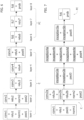
- Figure 13 is a flow chart for an exemplary procedure for each residual block k .
- ⁇ ( k ) an estimated output distribution, denoted by ⁇ ( k ) , is computed where each component is obtained by the corresponding one in v ( k ) multiplied by ( ⁇ act k ⁇ ⁇ w k ).
- a step 2002 the mean (average) of the values in ⁇ ( k ) , denoted by mean ( k ) is computed.
- dSx k min I ⁇ k ⁇ mean k
- a cardinality factor card ( k ) M -
- the estimated output distribution in ⁇ ( k ) may be exploited in order to select the RNS range.
- This range may cover the estimated output range ⁇ ( k ) , with margins A and B both to the left and the right of this interval.
- the available number of values for these margins, card ( k ) may be distributed to the margins accordingly to the distance of the left and right extreme of ⁇ ( k ) to the mean (average).
- the range of values is given by the interval [-9; 70] and the mean is 9.6685.
- r ( k ) -24.
- rounded activations a j and, possibly, weights w j are converted to RNS representation (e.g. at 122 in Figures 9 and 10 ).
- RNS blocks e.g. 10 in Figures 9 and 10
- operations within RNS blocks are defined in the Residue Number System.
- arithmetic operations such as e.g. additions, subtractions and multiplications may take a simplified form in the RNS, with the results of these operations adapted to be computed by considering separately for each modulus the corresponding residues of the operands.
- the operation performed in the "residual" (that is RNS) domain may include a dot product followed by addition of bias.
- This kind of operation may involve the following.
- computation in a RNS block may include the addition of bias values.
- bias values for the layer k may be multiplied by the product ( ⁇ act k ⁇ ⁇ w k ) and then rounded, and the (main) operation performed by a RNS block according to formula (5) above may be slightly modified.
- one or more embodiments may involve a parallelized implementation for performing computations separately for each modulus.
- a RNS unit for power-of-2 moduli may include a standard adder (e.g. carry save) or multiplier (e.g. Wallace tree/booth) with a bit width equal to the corresponding base.
- a standard adder e.g. carry save
- multiplier e.g. Wallace tree/booth
- the complexity of the resulting circuit may thus be proportional (with a law linear for adders and quadratic for multipliers) to the number of bits, and the resulting HW implementation will be much less complex and faster for RNS units in comparison with conventional units.
- the choice of the set of moduli may play a significant role.
- the moduli are responsible of the range width.
- a judicious choice of the base may lead to advantages in terms of computation or storage efficiency and simplification of some operations.
- possible aims directing the choice of the moduli may include:
- a possible way of increasing the range may include using moduli that are (pairwise) mutually prime. This result may be facilitated e.g. by strategies for choosing the moduli including, e.g.:
- the former strategy facilitates reducing the execution time of additions and multiplications, which given primarily by the execution time of additions and multiplications of residues corresponding to the largest modulus.
- this strategy may increase the time for conversion from residue number system to the associated mixed-radix system (see e.g. I. Koren, Computer arithmetic algorithms, Chapter 11, pp. 264-265, Universities Press, 2002 ) and does not maximize the storage efficiency.
- representation storage efficiency may be increased by select a modulus m i that is equal to 2 s for some s or very close to it, such as (2 s - 1).
- This strategy may be also useful for operation simplifications.
- addition may be performed with an ordinary binary adder, and the additive inverse of a number is simply the complement-to-2 thereof.
- modulus (2 s - 1) modular reduction may be further simplified, and addition may become an adder with end-around carry, with the additive inverse of a number being the complement-to-1 thereof. In that way, no modular reductions may be involved for additions and subtractions.
- Performance of embodiments was evaluated e.g. in the contest of a CNN such as AlexNet (discussed previously).
- AlexNet For experimental purposes a MATLAB replica of forward propagation of AlexNet was adopted using the version of the network provided by the Caffe Model Zoo (http://caffe.berkeleyvision.org/model zoo.html) for which trained weights are available.
- the block diagram of Figure 15 is exemplary of apparatus which may include a neural network 100 according to one or more embodiments.
- Such apparatus may include an input element or device IS, e.g. a sensor such as a microphone, a (video)camera, a biomedical sensor, and the like, providing input signals to be processed by a neural network 100 according to one or more embodiments.
- the neural network 100 may be configured as discussed previously to perform on the input signals from the device IS processing tasks such as e.g. acoustic scene classification, sensor-based activity recognition, classification of heartbeats and facial emotion recognition (these are just example of course) and provide corresponding results to an output device OD such as e.g. a display unit, a warning system, a "networked" device e.g. in an Internet-of-Things (IoT) scenario.
- IoT Internet-of-Things
- certain conventional solutions may adopt a 48-bit representation for weights and activations (this may represent a maximum value for a conventional implementation), with corresponding 103-bit accumulators (for 11x11 convolutional filters). This may correspond to a RNS representation using a number of bits in excess of 103. Absent steps allowing a reduction in accumulator resolution, a loss in network accuracy would be unavoidable.
- one or more embodiments may admit a reduced representation for accumulators.
- tests as discussed in the foregoing may start from a 32-bit representation for weights which, without loss of information as in conventional approaches, would require 71-bit accumulators.
- One or more embodiments may adopt 16-bit RNS accumulators by minimally affecting network accuracy. In one or more embodiments this may be made possible by using scale factors as discussed previously.
- One or more embodiments may thus relate to a computer-implemented method of operating a convolutional neural network in accordance with claim 1.
- the set of selected operating units may include operating units performing operations selected out of multiplication, including dot product and matrix multiplication, additions and subtractions.
- the set of selected operating units may include operating units performing operations (for instance dot products) homogeneous with respect to a first set and a second set of input data (e.g. activations a (k-1) and weights w (k) ) and the method may include:
- the RNS-converted input data includes data scaled (e.g. at 120) by respective scale factors, wherein backward converting (e.g. 14) from the Residue Number System includes complementary re-scaling (e.g. 142) of the RNS output data resulting from the RNS operations by respective complementary scale factors.
- backward converting e.g. 14
- complementary re-scaling e.g. 142
- the RNS-converted input data may include integer-to-RNS converted data (e.g. 122), wherein backward converting from the Residue Number System may includes RNS-to-integer conversion (e.g. 140) of the RNS output data resulting from the RNS operations.
- integer-to-RNS converted data e.g. 122
- backward converting from the Residue Number System may includes RNS-to-integer conversion (e.g. 140) of the RNS output data resulting from the RNS operations.
- One or more embodiments may include performing (10) arithmetic operations in a Residue Number System RNS with power-of-two moduli.
- One or more embodiments may concern a neural network including a plurality of layers (e.g. IL, HL, OL) including operating units performing arithmetic operations on input data to provide output data, the network including units configured (see e.g. 12, 10, 14 in Figures 9 and 10 ) for operating in a Residue Number System (briefly, RNS) by performing RNS operations on RNS-converted input data with the method of one or more embodiments.
- layers e.g. IL, HL, OL
- RNS Residue Number System
- One or more embodiments may concern apparatus in accordance with claim 9.
- One or more embodiments may concern a computer program product loadable into the memory of at least one processing device and including software code portions for executing the steps of the method of one or more embodiments when the product is run on at least one processing device.
Landscapes
- Engineering & Computer Science (AREA)
- Physics & Mathematics (AREA)
- Theoretical Computer Science (AREA)
- General Physics & Mathematics (AREA)
- Mathematical Physics (AREA)
- General Engineering & Computer Science (AREA)
- Computing Systems (AREA)
- Data Mining & Analysis (AREA)
- Mathematical Analysis (AREA)
- Mathematical Optimization (AREA)
- Computational Mathematics (AREA)
- Pure & Applied Mathematics (AREA)
- Software Systems (AREA)
- Artificial Intelligence (AREA)
- Evolutionary Computation (AREA)
- Computational Linguistics (AREA)
- Biomedical Technology (AREA)
- Biophysics (AREA)
- Life Sciences & Earth Sciences (AREA)
- Health & Medical Sciences (AREA)
- Molecular Biology (AREA)
- General Health & Medical Sciences (AREA)
- Algebra (AREA)
- Databases & Information Systems (AREA)
- Probability & Statistics with Applications (AREA)
- Neurology (AREA)
- Image Analysis (AREA)
- Computer And Data Communications (AREA)
- Details Of Television Systems (AREA)
- General Factory Administration (AREA)
Claims (10)
- Computerimplementiertes Verfahren zum Betrieb eines konvolutionalen neuronalen Netzwerks, wobei das konvolutionale neuronale Netzwerk eine Vielzahl von Netzwerkschichten (IL, HL, OL) umfasst, umfassend Betriebseinheiten, die arithmetische Operationen an Eingangsdaten (a(k-1),w(k) ) durchführen, um Ausgangsdaten (a(k) ) bereitzustellen, wobei das Verfahren Folgendes umfasst:- Auswählen eines Satzes von Betriebseinheiten (conv, fc, inception) in den Netzschichten (IL, HL, OL), und- Ausführen von arithmetischen Operationen in Betriebseinheiten (10) in dem ausgewählten Satz von Betriebseinheiten durch Ausführen von Operationen in einem Rückstandsnummernsystem, RNS, an RNS-konvertierten (12; 16) Eingangsdaten (a(k-1), w(k)) durch Erhalten von RNS-Ausgangsdaten (a(k) ) im Rückstandsnummernsystem,- Rückwärtskonvertieren (14) aus dem Rückstandsnummernsystem der RNS-Ausgabedaten (a(k) ), die sich aus den RNS-Operationen ergeben,dadurch gekennzeichnet, dass:- die in RNS konvertierten Eingangsdaten (a(k-1), w(k)) Daten umfassen, die durch entsprechende Skalierungsfaktoren skaliert (120) sind,- die Rückwärtskonvertierung (14) aus dem Rückstandsnummernsystem eine komplementäre Neuskalierung (142) der RNS-Ausgabedaten (a(k) ) umfasst, die sich aus den RNS-Operationen durch entsprechende komplementäre Skalierungsfaktoren ergeben,- dem Rückstandsnummernsystem (RNS) eine Reihe von dargestellten Werten beigefügt ist und Skalierungsfaktoren diesen Wertebereich bestimmen.
- Verfahren nach Anspruch 1, wobei der Satz ausgewählter Betriebseinheiten Betriebseinheiten (conv, fc, inception) umfasst, die aus der Multiplikation ausgewählte Operationen durchführen, umfassend Punktprodukt- und Matrixmultiplikation, Additionen und Subtraktionen.
- Verfahren nach Anspruch 1 oder 2, wobei der Satz ausgewählter Betriebseinheiten Betriebseinheiten umfasst, die Operationen homogen in Bezug auf einen ersten Satz (a(k-1) ) und einen zweiten Satz (w(k) ) von Eingangsdaten durchführen, wobei das Verfahren die Bereitstellung der RNS-konvertierten Eingangsdaten (a(k-1), w(k) ) durch Weiterkonvertierung (12) in ein Rückstandsnummernsystem umfasst, beides des ersten Satzes (a(k-1) ) und des zweiten Satzes (w(k) ) von Eingangsdaten.
- Verfahren nach Anspruch 1 oder 2, wobei der Satz ausgewählter Betriebseinheiten Betriebseinheiten umfasst, die Operationen homogen in Bezug auf einen ersten Satz (a(k-1) ) und einen zweiten Satz (w(k) ) von Eingangsdaten durchführen, wobei das Verfahren die Bereitstellung der in RNS konvertierten Eingangsdaten ( a(k-1), w(k)) umfasst, durch:- Bereitstellen des ersten Satzes (a(k-1) ) von Eingangsdaten durch Weiterkonvertierung (12) in ein Rückstandsnummernsystem des ersten Satzes (a(k-1) ) von Eingangsdaten, und- Bereitstellen des zweiten Satzes (w(k) ) von Eingangsdaten als gespeicherten Satz (16) von RNS-konvertierten Eingangsdaten.
- Verfahren nach einem der vorhergehenden Ansprüche, wobei die RNS-konvertierten Eingangsdaten (a(k-1), W (k) ) ganzzahlig in RNS konvertierte Daten (122) umfassen, wobei die Rückwärtskonvertierung (14) aus dem Rückstandsnummernsystem die Konvertierung (140) von RNS in Ganzzahlen der RNS-Ausgangsdaten (a(k) ) umfasst, die sich aus den RNS-Operationen ergeben.
- Verfahren nach Anspruch 1 und Anspruch 5, wobei:- die in RNS konvertierten Eingangsdaten (a(k-1), w(k) ) Daten umfassen, die nach jeweiligen Maßstabsfaktoren skaliert und gerundet (120) sind, um in Ganzzahlen in RNS konvertiert zu werden (122) und- die Rückwärtskonvertierung (14) aus dem Rückstandsnummernsystem die Konvertierung (140) von RNS in Ganzzahlen und die komplementäre Neuskalierung (142) durch entsprechende komplementäre Skalierungsfaktoren der RNS-Ausgabedaten (a(k) ) umfasst, die sich aus den RNS-Operationen ergeben.
- Verfahren nach Anspruch 1 und Anspruch 6, umfassend mindestens eines von:- Verwendung desselben Satzes von Skalierungsfaktoren für RNS-konvertierte Eingangsdaten (a(k-1), w(k) ) in einer Vielzahl von arithmetischen Operationen (10) im Rückstandsnummernsystem RNS, und/oder- Einstellen, um die Skalierungsfaktoren für mindestens einen Teil (a(k-1) ) der RNS-konvertierten Eingangsdaten (a(k-1), w(k) ) zu vereinheitlichen, und/oder- die Skalierungsfaktoren für RNS konvertierte Eingangsdaten (a(k-1), w(k) ) umfassend Zweierpotenz-Skalierungsfaktoren, wobei die Skalierung die Verschiebung von Binärdaten einschließt.
- Verfahren nach einem der vorhergehenden Ansprüche, umfassend die Durchführung von (10) arithmetischen Operationen in einem Rückstandsnummernsystem RNS mit Zweierpotenz-Moduli.
- Vorrichtung umfassend,- ein Quellgerät (IS), das Daten zur Verarbeitung durch ein konvolutionales neurales Netzwerk bereitstellt,- ein konvolutionales neuronales Netzwerk (100), das eine Vielzahl von Netzwerkschichten (IL, HL, OL) umfasst, umfassend Betriebseinheiten (10), die arithmetische Operationen auf Eingangsdaten (a(k-1), w(k) ) durchführen, um Ausgangsdaten (a(k) ) bereitzustellen, wobei die Netzwerkschichten Einheiten (12, 10, 14) umfassen, die konfiguriert sind, um Operationen in einem Rückstandsnummernsystem durchzuführen, RNS, das mit dem Quellgerät (IS) gekoppelte konvolutionale neuronale Netzwerk (100) und konfiguriert zum Empfangen der Daten von dem Quellgerät (IS), Bereitstellung einer konvolutionalen neuronalen Netzwerkverarbeitung der Daten und Ausgabe von Ausgangsdaten (OD), die sich aus der konvolutionalen neuronalen Netzwerkverarbeitung der Daten im konvolutionalen neuronalen Netzwerk (100) ergeben, indem das konvolutionale neuronale Netzwerk (100) mit dem computerimplementierten Verfahren nach einem der vorhergehenden Ansprüche betrieben wird.
- Computerprogrammprodukt, das in den Speicher mindestens einer Verarbeitungsvorrichtung geladen werden kann und Softwarecodeabschnitte zur Ausführung der Schritte des Verfahrens nach einem der Ansprüche 1 bis 8 umfasst, wenn das Produkt auf mindestens einer Verarbeitungsvorrichtung ausgeführt wird.
Applications Claiming Priority (1)
| Application Number | Priority Date | Filing Date | Title |
|---|---|---|---|
| IT102017000008949A IT201700008949A1 (it) | 2017-01-27 | 2017-01-27 | Procedimento di funzionamento di reti neurali, rete, apparecchiatura e prodotto informatico corrispondenti |
Publications (2)
| Publication Number | Publication Date |
|---|---|
| EP3355247A1 EP3355247A1 (de) | 2018-08-01 |
| EP3355247B1 true EP3355247B1 (de) | 2025-05-07 |
Family
ID=58701821
Family Applications (1)
| Application Number | Title | Priority Date | Filing Date |
|---|---|---|---|
| EP17193559.6A Active EP3355247B1 (de) | 2017-01-27 | 2017-09-27 | Verfahren zum betrieb eines neuronalen netzwerks, zugehöriges netzwerk, vorrichtung und computerprogrammprodukt |
Country Status (4)
| Country | Link |
|---|---|
| US (1) | US11308406B2 (de) |
| EP (1) | EP3355247B1 (de) |
| CN (1) | CN108364064B (de) |
| IT (1) | IT201700008949A1 (de) |
Families Citing this family (21)
| Publication number | Priority date | Publication date | Assignee | Title |
|---|---|---|---|---|
| US11164071B2 (en) | 2017-04-18 | 2021-11-02 | Samsung Electronics Co., Ltd. | Method and apparatus for reducing computational complexity of convolutional neural networks |
| CN109729734B8 (zh) * | 2017-08-31 | 2020-11-24 | 中科寒武纪科技股份有限公司 | 芯片装置及相关产品 |
| US10776662B2 (en) * | 2017-11-09 | 2020-09-15 | Disney Enterprises, Inc. | Weakly-supervised spatial context networks to recognize features within an image |
| WO2019114842A1 (zh) | 2017-12-14 | 2019-06-20 | 北京中科寒武纪科技有限公司 | 一种集成电路芯片装置 |
| US10387122B1 (en) * | 2018-05-04 | 2019-08-20 | Olsen Ip Reserve, Llc | Residue number matrix multiplier |
| US11165694B2 (en) * | 2018-07-31 | 2021-11-02 | Mcafee, Llc | Methods, systems, articles of manufacture and apparatus to identify applications |
| JP7174243B2 (ja) * | 2018-12-21 | 2022-11-17 | 富士通株式会社 | 情報処理装置、ニューラルネットワークプログラム、ニューラルネットワークの処理方法 |
| CN109787585A (zh) * | 2019-01-31 | 2019-05-21 | 电子科技大学 | 一种基于嵌套式余数系统的fir滤波系统 |
| CN111767204B (zh) * | 2019-04-02 | 2024-05-28 | 杭州海康威视数字技术股份有限公司 | 溢出风险检测方法、装置及设备 |
| CN110348350B (zh) * | 2019-07-01 | 2022-03-25 | 电子科技大学 | 一种基于面部表情的驾驶员状态检测方法 |
| US11157594B2 (en) * | 2019-07-24 | 2021-10-26 | Facebook, Inc. | Matrix multiplication in hardware using modular math |
| FR3105660B1 (fr) * | 2019-12-18 | 2022-10-14 | Commissariat Energie Atomique | Procédé et dispositif de codage additif de signaux pour implémenter des opérations MAC numériques à précision dynamique |
| CN111126587B (zh) * | 2019-12-30 | 2021-02-02 | 上海安路信息科技有限公司 | 交并比电路 |
| US11687778B2 (en) | 2020-01-06 | 2023-06-27 | The Research Foundation For The State University Of New York | Fakecatcher: detection of synthetic portrait videos using biological signals |
| RU2759964C1 (ru) * | 2020-08-12 | 2021-11-19 | Федеральное государственное казенное военное образовательное учреждение высшего образования "Военный учебно-научный центр Военно-воздушных сил "Военно-воздушная академия имени профессора Н.Е. Жуковского и Ю.А. Гагарина" (г. Воронеж) Министерства обороны Российской Федерации | Нейронная сеть конечного кольца |
| CN112580351B (zh) * | 2020-12-31 | 2022-04-19 | 成都信息工程大学 | 一种基于自信息损失补偿的机器生成文本检测方法 |
| US20220261650A1 (en) * | 2021-02-16 | 2022-08-18 | Nvidia Corp. | Machine learning training in logarithmic number system |
| US11947960B2 (en) * | 2021-11-05 | 2024-04-02 | Qualcomm Incorporated | Modulo-space processing in multiply-and-accumulate units |
| US12411696B2 (en) | 2022-12-29 | 2025-09-09 | Stmicroelectronics S.R.L. | Programmable hardware accelerator controller |
| US12591533B2 (en) | 2023-04-21 | 2026-03-31 | Stmicroelectronics International N.V. | Configurable stream switch with virtual channels for the sharing of I/O ports in stream-based architectures |
| US20250150271A1 (en) * | 2023-11-03 | 2025-05-08 | Microsoft Technology Licensing, Llc | Apparatus and methods for prime field modular reduction |
Family Cites Families (16)
| Publication number | Priority date | Publication date | Assignee | Title |
|---|---|---|---|---|
| CA1318027C (en) | 1987-10-12 | 1993-05-18 | Jun Takayama | Method and apparatus for encoding and decoding data in residue number system |
| JPH0199325A (ja) * | 1987-10-12 | 1989-04-18 | Sony Corp | エンコーダ回路 |
| JP2930325B2 (ja) * | 1989-07-29 | 1999-08-03 | ソニー株式会社 | ディジタル信号処理回路 |
| FR2690771A1 (fr) * | 1992-04-29 | 1993-11-05 | Philips Electronique Lab | Processeur neuronal muni de moyens pour normaliser des données. |
| CN1119308A (zh) * | 1994-02-07 | 1996-03-27 | 华中理工大学 | 余数制系统中的一种求余网络和余/+转换器电路 |
| US5987487A (en) * | 1996-03-11 | 1999-11-16 | Cirrus Logic, Inc. | Methods and apparatus for the processing of digital signals |
| US6601049B1 (en) * | 1996-05-02 | 2003-07-29 | David L. Cooper | Self-adjusting multi-layer neural network architectures and methods therefor |
| JP4279626B2 (ja) * | 2003-07-31 | 2009-06-17 | 株式会社アドバンテスト | 剰余系演算システム、スケーリング演算器、スケーリング演算方法、及びそのプログラムと記録媒体 |
| US8711926B2 (en) * | 2007-02-08 | 2014-04-29 | Qualcomm Incorporated | Distortion estimation for quantized data |
| EP2325707A1 (de) * | 2009-11-20 | 2011-05-25 | Zerogroup Holding OÜ | Verfahren und System zum Steuern der Umweltbedingungen von verschiedenen Einheiten |
| CN102043760B (zh) * | 2010-12-27 | 2013-06-05 | 上海华为技术有限公司 | 数据处理方法及系统 |
| WO2014149070A1 (en) * | 2013-03-15 | 2014-09-25 | Hrl Laboratories, Llc | Neural network and method of programming |
| RU2584495C1 (ru) * | 2015-05-14 | 2016-05-20 | Федеральное государственное автономное образовательное учреждение высшего профессионального образования "Северо-Кавказский федеральный университет" | Устройство для вычисления коэффициентов обобщенной полиадической системы с коррекцией ошибок |
| US10228911B2 (en) | 2015-10-08 | 2019-03-12 | Via Alliance Semiconductor Co., Ltd. | Apparatus employing user-specified binary point fixed point arithmetic |
| CN106485315B (zh) * | 2015-10-08 | 2019-06-04 | 上海兆芯集成电路有限公司 | 具有输出缓冲器反馈与遮蔽功能的神经网络单元 |
| CN106203622B (zh) * | 2016-07-14 | 2018-12-25 | 杭州华为数字技术有限公司 | 神经网络运算装置 |
-
2017
- 2017-01-27 IT IT102017000008949A patent/IT201700008949A1/it unknown
- 2017-09-27 EP EP17193559.6A patent/EP3355247B1/de active Active
- 2017-09-30 CN CN201710920011.5A patent/CN108364064B/zh active Active
-
2018
- 2018-01-22 US US15/877,138 patent/US11308406B2/en active Active
Also Published As
| Publication number | Publication date |
|---|---|
| CN108364064A (zh) | 2018-08-03 |
| US11308406B2 (en) | 2022-04-19 |
| CN108364064B (zh) | 2022-05-24 |
| EP3355247A1 (de) | 2018-08-01 |
| IT201700008949A1 (it) | 2018-07-27 |
| US20180218275A1 (en) | 2018-08-02 |
Similar Documents
| Publication | Publication Date | Title |
|---|---|---|
| EP3355247B1 (de) | Verfahren zum betrieb eines neuronalen netzwerks, zugehöriges netzwerk, vorrichtung und computerprogrammprodukt | |
| EP3657398B1 (de) | Verarbeitungsverfahren und beschleunigungsvorrichtung | |
| US12456030B2 (en) | Phase selective convolution with dynamic weight selection | |
| Nakahara et al. | A deep convolutional neural network based on nested residue number system | |
| US20210004663A1 (en) | Neural network device and method of quantizing parameters of neural network | |
| CN114698395B (zh) | 神经网络模型的量化方法和装置、数据处理的方法和装置 | |
| EP3816866B1 (de) | Verfahren und vorrichtung zum betrieb einer netzwerkschicht in einem tiefen neuronalen netzwerk | |
| EP4283876A1 (de) | Datencodierungsverfahren und zugehörige vorrichtung | |
| EP3637327B1 (de) | Rechenvorrichtung und -verfahren | |
| Faraone et al. | Customizing low-precision deep neural networks for fpgas | |
| US20220405576A1 (en) | Multi-layer neural network system and method | |
| Panwar et al. | Modified distributed arithmetic based low complexity CNN architecture design methodology | |
| US20230079289A1 (en) | Element for generating stochastic signals, stochastic neuron and neural network based on said neuron | |
| CN115913245A (zh) | 数据编码方法、数据解码方法以及数据处理装置 | |
| Moon et al. | FPGA-based sparsity-aware CNN accelerator for noise-resilient edge-level image recognition | |
| CN115587622A (zh) | 一种基于光电存算一体器件的多层感知机装置 | |
| Gerhards et al. | Hybrid spiking and artificial neural networks for radar-based gesture recognition | |
| SP et al. | Evaluating Winograd algorithm for convolution neural network using verilog | |
| Kalali et al. | A power-efficient parameter quantization technique for CNN accelerators | |
| US20250181886A1 (en) | Method and electronic system for inferring a morphological neural network | |
| CN114154621B (zh) | 一种基于fpga的卷积神经网络图像处理方法及装置 | |
| Lee et al. | MPQ-YOLACT: Mixed-Precision Quantization for Lightweight YOLACT | |
| RU2279132C2 (ru) | Нейронная сеть конечного кольца | |
| Hikawa | Hardware self-organizing map with dithered step neighborhood function | |
| US20200250524A1 (en) | System and method for reducing computational complexity of neural network |
Legal Events
| Date | Code | Title | Description |
|---|---|---|---|
| PUAI | Public reference made under article 153(3) epc to a published international application that has entered the european phase |
Free format text: ORIGINAL CODE: 0009012 |
|
| STAA | Information on the status of an ep patent application or granted ep patent |
Free format text: STATUS: THE APPLICATION HAS BEEN PUBLISHED |
|
| AK | Designated contracting states |
Kind code of ref document: A1 Designated state(s): AL AT BE BG CH CY CZ DE DK EE ES FI FR GB GR HR HU IE IS IT LI LT LU LV MC MK MT NL NO PL PT RO RS SE SI SK SM TR |
|
| AX | Request for extension of the european patent |
Extension state: BA ME |
|
| STAA | Information on the status of an ep patent application or granted ep patent |
Free format text: STATUS: REQUEST FOR EXAMINATION WAS MADE |
|
| 17P | Request for examination filed |
Effective date: 20190122 |
|
| RBV | Designated contracting states (corrected) |
Designated state(s): AL AT BE BG CH CY CZ DE DK EE ES FI FR GB GR HR HU IE IS IT LI LT LU LV MC MK MT NL NO PL PT RO RS SE SI SK SM TR |
|
| STAA | Information on the status of an ep patent application or granted ep patent |
Free format text: STATUS: EXAMINATION IS IN PROGRESS |
|
| 17Q | First examination report despatched |
Effective date: 20210817 |
|
| REG | Reference to a national code |
Ref legal event code: R079 Free format text: PREVIOUS MAIN CLASS: G06N0003040000 Ipc: G06N0003045000 Ref country code: DE Ref document number: 602017089295 Country of ref document: DE |
|
| GRAP | Despatch of communication of intention to grant a patent |
Free format text: ORIGINAL CODE: EPIDOSNIGR1 |
|
| STAA | Information on the status of an ep patent application or granted ep patent |
Free format text: STATUS: GRANT OF PATENT IS INTENDED |
|
| RIC1 | Information provided on ipc code assigned before grant |
Ipc: G06F 7/72 20060101ALI20250110BHEP Ipc: G06N 3/045 20230101AFI20250110BHEP |
|
| INTG | Intention to grant announced |
Effective date: 20250123 |
|
| GRAS | Grant fee paid |
Free format text: ORIGINAL CODE: EPIDOSNIGR3 |
|
| GRAA | (expected) grant |
Free format text: ORIGINAL CODE: 0009210 |
|
| STAA | Information on the status of an ep patent application or granted ep patent |
Free format text: STATUS: THE PATENT HAS BEEN GRANTED |
|
| AK | Designated contracting states |
Kind code of ref document: B1 Designated state(s): AL AT BE BG CH CY CZ DE DK EE ES FI FR GB GR HR HU IE IS IT LI LT LU LV MC MK MT NL NO PL PT RO RS SE SI SK SM TR |
|
| REG | Reference to a national code |
Ref country code: GB Ref legal event code: FG4D |
|
| REG | Reference to a national code |
Ref country code: CH Ref legal event code: EP |
|
| REG | Reference to a national code |
Ref country code: DE Ref legal event code: R096 Ref document number: 602017089295 Country of ref document: DE |
|
| REG | Reference to a national code |
Ref country code: IE Ref legal event code: FG4D |
|
| REG | Reference to a national code |
Ref country code: NL Ref legal event code: MP Effective date: 20250507 |
|
| PG25 | Lapsed in a contracting state [announced via postgrant information from national office to epo] |
Ref country code: PT Free format text: LAPSE BECAUSE OF FAILURE TO SUBMIT A TRANSLATION OF THE DESCRIPTION OR TO PAY THE FEE WITHIN THE PRESCRIBED TIME-LIMIT Effective date: 20250908 Ref country code: ES Free format text: LAPSE BECAUSE OF FAILURE TO SUBMIT A TRANSLATION OF THE DESCRIPTION OR TO PAY THE FEE WITHIN THE PRESCRIBED TIME-LIMIT Effective date: 20250507 Ref country code: FI Free format text: LAPSE BECAUSE OF FAILURE TO SUBMIT A TRANSLATION OF THE DESCRIPTION OR TO PAY THE FEE WITHIN THE PRESCRIBED TIME-LIMIT Effective date: 20250507 |
|
| PGFP | Annual fee paid to national office [announced via postgrant information from national office to epo] |
Ref country code: DE Payment date: 20250820 Year of fee payment: 9 |
|
| REG | Reference to a national code |
Ref country code: LT Ref legal event code: MG9D |
|
| PG25 | Lapsed in a contracting state [announced via postgrant information from national office to epo] |
Ref country code: GR Free format text: LAPSE BECAUSE OF FAILURE TO SUBMIT A TRANSLATION OF THE DESCRIPTION OR TO PAY THE FEE WITHIN THE PRESCRIBED TIME-LIMIT Effective date: 20250808 Ref country code: NO Free format text: LAPSE BECAUSE OF FAILURE TO SUBMIT A TRANSLATION OF THE DESCRIPTION OR TO PAY THE FEE WITHIN THE PRESCRIBED TIME-LIMIT Effective date: 20250807 |
|
| PG25 | Lapsed in a contracting state [announced via postgrant information from national office to epo] |
Ref country code: NL Free format text: LAPSE BECAUSE OF FAILURE TO SUBMIT A TRANSLATION OF THE DESCRIPTION OR TO PAY THE FEE WITHIN THE PRESCRIBED TIME-LIMIT Effective date: 20250507 Ref country code: PL Free format text: LAPSE BECAUSE OF FAILURE TO SUBMIT A TRANSLATION OF THE DESCRIPTION OR TO PAY THE FEE WITHIN THE PRESCRIBED TIME-LIMIT Effective date: 20250507 |
|
| REG | Reference to a national code |
Ref country code: AT Ref legal event code: MK05 Ref document number: 1793286 Country of ref document: AT Kind code of ref document: T Effective date: 20250507 |
|
| PG25 | Lapsed in a contracting state [announced via postgrant information from national office to epo] |
Ref country code: BG Free format text: LAPSE BECAUSE OF FAILURE TO SUBMIT A TRANSLATION OF THE DESCRIPTION OR TO PAY THE FEE WITHIN THE PRESCRIBED TIME-LIMIT Effective date: 20250507 |
|
| PG25 | Lapsed in a contracting state [announced via postgrant information from national office to epo] |
Ref country code: HR Free format text: LAPSE BECAUSE OF FAILURE TO SUBMIT A TRANSLATION OF THE DESCRIPTION OR TO PAY THE FEE WITHIN THE PRESCRIBED TIME-LIMIT Effective date: 20250507 |
|
| PG25 | Lapsed in a contracting state [announced via postgrant information from national office to epo] |
Ref country code: AT Free format text: LAPSE BECAUSE OF FAILURE TO SUBMIT A TRANSLATION OF THE DESCRIPTION OR TO PAY THE FEE WITHIN THE PRESCRIBED TIME-LIMIT Effective date: 20250507 |
|
| PG25 | Lapsed in a contracting state [announced via postgrant information from national office to epo] |
Ref country code: RS Free format text: LAPSE BECAUSE OF FAILURE TO SUBMIT A TRANSLATION OF THE DESCRIPTION OR TO PAY THE FEE WITHIN THE PRESCRIBED TIME-LIMIT Effective date: 20250807 |
|
| PG25 | Lapsed in a contracting state [announced via postgrant information from national office to epo] |
Ref country code: IS Free format text: LAPSE BECAUSE OF FAILURE TO SUBMIT A TRANSLATION OF THE DESCRIPTION OR TO PAY THE FEE WITHIN THE PRESCRIBED TIME-LIMIT Effective date: 20250907 |
|
| PG25 | Lapsed in a contracting state [announced via postgrant information from national office to epo] |
Ref country code: LV Free format text: LAPSE BECAUSE OF FAILURE TO SUBMIT A TRANSLATION OF THE DESCRIPTION OR TO PAY THE FEE WITHIN THE PRESCRIBED TIME-LIMIT Effective date: 20250507 |
|
| PG25 | Lapsed in a contracting state [announced via postgrant information from national office to epo] |
Ref country code: DK Free format text: LAPSE BECAUSE OF FAILURE TO SUBMIT A TRANSLATION OF THE DESCRIPTION OR TO PAY THE FEE WITHIN THE PRESCRIBED TIME-LIMIT Effective date: 20250507 Ref country code: SM Free format text: LAPSE BECAUSE OF FAILURE TO SUBMIT A TRANSLATION OF THE DESCRIPTION OR TO PAY THE FEE WITHIN THE PRESCRIBED TIME-LIMIT Effective date: 20250507 |
|
| PG25 | Lapsed in a contracting state [announced via postgrant information from national office to epo] |
Ref country code: CZ Free format text: LAPSE BECAUSE OF FAILURE TO SUBMIT A TRANSLATION OF THE DESCRIPTION OR TO PAY THE FEE WITHIN THE PRESCRIBED TIME-LIMIT Effective date: 20250507 |
|
| PG25 | Lapsed in a contracting state [announced via postgrant information from national office to epo] |
Ref country code: EE Free format text: LAPSE BECAUSE OF FAILURE TO SUBMIT A TRANSLATION OF THE DESCRIPTION OR TO PAY THE FEE WITHIN THE PRESCRIBED TIME-LIMIT Effective date: 20250507 |
|
| PG25 | Lapsed in a contracting state [announced via postgrant information from national office to epo] |
Ref country code: RO Free format text: LAPSE BECAUSE OF FAILURE TO SUBMIT A TRANSLATION OF THE DESCRIPTION OR TO PAY THE FEE WITHIN THE PRESCRIBED TIME-LIMIT Effective date: 20250507 Ref country code: SK Free format text: LAPSE BECAUSE OF FAILURE TO SUBMIT A TRANSLATION OF THE DESCRIPTION OR TO PAY THE FEE WITHIN THE PRESCRIBED TIME-LIMIT Effective date: 20250507 |
|
| PG25 | Lapsed in a contracting state [announced via postgrant information from national office to epo] |
Ref country code: IT Free format text: LAPSE BECAUSE OF FAILURE TO SUBMIT A TRANSLATION OF THE DESCRIPTION OR TO PAY THE FEE WITHIN THE PRESCRIBED TIME-LIMIT Effective date: 20250507 |
|
| REG | Reference to a national code |
Ref country code: DE Ref legal event code: R097 Ref document number: 602017089295 Country of ref document: DE |
|
| PLBE | No opposition filed within time limit |
Free format text: ORIGINAL CODE: 0009261 |
|
| STAA | Information on the status of an ep patent application or granted ep patent |
Free format text: STATUS: NO OPPOSITION FILED WITHIN TIME LIMIT |
|
| REG | Reference to a national code |
Ref country code: CH Ref legal event code: L10 Free format text: ST27 STATUS EVENT CODE: U-0-0-L10-L00 (AS PROVIDED BY THE NATIONAL OFFICE) Effective date: 20260318 |
|
| 26N | No opposition filed |
Effective date: 20260210 |