EP3352256A1 - Positive electrode - Google Patents
Positive electrode Download PDFInfo
- Publication number
- EP3352256A1 EP3352256A1 EP17789515.8A EP17789515A EP3352256A1 EP 3352256 A1 EP3352256 A1 EP 3352256A1 EP 17789515 A EP17789515 A EP 17789515A EP 3352256 A1 EP3352256 A1 EP 3352256A1
- Authority
- EP
- European Patent Office
- Prior art keywords
- positive electrode
- primary particles
- equal
- layer
- particles
- Prior art date
- Legal status (The legal status is an assumption and is not a legal conclusion. Google has not performed a legal analysis and makes no representation as to the accuracy of the status listed.)
- Granted
Links
Images

Classifications
-
- H—ELECTRICITY
- H01—ELECTRIC ELEMENTS
- H01M—PROCESSES OR MEANS, e.g. BATTERIES, FOR THE DIRECT CONVERSION OF CHEMICAL ENERGY INTO ELECTRICAL ENERGY
- H01M4/00—Electrodes
- H01M4/02—Electrodes composed of, or comprising, active material
- H01M4/36—Selection of substances as active materials, active masses, active liquids
- H01M4/48—Selection of substances as active materials, active masses, active liquids of inorganic oxides or hydroxides
- H01M4/52—Selection of substances as active materials, active masses, active liquids of inorganic oxides or hydroxides of nickel, cobalt or iron
- H01M4/525—Selection of substances as active materials, active masses, active liquids of inorganic oxides or hydroxides of nickel, cobalt or iron of mixed oxides or hydroxides containing iron, cobalt or nickel for inserting or intercalating light metals, e.g. LiNiO2, LiCoO2 or LiCoOxFy
-
- C—CHEMISTRY; METALLURGY
- C01—INORGANIC CHEMISTRY
- C01G—COMPOUNDS CONTAINING METALS NOT COVERED BY SUBCLASSES C01D OR C01F
- C01G51/00—Compounds of cobalt
- C01G51/40—Complex oxides containing cobalt and at least one other metal element
- C01G51/42—Complex oxides containing cobalt and at least one other metal element containing alkali metals, e.g. LiCoO2
-
- H—ELECTRICITY
- H01—ELECTRIC ELEMENTS
- H01M—PROCESSES OR MEANS, e.g. BATTERIES, FOR THE DIRECT CONVERSION OF CHEMICAL ENERGY INTO ELECTRICAL ENERGY
- H01M10/00—Secondary cells; Manufacture thereof
- H01M10/05—Accumulators with non-aqueous electrolyte
- H01M10/052—Li-accumulators
-
- H—ELECTRICITY
- H01—ELECTRIC ELEMENTS
- H01M—PROCESSES OR MEANS, e.g. BATTERIES, FOR THE DIRECT CONVERSION OF CHEMICAL ENERGY INTO ELECTRICAL ENERGY
- H01M10/00—Secondary cells; Manufacture thereof
- H01M10/05—Accumulators with non-aqueous electrolyte
- H01M10/052—Li-accumulators
- H01M10/0525—Rocking-chair batteries, i.e. batteries with lithium insertion or intercalation in both electrodes; Lithium-ion batteries
-
- H—ELECTRICITY
- H01—ELECTRIC ELEMENTS
- H01M—PROCESSES OR MEANS, e.g. BATTERIES, FOR THE DIRECT CONVERSION OF CHEMICAL ENERGY INTO ELECTRICAL ENERGY
- H01M10/00—Secondary cells; Manufacture thereof
- H01M10/05—Accumulators with non-aqueous electrolyte
- H01M10/056—Accumulators with non-aqueous electrolyte characterised by the materials used as electrolytes, e.g. mixed inorganic/organic electrolytes
- H01M10/0561—Accumulators with non-aqueous electrolyte characterised by the materials used as electrolytes, e.g. mixed inorganic/organic electrolytes the electrolyte being constituted of inorganic materials only
- H01M10/0562—Solid materials
-
- H—ELECTRICITY
- H01—ELECTRIC ELEMENTS
- H01M—PROCESSES OR MEANS, e.g. BATTERIES, FOR THE DIRECT CONVERSION OF CHEMICAL ENERGY INTO ELECTRICAL ENERGY
- H01M10/00—Secondary cells; Manufacture thereof
- H01M10/05—Accumulators with non-aqueous electrolyte
- H01M10/056—Accumulators with non-aqueous electrolyte characterised by the materials used as electrolytes, e.g. mixed inorganic/organic electrolytes
- H01M10/0564—Accumulators with non-aqueous electrolyte characterised by the materials used as electrolytes, e.g. mixed inorganic/organic electrolytes the electrolyte being constituted of organic materials only
- H01M10/0566—Liquid materials
-
- H—ELECTRICITY
- H01—ELECTRIC ELEMENTS
- H01M—PROCESSES OR MEANS, e.g. BATTERIES, FOR THE DIRECT CONVERSION OF CHEMICAL ENERGY INTO ELECTRICAL ENERGY
- H01M4/00—Electrodes
- H01M4/02—Electrodes composed of, or comprising, active material
- H01M4/13—Electrodes for accumulators with non-aqueous electrolyte, e.g. for lithium-accumulators; Processes of manufacture thereof
- H01M4/131—Electrodes based on mixed oxides or hydroxides, or on mixtures of oxides or hydroxides, e.g. LiCoOx
-
- H—ELECTRICITY
- H01—ELECTRIC ELEMENTS
- H01M—PROCESSES OR MEANS, e.g. BATTERIES, FOR THE DIRECT CONVERSION OF CHEMICAL ENERGY INTO ELECTRICAL ENERGY
- H01M4/00—Electrodes
- H01M4/02—Electrodes composed of, or comprising, active material
- H01M4/13—Electrodes for accumulators with non-aqueous electrolyte, e.g. for lithium-accumulators; Processes of manufacture thereof
- H01M4/139—Processes of manufacture
- H01M4/1391—Processes of manufacture of electrodes based on mixed oxides or hydroxides, or on mixtures of oxides or hydroxides, e.g. LiCoOx
-
- C—CHEMISTRY; METALLURGY
- C01—INORGANIC CHEMISTRY
- C01G—COMPOUNDS CONTAINING METALS NOT COVERED BY SUBCLASSES C01D OR C01F
- C01G51/00—Compounds of cobalt
-
- C—CHEMISTRY; METALLURGY
- C01—INORGANIC CHEMISTRY
- C01P—INDEXING SCHEME RELATING TO STRUCTURAL AND PHYSICAL ASPECTS OF SOLID INORGANIC COMPOUNDS
- C01P2004/00—Particle morphology
- C01P2004/60—Particles characterised by their size
- C01P2004/61—Micrometer sized, i.e. from 1-100 micrometer
-
- C—CHEMISTRY; METALLURGY
- C01—INORGANIC CHEMISTRY
- C01P—INDEXING SCHEME RELATING TO STRUCTURAL AND PHYSICAL ASPECTS OF SOLID INORGANIC COMPOUNDS
- C01P2006/00—Physical properties of inorganic compounds
- C01P2006/12—Surface area
-
- C—CHEMISTRY; METALLURGY
- C01—INORGANIC CHEMISTRY
- C01P—INDEXING SCHEME RELATING TO STRUCTURAL AND PHYSICAL ASPECTS OF SOLID INORGANIC COMPOUNDS
- C01P2006/00—Physical properties of inorganic compounds
- C01P2006/40—Electric properties
-
- H—ELECTRICITY
- H01—ELECTRIC ELEMENTS
- H01M—PROCESSES OR MEANS, e.g. BATTERIES, FOR THE DIRECT CONVERSION OF CHEMICAL ENERGY INTO ELECTRICAL ENERGY
- H01M4/00—Electrodes
- H01M4/02—Electrodes composed of, or comprising, active material
- H01M2004/021—Physical characteristics, e.g. porosity, surface area
-
- H—ELECTRICITY
- H01—ELECTRIC ELEMENTS
- H01M—PROCESSES OR MEANS, e.g. BATTERIES, FOR THE DIRECT CONVERSION OF CHEMICAL ENERGY INTO ELECTRICAL ENERGY
- H01M4/00—Electrodes
- H01M4/02—Electrodes composed of, or comprising, active material
- H01M2004/026—Electrodes composed of, or comprising, active material characterised by the polarity
- H01M2004/028—Positive electrodes
-
- H—ELECTRICITY
- H01—ELECTRIC ELEMENTS
- H01M—PROCESSES OR MEANS, e.g. BATTERIES, FOR THE DIRECT CONVERSION OF CHEMICAL ENERGY INTO ELECTRICAL ENERGY
- H01M4/00—Electrodes
- H01M4/02—Electrodes composed of, or comprising, active material
- H01M4/04—Processes of manufacture in general
- H01M4/0402—Methods of deposition of the material
- H01M4/0409—Methods of deposition of the material by a doctor blade method, slip-casting or roller coating
-
- H—ELECTRICITY
- H01—ELECTRIC ELEMENTS
- H01M—PROCESSES OR MEANS, e.g. BATTERIES, FOR THE DIRECT CONVERSION OF CHEMICAL ENERGY INTO ELECTRICAL ENERGY
- H01M4/00—Electrodes
- H01M4/02—Electrodes composed of, or comprising, active material
- H01M4/04—Processes of manufacture in general
- H01M4/0471—Processes of manufacture in general involving thermal treatment, e.g. firing, sintering, backing particulate active material, thermal decomposition, pyrolysis
-
- Y—GENERAL TAGGING OF NEW TECHNOLOGICAL DEVELOPMENTS; GENERAL TAGGING OF CROSS-SECTIONAL TECHNOLOGIES SPANNING OVER SEVERAL SECTIONS OF THE IPC; TECHNICAL SUBJECTS COVERED BY FORMER USPC CROSS-REFERENCE ART COLLECTIONS [XRACs] AND DIGESTS
- Y02—TECHNOLOGIES OR APPLICATIONS FOR MITIGATION OR ADAPTATION AGAINST CLIMATE CHANGE
- Y02E—REDUCTION OF GREENHOUSE GAS [GHG] EMISSIONS, RELATED TO ENERGY GENERATION, TRANSMISSION OR DISTRIBUTION
- Y02E60/00—Enabling technologies; Technologies with a potential or indirect contribution to GHG emissions mitigation
- Y02E60/10—Energy storage using batteries
-
- Y—GENERAL TAGGING OF NEW TECHNOLOGICAL DEVELOPMENTS; GENERAL TAGGING OF CROSS-SECTIONAL TECHNOLOGIES SPANNING OVER SEVERAL SECTIONS OF THE IPC; TECHNICAL SUBJECTS COVERED BY FORMER USPC CROSS-REFERENCE ART COLLECTIONS [XRACs] AND DIGESTS
- Y02—TECHNOLOGIES OR APPLICATIONS FOR MITIGATION OR ADAPTATION AGAINST CLIMATE CHANGE
- Y02P—CLIMATE CHANGE MITIGATION TECHNOLOGIES IN THE PRODUCTION OR PROCESSING OF GOODS
- Y02P70/00—Climate change mitigation technologies in the production process for final industrial or consumer products
- Y02P70/50—Manufacturing or production processes characterised by the final manufactured product
Definitions
- the positive electrode-side current collecting layer 101 can be composed of metal.
- the metal that configures the positive electrode-side current collecting layer 101 includes stainless steel, aluminum, copper, platinum, nickel and the like, with aluminum, nickel and stainless steel being particularly suitable.
- the positive electrode-side current collecting layer 101 may be formed in a plate shape or a foil shape, with a foil shape being particularly preferred. Therefore, use of an aluminum foil, a nickel foil, or a stainless steel foil is particularly preferred as the positive electrode-side current collecting layer 101.
- the thickness of the positive electrode-side current collecting layer 101 may be configured to 1 to 30 ⁇ m, preferably as greater than or equal to 5 and less than or equal to 25 ⁇ m, and more preferably as greater than or equal to 10 and less than or equal to 20 ⁇ m.
- the negative electrode-side current collecting layer 102 is disposed on an outer side of the negative electrode layer 108.
- the negative electrode-side current collecting layer 102 is mechanically and electrically connected to the negative electrode layer 108.
- the negative electrode-side current collecting layer 102 can function as a negative electrode current collector.
- the negative electrode-side current collecting layer 102 can be composed of metal.
- the negative electrode-side current collecting layer 102 can be composed of the same material as the positive electrode-side current collecting layer 101. Therefore use is preferred of an aluminum foil, a nickel foil, or a stainless steel foil as the negative electrode-side current collecting layer 102.
- the thickness of the negative electrode-side current collecting layer 102 may be configured to 1 to 30 ⁇ m, preferably as greater than or equal to 5 and less than or equal to 25 ⁇ m, and more preferably as greater than or equal to 10 and less than or equal to 20 ⁇ m.
- the outer cladding 103 and 104 seals a gap between the positive electrode-side current collecting layer 101 and the negative electrode-side current collecting layer 102.
- the outer cladding 103 and 104 encloses the lateral side of a unit battery configured by the solid electrode 106, the solid electrolyte layer 107 and the negative electrode layer 108.
- the outer cladding 103, 104 inhibits the entry of moisture into the lithium ion battery 100.
- the resistivity of the outer cladding 103 and 104 is preferably greater than or equal to 1 ⁇ 10 6 ⁇ cm, more preferably greater than or equal to 1 ⁇ 10 7 ⁇ cm, and still more preferably greater than or equal to 1 ⁇ 10 8 ⁇ cm.
- This type of outer cladding 103 and 104 may be composed of a sealing material that exhibits electrical insulating characteristics.
- the sealing material includes use of a resin-based sealing material containing a resin.
- a resin-based sealing material enables formation of the outer cladding 103 and 104 at a relatively low temperature (for example less than or equal to 400°C) and therefore it is possible to inhibit damage or deterioration of the lithium ion battery 100 due to heat.
- the outer cladding 103 and 104 may be formed by stacking a resin film, by dispensing a liquid resin, or the like.
- the current collecting connection layer 105 includes a conductive material and an adhesive.
- the conductive material may include use of conductive carbon or the like.
- the adhesive may include use of an epoxy or the like. Although there is no particular limitation in relation to the thickness of the current collecting connection layer 105, it may be configured as greater than or equal to 5 ⁇ m and less than or equal to 100 ⁇ m, and preferably greater than or equal to 10 ⁇ m and less than or equal to 50 ⁇ m.
- the positive electrode 106 is formed in a plate shape.
- the positive electrode 106 includes a solid electrolyte-side surface 106a and a current collecting connection layer-side surface 106b.
- the positive electrode 106 is connected to the solid electrolyte layer 107 on the solid electrolyte-side surface 106a.
- the positive electrode 106 is connected to the current collecting connection layer 105 on the current collecting connection layer-side surface 106b.
- the solid electrolyte-side surface 106a and the current collecting connection layer-side surface 106b respectively form a "plate face" of the positive electrode 106.
- the solid electrolyte-side surface 106a is an approximately straight line obtained by a least squares method defining the interface between the positive electrode 106 and the solid electrolyte layer 107.
- the current collecting connection layer-side surface 106b is an approximately straight line obtained by a least squares method defining the interface between the positive electrode 106 and the current collecting connection layer 105.
- a processing operation such as polishing or the like may be applied to the solid electrolyte-side surface 106a of the positive electrode 106.
- a processing operation such as polishing or the like may be applied to the solid electrolyte-side surface 106a of the positive electrode 106.
- the means of varying the surface configuration of the solid electrolyte-side surface 106a is not limited to a polishing processing operation, and the surface configuration of the solid electrolyte-side surface 106a may also be changed as a result of a method of coating and firing a microparticle active material, or a means of forming the solid electrolyte layer 107 by a gas phase method such as sputtering or the like.
- the microstructure of the positive electrode 106 will be discussed below.
- the solid electrolyte layer 107 is preferably composed of a lithium phosphate oxynitride (LiPON) ceramic material that is known to be an oxide-based ceramic material.
- the thickness of the solid electrolyte layer 107 preferably has a thin configuration to thereby enhance lithium ion conductivity, and may be suitably set by taking into account reliability during charging and discharging (cracking, separator function, inhibiting a defect or the like).
- the thickness of the solid electrolyte layer 107 for example is preferably 0.1 to 10 ⁇ m, more preferably 0.2 to 8.0 ⁇ m, still more preferably 0.3 to 7.0 ⁇ m, and particularly preferably 0.5 to 6.0 ⁇ m.
- a sputtering method is preferably used as a method of film formation for attaching the solid electrolyte layer 107 that is formed from a ceramic material to the solid electrolyte-side surface 106a of the positive electrode 106.
- the thickness of the solid electrolyte layer 107 can be adjusted by controlling the film formation conditions (for example, film formation time) used in the sputtering method.
- the positive electrode 106 does not tend to cause a defect in battery function even when the battery is configured by forming a solid electrode layer composed of LiPON on the surface by use of a sputtering method.
- LiPON is a group of compounds represented by a composition of Li 2.9 PO 3.3 N 0.46 , and for example, is a group of compounds represented by Li a PO b N c (wherein, a is 2 to 4, b is 3 to 5, and c is 0.1 to 0.9). Therefore, the formation of a LiPON-based solid electrolyte layer by sputtering may be performed using a lithium phosphate sintered body target as an Li source, a P source and an O source, and carried out according to known conditions by introducing N2 as a gas species for the N source. Although there is no particular limitation on the sputtering method, use of an RF magnetron method is preferred. Furthermore, in substitution for the sputtering method, a film formation method such as an MOCVD method, a sol gel method, an aerosol deposition method, a screen printing or the like may be used.
- a film formation method such as an MOCVD method, a sol gel method, an aerosol deposition method, a
- the solid electrolyte layer 107 may be composed of an oxide-based ceramic material other than a LiPON-based ceramic material.
- the oxide-based ceramic material other than a LiPON-based ceramic material includes at least one type selected from the group consisting of a garnet-based ceramic material, a nitride-based ceramic material, a perovskite-based ceramic material, a phosphate-based ceramic material and a zeolite-based ceramic material.
- An example of the garnet ceramic material includes use of an Li-La-Zr-O-based material (specifically Li 7 La 3 Zr 2 O 12 , or the like) and an Li-La-Ta-O-based material.
- An example of the perovskite-based ceramic material includes use of an Li-La-Ti-O-based material (specifically LiLa 1-x Ti x O 3 (0.04 ⁇ x ⁇ 0.14), or the like).
- An example of the phosphate-based ceramic material includes use of Li-Al-Ti-P-O, Li-Al-Ge-P-O and Li-Al-Ti-Si-P-O (specifically Li 1+x+y Al x Ti 2-x Si y P 3-y O 12 (0 ⁇ x ⁇ 0.4, 0 ⁇ y ⁇ 0.6) or the like).
- the solid electrolyte layer 107 may also be composed of a sulfide based material.
- the sulfide based material includes use of a material selected from a solid electrolyte based on Li 2 S-P 2 S 5 , LiI-Li 2 S-P 2 S 5 , LiI-Li 2 S-B 2 S 32 , or LiI-Li 2 S-SiS 2 , Thio-LISICON, and Li10GeP2S12, or the like.
- a sulfide based material is comparatively soft, and therefore the battery can be configured by forming a solid electrolyte layer by compaction pressing of a sulfide-based powder onto the surface of the positive electrode 106.
- the solid electrolyte layer can be formed by stacking and pressing a sulfide-based powder body configured in a sheet shape by using a binder or the like onto the positive electrode 106, or by pressing after coating and drying a slurry in which a sulfide-based powder is dispersed onto the positive electrode 106.
- the negative electrode layer 108 is disposed on the solid electrolyte layer 107.
- the negative electrode layer 108 contains a principal component of lithium metal.
- the negative electrode layer 108 may be configured as a lithium-containing metal film formed on the solid electrolyte layer 107.
- the lithium-containing metal film may be formed by a vacuum deposition method, a sputtering method, a CVD method, or the like.
- the thickness of the negative electrode layer 108 may be configured as less than or equal to 200 ⁇ m.
- the thickness of the negative electrode layer 108 is greater than or equal to 10 ⁇ m, preferably greater than or equal to 10 ⁇ m and less than or equal to 50 ⁇ m, more preferably greater than or equal to 10 ⁇ m and less than or equal to 40 ⁇ m, and particularly preferably greater than or equal to 10 ⁇ m and less than or equal to 20 ⁇ m.
- the positive electrode 106 is formed by bonding of a plurality of primary particles 20.
- Each primary particle 20 is formed mainly in a plate shape. However, a configuration such as rectangular, cubic and spherical or the like may also be included.
- Each primary particle 20 is composed of a lithium complex oxide.
- a lithium complex oxide is an oxide that is expressed as Li x MO 2 (wherein 0.05 ⁇ x ⁇ 1.10, and wherein M is at least one type of transition metal, and M typically includes one or more types of Co, Ni, Mn).
- a lithium complex oxide has a layered rock-salt structure.
- a lithium complex oxide for example includes Li x CoO 2 (lithium cobalt oxide), Li x NiO 2 (lithium nickelate), Li x MnO 2 (lithium manganate), Li x NiMnO 2 (nickel-lithium manganate), Li x NiCoO 2 (lithium-nickel-cobalt oxide), Li x CoNiMnO 2 (lithium cobalt nickel manganate), Li x CoMnO 2 (cobalt-lithium manganate), with Li x CoO 2 in particular being preferred.
- a lithium complex oxide may include one or more elements of Mg, Al, Si, Ca, Ti, V, Cr, Fe, Cu, Zn, Ga, Ge, Sr, Y, Zr, Nb, Mo, Ag, Sn, Sb, Te, Ba, Bi, W or the like.
- the average value of the orientation angle of each primary particle 20 (referred to below as “average orientation angle") is more than 0° and less than or equal to 30°.
- each primary particle 20 is nestled in a direction that is inclined towards the thickness direction, the adhesion between each of the primary particles can be enhanced. As a result, the rate characteristics are improved since the lithium ion conductivity is enhanced between a given primary particle 20 and another primary particle 20 that is adjacent on both longitudinal sides of the first primary particle 20.
- the cycle characteristics are enhanced.
- This feature is due to the fact that since each primary particle 20 is compressed in a direction that is perpendicular to the (003) plane in response to the intercalation and deintercalation of lithium ions, the expansion-contraction amount of the positive electrode 106 in the plate face direction is reduced as a result of the reduction in the angle of the (003) plane relative to the plate face direction and therefore it is possible to inhibit production of stress between the positive electrode 106 and the solid electrolyte layer 107.
- the average orientation angle of the primary particles 20 is obtained by the following method. Firstly, as illustrated in FIG. 3 , in the EBSD image in which a rectangular region of 95 ⁇ m ⁇ 125 ⁇ m is observed at 1000-fold magnification, three horizontal lines that divide the positive electrode 106 into 4 equal parts in the thickness direction and three vertical lines that divide the positive electrode 106 into 4 equal parts in the plate face direction are drawn. Then, the arithmetic mean of orientation angles is calculated for all primary particles 20 that intersect at least one line of the three horizontal lines and three vertical lines to thereby obtain an average orientation angle of the primary particles 20.
- the average orientation angle of the primary particles 20 is preferably less than or equal to 30°, and more preferably less than or equal to 25°.
- the average orientation angle of the primary particles 20 when the rate characteristics are considered in the same manner is preferably greater than or equal to 2°, and more preferably greater than or equal to 5°.
- Each primary particle 20 is formed in a plate shape, and therefore as illustrated in FIG. 2 and FIG. 3 , the cross section of each primary particle 20 extends in respectively predetermined directions. That is to say, the cross section of each primary particle 20 is formed in substantially an oblong shape.
- the aggregate surface area of primary particles having an aspect ratio of greater than or equal to 4 of the 30 primary particles 20 used in the calculation of the average orientation angle is preferably greater than or equal to 70% relative to the total area of primary particles used in the calculation of the average orientation angle.
- the aggregate surface area of the primary particles 20 that have an orientation angle of more than 0° to less than or equal to 30° relative to the plate face of the positive electrode 106 is greater than or equal to 70% when compared to the total area of the primary particles 20 contained in the cross section being analyzed.
- the rate characteristics can be further enhanced since the proportion of primary particles 20 that exhibit mutual adhesion is increased.
- the average aspect ratio of the primary particles 20 is a value obtained by dividing the maximum Feret diameter by the minimum Feret diameter of the primary particles.
- a maximum Feret diameter is the maximum distance between straight lines when two parallel straight lines are drawn to sandwich primary particles 20 on an EBSD image for observation of a cross section.
- a minimum Feret diameter is the minimum distance between straight lines when two parallel straight lines are drawn to sandwich primary particles 20 on an EBSD image.
- the surface area ratio of primary particles 20 having an aspect ratio of greater than or equal to 4 of the 30 primary particles 20 used in the calculation of the average orientation angle is more preferably more than 70%, and particularly preferably greater than or equal to 80%.
- the average particle diameter of the 30 primary particles 20 used in the calculation of the average orientation angle is preferably greater than or equal to 5 ⁇ m.
- the rate characteristics are further enhanced since lithium ion conductivity is enhanced overall due to a reduction in the number of grain boundaries between primary particles 20 in the direction of lithium ion conduction.
- the average particle diameter of the primary particles 20 is a value obtained as the arithmetic mean of the equivalent circle diameter of each primary particle 20.
- the equivalent circle diameter is the diameter of a circle having the same surface area as each primary particle 20 in the EBSD image.
- the average particle diameter of the 30 primary particles 20 that are used in the calculation of the average orientation angle is preferably greater than or equal to 7 ⁇ m, and particularly preferred to be greater than or equal to 12 ⁇ m, when further enhancement in the rate characteristics is considered.
- the orientation angle alignment between adjacent primary particles 20 also contributes to rate performance. That is to say, the rate performance is enhanced when the orientation angle difference between adjacent primary particles 20 is small and the grain boundary alignment is high. In particular, there is further improvement to the rate performance when the orientation angle difference is reduced in a direction in which the lithium ions and electrons are conducted.
- the direction of conduction of lithium ions and electrons is the longitudinal direction of the primary particles 20.
- the orientation angle difference between primary particles 20 that are adjacent in the longitudinal direction is preferably greater than or equal to 0° and less than or equal to 40°, more preferably greater than or equal to 0° and less than or equal to 30°, and particularly preferably greater than or equal to 0° and less than or equal to 20°.
- the proportion of primary particles 20 in which the orientation angle difference is less than or equal to 40° is preferably greater than or equal to 50%, more preferably greater than or equal to 60% and particularly preferably greater than or equal to 70%.
- the denseness of the positive electrode 106 is preferably greater than or equal to 70%. In this manner, further enhancement is enabled in relation to the rate characteristics since mutual adhesion between primary particles 20 is further enhanced.
- the denseness of the positive electrode 106 is calculated by SEM observation using a magnification of 1000 after polishing a cross section of the positive electrode plate using CP polishing, and binarizing the resulting SEM image.
- the denseness of the positive electrode 106 is more preferably greater than or equal to 80%, and particularly preferably greater than 90%.
- the average equivalent circle diameter of each pore formed in an inner portion of the positive electrode 106 it is preferred to be less than or equal to 8 ⁇ m. As the average equivalent circle diameter of each pore is reduced, there is a further improvement in the mutual adhesion of primary particles 20 and therefore there is a further enhancement to the rate characteristics.
- the average equivalent circle diameter of the pores is a value that is obtained as the arithmetic mean of the equivalent circle diameter of 10 pores on an EBSD image.
- the equivalent circle diameter is the diameter of a circle that has the same surface area of each pore on the EBSD image.
- each pore formed in an inner portion of the positive electrode 106 may be an open pore that is connected with an external portion of the positive electrode 106, it is preferred that the pore does not penetrate the positive electrode 106. That is to say, it is preferred that each pore does not connect the solid electrolyte-side surface 106a of the positive electrode 106 with the current collecting connection layer-side surface 106b. Each pore may be a closed pore.
- An LiCoO 2 powder is synthesized by mixing a Li 2 CO 3 starting powder with a Co 3 O 4 starting powder and firing (500 ⁇ to 900 ⁇ , 1 to 20 hours).
- Plate-shaped LiCoO 2 particles that enable conduction of lithium ions parallel to the plate face are obtained by grinding the resulting LiCoO 2 powder using a ball mill to have a volume-based D50 particle diameter of 0.1 ⁇ m to 10 ⁇ m.
- the resulting LiCoO 2 particles exhibit a configuration of tending to cleave along a cleavage plane.
- the LiCoO 2 template particles are prepared by cracking and cleaving the LiCoO 2 particles.
- This type of LiCoO 2 particle can be obtained by a method of synthesizing a plate shaped crystal (a method of cracking after causing grain growth of a green sheet using a LiCoO 2 particle slurry, flux growth or hydrothermal synthesis, single crystal growth using melting, a sol-gel method or the like).
- the aspect ratio of the LiCoO 2 template particles can be adjusted by at least one of the particle diameter of the Li 2 CO 3 starting powder and the Co 3 O 4 starting powder, the milling conditions during milling (milling time, milling energy, milling method or the like), and the classification conducted after milling.
- the denseness of the positive electrode 106 by adjusting the particle diameter of the LiCoO 2 template particles. More specifically, the denseness of the positive electrode 106 increases as the particle diameter of the LiCoO 2 template particles is reduced.
- a Co 3 O 4 starting powder is used as matrix particles.
- the volume-based D50 particle diameter of the Co 3 O 4 starting material powder may be 0.1 to 1.0 ⁇ m. It is preferred that it is smaller than the volume-based D50 particle diameter of the LiCoO 2 template particles.
- the matrix particles can be obtained by thermal processing of the Co(OH) 2 starting material for 1 to 10 hours at 500°C to 800°C. Furthermore, in addition to Co 3 O 4 , Co(OH) 2 particles, or LiCoO 2 particles may be used in the matrix particles.
- the aggregate surface area ratio of the primary particles 20 having an aspect ratio of greater than or equal to 4 can be controlled by adjusting the ratio of the matrix /template particle diameter ratio. More specifically, as the matrix/template particle diameter ratio becomes smaller, that is to say, as the particle diameter of the matrix particles becomes small, the aggregate surface area ratio of the primary particles 20 having an aspect ratio of greater than or equal to 4 can be increased.
- the denseness of the positive electrode 106 can be controlled by adjusting the matrix/template particle diameter ratio. More specifically, as the matrix/template particle diameter ratio becomes small, that is to say, as the particle diameter of the matrix particles becomes small, the denseness of the positive electrode 106 is increased.
- a powder containing a mixture of LiCoO 2 template particles and matrix particles in a proportion of 100:3 ⁇ 3:97, a dispersing medium, a binder, a plasticizer, and a dispersing agent are mixed. Under reduced pressure, stirring and degassing are performed, and the mixture is adjusted to a desired viscosity to thereby prepare a slurry.
- an average orientation angle for each primary particle 20 can be configured to be more than 0° and less than or equal to 30°.
- a doctor blade method is suitably applied as a molding method that enables application of a shearing force to the LiCoO 2 template particles.
- a green sheet can be formed as the green body by molding the prepared slurry onto a PET film.
- the present step as described below enables control of the profile of the primary particles 20 that configure the positive electrode 106.
- the average particle diameter of the primary particles 20 can be controlled by adjusting the density of the green body. More specifically, as the density of the green body increases, the average particle diameter of the primary particles 20 can be increased.
- the denseness of the positive electrode 106 can also be controlled by adjusting the mixing ratio of the LiCoO 2 template particles and the matrix particles. More specifically, as the number of LiCoO 2 template particles increases, the denseness of the positive electrode 106 can be reduced.
- a green body for the positive electrode was formed using a molding method in which a shear force was applied to the plate-shaped LCO template particles to thereby configure the orientation angle of the (003) plane of the primary particles to less than or equal to 25°. Furthermore, in Examples 1 to 8, the surface area ratio of primary particles having an aspect ratio of greater than or equal to 4 from among the 30 primary particles used in the calculation of the average orientation angle was configured to be greater or equal to 70%. As a result, the alignment (that is to say, grain boundary alignment) of the orientation angle of adjacent primary particles is increased, and therefore it was possible to enhance the rate performance in addition to the cycle capacity retention rate.
Landscapes
- Chemical & Material Sciences (AREA)
- Engineering & Computer Science (AREA)
- Chemical Kinetics & Catalysis (AREA)
- Electrochemistry (AREA)
- General Chemical & Material Sciences (AREA)
- Manufacturing & Machinery (AREA)
- Inorganic Chemistry (AREA)
- Materials Engineering (AREA)
- Condensed Matter Physics & Semiconductors (AREA)
- General Physics & Mathematics (AREA)
- Physics & Mathematics (AREA)
- Organic Chemistry (AREA)
- Battery Electrode And Active Subsutance (AREA)
- Secondary Cells (AREA)
- Inorganic Compounds Of Heavy Metals (AREA)
Abstract
Description
- The present invention relates to a positive electrode.
- A typical positive electrode for a lithium ion battery is a positive electrode which is configured by bonding of a plurality of primary particles composed of a lithium composite oxide having a layered rock-salt structure.
- A method has been proposed to orientate the (003) plane of the primary particles in a direction that intersects the plate face to enable exposure of the crystal plane, that facilitates intercalation and deintercalation of lithium ions, on the plate face (reference is made to Patent Literature 1).
- [Patent Literature 1]
PCT Laid Open Application 2010/074304 - In this regard, as a result of the diligent research conducted by the present inventors, the new insight has been gained that it is preferred to reduce the angle of inclination of the (003) plane of the primary particles relative to the plate face in order to enhance the rate characteristics of the positive electrode.
- The present invention is proposed based on the new insight above, and has the object of providing a positive electrode that enables enhancement of rate characteristics.
- The positive electrode according to the present invention is configured by a plurality of mutually bonded primary particles respectively composed of a lithium composite oxide having a layered rock-salt structure. An average orientation angle of the plurality of primary particles relative to a plate face direction that is parallel to a plate face is more than 0° and less than or equal to 30°. The aggregate surface area of the primary particles that have an aspect ratio of greater than or equal to 4 is greater than or equal to 70% relative to the total area of the plurality of primary particles, in cross section.
- The present invention provides a positive electrode that enables enhancement of rate characteristics.
-
-
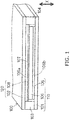
FIG. 1 is a cross sectional view schematically illustrating a configuration of a lithium ion battery. -
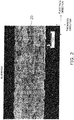
FIG. 2 is an SEM image showing an example of a cross section that is vertical to the plate face of the positive electrode. -
FIG. 3 is an EBSD image in a cross section of the positive electrode illustrated inFIG. 2 . -
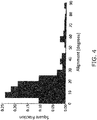
FIG. 4 is a histogram using a surface area basis to illustrate the distribution of an orientation angle of primary particles in the EBSD image illustrated inFIG. 3 . Description of Embodiments -
FIG. 1 is a cross sectional view illustrating a configuration of a lithium ion battery. A chip-type lithium battery 100 that is configured as a plate piece is a secondary battery (rechargeable battery) that is capable of repetitive use as a result of charging and discharging. - The
lithium battery 100 comprises a positive electrode-side current collectinglayer 101, a negative electrode-sidecurrent collecting layer 102,outer cladding collecting connection layer 105, apositive electrode 106, asolid electrolyte layer 107 and thenegative electrode layer 108. Thelithium ion battery 100 has a configuration in which the positive electrode-side current collectinglayer 101, the currentcollecting connection layer 105, thepositive electrode 106, thesolid electrolyte layer 107, thenegative electrode layer 108 and the negative electrode-sidecurrent collecting layer 102 are sequentially stacked in a stacking direction X. - The end portion in the direction of plate width of the
lithium ion battery 100 is sealed by theouter cladding positive electrode portion 110 is configured by the positive electrode-side current collectinglayer 101, the currentcollecting connection layer 105 and thepositive electrode 106. Anegative electrode portion 120 is configured by the negative electrode-side current collectinglayer 102 and thenegative electrode layer 108. - The positive electrode-side
current collecting layer 101 is disposed on an outer side of thepositive electrode 106. The positive electrode-side current collectinglayer 101 is mechanically and electrically connected through the currentcollecting connection layer 105 to thepositive electrode 106. The positive electrode-side current collectinglayer 101 can function as a positive electrode current collector. - The positive electrode-side current collecting
layer 101 can be composed of metal. The metal that configures the positive electrode-side current collectinglayer 101 includes stainless steel, aluminum, copper, platinum, nickel and the like, with aluminum, nickel and stainless steel being particularly suitable. The positive electrode-side current collectinglayer 101 may be formed in a plate shape or a foil shape, with a foil shape being particularly preferred. Therefore, use of an aluminum foil, a nickel foil, or a stainless steel foil is particularly preferred as the positive electrode-side current collectinglayer 101. When the positive electrode-side current collectinglayer 101 is shaped as a foil, the thickness of the positive electrode-sidecurrent collecting layer 101 may be configured to 1 to 30 µm, preferably as greater than or equal to 5 and less than or equal to 25 µm, and more preferably as greater than or equal to 10 and less than or equal to 20 µm. - The negative electrode-side
current collecting layer 102 is disposed on an outer side of thenegative electrode layer 108. The negative electrode-side current collectinglayer 102 is mechanically and electrically connected to thenegative electrode layer 108. The negative electrode-side current collectinglayer 102 can function as a negative electrode current collector. The negative electrode-side current collectinglayer 102 can be composed of metal. The negative electrode-side current collectinglayer 102 can be composed of the same material as the positive electrode-side current collectinglayer 101. Therefore use is preferred of an aluminum foil, a nickel foil, or a stainless steel foil as the negative electrode-sidecurrent collecting layer 102. When the negative electrode-sidecurrent collecting layer 102 is shaped as a foil, the thickness of the negative electrode-sidecurrent collecting layer 102 may be configured to 1 to 30 µm, preferably as greater than or equal to 5 and less than or equal to 25 µm, and more preferably as greater than or equal to 10 and less than or equal to 20 µm. - The
outer cladding layer 101 and the negative electrode-side current collectinglayer 102. Theouter cladding solid electrode 106, thesolid electrolyte layer 107 and thenegative electrode layer 108. Theouter cladding lithium ion battery 100. - In order to ensure electrical insulation between the positive electrode-side current collecting
layer 101 and the negative electrode-side current collectinglayer 102, the resistivity of theouter cladding outer cladding outer cladding lithium ion battery 100 due to heat. - The
outer cladding - The current
collecting connection layer 105 is disposed between the positive electrode-side current collectinglayer 101 and thepositive electrode 106. The currentcollecting connection layer 105 mechanically bonds thepositive electrode 106 to the positive electrode-side current collectinglayer 101 and electrically bonds thepositive electrode 106 to the positive electrode-side current collectinglayer 101. - The current
collecting connection layer 105 includes a conductive material and an adhesive. The conductive material may include use of conductive carbon or the like. The adhesive may include use of an epoxy or the like. Although there is no particular limitation in relation to the thickness of the currentcollecting connection layer 105, it may be configured as greater than or equal to 5 µm and less than or equal to 100 µm, and preferably greater than or equal to 10 µm and less than or equal to 50 µm. - However the current
collecting connection layer 105 may omit the adhesive. In this configuration, an electrical connection between thepositive electrode 106 and the currentcollecting connection layer 105 may be created by configuring the currentcollecting connection layer 105 as a direct connection film (for example, gold or aluminum) on the rear surface of thepositive electrode 106. - The
positive electrode 106 is formed in a plate shape. Thepositive electrode 106 includes a solid electrolyte-side surface 106a and a current collecting connection layer-side surface 106b. Thepositive electrode 106 is connected to thesolid electrolyte layer 107 on the solid electrolyte-side surface 106a. Thepositive electrode 106 is connected to the currentcollecting connection layer 105 on the current collecting connection layer-side surface 106b. The solid electrolyte-side surface 106a and the current collecting connection layer-side surface 106b respectively form a "plate face" of thepositive electrode 106. Upon observation of a cross section of thepositive electrode 106 by use of a scanning electron microscope (SEM), the solid electrolyte-side surface 106a is an approximately straight line obtained by a least squares method defining the interface between thepositive electrode 106 and thesolid electrolyte layer 107. Upon observation of a cross section of thepositive electrode 106 by SEM, the current collecting connection layer-side surface 106b is an approximately straight line obtained by a least squares method defining the interface between thepositive electrode 106 and the currentcollecting connection layer 105. - A processing operation such as polishing or the like may be applied to the solid electrolyte-
side surface 106a of thepositive electrode 106. In this manner, even in a configuration in which the film thickness of thesolid electrolyte layer 107 is reduced as a result of a change in the surface configuration of the solid electrolyte-side surface 106a, it is possible to inhibit a reduction in the film properties of thesolid electrolyte layer 107. The means of varying the surface configuration of the solid electrolyte-side surface 106a is not limited to a polishing processing operation, and the surface configuration of the solid electrolyte-side surface 106a may also be changed as a result of a method of coating and firing a microparticle active material, or a means of forming thesolid electrolyte layer 107 by a gas phase method such as sputtering or the like. - Although there is no particular limitation in relation to the thickness of the
positive electrode 106, it may be configured as greater than or equal to 20 µm, preferably greater than or equal to 25 µm, and more preferably greater than or equal to 30 µm. In particular, a configuration in which the thickness of thepositive electrode 106 is greater than or equal to 50 µm makes it possible to increase the density of thelithium ion battery 100 by ensuring a sufficient active material capacity per unit surface area. Furthermore although there is no particular limitation on the upper limiting value of the thickness of thepositive electrode 106, when inhibiting the deterioration of battery characteristics (in particular an increase in the resistance value) that results from repetitive charging and discharging is taken into account, a value of less than 200 µm is preferred, a value of less than or equal to 150 µm is more preferred, a value of less than or equal to 120 µm is still more preferred, and a value of less than or equal to 100 µm is particularly preferred. - When a cross section of the
positive electrode 106 is observed by SEM, the thickness of thepositive electrode 106 is obtained by measurement of the average distance (average value of a distance at 3 arbitrary points) in the thickness direction of the solid electrolyte-side surface 106a and the current collecting connection layer-side surface 106b. The thickness direction is a direction that is vertical in relation to the solid electrolyte-side surface 106a and the current collecting connection layer-side surface 106b and is substantially the same as the stacking direction X. - A coefficient of expansion-contraction in a direction parallel to the plate face of the positive electrode 106 (referred to below as "plate face direction") is preferably suppressed to less than or equal to 0.7%. In this manner, when the coefficient of expansion-contraction of the
positive electrode 106 is sufficiently low, even when the thickness of thepositive electrode 106 is configured to be less than or equal to 30 µm for the purpose of enhancing the rate characteristics of thelithium ion battery 100, it is possible to inhibit peeling of thepositive electrode 106 and/or a defect in thesolid electrolyte layer 107. Therefore the thickness of thepositive electrode 106 may be suitably set taking into account the coefficient of expansion-contraction of thepositive electrode 106 and the discharge capacity of thelithium ion battery 106. - The microstructure of the
positive electrode 106 will be discussed below. - The
solid electrolyte layer 107 is preferably composed of a lithium phosphate oxynitride (LiPON) ceramic material that is known to be an oxide-based ceramic material. The thickness of thesolid electrolyte layer 107 preferably has a thin configuration to thereby enhance lithium ion conductivity, and may be suitably set by taking into account reliability during charging and discharging (cracking, separator function, inhibiting a defect or the like). The thickness of thesolid electrolyte layer 107 for example is preferably 0.1 to 10 µm, more preferably 0.2 to 8.0 µm, still more preferably 0.3 to 7.0 µm, and particularly preferably 0.5 to 6.0 µm. - A sputtering method is preferably used as a method of film formation for attaching the
solid electrolyte layer 107 that is formed from a ceramic material to the solid electrolyte-side surface 106a of thepositive electrode 106. At that time, the thickness of thesolid electrolyte layer 107 can be adjusted by controlling the film formation conditions (for example, film formation time) used in the sputtering method. Thepositive electrode 106 does not tend to cause a defect in battery function even when the battery is configured by forming a solid electrode layer composed of LiPON on the surface by use of a sputtering method. - LiPON is a group of compounds represented by a composition of Li2.9PO3.3N0.46, and for example, is a group of compounds represented by LiaPObNc (wherein, a is 2 to 4, b is 3 to 5, and c is 0.1 to 0.9). Therefore, the formation of a LiPON-based solid electrolyte layer by sputtering may be performed using a lithium phosphate sintered body target as an Li source, a P source and an O source, and carried out according to known conditions by introducing N2 as a gas species for the N source. Although there is no particular limitation on the sputtering method, use of an RF magnetron method is preferred. Furthermore, in substitution for the sputtering method, a film formation method such as an MOCVD method, a sol gel method, an aerosol deposition method, a screen printing or the like may be used.
- The
solid electrolyte layer 107 may be composed of an oxide-based ceramic material other than a LiPON-based ceramic material. The oxide-based ceramic material other than a LiPON-based ceramic material includes at least one type selected from the group consisting of a garnet-based ceramic material, a nitride-based ceramic material, a perovskite-based ceramic material, a phosphate-based ceramic material and a zeolite-based ceramic material. An example of the garnet ceramic material includes use of an Li-La-Zr-O-based material (specifically Li7La3Zr2O12, or the like) and an Li-La-Ta-O-based material. An example of the perovskite-based ceramic material includes use of an Li-La-Ti-O-based material (specifically LiLa1-xTixO3 (0.04 ≦ x ≦ 0.14), or the like). An example of the phosphate-based ceramic material includes use of Li-Al-Ti-P-O, Li-Al-Ge-P-O and Li-Al-Ti-Si-P-O (specifically Li1+x+yAlxTi2-xSiy P3-yO12 (0≦x≦0.4, 0≦y≦0.6) or the like). - The
solid electrolyte layer 107 may also be composed of a sulfide based material. The sulfide based material includes use of a material selected from a solid electrolyte based on Li2S-P2S5, LiI-Li2S-P2S5, LiI-Li2S-B2S32, or LiI-Li2S-SiS2, Thio-LISICON, and Li10GeP2S12, or the like. A sulfide based material is comparatively soft, and therefore the battery can be configured by forming a solid electrolyte layer by compaction pressing of a sulfide-based powder onto the surface of thepositive electrode 106. More specifically, the solid electrolyte layer can be formed by stacking and pressing a sulfide-based powder body configured in a sheet shape by using a binder or the like onto thepositive electrode 106, or by pressing after coating and drying a slurry in which a sulfide-based powder is dispersed onto thepositive electrode 106. - The
negative electrode layer 108 is disposed on thesolid electrolyte layer 107. Thenegative electrode layer 108 contains a principal component of lithium metal. Thenegative electrode layer 108 may be configured as a lithium-containing metal film formed on thesolid electrolyte layer 107. The lithium-containing metal film may be formed by a vacuum deposition method, a sputtering method, a CVD method, or the like. - Although there is no particular limitation on the thickness of the
negative electrode layer 108, it may be configured as less than or equal to 200 µm. When the feature of increasing an density by ensuring a large total lithium amount in thelithium battery 100 is taken into account, it is preferred that the thickness of thenegative electrode layer 108 is greater than or equal to 10 µm, preferably greater than or equal to 10 µm and less than or equal to 50 µm, more preferably greater than or equal to 10 µm and less than or equal to 40 µm, and particularly preferably greater than or equal to 10 µm and less than or equal to 20 µm. -
FIG. 2 is a SEM image showing an example of a cross section that is vertical to the plate face of thepositive electrode 106.FIG. 3 is an electron backscatter diffraction (EBSD) image in the cross section that is vertical to the plate face of thepositive electrode 106.FIG. 4 is a histogram using a surface area basis to illustrate the distribution of an orientation angle of theprimary particles 20 in the EBSD image illustrated inFIG. 3 . - In the EBSD image illustrated in
FIG. 3 , a discontinuity in the crystal orientation can be observed. InFIG. 3 , the orientation angle of eachprimary particle 20 is categorized, such that the darker the color, the smaller the orientation angle. The orientation angle is the angle of inclination subtended by the (003) surface of eachprimary particle 20 relative to the plate face direction. InFIG. 2 andFIG. 3 , the positions illustrated in black in the inner portion of thepositive electrode 106 are pores. - The
positive electrode 106 is formed by bonding of a plurality ofprimary particles 20. Eachprimary particle 20 is formed mainly in a plate shape. However, a configuration such as rectangular, cubic and spherical or the like may also be included. There is no particular limitation on the cross sectional shape of eachprimary particle 20, and it may be oblong, a polygonal shape other than oblong, circular, oval, or another complex shape in addition to the above shapes. - Each
primary particle 20 is composed of a lithium complex oxide. A lithium complex oxide is an oxide that is expressed as LixMO2 (wherein 0.05 <x< 1.10, and wherein M is at least one type of transition metal, and M typically includes one or more types of Co, Ni, Mn). A lithium complex oxide has a layered rock-salt structure. A layered rock-salt structure is a crystalline structure in which a lithium layer and a transition metal layer other than lithium are alternately layered to sandwich an oxygen layer, that is to say, a crystalline structure in which a transition metal ion layer is alternatively layered with a lithium single layer through an oxide ion (typically, an α-NaFeO2 type structure, that is to say, a structure in which a transition metal and lithium are regularly ordered in an [111] axial direction of cubic crystal rock-salt structure). - A lithium complex oxide for example includes LixCoO2 (lithium cobalt oxide), LixNiO2 (lithium nickelate), LixMnO2 (lithium manganate), LixNiMnO2 (nickel-lithium manganate), LixNiCoO2 (lithium-nickel-cobalt oxide), LixCoNiMnO2 (lithium cobalt nickel manganate), LixCoMnO2 (cobalt-lithium manganate), with LixCoO2 in particular being preferred.
- A lithium complex oxide may include one or more elements of Mg, Al, Si, Ca, Ti, V, Cr, Fe, Cu, Zn, Ga, Ge, Sr, Y, Zr, Nb, Mo, Ag, Sn, Sb, Te, Ba, Bi, W or the like.
- As illustrated in
FIG. 3 andFIG. 4 , the average value of the orientation angle of each primary particle 20 (referred to below as "average orientation angle") is more than 0° and less than or equal to 30°. - In this manner, since each
primary particle 20 is nestled in a direction that is inclined towards the thickness direction, the adhesion between each of the primary particles can be enhanced. As a result, the rate characteristics are improved since the lithium ion conductivity is enhanced between a givenprimary particle 20 and anotherprimary particle 20 that is adjacent on both longitudinal sides of the firstprimary particle 20. - As shown in the present embodiment, when the
positive electrode 106 is used in connection with thesolid electrolyte layer 107, the cycle characteristics are enhanced. This feature is due to the fact that since eachprimary particle 20 is compressed in a direction that is perpendicular to the (003) plane in response to the intercalation and deintercalation of lithium ions, the expansion-contraction amount of thepositive electrode 106 in the plate face direction is reduced as a result of the reduction in the angle of the (003) plane relative to the plate face direction and therefore it is possible to inhibit production of stress between thepositive electrode 106 and thesolid electrolyte layer 107. - Furthermore, as shown in the present embodiment, when the
positive electrode 106 is used in connection with thesolid electrolyte layer 107, the rate characteristics are further enhanced. As discussed above, this feature is due to the fact that during intercalation and deintercalation of lithium ions, the expansion-contraction of thepositive electrode 106 in the thickness direction predominates over that in the plate face direction resulting in smooth expansion-contraction of thepositive electrode 106, and consequently smooth intercalation and deintercalation of lithium ions. - The average orientation angle of the
primary particles 20 is obtained by the following method. Firstly, as illustrated inFIG. 3 , in the EBSD image in which a rectangular region of 95µm × 125µm is observed at 1000-fold magnification, three horizontal lines that divide thepositive electrode 106 into 4 equal parts in the thickness direction and three vertical lines that divide thepositive electrode 106 into 4 equal parts in the plate face direction are drawn. Then, the arithmetic mean of orientation angles is calculated for allprimary particles 20 that intersect at least one line of the three horizontal lines and three vertical lines to thereby obtain an average orientation angle of theprimary particles 20. - In consideration of the further enhancement in the rate characteristics, the average orientation angle of the
primary particles 20 is preferably less than or equal to 30°, and more preferably less than or equal to 25°. The average orientation angle of theprimary particles 20 when the rate characteristics are considered in the same manner is preferably greater than or equal to 2°, and more preferably greater than or equal to 5°. - Each
primary particle 20 is formed in a plate shape, and therefore as illustrated inFIG. 2 andFIG. 3 , the cross section of eachprimary particle 20 extends in respectively predetermined directions. That is to say, the cross section of eachprimary particle 20 is formed in substantially an oblong shape. - The aggregate surface area of primary particles having an aspect ratio of greater than or equal to 4 of the 30
primary particles 20 used in the calculation of the average orientation angle is preferably greater than or equal to 70% relative to the total area of primary particles used in the calculation of the average orientation angle. In other words, when the cross section of thepositive electrode 106 is analyzed using EBSD, of thoseprimary particles 20 that are included in the cross section under analysis, it is preferred that the aggregate surface area of theprimary particles 20 that have an orientation angle of more than 0° to less than or equal to 30° relative to the plate face of thepositive electrode 106 is greater than or equal to 70% when compared to the total area of theprimary particles 20 contained in the cross section being analyzed. - In this manner, the rate characteristics can be further enhanced since the proportion of
primary particles 20 that exhibit mutual adhesion is increased. - The average aspect ratio of the
primary particles 20 is a value obtained by dividing the maximum Feret diameter by the minimum Feret diameter of the primary particles. A maximum Feret diameter is the maximum distance between straight lines when two parallel straight lines are drawn to sandwichprimary particles 20 on an EBSD image for observation of a cross section. A minimum Feret diameter is the minimum distance between straight lines when two parallel straight lines are drawn to sandwichprimary particles 20 on an EBSD image. - The surface area ratio of
primary particles 20 having an aspect ratio of greater than or equal to 4 of the 30primary particles 20 used in the calculation of the average orientation angle is more preferably more than 70%, and particularly preferably greater than or equal to 80%. - The average particle diameter of the 30
primary particles 20 used in the calculation of the average orientation angle is preferably greater than or equal to 5 µm. - In this manner, the rate characteristics are further enhanced since lithium ion conductivity is enhanced overall due to a reduction in the number of grain boundaries between
primary particles 20 in the direction of lithium ion conduction. - The average particle diameter of the
primary particles 20 is a value obtained as the arithmetic mean of the equivalent circle diameter of eachprimary particle 20. The equivalent circle diameter is the diameter of a circle having the same surface area as eachprimary particle 20 in the EBSD image. - The average particle diameter of the 30
primary particles 20 that are used in the calculation of the average orientation angle is preferably greater than or equal to 7 µm, and particularly preferred to be greater than or equal to 12 µm, when further enhancement in the rate characteristics is considered. - The orientation angle alignment between adjacent
primary particles 20 also contributes to rate performance. That is to say, the rate performance is enhanced when the orientation angle difference between adjacentprimary particles 20 is small and the grain boundary alignment is high. In particular, there is further improvement to the rate performance when the orientation angle difference is reduced in a direction in which the lithium ions and electrons are conducted. The direction of conduction of lithium ions and electrons is the longitudinal direction of theprimary particles 20. The orientation angle difference betweenprimary particles 20 that are adjacent in the longitudinal direction is preferably greater than or equal to 0° and less than or equal to 40°, more preferably greater than or equal to 0° and less than or equal to 30°, and particularly preferably greater than or equal to 0° and less than or equal to 20°. - When the cross section of the
positive electrode 106 is analyzed using EBSD, of theprimary particles 20 that are contained in the cross section under analysis, the proportion ofprimary particles 20 in which the orientation angle difference is less than or equal to 40° is preferably greater than or equal to 50%, more preferably greater than or equal to 60% and particularly preferably greater than or equal to 70%. - The denseness of the
positive electrode 106 is preferably greater than or equal to 70%. In this manner, further enhancement is enabled in relation to the rate characteristics since mutual adhesion betweenprimary particles 20 is further enhanced. - The denseness of the
positive electrode 106 is calculated by SEM observation using a magnification of 1000 after polishing a cross section of the positive electrode plate using CP polishing, and binarizing the resulting SEM image. - When further enhancement in relation to the rate characteristics is considered, the denseness of the
positive electrode 106 is more preferably greater than or equal to 80%, and particularly preferably greater than 90%. - Although there is no particular limitation on the average equivalent circle diameter of each pore formed in an inner portion of the
positive electrode 106, it is preferred to be less than or equal to 8 µm. As the average equivalent circle diameter of each pore is reduced, there is a further improvement in the mutual adhesion ofprimary particles 20 and therefore there is a further enhancement to the rate characteristics. - The average equivalent circle diameter of the pores is a value that is obtained as the arithmetic mean of the equivalent circle diameter of 10 pores on an EBSD image. The equivalent circle diameter is the diameter of a circle that has the same surface area of each pore on the EBSD image.
- Although each pore formed in an inner portion of the
positive electrode 106 may be an open pore that is connected with an external portion of thepositive electrode 106, it is preferred that the pore does not penetrate thepositive electrode 106. That is to say, it is preferred that each pore does not connect the solid electrolyte-side surface 106a of thepositive electrode 106 with the current collecting connection layer-side surface 106b. Each pore may be a closed pore. - An LiCoO2 powder is synthesized by mixing a Li2CO3 starting powder with a Co3O4 starting powder and firing (500□ to 900□, 1 to 20 hours).
- Plate-shaped LiCoO2 particles that enable conduction of lithium ions parallel to the plate face are obtained by grinding the resulting LiCoO2 powder using a ball mill to have a volume-based D50 particle diameter of 0.1 µm to 10 µm. The resulting LiCoO2 particles exhibit a configuration of tending to cleave along a cleavage plane. The LiCoO2 template particles are prepared by cracking and cleaving the LiCoO2 particles.
- This type of LiCoO2 particle can be obtained by a method of synthesizing a plate shaped crystal (a method of cracking after causing grain growth of a green sheet using a LiCoO2 particle slurry, flux growth or hydrothermal synthesis, single crystal growth using melting, a sol-gel method or the like).
- In the present step, as discussed below, it is possible to control the profile of the
primary particles 20 that configure thepositive electrode 106. - Firstly it is possible to control the aggregate surface area ratio of the
primary particles 20 having an aspect ratio of greater than or equal to 4 by adjusting the aspect ratio of the LiCoO2 template particles. More specifically, the aggregate surface area ratio of theprimary particles 20 having an aspect ratio of greater than or equal to 4 can be increased as the aspect ratio of the LiCoO2 template particles is increased. - The aspect ratio of the LiCoO2 template particles can be adjusted by at least one of the particle diameter of the Li2CO3 starting powder and the Co3O4 starting powder, the milling conditions during milling (milling time, milling energy, milling method or the like), and the classification conducted after milling.
- Furthermore it is possible to control the average particle diameter of the
primary particles 20 by adjusting the particle diameter of the LiCoO2 template particles. - Furthermore it is possible to control the denseness of the
positive electrode 106 by adjusting the particle diameter of the LiCoO2 template particles. More specifically, the denseness of thepositive electrode 106 increases as the particle diameter of the LiCoO2 template particles is reduced. - A Co3O4 starting powder is used as matrix particles. There is no particular limit in relation to the volume-based D50 particle diameter of the Co3O4 starting material powder, and for example, it may be 0.1 to 1.0 µm. It is preferred that it is smaller than the volume-based D50 particle diameter of the LiCoO2 template particles. The matrix particles can be obtained by thermal processing of the Co(OH)2 starting material for 1 to 10 hours at 500°C to 800°C. Furthermore, in addition to Co3O4, Co(OH)2 particles, or LiCoO2 particles may be used in the matrix particles.
- In the present step, as described below, it is possible to control the profile of the
primary particles 20 that configure thepositive electrode 106. - Firstly the aggregate surface area ratio of the
primary particles 20 having an aspect ratio of greater than or equal to 4 can be controlled by adjusting the ratio of the matrix /template particle diameter ratio. More specifically, as the matrix/template particle diameter ratio becomes smaller, that is to say, as the particle diameter of the matrix particles becomes small, the aggregate surface area ratio of theprimary particles 20 having an aspect ratio of greater than or equal to 4 can be increased. - Furthermore, the denseness of the
positive electrode 106 can be controlled by adjusting the matrix/template particle diameter ratio. More specifically, as the matrix/template particle diameter ratio becomes small, that is to say, as the particle diameter of the matrix particles becomes small, the denseness of thepositive electrode 106 is increased. - A powder containing a mixture of LiCoO2 template particles and matrix particles in a proportion of 100:3 ∼ 3:97, a dispersing medium, a binder, a plasticizer, and a dispersing agent are mixed. Under reduced pressure, stirring and degassing are performed, and the mixture is adjusted to a desired viscosity to thereby prepare a slurry.
- Next, a green body is formed by molding the prepared slurry by use of a molding method that enables application of a shearing force to the LiCoO2 template particles. In this manner, an average orientation angle for each
primary particle 20 can be configured to be more than 0° and less than or equal to 30°. - A doctor blade method is suitably applied as a molding method that enables application of a shearing force to the LiCoO2 template particles. When using a doctor blade method, a green sheet can be formed as the green body by molding the prepared slurry onto a PET film.
- The present step as described below enables control of the profile of the
primary particles 20 that configure thepositive electrode 106. - Firstly, the average particle diameter of the
primary particles 20 can be controlled by adjusting the density of the green body. More specifically, as the density of the green body increases, the average particle diameter of theprimary particles 20 can be increased. - Furthermore, the denseness of the
positive electrode 106 can also be controlled by adjusting the mixing ratio of the LiCoO2 template particles and the matrix particles. More specifically, as the number of LiCoO2 template particles increases, the denseness of thepositive electrode 106 can be reduced. - The green body of the slurry is placed into a zirconia setter and subjected to thermal processing (500°C to 900°C, 1 to 10 hours) to thereby obtain a sintered plate as an intermediate body.
- Next, the sintered plate is sandwiched from the top and the bottom by a lithium sheet so that the synthesized lithium sheet has an Li/Co ratio of 1.0, and placed on a zirconia setter. However, the Li/Co ratio may be in excess by about 0.1 to 1.5. Grain growth is promoted by reason of the Li/Co ratio being in excess by more than 1.0. The behavior of the grain growth can be controlled by changing the material and denseness of the setter. For example, grain growth can be controlled by use of a dense magnesia setter that tends not to react with lithium.
- Next, the setter is placed in an alumina sheath and after firing in air (700°C to 850°C, 1 to 20 hours), the sintered plate is sandwiched on the top and the bottom by a lithium sheet, and subjected to further firing (750°C to 900°C, 1 to 40 hours) to thereby obtain an LiCoO2 sintered plate. The firing step may be separated into two steps, or may be performed on a single occasion. When firing is performed twice, the first firing temperature is preferably lower than the second firing temperature.
- The present step as described below enables control of the profile of the
primary particles 20 that configure thepositive electrode 106. - Firstly, the average particle diameter of the
primary particles 20 can be controlled by adjusting at least one of the rate of increase in temperature during firing and the thermal processing temperature of the intermediate body. More specifically, as the rate of increase in temperature increases, or the thermal processing temperature of the intermediate body is reduced, the average particle diameter of theprimary particles 20 can be increased. - Furthermore, at least one of the Li (for example, Li2CO3) amount during firing and the sintering additive (for example, boric acid, bismuth oxide) amount can be adjusted to thereby control the average particle diameter of the
primary particles 20. More specifically, as the amount of Li increases, or as the amount of the sintering additive increases, the average particle diameter of theprimary particles 20 can be increased. - Furthermore the denseness of the
positive electrode 106 can be controlled by adjusting the profile during firing. More specifically, as the firing temperature is lowered, or as the firing time is increased, the denseness of thepositive electrode 106 can be increased. - The present invention is not limited to the above embodiment, and various changes or modifications may be added within a scope that does not depart from the scope of the invention.
- In the above embodiment, although an example has been explained in which there is application of the positive electrode according to the present invention to the
positive electrode 106 of alithium ion battery 100, application is also possible of the positive electrode to other battery configurations. - For example, the positive electrode according to the present invention can be used in a lithium ion battery using an electrolyte such as an ionic liquid electrolyte, a polymer electrolyte, a gel electrolyte, or a liquid electrolyte. An ionic liquid electrolyte solution comprises an ionic liquid cation, an ionic liquid anion and an electrolyte. The ionic liquid cation includes a 1-ethyl-3-methylimidazolium cation (EMI), a 1-methyl-1-propylpyrrolidinium cation (P13), 1-methyl-1-propylpiperidinium cation (PP13), and derivatives and arbitrary combinations thereof. The ionic liquid anions include a bis-(trifluoromethylsulfonyl) imide anion (TFSI), a bis-(fluorosulfonyl) imide anion (FSI) and combinations thereof. The electrolyte includes a bis-(trifluoro methyl sulfonyl) imide lithium salt (LiTFSI), a lithium bis-(fluorosulfonyl) imide lithium salt (LiFSI), and combinations thereof. When using an ionic liquid electrolyte, an ionic liquid electrolyte may be used in isolation, or a configuration in which an ionic liquid is stained into the pores of a separator (for example, a cellulose-based configuration) may be used.
- Although the examples of a lithium ion battery according to the present invention will be described below, the present invention is not thereby limited to the following examples.
- A Co3O4 starting material powder (volume-based D50 particle diameter 0.8 µm, manufactured by Seido Chemical Industry Co., Ltd.) and Li2CO3 starting material powder (volume-based D50 particle diameter 2.5 µm, manufactured by Honjo Chemical Corporation) were mixed and fired for 5 hours at 800°C to synthesize a LiCoO2 starting material powder. At that time, the firing temperature or firing time was adjusted to thereby adjust the volume-based D50 particle diameter of the LiCoO2 starting material powder to the values shown in Table 1.
- Plate-shaped LiCoO2 particles (LCO template particles) were obtained by grinding the resulting LiCoO2 powder. Examples 1 and 2 and 4 to 8 used a pot mill, and Example 3 used a wet jet mill. At this time, the grinding time was adjusted to thereby adjust the volume-based D50 particle diameter of the LCO template particles to the values shown in Table 1. The aspect ratio of the LiCoO2 template particles is shown in Table 1. The aspect ratio of LiCoO2 template particles was measured by using SEM to observe the resulting template particles.
- A Co3O4 starting material powder (manufactured by Seido Chemical Industry Co., Ltd.) was used as a matrix particle. The volume-based D50 particle diameter of the matrix particles is shown in Table 1. However, in Example 4, a matrix particle was not used.
- LCO template particles and CoO matrix particles were mixed. The weight ratio of the LCO template particles and CoO matrix particles was configured as shown in Table 1. However since matrix particles were not used in Example 4, the weight ratio is 100:0.
- 100 parts by weight of the mixed powder and 100 parts by weight of a dispersion medium (toluene:isopropanol = 1: 1), 10 parts by weight of a binder (polyvinyl butyral: No. BM-2, manufactured by Sekisui Chemical Co., Ltd.), 4 parts by weight of a plasticizer (DOP: di(2-ethylhexyl) phthalate manufactured by Kurogane Kasei Co., Ltd.) and 2 parts by weight of a dispersing agent (product name: RHEODOL SP-O30, manufactured by Kao Corporation) were mixed. The mixture was stirred under reduced pressure, degassed, and the viscosity was adjusted to 400010000cP to thereby prepare a slurry. The viscosity was measured with an LVT viscometer manufactured by Brookfield.
- The resulting slurry was formed into a sheet shaped configuration on a PET film using a doctor blade method at a molding rate of 100 m/h to thereby have a thickness after drying of 40 µm.
- The Co3O4 sintered plate was obtained by placing the green sheet that was peeled from the PET film in a zirconia setter and performing primary firing. As shown in Table 1, the firing conditions in Examples 1 to 6 and 8 were 900°C and 5 hours and in Example 7, 800°C and 5 hours.
- The LiCoO2 sintered plate was obtained by causing the Li/Co ratio of the synthesized lithium sheet to coincide with the ratio shown Table 1 by sandwiching the Co3O4 sintered plate from the top and the bottom by a lithium sheet, placing on a zirconia setter and performing secondary firing. More specifically, a zirconia setter is placed in a 90 mm square alumina sheath, and after retaining in air at 800°C for 5 hours, further sandwiching is performed from the top and the bottom by a lithium sheet and firing is performed at 900°C for 20 hours.
- A lithium phosphate sintered body target having a diameter of 4 inches (about 10 cm) was prepared, and sputtering was executed using a sputtering apparatus (SPF-430H manufactured by Canon Anerva Corporation) in an RF magnetron configuration to form a film thickness of 2 µm using a gas species of N2 at 0.2 Pa and an output of 0.2 kW. In this manner, a LiPON-type solid electrolyte sputter film having a thickness of 2 µm is formed on LiCoO2 sintered plate.
- A 500Å Au film was formed on the solid electrolyte layer by sputtering using an ion sputtering apparatus (JFC-1500 manufactured by JEOL Ltd).
- A tungsten boat loaded with lithium metal was prepared. A vacuum vapor deposition apparatus (carbon coater SVC-700 manufactured by Sanyu Electron Co., Ltd.) was used to vaporize Li using resistance heating and thereby deposit a thin film on the surface of the intermediate layer. At that time, a mask was used to form the size of the negative electrode layer as 9.5 mm square and so that the negative electrode layer was restricted to within the 10 mm square positive electrode region. In this manner, a unit battery was prepared by forming an Li deposition film having a film thickness of 10 µm as a negative electrode on the solid electrolyte layer.
- A positive electrode current collection plate was formed by cutting out stainless steel foil having a thickness of 20 µm into 13 mm square. Furthermore, a frame-shaped modified polypropylene resin film (
thickness 100 µm) having a width of 1 mm was prepared by punching holes that are 13 mm square on an outer edge and 11 mm square on an inner side. The frame-shaped resin film was stacked on an outer peripheral portion of the positive-electrode current collection plate and subjected to thermal press bonding to thereby form an end sealing portion. The unit battery was placed in a region surrounded by the end sealing portion on the positive-electrode current collection plate. Stainless steel foil having a thickness of 20 µm was placed in the same manner as described above on the negative electrode side of the disposed unit battery, and while a load was applied to the end sealing portion, heating was applied at 200°C under reduced pressure. In this manner, the upper and lower two layers of stainless steel foil and the end sealing portion were bonded along the entire outer periphery to thereby seal the unit battery. In this manner, a totally solid lithium battery was obtained in a sealed state. - In Comparative Example 1, the LiCoO2 powder is not pulverized, and therefore with the exception of using the LCO template particles without modification, a solid lithium battery was obtained using the same processing steps as those described in Examples 1 to 8.
- In Comparative Example 2, with the exception that the volume-based D50 particle diameter of the CoO matrix particles is greater than that used in Examples 1 to 8, a solid lithium battery was obtained using the same processing steps as those described in Examples 1 to 8. The volume-based D50 particle diameter of the matrix particles in Comparative Example 2 was 3.0 µm, and the particle diameter ratio of the LCO template particles relative to the CoO matrix particles was 0.2.
- In Comparative Example 3, with the exception that the LCO template particles were not used and a green sheet was prepared with a slurry only using CoO matrix particles, a solid lithium battery was obtained using the same processing steps as those described in Examples 1 to 8.
- In Comparative Example 4, with the exception that the firing temperature for the primary firing was 1200°C, a solid lithium battery was obtained using the same processing steps as those described in Examples 1 to 8.
- A scanning electron microscope (JSM-7800M manufactured by JEOL Ltd.) provided with a backscattered electron diffraction image system was used to acquire an EBSD image of a cross section that is vertical to the plate face of the positive electrode. The average orientation angle of the primary particles was calculated by taking the arithmetic mean of the orientation angle of 30 primary particles that are arbitrarily selected on the EBSD image. The calculation results are shown in Table 2.
- In the EBSD image, a calculation was performed of the ratio (%) of the aggregate surface area of the primary particles having an orientation angle of greater than 0° and less than or equal to 30° relative to the total area of 30 primary particles used in the calculation of the average orientation angle. The calculation results are shown in Table 2.
- The average particle diameter of the 30 primary particles in the EBSD image used in the calculation of the average orientation angle was calculated. More specifically, the average particle diameter of the primary particles was taken to be the value of the arithmetic mean of the equivalent circle diameter of the respective 30 primary particles. The calculation results are shown in Table 2.
- The average aspect ratio of the 30 primary particles in the EBSD image used in the calculation of the average orientation angle was calculated. More specifically, the average aspect ratio of the primary particles was taken to be the value of the arithmetic mean for values in which the maximum Feret diameter is divided by the minimum Feret diameter for the respective 30 primary particles. The calculation results are shown in Table 2.
- The surface area ratio was calculated for the primary particles having an aspect ratio greater than or equal to 4 in the EBSD image from among the 30 primary particles used in the calculation of the average orientation angle. The calculation results are shown in Table 2.
- An SEM image using a magnification of 1000 of a CP polished cross section of the positive electrode plate was binarized. Then, the denseness was calculated as the surface area ratio of the solid phase to the aggregate surface area of the solid phase and the gaseous phase in the binarized image. The calculation results are shown in Table 2.
- After charging the lithium ion battery to 4.2 [V] using a 0.1 [mA] constant current, charging was performed using a constant voltage to a current of 0.05 [mA]. Then discharging was performed using a 0.2 [mA] constant current to 3.0 [V] and the discharge capacity W0 was measured. Then, after charging to 4.2 [V] using a 0.1 [mA] constant current, charging was performed using a constant voltage to a current of 0.05 [mA]. Then discharging was performed using a 2.0 [mA] constant current to 3.0 [V] and the discharge capacity W1 was measured. The rate performance is evaluated by dividing W1 by W0.
- After charging the lithium ion battery to 4.2 [V] using a 0.1 [mA] constant current, charging was performed using a constant voltage to a current of 0.05 [mA]. Then discharging was performed using a 0.2 [mA] constant current to 3.0 [V] and the discharge capacity W0 was measured. The measurement was repeated 30 times to thereby measure the 30th discharge capacity W30. The cycle capacity retention rate was evaluated by dividing the W30 by W0.
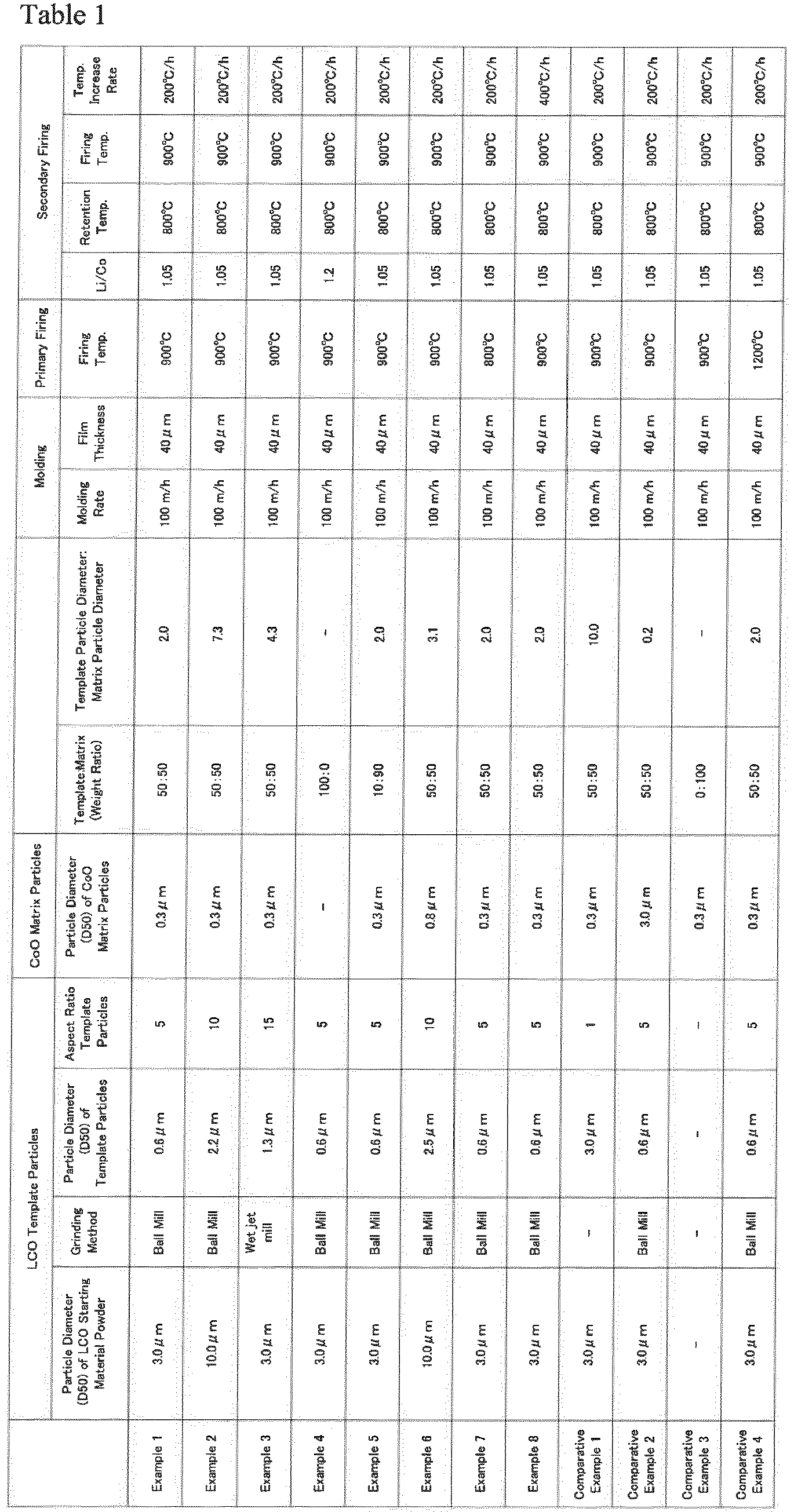
Table 2 Postive Electrode Evaluation Results Denseness Average Orientation Angle of Primary Particles Average Particle Diameter of Primary Particles Average Aspect Ratio of Primary Particles Surface Area Ratio of Primary Particles with Aspect Ratio of Greater than or Equal to 4 Rate Performance Cycle Capacity Retention Rate Example 1 98% 18° 7µm 5 75% 70% 90% Example 2 95% 15° 20µm 10 90% 84% 94% Example 3 97% 12° 15µm 12 95% 80% 95% Example 4 90% 5° 5µm 5 90% 55% 98% Example 5 99% 25° 12µm 5 70% 65% 75% Example 6 97% 13° 15µm 10 90% 88% 95% Example 7 99% 20° 15µm 10 90% 75% 80% Example 8 98% 15° 12µm 8 85% 80% 94% Comparative Example 1 95% 50° 8µm 1.5 20% 20% 30% Comparative Example 2 96% 50° 7µm 1.4 15% 20% 30% Comparative Example 3 99% 50° 10µm 1.7 30% 30% 25% Comparative Example 4 99% 60° 5µm 2 25% 20% - - As shown in Table 2, in Examples 1 to 8, a green body for the positive electrode was formed using a molding method in which a shear force was applied to the plate-shaped LCO template particles to thereby configure the orientation angle of the (003) plane of the primary particles to less than or equal to 25°. Furthermore, in Examples 1 to 8, the surface area ratio of primary particles having an aspect ratio of greater than or equal to 4 from among the 30 primary particles used in the calculation of the average orientation angle was configured to be greater or equal to 70%. As a result, the alignment (that is to say, grain boundary alignment) of the orientation angle of adjacent primary particles is increased, and therefore it was possible to enhance the rate performance in addition to the cycle capacity retention rate.
- In addition, when compared to Examples 1, 4 and 5 in which the average particle diameter of the primary particles was 5 µm, a further enhancement was enabled to the rate performance in Examples 2, 3, and 6 to 8 in which the average particle diameter of the primary particles was greater than or equal to 12 µm.
- Furthermore, as shown by a comparison with Examples 4 and 5, a further enhancement was enabled to the rate performed by a configuration in which the denseness of the positive electrode was greater than 90%.
-
- 100
- LITHIUM ION BATTERY
- 101
- POSTIVE ELECTRODE-SIDE CURRENT COLLECTING LAYER
- 102
- NEGATIVE ELECTRODE-SIDE CURRENT COLLECTING LAYER
- 103, 104
- OUTER CLADDING
- 105
- CURRENT COLLECTING CONNECTION LAYER
- 106
- POSITIVE ELECTRODE
- 107
- SOLID ELECTROLYTE LAYER
- 108
- NEGATIVE ELECTRODE
Claims (3)
- A positive electrode comprising a plurality of mutually bonded primary particles respectively composed of a lithium composite oxide having a layered rock-salt structure,
an average orientation angle of the plurality of primary particles relative to a plate face direction parallel to a plate face is more than 0° and less than or equal to 30°, and
an aggregate surface area of primary particles that have an aspect ratio of greater than or equal to 4 is greater than or equal to 70% relative to a total area of the plurality of primary particles, in cross section. - The positive electrode according to claim 1, wherein
an average particle diameter of the plurality of primary particles is greater than or equal to 8 µm. - The positive electrode according to claim 1 or 2, wherein
denseness is greater than 90%.
Applications Claiming Priority (3)
| Application Number | Priority Date | Filing Date | Title |
|---|---|---|---|
| JP2016087110 | 2016-04-25 | ||
| JP2016147856 | 2016-07-27 | ||
| PCT/JP2017/016342 WO2017188233A1 (en) | 2016-04-25 | 2017-04-25 | Positive electrode |
Publications (3)
| Publication Number | Publication Date |
|---|---|
| EP3352256A1 true EP3352256A1 (en) | 2018-07-25 |
| EP3352256A4 EP3352256A4 (en) | 2018-07-25 |
| EP3352256B1 EP3352256B1 (en) | 2020-01-01 |
Family
ID=60160453
Family Applications (1)
| Application Number | Title | Priority Date | Filing Date |
|---|---|---|---|
| EP17789515.8A Active EP3352256B1 (en) | 2016-04-25 | 2017-04-25 | Positive electrode |
Country Status (6)
| Country | Link |
|---|---|
| US (1) | US10637055B2 (en) |
| EP (1) | EP3352256B1 (en) |
| JP (2) | JP6483919B2 (en) |
| KR (1) | KR102327924B1 (en) |
| CN (1) | CN109075321B (en) |
| WO (1) | WO2017188233A1 (en) |
Families Citing this family (7)
| Publication number | Priority date | Publication date | Assignee | Title |
|---|---|---|---|---|
| JP6947673B2 (en) * | 2018-03-27 | 2021-10-13 | 日本碍子株式会社 | Lithium secondary battery |
| JP6496435B1 (en) * | 2018-03-28 | 2019-04-03 | 日本碍子株式会社 | Lithium secondary battery and battery card |
| JP6919064B2 (en) * | 2018-03-28 | 2021-08-11 | 日本碍子株式会社 | Lithium secondary battery and built-in battery card |
| JP7190509B2 (en) * | 2018-12-18 | 2022-12-15 | 日本碍子株式会社 | lithium secondary battery |
| US12469930B2 (en) * | 2019-05-24 | 2025-11-11 | University Of Southern California | Long-life lithium-sulfur battery using a novel flexible bi-layer solid state electrolyte |
| CN115004397A (en) | 2020-01-31 | 2022-09-02 | 京瓷株式会社 | Electrode for secondary battery and secondary battery |
| KR20230107145A (en) | 2022-01-07 | 2023-07-14 | 주식회사 엘지에너지솔루션 | Positive electrode material powder, positive electrode and lithium secondary battery comprising the same |
Family Cites Families (18)
| Publication number | Priority date | Publication date | Assignee | Title |
|---|---|---|---|---|
| US6337156B1 (en) * | 1997-12-23 | 2002-01-08 | Sri International | Ion battery using high aspect ratio electrodes |
| JP3971911B2 (en) * | 2001-10-29 | 2007-09-05 | 松下電器産業株式会社 | Solid lithium secondary battery and manufacturing method thereof |
| JP2007018883A (en) * | 2005-07-07 | 2007-01-25 | Toshiba Corp | Negative electrode active material, non-aqueous electrolyte battery and battery pack |
| JP2010074304A (en) | 2008-09-16 | 2010-04-02 | Ricoh Co Ltd | Image forming apparatus and start controlling method |
| US9099738B2 (en) * | 2008-11-03 | 2015-08-04 | Basvah Llc | Lithium secondary batteries with positive electrode compositions and their methods of manufacturing |
| CN102239588B (en) * | 2008-12-24 | 2014-09-24 | 日本碍子株式会社 | Plate-shaped particles for positive electrode material of lithium secondary batteries, lithium secondary battery positive electrode active material films, manufacturing method therefor, lithium secondary battery positive electrode active material man |
| EP2369664B1 (en) | 2008-12-24 | 2015-02-25 | NGK Insulators, Ltd. | Plate-shaped particles for positive electrode active material of lithium secondary batteries, lithium secondary battery positive electrode active material films, manufacturing method therefor, lithium secondary battery positive electrode active material manufacturing method and lithium secondary batteries |
| JP2011108407A (en) * | 2009-11-13 | 2011-06-02 | Sumitomo Electric Ind Ltd | Manufacturing method of cathode for nonaqueous electrolyte battery, cathode for nonaqueous electrolyte battery and nonaqueous electrolyte battery |
| JP5564649B2 (en) * | 2010-06-23 | 2014-07-30 | 日本碍子株式会社 | Positive electrode of lithium secondary battery and lithium secondary battery |
| US20120251858A1 (en) * | 2011-04-04 | 2012-10-04 | Rohm Co., Ltd. | Laminated type energy device, chip type energy device, energy device electrode structure and fabrication method of the laminated type energy device |
| JP6029898B2 (en) * | 2011-09-09 | 2016-11-24 | 株式会社半導体エネルギー研究所 | Method for producing positive electrode for lithium secondary battery |
| WO2014061399A1 (en) * | 2012-10-15 | 2014-04-24 | 日本碍子株式会社 | Positive active material for lithium secondary battery, and positive electrode obtained using same |
| JP2014164836A (en) * | 2013-02-22 | 2014-09-08 | Ngk Insulators Ltd | Method of forming crystal-oriented cathode active material plate |
| JP5789796B2 (en) * | 2013-08-29 | 2015-10-07 | パナソニックIpマネジメント株式会社 | All-solid lithium secondary battery |
| US10147966B2 (en) * | 2014-02-20 | 2018-12-04 | Sila Nanotechnologies, Inc. | Metal sulfide composite materials for batteries |
| CN105226272A (en) * | 2014-05-27 | 2016-01-06 | 中国科学院苏州纳米技术与纳米仿生研究所 | Lithium manganese phosphate-carbon composite material and its preparation method, positive electrode material and positive electrode |
| JPWO2016117499A1 (en) | 2015-01-23 | 2017-11-02 | 日本碍子株式会社 | Positive plate for all solid state battery, all solid state battery |
| CN105406056A (en) * | 2015-12-31 | 2016-03-16 | 湖南桑顿新能源有限公司 | Long-cycle and high-safety power lithium ion battery positive electrode material and preparation method thereof |
-
2017
- 2017-04-25 EP EP17789515.8A patent/EP3352256B1/en active Active
- 2017-04-25 WO PCT/JP2017/016342 patent/WO2017188233A1/en not_active Ceased
- 2017-04-25 KR KR1020187033280A patent/KR102327924B1/en active Active
- 2017-04-25 CN CN201780025186.8A patent/CN109075321B/en active Active
- 2017-04-25 JP JP2018509930A patent/JP6483919B2/en active Active
-
2018
- 2018-04-13 US US15/952,593 patent/US10637055B2/en active Active
-
2019
- 2019-02-14 JP JP2019024275A patent/JP6820960B2/en active Active
Also Published As
| Publication number | Publication date |
|---|---|
| US10637055B2 (en) | 2020-04-28 |
| JPWO2017188233A1 (en) | 2018-08-02 |
| EP3352256A4 (en) | 2018-07-25 |
| US20180233746A1 (en) | 2018-08-16 |
| KR20190002532A (en) | 2019-01-08 |
| JP6483919B2 (en) | 2019-03-13 |
| JP2019071301A (en) | 2019-05-09 |
| KR102327924B1 (en) | 2021-11-18 |
| CN109075321A (en) | 2018-12-21 |
| EP3352256B1 (en) | 2020-01-01 |
| JP6820960B2 (en) | 2021-01-27 |
| CN109075321B (en) | 2021-10-29 |
| WO2017188233A1 (en) | 2017-11-02 |
Similar Documents
| Publication | Publication Date | Title |
|---|---|---|
| EP3352255B1 (en) | Positive electrode | |
| EP3352254B1 (en) | Plate-shaped lithium composite oxide | |
| EP3352256B1 (en) | Positive electrode | |
| EP3582298B1 (en) | Lithium composite oxide sintered body plate | |
| US20180233731A1 (en) | Method for manufacturing positive electrode | |
| JPWO2018025594A1 (en) | All solid lithium battery | |
| JPWO2018025595A1 (en) | How to use all solid lithium battery | |
| CN110574207B (en) | Lithium ion conductive ceramic material, lithium ion conductive ceramic body, and lithium battery | |
| EP3796456A1 (en) | Lithium secondary battery | |
| EP3392935A1 (en) | Plate-shaped lithium composite oxide, and method for manufacturing same |
Legal Events
| Date | Code | Title | Description |
|---|---|---|---|
| STAA | Information on the status of an ep patent application or granted ep patent |
Free format text: STATUS: THE INTERNATIONAL PUBLICATION HAS BEEN MADE |
|
| PUAI | Public reference made under article 153(3) epc to a published international application that has entered the european phase |
Free format text: ORIGINAL CODE: 0009012 |
|
| STAA | Information on the status of an ep patent application or granted ep patent |
Free format text: STATUS: REQUEST FOR EXAMINATION WAS MADE |
|
| 17P | Request for examination filed |
Effective date: 20180417 |
|
| A4 | Supplementary search report drawn up and despatched |
Effective date: 20180605 |
|
| AK | Designated contracting states |
Kind code of ref document: A1 Designated state(s): AL AT BE BG CH CY CZ DE DK EE ES FI FR GB GR HR HU IE IS IT LI LT LU LV MC MK MT NL NO PL PT RO RS SE SI SK SM TR |
|
| AX | Request for extension of the european patent |
Extension state: BA ME |
|
| STAA | Information on the status of an ep patent application or granted ep patent |
Free format text: STATUS: EXAMINATION IS IN PROGRESS |
|
| 17Q | First examination report despatched |
Effective date: 20190208 |
|
| RIC1 | Information provided on ipc code assigned before grant |
Ipc: H01M 10/0525 20100101ALI20190617BHEP Ipc: H01M 4/04 20060101ALN20190617BHEP Ipc: H01M 4/525 20100101ALI20190617BHEP Ipc: H01M 4/131 20100101AFI20190617BHEP Ipc: H01M 10/0562 20100101ALN20190617BHEP Ipc: H01M 10/052 20100101ALI20190617BHEP Ipc: C01G 51/00 20060101ALI20190617BHEP Ipc: H01M 4/02 20060101ALN20190617BHEP Ipc: H01M 4/1391 20100101ALI20190617BHEP |
|
| DAV | Request for validation of the european patent (deleted) | ||
| DAX | Request for extension of the european patent (deleted) | ||
| GRAP | Despatch of communication of intention to grant a patent |
Free format text: ORIGINAL CODE: EPIDOSNIGR1 |
|
| STAA | Information on the status of an ep patent application or granted ep patent |
Free format text: STATUS: GRANT OF PATENT IS INTENDED |
|
| INTG | Intention to grant announced |
Effective date: 20190809 |
|
| GRAS | Grant fee paid |
Free format text: ORIGINAL CODE: EPIDOSNIGR3 |
|
| GRAA | (expected) grant |
Free format text: ORIGINAL CODE: 0009210 |
|
| STAA | Information on the status of an ep patent application or granted ep patent |
Free format text: STATUS: THE PATENT HAS BEEN GRANTED |
|
| AK | Designated contracting states |
Kind code of ref document: B1 Designated state(s): AL AT BE BG CH CY CZ DE DK EE ES FI FR GB GR HR HU IE IS IT LI LT LU LV MC MK MT NL NO PL PT RO RS SE SI SK SM TR |
|
| REG | Reference to a national code |
Ref country code: GB Ref legal event code: FG4D |
|
| REG | Reference to a national code |
Ref country code: CH Ref legal event code: EP Ref country code: AT Ref legal event code: REF Ref document number: 1220923 Country of ref document: AT Kind code of ref document: T Effective date: 20200115 |
|
| REG | Reference to a national code |
Ref country code: IE Ref legal event code: FG4D |
|
| REG | Reference to a national code |
Ref country code: DE Ref legal event code: R096 Ref document number: 602017010489 Country of ref document: DE |
|
| REG | Reference to a national code |
Ref country code: NL Ref legal event code: MP Effective date: 20200101 |
|
| REG | Reference to a national code |
Ref country code: LT Ref legal event code: MG4D |
|
| PG25 | Lapsed in a contracting state [announced via postgrant information from national office to epo] |
Ref country code: LT Free format text: LAPSE BECAUSE OF FAILURE TO SUBMIT A TRANSLATION OF THE DESCRIPTION OR TO PAY THE FEE WITHIN THE PRESCRIBED TIME-LIMIT Effective date: 20200101 Ref country code: NL Free format text: LAPSE BECAUSE OF FAILURE TO SUBMIT A TRANSLATION OF THE DESCRIPTION OR TO PAY THE FEE WITHIN THE PRESCRIBED TIME-LIMIT Effective date: 20200101 Ref country code: CZ Free format text: LAPSE BECAUSE OF FAILURE TO SUBMIT A TRANSLATION OF THE DESCRIPTION OR TO PAY THE FEE WITHIN THE PRESCRIBED TIME-LIMIT Effective date: 20200101 Ref country code: PT Free format text: LAPSE BECAUSE OF FAILURE TO SUBMIT A TRANSLATION OF THE DESCRIPTION OR TO PAY THE FEE WITHIN THE PRESCRIBED TIME-LIMIT Effective date: 20200527 Ref country code: FI Free format text: LAPSE BECAUSE OF FAILURE TO SUBMIT A TRANSLATION OF THE DESCRIPTION OR TO PAY THE FEE WITHIN THE PRESCRIBED TIME-LIMIT Effective date: 20200101 Ref country code: NO Free format text: LAPSE BECAUSE OF FAILURE TO SUBMIT A TRANSLATION OF THE DESCRIPTION OR TO PAY THE FEE WITHIN THE PRESCRIBED TIME-LIMIT Effective date: 20200401 Ref country code: RS Free format text: LAPSE BECAUSE OF FAILURE TO SUBMIT A TRANSLATION OF THE DESCRIPTION OR TO PAY THE FEE WITHIN THE PRESCRIBED TIME-LIMIT Effective date: 20200101 |
|
| PG25 | Lapsed in a contracting state [announced via postgrant information from national office to epo] |
Ref country code: HR Free format text: LAPSE BECAUSE OF FAILURE TO SUBMIT A TRANSLATION OF THE DESCRIPTION OR TO PAY THE FEE WITHIN THE PRESCRIBED TIME-LIMIT Effective date: 20200101 Ref country code: GR Free format text: LAPSE BECAUSE OF FAILURE TO SUBMIT A TRANSLATION OF THE DESCRIPTION OR TO PAY THE FEE WITHIN THE PRESCRIBED TIME-LIMIT Effective date: 20200402 Ref country code: LV Free format text: LAPSE BECAUSE OF FAILURE TO SUBMIT A TRANSLATION OF THE DESCRIPTION OR TO PAY THE FEE WITHIN THE PRESCRIBED TIME-LIMIT Effective date: 20200101 Ref country code: BG Free format text: LAPSE BECAUSE OF FAILURE TO SUBMIT A TRANSLATION OF THE DESCRIPTION OR TO PAY THE FEE WITHIN THE PRESCRIBED TIME-LIMIT Effective date: 20200401 Ref country code: SE Free format text: LAPSE BECAUSE OF FAILURE TO SUBMIT A TRANSLATION OF THE DESCRIPTION OR TO PAY THE FEE WITHIN THE PRESCRIBED TIME-LIMIT Effective date: 20200101 Ref country code: IS Free format text: LAPSE BECAUSE OF FAILURE TO SUBMIT A TRANSLATION OF THE DESCRIPTION OR TO PAY THE FEE WITHIN THE PRESCRIBED TIME-LIMIT Effective date: 20200501 |
|
| REG | Reference to a national code |
Ref country code: DE Ref legal event code: R097 Ref document number: 602017010489 Country of ref document: DE |
|
| PG25 | Lapsed in a contracting state [announced via postgrant information from national office to epo] |
Ref country code: SM Free format text: LAPSE BECAUSE OF FAILURE TO SUBMIT A TRANSLATION OF THE DESCRIPTION OR TO PAY THE FEE WITHIN THE PRESCRIBED TIME-LIMIT Effective date: 20200101 Ref country code: EE Free format text: LAPSE BECAUSE OF FAILURE TO SUBMIT A TRANSLATION OF THE DESCRIPTION OR TO PAY THE FEE WITHIN THE PRESCRIBED TIME-LIMIT Effective date: 20200101 Ref country code: DK Free format text: LAPSE BECAUSE OF FAILURE TO SUBMIT A TRANSLATION OF THE DESCRIPTION OR TO PAY THE FEE WITHIN THE PRESCRIBED TIME-LIMIT Effective date: 20200101 Ref country code: RO Free format text: LAPSE BECAUSE OF FAILURE TO SUBMIT A TRANSLATION OF THE DESCRIPTION OR TO PAY THE FEE WITHIN THE PRESCRIBED TIME-LIMIT Effective date: 20200101 Ref country code: ES Free format text: LAPSE BECAUSE OF FAILURE TO SUBMIT A TRANSLATION OF THE DESCRIPTION OR TO PAY THE FEE WITHIN THE PRESCRIBED TIME-LIMIT Effective date: 20200101 Ref country code: SK Free format text: LAPSE BECAUSE OF FAILURE TO SUBMIT A TRANSLATION OF THE DESCRIPTION OR TO PAY THE FEE WITHIN THE PRESCRIBED TIME-LIMIT Effective date: 20200101 |
|
| PLBE | No opposition filed within time limit |
Free format text: ORIGINAL CODE: 0009261 |
|
| STAA | Information on the status of an ep patent application or granted ep patent |
Free format text: STATUS: NO OPPOSITION FILED WITHIN TIME LIMIT |
|
| REG | Reference to a national code |
Ref country code: AT Ref legal event code: MK05 Ref document number: 1220923 Country of ref document: AT Kind code of ref document: T Effective date: 20200101 |
|
| PG25 | Lapsed in a contracting state [announced via postgrant information from national office to epo] |
Ref country code: MC Free format text: LAPSE BECAUSE OF FAILURE TO SUBMIT A TRANSLATION OF THE DESCRIPTION OR TO PAY THE FEE WITHIN THE PRESCRIBED TIME-LIMIT Effective date: 20200101 |
|
| REG | Reference to a national code |
Ref country code: CH Ref legal event code: PL |
|
| 26N | No opposition filed |
Effective date: 20201002 |
|
| PG25 | Lapsed in a contracting state [announced via postgrant information from national office to epo] |
Ref country code: LI Free format text: LAPSE BECAUSE OF NON-PAYMENT OF DUE FEES Effective date: 20200430 Ref country code: IT Free format text: LAPSE BECAUSE OF FAILURE TO SUBMIT A TRANSLATION OF THE DESCRIPTION OR TO PAY THE FEE WITHIN THE PRESCRIBED TIME-LIMIT Effective date: 20200101 Ref country code: AT Free format text: LAPSE BECAUSE OF FAILURE TO SUBMIT A TRANSLATION OF THE DESCRIPTION OR TO PAY THE FEE WITHIN THE PRESCRIBED TIME-LIMIT Effective date: 20200101 Ref country code: LU Free format text: LAPSE BECAUSE OF NON-PAYMENT OF DUE FEES Effective date: 20200425 Ref country code: CH Free format text: LAPSE BECAUSE OF NON-PAYMENT OF DUE FEES Effective date: 20200430 Ref country code: FR Free format text: LAPSE BECAUSE OF NON-PAYMENT OF DUE FEES Effective date: 20200430 |
|
| REG | Reference to a national code |
Ref country code: BE Ref legal event code: MM Effective date: 20200430 |
|
| PG25 | Lapsed in a contracting state [announced via postgrant information from national office to epo] |
Ref country code: SI Free format text: LAPSE BECAUSE OF FAILURE TO SUBMIT A TRANSLATION OF THE DESCRIPTION OR TO PAY THE FEE WITHIN THE PRESCRIBED TIME-LIMIT Effective date: 20200101 Ref country code: BE Free format text: LAPSE BECAUSE OF NON-PAYMENT OF DUE FEES Effective date: 20200430 Ref country code: PL Free format text: LAPSE BECAUSE OF FAILURE TO SUBMIT A TRANSLATION OF THE DESCRIPTION OR TO PAY THE FEE WITHIN THE PRESCRIBED TIME-LIMIT Effective date: 20200101 |
|
| PG25 | Lapsed in a contracting state [announced via postgrant information from national office to epo] |
Ref country code: IE Free format text: LAPSE BECAUSE OF NON-PAYMENT OF DUE FEES Effective date: 20200425 |
|
| GBPC | Gb: european patent ceased through non-payment of renewal fee |
Effective date: 20210425 |
|
| PG25 | Lapsed in a contracting state [announced via postgrant information from national office to epo] |
Ref country code: GB Free format text: LAPSE BECAUSE OF NON-PAYMENT OF DUE FEES Effective date: 20210425 |
|
| PG25 | Lapsed in a contracting state [announced via postgrant information from national office to epo] |
Ref country code: TR Free format text: LAPSE BECAUSE OF FAILURE TO SUBMIT A TRANSLATION OF THE DESCRIPTION OR TO PAY THE FEE WITHIN THE PRESCRIBED TIME-LIMIT Effective date: 20200101 Ref country code: MT Free format text: LAPSE BECAUSE OF FAILURE TO SUBMIT A TRANSLATION OF THE DESCRIPTION OR TO PAY THE FEE WITHIN THE PRESCRIBED TIME-LIMIT Effective date: 20200101 Ref country code: CY Free format text: LAPSE BECAUSE OF FAILURE TO SUBMIT A TRANSLATION OF THE DESCRIPTION OR TO PAY THE FEE WITHIN THE PRESCRIBED TIME-LIMIT Effective date: 20200101 |
|
| PG25 | Lapsed in a contracting state [announced via postgrant information from national office to epo] |
Ref country code: MK Free format text: LAPSE BECAUSE OF FAILURE TO SUBMIT A TRANSLATION OF THE DESCRIPTION OR TO PAY THE FEE WITHIN THE PRESCRIBED TIME-LIMIT Effective date: 20200101 Ref country code: AL Free format text: LAPSE BECAUSE OF FAILURE TO SUBMIT A TRANSLATION OF THE DESCRIPTION OR TO PAY THE FEE WITHIN THE PRESCRIBED TIME-LIMIT Effective date: 20200101 |
|
| PGFP | Annual fee paid to national office [announced via postgrant information from national office to epo] |
Ref country code: DE Payment date: 20250305 Year of fee payment: 9 |