EP3351537A1 - Compound and organic light-emitting device comprising same - Google Patents
Compound and organic light-emitting device comprising same Download PDFInfo
- Publication number
- EP3351537A1 EP3351537A1 EP16860236.5A EP16860236A EP3351537A1 EP 3351537 A1 EP3351537 A1 EP 3351537A1 EP 16860236 A EP16860236 A EP 16860236A EP 3351537 A1 EP3351537 A1 EP 3351537A1
- Authority
- EP
- European Patent Office
- Prior art keywords
- compound
- group
- substituted
- unsubstituted
- light emitting
- Prior art date
- Legal status (The legal status is an assumption and is not a legal conclusion. Google has not performed a legal analysis and makes no representation as to the accuracy of the status listed.)
- Granted
Links
- 0 *C1=CC=CC[C@]1N=CI Chemical compound *C1=CC=CC[C@]1N=CI 0.000 description 3
- CCNOXOFNNZHVSR-UHFFFAOYSA-N CC1(C)c(cc(cc2)-c(cc3)ccc3-c(cccc3)c3-c3nc(-c4ccccc4)nc(-c4ccccc4)n3)c2-c2ccccc12 Chemical compound CC1(C)c(cc(cc2)-c(cc3)ccc3-c(cccc3)c3-c3nc(-c4ccccc4)nc(-c4ccccc4)n3)c2-c2ccccc12 CCNOXOFNNZHVSR-UHFFFAOYSA-N 0.000 description 3
- HEVFQHZOKCPRFA-UHFFFAOYSA-N Bc(c1ccccc1c1ccccc11)c1-c1nc(-c2ccccc2)nc(-c2ccccc2)n1 Chemical compound Bc(c1ccccc1c1ccccc11)c1-c1nc(-c2ccccc2)nc(-c2ccccc2)n1 HEVFQHZOKCPRFA-UHFFFAOYSA-N 0.000 description 1
- JNVNXGAERLNSMC-UHFFFAOYSA-N Bc(cccc1)c1-c1nc(-c2ccccc2)nc(-c2ccccc2)n1 Chemical compound Bc(cccc1)c1-c1nc(-c2ccccc2)nc(-c2ccccc2)n1 JNVNXGAERLNSMC-UHFFFAOYSA-N 0.000 description 1
- RPUFOXIOXATVJH-UHFFFAOYSA-N C1=CC(c(cc2)ccc2-c2ccc(cccc3)c3c2-c2nc(-c3ccccc3)nc(-c3ccccc3)n2)=[N]=C1c1ccccc1 Chemical compound C1=CC(c(cc2)ccc2-c2ccc(cccc3)c3c2-c2nc(-c3ccccc3)nc(-c3ccccc3)n2)=[N]=C1c1ccccc1 RPUFOXIOXATVJH-UHFFFAOYSA-N 0.000 description 1
- KHFYJIWWOVVPFI-UHFFFAOYSA-N C1C=CC(c2nc(-c3cc4ccccc4cc3-c3cccc4c3C3C=CC=CC3C4(c3ccccc3-3)c4c-3c3ccccc3c3ccccc43)nc(-c3ccccc3)n2)=CC1 Chemical compound C1C=CC(c2nc(-c3cc4ccccc4cc3-c3cccc4c3C3C=CC=CC3C4(c3ccccc3-3)c4c-3c3ccccc3c3ccccc43)nc(-c3ccccc3)n2)=CC1 KHFYJIWWOVVPFI-UHFFFAOYSA-N 0.000 description 1
- LTOGSROQJKAHLL-UHFFFAOYSA-N CC(C)(c1ccc2)c(cc(cc3)-c(cc4)ccc4-c4cc5ccccc5cc4-c4nc(-c5ccccc5)nc(-c5ccccc5)n4)c3-c1c2C#N Chemical compound CC(C)(c1ccc2)c(cc(cc3)-c(cc4)ccc4-c4cc5ccccc5cc4-c4nc(-c5ccccc5)nc(-c5ccccc5)n4)c3-c1c2C#N LTOGSROQJKAHLL-UHFFFAOYSA-N 0.000 description 1
- JITXSOOBWBBOQW-UHFFFAOYSA-N CC(C)(c1ccc2)c(cc(cc3)-c(cc4)ccc4-c4ccc(cccc5)c5c4-c4nc(-c5ccccc5)nc(-c5ccccc5)n4)c3-c1c2C#N Chemical compound CC(C)(c1ccc2)c(cc(cc3)-c(cc4)ccc4-c4ccc(cccc5)c5c4-c4nc(-c5ccccc5)nc(-c5ccccc5)n4)c3-c1c2C#N JITXSOOBWBBOQW-UHFFFAOYSA-N 0.000 description 1
- XVGZREXBKXTEEF-UHFFFAOYSA-N CC(C)(c1ccccc1-1)c2c-1c(-c(cc1)ccc1-c(ccc1ccccc11)c1-c1nc(-c3ccccc3)nc(-c3ccccc3)n1)ccc2 Chemical compound CC(C)(c1ccccc1-1)c2c-1c(-c(cc1)ccc1-c(ccc1ccccc11)c1-c1nc(-c3ccccc3)nc(-c3ccccc3)n1)ccc2 XVGZREXBKXTEEF-UHFFFAOYSA-N 0.000 description 1
- FEHBYFXWZVPGPC-UHFFFAOYSA-N CC1(C)c(cc(cc2)-c(cc3)ccc3-c(c3ccccc3cc3)c3-c3nc(-c4ccccc4)nc(-c4ccccc4)n3)c2-c2ccccc12 Chemical compound CC1(C)c(cc(cc2)-c(cc3)ccc3-c(c3ccccc3cc3)c3-c3nc(-c4ccccc4)nc(-c4ccccc4)n3)c2-c2ccccc12 FEHBYFXWZVPGPC-UHFFFAOYSA-N 0.000 description 1
- OEPPPCDWIRETHP-UHFFFAOYSA-N CC1(C)c(cc(cc2)-c(cc3)ccc3-c3c(C4N=C(c5ccccc5)N=C(c5ccccc5)N4)c4ccccc4c4ccccc34)c2-c2ccccc12 Chemical compound CC1(C)c(cc(cc2)-c(cc3)ccc3-c3c(C4N=C(c5ccccc5)N=C(c5ccccc5)N4)c4ccccc4c4ccccc34)c2-c2ccccc12 OEPPPCDWIRETHP-UHFFFAOYSA-N 0.000 description 1
- FMILHHNMZBZZAW-UHFFFAOYSA-N CC1(C)c(cc(cc2)-c3ccc([B+]O)cc3)c2-c2ccccc12 Chemical compound CC1(C)c(cc(cc2)-c3ccc([B+]O)cc3)c2-c2ccccc12 FMILHHNMZBZZAW-UHFFFAOYSA-N 0.000 description 1
- NVCMJIQZFWRZSN-UHFFFAOYSA-N CC1(C)c(cc(cc2)C(C=C3)=CCC3c3cc4ccccc4cc3-c3nc(-c4ccccc4)nc(-c4ccccc4)n3)c2-c2ccccc12 Chemical compound CC1(C)c(cc(cc2)C(C=C3)=CCC3c3cc4ccccc4cc3-c3nc(-c4ccccc4)nc(-c4ccccc4)n3)c2-c2ccccc12 NVCMJIQZFWRZSN-UHFFFAOYSA-N 0.000 description 1
- VLIMUYBVLAIPEE-UHFFFAOYSA-N CC1(C)c2cc(-c(cc3)ccc3-c(cccc3)c3-c3nc(-c4ccccc4)nc(-c4ccccc4)n3)ccc2-c2c1cccc2C#N Chemical compound CC1(C)c2cc(-c(cc3)ccc3-c(cccc3)c3-c3nc(-c4ccccc4)nc(-c4ccccc4)n3)ccc2-c2c1cccc2C#N VLIMUYBVLAIPEE-UHFFFAOYSA-N 0.000 description 1
- DMJZRYZHZCSGEZ-UHFFFAOYSA-N CC1(C)c2cccc(-c(cc3)ccc3-c(c(cccc3)c3cc3)c3-c3nc(-c4ccccc4)nc(-c4ccccc4)n3)c2-c2ccccc12 Chemical compound CC1(C)c2cccc(-c(cc3)ccc3-c(c(cccc3)c3cc3)c3-c3nc(-c4ccccc4)nc(-c4ccccc4)n3)c2-c2ccccc12 DMJZRYZHZCSGEZ-UHFFFAOYSA-N 0.000 description 1
- WRCXETSRSRVIQM-UHFFFAOYSA-N C[n]1c(-c(c2ccccc2c2ccccc22)c2-c2nc(-c3ccccc3)nc(-c3ccccc3)n2)nc2ccccc12 Chemical compound C[n]1c(-c(c2ccccc2c2ccccc22)c2-c2nc(-c3ccccc3)nc(-c3ccccc3)n2)nc2ccccc12 WRCXETSRSRVIQM-UHFFFAOYSA-N 0.000 description 1
- QWHYVTVCROURII-UHFFFAOYSA-N C[n]1c(-c(cc2)ccc2-c2cc3ccccc3cc2-c2nc(-c3ccccc3)nc(-c3ccccc3)n2)nc2c1cccc2 Chemical compound C[n]1c(-c(cc2)ccc2-c2cc3ccccc3cc2-c2nc(-c3ccccc3)nc(-c3ccccc3)n2)nc2c1cccc2 QWHYVTVCROURII-UHFFFAOYSA-N 0.000 description 1
- DRRAKYFNQMDVLY-UHFFFAOYSA-N C[n]1c(-c(ccc2c3cccc2)c3-c2nc(-c3ccccc3)nc(-c3ccccc3)n2)nc2ccccc12 Chemical compound C[n]1c(-c(ccc2c3cccc2)c3-c2nc(-c3ccccc3)nc(-c3ccccc3)n2)nc2ccccc12 DRRAKYFNQMDVLY-UHFFFAOYSA-N 0.000 description 1
- LCPXQIZPOUSWBQ-UHFFFAOYSA-N C[n]1c(-c2ccc(cc(BO)cc3)c3c2)nc2ccccc12 Chemical compound C[n]1c(-c2ccc(cc(BO)cc3)c3c2)nc2ccccc12 LCPXQIZPOUSWBQ-UHFFFAOYSA-N 0.000 description 1
- AHZDGVOGXCSIOK-UHFFFAOYSA-N C[n]1c(-c2ccc(cc(cc3)-c(cccc4)c4-c4nc(-c5ccccc5)nc(-c5ccccc5)n4)c3c2)nc2c1cccc2 Chemical compound C[n]1c(-c2ccc(cc(cc3)-c(cccc4)c4-c4nc(-c5ccccc5)nc(-c5ccccc5)n4)c3c2)nc2c1cccc2 AHZDGVOGXCSIOK-UHFFFAOYSA-N 0.000 description 1
- IKLGLZWHWZUCSC-UHFFFAOYSA-N N#Cc(cc1)ccc1-c(cc1)ccc1-c(c1ccccc1c1ccccc11)c1-c1nc(-c2ccccc2)nc(-c2ccccc2)n1 Chemical compound N#Cc(cc1)ccc1-c(cc1)ccc1-c(c1ccccc1c1ccccc11)c1-c1nc(-c2ccccc2)nc(-c2ccccc2)n1 IKLGLZWHWZUCSC-UHFFFAOYSA-N 0.000 description 1
- VHLKVMSBUYCQSJ-UHFFFAOYSA-N N#Cc(cc1)ccc1-c(cc1)ccc1-c(ccc1ccccc11)c1-c1nc(-c2ccccc2)nc(-c2ccccc2)n1 Chemical compound N#Cc(cc1)ccc1-c(cc1)ccc1-c(ccc1ccccc11)c1-c1nc(-c2ccccc2)nc(-c2ccccc2)n1 VHLKVMSBUYCQSJ-UHFFFAOYSA-N 0.000 description 1
- SUFAKNZOLIGFPG-UHFFFAOYSA-N N#Cc(cc1)ccc1-c(cc1)ccc1-c1cc2ccccc2cc1-c1nc(-c2ccccc2)nc(-c2ccccc2)n1 Chemical compound N#Cc(cc1)ccc1-c(cc1)ccc1-c1cc2ccccc2cc1-c1nc(-c2ccccc2)nc(-c2ccccc2)n1 SUFAKNZOLIGFPG-UHFFFAOYSA-N 0.000 description 1
- ZYWIZYVGMYCIMF-UHFFFAOYSA-N N#Cc1cc(-c(cc2)ccc2-c2ccccc2-c2nc(-c3ccccc3)nc(-c3ccccc3)n2)ccc1 Chemical compound N#Cc1cc(-c(cc2)ccc2-c2ccccc2-c2nc(-c3ccccc3)nc(-c3ccccc3)n2)ccc1 ZYWIZYVGMYCIMF-UHFFFAOYSA-N 0.000 description 1
- UMTUJBGOVAXQOS-UHFFFAOYSA-N N#Cc1cccc(-c(cc2)ccc2-c(ccc2ccccc22)c2-c2nc(-c3ccccc3)nc(-c3ccccc3)n2)c1 Chemical compound N#Cc1cccc(-c(cc2)ccc2-c(ccc2ccccc22)c2-c2nc(-c3ccccc3)nc(-c3ccccc3)n2)c1 UMTUJBGOVAXQOS-UHFFFAOYSA-N 0.000 description 1
- POPPRISOWRKSJE-KPLVNZTFSA-N N=C(/C=C\C(c(cc1)ccc1-c(c1ccccc1c1c2cccc1)c2-c1nc(-c2ccccc2)nc(-c2ccccc2)n1)=N)c1ccccc1 Chemical compound N=C(/C=C\C(c(cc1)ccc1-c(c1ccccc1c1c2cccc1)c2-c1nc(-c2ccccc2)nc(-c2ccccc2)n1)=N)c1ccccc1 POPPRISOWRKSJE-KPLVNZTFSA-N 0.000 description 1
- RNFHCCYLQPNKTE-UHFFFAOYSA-N c(cc1)ccc1-c(cc1)ccc1-c1nc(-c(cc2)ccc2-c(ccc2c3cccc2)c3-c2nc(-c3ccccc3)nc(-c3ccccc3)n2)cc(-c2ccccc2)n1 Chemical compound c(cc1)ccc1-c(cc1)ccc1-c1nc(-c(cc2)ccc2-c(ccc2c3cccc2)c3-c2nc(-c3ccccc3)nc(-c3ccccc3)n2)cc(-c2ccccc2)n1 RNFHCCYLQPNKTE-UHFFFAOYSA-N 0.000 description 1
- DKYNGARADYGRCO-UHFFFAOYSA-N c(cc1)ccc1-c1nc(-c(c(cccc2)c2cc2)c2-c(cc2)ccc2-c2ccc3c4c(cccc5)c5ccc4[o]c3c2)nc(-c2ccccc2)n1 Chemical compound c(cc1)ccc1-c1nc(-c(c(cccc2)c2cc2)c2-c(cc2)ccc2-c2ccc3c4c(cccc5)c5ccc4[o]c3c2)nc(-c2ccccc2)n1 DKYNGARADYGRCO-UHFFFAOYSA-N 0.000 description 1
- OZPCZNQCFYBMCP-UHFFFAOYSA-N c(cc1)ccc1-c1nc(-c(c2ccccc2cc2)c2-c2ccc(-c3ccc4c5c(cccc6)c6ccc5[s]c4c3)c3c2cccc3)nc(-c2ccccc2)n1 Chemical compound c(cc1)ccc1-c1nc(-c(c2ccccc2cc2)c2-c2ccc(-c3ccc4c5c(cccc6)c6ccc5[s]c4c3)c3c2cccc3)nc(-c2ccccc2)n1 OZPCZNQCFYBMCP-UHFFFAOYSA-N 0.000 description 1
- GJAXIEWMHAVVAI-UHFFFAOYSA-N c(cc1)ccc1-c1nc(-c(cc2)ccc2-c(ccc2ccccc22)c2-c2nc(-c3ccccc3)nc(-c3ccccc3)n2)nc(-c2cccc3c2cccc3)c1 Chemical compound c(cc1)ccc1-c1nc(-c(cc2)ccc2-c(ccc2ccccc22)c2-c2nc(-c3ccccc3)nc(-c3ccccc3)n2)nc(-c2cccc3c2cccc3)c1 GJAXIEWMHAVVAI-UHFFFAOYSA-N 0.000 description 1
- QXNIVYWUMQVTCH-UHFFFAOYSA-N c(cc1)ccc1-c1nc(-c(cccc2)c2-c2nc(-c3ccccc3)nc(-c3ccccc3)n2)nc(-c2cccc3c2cccc3)c1 Chemical compound c(cc1)ccc1-c1nc(-c(cccc2)c2-c2nc(-c3ccccc3)nc(-c3ccccc3)n2)nc(-c2cccc3c2cccc3)c1 QXNIVYWUMQVTCH-UHFFFAOYSA-N 0.000 description 1
- WAUWQDDXOZGVCR-UHFFFAOYSA-N c(cc1)ccc1-c1nc(-c2c(-c(cc3)cc4c3-c3ccccc3C4(c3ccccc3-3)c4c-3c3ccccc3c3ccccc43)c(cccc3)c3cc2)nc(-c2ccccc2)n1 Chemical compound c(cc1)ccc1-c1nc(-c2c(-c(cc3)cc4c3-c3ccccc3C4(c3ccccc3-3)c4c-3c3ccccc3c3ccccc43)c(cccc3)c3cc2)nc(-c2ccccc2)n1 WAUWQDDXOZGVCR-UHFFFAOYSA-N 0.000 description 1
- FCGFIZXBAGEYCI-UHFFFAOYSA-N c(cc1)ccc1-c1nc(-c2c(-c(cc3)ccc3-[n]3c(c(cccc4)c4cc4)c4c4c3cccc4)c(cccc3)c3cc2)nc(-c2ccccc2)n1 Chemical compound c(cc1)ccc1-c1nc(-c2c(-c(cc3)ccc3-[n]3c(c(cccc4)c4cc4)c4c4c3cccc4)c(cccc3)c3cc2)nc(-c2ccccc2)n1 FCGFIZXBAGEYCI-UHFFFAOYSA-N 0.000 description 1
- KBSZWUDLKYLNEQ-UHFFFAOYSA-N c(cc1)ccc1-c1nc(-c2c(-c(cc3)ccc3-c(cc3)cc4c3c3c5[n]4c(cccc4)c4c5ccc3)c(cccc3)c3cc2)nc(-c2ccccc2)n1 Chemical compound c(cc1)ccc1-c1nc(-c2c(-c(cc3)ccc3-c(cc3)cc4c3c3c5[n]4c(cccc4)c4c5ccc3)c(cccc3)c3cc2)nc(-c2ccccc2)n1 KBSZWUDLKYLNEQ-UHFFFAOYSA-N 0.000 description 1
- VLFZVUYRQSSVET-UHFFFAOYSA-N c(cc1)ccc1-c1nc(-c2cc3ccccc3cc2)nc(-c(cc2)ccc2-c(cccc2)c2-c2nc(-c3ccccc3)nc(-c3ccccc3)n2)c1 Chemical compound c(cc1)ccc1-c1nc(-c2cc3ccccc3cc2)nc(-c(cc2)ccc2-c(cccc2)c2-c2nc(-c3ccccc3)nc(-c3ccccc3)n2)c1 VLFZVUYRQSSVET-UHFFFAOYSA-N 0.000 description 1
- QFTJGSHLGMXEJW-UHFFFAOYSA-N c(cc1)ccc1-c1nc(-c2cc3ccccc3cc2-c2ccc(C3(c4ccccc4-c4ccccc34)c3ccccc3C34c5ccccc5-c5ccccc35)c4c2)nc(-c2ccccc2)n1 Chemical compound c(cc1)ccc1-c1nc(-c2cc3ccccc3cc2-c2ccc(C3(c4ccccc4-c4ccccc34)c3ccccc3C34c5ccccc5-c5ccccc35)c4c2)nc(-c2ccccc2)n1 QFTJGSHLGMXEJW-UHFFFAOYSA-N 0.000 description 1
- HXRQRINZIIZHCQ-UHFFFAOYSA-N c(cc1)ccc1-c1nc(-c2ccccc2)nc(-c(c(cccc2)c2cc2)c2-c(cc23)ccc2-c2ccccc2C32c(cccc3)c3-[n]3c4c2cccc4c2c3cccc2)n1 Chemical compound c(cc1)ccc1-c1nc(-c2ccccc2)nc(-c(c(cccc2)c2cc2)c2-c(cc23)ccc2-c2ccccc2C32c(cccc3)c3-[n]3c4c2cccc4c2c3cccc2)n1 HXRQRINZIIZHCQ-UHFFFAOYSA-N 0.000 description 1
- XJNGWMFKBGPCEF-UHFFFAOYSA-N c(cc1)ccc1-c1nc(-c2ccccc2)nc(-c(c2ccccc2cc2)c2-c(cccc23)c2-c2ccccc2C3(c2ccccc2-2)c3c-2c2ccccc2c2c3cccc2)n1 Chemical compound c(cc1)ccc1-c1nc(-c2ccccc2)nc(-c(c2ccccc2cc2)c2-c(cccc23)c2-c2ccccc2C3(c2ccccc2-2)c3c-2c2ccccc2c2c3cccc2)n1 XJNGWMFKBGPCEF-UHFFFAOYSA-N 0.000 description 1
- XETWHPDVJMILNP-UHFFFAOYSA-N c(cc1)ccc1-c1nc(-c2ccccc2)nc(-c(cccc2)c2-c(cc2)ccc2-c2ccc(c(cc(cccc3)c3c3)c3[o]3)c3c2)n1 Chemical compound c(cc1)ccc1-c1nc(-c2ccccc2)nc(-c(cccc2)c2-c(cc2)ccc2-c2ccc(c(cc(cccc3)c3c3)c3[o]3)c3c2)n1 XETWHPDVJMILNP-UHFFFAOYSA-N 0.000 description 1
- FODBYZXUSZVUOG-UHFFFAOYSA-N c(cc1)ccc1-c1nc(-c2ccccc2)nc(-c2c(-c(cc3)cc(c4ccccc44)c3[n]4-c3ccccc3)c(cccc3)c3cc2)n1 Chemical compound c(cc1)ccc1-c1nc(-c2ccccc2)nc(-c2c(-c(cc3)cc(c4ccccc44)c3[n]4-c3ccccc3)c(cccc3)c3cc2)n1 FODBYZXUSZVUOG-UHFFFAOYSA-N 0.000 description 1
- IXERIOCCWAJNLO-UHFFFAOYSA-N c(cc1)ccc1-c1nc(-c2ccccc2)nc(-c2c(-c(cc3)cc4c3-c3ccccc3C4(c3ccc4)c(cccc5)c5-[n]5c3c4c3ccccc53)c(cccc3)c3cc2)n1 Chemical compound c(cc1)ccc1-c1nc(-c2ccccc2)nc(-c2c(-c(cc3)cc4c3-c3ccccc3C4(c3ccc4)c(cccc5)c5-[n]5c3c4c3ccccc53)c(cccc3)c3cc2)n1 IXERIOCCWAJNLO-UHFFFAOYSA-N 0.000 description 1
- AMTUMXNSRYRXMZ-UHFFFAOYSA-N c(cc1)ccc1-c1nc(-c2ccccc2)nc(-c2c(-c(cc3)ccc3-c3ccc(c4cccc5c4[n]4c6ccccc56)c4c3)c3ccccc3c3ccccc23)n1 Chemical compound c(cc1)ccc1-c1nc(-c2ccccc2)nc(-c2c(-c(cc3)ccc3-c3ccc(c4cccc5c4[n]4c6ccccc56)c4c3)c3ccccc3c3ccccc23)n1 AMTUMXNSRYRXMZ-UHFFFAOYSA-N 0.000 description 1
- UNSLTCULDCYAPZ-UHFFFAOYSA-N c(cc1)ccc1-c1nc(-c2ccccc2)nc(-c2c(-c(cc3)ccc3-c3nc(cccc4)c4[o]3)c3ccccc3cc2)n1 Chemical compound c(cc1)ccc1-c1nc(-c2ccccc2)nc(-c2c(-c(cc3)ccc3-c3nc(cccc4)c4[o]3)c3ccccc3cc2)n1 UNSLTCULDCYAPZ-UHFFFAOYSA-N 0.000 description 1
- SCHGTDTZQFIKIV-UHFFFAOYSA-N c(cc1)ccc1-c1nc(-c2ccccc2)nc(-c2c(-c(cc3)ccc3-c3nc4ccccc4[n]3-c3ccccc3)c(cccc3)c3cc2)n1 Chemical compound c(cc1)ccc1-c1nc(-c2ccccc2)nc(-c2c(-c(cc3)ccc3-c3nc4ccccc4[n]3-c3ccccc3)c(cccc3)c3cc2)n1 SCHGTDTZQFIKIV-UHFFFAOYSA-N 0.000 description 1
- VJBHPIGHLPIHIP-UHFFFAOYSA-N c(cc1)ccc1-c1nc(-c2ccccc2)nc(-c2c(-c3nc4ccccc4[n]3-c3ccccc3)c3ccccc3cc2)n1 Chemical compound c(cc1)ccc1-c1nc(-c2ccccc2)nc(-c2c(-c3nc4ccccc4[n]3-c3ccccc3)c3ccccc3cc2)n1 VJBHPIGHLPIHIP-UHFFFAOYSA-N 0.000 description 1
- SLDLRJRJXPJUOB-UHFFFAOYSA-N c(cc1)ccc1-c1nc(-c2ccccc2)nc(-c2c(-c3nc4ccccc4[o]3)c3ccccc3cc2)n1 Chemical compound c(cc1)ccc1-c1nc(-c2ccccc2)nc(-c2c(-c3nc4ccccc4[o]3)c3ccccc3cc2)n1 SLDLRJRJXPJUOB-UHFFFAOYSA-N 0.000 description 1
- NVBREARSRYBOMX-UHFFFAOYSA-N c(cc1)ccc1-c1nc(-c2ccccc2)nc(-c2c(cccc3)c3c(cccc3)c3c2-c(cc2)cc3c2-c2ccccc2C32c3ccccc3-c3ccccc23)n1 Chemical compound c(cc1)ccc1-c1nc(-c2ccccc2)nc(-c2c(cccc3)c3c(cccc3)c3c2-c(cc2)cc3c2-c2ccccc2C32c3ccccc3-c3ccccc23)n1 NVBREARSRYBOMX-UHFFFAOYSA-N 0.000 description 1
- BTDCMFVYOFMNCA-UHFFFAOYSA-N c(cc1)ccc1-c1nc(-c2ccccc2)nc(-c2c(cccc3)c3c(cccc3)c3c2-c(cc2)ccc2-[n]2c(c(cccc3)c3cc3)c3c3c2cccc3)n1 Chemical compound c(cc1)ccc1-c1nc(-c2ccccc2)nc(-c2c(cccc3)c3c(cccc3)c3c2-c(cc2)ccc2-[n]2c(c(cccc3)c3cc3)c3c3c2cccc3)n1 BTDCMFVYOFMNCA-UHFFFAOYSA-N 0.000 description 1
- PRBZWMXVZZNQMU-UHFFFAOYSA-N c(cc1)ccc1-c1nc(-c2ccccc2)nc(-c2c(cccc3)c3c(cccc3)c3c2-c(cc2)ccc2-c(cc2)cc3c2c2ccccc2c2ccccc32)n1 Chemical compound c(cc1)ccc1-c1nc(-c2ccccc2)nc(-c2c(cccc3)c3c(cccc3)c3c2-c(cc2)ccc2-c(cc2)cc3c2c2ccccc2c2ccccc32)n1 PRBZWMXVZZNQMU-UHFFFAOYSA-N 0.000 description 1
- LTCVRTKSRFMEBF-UHFFFAOYSA-N c(cc1)ccc1-c1nc(-c2ccccc2)nc(-c2c(cccc3)c3c(cccc3)c3c2-c(cc2)ccc2-c2c(cccc3)c3c3[o]c(cccc4)c4c3c2)n1 Chemical compound c(cc1)ccc1-c1nc(-c2ccccc2)nc(-c2c(cccc3)c3c(cccc3)c3c2-c(cc2)ccc2-c2c(cccc3)c3c3[o]c(cccc4)c4c3c2)n1 LTCVRTKSRFMEBF-UHFFFAOYSA-N 0.000 description 1
- WSSXHRZQQGLUSP-UHFFFAOYSA-N c(cc1)ccc1-c1nc(-c2ccccc2)nc(-c2cc(cccc3)c3cc2-c(cc2)cc3c2-c2ccccc2C32c3ccccc3-c3c2cccc3)n1 Chemical compound c(cc1)ccc1-c1nc(-c2ccccc2)nc(-c2cc(cccc3)c3cc2-c(cc2)cc3c2-c2ccccc2C32c3ccccc3-c3c2cccc3)n1 WSSXHRZQQGLUSP-UHFFFAOYSA-N 0.000 description 1
- UWTJMQACOGLVLO-UHFFFAOYSA-N c(cc1)ccc1-c1nc(-c2ccccc2)nc(-c2cc(cccc3)c3cc2-c(cc2)ccc2-[n](c2ccccc22)c3c2c(cccc2)c2cc3)n1 Chemical compound c(cc1)ccc1-c1nc(-c2ccccc2)nc(-c2cc(cccc3)c3cc2-c(cc2)ccc2-[n](c2ccccc22)c3c2c(cccc2)c2cc3)n1 UWTJMQACOGLVLO-UHFFFAOYSA-N 0.000 description 1
- XGSCPHSIYZQIIW-UHFFFAOYSA-N c(cc1)ccc1-c1nc(-c2ccccc2)nc(-c2cc(cccc3)c3cc2-c(cc2)ccc2-c(cc2)cc3c2c2ccccc2c2ccccc32)n1 Chemical compound c(cc1)ccc1-c1nc(-c2ccccc2)nc(-c2cc(cccc3)c3cc2-c(cc2)ccc2-c(cc2)cc3c2c2ccccc2c2ccccc32)n1 XGSCPHSIYZQIIW-UHFFFAOYSA-N 0.000 description 1
- FOJRJXSSUSCVDG-UHFFFAOYSA-N c(cc1)ccc1-c1nc(-c2ccccc2)nc(-c2cc(cccc3)c3cc2-c(cc2)ccc2-c2ccc3[o]c4ccc(cccc5)c5c4c3c2)n1 Chemical compound c(cc1)ccc1-c1nc(-c2ccccc2)nc(-c2cc(cccc3)c3cc2-c(cc2)ccc2-c2ccc3[o]c4ccc(cccc5)c5c4c3c2)n1 FOJRJXSSUSCVDG-UHFFFAOYSA-N 0.000 description 1
- DEWQGSMXESYZRO-UHFFFAOYSA-N c(cc1)ccc1-c1nc(-c2ccccc2)nc(-c2cc3ccccc3cc2-c(cc2)ccc2-c(cc2)cc3c2c2c4[n]3c(cccc3)c3c4ccc2)n1 Chemical compound c(cc1)ccc1-c1nc(-c2ccccc2)nc(-c2cc3ccccc3cc2-c(cc2)ccc2-c(cc2)cc3c2c2c4[n]3c(cccc3)c3c4ccc2)n1 DEWQGSMXESYZRO-UHFFFAOYSA-N 0.000 description 1
- SOPOVBWVCCBADE-UHFFFAOYSA-N c1ccc(C(c2ccccc2-2)(c3c-2c2ccccc2cc3)c(cc2)ccc2-c(cc2)ccc2-c(c(cccc2)c2c2ccccc22)c2-c2nc(-c3ccccc3)nc(-c3ccccc3)n2)cc1 Chemical compound c1ccc(C(c2ccccc2-2)(c3c-2c2ccccc2cc3)c(cc2)ccc2-c(cc2)ccc2-c(c(cccc2)c2c2ccccc22)c2-c2nc(-c3ccccc3)nc(-c3ccccc3)n2)cc1 SOPOVBWVCCBADE-UHFFFAOYSA-N 0.000 description 1
Images

Classifications
-
- C—CHEMISTRY; METALLURGY
- C07—ORGANIC CHEMISTRY
- C07D—HETEROCYCLIC COMPOUNDS
- C07D403/00—Heterocyclic compounds containing two or more hetero rings, having nitrogen atoms as the only ring hetero atoms, not provided for by group C07D401/00
- C07D403/02—Heterocyclic compounds containing two or more hetero rings, having nitrogen atoms as the only ring hetero atoms, not provided for by group C07D401/00 containing two hetero rings
- C07D403/10—Heterocyclic compounds containing two or more hetero rings, having nitrogen atoms as the only ring hetero atoms, not provided for by group C07D401/00 containing two hetero rings linked by a carbon chain containing aromatic rings
-
- C—CHEMISTRY; METALLURGY
- C07—ORGANIC CHEMISTRY
- C07D—HETEROCYCLIC COMPOUNDS
- C07D235/00—Heterocyclic compounds containing 1,3-diazole or hydrogenated 1,3-diazole rings, condensed with other rings
- C07D235/02—Heterocyclic compounds containing 1,3-diazole or hydrogenated 1,3-diazole rings, condensed with other rings condensed with carbocyclic rings or ring systems
- C07D235/04—Benzimidazoles; Hydrogenated benzimidazoles
- C07D235/06—Benzimidazoles; Hydrogenated benzimidazoles with only hydrogen atoms, hydrocarbon or substituted hydrocarbon radicals, directly attached in position 2
-
- C—CHEMISTRY; METALLURGY
- C07—ORGANIC CHEMISTRY
- C07D—HETEROCYCLIC COMPOUNDS
- C07D251/00—Heterocyclic compounds containing 1,3,5-triazine rings
- C07D251/02—Heterocyclic compounds containing 1,3,5-triazine rings not condensed with other rings
- C07D251/12—Heterocyclic compounds containing 1,3,5-triazine rings not condensed with other rings having three double bonds between ring members or between ring members and non-ring members
-
- C—CHEMISTRY; METALLURGY
- C07—ORGANIC CHEMISTRY
- C07D—HETEROCYCLIC COMPOUNDS
- C07D251/00—Heterocyclic compounds containing 1,3,5-triazine rings
- C07D251/02—Heterocyclic compounds containing 1,3,5-triazine rings not condensed with other rings
- C07D251/12—Heterocyclic compounds containing 1,3,5-triazine rings not condensed with other rings having three double bonds between ring members or between ring members and non-ring members
- C07D251/14—Heterocyclic compounds containing 1,3,5-triazine rings not condensed with other rings having three double bonds between ring members or between ring members and non-ring members with hydrogen or carbon atoms directly attached to at least one ring carbon atom
- C07D251/24—Heterocyclic compounds containing 1,3,5-triazine rings not condensed with other rings having three double bonds between ring members or between ring members and non-ring members with hydrogen or carbon atoms directly attached to at least one ring carbon atom to three ring carbon atoms
-
- C—CHEMISTRY; METALLURGY
- C07—ORGANIC CHEMISTRY
- C07D—HETEROCYCLIC COMPOUNDS
- C07D263/00—Heterocyclic compounds containing 1,3-oxazole or hydrogenated 1,3-oxazole rings
- C07D263/52—Heterocyclic compounds containing 1,3-oxazole or hydrogenated 1,3-oxazole rings condensed with carbocyclic rings or ring systems
-
- C—CHEMISTRY; METALLURGY
- C07—ORGANIC CHEMISTRY
- C07D—HETEROCYCLIC COMPOUNDS
- C07D277/00—Heterocyclic compounds containing 1,3-thiazole or hydrogenated 1,3-thiazole rings
- C07D277/60—Heterocyclic compounds containing 1,3-thiazole or hydrogenated 1,3-thiazole rings condensed with carbocyclic rings or ring systems
-
- C—CHEMISTRY; METALLURGY
- C07—ORGANIC CHEMISTRY
- C07D—HETEROCYCLIC COMPOUNDS
- C07D405/00—Heterocyclic compounds containing both one or more hetero rings having oxygen atoms as the only ring hetero atoms, and one or more rings having nitrogen as the only ring hetero atom
- C07D405/02—Heterocyclic compounds containing both one or more hetero rings having oxygen atoms as the only ring hetero atoms, and one or more rings having nitrogen as the only ring hetero atom containing two hetero rings
- C07D405/10—Heterocyclic compounds containing both one or more hetero rings having oxygen atoms as the only ring hetero atoms, and one or more rings having nitrogen as the only ring hetero atom containing two hetero rings linked by a carbon chain containing aromatic rings
-
- C—CHEMISTRY; METALLURGY
- C07—ORGANIC CHEMISTRY
- C07D—HETEROCYCLIC COMPOUNDS
- C07D409/00—Heterocyclic compounds containing two or more hetero rings, at least one ring having sulfur atoms as the only ring hetero atoms
- C07D409/02—Heterocyclic compounds containing two or more hetero rings, at least one ring having sulfur atoms as the only ring hetero atoms containing two hetero rings
- C07D409/10—Heterocyclic compounds containing two or more hetero rings, at least one ring having sulfur atoms as the only ring hetero atoms containing two hetero rings linked by a carbon chain containing aromatic rings
-
- C—CHEMISTRY; METALLURGY
- C07—ORGANIC CHEMISTRY
- C07D—HETEROCYCLIC COMPOUNDS
- C07D413/00—Heterocyclic compounds containing two or more hetero rings, at least one ring having nitrogen and oxygen atoms as the only ring hetero atoms
- C07D413/02—Heterocyclic compounds containing two or more hetero rings, at least one ring having nitrogen and oxygen atoms as the only ring hetero atoms containing two hetero rings
- C07D413/10—Heterocyclic compounds containing two or more hetero rings, at least one ring having nitrogen and oxygen atoms as the only ring hetero atoms containing two hetero rings linked by a carbon chain containing aromatic rings
-
- C—CHEMISTRY; METALLURGY
- C07—ORGANIC CHEMISTRY
- C07D—HETEROCYCLIC COMPOUNDS
- C07D471/00—Heterocyclic compounds containing nitrogen atoms as the only ring hetero atoms in the condensed system, at least one ring being a six-membered ring with one nitrogen atom, not provided for by groups C07D451/00 - C07D463/00
- C07D471/02—Heterocyclic compounds containing nitrogen atoms as the only ring hetero atoms in the condensed system, at least one ring being a six-membered ring with one nitrogen atom, not provided for by groups C07D451/00 - C07D463/00 in which the condensed system contains two hetero rings
- C07D471/04—Ortho-condensed systems
-
- C—CHEMISTRY; METALLURGY
- C09—DYES; PAINTS; POLISHES; NATURAL RESINS; ADHESIVES; COMPOSITIONS NOT OTHERWISE PROVIDED FOR; APPLICATIONS OF MATERIALS NOT OTHERWISE PROVIDED FOR
- C09K—MATERIALS FOR MISCELLANEOUS APPLICATIONS, NOT PROVIDED FOR ELSEWHERE
- C09K11/00—Luminescent materials, e.g. electroluminescent or chemiluminescent
- C09K11/06—Luminescent materials, e.g. electroluminescent or chemiluminescent containing organic luminescent materials
-
- H—ELECTRICITY
- H10—SEMICONDUCTOR DEVICES; ELECTRIC SOLID-STATE DEVICES NOT OTHERWISE PROVIDED FOR
- H10K—ORGANIC ELECTRIC SOLID-STATE DEVICES
- H10K50/00—Organic light-emitting devices
- H10K50/10—OLEDs or polymer light-emitting diodes [PLED]
- H10K50/11—OLEDs or polymer light-emitting diodes [PLED] characterised by the electroluminescent [EL] layers
- H10K50/12—OLEDs or polymer light-emitting diodes [PLED] characterised by the electroluminescent [EL] layers comprising dopants
-
- H—ELECTRICITY
- H10—SEMICONDUCTOR DEVICES; ELECTRIC SOLID-STATE DEVICES NOT OTHERWISE PROVIDED FOR
- H10K—ORGANIC ELECTRIC SOLID-STATE DEVICES
- H10K50/00—Organic light-emitting devices
- H10K50/10—OLEDs or polymer light-emitting diodes [PLED]
- H10K50/14—Carrier transporting layers
- H10K50/15—Hole transporting layers
-
- H—ELECTRICITY
- H10—SEMICONDUCTOR DEVICES; ELECTRIC SOLID-STATE DEVICES NOT OTHERWISE PROVIDED FOR
- H10K—ORGANIC ELECTRIC SOLID-STATE DEVICES
- H10K50/00—Organic light-emitting devices
- H10K50/10—OLEDs or polymer light-emitting diodes [PLED]
- H10K50/14—Carrier transporting layers
- H10K50/16—Electron transporting layers
-
- H—ELECTRICITY
- H10—SEMICONDUCTOR DEVICES; ELECTRIC SOLID-STATE DEVICES NOT OTHERWISE PROVIDED FOR
- H10K—ORGANIC ELECTRIC SOLID-STATE DEVICES
- H10K50/00—Organic light-emitting devices
- H10K50/10—OLEDs or polymer light-emitting diodes [PLED]
- H10K50/17—Carrier injection layers
- H10K50/171—Electron injection layers
-
- H—ELECTRICITY
- H10—SEMICONDUCTOR DEVICES; ELECTRIC SOLID-STATE DEVICES NOT OTHERWISE PROVIDED FOR
- H10K—ORGANIC ELECTRIC SOLID-STATE DEVICES
- H10K50/00—Organic light-emitting devices
- H10K50/10—OLEDs or polymer light-emitting diodes [PLED]
- H10K50/18—Carrier blocking layers
-
- H—ELECTRICITY
- H10—SEMICONDUCTOR DEVICES; ELECTRIC SOLID-STATE DEVICES NOT OTHERWISE PROVIDED FOR
- H10K—ORGANIC ELECTRIC SOLID-STATE DEVICES
- H10K50/00—Organic light-emitting devices
- H10K50/80—Constructional details
- H10K50/805—Electrodes
- H10K50/81—Anodes
-
- H—ELECTRICITY
- H10—SEMICONDUCTOR DEVICES; ELECTRIC SOLID-STATE DEVICES NOT OTHERWISE PROVIDED FOR
- H10K—ORGANIC ELECTRIC SOLID-STATE DEVICES
- H10K50/00—Organic light-emitting devices
- H10K50/80—Constructional details
- H10K50/805—Electrodes
- H10K50/82—Cathodes
-
- H—ELECTRICITY
- H10—SEMICONDUCTOR DEVICES; ELECTRIC SOLID-STATE DEVICES NOT OTHERWISE PROVIDED FOR
- H10K—ORGANIC ELECTRIC SOLID-STATE DEVICES
- H10K71/00—Manufacture or treatment specially adapted for the organic devices covered by this subclass
- H10K71/10—Deposition of organic active material
- H10K71/16—Deposition of organic active material using physical vapour deposition [PVD], e.g. vacuum deposition or sputtering
- H10K71/164—Deposition of organic active material using physical vapour deposition [PVD], e.g. vacuum deposition or sputtering using vacuum deposition
-
- H—ELECTRICITY
- H10—SEMICONDUCTOR DEVICES; ELECTRIC SOLID-STATE DEVICES NOT OTHERWISE PROVIDED FOR
- H10K—ORGANIC ELECTRIC SOLID-STATE DEVICES
- H10K85/00—Organic materials used in the body or electrodes of devices covered by this subclass
- H10K85/60—Organic compounds having low molecular weight
- H10K85/615—Polycyclic condensed aromatic hydrocarbons, e.g. anthracene
-
- H—ELECTRICITY
- H10—SEMICONDUCTOR DEVICES; ELECTRIC SOLID-STATE DEVICES NOT OTHERWISE PROVIDED FOR
- H10K—ORGANIC ELECTRIC SOLID-STATE DEVICES
- H10K85/00—Organic materials used in the body or electrodes of devices covered by this subclass
- H10K85/60—Organic compounds having low molecular weight
- H10K85/615—Polycyclic condensed aromatic hydrocarbons, e.g. anthracene
- H10K85/626—Polycyclic condensed aromatic hydrocarbons, e.g. anthracene containing more than one polycyclic condensed aromatic rings, e.g. bis-anthracene
-
- H—ELECTRICITY
- H10—SEMICONDUCTOR DEVICES; ELECTRIC SOLID-STATE DEVICES NOT OTHERWISE PROVIDED FOR
- H10K—ORGANIC ELECTRIC SOLID-STATE DEVICES
- H10K85/00—Organic materials used in the body or electrodes of devices covered by this subclass
- H10K85/60—Organic compounds having low molecular weight
- H10K85/649—Aromatic compounds comprising a hetero atom
- H10K85/654—Aromatic compounds comprising a hetero atom comprising only nitrogen as heteroatom
-
- H—ELECTRICITY
- H10—SEMICONDUCTOR DEVICES; ELECTRIC SOLID-STATE DEVICES NOT OTHERWISE PROVIDED FOR
- H10K—ORGANIC ELECTRIC SOLID-STATE DEVICES
- H10K85/00—Organic materials used in the body or electrodes of devices covered by this subclass
- H10K85/60—Organic compounds having low molecular weight
- H10K85/649—Aromatic compounds comprising a hetero atom
- H10K85/657—Polycyclic condensed heteroaromatic hydrocarbons
- H10K85/6572—Polycyclic condensed heteroaromatic hydrocarbons comprising only nitrogen in the heteroaromatic polycondensed ring system, e.g. phenanthroline or carbazole
-
- H—ELECTRICITY
- H10—SEMICONDUCTOR DEVICES; ELECTRIC SOLID-STATE DEVICES NOT OTHERWISE PROVIDED FOR
- H10K—ORGANIC ELECTRIC SOLID-STATE DEVICES
- H10K85/00—Organic materials used in the body or electrodes of devices covered by this subclass
- H10K85/60—Organic compounds having low molecular weight
- H10K85/649—Aromatic compounds comprising a hetero atom
- H10K85/657—Polycyclic condensed heteroaromatic hydrocarbons
- H10K85/6574—Polycyclic condensed heteroaromatic hydrocarbons comprising only oxygen in the heteroaromatic polycondensed ring system, e.g. cumarine dyes
-
- H—ELECTRICITY
- H10—SEMICONDUCTOR DEVICES; ELECTRIC SOLID-STATE DEVICES NOT OTHERWISE PROVIDED FOR
- H10K—ORGANIC ELECTRIC SOLID-STATE DEVICES
- H10K85/00—Organic materials used in the body or electrodes of devices covered by this subclass
- H10K85/60—Organic compounds having low molecular weight
- H10K85/649—Aromatic compounds comprising a hetero atom
- H10K85/657—Polycyclic condensed heteroaromatic hydrocarbons
- H10K85/6576—Polycyclic condensed heteroaromatic hydrocarbons comprising only sulfur in the heteroaromatic polycondensed ring system, e.g. benzothiophene
-
- C—CHEMISTRY; METALLURGY
- C09—DYES; PAINTS; POLISHES; NATURAL RESINS; ADHESIVES; COMPOSITIONS NOT OTHERWISE PROVIDED FOR; APPLICATIONS OF MATERIALS NOT OTHERWISE PROVIDED FOR
- C09K—MATERIALS FOR MISCELLANEOUS APPLICATIONS, NOT PROVIDED FOR ELSEWHERE
- C09K2211/00—Chemical nature of organic luminescent or tenebrescent compounds
- C09K2211/10—Non-macromolecular compounds
- C09K2211/1018—Heterocyclic compounds
- C09K2211/1025—Heterocyclic compounds characterised by ligands
- C09K2211/1029—Heterocyclic compounds characterised by ligands containing one nitrogen atom as the heteroatom
- C09K2211/1033—Heterocyclic compounds characterised by ligands containing one nitrogen atom as the heteroatom with oxygen
-
- C—CHEMISTRY; METALLURGY
- C09—DYES; PAINTS; POLISHES; NATURAL RESINS; ADHESIVES; COMPOSITIONS NOT OTHERWISE PROVIDED FOR; APPLICATIONS OF MATERIALS NOT OTHERWISE PROVIDED FOR
- C09K—MATERIALS FOR MISCELLANEOUS APPLICATIONS, NOT PROVIDED FOR ELSEWHERE
- C09K2211/00—Chemical nature of organic luminescent or tenebrescent compounds
- C09K2211/10—Non-macromolecular compounds
- C09K2211/1018—Heterocyclic compounds
- C09K2211/1025—Heterocyclic compounds characterised by ligands
- C09K2211/1029—Heterocyclic compounds characterised by ligands containing one nitrogen atom as the heteroatom
- C09K2211/1037—Heterocyclic compounds characterised by ligands containing one nitrogen atom as the heteroatom with sulfur
-
- C—CHEMISTRY; METALLURGY
- C09—DYES; PAINTS; POLISHES; NATURAL RESINS; ADHESIVES; COMPOSITIONS NOT OTHERWISE PROVIDED FOR; APPLICATIONS OF MATERIALS NOT OTHERWISE PROVIDED FOR
- C09K—MATERIALS FOR MISCELLANEOUS APPLICATIONS, NOT PROVIDED FOR ELSEWHERE
- C09K2211/00—Chemical nature of organic luminescent or tenebrescent compounds
- C09K2211/10—Non-macromolecular compounds
- C09K2211/1018—Heterocyclic compounds
- C09K2211/1025—Heterocyclic compounds characterised by ligands
- C09K2211/1059—Heterocyclic compounds characterised by ligands containing three nitrogen atoms as heteroatoms
-
- Y—GENERAL TAGGING OF NEW TECHNOLOGICAL DEVELOPMENTS; GENERAL TAGGING OF CROSS-SECTIONAL TECHNOLOGIES SPANNING OVER SEVERAL SECTIONS OF THE IPC; TECHNICAL SUBJECTS COVERED BY FORMER USPC CROSS-REFERENCE ART COLLECTIONS [XRACs] AND DIGESTS
- Y02—TECHNOLOGIES OR APPLICATIONS FOR MITIGATION OR ADAPTATION AGAINST CLIMATE CHANGE
- Y02E—REDUCTION OF GREENHOUSE GAS [GHG] EMISSIONS, RELATED TO ENERGY GENERATION, TRANSMISSION OR DISTRIBUTION
- Y02E10/00—Energy generation through renewable energy sources
- Y02E10/50—Photovoltaic [PV] energy
- Y02E10/549—Organic PV cells
Definitions
- the present application relates to a compound and an organic light emitting device including the same.
- This application claims priority to and the benefit of Korean Patent Application No. 10-2015-0149714 filed in the Korean Intellectual Property Office on October 27, 2015, the entire contents of which are incorporated herein by reference.
- an organic light emitting phenomenon refers to a phenomenon in which electric energy is converted into light energy by using an organic material.
- An organic light emitting device using the organic light emitting phenomenon usually has a structure including a positive electrode, a negative electrode, and an organic material layer interposed therebetween.
- the organic material layer may have a multi-layered structure composed of different materials in order to improve the efficiency and stability of an organic light emitting device in many cases, and for example, may be composed of a hole injection layer, a hole transport layer, a light emitting layer, an electron transport layer, an electron injection layer, and the like.
- the organic light emitting device In the structure of the organic light emitting device, if a voltage is applied between two electrodes, holes are injected from a positive electrode into the organic material layer and electrons are injected from a negative electrode into the organic material layer, and when the injected holes and electrons meet each other, an exciton is formed, and light is emitted when the exciton falls down again to a ground state.
- the present application provides a novel compound and an organic light emitting device including the same.
- the present application provides a compound represented by the following Chemical Formula 1.
- Ar 1 and Ar 2 are the same as or different from each other, and are each independently a substituted or unsubstituted aryl group; or a substituted or unsubstituted heterocyclic group
- L 1 is represented by any one of the following Chemical Formulae 2 to 5, in Chemical Formulae 2 to 5, a dotted line "------" is each a moiety bonded to a triazine group or L 2 of Chemical Formula 1
- S 1 to S 4 are the same as or different from each other, and are each independently hydrogen; deuterium; a halogen group; a substituted or unsubstituted alkyl group; a substituted or unsubstituted aryl group; or a substituted or unsubstituted heterocyclic group
- p and q are the same as or different from each other, and are each independently an integer of 0 to 6, r is an integer of 0 to 8, y is an integer of 0 to 4, when p, q, r, and y are each an
- an organic light emitting device including: a first electrode; a second electrode provided to face the first electrode; and one or more organic material layers provided between the first electrode and the second electrode, in which one or more layers of the organic material layers include the above-described compound.
- the compound according to an exemplary embodiment of the present application is used for an organic electronic device including an organic light emitting device, and thus may lower the driving voltage of the organic electronic device and improve the light efficiency, and may enhance lifetime characteristics of the device by thermal stability of the compound.
- substitution means that a hydrogen atom bonded to a carbon atom of a compound is changed into another substituent, and a position to be substituted is not limited as long as the position is a position at which the hydrogen atom is substituted, that is, a position at which the substituent may be substituted, and when two or more are substituted, the two or more substituents may be the same as or different from each other.
- substituted or unsubstituted means being substituted with one or two or more substituents selected from the group consisting of deuterium; a halogen group; a cyano group; a nitro group; a hydroxy group; an alkyl group; a cycloalkyl group; an alkenyl group; an alkoxy group; an aryl group; and a heterocyclic group, being substituted with a substituent to which two or more substituents among the exemplified substituents are linked, or having no substituent.
- the substituent to which two or more substituents are linked may be a biphenyl group. That is, the biphenyl group may also be an aryl group, and may be interpreted as a substituent to which two phenyl groups are linked.
- examples of a halogen group include fluorine, chlorine, bromine or iodine.
- the alkyl group may be straight-chained or branch-chained, and the number of carbon atoms thereof is not particularly limited, but is preferably 1 to 50.
- Specific examples thereof include methyl, ethyl, propyl, n-propyl, isopropyl, butyl, n-butyl, isobutyl, tert-butyl, sec-butyl, 1-methyl-butyl, 1-ethylbutyl, pentyl, n-pentyl, isopentyl, neopentyl, tert-pentyl, hexyl, n-hexyl, 1-methylpentyl, 2-methylpentyl, 4-methyl-2-pentyl, 3,3-dimethylbutyl, 2-ethylbutyl, heptyl, n-heptyl, 1-methylhexyl, cyclopentylmethyl, cyclohexylmethyl, o
- a cycloalkyl group is not particularly limited, but the number of carbon atoms thereof is preferably 3 to 60, and specific examples thereof include cyclopropyl, cyclobutyl, cyclopentyl, 3-methylcyclopentyl, 2,3-dimethylcyclopentyl, cyclohexyl, 3-methylcyclohexyl, 4-methylcyclohexyl, 2,3-dimethylcyclohexyl, 3,4,5-trimethylcyclohexyl, 4-tert-butylcyclohexyl, cycloheptyl, cyclooctyl, and the like, but are not limited thereto.
- the alkoxy group may be straight-chained, branch-chained, or cyclic.
- the number of carbon atoms of the alkoxy group is not particularly limited, but is preferably 1 to 20. Specific examples thereof include methoxy, ethoxy, n-propoxy, isopropoxy, i-propyloxy, n-butoxy, isobutoxy, tert-butoxy, sec-butoxy, n-pentyloxy, neopentyloxy, isopentyloxy, n-hexyloxy, 3,3-dimethylbutyloxy, 2-ethylbutyloxy, n-octyloxy, n-nonyloxy, n-decyloxy, benzyloxy, p-methylbenzyloxy, and the like, but are not limited thereto.
- the alkenyl group may be straight-chained or branch-chained, and the number of carbon atoms thereof is not particularly limited, but is preferably 2 to 40.
- Specific examples thereof include vinyl, 1-propenyl, isopropenyl, 1-butenyl, 2-butenyl, 3-butenyl, 1-pentenyl, 2-pentenyl, 3-pentenyl, 3-methyl-1-butenyl, 1,3-butadienyl, allyl, 1-phenylvinyl-1-yl, 2-phenylvinyl-1-yl, 2,2-diphenylvinyl-1-yl, 2-phenyl-2-(naphthyl-1-yl)vinyl-1-yl, 2,2-bis(diphenyl-1-yl)vinyl-1-yl, a stilbenyl group, a styrenyl group, and the like, but are not limited thereto.
- the aryl group is a monocyclic aryl group
- the number of carbon atoms thereof is not particularly limited, but is preferably 6 to 25.
- Specific examples of the monocyclic aryl group include a phenyl group, a biphenyl group, a terphenyl group, and the like, but are not limited thereto.
- the aryl group is a polycyclic aryl group
- the number of carbon atoms thereof is not particularly limited, but is preferably 10 to 24.
- Specific examples of the polycyclic aryl group include a naphthyl group, an anthracenyl group, a phenanthryl group, a pyrenyl group, a perylenyl group, a chrysenyl group, a fluorenyl group, and the like, but are not limited thereto.
- the fluorenyl group may be substituted, and adjacent substituents may combine with each other to form a ring.
- the group may be and the like, but is not limited thereto.
- a heterocyclic group includes one or more of an atom other than carbon, that is, a heteroatom, and specifically, the heteroatom may include one or more atoms selected from the group consisting of O, N, Se, and S, and the like.
- the number of carbon atoms of the heterocyclic group is not particularly limited, but is preferably 2 to 60.
- heterocyclic group examples include a thiophenyl group, a furanyl group, a pyrrole group, an imidazolyl group, a thiazolyl group, an oxazolyl group, an oxadiazolyl group, a triazolyl group, a pyridyl group, a bipyridyl group, a pyrimidyl group, a triazinyl group, an acridyl group, a hydroacridyl group (for example, a pyridazinyl group, a pyrazinyl group, a qinolinyl group, a quinazolinyl group, a quinoxalinyl group, a phthalazinyl group, a pyridopyrimidinyl group, a pyridopyrazinyl group, a pyrazinopyrazinyl group, an isoquinolinyl group, an in
- the fused structure may be a structure in which an aromatic hydrocarbon ring is fused with the corresponding substituent.
- a fused ring of benzimidazole include and the like, but are not limited thereto.
- the "adjacent" group may mean a substituent substituted with an atom directly linked to an atom in which the corresponding substituent is substituted, or another substituent substituted with an atom in which the corresponding substituent is substituted.
- two substituents substituted at the ortho position in a benzene ring and two substituents substituted with the same carbon in an aliphatic ring may be interpreted as groups which are "adjacent" to each other.
- the case where adjacent groups combine with each other to form a ring means that adjacent groups combine with each other to form a 5-membered to 8-membered hydrocarbon ring or a 5-membered to 8-membered hetero ring as described above, and the ring may be monocyclic or polycyclic, may be an aliphatic ring, an aromatic ring, or a fused form thereof, and is not limited thereto.
- L 2 is a direct bond; or a substituted or unsubstituted C 6 to C 20 arylene group.
- L 2 is a direct bond.
- L 2 is a substituted or unsubstituted phenylene group.
- L 2 is a substituted or unsubstituted biphenylene group.
- L 2 is a substituted or unsubstituted naphthylene group.
- Ar 3 is represented by a substituted phenyl group; a substituted or unsubstituted fluorenyl group; a substituted or unsubstituted benzofluorenyl group; a substituted or unsubstituted spirobifluorenyl group; a substituted or unsubstituted spirofluoreneindenophenanthrene group; a substituted or unsubstituted dispirofluoreneanthracenefluorene group; a substituted or unsubstituted triphenylene group; a C 4 to C 20 heterocyclic group including S or O; a substituted or unsubstituted carbazole group; or any one of Chemical Formulae 6 to 10, when L 1 is Chemical Formulae 2 to 4, and Ar 3 is represented by a substituted phenyl group; a substituted or unsubstituted fluorenyl group; a substituted or unsubstituted fluorenyl group; a
- Ar 3 is a substituted or unsubstituted C 4 to C 20 heteroaryl group including S or O.
- the substituted or unsubstituted heteroaryl group including S or O of Ar 3 is a substituted or unsubstituted furan group; or a substituted or unsubstituted thiophene group.
- the substituted or unsubstituted heteroaryl group including S or O of Ar 3 is a substituted or unsubstituted dibenzofuran group; or a substituted or unsubstituted dibenzothiophene group.
- Ar 3 is a substituted phenyl group; a substituted or unsubstituted fluorenyl group; a substituted or unsubstituted benzofluorenyl group; a substituted or unsubstituted spirobifluorenyl group; a substituted or unsubstituted spirofluoreneindenophenanthrene group; a substituted or unsubstituted dispirofluoreneanthracenefluorene group; a substituted or unsubstituted triphenylene group; a substituted or unsubstituted carbazole group; a substituted or unsubstituted pyrimidyl group; a substituted or unsubstituted pyridazinyl group; a substituted or unsubstituted triazinyl group; a substituted or unsubstituted benzocarbazolyl group; a substituted phenyl group; a substituted
- Ar 3 is a substituted phenyl group; a substituted or unsubstituted fluorenyl group; a substituted or unsubstituted benzofluorenyl group; a substituted or unsubstituted spirobifluorenyl group; a substituted or unsubstituted spirofluoreneindenophenanthrene group; a substituted or unsubstituted dispirofluoreneanthracenefluorene group; a substituted or unsubstituted triphenylene group; a substituted or unsubstituted carbazole group; a substituted or unsubstituted pyrimidyl group; a substituted or unsubstituted pyridazinyl group; a substituted or unsubstituted triazinyl group; a substituted or unsubstituted benzocarbazolyl group; a substituted phenyl group; a substituted
- Ar 3 is a phenyl group substituted with a cyano group; a fluorenyl group unsubstituted or substituted with a cyano group, an alkyl group, or an aryl group; a benzofluorenyl group unsubstituted or substituted with an alkyl group or an aryl group; a spirobifluorenyl group; a spirofluoreneindenophenanthrene group; a dispirofluoreneanthracenefluorene group; a triphenylene group; a carbazole group; a pyrimidyl group; a pyridazinyl group; a triazinyl group unsubstituted or substituted with a phenyl group; a benzocarbazolyl group; a benzimidazole group; a benzoxazole group; a benzothiazole group;
- Ar 3 is a phenyl group unsubstituted or substituted with a cyano group.
- Ar 3 is a fluorenyl group.
- Ar 3 is a fluorenyl group substituted with a cyano group.
- Ar 3 is a benzofluorenyl group substituted with an aryl group.
- Ar 3 is a benzofluorenyl group substituted with a phenyl group.
- Ar 3 is a dimethylfluorenyl group.
- Ar 3 is a spirobifluorenyl group.
- Ar 3 is a spirofluoreneindenophenanthrene group.
- Ar 3 is a dispirofluoreneanthracenefluorene group.
- Ar 3 is a dimethylfluorenyl group substituted with a cyano group.
- Ar 3 is a triphenylene group.
- Ar 3 is a pyrimidyl group.
- Ar 3 is a pyrimidyl group substituted with an aryl group.
- Ar 3 is a pyrimidyl group substituted with a phenyl group, a biphenyl group, a phenanthrene group, or a fluorenyl group.
- Ar 3 is a pyridazinyl group.
- Ar 3 is a pyridazinyl group substituted with an aryl group.
- Ar 3 is a pyridazinyl group substituted with a phenyl group.
- Ar 3 is a triazinyl group.
- Ar 3 is a benzimidazole group.
- Ar 3 is a benzimidazole group substituted with an alkyl group or an aryl group.
- Ar 3 is a benzimidazole group substituted with a methyl group.
- Ar 3 is a benzimidazole group substituted with a phenyl group.
- Ar 3 is a benzoxazole group.
- Ar 3 is a benzothiazole group.
- Ar 3 is a benzocarbazole group.
- Ar 3 is a dibenzothiophene group.
- Ar 3 is a dibenzofuran group.
- Ar 3 is a benzonaphthothiophene group.
- Ar 3 is a benzonaphthofuran group.
- Chemical Formula 6 is represented by any one of the following Chemical Formulae 6-1-1 to 6-1-3.
- R1 and m are the same as those described above.
- Chemical Formula 6 is represented by any one of the following Chemical Formulae 6-2-1 to 6-2-3.
- Chemical Formula 7 is represented by any one of the following Chemical Formulae 7-1 to 7-6.
- Chemical Formula 8 is represented by any one of the following Chemical Formulae 8-1 to 8-3.
- R 2 to R 4 , n, s, and t are the same as those described above.
- Chemical Formula 9 is represented by any one of the following Chemical Formulae 9-1 to 9-4.
- Chemical Formula 10 is represented by the following Chemical Formula 10-1 or 10-2.
- R 6 , R 9 , R 10 , v, w, and x are the same as those described above, and "------" means a moiety bonded to L 2 of Chemical Formula 1, and the bonding moiety of Chemical Formula 10-1 is R 6 , R 9 , or R 10 .
- Ar 1 and Ar 2 are the same as or different from each other, and are each independently a substituted or unsubstituted C 6 to C 20 aryl group.
- Ar 1 and Ar 2 are the same as or different from each other, and are each independently a substituted or unsubstituted phenyl group; a substituted or unsubstituted biphenyl group; or a substituted or unsubstituted naphthyl group.
- Ar 1 and Ar 2 are a phenyl group.
- S 1 to S 4 are the same as or different from each other, and are each independently hydrogen; deuterium; a halogen group; a C 1 to C 10 alkyl group; a C 6 to C 10 aryl group; or a C 2 to C 10 heterocyclic group.
- S 1 to S 4 are hydrogen.
- R 1 to R 4 are hydrogen.
- R 1 to R 6 , R 9 , and R 10 are hydrogen.
- the compound represented by Chemical Formula 1 is any one selected from the following structural formulae.
- Compound 1-1 Compound 1-2 Compound 1-3 Compound 1-4 Compound 1-5
- Compound 1-6 Compound 1-7
- Compound 1-8 Compound 1-9
- Compound 1-10 Compound 1-11
- Compound 1-12 Compound 1-13
- Compound 1-14 Compound 1-15
- Compound 1-16 Compound 1-17
- Compound 1-18 Compound 1-19
- Compound 1-20 Compound 1-21 Compound 1-22
- Compound 1-21 Compound 1-22 Compound 1-23
- Compound 1-24 Compound 1-25 Compound 1-26
- Compound 1-27 Compound 1-28 Compound 1-29 Compound 1-30
- Compound 1-31 Compound 1-32
- Compound 1-33 Compound 1-34 Compound 1-35
- Compound 1-36 Compound 1-37
- Compound 1-38 Compound 1-39 Compound 1-40 Compound 1-41
- Compound 1-42 Compound 1-43
- Compound 1-44 Compound 1-45
- Compound 1-46 Compound 1-47
- a core structure may be prepared as in the following General Formula 1.
- the substituent may be bonded by a method known in the art, and the kind and position of the substituent or the number of substituents may be changed according to the technology known in the art.
- a core structure of Chemical Formula 1-A may be prepared through a coupling reaction using a base from a compound having an aldehyde structure, which is represented by Chemical Formula A and a compound having an amidine structure, which is represented by Chemical Formula B.
- a structure of Chemical Formula C may be obtained through a coupling reaction using an aryl cyanide compound and a base of acetonitrile, as a medium, and a core structure of Chemical Formula 1-B may be prepared through a reflux reaction of the structures of Chemical Formulae C and D and POCl 3 .
- General Formula 1 only describes an example of the method of synthesizing the core of Chemical Formula 1, and the method is not limited thereto, and the kind and position of substituent may be changed, if necessary.
- the specific preparation method will be described below.
- the present specification provides an organic light emitting device including the above-described compound.
- An exemplary embodiment of the present application provides an organic light emitting device including: a first electrode; a second electrode provided to face the first electrode; and one or more organic material layers provided between the first electrode and the second electrode, in which one or more layers of the organic material layers include the compound.
- the organic material layer of the organic light emitting device of the present application may also be composed of a single-layered structure, but may be composed of a multi-layered structure in which two or more organic material layers are stacked.
- an organic light emitting device may have a structure including a hole injection layer, a hole transport layer, a light emitting layer, an electron transport layer, an electron injection layer, and the like as organic material layers.
- the structure of the organic light emitting device is not limited thereto, and may include a fewer number of organic material layers.
- the organic material layer includes a light emitting layer, and the light emitting layer includes the compound.
- the organic material layer includes a hole injection layer or a hole transport layer, and the hole injection layer or the hole transport layer includes the compound.
- the organic material layer includes a light emitting layer, and the light emitting layer includes the compound.
- the organic material layer includes an electron transport layer or an electron injection layer, and the electron transport layer or the electron injection layer includes the compound.
- the organic material layer includes an electron blocking layer or a hole blocking layer, and the electron blocking layer or the hole blocking layer includes the compound.
- the organic material layer is an electron transport layer
- the organic light emitting device further includes one or two or more layers selected from the group consisting of a hole injection layer, a hole transport layer, a light emitting layer, an electron injection layer, an electron blocking layer, and a hole blocking layer.
- the organic light emitting device includes: a first electrode; a second electrode provided to face the first electrode; a light emitting layer provided between the first electrode and the second electrode; and two or more organic material layers provided between the light emitting layer and the first electrode, or between the light emitting layer and the second electrode, in which at least one of the two or more organic material layers includes the compound.
- two or more organic material layers two or more may be selected from the group consisting of an electron transport layer, an electron injection layer, a layer which transports and injects electrons simultaneously, and a hole blocking layer.
- the organic material layer includes two or more electron transport layers, and at least one of the two or more electron transport layers includes the compound.
- the compound may also be included in one layer of the two or more electron transport layers, and may be included in each of the two or more electron transport layers.
- the other materials except for the compound may be the same as or different from each other.
- the organic material layer further includes a hole injection layer or a hole transport layer, which includes a compound including an arylamino group, a carbazolyl group, or a benzocarbazolyl group, in addition to the organic material layer including the compound.
- the organic light emitting device may be an organic light emitting device having a structure (normal type) in which a positive electrode, one or more organic material layers, and a negative electrode are sequentially stacked on a substrate.
- the organic light emitting device may be an organic light emitting device having a reverse-direction structure (inverted type) in which a negative electrode, one or more organic material layers, and a positive electrode are sequentially stacked on a substrate.
- a reverse-direction structure inverted type in which a negative electrode, one or more organic material layers, and a positive electrode are sequentially stacked on a substrate.
- FIGS. 1 and 2 the structure of the organic light emitting device according to an exemplary embodiment of the present application is exemplified in FIGS. 1 and 2 .
- FIG. 1 exemplifies a structure of an organic light emitting device in which a substrate 1, a positive electrode 2, a light emitting layer 3, and a negative electrode 4 are sequentially stacked.
- the compound may be included in the light emitting layer 3.
- FIG. 2 exemplifies a structure of an organic light emitting device in which a substrate 1, a positive electrode 2, a hole injection layer 5, a hole transport layer 6, a light emitting layer 3, an electron transport layer 7, and a negative electrode 4 are sequentially stacked.
- the compound may be included in one or more layers of the hole injection layer 5, the hole transport layer 6, the light emitting layer 3, and the electron transport layer 7.
- the compound may be included in one or more of the hole injection layer, the hole transport layer, the light emitting layer, and the electron transport layer.
- the organic light emitting device of the present application may be manufactured by the materials and methods known in the art, except that one or more layers of the organic material layers include the compound of the present application, that is, the compound.
- the organic material layers may be formed of the same material or different materials.
- the organic light emitting device of the present application may be manufactured by the materials and methods known in the art, except that one or more layers of the organic material layers include the compound, that is, the compound represented by Chemical Formula 1.
- the organic light emitting device of the present application may be manufactured by sequentially stacking a first electrode, an organic material layer, and a second electrode on a substrate.
- the organic light emitting device may be manufactured by depositing a metal or a metal oxide having conductivity, or an alloy thereof on a substrate to form a positive electrode, forming an organic material layer including a hole injection layer, a hole transport layer, a light emitting layer, and an electron transport layer thereon, and then depositing a material, which may be used as a negative electrode, thereon, by using a physical vapor deposition (PVD) method such as sputtering or e-beam evaporation.
- PVD physical vapor deposition
- an organic light emitting device may be made by sequentially depositing a negative electrode material, an organic material layer, and a positive electrode material on a substrate.
- the compound of Chemical Formula 1 may be formed as an organic material layer by not only a vacuum deposition method, but also a solution application method when an organic light emitting device is manufactured.
- the solution application method means spin coating, dip coating, doctor blading, inkjet printing, screen printing, a spray method, roll coating, and the like, but is not limited thereto.
- an organic light emitting device may also be made by sequentially depositing a negative electrode material, an organic material layer, and a positive electrode material on a substrate (International Publication No. 2003/012890).
- the manufacturing method is not limited thereto.
- the first electrode is a positive electrode
- the second electrode is a negative electrode
- the first electrode is a negative electrode
- the second electrode is a positive electrode
- the positive electrode material a material having a large work function is usually preferred so as to smoothly inject holes into an organic material layer.
- the positive electrode material which may be used in the present invention include: a metal, such as vanadium, chromium, copper, zinc, and gold, or alloys thereof; a metal oxide, such as zinc oxide, indium oxide, indium tin oxide (ITO), and indium zinc oxide (IZO); a combination of metal and oxide, such as ZnO:Al or SnO 2 :Sb; an electrically conductive polymer, such as poly(3-methylthiophene), poly[3,4-(ethylene-1,2-dioxy)thiophene] (PEDOT), polypyrrole, and polyaniline, and the like, but are not limited thereto.
- a metal such as vanadium, chromium, copper, zinc, and gold, or alloys thereof
- a metal oxide such as zinc oxide, indium oxide, indium tin oxide (ITO), and indium zinc oxide (IZO
- the negative electrode material a material having a small work function is usually preferred so as to smoothly inject electrons into an organic material layer.
- the negative electrode material include: a metal, such as magnesium, calcium, sodium, potassium, titanium, indium, yttrium, lithium, gadolinium, aluminum, silver, tin, and lead, or alloys thereof; a multi-layered structural material, such as LiF/Al or LiO 2 /Al, and the like, but are not limited thereto.
- the hole injection layer is a layer which injects holes from an electrode
- a hole injection material is preferably a compound which has a capability of transporting holes and thus has an effect of injecting holes at a positive electrode and an excellent effect of injecting holes for a light emitting layer or a light emitting material, prevents excitons produced from the light emitting layer from moving to an electron injection layer or an electron injection material, and is also excellent in the ability to form a thin film. It is preferred that the highest occupied molecular orbital (HOMO) of the hole injection material is between the work function of the positive electrode material and the HOMO of a peripheral organic material layer.
- HOMO highest occupied molecular orbital
- the hole injection material examples include metal porphyrin, oligothiophene, an arylamine-based organic material, a hexanitrile hexaazatriphenylene-based organic material, a quinacridone-based organic material, a perylene-based organic material, anthraquinone, a polyaniline and polythiophene-based electrically conductive polymer, and the like, but are not limited thereto.
- the hole transport layer is a layer which receives holes from a hole injection layer and transports the holes to a light emitting layer
- a hole transport material is suitably a material which may receive holes transported from a positive electrode or a hole injection layer to transfer the holes to a light emitting layer, and has a large mobility for the holes.
- Specific examples thereof include an arylamine-based organic material, an electrically conductive polymer, a block copolymer in which a conjugate portion and a non-conjugate portion are present together, and the like, but are not limited thereto.
- the light emitting material is preferably a material which may receive holes and electrons transported from a hole transport layer and an electron transport layer, respectively, and combine the holes and the electrons to emit light in a visible ray region, and has good quantum efficiency to fluorescence or phosphorescence.
- an 8-hydroxy-quinoline aluminum complex Alq 3
- a carbazole-based compound a dimerized styryl compound; BAlq; a 10-hydroxybenzoquinoline-metal compound; a benzoxazole, benzthiazole and benzimidazole-based compound; a poly(p-phenylenevinylene) (PPV)-based polymer; a spiro compound; polyfluorene, lubrene, and the like, but are not limited thereto.
- PSV poly(p-phenylenevinylene)
- the light emitting layer may include a host material and a dopant material.
- the host material include a fused aromatic ring derivative, or a hetero ring-containing compound, and the like.
- the fused aromatic ring derivative include an anthracene derivative, a pyrene derivative, a naphthalene derivative, a pentacene derivative, a phenanthrene compound, a fluoranthene compound, and the like
- specific examples of the hetero ring-containing compound include a compound, a dibenzofuran derivative, a ladder-type furan compound, a pyrimidine derivative, and the like, but the examples are not limited thereto.
- the electron transport layer is a layer which receives electrons from an electron injection layer and transports the electrons to a light emitting layer
- an electron transport material is suitably a material which may receive electrons well from a negative electrode and transfer the electrons to a light emitting layer, and has a large mobility for electrons.
- Specific examples thereof include: an Al complex of 8-hydroxyquinoline; a complex including Alq 3 ; an organic radical compound; a hydroxyflavone-metal complex, and the like, but are not limited thereto.
- the electron transport layer may be used with any desired cathode material, as used according to the related art.
- appropriate examples of the cathode material are a typical material which has a low work function, followed by an aluminum layer or a silver layer.
- Specific examples thereof include cesium, barium, calcium, ytterbium, and samarium, in each case followed by an aluminum layer or a silver layer.
- the electron injection layer is a layer which injects electrons from an electrode
- an electron injection material is preferably a compound which has a capability of transporting electrons, has an effect of injecting electrons from a negative electrode and an excellent effect of injecting electrons into a light emitting layer or a light emitting material, prevents excitons produced from the light emitting layer from moving to a hole injection layer, and is also excellent in the ability to form a thin film.
- fluorenone anthraquinodimethane, diphenoquinone, thiopyran dioxide, oxazole, oxadiazole, triazole, imidazole, perylenetetracarboxylic acid, fluorenylidene methane, anthrone, and the like, and derivatives thereof, a metal complex compound, a nitrogen-containing 5-membered ring derivative, and the like, but are not limited thereto.
- Examples of the metal complex compound include 8-hydroxyquinolinato lithium, bis(8-hydroxyquinolinato)zinc, bis(8-hydroxyquinolinato)copper, bis(8-hydroxyquinolinato) manganese, tris(8-hydroxyquinolinato)aluminum, tris(2-methyl-8-hydroxyquinolinato)aluminum, tris(8-hydroxyquinolinato)gallium, bis(10-hydroxybenzo[h]quinolinato)beryllium, bis(10-hydroxybenzo[h]quinolinato)zinc, bis(2-methyl-8-quinolinato)chlorogallium, bis(2-methyl-8-quinolinato)(o-cresolato)gallium, bis(2-methyl-8-quinolinato)(1-naphtholato)aluminum, bis(2-methyl-8-quinolinato)(2-naphtholato)gallium, and the like, but are not limited thereto.
- the hole blocking layer is a layer which blocks holes from reaching a negative electrode, and may be generally formed under the same conditions as those of the hole injection layer. Specific examples thereof include an oxadiazole derivative or a triazole derivative, a phenanthroline derivative, BCP, an aluminum complex, and the like, but are not limited thereto.
- the organic light emitting device may be a top emission type, a bottom emission type, or a dual emission type according to the material to be used.
- Compound 1-16 was obtained in the same manner as in the method for preparing Compound 1-1, except that (4-(7H-benzo[c]carbazol-7-yl)phenyl)boronic acid was used instead of (4-(6-phenylpyridazin-3-yl)phenyl)boronic acid.
- MS: [M+H] + 650
- Compound 1-38 was obtained in the same manner as in the method for preparing Compound 1-1, except that spiro[fluoren-9,8'-indolo[3,2,1-de]acridin]-2-yl boronic acid was used instead of (4-(6-phenylpyridazin-3-yl)phenyl)boronic acid.
- Compound 2-1-A was obtained in the same manner as in the method for preparing Compound 1-1-A, except that 3-bromo-2-naphthaldehyde was used instead of 2-bromo-1-naphthaldehyde.
- Compound 2-31 was obtained in the same manner as in the method for preparing Compound 1-1, except that [Compound 2-1-A] was used instead of [Compound 1-1-A], and (4'-(7-phenyl-7H-benzo[c]fluoren-7-yl)-[1,1'-biphenyl]-4-yl)boronic acid was used instead of (4-(6-phenylpyridazin-3-yl)phenyl)boronic acid.
- MS: [M+H] + 801
- Compound 2-33 was obtained in the same manner as in the method for preparing Compound 1-1, except that [Compound 2-1-A] was used instead of [Compound 1-1-A], and triphenylene-2-yl boronic acid was used instead of (4-(6-phenylpyridazin-3-yl)phenyl)boronic acid.
- MS: [M+H] + 585
- Compound 2-35 was obtained in the same manner as in the method for preparing Compound 1-1, except that [Compound 2-1-A] was used instead of [Compound 1-1-A], and spiro[fluoren-9,13'-indeno[1,2-yl]phenanthren]-2-yl]boronic acid was used instead of (4-(6-phenylpyridazin-3-yl)phenyl)boronic acid.
- MS: [M+H] + 773
- Compound 3-1-A was obtained in the same manner as in the method for preparing Compound 1-1-A, except that 1-bromo-2-naphthaldehyde was used instead of 2-bromo-1-naphthaldehyde.
- Compound 3-16 was obtained in the same manner as in the method for preparing Compound 1-1, except that [Compound 3-1-A] was used instead of [Compound 1-1-A], and (4-(7H-benzo[c]carbazol-7-yl)phenyl)boronic acid was used instead of (4-(6-phenylpyridazin-3-yl)phenyl)boronic acid.
- MS: [M+H] + 650
- Compound 3-22 was obtained in the same manner as in the method for preparing Compound 1-1, except that [Compound 3-1-A] was used instead of [Compound 1-1-A], and (4-(2-(naphthalen-2-yl)-6-phenylpyrimidin-4-yl)phenyl)boronic acid was used instead of (4-(6-phenylpyridazin-3-yl)phenyl)boronic acid.
- MS: [M+H] + 715
- Compound 3-33 was obtained in the same manner as in the method for preparing Compound 1-1, except that [Compound 3-1-A] was used instead of [Compound 1-1-A], and spiro[fluoren-9,8'-indolo[3,2,1-de]acridin]-2-yl boronic acid was used instead of (4-(6-phenylpyridazin-3-yl)phenyl)boronic acid.
- Compound 3-34 was obtained in the same manner as in the method for preparing Compound 1-1, except that [Compound 3-1-A] was used instead of [Compound 1-1-A], and (9,9-diphenyl-9H-fluoren-2-yl)boronic acid was used instead of (4-(6-phenylpyridazin-3-yl)phenyl)boronic acid.
- MS: [M+H] + 675
- Compound 3-35 was obtained in the same manner as in the method for preparing Compound 1-1, except that [Compound 3-1-A] was used instead of [Compound 1-1-A], and (9,9-diphenyl-9H-fluoren-4-yl)boronic acid was used instead of (4-(6-phenylpyridazin-3-yl)phenyl)boronic acid.
- MS: [M+H] + 675
- Compound 3-36 was obtained in the same manner as in the method for preparing Compound 1-1, except that [Compound 3-1-A] was used instead of [Compound 1-1-A], and 9,9'-spirobi[fluorene]-2-yl boronic acid was used instead of (4-(6-phenylpyridazin-3-yl)phenyl)boronic acid.
- MS: [M+H] + 673
- Compound 3-47 was obtained in the same manner as in the method for preparing Compound 1-1, except that [Compound 3-1-A] was used instead of [Compound 1-1-A], and (4-(indolo[3,2,1-jk]carbazol-10-yl)phenyl)boronic acid was used instead of (4-(6-phenylpyridazin-3-yl)phenyl)boronic acid.
- MS: [M+H] + 674
- Compound 4-1-A was obtained in the same manner as in the method for preparing Compound 1-1-A, except that 10-bromophenanthrene-9-carbaldehyde was used instead of 2-bromo-1-naphthaldehyde.
- Compound 4-4 was obtained in the same manner as in the method for preparing Compound 1-1, except that [Compound 4-1-A] was used instead of [Compound 1-1-A], and (4-(9,9-dimethyl-9H-fluoren-2-yl)phenyl)boronic acid was used instead of (4-(6-phenylpyridazin-3-yl)phenyl)boronic acid.
- MS: [M+H] + 677
- Compound 4-12 was obtained in the same manner as in the method for preparing Compound 1-1, except that [Compound 4-1-A] was used instead of [Compound 1-1-A], and (4-(1-phenyl-1H-benzo[d]imidazol-2-yl)phenyl)boronic acid was used instead of (4-(6-phenylpyridazin-3-yl)phenyl)boronic acid.
- MS: [M+H] + 677
- Compound 4-37 was obtained in the same manner as in the method for preparing Compound 1-1, except that [Compound 4-1-A] was used instead of [Compound 1-1-A], and 9,9'-spirobi[fluorene]-4-yl boronic acid was used instead of (4-(6-phenylpyridazin-3-yl)phenyl)boronic acid.
- MS: [M+H] + 723
- Compound 4-51 was obtained in the same manner as in the method for preparing Compound 1-1, except that [Compound 4-1-A] was used instead of [Compound 1-1-A], and spiro[fluoren-9,9'-indeno[2,1-l]phenanthren]-2-yl boronic acid was used instead of (4-(6-phenylpyridazin-3-yl)phenyl)boronic acid.
- MS: [M+H] + 823
- Compound 5-1-A was obtained in the same manner as in the method for preparing Compound 1-1-A, except that 2-bromobenzaldehyde was used instead of 2-bromo-1-naphthaldehyde.
- Compound 5-10 was obtained in the same manner as in the method for preparing Compound 1-1, except that [Compound 5-1-A] was used instead of [Compound 1-1-A], and (6-(1-methyl-1H-benzo[d]imidazol-2-yl)naphthalen-2-yl)boronic acid was used instead of (4-(6-phenylpyridazin-3-yl)phenyl)boronic acid.
- MS: [M+H] + 565
- Compound 5-28 was obtained in the same manner as in the method for preparing Compound 1-1, except that [Compound 5-1-A] was used instead of [Compound 1-1-A], and (4-(2-([1,1'-biphenyl]-4-yl)-6-phenylpyrimidin-4-yl)phenyl)boronic acid was used instead of (4-(6-phenylpyridazin-3-yl)phenyl)boronic acid.
- MS: [M+H] + 691
- Compound 5-52 was obtained in the same manner as in the method for preparing Compound 1-1, except that [Compound 5-1-A] was used instead of [Compound 1-1-A], and dispiro[fluoren-9,9'-anthracen-10',9"-fluoren]-2'-yl boronic acid was used instead of (4-(6-phenylpyridazin-3-yl)phenyl)boronic acid.
- MS: [M+H] + 787
- Compound 3-48 was obtained in the same manner as in the method for preparing Compound 1-1, except that [Compound 3-1-A] was used instead of [Compound 1-1-A], and (4-(11H-benzo[a]carbazol-11-yl)phenyl boronic acid was used instead of (4-(6-phenylpyridazin-3-yl)phenyl)boronic acid.
- MS: [M+H] + 650
- Compound 3-50 was obtained in the same manner as in the method for preparing Compound 1-1, except that [Compound 3-1-A] was used instead of [Compound 1-1-A], and (9-phenyl-9H-carbazol-3-yl)boronic acid was used instead of (4-(6-phenylpyridazin-3-yl)phenyl)boronic acid.
- MS: [M+H] + 600
- a glass substrate (Corning 7059 glass) thinly coated with ITO (indium tin oxide) to have a thickness of 1,000 ⁇ was put into distilled water in which a dispersant was dissolved, and ultrasonically washed.
- a product manufactured by Fischer Co. was used as the detergent, and distilled water twice filtered using a filter manufactured by Millipore Co., was used as the distilled water. After the ITO was washed for 30 minutes, ultrasonic washing was conducted twice repeatedly using distilled water for 10 minutes. After the washing using distilled water was completed, ultrasonic washing was conducted using isopropyl alcohol, acetone, and methanol solvents in this order, and drying was then conducted.
- Hexanitrile hexaazatriphenylene was thermally vacuum deposited to have a thickness of 500 ⁇ on a transparent ITO electrode, which was thus prepared, thereby forming a hole injection layer.
- HT1 400 ⁇
- a compound of a host H1 and a dopant D1 was vacuum deposited as a light emitting layer to have a thickness of 300 ⁇ .
- Compound 1-3 prepared in Preparation Example 1 and lithium quinolate (LiQ) were vacuum deposited at a weight ratio of 1:1 on the light emitting layer, thereby forming an electron injection and transport layer having a thickness of 350 ⁇ .
- Lithium fluoride (LiF) and aluminum were sequentially deposited on the electron injection and transport layer to have a thickness of 12 ⁇ and 2,000 ⁇ , respectively, thereby forming a negative electrode.
- An organic light emitting device was manufactured.
- the deposition rate of the organic material was maintained at 0.4 to 0.7 ⁇ /sec
- the deposition rates of lithium fluoride and aluminum of the negative electrode were maintained at 0.3 ⁇ /sec and at 2 ⁇ /sec, respectively
- the degree of vacuum during the deposition was maintained at 2 ⁇ 10 -7 to 5 ⁇ 10 -6 torr, thereby manufacturing an organic light emitting device.
- Example 10 mA/cm 2 Compound Voltage (V) Current efficiency (cd/A) Color coordinate (x, y) Life Time (98 at 20 mA/cm 2 )
- Example 1 1-3 3.84 5.19 (0.137, 0.127) 41
- Example 2 1-4 3.76 5.30 (0.137, 0.127) 39
- Example 3 1-16 3.81 5.27 (0.138, 0.127) 42
- Example 4 2-31 3.79 5.41 (0.137, 0.126) 40
- Example 6 3-34 3.81 5.45 (0.136, 0.126) 46
- Example 8 3-38 3.81 5.46 (0.136, 0.127) 48
- Example 9 3-39 3.82 5.45 (0.136, 0.126) 41
- Example 10 3-47 3.84 5.27 (0.137, 0.127) 39
- Example 11 4-12 3.91 5.19 (0.137, 0.127) 40
- Example 12 5-28 3.90 5.21 (0
Landscapes
- Chemical & Material Sciences (AREA)
- Organic Chemistry (AREA)
- Physics & Mathematics (AREA)
- Engineering & Computer Science (AREA)
- Materials Engineering (AREA)
- Spectroscopy & Molecular Physics (AREA)
- Optics & Photonics (AREA)
- Manufacturing & Machinery (AREA)
- Electroluminescent Light Sources (AREA)
- Plural Heterocyclic Compounds (AREA)
- Nitrogen Condensed Heterocyclic Rings (AREA)
Abstract
Description
- The present application relates to a compound and an organic light emitting device including the same. This application claims priority to and the benefit of Korean Patent Application No.
10-2015-0149714 - In general, an organic light emitting phenomenon refers to a phenomenon in which electric energy is converted into light energy by using an organic material. An organic light emitting device using the organic light emitting phenomenon usually has a structure including a positive electrode, a negative electrode, and an organic material layer interposed therebetween. Here, the organic material layer may have a multi-layered structure composed of different materials in order to improve the efficiency and stability of an organic light emitting device in many cases, and for example, may be composed of a hole injection layer, a hole transport layer, a light emitting layer, an electron transport layer, an electron injection layer, and the like. In the structure of the organic light emitting device, if a voltage is applied between two electrodes, holes are injected from a positive electrode into the organic material layer and electrons are injected from a negative electrode into the organic material layer, and when the injected holes and electrons meet each other, an exciton is formed, and light is emitted when the exciton falls down again to a ground state.
- There is a continuous need for developing a new material for the aforementioned organic light emitting device.
- The present application provides a novel compound and an organic light emitting device including the same.
- The present application provides a compound represented by the following Chemical Formula 1.

- In Chemical Formula 1,
Ar1 and Ar2 are the same as or different from each other, and are each independently a substituted or unsubstituted aryl group; or a substituted or unsubstituted heterocyclic group, and
L1 is represented by any one of the following Chemical Formulae 2 to 5,

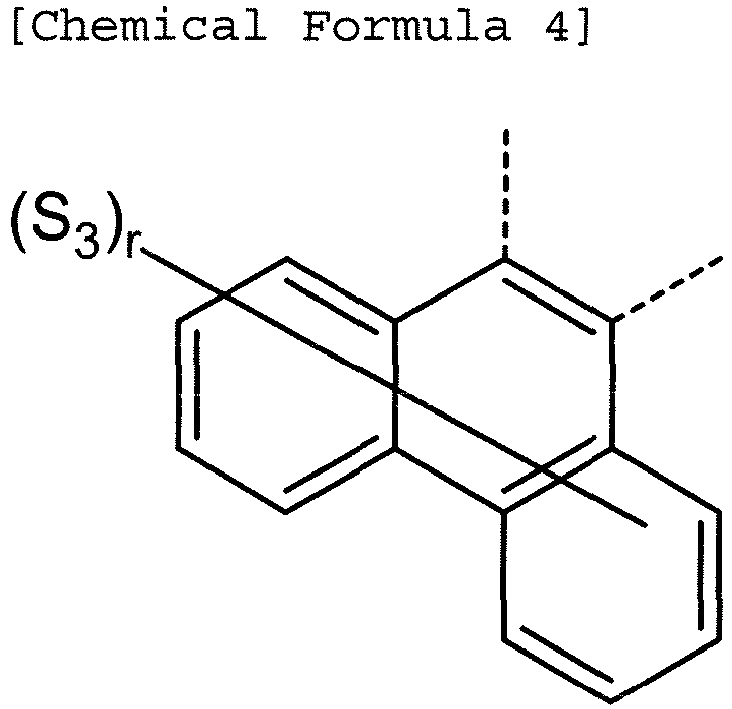


a dotted line "------" is each a moiety bonded to a triazine group or L2 of Chemical Formula 1,
S1 to S4 are the same as or different from each other, and are each independently hydrogen; deuterium; a halogen group; a substituted or unsubstituted alkyl group; a substituted or unsubstituted aryl group; or a substituted or unsubstituted heterocyclic group,
p and q are the same as or different from each other, and are each independently an integer of 0 to 6,
r is an integer of 0 to 8,
y is an integer of 0 to 4,
when p, q, r, and y are each an integer of 2 or more, a plurality of S1 to S4 are each the same as or different from each other,
L2 is a direct bond; or a substituted or unsubstituted arylene group,
Ar3 is represented by a substituted or unsubstituted aryl group; a substituted or unsubstituted heterocyclic group including S or O; a substituted or unsubstituted carbazole group; or any one of the followingChemical Formulae 6 to 10, when L1 is Chemical Formulae 2 to 4,
Ar3 is represented by a substituted or unsubstituted aryl group; a substituted or unsubstituted heterocyclic group including S or O; or any one of the following Chemical Formulae 6 to 10, when L1 is Chemical Formula 5,


X1 is O, S, or NR,
at least two of X2 to X6 are N, and the others are each independently CR',
R and R' are the same as or different from each other, and are each independently hydrogen; deuterium; a halogen group; a substituted or unsubstituted alkyl group; or a substituted or unsubstituted aryl group,
R1 to R6, R9, and R10 are the same as or different from each other, and are each independently hydrogen; deuterium; a halogen group; a substituted or unsubstituted alkyl group; a substituted or unsubstituted aryl group; or a substituted or unsubstituted heterocyclic group,
at least one of Y1 to Y4 is N, and the others are CR", R" is each independently hydrogen or deuterium,
R7 and R8 are directly bonded or combine with each other to form a substituted or unsubstituted ring,
m, n ,t, u, v, and x are each an integer of 0 to 4, w is an integer of 0 to 3, and when m, n ,t, u, v, w, and x are each an integer of 2 or more, a plurality of R1 to R6, R9, and R10 are each the same as or different from each other,
s is an integer of 0 to 2, and when s is 2, two R3s are the same as or different from each other, and
"------" means a moiety bonded to L2 of Chemical Formula 1, and the bonding moiety of Chemical Formula 10 is bonded to a ring formed by bonding R6, R9, R10 or R7, and R8. - Further, the present application provides an organic light emitting device including: a first electrode; a second electrode provided to face the first electrode; and one or more organic material layers provided between the first electrode and the second electrode, in which one or more layers of the organic material layers include the above-described compound.
- The compound according to an exemplary embodiment of the present application is used for an organic electronic device including an organic light emitting device, and thus may lower the driving voltage of the organic electronic device and improve the light efficiency, and may enhance lifetime characteristics of the device by thermal stability of the compound.
-
-
FIG. 1 illustrates an example of an organic light emitting device in which asubstrate 1, apositive electrode 2, alight emitting layer 3, and anegative electrode 4 are sequentially stacked. -
FIG. 2 illustrates an example of an organic light emitting device in which asubstrate 1, apositive electrode 2, ahole injection layer 5, ahole transport layer 6, alight emitting layer 3, anelectron transport layer 7, and anegative electrode 4 are sequentially stacked. - Hereinafter, the present specification will be described in more detail.
- The present specification provides the compound represented by Chemical Formula 1.
- Examples of the substituents in the present specification will be described below, but are not limited thereto.
- The term "substitution" means that a hydrogen atom bonded to a carbon atom of a compound is changed into another substituent, and a position to be substituted is not limited as long as the position is a position at which the hydrogen atom is substituted, that is, a position at which the substituent may be substituted, and when two or more are substituted, the two or more substituents may be the same as or different from each other.
- In the present specification, the term "substituted or unsubstituted" means being substituted with one or two or more substituents selected from the group consisting of deuterium; a halogen group; a cyano group; a nitro group; a hydroxy group; an alkyl group; a cycloalkyl group; an alkenyl group; an alkoxy group; an aryl group; and a heterocyclic group, being substituted with a substituent to which two or more substituents among the exemplified substituents are linked, or having no substituent. For example, "the substituent to which two or more substituents are linked" may be a biphenyl group. That is, the biphenyl group may also be an aryl group, and may be interpreted as a substituent to which two phenyl groups are linked.
- In the present specification, examples of a halogen group include fluorine, chlorine, bromine or iodine.
- In the present specification, the alkyl group may be straight-chained or branch-chained, and the number of carbon atoms thereof is not particularly limited, but is preferably 1 to 50. Specific examples thereof include methyl, ethyl, propyl, n-propyl, isopropyl, butyl, n-butyl, isobutyl, tert-butyl, sec-butyl, 1-methyl-butyl, 1-ethylbutyl, pentyl, n-pentyl, isopentyl, neopentyl, tert-pentyl, hexyl, n-hexyl, 1-methylpentyl, 2-methylpentyl, 4-methyl-2-pentyl, 3,3-dimethylbutyl, 2-ethylbutyl, heptyl, n-heptyl, 1-methylhexyl, cyclopentylmethyl, cyclohexylmethyl, octyl, n-octyl, tert-octyl, 1-methylheptyl, 2-ethylhexyl, 2-propylpentyl, n-nonyl, 2,2-dimethylheptyl, 1-ethyl-propyl, 1,1-dimethyl-propyl, isohexyl, 2-methylpentyl, 4-methylhexyl, 5-methylhexyl, and the like, but are not limited thereto.
- In the present specification, a cycloalkyl group is not particularly limited, but the number of carbon atoms thereof is preferably 3 to 60, and specific examples thereof include cyclopropyl, cyclobutyl, cyclopentyl, 3-methylcyclopentyl, 2,3-dimethylcyclopentyl, cyclohexyl, 3-methylcyclohexyl, 4-methylcyclohexyl, 2,3-dimethylcyclohexyl, 3,4,5-trimethylcyclohexyl, 4-tert-butylcyclohexyl, cycloheptyl, cyclooctyl, and the like, but are not limited thereto.
- In the present specification, the alkoxy group may be straight-chained, branch-chained, or cyclic. The number of carbon atoms of the alkoxy group is not particularly limited, but is preferably 1 to 20. Specific examples thereof include methoxy, ethoxy, n-propoxy, isopropoxy, i-propyloxy, n-butoxy, isobutoxy, tert-butoxy, sec-butoxy, n-pentyloxy, neopentyloxy, isopentyloxy, n-hexyloxy, 3,3-dimethylbutyloxy, 2-ethylbutyloxy, n-octyloxy, n-nonyloxy, n-decyloxy, benzyloxy, p-methylbenzyloxy, and the like, but are not limited thereto.
- In the present specification, the alkenyl group may be straight-chained or branch-chained, and the number of carbon atoms thereof is not particularly limited, but is preferably 2 to 40. Specific examples thereof include vinyl, 1-propenyl, isopropenyl, 1-butenyl, 2-butenyl, 3-butenyl, 1-pentenyl, 2-pentenyl, 3-pentenyl, 3-methyl-1-butenyl, 1,3-butadienyl, allyl, 1-phenylvinyl-1-yl, 2-phenylvinyl-1-yl, 2,2-diphenylvinyl-1-yl, 2-phenyl-2-(naphthyl-1-yl)vinyl-1-yl, 2,2-bis(diphenyl-1-yl)vinyl-1-yl, a stilbenyl group, a styrenyl group, and the like, but are not limited thereto.
- In the present specification, when the aryl group is a monocyclic aryl group, the number of carbon atoms thereof is not particularly limited, but is preferably 6 to 25. Specific examples of the monocyclic aryl group include a phenyl group, a biphenyl group, a terphenyl group, and the like, but are not limited thereto.
- When the aryl group is a polycyclic aryl group, the number of carbon atoms thereof is not particularly limited, but is preferably 10 to 24. Specific examples of the polycyclic aryl group include a naphthyl group, an anthracenyl group, a phenanthryl group, a pyrenyl group, a perylenyl group, a chrysenyl group, a fluorenyl group, and the like, but are not limited thereto.
- In the present specification, the fluorenyl group may be substituted, and adjacent substituents may combine with each other to form a ring.
- When the fluorenyl group is substituted, the group may be


- In the present specification, a heterocyclic group includes one or more of an atom other than carbon, that is, a heteroatom, and specifically, the heteroatom may include one or more atoms selected from the group consisting of O, N, Se, and S, and the like. The number of carbon atoms of the heterocyclic group is not particularly limited, but is preferably 2 to 60. Examples of the heterocyclic group include a thiophenyl group, a furanyl group, a pyrrole group, an imidazolyl group, a thiazolyl group, an oxazolyl group, an oxadiazolyl group, a triazolyl group, a pyridyl group, a bipyridyl group, a pyrimidyl group, a triazinyl group, an acridyl group, a hydroacridyl group (for example,
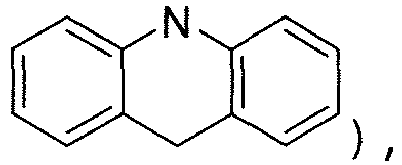


- In the present specification, the fused structure may be a structure in which an aromatic hydrocarbon ring is fused with the corresponding substituent. Examples of a fused ring of benzimidazole include

- In the present specification, the "adjacent" group may mean a substituent substituted with an atom directly linked to an atom in which the corresponding substituent is substituted, or another substituent substituted with an atom in which the corresponding substituent is substituted. For example, two substituents substituted at the ortho position in a benzene ring and two substituents substituted with the same carbon in an aliphatic ring may be interpreted as groups which are "adjacent" to each other.
- In the present specification, the case where adjacent groups combine with each other to form a ring means that adjacent groups combine with each other to form a 5-membered to 8-membered hydrocarbon ring or a 5-membered to 8-membered hetero ring as described above, and the ring may be monocyclic or polycyclic, may be an aliphatic ring, an aromatic ring, or a fused form thereof, and is not limited thereto.
- According to an exemplary embodiment of the present application, L2 is a direct bond; or a substituted or unsubstituted C6 to C20 arylene group.
- According to an exemplary embodiment of the present application, L2 is a direct bond.
- According to an exemplary embodiment of the present application, L2 is a substituted or unsubstituted phenylene group.
- According to an exemplary embodiment of the present application, L2 is a substituted or unsubstituted biphenylene group.
- According to an exemplary embodiment of the present application, L2 is a substituted or unsubstituted naphthylene group.
- According to an exemplary embodiment of the present application, Ar3 is represented by a substituted phenyl group; a substituted or unsubstituted fluorenyl group; a substituted or unsubstituted benzofluorenyl group; a substituted or unsubstituted spirobifluorenyl group; a substituted or unsubstituted spirofluoreneindenophenanthrene group; a substituted or unsubstituted dispirofluoreneanthracenefluorene group; a substituted or unsubstituted triphenylene group; a C4 to C20 heterocyclic group including S or O; a substituted or unsubstituted carbazole group; or any one of
Chemical Formulae 6 to 10, when L1 isChemical Formulae 2 to 4, and
Ar3 is represented by a substituted phenyl group; a substituted or unsubstituted fluorenyl group; a substituted or unsubstituted benzofluorenyl group; a substituted or unsubstituted spirobifluorenyl group; a substituted or unsubstituted spirofluoreneindenophenanthrene group; a substituted or unsubstituted dispirofluoreneanthracenefluorene group; a substituted or unsubstituted triphenylene group; a C4 to C20 heterocyclic group including S or O; any one ofChemical Formulae 6 to 10, when L1 isChemical Formula 5. - According to an exemplary embodiment of the present application, Ar3 is a substituted or unsubstituted C4 to C20 heteroaryl group including S or O.
- According to an exemplary embodiment of the present application, the substituted or unsubstituted heteroaryl group including S or O of Ar3 is a substituted or unsubstituted furan group; or a substituted or unsubstituted thiophene group.
- According to an exemplary embodiment of the present application, the substituted or unsubstituted heteroaryl group including S or O of Ar3 is a substituted or unsubstituted dibenzofuran group; or a substituted or unsubstituted dibenzothiophene group.
- According to an exemplary embodiment of the present application, Ar3 is a substituted phenyl group; a substituted or unsubstituted fluorenyl group; a substituted or unsubstituted benzofluorenyl group; a substituted or unsubstituted spirobifluorenyl group; a substituted or unsubstituted spirofluoreneindenophenanthrene group; a substituted or unsubstituted dispirofluoreneanthracenefluorene group; a substituted or unsubstituted triphenylene group; a substituted or unsubstituted carbazole group; a substituted or unsubstituted pyrimidyl group; a substituted or unsubstituted pyridazinyl group; a substituted or unsubstituted triazinyl group; a substituted or unsubstituted benzocarbazolyl group; a substituted or unsubstituted benzimidazole group; a substituted or unsubstituted benzoxazole group; a substituted or unsubstituted benzothiazole group; a substituted or unsubstituted dibenzofuran group; a substituted or unsubstituted dibenzothiophene group; a substituted or unsubstituted benzonaphthofuran group; or a substituted or unsubstituted benzonaphthothiophene group, when L1 is
Chemical Formulae 2 to 4,
Ar3 is a substituted phenyl group; a substituted or unsubstituted fluorenyl group; a substituted or unsubstituted benzofluorenyl group; a substituted or unsubstituted spirobifluorenyl group; a substituted or unsubstituted spirofluoreneindenophenanthrene group; a substituted or unsubstituted dispirofluoreneanthracenefluorene group; a substituted or unsubstituted triphenylene group; a substituted or unsubstituted pyrimidyl group; a substituted or unsubstituted pyridazinyl group; a substituted or unsubstituted triazinyl group; a substituted or unsubstituted benzocarbazolyl group; a substituted or unsubstituted benzimidazole group; a substituted or unsubstituted benzoxazole group; a substituted or unsubstituted benzothiazole group; a substituted or unsubstituted dibenzofuran group; a substituted or unsubstituted dibenzothiophene group; a substituted or unsubstituted benzonaphthofuran group; or a substituted or unsubstituted benzonaphthothiophene group, when L1 isChemical Formula 5, and
the "substituted or unsubstituted" means being unsubstituted or substituted with at least one selected from deuterium; a halogen group; a cyano group; a C1 to C10 alkyl group; and a C6 to C10 aryl group. - According to an exemplary embodiment of the present application, Ar3 is a substituted phenyl group; a substituted or unsubstituted fluorenyl group; a substituted or unsubstituted benzofluorenyl group; a substituted or unsubstituted spirobifluorenyl group; a substituted or unsubstituted spirofluoreneindenophenanthrene group; a substituted or unsubstituted dispirofluoreneanthracenefluorene group; a substituted or unsubstituted triphenylene group; a substituted or unsubstituted carbazole group; a substituted or unsubstituted pyrimidyl group; a substituted or unsubstituted pyridazinyl group; a substituted or unsubstituted triazinyl group; a substituted or unsubstituted benzocarbazolyl group; a substituted or unsubstituted benzimidazole group; a substituted or unsubstituted benzoxazole group; a substituted or unsubstituted benzothiazole group; a substituted or unsubstituted dibenzofuran group; a substituted or unsubstituted dibenzothiophene group; a substituted or unsubstituted benzonaphthofuran group; or a substituted or unsubstituted benzonaphthothiophene group, when L1 is
Chemical Formulae 2 to 4,
Ar3 is a substituted phenyl group; a substituted or unsubstituted fluorenyl group; a substituted or unsubstituted benzofluorenyl group; a substituted or unsubstituted spirobifluorenyl group; a substituted or unsubstituted spirofluoreneindenophenanthrene group; a substituted or unsubstituted dispirofluoreneanthracenefluorene group; a substituted or unsubstituted triphenylene group; a substituted or unsubstituted pyrimidyl group; a substituted or unsubstituted pyridazinyl group; a substituted or unsubstituted triazinyl group; a substituted or unsubstituted benzocarbazolyl group; a substituted or unsubstituted benzimidazole group; a substituted or unsubstituted benzoxazole group; a substituted or unsubstituted benzothiazole group; a substituted or unsubstituted dibenzofuran group; a substituted or unsubstituted dibenzothiophene group; a substituted or unsubstituted benzonaphthofuran group; or a substituted or unsubstituted benzonaphthothiophene group, when L1 isChemical Formula 5, and
the "substituted or unsubstituted" means being unsubstituted or substituted with a cyano group; a methyl group; an ethyl group; a phenyl group; and a biphenyl group. - According to an exemplary embodiment of the present application, Ar3 is a phenyl group substituted with a cyano group; a fluorenyl group unsubstituted or substituted with a cyano group, an alkyl group, or an aryl group; a benzofluorenyl group unsubstituted or substituted with an alkyl group or an aryl group; a spirobifluorenyl group; a spirofluoreneindenophenanthrene group; a dispirofluoreneanthracenefluorene group; a triphenylene group; a carbazole group; a pyrimidyl group; a pyridazinyl group; a triazinyl group unsubstituted or substituted with a phenyl group; a benzocarbazolyl group; a benzimidazole group; a benzoxazole group; a benzothiazole group; a dibenzofuran group; a dibenzothiophene group; a benzonaphthofuran group; or a benzonaphthothiophene group, when L1 is
Chemical Formulae 2 to 4, and
Ar3 is a phenyl group substituted with a cyano group; a fluorenyl group unsubstituted or substituted with a cyano group, an alkyl group, or an aryl group; a benzofluorenyl group unsubstituted or substituted with an alkyl group or an aryl group; a spirobifluorenyl group; a spirofluoreneindenophenanthrene group; a dispirofluoreneanthracenefluorene group; a triphenylene group; a pyrimidyl group; a pyridazinyl group; a triazinyl group unsubstituted or substituted with a phenyl group; a benzocarbazolyl group; a benzimidazole group; a benzoxazole group; a benzothiazole group; a dibenzofuran group; a dibenzothiophene group; a benzonaphthofuran group; or a benzonaphthothiophene group, when L1 isChemical Formula 5. - According to an exemplary embodiment of the present application, Ar3 is a phenyl group unsubstituted or substituted with a cyano group.
- According to an exemplary embodiment of the present application, Ar3 is a fluorenyl group.
- According to an exemplary embodiment of the present application, Ar3 is a fluorenyl group substituted with a cyano group.
- According to an exemplary embodiment of the present application, Ar3 is a benzofluorenyl group substituted with an aryl group.
- According to an exemplary embodiment of the present application, Ar3 is a benzofluorenyl group substituted with a phenyl group.
- According to an exemplary embodiment of the present application, Ar3 is a dimethylfluorenyl group.
- According to an exemplary embodiment of the present application, Ar3 is a spirobifluorenyl group.
- According to an exemplary embodiment of the present application, Ar3 is a spirofluoreneindenophenanthrene group.
- According to an exemplary embodiment of the present application, Ar3 is a dispirofluoreneanthracenefluorene group.
- According to an exemplary embodiment of the present application, Ar3 is a dimethylfluorenyl group substituted with a cyano group.
- According to an exemplary embodiment of the present application, Ar3 is a triphenylene group.
- According to an exemplary embodiment of the present application, Ar3 is a pyrimidyl group.
- According to an exemplary embodiment of the present application, Ar3 is a pyrimidyl group substituted with an aryl group.
- According to an exemplary embodiment of the present application, Ar3 is a pyrimidyl group substituted with a phenyl group, a biphenyl group, a phenanthrene group, or a fluorenyl group.
- According to an exemplary embodiment of the present application, Ar3 is a pyridazinyl group.
- According to an exemplary embodiment of the present application, Ar3 is a pyridazinyl group substituted with an aryl group.
- According to an exemplary embodiment of the present application, Ar3 is a pyridazinyl group substituted with a phenyl group.
- According to an exemplary embodiment of the present application, Ar3 is a triazinyl group.
- According to an exemplary embodiment of the present application, Ar3 is a benzimidazole group.
- According to an exemplary embodiment of the present application, Ar3 is a benzimidazole group substituted with an alkyl group or an aryl group.
- According to an exemplary embodiment of the present application, Ar3 is a benzimidazole group substituted with a methyl group.
- According to an exemplary embodiment of the present application, Ar3 is a benzimidazole group substituted with a phenyl group.
- According to an exemplary embodiment of the present application, Ar3 is a benzoxazole group.
- According to an exemplary embodiment of the present application, Ar3 is a benzothiazole group.
- According to an exemplary embodiment of the present application, Ar3 is a benzocarbazole group.
- According to an exemplary embodiment of the present application, Ar3 is a dibenzothiophene group.
- According to an exemplary embodiment of the present application, Ar3 is a dibenzofuran group.
- According to an exemplary embodiment of the present application, Ar3 is a benzonaphthothiophene group.
- According to an exemplary embodiment of the present application, Ar3 is a benzonaphthofuran group.
- According to an exemplary embodiment of the present application,
Chemical Formula 6 is represented by any one of the following Chemical Formulae 6-1-1 to 6-1-3.


- In Chemical Formulae 6-1-1 to 6-1-3, R1 and m are the same as those described above.
- According to an exemplary embodiment of the present application,
Chemical Formula 6 is represented by any one of the following Chemical Formulae 6-2-1 to 6-2-3.


- In Chemical Formulae 6-2-1 to 6-2-3, X1, R1, and m are the same as those described above.
- According to an exemplary embodiment of the present application,
Chemical Formula 7 is represented by any one of the following Chemical Formulae 7-1 to 7-6.


- In Chemical Formulae 7-1 to 7-6, X2 to X6 are the same as CR' described above.
- According to an exemplary embodiment of the present application, Chemical Formula 8 is represented by any one of the following Chemical Formulae 8-1 to 8-3.


- In Chemical Formulae 8-1 to 8-3, R2 to R4, n, s, and t are the same as those described above.
- According to an exemplary embodiment of the present application, Chemical Formula 9 is represented by any one of the following Chemical Formulae 9-1 to 9-4.


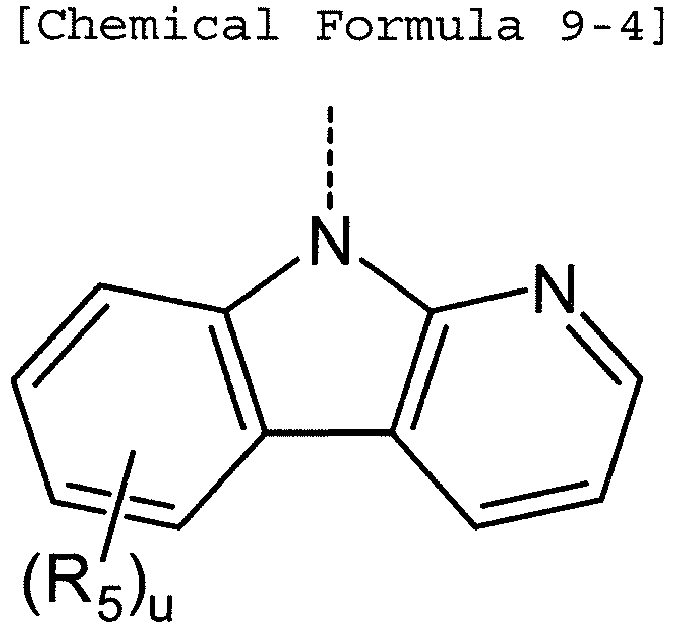
- In Chemical Formulae 9-1 to 9-4, R5 and u are the same as those described above.
- According to an exemplary embodiment of the present application, Chemical Formula 10 is represented by the following Chemical Formula 10-1 or 10-2.


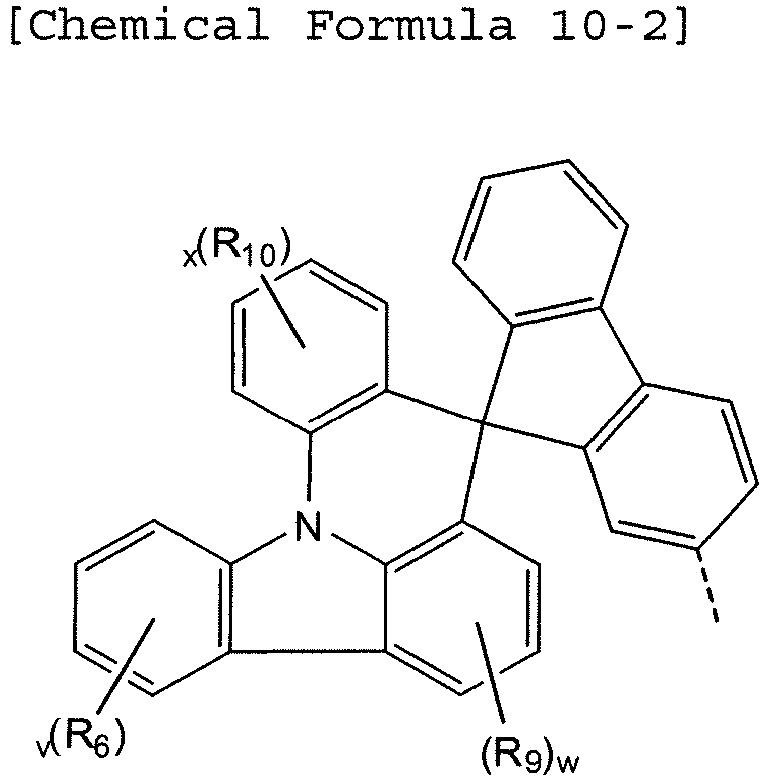
- In Chemical Formulae 10-1 and 10-2, R6, R9, R10, v, w, and x are the same as those described above, and
"------" means a moiety bonded to L2 ofChemical Formula 1, and the bonding moiety of Chemical Formula 10-1 is R6, R9, or R10. - According to an exemplary embodiment of the present application, Ar1 and Ar2 are the same as or different from each other, and are each independently a substituted or unsubstituted C6 to C20 aryl group.
- According to an exemplary embodiment of the present application, Ar1 and Ar2 are the same as or different from each other, and are each independently a substituted or unsubstituted phenyl group; a substituted or unsubstituted biphenyl group; or a substituted or unsubstituted naphthyl group.
- According to an exemplary embodiment of the present application, Ar1 and Ar2 are a phenyl group.
- According to an exemplary embodiment of the present application, S1 to S4 are the same as or different from each other, and are each independently hydrogen; deuterium; a halogen group; a C1 to C10 alkyl group; a C6 to C10 aryl group; or a C2 to C10 heterocyclic group.
- According to an exemplary embodiment of the present application, S1 to S4 are hydrogen.
- According to an exemplary embodiment of the present application, R1 to R4 are hydrogen.
- According to an exemplary embodiment of the present application, R1 to R6, R9, and R10 are hydrogen.
- According to an exemplary embodiment of the present application, the compound represented by
Chemical Formula 1 is any one selected from the following structural formulae.


Compound 1-1 Compound 1-2 Compound 1-3 

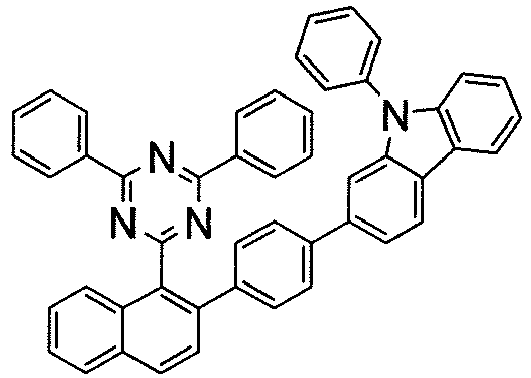
Compound 1-4 Compound 1-5 Compound 1-6 


Compound 1-7 Compound 1-8 Compound 1-9 


Compound 1-10 Compound 1-11 Compound 1-12 

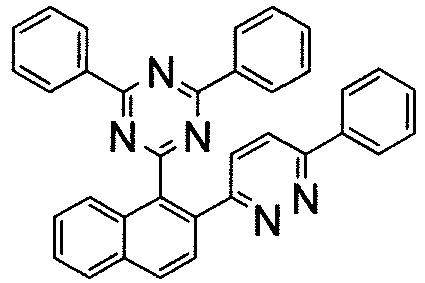
Compound 1-13 Compound 1-14 Compound 1-15 


Compound 1-16 Compound 1-17 Compound 1-18 


Compound 1-19 Compound 1-20 Compound 1-21 


Compound 1-22 Compound 1-23 Compound 1-24 


Compound 1-25 Compound 1-26 Compound 1-27 


Compound 1-28 Compound 1-29 Compound 1-30 

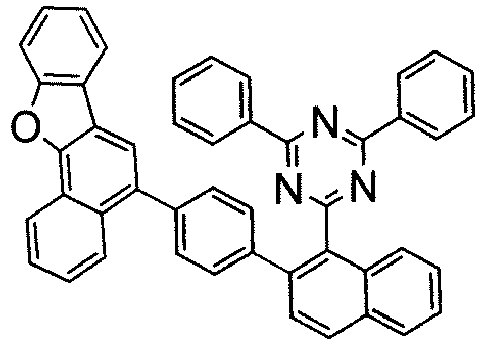
Compound 1-31 Compound 1-32 Compound 1-33 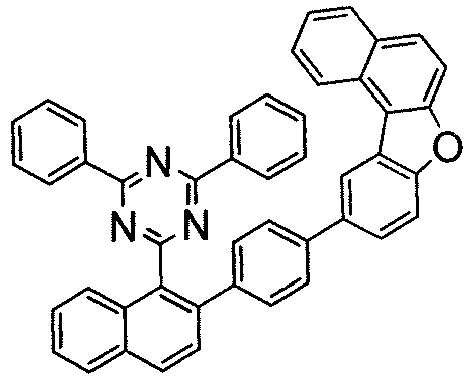


Compound 1-34 Compound 1-35 Compound 1-36 


Compound 1-37 Compound 1-38 Compound 1-39 

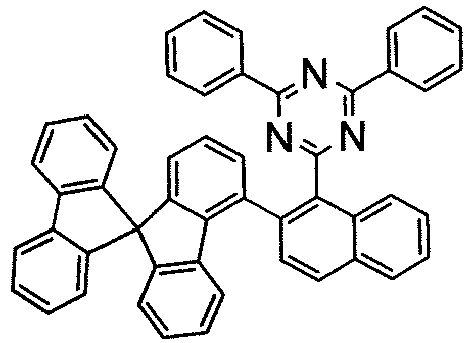
Compound 1-40 Compound 1-41 Compound 1-42 


Compound 1-43 Compound 1-44 Compound 1-45 


Compound 1-46 Compound 1-47 Compound 1-48 


Compound 1-49 Compound 1-50 Compound 1-51 


Compound 1-52 Compound 1-53 Compound 1-54 


Compound 1-55 Compound 1-56 Compound 1-57 


Compound 2-1 Compound 2-2 Compound 2-3 

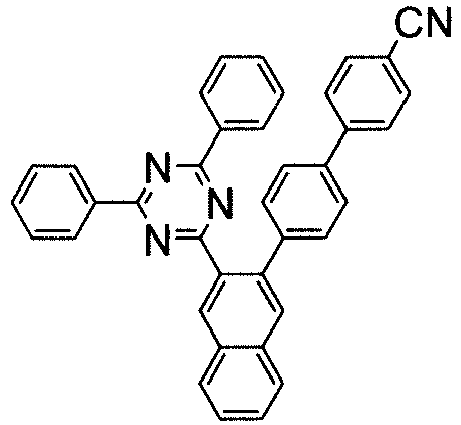
Compound 2-4 Compound 2-5 Compound 2-6 


Compound 2-7 Compound 2-8 Compound 2-9 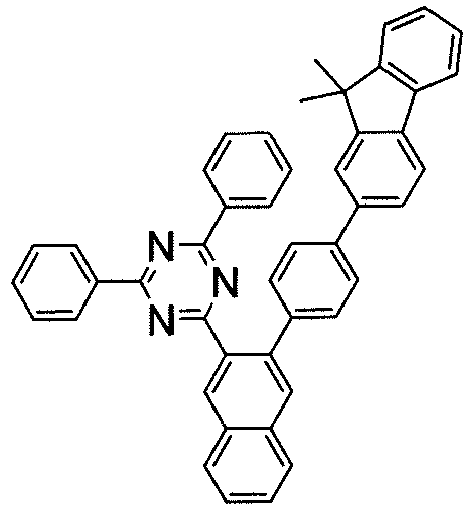


Compound 2-10 Compound 2-11 Compound 2-12 


Compound 2-13 Compound 2-14 Compound 2-15 


Compound 2-16 Compound 2-17 Compound 2-18 


Compound 2-39 Compound 2-19 Compound 2-20 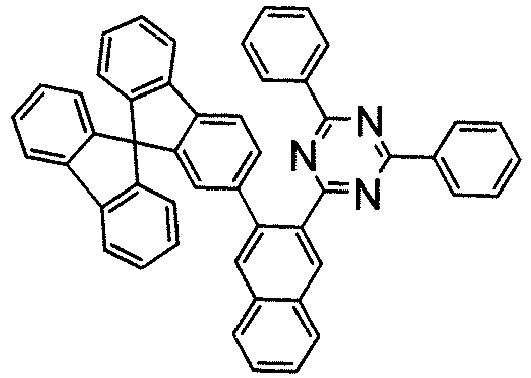


Compound 2-21 Compound 2-22 Compound 2-23 


Compound 2-24 Compound 2-25 Compound 2-26 
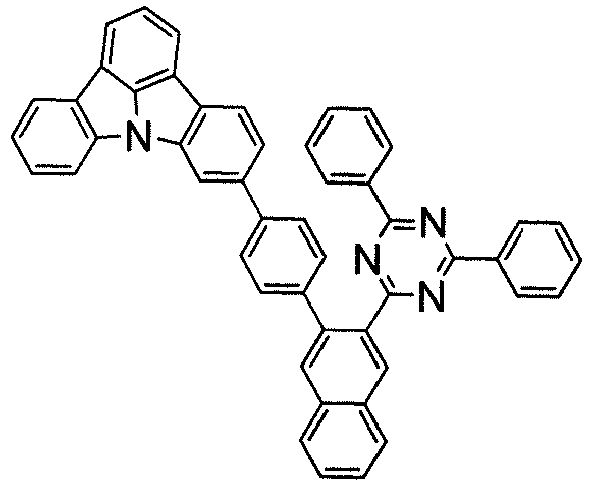

Compound 2-27 Compound 2-28 Compound 2-29 


Compound 2-30 Compound 2-31 Compound 2-32 


Compound 2-33 Compound 2-34 Compound 2-35 


Compound 2-36 Compound 2-37 Compound 2-38 


Compound 3-1 Compound 3-2 Compound 3-3 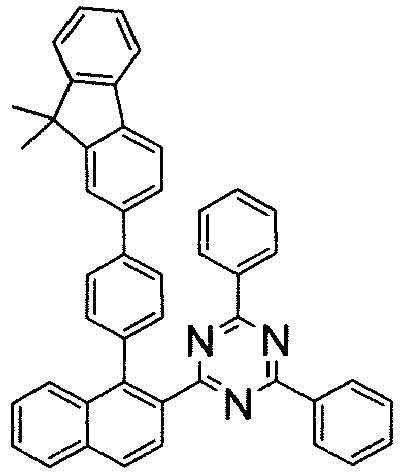


Compound 3-4 Compound 3-5 Compound 3-6 


Compound 3-7 Compound 3-8 Compound 3-9 


Compound 3-10 Compound 3-11 Compound 3-12 


Compound 3-13 Compound 3-14 Compound 3-15 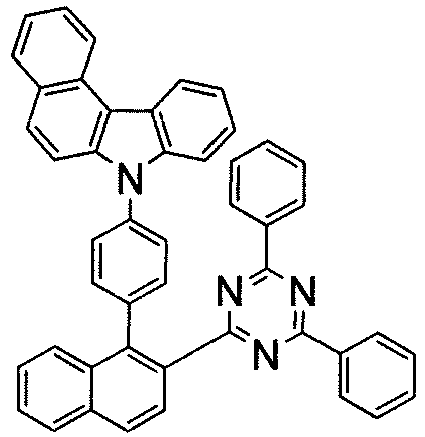


Compound 3-16 Compound 3-17 Compound 3-18 
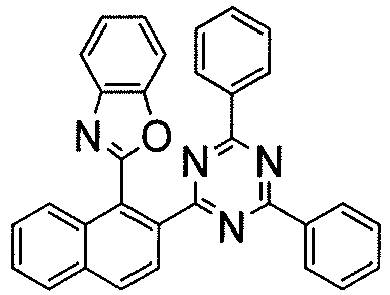

Compound 3-19 Compound 3-20 Compound 3-21 


Compound 3-22 Compound 3-23 Compound 3-24 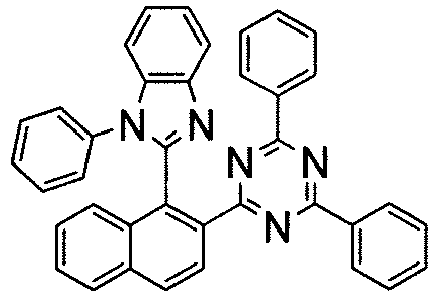


Compound 3-25 Compound 3-26 Compound 3-27 


Compound 3-28 Compound 3-29 Compound 3-30 


Compound 3-31 Compound 3-32 Compound 3-33 


Compound 3-34 Compound 3-35 Compound 3-36 


Compound 3-37 Compound 3-38 Compound 3-39 


Compound 3-40 Compound 3-41 Compound 3-42 


Compound 3-43 Compound 3-44 Compound 3-45 

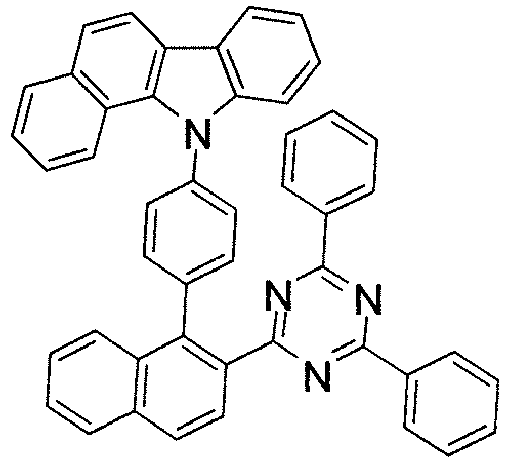
Compound 3-46 Compound 3-47 Compound 3-48 
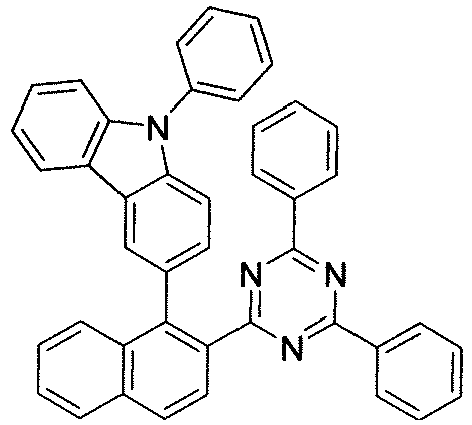
Compound 3-49 Compound 3-50 


Compound 4-1 Compound 4-2 Compound 4-3 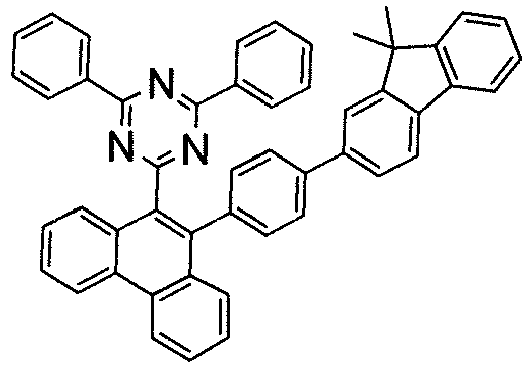


Compound 4-4 Compound 4-5 Compound 4-6 
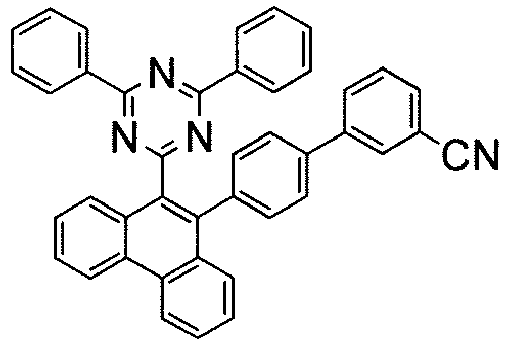

Compound 4-7 Compound 4-8 Compound 4-9 


Compound 4-10 Compound 4-11 Compound 4-12 


Compound 4-13 Compound 4-14 Compound 4-15 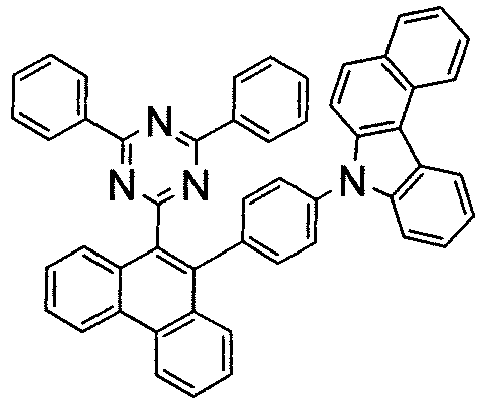


Compound 4-16 Compound 4-17 Compound 4-18 


Compound 4-19 Compound 4-20 Compound 4-21 


Compound 4-22 Compound 4-23 Compound 4-24 


Compound 4-25 Compound 4-26 Compound 4-27 
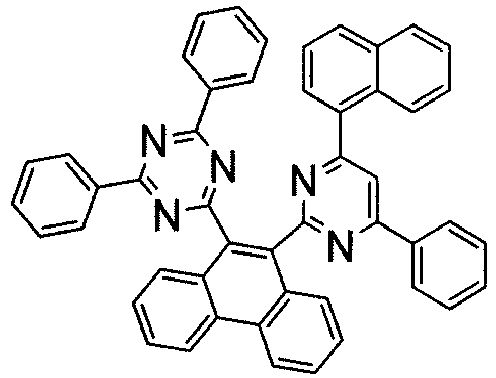
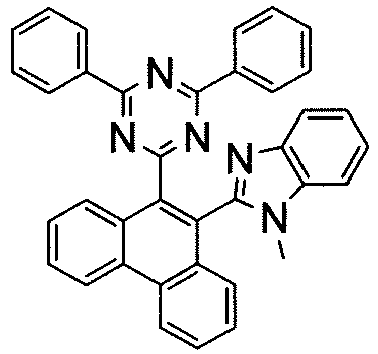
Compound 4-28 Compound 4-29 Compound 4-30 


Compound 4-31 Compound 4-32 Compound 4-33 


Compound 4-34 Compound 4-35 Compound 4-36 


Compound 4-37 Compound 4-38 Compound 4-39 


Compound 4-40 Compound 4-41 Compound 4-42 


Compound 4-43 Compound 4-44 Compound 4-45 


Compound 4-46 Compound 4-47 Compound 4-48 


Compound 4-49 Compound 4-50 Compound 4-51 


Compound 4-52 Compound 4-53 Compound 4-54 
Compound 4-55 


Compound 5-1 Compound 5-2 Compound 5-3 
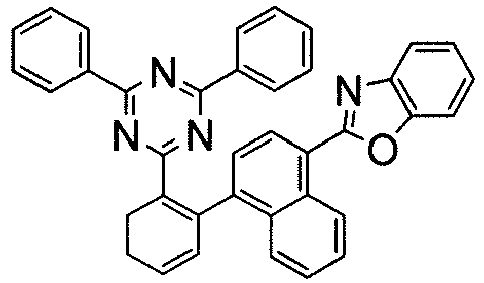

Compound 5-4 Compound 5-5 Compound 5-6 


Compound 5-7 Compound 5-8 Compound 5-9 


Compound 5-10 Compound 5-11 Compound 5-12 


Compound 5-13 Compound 5-14 Compound 5-15 


Compound 5-16 Compound 5-17 Compound 5-18 


Compound 5-19 Compound 5-20 Compound 5-21 


Compound 5-22 Compound 5-23 Compound 5-24 

Compound 5-25 Compound 5-27 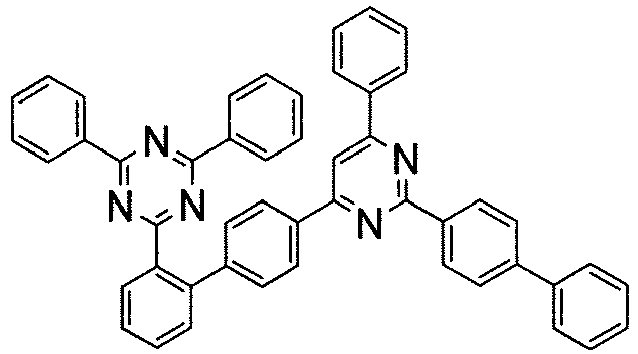


Compound 5-28 Compound 5-29 Compound 5-30 


Compound 5-31 Compound 5-32 Compound 5-33 


Compound 5-34 Compound 5-35 Compound 5-36 


Compound 5-37 Compound 5-38 Compound 5-39 
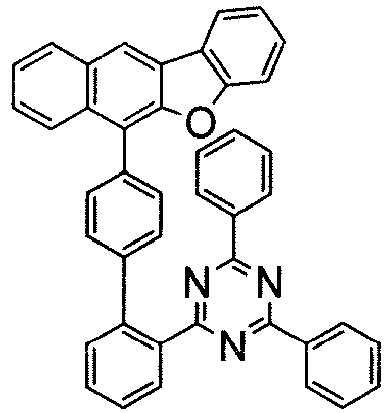

Compound 5-40 Compound 5-41 Compound 5-42 


Compound 5-43 Compound 5-44 Compound 5-45 


Compound 5-46 Compound 5-47 Compound 5-48 


Compound 5-49 Compound 5-50 Compound 5-51 
Compound 5-52 - For example, in the compound of
Formula 1, a core structure may be prepared as in the followingGeneral Formula 1. The substituent may be bonded by a method known in the art, and the kind and position of the substituent or the number of substituents may be changed according to the technology known in the art.
- In
General Formula 1, a core structure of Chemical Formula 1-A may be prepared through a coupling reaction using a base from a compound having an aldehyde structure, which is represented by Chemical Formula A and a compound having an amidine structure, which is represented by Chemical Formula B.

- Alternatively, a structure of Chemical Formula C may be obtained through a coupling reaction using an aryl cyanide compound and a base of acetonitrile, as a medium, and a core structure of Chemical Formula 1-B may be prepared through a reflux reaction of the structures of Chemical Formulae C and D and POCl3.
-
General Formula 1 only describes an example of the method of synthesizing the core ofChemical Formula 1, and the method is not limited thereto, and the kind and position of substituent may be changed, if necessary. The specific preparation method will be described below. - Further, the present specification provides an organic light emitting device including the above-described compound.
- An exemplary embodiment of the present application provides an organic light emitting device including: a first electrode; a second electrode provided to face the first electrode; and one or more organic material layers provided between the first electrode and the second electrode, in which one or more layers of the organic material layers include the compound.
- When one member is disposed "on" another member in the present specification, this includes not only a case where the one member is brought into contact with another member, but also a case where still another member is present between the two members.
- When one part "includes" one constituent element in the present specification, unless otherwise specifically described, this does not mean that another constituent element is excluded, but means that another constituent element may be further included.
- The organic material layer of the organic light emitting device of the present application may also be composed of a single-layered structure, but may be composed of a multi-layered structure in which two or more organic material layers are stacked. For example, as a representative example of the organic light emitting device of the present invention, an organic light emitting device may have a structure including a hole injection layer, a hole transport layer, a light emitting layer, an electron transport layer, an electron injection layer, and the like as organic material layers. However, the structure of the organic light emitting device is not limited thereto, and may include a fewer number of organic material layers.
- In an exemplary embodiment of the present application, the organic material layer includes a light emitting layer, and the light emitting layer includes the compound.
- In an exemplary embodiment of the present application, the organic material layer includes a hole injection layer or a hole transport layer, and the hole injection layer or the hole transport layer includes the compound.
- In another exemplary embodiment, the organic material layer includes a light emitting layer, and the light emitting layer includes the compound.
- In an exemplary embodiment of the present application, the organic material layer includes an electron transport layer or an electron injection layer, and the electron transport layer or the electron injection layer includes the compound.
- In an exemplary embodiment of the present application, the organic material layer includes an electron blocking layer or a hole blocking layer, and the electron blocking layer or the hole blocking layer includes the compound.
- In an exemplary embodiment of the present application, the organic material layer is an electron transport layer, and the organic light emitting device further includes one or two or more layers selected from the group consisting of a hole injection layer, a hole transport layer, a light emitting layer, an electron injection layer, an electron blocking layer, and a hole blocking layer.
- In an exemplary embodiment of the present application, the organic light emitting device includes: a first electrode; a second electrode provided to face the first electrode; a light emitting layer provided between the first electrode and the second electrode; and two or more organic material layers provided between the light emitting layer and the first electrode, or between the light emitting layer and the second electrode, in which at least one of the two or more organic material layers includes the compound. In an exemplary embodiment of the present application, as the two or more organic material layers, two or more may be selected from the group consisting of an electron transport layer, an electron injection layer, a layer which transports and injects electrons simultaneously, and a hole blocking layer.
- In an exemplary embodiment of the present application, the organic material layer includes two or more electron transport layers, and at least one of the two or more electron transport layers includes the compound. Specifically, in an exemplary embodiment of the present specification, the compound may also be included in one layer of the two or more electron transport layers, and may be included in each of the two or more electron transport layers.
- In addition, in an exemplary embodiment of the present application, when the compound is included in each of the two or more electron transport layers, the other materials except for the compound may be the same as or different from each other.
- In an exemplary embodiment of the present application, the organic material layer further includes a hole injection layer or a hole transport layer, which includes a compound including an arylamino group, a carbazolyl group, or a benzocarbazolyl group, in addition to the organic material layer including the compound.
- In another exemplary embodiment, the organic light emitting device may be an organic light emitting device having a structure (normal type) in which a positive electrode, one or more organic material layers, and a negative electrode are sequentially stacked on a substrate.
- In still another exemplary embodiment, the organic light emitting device may be an organic light emitting device having a reverse-direction structure (inverted type) in which a negative electrode, one or more organic material layers, and a positive electrode are sequentially stacked on a substrate.
- For example, the structure of the organic light emitting device according to an exemplary embodiment of the present application is exemplified in
FIGS. 1 and 2 . -
FIG. 1 exemplifies a structure of an organic light emitting device in which asubstrate 1, apositive electrode 2, alight emitting layer 3, and anegative electrode 4 are sequentially stacked. In the structure as described above, the compound may be included in thelight emitting layer 3. -
FIG. 2 exemplifies a structure of an organic light emitting device in which asubstrate 1, apositive electrode 2, ahole injection layer 5, ahole transport layer 6, alight emitting layer 3, anelectron transport layer 7, and anegative electrode 4 are sequentially stacked. In the structure as described above, the compound may be included in one or more layers of thehole injection layer 5, thehole transport layer 6, thelight emitting layer 3, and theelectron transport layer 7. - In the structure as described above, the compound may be included in one or more of the hole injection layer, the hole transport layer, the light emitting layer, and the electron transport layer.
- The organic light emitting device of the present application may be manufactured by the materials and methods known in the art, except that one or more layers of the organic material layers include the compound of the present application, that is, the compound.
- When the organic light emitting device includes a plurality of organic material layers, the organic material layers may be formed of the same material or different materials.
- The organic light emitting device of the present application may be manufactured by the materials and methods known in the art, except that one or more layers of the organic material layers include the compound, that is, the compound represented by
Chemical Formula 1. - For example, the organic light emitting device of the present application may be manufactured by sequentially stacking a first electrode, an organic material layer, and a second electrode on a substrate. In this case, the organic light emitting device may be manufactured by depositing a metal or a metal oxide having conductivity, or an alloy thereof on a substrate to form a positive electrode, forming an organic material layer including a hole injection layer, a hole transport layer, a light emitting layer, and an electron transport layer thereon, and then depositing a material, which may be used as a negative electrode, thereon, by using a physical vapor deposition (PVD) method such as sputtering or e-beam evaporation. In addition to the method as described above, an organic light emitting device may be made by sequentially depositing a negative electrode material, an organic material layer, and a positive electrode material on a substrate.
- Further, the compound of
Chemical Formula 1 may be formed as an organic material layer by not only a vacuum deposition method, but also a solution application method when an organic light emitting device is manufactured. Here, the solution application method means spin coating, dip coating, doctor blading, inkjet printing, screen printing, a spray method, roll coating, and the like, but is not limited thereto. - In addition to the method as described above, an organic light emitting device may also be made by sequentially depositing a negative electrode material, an organic material layer, and a positive electrode material on a substrate (International Publication No. 2003/012890). However, the manufacturing method is not limited thereto.
- In an exemplary embodiment of the present application, the first electrode is a positive electrode, and the second electrode is a negative electrode.
- In another exemplary embodiment, the first electrode is a negative electrode, and the second electrode is a positive electrode.
- As the positive electrode material, a material having a large work function is usually preferred so as to smoothly inject holes into an organic material layer. Specific examples of the positive electrode material which may be used in the present invention include: a metal, such as vanadium, chromium, copper, zinc, and gold, or alloys thereof; a metal oxide, such as zinc oxide, indium oxide, indium tin oxide (ITO), and indium zinc oxide (IZO); a combination of metal and oxide, such as ZnO:Al or SnO2:Sb; an electrically conductive polymer, such as poly(3-methylthiophene), poly[3,4-(ethylene-1,2-dioxy)thiophene] (PEDOT), polypyrrole, and polyaniline, and the like, but are not limited thereto.
- As the negative electrode material, a material having a small work function is usually preferred so as to smoothly inject electrons into an organic material layer. Specific examples of the negative electrode material include: a metal, such as magnesium, calcium, sodium, potassium, titanium, indium, yttrium, lithium, gadolinium, aluminum, silver, tin, and lead, or alloys thereof; a multi-layered structural material, such as LiF/Al or LiO2/Al, and the like, but are not limited thereto.
- The hole injection layer is a layer which injects holes from an electrode, and a hole injection material is preferably a compound which has a capability of transporting holes and thus has an effect of injecting holes at a positive electrode and an excellent effect of injecting holes for a light emitting layer or a light emitting material, prevents excitons produced from the light emitting layer from moving to an electron injection layer or an electron injection material, and is also excellent in the ability to form a thin film. It is preferred that the highest occupied molecular orbital (HOMO) of the hole injection material is between the work function of the positive electrode material and the HOMO of a peripheral organic material layer. Specific examples of the hole injection material include metal porphyrin, oligothiophene, an arylamine-based organic material, a hexanitrile hexaazatriphenylene-based organic material, a quinacridone-based organic material, a perylene-based organic material, anthraquinone, a polyaniline and polythiophene-based electrically conductive polymer, and the like, but are not limited thereto.
- The hole transport layer is a layer which receives holes from a hole injection layer and transports the holes to a light emitting layer, and a hole transport material is suitably a material which may receive holes transported from a positive electrode or a hole injection layer to transfer the holes to a light emitting layer, and has a large mobility for the holes. Specific examples thereof include an arylamine-based organic material, an electrically conductive polymer, a block copolymer in which a conjugate portion and a non-conjugate portion are present together, and the like, but are not limited thereto.
- The light emitting material is preferably a material which may receive holes and electrons transported from a hole transport layer and an electron transport layer, respectively, and combine the holes and the electrons to emit light in a visible ray region, and has good quantum efficiency to fluorescence or phosphorescence. Specific examples thereof include: an 8-hydroxy-quinoline aluminum complex (Alq3); a carbazole-based compound; a dimerized styryl compound; BAlq; a 10-hydroxybenzoquinoline-metal compound; a benzoxazole, benzthiazole and benzimidazole-based compound; a poly(p-phenylenevinylene) (PPV)-based polymer; a spiro compound; polyfluorene, lubrene, and the like, but are not limited thereto.
- The light emitting layer may include a host material and a dopant material. Examples of the host material include a fused aromatic ring derivative, or a hetero ring-containing compound, and the like. Specific examples of the fused aromatic ring derivative include an anthracene derivative, a pyrene derivative, a naphthalene derivative, a pentacene derivative, a phenanthrene compound, a fluoranthene compound, and the like, and specific examples of the hetero ring-containing compound include a compound, a dibenzofuran derivative, a ladder-type furan compound, a pyrimidine derivative, and the like, but the examples are not limited thereto.
- The electron transport layer is a layer which receives electrons from an electron injection layer and transports the electrons to a light emitting layer, and an electron transport material is suitably a material which may receive electrons well from a negative electrode and transfer the electrons to a light emitting layer, and has a large mobility for electrons. Specific examples thereof include: an Al complex of 8-hydroxyquinoline; a complex including Alq3; an organic radical compound; a hydroxyflavone-metal complex, and the like, but are not limited thereto. The electron transport layer may be used with any desired cathode material, as used according to the related art. In particular, appropriate examples of the cathode material are a typical material which has a low work function, followed by an aluminum layer or a silver layer. Specific examples thereof include cesium, barium, calcium, ytterbium, and samarium, in each case followed by an aluminum layer or a silver layer.
- The electron injection layer is a layer which injects electrons from an electrode, and an electron injection material is preferably a compound which has a capability of transporting electrons, has an effect of injecting electrons from a negative electrode and an excellent effect of injecting electrons into a light emitting layer or a light emitting material, prevents excitons produced from the light emitting layer from moving to a hole injection layer, and is also excellent in the ability to form a thin film. Specific examples thereof include fluorenone, anthraquinodimethane, diphenoquinone, thiopyran dioxide, oxazole, oxadiazole, triazole, imidazole, perylenetetracarboxylic acid, fluorenylidene methane, anthrone, and the like, and derivatives thereof, a metal complex compound, a nitrogen-containing 5-membered ring derivative, and the like, but are not limited thereto.
- Examples of the metal complex compound include 8-hydroxyquinolinato lithium, bis(8-hydroxyquinolinato)zinc, bis(8-hydroxyquinolinato)copper, bis(8-hydroxyquinolinato) manganese, tris(8-hydroxyquinolinato)aluminum, tris(2-methyl-8-hydroxyquinolinato)aluminum, tris(8-hydroxyquinolinato)gallium, bis(10-hydroxybenzo[h]quinolinato)beryllium, bis(10-hydroxybenzo[h]quinolinato)zinc, bis(2-methyl-8-quinolinato)chlorogallium, bis(2-methyl-8-quinolinato)(o-cresolato)gallium, bis(2-methyl-8-quinolinato)(1-naphtholato)aluminum, bis(2-methyl-8-quinolinato)(2-naphtholato)gallium, and the like, but are not limited thereto.
- The hole blocking layer is a layer which blocks holes from reaching a negative electrode, and may be generally formed under the same conditions as those of the hole injection layer. Specific examples thereof include an oxadiazole derivative or a triazole derivative, a phenanthroline derivative, BCP, an aluminum complex, and the like, but are not limited thereto.
- The organic light emitting device according to the present specification may be a top emission type, a bottom emission type, or a dual emission type according to the material to be used.
- Hereinafter, the present specification will be described in detail with reference to Examples for specifically describing the present specification. However, the Examples according to the present specification may be modified in various forms, and it is not interpreted that the scope of the present application is limited to the Examples described in detail below. The Examples of the present application are provided for more completely explaining the present specification to the person with ordinary skill in the art.
-

- Under nitrogen flow, 2-bromo-1-naphthaldehyde (10 g, 42.54 mmol), benzimidamide hydrochloride (20 g, 127.6 mmol), and potassium phosphate (36 g, 170.2 mmol) were put into 150 mL of a dimethylacetamide (DMAc) solvent, and the resulting solution was heated and stirred for 18 hours.
The reaction solution was cooled and then filtered, and then the filtered material was subjected to slurry purification using EtOH to obtain Compound 1-1-A (16 g, yield 86%).
- Under nitrogen flow, Compound 1-1-A (16 g, 36.5 mmol), (4-(6-phenylpyridazin-3-yl)phenyl)boronic acid (10.6 g, 38.3 mmol), tetrakis(triphenylphosphine)palladium(0) (1.3 g, 1.1 mmol), and potassium carbonate (10.1 g, 73 mmol) were put into a container, and the resulting mixture was heated and stirred for 6 hours. After the reaction was terminated, the temperature was lowered to normal temperature, and then a primary filtration was performed to remove impurities. The filtered material was put into water, extraction was performed by using chloroform to obtain an organic layer, and then the organic layer was dried over anhydrous magnesium sulfate. After distillation under reduced pressure, the residue was washed with ethanol to prepare Compound 1-1 (20 g, yield 93%).
MS: [M+H]+ = 589 -

- Under nitrogen flow, Compound 1-1-A (15 g, 34.2 mmol), (4'-cyano-[1,1'-biphenyl]-4-yl)boronic acid (8 g, 35.9 mmol), and potassium carbonate (9.5 g, 68.4 mmol) were put into a container, and the resulting mixture was heated and stirred. After reflux was performed, tetrakis(triphenylphosphine)palladium(0) (1.2 g, 1.0 mmol) was put thereinto, and the resulting mixture was additionally heated and stirred for 5 hours. After the reaction was terminated, the temperature was lowered to normal temperature, and then a primary filtration was performed to remove impurities. The filtered material was put into water, extraction was performed by using chloroform to obtain an organic layer, and then the organic layer was dried over anhydrous magnesium sulfate. After distillation under reduced pressure, the residue was washed with ethanol to prepare Compound 1-3 (16 g, yield 87%).
MS: [M+H]+ = 536 -

- Compound 1-4 was obtained in the same manner as in the method for preparing Compound 1-1, except that (4-(9,9-dimethyl-9H-fluoren-2-yl)phenyl)boronic acid was used instead of (4-(6-phenylpyridazin-3-yl)phenyl)boronic acid.
MS: [M+H]+ = 627 -

- Compound 1-6 was obtained in the same manner as in the method for preparing Compound 1-1, except that (4-(9-phenyl-9H-carbazol-2-yl)phenyl)boronic acid was used instead of (4-(6-phenylpyridazin-3-yl)phenyl)boronic acid.
MS: [M+H]+ = 676 -


- Compound 1-16 was obtained in the same manner as in the method for preparing Compound 1-1, except that (4-(7H-benzo[c]carbazol-7-yl)phenyl)boronic acid was used instead of (4-(6-phenylpyridazin-3-yl)phenyl)boronic acid.
MS: [M+H]+ = 650 -

- Compound 1-19 was obtained in the same manner as in the method for preparing Compound 1-1, except that (4-(9,9-diphenyl-9H-fluoren-2-yl)phenyl)boronic acid was used instead of (4-(6-phenylpyridazin-3-yl)phenyl)boronic acid.
MS: [M+H]+ = 751 -

- Compound 1-27 was obtained in the same manner as in the method for preparing Compound 1-1, except that (4-(2-([1,1'-biphenyl]-4-yl)-6-phenylpyrimidin-4-yl)phenyl)boronic acid was used instead of (4-(6-phenylpyridazin-3-yl)phenyl)boronic acid.
MS: [M+H]+ = 741 -

- Compound 1-36 was obtained in the same manner as in the method for preparing Compound 1-1, except that (4-(naphtho[2,1-b]benzofuran-9-yl)phenyl)boronic acid was used instead of (4-(6-phenylpyridazin-3-yl)phenyl)boronic acid.
MS: [M+H]+ = 651 -

- Compound 1-38 was obtained in the same manner as in the method for preparing Compound 1-1, except that spiro[fluoren-9,8'-indolo[3,2,1-de]acridin]-2-yl boronic acid was used instead of (4-(6-phenylpyridazin-3-yl)phenyl)boronic acid.
MS: [M+H]+ = 762 -

- Compound 1-39 was obtained in the same manner as in the method for preparing Compound 1-1, except that (9,9-diphenyl-9H-fluoren-2-yl)boronic acid was used instead of (4-(6-phenylpyridazin-3-yl)phenyl)boronic acid.
MS: [M+H]+ = 675 -
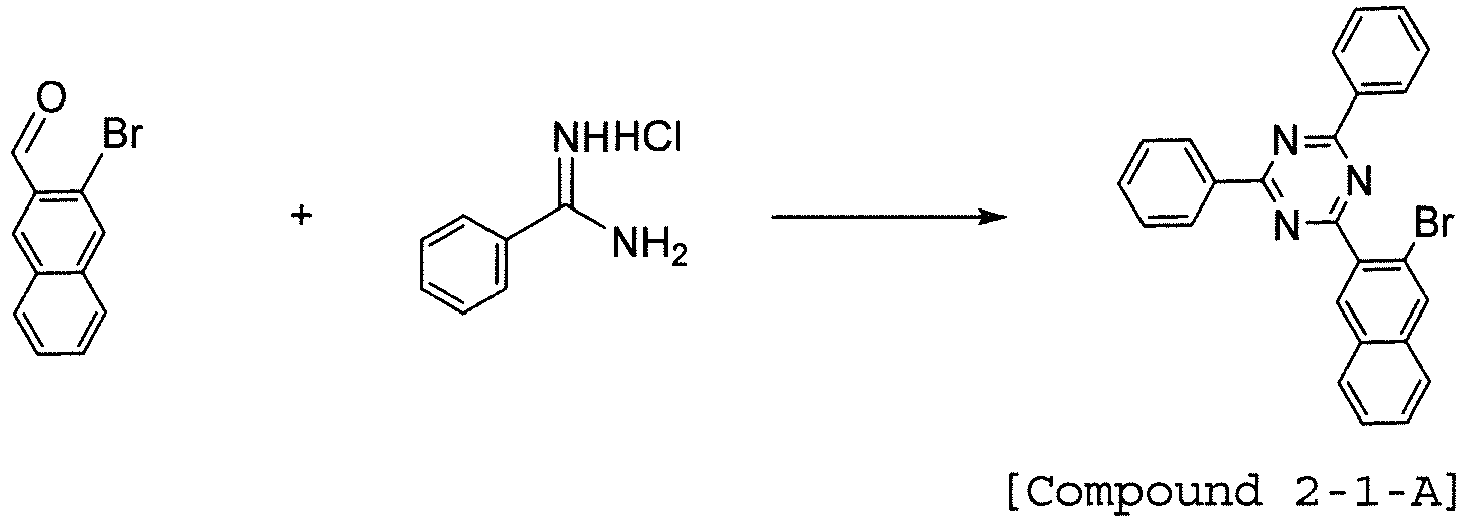
- Compound 2-1-A was obtained in the same manner as in the method for preparing Compound 1-1-A, except that 3-bromo-2-naphthaldehyde was used instead of 2-bromo-1-naphthaldehyde.

- Compound 2-31 was obtained in the same manner as in the method for preparing Compound 1-1, except that [Compound 2-1-A] was used instead of [Compound 1-1-A], and (4'-(7-phenyl-7H-benzo[c]fluoren-7-yl)-[1,1'-biphenyl]-4-yl)boronic acid was used instead of (4-(6-phenylpyridazin-3-yl)phenyl)boronic acid.
MS: [M+H]+ = 801 -

- Compound 2-33 was obtained in the same manner as in the method for preparing Compound 1-1, except that [Compound 2-1-A] was used instead of [Compound 1-1-A], and triphenylene-2-yl boronic acid was used instead of (4-(6-phenylpyridazin-3-yl)phenyl)boronic acid.
MS: [M+H]+ = 585 -

- Compound 2-35 was obtained in the same manner as in the method for preparing Compound 1-1, except that [Compound 2-1-A] was used instead of [Compound 1-1-A], and spiro[fluoren-9,13'-indeno[1,2-yl]phenanthren]-2-yl]boronic acid was used instead of (4-(6-phenylpyridazin-3-yl)phenyl)boronic acid.
MS: [M+H]+ = 773 -

- Compound 3-1-A was obtained in the same manner as in the method for preparing Compound 1-1-A, except that 1-bromo-2-naphthaldehyde was used instead of 2-bromo-1-naphthaldehyde.

- Compound 3-16 was obtained in the same manner as in the method for preparing Compound 1-1, except that [Compound 3-1-A] was used instead of [Compound 1-1-A], and (4-(7H-benzo[c]carbazol-7-yl)phenyl)boronic acid was used instead of (4-(6-phenylpyridazin-3-yl)phenyl)boronic acid.
MS: [M+H]+ = 650 -

- Compound 3-22 was obtained in the same manner as in the method for preparing Compound 1-1, except that [Compound 3-1-A] was used instead of [Compound 1-1-A], and (4-(2-(naphthalen-2-yl)-6-phenylpyrimidin-4-yl)phenyl)boronic acid was used instead of (4-(6-phenylpyridazin-3-yl)phenyl)boronic acid.
MS: [M+H]+ = 715 -

- Compound 3-33 was obtained in the same manner as in the method for preparing Compound 1-1, except that [Compound 3-1-A] was used instead of [Compound 1-1-A], and spiro[fluoren-9,8'-indolo[3,2,1-de]acridin]-2-yl boronic acid was used instead of (4-(6-phenylpyridazin-3-yl)phenyl)boronic acid.
MS: [M+H]+ = 762 -

- Compound 3-34 was obtained in the same manner as in the method for preparing Compound 1-1, except that [Compound 3-1-A] was used instead of [Compound 1-1-A], and (9,9-diphenyl-9H-fluoren-2-yl)boronic acid was used instead of (4-(6-phenylpyridazin-3-yl)phenyl)boronic acid.
MS: [M+H]+ = 675 -
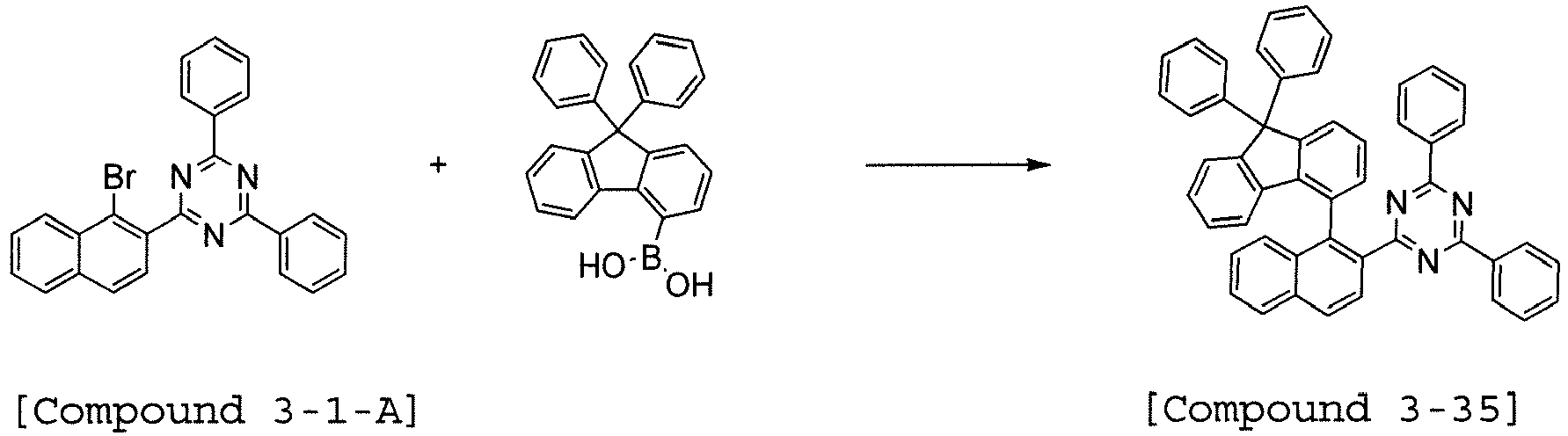
- Compound 3-35 was obtained in the same manner as in the method for preparing Compound 1-1, except that [Compound 3-1-A] was used instead of [Compound 1-1-A], and (9,9-diphenyl-9H-fluoren-4-yl)boronic acid was used instead of (4-(6-phenylpyridazin-3-yl)phenyl)boronic acid.
MS: [M+H]+ = 675 -

- Compound 3-36 was obtained in the same manner as in the method for preparing Compound 1-1, except that [Compound 3-1-A] was used instead of [Compound 1-1-A], and 9,9'-spirobi[fluorene]-2-yl boronic acid was used instead of (4-(6-phenylpyridazin-3-yl)phenyl)boronic acid.
MS: [M+H]+ = 673 -

- Compound 3-38 was obtained in the same manner as in the method for preparing Compound 1-1, except that [Compound 3-1-A] was used instead of [Compound 1-1-A], and triphenylene-2-yl boronic acid was used instead of (4-(6-phenylpyridazin-3-yl)phenyl)boronic acid.
MS: [M+H]+ = 585 -

- Compound 3-39 was obtained in the same manner as in the method for preparing Compound 1-1, except that [Compound 3-1-A] was used instead of [Compound 1-1-A], and (4-(7-phenyl-7H-benzo[c]fluoren-7-yl)phenyl)boronic acid was used instead of (4-(6-phenylpyridazin-3-yl)phenyl)boronic acid.
MS: [M+H]+ = 725 -

- Compound 3-47 was obtained in the same manner as in the method for preparing Compound 1-1, except that [Compound 3-1-A] was used instead of [Compound 1-1-A], and (4-(indolo[3,2,1-jk]carbazol-10-yl)phenyl)boronic acid was used instead of (4-(6-phenylpyridazin-3-yl)phenyl)boronic acid.
MS: [M+H]+ = 674 -

- Compound 4-1-A was obtained in the same manner as in the method for preparing Compound 1-1-A, except that 10-bromophenanthrene-9-carbaldehyde was used instead of 2-bromo-1-naphthaldehyde.

- Compound 4-4 was obtained in the same manner as in the method for preparing Compound 1-1, except that [Compound 4-1-A] was used instead of [Compound 1-1-A], and (4-(9,9-dimethyl-9H-fluoren-2-yl)phenyl)boronic acid was used instead of (4-(6-phenylpyridazin-3-yl)phenyl)boronic acid.
MS: [M+H]+ = 677 -

- Compound 4-12 was obtained in the same manner as in the method for preparing Compound 1-1, except that [Compound 4-1-A] was used instead of [Compound 1-1-A], and (4-(1-phenyl-1H-benzo[d]imidazol-2-yl)phenyl)boronic acid was used instead of (4-(6-phenylpyridazin-3-yl)phenyl)boronic acid.
MS: [M+H]+ = 677 -

- Compound 4-37 was obtained in the same manner as in the method for preparing Compound 1-1, except that [Compound 4-1-A] was used instead of [Compound 1-1-A], and 9,9'-spirobi[fluorene]-4-yl boronic acid was used instead of (4-(6-phenylpyridazin-3-yl)phenyl)boronic acid.
MS: [M+H]+ = 723 -
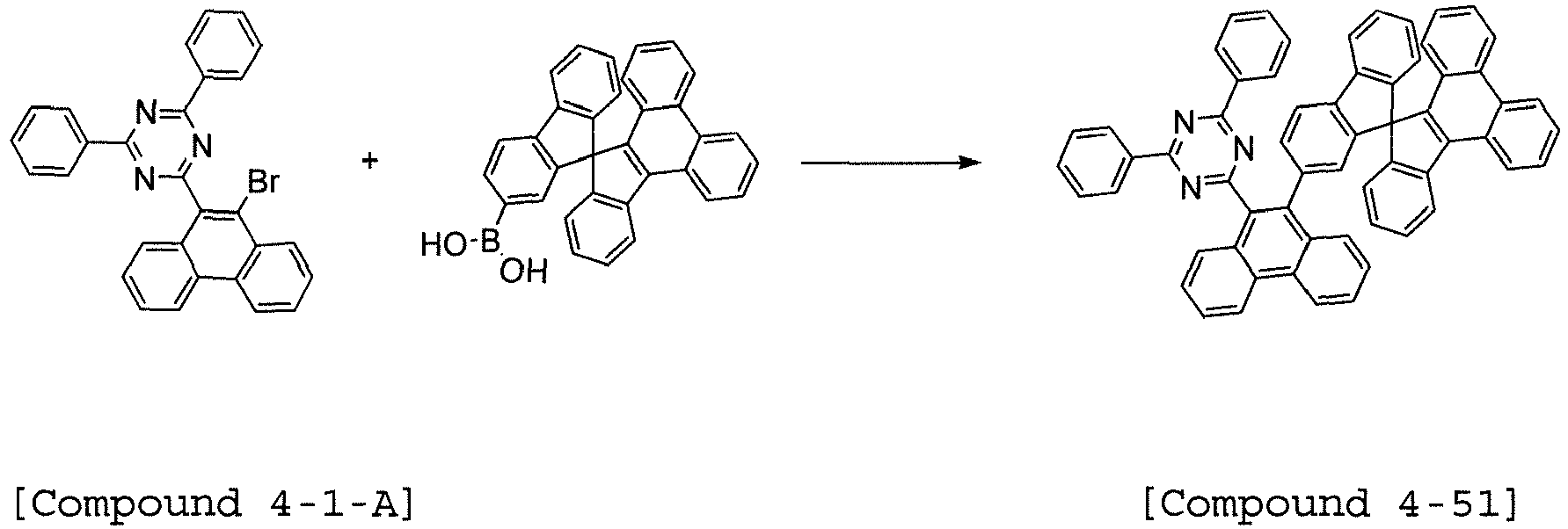
- Compound 4-51 was obtained in the same manner as in the method for preparing Compound 1-1, except that [Compound 4-1-A] was used instead of [Compound 1-1-A], and spiro[fluoren-9,9'-indeno[2,1-l]phenanthren]-2-yl boronic acid was used instead of (4-(6-phenylpyridazin-3-yl)phenyl)boronic acid.
MS: [M+H]+ = 823 -

- Compound 5-1-A was obtained in the same manner as in the method for preparing Compound 1-1-A, except that 2-bromobenzaldehyde was used instead of 2-bromo-1-naphthaldehyde.

- Compound 5-10 was obtained in the same manner as in the method for preparing Compound 1-1, except that [Compound 5-1-A] was used instead of [Compound 1-1-A], and (6-(1-methyl-1H-benzo[d]imidazol-2-yl)naphthalen-2-yl)boronic acid was used instead of (4-(6-phenylpyridazin-3-yl)phenyl)boronic acid.
MS: [M+H]+ = 565 -

- Compound 5-28 was obtained in the same manner as in the method for preparing Compound 1-1, except that [Compound 5-1-A] was used instead of [Compound 1-1-A], and (4-(2-([1,1'-biphenyl]-4-yl)-6-phenylpyrimidin-4-yl)phenyl)boronic acid was used instead of (4-(6-phenylpyridazin-3-yl)phenyl)boronic acid.
MS: [M+H]+ = 691 -

- Compound 5-52 was obtained in the same manner as in the method for preparing Compound 1-1, except that [Compound 5-1-A] was used instead of [Compound 1-1-A], and dispiro[fluoren-9,9'-anthracen-10',9"-fluoren]-2'-yl boronic acid was used instead of (4-(6-phenylpyridazin-3-yl)phenyl)boronic acid.
MS: [M+H]+ = 787 -

- Compound 3-48 was obtained in the same manner as in the method for preparing Compound 1-1, except that [Compound 3-1-A] was used instead of [Compound 1-1-A], and (4-(11H-benzo[a]carbazol-11-yl)phenyl boronic acid was used instead of (4-(6-phenylpyridazin-3-yl)phenyl)boronic acid.
MS: [M+H]+ = 650 -

- Compound 3-50 was obtained in the same manner as in the method for preparing Compound 1-1, except that [Compound 3-1-A] was used instead of [Compound 1-1-A], and (9-phenyl-9H-carbazol-3-yl)boronic acid was used instead of (4-(6-phenylpyridazin-3-yl)phenyl)boronic acid.
MS: [M+H]+ = 600 -

- Compound 1-17 was obtained in the same manner as in the method for preparing Compound 1-1, except that (4-(2,6-diphenylpyrimidin-4-yl)phenyl)boronic acid was used instead of (4-(6-phenylpyridazin-3-yl)phenyl)boronic acid.
MS: [M+H]+ = 665 - A glass substrate (Corning 7059 glass) thinly coated with ITO (indium tin oxide) to have a thickness of 1,000 Å was put into distilled water in which a dispersant was dissolved, and ultrasonically washed.
- A product manufactured by Fischer Co., was used as the detergent, and distilled water twice filtered using a filter manufactured by Millipore Co., was used as the distilled water. After the ITO was washed for 30 minutes, ultrasonic washing was conducted twice repeatedly using distilled water for 10 minutes. After the washing using distilled water was completed, ultrasonic washing was conducted using isopropyl alcohol, acetone, and methanol solvents in this order, and drying was then conducted.
- Hexanitrile hexaazatriphenylene was thermally vacuum deposited to have a thickness of 500 Å on a transparent ITO electrode, which was thus prepared, thereby forming a hole injection layer. HT1 (400 Å), which is a material for transporting holes, was vacuum deposited thereon, and then a compound of a host H1 and a dopant D1 was vacuum deposited as a light emitting layer to have a thickness of 300 Å. Compound 1-3 prepared in Preparation Example 1 and lithium quinolate (LiQ) were vacuum deposited at a weight ratio of 1:1 on the light emitting layer, thereby forming an electron injection and transport layer having a thickness of 350 Å.
- Lithium fluoride (LiF) and aluminum were sequentially deposited on the electron injection and transport layer to have a thickness of 12 Å and 2,000 Å, respectively, thereby forming a negative electrode.
- An organic light emitting device was manufactured.
- In the aforementioned procedure, the deposition rate of the organic material was maintained at 0.4 to 0.7 Å/sec, the deposition rates of lithium fluoride and aluminum of the negative electrode were maintained at 0.3 Å/sec and at 2 Å/sec, respectively, and the degree of vacuum during the deposition was maintained at 2 × 10⁻⁷ to 5 × 10⁻⁶ torr, thereby manufacturing an organic light emitting device.
-


- An experiment was performed in the same manner as in Example 1, except that as the electron transport layer, Compound 1-4 was used instead of Compound 1-3.
- An experiment was performed in the same manner as in Example 1, except that as the electron transport layer, Compound 1-16 was used instead of Compound 1-3.
- An experiment was performed in the same manner as in Example 1, except that as the electron transport layer, Compound 2-31 was used instead of Compound 1-3.
- An experiment was performed in the same manner as in Example 1, except that as the electron transport layer, Compound 3-33 was used instead of Compound 1-3.
- An experiment was performed in the same manner as in Example 1, except that as the electron transport layer, Compound 3-34 was used instead of Compound 1-3.
- An experiment was performed in the same manner as in Example 1, except that as the electron transport layer, Compound 3-36 was used instead of Compound 1-3.
- An experiment was performed in the same manner as in Example 1, except that as the electron transport layer, Compound 3-38 was used instead of Compound 1-3.
- An experiment was performed in the same manner as in Example 1, except that as the electron transport layer, Compound 3-39 was used instead of Compound 1-3.
- An experiment was performed in the same manner as in Example 1, except that as the electron transport layer, Compound 3-47 was used instead of Compound 1-3.
- An experiment was performed in the same manner as in Example 1, except that as the electron transport layer, Compound 4-12 was used instead of Compound 1-3.
- An experiment was performed in the same manner as in Example 1, except that as the electron transport layer, Compound 5-28 was used instead of Compound 1-3.
- An experiment was performed in the same manner as in Example 1, except that as the electron transport layer, Compound 3-48 was used instead of Compound 1-3.
- An experiment was performed in the same manner as in Example 1, except that as the electron transport layer, Compound 3-50 was used instead of Compound 1-3.
- An experiment was performed in the same manner as in Example 1, except that as the electron transport layer, Compound 1-17 was used instead of Compound 1-3.
- An experiment was performed in the same manner as in Example 1, except that as the electron transport layer, the following compound ET1 was used instead of Compound 1-3.

- An experiment was performed in the same manner as in Example 1, except that as the electron transport layer, the following compound ET2 was used instead of Compound 1-3.

- An experiment was performed in the same manner as in Example 1, except that as the electron transport layer, the following compound ET3 was used instead of Compound 1-3.

- An experiment was performed in the same manner as in Example 1, except that as the electron transport layer, the following compound ET4 was used instead of Compound 1-3.


- An experiment was performed in the same manner as in Example 1, except that as the electron transport layer, the following compound ET5 was used instead of Compound 1-3.

- An experiment was performed in the same manner as in Example 1, except that as the electron transport layer, the following compound ET6 was used instead of Compound 1-3.


- An experiment was performed in the same manner as in Example 1, except that as the electron transport layer, the following compound ET7 was used instead of Compound 1-3.

- For the organic light emitting devices of Examples 1 to 15 and Comparative Examples 1 to 7, the driving voltage and the light emitting efficiency were measured at a current density of 10 mA/cm2, and a time (LT98) for reaching a 98% value compared to the initial luminance was measured at a current density of 20 mA/cm2. The results are shown in the following Table 1.
<Table 1> Example 10 mA/cm2 Compound Voltage (V) Current efficiency (cd/A) Color coordinate (x, y) Life Time (98 at 20 mA/cm2) Example 1 1-3 3.84 5.19 (0.137, 0.127) 41 Example 2 1-4 3.76 5.30 (0.137, 0.127) 39 Example 3 1-16 3.81 5.27 (0.138, 0.127) 42 Example 4 2-31 3.79 5.41 (0.137, 0.126) 40 Example 5 3-33 3.83 5.42 (0.136, 0.127) 44 Example 6 3-34 3.81 5.45 (0.136, 0.126) 46 Example 7 3-36 3.83 5.42 (0.136, 0.126) 45 Example 8 3-38 3.81 5.46 (0.136, 0.127) 48 Example 9 3-39 3.82 5.45 (0.136, 0.126) 41 Example 10 3-47 3.84 5.27 (0.137, 0.127) 39 Example 11 4-12 3.91 5.19 (0.137, 0.127) 40 Example 12 5-28 3.90 5.21 (0.136, 0.127) 39 Example 13 3-48 3.89 5.19 (0.137, 0.126) 43 Example 14 3-50 3.85 5.25 (0.137, 0.127) 42 Example 15 1-17 3.90 5.24 (0.136, 0.127) 40 Comparative Example 1 ET 1 4.13 4.89 (0.140, 0.129) 26 Comparative Example 2 ET 2 4.07 5.11 (0.139, 0.130) 20 Comparative Example 3 ET 3 4.02 5.18 (0.139, 0.130) 21 Comparative Example 4 ET 4 3.96 5.02 (0.140, 0.130) 19 Comparative Example 5 ET 5 4.05 4.99 (0.139, 0.130) 22 Comparative Example 6 ET 6 4.01 4.98 (0.139, 0.130) 23 Comparative Example 7 ET 7 4.02 4.90 (0.139, 0.130) 21 - In Table 1, it could be seen that the compounds in Examples 1 to 15 where the compound of
Chemical Formula 1 according to an exemplary embodiment of the present specification was used as an electron transport layer of an organic light emitting device had low driving voltage, high current efficiency, and a long lifetime compared to the compounds in Comparative Examples 1 to 7. In particular, it could be seen that inChemical Formula 1 according to an exemplary embodiment of the present specification, the compounds in Examples 1 to 15, which are prepared by using a heterocyclic group (Har) except for an aryl group in which Ar3 is fused (fused Ar) or pyridine, quinoline, and the like, had low driving voltage, high current efficiency, and a long lifetime compared to the compounds in Comparative Examples 2 and 3 in which triazine is linked to Ar3 through pyridine and quinoline as in ET2 and ET3.
Claims (13)
- A compound represented by the following Chemical Formula 1:

Ar1 and Ar2 are the same as or different from each other, and are each independently a substituted or unsubstituted aryl group; or a substituted or unsubstituted heterocyclic group, and
L1 is represented by any one of the following Chemical Formulae 2 to 5,


a dotted line "------" is each a moiety bonded to a triazine group or L2 of Chemical Formula 1,
S1 to S4 are the same as or different from each other, and are each independently hydrogen; deuterium; a halogen group; a substituted or unsubstituted alkyl group; a substituted or unsubstituted aryl group; or a substituted or unsubstituted heterocyclic group,
p and q are the same as or different from each other, and are each independently an integer of 0 to 6,
r is an integer of 0 to 8,
y is an integer of 0 to 4,
when p, q, r, and y are each an integer of 2 or more, a plurality of S1 to S4 are each the same as or different from each other,
L2 is a direct bond; or a substituted or unsubstituted arylene group,
Ar3 is represented by a substituted or unsubstituted aryl group; a substituted or unsubstituted heterocyclic group including S or O; a substituted or unsubstituted carbazole group; or any one of the following Chemical Formulae 6 to 10, when L1 is Chemical Formulae 2 to 4,
Ar3 is represented by a substituted or unsubstituted aryl group; a substituted or unsubstituted heterocyclic group including S or O; or any one of the following Chemical Formulae 6 to 10, when L1 is Chemical Formula 5,


X1 is O, S, or NR,
at least two of X2 to X6 are N, and the others are each independently CR',
R and R' are the same as or different from each other, and are each independently hydrogen; deuterium; a halogen group; a substituted or unsubstituted alkyl group; or a substituted or unsubstituted aryl group,
R1 to R6, R9, and R10 are the same as or different from each other, and are each independently hydrogen; deuterium; a halogen group; a substituted or unsubstituted alkyl group; a substituted or unsubstituted aryl group; or a substituted or unsubstituted heterocyclic group,
at least one of Y1 to Y4 is N, and the others are CR", R" is each independently hydrogen or deuterium,
R7 and R8 are directly bonded or combine with each other to form a substituted or unsubstituted ring,
m, n ,t, u, v, and x are each an integer of 0 to 4, w is an integer of 0 to 3, and when m, n ,t, u, v, w, and x are each an integer of 2 or more, a plurality of R1 to R6, R9, and R10 are each the same as or different from each other,
s is an integer of 0 to 2, and when s is 2, two R3s are the same as or different from each other, and
"------" means a moiety bonded to L2 of Chemical Formula 1, and the bonding moiety of Chemical Formula 10 is bonded to a ring formed by bonding R6, R9, R10 or R7, and R8. - The compound of claim 1, wherein L2 is a direct bond; or a substituted or unsubstituted C6 to C20 arylene group.
- The compound of claim 1, wherein Ar3 is represented by a substituted phenyl group; a substituted or unsubstituted fluorenyl group; a substituted or unsubstituted benzofluorenyl group; a substituted or unsubstituted spirobifluorenyl group; a substituted or unsubstituted spirofluoreneindenophenanthrene group; a substituted or unsubstituted dispirofluoreneanthracenefluorene group; a substituted or unsubstituted triphenylene group; a C4 to C20 heterocyclic group including S or O; a substituted or unsubstituted carbazole group; or any one of Chemical Formulae 6 to 10, when L1 is Chemical Formulae 2 to 4, and
Ar3 is represented by a substituted phenyl group; a substituted or unsubstituted fluorenyl group; a substituted or unsubstituted benzofluorenyl group; a substituted or unsubstituted spirobifluorenyl group; a substituted or unsubstituted spirofluoreneindenophenanthrene group; a substituted or unsubstituted dispirofluoreneanthracenefluorene group; a substituted or unsubstituted triphenylene group; a C4 to C20 heterocyclic group including S or O; any one of Chemical Formulae 6 to 10, when L1 is Chemical Formula 5. - The compound of claim 1, wherein Ar3 is a substituted phenyl group; a substituted or unsubstituted fluorenyl group; a substituted or unsubstituted benzofluorenyl group; a substituted or unsubstituted spirobifluorenyl group; a substituted or unsubstituted spirofluoreneindenophenanthrene group; a substituted or unsubstituted dispirofluoreneanthracenefluorene group; a substituted or unsubstituted triphenylene group; a substituted or unsubstituted carbazole group; a substituted or unsubstituted pyrimidyl group; a substituted or unsubstituted pyridazinyl group; a substituted or unsubstituted triazinyl group; a substituted or unsubstituted benzocarbazolyl group; a substituted or unsubstituted benzimidazole group; a substituted or unsubstituted benzoxazole group; a substituted or unsubstituted benzothiazole group; a substituted or unsubstituted dibenzofuran group; a substituted or unsubstituted dibenzothiophene group; a substituted or unsubstituted benzonaphthofuran group; or a substituted or unsubstituted benzonaphthothiophene group, when L1 is Chemical Formulae 2 to 4, and
Ar3 is a substituted phenyl group; a substituted or unsubstituted fluorenyl group; a substituted or unsubstituted benzofluorenyl group; a substituted or unsubstituted spirobifluorenyl group; a substituted or unsubstituted spirofluoreneindenophenanthrene group; a substituted or unsubstituted dispirofluoreneanthracenefluorene group; a substituted or unsubstituted triphenylene group; a substituted or unsubstituted pyrimidyl group; a substituted or unsubstituted pyridazinyl group; a substituted or unsubstituted triazinyl group; a substituted or unsubstituted benzocarbazolyl group; a substituted or unsubstituted benzimidazole group; a substituted or unsubstituted benzoxazole group; a substituted or unsubstituted benzothiazole group; a substituted or unsubstituted dibenzofuran group; a substituted or unsubstituted dibenzothiophene group; a substituted or unsubstituted benzonaphthofuran group; or a substituted or unsubstituted benzonaphthothiophene group, when L1 is Chemical Formula 5. - The compound of claim 1, wherein Ar1 and Ar2 are the same as or different from each other, and are each independently a substituted or unsubstituted C6 to C20 aryl group.
- The compound of claim 1, wherein S1 to S5 are hydrogen.
- The compound of claim 1, wherein R1 to R6, R9, and R10 are hydrogen.
- The compound of claim 1, wherein the compound represented by Chemical Formula 1 is any one selected from the following structural formulae:


Compound 1-1 Compound 1-2 Compound 1-3 

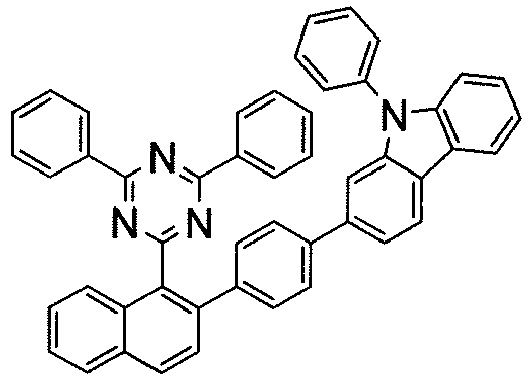
Compound 1-4 Compound 1-5 Compound 1-6 


Compound 1-7 Compound 1-8 Compound 1-9 


Compound 1-10 Compound 1-11 Compound 1-12 


Compound 1-13 Compound 1-14 Compound 1-15 


Compound 1-16 Compound 1-17 Compound 1-18 


Compound 1-19 Compound 1-20 Compound 1-21 


Compound 1-22 Compound 1-23 Compound 1-24 


Compound 1-25 Compound 1-26 Compound 1-27 


Compound 1-28 Compound 1-29 Compound 1-30 


Compound 1-31 Compound 1-32 Compound 1-33 


Compound 1-34 Compound 1-35 Compound 1-36 


Compound 1-37 Compound 1-38 Compound 1-39 


Compound 1-40 Compound 1-41 Compound 1-42 


Compound 1-43 Compound 1-44 Compound 1-45 


Compound 1-46 Compound 1-47 Compound 1-48 


Compound 1-49 Compound 1-50 Compound 1-51 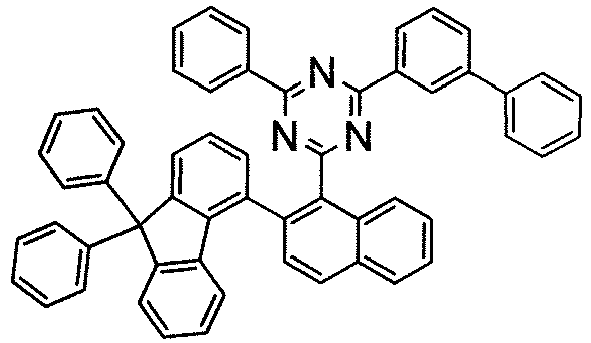


Compound 1-52 Compound 1-53 Compound 1-54 


Compound 1-55 Compound 1-56 Compound 1-57 


Compound 2-1 Compound 2-2 Compound 2-3 


Compound 2-4 Compound 2-5 Compound 2-6 


Compound 2-7 Compound 2-8 Compound 2-9 


Compound 2-10 Compound 2-11 Compound 2-12 


Compound 2-13 Compound 2-14 Compound 2-15 


Compound 2-16 Compound 2-17 Compound 2-18 


Compound 2-39 Compound 2-19 Compound 2-20 


Compound 2-21 Compound 2-22 Compound 2-23 


Compound 2-24 Compound 2-25 Compound 2-26 


Compound 2-27 Compound 2-28 Compound 2-29 


Compound 2-30 Compound 2-31 Compound 2-32 


Compound 2-33 Compound 2-34 Compound 2-35 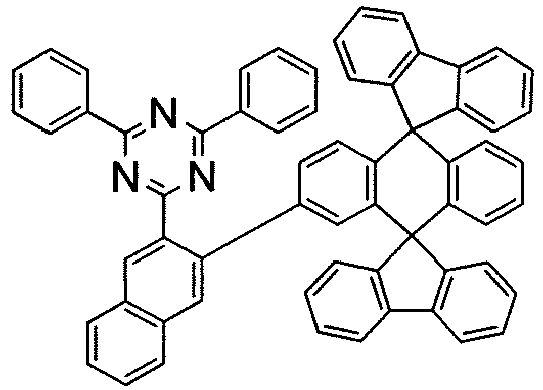


Compound 2-36 Compound 2-37 Compound 2-38 


Compound 3-1 Compound 3-2 Compound 3-3 


Compound 3-4 Compound 3-5 Compound 3-6 
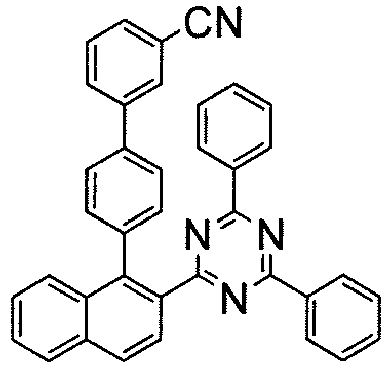

Compound 3-7 Compound 3-8 Compound 3-9 


Compound 3-10 Compound 3-11 Compound 3-12 


Compound 3-13 Compound 3-14 Compound 3-15 


Compound 3-16 Compound 3-17 Compound 3-18 


Compound 3-19 Compound 3-20 Compound 3-21 


Compound 3-22 Compound 3-23 Compound 3-24 

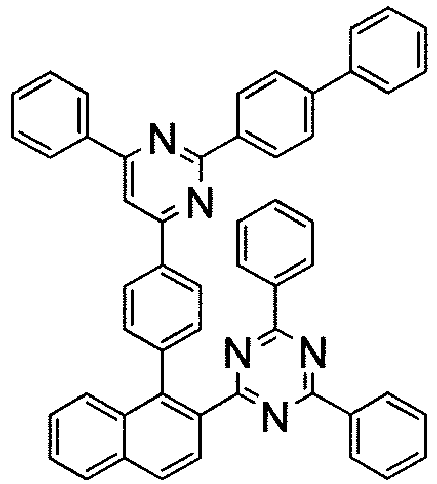
Compound 3-25 Compound 3-26 Compound 3-27 


Compound 3-28 Compound 3-29 Compound 3-30 


Compound 3-31 Compound 3-32 Compound 3-33 


Compound 3-34 Compound 3-35 Compound 3-36 


Compound 3-37 Compound 3-38 Compound 3-39 


Compound 3-40 Compound 3-41 Compound 3-42 

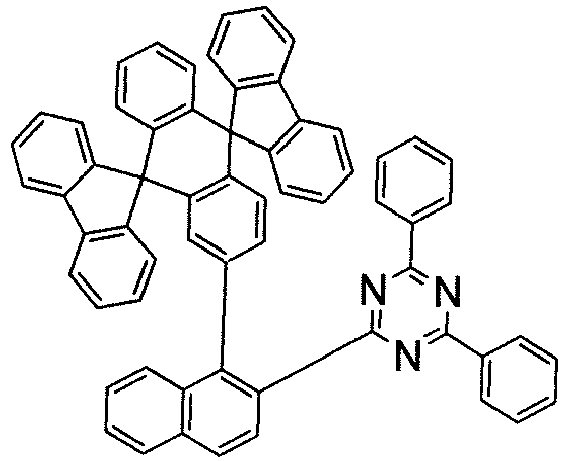
Compound 3-43 Compound 3-44 Compound 3-45 

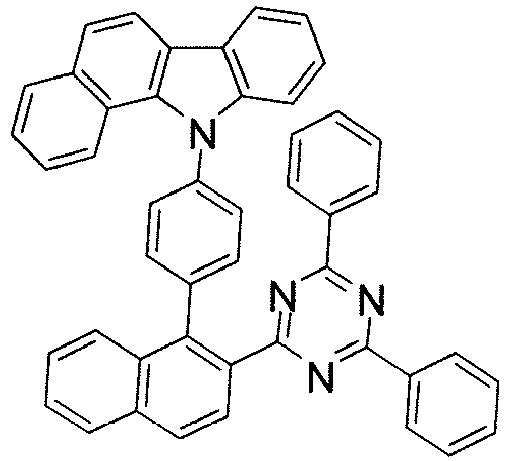
Compound 3-46 Compound 3-47 Compound 3-48 

Compound 3-49 Compound 3-50 


Compound 4-1 Compound 4-2 Compound 4-3 


Compound 4-4 Compound 4-5 Compound 4-6 


Compound 4-7 Compound 4-8 Compound 4-9 


Compound 4-10 Compound 4-11 Compound 4-12 


Compound 4-13 Compound 4-14 Compound 4-15 


Compound 4-16 Compound 4-17 Compound 4-18 


Compound 4-19 Compound 4-20 Compound 4-21 


Compound 4-22 Compound 4-23 Compound 4-24 

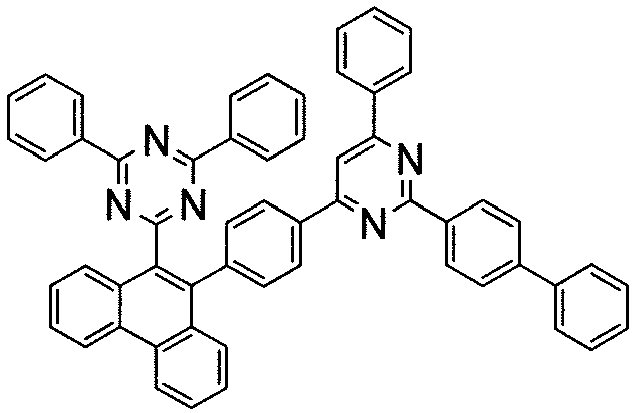
Compound 4-25 Compound 4-26 Compound 4-27 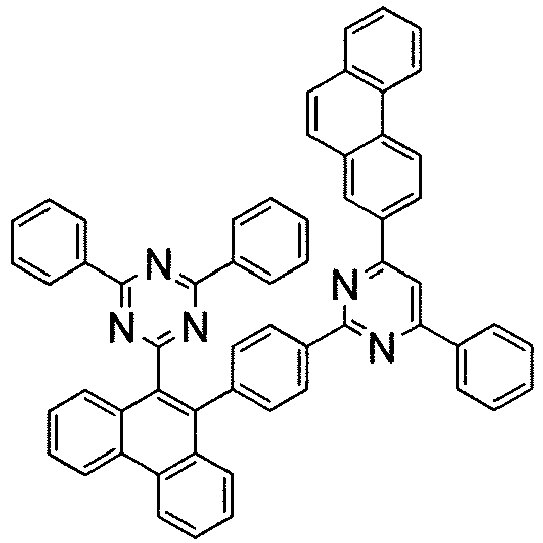


Compound 4-28 Compound 4-29 Compound 4-30 


Compound 4-31 Compound 4-32 Compound 4-33 


Compound 4-34 Compound 4-35 Compound 4-36 


Compound 4-37 Compound 4-38 Compound 4-39 

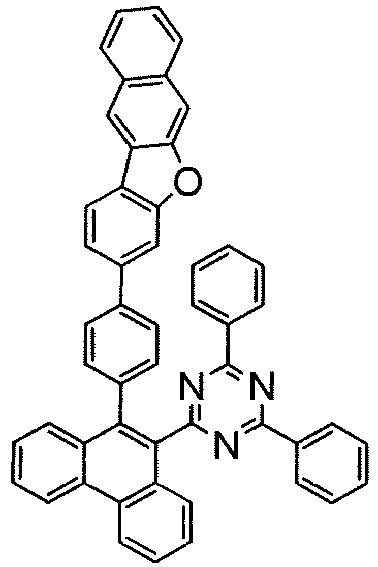
Compound 4-40 Compound 4-41 Compound 4-42 

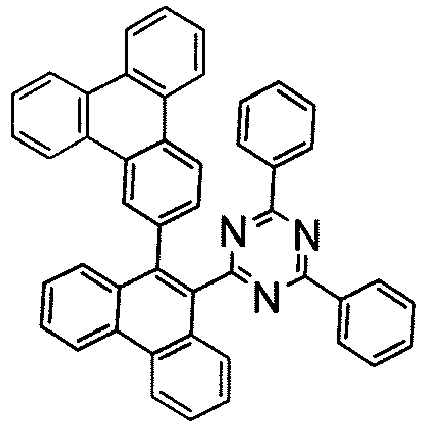
Compound 4-43 Compound 4-44 Compound 4-45 


Compound 4-46 Compound 4-47 Compound 4-48 


Compound 4-49 Compound 4-50 Compound 4-51 


Compound 4-52 Compound 4-53 Compound 4-54 
Compound 4-55 


Compound 5-1 Compound 5-2 Compound 5-3 
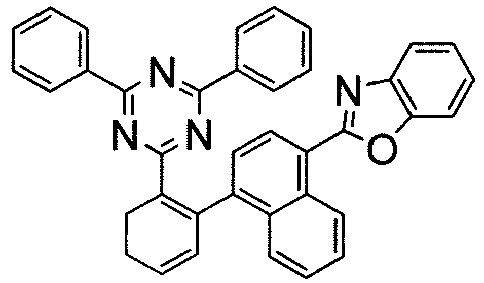

Compound 5-4 Compound 5-5 Compound 5-6 


Compound 5-7 Compound 5-8 Compound 5-9 


Compound 5-10 Compound 5-11 Compound 5-12 


Compound 5-13 Compound 5-14 Compound 5-15 


Compound 5-16 Compound 5-17 Compound 5-18 


Compound 5-19 Compound 5-20 Compound 5-21 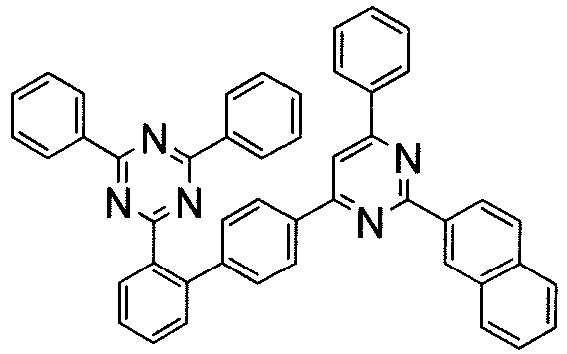


Compound 5-22 Compound 5-23 Compound 5-24 


Compound 5-25 Compound 5-26 Compound 5-27 


Compound 5-28 Compound 5-29 Compound 5-30 


Compound 5-31 Compound 5-32 Compound 5-33 


Compound 5-34 Compound 5-35 Compound 5-36 


Compound 5-37 Compound 5-38 Compound 5-39 


Compound 5-40 Compound 5-41 Compound 5-42 


Compound 5-43 Compound 5-44 Compound 5-45 


Compound 5-46 Compound 5-47 Compound 5-48 


Compound 5-49 Compound 5-50 Compound 5-51 
Compound 5-52 - An organic light emitting device comprising:a first electrode;a second electrode provided to face the first electrode; andone or more organic material layers provided between the first electrode and the second electrode,wherein one or more layers of the organic material layers comprise the compound of any one of claims 1 to 8.
- The organic light emitting device of claim 9, wherein the organic material layer comprises an electron transport layer or an electron injection layer, and
the electron transport layer or the electron injection layer comprises the compound. - The organic light emitting device of claim 9, wherein the organic material layer comprises a light emitting layer, and
the light emitting layer comprises the compound. - The organic light emitting device of claim 9, wherein the organic material layer comprises a hole injection layer or a hole transport layer, and
the hole injection layer or the hole transport layer comprises the compound. - The organic light emitting device of claim 9, wherein the organic material layer is an electron transport layer, and the organic light emitting device further comprises one or two or more layers selected from a group consisting of a hole injection layer, a hole transport layer, a light emitting layer, an electron injection layer, an electron blocking layer, and a hole blocking layer.
Applications Claiming Priority (2)
| Application Number | Priority Date | Filing Date | Title |
|---|---|---|---|
| KR20150149714 | 2015-10-27 | ||
| PCT/KR2016/012157 WO2017074053A1 (en) | 2015-10-27 | 2016-10-27 | Compound and organic light-emitting device comprising same |
Publications (3)
| Publication Number | Publication Date |
|---|---|
| EP3351537A1 true EP3351537A1 (en) | 2018-07-25 |
| EP3351537A4 EP3351537A4 (en) | 2018-10-24 |
| EP3351537B1 EP3351537B1 (en) | 2023-01-18 |
Family
ID=58630662
Family Applications (2)
| Application Number | Title | Priority Date | Filing Date |
|---|---|---|---|
| EP16860236.5A Active EP3351537B1 (en) | 2015-10-27 | 2016-10-27 | Compound and organic light-emitting device comprising same |
| EP16860235.7A Active EP3351536B1 (en) | 2015-10-27 | 2016-10-27 | Organic light-emitting device |
Family Applications After (1)
| Application Number | Title | Priority Date | Filing Date |
|---|---|---|---|
| EP16860235.7A Active EP3351536B1 (en) | 2015-10-27 | 2016-10-27 | Organic light-emitting device |
Country Status (7)
| Country | Link |
|---|---|
| US (3) | US10367149B2 (en) |
| EP (2) | EP3351537B1 (en) |
| JP (2) | JP6648882B2 (en) |
| KR (5) | KR102192360B1 (en) |
| CN (2) | CN108349914B9 (en) |
| TW (2) | TWI690516B (en) |
| WO (2) | WO2017074052A1 (en) |
Cited By (5)
| Publication number | Priority date | Publication date | Assignee | Title |
|---|---|---|---|---|
| EP3372593A4 (en) * | 2016-06-08 | 2018-12-05 | LG Chem, Ltd. | Novel compound and organic light emitting element comprising same |
| EP3546453A4 (en) * | 2017-02-21 | 2019-12-18 | LG Chem, Ltd. | NOVEL HETEROCYCLIC COMPOUND AND ORGANIC ELECTROLUMINESCENT ELEMENT USING THE SAME |
| JP2020102627A (en) * | 2018-12-20 | 2020-07-02 | ドク サン ネオルクス カンパニー リミテッド | Compound for organic electric element, organic electric element using the same and electronic device thereof |
| US11495747B2 (en) | 2018-12-20 | 2022-11-08 | Duk San Neolux Co., Ltd. | Compound for organic electronic element, organic electronic element using the same, and an electronic device thereof |
| EP3896061A4 (en) * | 2018-12-13 | 2022-11-16 | Solus Advanced Materials Co., Ltd. | ORGANIC COMPOUND AND ORGANIC ELECTROLUMINESCENT DEVICE USING THE SAME |
Families Citing this family (54)
| Publication number | Priority date | Publication date | Assignee | Title |
|---|---|---|---|---|
| CN108349914B9 (en) | 2015-10-27 | 2021-09-03 | 株式会社Lg化学 | Organic light emitting device |
| KR102447668B1 (en) | 2016-06-22 | 2022-09-26 | 이데미쓰 고산 가부시키가이샤 | Specifically Substituted Benzofuro- and Benzothienoquinolines for Organic Light Emitting Diodes |
| US10741769B2 (en) * | 2016-10-14 | 2020-08-11 | Semiconductor Energy Laboratory Co., Ltd. | Organic compound, light-emitting element, light-emitting device, electronic device, and lighting device |
| KR102533792B1 (en) * | 2016-12-09 | 2023-05-19 | 롬엔드하스전자재료코리아유한회사 | Organic Electroluminescent Compound and Organic Electroluminescent Device Comprising the Same |
| WO2018155904A1 (en) * | 2017-02-21 | 2018-08-30 | 주식회사 엘지화학 | Novel heterocyclic compound and organic light emitting element using same |
| CN116768911A (en) * | 2017-05-12 | 2023-09-19 | 株式会社半导体能源研究所 | Organic compound, light-emitting element, light-emitting device, electronic device, display device, and lighting device |
| KR102358032B1 (en) * | 2017-05-23 | 2022-02-03 | 솔루스첨단소재 주식회사 | Organic compounds and organic electro luminescence device comprising the same |
| KR102055979B1 (en) | 2017-05-29 | 2019-12-13 | 주식회사 엘지화학 | Organic light emitting device |
| KR102536248B1 (en) | 2017-06-21 | 2023-05-25 | 삼성디스플레이 주식회사 | Heterocyclic compound and organic light emitting device comprising the same |
| KR102064646B1 (en) * | 2017-06-30 | 2020-01-09 | 주식회사 엘지화학 | Organic light emitting device |
| KR102415376B1 (en) | 2017-08-04 | 2022-07-01 | 삼성디스플레이 주식회사 | Condensed-cyclic compound and organic light emitting device comprising the same |
| KR102145020B1 (en) * | 2017-10-23 | 2020-08-14 | 주식회사 엘지화학 | Novel cyclic compound and organic light emitting device comprising the same |
| KR102123742B1 (en) * | 2017-11-17 | 2020-06-16 | 주식회사 엘지화학 | Compound and organic light emitting device comprising the same |
| CN108003865B (en) * | 2017-12-04 | 2021-06-11 | 吉林奥来德光电材料股份有限公司 | Organic light-emitting compound, preparation method thereof and organic electroluminescent device |
| WO2019111971A1 (en) | 2017-12-06 | 2019-06-13 | 出光興産株式会社 | Organic electroluminescent element and novel compound |
| US10249832B1 (en) | 2017-12-06 | 2019-04-02 | Idemitsu Kosan Co., Ltd. | Organic electroluminescence device and novel compound |
| US11552262B2 (en) * | 2017-12-12 | 2023-01-10 | Samsung Display Co., Ltd. | Organic molecules for use in optoelectronic devices |
| KR102125962B1 (en) * | 2018-01-17 | 2020-06-23 | 주식회사 엘지화학 | Novel compound and organic light emitting device comprising the same |
| CN111247650B (en) * | 2018-02-02 | 2023-11-07 | 株式会社Lg化学 | organic light emitting diode |
| US12058930B2 (en) * | 2018-02-20 | 2024-08-06 | Idemitsu Kosan Co., Ltd. | Organic electroluminescence device and electronic apparatus |
| KR102238900B1 (en) * | 2018-03-23 | 2021-04-09 | 주식회사 엘지화학 | Multicyclic compound and organic light emitting device comprising the same |
| KR102536246B1 (en) | 2018-03-23 | 2023-05-25 | 삼성디스플레이 주식회사 | Heterocyclic compound and organic light emitting device comprising the same |
| JP7069947B2 (en) * | 2018-03-28 | 2022-05-18 | 三菱ケミカル株式会社 | A 1,3,5-triazine compound, a composition containing the compound, and a method for producing an organic electroluminescent device. |
| US20210296591A1 (en) * | 2018-06-15 | 2021-09-23 | Idemitsu Kosan Co.,Ltd. | Organic electroluminescence device and electronic appliance using the same |
| CN109053547B (en) * | 2018-07-18 | 2022-03-08 | 长春海谱润斯科技股份有限公司 | Organic electroluminescent device |
| CN108997345B (en) * | 2018-08-20 | 2024-08-02 | 上海弗屈尔光电科技有限公司 | Azaspiro compound and organic photoelectric device containing same |
| US20220384744A1 (en) * | 2018-08-29 | 2022-12-01 | Rohm And Haas Electronic Materials Korea Ltd. | A plurality of host materials and organic electroluminescent device comprising the same |
| WO2020050564A1 (en) * | 2018-09-03 | 2020-03-12 | 주식회사 엘지화학 | Organic light emitting diode |
| KR102254302B1 (en) * | 2018-09-03 | 2021-05-21 | 주식회사 엘지화학 | Organic light emitting device |
| US10593889B1 (en) | 2018-09-26 | 2020-03-17 | Idemitsu Kosan Co., Ltd. | Compound and organic electroluminescence device |
| WO2020115933A1 (en) * | 2018-12-05 | 2020-06-11 | 出光興産株式会社 | Organic electroluminescent element and electronic device using same |
| CN110746409B (en) * | 2018-12-10 | 2023-10-17 | 广州华睿光电材料有限公司 | Organic compounds, mixtures, compositions, electronic devices and uses |
| KR102456677B1 (en) | 2019-03-14 | 2022-10-19 | 주식회사 엘지화학 | Novel compound and organic light emitting device comprising the same |
| CN111747933B (en) * | 2019-03-29 | 2022-03-01 | 吉林省元合电子材料有限公司 | A kind of substituted 1,3,5-triazine compound, composition and application thereof |
| CN111909213B (en) * | 2019-05-09 | 2024-02-27 | 北京夏禾科技有限公司 | A metal complex containing three different ligands |
| TWI710621B (en) * | 2019-07-22 | 2020-11-21 | 昱鐳光電科技股份有限公司 | Naphthyl-substituted phenylpyrimidines compounds and organic electroluminescent devices using the same |
| US20220281856A1 (en) * | 2019-08-19 | 2022-09-08 | Idemitsu Kosan Co.,Ltd. | Compound, material for organic electroluminescent element, organic electroluminescent element, and electronic device |
| WO2021033724A1 (en) | 2019-08-19 | 2021-02-25 | 出光興産株式会社 | Compound, material for organic electroluminescent element, organic electroluminescent element, and electronic device |
| US11611049B2 (en) | 2019-10-22 | 2023-03-21 | Samsung Display Co., Ltd. | Compound and organic light-emitting device including the same |
| CN110734431B (en) * | 2019-11-18 | 2022-04-15 | 烟台九目化学股份有限公司 | Oxazole compound containing triazine structure and application thereof |
| KR102756225B1 (en) * | 2019-12-16 | 2025-01-17 | 엘지디스플레이 주식회사 | White Organic Light Emitting Element and Display Device Using the Same |
| CN111072637B (en) * | 2019-12-27 | 2023-04-07 | 吉林奥来德光电材料股份有限公司 | Organic light-emitting compound, preparation method thereof and organic light-emitting device |
| WO2021206502A1 (en) * | 2020-04-09 | 2021-10-14 | 주식회사 엘지화학 | Organic light-emitting element |
| CN113968847B (en) * | 2020-07-24 | 2025-04-11 | 杜邦特种材料韩国有限公司 | Organic electroluminescent compound, multiple host materials and organic electroluminescent device containing the same |
| EP4299564A4 (en) | 2021-02-25 | 2025-04-23 | Idemitsu Kosan Co.,Ltd. | COMPOUND, MATERIAL FOR ORGANIC ELECTROLUMINESCENT ELEMENTS, ORGANIC ELECTROLUMINESCENT ELEMENT AND ELECTRONIC DEVICE |
| CN115340531B (en) * | 2021-05-12 | 2024-02-13 | 江苏三月科技股份有限公司 | A compound containing triazine and pyrimidine structures and its application in organic electroluminescent devices |
| CN113980002B (en) * | 2021-11-23 | 2022-09-27 | 广东工业大学 | A kind of nitrogen heterocyclic carbazole compound and its application |
| KR102790563B1 (en) * | 2021-12-15 | 2025-04-08 | 주식회사 엘지화학 | Compound and organic light emitting device comprising the same |
| KR20230102692A (en) * | 2021-12-30 | 2023-07-07 | 엘지디스플레이 주식회사 | Organic compound and organic light emitting device including the same |
| WO2023182730A1 (en) * | 2022-03-21 | 2023-09-28 | 주식회사 엘지화학 | Heterocyclic compoumd amd organic light-emitting device including same |
| KR102566290B1 (en) * | 2022-09-05 | 2023-08-10 | 주식회사 엘지화학 | Novel compound and organic light emitting device comprising the same |
| CN115894491B (en) * | 2022-11-24 | 2024-03-26 | 吉林奥来德光电材料股份有限公司 | An electron transmission material and its preparation method, light-emitting device, and light-emitting device |
| KR102929268B1 (en) * | 2022-12-08 | 2026-02-23 | 주식회사 엘지화학 | Compound and organic light emitting device comprising same |
| WO2025219233A1 (en) | 2024-04-15 | 2025-10-23 | Merck Patent Gmbh | Materials for organic light-emitting devices |
Family Cites Families (38)
| Publication number | Priority date | Publication date | Assignee | Title |
|---|---|---|---|---|
| JP2003012890A (en) | 2001-07-03 | 2003-01-15 | Kyocera Chemical Corp | Sealing resin composition and electronic component sealing device |
| DE10135513B4 (en) | 2001-07-20 | 2005-02-24 | Novaled Gmbh | Light-emitting component with organic layers |
| KR101603070B1 (en) * | 2009-03-31 | 2016-03-14 | 롬엔드하스전자재료코리아유한회사 | Novel organic electroluminescent compounds and organic electroluminescent device using the same |
| CN103228647B (en) * | 2010-11-24 | 2017-02-15 | 默克专利有限公司 | Materials for organic electroluminescent devices |
| KR101888658B1 (en) * | 2011-04-15 | 2018-08-14 | 에스에프씨 주식회사 | New compounds and organic light-emitting diode including the same |
| CN107501244B (en) * | 2011-11-22 | 2022-05-03 | 出光兴产株式会社 | Aromatic heterocyclic derivative, material for organic electroluminescent element, and organic electroluminescent element |
| KR101358784B1 (en) | 2012-02-14 | 2014-02-10 | 삼성디스플레이 주식회사 | Organic light-emitting device having improved efficiency characterisitics and organic light-emitting display apparatus including the same |
| KR101380060B1 (en) * | 2012-07-13 | 2014-04-01 | 주식회사 엘지화학 | HETERO-CYCLIC COMPOUND AND ORGANIC ElECTRONIC DEVICE COMPRISING THE SAME |
| EP2935276B1 (en) | 2012-12-21 | 2017-11-01 | Merck Patent GmbH | Materials for organic electroluminescent devices |
| KR101627755B1 (en) * | 2013-06-13 | 2016-06-07 | 제일모직 주식회사 | Organic compound and organic optoelectric device and display device |
| KR101499356B1 (en) | 2013-06-28 | 2015-03-05 | 주식회사 엘지화학 | Hetero-cyclic compound and organic light emitting device comprising the same |
| CN105408448B (en) * | 2013-07-30 | 2018-11-02 | 默克专利有限公司 | Materials for Electronic Devices |
| US9293712B2 (en) * | 2013-10-11 | 2016-03-22 | Universal Display Corporation | Disubstituted pyrene compounds with amino group containing ortho aryl group and devices containing the same |
| TW201522317A (en) * | 2013-11-12 | 2015-06-16 | 陶氏全球科技有限責任公司 | Compositions containing fluorene substituted triazine derived compounds, and electronic devices containing the same |
| WO2015090504A2 (en) * | 2013-12-19 | 2015-06-25 | Merck Patent Gmbh | Heterocyclic spiro compounds |
| KR20150074603A (en) | 2013-12-24 | 2015-07-02 | 희성소재 (주) | Fluorene-based compound and organic light emitting device using the same |
| KR101742359B1 (en) * | 2013-12-27 | 2017-05-31 | 주식회사 두산 | Organic electro luminescence device |
| KR101846436B1 (en) | 2014-01-29 | 2018-04-06 | 제일모직 주식회사 | Composition for electron transport buffer layer and organic optoelectric device including the electron transport buffer layer and display device |
| WO2015115744A1 (en) | 2014-01-29 | 2015-08-06 | 삼성에스디아이 주식회사 | Composition for electron transport auxiliary layer, organic optoelectric device containing electron transport auxiliary layer, and display device |
| KR102280686B1 (en) | 2014-02-11 | 2021-07-22 | 삼성전자주식회사 | Carbazole-based compound and organic light emitting device including the same |
| KR20150104261A (en) | 2014-03-04 | 2015-09-15 | 삼성디스플레이 주식회사 | Organic light emitting device |
| WO2015152651A1 (en) * | 2014-04-04 | 2015-10-08 | 주식회사 엘지화학 | Heterocyclic compound and organic light-emitting element comprising same |
| KR20150115622A (en) * | 2014-04-04 | 2015-10-14 | 주식회사 엘지화학 | Hetero-cyclic compound and organic light emitting device comprising the same |
| CN109970670B (en) | 2014-04-04 | 2023-03-24 | 株式会社Lg化学 | Heterocyclic compound and organic light-emitting device comprising same |
| KR101542714B1 (en) * | 2014-04-04 | 2015-08-12 | 주식회사 엘지화학 | Hetero-cyclic compound and organic light emitting device comprising the same |
| KR101773363B1 (en) | 2014-04-09 | 2017-08-31 | 제일모직 주식회사 | Organic compound and composition and organic optoelectric device and display device |
| WO2015165563A1 (en) | 2014-04-30 | 2015-11-05 | Merck Patent Gmbh | Materials for electronic devices |
| JP2015210242A (en) | 2014-04-30 | 2015-11-24 | キヤノン株式会社 | Flow path device, flow path device manufacturing method, and inspection method |
| KR102351957B1 (en) | 2014-07-10 | 2022-01-17 | 삼성디스플레이 주식회사 | Organic light emitting diode and organic light emitting display device including the same |
| KR102460658B1 (en) | 2014-08-29 | 2022-10-31 | 삼성전자주식회사 | Organic light emitting device |
| US10741772B2 (en) | 2014-08-29 | 2020-08-11 | Samsung Electronics Co., Ltd. | Organic light-emitting device |
| KR101857146B1 (en) * | 2014-10-28 | 2018-05-11 | 삼성에스디아이 주식회사 | Organic optoelectric device and display device |
| KR101818581B1 (en) * | 2014-10-31 | 2018-01-15 | 삼성에스디아이 주식회사 | Organic optoelectric device and display device |
| KR101892234B1 (en) | 2014-10-31 | 2018-08-27 | 삼성에스디아이 주식회사 | Organic optoelectric device and display device |
| KR101560102B1 (en) * | 2014-11-20 | 2015-10-13 | 주식회사 엘지화학 | Organic light emitting device |
| US11758808B2 (en) * | 2015-03-27 | 2023-09-12 | Samsung Display Co., Ltd. | Ortho-substituted thermally activated delayed fluorescence material and organic light-emitting device comprising same |
| TWI610924B (en) | 2015-05-14 | 2018-01-11 | Lg化學股份有限公司 | Hetero-cyclic compound and organic light emitting device comprising the same |
| CN108349914B9 (en) * | 2015-10-27 | 2021-09-03 | 株式会社Lg化学 | Organic light emitting device |
-
2016
- 2016-10-27 CN CN201680062755.1A patent/CN108349914B9/en active Active
- 2016-10-27 KR KR1020160141105A patent/KR102192360B1/en active Active
- 2016-10-27 KR KR1020160141101A patent/KR102054039B1/en active Active
- 2016-10-27 US US15/770,606 patent/US10367149B2/en active Active
- 2016-10-27 EP EP16860236.5A patent/EP3351537B1/en active Active
- 2016-10-27 TW TW105134800A patent/TWI690516B/en active
- 2016-10-27 WO PCT/KR2016/012154 patent/WO2017074052A1/en not_active Ceased
- 2016-10-27 US US15/770,633 patent/US11737357B2/en active Active
- 2016-10-27 JP JP2018518469A patent/JP6648882B2/en active Active
- 2016-10-27 TW TW105134775A patent/TWI714655B/en active
- 2016-10-27 WO PCT/KR2016/012157 patent/WO2017074053A1/en not_active Ceased
- 2016-10-27 CN CN201680062252.4A patent/CN108349913B/en active Active
- 2016-10-27 JP JP2018518470A patent/JP6838253B2/en active Active
- 2016-10-27 EP EP16860235.7A patent/EP3351536B1/en active Active
-
2019
- 2019-10-11 KR KR1020190126147A patent/KR102125653B1/en active Active
-
2020
- 2020-02-18 KR KR1020200019632A patent/KR102278233B1/en active Active
- 2020-02-18 KR KR1020200019636A patent/KR102278319B1/en active Active
-
2023
- 2023-03-23 US US18/125,542 patent/US12075695B2/en active Active
Cited By (8)
| Publication number | Priority date | Publication date | Assignee | Title |
|---|---|---|---|---|
| EP3372593A4 (en) * | 2016-06-08 | 2018-12-05 | LG Chem, Ltd. | Novel compound and organic light emitting element comprising same |
| US10833278B2 (en) | 2016-06-08 | 2020-11-10 | Lg Chem, Ltd. | Compound and organic light emitting device comprising the same |
| EP3546453A4 (en) * | 2017-02-21 | 2019-12-18 | LG Chem, Ltd. | NOVEL HETEROCYCLIC COMPOUND AND ORGANIC ELECTROLUMINESCENT ELEMENT USING THE SAME |
| EP3896061A4 (en) * | 2018-12-13 | 2022-11-16 | Solus Advanced Materials Co., Ltd. | ORGANIC COMPOUND AND ORGANIC ELECTROLUMINESCENT DEVICE USING THE SAME |
| US12295259B2 (en) | 2018-12-13 | 2025-05-06 | Solus Advanced Materials Co., Ltd. | Organic compound and organic electroluminescent device using same |
| JP2020102627A (en) * | 2018-12-20 | 2020-07-02 | ドク サン ネオルクス カンパニー リミテッド | Compound for organic electric element, organic electric element using the same and electronic device thereof |
| JP2021100140A (en) * | 2018-12-20 | 2021-07-01 | ドク サン ネオルクス カンパニー リミテッド | Compound for organic electric element, organic electric element using the same, and electronic device thereof |
| US11495747B2 (en) | 2018-12-20 | 2022-11-08 | Duk San Neolux Co., Ltd. | Compound for organic electronic element, organic electronic element using the same, and an electronic device thereof |
Also Published As
Similar Documents
| Publication | Publication Date | Title |
|---|---|---|
| EP3351537B1 (en) | Compound and organic light-emitting device comprising same | |
| EP3305792B1 (en) | Nitrogen-containing condensed cyclic compound and organic light emitting element using same | |
| US10745362B2 (en) | Heterocyclic compound and organic light emitting device comprising same | |
| EP3305771B1 (en) | Organic light emitting device including a heterocyclic compound | |
| EP3050879B1 (en) | Heterocyclic compound and organic light-emtting element including same | |
| CN107531650A (en) | Compounds and organic electronic components containing them | |
| JP2019507737A (en) | Heterocyclic compound and organic electroluminescent device containing the same | |
| JP2019507739A (en) | Heterocyclic compound and organic electroluminescent device containing the same | |
| EP3305775B1 (en) | Compound and organic electronic element comprising same | |
| CN107257787A (en) | Heterocyclic compound and organic light-emitting element containing it | |
| JP2019507738A (en) | Heterocyclic compound and organic electroluminescent device containing the same | |
| CN108138041A (en) | Double spiro compound and organic light emitting diode containing it | |
| EP3395799B1 (en) | Compound and organic electronic device comprising same | |
| CN111868949A (en) | Organic Light Emitting Devices | |
| CN108026079B (en) | Compound and organic light-emitting device comprising the same | |
| KR20170127376A (en) | Compound and organic light emitting device comprising the same | |
| US10811615B2 (en) | Compound and organic light emitting element comprising same |
Legal Events
| Date | Code | Title | Description |
|---|---|---|---|
| STAA | Information on the status of an ep patent application or granted ep patent |
Free format text: STATUS: THE INTERNATIONAL PUBLICATION HAS BEEN MADE |
|
| PUAI | Public reference made under article 153(3) epc to a published international application that has entered the european phase |
Free format text: ORIGINAL CODE: 0009012 |
|
| STAA | Information on the status of an ep patent application or granted ep patent |
Free format text: STATUS: REQUEST FOR EXAMINATION WAS MADE |
|
| 17P | Request for examination filed |
Effective date: 20180416 |
|
| AK | Designated contracting states |
Kind code of ref document: A1 Designated state(s): AL AT BE BG CH CY CZ DE DK EE ES FI FR GB GR HR HU IE IS IT LI LT LU LV MC MK MT NL NO PL PT RO RS SE SI SK SM TR |
|
| AX | Request for extension of the european patent |
Extension state: BA ME |
|
| A4 | Supplementary search report drawn up and despatched |
Effective date: 20180926 |
|
| RIC1 | Information provided on ipc code assigned before grant |
Ipc: C07D 235/06 20060101ALI20180920BHEP Ipc: C07D 403/10 20060101ALI20180920BHEP Ipc: C07D 263/52 20060101ALI20180920BHEP Ipc: H01L 51/54 20060101ALI20180920BHEP Ipc: C07D 251/12 20060101AFI20180920BHEP Ipc: C07D 277/60 20060101ALI20180920BHEP Ipc: C09K 11/06 20060101ALI20180920BHEP |
|
| DAV | Request for validation of the european patent (deleted) | ||
| DAX | Request for extension of the european patent (deleted) | ||
| STAA | Information on the status of an ep patent application or granted ep patent |
Free format text: STATUS: EXAMINATION IS IN PROGRESS |
|
| 17Q | First examination report despatched |
Effective date: 20200625 |
|
| GRAP | Despatch of communication of intention to grant a patent |
Free format text: ORIGINAL CODE: EPIDOSNIGR1 |
|
| STAA | Information on the status of an ep patent application or granted ep patent |
Free format text: STATUS: GRANT OF PATENT IS INTENDED |
|
| INTG | Intention to grant announced |
Effective date: 20221103 |
|
| GRAS | Grant fee paid |
Free format text: ORIGINAL CODE: EPIDOSNIGR3 |
|
| GRAA | (expected) grant |
Free format text: ORIGINAL CODE: 0009210 |
|
| STAA | Information on the status of an ep patent application or granted ep patent |
Free format text: STATUS: THE PATENT HAS BEEN GRANTED |
|
| AK | Designated contracting states |
Kind code of ref document: B1 Designated state(s): AL AT BE BG CH CY CZ DE DK EE ES FI FR GB GR HR HU IE IS IT LI LT LU LV MC MK MT NL NO PL PT RO RS SE SI SK SM TR |
|
| REG | Reference to a national code |
Ref country code: GB Ref legal event code: FG4D |
|
| REG | Reference to a national code |
Ref country code: DE Ref legal event code: R096 Ref document number: 602016077553 Country of ref document: DE |
|
| REG | Reference to a national code |
Ref country code: CH Ref legal event code: EP |
|
| REG | Reference to a national code |
Ref country code: AT Ref legal event code: REF Ref document number: 1544630 Country of ref document: AT Kind code of ref document: T Effective date: 20230215 Ref country code: IE Ref legal event code: FG4D |
|
| REG | Reference to a national code |
Ref country code: LT Ref legal event code: MG9D |
|
| REG | Reference to a national code |
Ref country code: NL Ref legal event code: MP Effective date: 20230118 |
|
| REG | Reference to a national code |
Ref country code: AT Ref legal event code: MK05 Ref document number: 1544630 Country of ref document: AT Kind code of ref document: T Effective date: 20230118 |
|
| PG25 | Lapsed in a contracting state [announced via postgrant information from national office to epo] |
Ref country code: NL Free format text: LAPSE BECAUSE OF FAILURE TO SUBMIT A TRANSLATION OF THE DESCRIPTION OR TO PAY THE FEE WITHIN THE PRESCRIBED TIME-LIMIT Effective date: 20230118 |
|
| PG25 | Lapsed in a contracting state [announced via postgrant information from national office to epo] |
Ref country code: RS Free format text: LAPSE BECAUSE OF FAILURE TO SUBMIT A TRANSLATION OF THE DESCRIPTION OR TO PAY THE FEE WITHIN THE PRESCRIBED TIME-LIMIT Effective date: 20230118 Ref country code: PT Free format text: LAPSE BECAUSE OF FAILURE TO SUBMIT A TRANSLATION OF THE DESCRIPTION OR TO PAY THE FEE WITHIN THE PRESCRIBED TIME-LIMIT Effective date: 20230518 Ref country code: NO Free format text: LAPSE BECAUSE OF FAILURE TO SUBMIT A TRANSLATION OF THE DESCRIPTION OR TO PAY THE FEE WITHIN THE PRESCRIBED TIME-LIMIT Effective date: 20230418 Ref country code: LV Free format text: LAPSE BECAUSE OF FAILURE TO SUBMIT A TRANSLATION OF THE DESCRIPTION OR TO PAY THE FEE WITHIN THE PRESCRIBED TIME-LIMIT Effective date: 20230118 Ref country code: LT Free format text: LAPSE BECAUSE OF FAILURE TO SUBMIT A TRANSLATION OF THE DESCRIPTION OR TO PAY THE FEE WITHIN THE PRESCRIBED TIME-LIMIT Effective date: 20230118 Ref country code: HR Free format text: LAPSE BECAUSE OF FAILURE TO SUBMIT A TRANSLATION OF THE DESCRIPTION OR TO PAY THE FEE WITHIN THE PRESCRIBED TIME-LIMIT Effective date: 20230118 Ref country code: ES Free format text: LAPSE BECAUSE OF FAILURE TO SUBMIT A TRANSLATION OF THE DESCRIPTION OR TO PAY THE FEE WITHIN THE PRESCRIBED TIME-LIMIT Effective date: 20230118 Ref country code: AT Free format text: LAPSE BECAUSE OF FAILURE TO SUBMIT A TRANSLATION OF THE DESCRIPTION OR TO PAY THE FEE WITHIN THE PRESCRIBED TIME-LIMIT Effective date: 20230118 |
|
| PG25 | Lapsed in a contracting state [announced via postgrant information from national office to epo] |
Ref country code: SE Free format text: LAPSE BECAUSE OF FAILURE TO SUBMIT A TRANSLATION OF THE DESCRIPTION OR TO PAY THE FEE WITHIN THE PRESCRIBED TIME-LIMIT Effective date: 20230118 Ref country code: PL Free format text: LAPSE BECAUSE OF FAILURE TO SUBMIT A TRANSLATION OF THE DESCRIPTION OR TO PAY THE FEE WITHIN THE PRESCRIBED TIME-LIMIT Effective date: 20230118 Ref country code: IS Free format text: LAPSE BECAUSE OF FAILURE TO SUBMIT A TRANSLATION OF THE DESCRIPTION OR TO PAY THE FEE WITHIN THE PRESCRIBED TIME-LIMIT Effective date: 20230518 Ref country code: GR Free format text: LAPSE BECAUSE OF FAILURE TO SUBMIT A TRANSLATION OF THE DESCRIPTION OR TO PAY THE FEE WITHIN THE PRESCRIBED TIME-LIMIT Effective date: 20230419 Ref country code: FI Free format text: LAPSE BECAUSE OF FAILURE TO SUBMIT A TRANSLATION OF THE DESCRIPTION OR TO PAY THE FEE WITHIN THE PRESCRIBED TIME-LIMIT Effective date: 20230118 |
|
| REG | Reference to a national code |
Ref country code: DE Ref legal event code: R097 Ref document number: 602016077553 Country of ref document: DE |
|
| PG25 | Lapsed in a contracting state [announced via postgrant information from national office to epo] |
Ref country code: SM Free format text: LAPSE BECAUSE OF FAILURE TO SUBMIT A TRANSLATION OF THE DESCRIPTION OR TO PAY THE FEE WITHIN THE PRESCRIBED TIME-LIMIT Effective date: 20230118 Ref country code: RO Free format text: LAPSE BECAUSE OF FAILURE TO SUBMIT A TRANSLATION OF THE DESCRIPTION OR TO PAY THE FEE WITHIN THE PRESCRIBED TIME-LIMIT Effective date: 20230118 Ref country code: EE Free format text: LAPSE BECAUSE OF FAILURE TO SUBMIT A TRANSLATION OF THE DESCRIPTION OR TO PAY THE FEE WITHIN THE PRESCRIBED TIME-LIMIT Effective date: 20230118 Ref country code: DK Free format text: LAPSE BECAUSE OF FAILURE TO SUBMIT A TRANSLATION OF THE DESCRIPTION OR TO PAY THE FEE WITHIN THE PRESCRIBED TIME-LIMIT Effective date: 20230118 Ref country code: CZ Free format text: LAPSE BECAUSE OF FAILURE TO SUBMIT A TRANSLATION OF THE DESCRIPTION OR TO PAY THE FEE WITHIN THE PRESCRIBED TIME-LIMIT Effective date: 20230118 |
|
| PLBE | No opposition filed within time limit |
Free format text: ORIGINAL CODE: 0009261 |
|
| STAA | Information on the status of an ep patent application or granted ep patent |
Free format text: STATUS: NO OPPOSITION FILED WITHIN TIME LIMIT |
|
| PG25 | Lapsed in a contracting state [announced via postgrant information from national office to epo] |
Ref country code: SK Free format text: LAPSE BECAUSE OF FAILURE TO SUBMIT A TRANSLATION OF THE DESCRIPTION OR TO PAY THE FEE WITHIN THE PRESCRIBED TIME-LIMIT Effective date: 20230118 |
|
| 26N | No opposition filed |
Effective date: 20231019 |
|
| PG25 | Lapsed in a contracting state [announced via postgrant information from national office to epo] |
Ref country code: SI Free format text: LAPSE BECAUSE OF FAILURE TO SUBMIT A TRANSLATION OF THE DESCRIPTION OR TO PAY THE FEE WITHIN THE PRESCRIBED TIME-LIMIT Effective date: 20230118 |
|
| PG25 | Lapsed in a contracting state [announced via postgrant information from national office to epo] |
Ref country code: IT Free format text: LAPSE BECAUSE OF FAILURE TO SUBMIT A TRANSLATION OF THE DESCRIPTION OR TO PAY THE FEE WITHIN THE PRESCRIBED TIME-LIMIT Effective date: 20230118 Ref country code: MC Free format text: LAPSE BECAUSE OF FAILURE TO SUBMIT A TRANSLATION OF THE DESCRIPTION OR TO PAY THE FEE WITHIN THE PRESCRIBED TIME-LIMIT Effective date: 20230118 |
|
| REG | Reference to a national code |
Ref country code: CH Ref legal event code: PL |
|
| REG | Reference to a national code |
Ref country code: BE Ref legal event code: MM Effective date: 20231031 |
|
| PG25 | Lapsed in a contracting state [announced via postgrant information from national office to epo] |
Ref country code: LU Free format text: LAPSE BECAUSE OF NON-PAYMENT OF DUE FEES Effective date: 20231027 |
|
| PG25 | Lapsed in a contracting state [announced via postgrant information from national office to epo] |
Ref country code: LU Free format text: LAPSE BECAUSE OF NON-PAYMENT OF DUE FEES Effective date: 20231027 |
|
| PG25 | Lapsed in a contracting state [announced via postgrant information from national office to epo] |
Ref country code: CH Free format text: LAPSE BECAUSE OF NON-PAYMENT OF DUE FEES Effective date: 20231031 |
|
| PG25 | Lapsed in a contracting state [announced via postgrant information from national office to epo] |
Ref country code: CH Free format text: LAPSE BECAUSE OF NON-PAYMENT OF DUE FEES Effective date: 20231031 |
|
| PG25 | Lapsed in a contracting state [announced via postgrant information from national office to epo] |
Ref country code: BE Free format text: LAPSE BECAUSE OF NON-PAYMENT OF DUE FEES Effective date: 20231031 |
|
| PG25 | Lapsed in a contracting state [announced via postgrant information from national office to epo] |
Ref country code: IE Free format text: LAPSE BECAUSE OF NON-PAYMENT OF DUE FEES Effective date: 20231027 |
|
| PG25 | Lapsed in a contracting state [announced via postgrant information from national office to epo] |
Ref country code: IE Free format text: LAPSE BECAUSE OF NON-PAYMENT OF DUE FEES Effective date: 20231027 |
|
| PG25 | Lapsed in a contracting state [announced via postgrant information from national office to epo] |
Ref country code: BG Free format text: LAPSE BECAUSE OF FAILURE TO SUBMIT A TRANSLATION OF THE DESCRIPTION OR TO PAY THE FEE WITHIN THE PRESCRIBED TIME-LIMIT Effective date: 20230118 |
|
| PG25 | Lapsed in a contracting state [announced via postgrant information from national office to epo] |
Ref country code: BG Free format text: LAPSE BECAUSE OF FAILURE TO SUBMIT A TRANSLATION OF THE DESCRIPTION OR TO PAY THE FEE WITHIN THE PRESCRIBED TIME-LIMIT Effective date: 20230118 |
|
| PG25 | Lapsed in a contracting state [announced via postgrant information from national office to epo] |
Ref country code: CY Free format text: LAPSE BECAUSE OF FAILURE TO SUBMIT A TRANSLATION OF THE DESCRIPTION OR TO PAY THE FEE WITHIN THE PRESCRIBED TIME-LIMIT; INVALID AB INITIO Effective date: 20161027 |
|
| PG25 | Lapsed in a contracting state [announced via postgrant information from national office to epo] |
Ref country code: HU Free format text: LAPSE BECAUSE OF FAILURE TO SUBMIT A TRANSLATION OF THE DESCRIPTION OR TO PAY THE FEE WITHIN THE PRESCRIBED TIME-LIMIT; INVALID AB INITIO Effective date: 20161027 |
|
| PGFP | Annual fee paid to national office [announced via postgrant information from national office to epo] |
Ref country code: GB Payment date: 20250922 Year of fee payment: 10 |
|
| PGFP | Annual fee paid to national office [announced via postgrant information from national office to epo] |
Ref country code: FR Payment date: 20250925 Year of fee payment: 10 |
|
| PG25 | Lapsed in a contracting state [announced via postgrant information from national office to epo] |
Ref country code: TR Free format text: LAPSE BECAUSE OF FAILURE TO SUBMIT A TRANSLATION OF THE DESCRIPTION OR TO PAY THE FEE WITHIN THE PRESCRIBED TIME-LIMIT Effective date: 20230118 |
|
| PGFP | Annual fee paid to national office [announced via postgrant information from national office to epo] |
Ref country code: DE Payment date: 20250922 Year of fee payment: 10 |