EP3349811B1 - Peptid zur beschichtung von oberflächen - Google Patents
Peptid zur beschichtung von oberflächen Download PDFInfo
- Publication number
- EP3349811B1 EP3349811B1 EP16767250.0A EP16767250A EP3349811B1 EP 3349811 B1 EP3349811 B1 EP 3349811B1 EP 16767250 A EP16767250 A EP 16767250A EP 3349811 B1 EP3349811 B1 EP 3349811B1
- Authority
- EP
- European Patent Office
- Prior art keywords
- peptide
- titanium
- cell
- implant
- metallic surface
- Prior art date
- Legal status (The legal status is an assumption and is not a legal conclusion. Google has not performed a legal analysis and makes no representation as to the accuracy of the status listed.)
- Active
Links
Images



Classifications
-
- C—CHEMISTRY; METALLURGY
- C07—ORGANIC CHEMISTRY
- C07K—PEPTIDES
- C07K7/00—Peptides having 5 to 20 amino acids in a fully defined sequence; Derivatives thereof
- C07K7/04—Linear peptides containing only normal peptide links
- C07K7/06—Linear peptides containing only normal peptide links having 5 to 11 amino acids
-
- A—HUMAN NECESSITIES
- A61—MEDICAL OR VETERINARY SCIENCE; HYGIENE
- A61F—FILTERS IMPLANTABLE INTO BLOOD VESSELS; PROSTHESES; DEVICES PROVIDING PATENCY TO, OR PREVENTING COLLAPSING OF, TUBULAR STRUCTURES OF THE BODY, e.g. STENTS; ORTHOPAEDIC, NURSING OR CONTRACEPTIVE DEVICES; FOMENTATION; TREATMENT OR PROTECTION OF EYES OR EARS; BANDAGES, DRESSINGS OR ABSORBENT PADS; FIRST-AID KITS
- A61F2/00—Filters implantable into blood vessels; Prostheses, i.e. artificial substitutes or replacements for parts of the body; Appliances for connecting them with the body; Devices providing patency to, or preventing collapsing of, tubular structures of the body, e.g. stents
- A61F2/0077—Special surfaces of prostheses, e.g. for improving ingrowth
-
- A—HUMAN NECESSITIES
- A61—MEDICAL OR VETERINARY SCIENCE; HYGIENE
- A61K—PREPARATIONS FOR MEDICAL, DENTAL OR TOILETRY PURPOSES
- A61K47/00—Medicinal preparations characterised by the non-active ingredients used, e.g. carriers or inert additives; Targeting or modifying agents chemically bound to the active ingredient
- A61K47/50—Medicinal preparations characterised by the non-active ingredients used, e.g. carriers or inert additives; Targeting or modifying agents chemically bound to the active ingredient the non-active ingredient being chemically bound to the active ingredient, e.g. polymer-drug conjugates
- A61K47/51—Medicinal preparations characterised by the non-active ingredients used, e.g. carriers or inert additives; Targeting or modifying agents chemically bound to the active ingredient the non-active ingredient being chemically bound to the active ingredient, e.g. polymer-drug conjugates the non-active ingredient being a modifying agent
- A61K47/56—Medicinal preparations characterised by the non-active ingredients used, e.g. carriers or inert additives; Targeting or modifying agents chemically bound to the active ingredient the non-active ingredient being chemically bound to the active ingredient, e.g. polymer-drug conjugates the non-active ingredient being a modifying agent the modifying agent being an organic macromolecular compound, e.g. an oligomeric, polymeric or dendrimeric molecule
- A61K47/59—Medicinal preparations characterised by the non-active ingredients used, e.g. carriers or inert additives; Targeting or modifying agents chemically bound to the active ingredient the non-active ingredient being chemically bound to the active ingredient, e.g. polymer-drug conjugates the non-active ingredient being a modifying agent the modifying agent being an organic macromolecular compound, e.g. an oligomeric, polymeric or dendrimeric molecule obtained otherwise than by reactions only involving carbon-to-carbon unsaturated bonds, e.g. polyureas or polyurethanes
- A61K47/60—Medicinal preparations characterised by the non-active ingredients used, e.g. carriers or inert additives; Targeting or modifying agents chemically bound to the active ingredient the non-active ingredient being chemically bound to the active ingredient, e.g. polymer-drug conjugates the non-active ingredient being a modifying agent the modifying agent being an organic macromolecular compound, e.g. an oligomeric, polymeric or dendrimeric molecule obtained otherwise than by reactions only involving carbon-to-carbon unsaturated bonds, e.g. polyureas or polyurethanes the organic macromolecular compound being a polyoxyalkylene oligomer, polymer or dendrimer, e.g. PEG, PPG, PEO or polyglycerol
-
- A—HUMAN NECESSITIES
- A61—MEDICAL OR VETERINARY SCIENCE; HYGIENE
- A61K—PREPARATIONS FOR MEDICAL, DENTAL OR TOILETRY PURPOSES
- A61K47/00—Medicinal preparations characterised by the non-active ingredients used, e.g. carriers or inert additives; Targeting or modifying agents chemically bound to the active ingredient
- A61K47/50—Medicinal preparations characterised by the non-active ingredients used, e.g. carriers or inert additives; Targeting or modifying agents chemically bound to the active ingredient the non-active ingredient being chemically bound to the active ingredient, e.g. polymer-drug conjugates
- A61K47/51—Medicinal preparations characterised by the non-active ingredients used, e.g. carriers or inert additives; Targeting or modifying agents chemically bound to the active ingredient the non-active ingredient being chemically bound to the active ingredient, e.g. polymer-drug conjugates the non-active ingredient being a modifying agent
- A61K47/62—Medicinal preparations characterised by the non-active ingredients used, e.g. carriers or inert additives; Targeting or modifying agents chemically bound to the active ingredient the non-active ingredient being chemically bound to the active ingredient, e.g. polymer-drug conjugates the non-active ingredient being a modifying agent the modifying agent being a protein, peptide or polyamino acid
- A61K47/64—Drug-peptide, drug-protein or drug-polyamino acid conjugates, i.e. the modifying agent being a peptide, protein or polyamino acid which is covalently bonded or complexed to a therapeutically active agent
-
- A—HUMAN NECESSITIES
- A61—MEDICAL OR VETERINARY SCIENCE; HYGIENE
- A61K—PREPARATIONS FOR MEDICAL, DENTAL OR TOILETRY PURPOSES
- A61K47/00—Medicinal preparations characterised by the non-active ingredients used, e.g. carriers or inert additives; Targeting or modifying agents chemically bound to the active ingredient
- A61K47/50—Medicinal preparations characterised by the non-active ingredients used, e.g. carriers or inert additives; Targeting or modifying agents chemically bound to the active ingredient the non-active ingredient being chemically bound to the active ingredient, e.g. polymer-drug conjugates
- A61K47/51—Medicinal preparations characterised by the non-active ingredients used, e.g. carriers or inert additives; Targeting or modifying agents chemically bound to the active ingredient the non-active ingredient being chemically bound to the active ingredient, e.g. polymer-drug conjugates the non-active ingredient being a modifying agent
- A61K47/62—Medicinal preparations characterised by the non-active ingredients used, e.g. carriers or inert additives; Targeting or modifying agents chemically bound to the active ingredient the non-active ingredient being chemically bound to the active ingredient, e.g. polymer-drug conjugates the non-active ingredient being a modifying agent the modifying agent being a protein, peptide or polyamino acid
- A61K47/65—Peptidic linkers, binders or spacers, e.g. peptidic enzyme-labile linkers
-
- A—HUMAN NECESSITIES
- A61—MEDICAL OR VETERINARY SCIENCE; HYGIENE
- A61K—PREPARATIONS FOR MEDICAL, DENTAL OR TOILETRY PURPOSES
- A61K6/00—Preparations for dentistry
- A61K6/20—Protective coatings for natural or artificial teeth, e.g. sealings, dye coatings or varnish
-
- A—HUMAN NECESSITIES
- A61—MEDICAL OR VETERINARY SCIENCE; HYGIENE
- A61L—METHODS OR APPARATUS FOR STERILISING MATERIALS OR OBJECTS IN GENERAL; DISINFECTION, STERILISATION OR DEODORISATION OF AIR; CHEMICAL ASPECTS OF BANDAGES, DRESSINGS, ABSORBENT PADS OR SURGICAL ARTICLES; MATERIALS FOR BANDAGES, DRESSINGS, ABSORBENT PADS OR SURGICAL ARTICLES
- A61L27/00—Materials for grafts or prostheses or for coating grafts or prostheses
- A61L27/28—Materials for coating prostheses
-
- A—HUMAN NECESSITIES
- A61—MEDICAL OR VETERINARY SCIENCE; HYGIENE
- A61L—METHODS OR APPARATUS FOR STERILISING MATERIALS OR OBJECTS IN GENERAL; DISINFECTION, STERILISATION OR DEODORISATION OF AIR; CHEMICAL ASPECTS OF BANDAGES, DRESSINGS, ABSORBENT PADS OR SURGICAL ARTICLES; MATERIALS FOR BANDAGES, DRESSINGS, ABSORBENT PADS OR SURGICAL ARTICLES
- A61L27/00—Materials for grafts or prostheses or for coating grafts or prostheses
- A61L27/28—Materials for coating prostheses
- A61L27/34—Macromolecular materials
-
- A—HUMAN NECESSITIES
- A61—MEDICAL OR VETERINARY SCIENCE; HYGIENE
- A61L—METHODS OR APPARATUS FOR STERILISING MATERIALS OR OBJECTS IN GENERAL; DISINFECTION, STERILISATION OR DEODORISATION OF AIR; CHEMICAL ASPECTS OF BANDAGES, DRESSINGS, ABSORBENT PADS OR SURGICAL ARTICLES; MATERIALS FOR BANDAGES, DRESSINGS, ABSORBENT PADS OR SURGICAL ARTICLES
- A61L27/00—Materials for grafts or prostheses or for coating grafts or prostheses
- A61L27/50—Materials characterised by their function or physical properties, e.g. injectable or lubricating compositions, shape-memory materials, surface modified materials
-
- A—HUMAN NECESSITIES
- A61—MEDICAL OR VETERINARY SCIENCE; HYGIENE
- A61L—METHODS OR APPARATUS FOR STERILISING MATERIALS OR OBJECTS IN GENERAL; DISINFECTION, STERILISATION OR DEODORISATION OF AIR; CHEMICAL ASPECTS OF BANDAGES, DRESSINGS, ABSORBENT PADS OR SURGICAL ARTICLES; MATERIALS FOR BANDAGES, DRESSINGS, ABSORBENT PADS OR SURGICAL ARTICLES
- A61L27/00—Materials for grafts or prostheses or for coating grafts or prostheses
- A61L27/50—Materials characterised by their function or physical properties, e.g. injectable or lubricating compositions, shape-memory materials, surface modified materials
- A61L27/54—Biologically active materials, e.g. therapeutic substances
-
- C—CHEMISTRY; METALLURGY
- C07—ORGANIC CHEMISTRY
- C07K—PEPTIDES
- C07K14/00—Peptides having more than 20 amino acids; Gastrins; Somatostatins; Melanotropins; Derivatives thereof
- C07K14/435—Peptides having more than 20 amino acids; Gastrins; Somatostatins; Melanotropins; Derivatives thereof from animals; from humans
- C07K14/43504—Peptides having more than 20 amino acids; Gastrins; Somatostatins; Melanotropins; Derivatives thereof from animals; from humans from invertebrates
-
- C—CHEMISTRY; METALLURGY
- C07—ORGANIC CHEMISTRY
- C07K—PEPTIDES
- C07K17/00—Carrier-bound or immobilised peptides; Preparation thereof
- C07K17/14—Peptides being immobilised on, or in, an inorganic carrier
-
- C—CHEMISTRY; METALLURGY
- C07—ORGANIC CHEMISTRY
- C07K—PEPTIDES
- C07K5/00—Peptides containing up to four amino acids in a fully defined sequence; Derivatives thereof
- C07K5/04—Peptides containing up to four amino acids in a fully defined sequence; Derivatives thereof containing only normal peptide links
- C07K5/08—Tripeptides
- C07K5/0802—Tripeptides with the first amino acid being neutral
- C07K5/0812—Tripeptides with the first amino acid being neutral and aromatic or cycloaliphatic
-
- A—HUMAN NECESSITIES
- A61—MEDICAL OR VETERINARY SCIENCE; HYGIENE
- A61F—FILTERS IMPLANTABLE INTO BLOOD VESSELS; PROSTHESES; DEVICES PROVIDING PATENCY TO, OR PREVENTING COLLAPSING OF, TUBULAR STRUCTURES OF THE BODY, e.g. STENTS; ORTHOPAEDIC, NURSING OR CONTRACEPTIVE DEVICES; FOMENTATION; TREATMENT OR PROTECTION OF EYES OR EARS; BANDAGES, DRESSINGS OR ABSORBENT PADS; FIRST-AID KITS
- A61F2/00—Filters implantable into blood vessels; Prostheses, i.e. artificial substitutes or replacements for parts of the body; Appliances for connecting them with the body; Devices providing patency to, or preventing collapsing of, tubular structures of the body, e.g. stents
- A61F2/02—Prostheses implantable into the body
- A61F2/30—Joints
- A61F2/30767—Special external or bone-contacting surface, e.g. coating for improving bone ingrowth
- A61F2002/3093—Special external or bone-contacting surface, e.g. coating for improving bone ingrowth for promoting ingrowth of bone tissue
-
- A—HUMAN NECESSITIES
- A61—MEDICAL OR VETERINARY SCIENCE; HYGIENE
- A61F—FILTERS IMPLANTABLE INTO BLOOD VESSELS; PROSTHESES; DEVICES PROVIDING PATENCY TO, OR PREVENTING COLLAPSING OF, TUBULAR STRUCTURES OF THE BODY, e.g. STENTS; ORTHOPAEDIC, NURSING OR CONTRACEPTIVE DEVICES; FOMENTATION; TREATMENT OR PROTECTION OF EYES OR EARS; BANDAGES, DRESSINGS OR ABSORBENT PADS; FIRST-AID KITS
- A61F2310/00—Prostheses classified in A61F2/28 or A61F2/30 - A61F2/44 being constructed from or coated with a particular material
- A61F2310/00389—The prosthesis being coated or covered with a particular material
- A61F2310/00976—Coating or prosthesis-covering structure made of proteins or of polypeptides, e.g. of bone morphogenic proteins BMP or of transforming growth factors TGF
-
- A—HUMAN NECESSITIES
- A61—MEDICAL OR VETERINARY SCIENCE; HYGIENE
- A61L—METHODS OR APPARATUS FOR STERILISING MATERIALS OR OBJECTS IN GENERAL; DISINFECTION, STERILISATION OR DEODORISATION OF AIR; CHEMICAL ASPECTS OF BANDAGES, DRESSINGS, ABSORBENT PADS OR SURGICAL ARTICLES; MATERIALS FOR BANDAGES, DRESSINGS, ABSORBENT PADS OR SURGICAL ARTICLES
- A61L2300/00—Biologically active materials used in bandages, wound dressings, absorbent pads or medical devices
- A61L2300/20—Biologically active materials used in bandages, wound dressings, absorbent pads or medical devices containing or releasing organic materials
- A61L2300/25—Peptides having up to 20 amino acids in a defined sequence
-
- A—HUMAN NECESSITIES
- A61—MEDICAL OR VETERINARY SCIENCE; HYGIENE
- A61L—METHODS OR APPARATUS FOR STERILISING MATERIALS OR OBJECTS IN GENERAL; DISINFECTION, STERILISATION OR DEODORISATION OF AIR; CHEMICAL ASPECTS OF BANDAGES, DRESSINGS, ABSORBENT PADS OR SURGICAL ARTICLES; MATERIALS FOR BANDAGES, DRESSINGS, ABSORBENT PADS OR SURGICAL ARTICLES
- A61L2300/00—Biologically active materials used in bandages, wound dressings, absorbent pads or medical devices
- A61L2300/60—Biologically active materials used in bandages, wound dressings, absorbent pads or medical devices characterised by a special physical form
- A61L2300/606—Coatings
-
- A—HUMAN NECESSITIES
- A61—MEDICAL OR VETERINARY SCIENCE; HYGIENE
- A61L—METHODS OR APPARATUS FOR STERILISING MATERIALS OR OBJECTS IN GENERAL; DISINFECTION, STERILISATION OR DEODORISATION OF AIR; CHEMICAL ASPECTS OF BANDAGES, DRESSINGS, ABSORBENT PADS OR SURGICAL ARTICLES; MATERIALS FOR BANDAGES, DRESSINGS, ABSORBENT PADS OR SURGICAL ARTICLES
- A61L2400/00—Materials characterised by their function or physical properties
- A61L2400/18—Modification of implant surfaces in order to improve biocompatibility, cell growth, fixation of biomolecules, e.g. plasma treatment
-
- A—HUMAN NECESSITIES
- A61—MEDICAL OR VETERINARY SCIENCE; HYGIENE
- A61L—METHODS OR APPARATUS FOR STERILISING MATERIALS OR OBJECTS IN GENERAL; DISINFECTION, STERILISATION OR DEODORISATION OF AIR; CHEMICAL ASPECTS OF BANDAGES, DRESSINGS, ABSORBENT PADS OR SURGICAL ARTICLES; MATERIALS FOR BANDAGES, DRESSINGS, ABSORBENT PADS OR SURGICAL ARTICLES
- A61L2420/00—Materials or methods for coatings medical devices
-
- C—CHEMISTRY; METALLURGY
- C07—ORGANIC CHEMISTRY
- C07K—PEPTIDES
- C07K2319/00—Fusion polypeptide
Definitions
- the present invention relates to a peptide, a coating, a coated implant, and a peptide obtainable through a combination of solid phase synthesis and click chemistry.
- Titanium (Ti) is the material of choice in the manufacture of dental implants and orthopedic implants.
- Osseointegration is the result of a bony healing process in which the bone cells (osteoblasts) grow directly onto the implant and achieve firm attachment to the implant surface.
- ECM extracellular matrix
- the best-known peptide is the RGD (Arg - Gly - Asp) integrin-binding peptide.
- RGD Arg - Gly - Asp
- integrin-binding peptides binding to transmembrane proteoglycans has been shown for peptides containing basic amino acids.
- the peptide sequence FHRRIKA (Phe - His - Arg - Arg - Ile - Lys - Ala) (SEQ ID NO:1) is believed to bind to heparin-containing proteoglycans to aid in cell attachment.
- direct immobilization of these molecules is usually only possible after functionalization of the surface and requires the integration of specific anchor groups in the peptide.
- L-3,4-dihydroxyphenylalanine can bind to the oxidized surface of titanium without any chemical treatment.
- This post-translationally modified amino acid has been found in proteins secreted by the blue mussel ( Mytilus edulis ).
- the titanium-binding amino acid sequence may contain L-DOPA and the heterologous amino acid sequence may contain an RGD motif.
- the pamphlet U.S. 2013/0052712 A1 describes a scaffold that may contain an adhesive protein from Mytilus edulis and a bioactive substance. Variants of the mussel protein may contain L-DOPA and an RGD motif.
- WO 2008/150101 discloses linear fusion proteins which were produced using genetic engineering methods based on a mussel peptide sequence.
- the recombinant polypeptide is modified with a biofunctional peptide and is designed to mimic the extracellular matrix.
- an integrin-binding peptide sequence or a heparin-binding domain is mentioned as part of the fusion protein.
- the object of the invention is therefore to provide an effective, modified molecule which, among other things, promotes the osseointegration of implants.
- a peptide comprising (i) a main chain with at least one L-3,4-dihydroxyphenylalanine (DOPA), (ii) at least one integrin-binding peptide and (iii) at least one heparin-binding peptide, obtainable by a Combination of solid phase synthesis and click chemistry.
- DOPA L-3,4-dihydroxyphenylalanine
- integrin-binding peptide e
- heparin-binding peptide obtainable by a Combination of solid phase synthesis and click chemistry.
- main chain means any compound which can contain components of both peptide and non-peptide origin, as long as the main chain comprises at least one L-3,4-dihydroxyphenylalanine (DOPA).
- DOPA L-3,4-dihydroxyphenylalanine
- the main chain can therefore also contain non-peptidic components such as spacers, for example polyethylene glycol (PEG) spacers or aminohexanoic acid.
- the backbone comprises at least two L-3,4-dihydroxyphenylalanine (DOPA).
- DOPA polyethylene glycol
- the backbone consists of at least 4 units linked in a linear fashion, e.g., via peptide bonds.
- the main chain consists of at least 5, at least 6, at least 7 or at least 8 linearly linked units.
- DOPA DOPA.
- At least 1, at least 2, at least 3, at least 4, or at least 5 units are usually amino acids.
- At least one moiety is lysine.
- the integrin-binding peptide or the heparin-binding peptide can be covalently bonded via the ⁇ -amino group be bound.
- the main chain can contain 1, 2 or 3 lysines.
- the integrin binding peptide is linked to a lysine.
- the backbone contains a moiety to which the integrin-binding peptide or the heparin-binding peptide is covalently bound.
- a possible precursor of this unit is L-propargylglycine. The propargyl group is no longer contained in the peptide according to the invention, but has reacted as a result of the coupling.
- the backbone can be amidated at the C-terminus.
- the backbone is derived from a protein from the mussel Mytilus edulis .
- the main chain has the sequence Cys - PEG - DOPA - Lys - DOPA - PEG - L-propargylglycine - ⁇ -Ala - NH 2 (SEQ ID NO:2), where PEG stands for polyethylene glycol.
- PEG spacers serve to increase the solubility in aqueous media and to reduce the adhesion of proteins and bacteria.
- Integrin-binding peptide means any peptide that can bind to integrins.
- the integrin-binding peptide comprises the amino acid sequence Arg - Gly - Asp (RGD).
- the cyclic amino acid sequence c[Arg - Gly - Asp - D-Phe - Lys] (cRGDfK) is particularly preferred.
- Heparin-binding peptide means any peptide that can bind to heparin.
- the heparin-binding peptide comprises the amino acid sequence Phe - His - Arg - Arg - Ile - Lys - Ala (SEQ ID NO:1).
- the peptide has the following structure (“MP-RGD-HBP”):
- the peptides described above bind excellently to metal surfaces, in particular to titanium.
- the peptides according to the present invention have a binding affinity to metal surfaces, preferably to titanium, in which the saturation phase starts in the sub- ⁇ M range.
- the binding affinity for metal surfaces, preferably for titanium is in the range from 0.1 nM to 10 ⁇ M, preferably in the range from 1 nM to 1 ⁇ M and particularly preferably in the range from 10 nM to 100 nM.
- the peptides have excellent stability.
- the peptides of the present invention are stable at 37°C for a period of at least 1 week, preferably at least 2 weeks, particularly preferably at least 4 weeks in aqueous solution. Stable here means that over this period of time more than 50%, preferably more than 60%, preferably more than 70% of the peptide immobilized and biotinylated on the metal surface can be determined (determination carried out as in the examples, see FIG. 2C).
- the invention relates to a coating for metal surfaces, the coating comprising a peptide as described above.
- the coating can contain other substances, such as auxiliaries and solvents.
- the metal surface to be coated consists of titanium.
- the metal to be coated is implanted in the human or animal body. Any implant can be used. Preferably the implant is selected from the list consisting of dental implants and orthopedic implants such as hip joint implants. Furthermore, the invention relates to a coated metal surface obtainable by reacting a peptide described above with a metal surface.
- the coating can contain other substances, such as auxiliaries and solvents.
- the metal surface to be coated consists of titanium.
- the metal to be coated is implanted in the human or animal body. Any implant can be used.
- the implant is selected from the list consisting of dental implants and orthopedic implants such as hip joint implants.
- the invention relates to a coated implant obtainable by reacting a peptide described above with an implant.
- the implant is selected from the list consisting of dental implants and orthopedic implants such as hip joint implants.
- the present invention relates to a peptide comprising (i) a main chain comprising at least one L-3,4-dihydroxyphenylalanine (DOPA), (ii) at least one integrin binding peptide and (iii) at least one heparin binding peptide obtainable by a combination of solid phase synthesis and click chemistry.
- DOPA L-3,4-dihydroxyphenylalanine
- Solid phase synthesis is understood here to mean the chemical synthesis of substances that are linked during synthesis via covalently linking groups (so-called Linker) are coupled to solid phases in order to be released after synthesis by splitting off the linker groups.
- Linker covalently linking groups
- solid-phase synthesis is performed using the fluorenylmethoxycarbonyl/tert-butyl (Fmoc/tBu) strategy.
- Click chemistry is understood here to mean the concept established by K. Barry Sharpless with Hartmuth C. Kolb and MG Finn, which makes it possible to synthesize target molecules from smaller units quickly and in a targeted manner ( Kolb et al., Angew. Chemistry 2001, Volume 113, p. 2056 ).
- cycloaddition reactions such as, for example, the Cu(I)-catalyzed Huisgen cycloaddition (azide-alkyne cycloaddition) and the Diels-Alder reaction with inverse electron demand.
- a mussel-derived peptide containing functional groups was designed ( Figure 1A ).
- a PEG spacer was introduced, which on the one hand is intended to facilitate subsequent cycloaddition reactions and on the other hand increases the aqueous solubility and reduces the adhesion of proteins and bacteria.
- MP was modified with a tetrazine representing the diene.
- DAR inv MP-diene bound to the resin was incubated with an aqueous solution of c[RGDfK(dienophile)] for 5 h.
- the desired conjugate MP-RGD was then cleaved from the solid phase and could be identified using MALDI-ToF-MS and RP-HPLC.
- the orthogonal CuAAC was used to ligate a heparin binding peptide to MP-RGD.
- the MP was modified at the C-terminus with an alkyne group introduced by propargylglycine.
- azido-lysine was coupled to HBP and subsequently cleaved from the resin.
- the purified HBP-N 3 peptide was then used to perform CuAAC with resin-bound MP-RGD. Final cleavage of the ligated peptide showed that the desired product was formed with a conversion of 75%.
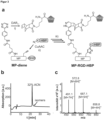
- the product and its corresponding isomers were analyzed by RP-HPLC and ESI-MS ( Figure 3C ).
- HBP and RGD in one peptide induced the highest mean cell area, significant to both controls (titanium, fibronectin), MP, MP-HBP and MP-RGD.
- a mixture of MP-HBP and MP-RGD did not lead to a synergistic effect, since cell proliferation comparable to MP-RGD could be determined ( figure 4 and 5A ).
- Cells with a fibroblast-like morphology and distinct fibril bundles were found on all RGD-containing peptide coatings.
- Pronounced, parallel actin filaments developed particularly on MP-RGD-HBP ( figure 4 ). In addition to the average cell area, the number of cells was determined by counting the cells that had adhered after 6 hours.
- Fmoc protected amino acids and reagents for peptide synthesis were obtained from Novabiochem, IrisBiotech, Sigma Aldrich, Roth, Bachem and Orpegen OPC. Solvents were purchased from Biosolve and VWR. The dienophile Reppe anhydride lysine derivative was synthesized as described elsewhere. 7
- the tetrazine 5-[4-(1,2,4,5-tetrazin-3-yl)benzylamine]-5-oxopentanoic acid was purchased from Sigma Aldrich.
- Reagents for the copper(I) catalyzed azide-alkyne cycloaddition (CuAAC) were provided by Sigma Aldrich. Cell culture material was obtained from PAA, Lonza and Biochrome.
- HBP heparin binding peptide
- HBP and mefp-1 Mytilus edulis foot protein-1) derived peptides were synthesized using automated solid-phase peptide synthesis (Syro peptide synthesizer, MultiSynTech) on Rink-Amid resin (15 ⁇ mol, loading 0.7 mmol/g) with standard fluorenylmethoxycarbonyl / tert-butyl ( Fmoc/tBu) strategy.
- Fmoc/tBu fluorenylmethoxycarbonyl / tert-butyl
- Mussel derived peptides were synthesized manually on TentaGel S RAM (IrisBiotech). Deprotection of the ⁇ -amino group was performed twice with 30% (v/v) piperidine in DMF for 10 min. The following amino acids were then coupled equimolarly with 2 eq HOBt/DIC in DMF: Fmoc- ⁇ -Ala-OH, Fmoc-Pra-OH, Fmoc-DOPA(acetonide)OH, Fmoc-Lys(Mtt)-OH, Fmoc-Ahx- OH, Fmoc-Cys(Trt)-OH.
- the RGD cyclic peptide was prepared as described in Hassert et al. synthesized. 3
- TentaGel resin loaded with the diene-modified mussel peptide was swollen in water. The resin was then incubated with an aqueous solution of c[RGDfK(dienophile) (1.5 eq, 30 mM) for 5 h at room temperature on a shaker in an open reaction vessel (N 2 release). After washing steps with water, DMF and DCM, Fmoc was N-terminally cleaved. Finally, the peptide was cleaved from the resin.
- the resin was incubated with the reaction mixture, it was degassed and shaken at RT for 24 h. After filtration and washing steps, the resin was incubated with an aqueous ethylenediaminetetraacetic acid (EDTA, 10 mM) solution to remove copper residues.
- EDTA ethylenediaminetetraacetic acid
- TBS buffer 50 mM tris(hydroxymethyl)aminomethane
- Biotin ELISA was performed according to Hassert et al. carried out. 3 zero values were obtained with uncoated titanium plates and subtracted from the generated values (absorption per cm 2 ). The received Data points were fitted non-linearly using GraphPad Prism 5 software (GraphPad Inc.). Error bars are presented as the standard error of the mean (SEM) from at least 2 independent experiments.
- Titanium plates were etched as described and incubated overnight at RT with 1 ⁇ M peptide solutions in TBS buffer. The coated platelets were then washed 5 times with TBS-T buffer and transferred to new reaction vessels. Thereafter, the titanium plates were incubated with cell supernatant (from SaOS-2 cells after 2 days of cell culture) at 37° C. for specific times. In order to detect bound, biotinylated peptide on the surface, the titanium plates were washed 4 times with TBS-T and once with TBS and the biotin ELISA was carried out as described. Zero values were obtained from uncoated titanium plaques and subtracted from the data generated. The readings obtained were normalized to the value measured at 0 min. Error bars are presented as the standard error of the mean (SEM) from at least 2 independent experiments (duplicate determinations).
- SEM standard error of the mean
- SaOS-2 cells (osteogenic sarcoma), were grown in a humid atmosphere at 37 °C and 5% CO 2 in McCoy's 5A medium with 15% heat-inactivated fetal calf serum (FCS), 1% (v/v) glutamine and 1% (v/v) v) cultured penicillin/streptomycin.
- Titanium foil was punched and etched as previously described. After washing with water and PBS buffer (Dulbecco's phosphate), the titanium plates were sterilized with 70% ethanol/water (v/v) in an ultrasonic bath for 15 min. After washing twice with PBS buffer, the titanium plates were incubated overnight in a 48-well plate at RT with 300 ⁇ L of a 1 ⁇ M peptide solution in PBS, PBS (negative control) and fibronectin in PBS (25 ⁇ g/mL, positive control).
- PBS buffer Dulbecco's phosphate
- Coated titanium plates (48-well plate) were washed twice with PBS. SaOS-2 cells were resuspended in medium without FCS. After that, the cells were seeded on the coated titanium plates (50,000-90,000 cells per well, in this range we have no influence on the cell area for each coating detected). After adhesion for 6 h, the slides were washed with PBS and the cells were fixed with 4% paraformaldehyde in PBS for 30 min. The adherent cells were then washed and permeabilized with 1% Triton X-100 in PBS for 1 min.
- phalloidin-TRITC Phalloidin-Tetramethylrhodamineisothiocyanate
- HOECHST 33342 both Sigma Aldrich.
- fluorescence microscopy Alignment microscope, Zeiss
- 3 representative images were taken at 20X and 10X magnification.
- the cells were washed and labeled with phalloidin-TRITC and a fluorescein isothiocyanate (FITC)-conjugated goat anti-mouse antibody (Millipore, 1:100) in 1% (v/v) BSA in PBS for 2 h.
- FITC fluorescein isothiocyanate
- the cell nucleus was stained with 4',6-diamidino-2-phenylindole (DAPI, Millipore) in PBS for 15 min.
- DAPI 4',6-diamidino-2-phenylindole
- the following scavenger mixtures were used: TIS (triisopropylsilane)/H 2 O (1:1 v/v) for HBP, thioanisoles/ethanedithiol or thioanisoles/thiocresol (1:1 v/v) for c[RGDfK(dienophile)] and all Mussel peptides, H 2 O was used for MP-diene. The peptides were then precipitated into ice cold ethyl ether and washed. The resulting pellet was dissolved and then lyophilized.
- the peptides were purified on the following preparative RP-HPLC column: Phenomenex Jupiter Proteo C18 column (90 ⁇ /4 ⁇ m, 22 mm ⁇ 250 mm). Linear gradients from eluent B to eluent A (A: 0.1% TFA in H 2 O, B: 0.08% TFA in ACN) were used.
- the purities of the peptides were determined using the following columns: Varian VariTide RPC (200 ⁇ , 6 ⁇ m), Phenomenex Jupiter Proteo C18 (90 ⁇ / 4 ⁇ m) and C18 (300 ⁇ , 5 ⁇ m)) with linear gradients from eluent A and B (A : 0.1% TFA in H 2 O, B: 0.08% TFA in ACN).
Landscapes
- Health & Medical Sciences (AREA)
- Chemical & Material Sciences (AREA)
- Life Sciences & Earth Sciences (AREA)
- General Health & Medical Sciences (AREA)
- Medicinal Chemistry (AREA)
- Organic Chemistry (AREA)
- Veterinary Medicine (AREA)
- Animal Behavior & Ethology (AREA)
- Public Health (AREA)
- Epidemiology (AREA)
- Proteomics, Peptides & Aminoacids (AREA)
- Molecular Biology (AREA)
- Oral & Maxillofacial Surgery (AREA)
- Engineering & Computer Science (AREA)
- Transplantation (AREA)
- Biochemistry (AREA)
- Biophysics (AREA)
- Genetics & Genomics (AREA)
- Dermatology (AREA)
- Bioinformatics & Cheminformatics (AREA)
- Pharmacology & Pharmacy (AREA)
- Biomedical Technology (AREA)
- Inorganic Chemistry (AREA)
- Tropical Medicine & Parasitology (AREA)
- Toxicology (AREA)
- Zoology (AREA)
- Gastroenterology & Hepatology (AREA)
- Vascular Medicine (AREA)
- Heart & Thoracic Surgery (AREA)
- Cardiology (AREA)
- Peptides Or Proteins (AREA)
Description
- Die vorliegende Erfindung betrifft ein Peptid, eine Beschichtung, ein beschichtetes Implantat, sowie ein Peptid erhältlich durch eine Kombination von Festphasensynthese und Click-Chemie.
- Titan (Ti) ist das Material der Wahl bei der Herstellung von Zahnimplantaten und orthopädischen Implantaten. In Folge mangelnder Osseointegration können jedoch Entzündungen, Lockerungen oder Einsinken des Implantats auftreten. Die Osseointegration ist das Ergebnis eines knöchernen Heilungsprozesses, bei dem die Knochenzellen (Osteoblasten) direkt an das Implantat heranwachsen und eine feste Anheftung an der Implantatoberfläche erzielen. Um die Osseointegration des Implantats zu verbessern, wurde versucht die Biokompatibilität der Titanoberfläche mit Hilfe von Komponenten der extrazellulären Matrix (ECM) zu verbessern. Peptidbeschichtungen, welche aus ECM-Komponenten hergestellt wurden spielen eine wichtige Rolle in der Nachahmung von zelladhesiven Eigenschaften. Das bekannteste Peptid ist hierbei das Integrin-Bindepeptid RGD (Arg - Gly - Asp). Neben Integrin-Bindepeptiden wurde eine Bindung an Transmembranproteoglykane für Peptide mit basischen Aminosäuren gezeigt. Es wird angenommen, dass die Peptidsequenz FHRRIKA (Phe - His - Arg - Arg - Ile - Lys - Ala) (SEQ ID NO:1) an Heparin enthaltende Proteoglykane bindet und so die Anlagerung von Zellen unterstützt. Eine direkte Immobilisierung dieser Moleküle ist jedoch meist nur nach einer Funktionalisierung der Oberfläche möglich und benötigt die Integration spezifischer Ankergruppen in dem Peptid. Es ist bekannt, dass L-3,4-dihydroxyphenylalanin (DOPA) an die oxidierte Oberfläche von Titan ohne chemische Behandlung binden kann. Diese posttranlational modifizierte Aminosäure wurde in Proteinen, die von der Miesmuschel (Mytilus edulis) abgesondert werden, gefunden.
- So beschreibt die
WO 2013/183048 A1 Peptide mit einer Titan-bindenden Aminosäuresequenz, die mit einer heterologen Aminosäuresequenz verknüpft ist. Die Titan-bindenden Aminosäuresequenz kann L-DOPA und die heterologe Aminosäuresequenz ein RGD-Motiv enthalten. - Die Druckschrift
US 2013/0052712 A1 beschreibt ein Gerüst (scaffold), das ein adhäsives Protein aus Mytilus edulis und eine bioaktive Substanz enthalten kann. Varianten des Muschelproteins können L-DOPA und ein RGD-Motiv enthalten. -
WO 2008/150101 offenbart lineare Fusionsproteine, die auf Grundlage einer Muschelpeptidsequenz mit gentechnischen Methoden hergestellt wurden. Das rekombinante Polypeptid ist mit einem biofunktionale Peptid modifiziert und soll die extrazelluläre Matrix mimikrieren. Unter anderem wird eine Integrin-Bindepeptidsequenz oder eine Heparin-bindende Domäne als Teil des Fusionsproteins genannt. - Die Synthese und insbesondere die spezifische kovalente Modifizierung von rekombinant exprimierten Muscheladhäsionsproteinen mit mehreren bioaktiven Molekülen bleiben schwierig.
- Aufgabe der Erfindung ist es daher ein effektives, modifiziertes Molekül bereitzustellen, welches unter anderem die Osseointegration von Implantaten fördert.
- Diese Aufgabe wird vorliegend gelöst durch ein Peptid, umfassend (i) eine Hauptkette mit wenigstens einem L-3,4-dihydroxyphenylalanin (DOPA), (ii) wenigstens ein Integrin-Bindepeptid und (iii) wenigstens ein Heparin-Bindepeptid, erhältlich durch eine Kombination von Festphasensynthese und Click-Chemie. Die Kombination von wenigstens einem DOPA, wenigstens einem Integrin-Bindepeptid und) wenigstens einem Heparin-Bindepeptid zeigt eine synergistischen Effekt bei der Zelladhäsion an mit dem Peptid beschichteten Metalloberflächen.
- Unter Hauptkette wird vorliegend jegliche Verbindung verstanden, welche Komponenten sowohl peptidischen, als auch nicht-peptidischen Ursprungs enthalten kann, solange die Hauptkette wenigstens ein L-3,4-dihydroxyphenylalanin (DOPA) umfasst. Neben Aminosäuren kann die Hauptkette daher auch nicht-peptidische Komponenten wie Spacer, zum Beispiel Polyethylenglykol(PEG)-Spacer oder Aminohexansäure, enthalten. Bevorzugt umfasst die Hauptkette wenigstens zwei L-3,4-dihydroxyphenylalanin (DOPA). Vorzugsweise besteht die Hauptkette aus mindestens 4 Einheiten, die linear miteinander verknüpft sind, z.B. über Peptidbindungen. In weiter bevorzugten Ausführungsformen besteht die Hauptkette aus wenigstens 5, wenigstens 6, wenigstens 7 oder wenigstens 8 linear verknüpften Einheiten. Ein, zwei oder drei Einheiten sind DOPA. Wenigstens 1, wenigstens 2, wenigstens 3, wenigstens 4, oder wenigstens 5 Einheiten sind üblicherweise Aminosäuren.
- Es ist weiterhin bevorzugt, dass wenigstens eine Einheit Lysin ist. Über die ε-Aminogruppe kann das Integrin-Bindepeptid oder das Heparin-Bindepeptid kovalent gebunden sein. Die Hauptkette kann 1, 2 oder 3 Lysine enthalten. Vorzugsweise ist das Integrin-Bindepeptid an ein Lysin gebunden.
- Weiterhin enthält die Hauptkette eine Einheit, an die das Integrin-Bindepeptid oder das Heparin-Bindepeptid kovalent gebunden ist. Im erfindungsgemäßen Peptid ist ein möglicher Vorläufer dieser Einheit L-Propargylglycin. Die Propargylgruppe ist im erfindungsgemäßen Peptid nicht mehr enthalten, sondern hat durch die Kopplung reagiert.
- Weitere mögliche Bestandteile der Hauptkette oder des erfindungsgemäßen Peptids sind β-Alanin, PEG, Aminohexansäure und Cystein. Die Hauptkette kann am C-Terminus amidiert sein.
- In einer Ausführungsform ist die Hauptkette von einem Protein aus der Muschel Mytilus edulis abgeleitet. Besonders bevorzugt hat die Hauptkette die Sequenz Cys - PEG - DOPA - Lys - DOPA - PEG - L-Propargylglycin - β-Ala - NH2 (SEQ ID NO:2), wobei PEG für Polyethylenglykol steht. Ohne an die Theorie gebunden zu sein, dienen die PEG-Spacer einer Erhöhung der Löslichkeit in wässrigen Medien und einer Verminderung der Adhäsion von Proteinen und Bakterien.
- Unter Integrin-Bindepeptid wird jedes Peptid verstanden, welches an Integrine binden kann. In einer bevorzugten Ausführungsform umfasst das Integrin-Bindepeptid die Aminosäuresequenz Arg - Gly - Asp (RGD). Besonders bevorzugt ist die cyclische Aminosäuresequenz c[Arg - Gly - Asp - D-Phe - Lys] (cRGDfK).
- Unter Heparin-Bindepeptid wird jedes Peptid verstanden, welches an Heparin binden kann. In einer bevorzugten Ausführungsform umfasst das Heparin-Bindepeptid die Aminosäuresequenz Phe - His - Arg - Arg - Ile - Lys - Ala (SEQ ID NO:1).
- In einer beispielhaften Ausführungsform hat das Peptid folgende Struktur ("MP-RGD-HBP"):

- Die oben beschriebenen Peptide binden hervorragend an Metalloberflächen, insbesondere an Titan. So besitzen die Peptide gemäß der vorliegenden Erfindung eine Bindungsaffinität zu Metalloberflächen, bevorzugt zu Titan, bei der die Sättigungsphase im sub-µM-Bereich startet. In einer Ausführungsform liegt die Bindungsaffinität zu Metalloberflächen, bevorzugt zu Titan, im Bereich von 0,1 nM bis 10 µM, bevorzugt im Bereich von 1 nM bis 1 µM und besonders bevorzugt im Bereich von 10 nM bis 100 nM.
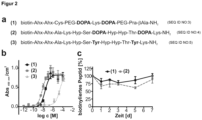
- Weiterhin besitzen die Peptide eine hervorragende Stabilität. So sind die Peptide der vorliegenden Erfindung bei 37°C über einen Zeitraum von mindestens 1 Woche, bevorzugt mindestens 2 Wochen, besonders bevorzugt mindestens 4 Wochen in wässriger Lösung stabil. Stabil bedeutet hierin, dass über diesen Zeitraum mehr als 50%, bevorzugt mehr als 60%, bevorzugt mehr als 70% des auf der Metalloberfläche immobilisierten und biotinylierten Peptids bestimmt werden kann (Bestimmung wie in den Beispielen durchgeführt, siehe Figur 2C).
- Desweiteren betrifft die Erfindung eine Beschichtung für Metalloberflächen, wobei die Beschichtung ein oben beschriebenes Peptid umfasst. Die Beschichtung kann weitere Stoffe, wie zum Beispiel Hilfsstoffe und Lösungsmittel enthalten.
- In einer Ausführungsform besteht die zu beschichtende Metalloberfläche aus Titan.
- In einer weiteren Ausführungsform wird das zu beschichtende Metall in den menschlichen oder tierischen Körper implantiert. Hierbei kann jegliches Implantat verwendet werden. Bevorzugt ist das Implantat ausgewählt aus der Liste bestehend aus Zahnimplantaten und orthopädischen Implantaten, z.B. Hüftgelenksimplantaten. Desweiteren betrifft die Erfindung eine beschichtete Metalloberfläche, erhältlich durch eine Reaktion von einem oben beschriebenen Peptid mit einer Metalloberfläche. Die Beschichtung kann weitere Stoffe, wie zum Beispiel Hilfsstoffe und Lösungsmittel enthalten.
- In einer Ausführungsform besteht die zu beschichtende Metalloberfläche aus Titan.
- In einer weiteren Ausführungsform wird das zu beschichtende Metall in den menschlichen oder tierischen Körper implantiert. Hierbei kann jegliches Implantat verwendet werden. Bevorzugt ist das Implantat ausgewählt aus der Liste bestehend aus Zahnimplantaten und orthopädischen Implantaten, z.B. Hüftgelenksimplantaten. Desweiteren betrifft die Erfindung ein beschichtetes Implantat erhältlich durch eine Reaktion von einem oben beschriebenen Peptid mit einem Implantat. Bevorzugt ist das Implantat ausgewählt aus der Liste bestehend aus Zahnimplantaten und orthopädischen Implantaten, z.B. Hüftgelenksimplantaten.
- Die vorliegende Erfindung betrifft ein Peptid umfassend (i) eine Hauptkette umfassend wenigstens ein L-3,4-dihydroxyphenylalanin (DOPA), (ii) wenigstens ein Integrin-Bindepeptid und (iii) wenigstens ein Heparin-Bindepeptid, erhältlich durch eine Kombination von Festphasensynthese und Click-Chemie.
- Unter Festphasensynthese wird hierin die chemische Synthese von Stoffen verstanden, die während der Synthese über kovalent verknüpfende Gruppen (sog. Linker) an feste Phasen gekoppelt sind, um nach erfolgter Synthese durch Abspaltung der Linkergruppen freigesetzt zu werden. Beispielsweise erfolgt die Festphasensynthese unter Anwendung der Fluorenylmethoxycarbonyl / tert-butyl (Fmoc/tBu) Strategie.
- Unter Click Chemie wird vorliegend das von K. Barry Sharpless mit Hartmuth C. Kolb und M. G. Finn begründete Konzept verstanden, welches es ermöglicht schnell und zielgerichtet Zielmoleküle aus kleineren Einheiten zu synthetisieren (Kolb et al., Angew. Chemie 2001, Band 113, S. 2056). Bevorzugt handelt es sich hierbei um Zykloadditionsreaktionen, wie zum Beispiel die Cu(I) katalysierte Huisgenzykloaddition (Azid-Alkin Zykloaddition) und die Diels-Alder-Reaktion mit inversem Elektronenbedarf.
-
-
Figur 1 : Design eines multifunktionalen Peptids
(A) Sequenz des Titan-adhäsiven Muschelpeptids (MP); Das Peptid besteht aus der Titanbindenden Aminosäure (L-3,4-Dihydroxyphenylalanin), funktionellen Gruppen eingeführt durch Pra (L-Propargylglycin), Cys and Lys als auch aus spacer (Abstandshalter) wie PEG (Polyethylenglycol) und β-Ala. (B) Zellbindepeptide: zyklisches Integrin-Bindepeptid (RGD), lineares Heparin Bindepeptid (HBP), (C) Ligationsprodukt bestehend aus MP, RGD und HBP, synthetisiert mithilfe von orthogonalen Zykloadditionen (CuAAC and DARinv), und die daraus resultierende Anwendung eines "Zell-Titan-Klebers". -
Figur 2 : Bindungseigenschaften und Stabilität von MP auf Titan
(A) Sequenz des natürlich abgeleiteten (mefp-1) und des artifiziellen Peptids (MP); Hyp (4-Hydroxyprolin), Ahx (Aminohexansäure). (B) Konzentrationswirkungskurve des Biotin-ELISA in der die im sub-µM Bereich startende Sättigungsphase für MP und mefp-1 zu erkennen ist. (C) Stabilität der DOPA-Peptide auf Titan, inkubiert mit Zellüberstand bei 37° (bestimmt durch einen Biotin-ELISA). -
Figur 3 : Orthogonale Zykloadditionen am Harz um das multifunktionale Peptid MP-RGD-HBP zu erhalten
(A) Reaktionsschema der DARinv und CuAAC; Reagenzien und Bedingungen: a) Wasser, RT, 5h; b) CuSO4, THPTA, TCEP in Wasser, RT, 1 d; nach Inkubation mit einer wässrigen EDTA-Lösung wurde das Peptid mit scavenger und TFA vom Harz abgespalten (B) RP-HPLC Chromatogramm und (C) ESI-Ionenfalle-MS des gereinigten MP-RGD-HBP -
Figur 4 : Zelladhäsion auf Peptidbeschichtungen in Medium ohne FCS (fetales Kälberserum)
Aktinzytoskelett in rot, Zellkern in blau und Vinkulin in grün (A) Fluoreszenzmikroskopie von SaOS-2 Zellen nach 6 h Adhäsion auf synthetisierten Peptiden und der Negativkontrolle (unbeschichtetes Ti), Maßstab: 100 µm (B) Immunmarkierung von fokalen Kontakten: Fluoreszenzmikroskopiebilder von SaOS-2 Zellen nach 24 h Adhäsion auf Peptidbeschichtungen, Maßstab bar: 50 µm. -
Figur 5 : Zellantwort auf Peptidbeschichtungen
A) durchschnittliche Zellfläche und B) Zellzahl normalisiert zu unbeschichteten Ti= 1 nach 6 h Adhäsion in Serum freien Medium, ermittelt durch Fluoreszenzmikroskopie. C) Proliferation (BrdU-assay, 24h Inkorporation) normalisiert auf Ti= 1 und D) Viabilität (Resazurin assay) nach 3 Tagen Zelladhäsion (24h in Serum freien Medium, gefolgt von FCS-haltigen Medium). Ergebnisse werden als Mittel ± SEM aus n ≥3 (signifikante Unterschiede zu unbeschichtetem Titan wurden durch one-way ANOVA (***p< 0.001) ermittelt) Schematische Darstellung: multifunktionales Peptid versus Mischung einfachmodifizierter Peptide. -
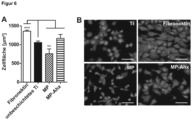
Figur 6 : Zellausbreitung auf Peptibeschichtungen (A) Durchschnittliche Zellfläche (Standartfehler des Mittels. n= 3) (B) Fluoreszenzmikroskopie von SaOS-2 Zellen nach 6h Adhäsion auf den Peptidbeschichtungen. Das Aktinzytoskelett ist in rot angefärbt und der Zellkern in blau Maßstab: 100µm. - Um ein multifunktionales Titan-Bindepeptid zu erhalten wurde ein von der Muschel abgeleitetes Peptid entworfen, welches funktionale Gruppen enthält (
Figur 1A ). Zudem wurde ein PEG-spacer eingeführt der zum einen folgende Zykloadditonsreaktionen erleichtern soll und zum anderen die wässrige Löslichkeit erhöht sowie die Adhäsion von Proteinen und Bakterien vermindert.1,2 - Im Anschluss an die Synthese des Muschelpeptids durch Festphasenpeptidsynthese (Fmoc/ tBu Strategie) wurde die Bindungsaffinität zu Titan untersucht. Um gebundenes Peptid mithilfe eines bereits beschriebenen Biotin-ELISAs zu untersuchen, wurden die verwendeten Peptide N-terminal biotinyliert (zwei Aminohexansäuren wurden als Abstandshalter eingeführt).3 Als Positivkontrolle wurde, bio-(+) mefp-1, abgeleitet von der natürlich vorkommenden Muschelfußproteinsequenz mefp-1 (M. edulis Fuß Protein-1), genutzt um die Affinität zu MP einschätzen zu können (
Figur 2A ).4 Als Negativkontrolle wurde die Aminosäure DOPA durch Tyrosin ausgetauscht (bio-(-) mefp-1) um die Catechol-vermittelte Binding an Titan nachzuweisen (Figur 1C ). - Dazu wurden Titanplättchen angeätzt um eine frisch oxidierte Oberfläche zu erlangen. Anschließend wurden die Titanplättchen mit verschiedenen Peptidkonzentrationen inkubiert. Nach intensiven Waschschritten wurde an Titan gebundenes Peptid mit der gut beschriebenen Biotin-Streptavidin Interaktion nachgewiesen. Peptide, die DOPA enthalten, zeigten hohe Bindungsaffinitäten mit einer in sub-µM-Bereich starteten Sättigungsphase (
Figur 2B ). Das artifiziell entworfene Peptid MP (EC50 = 23.6 nM, pEC50 = 7.6 ± 0.1) bindet dabei mit ähnlicher Affinität wie das natürlich abgeleitete mefp-1- Peptid (EC50 = 6.4 nM, pEC50 = 8.2 ± 0.1). Dramatisch verringerte Adhäsionseigenschaften wurden durch das Tyrosin-Peptid bio-(-) mefp-1 (EC50 > 10 000 nM, pEC50 = 4.6 ± 0.1) ermittelt. Darüber hinaus wurde die Stabilität der DOPA-Peptide in Zellüberstand getestet um in vitro Bedingungen zu imitieren. Dafür wurden Titanplättchen mit den entsprechenden biotinylierten Peptiden (Konzentration = 1 µM) beschichtet. Nach Inkubation in SaOS-2 Zellüberstand bei 37°C wurde verbleibendes Peptid mithilfe des Biotin-ELISAs nachgewiesen. Im Zeitraum von 7 Tagen wurde konstant mehr als 50% immobilisiertes und biotinyliertes Peptid bestimmt (Figur 2C). Zudem konnten keine signifikanten Unterschiede zwischen artifiziellen(bio-MP) und natürlich abgeleiteten Peptid (bio-(+) mefp-1) festgestellt werden. Jedoch zeigte MP eine Tendenz zur höheren Stabilität. - Selektive Zelladhäsion auf anorganischen Oberflächen kann durch verschiedene zellbindende Motive vermittelt werden. Durch Konjugation dieser Motive mit titanbindenden Peptiden entsteht ein Zell-Oberflächenmediator. Jedoch ist die Ligation komplexer Peptide, wie dem zyklischen αvβ3 selektiven Liganden c[RGDfK] besonders anspruchsvoll. Daher entwickelten wir eine mit der Festphasenpeptidsynthese kompatiblen Methode, die auf der Diels-Alder Reaktion mit inversem Elektronenbedarf (DARinv) (eine Reaktion zwischen einem Dien und Dienophil) beruht. Daher wurde das RGD-Peptid an der Lys-Seitenkette mit einem Dienophil modifiziert (Reppe Anhydrid-Lysin-Derivat). Dementsprechend wurde MP mit einem Tetrazin, welches das Dien darstellt, modifiziert. Um die DARinv durchzuführen wurde MP-dien, am Harz gebunden, mit einer wässrigen Lösung des c[RGDfK(dienophil)] für 5h inkubiert. Das erwünschte Konjugat MP-RGD wurde dann von der festen Phase abgespalten und konnte mithilfe von MALDI-ToF-MS und RP-HPLC identifiziert werden. Neben der DARinv wurde die orthogonale CuAAC genutzt um ein Heparin-Bindepeptid an MP-RGD zu ligieren. Vorrausgehend dazu wurde das MP mit einer Alkingruppe, durch Propargylglycin eingeführt, am C-Terminus modifiziert. Demzufolge wurde Azido-Lysin an HBP gekuppelt und darauffolgend vom Harz abgespalten. Das aufgereinigte Peptid HBP-N3 wurde dann genutzt um die CuAAC mit am Harz gebundenen MP-RGD durchzuführen. Abschließende Abspaltung des ligierten Peptides zeigte dass sich das gewünschte Produkt mit einem Umsatz von 75% gebildet hat. Nach Aufreinigung wurden das Produkt und seine entsprechenden Isomere mit RP-HPLC sowie ESI-MS analysiert (
Figur 3C ). - Um die Bioaktivität der ligierten Peptide sowie deren Kontrollen zu bestimmen wurden Zelladhäsionsstudien durchgeführt. Osteoblasten-ähnliche Zellen (SaOS-2) wurden auf angeätzten und mit Peptid beschichteten Titan ausgesät. Alle zellulären Experimente wurden in Serum-freiem Medium durchgeführt um falsche Ergebnisse durch die Adsorption von Serumproteinen zu verhindern. Um die initiale Zelladhäsion zu untersuchen wurden die Zellen nach 6h Kultur fixiert und gefärbt um die Morphologie sowie die durchschnittliche Zellfläche-und Zahl mithilfe von Fluoreszenzmikroskopie zu beobachten. Dabei wurde die geringste Zellausbreitung, auf MP beschichtetem Titan ermittelt, signifikant zu unbeschichtetem Titan. Zudem zeigten die Zellen eine eher runde Form mit schwach ausgebildeten Zytosekelett induziert durch die Zellabweisenden Eigenschaften von PEG.5 Um dies genauer zu untersuchen wurde PEG durch Aminohexansäure ausgetauscht. Tatsächlich wurde ein Anstieg der Zellgröße beobachtet, etwas höher als auf unbeschichteten Titanplättchen. Die Modifizierung von MP mit HBP resultierte in einem Anstieg der Zellausbreitung im Vergleich zu MP und unbeschichtetem Titan. Jedoch bildeten die Zellen nur wenig Aktinfilamente aus und adhärierten in unregelmäßigen Zellformen (
Figur 5A ). Noch bessere Resultate konnten durch eine MP-RGD-Beschichtung erlangt werden, da eine durchschnittliche Zellgröße vergleichbar mit dem natürlich vorkommenden ECM-Protein Fibronektin festgestellt werden konnte. Der Austausch von RGD zu RAD führte zu einer Verringerung der Zellgröße mit einer Zellfläche etwas höher als auf unbeschichtetem Titan. Die Kombination aus HBP und RGD in einem Peptid induzierte die höchste durchschnittliche Zellfläche, signifikant zu beiden Kontrollen (Titan, Fibronektin), MP, MP-HBP und MP-RGD. Andererseits führte eine Mischung aus MP-HBP und MP-RGD zu keinem synergistischen Effekt, da eine Zellausbreitung vergleichbar zu MP-RGD ermittelt werden konnte (Figur 4 und5A ). Zellen mit einer Fibroblast-ähnlichen Morphologie und ausgeprägten Fibrillenbündel wurden auf allen RGD-haltigen Peptidbeschichtungen gefunden. Besonders auf MP-RGD-HBP bildeten sich stark ausgeprägte, parallel verlaufende Aktinfilamente aus (Figur 4 ). Neben der durchschnittlichen Zellfläche wurde die Zellzahl durch Zählen der nach 6h adhärierten Zellen bestimmt. Dabei vermittelte MP aufgrund des zellabweisenden Effekts des PEGs die kleineste Zellzahl, bemerkenswerterweise signifikant weniger als auf unbeschichteten Titan (Figur 5B ). Darüber hinaus konnte eine ähnliche Tendenz wie schon im Zellflächen-Experiment beobachtet werden. Dabei wurde die Zellzahl auf RGD zu einem größer Ausmaß als auf HBP erhöht. Zudem führte eine Mischung aus RGD und HBP zu einem kleineren Effekt als RGD und HBP kombiniert in einem Peptid. Es ist bekannt dass RGD-Peptide die Bildung von fokalen Kontakten, die für die Außen-Innen Kommunikation zwischen Zelle und ECM entscheiden sind, vermitteln.6 Durch Immunmarkierung mit einem Anti-Vinkulin Antikörper ist es möglich Vinkulin, ein Protein das im Aufbau von Fokaler Adhäsion involviert ist, visualisierbar zu machen. Fluoreszenzmikroskopiebilder zeigten in der Tat, dass Strich-ähnliche Adhäsionskontakte (in grün) auf MP-RGD, MP-RGD-HBP sowie auf Mix: MP-HBP+RGD gebildet wurden, hauptsächlich an der Peripherie der Zelle (Figur 4B ). Eine leichte Zunahme an fokalen Komplexen konnte auf MP-RGD-HBP verglichen zu einfach modifizierten RGD-Beschichtungen beobachtet werden. Im Gegensatz dazu führten MP, MP-HBP und unbeschichtetes Titan zur Bildung von wenig oder keinen fokalen Adhäsionskontakten. - Neben initialer Zelladhäsion nach 6h, wurde die Zellviabilität und Proliferation nach 3d untersucht. Der Einbau des Brom-markierten Thymidin Analogs Bromdesoxyuridin (BrdU) in einem Zeitraum von 24h, nach 2d Zelladhäsion, wurde genutzt um die Proliferation der Zellen auf beschichteten Titan zu bestimmen. Keine signifikanten Veränderungen konnten zwischen den immobilisierten Peptiden und Kontrollen festgestellt werden (
Figur 5C ). Jedoch zeigt sich eine Peptidbeschichtung vorteilhaft gegenüber unbehandeltem Titan. Zudem konnte eine leicht erhöhte Zellproliferation auf MP-RGD-HBP ermittelt werden. Zellviabilität wurde nach 3 Tagen Adhäsion mittels Umsetzung von Resazurin zu Resorufin durch lebende Zellen untersucht. Alle bioaktivmodifizierten Peptidbeschichtungen weisen eine signifikant verbesserte Zellviabilität im Vergleich zu unbeschichtetem Titan auf. Obwohl MP die niedrigste Zellgröße und -Zahl vermittelte, konnten auf dieser Beschichtung mehr lebende Zellen als auf Titan analysiert werden. Dieser Fakt unterstreicht die Zell- abstoßenden aber gleichzeitig nicht toxischen Eigenschaften des PEG. Insbesondere MP-RGD-HBP führt zum besten Ergebnis unter allen synthetisierten Peptiden. MP-RGD induziert eine ähnliche Zellviabilität wie eine Mischung aus MP-RGD und MP-HBP. Damit wird der vorteilhafte Ansatz beide Zell-bindenden Peptide in einem Molekül zu präsentieren, bestätigt. - Fmoc geschützte Aminosäuren und Reagenzien für die Peptidsynthese wurden von Novabiochem, IrisBiotech, Sigma Aldrich, Roth, Bachem und Orpegen OPC erhalten. Lösungsmittel wurden von Biosolve und VWR bezogen. Das Dienophil Reppe-Anhydrid-Lysin-Derivat wurde wie an anderer Stelle beschrieben, synthetisiert.7 Das Tetrazin 5-[4-(1,2,4,5-Tetrazin-3-yl)benzyl- amin]-5-oxopentansäure wurde von Sigma Aldrich bezogen. Reagenzien für die Kupfer (I) katalysierte Azid-Alkin Zykloaddition (CuAAC) wurden von Sigma Aldrich bereitgestellt. Zellkulturmaterial wurde von PAA, Lonza und Biochrome erhalten.
- HBP sowie mefp-1- (Mytilus edulis Fußprotein-1) abgeleitete Peptide wurden mithilfe von automatisierter Festphasenpeptidsynthese (Syro peptide synthesizer, MultiSynTech) an Rink- Amid Harz (15 µmol, loading 0.7 mmol/g) mit Standard Fluorenylmethoxycarbonyl / tert-butyl (Fmoc/tBu) Strategie hergestellt. Ein detailliertes Protokoll ist von Böhme et al. beschrieben.8 Die unnatürliche Aminosäure Fmoc-Lys(N3)-OH wurde manuell an den N-Terminus von HBP mit 2 eq 1-Hydroxybenzotriazol (HOBt) und diisopropylcarbodiimid (DIC) in Dimethylformamid (DMF) für 4 h gekuppelt. Peptide, die für den Biotin ELISA genutzt wurden, wurden N-terminal mit zwei Einheiten Fmoc-Ahx-OH und schlussendlich mit Biotin durch HOBt/DIC Aktivierung modifiziert.
- Muschel abgeleitete Peptide wurden manuell an TentaGel S RAM (IrisBiotech) synthetisiert. Entschützung der α-Amino-Gruppe wurde zweimal mit 30 % (v/v) Piperidin in DMF für 10 min ausgeführt. Anschließend wurden folgende Aminosäuren equimolar mit 2 eq HOBt/DIC in DMF gekuppelt: Fmoc-β-Ala-OH, Fmoc-Pra-OH, Fmoc-DOPA(Acetonid)OH, Fmoc-Lys(Mtt)-OH, Fmoc-Ahx-OH, Fmoc-Cys(Trt)-OH. Für die Aktivierung des Aminosäurederivats Fmoc-NH-(PEG)2-COOH (13 atoms) wurden 1.5 eq O-(7-Azabenzotriazol-1-yl)-N,N,N',N'-tetramethyluronium-hexafluorphosphat (HATU) und equimolare Mengen an Diisopropylethylamin (DIPEA) verwendet. Selektive Abspaltung der Schutzgruppe 4- Methyltrityl (Mtt) wurde mit 2 % Trifluoressigsäure (TFA), 3 % Triisopropylsilan (TIS) in Dichlormethan (DCM) (v/v/v) durchgeführt. Anschließend wurde das Dien 5-[4-(1,2,4,5-Tetrazin-3-yl)benzyl- amino]-5-oxopentansäure in zweifachen Überschuss mit HOBt/DIC für 16 h gekuppelt. Biotinylierung des MP wurde wie bereits beschrieben durchgeführt.
- Das zyklische RGD-Peptid wurde wie beschrieben in Hassert et al. synthetisiert.3
- TentaGel Harz beladen mit dem Dien-modifizierten Muschelpeptid wurde in Wasser gequollen. Anschließend wurde das Harz mit einer wässrigen Lösung des c[RGDfK(Dienophil) (1.5 eq, 30 mM) für 5 h bei Raumtemperatur auf einem Schüttler in einem offenen Reaktionsgefäß (N2 Freisetzung) inkubiert. Nach Waschschritten mit Wasser, DMF und DCM, wurde Fmoc N-terminal abgespalten. Schlussendlich wurde das Peptid vom Harz abgespalten.
- TentaGel Harz beladen mit MP beziehungsweise MP-RGD wurde in Wasser gequollen. Für die Modifizierung von MP, wurden 2 eq CuSO4·5 H2O (10 mM), 4 eq Tris(2-carboxyethyl)phosphin (TCEP, 0.1 M) und 0.2 eq Tris[(1-benzyl-1H-1,2,3-triazol-4-yl)methyl]amin) (TBTA) in H2O/ acetonitril (ACN) (3:2, 2 mM) gemischt, entgast mit Ar und für 15 min bei 37 °C inkubiert. Anschließend wurde 1 eq. des Peptids HBP-N3 zu der Mischung hinzugefügt und der pH-Wert auf pH 8 mit einer wässrigen NaOH-Lösung (10 mM) eingestellt. Nachdem das Harz mit der Reaktionsmischung inkubiert wurde, wurde alles erneut mit Ar entgast und für 44 h bei 37 °C geschüttelt. Für die Modifizierung von MP-RGD, wurde eine Mischung aus 4 eq. CuSO4·5 H2O (0.1 M), 8 eq. TCEP (0.1 M) und 6 eq Tris(3-hydroxypropyltriazolylmethyl) amine (THPTA) in H2O (50 mM) entgast und wie beschrieben für MP behandelt. Dann wurden 1.5 eq HBP-N3 (10 mM) hinzugefügt und die Mischung wurde auf pH9 eingestellt. Nachdem das Harz mit der Reaktionsmischung inkubiert wurde, wurde entgast und für 24h bei RT geschüttelt. Nach Filtration und Waschschritten wurde das Harz mit einer wässrigen Ethylendiamintetraessigsäure (EDTA, 10 mM) Lösung inkubiert um Kupferrückstände zu entfernen.
- Voll- und Probeabspaltungen der Peptide wurde mit einem TFA/scavenger (90:10 v/v) Gemisch unter Schütteln bei RT für 3h durchgeführt. Aufreinigung der Peptide wurde mithilfe von präparativer Umkehrphasen Hochleistungsflüssigkeitschromatographie (RP-HPLC) ausgeführt. Peptide wurden mit Matrix-unterstützter Laser- lonisation-Flugzeitanalysator (MALDI-ToF)-Massenspektrometrie (MS) (Bruker Daltonics) sowie Elektrospray-Ionisations (ESI)-Ionenfallen MS (Bruker Daltonics) identifiziert. Die Reinheit wurde mit RP-HPLC analysiert. Gemessene m/z- Werte stimmten mit den kalkulierten Molekulargewichten überein. Die hergestellten Peptide wurden schlussendlich mit einer Reinheit ≥90% erhalten.
- Titanfolie (Sigma Aldrich, Dicke: 0.127 mm) wurde in runde Stücke (Fläche= 0.43 cm2) geschnitten und in H2SO4 (30 %)/ H2O2 (1:1 v/v) für 7 min angeätzt. Nach Waschschritten mit Wasser und TBS Puffer (50 mM Tris(hydroxymethyl)-aminomethan (Tris), 150 mM NaCl, pH 7.6), wurden die Titanplättchen mit verschiedenen Konzentrationen an biotinylierten Peptiden in TBS-Puffer gelöst für 2 h bei RT inkubiert. Anschließend wurden die beschichten Plättchen 5-mal mit TBS-T Puffer (50 mM Tris, 150 mM NaCl, 0.1 % Tween 20, pH 7.6) gewaschen und in neue Reaktionsgefäße überführt. Der folgende Biotin ELISA wurde entsprechend zu Hassert et al. durchgeführt.3 Nullwerte wurden mit nicht beschichteten Titanplättchen erhalten und von den generierten Werten abgezogen (Absorption per cm2). Die erhaltenen Datenpunkte wurden nicht-linear mit GraphPad Prism 5 software (GraphPadlnc.) gefittet. Fehlerbalken sind als Standartfehler des Mittels (SEM) aus mindestens 2 unabhängigen Experimenten dargestellt.
- Titanplättchen wurden wie beschrieben geätzt und mit 1 µM Peptidlösungen in TBS-Puffer über Nacht bei RT inkubiert. Anschließend wurden die beschichteten Plättchen 5-mal mit TBS-T Puffer gewaschen und in neue Reaktionsgefäße überführt. Danach wurden die Titanplättchen mit Zellüberstand (von SaOS-2 Zellen nach 2 Tagen Zellkultur) bei 37 °C für bestimmte Zeitpunkte inkubiert. Um gebundenes, biotinyliertes Peptid an der Oberfläche zu detektieren, wurden die Titanplättchen 4-mal mit TBS-T und einmal mit TBS gewaschen und wie beschrieben wurde der Biotin ELISA durchgeführt. Nullwerte wurden durch unbeschichtete Titanplättchen erhalten und von den generierten Daten abgezogen. Die erhaltenen Messwerte wurden zum bei 0 min gemessenen Wert normalisiert. Fehlerbalken sind als Standartfehler des Mittels (SEM) aus mindestens 2 unabhängigen Experimenten (Zweifachbestimmung) dargestellt.
- SaOS-2 Zellen (osteogenes Sarcoma), wurden in humider Atmosphäre bei 37 °C und 5 % CO2 in McCoy's 5A Medium mit 15 % hitzeinaktiviertem fetalem Kälberserum (FCS), 1 % (v/v) Glutamin und 1 % (v/v) Penicillin/ Streptomycin kultiviert.
- Titanfolie wurde gestanzt und geätzt wie bereits beschrieben. Nach Waschritten mit Wasser und PBS-Puffer (Dulbeccos Phosphat), wurden die Titanplättchen mit 70 % Ethanol/ Wasser (v/v) in einem Ultraschallbad für 15 min sterilisiert. Nach zweimal Waschen mit PBS-Puffer wurden die Titanplättchen über Nacht in einer 48-well Platte bei RT mit 300 µL einer 1 µM Peptidlösung in PBS, PBS (Negativkontrolle) und Fibronektin in PBS (25 µg/mL, Positivkontrolle) inkubiert.
- Beschichtete Titanplättchen (48-well Platte) wurden zweimal mit PBS gewaschen. SaOS-2 Zellen wurden in Medium ohne FCS resuspendiert. Danach wurden die Zellen auf den beschichteten Titanplättchen ausgesät (50,000-90,000 Zellen pro well, in diesem Bereich haben wir keinen Einfluss auf die Zellfläche für die jeweilige Beschichtung festgestellt). Nach der Adhäsion für 6h wurden die Plättchen mit PBS gewaschen und die Zellen wurden mit 4 % Paraformaldehyd in PBS für 30 min fixiert. Die adhärierten Zellen wurden anschließend gewaschen und mit 1 % Triton X-100 in PBS für 1 min permeabilisert. Danach wurden die Zellen mit Phalloidin-Tetramethylrhodamineisothiocyanate (phalloidin-TRITC) und HOECHST 33342 (beide Sigma Aldrich) angefärbt. Für die Fluoreszenzmikroskopie (Axio Observer microscope, Zeiss) wurden die Plättchen auf Objektträger befestigt. Für jedes Plättchen (Triplikat) wurden 3 repräsentative Bilder bei 20- facher und 10- facher Vergrößerung aufgenommen. Die durchschnittliche Zellfläche wurde dann durch Umranden (Software Axio Vision 4.8, Zeiss) jeder einzelnen Zelle auf je einem repräsentativen Bild (20fach) eines jeden Triplikats bestimmt. Die ermittelten Werte wurden aus 3 unabhängigen Experimenten zusammengefasst und als Mittel ± SEM dargestellt. Um die Zellzahl zu bestimmen, wurden drei 10-fach vergrößerte Bilder mithilfe der Software ImageJ ausgewertet und auf Titan=1 normalisiert, n≥ 3.
- Zellen (40,000 pro well) wurden auf beschichteten und gewaschenen Titanplättchen wie bereits beschrieben ausgesät. Nach 1 d Zelladhäsion wurden die Plättchen zweimal mit PBS gewaschen. Alle folgenden Waschschritte wurden mit 0.05 % (v/v) Tween-20 in PBS durchgeführt. Danach wurden die Zellen fixiert und permeabilisiert, wie bereits beschrieben. Zur Blockierung unspezifischer Interaktionen wurden die Plättchen mit 1 % bovinem Serumalbumin (BSA) in PBS für 40 min inkubiert. Anschließend wurden die Zellen mit einem monoklonalen Maus-Antikörper gegen Vinkulin (Millipore, staining kit, 1: 200) für 1 h bei RT inkubiert. Danach wurden die Zellen gewaschen und mit Phalloidin-TRITC und einem Fluoresceinisothiocyanate (FITC) - konjugierten Ziege Anti-Maus Antikörper (Millipore, 1:100) in 1 % (v/v) BSA in PBS für 2 h markiert. Nach einem weiteren Waschschritt wurde der Zellkern mit 4',6-Diamidino-2-phenylindol (DAPI, Millipore) in PBS für 15 min angefärbt. Bevor die Plättchen auf Objektträgern befestigt wurden, wurden sie dreimal für je 10 min gewaschen. Fluoreszenzmikroskopie wurde an einem Axio Observer Mikroskop und einem ApoTome Imaging System (Zeiss) durchgeführt.
- Zellen wurden auf beschichteten und gewaschenen Titanplättchen in FCS-freien Medium in einer 96-well Platte ausgesät. Nach einem Tag wurde das Medium zu FCS-haltigen Medium ausgetauscht. An Tag 3 wurden 20 µl CellTiderBlue® (Promega) zu jedem well hinzugefügt. Nach 2 h Inkubationszeit wurde die Umsetzung von Resazurin zu Resorufin mittels Fluoreszenzintensitätsmessung bei 560Ex/590Em nm bestimmt. Die Messwerte (Mittel± SEM) wurden aus 4 unabhängigen Experimenten, in Triplikaten durchgeführt, ausgewertet.
- Zellen wurden auf beschichteten und gewaschenen Titanplättchen in FCS-freien Medium in einer 96-well Platte ausgesät. Nach einem Tag wurde das Medium zu FCS-haltigen Medium ausgetauscht. An Tag 2, wurde zur Markierung Bromodeoxyuridin (BrdU) zu jedem Well hinzugefügt (colorimetric Cell Proliferation kit, Roche). Nach 24 h Inkorporation des labels wurden die Zellen gewaschen und fixiert. Anschließend wurde mit einem Peroxidase (POD) -konjugierten anti-BrdU Antikörper inkubiert. Das Binden des Antikörpers wurde mit der Zugabe von 3,3',5,5',-Tetramethylbenzidin (TMB)-Lösung und H2O2 (Calbiochem) detektiert. Die enzymatische Reaktion wurde mit 1 M HCl gestoppt. Die Messwerte (Mittel± SEM) wurden aus 4 unabhängigen Experimenten, in Triplikaten durchgeführt, ausgewertet und auf unbeschichtetes Titan normalisiert.
- Folgende scavenger Mischungen wurden genutzt: TIS (Triisopropylsilan)/H2O (1:1 v/v) für HBP, Thioanisole/ Ethandithiol oder Thioanisole/ Thiocresol (1:1 v/v) für c[RGDfK(Dienophil)] und alle Muschelpeptide, für MP-Dien wurde H2O genutzt. Die Peptide wurden dann in eiskalten Ethylether gefällt und gewaschen. Das daraus resultierende Pellet wurde gelöst und anschließend lyophilisiert.
- Aufreinigung der Peptide wurde auf folgender präparativen RP-HPLC-Säule vorgenommen: Phenomenex Jupiter Proteo C18 Säule (90 Å/ 4µm, 22 mm x 250 mm). Es wurden lineare Gradienten aus Eluent B in Eluent A (A: 0.1 % TFA in H2O, B: 0.08 % TFA in ACN) genutzt. Die Reinheiten der Peptide wurden mittels folgender Säulen ermittelt: Varian VariTide RPC (200 Å, 6µm), Phenomenex Jupiter Proteo C18 (90 Å/ 4µm) und C18 (300 Å, 5 µm)) mit linearen Gradieneten aus Eluent A und B (A: 0.1 % TFA in H2O, B: 0.08 % TFA in ACN).
-
Tabelle 1 Analytik der gereinigten, isolierten Peptide Peptid Sequenz M [Da] [M+H]+ Elution (%ACN)a Reinheit [%] MP 
1178.5 1179.6 33 >95 bio-MP 
1631.0 1631.9 41 >95 bio-(+)mefp-1 
1681.7 1682.6 34 >95 bio-(-)mefp-1 
1649.9 1651.0 33 >95 MP-Ahx 
998.5 999.6 32 >95 RGD c[RGDfK(dienophile)] 915.5 916.5 44 >95 MP-RGD 
2349.1 2350.1 36 b >90 N3-HBP 
1079.7 1080.8 32 b >95 MP-HBP 
2258.5 2259.2 32 c >95 MP- RGD-HBP 
3428.8 3429.8 32 b >90 - Die Identifikation wurde mittels MALDI-ToF MS (Bruker, Daltonics) festgestellt. Die Peptidreinheit wurde mit zwei verschiedenen HPLC-Systemen bestimmt (unterschiedliche Säule und Gradient); a Phenomenex Jupiter Proteo C18 (300 Å, 5 µm), b Phenomenex Jupiter Proteo C18 (90 Å, 4 µm) und c Varian VariTide RPC (200 Å, 6µm)
- PEG (Polyethyleneglycol), Y* (L-3,4-Dihydroxyphenylalanin), G* (Propargylglycin), X (Aminohexansäure), Bio (biotin), P* (4-Hydroxyprolin)
- Um zu testen ob die Zell-abweisenden Eigenschaften durch PEG vermittelt wurden, wurde PEG in MP durch Aminohexansäure ausgetauscht und mit SaOS-2 Zellen wie beschrieben getestet (siehe
Figur 6 ). -
- (1) Kumar, V.; Aldrich, J. V. Org Lett 2003, 5, 613.
- (2) Prime, K. L.; Whitesides, G. M. J. Am. Chem. Soc. 1993, 115, 10714.
- (3) Hassert, R.; Pagel, M.; Ming, Z.; Haupl, T.; Abel, B.; Braun, K.; Wiessler, M.; Beck-Sickinger, A. G. Bioconjug. Chem. 2012, 23, 2129.
- (4) Taylor, C. M.; Weir, C. A. J. Org. Chem. 2000, 65, 1414.
- (5) Wischerhoff, E.; Uhlig, K.; Lankenau, A.; Borner, H. G.; Laschewsky, A.; Duschl, C.; Lutz, J. F. Angew. Chem. Int. Ed. 2008, 47, 5666.
- (6) Geiger, B.; Spatz, J. P.; Bershadsky, A. D. Nat. Rev. Mol. Cell. Bio. 2009, 10, 21.
- (7) Pipkorn, R.; Waldeck, W.; Didinger, B.; Koch, M.; Mueller, G.; Wiessler, M.; Braun, K. J. Pept. Sci. 2009, 15, 235.
- (8) Böhme, D.; Beck-Sickinger, A. G. Chemmedchem 2015, 10, 804 .
Claims (14)
- Peptid, umfassend (i) eine Hauptkette umfassend wenigstens ein L-3,4-dihydroxyphenylalanin (DOPA), (ii) wenigstens ein Integrin-Bindepeptid und (iii) wenigstens ein Heparin-Bindepeptid, erhältlich durch eine Kombination von Festphasensynthese und Click-Chemie.
- Peptid gemäß Anspruch 1, wobei die Hauptkette von einem Protein aus der Muschel Mytilus edulis abgeleitet ist.
- Peptid gemäß Anspruch 1 oder 2, wobei das Peptid auch nicht-peptidische Bestandteile umfassen kann.
- Peptid gemäß einem der vorherigen Ansprüche, wobei die Hauptkette die Sequenz Cys - PEG - DOPA - Lys - DOPA - PEG - L-Propargylglycin - β-Ala - NH2 (SEQ ID NO:2) umfasst.
- Peptid gemäß einem der vorherigen Ansprüche, wobei das Integrin-Bindepeptid die Aminosäuresequenz Arg - Gly - Asp umfasst.
- Peptid gemäß Anspruch 5, wobei das Integrin-Bindepeptid die Aminosäuresequenz c[Arg - Gly - Asp - D-Phe - Lys] umfasst.
- Peptid gemäß einem der vorherigen Ansprüche, wobei das Heparin-Bindepeptid die Aminosäuresequenz Phe - His - Arg - Arg - Ile - Lys - Ala (SEQ ID NO:1) umfasst.
- Beschichtung für Metalloberflächen, umfassend ein Peptid gemäß einem der Ansprüche 1 bis 7.
- Beschichtung gemäß Anspruch 8, wobei die Metalloberfläche im Wesentlichen aus Titan besteht.
- Beschichtung gemäß Anspruch 8 oder 9, wobei die Metalloberfläche Teil eines Implantats ist, das zur Implantation in den menschlichen oder tierischen Körper vorgesehen ist, und wobei das Implantat vorzugsweise ausgewählt ist aus der Gruppe bestehend aus Zahnimplantaten und orthopädischen Implantaten.
- Beschichtete Metalloberfläche, erhältlich durch eine Reaktion von einem Peptid gemäß einem der Ansprüche 1 bis 7 mit einer Metalloberfläche.
- Beschichtete Metalloberfläche gemäß Anspruch 11, wobei die Metalloberfläche aus Titan besteht.
- Beschichtete Metalloberfläche gemäß Anspruch 11 oder 12, wobei die Metalloberfläche Teil eines Implantats ist, das zur Implantation in den menschlichen oder tierischen Körper vorgesehen ist, und wobei das Implantat vorzugsweise ausgewählt ist aus der Gruppe bestehend aus Zahnimplantaten und orthopädischen Implantaten.
- Beschichtetes metallisches Implantat erhältlich durch eine Reaktion von einem Peptid gemäß einem der Ansprüche 1 bis 7 mit einem metallischen Implantat, wobei das metallische Implantat vorzugsweise ausgewählt ist aus der Gruppe bestehend aus Zahnimplantaten und orthopädischen Implantaten.
Applications Claiming Priority (2)
| Application Number | Priority Date | Filing Date | Title |
|---|---|---|---|
| DE202015006574.0U DE202015006574U1 (de) | 2015-09-17 | 2015-09-17 | Peptid zur Beschichtung von Oberflächen |
| PCT/EP2016/071958 WO2017046323A1 (de) | 2015-09-17 | 2016-09-16 | Peptid zur beschichtung von oberflächen |
Publications (2)
| Publication Number | Publication Date |
|---|---|
| EP3349811A1 EP3349811A1 (de) | 2018-07-25 |
| EP3349811B1 true EP3349811B1 (de) | 2023-04-12 |
Family
ID=54768306
Family Applications (1)
| Application Number | Title | Priority Date | Filing Date |
|---|---|---|---|
| EP16767250.0A Active EP3349811B1 (de) | 2015-09-17 | 2016-09-16 | Peptid zur beschichtung von oberflächen |
Country Status (4)
| Country | Link |
|---|---|
| US (1) | US10787485B2 (de) |
| EP (1) | EP3349811B1 (de) |
| DE (1) | DE202015006574U1 (de) |
| WO (1) | WO2017046323A1 (de) |
Families Citing this family (1)
| Publication number | Priority date | Publication date | Assignee | Title |
|---|---|---|---|---|
| CN112566588B (zh) * | 2018-06-12 | 2024-08-23 | 贝拉塞诺有限公司 | 具有内部通道的3d打印植入物 |
Family Cites Families (11)
| Publication number | Priority date | Publication date | Assignee | Title |
|---|---|---|---|---|
| ES2229499T3 (es) * | 1997-05-22 | 2005-04-16 | Biomet Deutschland Gmbh | Implantes recubiertos con peptidos y procedimiento para su fabricacion. |
| CH694935A5 (de) * | 2000-07-26 | 2005-09-30 | Straumann Holding Ag | Oberflaechenmodifizierte Implantate. |
| EP1425583A1 (de) * | 2001-09-12 | 2004-06-09 | Eidgenössische Technische Hochschule Zürich | Vorrichtung mit chemisch strukturierten oberflächen |
| US20080150101A1 (en) * | 2006-12-20 | 2008-06-26 | Tessera, Inc. | Microelectronic packages having improved input/output connections and methods therefor |
| JP2010521246A (ja) * | 2007-03-15 | 2010-06-24 | ボストン サイエンティフィック リミテッド | 細胞接着性のタンパク質及びペプチドの安定性を改善する方法 |
| WO2008150101A2 (en) * | 2007-06-04 | 2008-12-11 | Postech Academy-Industry Foundation | Chimeric polypeptide including a mussel adheisve protein and extracellular matrix |
| US20100028387A1 (en) * | 2007-06-12 | 2010-02-04 | Ganesan Balasundaram | Biocompatible Coated Nanostructured Titanium Surfaces |
| KR101257996B1 (ko) * | 2010-11-01 | 2013-04-30 | 아주대학교산학협력단 | 폴리페놀산화효소를 이용한 생리활성 물질의 표면 고정화 방법 |
| KR101384746B1 (ko) | 2011-08-24 | 2014-04-14 | 포항공과대학교 산학협력단 | 홍합 접착 단백질을 이용한 다양한 기능성 생체분자의 표면 고정화 |
| EP2855507B1 (de) | 2012-06-03 | 2018-01-03 | Ben-Gurion University of The Negev Research and Development Authority | Funktionalisierte titanbindende peptide und damit beschichtete implantate |
| EP3347369B1 (de) * | 2015-09-08 | 2024-04-17 | Yissum Research Development Company of the Hebrew University of Jerusalem Ltd. | Neuartige verbindungen mit doppelter aktivität |
-
2015
- 2015-09-17 DE DE202015006574.0U patent/DE202015006574U1/de not_active Expired - Lifetime
-
2016
- 2016-09-16 EP EP16767250.0A patent/EP3349811B1/de active Active
- 2016-09-16 WO PCT/EP2016/071958 patent/WO2017046323A1/de not_active Ceased
- 2016-09-16 US US15/759,055 patent/US10787485B2/en not_active Expired - Fee Related
Also Published As
| Publication number | Publication date |
|---|---|
| US10787485B2 (en) | 2020-09-29 |
| DE202015006574U1 (de) | 2015-11-13 |
| EP3349811A1 (de) | 2018-07-25 |
| WO2017046323A1 (de) | 2017-03-23 |
| US20190241614A1 (en) | 2019-08-08 |
Similar Documents
| Publication | Publication Date | Title |
|---|---|---|
| DE68916900T2 (de) | Erregung der chemotaxe durch chemotaktische peptide. | |
| DE60012721T2 (de) | Analoge des magensaft inhibierenden peptides und ihre verwendung für die behandlung von diabetes | |
| Wang et al. | Unnatural amino acids: Promising implications for the development of new antimicrobial peptides | |
| DK2402369T3 (en) | Peptide fragments for inducing synthesis of extracellular matrix proteins | |
| US5446130A (en) | Parathyroid hormone antagonists | |
| US7972615B2 (en) | Peptide compositions for coating metal medical devices with vancomycin | |
| EP4108676A1 (de) | Menschliches transferrinrezeptor bindendes peptid | |
| CA2350919A1 (en) | Antennapedia homeodomain helix 3 derived translocation vectors | |
| WO1998052619A2 (de) | Peptid-beschichtete implantate und verfahren zu ihrer herstellung | |
| CA2757874C (en) | Short-chain peptides as parathyroid hormone (pth) receptor agonist | |
| Martino et al. | Synthesis and structural characterization of poly (LGGVG), an elastin-like polypeptide | |
| US20180030093A1 (en) | Self-assembling ultrashort aliphatic cyclic peptides for biomedical applications | |
| CN110225920B (zh) | 具有细胞渗透性和骨组织再生能力的双功能新颖肽及其用途 | |
| CN105949322A (zh) | 一种适用于“一步法”改性医用钛基材料的生物模拟活性肽 | |
| EP1309355B9 (de) | Peptid- und peptidmimetikakonjugate mit integrin-inhibitor-eigenschaften | |
| EP3349811A1 (de) | Peptid zur beschichtung von oberflächen | |
| EP1763535B1 (de) | Mit einem organischem rest verbundenes polypeptid | |
| Lamba et al. | Homo and hetero-branched lipopeptide Dendrimers: Synthesis and antimicrobial activity | |
| Georgieva et al. | New N-and C-modified RGD-hemorphins as potential biomedical application on Ti-surface materials: Synthesis, characterization and antinociceptive activity | |
| DE60305940T2 (de) | Modifizierte therapeutische mittel | |
| KR20150012505A (ko) | 용혈현상이 감소된 항생 펩타이드 제조방법 | |
| DE10325049A1 (de) | Peptid- und Peptidmimetika-Derivate mit Integrin-Inhibitor-Eigenschaften III | |
| KR101670842B1 (ko) | 나노피브릴 복합체를 포함하는 세포이미징 및 항균용 나노센서 | |
| Zeyn | Synthesis and Characterization of Bioactive Hydrogels as a Matrix for Tissue Repair | |
| KR101657040B1 (ko) | 금속 이온 검출용 나노피브릴 복합체 및 그 제조방법 |
Legal Events
| Date | Code | Title | Description |
|---|---|---|---|
| STAA | Information on the status of an ep patent application or granted ep patent |
Free format text: STATUS: THE INTERNATIONAL PUBLICATION HAS BEEN MADE |
|
| PUAI | Public reference made under article 153(3) epc to a published international application that has entered the european phase |
Free format text: ORIGINAL CODE: 0009012 |
|
| STAA | Information on the status of an ep patent application or granted ep patent |
Free format text: STATUS: REQUEST FOR EXAMINATION WAS MADE |
|
| 17P | Request for examination filed |
Effective date: 20180129 |
|
| AK | Designated contracting states |
Kind code of ref document: A1 Designated state(s): AL AT BE BG CH CY CZ DE DK EE ES FI FR GB GR HR HU IE IS IT LI LT LU LV MC MK MT NL NO PL PT RO RS SE SI SK SM TR |
|
| AX | Request for extension of the european patent |
Extension state: BA ME |
|
| RIN1 | Information on inventor provided before grant (corrected) |
Inventor name: PAGEL, MAREEN Inventor name: HASSERT, RAYK Inventor name: BECK-SICKINGER, ANNETTE |
|
| DAV | Request for validation of the european patent (deleted) | ||
| DAX | Request for extension of the european patent (deleted) | ||
| STAA | Information on the status of an ep patent application or granted ep patent |
Free format text: STATUS: EXAMINATION IS IN PROGRESS |
|
| 17Q | First examination report despatched |
Effective date: 20190709 |
|
| REG | Reference to a national code |
Ref country code: DE Ref legal event code: R079 Ref document number: 502016015695 Country of ref document: DE Free format text: PREVIOUS MAIN CLASS: A61L0027280000 Ipc: C07K0005087000 |
|
| GRAP | Despatch of communication of intention to grant a patent |
Free format text: ORIGINAL CODE: EPIDOSNIGR1 |
|
| STAA | Information on the status of an ep patent application or granted ep patent |
Free format text: STATUS: GRANT OF PATENT IS INTENDED |
|
| RIC1 | Information provided on ipc code assigned before grant |
Ipc: A61K 6/20 20200101ALI20220926BHEP Ipc: A61K 47/65 20170101ALI20220926BHEP Ipc: A61L 27/54 20060101ALI20220926BHEP Ipc: A61L 27/50 20060101ALI20220926BHEP Ipc: A61L 27/28 20060101ALI20220926BHEP Ipc: C07K 17/14 20060101ALI20220926BHEP Ipc: C07K 7/06 20060101ALI20220926BHEP Ipc: C07K 5/087 20060101AFI20220926BHEP |
|
| INTG | Intention to grant announced |
Effective date: 20221018 |
|
| GRAS | Grant fee paid |
Free format text: ORIGINAL CODE: EPIDOSNIGR3 |
|
| GRAA | (expected) grant |
Free format text: ORIGINAL CODE: 0009210 |
|
| STAA | Information on the status of an ep patent application or granted ep patent |
Free format text: STATUS: THE PATENT HAS BEEN GRANTED |
|
| AK | Designated contracting states |
Kind code of ref document: B1 Designated state(s): AL AT BE BG CH CY CZ DE DK EE ES FI FR GB GR HR HU IE IS IT LI LT LU LV MC MK MT NL NO PL PT RO RS SE SI SK SM TR |
|
| REG | Reference to a national code |
Ref country code: GB Ref legal event code: FG4D Free format text: NOT ENGLISH |
|
| REG | Reference to a national code |
Ref country code: CH Ref legal event code: EP |
|
| REG | Reference to a national code |
Ref country code: DE Ref legal event code: R096 Ref document number: 502016015695 Country of ref document: DE |
|
| REG | Reference to a national code |
Ref country code: IE Ref legal event code: FG4D Free format text: LANGUAGE OF EP DOCUMENT: GERMAN |
|
| REG | Reference to a national code |
Ref country code: AT Ref legal event code: REF Ref document number: 1559740 Country of ref document: AT Kind code of ref document: T Effective date: 20230515 |
|
| REG | Reference to a national code |
Ref country code: LT Ref legal event code: MG9D |
|
| REG | Reference to a national code |
Ref country code: NL Ref legal event code: MP Effective date: 20230412 |
|
| PG25 | Lapsed in a contracting state [announced via postgrant information from national office to epo] |
Ref country code: NL Free format text: LAPSE BECAUSE OF FAILURE TO SUBMIT A TRANSLATION OF THE DESCRIPTION OR TO PAY THE FEE WITHIN THE PRESCRIBED TIME-LIMIT Effective date: 20230412 |
|
| PG25 | Lapsed in a contracting state [announced via postgrant information from national office to epo] |
Ref country code: SE Free format text: LAPSE BECAUSE OF FAILURE TO SUBMIT A TRANSLATION OF THE DESCRIPTION OR TO PAY THE FEE WITHIN THE PRESCRIBED TIME-LIMIT Effective date: 20230412 Ref country code: PT Free format text: LAPSE BECAUSE OF FAILURE TO SUBMIT A TRANSLATION OF THE DESCRIPTION OR TO PAY THE FEE WITHIN THE PRESCRIBED TIME-LIMIT Effective date: 20230814 Ref country code: NO Free format text: LAPSE BECAUSE OF FAILURE TO SUBMIT A TRANSLATION OF THE DESCRIPTION OR TO PAY THE FEE WITHIN THE PRESCRIBED TIME-LIMIT Effective date: 20230712 Ref country code: ES Free format text: LAPSE BECAUSE OF FAILURE TO SUBMIT A TRANSLATION OF THE DESCRIPTION OR TO PAY THE FEE WITHIN THE PRESCRIBED TIME-LIMIT Effective date: 20230412 |
|
| PGFP | Annual fee paid to national office [announced via postgrant information from national office to epo] |
Ref country code: GB Payment date: 20230920 Year of fee payment: 8 |
|
| PG25 | Lapsed in a contracting state [announced via postgrant information from national office to epo] |
Ref country code: RS Free format text: LAPSE BECAUSE OF FAILURE TO SUBMIT A TRANSLATION OF THE DESCRIPTION OR TO PAY THE FEE WITHIN THE PRESCRIBED TIME-LIMIT Effective date: 20230412 Ref country code: PL Free format text: LAPSE BECAUSE OF FAILURE TO SUBMIT A TRANSLATION OF THE DESCRIPTION OR TO PAY THE FEE WITHIN THE PRESCRIBED TIME-LIMIT Effective date: 20230412 Ref country code: LV Free format text: LAPSE BECAUSE OF FAILURE TO SUBMIT A TRANSLATION OF THE DESCRIPTION OR TO PAY THE FEE WITHIN THE PRESCRIBED TIME-LIMIT Effective date: 20230412 Ref country code: LT Free format text: LAPSE BECAUSE OF FAILURE TO SUBMIT A TRANSLATION OF THE DESCRIPTION OR TO PAY THE FEE WITHIN THE PRESCRIBED TIME-LIMIT Effective date: 20230412 Ref country code: IS Free format text: LAPSE BECAUSE OF FAILURE TO SUBMIT A TRANSLATION OF THE DESCRIPTION OR TO PAY THE FEE WITHIN THE PRESCRIBED TIME-LIMIT Effective date: 20230812 Ref country code: HR Free format text: LAPSE BECAUSE OF FAILURE TO SUBMIT A TRANSLATION OF THE DESCRIPTION OR TO PAY THE FEE WITHIN THE PRESCRIBED TIME-LIMIT Effective date: 20230412 Ref country code: GR Free format text: LAPSE BECAUSE OF FAILURE TO SUBMIT A TRANSLATION OF THE DESCRIPTION OR TO PAY THE FEE WITHIN THE PRESCRIBED TIME-LIMIT Effective date: 20230713 Ref country code: AL Free format text: LAPSE BECAUSE OF FAILURE TO SUBMIT A TRANSLATION OF THE DESCRIPTION OR TO PAY THE FEE WITHIN THE PRESCRIBED TIME-LIMIT Effective date: 20230412 |
|
| PGFP | Annual fee paid to national office [announced via postgrant information from national office to epo] |
Ref country code: FR Payment date: 20230922 Year of fee payment: 8 |
|
| PG25 | Lapsed in a contracting state [announced via postgrant information from national office to epo] |
Ref country code: FI Free format text: LAPSE BECAUSE OF FAILURE TO SUBMIT A TRANSLATION OF THE DESCRIPTION OR TO PAY THE FEE WITHIN THE PRESCRIBED TIME-LIMIT Effective date: 20230412 |
|
| REG | Reference to a national code |
Ref country code: DE Ref legal event code: R082 Ref document number: 502016015695 Country of ref document: DE Representative=s name: KRAUS & LEDERER PARTGMBB, DE |
|
| REG | Reference to a national code |
Ref country code: DE Ref legal event code: R097 Ref document number: 502016015695 Country of ref document: DE |
|
| PG25 | Lapsed in a contracting state [announced via postgrant information from national office to epo] |
Ref country code: SK Free format text: LAPSE BECAUSE OF FAILURE TO SUBMIT A TRANSLATION OF THE DESCRIPTION OR TO PAY THE FEE WITHIN THE PRESCRIBED TIME-LIMIT Effective date: 20230412 |
|
| PG25 | Lapsed in a contracting state [announced via postgrant information from national office to epo] |
Ref country code: SM Free format text: LAPSE BECAUSE OF FAILURE TO SUBMIT A TRANSLATION OF THE DESCRIPTION OR TO PAY THE FEE WITHIN THE PRESCRIBED TIME-LIMIT Effective date: 20230412 Ref country code: SK Free format text: LAPSE BECAUSE OF FAILURE TO SUBMIT A TRANSLATION OF THE DESCRIPTION OR TO PAY THE FEE WITHIN THE PRESCRIBED TIME-LIMIT Effective date: 20230412 Ref country code: RO Free format text: LAPSE BECAUSE OF FAILURE TO SUBMIT A TRANSLATION OF THE DESCRIPTION OR TO PAY THE FEE WITHIN THE PRESCRIBED TIME-LIMIT Effective date: 20230412 Ref country code: EE Free format text: LAPSE BECAUSE OF FAILURE TO SUBMIT A TRANSLATION OF THE DESCRIPTION OR TO PAY THE FEE WITHIN THE PRESCRIBED TIME-LIMIT Effective date: 20230412 Ref country code: DK Free format text: LAPSE BECAUSE OF FAILURE TO SUBMIT A TRANSLATION OF THE DESCRIPTION OR TO PAY THE FEE WITHIN THE PRESCRIBED TIME-LIMIT Effective date: 20230412 Ref country code: CZ Free format text: LAPSE BECAUSE OF FAILURE TO SUBMIT A TRANSLATION OF THE DESCRIPTION OR TO PAY THE FEE WITHIN THE PRESCRIBED TIME-LIMIT Effective date: 20230412 |
|
| PLBE | No opposition filed within time limit |
Free format text: ORIGINAL CODE: 0009261 |
|
| STAA | Information on the status of an ep patent application or granted ep patent |
Free format text: STATUS: NO OPPOSITION FILED WITHIN TIME LIMIT |
|
| 26N | No opposition filed |
Effective date: 20240115 |
|
| REG | Reference to a national code |
Ref country code: CH Ref legal event code: PL |
|
| PG25 | Lapsed in a contracting state [announced via postgrant information from national office to epo] |
Ref country code: SI Free format text: LAPSE BECAUSE OF FAILURE TO SUBMIT A TRANSLATION OF THE DESCRIPTION OR TO PAY THE FEE WITHIN THE PRESCRIBED TIME-LIMIT Effective date: 20230412 |
|
| PG25 | Lapsed in a contracting state [announced via postgrant information from national office to epo] |
Ref country code: LU Free format text: LAPSE BECAUSE OF NON-PAYMENT OF DUE FEES Effective date: 20230916 |
|
| REG | Reference to a national code |
Ref country code: BE Ref legal event code: MM Effective date: 20230930 |
|
| PG25 | Lapsed in a contracting state [announced via postgrant information from national office to epo] |
Ref country code: SI Free format text: LAPSE BECAUSE OF FAILURE TO SUBMIT A TRANSLATION OF THE DESCRIPTION OR TO PAY THE FEE WITHIN THE PRESCRIBED TIME-LIMIT Effective date: 20230412 Ref country code: LU Free format text: LAPSE BECAUSE OF NON-PAYMENT OF DUE FEES Effective date: 20230916 Ref country code: IT Free format text: LAPSE BECAUSE OF FAILURE TO SUBMIT A TRANSLATION OF THE DESCRIPTION OR TO PAY THE FEE WITHIN THE PRESCRIBED TIME-LIMIT Effective date: 20230412 Ref country code: MC Free format text: LAPSE BECAUSE OF FAILURE TO SUBMIT A TRANSLATION OF THE DESCRIPTION OR TO PAY THE FEE WITHIN THE PRESCRIBED TIME-LIMIT Effective date: 20230412 |
|
| REG | Reference to a national code |
Ref country code: IE Ref legal event code: MM4A |
|
| PG25 | Lapsed in a contracting state [announced via postgrant information from national office to epo] |
Ref country code: IE Free format text: LAPSE BECAUSE OF NON-PAYMENT OF DUE FEES Effective date: 20230916 |
|
| PG25 | Lapsed in a contracting state [announced via postgrant information from national office to epo] |
Ref country code: CH Free format text: LAPSE BECAUSE OF NON-PAYMENT OF DUE FEES Effective date: 20230930 |
|
| PG25 | Lapsed in a contracting state [announced via postgrant information from national office to epo] |
Ref country code: IE Free format text: LAPSE BECAUSE OF NON-PAYMENT OF DUE FEES Effective date: 20230916 Ref country code: CH Free format text: LAPSE BECAUSE OF NON-PAYMENT OF DUE FEES Effective date: 20230930 |
|
| PG25 | Lapsed in a contracting state [announced via postgrant information from national office to epo] |
Ref country code: BE Free format text: LAPSE BECAUSE OF NON-PAYMENT OF DUE FEES Effective date: 20230930 |
|
| PG25 | Lapsed in a contracting state [announced via postgrant information from national office to epo] |
Ref country code: BG Free format text: LAPSE BECAUSE OF FAILURE TO SUBMIT A TRANSLATION OF THE DESCRIPTION OR TO PAY THE FEE WITHIN THE PRESCRIBED TIME-LIMIT Effective date: 20230412 |
|
| REG | Reference to a national code |
Ref country code: AT Ref legal event code: MM01 Ref document number: 1559740 Country of ref document: AT Kind code of ref document: T Effective date: 20230916 |
|
| PG25 | Lapsed in a contracting state [announced via postgrant information from national office to epo] |
Ref country code: BG Free format text: LAPSE BECAUSE OF FAILURE TO SUBMIT A TRANSLATION OF THE DESCRIPTION OR TO PAY THE FEE WITHIN THE PRESCRIBED TIME-LIMIT Effective date: 20230412 |
|
| PG25 | Lapsed in a contracting state [announced via postgrant information from national office to epo] |
Ref country code: AT Free format text: LAPSE BECAUSE OF NON-PAYMENT OF DUE FEES Effective date: 20230916 |
|
| PG25 | Lapsed in a contracting state [announced via postgrant information from national office to epo] |
Ref country code: AT Free format text: LAPSE BECAUSE OF NON-PAYMENT OF DUE FEES Effective date: 20230916 |
|
| GBPC | Gb: european patent ceased through non-payment of renewal fee |
Effective date: 20240916 |
|
| PG25 | Lapsed in a contracting state [announced via postgrant information from national office to epo] |
Ref country code: GB Free format text: LAPSE BECAUSE OF NON-PAYMENT OF DUE FEES Effective date: 20240916 |
|
| PG25 | Lapsed in a contracting state [announced via postgrant information from national office to epo] |
Ref country code: FR Free format text: LAPSE BECAUSE OF NON-PAYMENT OF DUE FEES Effective date: 20240930 |
|
| PG25 | Lapsed in a contracting state [announced via postgrant information from national office to epo] |
Ref country code: CY Free format text: LAPSE BECAUSE OF FAILURE TO SUBMIT A TRANSLATION OF THE DESCRIPTION OR TO PAY THE FEE WITHIN THE PRESCRIBED TIME-LIMIT; INVALID AB INITIO Effective date: 20160916 |
|
| PG25 | Lapsed in a contracting state [announced via postgrant information from national office to epo] |
Ref country code: HU Free format text: LAPSE BECAUSE OF FAILURE TO SUBMIT A TRANSLATION OF THE DESCRIPTION OR TO PAY THE FEE WITHIN THE PRESCRIBED TIME-LIMIT; INVALID AB INITIO Effective date: 20160916 |
|
| PGFP | Annual fee paid to national office [announced via postgrant information from national office to epo] |
Ref country code: DE Payment date: 20250924 Year of fee payment: 10 |
|
| PG25 | Lapsed in a contracting state [announced via postgrant information from national office to epo] |
Ref country code: TR Free format text: LAPSE BECAUSE OF FAILURE TO SUBMIT A TRANSLATION OF THE DESCRIPTION OR TO PAY THE FEE WITHIN THE PRESCRIBED TIME-LIMIT Effective date: 20230412 |