EP3349202B1 - Anordnung zur überwachung von seeschiffen mit einem satellitennetz mit bereitstellung durch einer irdischen station von passagier listen für die schiffen durch schiff identifikationsdaten erhalten von den satelliten und passagier daten erhalten durch sozialen medien. - Google Patents
Anordnung zur überwachung von seeschiffen mit einem satellitennetz mit bereitstellung durch einer irdischen station von passagier listen für die schiffen durch schiff identifikationsdaten erhalten von den satelliten und passagier daten erhalten durch sozialen medien. Download PDFInfo
- Publication number
- EP3349202B1 EP3349202B1 EP18151781.4A EP18151781A EP3349202B1 EP 3349202 B1 EP3349202 B1 EP 3349202B1 EP 18151781 A EP18151781 A EP 18151781A EP 3349202 B1 EP3349202 B1 EP 3349202B1
- Authority
- EP
- European Patent Office
- Prior art keywords
- data
- social media
- terrestrial station
- ais
- vessels
- Prior art date
- Legal status (The legal status is an assumption and is not a legal conclusion. Google has not performed a legal analysis and makes no representation as to the accuracy of the status listed.)
- Active
Links
Images






Classifications
-
- H—ELECTRICITY
- H04—ELECTRIC COMMUNICATION TECHNIQUE
- H04B—TRANSMISSION
- H04B7/00—Radio transmission systems, i.e. using radiation field
- H04B7/14—Relay systems
- H04B7/15—Active relay systems
- H04B7/185—Space-based or airborne stations; Stations for satellite systems
- H04B7/1851—Systems using a satellite or space-based relay
-
- G—PHYSICS
- G01—MEASURING; TESTING
- G01S—RADIO DIRECTION-FINDING; RADIO NAVIGATION; DETERMINING DISTANCE OR VELOCITY BY USE OF RADIO WAVES; LOCATING OR PRESENCE-DETECTING BY USE OF THE REFLECTION OR RERADIATION OF RADIO WAVES; ANALOGOUS ARRANGEMENTS USING OTHER WAVES
- G01S19/00—Satellite radio beacon positioning systems; Determining position, velocity or attitude using signals transmitted by such systems
- G01S19/38—Determining a navigation solution using signals transmitted by a satellite radio beacon positioning system
- G01S19/39—Determining a navigation solution using signals transmitted by a satellite radio beacon positioning system the satellite radio beacon positioning system transmitting time-stamped messages, e.g. GPS [Global Positioning System], GLONASS [Global Orbiting Navigation Satellite System] or GALILEO
- G01S19/42—Determining position
- G01S19/45—Determining position by combining measurements of signals from the satellite radio beacon positioning system with a supplementary measurement
- G01S19/46—Determining position by combining measurements of signals from the satellite radio beacon positioning system with a supplementary measurement the supplementary measurement being of a radio-wave signal type
-
- G—PHYSICS
- G06—COMPUTING OR CALCULATING; COUNTING
- G06V—IMAGE OR VIDEO RECOGNITION OR UNDERSTANDING
- G06V40/00—Recognition of biometric, human-related or animal-related patterns in image or video data
- G06V40/10—Human or animal bodies, e.g. vehicle occupants or pedestrians; Body parts, e.g. hands
- G06V40/16—Human faces, e.g. facial parts, sketches or expressions
- G06V40/172—Classification, e.g. identification
-
- G—PHYSICS
- G08—SIGNALLING
- G08G—TRAFFIC CONTROL SYSTEMS
- G08G3/00—Traffic control systems for marine craft
- G08G3/02—Anti-collision systems
-
- H—ELECTRICITY
- H04—ELECTRIC COMMUNICATION TECHNIQUE
- H04L—TRANSMISSION OF DIGITAL INFORMATION, e.g. TELEGRAPHIC COMMUNICATION
- H04L67/00—Network arrangements or protocols for supporting network services or applications
- H04L67/2866—Architectures; Arrangements
- H04L67/30—Profiles
- H04L67/306—User profiles
Definitions
- the present disclosure relates to marine vessel tracking systems, and more particularly to systems for monitoring marine vessels that send Automatic Identification System (AIS) signals and related methods.
- AIS Automatic Identification System
- the Automatic Identification System is a tracking system for identifying and locating marine vessels by electronically exchanging data with other nearby vessels, AIS base stations, and satellites.
- AIS information may be used in conjunction with marine radar to help avoid collision with other vessels.
- AIS transmissions include information such as vessel identifiers, position, course, and speed.
- AIS not only allows oncoming vessels to know each other's locations, but it also allows maritime authorities to track and monitor vessel movements as well.
- AIS devices utilize information from satellite positioning systems (e.g., GPS), as well as other electronic navigation sensors, and communicate the AIS data via a very high frequency (VHF) transceiver.
- VHF very high frequency
- U.S. Pat. Pub. No. 2009/0161797 to Cowles et al. discloses a system for detecting and decoding Automatic Identification System (AIS) signals which includes a plurality of orbital satellites. Each orbital satellite has at least one antenna with at least one antenna polarization for receiving a radio frequency signal. Each orbital satellite also has a communication module for accepting the radio frequency signal, converting the radio frequency signal into sampled packetized data for insertion into a raw data stream, inserting a plurality of signal parameters into the raw data stream, and transmitting the raw data stream and a telemetry data stream to at least one ground station.
- a processor located at the ground station receives and processes the raw data stream to identify one or more candidate AIS message signals.
- a system for monitoring a plurality of marine vessels using a satellite network may include a plurality of satellite payloads to be carried by respective satellites.
- Each satellite payload may include a communications interface configured to communicate via the satellite network, a radio frequency (RF) transceiver configured to communicate with the plurality of marine vessels, and a controller cooperating with the communications interface and the RF transceiver.
- the controller may be configured to obtain automatic identification system (AIS) data including vessel position and call sign information via the RF transceiver, and communicate the AIS system data via the communications interface.
- the system may further include a terrestrial station configured to receive the AIS system data, receive social media data, and determine expected passenger lists for the marine vessels based upon the AIS data and social media data.
- the social media data may comprise social media profiles
- the terrestrial station may be configured to determine the expected passenger lists based upon location metadata from social media profiles having an association with respective marine vessels.
- the terrestrial station may be configured to search the social media profiles for associations with respective marine vessels based upon natural language processing (NLP).
- NLP natural language processing
- the terrestrial station may be configured to determine the expected passenger list based upon a genetic linear optimization (GLO) algorithm.
- GLO genetic linear optimization
- the terrestrial station may also be configured to run image analytics on the social media data to extract facial images to incorporate with the expected passenger lists. Moreover, the terrestrial station may be further configured to compare the extracted facial images to a facial image database. The terrestrial station may also be configured to compare the expected passenger list with a passenger manifest for each marine vessel to determine differences therebetween.
- a related terrestrial station such as the one described briefly above, and a related marine vessel monitoring method are also provided.
- the method may include receiving, at a terrestrial station, respective AIS data including vessel position and call sign information for a plurality of marine vessels from a plurality of satellites receiving the AIS data from the marine vessels.
- the method may further include, at the terrestrial station, receiving social media data and determining, at the terrestrial station, expected passenger lists for the marine vessels based upon the AIS data and social media data.
- a system 30 for monitoring a plurality of marine vessels 31 using a network of satellites 32 is first described.
- the vessels 31 may transmit AIS data which may not only be received by nearby vessels, but also by the low-earth orbit satellites 32.
- the satellites 32 may be part of the Iridium satellite constellation, although other types of satellites may be used in different embodiments.
- each of the satellites 32 may be equipped with a respective payload 35 which illustratively includes a communications interface 36 configured to communicate via the satellite network (e.g., via microwave communications), a radio frequency (RF) transceiver 37 and associated antenna 38 configured to communicate with the plurality of marine vessels 31 to receive the AIS data therefrom, and a controller 39 cooperating with the communications interface and the RF transceiver.
- the controller 39 may obtain automatic identification system (AIS) data including vessel position and call sign information via the transceiver 37, and communicate the AIS system data via the communications interface 36 through the satellite constellation to a terrestrial station 40.
- AIS automatic identification system
- the satellite constellation may be the Iridium mobile communications satellite network, and the payloads 35 may be attached to respective Iridium satellites. That is, the communications interface 36 may utilize the existing Iridium inter-satellite communications infrastructure used for communicating mobile device communications to also communicate the AIS data. However, other types of communications satellites or constellations may be used in different embodiments.
- the system 30 In addition to providing enhanced coverage for AIS monitoring while the marine vessels 31 are at sea where their VHF communications cannot be picked up by terrestrial AIS antennas, the system 30 also advantageously provides for persistent surveillance capabilities resulting from the continuous and near real-time AIS data that is available throughout the voyage of a given marine vessel.
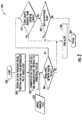
- One particularly advantageous surveillance capability is to determine an unexpected rendezvous between marine vessels 31 when they are in remote areas away from port, which is now further described with reference to the flow diagram 300 of FIG. 3 .
- the AIS data is received or intercepted by the RF transceivers 37 at respective satellites 32 as the vessels 31 come within range, at Block 302.
- this data is communicated to the terrestrial station 40 via the satellite constellation, at Block 303, which may then be processed by the terrestrial station as part of a persistent surveillance program, for example.
- the terrestrial station 40 optionally receives aerial marine imagery data from an imagery source to assist with the rendezvous analysis, at Block 304, as will be discussed further below, although imagery data need not be used in all embodiments.
- the terrestrial station 40 illustratively includes a memory 41 to receive the AIS data provided from the satellite payloads 35, and a processor 42 (e.g., a microprocessor(s)) cooperating with the memory 41 to analyze the received AIS data.
- the processor 42 may be incorporated in a single computing device (e.g., server), or distributed over many such devices (e.g., a cloud computing configuration). That is, while all of the components of the processor 42 may be located at the same terrestrial station 40, in some embodiments the computational operations may be distributed among a plurality of computing devices which are at different geographical locations and connected by the Internet or other communications network, for example.
- a Spark computing platform may be used to intelligently distribute computation among different processors, although other suitable computing platforms may also be used in different embodiments.
- Distributed computation may advantageously scale to allow for computation of billions of vessel location records, and in some embodiments anomalies like a rendezvous event may be pre-computed and stored for quick access, if desired.
- the system 30 may be used to collect and process tens of millions of records from around the world each day.
- the terrestrial station 40 may be co-located with the satellite ground antennas in some embodiments, or they may be located remote from one another in other embodiments.
- the processor 42 may be configured to determine from the AIS data (and optionally the aerial imagery data) a rendezvous between marine vessels 31 which pass within a threshold distance for greater than a threshold time.
- a rendezvous may be defined as ships coming within 200m of one another, and more particularly 50m, for a period of greater than 5 minutes, and more particularly greater than 10 minutes, although other threshold times and distances may be used in different embodiments.
- each rendezvous event may be captured and recorded in the memory 41 in the following format: MMSI_1, MMSI_2, timeStart, timeFinish, approxLat, approxLon.
- This event recordation may advantageously be used to efficiently query further AIS data as appropriate.
- example processing times for one day of collected global AIS data takes about 15 seconds to process for rendezvous events.
- Applicant theorizes, without wishing to be bound thereto, that a full two years of legacy data may be processed within a few hours using this computing platform.
- an alert may be generated to the proper authorities, ship owner, etc. (Block 306 ), depending upon the scope of analysis and the particular vessels and their ports or origin.
- an unscheduled rendezvous at sea may indicate that two vessels are engaging in an unauthorized exchange of cargo and trying to avoid detection of the exchange by authorities or the owners of the ships/cargo, as will be appreciated by those skilled in the art.
- the processor 42 may further be used to detect other abnormalities or deviations in vessel "behavior" from the collected AIS data in certain embodiments.
- the processor 42 may optionally determine deviations from a reported course or from established shipping lanes (or speed deviations), at Block 307, as well as to detect gaps in reported data, at Block 308, which may similarly result in an alert being generated.
- Other optional events which may be determined from the AIS analysis may include: when vessels turn off their AIS transmission and/or try to transmit "spoof" AIS data; when vessel "loitering" occurs; and identifying a vessel port of origin and predicting its destination based thereon and its reported course.
- this may also be determined based upon deviation greater than a threshold, such as more than 45 degrees off course or a speed deviation of more than 5 knots, for example, although other thresholds may also be used.
- a threshold such as more than 45 degrees off course or a speed deviation of more than 5 knots, for example, although other thresholds may also be used.
- various tradecraft information models 50 may be provided to one or more collection services 51 which operate the constellation of satellites 32 and the imaging satellites 45 to generate AIS reports and aerial imagery 52 from AIS transmissions from the vessels 31, as noted above.
- the AIS data may take the form of both historical AIS data files 70 as well as one or more live AIS data streams 71.
- the AIS data may be parsed through various filters 72, and the results stored in a post geographic information system (GIS) database 73, for example, from which the above-described analytics may be performed by the processor 42 (Block 74).
- the processor 42 may correlate "tipoffs" from the AIS data along with the aerial imagery 52 to confirm changes in course, rendezvouses, etc., as will be discussed further below.
- Graphical data outputs may be provided through a Geoserver Web Feature Service (WFS) as well as open layer to provide annotated aerial imagery 77 via browsers 78, geospatial image viewing programs such as Google Earth 79, and desktop GIS programs as well.
- WFS Geoserver Web Feature Service
- Various automation and workflows 81 may draw further from ship information data sources 82 (e.g., customs data, etc.) and ship owner/corporate data sources 83 (e.g., passenger manifests, vessel identification information, etc.) to be used for the analytics and reporting 74, which may take the form of link analysis data 85 as well as data reports 85 output to authorities or ship/cargo owners as mission insight reports 86, as will be appreciated by those skilled in the art.
- the system 30 may advantageously provide automated surveillance and processing of collections to create value-added information from raw data to help reduce analytical workloads. That is, the processor 42 may advantageously help to reduce the amount of data flowing into an intelligence enterprise, process data at the edge of an enterprise closer to its source, and provide value-added information to analysts. As such, a "geolocate to discover" all sources of data approach is used to support an Activity Based Intelligence (ABI) analysis. Information models may drive collections and processing workflows, while data providers may host the processing services in some implementations. Furthermore, maritime monitoring is enhanced through the system 30 which advantageously allows for the combination technologies including geospatial, analytics, image processing, as well social media and biometrics, as will be discussed further below.
- ABS Activity Based Intelligence
- Efficiency of the spatial data analysis may advantageously be provided through the use of spatial data to automatically create all of the requisite views (vs. the user explicitly creating all views via pan/roam/zoom).
- This may advantageously condense and reduce sparsely distributed point, line, and area geometric feature data for rapid and cost effective visualization, such as through the reduction by optimal packing of raster data in presentation, and the reduction by automated random sampling of geometric data, for example.
- the system 30 may also help to reduce analyst pan/zoom through large amounts of imagery, and point, line, and area geometries may be automatically displayed (calculated using ground sample distance (GSD) and object size) at full resolution (or user specified resolution) in a customized presentation. This may allow for a review of more features at higher resolution in less time by analysists.
- GSD ground sample distance
- presentation view order may be prioritized based on spatial and feature data attribution
- presentation views may be filtered based on spatial and feature data attribution.
- presentation views may simultaneously support multiple types of raster 2D/3D data, imagery, and sensors (e.g., IR, EO, SAR, X-Ray, MRI, LIDAR, DSMs, DTMs).
- the system 30 may also support a wide variety of applications such as GIS, HLS/Intelligence/Monitoring, Video, Medical, etc.
- FIGS. 6-11 another example implementation of the system 30' is now described which provides for enhanced processing of marine imagery for intelligence gathering.
- aerial imagery of large sections of open ocean sifting out the small amount of salient information from a large volume of irrelevant distractions may be challenging and time intensive to do manually, particularly as instances of action may only occur between extended periods of inactivity.
- airborne surveillance may include significant distortion due to change in perspective of the moving sensor.
- detected motion generally exceeds display time, requiring intelligent selection of motion displayed.
- the system 30' advantageously helps address these technical challenges by providing for automated summarization through effective techniques to compress data into condensed clips of salient activity, which may be tailored to individual needs.
- remote sensing requires image analysts to have the capability of identifying regions of interest (ROIs) in the corresponding imagery.
- ROIs regions of interest
- the automatic extraction of image areas that represent a feature of interest uses two specific steps: (1) accurately classifying the pixels that represent the region while minimizing misclassified pixels; and (2) a vectorization step that extracts a contiguous boundary along each classified region which, when paired with its geo-location, may be inserted in a feature database independent of the image. Updating databases frequently using high-resolution panchromatic and multispectral imagery is typically only feasible if the time and labor costs for extracting features are significantly reduced.
- the system 30' may accordingly provide flexible and extensible automated workflows for feature pixel labeling and material classification, in which the products of workflows may accordingly undergo an accelerated review and quality control process as needed.
- the terrestrial station 40' may advantageously be configured to receive the AIS data and aerial marine imagery as discussed above, process the aerial marine imagery using a fractal algorithm to assign respective vessel classifications to a plurality of marine vessels, and correlate the vessel classifications with AIS data.
- the aerial marine imagery may be correlated with the coordinates of interest from the AIS data to define an extended search radius of interest for the marine imagery, at Block 401.
- the processor 42' may perform dead reckoning from the reported AIS coordinates to define the potential search radius within the aerial imagery data, as the aerial imagery data may be provided on a less frequent scale than the AIS data (e.g., on the order of hours as opposed to minutes).
- the processor 42' may advantageously perform a self-similarity analysis on the imagery data in the fractal dimension to automatically distinguish the vessels 31' from the surrounding water and classify them as such, at Block 402.
- fractals are infinitely complex patterns that are self-similar, repeating patterns across different scales. Fractals may be exactly the same at every scale or may be nearly the same at different scales, such as those found in nature. Fractals can be used to compress real-world data by finding self-similar features and removing redundant ones.
- Fractal algorithms look for similar voxel (3-D pixel) patterns within data, which can have several z (height) dimension values for each x and y (rectangular voxel).
- a fractal algorithm uses pattern recognition to look for patterns within patterns at multiple resolutions to find the feature domain to compress the original data. Fractals are a fragmented geometric shape that can be split into parts, each of which is a reduced-size copy of the whole.
- the vectors X and Y may correspond to histograms with bins for pre and post-fractal dimensions.
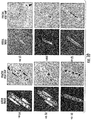
- the ocean surrounding the ship appears as a "cooler” or neutral color in the heat maps
- the higher profile of the vessels results in a "hotter” or darker color in the heat maps, thereby delineating the boundaries between the vessels and the water so that the clusters of higher points having elongated shapes may be classified as vessels.
- the fractal domain data still has position (i.e., latitude/longitude) data associated with it, the points of the vessel where the edges are located in combination with the position information associated with these points may be used to readily determine the dimensions (e.g., length and width) of the vessels.
- the processor 42' may advantageously create boundary shapes (e.g., rectangles) or "chips" around the vessels 31' in the aerial imagery once its location is determined in the fractal domain, at Block 403.
- the chips may be generated as GeoTiff images with a center corresponding to the latitude/longitude center of the respective vessel 31', for example, although other formats may also be used.
- the processor 42' may fit lines to the boundary points defining the vessels 31' in each heat map to define polygons outlining the ship, at Block 404, from which the length and width of the respective vessel may be readily determined (Block 405) by the processor.
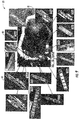
- a zoom out window 81 shows a plurality of vessels at port, along with corresponding zoom in windows 82 for respective chips where the image is zoomed in to reveal further details not evident in the zoom out window.
- further details regarding the vessels 31' determined from the fractal map, namely respective vessel length, is also displayed in each of the zoom in windows 82, although other dimensions (e.g., width or height) may also be provided in some embodiments.
- the screen view 80 advantageously provides for an assisted target recognition (ATR) use case where automated processing may provide value-added information based upon an external source of data, which in this case is satellite AIS reports over a watch area during similar collection windows (e.g., satellite AIS, E/O imagery). All of the useful information within this report may be automatically incorporated into an Adobe PDF or HTML5 page by the processor 42', for example. Moreover, this approach may allow an analyst to quickly follow threads without being overwhelmed, and it is valid for graphs as well.
- a static graph and/or table may be encoded into a PDF, and a dynamic graph may be represented as an HTML5 page (or other suitable format).
- HTML5 page or other suitable format
- vessels 31' are listed by respective entry numbers (here 1-15), geospatial positions, ship length, fractal dimensions, and respective classes.
- entry numbers here 1-15
- class 1 is handymax
- class 2 is at the pier
- class 3 is auxiliary
- class 4 is handysize.
- the processor 42' may further group the vessels 31' by their respective classifications, so that it may be readily determined how may of a given type of ship is present in a given area at the same time, or more generally how many ships of any type are present in the given area.
- the graph 75 of FIG. 8 which plots ship fractal dimensions vs. ship length in meters corresponding to the table 100, it will be seen that there are four vessels 31' present in an auxiliary class cluster 76, two vessels present in a handysize class cluster 77, five vessels present in a handymax class cluster 78, and four vessels present at a pier (represented by a cluster 79 ).
- the processor 42' may also use the fractal data to discern other useful information about the vessel.
- the fractal heat map will also reflect an exhaust profile of the marine vessels, in that the amount of exhaust seen from the smoke stack(s) of a vessel will change depending on how hard the engines are working (e.g., due to high seas, increased speed, engine problems, etc.).
- time lapse imagery may thereby be used to detect changes in the exhaust profile of a given vessel, so that appropriate alerts and/or corrections may be initiated when necessary.
- the processor 42' may also advantageously determine a wake profile associated with respective vessels from the aerial marine imagery based upon the fractal algorithm. More particularly, when a vessel 31' is fully loaded it will throw a larger wake than when the vessel is carrying a partial load or is empty. Thus, change in the wake profile of a vessel 31' between subsequent image captures, and particularly where the image captures occur before and after a rendezvous event, is an indicator that cargo may have been removed or added to a vessel, as the case may be. Thus, reviewing the wake profiles of two vessels 31' after a rendezvous where one of the wake profiles goes from higher to lower, and the other profile goes from lower to higher, is an even stronger indication that a cargo transfer has taken place.
- the wake profile may be determined based upon the fractal dimensions immediately surrounding the vessel, which may be detected as a "V" pattern emanating from the bow of the vessel, as will be appreciated by those skilled in the art, with its height determined from the fractal analysis. Moreover, the respective heights of vessels 31' before and after a rendezvous as determined by a fractal analysis may also be a further indicator of a cargo transfer.
- the processor 42' may be further configured to determine a vessel shape profile for the vessels 31'. More particularly, marine vessels are generally classified by their respective shapes and sizes.
- Example cargo ship classifications include Aframax, Capesize, Chinamax, Handymax/Supramax, Handysize, Malaccamax, Panamax and New Panamax, Q-max, Seawaymax, Suezmax, very large crude carriers (VLCCs) and ultra large crude carriers (ULCCs), each of which has respective limits on its maximum length, width, and/or draft which are set by different port or passageway authorities.
- VLCCs very large crude carriers
- ULCCs ultra large crude carriers
- the processor 42' may match the given vessel to a respective ship classification (Handymax, Seawaymax, etc.). This may then be compared to the ship designation associated with the AIS data received for the vessel in question to confirm the imagery and AIS data are in agreement.
- a respective ship classification Handymax, Seawaymax, etc.
- the processor 42' may be further configured to determine whether an actual course for a given marine vessel 31' deviates from a reported course from collected AIS data. More particularly, a given vessel 31' may be located in successive aerial images, and its identity may be confirmed via a comparison of its size, wake profile, exhaust profile, etc., obtained through the above-described fractal analysis by the processor 42'. As such, the actual course of a given vessel 31' as determined via the imagery may be compared with the course reported in the vessel's AIS data to determine if there is a discrepancy between them.
- the processor 42' may be configured to determine gaps in a reported course or heading for the marine vessels 31' based upon the AIS data. For example, a ship may stop transmitting AIS data at a given location to slip away unnoticed to another location. In such instances, location and tracking of the vessel 31' through the aerial imagery may be used to determine whether the vessel has actually gone and/or its true course. Similarly, the actual destination of a vessel 31' may be determined, either in contrast to reported AIS data or in the absence of any reported AIS data, by the processor 42'.
- the processor 42' may optionally coordinate with sources such as the ship information and owner data databases 82, 83 described above to provide numerous types of useful information to operators, such as: the number and type of vessels operating around a given location; initiating electro-optic (E/O) coverage of the watch area using commercial assets; correlating AIS reports with E/O imagery for during similar collection windows; conducting link analysis on vessels, owners, parent companies and state entities; generating daily reports identifying ships (new, recurring, departed); imagery with identified targets; and most current link analysis. This may be done as automated surveillance with periodic reporting.
- sources such as the ship information and owner data databases 82, 83 described above to provide numerous types of useful information to operators, such as: the number and type of vessels operating around a given location; initiating electro-optic (E/O) coverage of the watch area using commercial assets; correlating AIS reports with E/O imagery for during similar collection windows; conducting link analysis on vessels, owners, parent companies and state entities; generating daily reports identifying ships (new, recurring, departed); imagery with identified
- the processor 42" of the terrestrial station 40" may advantageously receive, in addition to the AIS system data described above, social media data, such as open source social media profiles from sources such as Twitter, Facebook, Snapchat, etc.
- the processor 42" may use the social media data along with the AIS data as part of a quality analysis (Block 407 of FIG. 6 ) to determine expected passenger lists for marine vessels 42" , which may include reported as well as unreported passengers in some instances. It should be noted that this approach does not require the aerial image processing and comparisons described above, but the terrestrial station 40" may also perform one or more of the vessel monitoring operations described above in addition to monitoring based upon social media data.
- the social media profiles may include useful metadata, including the location where profile updates were made, for example.
- Twitter profiles they may include the following metadata: Twitter user name (linked to Google search); Twitter screen name (linked to Twitter page); location (linked to Google Maps); number of followers; number of friends; number of total tweets; time of latest tweet; source of tweet (mobile/desktop); and URLs (linked).
- Twitter user name linked to Google search
- Twitter screen name linked to Twitter page
- location linked to Google Maps
- number of followers number of friends; number of total tweets; time of latest tweet; source of tweet (mobile/desktop); and URLs (linked).
- URLs linked
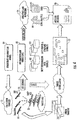
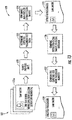
- a plurality of social medial profiles 121 are shown, including a fictitious profile 121a for a user Sam Smith.
- This profile 121a references a vessel named the "Sea Slider” and has a URL for a web page associated with this vessel ("www.seaslider123.com”).
- the processor 42" may advantageously search the social media profiles 121 using a technique such as Natural Language Processing (NLP) to identify verbs (activity), names, locations, and organizations in the data/metadata, at Block 122, although other techniques may also be used.
- NLP Natural Language Processing
- a blacklist may be used to filter out common and undesired verbs in some embodiments.
- a sanitation process may also be performed by the processor 42" to clean undesired strings like HTML formatting and special characters to help expedite processing as well.
- NLP may provide better results for the social media data search compared to a simple matching of a word list, as it identifies parts of speech and entities from the grammatical context.
- An example of a benefit of this is that it can automatically identify some misspelled or slang words as verbs (e.g., "canceled”, “respct”, “forcast”, “4got”, etc.).
- simple matching or other search techniques may also be used in different embodiments.
- the search results may then be processed to determine an expected passenger list (Block 123 ), that is, a list of people who are believed to be on a respective vessel 31" based upon an association found with the given vessel in the profile 121 and/or the location metadata associated with the profile.
- the processor 42" may use a genetic linear optimization (GLO) model approach and correlation to determine from the search results which candidates are likely to be on a given vessel 31".
- GLO genetic linear optimization
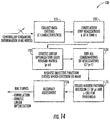
- Controlled streaming information (with noise) is provided as an input, from which data entities for a given number of characteristics (here correlations) are collected, at Block 131.
- a correlation of the top realizations at a given time t is performed, at Block 132, followed by a GLO operation which calculates the objective function from the correlations to populate a reward matrix (here a p x t matrix for p realizations at a time t), at Block 133.
- An example reward matrix is set forth in the following table: Where v ⁇ a 11 x 1 ⁇ b 21 x 2 ⁇ c 31 x 3 ⁇ d 41 x 4 ⁇ e 51 x 5 ⁇ f 61 x 6 ⁇ 0 v ⁇ a 12 x 1 ⁇ b 22 x 2 ⁇ c 32 x 3 ⁇ d 42 x 4 ⁇ e 52 x 5 ⁇ f 62 x 6 ⁇ 0 v ⁇ a 13 x 1 ⁇ b 23 x 2 ⁇ c 33 x 3 ⁇ d 43 x 4 ⁇ e 53 x 5 ⁇ f 63 x 6 ⁇ 0 v ⁇ a 14 x 1 ⁇ b 24 x 2 ⁇ c 34 x 3 ⁇ d 44 x 4 ⁇ e 54 x 5 ⁇ f 64 x 6 ⁇ 0 v ⁇ a 15 x 1 ⁇ b 25 x 2 ⁇ c
- the linear program parameters may include include a vector of topics discovered by topic modeling using Latent Dirichlet Allocation (LDA), for example, and a minimum or maximum solution approach may be used.
- LDA Latent Dirichlet Allocation
- the highest objective function drives which decision to make, and the linear programming may then be run for all of the desired combinations, at Block 134.
- an accuracy assessment may be performed, at Block 136. If the desired accuracy is achieved, then the linear programming is completed and receiver operating characteristic (ROC) curves may be generated, if desired.
- ROC receiver operating characteristic
- the answer characteristics may be changed and the above-noted steps repeated so that the global error minimum may be located, if desired.
- the processor 42" may optionally run image analytics to extract photos of the likely passengers, at Block 124.
- the processor 42" may cross-link the social media profiles to publicly available photos, such as on flickr or Google Images, for example.
- the processor 42" may run the image analytics to extract target photos for an expected passenger list 125.
- the extracted target photos may be further compared to a facial database by the processor 42", such as a criminal photo database or other "black list” photo library of potential bad actors, to output any matches therebetween.
- the processor may optionally compare the list of expected passengers 125 to a passenger manifest for the given vessel 31", at Block 127, to generate a list of unlisted passengers aboard the vessel.
- the processor 42" may compare the passenger manifest with the expected passenger list 125, and those that are present on the expected passenger list and not the ship manifest may be presented in a separate unlisted passenger list 128 to help authorities, ship owners, etc., determine when unauthorized passengers are aboard a vessel 31", for example.
- the list data may be saved in a database to provide for presentation views that may be filtered based on spatial and feature data attribution.
- models may be created, trained, and updated to improve the NLP results.
- a model for each social media data type (Twitter, Facebook, etc.) may also be implemented to provide better results for each type, if desired.
- objects may have periodic observations over time (actual or virtual), and observations may be fused periodically to develop time series and location relevance measures.
- a hypothesis may be established for what constitutes acceptable behavior, and the result of testing this hypothesis will update a judgment for the network.
Landscapes
- Engineering & Computer Science (AREA)
- Physics & Mathematics (AREA)
- General Physics & Mathematics (AREA)
- Radar, Positioning & Navigation (AREA)
- Remote Sensing (AREA)
- Computer Networks & Wireless Communication (AREA)
- Signal Processing (AREA)
- Aviation & Aerospace Engineering (AREA)
- Astronomy & Astrophysics (AREA)
- Ocean & Marine Engineering (AREA)
- Health & Medical Sciences (AREA)
- General Health & Medical Sciences (AREA)
- Oral & Maxillofacial Surgery (AREA)
- Human Computer Interaction (AREA)
- Multimedia (AREA)
- Theoretical Computer Science (AREA)
- Management, Administration, Business Operations System, And Electronic Commerce (AREA)
- Information Retrieval, Db Structures And Fs Structures Therefor (AREA)
Claims (10)
- System zum Überwachen einer Vielzahl von Seeschiffen (31") durch Verwenden eines Satellitennetzwerks (32"), das System umfassend:
eine Vielzahl von durch jeweilige Satelliten zu leitende Satellitennutzdaten (35"), jede der Satellitennutzdaten umfassendeine Kommunikationsschnittstelle (36"), die zum Kommunizieren über das Satellitennetzwerk eingerichtet ist,einen Funkfrequenz-, RF, (38") Sendeempfänger, der zum Kommunizieren mit der Vielzahl von Seeschiffen eingerichtet ist, undeine Steuerung (39"), die mit der Kommunikationsschnittstelle und dem RF-Sendeempfänger zusammenwirkt, wobei die Steuerung eingerichtet ist zumErhalten, von einem Seeschiff, automatischer Identifikationssystem-, AIS, Daten über den RF-Sendeempfänger, die Schiffspositions- und Rufzeicheninformationen beinhalten, undKommunizieren, zu der Bodenstation, der AIS-Daten über die Kommunikationsschnittstelle; undwobei die Bodenstation (40"") eingerichtet ist zum (42")Empfangen der AIS-Daten,Empfangen von Daten sozialer Medien, undBestimmen erwarteter Passagierlisten für die Seeschiffe
basierend auf den AIS-Daten und Daten sozialer Medien. - System nach Anspruch 1, wobei die Daten sozialer Medien Profile sozialer Medien umfassen; und wobei die Bodenstation dazu eingerichtet ist, die erwarteten Passagierlisten basierend auf den Positionsmetadaten der mit jeweiligen Seeschiffen eine Verbindung aufweisenden Profile sozialer Medien zu bestimmen.
- System nach Anspruch 2, wobei die Bodenstation dazu eingerichtet ist, die Profile sozialer Medien zum Verbinden mit jeweiligen Seeschiffen basierend auf natürlicher Sprachbearbeitung, NPL, zu suchen.
- System nach Anspruch 1, wobei die Bodenstation dazu eingerichtet ist, die erwarteten Passagierlisten basierend auf einem generischen linearen Optimierungs-, GLO-, Algorithmus zu bestimmen.
- System nach Anspruch 1, wobei die Bodenstation weiter eingerichtet ist zum Ausführen von Bildanalysen auf den Daten sozialer Medien, um Gesichtsbilder zu extrahieren und diese in die erwarteten Passagierlisten einzufügen.
- System nach Anspruch 5, wobei die Bodenstation weiter eingerichtet ist zum Vergleichen der extrahierten Gesichtsbilder mit einer Gesichtsbilddatenbasis.
- System nach Anspruch 1, wobei die Bodenstation weiter eingerichtet ist zum Vergleichen der erwarteten Passagierliste mit einem Passagierladungsverzeichnis für jedes Seeschiff, um Unterschiede zwischen diesen zu bestimmen.
- Seeschiffüberwachungsverfahren, umfassend:Empfangen, bei einer Bodenstation, jeweiliger automatischer Identifikationssystem-, AIS, Daten, die Schiffspositions- und Rufzeicheninformationen für eine Vielzahl von Seeschiffen beinhalten, von einer Vielzahl von Satelliten, die die AIS-Daten von den Seeschiffen empfangen;Empfangen, bei der Bodenstation, von Daten sozialer Medien; undBestimmen, bei der Bodenstation, erwarteter Passagierlisten für die Seeschiffe basierend auf den AIS-Daten und Daten sozialer Medien.
- Verfahren nach Anspruch 8, wobei die Daten sozialer Medien Profile sozialer Medien umfassen; und wobei das Bestimmen ein Bestimmen der erwarteten Passagierlisten basierend auf Positionsmetadaten der Profile sozialer Medien umfasst, die eine Verbindung mit jeweiligen Seeschiffen aufweisen.
- Verfahren nach Anspruch 9, weiter umfassend, bei der Bodenstation, Suchen der Profile sozialer Medien zum Verbinden mit jeweiligen Seeschiffen basierend auf natürlicher Sprachbearbeitung, NPL.
Applications Claiming Priority (1)
| Application Number | Priority Date | Filing Date | Title |
|---|---|---|---|
| US15/407,410 US10200113B2 (en) | 2017-01-17 | 2017-01-17 | System for monitoring marine vessels providing expected passenger determination features and related methods |
Publications (2)
| Publication Number | Publication Date |
|---|---|
| EP3349202A1 EP3349202A1 (de) | 2018-07-18 |
| EP3349202B1 true EP3349202B1 (de) | 2019-05-15 |
Family
ID=61131912
Family Applications (1)
| Application Number | Title | Priority Date | Filing Date |
|---|---|---|---|
| EP18151781.4A Active EP3349202B1 (de) | 2017-01-17 | 2018-01-16 | Anordnung zur überwachung von seeschiffen mit einem satellitennetz mit bereitstellung durch einer irdischen station von passagier listen für die schiffen durch schiff identifikationsdaten erhalten von den satelliten und passagier daten erhalten durch sozialen medien. |
Country Status (2)
| Country | Link |
|---|---|
| US (1) | US10200113B2 (de) |
| EP (1) | EP3349202B1 (de) |
Families Citing this family (14)
| Publication number | Priority date | Publication date | Assignee | Title |
|---|---|---|---|---|
| US10330794B2 (en) * | 2016-04-04 | 2019-06-25 | Spire Global, Inc. | AIS spoofing and dark-target detection methodology |
| US10302769B2 (en) * | 2017-01-17 | 2019-05-28 | Harris Corporation | System for monitoring marine vessels using fractal processing of aerial imagery and related methods |
| US10399650B2 (en) | 2017-01-17 | 2019-09-03 | Harris Corporation | System for monitoring marine vessels and determining rendezvouses therebetween and related methods |
| US10200113B2 (en) | 2017-01-17 | 2019-02-05 | Harris Corporation | System for monitoring marine vessels providing expected passenger determination features and related methods |
| US10795029B2 (en) * | 2017-02-14 | 2020-10-06 | United States Of America As Represented By The Secretary Of The Navy | Systems and methods for transmitting ship positions and tracks over multiple communications channels |
| US10936907B2 (en) * | 2018-08-10 | 2021-03-02 | Buffalo Automation Group Inc. | Training a deep learning system for maritime applications |
| AU2020205850A1 (en) * | 2019-01-11 | 2021-08-26 | Maerospace Corporation | System and method for tracking vessels |
| CN110175186B (zh) * | 2019-05-15 | 2023-09-26 | 中国舰船研究设计中心 | 一种智能船舶环境威胁目标感知系统及方法 |
| CN111179638B (zh) * | 2020-01-08 | 2022-03-11 | 中国船舶重工集团公司第七二四研究所 | 一种基于时间序列的船舶ais目标航行监控方法 |
| GB2593197B (en) * | 2020-03-19 | 2023-10-11 | Bae Systems Plc | System and Method for Classifying Vessels |
| FR3117246B1 (fr) * | 2020-12-09 | 2022-11-25 | Mbda France | Procédé et dispositif pour générer un nuage 3D optimisé de points d'un objet longiforme à partir d'images générées par un radar à synthèse d'ouverture multivoies. |
| CN112861968A (zh) * | 2021-02-07 | 2021-05-28 | 上海普适导航科技股份有限公司 | 一种海洋大数据处理系统 |
| US12443842B2 (en) * | 2021-06-14 | 2025-10-14 | Global Spatial Technology Solutions Inc. | Systems, methods, and computer readable media for vessel rendezvous detection and prediction |
| CN114005302B (zh) * | 2021-10-15 | 2023-07-07 | 中远海运科技股份有限公司 | 沿海船舶空船指数生成方法及系统 |
Family Cites Families (43)
| Publication number | Priority date | Publication date | Assignee | Title |
|---|---|---|---|---|
| US4941193A (en) | 1987-10-02 | 1990-07-10 | Iterated Systems, Inc. | Methods and apparatus for image compression by iterated function system |
| US5065447A (en) | 1989-07-05 | 1991-11-12 | Iterated Systems, Inc. | Method and apparatus for processing digital data |
| US5384867A (en) | 1991-10-23 | 1995-01-24 | Iterated Systems, Inc. | Fractal transform compression board |
| US5416856A (en) | 1992-03-30 | 1995-05-16 | The United States Of America As Represented By The Secretary Of The Navy | Method of encoding a digital image using iterated image transformations to form an eventually contractive map |
| US5793813A (en) | 1996-06-06 | 1998-08-11 | Space Systems/Loral, Inc. | Communication system employing space-based and terrestrial telecommunications equipment |
| US5978653A (en) | 1997-05-02 | 1999-11-02 | Motorola, Inc. | Method and apparatus for providing additional resources in a satellite communication system |
| EP1232567B1 (de) * | 1999-11-03 | 2004-03-03 | Stratos Global Limited | Anrufumleitungssystem |
| US7406309B2 (en) * | 2000-04-14 | 2008-07-29 | General Dynamics Advanced Information, Systems, Inc. | Cellular radio system |
| AU2002356343A1 (en) * | 2001-12-21 | 2003-07-09 | Rds-X Fejlesztesi Es Tanacsado Kft. | Control and communication system and method |
| US7391907B1 (en) | 2004-10-01 | 2008-06-24 | Objectvideo, Inc. | Spurious object detection in a video surveillance system |
| US7259714B1 (en) | 2005-05-04 | 2007-08-21 | Cataldo Thomas J | Unique space time adaptive system (USS) |
| US20080086267A1 (en) | 2006-05-30 | 2008-04-10 | John Stolte | Space based network for detection and monitoring of global maritime shipping using automatic identification system |
| US7990263B2 (en) | 2006-09-28 | 2011-08-02 | Beatty Street Properties, Inc. | Vector-based harbor scheduling |
| US20090161797A1 (en) | 2007-06-08 | 2009-06-25 | Cowles Philip R | Satellite detection of automatic identification system signals |
| ATE531019T1 (de) | 2008-01-21 | 2011-11-15 | Thales Nederland Bv | Sicherheits- und sicherungssystem gegen mehrfachbedrohung und bestimmungsverfahren dafür |
| US10127515B2 (en) | 2008-06-27 | 2018-11-13 | Cargometrics Technologies, Llc | System and method for generating commodity flow information |
| EP2460224B1 (de) | 2009-07-30 | 2018-12-05 | Jim D. Gray&Associates, Inc. | Antennensystem und antennenstecker |
| FI20095914A0 (fi) | 2009-09-04 | 2009-09-04 | Valtion Teknillinen | Älykäs vesiväylän riskien indikoimisjärjestelmä ja siihen liittyvä menetelmä |
| US20110113148A1 (en) | 2009-11-09 | 2011-05-12 | Nokia Corporation | Method and apparatus for providing a meeting point and routes for participants to a proposed meeting |
| US8170272B1 (en) | 2010-02-23 | 2012-05-01 | The United States Of America As Represented By The Secretary Of The Navy | Method for classifying vessels using features extracted from overhead imagery |
| WO2011138744A2 (en) | 2010-05-04 | 2011-11-10 | Eads Singapore Pte. Ltd. | System for the verification of authenticity of automatic identification system (ais) signatures by means of remote sensing |
| US9331774B2 (en) | 2010-06-09 | 2016-05-03 | Exactearth Ltd. | Systems and methods for segmenting a satellite field of view for detecting radio frequency signals |
| US8411969B1 (en) | 2010-08-06 | 2013-04-02 | The United States Of America As Represented By The Secretary Of The Navy | Method for fusing overhead imagery with automatic vessel reporting systems |
| KR101301169B1 (ko) | 2011-10-18 | 2013-08-29 | 한국교통연구원 | 공항 또는 항만 교통용 네비게이션 시스템 |
| US8832593B2 (en) | 2011-12-16 | 2014-09-09 | Harris Corporation | Systems and methods for efficient spatial feature analysis |
| EP2615749B1 (de) | 2011-12-20 | 2017-12-06 | Thales Alenia Space Schweiz AG | Verfahren zur optischen datenübertragung aus der erdbeobachtung auf die erde und entsprechendens kommunikationssystem |
| EP2610636A1 (de) | 2011-12-29 | 2013-07-03 | Windward Ltd. | Bereitstellung einer nahezu Echtzeit-Meeresüberwachung anhand von Satellitenbildmaterial und externen Daten |
| US20140152017A1 (en) | 2012-12-03 | 2014-06-05 | Gurcharan Singh Bhusri | System of floating platforms for generating electricity by wind turbines |
| US9135826B2 (en) | 2012-12-26 | 2015-09-15 | Sap Se | Complex event processing for moving objects |
| US8904257B2 (en) | 2013-03-05 | 2014-12-02 | Exactearth Ltd. | Methods and systems for enhanced detection of e-Navigation messages |
| US20140267736A1 (en) | 2013-03-15 | 2014-09-18 | Bruno Delean | Vision based system for detecting a breach of security in a monitored location |
| US10006271B2 (en) | 2013-09-26 | 2018-06-26 | Harris Corporation | Method for hydrocarbon recovery with a fractal pattern and related apparatus |
| US9329262B2 (en) | 2013-10-25 | 2016-05-03 | Raytheon Company | Situational awareness personal service |
| SG2014013288A (en) | 2014-02-13 | 2015-09-29 | Brightree Pte Ltd | A system and method for satellite remote monitoring of marine based assets |
| WO2015127540A1 (en) | 2014-02-25 | 2015-09-03 | Maerospace Corporation | System and method for tracking and forecasting the positions of marine vessels |
| EP3226025B1 (de) | 2014-11-28 | 2026-04-08 | Furuno Electric Co., Ltd. | Verfolgungsverarbeitungsvorrichtung und verfolgungsverarbeitungsverfahren |
| US10055648B1 (en) | 2015-04-16 | 2018-08-21 | Bae Systems Information And Electronic Systems Integration Inc. | Detection, classification, and tracking of surface contacts for maritime assets |
| US9743264B2 (en) | 2015-09-24 | 2017-08-22 | Harris Corporation | Systems and methods for space-based digital selective calling |
| US20170102466A1 (en) * | 2015-10-09 | 2017-04-13 | Harris Corporation | Systems and methods for space-based geolocation of vessels using maritime signals transmitted therefrom |
| JP6690382B2 (ja) | 2016-04-22 | 2020-04-28 | 富士通株式会社 | 航跡データ表示プログラム、航跡データ表示方法および航跡データ表示装置 |
| US10297158B2 (en) | 2016-04-26 | 2019-05-21 | Clarksons Cloud Limited | Apparatus for monitoring emergency response vessel position |
| US10200113B2 (en) | 2017-01-17 | 2019-02-05 | Harris Corporation | System for monitoring marine vessels providing expected passenger determination features and related methods |
| US10399650B2 (en) | 2017-01-17 | 2019-09-03 | Harris Corporation | System for monitoring marine vessels and determining rendezvouses therebetween and related methods |
-
2017
- 2017-01-17 US US15/407,410 patent/US10200113B2/en active Active
-
2018
- 2018-01-16 EP EP18151781.4A patent/EP3349202B1/de active Active
Non-Patent Citations (1)
| Title |
|---|
| None * |
Also Published As
| Publication number | Publication date |
|---|---|
| EP3349202A1 (de) | 2018-07-18 |
| US10200113B2 (en) | 2019-02-05 |
| US20180205444A1 (en) | 2018-07-19 |
Similar Documents
| Publication | Publication Date | Title |
|---|---|---|
| EP3349147B1 (de) | Anordnung zur überwachung von seeschiffen mit einem satellitennetz mit bestimmung durch einer irdischen station des treffen der schiffen die sich vorbei gehen unter einem schwellenabstand unter verwendung der satellitendaten. | |
| EP3349123B1 (de) | Anordnung zur überwachung von seeschiffen mit einem satellitennetz mit empfang durch einer irdischen station von den satelliten daten und verarbeitung von luft marine bildern unter verwendung von fraktal algorithmen zur klassifizierung von den schiffen. | |
| EP3349202B1 (de) | Anordnung zur überwachung von seeschiffen mit einem satellitennetz mit bereitstellung durch einer irdischen station von passagier listen für die schiffen durch schiff identifikationsdaten erhalten von den satelliten und passagier daten erhalten durch sozialen medien. | |
| Ahmadi et al. | Moving vehicle detection, tracking and traffic parameter estimation from a satellite video: A perspective on a smarter city | |
| Riveiro et al. | Maritime anomaly detection: A review | |
| Yang et al. | A deep learning based oil spill detector using Sentinel-1 SAR imagery | |
| US20150294233A1 (en) | Systems and methods for automatic metadata tagging and cataloging of optimal actionable intelligence | |
| US20220398448A1 (en) | Systems, methods, and computer readable media for vessel rendezvous detection and prediction | |
| US20200410301A1 (en) | System and methods for monitoring marine vessels using topic model to determine probabilistic maritime scenarios | |
| WO2008123907A1 (en) | Automatic camera calibration and geo-registration using objects that provide positional information | |
| Gao et al. | Automatic extraction of pavement markings on streets from point cloud data of mobile LiDAR | |
| Almagbile | Estimation of crowd density from UAVs images based on corner detection procedures and clustering analysis | |
| EP3374926A1 (de) | Verfahren und system zur verarbeitung von bilddaten | |
| Štepec et al. | Automated system for ship detection from medium resolution satellite optical imagery | |
| Meedeniya et al. | Land‐Use Classification with Integrated Data | |
| Lee et al. | A study on ship detection and classification using KOMPSAT optical and SAR images | |
| Römer et al. | Airborne near-real-time monitoring of assembly and parking areas in case of large-scale public events and natural disasters | |
| Zhang et al. | A scheme for ship detection in inhomogeneous regions based on segmentation of SAR images | |
| Roberts | A shape‐based local spatial association measure (LISShA): a case study in maritime anomaly detection | |
| Bereta et al. | Vessel traffic density maps based on vessel detection in satellite imagery | |
| Vicente et al. | Earth observation applications for goal 14: improving maritime domain awareness using synthetic aperture radar imaging with automatic identification system in the Philippines | |
| Etienne et al. | Maritime network monitoring: From position sensors to shipping patterns | |
| Szarmach et al. | VAR vs XGBoost: Performance of both models in AIS data reconstruction | |
| Ma et al. | Multi-sensor Analytic System Architecture for Maritime Surveillance | |
| Wang et al. | Multi-Modal Perception and Fusion for Maritime Autonomy: A Survey |
Legal Events
| Date | Code | Title | Description |
|---|---|---|---|
| PUAI | Public reference made under article 153(3) epc to a published international application that has entered the european phase |
Free format text: ORIGINAL CODE: 0009012 |
|
| STAA | Information on the status of an ep patent application or granted ep patent |
Free format text: STATUS: REQUEST FOR EXAMINATION WAS MADE |
|
| 17P | Request for examination filed |
Effective date: 20180116 |
|
| AK | Designated contracting states |
Kind code of ref document: A1 Designated state(s): AL AT BE BG CH CY CZ DE DK EE ES FI FR GB GR HR HU IE IS IT LI LT LU LV MC MK MT NL NO PL PT RO RS SE SI SK SM TR |
|
| AX | Request for extension of the european patent |
Extension state: BA ME |
|
| GRAP | Despatch of communication of intention to grant a patent |
Free format text: ORIGINAL CODE: EPIDOSNIGR1 |
|
| STAA | Information on the status of an ep patent application or granted ep patent |
Free format text: STATUS: GRANT OF PATENT IS INTENDED |
|
| INTG | Intention to grant announced |
Effective date: 20181221 |
|
| GRAS | Grant fee paid |
Free format text: ORIGINAL CODE: EPIDOSNIGR3 |
|
| GRAA | (expected) grant |
Free format text: ORIGINAL CODE: 0009210 |
|
| STAA | Information on the status of an ep patent application or granted ep patent |
Free format text: STATUS: THE PATENT HAS BEEN GRANTED |
|
| AK | Designated contracting states |
Kind code of ref document: B1 Designated state(s): AL AT BE BG CH CY CZ DE DK EE ES FI FR GB GR HR HU IE IS IT LI LT LU LV MC MK MT NL NO PL PT RO RS SE SI SK SM TR |
|
| REG | Reference to a national code |
Ref country code: CH Ref legal event code: EP |
|
| REG | Reference to a national code |
Ref country code: DE Ref legal event code: R096 Ref document number: 602018000062 Country of ref document: DE |
|
| REG | Reference to a national code |
Ref country code: IE Ref legal event code: FG4D |
|
| REG | Reference to a national code |
Ref country code: NL Ref legal event code: MP Effective date: 20190515 |
|
| REG | Reference to a national code |
Ref country code: LT Ref legal event code: MG4D |
|
| PG25 | Lapsed in a contracting state [announced via postgrant information from national office to epo] |
Ref country code: LT Free format text: LAPSE BECAUSE OF FAILURE TO SUBMIT A TRANSLATION OF THE DESCRIPTION OR TO PAY THE FEE WITHIN THE PRESCRIBED TIME-LIMIT Effective date: 20190515 Ref country code: HR Free format text: LAPSE BECAUSE OF FAILURE TO SUBMIT A TRANSLATION OF THE DESCRIPTION OR TO PAY THE FEE WITHIN THE PRESCRIBED TIME-LIMIT Effective date: 20190515 Ref country code: ES Free format text: LAPSE BECAUSE OF FAILURE TO SUBMIT A TRANSLATION OF THE DESCRIPTION OR TO PAY THE FEE WITHIN THE PRESCRIBED TIME-LIMIT Effective date: 20190515 Ref country code: NL Free format text: LAPSE BECAUSE OF FAILURE TO SUBMIT A TRANSLATION OF THE DESCRIPTION OR TO PAY THE FEE WITHIN THE PRESCRIBED TIME-LIMIT Effective date: 20190515 Ref country code: SE Free format text: LAPSE BECAUSE OF FAILURE TO SUBMIT A TRANSLATION OF THE DESCRIPTION OR TO PAY THE FEE WITHIN THE PRESCRIBED TIME-LIMIT Effective date: 20190515 Ref country code: NO Free format text: LAPSE BECAUSE OF FAILURE TO SUBMIT A TRANSLATION OF THE DESCRIPTION OR TO PAY THE FEE WITHIN THE PRESCRIBED TIME-LIMIT Effective date: 20190815 Ref country code: PT Free format text: LAPSE BECAUSE OF FAILURE TO SUBMIT A TRANSLATION OF THE DESCRIPTION OR TO PAY THE FEE WITHIN THE PRESCRIBED TIME-LIMIT Effective date: 20190915 Ref country code: AL Free format text: LAPSE BECAUSE OF FAILURE TO SUBMIT A TRANSLATION OF THE DESCRIPTION OR TO PAY THE FEE WITHIN THE PRESCRIBED TIME-LIMIT Effective date: 20190515 Ref country code: FI Free format text: LAPSE BECAUSE OF FAILURE TO SUBMIT A TRANSLATION OF THE DESCRIPTION OR TO PAY THE FEE WITHIN THE PRESCRIBED TIME-LIMIT Effective date: 20190515 |
|
| PG25 | Lapsed in a contracting state [announced via postgrant information from national office to epo] |
Ref country code: BG Free format text: LAPSE BECAUSE OF FAILURE TO SUBMIT A TRANSLATION OF THE DESCRIPTION OR TO PAY THE FEE WITHIN THE PRESCRIBED TIME-LIMIT Effective date: 20190815 Ref country code: GR Free format text: LAPSE BECAUSE OF FAILURE TO SUBMIT A TRANSLATION OF THE DESCRIPTION OR TO PAY THE FEE WITHIN THE PRESCRIBED TIME-LIMIT Effective date: 20190816 Ref country code: LV Free format text: LAPSE BECAUSE OF FAILURE TO SUBMIT A TRANSLATION OF THE DESCRIPTION OR TO PAY THE FEE WITHIN THE PRESCRIBED TIME-LIMIT Effective date: 20190515 Ref country code: RS Free format text: LAPSE BECAUSE OF FAILURE TO SUBMIT A TRANSLATION OF THE DESCRIPTION OR TO PAY THE FEE WITHIN THE PRESCRIBED TIME-LIMIT Effective date: 20190515 |
|
| REG | Reference to a national code |
Ref country code: AT Ref legal event code: MK05 Ref document number: 1134347 Country of ref document: AT Kind code of ref document: T Effective date: 20190515 |
|
| PG25 | Lapsed in a contracting state [announced via postgrant information from national office to epo] |
Ref country code: SK Free format text: LAPSE BECAUSE OF FAILURE TO SUBMIT A TRANSLATION OF THE DESCRIPTION OR TO PAY THE FEE WITHIN THE PRESCRIBED TIME-LIMIT Effective date: 20190515 Ref country code: CZ Free format text: LAPSE BECAUSE OF FAILURE TO SUBMIT A TRANSLATION OF THE DESCRIPTION OR TO PAY THE FEE WITHIN THE PRESCRIBED TIME-LIMIT Effective date: 20190515 Ref country code: AT Free format text: LAPSE BECAUSE OF FAILURE TO SUBMIT A TRANSLATION OF THE DESCRIPTION OR TO PAY THE FEE WITHIN THE PRESCRIBED TIME-LIMIT Effective date: 20190515 Ref country code: DK Free format text: LAPSE BECAUSE OF FAILURE TO SUBMIT A TRANSLATION OF THE DESCRIPTION OR TO PAY THE FEE WITHIN THE PRESCRIBED TIME-LIMIT Effective date: 20190515 Ref country code: EE Free format text: LAPSE BECAUSE OF FAILURE TO SUBMIT A TRANSLATION OF THE DESCRIPTION OR TO PAY THE FEE WITHIN THE PRESCRIBED TIME-LIMIT Effective date: 20190515 |
|
| REG | Reference to a national code |
Ref country code: DE Ref legal event code: R097 Ref document number: 602018000062 Country of ref document: DE |
|
| PG25 | Lapsed in a contracting state [announced via postgrant information from national office to epo] |
Ref country code: SM Free format text: LAPSE BECAUSE OF FAILURE TO SUBMIT A TRANSLATION OF THE DESCRIPTION OR TO PAY THE FEE WITHIN THE PRESCRIBED TIME-LIMIT Effective date: 20190515 Ref country code: IT Free format text: LAPSE BECAUSE OF FAILURE TO SUBMIT A TRANSLATION OF THE DESCRIPTION OR TO PAY THE FEE WITHIN THE PRESCRIBED TIME-LIMIT Effective date: 20190515 |
|
| PLBE | No opposition filed within time limit |
Free format text: ORIGINAL CODE: 0009261 |
|
| STAA | Information on the status of an ep patent application or granted ep patent |
Free format text: STATUS: NO OPPOSITION FILED WITHIN TIME LIMIT |
|
| PG25 | Lapsed in a contracting state [announced via postgrant information from national office to epo] |
Ref country code: TR Free format text: LAPSE BECAUSE OF FAILURE TO SUBMIT A TRANSLATION OF THE DESCRIPTION OR TO PAY THE FEE WITHIN THE PRESCRIBED TIME-LIMIT Effective date: 20190515 |
|
| 26N | No opposition filed |
Effective date: 20200218 |
|
| PG25 | Lapsed in a contracting state [announced via postgrant information from national office to epo] |
Ref country code: PL Free format text: LAPSE BECAUSE OF FAILURE TO SUBMIT A TRANSLATION OF THE DESCRIPTION OR TO PAY THE FEE WITHIN THE PRESCRIBED TIME-LIMIT Effective date: 20190515 |
|
| PG25 | Lapsed in a contracting state [announced via postgrant information from national office to epo] |
Ref country code: MC Free format text: LAPSE BECAUSE OF FAILURE TO SUBMIT A TRANSLATION OF THE DESCRIPTION OR TO PAY THE FEE WITHIN THE PRESCRIBED TIME-LIMIT Effective date: 20190515 |
|
| REG | Reference to a national code |
Ref country code: BE Ref legal event code: MM Effective date: 20200131 |
|
| PG25 | Lapsed in a contracting state [announced via postgrant information from national office to epo] |
Ref country code: LU Free format text: LAPSE BECAUSE OF NON-PAYMENT OF DUE FEES Effective date: 20200116 |
|
| PG25 | Lapsed in a contracting state [announced via postgrant information from national office to epo] |
Ref country code: BE Free format text: LAPSE BECAUSE OF NON-PAYMENT OF DUE FEES Effective date: 20200131 |
|
| PG25 | Lapsed in a contracting state [announced via postgrant information from national office to epo] |
Ref country code: IE Free format text: LAPSE BECAUSE OF NON-PAYMENT OF DUE FEES Effective date: 20200116 |
|
| REG | Reference to a national code |
Ref country code: CH Ref legal event code: PL |
|
| PG25 | Lapsed in a contracting state [announced via postgrant information from national office to epo] |
Ref country code: LI Free format text: LAPSE BECAUSE OF NON-PAYMENT OF DUE FEES Effective date: 20210131 Ref country code: CH Free format text: LAPSE BECAUSE OF NON-PAYMENT OF DUE FEES Effective date: 20210131 |
|
| PG25 | Lapsed in a contracting state [announced via postgrant information from national office to epo] |
Ref country code: MT Free format text: LAPSE BECAUSE OF FAILURE TO SUBMIT A TRANSLATION OF THE DESCRIPTION OR TO PAY THE FEE WITHIN THE PRESCRIBED TIME-LIMIT Effective date: 20190515 Ref country code: CY Free format text: LAPSE BECAUSE OF FAILURE TO SUBMIT A TRANSLATION OF THE DESCRIPTION OR TO PAY THE FEE WITHIN THE PRESCRIBED TIME-LIMIT Effective date: 20190515 |
|
| PG25 | Lapsed in a contracting state [announced via postgrant information from national office to epo] |
Ref country code: RO Free format text: LAPSE BECAUSE OF FAILURE TO SUBMIT A TRANSLATION OF THE DESCRIPTION OR TO PAY THE FEE WITHIN THE PRESCRIBED TIME-LIMIT Effective date: 20190515 Ref country code: MK Free format text: LAPSE BECAUSE OF FAILURE TO SUBMIT A TRANSLATION OF THE DESCRIPTION OR TO PAY THE FEE WITHIN THE PRESCRIBED TIME-LIMIT Effective date: 20190515 Ref country code: IS Free format text: LAPSE BECAUSE OF FAILURE TO SUBMIT A TRANSLATION OF THE DESCRIPTION OR TO PAY THE FEE WITHIN THE PRESCRIBED TIME-LIMIT Effective date: 20190915 |
|
| P01 | Opt-out of the competence of the unified patent court (upc) registered |
Effective date: 20230525 |
|
| PG25 | Lapsed in a contracting state [announced via postgrant information from national office to epo] |
Ref country code: SI Free format text: LAPSE BECAUSE OF FAILURE TO SUBMIT A TRANSLATION OF THE DESCRIPTION OR TO PAY THE FEE WITHIN THE PRESCRIBED TIME-LIMIT Effective date: 20190515 |
|
| PGFP | Annual fee paid to national office [announced via postgrant information from national office to epo] |
Ref country code: GB Payment date: 20260227 Year of fee payment: 9 |
|
| PGFP | Annual fee paid to national office [announced via postgrant information from national office to epo] |
Ref country code: DE Payment date: 20260227 Year of fee payment: 9 |
|
| PGFP | Annual fee paid to national office [announced via postgrant information from national office to epo] |
Ref country code: FR Payment date: 20260225 Year of fee payment: 9 |