EP3343577A1 - Dye sensitized solar cell module and dye sensitized solar cell comprising the same - Google Patents

Dye sensitized solar cell module and dye sensitized solar cell comprising the same Download PDF

Info

Publication number
EP3343577A1
EP3343577A1 EP17211133.8A EP17211133A EP3343577A1 EP 3343577 A1 EP3343577 A1 EP 3343577A1 EP 17211133 A EP17211133 A EP 17211133A EP 3343577 A1 EP3343577 A1 EP 3343577A1
Authority
EP
European Patent Office
Prior art keywords
dye
solar cell
sensitized solar
electrolyte solution
cell module
Prior art date
Legal status (The legal status is an assumption and is not a legal conclusion. Google has not performed a legal analysis and makes no representation as to the accuracy of the status listed.)
Withdrawn
Application number
EP17211133.8A
Other languages
German (de)
French (fr)
Inventor
Yong Su Kim
Jong Bok Kim
Hoe Taek Yang
Kyusoon SHIN
Current Assignee (The listed assignees may be inaccurate. Google has not performed a legal analysis and makes no representation or warranty as to the accuracy of the list.)
Dongjin Semichem Co Ltd
Original Assignee
Dongjin Semichem Co Ltd
Priority date (The priority date is an assumption and is not a legal conclusion. Google has not performed a legal analysis and makes no representation as to the accuracy of the date listed.)
Filing date
Publication date
Priority claimed from KR1020170133494A external-priority patent/KR20180079163A/en
Application filed by Dongjin Semichem Co Ltd filed Critical Dongjin Semichem Co Ltd
Publication of EP3343577A1 publication Critical patent/EP3343577A1/en
Withdrawn legal-status Critical Current

Links

Images

Classifications

    • HELECTRICITY
    • H01ELECTRIC ELEMENTS
    • H01GCAPACITORS; CAPACITORS, RECTIFIERS, DETECTORS, SWITCHING DEVICES, LIGHT-SENSITIVE OR TEMPERATURE-SENSITIVE DEVICES OF THE ELECTROLYTIC TYPE
    • H01G9/00Electrolytic capacitors, rectifiers, detectors, switching devices, light-sensitive or temperature-sensitive devices; Processes of their manufacture
    • H01G9/20Light-sensitive devices
    • H01G9/2068Panels or arrays of photoelectrochemical cells, e.g. photovoltaic modules based on photoelectrochemical cells
    • H01G9/2077Sealing arrangements, e.g. to prevent the leakage of the electrolyte
    • HELECTRICITY
    • H01ELECTRIC ELEMENTS
    • H01GCAPACITORS; CAPACITORS, RECTIFIERS, DETECTORS, SWITCHING DEVICES, LIGHT-SENSITIVE OR TEMPERATURE-SENSITIVE DEVICES OF THE ELECTROLYTIC TYPE
    • H01G9/00Electrolytic capacitors, rectifiers, detectors, switching devices, light-sensitive or temperature-sensitive devices; Processes of their manufacture
    • H01G9/20Light-sensitive devices
    • H01G9/2004Light-sensitive devices characterised by the electrolyte, e.g. comprising an organic electrolyte
    • HELECTRICITY
    • H01ELECTRIC ELEMENTS
    • H01GCAPACITORS; CAPACITORS, RECTIFIERS, DETECTORS, SWITCHING DEVICES, LIGHT-SENSITIVE OR TEMPERATURE-SENSITIVE DEVICES OF THE ELECTROLYTIC TYPE
    • H01G9/00Electrolytic capacitors, rectifiers, detectors, switching devices, light-sensitive or temperature-sensitive devices; Processes of their manufacture
    • H01G9/20Light-sensitive devices
    • H01G9/2004Light-sensitive devices characterised by the electrolyte, e.g. comprising an organic electrolyte
    • H01G9/2013Light-sensitive devices characterised by the electrolyte, e.g. comprising an organic electrolyte the electrolyte comprising ionic liquids, e.g. alkyl imidazolium iodide
    • HELECTRICITY
    • H01ELECTRIC ELEMENTS
    • H01GCAPACITORS; CAPACITORS, RECTIFIERS, DETECTORS, SWITCHING DEVICES, LIGHT-SENSITIVE OR TEMPERATURE-SENSITIVE DEVICES OF THE ELECTROLYTIC TYPE
    • H01G9/00Electrolytic capacitors, rectifiers, detectors, switching devices, light-sensitive or temperature-sensitive devices; Processes of their manufacture
    • H01G9/20Light-sensitive devices
    • H01G9/2068Panels or arrays of photoelectrochemical cells, e.g. photovoltaic modules based on photoelectrochemical cells
    • HELECTRICITY
    • H10SEMICONDUCTOR DEVICES; ELECTRIC SOLID-STATE DEVICES NOT OTHERWISE PROVIDED FOR
    • H10FINORGANIC SEMICONDUCTOR DEVICES SENSITIVE TO INFRARED RADIATION, LIGHT, ELECTROMAGNETIC RADIATION OF SHORTER WAVELENGTH OR CORPUSCULAR RADIATION
    • H10F77/00Constructional details of devices covered by this subclass
    • H10F77/20Electrodes
    • H10F77/206Electrodes for devices having potential barriers
    • H10F77/211Electrodes for devices having potential barriers for photovoltaic cells
    • HELECTRICITY
    • H01ELECTRIC ELEMENTS
    • H01GCAPACITORS; CAPACITORS, RECTIFIERS, DETECTORS, SWITCHING DEVICES, LIGHT-SENSITIVE OR TEMPERATURE-SENSITIVE DEVICES OF THE ELECTROLYTIC TYPE
    • H01G9/00Electrolytic capacitors, rectifiers, detectors, switching devices, light-sensitive or temperature-sensitive devices; Processes of their manufacture
    • H01G9/20Light-sensitive devices
    • H01G9/2027Light-sensitive devices comprising an oxide semiconductor electrode
    • HELECTRICITY
    • H01ELECTRIC ELEMENTS
    • H01GCAPACITORS; CAPACITORS, RECTIFIERS, DETECTORS, SWITCHING DEVICES, LIGHT-SENSITIVE OR TEMPERATURE-SENSITIVE DEVICES OF THE ELECTROLYTIC TYPE
    • H01G9/00Electrolytic capacitors, rectifiers, detectors, switching devices, light-sensitive or temperature-sensitive devices; Processes of their manufacture
    • H01G9/20Light-sensitive devices
    • H01G9/2059Light-sensitive devices comprising an organic dye as the active light absorbing material, e.g. adsorbed on an electrode or dissolved in solution
    • YGENERAL TAGGING OF NEW TECHNOLOGICAL DEVELOPMENTS; GENERAL TAGGING OF CROSS-SECTIONAL TECHNOLOGIES SPANNING OVER SEVERAL SECTIONS OF THE IPC; TECHNICAL SUBJECTS COVERED BY FORMER USPC CROSS-REFERENCE ART COLLECTIONS [XRACs] AND DIGESTS
    • Y02TECHNOLOGIES OR APPLICATIONS FOR MITIGATION OR ADAPTATION AGAINST CLIMATE CHANGE
    • Y02EREDUCTION OF GREENHOUSE GAS [GHG] EMISSIONS, RELATED TO ENERGY GENERATION, TRANSMISSION OR DISTRIBUTION
    • Y02E10/00Energy generation through renewable energy sources
    • Y02E10/50Photovoltaic [PV] energy
    • Y02E10/542Dye sensitized solar cells

Definitions

  • FIG. 2 is a view showing a dye-sensitized solar cell module 100 according to an exemplary embodiment of the present invention. Matters relating to construction and manufacture of known dye-sensitized solar cell modules may be applied to parts that are not described in the following description
  • the electrolyte solution 130 remains within 10 mm of a radius of the electrolyte solution injection path 121, and the sealant 150 and the cover glass 160 are positioned on the remaining electrolyte solution 130.
  • the diameter of the electrolyte solution injection path 121 is 0.1 mm to 1 mm, the electrolyte solution 130 may remain within the radius of 2 mm of the electrolyte solution injection path 121.
  • the dye-sensitized solar cell module of the present invention may minimize the burst phenomenon of the dye-sensitized solar cell module caused by the bubbles by preventing occurrence of the bubbles in the electrolyte solution, and may secure reliability by preventing separation of the dye adsorbed onto the oxide semiconductor.

Landscapes

  • Engineering & Computer Science (AREA)
  • Power Engineering (AREA)
  • Chemical & Material Sciences (AREA)
  • Chemical Kinetics & Catalysis (AREA)
  • Electrochemistry (AREA)
  • Microelectronics & Electronic Packaging (AREA)
  • Hybrid Cells (AREA)
  • Photovoltaic Devices (AREA)
  • Life Sciences & Earth Sciences (AREA)
  • Sustainable Development (AREA)
  • Sustainable Energy (AREA)

Abstract

The present invention relates to a dye-sensitized solar cell module, and more particularly, to a dye-sensitized solar cell module capable of minimizing a burst phenomenon of the dye-sensitized solar cell module caused by the bubbles by preventing occurrence of bubbles in an electrolyte solution, and securing reliability by preventing separation of a dye adsorbed onto a oxide semiconductor, and a dye-sensitized solar cell including the same.

Description

    [Technical Field]
  • The present invention relates to a dye-sensitized solar cell module. More particularly, the present invention relates to a dye-sensitized solar cell module capable of securing reliability by preventing occurrence of bubbles in an electrolyte solution, and a dye-sensitized solar cell including the same.
  • [Background Art]
  • Contents described below merely provide background information related to the present invention and do not constitute the conventional art.
  • A dye-sensitized solar cell module has a structure in which an electrolyte solution is positioned between two glass substrates, i.e., a working electrode and a counter electrode. The working electrode substrate has a structure in which a porous oxide semiconductor including a dye adsorbed thereonto is deposited. When an electrolyte solution is not sufficiently filled between pores of porous oxide semiconductor (wherein a size of the pore is about 20 nm in diameter), bubbles occur in a unit cell electrolyte solution of a module 100 including a plurality of unit cells, and after an injection of the electrolyte solution is completed, a temperature in the module is increased when performing high-temperature compressing during a sealing process for sealing an electrolyte solution injection path with a sealant, and as a result, as shown in FIG. 1, the module is burst due to volume expansion of the electrolyte solution, and thus, the electrolyte solution inside the module partially flows out through the electrolyte solution injection path. The electrolyte solution that flows out leads to deterioration of interfacial adhesion of the sealant, causes deterioration of the module of the dye-sensitized solar cell (deterioration of module characteristics), and thus, durability of the dye-sensitized solar cell is not possible to be secured without resolving the deterioration factors. Further, the bubbles around the porous oxide semiconductor desorb the dye adsorbed onto the porous oxide semiconductor, and thus, an efficiency of the dye-sensitized solar cell may be deteriorated, which may cause a problem in reliability.
  • [DISCLOSURE] [Technical Problem]
  • The present invention has been made in an effort to provide a dye-sensitized solar cell module having advantages of securing reliability by preventing occurrence of bubbles in an electrolyte solution, and a dye-sensitized solar cell including the same.
  • [Technical Solution]
  • An exemplary embodiment of the present invention provides a dye-sensitized solar cell module including: a plurality of unit cells including a working electrode, a counter electrode, and an electrolyte solution interposed between the working electrode and the counter electrode, wherein the number of bubbles included in the unit cell is 10 or less.
  • Another embodiment of the present invention provides a dye-sensitized solar cell module including: a plurality of unit cells including a working electrode, a counter electrode, and an electrolyte solution interposed between the working electrode and the counter electrode, wherein a volume of the unit cell is V1, a volume of the electrolyte solution interposed in the unit cell is V2, and V1 and V2 satisfy Equation 1 below: 1 < V 2 / V 1 1.5.
    Figure imgb0001
  • Another embodiment of the present invention provides a dye-sensitized solar cell module including: a plurality of unit cells including a working electrode, a counter electrode, and an electrolyte solution interposed between the working electrode and the counter electrode, wherein the counter electrode includes an electrolyte solution injection path, the unit cell further includes a cover glass covering the electrolyte solution injection path, the electrolyte solution remains within a range of two times a diameter of the electrolyte solution injection path, and the counter electrode and the cover glass are in contact with a sealant in a region other than a region where the electrolyte solution remains.
  • [Advantageous Effects]
  • According to the present invention, it is possible to minimize a burst phenomenon of the dye-sensitized solar cell module caused by the bubbles by preventing occurrence of bubbles in an electrolyte solution of the dye-sensitized solar cell module, and to secure reliability by preventing separation of a dye adsorbed onto the porous oxide semiconductor.
  • [Description of the Drawings]
    • FIG. 1 is an image illustrating defects in which an electrolyte solution flows out due to bubbles in a dye-sensitized solar cell module.
    • FIG. 2 is a view showing a dye-sensitized solar cell module in which bubbles are absent at room temperature according to an exemplary embodiment of the present invention.
    • FIG. 3 is an image showing that the bubbles occurring in the electrolyte solution are absent in the dye-sensitized solar cell module according to the exemplary embodiment of the present invention after the module is stored in an oven at 85°C for 2 hours.
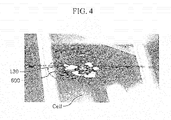
    • FIG. 4 is an image showing a result of a drilling test to confirm whether it is the dye-sensitized solar cell module according to the exemplary embodiment of the present invention.
    • FIG. 5 is a view showing injection of the electrolyte solution into the dye-sensitized solar cell module according to the exemplary embodiment of the present invention.
    • FIG. 6 is a view showing a step of attaching and sealing an electrolyte solution injection path of the dye-sensitized solar cell module according to the exemplary embodiment of the present invention with a cover glass to which a sealant is bonded, using a heating bar.
    [Mode for Invention]
  • In the following detailed description, only certain exemplary embodiments of the present invention have been shown and described, simply by way of illustration. As those skilled in the art would realize, the described embodiments may be modified in various different ways, all without departing from the spirit or scope of the present invention.
  • In addition, unless explicitly described to the contrary, the word "comprise" and variations such as "comprises" or "comprising", will be understood to imply the inclusion of stated elements but not the exclusion of any other elements.
  • FIG. 2 is a view showing a dye-sensitized solar cell module 100 according to an exemplary embodiment of the present invention. Matters relating to construction and manufacture of known dye-sensitized solar cell modules may be applied to parts that are not described in the following description
  • The dye-sensitized solar cell module 100 according to an exemplary embodiment of the present invention includes a working electrode 110, a counter electrode 120, an Ag electrode 140 that connects the working electrode 110 to the counter electrode 120, and an electrolyte solution 130 filled in a space between the working electrode 110 and the counter electrode 120.
  • In detail, the working electrode 110 may be formed by depositing a oxide semiconductor 112 onto which a dye (not shown) is adsorbed on a substrate 111 coated with a conductive film.
  • The substrate 111 is a transparent soda lime glass, and may be a conductive substrate through which an electric current flows due to FTO coating on a surface, and serves as a moving path of electrons.
  • The oxide semiconductor 112 deposited on the substrate 111 is composed of a porous metal oxide, and transmits the electrons generated when the dye adsorbed onto the porous metal oxide receives light to the substrate 111 of the working electrode 110.
  • The counter electrode 120 is positioned opposite to the working electrode 110, and may be formed by forming a catalyst layer using platinum after TCO coating on a transparent soda lime glass. The counter electrode 120 serves to transmit electrons to the dye.
  • The Ag electrode 140 serves to electrically connect the working electrode and the counter electrode, and the Ag electrode may be formed by performing a screen printing process using an Ag paste on the working electrode 110 and the counter electrode 120.
  • The electrolyte solution 130 serves to allow the electrons generated in the dye to flow to an external conducting wire through the working electrode 110, and to reduce the dye of the working electrode through the counter electrode 120 again, and may be formed of an iodine material.
  • The dye-sensitized solar cell module 100 according to an exemplary embodiment of the present invention may include the plurality of unit cells, and the number of bubbles included in the unit cell may be 10 or less, preferably, 5 or less, and more preferably, the bubbles may be absent.
  • Accordingly, the dye-sensitized solar cell module 100 of the present invention may prevent separation of the dye from the inside of the module due to the bubbles and a burst phenomenon of the module.
  • A volume of the electrolyte solution interposed in the unit cell of the dye-sensitized solar cell module 100 according to an exemplary embodiment of the present invention may be larger than a volume at which the electrolyte solution of the dye-sensitized solar cell is filled at room temperature at 1 atmospheric pressure. Specifically, since the electrolyte solution 130 is injected into the cell of the module 100 through the electrolyte solution injection path 121 by simultaneously applying two or more processes of forming a vacuum, adding pressure, or changing a temperature, the volume of the electrolyte solution 130 filled in the cell may be larger than the volume of the electrolyte solution filled in the cell of the dye-sensitized solar cell module 100 at room temperature at 1 atmospheric pressure.
  • Equation that specifically expresses the above description is as follows. When the volume of the unit cell of the module 100 designed at room temperature at 1 atmospheric pressure is V1 and the volume of the electrolyte solution interposed in the unit cell of the module 100 according to an exemplary embodiment of the present invention is V2, V1 and V2 satisfy Equation 1 below: 1 < V 2 / V 1 1.5.
    Figure imgb0002
  • That is, since the dye-sensitized solar cell module 100 according to an exemplary embodiment of the present invention is filled with the electrolyte solution by simultaneously applying two or more processes of forming a vacuum, adding pressure, or changing a temperature, an internal pressure exists in the cell. Accordingly, as shown in FIG. 4, at the time of performing a drilling test in which a hole 600 is drilled through a specific place in the cell, the electrolyte solution 130 is spurted like popcorn to the outside as indicated by circle.
  • The electrolyte solution 130 filled in the cell is filled at a density of 0.8 g/ml to 1.8 g/ml, and specifically has a density value of 1.2 g/ml.
  • When reviewing density values for each solvent type, an organic solvent electrolyte solution is filled at a density of 0.90 g/ml to 1.50 g/ml, an ionic liquid electrolyte solution is filled at a density of 1.15 g/ml to 1.75 g/ml, and a polymer organic solvent mixed electrolyte solution is filled at a density of 0.95 g/ml to 1.45 g/ml.
  • When the dye-sensitized solar cell module 100 according to an exemplary embodiment of the present invention is stored in an oven at 85°C for 2 hours, a size of the bubble occurring in the electrolyte solution 130 may be 5 mm or less, and the number of bubbles included in the unit cell may be 10 or less, specifically, the number of bubbles each having a size of 5 mm or less may be 5 or less, and more specifically, when the dye-sensitized solar cell module 100 is stored in an oven at 85°C for 2 hours, the bubbles occurring in the electrolyte solution 130 of the unit cell may be absent.
  • FIG. 3 is an image showing the dye-sensitized solar cell module 100 having a structure of FIG. 2 according to the exemplary embodiment of the present invention after the module 100 is stored in an oven at 85°C for 2 hours, which may be confirmed that the bubbles occurring in the electrolyte solution of the unit cell are absent.
  • Further, the dye-sensitized solar cell module according to an exemplary embodiment of the present invention may further include the electrolyte solution injection path 121 positioned at any part of the counter electrode 120, and a sealant 150 and a cover glass 160 for sealing the electrolyte solution injection path 121 in addition to the working electrode 110, the counter electrode 120, and the electrolyte solution 130.
  • FIG. 5 is a view showing injection of the electrolyte solution, wherein the electrolyte solution injection path 121 may be positioned at any part of the counter electrode 120 for injecting the electrolyte solution 130 into the dye-sensitized solar cell module 100. The electrolyte solution injection path 121 may be formed as a passage having a diameter of 0.1 mm to 1 mm, or specifically, a passage having a diameter of 0.1 mm to 0.7 mm. The electrolyte solution is injected through the electrolyte solution injection path 121, and the electrolyte solution is sufficiently injected by applying a pressure in a vacuum state so that the bubbles do not occur during the injection process.
  • FIG. 6 shows the sealing step, wherein the electrolyte solution injection path 121 of the dye-sensitized solar cell module 100 is attached and sealed with the sealant 150 and the cover glass 160 using a heating bar.
  • The sealant 150 serves to adhere the counter electrode 120 having the electrolyte solution injection path 121 to the cover glass 160.
  • The cover glass 160 is a soda lime glass, and serves to seal the electrolyte solution injection path 121 so as to prevent leakage of the electrolyte solution.
  • Further, a small amount of the electrolyte solution 130 may remain between the counter electrode 120 and the sealant 150 since the electrolyte solution remaining at an inlet of the injection path 121 is not wiped when the filling is completed. At this time, the remaining electrolyte solution 130 remains within a range of two times a diameter of the electrolyte solution injection path 121, and the counter electrode 120 and the cover glass 160 are in direct contact with the sealant 150 in a region other than a region where the electrolyte solution 130 remains.
  • For example, the electrolyte solution 130 remains within 10 mm of a radius of the electrolyte solution injection path 121, and the sealant 150 and the cover glass 160 are positioned on the remaining electrolyte solution 130. When the diameter of the electrolyte solution injection path 121 is 0.1 mm to 1 mm, the electrolyte solution 130 may remain within the radius of 2 mm of the electrolyte solution injection path 121.
  • The dye-sensitized solar cell module of the present invention may minimize the burst phenomenon of the dye-sensitized solar cell module caused by the bubbles by preventing occurrence of the bubbles in the electrolyte solution, and may secure reliability by preventing separation of the dye adsorbed onto the oxide semiconductor.
  • Further, the present invention may manufacture a dye-sensitized solar cell including the solar cell module.
  • Example
  • In order to evaluate the performance of the dye-sensitized solar cell module according to the exemplary embodiment of the present invention, a comparison test of bubble occurrence was performed with a conventional dye-sensitized solar cell module.
  • The test was performed by measuring the number of bubbles and the size thereof occurring after storing the dye-sensitized solar cell module in an oven at 85°C for 2 hours according to the density of the electrolyte solution. In order to obtain the reliability of the test, the test was repeated 10 times and an average value thereof was described. [Table 1]
    Electrolyte solution density (g/ml) Test temperature 1H 2H 24H or longer
    1.8 85°C Size of 5 mm or less 5 or less of bubbles Size of 5 mm or less 10 or less of bubbles Size of 5 mm or less 10 or less of bubbles
    0.8 85°C Size of 5 mm or less 5 or less of bubbles Size of 5 mm or less 10 or less of bubbles Size of 5 mm or less 10 or less of bubbles
    0.6 85°C Size of 5 mm or less 10 or less of bubbles Size of 5 mm or less 20 or less of bubbles Burst of module sealing
    0.2 85°C Size of 5 mm or less 15 or less of bubbles Burst of module sealing Burst of module sealing
  • Referring to Table 1, the lower the density of the electrolyte solution, the more bubbles occurred. In some of the experiments, when the density was less than 0.8 g/ml, the module could not withstand the test and the sealing of the module was burst during the test.
  • The present invention has been described above with reference to preferred exemplary embodiments thereof. It will be appreciated by those skilled in the art that various modifications, changes, and substitutions can be made without departing from the essential characteristics of the present invention. Accordingly, the embodiments disclosed in the present invention and the accompanying drawings are used not to limit but to describe the spirit of the present invention. The scope of the present invention is not limited only to the embodiments and the accompanying drawings. The protection scope of the present invention must be analyzed by the appended claims and it should be analyzed that all spirits within a scope equivalent thereto are included in the appended claims of the present invention.
  • <Description of symbols>
  • 100:
    Dye-sensitized solar cell module
    110:
    Working electrode
    111:
    Working electrode substrate
    112:
    Oxide semiconductor onto which dye (not shown) is adsorbed.
    120:
    Counter electrode
    121:
    Electrolyte solution injection path
    130:
    Electrolyte solution
    140:
    Ag electrode
    150:
    Sealant
    160:
    Cover substrate

Claims (16)

  1. A dye-sensitized solar cell module comprising:
    a plurality of unit cells including a working electrode, a counter electrode, and an electrolyte solution interposed between the working electrode and the counter electrode,
    wherein the number of bubbles included in the unit cell is 10 or less.
  2. The dye-sensitized solar cell module of claim 1, wherein:
    when the dye-sensitized solar cell module is stored in an oven at 85°C for 2 hours, a size of the bubble occurring in the electrolyte solution is 5 mm or less, and the number of bubbles included in the unit cell is 10 or less,
    in particular, when the dye-sensitized solar cell module is stored in an oven at 85°C for 2 hours, a size of bubble occurring in the electrolyte solution is 5 mm or less, and the number of bubbles included in the unit cell is 5 or less.
  3. The dye-sensitized solar cell module of claim 1, wherein:
    the bubbles occurring in the unit cell are absent when the dye-sensitized solar cell module is stored in an oven at 85°C for 2 hours.
  4. The dye-sensitized solar cell module of claim 1, wherein:
    a volume of the electrolyte solution interposed in the dye-sensitized solar cell module is larger than a volume at which the electrolyte solution of the dye-sensitized solar cell is filled at room temperature at 1 atmospheric pressure.
  5. The dye-sensitized solar cell module of claim 1, wherein:
    the electrolyte solution filled in the dye-sensitized solar cell module has a density of 0.8 g/ml to 1.8 g/ml.
  6. A dye-sensitized solar cell module comprising:
    a plurality of unit cells including a working electrode, a counter electrode, and an electrolyte solution interposed between the working electrode and the counter electrode,
    wherein a volume of the unit cell is V1, a volume of the electrolyte solution interposed in the unit cell is V2, and V1 and V2 satisfy Equation 1 below: 1 < V 2 / V 1 1.5.
    Figure imgb0003
  7. The dye-sensitized solar cell module of claim 6, wherein:
    the number of bubbles included in the unit cell is 10 or less.
  8. The dye-sensitized solar cell module of claim 6, wherein:
    when the dye-sensitized solar cell module is stored in an oven at 85°C for 2 hours, a size of bubble occurring in the electrolyte solution is 5 mm or less, and the number of bubbles included in the unit cell is 10 or less,
    in particular, when the dye-sensitized solar cell module is stored in an oven at 85°C for 2 hours, a size of bubble occurring in the electrolyte solution is 5 mm or less, and the number of bubbles included in the unit cell is 5 or less .
  9. The dye-sensitized solar cell module of claim 6, wherein:
    bubbles occurring in the unit cell are absent when the dye-sensitized solar cell module is stored in an oven at 85°C for 2 hours.
  10. A dye-sensitized solar cell module comprising:
    a plurality of unit cells including a working electrode, a counter electrode, and an electrolyte solution interposed between the working electrode and the counter electrode,
    wherein the counter electrode includes an electrolyte solution injection path,
    the unit cell further includes a cover glass covering the electrolyte solution injection path,
    the electrolyte solution remains within a range of two times a diameter of the electrolyte solution injection path, and
    the counter electrode and the cover glass are in contact with a sealant in a region other than a region where the electrolyte solution remains.
  11. The dye-sensitized solar cell module of claim 10, wherein:
    the electrolyte solution remains within a radius of 10 mm of the electrolyte solution injection path,
    and/or the sealant and the cover glass are positioned on the electrolyte solution in the region where the electrolyte solution remains.
  12. The dye-sensitized solar cell module of claim 10, wherein:
    the number of bubbles included in the unit cell is 10 or less.
  13. The dye-sensitized solar cell module of claim 10, wherein:
    when the dye-sensitized solar cell module is stored in an oven at 85°C for 2 hours, a size of bubble occurring in the electrolyte solution is 5 mm or less, and the number of bubbles included in the unit cell is 10 or less,
    in particular, when the dye-sensitized solar cell module is stored in an oven at 85°C for 2 hours, a size of bubble occurring in the electrolyte solution is 5 mm or less, and the number of bubbles included in the unit cell is 5 or less.
  14. The dye-sensitized solar cell module of claim 10, wherein:
    bubbles occurring in the unit cell are absent when the dye-sensitized solar cell module is stored in an oven at 85°C for 2 hours.
  15. The dye-sensitized solar cell module of claim 10, wherein:
    a volume of the unit cell is V1, a volume of the electrolyte solution interposed in the unit cell is V2, and V1 and V2 satisfy Equation 1 below: 1 < V 2 / V 1 1.5.
    Figure imgb0004
  16. A dye-sensitized solar cell comprising the dye-sensitized solar cell module of any one of claims 1 to 15.
EP17211133.8A 2016-12-30 2017-12-29 Dye sensitized solar cell module and dye sensitized solar cell comprising the same Withdrawn EP3343577A1 (en)

Applications Claiming Priority (2)

Application Number Priority Date Filing Date Title
KR20160183921 2016-12-30
KR1020170133494A KR20180079163A (en) 2016-12-30 2017-10-13 Dye sensitized solar cell module and dye sensitized solar cell comprising the same

Publications (1)

Publication Number Publication Date
EP3343577A1 true EP3343577A1 (en) 2018-07-04

Family

ID=60856970

Family Applications (1)

Application Number Title Priority Date Filing Date
EP17211133.8A Withdrawn EP3343577A1 (en) 2016-12-30 2017-12-29 Dye sensitized solar cell module and dye sensitized solar cell comprising the same

Country Status (3)

Country Link
US (1) US20180190438A1 (en)
EP (1) EP3343577A1 (en)
CN (1) CN108269691A (en)

Families Citing this family (1)

* Cited by examiner, † Cited by third party
Publication number Priority date Publication date Assignee Title
CN110940568B (en) * 2019-12-17 2022-02-18 武汉友芝友医疗科技股份有限公司 Integrated system for cell enrichment, separation, dyeing and flaking

Citations (2)

* Cited by examiner, † Cited by third party
Publication number Priority date Publication date Assignee Title
WO2010005213A2 (en) * 2008-07-07 2010-01-14 주식회사 동진쎄미켐 Dye sensitive solar battery or sub-module, method for manufacturing same, electrolyte injection apparatus thereof, and method for same
EP2175516A1 (en) * 2007-07-27 2010-04-14 Sony Corporation Coloring matter-sensitized photoelectric conversion element, process for producing the coloring matter-sensitized photoelectric conversion element, electronic equipment, semiconductor electrode, and process for rpoducing the semiconductor electrode

Family Cites Families (1)

* Cited by examiner, † Cited by third party
Publication number Priority date Publication date Assignee Title
KR101219351B1 (en) * 2011-11-30 2013-01-22 현대자동차주식회사 Dye-sensitized solar cell module and method for manufacturing the same

Patent Citations (2)

* Cited by examiner, † Cited by third party
Publication number Priority date Publication date Assignee Title
EP2175516A1 (en) * 2007-07-27 2010-04-14 Sony Corporation Coloring matter-sensitized photoelectric conversion element, process for producing the coloring matter-sensitized photoelectric conversion element, electronic equipment, semiconductor electrode, and process for rpoducing the semiconductor electrode
WO2010005213A2 (en) * 2008-07-07 2010-01-14 주식회사 동진쎄미켐 Dye sensitive solar battery or sub-module, method for manufacturing same, electrolyte injection apparatus thereof, and method for same

Also Published As

Publication number Publication date
CN108269691A (en) 2018-07-10
US20180190438A1 (en) 2018-07-05

Similar Documents

Publication Publication Date Title
US20250314937A1 (en) Electrochromic Devices, Methods of Manufacturing and Operation Thereof
AU2010276983B2 (en) Method for manufacturing dye-sensitized solar cell
KR101146768B1 (en) Dye-sensitized solar battery module and method for manufacturing the same
EP2219261A1 (en) Functional device and manufacturing method therefor
JP4651347B2 (en) Photoelectric conversion device and photovoltaic device using the same
CN102714340B (en) Dye-sensitized solar cell
EP2293359A1 (en) Sealant, dye-sensitized solar cell including the sealant, and method of manufacturing the dye-sensitized solar cell
JP2009277399A (en) Dye-sensitized solar cell
JP2009289549A (en) Dye-sensitized solar cell encapsulant
JP4639657B2 (en) Photoelectric conversion element and manufacturing method thereof
EP3343577A1 (en) Dye sensitized solar cell module and dye sensitized solar cell comprising the same
US20080072954A1 (en) Method of sealing solar cells
US10020120B2 (en) Electronic device and manufacturing method for same
JP2012174592A (en) Injection device and injection method and dye sensitized solar cell manufacturing method using the same
JP4759647B1 (en) Electronic device and manufacturing method thereof
KR20180079163A (en) Dye sensitized solar cell module and dye sensitized solar cell comprising the same
JP2011222139A (en) Electronic device and manufacturing method thereof
US20130214196A1 (en) Electrolyte formulation for use in photoelectrochemical devices
EP3333863A1 (en) Photoelectric conversion element
JP6534325B2 (en) PHOTOELECTRIC CONVERSION ELEMENT AND PHOTOELECTRIC CONVERSION MODULE
JP6371194B2 (en) Method for producing dye-sensitized photoelectric conversion element
KR920007086B1 (en) Manufacturing method of plasma display panel
EP3506327A1 (en) Photoelectric conversion element
JP2009231203A (en) Sealer for dye-sensitized solar cell
JP2009231204A (en) Dye-sensitized solar cell and its manufacturing method

Legal Events

Date Code Title Description
PUAI Public reference made under article 153(3) epc to a published international application that has entered the european phase

Free format text: ORIGINAL CODE: 0009012

STAA Information on the status of an ep patent application or granted ep patent

Free format text: STATUS: THE APPLICATION HAS BEEN PUBLISHED

AK Designated contracting states

Kind code of ref document: A1

Designated state(s): AL AT BE BG CH CY CZ DE DK EE ES FI FR GB GR HR HU IE IS IT LI LT LU LV MC MK MT NL NO PL PT RO RS SE SI SK SM TR

AX Request for extension of the european patent

Extension state: BA ME

STAA Information on the status of an ep patent application or granted ep patent

Free format text: STATUS: REQUEST FOR EXAMINATION WAS MADE

17P Request for examination filed

Effective date: 20190104

RBV Designated contracting states (corrected)

Designated state(s): AL AT BE BG CH CY CZ DE DK EE ES FI FR GB GR HR HU IE IS IT LI LT LU LV MC MK MT NL NO PL PT RO RS SE SI SK SM TR

STAA Information on the status of an ep patent application or granted ep patent

Free format text: STATUS: THE APPLICATION IS DEEMED TO BE WITHDRAWN

18D Application deemed to be withdrawn

Effective date: 20210701