EP3343378B1 - Vorrichtungsbasierte visuelle testautomation - Google Patents
Vorrichtungsbasierte visuelle testautomation Download PDFInfo
- Publication number
- EP3343378B1 EP3343378B1 EP17207185.4A EP17207185A EP3343378B1 EP 3343378 B1 EP3343378 B1 EP 3343378B1 EP 17207185 A EP17207185 A EP 17207185A EP 3343378 B1 EP3343378 B1 EP 3343378B1
- Authority
- EP
- European Patent Office
- Prior art keywords
- test
- user interface
- elements
- identifying
- automation platform
- Prior art date
- Legal status (The legal status is an assumption and is not a legal conclusion. Google has not performed a legal analysis and makes no representation as to the accuracy of the status listed.)
- Active
Links
Images



Classifications
-
- G—PHYSICS
- G06—COMPUTING OR CALCULATING; COUNTING
- G06F—ELECTRIC DIGITAL DATA PROCESSING
- G06F11/00—Error detection; Error correction; Monitoring
- G06F11/36—Prevention of errors by analysis, debugging or testing of software
- G06F11/3668—Testing of software
- G06F11/3672—Test management
- G06F11/3688—Test management for test execution, e.g. scheduling of test suites
-
- G—PHYSICS
- G06—COMPUTING OR CALCULATING; COUNTING
- G06F—ELECTRIC DIGITAL DATA PROCESSING
- G06F11/00—Error detection; Error correction; Monitoring
- G06F11/36—Prevention of errors by analysis, debugging or testing of software
- G06F11/3668—Testing of software
- G06F11/3672—Test management
- G06F11/3684—Test management for test design, e.g. generating new test cases
-
- G—PHYSICS
- G06—COMPUTING OR CALCULATING; COUNTING
- G06F—ELECTRIC DIGITAL DATA PROCESSING
- G06F11/00—Error detection; Error correction; Monitoring
- G06F11/36—Prevention of errors by analysis, debugging or testing of software
- G06F11/3668—Testing of software
- G06F11/3672—Test management
- G06F11/3692—Test management for test results analysis
-
- G—PHYSICS
- G06—COMPUTING OR CALCULATING; COUNTING
- G06F—ELECTRIC DIGITAL DATA PROCESSING
- G06F11/00—Error detection; Error correction; Monitoring
- G06F11/36—Prevention of errors by analysis, debugging or testing of software
- G06F11/3698—Environments for analysis, debugging or testing of software
-
- G—PHYSICS
- G06—COMPUTING OR CALCULATING; COUNTING
- G06F—ELECTRIC DIGITAL DATA PROCESSING
- G06F18/00—Pattern recognition
- G06F18/20—Analysing
- G06F18/21—Design or setup of recognition systems or techniques; Extraction of features in feature space; Blind source separation
- G06F18/214—Generating training patterns; Bootstrap methods, e.g. bagging or boosting
-
- G—PHYSICS
- G06—COMPUTING OR CALCULATING; COUNTING
- G06F—ELECTRIC DIGITAL DATA PROCESSING
- G06F18/00—Pattern recognition
- G06F18/20—Analysing
- G06F18/24—Classification techniques
-
- G—PHYSICS
- G06—COMPUTING OR CALCULATING; COUNTING
- G06N—COMPUTING ARRANGEMENTS BASED ON SPECIFIC COMPUTATIONAL MODELS
- G06N3/00—Computing arrangements based on biological models
- G06N3/02—Neural networks
- G06N3/04—Architecture, e.g. interconnection topology
- G06N3/0464—Convolutional networks [CNN, ConvNet]
-
- G—PHYSICS
- G06—COMPUTING OR CALCULATING; COUNTING
- G06N—COMPUTING ARRANGEMENTS BASED ON SPECIFIC COMPUTATIONAL MODELS
- G06N3/00—Computing arrangements based on biological models
- G06N3/02—Neural networks
- G06N3/08—Learning methods
- G06N3/09—Supervised learning
-
- G—PHYSICS
- G06—COMPUTING OR CALCULATING; COUNTING
- G06T—IMAGE DATA PROCESSING OR GENERATION, IN GENERAL
- G06T7/00—Image analysis
- G06T7/70—Determining position or orientation of objects or cameras
-
- G—PHYSICS
- G06—COMPUTING OR CALCULATING; COUNTING
- G06V—IMAGE OR VIDEO RECOGNITION OR UNDERSTANDING
- G06V30/00—Character recognition; Recognising digital ink; Document-oriented image-based pattern recognition
- G06V30/10—Character recognition
- G06V30/14—Image acquisition
- G06V30/148—Segmentation of character regions
- G06V30/153—Segmentation of character regions using recognition of characters or words
-
- G—PHYSICS
- G06—COMPUTING OR CALCULATING; COUNTING
- G06F—ELECTRIC DIGITAL DATA PROCESSING
- G06F8/00—Arrangements for software engineering
- G06F8/30—Creation or generation of source code
- G06F8/31—Programming languages or programming paradigms
-
- G—PHYSICS
- G06—COMPUTING OR CALCULATING; COUNTING
- G06F—ELECTRIC DIGITAL DATA PROCESSING
- G06F9/00—Arrangements for program control, e.g. control units
- G06F9/06—Arrangements for program control, e.g. control units using stored programs, i.e. using an internal store of processing equipment to receive or retain programs
- G06F9/44—Arrangements for executing specific programs
- G06F9/451—Execution arrangements for user interfaces
Definitions
- Software testing may be performed to test whether software functions as expected.
- Software testing may be performed manually, or may be automated via test automation.
- Test automation is the use of special software (separate from the software being tested) to control the execution of tests and the comparison of actual outcomes with predicted outcomes.
- US 2014/033091 A1 relates to an image-based automation process which includes identifying a graphical object of a graphical user interface and performing an action relative to the graphical object at the graphical user interface. The identifying is based on an image including the graphical object.
- a device may include one or more processors to receive a test script that includes first information identifying a first element to be displayed on a user interface and second information identifying a set of test steps to test the user interface.
- the test script may be written using first text or first program code.
- the one or more processors may process the first text or the first program code of the test script using a processing technique to identify the first information and the second information.
- the one or more processors may identify the first element on the user interface based on identifying the first information and the second information included in the test script. The first element may be identified without using second program code underlying the user interface.
- the first element may be identified based on a type of the first element, second text associated with the first element, or a visual relationship between the first element and a second element.
- the one more processors may determine a set of coordinates for the first element on the user interface based on identifying the first element.
- the set of coordinates may identify a position of the first element on the user interface.
- the one or more processors may perform the set of test steps to test the user interface based on determining the set of coordinates for the first element.
- the one or more processors may perform an action related to a result of testing the user interface based on performing the set of test steps.
- a method may include receiving, by a device, one or more test scripts that include first information identifying one or more first elements of one or more user interfaces or second information identifying a set of test steps to test the one or more user interfaces.
- the one or more test scripts may be written in first text or first program code.
- the method may include processing, by the device, the first text or the first program code of the one or more test scripts to identify the first information or the second information.
- the method may include identifying, by the device, the one or more first elements on the one or more user interfaces based on identifying the first information or the second information included in the one or more test scripts.
- the one or more first elements, as displayed on the one or more user interfaces, may be identified without using second program code associated with the one or more user interfaces.
- the one or more first elements may be identified based on a type of the one or more first elements, second text associated with the one or more first elements, or a relationship between the one or more first elements and one or more second elements.
- the method may include identifying, by the device, a set of positions for the one or more first elements on the one or more user interfaces based on identifying the one or more first elements.
- the set of positions may permit the device to interact with the one or more first elements to perform the set of test steps.
- the method may include performing the set of test steps to test the one or more user interfaces based on identifying the set of positions for the one or more first elements.
- a non-transitory computer-readable medium may store one or more instructions that, when executed by one or more processors, cause the one or more processors to receive a plurality of test scripts that include first information identifying a plurality of first elements displayed on a plurality of user interfaces or second information identifying a plurality of test steps to test the plurality of user interfaces.
- the one or more instructions may cause the one or more processors to process the plurality of test scripts to identify the first information or the second information based on receiving the plurality of test scripts.
- the one or more instructions may cause the one or more processors to identify the plurality of first elements on the plurality of user interfaces based on identifying the first information or the second information included in the plurality of test scripts.
- the plurality of first elements may be identified based on a type of the plurality of first elements, text associated with the plurality of first elements, or a relationship between the plurality of first elements and a plurality of second elements.
- the one or more instructions may cause the one or more processors to identify a set of coordinates for the plurality of first elements on the plurality of user interfaces based on identifying the plurality of first elements.
- the set of coordinates may identify a position of the plurality of first elements on the plurality of user interfaces.
- the one or more instructions may cause the one or more processors to perform the plurality of test steps to test the plurality of user interfaces based on identifying the set of coordinates for the plurality of first elements.
- the one or more instructions may cause the one or more processors to perform a plurality of actions related to the testing of the plurality of user interfaces based on performing the plurality of test steps.
- a software tester may desire to test software by automatically interacting with the user interface of the software.
- interacting with a user interface may require knowledge of program code underlying the user interface.
- the tester may not have access to the underlying program code, such as when the software related to the user interface is proprietary to an individual or entity different than the tester.
- the underlying program code may be modified from time to time, such as to modify the user interface, modify functionality related to the user interface, and/or the like. This may cause errors that consume processing resources when automatically interacting with the user interface. In addition, this decreases an efficiency of testing the software by increasing maintenance effort of software used to interact with the user interface.
- Implementations described herein provide for automatic interaction with a user interface based on identifying elements displayed by the user interface. In addition, implementations described herein provide for dynamic adjustment of automatic testing based on changes to the manner in which the elements of the user interface are displayed. Further, implementations described herein may interact with a user interface without needing access to the program code underlying the user interface.
- implementations described herein improve automatic testing of software by reducing or eliminating the need for a tester to know, or have access to, program code underlying the user interface. Furthermore, implementations described herein conserve processing resources by reducing or eliminating errors due to changes to the underlying program code, and increase an efficiency of automatic testing by permitting dynamic adjustments to the automatic testing based on changes to the user interface.
- Fig. 1 is a diagram of an overview of an example implementation 100 described herein.
- example implementation 100 may include a test automation platform and a client device.
- the client device may display a user interface, the functionality of which is to be tested.
- the user interface may provide login functionality, where a user of the client device can input a username and password to access information.
- the test automation platform may receive a test script to test software.
- the test automation platform may receive a set of instructions (e.g., with a natural language syntax, such as a subject-verb-object syntax) to automatically test functionality of the user interface shown by reference number 110.
- the test script may include four test steps that include inputting a username/password combination into various text boxes of the user interface, selecting a button to log in, and determining whether the login was successful (e.g., whether the username/password combination is accepted or generates an error).
- the test automation platform may receive thousands, millions, or billions of test scripts associated with testing thousands, millions, or billions of elements of user interfaces.
- the test automation platform may perform one or more big data techniques to perform the automatic testing.
- the test automation platform may process the test script to identify a set of test steps to perform and/or a set of elements (e.g., a button, a text box, a label, a dropdown menu, etc.) of the user interface on which to perform the set of test steps.
- the test automation platform may process the test script using natural language processing, computational linguistics, artificial intelligence, and/or the like to identify the set of test steps and/or the set of elements identified in the test script. These techniques may be examples of the claimed processing technique.
- the test automation platform may identify the set of test steps and/or the set of elements using terms, tags, and/or the like identified when processing the test script.
- test automation platform identifies terms or tags identifying a "Username” text box element, a "Password” text box element, and a "Submit” button element in the text of the test script. Further assume, for example, that the test automation platform identifies the test steps of inputting text into the "Username” text box, inputting text into the "Password” text box, and clicking the "Submit” button based on identified terms and/or tags in the text of the test script.
- the test automation platform may then identify the set of elements identified by the test script on the user interface.
- the test automation platform may identify the set of elements using computer vision, image processing, pattern recognition, machine learning, and/or the like. For example, the test automation platform may identify a text box associated with a "Username” label, a text box associated with a "Password” label, and a "Submit” button as the elements identified in the test script.
- the test automation platform may visually identify elements of a user interface based on a visual relationship among elements displayed on the user interface (e.g., identifying that text boxes are displayed on the user interface below labels). This reduces or eliminates the need for the test automation platform to have access to the underlying program code of the user interface to identify an element associated with the user interface. In addition, this permits the test automation platform to dynamically identify an element of the user interface regardless of modifications to the user interface.
- the test automation platform may perform the set of test steps identified in the test script by providing input and making selections (e.g., by taking programmatic control of the mouse and/or keyboard functions of the client device) based on the identified elements of the user interface. For example, the test automation platform may input text for a username (e.g., "ABC 123) into the text box associated with the "Username” label and may input text for a password (e.g., "XYZ321”) into the text box associated with the "Password” label.
- a username e.g., "ABC 123
- a password e.g., "XYZ321
- the test automation platform may select the "Submit” button.
- the test automation platform may determine a result of selecting the submit button (e.g., whether the username/password combination provides access to particular information, whether an error message was generated, etc.).
- Fig. 1 is provided merely as an example. Other examples are possible and may differ from what was described with regard to Fig. 1 .
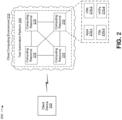
- Fig. 2 is a diagram of an example environment 200 in which systems and/or methods, described herein, may be implemented.
- environment 200 may include a test automation platform 205, a cloud computing environment 210, a set computing resources 215 (hereinafter referred to collectively as "computing resources 215" and individually as “computing resource 215"), and a client device 220.
- Devices of environment 200 may interconnect via wired connections, wireless connections, or a combination of wired and wireless connections.
- Test automation platform 205 includes one or more devices capable of visual-based test automation.
- test automation platform 205 may include a cloud server or a group of cloud servers.
- test automation platform 205 may be designed to be modular such that certain software components can be swapped in or out depending on a particular need. As such, test automation platform 205 may be easily and/or quickly reconfigured for different uses.
- test automation platform 205 may be hosted in cloud computing environment 210.
- test automation platform 205 may not be cloud-based (i.e., may be implemented outside of a cloud computing environment) or may be partially cloud-based.
- Cloud computing environment 210 includes an environment that hosts test automation platform 205.
- Cloud computing environment 210 may provide computation, software, data access, storage, etc. services that do not require end-user (e.g., client device 220) knowledge of a physical location and configuration of system(s) and/or device(s) that host test automation platform 205.
- cloud computing environment 210 may include a group of computing resources 215 (referred to collectively as “computing resources 215" and individually as “computing resource 215").
- Computing resource 215 includes one or more personal computers, workstation computers, server devices, or other types of computation and/or communication devices.
- computing resource 215 may host test automation platform 205.
- the cloud resources may include compute instances executing in computing resource 215, storage devices provided in computing resource 215, data transfer devices provided by computing resource 215, etc.
- computing resource 215 may communicate with other computing resources 215 via wired connections, wireless connections, or a combination of wired and wireless connections.
- computing resource 215 may include a group of cloud resources, such as one or more applications (“APPs”) 215-1, one or more virtual machines (“VMs”) 215-2, one or more virtualized storages (“VSs”) 215-3, or one or more hypervisors (“HYPs”) 215-4.
- APPs applications
- VMs virtual machines
- VSs virtualized storages
- HOPs hypervisors
- Application 215-1 includes one or more software applications that may be provided to or accessed by one or more devices of environment 200. Application 215-1 may eliminate a need to install and execute the software applications on devices of environment 200. For example, application 215-1 may include software associated with test automation platform 205 and/or any other software capable of being provided via cloud computing environment 210. In some implementations, one application 215-1 may send/receive information to/from one or more other applications 215-1, via virtual machine 215-2.
- Hypervisor 215-4 may provide hardware virtualization techniques that allow multiple operating systems (e.g., "guest operating systems") to execute concurrently on a host computer, such as computing resource 215.
- Hypervisor 215-4 may present a virtual operating platform to the guest operating systems, and may manage the execution of the guest operating systems. Multiple instances of a variety of operating systems may share virtualized hardware resources.
- the number and arrangement of devices shown in Fig. 2 are provided as an example. In practice, there may be additional devices, fewer devices, different devices, or differently arranged devices than those shown in Fig. 2 . Furthermore, two or more devices shown in Fig. 2 may be implemented within a single device, or a single device shown in Fig. 2 may be implemented as multiple, distributed devices. Additionally, or alternatively, a set of devices (e.g., one or more devices) of environment 200 may perform one or more functions described as being performed by another set of devices of environment 200.
- Fig. 3 is a diagram of example components of a device 300.
- Device 300 may correspond to test automation platform 205, a set of computing resources 215, and/or client device 220.
- test automation platform 205, a set of computing resources 215, and/or client device 220 may include one or more devices 300 and/or one or more components of device 300.
- device 300 may include a bus 310, a processor 320, a memory 330, a storage component 340, an input component 350, an output component 360, and a communication interface 370.
- Bus 310 includes a component that permits communication among the components of device 300.
- Processor 320 is implemented in hardware, firmware, or a combination of hardware and software.
- Processor 320 includes a central processing unit (CPU), a graphics processing unit (GPU), an accelerated processing unit (APU), a microprocessor, a microcontroller, a digital signal processor (DSP), a field-programmable gate array (FPGA), an application-specific integrated circuit (ASIC), or another type of processing component.
- processor 320 includes one or more processors capable of being programmed to perform a function.
- Memory 330 includes a random access memory (RAM), a read only memory (ROM), and/or another type of dynamic or static storage device (e.g., a flash memory, a magnetic memory, and/or an optical memory) that stores information and/or instructions for use by processor 320.
- RAM random access memory
- ROM read only memory
- static storage device e.g., a flash memory, a magnetic memory, and/or an optical memory
- Storage component 340 stores information and/or software related to the operation and use of device 300.
- storage component 340 may include a hard disk (e.g., a magnetic disk, an optical disk, a magneto-optic disk, and/or a solid state disk), a compact disc (CD), a digital versatile disc (DVD), a floppy disk, a cartridge, a magnetic tape, and/or another type of non-transitory computer-readable medium, along with a corresponding drive.
- Device 300 may perform one or more processes described herein. Device 300 may perform these processes in response to processor 320 executing software instructions stored by a non-transitory computer-readable medium, such as memory 330 and/or storage component 340.
- a computer-readable medium is defined herein as a non-transitory memory device.
- a memory device includes memory space within a single physical storage device or memory space spread across multiple physical storage devices.
- Software instructions may be read into memory 330 and/or storage component 340 from another computer-readable medium or from another device via communication interface 370. When executed, software instructions stored in memory 330 and/or storage component 340 may cause processor 320 to perform one or more processes described herein. Additionally, or alternatively, hardwired circuitry may be used in place of or in combination with software instructions to perform one or more processes described herein. Thus, implementations described herein are not limited to any specific combination of hardware circuitry and software.
- device 300 may include additional components, fewer components, different components, or differently arranged components than those shown in Fig. 3 . Additionally, or alternatively, a set of components (e.g., one or more components) of device 300 may perform one or more functions described as being performed by another set of components of device 300.
- a set of components e.g., one or more components
- Fig. 4 is a flow chart of an example process 400 for device-based visual test automation.
- one or more process blocks of Fig. 4 may be performed by test automation platform 205.
- one or more process blocks of Fig. 4 may be performed by another device or a group of devices separate from or including test automation platform 205, such as client device 220.
- process 400 may include receiving a test script that includes information identifying an element of a user interface and/or a set of test steps to test the user interface (block 410).
- test automation platform 205 may receive a test script that includes information identifying an element of a user interface and/or a set of test steps to perform related to testing the user interface.
- test automation platform 205 may receive the test script periodically, according to a schedule, based on requesting the test script from client device 220, based on input from a user of client device 220, and/or the like.
- test automation platform 205 may receive the test script when a user of client device 220 inputs program code and/or text into a code or text editor. Additionally, or alternatively, test automation platform 205 may receive the test script when a user of client device 220 uploads a file that includes program code and/or text to test automation platform 205.
- a test script may include a set of test steps (e.g., a set of instructions) to be performed to test functioning of a user interface, a device, software, and/or the like.
- a test script may identify an action to perform to test the user interface, the device, the software, and/or the like. Additionally, or alternatively, when the test script relates to testing a user interface, a test script may identify an element of the user interface on which an action is to be performed to test the user interface.
- an element of a user interface may include a label, a button, a radio button, a menu, a dropdown menu, a text box, a toggle, an icon, a link (e.g., a hyperlink, hypertext, or a uniform resource identifier), and/or the like, that displays information, receives text, controls a functionality of software and/or a device, and/or the like.
- a user interface may include an interface that enables human-machine interaction, such as a graphical user interface (GUI).
- GUI graphical user interface
- a test script may be written in text.
- the test script may be written in a text document, a web page, a file, and/or the like.
- a test script may be written in a natural language (e.g., English), such as using a natural language syntax (e.g., subject-verb-object syntax).
- a test script may be written in a constrained natural language where a particular term, tag, and/or phrase is used to identify an element of a user interface, functionality of the user interface or software related to the user interface, an action to perform to test the user interface, and/or the like.
- test automation platform 205 may quickly and efficiently identify a test step of a test script, an action to perform based on the test step, an element of a user interface on which to perform the action, and/or the like, by parsing text of the test script.
- a test script may be written in program code.
- program code may include text-based code that is executed by a device.
- a test script may be written in Java code, C++, a program code that uses a natural language syntax (e.g., a subject-verb-object syntax), or another type of hardware and/or software based code.
- a natural language syntax e.g., a subject-verb-object syntax
- particular terms, tags, or phrases of the programming language may be mapped to particular types of elements, actions, and/or the like.
- test automation platform 205 may quickly and efficiently identify a test step of a test script, an action to perform based on the test step, an element of a user interface on which to perform the action, and/or the like, by parsing program code for the test script.
- a test script may be written in one or more programming languages.
- a test script may be written in a computer language or constructed language designed to communicate instructions to a machine (e.g., a computer).
- a test script can be used to create software, such as to control the behavior of a machine and/or to express an algorithm.
- a test script can be used to create software in Java, C++, Gherkin, a domain-specific language, a natural language programming language that has a natural language syntax, and/or the like. This improves flexibility of test automation platform 205 to receive test scripts in various programming languages.
- test automation platform 205 may receive thousands, millions, or billions of test scripts to test thousands, millions, or billions of user interfaces, devices, software programs, and/or the like.
- the test script may include thousands, millions, or billions or test steps.
- the test script when the test script is written using program code or text, the test script may include thousands, millions, or billions of lines of program code or lines of text.
- test automation platform 205 may receive a test script that includes information identifying an element of a user interface and/or a set of test steps to test the user interface.
- process 400 may include processing the test script using a processing technique to identify the information included in the test script (block 420).
- test automation platform 205 may process the test script to identify the information included in the test script.
- test automation platform 205 may process a test script when test automation platform 205 receives the test script from client device 220, based on receiving an indication to process the test script, and/or the like. Additionally, or alternatively, test automation platform 205 may process the test script when test automation platform 205 receives a threshold quantity of test scripts (e.g., test automation platform 205 may batch process multiple test scripts), thereby conserving processing resources and increasing an efficiency of test automation platform 205.
- a threshold quantity of test scripts e.g., test automation platform 205 may batch process multiple test scripts
- test automation platform 205 may process the test script using a processing technique to identify the information included in the test script.
- process 400 may include identifying the element displayed on the user interface using the identified information included in the test script (block 430).
- test automation platform 205 may identify the element on the user interface based on identifying a term, tag, and/or phrase included in the test script that identifies the element.
- test automation platform 205 may identify the element using a technique.
- test automation platform 205 may identify the element using optical character recognition (OCR), image processing, pattern recognition, artificial intelligence, computer vision, a deep neural network, a convolutional neural network (CNN), a long short-term memory network (LSTM), another type of artificial neural network, and/or the like.
- OCR optical character recognition
- CNN convolutional neural network
- LSTM long short-term memory network
- the technique may permit test automation platform 205 to visually identify an element displayed by a user interface.
- test automation platform 205 may perform a comparison of an image of the user interface and images of known elements from other user interfaces to identify a button, a text box, a dropdown menu, a label with text, and/or the like displayed on the user interface based on the elements of the user interface having similar features to the other known elements (e.g., based on a machine learning process).
- test automation platform 205 This improves identification of an element displayed on a user interface by reducing or eliminating the need for test automation platform 205 to use the underlying program code of the user interface to identify the element (e.g., via metadata associated with the element, an identifier of the element, etc.). In addition, this enables test automation platform 205 to dynamically identify an element on the user interface regardless of where the element is displayed on the user interface or modifications to where the element is displayed, thereby improving an efficiency of identifying the element.
- test automation platform 205 may use OCR, or another technique for converting an image of text into machine-encoded text, to identify text associated with the element. For example, assume that a test script includes a test step of inputting a username into a text box associated with a label that displays the text "Username.” In this case, test automation platform 205 may capture a screen shot of the user interface and may use OCR to identify the term "Username,” as displayed by a label of the user interface, and may identify a text box associated with the label (e.g., positioned below the label, positioned to the right of the label, positioned at a diagonal to the label, etc.) as the text box for inputting a username. In this way, test automation platform 205 may identify text on the user interface, thereby facilitating testing of the user interface and identification of particular elements of the user interface.
- OCR OCR
- test automation platform 205 uses an artificial neural network to identify an element.
- test automation platform 205 uses a deep neural network to identify an element.
- test automation platform 205 may use a deep neural network to identify different types of elements (e.g., text boxes, buttons, labels, dropdown menus, etc.) displayed on the user interface.
- different artificial neural networks may be used to identify particular types of elements.
- test automation platform 205 may use a first artificial neural network to identify text boxes and a second artificial neural network to identify buttons on a user interface.
- the same artificial neural network may be used to identify various types of elements.
- test automation platform 205 may use the same artificial neural network to identify text boxes, buttons, labels, and/or the like. In this way, test automation platform 205 may identify various types of elements of a user interface.
- test automation platform 205 may use an artificial neural network in combination with another technique to identify a particular element of a user interface.
- test automation platform 205 may use a deep neural network and OCR to identify a specific element based on text associated with the elements identified using the deep neural network. For example, test automation platform 205 may use a deep neural network to identify various text boxes on the user interface and then may use OCR to identify a particular text box, such as a text box associated with a "Username" label, to identify a particular text box in which to input text for a username. In this way, test automation platform may quickly and efficiently identify a particular element of a user interface, thereby conserving processing resources.
- test automation platform 205 may use an artificial neural network to determine a position of an element on the user interface.
- test automation platform 205 may use a deep neural network trained using images of various elements to identify an element on the user interface.
- test automation platform 205 determines coordinates of the element. For example, test automation platform 205 determines a quantity of pixels or centimeters from an edge of the user interface, or a center of the user interface, that an element is located. In this way, test automation platform 205 may identify a position of an element on a user interface without needing access to the underlying program code of the user interface, thereby increasing an efficiency of identifying the position of the element. In addition, this reduces or eliminates errors due to changes to the user interface and/or the program code underlying the user interface.
- test automation platform 205 identifies an element based on a relationship to another element. For example, test automation platform 205 identifies a first element based on a visual relationship to a second element (e.g., based on being displayed above, below, to the right, to the left, at a diagonal, etc. relative to the second element on a user interface). Continuing with the previous example, test automation platform 205 may identify a text box for receiving a username based on the text box being located below a label displaying the text "Username.” In this way, test automation platform 205 identifies an element based on a visual relationship of the element to another element.
- a first element based on a visual relationship to a second element (e.g., based on being displayed above, below, to the right, to the left, at a diagonal, etc. relative to the second element on a user interface).
- test automation platform 205 may identify a text box for receiving a username based on the text box being located below a label displaying the text
- test automation platform 205 identifies a visual pattern among elements of a user interface to identify a particular element based on a visual relationship to another element. For example, test automation platform 205 identifies a visual pattern among elements of a user interface using an artificial network. Continuing with the previous example, test automation platform 205 identifies a pattern where text boxes are located below corresponding labels based on the layout of the user interface being similar to an annotated user interface in the artificial neural network where text boxes are located below corresponding labels. This permits test automation platform 205 to identify a particular element based on identifying a visual pattern among the elements of a user interface. In this way, test automation platform 205 may identify a visual pattern among elements of a user interface to identify a particular element.
- test automation platform 205 may identify horizontal (e.g., x-axis) coordinates and vertical (e.g., y-axis) coordinates of the element on the user interface. For example, test automation platform 205 may determine that an element is located 50 pixels to the right of a bottom left comer of the user interface and 50 pixels up from the bottom left corner of the user interface. In some implementations, the coordinates may identify the center of the element and/or another portion of the element (e.g., a clickable portion of the element, a portion of the element that can receive text, etc.). In this way, test automation platform 205 may identify a portion of an element on which to perform an action.
- horizontal e.g., x-axis
- vertical e.g., y-axis
- the artificial neural network used by test automation platform 205 may identify the element based on machine learning, pattern recognition, computer vision, and/or the like.
- a deep neural network is trained using a set of images of user interfaces where the elements of the user interfaces were annotated (e.g., using labels or tags).
- the deep neural network is used to identify an unannotated element on a user interface. This improves identification of the element by enabling test automation platform 205 to dynamically identify different types of elements, despite variations among elements displayed on different user interfaces.
- process 400 may include performing the set of test steps to test the user interface (block 440).
- test automation platform 205 may perform a set of actions on a set of elements of a user interface to test the user interface.
- test automation platform 205 may perform another action, such as an action related to a result of the test of the user interface.
- test automation platform 205 may perform an action, such as an action associated with a test step as described in the test script. In some implementations, test automation platform 205 may perform an action related to an element of a user interface. For example, test automation platform 205 may input text into a text box of the user interface, select an option from a menu of the user interface, select a button of the user interface, and/or the like.
- test automation platform 205 may perform an action related to a result of the test. In some implementations, test automation platform 205 may determine a result of performing the set of test steps. For example, assuming that test automation platform 205 is testing login functionality of a user interface, test automation platform 205 may determine whether a login attempt was successful or generates an error. Additionally, or alternatively, test automation platform 205 may provide information for display indicating a result of the test or may generate a report that includes information identifying a result of the test.
- test automation platform 205 may activate an alarm or an alert based on a result of the test. Additionally, or alternatively, test automation platform 205 may send a message (e.g., to a software developer) that includes information identifying a result of the test. In some implementations, when the test is unsuccessful, test automation platform 205 may attempt to identify a source of the unsuccessful test (e.g., by comparing the result to results of other tests).
- test automation platform 205 may record a video of the test and isolate a portion of the video (e.g., related to an error during the test). In some implementations, when test automation platform 205 has isolated a portion of the video, test automation platform 205 may provide (e.g., store/send) the isolated portion of the video to facilitate (permit) fixing of the error.
- test automation platform 205 may schedule a meeting for members of a development team (e.g., by identifying an available time using electronic calendars of the members of the development team). Additionally, or alternatively, test automation platform 205 may submit program code of the user interface for automatic analysis with information identifying various portions of the program code that may need particular scrutiny (e.g., due to causing an error during execution of the program code).
- test automation platform 205 may use a program to perform the action.
- test automation platform 205 may take programmatic control of a mouse and/or keyboard, such as by using a Java robot class to input text into a text box, click on a button, and/or the like. In this way, test automation platform 205 may automatically emulate use of a user interface by a user.
- test automation platform 205 may perform the set of test steps to test the user interface.
- process 400 may include additional blocks, fewer blocks, different blocks, or differently arranged blocks than those depicted in Fig. 4 . Additionally, or alternatively, two or more of the blocks of process 400 may be performed in parallel.
- Figs. 5A-5D are diagrams of an example implementation 500 relating to example process 400 shown in Fig. 4 .
- Figs. 5A-5D show an example of device-based visual test automation.
- Figs. 5A and 5B show test automation platform 205 dynamically testing different types of user interfaces.
- Figs. 5C and 5D show that test automation platform 205 can dynamically adjust testing of a user interface when the user interface is modified.
- test automation platform 205 may then identify the elements on a web-based user interface. For example, test automation platform 205 may identify a text box associated with a "Username” label, another text box associated with a "Password” label, and a "Submit” button displayed by the user interface. As shown by reference number 510, test automation platform 205 may then perform various actions related to the identified elements, such as inputting text into various text boxes and selecting a "Submit” button to cause the text to be processed. For example, test automation platform 205 may select the "Submit” button based on interpreting the term "click” in the test script as identifying a selection action and the phrase "'Submit' Button” as identifying a button element that displays the text "Submit.”
- test automation platform 205 enables a tester to create test scripts for non-web based user interfaces, without needing access to the underlying program code of the user interface.
- test automation platform 205 may have a test script (e.g., received from client device 220). As shown by reference numbers 524 through 528, test automation platform 205 may parse the test script to identify various terms, tags, and/or phrases that identify various actions of test script and/or elements of a user interface on which to perform the actions. For example, test automation platform 205 may identify "select” as identifying a selection action (shown by reference number 524), may identify "dropdown” (shown by reference number 526) as identifying a dropdown menu element, and may identify "Title” (shown by reference number 528) as identifying text of a label associated with the dropdown element.
- test automation platform 205 may identify an element of a user interface based on a visual relationship of the element to another element. This improves testing by reducing or eliminating a need for knowledge of implementation details of the user interface or the program code underlying the user interface.
- test automation platform 205 may have a test script (e.g., received from client device 220). As shown by reference numbers 538 through 542, test automation platform 205 may parse the test script to identify various terms, tags, and/or phrases that identify various actions to perform and/or various elements of a user interface on which to perform the various actions. For example, assuming that the information in the test script is the same as in Fig.
- test automation platform 205 may identify the term “select” (shown by reference number 538) as identifying a selection action, the term “dropdown” (shown by reference number 540) as identifying a dropdown menu element, and the term “Title” (shown by reference number 542) as identifying text of a label associated with the dropdown menu, in a manner similar to that described above with respect to Fig. 5C .
- test automation platform 205 may identify the elements on a user interface.
- the user interface includes the same elements as shown by reference number 530 in Fig. 5C , but the elements are positioned in a different manner than the user interface in Fig. 5C .
- test automation platform 205 may identify a label with the text "Title” on the user interface, such as by recognizing the word "Title” using OCR.
- test automation platform 205 may identify the dropdown menu as the "Title” dropdown menu based on a visual relationship to another element (e.g., based on being displayed below a label with text "Title").
- a visual relationship to another element e.g., based on being displayed below a label with text "Title”
- repositioning of the elements does not prevent test automation platform 205 from using the same test script to identify the elements of the user interface when the elements are rearranged.
- test automation platform 205 may identify an element of a user interface based on a visual relationship of the element to another element. This improves testing by reducing or eliminating a need for knowledge of implementation details of the user interface or the program code underlying the user interface. As a result, if elements on a user interface are rearranged, test automation platform 205 may still correctly identify the element on the user interface. This reduces maintenance effort related to automated testing and increases flexibility of automated testing. This conserves processing resources of test automation platform 205 that would be used to ineffectively test a user interface that has been modified.
- FIGS. 5A-5D are provided merely as examples. Other examples are possible and may differ from what was described with regard to Figs. 5A-5D .
- Fig. 6 is a diagram of an example implementation 600 relating to example process 400 shown in Fig. 4 .
- Fig. 6 shows an example implementation of device-based visual test automation.
- example implementation 600 includes test automation platform 205, which may utilize an Integrated Development Environment (IDE), such as Eclipse IDE.
- IDE Integrated Development Environment
- test automation platform 205 may receive a test script when a tester writes the test script (e.g., utilizing the IDE). For example, the tester may write the test script using a domain-specific language (DSL).
- DSL domain-specific language
- the DSL may be pre-defined. For example, various terms, tags, phrases, and/or the like, may be mapped to various actions, elements, and/or the like, such that test automation platform 205 may identify various actions to perform and/or the elements on which to perform the actions by identifying the various terms, tags, and/or phrases included in the test script.
- test automation platform 205 may parse the test script, as described above. For example, test automation platform 205 may parse the test script to identify a term, a tag, or a phrase included in the test script. In some implementations, and as shown by reference number 620, test automation platform 205 may identify elements and/or test actions identified by the test script based on parsing the test script.
- test automation platform 205 may identify coordinates (e.g., x, y coordinates) of elements on the user interface (as described above). In some implementations, as shown by reference number 630, test automation platform 205 may identify elements using optical character recognition. Additionally, or alternatively, as shown by reference number 635, test automation platform 205 may identify elements using a deep neural network that can identify similarities between elements of a user interface and elements of other user interfaces. As shown by reference number 640, the deep neural network may have been trained using training data that includes images of elements and annotations that identify the type of elements shown in the images.
- Fig. 6 is provided merely as an example. Other examples are possible and may differ from what was described with regard to Fig. 6 .
- Implementations described herein enable a test automation platform to automatically interact with a user interface based on identifying elements displayed by the user interface. Furthermore, implementations described herein enable the test automation platform to dynamically adjust automatic testing based on changes to the manner in which elements of the user interface are displayed.
- implementations described herein improve automatic testing of software by reducing or eliminating the need for a test automation platform to know or have access to program code underlying the user interface. Furthermore, implementations described herein conserve processing resources by reducing or eliminating errors due to changes to the underlying program code, and increase an efficiency of automatic testing by permitting dynamic adjustments to the automatic testing based on changes to the user interface.
- implementations described herein are described in the context of software testing, the implementations may relate to other contexts.
- the implementations may relate to process automation, virtual agents, and/or the like.
- satisfying a threshold may refer to a value being greater than the threshold, more than the threshold, higher than the threshold, greater than or equal to the threshold, less than the threshold, fewer than the threshold, lower than the threshold, less than or equal to the threshold, equal to the threshold, etc.
- a user interface may include a graphical user interface, a non-graphical user interface, a text-based user interface, etc.
- a user interface may provide information for display.
- a user may interact with the information, such as by providing input via an input component of a device that provides the user interface for display.
- a user interface may be configurable by a device and/or a user (e.g., a user may change the size of the user interface, information provided via the user interface, a position of information provided via the user interface, etc.).
- a user interface may be pre-configured to a standard configuration, a specific configuration based on a type of device on which the user interface is displayed, and/or a set of configurations based on capabilities and/or specifications associated with a device on which the user interface is displayed.
Landscapes
- Engineering & Computer Science (AREA)
- Theoretical Computer Science (AREA)
- Physics & Mathematics (AREA)
- General Physics & Mathematics (AREA)
- General Engineering & Computer Science (AREA)
- Computer Hardware Design (AREA)
- Quality & Reliability (AREA)
- Data Mining & Analysis (AREA)
- Computer Vision & Pattern Recognition (AREA)
- Life Sciences & Earth Sciences (AREA)
- Artificial Intelligence (AREA)
- Evolutionary Computation (AREA)
- Computing Systems (AREA)
- General Health & Medical Sciences (AREA)
- Software Systems (AREA)
- Health & Medical Sciences (AREA)
- Biomedical Technology (AREA)
- Biophysics (AREA)
- Computational Linguistics (AREA)
- Mathematical Physics (AREA)
- Molecular Biology (AREA)
- Bioinformatics & Cheminformatics (AREA)
- Evolutionary Biology (AREA)
- Bioinformatics & Computational Biology (AREA)
- Multimedia (AREA)
- User Interface Of Digital Computer (AREA)
- Debugging And Monitoring (AREA)
Claims (11)
- Eine Vorrichtung zum Testen der Funktionalität einer Benutzerschnittstelle (110) in einem Software-Testing, wobei die Vorrichtung Folgendes umfasst:
einen oder mehrere Prozessoren zum:Empfangen (120; 410; 650), durch eine Testautomatisierungsplattform (205), eines Testskripts (502; 512; 522; 536), das einen Satz von Testschritten zum Testen einer Benutzerschnittstelle beinhaltet,wobei der Satz von Testschritten Folgendes beinhaltet:- einen Testschritt,- eine erste Aktion, die auf der Grundlage des Testschritts auszuführen ist,- ein erstes Element, an dem die erste Aktion ausgeführt werden soll, wobei das erste Element (140; 510; 534; 548) auf einer Benutzerschnittstelle (110) angezeigt werden soll, und die erste Aktion dazu dient, die Benutzerschnittstelle zu testen, wobei die erste Aktion im Satz von Testschritten enthalten ist,wobei das Testskript (502; 512; 522; 536) unter Verwendung eines ersten Textes geschrieben ist, der geschrieben ist in einer natürlichen Sprache, einer eingeschränkten natürlichen Sprache, oder eines ersten Programmcodes unter Verwendung einer Syntax einer natürlichen Sprache;Verarbeiten (420), durch die Testautomatisierungsplattform (205), des ersten Textes oder des ersten Programmcodes des Testskripts (502; 512; 522; 536) unter Verwendung einer Textverarbeitungstechnik, wobei ein Begriff, ein Tag oder eine Phrase, der/die im ersten Text oder im ersten Programmcode enthalten ist, durch Parsen des ersten Textes oder des ersten Programmcodes des Testskripts identifiziert wird, um den Testschritt, die erste Aktion und das erste Element zu identifizieren;Identifizieren eines Labels (532; 546) auf der Benutzerschnittstelle (110) unter Verwendung optischer Zeichenerkennung (optical character recognition - OCR) auf der Grundlage der Verarbeitung des ersten Textes oder des ersten Programmcodes, wobei das Label (532; 546) den zweiten Text (528; 542) anzeigt;Identifizieren (430; 620), durch die Testautomatisierungsplattform (205), des ersten Elements (140; 534; 548) auf der Benutzerschnittstelle (110) auf der Grundlage des Identifizierens des Labels (532; 546) auf der Benutzerschnittstelle (110),wobei das erste Element (140; 534; 548) ohne Verwendung eines der Benutzerschnittstelle (110) zugrundeliegenden zweiten Programmcodes identifiziert wird,wobei das erste Element (140; 534; 548) identifiziert wird, indem, unter Verwendung eines künstlichen neuronalen Netzwerks, unter Elementen der Benutzerschnittstelle ein visuelles Muster identifiziert wird, wobei das visuelle Muster auf einer visuellen Beziehung des ersten Elements zu einem zweiten Element basiert, wobei das zweite Element (532; 546) den zweiten Text anzeigt, der dem ersten Element (534) zugeordnet ist, wobei die visuelle Beziehung beinhaltet, dass das erste Element relativ zum zweiten Element oberhalb, unterhalb, rechts, links und/oder in einer Diagonale angezeigt wird,wobei das künstliche neuronale Netzwerk ein tiefes neuronales Netzwerk ist,wobei ein tiefes neuronales Netzwerk unter Verwendung eines Satzes von Bildern von Benutzerschnittstellen trainiert wurde, bei denen Elemente der Benutzerschnittstellen unter Verwendung von Labeln oder Tags annotiert wurden,wobei die Testautomatisierungsplattform (205) ein Muster einer Position des ersten Elements relativ zum zweiten Element auf der Grundlage eines Layouts der Benutzerschnittstelle identifiziert, das einer mit Annotationen versehenen (annotated) Benutzerschnittstelle im künstlichen neuronalen Netzwerk entsprechend ist (being corresponding);Bestimmen, durch die Testautomatisierungsplattform (205), eines Satzes von Koordinaten für das erste Element (534; 548) auf der Benutzerschnittstelle (110) durch Bestimmen einer Menge von Pixeln oder Zentimetern ausgehend von einem Rand der Benutzerschnittstelle oder einer Mitte der Benutzerschnittstelle, an der sich das erste Element befindet, wobei der Satz von Koordinaten eine Position des ersten Elements (534; 548) auf der Benutzerschnittstelle (110) identifiziert;Ausführen (440; 645), durch die Testautomatisierungsplattform (205), des Satzes von Testschritten, um die Benutzerschnittstelle (110) basierend auf dem Bestimmen des Satzes von Koordinaten für das erste Element zu testen; undAusführen, durch die Testautomatisierungsplattform (205), einer zweiten Aktion, die sich auf ein Ergebnis des Testens der Benutzerschnittstelle (110) basierend auf dem Ausführen des Satzes von Testschritten bezieht, wobei das Ergebnis eine Feststellung beinhaltet, ob eine getestete Funktionalität erfolgreich war oder einen Fehler erzeugt; undeinen Bericht erzeugt, der Informationen zur Identifizierung des Ergebnisses beinhaltet. - Die Vorrichtung nach Anspruch 1, wobei der eine oder die mehreren Prozessoren beim Verarbeiten des ersten Textes oder des ersten Programmcodes des Testskripts (502; 512; 522) dazu dienen, Folgendes zu bewerkstelligen:Verarbeiten des ersten Textes oder des ersten Programmcodes des Testskripts, um den Begriff, den Tag oder die Phrase zu identifizieren, die sich auf das erste Element oder den Satz von Testschritten beziehen, basierend auf dem Empfang des Testskripts,
wobei der Begriff, der Tag oder die Phrase das erste Element oder einen Testschritt des Satzes von Testschritten identifiziert; undwobei der eine oder die mehreren Prozessoren, beim Identifizieren des ersten Elements (140; 534; 548) auf der Benutzerschnittstelle (110), dazu dienen, Folgendes zu bewerkstelligen:
Identifizieren des ersten Elements auf der Benutzerschnittstelle auf der Grundlage des Identifizierens des Begriffs, des Tags oder der Phrase, der/die das erste Element identifiziert. - Die Vorrichtung nach Anspruch 1 oder 2, wobei der eine oder die mehreren Prozessoren ferner dazu dienen, Folgendes zu bewerkstelligen:Bestimmen der für den Testschritt auszuführenden ersten Aktion auf der Grundlage des Identifizierens des Begriffs, des Tags oder der Phrase, die den Testschritt des Satzes von Testschritten identifiziert; undwobei der eine oder die mehreren Prozessoren beim Ausführen des Satzes von Testschritten dazu dienen, Folgendes zu bewerkstelligen:
Ausführen des Satzes von Testschritten auf der Grundlage des Bestimmens der ersten auszuführenden Aktion für den Testschritt. - Die Vorrichtung nach irgendeinem der vorstehenden Ansprüche, wobei der eine oder die mehreren Prozessoren ferner dazu dienen, Folgendes zu bewerkstelligen:Verwenden eines künstlichen neuronalen Netzwerks, um mehrere Elemente desselben Typs wie das erste Element (140; 534; 548) auf der Grundlage des Verarbeitens des ersten Textes oder des ersten Programmcodes zu identifizieren, wobei das erste Element (140; 534; 548) in den mehreren Elementen enthalten ist; undwobei der eine oder die mehreren Prozessoren, wenn sie das erste Element (140; 510; 534) identifizieren, dazu dienen, Folgendes zu bewerkstelligen:
Identifizieren des ersten Elements (140; 534; 548) auf der Grundlage der Verwendung des künstlichen neuronalen Netzes zur Identifikation der mehreren Elemente. - Die Vorrichtung nach irgendeinem der vorstehenden Ansprüche, wobei die zweite Aktion Folgendes beinhaltet:Verwenden von Informationen, die sich auf die Benutzerschnittstelle (110) oder auf das Ausführen des Satzes von Testschritten beziehen, als Trainingssatz, basierend auf der Durchführung des Satzes von Testschritten; undIdentifizieren eines dritten Elements einer anderen Benutzerschnittstelle auf der Grundlage der Verwendung der Informationen als Trainingssatz.
- Ein Verfahren zum Testen der Funktionalität einer Benutzerschnittstelle (110) in einem Software-Testing, wobei das Verfahren Folgendes umfasst:Empfangen (410), durch eine Testautomatisierungsplattform (205), eines oder mehrerer Testskripte (502; 512; 522; 536), die einen Satz von Testschritten zum Testen einer Benutzerschnittstelle beinhaltenwobei der Satz von Testschritten Folgendes beinhaltet:- einen Testschritt,- eine erste Aktion, die auf der Grundlage des Testschritts auszuführen ist,- ein oder mehrere erste Elemente, an denen die erste Aktion ausgeführt werden soll,wobei das erste Element (140; 534; 548) auf der Benutzerschnittstelle (110) angezeigt werden soll, wobei die erste Aktion dazu dient, die Benutzerschnittstelle zu testen, wobei die erste Aktion im Satz von Testschritten enthalten ist,wobei das eine oder die mehreren Testskripte (502; 512; 522; 536) in Form eines ersten Textes geschrieben sind, der in einer natürlichen Sprache, einer eingeschränkten natürlichen Sprache geschrieben ist, oder in Form eines ersten Programmcodes geschrieben sind, unter Verwendung einer Syntax einer natürlichen Sprache;Verarbeiten (420), durch die Testautomatisierungsplattform (205), des ersten Textes oder des ersten Programmcodes des einen oder der mehreren Testskripte (502; 512; 522) unter Verwendung einer Textverarbeitungstechnik, wobei ein Begriff, ein Tag oder eine Phrase, der/die im ersten Text oder im ersten Programmcode enthalten ist, durch Parsen des ersten Textes oder des ersten Programmcodes des Testskripts identifiziert wird, um den Testschritt, die erste Aktion und das erste Element zu identifizieren;Identifizieren eines oder mehrerer Labels, die auf der einen oder den mehreren Benutzerschnittstellen (110) angezeigt werden, unter Verwendung von optischer Zeichenerkennung (OCR), um das eine oder die mehreren Bilder zu verarbeiten, wobei das Label (532; 546) den zweiten Text (528; 542) anzeigt;Identifizieren (430), durch die Testautomatisierungsplattform (205), des einen oder der mehreren ersten Elemente (140; 534; 548) auf der einen oder den mehreren Benutzerschnittstellen (110) basierend auf dem Identifizieren des einen oder der mehreren Labels unter Verwendung der optischen Zeichenerkennung,wobei das eine oder die mehreren ersten Elemente (140; 534; 548), wie sie auf der einen oder den mehreren Benutzerschnittstellen (110) angezeigt werden, identifiziert werden ohne Verwendung eines zweiten Programmcodes, der der einen oder den mehreren Benutzerschnittstellen (110) zugeordnet ist,wobei das eine oder die mehreren ersten Elemente (140; 534; 548) identifiziert werden, indem unter Verwendung eines künstlichen neuronalen Netzes ein visuelles Muster unter den Elementen der Benutzerschnittstelle identifiziert wird, wobei das visuelle Muster auf einer visuellen Beziehung des ersten Elements zu einem zweiten Element basiert, wobei das zweite Element (532; 546) den zweiten Text anzeigt, der dem einen oder den mehreren ersten Elementen (140; 534; 548) zugeordnet ist, wobei die visuelle Beziehung beinhaltet, dass das erste Element relativ zum zweiten Element oberhalb, unterhalb, rechts, links und/oder in einer Diagonale angezeigt wird,wobei das künstliche neuronale Netzwerk ein tiefes neuronales Netzwerk ist,wobei ein tiefes neuronales Netzwerk unter Verwendung eines Satzes von Bildern von Benutzerschnittstellen trainiert wurde, bei denen Elemente der Benutzerschnittstellen unter Verwendung von Labels oder Tags annotiert wurden,wobei die Testautomatisierungsplattform (205) ein Muster einer Position des ersten Elements relativ zum zweiten Element auf der Grundlage eines Layouts der Benutzerschnittstelle identifiziert, das einer mit Annotationen versehenen (annotated) Benutzerschnittstelle im künstlichen neuronalen Netzwerk entsprechend ist (being corresponding);Identifizieren, durch die Testautomatisierungsplattform (205), eines Satzes von Positionen für das eine oder die mehreren ersten Elemente (140; 534; 548) auf der einen oder den mehreren Benutzerschnittstellen durch das Bestimmen einer Menge von Pixeln oder Zentimetern von einem Rand der Benutzerschnittstelle oder einer Mitte der Benutzerschnittstelle, an der sich das erste Element befindet, wobei der Satz von Positionen es der Vorrichtung erlaubt, mit dem einen oder den mehreren ersten Elementen zu interagieren, um den Satz von Testschritten auszuführen; undAusführen (440), durch die Testautomatisierungsplattform (205), des Satzes von Testschritten zum Testen der einen oder mehreren Benutzerschnittstellen (110) basierend auf dem Identifizieren des Satzes von Positionen für das eine oder die mehreren ersten Elemente (140; 534; 548);Ausführen, durch die Testautomatisierungsplattform (205), einer zweiten Aktion, die sich auf ein Ergebnis des Testens der Benutzerschnittstelle (110) bezieht, basierend auf dem Ausführen des Satzes von Testschritten, wobei das Ergebnis eine Feststellung beinhaltet, ob eine getestete Funktionalität erfolgreich war oder einen Fehler erzeugt; undErzeugen eines Berichts, der Informationen enthält, die das Ergebnis identifizieren.
- Das Verfahren nach Anspruch 6, das ferner Folgendes umfasst:Trainieren eines künstlichen neuronalen Netzes mit einem oder mehreren Bildern von einer oder mehreren anderen Benutzerschnittstellen (110), wobei Elemente der einen oder mehreren anderen Benutzerschnittstellen (110) vom gleichen Typ sind wie das eine oder die mehreren ersten Elemente (140; 534; 548); undwobei das Identifizieren des einen oder der mehreren ersten Elemente (140; 534; 548) Folgendes umfasst:
Identifizieren des einen oder der mehreren ersten Elemente (140; 534; 548) auf der Grundlage des Trainierens des künstlichen neuronalen Netzes mit dem einen oder den mehreren Bildern. - Das Verfahren nach irgendeinem der Ansprüche von 6 oder 7, wobei das Identifizieren des einen oder der mehreren ersten Elemente (140; 534; 548) Folgendes umfasst:Identifizieren des einen oder der mehreren ersten Elemente (140; 534; 548) unter Verwendung einer Kombination aus einem künstlichen neuronalen Netzwerk und optischer Zeichenerkennung auf der Grundlage des Identifizierens der ersten Informationen (506; 526) oder der zweiten Informationen (504; 524),wobei das künstliche neuronale Netzwerk verwendet wird, um eine Vielzahl von ersten Elementen (140; 534; 548) zu identifizieren, die das eine oder die mehreren ersten Elemente enthält,die optische Zeichenerkennung verwendet wird, um das eine oder die mehreren ersten Elemente (140; 534; 548) aus der Vielzahl der ersten Elemente (140; 534; 548) zu identifizieren.
- Das Verfahren nach irgendeinem der Ansprüche von 6 bis 8, wobei der Satz von Positionen eine horizontale Position und eine vertikale Position des einen oder der mehreren ersten Elemente (140; 534; 548) auf der einen oder den mehreren Benutzerschnittstellen (110) identifiziert.
- Das Verfahren nach irgendeinem der Ansprüche von 6 bis 9, wobei das Identifizieren des einen oder der mehreren ersten Elemente (140; 534; 548) auf der einen oder den mehreren Benutzerschnittstellen (110) Folgendes umfasst:
Identifizieren eines ersten Elements (140; 534; 548) auf einer ersten Benutzerschnittstelle (530) und einer zweiten Benutzerschnittstelle (544) basierend auf dem Identifizieren der ersten Informationen oder der zweiten Informationen, die in dem einen oder den mehreren Testskripten enthalten sind,
wobei eine erste Position des ersten Elements (140; 534; 548) auf der ersten Benutzerschnittstelle (530) sich von einer zweiten Position des ersten Elements (140; 534; 548) auf der zweiten Benutzerschnittstelle (544) unterscheidet. - Ein Computerprogrammprodukt, das maschinenausführbare Anweisungen umfasst, die sich auf nicht-flüchtigen computerlesbaren Medien befinden und die, wenn sie von einem Prozessor geladen und ausgeführt werden, den Prozessor dazu veranlassen, Operationen nach irgendeinem der Ansprüche von 6 bis 10 auszuführen.
Applications Claiming Priority (1)
| Application Number | Priority Date | Filing Date | Title |
|---|---|---|---|
| US15/395,452 US10409712B2 (en) | 2016-12-30 | 2016-12-30 | Device based visual test automation |
Publications (2)
| Publication Number | Publication Date |
|---|---|
| EP3343378A1 EP3343378A1 (de) | 2018-07-04 |
| EP3343378B1 true EP3343378B1 (de) | 2024-10-09 |
Family
ID=60781516
Family Applications (1)
| Application Number | Title | Priority Date | Filing Date |
|---|---|---|---|
| EP17207185.4A Active EP3343378B1 (de) | 2016-12-30 | 2017-12-14 | Vorrichtungsbasierte visuelle testautomation |
Country Status (2)
| Country | Link |
|---|---|
| US (1) | US10409712B2 (de) |
| EP (1) | EP3343378B1 (de) |
Families Citing this family (44)
| Publication number | Priority date | Publication date | Assignee | Title |
|---|---|---|---|---|
| US10554901B2 (en) | 2016-08-09 | 2020-02-04 | Contrast Inc. | Real-time HDR video for vehicle control |
| US20180285248A1 (en) * | 2017-03-31 | 2018-10-04 | Wipro Limited | System and method for generating test scripts for operational process testing |
| US11880746B1 (en) * | 2017-04-26 | 2024-01-23 | Hrb Innovations, Inc. | Interface for artificial intelligence training |
| WO2018227206A1 (en) | 2017-06-09 | 2018-12-13 | Dennis Lin | Software performance testing |
| US20200019488A1 (en) * | 2018-07-12 | 2020-01-16 | Sap Se | Application Test Automate Generation Using Natural Language Processing and Machine Learning |
| US20200034279A1 (en) * | 2018-07-24 | 2020-01-30 | Sap Se | Deep machine learning in software test automation |
| WO2020036957A1 (en) | 2018-08-14 | 2020-02-20 | Contrast, Inc. | Image compression |
| US10740221B2 (en) * | 2018-10-15 | 2020-08-11 | Sap Se | Scalable AI framework for test automation |
| WO2020086773A1 (en) * | 2018-10-23 | 2020-04-30 | Cser Tamas | Software test case maintenance |
| US10528454B1 (en) * | 2018-10-23 | 2020-01-07 | Fmr Llc | Intelligent automation of computer software testing log aggregation, analysis, and error remediation |
| CN109634841B (zh) * | 2018-10-26 | 2024-03-12 | 平安科技(深圳)有限公司 | 电子装置、接口自动化测试方法及存储介质 |
| CN111190574B (zh) * | 2018-11-14 | 2023-03-10 | 广东万丈金数信息技术股份有限公司 | 多级联动组件的选项选择方法、装置、设备和存储介质 |
| US11099972B2 (en) * | 2018-11-19 | 2021-08-24 | Microsoft Technology Licensing, Llc | Testing user interfaces using machine vision |
| US10698806B1 (en) * | 2018-12-10 | 2020-06-30 | Sap Se | Combinatorial testing of software for multi-level data structures |
| US12321254B2 (en) | 2019-03-08 | 2025-06-03 | Micro Focus Llc | Internationalization of automated test scripts |
| US11301366B2 (en) | 2019-05-10 | 2022-04-12 | Vmware, Inc. | Test automation systems and methods using logical identifiers |
| CN111949510B (zh) * | 2019-05-17 | 2024-05-14 | 百度在线网络技术(北京)有限公司 | 测试处理方法、装置、电子设备及可读存储介质 |
| US10970097B2 (en) | 2019-06-19 | 2021-04-06 | Sap Se | Adaptive web-based robotic process automation |
| CN110275834B (zh) * | 2019-06-25 | 2023-07-25 | 中国工商银行股份有限公司 | 用户界面自动化测试系统及方法 |
| US10936351B2 (en) | 2019-07-19 | 2021-03-02 | UiPath, Inc. | Multi-anchor based extraction, recognition, and machine learning of user interface (UI) |
| US11249729B2 (en) * | 2019-10-14 | 2022-02-15 | UiPath Inc. | Providing image and text data for automatic target selection in robotic process automation |
| US10885423B1 (en) * | 2019-10-14 | 2021-01-05 | UiPath Inc. | Systems and methods of activity target selection for robotic process automation |
| US11494203B2 (en) * | 2020-05-13 | 2022-11-08 | UiPath, Inc. | Application integration for robotic process automation |
| EP3933600A1 (de) * | 2020-07-02 | 2022-01-05 | Thales Management & Services Deutschland GmbH | Verfahren zur automatisierten durchfuehrung von softwaretests an grafischen benutzeroberflaechen sowie vorrichtung zur durchfuehrung eines solchen verfahrens |
| US11232170B1 (en) * | 2020-09-08 | 2022-01-25 | UiPath, Inc. | Application-specific graphical element detection |
| US11507259B2 (en) | 2020-09-08 | 2022-11-22 | UiPath, Inc. | Graphical element detection using a combined series and delayed parallel execution unified target technique, a default graphical element detection technique, or both |
| US11650874B2 (en) * | 2020-10-14 | 2023-05-16 | UiPath, Inc. | Anomaly detection and self-healing for robotic process automation via artificial intelligence / machine learning |
| US12469272B2 (en) | 2020-10-14 | 2025-11-11 | UiPath, Inc. | Training a generative artificial intelligence / machine learning model to recognize applications, screens, and user interface elements using computer vision |
| US11782733B2 (en) | 2020-10-14 | 2023-10-10 | UiPath, Inc. | Training an artificial intelligence / machine learning model to recognize applications, screens, and user interface elements using computer vision |
| US11500764B2 (en) * | 2020-10-30 | 2022-11-15 | Micro Focus Llc | Human interactions with artificial intelligence (AI)-based testing tool |
| US12093166B2 (en) * | 2021-02-24 | 2024-09-17 | Applause App Quality, Inc. | Systems and methods for automating test and validity |
| US12386732B2 (en) | 2021-02-24 | 2025-08-12 | Applause App Quality, Inc. | Systems and methods for capturing test execution and communication |
| CN113032268B (zh) * | 2021-03-30 | 2022-02-22 | 深圳市腾讯信息技术有限公司 | 软件测试方法、装置及存储介质 |
| US12461740B2 (en) | 2021-04-22 | 2025-11-04 | Applause App Quality, Inc. | Systems and method for analyzing software and testing integration |
| US11599455B2 (en) * | 2021-07-08 | 2023-03-07 | Bank Of America Corporation | Natural language processing (NLP)-based cross format pre-compiler for test automation |
| US20230078782A1 (en) * | 2021-09-10 | 2023-03-16 | Micro Focus Llc | Methods and systems of automatically associating text and control objects |
| US20230131682A1 (en) * | 2021-10-25 | 2023-04-27 | Citrix Systems, Inc. | Facilitated live analysis of screen content |
| US11822464B2 (en) | 2021-10-25 | 2023-11-21 | International Business Machines Corporation | Video-based user interface application testing |
| CN114064157B (zh) * | 2021-11-09 | 2023-09-15 | 中国电力科学研究院有限公司 | 基于页面元素识别的自动化流程实现方法、系统、设备及介质 |
| US20230236712A1 (en) * | 2022-01-24 | 2023-07-27 | UiPath Inc. | Browser-Based Robotic Process Automation (RPA) Robot Design Interface |
| CN114429114A (zh) * | 2022-01-25 | 2022-05-03 | 上海中通吉网络技术有限公司 | 一种自动解析jmeter脚本文件生成报表的方法及装置 |
| US11736556B1 (en) | 2022-03-31 | 2023-08-22 | UiPath Inc. | Systems and methods for using a browser to carry out robotic process automation (RPA) |
| US20250004910A1 (en) * | 2023-06-27 | 2025-01-02 | Microsoft Technology Licensing, Llc | Automated software testing using natural language-based form completion |
| CN119938531A (zh) * | 2024-12-30 | 2025-05-06 | 中移(苏州)软件技术有限公司 | 应用的测试方法、装置、电子设备、产品及存储介质 |
Family Cites Families (12)
| Publication number | Priority date | Publication date | Assignee | Title |
|---|---|---|---|---|
| US7165240B2 (en) * | 2002-06-20 | 2007-01-16 | International Business Machines Corporation | Topological best match naming convention apparatus and method for use in testing graphical user interfaces |
| US7269036B2 (en) * | 2003-05-12 | 2007-09-11 | Siemens Vdo Automotive Corporation | Method and apparatus for adjusting wakeup time in electrical power converter systems and transformer isolation |
| CN103502936B (zh) | 2011-05-06 | 2018-02-06 | 惠普发展公司,有限责任合伙企业 | 基于图像的自动化系统和方法 |
| US9047413B2 (en) * | 2012-10-05 | 2015-06-02 | Software Ag | White-box testing systems and/or methods for use in connection with graphical user interfaces |
| US9430364B1 (en) * | 2012-11-30 | 2016-08-30 | Mobile Labs, LLC | Systems, methods, and apparatuses for testing mobile device applications |
| US9208381B1 (en) * | 2012-12-13 | 2015-12-08 | Amazon Technologies, Inc. | Processing digital images including character recognition using ontological rules |
| US9940223B2 (en) * | 2013-04-05 | 2018-04-10 | FEV North America Inc. | Human-machine interface test system |
| GB2513431B (en) * | 2013-04-25 | 2018-12-05 | Testplant Europe Ltd | Method for creating a label |
| JP6271881B2 (ja) * | 2013-06-26 | 2018-01-31 | キヤノン株式会社 | 情報処理装置およびその制御方法、プログラム、記録媒体 |
| CH708244B1 (de) * | 2013-06-28 | 2016-10-14 | Fatzer Ag | Drahtseil sowie ein Verfahren zu dessen Herstellung. |
| US10235279B2 (en) * | 2013-07-01 | 2019-03-19 | Hcl Technologies Limited | Automation testing of GUI for non-standard displays |
| CN105335282A (zh) * | 2014-07-30 | 2016-02-17 | 国际商业机器公司 | 用于应用的跨平台测试的方法和系统 |
-
2016
- 2016-12-30 US US15/395,452 patent/US10409712B2/en active Active
-
2017
- 2017-12-14 EP EP17207185.4A patent/EP3343378B1/de active Active
Also Published As
| Publication number | Publication date |
|---|---|
| EP3343378A1 (de) | 2018-07-04 |
| US10409712B2 (en) | 2019-09-10 |
| US20180189170A1 (en) | 2018-07-05 |
Similar Documents
| Publication | Publication Date | Title |
|---|---|---|
| EP3343378B1 (de) | Vorrichtungsbasierte visuelle testautomation | |
| US10339036B2 (en) | Test automation using multiple programming languages | |
| US11038947B2 (en) | Automated constraint-based deployment of microservices to cloud-based server sets | |
| US10983904B1 (en) | Test automation for data processing | |
| US20220229762A1 (en) | Robotic Process Automation (RPA) Debugging Systems And Methods | |
| US10534861B2 (en) | Automated term extraction | |
| US20170213139A1 (en) | Processing data for use in a cognitive insights platform | |
| JP2022552127A (ja) | ロボティックプロセスオートメーションのための人工知能層ベースのプロセス抽出 | |
| US11694021B2 (en) | Apparatus for generating annotated image information using multimodal input data, apparatus for training an artificial intelligence model using annotated image information, and methods thereof | |
| KR20170057264A (ko) | 멀티 컨텍스트 지능형 지원 기능을 갖는 코드 개발 툴 | |
| US20250144804A1 (en) | Triggering dynamic robotic process automation | |
| US20250147754A1 (en) | Multi-modal artificial intelligence root cause analysis | |
| EP4086755B1 (de) | Roboterprozessautomatisierung (rpa) mit automatischem scrollen von dokumenten | |
| EP4495765A1 (de) | Systeme und verfahren zur optimierung von robotischen formularausfüllenden aktivitäten | |
| CN112612469A (zh) | 一种界面元素的处理方法、装置和电子设备 | |
| AU2017239615B2 (en) | Dynamic provisioning of a set of tools based on project specifications | |
| JP2023528092A (ja) | ロボティックプロセスオートメーションのためのグラフィカル要素検索技術の選択、アンカーおよびターゲットのファジー理論選択、ならびに/または階層的グラフィカル要素識別 | |
| US10339032B2 (en) | System for monitoring and reporting performance and correctness issues across design, compile and runtime | |
| US20250370899A1 (en) | Development-time simulation of an effect of a requested change to native code | |
| HK40026402A (en) | Method and system for operating a software application on a processor of a mobile device |
Legal Events
| Date | Code | Title | Description |
|---|---|---|---|
| PUAI | Public reference made under article 153(3) epc to a published international application that has entered the european phase |
Free format text: ORIGINAL CODE: 0009012 |
|
| STAA | Information on the status of an ep patent application or granted ep patent |
Free format text: STATUS: THE APPLICATION HAS BEEN PUBLISHED |
|
| AK | Designated contracting states |
Kind code of ref document: A1 Designated state(s): AL AT BE BG CH CY CZ DE DK EE ES FI FR GB GR HR HU IE IS IT LI LT LU LV MC MK MT NL NO PL PT RO RS SE SI SK SM TR |
|
| AX | Request for extension of the european patent |
Extension state: BA ME |
|
| STAA | Information on the status of an ep patent application or granted ep patent |
Free format text: STATUS: REQUEST FOR EXAMINATION WAS MADE |
|
| 17P | Request for examination filed |
Effective date: 20181206 |
|
| RBV | Designated contracting states (corrected) |
Designated state(s): AL AT BE BG CH CY CZ DE DK EE ES FI FR GB GR HR HU IE IS IT LI LT LU LV MC MK MT NL NO PL PT RO RS SE SI SK SM TR |
|
| STAA | Information on the status of an ep patent application or granted ep patent |
Free format text: STATUS: EXAMINATION IS IN PROGRESS |
|
| 17Q | First examination report despatched |
Effective date: 20200406 |
|
| GRAP | Despatch of communication of intention to grant a patent |
Free format text: ORIGINAL CODE: EPIDOSNIGR1 |
|
| STAA | Information on the status of an ep patent application or granted ep patent |
Free format text: STATUS: GRANT OF PATENT IS INTENDED |
|
| RIC1 | Information provided on ipc code assigned before grant |
Ipc: G06F 8/30 20180101ALN20240507BHEP Ipc: G06F 9/451 20180101ALN20240507BHEP Ipc: G06F 11/36 20060101AFI20240507BHEP |
|
| RIC1 | Information provided on ipc code assigned before grant |
Ipc: G06F 8/30 20180101ALN20240513BHEP Ipc: G06F 9/451 20180101ALN20240513BHEP Ipc: G06F 11/36 20060101AFI20240513BHEP |
|
| INTG | Intention to grant announced |
Effective date: 20240531 |
|
| P01 | Opt-out of the competence of the unified patent court (upc) registered |
Free format text: CASE NUMBER: APP_41697/2024 Effective date: 20240715 |
|
| GRAS | Grant fee paid |
Free format text: ORIGINAL CODE: EPIDOSNIGR3 |
|
| GRAA | (expected) grant |
Free format text: ORIGINAL CODE: 0009210 |
|
| STAA | Information on the status of an ep patent application or granted ep patent |
Free format text: STATUS: THE PATENT HAS BEEN GRANTED |
|
| AK | Designated contracting states |
Kind code of ref document: B1 Designated state(s): AL AT BE BG CH CY CZ DE DK EE ES FI FR GB GR HR HU IE IS IT LI LT LU LV MC MK MT NL NO PL PT RO RS SE SI SK SM TR |
|
| REG | Reference to a national code |
Ref country code: CH Ref legal event code: EP |
|
| REG | Reference to a national code |
Ref country code: DE Ref legal event code: R096 Ref document number: 602017085329 Country of ref document: DE |
|
| REG | Reference to a national code |
Ref country code: IE Ref legal event code: FG4D |
|
| REG | Reference to a national code |
Ref country code: LT Ref legal event code: MG9D |
|
| REG | Reference to a national code |
Ref country code: NL Ref legal event code: MP Effective date: 20241009 |
|
| REG | Reference to a national code |
Ref country code: AT Ref legal event code: MK05 Ref document number: 1731332 Country of ref document: AT Kind code of ref document: T Effective date: 20241009 |
|
| PG25 | Lapsed in a contracting state [announced via postgrant information from national office to epo] |
Ref country code: NL Free format text: LAPSE BECAUSE OF FAILURE TO SUBMIT A TRANSLATION OF THE DESCRIPTION OR TO PAY THE FEE WITHIN THE PRESCRIBED TIME-LIMIT Effective date: 20241009 |
|
| PG25 | Lapsed in a contracting state [announced via postgrant information from national office to epo] |
Ref country code: NL Free format text: LAPSE BECAUSE OF FAILURE TO SUBMIT A TRANSLATION OF THE DESCRIPTION OR TO PAY THE FEE WITHIN THE PRESCRIBED TIME-LIMIT Effective date: 20241009 |
|
| PG25 | Lapsed in a contracting state [announced via postgrant information from national office to epo] |
Ref country code: HR Free format text: LAPSE BECAUSE OF FAILURE TO SUBMIT A TRANSLATION OF THE DESCRIPTION OR TO PAY THE FEE WITHIN THE PRESCRIBED TIME-LIMIT Effective date: 20241009 Ref country code: PT Free format text: LAPSE BECAUSE OF FAILURE TO SUBMIT A TRANSLATION OF THE DESCRIPTION OR TO PAY THE FEE WITHIN THE PRESCRIBED TIME-LIMIT Effective date: 20250210 Ref country code: IS Free format text: LAPSE BECAUSE OF FAILURE TO SUBMIT A TRANSLATION OF THE DESCRIPTION OR TO PAY THE FEE WITHIN THE PRESCRIBED TIME-LIMIT Effective date: 20250209 |
|
| PG25 | Lapsed in a contracting state [announced via postgrant information from national office to epo] |
Ref country code: FI Free format text: LAPSE BECAUSE OF FAILURE TO SUBMIT A TRANSLATION OF THE DESCRIPTION OR TO PAY THE FEE WITHIN THE PRESCRIBED TIME-LIMIT Effective date: 20241009 |
|
| PG25 | Lapsed in a contracting state [announced via postgrant information from national office to epo] |
Ref country code: BG Free format text: LAPSE BECAUSE OF FAILURE TO SUBMIT A TRANSLATION OF THE DESCRIPTION OR TO PAY THE FEE WITHIN THE PRESCRIBED TIME-LIMIT Effective date: 20241009 |
|
| PG25 | Lapsed in a contracting state [announced via postgrant information from national office to epo] |
Ref country code: ES Free format text: LAPSE BECAUSE OF FAILURE TO SUBMIT A TRANSLATION OF THE DESCRIPTION OR TO PAY THE FEE WITHIN THE PRESCRIBED TIME-LIMIT Effective date: 20241009 |
|
| PG25 | Lapsed in a contracting state [announced via postgrant information from national office to epo] |
Ref country code: NO Free format text: LAPSE BECAUSE OF FAILURE TO SUBMIT A TRANSLATION OF THE DESCRIPTION OR TO PAY THE FEE WITHIN THE PRESCRIBED TIME-LIMIT Effective date: 20250109 |
|
| PG25 | Lapsed in a contracting state [announced via postgrant information from national office to epo] |
Ref country code: GR Free format text: LAPSE BECAUSE OF FAILURE TO SUBMIT A TRANSLATION OF THE DESCRIPTION OR TO PAY THE FEE WITHIN THE PRESCRIBED TIME-LIMIT Effective date: 20250110 Ref country code: LV Free format text: LAPSE BECAUSE OF FAILURE TO SUBMIT A TRANSLATION OF THE DESCRIPTION OR TO PAY THE FEE WITHIN THE PRESCRIBED TIME-LIMIT Effective date: 20241009 Ref country code: AT Free format text: LAPSE BECAUSE OF FAILURE TO SUBMIT A TRANSLATION OF THE DESCRIPTION OR TO PAY THE FEE WITHIN THE PRESCRIBED TIME-LIMIT Effective date: 20241009 |
|
| PG25 | Lapsed in a contracting state [announced via postgrant information from national office to epo] |
Ref country code: PL Free format text: LAPSE BECAUSE OF FAILURE TO SUBMIT A TRANSLATION OF THE DESCRIPTION OR TO PAY THE FEE WITHIN THE PRESCRIBED TIME-LIMIT Effective date: 20241009 |
|
| PG25 | Lapsed in a contracting state [announced via postgrant information from national office to epo] |
Ref country code: RS Free format text: LAPSE BECAUSE OF FAILURE TO SUBMIT A TRANSLATION OF THE DESCRIPTION OR TO PAY THE FEE WITHIN THE PRESCRIBED TIME-LIMIT Effective date: 20250109 |
|
| PG25 | Lapsed in a contracting state [announced via postgrant information from national office to epo] |
Ref country code: SM Free format text: LAPSE BECAUSE OF FAILURE TO SUBMIT A TRANSLATION OF THE DESCRIPTION OR TO PAY THE FEE WITHIN THE PRESCRIBED TIME-LIMIT Effective date: 20241009 |
|
| PG25 | Lapsed in a contracting state [announced via postgrant information from national office to epo] |
Ref country code: MC Free format text: LAPSE BECAUSE OF FAILURE TO SUBMIT A TRANSLATION OF THE DESCRIPTION OR TO PAY THE FEE WITHIN THE PRESCRIBED TIME-LIMIT Effective date: 20241009 |
|
| PG25 | Lapsed in a contracting state [announced via postgrant information from national office to epo] |
Ref country code: DK Free format text: LAPSE BECAUSE OF FAILURE TO SUBMIT A TRANSLATION OF THE DESCRIPTION OR TO PAY THE FEE WITHIN THE PRESCRIBED TIME-LIMIT Effective date: 20241009 |
|
| REG | Reference to a national code |
Ref country code: DE Ref legal event code: R097 Ref document number: 602017085329 Country of ref document: DE |
|
| PG25 | Lapsed in a contracting state [announced via postgrant information from national office to epo] |
Ref country code: EE Free format text: LAPSE BECAUSE OF FAILURE TO SUBMIT A TRANSLATION OF THE DESCRIPTION OR TO PAY THE FEE WITHIN THE PRESCRIBED TIME-LIMIT Effective date: 20241009 |
|
| PG25 | Lapsed in a contracting state [announced via postgrant information from national office to epo] |
Ref country code: RO Free format text: LAPSE BECAUSE OF FAILURE TO SUBMIT A TRANSLATION OF THE DESCRIPTION OR TO PAY THE FEE WITHIN THE PRESCRIBED TIME-LIMIT Effective date: 20241009 |
|
| PG25 | Lapsed in a contracting state [announced via postgrant information from national office to epo] |
Ref country code: SK Free format text: LAPSE BECAUSE OF FAILURE TO SUBMIT A TRANSLATION OF THE DESCRIPTION OR TO PAY THE FEE WITHIN THE PRESCRIBED TIME-LIMIT Effective date: 20241009 |
|
| PG25 | Lapsed in a contracting state [announced via postgrant information from national office to epo] |
Ref country code: CZ Free format text: LAPSE BECAUSE OF FAILURE TO SUBMIT A TRANSLATION OF THE DESCRIPTION OR TO PAY THE FEE WITHIN THE PRESCRIBED TIME-LIMIT Effective date: 20241009 |
|
| PG25 | Lapsed in a contracting state [announced via postgrant information from national office to epo] |
Ref country code: IT Free format text: LAPSE BECAUSE OF FAILURE TO SUBMIT A TRANSLATION OF THE DESCRIPTION OR TO PAY THE FEE WITHIN THE PRESCRIBED TIME-LIMIT Effective date: 20241009 |
|
| REG | Reference to a national code |
Ref country code: CH Ref legal event code: PL |
|
| PLBE | No opposition filed within time limit |
Free format text: ORIGINAL CODE: 0009261 |
|
| STAA | Information on the status of an ep patent application or granted ep patent |
Free format text: STATUS: NO OPPOSITION FILED WITHIN TIME LIMIT |
|
| PG25 | Lapsed in a contracting state [announced via postgrant information from national office to epo] |
Ref country code: LU Free format text: LAPSE BECAUSE OF NON-PAYMENT OF DUE FEES Effective date: 20241214 |
|
| PG25 | Lapsed in a contracting state [announced via postgrant information from national office to epo] |
Ref country code: SE Free format text: LAPSE BECAUSE OF FAILURE TO SUBMIT A TRANSLATION OF THE DESCRIPTION OR TO PAY THE FEE WITHIN THE PRESCRIBED TIME-LIMIT Effective date: 20241009 |
|
| 26N | No opposition filed |
Effective date: 20250710 |
|
| REG | Reference to a national code |
Ref country code: BE Ref legal event code: MM Effective date: 20241231 |
|
| PG25 | Lapsed in a contracting state [announced via postgrant information from national office to epo] |
Ref country code: BE Free format text: LAPSE BECAUSE OF NON-PAYMENT OF DUE FEES Effective date: 20241231 |
|
| PG25 | Lapsed in a contracting state [announced via postgrant information from national office to epo] |
Ref country code: CH Free format text: LAPSE BECAUSE OF NON-PAYMENT OF DUE FEES Effective date: 20241231 |
|
| PGFP | Annual fee paid to national office [announced via postgrant information from national office to epo] |
Ref country code: DE Payment date: 20250930 Year of fee payment: 9 |
|
| PGFP | Annual fee paid to national office [announced via postgrant information from national office to epo] |
Ref country code: GB Payment date: 20251001 Year of fee payment: 9 |
|
| PGFP | Annual fee paid to national office [announced via postgrant information from national office to epo] |
Ref country code: FR Payment date: 20251008 Year of fee payment: 9 |
|
| PGFP | Annual fee paid to national office [announced via postgrant information from national office to epo] |
Ref country code: IE Payment date: 20251001 Year of fee payment: 9 |