EP3342777A1 - Benzyl compound - Google Patents
Benzyl compound Download PDFInfo
- Publication number
- EP3342777A1 EP3342777A1 EP16841682.4A EP16841682A EP3342777A1 EP 3342777 A1 EP3342777 A1 EP 3342777A1 EP 16841682 A EP16841682 A EP 16841682A EP 3342777 A1 EP3342777 A1 EP 3342777A1
- Authority
- EP
- European Patent Office
- Prior art keywords
- group
- heptane
- liquid
- carbon atoms
- added
- Prior art date
- Legal status (The legal status is an assumption and is not a legal conclusion. Google has not performed a legal analysis and makes no representation as to the accuracy of the status listed.)
- Granted
Links
- 0 *c(ccc(O*)c1O*)c1O* Chemical compound *c(ccc(O*)c1O*)c1O* 0.000 description 1
Images

Classifications
-
- C—CHEMISTRY; METALLURGY
- C07—ORGANIC CHEMISTRY
- C07F—ACYCLIC, CARBOCYCLIC OR HETEROCYCLIC COMPOUNDS CONTAINING ELEMENTS OTHER THAN CARBON, HYDROGEN, HALOGEN, OXYGEN, NITROGEN, SULFUR, SELENIUM OR TELLURIUM
- C07F7/00—Compounds containing elements of Groups 4 or 14 of the Periodic Table
- C07F7/02—Silicon compounds
- C07F7/08—Compounds having one or more C—Si linkages
- C07F7/18—Compounds having one or more C—Si linkages as well as one or more C—O—Si linkages
- C07F7/1804—Compounds having Si-O-C linkages
- C07F7/1872—Preparation; Treatments not provided for in C07F7/20
- C07F7/1892—Preparation; Treatments not provided for in C07F7/20 by reactions not provided for in C07F7/1876 - C07F7/1888
-
- C—CHEMISTRY; METALLURGY
- C07—ORGANIC CHEMISTRY
- C07B—GENERAL METHODS OF ORGANIC CHEMISTRY; APPARATUS THEREFOR
- C07B51/00—Introduction of protecting groups or activating groups, not provided for in the preceding groups
-
- C—CHEMISTRY; METALLURGY
- C07—ORGANIC CHEMISTRY
- C07F—ACYCLIC, CARBOCYCLIC OR HETEROCYCLIC COMPOUNDS CONTAINING ELEMENTS OTHER THAN CARBON, HYDROGEN, HALOGEN, OXYGEN, NITROGEN, SULFUR, SELENIUM OR TELLURIUM
- C07F7/00—Compounds containing elements of Groups 4 or 14 of the Periodic Table
- C07F7/02—Silicon compounds
- C07F7/08—Compounds having one or more C—Si linkages
- C07F7/18—Compounds having one or more C—Si linkages as well as one or more C—O—Si linkages
- C07F7/1804—Compounds having Si-O-C linkages
-
- C—CHEMISTRY; METALLURGY
- C07—ORGANIC CHEMISTRY
- C07K—PEPTIDES
- C07K1/00—General methods for the preparation of peptides, i.e. processes for the organic chemical preparation of peptides or proteins of any length
- C07K1/06—General methods for the preparation of peptides, i.e. processes for the organic chemical preparation of peptides or proteins of any length using protecting groups or activating agents
-
- C—CHEMISTRY; METALLURGY
- C07—ORGANIC CHEMISTRY
- C07K—PEPTIDES
- C07K1/00—General methods for the preparation of peptides, i.e. processes for the organic chemical preparation of peptides or proteins of any length
- C07K1/06—General methods for the preparation of peptides, i.e. processes for the organic chemical preparation of peptides or proteins of any length using protecting groups or activating agents
- C07K1/061—General methods for the preparation of peptides, i.e. processes for the organic chemical preparation of peptides or proteins of any length using protecting groups or activating agents using protecting groups
- C07K1/062—General methods for the preparation of peptides, i.e. processes for the organic chemical preparation of peptides or proteins of any length using protecting groups or activating agents using protecting groups for alpha- or omega-carboxy functions
-
- C—CHEMISTRY; METALLURGY
- C07—ORGANIC CHEMISTRY
- C07K—PEPTIDES
- C07K1/00—General methods for the preparation of peptides, i.e. processes for the organic chemical preparation of peptides or proteins of any length
- C07K1/06—General methods for the preparation of peptides, i.e. processes for the organic chemical preparation of peptides or proteins of any length using protecting groups or activating agents
- C07K1/061—General methods for the preparation of peptides, i.e. processes for the organic chemical preparation of peptides or proteins of any length using protecting groups or activating agents using protecting groups
- C07K1/063—General methods for the preparation of peptides, i.e. processes for the organic chemical preparation of peptides or proteins of any length using protecting groups or activating agents using protecting groups for alpha-amino functions
-
- C—CHEMISTRY; METALLURGY
- C07—ORGANIC CHEMISTRY
- C07K—PEPTIDES
- C07K1/00—General methods for the preparation of peptides, i.e. processes for the organic chemical preparation of peptides or proteins of any length
- C07K1/06—General methods for the preparation of peptides, i.e. processes for the organic chemical preparation of peptides or proteins of any length using protecting groups or activating agents
- C07K1/061—General methods for the preparation of peptides, i.e. processes for the organic chemical preparation of peptides or proteins of any length using protecting groups or activating agents using protecting groups
- C07K1/065—General methods for the preparation of peptides, i.e. processes for the organic chemical preparation of peptides or proteins of any length using protecting groups or activating agents using protecting groups for hydroxy functions, not being part of carboxy functions
-
- Y—GENERAL TAGGING OF NEW TECHNOLOGICAL DEVELOPMENTS; GENERAL TAGGING OF CROSS-SECTIONAL TECHNOLOGIES SPANNING OVER SEVERAL SECTIONS OF THE IPC; TECHNICAL SUBJECTS COVERED BY FORMER USPC CROSS-REFERENCE ART COLLECTIONS [XRACs] AND DIGESTS
- Y02—TECHNOLOGIES OR APPLICATIONS FOR MITIGATION OR ADAPTATION AGAINST CLIMATE CHANGE
- Y02P—CLIMATE CHANGE MITIGATION TECHNOLOGIES IN THE PRODUCTION OR PROCESSING OF GOODS
- Y02P20/00—Technologies relating to chemical industry
- Y02P20/50—Improvements relating to the production of bulk chemicals
- Y02P20/55—Design of synthesis routes, e.g. reducing the use of auxiliary or protecting groups
Definitions
- the present invention relates to a novel benzyl compound which is useful as a protecting agent for functional groups such as a carboxy group, a hydroxy group, a diol group, an amino group, and a mercapto group.
- a protecting group is desirably a group which can perform protection by a simple method and can be eliminated under mild conditions.
- a tert-butoxycarbonyl group (Boc), a benzyloxycarbonyl group (Cbz), and a 9-fluorenylmethyloxycarbonyl group (Fmoc) are known as protecting groups for an amino group
- benzyl esters (Bn) and tert-butyl esters are known as protecting groups for a carboxy group.
- Patent Document 1 WO 2012/029794
- a compound having a functional group protected by a known protecting group has a disadvantage of being apt to precipitate.
- the compound since the compound is insoluble even in an organic solvent, it is often difficult to separate and purify the compound after the reaction. This difficulty in separation and purification is a serious problem in peptide synthesis serially performing condensation reactions.
- An object of the present invention is therefore to provide a protecting group which enhances the solubility of a compound in which a functional group is protected by the protecting group in an organic solvent and thereby facilitates the separation and purification of the protecting group after a reaction with avoiding solidification or insolubilization.
- the present inventors investigated a variety of substituents of benzyl compounds represented by benzyl alcohol, and as a result, found that a compound in which a functional group is protected by a compound including a benzene ring having a trialkylsilyloxy group via an oxyalkylene group is hardly precipitated and is easily separated and purified by a liquid-liquid phase separation procedure and that the latter compound is useful as a protecting agent, and have accomplished the present invention.
- the present invention provides the following aspects [1] to [5]:
- a compound in which a functional group is protected by the benzyl compound (1) of the present invention tends to be in a liquid state and has enhanced solubility in a solvent, and is therefore readily separated and purified after the condensation reaction by a procedure such as liquid-liquid phase separation. In addition, the procedure of eliminating the protecting group is also easy.
- Figure 1 shows the results of measurement of solubility in cyclopentyl methyl ether (CPME).
- the benzyl compound of the present invention represented by Formula (1) is characterized in that at least one of R 1 to R 5 has a structure represented by Formula (2).
- R 1 to R 5 has a structure represented by Formula (2).
- X 1 represents -CH 2 OR 14 (where R 14 represents a hydrogen atom, a halogenocarbonyl group, or an active ester-type protecting group), -CH 2 NHR 15 (where R 15 represents a hydrogen atom, a linear or branched alkyl group having 1 to 6 carbon atoms, or an aralkyl group), a halogenomethyl group, a methyl azide group, a formyl group, or an oxime.
- examples of the halogen atom include a fluorine atom, a bromine atom, a chlorine atom, and an iodine atom.
- Examples of the active ester-type protecting group include an active ester-type carbonyl group and an active ester-type sulfonyl group.
- Examples of the active ester-type carbonyl group include carbonyloxy succinimide, an alkoxycarbonyl group, an aryloxycarbonyl group, and an aralkyloxycarbonyl group, and more preferred examples include carbonyloxy succinimide.
- Examples of the active ester-type sulfonyl group include an alkylsulfonyl group and an arylsulfonyl group, and more preferred examples include a C 1 -C 6 alkylsulfonyl group and a p-toluenesulfonyl group.
- Examples of the linear or branched alkyl group having 1 to 6 carbon atoms represented by R 15 include a methyl group, an ethyl group, and an n-propyl group.
- Examples of the aralkyl group include a phenyl C 1-4 alkyl group, such as a benzyl group.
- X 1 is preferably -CH 2 OR 14 (where R 14 is the same as the above) or -CH 2 NHR 15 (where R 15 is the same as above) and is more preferably a hydroxymethyl group or an aminomethyl group.
- R 1 to R 5 is a group represented by Formula (2).
- R 1 to R 5 is a group represented by Formula (2).
- R 1 to R 5 is a group represented by Formula (2).
- the remainders are each a hydrogen atom, a halogen atom, an alkyl group having 1 to 4 carbon atoms, or an alkoxy group having 1 to 4 carbon atoms.
- examples of the halogen atom as the remainder represented by R 1 to R 5 include a fluorine atom, a chlorine atom, and a bromine atom. Among these atoms, a fluorine atom and a chlorine atom are preferred.
- examples of the alkoxy group having 1 to 4 carbon atoms as the remainder include a methoxy group, an ethoxy group, an n-propyloxy group, an isopropyloxy group, and an n-butyloxy group. Among these groups, a methoxy group is preferred.
- alkyl group having 1 to 4 carbon atoms examples include a methyl group, an ethyl group, an n-propyl group, an isopropyl group, and an n-butyl group. Among these groups, a methyl group is preferred.
- R 6 represents a linear or branched alkylene group having 1 to 16 carbon atoms.
- the number of carbon atoms of the alkylene group is preferably 2 or more, more preferably 6 or more, and most preferably 8 or more and preferably 16 or less, more preferably 14 or less, and most preferably 12 or less, from the viewpoint of improving the solubility of the compound combined to the benzyl compound (1) of the present invention in a solvent.
- the alkylene group is preferably a linear or branched alkylene group having 2 to 16 carbon atoms, more preferably a linear or branched alkylene group having 6 to 16 carbon atoms, more preferably a linear or branched alkylene group having 8 to 14 carbon atoms, and most preferably a linear or branched alkylene group having 8 to 12 carbon atoms.
- alkylene group examples include a methylene group, an ethylene group, a trimethylene group, a tetramethylene group, a pentamethylene group, a hexamethylene group, a heptamethylene group, an octamethylene group, a nanomethylene group, a decamethylene group, an undecamethylene group, a dodecamethylene group, and a tetradecamethylene group.
- X 2 represents O or CONR 16 .
- R 16 represents a hydrogen atom or an alkyl group having 1 to 4 carbon atoms and is preferably a hydrogen atom.
- A is a group represented by Formula (3), (4), (5), (6), (7), (8), (9), (10), (11), (12), or (13), where R 7 , R 8 , and R 9 are the same or different and each represent a linear or branched alkyl group having 1 to 6 carbon atoms or an optionally substituted aryl group.
- examples of the linear or branched alkyl group having 1 to 6 carbon atoms include a methyl group, an ethyl group, an n-propyl group, an isopropyl group, an n-butyl group, an isobutyl group, a sec-butyl group, a tert-butyl group, an n-pentyl group, and an n-hexyl group.
- an alkyl group having 1 to 4 carbon atoms is more preferred, and a methyl group, a tert-butyl group, and an isopropyl group are further preferred.
- the optionally substituted aryl group examples include an aryl group having 6 to 10 carbon atoms, specifically, a phenyl group or naphthyl group optionally substituted with an alkyl group having 1 to 3 carbon atoms. In particular, a phenyl group is preferred.
- R 10 represents a single bond or a linear or branched alkylene group having 1 to 3 carbon atoms.
- the linear or branched alkylene group having 1 to 3 carbon atoms include a methylene group, an ethylene group, a trimethylene group, and a propylene group.
- a methylene group is particularly preferred.
- R 11 , R 12 , and R 13 each represent a linear or branched alkylene group having 1 to 3 carbon atoms.
- Examples of the linear or branched alkylene group having 1 to 3 carbon atoms include a methylene group, an ethylene group, a trimethylene group, and a propylene group, and a methylene group is particularly preferred.
- X 1 is -CH 2 OR 14 (where R 14 is the same as above),-CH 2 NHR 15 (where R 15 is the same as above), or a halogenomethyl group; one to three of R 1 , R 2 , R 3 , R 4 , and R 5 are the group represented by Formula (2), and the remainders are each a hydrogen atom, an alkyl group having 1 to 4 carbon atoms, or an alkoxy group having 1 to 4 carbon atoms; R 6 is a linear or branched alkylene group having 2 to 16 carbon atoms (more preferably a linear or branched alkylene group having 6 to 16 carbon atoms, and most preferably a linear or branched alkylene group having 8 to 14 carbon atoms); X 2 is O or CONH; R 10 is a single bond or a methylene group; and R 11 , R 12 , and R 13 are methylene groups.
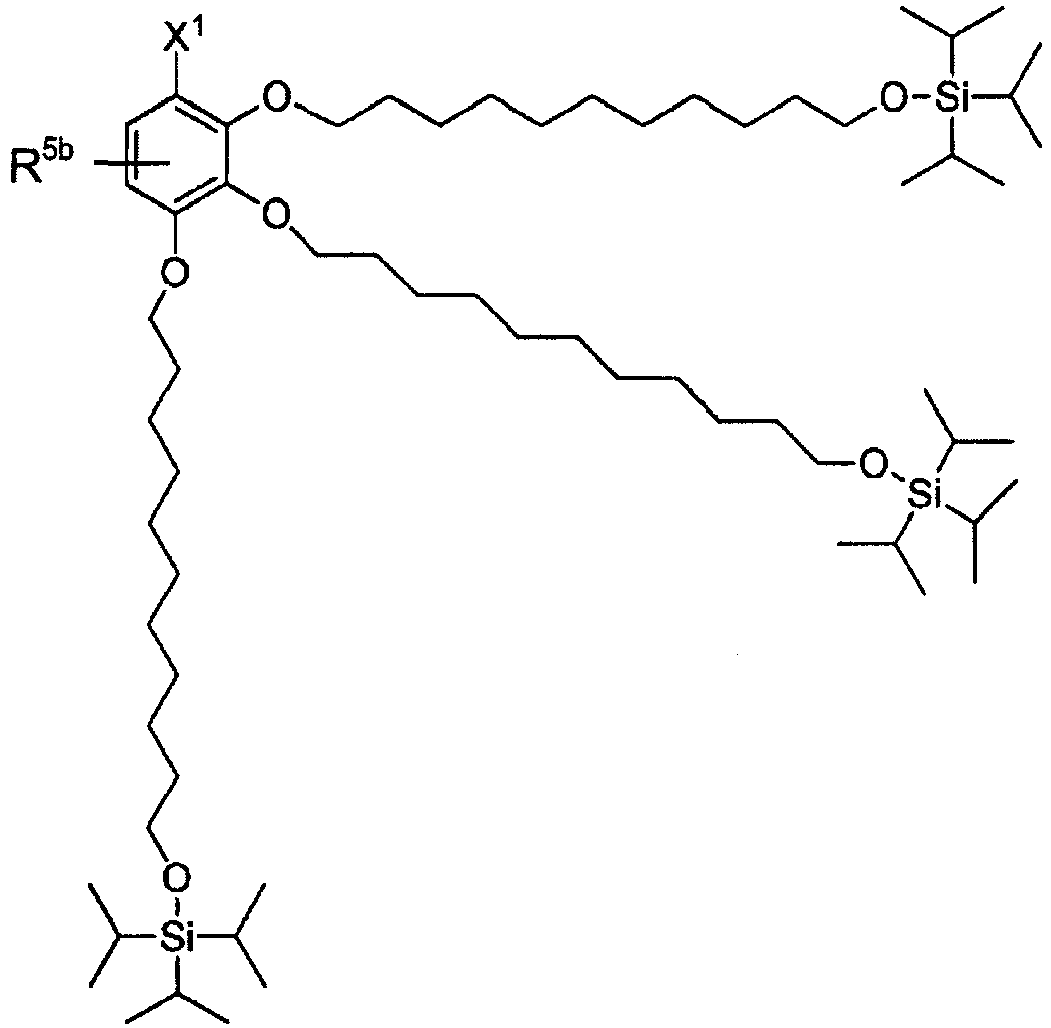
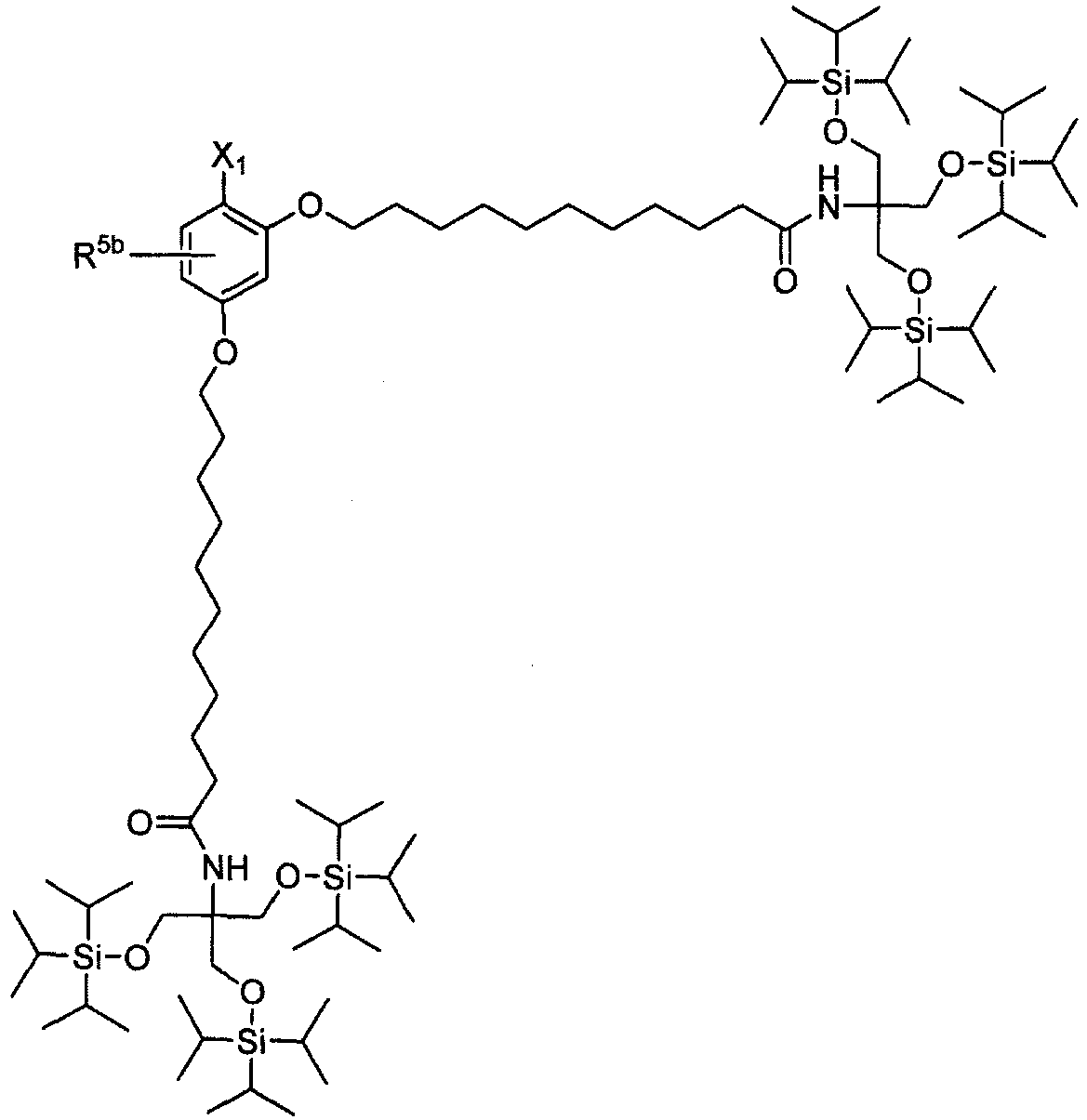
- the structure represented by Formula (1) in which X 1 and R 1 to R 5 are substituted is preferably, for example, the following structure: (where R 5b represents a hydrogen atom, a halogen atom, an alkyl group having 1 to 4 carbon atoms, or an alkoxy group having 1 to 4 carbon atoms; and X 1 , X 2 , R 6 , and A are the same as above).
- Examples of the benzyl compound (1) of the present invention include the following (a) to (h).
- X 1 represents -CH 2 OR 14 (where R 14 represents a hydrogen atom, a halogenocarbonyl group, or an active ester-type protecting group), -CH 2 NHR 15 (where R 15 is the same as above), a halogenomethyl group, a methyl azide group, a formyl group, or an oxime; and R 5b represents a hydrogen atom, a halogen atom, an alkyl group having 1 to 4 carbon atoms, or an alkoxy group having 1 to 4 carbon atoms).
- the benzyl compound (1) of the present invention can be produced, for example, according to the following reaction scheme: (where Hal represents a halogen atom; at least one of R 1a , R 2a , R 3a , R 4a , and R 5a represents a hydroxy group, and the remainders represent a hydrogen atom, an alkyl group having 1 to 4 carbon atoms, or an alkoxy group having 1 to 4 carbon atoms; X 1b represents -CH 2 OR 14 (where R 14 represents a hydrogen atom, a halogenocarbonyl group, or an active ester-type protecting group), -CH 2 NHR 15 (where R 15 represents a hydrogen atom, a linear or branched alkyl group having 1 to 6 carbon atoms, or an aralkyl group), a halogenomethyl group, a methyl azide group, or an oxime; and R 1 to R 6 , X 2 , and A are the same as above).
- silyloxylated alkyl halide (14) and a benzaldehyde (15) are reacted to obtain a silyloxylated benzaldehyde (1a).
- the formyl group is then converted into another substituent, such as a hydroxymethyl group, to obtain a benzyl compound (1b).
- the silyloxylated alkyl halide (14) as a raw material can be produced by, for example, reacting a halogenated alcohol and a silylating agent in the presence of a base.
- a halogenated alcohol and a silylating agent in the presence of a base.
- examples of the halogen atom in Formula (14) include a chlorine atom.
- silylating agent used in the above-mentioned reaction examples include triisopropylsilyl chloride (TIPSCl), triisopropylsilyl bromide, triisopropylsilyl iodide, methanesulfonyl triisopropylsilyl, trifluoromethanesulfonyl isopropylsilyl, p-toluenesulfonyl triisopropylsilyl, and tert-butyldiphenylchlorosilane (TBDPSCl).
- TIPSCl triisopropylsilyl chloride
- TBDPSCl tert-butyldiphenylchlorosilane
- the base examples include organic bases, such as TEA, DIPEA, DBU, diazabicyclononene (DBN), DABCO, imidazole, N-methylimidazole, N,N-dimethylaniline, pyridine, 2,6-lutidine, DMAP, LDA, NaOAc, MeONa, MeOK, lithium hexamethyldisilazide (LHMDS), and sodium bis(trimethylsilyl)amide (NaHMDS); and inorganic bases, such as Na 2 CO 3 , NaHCO 3 , NaH, NaNH 2 , K 2 CO 3 , Cs 2 CO 3 , AgNO 3 , and Pb(NO 3 ) 2 .
- organic bases such as TEA, DIPEA, DBU, diazabicyclononene (DBN), DABCO, imidazole, N-methylimidazole, N,N-dimethylaniline, pyridine, 2,6-lutidine, DMAP, LDA, Na
- the solvent examples include hydrocarbons, such as hexane and heptane; ethers, such as diethyl ether, diisopropyl ether, cyclopentyl methyl ether (CPME), tetrahydrofuran, and dioxane; nitriles, such as acetonitrile; amides, such as dimethylformamide, dimethylacetamide, and hexamethylphosphoramide; sulfoxides, such as dimethyl sulfoxide; lactams, such as N-methylpyrrolidone; halogenated hydrogens, such as chloroform and dichloromethane (DCM); aromatic hydrocarbons, such as toluene and xylene; and solvent mixtures thereof.
- hydrocarbons such as hexane and heptane
- ethers such as diethyl ether, diisopropyl ether, cyclopentyl methyl ether (CPME), tetrahydr
- the reaction may be performed, for example, at 0°C to 100°C for 1 to 24 hours.
- the reaction of the silyloxylated alkyl halide (14) and the benzaldehyde (15) is preferably performed in the presence of a base.
- Examples of the base used in the reaction include organic bases, such as TEA, DIPEA, DBU, DBN, DABCO, imidazole, N-methylimidazole, N,N-dimethylaniline, pyridine, 2,6-lutidine, DMAP, LDA, NaOAc, MeONa, MeOK, lithium hexamethyldisilazide (LHMDS), and sodium bis(trimethylsilyl)amide (NaHMDS); and inorganic bases, such as Na 2 CO 3 , NaHCO 3 , NaH, K 2 CO 3 , Cs 2 CO3, AgNO3, and Pb(NO 3 ) 2 .
- organic bases such as TEA, DIPEA, DBU, DBN, DABCO, imidazole, N-methylimidazole, N,N-dimethylaniline, pyridine, 2,6-lutidine, DMAP, LDA, NaOAc, MeONa, MeOK, lithium hexamethyldisilazide (L
- the solvent examples include hydrocarbons, such as hexane and heptane; ethers, such as diethyl ether, diisopropyl ether, CPME, tetrahydrofuran, and dioxane; nitriles, such as acetonitrile; amides, such as dimethylformamide, dimethylacetamide, and hexamethylphosphoramide; sulfoxides, such as dimethyl sulfoxide; lactams, such as N-methylpyrrolidone; halogenated hydrogens, such as chloroform and dichloromethane (DCM); aromatic hydrocarbons, such as toluene and xylene; and solvent mixtures thereof.
- hydrocarbons such as hexane and heptane
- ethers such as diethyl ether, diisopropyl ether, CPME, tetrahydrofuran, and dioxane
- nitriles such as
- the reaction may be performed, for example, at 40°C to 150°C for 1 to 24 hours.
- the method for converting the formyl group of the compound represented by Formula (1a) into a compound represented by Formula (1b) where X 1b is hydroxymethyl is, for example, a reducing process.
- the reducing process preferably uses a reducing agent.
- Examples of the reducing agent include lithium borohydride, sodium borohydride, lithium aluminum hydride, and aluminum hydride.
- Examples of the solvent include hydrocarbons, such as hexane and heptane; alcohols, such as methanol and ethanol; ethers, such as diethyl ether, diisopropyl ether, CPME, tetrahydrofuran, and dioxane; aromatic hydrocarbons, such as toluene and xylene; and solvent mixtures thereof.
- the reaction may be performed, for example, at 0°C to 90°C for 1 to 24 hours.
- the compound represented by Formula (1b) where X 1b is an aminomethyl group can be obtained by converting the hydroxymethyl group into an azidomethyl group and reducing the azidomethyl group.
- the method for azidation preferably uses diphenylphosphoryl azide.
- Examples of the base include organic bases, such as DBU, DBN, TEA, DIPEA, and DABCO.
- the solvent include hydrocarbons, such as hexane and heptane; ethers, such as diethyl ether, diisopropyl ether, CPME, tetrahydrofuran, and dioxane; aromatic hydrocarbons, such as toluene and xylene; and solvent mixtures thereof.
- the reaction may be performed, for example, at 0°C to 100°C for 1 to 24 hours.
- Examples of the reducing process include a Staudinger reaction of reacting triphenylphosphine in the presence of water and catalytic hydrogenation. Preferred is the Staudinger reaction.
- Examples of the solvent for the Staudinger reaction include hydrocarbons, such as hexane and heptane; ethers, such as diethyl ether, diisopropyl ether, CPME, tetrahydrofuran, and dioxane; aromatic hydrocarbons, such as toluene and xylene; and solvent mixtures thereof.
- the reaction may be performed, for example, at 20°C to 100°C for 1 to 24 hours.
- the compound represented by Formula (1b) where X 1b is a halogenated methyl group can be produced by, for example, reacting a halogenating reagent to a hydroxymethyl group in the presence of a base.
- a halogenating reagent for example, reacting a halogenating reagent to a hydroxymethyl group in the presence of a base.
- the halogen atom of X 1b include a chlorine atom.
- halogenating reagent examples include thionyl chloride, acetyl chloride, acetyl bromide, triphenylphosphine/carbon tetrachloride, and triphenylphosphine/carbon tetrabromide.
- Examples of the base include organic bases, such as pyridine, TEA, DIPEA, DBU, DBN, and DABCO.
- the solvent examples include hydrocarbons, such as hexane and heptane; ethers, such as diethyl ether, diisopropyl ether, CPME, tetrahydrofuran, and dioxane; aromatic hydrocarbons, such as toluene and xylene; and solvent mixtures thereof.
- the reaction may be performed, for example, at 0°C to 100°C for 0.5 to 24 hours.
- the compound represented by Formula (1b) where X 1b is a halogenocarbonyl oxymethyl group can be obtained by chloroformylating a hydroxymethyl group with phosgene or triphosgene in the presence of a base. Preferred is a method of using triphosgene.
- Examples of the base include organic bases, such as pyridine, TEA, DIPEA, 2,6-lutidine, N,N-dimethylaniline, DBU, DBN, and DABCO.
- organic bases such as pyridine, TEA, DIPEA, 2,6-lutidine, N,N-dimethylaniline, DBU, DBN, and DABCO.
- the solvent examples include hydrocarbons, such as hexane and heptane; ethers, such as diethyl ether, diisopropyl ether, CPME, tetrahydrofuran, and dioxane; aromatic hydrocarbons, such as toluene and xylene; halogenated hydrogens, such as chloroform and dichloromethane (DCM); and solvent mixtures thereof.
- hydrocarbons such as hexane and heptane
- ethers such as diethyl ether, diisopropyl ether, CPME, tetrahydrofuran, and dioxane
- aromatic hydrocarbons such as toluene and xylene
- halogenated hydrogens such as chloroform and dichloromethane (DCM)
- solvent mixtures thereof examples include hydrocarbons, such as hexane and heptane; ethers, such as diethyl ether, diisoprop
- the compound represented by Formula (1b) where X 1b is an N-succinimidyl carboxy-substituted oxymethyl group can be obtained by carbonate esterification a hydroxymethyl group with N,N'-disuccinimidyl carbonate or N,N'-disuccinimidyl oxalate in the presence of a base.
- the method preferably uses N,N'-disuccinimidyl carbonate.
- Examples of the base include organic bases, such as TEA, DMAP, pyridine, DIPEA, 2,6-lutidine, N,N-dimethylaniline, DBU, DBN, and DABCO.
- organic bases such as TEA, DMAP, pyridine, DIPEA, 2,6-lutidine, N,N-dimethylaniline, DBU, DBN, and DABCO.
- the solvent examples include hydrocarbons, such as hexane and heptane; ethers, such as diethyl ether, diisopropyl ether, cyclopentyl methyl ether (CPME), tetrahydrofuran, and dioxane; nitriles, such as acetonitrile; amides, such as dimethylformamide, dimethylacetamide, and hexamethylphosphoramide; sulfoxides, such as dimethyl sulfoxide; lactams, such as N-methylpyrrolidone; halogenated hydrogens, such as chloroform and dichloromethane (DCM); aromatic hydrocarbons, such as toluene and xylene; and solvent mixtures thereof.
- the reaction may be performed, for example, at 0°C to 60°C for 1 to 48 hours.
- the compound represented by Formula (1b) where X 1b is -CH 2 NHR 15 can be obtained by, for example, reacting the formyl group in Formula (1a) and amine represented by H 2 N-R 15 or its acid adduct salt under acid catalyst conditions and reducing with a reducing agent.
- Examples of the acid adduct salt of the amine represented by H 2 N-R 15 include a hydrochloride, a sulfate, an acetate, a trifluoroacetate, a methanesulfonate, a trifluoromethanesulfonate, and a p-toluenesulfonate.
- Examples of the acid catalyst include acetic acid, formic acid, hydrochloric acid, sulfuric acid, trifluoroacetic acid, methanesulfonic acid, trifluoromethanesulfonic acid, and p-toluenesulfonic acid.
- Examples of the reducing agent include 2-picoline borane, 5-ethyl-2-methylpyridine borane (PEMB), hydrogenated cyanoborohydride, and hydrogenated triacetoxyborohydride.
- the solvent examples include hydrocarbons, such as hexane and heptane; ethers, such as diethyl ether, diisopropyl ether, cyclopentyl methyl ether (CPME), tetrahydrofuran, and dioxane; nitriles, such as acetonitrile; alcohols, such as methanol, ethanol, and propanol; aromatic hydrocarbons, such as toluene and xylene; and solvent mixtures thereof.
- hydrocarbons such as hexane and heptane
- ethers such as diethyl ether, diisopropyl ether, cyclopentyl methyl ether (CPME), tetrahydrofuran, and dioxane
- nitriles such as acetonitrile
- alcohols such as methanol, ethanol, and propanol
- aromatic hydrocarbons such as toluene and xylene
- the compound represented by Formula (1b) where X 1b is an oxime can be obtained by reacting the formyl group in Formula (1a) and an acid adduct salt of hydroxylamine in the presence of a base.
- Examples of the acid adduct salt of hydroxylamine include a hydrochloride, a sulfate, an acetate, a trifluoroacetate, a methanesulfonate, a trifluoromethanesulfonate, and a p-toluenesulfonate.
- Examples of the base include organic bases, such as TEA, pyridine, DIPEA, N,N-dimethylaniline, DBU, DBN, and DABCO; and inorganic bases, such as sodium hydroxide, sodium bicarbonate, potassium hydroxide, and potassium carbonate.
- organic bases such as TEA, pyridine, DIPEA, N,N-dimethylaniline, DBU, DBN, and DABCO
- inorganic bases such as sodium hydroxide, sodium bicarbonate, potassium hydroxide, and potassium carbonate.
- the solvent examples include hydrocarbons, such as hexane and heptane; ethers, such as diethyl ether, diisopropyl ether, cyclopentyl methyl ether (CPME), tetrahydrofuran, and dioxane; halogenated hydrogens, such as chloroform and dichloromethane; aromatic hydrocarbons, such as toluene and xylene; and solvent mixtures thereof.
- the reaction may be performed, for example, at 0°C to 50°C for 1 to 48 hours.
- the benzyl compound (1) of the present invention can be used as a protecting agent for a functional group, such as a carboxy group, a hydroxy group, an amino group, and a mercapto group.
- a functional group such as a carboxy group, a hydroxy group, an amino group, and a mercapto group.
- the compound in which the carbonyl group is protected by the benzyl compound (1) of the present invention is characterized by tending to be in a liquid state and its high solubility in a solvent. Accordingly, a compound in which a functional group is protected by the benzyl compound (1) of the present invention used as a protecting agent can be readily dissolved in an organic solvent and can be easily separated and purified by a procedure such as liquid-liquid phase separation.
- the protecting group used in the inventive compound can be readily eliminated by, for example, an acid orcatalytic hydrogenation.
- the compound which can be protected by the benzyl compound (1) of the present invention may be any compound having a functional group such as a carboxy group, a hydroxy group, a diol group, and an amino group, and examples thereof include amino acids, peptides, saccharides, proteins, nucleotides, various medicinal compounds and agrochemical compounds, and various polymers and dendrimers.
- the method of synthesizing a peptide using the benzyl compound (1) of the present invention as a protecting agent includes, for example, the following steps (1) to (4).
- the protected peptide obtained in each step and the target peptide can be separated by liquid-liquid separation. Accordingly, the method is particularly industrially advantageous.
- Heptane (8.2 mL) was added to the resulting heptane layer, followed by washing with 1 N hydrochloric acid (8.2 mL) once, a 5% sodium bicarbonate aqueous solution (8.2 mL) once, and water (8.2 mL) once.
- Heptane (8.2 mL) was added to the resulting heptane layer, followed by liquid-liquid extraction with DMF (8.2 mL).
- Heptane (8.2 mL) was added to the resulting heptane layer, followed by liquid-liquid extraction with acetonitrile (8.2 mL).
- TIPS2-CHO (0.49 g, 0.62 mmol) was dissolved in a mixed solution of THF (anhydrous, 4.7 mL) and methanol (0.24 mL). The solution was cooled to 5°C, and sodium borohydride (28 mg, 0.75 mmol) was added thereto, followed by stirring for 1 hour. The reaction was quenched with 1 N hydrochloric acid (0.59 mL), and CPME (12.3 mL) was added thereto, followed by liquid-liquid extraction with 1 N hydrochloric acid (3.7 mL) three times, a 5% sodium bicarbonate aqueous solution (3.7 mL) once, and water (3.7 mL) once. The solvent was distilled.
- TIPS2-OH (0.85 g, 1.07 mmol) was dissolved in CPME (21.4 mL), and diphenylphosphoryl azide (0.69 mL, 3.21 mmol) and DBU (0.48 mL, 3.21 mmol) were added to the solution, followed by stirring at room temperature for 20 hours.
- the reaction solution was diluted with CPME (10.7 mL), followed by liquid-liquid extraction with a 5% sodium bicarbonate aqueous solution (21.4 mL) twice and water (21.4 mL) four times.
- the solvent was distilled, and the residue was dissolved in heptane (21.4 mL), followed by liquid-liquid extraction with DMF (10.7 mL).
- TIPS2-N 3 (0.45 g, 0.55 mmol) was dissolved in toluene (11 mL), and triphenylphosphine (0.43 g, 1.66 mmol) and water (0.20 mL, 11.0 mmol) were added to the solution, followed by stirring at 60°C for 3 hours.
- the solvent was distilled, and the residue was dissolved in heptane (11 mL), followed by liquid-liquid extraction with DMF (6 mL). The liquid-liquid extraction with heptane and DMF was further repeated twice, and heptane (11 mL) was then added to the heptane layer, followed by liquid-liquid extraction with acetonitrile (6 mL).
- TIPS2-OSu indicates the structure in the formula.
- N,N'-Disuccinimidyl carbonate (1.58 g, 6.15 mmol) was dissolved in acetonitrile (1.0 mL). The solution was cooled to 5°C, and a solution prepared by dissolving TIPS2-OH (0.24 g, 0.31 mmol) and TEA (1.1 mL, 7.63 mmol) in dichloromethane (1.0 mL) was dropwise added to the solution. The mixture was stirred at 5°C for 5 minutes and then at room temperature for 4 hours. Dichloromethane (3.0 mL) was added to the reaction solution, followed by filtration. The solvent of the filtrate was distilled. THF (4.0 mL) was added to the resulting residue, and the solvent was distilled.
- TIPS2-Cl indicates the structure in the formula.
- TIPS2-OH (0.42 g, 0.53 mmol) was dissolved in chloroform (8.5 mL), and DMF (8 ⁇ L, 0.11 mmol) and pyridine (95 ⁇ L, 1.18 mmol) were added to the solution. The mixture was cooled to 5°C, and thionyl chloride (78 ⁇ L, 1.07 mmol) was added thereto. The mixture was warmed to room temperature and was stirred for 1 hour. Heptane (25.2 mL) was added to the reaction solution, followed by liquid-liquid extraction with acetonitrile (25.2 mL).
- TIPS3-CHO and TIPS3-OH indicate the respective structures in the formula.
- Heptane (21.7 mL) was added to the resulting heptane layer, followed by liquid-liquid extraction with 1 N hydrochloric acid (21.7 mL) once, a 5% sodium bicarbonate aqueous solution (21.7 mL) once, and water (21.7 mL) once.
- Heptane (21.7 mL) was added to the resulting heptane layer, followed by liquid-liquid extraction with DMF (21.7 mL).
- Heptane (21.7 mL) was added to the resulting heptane layer, followed by liquid-liquid extraction with acetonitrile (21.7 mL).
- the solvent was distilled to obtain TIPS3-CHO (3.97 g, yield: quant.).
- TIPS3-CHO (2.95 g, 2.60 mmol) was dissolved in a mixed solution of THF (anhydrous, 19.8 mL) and methanol (0.99 mL). The solution was cooled to 5°C, and sodium borohydride (0.12 g, 3.12 mmol) was added thereto, followed by stirring for 1 hour. The reaction was quenched with 1 N hydrochloric acid (2.5 mL), and CPME (73.8 mL) was added thereto, followed by liquid-liquid extraction with 1 N hydrochloric acid (22.1 mL) three times, a 5% sodium bicarbonate aqueous solution (22.1 mL) once, and water (22.1 mL) once. The solvent was distilled.
- the mixture obtained in the step (a) was dissolved in DMF (40.7 mL). Imidazole (2.56 g, 37.63 mmol) was added to the solution, and TIPSCl (3.9 mL, 18.25 mmol) was dropwise added thereto. The mixture was then heated to 85°C and was stirred for 1 hour. Ethyl acetate (200 mL) was added to the reaction solution, followed by washing with 1 N hydrochloric acid (100 mL) once, a saturated sodium bicarbonate aqueous solution (100 mL) once, and 20% sodium chloride aqueous solution (100 mL) twice to remove the aqueous phase.
- Heptane (5.1 mL) was added to the resulting heptane layer, followed by liquid-liquid extraction with 1 N hydrochloric acid (5.1 mL) once, a 5% sodium bicarbonate aqueous solution (5.1 mL) once, and water (5.1 mL) once.
- Heptane (5.1 mL) was added to the resulting heptane layer, followed by liquid-liquid extraction with DMF (5.1 mL).
- Heptane (5.1 mL) was added to the resulting heptane layer, followed by liquid-liquid extraction with acetonitrile (5.1 mL).
- TIPS6-CHO (0.44 g, 0.27 mmol) was dissolved in a mixed solution of THF (anhydrous, 2.0 mL) and methanol (0.10 mL). The solution was cooled to 5°C, and sodium borohydride (12 mg, 0.32 mmol) was added thereto, followed by stirring at room temperature for 1 hour. The reaction was quenched with 1 N hydrochloric acid, and CPME (11.0 mL) was added thereto, followed by washing with 1 N hydrochloric acid (3.3 mL) three times, a 5% sodium bicarbonate aqueous solution (3.3 mL) once, and water (3.3 mL) once to remove the aqueous phase.
- TIPS9-CHO indicates the structure in the formula.
- TIPS9-OH indicates the structure in the formula.
- TIPS9-CHO (0.17 g, 0.069 mmol) was dissolved in a mixed solution of THF (anhydrous, 0.53 mL) and methanol (0.026 mL), and sodium borohydride (3.1 mg, 0.083 mmol) was added to the solution, followed by stirring for 1 hour.
- the reaction was quenched with 1 N hydrochloric acid (0.066 mL), and CPME (4.2 mL) was added thereto, followed by washing with 1 N hydrochloric acid (1.3 mL) once, a 5% sodium bicarbonate aqueous solution (1.3 mL) once, and water (1.3 mL) once.
- 1-Bromoundecanol (4.00 g, 15.9 mmol) was dissolved in dichloromethane (15.9 mL), and imidazole (2.39 g, 35.0 mmol) was added to the solution. The mixture was cooled to 5°C, and TBDPSCl (4.47 mL, 17.5 mmol) was dropwise added thereto. The mixture was warmed to room temperature and was stirred for 30 minutes. CPME (63.7 mL) was added to the reaction solution, followed by washing with water (15.9 mL) once, 1 N hydrochloric acid (15.9 mL) once, and water (15.9 mL) twice. The solvent was distilled.
- Heptane (20.4 mL) was added to the resulting heptane layer, followed by liquid-liquid extraction with 1 N hydrochloric acid (20.4 mL) once, a 5% sodium bicarbonate aqueous solution (20.4 mL) once, and water (20.4 mL) once.
- Heptane (20.4 mL) was added to the resulting heptane layer, followed by liquid-liquid extraction with acetonitrile (20.4 mL).
- Heptane (20.4 mL) was added to the resulting heptane layer, followed by liquid-liquid extraction with acetonitrile (20.4 mL).
- TBDPS2-CHO (0.15 g, 0.16 mmol) was dissolved in a mixed solution of THF (anhydrous, 1.2 mL) and methanol (61 ⁇ L), and sodium borohydride (7.2 mg, 0.19 mmol) was added to the solution, followed by stirring for 1 hour.
- the reaction solution was cooled to 5°C, and 1 N hydrochloric acid (0.15 mL) was then added thereto to quench the reaction.
- CPME (3.8 mL) was added to the solution, followed by liquid-liquid extraction with 1 N hydrochloric acid (1.1 mL) three times, a 5% sodium bicarbonate aqueous solution (1.1 mL) once, and water (1.1 mL) once.
- Heptane (14.4 mL) was added to the resulting heptane layer, followed by liquid-liquid extraction with 1 N hydrochloric acid (14.4 mL) once, a 5% sodium bicarbonate aqueous solution (14.4 mL) once, and water (14.4 mL) once.
- Heptane (14.4 mL) was added to the resulting heptane layer, followed by liquid-liquid extraction with acetonitrile (14.4 mL). The liquid-liquid extraction with heptane and acetonitrile was further repeated once, and the heptane layer was concentrated under reduced pressure.
- TIPS2-CHO(C 8 ) (1.04 g, 1.47 mmol) was dissolved in a mixed solution of THF (anhydrous, 11.2 mL) and methanol (0.56 mL), and sodium borohydride (67 mg, 1.76 mmol) was added to the solution, followed by stirring at room temperature for 1 hour. The reaction solution was cooled to 5°C, and 1 N hydrochloric acid (1.40 mL) was then added thereto to quench the reaction.
- Heptane (11.5 mL) was added to the resulting heptane layer, followed by liquid-liquid extraction with 1 N hydrochloric acid (11.5 mL) once, a 5% sodium bicarbonate aqueous solution (11.5 mL) once, and water (11.5 mL) once.
- Heptane (11.5 mL) was added to the resulting heptane layer, followed by liquid-liquid extraction with acetonitrile (11.5 mL). The liquid-liquid extraction with heptane and acetonitrile was further repeated once, and the heptane layer was concentrated under reduced pressure.
- TIPS2-CHO(C 14 ) (0.28 g, 0.32 mmol) was dissolved in a mixed solution of THF (anhydrous, 2.45 mL) and methanol (0.12 mL), and sodium borohydride (15 mg, 0.39 mmol) was added to the solution, followed by stirring at room temperature for 1 hour.
- the reaction solution was cooled to 5°C, and 1 N hydrochloric acid (0.31 mL) was added thereto to quench the reaction.
- CPME 7.0 mL was added to the solution, followed by liquid-liquid extraction with 1 N hydrochloric acid (2.1 mL) three times, a 5% sodium bicarbonate aqueous solution (2.1 mL) once, and water (2.1 mL) once.
- TIPS2-NOH(C 14 ) indicates the structure in the formula.
- TIPS2-CHO(C 14 ) (0.22 g, 0.25 mmol) was dissolved in dichloromethane (1.2 mL), and hydroxylamine hydrochloride (53 mg, 0.76 mmol) was added to the solution. The mixture was cooled to 5°C, and triethylamine (177 ⁇ L, 1.27 mmol) was added thereto. The mixture was warmed to room temperature and stirred for 23 hours. The reaction solution was cooled to 5°C, and the reaction was quenched with 1 N hydrochloric acid (0.51 mL).
- TIPS2-NH(CH 2 ) 2 CH 3 (C 14 ) indicates the structure in the formula.
- TIPS2-CHO(C 14 ) (0.30 g, 0.34 mmol) was dissolved in THF (anhydrous, 0.35 mL).
- Propylamine 40 ⁇ L, 0.48 mmol
- acetic acid 124 ⁇ L, 2.17 mmol
- 2-picoline borane 63 mg, 0.59 mmol
- 1,8-Dibromooctane (5.09 mL, 27.5 mmol) and HO-(CH 2 ) 2 -OTIPS (3.00 g, 13.7 mmol) were dissolved in toluene (18 mL), and sodium hydride (60%, dispersed in liquid paraffin, 1.10 g, 27.5 mmol) was added thereto. The mixture was heated to 80°C and was stirred for 20 hours. The reaction solution was cooled to 5°C, and the reaction was quenched with 1 N hydrochloric acid (27.5 mL).
- TIPS2-CHO(C 8 -O-C 2 ) was obtained by the same method as that for TIPS2-CHO(C 14 ) described above.
- 1 H-NMR 400 MHz, CDCl 3 ) ⁇ 1.04-1.08 (m, 42H), 1.31-1.41 (m, 12H), 1.41-1.52 (m, 4H), 1.52-1.61 (m, 4H), 1.74-1.89 (m, 4H), 3.47 (t, 4H), 3.52 (t, 4H), 3.82 (t, 4H), 3.97-4.06 (m, 4H), 6.41 (d, 1H), 6.50 (dd, 1H), 7.79 (d, 1H), 10.32 (s, 1H) ESIMS MH+ 795.6
- TIPS2-OH(C 8 -O-C 2 ) was obtained by the same method as that for TIPS2-CHO(C 14 ) described above.
- 11-Bromoundecanoic acid (8.00 g, 30.2 mmol) and ethanolamine (2.76 g, 45.3 mmol) were suspended in DMF (201 mL), and DMT-MM ⁇ 1.8H 2 O (18.65 g, 60.3 mmol) and DIPEA (21.0 mL, 120.7 mmol) were added thereto. The mixture was stirred at room temperature for 0.5 hours. Ethyl acetate (1,006 mL) was added to the reaction solution, followed by washing with a 5% sodium bicarbonate aqueous solution (503 mL) once and 20% sodium chloride aqueous solution (503 mL) three times.
- the mixture obtained in the step (a) was dissolved in DMF (215 mL). Imidazole (4.52 g, 66.4 mmol) was added to the solution, and TIPSCl (7.0 mL, 33.2 mmol) was dropwise added to the mixture at room temperature. The mixture was then heated to 85°C and was stirred for 1 hour and 10 minutes. TIPSCl (0.64 mL, 3.02 mmol) was further added to the mixture, followed by stirring at 85°C for 20 minutes.
- TIPS3-CHO(C 10 -CONH-C 2 ) (0.66 g, 0.51 mmol) was dissolved in a mixed solution of THF (anhydrous, 3.85 mL) and methanol (0.19 mL), and sodium borohydride (23 mg, 0.61 mmol) was added to the solution, followed by stirring at room temperature for 1 hour.
- the reaction solution was cooled to 5°C, and 1 N hydrochloric acid (0.48 mL) was added thereto to quench the reaction.
- a mixture containing Br-(CH 2 ) 10 -CONH-CH(CH 2 -OH) 2 was obtained by the same method as that for Br-(CH 2 ) 10 -CONH-(CH 2 ) 2 -OH described above.
- This mixture (10.2 g) containing Br-(CH 2 ) 10 -CONH-CH(CH 2 -OH) 2 was dissolved in DMF (215 mL), and imidazole (9.04 g, 132.7 mmol) was added thereto.
- TIPSCl (14.1 mL, 66.4 mmol) was dropwise added to the mixture at room temperature. The mixture was then heated to 85°C and was stirred for 2 hours and 10 minutes.
- the heptane layer was separated from the filtrate, and heptane (5.7 mL) was added to the layer, followed by liquid-liquid extraction with DMF (5.7 mL). Heptane (5.7 mL) was added to the resulting heptane layer, followed by liquid-liquid extraction with 1 N hydrochloric acid (5.7 mL) once, a 5% sodium bicarbonate aqueous solution (5.7 mL) once, and water (5.7 mL) once. Heptane (5.7 mL) was added to the resulting heptane layer, followed by liquid-liquid extraction with acetonitrile (5.7 mL).
- TIPS6-OH(C 10 -CONH-CH(CH 2 ) 2 ) was obtained by the same method as that for TIPS3-OH(C 10 -CONH-C 2 ).
- TIPS3-CHO(4-OMe) and TIPS3-OH(4-OMe) indicate the respective structures in the formula.
- TIPS3-OH(4-OMe) was obtained by the same method as that for TIPS2-OH(C 8 ).
- 1 H-NMR 400 MHz, CDCl 3 ) ⁇ 1.03-1.10 (m, 63H), 1.24-1.39 (m, 10H), 1.45 (quin., 2H), 1.57 (quin., 2H), 1.80 (quin., 2H), 2.08 (t, 2H), 2.31 (br, 1H), 3.79 (s, 3H), 3.98 (t, 2H), 4.04 (s, 6H), 4.61 (s, 2H), 5.75 (s, 1H), 6.41-6.47 (m, 2H), 7.16 (d, 1H) 13 C-NMR (100 MHz, CDCl 3 ) ⁇ 12.1 (9C), 18.1 (18C), 25.9, 26.3, 29.4-29.7 (6C), 37.9, 55.5, 61.3 (3C), 62.0, 62.2, 68.1, 99.4, 103.9, 122.1, 129
- H-Gly-Gly-Gly-Gly-OH (model peptide), H-Gly-Gly-Gly-O-TIPS2, H-Gly-Gly-Gly-O-TIPS3, and H-Gly-Gly-Gly-O-TIPS6 were synthesized, and the solubility at 25°C of each peptide in cyclopentyl methyl ether (CPME) was measured. As a result, merely 0.032 mM of H-Gly-Gly-Gly-OH was dissolved in CPME when a TIPS-type protecting agent was not combined to the peptide.
- CPME cyclopentyl methyl ether
- H-Gly-Gly-Gly-O-TIPS2, H-Gly-Gly-Gly-O-TIPS3, and H-Gly-Gly-Gly-O-TIPS6 indicate the following structures.
- TIPS2-OH (0.81 g, 1.02 mmol) was dissolved in CPME (16.2 mL).
- DMF 4.1 mL
- Fmoc-Gly-OH (0.91 g, 3.05 mmol
- WSCI ⁇ HCl (0.58 g, 3.05 mmol)
- DMAP 12.4 mg, 0.10 mmol
- H-Gly-O-TIPS2 indicates the following structure.
Landscapes
- Chemical & Material Sciences (AREA)
- Organic Chemistry (AREA)
- Analytical Chemistry (AREA)
- Health & Medical Sciences (AREA)
- Life Sciences & Earth Sciences (AREA)
- Biochemistry (AREA)
- Biophysics (AREA)
- General Health & Medical Sciences (AREA)
- Genetics & Genomics (AREA)
- Medicinal Chemistry (AREA)
- Molecular Biology (AREA)
- Proteomics, Peptides & Aminoacids (AREA)
- Chemical Kinetics & Catalysis (AREA)
- Organic Low-Molecular-Weight Compounds And Preparation Thereof (AREA)
- Peptides Or Proteins (AREA)
Abstract
Description
- The present invention relates to a novel benzyl compound which is useful as a protecting agent for functional groups such as a carboxy group, a hydroxy group, a diol group, an amino group, and a mercapto group.
- In synthesis of peptides or a variety of compounds, the reaction is sometimes required to be performed by protecting the functional groups, such as a carboxy group and an amino group. Such a protecting group is desirably a group which can perform protection by a simple method and can be eliminated under mild conditions. For example, a tert-butoxycarbonyl group (Boc), a benzyloxycarbonyl group (Cbz), and a 9-fluorenylmethyloxycarbonyl group (Fmoc) are known as protecting groups for an amino group; and benzyl esters (Bn) and tert-butyl esters are known as protecting groups for a carboxy group. Recently, it has been reported that a benzyl alcohol compound is useful as a protecting group (Patent Document 1).
- [Patent Document 1]
WO 2012/029794 - However, a compound having a functional group protected by a known protecting group has a disadvantage of being apt to precipitate. In particular, in peptide synthesis, since the compound is insoluble even in an organic solvent, it is often difficult to separate and purify the compound after the reaction. This difficulty in separation and purification is a serious problem in peptide synthesis serially performing condensation reactions.
- An object of the present invention is therefore to provide a protecting group which enhances the solubility of a compound in which a functional group is protected by the protecting group in an organic solvent and thereby facilitates the separation and purification of the protecting group after a reaction with avoiding solidification or insolubilization.
- Accordingly, the present inventors investigated a variety of substituents of benzyl compounds represented by benzyl alcohol, and as a result, found that a compound in which a functional group is protected by a compound including a benzene ring having a trialkylsilyloxy group via an oxyalkylene group is hardly precipitated and is easily separated and purified by a liquid-liquid phase separation procedure and that the latter compound is useful as a protecting agent, and have accomplished the present invention.
- That is, the present invention provides the following aspects [1] to [5]:
-
- [1] A benzyl compound represented by Formula (1):

- where X1 represents -CH2OR14 (where R14 represents a hydrogen atom, a halogenocarbonyl group, or an active ester-type protecting group), -CH2NHR15 (where R15 represents a hydrogen atom, a linear or branched alkyl group having 1 to 6 carbon atoms, or an aralkyl group), a halogenomethyl group, a methyl azide group, a formyl group, or an oxime; and
- at least one of R1, R2, R3, R4, and R5 is a group represented by Formula (2):
-O-R6-X2-A (2)
, and
the remainders each represent a hydrogen atom, a halogen atom, an alkyl group having 1 to 4 carbon atoms, or an alkoxy group having 1 to 4 carbon atoms, wherein R6 represents a linear or branched alkylene group having 1 to 16 carbon atoms; - X2 represents O or CONR16 (where R16 represents a hydrogen atom or an alkyl group having 1 to 4 carbon atoms); and
- A represents Formula (3), (4), (5), (6), (7), (8), (9), (10), (11), (12), or (13)


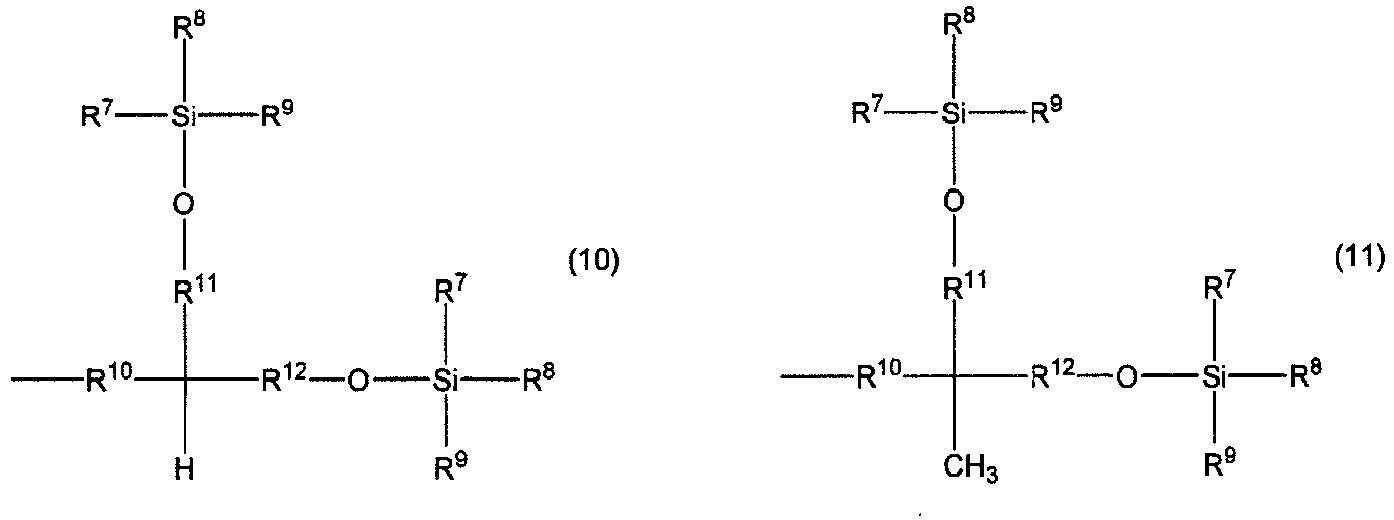

- [2] The benzyl compound according to aspect [1], wherein X1 is -CH2OR14 (where R14 represents a hydrogen atom, a halogenocarbonyl group, or an active ester-type protecting group), -CH2NHR15 (where R15 represents a hydrogen atom, a linear or branched alkyl group having 1 to 6 carbon atoms, or an aralkyl group), or a halogenomethyl group;
- [3] The benzyl compound according to aspect [1] or [2], wherein R6 is a linear or branched alkylene group having 2 to 16 carbon atoms;
- [4] The benzyl compound according to any one of aspects [1] to [3], wherein R6 is a linear or branched alkylene group having 6 to 16 carbon atoms;
- [5] The benzyl compound according to any one of aspects [1] to [4], wherein R10 is a single bond or a methylene group; and R11, R12, and R13 are methylene groups; and
- [6] A protecting agent for a carboxy group, a hydroxy group, a diol group, an amino group, or a mercapto group, the protecting agent comprising the benzyl compound according to any one of aspects [1] to [5].
- A compound in which a functional group is protected by the benzyl compound (1) of the present invention tends to be in a liquid state and has enhanced solubility in a solvent, and is therefore readily separated and purified after the condensation reaction by a procedure such as liquid-liquid phase separation. In addition, the procedure of eliminating the protecting group is also easy.
- If insolubilization or solidification of a raw material or an intermediate is an obstacle in the processes of producing various chemicals, such as medicines and agrochemicals, such a problem can be solved by combining the benzyl compound (1) of the present invention to the raw material or the intermediate to enhance the solubility thereof.
- [
Figure 1] Figure 1 shows the results of measurement of solubility in cyclopentyl methyl ether (CPME). - The benzyl compound of the present invention represented by Formula (1) is characterized in that at least one of R1 to R5 has a structure represented by Formula (2). By having such a structure, the compound in which a functional group is protected by the benzyl compound (1) of the present invention tends to be in a liquid state, and the solubility thereof in a solvent is significantly enhanced.
- In Formula (1), X1 represents -CH2OR14 (where R14 represents a hydrogen atom, a halogenocarbonyl group, or an active ester-type protecting group), -CH2NHR15 (where R15 represents a hydrogen atom, a linear or branched alkyl group having 1 to 6 carbon atoms, or an aralkyl group), a halogenomethyl group, a methyl azide group, a formyl group, or an oxime.
- Herein, examples of the halogen atom include a fluorine atom, a bromine atom, a chlorine atom, and an iodine atom.
- Examples of the active ester-type protecting group include an active ester-type carbonyl group and an active ester-type sulfonyl group. Examples of the active ester-type carbonyl group include carbonyloxy succinimide, an alkoxycarbonyl group, an aryloxycarbonyl group, and an aralkyloxycarbonyl group, and more preferred examples include carbonyloxy succinimide.
- Examples of the active ester-type sulfonyl group include an alkylsulfonyl group and an arylsulfonyl group, and more preferred examples include a C1-C6 alkylsulfonyl group and a p-toluenesulfonyl group.
- Examples of the linear or branched alkyl group having 1 to 6 carbon atoms represented by R15 include a methyl group, an ethyl group, and an n-propyl group. Examples of the aralkyl group include a phenyl C1-4 alkyl group, such as a benzyl group.
- X1 is preferably -CH2OR14 (where R14 is the same as the above) or -CH2NHR15 (where R15 is the same as above) and is more preferably a hydroxymethyl group or an aminomethyl group.
- In the benzyl compound of the present invention, at least one of R1 to R5 is a group represented by Formula (2). Preferably one to four, more preferably one to three of R1 to R5 is a group represented by Formula (2). The remainders are each a hydrogen atom, a halogen atom, an alkyl group having 1 to 4 carbon atoms, or an alkoxy group having 1 to 4 carbon atoms.
- Herein, examples of the halogen atom as the remainder represented by R1 to R5 include a fluorine atom, a chlorine atom, and a bromine atom. Among these atoms, a fluorine atom and a chlorine atom are preferred. Examples of the alkoxy group having 1 to 4 carbon atoms as the remainder include a methoxy group, an ethoxy group, an n-propyloxy group, an isopropyloxy group, and an n-butyloxy group. Among these groups, a methoxy group is preferred. Examples of the alkyl group having 1 to 4 carbon atoms include a methyl group, an ethyl group, an n-propyl group, an isopropyl group, and an n-butyl group. Among these groups, a methyl group is preferred.
- R6 represents a linear or branched alkylene group having 1 to 16 carbon atoms. The number of carbon atoms of the alkylene group is preferably 2 or more, more preferably 6 or more, and most preferably 8 or more and preferably 16 or less, more preferably 14 or less, and most preferably 12 or less, from the viewpoint of improving the solubility of the compound combined to the benzyl compound (1) of the present invention in a solvent.
- The alkylene group is preferably a linear or branched alkylene group having 2 to 16 carbon atoms, more preferably a linear or branched alkylene group having 6 to 16 carbon atoms, more preferably a linear or branched alkylene group having 8 to 14 carbon atoms, and most preferably a linear or branched alkylene group having 8 to 12 carbon atoms. Examples of the alkylene group include a methylene group, an ethylene group, a trimethylene group, a tetramethylene group, a pentamethylene group, a hexamethylene group, a heptamethylene group, an octamethylene group, a nanomethylene group, a decamethylene group, an undecamethylene group, a dodecamethylene group, and a tetradecamethylene group.
- X2 represents O or CONR16. R16 represents a hydrogen atom or an alkyl group having 1 to 4 carbon atoms and is preferably a hydrogen atom.
- A is a group represented by Formula (3), (4), (5), (6), (7), (8), (9), (10), (11), (12), or (13), where R7, R8, and R9 are the same or different and each represent a linear or branched alkyl group having 1 to 6 carbon atoms or an optionally substituted aryl group. Herein, examples of the linear or branched alkyl group having 1 to 6 carbon atoms include a methyl group, an ethyl group, an n-propyl group, an isopropyl group, an n-butyl group, an isobutyl group, a sec-butyl group, a tert-butyl group, an n-pentyl group, and an n-hexyl group. Among these groups, an alkyl group having 1 to 4 carbon atoms is more preferred, and a methyl group, a tert-butyl group, and an isopropyl group are further preferred.
- Examples of the optionally substituted aryl group include an aryl group having 6 to 10 carbon atoms, specifically, a phenyl group or naphthyl group optionally substituted with an alkyl group having 1 to 3 carbon atoms. In particular, a phenyl group is preferred.
- R10 represents a single bond or a linear or branched alkylene group having 1 to 3 carbon atoms. Examples of the linear or branched alkylene group having 1 to 3 carbon atoms include a methylene group, an ethylene group, a trimethylene group, and a propylene group. Among these alkylene groups, a methylene group is particularly preferred.
- R11, R12, and R13 each represent a linear or branched alkylene group having 1 to 3 carbon atoms. Examples of the linear or branched alkylene group having 1 to 3 carbon atoms include a methylene group, an ethylene group, a trimethylene group, and a propylene group, and a methylene group is particularly preferred.
- In a more preferred compound represented by Formula (1), X1 is -CH2OR14 (where R14 is the same as above),-CH2NHR15 (where R15 is the same as above), or a halogenomethyl group; one to three of R1, R2, R3, R4, and R5 are the group represented by Formula (2), and the remainders are each a hydrogen atom, an alkyl group having 1 to 4 carbon atoms, or an alkoxy group having 1 to 4 carbon atoms; R6 is a linear or branched alkylene group having 2 to 16 carbon atoms (more preferably a linear or branched alkylene group having 6 to 16 carbon atoms, and most preferably a linear or branched alkylene group having 8 to 14 carbon atoms); X2 is O or CONH; R10 is a single bond or a methylene group; and R11, R12, and R13 are methylene groups.
- The structure represented by Formula (1) in which X1 and R1 to R5 are substituted is preferably, for example, the following structure:


- Examples of the benzyl compound (1) of the present invention include the following (a) to (h).
-

-
-

-

-
-

-

-

- The benzyl compound (1) of the present invention can be produced, for example, according to the following reaction scheme:

- That is, silyloxylated alkyl halide (14) and a benzaldehyde (15) are reacted to obtain a silyloxylated benzaldehyde (1a). The formyl group is then converted into another substituent, such as a hydroxymethyl group, to obtain a benzyl compound (1b).
- The silyloxylated alkyl halide (14) as a raw material can be produced by, for example, reacting a halogenated alcohol and a silylating agent in the presence of a base. Examples of the halogen atom in Formula (14) include a chlorine atom.
- Examples of the silylating agent used in the above-mentioned reaction include triisopropylsilyl chloride (TIPSCl), triisopropylsilyl bromide, triisopropylsilyl iodide, methanesulfonyl triisopropylsilyl, trifluoromethanesulfonyl isopropylsilyl, p-toluenesulfonyl triisopropylsilyl, and tert-butyldiphenylchlorosilane (TBDPSCl).
- Examples of the base include organic bases, such as TEA, DIPEA, DBU, diazabicyclononene (DBN), DABCO, imidazole, N-methylimidazole, N,N-dimethylaniline, pyridine, 2,6-lutidine, DMAP, LDA, NaOAc, MeONa, MeOK, lithium hexamethyldisilazide (LHMDS), and sodium bis(trimethylsilyl)amide (NaHMDS); and inorganic bases, such as Na2CO3, NaHCO3, NaH, NaNH2, K2CO3, Cs2CO3, AgNO3, and Pb(NO3)2.
- Examples of the solvent include hydrocarbons, such as hexane and heptane; ethers, such as diethyl ether, diisopropyl ether, cyclopentyl methyl ether (CPME), tetrahydrofuran, and dioxane; nitriles, such as acetonitrile; amides, such as dimethylformamide, dimethylacetamide, and hexamethylphosphoramide; sulfoxides, such as dimethyl sulfoxide; lactams, such as N-methylpyrrolidone; halogenated hydrogens, such as chloroform and dichloromethane (DCM); aromatic hydrocarbons, such as toluene and xylene; and solvent mixtures thereof.
- The reaction may be performed, for example, at 0°C to 100°C for 1 to 24 hours.
- The reaction of the silyloxylated alkyl halide (14) and the benzaldehyde (15) is preferably performed in the presence of a base.
- Examples of the base used in the reaction include organic bases, such as TEA, DIPEA, DBU, DBN, DABCO, imidazole, N-methylimidazole, N,N-dimethylaniline, pyridine, 2,6-lutidine, DMAP, LDA, NaOAc, MeONa, MeOK, lithium hexamethyldisilazide (LHMDS), and sodium bis(trimethylsilyl)amide (NaHMDS); and inorganic bases, such as Na2CO3, NaHCO3, NaH, K2CO3, Cs2CO3, AgNO3, and Pb(NO3)2.
- Examples of the solvent include hydrocarbons, such as hexane and heptane; ethers, such as diethyl ether, diisopropyl ether, CPME, tetrahydrofuran, and dioxane; nitriles, such as acetonitrile; amides, such as dimethylformamide, dimethylacetamide, and hexamethylphosphoramide; sulfoxides, such as dimethyl sulfoxide; lactams, such as N-methylpyrrolidone; halogenated hydrogens, such as chloroform and dichloromethane (DCM); aromatic hydrocarbons, such as toluene and xylene; and solvent mixtures thereof.
- The reaction may be performed, for example, at 40°C to 150°C for 1 to 24 hours.
- The method for converting the formyl group of the compound represented by Formula (1a) into a compound represented by Formula (1b) where X1b is hydroxymethyl is, for example, a reducing process. The reducing process preferably uses a reducing agent.
- Examples of the reducing agent include lithium borohydride, sodium borohydride, lithium aluminum hydride, and aluminum hydride. Examples of the solvent include hydrocarbons, such as hexane and heptane; alcohols, such as methanol and ethanol; ethers, such as diethyl ether, diisopropyl ether, CPME, tetrahydrofuran, and dioxane; aromatic hydrocarbons, such as toluene and xylene; and solvent mixtures thereof. The reaction may be performed, for example, at 0°C to 90°C for 1 to 24 hours.
- The compound represented by Formula (1b) where X1b is an aminomethyl group can be obtained by converting the hydroxymethyl group into an azidomethyl group and reducing the azidomethyl group. The method for azidation preferably uses diphenylphosphoryl azide.
- Examples of the base include organic bases, such as DBU, DBN, TEA, DIPEA, and DABCO. Examples of the solvent include hydrocarbons, such as hexane and heptane; ethers, such as diethyl ether, diisopropyl ether, CPME, tetrahydrofuran, and dioxane; aromatic hydrocarbons, such as toluene and xylene; and solvent mixtures thereof. The reaction may be performed, for example, at 0°C to 100°C for 1 to 24 hours.
- Examples of the reducing process include a Staudinger reaction of reacting triphenylphosphine in the presence of water and catalytic hydrogenation. Preferred is the Staudinger reaction.
- Examples of the solvent for the Staudinger reaction include hydrocarbons, such as hexane and heptane; ethers, such as diethyl ether, diisopropyl ether, CPME, tetrahydrofuran, and dioxane; aromatic hydrocarbons, such as toluene and xylene; and solvent mixtures thereof. The reaction may be performed, for example, at 20°C to 100°C for 1 to 24 hours.
- The compound represented by Formula (1b) where X1b is a halogenated methyl group can be produced by, for example, reacting a halogenating reagent to a hydroxymethyl group in the presence of a base. Examples of the halogen atom of X1b include a chlorine atom.
- Examples of the halogenating reagent include thionyl chloride, acetyl chloride, acetyl bromide, triphenylphosphine/carbon tetrachloride, and triphenylphosphine/carbon tetrabromide.
- Examples of the base include organic bases, such as pyridine, TEA, DIPEA, DBU, DBN, and DABCO.
- Examples of the solvent include hydrocarbons, such as hexane and heptane; ethers, such as diethyl ether, diisopropyl ether, CPME, tetrahydrofuran, and dioxane; aromatic hydrocarbons, such as toluene and xylene; and solvent mixtures thereof. The reaction may be performed, for example, at 0°C to 100°C for 0.5 to 24 hours.
- The compound represented by Formula (1b) where X1b is a halogenocarbonyl oxymethyl group can be obtained by chloroformylating a hydroxymethyl group with phosgene or triphosgene in the presence of a base. Preferred is a method of using triphosgene.
- Examples of the base include organic bases, such as pyridine, TEA, DIPEA, 2,6-lutidine, N,N-dimethylaniline, DBU, DBN, and DABCO.
- Examples of the solvent include hydrocarbons, such as hexane and heptane; ethers, such as diethyl ether, diisopropyl ether, CPME, tetrahydrofuran, and dioxane; aromatic hydrocarbons, such as toluene and xylene; halogenated hydrogens, such as chloroform and dichloromethane (DCM); and solvent mixtures thereof. The reaction may be performed, for example, at -10°C to 50°C for 1 to 48 hours.
- The compound represented by Formula (1b) where X1b is an N-succinimidyl carboxy-substituted oxymethyl group can be obtained by carbonate esterification a hydroxymethyl group with N,N'-disuccinimidyl carbonate or N,N'-disuccinimidyl oxalate in the presence of a base. The method preferably uses N,N'-disuccinimidyl carbonate.
- Examples of the base include organic bases, such as TEA, DMAP, pyridine, DIPEA, 2,6-lutidine, N,N-dimethylaniline, DBU, DBN, and DABCO.
- Examples of the solvent include hydrocarbons, such as hexane and heptane; ethers, such as diethyl ether, diisopropyl ether, cyclopentyl methyl ether (CPME), tetrahydrofuran, and dioxane; nitriles, such as acetonitrile; amides, such as dimethylformamide, dimethylacetamide, and hexamethylphosphoramide; sulfoxides, such as dimethyl sulfoxide; lactams, such as N-methylpyrrolidone; halogenated hydrogens, such as chloroform and dichloromethane (DCM); aromatic hydrocarbons, such as toluene and xylene; and solvent mixtures thereof. The reaction may be performed, for example, at 0°C to 60°C for 1 to 48 hours.
- The compound represented by Formula (1b) where X1b is -CH2NHR15 (where R15 is the same as above) can be obtained by, for example, reacting the formyl group in Formula (1a) and amine represented by H2N-R15 or its acid adduct salt under acid catalyst conditions and reducing with a reducing agent.
- Examples of the acid adduct salt of the amine represented by H2N-R15 include a hydrochloride, a sulfate, an acetate, a trifluoroacetate, a methanesulfonate, a trifluoromethanesulfonate, and a p-toluenesulfonate.
- Examples of the acid catalyst include acetic acid, formic acid, hydrochloric acid, sulfuric acid, trifluoroacetic acid, methanesulfonic acid, trifluoromethanesulfonic acid, and p-toluenesulfonic acid.
- Examples of the reducing agent include 2-picoline borane, 5-ethyl-2-methylpyridine borane (PEMB), hydrogenated cyanoborohydride, and hydrogenated triacetoxyborohydride.
- Examples of the solvent include hydrocarbons, such as hexane and heptane; ethers, such as diethyl ether, diisopropyl ether, cyclopentyl methyl ether (CPME), tetrahydrofuran, and dioxane; nitriles, such as acetonitrile; alcohols, such as methanol, ethanol, and propanol; aromatic hydrocarbons, such as toluene and xylene; and solvent mixtures thereof. The reaction may be performed, for example, at 0°C to 50°C for 0.5 to 24 hours.
- The compound represented by Formula (1b) where X1b is an oxime can be obtained by reacting the formyl group in Formula (1a) and an acid adduct salt of hydroxylamine in the presence of a base.
- Examples of the acid adduct salt of hydroxylamine include a hydrochloride, a sulfate, an acetate, a trifluoroacetate, a methanesulfonate, a trifluoromethanesulfonate, and a p-toluenesulfonate.
- Examples of the base include organic bases, such as TEA, pyridine, DIPEA, N,N-dimethylaniline, DBU, DBN, and DABCO; and inorganic bases, such as sodium hydroxide, sodium bicarbonate, potassium hydroxide, and potassium carbonate.
- Examples of the solvent include hydrocarbons, such as hexane and heptane; ethers, such as diethyl ether, diisopropyl ether, cyclopentyl methyl ether (CPME), tetrahydrofuran, and dioxane; halogenated hydrogens, such as chloroform and dichloromethane; aromatic hydrocarbons, such as toluene and xylene; and solvent mixtures thereof. The reaction may be performed, for example, at 0°C to 50°C for 1 to 48 hours.
- The benzyl compound (1) of the present invention can be used as a protecting agent for a functional group, such as a carboxy group, a hydroxy group, an amino group, and a mercapto group. The compound in which the carbonyl group is protected by the benzyl compound (1) of the present invention is characterized by tending to be in a liquid state and its high solubility in a solvent. Accordingly, a compound in which a functional group is protected by the benzyl compound (1) of the present invention used as a protecting agent can be readily dissolved in an organic solvent and can be easily separated and purified by a procedure such as liquid-liquid phase separation. The protecting group used in the inventive compound can be readily eliminated by, for example, an acid orcatalytic hydrogenation.
- The compound which can be protected by the benzyl compound (1) of the present invention may be any compound having a functional group such as a carboxy group, a hydroxy group, a diol group, and an amino group, and examples thereof include amino acids, peptides, saccharides, proteins, nucleotides, various medicinal compounds and agrochemical compounds, and various polymers and dendrimers.
- The method of synthesizing a peptide using the benzyl compound (1) of the present invention as a protecting agent includes, for example, the following steps (1) to (4). In this peptide synthesizing method, the protected peptide obtained in each step and the target peptide can be separated by liquid-liquid separation. Accordingly, the method is particularly industrially advantageous.
- (1) The benzyl compound (1) of the present invention is condensed with the C-terminal carboxy group of an N-protected amino acid or N-protected peptide in a soluble solvent to obtain an N-protected C-protected amino acid or N-protected C-protected peptide in which the C-terminal is protected by the benzyl compound (1) of the present invention.
- (2) The protecting group on the N-terminal of the resulting N-protected C-protected amino acid or N-protected C-protected peptide is removed to obtain a C-protected amino acid or C-protected peptide.
- (3) An N-protected amino acid or N-protected peptide is condensed with the N-terminal of the resulting C-protected amino acid or C-protected peptide to obtain an N-protected C-protected peptide.
- (4) The protecting groups on the N-terminal and the protecting group on the C-terminal of the resulting N-protected C-protected peptide are removed to obtain the target peptide.
- The present invention will now be described in detail by Examples, but the present invention is not limited thereto.
-

- 1-Bromoundecanol (0.90 g, 3.58 mmol) was dissolved in dichloromethane (12.8 mL), and imidazole (0.61 g, 8.96 mmol) was added thereto. The mixture was cooled to 5°C, and TIPSCl (0.91 mL, 4.30 mmol) was dropwise added thereto. After 5 minutes, the mixture was warmed to room temperature and was stirred for 2 hours. CPME (51.2 mL) was added to the reaction solution, followed by washing with water (12.8 mL) once, 1 N hydrochloric acid (12.8 mL) once, and water (12.8 mL) three times. The solvent was distilled. The residue was dissolved in heptane (51.2 mL), followed by liquid-liquid extraction with acetonitrile (25.6 mL). Heptane (12.8 mL) was added to the resulting heptane layer, followed by liquid-liquid extraction with acetonitrile (25.6 mL). The liquid-liquid extraction with heptane and acetonitrile was further repeated once, and the solvent was then distilled to obtain Br-(CH2)11-O-TIPS (1.45 g, yield: 99.3%).
1H-NMR (400 MHz, CDCl3) δ 1.03-1.20 (m, 21H), 1.24-1.49 (m, 14H), 1.54 (quin., 2H), 1.85 (quin., 2H), 3.41 (t, 2H), 3.66 (t, 2H)
ESIMS MH+ 407.1 - Br-(CH2)11-O-TIPS (1.20 g, 2.95 mmol), 2,4-dihydroxybenzaldehyde (0.17 g, 1.23 mmol), and potassium carbonate (0.612 g, 4.43 mmol) were suspended in DMF (8.2 mL), and the suspension was heated to 85°C and was stirred for 2 hours. The reaction solution was filtered, and the residue was washed with heptane (17.2 mL). The heptane layer was separated from the filtrate, and heptane (8.2 mL) was added to the layer, followed by liquid-liquid extraction with DMF (8.2 mL). The liquid-liquid extraction with heptane and DMF was further repeated once. Heptane (8.2 mL) was added to the resulting heptane layer, followed by washing with 1 N hydrochloric acid (8.2 mL) once, a 5% sodium bicarbonate aqueous solution (8.2 mL) once, and water (8.2 mL) once. Heptane (8.2 mL) was added to the resulting heptane layer, followed by liquid-liquid extraction with DMF (8.2 mL). Heptane (8.2 mL) was added to the resulting heptane layer, followed by liquid-liquid extraction with acetonitrile (8.2 mL). The solvent was distilled, and the resulting residue was purified by silica gel column chromatography (hexane:ethyl acetate = 100:1) to obtain TIPS2-CHO (0.82 g, 84.2%).
1H-NMR (400 MHz, CDCl3) δ 1.03-1.06 (m, 42H), 1.20-1.39
(m, 28H), 1.40-1.56 (m, 4H), 1.73-1.86 (m, 4H), 3.64-3.68 (m, 4H), 3.96-4.04 (m, 4H), 6.41 (d, 1H), 6.48-6.52 (m, 1H), 7.79 (d, 1H), 10.33 (s, 1H)
13C-NMR (100 MHz, CDCl3) δ 12.2 (6C), 18.2 (12C), 26.0 (2C), 26.1, 26.2, 29.2-29.8 (12C), 33.2 (2C) 63.7 (2C), 68.6, 68.7, 99.1, 106.3, 119.1, 130.4, 163.5, 165.9, 188.6
ESIMS MH+ 791.6 - TIPS2-CHO (0.49 g, 0.62 mmol) was dissolved in a mixed solution of THF (anhydrous, 4.7 mL) and methanol (0.24 mL). The solution was cooled to 5°C, and sodium borohydride (28 mg, 0.75 mmol) was added thereto, followed by stirring for 1 hour. The reaction was quenched with 1 N hydrochloric acid (0.59 mL), and CPME (12.3 mL) was added thereto, followed by liquid-liquid extraction with 1 N hydrochloric acid (3.7 mL) three times, a 5% sodium bicarbonate aqueous solution (3.7 mL) once, and water (3.7 mL) once. The solvent was distilled. The resulting residue was dissolved in heptane (12.3 mL), followed by liquid-liquid extraction with DMF (6.2 mL). Heptane (6.2 mL) was added to the resulting heptane layer, followed by liquid-liquid extraction with acetonitrile (6.2 mL). The liquid-liquid extraction with heptane and acetonitrile was further repeated once, and the solvent was then distilled to obtain TIPS2-OH (0.44 g, yield: 89.6%) .
1H-NMR (400 MHz, CDCl3) δ 1.04-1.07 (m, 42H), 1.20-1.39
(m, 28H), 1.40-1.57 (m, 4H), 1.71-1.85 (m, 4H), 2.24 (t, 1H), 3.64-3.69 (m, 4H), 3.89-4.00 (m, 4H), 4.61 (d, 2H), 6.39-6.44 (m, 1H), 6.45 (d, 1H), 7.13 (d, 1H)
13C-NMR (100 MHz, CDCl3) δ 12.2 (6C), 18.2 (12C), 26.0 (2C), 26.2, 26.3, 29.4-29.8 (12C), 33.2 (2C), 62.2, 63.7 (2C), 68.2, 68.3, 100.0, 104.6, 121.9, 129.7, 158.3, 160.3
ESIMS MNa+ 815.6 - TIPS2-OH (0.85 g, 1.07 mmol) was dissolved in CPME (21.4 mL), and diphenylphosphoryl azide (0.69 mL, 3.21 mmol) and DBU (0.48 mL, 3.21 mmol) were added to the solution, followed by stirring at room temperature for 20 hours. The reaction solution was diluted with CPME (10.7 mL), followed by liquid-liquid extraction with a 5% sodium bicarbonate aqueous solution (21.4 mL) twice and water (21.4 mL) four times. The solvent was distilled, and the residue was dissolved in heptane (21.4 mL), followed by liquid-liquid extraction with DMF (10.7 mL). The liquid-liquid extraction with heptane and DMF was further repeated three times, and heptane (10.7 mL) was added to the heptane layer, followed by liquid-liquid extraction with acetonitrile (10.7 mL). The liquid-liquid extraction with heptane and acetonitrile was further repeated twice, and the solvent was then distilled to obtain TIPS2-N3 (0.61 g, yield: 70.0%). 1H-NMR (400 MHz, CDCl3) δ 1.04-1.07 (m, 42H), 1.19-1.39 (m, 28H), 1.40-1.57 (m, 4H), 1.73-1.86 (m, 4H), 3.64-3.69 (m, 4H), 3.90-3.99 (m, 4H), 4.28 (s, 2H), 6.40-6.45 (m, 1H), 6.46 (d, 1H), 7.12 (d, 1H)
13C-NMR (100 MHz, CDCl3) δ 12.2 (6C), 18.2 (12C), 26.0 (2C), 26.2 (2C), 29.3-29.8 (12C), 33.2 (2C), 50.1, 63.7 (2C), 68.3 (2C), 99.9, 104.7, 116.4, 131.1, 158.4, 160.9
ESIMS MNa+ 840.8 - TIPS2-N3 (0.45 g, 0.55 mmol) was dissolved in toluene (11 mL), and triphenylphosphine (0.43 g, 1.66 mmol) and water (0.20 mL, 11.0 mmol) were added to the solution, followed by stirring at 60°C for 3 hours. The solvent was distilled, and the residue was dissolved in heptane (11 mL), followed by liquid-liquid extraction with DMF (6 mL). The liquid-liquid extraction with heptane and DMF was further repeated twice, and heptane (11 mL) was then added to the heptane layer, followed by liquid-liquid extraction with acetonitrile (6 mL). The liquid-liquid extraction with heptane and acetonitrile was further repeated twice, and the solvent was then distilled to obtain TIPS2-NH2 (0.39 g, yield: 89.5%). 1H-NMR (400 MHz, CDCl3) δ 1.04-1.07 (m, 42H), 1.20-1.39 (m, 28H), 1.40-1.58 (m, 4H), 1.72-1.84 (m, 4H), 2.14 (s, 2H), 3.64-3.69 (m, 4H), 3.77 (s, 2H), 3.90-3.98 (m, 4H), 6.38-6.41 (m, 1H), 6.44 (d, 1H), 7.08 (d, 1H)
13C-NMR (100 MHz, CDCl3) δ 12.2 (6C), 18.2 (12C), 26.0 (2C), 26.2, 26.4, 29.4-29.8 (12C), 33.2 (2C), 42.4, 63.7 (2C), 68.0, 68.3, 100.0, 104.5, 123.6, 129.3, 158.1, 159.8
ESIMS MNa+ 814.6 - Triphosgene (0.187 g, 0.63 mmol) was dissolved in dichloromethane (0.38 mL). The solution was cooled to - 5°C, and a solution prepared by dissolving pyridine (0.15 mL, 1.89 mmol) and TIPS2-OH (1.00 g, 1.26 mmol) in dichloromethane (0.25 mL) was dropwise added to the solution. The mixture was stirred at -5°C for 2 hours and then at room temperature for 17 hours. The solvent was distilled, and the residue was dissolved in hexane (5 mL), followed by filtration. The solvent of the filtrate was distilled to obtain TIPS2-OCOCl (0.95 g, yield: 88.0%).
ESIMS MH+ 855.8 -

- N,N'-Disuccinimidyl carbonate (1.58 g, 6.15 mmol) was dissolved in acetonitrile (1.0 mL). The solution was cooled to 5°C, and a solution prepared by dissolving TIPS2-OH (0.24 g, 0.31 mmol) and TEA (1.1 mL, 7.63 mmol) in dichloromethane (1.0 mL) was dropwise added to the solution. The mixture was stirred at 5°C for 5 minutes and then at room temperature for 4 hours. Dichloromethane (3.0 mL) was added to the reaction solution, followed by filtration. The solvent of the filtrate was distilled. THF (4.0 mL) was added to the resulting residue, and the solvent was distilled. The resulting residue was dissolved in heptane (8.0 mL), followed by liquid-liquid extraction with acetonitrile (8.0 mL). Heptane (4.0 mL) was added to the heptane layer, followed by liquid-liquid extraction with acetonitrile (8 mL) four times. Heptane (1.0 mL) was added to the resulting heptane layer, followed by liquid-liquid extraction with acetonitrile (8 mL). The solvent was then distilled to obtain TIPS2-OSu (34 mg, yield: 11.9%) .
1H-NMR (400 MHz, CDCl3) δ 1.04-1.07 (m, 42H), 1.20-1.39 (m, 28H), 1.40-1.57 (m, 4H), 1.72-1.84 (m, 4H), 2.60 (s, 4H), 3.64-3.69 (m, 4H), 3.91-3.98 (m, 4H), 5.11 (s, 2H), 6.40-6.46 (m, 2H), 7.28 (d, 1H)
13C-NMR (100 MHz, CDCl3) δ 12.2 (6C), 18.2 (12C), 25.6 (2C), 26.0 (2C), 26.1, 26.2, 29.3-29.8 (12C), 33.2 (2C), 63.7 (2C), 68.2, 68.8, 73.3, 100.0, 105.1, 114.8, 133.3, 152.6, 159.5, 161.8, 171.3 -

- TIPS2-OH (0.42 g, 0.53 mmol) was dissolved in chloroform (8.5 mL), and DMF (8 µL, 0.11 mmol) and pyridine (95 µL, 1.18 mmol) were added to the solution. The mixture was cooled to 5°C, and thionyl chloride (78 µL, 1.07 mmol) was added thereto. The mixture was warmed to room temperature and was stirred for 1 hour. Heptane (25.2 mL) was added to the reaction solution, followed by liquid-liquid extraction with acetonitrile (25.2 mL). Heptane (4.2 mL) and CPME (1.3 mL) were added to the resulting heptane layer, followed by liquid-liquid extraction with acetonitrile (25.2 mL). Heptane (4.2 mL) was added to the resulting heptane layer, followed by liquid-liquid extraction with acetonitrile (25.2 mL). The liquid-liquid extraction with heptane and acetonitrile was further repeated once, and the heptane layer was concentrated under reduced pressure to obtain TIPS2-Cl (0.15 g).
1H-NMR (400 MHz, Benzene-d6) δ 1.12-1.16 (m, 42H), 1.23-1.49 (m, 28H), 1.56-1.73 (m, 8H), 3.61-3.73 (m, 8H), 4.61 (s, 2H), 6.35 (dd, 1H), 6.49 (d, 1H), 7.09 (d, 1H)
13C-NMR (100 MHz, Benzene-d6) δ 12.8 (6C), 18.7 (12C), 26.7 (3C), 26.9, 29.8-30.5 (12C), 33.9 (2C), 42.5, 64.1 (2C), 68.4, 68.5, 100.8, 105.4, 119.4, 132.1, 159.0, 161.9 -

- Br-(CH2)11-O-TIPS (4.64 g, 11.38 mmol), 2,3,4-trihydroxybenzaldehyde (0.50 g, 3.25 mmol), and potassium carbonate (2.25 g, 16.25 mmol) were suspended in DMF (21.7 mL), and the suspension was heated to 85°C and was stirred for 4 hours. The reaction solution was filtered, and the residue was washed with heptane (45.5 mL). The heptane layer was separated from the filtrate, and heptane (21.7 mL) was added to the layer, followed by liquid-liquid extraction with DMF (21.7 mL). The liquid-liquid extraction with heptane and DMF was further repeated once. Heptane (21.7 mL) was added to the resulting heptane layer, followed by liquid-liquid extraction with 1 N hydrochloric acid (21.7 mL) once, a 5% sodium bicarbonate aqueous solution (21.7 mL) once, and water (21.7 mL) once. Heptane (21.7 mL) was added to the resulting heptane layer, followed by liquid-liquid extraction with DMF (21.7 mL). Heptane (21.7 mL) was added to the resulting heptane layer, followed by liquid-liquid extraction with acetonitrile (21.7 mL). The solvent was distilled to obtain TIPS3-CHO (3.97 g, yield: quant.).
1H-NMR (400 MHz, CDCl3) δ 1.03-1.08 (m, 63H), 1.20-1.39 (m, 42H), 1.41-1.57 (m, 6H), 1.72-1.89 (m, 6H), 3.63-3.69 (m, 6H), 3.97 (t, 2H), 4.04 (t, 2H), 4.17 (t, 2H), 6.72 (d, 1H), 7.58 (d, 1H), 10.26 (s, 1H) - TIPS3-CHO (2.95 g, 2.60 mmol) was dissolved in a mixed solution of THF (anhydrous, 19.8 mL) and methanol (0.99 mL). The solution was cooled to 5°C, and sodium borohydride (0.12 g, 3.12 mmol) was added thereto, followed by stirring for 1 hour. The reaction was quenched with 1 N hydrochloric acid (2.5 mL), and CPME (73.8 mL) was added thereto, followed by liquid-liquid extraction with 1 N hydrochloric acid (22.1 mL) three times, a 5% sodium bicarbonate aqueous solution (22.1 mL) once, and water (22.1 mL) once. The solvent was distilled. The resulting residue was dissolved in heptane (73.8 mL), followed by liquid-liquid extraction with DMF (36.9 mL). Heptane (36.9 mL) was added to the resulting heptane layer, followed by liquid-liquid extraction with acetonitrile (36.9 mL). The liquid-liquid extraction with heptane and acetonitrile was further repeated once. The solvent was then distilled, and the resulting residue was purified by silica gel column chromatography (hexane:ethyl acetate = 50:1 → 20:1 → 12:1) to obtain TIPS3-OH (2.57 g, yield: 87.0%, two steps).
1H-NMR (400 MHz, CDCl3) δ 1.03-1.07 (m, 63H), 1.20-1.39 (m, 42H), 1.40-1.57 (m, 6H), 1.71-1.86 (m, 6H), 2.17 (t, 1H), 3.63-3.69 (m, 6H), 3.88-3.98 (m, 4H), 4.10 (t, 2H), 4.60 (d, 2H), 6.60 (d, 1H), 6.92 (d, 1H)
13C-NMR (100 MHz, CDCl3) δ 12.2 (9C), 18.2 (18C), 26.0 (3C), 26.2, 26.3 (2C), 29.5-30.7 (18C), 33.2 (3C), 62.2, 63.7 (3C), 68.9, 73.7, 74.2, 108.0, 123.2, 127.0, 141.7, 151.6, 153.6
ESIMS MH+ 1,158.2 -

- 11-Bromoundecanoic acid (1.00 g, 3.77 mmol) and trihydroxymethylaminomethane (0.69 g, 5.66 mmol) were suspended in DMF (37.7 mL). DMT-MM (3.13 g, 11.31 mmol) and DIPEA (2.6 mL, 15.08 mmol) were added thereto, followed by stirring at room temperature for 1 hour. Ethyl acetate (189 mL) was added to the reaction solution, followed by washing with a saturated sodium bicarbonate aqueous solution (94 mL) once and 20% sodium chloride aqueous solution (94.3 mL) three times to remove the aqueous phase. Anhydrous magnesium sulfate was added to the organic phase, and the mixture was thoroughly stirred, followed by filtration. The filtrate was concentrated under reduced pressure to distill the solvent. A mixture containing Br-(CH2)10-CONH-C(CH2OH)3 was thus obtained.
- The mixture obtained in the step (a) was dissolved in DMF (40.7 mL). Imidazole (2.56 g, 37.63 mmol) was added to the solution, and TIPSCl (3.9 mL, 18.25 mmol) was dropwise added thereto. The mixture was then heated to 85°C and was stirred for 1 hour. Ethyl acetate (200 mL) was added to the reaction solution, followed by washing with 1 N hydrochloric acid (100 mL) once, a saturated sodium bicarbonate aqueous solution (100 mL) once, and 20% sodium chloride aqueous solution (100 mL) twice to remove the aqueous phase. Anhydrous magnesium sulfate was added to the organic phase, and the mixture was thoroughly stirred, followed by filtration. The filtrate was concentrated under reduced pressure to distill the solvent. The resulting residue was purified by silica gel column chromatography (hexane:ethyl acetate = 75:1) to obtain Br-(CH2)10-CONH-C(CH2OTIPS)3 (2.23 g, yield: 70.6%, two steps).
1H-NMR (400 MHz, CDCl3) δ 0.93-1.10 (m, 63H), 1.21-1.30 (m, 10H), 1.37-1.43 (m, 2H), 1.51-1.59 (m, 2H), 1.72-1.79 (m, 2H), 2.07 (t, 2H), 3.52 (t, 2H), 4.01-4.03 (m, 6H), 5.71 (s, 1H)
13C-NMR (100 MHz, CDCl3) δ 12.6 (9C), 18.1 (18C), 25.8, 27.0, 29.0-29.5 (6C), 32.7, 37.8, 45.2, 61.3 (2C), 62.1, 172.5
ESIMS MH+ 836.5 - Br-(CH2)10-CONH-C(CH2OTIPS)3 (1.02 g, 1.22 mmol), 2,4-dihydroxybenzaldehyde (70 mg, 0.51 mmol), and potassium carbonate (0.25 g, 1.82 mmol) were suspended in DMF (5.1 mL), and the suspension was heated to 100°C and was stirred for 8 hours. The reaction solution was filtered, and the residue was washed with heptane (10.6 mL). The heptane layer was separated from the filtrate, and heptane (5.1 mL) was added to the layer, followed by liquid-liquid extraction with DMF (5.1 mL). The liquid-liquid extraction with heptane and DMF was further repeated once. Heptane (5.1 mL) was added to the resulting heptane layer, followed by liquid-liquid extraction with 1 N hydrochloric acid (5.1 mL) once, a 5% sodium bicarbonate aqueous solution (5.1 mL) once, and water (5.1 mL) once. Heptane (5.1 mL) was added to the resulting heptane layer, followed by liquid-liquid extraction with DMF (5.1 mL). Heptane (5.1 mL) was added to the resulting heptane layer, followed by liquid-liquid extraction with acetonitrile (5.1 mL). The solvent was distilled, and the residue was purified by silica gel column chromatography (hexane:ethyl acetate = 125:1) to obtain TIPS6-CHO (0.48 g, yield: 57.6%).
1H-NMR (400 MHz, CDCl3) δ 0.90-1.11 (m, 126H), 1.20-1.46 (m, 24H), 1.53-1.60 (m, 4H), 1.72-1.83 (m, 4H), 2.08 (t, 4H), 4.01-4.03 (m, 16H), 5.71-5.74 (m, 2H), 6.40 (d, 1H), 6.48-6.51 (m, 1H), 7.78 (d, 1H), 10.31 (s, 1H)
13C-NMR (100 MHz, CDCl3) δ 12.1 (18C), 18.1 (36C), 25.9 (2C), 26.1, 26.2, 29.2-29.7 (12C), 37.9 (2C), 61.3 (6C), 62.2 (2C), 68.4, 68.5, 99.1, 106.3, 119.1, 130.3, 163.5, 165.9, 172.6 (2C), 188.5
ESIMS MH+ 1,650.7 - TIPS6-CHO (0.44 g, 0.27 mmol) was dissolved in a mixed solution of THF (anhydrous, 2.0 mL) and methanol (0.10 mL). The solution was cooled to 5°C, and sodium borohydride (12 mg, 0.32 mmol) was added thereto, followed by stirring at room temperature for 1 hour. The reaction was quenched with 1 N hydrochloric acid, and CPME (11.0 mL) was added thereto, followed by washing with 1 N hydrochloric acid (3.3 mL) three times, a 5% sodium bicarbonate aqueous solution (3.3 mL) once, and water (3.3 mL) once to remove the aqueous phase. The resulting residue was dissolved in heptane (11.0 mL), followed by liquid-liquid extraction with DMF (5.5 mL). Heptane (5.5 mL) was added to the resulting heptane layer, followed by liquid-liquid extraction with acetonitrile (5.5 mL). The liquid-liquid extraction with heptane and acetonitrile was further repeated once, and the solvent was then distilled to obtain TIPS6-OH (0.22 g, yield: 50.1%).
1H-NMR (400 MHz, CDCl3) δ 0.93-1.10 (m, 126H), 1.22-1.42 (m, 24H), 1.52-1.57 (m, 4H), 1.71-1.80 (m, 4H), 2.08 (t, 4H), 3.26 (s, 1H), 3.90-4.03 (m, 16H), 4.60 (d, 2H), 5.71-5.74 (m, 2H), 6.39-6.44 (m, 2H), 7.12 (d, 1H) 13C-NMR (100 MHz, CDCl3) δ 12.0 (18C), 18.1 (36C), 25.7 (2C), 26.1, 26.2, 29.3-29.6 (12C), 37.7 (2C), 61.2, 61.3 (6C), 62.0, 62.1, 68.1, 68.3, 99.8, 104.4, 121.9, 129.5, 158.0, 160.2, 172.5 (2C)
ESIMS MH+ 1,652.7 -
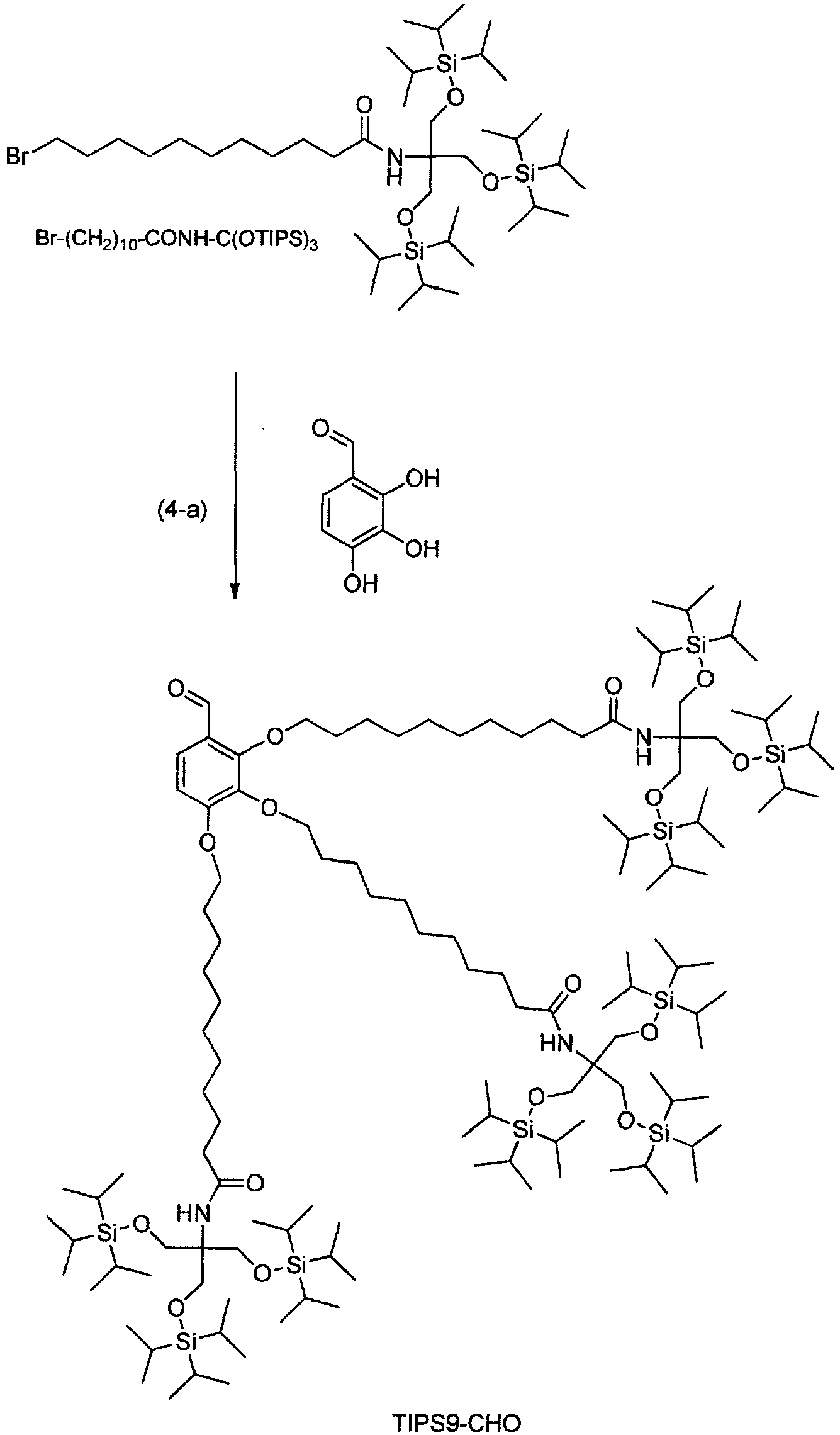
- Br-(CH2)10-CONH-C(CH2OTIPS)3 (0.91 g, 1.09 mmol), 2,3,4-trihydroxybenzaldehyde (50 mg, 0.32 mmol), and potassium carbonate (0.22 g, 1.62 mmol) were suspended in DMF (3.2 mL). The suspension was heated to 100°C and stirred for 2 hours and was then heated to 120°C and stirred for 8.5 hours. The reaction solution was filtered, and the filter residue was washed with heptane (6.8 mL). The heptane layer was separated from the filtrate, and heptane (3.2 mL) was added to the layer, followed by liquid-liquid separation with DMF (3.2 mL). The liquid-liquid separation with heptane and DMF was further repeated once. Heptane (3.2 mL) was added to the resulting heptane layer, followed by liquid-liquid extraction with 1 N hydrochloric acid (3.2 mL) once, a 5% sodium bicarbonate aqueous solution (3.2 mL) once, and water (3.2 mL) once. Heptane (3.2 mL) was added to the resulting heptane layer, followed by liquid-liquid extraction with acetonitrile (3.2 mL). The liquid-liquid extraction with heptane and acetonitrile was further repeated twice. The solvent was distilled, and the resulting residue was purified by silica gel column chromatography (heptane:ethyl acetate = 20:1 → 12:1) to obtain TIPS9-CHO (0.38 g, yield: 47.9%).
1H-NMR (400 MHz, CDCl3) δ 1.02-1.08 (m, 189H), 1.23-1.51 (m, 36H), 1.52-1.59 (m, 6H), 1.71-1.89 (m, 6H), 2.08 (t, 6H), 3.94-4.06 (m, 22H), 4.16 (t, 2H), 5.71-5.81 (m, 3H), 6.71 (d, 1H), 7.57 (d, 1H), 10.26 (s, 1H)
13C-NMR (100 MHz, CDCl3) δ 12.1 (27C), 18.1 (54C), 26.0 (3C), 26.1, 26.2 (2C), 29.3-30.4 (18C), 37.9 (3C), 61.3 (9C), 62.2 (3C), 69.1, 73.9, 75.4, 108.2, 123.6, 123.8, 141.2, 156.8, 159.3, 172.6 (3C), 189.3 -

- TIPS9-CHO (0.17 g, 0.069 mmol) was dissolved in a mixed solution of THF (anhydrous, 0.53 mL) and methanol (0.026 mL), and sodium borohydride (3.1 mg, 0.083 mmol) was added to the solution, followed by stirring for 1 hour. The reaction was quenched with 1 N hydrochloric acid (0.066 mL), and CPME (4.2 mL) was added thereto, followed by washing with 1 N hydrochloric acid (1.3 mL) once, a 5% sodium bicarbonate aqueous solution (1.3 mL) once, and water (1.3 mL) once. The solvent was distilled, and the resulting residue was dissolved in heptane (4.2 mL), followed by liquid-liquid extraction with DMF (2.1 mL). Heptane (2.1 mL) was added to the resulting heptane layer, followed by liquid-liquid extraction with acetonitrile (2.1 mL). The liquid-liquid extraction with heptane and acetonitrile was further repeated once, and the solvent was then distilled to obtain TIPS9-OH (0.15 g, yield: 89.2%).
1H-NMR (400 MHz, CDCl3) δ 1.02-1.08 (m, 189H), 1.23-1.51 (m, 36H), 1.51-1.62 (m, 6H), 1.70-1.85 (m, 6H), 2.04-2.16 (m, 7H), 3.96-4.00 (t, 2H), 4.00-4.13 (m, 22H), 4.60 (s, 2H), 5.71-5.80 (m, 3H), 6.59 (d, 1H), 6.92 (d, 1H)
13C-NMR (100 MHz, CDCl3) δ 12.1 (27C), 18.1 (54C), 26.0 (3C), 26.2 (2C), 26.3, 29.4-30.7 (18C), 37.9 (3C), 61.4 (9C), 62.1, 62.2 (3C), 68.9, 73.7, 74.1, 108.1, 123.2, 127.0, 141.7, 151.6, 153.5, 172.6 (3C) -

- 1-Bromoundecanol (4.00 g, 15.9 mmol) was dissolved in dichloromethane (15.9 mL), and imidazole (2.39 g, 35.0 mmol) was added to the solution. The mixture was cooled to 5°C, and TBDPSCl (4.47 mL, 17.5 mmol) was dropwise added thereto. The mixture was warmed to room temperature and was stirred for 30 minutes. CPME (63.7 mL) was added to the reaction solution, followed by washing with water (15.9 mL) once, 1 N hydrochloric acid (15.9 mL) once, and water (15.9 mL) twice. The solvent was distilled. The residue was dissolved in heptane (61.7 mL), followed by liquid-liquid extraction with DMF (31.8 mL). Heptane (15.9 mL) was added to the resulting heptane layer, followed by liquid-liquid extraction with acetonitrile (31.8 mL). The liquid-liquid extraction with heptane and acetonitrile was further repeated once, and the solvent was then distilled to obtain Br-(CH2)11-O-TBDPS (6.62 g, yield: 84.9%).
1H-NMR (400 MHz, CDCl3) δ 1.06 (s, 9H), 1.24-1.48 (m, 14H), 1.57 (quin., 2H), 1.86 (quin., 2H), 3.41 (t, 2H), 3.67 (t, 2H), 7.35-7.46 (m, 6H), 7.66-7.70 (m, 4H) 13C-NMR (100 MHz, CDCl3) δ 19.4, 25.9, 27.0 (3C), 28.3, 28.9, 29.5, 29.6 (2C), 29.7, 32.7, 33.0, 34.2, 64.2, 127.7 (4C), 129.6 (2C), 134.3 (2C), 135.7 (4C)
ESIMS MNa+ 511.3 - Br-(CH2)11-O-TBDPS (3.34 g, 6.89 mmol), 2,4-dihydroxybenzaldehyde (0.42 g, 3.06 mmol), and potassium carbonate (1.52 g, 11.0 mmol) were suspended in DMF (20.4 mL). The suspension was heated to 85°C and was stirred for 2 hours. The reaction solution was filtered, and the residue was washed with heptane (42.9 mL). The heptane layer was separated from the filtrate, and heptane (20.4 mL) was added to the layer, followed by liquid-liquid extraction with DMF (20.4 mL). Heptane (20.4 mL) was added to the resulting heptane layer, followed by liquid-liquid extraction with 1 N hydrochloric acid (20.4 mL) once, a 5% sodium bicarbonate aqueous solution (20.4 mL) once, and water (20.4 mL) once. Heptane (20.4 mL) was added to the resulting heptane layer, followed by liquid-liquid extraction with acetonitrile (20.4 mL). Heptane (20.4 mL) was added to the resulting heptane layer, followed by liquid-liquid extraction with acetonitrile (20.4 mL). The solvent was distilled, and the resulting residue was purified by silica gel column chromatography (hexane:ethyl acetate = 82:1) to obtain TBDPS2-CHO (0.62 g, 21.2%).
1H-NMR (400 MHz, CDCl3) δ 1.06 (s, 18H), 1.20-1.39 (m, 24H), 1.41-1.61 (m, 8H), 1.74-1.89 (m, 4H), 3.66 (t, 4H), 3.96-4.06 (m, 4H), 6.43 (d, 1H), 6.48-6.54 (m, 1H), 7.28-7.45 (m, 12H), 7.61-7.70 (m, 8H), 7.81 (d, 1H), 10.34 (s, 1H)
13C-NMR (100 MHz, CDCl3) δ 19.4 (2C), 25.9 (2C), 26.1, 26.2, 27.0 (6C), 29.2-29.7 (12C), 32.7 (2C) 64.1 (2C), 68.6 (2C), 99.1, 106.3, 119.1, 127.7 (8C), 129.6 (4C), 130.3, 134.3 (4C), 135.7 (8C), 163.5, 165.9, 188.5
ESIMS MNa+ 977.7 - TBDPS2-CHO (0.15 g, 0.16 mmol) was dissolved in a mixed solution of THF (anhydrous, 1.2 mL) and methanol (61 µL), and sodium borohydride (7.2 mg, 0.19 mmol) was added to the solution, followed by stirring for 1 hour. The reaction solution was cooled to 5°C, and 1 N hydrochloric acid (0.15 mL) was then added thereto to quench the reaction. CPME (3.8 mL) was added to the solution, followed by liquid-liquid extraction with 1 N hydrochloric acid (1.1 mL) three times, a 5% sodium bicarbonate aqueous solution (1.1 mL) once, and water (1.1 mL) once. Anhydrous sodium sulfate was added to the resulting organic phase. The mixture was thoroughly stirred and was then filtered. The filtrate was concentrated under reduced pressure to distill the solvent. The resulting residue was dissolved in heptane (1.5 mL), and the mixture was then concentrated under reduced pressure to distill the solvent to obtain TBDPS2-OH (0.15 g, yield: quant).
1H-NMR (400 MHz, CDCl3) δ 1.05 (s, 18H), 1.20-1.39 (m, 24H), 1.41-1.60 (m, 8H), 1.71-1.89 (m, 4H), 2.21 (s, 1H), 3.65 (t, 4H), 3.88-4.01 (m, 4H), 4.61 (s, 2H), 6.38-6.44 (m, 1H), 6.46 (d, 1H), 7.13 (d, 1H), 7.28-7.44 (m, 12H), 7.61-7.70 (m, 8H)
13C-NMR (100 MHz, CDCl3) δ 19.4 (2C), 25.9 (2C), 26.2, 26.3, 27.0 (6C), 29.4-29.8 (12C), 32.7 (2C) 62.2, 64.2 (2C), 68.2, 68.3, 100.0, 104.6, 121.8, 127.7 (8C), 129.6 (4C), 129.7, 134.4 (4C), 135.7 (8C), 158.3, 160.3
ESIMS MNa+ 979.7 -

- Br-(CH2)8-O-TIPS (1.78 g, 4.87 mmol), 2,4-dihydroxybenzaldehyde (0.30 g, 2.16 mmol), and potassium carbonate (1.08 g, 7.79 mmol) were suspended in DMF (14.4 mL). The suspension was heated to 85°C and was stirred for 2 hours. The reaction solution was filtered, and the residue was washed with heptane (30.3 mL). The heptane layer was separated from the filtrate, and heptane (4.4 mL) was added to the layer, followed by liquid-liquid extraction with acetonitrile (14.4 mL). Heptane (14.4 mL) was added to the resulting heptane layer, followed by liquid-liquid extraction with 1 N hydrochloric acid (14.4 mL) once, a 5% sodium bicarbonate aqueous solution (14.4 mL) once, and water (14.4 mL) once. Heptane (14.4 mL) was added to the resulting heptane layer, followed by liquid-liquid extraction with acetonitrile (14.4 mL). The liquid-liquid extraction with heptane and acetonitrile was further repeated once, and the heptane layer was concentrated under reduced pressure. The resulting residue was purified by silica gel column chromatography (hexane:ethyl acetate = 75:1) to obtain TIPS2-CHO(C8) (1.29 g, yield: 84.6%).
1H-NMR (400 MHz, CDCl3) δ 1.04-1.09 (m, 42H), 1.32-1.40 (m, 12H), 1.43-1.51 (m, 4H), 1.51-1.59 (m, 4H), 1.75-1.88 (m, 4H), 3.67 (t, 4H), 3.98-4.05 (m, 4H), 6.41 (d, 1H), 6.51 (dd, 1H), 7.79 (d, 1H), 10.32 (s, 1H)
13C-NMR (100 MHz, CDCl3) δ 12.2 (6C), 18.2 (12C), 25.9 (2C), 26.1, 26.2, 29.2 (2C), 29.5 (4C), 33.1 (2C), 63.6 (2C), 68.5, 68.6, 99.1, 106.3, 119.1, 130.3, 163.5, 165.9, 188.5
ESIMS MH+ 707.3 - TIPS2-CHO(C8) (1.04 g, 1.47 mmol) was dissolved in a mixed solution of THF (anhydrous, 11.2 mL) and methanol (0.56 mL), and sodium borohydride (67 mg, 1.76 mmol) was added to the solution, followed by stirring at room temperature for 1 hour. The reaction solution was cooled to 5°C, and 1 N hydrochloric acid (1.40 mL) was then added thereto to quench the reaction. CPME (26.0 mL) was added to the solution, followed by liquid-liquid extraction with 1 N hydrochloric acid (7.8 mL) three times, a 5% sodium bicarbonate aqueous solution (7.8 mL) once, and water (7.8 mL) once. The resulting organic layer was concentrated under reduced pressure. The residue was dissolved in heptane (20.8 mL), followed by liquid-liquid extraction with acetonitrile (10.4 mL). The liquid-liquid extraction with heptane and acetonitrile was further repeated once, and heptane layer was then concentrated under reduced pressure to obtain TIPS2-OH(C8) (1.00 g) .
1H-NMR (400 MHz, CDCl3) δ 1.04-1.08 (m, 42H), 1.32-1.40 (m, 12H), 1.42-1.50 (m, 4H), 1.51-1.59 (m, 4H), 1.72-1.87 (m, 4H), 2.23 (br, 1H), 3.67 (t, 4H), 3.93 (t, 2H), 3.98 (t, 2H), 4.61 (s, 2H), 6.42 (dd, 1H), 6.45 (d, 1H), 7.13 (d, 1H)
13C-NMR (100 MHz, CDCl3) δ 12.2 (6C), 18.2 (12C), 25.9 (2C), 26.2, 26.3, 29.4 (2C), 29.5-29.6 (4C), 33.2 (2C), 62.2, 63.6 (2C), 68.2, 68.3, 99.9, 104.6, 121.9, 129.7, 158.3, 160.3
ESIMS MNa+ 731.4 -

- 14-Bromo-1-tetradecanol (10.00 g, 34.1 mmol) was dissolved in dichloromethane (34.1 mL), and imidazole (5.11 g, 75.0 mmol) was added to the solution. TIPSCl (7.95 mL, 37.5 mmol) was dropwise added to the mixture, followed by stirring at room temperature for 3 hours. The reaction solution was concentrated under reduced pressure, and the resulting residue was dissolved in heptane (136 mL), followed by liquid-liquid extraction with water (34 mL) once, 1 N hydrochloric acid (34 mL) once, water (34 mL) twice, and acetonitrile (34 mL) once. Heptane (34 mL) was added to the resulting heptane layer, followed by liquid-liquid extraction with acetonitrile (34 mL). The liquid-liquid extraction with heptane and acetonitrile was further repeated once, and the heptane layer was then concentrated under reduced pressure to obtain Br-(CH2)14-O-TIPS (15.41 g) .
1H-NMR (400 MHz, CDCl3) δ 1.04-1.08 (m, 21H), 1.24-1.38 (m, 18H), 1.42 (quin., 2H), 1.53 (quin., 2H), 1.85 (quin., 2H), 3.40 (t, 2H), 3.67 (t, 2H) - Br-(CH2)14-O-TIPS (1.74 g, 3.87 mmol), 2,4-dihydroxybenzaldehyde (0.24 g, 1.72 mmol), and potassium carbonate (0.86 g, 6.19 mmol) were suspended in DMF (11.5 mL), and the suspension was heated to 85°C and was stirred for 2 hours. The reaction solution was filtered, and the residue was washed with heptane (24.1 mL). The heptane layer was separated from the filtrate, and heptane (11.5 mL) was added to the layer, followed by liquid-liquid extraction with DMF (11.5 mL). Heptane (11.5 mL) was added to the resulting heptane layer, followed by liquid-liquid extraction with 1 N hydrochloric acid (11.5 mL) once, a 5% sodium bicarbonate aqueous solution (11.5 mL) once, and water (11.5 mL) once. Heptane (11.5 mL) was added to the resulting heptane layer, followed by liquid-liquid extraction with acetonitrile (11.5 mL). The liquid-liquid extraction with heptane and acetonitrile was further repeated once, and the heptane layer was concentrated under reduced pressure. The resulting residue was purified by silica gel column chromatography (hexane:ethyl acetate = 100:0 → 0:100) to obtain TIPS2-CHO(C14) (1.22 g, yield: 80.9%). 1H-NMR (400 MHz, CDCl3) δ 1.04-1.08 (m, 42H), 1.24-1.40 (m, 36H), 1.40-1.59 (m, 8H), 1.75-1.88 (m, 4H), 3.66 (t, 4H), 3.98-4.05 (m, 4H), 6.42 (d, 1H), 6.51 (dd, 1H), 7.79 (d, 1H), 10.33 (s, 1H)
13C-NMR (100 MHz, CDCl3) δ 12.2 (6C), 18.2 (12C), 26.0 (2C), 26.1, 26.2, 29.2-29.8 (18C), 33.2 (2C), 63.7 (2C), 68.6 (2C), 99.1, 106.3, 119.1, 130.3, 163.5, 165.9, 188.5 ESIMS MNa+ 897.7 - TIPS2-CHO(C14) (0.28 g, 0.32 mmol) was dissolved in a mixed solution of THF (anhydrous, 2.45 mL) and methanol (0.12 mL), and sodium borohydride (15 mg, 0.39 mmol) was added to the solution, followed by stirring at room temperature for 1 hour. The reaction solution was cooled to 5°C, and 1 N hydrochloric acid (0.31 mL) was added thereto to quench the reaction. CPME (7.0 mL) was added to the solution, followed by liquid-liquid extraction with 1 N hydrochloric acid (2.1 mL) three times, a 5% sodium bicarbonate aqueous solution (2.1 mL) once, and water (2.1 mL) once. Anhydrous sodium sulfate was added to the organic layer, and the mixture was thoroughly stirred and was then filtered. The filtrate was concentrated under reduced pressure to obtain TIPS2-OH(C14) (0.27 g) .
1H-NMR (400 MHz, CDCl3) δ 1.04-1.08 (m, 42H), 1.24-1.40 (m, 36H), 1.40-1.50 (m, 4H), 1.50-1.58 (m, 4H), 1.72-1.85 (m, 4H), 2.23 (br, 1H), 3.67 (t, 4H), 3.91-4.01 (m, 4H), 4.61 (s, 2H), 6.42 (dd, 1H), 6.45 (d, 1H), 7.13 (d, 1H) 13C-NMR (100 MHz, CDCl3) δ 12.2 (6C), 18.2 (12C), 26.0 (2C), 26.2, 26.3, 29.4-29.8 (18C), 33.2 (2C), 62.2, 63.7 (2C), 68.2, 68.3, 99.9, 104.6, 121.9, 129.7, 158.3, 160.3 ESIMS MNa+ 899.7 -

- TIPS2-CHO(C14) (0.22 g, 0.25 mmol) was dissolved in dichloromethane (1.2 mL), and hydroxylamine hydrochloride (53 mg, 0.76 mmol) was added to the solution. The mixture was cooled to 5°C, and triethylamine (177 µL, 1.27 mmol) was added thereto. The mixture was warmed to room temperature and stirred for 23 hours. The reaction solution was cooled to 5°C, and the reaction was quenched with 1 N hydrochloric acid (0.51 mL). Heptane (6.7 mL) was added thereto, followed by liquid-liquid extraction with 1 N hydrochloric acid (3.3 mL) three times, a 5% sodium bicarbonate aqueous solution (3.3 mL) three times, and water (3.3 mL) once. Heptane (3.3 mL) was added to the resulting heptane layer, followed by liquid-liquid extraction with acetonitrile (3.3 mL). The liquid-liquid extraction with heptane and acetonitrile was further repeated once, and the heptane layer was concentrated under reduced pressure to obtain TIPS2-NOH(C14) (0.17 g). ESIMS MH+ 890.8
-

- TIPS2-CHO(C14) (0.30 g, 0.34 mmol) was dissolved in THF (anhydrous, 0.35 mL). Propylamine (40 µL, 0.48 mmol), acetic acid (124 µL, 2.17 mmol), and 2-picoline borane (63 mg, 0.59 mmol) were added to the solution, followed by stirring at room temperature for 1 hour and 45 minutes. The reaction solution was cooled to 5°C, and the reaction was quenched with 1 N hydrochloric acid (0.24 mL). CPME (12.1 mL) was added thereto, followed by liquid-liquid extraction with 1 N hydrochloric acid (3.6 mL) once, a 5% sodium bicarbonate aqueous solution (3.6 mL) twice, and water (3.6 mL) once. The heptane layer was concentrated under reduced pressure. The residue was dissolved in heptane (24.2 mL), followed by liquid-liquid extraction with acetonitrile (24.2 mL) twice. The heptane layer was concentrated under reduced pressure to obtain TIPS2-NH(CH2)2CH3(C14) (0.30 g).
1H-NMR (400 MHz, CDCl3) δ 1.03-1.08 (m, 45H), 1.22-1.39 (m, 36H), 1.39-1.58 (m, 10H), 1.68-1.90 (m, 5H), 2.54 (t, 2H), 3.67 (t, 4H), 3.72 (s, 2H), 3.87-3.96 (m, 4H), 6.39 (dd, 1H), 6.43 (d, 1H), 7.10 (d, 1H)
13C-NMR (100 MHz, CDCl3) δ 12.0, 12.2 (6C), 18.2 (12C), 23.3, 26.0 (2C), 26.2, 26.4, 29.5-29.8 (18C), 33.2 (2C), 49.3, 51.1, 63.7 (2C), 67.9, 68.2, 99.8, 104.3, 121.0, 130.5, 158.3, 159.6
ESIMS MH+ 918.8 -

- 1,8-Dibromooctane (5.09 mL, 27.5 mmol) and HO-(CH2)2-OTIPS (3.00 g, 13.7 mmol) were dissolved in toluene (18 mL), and sodium hydride (60%, dispersed in liquid paraffin, 1.10 g, 27.5 mmol) was added thereto. The mixture was heated to 80°C and was stirred for 20 hours. The reaction solution was cooled to 5°C, and the reaction was quenched with 1 N hydrochloric acid (27.5 mL). Toluene (18 mL) was added thereto, and the organic layer was separated from the mixture, followed by liquid-liquid extraction with 1 N hydrochloric acid (27 mL) once, a mixed solution of 5% sodium bicarbonate aqueous solution (27 mL) and 1 N hydrochloric acid (14 mL) once, and water (27 mL) once. Anhydrous sodium sulfate was added to the organic layer, and the mixture was thoroughly stirred and was then filtered. The filtrate was concentrated under reduced pressure. The resulting residue was purified by silica gel column chromatography (hexane:ethyl acetate = 100:0 → 1:1) to obtain Br-(CH2)8-O-(CH2)2-O-TIPS (5.12 g). ESIMS MH+ 409.0
- TIPS2-CHO(C8-O-C2) was obtained by the same method as that for TIPS2-CHO(C14) described above.
1H-NMR (400 MHz, CDCl3) δ 1.04-1.08 (m, 42H), 1.31-1.41 (m, 12H), 1.41-1.52 (m, 4H), 1.52-1.61 (m, 4H), 1.74-1.89 (m, 4H), 3.47 (t, 4H), 3.52 (t, 4H), 3.82 (t, 4H), 3.97-4.06 (m, 4H), 6.41 (d, 1H), 6.50 (dd, 1H), 7.79 (d, 1H), 10.32 (s, 1H)
ESIMS MH+ 795.6 - TIPS2-OH(C8-O-C2) was obtained by the same method as that for TIPS2-CHO(C14) described above.
ESIMS MNa+ 819.6 -

- 11-Bromoundecanoic acid (8.00 g, 30.2 mmol) and ethanolamine (2.76 g, 45.3 mmol) were suspended in DMF (201 mL), and DMT-MM·1.8H2O (18.65 g, 60.3 mmol) and DIPEA (21.0 mL, 120.7 mmol) were added thereto. The mixture was stirred at room temperature for 0.5 hours. Ethyl acetate (1,006 mL) was added to the reaction solution, followed by washing with a 5% sodium bicarbonate aqueous solution (503 mL) once and 20% sodium chloride aqueous solution (503 mL) three times. Anhydrous magnesium sulfate was added to the organic layer, and the mixture was thoroughly stirred and was then filtered. The filtrate was concentrated under reduced pressure. Hexane (93 mL) was added to the resulting residue, and the precipitate was collected by filtration and was dried under reduced pressure to obtain a mixture containing Br-(CH2)10-CONH-(CH2)2-OH.
- The mixture obtained in the step (a) was dissolved in DMF (215 mL). Imidazole (4.52 g, 66.4 mmol) was added to the solution, and TIPSCl (7.0 mL, 33.2 mmol) was dropwise added to the mixture at room temperature. The mixture was then heated to 85°C and was stirred for 1 hour and 10 minutes. TIPSCl (0.64 mL, 3.02 mmol) was further added to the mixture, followed by stirring at 85°C for 20 minutes. Ethyl acetate (1,077 mL) was added to the reaction solution, and the mixture was washed with 1 N hydrochloric acid (539 mL) once, a 5% sodium bicarbonate aqueous solution (539 mL) once, and 20% sodium chloride aqueous solution (539 mL) twice. Anhydrous magnesium sulfate was added to the organic layer, and the mixture was thoroughly stirred and was then filtered. The filtrate was concentrated under reduced pressure to obtain Br-(CH2)10-CONH-(CH2)2-O-TIPS (13.8 g).
1H-NMR (400 MHz, CDCl3) δ 1.02-1.05 (m, 21H), 1.24-1.33 (m, 10H), 1.39 (quin., 2H), 1.60 (quin., 2H), 1.74 (quin., 2H), 2.15 (t, 2H), 3.37 (q, 2H), 3.50 (t, 2H), 3.73 (t, 2H), 5.90 (t, 1H) - Br-(CH2)10-CONH-(CH2)2-O-TIPS (1.44 g, 3.09 mmol), 3,4,5-trihydroxybenzaldehyde (0.12 g, 0.77 mmol), and potassium carbonate (0.64 g, 4.64 mmol) were suspended in DMF (5.2 mL), and the suspension was heated to 115°C and was stirred for 4 hours. The reaction solution was filtered, and ethyl acetate (51.5 mL) was added to the filtrate, followed by liquid-liquid extraction with water (46.4 mL) four times. Anhydrous sodium sulfate was added to the organic layer, and the mixture was thoroughly stirred and was then filtered. The filtrate was concentrated under reduced pressure to obtain TIPS3-CHO(C10-CONH-C2) (1.16 g) .
ESIMS MH+ 1,304.9 - TIPS3-CHO(C10-CONH-C2) (0.66 g, 0.51 mmol) was dissolved in a mixed solution of THF (anhydrous, 3.85 mL) and methanol (0.19 mL), and sodium borohydride (23 mg, 0.61 mmol) was added to the solution, followed by stirring at room temperature for 1 hour. The reaction solution was cooled to 5°C, and 1 N hydrochloric acid (0.48 mL) was added thereto to quench the reaction. CPME (16.5 mL) was added to the solution, followed by liquid-liquid extraction with 1 N hydrochloric acid (4.9 mL) twice, a 5% sodium bicarbonate aqueous solution (4.9 mL) once, and water (4.9 mL) once. Anhydrous sodium sulfate was added to the organic layer, and the mixture was thoroughly stirred and was then filtered. The filtrate was concentrated under reduced pressure to obtain TIPS3-OH(C10-CONH-C2) (0.64 g).
ESIMS MNa+ 1,329.0 -

- A mixture containing Br-(CH2)10-CONH-CH(CH2-OH)2 was obtained by the same method as that for Br-(CH2)10-CONH-(CH2)2-OH described above. This mixture (10.2 g) containing Br-(CH2)10-CONH-CH(CH2-OH)2 was dissolved in DMF (215 mL), and imidazole (9.04 g, 132.7 mmol) was added thereto. TIPSCl (14.1 mL, 66.4 mmol) was dropwise added to the mixture at room temperature. The mixture was then heated to 85°C and was stirred for 2 hours and 10 minutes. Ethyl acetate (1,077 mL) was added to the reaction solution, followed by washing with 1 N hydrochloric acid (539 mL) once, a 5% sodium bicarbonate aqueous solution (539 mL) once, and 20% sodium chloride aqueous solution (539 mL) twice. Anhydrous magnesium sulfate was added to the organic layer, and the mixture was thoroughly stirred and was then filtered. The filtrate was concentrated under reduced pressure to obtain Br-(CH2)10-CONH-CH(CH2-O-TIPS)2 (19.7 g).
1H-NMR (400 MHz, CDCl3) δ 1.03-1.07 (m, 42H), 1.24-1.34 (m, 10H), 1.40 (quin., 2H), 1.59 (quin., 2H), 1.75 (quin., 2H), 2.14 (t, 2H), 3.51 (t, 2H), 3.63-3.70 (m, 2H), 3.85-3.90 (m, 2H), 3.93-4.03 (m, 1H), 5.83 (d, 1H) - Br-(CH2)10-CONH-CH(CH2-O-TIPS)2 (2.02 g, 3.10 mmol), 3,4,5-trihydroxybenzaldehyde (0.13 g, 0.86 mmol), and potassium carbonate (0.61 g, 4.39 mmol) were suspended in DMF (5.7 mL), and the suspension was heated to 115°C and was stirred for 9 hours. Br-(CH2)10-CONH-CH(CH2-O-TIPS)2 (0.22 g, 0.34 mmol) was further added thereto, and the mixture was stirred at 115°C for 1 hour. The reaction solution was filtered, and the residue was washed with heptane (12.0 mL). The heptane layer was separated from the filtrate, and heptane (5.7 mL) was added to the layer, followed by liquid-liquid extraction with DMF (5.7 mL). Heptane (5.7 mL) was added to the resulting heptane layer, followed by liquid-liquid extraction with 1 N hydrochloric acid (5.7 mL) once, a 5% sodium bicarbonate aqueous solution (5.7 mL) once, and water (5.7 mL) once. Heptane (5.7 mL) was added to the resulting heptane layer, followed by liquid-liquid extraction with acetonitrile (5.7 mL). The liquid-liquid extraction with heptane and acetonitrile was further repeated once, and the heptane layer was concentrated under reduced pressure to obtain TIPS6-CHO(C10-CONH-CH(CH2)2) (1.05 g).
1H-NMR (400 MHz, CDCl3) δ 1.03-1.08 (m, 126H), 1.23-1.39 (m, 30H), 1.39-1.51 (m, 6H), 1.55-1.67 (m, 6H), 1.70-1.87 (m, 6H), 2.15 (t, 6H), 3.63-3.70 (m, 6H), 3.86-3.91 (m, 6H), 3.95-4.07 (m, 9H), 5.84 (d, 3H), 7.07 (s, 2H), 9.82 (s, 1H)
ESIMS MH+ 1,864.0 - TIPS6-OH(C10-CONH-CH(CH2)2) was obtained by the same method as that for TIPS3-OH(C10-CONH-C2).
ESIMS MH+ 1,865.5 -

- Br-(CH2)10-CONH-C(CH2OTIPS)3 (3.13 g, 3.74 mmol), 2-hydroxy-4-methoxybenzaldehyde (0.68 g, 4.49 mmol), and potassium carbonate (1.24 g, 8.98 mmol) were suspended in DMF (24.9 mL), and the suspension was heated to 120°C and was stirred for 3.5 hours. The reaction solution was filtered, and the residue was washed with heptane (34.0 mL). The heptane layer was separated from the filtrate, and heptane (17.0 mL) was added to the layer, followed by liquid-liquid extraction with DMF (17.0 mL). The liquid-liquid extraction with heptane and DMF was further repeated once. Heptane (17.0 mL) was added to the resulting heptane layer, followed by liquid-liquid extraction with 1 N hydrochloric acid (17.0 mL) once, a 5% sodium bicarbonate aqueous solution (17.0 mL) once, and water (17.0 mL) once. The heptane layer was concentrated under reduced pressure, and the resulting residue was dissolved in heptane (17.0 mL), followed by liquid-liquid extraction with acetonitrile (17.0 mL). The liquid-liquid extraction with heptane and acetonitrile was further repeated once, and the heptane layer was concentrated under reduced pressure to obtain TIPS3-CHO(4-OMe) (1.64 g).
1H-NMR (400 MHz, CDCl3) δ 1.03-1.10 (m, 63H), 1.24-1.39 (m, 10H), 1.48 (quin., 2H), 1.56 (quin., 2H), 1.83 (quin., 2H), 2.08 (t, 2H), 3.86 (s, 3H), 4.00-4.06 (m, 8H), 5.75 (s, 1H), 6.42 (d, 1H), 6.52 (dd, 1H), 7.81 (d, 1H), 10.33 (s, 1H)
ESIMS MH+ 908.7 - TIPS3-OH(4-OMe) was obtained by the same method as that for TIPS2-OH(C8).
1H-NMR (400 MHz, CDCl3) δ 1.03-1.10 (m, 63H), 1.24-1.39 (m, 10H), 1.45 (quin., 2H), 1.57 (quin., 2H), 1.80 (quin., 2H), 2.08 (t, 2H), 2.31 (br, 1H), 3.79 (s, 3H), 3.98 (t, 2H), 4.04 (s, 6H), 4.61 (s, 2H), 5.75 (s, 1H), 6.41-6.47 (m, 2H), 7.16 (d, 1H)
13C-NMR (100 MHz, CDCl3) δ 12.1 (9C), 18.1 (18C), 25.9, 26.3, 29.4-29.7 (6C), 37.9, 55.5, 61.3 (3C), 62.0, 62.2, 68.1, 99.4, 103.9, 122.1, 129.6, 158.2, 160.7, 172.6
ESIMS MNa+ 932.7 - H-Gly-Gly-Gly-OH (model peptide), H-Gly-Gly-Gly-O-TIPS2, H-Gly-Gly-Gly-O-TIPS3, and H-Gly-Gly-Gly-O-TIPS6 were synthesized, and the solubility at 25°C of each peptide in cyclopentyl methyl ether (CPME) was measured. As a result, merely 0.032 mM of H-Gly-Gly-Gly-OH was dissolved in CPME when a TIPS-type protecting agent was not combined to the peptide. However, 181 mM and 175 mM of the peptide were dissolved when TIPS2-OH and TIPS3-OH were combined to the peptide, and 286 mM of the peptide was dissolved when TIPS6-OH was combined to the peptide. The solubility was thus enhanced by about 5,000-fold and about 9,000-fold, respectively. The results are shown in
Figure 1 . - The results demonstrated that the solubility of the peptide used as a model was significantly enhanced by derivatizing the peptide with a novel benzyl-type compound. H-Gly-Gly-Gly-O-TIPS2, H-Gly-Gly-Gly-O-TIPS3, and H-Gly-Gly-Gly-O-TIPS6 indicate the following structures.


- TIPS2-OH (0.81 g, 1.02 mmol) was dissolved in CPME (16.2 mL). DMF (4.1 mL), Fmoc-Gly-OH (0.91 g, 3.05 mmol), WSCI·HCl (0.58 g, 3.05 mmol), and DMAP (12.4 mg, 0.10 mmol) were added to the solution, followed by stirring at room temperature for 2 hours. After confirmation of disappearance of TIPS2-OH, DBU (1.76 mL, 11.8 mmol) was added to the mixture, followed by stirring at room temperature for 10 minutes. The reaction solution was cooled to 5°C, and 4 M CPME/HCl (3.54 mL) was then dropwise added thereto. The mixture was warmed to room temperature, and CPME (0.81 mL), 20% sodium chloride aqueous solution (21 mL), and a 10% sodium carbonate aqueous solution (18 mL) were added thereto for liquid-liquid extraction. 20% sodium chloride aqueous solution (38 mL), DMSO (1.0 mL), and DMF (1.0 mL) were added to the resulting organic phase for liquid-liquid extraction. A 50% dipotassium hydrogen phosphate aqueous solution (19 mL), DMSO (0.5 mL), and DMF (0.5 mL) were added to the resulting organic phase for liquid-liquid extraction. A 50% dipotassium hydrogen phosphate aqueous solution (19 mL), DMSO (0.5 mL), and DMF (0.5 mL) were added to the resulting organic phase for liquid-liquid extraction to obtain a mixed liquid containing H-Gly-O-TIPS2. H-Gly-O-TIPS2 indicates the following structure.

- CPME (1.4 mL), DMF (5.1 mL), Fmoc-Gly-Gly-OH (1.08 g, 3.05 mmol), WSCI·HCl (0.58 g, 3.05 mmol), and DIPEA (0.71 mL, 4.06 mmol) were added to the resulting mixed liquid, and the mixture was stirred at room temperature for 1.5 hours. After confirmation of disappearance of H-Gly-O-TIPS2, DBU (1.76 mL, 11.8 mmol) was added to the mixture, followed by stirring at room temperature for 10 minutes. The reaction solution was cooled to 5°C, and 4 M CPME/HCl (3.50 mL) was then dropwise added thereto. The mixture was warmed to room temperature, and CPME (0.86 mL), 20% sodium chloride aqueous solution (24 mL), and a 10% sodium carbonate aqueous solution (20 mL) were added thereto for liquid-liquid extraction. A 20% sodium chloride aqueous solution (44 mL), DMSO (1.2 mL), DMF (1.2 mL), and a 50% dipotassium hydrogen phosphate aqueous solution (15 mL) were added to the resulting organic phase for liquid-liquid extraction. A 50% dipotassium hydrogen phosphate aqueous solution (22 mL), DMSO (0.6 mL), and DMF (0.6 mL) were added to the resulting organic phase for liquid-liquid extraction. A 50% dipotassium hydrogen phosphate aqueous solution (22 mL), DMSO (0.6 mL), and DMF (0.6 mL) were added to the resulting organic phase for liquid-liquid extraction. The resulting organic phase was concentrated under reduced pressure to distill the solvent. Acetonitrile (28 mL) was added to the resulting residue, and precipitate was collected by filtration. Acetonitrile (28 mL) was added to the collected precipitate to wash the precipitate, and the precipitate was collected by filtration. The precipitate was further washed with acetonitrile twice and was dried under reduced pressure to obtain H-Gly-Gly-Gly-O-TIPS2 (0.95 g, 97.3%).
ESIMS MH+ 964.8
H-Gly-Gly-Gly-O-TIPS3 (yield: 88.7%, ESIMS MH+ 1,307.2) and H-Gly-Gly-Gly-O-TIPS6 (yield: 69.4%, ESIMS MH+ 1,823.3) were synthesized by the same method as that for H-Gly-Gly-Gly-O-TIPS2. - A mixed solution of trifluoroacetic acid (1.04 mL, 13.6 mmol), 3,6-dioxa-1,8-octanedithiol (27 µL, 0.168 mmol), and triisopropylsilane (27 µL, 0.127 mmol) was cooled to 5°C, and H-Gly-Gly-Gly-O-TIPS2 (53 mg, 0.055 mmol) was added thereto. The mixture was warmed to room temperature and was stirred for 1 hour. After confirmation of disappearance of H-Gly-Gly-Gly-O-TIPS2, the reaction solution was concentrated under reduced pressure. Diisopropyl ether (3.5 mL) was added to the residue. The mixture was cooled to 5°C, and the precipitate was collected by filtration. The washing of the precipitate with diisopropyl ether and filtration were further repeated three times, and the precipitate was collected by filtration. The precipitate was dried under reduced pressure to obtain H-Gly-Gly-Gly-OH (9.8 mg) .
ESIMS MH+ 189.9
Claims (6)
- A benzyl compound represented by Formula (1):
 where X1 represents -CH2OR14 (where R14 represents a hydrogen atom, a halogenocarbonyl group, or an active ester-type protecting group), -CH2NHR15 (where R15 represents a hydrogen atom, a linear or branched alkyl group having 1 to 6 carbon atoms, or an aralkyl group), a halogenomethyl group, a methyl azide group, a formyl group, or an oxime; andat least one of R1, R2, R3, R4, and R5 is a group represented by Formula (2):
-O-R6-X2-A (2),
and the remainders each represent a hydrogen atom, a halogen atom, an alkyl group having 1 to 4 carbon atoms, or an alkoxy group having 1 to 4 carbon atoms, wherein R6 represents a linear or branched alkylene group having 1 to 16 carbon atoms;X2 represents O or CONR16 (where R16 represents a hydrogen atom or an alkyl group having 1 to 4 carbon atoms); andA is a group represented by Formula (3), (4), (5), (6), (7), (8), (9), (10), (11), (12), or (13):


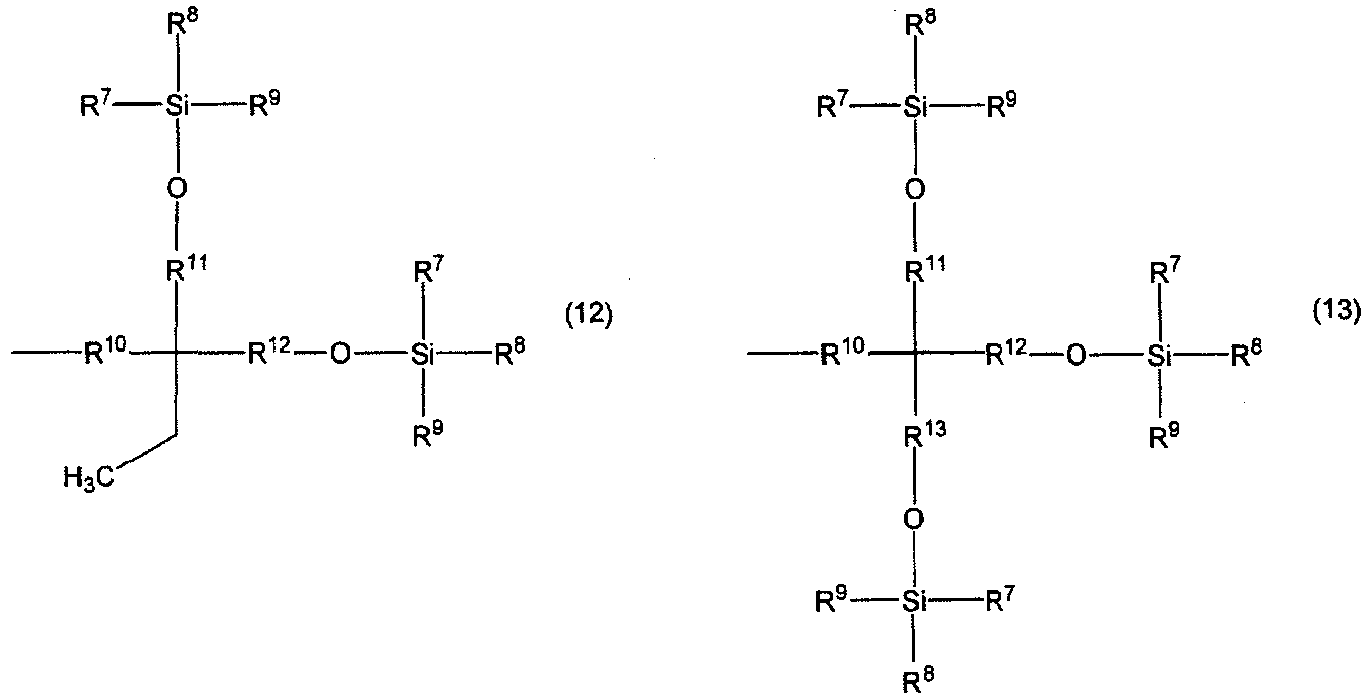
- The benzyl compound according to Claim 1, wherein X1 is -CH2OR14 (where R14 represents a hydrogen atom, a halogenocarbonyl group, or an active ester-type protecting group), -CH2NHR15 (where R15 represents a hydrogen atom, a linear or branched alkyl group having 1 to 6 carbon atoms, or an aralkyl group), or a halogenomethyl group.
- The benzyl compound according to Claim 1 or 2, wherein R6 is a linear or branched alkylene group having 2 to 16 carbon atoms.
- The benzyl compound according to any one of Claims 1 to 3, wherein R6 is a linear or branched alkylene group having 6 to 16 carbon atoms.
- The benzyl compound according to any one of Claims 1 to 4, wherein R10 is a single bond or a methylene group; and R11, R12, and R13 are methylene groups.
- A protecting agent for a carboxy group, a hydroxy group, a diol group, an amino group, or a mercapto group, the protecting agent comprising the benzyl compound according to any one of Claims 1 to 5.
Applications Claiming Priority (4)
| Application Number | Priority Date | Filing Date | Title |
|---|---|---|---|
| JP2015168711 | 2015-08-28 | ||
| JP2015227234 | 2015-11-20 | ||
| JP2016124192 | 2016-06-23 | ||
| PCT/JP2016/074888 WO2017038650A1 (en) | 2015-08-28 | 2016-08-25 | Benzyl compound |
Publications (3)
| Publication Number | Publication Date |
|---|---|
| EP3342777A1 true EP3342777A1 (en) | 2018-07-04 |
| EP3342777A4 EP3342777A4 (en) | 2019-05-01 |
| EP3342777B1 EP3342777B1 (en) | 2023-01-11 |
Family
ID=58187438
Family Applications (1)
| Application Number | Title | Priority Date | Filing Date |
|---|---|---|---|
| EP16841682.4A Active EP3342777B1 (en) | 2015-08-28 | 2016-08-25 | Benzyl compound |
Country Status (6)
| Country | Link |
|---|---|
| US (2) | US10822357B2 (en) |
| EP (1) | EP3342777B1 (en) |
| JP (2) | JP6116782B1 (en) |
| KR (1) | KR102630720B1 (en) |
| CN (1) | CN108026116B (en) |
| WO (1) | WO2017038650A1 (en) |
Cited By (1)
| Publication number | Priority date | Publication date | Assignee | Title |
|---|---|---|---|---|
| US10851120B2 (en) | 2016-06-20 | 2020-12-01 | Sekisui Medical Co., Ltd. | Diphenylmethane protective agent |
Families Citing this family (18)
| Publication number | Priority date | Publication date | Assignee | Title |
|---|---|---|---|---|
| EP3489245B1 (en) | 2016-07-25 | 2020-10-14 | Sekisui Medical Co., Ltd. | New xanthene protective agent |
| TW201833127A (en) * | 2017-02-27 | 2018-09-16 | 日商積水醫療股份有限公司 | Novel tetracyclic protection agent |
| JP6531235B1 (en) * | 2017-12-19 | 2019-06-12 | 積水メディカル株式会社 | Novel alkyl diphenyl methane protective agent |
| CN110317130B (en) * | 2018-03-29 | 2021-12-21 | 深圳翰宇药业股份有限公司 | Compound and preparation method and application thereof |
| EP3778621B1 (en) | 2018-04-13 | 2023-08-23 | Jitsubo Co., Ltd. | Peptide synthesis method |
| CN113490679A (en) * | 2019-02-28 | 2021-10-08 | 富士胶片株式会社 | Method for producing peptide compound, reagent for forming protecting group, and aromatic heterocyclic compound |
| EP3932899A4 (en) * | 2019-02-28 | 2022-04-20 | FUJIFILM Corporation | PROCESS FOR THE PREPARATION OF A PEPTIDE COMPOUND, PROTECTING REAGENT AND CONDENSED POLYCYCLIC AROMATIC HYDROCARBON COMPOUND |
| JP7661880B2 (en) | 2019-04-25 | 2025-04-15 | 味の素株式会社 | Continuous production method of peptides |
| WO2020262259A1 (en) | 2019-06-28 | 2020-12-30 | 富士フイルム株式会社 | Method for producing peptide compound, reagent for forming protective group, and fused polycyclic compound |
| EP4006045A4 (en) | 2019-08-29 | 2022-10-19 | FUJIFILM Corporation | METHOD FOR MAKING NUCLEIC ACID COMPOUND AND NUCLEIC ACID COMPOUND |
| WO2021039901A1 (en) * | 2019-08-30 | 2021-03-04 | 日産化学株式会社 | Method for producing peptide compound |
| AR125800A1 (en) | 2021-05-07 | 2023-08-16 | Chugai Pharmaceutical Co Ltd | METHODS FOR PRODUCING CYCLIC COMPOUNDS COMPRISING N-SUBSTITUTED AMINO ACIDS RESIDUES |
| JP7162853B1 (en) | 2021-07-02 | 2022-10-31 | ペプチスター株式会社 | Method for analyzing carrier-bound peptides for liquid-phase peptide synthesis |
| JPWO2023013757A1 (en) * | 2021-08-05 | 2023-02-09 | ||
| TW202432571A (en) | 2022-11-01 | 2024-08-16 | 日商中外製藥股份有限公司 | Method for removing dibenzofulvene or dibenzofulvene derivatives |
| JP2024160485A (en) | 2023-05-01 | 2024-11-14 | 横河電機株式会社 | Method and apparatus for producing peptides |
| WO2026034639A1 (en) * | 2024-08-09 | 2026-02-12 | 株式会社Spin Wave | Soluble carrier for peptide synthesis and synthesis method using same |
| CN119613485B (en) * | 2024-12-16 | 2025-10-28 | 中原食品实验室 | Preparation method of dipeptide-2 |
Family Cites Families (30)
| Publication number | Priority date | Publication date | Assignee | Title |
|---|---|---|---|---|
| DE2706490A1 (en) | 1976-02-20 | 1977-08-25 | Ciba Geigy Ag | NEW CARBON ACID ESTERS |
| EP0177454B1 (en) | 1984-10-04 | 1988-12-21 | Ciba-Geigy Ag | Silanes, process for their preparation and their use |
| PT100902A (en) * | 1991-09-26 | 1993-11-30 | Smithkline Beecham Plc | MUPIROCIN DERIVATIVES, UTEIS AS ANTIBACTERIAL AND ANTIMICOPLASMATIC AGENTS, AND PROCESS FOR THEIR PREPARATION |
| AUPP616498A0 (en) | 1998-09-25 | 1998-10-15 | University Of Queensland, The | Synthesis of cyclic peptides |
| CO5140104A1 (en) | 1999-02-16 | 2002-03-22 | Novartis Ag | MEVINOLINE DERIVATIVES AND PHARMACEUTICAL PREPARATION CONTAINING THEM |
| JP3600753B2 (en) | 1999-04-09 | 2004-12-15 | 独立行政法人 科学技術振興機構 | Novel linker and solid-phase synthesis of glycopeptides using it |
| WO2004063292A2 (en) | 2003-01-07 | 2004-07-29 | The Research Foundation Of State University Of Newyork | Anti-fouling sol-gel coatings containing dendrimers |
| US20070037846A1 (en) | 2003-06-24 | 2007-02-15 | Actelion Pharmaceuticals, Ltd. | Pyrazolidinedione derivatives |
| AU2003249865A1 (en) * | 2003-06-24 | 2005-01-21 | Actelion Pharmaceuticals Ltd | Pyrazolidinedione derivatives and their use as platelet aggregation inhibitors |
| WO2005005395A2 (en) | 2003-07-02 | 2005-01-20 | F. Hoffmann-La Roche Ag | Arylamine-substituted quinazolinone compounds |
| AU2006272348B2 (en) * | 2005-07-22 | 2011-06-16 | Merck Frosst Canada Ltd | Renin inhibitors |
| US7495007B2 (en) * | 2006-03-13 | 2009-02-24 | Hoffmann-La Roche Inc. | Spiroindolinone derivatives |
| EP2145889A4 (en) | 2007-04-18 | 2012-04-18 | Kissei Pharmaceutical | Fused heterocyclic derivative, pharmaceutical composition comprising the derivative, and use of the composition for medical purposes |
| CN101555232B (en) * | 2009-05-21 | 2011-01-05 | 北京师范大学 | Pyridazinone compound marked by fluorine-18, preparation method and applications |
| WO2011071565A1 (en) * | 2009-12-11 | 2011-06-16 | Exelixis, Inc. | Tgr5 agonists |
| US20110196770A1 (en) | 2010-02-11 | 2011-08-11 | Intuitive Analytics, Llc | System and Method for Visual and Interactive Determination of Optimal Financing and Refinancing Solutions |
| DE102010030688A1 (en) | 2010-06-30 | 2012-01-05 | Bayer Schering Pharma Aktiengesellschaft | Substituted dicyanopyridines and their use |
| DK2612845T3 (en) | 2010-08-30 | 2020-11-02 | Ajinomoto Kk | AROMATIC COMPOUND CONTAINING SPECIFIC BRANCH |
| US9403835B2 (en) | 2011-12-22 | 2016-08-02 | Ares Trading S.A. | Tetraaza-cyclopenta[a]indenyl and their use as positive allosteric modulators |
| US20130281397A1 (en) | 2012-04-19 | 2013-10-24 | Rvx Therapeutics Inc. | Treatment of diseases by epigenetic regulation |
| US20130281398A1 (en) * | 2012-04-19 | 2013-10-24 | Rvx Therapeutics Inc. | Treatment of diseases by epigenetic regulation |
| US20130281399A1 (en) | 2012-04-19 | 2013-10-24 | Rvx Therapeutics Inc. | Treatment of diseases by epigenetic regulation |
| EP2850067B1 (en) * | 2012-05-18 | 2017-08-16 | Sumitomo Dainippon Pharma Co., Ltd. | Carboxylic acid compounds |
| AU2013203000B9 (en) | 2012-08-10 | 2017-02-02 | Lantheus Medical Imaging, Inc. | Compositions, methods, and systems for the synthesis and use of imaging agents |
| EP3608308B1 (en) | 2013-03-08 | 2021-07-21 | Novartis AG | Lipids and lipid compositions for the delivery of active agents |
| US9504747B2 (en) | 2013-03-08 | 2016-11-29 | Novartis Ag | Lipids and lipid compositions for the delivery of active agents |
| WO2014175330A1 (en) * | 2013-04-24 | 2014-10-30 | 塩野義製薬株式会社 | 5-oxybenzimidazole and 5-oxyaza benzimidazole derivative having ampk activation effect |
| BR112016022105B1 (en) | 2014-03-27 | 2023-01-31 | Janssen Pharmaceutica Nv | SUBSTITUTED 4,5,6,7-TETRAHYDRO-PYRAZOL[1,5-A]PYRAZINE DERIVATIVES AND 5,6,7,8-TETRAHYDRO-4H-PYRAZOL[1,5-A][1, 4]DIAZEPINE AS ROS1 INHIBITORS AND PHARMACEUTICAL COMPOSITION INCLUDING THEM |
| CN107072946B (en) * | 2014-09-05 | 2022-01-11 | 诺华股份有限公司 | Lipids and lipid compositions for delivery of active agents |
| CN105820165B (en) | 2015-01-05 | 2021-05-04 | 中国科学院上海药物研究所 | Alpha-carboline compound, its preparation method and use |
-
2016
- 2016-08-25 JP JP2016574023A patent/JP6116782B1/en active Active
- 2016-08-25 KR KR1020187006334A patent/KR102630720B1/en active Active
- 2016-08-25 EP EP16841682.4A patent/EP3342777B1/en active Active
- 2016-08-25 WO PCT/JP2016/074888 patent/WO2017038650A1/en not_active Ceased
- 2016-08-25 CN CN201680050461.7A patent/CN108026116B/en active Active
- 2016-08-25 US US15/755,705 patent/US10822357B2/en active Active
-
2017
- 2017-03-02 JP JP2017039276A patent/JP6201076B1/en active Active
-
2020
- 2020-09-25 US US17/032,357 patent/US11591351B2/en active Active
Cited By (2)
| Publication number | Priority date | Publication date | Assignee | Title |
|---|---|---|---|---|
| US10851120B2 (en) | 2016-06-20 | 2020-12-01 | Sekisui Medical Co., Ltd. | Diphenylmethane protective agent |
| US11485747B2 (en) | 2016-06-20 | 2022-11-01 | Sekisui Medical Co., Ltd. | Diphenylmethane protective agent |
Also Published As
| Publication number | Publication date |
|---|---|
| JP6116782B1 (en) | 2017-04-19 |
| CN108026116A (en) | 2018-05-11 |
| CN108026116B (en) | 2021-08-24 |
| KR102630720B1 (en) | 2024-01-29 |
| EP3342777A4 (en) | 2019-05-01 |
| US20210009611A1 (en) | 2021-01-14 |
| US10822357B2 (en) | 2020-11-03 |
| KR20180044305A (en) | 2018-05-02 |
| US20190023726A1 (en) | 2019-01-24 |
| US11591351B2 (en) | 2023-02-28 |
| WO2017038650A1 (en) | 2017-03-09 |
| JP2018002700A (en) | 2018-01-11 |
| JPWO2017038650A1 (en) | 2017-08-31 |
| JP6201076B1 (en) | 2017-09-20 |
| EP3342777B1 (en) | 2023-01-11 |
Similar Documents
| Publication | Publication Date | Title |
|---|---|---|
| EP3342777B1 (en) | Benzyl compound | |
| EP3489245B1 (en) | New xanthene protective agent | |
| EP3473632B1 (en) | Novel diphenylmethane protective agent | |
| CN111491941B (en) | A new type of alkyl diphenylmethane protective agent | |
| EP3481200B1 (en) | Processes for the preparation of 4-alkoxy-3-(acyl or alkyl)oxypicolinamides | |
| KR20120128667A (en) | A process for the preparation of lacosamide | |
| US20080004242A1 (en) | Process for preparation of HIV protease inhibitors | |
| EP3539968A1 (en) | Novel trityl protecting agent | |
| ES2619403T3 (en) | Process to produce lacosamide | |
| EP2399901A1 (en) | Intermediate for producing lacosamide and a process for its preparation and conversion to lacosamide | |
| JP5704763B2 (en) | Production of trans-4-aminocyclopent-2-ene-1-carboxylic acid derivative | |
| WO2019200114A1 (en) | Methods for preparing substituted dihydroindene-4-carboxamide compounds |
Legal Events
| Date | Code | Title | Description |
|---|---|---|---|
| STAA | Information on the status of an ep patent application or granted ep patent |
Free format text: STATUS: THE INTERNATIONAL PUBLICATION HAS BEEN MADE |
|
| PUAI | Public reference made under article 153(3) epc to a published international application that has entered the european phase |
Free format text: ORIGINAL CODE: 0009012 |
|
| STAA | Information on the status of an ep patent application or granted ep patent |
Free format text: STATUS: REQUEST FOR EXAMINATION WAS MADE |
|
| 17P | Request for examination filed |
Effective date: 20180319 |
|
| AK | Designated contracting states |
Kind code of ref document: A1 Designated state(s): AL AT BE BG CH CY CZ DE DK EE ES FI FR GB GR HR HU IE IS IT LI LT LU LV MC MK MT NL NO PL PT RO RS SE SI SK SM TR |
|
| AX | Request for extension of the european patent |
Extension state: BA ME |
|
| DAV | Request for validation of the european patent (deleted) | ||
| DAX | Request for extension of the european patent (deleted) | ||
| A4 | Supplementary search report drawn up and despatched |
Effective date: 20190328 |
|
| RIC1 | Information provided on ipc code assigned before grant |
Ipc: C07K 1/06 20060101ALI20190322BHEP Ipc: C07B 51/00 20060101ALI20190322BHEP Ipc: C07F 7/18 20060101AFI20190322BHEP |
|
| STAA | Information on the status of an ep patent application or granted ep patent |
Free format text: STATUS: EXAMINATION IS IN PROGRESS |
|
| 17Q | First examination report despatched |
Effective date: 20200206 |
|
| GRAP | Despatch of communication of intention to grant a patent |
Free format text: ORIGINAL CODE: EPIDOSNIGR1 |
|
| STAA | Information on the status of an ep patent application or granted ep patent |
Free format text: STATUS: GRANT OF PATENT IS INTENDED |
|
| INTG | Intention to grant announced |
Effective date: 20220406 |
|
| GRAJ | Information related to disapproval of communication of intention to grant by the applicant or resumption of examination proceedings by the epo deleted |
Free format text: ORIGINAL CODE: EPIDOSDIGR1 |
|
| STAA | Information on the status of an ep patent application or granted ep patent |
Free format text: STATUS: EXAMINATION IS IN PROGRESS |
|
| INTC | Intention to grant announced (deleted) | ||
| GRAS | Grant fee paid |
Free format text: ORIGINAL CODE: EPIDOSNIGR3 |
|
| STAA | Information on the status of an ep patent application or granted ep patent |
Free format text: STATUS: GRANT OF PATENT IS INTENDED |
|
| GRAP | Despatch of communication of intention to grant a patent |
Free format text: ORIGINAL CODE: EPIDOSNIGR1 |
|
| INTG | Intention to grant announced |
Effective date: 20221005 |
|
| GRAA | (expected) grant |
Free format text: ORIGINAL CODE: 0009210 |
|
| STAA | Information on the status of an ep patent application or granted ep patent |
Free format text: STATUS: THE PATENT HAS BEEN GRANTED |
|
| AK | Designated contracting states |
Kind code of ref document: B1 Designated state(s): AL AT BE BG CH CY CZ DE DK EE ES FI FR GB GR HR HU IE IS IT LI LT LU LV MC MK MT NL NO PL PT RO RS SE SI SK SM TR |
|
| REG | Reference to a national code |
Ref country code: GB Ref legal event code: FG4D |
|
| REG | Reference to a national code |
Ref country code: CH Ref legal event code: EP |
|
| REG | Reference to a national code |
Ref country code: DE Ref legal event code: R096 Ref document number: 602016077428 Country of ref document: DE |
|
| REG | Reference to a national code |
Ref country code: IE Ref legal event code: FG4D |
|
| REG | Reference to a national code |
Ref country code: AT Ref legal event code: REF Ref document number: 1543380 Country of ref document: AT Kind code of ref document: T Effective date: 20230215 |
|
| REG | Reference to a national code |
Ref country code: LT Ref legal event code: MG9D |
|
| REG | Reference to a national code |
Ref country code: NL Ref legal event code: MP Effective date: 20230111 |
|
| REG | Reference to a national code |
Ref country code: AT Ref legal event code: MK05 Ref document number: 1543380 Country of ref document: AT Kind code of ref document: T Effective date: 20230111 |
|
| P01 | Opt-out of the competence of the unified patent court (upc) registered |
Effective date: 20230512 |
|
| PG25 | Lapsed in a contracting state [announced via postgrant information from national office to epo] |
Ref country code: NL Free format text: LAPSE BECAUSE OF FAILURE TO SUBMIT A TRANSLATION OF THE DESCRIPTION OR TO PAY THE FEE WITHIN THE PRESCRIBED TIME-LIMIT Effective date: 20230111 |
|
| PG25 | Lapsed in a contracting state [announced via postgrant information from national office to epo] |
Ref country code: RS Free format text: LAPSE BECAUSE OF FAILURE TO SUBMIT A TRANSLATION OF THE DESCRIPTION OR TO PAY THE FEE WITHIN THE PRESCRIBED TIME-LIMIT Effective date: 20230111 Ref country code: PT Free format text: LAPSE BECAUSE OF FAILURE TO SUBMIT A TRANSLATION OF THE DESCRIPTION OR TO PAY THE FEE WITHIN THE PRESCRIBED TIME-LIMIT Effective date: 20230511 Ref country code: NO Free format text: LAPSE BECAUSE OF FAILURE TO SUBMIT A TRANSLATION OF THE DESCRIPTION OR TO PAY THE FEE WITHIN THE PRESCRIBED TIME-LIMIT Effective date: 20230411 Ref country code: LV Free format text: LAPSE BECAUSE OF FAILURE TO SUBMIT A TRANSLATION OF THE DESCRIPTION OR TO PAY THE FEE WITHIN THE PRESCRIBED TIME-LIMIT Effective date: 20230111 Ref country code: LT Free format text: LAPSE BECAUSE OF FAILURE TO SUBMIT A TRANSLATION OF THE DESCRIPTION OR TO PAY THE FEE WITHIN THE PRESCRIBED TIME-LIMIT Effective date: 20230111 Ref country code: HR Free format text: LAPSE BECAUSE OF FAILURE TO SUBMIT A TRANSLATION OF THE DESCRIPTION OR TO PAY THE FEE WITHIN THE PRESCRIBED TIME-LIMIT Effective date: 20230111 Ref country code: ES Free format text: LAPSE BECAUSE OF FAILURE TO SUBMIT A TRANSLATION OF THE DESCRIPTION OR TO PAY THE FEE WITHIN THE PRESCRIBED TIME-LIMIT Effective date: 20230111 Ref country code: AT Free format text: LAPSE BECAUSE OF FAILURE TO SUBMIT A TRANSLATION OF THE DESCRIPTION OR TO PAY THE FEE WITHIN THE PRESCRIBED TIME-LIMIT Effective date: 20230111 |
|
| PG25 | Lapsed in a contracting state [announced via postgrant information from national office to epo] |
Ref country code: SE Free format text: LAPSE BECAUSE OF FAILURE TO SUBMIT A TRANSLATION OF THE DESCRIPTION OR TO PAY THE FEE WITHIN THE PRESCRIBED TIME-LIMIT Effective date: 20230111 Ref country code: PL Free format text: LAPSE BECAUSE OF FAILURE TO SUBMIT A TRANSLATION OF THE DESCRIPTION OR TO PAY THE FEE WITHIN THE PRESCRIBED TIME-LIMIT Effective date: 20230111 Ref country code: IS Free format text: LAPSE BECAUSE OF FAILURE TO SUBMIT A TRANSLATION OF THE DESCRIPTION OR TO PAY THE FEE WITHIN THE PRESCRIBED TIME-LIMIT Effective date: 20230511 Ref country code: GR Free format text: LAPSE BECAUSE OF FAILURE TO SUBMIT A TRANSLATION OF THE DESCRIPTION OR TO PAY THE FEE WITHIN THE PRESCRIBED TIME-LIMIT Effective date: 20230412 Ref country code: FI Free format text: LAPSE BECAUSE OF FAILURE TO SUBMIT A TRANSLATION OF THE DESCRIPTION OR TO PAY THE FEE WITHIN THE PRESCRIBED TIME-LIMIT Effective date: 20230111 |
|
| REG | Reference to a national code |
Ref country code: DE Ref legal event code: R097 Ref document number: 602016077428 Country of ref document: DE |
|
| PG25 | Lapsed in a contracting state [announced via postgrant information from national office to epo] |
Ref country code: SM Free format text: LAPSE BECAUSE OF FAILURE TO SUBMIT A TRANSLATION OF THE DESCRIPTION OR TO PAY THE FEE WITHIN THE PRESCRIBED TIME-LIMIT Effective date: 20230111 Ref country code: RO Free format text: LAPSE BECAUSE OF FAILURE TO SUBMIT A TRANSLATION OF THE DESCRIPTION OR TO PAY THE FEE WITHIN THE PRESCRIBED TIME-LIMIT Effective date: 20230111 Ref country code: EE Free format text: LAPSE BECAUSE OF FAILURE TO SUBMIT A TRANSLATION OF THE DESCRIPTION OR TO PAY THE FEE WITHIN THE PRESCRIBED TIME-LIMIT Effective date: 20230111 Ref country code: DK Free format text: LAPSE BECAUSE OF FAILURE TO SUBMIT A TRANSLATION OF THE DESCRIPTION OR TO PAY THE FEE WITHIN THE PRESCRIBED TIME-LIMIT Effective date: 20230111 Ref country code: CZ Free format text: LAPSE BECAUSE OF FAILURE TO SUBMIT A TRANSLATION OF THE DESCRIPTION OR TO PAY THE FEE WITHIN THE PRESCRIBED TIME-LIMIT Effective date: 20230111 |
|
| PLBE | No opposition filed within time limit |
Free format text: ORIGINAL CODE: 0009261 |
|
| STAA | Information on the status of an ep patent application or granted ep patent |
Free format text: STATUS: NO OPPOSITION FILED WITHIN TIME LIMIT |
|
| PG25 | Lapsed in a contracting state [announced via postgrant information from national office to epo] |
Ref country code: SK Free format text: LAPSE BECAUSE OF FAILURE TO SUBMIT A TRANSLATION OF THE DESCRIPTION OR TO PAY THE FEE WITHIN THE PRESCRIBED TIME-LIMIT Effective date: 20230111 |
|
| 26N | No opposition filed |
Effective date: 20231012 |
|
| PG25 | Lapsed in a contracting state [announced via postgrant information from national office to epo] |
Ref country code: SI Free format text: LAPSE BECAUSE OF FAILURE TO SUBMIT A TRANSLATION OF THE DESCRIPTION OR TO PAY THE FEE WITHIN THE PRESCRIBED TIME-LIMIT Effective date: 20230111 |
|
| PG25 | Lapsed in a contracting state [announced via postgrant information from national office to epo] |
Ref country code: MC Free format text: LAPSE BECAUSE OF FAILURE TO SUBMIT A TRANSLATION OF THE DESCRIPTION OR TO PAY THE FEE WITHIN THE PRESCRIBED TIME-LIMIT Effective date: 20230111 |
|
| PG25 | Lapsed in a contracting state [announced via postgrant information from national office to epo] |
Ref country code: MC Free format text: LAPSE BECAUSE OF FAILURE TO SUBMIT A TRANSLATION OF THE DESCRIPTION OR TO PAY THE FEE WITHIN THE PRESCRIBED TIME-LIMIT Effective date: 20230111 |
|
| PG25 | Lapsed in a contracting state [announced via postgrant information from national office to epo] |
Ref country code: LU Free format text: LAPSE BECAUSE OF NON-PAYMENT OF DUE FEES Effective date: 20230825 |
|
| PG25 | Lapsed in a contracting state [announced via postgrant information from national office to epo] |
Ref country code: LU Free format text: LAPSE BECAUSE OF NON-PAYMENT OF DUE FEES Effective date: 20230825 |
|
| REG | Reference to a national code |
Ref country code: BE Ref legal event code: MM Effective date: 20230831 |
|
| REG | Reference to a national code |
Ref country code: IE Ref legal event code: MM4A |
|
| PG25 | Lapsed in a contracting state [announced via postgrant information from national office to epo] |
Ref country code: IT Free format text: LAPSE BECAUSE OF FAILURE TO SUBMIT A TRANSLATION OF THE DESCRIPTION OR TO PAY THE FEE WITHIN THE PRESCRIBED TIME-LIMIT Effective date: 20230111 |
|
| PG25 | Lapsed in a contracting state [announced via postgrant information from national office to epo] |
Ref country code: IE Free format text: LAPSE BECAUSE OF NON-PAYMENT OF DUE FEES Effective date: 20230825 |
|
| PG25 | Lapsed in a contracting state [announced via postgrant information from national office to epo] |
Ref country code: IE Free format text: LAPSE BECAUSE OF NON-PAYMENT OF DUE FEES Effective date: 20230825 Ref country code: FR Free format text: LAPSE BECAUSE OF NON-PAYMENT OF DUE FEES Effective date: 20230831 |
|
| PG25 | Lapsed in a contracting state [announced via postgrant information from national office to epo] |
Ref country code: BE Free format text: LAPSE BECAUSE OF NON-PAYMENT OF DUE FEES Effective date: 20230831 |
|
| PG25 | Lapsed in a contracting state [announced via postgrant information from national office to epo] |
Ref country code: BG Free format text: LAPSE BECAUSE OF FAILURE TO SUBMIT A TRANSLATION OF THE DESCRIPTION OR TO PAY THE FEE WITHIN THE PRESCRIBED TIME-LIMIT Effective date: 20230111 |
|
| PG25 | Lapsed in a contracting state [announced via postgrant information from national office to epo] |
Ref country code: BG Free format text: LAPSE BECAUSE OF FAILURE TO SUBMIT A TRANSLATION OF THE DESCRIPTION OR TO PAY THE FEE WITHIN THE PRESCRIBED TIME-LIMIT Effective date: 20230111 |
|
| PG25 | Lapsed in a contracting state [announced via postgrant information from national office to epo] |
Ref country code: CY Free format text: LAPSE BECAUSE OF FAILURE TO SUBMIT A TRANSLATION OF THE DESCRIPTION OR TO PAY THE FEE WITHIN THE PRESCRIBED TIME-LIMIT; INVALID AB INITIO Effective date: 20160825 |
|
| PG25 | Lapsed in a contracting state [announced via postgrant information from national office to epo] |
Ref country code: HU Free format text: LAPSE BECAUSE OF FAILURE TO SUBMIT A TRANSLATION OF THE DESCRIPTION OR TO PAY THE FEE WITHIN THE PRESCRIBED TIME-LIMIT; INVALID AB INITIO Effective date: 20160825 |
|
| PGFP | Annual fee paid to national office [announced via postgrant information from national office to epo] |
Ref country code: DE Payment date: 20250702 Year of fee payment: 10 |
|
| PGFP | Annual fee paid to national office [announced via postgrant information from national office to epo] |
Ref country code: GB Payment date: 20250703 Year of fee payment: 10 |
|
| PGFP | Annual fee paid to national office [announced via postgrant information from national office to epo] |
Ref country code: CH Payment date: 20250901 Year of fee payment: 10 |
|
| PG25 | Lapsed in a contracting state [announced via postgrant information from national office to epo] |
Ref country code: TR Free format text: LAPSE BECAUSE OF FAILURE TO SUBMIT A TRANSLATION OF THE DESCRIPTION OR TO PAY THE FEE WITHIN THE PRESCRIBED TIME-LIMIT Effective date: 20230111 |