EP3341451B1 - Liquid crystalline medium - Google Patents
Liquid crystalline medium Download PDFInfo
- Publication number
- EP3341451B1 EP3341451B1 EP16744667.3A EP16744667A EP3341451B1 EP 3341451 B1 EP3341451 B1 EP 3341451B1 EP 16744667 A EP16744667 A EP 16744667A EP 3341451 B1 EP3341451 B1 EP 3341451B1
- Authority
- EP
- European Patent Office
- Prior art keywords
- compounds
- formula
- liquid crystal
- independently
- formulae
- Prior art date
- Legal status (The legal status is an assumption and is not a legal conclusion. Google has not performed a legal analysis and makes no representation as to the accuracy of the status listed.)
- Active
Links
- 0 *C(CC1)CCC1C(CC1)CCC1C(CC1)CCC1NOc1cc(N)c(*)c(N)c1 Chemical compound *C(CC1)CCC1C(CC1)CCC1C(CC1)CCC1NOc1cc(N)c(*)c(N)c1 0.000 description 13
- LHPPDQUVECZQSW-UHFFFAOYSA-N CC(C)(C)c(cc1C(C)(C)C)cc(-[n]2nc(cccc3)c3n2)c1O Chemical compound CC(C)(C)c(cc1C(C)(C)C)cc(-[n]2nc(cccc3)c3n2)c1O LHPPDQUVECZQSW-UHFFFAOYSA-N 0.000 description 1
- BGYHLZZASRKEJE-UHFFFAOYSA-N CC(C)(C)c1cc(CCC(OCC(COC(CCc(cc2C(C)(C)C)cc(C(C)(C)C)c2O)=O)(COC(CCc(cc2C(C)(C)C)cc(C(C)(C)C)c2O)=O)COC(CCc(cc2C(C)(C)C)cc(C(C)(C)C)c2O)=O)=O)cc(C(C)(C)C)c1O Chemical compound CC(C)(C)c1cc(CCC(OCC(COC(CCc(cc2C(C)(C)C)cc(C(C)(C)C)c2O)=O)(COC(CCc(cc2C(C)(C)C)cc(C(C)(C)C)c2O)=O)COC(CCc(cc2C(C)(C)C)cc(C(C)(C)C)c2O)=O)=O)cc(C(C)(C)C)c1O BGYHLZZASRKEJE-UHFFFAOYSA-N 0.000 description 1
- HXIQYSLFEXIOAV-UHFFFAOYSA-N CC(C)(C)c1cc(Sc(cc2C(C)(C)C)c(C)cc2O)c(C)cc1O Chemical compound CC(C)(C)c1cc(Sc(cc2C(C)(C)C)c(C)cc2O)c(C)cc1O HXIQYSLFEXIOAV-UHFFFAOYSA-N 0.000 description 1
- IRRXURZCIFYEFS-UHFFFAOYSA-N CC(C)(C)c1cccc(N(NC2C=C3)N=C2C=C3Cl)c1O Chemical compound CC(C)(C)c1cccc(N(NC2C=C3)N=C2C=C3Cl)c1O IRRXURZCIFYEFS-UHFFFAOYSA-N 0.000 description 1
- XIKAZXDCKNBSEK-UHFFFAOYSA-N CC(C)(C1)N(C)C(C)(C)CC1OC(c(c(C(OC1CC(C)(C)N(C)C(C)(C)C1)=O)c1)cc(C(OC2CC(C)(C)N(C)C(C)(C)C2)=O)c1C(OC1CC(C)(C)N(C)C(C)(C)C1)=O)=O Chemical compound CC(C)(C1)N(C)C(C)(C)CC1OC(c(c(C(OC1CC(C)(C)N(C)C(C)(C)C1)=O)c1)cc(C(OC2CC(C)(C)N(C)C(C)(C)C2)=O)c1C(OC1CC(C)(C)N(C)C(C)(C)C1)=O)=O XIKAZXDCKNBSEK-UHFFFAOYSA-N 0.000 description 1
- RWWGPCWSFFOXJN-UHFFFAOYSA-N CC(C)(C1)NC(C)(C)CC1OC Chemical compound CC(C)(C1)NC(C)(C)CC1OC RWWGPCWSFFOXJN-UHFFFAOYSA-N 0.000 description 1
- CSGAUKGQUCHWDP-UHFFFAOYSA-N CC(C)(CC(CC1(C)C)O)N1O Chemical compound CC(C)(CC(CC1(C)C)O)N1O CSGAUKGQUCHWDP-UHFFFAOYSA-N 0.000 description 1
- WFANOSWQHXLWTD-UHFFFAOYSA-O CC(C)(CC(CC1(C)C)OC(CCCCCCCCC(OC(CC2(C)C)CC(C)(C)N2OC)=O)=O)N1[OH2+] Chemical compound CC(C)(CC(CC1(C)C)OC(CCCCCCCCC(OC(CC2(C)C)CC(C)(C)N2OC)=O)=O)N1[OH2+] WFANOSWQHXLWTD-UHFFFAOYSA-O 0.000 description 1
- OLFNXLXEGXRUOI-UHFFFAOYSA-N CC(C)(c1ccccc1)c(cc1C(C)(C)c2ccccc2)cc(-[n]2nc(cccc3)c3n2)c1O Chemical compound CC(C)(c1ccccc1)c(cc1C(C)(C)c2ccccc2)cc(-[n]2nc(cccc3)c3n2)c1O OLFNXLXEGXRUOI-UHFFFAOYSA-N 0.000 description 1
Classifications
-
- C—CHEMISTRY; METALLURGY
- C09—DYES; PAINTS; POLISHES; NATURAL RESINS; ADHESIVES; COMPOSITIONS NOT OTHERWISE PROVIDED FOR; APPLICATIONS OF MATERIALS NOT OTHERWISE PROVIDED FOR
- C09K—MATERIALS FOR MISCELLANEOUS APPLICATIONS, NOT PROVIDED FOR ELSEWHERE
- C09K19/00—Liquid crystal materials
- C09K19/04—Liquid crystal materials characterised by the chemical structure of the liquid crystal components, e.g. by a specific unit
- C09K19/06—Non-steroidal liquid crystal compounds
- C09K19/08—Non-steroidal liquid crystal compounds containing at least two non-condensed rings
- C09K19/10—Non-steroidal liquid crystal compounds containing at least two non-condensed rings containing at least two benzene rings
- C09K19/20—Non-steroidal liquid crystal compounds containing at least two non-condensed rings containing at least two benzene rings linked by a chain containing carbon and oxygen atoms as chain links, e.g. esters or ethers
-
- C—CHEMISTRY; METALLURGY
- C09—DYES; PAINTS; POLISHES; NATURAL RESINS; ADHESIVES; COMPOSITIONS NOT OTHERWISE PROVIDED FOR; APPLICATIONS OF MATERIALS NOT OTHERWISE PROVIDED FOR
- C09K—MATERIALS FOR MISCELLANEOUS APPLICATIONS, NOT PROVIDED FOR ELSEWHERE
- C09K19/00—Liquid crystal materials
- C09K19/04—Liquid crystal materials characterised by the chemical structure of the liquid crystal components, e.g. by a specific unit
- C09K19/06—Non-steroidal liquid crystal compounds
- C09K19/08—Non-steroidal liquid crystal compounds containing at least two non-condensed rings
- C09K19/10—Non-steroidal liquid crystal compounds containing at least two non-condensed rings containing at least two benzene rings
- C09K19/12—Non-steroidal liquid crystal compounds containing at least two non-condensed rings containing at least two benzene rings at least two benzene rings directly linked, e.g. biphenyls
-
- C—CHEMISTRY; METALLURGY
- C09—DYES; PAINTS; POLISHES; NATURAL RESINS; ADHESIVES; COMPOSITIONS NOT OTHERWISE PROVIDED FOR; APPLICATIONS OF MATERIALS NOT OTHERWISE PROVIDED FOR
- C09K—MATERIALS FOR MISCELLANEOUS APPLICATIONS, NOT PROVIDED FOR ELSEWHERE
- C09K19/00—Liquid crystal materials
- C09K19/04—Liquid crystal materials characterised by the chemical structure of the liquid crystal components, e.g. by a specific unit
- C09K19/42—Mixtures of liquid crystal compounds covered by two or more of the preceding groups C09K19/06 - C09K19/40
- C09K19/44—Mixtures of liquid crystal compounds covered by two or more of the preceding groups C09K19/06 - C09K19/40 containing compounds with benzene rings directly linked
-
- G—PHYSICS
- G02—OPTICS
- G02F—OPTICAL DEVICES OR ARRANGEMENTS FOR THE CONTROL OF LIGHT BY MODIFICATION OF THE OPTICAL PROPERTIES OF THE MEDIA OF THE ELEMENTS INVOLVED THEREIN; NON-LINEAR OPTICS; FREQUENCY-CHANGING OF LIGHT; OPTICAL LOGIC ELEMENTS; OPTICAL ANALOGUE/DIGITAL CONVERTERS
- G02F1/00—Devices or arrangements for the control of the intensity, colour, phase, polarisation or direction of light arriving from an independent light source, e.g. switching, gating or modulating; Non-linear optics
- G02F1/01—Devices or arrangements for the control of the intensity, colour, phase, polarisation or direction of light arriving from an independent light source, e.g. switching, gating or modulating; Non-linear optics for the control of the intensity, phase, polarisation or colour
- G02F1/13—Devices or arrangements for the control of the intensity, colour, phase, polarisation or direction of light arriving from an independent light source, e.g. switching, gating or modulating; Non-linear optics for the control of the intensity, phase, polarisation or colour based on liquid crystals, e.g. single liquid crystal display cells
-
- C—CHEMISTRY; METALLURGY
- C09—DYES; PAINTS; POLISHES; NATURAL RESINS; ADHESIVES; COMPOSITIONS NOT OTHERWISE PROVIDED FOR; APPLICATIONS OF MATERIALS NOT OTHERWISE PROVIDED FOR
- C09K—MATERIALS FOR MISCELLANEOUS APPLICATIONS, NOT PROVIDED FOR ELSEWHERE
- C09K19/00—Liquid crystal materials
- C09K19/04—Liquid crystal materials characterised by the chemical structure of the liquid crystal components, e.g. by a specific unit
- C09K2019/0444—Liquid crystal materials characterised by the chemical structure of the liquid crystal components, e.g. by a specific unit characterized by a linking chain between rings or ring systems, a bridging chain between extensive mesogenic moieties or an end chain group
- C09K2019/0455—Liquid crystal materials characterised by the chemical structure of the liquid crystal components, e.g. by a specific unit characterized by a linking chain between rings or ring systems, a bridging chain between extensive mesogenic moieties or an end chain group the linking chain being a -CF2CF2-, -CF2CF2CF2CF2- or -CH2CF2CF2CH2- chain
-
- C—CHEMISTRY; METALLURGY
- C09—DYES; PAINTS; POLISHES; NATURAL RESINS; ADHESIVES; COMPOSITIONS NOT OTHERWISE PROVIDED FOR; APPLICATIONS OF MATERIALS NOT OTHERWISE PROVIDED FOR
- C09K—MATERIALS FOR MISCELLANEOUS APPLICATIONS, NOT PROVIDED FOR ELSEWHERE
- C09K19/00—Liquid crystal materials
- C09K19/04—Liquid crystal materials characterised by the chemical structure of the liquid crystal components, e.g. by a specific unit
- C09K2019/0444—Liquid crystal materials characterised by the chemical structure of the liquid crystal components, e.g. by a specific unit characterized by a linking chain between rings or ring systems, a bridging chain between extensive mesogenic moieties or an end chain group
- C09K2019/0459—Liquid crystal materials characterised by the chemical structure of the liquid crystal components, e.g. by a specific unit characterized by a linking chain between rings or ring systems, a bridging chain between extensive mesogenic moieties or an end chain group the linking chain being a -CF=CF- chain, e.g. 1,2-difluoroethen-1,2-diyl
-
- C—CHEMISTRY; METALLURGY
- C09—DYES; PAINTS; POLISHES; NATURAL RESINS; ADHESIVES; COMPOSITIONS NOT OTHERWISE PROVIDED FOR; APPLICATIONS OF MATERIALS NOT OTHERWISE PROVIDED FOR
- C09K—MATERIALS FOR MISCELLANEOUS APPLICATIONS, NOT PROVIDED FOR ELSEWHERE
- C09K19/00—Liquid crystal materials
- C09K19/04—Liquid crystal materials characterised by the chemical structure of the liquid crystal components, e.g. by a specific unit
- C09K2019/0444—Liquid crystal materials characterised by the chemical structure of the liquid crystal components, e.g. by a specific unit characterized by a linking chain between rings or ring systems, a bridging chain between extensive mesogenic moieties or an end chain group
- C09K2019/0466—Liquid crystal materials characterised by the chemical structure of the liquid crystal components, e.g. by a specific unit characterized by a linking chain between rings or ring systems, a bridging chain between extensive mesogenic moieties or an end chain group the linking chain being a -CF2O- chain
-
- C—CHEMISTRY; METALLURGY
- C09—DYES; PAINTS; POLISHES; NATURAL RESINS; ADHESIVES; COMPOSITIONS NOT OTHERWISE PROVIDED FOR; APPLICATIONS OF MATERIALS NOT OTHERWISE PROVIDED FOR
- C09K—MATERIALS FOR MISCELLANEOUS APPLICATIONS, NOT PROVIDED FOR ELSEWHERE
- C09K19/00—Liquid crystal materials
- C09K19/04—Liquid crystal materials characterised by the chemical structure of the liquid crystal components, e.g. by a specific unit
- C09K19/06—Non-steroidal liquid crystal compounds
- C09K19/08—Non-steroidal liquid crystal compounds containing at least two non-condensed rings
- C09K19/10—Non-steroidal liquid crystal compounds containing at least two non-condensed rings containing at least two benzene rings
- C09K19/12—Non-steroidal liquid crystal compounds containing at least two non-condensed rings containing at least two benzene rings at least two benzene rings directly linked, e.g. biphenyls
- C09K2019/121—Compounds containing phenylene-1,4-diyl (-Ph-)
- C09K2019/122—Ph-Ph
-
- C—CHEMISTRY; METALLURGY
- C09—DYES; PAINTS; POLISHES; NATURAL RESINS; ADHESIVES; COMPOSITIONS NOT OTHERWISE PROVIDED FOR; APPLICATIONS OF MATERIALS NOT OTHERWISE PROVIDED FOR
- C09K—MATERIALS FOR MISCELLANEOUS APPLICATIONS, NOT PROVIDED FOR ELSEWHERE
- C09K19/00—Liquid crystal materials
- C09K19/04—Liquid crystal materials characterised by the chemical structure of the liquid crystal components, e.g. by a specific unit
- C09K19/06—Non-steroidal liquid crystal compounds
- C09K19/08—Non-steroidal liquid crystal compounds containing at least two non-condensed rings
- C09K19/10—Non-steroidal liquid crystal compounds containing at least two non-condensed rings containing at least two benzene rings
- C09K19/12—Non-steroidal liquid crystal compounds containing at least two non-condensed rings containing at least two benzene rings at least two benzene rings directly linked, e.g. biphenyls
- C09K2019/121—Compounds containing phenylene-1,4-diyl (-Ph-)
- C09K2019/123—Ph-Ph-Ph
-
- C—CHEMISTRY; METALLURGY
- C09—DYES; PAINTS; POLISHES; NATURAL RESINS; ADHESIVES; COMPOSITIONS NOT OTHERWISE PROVIDED FOR; APPLICATIONS OF MATERIALS NOT OTHERWISE PROVIDED FOR
- C09K—MATERIALS FOR MISCELLANEOUS APPLICATIONS, NOT PROVIDED FOR ELSEWHERE
- C09K19/00—Liquid crystal materials
- C09K19/04—Liquid crystal materials characterised by the chemical structure of the liquid crystal components, e.g. by a specific unit
- C09K19/06—Non-steroidal liquid crystal compounds
- C09K19/08—Non-steroidal liquid crystal compounds containing at least two non-condensed rings
- C09K19/30—Non-steroidal liquid crystal compounds containing at least two non-condensed rings containing saturated or unsaturated non-aromatic rings, e.g. cyclohexane rings
- C09K19/3001—Cyclohexane rings
- C09K19/3003—Compounds containing at least two rings in which the different rings are directly linked (covalent bond)
- C09K2019/3004—Cy-Cy
-
- C—CHEMISTRY; METALLURGY
- C09—DYES; PAINTS; POLISHES; NATURAL RESINS; ADHESIVES; COMPOSITIONS NOT OTHERWISE PROVIDED FOR; APPLICATIONS OF MATERIALS NOT OTHERWISE PROVIDED FOR
- C09K—MATERIALS FOR MISCELLANEOUS APPLICATIONS, NOT PROVIDED FOR ELSEWHERE
- C09K19/00—Liquid crystal materials
- C09K19/04—Liquid crystal materials characterised by the chemical structure of the liquid crystal components, e.g. by a specific unit
- C09K19/06—Non-steroidal liquid crystal compounds
- C09K19/08—Non-steroidal liquid crystal compounds containing at least two non-condensed rings
- C09K19/30—Non-steroidal liquid crystal compounds containing at least two non-condensed rings containing saturated or unsaturated non-aromatic rings, e.g. cyclohexane rings
- C09K19/3001—Cyclohexane rings
- C09K19/3003—Compounds containing at least two rings in which the different rings are directly linked (covalent bond)
- C09K2019/3009—Cy-Ph
-
- C—CHEMISTRY; METALLURGY
- C09—DYES; PAINTS; POLISHES; NATURAL RESINS; ADHESIVES; COMPOSITIONS NOT OTHERWISE PROVIDED FOR; APPLICATIONS OF MATERIALS NOT OTHERWISE PROVIDED FOR
- C09K—MATERIALS FOR MISCELLANEOUS APPLICATIONS, NOT PROVIDED FOR ELSEWHERE
- C09K19/00—Liquid crystal materials
- C09K19/04—Liquid crystal materials characterised by the chemical structure of the liquid crystal components, e.g. by a specific unit
- C09K19/06—Non-steroidal liquid crystal compounds
- C09K19/08—Non-steroidal liquid crystal compounds containing at least two non-condensed rings
- C09K19/30—Non-steroidal liquid crystal compounds containing at least two non-condensed rings containing saturated or unsaturated non-aromatic rings, e.g. cyclohexane rings
- C09K19/3001—Cyclohexane rings
- C09K19/3003—Compounds containing at least two rings in which the different rings are directly linked (covalent bond)
- C09K2019/301—Cy-Cy-Ph
-
- C—CHEMISTRY; METALLURGY
- C09—DYES; PAINTS; POLISHES; NATURAL RESINS; ADHESIVES; COMPOSITIONS NOT OTHERWISE PROVIDED FOR; APPLICATIONS OF MATERIALS NOT OTHERWISE PROVIDED FOR
- C09K—MATERIALS FOR MISCELLANEOUS APPLICATIONS, NOT PROVIDED FOR ELSEWHERE
- C09K19/00—Liquid crystal materials
- C09K19/04—Liquid crystal materials characterised by the chemical structure of the liquid crystal components, e.g. by a specific unit
- C09K19/06—Non-steroidal liquid crystal compounds
- C09K19/08—Non-steroidal liquid crystal compounds containing at least two non-condensed rings
- C09K19/30—Non-steroidal liquid crystal compounds containing at least two non-condensed rings containing saturated or unsaturated non-aromatic rings, e.g. cyclohexane rings
- C09K19/3001—Cyclohexane rings
- C09K19/3003—Compounds containing at least two rings in which the different rings are directly linked (covalent bond)
- C09K2019/3016—Cy-Ph-Ph
-
- C—CHEMISTRY; METALLURGY
- C09—DYES; PAINTS; POLISHES; NATURAL RESINS; ADHESIVES; COMPOSITIONS NOT OTHERWISE PROVIDED FOR; APPLICATIONS OF MATERIALS NOT OTHERWISE PROVIDED FOR
- C09K—MATERIALS FOR MISCELLANEOUS APPLICATIONS, NOT PROVIDED FOR ELSEWHERE
- C09K19/00—Liquid crystal materials
- C09K19/04—Liquid crystal materials characterised by the chemical structure of the liquid crystal components, e.g. by a specific unit
- C09K19/06—Non-steroidal liquid crystal compounds
- C09K19/08—Non-steroidal liquid crystal compounds containing at least two non-condensed rings
- C09K19/30—Non-steroidal liquid crystal compounds containing at least two non-condensed rings containing saturated or unsaturated non-aromatic rings, e.g. cyclohexane rings
- C09K19/3001—Cyclohexane rings
- C09K19/3003—Compounds containing at least two rings in which the different rings are directly linked (covalent bond)
- C09K2019/3025—Cy-Ph-Ph-Ph
-
- C—CHEMISTRY; METALLURGY
- C09—DYES; PAINTS; POLISHES; NATURAL RESINS; ADHESIVES; COMPOSITIONS NOT OTHERWISE PROVIDED FOR; APPLICATIONS OF MATERIALS NOT OTHERWISE PROVIDED FOR
- C09K—MATERIALS FOR MISCELLANEOUS APPLICATIONS, NOT PROVIDED FOR ELSEWHERE
- C09K19/00—Liquid crystal materials
- C09K19/04—Liquid crystal materials characterised by the chemical structure of the liquid crystal components, e.g. by a specific unit
- C09K19/06—Non-steroidal liquid crystal compounds
- C09K19/08—Non-steroidal liquid crystal compounds containing at least two non-condensed rings
- C09K19/30—Non-steroidal liquid crystal compounds containing at least two non-condensed rings containing saturated or unsaturated non-aromatic rings, e.g. cyclohexane rings
- C09K19/3001—Cyclohexane rings
- C09K19/3048—Cyclohexane rings in which at least two rings are linked by a carbon chain containing carbon to carbon double bonds
- C09K2019/305—Cy-CH=CH-Cy
-
- C—CHEMISTRY; METALLURGY
- C09—DYES; PAINTS; POLISHES; NATURAL RESINS; ADHESIVES; COMPOSITIONS NOT OTHERWISE PROVIDED FOR; APPLICATIONS OF MATERIALS NOT OTHERWISE PROVIDED FOR
- C09K—MATERIALS FOR MISCELLANEOUS APPLICATIONS, NOT PROVIDED FOR ELSEWHERE
- C09K19/00—Liquid crystal materials
- C09K19/04—Liquid crystal materials characterised by the chemical structure of the liquid crystal components, e.g. by a specific unit
- C09K19/06—Non-steroidal liquid crystal compounds
- C09K19/08—Non-steroidal liquid crystal compounds containing at least two non-condensed rings
- C09K19/30—Non-steroidal liquid crystal compounds containing at least two non-condensed rings containing saturated or unsaturated non-aromatic rings, e.g. cyclohexane rings
- C09K19/3001—Cyclohexane rings
- C09K19/3048—Cyclohexane rings in which at least two rings are linked by a carbon chain containing carbon to carbon double bonds
- C09K2019/3051—Cy-CH=CH-Cy-Ph
-
- C—CHEMISTRY; METALLURGY
- C09—DYES; PAINTS; POLISHES; NATURAL RESINS; ADHESIVES; COMPOSITIONS NOT OTHERWISE PROVIDED FOR; APPLICATIONS OF MATERIALS NOT OTHERWISE PROVIDED FOR
- C09K—MATERIALS FOR MISCELLANEOUS APPLICATIONS, NOT PROVIDED FOR ELSEWHERE
- C09K19/00—Liquid crystal materials
- C09K19/04—Liquid crystal materials characterised by the chemical structure of the liquid crystal components, e.g. by a specific unit
- C09K19/06—Non-steroidal liquid crystal compounds
- C09K19/34—Non-steroidal liquid crystal compounds containing at least one heterocyclic ring
- C09K19/3402—Non-steroidal liquid crystal compounds containing at least one heterocyclic ring having oxygen as hetero atom
- C09K2019/3422—Non-steroidal liquid crystal compounds containing at least one heterocyclic ring having oxygen as hetero atom the heterocyclic ring being a six-membered ring
-
- G—PHYSICS
- G02—OPTICS
- G02F—OPTICAL DEVICES OR ARRANGEMENTS FOR THE CONTROL OF LIGHT BY MODIFICATION OF THE OPTICAL PROPERTIES OF THE MEDIA OF THE ELEMENTS INVOLVED THEREIN; NON-LINEAR OPTICS; FREQUENCY-CHANGING OF LIGHT; OPTICAL LOGIC ELEMENTS; OPTICAL ANALOGUE/DIGITAL CONVERTERS
- G02F1/00—Devices or arrangements for the control of the intensity, colour, phase, polarisation or direction of light arriving from an independent light source, e.g. switching, gating or modulating; Non-linear optics
- G02F1/01—Devices or arrangements for the control of the intensity, colour, phase, polarisation or direction of light arriving from an independent light source, e.g. switching, gating or modulating; Non-linear optics for the control of the intensity, phase, polarisation or colour
- G02F1/13—Devices or arrangements for the control of the intensity, colour, phase, polarisation or direction of light arriving from an independent light source, e.g. switching, gating or modulating; Non-linear optics for the control of the intensity, phase, polarisation or colour based on liquid crystals, e.g. single liquid crystal display cells
- G02F1/133—Constructional arrangements; Operation of liquid crystal cells; Circuit arrangements
- G02F1/136—Liquid crystal cells structurally associated with a semi-conducting layer or substrate, e.g. cells forming part of an integrated circuit
- G02F1/1362—Active matrix addressed cells
Definitions
- the present invention relates to liquid crystalline media and to liquid crystal displays comprising these media, especially to displays addressed by an active matrix and in particular to displays of the T wisted N ematic or the I n P lane S witching (IPS) type.
- IPS I n P lane S witching
- L iquid C rystal D isplays are widely used to display information. LCDs are used for direct view displays, as well as for projection type displays. Electro-optical modes employed are e.g. the t wisted n ematic (TN)-, the s uper t wisted n ematic (STN)-, the o ptically c ompensated b end (OCB)- and the e lectrically c ontrolled b irefringence (ECB)-mode with their various modifications, as well as others. All these modes use an electrical field, which is substantially perpendicular to the substrates, respectively to the liquid crystal layer.
- TN t wisted n ematic
- STN s uper t wisted n ematic
- OCB o ptically c ompensated b end
- EBC e lectrically c ontrolled b irefringence
- electro-optical modes employing an electrical field substantially parallel to the substrates, respectively the liquid crystal layer, like e.g. the In-Plane Switching mode (as disclosed e.g. in DE 40 00 451 and EP 0 588 568 ).
- this electro-optical mode is used for LCDs for modern desktop monitors and TV applications.
- the liquid crystals according to the present invention are preferably used in this type of displays.
- liquid crystalline media with improved properties are required. Especially the response times have to be improved for many types of applications.
- liquid crystalline media with lower viscosities ( ⁇ ), especially with lower rotational viscosities ( ⁇ 1 ) are required.
- the rotational viscosity should be 80 mPa ⁇ s or less, preferably 70 mPa ⁇ s or less and especially 60 mPa ⁇ s or less.
- the media have to exhibit a suitably wide range of the nematic phase, an appropriate birefringence ( ⁇ n) and dielectric anisotropy ( ⁇ ) should be high enough to allow a reasonably low operation voltage.
- ⁇ should be higher than 3 and very preferably higher than 4, preferably, however, not higher than 15 and in particular not higher than 12, as this would be detrimental for an at least reasonably high specific resistivity.
- the displays according to the present invention are preferably addressed by an active matrix (a ctive m atrix LC D s, short AMDs), preferably by a matrix of t hin f ilm t ransistors (TFTs).
- an active matrix a ctive m atrix LC D s, short AMDs
- TFTs t hin f ilm t ransistors
- inventive liquid crystals can also beneficially be used in displays with other known addressing means.
- Prior art describes the use of aromatic mesogenic compounds with a difluoromethyleneoxy bridge and a trifluoromethyl head group for the use in liquid crystalline media in order to achieve a sufficiently high dielectric anisotropy for display applications, for example EP 2 698 414 A1 , US 2014/097384 A1 , EP 1 739 151 A1 , US 2012/261616 A1 , US 2011/095228 A1 and US 6 231 785 B1 .
- Liquid crystal compositions suitable for LCDs and especially for IPS displays are known e. g. from JP 07-181 439 (A ), EP 0 667 555 , EP 0 673 986 , DE 195 09 410 , DE 195 28 106 , DE 195 28 107 , WO 96/23 851 and WO 96/28 521 .
- These compositions do have significant drawbacks. Most of them, amongst other deficiencies, lead to unfavourably long response times, have too low values of the resistivity and/or require operation voltages, which are too high.
- liquid crystalline media with suitable properties for practical applications such as a wide nematic phase range, appropriate optical anisotropy ⁇ n, according to the display mode used, a high ⁇ and especially low viscosities.
- liquid crystalline media with a suitably high ⁇ , a suitable phase range, and ⁇ n can be realized which do not exhibit the drawbacks of the materials of the prior art or at least do exhibit them to a significantly lesser degree by using liquid crystalline media comprising one or more compounds of formula I below.
- the present invention relates to a liquid crystal medium comprising
- the medium according to the invention optionally comprises one or more compounds selected from the group of compounds of formulae II-1 to II-3 from which the compounds of formulae II-1a and II-1g shown above are excluded and in which
- L 21 and L 22 or L 23 and L 24 are preferably both F.
- the compounds of formula II-1 are selected from the group of compounds of formulae II-1b to II-1f wherein the parameters have the respective meanings given above.
- the medium comprises compounds selected from the group of compounds of formulae II-1a to II-1g wherein L 21 and L 22 or L 23 and L 24 are both F.
- the medium comprises compounds selected from the group of compounds of formulae II-1a to II-1g, wherein L 21 , L 22 , L 23 and L 24 all are F.
- the compounds of formula II-2 are selected from the group of compounds of formulae II-2a to II-2c wherein the parameters have the respective meanings given above and preferably L 21 and L 22 are both F.
- the compounds of formula II-3 are selected from the group of compounds of formulae II-3a to II-3e wherein the parameters have the respective meanings given above and preferably L 21 and L 22 are both F and L 23 and L 24 are both H or L 21 , L 22 , L 23 and L 24 are all F.
- compounds of formula III are selected from the group of formulae III-1 and III-2 wherein the parameters have the respective meanings given under formula III above.
- the compounds of formula III-1 are selected from the group of compounds of formulae III-1a and III-1b wherein the parameters have the respective meanings given above and the parameters L 33 and L 34 , independently of each other and of the other parameters, denote H or F.
- the compounds of formula III-2 are selected from the group of compounds of formulae III-2a to III-2i wherein the parameters have the respective meanings given above and L 35 and L 36 , independently of one another, denote H or F.
- III-1a are preferably selected from the group of compounds of formulae III-1a-1 to III-1a-6 wherein the R 3 has the meaning given above.
- the compounds of formula II-2a are selected from the group of compounds of formulae III-2a-1 to III-2a-4 wherein the R 3 has the meaning given above.
- the compounds of formula III-2b are preferably selected from the group of compounds of formulae III-2b-1 and III-2b-2, preferably III-2b-2 wherein the R 3 has the meaning given above.
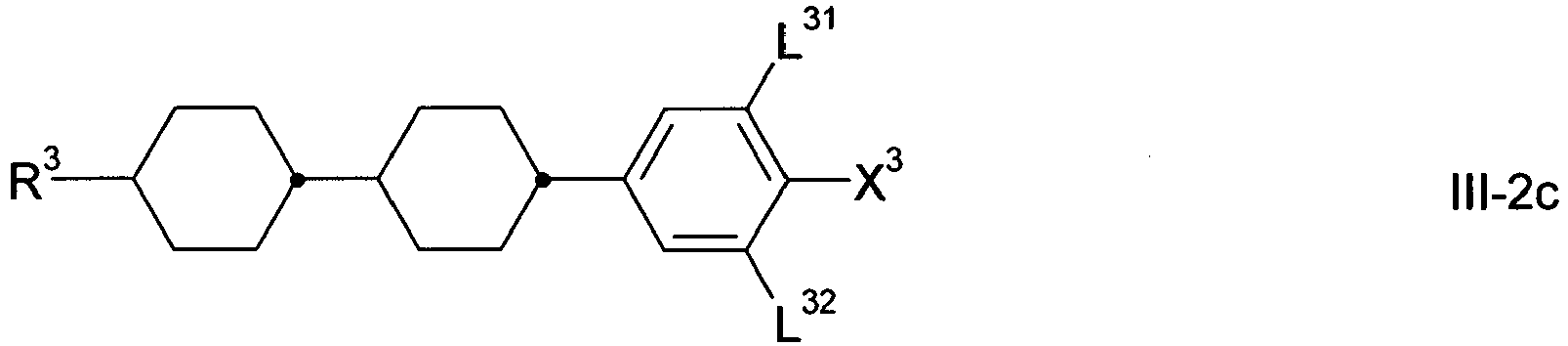
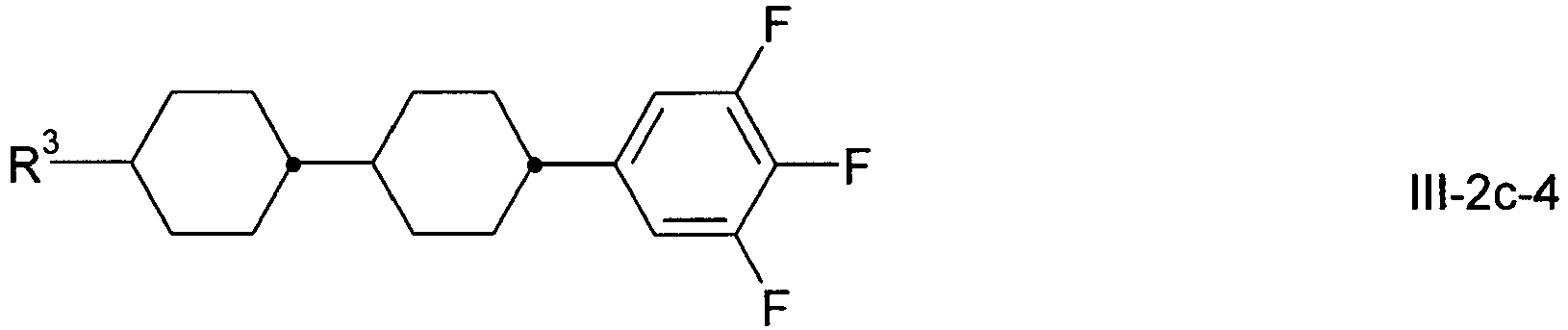
- the compounds of formula II-2c are preferably selected from the group of compounds of formulae III-2c-1 to III-2c-5 wherein the R 3 has the meaning given above.
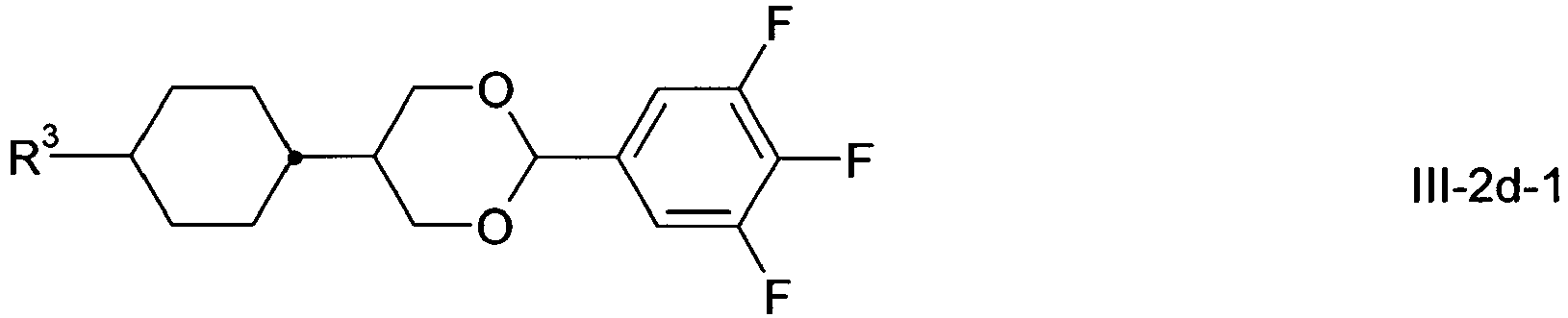
- the compounds of formulae III-2d and III-2e are preferably selected from the group of compounds of formulae III-2d-1 and III-2e-1 wherein the R 3 has the meaning given above.
- the compounds of formula III-2f are preferably selected from the group of compounds of formulae III-2f-1 to III-2f-7 wherein the R 3 has the meaning given above.
- the compounds of formula III-2g are preferably selected from the group of compounds of formulae III-2g-1 to III-2g-5 wherein the R 3 has the meaning given above.
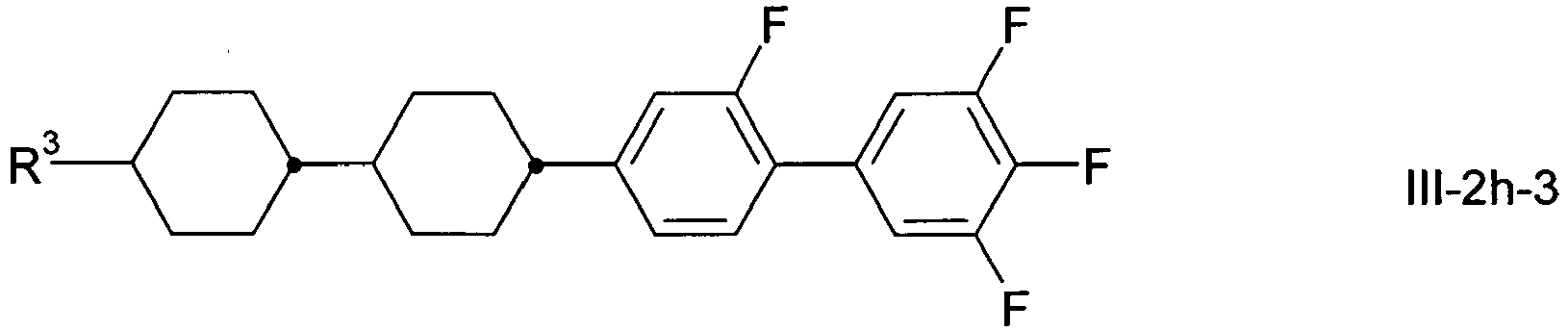
- the compounds of formula III-2h are preferably selected from the group of compounds of formulae III-2h-1 to III-2h-3 wherein the R 3 has the meaning given above.
- the compounds of formula III-2i are preferably selected from the group of compounds of formulae III-2i-1 to III-2i-6 wherein the R 3 has the meaning given above.
- the media according to the present invention may comprise one or more compounds of formula III-3, wherein the parameters have the respective meanings given under formula III above, and preferably of formula III-3a wherein the R 3 has the meaning given above.
- the liquid crystalline media according to the present invention comprise one or more compounds of formula IV preferably selected from the group of compounds of formulae IV-1 to IV-5 wherein R 41 and R 42 have the respective meanings given under formula IV above and in formulae IV-1, IV-4 and IV-5
- R 41 preferably is alkyl or alkenyl, preferably alkenyl and R 42 preferably is alkyl or alkenyl, preferably alkyl
- R 41 and R 42 preferably are alkyl and in formula IV-3
- R 41 preferably is alkyl or alkenyl, preferably alkyl and R 42 preferably is alkyl or alkoxy, preferably alkoxy.
- the medium comprises one or more compounds of formula IV-1, more preferably selected from its respective subformulae of formula CC-n-V and/or CC-nV-m, more preferably of formula CC-n-V and most preferably of formula CC-3-V.
- formula IV-1 more preferably selected from its respective subformulae of formula CC-n-V and/or CC-nV-m, more preferably of formula CC-n-V and most preferably of formula CC-3-V.
- the medium comprises one or more compounds of formula IV-4, more preferably selected from its respective subformulae of formula CCP-V-n and/or CCP-nV-m and/or CCP-Vn-m, more preferably of formula CCP-V-n and/or CCP-V2-n and most preferably selected from the group of formulae CCP-V-1 and CCP-V2-1.
- formula IV-4 more preferably selected from its respective subformulae of formula CCP-V-n and/or CCP-nV-m and/or CCP-Vn-m, more preferably of formula CCP-V-n and/or CCP-V2-n and most preferably selected from the group of formulae CCP-V-1 and CCP-V2-1.
- the medium comprises compounds selected from the group of compounds of formulae IV-1, IV-3, IV-4 and IV-5, preferably one or more compounds of formula IV-1 and one or more compounds selected from the group of formulae IV-3 or IV-4.
- the medium further comprises one or more compounds of formula IV selected from the group of compounds of formulae IV-6 to IV-13 wherein
- the media according to the present invention my comprise one or more compounds of formula V wherein
- the media according to the present invention comprises one or more compounds of formula V, preferably selected from the group of compounds of formulae V-1 and V-2 wherein the parameters have the respective meanings given above and the parameters L 53 and L 54 are, independently of each other and of the other parameters, H or F and preferably Z 5 is -CH 2 -CH 2 -.
- the compounds of formula V-1 are selected from the group of compounds of formulae V-1a and V-1b wherein the R 5 has the meaning given above.
- the compounds of formula V-2 are selected from the group of compounds of formulae V-2a to V-2d wherein the R 5 has the meaning given above.
- liquid crystalline media according to the present invention additionally comprise one or more compounds of formula VI wherein
- the compounds of formula VI-1 are preferably selected from its subformula PP-n-2Vm, more preferably of formula PP-1-2V1.
- the definitions of these abbreviations (acronyms) are given in table B below.
- the medium comprises one or more compounds of formula VI-2, more preferably of its subformula PGP-n-m, more preferably of its subformulae PGP-2-m and PGP-3-m, more preferably selected from of formulae PGP-2-2V, PGP-3-2, PGP-3-3, PGP-3-4, PGP-3-5.
- liquid crystalline media according to the instant invention comprise one or more compounds of formula I, II, III and IV.
- mesogenic compounds which are not explicitly mentioned above, can optionally and beneficially be used in the media according to the instant invention. Such compounds are known to the expert in the field.
- the ⁇ n, at 589 nm (Na D ) and 20 °C, of the liquid crystal media according to the instant invention preferably is in the range of 0.070 or more to 0.145 or less, more preferably in the range of 0.080 or more to 0.140 or less and most preferably in the range of 0.090 or more to 0.135 or less.
- the ⁇ , at 1 kHz and 20 °C, of the liquid crystal medium according to the invention preferably is 4 or more, more preferably 6 or more and most preferably 8 or more. In particular ⁇ is 14 or less.
- the nematic phase of the inventive media extends at least from 0 °C or less to 70 °C more, more preferably at least from -20 °C or less to 70 °C more, most preferably at least from -30 °C or less to 75 °C more and in particular at least from -40 °C or less to 75 °C more.
- the ⁇ n of the liquid crystal media is in the range of 0.120 or more to 0.150 or less, more preferably in the range of 0.125 or more to 0.145 or less and most preferably in the range of 0.130 or more to 0.140 or less, while ⁇ preferably is in the range from 3 or more to 12 or less, preferably 10 or less.
- the ⁇ n of the liquid crystal media is n the range of 0.120 or more to 0.150 or less, more preferably in the range of 0.125 or more to 0.145 or less and most preferably in the range of 0.130 or more to 0.140 or less, while ⁇ preferably is in the range from 2 or more to 8 or less, preferably 6 or less.
- the ⁇ n of the liquid crystal media is n the range of 0.085 or more to 0.130 or less, more preferably in the range of 0.090 or more to 0.125 or less and most preferably in the range of 0.095 or more to 0.120 or less, while ⁇ preferably is 6 or more, more preferably 8 or more, even more preferably 11 or more and most preferably in the range from 11 or more to 14 or less.
- the ⁇ n of the liquid crystal media is n the range of 0.090 or more to 0.135 or less, more preferably in the range of 0.095 or more to 0.130 or less and most preferably in the range of 0.110 or more to 0.125 or less, while ⁇ preferably is 6 or more, more preferably 8 or more, even more preferably 11 or more and most preferably in the range from 11 or more to 14 or less.
- the concentration of compounds of formula I in the medium preferably is in the range from 1 % to 20 %, more preferably from 2 % to 17 % and most preferably from 4 % to 15 %.
- the total concentration of compounds of formulae II and III in the medium preferably is in the range from 5 % to 65 %, more preferably from 10 % to 60 % and most preferably from 13 % to 50 %.
- the total concentration of compounds of the formulae I, II and III in total preferably is in the range from 10 % to 80 %, more preferably from 15 % to 70 % and most preferably from 18 % to 65 %
- the total concentration of compounds of formula IV preferably is in the range from 30% to 70%, more preferably from 35% to 60% and most preferably from 40% to 55%.
- the total concentration of compounds of formula V is in the range from 0% to 35%, more preferably from 1% to 30% and most preferably from 5% to 30%.
- the concentration of compounds of formula VI is in the range from 0 to 40%, preferably 2 to 35% and most preferably 5 to 30%.
- the inventive media can comprise further liquid crystal compounds in order to adjust the physical properties.
- Such compounds are known to the expert.
- Their concentration in the media according to the instant invention is preferably 0 % to 30 %, more preferably 0.1 % to 20 % and most preferably 1 % to 15 %.
- the medium comprises one or more compounds of formula IV, more preferably of formula IV-1, more preferably selected from its respective subformulae of formula CC-n-V and/or CC-n-Vm, more preferably of formula CC-n-V1 and/ or CC-n-V and most preferably selected from the group of formulae CC-3-V, CC-4-V, CC-5-V and CC-3-V1.
- the medium comprises one or more compounds of formulae II-1a and II-1g, more preferably of formula II-1-g-1, preferably selected from its respective subformulae of formula PGUQU-n-F, most preferably selected from the group of formulae PGUQU-3-F, PGUQU-4-F and PGUQU-5-F.
- the concentration of compounds of formula IV is greater than 40%, more preferably greater than 42%, and most preferably greater than 45%.
- the liquid crystal media contain 50 % to 100 %, more preferably 70 % to 100 % and most preferably 90 % to 100 % compounds of formulae I to VI and preferably I to IV and VI.
- the threshold voltages, as well as all other electro-optical properties have been determined with test cells prepared at Merck KGaA, Germany.
- the test cells for the determination of ⁇ had a cell gap of approximately 20 ⁇ m.
- the electrode was a circular ITO electrode with an area of 1.13 cm 2 and a guard ring.
- the orientation layers were lecithin for homeotropic orientation ( ⁇ ) and polyimide AL-1054 from Japan Synthetic Rubber for homogeneous orientation ( ⁇ ⁇ ).
- the capacities were determined with a frequency response analyser Solatron 1260 using a sine wave with a voltage of 0.3 V rms .
- the light used in the electro-optical measurements was white light.
- the set up used was commercially available equipment of Otsuka, Japan.
- the characteristic voltages have been determined under perpendicular observation.
- the threshold (V 10 ) - mid grey (V 50 ) - and saturation (V 90 ) voltages have been determined for 10 %, 50 % and 90
- the threshold voltages, as well as all other electro-optical properties have been determined with test cells prepared at Merck KGaA, Germany.
- the test cells for the determination of ⁇ had a cell gap of approximately 20 ⁇ m.
- the electrode was a circular ITO electrode with an area of 1.13 cm 2 and a guard ring.
- the orientation layers were lecithin for homeotropic orientation ( ⁇ ) and polyimide AL-1054 from Japan Synthetic Rubber for homogeneous orientation ( ⁇ ⁇ ).
- the capacities were determined with a frequency response analyser Solatron 1260 using a sine wave with a voltage of 0.3 V rms .
- the light used in the electro-optical measurements was white light.
- the set up used was commercially available equipment of Otsuka, Japan.
- the characteristic voltages have been determined under perpendicular observation.
- the threshold (V 10 ) - mid grey (V 50 ) - and saturation (V 90 ) voltages have been determined for 10 %, 50 % and 90
- the liquid crystal media according to the present invention can contain further additives and chiral dopants in usual concentrations.
- the total concentration of these further constituents is in the range of 0 % to 10 %, preferably 0.1 % to 6 %, based on the total mixture.
- the concentrations of the individual compounds used each are preferably in the range of 0.1 % to 3 %.
- the concentration of these and of similar additives is not taken into consideration for the values and ranges of the concentrations of the liquid crystal components and compounds of the liquid crystal media in this application.
- the inventive liquid crystal media according to the present invention consist of several compounds, preferably of 3 to 30, more preferably of 4 to 20 and most preferably of 4 to 16 compounds. These compounds are mixed in conventional way. As a rule, the required amount of the compound used in the smaller amount is dissolved in the compound used in the greater amount. In case the temperature is above the clearing point of the compound used in the higher concentration, it is particularly easy to observe completion of the process of dissolution. It is, however, also possible to prepare the media by other conventional ways, e.g. using so called pre-mixtures, which can be e.g. homologous or eutectic mixtures of compounds or using so called multi-bottle-systems, the constituents of which are ready to use mixtures themselves.
- pre-mixtures which can be e.g. homologous or eutectic mixtures of compounds or using so called multi-bottle-systems, the constituents of which are ready to use mixtures themselves.
- liquid crystal media according to the instant invention can be modified in such a way, that they are usable in all known types of liquid crystal displays, either using the liquid crystal media as such, like TN-, TN-AMD, ECB-AMD, VAN-AMD, IPS and OCB LCDs and in particular in composite systems, like PDLC, NCAP, PN LCDs and especially in ASM-PA LCDs.
- the melting point T(C,N), the transition from the smectic (S) to the nematic (N) phase T(S,N) and the clearing point T(N,I) of the liquid crystals are given in degrees centigrade.
- the structures of the liquid crystal compounds are represented by abbreviations also called acronyms.
- the transformation of the abbreviations into the corresponding structures is straight forward according to the following two tables A and B. All groups C n H 2n+1 and C m H 2m+1 are straight chain alkyl groups with n respectively m C-atoms.
- Table B The interpretation of table B is self-evident.
- Table A does only list the abbreviations for the cores of the structures.
- the LC media preferably comprise 0 to 10% by weight, in particular 1 ppm to 5% by weight, particularly preferably 1 ppm to 1% by weight, of stabilisers.
- the LC media preferably comprise one or more stabilisers selected from the group consisting of compounds from Table C
- liquid crystal media according to the instant invention contain preferably
- the physical properties compositions illustrate to the expert, which properties can be achieved and in which ranges they can be modified. Especially the combination of the various properties, which can be preferably achieved, is thus well defined for the expert.
- a liquid crystal mixture is realized with the composition and properties given in the following table.
- a liquid crystal mixture is realized with the composition and properties given in the following table.
- a liquid crystal mixture is realized with the composition and properties given in the following table.
- a liquid crystal mixture is realized with the composition and properties given in the following table.
- a liquid crystal mixture is realized with the composition and properties given in the following table.
- a liquid crystal mixture is realized with the composition and properties given in the following table.
- a liquid crystal mixture is realized with the composition and properties given in the following table.
- a liquid crystal mixture is realized with the composition and properties given in the following table.
- a liquid crystal mixture is realized with the composition and properties given in the following table.
- APUQU-2-F 6.50 ⁇ (20 °C, 1 kHz) 12.4 3
- a liquid crystal mixture is realized with the composition and properties given in the following table.
- APUQU-2-F 6.50 ⁇ (20 °C, 1 kHz) 12.5 3
- a liquid crystal mixture is realized with the composition and properties given in the following table.
- a liquid crystal mixture is realized with the composition and properties given in the following table.
- a liquid crystal mixture is realized with the composition and properties given in the following table.
- a liquid crystal mixture is realized with the composition and properties given in the following table.
- a liquid crystal mixture is realized with the composition and properties given in the following table.
- a liquid crystal mixture is realized with the composition and properties given in the following table.
- a liquid crystal mixture is realized with the composition and properties given in the following table.
- APUQU-2-F 5.00 ⁇ (20 °C, 1 kHz) 13.0 3
- a liquid crystal mixture is realized with the composition and properties given in the following table.
- APUQU-2-F 5.00 ⁇ (20 °C, 1 kHz) 12.7 3
- APUQU-3-F 6.00 ⁇ 1 (20 °C) 70 mPa ⁇ s 4
- a liquid crystal mixture is realized with the composition and properties given in the following table.
- a liquid crystal mixture is realized with the composition and properties given in the following table.
Landscapes
- Chemical & Material Sciences (AREA)
- Crystallography & Structural Chemistry (AREA)
- Engineering & Computer Science (AREA)
- Materials Engineering (AREA)
- Organic Chemistry (AREA)
- Physics & Mathematics (AREA)
- Nonlinear Science (AREA)
- General Physics & Mathematics (AREA)
- Optics & Photonics (AREA)
- Liquid Crystal Substances (AREA)
Description
- The present invention relates to liquid crystalline media and to liquid crystal displays comprising these media, especially to displays addressed by an active matrix and in particular to displays of the Twisted Nematic or the In Plane Switching (IPS) type.
- Liquid Crystal Displays (LCDs) are widely used to display information. LCDs are used for direct view displays, as well as for projection type displays. Electro-optical modes employed are e.g. the twisted nematic (TN)-, the super twisted nematic (STN)-, the optically compensated bend (OCB)- and the electrically controlled birefringence (ECB)-mode with their various modifications, as well as others. All these modes use an electrical field, which is substantially perpendicular to the substrates, respectively to the liquid crystal layer. Besides these modes there are also electro-optical modes employing an electrical field substantially parallel to the substrates, respectively the liquid crystal layer, like e.g. the In-Plane Switching mode (as disclosed e.g. in
DE 40 00 451 andEP 0 588 568 ). Especially this electro-optical mode is used for LCDs for modern desktop monitors and TV applications. The liquid crystals according to the present invention are preferably used in this type of displays. - For these displays new liquid crystalline media with improved properties are required. Especially the response times have to be improved for many types of applications. Thus liquid crystalline media with lower viscosities (η), especially with lower rotational viscosities (γ1) are required. The rotational viscosity should be 80 mPa·s or less, preferably 70 mPa·s or less and especially 60 mPa·s or less. Besides this parameter, the media have to exhibit a suitably wide range of the nematic phase, an appropriate birefringence (Δn) and dielectric anisotropy (Δε) should be high enough to allow a reasonably low operation voltage. Preferably Δε should be higher than 3 and very preferably higher than 4, preferably, however, not higher than 15 and in particular not higher than 12, as this would be detrimental for an at least reasonably high specific resistivity.
- The displays according to the present invention are preferably addressed by an active matrix (active matrix LCDs, short AMDs), preferably by a matrix of thin film transistors (TFTs). However, the inventive liquid crystals can also beneficially be used in displays with other known addressing means.
- There are various different display modes using composite systems of liquid crystal materials of low molecular weight together with polymeric materials. These are e.g. polymer dispersed liquid crystal (PDLC)-, nematic curvi-linearly aligned phase (NCAP)- and polymer network (PN)-systems, as disclosed for example in
WO 91/05 029 - Prior art describes the use of aromatic mesogenic compounds with a difluoromethyleneoxy bridge and a trifluoromethyl head group for the use in liquid crystalline media in order to achieve a sufficiently high dielectric anisotropy for display applications, for example
EP 2 698 414 A1 ,US 2014/097384 A1 ,EP 1 739 151 A1 ,US 2012/261616 A1 ,US 2011/095228 A1 andUS 6 231 785 B1 . - Liquid crystal compositions suitable for LCDs and especially for IPS displays are known e. g. from
JP 07-181 439 (A EP 0 667 555 ,EP 0 673 986 ,DE 195 09 410 ,DE 195 28 106 ,DE 195 28 107 ,WO 96/23 851 WO 96/28 521 - Thus, there is a significant need for liquid crystalline media with suitable properties for practical applications such as a wide nematic phase range, appropriate optical anisotropy Δn, according to the display mode used, a high Δε and especially low viscosities.
- Surprisingly, it has now been found that liquid crystalline media with a suitably high Δε, a suitable phase range, and Δn can be realized which do not exhibit the drawbacks of the materials of the prior art or at least do exhibit them to a significantly lesser degree by using liquid crystalline media comprising one or more compounds of formula I below.
- Hence, the present invention relates to a liquid crystal medium comprising
- one or more compounds of formula I

- R1
- denotes alkyl, alkoxy, fluorinated alkyl or fluorinated alkoxy with 1 to 7 C-atoms, alkenyl, alkenyloxy, alkoxyalkyl or fluorinated alkenyl with 2 to 7 C-atoms, preferably alkyl or alkenyl,
- L1
- denotes H or F,
- one or more compounds of formulae II-1a and II-1g


- R2 and R3,
- independently of each other, are alkyl, alkoxy, fluorinated alkyl or fluorinated alkoxy with 1 to 7 C-atoms, alkenyl, alkenyloxy, alkoxyalkyl or fluorinated alkenyl with 2 to 7 C-atoms,


- L21, L22, L23, L24, L31 and L32,
- are, independently of each other, H or F,
- X2 and X3
- are, independently of each other, halogen, halogenated alkyl or alkoxy with 1 to 3 C-atoms or halogenated alkenyl or alkenyloxy with 2 or 3 C-atoms,
- Z3
- is -CH2CH2-, -CF2CF2-, -COO-, trans- -CH=CH-, trans- -CF=CF-, -CH2O- or a single bond,
- n and o
- are, independently of each other, 0 or 1 and
and - optionally one or more compounds of formula IV

- R41 and R42
- independently of each other have the meaning given for R2 under formula II-1a and II-1g above, preferably R41 is alkyl and R42 is alkyl or alkoxy or R41 is alkenyl and R42 is alkyl,


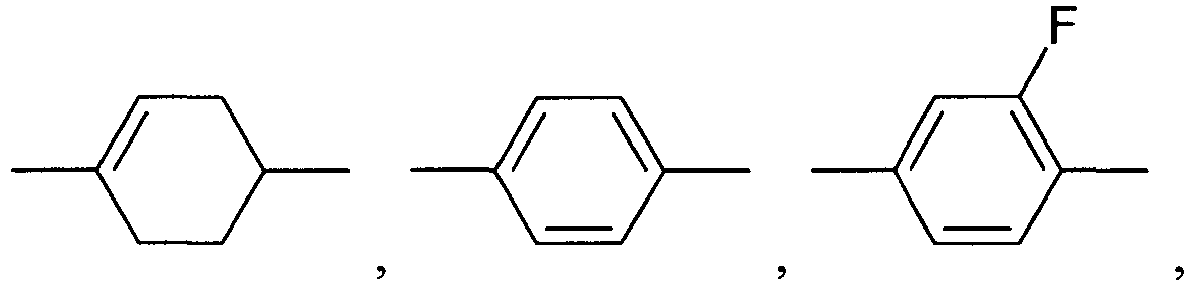


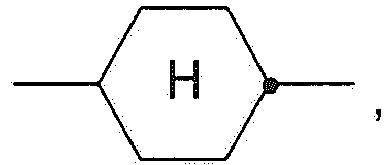
- Z41, Z42
- independently of each other, and in case Z41 is present twice, also these independently of each other, denote -CH2CH2-, -COO-, trans- -CH=CH-, trans- -CF=CF-, -CH2O-, -CF2O-, -C≡C- or a single bond, preferably at least one of them is a single bond, and
- p
- is 0, 1 or 2, preferably 0 or 1.
- The medium according to the invention optionally comprises one or more compounds selected from the group of compounds of formulae II-1 to II-3

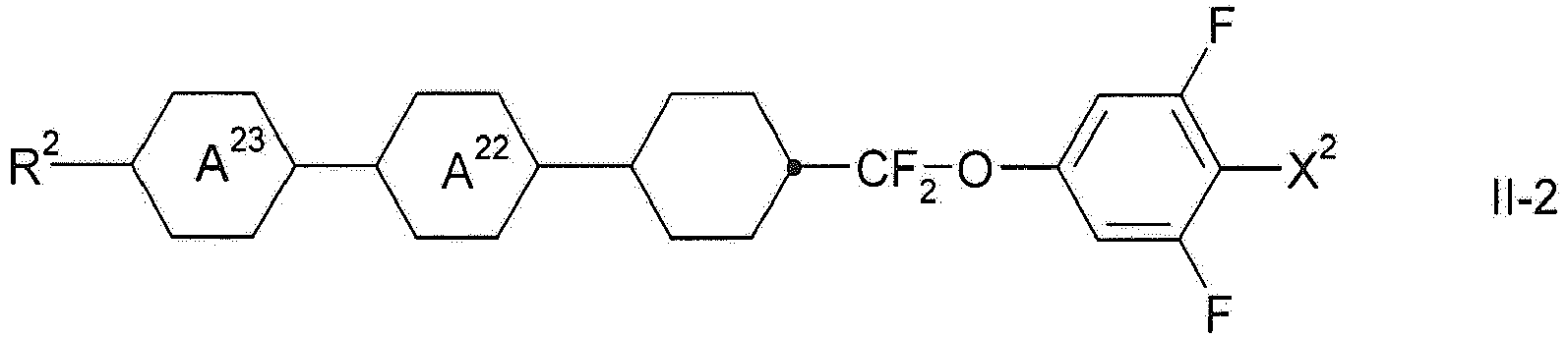

in which - R2
- independently of each other, denote alkyl, alkoxy, fluorinated alkyl or fluorinated alkoxy with 1 to 7 C-atoms, alkenyl, alkenyloxy, alkoxyalkyl or fluorinated alkenyl with 2 to 7 C-atoms, preferably alkyl or alkenyl,
- L21, L22, L31 and L32
- independently of each other, denote H or F, preferably F
- X2 and X3
- independently of each other, denote halogen, halogenated alkyl or alkoxy with 1 to 3 C-atoms or halogenated alkenyl or alkenyloxy with 2 or 3 C-atoms, preferably F, Cl, -OCF3 or -CF3, most preferably F, Cl or -OCF3,
- Z3
- denotes -CH2CH2-, -CF2CF2-, -COO-, trans- -CH=CH-, trans-CF=CF-, -CH2O- or a single bond, preferably-CH2CH2-, -COO-, trans- -CH=CH- or a single bond and most preferably -COO-, trans- -CH=CH- or a single bond, and
- In formulae II-1 to II-3, L21 and L22 or L23 and L24 are preferably both F.
- In another preferred embodiment in formulae II-1 and II-2, all of L21, L22, L23 and L24 denote F.
- The compounds of formula II-1 are selected from the group of compounds of formulae II-1b to II-1f


- In a preferred embodiment of the present invention the medium comprises compounds selected from the group of compounds of formulae II-1a to II-1g wherein L21 and L22 or L23 and L24 are both F.
- In another preferred embodiment the medium comprises compounds selected from the group of compounds of formulae II-1a to II-1g, wherein L21, L22, L23 and L24 all are F.
- Especially preferred compounds of formula II-1 are


- Preferably the compounds of formula II-2 are selected from the group of compounds of formulae II-2a to II-2c


L21 and L22 are both F. - Preferably the compounds of formula II-3 are selected from the group of compounds of formulae II-3a to II-3e


L21 and L22 are both F and L23 and L24 are both H or
L21, L22, L23 and L24 are all F. - Especially preferred compounds of formula II-3 are


- In another preferred embodiment of the present invention compounds of formula III are selected from the group of formulae III-1 and III-2


- Preferably the compounds of formula III-1 are selected from the group of compounds of formulae III-1a and III-1b


- Preferably the compounds of formula III-2 are selected from the group of compounds of formulae III-2a to III-2i

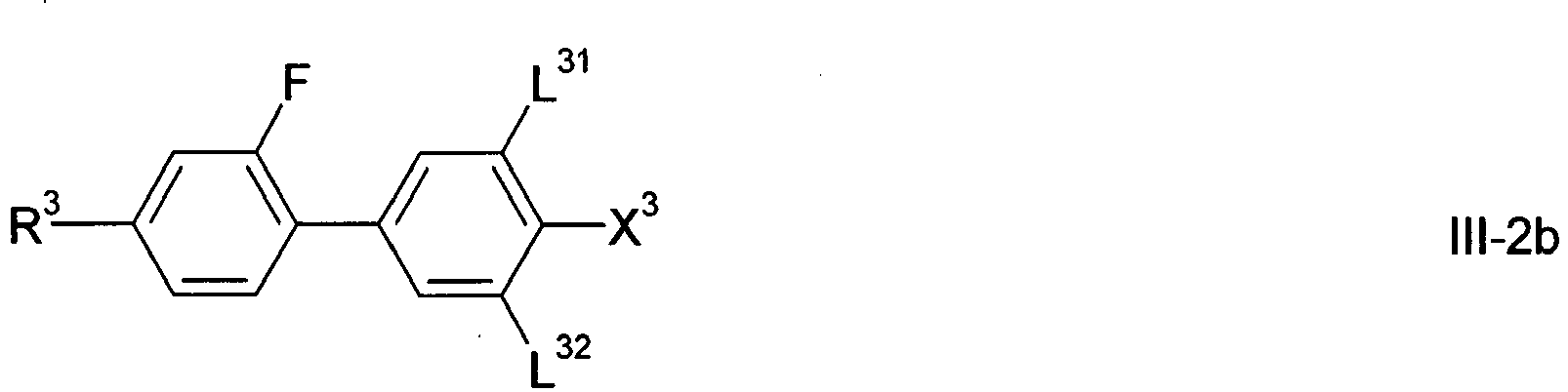


- III-1a, are preferably selected from the group of compounds of formulae III-1a-1 to III-1a-6





- In another preferred embodiment the compounds of formula II-2a are selected from the group of compounds of formulae III-2a-1 to III-2a-4


- The compounds of formula III-2b are preferably selected from the group of compounds of formulae III-2b-1 and III-2b-2, preferably III-2b-2


- The compounds of formula II-2c, are preferably selected from the group of compounds of formulae III-2c-1 to III-2c-5



- The compounds of formulae III-2d and III-2e are preferably selected from the group of compounds of formulae III-2d-1 and III-2e-1

- The compounds of formula III-2f are preferably selected from the group of compounds of formulae III-2f-1 to III-2f-7


- The compounds of formula III-2g, are preferably selected from the group of compounds of formulae III-2g-1 to III-2g-5




- The compounds of formula III-2h are preferably selected from the group of compounds of formulae III-2h-1 to III-2h-3


- The compounds of formula III-2i are preferably selected from the group of compounds of formulae III-2i-1 to III-2i-6


- Alternatively or additionally to compounds of formulae III-1 and/or III-2 the media according to the present invention may comprise one or more compounds of formula III-3,
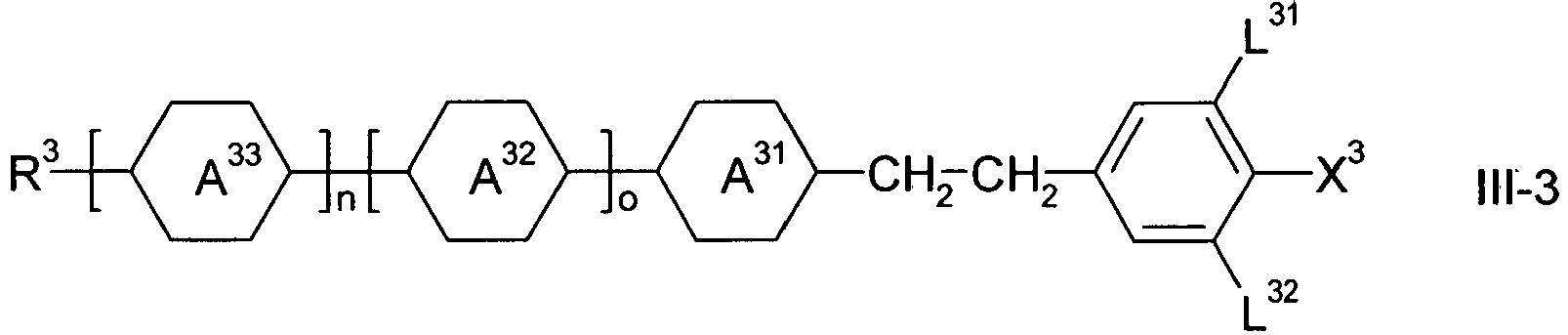
and preferably of formula III-3a
- Preferably the liquid crystalline media according to the present invention comprise one or more compounds of formula IV preferably selected from the group of compounds of formulae IV-1 to IV-5


- In a preferred embodiment, the medium comprises one or more compounds of formula IV-1, more preferably selected from its respective subformulae of formula CC-n-V and/or CC-nV-m, more preferably of formula CC-n-V and most preferably of formula CC-3-V. The definitions of these abbreviations (acronyms) are given in table B below.
- In a preferred embodiment, the medium comprises one or more compounds of formula IV-4, more preferably selected from its respective subformulae of formula CCP-V-n and/or CCP-nV-m and/or CCP-Vn-m, more preferably of formula CCP-V-n and/or CCP-V2-n and most preferably selected from the group of formulae CCP-V-1 and CCP-V2-1. The definitions of these abbreviations (acronyms) are given in table B below.
- Preferably the medium comprises compounds selected from the group of compounds of formulae IV-1, IV-3, IV-4 and IV-5, preferably one or more compounds of formula IV-1 and one or more compounds selected from the group of formulae IV-3 or IV-4.
- Optionally it can be preferred that the medium further comprises one or more compounds of formula IV selected from the group of compounds of formulae IV-6 to IV-13


- R41 and R42
- independently of each other, denote alkyl, alkoxy, fluorinated alkyl or fluorinated alkoxy with 1 to 7 C-atoms, alkenyl, alkenyloxy, alkoxyalkyl or fluorinated alkenyl with 2 to 7 C-atoms and
- L4
- denotes H or F.
- Alternatively or additionally to compounds of formulae II and/or III the media according to the present invention my comprise one or more compounds of formula V

- R5
- is alkyl, alkoxy, fluorinated alkyl or fluorinated alkoxy with 1 to 7 C-atoms, alkenyl, alkenyloxy, alkoxyalkyl or fluorinated alkenyl with 2 to 7 C-atoms, and preferably is alkyl or alkenyl,
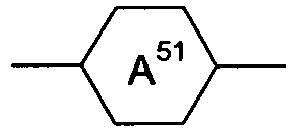


- L51 and L52,
- independently of each other, denote H or F, preferably L51 denotes F and
- X5
- denotes halogen, halogenated alkyl or alkoxy with 1 to 3 C-atoms or halogenated alkenyl or alkenyloxy with 2 or 3 C-atoms, preferably F, Cl, -OCF3 or -CF3, most preferably F, Cl or -OCF3,
- Z5
- denotes -CH2CH2-, -CF2CF2-, -COO-, trans- -CH=CH-, trans- -CF=CF- or -CH2O, preferably -CH2CH2-, -COO- or trans- -CH=CH- and most preferably -COO- or -CH2CH2-, and
- q
- is 0 or 1.
- Preferably the media according to the present invention comprises one or more compounds of formula V, preferably selected from the group of compounds of formulae V-1 and V-2


- Preferably the compounds of formula V-1 are selected from the group of compounds of formulae V-1a and V-1b


- Preferably the compounds of formula V-2 are selected from the group of compounds of formulae V-2a to V-2d


- Preferably the liquid crystalline media according to the present invention additionally comprise one or more compounds of formula VI

- R61 and R62
- independently of each other have the meaning given for R2 under formula II-1a and II-1g above, preferably R61 is alkyl and R62 is alkyl or alkenyl,


- Z61 and Z62
- are, independently of each other, and in case Z61 is present twice, also these independently of each other, -CH2CH2-, -COO-, trans- -CH=CH-, trans- -CF=CF-, -CH2O-, -CF2O- or a single bond, preferably at least one of them is a single bond, and
- r
- is 0, 1 or 2, preferably 0 or 1.
- Preferably the compounds of formula VI are selected from the group of compounds of formulae VI-1 to VI-4


- Preferably the medium comprises one or more compounds selected from the group of compounds of formulae VI-1 to VI-4 wherein R61 preferably is alkyl and in formula VI-1 R62 preferably is alkenyl, preferably -(CH2)2-CH=CH-CH3 and in formula VI-2 R62 preferably is alkenyl, preferably - (CH2)2-CH=CH2 and in formulae VI-3 and VI-4 R62 preferably is alkyl.
- The compounds of formula VI-1 are preferably selected from its subformula PP-n-2Vm, more preferably of formula PP-1-2V1. The definitions of these abbreviations (acronyms) are given in table B below.
- In a preferred embodiment, the medium comprises one or more compounds of formula VI-2, more preferably of its subformula PGP-n-m, more preferably of its subformulae PGP-2-m and PGP-3-m, more preferably selected from of formulae PGP-2-2V, PGP-3-2, PGP-3-3, PGP-3-4, PGP-3-5.
- The definitions of these abbreviations (acronyms) are given in table B below.
- Preferably the liquid crystalline media according to the instant invention comprise one or more compounds of formula I, II, III and IV.
- Also other mesogenic compounds, which are not explicitly mentioned above, can optionally and beneficially be used in the media according to the instant invention. Such compounds are known to the expert in the field.
- The Δn, at 589 nm (NaD) and 20 °C, of the liquid crystal media according to the instant invention preferably is in the range of 0.070 or more to 0.145 or less, more preferably in the range of 0.080 or more to 0.140 or less and most preferably in the range of 0.090 or more to 0.135 or less.
- The Δε, at 1 kHz and 20 °C, of the liquid crystal medium according to the invention preferably is 4 or more, more preferably 6 or more and most preferably 8 or more. In particular Δε is 14 or less.
- Preferably the nematic phase of the inventive media extends at least from 0 °C or less to 70 °C more, more preferably at least from -20 °C or less to 70 °C more, most preferably at least from -30 °C or less to 75 °C more and in particular at least from -40 °C or less to 75 °C more.
- In a first preferred embodiment of the present invention the Δn of the liquid crystal media is in the range of 0.120 or more to 0.150 or less, more preferably in the range of 0.125 or more to 0.145 or less and most preferably in the range of 0.130 or more to 0.140 or less, while Δε preferably is in the range from 3 or more to 12 or less, preferably 10 or less.
- In a second preferred embodiment of the present invention the Δn of the liquid crystal media is n the range of 0.120 or more to 0.150 or less, more preferably in the range of 0.125 or more to 0.145 or less and most preferably in the range of 0.130 or more to 0.140 or less, while Δε preferably is in the range from 2 or more to 8 or less, preferably 6 or less.
- In a third preferred embodiment of the present invention the Δn of the liquid crystal media is n the range of 0.085 or more to 0.130 or less, more preferably in the range of 0.090 or more to 0.125 or less and most preferably in the range of 0.095 or more to 0.120 or less, while Δε preferably is 6 or more, more preferably 8 or more, even more preferably 11 or more and most preferably in the range from 11 or more to 14 or less.
- In a fourth preferred embodiment of the present invention the Δn of the liquid crystal media is n the range of 0.090 or more to 0.135 or less, more preferably in the range of 0.095 or more to 0.130 or less and most preferably in the range of 0.110 or more to 0.125 or less, while Δε preferably is 6 or more, more preferably 8 or more, even more preferably 11 or more and most preferably in the range from 11 or more to 14 or less.
- The concentration of compounds of formula I in the medium preferably is in the range from 1 % to 20 %, more preferably from 2 % to 17 % and most preferably from 4 % to 15 %.
- The total concentration of compounds of formulae II and III in the medium preferably is in the range from 5 % to 65 %, more preferably from 10 % to 60 % and most preferably from 13 % to 50 %.
- The total concentration of compounds of the formulae I, II and III in total preferably is in the range from 10 % to 80 %, more preferably from 15 % to 70 % and most preferably from 18 % to 65 %
- The total concentration of compounds of formula IV preferably is in the range from 30% to 70%, more preferably from 35% to 60% and most preferably from 40% to 55%.
- The total concentration of compounds of formula V is in the range from 0% to 35%, more preferably from 1% to 30% and most preferably from 5% to 30%.
- The concentration of compounds of formula VI is in the range from 0 to 40%, preferably 2 to 35% and most preferably 5 to 30%.
- Optionally, the inventive media can comprise further liquid crystal compounds in order to adjust the physical properties. Such compounds are known to the expert. Their concentration in the media according to the instant invention is preferably 0 % to 30 %, more preferably 0.1 % to 20 % and most preferably 1 % to 15 %.
- In a preferred embodiment the medium comprises one or more compounds of formula IV, more preferably of formula IV-1, more preferably selected from its respective subformulae of formula CC-n-V and/or CC-n-Vm, more preferably of formula CC-n-V1 and/ or CC-n-V and most preferably selected from the group of formulae CC-3-V, CC-4-V, CC-5-V and CC-3-V1.
- The medium comprises one or more compounds of formulae II-1a and II-1g, more preferably of formula II-1-g-1, preferably selected from its respective subformulae of formula PGUQU-n-F, most preferably selected from the group of formulae PGUQU-3-F, PGUQU-4-F and PGUQU-5-F.
- The definitions of these abbreviations (acronyms) are given in table B below. In this preferred embodiment, preferably the concentration of compounds of formula IV is greater than 40%, more preferably greater than 42%, and most preferably greater than 45%.
- Preferably the liquid crystal media contain 50 % to 100 %, more preferably 70 % to 100 % and most preferably 90 % to 100 % compounds of formulae I to VI and preferably I to IV and VI.
- The following abbreviations are used:
- Vop =
- operating voltage;
- ton =
- time after switching on until 90% of the maximum contrast is achieved, measured from 10% of the maximum contrast;
- toff =
- time after switching off until 10% of the maximum contrast is achieved, measured from 90% of the maximum contrast;
- tsum =
- ton + toff.
- The ranges of parameters given in this application are all including the limiting values, unless explicitly stated otherwise.
- Throughout this application, unless explicitly stated otherwise, all concentrations are given in mass percent and relate to the respective complete mixture, all temperatures are given in degrees centigrade (Celsius) and all differences of temperatures in degrees centigrade. All physical properties have been and are determined according to "Merck Liquid Crystals, Physical Properties of Liquid Crystals", Status Nov. 1997, Merck KGaA, Germany and are given for a temperature of 20 °C, unless explicitly stated otherwise. The optical anisotropy (Δn) is determined at a wavelength of 589.3 nm. The dielectric anisotropy (Δε) is determined at a frequency of 1 kHz. The threshold voltages, as well as all other electro-optical properties have been determined with test cells prepared at Merck KGaA, Germany. The test cells for the determination of Δε had a cell gap of approximately 20 µm. The electrode was a circular ITO electrode with an area of 1.13 cm2 and a guard ring. The orientation layers were lecithin for homeotropic orientation (ε∥) and polyimide AL-1054 from Japan Synthetic Rubber for homogeneous orientation (ε⊥). The capacities were determined with a frequency response analyser Solatron 1260 using a sine wave with a voltage of 0.3 Vrms. The light used in the electro-optical measurements was white light. The set up used was commercially available equipment of Otsuka, Japan. The characteristic voltages have been determined under perpendicular observation. The threshold (V10) - mid grey (V50) - and saturation (V90) voltages have been determined for 10 %, 50 % and 90 % relative contrast, respectively.
- The following abbreciations are used:
- Vop =
- operating voltage;
- ton =
- time after switching on until 90% of the maximum contrast is achieved, measured from 10% of the maximum contrast;
- toff =
- time after switching off until 10% of the maximum contrast is achieved, measured from 90% of the maximum contrast;
- tsum =
- ton + toff.
- The ranges of parameters given in this application are all including the limiting values, unless explicitly stated otherwise.
- Throughout this application, unless explicitly stated otherwise, all concentrations are given in mass percent and relate to the respective complete mixture, all temperatures are given in degrees centigrade (Celsius) and all differences of temperatures in degrees centigrade. All physical properties have been and are determined according to "Merck Liquid Crystals, Physical Properties of Liquid Crystals", Status Nov. 1997, Merck KGaA, Germany and are given for a temperature of 20 °C, unless explicitly stated otherwise. The optical anisotropy (Δn) is determined at a wavelength of 589.3 nm. The dielectric anisotropy (Δε) is determined at a frequency of 1 kHz. The threshold voltages, as well as all other electro-optical properties have been determined with test cells prepared at Merck KGaA, Germany. The test cells for the determination of Δε had a cell gap of approximately 20 µm. The electrode was a circular ITO electrode with an area of 1.13 cm2 and a guard ring. The orientation layers were lecithin for homeotropic orientation (ε∥) and polyimide AL-1054 from Japan Synthetic Rubber for homogeneous orientation (ε⊥). The capacities were determined with a frequency response analyser Solatron 1260 using a sine wave with a voltage of 0.3 Vrms. The light used in the electro-optical measurements was white light. The set up used was commercially available equipment of Otsuka, Japan. The characteristic voltages have been determined under perpendicular observation. The threshold (V10) - mid grey (V50) - and saturation (V90) voltages have been determined for 10 %, 50 % and 90 % relative contrast, respectively.
- The liquid crystal media according to the present invention can contain further additives and chiral dopants in usual concentrations. The total concentration of these further constituents is in the range of 0 % to 10 %, preferably 0.1 % to 6 %, based on the total mixture. The concentrations of the individual compounds used each are preferably in the range of 0.1 % to 3 %. The concentration of these and of similar additives is not taken into consideration for the values and ranges of the concentrations of the liquid crystal components and compounds of the liquid crystal media in this application.
- The inventive liquid crystal media according to the present invention consist of several compounds, preferably of 3 to 30, more preferably of 4 to 20 and most preferably of 4 to 16 compounds. These compounds are mixed in conventional way. As a rule, the required amount of the compound used in the smaller amount is dissolved in the compound used in the greater amount. In case the temperature is above the clearing point of the compound used in the higher concentration, it is particularly easy to observe completion of the process of dissolution. It is, however, also possible to prepare the media by other conventional ways, e.g. using so called pre-mixtures, which can be e.g. homologous or eutectic mixtures of compounds or using so called multi-bottle-systems, the constituents of which are ready to use mixtures themselves.
- By addition of suitable additives, the liquid crystal media according to the instant invention can be modified in such a way, that they are usable in all known types of liquid crystal displays, either using the liquid crystal media as such, like TN-, TN-AMD, ECB-AMD, VAN-AMD, IPS and OCB LCDs and in particular in composite systems, like PDLC, NCAP, PN LCDs and especially in ASM-PA LCDs.
- The melting point T(C,N), the transition from the smectic (S) to the nematic (N) phase T(S,N) and the clearing point T(N,I) of the liquid crystals are given in degrees centigrade.
- In the present application and especially in the following examples, the structures of the liquid crystal compounds are represented by abbreviations also called acronyms. The transformation of the abbreviations into the corresponding structures is straight forward according to the following two tables A and B. All groups CnH2n+1 and CmH2m+1 are straight chain alkyl groups with n respectively m C-atoms. The interpretation of table B is self-evident. Table A does only list the abbreviations for the cores of the structures. The individual compounds are denoted by the abbreviation of the core followed by a hyphen and a code specifying the substituents R1, R2, L1 and L2 as follows:
Code for R1, R2, L1, L2 R1 R2 L1 L2 nm CnH2n+1 CmH2m+1 H H nOm CnH2n+1 OCmH2m+1 H H nO.m OCnH2n+1 CmH2m+1 H H n CnH2n+1 CN H H nN.F CnH2n+1 CN H F nN.F.F CnH2n+1 CN F F nF CnH2n+1 F H H nF.F CnH2n+1 F H F nF.F.F CnH2n+1 F F F nOF OCnH2n+1 F H H nCl CnH2n+1 Cl H H nCl.F CnH2n+1 Cl H F nCl.F.F CnH2n+1 Cl F F nCF3 CnH2n+1 CF3 H H nCF3.F CnH2n+1 CF3 H F nCF3.F.F CnH2n+1 CF3 F F nOCF3 CnH2n+1 OCF3 H H nOCF3.F CnH2n+1 OCF3 H F nOCF3.F.F CnH2n+1 OCF3 F F nOCF2 CnH2n+1 OCHF2 H H nOCF2.F CnH2n+1 OCHF2 H F nOCF2.F.F CnH2n+1 OCHF2 F F nS CnH2n+1 NCS H H nS.F CnH2n+1 NCS H F nS.F.F CnH2n+1 NCS F F rVsN CrH2r+1-CH=CH-CsH2s- CN H H rEsN CrH2r+1-O-CsH2s- CN H H nAm CnH2n+1 COOCmH2m+1 H H 


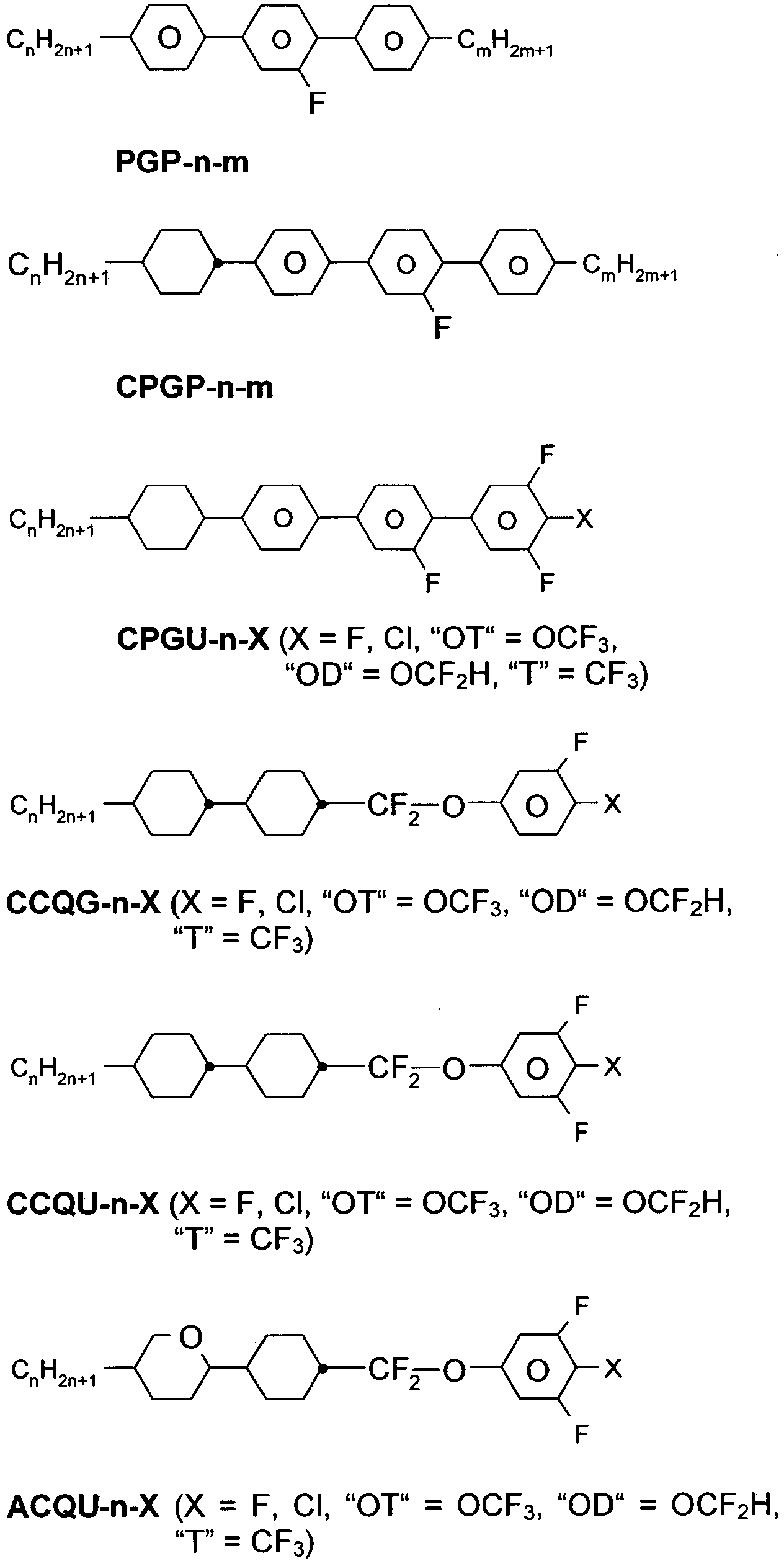


Table C Table C shows possible stabilisers which can be added to the LC media according to the invention. (n here denotes an integer from 1 to 12, preferably 1, 2, 3, 4, 5, 6, 7 or 8, terminal methyl groups are not shown). 


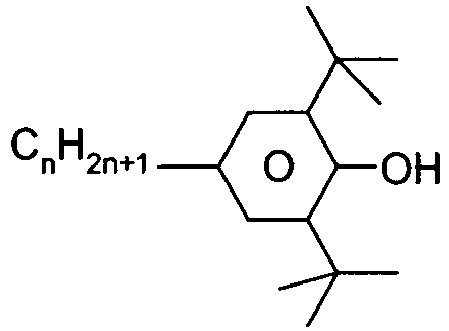


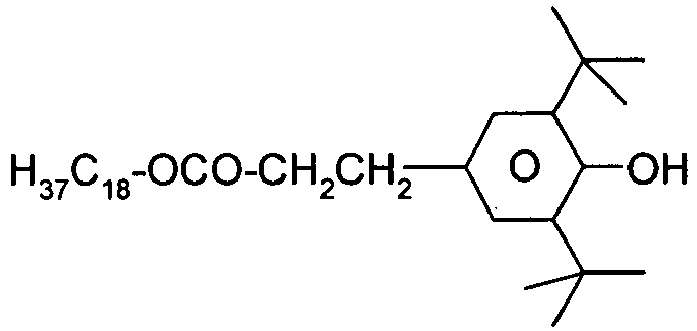


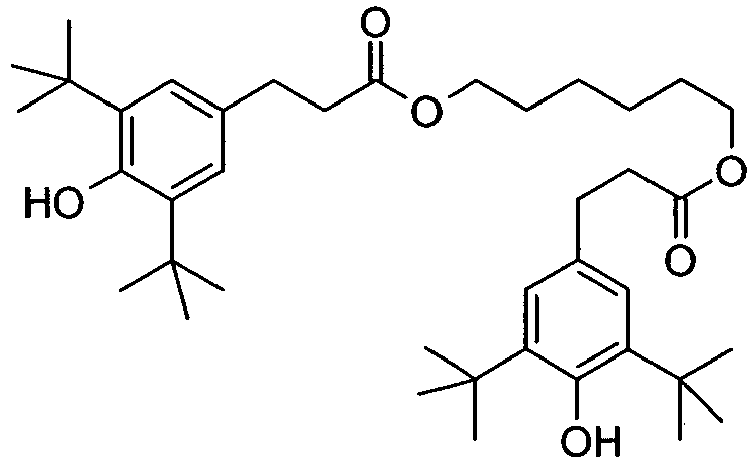


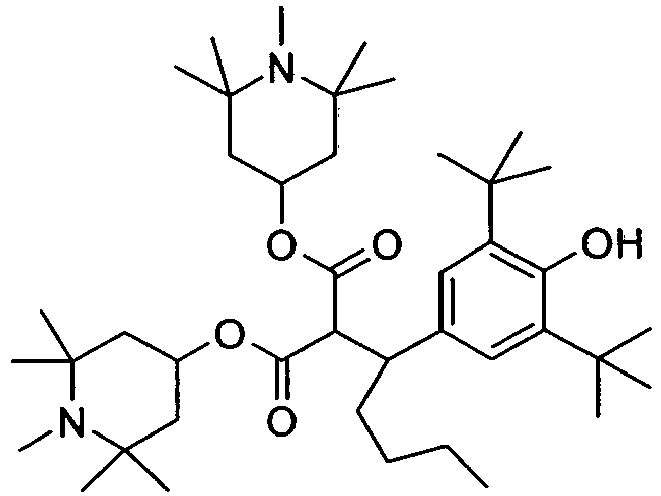


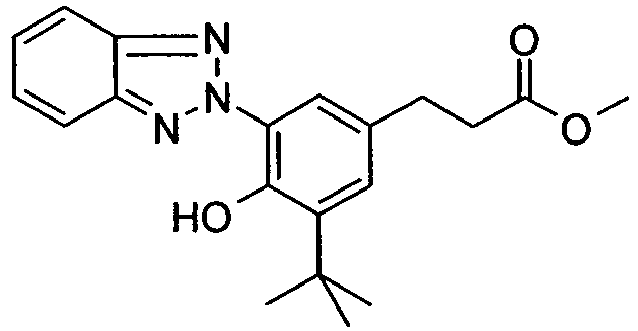


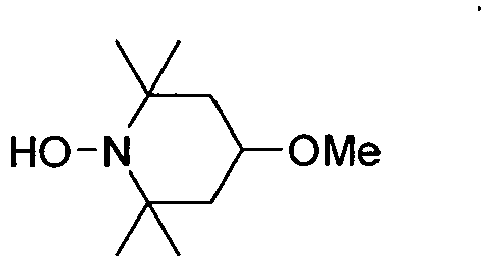
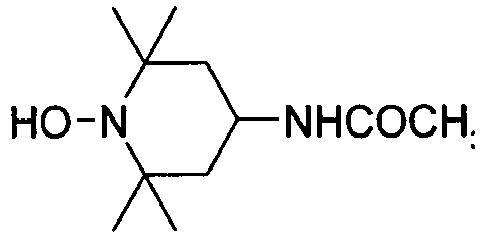


- The LC media preferably comprise 0 to 10% by weight, in particular 1 ppm to 5% by weight, particularly preferably 1 ppm to 1% by weight, of stabilisers. The LC media preferably comprise one or more stabilisers selected from the group consisting of compounds from Table C
- The liquid crystal media according to the instant invention contain preferably
- seven or more, preferably eight or more compounds, preferably of different formulae, selected from the group of compounds of tables A and B and/or
- one or more, more preferably two or more, preferably three or more compounds, preferably of different formulae, selected from the group of compounds of table A and/or
- three or more, more preferably four or more compounds, more preferably five or more compounds, preferably of different formulae, selected from the group of compounds of table B.
- The examples given in the following are illustrating the present invention without limiting it in any way.
- However, the physical properties compositions illustrate to the expert, which properties can be achieved and in which ranges they can be modified. Especially the combination of the various properties, which can be preferably achieved, is thus well defined for the expert.
- A liquid crystal mixture is realized with the composition and properties given in the following table.
Composition Physical Properties Compound T(N,I) = 75.5 °C No. Abbreviation Conc. /% Δn (20 °C, 589.3 nm) = 0.1318 1 CC-3-V 40.50 ε∥(20 °C, 1 kHz) = 7.6 2 CC-3-V1 8.00 Δε (20 °C, 1 kHz) = 4.7 3 CCP-V2-1 3.50 γ1 (20 °C) = 54 mPa · s 4 CPGU-3-OT 5.00 V(10, 0, 20) = 2.04 V 5 PGP-2-2V 20.00 V(90, 0, 20) = 3.03 V 6 PGUQU-3-F 8.00 γ1/[Δε (V10)2] = 2.76 mPa·s V-2 7 PP-1-2V1 10.00 ton (Vop = 5.0V) = 1.50 ms 8 PUQU-3-T 5.00 toff (Vop = 5.0V) = 3.89 ms Σ 100.00 tsum (Vop = 5.0V) = 5.39 ms - A liquid crystal mixture is realized with the composition and properties given in the following table.
Composition Physical Properties Compound T(N,I) = 75.0 °C No. Abbreviation Conc. /% Δn (20 °C, 589.3 nm) = 0.1309 1 CC-3-V 40.00 ε∥ (20 °C, 1 kHz) = 7.7 2 CC-3-V1 8.00 Δε (20 °C, 1 kHz) = 4.7 3 CCP-V2-1 4.00 γ1 (20 °C) = 55 mPa · s 4 CPGU-3-OT 5.00 V(10, 0, 20) = 2.02 V 5 PGP-2-2V 20.00 V(90, 0, 20) = 3.00 V 6 PGUQU-3-F 8.00 γ1/[Δε (V10)2] = 2.86 mPa·s V-2 7 PP-1-2V1 10.00 8 GUQU-3-T 5.00 Σ 100.00 - A liquid crystal mixture is realized with the composition and properties given in the following table.
Composition Physical Properties Compound T(N,I) = 74.5 °C No. Abbreviation Conc. /% Δn (20 °C, 589.3 nm) = 0.1322 1 CC-3-V 47.50 ε∥ (20 °C, 1 kHz) = 11.3 2 PP-1-2V1 5.00 Δε (20 °C, 1 kHz) = 8.1 3 PGP-2-2V 19.00 γ1 (20 °C) = 60 mPa · s 4 PGUQU-3-F 13.00 V(10, 0, 20) = 1.55 V 5 CPGU-3-OT 4.00 V(90, 0, 20) = 2.31 V 6 APUQU-3-F 5.50 γ1/[Δε (V10)2] = 3.10 mPa·s V-2 7 PUQU-3-T 6.00 ton (Vop = 4.5V) = 1.22 ms ∑ 100.00 toff (Vop = 4.5V) = 4.67 ms tsum (Vop = 4.5V) = 5.88 ms - A liquid crystal mixture is realized with the composition and properties given in the following table.
Composition Physical Properties Compound T(N,I) = 74.0 °C No. Abbreviation Conc. /% Δn (20 °C, 589.3 nm) = 0.1327 1 CC-3-V 47.00 ε∥ (20 °C, 1 kHz) = 11.2 2 PP-1-2V1 6.00 Δε (20 °C, 1 kHz) = 7.9 3 PGP-2-2V 19.00 γ1 (20 °C) = 60 mPa · s 4 PGUQU-3-F 12.00 V(10, 0, 20) = 1.56 V 5 CPGU-3-OT 5.00 V(90, 0, 20) = 2.34 V 6 APUQU-3-F 5.50 γ1/[Δε (V10)2] = 3.13 mPa·s V-2 7 GUQU-3-T 5.50 ∑ 100.00 - A liquid crystal mixture is realized with the composition and properties given in the following table.
Composition Physical Properties Compound T(N,I) = 74.5 °C No. Abbreviation Conc. /% Δn (20 °C, 589.3 nm) = 0.1149 1 CC-3-V 42.00 ε ∥ (20 °C, 1 kHz) = 17.6 2 PUQU-3-T 14.50 Δε (20 °C, 1 kHz) = 13.7 3 CCP-V-1 9.00 γ1 (20 °C) = 77 mPa·s 4 APUQU-2-F 6.00 V(10, 0, 20) = 1.18 V 5 APUQU-3-F 8.50 V(90, 0, 20) = 1.81 V 6 PGUQU-3-F 9.50 γ1/[Δε (V10)2] = 4.06 mPa·s V-2 7 CPGU-3-OT 5.00 8 PGP-2-2V 5.50 ∑ 100.00 - A liquid crystal mixture is realized with the composition and properties given in the following table.
Composition Physical Properties Compound T(N,I) = 74.0 °C No. Abbreviation Conc. /% Δn (20 °C, 589.3 nm) = 0.1150 1 CC-3-V 42.50 ε∥ (20 °C, 1 kHz) = 17.6 2 GUQU-3-T 13.00 Δε (20 °C, 1 kHz) = 13.6 3 CCP-V-1 8.00 γ1 (20 °C) = 75 mPa · s 4 APUQU-2-F 6.00 V(10, 0, 20) = 1.17 V 5 APUQU-3-F 9.00 V(90, 0, 20) = 1.80 V 6 PGUQU-3-F 9.00 γ1/[Δε (V10)2] = 4.03 mPa·s V-2 7 CPGU-3-OT 5.50 8 PGP-2-2V 7.00 ∑ 100.00 - A liquid crystal mixture is realized with the composition and properties given in the following table.
Composition Physical Properties Compound T(N,I) = 74.5 °C No. Abbreviation Conc. /% Δn (20 °C, 589.3 nm) = 0.1152 1 CC-3-V 42.50 ε∥ (20 °C, 1 kHz) = 17.2 2 CCP-V-1 12.00 Δε (20 °C, 1 kHz) = 13.6 3 PP-1-2V1 2.50 y1 (20°C) = 75 mPa · s 4 PUQU-3-T 8.00 V(10, 0, 20) = 1.19 V 5 PGUQU-3-F 8.50 V(90, 0, 20) = 1.84 V 6 PGUQU-4-F 8.50 γ1/[Δε (V10)2] = 4.10 mPa·s V-2 7 PGUQU-5-F 8.50 ton (Vop = 3.3V) = 2.21 ms 8 APUQU-3-F 9.50 toff (Vop = 3.3V) = 7.89 ms ∑ 100.00 tsum (Vop = 3.3V) = 10.10 ms - A liquid crystal mixture is realized with the composition and properties given in the following table.
Composition Physical Properties Compound T(N,I) = 75.0 °C No. Abbreviation Conc. /% Δn (20 °C, 589.3 nm) = 0.1149 1 CC-3-V 45.50 ε∥ (20 °C, 1 kHz) = 16.5 2 CCP-V-1 9.50 Δε (20 °C, 1 kHz) = 12.7 3 GUQU-3-T 7.50 γ1 (20 °C) = 73 mPa · s 4 PGUQU-3-F 7.50 V(10, 0, 20) = 1.22 V 5 PGUQU-4-F 8.00 V(90, 0, 20) = 1.89 V 6 PGUQU-5-F 8.50 γ1/[Δε (V10)2] = 3.85 mPa·s V-2 7 APUQU-3-F 9.00 8 PGP-2-2V 4.50 ∑ 100.00 - A liquid crystal mixture is realized with the composition and properties given in the following table.
Composition Physical Properties Compound T(N,I) = 74.5 °C No. Abbreviation Conc. /% Δn (20 °C, 589.3 nm) = 0.1143 1 CC-3-V 44.50 ε∥ (20 °C, 1 kHz) = 16.2 2 APUQU-2-F 6.50 Δε (20 °C, 1 kHz) = 12.4 3 APUQU-3-F 8.00 γ1 (20 °C) = 69 mPa · s 4 CPGU-3-OT 4.50 V(10, 0, 20) = 1.19 V 5 PGUQU-3-F 8.50 V(90, 0, 20) = 1.82 V 6 PUQU-3-T 6.00 γ1/[Δε (V10)2] = 3.97 mPa·s V-2 7 PGP-2-2V 2.00 8 CPU-3-OXF 20.00 ∑ 100.00 - A liquid crystal mixture is realized with the composition and properties given in the following table.
Composition Physical Properties Compound T(N,I) = 74.5 °C No. Abbreviation Conc. /% Δn (20 °C, 589.3 nm) = 0.1141 1 CC-3-V 44.50 ε∥ (20 °C, 1 kHz) = 16.4 2 APUQU-2-F 6.50 Δε (20 °C, 1 kHz) = 12.5 3 APUQU-3-F 8.00 γ1 (20 °C) = 69 mPa · s 4 CPGU-3-OT 4.50 V(10, 0, 20) = 1.19 V 5 PGUQU-3-F 8.50 V(90, 0, 20) = 1.81 V 6 GUQU-3-T 5.50 γ1/[Δε (V10)2] = 3.91 mPa·s V-2 7 PGP-2-2V 2.00 8 CPU-3-OXF 20.50 ∑ 100.00 - A liquid crystal mixture is realized with the composition and properties given in the following table.
Composition Physical Properties Compound T(N,I) = 75.0 °C No. Abbreviation Conc. /% Δn (20 °C, 589.3 nm) = 0.1151 1 CC-3-V 43.50 ε∥ (20 °C, 1 kHz) = 16.0 2 CCP-V-1 4.00 Δε (20 °C, 1 kHz) = 12.2 3 PUQU-3-T 4.50 γ1 (20 °C) = 70 mPa·s 4 PGUQU-3-F 6.00 V(10, 0, 20) = 1.20 V 5 PGUQU-4-F 6.50 V(90, 0, 20) = 1.85 V 6 PGUQU-5-F 7.00 γ1/[Δε (V10)2] = 3.98 mPa·s V-2 7 APUQU-3-F 8.00 8 CPU-3-OXF 20.50 ∑ 100.00 - A liquid crystal mixture is realized with the composition and properties given in the following table.
Composition Physical Properties Compound T(N,I) = 75.0 °C No. Abbreviation Conc. /% Δn (20 °C, 589.3 nm) = 0.1150 1 CC-3-V 43.00 ε∥ (20 °C, 1 kHz) = 16.2 2 CCP-V-1 4.50 Δε (20 °C, 1 kHz) = 12.3 3 GUQU-3-T 4.50 γ1 (20 °C) = 70 mPa·s 4 PGUQU-3-F 6.00 V(10, 0, 20) = 1.20 V 5 PGUQU-4-F 6.50 V(90, 0, 20) = 1.84 V 6 PGUQU-5-F 7.00 y1/[Δε (V10)2] = 3.97 mPa·s V-2 7 APUQU-3-F 8.00 8 CPU-3-OXF 20.50 ∑ 100.00 - A liquid crystal mixture is realized with the composition and properties given in the following table.
Composition Physical Properties Compound T(N,I) = 74.5 °C No. Abbreviation Conc. /% Δn (20 °C, 589.3 nm) = 0.1255 1 CC-3-V 40.00 ε∥ (20 °C, 1 kHz) = 17.4 2 PGP-2-2V 11.50 Δε (20 °C, 1 kHz) = 13.5 3 PUQU-3-T 12.00 γ1 (20 °C) = 78 mPa · s 4 CCP-V-1 3.50 V(10, 0, 20) = 1.17 V 5 APUQU-2-F 6.00 V(90, 0, 20) = 1.79 V 6 APUQU-3-F 8.00 γ1/[Δε (V10)2] = 4.18 mPa·s V-2 7 PGUQU-3-F 9.50 8 CPGU-3-OT 4.00 9 CPU-3-F 5.50 ∑ 100.00 - A liquid crystal mixture is realized with the composition and properties given in the following table.
Composition Physical Properties Compound T(N,I) = 74.5 °C No. Abbreviation Conc. /% Δn (20 °C, 589.3 nm) = 0.1253 1 CC-3-V 41.00 ε∥ (20 °C, 1 kHz) = 17.4 2 PGP-2-2V 13.50 Δε (20 °C, 1 kHz) = 13.1 3 GUQU-3-T 11.00 γ1 (20 °C) = 75 mPa · s 4 CCP-V-1 3.50 V(10, 0, 20) = 1.19 V 5 APUQU-2-F 6.50 V(90, 0, 20) = 1.82 V 6 APUQU-3-F 8.00 γ1/[Δε (V10)2] = 4.08 mPa·s V-2 7 PGUQU-3-F 9.00 8 CPGU-3-OT 4.00 9 CPU-3-F 3.50 ∑ 100.00 - A liquid crystal mixture is realized with the composition and properties given in the following table.
Composition Physical Properties Compound T(N,I) = 74.5 °C No. Abbreviation Conc. /% Δn (20 °C, 589.3 nm) = 0.1255 1 CC-3-V 43.50 ε∥ (20 °C, 1 kHz) = 17.4 2 CCP-V-1 5.00 Δε (20 °C, 1 kHz) = 13.7 3 PGP-2-2V 9.50 γ1 (20 °C) = 77 mPa · s 4 PUQU-3-T 9.50 V(10, 0, 20) = 1.18 V 5 PGUQU-3-F 7.00 V(90, 0, 20) = 1.81 V 6 PGUQU-4-F 8.50 γ1/[Δε (V10)2] = 4.05 mPa·s V-2 7 PGUQU-5-F 9.00 ton (Vop = 3.3V) = 1.83 ms 8 APUQU-3-F 8.00 toff (Vop = 3.3V) = 6.64 ms ∑ 100.00 tsum (Vop = 3.3V) = 8.47 ms - A liquid crystal mixture is realized with the composition and properties given in the following table.
Composition Physical Properties Compound T(N,I) = 74.5 °C No. Abbreviation Conc. /% Δn (20 °C, 589.3 nm) = 0.1251 1 CC-3-V 44.00 ε∥ (20 °C, 1 kHz) = 16.3 2 CCP-V-1 6.00 Δε (20 °C, 1 kHz) = 12.6 3 PGP-2-2V 11.00 γ1 (20 °C) = 73 mPa·s 4 GUQU-3-T 8.50 V(10, 0, 20) = 1.23 V 5 PGUQU-3-F 7.00 V(90, 0, 20) = 1.88 V 6 PGUQU-4-F 8.00 γ1/[Δε (V10)2] = 3.87 mPa·s V-2 7 PGUQU-5-F 9.00 8 APUQU-3-F 6.50 ∑ 100.00 - A liquid crystal mixture is realized with the composition and properties given in the following table.
Composition Physical Properties Compound T(N,I) = 75.5 °C No. Abbreviation Conc. /% Δn (20 °C, 589.3 nm) = 0.1260 1 CC-3-V 39.50 ε∥ (20 °C, 1 kHz) = 17.0 2 APUQU-2-F 5.00 Δε (20 °C, 1 kHz) = 13.0 3 APUQU-3-F 6.00 γ1 (20 °C) = 72 mPa · s 4 CPGU-3-OT 3.50 V(10, 0, 20) = 1.19 V 5 PGUQU-3-F 9.50 V(90, 0, 20) = 1.79 V 6 PUQU-3-T 9.00 γ1/[Δε (V10)2] = 3.95 mPa·s V-2 7 PGP-2-2V 7.50 8 CPU-3-OXF 20.00 ∑ 100.00 - A liquid crystal mixture is realized with the composition and properties given in the following table.
Composition Physical Properties Compound T(N,I) = 76.0 °C No. Abbreviation Conc. /% Δn (20 °C, 589.3 nm) = 0.1260 1 CC-3-V 39.50 ε∥ (20 °C, 1 kHz) = 16.8 2 APUQU-2-F 5.00 Δε (20 °C, 1 kHz) = 12.7 3 APUQU-3-F 6.00 γ1 (20 °C) = 70 mPa · s 4 CPGU-3-OT 4.50 V(10, 0, 20) = 1.19 V 5 PGUQU-3-F 8.50 V(90, 0, 20) = 1.78 V 6 GUQU-3-T 9.00 γ1/[Δε (V10)2] = 3.91 mPa·s V-2 7 PGP-2-2V 8.50 8 CPU-3-OXF 19.00 ∑ 100.00 - A liquid crystal mixture is realized with the composition and properties given in the following table.
Composition Physical Properties Compound T(N,I) = 75.0 °C No. Abbreviation Conc. /% Δn (20 °C, 589.3 nm) = 0.1247 1 CC-3-V 41.50 ε∥ (20 °C, 1 kHz) = 16.5 2 APUQU-3-F 4.00 Δε (20 °C, 1 kHz) = 12.6 3 PGUQU-3-F 7.00 γ1 (20 °C) = 71 mPa · s 4 PGUQU-4-F 7.00 V(10, 0, 20) = 1.19 V 5 PGUQU-5-F 8.00 V(90, 0, 20) = 1.81 V 6 PUQU-3-T 4.50 γ1/[Δε (V10)2] = 4.00 mPa·s V-2 7 PGP-2-2V 3.50 8 CPU-3-OXF 24.50 ∑ 100.00 - A liquid crystal mixture is realized with the composition and properties given in the following table.
Composition Physical Properties Compound T(N,I) = 75.0 °C No. Abbreviation Conc. /% Δn (20 °C, 589.3 nm) = 0.1251 1 CC-3-V 41.00 ε∥ (20 °C, 1 kHz) = 16.7 2 APUQU-3-F 4.00 Δε (20 °C, 1 kHz) = 12.9 3 PGUQU-3-F 7.00 γ1 (20 °C) = 72 mPa · s 4 PGUQU-4-F 7.00 V(10, 0, 20) = 1.19 V 5 PGUQU-5-F 8.00 V(90, 0, 20) = 1.80 V 6 GUQU-3-T 4.50 γ1/[Δε (V10)2] = 3.99 mPa·s V-2 7 PGP-2-2V 4.00 8 CPU-3-OXF 24.50 ∑ 100.00


Claims (13)
- Liquid crystal medium, characterised in that it comprises- a compound of formula I
 R1 denotes alkyl, alkoxy, fluorinated alkyl or fluorinated alkoxy with 1 to 7 C-atoms, alkenyl, alkenyloxy, alkoxyalkyl or fluorinated alkenyl with 2 to 7 C-atoms,L1 denotes H or F,and- one or more compounds of formulae II-1a and II-1gand optionally one or more compounds of formula III

 R2 and R3, independently of each other, are alkyl, alkoxy, fluorinated alkyl or fluorinated alkoxy with 1 to 7 C-atoms, alkenyl, alkenyloxy, alkoxyalkyl or fluorinated alkenyl with 2 to 7 C-atoms,are, independently of each other,


 L21, L22, L23, L24, L31 and L32, are, independently of each other, H or F,X2 and X3 are, independently of each other, halogen, halogenated alkyl or alkoxy with 1 to 3 C-atoms or halogenated alkenyl or alkenyloxy with 2 or 3 C-atoms,Z3 is -CH2CH2-, -CF2CF2-, -COO-, trans- -CH=CH-, trans- -CF=CF-, -CH2O- or a single bond,n and o are, independently of each other, 0 or 1 andfrom which compounds of formula I are excluded.
 - Liquid crystal medium according to claim 1, characterised in that L1 in formula I denotes H.
- Liquid crystal medium according to claim 1 or 2, characterised in that it comprises one or more compounds of formula III, as given in claim 1.
- Liquid crystal medium according to claim 1, characterised in that one or more compounds of formula II-1g are selected from compounds of formula II-1g-1
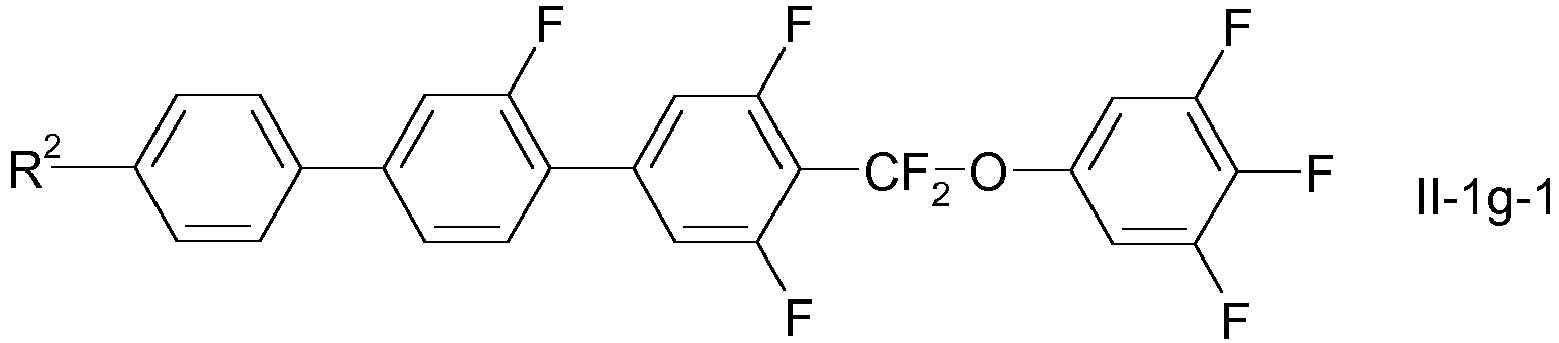
- Liquid crystal medium according to one or more of claims 1 to 4, characterised in that it additionally comprises one or more compounds of formula IV
 R41 and R42, independently of each other, have the meaning given for R2 under formula II-1a and II-1g in claim 1,



 Z41 and Z42 independently of each other, and in case Z41 is present twice, also these independently of each other, denote -CH2CH2-, -COO-, trans- -CH=CH-, trans- -CF=CF-, -CH2O-, -CF2O-, -C≡C- or a single bond, andp is 0, 1 or 2.
 - Liquid crystal medium according to claim 5, characterised in that one or more compounds of formula IV are selected from the group of compounds of formulae IV-1 to IV-5.


- Liquid crystal medium according to one or more of claims 1 to 6, characterised in that it comprises one or more compounds of formula VI
 R61 and R62, independently of each other have the meaning given for R2 under formula II-1a and II-1g in claim 1,


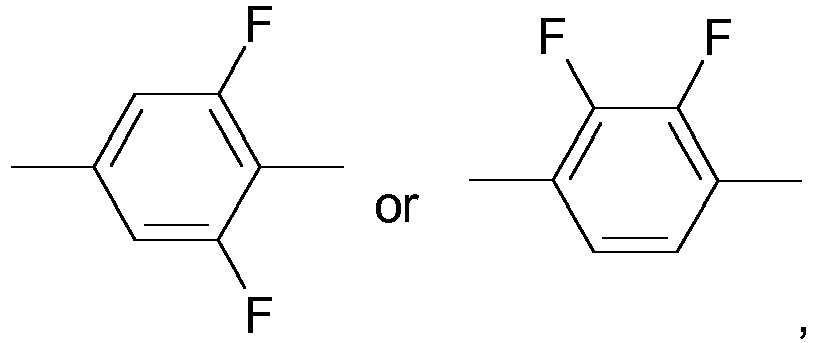 Z61 and Z62 independently of each other, denote -CH2CH2-, -COO-, trans- -CH=CH-, trans- -CF=CF-, -CH2O-, -CF2O, -C≡C- or a single bond, andr is 0, 1 or 2.
 - Liquid crystal medium according to claim 7, characterised in that one or more compounds of formula VI are selected from the group of compounds of formulae VI-1 to VI-4


- Liquid crystal medium according to one or more of claims 1 to 8, characterised in that the total concentration of the compounds of formula I in the medium is in the range from 1 % to 20 %.
- Process for the preparation of a liquid-crystalline medium according to one or more of claims 1 to 9, characterised in that at least one compound of the formula I is mixed with at least one further mesogenic compound, and one or more additives and/or one or more stabilisers are optionally added.
- Liquid crystal display, characterised in that it comprises a liquid crystal medium according to one or more of claims 1 to 9.
- Liquid crystal display according to claim 11, characterised in that it is addressed by an active matrix.
- Use of a liquid crystal medium according to one or more of claims 1 to 9 in a liquid crystal display.
Applications Claiming Priority (2)
| Application Number | Priority Date | Filing Date | Title |
|---|---|---|---|
| EP15002527 | 2015-08-26 | ||
| PCT/EP2016/001311 WO2017032440A1 (en) | 2015-08-26 | 2016-07-28 | Liquid crystalline medium |
Publications (2)
| Publication Number | Publication Date |
|---|---|
| EP3341451A1 EP3341451A1 (en) | 2018-07-04 |
| EP3341451B1 true EP3341451B1 (en) | 2019-10-16 |
Family
ID=54011491
Family Applications (1)
| Application Number | Title | Priority Date | Filing Date |
|---|---|---|---|
| EP16744667.3A Active EP3341451B1 (en) | 2015-08-26 | 2016-07-28 | Liquid crystalline medium |
Country Status (7)
| Country | Link |
|---|---|
| US (1) | US10723948B2 (en) |
| EP (1) | EP3341451B1 (en) |
| JP (1) | JP2018526507A (en) |
| KR (1) | KR20180044348A (en) |
| CN (1) | CN107922841A (en) |
| TW (1) | TWI711689B (en) |
| WO (1) | WO2017032440A1 (en) |
Family Cites Families (16)
| Publication number | Priority date | Publication date | Assignee | Title |
|---|---|---|---|---|
| JP4288729B2 (en) * | 1998-09-28 | 2009-07-01 | チッソ株式会社 | Benzene derivative and method for producing the same |
| JP4300714B2 (en) * | 2001-04-27 | 2009-07-22 | チッソ株式会社 | Liquid crystal composition and liquid crystal display element |
| EP1739151B1 (en) * | 2005-07-01 | 2010-09-15 | Merck Patent GmbH | Mesogenic compounds, liquid crystal medium and liquid display |
| KR101428807B1 (en) * | 2006-01-13 | 2014-08-08 | 메르크 파텐트 게엠베하 | Liquid crystal medium |
| JP2009067780A (en) * | 2007-08-22 | 2009-04-02 | Chisso Corp | Liquid crystal compound having chloronaphthalene moiety, liquid crystal composition and optical device |
| CN101778924B (en) * | 2007-08-27 | 2013-04-10 | Jnc株式会社 | Liquid crystal composition and liquid crystal display element |
| ATE527333T1 (en) * | 2008-03-11 | 2011-10-15 | Merck Patent Gmbh | LIQUID CRYSTAL MEDIUM AND LIQUID CRYSTAL DISPLAY |
| DE102010006691A1 (en) * | 2009-02-06 | 2010-10-28 | Merck Patent Gmbh | Liquid-crystalline medium and liquid-crystal display |
| DE102010052795A1 (en) * | 2009-12-21 | 2011-06-22 | Merck Patent GmbH, 64293 | Liquid-crystalline medium and liquid-crystal display |
| EP2368966B1 (en) * | 2010-03-23 | 2013-05-15 | Merck Patent GmbH | Liquid crystalline compounds and liquid crystalline media |
| TWI512094B (en) * | 2011-04-14 | 2015-12-11 | Jnc Corp | Liquid crystal composition, liquid crystal display device and use thereof |
| JP6058644B2 (en) * | 2011-06-01 | 2017-01-11 | メルク パテント ゲゼルシャフト ミット ベシュレンクテル ハフツングMerck Patent Gesellschaft mit beschraenkter Haftung | Liquid crystal medium and liquid crystal display |
| KR101980926B1 (en) * | 2011-08-01 | 2019-05-21 | 메르크 파텐트 게엠베하 | Liquid crystal medium and liquid crystal display |
| JP6386378B2 (en) * | 2011-09-06 | 2018-09-05 | メルク パテント ゲゼルシャフト ミット ベシュレンクテル ハフツングMerck Patent Gesellschaft mit beschraenkter Haftung | Liquid crystal medium and liquid crystal display |
| TWI476273B (en) * | 2012-12-04 | 2015-03-11 | 迪愛生股份有限公司 | Liquid crystal display device |
| CN105567250A (en) * | 2014-11-06 | 2016-05-11 | 福建省邵武市永晶化工有限公司 | Difluoro methoxy bridged bond-containing liquid crystal containing fluorine |
-
2016
- 2016-07-28 JP JP2018510048A patent/JP2018526507A/en active Pending
- 2016-07-28 WO PCT/EP2016/001311 patent/WO2017032440A1/en not_active Ceased
- 2016-07-28 CN CN201680049315.2A patent/CN107922841A/en active Pending
- 2016-07-28 EP EP16744667.3A patent/EP3341451B1/en active Active
- 2016-07-28 US US15/755,328 patent/US10723948B2/en not_active Expired - Fee Related
- 2016-07-28 KR KR1020187008125A patent/KR20180044348A/en not_active Ceased
- 2016-08-25 TW TW105127302A patent/TWI711689B/en active
Non-Patent Citations (1)
| Title |
|---|
| None * |
Also Published As
| Publication number | Publication date |
|---|---|
| WO2017032440A1 (en) | 2017-03-02 |
| KR20180044348A (en) | 2018-05-02 |
| US10723948B2 (en) | 2020-07-28 |
| EP3341451A1 (en) | 2018-07-04 |
| TW201713755A (en) | 2017-04-16 |
| TWI711689B (en) | 2020-12-01 |
| CN107922841A (en) | 2018-04-17 |
| US20180244994A1 (en) | 2018-08-30 |
| JP2018526507A (en) | 2018-09-13 |
Similar Documents
| Publication | Publication Date | Title |
|---|---|---|
| EP1813662B1 (en) | Liquid crystalline medium and liquid crystal display | |
| US7682671B2 (en) | Liquid crystalline medium and liquid crystal display | |
| US7691455B2 (en) | Liquid crystalline medium and liquid crystal display | |
| KR20100126388A (en) | Liquid crystal medium and liquid crystal display | |
| KR101851888B1 (en) | Liquid crystalline medium and liquid crystal display | |
| TWI465549B (en) | Liquid crystalline medium and liquid crystal display | |
| KR20120125255A (en) | Liquid crystalline medium and liquid crystalline display | |
| EP1835010B1 (en) | Liquid crystalline medium and liquid crystal display | |
| EP1726633B1 (en) | Liquid crystalline medium and liquid crystal display | |
| KR101647510B1 (en) | Liquid crystalline medium and liquid crystal display | |
| EP1842894B1 (en) | Liquid crystalline medium and liquid crystal display | |
| EP3617293B1 (en) | Liquid-crystalline medium and liquid-crystal display | |
| EP3551722B1 (en) | Liquid crystalline medium | |
| EP1925653B1 (en) | Liquid crystalline medium and liquid crystal display | |
| EP1935960B1 (en) | Liquid crystalline medium and liquid crystal display | |
| US10723948B2 (en) | Liquid crystalline medium | |
| EP3345985A1 (en) | Liquid-crystalline medium |
Legal Events
| Date | Code | Title | Description |
|---|---|---|---|
| STAA | Information on the status of an ep patent application or granted ep patent |
Free format text: STATUS: THE INTERNATIONAL PUBLICATION HAS BEEN MADE |
|
| PUAI | Public reference made under article 153(3) epc to a published international application that has entered the european phase |
Free format text: ORIGINAL CODE: 0009012 |
|
| STAA | Information on the status of an ep patent application or granted ep patent |
Free format text: STATUS: REQUEST FOR EXAMINATION WAS MADE |
|
| 17P | Request for examination filed |
Effective date: 20180221 |
|
| AK | Designated contracting states |
Kind code of ref document: A1 Designated state(s): AL AT BE BG CH CY CZ DE DK EE ES FI FR GB GR HR HU IE IS IT LI LT LU LV MC MK MT NL NO PL PT RO RS SE SI SK SM TR |
|
| AX | Request for extension of the european patent |
Extension state: BA ME |
|
| DAV | Request for validation of the european patent (deleted) | ||
| DAX | Request for extension of the european patent (deleted) | ||
| STAA | Information on the status of an ep patent application or granted ep patent |
Free format text: STATUS: EXAMINATION IS IN PROGRESS |
|
| 17Q | First examination report despatched |
Effective date: 20181217 |
|
| GRAP | Despatch of communication of intention to grant a patent |
Free format text: ORIGINAL CODE: EPIDOSNIGR1 |
|
| STAA | Information on the status of an ep patent application or granted ep patent |
Free format text: STATUS: GRANT OF PATENT IS INTENDED |
|
| RIC1 | Information provided on ipc code assigned before grant |
Ipc: C09K 19/34 20060101ALI20190522BHEP Ipc: C09K 19/20 20060101AFI20190522BHEP Ipc: C09K 19/30 20060101ALI20190522BHEP Ipc: C09K 19/12 20060101ALI20190522BHEP Ipc: C09K 19/04 20060101ALI20190522BHEP Ipc: C09K 19/44 20060101ALI20190522BHEP Ipc: G02F 1/1362 20060101ALI20190522BHEP |
|
| INTG | Intention to grant announced |
Effective date: 20190612 |
|
| GRAS | Grant fee paid |
Free format text: ORIGINAL CODE: EPIDOSNIGR3 |
|
| GRAA | (expected) grant |
Free format text: ORIGINAL CODE: 0009210 |
|
| STAA | Information on the status of an ep patent application or granted ep patent |
Free format text: STATUS: THE PATENT HAS BEEN GRANTED |
|
| AK | Designated contracting states |
Kind code of ref document: B1 Designated state(s): AL AT BE BG CH CY CZ DE DK EE ES FI FR GB GR HR HU IE IS IT LI LT LU LV MC MK MT NL NO PL PT RO RS SE SI SK SM TR |
|
| REG | Reference to a national code |
Ref country code: GB Ref legal event code: FG4D |
|
| REG | Reference to a national code |
Ref country code: CH Ref legal event code: EP |
|
| REG | Reference to a national code |
Ref country code: DE Ref legal event code: R096 Ref document number: 602016022585 Country of ref document: DE |
|
| REG | Reference to a national code |
Ref country code: IE Ref legal event code: FG4D |
|
| REG | Reference to a national code |
Ref country code: AT Ref legal event code: REF Ref document number: 1191238 Country of ref document: AT Kind code of ref document: T Effective date: 20191115 |
|
| REG | Reference to a national code |
Ref country code: NL Ref legal event code: MP Effective date: 20191016 |
|
| REG | Reference to a national code |
Ref country code: LT Ref legal event code: MG4D |
|
| REG | Reference to a national code |
Ref country code: AT Ref legal event code: MK05 Ref document number: 1191238 Country of ref document: AT Kind code of ref document: T Effective date: 20191016 |
|
| PG25 | Lapsed in a contracting state [announced via postgrant information from national office to epo] |
Ref country code: AT Free format text: LAPSE BECAUSE OF FAILURE TO SUBMIT A TRANSLATION OF THE DESCRIPTION OR TO PAY THE FEE WITHIN THE PRESCRIBED TIME-LIMIT Effective date: 20191016 Ref country code: NL Free format text: LAPSE BECAUSE OF FAILURE TO SUBMIT A TRANSLATION OF THE DESCRIPTION OR TO PAY THE FEE WITHIN THE PRESCRIBED TIME-LIMIT Effective date: 20191016 Ref country code: LV Free format text: LAPSE BECAUSE OF FAILURE TO SUBMIT A TRANSLATION OF THE DESCRIPTION OR TO PAY THE FEE WITHIN THE PRESCRIBED TIME-LIMIT Effective date: 20191016 Ref country code: SE Free format text: LAPSE BECAUSE OF FAILURE TO SUBMIT A TRANSLATION OF THE DESCRIPTION OR TO PAY THE FEE WITHIN THE PRESCRIBED TIME-LIMIT Effective date: 20191016 Ref country code: PL Free format text: LAPSE BECAUSE OF FAILURE TO SUBMIT A TRANSLATION OF THE DESCRIPTION OR TO PAY THE FEE WITHIN THE PRESCRIBED TIME-LIMIT Effective date: 20191016 Ref country code: NO Free format text: LAPSE BECAUSE OF FAILURE TO SUBMIT A TRANSLATION OF THE DESCRIPTION OR TO PAY THE FEE WITHIN THE PRESCRIBED TIME-LIMIT Effective date: 20200116 Ref country code: LT Free format text: LAPSE BECAUSE OF FAILURE TO SUBMIT A TRANSLATION OF THE DESCRIPTION OR TO PAY THE FEE WITHIN THE PRESCRIBED TIME-LIMIT Effective date: 20191016 Ref country code: GR Free format text: LAPSE BECAUSE OF FAILURE TO SUBMIT A TRANSLATION OF THE DESCRIPTION OR TO PAY THE FEE WITHIN THE PRESCRIBED TIME-LIMIT Effective date: 20200117 Ref country code: PT Free format text: LAPSE BECAUSE OF FAILURE TO SUBMIT A TRANSLATION OF THE DESCRIPTION OR TO PAY THE FEE WITHIN THE PRESCRIBED TIME-LIMIT Effective date: 20200217 Ref country code: FI Free format text: LAPSE BECAUSE OF FAILURE TO SUBMIT A TRANSLATION OF THE DESCRIPTION OR TO PAY THE FEE WITHIN THE PRESCRIBED TIME-LIMIT Effective date: 20191016 Ref country code: BG Free format text: LAPSE BECAUSE OF FAILURE TO SUBMIT A TRANSLATION OF THE DESCRIPTION OR TO PAY THE FEE WITHIN THE PRESCRIBED TIME-LIMIT Effective date: 20200116 |
|
| PG25 | Lapsed in a contracting state [announced via postgrant information from national office to epo] |
Ref country code: HR Free format text: LAPSE BECAUSE OF FAILURE TO SUBMIT A TRANSLATION OF THE DESCRIPTION OR TO PAY THE FEE WITHIN THE PRESCRIBED TIME-LIMIT Effective date: 20191016 Ref country code: RS Free format text: LAPSE BECAUSE OF FAILURE TO SUBMIT A TRANSLATION OF THE DESCRIPTION OR TO PAY THE FEE WITHIN THE PRESCRIBED TIME-LIMIT Effective date: 20191016 Ref country code: IS Free format text: LAPSE BECAUSE OF FAILURE TO SUBMIT A TRANSLATION OF THE DESCRIPTION OR TO PAY THE FEE WITHIN THE PRESCRIBED TIME-LIMIT Effective date: 20200224 |
|
| PG25 | Lapsed in a contracting state [announced via postgrant information from national office to epo] |
Ref country code: AL Free format text: LAPSE BECAUSE OF FAILURE TO SUBMIT A TRANSLATION OF THE DESCRIPTION OR TO PAY THE FEE WITHIN THE PRESCRIBED TIME-LIMIT Effective date: 20191016 |
|
| REG | Reference to a national code |
Ref country code: DE Ref legal event code: R097 Ref document number: 602016022585 Country of ref document: DE |
|
| PG2D | Information on lapse in contracting state deleted |
Ref country code: IS |
|
| PG25 | Lapsed in a contracting state [announced via postgrant information from national office to epo] |
Ref country code: RO Free format text: LAPSE BECAUSE OF FAILURE TO SUBMIT A TRANSLATION OF THE DESCRIPTION OR TO PAY THE FEE WITHIN THE PRESCRIBED TIME-LIMIT Effective date: 20191016 Ref country code: DK Free format text: LAPSE BECAUSE OF FAILURE TO SUBMIT A TRANSLATION OF THE DESCRIPTION OR TO PAY THE FEE WITHIN THE PRESCRIBED TIME-LIMIT Effective date: 20191016 Ref country code: EE Free format text: LAPSE BECAUSE OF FAILURE TO SUBMIT A TRANSLATION OF THE DESCRIPTION OR TO PAY THE FEE WITHIN THE PRESCRIBED TIME-LIMIT Effective date: 20191016 Ref country code: CZ Free format text: LAPSE BECAUSE OF FAILURE TO SUBMIT A TRANSLATION OF THE DESCRIPTION OR TO PAY THE FEE WITHIN THE PRESCRIBED TIME-LIMIT Effective date: 20191016 Ref country code: ES Free format text: LAPSE BECAUSE OF FAILURE TO SUBMIT A TRANSLATION OF THE DESCRIPTION OR TO PAY THE FEE WITHIN THE PRESCRIBED TIME-LIMIT Effective date: 20191016 Ref country code: IS Free format text: LAPSE BECAUSE OF FAILURE TO SUBMIT A TRANSLATION OF THE DESCRIPTION OR TO PAY THE FEE WITHIN THE PRESCRIBED TIME-LIMIT Effective date: 20200216 |
|
| PLBE | No opposition filed within time limit |
Free format text: ORIGINAL CODE: 0009261 |
|
| STAA | Information on the status of an ep patent application or granted ep patent |
Free format text: STATUS: NO OPPOSITION FILED WITHIN TIME LIMIT |
|
| PG25 | Lapsed in a contracting state [announced via postgrant information from national office to epo] |
Ref country code: SK Free format text: LAPSE BECAUSE OF FAILURE TO SUBMIT A TRANSLATION OF THE DESCRIPTION OR TO PAY THE FEE WITHIN THE PRESCRIBED TIME-LIMIT Effective date: 20191016 Ref country code: IT Free format text: LAPSE BECAUSE OF FAILURE TO SUBMIT A TRANSLATION OF THE DESCRIPTION OR TO PAY THE FEE WITHIN THE PRESCRIBED TIME-LIMIT Effective date: 20191016 Ref country code: SM Free format text: LAPSE BECAUSE OF FAILURE TO SUBMIT A TRANSLATION OF THE DESCRIPTION OR TO PAY THE FEE WITHIN THE PRESCRIBED TIME-LIMIT Effective date: 20191016 |
|
| 26N | No opposition filed |
Effective date: 20200717 |
|
| PG25 | Lapsed in a contracting state [announced via postgrant information from national office to epo] |
Ref country code: SI Free format text: LAPSE BECAUSE OF FAILURE TO SUBMIT A TRANSLATION OF THE DESCRIPTION OR TO PAY THE FEE WITHIN THE PRESCRIBED TIME-LIMIT Effective date: 20191016 |
|
| PG25 | Lapsed in a contracting state [announced via postgrant information from national office to epo] |
Ref country code: MC Free format text: LAPSE BECAUSE OF FAILURE TO SUBMIT A TRANSLATION OF THE DESCRIPTION OR TO PAY THE FEE WITHIN THE PRESCRIBED TIME-LIMIT Effective date: 20191016 |
|
| REG | Reference to a national code |
Ref country code: CH Ref legal event code: PL |
|
| GBPC | Gb: european patent ceased through non-payment of renewal fee |
Effective date: 20200728 |
|
| REG | Reference to a national code |
Ref country code: BE Ref legal event code: MM Effective date: 20200731 |
|
| PG25 | Lapsed in a contracting state [announced via postgrant information from national office to epo] |
Ref country code: LI Free format text: LAPSE BECAUSE OF NON-PAYMENT OF DUE FEES Effective date: 20200731 Ref country code: LU Free format text: LAPSE BECAUSE OF NON-PAYMENT OF DUE FEES Effective date: 20200728 Ref country code: CH Free format text: LAPSE BECAUSE OF NON-PAYMENT OF DUE FEES Effective date: 20200731 Ref country code: FR Free format text: LAPSE BECAUSE OF NON-PAYMENT OF DUE FEES Effective date: 20200731 Ref country code: GB Free format text: LAPSE BECAUSE OF NON-PAYMENT OF DUE FEES Effective date: 20200728 |
|
| PG25 | Lapsed in a contracting state [announced via postgrant information from national office to epo] |
Ref country code: BE Free format text: LAPSE BECAUSE OF NON-PAYMENT OF DUE FEES Effective date: 20200731 |
|
| PG25 | Lapsed in a contracting state [announced via postgrant information from national office to epo] |
Ref country code: IE Free format text: LAPSE BECAUSE OF NON-PAYMENT OF DUE FEES Effective date: 20200728 |
|
| PG25 | Lapsed in a contracting state [announced via postgrant information from national office to epo] |
Ref country code: TR Free format text: LAPSE BECAUSE OF FAILURE TO SUBMIT A TRANSLATION OF THE DESCRIPTION OR TO PAY THE FEE WITHIN THE PRESCRIBED TIME-LIMIT Effective date: 20191016 Ref country code: MT Free format text: LAPSE BECAUSE OF FAILURE TO SUBMIT A TRANSLATION OF THE DESCRIPTION OR TO PAY THE FEE WITHIN THE PRESCRIBED TIME-LIMIT Effective date: 20191016 Ref country code: CY Free format text: LAPSE BECAUSE OF FAILURE TO SUBMIT A TRANSLATION OF THE DESCRIPTION OR TO PAY THE FEE WITHIN THE PRESCRIBED TIME-LIMIT Effective date: 20191016 |
|
| PG25 | Lapsed in a contracting state [announced via postgrant information from national office to epo] |
Ref country code: MK Free format text: LAPSE BECAUSE OF FAILURE TO SUBMIT A TRANSLATION OF THE DESCRIPTION OR TO PAY THE FEE WITHIN THE PRESCRIBED TIME-LIMIT Effective date: 20191016 |
|
| P01 | Opt-out of the competence of the unified patent court (upc) registered |
Effective date: 20230518 |
|
| PGFP | Annual fee paid to national office [announced via postgrant information from national office to epo] |
Ref country code: DE Payment date: 20250620 Year of fee payment: 10 |