EP3339293A1 - Compound and organic electronic device comprising same - Google Patents
Compound and organic electronic device comprising same Download PDFInfo
- Publication number
- EP3339293A1 EP3339293A1 EP16848937.5A EP16848937A EP3339293A1 EP 3339293 A1 EP3339293 A1 EP 3339293A1 EP 16848937 A EP16848937 A EP 16848937A EP 3339293 A1 EP3339293 A1 EP 3339293A1
- Authority
- EP
- European Patent Office
- Prior art keywords
- group
- substituted
- unsubstituted
- compound
- light emitting
- Prior art date
- Legal status (The legal status is an assumption and is not a legal conclusion. Google has not performed a legal analysis and makes no representation as to the accuracy of the status listed.)
- Granted
Links
- 0 Cc(c(*)c1c2c3c4c(*)c(*)c(*)c(*)c4c(c(c4c(*)c(*)c(*)c(*)c44)c5[n]4I*)c2c2c5c(*)c(*)c(*)c2*)c(*)c(*)c1[n]3I[Al] Chemical compound Cc(c(*)c1c2c3c4c(*)c(*)c(*)c(*)c4c(c(c4c(*)c(*)c(*)c(*)c44)c5[n]4I*)c2c2c5c(*)c(*)c(*)c2*)c(*)c(*)c1[n]3I[Al] 0.000 description 9
- HPIZMOUHIKKXMZ-UHFFFAOYSA-N c(cc1)ccc1N(c1ccccc1)c(c1ccccc1c1c2c3ccccc33)cc1c(cccc1)c1c2[n]3-c1ccccc1 Chemical compound c(cc1)ccc1N(c1ccccc1)c(c1ccccc1c1c2c3ccccc33)cc1c(cccc1)c1c2[n]3-c1ccccc1 HPIZMOUHIKKXMZ-UHFFFAOYSA-N 0.000 description 2
- DOFOGMVZAYSOIP-UHFFFAOYSA-N C(C(c1c(c2ccc3)c3ccc1)C2=C1)C=C1[n]1c2c(cccc3)c3c(cc(-c(cc3)cc(-c4ccc5)c3-c3c4c5ccc3)c3ccccc33)c3c2c2ccccc12 Chemical compound C(C(c1c(c2ccc3)c3ccc1)C2=C1)C=C1[n]1c2c(cccc3)c3c(cc(-c(cc3)cc(-c4ccc5)c3-c3c4c5ccc3)c3ccccc33)c3c2c2ccccc12 DOFOGMVZAYSOIP-UHFFFAOYSA-N 0.000 description 1
- AYMZEHHHHGDFNY-UHFFFAOYSA-N C(C(c1cc(-[n]2c3c(cccc4)c4c(ccc4c5cccc4)c5c3c3c2cccc3)ccc1)NC(c(cc1)ccc1-c1ccccc1)=C1)=C1c1ccccc1 Chemical compound C(C(c1cc(-[n]2c3c(cccc4)c4c(ccc4c5cccc4)c5c3c3c2cccc3)ccc1)NC(c(cc1)ccc1-c1ccccc1)=C1)=C1c1ccccc1 AYMZEHHHHGDFNY-UHFFFAOYSA-N 0.000 description 1
- PLYPSGDJEKXHIW-UHFFFAOYSA-N C(C(c1cccc(-[n](c2ccccc22)c3c2c2c(cccc4)c4ccc2c2c3cccc2)c1)NC(c1cc(cccc2)c2cc1)=C1)=C1c1ccccc1 Chemical compound C(C(c1cccc(-[n](c2ccccc22)c3c2c2c(cccc4)c4ccc2c2c3cccc2)c1)NC(c1cc(cccc2)c2cc1)=C1)=C1c1ccccc1 PLYPSGDJEKXHIW-UHFFFAOYSA-N 0.000 description 1
- JZSPVEKAVPIWTD-UHFFFAOYSA-N C(C1)C=CC(C2=C3c(cccc4)c4C(c4cc(-c5ccccc5)cc(-c5ccccc5)n4)=CC3C(C=CC=C3)C3=C22)=C1N2c1cc(-c2ccccc2)cc(-c2ccccc2)n1 Chemical compound C(C1)C=CC(C2=C3c(cccc4)c4C(c4cc(-c5ccccc5)cc(-c5ccccc5)n4)=CC3C(C=CC=C3)C3=C22)=C1N2c1cc(-c2ccccc2)cc(-c2ccccc2)n1 JZSPVEKAVPIWTD-UHFFFAOYSA-N 0.000 description 1
- ADXRKJHSCCTGDD-UHFFFAOYSA-N C(C1)C=Cc(c2c3c4ccccc4c4ccc(cccc5)c5c24)c1[n]3-c1c(cccc2)c2c(-c2ccccc2)c2c1cccc2 Chemical compound C(C1)C=Cc(c2c3c4ccccc4c4ccc(cccc5)c5c24)c1[n]3-c1c(cccc2)c2c(-c2ccccc2)c2c1cccc2 ADXRKJHSCCTGDD-UHFFFAOYSA-N 0.000 description 1
- YBORVBMQYGWWPU-UHFFFAOYSA-N C(C1)c(cccc2)c2C=C1c(cc1)cc2c1ccc(-[n](c1ccccc11)c3c1c1c(cccc4)c4ccc1c1ccccc31)c2 Chemical compound C(C1)c(cccc2)c2C=C1c(cc1)cc2c1ccc(-[n](c1ccccc11)c3c1c1c(cccc4)c4ccc1c1ccccc31)c2 YBORVBMQYGWWPU-UHFFFAOYSA-N 0.000 description 1
- JCRNNCOXHYSAFZ-UHFFFAOYSA-N C(C1C(C=Cc2ccccc22)C2=C2c3ccccc33)=CC=CC1=C2N3c1cc(C2NC(c3ccccc3)=CC(c3ccccc3)=C2)ccc1 Chemical compound C(C1C(C=Cc2ccccc22)C2=C2c3ccccc33)=CC=CC1=C2N3c1cc(C2NC(c3ccccc3)=CC(c3ccccc3)=C2)ccc1 JCRNNCOXHYSAFZ-UHFFFAOYSA-N 0.000 description 1
- TZOJKDCZZHLNKL-UHFFFAOYSA-N C(CC=C1c2c3c4ccccc44)C=C1C(c(cc1)cc5c1c1ccccc1cc5)=Cc2c(cccc1)c1c3[n]4-c(cc1)cc2c1c1ccccc1cc2 Chemical compound C(CC=C1c2c3c4ccccc44)C=C1C(c(cc1)cc5c1c1ccccc1cc5)=Cc2c(cccc1)c1c3[n]4-c(cc1)cc2c1c1ccccc1cc2 TZOJKDCZZHLNKL-UHFFFAOYSA-N 0.000 description 1
- IIIKMLKZEQMYCU-MWGPYLPASA-N C/C=C(\C=C/N)/[n](c1ccccc11)c2c1c(c(cccc1)c1cc1)c1c1ccccc21 Chemical compound C/C=C(\C=C/N)/[n](c1ccccc11)c2c1c(c(cccc1)c1cc1)c1c1ccccc21 IIIKMLKZEQMYCU-MWGPYLPASA-N 0.000 description 1
- DLEOOJQRJHHEDP-UHFFFAOYSA-N C1=C(c(cc2)ccc2-c2ccccc2)NC(c2cc(-[n](c3ccccc33)c4c3c3c(cccc5)c5ccc3c3c4cccc3)ccc2)NC1c1ccccc1 Chemical compound C1=C(c(cc2)ccc2-c2ccccc2)NC(c2cc(-[n](c3ccccc33)c4c3c3c(cccc5)c5ccc3c3c4cccc3)ccc2)NC1c1ccccc1 DLEOOJQRJHHEDP-UHFFFAOYSA-N 0.000 description 1
- QXXWNURKSFDARD-UHFFFAOYSA-N C1=C(c2cc(cccc3)c3cc2)NC(c2cccc(-[n](c3ccccc33)c4c3c(c3ccccc3cc3)c3c3ccccc43)c2)NC1c1ccccc1 Chemical compound C1=C(c2cc(cccc3)c3cc2)NC(c2cccc(-[n](c3ccccc33)c4c3c(c3ccccc3cc3)c3c3ccccc43)c2)NC1c1ccccc1 QXXWNURKSFDARD-UHFFFAOYSA-N 0.000 description 1
- PQQJXJZXDUPRAV-UHFFFAOYSA-N C1=C(c2cccc3c2cccc3)NC(c2cc(-[n]3c4c(cccc5)c5c(ccc5c6cccc5)c6c4c4ccccc34)ccc2)NC1c1ccccc1 Chemical compound C1=C(c2cccc3c2cccc3)NC(c2cc(-[n]3c4c(cccc5)c5c(ccc5c6cccc5)c6c4c4ccccc34)ccc2)NC1c1ccccc1 PQQJXJZXDUPRAV-UHFFFAOYSA-N 0.000 description 1
- PHAUBRHBWBVNOV-UHFFFAOYSA-N C1=C(c2ccccc2)NC(c2ccccc2)NC1c1cc(-[n](c2ccccc22)c3c2c(c(cccc2)c2cc2)c2c2ccccc32)ccc1 Chemical compound C1=C(c2ccccc2)NC(c2ccccc2)NC1c1cc(-[n](c2ccccc22)c3c2c(c(cccc2)c2cc2)c2c2ccccc32)ccc1 PHAUBRHBWBVNOV-UHFFFAOYSA-N 0.000 description 1
- IPWXAWCMCFGGDR-UHFFFAOYSA-N C1C=C(C=C(C=C2C=C3)[n]4c5c(cccc6)c6c(cc(-c6cc(ccc7ccc8)c9c7c8ccc9c6)c6ccccc66)c6c5c5ccccc45)C2=C2C3=CC=CC12 Chemical compound C1C=C(C=C(C=C2C=C3)[n]4c5c(cccc6)c6c(cc(-c6cc(ccc7ccc8)c9c7c8ccc9c6)c6ccccc66)c6c5c5ccccc45)C2=C2C3=CC=CC12 IPWXAWCMCFGGDR-UHFFFAOYSA-N 0.000 description 1
- HVIHMWMZZFTKPI-UHFFFAOYSA-N C1C=CC(C2=CC(c3cc(-[n](c4ccccc44)c5c4c(c4ccccc4cc4)c4c4ccccc54)ccc3)NC(C3=CC=C4C=CC=CC4C3)N2)=CC1 Chemical compound C1C=CC(C2=CC(c3cc(-[n](c4ccccc44)c5c4c(c4ccccc4cc4)c4c4ccccc54)ccc3)NC(C3=CC=C4C=CC=CC4C3)N2)=CC1 HVIHMWMZZFTKPI-UHFFFAOYSA-N 0.000 description 1
- YDJZNKJZELEAQO-UHFFFAOYSA-N C1C=CC(C2NC(c3cc(-[n](c4ccccc44)c5c4c(c4ccccc4cc4)c4c4ccccc54)ccc3)NC(c3cc4ccccc4cc3)[N-]2)=CC1 Chemical compound C1C=CC(C2NC(c3cc(-[n](c4ccccc44)c5c4c(c4ccccc4cc4)c4c4ccccc54)ccc3)NC(c3cc4ccccc4cc3)[N-]2)=CC1 YDJZNKJZELEAQO-UHFFFAOYSA-N 0.000 description 1
- VPPQTVXARTYZFZ-UHFFFAOYSA-O C1C=CC(C2NC(c3cc(N4c5ccccc5C(C56)C4=C(C=CC=C4)C4=C5C=Cc4c6cccc4)ccc3)[NH2+]C(c3ccccc3)=C2)=CC1 Chemical compound C1C=CC(C2NC(c3cc(N4c5ccccc5C(C56)C4=C(C=CC=C4)C4=C5C=Cc4c6cccc4)ccc3)[NH2+]C(c3ccccc3)=C2)=CC1 VPPQTVXARTYZFZ-UHFFFAOYSA-O 0.000 description 1
- ZGDFQHQHQKDGER-UHFFFAOYSA-N C1C=CC([n](c2ccccc22)c3c2c(c2ccccc2cc2)c2c2ccccc32)=CC1C1NC(c2cccc3c2cccc3)=CC(c2ccccc2)=C1 Chemical compound C1C=CC([n](c2ccccc22)c3c2c(c2ccccc2cc2)c2c2ccccc32)=CC1C1NC(c2cccc3c2cccc3)=CC(c2ccccc2)=C1 ZGDFQHQHQKDGER-UHFFFAOYSA-N 0.000 description 1
- VCSJPRYCAJGSLX-UHFFFAOYSA-N C1C=CC=CC1N(c1ccccc1)c(cc1)ccc1-c(c1ccccc1c1c2c3ccccc33)cc1c(cccc1)c1c2[n]3-c(cc1)ccc1N(c1ccccc1)c1ccccc1 Chemical compound C1C=CC=CC1N(c1ccccc1)c(cc1)ccc1-c(c1ccccc1c1c2c3ccccc33)cc1c(cccc1)c1c2[n]3-c(cc1)ccc1N(c1ccccc1)c1ccccc1 VCSJPRYCAJGSLX-UHFFFAOYSA-N 0.000 description 1
- OPSBDLSIDYGROG-UHFFFAOYSA-N C1C=CC=CC1c1nc(-c2ccccc2)nc(-c(c2ccccc2c2c3c4ccccc44)cc2c(cccc2)c2c3[n]4C2=CC(c3ccccc3)=NC(c3ccccc3)N2)c1 Chemical compound C1C=CC=CC1c1nc(-c2ccccc2)nc(-c(c2ccccc2c2c3c4ccccc44)cc2c(cccc2)c2c3[n]4C2=CC(c3ccccc3)=NC(c3ccccc3)N2)c1 OPSBDLSIDYGROG-UHFFFAOYSA-N 0.000 description 1
- OPKZTZNVSVHEFA-UHFFFAOYSA-N CC(C)(c1c2)c(cc(cc3)-[n](c4c5cccc4)c4c5c5c(cccc6)c6ccc5c5ccccc45)c3-c1ccc2-c1cc2ccccc2cc1 Chemical compound CC(C)(c1c2)c(cc(cc3)-[n](c4c5cccc4)c4c5c5c(cccc6)c6ccc5c5ccccc45)c3-c1ccc2-c1cc2ccccc2cc1 OPKZTZNVSVHEFA-UHFFFAOYSA-N 0.000 description 1
- BJYAKGLDMKDWKD-UHFFFAOYSA-N CC(C)(c1c2)c(cc(cc3)-[n](c4ccccc44)c5c4c(c4ccccc4cc4)c4c4ccccc54)c3-c1ccc2-c1c(cccc2)c2ccc1 Chemical compound CC(C)(c1c2)c(cc(cc3)-[n](c4ccccc44)c5c4c(c4ccccc4cc4)c4c4ccccc54)c3-c1ccc2-c1c(cccc2)c2ccc1 BJYAKGLDMKDWKD-UHFFFAOYSA-N 0.000 description 1
- KZOAZESFAOSUJN-UHFFFAOYSA-N CC(C)(c1c2)c(cc(cc3)-[n](c4ccccc44)c5c4c(c4ccccc4cc4)c4c4ccccc54)c3-c1ccc2-c1ccccc1 Chemical compound CC(C)(c1c2)c(cc(cc3)-[n](c4ccccc44)c5c4c(c4ccccc4cc4)c4c4ccccc54)c3-c1ccc2-c1ccccc1 KZOAZESFAOSUJN-UHFFFAOYSA-N 0.000 description 1
- PUXXOOPKFSCBGX-UHFFFAOYSA-O CC(C1)C=Cc(c2c(c3ccccc3c(-c3cccc4c3[o]c3ccccc43)c3)c3c(cccc3)c3c22)c1[n]2C1=NC(c2ccc(cccc3)c3c2)=C2C=CC=CC2[NH2+]1 Chemical compound CC(C1)C=Cc(c2c(c3ccccc3c(-c3cccc4c3[o]c3ccccc43)c3)c3c(cccc3)c3c22)c1[n]2C1=NC(c2ccc(cccc3)c3c2)=C2C=CC=CC2[NH2+]1 PUXXOOPKFSCBGX-UHFFFAOYSA-O 0.000 description 1
- MIOLBNYOUSHNKA-UHFFFAOYSA-N CC1(C)c(cc(cc2)-[n](c3ccccc33)c4c3c(c3ccccc3cc3)c3c3ccccc43)c2-c2c1cccc2 Chemical compound CC1(C)c(cc(cc2)-[n](c3ccccc33)c4c3c(c3ccccc3cc3)c3c3ccccc43)c2-c2c1cccc2 MIOLBNYOUSHNKA-UHFFFAOYSA-N 0.000 description 1
- WSFWALWVNZJNRC-UHFFFAOYSA-N CC1(C)c(cc(cc2)-c(cc3)ccc3-[n](c3ccccc33)c4c3c3c(cccc5)c5ccc3c3ccccc43)c2-c2ccccc12 Chemical compound CC1(C)c(cc(cc2)-c(cc3)ccc3-[n](c3ccccc33)c4c3c3c(cccc5)c5ccc3c3ccccc43)c2-c2ccccc12 WSFWALWVNZJNRC-UHFFFAOYSA-N 0.000 description 1
- VVZWTVNAMLEYGU-UHFFFAOYSA-N CC1(C)c(cc(cc2)N(c(cc3)ccc3-c3ccccc3)c(c3ccccc3c3c4c5c6cccc5)cc3c(cccc3)c3c4[n]6-c3ccccc3)c2-c2c1cccc2 Chemical compound CC1(C)c(cc(cc2)N(c(cc3)ccc3-c3ccccc3)c(c3ccccc3c3c4c5c6cccc5)cc3c(cccc3)c3c4[n]6-c3ccccc3)c2-c2c1cccc2 VVZWTVNAMLEYGU-UHFFFAOYSA-N 0.000 description 1
- VEXZNOGIWWHSTP-UHFFFAOYSA-O CC1(C=CC=CC1c1c(c2ccccc2c([NH+]2C(c3ccccc3)=CC2c2ccccc2)c2)c2c(cccc2)c2c11)N1c1ccccc1 Chemical compound CC1(C=CC=CC1c1c(c2ccccc2c([NH+]2C(c3ccccc3)=CC2c2ccccc2)c2)c2c(cccc2)c2c11)N1c1ccccc1 VEXZNOGIWWHSTP-UHFFFAOYSA-O 0.000 description 1
- NPXSTUFWLGEJGR-UHFFFAOYSA-O CC1C([n]2c3c(cccc4)c4c(ccc4ccccc44)c4c3c3ccccc23)=CC(C2[NH2+]C(c3c(cccc4)c4ccc3)NC(c3ccccc3)=C2)=CC1 Chemical compound CC1C([n]2c3c(cccc4)c4c(ccc4ccccc44)c4c3c3ccccc23)=CC(C2[NH2+]C(c3c(cccc4)c4ccc3)NC(c3ccccc3)=C2)=CC1 NPXSTUFWLGEJGR-UHFFFAOYSA-O 0.000 description 1
- ZRHOBFPVIFNPAW-UHFFFAOYSA-N CCCOC1N=C1 Chemical compound CCCOC1N=C1 ZRHOBFPVIFNPAW-UHFFFAOYSA-N 0.000 description 1
- HCOMQXMWAXCLEC-UHFFFAOYSA-N CN1C(c2cc(-[n](c3ccccc33)c4c3c(c(cccc3)c3cc3)c3c3ccccc43)ccc2)NC(c2ccccc2)NC1c1ccccc1 Chemical compound CN1C(c2cc(-[n](c3ccccc33)c4c3c(c(cccc3)c3cc3)c3c3ccccc43)ccc2)NC(c2ccccc2)NC1c1ccccc1 HCOMQXMWAXCLEC-UHFFFAOYSA-N 0.000 description 1
- LCIXAXNGUBKSFG-UHFFFAOYSA-N Fc(cc1)ccc1-[n](c1ccccc11)c2c1c1c(cccc3)c3ccc1c1ccccc21 Chemical compound Fc(cc1)ccc1-[n](c1ccccc11)c2c1c1c(cccc3)c3ccc1c1ccccc21 LCIXAXNGUBKSFG-UHFFFAOYSA-N 0.000 description 1
- ZAAUHEMTNDEOQJ-UHFFFAOYSA-N NC(c1ccccc1)NC(c1ccccc1)NCc(c1ccccc1c1c2c3ccccc33)cc1c(cccc1)c1c2[n]3-c1ccccc1 Chemical compound NC(c1ccccc1)NC(c1ccccc1)NCc(c1ccccc1c1c2c3ccccc33)cc1c(cccc1)c1c2[n]3-c1ccccc1 ZAAUHEMTNDEOQJ-UHFFFAOYSA-N 0.000 description 1
- RKZNYNVCRWVCGW-LHNXIBQNSA-N N[C@@H](c1ccccc1)NC(c(cc1)ccc1-c1ccccc1)NCC(CC=C1)C=C1N(C1C=CCCC11)c2c1c1c(cccc3)c3ccc1c1ccccc21 Chemical compound N[C@@H](c1ccccc1)NC(c(cc1)ccc1-c1ccccc1)NCC(CC=C1)C=C1N(C1C=CCCC11)c2c1c1c(cccc3)c3ccc1c1ccccc21 RKZNYNVCRWVCGW-LHNXIBQNSA-N 0.000 description 1
- PSEYQRMIAACSNG-UHFFFAOYSA-N c(cc1)cc(c2c3c(cccc4)c4c4c2c(cccc2)c2cc4)c1[n]3-c1c(ccc2cccc(cc3)c22)c2c3cc1 Chemical compound c(cc1)cc(c2c3c(cccc4)c4c4c2c(cccc2)c2cc4)c1[n]3-c1c(ccc2cccc(cc3)c22)c2c3cc1 PSEYQRMIAACSNG-UHFFFAOYSA-N 0.000 description 1
- RWDCENITJCHITF-UHFFFAOYSA-N c(cc1)cc(c2c3c(cccc4)c4c4c2c2ccccc2cc4)c1[n]3-c(cc1)ccc1-c1cc(cccc2)c2c2ccccc12 Chemical compound c(cc1)cc(c2c3c(cccc4)c4c4c2c2ccccc2cc4)c1[n]3-c(cc1)ccc1-c1cc(cccc2)c2c2ccccc12 RWDCENITJCHITF-UHFFFAOYSA-N 0.000 description 1
- WHECMFLUXBTRSF-UHFFFAOYSA-N c(cc1)cc(c2c3c4ccccc4c4c2c(cccc2)c2cc4)c1[n]3-c1ccc2[o]c(cccc3)c3c2c1 Chemical compound c(cc1)cc(c2c3c4ccccc4c4c2c(cccc2)c2cc4)c1[n]3-c1ccc2[o]c(cccc3)c3c2c1 WHECMFLUXBTRSF-UHFFFAOYSA-N 0.000 description 1
- HJFSTZPZAJDWDW-UHFFFAOYSA-N c(cc1)cc2c1[nH]c1c2c(c2ccccc2cc2)c2c2ccccc12 Chemical compound c(cc1)cc2c1[nH]c1c2c(c2ccccc2cc2)c2c2ccccc12 HJFSTZPZAJDWDW-UHFFFAOYSA-N 0.000 description 1
- LIXPCGGZPFPGBP-UHFFFAOYSA-N c(cc1)ccc1-[n](c1ccccc11)c2c1c(c1ccccc1cc1)c1c1ccccc21 Chemical compound c(cc1)ccc1-[n](c1ccccc11)c2c1c(c1ccccc1cc1)c1c1ccccc21 LIXPCGGZPFPGBP-UHFFFAOYSA-N 0.000 description 1
- OKQLKCQMMLPJFW-UHFFFAOYSA-N c(cc1)ccc1-c(c1ccccc1c1c2c3c4cccc3)cc1c(cccc1)c1c2[n]4-c1cc(ccc2ccc3)c4c2c3ccc4c1 Chemical compound c(cc1)ccc1-c(c1ccccc1c1c2c3c4cccc3)cc1c(cccc1)c1c2[n]4-c1cc(ccc2ccc3)c4c2c3ccc4c1 OKQLKCQMMLPJFW-UHFFFAOYSA-N 0.000 description 1
- VUJNXLVEILUMPW-UHFFFAOYSA-N c(cc1)ccc1-c(c1ccccc1c1c2c3ccccc33)cc1c(cccc1)c1c2[n]3-c1c(ccc2cccc(cc3)c22)c2c3cc1 Chemical compound c(cc1)ccc1-c(c1ccccc1c1c2c3ccccc33)cc1c(cccc1)c1c2[n]3-c1c(ccc2cccc(cc3)c22)c2c3cc1 VUJNXLVEILUMPW-UHFFFAOYSA-N 0.000 description 1
- PRZGUIMWIFNOLB-UHFFFAOYSA-N c(cc1)ccc1-c(c1ccccc1c1c2c3ccccc33)cc1c(cccc1)c1c2[n]3-c1c(cccc2)c2c(-c2cc3ccccc3cc2)c2c1cccc2 Chemical compound c(cc1)ccc1-c(c1ccccc1c1c2c3ccccc33)cc1c(cccc1)c1c2[n]3-c1c(cccc2)c2c(-c2cc3ccccc3cc2)c2c1cccc2 PRZGUIMWIFNOLB-UHFFFAOYSA-N 0.000 description 1
- USKYDICYOWCKGZ-UHFFFAOYSA-N c(cc1)ccc1-c(c1ccccc1c1c2c3ccccc33)cc1c(cccc1)c1c2[n]3-c1c(cccc2)c2c(-c2cccc3c2cccc3)c2c1cccc2 Chemical compound c(cc1)ccc1-c(c1ccccc1c1c2c3ccccc33)cc1c(cccc1)c1c2[n]3-c1c(cccc2)c2c(-c2cccc3c2cccc3)c2c1cccc2 USKYDICYOWCKGZ-UHFFFAOYSA-N 0.000 description 1
- WFBXGFAABYOKKE-UHFFFAOYSA-N c(cc1)ccc1-c(c1ccccc1c1c2c3ccccc33)cc1c(cccc1)c1c2[n]3-c1c(cccc2)c2c(-c2ccccc2)c2c1cccc2 Chemical compound c(cc1)ccc1-c(c1ccccc1c1c2c3ccccc33)cc1c(cccc1)c1c2[n]3-c1c(cccc2)c2c(-c2ccccc2)c2c1cccc2 WFBXGFAABYOKKE-UHFFFAOYSA-N 0.000 description 1
- LLQJUMFQSYLLOC-UHFFFAOYSA-N c(cc1)ccc1-c(cc1)ccc1-[n]1c2c(cccc3)c3c(cc(-c3c4[o]c5ccccc5c4ccc3)c3ccccc33)c3c2c2ccccc12 Chemical compound c(cc1)ccc1-c(cc1)ccc1-[n]1c2c(cccc3)c3c(cc(-c3c4[o]c5ccccc5c4ccc3)c3ccccc33)c3c2c2ccccc12 LLQJUMFQSYLLOC-UHFFFAOYSA-N 0.000 description 1
- AJBQFMGSDAPOMP-UHFFFAOYSA-N c(cc1)ccc1-c(cc1)ccc1-[n]1c2c(cccc3)c3c(cc(-c3cccc4c3[s]c3ccccc43)c3ccccc33)c3c2c2ccccc12 Chemical compound c(cc1)ccc1-c(cc1)ccc1-[n]1c2c(cccc3)c3c(cc(-c3cccc4c3[s]c3ccccc43)c3ccccc33)c3c2c2ccccc12 AJBQFMGSDAPOMP-UHFFFAOYSA-N 0.000 description 1
- ZLKDAJYTIDRSEL-UHFFFAOYSA-N c(cc1)ccc1-c(cc1)ccc1-c(c1c2cccc1)c(cccc1)c1c2-[n](c1ccccc11)c(c2ccccc2c2c3)c1c2c(cccc1)c1c3-c1ccccc1 Chemical compound c(cc1)ccc1-c(cc1)ccc1-c(c1c2cccc1)c(cccc1)c1c2-[n](c1ccccc11)c(c2ccccc2c2c3)c1c2c(cccc1)c1c3-c1ccccc1 ZLKDAJYTIDRSEL-UHFFFAOYSA-N 0.000 description 1
- RNCSCSHVHHHXNK-UHFFFAOYSA-N c(cc1)ccc1-c(cc1)ccc1-c(c1c2cccc1)c(cccc1)c1c2-[n](c1ccccc11)c2c1c(c1ccccc1cc1)c1c1ccccc21 Chemical compound c(cc1)ccc1-c(cc1)ccc1-c(c1c2cccc1)c(cccc1)c1c2-[n](c1ccccc11)c2c1c(c1ccccc1cc1)c1c1ccccc21 RNCSCSHVHHHXNK-UHFFFAOYSA-N 0.000 description 1
- SNBHKJHPMAQITH-UHFFFAOYSA-N c(cc1)ccc1-c(cc1)ccc1N(c(cc1)ccc1-c1ccccc1)c(c1ccccc1c1c2c3ccccc33)cc1c(cccc1)c1c2[n]3-c1ccccc1 Chemical compound c(cc1)ccc1-c(cc1)ccc1N(c(cc1)ccc1-c1ccccc1)c(c1ccccc1c1c2c3ccccc33)cc1c(cccc1)c1c2[n]3-c1ccccc1 SNBHKJHPMAQITH-UHFFFAOYSA-N 0.000 description 1
- KJKMETYUEYODLR-UHFFFAOYSA-N c(cc1)ccc1-c(cc1)ccc1N(c1ccccc1)c(c1ccccc1c1c2c3ccccc33)cc1c(cccc1)c1c2[n]3-c(cc1)ccc1-c1ccccc1 Chemical compound c(cc1)ccc1-c(cc1)ccc1N(c1ccccc1)c(c1ccccc1c1c2c3ccccc33)cc1c(cccc1)c1c2[n]3-c(cc1)ccc1-c1ccccc1 KJKMETYUEYODLR-UHFFFAOYSA-N 0.000 description 1
- YSKQHOOJRAJHCI-UHFFFAOYSA-N c(cc1)ccc1-c(cc1)ccc1N(c1ccccc1)c(cc1)ccc1-c(c1ccccc1c1c2c3ccccc33)cc1c(cccc1)c1c2[n]3-c1ccccc1 Chemical compound c(cc1)ccc1-c(cc1)ccc1N(c1ccccc1)c(cc1)ccc1-c(c1ccccc1c1c2c3ccccc33)cc1c(cccc1)c1c2[n]3-c1ccccc1 YSKQHOOJRAJHCI-UHFFFAOYSA-N 0.000 description 1
- VBPBPIIAQHNBSO-UHFFFAOYSA-N c(cc1)ccc1-c(cc1)ccc1N(c1ccccc1)c1cc(c2ccccc2c2c3c4ccccc4[n]2-c2ccccc2)c3c2c1cccc2 Chemical compound c(cc1)ccc1-c(cc1)ccc1N(c1ccccc1)c1cc(c2ccccc2c2c3c4ccccc4[n]2-c2ccccc2)c3c2c1cccc2 VBPBPIIAQHNBSO-UHFFFAOYSA-N 0.000 description 1
- PLWDNZAQRZSAMI-UHFFFAOYSA-N c(cc1)ccc1-c(cccc1)c1-[n](c1ccccc11)c2c1c(c1ccccc1cc1)c1c1ccccc21 Chemical compound c(cc1)ccc1-c(cccc1)c1-[n](c1ccccc11)c2c1c(c1ccccc1cc1)c1c1ccccc21 PLWDNZAQRZSAMI-UHFFFAOYSA-N 0.000 description 1
- AUDOQMMGXLDMQQ-UHFFFAOYSA-N c(cc1)ccc1-c1cccc(-[n](c2c3cccc2)c2c3c(c(cccc3)c3cc3)c3c3ccccc23)c1 Chemical compound c(cc1)ccc1-c1cccc(-[n](c2c3cccc2)c2c3c(c(cccc3)c3cc3)c3c3ccccc23)c1 AUDOQMMGXLDMQQ-UHFFFAOYSA-N 0.000 description 1
- OPCLSQMXJSIHER-UHFFFAOYSA-N c(cc1)ccc1-c1nc(-c2ccccc2)nc(-c(c2ccccc2c2c3c4c5cccc4)cc2c(cccc2)c2c3[n]5-c2nc(-c3ccccc3)nc(-c3ccccc3)n2)n1 Chemical compound c(cc1)ccc1-c1nc(-c2ccccc2)nc(-c(c2ccccc2c2c3c4c5cccc4)cc2c(cccc2)c2c3[n]5-c2nc(-c3ccccc3)nc(-c3ccccc3)n2)n1 OPCLSQMXJSIHER-UHFFFAOYSA-N 0.000 description 1
- ZHXAHZQUSIDVII-UHFFFAOYSA-N c(cc1)ccc1N(c1ccccc1)c(cc1)ccc1-c1cc(c2ccccc2c2c3c4ccccc4[n]2-c2ccccc2)c3c2c1cccc2 Chemical compound c(cc1)ccc1N(c1ccccc1)c(cc1)ccc1-c1cc(c2ccccc2c2c3c4ccccc4[n]2-c2ccccc2)c3c2c1cccc2 ZHXAHZQUSIDVII-UHFFFAOYSA-N 0.000 description 1
- YANSJLNCKRDUSC-UHFFFAOYSA-N c(cc1c2c(c3ccccc3c(-c(cc3)ccc3-c3nc4ccccc4[o]3)c3)c3c(cccc3)c3c22)ccc1[n]2-c(cc1)ccc1-c1nc2ccccc2[o]1 Chemical compound c(cc1c2c(c3ccccc3c(-c(cc3)ccc3-c3nc4ccccc4[o]3)c3)c3c(cccc3)c3c22)ccc1[n]2-c(cc1)ccc1-c1nc2ccccc2[o]1 YANSJLNCKRDUSC-UHFFFAOYSA-N 0.000 description 1
- SYEFUYYGFLANQR-UHFFFAOYSA-N c(cc1c2c(c3ccccc3c(-c(cc3)ccc3-c3nc4ccccc4[s]3)c3)c3c(cccc3)c3c22)ccc1[n]2-c(cc1)ccc1-c1nc(cccc2)c2[s]1 Chemical compound c(cc1c2c(c3ccccc3c(-c(cc3)ccc3-c3nc4ccccc4[s]3)c3)c3c(cccc3)c3c22)ccc1[n]2-c(cc1)ccc1-c1nc(cccc2)c2[s]1 SYEFUYYGFLANQR-UHFFFAOYSA-N 0.000 description 1
- KUGCODGKTUWWPT-UHFFFAOYSA-N c(cc1c2c(c3ccccc3c(-c3cc4c(cccc5)c5ccc4cc3)c3)c3c(cccc3)c3c22)ccc1[n]2-c1cc(c2ccccc2cc2)c2cc1 Chemical compound c(cc1c2c(c3ccccc3c(-c3cc4c(cccc5)c5ccc4cc3)c3)c3c(cccc3)c3c22)ccc1[n]2-c1cc(c2ccccc2cc2)c2cc1 KUGCODGKTUWWPT-UHFFFAOYSA-N 0.000 description 1
- XNQHEDTYJDNLER-UHFFFAOYSA-N c(cc1c2c(c3ccccc3c(-c3ccc(c(cccc4)c4c4ccccc44)c4c3)c3)c3c(cccc3)c3c22)ccc1[n]2-c(cc1)cc2c1c1ccccc1c1ccccc21 Chemical compound c(cc1c2c(c3ccccc3c(-c3ccc(c(cccc4)c4c4ccccc44)c4c3)c3)c3c(cccc3)c3c22)ccc1[n]2-c(cc1)cc2c1c1ccccc1c1ccccc21 XNQHEDTYJDNLER-UHFFFAOYSA-N 0.000 description 1
- SGAPCGYQDGZHGU-UHFFFAOYSA-N c(cc1c2c3c(cccc4)c4c4ccc(cccc5)c5c24)ccc1[n]3-c1cc(cccc2)c2cc1 Chemical compound c(cc1c2c3c(cccc4)c4c4ccc(cccc5)c5c24)ccc1[n]3-c1cc(cccc2)c2cc1 SGAPCGYQDGZHGU-UHFFFAOYSA-N 0.000 description 1
- PJPPKDSVEHYIAL-UHFFFAOYSA-N c(cc1c2c3c4ccccc4c4c2c(cccc2)c2cc4)ccc1[n]3-c1c(cccc2)c2ccc1 Chemical compound c(cc1c2c3c4ccccc4c4c2c(cccc2)c2cc4)ccc1[n]3-c1c(cccc2)c2ccc1 PJPPKDSVEHYIAL-UHFFFAOYSA-N 0.000 description 1
- QVKWOUZEAQODAX-UHFFFAOYSA-N c(cc1c2c3c4ccccc4c4ccc(cccc5)c5c24)ccc1[n]3-c(cc1)cc(cc2)c1cc2-c1cc(cccc2)c2cc1 Chemical compound c(cc1c2c3c4ccccc4c4ccc(cccc5)c5c24)ccc1[n]3-c(cc1)cc(cc2)c1cc2-c1cc(cccc2)c2cc1 QVKWOUZEAQODAX-UHFFFAOYSA-N 0.000 description 1
- OLHMQWVHOCWXJZ-UHFFFAOYSA-N c(cc1c2c3c4ccccc4c4ccc(cccc5)c5c24)ccc1[n]3-c(cc1)ccc1-c1c(cccc2)c2ccc1 Chemical compound c(cc1c2c3c4ccccc4c4ccc(cccc5)c5c24)ccc1[n]3-c(cc1)ccc1-c1c(cccc2)c2ccc1 OLHMQWVHOCWXJZ-UHFFFAOYSA-N 0.000 description 1
- KMDZTDWYVHOCGR-UHFFFAOYSA-N c(cc1c2c3c4ccccc4c4ccc(cccc5)c5c24)ccc1[n]3-c(cc1)ccc1-c1cc(cccc2)c2cc1 Chemical compound c(cc1c2c3c4ccccc4c4ccc(cccc5)c5c24)ccc1[n]3-c(cc1)ccc1-c1cc(cccc2)c2cc1 KMDZTDWYVHOCGR-UHFFFAOYSA-N 0.000 description 1
- GKQNXWARZUULQZ-UHFFFAOYSA-N c(cc1c2c3c4ccccc4c4ccc(cccc5)c5c24)ccc1[n]3-c1c(cccc2)c2c(-c2cc3ccccc3cc2)c2c1cccc2 Chemical compound c(cc1c2c3c4ccccc4c4ccc(cccc5)c5c24)ccc1[n]3-c1c(cccc2)c2c(-c2cc3ccccc3cc2)c2c1cccc2 GKQNXWARZUULQZ-UHFFFAOYSA-N 0.000 description 1
- DQVHVYUHYYEIIF-UHFFFAOYSA-N c(cc1c2c3c4ccccc4c4ccc(cccc5)c5c24)ccc1[n]3-c1c(cccc2)c2c(-c2cccc3c2cccc3)c2c1cccc2 Chemical compound c(cc1c2c3c4ccccc4c4ccc(cccc5)c5c24)ccc1[n]3-c1c(cccc2)c2c(-c2cccc3c2cccc3)c2c1cccc2 DQVHVYUHYYEIIF-UHFFFAOYSA-N 0.000 description 1
- NAEKMJXOOZMROW-UHFFFAOYSA-N c(cc1c2c3c4ccccc4c4ccc(cccc5)c5c24)ccc1[n]3-c1cc(ccc2ccc3)c4c2c3ccc4c1 Chemical compound c(cc1c2c3c4ccccc4c4ccc(cccc5)c5c24)ccc1[n]3-c1cc(ccc2ccc3)c4c2c3ccc4c1 NAEKMJXOOZMROW-UHFFFAOYSA-N 0.000 description 1
- DNWYJBBCIAWSBA-UHFFFAOYSA-N c(cc1c2c3c4ccccc4c4ccc(cccc5)c5c24)ccc1[n]3-c1cc2ccccc2c2ccccc12 Chemical compound c(cc1c2c3c4ccccc4c4ccc(cccc5)c5c24)ccc1[n]3-c1cc2ccccc2c2ccccc12 DNWYJBBCIAWSBA-UHFFFAOYSA-N 0.000 description 1
Images

Classifications
-
- C—CHEMISTRY; METALLURGY
- C07—ORGANIC CHEMISTRY
- C07D—HETEROCYCLIC COMPOUNDS
- C07D209/00—Heterocyclic compounds containing five-membered rings, condensed with other rings, with one nitrogen atom as the only ring hetero atom
- C07D209/56—Ring systems containing three or more rings
- C07D209/80—[b, c]- or [b, d]-condensed
- C07D209/82—Carbazoles; Hydrogenated carbazoles
-
- C—CHEMISTRY; METALLURGY
- C07—ORGANIC CHEMISTRY
- C07D—HETEROCYCLIC COMPOUNDS
- C07D209/00—Heterocyclic compounds containing five-membered rings, condensed with other rings, with one nitrogen atom as the only ring hetero atom
- C07D209/56—Ring systems containing three or more rings
- C07D209/80—[b, c]- or [b, d]-condensed
-
- C—CHEMISTRY; METALLURGY
- C07—ORGANIC CHEMISTRY
- C07D—HETEROCYCLIC COMPOUNDS
- C07D209/00—Heterocyclic compounds containing five-membered rings, condensed with other rings, with one nitrogen atom as the only ring hetero atom
- C07D209/56—Ring systems containing three or more rings
- C07D209/80—[b, c]- or [b, d]-condensed
- C07D209/82—Carbazoles; Hydrogenated carbazoles
- C07D209/86—Carbazoles; Hydrogenated carbazoles with only hydrogen atoms, hydrocarbon or substituted hydrocarbon radicals, directly attached to carbon atoms of the ring system
-
- C—CHEMISTRY; METALLURGY
- C07—ORGANIC CHEMISTRY
- C07D—HETEROCYCLIC COMPOUNDS
- C07D401/00—Heterocyclic compounds containing two or more hetero rings, having nitrogen atoms as the only ring hetero atoms, at least one ring being a six-membered ring with only one nitrogen atom
- C07D401/02—Heterocyclic compounds containing two or more hetero rings, having nitrogen atoms as the only ring hetero atoms, at least one ring being a six-membered ring with only one nitrogen atom containing two hetero rings
- C07D401/04—Heterocyclic compounds containing two or more hetero rings, having nitrogen atoms as the only ring hetero atoms, at least one ring being a six-membered ring with only one nitrogen atom containing two hetero rings directly linked by a ring-member-to-ring-member bond
-
- C—CHEMISTRY; METALLURGY
- C07—ORGANIC CHEMISTRY
- C07D—HETEROCYCLIC COMPOUNDS
- C07D401/00—Heterocyclic compounds containing two or more hetero rings, having nitrogen atoms as the only ring hetero atoms, at least one ring being a six-membered ring with only one nitrogen atom
- C07D401/02—Heterocyclic compounds containing two or more hetero rings, having nitrogen atoms as the only ring hetero atoms, at least one ring being a six-membered ring with only one nitrogen atom containing two hetero rings
- C07D401/10—Heterocyclic compounds containing two or more hetero rings, having nitrogen atoms as the only ring hetero atoms, at least one ring being a six-membered ring with only one nitrogen atom containing two hetero rings linked by a carbon chain containing aromatic rings
-
- C—CHEMISTRY; METALLURGY
- C07—ORGANIC CHEMISTRY
- C07D—HETEROCYCLIC COMPOUNDS
- C07D403/00—Heterocyclic compounds containing two or more hetero rings, having nitrogen atoms as the only ring hetero atoms, not provided for by group C07D401/00
- C07D403/02—Heterocyclic compounds containing two or more hetero rings, having nitrogen atoms as the only ring hetero atoms, not provided for by group C07D401/00 containing two hetero rings
- C07D403/04—Heterocyclic compounds containing two or more hetero rings, having nitrogen atoms as the only ring hetero atoms, not provided for by group C07D401/00 containing two hetero rings directly linked by a ring-member-to-ring-member bond
-
- C—CHEMISTRY; METALLURGY
- C07—ORGANIC CHEMISTRY
- C07D—HETEROCYCLIC COMPOUNDS
- C07D403/00—Heterocyclic compounds containing two or more hetero rings, having nitrogen atoms as the only ring hetero atoms, not provided for by group C07D401/00
- C07D403/02—Heterocyclic compounds containing two or more hetero rings, having nitrogen atoms as the only ring hetero atoms, not provided for by group C07D401/00 containing two hetero rings
- C07D403/10—Heterocyclic compounds containing two or more hetero rings, having nitrogen atoms as the only ring hetero atoms, not provided for by group C07D401/00 containing two hetero rings linked by a carbon chain containing aromatic rings
-
- C—CHEMISTRY; METALLURGY
- C07—ORGANIC CHEMISTRY
- C07D—HETEROCYCLIC COMPOUNDS
- C07D403/00—Heterocyclic compounds containing two or more hetero rings, having nitrogen atoms as the only ring hetero atoms, not provided for by group C07D401/00
- C07D403/14—Heterocyclic compounds containing two or more hetero rings, having nitrogen atoms as the only ring hetero atoms, not provided for by group C07D401/00 containing three or more hetero rings
-
- C—CHEMISTRY; METALLURGY
- C07—ORGANIC CHEMISTRY
- C07D—HETEROCYCLIC COMPOUNDS
- C07D405/00—Heterocyclic compounds containing both one or more hetero rings having oxygen atoms as the only ring hetero atoms, and one or more rings having nitrogen as the only ring hetero atom
- C07D405/02—Heterocyclic compounds containing both one or more hetero rings having oxygen atoms as the only ring hetero atoms, and one or more rings having nitrogen as the only ring hetero atom containing two hetero rings
- C07D405/04—Heterocyclic compounds containing both one or more hetero rings having oxygen atoms as the only ring hetero atoms, and one or more rings having nitrogen as the only ring hetero atom containing two hetero rings directly linked by a ring-member-to-ring-member bond
-
- C—CHEMISTRY; METALLURGY
- C07—ORGANIC CHEMISTRY
- C07D—HETEROCYCLIC COMPOUNDS
- C07D405/00—Heterocyclic compounds containing both one or more hetero rings having oxygen atoms as the only ring hetero atoms, and one or more rings having nitrogen as the only ring hetero atom
- C07D405/02—Heterocyclic compounds containing both one or more hetero rings having oxygen atoms as the only ring hetero atoms, and one or more rings having nitrogen as the only ring hetero atom containing two hetero rings
- C07D405/12—Heterocyclic compounds containing both one or more hetero rings having oxygen atoms as the only ring hetero atoms, and one or more rings having nitrogen as the only ring hetero atom containing two hetero rings linked by a chain containing hetero atoms as chain links
-
- C—CHEMISTRY; METALLURGY
- C07—ORGANIC CHEMISTRY
- C07D—HETEROCYCLIC COMPOUNDS
- C07D405/00—Heterocyclic compounds containing both one or more hetero rings having oxygen atoms as the only ring hetero atoms, and one or more rings having nitrogen as the only ring hetero atom
- C07D405/14—Heterocyclic compounds containing both one or more hetero rings having oxygen atoms as the only ring hetero atoms, and one or more rings having nitrogen as the only ring hetero atom containing three or more hetero rings
-
- C—CHEMISTRY; METALLURGY
- C07—ORGANIC CHEMISTRY
- C07D—HETEROCYCLIC COMPOUNDS
- C07D409/00—Heterocyclic compounds containing two or more hetero rings, at least one ring having sulfur atoms as the only ring hetero atoms
- C07D409/02—Heterocyclic compounds containing two or more hetero rings, at least one ring having sulfur atoms as the only ring hetero atoms containing two hetero rings
- C07D409/04—Heterocyclic compounds containing two or more hetero rings, at least one ring having sulfur atoms as the only ring hetero atoms containing two hetero rings directly linked by a ring-member-to-ring-member bond
-
- C—CHEMISTRY; METALLURGY
- C07—ORGANIC CHEMISTRY
- C07D—HETEROCYCLIC COMPOUNDS
- C07D409/00—Heterocyclic compounds containing two or more hetero rings, at least one ring having sulfur atoms as the only ring hetero atoms
- C07D409/02—Heterocyclic compounds containing two or more hetero rings, at least one ring having sulfur atoms as the only ring hetero atoms containing two hetero rings
- C07D409/12—Heterocyclic compounds containing two or more hetero rings, at least one ring having sulfur atoms as the only ring hetero atoms containing two hetero rings linked by a chain containing hetero atoms as chain links
-
- C—CHEMISTRY; METALLURGY
- C07—ORGANIC CHEMISTRY
- C07D—HETEROCYCLIC COMPOUNDS
- C07D409/00—Heterocyclic compounds containing two or more hetero rings, at least one ring having sulfur atoms as the only ring hetero atoms
- C07D409/14—Heterocyclic compounds containing two or more hetero rings, at least one ring having sulfur atoms as the only ring hetero atoms containing three or more hetero rings
-
- C—CHEMISTRY; METALLURGY
- C07—ORGANIC CHEMISTRY
- C07D—HETEROCYCLIC COMPOUNDS
- C07D487/00—Heterocyclic compounds containing nitrogen atoms as the only ring hetero atoms in the condensed system, not provided for by groups C07D451/00 - C07D477/00
- C07D487/02—Heterocyclic compounds containing nitrogen atoms as the only ring hetero atoms in the condensed system, not provided for by groups C07D451/00 - C07D477/00 in which the condensed system contains two hetero rings
- C07D487/04—Ortho-condensed systems
-
- C—CHEMISTRY; METALLURGY
- C07—ORGANIC CHEMISTRY
- C07F—ACYCLIC, CARBOCYCLIC OR HETEROCYCLIC COMPOUNDS CONTAINING ELEMENTS OTHER THAN CARBON, HYDROGEN, HALOGEN, OXYGEN, NITROGEN, SULFUR, SELENIUM OR TELLURIUM
- C07F7/00—Compounds containing elements of Groups 4 or 14 of the Periodic Table
- C07F7/02—Silicon compounds
- C07F7/08—Compounds having one or more C—Si linkages
- C07F7/0803—Compounds with Si-C or Si-Si linkages
- C07F7/081—Compounds with Si-C or Si-Si linkages comprising at least one atom selected from the elements N, O, halogen, S, Se or Te
- C07F7/0812—Compounds with Si-C or Si-Si linkages comprising at least one atom selected from the elements N, O, halogen, S, Se or Te comprising a heterocyclic ring
-
- C—CHEMISTRY; METALLURGY
- C09—DYES; PAINTS; POLISHES; NATURAL RESINS; ADHESIVES; COMPOSITIONS NOT OTHERWISE PROVIDED FOR; APPLICATIONS OF MATERIALS NOT OTHERWISE PROVIDED FOR
- C09B—ORGANIC DYES OR CLOSELY-RELATED COMPOUNDS FOR PRODUCING DYES, e.g. PIGMENTS; MORDANTS; LAKES
- C09B57/00—Other synthetic dyes of known constitution
-
- C—CHEMISTRY; METALLURGY
- C09—DYES; PAINTS; POLISHES; NATURAL RESINS; ADHESIVES; COMPOSITIONS NOT OTHERWISE PROVIDED FOR; APPLICATIONS OF MATERIALS NOT OTHERWISE PROVIDED FOR
- C09B—ORGANIC DYES OR CLOSELY-RELATED COMPOUNDS FOR PRODUCING DYES, e.g. PIGMENTS; MORDANTS; LAKES
- C09B57/00—Other synthetic dyes of known constitution
- C09B57/008—Triarylamine dyes containing no other chromophores
-
- C—CHEMISTRY; METALLURGY
- C09—DYES; PAINTS; POLISHES; NATURAL RESINS; ADHESIVES; COMPOSITIONS NOT OTHERWISE PROVIDED FOR; APPLICATIONS OF MATERIALS NOT OTHERWISE PROVIDED FOR
- C09K—MATERIALS FOR MISCELLANEOUS APPLICATIONS, NOT PROVIDED FOR ELSEWHERE
- C09K11/00—Luminescent materials, e.g. electroluminescent or chemiluminescent
- C09K11/02—Use of particular materials as binders, particle coatings or suspension media therefor
- C09K11/025—Use of particular materials as binders, particle coatings or suspension media therefor non-luminescent particle coatings or suspension media
-
- C—CHEMISTRY; METALLURGY
- C09—DYES; PAINTS; POLISHES; NATURAL RESINS; ADHESIVES; COMPOSITIONS NOT OTHERWISE PROVIDED FOR; APPLICATIONS OF MATERIALS NOT OTHERWISE PROVIDED FOR
- C09K—MATERIALS FOR MISCELLANEOUS APPLICATIONS, NOT PROVIDED FOR ELSEWHERE
- C09K11/00—Luminescent materials, e.g. electroluminescent or chemiluminescent
- C09K11/06—Luminescent materials, e.g. electroluminescent or chemiluminescent containing organic luminescent materials
-
- H—ELECTRICITY
- H10—SEMICONDUCTOR DEVICES; ELECTRIC SOLID-STATE DEVICES NOT OTHERWISE PROVIDED FOR
- H10K—ORGANIC ELECTRIC SOLID-STATE DEVICES
- H10K50/00—Organic light-emitting devices
-
- H—ELECTRICITY
- H10—SEMICONDUCTOR DEVICES; ELECTRIC SOLID-STATE DEVICES NOT OTHERWISE PROVIDED FOR
- H10K—ORGANIC ELECTRIC SOLID-STATE DEVICES
- H10K85/00—Organic materials used in the body or electrodes of devices covered by this subclass
- H10K85/30—Coordination compounds
- H10K85/361—Polynuclear complexes, i.e. complexes comprising two or more metal centers
-
- H—ELECTRICITY
- H10—SEMICONDUCTOR DEVICES; ELECTRIC SOLID-STATE DEVICES NOT OTHERWISE PROVIDED FOR
- H10K—ORGANIC ELECTRIC SOLID-STATE DEVICES
- H10K85/00—Organic materials used in the body or electrodes of devices covered by this subclass
- H10K85/40—Organosilicon compounds, e.g. TIPS pentacene
-
- H—ELECTRICITY
- H10—SEMICONDUCTOR DEVICES; ELECTRIC SOLID-STATE DEVICES NOT OTHERWISE PROVIDED FOR
- H10K—ORGANIC ELECTRIC SOLID-STATE DEVICES
- H10K85/00—Organic materials used in the body or electrodes of devices covered by this subclass
- H10K85/60—Organic compounds having low molecular weight
- H10K85/615—Polycyclic condensed aromatic hydrocarbons, e.g. anthracene
-
- H—ELECTRICITY
- H10—SEMICONDUCTOR DEVICES; ELECTRIC SOLID-STATE DEVICES NOT OTHERWISE PROVIDED FOR
- H10K—ORGANIC ELECTRIC SOLID-STATE DEVICES
- H10K85/00—Organic materials used in the body or electrodes of devices covered by this subclass
- H10K85/60—Organic compounds having low molecular weight
- H10K85/615—Polycyclic condensed aromatic hydrocarbons, e.g. anthracene
- H10K85/622—Polycyclic condensed aromatic hydrocarbons, e.g. anthracene containing four rings, e.g. pyrene
-
- H—ELECTRICITY
- H10—SEMICONDUCTOR DEVICES; ELECTRIC SOLID-STATE DEVICES NOT OTHERWISE PROVIDED FOR
- H10K—ORGANIC ELECTRIC SOLID-STATE DEVICES
- H10K85/00—Organic materials used in the body or electrodes of devices covered by this subclass
- H10K85/60—Organic compounds having low molecular weight
- H10K85/615—Polycyclic condensed aromatic hydrocarbons, e.g. anthracene
- H10K85/626—Polycyclic condensed aromatic hydrocarbons, e.g. anthracene containing more than one polycyclic condensed aromatic rings, e.g. bis-anthracene
-
- H—ELECTRICITY
- H10—SEMICONDUCTOR DEVICES; ELECTRIC SOLID-STATE DEVICES NOT OTHERWISE PROVIDED FOR
- H10K—ORGANIC ELECTRIC SOLID-STATE DEVICES
- H10K85/00—Organic materials used in the body or electrodes of devices covered by this subclass
- H10K85/60—Organic compounds having low molecular weight
- H10K85/631—Amine compounds having at least two aryl rest on at least one amine-nitrogen atom, e.g. triphenylamine
-
- H—ELECTRICITY
- H10—SEMICONDUCTOR DEVICES; ELECTRIC SOLID-STATE DEVICES NOT OTHERWISE PROVIDED FOR
- H10K—ORGANIC ELECTRIC SOLID-STATE DEVICES
- H10K85/00—Organic materials used in the body or electrodes of devices covered by this subclass
- H10K85/60—Organic compounds having low molecular weight
- H10K85/631—Amine compounds having at least two aryl rest on at least one amine-nitrogen atom, e.g. triphenylamine
- H10K85/633—Amine compounds having at least two aryl rest on at least one amine-nitrogen atom, e.g. triphenylamine comprising polycyclic condensed aromatic hydrocarbons as substituents on the nitrogen atom
-
- H—ELECTRICITY
- H10—SEMICONDUCTOR DEVICES; ELECTRIC SOLID-STATE DEVICES NOT OTHERWISE PROVIDED FOR
- H10K—ORGANIC ELECTRIC SOLID-STATE DEVICES
- H10K85/00—Organic materials used in the body or electrodes of devices covered by this subclass
- H10K85/60—Organic compounds having low molecular weight
- H10K85/631—Amine compounds having at least two aryl rest on at least one amine-nitrogen atom, e.g. triphenylamine
- H10K85/636—Amine compounds having at least two aryl rest on at least one amine-nitrogen atom, e.g. triphenylamine comprising heteroaromatic hydrocarbons as substituents on the nitrogen atom
-
- H—ELECTRICITY
- H10—SEMICONDUCTOR DEVICES; ELECTRIC SOLID-STATE DEVICES NOT OTHERWISE PROVIDED FOR
- H10K—ORGANIC ELECTRIC SOLID-STATE DEVICES
- H10K85/00—Organic materials used in the body or electrodes of devices covered by this subclass
- H10K85/60—Organic compounds having low molecular weight
- H10K85/649—Aromatic compounds comprising a hetero atom
- H10K85/654—Aromatic compounds comprising a hetero atom comprising only nitrogen as heteroatom
-
- H—ELECTRICITY
- H10—SEMICONDUCTOR DEVICES; ELECTRIC SOLID-STATE DEVICES NOT OTHERWISE PROVIDED FOR
- H10K—ORGANIC ELECTRIC SOLID-STATE DEVICES
- H10K85/00—Organic materials used in the body or electrodes of devices covered by this subclass
- H10K85/60—Organic compounds having low molecular weight
- H10K85/649—Aromatic compounds comprising a hetero atom
- H10K85/657—Polycyclic condensed heteroaromatic hydrocarbons
- H10K85/6572—Polycyclic condensed heteroaromatic hydrocarbons comprising only nitrogen in the heteroaromatic polycondensed ring system, e.g. phenanthroline or carbazole
-
- H—ELECTRICITY
- H10—SEMICONDUCTOR DEVICES; ELECTRIC SOLID-STATE DEVICES NOT OTHERWISE PROVIDED FOR
- H10K—ORGANIC ELECTRIC SOLID-STATE DEVICES
- H10K85/00—Organic materials used in the body or electrodes of devices covered by this subclass
- H10K85/60—Organic compounds having low molecular weight
- H10K85/649—Aromatic compounds comprising a hetero atom
- H10K85/657—Polycyclic condensed heteroaromatic hydrocarbons
- H10K85/6574—Polycyclic condensed heteroaromatic hydrocarbons comprising only oxygen in the heteroaromatic polycondensed ring system, e.g. cumarine dyes
-
- H—ELECTRICITY
- H10—SEMICONDUCTOR DEVICES; ELECTRIC SOLID-STATE DEVICES NOT OTHERWISE PROVIDED FOR
- H10K—ORGANIC ELECTRIC SOLID-STATE DEVICES
- H10K85/00—Organic materials used in the body or electrodes of devices covered by this subclass
- H10K85/60—Organic compounds having low molecular weight
- H10K85/649—Aromatic compounds comprising a hetero atom
- H10K85/657—Polycyclic condensed heteroaromatic hydrocarbons
- H10K85/6576—Polycyclic condensed heteroaromatic hydrocarbons comprising only sulfur in the heteroaromatic polycondensed ring system, e.g. benzothiophene
-
- C—CHEMISTRY; METALLURGY
- C09—DYES; PAINTS; POLISHES; NATURAL RESINS; ADHESIVES; COMPOSITIONS NOT OTHERWISE PROVIDED FOR; APPLICATIONS OF MATERIALS NOT OTHERWISE PROVIDED FOR
- C09K—MATERIALS FOR MISCELLANEOUS APPLICATIONS, NOT PROVIDED FOR ELSEWHERE
- C09K2211/00—Chemical nature of organic luminescent or tenebrescent compounds
- C09K2211/10—Non-macromolecular compounds
- C09K2211/1003—Carbocyclic compounds
- C09K2211/1007—Non-condensed systems
-
- C—CHEMISTRY; METALLURGY
- C09—DYES; PAINTS; POLISHES; NATURAL RESINS; ADHESIVES; COMPOSITIONS NOT OTHERWISE PROVIDED FOR; APPLICATIONS OF MATERIALS NOT OTHERWISE PROVIDED FOR
- C09K—MATERIALS FOR MISCELLANEOUS APPLICATIONS, NOT PROVIDED FOR ELSEWHERE
- C09K2211/00—Chemical nature of organic luminescent or tenebrescent compounds
- C09K2211/10—Non-macromolecular compounds
- C09K2211/1003—Carbocyclic compounds
- C09K2211/1011—Condensed systems
-
- C—CHEMISTRY; METALLURGY
- C09—DYES; PAINTS; POLISHES; NATURAL RESINS; ADHESIVES; COMPOSITIONS NOT OTHERWISE PROVIDED FOR; APPLICATIONS OF MATERIALS NOT OTHERWISE PROVIDED FOR
- C09K—MATERIALS FOR MISCELLANEOUS APPLICATIONS, NOT PROVIDED FOR ELSEWHERE
- C09K2211/00—Chemical nature of organic luminescent or tenebrescent compounds
- C09K2211/10—Non-macromolecular compounds
- C09K2211/1003—Carbocyclic compounds
- C09K2211/1014—Carbocyclic compounds bridged by heteroatoms, e.g. N, P, Si or B
-
- C—CHEMISTRY; METALLURGY
- C09—DYES; PAINTS; POLISHES; NATURAL RESINS; ADHESIVES; COMPOSITIONS NOT OTHERWISE PROVIDED FOR; APPLICATIONS OF MATERIALS NOT OTHERWISE PROVIDED FOR
- C09K—MATERIALS FOR MISCELLANEOUS APPLICATIONS, NOT PROVIDED FOR ELSEWHERE
- C09K2211/00—Chemical nature of organic luminescent or tenebrescent compounds
- C09K2211/10—Non-macromolecular compounds
- C09K2211/1018—Heterocyclic compounds
- C09K2211/1025—Heterocyclic compounds characterised by ligands
- C09K2211/1029—Heterocyclic compounds characterised by ligands containing one nitrogen atom as the heteroatom
-
- C—CHEMISTRY; METALLURGY
- C09—DYES; PAINTS; POLISHES; NATURAL RESINS; ADHESIVES; COMPOSITIONS NOT OTHERWISE PROVIDED FOR; APPLICATIONS OF MATERIALS NOT OTHERWISE PROVIDED FOR
- C09K—MATERIALS FOR MISCELLANEOUS APPLICATIONS, NOT PROVIDED FOR ELSEWHERE
- C09K2211/00—Chemical nature of organic luminescent or tenebrescent compounds
- C09K2211/18—Metal complexes
- C09K2211/188—Metal complexes of other metals not provided for in one of the previous groups
-
- H—ELECTRICITY
- H10—SEMICONDUCTOR DEVICES; ELECTRIC SOLID-STATE DEVICES NOT OTHERWISE PROVIDED FOR
- H10K—ORGANIC ELECTRIC SOLID-STATE DEVICES
- H10K2101/00—Properties of the organic materials covered by group H10K85/00
- H10K2101/10—Triplet emission
-
- H—ELECTRICITY
- H10—SEMICONDUCTOR DEVICES; ELECTRIC SOLID-STATE DEVICES NOT OTHERWISE PROVIDED FOR
- H10K—ORGANIC ELECTRIC SOLID-STATE DEVICES
- H10K50/00—Organic light-emitting devices
- H10K50/10—OLEDs or polymer light-emitting diodes [PLED]
- H10K50/11—OLEDs or polymer light-emitting diodes [PLED] characterised by the electroluminescent [EL] layers
-
- H—ELECTRICITY
- H10—SEMICONDUCTOR DEVICES; ELECTRIC SOLID-STATE DEVICES NOT OTHERWISE PROVIDED FOR
- H10K—ORGANIC ELECTRIC SOLID-STATE DEVICES
- H10K50/00—Organic light-emitting devices
- H10K50/10—OLEDs or polymer light-emitting diodes [PLED]
- H10K50/14—Carrier transporting layers
- H10K50/15—Hole transporting layers
-
- H—ELECTRICITY
- H10—SEMICONDUCTOR DEVICES; ELECTRIC SOLID-STATE DEVICES NOT OTHERWISE PROVIDED FOR
- H10K—ORGANIC ELECTRIC SOLID-STATE DEVICES
- H10K50/00—Organic light-emitting devices
- H10K50/10—OLEDs or polymer light-emitting diodes [PLED]
- H10K50/14—Carrier transporting layers
- H10K50/16—Electron transporting layers
-
- H—ELECTRICITY
- H10—SEMICONDUCTOR DEVICES; ELECTRIC SOLID-STATE DEVICES NOT OTHERWISE PROVIDED FOR
- H10K—ORGANIC ELECTRIC SOLID-STATE DEVICES
- H10K50/00—Organic light-emitting devices
- H10K50/10—OLEDs or polymer light-emitting diodes [PLED]
- H10K50/17—Carrier injection layers
-
- H—ELECTRICITY
- H10—SEMICONDUCTOR DEVICES; ELECTRIC SOLID-STATE DEVICES NOT OTHERWISE PROVIDED FOR
- H10K—ORGANIC ELECTRIC SOLID-STATE DEVICES
- H10K50/00—Organic light-emitting devices
- H10K50/10—OLEDs or polymer light-emitting diodes [PLED]
- H10K50/17—Carrier injection layers
- H10K50/171—Electron injection layers
-
- H—ELECTRICITY
- H10—SEMICONDUCTOR DEVICES; ELECTRIC SOLID-STATE DEVICES NOT OTHERWISE PROVIDED FOR
- H10K—ORGANIC ELECTRIC SOLID-STATE DEVICES
- H10K50/00—Organic light-emitting devices
- H10K50/10—OLEDs or polymer light-emitting diodes [PLED]
- H10K50/18—Carrier blocking layers
-
- H—ELECTRICITY
- H10—SEMICONDUCTOR DEVICES; ELECTRIC SOLID-STATE DEVICES NOT OTHERWISE PROVIDED FOR
- H10K—ORGANIC ELECTRIC SOLID-STATE DEVICES
- H10K50/00—Organic light-emitting devices
- H10K50/10—OLEDs or polymer light-emitting diodes [PLED]
- H10K50/18—Carrier blocking layers
- H10K50/181—Electron blocking layers
-
- H—ELECTRICITY
- H10—SEMICONDUCTOR DEVICES; ELECTRIC SOLID-STATE DEVICES NOT OTHERWISE PROVIDED FOR
- H10K—ORGANIC ELECTRIC SOLID-STATE DEVICES
- H10K85/00—Organic materials used in the body or electrodes of devices covered by this subclass
- H10K85/30—Coordination compounds
- H10K85/341—Transition metal complexes, e.g. Ru(II)polypyridine complexes
- H10K85/342—Transition metal complexes, e.g. Ru(II)polypyridine complexes comprising iridium
-
- Y—GENERAL TAGGING OF NEW TECHNOLOGICAL DEVELOPMENTS; GENERAL TAGGING OF CROSS-SECTIONAL TECHNOLOGIES SPANNING OVER SEVERAL SECTIONS OF THE IPC; TECHNICAL SUBJECTS COVERED BY FORMER USPC CROSS-REFERENCE ART COLLECTIONS [XRACs] AND DIGESTS
- Y02—TECHNOLOGIES OR APPLICATIONS FOR MITIGATION OR ADAPTATION AGAINST CLIMATE CHANGE
- Y02E—REDUCTION OF GREENHOUSE GAS [GHG] EMISSIONS, RELATED TO ENERGY GENERATION, TRANSMISSION OR DISTRIBUTION
- Y02E10/00—Energy generation through renewable energy sources
- Y02E10/50—Photovoltaic [PV] energy
- Y02E10/549—Organic PV cells
Definitions
- the present application relates to a compound and an organic electronic device including the same.
- This application claims priority to and the benefit of Korean Patent Application Nos. 10-2015-0135898 and 10-2016-0110164 filed in the Korean Intellectual Property Office on September 24, 2015 and August 29, 2016, respectively, the entire contents of which are incorporated herein by reference.
- an organic electronic device include an organic light emitting device.
- an organic light emitting phenomenon refers to a phenomenon in which electric energy is converted into light energy by using an organic material.
- An organic light emitting device using the organic light emitting phenomenon typically has a structure including a positive electrode, a negative electrode, and an organic material layer disposed therebetween.
- the organic material layer may have a multi-layered structure composed of different materials in order to enhance the efficiency and stability of an organic light emitting device in many cases, and for example, may be composed of a hole injection layer, a hole transport layer, a light emitting layer, an electron transport layer, an electron injection layer, and the like.
- the organic light emitting device In the structure of the organic light emitting device, if a voltage is applied between two electrodes, holes are injected from a positive electrode into the organic material layer and electrons are injected from a negative electrode into the organic material layer, and when the injected holes and electrons meet each other, an exciton is formed, and light is emitted when the exciton falls down again to a ground state.
- Such an organic light emitting device has been known to have characteristics such as self-emission, high luminance, high efficiency, a low driving voltage, a wide viewing angle, high contrast, and quick responsiveness.
- materials used as an organic material layer may be classified into a light emitting material and a charge transport material, for example, a hole injection material, a hole transport material, an electron transport material, an electron injection material, and the like depending on the function. Further, the light emitting materials may be divided into blue, green, and red light emitting materials depending on the light emitting color, and into yellow and orange light emitting materials required for implementing a much better natural color.
- a host/dopant-based material may be used as the light emitting material in order to increase color purity and increase light emitting efficiency through the energy transfer.
- an organic light emitting device In order for an organic light emitting device to sufficiently exhibit the above-described excellent characteristics, first, materials which form an organic material layer in the device, for example, a hole injection material, a hole transport material, a light emitting material, an electron transport material, an electron injection material, and the like need to be supported by stable and efficient materials, but stable and efficient materials for an organic material layer for an organic light emitting device have not been sufficiently developed up to now. Therefore, there is a continuous need for developing a new material, and the need for developing such materials also applies to the above-described other organic electronic devices.
- a hole injection material, a hole transport material, a light emitting material, an electron transport material, an electron injection material, and the like need to be supported by stable and efficient materials, but stable and efficient materials for an organic material layer for an organic light emitting device have not been sufficiently developed up to now. Therefore, there is a continuous need for developing a new material, and the need for developing such materials also applies to the above-described other organic electronic devices.
- the present application has been made in an effort to provide a novel compound and an organic electronic device including the same.
- the present application provides a compound represented by the following Chemical Formula 1.
- L 1 is a substituted or unsubstituted arylene group; or a substituted or unsubstituted divalent heterocyclic group
- Ar 1 is hydrogen; deuterium; a halogen group; a cyano group; a substituted or unsubstituted alkyl group; a substituted or unsubstituted aryl group; a substituted or unsubstituted heterocyclic group; a substituted or unsubstituted amine group; or a substituted or unsubstituted silyl group
- R 1 to R 4 and R 7 to R 10 are the same as or different from each other, and are each independently hydrogen; deuterium; a halogen group; a hydroxy group; a nitro group; a cyano group; a substituted or unsubstituted alkyl group; a substituted or unsubstituted alkenyl group; a substituted or unsubstituted alkynyl group; a
- an organic electronic device including: a first electrode; a second electrode provided to face the first electrode; and one or more organic material layers provided between the first electrode and the second electrode, in which one or more layers of the organic material layers include the above-described compound.
- the compound according to an exemplary embodiment of the present application is used for an organic electronic device including an organic light emitting device, and thus may lower the driving voltage of the organic electronic device and improve the light efficiency, and enhance lifetime characteristics of the device by thermal stability of the compound.
- substitution means that a hydrogen atom bonded to a carbon atom of a compound is changed into another substituent, and a position to be substituted is not limited as long as the position is a position at which the hydrogen atom is substituted, that is, a position at which the substituent may be substituted, and when two or more are substituted, the two or more substituents may be the same as or different from each other.
- substituted or unsubstituted means being substituted with one or two or more substituents selected from the group consisting of deuterium; a halogen group; a cyano group; a nitro group; a hydroxy group; an alkyl group; a cycloalkyl group; an alkenyl group; an amine group; a phosphoryl group; an aryl group; and a heterocyclic group, being substituted with a substituent to which two or more substituents among the substituents exemplified above are linked, or having no substituent.
- the substituent to which two or more substituents are linked may be a biphenyl group. That is, the biphenyl group may also be an aryl group, and may be interpreted as a substituent to which two phenyl groups are linked.
- examples of a halogen group include fluorine, chlorine, bromine or iodine.
- the alkyl group may be straight-chained or branch-chained, and the number of carbon atoms thereof is not particularly limited, but is preferably 1 to 50.
- Specific examples thereof include methyl, ethyl, propyl, n-propyl, isopropyl, butyl, n-butyl, isobutyl, tert-butyl, sec-butyl, 1-methyl-butyl, 1-ethylbutyl, pentyl, n-pentyl, isopentyl, neopentyl, tert-pentyl, hexyl, n-hexyl, 1-methylpentyl, 2-methylpentyl, 4-methyl-2-pentyl, 3,3-dimethylbutyl, 2-ethylbutyl, heptyl, n-heptyl, 1-methylhexyl, cyclopentylmethyl, cyclohexylmethyl, o
- a cycloalkyl group is not particularly limited, but the number of carbon atoms thereof is preferably 3 to 60, and specific examples thereof include cyclopropyl, cyclobutyl, cyclopentyl, 3-methylcyclopentyl, 2,3-dimethylcyclopentyl, cyclohexyl, 3-methylcyclohexyl, 4-methylcyclohexyl, 2,3-dimethylcyclohexyl, 3,4,5-trimethylcyclohexyl, 4-tert-butylcyclohexyl, cycloheptyl, cyclooctyl, and the like, but are not limited thereto.
- the alkoxy group may be straight-chained, branch-chained, or cyclic.
- the number of carbon atoms of the alkoxy group is not particularly limited, but is preferably 1 to 20. Specific examples thereof include methoxy, ethoxy, n-propoxy, isopropoxy, i-propyloxy, n-butoxy, isobutoxy, tert-butoxy, sec-butoxy, n-pentyloxy, neopentyloxy, isopentyloxy, n-hexyloxy, 3,3-dimethylbutyloxy, 2-ethylbutyloxy, n-octyloxy, n-nonyloxy, n-decyloxy, benzyloxy, p-methylbenzyloxy, and the like, but are not limited thereto.
- the alkenyl group may be straight-chained or branch-chained, and the number of carbon atoms thereof is not particularly limited, but is preferably 2 to 40.
- Specific examples thereof include vinyl, 1-propenyl, isopropenyl, 1-butenyl, 2-butenyl, 3-butenyl, 1-pentenyl, 2-pentenyl, 3-pentenyl, 3-methyl-1-butenyl, 1,3-butadienyl, allyl, 1-phenylvinyl-1-yl, 2-phenylvinyl-1-yl, 2,2-diphenylvinyl-1-yl, 2-phenyl-2-(naphthyl-1-yl)vinyl-1-yl, 2,2-bis(diphenyl-1-yl)vinyl-1-yl, a stilbenyl group, a styrenyl group, and the like, but are not limited thereto.
- the aryl group is a monocyclic aryl group
- the number of carbon atoms thereof is not particularly limited, but is preferably 6 to 25.
- Specific examples of the monocyclic aryl group include a phenyl group, a biphenyl group, a terphenyl group, and the like, but are not limited thereto.
- the aryl group is a polycyclic aryl group
- the number of carbon atoms thereof is not particularly limited, but is preferably 10 to 24.
- Specific examples of the polycyclic aryl group include a naphthyl group, an anthracenyl group, a phenanthryl group, a pyrenyl group, a perylenyl group, a chrysenyl group, a fluorenyl group, and the like, but are not limited thereto.
- the fluorenyl group may be substituted, and adjacent substituents may combine with each other to form a ring.
- the group may be and the like, but is not limited thereto.
- a heterocyclic group includes one or more of an atom other than carbon, that is, a heteroatom, and specifically, the heteroatom may include one or more atoms selected from the group consisting of O, N, Se, Si, and S, and the like.
- the number of carbon atoms of the heterocyclic group is not particularly limited, but is preferably 2 to 60.
- heterocyclic group examples include a thiophenyl group, a furanyl group, a pyrrole group, an imidazolyl group, a thiazolyl group, an oxazolyl group, an oxadiazolyl group, a triazolyl group, a pyridyl group, a bipyridyl group, a pyrimidyl group, a triazinyl group, an acridyl group, a hydroacridyl group (for example, a pyridazinyl group, a pyrazinyl group, a qinolinyl group, a quinazolinyl group, a quinoxalinyl group, a phthalazinyl group, a pyridopyrimidinyl group, a pyridopyrazinyl group, a pyrazinopyrazinyl group, an isoquinolinyl group, an in
- the fused structure may be a structure in which an aromatic hydrocarbon ring is fused with the corresponding substituent.
- a fused ring of benzimidazole include and the like, but are not limited thereto.
- the "adjacent" group may mean a substituent substituted with an atom directly linked to an atom in which the corresponding substituent is substituted, a substituent disposed sterically closest to the corresponding substituent, or another substituent substituted with an atom in which the corresponding substituent is substituted.
- two substituents substituted at the ortho position in a benzene ring and two substituents substituted with the same carbon in an aliphatic ring may be interpreted as groups which are "adjacent" to each other.
- the case where adjacent groups combine with each other to form a ring means that adjacent groups combine with each other to form a 5-membered to 8-membered hydrocarbon ring or a 5-membered to 8-membered hetero ring as described above, and the ring may be monocyclic or polycyclic, may be an aliphatic ring, an aromatic ring, or a fused form thereof, and is not limited thereto.
- R 5 and R 6 may combine with each other to be represented by the following Chemical Formula 2.
- L 2 is a substituted or unsubstituted arylene group; or a substituted or unsubstituted divalent heterocyclic group
- Ar 2 is hydrogen; deuterium; a halogen group; a cyano group; a substituted or unsubstituted alkyl group; a substituted or unsubstituted aryl group; a substituted or unsubstituted heterocyclic group; or a substituted or unsubstituted silyl group
- R 15 to R 18 are the same as or different from each other, and are each independently hydrogen; deuterium; a halogen group; a hydroxy group; a nitro group; a cyano group; a substituted or unsubstituted alkyl group; a substituted or unsubstituted alkenyl group; a substituted or unsubstituted alkynyl group;
- * and ** means a moiety to be bonded, and * and ** are bonded to moieties different from each other.
- R 5 and R 6 of Chemical Formula 1 when R 5 and R 6 of Chemical Formula 1 are bonded to * and ** of Chemical Formula 2, R 5 and R 6 correspond one-to-one to each other, and a position to correspond to each other is not limited.
- R 5 may be bonded to * and R6 may be bonded to **, or R 5 may be bonded to ** and R 6 may be bonded to *.
- Chemical Formula 2 may be represented by any one of Chemical Formulae 2-1 to 2-3.
- Chemical Formulae 2-1 to 2-3 * and ** are a moiety bonded to a position of R 5 or R 6 , L 2 and Ar 2 are the same as those defined in Chemical Formula 2,
- R 15 to R 18 and R 20 are the same as or different from each other, and are each independently hydrogen; deuterium; a halogen group; a hydroxy group; a nitro group; a cyano group; a substituted or unsubstituted alkyl group; a substituted or unsubstituted alkenyl group; a substituted or unsubstituted alkynyl group; a substituted or unsubstituted cycloalkyl group; a substituted or unsubstituted alkoxy group; a substituted or unsubstituted aryloxy group; a substituted or unsubstituted arylthioxy group; a substituted or
- Chemical Formula 1 is represented by the following Chemical Formula 3 or 4.
- Chemical Formula 1 is represented by any one of the following Chemical Formulae 1-1, 1-2, 3-1, 3-2, 4-1, and 4-2.
- L 1 is a substituted or unsubstituted phenylene group; a substituted or unsubstituted divalent biphenyl group; a substituted or unsubstituted naphthylene group; a substituted or unsubstituted pyridylene group; a substituted or unsubstituted pyrimidylene group; or a substituted or unsubstituted triazinylene group.
- R 6 is -L 3 -Ar 3
- L 3 is a direct bond
- a substituted or unsubstituted arylene group or a substituted or unsubstituted divalent heterocyclic group
- Ar 3 is hydrogen; deuterium; a halogen group; a cyano group; a substituted or unsubstituted alkyl group; a substituted or unsubstituted aryl group; a substituted or unsubstituted amine group; a substituted or unsubstituted heterocyclic group; or a substituted or unsubstituted silyl group.
- R 12 is -L 4 -Ar 4
- L 4 is a direct bond
- a substituted or unsubstituted arylene group or a substituted or unsubstituted divalent heterocyclic group
- Ar 4 is hydrogen; deuterium; a halogen group; a cyano group; a substituted or unsubstituted alkyl group; a substituted or unsubstituted aryl group; a substituted or unsubstituted amine group; a substituted or unsubstituted heterocyclic group; or a substituted or unsubstituted silyl group.
- L 4 is a direct bond; a phenylene group; a divalent biphenyl group; a pyridylene group; a pyrimidylene group; or a triazinylene group.
- Ar 4 is hydrogen; deuterium; a halogen group; a cyano group; a substituted or unsubstituted alkyl group; a substituted or unsubstituted aryl group; a substituted or unsubstituted amine group; a substituted or unsubstituted heterocyclic group; or a substituted or unsubstituted silyl group.
- Ar 4 is hydrogen; deuterium; a halogen group; a cyano group; a substituted or unsubstituted alkyl group; or a substituted or unsubstituted aryl group.
- Ar 4 is hydrogen; deuterium; a halogen group; a cyano group; a methyl group; a phenyl group; a biphenyl group; or a naphthyl group.
- Ar 1 to Ar 3 are the same as or different from each other, and are each independently a substituted or unsubstituted C 6 to C 20 aryl group; a substituted or unsubstituted C 2 to C 20 heterocyclic group; or a substituted or unsubstituted amine group.
- the aryl group is a substituted or unsubstituted phenyl group; a substituted or unsubstituted biphenyl group; a substituted or unsubstituted naphthyl group; a substituted or unsubstituted anthracenyl group; a substituted or unsubstituted phenanthrenyl group; a substituted or unsubstituted chrysenyl group; a substituted or unsubstituted pyrenyl group; a substituted or unsubstituted triphenylenyl group; or a substituted or unsubstituted fluorenyl group.
- the aryl group is a substituted or unsubstituted phenyl group; a substituted or unsubstituted biphenyl group; a substituted or unsubstituted naphthyl group; a substituted or unsubstituted anthracenyl group; a substituted or unsubstituted phenanthrenyl group; a substituted or unsubstituted chrysenyl group; a substituted or unsubstituted pyrenyl group; a substituted or unsubstituted triphenylenyl group; or a substituted or unsubstituted fluorenyl group, and the substituted or unsubstituted means being unsubstituted or substituted with at least one selected from the group consisting of deuterium; a halogen group; a C 1 to C 20 alkyl group; a cyano group;
- the aryl group is a substituted or unsubstituted phenyl group; a substituted or unsubstituted biphenyl group; a substituted or unsubstituted naphthyl group; a substituted or unsubstituted anthracenyl group; a substituted or unsubstituted phenanthrenyl group; a substituted or unsubstituted chrysenyl group; a substituted or unsubstituted pyrenyl group; a substituted or unsubstituted triphenylenyl group; or a substituted or unsubstituted fluorenyl group, and the substituted or unsubstituted means being unsubstituted or substituted with at least one selected from the group consisting of deuterium; a halogen group; a methyl group; a t-butyl group; a
- the heterocyclic group is a substituted or unsubstituted pyridyl group; a substituted or unsubstituted pyrimidyl group; a substituted or unsubstituted triazinyl group; a substituted or unsubstituted thiophenyl group; a substituted or unsubstituted furanyl group; a substituted or unsubstituted benzofuranyl group; a substituted or unsubstituted benzothiophenyl group; a substituted or unsubstituted dibenzofuranyl group; a substituted or unsubstituted dibenzothiophenyl group; a substituted or unsubstituted carbazolyl group; a substituted or unsubstituted benzocarbazolyl group; a substituted or unsubstituted dibenzocarbazolyl group; a substituted or unsubstituted carbazolyl group; a substituted
- the heterocyclic group is a substituted or unsubstituted pyridyl group; a substituted or unsubstituted pyrimidyl group; a substituted or unsubstituted triazinyl group; a substituted or unsubstituted thiophenyl group; a substituted or unsubstituted furanyl group; a substituted or unsubstituted benzofuranyl group; a substituted or unsubstituted benzothiophenyl group; a substituted or unsubstituted dibenzofuranyl group; a substituted or unsubstituted dibenzothiophenyl group; a substituted or unsubstituted carbazolyl group; a substituted or unsubstituted benzocarbazolyl group; a substituted or unsubstituted dibenzocarbazolyl group; a substituted or unsubstituted carbazolyl group; a substituted
- the amine group is represented by -NR'R", and R' and R" are the same as or different from each other, and may be each independently a substituted or unsubstituted C 1 to C 60 alkyl group; a substituted or unsubstituted C 6 to C 60 cycloalkyl group; a substituted or unsubstituted C 6 to C 60 aryl group; or a substituted or unsubstituted C 2 to C 60 heterocyclic group.
- R' and R" are a substituted or unsubstituted C 6 to C 60 aryl group, and R' and R" may be the same as or different from each other.
- R' and R" are a C 6 to C 60 aryl group which is unsubstituted or substituted with a C 1 to C 60 alkyl group, and R' and R" may be the same as or different from each other.
- R' and R" are the same as or different from each other, and may be each independently a phenyl group, a biphenyl group, a naphthyl group, a terphenyl group, a fluorenyl group, or a dimethylfluorenyl group.
- R 1 to R 4 and R 7 to R 10 are the same as or different from each other, and are each independently hydrogen; deuterium; a halogen group; a C 1 to C 10 alkyl group; or C 6 to C 20 aryl group.
- R 1 to R 4 and R 7 to R 10 are the same as or different from each other, and are each independently hydrogen; deuterium; a halogen group; a methyl group; or a phenyl group.
- R 1 to R 4 and R 7 to R 10 are hydrogen.
- the compound represented by Chemical Formula 1 is any one selected from the structural formulae of the following Group 1.
- the compound represented by Chemical Formula 1 is any one selected from the structural formulae of the following Group 2.
- the compound represented by Chemical Formula 1 is any one selected from the structural formulae of the following Group 3.
- the compound according to an exemplary embodiment of the present application may be prepared by a preparation method to be described below.
- a core structure may be prepared as in the following Reaction Formulae 1 to 5.
- Reaction Formulae 1 to 5 only describe the examples of the method of synthesizing the core of Chemical Formula 1, and are not limited thereto, and the kind and position of substituent may be changed, if necessary.
- the substituent may be bonded by a method known in the art, and the kind and position of the substituent or the number of substituents may be changed according to the technology known in the art.
- the substituent may be linked as in the following Reaction Formulae 6 and 7, but is not limited thereto.
- L 1 , L 2 , Ar 1 , and Ar 2 are the same as those described above, and Ar is the same as the definition of Ar 1 , and L is the same as the definition of L 1 .
- the present specification provides an organic electronic device including the above-described compound.
- An exemplary embodiment of the present application provides an organic electronic device including: a first electrode; a second electrode provided to face the first electrode; and one or more organic material layers provided between the first electrode and the second electrode, in which one or more layers of the organic material layers include the compound.
- the organic material layer of the organic electronic device of the present application may also be composed of a single-layered structure, but may be composed of a multi-layered structure in which two or more organic material layers are stacked.
- an organic light emitting device may have a structure including a hole injection layer, a hole transport layer, a light emitting layer, an electron transport layer, an electron injection layer, and the like as organic material layers.
- the structure of the organic electronic device is not limited thereto, and may include a fewer number of organic layers.
- the organic electronic device may be selected from the group consisting of an organic light emitting device, an organic solar cell, an organic photoconductor (OPC), and an organic transistor.
- OPC organic photoconductor
- the organic material layer includes a light emitting layer, and the light emitting layer includes the compound.
- the organic material layer includes a hole injection layer or a hole transport layer, and the hole injection layer or the hole transport layer includes the compound.
- the organic material layer includes a light emitting layer, and the light emitting layer includes the compound.
- the organic material layer includes an electron transport layer or an electron injection layer, and the electron transport layer or the electron injection layer includes the compound.
- the organic material layer includes an electron blocking layer or a hole blocking layer, and the electron blocking layer or the hole blocking layer includes the compound.
- the organic material layer includes an electron blocking layer
- the electron blocking layer includes the compound
- the organic light emitting device further includes one or two or more layers selected from the group consisting of a hole injection layer, a hole transport layer, a light emitting layer, an electron transport layer, an electron injection layer, an electron blocking layer, and a hole blocking layer.
- the organic light emitting device includes: a first electrode; a second electrode provided to face the first electrode; a light emitting layer provided between the first electrode and the second electrode; and two or more organic material layers provided between the light emitting layer and the first electrode, or between the light emitting layer and the second electrode, in which at least one of the two or more organic material layers includes the compound.
- two or more organic material layers two or more may be selected from the group consisting of an electron transport layer, an electron injection layer, a layer which transports and injects electrons simultaneously, and a hole blocking layer.
- the organic material layer includes two or more electron transport layers, and at least one of the two or more electron transport layers includes the compound.
- the compound may also be included in one layer of the two or more electron transport layers, and may be included in each of the two or more electron transport layers.
- the other materials except for the compound may be the same as or different from each other.
- the organic material layer further includes a hole injection layer or a hole transport layer, which includes a compound including an arylamino group, a carbazolyl group, or a benzocarbazolyl group, in addition to the organic material layer including the compound.
- the light emitting layer includes the compound of Chemical Formula 1 and further includes a light emitting dopant.
- the light emitting dopant includes a phosphorescent dopant.
- the phosphorescent dopant includes an iridium-based phosphorescent dopant.
- the phosphorescent dopant material includes Ir(ppy) 3 or (piq) 2 Ir(acac).
- the organic material layer includes a light emitting layer, and the light emitting layer includes a compound represented by the following Chemical Formula A-1.
- n1 is an integer of 1 or more
- Ar5 is a substituted or unsubstituted monovalent or more benzofluorene group; a substituted or unsubstituted monovalent or more fluoranthene group; a substituted or unsubstituted monovalent or more pyrene group; or a substituted or unsubstituted monovalent or more chrysene group
- L5 is a direct bond
- Ar6 and Ar7 are the same as or different from each other, and are each independently a substituted or unsubstituted aryl group; a substituted or unsubstituted silyl group; a substituted or unsubstituted germanium group; a substituted or unsubstituted alkyl group; a substituted or unsubstituted arylalkyl group; or a
- the organic material layer includes a light emitting layer
- the light emitting layer includes the compound represented by Chemical Formula A-1 as a dopant of the light emitting layer.
- L5 is a direct bond.
- n1 is 2.
- Ar5 is a divalent pyrene group which is unsubstituted or substituted with deuterium, a methyl group, an ethyl group, or a tert-butyl group.
- Ar6 and Ar7 are the same as or different from each other, and are each independently a substituted or unsubstituted aryl group having 6 to 30 carbon atoms.
- Ar6 and Ar7 are the same as or different from each other, and are each independently an aryl group which is unsubstituted or substituted with a germanium group substituted with an alkyl group.
- Ar6 and Ar7 are the same as or different from each other, and are each independently an aryl group which is unsubstituted or substituted with a trimethylgermanium group.
- Ar6 and Ar7 are the same as or different from each other, and are each independently a substituted or unsubstituted phenyl group.
- Ar6 and Ar7 are a phenyl group which is unsubstituted or substituted with a trimethylgermanium group.
- Chemical Formula A-1 is represented by the following compound.
- the organic material layer includes a light emitting layer, and the light emitting layer includes a compound represented by the following Chemical Formula A-2.
- G11 is a phenyl group, a 1-naphthyl group, a 2-naphthyl group, a 1-anthryl group, a 2-anthryl group, a 1-phenanthryl group, a 2-phenanthryl group, a 3-phenanthryl group, a 4-phenanthryl group, a 9-phenanthryl group, a 1-naphthacenyl group, a 2-naphthacenyl group, a 9-naphthacenyl group, a 1-pyrenyl group, a 2-pyrenyl group, a 4-pyrenyl group, a 3-methyl-2-naphthyl group, a 4-methyl-1-naphthyl group, or the following Chemical Formula G12 is a phenyl group, a 1-naphthyl group, a 2-naphthyl group, a 1-anthryl group, a 2-anthryl group,
- the organic material layer includes a light emitting layer
- the light emitting layer includes the compound represented by Chemical Formula A-2 as a host of the light emitting layer.
- G11 is a phenyl group.
- G11 is a 1-naphthyl group.
- G12 is a 2-naphthyl group.
- G13 and G14 are hydrogen.
- Chemical Formula A-2 is represented by any one of the following compounds.
- the organic light emitting device may be an organic light emitting device having a structure (normal type) in which a positive electrode, one or more organic material layers, and a negative electrode are sequentially stacked on a substrate.
- the organic light emitting device may be an organic light emitting device having a reverse direction structure (inverted type) in which a negative electrode, one or more organic material layers, and a positive electrode are sequentially stacked on a substrate.
- a reverse direction structure inverted type in which a negative electrode, one or more organic material layers, and a positive electrode are sequentially stacked on a substrate.
- FIGS. 1 and 2 the structure of the organic light emitting device according to an exemplary embodiment of the present specification is exemplified in FIGS. 1 and 2 .
- FIG. 1 exemplifies a structure of an organic electronic device in which a substrate 1, a positive electrode 2, a light emitting layer 3, and a negative electrode 4 are sequentially stacked.
- the compound may be included in the light emitting layer 3.
- FIG. 2 exemplifies a structure of an organic electronic device in which a substrate 1, a positive electrode 2, a hole injection layer 5, a hole transport layer 6, a light emitting layer 3, an electron transport layer 7, and a negative electrode 4 are sequentially stacked.
- the compound may be included in one or more layers of the hole injection layer 5, the hole transport layer 6, the light emitting layer 3, and the electron transport layer 7.
- the compound may be included in one or more of the hole injection layer, the hole transport layer, the light emitting layer, and the electron transport layer.
- the organic light emitting device of the present application may be manufactured by the materials and methods known in the art, except that one or more layers of the organic material layers include the compound of the present application, that is, the compound.
- the organic material layer may be formed of the same material or different materials.
- the organic light emitting device of the present application may be manufactured by the materials and methods known in the art, except that one or more layers of the organic material layers include the compound, that is, the compound represented by Chemical Formula 1.
- the organic light emitting device of the present application may be manufactured by sequentially stacking a first electrode, an organic material layer, and a second electrode on a substrate.
- the organic light emitting device may be manufactured by depositing a metal or a metal oxide having conductivity, or an alloy thereof on a substrate to form a positive electrode, forming an organic material layer including a hole injection layer, a hole transport layer, a light emitting layer, and an electron transport layer thereon, and then depositing a material, which may be used as a negative electrode, thereon, by using a physical vapor deposition (PVD) method such as sputtering or e-beam evaporation.
- PVD physical vapor deposition
- an organic light emitting device may be made by sequentially depositing a negative electrode material, an organic material layer, and a positive electrode material on a substrate.
- the compound of Formula 1 may be formed as an organic material layer by not only a vacuum deposition method, but also a solution application method when an organic light emitting device is manufactured.
- the solution application method means spin coating, dip coating, doctor blading, inkjet printing, screen printing, a spray method, roll coating, and the like, but is not limited thereto.
- an organic light emitting device may also be manufactured by sequentially stacking a negative electrode material, an organic material layer, and a positive electrode material on a substrate (International Publication No. 2003/012890 ).
- the manufacturing method is not limited thereto.
- the first electrode is a positive electrode
- the second electrode is a negative electrode
- the first electrode is a negative electrode
- the second electrode is a positive electrode
- the positive electrode material a material having a large work function is usually preferred so as to smoothly inject holes into an organic material layer.
- the positive electrode material which may be used in the present invention include: a metal, such as vanadium, chromium, copper, zinc, and gold, or alloys thereof; a metal oxide, such as zinc oxide, indium oxide, indium tin oxide (ITO), and indium zinc oxide (IZO); a combination of metal and oxide, such as ZnO:Al or SnO 2 :Sb; an electrically conductive polymer, such as poly(3-methylthiophene), poly[3,4-(ethylene-1,2-dioxy)thiophene] (PEDOT), polypyrrole, and polyaniline, and the like, but are not limited thereto.
- a metal such as vanadium, chromium, copper, zinc, and gold, or alloys thereof
- a metal oxide such as zinc oxide, indium oxide, indium tin oxide (ITO), and indium zinc oxide (IZO
- the negative electrode material a material having a small work function is usually preferred so as to smoothly inject electrons into an organic material layer.
- the negative electrode material include: a metal, such as magnesium, calcium, sodium, potassium, titanium, indium, yttrium, lithium, gadolinium, aluminum, silver, tin, and lead, or alloys thereof; a multi-layered structural material, such as LiF/Al or LiO 2 /Al, and the like, but are not limited thereto.
- the hole injection layer is a layer which injects holes from an electrode
- a hole injection material is preferably a compound which has a capability of transporting holes and thus has an effect of injecting holes at a positive electrode and an excellent effect of injecting holes for a light emitting layer or a light emitting material, prevents excitons produced from the light emitting layer from moving to an electron injection layer or an electron injection material, and is also excellent in the ability to form a thin film. It is preferred that the highest occupied molecular orbital (HOMO) of the hole injection material is between the work function of the positive electrode material and the HOMO of a peripheral organic material layer.
- HOMO highest occupied molecular orbital
- the hole injection material examples include metal porphyrin, oligothiophene, an arylamine-based organic material, a hexanitrile hexaazatriphenylene-based organic material, a quinacridone-based organic material, a perylene-based organic material, anthraquinone, a polyaniline and polythiophene-based electrically conductive polymer, and the like, but are not limited thereto.
- the hole transport layer is a layer which receives holes from a hole injection layer and transports the holes to a light emitting layer
- a hole transport material is suitably a material which may receive holes from a positive electrode or a hole injection layer to transfer the holes to a light emitting layer, and has a large mobility for the holes.
- Specific examples thereof include an arylamine-based organic material, an electrically conductive polymer, a block copolymer in which a conjugate portion and a non-conjugate portion are present together, and the like, but are not limited thereto.
- the light emitting material is a material which may receive holes and electrons from a hole transport layer and an electron transport layer, respectively, and combine the holes and the electrons to emit light in a visible ray region, and is preferably a material having good quantum efficiency to fluorescence or phosphorescence.
- an 8-hydroxy-quinoline aluminum complex Alq 3
- a carbazole-based compound a dimerized styryl compound; BAlq; a 10-hydroxybenzoquinoline-metal compound; a benzoxazole, benzthiazole and benzimidazole-based compound; a poly(p-phenylenevinylene) (PPV)-based polymer; a spiro compound; polyfluorene, lubrene, and the like, but are not limited thereto.
- PSV poly(p-phenylenevinylene)
- the light emitting layer may include a host material and a dopant material.
- the host material include a fused aromatic ring derivative, or a hetero ring-containing compound, and the like.
- the fused aromatic ring derivative include an anthracene derivative, a pyrene derivative, a naphthalene derivative, a pentacene derivative, a phenanthrene compound, a fluoranthene compound, and the like
- specific examples of the hetero ring-containing compound include a dibenzofuran derivative, a ladder-type furan compound, a pyrimidine derivative, and the like, but the examples are not limited thereto.
- the electron transport layer is a layer which receives electrons from an electron injection layer and transports the electrons to a light emitting layer
- an electron transport material is suitably a material which may receive electrons well from a negative electrode and transfer the electrons to a light emitting layer, and has a large mobility for electrons.
- Specific examples thereof include: an Al complex of 8-hydroxyquinoline; a complex including Alq 3 ; an organic radical compound; a hydroxyflavone-metal complex, and the like, but are not limited thereto.
- the electron transport layer may be used with any desired cathode material, as used according to the related art.
- appropriate examples of the cathode material are a typical material which has a low work function, followed by an aluminum layer or a silver layer.
- Specific examples thereof include cesium, barium, calcium, ytterbium, and samarium, in each case followed by an aluminum layer or a silver layer.
- the electron injection layer is a layer which injects electrons from an electrode, and is preferably a compound which has a capability of transporting electrons, has an effect of injecting electrons from a negative electrode and an excellent effect of injecting electrons into a light emitting layer or a light emitting material, prevents excitons produced from the light emitting layer from moving to a hole injection layer, and is also excellent in the ability to form a thin film.
- fluorenone anthraquinodimethane, diphenoquinone, thiopyran dioxide, oxazole, oxadiazole, triazole, imidazole, perylenetetracarboxylic acid, fluorenylidene methane, anthrone, and the like, and derivatives thereof, a metal complex compound, a nitrogen-containing 5-membered ring derivative, and the like, but are not limited thereto.
- Examples of the metal complex compound include 8-hydroxyquinolinato lithium, bis(8-hydroxyquinolinato) zinc, bis(8-hydroxyquinolinato) copper, bis(8-hydroxyquinolinato) manganese, tris(8-hydroxyquinolinato) aluminum, tris(2-methyl-8-hydroxyquinolinato) aluminum, tris(8-hydroxyquinolinato) gallium, bis(10-hydroxybenzo[h]quinolinato) beryllium, bis(10-hydroxybenzo[h]quinolinato) zinc, bis(2-methyl-8-quinolinato) chlorogallium, bis(2-methyl-8-quinolinato)(o-cresolato) gallium, bis(2-methyl-8-quinolinato)(1-naphtholato) aluminum, bis(2-methyl-8-quinolinato)(2-naphtholato) gallium, and the like, but are not limited thereto.
- the hole blocking layer is a layer which blocks holes from reaching a negative electrode, and may be generally formed under the same conditions as those of the hole injection layer. Specific examples thereof include an oxadiazole derivative or a triazole derivative, a phenanthroline derivative, bathocuproine (BCP), an aluminum complex, and the like, but are not limited thereto.
- the organic light emitting device may be a top emission type, a bottom emission type, or a dual emission type according to the material to be used.
- the compound may be included in an organic solar cell or an organic transistor in addition to the organic light emitting device.
- the compound according to the present application may act by a principle similar to that applied to the organic light emitting device even in an organic electronic device such as an organic solar cell, an organic photoconductor, and an organic transistor.
- a glass substrate thinly coated with indium tin oxide (ITO) to have a thickness of 1,000 ⁇ was put into distilled water in which a detergent was dissolved, and ultrasonically washed.
- ITO indium tin oxide
- a product manufactured by Fischer Co. was used as the detergent
- distilled water twice filtered using a filter manufactured by Millipore Co. was used as the distilled water.
- ultrasonic washing was conducted twice repeatedly using distilled water for 10 minutes.
- ultrasonic washing was conducted using isopropyl alcohol, acetone, and methanol solvents, and drying was conducted, and then the substrate was transferred to a plasma cleaner.
- the substrate was cleaned using oxygen plasma for 5 minutes, and then transferred to a vacuum evaporator.
- Hexanitrile hexaazatriphenylene (HAT) of the following Chemical Formula was thermally vacuum deposited to have a thickness of 500 ⁇ on the transparent ITO electrode, which was thus prepared, thereby forming a hole injection layer.
- NPB N-(1-naphthyl)-N-phenylamino]biphenyl
- the following Compound 1 was vacuum deposited to have a film thickness of 100 ⁇ on the hole transport layer, thereby forming an electron blocking layer.
- the following BH and BD were vacuum deposited at a weight ratio of 25:1 to have a film thickness of 300 ⁇ on the electron blocking layer, thereby forming a light emitting layer.
- Compound ET1 and Compound LiQ were vacuum deposited at a weight ratio of 1:1 on the light emitting layer, thereby forming an electron injection and transport layer having a thickness of 300 ⁇ .
- Lithium fluoride (LiF) and aluminum were sequentially deposited to have a thickness of 12 ⁇ and 2,000 ⁇ , respectively, on the electron injection and transport layer, thereby forming a negative electrode.
- the deposition rate of the organic material was maintained at 0.4 to 0.7 ⁇ /sec
- the deposition rates of lithium fluoride and aluminum of the negative electrode were maintained at 0.3 ⁇ /sec and at 2 ⁇ /sec, respectively
- the degree of vacuum during the deposition was maintained at 2 ⁇ 10 -7 to 5 ⁇ 10 -6 torr, thereby manufacturing an organic light emitting device.
- An organic light emitting device was manufactured in the same manner as in Experimental Example 1-1, except that Compound 2 was used instead of Compound 1 in Experimental Example 1-1.
- An organic light emitting device was manufactured in the same manner as in Experimental Example 1-1, except that Compound 3 was used instead of Compound 1 in Experimental Example 1-1.
- An organic light emitting device was manufactured in the same manner as in Experimental Example 1-1, except that Compound 4 was used instead of Compound 1 in Experimental Example 1-1.
- An organic light emitting device was manufactured in the same manner as in Experimental Example 1-1, except that Compound 5 was used instead of Compound 1 in Experimental Example 1-1.
- An organic light emitting device was manufactured in the same manner as in Experimental Example 1-1, except that Compound 12 was used instead of Compound 1 in Experimental Example 1-1.
- An organic light emitting device was manufactured in the same manner as in Experimental Example 1-1, except that Compound 13 was used instead of Compound 1 in Experimental Example 1-1.
- An organic light emitting device was manufactured in the same manner as in Experimental Example 1-1, except that Compound 14 was used instead of Compound 1 in Experimental Example 1-1.
- An organic light emitting device was manufactured in the same manner as in Experimental Example 1-1, except that Compound 16 was used instead of Compound 1 in Experimental Example 1-1.
- An organic light emitting device was manufactured in the same manner as in Experimental Example 1-1, except that a compound of the following EB1 was used instead of Compound 1 in Experimental Example 1-1.
- An organic light emitting device was manufactured in the same manner as in Experimental Example 1-1, except that a compound of the following EB2 was used instead of Compound 1 in Experimental Example 1-1.
- An organic light emitting device was manufactured in the same manner as in Experimental Example 1-1, except that a compound of the following EB3 was used instead of Compound 1 in Experimental Example 1-1.
- the organic light emitting device manufactured by using the compound of the present invention as an electron blocking layer exhibits excellent characteristics in terms of the efficiency, and driving voltage and/or stability of the organic light emitting device.
- the organic light emitting device shows lower voltage and higher efficiency characteristics than the organic light emitting devices manufactured by using, as an electron blocking layer, the compounds of Comparative Examples 1-1 to 1-3 in which a carbazole ring is formed in a direction different from the core of the present invention.
- An organic light emitting device was manufactured in the same manner as in Experimental Example 2-1, except that a compound of the following HT1 was used instead of Compound 1 in Experimental Example 2-1.
- An organic light emitting device was manufactured in the same manner as in Experimental Example 2-1, except that a compound of the following HT2 was used instead of Compound 1 in Experimental Example 2-1.
- the organic light emitting device manufactured by using the compound of the present invention as a hole transport layer exhibits better Characteristics, in terms of the efficiency, and driving voltage and/or stability of the organic light emitting device, than the organic light emitting devices manufactured by using, as an electron blocking layer, the compounds of Comparative Examples 2-1 and 2-2, in which a carbazole ring is formed in a direction different from the core of the present invention.
- the compounds synthesized in the Synthesis Examples were subjected to high purity sublimation purification by a typically known method, and then green organic light emitting devices were manufactured by the following method.
- a glass substrate thinly coated with indium tin oxide (ITO) to have a thickness of 1,000 ⁇ was put into distilled water in which a detergent was dissolved, and ultrasonically washed.
- ITO indium tin oxide
- a product manufactured by Fischer Co. was used as the detergent
- distilled water twice filtered using a filter manufactured by Millipore Co. was used as the distilled water.
- ultrasonic washing was conducted twice repeatedly using distilled water for 10 minutes.
- ultrasonic washing was conducted using isopropyl alcohol, acetone, and methanol solvents, and drying was conducted, and then the substrate was transferred to a plasma cleaner.
- the substrate was cleaned using oxygen plasma for 5 minutes, and then transferred to a vacuum evaporator.
- An organic EL device was manufactured by configuring the light emitting device in the order of m-MTDATA (60 nm)/TCTA (80 nm)/CBP + 10 % Ir(ppy) 3 (300 nm)/BCP (10 nm)/Alq 3 (30 nm)/LiF (1 nm)/Al (200 nm) on the thus prepared ITO transparent electrode by using CBP as a host.
- the structures of m-MTDATA, TCTA, Ir(ppy) 3 , CBP, and BCP are as follows.
- An organic light emitting device was manufactured in the same manner as in Experimental Example 3, except that Compound 6 was used instead of CBP in Experimental Example 3.
- An organic light emitting device was manufactured in the same manner as in Experimental Example 3, except that Compound 7 was used instead of CBP in Experimental Example 3.
- An organic light emitting device was manufactured in the same manner as in Experimental Example 3, except that Compound 8 was used instead of CBP in Experimental Example 3.
- An organic light emitting device was manufactured in the same manner as in Experimental Example 3, except that Compound 9 was used instead of CBP in Experimental Example 3.
- An organic light emitting device was manufactured in the same manner as in Experimental Example 3, except that Compound 10 was used instead of CBP in Experimental Example 3.
- An organic light emitting device was manufactured in the same manner as in Experimental Example 3, except that Compound 11 was used instead of CBP in Experimental Example 3.
- the compounds synthesized in the Synthesis Examples were subjected to high purity sublimation purification by a typically known method, and then red organic light emitting devices were manufactured by the following method.
- ITO glass was patterned and then washed, such that the light emitting area of the ITO glass became 2 mm ⁇ 2 mm.
- the substrate was mounted on a vacuum chamber, and then the base pressure was allowed to be 1 ⁇ 10 -6 torr, and then for the organic material, DNTPD (700 ⁇ ), ⁇ -NPB (300 ⁇ ), and Compound 6 prepared by the present invention were used as hosts (90 wt%) on the ITO, the following (piq) 2 Ir(acac) (10 wt%) was co-deposited (300 ⁇ ) as a dopant, films were formed in the order of Alq 3 (350 ⁇ ), LiF (5 ⁇ ), and Al (1,000 ⁇ ), and measurements were made at 0.4 mA.
- An organic light emitting device was manufactured in the same manner as in Experimental Example 4-1, except that Compound 7 was used instead of Compound 6 in Experimental Example 4-1.
- An organic light emitting device was manufactured in the same manner as in Experimental Example 4-1, except that Compound 8 was used instead of Compound 6 in Experimental Example 4-1.
- An organic light emitting device was manufactured in the same manner as in Experimental Example 4-1, except that Compound 9 was used instead of Compound 6 in Experimental Example 4-1.
- An organic light emitting device was manufactured in the same manner as in Experimental Example 4-1, except that Compound 10 was used instead of Compound 6 in Experimental Example 4-1.
- An organic light emitting device was manufactured in the same manner as in Experimental Example 4-1, except that Compound 11 was used instead of Compound 6 in Experimental Example 4-1.
- An organic light emitting device for Comparative Example 4-1 was manufactured equally, except that CBP frequently used as a general phosphorescent host material was used instead of the organic light emitting compound prepared by the present invention as a host of the light emitting layer in the device structures of the Examples.
- T95 means the time taken for the luminance to be reduced to 95% of the initial luminance (5,000 nit).
Landscapes
- Chemical & Material Sciences (AREA)
- Organic Chemistry (AREA)
- Engineering & Computer Science (AREA)
- Materials Engineering (AREA)
- Physics & Mathematics (AREA)
- Spectroscopy & Molecular Physics (AREA)
- High Energy & Nuclear Physics (AREA)
- Inorganic Chemistry (AREA)
- Optics & Photonics (AREA)
- Electroluminescent Light Sources (AREA)
- Plural Heterocyclic Compounds (AREA)
- Photovoltaic Devices (AREA)
- Photoreceptors In Electrophotography (AREA)
- Nitrogen Condensed Heterocyclic Rings (AREA)
- Indole Compounds (AREA)
Abstract
Description
- The present application relates to a compound and an organic electronic device including the same. This application claims priority to and the benefit of Korean Patent Application Nos.
10-2015-0135898 10-2016-0110164 - Representative examples of an organic electronic device include an organic light emitting device. In general, an organic light emitting phenomenon refers to a phenomenon in which electric energy is converted into light energy by using an organic material. An organic light emitting device using the organic light emitting phenomenon typically has a structure including a positive electrode, a negative electrode, and an organic material layer disposed therebetween. Here, the organic material layer may have a multi-layered structure composed of different materials in order to enhance the efficiency and stability of an organic light emitting device in many cases, and for example, may be composed of a hole injection layer, a hole transport layer, a light emitting layer, an electron transport layer, an electron injection layer, and the like. In the structure of the organic light emitting device, if a voltage is applied between two electrodes, holes are injected from a positive electrode into the organic material layer and electrons are injected from a negative electrode into the organic material layer, and when the injected holes and electrons meet each other, an exciton is formed, and light is emitted when the exciton falls down again to a ground state.
- Such an organic light emitting device has been known to have characteristics such as self-emission, high luminance, high efficiency, a low driving voltage, a wide viewing angle, high contrast, and quick responsiveness.
- In an organic light emitting device, materials used as an organic material layer may be classified into a light emitting material and a charge transport material, for example, a hole injection material, a hole transport material, an electron transport material, an electron injection material, and the like depending on the function. Further, the light emitting materials may be divided into blue, green, and red light emitting materials depending on the light emitting color, and into yellow and orange light emitting materials required for implementing a much better natural color. Meanwhile, when only one material is used as the light emitting material, there occur problems in that the maximum light emitting wavelength moves to a long wavelength due to the interaction between molecules, color purity deteriorates, or the efficiency of the device is reduced due to a light emission diminution effect, and accordingly, a host/dopant-based material may be used as the light emitting material in order to increase color purity and increase light emitting efficiency through the energy transfer.
- In order for an organic light emitting device to sufficiently exhibit the above-described excellent characteristics, first, materials which form an organic material layer in the device, for example, a hole injection material, a hole transport material, a light emitting material, an electron transport material, an electron injection material, and the like need to be supported by stable and efficient materials, but stable and efficient materials for an organic material layer for an organic light emitting device have not been sufficiently developed up to now. Therefore, there is a continuous need for developing a new material, and the need for developing such materials also applies to the above-described other organic electronic devices.
- The present application has been made in an effort to provide a novel compound and an organic electronic device including the same.
- The present application provides a compound represented by the following Chemical Formula 1.

- In
Chemical Formula 1, L1 is a substituted or unsubstituted arylene group; or a substituted or unsubstituted divalent heterocyclic group,
Ar1 is hydrogen; deuterium; a halogen group; a cyano group; a substituted or unsubstituted alkyl group; a substituted or unsubstituted aryl group; a substituted or unsubstituted heterocyclic group; a substituted or unsubstituted amine group; or a substituted or unsubstituted silyl group,
R1 to R4 and R7 to R10 are the same as or different from each other, and are each independently hydrogen; deuterium; a halogen group; a hydroxy group; a nitro group; a cyano group; a substituted or unsubstituted alkyl group; a substituted or unsubstituted alkenyl group; a substituted or unsubstituted alkynyl group; a substituted or unsubstituted cycloalkyl group; a substituted or unsubstituted alkoxy group; a substituted or unsubstituted aryloxy group; a substituted or unsubstituted arylthioxy group; a substituted or unsubstituted amine group; a substituted or unsubstituted aryl group; or a substituted or unsubstituted heterocyclic group,
R11 to R14 are the same as or different from each other, and are each independently hydrogen; deuterium; a halogen group; a hydroxy group; a nitro group; a cyano group; a substituted or unsubstituted alkyl group; a substituted or unsubstituted alkenyl group; a substituted or unsubstituted alkynyl group; a substituted or unsubstituted cycloalkyl group; a substituted or unsubstituted alkoxy group; a substituted or unsubstituted aryloxy group; a substituted or unsubstituted arylthioxy group; a substituted or unsubstituted amine group; a substituted or unsubstituted aryl group; or a substituted or unsubstituted heterocyclic group, or combine with an adjacent group to form a ring, and
R5 and R6 are the same as or different from each other, and are each independently hydrogen; deuterium; a halogen group; a hydroxy group; a nitro group; a cyano group; a substituted or unsubstituted alkyl group; a substituted or unsubstituted alkenyl group; a substituted or unsubstituted alkynyl group; a substituted or unsubstituted cycloalkyl group; a substituted or unsubstituted alkoxy group; a substituted or unsubstituted aryloxy group; a substituted or unsubstituted arylthioxy group; a substituted or unsubstituted amine group; a substituted or unsubstituted aryl group; or a substituted or unsubstituted heterocyclic group, or combine with an adjacent group to form a ring. - Further, the present application provides an organic electronic device including: a first electrode; a second electrode provided to face the first electrode; and one or more organic material layers provided between the first electrode and the second electrode, in which one or more layers of the organic material layers include the above-described compound.
- The compound according to an exemplary embodiment of the present application is used for an organic electronic device including an organic light emitting device, and thus may lower the driving voltage of the organic electronic device and improve the light efficiency, and enhance lifetime characteristics of the device by thermal stability of the compound.
-
-
FIG. 1 illustrates an example of an organic light emitting device in which asubstrate 1, apositive electrode 2, alight emitting layer 3, and anegative electrode 4 are sequentially stacked. -
FIG. 2 illustrates an example of an organic light emitting device in which asubstrate 1, apositive electrode 2, a hole injection layer 5, ahole transport layer 6, alight emitting layer 3, anelectron transport layer 7, and anegative electrode 4 are sequentially stacked. - 1:
- Substrate
- 2:
- Positive electrode
- 3:
- Light emitting layer
- 4:
- Negative electrode
- 5:
- Hole injection layer
- 6:
- Hole transport layer
- 7:
- Electron transport layer
- Hereinafter, the present specification will be described in more detail.
- The present specification provides the compound represented by Chemical Formula 1.
- Examples of the substituents in the present specification will be described below, but are not limited thereto.
- The term "substitution" means that a hydrogen atom bonded to a carbon atom of a compound is changed into another substituent, and a position to be substituted is not limited as long as the position is a position at which the hydrogen atom is substituted, that is, a position at which the substituent may be substituted, and when two or more are substituted, the two or more substituents may be the same as or different from each other.
- In the present specification, the term "substituted or unsubstituted" means being substituted with one or two or more substituents selected from the group consisting of deuterium; a halogen group; a cyano group; a nitro group; a hydroxy group; an alkyl group; a cycloalkyl group; an alkenyl group; an amine group; a phosphoryl group; an aryl group; and a heterocyclic group, being substituted with a substituent to which two or more substituents among the substituents exemplified above are linked, or having no substituent. For example, "the substituent to which two or more substituents are linked" may be a biphenyl group. That is, the biphenyl group may also be an aryl group, and may be interpreted as a substituent to which two phenyl groups are linked.
- In the present specification, examples of a halogen group include fluorine, chlorine, bromine or iodine.
- In the present specification, the alkyl group may be straight-chained or branch-chained, and the number of carbon atoms thereof is not particularly limited, but is preferably 1 to 50. Specific examples thereof include methyl, ethyl, propyl, n-propyl, isopropyl, butyl, n-butyl, isobutyl, tert-butyl, sec-butyl, 1-methyl-butyl, 1-ethylbutyl, pentyl, n-pentyl, isopentyl, neopentyl, tert-pentyl, hexyl, n-hexyl, 1-methylpentyl, 2-methylpentyl, 4-methyl-2-pentyl, 3,3-dimethylbutyl, 2-ethylbutyl, heptyl, n-heptyl, 1-methylhexyl, cyclopentylmethyl, cyclohexylmethyl, octyl, n-octyl, tert-octyl, 1-methylheptyl, 2-ethylhexyl, 2-propylpentyl, n-nonyl, 2,2-dimethylheptyl, 1-ethyl-propyl, 1,1-dimethyl-propyl, isohexyl, 2-methylpentyl, 4-methylhexyl, 5-methylhexyl, and the like, but are not limited thereto.
- In the present specification, a cycloalkyl group is not particularly limited, but the number of carbon atoms thereof is preferably 3 to 60, and specific examples thereof include cyclopropyl, cyclobutyl, cyclopentyl, 3-methylcyclopentyl, 2,3-dimethylcyclopentyl, cyclohexyl, 3-methylcyclohexyl, 4-methylcyclohexyl, 2,3-dimethylcyclohexyl, 3,4,5-trimethylcyclohexyl, 4-tert-butylcyclohexyl, cycloheptyl, cyclooctyl, and the like, but are not limited thereto.
- In the present specification, the alkoxy group may be straight-chained, branch-chained, or cyclic. The number of carbon atoms of the alkoxy group is not particularly limited, but is preferably 1 to 20. Specific examples thereof include methoxy, ethoxy, n-propoxy, isopropoxy, i-propyloxy, n-butoxy, isobutoxy, tert-butoxy, sec-butoxy, n-pentyloxy, neopentyloxy, isopentyloxy, n-hexyloxy, 3,3-dimethylbutyloxy, 2-ethylbutyloxy, n-octyloxy, n-nonyloxy, n-decyloxy, benzyloxy, p-methylbenzyloxy, and the like, but are not limited thereto.
- In the present specification, the alkenyl group may be straight-chained or branch-chained, and the number of carbon atoms thereof is not particularly limited, but is preferably 2 to 40. Specific examples thereof include vinyl, 1-propenyl, isopropenyl, 1-butenyl, 2-butenyl, 3-butenyl, 1-pentenyl, 2-pentenyl, 3-pentenyl, 3-methyl-1-butenyl, 1,3-butadienyl, allyl, 1-phenylvinyl-1-yl, 2-phenylvinyl-1-yl, 2,2-diphenylvinyl-1-yl, 2-phenyl-2-(naphthyl-1-yl)vinyl-1-yl, 2,2-bis(diphenyl-1-yl)vinyl-1-yl, a stilbenyl group, a styrenyl group, and the like, but are not limited thereto.
- In the present specification, when the aryl group is a monocyclic aryl group, the number of carbon atoms thereof is not particularly limited, but is preferably 6 to 25. Specific examples of the monocyclic aryl group include a phenyl group, a biphenyl group, a terphenyl group, and the like, but are not limited thereto.
- When the aryl group is a polycyclic aryl group, the number of carbon atoms thereof is not particularly limited, but is preferably 10 to 24. Specific examples of the polycyclic aryl group include a naphthyl group, an anthracenyl group, a phenanthryl group, a pyrenyl group, a perylenyl group, a chrysenyl group, a fluorenyl group, and the like, but are not limited thereto.
- In the present specification, the fluorenyl group may be substituted, and adjacent substituents may combine with each other to form a ring.
- When the fluorenyl group is substituted, the group may be


- In the present specification, a heterocyclic group includes one or more of an atom other than carbon, that is, a heteroatom, and specifically, the heteroatom may include one or more atoms selected from the group consisting of O, N, Se, Si, and S, and the like. The number of carbon atoms of the heterocyclic group is not particularly limited, but is preferably 2 to 60. Examples of the heterocyclic group include a thiophenyl group, a furanyl group, a pyrrole group, an imidazolyl group, a thiazolyl group, an oxazolyl group, an oxadiazolyl group, a triazolyl group, a pyridyl group, a bipyridyl group, a pyrimidyl group, a triazinyl group, an acridyl group, a hydroacridyl group (for example,
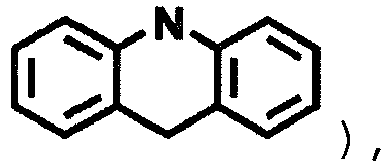

- In the present specification, the fused structure may be a structure in which an aromatic hydrocarbon ring is fused with the corresponding substituent. Examples of a fused ring of benzimidazole include

- In the present specification, the "adjacent" group may mean a substituent substituted with an atom directly linked to an atom in which the corresponding substituent is substituted, a substituent disposed sterically closest to the corresponding substituent, or another substituent substituted with an atom in which the corresponding substituent is substituted. For example, two substituents substituted at the ortho position in a benzene ring and two substituents substituted with the same carbon in an aliphatic ring may be interpreted as groups which are "adjacent" to each other.
- In the present specification, the case where adjacent groups combine with each other to form a ring means that adjacent groups combine with each other to form a 5-membered to 8-membered hydrocarbon ring or a 5-membered to 8-membered hetero ring as described above, and the ring may be monocyclic or polycyclic, may be an aliphatic ring, an aromatic ring, or a fused form thereof, and is not limited thereto.
- According to an exemplary embodiment of the present application, R5 and R6 may combine with each other to be represented by the following
Chemical Formula 2.
- In
Chemical Formula 2,
* and ** are a moiety bonded to a position of R5 or R6,
L2 is a substituted or unsubstituted arylene group; or a substituted or unsubstituted divalent heterocyclic group,
Ar2 is hydrogen; deuterium; a halogen group; a cyano group; a substituted or unsubstituted alkyl group; a substituted or unsubstituted aryl group; a substituted or unsubstituted heterocyclic group; or a substituted or unsubstituted silyl group, and
R15 to R18 are the same as or different from each other, and are each independently hydrogen; deuterium; a halogen group; a hydroxy group; a nitro group; a cyano group; a substituted or unsubstituted alkyl group; a substituted or unsubstituted alkenyl group; a substituted or unsubstituted alkynyl group; a substituted or unsubstituted cycloalkyl group; a substituted or unsubstituted alkoxy group; a substituted or unsubstituted aryloxy group; a substituted or unsubstituted arylthioxy group; a substituted or unsubstituted amine group; a substituted or unsubstituted aryl group; or a substituted or unsubstituted heterocyclic group, or combine with an adjacent group to form a ring. - According to an exemplary embodiment of the present application, in
Chemical Formulae - According to an exemplary embodiment of the present application, when R5 and R6 of
Chemical Formula 1 are bonded to * and ** ofChemical Formula 2, R5 and R6 correspond one-to-one to each other, and a position to correspond to each other is not limited. For example, R5 may be bonded to * and R6 may be bonded to **, or R5 may be bonded to ** and R6 may be bonded to *. - According to an exemplary embodiment of the present application,
Chemical Formula 2 may be represented by any one of Chemical Formulae 2-1 to 2-3.


* and ** are a moiety bonded to a position of R5 or R6,
L2 and Ar2 are the same as those defined inChemical Formula 2,
R15 to R18 and R20 are the same as or different from each other, and are each independently hydrogen; deuterium; a halogen group; a hydroxy group; a nitro group; a cyano group; a substituted or unsubstituted alkyl group; a substituted or unsubstituted alkenyl group; a substituted or unsubstituted alkynyl group; a substituted or unsubstituted cycloalkyl group; a substituted or unsubstituted alkoxy group; a substituted or unsubstituted aryloxy group; a substituted or unsubstituted arylthioxy group; a substituted or unsubstituted aryl group; or a substituted or unsubstituted heterocyclic group, and
t is an integer of 0 to 4, and when t is an integer of 2 or more, a plurality of R20's is the same as or different from each other. - According to an exemplary embodiment of the present application,
Chemical Formula 1 is represented by the followingChemical Formula 


- In
Chemical Formulae Chemical Formula 1, and R19 is the same as the definition of R1 ofChemical Formula 1. - According to an exemplary embodiment of the present application,
Chemical Formula 1 is represented by any one of the following Chemical Formulae 1-1, 1-2, 3-1, 3-2, 4-1, and 4-2.


- In Chemical Formulae 1-1, 1-2, 3-1, 3-2, 4-1, and 4-2, L1, L2, Ar1, Ar2, R1 to R4, and R7 to R18 are the same as those defined in
Chemical Formulae Chemical Formula 1. - According to an exemplary embodiment of the present application, L1 is a substituted or unsubstituted phenylene group; a substituted or unsubstituted divalent biphenyl group; a substituted or unsubstituted naphthylene group; a substituted or unsubstituted pyridylene group; a substituted or unsubstituted pyrimidylene group; or a substituted or unsubstituted triazinylene group.
- According to an exemplary embodiment of the present application, R6 is -L3-Ar3,
L3 is a direct bond; a substituted or unsubstituted arylene group; or a substituted or unsubstituted divalent heterocyclic group, and
Ar3 is hydrogen; deuterium; a halogen group; a cyano group; a substituted or unsubstituted alkyl group; a substituted or unsubstituted aryl group; a substituted or unsubstituted amine group; a substituted or unsubstituted heterocyclic group; or a substituted or unsubstituted silyl group. - According to an exemplary embodiment of the present application, R12 is -L4-Ar4,
L4 is a direct bond; a substituted or unsubstituted arylene group; or a substituted or unsubstituted divalent heterocyclic group, and
Ar4 is hydrogen; deuterium; a halogen group; a cyano group; a substituted or unsubstituted alkyl group; a substituted or unsubstituted aryl group; a substituted or unsubstituted amine group; a substituted or unsubstituted heterocyclic group; or a substituted or unsubstituted silyl group. - According to an exemplary embodiment of the present application, L4 is a direct bond; a phenylene group; a divalent biphenyl group; a pyridylene group; a pyrimidylene group; or a triazinylene group.
- According to an exemplary embodiment of the present application, Ar4 is hydrogen; deuterium; a halogen group; a cyano group; a substituted or unsubstituted alkyl group; a substituted or unsubstituted aryl group; a substituted or unsubstituted amine group; a substituted or unsubstituted heterocyclic group; or a substituted or unsubstituted silyl group.
- According to an exemplary embodiment of the present application, Ar4 is hydrogen; deuterium; a halogen group; a cyano group; a substituted or unsubstituted alkyl group; or a substituted or unsubstituted aryl group.
- According to an exemplary embodiment of the present application, Ar4 is hydrogen; deuterium; a halogen group; a cyano group; a methyl group; a phenyl group; a biphenyl group; or a naphthyl group.
- According to an exemplary embodiment of the present application, Ar1 to Ar3 are the same as or different from each other, and are each independently a substituted or unsubstituted C6 to C20 aryl group; a substituted or unsubstituted C2 to C20 heterocyclic group; or a substituted or unsubstituted amine group.
- According to an exemplary embodiment of the present application, in Ar1 to Ar3, the aryl group is a substituted or unsubstituted phenyl group; a substituted or unsubstituted biphenyl group; a substituted or unsubstituted naphthyl group; a substituted or unsubstituted anthracenyl group; a substituted or unsubstituted phenanthrenyl group; a substituted or unsubstituted chrysenyl group; a substituted or unsubstituted pyrenyl group; a substituted or unsubstituted triphenylenyl group; or a substituted or unsubstituted fluorenyl group.
- According to an exemplary embodiment of the present application, in Ar1 to Ar3, the aryl group is a substituted or unsubstituted phenyl group; a substituted or unsubstituted biphenyl group; a substituted or unsubstituted naphthyl group; a substituted or unsubstituted anthracenyl group; a substituted or unsubstituted phenanthrenyl group; a substituted or unsubstituted chrysenyl group; a substituted or unsubstituted pyrenyl group; a substituted or unsubstituted triphenylenyl group; or a substituted or unsubstituted fluorenyl group, and the substituted or unsubstituted means being unsubstituted or substituted with at least one selected from the group consisting of deuterium; a halogen group; a C1 to C20 alkyl group; a cyano group; a C6 to C20 aryl group; and a C2 to C20 heterocyclic group.
- According to an exemplary embodiment of the present application, in Ar1 to Ar3, the aryl group is a substituted or unsubstituted phenyl group; a substituted or unsubstituted biphenyl group; a substituted or unsubstituted naphthyl group; a substituted or unsubstituted anthracenyl group; a substituted or unsubstituted phenanthrenyl group; a substituted or unsubstituted chrysenyl group; a substituted or unsubstituted pyrenyl group; a substituted or unsubstituted triphenylenyl group; or a substituted or unsubstituted fluorenyl group, and the substituted or unsubstituted means being unsubstituted or substituted with at least one selected from the group consisting of deuterium; a halogen group; a methyl group; a t-butyl group; a cyano group; a phenyl group; a biphenyl group; a naphthyl group; an anthracenyl group; a phenanthrenyl group; a pyridyl group; a pyrimidyl group; and a triazinyl group.
- According to an exemplary embodiment of the present application, in Ar1 to Ar3, the heterocyclic group is a substituted or unsubstituted pyridyl group; a substituted or unsubstituted pyrimidyl group; a substituted or unsubstituted triazinyl group; a substituted or unsubstituted thiophenyl group; a substituted or unsubstituted furanyl group; a substituted or unsubstituted benzofuranyl group; a substituted or unsubstituted benzothiophenyl group; a substituted or unsubstituted dibenzofuranyl group; a substituted or unsubstituted dibenzothiophenyl group; a substituted or unsubstituted carbazolyl group; a substituted or unsubstituted benzocarbazolyl group; a substituted or unsubstituted dibenzocarbazolyl group; a substituted or unsubstituted dibenzosilole group; a substituted or unsubstituted imidazolyl group; a substituted or unsubstituted benzimidazolyl group; a substituted or unsubstituted dibenzimidazolyl group; a substituted or unsubstituted thiazolyl group; a substituted or unsubstituted benzothiazolyl group; a substituted or unsubstituted oxazolyl group; a substituted or unsubstituted benzoxazolyl group; a substituted or unsubstituted phenanthrolinyl group; a substituted or unsubstituted phenothiazinyl group; a substituted or unsubstituted phenoxazinyl group; or a substituted or unsubstituted quinolinyl group, and the substituted or unsubstituted means being unsubstituted or substituted with at least one selected from the group consisting of deuterium; a halogen group; a C1 to C20 alkyl group; a cyano group; a C6 to C20 aryl group; and a C2 to C20 heterocyclic group.
- According to an exemplary embodiment of the present application, in Ar1 to Ar3, the heterocyclic group is a substituted or unsubstituted pyridyl group; a substituted or unsubstituted pyrimidyl group; a substituted or unsubstituted triazinyl group; a substituted or unsubstituted thiophenyl group; a substituted or unsubstituted furanyl group; a substituted or unsubstituted benzofuranyl group; a substituted or unsubstituted benzothiophenyl group; a substituted or unsubstituted dibenzofuranyl group; a substituted or unsubstituted dibenzothiophenyl group; a substituted or unsubstituted carbazolyl group; a substituted or unsubstituted benzocarbazolyl group; a substituted or unsubstituted dibenzocarbazolyl group; a substituted or unsubstituted dibenzosilole group; a substituted or unsubstituted imidazolyl group; a substituted or unsubstituted benzimidazolyl group; a substituted or unsubstituted dibenzimidazolyl group; a substituted or unsubstituted thiazolyl group; a substituted or unsubstituted benzothiazolyl group; a substituted or unsubstituted oxazolyl group; a substituted or unsubstituted benzoxazolyl group; a substituted or unsubstituted phenanthrolinyl group; a substituted or unsubstituted phenothiazinyl group; a substituted or unsubstituted phenoxazinyl group; or a substituted or unsubstituted quinolinyl group, and the substituted or unsubstituted means being unsubstituted or substituted with at least one selected from the group consisting of deuterium; a halogen group; a methyl group; a t-butyl group; a cyano group; a phenyl group; a biphenyl group; a naphthyl group; an anthracenyl group; a phenanthrenyl group; a pyridyl group; a pyrimidyl group; and a triazinyl group.
- According to an exemplary embodiment of the present application, the amine group is represented by -NR'R", and R' and R" are the same as or different from each other, and may be each independently a substituted or unsubstituted C1 to C60 alkyl group; a substituted or unsubstituted C6 to C60 cycloalkyl group; a substituted or unsubstituted C6 to C60 aryl group; or a substituted or unsubstituted C2 to C60 heterocyclic group.
- According to an exemplary embodiment of the present application, R' and R" are a substituted or unsubstituted C6 to C60 aryl group, and R' and R" may be the same as or different from each other.
- According to an exemplary embodiment of the present application, R' and R" are a C6 to C60 aryl group which is unsubstituted or substituted with a C1 to C60 alkyl group, and R' and R" may be the same as or different from each other.
- According to an exemplary embodiment of the present application, R' and R" are the same as or different from each other, and may be each independently a phenyl group, a biphenyl group, a naphthyl group, a terphenyl group, a fluorenyl group, or a dimethylfluorenyl group.
- According to an exemplary embodiment of the present application, R1 to R4 and R7 to R10 are the same as or different from each other, and are each independently hydrogen; deuterium; a halogen group; a C1 to C10 alkyl group; or C6 to C20 aryl group.
- According to an exemplary embodiment of the present application, R1 to R4 and R7 to R10 are the same as or different from each other, and are each independently hydrogen; deuterium; a halogen group; a methyl group; or a phenyl group.
- According to an exemplary embodiment of the present application, R1 to R4 and R7 to R10 are hydrogen.
- According to an exemplary embodiment of the present application, the compound represented by
Chemical Formula 1 is any one selected from the structural formulae of the followingGroup 1.


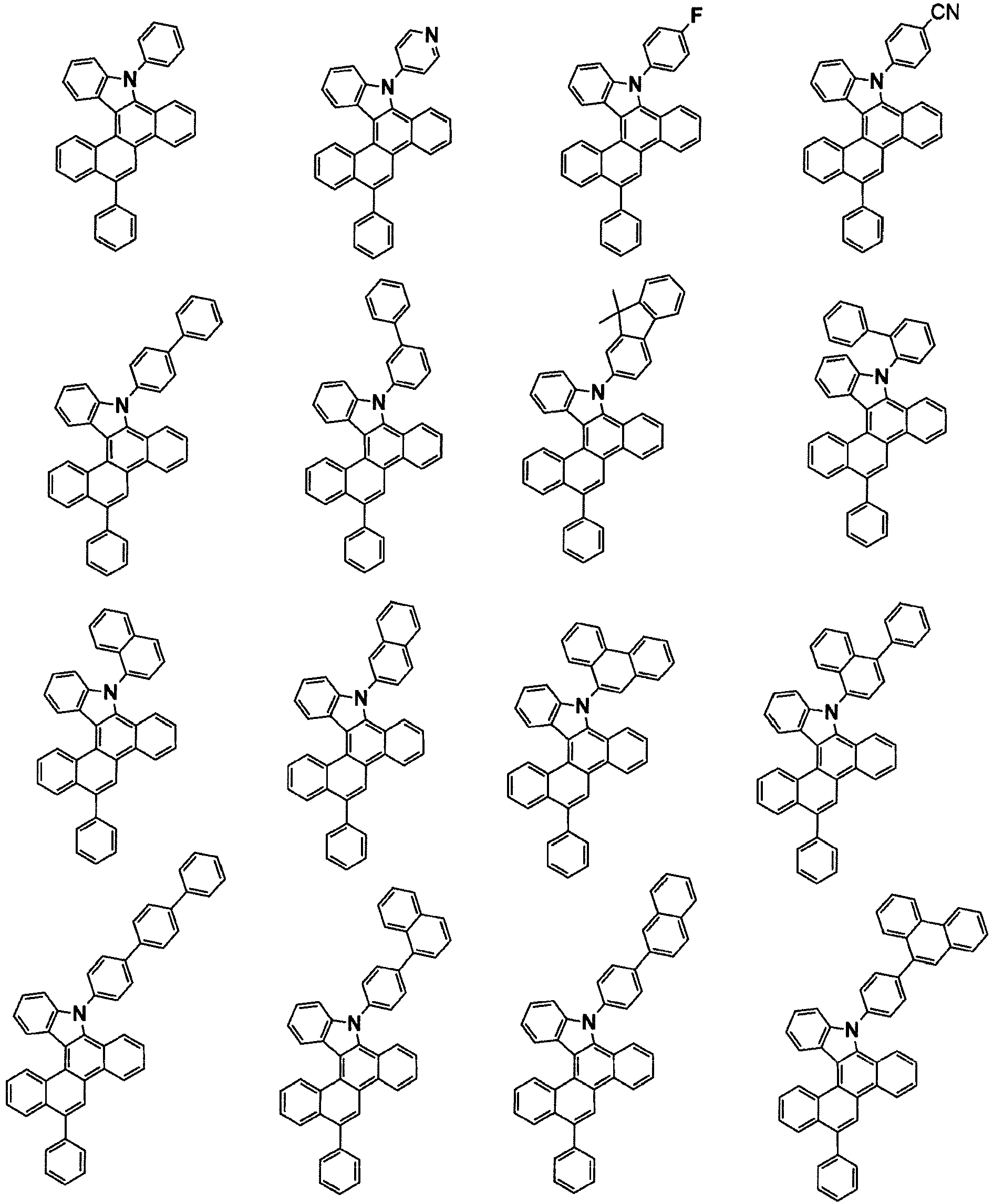


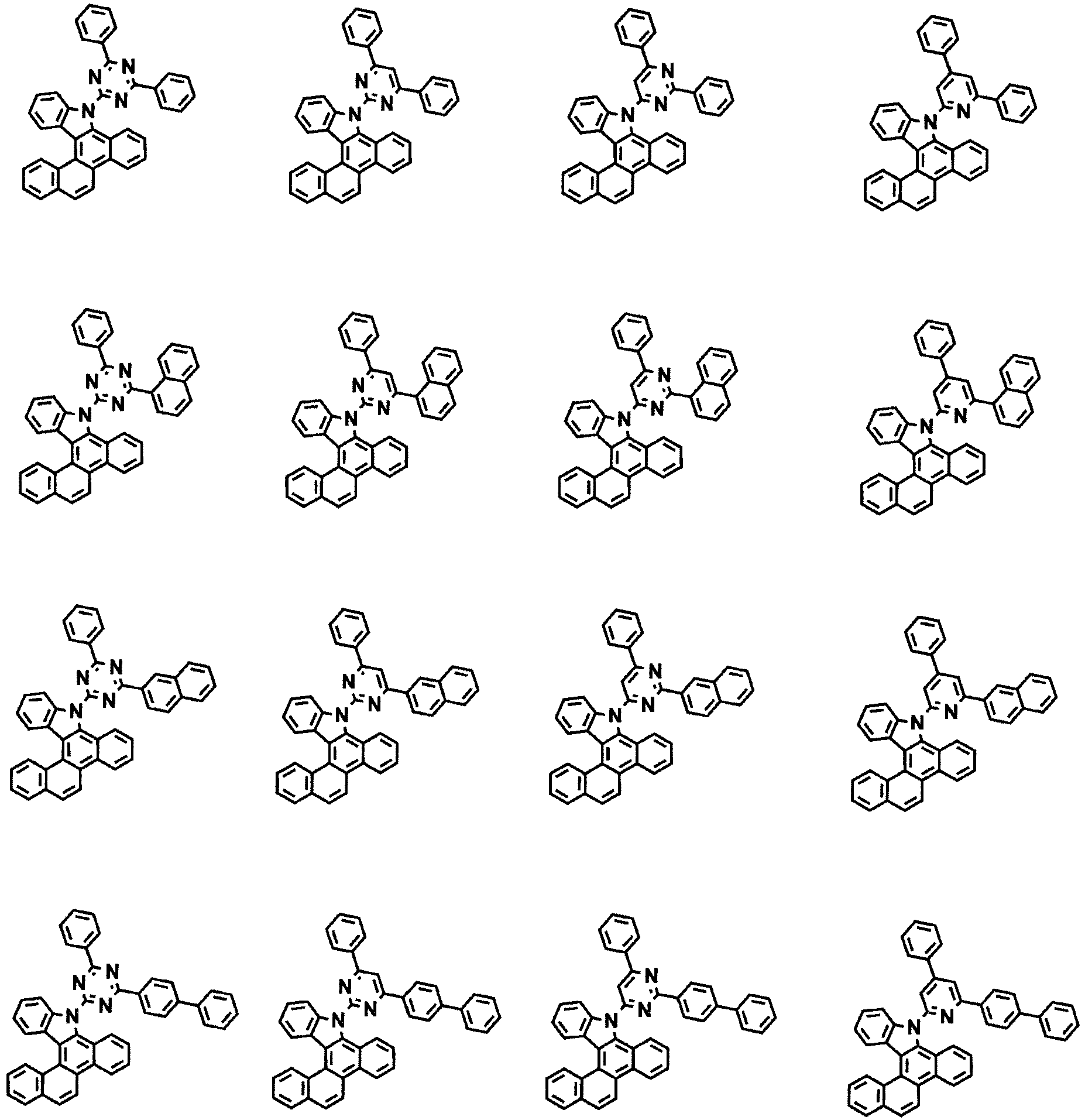


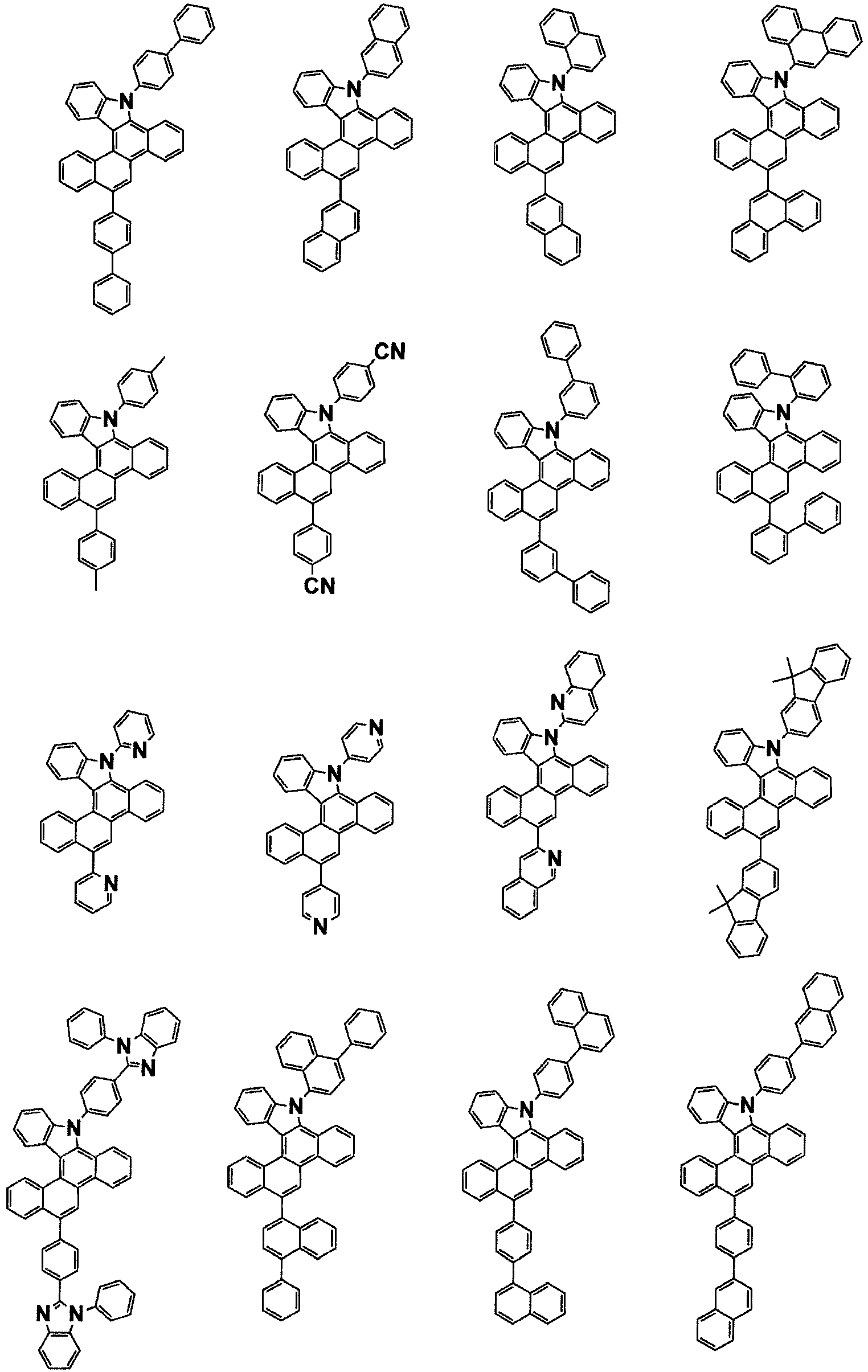


- According to an exemplary embodiment of the present application, the compound represented by
Chemical Formula 1 is any one selected from the structural formulae of the followingGroup 2.


- According to an exemplary embodiment of the present application, the compound represented by
Chemical Formula 1 is any one selected from the structural formulae of the followingGroup 3.


- The compound according to an exemplary embodiment of the present application may be prepared by a preparation method to be described below.
- For example, in the compound of
Chemical Formula 1, a core structure may be prepared as in the followingReaction Formulae 1 to 5.


-
Reaction Formulae 1 to 5 only describe the examples of the method of synthesizing the core ofChemical Formula 1, and are not limited thereto, and the kind and position of substituent may be changed, if necessary. - The substituent may be bonded by a method known in the art, and the kind and position of the substituent or the number of substituents may be changed according to the technology known in the art. For example, the substituent may be linked as in the following
Reaction Formulae 


- In Reaction Formulae 5 to 7, L1, L2, Ar1, and Ar2 are the same as those described above, and Ar is the same as the definition of Ar1, and L is the same as the definition of L1.
- The specific preparation method will be described below.
- Further, the present specification provides an organic electronic device including the above-described compound.
- An exemplary embodiment of the present application provides an organic electronic device including: a first electrode; a second electrode provided to face the first electrode; and one or more organic material layers provided between the first electrode and the second electrode, in which one or more layers of the organic material layers include the compound.
- When one member is disposed "on" another member in the present specification, this includes not only a case where the one member is brought into contact with another member, but also a case where still another member is present between the two members.
- When one part "includes" one constituent element in the present specification, unless otherwise specifically described, this does not mean that another constituent element is excluded, but means that another constituent element may be further included.
- The organic material layer of the organic electronic device of the present application may also be composed of a single-layered structure, but may be composed of a multi-layered structure in which two or more organic material layers are stacked. For example, as a representative example of the organic electronic device of the present invention, an organic light emitting device may have a structure including a hole injection layer, a hole transport layer, a light emitting layer, an electron transport layer, an electron injection layer, and the like as organic material layers. However, the structure of the organic electronic device is not limited thereto, and may include a fewer number of organic layers.
- According to an exemplary embodiment of the present application, the organic electronic device may be selected from the group consisting of an organic light emitting device, an organic solar cell, an organic photoconductor (OPC), and an organic transistor.
- Hereinafter, an organic light emitting device will be exemplified.
- In an exemplary embodiment of the present application, the organic material layer includes a light emitting layer, and the light emitting layer includes the compound.
- In an exemplary embodiment of the present application, the organic material layer includes a hole injection layer or a hole transport layer, and the hole injection layer or the hole transport layer includes the compound.
- In another exemplary embodiment, the organic material layer includes a light emitting layer, and the light emitting layer includes the compound.
- In an exemplary embodiment of the present application, the organic material layer includes an electron transport layer or an electron injection layer, and the electron transport layer or the electron injection layer includes the compound.
- In an exemplary embodiment of the present application, the organic material layer includes an electron blocking layer or a hole blocking layer, and the electron blocking layer or the hole blocking layer includes the compound.
- In an exemplary embodiment of the present application, the organic material layer includes an electron blocking layer, and the electron blocking layer includes the compound.
- In an exemplary embodiment of the present application, the organic light emitting device further includes one or two or more layers selected from the group consisting of a hole injection layer, a hole transport layer, a light emitting layer, an electron transport layer, an electron injection layer, an electron blocking layer, and a hole blocking layer.
- In an exemplary embodiment of the present application, the organic light emitting device includes: a first electrode; a second electrode provided to face the first electrode; a light emitting layer provided between the first electrode and the second electrode; and two or more organic material layers provided between the light emitting layer and the first electrode, or between the light emitting layer and the second electrode, in which at least one of the two or more organic material layers includes the compound. In an exemplary embodiment of the present application, as the two or more organic material layers, two or more may be selected from the group consisting of an electron transport layer, an electron injection layer, a layer which transports and injects electrons simultaneously, and a hole blocking layer.
- In an exemplary embodiment of the present application, the organic material layer includes two or more electron transport layers, and at least one of the two or more electron transport layers includes the compound. Specifically, in an exemplary embodiment of the present specification, the compound may also be included in one layer of the two or more electron transport layers, and may be included in each of the two or more electron transport layers.
- In addition, in an exemplary embodiment of the present application, when the compound is included in each of the two or more electron transport layers, the other materials except for the compound may be the same as or different from each other.
- In an exemplary embodiment of the present application, the organic material layer further includes a hole injection layer or a hole transport layer, which includes a compound including an arylamino group, a carbazolyl group, or a benzocarbazolyl group, in addition to the organic material layer including the compound.
- In an exemplary embodiment of the present specification, the light emitting layer includes the compound of
Chemical Formula 1 and further includes a light emitting dopant. - In another exemplary embodiment, the light emitting dopant includes a phosphorescent dopant.
- In still another exemplary embodiment, the phosphorescent dopant includes an iridium-based phosphorescent dopant.
- In yet another exemplary embodiment, the phosphorescent dopant material includes Ir(ppy)3 or (piq)2Ir(acac).
- According to an exemplary embodiment of the present specification, the organic material layer includes a light emitting layer, and the light emitting layer includes a compound represented by the following Chemical Formula A-1.

- In Chemical Formula A-1,
n1 is an integer of 1 or more,
Ar5 is a substituted or unsubstituted monovalent or more benzofluorene group; a substituted or unsubstituted monovalent or more fluoranthene group; a substituted or unsubstituted monovalent or more pyrene group; or a substituted or unsubstituted monovalent or more chrysene group,
L5 is a direct bond; a substituted or unsubstituted arylene group; or a substituted or unsubstituted heteroarylene group,
Ar6 and Ar7 are the same as or different from each other, and are each independently a substituted or unsubstituted aryl group; a substituted or unsubstituted silyl group; a substituted or unsubstituted germanium group; a substituted or unsubstituted alkyl group; a substituted or unsubstituted arylalkyl group; or a substituted or unsubstituted heteroaryl group, or may combine with each other to form a substituted or unsubstituted ring, and
when n1 is 2 or more, two or more structures in the parenthesis are the same as or different from each other. - According to an exemplary embodiment of the present specification, the organic material layer includes a light emitting layer, and the light emitting layer includes the compound represented by Chemical Formula A-1 as a dopant of the light emitting layer.
- According to an exemplary embodiment of the present specification, L5 is a direct bond.
- According to an exemplary embodiment of the present specification, n1 is 2.
- In an exemplary embodiment of the present specification, Ar5 is a divalent pyrene group which is unsubstituted or substituted with deuterium, a methyl group, an ethyl group, or a tert-butyl group.
- According to an exemplary embodiment of the present specification, Ar6 and Ar7 are the same as or different from each other, and are each independently a substituted or unsubstituted aryl group having 6 to 30 carbon atoms.
- According to an exemplary embodiment of the present specification, Ar6 and Ar7 are the same as or different from each other, and are each independently an aryl group which is unsubstituted or substituted with a germanium group substituted with an alkyl group.
- According to an exemplary embodiment of the present specification, Ar6 and Ar7 are the same as or different from each other, and are each independently an aryl group which is unsubstituted or substituted with a trimethylgermanium group.
- According to an exemplary embodiment of the present specification, Ar6 and Ar7 are the same as or different from each other, and are each independently a substituted or unsubstituted phenyl group.
- According to an exemplary embodiment of the present specification, Ar6 and Ar7 are a phenyl group which is unsubstituted or substituted with a trimethylgermanium group.
- According to an exemplary embodiment of the present specification, Chemical Formula A-1 is represented by the following compound.

- According to an exemplary embodiment of the present specification, the organic material layer includes a light emitting layer, and the light emitting layer includes a compound represented by the following Chemical Formula A-2.

- In Chemical Formula A-2,
G11 is a phenyl group, a 1-naphthyl group, a 2-naphthyl group, a 1-anthryl group, a 2-anthryl group, a 1-phenanthryl group, a 2-phenanthryl group, a 3-phenanthryl group, a 4-phenanthryl group, a 9-phenanthryl group, a 1-naphthacenyl group, a 2-naphthacenyl group, a 9-naphthacenyl group, a 1-pyrenyl group, a 2-pyrenyl group, a 4-pyrenyl group, a 3-methyl-2-naphthyl group, a 4-methyl-1-naphthyl group, or the following Chemical Formula
G13 and G14 are the same as or different from each other, and are each independently hydrogen; a substituted or unsubstituted alkyl group; a substituted or unsubstituted alkoxy group; a substituted or unsubstituted aryl group; or a substituted or unsubstituted heteroaryl group,
g12 is an integer of 1 to 5,
g13 and g14 are each an integer of 1 to 4, and
when g12 to g14 are each 2 or more, two or more structures in the parenthesis are the same as or different from each other. - According to an exemplary embodiment of the present specification, the organic material layer includes a light emitting layer, and the light emitting layer includes the compound represented by Chemical Formula A-2 as a host of the light emitting layer.
- According to an exemplary embodiment of the present specification, G11 is a phenyl group.
- According to an exemplary embodiment of the present specification, G11 is a 1-naphthyl group.
- According to an exemplary embodiment of the present specification, G12 is a 2-naphthyl group.
- According to an exemplary embodiment of the present specification, G13 and G14 are hydrogen.
- According to an exemplary embodiment of the present specification, Chemical Formula A-2 is represented by any one of the following compounds.

- In another exemplary embodiment, the organic light emitting device may be an organic light emitting device having a structure (normal type) in which a positive electrode, one or more organic material layers, and a negative electrode are sequentially stacked on a substrate.
- In still another exemplary embodiment, the organic light emitting device may be an organic light emitting device having a reverse direction structure (inverted type) in which a negative electrode, one or more organic material layers, and a positive electrode are sequentially stacked on a substrate.
- For example, the structure of the organic light emitting device according to an exemplary embodiment of the present specification is exemplified in
FIGS. 1 and 2 . -
FIG. 1 exemplifies a structure of an organic electronic device in which asubstrate 1, apositive electrode 2, alight emitting layer 3, and anegative electrode 4 are sequentially stacked. In the structure as described above, the compound may be included in thelight emitting layer 3. -
FIG. 2 exemplifies a structure of an organic electronic device in which asubstrate 1, apositive electrode 2, a hole injection layer 5, ahole transport layer 6, alight emitting layer 3, anelectron transport layer 7, and anegative electrode 4 are sequentially stacked. In the structure as described above, the compound may be included in one or more layers of the hole injection layer 5, thehole transport layer 6, thelight emitting layer 3, and theelectron transport layer 7. - In the structure as described above, the compound may be included in one or more of the hole injection layer, the hole transport layer, the light emitting layer, and the electron transport layer.
- The organic light emitting device of the present application may be manufactured by the materials and methods known in the art, except that one or more layers of the organic material layers include the compound of the present application, that is, the compound.
- When the organic light emitting device includes a plurality of organic material layers, the organic material layer may be formed of the same material or different materials.
- The organic light emitting device of the present application may be manufactured by the materials and methods known in the art, except that one or more layers of the organic material layers include the compound, that is, the compound represented by
Chemical Formula 1. - For example, the organic light emitting device of the present application may be manufactured by sequentially stacking a first electrode, an organic material layer, and a second electrode on a substrate. In this case, the organic light emitting device may be manufactured by depositing a metal or a metal oxide having conductivity, or an alloy thereof on a substrate to form a positive electrode, forming an organic material layer including a hole injection layer, a hole transport layer, a light emitting layer, and an electron transport layer thereon, and then depositing a material, which may be used as a negative electrode, thereon, by using a physical vapor deposition (PVD) method such as sputtering or e-beam evaporation. In addition to the method as described above, an organic light emitting device may be made by sequentially depositing a negative electrode material, an organic material layer, and a positive electrode material on a substrate.
- Further, the compound of
Formula 1 may be formed as an organic material layer by not only a vacuum deposition method, but also a solution application method when an organic light emitting device is manufactured. Here, the solution application method means spin coating, dip coating, doctor blading, inkjet printing, screen printing, a spray method, roll coating, and the like, but is not limited thereto. - In addition to the method as described above, an organic light emitting device may also be manufactured by sequentially stacking a negative electrode material, an organic material layer, and a positive electrode material on a substrate (International Publication No.
2003/012890 ). However, the manufacturing method is not limited thereto. - In an exemplary embodiment of the present application, the first electrode is a positive electrode, and the second electrode is a negative electrode.
- In another exemplary embodiment, the first electrode is a negative electrode, and the second electrode is a positive electrode.
- As the positive electrode material, a material having a large work function is usually preferred so as to smoothly inject holes into an organic material layer. Specific examples of the positive electrode material which may be used in the present invention include: a metal, such as vanadium, chromium, copper, zinc, and gold, or alloys thereof; a metal oxide, such as zinc oxide, indium oxide, indium tin oxide (ITO), and indium zinc oxide (IZO); a combination of metal and oxide, such as ZnO:Al or SnO2:Sb; an electrically conductive polymer, such as poly(3-methylthiophene), poly[3,4-(ethylene-1,2-dioxy)thiophene] (PEDOT), polypyrrole, and polyaniline, and the like, but are not limited thereto.
- As the negative electrode material, a material having a small work function is usually preferred so as to smoothly inject electrons into an organic material layer. Specific examples of the negative electrode material include: a metal, such as magnesium, calcium, sodium, potassium, titanium, indium, yttrium, lithium, gadolinium, aluminum, silver, tin, and lead, or alloys thereof; a multi-layered structural material, such as LiF/Al or LiO2/Al, and the like, but are not limited thereto.
- The hole injection layer is a layer which injects holes from an electrode, and a hole injection material is preferably a compound which has a capability of transporting holes and thus has an effect of injecting holes at a positive electrode and an excellent effect of injecting holes for a light emitting layer or a light emitting material, prevents excitons produced from the light emitting layer from moving to an electron injection layer or an electron injection material, and is also excellent in the ability to form a thin film. It is preferred that the highest occupied molecular orbital (HOMO) of the hole injection material is between the work function of the positive electrode material and the HOMO of a peripheral organic material layer. Specific examples of the hole injection material include metal porphyrin, oligothiophene, an arylamine-based organic material, a hexanitrile hexaazatriphenylene-based organic material, a quinacridone-based organic material, a perylene-based organic material, anthraquinone, a polyaniline and polythiophene-based electrically conductive polymer, and the like, but are not limited thereto.
- The hole transport layer is a layer which receives holes from a hole injection layer and transports the holes to a light emitting layer, and a hole transport material is suitably a material which may receive holes from a positive electrode or a hole injection layer to transfer the holes to a light emitting layer, and has a large mobility for the holes. Specific examples thereof include an arylamine-based organic material, an electrically conductive polymer, a block copolymer in which a conjugate portion and a non-conjugate portion are present together, and the like, but are not limited thereto.
- The light emitting material is a material which may receive holes and electrons from a hole transport layer and an electron transport layer, respectively, and combine the holes and the electrons to emit light in a visible ray region, and is preferably a material having good quantum efficiency to fluorescence or phosphorescence. Specific examples thereof include: an 8-hydroxy-quinoline aluminum complex (Alq3); a carbazole-based compound; a dimerized styryl compound; BAlq; a 10-hydroxybenzoquinoline-metal compound; a benzoxazole, benzthiazole and benzimidazole-based compound; a poly(p-phenylenevinylene) (PPV)-based polymer; a spiro compound; polyfluorene, lubrene, and the like, but are not limited thereto.
- The light emitting layer may include a host material and a dopant material. Examples of the host material include a fused aromatic ring derivative, or a hetero ring-containing compound, and the like. Specific examples of the fused aromatic ring derivative include an anthracene derivative, a pyrene derivative, a naphthalene derivative, a pentacene derivative, a phenanthrene compound, a fluoranthene compound, and the like, and specific examples of the hetero ring-containing compound include a dibenzofuran derivative, a ladder-type furan compound, a pyrimidine derivative, and the like, but the examples are not limited thereto.
- The electron transport layer is a layer which receives electrons from an electron injection layer and transports the electrons to a light emitting layer, and an electron transport material is suitably a material which may receive electrons well from a negative electrode and transfer the electrons to a light emitting layer, and has a large mobility for electrons. Specific examples thereof include: an Al complex of 8-hydroxyquinoline; a complex including Alq3; an organic radical compound; a hydroxyflavone-metal complex, and the like, but are not limited thereto. The electron transport layer may be used with any desired cathode material, as used according to the related art. In particular, appropriate examples of the cathode material are a typical material which has a low work function, followed by an aluminum layer or a silver layer. Specific examples thereof include cesium, barium, calcium, ytterbium, and samarium, in each case followed by an aluminum layer or a silver layer.
- The electron injection layer is a layer which injects electrons from an electrode, and is preferably a compound which has a capability of transporting electrons, has an effect of injecting electrons from a negative electrode and an excellent effect of injecting electrons into a light emitting layer or a light emitting material, prevents excitons produced from the light emitting layer from moving to a hole injection layer, and is also excellent in the ability to form a thin film. Specific examples thereof include fluorenone, anthraquinodimethane, diphenoquinone, thiopyran dioxide, oxazole, oxadiazole, triazole, imidazole, perylenetetracarboxylic acid, fluorenylidene methane, anthrone, and the like, and derivatives thereof, a metal complex compound, a nitrogen-containing 5-membered ring derivative, and the like, but are not limited thereto.
- Examples of the metal complex compound include 8-hydroxyquinolinato lithium, bis(8-hydroxyquinolinato) zinc, bis(8-hydroxyquinolinato) copper, bis(8-hydroxyquinolinato) manganese, tris(8-hydroxyquinolinato) aluminum, tris(2-methyl-8-hydroxyquinolinato) aluminum, tris(8-hydroxyquinolinato) gallium, bis(10-hydroxybenzo[h]quinolinato) beryllium, bis(10-hydroxybenzo[h]quinolinato) zinc, bis(2-methyl-8-quinolinato) chlorogallium, bis(2-methyl-8-quinolinato)(o-cresolato) gallium, bis(2-methyl-8-quinolinato)(1-naphtholato) aluminum, bis(2-methyl-8-quinolinato)(2-naphtholato) gallium, and the like, but are not limited thereto.
- The hole blocking layer is a layer which blocks holes from reaching a negative electrode, and may be generally formed under the same conditions as those of the hole injection layer. Specific examples thereof include an oxadiazole derivative or a triazole derivative, a phenanthroline derivative, bathocuproine (BCP), an aluminum complex, and the like, but are not limited thereto.
- The organic light emitting device according to the present specification may be a top emission type, a bottom emission type, or a dual emission type according to the material to be used.
- In an exemplary embodiment of the present application, the compound may be included in an organic solar cell or an organic transistor in addition to the organic light emitting device.
- The compound according to the present application may act by a principle similar to that applied to the organic light emitting device even in an organic electronic device such as an organic solar cell, an organic photoconductor, and an organic transistor.
- Hereinafter, the present specification will be described in detail with reference to Examples in order to specifically explain the present specification. However, the Examples according to the present specification may be modified in various forms, and it is not interpreted that the scope of the present application is limited to the Examples described in detail below. The Examples of the present application are provided for more completely explaining the present specification to the person with ordinary skill in the art.
-
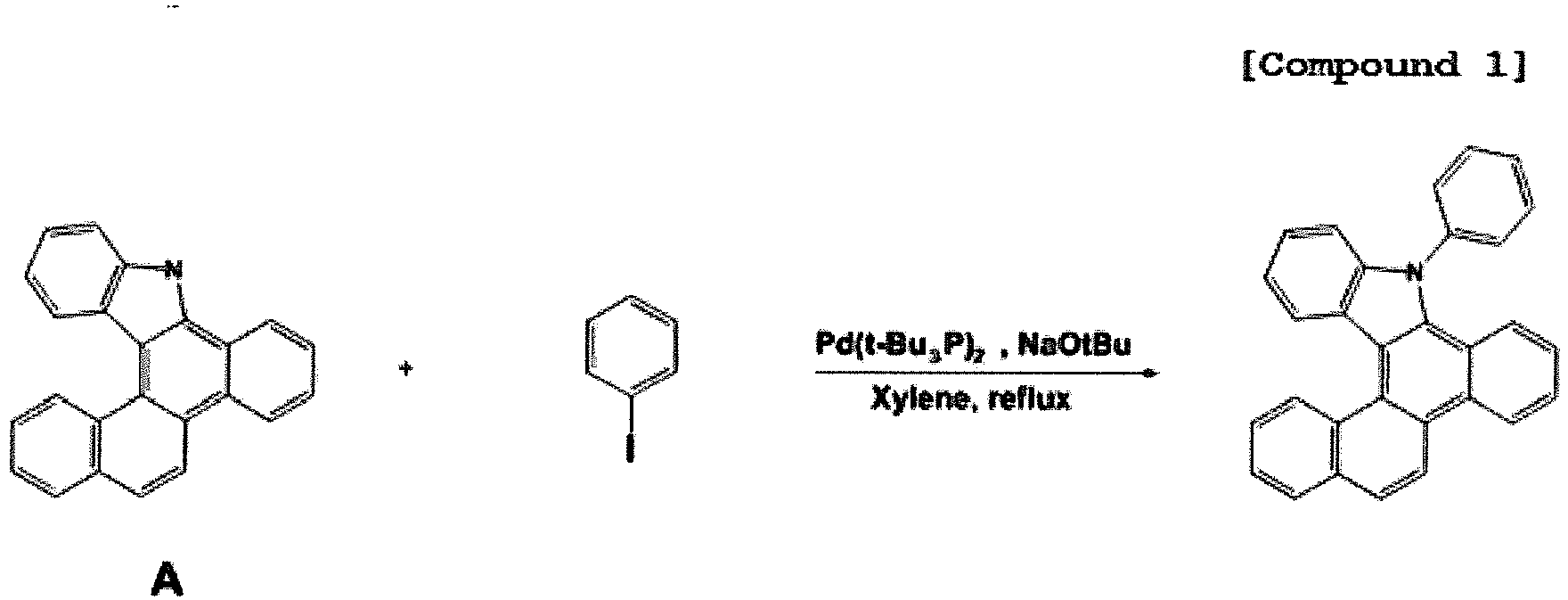
- Under a nitrogen atmosphere, Chemical Formula A (10 g, 31.55 mmol) and iodobenzene (7.04 g, 34.70 mmol) were completely dissolved in 160 ml of xylene in a 500 ml-round bottom flask, and then sodium-tert-butoxide (3.94 g, 41.02 mmol) was added thereto, bis(tri-tert-butylphosphine) palladium(0) (0.16 g, 0.32 mmol) was put thereinto, and then the resulting mixture was heated and stirred for 1 hour. The temperature was lowered to normal temperature, the mixture was filtered to remove the base, and then xylene was concentrated under reduced pressure, and the residue was columned at a ratio of tetrahydrofuran : hexane = 1 : 20 to prepare Compound 1 (9.56 g, yield: 77%).
MS [M+H]+ = 394 -

- Under a nitrogen atmosphere, Chemical Formula A (10 g, 31.55 mmol) and 4-iodo-1,1'-biphenyl (9.72 g, 34.70 mmol) were completely dissolved in 180 ml of xylene in a 500 ml-round bottom flask, and then sodium tert-butoxide (3.94 g, 41.02 mmol) was added thereto, bis(tri-tert-butylphosphine) palladium(0) (0.16 g, 0.32 mmol) was put thereinto, and then the resulting mixture was heated and stirred for 2 hours. The temperature was lowered to normal temperature, the mixture was filtered to remove the base, and then xylene was concentrated under reduced pressure, and the residue was columned at a ratio of tetrahydrofuran : hexane = 1 : 16 to prepare Compound 2 (12.45 g, yield: 84%).
MS [M+H]+ = 470 -

- Under a nitrogen atmosphere, Chemical Formula A (10 g, 31.55 mmol) and 4-bromo-N,N-diphenylaniline (11.21 g, 34.70 mmol) were completely dissolved in 200 ml of xylene in a 500 ml-round bottom flask, and then sodium tert-butoxide (3.94 g, 41.02 mmol) was added thereto, bis(tri-tert-butylphosphine) palladium(0) (0.16 g, 0.32 mmol) was put thereinto, and then the resulting mixture was heated and stirred for 2 hours. The temperature was lowered to normal temperature, the mixture was filtered to remove the base, and then xylene was concentrated under reduced pressure, and the residue was columned at a ratio of tetrahydrofuran : hexane = 1 : 15 to prepare Compound 3 (15.91 g, yield: 89%).
MS [M+H]+ = 561 -

- Under a nitrogen atmosphere, Chemical Formula A (10 g, 31.55 mmol) and 3-bromo-9-phenyl-9H-carbazole (11.20 g, 34.70 mmol) were completely dissolved in 230 ml of xylene in a 500 ml-round bottom flask, and then sodium tert-butoxide (3.94 g, 41.02 mmol) was added thereto, bis(tri-tert-butylphosphine) palladium(0) (0.16 g, 0.32 mmol) was put thereinto, and then the resulting mixture was heated and stirred for 4 hours. The temperature was lowered to normal temperature, the mixture was filtered to remove the base, and then xylene was concentrated under reduced pressure, and the residue was columned at a ratio of tetrahydrofuran : hexane = 1 : 12 to prepare Compound 4 (14.39 g, yield: 82%).
MS [M+H]+ = 559 -

- Under a nitrogen atmosphere, Chemical Formula A (10 g, 31.55 mmol) and 9-(4-bromophenyl)-9H-carbazole (11.20 g, 34.70 mmol) were completely dissolved in 220 ml of xylene in a 500 ml-round bottom flask, and then sodium tert-butoxide (3.94 g, 41.02 mmol) was added thereto, bis(tri-tert-butylphosphine) palladium(0) (0.16 g, 0.32 mmol) was put thereinto, and then the resulting mixture was heated and stirred for 5 hours. The temperature was lowered to normal temperature, the mixture was filtered to remove the base, and then xylene was concentrated under reduced pressure, and the residue was columned at a ratio of tetrahydrofuran : hexane = 1 : 9 to prepare Compound 5 (12.85 g, yield: 73%).
MS [M+H]+ = 559 -

- Under a nitrogen atmosphere, Chemical Formula A (10 g, 31.55 mmol) and 2-chloro-4,6-diphenyl-1,3,5-triazine (9.26 g, 34.70 mmol) were completely dissolved in 220 ml of xylene in a 500 ml-round bottom flask, and then sodium tert-butoxide (3.94 g, 41.02 mmol) was added thereto, bis(tri-tert-butylphosphine) palladium(0) (0.16 g, 0.32 mmol) was put thereinto, and then the resulting mixture was heated and stirred for 3 hours. The temperature was lowered to normal temperature, the mixture was filtered to remove the base, and then xylene was concentrated under reduced pressure, and the residue was recrystallized with 300 ml of ethyl acetate to prepare Compound 6 (12.45 g, yield: 84%).
MS [M+H]+ = 549 -

- Under a nitrogen atmosphere, Chemical Formula A (10 g, 31.55 mmol) and 2-chloro-4,6-diphenylpyrimidine (9.26 g, 34.70 mmol) were completely dissolved in 220 ml of xylene in a 500 ml-round bottom flask, and then sodium tert-butoxide (3.94 g, 41.02 mmol) was added thereto, bis(tri-tert-butylphosphine) palladium(0) (0.16 g, 0.32 mmol) was put thereinto, and then the resulting mixture was heated and stirred for 3 hours. The temperature was lowered to normal temperature, the mixture was filtered to remove the base, and then xylene was concentrated under reduced pressure, and the residue was recrystallized with 320 ml of ethyl acetate to prepare Compound 7 (11.21 g, yield: 76%).
MS [M+H]+ = 548 -

- Under a nitrogen atmosphere, Chemical Formula A (10 g, 31.55 mmol) and 4-chloro-2,6-diphenylpyrimidine (9.26 g, 34.70 mmol) were completely dissolved in 230 ml of xylene in a 500 ml-round bottom flask, and then sodium tert-butoxide (3.94 g, 41.02 mmol) was added thereto, bis(tri-tert-butylphosphine) palladium(0) (0.16 g, 0.32 mmol) was put thereinto, and then the resulting mixture was heated and stirred for 4 hours. The temperature was lowered to normal temperature, the mixture was filtered to remove the base, and then xylene was concentrated under reduced pressure, and the residue was recrystallized with 350 ml of ethyl acetate to prepare Compound 8 (10.09 g, yield: 69%).
MS [M+H]+ = 548 -

- Under a nitrogen atmosphere, Chemical Formula A (10 g, 31.55 mmol) and 2-chloro-4,6-diphenylpyridine (9.26 g, 34.70 mmol) were completely dissolved in 230 ml of xylene in a 500 ml-round bottom flask, and then sodium tert-butoxide (3.94 g, 41.02 mmol) was added thereto, bis(tri-tert-butylphosphine) palladium(0) (0.16 g, 0.32 mmol) was put thereinto, and then the resulting mixture was heated and stirred for 4 hours. The temperature was lowered to normal temperature, the mixture was filtered to remove the base, and then xylene was concentrated under reduced pressure, and the residue was recrystallized with 350 ml of ethyl acetate to prepare Compound 9 (9.98 g, yield: 62%).
MS [M+H]+ = 547 -
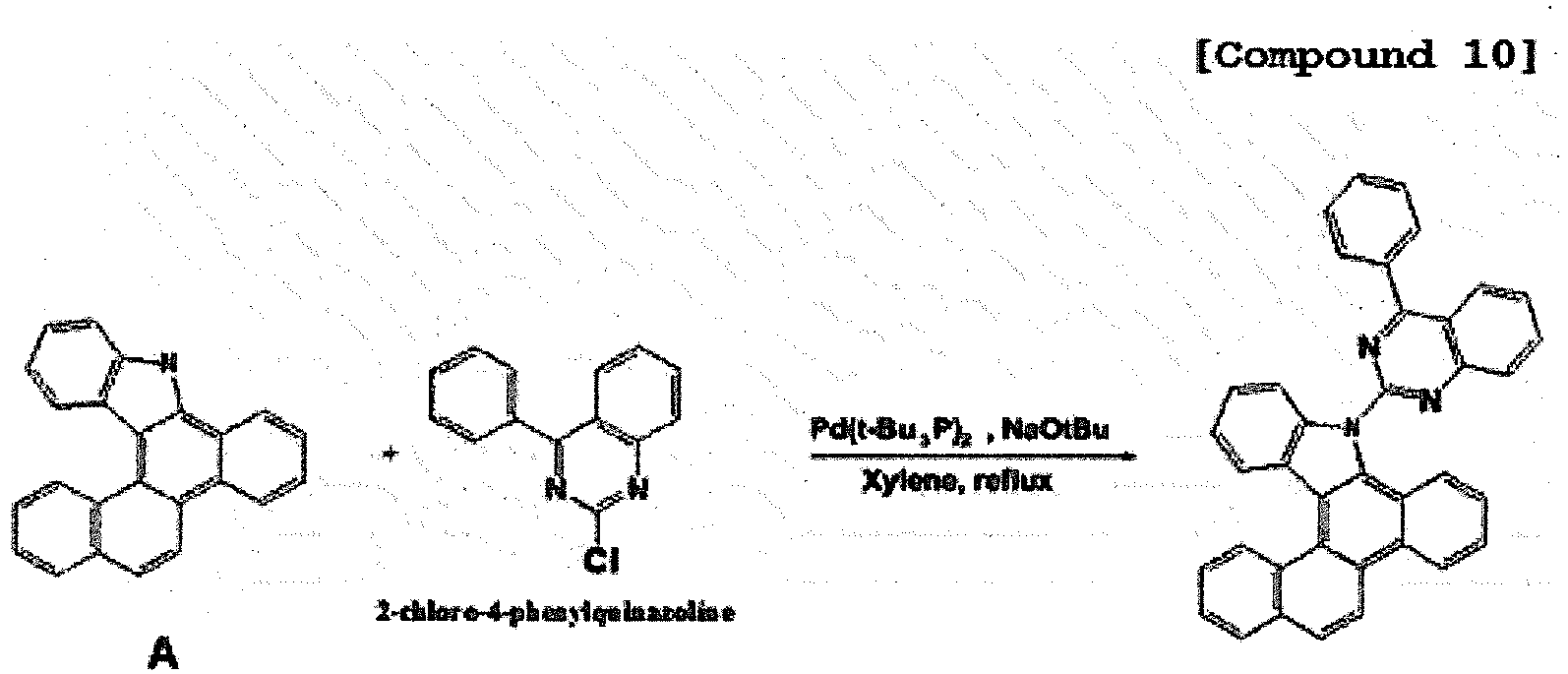
- Under a nitrogen atmosphere, Chemical Formula A (10 g, 31.55 mmol) and 2-chloro-4-phenylquinazoline (8.33 g, 34.70 mmol) were completely dissolved in 290 ml of xylene in a 500 ml-round bottom flask, and then sodium tert-butoxide (3.94 g, 41.02 mmol) was added thereto, bis(tri-tert-butylphosphine) palladium(0) (0.16 g, 0.32 mmol) was put thereinto, and then the resulting mixture was heated and stirred for 6 hours. The temperature was lowered to normal temperature, the mixture was filtered to remove the base, and then xylene was concentrated under reduced pressure, and the residue was recrystallized with 310 ml of ethyl acetate to prepare Compound 10 (14.59 g, yield: 89%).
MS [M+H]+ = 522 -

- Under a nitrogen atmosphere, Chemical Formula A (10 g, 31.55 mmol) and 2-(3-bromophenyl)-4,6-diphenyl-1,3,5-triazine (13.43 g, 34.70 mmol) were completely dissolved in 220 ml of xylene in a 500 ml-round bottom flask, and then sodium tert-butoxide (3.94 g, 41.02 mmol) was added thereto, bis(tri-tert-butylphosphine) palladium(0) (0.16 g, 0.32 mmol) was put thereinto, and then the resulting mixture was heated and stirred for 6 hours. The temperature was lowered to normal temperature, the mixture was filtered to remove the base, and then xylene was concentrated under reduced pressure, and the residue was recrystallized with 330 ml of ethyl acetate to prepare Compound 11 (12.45 g, yield: 84%).
MS [M+H]+ = 625 -
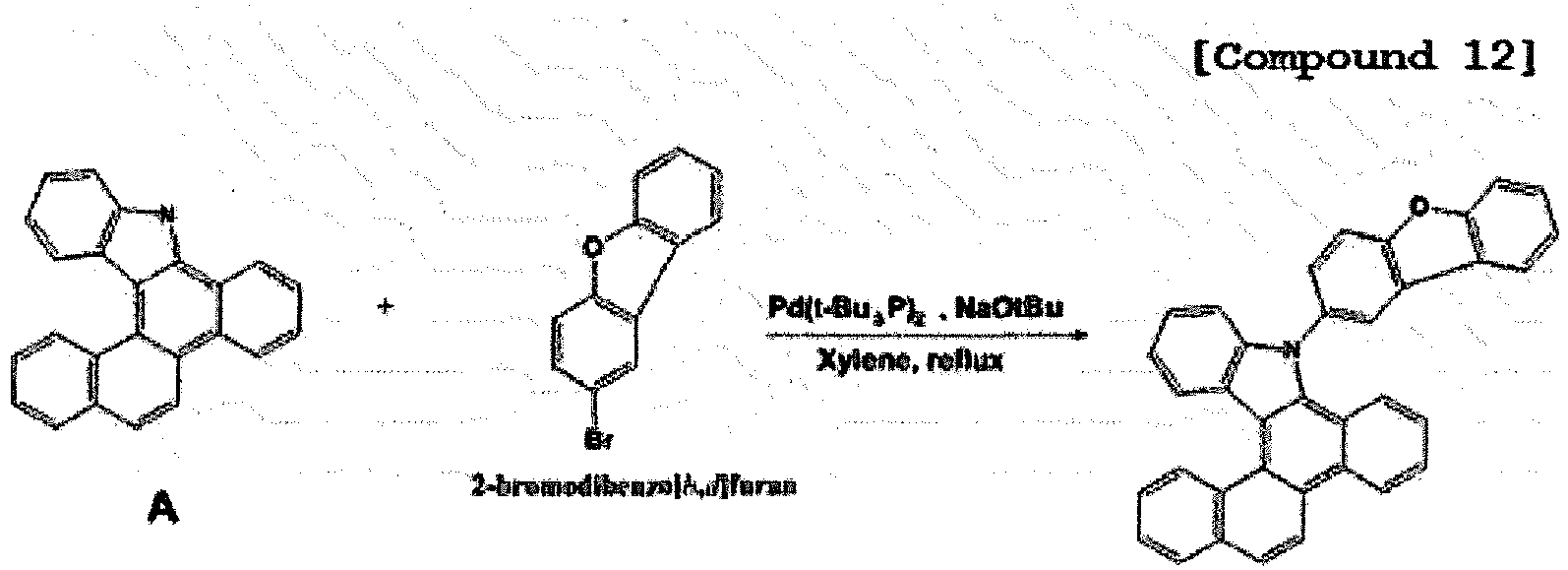
- Under a nitrogen atmosphere, Chemical Formula A (10 g, 31.55 mmol) and 2-bromodibenzo[b,d]furan (8.54 g, 34.70 mmol) were completely dissolved in 190 ml of xylene in a 500 ml-round bottom flask, and then sodium tert-butoxide (3.94 g, 41.02 mmol) was added thereto, bis(tri-tert-butylphosphine) palladium(0) (0.16 g, 0.32 mmol) was put thereinto, and then the resulting mixture was heated and stirred for 3 hours. The temperature was lowered to normal temperature, the mixture was filtered to remove the base, and then xylene was concentrated under reduced pressure, and the residue was columned at a ratio of tetrahydrofuran : hexane = 1 : 13 to prepare Compound 12 (14.39 g, yield: 82%).
MS [M+H]+ = 484 -

- Under a nitrogen atmosphere, Chemical Formula A (10 g, 31.55 mmol) and 2-bromodibenzo[b,d]thiophene (9.09 g, 34.70 mmol) were completely dissolved in 190 ml of xylene in a 500 ml-round bottom flask, and then sodium tert-butoxide (3.94 g, 41.02 mmol) was added thereto, bis(tri-tert-butylphosphine) palladium(0) (0.16 g, 0.32 mmol) was put thereinto, and then the resulting mixture was heated and stirred for 3 hours. The temperature was lowered to normal temperature, the mixture was filtered to remove the base, and then xylene was concentrated under reduced pressure, and the residue was columned at a ratio of tetrahydrofuran : hexane = 1 : 13 to prepare Compound 13 (12.97 g, yield: 74%).
MS [M+H]+ = 500 -

- Under a nitrogen atmosphere, Chemical Formula B (10 g, 27.25 mmol) and 4-bromo-N,N-diphenylaniline (9.59 g, 29.97 mmol) were completely dissolved in 180 ml of xylene in a 500 ml-round bottom flask, and then sodium tert-butoxide (3.40 g, 35.43 mmol) was added thereto, bis(tri-tert-butylphosphine) palladium(0) (0.14 g, 0.27 mmol) was put thereinto, and then the resulting mixture was heated and stirred for 3 hours. The temperature was lowered to normal temperature, the mixture was filtered to remove the base, and then xylene was concentrated under reduced pressure, and the residue was columned at a ratio of tetrahydrofuran : hexane = 1 : 13 to prepare Compound 14 (12.97 g, yield: 74%).
MS [M+H]+ = 611 -

- Under a nitrogen atmosphere, Chemical Formula C (10 g, 27.25 mmol) and 2-chloro-4,6-diphenyl-1,3,5-triazine (8.01 g, 29.97 mmol) were completely dissolved in 220 ml of xylene in a 500 ml-round bottom flask, and then sodium tert-butoxide (3.40 g, 35.43 mmol) was added thereto, bis(tri-tert-butylphosphine) palladium(0) (0.14 g, 0.27 mmol) was put thereinto, and then the resulting mixture was heated and stirred for 6 hours. The temperature was lowered to normal temperature, the mixture was filtered to remove the base, and then xylene was concentrated under reduced pressure, and the residue was recrystallized with 250 ml of ethyl acetate to prepare Compound 15 (11.74 g, yield: 68%).
MS [M+H]+ = 599 -

- Under a nitrogen atmosphere, Chemical Formula D (10 g, 24.69 mmol) and iodobenzene (5.52 g, 27.16 mmol) were completely dissolved in 180 ml of xylene in a 500 ml-round bottom flask, and then sodium-tert-butoxide (3.08 g, 32.69 mmol) was added thereto, bis(tri-tert-butylphosphine) palladium(0) (0.13 g, 0.25 mmol) was put thereinto, and then the resulting mixture was heated and stirred for 3 hours. The temperature was lowered to normal temperature, the mixture was filtered to remove the base, and then xylene was concentrated under reduced pressure, and the residue was recrystallized with 220 ml of ethyl acetate to prepare Compound 16 (12.97 g, yield: 74%).
MS [M+H]+ = 559 - A glass substrate thinly coated with indium tin oxide (ITO) to have a thickness of 1,000 Å was put into distilled water in which a detergent was dissolved, and ultrasonically washed. In this case, a product manufactured by Fischer Co., was used as the detergent, and distilled water twice filtered using a filter manufactured by Millipore Co., was used as the distilled water. After the ITO was washed for 30 minutes, ultrasonic washing was conducted twice repeatedly using distilled water for 10 minutes. After the washing using distilled water was completed, ultrasonic washing was conducted using isopropyl alcohol, acetone, and methanol solvents, and drying was conducted, and then the substrate was transferred to a plasma cleaner. In addition, the substrate was cleaned using oxygen plasma for 5 minutes, and then transferred to a vacuum evaporator.
- Hexanitrile hexaazatriphenylene (HAT) of the following Chemical Formula was thermally vacuum deposited to have a thickness of 500 Å on the transparent ITO electrode, which was thus prepared, thereby forming a hole injection layer.

- The following compound 4-4'-bis[N-(1-naphthyl)-N-phenylamino]biphenyl (NPB) (300 Å), which is a material for transporting holes, was vacuum deposited on the hole injection layer, thereby forming a hole transport layer.
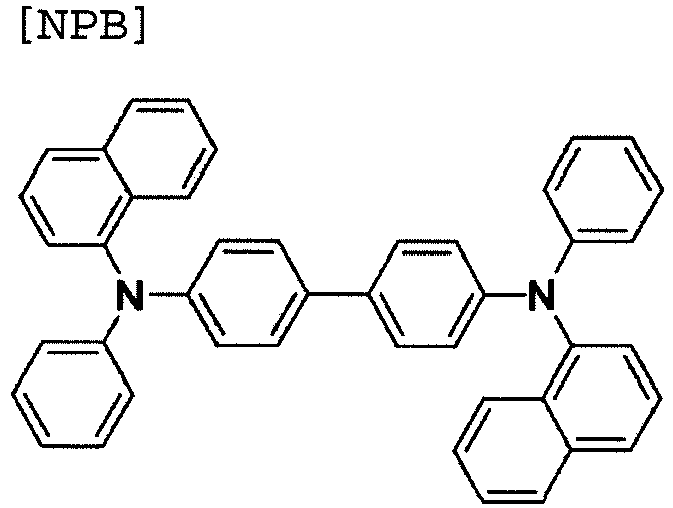
- Subsequently, the following
Compound 1 was vacuum deposited to have a film thickness of 100 Å on the hole transport layer, thereby forming an electron blocking layer.
- Subsequently, the following BH and BD were vacuum deposited at a weight ratio of 25:1 to have a film thickness of 300 Å on the electron blocking layer, thereby forming a light emitting layer.


- Compound ET1 and Compound LiQ (lithium quinolate) were vacuum deposited at a weight ratio of 1:1 on the light emitting layer, thereby forming an electron injection and transport layer having a thickness of 300 Å. Lithium fluoride (LiF) and aluminum were sequentially deposited to have a thickness of 12 Å and 2,000 Å, respectively, on the electron injection and transport layer, thereby forming a negative electrode.
- In the aforementioned procedure, the deposition rate of the organic material was maintained at 0.4 to 0.7 Å/sec, the deposition rates of lithium fluoride and aluminum of the negative electrode were maintained at 0.3 Å/sec and at 2 Å/sec, respectively, and the degree of vacuum during the deposition was maintained at 2 × 10⁻⁷ to 5 × 10⁻⁶ torr, thereby manufacturing an organic light emitting device.
- An organic light emitting device was manufactured in the same manner as in Experimental Example 1-1, except that
Compound 2 was used instead ofCompound 1 in Experimental Example 1-1. - An organic light emitting device was manufactured in the same manner as in Experimental Example 1-1, except that
Compound 3 was used instead ofCompound 1 in Experimental Example 1-1. - An organic light emitting device was manufactured in the same manner as in Experimental Example 1-1, except that
Compound 4 was used instead ofCompound 1 in Experimental Example 1-1. - An organic light emitting device was manufactured in the same manner as in Experimental Example 1-1, except that Compound 5 was used instead of
Compound 1 in Experimental Example 1-1. - An organic light emitting device was manufactured in the same manner as in Experimental Example 1-1, except that Compound 12 was used instead of
Compound 1 in Experimental Example 1-1. - An organic light emitting device was manufactured in the same manner as in Experimental Example 1-1, except that Compound 13 was used instead of
Compound 1 in Experimental Example 1-1. - An organic light emitting device was manufactured in the same manner as in Experimental Example 1-1, except that Compound 14 was used instead of
Compound 1 in Experimental Example 1-1. - An organic light emitting device was manufactured in the same manner as in Experimental Example 1-1, except that Compound 16 was used instead of
Compound 1 in Experimental Example 1-1. - An organic light emitting device was manufactured in the same manner as in Experimental Example 1-1, except that a compound of the following EB1 was used instead of
Compound 1 in Experimental Example 1-1.
- An organic light emitting device was manufactured in the same manner as in Experimental Example 1-1, except that a compound of the following EB2 was used instead of
Compound 1 in Experimental Example 1-1.
- An organic light emitting device was manufactured in the same manner as in Experimental Example 1-1, except that a compound of the following EB3 was used instead of
Compound 1 in Experimental Example 1-1.
- When current was applied to the organic light emitting devices manufactured in Experimental Examples 1-1 to 1-9 and Comparative Examples 1-1 to 1-3, the results of Table 1 were obtained.
[Table 1] Compound (Electron blocking layer) Voltage (V@10mA/cm2) Efficiency (cd/A@10mA/cm2) Color coordinate (x, y) Experimental Example 1-1 Compound 13.65 6.43 (0.138, 0.127) Experimental Example 1-2 Compound 23.61 6.42 (0.139, 0.127) Experimental Example 1-3 Compound 33.69 6.39 (0.138, 0.126) Experimental Example 1-4 Compound 43.69 6.38 (0.138, 0.127) Experimental Example 1-5 Compound 5 3.64 6.38 (0.137, 0.125) Experimental Example 1-6 Compound 12 3.85 6.13 (0.136, 0.125) Experimental Example 1-7 Compound 13 3.81 6.12 (0.136, 0.127) Experimental Example 1-8 Compound 14 3.89 6.08 (0.136, 0.125) Experimental Example 1-9 Compound 16 3.87 6.07 (0.137, 0.125) Comparative Example 1-1 EB1 4.53 5.31 (0.136, 0.127) Comparative Example 1-2 EB2 4.83 5.11 (0.136, 0.127) Comparative Example 1-3 EB3 4.93 5.03 (0.136, 0.127) - As seen in Table 1, the organic light emitting device manufactured by using the compound of the present invention as an electron blocking layer exhibits excellent characteristics in terms of the efficiency, and driving voltage and/or stability of the organic light emitting device.
- The organic light emitting device shows lower voltage and higher efficiency characteristics than the organic light emitting devices manufactured by using, as an electron blocking layer, the compounds of Comparative Examples 1-1 to 1-3 in which a carbazole ring is formed in a direction different from the core of the present invention.
- As in the result of Table 1, it could be confirmed that the compound according to the present invention had excellent electron blocking capability, and thus could be applied to an organic light emitting device.
- An experiment was performed in the same manner as in Experimental Example 1-1, except that the compound TCTA was used as the electron blocking layer, and
Compound 1 was used instead of NPB as the hole transport layer.
- An experiment was performed in the same manner as in Experimental Example 2-1, except that as the hole transport layer,
Compound 2 was used instead ofCompound 1. - An experiment was performed in the same manner as in Experimental Example 2-1, except that as the hole transport layer,
Compound 3 was used instead ofCompound 1. - An experiment was performed in the same manner as in Experimental Example 2-1, except that as the hole transport layer,
Compound 4 was used instead ofCompound 1. - An experiment was performed in the same manner as in Experimental Example 2-1, except that as the hole transport layer, Compound 5 was used instead of
Compound 1. - An experiment was performed in the same manner as in Experimental Example 2-1, except that as the hole transport layer, Compound 12 was used instead of
Compound 1. - An experiment was performed in the same manner as in Experimental Example 2-1, except that as the hole transport layer, Compound 13 was used instead of
Compound 1. - An experiment was performed in the same manner as in Experimental Example 2-1, except that as the hole transport layer, Compound 14 was used instead of
Compound 1. - An experiment was performed in the same manner as in Experimental Example 2-1, except that as the hole transport layer, Compound 16 was used instead of
Compound 1. - An organic light emitting device was manufactured in the same manner as in Experimental Example 2-1, except that a compound of the following HT1 was used instead of
Compound 1 in Experimental Example 2-1.
- An organic light emitting device was manufactured in the same manner as in Experimental Example 2-1, except that a compound of the following HT2 was used instead of
Compound 1 in Experimental Example 2-1.

- When current was applied to the organic light emitting devices manufactured in Experimental Examples 2-1 to 2-9 and Comparative Examples 2-1 and 2-2, the results of Table 2 were obtained.
[Table 2] Compound (Hole transport layer) Voltage (V@10mA/cm2) Efficiency (cd/A@10mA/cm2) Color coordinate (x, y) Experimental Example 2-1 Compound 13.45 5.25 (0.137, 0.125) Experimental Example 2-2 Compound 23.54 5.31 (0.136, 0.125) Experimental Example 2-3 Compound 33.51 5.28 (0.136, 0.127) Experimental Example 2-4 Compound 43.41 5.30 (0.136, 0.125) Experimental Example 2-5 Compound 5 3.42 5.21 (0.136, 0.127) Experimental Example 2-6 Compound 12 3.54 5.02 (0.136, 0.125) Experimental Example 2-7 Compound 13 3.64 5.01 (0.136, 0.127) Experimental Example 2-8 Compound 14 3.61 5.15 (0.136, 0.125) Experimental Example 2-9 Compound 16 3.3 5.00 (0.137, 0.125) Comparative Example 2-1 HT1 4.01 4.63 (0.136, 0.127) Comparative Example 2-2 HT2 4.25 4.42 (0.136, 0.127) - As seen in Table 2, the organic light emitting device manufactured by using the compound of the present invention as a hole transport layer exhibits better Characteristics, in terms of the efficiency, and driving voltage and/or stability of the organic light emitting device, than the organic light emitting devices manufactured by using, as an electron blocking layer, the compounds of Comparative Examples 2-1 and 2-2, in which a carbazole ring is formed in a direction different from the core of the present invention.
- As in the result of Table 1, it could be confirmed that the compound according to the present invention had excellent hole transport capability, and thus could be applied to an organic light emitting device.
- As in the results of Tables 1 and 2, it could be confirmed that the compound according to the present invention had excellent electron blocking capability and hole transport capability, and thus could be applied to an organic light emitting device.
- The compounds synthesized in the Synthesis Examples were subjected to high purity sublimation purification by a typically known method, and then green organic light emitting devices were manufactured by the following method.
- A glass substrate thinly coated with indium tin oxide (ITO) to have a thickness of 1,000 Å was put into distilled water in which a detergent was dissolved, and ultrasonically washed. In this case, a product manufactured by Fischer Co., was used as the detergent, and distilled water twice filtered using a filter manufactured by Millipore Co., was used as the distilled water. After the ITO was washed for 30 minutes, ultrasonic washing was conducted twice repeatedly using distilled water for 10 minutes. After the washing using distilled water was completed, ultrasonic washing was conducted using isopropyl alcohol, acetone, and methanol solvents, and drying was conducted, and then the substrate was transferred to a plasma cleaner. In addition, the substrate was cleaned using oxygen plasma for 5 minutes, and then transferred to a vacuum evaporator.
- An organic EL device was manufactured by configuring the light emitting device in the order of m-MTDATA (60 nm)/TCTA (80 nm)/CBP + 10 % Ir(ppy)3 (300 nm)/BCP (10 nm)/Alq3 (30 nm)/LiF (1 nm)/Al (200 nm) on the thus prepared ITO transparent electrode by using CBP as a host. The structures of m-MTDATA, TCTA, Ir(ppy)3, CBP, and BCP are as follows.


- An organic light emitting device was manufactured in the same manner as in Experimental Example 3, except that
Compound 6 was used instead of CBP in Experimental Example 3. - An organic light emitting device was manufactured in the same manner as in Experimental Example 3, except that
Compound 7 was used instead of CBP in Experimental Example 3. - An organic light emitting device was manufactured in the same manner as in Experimental Example 3, except that Compound 8 was used instead of CBP in Experimental Example 3.
- An organic light emitting device was manufactured in the same manner as in Experimental Example 3, except that Compound 9 was used instead of CBP in Experimental Example 3.
- An organic light emitting device was manufactured in the same manner as in Experimental Example 3, except that Compound 10 was used instead of CBP in Experimental Example 3.
- An organic light emitting device was manufactured in the same manner as in Experimental Example 3, except that Compound 11 was used instead of CBP in Experimental Example 3.
- When current was applied to the organic light emitting devices manufactured in Experimental Example 3 and Experimental Examples 3-1 to 3-6, the results of Table 3 were obtained.
[Table 3] Compound (Host) Voltage (V@10mA/cm2) Efficiency (cd/A@10mA/cm2) EL peak (nm) Experimental Example 3 (Comparative Example 3-1) CBP 7.62 36.12 516 Experimental Example 3-1 Compound 66.60 44.93 517 Experimental Example 3-2 Compound 76.56 45.24 516 Experimental Example 3-3 Compound 8 6.61 44.72 517 Experimental Example 3-4 Compound 9 6.59 44.65 518 Experimental Example 3-5 Compound 10 6.68 44.31 517 Experimental Example 3-6 Compound 11 6.53 44.63 517 - As a result of the experiments, it could be confirmed that the green organic light emitting devices of Experimental Examples 3-1 to 3-6 in which the compound according to the present invention was used as a host material of the light emitting layer exhibited better performances, in terms of current efficiency and driving voltage, than the green organic light emitting device of Experimental Example 3 (Comparative Example 3-1) in which CBP in the related art was used. It can be seen that the compounds having triazine, pyrimidine, pyridine, and quinazoline as the substituent are suitable for a green organic light emitting device.
- The compounds synthesized in the Synthesis Examples were subjected to high purity sublimation purification by a typically known method, and then red organic light emitting devices were manufactured by the following method.
- An ITO glass was patterned and then washed, such that the light emitting area of the ITO glass became 2 mm × 2 mm. The substrate was mounted on a vacuum chamber, and then the base pressure was allowed to be 1 × 10⁻⁶ torr, and then for the organic material, DNTPD (700 Å), α-NPB (300 Å), and
Compound 6 prepared by the present invention were used as hosts (90 wt%) on the ITO, the following (piq)2Ir(acac) (10 wt%) was co-deposited (300 Å) as a dopant, films were formed in the order of Alq3 (350 Å), LiF (5 Å), and Al (1,000 Å), and measurements were made at 0.4 mA. - The structures of DNTPD, α-NPB, (piq)2Ir(acac), and Alq3 are as follows.
- An organic light emitting device was manufactured in the same manner as in Experimental Example 4-1, except that
Compound 7 was used instead ofCompound 6 in Experimental Example 4-1. - An organic light emitting device was manufactured in the same manner as in Experimental Example 4-1, except that Compound 8 was used instead of
Compound 6 in Experimental Example 4-1. - An organic light emitting device was manufactured in the same manner as in Experimental Example 4-1, except that Compound 9 was used instead of
Compound 6 in Experimental Example 4-1. - An organic light emitting device was manufactured in the same manner as in Experimental Example 4-1, except that Compound 10 was used instead of
Compound 6 in Experimental Example 4-1. - An organic light emitting device was manufactured in the same manner as in Experimental Example 4-1, except that Compound 11 was used instead of
Compound 6 in Experimental Example 4-1.

- An organic light emitting device for Comparative Example 4-1 was manufactured equally, except that CBP frequently used as a general phosphorescent host material was used instead of the organic light emitting compound prepared by the present invention as a host of the light emitting layer in the device structures of the Examples.
- For the organic light emitting devices manufactured according to the following Examples 4-1 to 4-6 and Comparative Example 4-1, the voltages, current densities, luminances, color coordinates, and lifetimes were measured, and the results are shown in the following [Table 4]. T95 means the time taken for the luminance to be reduced to 95% of the initial luminance (5,000 nit).
[Table 4] Classification Host Dopant Voltage Luminance (V) CIEx (cd/m2) CIEy T95 (hr) Experimental Example 4-1 Compound 6 [(piq)2Ir(acac)] 4.4 1860 0.670 0.329 465 Experimental Example 4-2 Compound 7 [(piq)2Ir(acac)] 4.2 1850 0.674 0.325 445 Experimental Example 4-3 Compound 8 [(piq)2Ir(acac)] 4.1 1900 0.672 0.327 440 Experimental Example 4-4 Compound 9 [(piq)2Ir(acac)] 4.3 1840 0.673 0.335 435 Experimental Example 4-5 Compound 10 [(piq)2Ir(acac)] 4.4 1790 0.675 0.333 445 Experimental Example 4-6 Compound 11 [(piq)2Ir(acac)] 4.2 1810 0.670 0.339 440 Comparative Example 4-1 CBP [(piq)2Ir(acac)] 6.5 920 0.679 0.339 260 - As a result of the experiments, it could be confirmed that the red organic light emitting devices of Experimental Examples 4-1 to 4-6 of Experimental Example 4 in which Compounds 6, 7, 8, 9, 10, and 11 prepared according to the present invention was used as a host material of the light emitting layer exhibited better performances, in terms of current efficiency, driving voltage, and lifetime, than the red organic light emitting device of Comparative Example 4-1 in which CBP in the related art was used. It can be seen that the compounds having triazine and quinazoline as the substituent are suitable for a red organic light emitting device.
- Although the preferred exemplary embodiments (an electron blocking layer, a hole transport layer, a green light emitting layer, and a red light emitting layer) of the present invention have been described above, the present invention is not limited thereto, and various modifications can be made and carried out within the scope of the claims and the detailed description of the invention, and also fall within the scope of the invention.
Claims (23)
- A compound represented by the following Chemical Formula 1:

L1 is a substituted or unsubstituted arylene group; or a substituted or unsubstituted divalent heterocyclic group,
Ar1 is hydrogen; deuterium; a halogen group; a cyano group; a substituted or unsubstituted alkyl group; a substituted or unsubstituted aryl group; a substituted or unsubstituted heterocyclic group; a substituted or unsubstituted amine group; or a substituted or unsubstituted silyl group,
R1 to R4 and R7 to R10 are the same as or different from each other, and are each independently hydrogen; deuterium; a halogen group; a hydroxy group; a nitro group; a cyano group; a substituted or unsubstituted alkyl group; a substituted or unsubstituted alkenyl group; a substituted or unsubstituted alkynyl group; a substituted or unsubstituted cycloalkyl group; a substituted or unsubstituted alkoxy group; a substituted or unsubstituted aryloxy group; a substituted or unsubstituted arylthioxy group; a substituted or unsubstituted amine group; a substituted or unsubstituted aryl group; or a substituted or unsubstituted heterocyclic group,
R11 to R14 are the same as or different from each other, and are each independently hydrogen; deuterium; a halogen group; a hydroxy group; a nitro group; a cyano group; a substituted or unsubstituted alkyl group; a substituted or unsubstituted alkenyl group; a substituted or unsubstituted alkynyl group; a substituted or unsubstituted cycloalkyl group; a substituted or unsubstituted alkoxy group; a substituted or unsubstituted aryloxy group; a substituted or unsubstituted arylthioxy group; a substituted or unsubstituted amine group; a substituted or unsubstituted aryl group; or a substituted or unsubstituted heterocyclic group, or combine with an adjacent group to form a ring, and
R5 and R6 are the same as or different from each other, and are each independently hydrogen; deuterium; a halogen group; a hydroxy group; a nitro group; a cyano group; a substituted or unsubstituted alkyl group; a substituted or unsubstituted alkenyl group; a substituted or unsubstituted alkynyl group; a substituted or unsubstituted cycloalkyl group; a substituted or unsubstituted alkoxy group; a substituted or unsubstituted aryloxy group; a substituted or unsubstituted arylthioxy group; a substituted or unsubstituted amine group; a substituted or unsubstituted aryl group; or a substituted or unsubstituted heterocyclic group, or combine with an adjacent group to form a ring. - The compound of claim 1, wherein Chemical Formula 1 is represented by the following Chemical Formula 3 or 4:
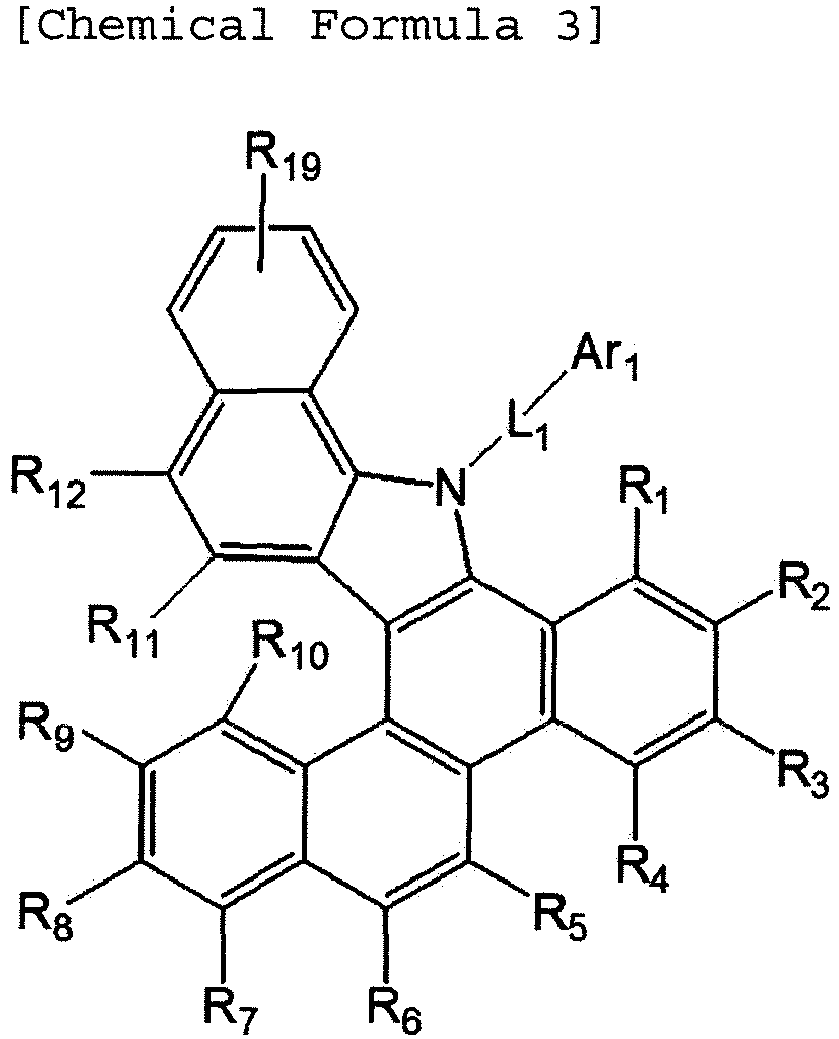


- The compound of claim 1, wherein R5 and R6 combine with each other to be represented by the following Chemical Formula 2:

* and ** are a moiety bonded to a position of R5 or R6,
L2 is a substituted or unsubstituted arylene group; or a substituted or unsubstituted divalent heterocyclic group,
Ar2 is hydrogen; deuterium; a halogen group; a cyano group; a substituted or unsubstituted alkyl group; a substituted or unsubstituted aryl group; a substituted or unsubstituted heterocyclic group; or a substituted or unsubstituted silyl group, and
R15 to R18 are the same as or different from each other, and are each independently hydrogen; deuterium; a halogen group; a hydroxy group; a nitro group; a cyano group; a substituted or unsubstituted alkyl group; a substituted or unsubstituted alkenyl group; a substituted or unsubstituted alkynyl group; a substituted or unsubstituted cycloalkyl group; a substituted or unsubstituted alkoxy group; a substituted or unsubstituted aryloxy group; a substituted or unsubstituted arylthioxy group; a substituted or unsubstituted amine group; a substituted or unsubstituted aryl group; or a substituted or unsubstituted heterocyclic group, or combine with an adjacent group to form a ring. - The compound of claim 3, wherein Chemical Formula 1 is represented by any one of the following Chemical Formulae 1-1, 1-2, 3-1, 3-2, 4-1, and 4-2:


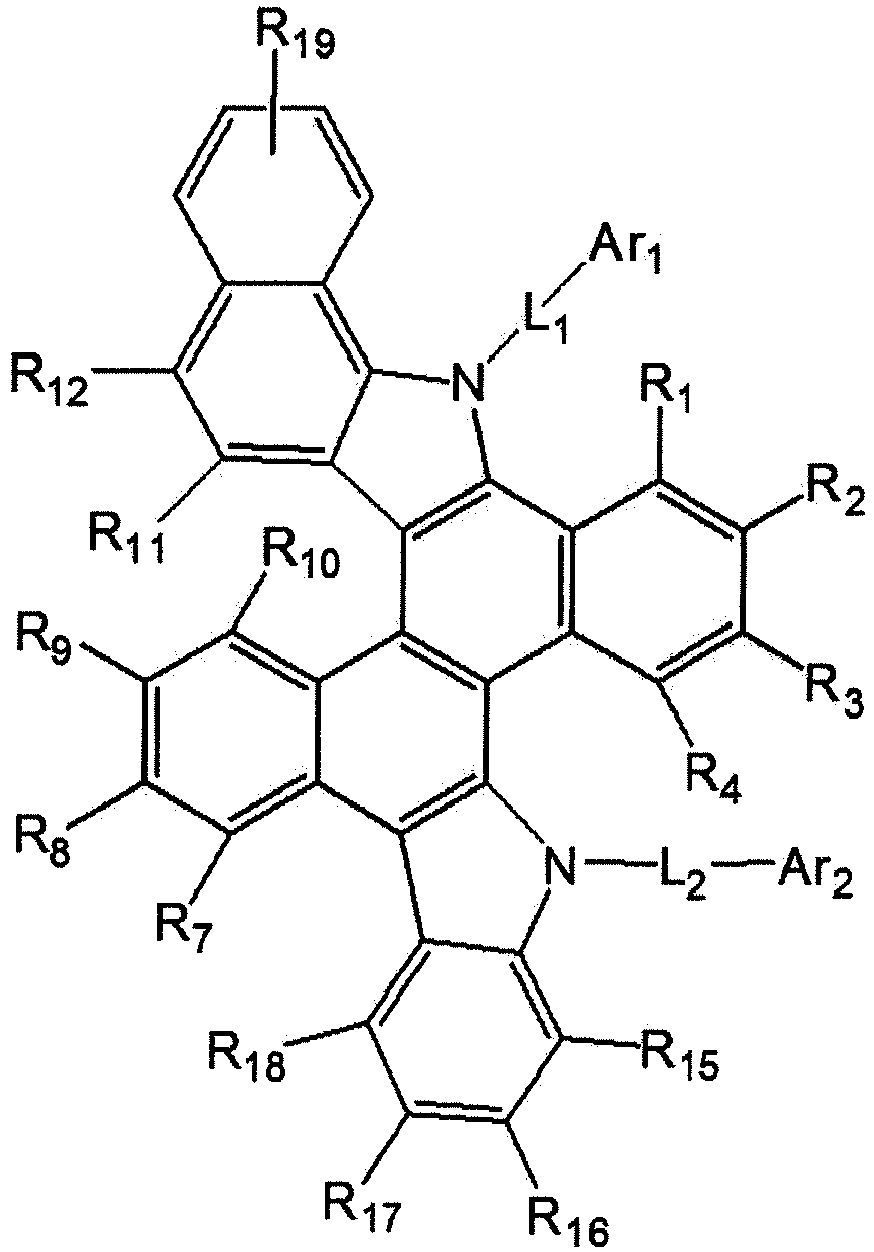


- The compound of claim 1, wherein L1 is a substituted or unsubstituted phenylene group; a substituted or unsubstituted divalent biphenyl group; a substituted or unsubstituted naphthylene group; a substituted or unsubstituted pyridylene group; a substituted or unsubstituted pyrimidylene group; or a substituted or unsubstituted triazinylene group.
- The compound of claim 1, wherein R6 is -L3-Ar3, L3 is a direct bond; a substituted or unsubstituted arylene group; or a substituted or unsubstituted divalent heterocyclic group, and
Ar3 is hydrogen; deuterium; a halogen group; a cyano group; a substituted or unsubstituted alkyl group; a substituted or unsubstituted aryl group; a substituted or unsubstituted amine group; a substituted or unsubstituted heterocyclic group; or a substituted or unsubstituted silyl group. - The compound of claim 1, wherein R12 is -L4-Ar4,
L4 is a direct bond; a substituted or unsubstituted arylene group; or a substituted or unsubstituted divalent heterocyclic group, and
Ar4 is hydrogen; deuterium; a halogen group; a cyano group; a substituted or unsubstituted alkyl group; a substituted or unsubstituted aryl group; a substituted or unsubstituted heterocyclic group; or a substituted or unsubstituted silyl group. - The compound of claim 1, wherein R1 to R4 and R7 to R10 are the same as or different from each other, and are each independently hydrogen; deuterium; a halogen group; a C1 to C10 alkyl group; or a C6 to C20 aryl group.
- The compound of claim 1, wherein the compound represented by Chemical Formula 1 is any one selected from the structural formulae of the following Group 1:


- The compound of claim 1, wherein the compound represented by Chemical Formula 1 is any one selected from the structural formulae of the following Group 2:


- The compound of claim 1, wherein the compound represented by Chemical Formula 1 is any one selected from the structural formulae of the following Group 3:


- An organic electronic device comprising:a first electrode;a second electrode provided to face the first electrode; andone or more organic material layers provided between the first electrode and the second electrode,wherein one or more layers of the organic material layers comprise the compound of any one of claims 1 to 11.
- The organic electronic device of claim 12, wherein the organic material layer comprises a hole injection layer or a hole transport layer, and the hole injection layer or the hole transport layer comprises the compound.
- The organic electronic device of claim 12, wherein the organic material layer comprises a light emitting layer, and the light emitting layer comprises the compound.
- The organic electronic device of claim 12, wherein the organic material layer comprises an electron transport layer or an electron injection layer, and the electron transport layer or the electron injection layer comprises the compound.
- The organic electronic device of claim 12, wherein the organic material layer comprises an electron blocking layer, and the electron blocking layer comprises the compound.
- The organic electronic device of claim 12, further comprising:
one or two or more layers selected from a group consisting of a hole injection layer, a hole transport layer, a light emitting layer, an electron transport layer, an electron injection layer, an electron blocking layer, and a hole blocking layer. - The organic electronic device of claim 12, wherein the organic electronic device is selected from a group consisting of an organic light emitting device, an organic solar cell, an organic photoconductor (OPC), and an organic transistor.
- The organic electronic device of claim 12, wherein the organic material layer comprises a light emitting layer, and the light emitting layer comprises a compound represented by the following Chemical Formula A-1:

n1 is an integer of 1 or more,
Ar5 is a substituted or unsubstituted monovalent or more benzofluorene group; a substituted or unsubstituted monovalent or more fluoranthene group; a substituted or unsubstituted monovalent or more pyrene group; or a substituted or unsubstituted monovalent or more chrysene group,
L5 is a direct bond; a substituted or unsubstituted arylene group; or a substituted or unsubstituted heteroarylene group,
Ar6 and Ar7 are the same as or different from each other, and are each independently a substituted or unsubstituted aryl group; a substituted or unsubstituted silyl group; a substituted or unsubstituted germanium group; a substituted or unsubstituted alkyl group; a substituted or unsubstituted arylalkyl group; or a substituted or unsubstituted heteroaryl group, or optionally combine with each other to form a substituted or unsubstituted ring, and
when n1 is 2 or more, two or more structures in the parenthesis are the same as or different from each other. - The organic electronic device of claim 19, wherein L5 is a direct bond, Ar5 is a divalent pyrene group, Ar6 and Ar7 are the same as or different from each other, and are each independently an aryl group which is unsubstituted or substituted with a germanium group substituted with an alkyl group, and n1 is 2.
- The organic electronic device of claim 12, wherein the organic material layer comprises a light emitting layer, and the light emitting layer comprises a compound represented by the following Chemical Formula A-2:

G11 is a phenyl group, a 1-naphthyl group, a 2-naphthyl group, a 1-anthryl group, a 2-anthryl group, a 1-phenanthryl group, a 2-phenanthryl group, a 3-phenanthryl group, a 4-phenanthryl group, a 9-phenanthryl group, a 1-naphthacenyl group, a 2-naphthacenyl group, a 9-naphthacenyl group, a 1-pyrenyl group, a 2-pyrenyl group, a 4-pyrenyl group, a 3-methyl-2-naphthyl group, a 4-methyl-1-naphthyl group, or the following Chemical Formula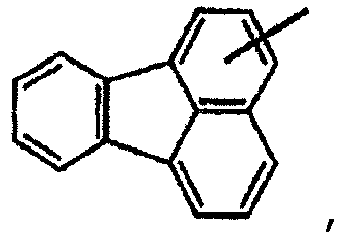
G13 and G14 are the same as or different from each other, and are each independently hydrogen; a substituted or unsubstituted alkyl group; a substituted or unsubstituted alkoxy group; a substituted or unsubstituted aryl group; or a substituted or unsubstituted heteroaryl group,
g12 is an integer of 1 to 5,
g13 and g14 are each an integer of 1 to 4, and
when g12 to g14 are each 2 or more, two or more structures in the parenthesis are the same as or different from each other. - The organic electronic device of claim 21, wherein G11 is a phenyl group or a 1-naphthyl group, and G12 is a 2-naphthyl group.
- The organic electronic device of claim 19, wherein the light emitting layer comprises a compound represented by the following Chemical Formula A-2:

G11 is a phenyl group, a 1-naphthyl group, a 2-naphthyl group, a 1-anthryl group, a 2-anthryl group, a 1-phenanthryl group, a 2-phenanthryl group, a 3-phenanthryl group, a 4-phenanthryl group, a 9-phenanthryl group, a 1-naphthacenyl group, a 2-naphthacenyl group, a 9-naphthacenyl group, a 1-pyrenyl group, a 2-pyrenyl group, a 4-pyrenyl group, a 3-methyl-2-naphthyl group, a 4-methyl-1-naphthyl group, or the following Chemical Formula
G13 and G14 are the same as or different from each other, and are each independently hydrogen; a substituted or unsubstituted alkyl group; a substituted or unsubstituted alkoxy group; a substituted or unsubstituted aryl group; or a substituted or unsubstituted heteroaryl group,
g12 is an integer of 1 to 5,
g13 and g14 are each an integer of 1 to 4, and
when g12 to g14 are each 2 or more, two or more structures in the parenthesis are the same as or different from each other.
Applications Claiming Priority (3)
| Application Number | Priority Date | Filing Date | Title |
|---|---|---|---|
| KR20150135898 | 2015-09-24 | ||
| KR1020160110164A KR101905970B1 (en) | 2015-09-24 | 2016-08-29 | Compound and organic electronic device comprising the same |
| PCT/KR2016/010562 WO2017052212A1 (en) | 2015-09-24 | 2016-09-22 | Compound and organic electronic device comprising same |
Publications (3)
| Publication Number | Publication Date |
|---|---|
| EP3339293A1 true EP3339293A1 (en) | 2018-06-27 |
| EP3339293A4 EP3339293A4 (en) | 2018-07-04 |
| EP3339293B1 EP3339293B1 (en) | 2021-08-11 |
Family
ID=58589100
Family Applications (1)
| Application Number | Title | Priority Date | Filing Date |
|---|---|---|---|
| EP16848937.5A Active EP3339293B1 (en) | 2015-09-24 | 2016-09-22 | Compound and organic electronic device comprising same |
Country Status (6)
| Country | Link |
|---|---|
| US (1) | US10903431B2 (en) |
| EP (1) | EP3339293B1 (en) |
| JP (1) | JP6614520B2 (en) |
| KR (1) | KR101905970B1 (en) |
| CN (1) | CN108055841B (en) |
| TW (1) | TWI638805B (en) |
Families Citing this family (10)
| Publication number | Priority date | Publication date | Assignee | Title |
|---|---|---|---|---|
| KR102559638B1 (en) * | 2016-05-24 | 2023-07-26 | 솔루스첨단소재 주식회사 | Organic light-emitting compound and organic electroluminescent device using the same |
| JPWO2018034242A1 (en) * | 2016-08-19 | 2019-06-20 | 出光興産株式会社 | Compound, material for organic electroluminescence device, organic electroluminescence device, and electronic device |
| KR20250035612A (en) | 2017-11-23 | 2025-03-12 | 메르크 파텐트 게엠베하 | Materials for electronic devices |
| KR102644211B1 (en) * | 2018-09-19 | 2024-03-06 | 덕산네오룩스 주식회사 | Compound for organic electric element, organic electric element comprising the same and electronic device thereof |
| CN111848590B (en) * | 2019-07-24 | 2022-08-12 | 广州华睿光电材料有限公司 | Compound, high polymer, mixture, composition and organic electronic device |
| US11192881B2 (en) * | 2019-08-27 | 2021-12-07 | Luminescence Technology Corp. | Compound for organic electroluminescence device using the same |
| CN114685484B (en) * | 2020-12-28 | 2023-09-01 | 宁波卢米蓝新材料有限公司 | Organic electroluminescent compound and organic electroluminescent device comprising same |
| CN113801057B (en) * | 2021-08-13 | 2023-04-18 | 浙江大学 | chrysene-base aza [7] spiroalkene compound, preparation method and application |
| CN113788832B (en) * | 2021-08-13 | 2022-08-05 | 浙江大学 | chrysene -base aza-bis [6] helicene compound and application thereof in hole transport material and solar cell |
| CN118994120A (en) * | 2024-06-19 | 2024-11-22 | 四川阿格瑞新材料有限公司 | Compound and organic electroluminescent device |
Family Cites Families (15)
| Publication number | Priority date | Publication date | Assignee | Title |
|---|---|---|---|---|
| NL275143A (en) | 1961-02-23 | |||
| JP2003012890A (en) | 2001-07-03 | 2003-01-15 | Kyocera Chemical Corp | Sealing resin composition and electronic component sealing device |
| DE10135513B4 (en) | 2001-07-20 | 2005-02-24 | Novaled Gmbh | Light-emitting component with organic layers |
| US20030186077A1 (en) | 2001-12-31 | 2003-10-02 | Chen Jian P. | Bis- and tris- (di) benzocarbazole-based materials as hole transport materials for organic light emitting devices |
| KR101603070B1 (en) * | 2009-03-31 | 2016-03-14 | 롬엔드하스전자재료코리아유한회사 | Novel organic electroluminescent compounds and organic electroluminescent device using the same |
| JP2011222831A (en) * | 2010-04-12 | 2011-11-04 | Idemitsu Kosan Co Ltd | Organic electroluminescent element |
| KR101810045B1 (en) * | 2010-10-25 | 2017-12-19 | 삼성디스플레이 주식회사 | Heterocyclic compound and Organic light emitting device containing same |
| KR102154056B1 (en) | 2013-04-02 | 2020-09-09 | 에스에프씨 주식회사 | An organoelectro luminescent compounds and organoelectro luminescent device using the same |
| WO2014196580A1 (en) * | 2013-06-04 | 2014-12-11 | 出光興産株式会社 | Nitrogen-containing heterocyclic derivative, organic electroluminescence element material using same, and organic electroluminescence element and electronic device using same |
| KR20150010016A (en) * | 2013-07-17 | 2015-01-28 | 롬엔드하스전자재료코리아유한회사 | Organic electroluminescent device |
| CN104513247B (en) * | 2013-09-30 | 2018-05-18 | 北京鼎材科技有限公司 | A kind of benzo [ c ] benzo [ 3,4 ] carbazole and carbazole derivates and application |
| JP2015128115A (en) | 2013-12-27 | 2015-07-09 | 三星ディスプレイ株式會社Samsung Display Co.,Ltd. | Organic electroluminescence device |
| KR20150077269A (en) * | 2013-12-27 | 2015-07-07 | 삼성디스플레이 주식회사 | Organic electroluminescence device |
| KR102376394B1 (en) * | 2015-09-22 | 2022-03-18 | 덕산네오룩스 주식회사 | Compound for organic electronic element, organic electronic element comprising the same, and electronic device thereof |
| WO2017109722A1 (en) * | 2015-12-21 | 2017-06-29 | Idemitsu Kosan Co., Ltd. | Nitrogen-containing heterocyclic compounds and organic electroluminescence devices containing them |
-
2016
- 2016-08-29 KR KR1020160110164A patent/KR101905970B1/en active Active
- 2016-09-22 EP EP16848937.5A patent/EP3339293B1/en active Active
- 2016-09-22 JP JP2018512276A patent/JP6614520B2/en active Active
- 2016-09-22 CN CN201680055676.8A patent/CN108055841B/en active Active
- 2016-09-22 US US15/760,447 patent/US10903431B2/en active Active
- 2016-09-23 TW TW105130721A patent/TWI638805B/en active
Also Published As
| Publication number | Publication date |
|---|---|
| US20180277767A1 (en) | 2018-09-27 |
| TW201725196A (en) | 2017-07-16 |
| KR101905970B1 (en) | 2018-10-10 |
| US10903431B2 (en) | 2021-01-26 |
| KR20170036602A (en) | 2017-04-03 |
| EP3339293B1 (en) | 2021-08-11 |
| JP2018535188A (en) | 2018-11-29 |
| EP3339293A4 (en) | 2018-07-04 |
| CN108055841B (en) | 2021-02-26 |
| TWI638805B (en) | 2018-10-21 |
| JP6614520B2 (en) | 2019-12-04 |
| CN108055841A (en) | 2018-05-18 |
Similar Documents
| Publication | Publication Date | Title |
|---|---|---|
| EP3357912B1 (en) | Use of spiro compound and organic light emitting element comprising same | |
| EP3339293B1 (en) | Compound and organic electronic device comprising same | |
| EP3378864B1 (en) | Spiro compound and organic light-emitting element comprising same | |
| EP3378853B1 (en) | Heterocyclic compound and organic light-emitting element comprising same | |
| EP3351523B1 (en) | Compound and organic light emitting device containing same | |
| EP3388438B1 (en) | Spiro-structured compound and organic electronic device comprising same | |
| KR102020529B1 (en) | Compound and organic electronic device comprising the same | |
| EP3378865B1 (en) | Spiro compound and organic light-emitting element comprising same | |
| EP3345891B1 (en) | Amine compound and organic light-emitting device comprising same | |
| EP3330262B1 (en) | Heterocyclic compound and organic light emitting diode containing same | |
| CN107709297B (en) | Double spiro organic compounds and organic electronic components containing the same | |
| EP3330249B1 (en) | Amine-based compound and organic light emitting device comprising same | |
| EP3321246B1 (en) | Double spiro compound and organic light-emitting element comprising same | |
| EP3351531A1 (en) | Heterocyclic compound and organic light emitting device comprising same | |
| KR102028242B1 (en) | Compound and organic electronic device comprising the same |
Legal Events
| Date | Code | Title | Description |
|---|---|---|---|
| STAA | Information on the status of an ep patent application or granted ep patent |
Free format text: STATUS: THE INTERNATIONAL PUBLICATION HAS BEEN MADE |
|
| PUAI | Public reference made under article 153(3) epc to a published international application that has entered the european phase |
Free format text: ORIGINAL CODE: 0009012 |
|
| STAA | Information on the status of an ep patent application or granted ep patent |
Free format text: STATUS: REQUEST FOR EXAMINATION WAS MADE |
|
| 17P | Request for examination filed |
Effective date: 20180319 |
|
| AK | Designated contracting states |
Kind code of ref document: A1 Designated state(s): AL AT BE BG CH CY CZ DE DK EE ES FI FR GB GR HR HU IE IS IT LI LT LU LV MC MK MT NL NO PL PT RO RS SE SI SK SM TR |
|
| AX | Request for extension of the european patent |
Extension state: BA ME |
|
| A4 | Supplementary search report drawn up and despatched |
Effective date: 20180604 |
|
| RIC1 | Information provided on ipc code assigned before grant |
Ipc: C09K 11/06 20060101ALI20180528BHEP Ipc: H01L 51/50 20060101ALI20180528BHEP Ipc: C07D 401/04 20060101ALI20180528BHEP Ipc: C07D 209/82 20060101AFI20180528BHEP |
|
| DAV | Request for validation of the european patent (deleted) | ||
| DAX | Request for extension of the european patent (deleted) | ||
| STAA | Information on the status of an ep patent application or granted ep patent |
Free format text: STATUS: EXAMINATION IS IN PROGRESS |
|
| 17Q | First examination report despatched |
Effective date: 20200729 |
|
| GRAP | Despatch of communication of intention to grant a patent |
Free format text: ORIGINAL CODE: EPIDOSNIGR1 |
|
| STAA | Information on the status of an ep patent application or granted ep patent |
Free format text: STATUS: GRANT OF PATENT IS INTENDED |
|
| INTG | Intention to grant announced |
Effective date: 20210428 |
|
| GRAS | Grant fee paid |
Free format text: ORIGINAL CODE: EPIDOSNIGR3 |
|
| GRAA | (expected) grant |
Free format text: ORIGINAL CODE: 0009210 |
|
| STAA | Information on the status of an ep patent application or granted ep patent |
Free format text: STATUS: THE PATENT HAS BEEN GRANTED |
|
| AK | Designated contracting states |
Kind code of ref document: B1 Designated state(s): AL AT BE BG CH CY CZ DE DK EE ES FI FR GB GR HR HU IE IS IT LI LT LU LV MC MK MT NL NO PL PT RO RS SE SI SK SM TR |
|
| REG | Reference to a national code |
Ref country code: CH Ref legal event code: EP |
|
| REG | Reference to a national code |
Ref country code: DE Ref legal event code: R096 Ref document number: 602016062157 Country of ref document: DE |
|
| REG | Reference to a national code |
Ref country code: IE Ref legal event code: FG4D Ref country code: AT Ref legal event code: REF Ref document number: 1419259 Country of ref document: AT Kind code of ref document: T Effective date: 20210915 |
|
| REG | Reference to a national code |
Ref country code: LT Ref legal event code: MG9D |
|
| REG | Reference to a national code |
Ref country code: NL Ref legal event code: MP Effective date: 20210811 |
|
| REG | Reference to a national code |
Ref country code: AT Ref legal event code: MK05 Ref document number: 1419259 Country of ref document: AT Kind code of ref document: T Effective date: 20210811 |
|
| PG25 | Lapsed in a contracting state [announced via postgrant information from national office to epo] |
Ref country code: SE Free format text: LAPSE BECAUSE OF FAILURE TO SUBMIT A TRANSLATION OF THE DESCRIPTION OR TO PAY THE FEE WITHIN THE PRESCRIBED TIME-LIMIT Effective date: 20210811 Ref country code: RS Free format text: LAPSE BECAUSE OF FAILURE TO SUBMIT A TRANSLATION OF THE DESCRIPTION OR TO PAY THE FEE WITHIN THE PRESCRIBED TIME-LIMIT Effective date: 20210811 Ref country code: BG Free format text: LAPSE BECAUSE OF FAILURE TO SUBMIT A TRANSLATION OF THE DESCRIPTION OR TO PAY THE FEE WITHIN THE PRESCRIBED TIME-LIMIT Effective date: 20211111 Ref country code: AT Free format text: LAPSE BECAUSE OF FAILURE TO SUBMIT A TRANSLATION OF THE DESCRIPTION OR TO PAY THE FEE WITHIN THE PRESCRIBED TIME-LIMIT Effective date: 20210811 Ref country code: LT Free format text: LAPSE BECAUSE OF FAILURE TO SUBMIT A TRANSLATION OF THE DESCRIPTION OR TO PAY THE FEE WITHIN THE PRESCRIBED TIME-LIMIT Effective date: 20210811 Ref country code: NO Free format text: LAPSE BECAUSE OF FAILURE TO SUBMIT A TRANSLATION OF THE DESCRIPTION OR TO PAY THE FEE WITHIN THE PRESCRIBED TIME-LIMIT Effective date: 20211111 Ref country code: PT Free format text: LAPSE BECAUSE OF FAILURE TO SUBMIT A TRANSLATION OF THE DESCRIPTION OR TO PAY THE FEE WITHIN THE PRESCRIBED TIME-LIMIT Effective date: 20211213 Ref country code: FI Free format text: LAPSE BECAUSE OF FAILURE TO SUBMIT A TRANSLATION OF THE DESCRIPTION OR TO PAY THE FEE WITHIN THE PRESCRIBED TIME-LIMIT Effective date: 20210811 Ref country code: ES Free format text: LAPSE BECAUSE OF FAILURE TO SUBMIT A TRANSLATION OF THE DESCRIPTION OR TO PAY THE FEE WITHIN THE PRESCRIBED TIME-LIMIT Effective date: 20210811 Ref country code: HR Free format text: LAPSE BECAUSE OF FAILURE TO SUBMIT A TRANSLATION OF THE DESCRIPTION OR TO PAY THE FEE WITHIN THE PRESCRIBED TIME-LIMIT Effective date: 20210811 |
|
| PG25 | Lapsed in a contracting state [announced via postgrant information from national office to epo] |
Ref country code: PL Free format text: LAPSE BECAUSE OF FAILURE TO SUBMIT A TRANSLATION OF THE DESCRIPTION OR TO PAY THE FEE WITHIN THE PRESCRIBED TIME-LIMIT Effective date: 20210811 Ref country code: LV Free format text: LAPSE BECAUSE OF FAILURE TO SUBMIT A TRANSLATION OF THE DESCRIPTION OR TO PAY THE FEE WITHIN THE PRESCRIBED TIME-LIMIT Effective date: 20210811 Ref country code: GR Free format text: LAPSE BECAUSE OF FAILURE TO SUBMIT A TRANSLATION OF THE DESCRIPTION OR TO PAY THE FEE WITHIN THE PRESCRIBED TIME-LIMIT Effective date: 20211112 |
|
| PG25 | Lapsed in a contracting state [announced via postgrant information from national office to epo] |
Ref country code: NL Free format text: LAPSE BECAUSE OF FAILURE TO SUBMIT A TRANSLATION OF THE DESCRIPTION OR TO PAY THE FEE WITHIN THE PRESCRIBED TIME-LIMIT Effective date: 20210811 |
|
| PG25 | Lapsed in a contracting state [announced via postgrant information from national office to epo] |
Ref country code: DK Free format text: LAPSE BECAUSE OF FAILURE TO SUBMIT A TRANSLATION OF THE DESCRIPTION OR TO PAY THE FEE WITHIN THE PRESCRIBED TIME-LIMIT Effective date: 20210811 |
|
| REG | Reference to a national code |
Ref country code: DE Ref legal event code: R097 Ref document number: 602016062157 Country of ref document: DE |
|
| REG | Reference to a national code |
Ref country code: CH Ref legal event code: PL |
|
| REG | Reference to a national code |
Ref country code: BE Ref legal event code: MM Effective date: 20210930 |
|
| PG25 | Lapsed in a contracting state [announced via postgrant information from national office to epo] |
Ref country code: SM Free format text: LAPSE BECAUSE OF FAILURE TO SUBMIT A TRANSLATION OF THE DESCRIPTION OR TO PAY THE FEE WITHIN THE PRESCRIBED TIME-LIMIT Effective date: 20210811 Ref country code: SK Free format text: LAPSE BECAUSE OF FAILURE TO SUBMIT A TRANSLATION OF THE DESCRIPTION OR TO PAY THE FEE WITHIN THE PRESCRIBED TIME-LIMIT Effective date: 20210811 Ref country code: RO Free format text: LAPSE BECAUSE OF FAILURE TO SUBMIT A TRANSLATION OF THE DESCRIPTION OR TO PAY THE FEE WITHIN THE PRESCRIBED TIME-LIMIT Effective date: 20210811 Ref country code: MC Free format text: LAPSE BECAUSE OF FAILURE TO SUBMIT A TRANSLATION OF THE DESCRIPTION OR TO PAY THE FEE WITHIN THE PRESCRIBED TIME-LIMIT Effective date: 20210811 Ref country code: EE Free format text: LAPSE BECAUSE OF FAILURE TO SUBMIT A TRANSLATION OF THE DESCRIPTION OR TO PAY THE FEE WITHIN THE PRESCRIBED TIME-LIMIT Effective date: 20210811 Ref country code: CZ Free format text: LAPSE BECAUSE OF FAILURE TO SUBMIT A TRANSLATION OF THE DESCRIPTION OR TO PAY THE FEE WITHIN THE PRESCRIBED TIME-LIMIT Effective date: 20210811 Ref country code: AL Free format text: LAPSE BECAUSE OF FAILURE TO SUBMIT A TRANSLATION OF THE DESCRIPTION OR TO PAY THE FEE WITHIN THE PRESCRIBED TIME-LIMIT Effective date: 20210811 |
|
| PLBE | No opposition filed within time limit |
Free format text: ORIGINAL CODE: 0009261 |
|
| STAA | Information on the status of an ep patent application or granted ep patent |
Free format text: STATUS: NO OPPOSITION FILED WITHIN TIME LIMIT |
|
| 26N | No opposition filed |
Effective date: 20220512 |
|
| PG25 | Lapsed in a contracting state [announced via postgrant information from national office to epo] |
Ref country code: LU Free format text: LAPSE BECAUSE OF NON-PAYMENT OF DUE FEES Effective date: 20210922 Ref country code: IT Free format text: LAPSE BECAUSE OF FAILURE TO SUBMIT A TRANSLATION OF THE DESCRIPTION OR TO PAY THE FEE WITHIN THE PRESCRIBED TIME-LIMIT Effective date: 20210811 Ref country code: IE Free format text: LAPSE BECAUSE OF NON-PAYMENT OF DUE FEES Effective date: 20210922 Ref country code: BE Free format text: LAPSE BECAUSE OF NON-PAYMENT OF DUE FEES Effective date: 20210930 |
|
| PG25 | Lapsed in a contracting state [announced via postgrant information from national office to epo] |
Ref country code: SI Free format text: LAPSE BECAUSE OF FAILURE TO SUBMIT A TRANSLATION OF THE DESCRIPTION OR TO PAY THE FEE WITHIN THE PRESCRIBED TIME-LIMIT Effective date: 20210811 Ref country code: LI Free format text: LAPSE BECAUSE OF NON-PAYMENT OF DUE FEES Effective date: 20210930 Ref country code: CH Free format text: LAPSE BECAUSE OF NON-PAYMENT OF DUE FEES Effective date: 20210930 |
|
| PG25 | Lapsed in a contracting state [announced via postgrant information from national office to epo] |
Ref country code: HU Free format text: LAPSE BECAUSE OF FAILURE TO SUBMIT A TRANSLATION OF THE DESCRIPTION OR TO PAY THE FEE WITHIN THE PRESCRIBED TIME-LIMIT; INVALID AB INITIO Effective date: 20160922 |
|
| PG25 | Lapsed in a contracting state [announced via postgrant information from national office to epo] |
Ref country code: CY Free format text: LAPSE BECAUSE OF FAILURE TO SUBMIT A TRANSLATION OF THE DESCRIPTION OR TO PAY THE FEE WITHIN THE PRESCRIBED TIME-LIMIT Effective date: 20210811 |
|
| PG25 | Lapsed in a contracting state [announced via postgrant information from national office to epo] |
Ref country code: MK Free format text: LAPSE BECAUSE OF FAILURE TO SUBMIT A TRANSLATION OF THE DESCRIPTION OR TO PAY THE FEE WITHIN THE PRESCRIBED TIME-LIMIT Effective date: 20210811 |
|
| PG25 | Lapsed in a contracting state [announced via postgrant information from national office to epo] |
Ref country code: MT Free format text: LAPSE BECAUSE OF FAILURE TO SUBMIT A TRANSLATION OF THE DESCRIPTION OR TO PAY THE FEE WITHIN THE PRESCRIBED TIME-LIMIT Effective date: 20210811 |
|
| PGFP | Annual fee paid to national office [announced via postgrant information from national office to epo] |
Ref country code: DE Payment date: 20250820 Year of fee payment: 10 |
|
| PGFP | Annual fee paid to national office [announced via postgrant information from national office to epo] |
Ref country code: GB Payment date: 20250820 Year of fee payment: 10 |
|
| PGFP | Annual fee paid to national office [announced via postgrant information from national office to epo] |
Ref country code: FR Payment date: 20250821 Year of fee payment: 10 |
|
| PG25 | Lapsed in a contracting state [announced via postgrant information from national office to epo] |
Ref country code: TR Free format text: LAPSE BECAUSE OF FAILURE TO SUBMIT A TRANSLATION OF THE DESCRIPTION OR TO PAY THE FEE WITHIN THE PRESCRIBED TIME-LIMIT Effective date: 20210811 |