EP3335928A1 - Composite seat core material and vehicular seat member using composite seat core material - Google Patents
Composite seat core material and vehicular seat member using composite seat core material Download PDFInfo
- Publication number
- EP3335928A1 EP3335928A1 EP16834941.3A EP16834941A EP3335928A1 EP 3335928 A1 EP3335928 A1 EP 3335928A1 EP 16834941 A EP16834941 A EP 16834941A EP 3335928 A1 EP3335928 A1 EP 3335928A1
- Authority
- EP
- European Patent Office
- Prior art keywords
- core material
- connecting member
- expanded beads
- substrate
- polyurethane foam
- Prior art date
- Legal status (The legal status is an assumption and is not a legal conclusion. Google has not performed a legal analysis and makes no representation as to the accuracy of the status listed.)
- Granted
Links
Images


Classifications
-
- B—PERFORMING OPERATIONS; TRANSPORTING
- B60—VEHICLES IN GENERAL
- B60N—SEATS SPECIALLY ADAPTED FOR VEHICLES; VEHICLE PASSENGER ACCOMMODATION NOT OTHERWISE PROVIDED FOR
- B60N2/00—Seats specially adapted for vehicles; Arrangement or mounting of seats in vehicles
- B60N2/90—Details or parts not otherwise provided for
-
- B—PERFORMING OPERATIONS; TRANSPORTING
- B29—WORKING OF PLASTICS; WORKING OF SUBSTANCES IN A PLASTIC STATE IN GENERAL
- B29C—SHAPING OR JOINING OF PLASTICS; SHAPING OF MATERIAL IN A PLASTIC STATE, NOT OTHERWISE PROVIDED FOR; AFTER-TREATMENT OF THE SHAPED PRODUCTS, e.g. REPAIRING
- B29C44/00—Shaping by internal pressure generated in the material, e.g. swelling or foaming ; Producing porous or cellular expanded plastics articles
- B29C44/02—Shaping by internal pressure generated in the material, e.g. swelling or foaming ; Producing porous or cellular expanded plastics articles for articles of definite length, i.e. discrete articles
- B29C44/04—Shaping by internal pressure generated in the material, e.g. swelling or foaming ; Producing porous or cellular expanded plastics articles for articles of definite length, i.e. discrete articles consisting of at least two parts of chemically or physically different materials, e.g. having different densities
-
- B—PERFORMING OPERATIONS; TRANSPORTING
- B29—WORKING OF PLASTICS; WORKING OF SUBSTANCES IN A PLASTIC STATE IN GENERAL
- B29C—SHAPING OR JOINING OF PLASTICS; SHAPING OF MATERIAL IN A PLASTIC STATE, NOT OTHERWISE PROVIDED FOR; AFTER-TREATMENT OF THE SHAPED PRODUCTS, e.g. REPAIRING
- B29C44/00—Shaping by internal pressure generated in the material, e.g. swelling or foaming ; Producing porous or cellular expanded plastics articles
- B29C44/02—Shaping by internal pressure generated in the material, e.g. swelling or foaming ; Producing porous or cellular expanded plastics articles for articles of definite length, i.e. discrete articles
- B29C44/04—Shaping by internal pressure generated in the material, e.g. swelling or foaming ; Producing porous or cellular expanded plastics articles for articles of definite length, i.e. discrete articles consisting of at least two parts of chemically or physically different materials, e.g. having different densities
- B29C44/06—Making multilayered articles
-
- B—PERFORMING OPERATIONS; TRANSPORTING
- B29—WORKING OF PLASTICS; WORKING OF SUBSTANCES IN A PLASTIC STATE IN GENERAL
- B29C—SHAPING OR JOINING OF PLASTICS; SHAPING OF MATERIAL IN A PLASTIC STATE, NOT OTHERWISE PROVIDED FOR; AFTER-TREATMENT OF THE SHAPED PRODUCTS, e.g. REPAIRING
- B29C44/00—Shaping by internal pressure generated in the material, e.g. swelling or foaming ; Producing porous or cellular expanded plastics articles
- B29C44/34—Auxiliary operations
- B29C44/3415—Heating or cooling
- B29C44/3426—Heating by introducing steam in the mould
-
- B—PERFORMING OPERATIONS; TRANSPORTING
- B29—WORKING OF PLASTICS; WORKING OF SUBSTANCES IN A PLASTIC STATE IN GENERAL
- B29C—SHAPING OR JOINING OF PLASTICS; SHAPING OF MATERIAL IN A PLASTIC STATE, NOT OTHERWISE PROVIDED FOR; AFTER-TREATMENT OF THE SHAPED PRODUCTS, e.g. REPAIRING
- B29C44/00—Shaping by internal pressure generated in the material, e.g. swelling or foaming ; Producing porous or cellular expanded plastics articles
- B29C44/34—Auxiliary operations
- B29C44/36—Feeding the material to be shaped
- B29C44/38—Feeding the material to be shaped into a closed space, i.e. to make articles of definite length
- B29C44/44—Feeding the material to be shaped into a closed space, i.e. to make articles of definite length in solid form
- B29C44/445—Feeding the material to be shaped into a closed space, i.e. to make articles of definite length in solid form in the form of expandable granules, particles or beads
-
- B—PERFORMING OPERATIONS; TRANSPORTING
- B29—WORKING OF PLASTICS; WORKING OF SUBSTANCES IN A PLASTIC STATE IN GENERAL
- B29C—SHAPING OR JOINING OF PLASTICS; SHAPING OF MATERIAL IN A PLASTIC STATE, NOT OTHERWISE PROVIDED FOR; AFTER-TREATMENT OF THE SHAPED PRODUCTS, e.g. REPAIRING
- B29C67/00—Shaping techniques not covered by groups B29C39/00 - B29C65/00, B29C70/00 or B29C73/00
- B29C67/20—Shaping techniques not covered by groups B29C39/00 - B29C65/00, B29C70/00 or B29C73/00 for porous or cellular articles, e.g. of foam plastics, coarse-pored
- B29C67/205—Shaping techniques not covered by groups B29C39/00 - B29C65/00, B29C70/00 or B29C73/00 for porous or cellular articles, e.g. of foam plastics, coarse-pored comprising surface fusion, and bonding of particles to form voids, e.g. sintering
-
- B—PERFORMING OPERATIONS; TRANSPORTING
- B32—LAYERED PRODUCTS
- B32B—LAYERED PRODUCTS, i.e. PRODUCTS BUILT-UP OF STRATA OF FLAT OR NON-FLAT, e.g. CELLULAR OR HONEYCOMB, FORM
- B32B5/00—Layered products characterised by the non- homogeneity or physical structure, i.e. comprising a fibrous, filamentary, particulate or foam layer; Layered products characterised by having a layer differing constitutionally or physically in different parts
- B32B5/18—Layered products characterised by the non- homogeneity or physical structure, i.e. comprising a fibrous, filamentary, particulate or foam layer; Layered products characterised by having a layer differing constitutionally or physically in different parts characterised by features of a layer of foamed material
- B32B5/20—Layered products characterised by the non- homogeneity or physical structure, i.e. comprising a fibrous, filamentary, particulate or foam layer; Layered products characterised by having a layer differing constitutionally or physically in different parts characterised by features of a layer of foamed material foamed in situ
-
- B—PERFORMING OPERATIONS; TRANSPORTING
- B32—LAYERED PRODUCTS
- B32B—LAYERED PRODUCTS, i.e. PRODUCTS BUILT-UP OF STRATA OF FLAT OR NON-FLAT, e.g. CELLULAR OR HONEYCOMB, FORM
- B32B5/00—Layered products characterised by the non- homogeneity or physical structure, i.e. comprising a fibrous, filamentary, particulate or foam layer; Layered products characterised by having a layer differing constitutionally or physically in different parts
- B32B5/22—Layered products characterised by the non- homogeneity or physical structure, i.e. comprising a fibrous, filamentary, particulate or foam layer; Layered products characterised by having a layer differing constitutionally or physically in different parts characterised by the presence of two or more layers which are next to each other and are fibrous, filamentary, formed of particles or foamed
- B32B5/32—Layered products characterised by the non- homogeneity or physical structure, i.e. comprising a fibrous, filamentary, particulate or foam layer; Layered products characterised by having a layer differing constitutionally or physically in different parts characterised by the presence of two or more layers which are next to each other and are fibrous, filamentary, formed of particles or foamed at least two layers being foamed and next to each other
-
- B—PERFORMING OPERATIONS; TRANSPORTING
- B60—VEHICLES IN GENERAL
- B60N—SEATS SPECIALLY ADAPTED FOR VEHICLES; VEHICLE PASSENGER ACCOMMODATION NOT OTHERWISE PROVIDED FOR
- B60N2/00—Seats specially adapted for vehicles; Arrangement or mounting of seats in vehicles
- B60N2/64—Back-rests or cushions
-
- B—PERFORMING OPERATIONS; TRANSPORTING
- B29—WORKING OF PLASTICS; WORKING OF SUBSTANCES IN A PLASTIC STATE IN GENERAL
- B29K—INDEXING SCHEME ASSOCIATED WITH SUBCLASSES B29B, B29C OR B29D, RELATING TO MOULDING MATERIALS OR TO MATERIALS FOR MOULDS, REINFORCEMENTS, FILLERS OR PREFORMED PARTS, e.g. INSERTS
- B29K2023/00—Use of polyalkenes or derivatives thereof as moulding material
- B29K2023/10—Polymers of propylene
- B29K2023/12—PP, i.e. polypropylene
-
- B—PERFORMING OPERATIONS; TRANSPORTING
- B29—WORKING OF PLASTICS; WORKING OF SUBSTANCES IN A PLASTIC STATE IN GENERAL
- B29K—INDEXING SCHEME ASSOCIATED WITH SUBCLASSES B29B, B29C OR B29D, RELATING TO MOULDING MATERIALS OR TO MATERIALS FOR MOULDS, REINFORCEMENTS, FILLERS OR PREFORMED PARTS, e.g. INSERTS
- B29K2075/00—Use of PU, i.e. polyureas or polyurethanes or derivatives thereof, as moulding material
-
- B—PERFORMING OPERATIONS; TRANSPORTING
- B29—WORKING OF PLASTICS; WORKING OF SUBSTANCES IN A PLASTIC STATE IN GENERAL
- B29L—INDEXING SCHEME ASSOCIATED WITH SUBCLASS B29C, RELATING TO PARTICULAR ARTICLES
- B29L2031/00—Other particular articles
- B29L2031/771—Seats
-
- B—PERFORMING OPERATIONS; TRANSPORTING
- B32—LAYERED PRODUCTS
- B32B—LAYERED PRODUCTS, i.e. PRODUCTS BUILT-UP OF STRATA OF FLAT OR NON-FLAT, e.g. CELLULAR OR HONEYCOMB, FORM
- B32B2266/00—Composition of foam
- B32B2266/02—Organic
- B32B2266/0214—Materials belonging to B32B27/00
- B32B2266/0278—Polyurethane
-
- B—PERFORMING OPERATIONS; TRANSPORTING
- B32—LAYERED PRODUCTS
- B32B—LAYERED PRODUCTS, i.e. PRODUCTS BUILT-UP OF STRATA OF FLAT OR NON-FLAT, e.g. CELLULAR OR HONEYCOMB, FORM
- B32B2605/00—Vehicles
Definitions
- the present invention relates to a composite seat core material and to a vehicular seat element using the composite seat core material.
- a vehicular seat element composed of a plurality of laminated different materials has been hitherto used as a seat for use in automobiles, etc.
- a seat element is a laminate composed of a cushion layer (pad) that is formed of a material having cushioning property and a substrate layer that is formed of a light-weight material and that has higher strength and rigidity as compared with the cushioning layer.
- the material from which the cushioning layer is formed there is used, for example, a soft polyurethane foam that is configured to provide an occupant sitting thereon with good comfort and snug fit around the hip.
- a hard polyurethane foam As the material from which the substrate layer is formed, on the other hand, there has been used, for example, a hard polyurethane foam.
- a foam of a thermoplastic resin such as a styrene-based resin, an ethylene-based resin or a propylene-based resin has been used so that it has become possible to supplement the strength and rigidity of the cushioning layer and achieve weight reduction of the vehicular seat element.
- a cushioning layer of a soft polyurethane foam and a substrate layer of a thermoplastic resin foam together, it has become possible to obtain a vehicular seat element having composite properties.
- a method for producing such a vehicular seat element there is a method using a mold.
- a previously prepared member a thermoplastic resin foamed body for forming a substrate layer
- a liquid raw material for forming a polyurethane foam is filled in the mold cavity in which the above member has been disposed, and is caused to foam to prepare a cushioning layer, thereby directly forming (laminating) the cushioning layer on a surface of the substrate layer.
- Patent Document 1 proposes a method for producing a laminate in which that region of a surface of an expandable thermoplastic resin expanded beads foamed body which is to be contacted by a polyurethane foam layer, is heated at a temperature that is at least 80% of the softening temperature of the foamed body to soften and expand the expandable resin beads which constitute the contact region and to form undulations in the contact region. The polyurethane foam is then formed such that it enters into the recesses of the undulations.
- Patent document
- Patent Document 1 Japanese Laid Open Patent Publication No. JP-A-2012-171104
- the present inventors have attempted to integrally laminate a polyurethane foam to a substrate formed of an expanded beads molded body.
- the molded body is obtained by in-mold molding of thermoplastic resin particles having through holes and has void spaces that are communicated with the outside.
- the obtained product is a laminate in which the polyurethane foam and the substrate are integrally laminated by impregnating, foaming and solidifying a polyurethane foam forming raw material liquid in the void spaces of the substrate of the expanded beads molded body.
- the laminate was found to excel in adhesion properties between the substrate and the polyurethane foam and to have less tendency to cause delamination, because part of the polyurethane foam is impregnated, foamed and solidified within the void spaces that are present on a surface side thereof.
- the present invention is aimed at the provision of a composite seat core material that is adapted to be integrally laminated with a polyurethane foam pad by foaming polyurethane in a mold, that excels in bonding strength to the polyurethane foam pad and that is able to suppress deformation such as warp which might occur by lamination with the polyurethane pad, and at the provision of a vehicular seat element using the composite seat core material.
- the composite seat core material of the present invention which comprises the above-described substrate and the above-described connecting member, shows excellent bonding strength to the polyurethane foam pad and shows suppressed deformation such as warp when laminated with the polyurethane foam pad.
- the vehicular seat element of the present invention shows excellent cushioning properties and suppressed delamination between the core material and the polyurethane foam pad and, moreover, has suppressed deformation such as warp of its composite seat core material.
- the composite seat core material according to the present invention and the vehicular seat element having a polyurethane pad provided on the composite seat core material will be described in detail below.
- the term "seat element” as used herein is intended to refer to a seat cushion on which an occupant sits, a seat back which supports the back of the occupant, a head rest and/or an arm rest. Description will be hereinafter made of a seat element used as a seat cushion.
- the composite seat core material (hereinafter occasionally referred to simply as “core material”) used for the vehicular seat element of the present invention has a foamed molded substrate (hereinafter occasionally referred to simply as “substrate”) that comprises a multiplicity of thermoplastic resin expanded beads which are fusion-bonded to each other, and a foamed molded connecting member (hereinafter occasionally referred to simply as “connecting member”) that is provided on an outer surface of the substrate and that comprises a multiplicity of thermoplastic resin expanded beads which are fusion-bonded to each other.
- substrate a foamed molded substrate
- connecting member hereinafter occasionally referred to simply as “connecting member”
- the vehicular seat element of the present invention is mounted on a vehicle in such a state that the substrate, connecting member and a polyurethane foam pad (hereinafter occasionally referred to simply as "pad") thereof are arranged in this order from below.
- the term "upper surface” of the core material as used herein is intended to refer to a surface on the top side of the seat cushion, namely a surface on the side on which a passenger sits.
- the term "upper surface” of the core material as used herein is intended to refer to a surface on the side against which a passenger leans.
- the substrate which constitutes the composite seat core material of the present invention is formed of an expanded beads foamed molded body which comprises thermoplastic resin expanded beads which are free of through-holes (hereinafter occasionally referred to simply as first expanded beads) and which are fusion-bonded to each other. Because the substrate is formed of the expanded beads which are free of through-holes, the core material has excellent rigidity and is able to be prevented from being warped at the time of lamination of a pad thereon. Further, a raw material liquid of a polyurethane foam is prevented from impregnating into the substrate at the time of production of a vehicular seat element, which will be described later, it is possible to control the amount of the pad impregnated into the connecting member. Thus, it is possible to prevent variation of the density of the pad.
- the substrate which constitutes the composite seat core material is substantially free of void spaces.
- the voidage of the substrate which is determined by a method described hereinafter is not 0%, because fine void spaces may remain present between expanded beads.
- the term "substantially free of void spaces" as used herein is intended to mean that the substrate has an average voidage of 8% by volume or less. It is more preferred that the substrate has an average voidage of 6% by volume or less.
- thermoplastic resin As a base resin of the first expanded beads that constitute the substrate there may be used any thermoplastic resin.
- the thermoplastic resin may be, for example, one or more of a polyproylene-based resin, such as an ethylene-propylene copolymer, a propylene-butene copolymer, an ethylene-propylene-butene terpolymer and a polypropylene homopolymer; a polyethylene-based resin, such as low density polyethylene, medium density polyethylene, high density polyethylene, linear low density polyethylene, ultralow density polyethylene, an ethylene-vinyl acetate copolymer, an ethylene-methyl methacrylate copolymer and an ionomer resin obtained by crosslinking between the molecules of an ethylene-methacrylic acid copolymer with metal ion; polybutene; and polypentene.
- a polyproylene-based resin such as an ethylene-propylene copolymer, a propylene-butene
- low density polyethylene medium density polyethylene, high density polyethylene, linear low density polyethylene, ultralow density polyethylene, polypropylene, polybutene, an ethylene-propylene copolymer, a propylene-butene copolymer, an ethylene-propylene-butene terpolymer, etc.
- the copolymer and terpolymer may be a random copolymer or a block copolymer, with the random copolymer being more preferred.
- thermoplastic resin may be cross-linked by using a peroxide or radiation, although it may be in a non-cross-linked state. From the standpoint of number of production steps and recyclability, however, a non-cross-linked thermoplastic resin is preferred.
- thermoplastic resin may be colored in black, gray, brown, etc. by addition of a coloring pigment or a dye.
- the connecting member which constitutes the composite core material of the present invention is an expanded beads foamed molded body that comprises a multiplicity of thermoplastic resin expanded beads each of which has a through-hole (hereinafter occasionally referred simply as second expanded beads) and which are fusion-bonded to each other.
- the connecting member has interconnected void spaces which communicate with an outer surface thereof.
- the interconnected void spaces of the connecting member include the through-holes of the second expanded beads and interstices between the plurality of the second expanded beads which are fusion-bonded to each other, with through-holes of the second expanded beads being the majority of the interconnected void spaces.
- a liquid is able to be impregnated into the interconnected void spaces through the outer surface. Therefore, when a vehicular seat element having a polyurethane foam pad is produced as described hereinafter, a raw material liquid of the polyurethane foam can be impregnated into the interconnected void spaces through the outer surface and foamed therein. By this, it is possible to tightly bond the polyurethane foam pad to the connecting member.
- a molded body of expanded beads having such through-holes generally has a low rigidity because of the presence of the void spaces.
- the core material of the present invention can suppress its deformation at the time of foaming lamination of a polyurethane foam, since the core material is constituted of a molded body of the second expanded beads which has void spaces and a molded body of the first expanded beads having no through-holes.
- thermoplastic resin that constitutes the connecting member there may be mentioned the above-described thermoplastic resins used to form the substrate.
- the thermoplastic resin of the connecting member may be the same as that of the substrate, or may be different from that of the substrate.
- the second expanded beads there may be mentioned, for example, those which are cylindrical and in which (a) the shape of the outer periphery and the shape of the hollow portion thereof are both circular, (b) the shape of the outer periphery and the shape of the hollow portion thereof are both polygonal, (c) the shape of the outer periphery is circular and the shape of the hollow portion is polygonal, (d) the shape of the outer periphery is polygonal and the shape of the hollow portion is circular, and (e) the shapes of (a) to (d) are each connected at its periphery.
- the term “circular” is intended to include elliptical and oval and the term “polygonal” is intended to include rounded polygonal.
- the shape of the cylindrical expanded beads and the dimensions of the hollow portion may be designed as appropriate.
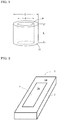
- an example of the cylindrical bead in which the outer peripheral shape of the second expanded bead and the shape of the hollow portion are both circular is preferably a cylindrical bead as illustrated in schematic illustration of FIG. 1 .
- the outer diameter D of the cylindrical expanded bead 11 is 2 to 6 mm
- the inner diameter d (diameter of the hollow portion P) is 1 to 5 mm
- the length L is 2 to 6 mm.
- the bonding strength between the pad and the connecting member is further improved as described hereinafter.
- D/L is 0.8 to 1.2 and the inner diameter d is 1.5 mm or more, since the bonding strength between the pad and the connecting member is further improved
- the connecting member has an average voidage of 10% by volume or more.
- the average voidage is 10% by volume or more, it becomes easy to ensure the desired bonding strength between the polyurethane pad and the connecting member as described hereinafter.
- the average voidage exceeds 40% by volume, on the other hand, there is a possibility that the mechanical strength of the connecting member becomes insufficient.
- the average voidage of the connecting member is more preferably 12 to 35% by volume, particularly preferably 15 to 30% by volume.
- the apparent volume X is a volume calculated from the outer dimensions of the foamed molded body.
- the true volume Y is a real volume of the foamed molded body in which the void spaces are excluded. The true volume may be determined by immersing the foamed molded body in a liquid (such as an alcohol) and measuring a volume of the liquid that has been increased by the immersion.
- the reference numeral 1 designates a core material which is composed of a substrate 2 and a connecting member 3.
- the core material 1 has an upper surface 1a.
- the substrate 2 comprises a multiplicity of first expanded beads that are fusion-bonded to each other.
- the connecting member 3 comprises a multiplicity of second expanded beads each having a through-hole.
- the second expanded beads are fusion-bonded to each other such that interconnected void spaces (not shown) which communicate with an outer surface of the connecting member 3 are formed.
- the interconnected void spaces include a part of the through-holes of the second expanded beads.
- the connecting member 3 is integrally bonded to the substrate 2 in such a state that a part of the outer surface 3a of the connecting member 3 is exposed on the upper surface 1a of the core material 1.
- the core material 1 of the present invention it is necessary that a part of the outer surface 3a of the connecting member 3 is exposed on the upper surface 1a of the core material 1.
- a raw material of a polyurethane foam can enter into the interconnected void spaces through the outer surface 3a at the time the polyurethane foam is formed on the upper surface 1a.
- the pad is integrated with the core material 1.
- the embodiment in which the outer surface 3a of the connecting member is exposed on the upper surface 1a of the core material is not specifically limited. Examples of such embodiments are shown in FIG. 3 to FIG. 6 .
- FIG. 3 is a diagrammatic vertical cross-sectional view of a vehicular seat element 5.
- An outer surface of a connecting member 3 is exposed on the entire upper surface of a core material 1.
- a polyurethane foam pad 4 is formed to cover the entire upper surface of the core material 1 (namely, the entire exposed outer surface of the connecting member 3).
- a part of an outer surface of a connecting member 3 is exposed on a center region of an upper part of a core material 1.
- a pad 4 is formed to cover the entire upper surface of the core material 1.
- a vehicular seat element 5 of FIG. 5 is similar to that of FIG. 3 , but in this embodiment, a connecting member 3 is formed to additionally cover a side surface of a substrate 2.
- a connecting member 3 is formed into plural divided sections. An outer surface of each of the sections is exposed on an upper surface of a core material 1.
- a pad 4 is formed to cover the entire upper surface of the core material 1.
- the reference numeral 2 designates a substrate.
- the upper surface 1a ( FIG. 2 ) of the composite seat core material 1 may be formed only by the connecting member 3 as shown in FIG. 3 and FIG. 5 or, alternatively, may be formed by the connecting member 3 and the substrate 2 as shown in FIG. 2 , FIG. 4 and FIG. 6 .
- the form and configuration of the upper surface 1a of the core material 1 are not specifically limited.
- the upper surface 1a may be flat, curved or bent and its planar shape may be rectangular, polygonal, circular, etc. and determined as appropriate according to the structure of the seat element.
- the substrate 2 and the connecting member 3 have integrally bonded to each other.
- the obtained core material 1 has excellent strength, which finally makes it possible to obtain a vehicular seat element 5 having excellent strength.
- a method for bonding the substrate 2 and connecting member 3 together is not specifically limited. There may be mentioned, for example, a method in which the substrate 2 and connecting member 3 are molded integrally using, as thermoplastic resins of which they are constituted, similar kinds of resins that can be fusion-bonded to each other, a method in which they are first separately prepared and, in a subsequent step, fusion-bonded together or bonded together with an adhesive. In an alternative, they are mechanically integrally united together by forming the connecting member in dovetail grooves formed in the substrate as shown in FIG. 6 .
- the volume percentage of the connecting member in the core material of the present invention is 5 to 50% by volume.
- the volume percentage of the connecting member is within the above range, it becomes possible to achieve more reliable bonding of a pad to the connecting member while suppressing deformation such as warp at the time of lamination with the pad.
- the lower limit of the volume percentage of the connecting member is more preferably 10% by volume, still more preferably 15% by volume.
- the upper limit thereof is more preferably 40% by volume, still more preferably 30% by volume.
- the connecting member has a thickness of 5 mm or more, more preferably 10 mm or more, from the standpoint of bonding force thereof to the pad.
- the thickness of the connecting member is preferably 30 mm or less, more preferably 25 mm or less.
- the substrate has an apparent density of 10 to 90 kg/m 3 , more preferably 20 to 60 kg/m 3 , from the standpoint of balance between the lightness in weight and mechanical strength and of effective suppression of deformation by the lamination of the pad.
- the apparent density of the connecting member is preferably 10 to 90 kg/m 3 , more preferably 20 to 60 kg/m 3 , from the standpoint of the mechanical strength of the composite seat core material.
- the term "apparent density" of the expanded beads molded body, such as the connecting member and substrate is intended to refer to a value determined by dividing the weight of the molded body by the volume thereof that is calculated from the external dimensions thereof.
- the vehicular seat element of the present invention comprises the above-described composite seat core material, and a pad that covers an upper surface of the core material. Part of the pad is impregnated and solidified in the interconnected void spaces of the connecting member which constitutes the core material.
- the vehicular seat element of the present invention has cushioning properties because of the pad that covers its upper surface and is excellent in strength and rigidity because of the presence of the core material that is formed of a light weight material and is provided underneath thereof. Further, because part of the pad is impregnated and solidified in the interconnected void spaces of the connecting member and is integrated therewith, the pad and the core material are tightly bonded to each other. Therefore, delamination between them is prevented. Furthermore, because the core material has the above-described structure that is peculiar to the present invention, deformation such as warp is prevented.
- the core material of the present invention may be obtained by undergoing the following steps.
- step (1) and step (2) may be carried out in this order, the step (1) may be carried out prior to the step (2), or the step (1) and step (2) may be carried out simultaneously.
- the substrate that comprises expanded beads which do not have through-holes, namely the first expanded beads, and which are fusion-bonded to each other is formed.
- a substrate may be obtained by any known in-mold molding process using thermoplastic resin expanded beads which do not have through-holes.
- thermoplastic resin particles (hereinafter occasionally referred to simply as resin particles) are prepared by a method in which the resin is extruded in the form of strands, cooled and then cut into an appropriate length, or a method in which the extruded strands are cut into an appropriate length and then cooled.
- thermoplastic resin which constitutes the resin particles there may be used the previously described thermoplastic resin that constitutes the substrate.
- the thermoplastic resin may be colored by being added with a coloring pigment or dye such as black, gray or brown.
- thermoplastic resin particles are then dispersed in a dispersing medium in a closed vessel in the presence of a blowing agent and heated to a temperature that is not lower than the softening temperature of the thermoplastic resin particles so that the blowing agent is impregnated into the resin particles. Thereafter, while maintaining the pressure within the vessel at a pressure not lower than the vapor pressure of the blowing agent, one and of the vessel is opened to release the thermoplastic resin particles and the dispersing medium simultaneously to an atmosphere having a pressure lower than that within the vessel (generally atmospheric pressure) thereby expanding the thermoplastic resin particles and obtaining the first expanded beads.
- a pressure lower than that within the vessel generally atmospheric pressure
- blowing agent used for obtaining the thermoplastic resin beads there may be generally mentioned volatile organic blowing agents such as propane, isobutane, butane, isopentane, pentane, cyclopentane, hexane, cyclobutane, cyclohexane, chlorofluoromethane, trifluoromethane, 1,2,2,2-tetrafluoroethane, 1-chloro-1,1-difluoroethane, 1,1-difluoroethane and 1-chloro-1,2,2,2- tetrafluoroethane; and inorganic gas blowing agents such as nitrogen, carbon dioxide, argon and air.
- volatile organic blowing agents such as propane, isobutane, butane, isopentane, pentane, cyclopentane, hexane, cyclobutane, cyclohexane, chlorofluoromethane, trifluoromethane, 1,2,2,2-t
- inorganic gas blowing agents are preferred because of their freeness of destroying the ozone layer and their low costs.
- Particularly preferred are nitrogen, air and carbon dioxide.
- the above-described blowing agents may be used as a mixture of two or more thereof. With the consideration of an effect of improving expansion ratio, a mixed blowing agent composed of carbon dioxide and butane may be used.
- thermoplastic resin expanded beads one which does not dissolve the resin particles may be used.
- examples of such a dispersing medium include water, ethylene glycol, glycerin, methanol and ethanol. Water is generally used.
- thermoplastic resin particles when the thermoplastic resin particles are dispersed in the dispersing medium and heated to an expansion temperature, a dispersing agent may be used for preventing adhesion between the resin particles.
- the substrate in which the first expanded beads are fusion-bonded to each other may be obtained by subjecting the first expanded beads produced in the manner described above to an in-mold molding process in which the expanded beads are filled in a mold and heated to a predetermine temperature.
- the molding conditions may be determined as appropriate with consideration of the object of use of the composite seat core material.
- a connecting member that comprises thermoplastic resin expanded beads which have through-holes, namely the second expanded beads, and which are fusion-bonded to each other is produced such that interconnected void spaces which are in communication with an outer surface thereof are formed.
- the second expanded beads molded body which constitutes the connecting member may be produced by a conventionally known method disclosed in, for example, Japanese Laid Open Patent Publications Nos. JP-A-H08-108441 , JP-A-H07-137063 and JP-A-2012-126816 , and United States Patent No. 5,622,756 .
- tubular thermoplastic resin particles each having a through-hole are produced by a method similar to that for producing the resin particles for forming the substrate.
- a die having a slit which is provided in the molten resin exit of the extruder and which has a cross-sectional shape similar to that of the desired tubular thermoplastic resin particles.
- thermoplastic resin which constitutes the tubular resin particles there may be used the same thermoplastic resin as that used for the production of the first expanded beads.
- the second expanded beads may be obtained by expanding the thermoplastic resin particles having through-holes using the method similar to that for producing the first expanded beads.
- the connecting member having the second expanded beads that are fusion-bonded to each other may be obtained by subjecting the second expanded beads produced in the manner described above to an in-mold molding process in which the expanded beads are filled in a mold and heated to a predetermine temperature.
- the molding conditions may be determined as appropriate with consideration of the object of use of the composite seat core material.
- the connecting member is disposed on an upper side of the substrate and integrally bonded thereto, thereby obtaining a composite seat core material.
- the steps (1), (2) and (3) may be continuously carried out using a single in-mold molding device.
- the methods disclosed in, for example, Japanese patent publications Nos. JP-A-S55-11841 , JP-A-S55-46938 , JP-A-S55-53538 , JP-A-S57-47629 , JP-A-S61-130026 , and JP-A-H05-116226 may be adopted.
- the first expanded beads are filled in a first cavity of a mold composed of a pair of male and female molds and are then heated and fusion-bonded to form the substrate (step 1).
- the male mold thus used is substituted by another male mold so that a second cavity having a volume greater than that of the first cavity is formed.
- the second expanded beads are filled in a space above the substrate, that is present within the second cavity, and are then heated and fusion-bonded to form the connecting member (step 2), with simultaneous fusion-bonding thereof to the substrate (step 3), thereby obtaining the composite seat core material.
- the bonding of the connecting member to the substrate may be carried out in a separate step by, for example, using an adhesive or by fusion bonding.
- a liquid raw material for a polyurethane foam is fed on the core material within a mold for laminating a polyurethane foam pad.
- liquid raw material for a polyurethane foam there may be used a known material, as appropriate.
- the amount of the liquid raw material for a polyurethane foam may also be determined as appropriate according to the density of the desired polyurethane foam.
- the liquid raw material for a polyurethane foam is caused to foam for integral lamination of the pad with the core material.
- the pad is formed on the core material in such a state that part of the pad enters into the interconnected void spaces either by foaming of the polyurethane foam raw material that has been impregnated within the interconnected void spaces of the connecting member at the time the polyurethane foam raw material has been fed onto the substrate or by entry of a part of the pad into the interconnected void spaces of the connecting member as a result of the pressure generated at the time the polyurethane foam raw material foams.
- the connecting member is constituted of the second expanded beads that are fusion-bonded to each other and because the polyurethane foam enters into the spaces of the through-holes of the second expanded beads, the structure of the fusing bonding between the second expanded beads has a less tendency to be broken owning to the expansion pressure of the foam. Further, because the interconnected void spaces of the connecting member are formed by complicated interconnection of the through-holes of the second expanded beads and interstices between the second expanded beads, the connecting member and the pad are bonded to each other with a large contacting area and in a complicated form. Therefore, the connecting member and the pad are integrally laminated with a high bonding strength.
- the conditions under which the polyurethane foam raw material is foamed may be determined as appropriate according to known methods.
- the connecting member is integrally laminated with the pad. Accordingly, the bonding strength between the pad and the connecting member is excellent, i.e. delamination between the pad and the connecting member is surely suppressed. Additionally, because the connecting member is provided on only an upper side of the vehicular seat element and because a lower part of the vehicular seat element is formed of the first expanded beads that are free of through-holes, deformation attributed to the lamination of the pad is prevented. Moreover, since the amount of the pad that is impregnated into the connecting member can be controlled by adjusting the volume of the connecting member, variation of the density of the pad can be suppressed.
- the seat core material of the present invention may be used for a variety of seat elements, which are desired to have cushioning properties, such as seats for vehicles, e.g. automobiles, bicycles, airplanes and electric trains, couches and chairs.
- the composite seat core material of the present invention is particularly suitably used, in combination with an urethane foam pad, as a seat element of vehicles such as automobiles, bicycles, airplanes and electric trains. Examples
- a composite seat core material was obtained in the same manner as in Example 1 except that the second expanded beads were imparted with increased secondary expansion efficiency by controlling the pressure of the steam that was fed at the time of molding the connecting member, so that the voidage of the connecting member was reduced to 15%.
- a composite seat core material was obtained in the same manner as in Example 1 except that the size of the first cavity was changed to 350mm ⁇ 300mm ⁇ 36mm rectangular parallelepiped.
- the expanded beads for forming the substrate used in Example 1 were filled in a rectangular parallelepiped cavity of 350mm ⁇ 300mm ⁇ 60mm and heated and fusion-bonded to obtain a core material having a single layer structure.
- the second expanded beads for forming the connecting member used in Example 1 were filled in a rectangular parallelepiped cavity of 350mm ⁇ 300mm ⁇ 60mm and heated and fusion-bonded to obtain a core material having a single layer structure and interconnected void spaces that communicated with the outside.
- the physical properties of the obtained seat elements are shown in Table 1.
- Table 1 Example 1 2 3 Comparative Example 1 2
- Seat core material Substrate Apparent density [kg/m 3 ] 30 30 30 30 - Voidage [%] 6 6 6 6 - Volume percentage [volume %] 83 83 60 100 - Connecting member Apparent density [kg/m 3 ] 32 32 32 - 32 Voidage [%] 30 15 30 - 30 Volume percentage [volume %] 17 17 40 - 100 Thickness [mm] 10 10 24 - 60 Flexural rigidity relative value 93 97 90 100 79 Bonding strength between pad and core material [N] 243 170 240 30 240 Deformation (warp) [mm] 0.6 0.5 1.8 0.2 2.9
- the obtained core material was cut into the substrate and the connecting member.
- the weight and outer dimensions of the cut substrate were measured.
- the apparent density of the substrate was calculated by dividing the weight by an apparent volume that was calculated from the outer dimensions.
- the connecting member was cut off in the same manner as above.
- the weight and outer dimensions of the connecting member were measured.
- the apparent density of the connecting member was calculated by dividing the weight by an apparent volume that was calculated from the outer dimensions.
- the connecting member was immersed in ethanol. From a rise of the level of the ethanol, a true volume of the connecting member was determined.
- the volume percentages of the substrate and the connecting member were determined from the apparent volume of the substrate and the apparent volume of the connecting member.
Landscapes
- Engineering & Computer Science (AREA)
- Mechanical Engineering (AREA)
- Aviation & Aerospace Engineering (AREA)
- Transportation (AREA)
- Laminated Bodies (AREA)
- Mattresses And Other Support Structures For Chairs And Beds (AREA)
- Seats For Vehicles (AREA)
Abstract
Description
- The present invention relates to a composite seat core material and to a vehicular seat element using the composite seat core material.
- A vehicular seat element composed of a plurality of laminated different materials has been hitherto used as a seat for use in automobiles, etc. One example of such a seat element is a laminate composed of a cushion layer (pad) that is formed of a material having cushioning property and a substrate layer that is formed of a light-weight material and that has higher strength and rigidity as compared with the cushioning layer.
- As the material from which the cushioning layer is formed, there is used, for example, a soft polyurethane foam that is configured to provide an occupant sitting thereon with good comfort and snug fit around the hip.
- As the material from which the substrate layer is formed, on the other hand, there has been used, for example, a hard polyurethane foam. In recent years, however, a foam of a thermoplastic resin such as a styrene-based resin, an ethylene-based resin or a propylene-based resin has been used so that it has become possible to supplement the strength and rigidity of the cushioning layer and achieve weight reduction of the vehicular seat element. Thus, by laminating a cushioning layer of a soft polyurethane foam and a substrate layer of a thermoplastic resin foam together, it has become possible to obtain a vehicular seat element having composite properties.
- As a method for producing such a vehicular seat element, there is a method using a mold. To be more specific, there is a method in which a previously prepared member (a thermoplastic resin foamed body) for forming a substrate layer is disposed in a mold cavity defined in a mold and in which a liquid raw material for forming a polyurethane foam is filled in the mold cavity in which the above member has been disposed, and is caused to foam to prepare a cushioning layer, thereby directly forming (laminating) the cushioning layer on a surface of the substrate layer.
- However, because a cushioning layer formed of a polyurethane foam has poor adhesion property to a foamed body of a thermoplastic resin such as a propylene-based resin that forms a substrate layer, investigation is being made for suppressing the delamination between the polyurethane foam and the substrate layer. For example,
Patent Document 1 proposes a method for producing a laminate in which that region of a surface of an expandable thermoplastic resin expanded beads foamed body which is to be contacted by a polyurethane foam layer, is heated at a temperature that is at least 80% of the softening temperature of the foamed body to soften and expand the expandable resin beads which constitute the contact region and to form undulations in the contact region. The polyurethane foam is then formed such that it enters into the recesses of the undulations. - Patent Document 1: Japanese Laid Open Patent Publication No.
JP-A-2012-171104 - In the laminate produced by the production method of
Patent Document 1, however, the bonding strength between the polyurethane foam and the thermoplastic resin foamed body is not fully satisfactory. It is thus difficult to surely suppress the delamination between the layers. For example, when such a laminate is used as a seat for an automobile, delamination between the polyurethane foam and the substrate layer is apt to occur. There is, therefore, a possibility that problems of deterioration of sitting comfort and snug fit of the occupant and of generation of frictional sounds between the layers due to delamination thereof occur. - With a view toward solving the above delamination problem, the present inventors have attempted to integrally laminate a polyurethane foam to a substrate formed of an expanded beads molded body. The molded body is obtained by in-mold molding of thermoplastic resin particles having through holes and has void spaces that are communicated with the outside.
- The obtained product is a laminate in which the polyurethane foam and the substrate are integrally laminated by impregnating, foaming and solidifying a polyurethane foam forming raw material liquid in the void spaces of the substrate of the expanded beads molded body. The laminate was found to excel in adhesion properties between the substrate and the polyurethane foam and to have less tendency to cause delamination, because part of the polyurethane foam is impregnated, foamed and solidified within the void spaces that are present on a surface side thereof.
- It has been revealed, however, that when the polyurethane foam is integrally laminated with the substrate which is an expanded beads molded body having void spaces that are in communication with the outside, deformation such as warp of the expanded beads molded body occurs depending upon the density of the expanded beads molded body. The reason for this is considered to be because the polyurethane foam is physically tightly bonded to the expanded beads molded body, because the degree of shrinkage of them differs from each other and additionally because there is thermal influence at the time of foaming of the polyurethane foam.
- The present invention is aimed at the provision of a composite seat core material that is adapted to be integrally laminated with a polyurethane foam pad by foaming polyurethane in a mold, that excels in bonding strength to the polyurethane foam pad and that is able to suppress deformation such as warp which might occur by lamination with the polyurethane pad, and at the provision of a vehicular seat element using the composite seat core material. Means for solving the problems:
- In accordance with the present invention, there are provided the following composite seat core material and vehicular seat element:
- [1] A composite seat core material, comprising:
- a foamed molded substrate that comprises a multiplicity of first thermoplastic resin expanded beads which are fusion-bonded to each other and free of through-holes, and
- a foamed molded connecting member that comprises a multiplicity of second thermoplastic resin expanded beads each having a through-hole, said second thermoplastic resin expanded beads being fusion-bonded to each other such that interconnected void spaces which communicate with an outer surface of the foamed molded connecting member and which include part of the through-holes of the second thermoplastic resin expanded beads, are defined in the foamed molded connecting member,
- the foamed molded connecting member being integrally bonded to the foamed molded substrate in such a state that a part of said outer surface of the foamed molded connecting member is exposed on an upper surface of the composite seat core material.
- [2] The composite seat core material according to above [1], wherein the foamed molded connecting member has an average voidage of 10% by volume or more.
- [3] The composite seat core material according to above [1] or [2], wherein the foamed molded connecting member has a volume that is 5 to 50% of the volume of the composite seat core material.
- [4] The composite core material according to any one of above [1] to [3], wherein the foamed molded substrate is substantially free of void spaces.
- [5] A vehicular seat element, comprising:
- the composite seat core material according to
claim 1, and - a polyurethane foam pad provided on the upper surface of the composite seat core material,
- wherein said polyurethane foam pad has portions impregnated through said outer surface of the foamed molded connecting member into part of the void spaces of the foamed molded connecting member.
- the composite seat core material according to
- The composite seat core material of the present invention, which comprises the above-described substrate and the above-described connecting member, shows excellent bonding strength to the polyurethane foam pad and shows suppressed deformation such as warp when laminated with the polyurethane foam pad. The vehicular seat element of the present invention shows excellent cushioning properties and suppressed delamination between the core material and the polyurethane foam pad and, moreover, has suppressed deformation such as warp of its composite seat core material.
-
-
FIG. 1 is a schematic view showing an example of a shape of a thermoplastic resin expanded bead having a through hole. -
FIG. 2 is a perspective view schematically illustrating an embodiment of a composite seat core material according to the present invention. -
FIG. 3 is a vertical cross-sectional view schematically illustrating an embodiment of a vehicular seat element according to the present invention. -
FIG. 4 is a vertical cross-sectional view schematically illustrating a further embodiment of a vehicular seat element according to the present invention. -
FIG. 5 is a vertical cross-sectional view schematically illustrating a further embodiment of a vehicular seat element according to the present invention. -
FIG. 6 is a vertical cross-sectional view schematically illustrating a further embodiment of a vehicular seat element according to the present invention. - The composite seat core material according to the present invention and the vehicular seat element having a polyurethane pad provided on the composite seat core material will be described in detail below. The term "seat element" as used herein is intended to refer to a seat cushion on which an occupant sits, a seat back which supports the back of the occupant, a head rest and/or an arm rest. Description will be hereinafter made of a seat element used as a seat cushion.
- The composite seat core material (hereinafter occasionally referred to simply as "core material") used for the vehicular seat element of the present invention has a foamed molded substrate (hereinafter occasionally referred to simply as "substrate") that comprises a multiplicity of thermoplastic resin expanded beads which are fusion-bonded to each other, and a foamed molded connecting member (hereinafter occasionally referred to simply as "connecting member") that is provided on an outer surface of the substrate and that comprises a multiplicity of thermoplastic resin expanded beads which are fusion-bonded to each other.
- The vehicular seat element of the present invention is mounted on a vehicle in such a state that the substrate, connecting member and a polyurethane foam pad (hereinafter occasionally referred to simply as "pad") thereof are arranged in this order from below. When the vehicular seat element is used as a seat cushion, the term "upper surface" of the core material as used herein is intended to refer to a surface on the top side of the seat cushion, namely a surface on the side on which a passenger sits. When the vehicular seat element is used as a seat back, the term "upper surface" of the core material as used herein is intended to refer to a surface on the side against which a passenger leans.
- The substrate which constitutes the composite seat core material of the present invention is formed of an expanded beads foamed molded body which comprises thermoplastic resin expanded beads which are free of through-holes (hereinafter occasionally referred to simply as first expanded beads) and which are fusion-bonded to each other. Because the substrate is formed of the expanded beads which are free of through-holes, the core material has excellent rigidity and is able to be prevented from being warped at the time of lamination of a pad thereon. Further, a raw material liquid of a polyurethane foam is prevented from impregnating into the substrate at the time of production of a vehicular seat element, which will be described later, it is possible to control the amount of the pad impregnated into the connecting member. Thus, it is possible to prevent variation of the density of the pad.
- It is preferred that the substrate which constitutes the composite seat core material is substantially free of void spaces. Generally, however, even when a foamed body is formed of expanded beads that are free of void spaces, the voidage of the substrate which is determined by a method described hereinafter is not 0%, because fine void spaces may remain present between expanded beads. Thus, the term "substantially free of void spaces" as used herein is intended to mean that the substrate has an average voidage of 8% by volume or less. It is more preferred that the substrate has an average voidage of 6% by volume or less.
- As a base resin of the first expanded beads that constitute the substrate there may be used any thermoplastic resin. The thermoplastic resin may be, for example, one or more of a polyproylene-based resin, such as an ethylene-propylene copolymer, a propylene-butene copolymer, an ethylene-propylene-butene terpolymer and a polypropylene homopolymer; a polyethylene-based resin, such as low density polyethylene, medium density polyethylene, high density polyethylene, linear low density polyethylene, ultralow density polyethylene, an ethylene-vinyl acetate copolymer, an ethylene-methyl methacrylate copolymer and an ionomer resin obtained by crosslinking between the molecules of an ethylene-methacrylic acid copolymer with metal ion; polybutene; and polypentene. Above all, for reasons of good recovery property after being compressed, low density polyethylene, medium density polyethylene, high density polyethylene, linear low density polyethylene, ultralow density polyethylene, polypropylene, polybutene, an ethylene-propylene copolymer, a propylene-butene copolymer, an ethylene-propylene-butene terpolymer, etc. are preferred. Incidentally, the copolymer and terpolymer may be a random copolymer or a block copolymer, with the random copolymer being more preferred.
- The thermoplastic resin may be cross-linked by using a peroxide or radiation, although it may be in a non-cross-linked state. From the standpoint of number of production steps and recyclability, however, a non-cross-linked thermoplastic resin is preferred.
- Further, the thermoplastic resin may be colored in black, gray, brown, etc. by addition of a coloring pigment or a dye.
- The connecting member which constitutes the composite core material of the present invention is an expanded beads foamed molded body that comprises a multiplicity of thermoplastic resin expanded beads each of which has a through-hole (hereinafter occasionally referred simply as second expanded beads) and which are fusion-bonded to each other. The connecting member has interconnected void spaces which communicate with an outer surface thereof. The interconnected void spaces of the connecting member include the through-holes of the second expanded beads and interstices between the plurality of the second expanded beads which are fusion-bonded to each other, with through-holes of the second expanded beads being the majority of the interconnected void spaces.
- Because the interconnected void spaces of the connecting member are in communication with the outer surface of the connecting member, a liquid is able to be impregnated into the interconnected void spaces through the outer surface. Therefore, when a vehicular seat element having a polyurethane foam pad is produced as described hereinafter, a raw material liquid of the polyurethane foam can be impregnated into the interconnected void spaces through the outer surface and foamed therein. By this, it is possible to tightly bond the polyurethane foam pad to the connecting member. A molded body of expanded beads having such through-holes generally has a low rigidity because of the presence of the void spaces. The core material of the present invention, however, can suppress its deformation at the time of foaming lamination of a polyurethane foam, since the core material is constituted of a molded body of the second expanded beads which has void spaces and a molded body of the first expanded beads having no through-holes.
- As the thermoplastic resin that constitutes the connecting member, there may be mentioned the above-described thermoplastic resins used to form the substrate. However, the thermoplastic resin of the connecting member may be the same as that of the substrate, or may be different from that of the substrate.
- As the second expanded beads, there may be mentioned, for example, those which are cylindrical and in which (a) the shape of the outer periphery and the shape of the hollow portion thereof are both circular, (b) the shape of the outer periphery and the shape of the hollow portion thereof are both polygonal, (c) the shape of the outer periphery is circular and the shape of the hollow portion is polygonal, (d) the shape of the outer periphery is polygonal and the shape of the hollow portion is circular, and (e) the shapes of (a) to (d) are each connected at its periphery. Here, the term "circular" is intended to include elliptical and oval and the term "polygonal" is intended to include rounded polygonal.
- The shape of the cylindrical expanded beads and the dimensions of the hollow portion may be designed as appropriate. For instance, an example of the cylindrical bead in which the outer peripheral shape of the second expanded bead and the shape of the hollow portion are both circular is preferably a cylindrical bead as illustrated in schematic illustration of
FIG. 1 . It is preferred that the outer diameter D of the cylindrical expandedbead 11 is 2 to 6 mm, the inner diameter d (diameter of the hollow portion P) is 1 to 5 mm, and the length L is 2 to 6 mm. When the dimensions of the cylindrical expanded beads fall within the above range, the bonding strength between the pad and the connecting member is further improved as described hereinafter. In the above case, it is more preferred that D/L is 0.8 to 1.2 and the inner diameter d is 1.5 mm or more, since the bonding strength between the pad and the connecting member is further improved - It is preferred that the connecting member has an average voidage of 10% by volume or more. When the average voidage is 10% by volume or more, it becomes easy to ensure the desired bonding strength between the polyurethane pad and the connecting member as described hereinafter. When the average voidage exceeds 40% by volume, on the other hand, there is a possibility that the mechanical strength of the connecting member becomes insufficient. From the above point of view, the average voidage of the connecting member is more preferably 12 to 35% by volume, particularly preferably 15 to 30% by volume.
- As used herein the term "average voidage" of a foamed molded body such as the substrate and the connecting member is intended to mean a value calculated using the following equation:

- One embodiment of the
core material 1 of the present invention that is constituted as described above is shown inFIG. 2 . InFIG. 2 , thereference numeral 1 designates a core material which is composed of asubstrate 2 and a connectingmember 3. Thecore material 1 has anupper surface 1a. Thesubstrate 2 comprises a multiplicity of first expanded beads that are fusion-bonded to each other. The connectingmember 3 comprises a multiplicity of second expanded beads each having a through-hole. The second expanded beads are fusion-bonded to each other such that interconnected void spaces (not shown) which communicate with an outer surface of the connectingmember 3 are formed. The interconnected void spaces include a part of the through-holes of the second expanded beads. The connectingmember 3 is integrally bonded to thesubstrate 2 in such a state that a part of theouter surface 3a of the connectingmember 3 is exposed on theupper surface 1a of thecore material 1. - In the
core material 1 of the present invention, it is necessary that a part of theouter surface 3a of the connectingmember 3 is exposed on theupper surface 1a of thecore material 1. When a part of theouter surface 3a of the connectingmember 3 is exposed on theupper surface 1a of thecore material 1, a raw material of a polyurethane foam can enter into the interconnected void spaces through theouter surface 3a at the time the polyurethane foam is formed on theupper surface 1a. When the polyurethane foam raw material is subsequently caused to foam and solidify, the pad is integrated with thecore material 1. The embodiment in which theouter surface 3a of the connecting member is exposed on theupper surface 1a of the core material is not specifically limited. Examples of such embodiments are shown inFIG. 3 to FIG. 6 . -
FIG. 3 is a diagrammatic vertical cross-sectional view of avehicular seat element 5. An outer surface of a connectingmember 3 is exposed on the entire upper surface of acore material 1. Apolyurethane foam pad 4 is formed to cover the entire upper surface of the core material 1 (namely, the entire exposed outer surface of the connecting member 3). In avehicular seat element 5 ofFIG. 4 , a part of an outer surface of a connectingmember 3 is exposed on a center region of an upper part of acore material 1. Apad 4 is formed to cover the entire upper surface of thecore material 1. Avehicular seat element 5 ofFIG. 5 is similar to that ofFIG. 3 , but in this embodiment, a connectingmember 3 is formed to additionally cover a side surface of asubstrate 2. In avehicular seat element 5 ofFIG. 6 , a connectingmember 3 is formed into plural divided sections. An outer surface of each of the sections is exposed on an upper surface of acore material 1. Apad 4 is formed to cover the entire upper surface of thecore material 1. InFIG 3 to FIG. 6 , thereference numeral 2 designates a substrate. Thus, theupper surface 1a (FIG. 2 ) of the compositeseat core material 1 may be formed only by the connectingmember 3 as shown inFIG. 3 andFIG. 5 or, alternatively, may be formed by the connectingmember 3 and thesubstrate 2 as shown inFIG. 2 ,FIG. 4 andFIG. 6 . The form and configuration of theupper surface 1a of thecore material 1 are not specifically limited. Theupper surface 1a may be flat, curved or bent and its planar shape may be rectangular, polygonal, circular, etc. and determined as appropriate according to the structure of the seat element. - Further, in the
core material 1 of the present invention, thesubstrate 2 and the connectingmember 3 have integrally bonded to each other. By this, the obtainedcore material 1 has excellent strength, which finally makes it possible to obtain avehicular seat element 5 having excellent strength. A method for bonding thesubstrate 2 and connectingmember 3 together is not specifically limited. There may be mentioned, for example, a method in which thesubstrate 2 and connectingmember 3 are molded integrally using, as thermoplastic resins of which they are constituted, similar kinds of resins that can be fusion-bonded to each other, a method in which they are first separately prepared and, in a subsequent step, fusion-bonded together or bonded together with an adhesive. In an alternative, they are mechanically integrally united together by forming the connecting member in dovetail grooves formed in the substrate as shown inFIG. 6 . - It is preferred that the volume percentage of the connecting member in the core material of the present invention is 5 to 50% by volume. When the volume percentage of the connecting member is within the above range, it becomes possible to achieve more reliable bonding of a pad to the connecting member while suppressing deformation such as warp at the time of lamination with the pad.
- From the above point of view, the lower limit of the volume percentage of the connecting member is more preferably 10% by volume, still more preferably 15% by volume. The upper limit thereof is more preferably 40% by volume, still more preferably 30% by volume.
- It is preferred that the connecting member has a thickness of 5 mm or more, more preferably 10 mm or more, from the standpoint of bonding force thereof to the pad. When there is a variation in impregnation amount of the pad in the vehicular seat elements, a variation in density is caused in the pads. Thus, from the standpoint of control of the impregnation amount, the thickness of the connecting member is preferably 30 mm or less, more preferably 25 mm or less.
- It is preferred that the substrate has an apparent density of 10 to 90 kg/m3, more preferably 20 to 60 kg/m3, from the standpoint of balance between the lightness in weight and mechanical strength and of effective suppression of deformation by the lamination of the pad. The apparent density of the connecting member, on the other hand, is preferably 10 to 90 kg/m3, more preferably 20 to 60 kg/m3, from the standpoint of the mechanical strength of the composite seat core material. As used herein, the term "apparent density" of the expanded beads molded body, such as the connecting member and substrate, is intended to refer to a value determined by dividing the weight of the molded body by the volume thereof that is calculated from the external dimensions thereof.
- Description will be next made of the vehicular seat element of the present invention.
- The vehicular seat element of the present invention comprises the above-described composite seat core material, and a pad that covers an upper surface of the core material. Part of the pad is impregnated and solidified in the interconnected void spaces of the connecting member which constitutes the core material. The vehicular seat element of the present invention has cushioning properties because of the pad that covers its upper surface and is excellent in strength and rigidity because of the presence of the core material that is formed of a light weight material and is provided underneath thereof. Further, because part of the pad is impregnated and solidified in the interconnected void spaces of the connecting member and is integrated therewith, the pad and the core material are tightly bonded to each other. Therefore, delamination between them is prevented. Furthermore, because the core material has the above-described structure that is peculiar to the present invention, deformation such as warp is prevented.
- Description will be next made of a method for fabricating the composite seat core material of the present invention and the vehicular seat element using the core material.
- The core material of the present invention may be obtained by undergoing the following steps.
- (1) A step of producing a substrate which comprises the first expanded beads fusion-bonded to each other;
- (2) A step of producing a connecting member which comprises the second expanded beads fusion-bonded to each other and which has interconnected void spaces being in communication with an outer surface thereof;
- (3) A step of producing a composite seat core material by disposing the connecting member on an upper side of the substrate and integrally bonding them;
- (4) A step of integrally laminating the core material with a polyurethane foam pad, wherein a liquid raw material for a polyurethane foam is fed on the composite seat core material within a mold and is caused to foam thereby forming the pad and wherein a part of the raw material is allowed to foam and solidify in the interconnected void spaces of the connecting member.
- The step (1) and step (2) may be carried out in this order, the step (1) may be carried out prior to the step (2), or the step (1) and step (2) may be carried out simultaneously.
- Each of the above steps will be described below.
- In the step (1), the substrate that comprises expanded beads which do not have through-holes, namely the first expanded beads, and which are fusion-bonded to each other is formed. Such a substrate may be obtained by any known in-mold molding process using thermoplastic resin expanded beads which do not have through-holes.
- To be more specific, a thermoplastic resin as a base resin is melted and kneaded with a kneader for example. Thereafter, thermoplastic resin particles (hereinafter occasionally referred to simply as resin particles) are prepared by a method in which the resin is extruded in the form of strands, cooled and then cut into an appropriate length, or a method in which the extruded strands are cut into an appropriate length and then cooled.
- As the thermoplastic resin which constitutes the resin particles, there may be used the previously described thermoplastic resin that constitutes the substrate. The thermoplastic resin may be colored by being added with a coloring pigment or dye such as black, gray or brown.
- The thermoplastic resin particles are then dispersed in a dispersing medium in a closed vessel in the presence of a blowing agent and heated to a temperature that is not lower than the softening temperature of the thermoplastic resin particles so that the blowing agent is impregnated into the resin particles. Thereafter, while maintaining the pressure within the vessel at a pressure not lower than the vapor pressure of the blowing agent, one and of the vessel is opened to release the thermoplastic resin particles and the dispersing medium simultaneously to an atmosphere having a pressure lower than that within the vessel (generally atmospheric pressure) thereby expanding the thermoplastic resin particles and obtaining the first expanded beads.
- As the blowing agent used for obtaining the thermoplastic resin beads, there may be generally mentioned volatile organic blowing agents such as propane, isobutane, butane, isopentane, pentane, cyclopentane, hexane, cyclobutane, cyclohexane, chlorofluoromethane, trifluoromethane, 1,2,2,2-tetrafluoroethane, 1-chloro-1,1-difluoroethane, 1,1-difluoroethane and 1-chloro-1,2,2,2- tetrafluoroethane; and inorganic gas blowing agents such as nitrogen, carbon dioxide, argon and air. Above all, inorganic gas blowing agents are preferred because of their freeness of destroying the ozone layer and their low costs. Particularly preferred are nitrogen, air and carbon dioxide. The above-described blowing agents may be used as a mixture of two or more thereof. With the consideration of an effect of improving expansion ratio, a mixed blowing agent composed of carbon dioxide and butane may be used.
- As the dispersing medium used for obtaining thermoplastic resin expanded beads, one which does not dissolve the resin particles may be used. Examples of such a dispersing medium include water, ethylene glycol, glycerin, methanol and ethanol. Water is generally used.
- Additionally, when the thermoplastic resin particles are dispersed in the dispersing medium and heated to an expansion temperature, a dispersing agent may be used for preventing adhesion between the resin particles.
- The substrate in which the first expanded beads are fusion-bonded to each other may be obtained by subjecting the first expanded beads produced in the manner described above to an in-mold molding process in which the expanded beads are filled in a mold and heated to a predetermine temperature. The molding conditions may be determined as appropriate with consideration of the object of use of the composite seat core material.
- In the step (2), a connecting member that comprises thermoplastic resin expanded beads which have through-holes, namely the second expanded beads, and which are fusion-bonded to each other is produced such that interconnected void spaces which are in communication with an outer surface thereof are formed.
- The second expanded beads molded body which constitutes the connecting member may be produced by a conventionally known method disclosed in, for example, Japanese Laid Open Patent Publications Nos.
JP-A-H08-108441 JP-A-H07-137063 JP-A-2012-126816 5,622,756 . - To be more specific, tubular thermoplastic resin particles each having a through-hole are produced by a method similar to that for producing the resin particles for forming the substrate. In this case, there may be used a die having a slit which is provided in the molten resin exit of the extruder and which has a cross-sectional shape similar to that of the desired tubular thermoplastic resin particles. There may also be used a die which is provided with pressure control holes in the interior of the slit thereof for keeping the pressure in tubular strand holes at ambient pressure or more so as to maintain the tubular shape.
- As the thermoplastic resin which constitutes the tubular resin particles, there may be used the same thermoplastic resin as that used for the production of the first expanded beads.
- Next, the second expanded beads may be obtained by expanding the thermoplastic resin particles having through-holes using the method similar to that for producing the first expanded beads.
- As the second expanded beads, those which are tubular and which have various shapes may be used as described previously.
- The connecting member having the second expanded beads that are fusion-bonded to each other may be obtained by subjecting the second expanded beads produced in the manner described above to an in-mold molding process in which the expanded beads are filled in a mold and heated to a predetermine temperature. The molding conditions may be determined as appropriate with consideration of the object of use of the composite seat core material.
- In the step (3), the connecting member is disposed on an upper side of the substrate and integrally bonded thereto, thereby obtaining a composite seat core material. In this case, it is necessary that at least part of the outer surface of the connecting member should be exposed on the upper surface of the core material.
- The steps (1), (2) and (3) may be continuously carried out using a single in-mold molding device. To be more specific, the methods disclosed in, for example, Japanese patent publications Nos.
JP-A-S55-11841 JP-A-S55-46938 JP-A-S55-53538 JP-A-S57-47629 JP-A-S61-130026 JP-A-H05-116226 - For example, the first expanded beads are filled in a first cavity of a mold composed of a pair of male and female molds and are then heated and fusion-bonded to form the substrate (step 1). Next, the male mold thus used is substituted by another male mold so that a second cavity having a volume greater than that of the first cavity is formed. The second expanded beads are filled in a space above the substrate, that is present within the second cavity, and are then heated and fusion-bonded to form the connecting member (step 2), with simultaneous fusion-bonding thereof to the substrate (step 3), thereby obtaining the composite seat core material.
- However, as described above, the bonding of the connecting member to the substrate may be carried out in a separate step by, for example, using an adhesive or by fusion bonding.
- In the step (4), a liquid raw material for a polyurethane foam is fed on the core material within a mold for laminating a polyurethane foam pad.
- As the liquid raw material for a polyurethane foam, there may be used a known material, as appropriate. The amount of the liquid raw material for a polyurethane foam may also be determined as appropriate according to the density of the desired polyurethane foam.
- In the step (4), the liquid raw material for a polyurethane foam is caused to foam for integral lamination of the pad with the core material. In this case, the pad is formed on the core material in such a state that part of the pad enters into the interconnected void spaces either by foaming of the polyurethane foam raw material that has been impregnated within the interconnected void spaces of the connecting member at the time the polyurethane foam raw material has been fed onto the substrate or by entry of a part of the pad into the interconnected void spaces of the connecting member as a result of the pressure generated at the time the polyurethane foam raw material foams.
- Because the connecting member is constituted of the second expanded beads that are fusion-bonded to each other and because the polyurethane foam enters into the spaces of the through-holes of the second expanded beads, the structure of the fusing bonding between the second expanded beads has a less tendency to be broken owning to the expansion pressure of the foam. Further, because the interconnected void spaces of the connecting member are formed by complicated interconnection of the through-holes of the second expanded beads and interstices between the second expanded beads, the connecting member and the pad are bonded to each other with a large contacting area and in a complicated form. Therefore, the connecting member and the pad are integrally laminated with a high bonding strength. Incidentally, the conditions under which the polyurethane foam raw material is foamed may be determined as appropriate according to known methods.
- Thus, in the vehicular seat element according to the present invention, a part of the pad is impregnated into the interconnected void spaces of the connecting member of the composite seat core material and, therefore, the connecting member is integrally laminated with the pad. Accordingly, the bonding strength between the pad and the connecting member is excellent, i.e. delamination between the pad and the connecting member is surely suppressed. Additionally, because the connecting member is provided on only an upper side of the vehicular seat element and because a lower part of the vehicular seat element is formed of the first expanded beads that are free of through-holes, deformation attributed to the lamination of the pad is prevented. Moreover, since the amount of the pad that is impregnated into the connecting member can be controlled by adjusting the volume of the connecting member, variation of the density of the pad can be suppressed.
- The seat core material of the present invention may be used for a variety of seat elements, which are desired to have cushioning properties, such as seats for vehicles, e.g. automobiles, bicycles, airplanes and electric trains, couches and chairs. The composite seat core material of the present invention is particularly suitably used, in combination with an urethane foam pad, as a seat element of vehicles such as automobiles, bicycles, airplanes and electric trains. Examples
- The following examples and comparative examples will further illustrate the present invention.
-
- (1) Nearly cylindrical polypropylene-based resin expanded beads which had a bulk density of 24 kg/m3, a true density of 53 kg/m3, an average weight per bead of 1.5 mg and an average D/L of 1.0 and which were formed with through-holes were used as second expanded beads for forming a connecting member.
- (2) Polypropylene-based resin expanded beads which had a bulk density of 26 kg/m3, an average weight per bead of 1.0 mg and an average D/L of 1.0 and which were free of through-holes were used as first expanded beads for forming a substrate.
The bulk density of the above expanded beads was determined as follows. A vessel having a volume of 1,000 cm3 and provided with an opening at its top was provided. The expanded beads were filled in the vessel at ambient temperature and pressure. Those expanded beads that were present above the opening were removed so that the bulk height of the expanded beads nearly coincided with the opening. The weight (g) of the expanded beads in the vessel was divided by 1,000 (cm3) and the unit of the result was changed to kg/m3. The true density of the expanded beads was determined as follows. The expanded beads whose weight was previously measured were immersed in ethanol to measure the rise of the level, from which the volume of the expanded beads was measured. The measured volume was divided with the weight of the expanded beads and the unit of the result was changed to kg/m3. - (3) Formation of the connecting member and substrate:
The first expanded beads free of through-holes for forming the substrate were filled in a first cavity (rectangular parallelepiped of 350mm×300mm×50mm) defined between male and female molds of a molding tool, to which was then fed steam to heat and fuse-bond the beads. Next, a second cavity (rectangular parallelepiped of 350mm×300mm×60mm) whose volume was greater than that of the first cavity was formed between the female mold and another male mold which was substituted for the previously used male mold. The second expanded beads having through-holes for forming the connecting member were filled in an upper space in the second cavity, to which was then fed steam to heat and fuse-bond the beads. Thus, a composite seat core material in which the substrate and the connecting member were fusion-bonded and integrated was obtained. The connecting member and the substrate of the thus obtained core material were found to be firmly integrally fusion-bonded together. - A composite seat core material was obtained in the same manner as in Example 1 except that the second expanded beads were imparted with increased secondary expansion efficiency by controlling the pressure of the steam that was fed at the time of molding the connecting member, so that the voidage of the connecting member was reduced to 15%.
- A composite seat core material was obtained in the same manner as in Example 1 except that the size of the first cavity was changed to 350mm×300mm×36mm rectangular parallelepiped.
- The expanded beads for forming the substrate used in Example 1 were filled in a rectangular parallelepiped cavity of 350mm×300mm×60mm and heated and fusion-bonded to obtain a core material having a single layer structure.
- The second expanded beads for forming the connecting member used in Example 1 were filled in a rectangular parallelepiped cavity of 350mm×300mm×60mm and heated and fusion-bonded to obtain a core material having a single layer structure and interconnected void spaces that communicated with the outside.
- The bulk density, voidage, volume percentage of the substrate and connecting member, and flexural rigidity relative values of the obtained core materials are shown in Table 1.
- (4) Formation of polyurethane foam pad:
The obtained core material was placed in a rectangular parallelepiped mold cavity of 400mm×400mm×100mm, to which a raw material liquid for an in-cavity polyurethane foam was fed. The raw material liquid was then caused to foam to laminate a polyurethane foam, thereby obtaining a seat element having a laminated polyurethane foam pad. - The physical properties of the obtained seat elements are shown in Table 1.
Table 1 Example 1 2 3 Comparative Example 1 2 Seat core material Substrate Apparent density [kg/m3] 30 30 30 30 - Voidage [%] 6 6 6 6 - Volume percentage [volume %] 83 83 60 100 - Connecting member Apparent density [kg/m3] 32 32 32 - 32 Voidage [%] 30 15 30 - 30 Volume percentage [volume %] 17 17 40 - 100 Thickness [mm] 10 10 24 - 60 Flexural rigidity relative value 93 97 90 100 79 Bonding strength between pad and core material [N] 243 170 240 30 240 Deformation (warp) [mm] 0.6 0.5 1.8 0.2 2.9 - Each of the physical values shown in Table 1 was measured or evaluated as follows. Shown in Table 1 are average values.
- The obtained core material was cut into the substrate and the connecting member. The weight and outer dimensions of the cut substrate were measured. The apparent density of the substrate was calculated by dividing the weight by an apparent volume that was calculated from the outer dimensions. The substrate was immersed in ethanol. From a rise of the level of the ethanol, a true volume of the substrate was determined. The voidage of the substrate was determined according to the previously described equation (n=3).
- The connecting member was cut off in the same manner as above. The weight and outer dimensions of the connecting member were measured. The apparent density of the connecting member was calculated by dividing the weight by an apparent volume that was calculated from the outer dimensions. The connecting member was immersed in ethanol. From a rise of the level of the ethanol, a true volume of the connecting member was determined. The voidage of the connecting member was determined according to the previously described equation (n=3).
- The volume percentages of the substrate and the connecting member were determined from the apparent volume of the substrate and the apparent volume of the connecting member.
- A bending test was carried out by the three-point bending test according to JIS K7221-1 (2006). More specifically, from the obtained core material, a test specimen of 350mm×100mm (thickness was the same as that of the core material) was cut off. The three-point bending test was carried out under the conditions involving a span between fulcrums of 300 mm and a test speed of 20 mm/min to measure the maximum flexural strength (kPa). The measured maximum flexural strength was expressed as a relative value to the result of Comparative Example 1, (with the assumption that the result of Comparative Example 1 is 100) (n=5).
- From the obtained seat element, a test specimen with a size of 50mm×50mm (thickness was the same as that of the seat element) was cut out. A SUS plate was bonded to each of the upper and bottom surfaces. A tensile test was carried out in the vertical direction using a universal testing machine (TENSIRON) at a tensile speed of 10 mm/min. The bonding strength (N) was the maximum load at which the polyurethane foam pad was delaminated from the core material (n=5).
- The seat element was placed on a horizontal surface with its core material side being oriented downward. One end in the longitudinal direction of the seat element was pressed by a hand against the horizontal surface. The distance between the bottom surface of the core material at the other end, which was lifted, and the horizontal surface was measured (n=5).
-
- 1:
- Core material
- 1a:
- Upper surface of core material
- 2:
- Substrate
- 3:
- Connecting member
- 3a:
- Part of outer surface of connecting member
- 4:
- Pad
- 5:
- Vehicular seat element
- 11:
- Tubular expanded bead
- d:
- Inner diameter of tubular expanded bead
- D:
- Outer diameter of tubular expanded bead
- L:
- Length of tubular expanded bead
- P:
- Hollow portion of tubular expanded bead
Claims (5)
- A composite seat core material, comprising:a foamed molded substrate that comprises a multiplicity of first thermoplastic resin expanded beads which are fusion-bonded to each other and free of through-holes, anda foamed molded connecting member that comprises a multiplicity of second thermoplastic resin expanded beads each having a through-hole, said second thermoplastic resin expanded beads being fusion-bonded to each other such that interconnected void spaces which communicate with an outer surface of the foamed molded connecting member and which include part of the through-holes of the second thermoplastic resin expanded beads, are defined in the foamed molded connecting member,the foamed molded connecting member being integrally bonded to the foamed molded substrate in such a state that a part of said outer surface of the foamed molded connecting member is exposed on an upper surface of the composite seat core material.
- The composite seat core material according to claim 1, wherein the foamed molded connecting member has an average voidage of 10% by volume or more.
- The composite seat core material according to claim 1 or 2, wherein the foamed molded connecting member has a volume that is 5 to 50% of the volume of the composite seat core material.
- The composite core material according to any one of claims 1 to 3, wherein the foamed molded substrate is substantially free of void spaces.
- A vehicular seat element, comprising:the composite seat core material according to claim 1, anda polyurethane foam pad provided on the upper surface of the composite seat core material,wherein said polyurethane foam pad has portions impregnated through said outer surface of the foamed molded connecting member into part of the void spaces of the foamed molded connecting member.
Applications Claiming Priority (2)
| Application Number | Priority Date | Filing Date | Title |
|---|---|---|---|
| JP2015159443A JP6080275B1 (en) | 2015-08-12 | 2015-08-12 | Vehicle seat core and vehicle seat member |
| PCT/JP2016/071535 WO2017026244A1 (en) | 2015-08-12 | 2016-07-22 | Composite seat core material and vehicular seat member using composite seat core material |
Publications (3)
| Publication Number | Publication Date |
|---|---|
| EP3335928A1 true EP3335928A1 (en) | 2018-06-20 |
| EP3335928A4 EP3335928A4 (en) | 2019-05-08 |
| EP3335928B1 EP3335928B1 (en) | 2020-03-25 |
Family
ID=57983148
Family Applications (1)
| Application Number | Title | Priority Date | Filing Date |
|---|---|---|---|
| EP16834941.3A Active EP3335928B1 (en) | 2015-08-12 | 2016-07-22 | Composite seat core material and vehicular seat member using composite seat core material |
Country Status (5)
| Country | Link |
|---|---|
| US (1) | US10391911B2 (en) |
| EP (1) | EP3335928B1 (en) |
| JP (1) | JP6080275B1 (en) |
| CN (1) | CN107848453B (en) |
| WO (1) | WO2017026244A1 (en) |
Cited By (2)
| Publication number | Priority date | Publication date | Assignee | Title |
|---|---|---|---|---|
| EP4147847A1 (en) * | 2021-09-08 | 2023-03-15 | Basf Se | Permeable molded body comprising polyurethane beads |
| EP4234223A4 (en) * | 2020-10-26 | 2024-09-25 | JSP Corporation | METHOD OF MANUFACTURING LAMINATE |
Families Citing this family (8)
| Publication number | Priority date | Publication date | Assignee | Title |
|---|---|---|---|---|
| JP6840630B2 (en) * | 2017-06-16 | 2021-03-10 | 株式会社ジェイエスピー | Vehicle seat member |
| JP6986386B2 (en) * | 2017-08-09 | 2021-12-22 | 株式会社ジェイエスピー | Vehicle seat members |
| KR102042320B1 (en) * | 2017-12-19 | 2019-11-07 | 조민정 | Mat having hetero junction part |
| CN108741421A (en) * | 2018-08-06 | 2018-11-06 | 福建美明达鞋业发展有限公司 | Have the stereo shoe-vamp spike and its preparation process of density gradient |
| US20220143879A1 (en) * | 2019-03-25 | 2022-05-12 | Zephyros, Inc. | Dual expanding foam for closed mold composite manufacturing |
| JP7164660B2 (en) | 2021-04-09 | 2022-11-01 | 株式会社ジェイエスピー | Core material |
| KR102825043B1 (en) * | 2022-09-19 | 2025-06-26 | 현대트랜시스 주식회사 | Multi-layered structure for car seats |
| WO2026014254A1 (en) * | 2024-07-10 | 2026-01-15 | 株式会社イノアックコーポレーション | Vehicle seat pad and automotive interior member |
Family Cites Families (20)
| Publication number | Priority date | Publication date | Assignee | Title |
|---|---|---|---|---|
| JPS6021532B2 (en) | 1978-07-10 | 1985-05-28 | 鐘淵化学工業株式会社 | Manufacturing method for multilayer foam molded products |
| JPS5856337B2 (en) | 1978-09-30 | 1983-12-14 | 積水化成品工業株式会社 | Simultaneous molding equipment using different raw materials |
| JPS5553538A (en) | 1978-10-17 | 1980-04-19 | Kanegafuchi Chem Ind Co Ltd | Manufacturing of synthetic resin foaming molded article |
| JPS5747629A (en) | 1980-09-08 | 1982-03-18 | Badische Yuka Co Ltd | Production of multilayer expansion-molded article |
| JPS61130026A (en) | 1984-11-29 | 1986-06-17 | Shoei Kako Kk | Method of molding foamed polystyrene with different layer |
| JPH0531974Y2 (en) * | 1986-10-24 | 1993-08-17 | ||
| JP2528577B2 (en) | 1991-10-30 | 1996-08-28 | 積水化成品工業株式会社 | Method for producing foamed molded article |
| JP3377575B2 (en) | 1993-11-16 | 2003-02-17 | 株式会社ジエイエスピー | Molded polymer foam particles having voids |
| JP2805286B2 (en) * | 1994-08-16 | 1998-09-30 | 株式会社ジェイエスピー | Polyolefin-based resin foam molded article having communicating voids and method for producing the same |
| TW294691B (en) | 1994-08-16 | 1997-01-01 | Jsp Corp | Expansion-molded article of polyolefin resin having open voids and production thereof |
| CA2542367A1 (en) * | 2003-10-17 | 2005-04-28 | Shiina Kasei Co. | Method for producing plastic foamed composite |
| JP4293281B1 (en) * | 2007-07-23 | 2009-07-08 | 株式会社ブリヂストン | Vehicle seat pad and vehicle seat |
| JP2011036469A (en) * | 2009-08-12 | 2011-02-24 | Sekisui Plastics Co Ltd | Vehicle seat base material |
| CN201850698U (en) * | 2010-06-04 | 2011-06-01 | 王韬 | Novel foam-filled honeycomb sandwich board |
| JP5664143B2 (en) * | 2010-11-09 | 2015-02-04 | 株式会社ジェイエスピー | Expandable composite thermoplastic resin particles, composite thermoplastic resin foam particles, and composite thermoplastic resin foam particles |
| JP5727210B2 (en) | 2010-12-15 | 2015-06-03 | 株式会社ジェイエスピー | Method for producing polyolefin resin expanded particle molded body, and polyolefin resin expanded resin molded body |
| JP5667905B2 (en) * | 2011-02-17 | 2015-02-12 | 積水化成品工業株式会社 | LAMINATE MANUFACTURING METHOD AND LAMINATE |
| FR2974800B1 (en) * | 2011-05-05 | 2013-04-26 | Saint Gobain | TRANSPARENT SUBSTRATE COATED WITH A STACK OF MINERAL LAYERS INCLUDING A COVERED POROUS |
| DE102012102689A1 (en) * | 2012-03-26 | 2013-09-26 | Airex Ag | Structural element and method for its production |
| JP6291281B2 (en) * | 2014-02-19 | 2018-03-14 | 株式会社ジェイエスピー | LAMINATE MANUFACTURING METHOD, LAMINATE, AND Cushion Material |
-
2015
- 2015-08-12 JP JP2015159443A patent/JP6080275B1/en active Active
-
2016
- 2016-07-22 CN CN201680047686.7A patent/CN107848453B/en active Active
- 2016-07-22 WO PCT/JP2016/071535 patent/WO2017026244A1/en not_active Ceased
- 2016-07-22 EP EP16834941.3A patent/EP3335928B1/en active Active
- 2016-07-22 US US15/750,854 patent/US10391911B2/en active Active
Cited By (2)
| Publication number | Priority date | Publication date | Assignee | Title |
|---|---|---|---|---|
| EP4234223A4 (en) * | 2020-10-26 | 2024-09-25 | JSP Corporation | METHOD OF MANUFACTURING LAMINATE |
| EP4147847A1 (en) * | 2021-09-08 | 2023-03-15 | Basf Se | Permeable molded body comprising polyurethane beads |
Also Published As
| Publication number | Publication date |
|---|---|
| US10391911B2 (en) | 2019-08-27 |
| JP6080275B1 (en) | 2017-02-15 |
| CN107848453B (en) | 2020-06-16 |
| JP2017035378A (en) | 2017-02-16 |
| CN107848453A (en) | 2018-03-27 |
| EP3335928A4 (en) | 2019-05-08 |
| EP3335928B1 (en) | 2020-03-25 |
| WO2017026244A1 (en) | 2017-02-16 |
| US20180319304A1 (en) | 2018-11-08 |
Similar Documents
| Publication | Publication Date | Title |
|---|---|---|
| EP3335928B1 (en) | Composite seat core material and vehicular seat member using composite seat core material | |
| JP6291281B2 (en) | LAMINATE MANUFACTURING METHOD, LAMINATE, AND Cushion Material | |
| EP2343185B1 (en) | Sandwich panel and method of forming the sandwich panel | |
| US5786394A (en) | Durable, energy-absorptive EPP/PUR structural composites | |
| US6755475B1 (en) | Multiple indentation load deflection foam molding | |
| EP3835025B1 (en) | Laminated article | |
| JPWO2017135456A1 (en) | Vehicle seat core material | |
| JPH0480720B2 (en) | ||
| EP4406997A1 (en) | Method for manufacturing polypropylene-based resin foamed particle molded article | |
| JPH08103581A (en) | Cushion material | |
| US20240109271A1 (en) | Core member | |
| EP3673768B1 (en) | Vehicle seat core and seat pad | |
| JP6643947B2 (en) | Vehicle cushion pad and manufacturing method thereof | |
| JPH0716867A (en) | Shock absorbing structure of interior member for automobile | |
| JP3188900U (en) | Vehicle seat | |
| JP3217373U (en) | Vehicle step | |
| JP2011036469A (en) | Vehicle seat base material | |
| JPH0732523A (en) | Interior member and manufacturing method thereof | |
| JP2001301076A (en) | Polyolefinic resin composite molded object | |
| JPH0349555Y2 (en) | ||
| JP2000272521A (en) | Lightweight steering wheel by beads molding |
Legal Events
| Date | Code | Title | Description |
|---|---|---|---|
| STAA | Information on the status of an ep patent application or granted ep patent |
Free format text: STATUS: THE INTERNATIONAL PUBLICATION HAS BEEN MADE |
|
| PUAI | Public reference made under article 153(3) epc to a published international application that has entered the european phase |
Free format text: ORIGINAL CODE: 0009012 |
|
| STAA | Information on the status of an ep patent application or granted ep patent |
Free format text: STATUS: REQUEST FOR EXAMINATION WAS MADE |
|
| 17P | Request for examination filed |
Effective date: 20180226 |
|
| AK | Designated contracting states |
Kind code of ref document: A1 Designated state(s): AL AT BE BG CH CY CZ DE DK EE ES FI FR GB GR HR HU IE IS IT LI LT LU LV MC MK MT NL NO PL PT RO RS SE SI SK SM TR |
|
| AX | Request for extension of the european patent |
Extension state: BA ME |
|
| DAV | Request for validation of the european patent (deleted) | ||
| DAX | Request for extension of the european patent (deleted) | ||
| RIC1 | Information provided on ipc code assigned before grant |
Ipc: B32B 5/32 20060101ALI20170228BHEP Ipc: B60N 2/44 20060101AFI20170228BHEP |
|
| A4 | Supplementary search report drawn up and despatched |
Effective date: 20190410 |
|
| RIC1 | Information provided on ipc code assigned before grant |
Ipc: B29C 67/20 20060101ALI20190404BHEP Ipc: B29C 44/34 20060101ALI20190404BHEP Ipc: B29C 44/06 20060101ALI20190404BHEP Ipc: B29C 44/04 20060101AFI20190404BHEP Ipc: B29C 44/44 20060101ALI20190404BHEP |
|
| REG | Reference to a national code |
Ref country code: DE Ref legal event code: R079 Ref document number: 602016032712 Country of ref document: DE Free format text: PREVIOUS MAIN CLASS: B60N0002440000 Ipc: B29C0044040000 |
|
| GRAP | Despatch of communication of intention to grant a patent |
Free format text: ORIGINAL CODE: EPIDOSNIGR1 |
|
| STAA | Information on the status of an ep patent application or granted ep patent |
Free format text: STATUS: GRANT OF PATENT IS INTENDED |
|
| RIC1 | Information provided on ipc code assigned before grant |
Ipc: B29C 44/34 20060101ALI20191007BHEP Ipc: B29C 44/06 20060101ALI20191007BHEP Ipc: B29C 44/04 20060101AFI20191007BHEP Ipc: B29C 67/20 20060101ALI20191007BHEP Ipc: B29C 44/44 20060101ALI20191007BHEP |
|
| INTG | Intention to grant announced |
Effective date: 20191022 |
|
| RIN1 | Information on inventor provided before grant (corrected) |
Inventor name: HASHIMOTO, KEIICHI Inventor name: TAKAYAMA, ATSUO Inventor name: UEGURI, MOTOAKI |
|
| GRAS | Grant fee paid |
Free format text: ORIGINAL CODE: EPIDOSNIGR3 |
|
| GRAA | (expected) grant |
Free format text: ORIGINAL CODE: 0009210 |
|
| STAA | Information on the status of an ep patent application or granted ep patent |
Free format text: STATUS: THE PATENT HAS BEEN GRANTED |
|
| AK | Designated contracting states |
Kind code of ref document: B1 Designated state(s): AL AT BE BG CH CY CZ DE DK EE ES FI FR GB GR HR HU IE IS IT LI LT LU LV MC MK MT NL NO PL PT RO RS SE SI SK SM TR |
|
| REG | Reference to a national code |
Ref country code: GB Ref legal event code: FG4D |
|
| REG | Reference to a national code |
Ref country code: AT Ref legal event code: REF Ref document number: 1248063 Country of ref document: AT Kind code of ref document: T Effective date: 20200415 Ref country code: IE Ref legal event code: FG4D |
|
| REG | Reference to a national code |
Ref country code: DE Ref legal event code: R096 Ref document number: 602016032712 Country of ref document: DE |
|
| PG25 | Lapsed in a contracting state [announced via postgrant information from national office to epo] |
Ref country code: NO Free format text: LAPSE BECAUSE OF FAILURE TO SUBMIT A TRANSLATION OF THE DESCRIPTION OR TO PAY THE FEE WITHIN THE PRESCRIBED TIME-LIMIT Effective date: 20200625 Ref country code: RS Free format text: LAPSE BECAUSE OF FAILURE TO SUBMIT A TRANSLATION OF THE DESCRIPTION OR TO PAY THE FEE WITHIN THE PRESCRIBED TIME-LIMIT Effective date: 20200325 Ref country code: FI Free format text: LAPSE BECAUSE OF FAILURE TO SUBMIT A TRANSLATION OF THE DESCRIPTION OR TO PAY THE FEE WITHIN THE PRESCRIBED TIME-LIMIT Effective date: 20200325 |
|
| PG25 | Lapsed in a contracting state [announced via postgrant information from national office to epo] |
Ref country code: SE Free format text: LAPSE BECAUSE OF FAILURE TO SUBMIT A TRANSLATION OF THE DESCRIPTION OR TO PAY THE FEE WITHIN THE PRESCRIBED TIME-LIMIT Effective date: 20200325 Ref country code: LV Free format text: LAPSE BECAUSE OF FAILURE TO SUBMIT A TRANSLATION OF THE DESCRIPTION OR TO PAY THE FEE WITHIN THE PRESCRIBED TIME-LIMIT Effective date: 20200325 Ref country code: GR Free format text: LAPSE BECAUSE OF FAILURE TO SUBMIT A TRANSLATION OF THE DESCRIPTION OR TO PAY THE FEE WITHIN THE PRESCRIBED TIME-LIMIT Effective date: 20200626 Ref country code: HR Free format text: LAPSE BECAUSE OF FAILURE TO SUBMIT A TRANSLATION OF THE DESCRIPTION OR TO PAY THE FEE WITHIN THE PRESCRIBED TIME-LIMIT Effective date: 20200325 Ref country code: BG Free format text: LAPSE BECAUSE OF FAILURE TO SUBMIT A TRANSLATION OF THE DESCRIPTION OR TO PAY THE FEE WITHIN THE PRESCRIBED TIME-LIMIT Effective date: 20200625 |
|
| REG | Reference to a national code |
Ref country code: NL Ref legal event code: MP Effective date: 20200325 |
|
| REG | Reference to a national code |
Ref country code: LT Ref legal event code: MG4D |
|
| PG25 | Lapsed in a contracting state [announced via postgrant information from national office to epo] |
Ref country code: NL Free format text: LAPSE BECAUSE OF FAILURE TO SUBMIT A TRANSLATION OF THE DESCRIPTION OR TO PAY THE FEE WITHIN THE PRESCRIBED TIME-LIMIT Effective date: 20200325 |
|
| PG25 | Lapsed in a contracting state [announced via postgrant information from national office to epo] |
Ref country code: EE Free format text: LAPSE BECAUSE OF FAILURE TO SUBMIT A TRANSLATION OF THE DESCRIPTION OR TO PAY THE FEE WITHIN THE PRESCRIBED TIME-LIMIT Effective date: 20200325 Ref country code: LT Free format text: LAPSE BECAUSE OF FAILURE TO SUBMIT A TRANSLATION OF THE DESCRIPTION OR TO PAY THE FEE WITHIN THE PRESCRIBED TIME-LIMIT Effective date: 20200325 Ref country code: PT Free format text: LAPSE BECAUSE OF FAILURE TO SUBMIT A TRANSLATION OF THE DESCRIPTION OR TO PAY THE FEE WITHIN THE PRESCRIBED TIME-LIMIT Effective date: 20200818 Ref country code: CZ Free format text: LAPSE BECAUSE OF FAILURE TO SUBMIT A TRANSLATION OF THE DESCRIPTION OR TO PAY THE FEE WITHIN THE PRESCRIBED TIME-LIMIT Effective date: 20200325 Ref country code: IS Free format text: LAPSE BECAUSE OF FAILURE TO SUBMIT A TRANSLATION OF THE DESCRIPTION OR TO PAY THE FEE WITHIN THE PRESCRIBED TIME-LIMIT Effective date: 20200725 Ref country code: RO Free format text: LAPSE BECAUSE OF FAILURE TO SUBMIT A TRANSLATION OF THE DESCRIPTION OR TO PAY THE FEE WITHIN THE PRESCRIBED TIME-LIMIT Effective date: 20200325 Ref country code: SK Free format text: LAPSE BECAUSE OF FAILURE TO SUBMIT A TRANSLATION OF THE DESCRIPTION OR TO PAY THE FEE WITHIN THE PRESCRIBED TIME-LIMIT Effective date: 20200325 Ref country code: SM Free format text: LAPSE BECAUSE OF FAILURE TO SUBMIT A TRANSLATION OF THE DESCRIPTION OR TO PAY THE FEE WITHIN THE PRESCRIBED TIME-LIMIT Effective date: 20200325 |
|
| REG | Reference to a national code |
Ref country code: AT Ref legal event code: MK05 Ref document number: 1248063 Country of ref document: AT Kind code of ref document: T Effective date: 20200325 |
|
| REG | Reference to a national code |
Ref country code: DE Ref legal event code: R097 Ref document number: 602016032712 Country of ref document: DE |
|
| PG25 | Lapsed in a contracting state [announced via postgrant information from national office to epo] |
Ref country code: ES Free format text: LAPSE BECAUSE OF FAILURE TO SUBMIT A TRANSLATION OF THE DESCRIPTION OR TO PAY THE FEE WITHIN THE PRESCRIBED TIME-LIMIT Effective date: 20200325 Ref country code: DK Free format text: LAPSE BECAUSE OF FAILURE TO SUBMIT A TRANSLATION OF THE DESCRIPTION OR TO PAY THE FEE WITHIN THE PRESCRIBED TIME-LIMIT Effective date: 20200325 Ref country code: AT Free format text: LAPSE BECAUSE OF FAILURE TO SUBMIT A TRANSLATION OF THE DESCRIPTION OR TO PAY THE FEE WITHIN THE PRESCRIBED TIME-LIMIT Effective date: 20200325 Ref country code: IT Free format text: LAPSE BECAUSE OF FAILURE TO SUBMIT A TRANSLATION OF THE DESCRIPTION OR TO PAY THE FEE WITHIN THE PRESCRIBED TIME-LIMIT Effective date: 20200325 |
|
| PLBE | No opposition filed within time limit |
Free format text: ORIGINAL CODE: 0009261 |
|
| STAA | Information on the status of an ep patent application or granted ep patent |
Free format text: STATUS: NO OPPOSITION FILED WITHIN TIME LIMIT |
|
| PG25 | Lapsed in a contracting state [announced via postgrant information from national office to epo] |
Ref country code: PL Free format text: LAPSE BECAUSE OF FAILURE TO SUBMIT A TRANSLATION OF THE DESCRIPTION OR TO PAY THE FEE WITHIN THE PRESCRIBED TIME-LIMIT Effective date: 20200325 Ref country code: MC Free format text: LAPSE BECAUSE OF FAILURE TO SUBMIT A TRANSLATION OF THE DESCRIPTION OR TO PAY THE FEE WITHIN THE PRESCRIBED TIME-LIMIT Effective date: 20200325 |
|
| REG | Reference to a national code |
Ref country code: CH Ref legal event code: PL |
|
| 26N | No opposition filed |
Effective date: 20210112 |
|
| REG | Reference to a national code |
Ref country code: BE Ref legal event code: MM Effective date: 20200731 |
|
| PG25 | Lapsed in a contracting state [announced via postgrant information from national office to epo] |
Ref country code: LU Free format text: LAPSE BECAUSE OF NON-PAYMENT OF DUE FEES Effective date: 20200722 Ref country code: LI Free format text: LAPSE BECAUSE OF NON-PAYMENT OF DUE FEES Effective date: 20200731 Ref country code: CH Free format text: LAPSE BECAUSE OF NON-PAYMENT OF DUE FEES Effective date: 20200731 |
|
| PG25 | Lapsed in a contracting state [announced via postgrant information from national office to epo] |
Ref country code: SI Free format text: LAPSE BECAUSE OF FAILURE TO SUBMIT A TRANSLATION OF THE DESCRIPTION OR TO PAY THE FEE WITHIN THE PRESCRIBED TIME-LIMIT Effective date: 20200325 Ref country code: BE Free format text: LAPSE BECAUSE OF NON-PAYMENT OF DUE FEES Effective date: 20200731 |
|
| PG25 | Lapsed in a contracting state [announced via postgrant information from national office to epo] |
Ref country code: IE Free format text: LAPSE BECAUSE OF NON-PAYMENT OF DUE FEES Effective date: 20200722 |
|
| PG25 | Lapsed in a contracting state [announced via postgrant information from national office to epo] |
Ref country code: TR Free format text: LAPSE BECAUSE OF FAILURE TO SUBMIT A TRANSLATION OF THE DESCRIPTION OR TO PAY THE FEE WITHIN THE PRESCRIBED TIME-LIMIT Effective date: 20200325 Ref country code: MT Free format text: LAPSE BECAUSE OF FAILURE TO SUBMIT A TRANSLATION OF THE DESCRIPTION OR TO PAY THE FEE WITHIN THE PRESCRIBED TIME-LIMIT Effective date: 20200325 Ref country code: CY Free format text: LAPSE BECAUSE OF FAILURE TO SUBMIT A TRANSLATION OF THE DESCRIPTION OR TO PAY THE FEE WITHIN THE PRESCRIBED TIME-LIMIT Effective date: 20200325 |
|
| PG25 | Lapsed in a contracting state [announced via postgrant information from national office to epo] |
Ref country code: MK Free format text: LAPSE BECAUSE OF FAILURE TO SUBMIT A TRANSLATION OF THE DESCRIPTION OR TO PAY THE FEE WITHIN THE PRESCRIBED TIME-LIMIT Effective date: 20200325 Ref country code: AL Free format text: LAPSE BECAUSE OF FAILURE TO SUBMIT A TRANSLATION OF THE DESCRIPTION OR TO PAY THE FEE WITHIN THE PRESCRIBED TIME-LIMIT Effective date: 20200325 |
|
| P01 | Opt-out of the competence of the unified patent court (upc) registered |
Effective date: 20230420 |
|
| PGFP | Annual fee paid to national office [announced via postgrant information from national office to epo] |
Ref country code: GB Payment date: 20250529 Year of fee payment: 10 |
|
| PGFP | Annual fee paid to national office [announced via postgrant information from national office to epo] |
Ref country code: FR Payment date: 20250610 Year of fee payment: 10 |
|
| PGFP | Annual fee paid to national office [announced via postgrant information from national office to epo] |
Ref country code: DE Payment date: 20250528 Year of fee payment: 10 |
|
| REG | Reference to a national code |
Ref country code: DE Ref legal event code: R082 Ref document number: 602016032712 Country of ref document: DE Representative=s name: BLUMBACH ZINNGREBE PATENTANWAELTE PARTG MBB, DE |