EP3335822A1 - Piston for vehicle engine and method for manufacturing the same - Google Patents
Piston for vehicle engine and method for manufacturing the same Download PDFInfo
- Publication number
- EP3335822A1 EP3335822A1 EP17201604.0A EP17201604A EP3335822A1 EP 3335822 A1 EP3335822 A1 EP 3335822A1 EP 17201604 A EP17201604 A EP 17201604A EP 3335822 A1 EP3335822 A1 EP 3335822A1
- Authority
- EP
- European Patent Office
- Prior art keywords
- piston
- cooling
- zone
- bonding
- preheating
- Prior art date
- Legal status (The legal status is an assumption and is not a legal conclusion. Google has not performed a legal analysis and makes no representation as to the accuracy of the status listed.)
- Granted
Links
Images



Classifications
-
- B—PERFORMING OPERATIONS; TRANSPORTING
- B23—MACHINE TOOLS; METAL-WORKING NOT OTHERWISE PROVIDED FOR
- B23K—SOLDERING OR UNSOLDERING; WELDING; CLADDING OR PLATING BY SOLDERING OR WELDING; CUTTING BY APPLYING HEAT LOCALLY, e.g. FLAME CUTTING; WORKING BY LASER BEAM
- B23K1/00—Soldering, e.g. brazing, or unsoldering
- B23K1/0008—Soldering, e.g. brazing, or unsoldering specially adapted for particular articles or work
-
- F—MECHANICAL ENGINEERING; LIGHTING; HEATING; WEAPONS; BLASTING
- F02—COMBUSTION ENGINES; HOT-GAS OR COMBUSTION-PRODUCT ENGINE PLANTS
- F02F—CYLINDERS, PISTONS OR CASINGS, FOR COMBUSTION ENGINES; ARRANGEMENTS OF SEALINGS IN COMBUSTION ENGINES
- F02F3/00—Pistons
- F02F3/0015—Multi-part pistons
-
- B—PERFORMING OPERATIONS; TRANSPORTING
- B23—MACHINE TOOLS; METAL-WORKING NOT OTHERWISE PROVIDED FOR
- B23P—METAL-WORKING NOT OTHERWISE PROVIDED FOR; COMBINED OPERATIONS; UNIVERSAL MACHINE TOOLS
- B23P15/00—Making specific metal objects by operations not covered by a single other subclass or a group in this subclass
- B23P15/10—Making specific metal objects by operations not covered by a single other subclass or a group in this subclass pistons
-
- B—PERFORMING OPERATIONS; TRANSPORTING
- B23—MACHINE TOOLS; METAL-WORKING NOT OTHERWISE PROVIDED FOR
- B23K—SOLDERING OR UNSOLDERING; WELDING; CLADDING OR PLATING BY SOLDERING OR WELDING; CUTTING BY APPLYING HEAT LOCALLY, e.g. FLAME CUTTING; WORKING BY LASER BEAM
- B23K1/00—Soldering, e.g. brazing, or unsoldering
- B23K1/008—Soldering within a furnace
-
- F—MECHANICAL ENGINEERING; LIGHTING; HEATING; WEAPONS; BLASTING
- F02—COMBUSTION ENGINES; HOT-GAS OR COMBUSTION-PRODUCT ENGINE PLANTS
- F02F—CYLINDERS, PISTONS OR CASINGS, FOR COMBUSTION ENGINES; ARRANGEMENTS OF SEALINGS IN COMBUSTION ENGINES
- F02F3/00—Pistons
- F02F3/0015—Multi-part pistons
- F02F3/003—Multi-part pistons the parts being connected by casting, brazing, welding or clamping
-
- F—MECHANICAL ENGINEERING; LIGHTING; HEATING; WEAPONS; BLASTING
- F02—COMBUSTION ENGINES; HOT-GAS OR COMBUSTION-PRODUCT ENGINE PLANTS
- F02F—CYLINDERS, PISTONS OR CASINGS, FOR COMBUSTION ENGINES; ARRANGEMENTS OF SEALINGS IN COMBUSTION ENGINES
- F02F3/00—Pistons
- F02F3/0084—Pistons the pistons being constructed from specific materials
-
- F—MECHANICAL ENGINEERING; LIGHTING; HEATING; WEAPONS; BLASTING
- F16—ENGINEERING ELEMENTS AND UNITS; GENERAL MEASURES FOR PRODUCING AND MAINTAINING EFFECTIVE FUNCTIONING OF MACHINES OR INSTALLATIONS; THERMAL INSULATION IN GENERAL
- F16J—PISTONS; CYLINDERS; SEALINGS
- F16J1/00—Pistons; Trunk pistons; Plungers
- F16J1/005—Pistons; Trunk pistons; Plungers obtained by assembling several pieces
-
- B—PERFORMING OPERATIONS; TRANSPORTING
- B23—MACHINE TOOLS; METAL-WORKING NOT OTHERWISE PROVIDED FOR
- B23K—SOLDERING OR UNSOLDERING; WELDING; CLADDING OR PLATING BY SOLDERING OR WELDING; CUTTING BY APPLYING HEAT LOCALLY, e.g. FLAME CUTTING; WORKING BY LASER BEAM
- B23K2101/00—Articles made by soldering, welding or cutting
- B23K2101/003—Pistons
-
- B—PERFORMING OPERATIONS; TRANSPORTING
- B23—MACHINE TOOLS; METAL-WORKING NOT OTHERWISE PROVIDED FOR
- B23P—METAL-WORKING NOT OTHERWISE PROVIDED FOR; COMBINED OPERATIONS; UNIVERSAL MACHINE TOOLS
- B23P2700/00—Indexing scheme relating to the articles being treated, e.g. manufactured, repaired, assembled, connected or other operations covered in the subgroups
- B23P2700/50—Other automobile vehicle parts, i.e. manufactured in assembly lines
-
- F—MECHANICAL ENGINEERING; LIGHTING; HEATING; WEAPONS; BLASTING
- F02—COMBUSTION ENGINES; HOT-GAS OR COMBUSTION-PRODUCT ENGINE PLANTS
- F02F—CYLINDERS, PISTONS OR CASINGS, FOR COMBUSTION ENGINES; ARRANGEMENTS OF SEALINGS IN COMBUSTION ENGINES
- F02F3/00—Pistons
- F02F3/0015—Multi-part pistons
- F02F3/003—Multi-part pistons the parts being connected by casting, brazing, welding or clamping
- F02F2003/0038—Multi-part pistons the parts being connected by casting, brazing, welding or clamping by brazing
-
- F—MECHANICAL ENGINEERING; LIGHTING; HEATING; WEAPONS; BLASTING
- F02—COMBUSTION ENGINES; HOT-GAS OR COMBUSTION-PRODUCT ENGINE PLANTS
- F02F—CYLINDERS, PISTONS OR CASINGS, FOR COMBUSTION ENGINES; ARRANGEMENTS OF SEALINGS IN COMBUSTION ENGINES
- F02F3/00—Pistons
- F02F3/0015—Multi-part pistons
- F02F3/003—Multi-part pistons the parts being connected by casting, brazing, welding or clamping
- F02F2003/0061—Multi-part pistons the parts being connected by casting, brazing, welding or clamping by welding
-
- F—MECHANICAL ENGINEERING; LIGHTING; HEATING; WEAPONS; BLASTING
- F02—COMBUSTION ENGINES; HOT-GAS OR COMBUSTION-PRODUCT ENGINE PLANTS
- F02F—CYLINDERS, PISTONS OR CASINGS, FOR COMBUSTION ENGINES; ARRANGEMENTS OF SEALINGS IN COMBUSTION ENGINES
- F02F2200/00—Manufacturing
Definitions
- the present disclosure relates to a piston for a vehicle engine and a method for manufacturing the same, and more particularly, to a piston for a vehicle engine, which has a cooling gallery formed therein, and a method for manufacturing the same.
- the internal combustion engine of a vehicle includes a piston made of steel.
- the piston has a cooling gallery that rapidly cools high-temperature heat generated during a fuel combustion process, in order to prevent a damage of the piston.
- an upper piston part having a valve pocket and combustion cavity formed therein and a lower piston part having a piston skirt and piston pin hole formed therein are separately manufactured and welded to each other.
- Examples of the method for welding the upper and lower piston parts to each other may include friction welding, brazing and the like.
- US Patent Registration No. 6,260,472 discloses a process of manufacturing a steel piston through friction welding. However, during a process of welding upper and lower piston parts through friction welding, flashing may be formed and remain in a cooling gallery, thereby disturbing a fluid flow in the cooling gallery.
- US Patent Registration No. 8,991,046 discloses a process of manufacturing a steel piston through brazing bonding. According to this process, heating and cooling are performed in a sealed chamber. Thus, the productivity of the process is inevitably degraded.
- An object of the present disclosure is to provide a piston for a vehicle engine and a method for manufacturing the same, which can improve productivity.
- a method for manufacturing a piston for a vehicle engine includes: a piston assembling step of forming a piston assembly by assembling a first piston part, a bonding member and a second piston part, wherein the first piston part has two or more bonding surfaces separated from each other and extended in a circumferential direction, and the second piston part has two or more bonding surfaces separated from each other and extended in the circumferential direction; a piston diffusion brazing step of diffusion brazing the first piston part, the bonding member and the second piston part under an open atmosphere by heating the formed piston assembly; and a piston cooling step of cooling a piston unit formed by diffusion brazing the first piston part, the bonding member and the second piston part.
- the piston diffusion brazing step is performed in a piston manufacturing device which includes a partially opened heating zone, a heater for providing heat into the heating zone, and a moving unit moved in one direction in the heating zone.
- the piston assembly is heated while being moved at a predetermined speed through the heating zone in one direction by the moving unit.
- the bonding surfaces of the first piston part may include a ring-shaped first bonding surface and a second bonding surface disposed further inside than the first bonding surface
- the bonding surfaces of the second piston part may include a ring-shaped third bonding surface and a fourth bonding surface disposed further inside than the third bonding surface
- the first and second bonding surfaces of the first piston part may face the third and fourth bonding surfaces of the second piston part, respectively, with the bonding member interposed therebetween.
- the bonding member may include a bonding member body formed in a circular plate shape, and have a through-hole formed in the center of the bonding member body.
- One surface of the bonding member body may be in contact with the first and second bonding surfaces, and the other surface of the bonding member body may be in contact with the third and fourth bonding surfaces.
- the first and second piston parts may be made of steel, and the bonding member may be made of a nickel-based alloy.
- a diffusion layer containing a nickel-based alloy may be formed on the inner surface of a cooling gallery formed by bonding the first and second bonding surfaces of the first piston part and the third and fourth bonding surfaces of the second piston part, respectively.
- the piston diffusion brazing step may include: a preheating step of heating the piston assembly formed at room temperature to a preheating temperature from the room temperature, the preheating temperature being lower than the melting temperature of the bonding member; and a main heating step of diffusion brazing the first piston part, the bonding member and the second piston part of the piston assembly by heating the piston assembly heated to the preheating temperature through the preheating step at a main heating temperature higher than the melting temperature of the bonding member.
- the preheating step may be performed in a preheating zone of the heating zone, the preheating zone including two or more sub preheating zones, a first preheating temperature of a first sub preheating zone may be lower than a second preheating temperature of a second sub preheating zone disposed at the rear of the first sub preheating zone, and the preheating temperatures of the sub preheating zones may be constantly maintained.
- the first preheating temperature may be higher than 500°C and lower than 800°C
- the second preheating temperature may be higher than 800°C and lower than 1,200°C.
- the main heating step may be performed in a main heating zone which is disposed at the rear of the preheating zone of the heating zone and communicates with the preheating zone, and the main heating zone may have an internal temperature maintained at the main heating temperature.
- the main heating temperature may be higher than 1, 000°C and lower than 1,300°C.
- the second piston part may include a piston skirt and a piston pin hole, and the plurality of piston assemblies each including the first piston part, the bonding member and the second piston part, which are sequentially stacked, may be successively moved by the moving unit.
- the method may further include a jig installation step of installing a jig for maintaining an alignment state of the first piston part, the bonding member and the second piston part, after the piston assembly is formed.
- the jig may press the second piston part against the first piston part.
- a gas mixture may be supplied to the heating zone, and then discharged to the outside through the heating zone.
- the heating zone may include a preheating zone and a main heating zone disposed at the rear of the preheating zone, and the gas mixture may be introduced into the heating zone through a gas discharge port installed in the main heating zone.
- the piston manufacturing device may further include a cooling zone disposed at the rear of the heating zone and having first and second cooling zones communicating with each other, wherein the first cooling zone has an internal temperature that decreases to a cooling temperature from a main heating temperature higher than the melting temperature of the bonding member, and the second cooling zone communicates with the first cooling zone and has an internal temperature maintained at the cooling temperature.
- the piston cooling step may include: a first cooling step of cooling the piston unit in the first cooling zone; and a second cooling step of cooling the piston unit subjected to the first cooling step in the second cooling zone.
- the time during which one piston unit stays in the second cooling zone may be two to four times longer than the time during which the same piston unit stays in the first cooling zone.
- first and second piston parts may further include a latch part protruding in a ring shape to cover a portion of the other piston part, and the method may further include a piston processing step of removing the latch part from the cooled piston unit.
- the piston unit subjected to the piston cooling step may have a smaller metal grain size than the piston assembly before the piston assembling step.
- a piston for a vehicle engine includes a piston unit made of steel and having a piston body and a cooling gallery formed in the piston body.
- the piston body has a bonding interface formed in parallel to the top surface of the piston body and passing through the cooling gallery, and the concentration of a metal different from the material of the piston body decreases from the center of the bonding interface toward the outside of the bonding surface.
- a method for manufacturing a piston for a vehicle engine includes: a piston assembling step of forming a piston assembly by assembling a first piston part, a bonding member and a second piston part, wherein the first piston part has two or more bonding surfaces separated from each other and extended in a circumferential direction, and the second piston part has two or more bonding surfaces separated from each other and extended in the circumferential direction; a piston diffusion brazing step of diffusion brazing the first piston part, the bonding member and the second piston part under an open atmosphere by heating the formed piston assembly; and a piston cooling step of cooling a piston unit formed by diffusion brazing the first piston part, the bonding member and the second piston part.
- the piston diffusion brazing step is performed in a piston manufacturing device including a partially opened heating zone, a heater for providing heat into the heating zone, and a moving unit moved in one direction in the heating zone.
- the piston assembly is heated while being moved at a predetermined speed through the heating zone in the one direction by the moving unit.
- a diffusion layer containing the different metal may be formed on the inner surface of the cooling gallery, and the different metal may include a nickel-based alloy.
- the piston for a vehicle engine and the method for manufacturing the same can improve the productivity, a large quantity of pistons for a vehicle engine can be manufactured at a lower cost for a shorter time.
- over/on indicates that an element is positioned over or under a target member, and does not necessarily indicate that the element is positioned over/on the target member based on the direction of gravity.
- an element when referred to as "including” a component, it may indicate that the element does not exclude another component but can include another component, unless referred to the contrary.
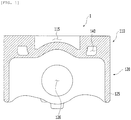
- FIG. 1 illustrates a cross-section of a piston for a vehicle engine according to an embodiment of the present disclosure.
- the piston 1 for an engine vehicle includes a piston body 100 formed by diffusion brazing first and second piston parts 110 and 120 (refer to FIG. 2 ) to each other, the first and second piston parts 110 and 120 being made of forged steel such as precipitation-hardened ferrite-pearlite steel (AFP steel) or heat treated steel such as 42CrMo 4 .
- the piston body 100 has a cooling gallery 140 formed in the top thereof, the cooling gallery 140 serving to cool high-temperature heat generated through a combustion process in a cylinder.
- the piston body 100 has a pin hole 126 formed at the bottom thereof, such that a piston skirt 125 and a piston pin (not illustrated) are housed in the pin hole 126.
- each of the first and second piston parts 110 and 120 has a plurality of bonding surfaces formed thereon, and the bonding surfaces of the first and second piston parts 110 and 120, facing each other, are bonded to form the cooling gallery 140 in the piston body 100.
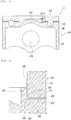
- FIG. 2 illustrates a state before upper and lower piston parts of the piston for the vehicle engine of FIG. 1 are assembled
- FIG. 3 illustrates a piston assembly in which the upper piston part, the lower piston part and a bonding member of FIG. 2 are assembled
- FIG. 4 is an expanded view of a portion VI of FIG. 3
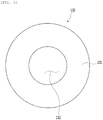
- FIG. 5 illustrates the bonding member of FIG. 1 .
- the first piston part 110 forms the upper portion of the piston 1
- a combustion cavity 115 is formed in the center of the first piston part 110
- first and second bonding surfaces 112 and 113 extended in the circumferential direction and separated from each other are formed on the bottom surface of the first piston part 110.
- a first groove 114 is formed between the first and second bonding surfaces 112 and 113.
- the second bonding surface 113 is disposed at an inner position closer to the center of the first piston part 110 than the first bonding surface 112.
- the second piston part 120 forms the lower portion of the piston 1, and the piston skirt 125 and the piston pin hole 126 are formed in the second piston part 120.
- the second piston part 120 has third and fourth bonding surfaces 122 and 123 formed at the top surface thereof, the third and fourth bonding surfaces 122 and 123 being extended in the circumferential direction and separated from each other. Between the third and fourth bonding surfaces 122 and 123, a second groove 124 is formed. The fourth bonding surface 123 is disposed at an inner position closer to the center of the second piston part 120 than the third bonding surface 122.
- a latch part 127 protrudes upward from the edge of the third bonding surface 122, which is separated from the second groove 124.
- the latch part 127 is formed along the circumferential direction or formed in a ring shape.
- the latch part 127 has an outer diameter corresponding to the diameter of the combustion cavity 115 formed through the center of the first piston part 110.
- the latch part 127 of the second piston part 120 may be inserted into the combustion cavity 115 of the first piston part 110 so as to cover a portion of the first piston part 110 or specifically the inner circumference of the first piston part 110, which makes it possible to maintain the state in which the first and second piston parts 110 and 120 are matched with each other.
- the first piston part 110 has a first cut portion 118 which is obliquely formed at the inner circumference thereof, that is, at the inner end of the second bonding surface 113, and a rounted portion 128 having a predetermined curvature radius of 0.2 mm to 0.7 mm, for example, is formed at the connection between the latch part 127 and the fourth bonding surface 123 of the second piston part 120.
- the latch part 127 has a second cut portion 129 formed at the upper end thereof, the second cut portion 129 being obliquely formed toward the inner circumference of the first piston part 110.
- the first cut portion 118, the second cut portion 129 and the rounted portion 128 can prevent an interference between the first and second piston parts 110 and 120 during an assembling process.
- an assembling and diffusion brazing process between the first and second piston parts 110 and 120 can be smoothly performed.
- the latch part 127 is formed in the second piston part 120.
- the latch part 127 may be formed in the first piston part 110, or formed at the outer circumference of the first or second piston part 110 or 120.
- a bonding member 130 is disposed between the first and second piston parts 110 and 120.
- the bonding member 130 includes a bonding member body 131 formed in a circular plate shape, and has a through-hole 132 formed in the center of the bonding member body 131.
- the bonding member 130 may be formed of a nickel-based alloy, for example.
- the bonding member 130 may be formed of a tertiary nickel filler metal.
- the bonding member 130 may be provided as a metal thin film with a thickness of 50um to 200um.
- the bonding member body 131 has a diameter corresponding to the diameter of the bottom surface of the first piston part 110 or the top surface of the second piston part 120, and the through-hole 132 has a diameter corresponding to the diameter of the latch part 127 formed in the second piston part 120. Therefore, with the first piston part 110, the bonding member 130 and the second piston part 120 assembled to form a piston assembly, an arrangement interference between the bonding member 130 and the latch part 127 can be suppressed.
- first piston part 110 When the first piston part 110, the bonding member 130 and the second piston part 120 are assembled to form the piston assembly, one surface of the bonding member 130 is in contact with the first and second bonding surfaces 112 and 113 of the first piston part 110, and the other surface of the bonding member 130 is in contact with the third and fourth bonding surfaces 122 and 123 of the second piston part 120.
- the first and second bonding surfaces 112 and 113 face the third and fourth bonding surfaces 122 and 123, respectively, with the bonding member 130 interposed therebetween.
- a portion of the bonding member 130 is positioned between the first groove 114 of the first piston part 110 and the second groove 124 of the second piston part 120.
- the bonding surfaces 112 and 113 and the bonding surfaces 122 and 123 are joined to each other by heating and diffusion brazing the first piston part 110, the bonding member 130 and the second piston part 120, the first groove 114 of the first piston part 110 and the second groove 124 of the second piston part 120 form the cooling gallery 140.
- the portion of the bonding member 130 which had been disposed between the first and second grooves 114 and 124, may be diffused to the inside of the cooling gallery 140, thereby forming a diffusion layer 150 (refer to FIG. 10 ) on the inner surface of the cooling gallery 140, the diffusion layer 150 containing a heterogeneous metal, for example, a nickel-based alloy.
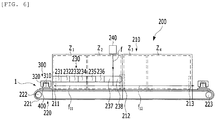
- FIG. 6 illustrates a process in which the piston assembly of FIG. 3 is friction brazed in a piston manufacturing device
- FIG. 7 illustrates an internal temperature distribution of the piston manufacturing device of FIG. 6 .
- the piston assembly indicates a state in which the first piston part 110, the bonding member 130 and the second piston part 120 are assembled to each other before diffusion brazing
- a piston unit indicates a state in which the first and second piston parts 110 and 120 of the piston assembly are brazed to each other in the piston manufacturing device 200 (refer to FIG. 6 ) through a heating process.
- the piston manufacturing device 200 for manufacturing the piston 1 includes a manufacturing device body 210, a heater 230 and a moving unit 220.
- the manufacturing device body 210 includes a heating zone Z 1 and Z 2 and a cooling zone Z 3 and Z 4 which are partially opened, the heater 230 provides heat to the heating zone Z 1 and Z 2 , and the moving unit 220 is moved in one direction through the heating zone Z 1 and Z 2 and the cooling zone Z 3 and Z 4 , with the piston assembly seated on the moving unit 220.
- the heating zone Z 1 and Z 2 communicates with the outside of the piston manufacturing device 200 through a first opening 211 so as to form an open atmosphere, and communicates with the cooling zone Z 3 and Z 4 through a second opening 212. That is, the heating zone Z 1 and Z 2 are formed as a heating furnace which is partially opened.
- the first and second openings 211 and 212 may be formed so as not to open the entire heating zone Z 1 and Z 2 .
- the first and second openings 211 and 212 may partially open the heating zone Z 1 and Z 2 such that the moving unit 220 and the piston assembly can be moved.
- the heating zone Z 1 and Z 2 includes a preheating zone Z 1 and a main heating zone Z 2 which communicate with each other.
- the preheating zone Z 1 is located at the front of the heating zone Z 1 and Z 2 or located adjacent to the first opening 211, and the main heating zone Z 2 may be disposed at the rear of the preheating zone Z 1 .
- the preheating zone Z 1 includes a plurality of sub preheating zones Z 11 to Z 14 disposed in the moving direction of the moving unit 220.
- the main heating zone Z 2 includes a plurality of sub main heating zones Z 21 to Z 24 disposed in the movement direction of the moving unit 220.
- the heater 230 provides high-temperature heat generated by electricity or combustion to the heating zone Z 1 and Z 2 , and includes a plurality of heating units 231 to 238.
- the piston assemblies moved at a predetermined speed through the heating zone Z 1 and Z 2 may be successively preheated by the heat supplied from the heater 230, and then brazed.
- the plurality of heating units 231 to 238 may be arranged in the plurality of sub preheating zones Z 11 to Z 14 and the plurality of sub main heating zones Z 21 to Z 24 , respectively, and each of the heating units 231 to 238 may provide a different amount of heat from the other heating units, such that the internal temperatures of the sub preheating zones Z 11 to Z 14 and the sub main heating zones Z 21 to Z 24 are different from one another.
- the sub preheating zones Z 11 to Z 14 and the sub main heating zones Z 21 to Z 24 may have the same length in one direction or specifically in the movement direction of the moving unit 220. Therefore, while the piston assembly is moved by the moving unit 220, the piston assembly stays in each of the sub preheating zones Z 11 to Z 14 and the sub main heating zones Z 21 to Z 24 for the same time.
- the internal temperature of the first sub preheating zone Z 11 of the sub preheating zones Z 11 to Z 14 may be set to a first preheating temperature Temp 1
- the internal temperature of the second sub preheating zone Z 12 may be set to a second preheating temperature Temp 2
- the internal temperature of the third sub preheating zone Z 13 may be set to the second preheating temperature Temp 2
- the internal temperature of the fourth sub preheating zone Z 14 may be set to a third preheating temperature Temp 3 .
- the first to third preheating temperatures Temp 1 to Temp 3 have a relation of Temp 1 ⁇ Temp 2 ⁇ Temp 3 .
- the first to third preheating temperatures Temp 1 to Temp 3 are lower than the melting temperature of the bonding member 130, and the third preheating temperature Temp 3 is close to the melting temperature of the bonding member 130.
- the first preheating temperature Temp 1 may range from 500°C to 800°C
- the second and third preheating temperatures Temp 2 and Temp 3 may range from 800°C to 1,200°C.
- the temperature of the entire area of the bonding member 130 assembled to the piston assembly may uniformly rise to a temperature close to the melting temperature.
- the internal temperatures of the respective sub main heating zones Z 11 to Z 14 are uniformly maintained at a main heating temperature Temp 4 .
- the main heating temperature Temp 4 is higher than the melting temperature of the bonding member 130, and may range from 1, 000°C to 1, 300°C, for example.
- the bonding member 130 may be made of a tertiary nickel filler metal.
- the melting temperature of the bonding member 130 may range from 950°C to 1,070°C, for example.
- the first to third preheating temperatures Temp 1 to Temp 3 are set to lower temperatures than the range of 950°C to 1, 070°C, which corresponds to the melting temperature of the bonding member 130, and the main heating temperature Temp 4 is set to a higher temperature than the melting temperature.
- the bonding member 130 disposed between the first and second piston parts 110 and 120 of the piston assembly is melted and diffused into the first and second piston parts 110 and 120, such that the bonding surfaces 112 and 113 of the first piston part 110 and the bonding surfaces 122 and 123 of the second piston part 120 are reliably brazed to each other.
- the cooling zone Z 3 and Z 4 includes a first cooling zone Z 3 and a second cooling zone Z 4 communicating with the first cooling zone Z 3 .
- the first cooling zone Z 3 communicates with the heating zone Z 1 and Z 2 through the second opening 212, and the piston unit moved to the first cooling zone Z 3 through the second opening 212 is subjected to a first cooling step.
- the internal temperature of the first cooling zone Z 3 rapidly decreases toward the rear side or the second cooling zone Z 4 from the front side or the second opening 212. That is, the internal temperature of the first cooling zone Z 3 decreases from the main heating temperature Temp 4 to a cooling temperature Temp 5 .
- the cooling temperature Temp 5 may range from 10°C to 100°C, for example. Therefore, the piston unit is rapidly cooled through the first cooling step.
- low-temperature cooling gas may be supplied to the first cooling zone Z 3 .
- the internal temperature of the second cooling zone Z 4 is maintained at a cooling temperature Temp 5 , and the piston unit is subjected to a second cooling step in the second cooling zone Z 4 .
- the piston unit may be cooled at a lower speed than at the first cooling step.
- the second cooling zone Z 4 may communicate with the outside through a third opening 213.
- the length of the second cooling zone Z 4 in the one direction is larger than the length of the first cooling zone Z 3 in the one direction. Therefore, when the piston unit is moved through the first and second cooling zones Z 3 and Z 4 at the same speed, the second cooling step performed in the second cooling zone Z 4 may be performed for a longer time than the first cooling step. For example, the time during which one piston unit stays in the first cooling zone Z 3 may be two to four times longer than the time during which the same piston unit stays in the second cooling zone Z 4 .
- the cooling zone Z 3 and Z 4 is described as a closed space except the second and third openings 212 and 213.
- the entire cooling zone Z 3 and Z 4 may be formed as an open atmosphere without the third opening 213.
- the moving unit 220 moves the piston assembly in one direction, such that the piston assembly is brazed and cooled while being moved through the heating zone Z 1 and Z 2 and the cooling zone Z 3 and Z 4 .
- the moving unit 220 may include a moving mechanism using a conveyer belt, for example, and have a conveyer belt 221 and power units 222 and 223.
- the conveyer belt 221 is moved in one direction with the plurality of piston assemblies seated thereon, and the power units 222 and 223 provide a rotational force to move the conveyer belt 221 in the one direction.
- the conveyer belt 221 according to the present embodiment may be moved at a speed of 5 to 30cm/min, for example.
- a plate-shaped seating member 400 is disposed between the top surface of the conveyer belt 221 and the piston assembly.
- the piston assembly may be stably seated on the seating member 400 while a damage of the piston assembly is prevented.
- the piston assembly including the first piston part 110, the bonding member 130 and the second piston part 120, which are sequentially stacked therein, is seated on the conveyer belt 221. That is, the piston assembly, in which the first piston part 110 having the combustion cavity 115 formed therein is positioned at the bottom and the second piston part 120 having the piston skirt 125 and the pin hole 216 formed therein is positioned at the top, is seated on the conveyer belt 221.
- the boundary surface between the first and second piston parts 110 and 120 may be located at a lower position than the center of gravity of the piston assembly, such that the piston assembly can be more stably transferred.
- the surface of the piston assembly may be oxidized while the piston assembly is subjected to the high-temperature heating step in the opened heating zone Z 1 and Z 2 .
- the piston manufacturing device 200 which performs the method for manufacturing a piston according to the embodiment of the present disclosure further includes a gas mixture supply unit 240.
- the gas mixture supply unit 240 supplies a gas mixture into the heating zone Z 1 and Z 2 , and the gas mixture supplied to the heating zone Z 1 and Z 2 suppresses an oxidation of the piston assemblies moved through the heating zone Z 1 and Z 2 , and is discharged to the outside.
- the gas mixture supply unit 240 has a supply flow path f 1 that is formed downward from a gas discharge port (not illustrated) disposed between the third and fourth sub main heating zones Z 23 and Z 24 , for example. That is, the supply flow path f 1 of the gas mixture is disposed at the rear of the heating zone Z 1 and Z 2 adjacent to the cooling zone Z 3 and Z 4 .
- the gas mixture introduced into the heating zone Z 1 and Z 2 may be discharged to the outside through a discharge flow path f 11 and f 12 in the heating zone Z 1 and Z 2 , facing the first and second openings 211 and 212.
- the gas mixture may include a gas mixture of nitrogen and hydrogen, for example.
- a combustion unit (not illustrated) for removing the hydrogen may be installed at the first and second openings 211 and 212 or the third opening 213. Since nitrogen is an inert gas and hydrogen is a reduction gas, the gas mixture according to the present embodiment may be supplied to the heating zone Z 1 and Z 2 , in order to suppress an oxidation of the piston assemblies during the heating process.
- the productivity can be further improved.
- the matching state of the piston needs to be maintained because the piston assembly is heated and brazed while being moved by the moving unit 220.
- a configuration for maintaining the matching state of the piston assembly while the piston assembly is moved will be described in detail.
- FIG. 8 is a cross-sectional view illustrating that the piston assembly is held by a jig when the piston assembly is seated in the piston manufacturing device of FIG. 6 .
- the piston assembly assembled through the manufacturing method according to the present embodiment is seated on the conveyer belt 221 of the piston manufacturing device 200, and a jig 300 is installed on the piston assembly to press the second piston part 120 against the first piston part 110.
- a jig 300 is installed on the piston assembly to press the second piston part 120 against the first piston part 110.
- the matching state of the piston assembly may be stably maintained.
- the jig 300 includes a first jig 310 and a second jig 320 which are made of a heavy-weight metallic material.
- the first jig 310 is disposed at the center hole 160 of the second piston part 120, and presses the second piston part 120 against the first piston part 110.
- the second jig 320 includes a second jig body 321 having a through-hole 323 formed therein and a pair of pressing parts 322 which extend downward from both ends of the second jig body 321 and are in contact with one surface of the head part 129 of the second piston part 120.
- the second jig body 321 With the second jig 320 installed on the piston assembly, the second jig body 321 is separated at a predetermined distance from the piston assembly. Through the through-hole 323 formed in the second jig body 321, the heat of the heating zone Z 1 and Z 2 may be smoothly transmitted to the piston assembly.
- the jig 300 may provide a uniform pressing force for the piston assembly while the first jig 310 of the jig 300 presses the central portion of the piston assembly and the second jig 320 presses the edge portion of the piston assembly.
- FIGS. 9A and 9B illustrate the metal texture sizes of the piston before and after the piston manufacturing process by the piston manufacturing device of FIG. 6 .
- FIG. 9A is an optical microscope image of a metal texture formed at a cross-section of the piston assembly, before the piston 1 according to the present embodiment is subjected to diffusion brazing
- FIG. 9B is an optical microscope image of a metal texture formed at a cross-section of the piston unit, after the piston 1 is subjected to diffusion brazing and cooling.
- a pearlite structure G 1 in the metal texture formed in the first or second piston part 110 and/or 120 has a grain size corresponding to a first size W 1 , before the manufacturing process by the method for manufacturing a piston according to the present embodiment.
- a pearlite structure G 2 in the metal texture formed in the piston unit has a grain size corresponding to a second size W 2 .
- the first size W 1 is larger than the second size W 2 .
- the first size W 1 ranges from 64 um to 90 um
- the second size W 2 ranges from 32um to 45um.
- the hardness of the piston 1 subjected to the manufacturing process by the piston manufacturing method according to the present embodiment has risen by about 2% to 5% from the hardness of the piston assembly before the manufacturing process.
- the particle size of the metal texture of the piston 1 is reduced while the hardness thereof is increased.
- FIG. 10 is a cross-sectional views illustrating the cooling gallery of the piston unit formed by diffusion brazing the piston assembly in the piston manufacturing device of FIG. 6
- FIG. 11 is an expanded view of a portion XI of FIG. 10 .
- the cooling gallery 140 of the piston 1 manufactured through the manufacturing method according to the present embodiment has a diffusion layer 150 formed on the inner surface thereof, the diffusion layer 150 being formed by diffusion of a portion of the bonding member 130.
- the diffusion layer 150 may include a heterogeneous metal made of a nickel-based alloy contained in the bonding member 130.
- the formation of the diffusion layer 150 on the inner surface of the cooling gallery 140 can improve the heat conductivity and corrosion resistance of the cooling gallery 140.
- the piston body of the piston 1 has a bonding interface I formed in parallel to the top surface of the piston body and passing through the cooling gallery 140.
- the bonding interface I is formed through a bonding between the bonding surfaces of the first and second piston parts 110 and 120, as the bonding member 130 is melted and diffused. From the center A of the bonding interface I toward the outside B of the bonding interface I, the concentration of the metal which is different from the material of the piston body formed of steel, for example, nickel decreases.
- Table 1 shows data obtained by analyzing the components of the bonding interface of the piston of FIG. 11 .
- Location C (%) Si (%) Fe (%) Ni (%)
- a 1.83 8.98 14.34 74.56 B 1.36 2.21 42.13 54.3
- the piston manufacturing method according to the present embodiment when the piston manufacturing method according to the present embodiment is applied, metal diffusion may be smoothly performed at the bonding interface I where the bonding member 130 had been disposed. Therefore, the first and second piston parts 110 and 120 may be stably brazed.
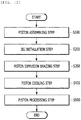
- FIG. 12 illustrates a method for manufacturing a piston for a vehicle engine according to an embodiment of the present disclosure.
- the method for manufacturing a piston for a vehicle engine begins with a piston installation step S100 of aligning the first piston part 110, the bonding member 130 and the second piston part 120 to assemble the piston assembly.
- the jig 300 is installed on the piston assembly, in order to stably maintain the alignment state of the piston assembly, at a jig installation step S200.
- the piston assemblies are seated on the conveyer belt 221 of the piston manufacturing device 200, and successively brazed while being heated in the heating zone Z 1 and Z 2 of the piston manufacturing device 200, at a piston diffusion brazing step S300.
- the piston diffusion brazing step S300 includes a preheating step of heating the piston assembly almost to the melting point of the bonding member 130 and a main heating step of heating the piston assembly preheated through the preheating step at a main heating temperature higher than the melting temperature of the bonding member 130, such that the first and second piston parts 110 and 120 are brazed to each other by diffusion of the bonding member 130.
- the main heating temperature is higher than the melting temperature of the bonding member 130 or lower than the melting temperature of the base material, that is, the first and second piston parts 110 and 120.
- the piston cooling step S400 includes a first cooling step of rapidly cooling the piston unit which has been heated to the main heating temperature through the main heating step and a second cooling step of cooling the piston unit cooled through the first cooling step to the cooling temperature.
- the piston processing step S500 may include a cutting work, for example.
- the piston processing step S500 may also be referred to as a latch part removing step.
- the piston made of steel may be manufactured by the brazing method.
- the upper and lower piston parts can be brazed to each other without flashing.
- piston diffusion brazing can be successively performed to improve the manufacturing efficiency of the piston.
Landscapes
- Engineering & Computer Science (AREA)
- Mechanical Engineering (AREA)
- General Engineering & Computer Science (AREA)
- Chemical & Material Sciences (AREA)
- Combustion & Propulsion (AREA)
- Pistons, Piston Rings, And Cylinders (AREA)
Abstract
Description
- This application claims benefit of priority to Korean Patent Application No.
10-2016-0165767 filed on Dec. 7, 2016 - The present disclosure relates to a piston for a vehicle engine and a method for manufacturing the same, and more particularly, to a piston for a vehicle engine, which has a cooling gallery formed therein, and a method for manufacturing the same.
- The internal combustion engine of a vehicle includes a piston made of steel. The piston has a cooling gallery that rapidly cools high-temperature heat generated during a fuel combustion process, in order to prevent a damage of the piston.
- In order to form the cooling gallery, an upper piston part having a valve pocket and combustion cavity formed therein and a lower piston part having a piston skirt and piston pin hole formed therein are separately manufactured and welded to each other.
- Examples of the method for welding the upper and lower piston parts to each other may include friction welding, brazing and the like.
- US Patent Registration No.
6,260,472 discloses a process of manufacturing a steel piston through friction welding. However, during a process of welding upper and lower piston parts through friction welding, flashing may be formed and remain in a cooling gallery, thereby disturbing a fluid flow in the cooling gallery. - US Patent Registration No.
8,991,046 discloses a process of manufacturing a steel piston through brazing bonding. According to this process, heating and cooling are performed in a sealed chamber. Thus, the productivity of the process is inevitably degraded. - An object of the present disclosure is to provide a piston for a vehicle engine and a method for manufacturing the same, which can improve productivity.
- According to an embodiment of the present disclosure, a method for manufacturing a piston for a vehicle engine includes: a piston assembling step of forming a piston assembly by assembling a first piston part, a bonding member and a second piston part, wherein the first piston part has two or more bonding surfaces separated from each other and extended in a circumferential direction, and the second piston part has two or more bonding surfaces separated from each other and extended in the circumferential direction; a piston diffusion brazing step of diffusion brazing the first piston part, the bonding member and the second piston part under an open atmosphere by heating the formed piston assembly; and a piston cooling step of cooling a piston unit formed by diffusion brazing the first piston part, the bonding member and the second piston part. The piston diffusion brazing step is performed in a piston manufacturing device which includes a partially opened heating zone, a heater for providing heat into the heating zone, and a moving unit moved in one direction in the heating zone. In the piston diffusion brazing step, the piston assembly is heated while being moved at a predetermined speed through the heating zone in one direction by the moving unit.
- In the piston assembling step, the bonding surfaces of the first piston part may include a ring-shaped first bonding surface and a second bonding surface disposed further inside than the first bonding surface, the bonding surfaces of the second piston part may include a ring-shaped third bonding surface and a fourth bonding surface disposed further inside than the third bonding surface, and the first and second bonding surfaces of the first piston part may face the third and fourth bonding surfaces of the second piston part, respectively, with the bonding member interposed therebetween.
- The bonding member may include a bonding member body formed in a circular plate shape, and have a through-hole formed in the center of the bonding member body. One surface of the bonding member body may be in contact with the first and second bonding surfaces, and the other surface of the bonding member body may be in contact with the third and fourth bonding surfaces.
- The first and second piston parts may be made of steel, and the bonding member may be made of a nickel-based alloy. In the piston diffusion brazing step, a diffusion layer containing a nickel-based alloy may be formed on the inner surface of a cooling gallery formed by bonding the first and second bonding surfaces of the first piston part and the third and fourth bonding surfaces of the second piston part, respectively.
- The piston diffusion brazing step may include: a preheating step of heating the piston assembly formed at room temperature to a preheating temperature from the room temperature, the preheating temperature being lower than the melting temperature of the bonding member; and a main heating step of diffusion brazing the first piston part, the bonding member and the second piston part of the piston assembly by heating the piston assembly heated to the preheating temperature through the preheating step at a main heating temperature higher than the melting temperature of the bonding member.
- The preheating step may be performed in a preheating zone of the heating zone, the preheating zone including two or more sub preheating zones, a first preheating temperature of a first sub preheating zone may be lower than a second preheating temperature of a second sub preheating zone disposed at the rear of the first sub preheating zone, and the preheating temperatures of the sub preheating zones may be constantly maintained.
- The first preheating temperature may be higher than 500°C and lower than 800°C, and the second preheating temperature may be higher than 800°C and lower than 1,200°C.
- The main heating step may be performed in a main heating zone which is disposed at the rear of the preheating zone of the heating zone and communicates with the preheating zone, and the main heating zone may have an internal temperature maintained at the main heating temperature.
- The main heating temperature may be higher than 1, 000°C and lower than 1,300°C.
- The second piston part may include a piston skirt and a piston pin hole, and the plurality of piston assemblies each including the first piston part, the bonding member and the second piston part, which are sequentially stacked, may be successively moved by the moving unit.
- The method may further include a jig installation step of installing a jig for maintaining an alignment state of the first piston part, the bonding member and the second piston part, after the piston assembly is formed. The jig may press the second piston part against the first piston part.
- A gas mixture may be supplied to the heating zone, and then discharged to the outside through the heating zone.
- The heating zone may include a preheating zone and a main heating zone disposed at the rear of the preheating zone, and the gas mixture may be introduced into the heating zone through a gas discharge port installed in the main heating zone.
- The piston manufacturing device may further include a cooling zone disposed at the rear of the heating zone and having first and second cooling zones communicating with each other, wherein the first cooling zone has an internal temperature that decreases to a cooling temperature from a main heating temperature higher than the melting temperature of the bonding member, and the second cooling zone communicates with the first cooling zone and has an internal temperature maintained at the cooling temperature. The piston cooling step may include: a first cooling step of cooling the piston unit in the first cooling zone; and a second cooling step of cooling the piston unit subjected to the first cooling step in the second cooling zone.
- The time during which one piston unit stays in the second cooling zone may be two to four times longer than the time during which the same piston unit stays in the first cooling zone.
- Any one of the first and second piston parts may further include a latch part protruding in a ring shape to cover a portion of the other piston part, and the method may further include a piston processing step of removing the latch part from the cooled piston unit.
- The piston unit subjected to the piston cooling step may have a smaller metal grain size than the piston assembly before the piston assembling step.
- According to another embodiment of the present disclosure, a piston for a vehicle engine includes a piston unit made of steel and having a piston body and a cooling gallery formed in the piston body. The piston body has a bonding interface formed in parallel to the top surface of the piston body and passing through the cooling gallery, and the concentration of a metal different from the material of the piston body decreases from the center of the bonding interface toward the outside of the bonding surface.
- According to another embodiment of the present disclosure, a method for manufacturing a piston for a vehicle engine includes: a piston assembling step of forming a piston assembly by assembling a first piston part, a bonding member and a second piston part, wherein the first piston part has two or more bonding surfaces separated from each other and extended in a circumferential direction, and the second piston part has two or more bonding surfaces separated from each other and extended in the circumferential direction; a piston diffusion brazing step of diffusion brazing the first piston part, the bonding member and the second piston part under an open atmosphere by heating the formed piston assembly; and a piston cooling step of cooling a piston unit formed by diffusion brazing the first piston part, the bonding member and the second piston part. The piston diffusion brazing step is performed in a piston manufacturing device including a partially opened heating zone, a heater for providing heat into the heating zone, and a moving unit moved in one direction in the heating zone. In the piston diffusion brazing step, the piston assembly is heated while being moved at a predetermined speed through the heating zone in the one direction by the moving unit.
- A diffusion layer containing the different metal may be formed on the inner surface of the cooling gallery, and the different metal may include a nickel-based alloy.
- According to the embodiments of the present disclosure, since the piston for a vehicle engine and the method for manufacturing the same can improve the productivity, a large quantity of pistons for a vehicle engine can be manufactured at a lower cost for a shorter time.
-
-
FIG. 1 illustrates a cross-section of a piston for a vehicle engine according to an embodiment of the present disclosure. -
FIG. 2 illustrates a state before upper and lower piston parts of the piston ofFIG. 1 are assembled. -
FIG. 3 illustrates a piston assembly in which the upper piston part, the lower piston part and a bonding member ofFIG. 2 are assembled. -
FIG. 4 is an expanded view of a portion VI ofFIG. 3 . -
FIG. 5 illustrates the bonding member ofFIG. 1 . -
FIG. 6 illustrates a process in which the piston assembly ofFIG. 3 is diffusion brazed in a piston manufacturing device. -
FIG. 7 illustrates an internal temperature distribution of the piston manufacturing device ofFIG. 6 . -
FIG. 8 is a cross-sectional view illustrating that the piston assembly is held by a jig when the piston assembly is seated in the piston manufacturing device ofFIG. 6 . -
FIGS. 9A and 9B illustrate the metal texture sizes of the piston before and after the piston manufacturing process by the piston manufacturing device ofFIG. 6 . -
FIG. 10 is a cross-sectional views illustrating the cooling gallery of the piston unit formed by diffusion brazing the piston assembly in the piston manufacturing device ofFIG. 6 . -
FIG. 11 is an expanded view of a portion XI ofFIG. 10 . -
FIG. 12 illustrates a method for manufacturing a piston for a vehicle engine according to an embodiment of the present disclosure. - Hereinafter, embodiments of the present disclosure will be described with reference to the accompanying drawings, such that this disclosure will be thorough and complete and fully convey the scope of the present disclosure to those skilled in the art.
- The present disclosure may be implemented in various manners, and is not limited to embodiments described herein. In the drawings, components which are not related to the descriptions are omitted in order to clearly describe the present disclosure. Throughout the specification, like reference numerals refer to like components. Furthermore, since the sizes and thickness of components in the drawings are arbitrarily set for convenience of description, they are not limited to the drawings.
- In the present disclosure, "over/on" indicates that an element is positioned over or under a target member, and does not necessarily indicate that the element is positioned over/on the target member based on the direction of gravity. Throughout the specification, when an element is referred to as "including" a component, it may indicate that the element does not exclude another component but can include another component, unless referred to the contrary.
- Hereafter, a piston for a vehicle engine and a method for manufacturing the same according to embodiments of the present disclosure will be described in detail with reference to the accompanying drawings.
-
FIG. 1 illustrates a cross-section of a piston for a vehicle engine according to an embodiment of the present disclosure. - Referring to
FIG. 1 , thepiston 1 for an engine vehicle according to the embodiment of the present disclosure includes a piston body 100 formed by diffusion brazing first andsecond piston parts 110 and 120 (refer toFIG. 2 ) to each other, the first andsecond piston parts cooling gallery 140 formed in the top thereof, thecooling gallery 140 serving to cool high-temperature heat generated through a combustion process in a cylinder. The piston body 100 has apin hole 126 formed at the bottom thereof, such that apiston skirt 125 and a piston pin (not illustrated) are housed in thepin hole 126. - In order to form the
cooling gallery 140 of thepiston 1 for a vehicle engine according to the embodiment of the present disclosure, each of the first andsecond piston parts second piston parts cooling gallery 140 in the piston body 100. -
FIG. 2 illustrates a state before upper and lower piston parts of the piston for the vehicle engine ofFIG. 1 are assembled, andFIG. 3 illustrates a piston assembly in which the upper piston part, the lower piston part and a bonding member ofFIG. 2 are assembled.FIG. 4 is an expanded view of a portion VI ofFIG. 3 , andFIG. 5 illustrates the bonding member ofFIG. 1 . - Referring to
FIGS. 2 to 5 , thefirst piston part 110 forms the upper portion of thepiston 1, acombustion cavity 115 is formed in the center of thefirst piston part 110, and first and second bonding surfaces 112 and 113 extended in the circumferential direction and separated from each other are formed on the bottom surface of thefirst piston part 110. Between the first and second bonding surfaces 112 and 113, afirst groove 114 is formed. Thesecond bonding surface 113 is disposed at an inner position closer to the center of thefirst piston part 110 than thefirst bonding surface 112. - The
second piston part 120 forms the lower portion of thepiston 1, and thepiston skirt 125 and thepiston pin hole 126 are formed in thesecond piston part 120. - Like the
first piston part 110, thesecond piston part 120 has third and fourth bonding surfaces 122 and 123 formed at the top surface thereof, the third and fourth bonding surfaces 122 and 123 being extended in the circumferential direction and separated from each other. Between the third and fourth bonding surfaces 122 and 123, asecond groove 124 is formed. Thefourth bonding surface 123 is disposed at an inner position closer to the center of thesecond piston part 120 than thethird bonding surface 122. - Furthermore, a
latch part 127 protrudes upward from the edge of thethird bonding surface 122, which is separated from thesecond groove 124. Thelatch part 127 is formed along the circumferential direction or formed in a ring shape. Thelatch part 127 has an outer diameter corresponding to the diameter of thecombustion cavity 115 formed through the center of thefirst piston part 110. - With the first and
second piston parts latch part 127 of thesecond piston part 120 may be inserted into thecombustion cavity 115 of thefirst piston part 110 so as to cover a portion of thefirst piston part 110 or specifically the inner circumference of thefirst piston part 110, which makes it possible to maintain the state in which the first andsecond piston parts - Meanwhile, the
first piston part 110 has afirst cut portion 118 which is obliquely formed at the inner circumference thereof, that is, at the inner end of thesecond bonding surface 113, and arounted portion 128 having a predetermined curvature radius of 0.2 mm to 0.7 mm, for example, is formed at the connection between thelatch part 127 and thefourth bonding surface 123 of thesecond piston part 120. Furthermore, thelatch part 127 has asecond cut portion 129 formed at the upper end thereof, thesecond cut portion 129 being obliquely formed toward the inner circumference of thefirst piston part 110. - The
first cut portion 118, thesecond cut portion 129 and therounted portion 128 can prevent an interference between the first andsecond piston parts second piston parts - In the present embodiment, it has been described that the
latch part 127 is formed in thesecond piston part 120. However, thelatch part 127 may be formed in thefirst piston part 110, or formed at the outer circumference of the first orsecond piston part - With the first and
second piston parts bonding member 130 is disposed between the first andsecond piston parts - The
bonding member 130 includes abonding member body 131 formed in a circular plate shape, and has a through-hole 132 formed in the center of thebonding member body 131. Thebonding member 130 may be formed of a nickel-based alloy, for example. In the present embodiment, thebonding member 130 may be formed of a tertiary nickel filler metal. For example, thebonding member 130 may be provided as a metal thin film with a thickness of 50um to 200um. - The
bonding member body 131 has a diameter corresponding to the diameter of the bottom surface of thefirst piston part 110 or the top surface of thesecond piston part 120, and the through-hole 132 has a diameter corresponding to the diameter of thelatch part 127 formed in thesecond piston part 120. Therefore, with thefirst piston part 110, thebonding member 130 and thesecond piston part 120 assembled to form a piston assembly, an arrangement interference between the bondingmember 130 and thelatch part 127 can be suppressed. - When the
first piston part 110, thebonding member 130 and thesecond piston part 120 are assembled to form the piston assembly, one surface of thebonding member 130 is in contact with the first and second bonding surfaces 112 and 113 of thefirst piston part 110, and the other surface of thebonding member 130 is in contact with the third and fourth bonding surfaces 122 and 123 of thesecond piston part 120. The first and second bonding surfaces 112 and 113 face the third and fourth bonding surfaces 122 and 123, respectively, with thebonding member 130 interposed therebetween. Between thefirst groove 114 of thefirst piston part 110 and thesecond groove 124 of thesecond piston part 120, a portion of thebonding member 130 is positioned. - When the bonding surfaces 112 and 113 and the bonding surfaces 122 and 123 are joined to each other by heating and diffusion brazing the
first piston part 110, thebonding member 130 and thesecond piston part 120, thefirst groove 114 of thefirst piston part 110 and thesecond groove 124 of thesecond piston part 120 form thecooling gallery 140. At this time, the portion of thebonding member 130, which had been disposed between the first andsecond grooves cooling gallery 140, thereby forming a diffusion layer 150 (refer toFIG. 10 ) on the inner surface of thecooling gallery 140, the diffusion layer 150 containing a heterogeneous metal, for example, a nickel-based alloy. - Hereafter, a process of manufacturing the
piston 1 according to the embodiment of the present disclosure will be described in detail. -
FIG. 6 illustrates a process in which the piston assembly ofFIG. 3 is friction brazed in a piston manufacturing device, andFIG. 7 illustrates an internal temperature distribution of the piston manufacturing device ofFIG. 6 . - In the following descriptions, the piston assembly indicates a state in which the
first piston part 110, thebonding member 130 and thesecond piston part 120 are assembled to each other before diffusion brazing, and a piston unit indicates a state in which the first andsecond piston parts FIG. 6 ) through a heating process. - Referring to
FIGS. 6 and7 , thepiston manufacturing device 200 for manufacturing thepiston 1 according to the present embodiment includes amanufacturing device body 210, aheater 230 and a movingunit 220. Themanufacturing device body 210 includes a heating zone Z1 and Z2 and a cooling zone Z3 and Z4 which are partially opened, theheater 230 provides heat to the heating zone Z1 and Z2, and the movingunit 220 is moved in one direction through the heating zone Z1 and Z2 and the cooling zone Z3 and Z4, with the piston assembly seated on the movingunit 220. - The heating zone Z1 and Z2 communicates with the outside of the
piston manufacturing device 200 through afirst opening 211 so as to form an open atmosphere, and communicates with the cooling zone Z3 and Z4 through asecond opening 212. That is, the heating zone Z1 and Z2 are formed as a heating furnace which is partially opened. - At this time, the first and
second openings second openings unit 220 and the piston assembly can be moved. - The heating zone Z1 and Z2 includes a preheating zone Z1 and a main heating zone Z2 which communicate with each other. The preheating zone Z1 is located at the front of the heating zone Z1 and Z2 or located adjacent to the
first opening 211, and the main heating zone Z2 may be disposed at the rear of the preheating zone Z1. - The preheating zone Z1 includes a plurality of sub preheating zones Z11 to Z14 disposed in the moving direction of the moving
unit 220. - Similarly, the main heating zone Z2 includes a plurality of sub main heating zones Z21 to Z24 disposed in the movement direction of the moving
unit 220. - The
heater 230 provides high-temperature heat generated by electricity or combustion to the heating zone Z1 and Z2, and includes a plurality of heating units 231 to 238. The piston assemblies moved at a predetermined speed through the heating zone Z1 and Z2 may be successively preheated by the heat supplied from theheater 230, and then brazed. - At this time, the plurality of heating units 231 to 238 may be arranged in the plurality of sub preheating zones Z11 to Z14 and the plurality of sub main heating zones Z21 to Z24, respectively, and each of the heating units 231 to 238 may provide a different amount of heat from the other heating units, such that the internal temperatures of the sub preheating zones Z11 to Z14 and the sub main heating zones Z21 to Z24 are different from one another. The sub preheating zones Z11 to Z14 and the sub main heating zones Z21 to Z24 may have the same length in one direction or specifically in the movement direction of the moving
unit 220. Therefore, while the piston assembly is moved by the movingunit 220, the piston assembly stays in each of the sub preheating zones Z11 to Z14 and the sub main heating zones Z21 to Z24 for the same time. - In the present embodiment, the internal temperature of the first sub preheating zone Z11 of the sub preheating zones Z11 to Z14 may be set to a first preheating temperature Temp1, the internal temperature of the second sub preheating zone Z12 may be set to a second preheating temperature Temp2, the internal temperature of the third sub preheating zone Z13 may be set to the second preheating temperature Temp2, and the internal temperature of the fourth sub preheating zone Z14 may be set to a third preheating temperature Temp3.
- The first to third preheating temperatures Temp1 to Temp3 have a relation of Temp1 < Temp2 < Temp3. The first to third preheating temperatures Temp1 to Temp3 are lower than the melting temperature of the
bonding member 130, and the third preheating temperature Temp3 is close to the melting temperature of thebonding member 130. - For example, the first preheating temperature Temp1 may range from 500°C to 800°C, and the second and third preheating temperatures Temp2 and Temp3 may range from 800°C to 1,200°C.
- That is, since the piston assembly is preheated in the preheating zones Z11 to Z14, the temperature of the entire area of the
bonding member 130 assembled to the piston assembly may uniformly rise to a temperature close to the melting temperature. - Meanwhile, the internal temperatures of the respective sub main heating zones Z11 to Z14 are uniformly maintained at a main heating temperature Temp4. At this time, the main heating temperature Temp4 is higher than the melting temperature of the
bonding member 130, and may range from 1, 000°C to 1, 300°C, for example. - In the present embodiment, the
bonding member 130 may be made of a tertiary nickel filler metal. In this case, the melting temperature of thebonding member 130 may range from 950°C to 1,070°C, for example. The first to third preheating temperatures Temp1 to Temp3 are set to lower temperatures than the range of 950°C to 1, 070°C, which corresponds to the melting temperature of thebonding member 130, and the main heating temperature Temp4 is set to a higher temperature than the melting temperature. - While the piston assembly is subjected to the main heating step in the main heating zone Z2, the
bonding member 130 disposed between the first andsecond piston parts second piston parts first piston part 110 and the bonding surfaces 122 and 123 of thesecond piston part 120 are reliably brazed to each other. - The cooling zone Z3 and Z4 includes a first cooling zone Z3 and a second cooling zone Z4 communicating with the first cooling zone Z3.
- The first cooling zone Z3 communicates with the heating zone Z1 and Z2 through the
second opening 212, and the piston unit moved to the first cooling zone Z3 through thesecond opening 212 is subjected to a first cooling step. The internal temperature of the first cooling zone Z3 rapidly decreases toward the rear side or the second cooling zone Z4 from the front side or thesecond opening 212. That is, the internal temperature of the first cooling zone Z3 decreases from the main heating temperature Temp4 to a cooling temperature Temp5. At this time, the cooling temperature Temp5 may range from 10°C to 100°C, for example. Therefore, the piston unit is rapidly cooled through the first cooling step. - At this time, in order to rapidly lower the internal temperature of the first cooling zone Z3, low-temperature cooling gas may be supplied to the first cooling zone Z3.
- The internal temperature of the second cooling zone Z4 is maintained at a cooling temperature Temp5, and the piston unit is subjected to a second cooling step in the second cooling zone Z4. At the second cooling step, the piston unit may be cooled at a lower speed than at the first cooling step. The second cooling zone Z4 may communicate with the outside through a
third opening 213. - The length of the second cooling zone Z4 in the one direction is larger than the length of the first cooling zone Z3 in the one direction. Therefore, when the piston unit is moved through the first and second cooling zones Z3 and Z4 at the same speed, the second cooling step performed in the second cooling zone Z4 may be performed for a longer time than the first cooling step. For example, the time during which one piston unit stays in the first cooling zone Z3 may be two to four times longer than the time during which the same piston unit stays in the second cooling zone Z4.
- In the present embodiment, the cooling zone Z3 and Z4 is described as a closed space except the second and
third openings third opening 213. - The moving
unit 220 moves the piston assembly in one direction, such that the piston assembly is brazed and cooled while being moved through the heating zone Z1 and Z2 and the cooling zone Z3 and Z4. - The moving
unit 220 may include a moving mechanism using a conveyer belt, for example, and have aconveyer belt 221 andpower units conveyer belt 221 is moved in one direction with the plurality of piston assemblies seated thereon, and thepower units conveyer belt 221 in the one direction. Theconveyer belt 221 according to the present embodiment may be moved at a speed of 5 to 30cm/min, for example. - Between the top surface of the
conveyer belt 221 and the piston assembly, a plate-shapedseating member 400 is disposed. Thus, the piston assembly may be stably seated on theseating member 400 while a damage of the piston assembly is prevented. - The piston assembly including the
first piston part 110, thebonding member 130 and thesecond piston part 120, which are sequentially stacked therein, is seated on theconveyer belt 221. That is, the piston assembly, in which thefirst piston part 110 having thecombustion cavity 115 formed therein is positioned at the bottom and thesecond piston part 120 having thepiston skirt 125 and the pin hole 216 formed therein is positioned at the top, is seated on theconveyer belt 221. The boundary surface between the first andsecond piston parts - Meanwhile, when the heating zone Z1 and Z2 of the
piston manufacturing device 200 is partially opened, the surface of the piston assembly may be oxidized while the piston assembly is subjected to the high-temperature heating step in the opened heating zone Z1 and Z2. - Therefore, the
piston manufacturing device 200 which performs the method for manufacturing a piston according to the embodiment of the present disclosure further includes a gasmixture supply unit 240. The gasmixture supply unit 240 supplies a gas mixture into the heating zone Z1 and Z2, and the gas mixture supplied to the heating zone Z1 and Z2 suppresses an oxidation of the piston assemblies moved through the heating zone Z1 and Z2, and is discharged to the outside. - The gas
mixture supply unit 240 has a supply flow path f1 that is formed downward from a gas discharge port (not illustrated) disposed between the third and fourth sub main heating zones Z23 and Z24, for example. That is, the supply flow path f1 of the gas mixture is disposed at the rear of the heating zone Z1 and Z2 adjacent to the cooling zone Z3 and Z4. - The gas mixture introduced into the heating zone Z1 and Z2 may be discharged to the outside through a discharge flow path f11 and f12 in the heating zone Z1 and Z2, facing the first and
second openings - The gas mixture may include a gas mixture of nitrogen and hydrogen, for example. In this case, a combustion unit (not illustrated) for removing the hydrogen may be installed at the first and
second openings third opening 213. Since nitrogen is an inert gas and hydrogen is a reduction gas, the gas mixture according to the present embodiment may be supplied to the heating zone Z1 and Z2, in order to suppress an oxidation of the piston assemblies during the heating process. - In the present embodiment, since the piston assemblies are successively transferred into the
piston manufacturing device 200 and then brazed and cooled therein, the productivity can be further improved. - Meanwhile, when the method for manufacturing a piston according to the present embodiment is applied, the matching state of the piston needs to be maintained because the piston assembly is heated and brazed while being moved by the moving
unit 220. Hereafter, a configuration for maintaining the matching state of the piston assembly while the piston assembly is moved will be described in detail. -
FIG. 8 is a cross-sectional view illustrating that the piston assembly is held by a jig when the piston assembly is seated in the piston manufacturing device ofFIG. 6 . - Referring to
FIG. 8 , the piston assembly assembled through the manufacturing method according to the present embodiment is seated on theconveyer belt 221 of thepiston manufacturing device 200, and ajig 300 is installed on the piston assembly to press thesecond piston part 120 against thefirst piston part 110. Thus, the matching state of the piston assembly may be stably maintained. - The
jig 300 includes afirst jig 310 and asecond jig 320 which are made of a heavy-weight metallic material. - The
first jig 310 is disposed at thecenter hole 160 of thesecond piston part 120, and presses thesecond piston part 120 against thefirst piston part 110. - The
second jig 320 includes asecond jig body 321 having a through-hole 323 formed therein and a pair ofpressing parts 322 which extend downward from both ends of thesecond jig body 321 and are in contact with one surface of thehead part 129 of thesecond piston part 120. With thesecond jig 320 installed on the piston assembly, thesecond jig body 321 is separated at a predetermined distance from the piston assembly. Through the through-hole 323 formed in thesecond jig body 321, the heat of the heating zone Z1 and Z2 may be smoothly transmitted to the piston assembly. - According to the present embodiment, the
jig 300 may provide a uniform pressing force for the piston assembly while thefirst jig 310 of thejig 300 presses the central portion of the piston assembly and thesecond jig 320 presses the edge portion of the piston assembly. -
FIGS. 9A and 9B illustrate the metal texture sizes of the piston before and after the piston manufacturing process by the piston manufacturing device ofFIG. 6 . -
FIG. 9A is an optical microscope image of a metal texture formed at a cross-section of the piston assembly, before thepiston 1 according to the present embodiment is subjected to diffusion brazing, andFIG. 9B is an optical microscope image of a metal texture formed at a cross-section of the piston unit, after thepiston 1 is subjected to diffusion brazing and cooling. - Referring to
FIGS. 9A and 9B , a pearlite structure G1 in the metal texture formed in the first orsecond piston part 110 and/or 120 has a grain size corresponding to a first size W1, before the manufacturing process by the method for manufacturing a piston according to the present embodiment. - After the manufacturing process, a pearlite structure G2 in the metal texture formed in the piston unit has a grain size corresponding to a second size W2.
- At this time, the first size W1 is larger than the second size W2. For example, the first size W1 ranges from 64 um to 90 um, and the second size W2 ranges from 32um to 45um.
- Furthermore, the hardness of the
piston 1 subjected to the manufacturing process by the piston manufacturing method according to the present embodiment has risen by about 2% to 5% from the hardness of the piston assembly before the manufacturing process. - When the piston manufacturing method according to the present embodiment is applied, the particle size of the metal texture of the
piston 1 is reduced while the hardness thereof is increased. -
FIG. 10 is a cross-sectional views illustrating the cooling gallery of the piston unit formed by diffusion brazing the piston assembly in the piston manufacturing device ofFIG. 6 , andFIG. 11 is an expanded view of a portion XI ofFIG. 10 . - Referring to
FIG. 10 and11 , thecooling gallery 140 of thepiston 1 manufactured through the manufacturing method according to the present embodiment has a diffusion layer 150 formed on the inner surface thereof, the diffusion layer 150 being formed by diffusion of a portion of thebonding member 130. - The diffusion layer 150 may include a heterogeneous metal made of a nickel-based alloy contained in the
bonding member 130. The formation of the diffusion layer 150 on the inner surface of thecooling gallery 140 can improve the heat conductivity and corrosion resistance of thecooling gallery 140. - Meanwhile, the piston body of the
piston 1 has a bonding interface I formed in parallel to the top surface of the piston body and passing through thecooling gallery 140. - The bonding interface I is formed through a bonding between the bonding surfaces of the first and
second piston parts bonding member 130 is melted and diffused. From the center A of the bonding interface I toward the outside B of the bonding interface I, the concentration of the metal which is different from the material of the piston body formed of steel, for example, nickel decreases. - Table 1 shows data obtained by analyzing the components of the bonding interface of the piston of
FIG. 11 .[Table 1] Location C (%) Si (%) Fe (%) Ni (%) A 1.83 8.98 14.34 74.56 B 1.36 2.21 42.13 54.3 - That is, when the piston manufacturing method according to the present embodiment is applied, metal diffusion may be smoothly performed at the bonding interface I where the
bonding member 130 had been disposed. Therefore, the first andsecond piston parts -
FIG. 12 illustrates a method for manufacturing a piston for a vehicle engine according to an embodiment of the present disclosure. - Referring to
FIG. 12 , the method for manufacturing a piston for a vehicle engine according to the present embodiment begins with a piston installation step S100 of aligning thefirst piston part 110, thebonding member 130 and thesecond piston part 120 to assemble the piston assembly. - Then, the
jig 300 is installed on the piston assembly, in order to stably maintain the alignment state of the piston assembly, at a jig installation step S200. - Then, the piston assemblies are seated on the
conveyer belt 221 of thepiston manufacturing device 200, and successively brazed while being heated in the heating zone Z1 and Z2 of thepiston manufacturing device 200, at a piston diffusion brazing step S300. - The piston diffusion brazing step S300 includes a preheating step of heating the piston assembly almost to the melting point of the
bonding member 130 and a main heating step of heating the piston assembly preheated through the preheating step at a main heating temperature higher than the melting temperature of thebonding member 130, such that the first andsecond piston parts bonding member 130. - At this time, the main heating temperature is higher than the melting temperature of the
bonding member 130 or lower than the melting temperature of the base material, that is, the first andsecond piston parts - Then, the piston unit formed by diffusion brazing the piston assembly is cooled at a piston cooling step S400.
- The piston cooling step S400 includes a first cooling step of rapidly cooling the piston unit which has been heated to the main heating temperature through the main heating step and a second cooling step of cooling the piston unit cooled through the first cooling step to the cooling temperature.
- Then, the
latch part 127 protruding toward thecombustion cavity 115 of the piston unit which has been completely cooled is removed to process the piston unit, at a piston processing step S500. The piston processing step S500 may include a cutting work, for example. At this time, the piston processing step S500 may also be referred to as a latch part removing step. - According to the present embodiment, the piston made of steel may be manufactured by the brazing method. Thus, the upper and lower piston parts can be brazed to each other without flashing.
- Furthermore, as the piston manufacturing process is performed under an open atmosphere, piston diffusion brazing can be successively performed to improve the manufacturing efficiency of the piston.
- Although the representative embodiments of the present disclosure have been disclosed in detail, those having ordinary skill in the field of technology to which the present disclosure pertains would understand that various modifications are possible, without departing from the scope of the present disclosure. Accordingly, the scope of the present disclosure should not be construed as being limited to the described embodiments but be defined by the appended claims as well as equivalents thereof.
Claims (15)
- A method for manufacturing a piston for a vehicle engine, comprising:a piston assembling step of forming a piston assembly by assembling a first piston part, a bonding member and a second piston part, wherein the first piston part has two or more bonding surfaces separated from each other and extended in a circumferential direction, and the second piston part has two or more bonding surfaces separated from each other and extended in the circumferential direction;a piston diffusion brazing step of diffusion brazing the first piston part, the bonding member and the second piston part under an open atmosphere by heating the formed piston assembly; anda piston cooling step of cooling a piston unit formed by diffusion brazing the first piston part, the bonding member and the second piston part,wherein the piston diffusion brazing step is performed in a piston manufacturing device including a partially opened heating zone, a heater for providing heat into the heating zone, and a moving unit moved in one direction in the heating zone, andwherein in the piston diffusion brazing step, the piston assembly is heated while being moved at a predetermined speed through the heating zone in the one direction by the moving unit.
- The method of claim 1, wherein in the piston assembling step,
the bonding surfaces of the first piston part comprise a ring-shaped first bonding surface and a second bonding surface disposed further inside than the first bonding surface,
the bonding surfaces of the second piston part comprise a ring-shaped third bonding surface and a fourth bonding surface disposed further inside than the third bonding surface,
the first and second bonding surfaces of the first piston part face the third and fourth bonding surfaces of the second piston part, respectively, with the bonding member interposed therebetween,
the bonding member comprises a bonding member body formed in a circular plate shape, and has a through-hole formed in the center of the bonding member body, and
one surface of the bonding member body is in contact with the first and second bonding surfaces, and the other surface of the bonding member body is in contact with the third and fourth bonding surfaces. - The method of claim 2, wherein the first and second piston parts are made of steel, and the bonding member is made of a nickel-based alloy,
wherein in the piston diffusion brazing step, a diffusion layer containing a nickel-based alloy is formed on the inner surface of a cooling gallery formed by bonding the first and second bonding surfaces of the first piston part to the third and fourth bonding surfaces of the second piston part, respectively. - The method of any of claims 1 to 3, wherein the piston diffusion brazing step comprises:a preheating step of heating the piston assembly formed at room temperature to a preheating temperature from the room temperature, the preheating temperature being lower than the melting temperature of the bonding member; anda main heating step of diffusion brazing the first piston part, the diffusion brazing member and the second piston part of the piston assembly, by heating the piston assembly heated to the preheating temperature through the preheating step to a main heating temperature higher than the melting temperature of the bonding member.
- The method of claim 4, wherein the preheating step is performed in a preheating zone of the heating zone, the preheating zone including two or more sub preheating zones,
a first preheating temperature of a first sub preheating zone is lower than a second preheating temperature of a second sub preheating zone disposed at the rear of the first sub preheating zone,
the preheating temperatures of the sub preheating zones are constantly maintained,
the first preheating temperature is higher than 500°C and lower than 800°C, and
the second preheating temperature is higher than 800°C and lower than 1,200°C. - The method of claim 4 or 5, wherein the main heating step is performed in a main heating zone disposed at the rear of the preheating zone of the heating zone, and communicating with the preheating zone,
the main heating zone has an internal temperature maintained at the main heating temperature, and
the main heating temperature is higher than 1,000°C and lower than 1,300°C. - The method of any of preceding claims, wherein the second piston part comprises a piston skirt and a piston pin hole, and
wherein a plurality of the piston assemblies, each including the first piston part, the bonding member and the second piston part sequentially stacked, are successively moved by the moving unit. - The method of any of preceding claims, further comprising a jig installation step of installing a jig for maintaining an alignment state of the first piston part, the bonding member and the second piston part, after the piston assembly is formed,
wherein the jig presses the second piston part against the first piston part. - The method of any of claims 1 to 4, wherein a gas mixture is supplied to the heating zone, and then discharged outside through the heating zone,
the heating zone comprises a preheating zone and a main heating zone disposed at the rear of the preheating zone, and
the gas mixture is introduced into the heating zone through a gas discharge port installed in the main heating zone. - The method of any of preceding claims, wherein the piston manufacturing device further comprise a cooling zone disposed at the rear of the heating zone and including first and second cooling zones communicating with each other, wherein the first cooling zone has an internal temperature that decreases to a cooling temperature from a main heating temperature higher than the melting temperature of the bonding member, and the second cooling zone communicates with the first cooling zone and has an internal temperature maintained at the cooling temperature,
the piston cooling step comprises:a first cooling step of cooling the piston unit in the first cooling zone; anda second cooling step of cooling the piston unit subjected to the first cooling step in the second cooling zone. - The method of claim 10, wherein the time during which one piston unit stays in the second cooling zone is two to four times longer than the time during which the same piston unit stays in the first cooling zone.
- The method of any of preceding claims, wherein any one of the first and second piston parts further comprises a latch part protruding in a ring shape to cover a portion of the other piston part, and
the method further comprises a piston processing step of removing the latch part from the cooled piston unit. - The method of any of preceding claims, wherein the piston unit subjected to the piston cooling step has a smaller metal grain size than the piston assembly before the piston assembling step.
- A piston for a vehicle engine, comprising a piston unit made of steel and having a piston body and a cooling gallery formed in the piston body,
wherein the piston body has a bonding interface formed in parallel to the top surface of the piston body and passing through the cooling gallery, and
the concentration of a metal different from the material of the piston body decreases toward the outside of the bonding interface from the center of the bonding interface. - The piston of claim 14, wherein a diffusion layer containing the different metal is formed on the inner surface of the cooling gallery, and
the different metal comprises a nickel-based metal.
Applications Claiming Priority (1)
| Application Number | Priority Date | Filing Date | Title |
|---|---|---|---|
| KR1020160165767A KR101874559B1 (en) | 2016-12-07 | 2016-12-07 | Piston for vehicle engine and method for manufacturing the same |
Publications (2)
| Publication Number | Publication Date |
|---|---|
| EP3335822A1 true EP3335822A1 (en) | 2018-06-20 |
| EP3335822B1 EP3335822B1 (en) | 2021-02-17 |
Family
ID=60320798
Family Applications (1)
| Application Number | Title | Priority Date | Filing Date |
|---|---|---|---|
| EP17201604.0A Active EP3335822B1 (en) | 2016-12-07 | 2017-11-14 | Piston for vehicle engine and method for manufacturing the same |
Country Status (3)
| Country | Link |
|---|---|
| US (2) | US10724466B2 (en) |
| EP (1) | EP3335822B1 (en) |
| KR (1) | KR101874559B1 (en) |
Families Citing this family (2)
| Publication number | Priority date | Publication date | Assignee | Title |
|---|---|---|---|---|
| DE102017210818A1 (en) * | 2017-06-27 | 2018-12-27 | Mahle International Gmbh | Method for producing a piston for an internal combustion engine from a piston upper part and from a piston lower part |
| KR102554929B1 (en) * | 2018-10-19 | 2023-07-11 | 현대자동차주식회사 | Engine piston and manufacturing method thereof |
Citations (6)
| Publication number | Priority date | Publication date | Assignee | Title |
|---|---|---|---|---|
| US6260472B1 (en) | 1998-07-28 | 2001-07-17 | Federal-Mogul World Wide, Inc. | One-piece integral skirt piston and method of making the same |
| WO2006126953A1 (en) * | 2005-05-26 | 2006-11-30 | Alfa Laval Corporate Ab | A method of brazing articles of stainless steel |
| DE102007035849A1 (en) * | 2007-07-31 | 2009-02-05 | Gesenkschmiede Schneider Gmbh | A method of solder bonding a first metal part to a second metal part and soldered metal part so produced |
| WO2011128624A1 (en) * | 2010-04-14 | 2011-10-20 | Afc-Holcroft | Apparatus for and method of brazing aluminium products with closed loop conveyor within the furnace |
| US8991046B2 (en) | 2009-07-14 | 2015-03-31 | Mahle International Gmbh | Multi-part piston for an internal combustion engine and method for the production thereof |
| KR20160128067A (en) * | 2015-04-28 | 2016-11-07 | 동양피스톤 주식회사 | Manufacturing method of metal bonding structure and manufacturing method of piston |
Family Cites Families (8)
| Publication number | Priority date | Publication date | Assignee | Title |
|---|---|---|---|---|
| DE2730120A1 (en) * | 1977-07-04 | 1979-01-25 | Schmidt Gmbh Karl | COOLED INTERNAL COMBUSTION PISTON |
| JP3114278B2 (en) * | 1991-10-14 | 2000-12-04 | 松下電器産業株式会社 | Chisso reflow device |
| FR2781399B1 (en) * | 1998-07-23 | 2000-08-18 | Sochata Energy 1 Soc | METHOD OF BRAZING-DIFFUSING SUPERALLOY PARTS |
| KR100704038B1 (en) * | 2004-04-01 | 2007-04-05 | 주식회사 모노세라피아 | Joining method of metal thin plate by continuous process |
| DE102008038325A1 (en) * | 2007-12-20 | 2009-06-25 | Mahle International Gmbh | Method for attaching a ring element on a piston for an internal combustion engine |
| DE102011100521B4 (en) * | 2010-08-10 | 2015-01-15 | Mahle International Gmbh | A method of manufacturing a piston for an internal combustion engine, and a piston produced thereafter |
| US9169800B2 (en) * | 2011-11-28 | 2015-10-27 | Federal-Mogul Corporation | Piston with anti-carbon deposit coating and method of construction thereof |
| WO2015002367A1 (en) * | 2013-07-02 | 2015-01-08 | Dong Yang Piston Co., Ltd. | Steel piston having cooling channel without flash |
-
2016
- 2016-12-07 KR KR1020160165767A patent/KR101874559B1/en active Active
-
2017
- 2017-11-14 EP EP17201604.0A patent/EP3335822B1/en active Active
- 2017-11-20 US US15/817,405 patent/US10724466B2/en active Active
-
2020
- 2020-07-17 US US16/931,514 patent/US20200347797A1/en not_active Abandoned
Patent Citations (6)
| Publication number | Priority date | Publication date | Assignee | Title |
|---|---|---|---|---|
| US6260472B1 (en) | 1998-07-28 | 2001-07-17 | Federal-Mogul World Wide, Inc. | One-piece integral skirt piston and method of making the same |
| WO2006126953A1 (en) * | 2005-05-26 | 2006-11-30 | Alfa Laval Corporate Ab | A method of brazing articles of stainless steel |
| DE102007035849A1 (en) * | 2007-07-31 | 2009-02-05 | Gesenkschmiede Schneider Gmbh | A method of solder bonding a first metal part to a second metal part and soldered metal part so produced |
| US8991046B2 (en) | 2009-07-14 | 2015-03-31 | Mahle International Gmbh | Multi-part piston for an internal combustion engine and method for the production thereof |
| WO2011128624A1 (en) * | 2010-04-14 | 2011-10-20 | Afc-Holcroft | Apparatus for and method of brazing aluminium products with closed loop conveyor within the furnace |
| KR20160128067A (en) * | 2015-04-28 | 2016-11-07 | 동양피스톤 주식회사 | Manufacturing method of metal bonding structure and manufacturing method of piston |
Also Published As
| Publication number | Publication date |
|---|---|
| US10724466B2 (en) | 2020-07-28 |
| US20180156156A1 (en) | 2018-06-07 |
| KR101874559B1 (en) | 2018-08-02 |
| US20200347797A1 (en) | 2020-11-05 |
| EP3335822B1 (en) | 2021-02-17 |
| KR20180065225A (en) | 2018-06-18 |
Similar Documents
| Publication | Publication Date | Title |
|---|---|---|
| KR101682845B1 (en) | Hollow curved plate, method for manufacturing same, and burner for gas turbine | |
| US20200347797A1 (en) | Piston for vehicle engine and method for manufacturing the same | |
| CN106164455B (en) | Piston without closed cooling chamber for an internal combustion engine provided with at least one cooling oil nozzle per cylinder and method for cooling said piston | |
| US20190001447A1 (en) | Method of manufacturing high-conductivity wear resistant surface on a soft substrate | |
| KR100994140B1 (en) | Nozzle and manufacturing method for fuel valve of diesel engine | |
| US9593641B2 (en) | Laser welded piston assembly | |
| EP3333399B1 (en) | Piston for vehicle engine and method for manufacturing the same | |
| CN108356407A (en) | A kind of nickel base superalloy multilevel access structure diffusion joint forming method | |
| CN105142850A (en) | Method of laser welding a piston using inside space backing | |
| US7200932B2 (en) | Laser welded multi-layered steel gasket assembly | |
| US7895936B2 (en) | Piston with a lightweight construction that is subjected to high thermal stress | |
| CN106271033A (en) | A kind of tin bronze and the diffusion welding method of steel welding construction | |
| US20190218996A1 (en) | Piston and manufacturing method thereof | |
| JPH09239566A (en) | Joining method for dissimilar metal materials | |
| EP1400300B1 (en) | Layered heat-resistant alloy plate and method of producing the same | |
| US7641564B2 (en) | Member with inner teeth and method of producing the same | |
| CN104220793B (en) | Piston, cooling piston ring for the same and method of construction thereof | |
| CN113843503B (en) | Method of attaching a valve seat insert to an aluminum cylinder head | |
| DE102021111283A1 (en) | VALVE SEAT FOR AUTOMOTIVE CYLINDER HEAD | |
| CN105190000B (en) | Piston and its manufacturing method with anti-carbon coating | |
| CN112901305A (en) | Valve seat ring of gas exchange valve and gas exchange valve | |
| TW202443761A (en) | Wafer placement table | |
| CN107454924B (en) | Piston with cooling gallery cooling insert and method of construction thereof | |
| EP0819836A2 (en) | a cylinder head and a method for producing a valve seat | |
| CN108412570A (en) | Seat ring, scavenging air valve and the method for manufacturing seat ring of scavenging air valve |
Legal Events
| Date | Code | Title | Description |
|---|---|---|---|
| PUAI | Public reference made under article 153(3) epc to a published international application that has entered the european phase |
Free format text: ORIGINAL CODE: 0009012 |
|
| STAA | Information on the status of an ep patent application or granted ep patent |
Free format text: STATUS: REQUEST FOR EXAMINATION WAS MADE |
|
| 17P | Request for examination filed |
Effective date: 20171214 |
|
| AK | Designated contracting states |
Kind code of ref document: A1 Designated state(s): AL AT BE BG CH CY CZ DE DK EE ES FI FR GB GR HR HU IE IS IT LI LT LU LV MC MK MT NL NO PL PT RO RS SE SI SK SM TR |
|
| AX | Request for extension of the european patent |
Extension state: BA ME |
|
| RBV | Designated contracting states (corrected) |
Designated state(s): AL AT BE BG CH CY CZ DE DK EE ES FI FR GB GR HR HU IE IS IT LI LT LU LV MC MK MT NL NO PL PT RO RS SE SI SK SM TR |
|
| STAA | Information on the status of an ep patent application or granted ep patent |
Free format text: STATUS: EXAMINATION IS IN PROGRESS |
|
| 17Q | First examination report despatched |
Effective date: 20190118 |
|
| GRAP | Despatch of communication of intention to grant a patent |
Free format text: ORIGINAL CODE: EPIDOSNIGR1 |
|
| STAA | Information on the status of an ep patent application or granted ep patent |
Free format text: STATUS: GRANT OF PATENT IS INTENDED |
|
| RIC1 | Information provided on ipc code assigned before grant |
Ipc: F02F 3/00 20060101ALI20200729BHEP Ipc: B23K 1/008 20060101ALI20200729BHEP Ipc: B23K 1/00 20060101AFI20200729BHEP Ipc: B23P 15/10 20060101ALI20200729BHEP Ipc: B23K 101/00 20060101ALN20200729BHEP |
|
| INTG | Intention to grant announced |
Effective date: 20200827 |
|
| GRAS | Grant fee paid |
Free format text: ORIGINAL CODE: EPIDOSNIGR3 |
|
| GRAA | (expected) grant |
Free format text: ORIGINAL CODE: 0009210 |
|
| STAA | Information on the status of an ep patent application or granted ep patent |
Free format text: STATUS: THE PATENT HAS BEEN GRANTED |
|
| AK | Designated contracting states |
Kind code of ref document: B1 Designated state(s): AL AT BE BG CH CY CZ DE DK EE ES FI FR GB GR HR HU IE IS IT LI LT LU LV MC MK MT NL NO PL PT RO RS SE SI SK SM TR |
|
| REG | Reference to a national code |
Ref country code: GB Ref legal event code: FG4D |
|
| REG | Reference to a national code |
Ref country code: CH Ref legal event code: EP |
|
| REG | Reference to a national code |
Ref country code: DE Ref legal event code: R096 Ref document number: 602017032565 Country of ref document: DE |
|
| REG | Reference to a national code |
Ref country code: AT Ref legal event code: REF Ref document number: 1360847 Country of ref document: AT Kind code of ref document: T Effective date: 20210315 |
|
| REG | Reference to a national code |
Ref country code: IE Ref legal event code: FG4D |
|
| REG | Reference to a national code |
Ref country code: LT Ref legal event code: MG9D |
|
| REG | Reference to a national code |
Ref country code: NL Ref legal event code: MP Effective date: 20210217 |
|
| PG25 | Lapsed in a contracting state [announced via postgrant information from national office to epo] |
Ref country code: GR Free format text: LAPSE BECAUSE OF FAILURE TO SUBMIT A TRANSLATION OF THE DESCRIPTION OR TO PAY THE FEE WITHIN THE PRESCRIBED TIME-LIMIT Effective date: 20210518 Ref country code: HR Free format text: LAPSE BECAUSE OF FAILURE TO SUBMIT A TRANSLATION OF THE DESCRIPTION OR TO PAY THE FEE WITHIN THE PRESCRIBED TIME-LIMIT Effective date: 20210217 Ref country code: FI Free format text: LAPSE BECAUSE OF FAILURE TO SUBMIT A TRANSLATION OF THE DESCRIPTION OR TO PAY THE FEE WITHIN THE PRESCRIBED TIME-LIMIT Effective date: 20210217 Ref country code: PT Free format text: LAPSE BECAUSE OF FAILURE TO SUBMIT A TRANSLATION OF THE DESCRIPTION OR TO PAY THE FEE WITHIN THE PRESCRIBED TIME-LIMIT Effective date: 20210617 Ref country code: NO Free format text: LAPSE BECAUSE OF FAILURE TO SUBMIT A TRANSLATION OF THE DESCRIPTION OR TO PAY THE FEE WITHIN THE PRESCRIBED TIME-LIMIT Effective date: 20210517 Ref country code: BG Free format text: LAPSE BECAUSE OF FAILURE TO SUBMIT A TRANSLATION OF THE DESCRIPTION OR TO PAY THE FEE WITHIN THE PRESCRIBED TIME-LIMIT Effective date: 20210517 Ref country code: LT Free format text: LAPSE BECAUSE OF FAILURE TO SUBMIT A TRANSLATION OF THE DESCRIPTION OR TO PAY THE FEE WITHIN THE PRESCRIBED TIME-LIMIT Effective date: 20210217 |
|
| REG | Reference to a national code |
Ref country code: AT Ref legal event code: MK05 Ref document number: 1360847 Country of ref document: AT Kind code of ref document: T Effective date: 20210217 |
|
| PG25 | Lapsed in a contracting state [announced via postgrant information from national office to epo] |
Ref country code: RS Free format text: LAPSE BECAUSE OF FAILURE TO SUBMIT A TRANSLATION OF THE DESCRIPTION OR TO PAY THE FEE WITHIN THE PRESCRIBED TIME-LIMIT Effective date: 20210217 Ref country code: NL Free format text: LAPSE BECAUSE OF FAILURE TO SUBMIT A TRANSLATION OF THE DESCRIPTION OR TO PAY THE FEE WITHIN THE PRESCRIBED TIME-LIMIT Effective date: 20210217 Ref country code: LV Free format text: LAPSE BECAUSE OF FAILURE TO SUBMIT A TRANSLATION OF THE DESCRIPTION OR TO PAY THE FEE WITHIN THE PRESCRIBED TIME-LIMIT Effective date: 20210217 Ref country code: PL Free format text: LAPSE BECAUSE OF FAILURE TO SUBMIT A TRANSLATION OF THE DESCRIPTION OR TO PAY THE FEE WITHIN THE PRESCRIBED TIME-LIMIT Effective date: 20210217 Ref country code: SE Free format text: LAPSE BECAUSE OF FAILURE TO SUBMIT A TRANSLATION OF THE DESCRIPTION OR TO PAY THE FEE WITHIN THE PRESCRIBED TIME-LIMIT Effective date: 20210217 |
|
| PG25 | Lapsed in a contracting state [announced via postgrant information from national office to epo] |
Ref country code: IS Free format text: LAPSE BECAUSE OF FAILURE TO SUBMIT A TRANSLATION OF THE DESCRIPTION OR TO PAY THE FEE WITHIN THE PRESCRIBED TIME-LIMIT Effective date: 20210617 |
|
| PG25 | Lapsed in a contracting state [announced via postgrant information from national office to epo] |
Ref country code: SM Free format text: LAPSE BECAUSE OF FAILURE TO SUBMIT A TRANSLATION OF THE DESCRIPTION OR TO PAY THE FEE WITHIN THE PRESCRIBED TIME-LIMIT Effective date: 20210217 Ref country code: AT Free format text: LAPSE BECAUSE OF FAILURE TO SUBMIT A TRANSLATION OF THE DESCRIPTION OR TO PAY THE FEE WITHIN THE PRESCRIBED TIME-LIMIT Effective date: 20210217 Ref country code: CZ Free format text: LAPSE BECAUSE OF FAILURE TO SUBMIT A TRANSLATION OF THE DESCRIPTION OR TO PAY THE FEE WITHIN THE PRESCRIBED TIME-LIMIT Effective date: 20210217 Ref country code: EE Free format text: LAPSE BECAUSE OF FAILURE TO SUBMIT A TRANSLATION OF THE DESCRIPTION OR TO PAY THE FEE WITHIN THE PRESCRIBED TIME-LIMIT Effective date: 20210217 |
|
| REG | Reference to a national code |
Ref country code: DE Ref legal event code: R097 Ref document number: 602017032565 Country of ref document: DE |
|
| PG25 | Lapsed in a contracting state [announced via postgrant information from national office to epo] |
Ref country code: DK Free format text: LAPSE BECAUSE OF FAILURE TO SUBMIT A TRANSLATION OF THE DESCRIPTION OR TO PAY THE FEE WITHIN THE PRESCRIBED TIME-LIMIT Effective date: 20210217 Ref country code: RO Free format text: LAPSE BECAUSE OF FAILURE TO SUBMIT A TRANSLATION OF THE DESCRIPTION OR TO PAY THE FEE WITHIN THE PRESCRIBED TIME-LIMIT Effective date: 20210217 Ref country code: SK Free format text: LAPSE BECAUSE OF FAILURE TO SUBMIT A TRANSLATION OF THE DESCRIPTION OR TO PAY THE FEE WITHIN THE PRESCRIBED TIME-LIMIT Effective date: 20210217 |
|
| PLBE | No opposition filed within time limit |
Free format text: ORIGINAL CODE: 0009261 |
|
| STAA | Information on the status of an ep patent application or granted ep patent |
Free format text: STATUS: NO OPPOSITION FILED WITHIN TIME LIMIT |
|
| 26N | No opposition filed |
Effective date: 20211118 |
|
| PG25 | Lapsed in a contracting state [announced via postgrant information from national office to epo] |
Ref country code: AL Free format text: LAPSE BECAUSE OF FAILURE TO SUBMIT A TRANSLATION OF THE DESCRIPTION OR TO PAY THE FEE WITHIN THE PRESCRIBED TIME-LIMIT Effective date: 20210217 Ref country code: ES Free format text: LAPSE BECAUSE OF FAILURE TO SUBMIT A TRANSLATION OF THE DESCRIPTION OR TO PAY THE FEE WITHIN THE PRESCRIBED TIME-LIMIT Effective date: 20210217 |
|
| PG25 | Lapsed in a contracting state [announced via postgrant information from national office to epo] |
Ref country code: SI Free format text: LAPSE BECAUSE OF FAILURE TO SUBMIT A TRANSLATION OF THE DESCRIPTION OR TO PAY THE FEE WITHIN THE PRESCRIBED TIME-LIMIT Effective date: 20210217 |
|
| PG25 | Lapsed in a contracting state [announced via postgrant information from national office to epo] |
Ref country code: IT Free format text: LAPSE BECAUSE OF FAILURE TO SUBMIT A TRANSLATION OF THE DESCRIPTION OR TO PAY THE FEE WITHIN THE PRESCRIBED TIME-LIMIT Effective date: 20210217 |
|
| PG25 | Lapsed in a contracting state [announced via postgrant information from national office to epo] |
Ref country code: IS Free format text: LAPSE BECAUSE OF FAILURE TO SUBMIT A TRANSLATION OF THE DESCRIPTION OR TO PAY THE FEE WITHIN THE PRESCRIBED TIME-LIMIT Effective date: 20210617 |
|
| PG25 | Lapsed in a contracting state [announced via postgrant information from national office to epo] |
Ref country code: MC Free format text: LAPSE BECAUSE OF FAILURE TO SUBMIT A TRANSLATION OF THE DESCRIPTION OR TO PAY THE FEE WITHIN THE PRESCRIBED TIME-LIMIT Effective date: 20210217 |
|
| REG | Reference to a national code |
Ref country code: CH Ref legal event code: PL |
|
| GBPC | Gb: european patent ceased through non-payment of renewal fee |
Effective date: 20211114 |
|
| PG25 | Lapsed in a contracting state [announced via postgrant information from national office to epo] |
Ref country code: LU Free format text: LAPSE BECAUSE OF NON-PAYMENT OF DUE FEES Effective date: 20211114 Ref country code: BE Free format text: LAPSE BECAUSE OF NON-PAYMENT OF DUE FEES Effective date: 20211130 |
|
| REG | Reference to a national code |
Ref country code: BE Ref legal event code: MM Effective date: 20211130 |
|
| PG25 | Lapsed in a contracting state [announced via postgrant information from national office to epo] |
Ref country code: LI Free format text: LAPSE BECAUSE OF NON-PAYMENT OF DUE FEES Effective date: 20211130 Ref country code: CH Free format text: LAPSE BECAUSE OF NON-PAYMENT OF DUE FEES Effective date: 20211130 |
|
| PG25 | Lapsed in a contracting state [announced via postgrant information from national office to epo] |
Ref country code: IE Free format text: LAPSE BECAUSE OF NON-PAYMENT OF DUE FEES Effective date: 20211114 Ref country code: GB Free format text: LAPSE BECAUSE OF NON-PAYMENT OF DUE FEES Effective date: 20211114 |
|
| PG25 | Lapsed in a contracting state [announced via postgrant information from national office to epo] |
Ref country code: FR Free format text: LAPSE BECAUSE OF NON-PAYMENT OF DUE FEES Effective date: 20211130 |
|
| PG25 | Lapsed in a contracting state [announced via postgrant information from national office to epo] |
Ref country code: HU Free format text: LAPSE BECAUSE OF FAILURE TO SUBMIT A TRANSLATION OF THE DESCRIPTION OR TO PAY THE FEE WITHIN THE PRESCRIBED TIME-LIMIT; INVALID AB INITIO Effective date: 20171114 |
|
| PG25 | Lapsed in a contracting state [announced via postgrant information from national office to epo] |
Ref country code: CY Free format text: LAPSE BECAUSE OF FAILURE TO SUBMIT A TRANSLATION OF THE DESCRIPTION OR TO PAY THE FEE WITHIN THE PRESCRIBED TIME-LIMIT Effective date: 20210217 |
|
| PG25 | Lapsed in a contracting state [announced via postgrant information from national office to epo] |
Ref country code: MK Free format text: LAPSE BECAUSE OF FAILURE TO SUBMIT A TRANSLATION OF THE DESCRIPTION OR TO PAY THE FEE WITHIN THE PRESCRIBED TIME-LIMIT Effective date: 20210217 |
|
| PG25 | Lapsed in a contracting state [announced via postgrant information from national office to epo] |
Ref country code: TR Free format text: LAPSE BECAUSE OF FAILURE TO SUBMIT A TRANSLATION OF THE DESCRIPTION OR TO PAY THE FEE WITHIN THE PRESCRIBED TIME-LIMIT Effective date: 20210217 |
|
| PG25 | Lapsed in a contracting state [announced via postgrant information from national office to epo] |
Ref country code: MT Free format text: LAPSE BECAUSE OF FAILURE TO SUBMIT A TRANSLATION OF THE DESCRIPTION OR TO PAY THE FEE WITHIN THE PRESCRIBED TIME-LIMIT Effective date: 20210217 |
|
| PGFP | Annual fee paid to national office [announced via postgrant information from national office to epo] |
Ref country code: DE Payment date: 20251111 Year of fee payment: 9 |