EP3334112B1 - Verfahren und vorrichtung zur übertragung einer he-ltf-sequenz - Google Patents
Verfahren und vorrichtung zur übertragung einer he-ltf-sequenz Download PDFInfo
- Publication number
- EP3334112B1 EP3334112B1 EP16838601.9A EP16838601A EP3334112B1 EP 3334112 B1 EP3334112 B1 EP 3334112B1 EP 16838601 A EP16838601 A EP 16838601A EP 3334112 B1 EP3334112 B1 EP 3334112B1
- Authority
- EP
- European Patent Office
- Prior art keywords
- sequence
- values
- ltf
- papr
- multiplied
- Prior art date
- Legal status (The legal status is an assumption and is not a legal conclusion. Google has not performed a legal analysis and makes no representation as to the accuracy of the status listed.)
- Active
Links
Images


Classifications
-
- H—ELECTRICITY
- H04—ELECTRIC COMMUNICATION TECHNIQUE
- H04L—TRANSMISSION OF DIGITAL INFORMATION, e.g. TELEGRAPHIC COMMUNICATION
- H04L27/00—Modulated-carrier systems
- H04L27/26—Systems using multi-frequency codes
- H04L27/2601—Multicarrier modulation systems
- H04L27/2602—Signal structure
- H04L27/261—Details of reference signals
- H04L27/2613—Structure of the reference signals
- H04L27/26134—Pilot insertion in the transmitter chain, e.g. pilot overlapping with data, insertion in time or frequency domain
-
- H—ELECTRICITY
- H04—ELECTRIC COMMUNICATION TECHNIQUE
- H04L—TRANSMISSION OF DIGITAL INFORMATION, e.g. TELEGRAPHIC COMMUNICATION
- H04L27/00—Modulated-carrier systems
- H04L27/26—Systems using multi-frequency codes
- H04L27/2601—Multicarrier modulation systems
- H04L27/2602—Signal structure
- H04L27/261—Details of reference signals
- H04L27/2613—Structure of the reference signals
-
- H—ELECTRICITY
- H04—ELECTRIC COMMUNICATION TECHNIQUE
- H04L—TRANSMISSION OF DIGITAL INFORMATION, e.g. TELEGRAPHIC COMMUNICATION
- H04L27/00—Modulated-carrier systems
- H04L27/26—Systems using multi-frequency codes
- H04L27/2601—Multicarrier modulation systems
- H04L27/2614—Peak power aspects
-
- H—ELECTRICITY
- H04—ELECTRIC COMMUNICATION TECHNIQUE
- H04L—TRANSMISSION OF DIGITAL INFORMATION, e.g. TELEGRAPHIC COMMUNICATION
- H04L27/00—Modulated-carrier systems
- H04L27/26—Systems using multi-frequency codes
- H04L27/2601—Multicarrier modulation systems
- H04L27/2614—Peak power aspects
- H04L27/262—Reduction thereof by selection of pilot symbols
-
- H—ELECTRICITY
- H04—ELECTRIC COMMUNICATION TECHNIQUE
- H04L—TRANSMISSION OF DIGITAL INFORMATION, e.g. TELEGRAPHIC COMMUNICATION
- H04L5/00—Arrangements affording multiple use of the transmission path
- H04L5/0001—Arrangements for dividing the transmission path
- H04L5/0003—Two-dimensional division
- H04L5/0005—Time-frequency
- H04L5/0007—Time-frequency the frequencies being orthogonal, e.g. OFDM(A) or DMT
-
- H—ELECTRICITY
- H04—ELECTRIC COMMUNICATION TECHNIQUE
- H04L—TRANSMISSION OF DIGITAL INFORMATION, e.g. TELEGRAPHIC COMMUNICATION
- H04L5/00—Arrangements affording multiple use of the transmission path
- H04L5/003—Arrangements for allocating sub-channels of the transmission path
- H04L5/0048—Allocation of pilot signals, i.e. of signals known to the receiver
-
- H—ELECTRICITY
- H04—ELECTRIC COMMUNICATION TECHNIQUE
- H04W—WIRELESS COMMUNICATION NETWORKS
- H04W28/00—Network traffic management; Network resource management
- H04W28/16—Central resource management; Negotiation of resources or communication parameters, e.g. negotiating bandwidth or QoS [Quality of Service]
- H04W28/18—Negotiating wireless communication parameters
-
- H—ELECTRICITY
- H04—ELECTRIC COMMUNICATION TECHNIQUE
- H04W—WIRELESS COMMUNICATION NETWORKS
- H04W72/00—Local resource management
- H04W72/04—Wireless resource allocation
- H04W72/044—Wireless resource allocation based on the type of the allocated resource
-
- H—ELECTRICITY
- H04—ELECTRIC COMMUNICATION TECHNIQUE
- H04L—TRANSMISSION OF DIGITAL INFORMATION, e.g. TELEGRAPHIC COMMUNICATION
- H04L27/00—Modulated-carrier systems
- H04L27/26—Systems using multi-frequency codes
- H04L27/2601—Multicarrier modulation systems
- H04L27/2602—Signal structure
- H04L27/261—Details of reference signals
- H04L27/2613—Structure of the reference signals
- H04L27/26132—Structure of the reference signals using repetition
-
- H—ELECTRICITY
- H04—ELECTRIC COMMUNICATION TECHNIQUE
- H04W—WIRELESS COMMUNICATION NETWORKS
- H04W84/00—Network topologies
- H04W84/02—Hierarchically pre-organised networks, e.g. paging networks, cellular networks, WLAN [Wireless Local Area Network] or WLL [Wireless Local Loop]
- H04W84/10—Small scale networks; Flat hierarchical networks
- H04W84/12—WLAN [Wireless Local Area Networks]
Definitions
- the present invention relates to the field of wireless communications technologies, and more specifically, to a method for transmitting an HE-LTF sequence and an apparatus.
- WLAN wireless local area network
- an orthogonal frequency division multiple access (OFDMA) technology is further used.
- OFDMA orthogonal frequency division multiple access
- a time-frequency resource of an air interface radio channel is divided into multiple orthogonal time-frequency resource blocks (RB, Resource Block); the RBs may be shared in a time domain, and may be orthogonal in a frequency domain.
- an existing WiFi system for example, 11n or 11ac
- a terminal still performs channel access by using a contention manner of carrier sense with collision avoidance.
- a system average throughput drops rapidly.
- an OFDMA technology in a WiFi system, to achieve an objective of improving a system average throughput in a high-density scenario.
- an LTF also continues to be used in an OFDMA mode in the new WiFi standard. Therefore, in the OFDMA mode, a manner of generating an LTF becomes a research focus.
- an 80-MHz LTF or a 160-MHz LTF in the 802.11ac standard is used as a basic template, from which values in a carrier part corresponding to a resource block scheduled by a user in an OFDMA mode are extracted, and values in a carrier part that does not correspond to the resource block are padded with 0s, so as to generate an LTF used by the user in the OFDMA mode.
- a peak to average power ratio PAPR
- the present invention provides a method for sending wireless local area network information, so as to reduce a peak-to-average power ratio.
- a method for sending wireless local area network information including:
- a method for receiving a wireless local area network PPDU including:
- an apparatus configured to execute the foregoing method, and the apparatus is, for example, an AP, a STA, or a corresponding chip.
- An HE-LTF sequence provided in an embodiment of the present invention is used, so that a next-generation wireless local area network has a relatively low PAPR.
- An access point may also be referred to as a wireless access point, a bridge, a hotspot, or the like, and may be an access server or a communications network.
- a station may be further referred to as a user, and may be a wireless sensor, a wireless communications terminal, or a mobile terminal, for example, a mobile telephone (or referred to as a "cellular" phone) that supports a WiFi communication function and a computer that has a wireless communication function.
- the station may be a portable, pocket-sized, handheld, computer built-in, wearable, or in-vehicle wireless communications apparatus that supports the WiFi communication function, and exchanges communication data such as voice and data with a wireless access network.
- the next-generation wireless local area network standard 802.11ax intends to further improve WLAN spectrum efficiency, a throughput of an area, actual user experience, and performance in various indoor and outdoor dense network deployment environments.
- the solution is further required to suppress interference between devices and meet large-scale and high-load networking requirements.
- a 64-FFT is used to generate an OFDM symbol, and among all 56 subcarriers, there are 52 data subcarriers and 4 subcarriers.
- a 128-FFT is used to generate an OFDM symbol, and among all 128 subcarriers, there are 108 data subcarriers and 6 subcarriers.
- a 256-FFT is used to generate an OFDM symbol, among all 256 subcarriers, there are 234 data subcarriers and 8 subcarriers.
- a tone plan distributed of subcarriers that carry data
- location relationships between different resource blocks (RU) are shown in FIG. 1a to FIG. 1c , where an arrow indicates a location of a leftover tone between RUs.
- a quantity of subcarriers of a large RU is the same as a total sum of a quantity of subcarriers of multiple small RUs that may be correspondingly accommodated by the large RU and a quantity of leftover subcarriers between small RUs.
- FIG. 1a is a simple schematic diagram of "tone plan" that may be allocated in OFDMA in 20 MHz;
- FIG. 1b is a simple schematic diagram of locations of OFDMA resource blocks in 40 MHz;
- FIG. 1c is a simple schematic diagram of locations of OFDMA resource blocks in 80 MHz.
- An OFDMA multi-user data packet in 802.11ax is formed by resource blocks (RU) of various sizes.
- An AP allocates one RU to each user.
- An optional RU that may be allocated to a user is:
- a 484-RU is used in multi-user transmission of 40 MHz, and an 996-RU is used in multi-user transmission of 80/160 MHz. It may be learned that 160 MHz is formed by two 80-MHz tone plans. Locations of pilot subcarriers indicated by arrows in FIG. 1a , FIG. 1b , and FIG. 1c are locations of the foregoing pilot subcarriers.
- a 2x mode and a 4x mode are used for an HE-LTF used for channel estimation.
- the 4x mode means that subcarrier indexes, mapped by an 4x HE-LTF sequence, is the same as subcarrier indexes mapped by a resource block distribution (tone plan) of a data part.
- the 2x mode means that, indexes of a 2x HE-LTF sequence corresponds to indexes of a 4x HE-LTF sequence divided by 2. That is, subcarrier indexes, mapped by an 2x HE-LTF sequence, is as half of subcarrier indexes, mapped by a resource block distribution (tone plan) of a data part.
- a tone plan of OFDMA transmission is different from a tone plan of OFDM in an existing 802.11ac system. Therefore, a VHT-LTF sequence of 20/40 defined in 802.11ac is inapplicable.
- a total subcarrier quantity 242 of 80 MHz in 802.11ac is the same as a total subcarrier quantity of 20 MHz in 802.11ax.
- PAPR peak-to-average power ratio
- a VHT-LTF of 802.11ac 80 MHz is used in 802.11ax 20 MHz, a PAPR of the VHT-LTF is significantly increased as compared with a PAPR of a conventional LTF sequence, which affects power control efficiency, and further reduces precision of channel estimation.
- FIG. 3 is a simple schematic diagram of a WLAN system applied in an embodiment of the present invention.
- the system in FIG. 3 includes one or more access points APs 101 and one or more stations STAs 102.
- the access points 101 and the stations 102 perform wireless communication by using an OFDMA technology.
- FIG. 4 shows a possible frame structure of a data packet PPDU sent by an AP in the foregoing downlink WLAN system.
- the frame structure complies with related regulations in 802.11ax.
- an HE-SIG-A includes information used to indicate a transmission bandwidth of a downlink user STA
- an HE-SIG-B includes information used to indicate a size and a location of an RU allocated to a downlink scheduled user, or further includes a STA ID corresponding to each scheduled user and other scheduling information such as a spatial flow number or modulation and coding mode.
- the HE-SIG-A or the HE-SIG-B may further comprise: an HE-LTF length, that is, a quantity N of symbols of an HE-LTF, used to instruct to perform alignment of multiple users.
- a quantity of pilot subcarriers, locations of the pilot subcarriers, and a sending manner are given.
- corresponding content refer to Motion #3, October 29, 2014, Removed with Motion 10, March 6, 2015 below.
- locations of pilot subcarriers are given, that is, locations indicated by long arrows in FIG. 5a , FIG. 5b , FIG. 5c , and FIG. 5d .
- the sending manner is: in single-user transmission, uplink and downlink OFDMA transmission, and downlink MU-MIMO transmission, pilots in an HE-LTF in 802.11ax are sent according to a single flow (similar to 802.11ac).
- an HE-LTF sequence of each STA is multiplied by an identification code allocated by the AP, in frequency, and the AP may estimate a CFO of each STA depending on a frequency identification code of each STA. Therefore, there is no special pilot subcarrier in an HE-LTF sequence of uplink MU-MIMO, and the HE-LTF sequence of uplink MU-MIMO is different from an HE-LTF sequence of downlink MU-MIMO.
- some HE-LTFs or some methods for generating an HE-LTF are provided; however, the impact of a pilot is not considered, and in the corresponding methods, a PAPR is relatively high.
- a Barker sequence that is, x, whose length is 13, is provided.
- a sequence whose length is 121 is generated according to the Barker sequence, and is represented by using M 1 .
- Barker sequences whose lengths are respectively 13 and 7 are found, and are respectively represented by using M 2 and M 3 .
- sequences x, M 1 , M 2 , and M 3 are used to generate an HE-LTF sequence in the 2x/4x mode.
- the generated HE-LTF sequence is as follows:
- phase change of pilot subcarrier(s) corresponds to a first row in a P-maxtrix
- phase change of other subcarriers corresponds to a corresponding row in the P-matrix in accordance with a spatial flow.
- results of a PAPR are as follows, where a phase of a pilot subcarrier does not change, and the pilot subcarrier is always multiplied by'+1', and a phase of another subcarrier changes, and the another subcarrier is separately multiplied by '+1', '-1', 'w', or 'w 2 '.
- a PAPR corresponding to each row is shown in FIG. 6 . It may be learned that PAPRs change significantly, and some PAPRs already exceed 7 dB.
- PAPRs are all relatively low.
- requirements such as a low storage load and easy implementation in hardware implementation may also be met.
- a method for sending an HE-LTF sequence including:
- FIG. 7a and FIG. 7b are simple schematic diagrams of the foregoing method in an uplink direction and a downlink direction.
- An AP sends a data packet PPDU.
- the PPDU refer to the structure shown in FIG. 4 .
- the downlink transmission process includes: 101: The AP obtains, according to a total transmission bandwidth, an HE-LTF sequence corresponding to the bandwidth.
- the HE-LTF sequence may be stored on the AP, or may be obtained by generating according to a particular principle.
- HE-LTF For a specific example of the HE-LTF, refer to subsequent examples.
- HE-LTF sequence segment Obtain a corresponding HE-LTF sequence segment from the HE-LTF sequence according to a size and a location of a resource block RU allocated to a scheduled user, map the HE-LTF sequence segment to subcarriers of the allocated RU, and send the HE-LTF sequence segment.
- the AP sequentially allocates, to each flow on an RU, a row in a P-matrix matrix whose size is NxN, where the row is used as a feature code used to distinguish a flow.
- a length value of a tone plan, excluding a location of a pilot subcarrier, on an n th symbol of an HE-LTF needs to be multiplied by an n th code word correspondingly used to distinguish a feature code of the flow.
- a method used by a downlink scheduled STA to receive data packet PPDU of 802.11ax includes:
- the HE-LTF sequence may be stored on an AP or a STA, or may be obtained by generating according to a particular principle. For a specific example of the HE-LTF sequence, refer to subsequent embodiments.
- the scheduled STA identifies, according to an HE-SIG-B in the PPDU and by using a STA ID of the scheduled STA, information indicating that the scheduled STA is scheduled, and obtains, from the indication information, a size and a location of an RU allocated by the AP, to a user.
- a corresponding HE-LTF sequence segment is selected as a reference sequence that is at a receive end, that corresponds to the RU, and that is used for channel estimation, so as to perform a subsequent channel estimation operation.
- a principle is not described herein again.
- An AP For sending an 802.11ax data packet PPDU by an uplink STA, refer to FIG. 4 above.
- An AP indicates uplink scheduling information by using a triggering frame, where the uplink scheduling information includes a transmission bandwidth of an uplink user STA, an ID of an uplink scheduled STA, and a size and a location of an RU allocated to the STA, or an HE-LTF length for alignment of multiple uplink users.
- the STA obtains, according to a size of an indicated total transmission bandwidth, an HE-LTF sequence corresponding to the bandwidth.
- the HE-LTF sequence may be stored on the AP or the STA, or may be obtained by generating according to a particular principle. For a specific example of the HE-LTF sequence, refer to subsequent embodiments.
- the STA selects an HE-LTF sequence segment that is at a corresponding location from the HE-LTF sequence according to a size and a location of an allocated resource block RU, so as to map the HE-LTF sequence segment at subcarriers in the allocated RU to send the HE-LTF sequence segment.
- an uplink AP receives a data packet PPDU of 802.11ax, including: 401: An AP obtains, according to a total transmission bandwidth, an HE-LTF sequence corresponding to the bandwidth.
- the HE-LTF sequence may be stored on the AP, or may be obtained by generating according to a particular principle. For a specific example of the HE-LTF sequence, refer to subsequent embodiments.
- the AP selects a corresponding HE-LTF sequence segment from the HE-LTF sequence as a reference sequence of the RU according to a size and a location of a resource block RU allocated by each uplink scheduled user (station), so as to perform channel estimation.
- a data packet that complies with 802.11ax may have a transmission mode or data structure of SU, MU, OFDMA, or the like.
- An HE-LTF sequence provided in embodiments of the present invention is not limited to being applied in transmission of a specific data structure, but instead may be applied in transmission of various data packets that comply with the 802.11ax standard.
- the size and location of the resource block RU allocated to the station mentioned in the foregoing embodiments is an entire bandwidth that is used in current transmission, and details are not described herein again.
- a method for generating an HE-LTF sequence is provided, and may be applied in the foregoing embodiments, especially, for sizes and locations of different resource blocks RUs in an 802.11ax OFDMA tone plan:
- an HE-LTF sequence generated according to the foregoing method may be respectively stored at an AP end and a STA end in a wireless local area network, so that the HE-LTF sequence is directly used in the uplink and downlink transmission processes mentioned above.
- a transmitter in different OFDMA subcarrier mapping manners, sends different HE-LTF sequences according to different bandwidths, different RU locations, and different RU sizes.
- the manner includes the following steps: 601: Select one HE-LTF sequence according to a bandwidth, where the one HE-LTF sequence has two forms that respectively correspond to a 2x mode and a 4x mode in 802.11ax.
- the HE-LTF in the 2x mode includes: a sub-sequence Ga, a sub-sequence Gb, and +1 or -1 that is located at a leftover subcarrier location.
- Ga and Gb are sequences that are formed by +1 or -1 and that have a length of 13. In a specific example, Ga and Gb are respectively:
- the HE-LTF in the 2x mode may further include a sequence that is generated according to Ga and Gb.
- the sequence generated according to Ga and Gb is referred to as a derived sequence, which specifically includes, but is not limited to:
- the derived sequence further includes: a sequence that is obtained after a phase of a value at a pilot location of a G c sequence is reversed, where the sequence may be represented by G c p ; and a sequence that is obtained after a phase of a value at a pilot location of a G d sequence is reversed, where the sequence may be represented by G d p .
- G a p G a ⁇ ⁇ G ap
- G b p G b ⁇ ⁇ G bp
- G c G a ⁇ ⁇ G xp
- G d G b ⁇ ⁇ G xp
- G c p G c ⁇ ⁇ G ap
- G d p G d ⁇ ⁇ G bp
- G a , G c , G a p , G c p , G b , G d , G b p , and G d p have the following relationships.
- Equation manners A person skilled in the art may know that the foregoing derived sequences may have different Equation manners.
- the foregoing G c is replaced with G ⁇ a
- G d is replaced with G ⁇ b
- G c p is replaced with G ⁇ a p
- G d p is replaced with G ⁇ b p .
- the essence thereof stays the same.
- all basic sub-sequences and corresponding derived sequences have different Equation manners.
- the HE-LTF in the 4x mode includes: a sequence Ga, a sub-sequence Gb, and +1 or -1 that is located at a leftover leftover subcarrier location.
- the Ga or Gb is a sequence that is formed by +1 or -1 and that has a length of 26. Specifically:
- the HE-LTF in the 4x mode may further include a sequence that is generated according to Ga or Gb.
- the sequence that is generated according to Ga or Gb is referred to as a derived sequence, which includes, but is not limited to:
- G a p G a ⁇ ⁇ G ap
- G b p G b ⁇ ⁇ G bp
- G c G a ⁇ ⁇ G xp
- G d G b ⁇ ⁇ G xp
- G c p G c ⁇ ⁇ G ap
- G d p G d ⁇ ⁇ G bp
- G a , G c , G a p , G c p , G b , G d , G b p , and G d p have the following relationships.
- G c is replaced with G ⁇ a
- G d is replaced with G ⁇ b
- G c p is replaced with G ⁇ a p
- G d p is replaced with G ⁇ b p .
- the essence thereof stays the same.
- all basic sub-sequences and corresponding derived sequences have different Equation manners, and the essence thereof stays the same.
- the HE-LTF sequence further includes different combinations of derived sequences.
- a concatenated combination in the 2x mode includes, but is not limited to, one or any combination of the following sequences: + Ga , + G a p , + Ga , ⁇ G a p , + G a p , + Ga , G a p , ⁇ Ga , + G c , + G c p , + G c , ⁇ G c p , + G c p , + G c p , + G c p , + G c p , + G c p , + G c p , + G c p , ⁇ G c , + Gb , + G b p , + Gb , ⁇ G b p , + Gb , + G b p , + Gb p , + Gb p , + Gb p , + G b p , ⁇ Gb , G d , + G
- a concatenated combination in the 4x mode includes, but is not limited to, one or any combination of the following sequences: G c , ⁇ G c p ⁇ , ⁇ G c , + G c p , ⁇ G c p , ⁇ G c p , + G c , + Gb , + G b p , + Gb , ⁇ G b p , + Gb , + G b p , + Gb , + G b p , + Gb , + G b p , ⁇ Gb , ⁇ Gb , ⁇ G b p , + G b p , ⁇ Gb , + G b p , ⁇ Gb p , + G b p , + G d , + G d p , + G d , ⁇ d , + G d , + G d , + G d ,
- the foregoing concatenated combination may also have a corresponding different Equation manner, and content of the different Equation manner is substantially the same.
- the sub-sequence Ga and the sub-sequence Gb may be stored.
- an HE-LTF sequence is generated and is then sent, or the foregoing HE-LTF sequence may also be directly stored in the AP or STA, and the HE-LTF sequence is sent on a corresponding subcarrier when necessary.
- 602 Send the HE-LTF sequence according to a size of an RU and a location of an RU that are in resource allocation information.
- a sub-sequence segment at a corresponding location of an HE-LTF sequence is placed on a subcarrier at the corresponding location and is then sent.
- HE-LTF sequences Some more specific HE-LTF sequences are provided below, and these sequences all have the foregoing feature that a PAPR is relatively low.
- an RU size may be 13, 26, 54, or 121 subcarriers.
- HELTF 2 ⁇ x ⁇ 122 : 2 : 122 + 1 , + G a , ⁇ G a p , + G b , + G b p , ⁇ 1 , ⁇ 1 , + 1 , ⁇ 1 , + 1 , ⁇ 1 , + 1,0 , ⁇ 1 , ⁇ 1 , ⁇ 1 , + 1 , + 1 , + 1 , + 1 , + 1 , + 1 , + 1 , ⁇ 1 , ⁇ 1 , + G c , ⁇ G c p , ⁇ G b p , ⁇ G b , ⁇ 1 .
- -122:2:122 means subcarriers with even indexes in indexes -122 to 122, i.e., subcarriers with indexes ⁇ -122, -120, ..., -2, 0, +2, ..., +120, +122 ⁇ .
- Values (mapped) on the above subcarriers are elements at corresponding locations in the foregoing sequence. Values (mapped) on subcarriers with other locations(indexes) are 0. Subsequently, such an Equation manner will not be described repeatedly.
- HELTF 2x (-122:2:122) [+1, +1, +1, +1, +1, +1, +1, -1, +1, -1, -1, +1, -1, -1, +1, +1, -1, -1, +1, +1, -1, -1, +1, -1, +1, +1, +1, +1, +1, +1, -1, -1, -1, +1, +1, +1, +1, +1, -1, -1, -1, -1, +1, +1, +1, +1, +1, -1, -1, -1, +1, +1, +1, -1, -1, -1, +1, +1, -1, -1, -1, +1, +1, -1, -1, -1, +1, +1, -1, -1, -1, +1, +1, -1, -1, -1, +1, +1, -1, -1,
- FIG. 8a shows PAPR values when the foregoing HE-LTF sequence is used in an 20-MHz bandwidth transmission. It may be learned, according to the group of PAPR values, that when different rotational phases are introduced in pilot subcarriers and other subcarriers, PAPR values are still very small.
- the first group of PAPR values is sequentially PAPR values corresponding to 26-subcarrier resource blocks from left to right.
- Values in the first row, 2.76, 3.68, 2.76, 3.68, ..., are PAPR values corresponding to an HE-LTF sequence when values at data locations are all multiplied by +1 and values at pilot locations are all multiplied by +1, and sequentially from left to right in the first row, 2.76 is a PAPR value corresponding to a first 26-subcarrier resource block, 3.68 is a PAPR value corresponding to a second 26-subcarrier resource block from left to right, and so on.
- Values in the second row, 3.67, 2.76, 3.68, 2.76, ..., are PAPR values corresponding to an HE-LTF sequence when values at data locations are all multiplied by -1 and values at pilot locations are all multiplied by +1, and sequentially from left to right in the second row, 3.68 is a PAPR value corresponding to a first 26-subcarrier resource block, 2.76 is a PAPR value corresponding to a second 26-subcarrier resource block from left to right, and so on.
- Values in the third row, 3.30, 4.46, 3.30, 4.46, ..., are PAPR values corresponding to an HE-LTF sequence when values at data locations are all multiplied by w and values at pilot locations are all multiplied by +1, and sequentially from left to right in the third row, 3.30 is a PAPR value corresponding to a first 26-subcarrier resource block, 4.46 is a PAPR value corresponding to a second 26-subcarrier resource block from left to right, and so on.
- Values in the fourth row, 4.46, 3.30, 4.46, 3.30, ..., are PAPR values corresponding to an HE-LTF sequence when values at data locations are all multiplied by w 2 and values at pilot locations are all multiplied by +1, and sequentially from left to right in the fourth row, 4.46 is a PAPR value corresponding to a first 26-subcarrier resource block, 3.30 is a PAPR value corresponding to a second 26-subcarrier resource block from left to right, and so on.
- the second group of PAPR values is sequentially PAPR values corresponding to 52-subcarrier resource blocks in a second row from left to right.
- Values in the first row, 4.68, 4.68, 4.33, 4.68, ..., are PAPR values corresponding to an HE-LTF sequence when values at data locations are all multiplied by +1 and values at pilot locations are all multiplied by +1, and sequentially from left to right in the second row, the first 4.68 is a PAPR value corresponding to a first 52-subcarrier resource block, the second 4.68 is a PAPR value corresponding to a second 52-subcarrier resource block from left to right, and so on.
- Values in the second row, 4.68, 4.68, 4.48, and 4.68 are PAPR values corresponding to an HE-LTF sequence when values at data locations are all multiplied by -1 and values at pilot locations are all multiplied by +1, and sequentially from left to right in the second row, the first 4.68 is a PAPR value corresponding to a first 52-subcarrier resource block, the second 4.68 is a PAPR value corresponding to a second 52-subcarrier resource block from left to right, and so on.
- Values in the third row, 4.69, 4.69, 4.35, and 4.69 are PAPR values corresponding to an HE-LTF sequence when values at data locations are all multiplied by w and values at pilot locations are all multiplied by +1, and sequentially from left to right in the third row, the first 4.69 is a PAPR value corresponding to a first 52-subcarrier resource block, the second 4.69 is a PAPR value corresponding to a second 52-subcarrier resource block from left to right, and so on.
- Values in the fourth row, 4.69, 4.69, 4.77, and 4.69 are PAPR values corresponding to an HE-LTF sequence when values at data locations are all multiplied by w 2 and values at pilot locations are all multiplied by +1, and sequentially from left to right in the fourth row, the first 4.69 is a PAPR value corresponding to a first 52-subcarrier resource block, the second 4.69 is a PAPR value corresponding to a second 52-subcarrier resource block from left to right, and so on.
- the third group of PAPR values is sequentially PAPR values corresponding to 106-subcarrier resource blocks in the third row from left to right.
- Values in the first row, 4.89 and 3.93 are PAPR values corresponding to an HE-LTF sequence when values at data locations are all multiplied by +1 and values at pilot locations are all multiplied by +1, and sequentially from left to right in the third row, 4.89 is a PAPR value corresponding to a first 106-subcarrier resource block, and 3.93 is a PAPR value corresponding to a second 106-subcarrier resource block from left to right.
- Values in the second row, 4.23 and 4.76 are PAPR values corresponding to an HE-LTF sequence when values at data locations are all multiplied by -1 and values at pilot locations are all multiplied by +1, and sequentially from left to right in the second row, 4.23 is a PAPR value corresponding to a first 106-subcarrier resource block, and 4.76 is a PAPR value corresponding to a second 106-subcarrier resource block from left to right.
- Values in the third row, 4.79 and 4.73 are PAPR values corresponding to an HE-LTF sequence when values at data locations are all multiplied by w and values at pilot locations are all multiplied by +1, and sequentially from left to right in the third row, 4.79 is a PAPR value corresponding to a first 106-subcarrier resource block, and 4.73 is a PAPR value corresponding to a second 106-subcarrier resource block from left to right.
- Values in the fourth row, 4.38 and 4.87 are PAPR values corresponding to an HE-LTF sequence when values at data locations are all multiplied by w 2 and values at pilot locations are all multiplied by +1, and sequentially from left to right in the fourth row, 4.38 is a PAPR value corresponding to a first 106-subcarrier resource block, and 4.87 is a PAPR value corresponding to a second 106-subcarrier resource block from left to right.
- the fourth group of values, 5.31, 5.32, 5.48, and 5.46 are PAPR values corresponding to 242-subcarrier resource blocks in a fourth row, where the first 5.31 is a PAPR value corresponding to an HE-LTF sequence when values at data locations are all multiplied by +1 and values at pilot locations are all multiplied by +1; the second 5.32 is a PAPR value corresponding to an HE-LTF sequence when values at data locations are all multiplied by -1 and values at pilot locations are all multiplied by +1; the third 5.48 is a PAPR value corresponding to an HE-LTF sequence when values at data locations are all multiplied by w and values at pilot locations are all multiplied by +1; the first 5.46 is a PAPR value corresponding to an HE-LTF sequence when values at data locations are all multiplied by w 2 and values at pilot locations are all multiplied by +1.
- the HE-LTF sequence in the 2x mode includes the Ga sequence and sequences G c , G a p , G c p , G d , and G d p that are generated according to the Ga sequence and the Gb sequence, and +1 or -1 that is located at leftover leftover subcarrier locations.
- G c , G a p , G c p , G d , and G d p that are generated according to the Ga sequence and the Gb sequence, and +1 or -1 that is located at leftover leftover subcarrier locations.
- the HE-LTF sequence further includes consecutive -G c , ⁇ G c p or consecutive +G a , + G a p , (or for example, the consecutive -G d , + G d p listed in the foregoing sequence, consecutive +G a , + G a p , or consecutive ⁇ G d p , +G d ).
- HELTF 2x (-122:2:122) [+1, -1, +1, -1, -1, -1, +1, -1, -1, -1, +1, +1, +1, +1, -1, -1, +1, +1, +1, -1, -1, +1, +1, +1, -1, -1, +1, +1, +1, -1, +1, +1, +1, -1, +1, +1, +1, +1, +1, +1, +1, +1, +1, -1, +1, -1, +1, -1, -1, +1, +1, -1, -1, +1, +1, -1, -1, -1, +1, +1, -1, -1, +1, +1, -1, -1, -1, +1, +1, -1, -1, +1, +1, -1, -1, +1, +1, +1, +1, +1,
- PAPR values obtained by using the foregoing HE-LTF sequence are the same as those shown in FIG. 8a .
- the HE-LTF sequence includes the Ga sequence and the Gb sequence, sequences G a p , G d p , G d , and G b p that are generated according to the Ga sequence and the Gb sequence, and +1 or -1 that are located at leftover leftover subcarrier locations. Further, the HE-LTF sequence may further include consecutive +G a , ⁇ G a p , consecutive ⁇ G d p , G d , consecutive + G a p , -G a , and consecutive ⁇ G b p , -G b . For the specific content of each sequence, refer to the foregoing embodiments, and details are not described again.
- HELTF 2x (-122:2:122) [+1, +1, +1, +1, +1, +1, +1, -1, +1, -1, -1, +1, -1, -1, +1, +1, -1, -1, +1, +1, -1, -1, +1, -1, -1, +1, -1, +1, -1, +1, -1, +1, -1, +1, +1, -1, +1, -1, -1, +1, +1, -1, +1, +1, -1, +1, -1, +1, -1, +1, -1, +1, -1, -1, -1, -1, +1, -1, -1, -1, +1, -1, -1, -1, +1, -1, -1, -1, +1, +1, -1, -1, -1, -1, +1, +1, -1, -1, -1, -1,
- FIG. 8b shows PAPR values of an HE-LTF sequence in the 20-MHz bandwidth. It may be learned, according to the group of PAPR values, that when different rotational phases are introduced in pilot subcarriers and other subcarriers, PAPR values are still very small.
- the first group of values is sequentially PAPR values corresponding to 26-subcarrier resource blocks from left to right.
- Values in the first row, 2.76, 3.68, 2.76, 3.68, ..., are PAPR values corresponding to an HE-LTF sequence when values at data locations are all multiplied by +1 and values at pilot locations are all multiplied by +1, and sequentially from left to right in the first row, 2.76 is a PAPR value corresponding to a first 26-subcarrier resource block, 3.68 is a PAPR value corresponding to a second 26-subcarrier resource block from left to right, and so on.
- Values in the second row, 3.68, 2.76, 3.68, 2.76, ..., are PAPR values corresponding to an HE-LTF sequence when values at data locations are all multiplied by -1 and values at pilot locations are all multiplied by +1, and sequentially from left to right in the second row, 3.68 is a PAPR value corresponding to a first 26-subcarrier resource block, 2.76 is a PAPR value corresponding to a second 26-subcarrier resource block from left to right, and so on.
- Values in the third row, 3.30, 4.46, 4.46, 3.30, ..., are PAPR values corresponding to an HE-LTF sequence when values at data locations are all multiplied by w and values at pilot locations are all multiplied by +1, and sequentially from left to right in the third row, 3.30 is a PAPR value corresponding to a first 26-subcarrier resource block, 4.46 is a PAPR value corresponding to a second 26-subcarrier resource block from left to right, and so on.
- Values in the fourth row, 4.46, 3.30, 3.30, 4.46, ..., are PAPR values corresponding to an HE-LTF sequence when values at data locations are all multiplied by w 2 and values at pilot locations are all multiplied by +1, and sequentially from left to right in the fourth row, 4.46 is a PAPR value corresponding to a first 26-subcarrier resource block, 3.30 is a PAPR value corresponding to a second 26-subcarrier resource block from left to right, and so on.
- the second group of values is sequentially PAPR values corresponding to 52-subcarrier resource blocks in a second row from left to right.
- Values in the first row, 4.68, 4.33, 4.68, and 4.68 are PAPR values corresponding to an HE-LTF sequence when values at data locations are all multiplied by +1 and values at pilot locations are all multiplied by +1, and sequentially from left to right in the second row, the first 4.68 is a PAPR value corresponding to the first 52-subcarrier resource block, the second 4.33 is a PAPR value corresponding to a second 52-subcarrier resource block from left to right, and so on.
- Values in the second row, 4.68, 4.48, 4.68, and 4.68 are PAPR values corresponding to an HE-LTF sequence when values at data locations are all multiplied by -1 and values at pilot locations are all multiplied by +1, and sequentially from left to right in the second row, the first 4.48 is a PAPR value corresponding to a first 52-subcarrier resource block, the second 4.68 is a PAPR value corresponding to a second 52-subcarrier resource block from left to right, and so on.
- Values in the third row, 4.69, 4.35, 4.69, and 4.69 are PAPR values corresponding to an HE-LTF sequence when values at data locations are all multiplied by w and values at pilot locations are all multiplied by +1, and sequentially from left to right in the third row, the first 4.69 is a PAPR value corresponding to a first 52-subcarrier resource block, the second 4.35 is a PAPR value corresponding to a second 52-subcarrier resource block from left to right, and so on.
- Values in the fourth row, 4.69, 4.77, 4.69, 4.69 are PAPR values corresponding to an HE-LTF sequence when values at data locations are all multiplied by w 2 and values at pilot locations are all multiplied by +1, and sequentially from left to right in the fourth row, the first 4.69 is a PAPR value corresponding to a first 52-subcarrier resource block, the second 4.77 is a PAPR value corresponding to a second 52-subcarrier resource block from left to right, and so on.
- the third group of values is sequentially from left to right PAPR values corresponding to 106-subcarrier resource blocks in a third row.
- Values in the first row, 3.93 and 4.89 are PAPR values corresponding to an HE-LTF sequence when values at data locations are all multiplied by +1 and values at pilot locations are all multiplied by +1, and sequentially from left to right in the third row, 3.93 is a PAPR value corresponding to a first 106-subcarrier resource block, and 4.89 is a PAPR value corresponding to a second 106-subcarrier resource block from left to right.
- Values in the second row, 4.76 and 4.23 are PAPR values corresponding to an HE-LTF sequence when values at data locations are all multiplied by -1 and values at pilot locations are all multiplied by +1, and sequentially from left to right in the second row, 4.76 is a PAPR value corresponding to a first 106-subcarrier resource block, and 4.23 is a PAPR value corresponding to a second 106-subcarrier resource block from left to right.
- Values in the third row, 4.73 and 4.79 are PAPR values corresponding to an HE-LTF sequence when values at data locations are all multiplied by w and values at pilot locations are all multiplied by +1, and sequentially from left to right in the third row, 4.73 is a PAPR value corresponding to a first 106-subcarrier resource block, and 4.79 is a PAPR value corresponding to a second 106-subcarrier resource block from left to right.
- Values in the fourth row, 4.87 and 4.38 are PAPR values corresponding to an HE-LTF sequence when values at data locations are all multiplied by w 2 and values at pilot locations are all multiplied by +1, and sequentially from left to right in the fourth row, 4.87 is a PAPR value corresponding to a first 106-subcarrier resource block, and 4.38 is a PAPR value corresponding to a second 106-subcarrier resource block from left to right.
- the fourth group of values, 5.31, 5.32, 5.48, and 5.46, are PAPR values corresponding to 242-subcarrier resource blocks in a fourth row.
- the first 5.31 is a PAPR value corresponding to an HE-LTF sequence when values at data locations are all multiplied by +1 and values at pilot locations are all multiplied by +1.
- the second 5.32 is a PAPR value corresponding to an HE-LTF sequence when values at data locations are all multiplied by -1 and values at pilot locations are all multiplied by +1.
- the third 5.48 is a PAPR value corresponding to an HE-LTF sequence when values at data locations are all multiplied by w and values at pilot locations are all multiplied by +1.
- the first 5.46 is a PAPR value corresponding to an HE-LTF sequence when values at data locations are all multiplied by w 2 and values at pilot locations are all multiplied by +1.
- the HE-LTF sequence includes the Gb sequence, sequences G c , G c p , G b p , G d p , and G d that are generated according to the Ga sequence and the Gb sequence, and +1 or -1 that is located at a leftover leftover subcarrier location. Further, the HE-LTF sequence may further include consecutive -G c , ⁇ G c p , consecutive ⁇ G b p , +G b , consecutive + G c p , +G c , or consecutive ⁇ G d p , +G d .
- HELTF 2x (-122 : 2 : 122) [+1, -1, +1, -1, -1, -1, +1, -1, -1, -1, +1, +1, +1, +1, -1, -1, +1, +1, +1, -1, -1, +1, +1, +1, +1, -1, -1, -1, +1, +1, +1, +1, -1, -1, -1, +1, +1, +1, -1, +1, +1, +1, +1, -1, -1, -1, +1, +1, +1, +1, +1, -1, -1, -1, +1, -1, -1, +1, -1, +1, +1, +1, +1, +1, -1, -1, -1, +1, +1, +1, +1, +1, +1, -1, -1, -1, +1, +1, +1, -1
- PAPR values obtained by using the foregoing HE-LTF sequence are the same as those shown in FIG. 8b , and details are not described herein again.
- an RU size may be 26, 52, 106, 242, or 484 subcarriers.
- HE-LTF sequences there are many types of HE-LTF sequences in the 40-MHz 484-subcarrier 2X mode. Only several types of the HE-LTF sequences are listed below.
- the HE-LTF sequence includes the Ga sequence and the Gb sequence, sequences G c , G c p , G a p , G b p , G d p , and G d that are generated according to the Ga sequence and the Gb sequence, and +1 or -1 that is located at a leftover leftover subcarrier location.
- the HE-LTF sequence may further include: consecutive -G c , ⁇ G c p , consecutive -G a , + G a p , ⁇ G d p , consecutive +G a , + G a p , consecutive + G c p , -G c , consecutive +G d + G d p , consecutive + G b p , + G b p , -G d , consecutive + G b p , -G b , consecutive + G c p , + G b p , +G b , or consecutive + G d p , -G d .
- consecutive -G d refer to sequences on a 2x symbol of the foregoing 40-MHz bandwidth.
- HELTF 2x (-244 : 2 : 244) [+1, -1, +1, -1, -1, +1, -1, -1, -1, +1, +1, +1, -1, +1, +1, -1, -1, +1, +1, +1, -1, -1, +1, +1, +1, +1, -1, -1, -1, +1, +1, +1, +1, -1, -1, -1, +1, +1, +1, +1, -1, -1, +1, +1, +1, -1, -1, +1, +1, +1, -1, +1, +1, -1, +1, +1, -1, +1, +1, -1, +1, +1, -1, +1, -1, +1, -1, +1, -1, +1, -1, +1, -1, +1, -1, +1, -1, +1, -1, +1
- HELTF 2 ⁇ x ⁇ 244 : 2 : 244 + 1 , ⁇ G c , ⁇ G c p , ⁇ 1 , ⁇ G a , + G a p , ⁇ G d p , + 1 , + G a , + G a p , + 1 , + G c p , ⁇ G c , 0 , 0 , 0 , + G d , + G d p , + 1 , + G b p , ⁇ G b , ⁇ 1 , + G c p , + G b p , + G b , + 1 , + G d p , ⁇ G d , + 1 .
- FIG. 9 shows PAPR values of an HE-LTF sequence in the 40-MHz bandwidth. It may be learned, according to the group of PAPR values, that when different rotational phases are introduced in pilot subcarriers and other subcarriers, PAPR values are still very small.
- the first group of values is sequentially PAPR values corresponding to 26-subcarrier resource blocks from left to right.
- Values in the first row, 2.76, 3.68, 2.76, 3.68, ..., are PAPR values corresponding to an HE-LTF sequence when values at data locations are all multiplied by +1 and values at pilot locations are all multiplied by +1, and sequentially from left to right in the first row, 2.76 is a PAPR value corresponding to a first 26-subcarrier resource block, 3.68 is a PAPR value corresponding to a second 26-subcarrier resource block from left to right, and so on.
- Values in the second row, 3.68, 2.76, 3.68, 2.76, ..., are PAPR values corresponding to an HE-LTF sequence when values at data locations are all multiplied by -1 and values at pilot locations are all multiplied by +1, and sequentially from left to right in the second row, 3.68 is a PAPR value corresponding to a first 26-subcarrier resource block, 2.76 is a PAPR value corresponding to a second 26-subcarrier resource block from left to right, and so on.
- Values in the third row, 3.30, 4.46, 3.30, 4.46 ..., are PAPR values corresponding to an HE-LTF sequence when values at data locations are all multiplied by w and values at pilot locations are all multiplied by +1, and sequentially from left to right in the third row, 3.30 is a PAPR value corresponding to a first 26-subcarrier resource block, 4.46 is a PAPR value corresponding to a second 26-subcarrier resource block from left to right, and so on.
- Values in the fourth row, 4.46, 3.30, 4.46, 3.30, ..., are PAPR values corresponding to an HE-LTF sequence when values at data locations are all multiplied by w 2 and values at pilot locations are all multiplied by +1, and sequentially from left to right in the fourth row, 4.46 is a PAPR value corresponding to a first 26-subcarrier resource block, 3.30 is a PAPR value corresponding to a second 26-subcarrier resource block from left to right, and so on.
- the second group of values is sequentially PAPR values corresponding to 52-subcarrier resource blocks in a second row from left to right.
- Values in the first row, 4.68, 4.68, 4.34, 4.48, ..., are PAPR values corresponding to an HE-LTF sequence when values at data locations are all multiplied by +1 and values at pilot locations are all multiplied by +1, and sequentially from left to right in the first row, the first 4.68 is a PAPR value corresponding to the first 52-subcarrier resource block, the second 4.68 is a PAPR value corresponding to a second 52-subcarrier resource block from left to right, and so on.
- Values in the second row, 4.68, 4.68, 4.48, 4.34, ... are PAPR values corresponding to an HE-LTF sequence when values at data locations are all multiplied by -1 and values at pilot locations are all multiplied by +1, and sequentially from left to right in the second row, the first 4.68 is a PAPR value corresponding to a first 52-subcarrier resource block, the second 4.68 is a PAPR value corresponding to a second 52-subcarrier resource block from left to right, and so on.
- Values in the third row, 4.69, 4.69, 4.35, 4.77, ..., are PAPR values corresponding to an HE-LTF sequence when values at data locations are all multiplied by w and values at pilot locations are all multiplied by +1, and sequentially from left to right in the third row, the first 4.69 is a PAPR value corresponding to a first 52-subcarrier resource block, the second 4.69 is a PAPR value corresponding to a second 52-subcarrier resource block from left to right, and so on.
- Values in the fourth row, 4.69, 4.69, 4.77, and 4.35 are PAPR values corresponding to an HE-LTF sequence when values at data locations are all multiplied by w 2 and values at pilot locations are all multiplied by +1, and sequentially from left to right in the fourth row, the first 4.69 is a PAPR value corresponding to a first 52-subcarrier resource block, the second 4.69 is a PAPR value corresponding to a second 52-subcarrier resource block from left to right, and so on.
- the third group of values is sequentially PAPR values corresponding to 106-subcarrier resource blocks in a third row from left to right.
- Values in the first row, 5.42, 4.34, 4.34, and 5.42 are PAPR values corresponding to an HE-LTF sequence when values at data locations are all multiplied by +1 and values at pilot locations are all multiplied by +1, and sequentially from left to right in the first row, 5.42 is a PAPR value corresponding to a first 106-subcarrier resource block, 4.34 is a PAPR value corresponding to a second 106-subcarrier resource block from left to right, and so on.
- Values in the second row, 4.85, 5.50, 5.50, and 4.85 are PAPR values corresponding to an HE-LTF sequence when values at data locations are all multiplied by -1 and values at pilot locations are all multiplied by +1, and sequentially from left to right in the second row, 4.85 is a PAPR value corresponding to a first 106-subcarrier resource block, 5.50 is a PAPR value corresponding to a second 106-subcarrier resource block from left to right, and so on.
- Values in the third row, 4.94, 4.63, 4.63, and 4.94 are PAPR values corresponding to an HE-LTF sequence when values at data locations are all multiplied by w and values at pilot locations are all multiplied by +1, and sequentially from left to right in the third row, 4.94 is a PAPR value corresponding to a first 106-subcarrier resource block, 4.63 is a PAPR value corresponding to a second 106-subcarrier resource block from left to right, and so on.
- Values in the fourth row, 4.68, 5.16, 5.16, and 4.68 are PAPR values corresponding to an HE-LTF sequence when values at data locations are all multiplied by w 2 and values at pilot locations are all multiplied by +1, and sequentially from left to right in the fourth row, 4.68 is a PAPR value corresponding to a first 106-subcarrier resource block, and 5.16 is a PAPR value corresponding to a second 106-subcarrier resource block from left to right.
- the fourth group of values is sequentially PAPR values corresponding to 242-subcarrier resource blocks from left to right in a third row.
- Values in the first row, 5.32 and 5.32 are PAPR values corresponding to an HE-LTF sequence when values at data locations are all multiplied by +1 and values at pilot locations are all multiplied by +1, and sequentially from left to right in the first row, the first 5.32 is a PAPR value corresponding to a first 242-subcarrier resource block, and the second 5.32 is a PAPR value corresponding to a second 242-subcarrier resource block from left to right.
- Values in the second row, 5.37 and 5.37 are PAPR values corresponding to an HE-LTF sequence when values at data locations are all multiplied by -1 and values at pilot locations are all multiplied by +1, and sequentially from left to right in the second row, the first 5.37 is a PAPR value corresponding to a first 242-subcarrier resource block, and the second 5.37 is a PAPR value corresponding to a second 242-subcarrier resource block from left to right.
- Values in the third row, 5.50 and 5.50 are PAPR values corresponding to an HE-LTF sequence when values at data locations are all multiplied by w and values at pilot locations are all multiplied by +1, and sequentially from left to right in the third row, the first 5.50 is a PAPR value corresponding to a first 242-subcarrier resource block, and the second 5.50 is a PAPR value corresponding to a second 242-subcarrier resource block from left to right.
- Values in the fourth row, 5.39 and 5.39 are PAPR values corresponding to an HE-LTF sequence when values at data locations are all multiplied by w 2 and values at pilot locations are all multiplied by +1, and sequentially from left to right in the fourth row, the first 5.39 is a PAPR value corresponding to a first 242-subcarrier resource block, and the second 5.39 is a PAPR value corresponding to a second 242-subcarrier resource block from left to right.
- the fifth group of values, 6.00, 4.98, 6.15, and 5.26 are PAPR values corresponding to 242-subcarrier resource blocks in a fourth row.
- the first 6.00 is a PAPR value corresponding to an HE-LTF sequence when values at data locations are all multiplied by +1 and values at pilot locations are all multiplied by +1.
- the second 4.98 is a PAPR value corresponding to an HE-LTF sequence when values at data locations are all multiplied by -1 and values at pilot locations are all multiplied by +1.
- the third 6.15 is a PAPR value corresponding to an HE-LTF sequence when values at data locations are all multiplied by w and values at pilot locations are all multiplied by +1.
- the first 5.26 is a PAPR value corresponding to an HE-LTF sequence when values at data locations are all multiplied by w 2 and values at pilot locations are all multiplied by +1.
- the HE-LTF sequence includes the Ga sequence and the Gb sequence, sequences G c , G c p , G a p , G b p , G d p , and G d that are generated according to the Ga sequence and the Gb sequence, and +1 or -1 that is located at a leftover leftover subcarrier location.
- the HE-LTF sequence may include consecutive +G a , ⁇ G a p , consecutive -G c , ⁇ G c p , ⁇ G b p , consecutive +G c , ⁇ G c p , consecutive ⁇ G a p , -G a , consecutive +G b , ⁇ G b p , consecutive ⁇ G d p , -G d , consecutive + G a p , ⁇ G d p , +G d , or consecutive + G b p , +G b , +G b , +G b .
- HELTF 2 ⁇ x ⁇ 244 : 2 : 244 + 1 , + G a , ⁇ G a p , + 1 , ⁇ G c , ⁇ G c p , ⁇ G b p , ⁇ 1 , + G c , ⁇ G c p , + 1 , ⁇ G a p , ⁇ G a , 0 , 0 , 0 , + G b , ⁇ G b p , + 1 , ⁇ G d p , ⁇ G d , + 1 , + G a p , ⁇ G d p , + G d , ⁇ 1 , + G b p , + G b , + 1 .
- PAPR values obtained by using the foregoing HE-LTF sequence are the same as those shown in FIG. 9 , and details are not described again.
- an RU size maybe 26, 52, 106, 242, 484, or 996 subcarriers.
- HE-LTF sequences for 2x symbol of the 996 subcarriers in an 80 MHz transmission.
- Several types of the HE-LTF sequences are listed as follows:
- the HE-LTF sequence includes the G a sequence and the G b sequence, sequences G a p , G c , G c p , G b p , G d , and G d p that are generated according to the G a sequence and the G b sequence, and +1 or -1 that is located at a leftover leftover subcarrier location.
- the HE-LTF sequence may further include consecutive -G a , + G a p , consecutive +G c , + G c p , +G b , consecutive + G a p , -G a , consecutive ⁇ G c p , -G c , consecutive -G c , ⁇ G c p , consecutive -G a , + G a p , -G d , consecutive ⁇ G c p , -G c , consecutive ⁇ G a p , +G a , consecutive +G d , ⁇ G d p , consecutive -G b , ⁇ G b p , consecutive -G a , ⁇ G d p , -G d , consecutive -G a , + G d p , -G d , consecutive ⁇ G b , -G b , consecutive G -G
- HELTF 2x (-500 : 2 : 500) [+1, -1, -1, -1, +1, -1, -1, +1, -1, +1, -1, +1, +1, +1, -1, +1, +1, +1, -1, -1, +1, +1, +1, -1, +1, +1, -1, +1, +1, -1, +1, +1, -1, +1, +1, +1, +1, +1, +1, +1, +1, -1, -1, -1, +1, +1, +1, +1, -1, -1, -1, -1, +1, +1, +1, +1, -1, -1, -1, -1, +1, +1, +1, +1, -1, -1, -1, -1, +1, +1, +1, +1, -1, -1, -1, -1, +1, +1, +1, -1
- HELTF 2 ⁇ x ⁇ 500 : 2 : 500 + 1 , ⁇ G a , + G a p , ⁇ 1 , + G c , + G c p , + G b , + 1 , + G a p , ⁇ G a , + 1 , ⁇ G c p , ⁇ G c , ⁇ 1 , ⁇ G c , ⁇ G c p , ⁇ 1 , ⁇ G a , + G a p , ⁇ G d , + 1 , ⁇ G c p , ⁇ G c , ⁇ 1 , ⁇ G a p , + G a , + 1 , + 1 , ⁇ 1 , + 1 , ⁇ 1 , + 1 , ⁇ 1 , + 1 , ⁇ 1 , + 1 , ⁇ 1 , + 1 , ⁇ 1 , + 1 , ⁇ 1
- FIG. 10 shows PAPR values of an HE-LTF sequence in the 80-MHz bandwidth. It may be learned, according to the group of PAPR values, that when different rotational phases are introduced in pilot subcarriers and other subcarriers, PAPR values are still very small.
- the first group of values is sequentially PAPR values corresponding to 26-subcarrier resource blocks from left to right.
- Values in the first row, 2.76, 3.68, 2.76, 3.68, ..., are PAPR values corresponding to an HE-LTF sequence when values at data locations are all multiplied by +1 and values at pilot locations are all multiplied by +1, and sequentially from left to right in the first row, 2.76 is a PAPR value corresponding to a first 26-subcarrier resource block, 3.68 is a PAPR value corresponding to a second 26-subcarrier resource block from left to right, and so on.
- Values in the second row, 3.68, 2.76, 3.68, 2.76, ..., are PAPR values corresponding to an HE-LTF sequence when values at data locations are all multiplied by +1 and values at pilot locations are all multiplied by -1, and sequentially from left to right in the second row, 3.68 is a PAPR value corresponding to a first 26-subcarrier resource block, 2.76 is a PAPR value corresponding to a second 26-subcarrier resource block from left to right, and so on.
- Values in the third row, 3.30, 4.46, 3.30, 4.46, ..., are PAPR values corresponding to an HE-LTF sequence when values at data locations are all multiplied by w and values at pilot locations are all multiplied by +1, and sequentially from left to right in the third row, 3.30 is a PAPR value corresponding to a first 26-subcarrier resource block, 4.46 is a PAPR value corresponding to a second 26-subcarrier resource block from left to right, and so on.
- Values in the fourth row, 4.46, 3.30, 4.46, 3.30, ..., are PAPR values corresponding to an HE-LTF sequence when values at data locations are all multiplied by w 2 and values at pilot locations are all multiplied by +1, and sequentially from left to right in the fourth row, 4.46 is a PAPR value corresponding to a first 26-subcarrier resource block, 3.30 is a PAPR value corresponding to a second 26-subcarrier resource block from left to right, and so on.
- the second group of values is sequentially PAPR values corresponding to 52-subcarrier resource blocks in a second row from left to right.
- Values in the first row, 4.68, 4.68, 4.69, 4.69, ..., are PAPR values corresponding to an HE-LTF sequence when values at data locations are all multiplied by +1 and values at pilot locations are all multiplied by +1, and sequentially from left to right in the first row, the first 4.68 is a PAPR value corresponding to a first 52-subcarrier resource block, the second 4.68 is a PAPR value corresponding to a second 52-subcarrier resource block from left to right, and so on.
- Values in the second row, 4.68, 4.68, 4.69, 4.69, ... are PAPR values corresponding to an HE-LTF sequence when values at data locations are all multiplied by -1 and values at pilot locations are all multiplied by +1, and sequentially from left to right in the second row, the first 4.68 is a PAPR value corresponding to a first 52-subcarrier resource block, the second 4.68 is a PAPR value corresponding to a second 52-subcarrier resource block from left to right, and so on.
- Values in the third row, 4.68, 4.68, 4.69, 4.69, ..., are PAPR values corresponding to an HE-LTF sequence when values at data locations are all multiplied by w and values at pilot locations are all multiplied by +1, and sequentially from left to right in the third row, the first 4.68 is a PAPR value corresponding to a first 52-subcarrier resource block, the second 4.68 is a PAPR value corresponding to a second 52-subcarrier resource block from left to right, and so on.
- Values in the fourth row, 4.68, 4.68, 4.69, and 4.69 are PAPR values corresponding to an HE-LTF sequence when values at data locations are all multiplied by w 2 and values at pilot locations are all multiplied by +1, and sequentially from left to right in the fourth row, the first 4.68 is a PAPR value corresponding to a first 52-subcarrier resource block, the second 4.68 is a PAPR value corresponding to a second 52-subcarrier resource block from left to right, and so on.
- the third group of values is sequentially PAPR values corresponding to 106-subcarrier resource blocks in a third row from left to right.
- Values in the first row, 5.42, 5.33, 5.42, 5.33 ..., are PAPR values corresponding to an HE-LTF sequence when values at data locations are all multiplied by +1 and values at pilot locations are all multiplied by +1, and sequentially from left to right in the first row, 5.42 is a PAPR value corresponding to a first 106-subcarrier resource block, 5.33 is a PAPR value corresponding to a second 106-subcarrier resource block from left to right, and so on.
- Values in the second row, 4.85, 5.41, 4.85, 5.41, ..., are that PAPR values corresponding to an HE-LTF sequence when values at data locations are all multiplied by -1 and values at pilot locations are all multiplied by +1, and sequentially from left to right in the second row, 4.85 is a PAPR value corresponding to a first 106-subcarrier resource block, 5.50 is a PAPR value corresponding to a second 106-subcarrier resource block from left to right, and so on.
- Values in the third row, 4.95, 5.18, 4.95, 5.18, ..., are PAPR values corresponding to an HE-LTF sequence when values at data locations are all multiplied by w and values at pilot locations are all multiplied by +1, and sequentially from left to right in the third row, 4.95 is a PAPR value corresponding to a first 106-subcarrier resource block, 5.18 is a PAPR value corresponding to a second 106-subcarrier resource block from left to right, and so on.
- Values in the fourth row, 4.68, 4.97, 4.68, 4.97, ..., are PAPR values corresponding to an HE-LTF sequence when values at data locations are all multiplied by w 2 and values at pilot locations are all multiplied by +1, and sequentially from left to right in the fourth row, 4.68 is a PAPR value corresponding to a first 106-subcarrier resource block, and 4.97 is a PAPR value corresponding to a second 106-subcarrier resource block from left to right.
- the fourth group of values is sequentially PAPR values corresponding to 242-subcarrier resource blocks from left to right in a fourth row.
- Values in the first row, 5.29 and 5.29 are that PAPR values corresponding to an HE-LTF sequence when values at data locations are all multiplied by +1 and values at pilot locations are all multiplied by +1, and sequentially from left to right in the first row, the first 5.29 is a PAPR value corresponding to a first 242-subcarrier resource block, and the second 5.29 is a PAPR value corresponding to a second 242-subcarrier resource block from left to right.
- Values in the second row, 5.58 and 5.58 are PAPR values corresponding to an HE-LTF sequence when values at data locations are all multiplied by -1 and values at pilot locations are all multiplied by +1, and sequentially from left to right in the second row, the first 5.58 is a PAPR value corresponding to a first 242-subcarrier resource block, the second 5.58 is a PAPR value corresponding to a second 242-subcarrier resource block from left to right.
- Values in the third row, 5.40 and 5.40 are PAPR values corresponding to an HE-LTF sequence when values at data locations are all multiplied by w and values at pilot locations are all multiplied by +1, and sequentially from left to right in the third row, the first 5.40 is a PAPR value corresponding to a first 242-subcarrier resource block, and the second 5.40 is a PAPR value corresponding to a second 242-subcarrier resource block from left to right.
- Values in the fourth row, 5.46 and 5.46 are PAPR values corresponding to an HE-LTF sequence when values at data locations are all multiplied by w 2 and values at pilot locations are all multiplied by +1, and sequentially from left to right in the fourth row, the first 5.46 is a PAPR value corresponding to a first 242-subcarrier resource block, and the second 5.46 is a PAPR value corresponding to a second 242-subcarrier resource block from left to right.
- the fifth group of values is sequentially PAPR values corresponding to 484-subcarrier resource blocks in a fifth row from left to right.
- Values in the first row, 6.27 and 6.13 are PAPR values corresponding to an HE-LTF sequence when values at data locations are all multiplied by +1 and values at pilot locations are all multiplied by +1, and sequentially from left to right in the first row, 6.27 is a PAPR value corresponding to a first 484-subcarrier resource block, and 6.13 is a PAPR value corresponding to a second 484-subcarrier resource block from left to right.
- Values in the second row, 6.11 and 6.40 are PAPR values corresponding to an HE-LTF sequence when values at data locations are all multiplied by -1 and values at pilot locations are all multiplied by +1, and sequentially from left to right in the second row, 6.11 is a PAPR value corresponding to a first 242-subcarrier resource block, and 6.40 is a PAPR value corresponding to a second 484-subcarrier resource block from left to right.
- Values in the third row, 6.24 and 6.34 are PAPR values corresponding to an HE-LTF sequence when values at data locations are all multiplied by w and values at pilot locations are all multiplied by +1, and sequentially from left to right in the third row, 6.24 is a PAPR value corresponding to a first 484-subcarrier resource block, and 6.34 is a PAPR value corresponding to a second 484-subcarrier resource block from left to right.
- Values in the fourth row, 6.29 and 6.25 are PAPR values corresponding to an HE-LTF sequence when values at data locations are all multiplied by w 2 and values at pilot locations are all multiplied by +1, and sequentially from left to right in the fourth row, 6.29 is a PAPR value corresponding to a first 484-subcarrier resource block, and 6.25 is a PAPR value corresponding to a second 484-subcarrier resource block from left to right.
- the sixth group of values, 6.01, 5.68, 6.08, and 5.92, are PAPR values corresponding to 996-subcarrier resource blocks in a sixth row.
- the first 6.08 is a PAPR value corresponding to an HE-LTF sequence when values at data locations are all multiplied by +1 and values at pilot locations are all multiplied by +1.
- the second 5.68 is a PAPR value corresponding to an HE-LTF sequence when values at data locations are all multiplied by -1 and values at pilot locations are all multiplied by +1.
- the third 6.08 is a PAPR value corresponding to an HE-LTF sequence when values at data locations are all multiplied by w and values at pilot locations are all multiplied by +1.
- the fourth 5.92 is a PAPR value corresponding to an HE-LTF sequence when values at data locations are all multiplied by w 2 and values at pilot locations are all multiplied by +1.
- a second HE-LTF sequence in 80 MHz 2X: HELTF 2 ⁇ x ⁇ 500 : 2 : 500 + 1 , + G c , + G c p , + 1 , + G a , ⁇ G a p , + G d , ⁇ 1 , + G c p , + G c , + 1 , + G a p , ⁇ G a , + 1 , ⁇ G a , + G a p , ⁇ 1 , + G a p , + G c p , + G b , + 1 , + G a p , ⁇ G a , + 1 , ⁇ G c p , ⁇ G c , + 1 , ⁇ 1 , ⁇ 1 , + 1 , + 1 0 , 0 , + 1 , ⁇ 1 , ⁇ 1 , + + + 1 , + 1 , + 1 ,
- the HE-LTF sequence includes the G a sequence and the G b sequence, sequences G a p , G c , G c p , G b p , G d , and G d p that are generated according to the G a sequence and the G b sequence, and +1 or -1 that is located at a leftover leftover subcarrier location.
- the HE-LTF sequence may further include consecutive +G c , + G c p , consecutive +G a , ⁇ G a p , +G d , consecutive + G c p , G c , consecutive + G a p , G a , consecutive -G a , + G a p , consecutive +G c , + G c p , +G b , consecutive + G a p , -G a , consecutive ⁇ G c p , -G c , consecutive -G b , ⁇ G b p , consecutive -G d + G d p , consecutive +G c + G b p , +G b , consecutive + G d p , -G d , consecutive +G d p , -G d , consecutive +G d p , -G d , consecutive +G d p , -
- HE-LTF 2x (-500:2:500) [+1, +1, -1, +1, +1, +1, +1, +1, +1, +1, +1, -1, -1, +1, -1, +1, +1, +1, +1, -1, -1, +1, +1, +1, +1, -1, -1, -1, +1, +1, +1, +1, -1, +1, +1, +1, +1, +1, +1, -1, +1, +1, -1, +1, -1, -1, -1, +1, +1, -1, -1, -1, +1, +1, -1, -1, +1, +1, -1, -1, +1, +1, -1, +1, +1, -1, +1, +1, -1, +1, +1, -1, +1, +1, -1, +1, +1, -1, +1, -1
- PAPR values corresponding to the second HE-LTF sequence are the same as PAPR values (shown in FIG. 10 ) of the first HE-LTF sequence.
- a third HE-LTF sequence in 80 MHz 2X: HELTF 2 ⁇ x ⁇ 500 : 2 : 500 + 1 , ⁇ G a + G a p , ⁇ 1 , + G c , + G c p , + G b , + 1 , + G a p , ⁇ G a , + 1 , ⁇ G c p , ⁇ G c , + 1 , + G c , + G c p , + 1 , + G a , ⁇ G a p , ⁇ G a , + 1 , + 1 , + 1 ⁇ 1 ⁇ 1 , + 1 , + 1 , 0 , 0 , 0 , + 1 , ⁇ 1 , + 1 , + 1 , + 1 , + 1 d , + G d p , ⁇ 1 , + G b , + G
- the HE-LTF sequence includes the G a sequence and the G b sequence, sequences G a p , G c , G c p , G b p , G d , and G d p that are generated according to the G a sequence and the G b sequence, and +1 or -1 that is located at a leftover leftover subcarrier location.
- the HE-LTF sequence may further include consecutive -G a , + G a p , consecutive + G c , + G c p , + Gb, consecutive + G a p , - G a , consecutive ⁇ G c p , - G c , consecutive + G c , + G c p , consecutive + G a , ⁇ G a p , + G d , consecutive + G c p , + G c , consecutive + G a p , - G a , consecutive - G d , + + G d p , consecutive + G b , + G b p , consecutive +G a , ⁇ G d p , +G b , consecutive + G a , ⁇ G d p , +G b , consecutive + G a , ⁇ G d p , +G b , consecutive + G a , ⁇ G
- HE-LTF 2x (-500:2:500) [+1, -1, -1, -1, +1, -1, -1, +1, -1, +1, -1, +1, +1, -1, +1, +1, +1, -1, +1, +1, +1, -1, +1, +1, -1, +1, +1, -1, +1, +1, -1, +1, +1, +1, -1, +1, +1, +1, +1, +1, +1, +1, -1, -1, -1, +1, +1, +1, +1, +1, -1, -1, -1, +1, +1, +1, +1, -1, -1, -1, -1, +1, +1, +1, +1, -1, -1, -1, -1, +1, +1, +1, +1, -1, -1, -1, -1, +1, +1, +1
- FIG. 11 shows PAPR values of an HE-LTF sequence in the 80-MHz bandwidth. It may be learned, according to the group of PAPR values, that when different rotational phases are introduced in pilot subcarriers and other subcarriers, PAPR values are still very small.
- the first group of values are sequentially PAPR values corresponding to 26-subcarrier resource blocks from left to right.
- Values in the first row, 2.76, 3.68, 2.76, 3.68, ..., are PAPR values corresponding to an HE-LTF sequence when values at data locations are all multiplied by +1 and values at pilot locations are all multiplied by +1, and sequentially from left to right in the first row, 2.76 is a PAPR value corresponding to a first 26-subcarrier resource block, 3.68 is a PAPR value corresponding to a second 26-subcarrier resource block from left to right, and so on.
- Values in the second row, 3.68, 2.76, 3.68, 2.76, ..., are PAPR values corresponding to an HE-LTF sequence when values at data locations are all multiplied by +1 and values at pilot locations are all multiplied by -1, and sequentially from left to right in the second row, 3.68 is a PAPR value corresponding to a first 26-subcarrier resource block, 2.76 is a PAPR value corresponding to a second 26-subcarrier resource block from left to right, and so on.
- Values in the third row, 3.30, 4.46, 3.30, 4.46, ..., are PAPR values corresponding to an HE-LTF sequence when values at data locations are all multiplied by w and values at pilot locations are all multiplied by + 1, and sequentially from left to right in the third row, 3.30 is a PAPR value corresponding to a first 26-subcarrier resource block, 4.46 is a PAPR value corresponding to a second 26-subcarrier resource block from left to right, and so on.
- Values in the fourth row, 4.46, 3.30, 4.46, 3.30, ..., are PAPR values corresponding to an HE-LTF sequence when values at data locations are all multiplied by w 2 and values at pilot locations are all multiplied by +1, and sequentially from left to right in the fourth row, 4.46 is a PAPR value corresponding to a first 26-subcarrier resource block, 3.30 is a PAPR value corresponding to a second 26-subcarrier resource block from left to right, and so on.
- the second group of values are sequentially PAPR values corresponding to 52-subcarrier resource blocks in a second row from left to right.
- Values in the first row, 4.68, 4.68, 4.69, 4.69, ..., are PAPR values corresponding to an HE-LTF sequence when values at data locations are all multiplied by +1 and values at pilot locations are all multiplied by + 1, and sequentially from left to right in the first row, the first 4.68 is a PAPR value corresponding to a first 52-subcarrier resource block, and the second 4.68 is a PAPR value corresponding to a second 52-subcarrier resource block from left to right, and so on.
- Values in the second row, 4.68, 4.68, 4.69, 4.69, ... are PAPR values corresponding to an HE-LTF sequence when values at data locations are all multiplied by -1 and values at pilot locations are all multiplied by +1, and sequentially from left to right in the second row, the first 4.68 is a PAPR value corresponding to a first 52-subcarrier resource block, the second 4.68 is a PAPR value corresponding to a second 52-subcarrier resource block from left to right, and so on.
- Values in the third row, 4.68, 4.68, 4.69, 4.69, ..., are PAPR values corresponding to an HE-LTF sequence when values at data locations are all multiplied by w and values at pilot locations are all multiplied by +1, and sequentially from left to right in the third row, the first 4.68 is a PAPR value corresponding to a first 52-subcarrier resource block, the second 4.68 is a PAPR value corresponding to a second 52-subcarrier resource block from left to right, and so on.
- Values in the fourth row, 4.68, 4.68, 4.69, and 4.69 are PAPR values corresponding to an HE-LTF sequence when values at data locations are all multiplied by w 2 and values at pilot locations are all multiplied by +1, and sequentially from left to right in the fourth row, the first 4.68 is a PAPR value corresponding to a first 52-subcarrier resource block, the second 4.68 is a PAPR value corresponding to a second 52-subcarrier resource block from left to right, and so on.
- the third group of values are sequentially PAPR values corresponding to 106-subcarrier resource blocks in a third row from left to right.
- Values in the first row, 5.42, 5.33, 5.42, 5.33, ..., are PAPR values corresponding to an HE-LTF sequence when values at data locations are all multiplied by +1 and values at pilot locations are all multiplied by + 1, and sequentially from left to right in the first row, 5.42 is a PAPR value corresponding to a first 106-subcarrier resource block, 5.33 is a PAPR value corresponding to a second 106-subcarrier resource block from left to right, and so on.
- Values in the second row, 4.85, 5.41, 4.85, 5.41, ..., are PAPR values corresponding to an HE-LTF sequence when values at data locations are all multiplied by -1 and values at pilot locations are all multiplied by +1, and sequentially from left to right in the second row, 4.85 is a PAPR value corresponding to a first 106-subcarrier resource block, 5.50 is a PAPR value corresponding to a second 106-subcarrier resource block from left to right, and so on.
- Values in the third row, 4.95, 5.18, 4.95, 5.18, ..., are PAPR values corresponding to an HE-LTF sequence when values at data locations are all multiplied by w and values at pilot locations are all multiplied by +1, and sequentially from left to right in the third row, 4.95 is a PAPR value corresponding to a first 106-subcarrier resource block, 5.18 is a PAPR value corresponding to a second 106-subcarrier resource block from left to right, and so on.
- Values in the fourth row, 4.68, 4.97, 4.68, 4.97, ..., are PAPR values corresponding to an HE-LTF sequence when values at data locations are all multiplied by w 2 and values at pilot locations are all multiplied by + 1, and sequentially from left to right in the fourth row, 4.68 is a PAPR value corresponding to a first 106-subcarrier resource block, and 4.97 is a PAPR value corresponding to a second 106-subcarrier resource block from left to right.
- the fourth group of values is sequentially PAPR values corresponding to 242-subcarrier resource blocks from left to right in a fourth row.
- Values in the first row, 5.29 and 5.29 are PAPR values corresponding to an HE-LTF sequence when values at data locations are all multiplied by +1 and values at pilot locations are all multiplied by +1, and sequentially from left to right in the first row, the first 5.29 is a PAPR value corresponding to a first 242-subcarrier resource block, and the second 5.29 is a PAPR value corresponding to a second 242-subcarrier resource block from left to right.
- Values in the second row, 5.58 and 5.58 are PAPR values corresponding to an HE-LTF sequence when values at data locations are all multiplied by -1 and values at pilot locations are all multiplied by +1, and sequentially from left to right in the second row, the first 5.58 is a PAPR value corresponding to a first 242-subcarrier resource block, and the second 5.58 is a PAPR value corresponding to a second 242-subcarrier resource block from left to right.
- Values in the third row, 5.40 and 5.40 are PAPR values corresponding to an HE-LTF sequence when values at data locations are all multiplied by w and values at pilot locations are all multiplied by +1, and sequentially from left to right in the third row, the first 5.40 is a PAPR value corresponding to a first 242-subcarrier resource block, and the second 5.40 is a PAPR value corresponding to a second 242-subcarrier resource block from left to right.
- Values in the fourth row, 5.46 and 5.46 are PAPR values corresponding to an HE-LTF sequence when values at data locations are all multiplied by w 2 and values at pilot locations are all multiplied by +1, and sequentially from left to right in the fourth row, the first 5.46 is a PAPR value corresponding to a first 242-subcarrier resource block, and the second 5.46 is a PAPR value corresponding to a second 242-subcarrier resource block from left to right.
- the fifth group of values is sequentially PAPR values corresponding to 484-subcarrier resource blocks in a fifth row from left to right.
- Values in the first row, 6.13 and 6.27 are PAPR values corresponding to an HE-LTF sequence when values at data locations are all multiplied by +1 and values at pilot locations are all multiplied by +1, and sequentially from left to right in the first row, 6.13 is a PAPR value corresponding to a first 484-subcarrier resource block, and 6.27 is a PAPR value corresponding to a second 484-subcarrier resource block from left to right.
- Values in the second row, 6.40 and 6.11 are PAPR values corresponding to an HE-LTF sequence when values at data locations are all multiplied by -1 and values at pilot locations are all multiplied by +1, and sequentially from left to right in the second row, 6.40 is a PAPR value corresponding to a first 242-subcarrier resource block, and 6.11 is a PAPR value corresponding to a second 484-subcarrier resource block from left to right.
- Values in the third row, 6.34 and 6.24 are PAPR values corresponding to an HE-LTF sequence when values at data locations are all multiplied by w and values at pilot locations are all multiplied by +1, and sequentially from left to right in the third row, 6.34 is a PAPR value corresponding to a first 484-subcarrier resource block, and 6.24 is a PAPR value corresponding to a second 484-subcarrier resource block from left to right.
- Values in the fourth row, 6.25 and 6.29 are PAPR values corresponding to an HE-LTF sequence when values at data locations are all multiplied by w 2 and values at pilot locations are all multiplied by +1, and sequentially from left to right in the fourth row, 6.25 is a PAPR value corresponding to a first 484-subcarrier resource block, and 6.29 is a PAPR value corresponding to a second 484-subcarrier resource block from left to right.
- the sixth group of values, 6.01, 5.68, 6.08, and 5.92, are PAPR values corresponding to 996-subcarrier resource blocks in a sixth row.
- the first 6.08 is a PAPR value corresponding to an HE-LTF sequence when values at data locations are all multiplied by +1 and values at pilot locations are all multiplied by +1.
- the second 5.68 is a PAPR value corresponding to an HE-LTF sequence when values at data locations are all multiplied by -1 and values at pilot locations are all multiplied by +1.
- the third 6.08 is a PAPR value corresponding to an HE-LTF sequence when values at data locations are all multiplied by w and values at pilot locations are all multiplied by +1.
- the fourth 5.92 is a PAPR value corresponding to an HE-LTF sequence when values at data locations are all multiplied by w 2 and values at pilot locations are all multiplied by +1.
- a fourth HE-LTF sequence in the 80 MHz 2x mode: HELTF 2 ⁇ x ⁇ 500 : 2 : 500 + 1 , + G c , + G c p , + 1 , G a , ⁇ G a p , + G d , ⁇ 1 , + G c p , G c , + 1 , + G a p , ⁇ G a , ⁇ 1 , + G a , ⁇ G a p , + 1 , ⁇ G c , ⁇ G c p , ⁇ G b , ⁇ 1 , ⁇ G a p , + G a , ⁇ 1 , + G c p , + G c , + G c , + 1 , ⁇ 1 , + 1 0 , 0 , + 1 , + 1 , + 1 , + 1 , + 1 , + 1 , + 1 , + 1
- the HE-LTF sequence includes the G a sequence and G b sequence, sequences G a p , G c , G c p , G b p , G d , and G d p that are generated according to the G a sequence and the G b sequence, and +1 or -1 that is located at a leftover leftover subcarrier location.
- the HE-LTF sequence may further include consecutive +G c , + G c p , consecutive +G a , ⁇ G a p , +G d , consecutive + G c p , +G c , consecutive + G a p , -G a consecutive +G a ⁇ G a p , consecutive -G c , ⁇ G c p , -G b , consecutive ⁇ G a p , +G a , consecutive + G c p , +G c , consecutive +G b , + G b p , consecutive +G d , ⁇ G d p , consecutive -G c , ⁇ G b p , -G b , consecutive ⁇ G d p , +G d , consecutive +G d , ⁇ G d p , consecutive -G c , ⁇ G b p , -G b
- HE-LTF 2x (-500:2:500) [+1, +1, -1, +1, +1, +1, +1, +1, +1, +1, +1, -1, -1, +1, -1, -1, +1, +1, -1, +1, +1, +1, +1, -1, -1, -1, +1, +1, +1, +1, -1, +1, +1, +1, +1, +1, +1, -1, +1, +1, -1, +1, -1, -1, -1, +1, +1, -1, -1, +1, -1, +1, +1, -1, +1, +1, -1, +1, +1, -1, +1, +1, -1, +1, -1, +1, -1, +1, +1, -1, +1, -1, +1, -1, +1, -1, +1, -1, +1, -1
- PAPR values corresponding to the fourth HE-LTF sequence are the same as the PAPR values of the third HE-LTF sequence. For details, refer to FIG. 11 . It may be learned, according to the group of PAPR values, that when different rotational phases are introduced in pilot subcarriers and other subcarriers, PAPR values are still very small.
- an RU size shown in FIG. 1a may be 26, 52, 106, or 242 subcarriers.
- HE-LTF sequences there are many types of HE-LTF sequences in the 20-MHz 242-subcarrier 4X mode. Only several types of the HE-LTF sequences are listed below.
- the HE-LTF sequence includes the G e sequence, derived sequences G c , G c p , G d , and G d p that are generated according to the Ga sequence and the Gb sequence, and +1 or -1 that is located at a leftover leftover subcarrier location. Further, the HE-LTF sequence may further include consecutive -G c , ⁇ G c p , consecutive +G d , ⁇ G d p , consecutive -G c , + G c p , or consecutive +G d , + G d p ,
- FIG. 12 shows PAPR values of an HE-LTF sequence in the 20-MHz bandwidth. It may be learned, according to the group of PAPR values, that when different rotational phases are introduced in pilot subcarriers and other subcarriers, PAPR values are still very small.
- the first group of values is sequentially PAPR values corresponding to 26-subcarrier resource blocks from left to right.
- Values in the first row, 3.51, 3.78, 3.51, 3.78, ..., are PAPR values corresponding to an HE-LTF sequence when values at data locations are all multiplied by +1 and values at pilot locations are all multiplied by +1, and sequentially from left to right in the first row, 3.51 is a PAPR value corresponding to a first 26-subcarrier resource block, 3.78 is a PAPR value corresponding to a second 26-subcarrier resource block from left to right, and so on.
- Values in the second row, 3.78, 3.51, 3.78, 3.51, ..., are PAPR values corresponding to an HE-LTF sequence when values at data locations are all multiplied by -1 and values at pilot locations are all multiplied by +1, and sequentially from left to right in the second row, 3.78 is a PAPR value corresponding to a first 26-subcarrier resource block, 3.51 is a PAPR value corresponding to a second 26-subcarrier resource block from left to right, and so on.
- Values in the third row, 3.28, 3.48, 3.28, 3.48, ..., are PAPR values corresponding to an HE-LTF sequence when values at data locations are all multiplied by w and values at pilot locations are all multiplied by +1, and sequentially from left to right in the third row, 3.28 is a PAPR value corresponding to a first 26-subcarrier resource block, 3.48 is a PAPR value corresponding to a second 26-subcarrier resource block from left to right, and so on.
- Values in the fourth row, 3.48, 3.28, 3.48, 3.28, ..., are PAPR values corresponding to an HE-LTF sequence when values at data locations are all multiplied by w 2 and values at pilot locations are all multiplied by +1, and sequentially from left to right in the fourth row, 3.48 is a PAPR value corresponding to a first 26-subcarrier resource block, 3.28 is a PAPR value corresponding to a second 26-subcarrier resource block from left to right, and so on.
- the second group of values is sequentially PAPR values corresponding to 52-subcarrier resource blocks in a second row from left to right.
- Values in the first row, 4.42, 4.59, 4.63, and 4.42 are PAPR values corresponding to an HE-LTF sequence when values at data locations are all multiplied by +1 and values at pilot locations are all multiplied by +1, and sequentially from left to right in the first row, the first 4.42 is a PAPR value corresponding to a first 52-subcarrier resource block, and the second 4.59 is a PAPR value corresponding to a second 52-subcarrier resource block from left to right, and so on.
- Values in the second row, 4.42, 4.63, 4.59, and 4.42 are PAPR values corresponding to an HE-LTF sequence when values at data locations are all multiplied by -1 and values at pilot locations are all multiplied by +1, and sequentially from left to right in the second row, the first 4.42 is a PAPR value corresponding to a first 52-subcarrier resource block, the second 4.63 is a PAPR value corresponding to a second 52-subcarrier resource block from left to right, and so on.
- Values in the third row, 4.44, 4.86, 4.97, and 4.42 are PAPR values corresponding to an HE-LTF sequence when values at data locations are all multiplied by w and values at pilot locations are all multiplied by +1, and sequentially from left to right in the third row, the first 4.44 is a PAPR value corresponding to a first 52-subcarrier resource block, a second 4.86 is a PAPR value corresponding to a second 52-subcarrier resource block from left to right, and so on.
- Values in the fourth row, 4.42, 4.97, 4.86, and 4.44 are PAPR values corresponding to an HE-LTF sequence when values at data locations are all multiplied by w 2 and values at pilot locations are all multiplied by +1, and sequentially from left to right in the fourth row, the first 4.42 is a PAPR value corresponding to a first 52-subcarrier resource block, the second 4.97 is a PAPR value corresponding to a second 52-subcarrier resource block from left to right, and so on.
- the third group of values is sequentially PAPR values corresponding to 106-subcarrier resource blocks in a third row from left to right.
- Values in the first row, 4.65 and 4.90 are PAPR values corresponding to an HE-LTF sequence when values at data locations are all multiplied by +1 and values at pilot locations are all multiplied by +1, and sequentially from left to right in the first row, 4.65 is a PAPR value corresponding to a first 106-subcarrier resource block, and 4.90 is a PAPR value corresponding to a second 106-subcarrier resource block from left to right.
- Values in the second row, 4.69 and 5.01 are PAPR values corresponding to an HE-LTF sequence when values at data locations are all multiplied by -1 and values at pilot locations are all multiplied by +1, and sequentially from left to right in the second row, 4.69 is a PAPR value corresponding to a first 106-subcarrier resource block, and 5.01 is a PAPR value corresponding to a second 106-subcarrier resource block from left to right.
- Values in the third row, 4.90 and 4.95 are PAPR values corresponding to an HE-LTF sequence when values at data locations are all multiplied by w and values at pilot locations are all multiplied by +1, and sequentially from left to right in the third row, 4.90 is a PAPR value corresponding to a first 106-subcarrier resource block, and 4.95 is a PAPR value corresponding to a second 106-subcarrier resource block from left to right.
- Values in the fourth row, 4.92 and 4.87 are PAPR values corresponding to an HE-LTF sequence when values at data locations are all multiplied by w 2 and values at pilot locations are all multiplied by +1, and sequentially from left to right in the fourth row, 4.92 is a PAPR value corresponding to a first 106-subcarrier resource block, and 4.87 is a PAPR value corresponding to a second 106-subcarrier resource block from left to right.
- the fourth group of values, 5.26, 5.30, 5.29, and 5.56 are PAPR values corresponding to 242-subcarrier resource blocks in a fourth row.
- the first 5.26 is a PAPR value corresponding to an HE-LTF sequence when values at data locations are all multiplied by +1 and values at pilot locations are all multiplied by +1.
- the second 5.30 is a PAPR value corresponding to an HE-LTF sequence when values at data locations are all multiplied by -1 and values at pilot locations are all multiplied by +1.
- the third 5.29 is a PAPR value corresponding to an HE-LTF sequence when values at data locations are all multiplied by w and values at pilot locations are all multiplied by +1.
- the first 5.56 is a PAPR value corresponding to an HE-LTF sequence when values at data locations are all multiplied by w 2 and values at pilot locations are all multiplied by +1.
- the HE-LTF sequence includes the G e sequence, the Ga sequence and the Gb sequence, derived sequences G a p and G b p that are generated according to the Ga sequence and Gb sequence, and +1 or -1 that is located at a leftover leftover subcarrier location. Further, the HE-LTF sequence may further include: consecutive +G a , + G a p , consecutive +G b , ⁇ G b p , consecutive +G a , ⁇ G a p , consecutive +G b , + G b p , or +G e (1:13),+G e (14:26).
- HE-LTF 4x (-122:122) [+1, +1, +1, +1, +1, +1, +1, +1, +1, -1, +1, +1, +1, -1, -1, +1, -1, +1, -1, +1, -1, +1, +1, -1, +1, +1, -1, +1, +1, +1, +1, +1, +1, +1, +1, +1, +1, -1, -1, +1, +1, +1, +1, -1, -1, +1, +1, +1, -1, +1, +1, -1, +1, +1, -1, +1, +1, -1, +1, +1, -1, +1, +1, +1, -1, +1, +1, -1, +1, +1, +1, -1, -1, +1, +1, +1, -1, -1, +1, +1,
- HELTF 4 ⁇ x ⁇ 122 : 122 + 1 , + G a , + G a p , ⁇ 1 , + G b , ⁇ G b p , + G e 1 : 13 , ⁇ 1 , ⁇ 1 , 0 , 0 , 0 , + 1 , + 1 , + G e 14 : 26 , + G a , ⁇ G a p , ⁇ 1 , + G b , + G b p , + 1 .
- PAPR values corresponding to the second HE-LTF sequence are the same as PAPR values of the first HE-LTF sequence. Referring to FIG. 12 , it may be learned, according to the group of PAPR values, that when different rotational phases are introduced in pilot subcarriers and other subcarriers, PAPR values are still very small.
- an RU size may be 26, 52, 106, 242, or 484 subcarriers.
- HE-LTF sequences there are many types of HE-LTF sequences in the 40-MHz 484-subcarrier 4X mode. Only several types of the HE-LTF sequences are listed below.
- the HE-LTF sequence includes the Ga sequence and the Gb sequence, sequences G c , G c p , G a p , G b p , G d p , and G d that are generated according to the Ga sequence and the Gb sequence, and +1 or -1 that is located at a leftover leftover subcarrier location.
- the HE-LTF sequence may further include consecutive -G a , + G a p , consecutive -G c , ⁇ G c p , consecutive +G a , ⁇ G a p , consecutive + G b p , +G b , consecutive ⁇ G d p , +G d , or consecutive ⁇ G b p , -G b .
- HELTF 4 ⁇ x ⁇ 244 : 244 + 1 , ⁇ G a , + G a p , + 1 , ⁇ 1 , ⁇ G c , ⁇ G c p , + 1 , + G d , + 1 , + G a , ⁇ G a p , ⁇ 1 , + 1 , ⁇ G c , ⁇ G c p , + 1 , 0 , 0 , 0 , 0 , ⁇ 1 , + G b p , + G b , ⁇ 1 , ⁇ 1 , ⁇ G d p , + G d , + 1 , + G c p , + 1 , ⁇ G b p , ⁇ G b , + 1 ,
- FIG. 13 shows PAPR values of an HE-LTF sequence in the 40-MHz bandwidth. It may be learned, according to the group of PAPR values, that when different rotational phases are introduced in pilot subcarriers and other subcarriers, PAPR values are still very small. For a manner of reading data in the table, refer to the foregoing embodiment, and details are not described herein again.
- the HE-LTF sequence includes the Ga sequence and the Gb sequence, sequences G c, G c p , G a p , G b p , G d p , and G d that are generated according to the Ga sequence and the Gb sequence, and +1 or -1 that is located at a leftover leftover subcarrier location.
- the HE-LTF sequence may further include consecutive G c , ⁇ G c p , consecutive +G a + G a p , consecutive -G c , + G c p , consecutive + G d p , G d , consecutive ⁇ G b p , +G b or consecutive ⁇ G b p , +G b
- PAPR values corresponding to the second HE-LTF sequence are the same as PAPR values of the first HE-LTF sequence. Referring to FIG. 13 , it may be learned, according to the group of PAPR values, that when different rotational phases are introduced in pilot subcarriers and other subcarriers, PAPR values are still very small.
- the 80-MHz bandwidth has 1024 subcarriers.
- an RU size may be 26, 52, 106, 242, 484, or 996 subcarriers.
- HE-LTF sequences for 4x symbol of the 996 subcarriers in an 80 MHz transmission.
- Several types of the HE-LTF sequences are listed as follows:
- the HE-LTF sequence includes the Ge sequence, the Ga sequence, and the Gb sequence, sequences G c , G c p , G a p , G b p , G d p , and G d that are generated according to the Ga sequence and the Gb sequence, and +1 or -1 that is located at a leftover leftover subcarrier location.
- the HE-LTF sequence may further include consecutive +G c , ⁇ G c p , consecutive +G a , + G a p , consecutive -G c , + G c p , consecutive +G a , + G a p , consecutive -G c , + G c p , consecutive -G a , ⁇ G a p , consecutive -G d , ⁇ G d p , consecutive -G b , ⁇ G b p , consecutive + G d , ⁇ G d p , consecutive -G b , ⁇ G b p , consecutive +G d , ⁇ G d p , consecutive +G b , ⁇ G b p , or -G e (1:13), -G e (14:26).
- HE-LTF 4x (-500:500) [+1, +1, -1, +1, -1, +1, -1, -1, +1, -1, -1, +1, +1, -1, +1, +1, +1, +1, +1, +1, +1, +1, +1, -1, -1, +1, +1, +1, +1, +1, -1, +1, +1, +1, +1, -1, +1, +1, +1, -1, -1, +1, +1, +1, -1, -1, +1, +1, +1, -1, -1, -1, -1, +1, +1, +1, -1, -1, -1, -1, -1, +1, +1, +1, +1, -1, -1, -1, -1, -1, -1, -1, +1, +1, +1, +1, +1, -1, -1, -1,
- FIG. 14 shows PAPR values of an HE-LTF sequence in the 80-MHz bandwidth. It may be learned, according to the group of PAPR values, that when different rotational phases are introduced in pilot subcarriers and other subcarriers, PAPR values are still very small.
- the HE-LTF sequence includes the Ge sequence, the Ga sequence, and the Gb sequence, sequences G c, G c p , G a p , G b p , G d p , and G d that are generated according to the Ga sequence and the Gb sequence, and +1 or -1 that is located at a leftover leftover subcarrier location.
- the HE-LTF sequence may further include consecutive ⁇ G a , + G a p , consecutive ⁇ G c , ⁇ G c p , consecutive + G a , ⁇ G a p , consecutive ⁇ G c , ⁇ G c p , consecutive + G a , ⁇ G a p , consecutive + G c , + G c p , consecutive ⁇ G b , + G b p , consecutive ⁇ G d , ⁇ G d p , consecutive + G b , ⁇ G b p , consecutive ⁇ G d , ⁇ G d p , consecutive + G b , ⁇ G b p , consecutive + G d , + G d p , or -Ge (1:13), -Ge (14:26)
- HE-LTF 4x (-500:500) [+1, -1, -1, -1, -1, -1, -1, +1, -1, -1, +1, -1, -1, +1, -1, -1, +1, +1, +1, -1, +1, +1, -1, +1, +1, -1, +1, +1, +1, -1, -1, +1, +1, +1, +1, +1, +1, +1, -1, -1, +1, +1, +1, -1, +1, +1, -1, +1, +1, -1, +1, +1, -1, +1, +1, -1, +1, -1, +1, -1, +1, -1, +1, -1, +1, -1, +1, -1, +1, -1, +1, -1, +1, -1, +1, -1, +1, -1, +1, -1,
- PAPR values corresponding to the second HE-LTF sequence are the same as PAPR values of the first HE-LTF sequence. Referring to FIG. 14 , it may be learned, according to the group of PAPR values, that when different rotational phases are introduced in pilot subcarriers and other subcarriers, PAPR values are still very small.
- a subcarrier design of a 4x symbol of the 160-MHz bandwidth may be obtained by splicing two subcarrier designs of a 4x symbol of the 80-MHz bandwidth.
- a primary 80 M band and a secondary 80 M band may be consecutively spliced or separated at a spacing of a particular bandwidth (for example, a spacing of 100 MHz).
- successive band locations of the primary 80 M band and the secondary 80 M band may be flexibly adjusted according to an actual case.
- a 4x HE-LTF sequence (LTF 80 MHz_prime ) of the primary 80 M band and a 4x HE-LTF sequence (LTF 80 MHz_second ) of the secondary 80 M band may be separately defined, and polarity is flexibly adjusted according to the spacing between the primary 80 M band and the secondary 80 M band and a successive order of the primary 80 M band and the secondary 80 M band by using an entire 80 M sequence as a unit, so as to obtain a lower PAPR.
- P1 is used to denote a polarity adjustment coefficient of the primary 80 M sequence
- P2 is used to denote a polarity adjustment coefficient of the secondary 80 M sequence. If P1 is always +1, P2 may be +1 or -1.
- BI indicates a frequency spacing between edge subcarriers of the two 80 M channels.
- BI may be correspondingly adjusted.
- LTF 80 MHz_prime [ ⁇ 1st-484-RU ⁇ , ⁇ central-26-RU ⁇ , ⁇ 2nd-484-RU ⁇ ].
- the table below shows polarity adjustment coefficients of the primary 80-MHz bandwidth and the secondary 80-MHz bandwidth in two band orders and various frequency spacings.
- the primary/secondary channel spacing refers to a center frequency spacing (the spacing of 80 MHz refers to splicing of two adjacent 80 M channels) of two 80 M bands.
- a PAPR value is a maximum value of 4 phase differences between data and a pilot.
- PAPR (dB) [Secondary 80 M, primary 80 M] [P2, P1] PAPR (dB) 80 (adjacent) [+1, +1] 6.81 [+1, +1] 6.87 100 [+1, -1] 6.83 [-1, +1] 6.82 120 [+1, -1] 6.82 [+1, +1] 6.97 140 [+1, -1] 6.87 [-1, +1] 6.77 160 [+1, -1] 6.88 [-1, +1] 6.95 180 [+1, -1] 6.80 [-1, +1] 6.92 200 [+1, +1] 6.89 [+1, +1] 6.91 220 [+1, +1] 6.85 [+1, +1] 6.90 240 [+1, -1] 6.87 [-1, +1] 6.96 > 240 [+1, -1] ⁇ 6.85 [-1, +1] ⁇ 6.86
- a subcarrier design on a 2x symbol of the 160-MHz bandwidth may be obtained by splicing two subcarrier designs of 2x symbols of the 80-MHz bandwidth.
- the primary 80 M band and the secondary 80 M band may be consecutively spliced or separated at a spacing of a particular bandwidth (for example, a spacing of 100 MHz).
- successive band locations of the primary 80 M band and the secondary 80 M band may be flexibly adjusted according to an actual case.
- a 2x HE-LTF sequence (LTF 80 MHz_prime ) of the primary 80 M band and a 2x HE-LTF sequence (LTF 80 MHz_second ) of the secondary 80 M band may be separately defined, and a polarity is flexibly adjusted according to a spacing between the primary 80 M band and the secondary 80 M band and a successive band order by using an entire 80 M sequence as a unit, so as to obtain a lower PAPR.
- P1 is used to denote a polarity adjustment coefficient of the primary 80 M sequence
- P2 is used to denote a polarity adjustment coefficient of a secondary 80 M sequence. If P1 is always +1, P2 may be +1 or -1.
- BI indicates a frequency spacing between edge subcarriers of the two 80 M channels.
- HE-LTF 160 MHz (-1012:2:1012) [P1 ⁇ LTF 80 MHz_prime , zeros (1, 11), P2 ⁇ LTF 80 MHz_second ].
- HE-LTF 160 MHz (-1012:2:1012) [P2 ⁇ LTF 80 MHz_second , zeros (1, 11), P1 ⁇ LTF 80 MHz_prime ] where zeros (1, 11) indicate eleven 0s; and values at locations corresponding to the rest subcarrier indication numbers (for example, -1024:-1013, 1013:1023, and -1011:2:1011) that are not displayed are 0 by default.
- BI may be correspondingly adjusted.
- the table below shows polarity adjustment coefficients of the primary 80-MHz bandwidth and the secondary 80-MHz bandwidth in two band orders and various frequency spacings.
- the primary/secondary channel spacing refers to a center frequency spacing (the spacing of 80 MHz means splicing of two adjacent 80 M channels) of two 80 M bands.
- a PAPR value is a maximum value of 4 phase differences between data and a pilot.
- PAPR (dB) [Secondary 80 M, primary 80 M] [P2, P1] PAPR (dB) 80 (adjacent) [+1, +1] 6.70 [-1, +1] 6.63 100 [+1, -1] 6.77 [-1, +1] 6.71 120 [+1, +1] 6.71 [+1, +1] 6.63 140 [+1, +1] 6.57 [-1, +1] 6.65 160 [+1, -1] 6.73 [-1, +1] 6.74 180 [+1, -1] 6.75 [+1, +1] 6.68 200 [+1, +1] 6.72 [+1, +1] 6.74 220 [+1, -1] 6.64 [-1, +1] 6.80 240 [+1, +1] 6.75 [+1, +1] 6.71 > 240 [+1, +1] ⁇ 6.82 [+1, +1] ⁇ 6.71
- HE-LTF sequences in the 2x mode or the 4x mode of various bandwidths are merely specific examples. These preferred sequences have relatively low PAPR values.
- embodiments of the present invention may further have another HE-LTF sequence, and the HE-LTF sequence meets features of a sequence mentioned in this embodiment, and may be obtained by using the generating method mentioned above.
- an HE-LTF processing apparatus (not shown), applied in a wireless local area network that uses an OFDMA technology.
- the HE-LTF processing apparatus includes a processing unit, configured to execute the method in the foregoing implementation.
- the processing unit may be a general-purpose processor, a digital signal processor, an application-specific integrated circuit, a field programmable gate array or another programmable logical device, a discrete gate or transistor logical device, or a discrete hardware component, and may implement or execute the methods, steps, and logical block diagrams disclosed in the embodiments of the present invention.
- the general-purpose processor may be a microprocessor, any conventional processor, or the like. Steps of the methods disclosed with reference to the embodiments of the present invention may be directly performed and completed by means of a hardware processor, or may be performed and completed by using a combination of hardware and software modules in the processor. It can be easily understood that the foregoing HE-LTF processing apparatus may be located at an access point or a station.
- FIG. 15 is a block diagram of an access point according to another embodiment of the present invention.
- the access point in FIG. 15 includes an interface 101, a processing unit 102, and a memory 103.
- the processing unit 102 controls operations of an access point 100.
- the memory 103 may include a read-only memory and a random access memory, and provides an instruction and data to the processing unit 102.
- a part of the memory 103 may further include a non-volatile random access memory (NVRAM).
- Components of the access point 100 are coupled together by using a bus system 109, where the bus system 109 includes a data bus, and further includes a power bus, a control bus, and a status signal bus.
- various buses in FIG. 15 are all denoted as the bus system 109.
- the method for sending the foregoing various frames that is disclosed in the foregoing embodiment of the present invention may be applied in the processing unit 102, or may be implemented by the processing unit 102.
- steps of the foregoing methods may be performed by using an integrated logical circuit of hardware in the processing unit 102 or an instruction in a form of software.
- the processing unit 102 may be a general-purpose processor, a digital signal processor, an application-specific integrated circuit, a field programmable gate array or another programmable logical device, a discrete gate or a transistor logical device, or a discrete hardware component, and may implement or execute the methods, steps, and logical block diagrams disclosed in the embodiments of the present invention.
- the general-purpose processor may be a microprocessor, any conventional processor, or the like. Steps of the methods disclosed with reference to the embodiments of the present invention may be directly performed and completed by means of a hardware processor, or may be performed and completed by using a combination of hardware and software modules in the processor.
- the software module may be located in a mature storage medium in the field, such as a random access memory, a flash memory, a read-only memory, a programmable read-only memory, an electrically-erasable programmable memory, or a register.
- the storage medium is located in the memory 103, and the processing unit 102 reads information in the memory 103, and completes the steps of the foregoing methods in combination with hardware of the processing unit 102.
- FIG. 16 is a block diagram of a station according to another embodiment of the present invention.
- An access point in FIG. 16 includes an interface 111, a processing unit 112, and a memory 113.
- the processing unit 112 controls operations of a station 110.
- the memory 113 may include a read-only memory and a random access memory, and provides an instruction and data to the processing unit 112.
- a part of the memory 113 may further include a non-volatile random access memory (NVRAM).
- Components of the station 110 are coupled together by using a bus system 119, where the bus system 119 includes a data bus, and further includes a power bus, a control bus, and a status signal bus.
- various buses in FIG. 16 are all denoted as the bus system 119.
- the method for sending the foregoing various frames that is disclosed in the foregoing embodiment of the present invention may be applied in the processing unit 112, or may be implemented by the processing unit 112.
- steps of the foregoing methods may be performed by using an integrated logical circuit of hardware in the processing unit 112 or an instruction in a form of software.
- the processing unit 112 may be a general-purpose processor, a digital signal processor, an application-specific integrated circuit, a field programmable gate array or another programmable logical device, a discrete gate or a transistor logical device, or a discrete hardware component, and may implement or execute the methods, steps, and logical block diagrams disclosed in the embodiments of the present invention.
- the general-purpose processor may be a microprocessor, any conventional processor, or the like. Steps of the methods disclosed with reference to the embodiments of the present invention may be directly performed and completed by means of a hardware processor, or may be performed and completed by using a combination of hardware and software modules in the processor.
- the software module may be located in a mature storage medium in the field, such as a random access memory, a flash memory, a read-only memory, a programmable read-only memory, an electrically-erasable programmable memory, or a register.
- the storage medium is located in the memory 113, and the processing unit 112 reads information in the memory 113, and completes the steps of the foregoing methods in combination with hardware of the processing unit 112.
- the memory 113 stores an instruction that enables the processing unit 112 to execute the methods mentioned in the foregoing embodiment.
- system and “network” may be used interchangeably in this specification.
- network may be used interchangeably in this specification.
- the term “and/or” in this specification describes only an association relationship for describing associated objects and represents that three relationships may exist. For example, A and/or B may represent the following three cases: Only A exists, both A and B exist, and only B exists.
- the character “/” in this specification generally indicates an “or” relationship between the associated objects.
- B corresponding to A indicates that B is associated with A, and B may be determined according to A.
- determining B according to A does not mean that B is determined according to A only; that is, B may also be determined according to A and/or other information.
- the disclosed system, apparatus, and method may be implemented in other manners.
- the described apparatus embodiment is merely an example.
- the unit division is merely logical function division and may be other division in actual implementation.
- a plurality of units or components may be combined or integrated into another system, or some features may be ignored or not performed.
- the displayed or discussed mutual couplings or direct couplings or communication connections may be implemented by using some interfaces.
- the indirect couplings or communication connections between the apparatuses or units may be implemented in electronic, mechanical, or other forms.
- the units described as separate parts may or may not be physically separate, and parts displayed as units may or may not be physical units, may be located in one position, or may be distributed on a plurality of network units. A part or all of the units may be selected according to actual needs to achieve the objectives of the solutions of the embodiments of the present invention.
- functional units in the embodiments of the present invention may be integrated into one processing unit, or each of the units may exist alone physically, or two or more units are integrated into one unit.
- the integrated unit may be implemented in a form of hardware, or may be implemented in a form of a software functional unit.
- the present invention may be implemented by hardware, firmware or a combination thereof.
- the foregoing functions may be stored in a computer-readable medium or transmitted as one or more instructions or code in the computer-readable medium.
- the computer-readable medium includes a computer storage medium and a communications medium, where the communications medium includes any medium that enables a computer program to be transmitted from one place to another.
- the storage medium may be any available medium accessible to a computer.
- the computer-readable medium may include a RAM, a ROM, an EEPROM, a CD-ROM, or another optical disc storage or disk storage medium, or another magnetic storage device, or any other medium that can carry or store expected program code in a form of an instruction or a data structure and can be accessed by a computer.
- any connection may be appropriately defined as a computer-readable medium.
- the coaxial cable, optical fiber/cable, twisted pair, DSL or wireless technologies such as infrared ray, radio and microwave are included in a definition of a medium to which they belong.
- a disk (Disk) and disc (disc) used by the present invention includes a compact disc CD, a laser disc, an optical disc, a digital versatile disc (DVD), a floppy disk and a Blu-ray disc, where the disk generally copies data by a magnetic means, and the disc copies data optically by a laser means.
- DVD digital versatile disc
- a floppy disk and a Blu-ray disc, where the disk generally copies data by a magnetic means, and the disc copies data optically by a laser means.
- the foregoing combination should also be included in the protection scope of the computer-readable medium.
Landscapes
- Engineering & Computer Science (AREA)
- Signal Processing (AREA)
- Computer Networks & Wireless Communication (AREA)
- Quality & Reliability (AREA)
- Mobile Radio Communication Systems (AREA)
- Digital Transmission Methods That Use Modulated Carrier Waves (AREA)
- Alarm Systems (AREA)
- Rehabilitation Tools (AREA)
- Detergent Compositions (AREA)
- Transmitters (AREA)
- Developing Agents For Electrophotography (AREA)
- Reduction Or Emphasis Of Bandwidth Of Signals (AREA)
- Radio Transmission System (AREA)
- Emergency Alarm Devices (AREA)
- Error Detection And Correction (AREA)
- Stereo-Broadcasting Methods (AREA)
- Magnetic Record Carriers (AREA)
Claims (8)
- Verfahren zum Senden einer langen Trainingssequenz in einem Datenpaket in einem drahtlosen lokalen Netzwerk, wobei das Datenpaket den Standard 802.11ax einhält und das Verfahren Folgendes umfasst:Erhalter durch eine Sendevorrichtung gemäß einer Übertragungsbandbreite einer der Übertragungsbandbreite entsprechenden HE-LTF-Sequenz (101, 301); undgemäß einer Größe und einem Ort eines an eine Station vergebenen Ressourcenblocks RU, Abbilden eines Sequenzsegments, das sich in der HE-LTF-Sequenz befindet, und wobei der Ort dem Ort der vergebenen RU entspricht, auf Subträger in der vergebenen RU, und Senden des Sequenzsegments (102, 302);dadurch gekennzeichnet, dass eine 2x-HE-LTF-Sequenz in einer 80-MHz-Bandbreitenübertragung folgendermaßen lautet:
HE-LTF2x (-500:2:500) = [+1, +1, -1, +1, +1, +1, -1, +1, +1, +1, +1, -1, -1, -1, +1, -1, -1, +1, +1, -1, +1, +1, +1, -1, -1, -1, -1, +1, +1, +1, +1, -1, +1, +1, +1, -1, +1, -1, -1, +1, -1, -1, -1, +1, +1, -1, -1, -1, +1, -1, -1, +1, -1, +1, +1, -1, +1, +1, -1, +1, -1, -1, -1, +1, -1, -1, -1, -1, +1, -1, -1, +1, +1, -1, +1, +1, +1, -1, -1, -1, -1, +1, -1, +1, +1, +1, -1, +1, +1, +1, +1, -1, -1, -1, +1, +1, +1, -1, -1, +1, +1, +1, -1, +1, +1, -1, +1, -1, -1, -1, -1, +1, -1, -1, -1, +1, -1, +1, +1, -1, +1, +1, -1, -1, -1, +1, -1, -1, -1, +1, -1, +1, +1, -1, +1, +1, +1, -1, -1, +1, +1, +1, -1, +1, +1 -1, +1, -1, -1, +1, -1, +1, +1, +1, -1, +1, +1, + 1, +1, -1, -1, -1, +1, -1, -1, +1, +1, -1, +1, +1, +1, -1, -1, -1, -1, +1, +1, +1, -1, -1, -1, -1, +1, -1, -1, -1, +1, -1, +1, +1, +1, -1, -1, +1, +1, +1, -1, +1, +1, -1, +1, -1, -1, -1, -1, +1, -1, -1, -1, +1, -1, +1, +1, -1, +1, +1, -1, +1, +1, -1, -1, +1, -1, -1, -1, +1, +1, +1, +1, -1, +1, -1, -1, -1, +1, -1, -1, -1, -1, +1, +1, +1, +1, -1, -1, -1, +1, +1, +1, 0, 0, 0, +1, -1, -1, +1, +1, -1, +1, -1, -1, -1, +1, +1, +1, +1, -1, +1, +1, +1, -1, +1, -1, -1, -1, -1, +1, +1, +1, -1, +1, +1, -1, -1, +1, -1, -1, +1, -1, -1, +1, -1, +1, +1, +1, -1, +1, +1, +1, +1, -1, +1, -1, -1, +1, -1, -1, -1, +1, +1, -1, -1, -1, +1, -1, +1, +1, +1, -1, +1, +1, +1, +1, -1, -1, -1, +1, +1, +1, +1, -1, -1, -1, +1, -1, -1, +1, +1, -1, +1, +1, +1, -1, -1, -1, -1, +1, -1, -1, -1, +1, -1, +1, +1, -1, +1, -1, -1, +1, -1, -1, +1, +1, +1, -1, +1, -1, +1, +1, -1, +1, -1, -1, -1, +1, -1, -1, -1, -1, +1, +1, +1, -1, +1, +1, -1, -1, +1, -1, -1, -1, -1, +1, -1, -1, -1, +1, +1, -1, -1, -1, +1, -1, -1, +1, -1, +1, +1, +1, -1, +1, +1, +1, +1, -1, -1, -1, -1, +1, +1, +1, +1, +1, -1, +1, +1],wobei die Gleichung bedeutet, dass Werte auf Subträgern mit geraden Indizes in den Indizes -500∼500 sequenzielle Werte in der vorhergehenden Sequenz sind und die Werte auf Subträgern mit anderen Orten 0 sind. - Verfahren nach Anspruch 1, wobei die 2x-HE-LTF-Sequenz in einer 80-MHz-Bandbreitenübertragung eine gespeicherte Sequenz ist oder konstruiert wird durch
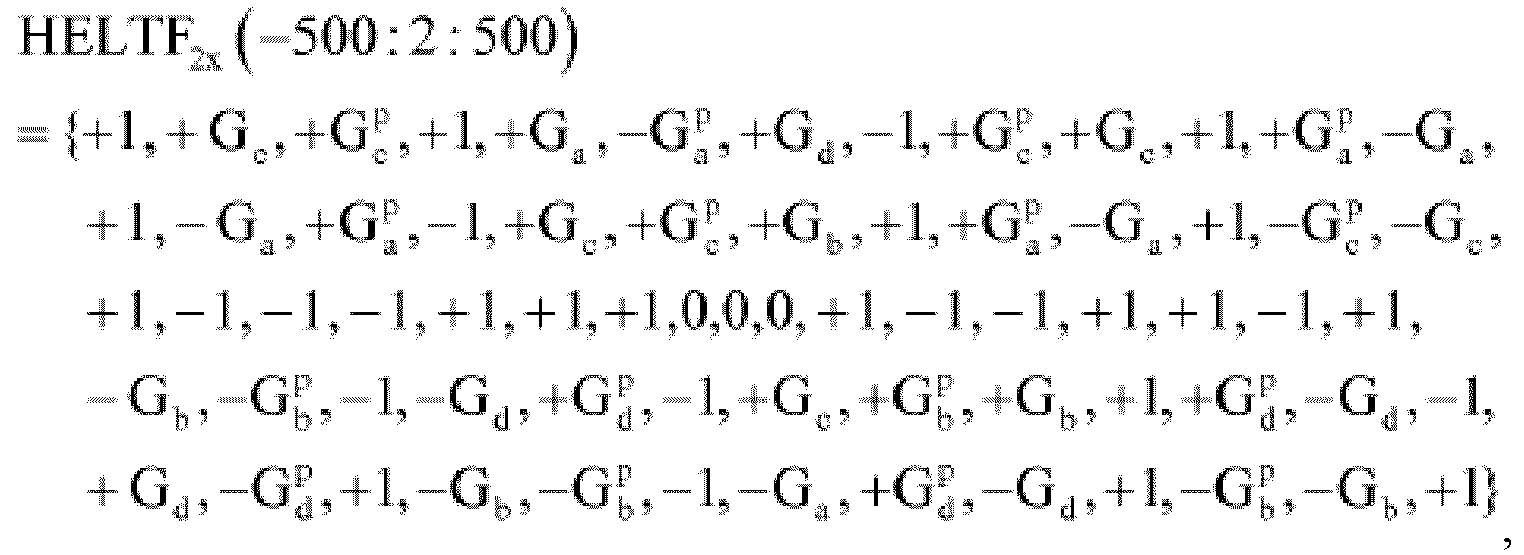 wobei Ga={+1,+1,+1,-1,+1,+1,+1,+1,-1,+1,-1,-1,+1,-1} und Gb={+1,+1,+1,-1,-1,-1,-1,+1,-1,-1,-1,+1,-1} ist,
 Gc eine Sequenz ist, die erhalten wird, nachdem eine Phase eines Werts auf einem geradzahligen Subträger der Ga-Sequenz umgekehrt wird,Gd eine Sequenz ist, die erhalten wird, nachdem eine Phase eines Werts auf einem geradzahligen Subträger der Gb-Sequenz umgekehrt wird,

- Verfahren zum Empfangen eines Datenpakets in einem drahtlosen lokalen Netzwerk, umfassend:Empfangen eines Datenpakets durch eine Empfangsvorrichtung, das den Standard 802.11ax einhält, und Erhalten einer in dem Datenpaket angegebenen Übertragungsbandbreite (201, 401);Erhalten einer HE-LTF-Sequenz gemäß der Übertragungsbandbreite, die der Übertragungsbandbreite entspricht (202); undBestimmen durch die Empfangsvorrichtung gemäß einer Größe und einem Ort eines an eine Station vergebenen Ressourcenblocks RU eines entsprechenden HE-LTF-Sequenzsegments in dem Datenpaket als eine Referenzsequenz, die dem RU entspricht, zur Kanalschätzung (203, 402);dadurch gekennzeichnet, dass eine 2x-HE-LTF-Sequenz in einer 80-MHz-Bandbreitenübertragung folgendermaßen lautet:
HE-LTF2x(-500:2:500) = [+1, +1, -1, +1, +1, +1, -1, +1, +1, +1, +1, -1, -1, -1, +1, -1, -1, +1, +1, -1, +1, +1, +1, -1, -1, -1, -1, +1, +1, +1, +1, -1, +1, +1, +1, -1, +1, -1, -1, +1, -1, -1, -1, +1, +1, -1, -1, -1, +1, -1, -1, +1, -1, +1, +1, -1, +1, +1, -1, +1, -1, -1, -1, +1, -1, -1, -1, -1, +1, -1, -1, +1, +1, -1, +1, +1, +1, -1, -1, -1, -1, +1, -1, +1, +1, +1, -1, +1, +1, +1, +1, -1, -1, -1, +1, +1, +1, -1, -1, +1, +1, +1, -1, +1, +1, -1, +1, -1, -1, -1, -1, +1, -1, -1, -1, +1, -1, +1, +1, -1, +1, +1, -1, -1, -1, +1, -1, -1, -1, +1, -1, -1, +1, +1, -1, +1, +1, +1, -1, -1, +1, +1, +1, -1, +1, +1, -1, +1, -1, -1, +1, -1, +1, +1, +1, -1, +1, +1, +1, +1, -1, -1, -1, +1, -1, -1, +1, +1, -1, +1, +1, +1, -1, -1, -1, -1, +1, +1, +1, -1, -1, -1, -1, +1, -1, -1, -1, +1, -1, +1, +1, -1, -1, +1, +1, +1, -1, +1, +1, -1, +1, -1, -1, -1, -1, +1, -1, -1, -1, +1, -1, +1, +1, -1, +1, +1, -1, +1, +1, -1, -1, +1, -1, -1, -1, +1, +1, +1, +1, -1, +1, -1, -1, -1, +1, -1, -1, -1, -1, +1, +1, +1, +1, -1, -1, -1, +1, +1, +1, 0, 0, 0, +1, -1, -1, +1, +1, -1, +1, -1, -1, -1, +1, +1, +1, +1, -1, +1, +1, +1, -1, +1, -1, -1, -1, -1, +1, +1, +1, -1, +1, +1, -1, -1, +1, -1, -1, +1, -1, -1, +1, -1, +1, +1, +1, -1, +1, +1, +1, +1, -1, +1, -1, -1, +1, -1, -1, -1, +1, +1, -1, -1, -1, +1, -1, +1, +1, +1, -1, +1, +1, +1, +1, -1, -1, -1, +1, +1, +1, +1, -1, -1, -1, +1, -1, -1, +1, +1, -1, +1, +1, +1, -1, -1, -1, -1, +1, -1, -1, -1, +1, -1, +1, +1, -1, +1, -1, -1, +1, -1, -1, -1, +1, +1, -1, -1, -1, +1, -1, -1, +1, -1, +1, +1, +1, +1, -1, +1, +1, +1, -1, +1, -1, +1, +1, -1, +1, -1, -1, -1, +1, -1, -1, -1, -1, +1, -1, +1, +1, -1, +1, +1, +1, -1, -1, +1, +1, +1, -1, -1, -1, +1, +1, +1, +1, -1, +1, +1, +1, -1, +1, -1, -1, -1, -1, +1, +1, +1, -1, +1, +1, -1, -1, +1, -1, -1, -1, -1, +1, -1, -1, -1, +1, -1, +1, +1, -1, +1, +1, -1, +1, -1, -1, +1, -1, -1, -1, +1, +1, +1, -1, -1, -1, +1, -1, -1, +1, -1, +1, +1, +1, -1, +1, +1, +1, +1, -1, -1, -1, -1, +1, +1, +1, -1, +1, +1, -1, -1, +1, -1, -1, -1, +1, +1, +1, +1, -1, +1, +1, +1, -1, +1, +1],wobei die Gleichung bedeutet, dass Werte auf Subträgern mit geraden Indizes in den Indizes -500∼500 sequenzielle Werte in der vorhergehenden Sequenz sind und die Werte auf Subträgern mit anderen Orten 0 sind. - Verfahren nach Anspruch 3, wobei die 2x-HE-LTF-Sequenz in einer 80-MHz-Bandbreitenübertragung eine gespeicherte Sequenz ist oder konstruiert wird durch

Gb = {+1,+1,+1,-1,-1,-1,-1,+1,-1,-1,-1,+1,-1} ist,
 Gc eine Sequenz ist, die erhalten wird, nachdem eine Phase eines Werts auf einem geradzahligen Subträger der Ga-Sequenz umgekehrt wird,Gd eine Sequenz ist, die erhalten wird, nachdem eine Phase eines Werts auf einem geradzahligen Subträger der Gb-Sequenz umgekehrt wird,

- Vorrichtung, die in einem drahtlosen lokalen Netzwerk angewandt wird, die sich auf einer Seite eines Zugangspunkts befindet, der 802.11ax einhält, und umfassend:eine Einheit, ausgelegt zum Erhalten einer HE-LTF-Sequenz gemäß einer Übertragungsbandbreite, die der Übertragungsbandbreite entspricht (101, 301); undeine Einheit, die dafür ausgelegt ist, gemäß einer Größe und einem Ort eines an eine Station vergebenen Ressourcenblocks RU ein Sequenzsegment, das dem Ort der RU entspricht und das sich in der HE-LTF-Sequenz befindet, auf Subträger in dem vergebenen RU abzubilden und das Sequenzsegment zu senden (102, 302);dadurch gekennzeichnet, dass eine 2x-HE-LTF-Sequenz in einer 80-MHz-Bandbreitenübertragung folgendermaßen lautet:
HE-LTF 2x (-500:2:500) = [+1, +1, -1, +1, +1, +1, -1, +1, +1, +1, +1, -1, -1, -1, +1, -1, -1, +1, +1, -1, +1, +1, +1, -1, -1, -1, -1, +1, +1, +1, +1, -1, +1, +1, +1, -1, +1, -1, -1, +1, -1, -1, -1, +1, +1, -1, -1, -1, +1, -1, -1, +1, -1, +1, +1, -1, +1, +1, -1, +1, -1, -1, -1, +1, -1, -1, -1, -1, +1, -1, -1, +1, +1, -1, +1, +1, +1, -1, -1, -1, -1, +1, -1, +1, +1, +1, -1, +1, +1, +1, +1, -1, -1, -1, +1, +1, +1, -1, -1, +1, +1, +1, -1, +1, +1, -1, +1, -1, -1, -1, -1, +1, -1, -1, -1, +1, -1, +1, +1, -1, +1, +1, -1, -1, -1, +1, -1, -1, -1, +1, -1, +1, +1, -1, +1, +1, +1, -1, -1, +1, +1, +1, -1, +1, +1, -1, +1, -1, -1, +1, -1, +1, +1, +1, -1, +1, +1, +1, +1, -1, -1, -1, +1, -1, -1, +1, +1, -1, +1, +1, +1, -1, -1, -1, -1, +1, +1, +1, -1, -1, -1, -1, +1, -1, -1, -1, +1, -1, +1, +1, +1, -1, -1, +1, +1, +1, -1, +1, +1, -1, +1, -1, -1, -1, -1, +1, -1, -1, -1, +1, -1, +1, +1, -1, +1, +1, -1, +1, +1, -1, -1, +1, -1, -1, -1, +1, +1, +1, +1, -1, +1, -1, -1, -1, +1, -1, -1, -1, -1, +1, +1, +1, +1, -1, -1, -1, +1, +1, +1, 0, 0, 0, +1, -1, -1, +1, +1, -1, +1, -1, -1, -1, +1, +1, +1, +1, -1, +1, +1, +1, -1, +1, -1, -1, -1, -1, +1, +1, +1, -1, +1, +1, -1, -1, +1, -1, -1, +1, -1 -1, +1, -1, +1, +1, +1, -1, +1, +1, +1, +1, -1, +1, -1, -1, +1, -1, -1, 1-, +1, +1, -1, -1, -1, +1, -1, +1, +1, +1, -1, +1, +1, +1, +1, -1, -1, -1, +1, +1, +1, +1, -1, -1, -1, +1, -1, -1, +1, +1, -1, +1, +1, +1, -1 -1, -1, -1, +1, -1, -1, -1, +1, -1, +1, +1, -1, +1, -1, -1, +1, -1, -1, -1, +1, +-1, -1, -1, +1, -1, -1, +1, -1, +1, +1, +1, -1, +1, +1, +1, -1, +1, -1, +1, +1, -1, +1, -1, -1, -1, +1, -1, -1, -1, -1, +1, -1, +1, +1, -1, +1, +1, +1, -1, -1, +1, +1, +1, -1, -1, -1, +1, +1, +1, +1, -1, +1, +1, +1, -1, +1, -1, -1, -1 -1, +1, +1, +1, -1, +1, -1, -1, +1, -1, -1, -1, -1, +1, -1, -1, -1, +1, -1, +1, +1, -1, +1, +1, -1, +1, -1, -1, +1, -1, -1, -1, +1, +1, -1, -1, -1, +1, -1, -1, +1, -1, +1, +1, +1, -1, +1, +1, +1, +1, -1, -1, -1, -1, +1, +1, +1, +1, +1, -1, -1, +1, -1, -1, -1, +1, +1, +1, -1, +1, +1, +1, -1, +1, +1],wobei die Gleichung bedeutet, dass Werte auf Subträgern mit geraden Indizes in den Indizes -500∼500 sequenzielle Werte in der vorhergehenden Sequenz sind und Werte auf Subträgern mit anderen Orten 0 sind. - Vorrichtung nach Anspruch 5, wobei die 2x-HE-LTF-Sequenz in einer 80-MHz-Bandbreitenübertragung eine gespeicherte Sequenz ist oder konstruiert wird durch

wobei Ga ={+1,+1,+1,-1,+1,+1,+1,-1,+1,-1,-1,+1,-1} und
Gb ={+1,+1,+1,-1+1,+1,+1,-1,+1,-1,-1,+1,-1} und
 Gc eine Sequenz ist, die erhalten wird, nachdem eine Phase eines Werts auf einem geradzahligen Subträger der Ga-Sequenz umgekehrt wird,Gd eine Sequenz ist, die erhalten wird, nachdem eine Phase eines Werts auf einem geradzahligen Subträger der Gb-Sequenz umgekehrt wird,

- Vorrichtung, die in einem drahtlosen lokalen Netzwerk angewandt wird, die sich auf einer Seite einer Empfangsvorrichtung befindet, der 802.11ax einhält, und umfassend:eine Einheit, ausgelegt zum Empfangen eines Datenpakets, das den Standard 802.11ax einhält, und Erhalten einer in dem Datenpaket angegebenen Übertragungsbandbreite (201, 401);eine Einheit, ausgelegt zum Erhalten einer HE-LTF-Sequenz gemäß der Übertragungsbandbreite, die der Übertragungsbandbreite (202) entspricht, undeine Einheit, ausgelegt zum Bestimmen eines entsprechenden HE-LTF-Sequenzsegments gemäß einer Größe und einem Ort eines an eine Station vergebenen Ressourcenblocks RU in dem Datenpaket als Referenzsequenz, die dem RU entspricht, zur Kanalschätzung (203, 402);dadurch gekennzeichnet, dass eine 2x-HE-LTF-Sequenz in einer 80-MHz-Bandbreitenübertragung folgendermaßen lautet:
HE-LTF 2x (-500:2:500) = [+1, +1, -1, +1, +1, +1, -1, +1, +1, +1, +1, -1, -1, -1, +1, -1, -1, +1, +1, -1, +1, +1, +1, -1, -1, -1, -1, +1, +1, +1, +1, -1, +1, +1, +1, -1, +1, -1, -1, +1, -1, -1, -1, +1, +1, -1, -1, -1, +1, -1, -1, +1, -1, +1, +1, -1, +1, +1, -1, +1, -1, -1, -1, +1, -1, -1, -1, -1, +1, -1, -1, +1, +1, -1, +1, +1, +1, -1, -1, -1, -1, +1, -1, +1, +1, +1, -1, +1, +1, +1, +1, -1, -1, -1, +1, +1, +1, -1, -1, +1, +1, +1, -1, +1, +1, -1, +1, -1, -1, -1, -1, +1, -1, -1, -1, +1, -1, +1, +1, -1, +1, +1, -1, -1, -1, +1, -1, -1, -1, +1, -1, -1, +1, +1, -1, +1, +1, +1, -1, -1, +1, +1, +1, -1, +1, +1, -1, +1, -1, -1, +1, -1, +1, +1, +1, -1, +1, +1, +1, +1, -1, -1, -1, +1, -1, -1, +1, +1, -1, +1, +1, +1, -1, -1, -1, -1, +1, +1, +1, -1, -1, -1, -1, +1, -1, -1, 1, +1, -1, +1, +1, -1, -1, +1, +1, +1, -1, +1, +1, -1, +1, -1, -1, -1, -1, +1, -1, -1, -1, +1, -1, +1, +1, -1, +1, +1, -1, +1, +1, -1, -1, +1, -1, -1, -1, +1, +1, +1, +1, -1, +1, -1, -1, -1, +1, -1, -1, -1, -1, +1, +1, +1, +1, -1, -1, -1, +1, +1, +1, 0, 0, 0, +1, -1, -1, +1, +1, -1, +1, -1, -1, -1, +1, +1, +1, +1, -1, +1, +1, +1, -1, +1, -1, -1, -1, -1, +1, +1, +1, -1, +1, +1, -1, -1, +1, -1, -1, +1, -1, -1, +1, -1, +1, +1, +1, -1, +1, +1, +1, +1, -1, +1, -1, -1, +1, -1, -1, -1, +1, +1, -1, -1, -1, +1, -1, +1, +1, +1, -1, +1, +1, +1, +1, -1, -1, -1, +1, +1, +1, +1, -1, -1, -1, +1, -1, -1, +1, +1, -1, +1, +1, +1, -1, -1, -1, -1, +1, -1, -1, -1, +1, -1, +1, +1, -1, +1, -1, -1, +1, -1, -1, -1, +1, +1, -1, -1, -1, +1, -1, -1, +1, -1, +1, +1, +1, -1, +1, +1, +1, -1, +1, -1, +1, +1, -1, +1, -1, -1, -1, +1, -1, -1, -1, -1, +1, -1, +1, +1, -1, +1, +1, +1, -1, -1, +1, +1, +1, -1, -1, -1, +1, +1, +1, +1, -1, +1, +1, +1, -1, +1, -1, -1, -1, -1, +1, +1, +1, -1, +1, +1, -1, -1, +1, -1, -1, -1, -1, +1, -1, -1, -1, +1, -1, +1, +1, -1, +1, +1, -1, +1, -1, -1, +1, -1, -1, -1, +1, +1, -1, -1, -1, +1, -1, -1, +1, -1, +1, +1, +1, -1, +1, +1, -1, +1, -1, -1, -1, -1, +1, +1, +1, -1, +1, +1, -1, -1, +1, -1, -1, -1, +1, +1, +1, +1, -1, +1, +1, +1, -1, +1, +1],wobei die Gleichung bedeutet, dass Werte auf Subträgern mit geraden Indizes in den Indizes -500∼500 sequenzielle Werte in der vorhergehenden Sequenz sind und die Werte auf Subträgern mit anderen Orten 0 sind. - Vorrichtung nach Anspruch 7, wobei die 2x-HE-LTF-Sequenz in einer 80-MHz-Bandbreitenübertragung eine gespeicherte Sequenz ist oder konstruiert wird durch

Gb = {+1,+1,+1,-1,-1,-1,-1,+1,-1,-1,-1,+1,-1} ist,
 Gc eine Sequenz ist, die erhalten wird, nachdem eine Phase eines Werts auf einem geradzahligen Subträger der Ga-Sequenz umgekehrt wird,Gd eine Sequenz ist, die erhalten wird, nachdem eine Phase eines Werts auf einem geradzahligen Subträger der Gb-Sequenz umgekehrt wird,

Priority Applications (6)
| Application Number | Priority Date | Filing Date | Title |
|---|---|---|---|
| EP21165745.7A EP3937445B2 (de) | 2015-08-26 | 2016-08-26 | Verfahren zur übertragung einer he-ltf-sequenz und vorrichtung |
| PL16838601T PL3334112T3 (pl) | 2015-08-26 | 2016-08-26 | Sposób i urządzenie do przesyłania sekwencji he-ltf |
| EP25184864.4A EP4645788A3 (de) | 2015-08-26 | 2016-08-26 | Verfahren zur übertragung einer he-ltf-sequenz und vorrichtung |
| EP23172732.2A EP4280554B1 (de) | 2015-08-26 | 2016-08-26 | Verfahren zur übertragung einer he-ltf-sequenz und vorrichtung |
| DK19189060.7T DK3657749T3 (da) | 2015-08-26 | 2016-08-26 | Fremgangsmåde til transmission af he-ltf-sekvens og apparat |
| EP19189060.7A EP3657749B1 (de) | 2015-08-26 | 2016-08-26 | Verfahren zur übertragung einer he-ltf-sequenz und vorrichtung |
Applications Claiming Priority (3)
| Application Number | Priority Date | Filing Date | Title |
|---|---|---|---|
| CN201510532381 | 2015-08-26 | ||
| CN201510849062.4A CN106487737B (zh) | 2015-08-26 | 2015-11-26 | 传输无线局域网中的长训练序列的方法及装置 |
| PCT/CN2016/096973 WO2017032343A1 (zh) | 2015-08-26 | 2016-08-26 | 传输he-ltf序列的方法和装置 |
Related Child Applications (5)
| Application Number | Title | Priority Date | Filing Date |
|---|---|---|---|
| EP19189060.7A Division EP3657749B1 (de) | 2015-08-26 | 2016-08-26 | Verfahren zur übertragung einer he-ltf-sequenz und vorrichtung |
| EP19189060.7A Division-Into EP3657749B1 (de) | 2015-08-26 | 2016-08-26 | Verfahren zur übertragung einer he-ltf-sequenz und vorrichtung |
| EP21165745.7A Division EP3937445B2 (de) | 2015-08-26 | 2016-08-26 | Verfahren zur übertragung einer he-ltf-sequenz und vorrichtung |
| EP25184864.4A Division EP4645788A3 (de) | 2015-08-26 | 2016-08-26 | Verfahren zur übertragung einer he-ltf-sequenz und vorrichtung |
| EP23172732.2A Division EP4280554B1 (de) | 2015-08-26 | 2016-08-26 | Verfahren zur übertragung einer he-ltf-sequenz und vorrichtung |
Publications (3)
| Publication Number | Publication Date |
|---|---|
| EP3334112A1 EP3334112A1 (de) | 2018-06-13 |
| EP3334112A4 EP3334112A4 (de) | 2018-08-01 |
| EP3334112B1 true EP3334112B1 (de) | 2020-02-19 |
Family
ID=58238652
Family Applications (5)
| Application Number | Title | Priority Date | Filing Date |
|---|---|---|---|
| EP19189060.7A Active EP3657749B1 (de) | 2015-08-26 | 2016-08-26 | Verfahren zur übertragung einer he-ltf-sequenz und vorrichtung |
| EP16838601.9A Active EP3334112B1 (de) | 2015-08-26 | 2016-08-26 | Verfahren und vorrichtung zur übertragung einer he-ltf-sequenz |
| EP21165745.7A Active EP3937445B2 (de) | 2015-08-26 | 2016-08-26 | Verfahren zur übertragung einer he-ltf-sequenz und vorrichtung |
| EP23172732.2A Active EP4280554B1 (de) | 2015-08-26 | 2016-08-26 | Verfahren zur übertragung einer he-ltf-sequenz und vorrichtung |
| EP25184864.4A Pending EP4645788A3 (de) | 2015-08-26 | 2016-08-26 | Verfahren zur übertragung einer he-ltf-sequenz und vorrichtung |
Family Applications Before (1)
| Application Number | Title | Priority Date | Filing Date |
|---|---|---|---|
| EP19189060.7A Active EP3657749B1 (de) | 2015-08-26 | 2016-08-26 | Verfahren zur übertragung einer he-ltf-sequenz und vorrichtung |
Family Applications After (3)
| Application Number | Title | Priority Date | Filing Date |
|---|---|---|---|
| EP21165745.7A Active EP3937445B2 (de) | 2015-08-26 | 2016-08-26 | Verfahren zur übertragung einer he-ltf-sequenz und vorrichtung |
| EP23172732.2A Active EP4280554B1 (de) | 2015-08-26 | 2016-08-26 | Verfahren zur übertragung einer he-ltf-sequenz und vorrichtung |
| EP25184864.4A Pending EP4645788A3 (de) | 2015-08-26 | 2016-08-26 | Verfahren zur übertragung einer he-ltf-sequenz und vorrichtung |
Country Status (15)
| Country | Link |
|---|---|
| US (6) | US10645687B2 (de) |
| EP (5) | EP3657749B1 (de) |
| JP (1) | JP6463552B2 (de) |
| KR (1) | KR102028661B1 (de) |
| CN (6) | CN113315612A (de) |
| AU (1) | AU2016312080B2 (de) |
| CA (5) | CA3315123A1 (de) |
| DK (1) | DK3657749T3 (de) |
| ES (3) | ES2790383T3 (de) |
| HU (1) | HUE062934T2 (de) |
| MX (1) | MX383648B (de) |
| MY (1) | MY201594A (de) |
| PL (1) | PL3334112T3 (de) |
| SG (1) | SG11201801055TA (de) |
| ZA (1) | ZA201800863B (de) |
Families Citing this family (30)
| Publication number | Priority date | Publication date | Assignee | Title |
|---|---|---|---|---|
| CN113315612A (zh) | 2015-08-26 | 2021-08-27 | 华为技术有限公司 | 传输he-ltf序列的方法和装置 |
| CN111327548B (zh) | 2015-11-23 | 2025-03-07 | 华为技术有限公司 | 无线局域网数据传输方法和装置 |
| US10205570B2 (en) * | 2015-11-30 | 2019-02-12 | Lg Electronics Inc. | Method and apparatus for configuring pilot sequence in WLAN system |
| WO2018190697A1 (ko) | 2017-04-14 | 2018-10-18 | 주식회사 윌러스표준기술연구소 | Bss 식별자를 사용하는 무선 통신 방법 및 이를 사용하는 무선 통신 단말 |
| CN109391578B (zh) * | 2017-08-11 | 2022-07-22 | 华为技术有限公司 | 信号发送方法、信号接收方法、终端设备及网络设备 |
| US11212837B2 (en) * | 2017-10-19 | 2021-12-28 | Qualcomm Incorporated | Listen before talk sequence design for wireless communication |
| US20190288895A1 (en) * | 2018-03-16 | 2019-09-19 | Qualcomm Incorporated | Wireless communication via a large bandwidth channel |
| CN118555175A (zh) * | 2018-07-27 | 2024-08-27 | 华为技术有限公司 | 设计短训练序列的方法和装置 |
| CN110876200B (zh) | 2018-09-04 | 2023-04-18 | 华为技术有限公司 | 一种传输数据的方法和装置 |
| US11159348B2 (en) * | 2018-09-18 | 2021-10-26 | Marvell Asia Pte, Ltd. | High efficiency long training field symbol transmission for multiple transmission streams |
| SG10201808652UA (en) | 2018-10-01 | 2020-05-28 | Panasonic Ip Corp America | Communication Apparatus and Communication Method for Channel Estimation |
| KR102595373B1 (ko) | 2019-08-12 | 2023-10-31 | 엘지전자 주식회사 | 무선랜 시스템에서 광대역을 통해 ppdu를 수신하는 방법 및 장치 |
| CN114788237B (zh) | 2019-10-31 | 2024-02-27 | Lg 电子株式会社 | 在无线通信系统中发送ltf信号的技术 |
| CN110784297B (zh) * | 2019-10-31 | 2022-05-24 | 普联技术有限公司 | 一种资源单元的分配方法及装置 |
| CN112821998A (zh) * | 2019-11-15 | 2021-05-18 | 华为技术有限公司 | 传输物理层协议数据单元的方法和装置 |
| WO2021112336A1 (ko) * | 2019-12-06 | 2021-06-10 | 엘지전자 주식회사 | Ltf 시퀀스 생성 방법 |
| CN113078987B (zh) | 2020-01-03 | 2024-08-27 | 华为技术有限公司 | 传输物理层协议数据单元的方法和装置 |
| WO2021182755A1 (ko) * | 2020-03-13 | 2021-09-16 | 엘지전자 주식회사 | 320mhz 대역을 위한 4x ltf 시퀀스 |
| WO2021230471A1 (ko) * | 2020-05-13 | 2021-11-18 | 엘지전자 주식회사 | 80mhz를 위한 4x ltf 시퀀스 |
| US12267821B2 (en) | 2020-05-15 | 2025-04-01 | Samsung Electronics Co., Ltd. | Methods and device for communicating PPDU |
| CN115735407B (zh) * | 2020-06-26 | 2026-03-20 | 松下电器(美国)知识产权公司 | 用于资源单元分配信令的通信装置和通信方法 |
| CN113923082B (zh) * | 2020-07-10 | 2023-03-10 | 华为技术有限公司 | 传输ppdu的方法及相关装置 |
| CN116015580A (zh) * | 2020-08-03 | 2023-04-25 | 华为技术有限公司 | 一种传输物理层协议数据单元的方法及装置 |
| CN114070697B (zh) | 2020-08-05 | 2023-02-10 | 华为技术有限公司 | 一种传输物理层协议数据单元的方法及装置 |
| CN118945018A (zh) * | 2020-12-11 | 2024-11-12 | 华为技术有限公司 | 信号处理方法及装置 |
| CN113098843B (zh) * | 2021-03-08 | 2022-06-14 | 中国地质大学(武汉) | 一种面向地质、地理大数据的高速随机抽样加密方法 |
| CN115567174A (zh) * | 2021-07-02 | 2023-01-03 | 华为技术有限公司 | 一种导频信号传输方法及相关装置 |
| US11711184B2 (en) * | 2021-10-04 | 2023-07-25 | Qualcomm Incorporated | Long training field (LTF) in distributed transmission |
| CN119835128A (zh) * | 2023-10-13 | 2025-04-15 | 华为技术有限公司 | 通信方法和装置 |
| CN122001730A (zh) * | 2024-11-06 | 2026-05-08 | 华为技术有限公司 | 通信方法及装置 |
Family Cites Families (75)
| Publication number | Priority date | Publication date | Assignee | Title |
|---|---|---|---|---|
| US7916803B2 (en) | 2003-04-10 | 2011-03-29 | Qualcomm Incorporated | Modified preamble structure for IEEE 802.11a extensions to allow for coexistence and interoperability between 802.11a devices and higher data rate, MIMO or otherwise extended devices |
| US7660362B2 (en) * | 2004-06-18 | 2010-02-09 | Broadcom Corporation | Wireless local area network system using space-time block coding (STBC) having backward compatibility with prior standards |
| US7426199B2 (en) | 2005-06-29 | 2008-09-16 | Intel Corporation | Wireless communication device and method for reducing carrier frequency offsets over a simultaneous multi-user uplink in a multicarrier communication network |
| US7701919B2 (en) | 2006-05-01 | 2010-04-20 | Alcatel-Lucent Usa Inc. | Method of assigning uplink reference signals, and transmitter and receiver thereof |
| US8848837B2 (en) | 2006-10-19 | 2014-09-30 | Intel Mobile Communications GmbH | Statistical procedures for carrier frequency tracking |
| PL2241049T3 (pl) * | 2008-01-08 | 2019-09-30 | Hmd Global Oy | Układ sondującego sygnału odniesienia |
| EP2269196B1 (de) | 2008-03-06 | 2016-11-09 | Panduit Corp. | Abschirmungsband für datenkabel mit verbesserter nebensprechdämpfung |
| CN101610543B (zh) * | 2008-06-20 | 2012-12-19 | 中兴通讯股份有限公司 | 资源块位置调整方法和系统 |
| CN102204153B (zh) | 2008-08-25 | 2016-06-01 | 应用转换有限责任公司 | 在基于分组的ofdm系统中识别在多个重叠频带工作的各种设备发送的分组业务 |
| JP5077181B2 (ja) | 2008-10-14 | 2012-11-21 | ソニー株式会社 | 情報受信装置、情報送信装置および情報通信システム |
| CN102388558B (zh) * | 2009-04-10 | 2015-12-09 | 皇家飞利浦电子股份有限公司 | 在无线系统中允许多天线通信的信令方法和设备 |
| CN101924721B (zh) * | 2009-06-10 | 2013-06-05 | 清华大学 | 确定下行多址系统传输模式的方法及发射端、接收端装置 |
| US8488539B2 (en) | 2009-07-16 | 2013-07-16 | Ralink Technology Corp. | Method of generating preamble sequence |
| TW201105057A (en) | 2009-07-16 | 2011-02-01 | Ralink Technology Corp | Method and apparatus for generating training sequences in wireless communication system |
| US8693356B2 (en) | 2009-07-16 | 2014-04-08 | Ralink Technology Corp. | Method for wireless communication system and device using the same |
| US8385443B2 (en) | 2009-07-17 | 2013-02-26 | Qualcomm Incorporated | Constructing very high throughput long training field sequences |
| US8917784B2 (en) | 2009-07-17 | 2014-12-23 | Qualcomm Incorporated | Method and apparatus for constructing very high throughput long training field sequences |
| KR20110027533A (ko) | 2009-09-09 | 2011-03-16 | 엘지전자 주식회사 | 다중 안테나 시스템에서 제어정보 전송 방법 및 장치 |
| US8982686B2 (en) * | 2010-06-07 | 2015-03-17 | Qualcomm Incorporated | Communication devices for generating and using a matrix-mapped sequence |
| CN102469053A (zh) | 2010-11-08 | 2012-05-23 | 中兴通讯股份有限公司 | 一种超高吞吐量长训练域处理方法和系统 |
| JP6057435B2 (ja) | 2011-02-04 | 2017-01-11 | マーベル ワールド トレード リミテッド | 無線lanの制御モードphy |
| US9178745B2 (en) * | 2011-02-04 | 2015-11-03 | Marvell World Trade Ltd. | Control mode PHY for WLAN |
| US8625690B2 (en) | 2011-03-04 | 2014-01-07 | Qualcomm Incorporated | Systems and methods for wireless communication in sub gigahertz bands |
| EP3029903B1 (de) | 2011-04-26 | 2023-06-07 | Intel Corporation | Verfahren und anordnungen für drahtlose schwachstromnetze |
| CN102826212A (zh) | 2011-06-16 | 2012-12-19 | 渠仁书 | 平衡调节装置 |
| US20120327871A1 (en) | 2011-06-24 | 2012-12-27 | Interdigital Patent Holdings, Inc. | Non-legacy preamble for wireless local area networks |
| CN102604648A (zh) * | 2011-07-22 | 2012-07-25 | 深圳市华星光电技术有限公司 | 液晶活性单体及液晶面板 |
| WO2013066739A1 (en) | 2011-11-02 | 2013-05-10 | Marvell World Trade Ltd. | Method and apparatus for automatically detecting a physical layer (phy) mode of a data unit in a wireless local area network (wlan) |
| KR102192064B1 (ko) | 2012-01-30 | 2020-12-17 | 마벨 월드 트레이드 리미티드 | 통신 시스템들에서 프리앰블 심볼들을 생성하는 시스템들 및 방법들 |
| WO2013122377A1 (ko) | 2012-02-14 | 2013-08-22 | 엘지전자 주식회사 | 무선랜 시스템에서 데이터 유닛 전송 방법 및 이를 지원하는 장치 |
| US9078237B2 (en) | 2012-04-13 | 2015-07-07 | Intel Corporation | Methods and arrangements for orthogonal training sequences in wireless networks |
| US8995320B2 (en) * | 2012-04-16 | 2015-03-31 | Qualcomm Incorporated | Systems and methods of using space time block codes |
| TWI637648B (zh) * | 2012-04-30 | 2018-10-01 | 內數位專利控股公司 | 電氣和電子工程師協會(ieee)802.11站(sta)及在其中使用的方法 |
| WO2014031057A1 (en) | 2012-08-21 | 2014-02-27 | Telefonaktiebolaget L M Ericsson (Publ) | Precoding for mimo |
| CN105075131B (zh) | 2013-03-25 | 2018-10-16 | 英特尔德国有限责任公司 | 用于频率偏置估计的装置和方法 |
| US10439773B2 (en) | 2013-04-15 | 2019-10-08 | Qualcomm Incorporated | Systems and methods for backwards-compatible preamble formats for multiple access wireless communication |
| US9439161B2 (en) * | 2013-07-17 | 2016-09-06 | Qualcomm Incorporated | Physical layer design for uplink (UL) multiuser multiple-input, multiple-output (MU-MIMO) in wireless local area network (WLAN) systems |
| US9325533B2 (en) * | 2013-11-06 | 2016-04-26 | Ixia | Systems and methods for improved wireless channel estimation |
| CN105830374A (zh) | 2013-12-14 | 2016-08-03 | Lg电子株式会社 | 将数据从无线lan传输到多个sta的方法和设备 |
| KR20160004955A (ko) * | 2014-07-04 | 2016-01-13 | 뉴라컴 인코포레이티드 | 고효율 무선랜의 물리계층 프로토콜 데이터 유닛 포맷 |
| KR20160013820A (ko) | 2014-07-28 | 2016-02-05 | 뉴라컴 인코포레이티드 | 상향링크 다중 사용자 전송에 응답하는 하향링크 확인응답 |
| JP6423078B2 (ja) * | 2014-08-21 | 2018-11-14 | エルジー エレクトロニクス インコーポレイティド | 無線通信システムにおけるアップリンク転送方法及びそのために装置 |
| US20170222769A1 (en) | 2014-08-26 | 2017-08-03 | Intel IP Corporation | Apparatus, method, and computer readable medium for transmitting a high-efficiency wireless local-area network signal field for small and large bandwidth allocations |
| US10567046B2 (en) * | 2014-09-03 | 2020-02-18 | Lg Electronics Inc. | Method and device for transmitting training field in wireless LAN |
| CN107113132B (zh) | 2014-10-31 | 2020-10-30 | Lg电子株式会社 | 无线通信系统中的多用户收发方法及其装置 |
| WO2016070330A1 (zh) | 2014-11-04 | 2016-05-12 | 华为技术有限公司 | Ltf生成方法和装置 |
| US10165470B2 (en) * | 2014-11-05 | 2018-12-25 | Intel IP Corporation | High-efficiency (HE) station and method for configuring HE packets with long and short preamble formats |
| CN104580053B (zh) * | 2014-12-02 | 2017-09-15 | 江苏中兴微通信息科技有限公司 | 在宽带无线局域网中实现ofdma技术的收发方法和装置 |
| WO2016089059A1 (ko) * | 2014-12-05 | 2016-06-09 | 엘지전자(주) | 무선 통신 시스템에서 데이터 전송 방법 및 이를 위한 장치 |
| WO2016090372A1 (en) | 2014-12-05 | 2016-06-09 | Marvell Semiconductor, Inc. | Trigger frame format for orthogonal frequency division multiple access (ofdma) communication |
| US20180263047A1 (en) * | 2014-12-25 | 2018-09-13 | Lg Electronics Inc. | Method and apparatus for transmitting data unit on basis of trigger frame |
| US9949285B2 (en) * | 2015-01-07 | 2018-04-17 | Futurewei Technologies, Inc. | System and method for digital communications with interference avoidance |
| KR20170103861A (ko) * | 2015-01-08 | 2017-09-13 | 마벨 월드 트레이드 리미티드 | 고효율 무선 근거리 통신망(wlan)에서의 다운링크 시그널링 |
| US9825796B2 (en) | 2015-03-04 | 2017-11-21 | Avago Technologies General Ip (Singapore) Pte. Ltd | Long training field (LTF) within wireless communications |
| US9628310B2 (en) | 2015-03-25 | 2017-04-18 | Newracom, Inc. | Long training field sequence construction |
| US10356757B2 (en) * | 2015-04-15 | 2019-07-16 | Lg Electronics Inc. | Method for transmitting/receiving signal in wireless LAN system and device therefor |
| US9912462B2 (en) | 2015-04-28 | 2018-03-06 | Intel IP Corporation | Apparatus, computer readable medium, and method for alignment of long training fields in a high efficiency wireless local-area network |
| US9923680B2 (en) | 2015-06-03 | 2018-03-20 | Avago Technologies General Ip (Singapore) Pte. Ltd. | Beamforming feedback tone/sub-carrier location within wireless communications |
| US9955459B2 (en) * | 2015-06-05 | 2018-04-24 | Intel IP Corporation | Orthogonal frequency division multiple access uplink resource allocation |
| CN105119851B (zh) * | 2015-07-03 | 2018-11-09 | 魅族科技(中国)有限公司 | 无线局域网通信方法和设备 |
| US9913217B2 (en) * | 2015-07-07 | 2018-03-06 | Intel IP Corporation | Transmission feedback mechanism for polling wireless devices |
| WO2017007266A1 (ko) * | 2015-07-07 | 2017-01-12 | 엘지전자 주식회사 | 무선랜 시스템에서 사운딩 동작 방법 및 이를 위한 장치 |
| US10159043B1 (en) | 2015-07-28 | 2018-12-18 | Marvell International Ltd. | Training sequences in wireless communication systems |
| US10122508B2 (en) | 2015-07-31 | 2018-11-06 | Lg Electronics Inc. | Method and apparatus for configuring a long training field in a wireless local area network system |
| US9998951B2 (en) | 2015-08-05 | 2018-06-12 | Qualcomm Incorporated | Training sequence generation for wireless communication networks |
| WO2017020283A1 (zh) | 2015-08-05 | 2017-02-09 | 华为技术有限公司 | 生成he-ltf序列方法、处理装置、接入点和站点 |
| US9998263B2 (en) * | 2015-08-10 | 2018-06-12 | Intel IP Corporation | Scheduling resources for orthogonal frequency division multiple access uplink transmissions |
| US10129001B2 (en) * | 2015-08-14 | 2018-11-13 | Newracom, Inc. | Block acknowledgment for multi-user transmissions in WLAN systems |
| CN113315612A (zh) * | 2015-08-26 | 2021-08-27 | 华为技术有限公司 | 传输he-ltf序列的方法和装置 |
| US10420121B2 (en) | 2015-11-03 | 2019-09-17 | Newracom, Inc. | Aggregated HE control content in A-MPDU |
| US10135590B2 (en) | 2015-11-26 | 2018-11-20 | Lg Electronics Inc. | Method and apparatus for configuring long training field in wireless local network system |
| TW201733389A (zh) | 2016-01-14 | 2017-09-16 | 內數位專利控股公司 | 無線區域網路中控制及操作 |
| US10187893B2 (en) | 2016-04-19 | 2019-01-22 | Lg Electronics Inc. | Method and apparatus for configuring long training field in wireless local network system |
| US20180027514A1 (en) | 2016-07-20 | 2018-01-25 | Xiaogang Chen | Resource unit indication for extended range packets |
| US11979871B2 (en) | 2018-11-06 | 2024-05-07 | Lg Electronics Inc. | Method and device for transmitting EHT PPDU in wireless LAN system |
-
2015
- 2015-11-26 CN CN202011547649.7A patent/CN113315612A/zh active Pending
- 2015-11-26 CN CN201811536087.9A patent/CN110545165B/zh active Active
- 2015-11-26 CN CN202110413845.3A patent/CN113612591A/zh active Pending
- 2015-11-26 CN CN202110412872.9A patent/CN113162746A/zh active Pending
- 2015-11-26 CN CN201810253195.9A patent/CN108551434B/zh active Active
- 2015-11-26 CN CN201510849062.4A patent/CN106487737B/zh active Active
-
2016
- 2016-08-26 CA CA3315123A patent/CA3315123A1/en active Pending
- 2016-08-26 KR KR1020187006056A patent/KR102028661B1/ko active Active
- 2016-08-26 SG SG11201801055TA patent/SG11201801055TA/en unknown
- 2016-08-26 EP EP19189060.7A patent/EP3657749B1/de active Active
- 2016-08-26 ES ES16838601T patent/ES2790383T3/es active Active
- 2016-08-26 HU HUE21165745A patent/HUE062934T2/hu unknown
- 2016-08-26 PL PL16838601T patent/PL3334112T3/pl unknown
- 2016-08-26 EP EP16838601.9A patent/EP3334112B1/de active Active
- 2016-08-26 MX MX2018002300A patent/MX383648B/es unknown
- 2016-08-26 CA CA2995892A patent/CA2995892C/en active Active
- 2016-08-26 CA CA3089960A patent/CA3089960C/en active Active
- 2016-08-26 EP EP21165745.7A patent/EP3937445B2/de active Active
- 2016-08-26 JP JP2018510392A patent/JP6463552B2/ja active Active
- 2016-08-26 ES ES23172732T patent/ES3065922T3/es active Active
- 2016-08-26 MY MYPI2018700567A patent/MY201594A/en unknown
- 2016-08-26 CA CA3183273A patent/CA3183273A1/en active Pending
- 2016-08-26 AU AU2016312080A patent/AU2016312080B2/en active Active
- 2016-08-26 CA CA3254319A patent/CA3254319A1/en active Pending
- 2016-08-26 DK DK19189060.7T patent/DK3657749T3/da active
- 2016-08-26 EP EP23172732.2A patent/EP4280554B1/de active Active
- 2016-08-26 EP EP25184864.4A patent/EP4645788A3/de active Pending
- 2016-08-26 ES ES21165745T patent/ES2953874T5/es active Active
-
2018
- 2018-02-09 ZA ZA201800863A patent/ZA201800863B/en unknown
- 2018-02-26 US US15/905,567 patent/US10645687B2/en active Active
-
2019
- 2019-03-15 US US16/355,385 patent/US10616882B2/en active Active
- 2019-11-25 US US16/694,695 patent/US11265873B2/en active Active
-
2022
- 2022-02-28 US US17/683,103 patent/US11843493B2/en active Active
-
2023
- 2023-11-16 US US18/512,013 patent/US20240205064A1/en active Pending
-
2025
- 2025-01-17 US US19/030,207 patent/US20250260608A1/en active Pending
Non-Patent Citations (1)
| Title |
|---|
| None * |
Also Published As
Similar Documents
| Publication | Publication Date | Title |
|---|---|---|
| US20240205064A1 (en) | Method for transmitting he-ltf sequence and apparatus | |
| CN109698740B (zh) | 资源调度的方法、装置 | |
| EP3681113B1 (de) | Datenübertragungsverfahren und -vorrichtung in einem drahtlosen lokalen netzwerk | |
| EP4387355A1 (de) | Verfahren zur übertragung von langen trainingsfeldsequenzen und kommunikationsvorrichtung | |
| AU2021413193B2 (en) | Method and apparatus for reducing a peak to average power ratio in the transmission of physical layer protocol data units | |
| WO2017032343A1 (zh) | 传输he-ltf序列的方法和装置 | |
| EP3389302A1 (de) | Backhaul-verfahren zur verwendung in der drahtlosen kommunikation, steuergerät, basisstation und gateway |
Legal Events
| Date | Code | Title | Description |
|---|---|---|---|
| STAA | Information on the status of an ep patent application or granted ep patent |
Free format text: STATUS: THE INTERNATIONAL PUBLICATION HAS BEEN MADE |
|
| PUAI | Public reference made under article 153(3) epc to a published international application that has entered the european phase |
Free format text: ORIGINAL CODE: 0009012 |
|
| STAA | Information on the status of an ep patent application or granted ep patent |
Free format text: STATUS: REQUEST FOR EXAMINATION WAS MADE |
|
| 17P | Request for examination filed |
Effective date: 20180306 |
|
| AK | Designated contracting states |
Kind code of ref document: A1 Designated state(s): AL AT BE BG CH CY CZ DE DK EE ES FI FR GB GR HR HU IE IS IT LI LT LU LV MC MK MT NL NO PL PT RO RS SE SI SK SM TR |
|
| AX | Request for extension of the european patent |
Extension state: BA ME |
|
| A4 | Supplementary search report drawn up and despatched |
Effective date: 20180703 |
|
| RIC1 | Information provided on ipc code assigned before grant |
Ipc: H04L 27/26 20060101AFI20180627BHEP |
|
| DAV | Request for validation of the european patent (deleted) | ||
| DAX | Request for extension of the european patent (deleted) | ||
| GRAP | Despatch of communication of intention to grant a patent |
Free format text: ORIGINAL CODE: EPIDOSNIGR1 |
|
| STAA | Information on the status of an ep patent application or granted ep patent |
Free format text: STATUS: GRANT OF PATENT IS INTENDED |
|
| INTG | Intention to grant announced |
Effective date: 20190904 |
|
| GRAS | Grant fee paid |
Free format text: ORIGINAL CODE: EPIDOSNIGR3 |
|
| GRAA | (expected) grant |
Free format text: ORIGINAL CODE: 0009210 |
|
| STAA | Information on the status of an ep patent application or granted ep patent |
Free format text: STATUS: THE PATENT HAS BEEN GRANTED |
|
| AK | Designated contracting states |
Kind code of ref document: B1 Designated state(s): AL AT BE BG CH CY CZ DE DK EE ES FI FR GB GR HR HU IE IS IT LI LT LU LV MC MK MT NL NO PL PT RO RS SE SI SK SM TR |
|
| REG | Reference to a national code |
Ref country code: CH Ref legal event code: EP |
|
| REG | Reference to a national code |
Ref country code: DE Ref legal event code: R096 Ref document number: 602016030295 Country of ref document: DE |
|
| REG | Reference to a national code |
Ref country code: AT Ref legal event code: REF Ref document number: 1236248 Country of ref document: AT Kind code of ref document: T Effective date: 20200315 |
|
| REG | Reference to a national code |
Ref country code: IE Ref legal event code: FG4D |
|
| REG | Reference to a national code |
Ref country code: NL Ref legal event code: FP |
|
| REG | Reference to a national code |
Ref country code: SE Ref legal event code: TRGR |
|
| PG25 | Lapsed in a contracting state [announced via postgrant information from national office to epo] |
Ref country code: NO Free format text: LAPSE BECAUSE OF FAILURE TO SUBMIT A TRANSLATION OF THE DESCRIPTION OR TO PAY THE FEE WITHIN THE PRESCRIBED TIME-LIMIT Effective date: 20200519 Ref country code: FI Free format text: LAPSE BECAUSE OF FAILURE TO SUBMIT A TRANSLATION OF THE DESCRIPTION OR TO PAY THE FEE WITHIN THE PRESCRIBED TIME-LIMIT Effective date: 20200219 Ref country code: RS Free format text: LAPSE BECAUSE OF FAILURE TO SUBMIT A TRANSLATION OF THE DESCRIPTION OR TO PAY THE FEE WITHIN THE PRESCRIBED TIME-LIMIT Effective date: 20200219 |
|
| REG | Reference to a national code |
Ref country code: LT Ref legal event code: MG4D |
|
| PG25 | Lapsed in a contracting state [announced via postgrant information from national office to epo] |
Ref country code: LV Free format text: LAPSE BECAUSE OF FAILURE TO SUBMIT A TRANSLATION OF THE DESCRIPTION OR TO PAY THE FEE WITHIN THE PRESCRIBED TIME-LIMIT Effective date: 20200219 Ref country code: IS Free format text: LAPSE BECAUSE OF FAILURE TO SUBMIT A TRANSLATION OF THE DESCRIPTION OR TO PAY THE FEE WITHIN THE PRESCRIBED TIME-LIMIT Effective date: 20200619 Ref country code: HR Free format text: LAPSE BECAUSE OF FAILURE TO SUBMIT A TRANSLATION OF THE DESCRIPTION OR TO PAY THE FEE WITHIN THE PRESCRIBED TIME-LIMIT Effective date: 20200219 Ref country code: GR Free format text: LAPSE BECAUSE OF FAILURE TO SUBMIT A TRANSLATION OF THE DESCRIPTION OR TO PAY THE FEE WITHIN THE PRESCRIBED TIME-LIMIT Effective date: 20200520 Ref country code: BG Free format text: LAPSE BECAUSE OF FAILURE TO SUBMIT A TRANSLATION OF THE DESCRIPTION OR TO PAY THE FEE WITHIN THE PRESCRIBED TIME-LIMIT Effective date: 20200519 |
|
| REG | Reference to a national code |
Ref country code: ES Ref legal event code: FG2A Ref document number: 2790383 Country of ref document: ES Kind code of ref document: T3 Effective date: 20201027 |
|
| PG25 | Lapsed in a contracting state [announced via postgrant information from national office to epo] |
Ref country code: LT Free format text: LAPSE BECAUSE OF FAILURE TO SUBMIT A TRANSLATION OF THE DESCRIPTION OR TO PAY THE FEE WITHIN THE PRESCRIBED TIME-LIMIT Effective date: 20200219 Ref country code: CZ Free format text: LAPSE BECAUSE OF FAILURE TO SUBMIT A TRANSLATION OF THE DESCRIPTION OR TO PAY THE FEE WITHIN THE PRESCRIBED TIME-LIMIT Effective date: 20200219 Ref country code: RO Free format text: LAPSE BECAUSE OF FAILURE TO SUBMIT A TRANSLATION OF THE DESCRIPTION OR TO PAY THE FEE WITHIN THE PRESCRIBED TIME-LIMIT Effective date: 20200219 Ref country code: SK Free format text: LAPSE BECAUSE OF FAILURE TO SUBMIT A TRANSLATION OF THE DESCRIPTION OR TO PAY THE FEE WITHIN THE PRESCRIBED TIME-LIMIT Effective date: 20200219 Ref country code: PT Free format text: LAPSE BECAUSE OF FAILURE TO SUBMIT A TRANSLATION OF THE DESCRIPTION OR TO PAY THE FEE WITHIN THE PRESCRIBED TIME-LIMIT Effective date: 20200712 Ref country code: SM Free format text: LAPSE BECAUSE OF FAILURE TO SUBMIT A TRANSLATION OF THE DESCRIPTION OR TO PAY THE FEE WITHIN THE PRESCRIBED TIME-LIMIT Effective date: 20200219 Ref country code: EE Free format text: LAPSE BECAUSE OF FAILURE TO SUBMIT A TRANSLATION OF THE DESCRIPTION OR TO PAY THE FEE WITHIN THE PRESCRIBED TIME-LIMIT Effective date: 20200219 Ref country code: DK Free format text: LAPSE BECAUSE OF FAILURE TO SUBMIT A TRANSLATION OF THE DESCRIPTION OR TO PAY THE FEE WITHIN THE PRESCRIBED TIME-LIMIT Effective date: 20200219 |
|
| REG | Reference to a national code |
Ref country code: AT Ref legal event code: MK05 Ref document number: 1236248 Country of ref document: AT Kind code of ref document: T Effective date: 20200219 |
|
| REG | Reference to a national code |
Ref country code: DE Ref legal event code: R097 Ref document number: 602016030295 Country of ref document: DE |
|
| PLBE | No opposition filed within time limit |
Free format text: ORIGINAL CODE: 0009261 |
|
| STAA | Information on the status of an ep patent application or granted ep patent |
Free format text: STATUS: NO OPPOSITION FILED WITHIN TIME LIMIT |
|
| 26N | No opposition filed |
Effective date: 20201120 |
|
| PG25 | Lapsed in a contracting state [announced via postgrant information from national office to epo] |
Ref country code: AT Free format text: LAPSE BECAUSE OF FAILURE TO SUBMIT A TRANSLATION OF THE DESCRIPTION OR TO PAY THE FEE WITHIN THE PRESCRIBED TIME-LIMIT Effective date: 20200219 |
|
| PG25 | Lapsed in a contracting state [announced via postgrant information from national office to epo] |
Ref country code: SI Free format text: LAPSE BECAUSE OF FAILURE TO SUBMIT A TRANSLATION OF THE DESCRIPTION OR TO PAY THE FEE WITHIN THE PRESCRIBED TIME-LIMIT Effective date: 20200219 |
|
| PG25 | Lapsed in a contracting state [announced via postgrant information from national office to epo] |
Ref country code: MC Free format text: LAPSE BECAUSE OF FAILURE TO SUBMIT A TRANSLATION OF THE DESCRIPTION OR TO PAY THE FEE WITHIN THE PRESCRIBED TIME-LIMIT Effective date: 20200219 |
|
| REG | Reference to a national code |
Ref country code: CH Ref legal event code: PL |
|
| PG25 | Lapsed in a contracting state [announced via postgrant information from national office to epo] |
Ref country code: LI Free format text: LAPSE BECAUSE OF NON-PAYMENT OF DUE FEES Effective date: 20200831 Ref country code: LU Free format text: LAPSE BECAUSE OF NON-PAYMENT OF DUE FEES Effective date: 20200826 Ref country code: CH Free format text: LAPSE BECAUSE OF NON-PAYMENT OF DUE FEES Effective date: 20200831 |
|
| REG | Reference to a national code |
Ref country code: BE Ref legal event code: MM Effective date: 20200831 |
|
| PG25 | Lapsed in a contracting state [announced via postgrant information from national office to epo] |
Ref country code: BE Free format text: LAPSE BECAUSE OF NON-PAYMENT OF DUE FEES Effective date: 20200831 Ref country code: IE Free format text: LAPSE BECAUSE OF NON-PAYMENT OF DUE FEES Effective date: 20200826 |
|
| PG25 | Lapsed in a contracting state [announced via postgrant information from national office to epo] |
Ref country code: MT Free format text: LAPSE BECAUSE OF FAILURE TO SUBMIT A TRANSLATION OF THE DESCRIPTION OR TO PAY THE FEE WITHIN THE PRESCRIBED TIME-LIMIT Effective date: 20200219 Ref country code: CY Free format text: LAPSE BECAUSE OF FAILURE TO SUBMIT A TRANSLATION OF THE DESCRIPTION OR TO PAY THE FEE WITHIN THE PRESCRIBED TIME-LIMIT Effective date: 20200219 |
|
| PG25 | Lapsed in a contracting state [announced via postgrant information from national office to epo] |
Ref country code: MK Free format text: LAPSE BECAUSE OF FAILURE TO SUBMIT A TRANSLATION OF THE DESCRIPTION OR TO PAY THE FEE WITHIN THE PRESCRIBED TIME-LIMIT Effective date: 20200219 Ref country code: AL Free format text: LAPSE BECAUSE OF FAILURE TO SUBMIT A TRANSLATION OF THE DESCRIPTION OR TO PAY THE FEE WITHIN THE PRESCRIBED TIME-LIMIT Effective date: 20200219 |
|
| REG | Reference to a national code |
Ref country code: DE Ref legal event code: R082 Ref document number: 602016030295 Country of ref document: DE Representative=s name: BRAUN-DULLAEUS PANNEN EMMERLING PATENT- UND RE, DE |
|
| REG | Reference to a national code |
Ref country code: DE Ref legal event code: R082 Ref document number: 602016030295 Country of ref document: DE Representative=s name: BRAUN-DULLAEUS PANNEN EMMERLING PATENT- UND RE, DE |
|
| P01 | Opt-out of the competence of the unified patent court (upc) registered |
Effective date: 20230514 |
|
| REG | Reference to a national code |
Ref country code: DE Ref legal event code: R039 Ref document number: 602016030295 Country of ref document: DE Ref country code: DE Ref legal event code: R008 Ref document number: 602016030295 Country of ref document: DE |
|
| REG | Reference to a national code |
Ref country code: DE Ref legal event code: R040 Ref document number: 602016030295 Country of ref document: DE |
|
| PGFP | Annual fee paid to national office [announced via postgrant information from national office to epo] |
Ref country code: NL Payment date: 20250704 Year of fee payment: 10 |
|
| PGFP | Annual fee paid to national office [announced via postgrant information from national office to epo] |
Ref country code: ES Payment date: 20250903 Year of fee payment: 10 |
|
| PGFP | Annual fee paid to national office [announced via postgrant information from national office to epo] |
Ref country code: DE Payment date: 20250702 Year of fee payment: 10 |
|
| PGFP | Annual fee paid to national office [announced via postgrant information from national office to epo] |
Ref country code: IT Payment date: 20250722 Year of fee payment: 10 Ref country code: PL Payment date: 20250714 Year of fee payment: 10 Ref country code: TR Payment date: 20250808 Year of fee payment: 10 |
|
| PGFP | Annual fee paid to national office [announced via postgrant information from national office to epo] |
Ref country code: GB Payment date: 20250703 Year of fee payment: 10 |
|
| PGFP | Annual fee paid to national office [announced via postgrant information from national office to epo] |
Ref country code: FR Payment date: 20250703 Year of fee payment: 10 |
|
| PGFP | Annual fee paid to national office [announced via postgrant information from national office to epo] |
Ref country code: SE Payment date: 20250702 Year of fee payment: 10 |
|
| REG | Reference to a national code |
Ref country code: DE Ref legal event code: R008 Ref document number: 602016030295 Country of ref document: DE Ref country code: DE Ref legal event code: R039 Ref document number: 602016030295 Country of ref document: DE |
|
| REG | Reference to a national code |
Ref country code: DE Ref legal event code: R040 Ref document number: 602016030295 Country of ref document: DE |
|
| REG | Reference to a national code |
Ref country code: DE Ref legal event code: R008 Ref document number: 602016030295 Country of ref document: DE Ref country code: DE Ref legal event code: R039 Ref document number: 602016030295 Country of ref document: DE |