EP3333360A1 - Method of acquiring rock component content of stratum - Google Patents
Method of acquiring rock component content of stratum Download PDFInfo
- Publication number
- EP3333360A1 EP3333360A1 EP16861419.6A EP16861419A EP3333360A1 EP 3333360 A1 EP3333360 A1 EP 3333360A1 EP 16861419 A EP16861419 A EP 16861419A EP 3333360 A1 EP3333360 A1 EP 3333360A1
- Authority
- EP
- European Patent Office
- Prior art keywords
- well logging
- stratum
- curves
- yield
- response
- Prior art date
- Legal status (The legal status is an assumption and is not a legal conclusion. Google has not performed a legal analysis and makes no representation as to the accuracy of the status listed.)
- Granted
Links
Images
Classifications
-
- G—PHYSICS
- G01—MEASURING; TESTING
- G01V—GEOPHYSICS; GRAVITATIONAL MEASUREMENTS; DETECTING MASSES OR OBJECTS; TAGS
- G01V20/00—Geomodelling in general
-
- G—PHYSICS
- G01—MEASURING; TESTING
- G01V—GEOPHYSICS; GRAVITATIONAL MEASUREMENTS; DETECTING MASSES OR OBJECTS; TAGS
- G01V5/00—Prospecting or detecting by the use of ionising radiation, e.g. of natural or induced radioactivity
- G01V5/04—Prospecting or detecting by the use of ionising radiation, e.g. of natural or induced radioactivity specially adapted for well-logging
- G01V5/08—Prospecting or detecting by the use of ionising radiation, e.g. of natural or induced radioactivity specially adapted for well-logging using primary nuclear radiation sources or X-rays
- G01V5/10—Prospecting or detecting by the use of ionising radiation, e.g. of natural or induced radioactivity specially adapted for well-logging using primary nuclear radiation sources or X-rays using neutron sources
- G01V5/101—Prospecting or detecting by the use of ionising radiation, e.g. of natural or induced radioactivity specially adapted for well-logging using primary nuclear radiation sources or X-rays using neutron sources and detecting the secondary Y-rays produced in the surrounding layers of the bore hole
-
- E—FIXED CONSTRUCTIONS
- E21—EARTH OR ROCK DRILLING; MINING
- E21B—EARTH OR ROCK DRILLING; OBTAINING OIL, GAS, WATER, SOLUBLE OR MELTABLE MATERIALS OR A SLURRY OF MINERALS FROM WELLS
- E21B49/00—Testing the nature of borehole walls; Formation testing; Methods or apparatus for obtaining samples of soil or well fluids, specially adapted to earth drilling or wells
-
- E—FIXED CONSTRUCTIONS
- E21—EARTH OR ROCK DRILLING; MINING
- E21B—EARTH OR ROCK DRILLING; OBTAINING OIL, GAS, WATER, SOLUBLE OR MELTABLE MATERIALS OR A SLURRY OF MINERALS FROM WELLS
- E21B49/00—Testing the nature of borehole walls; Formation testing; Methods or apparatus for obtaining samples of soil or well fluids, specially adapted to earth drilling or wells
- E21B49/02—Testing the nature of borehole walls; Formation testing; Methods or apparatus for obtaining samples of soil or well fluids, specially adapted to earth drilling or wells by mechanically taking samples of the soil
-
- E—FIXED CONSTRUCTIONS
- E21—EARTH OR ROCK DRILLING; MINING
- E21B—EARTH OR ROCK DRILLING; OBTAINING OIL, GAS, WATER, SOLUBLE OR MELTABLE MATERIALS OR A SLURRY OF MINERALS FROM WELLS
- E21B49/00—Testing the nature of borehole walls; Formation testing; Methods or apparatus for obtaining samples of soil or well fluids, specially adapted to earth drilling or wells
- E21B49/08—Obtaining fluid samples or testing fluids, in boreholes or wells
Definitions
- the present disclosure relates to the technical field of oil-gas exploration, and particularly, to a method and device for acquiring stratum rock component contents.
- the quantitative calculation of the stratum rock component contents is the basis and key for the evaluation of the well logging interpretation.
- the accuracy of the calculation result directly influences the lithology identification, the stratigraphic division, the reservoir parameter calculation, the hydrocarbon reservoir prediction and analysis, the oil field region evaluation, etc.
- how to quickly and accurately calculate the stratum rock mineral component contents is very important to the oil-gas field exploration and development.
- the prior art mainly uses two methods to calculate the stratum rock component contents.
- One is to directly calculate using several well logging curves sensitive to the stratum lithology changes among conventional well logging data, with a given interpretation model, based on quantitative relations between minerals, fluids and well logging responses.
- the other is to convert the yields of elements such as silicon, calcium, iron, magnesium and sulfur obtained by unfolding spectrums of the original measurement signal through "oxygen closing" processing, into weight percentage contents of the elements using element capture energy spectrum well logging data, and calculate the mineral percentage contents through conversion relations between the stratum elements and the rock minerals.
- An objective of the embodiments of the present disclosure is to provide a method and device for acquiring stratum rock component contents, so as to improve a calculation precision of the stratum rock component contents.
- the embodiments of the present disclosure provide a method for acquiring stratum rock component contents, comprising:
- the embodiments of the present disclosure further provide an device for acquiring stratum rock component contents, comprising:
- the embodiments of the present disclosure avoid "oxygen closing" processing in the element capture energy spectrum well logging data processing and conversion steps from elements to minerals, and comprehensively process the conventional well logging data and the element capture energy spectrum well logging data, thereby increasing the calculation precision of the stratum rock component contents.
- the embodiments of the present disclosure provide a method and device for acquiring stratum rock component contents.
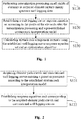
- Fig. 1 illustrates a flow diagram of a method for acquiring stratum rock component contents provided by an embodiment of the present disclosure. The method comprises the steps of: S110: performing normalization processing on all yields of elements in acquired element capture energy spectrum well logging data.
- the normalization processing may be performed on yields of elements in the measured stratum rock components using a normalization equation.
- the target area may be the whole or a part of the exploration area.
- the element capture energy spectrum well logging data may be the data obtained by measuring the target area with a capture energy spectrum well logging method, and may include yields of elements such as silicon, aluminum, sodium, potassium, calcium, magnesium, iron, sulfur and titanium in the stratum rock.
- the capture energy spectrum well logging method may be a method in which fast neutrons are transmitted to a stratum from a chemical source, converted into thermal neutrons after multiple inelastic collisions in the stratum, and finally captured by surrounding atoms, while the elements return to the original state by releasing gamma rays.
- yield normalization coefficient of an element is relevant to an element content in an oxide corresponding to the element, and the yield normalization coefficients of conventional elements are shown in the following Table 1: Table 1: Yield Normalization Coefficients of Conventional Elements Element Si Ca Fe S Ti & Yield normalization coefficient 2.14 1.52 0.23 0.01 0.09 together
- an element yield curve may be constructed.
- the element yield curve records a second actual well logging response value corresponding to each depth point in a certain depth range, i.e., the yields of the elements after the normalization processing.
- the depth point may be a point of a certain depth.
- the well logging curve response equation set may be established using the obtained yields of the elements after the normalization processing and the pre-established stratum rock interpretation model.
- the stratum rock component interpretation model may be established according to main mineral component types, trace mineral types and stratum fluid types of the stratum rock in the target area determined using the acquired well logging data, core analysis data, fluid analysis data and geological conditions of the target area.
- the established stratum rock model may include type information of a rock existed in the target area.
- the well logging data may comprise the conventional well logging data and the element capture energy spectrum well logging data.
- the core analysis data may be used for analyzing different positions and lithologies of the core, so as to deepen the understanding of the stratum rock characteristics, and may comprise coring descriptions, physical property analysis data, total rock oxide data, rock electrical property experimental data, etc.
- the fluid analysis data may be used for recognizing stratum fluid types and stratum water properties, comprising stratum test data, stratum water analysis data, etc.
- a well section of 2350.00 m to 2405.00 m is continuously cored.
- the core shows that an upper portion of the well section has a lithology of black shale, and a lower portion thereof gradually transitions to limestone.
- the core analysis shows that the main stratum mineral types of the well section are clay, quartz, calcite and dolomite, a minute amount of pyrite is contained, and the pore fluid components are stratum water and natural gas.
- the established stratum rock interpretation model comprises clay, quartz, calcite, dolomite, pyrite, stratum water and natural gas.
- execution orders of establishing the stratum rock interpretation model and performing the normalization processing of the yields of the elements are not limited.
- Step S120 specifically may comprise the following substeps, as illustrated in Fig. 2 : S121: acquiring element yield curves and conventional well logging curves meeting a preset requirement according to the established stratum rock interpretation model.
- the preset requirement may mean having obvious response characteristics with respect to the change of the stratum rock mineral or fluid.
- Acquiring element yield curves and conventional well logging curves meeting a preset requirement according to the established stratum rock interpretation model may mean acquiring element yield curves and conventional well logging curves which can reflect relevant characteristics of mineral components and/or fluid components according to the mineral components and/or the fluid components included in the stratum rock interpretation model.
- the conventional well logging curve may be acquired from well logging data obtained by a well logging with a conventional well logging method, and it records a first actual well logging response value corresponding to each depth point in a certain depth range.
- the element yield curve is acquired by performing normalization processing of the yields of the elements obtained by measuring the element capture energy spectrum well logging, and it records a second actual well logging response value corresponding to each depth point in a certain depth range.
- the depth point may be a point of a certain depth.
- Various well logging curves reflect different stratum information characteristics.
- the natural gamma curve mainly reflects a total amount of stratum clay minerals
- the tri-porosity curve mainly reflects a stratum pore development degree
- the resistivity curve mainly reflects a change of intrapore fluid components.
- the stratum minerals reflected by the element yield curves are also inconsistent with each other.
- an aluminum (Al) element yield curve reflects a stratum clay mineral content
- a silicon (Si) element yield curve indicates a change of a stratum quartz content
- a calcium (Ca) element yield curve mainly reflects a carbonatite mineral content in a stratum, and it is relevant to a calcite content and a dolomite content in the stratum
- a potassium (K) element yield curve and a sodium (Na) element yield curve well indicate feldspar mineral components in a stratum
- an iron (Fe) element yield curve mainly reflects iron-bearing minerals such as pyrite and siderite in a stratum
- the sulfur (S) element yield curve can also well reflect a stratum pyrite content.
- corresponding well logging curves can be acquired according to the mineral components included in the established stratum rock interpretation model.
- the established stratum rock interpretation model includes clay, quartz, calcite, dolomite, pyrite, stratum water and natural gas.
- the acquired well logging curves may include element yield curves of Al, Si, Ca, Fe and S, the natural gamma curve, the resistivity curve and the tri-porosity curve.
- the number of the acquired element yield curves and conventional well logging curves may be larger than that of mineral components in the stratum rock interpretation model.
- the well logging curves may comprise the element yield curve and the conventional well logging curve.
- Establishing response equations each corresponding to the acquired element yield curves and conventional well logging curves may mean establishing relational expressions between the theoretical well logging response values each corresponding to the acquired element yield curves and conventional well logging curves and volume percentage contents of stratum rock components.
- t ck 1 denotes a theoretical well logging response value corresponding to a k-th conventional well logging curve acquired
- v i and v j denote volume percentage contents of each mineral component and fluid component of a stratum, respectively
- R i and R j denote well logging response parameters of each mineral and fluid, respectively
- m and f denote the number of the minerals and fluids in a stratum rock, respectively
- i, j and k are all positive integers.
- Equation (2) The response equation corresponding to each conventional well logging curve acquired may be established using equation (2).
- t cGR denotes a theoretical well logging response value corresponding to the natural gamma well logging curve
- v clay , v quar , v calc , v dolo , v pyri , v water and v gas denote volume percentage contents of clay, quartz, calcite, dolomite, pyrite, stratum water and natural gas, respectively
- GR clay , GR quar , GR calc , GR dolo , GR pyri , GR water and GR gas denote natural gamma well logging response parameters of clay, quartz, calcite, dolomite, pyrite, stratum water and natural gas, respectively.
- the response equation corresponding to each conventional well logging curve acquired may be established using equation (4).
- a response equation corresponding to the stratum calcium element yield curve may be represented with equation (5):
- t cCa ( v caly . ⁇ clay . C a clay + v quar . ⁇ quar . C a quar + v calc . ⁇ calc . C a calc + v dolo . ⁇ dolo . C a dolo + v pyri . ⁇ pyri . C a pyri ) / v caly . ⁇ clay + v quar . ⁇ quar + v calc . ⁇ calc + v dolo . ⁇ dolo + v pyri .
- t cCa denote a theoretical well logging response value corresponding to the calcium element yield curve
- Ca clay , Ca quar , Ca calc , Ca dolo and Ca pyri denote calcium element well logging response parameters of clay, quartz, calcite, dolomite and pyrite, respectively
- ⁇ clay , ⁇ quar , ⁇ calc , ⁇ dolo and ⁇ pyri denote mineral densities of clay, quartz, calcite, dolomite and pyrite, respectively.
- the well logging response parameters in equations (2) to (5) may be determined with a method that combines a rock element mineral experiment with a theoretical value calculation.
- the well logging response parameters in equations (2) to (3) may also take the technicians' empirical values or values acquired with other methods in the prior art.
- each element well logging response parameter for the mineral components can be determined with a method such as X-ray Diffraction (XRD), X-ray Fluorescence (XRF), Fourier transform infrared spectrum analyzer (FTIR), etc.
- XRD X-ray Diffraction
- XRF X-ray Fluorescence
- FTIR Fourier transform infrared spectrum analyzer
- experimental methods are taken to determine the variation range and optimal values of element well logging response parameters in acquired core samples of a plurality of oil field blocks in the east and west of China.
- element well logging response parameters 16 conventional stratum minerals, such as quartz, sodium feldspar, potassium feldspar, calcite and dolomite, in the above oil fields, as shown in Table 2:
- the stratum rock component contents may comprise the mineral component contents and the fluid component contents.
- calculating stratum rock component contents may mean calculating volume percentage contents of each mineral component and fluid component in a stratum rock.
- the mineral component contents of the stratum rock may be calculated using the established response equations and the optimization algorithm. Specifically,
- an optimization target function may be established with a least square method.
- the mineral component contents and the fluid component contents in the stratum rock may be calculated using the established target function and a non-linear optimization algorithm after establishing the target function.
- the theoretical well logging response values i.e., equations (2) and (4)
- equation (8) may be solved using the non-linear optimization algorithm to calculate a value of the target function F ( v )
- the volume percentage contents of each mineral component and/or fluid component in the stratum may be continuously adjusted with an optimization method, so that the value of the target function F ( v ) becomes minimum; at that time, the volume percentage contents of each mineral component and/or fluid component are those finally determined for the stratum rock.
- the volume percentage contents of the mineral component and the fluid component in equation (8) may be restricted in a certain range, so that a sum of the volume percentage contents of all the components is 1, while preset constraint conditions can be met.
- the constraint conditions may be defined, by an interpreter based on empirical knowledge, for the range of the mineral component content and the fluid component content in the stratum rock component interpretation model, including maximum and minimum values of the mineral content, maximum and minimum values of the stratum porosity, etc.
- the constraint conditions may be set before or after the stratum rock component interpretation model is established.
- the stratum lithology, the advantageous parts for reservoir development, and the fluid properties can be determined. For example, when the calcite content is high while the clay and dolomite contents are low in the stratum after a calculation, it may be judged that the stratum is a limestone stratum; and when hydrocarbon is dominant in the calculated fluid, it may be judged that the stratum is a hydrocarbon bearing stratum.
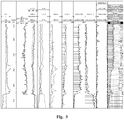
- Fig. 3 illustrates a comparison diagram between a calculation result of stratum rock component contents of well A of Southwest Oil and Gas Field and a lab analysis result.
- the rightmost column in Fig. 3 is a component section obtained by processing well A with a stratum rock component content calculation method proposed by the present disclosure.
- the second to fifth columns from right are comparisons between calculation results of the method provided by the embodiment of the present disclosure and the coring analysis result. As can be seen from those columns, the mineral component contents of clay, quartz and calcite of the stratum calculated with the method provided by the embodiment of the present disclosure are consistent with the core experimental analysis result.
- the fifth and sixth columns from left are element yield curves of aluminum, silicon, calcium, iron and sulfur of the stratum after the normalization processing.
- the pores are well developed, and the total amounts of natural gas and stratum water (white and black filled parts) are high, wherein natural gas (white filled parts) are dominant.
- the pores in that section are mainly filled of natural gas, which is an advantageous exploration portion for shale gas reservoir.
- the embodiments of the present disclosure perform normalization processing of yields of elements using acquired element capture energy spectrum well logging data; establish a well logging curve response equation set according to the element yield curves acquired after the normalization processing and a pre-established stratum rock interpretation model, the well logging curve response equation set comprising response equations corresponding to conventional well logging curves and the element yield curves; and calculate stratum rock component contents using the established well logging response equation set and an optimization algorithm.
- the method provided by the embodiments of the present disclosure not only avoids "oxygen closing" processing in the element capture energy spectrum well logging data processing and conversion steps from elements to minerals, but also comprehensively processes the conventional well logging data and the element capture energy spectrum well logging data, thereby increasing the calculation precision of the stratum rock component contents, reducing the calculation amount, and improving the calculation efficiency.
- the method is also well adaptive for the reservoir evaluations of various complex lithologies.
- the embodiments of the present disclosure further provide a device for acquiring stratum rock component contents.
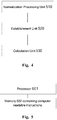
- the device comprises a normalization processing unit 510, an establishment unit 520 and a calculation unit 530, wherein the normalization processing unit 510 may be configured to perform normalization processing of yields of elements in acquired element capture energy spectrum well logging data; the establishment unit 520 may be configured to establish a well logging curve response equation set according to the yields of the elements after the normalization processing and a pre-established stratum rock interpretation model; and the calculation unit may be configured to calculate stratum rock component contents using the established well logging response equation set and an optimization algorithm.
- the establishment unit 520 may comprise (not illustrated):
- the calculation unit 530 may comprise (not illustrated):
- the embodiment of the present disclosure increases the calculation precision of the stratum rock component contents.
- the embodiments of the present disclosure further provide a computer readable storage medium, wherein the computer readable storage medium stores a computer program which causes the processor to perform the following operations when being executed: performing normalization processing on all yields of elements in acquired element capture energy spectrum well logging data; establishing a well logging curve response equation set according to the yields of the elements after the normalization processing and a pre-established stratum rock interpretation model; and calculating stratum rock component contents using the established well logging curve response equation set and an optimization algorithm.
- the computer readable instructions cause the processor to acquire element yield curves and conventional well logging curves meeting a preset requirement according to the established stratum rock interpretation model; establish response equations each corresponding to the acquired element yield curves and conventional well logging curves.
- the computer readable instructions cause the processor to establish relational expressions between the theoretical well logging response values each corresponding to the acquired element yield curves and conventional well logging curves and volume percentage contents of stratum rock components.
- the computer readable instructions cause the processor to establish a target function using the well logging curve response equation set; calculate volume percentage contents of each mineral component and fluid component in a stratum rock using the target function.
- the embodiments of the present disclosure further provide a device for acquiring stratum rock component contents.
- the device comprises a processor 601; and a memory 602 containing computer readable instructions which when being executed, cause the processor to perform the operations of: performing normalization processing on all yields of elements in acquired element capture energy spectrum well logging data; establishing a well logging curve response equation set according to the yields of the elements after the normalization processing and a pre-established stratum rock interpretation model; and calculating stratum rock component contents using the established well logging curve response equation set and an optimization algorithm.
- the computer readable instructions cause the processor to acquire element yield curves and conventional well logging curves meeting a preset requirement according to the established stratum rock interpretation model; establish response equations each corresponding to the acquired element yield curves and conventional well logging curves.
- the computer readable instructions cause the processor to establish relational expressions between the theoretical well logging response values each corresponding to the acquired element yield curves and conventional well logging curves and volume percentage contents of stratum rock components.
- the computer readable instructions cause the processor to establish a target function using the well logging curve response equation set; calculate volume percentage contents of each mineral component and fluid component in a stratum rock using the target function.
- the device or unit elaborated in the above embodiment specifically may be implemented by a computer chip or entity, or a product having a certain function.
- the device is described through various units based on the functions.
- the functions of the units may be realized in one or more software and/or hardware during the implementation of the present disclosure.
- the steps of the method or the algorithm described in the embodiments of the present disclosure may be directly embedded into hardware, a software module executed by a processor, or a combination thereof.
- the software module may be stored in a Random-Access Memory (RAM), a flash memory, a Read-Only Memory (ROM), an Electrically Programmable ROM (EPROM), an Electrically Erasable Programmable ROM (EEPROM), a register, a hard disc, a removable disc, a Compact Disc-ROM (CD-ROM) or a storage medium of any other form in the art.
- the storage medium may be connected to the processor, so that the processor can read and write information from and into the storage medium.
- the storage medium may also be integrated into the processor.
- the processor and the storage medium may be disposed in an Application Specific Integrated Circuit (ASIC) that may be provided in a user terminal.
- the processor and the storage medium may also be disposed in different parts of the user terminal.
- ASIC Application Specific Integrated Circuit
- the functions described by the embodiments of the present disclosure may be realized by hardware, software, firmware or combinations thereof.
- the functions When being realized in software, the functions may be stored in a computer readable medium, or transmitted therein in the form of one or more instructions or codes.
- the computer readable medium includes a computer storage medium and a communication medium that facilitates a computer program to be transferred from one place to another place.
- the storage medium may be an available medium that can be accessed by any general or special computer.
- such a computer readable medium may include, but not limited to, an RAM, an ROM, an EEPROM, a CD-ROM, other optical disc storage, other magnetic disc storage, other magnetic storage device, or any other medium for bearing or storing program codes in the form of instructions or data structures and other forms readable by a general or special computer or processor.
Landscapes
- Physics & Mathematics (AREA)
- Life Sciences & Earth Sciences (AREA)
- Geology (AREA)
- Engineering & Computer Science (AREA)
- Mining & Mineral Resources (AREA)
- General Life Sciences & Earth Sciences (AREA)
- High Energy & Nuclear Physics (AREA)
- Environmental & Geological Engineering (AREA)
- Fluid Mechanics (AREA)
- Geochemistry & Mineralogy (AREA)
- General Physics & Mathematics (AREA)
- Geophysics (AREA)
- Soil Sciences (AREA)
- Geophysics And Detection Of Objects (AREA)
Abstract
Description
- This application claims priority to Chinese patent application No.
2015107317407 filed on November 02, 2015 - The present disclosure relates to the technical field of oil-gas exploration, and particularly, to a method and device for acquiring stratum rock component contents.
- In the oil-gas field exploration, the quantitative calculation of the stratum rock component contents is the basis and key for the evaluation of the well logging interpretation. The accuracy of the calculation result directly influences the lithology identification, the stratigraphic division, the reservoir parameter calculation, the hydrocarbon reservoir prediction and analysis, the oil field region evaluation, etc. Thus, how to quickly and accurately calculate the stratum rock mineral component contents is very important to the oil-gas field exploration and development.
- Currently, the prior art mainly uses two methods to calculate the stratum rock component contents. One is to directly calculate using several well logging curves sensitive to the stratum lithology changes among conventional well logging data, with a given interpretation model, based on quantitative relations between minerals, fluids and well logging responses. The other is to convert the yields of elements such as silicon, calcium, iron, magnesium and sulfur obtained by unfolding spectrums of the original measurement signal through "oxygen closing" processing, into weight percentage contents of the elements using element capture energy spectrum well logging data, and calculate the mineral percentage contents through conversion relations between the stratum elements and the rock minerals.
- During implementation of the present disclosure, the inventor finds that the prior art at least has the following problems: 1) information of the elements composing the stratum rock recorded in the conventional well logging data is limited, thus the types of the calculated rock mineral components are limited, and the calculation precision is low; 2) the element capture energy spectrum well logging data processing is tedious, and the mineral contents cannot be calculated unless the yields of elements are converted into the weight percentage contents of the elements, while the conversion models between the elements and the minerals are established based on the oil field sedimentary rocks abroad and the application effects are not ideal in many regions of China; 3) the above two methods both substantively directly calculate using empirical relations between the stratum minerals and fluids and the conventional well logging or element capture energy spectrum well logging response, thus the data utilization degree is low, and the calculation precision is largely limited.
- An objective of the embodiments of the present disclosure is to provide a method and device for acquiring stratum rock component contents, so as to improve a calculation precision of the stratum rock component contents.
- In order to achieve the above technical objective, a method and device for acquiring stratum rock component contents provided by the embodiments of the present disclosure are realized as follows.
- The embodiments of the present disclosure provide a method for acquiring stratum rock component contents, comprising:
- performing normalization processing on all yields of elements in acquired element capture energy spectrum well logging data;
- establishing a well logging curve response equation set according to an element yield curve after the normalization processing and a pre-established stratum rock interpretation model; and
- calculating stratum rock component contents using the established well logging curve response equation set and an optimization algorithm.
- The embodiments of the present disclosure further provide an device for acquiring stratum rock component contents, comprising:
- a normalization processing unit configured to perform normalization processing of yields of elements in acquired element capture energy spectrum well logging data;
- an establishment unit configured to establish a well logging curve response equation set according to the yields of the elements after the normalization processing and a pre-established stratum rock interpretation model; and
- a calculation unit configured to calculate stratum rock component contents using the established well logging response equation set and an optimization algorithm.
- As can be seen from the technical solutions provided by the above embodiments of the present disclosure, by performing normalization processing on all yields of elements based on acquired element capture energy spectrum well logging data, establishing a well logging curve response equation set according to the yields of the elements after the normalization processing and a pre-established stratum rock interpretation model, and calculating stratum rock component contents using the established well logging curve response equation set and an optimization algorithm, the embodiments of the present disclosure avoid "oxygen closing" processing in the element capture energy spectrum well logging data processing and conversion steps from elements to minerals, and comprehensively process the conventional well logging data and the element capture energy spectrum well logging data, thereby increasing the calculation precision of the stratum rock component contents.
- In order to more clearly describe the technical solutions in the embodiments of the present disclosure or the prior art, the drawings to be used in the descriptions of the embodiments or the prior art will be briefly introduced as follows. Obviously, the drawings in the following descriptions just illustrate some embodiments of the present disclosure, and a person skilled in the art can obtain other drawings from them without paying any creative labor.
-
Fig. 1 illustrates a flow diagram of a method for acquiring stratum rock component contents provided by an embodiment of the present disclosure; -
Fig. 2 illustrates a flow diagram of substeps ofstep S 120; -
Fig. 3 illustrates a comparison diagram between a calculation result of stratum rock component contents of well A of Southwest Oil and Gas Field and a lab analysis result; -
Fig. 4 illustrates a block diagram of a device for calculating stratum rock component contents provided by an embodiment of the present disclosure. -
Fig. 5 illustrates a device for acquiring stratum rock component contents provided by an embodiment of the present disclosure. - The embodiments of the present disclosure provide a method and device for acquiring stratum rock component contents.
- In order that a person skilled in the art better understands the technical solutions in the present disclosure, the technical solutions in the embodiments of the present disclosure will be clearly and completely described with reference to the drawings in the embodiments of the present disclosure. Obviously, those described are just parts, rather than all, of the embodiments of the present disclosure. Any other embodiment obtained by a person skilled in the art based on the embodiments of the present disclosure without paying any creative labor shall fall within the protection scope of the present disclosure.
- Next, a method for acquiring stratum rock component contents of the present disclosure will be described in details with reference to the drawings. Although the present disclosure provides methodical operation steps as described in the following embodiment or flow diagram, more or less operation steps may be included in the method based on the conventional labor or a non-inventive labor. The execution orders of the steps having no necessary causal relation in logics are not limited to those provided in the embodiments of the present disclosure.
Fig. 1 illustrates a flow diagram of a method for acquiring stratum rock component contents provided by an embodiment of the present disclosure. The method comprises the steps of:
S110: performing normalization processing on all yields of elements in acquired element capture energy spectrum well logging data. - After element capture energy spectrum well logging data of a target area is acquired, the normalization processing may be performed on yields of elements in the measured stratum rock components using a normalization equation.
- The target area may be the whole or a part of the exploration area.
- The element capture energy spectrum well logging data may be the data obtained by measuring the target area with a capture energy spectrum well logging method, and may include yields of elements such as silicon, aluminum, sodium, potassium, calcium, magnesium, iron, sulfur and titanium in the stratum rock. The capture energy spectrum well logging method may be a method in which fast neutrons are transmitted to a stratum from a chemical source, converted into thermal neutrons after multiple inelastic collisions in the stratum, and finally captured by surrounding atoms, while the elements return to the original state by releasing gamma rays.
- The normalization processing of the yields of the elements may be performed using the following equation:

- The yield normalization coefficient of an element is relevant to an element content in an oxide corresponding to the element, and the yield normalization coefficients of conventional elements are shown in the following Table 1:
Table 1: Yield Normalization Coefficients of Conventional Elements Element Si Ca Fe S Ti ...... Yield normalization coefficient 2.14 1.52 0.23 0.01 0.09 ...... - After the normalization processing is performed on the yields of the elements, an element yield curve may be constructed. The element yield curve records a second actual well logging response value corresponding to each depth point in a certain depth range, i.e., the yields of the elements after the normalization processing. The depth point may be a point of a certain depth.
- S120: establishing a well logging curve response equation set according to the yields of the elements after the normalization processing and a pre-established stratum rock interpretation model.
- The well logging curve response equation set may be established using the obtained yields of the elements after the normalization processing and the pre-established stratum rock interpretation model.
- The stratum rock component interpretation model may be established according to main mineral component types, trace mineral types and stratum fluid types of the stratum rock in the target area determined using the acquired well logging data, core analysis data, fluid analysis data and geological conditions of the target area. The established stratum rock model may include type information of a rock existed in the target area.
- The well logging data may comprise the conventional well logging data and the element capture energy spectrum well logging data. The core analysis data may be used for analyzing different positions and lithologies of the core, so as to deepen the understanding of the stratum rock characteristics, and may comprise coring descriptions, physical property analysis data, total rock oxide data, rock electrical property experimental data, etc. The fluid analysis data may be used for recognizing stratum fluid types and stratum water properties, comprising stratum test data, stratum water analysis data, etc.
- For example, in well A of Southwest Oil and Gas Field, a well section of 2350.00 m to 2405.00 m is continuously cored. The core shows that an upper portion of the well section has a lithology of black shale, and a lower portion thereof gradually transitions to limestone. The core analysis shows that the main stratum mineral types of the well section are clay, quartz, calcite and dolomite, a minute amount of pyrite is contained, and the pore fluid components are stratum water and natural gas. Thus, the established stratum rock interpretation model comprises clay, quartz, calcite, dolomite, pyrite, stratum water and natural gas.
- To be noted, the execution orders of establishing the stratum rock interpretation model and performing the normalization processing of the yields of the elements are not limited.
- Step S120 specifically may comprise the following substeps, as illustrated in
Fig. 2 :
S121: acquiring element yield curves and conventional well logging curves meeting a preset requirement according to the established stratum rock interpretation model. - The preset requirement may mean having obvious response characteristics with respect to the change of the stratum rock mineral or fluid.
- Acquiring element yield curves and conventional well logging curves meeting a preset requirement according to the established stratum rock interpretation model may mean acquiring element yield curves and conventional well logging curves which can reflect relevant characteristics of mineral components and/or fluid components according to the mineral components and/or the fluid components included in the stratum rock interpretation model.
- The conventional well logging curve may be acquired from well logging data obtained by a well logging with a conventional well logging method, and it records a first actual well logging response value corresponding to each depth point in a certain depth range. The element yield curve is acquired by performing normalization processing of the yields of the elements obtained by measuring the element capture energy spectrum well logging, and it records a second actual well logging response value corresponding to each depth point in a certain depth range. The depth point may be a point of a certain depth.
- Various well logging curves reflect different stratum information characteristics. For example, in the conventional well logging, it is generally recognized that the natural gamma curve mainly reflects a total amount of stratum clay minerals, the tri-porosity curve mainly reflects a stratum pore development degree, and the resistivity curve mainly reflects a change of intrapore fluid components. The stratum minerals reflected by the element yield curves are also inconsistent with each other. For example, an aluminum (Al) element yield curve reflects a stratum clay mineral content; a silicon (Si) element yield curve indicates a change of a stratum quartz content; a calcium (Ca) element yield curve mainly reflects a carbonatite mineral content in a stratum, and it is relevant to a calcite content and a dolomite content in the stratum; a potassium (K) element yield curve and a sodium (Na) element yield curve well indicate feldspar mineral components in a stratum; an iron (Fe) element yield curve mainly reflects iron-bearing minerals such as pyrite and siderite in a stratum; the sulfur (S) element yield curve can also well reflect a stratum pyrite content. Thus, corresponding well logging curves can be acquired according to the mineral components included in the established stratum rock interpretation model. For example, in well A, the established stratum rock interpretation model includes clay, quartz, calcite, dolomite, pyrite, stratum water and natural gas. Thus, for the stratum mineral and fluid types in the stratum rock interpretation model, the acquired well logging curves may include element yield curves of Al, Si, Ca, Fe and S, the natural gamma curve, the resistivity curve and the tri-porosity curve.
- Preferably, the number of the acquired element yield curves and conventional well logging curves may be larger than that of mineral components in the stratum rock interpretation model.
- S122: establishing response equations each corresponding to the acquired element yield curves and conventional well logging curves.
- After the element yield curves and the conventional well logging curves are acquired, corresponding response equations may be established, respectively, to constitute the well logging curve response equation set. The well logging curves may comprise the element yield curve and the conventional well logging curve.
- Establishing response equations each corresponding to the acquired element yield curves and conventional well logging curves may mean establishing relational expressions between the theoretical well logging response values each corresponding to the acquired element yield curves and conventional well logging curves and volume percentage contents of stratum rock components.
- For each depth point, the response equation corresponding to the established conventional well logging curve may be represented as:

- The response equation corresponding to each conventional well logging curve acquired may be established using equation (2).
- For example, a response equation corresponding to the natural gamma well logging curve may be represented as:


- For each depth point, the response equation corresponding to the established element yield curve may be represented as:

- The response equation corresponding to each conventional well logging curve acquired may be established using equation (4).
- For example, a response equation corresponding to the stratum calcium element yield curve may be represented with equation (5):

- The well logging response parameters in equations (2) to (5) may be determined with a method that combines a rock element mineral experiment with a theoretical value calculation. The well logging response parameters in equations (2) to (3) may also take the technicians' empirical values or values acquired with other methods in the prior art.
- Regarding most of conventional minerals, their chemical components are fixed, and their well logging response parameters can be directly obtained through the theoretical value calculation. For example, the specific calculation equation for the well logging response parameters in equations (4) to (5) may be represented as:

- Regarding a mineral having complex chemical components and various changes, a total rock oxide analysis and assay may be performed on the mineral components through experiment measures, so as to directly determine the element well logging response parameter. For example, each element well logging response parameter for the mineral components can be determined with a method such as X-ray Diffraction (XRD), X-ray Fluorescence (XRF), Fourier transform infrared spectrum analyzer (FTIR), etc.
- During an implementation, experimental methods are taken to determine the variation range and optimal values of element well logging response parameters in acquired core samples of a plurality of oil field blocks in the east and west of China. For example, it is possible to determine the element well logging response parameters of sixteen conventional stratum minerals, such as quartz, sodium feldspar, potassium feldspar, calcite and dolomite, in the above oil fields, as shown in Table 2:
-


- S130: calculating stratum rock component contents using the established well logging response equation set and an optimization algorithm.
- The stratum rock component contents may comprise the mineral component contents and the fluid component contents. In this embodiment, calculating stratum rock component contents may mean calculating volume percentage contents of each mineral component and fluid component in a stratum rock.
- After the response equations corresponding to the acquired conventional well logging curves and the response equations corresponding to the acquired element yield curves are established, the mineral component contents of the stratum rock may be calculated using the established response equations and the optimization algorithm. Specifically,
- After the response equations are established, an optimization target function may be established with a least square method. The established target function may be represented as:


- The mineral component contents and the fluid component contents in the stratum rock may be calculated using the established target function and a non-linear optimization algorithm after establishing the target function. Namely, the theoretical well logging response values (i.e., equations (2) and (4)) corresponding to the acquired well logging curves and corresponding actual well logging response values are plugged into equations (7) and (8); equation (8) may be solved using the non-linear optimization algorithm to calculate a value of the target function F(v) ; the volume percentage contents of each mineral component and/or fluid component in the stratum may be continuously adjusted with an optimization method, so that the value of the target function F(v) becomes minimum; at that time, the volume percentage contents of each mineral component and/or fluid component are those finally determined for the stratum rock.
- To be noted, the volume percentage contents of the mineral component and the fluid component in equation (8) may be restricted in a certain range, so that a sum of the volume percentage contents of all the components is 1, while preset constraint conditions can be met. The constraint conditions may be defined, by an interpreter based on empirical knowledge, for the range of the mineral component content and the fluid component content in the stratum rock component interpretation model, including maximum and minimum values of the mineral content, maximum and minimum values of the stratum porosity, etc. The constraint conditions may be set before or after the stratum rock component interpretation model is established.
- After each mineral component content and fluid component content in the stratum rock are calculated, the stratum lithology, the advantageous parts for reservoir development, and the fluid properties can be determined. For example, when the calcite content is high while the clay and dolomite contents are low in the stratum after a calculation, it may be judged that the stratum is a limestone stratum; and when hydrocarbon is dominant in the calculated fluid, it may be judged that the stratum is a hydrocarbon bearing stratum.
-
Fig. 3 illustrates a comparison diagram between a calculation result of stratum rock component contents of well A of Southwest Oil and Gas Field and a lab analysis result. The rightmost column inFig. 3 is a component section obtained by processing well A with a stratum rock component content calculation method proposed by the present disclosure. The second to fifth columns from right (i.e., the seventh to tenth columns from left) are comparisons between calculation results of the method provided by the embodiment of the present disclosure and the coring analysis result. As can be seen from those columns, the mineral component contents of clay, quartz and calcite of the stratum calculated with the method provided by the embodiment of the present disclosure are consistent with the core experimental analysis result. The fifth and sixth columns from left are element yield curves of aluminum, silicon, calcium, iron and sulfur of the stratum after the normalization processing. As can be seen from the first column from right inFig. 3 , in the reservoir within a section of 2364.00 m to 2395.00 m, the pores are well developed, and the total amounts of natural gas and stratum water (white and black filled parts) are high, wherein natural gas (white filled parts) are dominant. Thus, it can be judged that the pores in that section are mainly filled of natural gas, which is an advantageous exploration portion for shale gas reservoir. - As can be seen from the above steps, the embodiments of the present disclosure perform normalization processing of yields of elements using acquired element capture energy spectrum well logging data; establish a well logging curve response equation set according to the element yield curves acquired after the normalization processing and a pre-established stratum rock interpretation model, the well logging curve response equation set comprising response equations corresponding to conventional well logging curves and the element yield curves; and calculate stratum rock component contents using the established well logging response equation set and an optimization algorithm. The method provided by the embodiments of the present disclosure not only avoids "oxygen closing" processing in the element capture energy spectrum well logging data processing and conversion steps from elements to minerals, but also comprehensively processes the conventional well logging data and the element capture energy spectrum well logging data, thereby increasing the calculation precision of the stratum rock component contents, reducing the calculation amount, and improving the calculation efficiency. The method is also well adaptive for the reservoir evaluations of various complex lithologies.
- The embodiments of the present disclosure further provide a device for acquiring stratum rock component contents. As illustrated in
Fig. 4 , the device comprises anormalization processing unit 510, anestablishment unit 520 and acalculation unit 530, wherein thenormalization processing unit 510 may be configured to perform normalization processing of yields of elements in acquired element capture energy spectrum well logging data; theestablishment unit 520 may be configured to establish a well logging curve response equation set according to the yields of the elements after the normalization processing and a pre-established stratum rock interpretation model; and the calculation unit may be configured to calculate stratum rock component contents using the established well logging response equation set and an optimization algorithm. - In an embodiment, the
establishment unit 520 may comprise (not illustrated): - an acquisition subunit configured to acquire element yield curves and conventional well logging curves meeting a preset requirement according to the established stratum rock interpretation model;
- a first establishment subunit configured to establish response equations corresponding to the acquired element yield curves and conventional well logging curves, respectively. The established response equations may be as shown in equations (2) and (4).
- In an embodiment, the
calculation unit 530 may comprise (not illustrated): - a second establishment subunit configured to establish a target function using the well logging curve response equation set;
- a calculation subunit configured to calculate volume percentage contents of each mineral component and fluid component in a stratum rock using the target function.
- As can be seen from the above description, by providing a normalization processing unit configured to perform normalization processing of yields of elements acquired by measuring the element capture energy spectrum well logging, an establishment unit configured to establish a well logging curve response equation set comprising response equations corresponding to conventional well logging curves and element yield curves, and a calculation unit configured to calculate stratum rock component contents, the embodiment of the present disclosure increases the calculation precision of the stratum rock component contents.
- The embodiments of the present disclosure further provide a computer readable storage medium, wherein the computer readable storage medium stores a computer program which causes the processor to perform the following operations when being executed: performing normalization processing on all yields of elements in acquired element capture energy spectrum well logging data; establishing a well logging curve response equation set according to the yields of the elements after the normalization processing and a pre-established stratum rock interpretation model; and calculating stratum rock component contents using the established well logging curve response equation set and an optimization algorithm.
- In an embodiment, the computer readable instructions cause the processor to calculate the yields of the elements using the following equation:

- In an embodiment, the computer readable instructions cause the processor to acquire element yield curves and conventional well logging curves meeting a preset requirement according to the established stratum rock interpretation model; establish response equations each corresponding to the acquired element yield curves and conventional well logging curves.
- In an embodiment, the computer readable instructions cause the processor to establish relational expressions between the theoretical well logging response values each corresponding to the acquired element yield curves and conventional well logging curves and volume percentage contents of stratum rock components.
- In an embodiment, the computer readable instructions cause the processor to establish a target function using the well logging curve response equation set; calculate volume percentage contents of each mineral component and fluid component in a stratum rock using the target function.
- The embodiments of the present disclosure further provide a device for acquiring stratum rock component contents. As illustrated in
Fig. 5 , the device comprises aprocessor 601; and amemory 602 containing computer readable instructions which when being executed, cause the processor to perform the operations of: performing normalization processing on all yields of elements in acquired element capture energy spectrum well logging data; establishing a well logging curve response equation set according to the yields of the elements after the normalization processing and a pre-established stratum rock interpretation model; and calculating stratum rock component contents using the established well logging curve response equation set and an optimization algorithm. - In an embodiment, the computer readable instructions cause the processor to calculate the yields of the elements using the following equation:

- In an embodiment, the computer readable instructions cause the processor to acquire element yield curves and conventional well logging curves meeting a preset requirement according to the established stratum rock interpretation model; establish response equations each corresponding to the acquired element yield curves and conventional well logging curves.
- In an embodiment, the computer readable instructions cause the processor to establish relational expressions between the theoretical well logging response values each corresponding to the acquired element yield curves and conventional well logging curves and volume percentage contents of stratum rock components.
- In an embodiment, the computer readable instructions cause the processor to establish a target function using the well logging curve response equation set; calculate volume percentage contents of each mineral component and fluid component in a stratum rock using the target function.
- The device or unit elaborated in the above embodiment specifically may be implemented by a computer chip or entity, or a product having a certain function. For the convenience of description, the device is described through various units based on the functions. Of course, the functions of the units may be realized in one or more software and/or hardware during the implementation of the present disclosure.
- From the description of the above embodiments, a person skilled in the art may further acquire that various illustrative logical blocks, units and steps listed in the embodiments of the present disclosure can be realized by hardware, software or a combination thereof, depending on the specific application and the design requirement of the whole system. With respect to each specific application, a person skilled in the art may realize the functions with various methods, which shall not be understood as going beyond the protection scope of the embodiments of the present disclosure.
- The steps of the method or the algorithm described in the embodiments of the present disclosure may be directly embedded into hardware, a software module executed by a processor, or a combination thereof. The software module may be stored in a Random-Access Memory (RAM), a flash memory, a Read-Only Memory (ROM), an Electrically Programmable ROM (EPROM), an Electrically Erasable Programmable ROM (EEPROM), a register, a hard disc, a removable disc, a Compact Disc-ROM (CD-ROM) or a storage medium of any other form in the art. For example, the storage medium may be connected to the processor, so that the processor can read and write information from and into the storage medium. Optionally, the storage medium may also be integrated into the processor. The processor and the storage medium may be disposed in an Application Specific Integrated Circuit (ASIC) that may be provided in a user terminal. Optionally, the processor and the storage medium may also be disposed in different parts of the user terminal.
- In one or more example designs, the functions described by the embodiments of the present disclosure may be realized by hardware, software, firmware or combinations thereof. When being realized in software, the functions may be stored in a computer readable medium, or transmitted therein in the form of one or more instructions or codes. The computer readable medium includes a computer storage medium and a communication medium that facilitates a computer program to be transferred from one place to another place. The storage medium may be an available medium that can be accessed by any general or special computer. For example, such a computer readable medium may include, but not limited to, an RAM, an ROM, an EEPROM, a CD-ROM, other optical disc storage, other magnetic disc storage, other magnetic storage device, or any other medium for bearing or storing program codes in the form of instructions or data structures and other forms readable by a general or special computer or processor.
- The embodiments herein are described in a progressive manner, and the same or similar parts of the embodiments can refer to each other. Each embodiment lays an emphasis on its distinctions from other embodiments. In particular, the device embodiment is simply described since it is substantially similar to the method embodiment, and please refer to the description of the method embodiment for the relevant portion.
- Although the present disclosure is described through the above embodiments, a person skilled in the art shall appreciate that various modifications and changes can be made to the present disclosure without deviating from the spirit of the present disclosure. It is intended that the appended claims include those modifications and changes without deviating from the spirit of the present disclosure.
Claims (10)
- A method for acquiring stratum rock component contents, wherein the method comprising:performing normalization processing on all yields of elements in acquired element capture energy spectrum well logging data;establishing a well logging curve response equation set according to the yields of the elements after the normalization processing and a pre-established stratum rock interpretation model; andcalculating stratum rock component contents using the established well logging curve response equation set and an optimization algorithm.
- The method according to claim 1, wherein performing normalization processing on all yields of elements comprises calculating the yields of the elements using the following equation:

- The method according to claim 1, wherein establishing a well logging curve response equation set according to the yields of the elements after the normalization processing and a pre-established stratum rock interpretation model comprises:acquiring element yield curves and conventional well logging curves meeting a preset requirement according to the established stratum rock interpretation model;establishing response equations each corresponding to the acquired element yield curves and conventional well logging curves.
- The method according to claim 3, wherein establishing response equations each corresponding to the acquired element yield curves and conventional well logging curves comprises establishing relational expressions between the theoretical well logging response values each corresponding to the acquired element yield curves and conventional well logging curves and volume percentage contents of stratum rock components.
- The method according to claim 4, wherein the established relational expressions are represented as:


- The method according to claim 5, wherein the well logging response parameters are determined with a method that combines a rock element mineral experiment with a theoretical value calculation.
- The method according to claim 1, wherein calculating stratum rock component contents using the established well logging curve response equation set and an optimization algorithm comprises:establishing a target function using the well logging curve response equation set;calculating volume percentage contents of each mineral component and fluid component in a stratum rock using the target function.
- A device for acquiring stratum rock component contents, comprising:a normalization processing unit configured to perform normalization processing of yields of elements in acquired element capture energy spectrum well logging data;an establishment unit configured to establish a well logging curve response equation set according to the yields of the elements after the normalization processing and a pre-established stratum rock interpretation model; anda calculation unit configured to calculate stratum rock component contents using the established well logging response equation set and an optimization algorithm.
- The device according to claim 8, wherein the establishment unit comprises:an acquisition subunit configured to acquire element yield curves and conventional well logging curves meeting a preset requirement according to the established stratum rock interpretation model;a first establishment subunit configured to establish response equations each corresponding to the acquired element yield curves and conventional well logging curves.
- The device according to claim 8, wherein the calculation unit comprises:a second establishment subunit configured to establish a target function using the well logging curve response equation set;a calculation subunit configured to calculate volume percentage contents of each mineral component and fluid component in a stratum rock using the target function.
Applications Claiming Priority (2)
| Application Number | Priority Date | Filing Date | Title |
|---|---|---|---|
| CN201510731740.7A CN105257286B (en) | 2015-11-02 | 2015-11-02 | A method and device for obtaining the content of formation rock components |
| PCT/CN2016/101644 WO2017076151A1 (en) | 2015-11-02 | 2016-10-10 | Method of acquiring rock component content of stratum |
Publications (3)
| Publication Number | Publication Date |
|---|---|
| EP3333360A1 true EP3333360A1 (en) | 2018-06-13 |
| EP3333360A4 EP3333360A4 (en) | 2018-10-10 |
| EP3333360B1 EP3333360B1 (en) | 2021-11-24 |
Family
ID=55097176
Family Applications (1)
| Application Number | Title | Priority Date | Filing Date |
|---|---|---|---|
| EP16861419.6A Active EP3333360B1 (en) | 2015-11-02 | 2016-10-10 | Method of acquiring rock component content of stratum |
Country Status (4)
| Country | Link |
|---|---|
| US (1) | US10962679B2 (en) |
| EP (1) | EP3333360B1 (en) |
| CN (1) | CN105257286B (en) |
| WO (1) | WO2017076151A1 (en) |
Families Citing this family (49)
| Publication number | Priority date | Publication date | Assignee | Title |
|---|---|---|---|---|
| CN105257286B (en) * | 2015-11-02 | 2018-12-25 | 中国石油天然气股份有限公司 | A method and device for obtaining the content of formation rock components |
| CN105426612B (en) | 2015-11-18 | 2019-01-18 | 中国石油天然气股份有限公司 | Method and device for optimal determination of formation components |
| CN107515290B (en) * | 2016-06-15 | 2019-12-27 | 中国石油化工股份有限公司 | Rock mineral component content quantitative calculation method |
| CN107644383A (en) * | 2016-07-21 | 2018-01-30 | 中国石油天然气股份有限公司 | Qualitative methods for carbonate rocks |
| CN106250619B (en) * | 2016-07-29 | 2020-01-10 | 中国石油天然气股份有限公司 | Method and device for determining mineral content of stratum |
| CN106600436B (en) * | 2016-11-28 | 2021-04-09 | 中国石油天然气集团有限公司 | Method for calculating mineral composition content and porosity of shale gas formation |
| US10156137B2 (en) * | 2017-03-06 | 2018-12-18 | Saudi Arabian Oil Company | Determining a rock formation content |
| CN108457644B (en) * | 2017-12-26 | 2020-04-10 | 中国石油天然气股份有限公司 | Gamma-ray energy spectrum unscrambling method and device for element capture energy spectrum logging |
| CN109612943B (en) * | 2019-01-14 | 2020-04-21 | 山东大学 | System and method for testing quartz content of tunnel rock based on machine learning |
| CN111505238A (en) * | 2019-01-31 | 2020-08-07 | 中国石油化工股份有限公司 | A kind of rock dolomization calculation method and calculation system |
| CN111707681B (en) * | 2019-03-18 | 2023-09-12 | 中国石油化工股份有限公司 | System and method for detecting element content in rock debris |
| CN110111856B (en) * | 2019-04-23 | 2022-12-23 | 长江大学 | Method for analyzing mineral components in rock based on element measurement |
| CN112031740B (en) * | 2019-05-15 | 2024-02-02 | 中国石油化工股份有限公司 | Shale gas geological dessert evaluation method and device based on stratum elements |
| CN110673215A (en) * | 2019-09-19 | 2020-01-10 | 中国石油大学(华东) | Automatic complex lithology distinguishing method based on intersection graph and Fisher distinguishing |
| CN111119841A (en) * | 2019-11-12 | 2020-05-08 | 中国石油天然气集团有限公司 | Evaluation method for fine processing and automatic lithology identification of salt rock components |
| CN113123782B (en) * | 2019-12-31 | 2024-05-14 | 中国石油化工股份有限公司 | Method for evaluating stratum components by utilizing linear programming |
| US11566518B2 (en) | 2020-03-02 | 2023-01-31 | Saudi Arabian Oil Company | Method and system for diagenesis-based rock classification |
| CN111323844B (en) * | 2020-03-14 | 2023-04-21 | 长江大学 | Lithology recognition method and system of complex gravel rock mass based on curve reconstruction |
| CN111577267A (en) * | 2020-05-15 | 2020-08-25 | 重庆科技学院 | Reservoir sensitivity prediction method based on whole rock and clay mineral composition |
| CN114075973B (en) * | 2020-08-13 | 2024-03-01 | 中国石油天然气股份有限公司 | Formation element logging curve reconstruction method and device |
| CN112049626A (en) * | 2020-09-14 | 2020-12-08 | 中国石油大学(华东) | A method and system for discriminating between exogenous dispersed liquid hydrocarbons and paleo-reservoirs |
| CN112081584B (en) * | 2020-09-25 | 2024-06-25 | 中国石油天然气集团有限公司 | Method, system, computer equipment and storage medium for discriminating formation lithology |
| CN112523749B (en) * | 2020-10-27 | 2024-03-26 | 中国石油天然气集团有限公司 | Method for calculating stratum mineral content based on quadratic programming |
| CN113720991B (en) * | 2020-11-16 | 2024-03-26 | 中国石油天然气集团有限公司 | Method, device, equipment and storage medium for detecting mineral composition in sedimentary rock |
| CN114791439B (en) * | 2021-01-25 | 2025-04-15 | 中国石油化工股份有限公司 | Method, device, computer equipment and storage medium for determining mineral composition of igneous rocks |
| CN114791482B (en) * | 2021-01-25 | 2024-03-08 | 中国石油化工股份有限公司 | Method and device for determining rock mineral content coefficient and storage medium |
| CN114859435B (en) * | 2021-02-04 | 2024-07-26 | 中国石油天然气股份有限公司 | Shale compressibility evaluation parameter acquisition method and device and computer equipment |
| CN114970071B (en) * | 2021-02-20 | 2024-05-28 | 中国石油天然气股份有限公司 | A method and system for identifying favorable reservoirs of eruptive rocks |
| CN112983396A (en) * | 2021-02-22 | 2021-06-18 | 中海石油(中国)有限公司海南分公司 | Intelligent logging analysis method, system, computer equipment and storage medium in oil and gas exploration process |
| CN112903607B (en) * | 2021-02-23 | 2024-11-19 | 谢跃红 | Underground geological exploration method, device, equipment and storage medium |
| CN113075156B (en) * | 2021-03-29 | 2023-03-14 | 自然资源实物地质资料中心 | Method, apparatus and equipment for quantitative determination of carbonate mineral component, and storage medium |
| CN113374472B (en) * | 2021-06-11 | 2024-03-19 | 中国石油天然气股份有限公司 | A method for identifying igneous rock lithology by applying element logging |
| CN115700321B (en) * | 2021-07-27 | 2025-08-22 | 中国石油天然气集团有限公司 | A complex lithology identification method based on well logging composite parameters |
| CN114428358B (en) * | 2021-09-13 | 2022-08-16 | 中国石油化工股份有限公司 | Isochronous stratigraphic division method based on geological-geophysical analysis |
| CN115012902B (en) * | 2022-01-17 | 2025-05-02 | 东华理工大学 | Method, system, readable storage medium and computer device for generating standard energy spectrum |
| CN114647015B (en) * | 2022-02-21 | 2024-11-19 | 中国石油大学(北京) | Method, device and equipment for determining three-dimensional mineral interpretation model |
| CN117008208A (en) * | 2022-04-29 | 2023-11-07 | 中国石油天然气集团有限公司 | Method and system for identifying low-resistivity oil and gas layers |
| CN115220130B (en) * | 2022-07-26 | 2024-08-16 | 中海石油深海开发有限公司 | Method and device for determining mineral content of submarine stratum, electronic equipment and storage medium |
| CN115267928B (en) * | 2022-09-28 | 2022-12-23 | 中石化经纬有限公司 | Intelligent energy spectrum processing method for logging while drilling element |
| CN115903026B (en) * | 2023-01-09 | 2023-05-09 | 东北石油大学三亚海洋油气研究院 | Composite sand body structure analysis method, equipment and medium |
| CN116299733B (en) * | 2023-04-06 | 2025-09-16 | 重庆科技学院 | Method for identifying sulfur-containing reservoir in stratum by using conventional logging curve |
| CN116626779B (en) * | 2023-07-21 | 2023-11-10 | 中海石油(中国)有限公司深圳分公司 | Method and system for calculating porosity of subsurface mountain stratum |
| CN119491705B (en) * | 2023-08-21 | 2026-03-27 | 中国石油天然气股份有限公司 | A method, apparatus, electronic device and medium for determining mineral composition |
| CN117272136B (en) * | 2023-09-11 | 2025-04-18 | 成都理工大学 | A well logging algorithm identification method for Permian sepiolite-bearing strata |
| CN119724396B (en) * | 2023-09-28 | 2025-10-14 | 中国石油天然气集团有限公司 | Method, device and electronic equipment for predicting rock cuttings content |
| CN119882038B (en) * | 2023-10-25 | 2025-10-21 | 中国石油天然气集团有限公司 | Carbonate rock physics modeling methods and applications, devices, equipment, and media |
| CN119719845A (en) * | 2024-12-05 | 2025-03-28 | 东南大学 | A method, system, device and storage medium for predicting parent rock mineral composition based on element content |
| CN119666900B (en) * | 2024-12-09 | 2025-10-03 | 中国石油大学(华东) | Shale core homing method |
| CN120744592A (en) * | 2025-09-04 | 2025-10-03 | 中国石油集团西部钻探工程有限公司 | High-quality oil layer lithology recognition method and device based on normalization method |
Family Cites Families (16)
| Publication number | Priority date | Publication date | Assignee | Title |
|---|---|---|---|---|
| US4903527A (en) * | 1984-01-26 | 1990-02-27 | Schlumberger Technology Corp. | Quantitative clay typing and lithological evaluation of subsurface formations |
| US4712424A (en) * | 1984-01-26 | 1987-12-15 | Schlumberger Technology Corp. | Quantitative determination by elemental logging of subsurface formation properties |
| US4661701A (en) | 1985-07-17 | 1987-04-28 | Schlumberger Technology Corporation | Methods and apparatus for borehole-corrected spectral analysis of earth formations |
| US6140643A (en) * | 1999-03-09 | 2000-10-31 | Exxonmobil Upstream Research Company | Method for identification of unknown substances |
| JP2010223311A (en) | 2009-03-23 | 2010-10-07 | Toyota Motor Corp | Vehicle anti-theft device |
| CN102071928B (en) * | 2009-11-25 | 2013-05-29 | 中国石油天然气股份有限公司 | A three-dimensional volcanic rock lithology identification method |
| AU2011203206A1 (en) * | 2010-07-13 | 2012-02-02 | Schlumberger Technology B.V. | Correction for neutron-gamma density measurement |
| US8805615B2 (en) * | 2011-09-08 | 2014-08-12 | Carbo Ceramics Inc. | Lithology and borehole condition independent methods for locating tagged proppant in induced subterranean formation fractures |
| BR112014024034A8 (en) | 2012-04-23 | 2017-07-25 | Halliburton Energy Services Inc | COATING CORROSION PROFILE SYSTEM, AND METHOD OF MONITORING THE COATING CONDITION |
| CN103375166A (en) * | 2012-04-26 | 2013-10-30 | 中国石油集团长城钻探工程有限公司 | Method for determining content of a plurality of mineral constituents in stratum |
| CN103485758A (en) * | 2013-08-12 | 2014-01-01 | 中国石油天然气股份有限公司 | A method and device for fitting and inversion complex lithology interpretation using multiple data |
| CN103617345B (en) * | 2013-11-11 | 2017-02-01 | 中国石油集团川庆钻探工程有限公司 | A Method for Calculating Mineral Composition of Formation Rocks Using Element Content |
| CA2929368C (en) * | 2013-12-04 | 2020-01-14 | Halliburton Energy Services, Inc. | Temperature correction of a gamma detector |
| CN104316971A (en) * | 2014-10-21 | 2015-01-28 | 中国石油天然气股份有限公司 | A joint analytical method for inelastic scattering and capture gamma spectroscopy |
| CN105257286B (en) * | 2015-11-02 | 2018-12-25 | 中国石油天然气股份有限公司 | A method and device for obtaining the content of formation rock components |
| US10222497B2 (en) * | 2016-02-03 | 2019-03-05 | Cgg Services Sas | Multi-stack (broadband) wavelet estimation method |
-
2015
- 2015-11-02 CN CN201510731740.7A patent/CN105257286B/en active Active
-
2016
- 2016-10-10 WO PCT/CN2016/101644 patent/WO2017076151A1/en not_active Ceased
- 2016-10-10 EP EP16861419.6A patent/EP3333360B1/en active Active
-
2018
- 2018-03-30 US US15/942,356 patent/US10962679B2/en active Active
Also Published As
| Publication number | Publication date |
|---|---|
| WO2017076151A1 (en) | 2017-05-11 |
| US20180246254A1 (en) | 2018-08-30 |
| US10962679B2 (en) | 2021-03-30 |
| EP3333360B1 (en) | 2021-11-24 |
| CN105257286A (en) | 2016-01-20 |
| EP3333360A4 (en) | 2018-10-10 |
| CN105257286B (en) | 2018-12-25 |
Similar Documents
| Publication | Publication Date | Title |
|---|---|---|
| EP3333360B1 (en) | Method of acquiring rock component content of stratum | |
| EP3379433B1 (en) | Stratum component optimization determination method and device | |
| CN102053268B (en) | Lithology identification method and device for altered volcanic rock | |
| US20180003786A1 (en) | Cuttings Analysis For Improved Downhole NMR Characterisation | |
| CN107728231B (en) | A kind of prediction nuclear magnetic resonance log lateral relaxation time T2The method of distribution | |
| CN115390155B (en) | Logging interpretation method and device for heterogeneous reservoir, electronic equipment and medium | |
| US10705246B2 (en) | Method of rock mineralogy interpretation | |
| Warr | A new collection of clay mineral ‘Crystallinity’Index Standards and revised guidelines for the calibration of Kübler and Árkai indices | |
| CN105221142A (en) | A kind of method identifying shale subterranean minerals mass content | |
| CN109236255B (en) | Horizontal well fracturing potential evaluation method and device | |
| US10422917B2 (en) | Sand-resistivity/conductivity and saturation evaluation in laminated formations with biaxial anisotropy | |
| CN107688037A (en) | It is a kind of that the method for determining Rock in Well grading curve is distributed using nuclear magnetic resonance log T2 | |
| CN105257284B (en) | A method and device for determining tuffaceous content by using element capture spectroscopy logging | |
| CN106351652A (en) | Shape correcting method for nuclear magnetic resonance logging T2 spectrum containing hydrocarbon reservoir layers | |
| US20250035813A1 (en) | Invasion correction method and system for resistivity logging | |
| CN112505154B (en) | Shale reservoir mineral component content analysis and lithofacies identification characterization method | |
| CN116930023A (en) | Fine interpretation method and device for dense sandstone phase-control classified porosity logging | |
| Agut et al. | Integrating core measurements and NMR logs in complex lithology | |
| Quirein et al. | Review and comparison of three different gas shale interpretation approaches | |
| CN116931105A (en) | High-thorium sandstone reservoir logging identification method, device, equipment and readable storage medium | |
| Yue et al. | Comprehensive pore structure characterization and permeability prediction of carbonate reservoirs using high-pressure mercury intrusion and X-ray CT | |
| CN109100802B (en) | Reservoir determination method and device | |
| CN104675391A (en) | Method for calculating oil saturation of stratum | |
| CN119000746B (en) | Based on T2Clay type identification method, device and storage medium for spectrum morphology | |
| Allen et al. | Thin bed analysis workflow for low resistivity pay in clastic reservoirs in the Permian |
Legal Events
| Date | Code | Title | Description |
|---|---|---|---|
| STAA | Information on the status of an ep patent application or granted ep patent |
Free format text: STATUS: THE INTERNATIONAL PUBLICATION HAS BEEN MADE |
|
| PUAI | Public reference made under article 153(3) epc to a published international application that has entered the european phase |
Free format text: ORIGINAL CODE: 0009012 |
|
| STAA | Information on the status of an ep patent application or granted ep patent |
Free format text: STATUS: REQUEST FOR EXAMINATION WAS MADE |
|
| 17P | Request for examination filed |
Effective date: 20180308 |
|
| AK | Designated contracting states |
Kind code of ref document: A1 Designated state(s): AL AT BE BG CH CY CZ DE DK EE ES FI FR GB GR HR HU IE IS IT LI LT LU LV MC MK MT NL NO PL PT RO RS SE SI SK SM TR |
|
| AX | Request for extension of the european patent |
Extension state: BA ME |
|
| A4 | Supplementary search report drawn up and despatched |
Effective date: 20180911 |
|
| RIC1 | Information provided on ipc code assigned before grant |
Ipc: G01V 5/10 20060101ALI20180905BHEP Ipc: E21B 49/00 20060101AFI20180905BHEP |
|
| DAV | Request for validation of the european patent (deleted) | ||
| DAX | Request for extension of the european patent (deleted) | ||
| STAA | Information on the status of an ep patent application or granted ep patent |
Free format text: STATUS: EXAMINATION IS IN PROGRESS |
|
| 17Q | First examination report despatched |
Effective date: 20191206 |
|
| GRAP | Despatch of communication of intention to grant a patent |
Free format text: ORIGINAL CODE: EPIDOSNIGR1 |
|
| STAA | Information on the status of an ep patent application or granted ep patent |
Free format text: STATUS: GRANT OF PATENT IS INTENDED |
|
| INTG | Intention to grant announced |
Effective date: 20210716 |
|
| GRAS | Grant fee paid |
Free format text: ORIGINAL CODE: EPIDOSNIGR3 |
|
| GRAA | (expected) grant |
Free format text: ORIGINAL CODE: 0009210 |
|
| STAA | Information on the status of an ep patent application or granted ep patent |
Free format text: STATUS: THE PATENT HAS BEEN GRANTED |
|
| AK | Designated contracting states |
Kind code of ref document: B1 Designated state(s): AL AT BE BG CH CY CZ DE DK EE ES FI FR GB GR HR HU IE IS IT LI LT LU LV MC MK MT NL NO PL PT RO RS SE SI SK SM TR |
|
| REG | Reference to a national code |
Ref country code: GB Ref legal event code: FG4D |
|
| REG | Reference to a national code |
Ref country code: AT Ref legal event code: REF Ref document number: 1450008 Country of ref document: AT Kind code of ref document: T Effective date: 20211215 |
|
| REG | Reference to a national code |
Ref country code: DE Ref legal event code: R096 Ref document number: 602016066666 Country of ref document: DE |
|
| REG | Reference to a national code |
Ref country code: IE Ref legal event code: FG4D |
|
| REG | Reference to a national code |
Ref country code: NO Ref legal event code: T2 Effective date: 20211124 |
|
| REG | Reference to a national code |
Ref country code: LT Ref legal event code: MG9D |
|
| REG | Reference to a national code |
Ref country code: NL Ref legal event code: MP Effective date: 20211124 |
|
| REG | Reference to a national code |
Ref country code: AT Ref legal event code: MK05 Ref document number: 1450008 Country of ref document: AT Kind code of ref document: T Effective date: 20211124 |
|
| PG25 | Lapsed in a contracting state [announced via postgrant information from national office to epo] |
Ref country code: RS Free format text: LAPSE BECAUSE OF FAILURE TO SUBMIT A TRANSLATION OF THE DESCRIPTION OR TO PAY THE FEE WITHIN THE PRESCRIBED TIME-LIMIT Effective date: 20211124 Ref country code: LT Free format text: LAPSE BECAUSE OF FAILURE TO SUBMIT A TRANSLATION OF THE DESCRIPTION OR TO PAY THE FEE WITHIN THE PRESCRIBED TIME-LIMIT Effective date: 20211124 Ref country code: FI Free format text: LAPSE BECAUSE OF FAILURE TO SUBMIT A TRANSLATION OF THE DESCRIPTION OR TO PAY THE FEE WITHIN THE PRESCRIBED TIME-LIMIT Effective date: 20211124 Ref country code: BG Free format text: LAPSE BECAUSE OF FAILURE TO SUBMIT A TRANSLATION OF THE DESCRIPTION OR TO PAY THE FEE WITHIN THE PRESCRIBED TIME-LIMIT Effective date: 20220224 Ref country code: AT Free format text: LAPSE BECAUSE OF FAILURE TO SUBMIT A TRANSLATION OF THE DESCRIPTION OR TO PAY THE FEE WITHIN THE PRESCRIBED TIME-LIMIT Effective date: 20211124 |
|
| PG25 | Lapsed in a contracting state [announced via postgrant information from national office to epo] |
Ref country code: IS Free format text: LAPSE BECAUSE OF FAILURE TO SUBMIT A TRANSLATION OF THE DESCRIPTION OR TO PAY THE FEE WITHIN THE PRESCRIBED TIME-LIMIT Effective date: 20220324 Ref country code: SE Free format text: LAPSE BECAUSE OF FAILURE TO SUBMIT A TRANSLATION OF THE DESCRIPTION OR TO PAY THE FEE WITHIN THE PRESCRIBED TIME-LIMIT Effective date: 20211124 Ref country code: PT Free format text: LAPSE BECAUSE OF FAILURE TO SUBMIT A TRANSLATION OF THE DESCRIPTION OR TO PAY THE FEE WITHIN THE PRESCRIBED TIME-LIMIT Effective date: 20220324 Ref country code: PL Free format text: LAPSE BECAUSE OF FAILURE TO SUBMIT A TRANSLATION OF THE DESCRIPTION OR TO PAY THE FEE WITHIN THE PRESCRIBED TIME-LIMIT Effective date: 20211124 Ref country code: NL Free format text: LAPSE BECAUSE OF FAILURE TO SUBMIT A TRANSLATION OF THE DESCRIPTION OR TO PAY THE FEE WITHIN THE PRESCRIBED TIME-LIMIT Effective date: 20211124 Ref country code: LV Free format text: LAPSE BECAUSE OF FAILURE TO SUBMIT A TRANSLATION OF THE DESCRIPTION OR TO PAY THE FEE WITHIN THE PRESCRIBED TIME-LIMIT Effective date: 20211124 Ref country code: HR Free format text: LAPSE BECAUSE OF FAILURE TO SUBMIT A TRANSLATION OF THE DESCRIPTION OR TO PAY THE FEE WITHIN THE PRESCRIBED TIME-LIMIT Effective date: 20211124 Ref country code: GR Free format text: LAPSE BECAUSE OF FAILURE TO SUBMIT A TRANSLATION OF THE DESCRIPTION OR TO PAY THE FEE WITHIN THE PRESCRIBED TIME-LIMIT Effective date: 20220225 Ref country code: ES Free format text: LAPSE BECAUSE OF FAILURE TO SUBMIT A TRANSLATION OF THE DESCRIPTION OR TO PAY THE FEE WITHIN THE PRESCRIBED TIME-LIMIT Effective date: 20211124 |
|
| PG25 | Lapsed in a contracting state [announced via postgrant information from national office to epo] |
Ref country code: SM Free format text: LAPSE BECAUSE OF FAILURE TO SUBMIT A TRANSLATION OF THE DESCRIPTION OR TO PAY THE FEE WITHIN THE PRESCRIBED TIME-LIMIT Effective date: 20211124 Ref country code: SK Free format text: LAPSE BECAUSE OF FAILURE TO SUBMIT A TRANSLATION OF THE DESCRIPTION OR TO PAY THE FEE WITHIN THE PRESCRIBED TIME-LIMIT Effective date: 20211124 Ref country code: RO Free format text: LAPSE BECAUSE OF FAILURE TO SUBMIT A TRANSLATION OF THE DESCRIPTION OR TO PAY THE FEE WITHIN THE PRESCRIBED TIME-LIMIT Effective date: 20211124 Ref country code: EE Free format text: LAPSE BECAUSE OF FAILURE TO SUBMIT A TRANSLATION OF THE DESCRIPTION OR TO PAY THE FEE WITHIN THE PRESCRIBED TIME-LIMIT Effective date: 20211124 Ref country code: DK Free format text: LAPSE BECAUSE OF FAILURE TO SUBMIT A TRANSLATION OF THE DESCRIPTION OR TO PAY THE FEE WITHIN THE PRESCRIBED TIME-LIMIT Effective date: 20211124 Ref country code: CZ Free format text: LAPSE BECAUSE OF FAILURE TO SUBMIT A TRANSLATION OF THE DESCRIPTION OR TO PAY THE FEE WITHIN THE PRESCRIBED TIME-LIMIT Effective date: 20211124 |
|
| REG | Reference to a national code |
Ref country code: DE Ref legal event code: R097 Ref document number: 602016066666 Country of ref document: DE |
|
| PLBE | No opposition filed within time limit |
Free format text: ORIGINAL CODE: 0009261 |
|
| STAA | Information on the status of an ep patent application or granted ep patent |
Free format text: STATUS: NO OPPOSITION FILED WITHIN TIME LIMIT |
|
| PG25 | Lapsed in a contracting state [announced via postgrant information from national office to epo] |
Ref country code: AL Free format text: LAPSE BECAUSE OF FAILURE TO SUBMIT A TRANSLATION OF THE DESCRIPTION OR TO PAY THE FEE WITHIN THE PRESCRIBED TIME-LIMIT Effective date: 20211124 |
|
| 26N | No opposition filed |
Effective date: 20220825 |
|
| PG25 | Lapsed in a contracting state [announced via postgrant information from national office to epo] |
Ref country code: SI Free format text: LAPSE BECAUSE OF FAILURE TO SUBMIT A TRANSLATION OF THE DESCRIPTION OR TO PAY THE FEE WITHIN THE PRESCRIBED TIME-LIMIT Effective date: 20211124 |
|
| REG | Reference to a national code |
Ref country code: DE Ref legal event code: R119 Ref document number: 602016066666 Country of ref document: DE |
|
| PG25 | Lapsed in a contracting state [announced via postgrant information from national office to epo] |
Ref country code: MC Free format text: LAPSE BECAUSE OF FAILURE TO SUBMIT A TRANSLATION OF THE DESCRIPTION OR TO PAY THE FEE WITHIN THE PRESCRIBED TIME-LIMIT Effective date: 20211124 Ref country code: IT Free format text: LAPSE BECAUSE OF FAILURE TO SUBMIT A TRANSLATION OF THE DESCRIPTION OR TO PAY THE FEE WITHIN THE PRESCRIBED TIME-LIMIT Effective date: 20211124 |
|
| REG | Reference to a national code |
Ref country code: CH Ref legal event code: PL |
|
| REG | Reference to a national code |
Ref country code: BE Ref legal event code: MM Effective date: 20221031 |
|
| PG25 | Lapsed in a contracting state [announced via postgrant information from national office to epo] |
Ref country code: LU Free format text: LAPSE BECAUSE OF NON-PAYMENT OF DUE FEES Effective date: 20221010 |
|
| PG25 | Lapsed in a contracting state [announced via postgrant information from national office to epo] |
Ref country code: LI Free format text: LAPSE BECAUSE OF NON-PAYMENT OF DUE FEES Effective date: 20221031 Ref country code: DE Free format text: LAPSE BECAUSE OF NON-PAYMENT OF DUE FEES Effective date: 20230503 Ref country code: CH Free format text: LAPSE BECAUSE OF NON-PAYMENT OF DUE FEES Effective date: 20221031 |
|
| PG25 | Lapsed in a contracting state [announced via postgrant information from national office to epo] |
Ref country code: BE Free format text: LAPSE BECAUSE OF NON-PAYMENT OF DUE FEES Effective date: 20221031 |
|
| PG25 | Lapsed in a contracting state [announced via postgrant information from national office to epo] |
Ref country code: IE Free format text: LAPSE BECAUSE OF NON-PAYMENT OF DUE FEES Effective date: 20221010 |
|
| PG25 | Lapsed in a contracting state [announced via postgrant information from national office to epo] |
Ref country code: HU Free format text: LAPSE BECAUSE OF FAILURE TO SUBMIT A TRANSLATION OF THE DESCRIPTION OR TO PAY THE FEE WITHIN THE PRESCRIBED TIME-LIMIT; INVALID AB INITIO Effective date: 20161010 |
|
| PG25 | Lapsed in a contracting state [announced via postgrant information from national office to epo] |
Ref country code: CY Free format text: LAPSE BECAUSE OF FAILURE TO SUBMIT A TRANSLATION OF THE DESCRIPTION OR TO PAY THE FEE WITHIN THE PRESCRIBED TIME-LIMIT Effective date: 20211124 |
|
| PG25 | Lapsed in a contracting state [announced via postgrant information from national office to epo] |
Ref country code: MK Free format text: LAPSE BECAUSE OF FAILURE TO SUBMIT A TRANSLATION OF THE DESCRIPTION OR TO PAY THE FEE WITHIN THE PRESCRIBED TIME-LIMIT Effective date: 20211124 |
|
| PG25 | Lapsed in a contracting state [announced via postgrant information from national office to epo] |
Ref country code: TR Free format text: LAPSE BECAUSE OF FAILURE TO SUBMIT A TRANSLATION OF THE DESCRIPTION OR TO PAY THE FEE WITHIN THE PRESCRIBED TIME-LIMIT Effective date: 20211124 |
|
| PG25 | Lapsed in a contracting state [announced via postgrant information from national office to epo] |
Ref country code: MT Free format text: LAPSE BECAUSE OF FAILURE TO SUBMIT A TRANSLATION OF THE DESCRIPTION OR TO PAY THE FEE WITHIN THE PRESCRIBED TIME-LIMIT Effective date: 20211124 |
|
| PGFP | Annual fee paid to national office [announced via postgrant information from national office to epo] |
Ref country code: GB Payment date: 20250911 Year of fee payment: 10 |
|
| PGFP | Annual fee paid to national office [announced via postgrant information from national office to epo] |
Ref country code: FR Payment date: 20250908 Year of fee payment: 10 |
|
| PGFP | Annual fee paid to national office [announced via postgrant information from national office to epo] |
Ref country code: NO Payment date: 20251009 Year of fee payment: 10 |