EP3331965B1 - Flüssigkristallines medium - Google Patents
Flüssigkristallines medium Download PDFInfo
- Publication number
- EP3331965B1 EP3331965B1 EP16741863.1A EP16741863A EP3331965B1 EP 3331965 B1 EP3331965 B1 EP 3331965B1 EP 16741863 A EP16741863 A EP 16741863A EP 3331965 B1 EP3331965 B1 EP 3331965B1
- Authority
- EP
- European Patent Office
- Prior art keywords
- compounds
- alkyl
- liquid
- formula
- alkenyl
- Prior art date
- Legal status (The legal status is an assumption and is not a legal conclusion. Google has not performed a legal analysis and makes no representation as to the accuracy of the status listed.)
- Active
Links
- 0 CC1CC*CC1 Chemical compound CC1CC*CC1 0.000 description 11
- PXQRBGJTHKQWBC-UHFFFAOYSA-N CC1CNC(C)NC1 Chemical compound CC1CNC(C)NC1 PXQRBGJTHKQWBC-UHFFFAOYSA-N 0.000 description 2
- AZJOWKHEVIMZAR-UHFFFAOYSA-N Cc(ccc(C)c1Cl)c1F Chemical compound Cc(ccc(C)c1Cl)c1F AZJOWKHEVIMZAR-UHFFFAOYSA-N 0.000 description 2
- HBXFIXSFKULBOG-UHFFFAOYSA-N Cc1cc(F)c(C)c(F)c1 Chemical compound Cc1cc(F)c(C)c(F)c1 HBXFIXSFKULBOG-UHFFFAOYSA-N 0.000 description 2
- CCKWMUGWAKTDIV-UHFFFAOYSA-N C(CCCN1CCOCC1)CCN1CCOCC1 Chemical compound C(CCCN1CCOCC1)CCN1CCOCC1 CCKWMUGWAKTDIV-UHFFFAOYSA-N 0.000 description 1
- LQWXPLYHAIHCSU-UHFFFAOYSA-N C=CC(Oc1ccc(-c(cc2F)cc(F)c2OC(C=C)=O)c(F)c1F)=O Chemical compound C=CC(Oc1ccc(-c(cc2F)cc(F)c2OC(C=C)=O)c(F)c1F)=O LQWXPLYHAIHCSU-UHFFFAOYSA-N 0.000 description 1
- NJJLVZKAVFKYSB-UHFFFAOYSA-N CC(C(OCCCCc1cc(OC(C(c(cc2)ccc2OC(C(C)=C)=O)=C2)=O)c2c(CCCCOC(C(C)=C)=O)c1)=O)=C Chemical compound CC(C(OCCCCc1cc(OC(C(c(cc2)ccc2OC(C(C)=C)=O)=C2)=O)c2c(CCCCOC(C(C)=C)=O)c1)=O)=C NJJLVZKAVFKYSB-UHFFFAOYSA-N 0.000 description 1
- SMWVFBJTHKAMEK-UHFFFAOYSA-N CC(C(Oc(cc1)ccc1C(Oc(cc1)c2cc1OC(C(C)=C)=O)=CC2=O)=O)=C Chemical compound CC(C(Oc(cc1)ccc1C(Oc(cc1)c2cc1OC(C(C)=C)=O)=CC2=O)=O)=C SMWVFBJTHKAMEK-UHFFFAOYSA-N 0.000 description 1
- AGYNNTXLCRPTJS-UHFFFAOYSA-N CC(C)(C)CC(C)(C)c(cc1C[n]2nc(cccc3)c3n2)ccc1O Chemical compound CC(C)(C)CC(C)(C)c(cc1C[n]2nc(cccc3)c3n2)ccc1O AGYNNTXLCRPTJS-UHFFFAOYSA-N 0.000 description 1
- OMMITISBGFYYTR-UHFFFAOYSA-O CC(C)(C)c1cc([OH+]C=[N]=CN=C)cc(C(C)(C)C)c1OC Chemical compound CC(C)(C)c1cc([OH+]C=[N]=CN=C)cc(C(C)(C)C)c1OC OMMITISBGFYYTR-UHFFFAOYSA-O 0.000 description 1
- XITRBUPOXXBIJN-UHFFFAOYSA-N CC(C)(C1)NC(C)(C)CC1OC(CCCCCCCCC(OC1CC(C)(C)NC(C)(C)C1)=O)=O Chemical compound CC(C)(C1)NC(C)(C)CC1OC(CCCCCCCCC(OC1CC(C)(C)NC(C)(C)C1)=O)=O XITRBUPOXXBIJN-UHFFFAOYSA-N 0.000 description 1
- OLFNXLXEGXRUOI-UHFFFAOYSA-N CC(C)(c1ccccc1)c(cc1C(C)(C)c2ccccc2)cc(-[n]2nc(cccc3)c3n2)c1O Chemical compound CC(C)(c1ccccc1)c(cc1C(C)(C)c2ccccc2)cc(-[n]2nc(cccc3)c3n2)c1O OLFNXLXEGXRUOI-UHFFFAOYSA-N 0.000 description 1
- FIJHVABMDQDNEH-UHFFFAOYSA-N CC(Cc1c2c(F)c(C)cc1)C2(F)F Chemical compound CC(Cc1c2c(F)c(C)cc1)C2(F)F FIJHVABMDQDNEH-UHFFFAOYSA-N 0.000 description 1
- YEJCHVFCLNKZPU-UHFFFAOYSA-N CC1COC(C)CC1 Chemical compound CC1COC(C)CC1 YEJCHVFCLNKZPU-UHFFFAOYSA-N 0.000 description 1
- RPMUDXVQHUECRE-UHFFFAOYSA-N CC1COC(C)OC1 Chemical compound CC1COC(C)OC1 RPMUDXVQHUECRE-UHFFFAOYSA-N 0.000 description 1
- CBFGEORXWXEHBL-UHFFFAOYSA-N CCCC(CC1)CCC1C(OCCCCOC(C(C)=C)=O)=O Chemical compound CCCC(CC1)CCC1C(OCCCCOC(C(C)=C)=O)=O CBFGEORXWXEHBL-UHFFFAOYSA-N 0.000 description 1
- ODVKGGNHRSKARU-UHFFFAOYSA-N CCCc(cc1)ccc1-c(cc1)ccc1F Chemical compound CCCc(cc1)ccc1-c(cc1)ccc1F ODVKGGNHRSKARU-UHFFFAOYSA-N 0.000 description 1
- ZSAVFSVJKKYWBQ-UHFFFAOYSA-N CCCc(cc1)ccc1-c1ccc(-c2ccc(CCC=C)cc2)c(F)c1 Chemical compound CCCc(cc1)ccc1-c1ccc(-c2ccc(CCC=C)cc2)c(F)c1 ZSAVFSVJKKYWBQ-UHFFFAOYSA-N 0.000 description 1
- XGUJPOAKTOCFHU-DLOPDXLVSA-N CC[O](C(C=C)O)C([C@H]([C@@H]1OC(C=C)=O)OC(C=C)=O)OC[C@H]1OC(C=C)=O Chemical compound CC[O](C(C=C)O)C([C@H]([C@@H]1OC(C=C)=O)OC(C=C)=O)OC[C@H]1OC(C=C)=O XGUJPOAKTOCFHU-DLOPDXLVSA-N 0.000 description 1
- MCPKSFINULVDNX-UHFFFAOYSA-N Cc(cc1-[n]2nc(cccc3)c3n2)ccc1O Chemical compound Cc(cc1-[n]2nc(cccc3)c3n2)ccc1O MCPKSFINULVDNX-UHFFFAOYSA-N 0.000 description 1
- DYSJQUQJVBYIOT-UHFFFAOYSA-N Cc(ccc(C)c1F)c1F Chemical compound Cc(ccc(C)c1F)c1F DYSJQUQJVBYIOT-UHFFFAOYSA-N 0.000 description 1
Classifications
-
- C—CHEMISTRY; METALLURGY
- C09—DYES; PAINTS; POLISHES; NATURAL RESINS; ADHESIVES; COMPOSITIONS NOT OTHERWISE PROVIDED FOR; APPLICATIONS OF MATERIALS NOT OTHERWISE PROVIDED FOR
- C09K—MATERIALS FOR MISCELLANEOUS APPLICATIONS, NOT PROVIDED FOR ELSEWHERE
- C09K19/00—Liquid crystal materials
- C09K19/04—Liquid crystal materials characterised by the chemical structure of the liquid crystal components, e.g. by a specific unit
- C09K19/42—Mixtures of liquid crystal compounds covered by two or more of the preceding groups C09K19/06 - C09K19/40
- C09K19/44—Mixtures of liquid crystal compounds covered by two or more of the preceding groups C09K19/06 - C09K19/40 containing compounds with benzene rings directly linked
-
- C—CHEMISTRY; METALLURGY
- C09—DYES; PAINTS; POLISHES; NATURAL RESINS; ADHESIVES; COMPOSITIONS NOT OTHERWISE PROVIDED FOR; APPLICATIONS OF MATERIALS NOT OTHERWISE PROVIDED FOR
- C09K—MATERIALS FOR MISCELLANEOUS APPLICATIONS, NOT PROVIDED FOR ELSEWHERE
- C09K19/00—Liquid crystal materials
- C09K19/04—Liquid crystal materials characterised by the chemical structure of the liquid crystal components, e.g. by a specific unit
- C09K19/06—Non-steroidal liquid crystal compounds
- C09K19/08—Non-steroidal liquid crystal compounds containing at least two non-condensed rings
- C09K19/10—Non-steroidal liquid crystal compounds containing at least two non-condensed rings containing at least two benzene rings
- C09K19/12—Non-steroidal liquid crystal compounds containing at least two non-condensed rings containing at least two benzene rings at least two benzene rings directly linked, e.g. biphenyls
-
- C—CHEMISTRY; METALLURGY
- C09—DYES; PAINTS; POLISHES; NATURAL RESINS; ADHESIVES; COMPOSITIONS NOT OTHERWISE PROVIDED FOR; APPLICATIONS OF MATERIALS NOT OTHERWISE PROVIDED FOR
- C09K—MATERIALS FOR MISCELLANEOUS APPLICATIONS, NOT PROVIDED FOR ELSEWHERE
- C09K19/00—Liquid crystal materials
- C09K19/04—Liquid crystal materials characterised by the chemical structure of the liquid crystal components, e.g. by a specific unit
- C09K19/06—Non-steroidal liquid crystal compounds
- C09K19/08—Non-steroidal liquid crystal compounds containing at least two non-condensed rings
- C09K19/10—Non-steroidal liquid crystal compounds containing at least two non-condensed rings containing at least two benzene rings
- C09K19/20—Non-steroidal liquid crystal compounds containing at least two non-condensed rings containing at least two benzene rings linked by a chain containing carbon and oxygen atoms as chain links, e.g. esters or ethers
-
- C—CHEMISTRY; METALLURGY
- C09—DYES; PAINTS; POLISHES; NATURAL RESINS; ADHESIVES; COMPOSITIONS NOT OTHERWISE PROVIDED FOR; APPLICATIONS OF MATERIALS NOT OTHERWISE PROVIDED FOR
- C09K—MATERIALS FOR MISCELLANEOUS APPLICATIONS, NOT PROVIDED FOR ELSEWHERE
- C09K19/00—Liquid crystal materials
- C09K19/04—Liquid crystal materials characterised by the chemical structure of the liquid crystal components, e.g. by a specific unit
- C09K19/06—Non-steroidal liquid crystal compounds
- C09K19/08—Non-steroidal liquid crystal compounds containing at least two non-condensed rings
- C09K19/30—Non-steroidal liquid crystal compounds containing at least two non-condensed rings containing saturated or unsaturated non-aromatic rings, e.g. cyclohexane rings
-
- C—CHEMISTRY; METALLURGY
- C09—DYES; PAINTS; POLISHES; NATURAL RESINS; ADHESIVES; COMPOSITIONS NOT OTHERWISE PROVIDED FOR; APPLICATIONS OF MATERIALS NOT OTHERWISE PROVIDED FOR
- C09K—MATERIALS FOR MISCELLANEOUS APPLICATIONS, NOT PROVIDED FOR ELSEWHERE
- C09K19/00—Liquid crystal materials
- C09K19/04—Liquid crystal materials characterised by the chemical structure of the liquid crystal components, e.g. by a specific unit
- C09K19/06—Non-steroidal liquid crystal compounds
- C09K19/08—Non-steroidal liquid crystal compounds containing at least two non-condensed rings
- C09K19/30—Non-steroidal liquid crystal compounds containing at least two non-condensed rings containing saturated or unsaturated non-aromatic rings, e.g. cyclohexane rings
- C09K19/3001—Cyclohexane rings
- C09K19/3003—Compounds containing at least two rings in which the different rings are directly linked (covalent bond)
-
- C—CHEMISTRY; METALLURGY
- C09—DYES; PAINTS; POLISHES; NATURAL RESINS; ADHESIVES; COMPOSITIONS NOT OTHERWISE PROVIDED FOR; APPLICATIONS OF MATERIALS NOT OTHERWISE PROVIDED FOR
- C09K—MATERIALS FOR MISCELLANEOUS APPLICATIONS, NOT PROVIDED FOR ELSEWHERE
- C09K19/00—Liquid crystal materials
- C09K19/04—Liquid crystal materials characterised by the chemical structure of the liquid crystal components, e.g. by a specific unit
- C09K19/06—Non-steroidal liquid crystal compounds
- C09K19/34—Non-steroidal liquid crystal compounds containing at least one heterocyclic ring
- C09K19/3402—Non-steroidal liquid crystal compounds containing at least one heterocyclic ring having oxygen as hetero atom
-
- C—CHEMISTRY; METALLURGY
- C09—DYES; PAINTS; POLISHES; NATURAL RESINS; ADHESIVES; COMPOSITIONS NOT OTHERWISE PROVIDED FOR; APPLICATIONS OF MATERIALS NOT OTHERWISE PROVIDED FOR
- C09K—MATERIALS FOR MISCELLANEOUS APPLICATIONS, NOT PROVIDED FOR ELSEWHERE
- C09K19/00—Liquid crystal materials
- C09K19/04—Liquid crystal materials characterised by the chemical structure of the liquid crystal components, e.g. by a specific unit
- C09K2019/0444—Liquid crystal materials characterised by the chemical structure of the liquid crystal components, e.g. by a specific unit characterized by a linking chain between rings or ring systems, a bridging chain between extensive mesogenic moieties or an end chain group
- C09K2019/0466—Liquid crystal materials characterised by the chemical structure of the liquid crystal components, e.g. by a specific unit characterized by a linking chain between rings or ring systems, a bridging chain between extensive mesogenic moieties or an end chain group the linking chain being a -CF2O- chain
-
- C—CHEMISTRY; METALLURGY
- C09—DYES; PAINTS; POLISHES; NATURAL RESINS; ADHESIVES; COMPOSITIONS NOT OTHERWISE PROVIDED FOR; APPLICATIONS OF MATERIALS NOT OTHERWISE PROVIDED FOR
- C09K—MATERIALS FOR MISCELLANEOUS APPLICATIONS, NOT PROVIDED FOR ELSEWHERE
- C09K19/00—Liquid crystal materials
- C09K19/04—Liquid crystal materials characterised by the chemical structure of the liquid crystal components, e.g. by a specific unit
- C09K19/06—Non-steroidal liquid crystal compounds
- C09K19/08—Non-steroidal liquid crystal compounds containing at least two non-condensed rings
- C09K19/10—Non-steroidal liquid crystal compounds containing at least two non-condensed rings containing at least two benzene rings
- C09K19/12—Non-steroidal liquid crystal compounds containing at least two non-condensed rings containing at least two benzene rings at least two benzene rings directly linked, e.g. biphenyls
- C09K2019/121—Compounds containing phenylene-1,4-diyl (-Ph-)
- C09K2019/122—Ph-Ph
-
- C—CHEMISTRY; METALLURGY
- C09—DYES; PAINTS; POLISHES; NATURAL RESINS; ADHESIVES; COMPOSITIONS NOT OTHERWISE PROVIDED FOR; APPLICATIONS OF MATERIALS NOT OTHERWISE PROVIDED FOR
- C09K—MATERIALS FOR MISCELLANEOUS APPLICATIONS, NOT PROVIDED FOR ELSEWHERE
- C09K19/00—Liquid crystal materials
- C09K19/04—Liquid crystal materials characterised by the chemical structure of the liquid crystal components, e.g. by a specific unit
- C09K19/06—Non-steroidal liquid crystal compounds
- C09K19/08—Non-steroidal liquid crystal compounds containing at least two non-condensed rings
- C09K19/10—Non-steroidal liquid crystal compounds containing at least two non-condensed rings containing at least two benzene rings
- C09K19/12—Non-steroidal liquid crystal compounds containing at least two non-condensed rings containing at least two benzene rings at least two benzene rings directly linked, e.g. biphenyls
- C09K2019/121—Compounds containing phenylene-1,4-diyl (-Ph-)
- C09K2019/123—Ph-Ph-Ph
-
- C—CHEMISTRY; METALLURGY
- C09—DYES; PAINTS; POLISHES; NATURAL RESINS; ADHESIVES; COMPOSITIONS NOT OTHERWISE PROVIDED FOR; APPLICATIONS OF MATERIALS NOT OTHERWISE PROVIDED FOR
- C09K—MATERIALS FOR MISCELLANEOUS APPLICATIONS, NOT PROVIDED FOR ELSEWHERE
- C09K19/00—Liquid crystal materials
- C09K19/04—Liquid crystal materials characterised by the chemical structure of the liquid crystal components, e.g. by a specific unit
- C09K19/06—Non-steroidal liquid crystal compounds
- C09K19/08—Non-steroidal liquid crystal compounds containing at least two non-condensed rings
- C09K19/30—Non-steroidal liquid crystal compounds containing at least two non-condensed rings containing saturated or unsaturated non-aromatic rings, e.g. cyclohexane rings
- C09K19/3001—Cyclohexane rings
- C09K19/3003—Compounds containing at least two rings in which the different rings are directly linked (covalent bond)
- C09K2019/3004—Cy-Cy
-
- C—CHEMISTRY; METALLURGY
- C09—DYES; PAINTS; POLISHES; NATURAL RESINS; ADHESIVES; COMPOSITIONS NOT OTHERWISE PROVIDED FOR; APPLICATIONS OF MATERIALS NOT OTHERWISE PROVIDED FOR
- C09K—MATERIALS FOR MISCELLANEOUS APPLICATIONS, NOT PROVIDED FOR ELSEWHERE
- C09K19/00—Liquid crystal materials
- C09K19/04—Liquid crystal materials characterised by the chemical structure of the liquid crystal components, e.g. by a specific unit
- C09K19/06—Non-steroidal liquid crystal compounds
- C09K19/08—Non-steroidal liquid crystal compounds containing at least two non-condensed rings
- C09K19/30—Non-steroidal liquid crystal compounds containing at least two non-condensed rings containing saturated or unsaturated non-aromatic rings, e.g. cyclohexane rings
- C09K19/3001—Cyclohexane rings
- C09K19/3003—Compounds containing at least two rings in which the different rings are directly linked (covalent bond)
- C09K2019/3009—Cy-Ph
-
- C—CHEMISTRY; METALLURGY
- C09—DYES; PAINTS; POLISHES; NATURAL RESINS; ADHESIVES; COMPOSITIONS NOT OTHERWISE PROVIDED FOR; APPLICATIONS OF MATERIALS NOT OTHERWISE PROVIDED FOR
- C09K—MATERIALS FOR MISCELLANEOUS APPLICATIONS, NOT PROVIDED FOR ELSEWHERE
- C09K19/00—Liquid crystal materials
- C09K19/04—Liquid crystal materials characterised by the chemical structure of the liquid crystal components, e.g. by a specific unit
- C09K19/06—Non-steroidal liquid crystal compounds
- C09K19/08—Non-steroidal liquid crystal compounds containing at least two non-condensed rings
- C09K19/30—Non-steroidal liquid crystal compounds containing at least two non-condensed rings containing saturated or unsaturated non-aromatic rings, e.g. cyclohexane rings
- C09K19/3001—Cyclohexane rings
- C09K19/3003—Compounds containing at least two rings in which the different rings are directly linked (covalent bond)
- C09K2019/301—Cy-Cy-Ph
-
- C—CHEMISTRY; METALLURGY
- C09—DYES; PAINTS; POLISHES; NATURAL RESINS; ADHESIVES; COMPOSITIONS NOT OTHERWISE PROVIDED FOR; APPLICATIONS OF MATERIALS NOT OTHERWISE PROVIDED FOR
- C09K—MATERIALS FOR MISCELLANEOUS APPLICATIONS, NOT PROVIDED FOR ELSEWHERE
- C09K19/00—Liquid crystal materials
- C09K19/04—Liquid crystal materials characterised by the chemical structure of the liquid crystal components, e.g. by a specific unit
- C09K19/06—Non-steroidal liquid crystal compounds
- C09K19/08—Non-steroidal liquid crystal compounds containing at least two non-condensed rings
- C09K19/30—Non-steroidal liquid crystal compounds containing at least two non-condensed rings containing saturated or unsaturated non-aromatic rings, e.g. cyclohexane rings
- C09K19/3001—Cyclohexane rings
- C09K19/3003—Compounds containing at least two rings in which the different rings are directly linked (covalent bond)
- C09K2019/3016—Cy-Ph-Ph
-
- C—CHEMISTRY; METALLURGY
- C09—DYES; PAINTS; POLISHES; NATURAL RESINS; ADHESIVES; COMPOSITIONS NOT OTHERWISE PROVIDED FOR; APPLICATIONS OF MATERIALS NOT OTHERWISE PROVIDED FOR
- C09K—MATERIALS FOR MISCELLANEOUS APPLICATIONS, NOT PROVIDED FOR ELSEWHERE
- C09K19/00—Liquid crystal materials
- C09K19/04—Liquid crystal materials characterised by the chemical structure of the liquid crystal components, e.g. by a specific unit
- C09K19/06—Non-steroidal liquid crystal compounds
- C09K19/08—Non-steroidal liquid crystal compounds containing at least two non-condensed rings
- C09K19/30—Non-steroidal liquid crystal compounds containing at least two non-condensed rings containing saturated or unsaturated non-aromatic rings, e.g. cyclohexane rings
- C09K19/3001—Cyclohexane rings
- C09K19/3003—Compounds containing at least two rings in which the different rings are directly linked (covalent bond)
- C09K2019/3019—Cy-Cy-Ph-Ph
-
- C—CHEMISTRY; METALLURGY
- C09—DYES; PAINTS; POLISHES; NATURAL RESINS; ADHESIVES; COMPOSITIONS NOT OTHERWISE PROVIDED FOR; APPLICATIONS OF MATERIALS NOT OTHERWISE PROVIDED FOR
- C09K—MATERIALS FOR MISCELLANEOUS APPLICATIONS, NOT PROVIDED FOR ELSEWHERE
- C09K19/00—Liquid crystal materials
- C09K19/04—Liquid crystal materials characterised by the chemical structure of the liquid crystal components, e.g. by a specific unit
- C09K19/06—Non-steroidal liquid crystal compounds
- C09K19/08—Non-steroidal liquid crystal compounds containing at least two non-condensed rings
- C09K19/30—Non-steroidal liquid crystal compounds containing at least two non-condensed rings containing saturated or unsaturated non-aromatic rings, e.g. cyclohexane rings
- C09K19/3001—Cyclohexane rings
- C09K19/3003—Compounds containing at least two rings in which the different rings are directly linked (covalent bond)
- C09K2019/3021—Cy-Ph-Ph-Cy
-
- C—CHEMISTRY; METALLURGY
- C09—DYES; PAINTS; POLISHES; NATURAL RESINS; ADHESIVES; COMPOSITIONS NOT OTHERWISE PROVIDED FOR; APPLICATIONS OF MATERIALS NOT OTHERWISE PROVIDED FOR
- C09K—MATERIALS FOR MISCELLANEOUS APPLICATIONS, NOT PROVIDED FOR ELSEWHERE
- C09K19/00—Liquid crystal materials
- C09K19/04—Liquid crystal materials characterised by the chemical structure of the liquid crystal components, e.g. by a specific unit
- C09K19/06—Non-steroidal liquid crystal compounds
- C09K19/08—Non-steroidal liquid crystal compounds containing at least two non-condensed rings
- C09K19/30—Non-steroidal liquid crystal compounds containing at least two non-condensed rings containing saturated or unsaturated non-aromatic rings, e.g. cyclohexane rings
- C09K19/3001—Cyclohexane rings
- C09K19/3003—Compounds containing at least two rings in which the different rings are directly linked (covalent bond)
- C09K2019/3025—Cy-Ph-Ph-Ph
-
- C—CHEMISTRY; METALLURGY
- C09—DYES; PAINTS; POLISHES; NATURAL RESINS; ADHESIVES; COMPOSITIONS NOT OTHERWISE PROVIDED FOR; APPLICATIONS OF MATERIALS NOT OTHERWISE PROVIDED FOR
- C09K—MATERIALS FOR MISCELLANEOUS APPLICATIONS, NOT PROVIDED FOR ELSEWHERE
- C09K19/00—Liquid crystal materials
- C09K19/04—Liquid crystal materials characterised by the chemical structure of the liquid crystal components, e.g. by a specific unit
- C09K19/06—Non-steroidal liquid crystal compounds
- C09K19/34—Non-steroidal liquid crystal compounds containing at least one heterocyclic ring
- C09K19/3402—Non-steroidal liquid crystal compounds containing at least one heterocyclic ring having oxygen as hetero atom
- C09K2019/3422—Non-steroidal liquid crystal compounds containing at least one heterocyclic ring having oxygen as hetero atom the heterocyclic ring being a six-membered ring
Definitions
- the present invention relates to a liquid-crystalline medium (LC medium), its use for electro-optical purposes and LC displays containing this medium.
- LC medium liquid-crystalline medium
- Liquid crystals are mainly used as dielectrics in display devices, since the optical properties of such substances can be influenced by an applied voltage.
- Electro-optical devices based on liquid crystals are very well known to the person skilled in the art and can be based on various effects. Such devices are, for example, cells with dynamic scattering, DAP cells (deformation of erect phases), guest / host cells, TN cells with a twisted nematic structure, STN cells (super-twisted nematic), SBE cells (“superbirefringence effect”) and OMI cells (“optical mode interference").
- DAP cells deformation of erect phases
- guest / host cells guest / host cells
- TN cells with a twisted nematic structure STN cells (super-twisted nematic)
- SBE cells superbirefringence effect
- OMI cells optical mode interference
- the liquid crystal materials must have good chemical and thermal stability and good stability to electrical fields and electromagnetic radiation. Furthermore, the liquid-crystal materials should have a low viscosity and result in short response times, low threshold voltages and a high contrast in the cells.
- nematic or cholesteric mesophase for the cells mentioned above.
- liquid crystals are usually used as mixtures of several components, it is important that the components can be mixed with one another.
- Other properties, such as electrical conductivity, dielectric anisotropy and optical anisotropy, have to meet different requirements depending on the cell type and area of application. For example, materials for cells should be twisted nematic structure have a positive dielectric anisotropy and a low electrical conductivity.
- MLC displays matrix liquid crystal displays with integrated non-linear elements for switching individual pixels
- media with large positive dielectric anisotropy, broad nematic phases, relatively low birefringence, very high specific resistance, good UV and temperature stability and low vapor pressure are desirable .
- the TN effect is usually used as the electro-optical effect.
- TFTs made from compound semiconductors such as CdSe or TFTs based on polycrystalline or amorphous silicon The latter technology is being worked on with great intensity worldwide.
- the TFT matrix is applied to the inside of one glass plate of the display, while the other glass plate carries the transparent counter-electrode on the inside. Compared to the size of the pixel electrode, the TFT is very small and practically does not disturb the image.
- This technology can also be expanded for fully color-compatible images a mosaic of red, green and blue filters is arranged in such a way that one filter element is located opposite a switchable picture element.
- the TFT displays usually work as TN cells with crossed polarizers in transmission and are backlit.
- MLC displays of this type are particularly suitable for TV applications (for example pocket TVs) or for high-information displays for computer applications (laptops) and in automobile or aircraft construction.
- difficulties arise in MLC displays due to the insufficiently high specific resistance of the liquid crystal mixtures [ TOGASHI, S., SEKIGUCHI, K., TANABE, H., YAMAMOTO, E., SORIMACHI, K., TAJIMA, E., WATANABE, H., SHIMIZU, H., Proc. Eurodisplay 84, Sept. 1984: A 210-288 Matrix LCD Controlled by Double Stage Diode Rings, p.
- reflective liquid crystal displays are also of particular interest. These reflective liquid crystal displays use ambient light to display information. This means that they consume significantly less energy than backlit liquid crystal displays of the same size and resolution. Since the TN effect is characterized by a very good contrast, such reflective displays can still be read easily even in bright ambient conditions. This is already the case with simple reflective TN displays, such as those shown in e.g. B. wristwatches and calculators are known. However, the principle is also applicable to high-quality, higher-resolution active-matrix displays such as B. TFT displays applicable.
- Electro-optical lens systems with which a 2-dimensional representation of a display can be switched into a 3-dimensional autostereoscopic representation, can be implemented using mixtures with high optical anisotropy ( ⁇ n).
- LC displays for TV and video applications (e.g. LCD TV, monitors, PDAs, notebooks, game consoles)
- LC mixtures with low rotational viscosities and high dielectric anisotropies.
- the LC media should have a broad nematic phase and the lowest possible value for the temperature of the smectic-nematic phase transition or the melting point.
- the invention is based on the object of media, in particular for such MFK, TN, PS-TN, STN, ECB, OCB, IPS, PS-IPS, FFS, PS-FFS or positive VA
- Provide displays that do not show the above-mentioned disadvantages or only show them to a lesser extent, and preferably have fast switching times and low rotational viscosities with a high clearing point at the same time, as well as high dielectric anisotropy and a low threshold voltage.
- LC media containing one or more compounds selected from the formulas 1-5 have a high dielectric anisotropy ⁇ , a high birefringence ⁇ n, a low rotational viscosity ⁇ 1 and a low temperature of the smectic-nematic phase transition or the melting point exhibit. They are therefore particularly suitable for realizing liquid crystal mixtures with low ⁇ 1 and high ⁇ n.
- the compounds of the formulas 1-5 show good solubility and very good phase behavior in LC media.
- LC media according to the invention containing compounds of the formulas 1-5 have a low rotational viscosity, fast switching times, a high clearing point, a very high positive dielectric anisotropy, a relatively high birefringence and a broad nematic phase range. They are therefore particularly suitable for mobile telephones, TV and video applications.
- the compounds of the formulas 1-5 have a wide range of applications. Depending on the choice of substituents, they can serve as base materials from which liquid-crystalline media are predominantly composed; however, liquid-crystalline base materials from other classes of compound can also be added to the compounds of the formulas 1-5, for example to influence the dielectric and / or optical anisotropy of such a dielectric and / or to optimize its threshold voltage and / or its viscosity.
- the compounds of the formulas 1-5 have relatively low melting points, show good phase behavior, are colorless in the pure state and form liquid-crystalline mesophases in a temperature range which is favorable for electro-optical use. They are stable chemically, thermally and against light.
- an alkyl radical or alkoxy radical can be straight-chain or branched. It is preferably straight-chain, has 2, 3, 4, 5, 6 or 7 carbon atoms and is therefore preferably ethyl, propyl, butyl, pentyl, hexyl, heptyl, ethoxy, propoxy, butoxy, pentoxy, hexoxy or heptoxy, and also methyl , Octyl, nonyl, decyl, undecyl, dodecyl, tridecyl, tetradecyl, pentadecyl, methoxy, octoxy, nonoxy, decoxy, undecoxy, dodecoxy, tridecoxy or tetradedoxy.
- R A and R B each preferably denote straight-chain alkyl having 2-6 carbon atoms.
- An alkenyl radical can be straight-chain or branched. It is preferably straight-chain and has 2 to 10 carbon atoms. Accordingly, it means in particular vinyl, prop-1- or prop-2-enyl, but-1-, 2- or but-3-enyl, pent-1-, 2-, 3- or pent-4-enyl, hex -1-, 2-, 3-, 4- or hex-5-enyl, hept-1-, 2-, 3-, 4-, 5- or hept-6-enyl, oct-1-, 2-, 3-, 4-, 5-, 6- or oct-7-enyl, non-1-, 2-, 3-, 4-, 5-, 6-, 7- or non-8-enyl, dec-1 -, 2-, 3-, 4-, 5-, 6-, 7-, 8- or dec-9-enyl.
- alkyl or alkenyl radical is at least once substituted by halogen
- this radical is preferably straight-chain and halogen is preferably F or Cl.
- halogen is preferably F.
- the resulting radicals also include perfluorinated radicals.
- the fluorine or chlorine substituent can be in any position, but preferably in the ⁇ -position.
- X 0 is preferably F, Cl or mono- or polyfluorinated alkyl or alkoxy radical with 1, 2 or 3 carbon atoms or mono- or polyfluorinated alkenyl radical with 2 or 3 carbon atoms.
- R x is methyl, ethyl, n-propyl, n-butyl or n-pentyl.
- alkyl denotes methyl, ethyl, n-propyl, n-butyl or n-pentyl.
- alkenyl denotes vinyl, prop-1-enyl, prop-2-enyl or but-3-enyl, particularly preferably but-3-enyl.
- the compounds of formula 1 are preferably selected from the following formulas, wherein "alkyl” has the meaning given in formula 1 and particularly preferably methyl, ethyl. means n-propyl, n-butyl or n-pentyl.
- the compounds of formula 2 are preferably selected from the following formulas:
- the compounds of the formula 3 are preferably selected from the following formulas
- the compounds of formula 4 are preferably selected from the following formulas
- the compounds of the formula 5 are preferably selected from the following formulas
- the proportion of compounds of the formula 1 in the mixture as a whole is preferably 20 to 65% by weight, particularly preferably 25 to 60% by weight.
- the proportion of compounds of the formula 2 in the mixture as a whole is preferably 5 to 35% by weight, particularly preferably 5 to 25% by weight.
- the proportion of compounds of the formula 3 in the mixture as a whole is preferably 2 to 20% by weight, particularly preferably 2 to 15% by weight.
- the proportion of compounds of the formula 4 in the mixture as a whole is preferably 2 to 20% by weight, particularly preferably 2 to 15% by weight.
- the proportion of compounds of the formula 5 in the mixture as a whole is preferably 2 to 20% by weight, particularly preferably 2 to 15% by weight.
- the compounds of the formulas 1-5 are prepared by methods known per se, as described in the literature (for example in standard works such as Houben-Weyl, Methods of Organic Chemistry, Georg-Thieme-Verlag, Stuttgart), specifically under reaction conditions which are known and suitable for the reactions mentioned. Use can also be made here of variants which are known per se but are not mentioned here in greater detail.
- X 0 can also mean an alkyl radical with 1-6 carbon atoms or an alkoxy radical with 1-6 carbon atoms.
- the alkyl or alkoxy radical is preferably straight-chain.
- alkyl or “alkyl *” in this application includes straight-chain and branched alkyl groups with 1-6 carbon atoms, in particular the straight-chain groups methyl, ethyl, propyl, butyl, pentyl and hexyl. Groups of 2-5 carbon atoms are generally preferred.
- alkenyl or “alkenyl *” includes straight-chain and branched alkenyl groups with 2-6 carbon atoms, in particular the straight-chain groups.
- Preferred alkenyl groups are C 2 -C 7 -1E-alkenyl, C 4 -C 6 -3E-alkenyl, in particular C 2 -C 6 -1E-alkenyl.
- alkenyl groups are vinyl, 1E-propenyl, 1E-butenyl, 1E-pentenyl, 1E-hexenyl, 3-butenyl, 3E-pentenyl, 3E-hexenyl, 4-pentenyl, 4Z-hexenyl, 4E-hexenyl and 5-hexenyl .
- fluoroalkyl preferably encompasses straight-chain groups with terminal fluorine, ie fluoromethyl, 2-fluoroethyl, 3-fluoropropyl, 4-fluorobutyl, 5-fluoropentyl, 6-fluorohexyl and 7-fluoroheptyl. However, other positions of the fluorine are not excluded.
- oxaalkyl or “alkoxy” preferably encompasses straight-chain radicals of the formula C n H 2n + 1 -O- (CH 2 ) m , in which n and m are each independently 1 to 6.
- R 0 and X 0 By suitable choice of the meanings of R 0 and X 0 , the response times, the threshold voltage, the steepness of the transmission characteristics, etc. can be modified as desired.
- 1E-alkenyl residues, 3E-alkenyl residues, 2E-alkenyloxy residues and the like usually lead to shorter response times, improved nematic tendencies and a higher ratio of the elastic constants k 33 (bend) and k 11 (splay) compared to alkyl or Alkoxy radicals.
- 4-alkenyl radicals, 3-alkenyl radicals and the like generally give lower threshold voltages and smaller values of k 33 / k 11 compared to alkyl and alkoxy radicals.
- the mixtures according to the invention are distinguished in particular by high ⁇ values and thus have significantly faster switching lines than the mixtures from the prior art.
- the optimal quantitative ratio of the compounds of the abovementioned formulas depends largely on the desired properties, on the choice of the components of the abovementioned formulas and on the choice of further components which may be present.
- the total amount of compounds of the abovementioned formulas in the mixtures according to the invention is not critical.
- the mixtures can therefore contain one or more further components in order to optimize various properties.
- the observed effect on the desired improvement in the properties of the mixture is generally greater the higher the total concentration of compounds of the above-mentioned formulas.
- the invention also relates to electro-optical displays, such as. B. STN or MLC displays with two plane-parallel carrier plates that form a cell with a border, integrated non-linear elements for switching individual pixels on the carrier plates and a nematic liquid crystal mixture located in the cell with positive dielectric anisotropy and high specific resistance) containing such media and the use of these media for electro-optical purposes.
- electro-optical displays such as. B. STN or MLC displays with two plane-parallel carrier plates that form a cell with a border, integrated non-linear elements for switching individual pixels on the carrier plates and a nematic liquid crystal mixture located in the cell with positive dielectric anisotropy and high specific resistance) containing such media and the use of these media for electro-optical purposes.
- liquid-crystal mixtures according to the invention enable a significant expansion of the available parameter range.
- achievable combinations of clearing point, viscosity at low temperature, thermal and UV stability and high optical anisotropy far surpass previous materials from the prior art.
- the mixtures according to the invention are particularly suitable for mobile applications and TFT applications, such as. B. mobile phones and PDAs suitable.
- the mixtures according to the invention can also be used in FFS, HB-FFS, VA-IPS, OCB and IPS displays.
- the liquid-crystal mixtures according to the invention make it possible, while maintaining the nematic phase down to -20 ° C and preferably down to -30 ° C, particularly preferably down to -40 ° C, and the clearing point ⁇ 75 ° C, preferably ⁇ 80 ° C, at the same time rotational viscosities ⁇ 1 of 110 mPa ⁇ s, particularly preferably 100 mPa ⁇ s, as a result of which excellent MLC displays with fast switching times can be achieved.
- the rotational viscosities are determined at 20 ° C.
- the dielectric anisotropy of the liquid-crystal mixtures according to the invention ⁇ at 20 ° C. is preferably +7, particularly preferably +8, particularly preferably 10.
- the mixtures are also characterized by low operating voltages.
- the threshold voltage of the liquid-crystal mixtures according to the invention is preferably 2.0 V.
- the birefringence ⁇ n of the liquid-crystal mixtures according to the invention at 20 ° C. is preferably 0.09, particularly preferably 0.10.
- the nematic phase range of the liquid-crystal mixtures according to the invention is preferably at least 90 °, in particular at least 100 °, wide. This range preferably extends at least from -25 ° to + 70 ° C.
- the MLC displays according to the invention preferably work in the first transmission minimum according to Gooch and Tarry [ CH Gooch and HA Tarry, Electron. Lett. 10, 2-4, 1974 ; CH Gooch and HA Tarry, Appl. Phys., Vol.
- the light stability and UV stability of the mixtures according to the invention are considerably better, i.e. they show a significantly smaller decrease in HR under light or UV exposure.
- the structure of the MLC display according to the invention from polarizers, electrode base plates and electrodes with surface treatment corresponds to the construction customary for such displays.
- customary construction is broadly defined here and also includes all variations and modifications of the MLC display, in particular also matrix display elements based on poly-Si TFT or MIM.
- liquid-crystal mixtures which can be used according to the invention are prepared in a conventional manner, for example by mixing one or more compounds of the formula 1-5 with one or more compounds of the formulas II-XXX or with other liquid-crystalline compounds and / or additives.
- the desired amount of the components used in a smaller amount is dissolved in the components making up the main constituent, expediently at an elevated temperature.
- an organic solvent for example in acetone, or chloroform Methanol
- the dielectrics can also contain other additives known to those skilled in the art and described in the literature, such as.
- UV stabilizers such as Tinuvin ® , for example Tinuvin ® 770, from Ciba Chemicals, antioxidants, such as TEMPOL, microparticles, radical scavengers, nanoparticles, etc. contain.
- TEMPOL TEMPOL
- microparticles such as TEMPOL
- radical scavengers such as TEMPOL
- nanoparticles such as TEMPOL
- Suitable stabilizers and dopants are specified in Tables B and C below.
- the mixtures according to the invention can also contain polymerizable compounds, so-called reactive mesogens (RMs), for example as in U.S. 6,861,107 disclosed, are added in concentrations of preferably 0.12-5% by weight, particularly preferably 0.2-2%, based on the mixture.
- RMs reactive mesogens
- These mixtures can optionally also contain an initiator, as described, for example, in US Pat. No. 6,781,665.
- the initiator for example Irganox-1076 from Ciba, is preferably added to the mixture containing polymerizable compounds in amounts of 0-1%.
- PS polymer stabilized
- Suitable polymerizable compounds are listed in Table D, for example.
- the liquid-crystalline media preferably contain a total of 0.01 to 3%, preferably 0.1 to 1.0%, particularly preferably 0.1 to 0.5%, of polymerizable compounds.
- the polymerizable compounds of the formulas M2, M13, M17, M22, M23, M24 and M30 are particularly preferred.
- the polymerizable compounds of the formulas M15 to M31 are also preferred.
- the present invention thus also relates to the use of the mixtures according to the invention in electro-optical displays and the use of the mixtures according to the invention in shutter glasses, in particular for 3D applications, and in TN, PS-TN, STN, TN-TFT, OCB, IPS, PS-IPS, FFS, HB-FFS, PS-FFS and PS-VA-IPS displays.
- mixtures according to the invention preferably contain at least one in addition to one or more compounds of the formulas 1 to 5 Compound selected from the compounds listed below in Table A.
- Liquid-crystalline mixtures which, in addition to the compounds of the formulas 1 to 5, contain at least one, two, three, four or more compounds from Table A are particularly preferred.
- Table C ⁇ /u> ⁇ /b> Stabilizers which, for example, can be added to the mixtures according to the invention in amounts of 0-10% by weight, are named below.
- the mesogenic media contain one or more compounds selected from the group of the compounds in Table D.
- Example 1 (comparative example) CC-3-V 33.00% Clear point [° C]: 75.5 BCH-2F.F 3.50% ⁇ n [589 nm, 20 ° C]: 0.1286 BCH-3F.F 6.00% ⁇ [1 kHz, 20 ° C]: +3.8 BCH-5F.F 6.00% ⁇ 1 [mPas, 20 ° C]: 66 PGP-2-3 5.50% V 10 [V]: 2.04 PGP-2-4 5.00% LTS bulk [h, -20 ° C]: > 1000 PGP-2-5 11.50% S ⁇ N transition [° C]: -22.5 BCH-3F.F.F 9.00% BCH-5F.F.F 9.00% PCH-3-CI 6.00% CPP-3-F 5.50%
- Example 2 (comparative example) PUQU-3-F 11.00% Clear point [° C]: 74.5 CPP-2-F 4.00% ⁇ n [589 nm, 20 ° C]: 0.1270
Landscapes
- Chemical & Material Sciences (AREA)
- Crystallography & Structural Chemistry (AREA)
- Engineering & Computer Science (AREA)
- Materials Engineering (AREA)
- Organic Chemistry (AREA)
- Liquid Crystal Substances (AREA)
- Liquid Crystal (AREA)
Description
- Die vorliegende Erfindung betrifft ein flüssigkristallines Medium (FK-Medium), dessen Verwendung für elektrooptische Zwecke und dieses Medium enthaltende FK-Anzeigen.
- Flüssigkristalle werden vor allem als Dielektrika in Anzeigevorrichtungen verwendet, da die optischen Eigenschaften solcher Substanzen durch eine angelegte Spannung beeinflusst werden können. Elektrooptische Vorrichtungen auf der Basis von Flüssigkristallen sind dem Fachmann bestens bekannt und können auf verschiedenen Effekten beruhen. Derartige Vorrichtungen sind beispielsweise Zellen mit dynamischer Streuung, DAP-Zellen (Deformation aufgerichteter Phasen), Gast/Wirt-Zellen, TN-Zellen mit verdrillt nematischer ("twisted nematic") Struktur, STN-Zellen ("super-twisted nematic"), SBE-Zellen ("superbirefringence effect") und OMI-Zellen ("optical mode interference"). Die gebräuchlichsten Anzeigevorrichtungen beruhen auf dem Schadt-Helfrich-Effekt und besitzen eine verdrillt nematische Struktur.
- Die Flüssigkristallmaterialien müssen eine gute chemische und thermische Stabilität und eine gute Stabilität gegenüber elektrischen Feldern und elektromagnetischer Strahlung besitzen. Ferner sollten die Flüssigkristallmaterialien niedere Viskosität aufweisen und in den Zellen kurze Ansprechzeiten, tiefe Schwellenspannungen und einen hohen Kontrast ergeben.
- Weiterhin sollten sie bei üblichen Betriebstemperaturen, d.h. in einem möglichst breiten Bereich unterhalb und oberhalb Raumtemperatur eine geeignete Mesophase besitzen, beispielsweise für die oben genannten Zellen eine nematische oder cholesterische Mesophase. Da Flüssigkristalle in der Regel als Mischungen mehrerer Komponenten zur Anwendung gelangen, ist es wichtig, dass die Komponenten untereinander gut mischbar sind. Weitere Eigenschaften, wie die elektrische Leitfähigkeit, die dielektrische Anisotropie und die optische Anisotropie, müssen je nach Zellentyp und Anwendungsgebiet unterschiedlichen Anforderungen genügen. Beispielsweise sollten Materialien für Zellen mit verdrillt nematischer Struktur eine positive dielektrische Anisotropie und eine geringe elektrische Leitfähigkeit aufweisen.
- Beispielsweise sind für Matrix-Flüssigkristallanzeigen mit integrierten nicht-linearen Elementen zur Schaltung einzelner Bildpunkte (MFK-Anzeigen) Medien mit großer positiver dielektrischer Anisotropie, breiten nematischen Phasen, relativ niedriger Doppelbrechung, sehr hohem spezifischen Widerstand, guter UV- und Temperaturstabilität und geringem Dampfdruck erwünscht.
- Derartige Matrix-Flüssigkristallanzeigen sind bekannt. Als nichtlineare Elemente zur individuellen Schaltung der einzelnen Bildpunkte können beispielsweise aktive Elemente (d.h. Transistoren) verwendet werden. Man spricht dann von einer "aktiven Matrix", wobei man zwei Typen unterscheiden kann:
- 1. MOS (Metal Oxide Semiconductor) oder andere Dioden auf Silizium-Wafer als Substrat.
- 2. Dünnfilm-Transistoren (TFT) auf einer Glasplatte als Substrat.
- Die Verwendung von einkristallinem Silizium als Substratmaterial beschränkt die Displaygröße, da auch die modulartige Zusammensetzung verschiedener Teildisplays an den Stößen zu Problemen führt.
- Bei dem aussichtsreicheren Typ 2, welcher bevorzugt ist, wird als elektrooptischer Effekt üblicherweise der TN-Effekt verwendet. Man unterscheidet zwei Technologien: TFT's aus Verbindungshalbleitern wie z.B. CdSe oder TFT's auf der Basis von polykristallinem oder amorphem Silizium. An letzterer Technologie wird weltweit mit großer Intensität gearbeitet.
- Die TFT-Matrix ist auf der Innenseite der einen Glasplatte der Anzeige aufgebracht, während die andere Glasplatte auf der Innenseite die transparente Gegenelektrode trägt. Im Vergleich zu der Größe der Bildpunkt-Elektrode ist der TFT sehr klein und stört das Bild praktisch nicht. Diese Technologie kann auch für voll farbtaugliche Bilddarstellungen erweitert werden, wobei ein Mosaik von roten, grünen und blauen Filtern derart angeordnet ist, dass je ein Filterelement einem schaltbaren Bildelement gegenüber liegt.
- Die TFT-Anzeigen arbeiten üblicherweise als TN-Zellen mit gekreuzten Polarisatoren in Transmission und sind von hinten beleuchtet.
- Der Begriff MFK-Anzeigen umfasst hier jedes Matrix-Display mit integrierten nichtlinearen Elementen, d.h. neben der aktiven Matrix auch Anzeigen mit passiven Elementen wie Varistoren oder Dioden (MIM = Metall-Isolator-Metall).
- Derartige MFK-Anzeigen eignen sich insbesondere für TV-Anwendungen (z.B. Taschenfernseher) oder für hochinformative Displays für Rechneranwendungen (Laptop) und im Automobil- oder Flugzeugbau. Neben Problemen hinsichtlich der Winkelabhängigkeit des Kontrastes und der Schaltzeiten resultieren bei MFK-Anzeigen Schwierigkeiten bedingt durch nicht ausreichend hohen spezifischen Widerstand der Flüssigkristallmischungen [TOGASHI, S., SEKIGUCHI, K., TANABE, H., YAMAMOTO, E., SORIMACHI, K., TAJIMA, E., WATANABE, H., SHIMIZU, H., Proc. Eurodisplay 84, Sept. 1984: A 210-288 Matrix LCD Controlled by Double Stage Diode Rings, p. 141 ff, Paris; STROMER, M., Proc. Eurodisplay 84, Sept. 1984: Design of Thin Film Transistors for Matrix Adressing of Television Liquid Crystal Displays, p. 145 ff, Paris]. Mit abnehmendem Widerstand verschlechtert sich der Kontrast einer MFK-Anzeige und es kann das Problem der "after image elimination" auftreten. Da der spezifische Widerstand der Flüssigkristallmischung durch Wechselwirkung mit den inneren Oberflächen der Anzeige im allgemeinen über die Lebenszeit einer MFK-Anzeige abnimmt, ist ein hoher (Anfangs)-Widerstand sehr wichtig, um akzeptable Standzeiten zu erhalten. Insbesondere bei low-volt-Mischungen war es bisher nicht möglich, sehr hohe spezifische Widerstände zu realisieren. Weiterhin ist es wichtig, dass der spezifische Widerstand eine möglichst geringe Zunahme bei steigender Temperatur sowie nach Temperatur- und/oder UV-Belastung zeigt. Besonders nachteilig sind auch die Tieftemperatureigenschaften der Mischungen aus dem Stand der Technik. Gefordert wird, dass auch bei tiefen Temperaturen keine Kristallisation und/oder smektische Phasen auftreten und die Temperaturabhängigkeit der Viskosität möglichst gering ist. Die MFK-Anzeigen aus dem Stand der Technik genügen somit nicht den heutigen Anforderungen.
- Neben Flüssigkristallanzeigen, die eine Hintergrundbeleuchtung verwenden, also transmissiv und gegebenenfalls transflektiv betrieben werden, sind besonders auch reflektive Flüssigkristallanzeigen interessant. Diese reflektiven Flüssigkristallanzeigen benutzen das Umgebungslicht zur Informationsdarstellung. Somit verbrauchen sie wesentlich weniger Energie als hintergrundbeleuchtete Flüssigkristallanzeigen mit entsprechender Größe und Auflösung. Da der TN-Effekt durch einen sehr guten Kontrast gekennzeichnet ist, sind derartige reflektive Anzeigen auch bei hellen Umgebungsverhältnissen noch gut abzulesen. Dies ist bereits von einfachen reflektiven TN-Anzeigen, wie sie in z. B. Armbanduhren und Taschenrechnern verwendet werden, bekannt. Jedoch ist das Prinzip auch auf hochwertige, höher auflösende Aktiv-Matrix angesteuerte Anzeigen wie z. B. TFT-Displays anwendbar. Hier ist wie bereits bei den allgemeinen üblichen transmissiven TFT-TN-Anzeigen die Verwendung von Flüssigkristallen mit niedriger Doppelbrechung (Δn) nötig, um eine geringe optische Verzögerung (d · Δn) zu erreichen. Diese geringe optische Verzögerung führt zu einer meist akzeptablen geringen Blickwinkelabhängigkeit des Kontrastes (vgl.
DE 30 22 818 ). Bei reflektiven Anzeigen ist die Verwendung von Flüssigkristallen mit kleiner Doppelbrechung noch wichtiger als bei transmissiven Anzeigen, da bei reflektiven Anzeigen die effektive Schichtdicke, die das Licht durchquert, ungefähr doppelt so groß ist wie bei transmissiven Anzeigen mit derselben Schichtdicke. - Zur Realisierung von 3D-Effekten mittels Shutterbrillen werden insbesondere schnell schaltende Mischungen mit niedrigen Rotationsviskositäten und einer entsprechend hohen optischen Anisotropie (Δn) eingesetzt. Elektrooptische Linsensyteme, mit denen eine 2-dimensionale Darstellung eines Displays in eine 3-dimensionale autostereoskopische Darstellung geschaltet werden kann, können unter Verwendung von Mischungen mit hoher optischer Anisotropie (Δn) realisiert werden.
- Es besteht somit immer noch ein großer Bedarf nach MFK-Anzeigen mit sehr hohem spezifischen Widerstand bei gleichzeitig großem Arbeitstemperaturbereich, kurzen Schaltzeiten auch bei tiefen Temperaturen und niedriger Schwellenspannung, die diese Nachteile nicht oder nur in geringerem Maße zeigen.
- Bei TN-(Schadt-Helfrich)-Zellen sind Medien erwünscht, die folgende Vorteile in den Zellen ermöglichen:
- erweiterter nematischer Phasenbereich (insbesondere zu tiefen Temperaturen)
- Schaltbarkeit bei extrem tiefen Temperaturen (out-door-use, Automobil, Avionik)
- erhöhte Beständigkeit gegenüber UV-Strahlung (längere Lebensdauer)
- kleine Schwellenspannung.
- Mit den aus dem Stand der Technik zur Verfügung stehenden Medien, wie z. B. bekannt aus
WO 2015/072368 A1 ,US 2014/306158 A1 ,EP 2 182 043 A1 ,US 2012/044453 A1 ,EP 2 116 587 A1 ,DE 10 2007 041245 A1 ,EP 1 956 069 A1 ,DE 10 2009 009414 A1 , ist es nicht möglich, diese Vorteile unter gleichzeitigem Erhalt der übrigen Parameter zu realisieren. Moderne LCD-Flachbildschirme erfordern immer schnellere Schaltzeiten um Multimediainhalte, wie z.B. Filme und Videospiele, realistisch wiedergeben zu können. Dies wiederum erfordert nematische Flüssigkristallmischungen, die eine sehr kleine Rotationsviskosität γ1 mit einer hohen optischen Anisotropie Δn aufweisen. Um die geforderten Rotationsviskositäten zu erhalten, werden Substanzen gesucht, die ein besonders vorteilhaftes γ1/Klärpunkt-Verhältnis bei gleichzeitig hohem Δn mit hoher Polarität aufweisen. - Bei höher verdrillten Zellen (STN) sind Medien erwünscht, die eine höhere Multiplexierbarkeit und/oder kleinere Schwellenspannungen und/oder breitere nematische Phasenbereiche (insbesondere bei tiefen Temperaturen) ermöglichen. Hierzu ist eine weitere Ausdehnung des zur Verfügung stehenden Parameterraumes (Klärpunkt, Übergang smektisch-nematisch bzw. Schmelzpunkt, Viskosität, dielektrische Größen, elastische Größen) dringend erwünscht.
- Insbesondere bei FK-Anzeigen für TV- und Video-Anwendungen (z. B. LCD-TV, Monitore, PDAs, Notebooks, Spielkonsolen) ist eine deutliche Verringerung der Schaltzeiten gewünscht. Dies erfordert FK-Mischungen mit niedrigen Rotationsviskositäten und hohen dielektrischen Anisotropien. Gleichzeitig sollten die FK-Medien ein breite nematische Phase und einen möglichst niedrigen Wert der Temperatur des Phasenübergangs smektisch-nematisch bzw. des Schmelzpunktes aufweisen.
- Der Erfindung liegt die Aufgabe zugrunde Medien, insbesondere für derartige MFK-, TN-, PS-TN-, STN-, ECB-, OCB-, IPS-, PS-IPS-, FFS-, PS-FFS- oder positiv-VA-Anzeigen, bereitzustellen, die die oben angegebenen Nachteile nicht oder nur in geringerem Maße zeigen, und vorzugsweise schnelle Schaltzeiten und niedrige Rotationsviskositäten bei gleichzeitig hohem Klärpunkt, sowie eine hohe dielektrische Anisotropie und eine niedrige Schwellenspannung aufweisen.
- Es wurde nun gefunden, dass diese Aufgabe gelöst werden kann, wenn man FK-Medien, wie nachfolgend beschrieben, verwendet.
- Gegenstand der Erfindung ist ein flüssigkristallines Medium gemäß Anspruch 1, dadurch gekennzeichnet, dass es
eine oder mehrere Verbindungen der Formel 1, und


worin die einzelnen Reste, jeweils unabhängig voneinander und bei jedem Auftreten gleich oder verschieden, die folgende Bedeutung besitzen: - Alkenyl
- C2-6-Alkenyl,
- Rx
- C1-6-Alkyl oder C2-6-Alkenyl,
- Alkyl oder Alkyl*
- jeweils unabhängig voneinander C1-6-Alkyl,
- L
- H oder F,
- Alk(en)yl*
- C1-6-Alkyl oder C2-6-Alkenyl,
- Überraschenderweise wurde gefunden, dass FK-Medien enthaltend eine oder mehrere Verbindungen aus gewählt aus den Formeln 1-5 eine hohe dielektrische Anisotropie Δε , eine hohe Doppelbrechung Δn, eine niedrige Rotationsviskosität γ1 und eine niedrige Temperatur des Phasenübergangs smektisch-nematisch bzw. des Schmelzpunktes aufweisen. Sie sind daher zur Realisierung von Flüssigkristallmischungen mit niedrigem γ1 und hohem Δn besonders geeignet. Darüber hinaus zeigen die Verbindungen der Formeln 1-5 eine gute Löslichkeit und ein sehr gutes Phasenverhalten in FK-Medien.
- Erfindungsgemäße FK-Medien enthaltend Verbindungen der Formeln 1-5 besitzen eine niedrige Rotationsviskosität, schnelle Schaltzeiten, einen hohen Klärpunkt, eine sehr hohe positive dielektrische Anisotropie, eine relativ hohe Doppelbrechung und einen breiten nematischen Phasenbereich. Sie sind deshalb besonders gut für mobile Telefone, TV-und Video-Anwendungen geeignet.
- Die Verbindungen der Formeln 1-5 besitzen einen breiten Anwendungsbereich. In Abhängigkeit von der Auswahl der Substituenten können sie als Basismaterialien dienen, aus denen flüssigkristalline Medien zum überwiegenden Teil zusammengesetzt sind; es können aber auch den Verbindungen der Formeln 1-5 flüssigkristalline Basismaterialien aus anderen Verbindungsklassen zugesetzt werden, um beispielsweise die dielektrische und/oder optische Anisotropie eines solchen Dielektrikums zu beeinflussen und/oder um dessen Schwellenspannung und/oder dessen Viskosität zu optimieren.
- Die Verbindungen der Formeln 1-5 besitzen relativ niedrige Schmelzpunkte, zeigen ein gutes Phasenverhalten, sind in reinem Zustand farblos und bilden flüssigkristalline Mesophasen in einem für die elektrooptische Verwendung günstig gelegenen Temperaturbereich. Chemisch, thermisch und gegen Licht sind sie stabil.
- In den oben- und untenstehenden Formeln kann ein Alkylrest oder Alkoxyrest geradkettig oder verzweigt sein. Vorzugsweise ist er geradkettig, hat 2, 3, 4, 5, 6 oder 7 C-Atome und bedeutet demnach bevorzugt Ethyl, Propyl, Butyl, Pentyl, Hexyl, Heptyl, Ethoxy, Propoxy, Butoxy, Pentoxy, Hexoxy oder Heptoxy, ferner Methyl, Octyl, Nonyl, Decyl, Undecyl, Dodecyl, Tridecyl, Tetradecyl, Pentadecyl, Methoxy, Octoxy, Nonoxy, Decoxy, Undecoxy, Dodecoxy, Tridecoxy oder Tetradedoxy. RA und RB bedeuten jeweils vorzugsweise geradkettiges Alkyl mit 2-6 C-Atomen.
- Oxaalkyl bedeutet vorzugsweise geradkettiges 2-Oxapropyl (= Methoxymethyl), 2-(= Ethoxymethyl) oder 3-Oxabutyl (= 2-Methoxyethyl), 2-, 3- oder 4-Oxapentyl, 2-, 3-, 4- oder 5-Oxahexyl, 2-, 3-, 4-, 5- oder 6-Oxaheptyl, 2-, 3-, 4-, 5-, 6-, oder 7-Oxaoctyl, 2-, 3-, 4-, 5-, 6-, 7- oder 8-Oxanonyl, 2-, 3-, 4-, 5-, 6-, 7-, 8- oder 9-Oxadexyl.
- Ein Alkenylrest kann geradkettig oder verzweigt sein. Vorzugsweise ist er geradkettig und hat 2 bis 10 C-Atome. Er bedeutet demnach besonders Vinyl, Prop-1-, oder Prop-2-enyl, But-1-, 2- oder But-3-enyl, Pent-1-, 2-, 3-oder Pent-4-enyl, Hex-1-, 2-, 3-, 4- oder Hex-5-enyl, Hept-1-, 2-, 3-, 4-, 5-oder Hept-6-enyl, Oct-1-, 2-, 3-, 4-, 5-, 6- oder Oct-7-enyl, Non-1-, 2-, 3-, 4-, 5-, 6-, 7- oder Non-8-enyl, Dec-1-, 2-, 3-, 4-, 5-, 6-, 7-, 8- oder Dec-9-enyl.
- Falls eine Alkyl- oder Alkenylrest mindestens einfach durch Halogen substituiert ist, so ist dieser Rest vorzugsweise geradkettig und Halogen ist vorzugsweise F oder Cl. Bei Mehrfachsubstitution ist Halogen vorzugsweise F. Die resultierenden Reste schließen auch perfluorierte Reste ein. Bei Einfachsubstitution kann der Fluor- oder Chlorsubstituent in beliebiger Position sein, vorzugsweise jedoch in ω-Position.
- In den oben- und untenstehenden Formeln ist X0 vorzugsweise F, Cl oder ein- oder mehrfach fluorierter Alkyl- oder Alkoxyrest mit 1, 2 oder 3 C-Atomen oder ein- oder mehrfach fluorierter Alkenylrest mit 2 oder 3 C-Atomen bedeutet. X0 ist besonders bevorzugt F, Cl, CF3, CHF2, OCF3, OCHF2, OCFHCF3, OCFHCHF2, OCFHCHF2, OCF2CH3, OCF2CHF2, OCF2CHF2, OCF2CF2CHF2, OCF2CF2CHF2, OCFHCF2CF3, OCFHCF2CHF2, OCF2CF2CF3, OCF2CF2CCIF2, OCCIFCF2CF3, OCH=CF2 oder CH=CF2, ganz besonders bevorzugt F oder OCF3, ferner CF3, OCF=CF2, OCHF2 und OCH=CF2.
- Besonders bevorzugt sind Verbindungen der Formel 1, worin "Alkenyl" Vinyl, Prop-1-enyl, Prop-2-enyl oder But-3-enyl bedeutet.
- Ferner bevorzugt sind Verbindungen der Formel 1, worin Rx Methyl, Ethyl, n-Propyl, n-Butyl oder n-Pentyl bedeutet.
- Besonders bevorzugt sind Verbindungen der Formel 2, worin L F bedeutet.
- Ferner bevorzugt sind Verbindungen der Formel 2, worin "Alkyl" Methyl, Ethyl, n-Propyl, n-Butyl oder n-Pentyl bedeutet.
- Ferner bevorzugt sind Verbindungen der Formel 2, worin "Alkenyl" Vinyl, Prop-1-enyl, Prop-2-enyl oder But-3-enyl, besonders bevorzugt But-3-enyl bedeutet.
- Besonders bevorzugt sind Verbindungen der Formel 4 worin L F bedeutet.
- Besonders bevorzugt sind Verbindungen der Formel 5 worin L H bedeutet.
- Ferner bevorzugt sind Verbindungen der Formeln 3, 4 und 5 worin "Alkyl" Ethyl, n-Propyl oder n-Pentyl bedeutet.
- Die Verbindungen der Formel 1 sind vorzugsweise ausgewählt aus den folgenden Formeln,


- Besonders bevorzugt sind Verbindungen der Formel 1a und 1b, insbesondere solche worin "Alkyl" n-Propyl bedeutet.
- Die Verbindungen der Formel 2 sind vorzugsweise ausgewählt aus den folgenden Formeln:



- Die Verbindungen der Formel 3 sind vorzugsweise ausgewählt aus den folgenden Formeln


- Besonders bevorzugt sind Verbindungen der Formel 3b.
- Die Verbindungen der Formel 4 sind vorzugsweise ausgewählt aus den folgenden Formeln


- Besonders bevorzugt sind Verbindungen der Formel 4b.
- Die Verbindungen der Formel 5 sind vorzugsweise ausgewählt aus den folgenden Formeln


- Besonders bevorzugt sind Verbindungen der Formel 5c.
- Besonders bevorzugte Medien sind im Folgenden beschrieben:
- Medium enthaltend jeweils eine oder mehrere Verbindungen der Formel 1, 2 und 3.
- Medium enthaltend jeweils eine oder mehrere Verbindungen der Formel 1, 2 und 4.
- Medium enthaltend jeweils eine oder mehrere Verbindungen der Formel 1, 2 und 5.
- Medium enthaltend eine oder mehrere Verbindungen der Formel 1, eine oder mehrere Verbindungen der Formel 2, sowie eine oder mehrere Verbindungen der Formel 3 oder 5.
- eine oder mehrere Verbindungen ausgewählt aus den Formeln 1a und 1b, und zwei oder mehrere Verbindungen ausgewählt aus den Formeln 2a bis 2d, und eine Verbindung der Formel 3b oder 4b oder 5c.
- eine oder mehrere Verbindungen ausgewählt aus den Formeln 1a und 1b, und zwei oder mehrere Verbindungen ausgewählt aus den Formeln 2a bis 2d, und eine Verbindung der Formel 3b oder 5c.
- Der Anteil an Verbindungen der Formel 1 im Gesamtgemisch beträgt vorzugsweise 20 bis 65 Gew.%, besonders bevorzugt 25 bis 60 Gew.%.
- Der Anteil an Verbindungen der Formel 2 im Gesamtgemisch beträgt vorzugsweise 5 bis 35 Gew.%, besonders bevorzugt 5 bis 25 Gew.%.
- Der Anteil an Verbindungen der Formel 3 im Gesamtgemisch beträgt vorzugsweise 2 bis 20 Gew.%, besonders bevorzugt 2 bis 15 Gew.%.
- Der Anteil an Verbindungen der Formel 4 im Gesamtgemisch beträgt vorzugsweise 2 bis 20 Gew.%, besonders bevorzugt 2 bis 15 Gew.%.
- Der Anteil an Verbindungen der Formel 5 im Gesamtgemisch beträgt vorzugsweise 2 bis 20 Gew.%, besonders bevorzugt 2 bis 15 Gew.%.
-
- 20 bis 65 Gew.% einer oder mehrerer Verbindungen der Formel 1, vorzugsweise ausgewählt aus den Formeln 1a und 1b, und
- 5 bis 30 Gew.% einer oder mehrerer Verbindungen der Formel 2, vorzugsweise ausgewählt aus den Formeln 2a, 2b, 2c und 2d, und
- 2 bis 20 Gew.% einer oder mehrerer Verbindungen ausgewählt aus den Formeln 3, 4 und 5, vorzugsweise ausgewählt aus den Formeln 3b, 4b und 5c.
- Die Verbindungen der Formeln 1-5 werden nach an sich bekannten Methoden dargestellt, wie sie in der Literatur (z.B. in den Standardwerken wie Houben-Weyl, Methoden der Organischen Chemie, Georg-Thieme-Verlag, Stuttgart) beschrieben sind, und zwar unter Reaktionsbedingungen, die für die genannten Umsetzungen bekannt und geeignet sind. Dabei kann man auch von an sich bekannten, hier nicht näher erwähnten Varianten Gebrauch machen.
- Bevorzugte Ausführungsformen für die erfindungsgemäßen Mischungen sind im Folgenden angegeben:
- Das Medium enthält zusätzlich eine oder mehrere Verbindungen der Formel II und/oder III


- R0
- unsubstituiertes oder halogeniertes Alkyl oder Alkoxy mit 1 bis 15 C-Atomen, Cyclopentyl, Cyclobutyl, wobei in diesen Resten auch eine oder mehrere CH2-Gruppen jeweils unabhängig voneinander durch -C≡C-, -CF2O-, -CH=CH-,


- X0
- F, Cl, halogeniertes Alkyl, halogeniertes Alkoxy, halogeniertes Alkenyl oder halogeniertes Alkenyloxy mit jeweils bis zu 6 C-Atomen,
- Y1-6
- jeweils unabhängig voneinander H oder F


- Die Verbindungen der Formel II sind vorzugsweise ausgewählt aus den folgenden Formeln,


- Vorzugsweise bedeutet R0 Alkyl mit 1 bis 6 C-Atomen oder Cyclopentyl. X0 bedeutet vorzugsweise F. Besonders bevorzugt sind Verbindungen der Formel IIa und IIb, insbesondere Verbindungen der Formeln IIa und IIb, worin X0 F bedeutet.
- Die Verbindungen der Formel III sind vorzugsweise ausgewählt aus den folgenden Formeln,


- Vorzugsweise bedeutet R0 Alkyl mit 1 bis 6 C-Atomen oder Cyclopentyl. X0 bedeutet vorzugsweise F. Besonders bevorzugt sind Verbindungen der Formeln lila und IIIa, insbesondere der Formel lila;
- Das Medium enthält zusätzlich eine oder mehrere Verbindungen ausgewählt aus den folgenden Formeln,


- Z0
- -C2H4-, -(CH2)4-, -CH=CH-, -CF=CF-, -C2F4-, -CH2CF2-, -CF2CH2-, -CH2O-, -OCH2-, -COO- oder -OCF2-, in Formel V und VI auch eine Einfachbindung, in Formel V und VIII auch -CF2O-,
- r
- 0 oder 1, und
- s
- 0 oder 1
- Die Verbindungen der Formel IV sind vorzugsweise ausgewählt aus folgenden Formeln,


- Vorzugsweise bedeutet R0 Alkyl mit 1 bis 6 C-Atomen oder Cyclopentyl. X0 bedeutet vorzugsweise F oder OCF3, ferner OCF=CF2, CF3 und Cl;
- Die Verbindungen der Formel V sind vorzugsweise ausgewählt aus den folgenden Formeln,

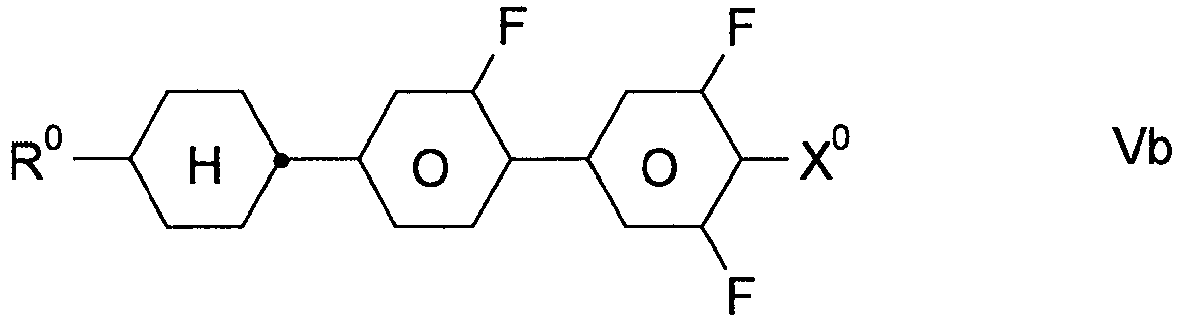


Vorzugsweise bedeutet R0 Alkyl mit 1 bis 6 C-Atomen oder Cyclopentyl. X0 bedeutet vorzugsweise F und OCF3, ferner OCHF2, CF3, OCF=CF2 und OCH=CF2; - Die Verbindungen der Formel VI sind vorzugsweise ausgewählt aus den folgenden Formeln,
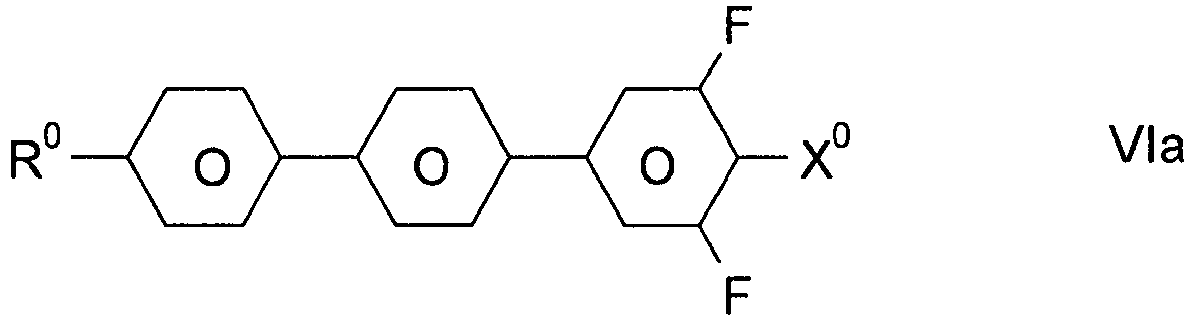


- Vorzugsweise bedeutet R0 Alkyl mit 1 bis 6 C-Atomen oder Cyclopenyl. X0 bedeutet vorzugsweise F, ferner OCF3, CF3, CF=CF2, OCHF2 und OCH=CF2.
- Die Verbindungen der Formel VII sind vorzugsweise ausgewählt aus den folgenden Formeln,
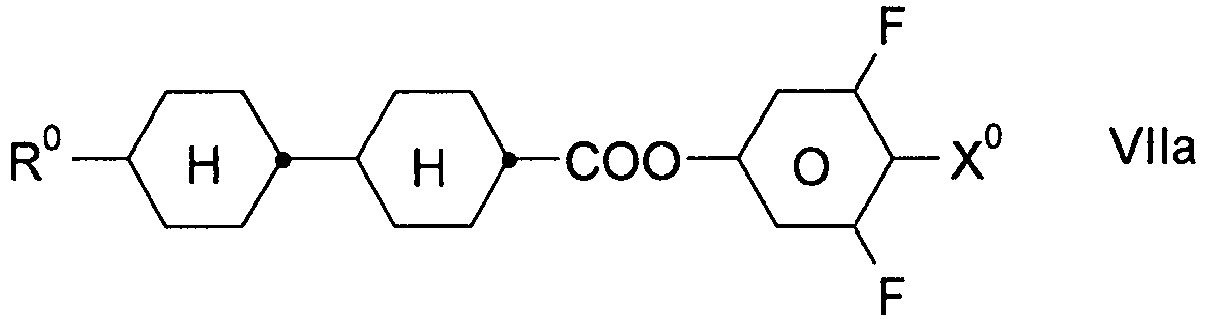

- Vorzugsweise bedeutet R0 Alkyl mit 1 bis 6 C-Atomen oder Cyclpentyl. X0 bedeutet vorzugsweise F, ferner OCF3, CF3, OCHF2 und OCH=CF2.
- Das Medium enthält zusätzlich eine oder mehrere Verbindungen ausgewählt aus den folgenden Formeln,


- L
- H oder F,
- "Alkyl"
- C1-6-Alkyl,
- R'
- C1-6-Alkyl, C1-6-Alkoxy oder C2-6-Alkenyl, und
- Die Verbindungen der Formeln IX-XII sind vorzugsweise ausgewählt aus den folgenden Formeln,


- Das Medium enthält zusätzlich eine oder mehrere Verbindungen ausgewählt aus den folgenden Formeln,


- Das Medium enthält eine oder mehrere Verbindungen der Formel XIII, worin mindestens einer der Reste R1 und R2 Alkenyl mit 2 bis 6 C-Atomen bedeutet, vorzugsweise solche ausgewählt aus folgenden Formeln,


- Das Medium enthält eine oder mehrere Verbindungen der folgenden Formeln,


- Die Verbindungen der Formeln XV und XVI sind vorzugsweise ausgewählt aus den folgenden Formeln,


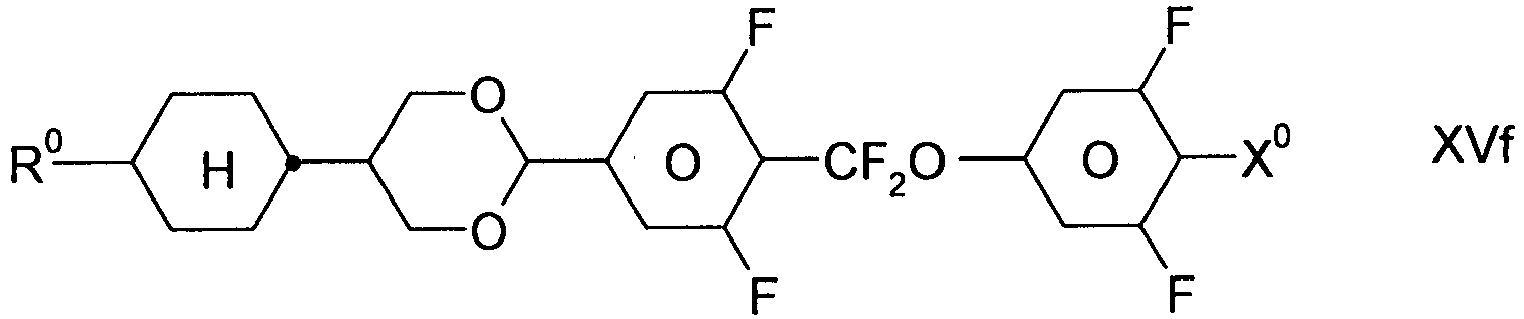


- Vorzugsweise bedeutet R0 Alkyl mit 1 bis 6 C-Atomen. X0 bedeutet vorzugsweise F, ferner OCF3. Besonders bevorzugte Verbindungen der Formeln XV und XVI sowie deren Unterformeln sind solche, worin Y1 F und Y2 H oder F, vorzugsweise F, bedeutet. Besonders bevorzugt enthält die erfindungsgemäße Mischung mindestens eine Verbindung der Formel XVa, XVf und/oder XVIa.
- Das Medium enthält eine oder mehrere Verbindungen der Formel XVII,

- R1
- C2-6-Alkenyl,
- R2
- C1-6-Alkyl und C2-6-Alkenyl, und
- L
- H oder F, vorzugsweise F
- Besonders bevorzugte Verbindungen der Formel XVII sind solche der Unterformeln,


- alkyl
- ein geradkettiger Alkylrest mit 1-6 C-Atomen, insbesondere Ethyl, Propyl und Pentyl,
- alkenyl und alkenyl*
- jeweils unabhängig voneinander einen geradkettigen Alkenylrest mit 2-6 C-Atomen, insbesondere CH2=CHC2H4, CH3CH=CHC2H4, CH2=CH und CH3CH=CH,
- Das Medium enthält zusätzlich eine oder mehrere Verbindungen der folgenden Formeln,



- R1 und R2
- jeweils unabhängig voneinander unsubstituiertes oder halogeniertes Alkyl oder Alkoxy mit 1 bis 15 C-Atomen, Cyclopentyl, Cyclobutyl, wobei in diesen Resten auch eine oder mehrere CH2-Gruppen jeweils unabhängig voneinander durch -C≡C-, -CF2O-,-CH=CH-,

- Das Medium enthält zusätzlich eine oder mehrere Verbindungen ausgewählt aus den folgenden Formeln,


- Das Medium enthält eine oder mehrere Verbindungen der Formel XXIV-a,

- Das Medium enthält eine oder mehrere Verbindungen der Formel XXIa und/oder XXIIa


- Das Medium enthält zusätzlich eine oder mehrere Verbindungen aus der Formel XXIV,


- In der Formel XXIV kann X0 auch ein Alkylrest mit 1-6 C-Atomen oder ein Alkoxyrest mit 1-6 C-Atomen bedeuten. Vorzugsweise ist der Alkyl-oder Alkoxyrest geradkettig.
- Vorzugsweise bedeutet R0 Alkyl mit 1 bis 6 C-Atomen. X0 bedeutet vorzugsweise F;
- Die Verbindungen der Formel XXIV sind vorzugsweise ausgewählt aus den folgenden Formeln,





- R0 ist geradkettiges Alkyl oder Alkenyl mit 2 bis 6 C-Atomen;
- Das Medium enthält eine oder mehrere Verbindungen der folgenden Formeln


- Das Medium enthält eine oder mehrere Verbindungen der folgenden Formeln,


- Das Medium enthält eine oder mehrere Verbindungen der folgenden Formel,
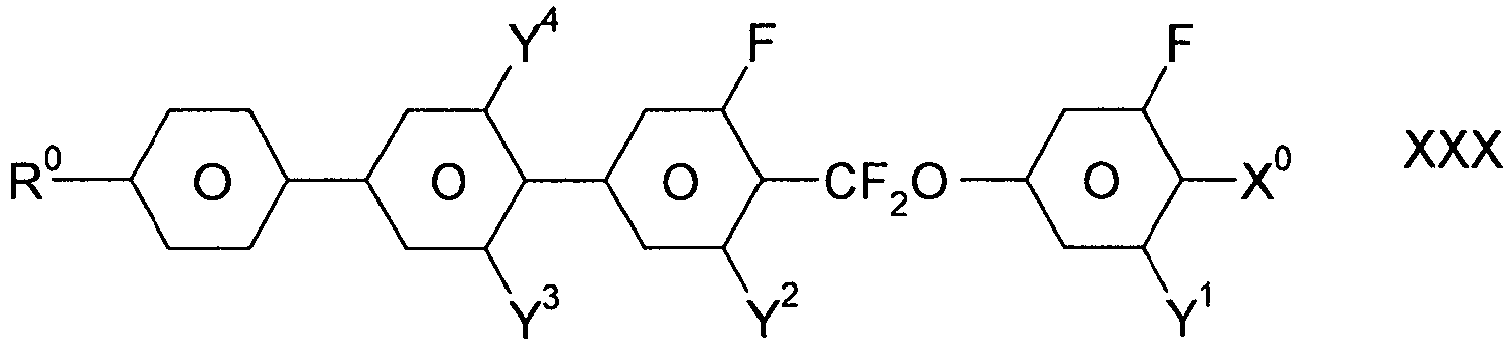
- Die Verbindungen der Formel XXX sind vorzugsweise ausgewählt aus den folgenden Formeln,


- Nachfolgend werden weitere bevorzugte Ausführungsformen angegeben:
- Der Anteil an Verbindungen der Formeln II, III, IX-XIII, XVII und XVIII im Gesamtgemisch beträgt 40 bis 95 Gew.%;
- Das Medium enthält 10-50 Gew.%, besonders bevorzugt 12-40 Gew.% an Verbindungen der Formel II und/oder III;
- Das Medium enthält 20-70 Gew.%, besonders bevorzugt 25-65 Gew.% an Verbindungen der Formeln IX-XIII;
- Das Medium enthält 4-30 Gew.%, besonders bevorzugt 5-20 Gew.% an Verbindungen der Formel XVII;
- Das Medium enthält 1-20 Gew.%, besonders bevorzugt 2-15 Gew.% an Verbindungen der Formel XVIII.
- Das Medium enthält ≥ 20 Gew.%, vorzugsweise ≥ 24 Gew.%, vorzugsweise 25-60 Gew.%, an Verbindungen der Formel 1, insbesondere die Verbindung der Formel 1a1,

- Das Medium enthält mindestens eine Verbindung der Formel 1a oder 1a1 und mindestens eine Verbindung der Formel 1b1.

- Das Medium enthält mindestens eine Verbindung ausgewählt aus den folgenden Formeln



- Das Medium enthält mindestens eine Verbindung ausgewählt aus den folgenden Formeln


- Das Medium enthält mindestens eine Verbindung ausgewählt aus den folgenden Formeln


- Das Medium enthält mindestens drei Verbindungen der Formel PGP-n-m und/oder PGP-n-2V, worin n und m jeweils unabhängig voneinander 2, 3, 4 oder 5 bedeuten.
- Es wurde gefunden, dass die Verwendung von Verbindungen der Formeln 1-5 wie oben beschrieben im Gemisch mit üblichen Flüssigkristallmaterialien, insbesondere jedoch mit einer oder mehreren Verbindungen der Formeln II bis XXX zu einer beträchtlichen Erhöhung der Lichtstabilität und zu relativ hohen Werten für die Doppelbrechung führt, wobei gleichzeitig breite nematische Phasen mit tiefen Übergangstemperaturen smektisch-nematisch beobachtet werden, wodurch die Lagerstabilität verbessert wird. Gleichzeitig zeigen die Mischungen sehr niedrige Schwellenspannungen und sehr gute Werte für die VHR bei UV-Belastung und sehr hohe Klärpunkte.
- Der Ausdruck "Alkyl" bzw. "Alkyl*" umfasst in dieser Anmeldung geradkettige und verzweigte Alkylgruppen mit 1-6 Kohlenstoffatomen, insbesondere die geradkettigen Gruppen Methyl, Ethyl, Propyl, Butyl, Pentyl und Hexyl. Gruppen mit 2-5 Kohlenstoffatomen sind im allgemeinen bevorzugt.
- Der Ausdruck "Alkenyl" bzw. "Alkenyl*" umfasst geradkettige und verzweigte Alkenylgruppen mit 2-6 Kohlenstoffatomen, insbesondere die geradkettigen Gruppen. Bevorzugte Alkenylgruppen sind C2-C7-1E-Alkenyl, C4-C6-3E-Alkenyl, insbesondere C2-C6-1E-Alkenyl. Beispiele besonders bevorzugter Alkenylgruppen sind Vinyl, 1E-Propenyl, 1E-Butenyl, 1E-Pentenyl, 1E-Hexenyl, 3-Butenyl, 3E-Pentenyl, 3E-Hexenyl, 4-Pentenyl, 4Z-Hexenyl, 4E-Hexenyl und 5-Hexenyl. Gruppen mit bis zu 5 Kohlenstoffatomen sind im allgemeinen bevorzugt, insbesondere CH2=CH, CH3CH=CH.
- Der Ausdruck "Fluoralkyl" umfasst vorzugsweise geradkettige Gruppen mit endständigem Fluor, d.h. Fluormethyl, 2-Fluorethyl, 3-Fluorpropyl, 4-Fluorbutyl, 5-Fluorpentyl, 6-Fluorhexyl und 7-Fluorheptyl. Andere Positionen des Fluors sind jedoch nicht ausgeschlossen.
- Der Ausdruck "Oxaalkyl" bzw. "Alkoxy" umfasst vorzugsweise geradkettige Reste der Formel CnH2n+1-O-(CH2)m, worin n und m jeweils unabhängig voneinander 1 bis 6 bedeuten m kann auch 0 bedeuten. Vorzugsweise ist n = 1 und m 1-6 oder m = 0 und n = 1-3.
- Durch geeignete Wahl der Bedeutungen von R0 und X0 können die Ansprechzeiten, die Schwellenspannung, die Steilheit der Transmissionskennlinien etc. in gewünschter Weise modifiziert werden. Beispielsweise führen 1E-Alkenylreste, 3E-Alkenylreste, 2E-Alkenyloxyreste und dergleichen in der Regel zu kürzeren Ansprechzeiten, verbesserten nematischen Tendenzen und einem höheren Verhältnis der elastischen Konstanten k33 (bend) und k11 (splay) im Vergleich zu Alkyl- bzw. Alkoxyresten. 4-Alkenylreste, 3-Alkenylreste und dergleichen ergeben im allgemeinen tiefere Schwellenspannungen und kleinere Werte von k33/k11 im Vergleich zu Alkyl- und Alkoxyresten. Die erfindungsgemäßen Mischungen zeichnen sich insbesondere durch hohe Δε-Werte aus und besitzen somit deutlich schnellere Schaltzeilen als die Mischungen aus dem Stand der Technik.
- Das optimale Mengenverhältnis der Verbindungen der oben genannten Formeln hängt weitgehend von den gewünschten Eigenschaften, von der Wahl der Komponenten der oben genannten Formeln und der Wahl weiterer gegebenenfalls vorhandener Komponenten ab.
- Geeignete Mengenverhältnisse innerhalb des oben angegebenen Bereichs können von Fall zu Fall leicht ermittelt werden.
- Die Gesamtmenge an Verbindungen der oben genannten Formeln in den erfindungsgemäßen Gemischen ist nicht kritisch. Die Gemische können daher eine oder mehrere weitere Komponenten enthalten zwecks Optimierung verschiedener Eigenschaften. Der beobachtete Effekt auf die gewünschte Verbesserung der Eigenschaften der Mischung ist jedoch in der Regel umso größer je höher die Gesamtkonzentration an Verbindungen der oben genannten Formeln ist.
- In einer besonders bevorzugten Ausführungsform enthalten die erfindungsgemäßen Medien Verbindungen der Formel II bis VIII (vorzugsweise II, III, IV und V, insbesondere IIa und IIIa), worin X0 F, OCF3, OCHF2, OCH=CF2, OCF=CF2 oder OCF2-CF2H bedeutet.
- Die einzelnen Verbindungen der oben genannten Formeln und deren Unterformeln, die in den erfindungsgemäßen Medien verwendet werden können, sind entweder bekannt, oder sie können analog zu den bekannten Verbindungen hergestellt werden.
- Gegenstand der Erfindung sind auch elektrooptische Anzeigen, wie z. B. STN- oder MFK-Anzeigen mit zwei planparallelen Trägerplatten, die mit einer Umrandung eine Zelle bilden, integrierten nicht-linearen Elementen zur Schaltung einzelner Bildpunkte auf den Trägerplatten und einer in der Zelle befindlichen nematischen Flüssigkristallmischung mit positiver dielektrischer Anisotropie und hohem spezifischem Widerstand), die derartige Medien enthalten sowie die Verwendung dieser Medien für elektrooptische Zwecke.
- Die erfindungsgemäßen Flüssigkristallmischungen ermöglichen eine bedeutende Erweiterung des zur Verfügung stehenden Parameterraumes. Die erzielbaren Kombinationen aus Klärpunkt, Viskosität bei tiefer Temperatur, thermischer und UV-Stabilität und hoher optischer Anisotropie übertreffen bei weitem bisherige Materialien aus dem Stand der Technik.
- Die erfindungsgemäßen Mischungen sind insbesondere für mobile Anwendungen und TFT-Anwendungen, wie z. B. Mobiltelefone und PDAs geeignet. Weiterhin können die erfindungsgemäßen Mischungen in FFS-, HB-FFS, VA-IPS, OCB- und IPS-Anzeigen Anwendung finden.
- Die erfindungsgemäßen Flüssigkristallmischungen ermöglichen es, bei Beibehaltung der nematischen Phase bis -20 °C und bevorzugt bis -30 °C, besonders bevorzugt bis -40 °C, und des Klärpunkts ≥ 75 °C, vorzugsweise ≥ 80 °C, gleichzeitig Rotationsviskositäten γ1 von ≤ 110 mPa·s, besonders bevorzugt ≤ 100 mPa·s zu erreichen, wodurch hervorragende MFK-Anzeigen mit schnellen Schaltzeiten erzielt werden können. Die Rotationsviskositäten sind bei 20 °C bestimmt.
- Die dielektrische Anisotropie der erfindungsgemäßen Flüssigkristallmischungen Δε ist bei 20 °C vorzugsweise ≥ +7, besonders bevorzugt ≥ +8, insbesondere bevorzugt ≥ 10. Die Mischungen sind außerdem durch kleine Operationsspannungen gekennzeichnet. Die Schwellenspannung der erfindungsgemäßen Flüssigkristallmischungen ist vorzugsweise ≤ 2.0 V. Die Doppelbrechung Δn der erfindungsgemäßen Flüssigkristallmischungen ist bei 20 °C vorzugsweise ≥ 0,09, besonders bevorzugt ≥ 0,10.
- Der nematische Phasenbereich der erfindungsgemäßen Flüssigkristallmischungen ist vorzugsweise mindestens 90°, insbesondere mindestens 100° breit. Vorzugsweise erstreckt sich dieser Bereich mindestens von -25° bis +70°C.
- Es versteht sich, dass durch geeignete Wahl der Komponenten der erfindungsgemäßen Mischungen auch höhere Klärpunkte (z.B. oberhalb 100 °C) bei höheren Schwellenspannungen oder niedrigere Klärpunkte bei niedrigeren Schwellenspannungen unter Erhalt der anderen vorteilhaften Eigenschaften realisiert werden können. Ebenso können bei entsprechend wenig erhöhten Viskositäten Mischungen mit größerem Δε und somit geringen Schwellen erhalten werden. Die erfindungsgemäßen MFK-Anzeigen arbeiten vorzugsweise im ersten Transmissionsminimum nach Gooch und Tarry [C.H. Gooch und H.A. Tarry, Electron. Lett. 10, 2-4, 1974; C.H. Gooch und H.A. Tarry, Appl. Phys., Vol. 8, 1575-1584, 1975], wobei hier neben besonders günstigen elektrooptischen Eigenschaften, wie z.B. hohe Steilheit der Kennlinie und geringe Winkelabhängigkeit des Kontrastes (
DE-PS 30 22 818 ) bei gleicher Schwellenspannung wie in einer analogen Anzeige im zweiten Minimum, eine kleinere dielektrische Anisotropie ausreichend ist. Hierdurch lassen sich unter Verwendung der erfindungsgemäßen Mischungen im ersten Minimum deutlich höhere spezifische Widerstände verwirklichen als bei Mischungen mit Cyanverbindungen. Der Fachmann kann durch geeignete Wahl der einzelnen Komponenten und deren Gewichtsanteilen mit einfachen Routinemethoden die für eine vorgegebene Schichtdicke der MFK-Anzeige erforderliche Doppelbrechung einstellen. - Messungen des "Voltage Holding-ratio" (HR) [S. Matsumoto et al., Liquid Crystals 5, 1320 (1989); K. Niwa et al., Proc. SID Conference, San Francisco, June 1984, p. 304 (1984); G. Weber et al., Liquid Crystals 5, 1381 (1989)] haben ergeben, dass erfindungsgemäße Mischungen enthaltend eine oder mehrere Verbindungen der Formel IA eine deutlich geringere Abnahme des HR unter UV-Belastung aufweisen als analoge Mischungen enthaltend anstelle einer oder mehrerer Verbindungen der Formel IA Cyanophenylcyclohexane der Formel


- Die Lichtstabilität und UV-Stabilität der erfindungsgemäßen Mischungen ist erheblich besser, d.h. sie zeigen eine deutlich kleinere Abnahme des HR unter Licht- bzw. UV-Belastung.
- Der Aufbau der erfindungsgemäßen MFK-Anzeige aus Polarisatoren, Elektrodengrundplatten und Elektroden mit Oberflächenbehandlung entspricht der für derartige Anzeigen üblichen Bauweise. Dabei ist der Begriff der üblichen Bauweise hier weit gefasst und umfasst auch alle Abwandlungen und Modifikationen der MFK-Anzeige, insbesondere auch Matrix-Anzeigeelemente auf Basis poly-Si TFT oder MIM.
- Ein wesentlicher Unterschied der erfindungsgemäßen Anzeigen zu den bisher üblichen auf der Basis der verdrillten nematischen Zelle besteht jedoch in der Wahl der Flüssigkristallparameter der Flüssigkristallschicht.
- Die Herstellung der erfindungsgemäß verwendbaren Flüssigkristallmischungen erfolgt in an sich üblicher Weise, beispielsweise indem man eine oder mehrere Verbindungen der Formel 1-5 mit einer oder mehreren Verbindungen der Formeln II-XXX oder mit weiteren flüssigkristallinen Verbindungen und/oder Additiven mischt. In der Regel wird die gewünschte Menge der in geringerer Menge verwendeten Komponenten in der den Hauptbestandteil ausmachenden Komponenten gelöst, zweckmäßig bei erhöhter Temperatur. Es ist auch möglich Lösungen der Komponenten in einem organischen Lösungsmittel, z.B. in Aceton, Chloroform oder Methanol, zu mischen und das Lösungsmittel nach Durchmischung wieder zu entfernen, beispielsweise durch Destillation.
- Die Dielektrika können auch weitere, dem Fachmann bekannte und in der Literatur beschriebene Zusätze, wie z. B. UV-Stabilisatoren wie Tinuvin®, z.B. Tinuvin® 770, der Fa. Ciba Chemicals, Antioxidantien, z.B. TEMPOL, Mikropartikel, Radikalfänger, Nanopartikel, etc. enthalten. Beispielsweise können 0-15 % pleochroitische Farbstoffe oder chirale Dotierstoffe zugesetzt werden. Geeignete Stabilisatoren und Dotierstoffe werden nachfolgend in den Tabellen B und C genannt.
- Den erfindungsgemäßen Mischungen können weiterhin polymerisierbare Verbindungen, sogenannte reaktive Mesogene (RMs), beispielsweise wie in
U.S. 6,861,107 offenbart, in Konzentrationen von bevorzugt 0,12 - 5 Gew.%, besonders bevorzugt 0,2 - 2 % bezogen auf die Mischung, zugesetzt werden. Optional können diese Mischungen auch einen Initiator enthalten, wie beispielsweise in der U.S 6,781,665 beschrieben. Der Initiator, z.B. Irganox-1076 der Fa. Ciba, wird vorzugsweise der Mischung enthaltend polymerisierbare Verbindungen in Mengen von 0-1 % zugesetzt. Derartige Mischungen können für sogenannte Polymer Stabilized (PS) Modes, bei denen eine Polymerisierung der reaktiven Mesogene in der flüssigkristallinen Mischung erfolgen soll, verwendet werden, z.B. für PS-IPS-, PS-FFS, PS-TN, PS-VA-IPS. Voraussetzung hierfür ist, dass die Flüssigkristallmischung selbst keine polymerisierbaren Komponenten enthält. - In einer bevorzugten Ausführungsform der Erfindung sind die polymerisierbaren Verbindungen ausgewählt aus den Verbindungen der Formel M
RMa-AM1-(ZM1-AM2)m1-RMb M
worin die einzelnen Reste folgende Bedeutung haben: - RMa und RMb
- jeweils unabhängig voneinander P, P-Sp-, H, Halogen, SFs, NO2, eine Alkyl-, Alkenyl- oder Alkinylgruppe, wobei bevorzugt mindestens einer der Reste RMa und RMb eine Gruppe P oder P-Sp- bedeutet oder enthält,
- P
- eine polymerisierbare Gruppe,
- Sp
- eine Abstandsgruppe oder eine Einfachbindung,
- AM1 und AM2
- jeweils unabhängig voneinander eine aromatische, heteroaromatische, alicyclische oder heterocyclische Gruppe, vorzugsweise mit 4 bis 25 Ringatomen, bevorzugt C-Atomen, welche auch anellierte Ringe umfasst oder enthalten kann, und die optional ein- oder mehrfach durch L substitutiert sein kann,
- L
- P, P-Sp-, OH, CH2OH, F, Cl, Br, I, -CN, -NO2, -NCO, -NCS, -OCN, -SCN, -C(=O)N(Rx)2, -C(=O)Y1, -C(=O)Rx, -N(Rx)2, optional substituiertes Silyl, optional substituiertes Aryl mit 6 bis 20 C Atomen, oder geradkettiges oder verzweigtes Alkyl, Alkoxy, Alkylcarbonyl, Alkoxycarbonyl, Alkylcarbonlyoxy oder Alkoxycarbonyloxy mit 1 bis 25 C-Atomen, worin auch ein oder mehrere H-Atome durch F, Cl, P oder P-Sp- ersetzt sein können, bevorzugt P, P-Sp-, H, OH, CH2OH, Halogen, SFs, NO2, eine Alkyl-, Alkenyl- oder Alkinylgruppe,
- Y1
- Halogen,
- ZM1
- -O-, -S-, -CO-, -CO-O-, -OCO-, -O-CO-O-, -OCH2-, -CH2O-, -SCH2-, -CH2S-, -CF2O-, -OCF2-, -CF2S-, -SCF2-, -(CH2)n1-, -CF2CH2-, -CH2CF2-, -(CF2)n1-, -CH=CH-, -CF=CF-, -C≡C-, -CH=CH-, -COO-, -OCO-CH=CH-, CR0R00 oder eine Einfachbindung,
- R0 und R00
- jeweils unabhängig voneinander H oder Alkyl mit 1 bis 12 C-Atomen,
- Rx
- P, P-Sp-, H, Halogen, geradkettiges, verzweigtes oder cyclisches Alkyl mit 1 bis 25 C-Atomen, worin auch eine oder mehrere nicht benachbarte CH2-Gruppen durch -O-, -S-, -CO-, -CO-O-, -O-CO-, -O-CO-O- so ersetzt sein können, dass O- und/oder S-Atome nicht direkt miteinander verknüpft sind, und worin auch ein oder mehrere H-Atome durch F, Cl, P oder P-Sp- ersetzt sein können, eine optional substituierte Aryl- oder Aryloxygruppe mit 6 bis 40 C-Atomen, oder eine optional substituierte Heteroaryl- oder Heteroaryloxygruppe mit 2 bis 40 C-Atomen,
- m1
- 0, 1, 2, 3 oder 4, und
- n1
- 1, 2, 3 oder 4,
- Besonders bevorzugte Verbindungen der Formel M sind solche, worin
- RMa und RMb
- jeweils unabhängig voneinander P, P-Sp-, H, F, Cl, Br, I, -CN,-NO2, -NCO, -NCS, -OCN, -SCN, SF5 oder geradkettiges oder verzweigtes Alkyl mit 1 bis 25 C-Atomen, worin auch eine oder mehrere nicht benachbarte CH2-Gruppen jeweils unabhängig voneinander durch -C(R0)=C(R00)-, -C≡C-, -N(R00)-, -O-, -S-,-CO-, -CO-O-, -O-CO-, -O-CO-O- so ersetzt sein können, dass O- und/oder S-Atome nicht direkt miteinander verknüpft sind, und worin auch ein oder mehrere H-Atome durch F, Cl, Br, I, CN, P oder P-Sp- ersetzt sein können, wobei bevorzugt mindestens einer der Reste RMa und RMb eine Gruppe P oder P-Sp- bedeutet oder enthält,
- AM1 und AM2
- jeweils unabhängig voneinander 1,4-Phenylen, Naphthalin-1,4-diyl, Naphthalin-2,6-diyl, Phenanthren-2,7-diyl, Anthracen-2,7-diyl, Fluoren-2,7-diyl, Cumarin, Flavon, wobei in diesen Gruppen auch eine oder mehrere CH-Gruppen durch N ersetzt sein können, Cyclohexan-1,4-diyl, worin auch eine oder mehrere nicht-benachbarte CH2-Gruppen durch O und/oder S ersetzt sein können, 1,4-Cyclohexenylen, Bicyclo[1.1.1]pentan-1,3-diyl, Bicyclo[2.2.2]octan-1,4-diyl, Spiro[3.3]heptan-2,6-diyl, Piperidin-1,4-diyl, Decahydronaphthalin-2,6-diyl, 1,2,3,4-Tetrahydronaphthalin-2,6-diyl, Indan-2,5-diyl oder Octahydro-4,7-methano-indan-2,5-diyl, wobei alle diese Gruppen unsubstituiert oder durch L ein- oder mehrfach substituiert sein können,
- L
- P, P-Sp-, OH, CH2OH, F, Cl, Br, I, -CN, -NO2, -NCO, -NCS,-OCN, -SCN, -C(=O)N(Rx)2, -C(=O)Y1, -C(=O)Rx, -N(Rx)2, optional substituiertes Silyl, optional substituiertes Aryl mit 6 bis 20 C Atomen, oder geradkettiges oder verzweigtes Alkyl, Alkoxy, Alkylcarbonyl, Alkoxycarbonyl, Alkylcarbonlyoxy oder Alkoxycarbonyloxy mit 1 bis 25 C-Atomen, worin auch ein oder mehrere H-Atome durch F, Cl, P oder P-Sp- ersetzt sein können,
- P
- eine polymerisierbare Gruppe,
- Y1
- Halogen,
- Rx
- P, P-Sp-, H, Halogen, geradkettiges, verzweigtes oder cyclisches Alkyl mit 1 bis 25 C-Atomen, worin auch eine oder mehrere nicht benachbarte CH2-Gruppen durch -O-, -S-, -CO-, -CO-O-, -O-CO-, -O-CO-O- so ersetzt sein können, dass O- und/oder S-Atome nicht direkt miteinander verknüpft sind, und worin auch ein oder mehrere H-Atome durch F, Cl, P oder P-Sp- ersetzt sein können, eine optional substituierte Aryl- oder Aryloxygruppe mit 6 bis 40 C-Atomen, oder eine optional substituierte Heteroaryl- oder Heteroaryloxygruppe mit 2 bis 40 C-Atomen,
- Ganz besonders bevorzugt sind Verbindungen der Formel M, worin einer von RMa und RMb oder beide P oder P-Sp- bedeuten.
- Geeignete und bevorzugte RMs für die Verwendung in erfindungs-gemäßen flüssigkristallinen Medien und PS-Mode-Anzeigen, sind beispielsweise ausgewählt aus den folgenden Formeln:







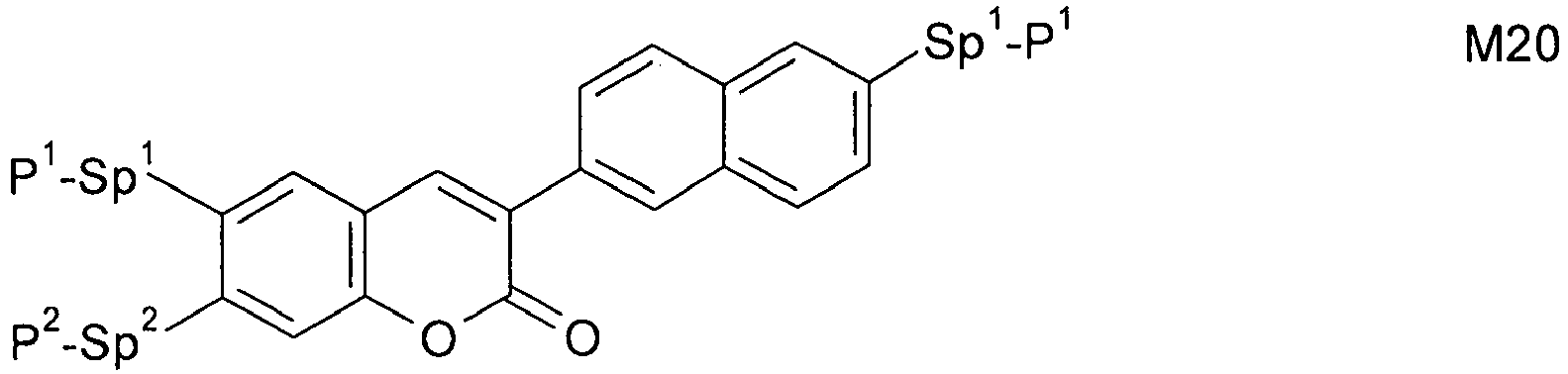


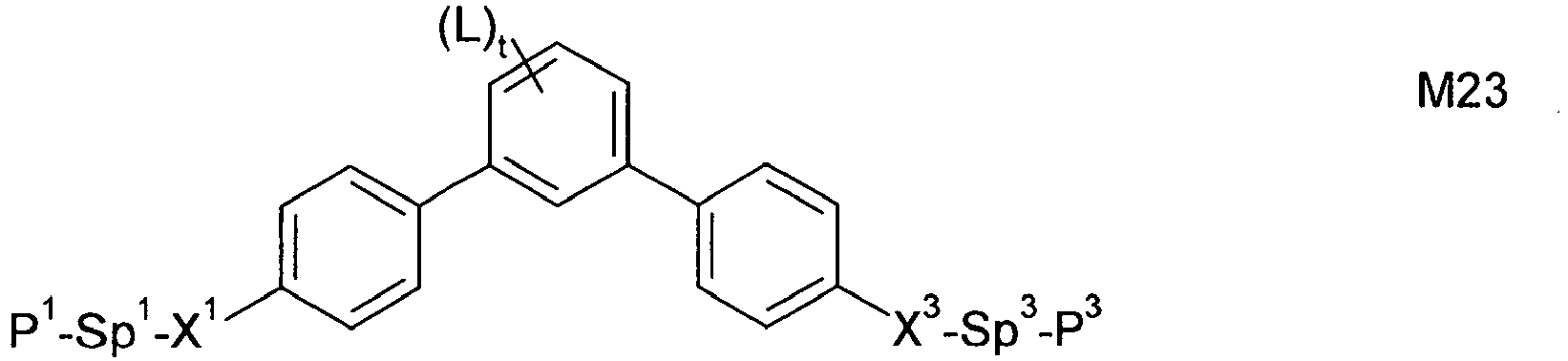


- P1-3
- jeweils unabhängig voneinander eine polymerisierbare Gruppe, vorzugsweise mit einer der vor- und nachstehend für P angegebenen Bedeutungen, besonders bevorzugt eine Acrylat-, Methacrylat-, Fluoracrylat-, Oxetan-, Vinyloxy- oder Epoxygruppe,
- Sp1-3
- jeweils unabhängig voneinander eine Einfachbindung oder eine Abstandsgruppe, vorzugsweise mit einer der vor- und nachstehend für Sp angegebenen Bedeutungen, und besonders bevorzugt -(CH2)p1-, -(CH2)p1-O-, -(CH2)p1-CO-O-oder -(CH2)p1-O-CO-O- bedeuten, worin p1 eine ganze Zahl von 1 bis 12 ist, und wobei in den letztgenannten Gruppen die Verknüpfung zur benachbarten Ring über das O-Atom erfolgt, wobei einer der Reste P1-Sp1-, P2-Sp2- und P3-Sp3- auch Raa bedeuten kann,
- Raa
- H, F, Cl, CN oder geradkettiges oder verzweigtes Alkyl mit 1 bis 25 C-Atomen, worin auch eine oder mehrere nicht benachbarte CH2-Gruppen jeweils unabhängig voneinander durch C(R0)=C(R00)-, -C≡C-, -N(R0)-, -O-, -S-, -CO-, -CO-O-, -O-CO-, -O-CO-O- so ersetzt sein können, dass O- und/oder S-Atome nicht direkt miteinander verknüpft sind, und worin auch ein oder mehrere H-Atome durch F, Cl, CN oder P1-Sp1-ersetzt sein können, besonders bevorzugt geradkettiges oder verzweigtes, optional ein- oder mehrfach fluoriertes, Alkyl, Alkoxy, Alkenyl, Alkinyl, Alkylcarbonyl, Alkoxycarbonyl, oder Alkylcarbonyloxy mit 1 bis 12 C-Atomen (wobei die Alkenyl-und Alkinylreste mindestens zwei und die verzweigten Reste mindestens drei C-Atome aufweisen),
- R0, R00
- jeweils unabhängig voneinander und bei jedem Auftreten gleich oder verschieden H oder Alkyl mit 1 bis 12 C-Atomen,
- Ry und Rz
- jeweils unabhängig voneinander H, F, CH3 oder CF3,
- Z1
- -O-, -CO-, -C(RyRz)-, oder -CF2CF2-,
- Z2 und Z3
- jeweils unabhängig voneinander -CO-O-, -O-CO-, -CH2O-, -OCH2-, -CF2O-, -OCF2-, oder -(CH2)n-, wobei n 2, 3 oder 4 ist,
- L
- bei jedem Auftreten gleich oder verschieden F, Cl, CN, oder geradkettiges oder verzweigtes, optional ein- oder mehrfach fluoriertes, Alkyl, Alkoxy, Alkenyl, Alkinyl, Alkylcarbonyl, Alkoxycarbonyl, oder Alkylcarbonyloxy mit 1 bis 12 C-Atomen vorzugsweise F,
- L' und L"
- jeweils unabhängig voneinander H, F oder Cl,
- r
- 0, 1, 2, 3 oder 4,
- s
- 0, 1, 2 oder 3,
- t
- 0, 1 oder 2, und
- x
- 0 oder 1.
- Geeignete polymerisierbare Verbindungen sind beispielsweise in Tabelle D gelistet.
- Bevorzugt enthalten die flüssigkristallinen Medien gemäß der vorliegenden Anmeldung insgesamt 0,01 bis 3 %, bevorzugt 0,1 bis 1,0 %, besonders bevorzugt 0,1 bis 0,5 %, an polymerisierbaren Verbindungen.
- Insbesondere bevorzugt sind die polymerisierbaren Verbindungen der Formeln M2, M13, M17, M22, M23, M24 and M30.
- Ferner bevorzugt sind die polymerisierbaren Verbindungen der Formeln M15 bis M31, insbesondere M17, M18, M19, M22, M23, M24, M25, M26, M30 und M31.
- Gegenstand der vorliegenden Erfindung ist somit auch die Verwendung der erfindungsgemäßen Mischungen in elektrooptischen Anzeigen sowie der Einsatz der erfindungsgemäßen Mischungen in Shutter-Brillen, insbesondere für 3D-Anwendungen, und in TN-, PS-TN-, STN-, TN-TFT-, OCB-, IPS-, PS-IPS-, FFS-, HB-FFS, PS-FFS- und PS-VA-IPS-Anzeigen.
- In der gesamten Patentanmeldung sowie in den Ausführungsbeispielen sind die Strukturen der Flüssigkristallverbindungen durch Acronyme angegeben.
- Sofern nicht anders angegeben, erfolgt die Transformation in chemische Formeln gemäß der Tabellen 1-3. Alle Reste CnH2n+1 und CmH2m+1 bzw. CnH2n und CmH2m sind geradkettige Alkylreste bzw. Alkylenreste jeweils mit n und m C-Atomen. n, m und k bedeuten jeweils unabhängig voneinander 0, 1, 2, 3, 4, 5, 6, 7, 8, 9, 10, 11, 12, vorzugsweise 0, 1, 2, 3, 4, 5 oder 6. In Tabelle 1 sind die Ringelemente der jeweiligen Verbindung codiert, in Tabelle 2 sind die Brückenglieder aufgelistet und in Tabelle 3 sind die Bedeutungen der Symbole für die linken bzw. rechten Seitenketten der Verbindungen angegeben.


Tabelle 2: Brückenglieder E -CH2CH2- V -CH=CH- T -C=C- W -CF2CF2- Z -COO- ZI -OCO- O -CH2O- OI -OCH2- Q -CF2O- QI -OCF2- Tabelle 3: Seitenketten Seitenkette links Seitenkette rechts n- CnH2n+1- -n -CnH2n+1 nO- CnH2n+1-O- -On -O-CnH2n+1 V- CH2=CH- -V -CH=CH2 nV- CnH2n+1-CH=CH- -nV -CnH2n-CH=CH2 Vn- CH2=CH- CnH2n- -Vn -CH=CH-CnH2n+1 .nVm- CnH2n+1-CH=CH-CmH2m- -nVm - CnH2n-CH=CH-CmH2m+1 N- N=C- -N -C=N F- F- -F -F CI- Cl- -CI -CI M- CFH2- -M -CFH2 D- CF2H- -D -CF2H T- CF3- -T -CF3 MO- CFH2O- -OM -OCFH2 DO- CF2HO- -OD -OCF2H TO- CF3O- -OT -OCF3 T- CF3- -T -CF3 A- H-C≡C- -A -C≡C-H C5- 
-C5 
- Bevorzugte Mischungskomponenten finden sich in der Tabelle A. Vorzugsweise enthalten die erfindungsgemäßen Mischungen neben einer oder mehreren Verbindungen der Formeln 1 bis 5 mindestens eine Verbindung ausgewählt aus den nachfolgend genannten Verbindungen der Tabelle A.


- Besonders bevorzugt sind flüssigkristalline Mischungen, die neben den Verbindungen der Formeln 1 bis 5 mindestens ein, zwei, drei, vier oder mehr Verbindungen aus der Tabelle A enthalten.


Tabelle C Stabilisatoren, die beispielsweise den erfindungsgemäßen Mischungen in Mengen von 0-10 Gew.% zugesetzt werden können, werden nachfolgend genannt. 


n = 1, 2, 3, 4, 5, 6 or 7 

n = 1, 2, 3, 4, 5, 6 or 7 

n = 1, 2, 3, 4, 5, 6 or 7 
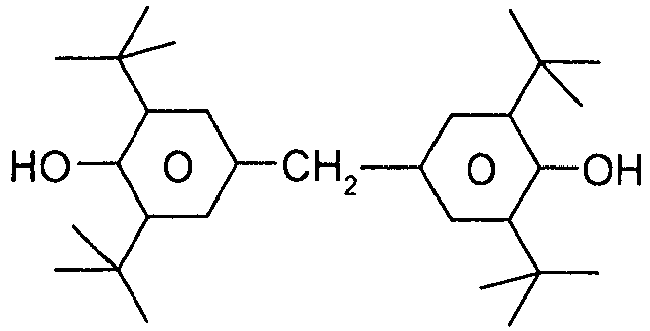


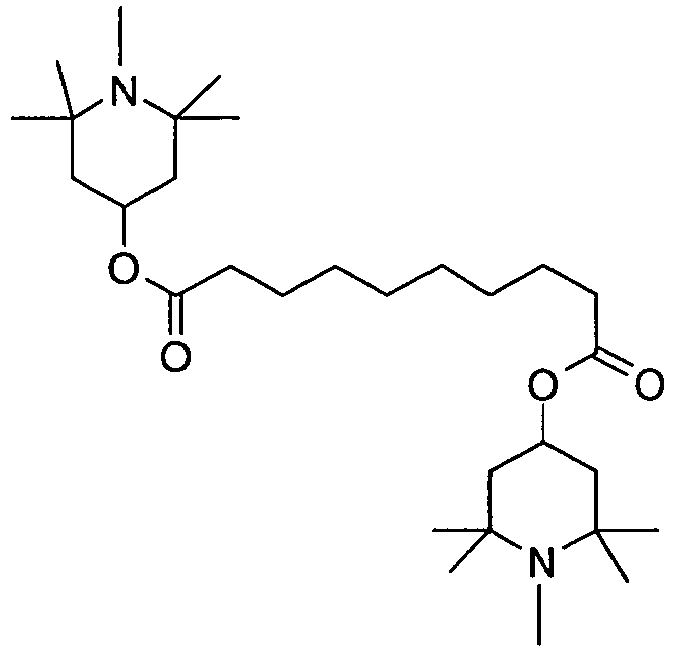


Tabelle D In der Tabelle D sind Beispielverbindungen zusammengestellt, die in den FK-Medien gemäß der vorliegenden Erfindung vorzugsweise als reaktive mesogene Verbindungen verwendet werden können. Sofern die erfindungsgemäßen Mischungen ein oder mehrere reaktive Verbindungen enthalten, werden sie vorzugsweise in Mengen von 0,01-5 Gew.% eingesetzt. Gegebenenfalls muss für die Polymerisation noch ein Initiator oder ein Gemisch aus zwei oder mehr Initiatoren zugesetzt werden. Der Initiator oder das Initiatorgemisch wird vorzugsweise in Mengen von 0,001-2 Gew.% bezogen auf die Mischung zugesetzt. Ein geeigneter Initiator ist z.B. Irgacure® 651 (Fa. BASF). 
RM-1 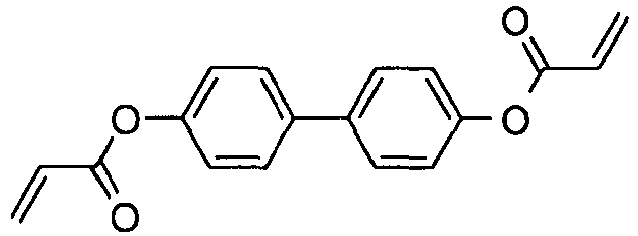
RM-2 
RM-3 
RM-4 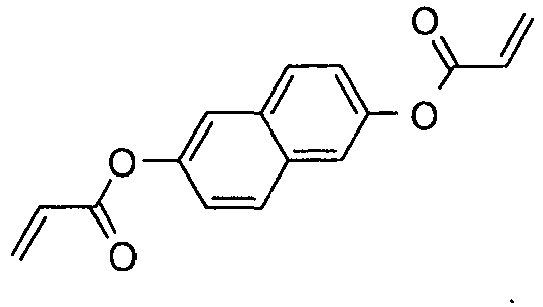
RM-5 
RM-6 
RM-7 
RM-8 
RM-9 
RM-10 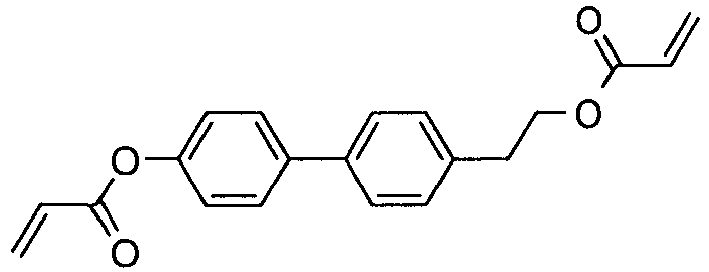
RM-11 
RM-12 
RM-13 
RM-14 
RM-15 
RM-16 
RM-17 
RM-18 
RM-19 
RM-20 
RM-21 
RM-22 
RM-23 
RM-24 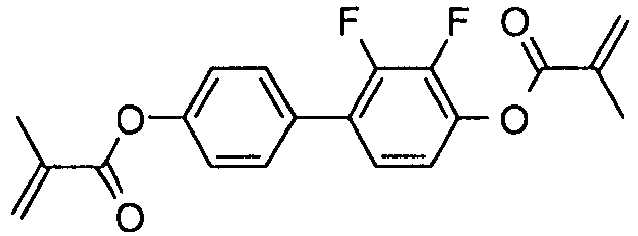
RM-25 
RM-26 
RM-27 
RM-28 
RM-29 
RM-30 
RM-31 
RM-32 
RM-33 
RM-34 
RM-35 
RM-36 
RM-37 
RM-38 
RM-39 
RM-40 
RM-41 
RM-42 
RM-43 
RM-44 
RM-45 
RM-46 
RM-47 
RM-48 
RM-49 
RM-50 
RM-51 
RM-52 
RM-53 
RM-54 
RM-55 
RM-56 
RM-57 
RM-58 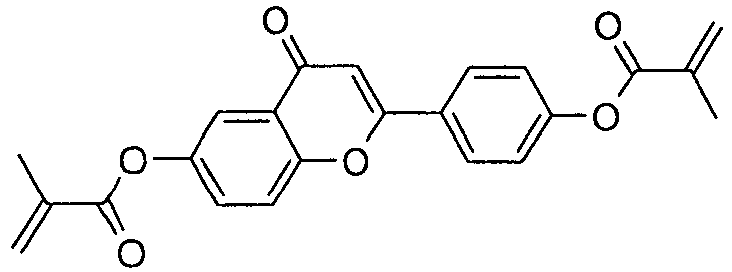
RM-59 
RM-60 
RM-61 
RM-62 
RM-63 
RM-64 
RM-65 
RM-66 
RM-67 
RM-68 
RM-69 
RM-70 
RM-71 
RM-72 
RM-73 
RM-74 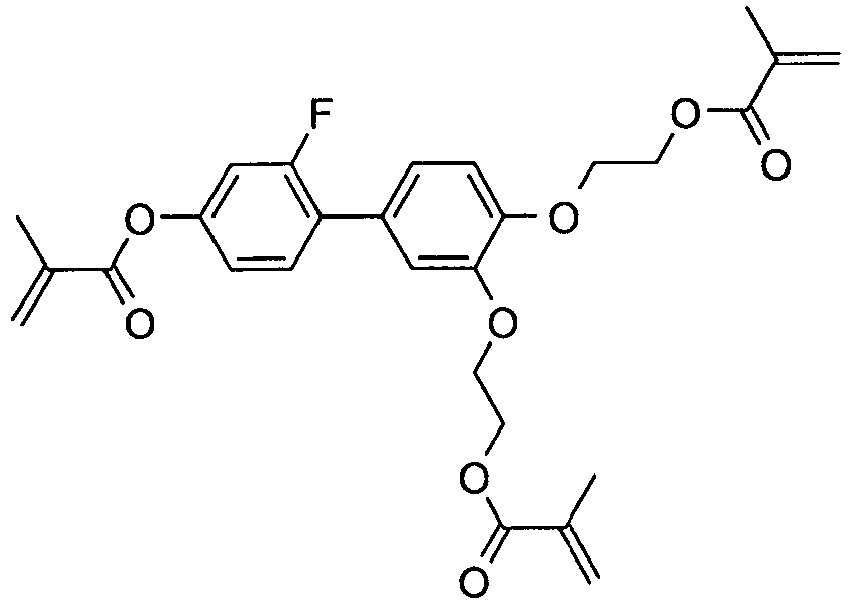
RM-75 
RM-76 
RM-77 
RM-78 
RM-79 
RM-80 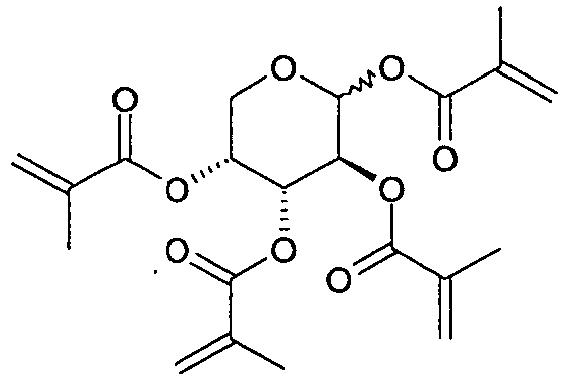
RM-81 
RM-82 
RM-83 
RM-84 
RM-85 
RM-86 
RM-87 
RM-88 
RM-89 
RM-90 
RM-91 
RM-92 
RM-93 
RM-94 
RM-95 
RM-96 
RM-97 
RM-98 
RM-99 
RM-100 - In einer bevorzugten Ausführungsform der vorliegenden Erfindung enthalten die mesogenen Medien eine oder mehrere Verbindungen ausgewählt aus der Gruppe der Verbindungen der Tabelle D.
- Die folgenden Mischungsbeispiele sollen die Erfindung erläutern, ohne sie zu begrenzen.
- Vor- und nachstehend bedeuten Prozentangaben Gewichtsprozent. Alle Temperaturen sind in Grad Celsius angegeben. Fp. bedeutet Schmelzpunkt, Kp. = Klärpunkt. Ferner bedeuten K = kristalliner Zustand, N = nematische Phase, S = smektische Phase und I = isotrope Phase. Die Angaben zwischen diesen Symbolen stellen die Übergangstemperaturen dar. Weiterhin bedeutet
- Δn die optische Anisotropie bei 589 nm und 20 °C,
- γ1 die Rotationsviskosität (mPa·s) bei 20 °C,
- Δε die dielektrische Anisotropie bei 20 °C und 1 kHz (Δε = ε|| - ε⊥, wobei ε∥ die Dielektrizitätskonstante parallel zu den Moleküllängsachsen und ε⊥ die Dielektrizitätskonstante senkrecht dazu bedeutet),
- V10 die Spannung (V) für 10 % Transmission (Blickrichtung senkrecht zur Plattenoberfläche), (Schwellenspannung), bestimmt in einer TN Zelle (90 Grad Verdrillung) im 1. Minimum (d.h. bei einem dΔn-Wert von 0,5 µm) bei 20 °C,
- V0 die kapazitiv bestimmte Freedericksschwellenspannung in einer antiparallel geriebenen Zelle bei 20 °C.
- Alle physikalischen Eigenschaften werden nach "Merck Liquid Crystals, Physical Properties of Liquid Crystals" Status Nov. 1997, Merck KGaA, Deutschland bestimmt und gelten für eine Temperatur von 20 °C, sofern nicht explizit anders angegeben.
-
Beispiel 1 (Vergleichsbeispiel) CC-3-V 33,00% Klärpunkt [°C]: 75,5 BCH-2F.F 3,50% Δn [589 nm, 20 °C]: 0,1286 BCH-3F.F 6,00% Δε [1 kHz, 20 °C]: +3,8 BCH-5F.F 6,00% γ1 [mPa·s, 20 °C]: 66 PGP-2-3 5,50% V10 [V]: 2,04 PGP-2-4 5,00% LTS bulk [h, -20 °C]: >1000 PGP-2-5 11,50% S → N Übergang [°C]: -22,5 BCH-3F.F.F 9,00% BCH-5F.F.F 9,00% PCH-3-CI 6,00% CPP-3-F 5,50% Beispiel 2 (Vergleichsbeispiel) PUQU-3-F 11,00% Klärpunkt [°C]: 74,5 CPP-2-F 4,00% Δn [589 nm, 20 °C]: 0,1270 CPP-3-F 4,00% Δε [1 kHz, 20 °C]: +3,8 BCH-3F.F.F 3,00% γ1 [mPa·s, 20 °C]: 60 CP-3-CI 10,50% V10 [V]: 2,03 CC-3-V 27,00% LTS bulk [h, -20 °C]: >1000 PGP-2-3 11,00% S → N Übergang [°C]: PGP-2-4 11,00% CCP-V-1 18,50% Beispiel 3 (Verqleichsbeispiel) PUQU-3-F 8,00% Klärpunkt [°C]: 78,5 BCH-3F.F.F 14,00% Δn [589 nm, 20 °C]: 0,1320 CPP-2-F 6,00% Δε [1 kHz, 20 °C]: +4,2 PCH-3Cl 6,00% γ1 [mPa·s, 20 °C]: 67 CC-3-V 33,00% V10 [V]: 2,00 CPGP-5-2 3,00% LTS bulk [h, -20 °C]: >1000 CPGP-5-3 3,00% S → N Übergang [°C]: PGP-2-3 10,00% PGP-2-4 11,00% CCP-V-1 6,00% Beispiel 4 (Vergleichsbeispiel) PUQU-3-F 8,00% Klärpunkt [°C]: 75,5 BCH-3F.F.F 11,00% Δn [589 nm, 20 °C]: 0,1157 CP-3-Cl 15,00% Δε [1 kHz, 20 °C]: +3,9 CC-3-V 32,00% γ1 [mPa·s, 20 °C]: 63 CPGP-5-2 5,00% V10 [V]: 2,00 CPGP-5-3 4,00% LTS bulk [h, -20 °C]: >1000 PGP-2-3 5,00% S → N Übergang [°C]: PGP-2-4 5,00% CCP-V-1 15,00% Beispiel 5 (Vergleichsbeispiel) CC-3-V 32,00% Klärpunkt [°C]: 74 CC-3-V1 5,00% Δn [589 nm, 20 °C]: 0,1156 PCH-3Cl 3,00% Δε [1 kHz, 20 °C]: +4,3 PUQU-3-F 18,00% γ1 [mPa·s, 20 °C]: 55 BCH-5F 8,00% V10 [V]: 1,97 PGP-2-3 8,00% LTS bulk [h, -20 °C]: 912 PGP-2-5 8,00% S → N Übergang [°C]: -20 CCP-V-1 18,00% Beispiel 6 (Vergleichsbeispiel) PGU-2-F 5,00% Klärpunkt [°C]: 75,5 PGU-3-F 7,00% Δn [589 nm, 20 °C]: 0,1258 PUQU-3-F 10,00% Δε [1 kHz, 20 °C]: +4,8 CP-3-Cl 5,00% γ1 [mPa·s, 20 °C]: 59 CCP-V-1 13,50% V10 [V]: 1,90 CCP-V2-1 7,00% LTS bulk [h, -20 °C]: >1000 CC-3-V1 8,00% S → N Übergang [°C]: CC-3-V 27,50% PGP-2-3 6,00% PGP-2-4 6,00% PGP-3-3 5,00% Beispiel 7 (Vergleichsbeispiel) CPGU-2-OT 2,50% Klärpunkt [°C]: 77 CPGU-3-OT 3,00% Δn [589 nm, 20 °C]: 0,1266 PGU-2-F 5,00% Δε [1 kHz, 20 °C]: +4,7 PGU-3-F 5,00% γ1 [mPa·s, 20 °C]: 58 PUQU-2-F 4,00% V10 [V]: 1,90 PUQU-3-F 3,00% LTS bulk [h, -20 °C]: >1000 CCP-V-1 13,00% S → N Übergang [°C]: CC-3-V1 7,00% PGP-2-3 6,00% PGP-2-4 6,50% PGP-2-5 7,00% CC-3-V 35,00% PCH-3Cl 3,00% Beispiel 8 (Vergleichsbeispiel) CC-3-V 20,00% Klärpunkt [°C]: 75 CC-3-V1 12,50% Δn [589 nm, 20 °C]: 0,1230 PP-1-2V1 8,00% Δε [1 kHz, 20 °C]: +5,0 PCH-3Cl 3,00% γ1 [mPa·s, 20 °C]: 65 PUQU-3-F 14,00% V10 [V]: 1,96 CGU-3-F 6,50% LTS bulk [h, -20 °C]: >1000 BCH-3F.F 3,00% S → N Übergang [°C]: -20 PGP-2-3 6,50% PGP-2-4 6,00% CCP-V-1 16,00% CBC-33 2,00% CCGU-3-F 2,50% Beispiel 9 CC-3-V 42,00% Klärpunkt [°C]: 75 PCH-3Cl 5,00% Δn [589 nm, 20 °C]: 0,1362 PP-1-2V1 7,00% Δε [1 kHz, 20 °C]: +5,5 PGP-2-3 7,00% γ1 [mPa·s, 20 °C]: 61 PGP-2-4 8,00% V10 [V]: 1,81 PGP-2-5 10,00% LTS bulk [h, -20 °C]: >1000 CPGU-3-OT 5,00% S → N Übergang [°C]: -20 APUQU-3-F 9,00% PGUQU-3-F 7,00% Beispiel 10 (Vergleichsbeispiel) CCQU-5-F 5,00% Klärpunkt [°C]: 80 PUQU-2-F 6,00% Δn [589 nm, 20 °C]: 0,1147 PUQU-3-F 11,00% Δε [1 kHz, 20 °C]: +5.6 CC-3-V1 9,00% γ1 [mPa·s, 20 °C]: 67 CCP-V-1 20,00% V10 [V]: 1,83 CCGU-3-F 6,00% LTS bulk [h, -20 °C]: >1000 PP-1-2V1 2,00% S → N Übergang [°C]: CC-3-V 26,00% PGP-2-3 7,00% PGP-2-4 8,00% GP-2-CI 2,00% Beispiel 11 (Vergleichsbeispiel) CPGU-3-OT 10,00% Klärpunkt [°C]: 77.5 CC-3-V 32,50% Δn [589 nm, 20 °C]: 0,1240 CC-3-V1 6,00% Δε [1 kHz, 20 °C]: +4.6 CCP-V-1 16,50% γ1 [mPa·s, 20 °C]: 62 PGP-2-4 6,50% V10 [V]: 2,04 PGP-2-5 7,00% LTS bulk [h, -20 °C]: >1000 PP-1-2V1 8,00% S → N Übergang [°C]: PUQU-3-F 11,50% GP-2-Cl 2,00% Beispiel 12 (Vergleichsbeispiel) PGU-2-F 5,00% Klärpunkt [°C]: 74,5 PGU-3-F 6,50% Δn [589 nm, 20 °C]: 0,1259 PUQU-3-F 10,00% Δε [1 kHz, 20 °C]: +4.8 CCP-V-1 13,50% γ1 [mPa·s, 20 °C]: 59 CCP-V2-1 6,00% V10 [V]: 1,92 CC-3-V1 8,00% LTS bulk [h, -20 °C]: >1000 CC-3-V 38,00% S → N Übergang [°C]: PGP-2-3 4,00% PGP-2-4 4,00% PGP-2-5 10,00% GP-2-Cl 3,00% Beispiel 13 (Vergleichsbeispiel) CPGU-2-F 3,00% Klärpunkt [°C]: 74,5 CPGU-3-F 3,00% Δn [589 nm, 20 °C]: 0,1258 PGU-2-F 5,00% Δε [1 kHz, 20 °C]: +4.7 PGU-3-F 5,00% γ1 [mPa·s, 20 °C]: 57 PUQU-2-F 4,00% V10 [V]: 1,92 PUQU-3-F 3,00% LTS bulk [h, -20 °C]: >1000 CCP-V-1 14,00% S → N Übergang [°C]: CC-3-V1 6,00% PGP-2-3 5,00% PGP-2-4 5,00% PGP-2-5 6,00% CC-3-V 35,00% PCH-3Cl 3,00% PP-1-2V1 3,00% Beispiel 14 CC-3-V 45,50% Klärpunkt [°C]: 73 PP-1-2V1 4,00% Δn [589 nm, 20 °C]: 0,1339 PGP-2-3 7,00% Δε [1 kHz, 20 °C]: +7,6 PGP-2-4 6,50% γ1 [mPa·s, 20 °C]: 62 PGP-2-5 5,00% V10 [V]: 1,56 PGUQU-3-F 13,00% LTS bulk [h, -20 °C]: >1000 CPGU-3-OT 5,00% S → N Übergang [°C]: PGU-3-F 4,00% APUQU-3-F 7,00% GP-2-Cl 3,00% Beispiel 15 (Vergleichsbeispiel) CC-3-V 33,00% Klärpunkt [°C]: 75,5 BCH-2F.F 3,00% Δn [589 nm, 20 °C]: 0,1298 BCH-3F.F 7,00% Δε [1 kHz, 20 °C]: +4,0 BCH-5F.F 8,00% γ1 [mPa·s, 20 °C]: 69 PGP-2-3 4,00% V10 [V]: 2,01 PGP-2-4 4,00% LTS bulk [h, -20 °C]: >1000 PGP-2-5 13,00% S → N Übergang [°C]: -21 BCH-3F.F.F 10,00% BCH-5F.F.F 10,00% PP-5-F 4,00% CPP-3-F 4,00% Beispiel 16 (Vergleichsbeispiel) CC-3-V 32,50% Klärpunkt [°C]: 75 BCH-3F.F 7,00% Δn [589 nm, 20 °C]: 0,1305 BCH-5F.F 7,00% Δε [1 kHz, 20 °C]: +4,2 PGP-2-3 4,50% γ1 [mPa·s, 20 °C]: 69 PGP-2-4 4,50% V10 [V]: 1,97 PGP-2-5 13,00% LTS bulk [h, -20 °C]: >1000 BCH-3F.F.F 9,00% S → N Übergang [°C]: BCH-5F.F.F 10,00% PP-5-F 4,00% CPP-3-F 4,50% CGU-3-F 4,00% Beispiel 17 (Vergleichsbeispiel) CC-3-V 36,00% Klärpunkt [°C]: 74 PGP-2-3 6,00% Δn [589 nm, 20 °C]: 0,1295 PGP-2-4 6,00% Δε [1 kHz, 20 °C]: +3,9 PGP-2-5 13,00% γ1 [mPa·s, 20 °C]: 58 CGU-3-F 5,50% V10 [V]: 2,00 CCPU-3-F 3,00% LTS bulk [h, -20 °C]: >1000 BCH-3F.F.F 10,50% S → N Übergang [°C]: BCH-5F.F.F 10,50% CPP-3-F 5,00% PP-5-F 4,50%
es zusätzlich eine oder mehrere Verbindungen ausgewählt aus den Formeln XV und XVI enthält,


und das Medium mindestens drei Verbindungen der Formel PGP-n-m und/oder PGP-n-2V,


enthält.
Claims (21)
- Flüssigkristallines Medium, dadurch gekennzeichnet, dass es eine oder mehrere Verbindungen der Formel 1, und



worin die einzelnen Reste, jeweils unabhängig voneinander und bei jedem Auftreten gleich oder verschieden, die folgende Bedeutung besitzen:Alkenyl C2-6-Alkenyl,Rx C1-6-Alkyl oder C2-6-Alkenyl,Alkyl oder Alkyl* jeweils unabhängig voneinander C1-6-Alkyl,L H oder F,Alk(en)yl* C1-6-Alkyl oder C2-6-Alkenyl,und
es zusätzlich eine oder mehrere Verbindungen ausgewählt aus den Formeln XV und XVI enthält,


und das Medium mindestens drei Verbindungen der Formel PGP-n-m und/oder PGP-n-2V,

enthält. - Flüssigkristallines Medium nach Anspruch 1, dadurch gekennzeichnet, dass es eine oder mehrere Verbindungen der Formel 1 ausgewählt aus den folgenden Formeln enthält


- Flüssigkristallines Medium nach Anspruch 1 oder 2, dadurch gekennzeichnet, dass es eine oder mehrere Verbindungen der Formel 2 ausgewählt aus den folgenden Formeln enthält:


- Flüssigkristallines Medium nach einem oder mehreren der Ansprüche 1 bis 3, dadurch gekennzeichnet, dass es eine oder mehrere Verbindungen der Formel 3 ausgewählt aus den folgenden Formeln enthält


- Flüssigkristallines Medium nach einem oder mehreren der Ansprüche 1 bis 4, dadurch gekennzeichnet, dass es eine oder mehrere Verbindungen der Formel 4 ausgewählt aus den folgenden Formeln enthält:



- Flüssigkristallines Medium nach einem oder mehreren der Ansprüche 1 bis 5, dadurch gekennzeichnet, dass es eine oder mehrere Verbindungen der Formel 5 ausgewählt aus den folgenden Formeln enthält:



- Flüssigkristallines Medium nach einem oder mehreren der Ansprüche 2 bis 6, enthaltendeine oder mehrere Verbindungen ausgewählt aus den Formeln 1a und 1b, undzwei oder mehrere Verbindungen ausgewählt aus den Formeln 2a bis 2d, undeine Verbindung der Formel 3b oder 4b oder 5c.
- Flüssigkristallines Medium nach einem oder mehreren der Ansprüche 1 bis 7, enthaltend 20 bis 65 Gew.% einer oder mehrerer Verbindungen der Formel 1, und 5 bis 30 Gew.% einer oder mehrerer Verbindungen der Formel 2, und 2 bis 20 Gew.% einer oder mehrerer Verbindungen ausgewählt aus den Formeln 3, 4 und 5.
- Flüssigkristallines Medium nach einem oder mehreren der Ansprüche 1 bis 8, dadurch gekennzeichnet, dass es zusätzlich eine oder mehrere Verbindungen ausgewählt aus den Formeln II und/oder III enthält

 R0 unsubstituiertes oder halogeniertes Alkyl oder Alkoxy mit 1 bis 15 C-Atomen, Cyclopentyl, Cyclobutyl, wobei in diesen Resten auch eine oder mehrere CH2-Gruppen jeweils unabhängig voneinander durch -C=C-, -CF2O-, -CH=CH-,
 X0 F, Cl, halogeniertes Alkyl, halogeniertes Alkoxy, halogeniertes Alkenyl oder halogeniertes Alkenyloxy mit jeweils bis zu 6 C-Atomen,Y1-6 jeweils unabhängig voneinander H oder F, und


- Flüssigkristallines Medium nach einem oder mehreren der Ansprüche 1 bis 9, dadurch gekennzeichnet, dass es zusätzlich eine oder mehrere Verbindungen ausgewählt aus den Formeln IV bis VIII enthält,


Z0 -C2H4-, -(CH2)4-, -CH=CH-, -CF=CF-, -C2F4-, -CH2CF2-, -CF2CH2-, -CH2O-, -OCH2-, -COO- oder -OCF2-, in Formel V und VI auch eine Einfachbindung, in Formel V und VIII auch -CF2O-,r 0 oder 1, unds 0 oder 1bedeuten. - Flüssigkristallines Medium nach einem oder mehreren der Ansprüche 1 bis 10, dadurch gekennzeichnet, dass es zusätzlich eine oder mehrere Verbindungen ausgewählt aus den Formeln IX bis XII enthält,


 L H oder F,"Alkyl" C1-6-Alkyl,R' C1-6-Alkyl, C1-6-Alkoxy oder C2-6-Alkenyl, und"Alkenyl" und "Alkenyl*"jeweils unabhängig voneinander C2-6-Alkenyl bedeuten.
 - Flüssigkristallines Medium nach einem oder mehreren der Ansprüche 1 bis 11, dadurch gekennzeichnet, dass es zusätzlich eine oder mehrere Verbindungen der Formel XIII enthält,

- Flüssigkristallines Medium nach einem oder mehreren der Ansprüche 1 bis 12, dadurch gekennzeichnet, dass es zusätzlich eine oder mehrere Verbindungen ausgewählt den Verbindungen der folgenden Formeln enthält,


- Flüssigkristallines Medium nach einem oder mehreren der Ansprüche 1 bis 13, dadurch gekennzeichnet, dass es zusätzlich eine oder mehrere Verbindungen ausgewählt der Gruppe der Verbindungen der Formeln XIX, XX, XXI, XXII, XXIII und XIV enthält,


- Flüssigkristallines Medium nach einem oder mehreren der Ansprüche 1 bis 14, dadurch gekennzeichnet, dass es zusätzlich ein oder mehrere Additiv(e) ausgewählt aus der Gruppe der UV-Stabilisatoren, Dotierstoffe und Antioxidantien enthält.
- Flüssigkristallines Medium nach einem oder mehreren der Ansprüche 1 bis 15, dadurch gekennzeichnet, dass es zusätzlich eine oder mehrere polymerisierbare Verbindungen enthält.
- Verfahren zur Herstellung eines flüssigkristallinen Mediums nach einem oder mehreren der Ansprüche 1 bis 16, dadurch gekennzeichnet, dass man eine oder mehrere Verbindungen der Formeln 1-5 wie in Anspruch 1 definiert mit weiteren mesogenen Verbindungen und gegebenenfalls noch mit ein oder mehreren Additiven und/oder mindestens einer polymerisierbaren Verbindung mischt.
- Verwendung eines flüssigkristallinen Mediums nach einem oder mehreren der Ansprüche 1 bis 16 für elektrooptische Zwecke.
- Verwendung eines flüssigkristallinen Mediums nach einem oder mehreren der Ansprüche 1 bis 16 in Shutter-Brillen, für 3D-Anwendungen, in TN-, PS-TN-, STN-, ECB-, OCB-, IPS-, PS-IPS-, HB-FFS-, FFS-, PS-FFS- und posi-VA-Anzeigen.
- Elektrooptische Flüssigkristallanzeige enthaltend ein flüssigkristallines Medium nach einem oder mehreren der Ansprüche 1 bis 16.
- Elektrooptische Flüssigkristallanzeige nach Anspruch 20, dadurch gekennzeichnet, dass sie eine TN-, PS-TN-, STN-, ECB-, OCB-, IPS-, PS-IPS-, FFS-, HB-FFS, PS-FFS- oder positiv-VA-Anzeige ist.
Applications Claiming Priority (2)
| Application Number | Priority Date | Filing Date | Title |
|---|---|---|---|
| DE102015010116 | 2015-08-05 | ||
| PCT/EP2016/001278 WO2017020998A1 (de) | 2015-08-05 | 2016-07-22 | Flüssigkristallines medium |
Publications (2)
| Publication Number | Publication Date |
|---|---|
| EP3331965A1 EP3331965A1 (de) | 2018-06-13 |
| EP3331965B1 true EP3331965B1 (de) | 2022-01-05 |
Family
ID=56511528
Family Applications (1)
| Application Number | Title | Priority Date | Filing Date |
|---|---|---|---|
| EP16741863.1A Active EP3331965B1 (de) | 2015-08-05 | 2016-07-22 | Flüssigkristallines medium |
Country Status (8)
| Country | Link |
|---|---|
| US (1) | US20180223187A1 (de) |
| EP (1) | EP3331965B1 (de) |
| JP (1) | JP2018523736A (de) |
| KR (1) | KR20180037229A (de) |
| CN (2) | CN114702966A (de) |
| DE (1) | DE102016008901A1 (de) |
| TW (1) | TW201718830A (de) |
| WO (1) | WO2017020998A1 (de) |
Families Citing this family (2)
| Publication number | Priority date | Publication date | Assignee | Title |
|---|---|---|---|---|
| DE102019008296A1 (de) * | 2018-12-20 | 2020-06-25 | Merck Patent Gmbh | Flüssigkristallines Medium |
| CN112143507B (zh) | 2019-06-28 | 2025-03-18 | 默克专利股份有限公司 | Lc介质 |
Citations (3)
| Publication number | Priority date | Publication date | Assignee | Title |
|---|---|---|---|---|
| DE102007041245A1 (de) * | 2006-09-01 | 2008-03-06 | Merck Patent Gmbh | Flüssigkristallines Medium |
| EP1956069A1 (de) * | 2007-02-02 | 2008-08-13 | Merck Patent GmbH | Flüssigkristallines Medium |
| DE102009009414A1 (de) * | 2008-02-20 | 2009-08-27 | Merck Patent Gmbh | Flüssigkristallines Medium |
Family Cites Families (16)
| Publication number | Priority date | Publication date | Assignee | Title |
|---|---|---|---|---|
| DE3022818C2 (de) | 1980-06-19 | 1986-11-27 | Merck Patent Gmbh, 6100 Darmstadt | Flüssigkristall-Anzeigeelement |
| CN1204445C (zh) | 2002-02-04 | 2005-06-01 | 富士通显示技术株式会社 | 液晶显示装置及其制造方法 |
| EP1378557B1 (de) | 2002-07-06 | 2007-02-21 | MERCK PATENT GmbH | Flüssigkristallines Medium |
| WO2006038443A1 (ja) * | 2004-10-04 | 2006-04-13 | Chisso Corporation | 液晶組成物および液晶表示素子 |
| JP2006199941A (ja) * | 2004-12-20 | 2006-08-03 | Chisso Corp | クロマン環を有する化合物を含有する液晶組成物 |
| DE602007006570D1 (de) * | 2006-03-17 | 2010-07-01 | Merck Patent Gmbh | Flüssigkristallines Medium und Flüssigkristallanzeige |
| EP2116587B1 (de) * | 2007-02-19 | 2013-09-11 | JNC Corporation | Flüssigkristalline zusammensetzung und flüssigkristalldisplayelement |
| WO2009028446A1 (ja) * | 2007-08-29 | 2009-03-05 | Chisso Corporation | 液晶組成物および液晶表示素子 |
| TWI509055B (zh) * | 2009-05-14 | 2015-11-21 | Jnc Corp | 液晶組成物及液晶顯示元件 |
| US8071182B2 (en) * | 2009-06-08 | 2011-12-06 | Jnc Corporation | Liquid crystal composition and liquid crystal display device |
| JP5720114B2 (ja) * | 2010-04-27 | 2015-05-20 | Jnc株式会社 | 液晶化合物、液晶組成物および液晶表示素子 |
| CN103261371B (zh) * | 2010-12-17 | 2015-11-25 | 默克专利股份有限公司 | 液晶介质 |
| EP2703472B1 (de) * | 2012-08-31 | 2018-07-04 | Merck Patent GmbH | Flüssigkristallines Medium |
| JP5999015B2 (ja) * | 2013-04-15 | 2016-09-28 | Jnc株式会社 | 液晶組成物および液晶表示素子 |
| JP5850286B2 (ja) * | 2013-11-12 | 2016-02-03 | Dic株式会社 | 液晶表示素子 |
| JP2014185314A (ja) * | 2013-11-19 | 2014-10-02 | Dic Corp | 液晶組成物及びこれを用いた液晶表示素子 |
-
2016
- 2016-07-22 CN CN202210246849.1A patent/CN114702966A/zh active Pending
- 2016-07-22 DE DE102016008901.6A patent/DE102016008901A1/de not_active Withdrawn
- 2016-07-22 US US15/750,407 patent/US20180223187A1/en not_active Abandoned
- 2016-07-22 EP EP16741863.1A patent/EP3331965B1/de active Active
- 2016-07-22 WO PCT/EP2016/001278 patent/WO2017020998A1/de not_active Ceased
- 2016-07-22 JP JP2018506194A patent/JP2018523736A/ja active Pending
- 2016-07-22 CN CN201680045450.XA patent/CN107922842A/zh active Pending
- 2016-07-22 KR KR1020187006100A patent/KR20180037229A/ko not_active Withdrawn
- 2016-08-04 TW TW105124828A patent/TW201718830A/zh unknown
Patent Citations (3)
| Publication number | Priority date | Publication date | Assignee | Title |
|---|---|---|---|---|
| DE102007041245A1 (de) * | 2006-09-01 | 2008-03-06 | Merck Patent Gmbh | Flüssigkristallines Medium |
| EP1956069A1 (de) * | 2007-02-02 | 2008-08-13 | Merck Patent GmbH | Flüssigkristallines Medium |
| DE102009009414A1 (de) * | 2008-02-20 | 2009-08-27 | Merck Patent Gmbh | Flüssigkristallines Medium |
Also Published As
| Publication number | Publication date |
|---|---|
| US20180223187A1 (en) | 2018-08-09 |
| TW201718830A (zh) | 2017-06-01 |
| CN107922842A (zh) | 2018-04-17 |
| DE102016008901A1 (de) | 2017-02-09 |
| JP2018523736A (ja) | 2018-08-23 |
| WO2017020998A1 (de) | 2017-02-09 |
| CN114702966A (zh) | 2022-07-05 |
| KR20180037229A (ko) | 2018-04-11 |
| EP3331965A1 (de) | 2018-06-13 |
Similar Documents
| Publication | Publication Date | Title |
|---|---|---|
| EP2652087B1 (de) | Flüssigkristallines medium | |
| EP1908811B1 (de) | Flüssigkristallines Medium | |
| EP2242819B1 (de) | Flüssigkristallines medium | |
| EP3127989B1 (de) | Flüssigkristallines medium | |
| EP2643426B1 (de) | Flüssigkristallines medium | |
| EP3271440B1 (de) | Flüssigkristallines medium | |
| EP1911827B1 (de) | Flüssigkristallines Medium | |
| EP2909286B1 (de) | Flüssigkristallines medium | |
| DE102007041245A1 (de) | Flüssigkristallines Medium | |
| DE102008004062A1 (de) | Flüssigkristallines Medium | |
| DE102014010908A1 (de) | Flüssigkristallines Medium | |
| EP2725083B1 (de) | Flüssigkristallines Medium | |
| EP1908812B1 (de) | Flüssigkristallines Medium | |
| DE102011011268A1 (de) | Flüssigkristallines Medium | |
| EP2248872B1 (de) | Flüssigkristallines Medium | |
| DE102011016189A1 (de) | Flüssigkristallines Medium | |
| DE102011009337A1 (de) | Flüssigkristallines Medium | |
| EP3292181B1 (de) | Flüssigkristallines medium | |
| DE102011118785A1 (de) | Flüssigkristallines Medium | |
| DE102016008901A1 (de) | Flüssigkristallines Medium | |
| EP2935514B1 (de) | Flüssigkristallines medium | |
| DE102007042414A1 (de) | Flüssigkristallines Medium | |
| DE102007045661A1 (de) | Flüssigkristallines Medium | |
| DE102007042415A1 (de) | Flüssigkristallines Medium |
Legal Events
| Date | Code | Title | Description |
|---|---|---|---|
| STAA | Information on the status of an ep patent application or granted ep patent |
Free format text: STATUS: THE INTERNATIONAL PUBLICATION HAS BEEN MADE |
|
| PUAI | Public reference made under article 153(3) epc to a published international application that has entered the european phase |
Free format text: ORIGINAL CODE: 0009012 |
|
| STAA | Information on the status of an ep patent application or granted ep patent |
Free format text: STATUS: REQUEST FOR EXAMINATION WAS MADE |
|
| 17P | Request for examination filed |
Effective date: 20180122 |
|
| AK | Designated contracting states |
Kind code of ref document: A1 Designated state(s): AL AT BE BG CH CY CZ DE DK EE ES FI FR GB GR HR HU IE IS IT LI LT LU LV MC MK MT NL NO PL PT RO RS SE SI SK SM TR |
|
| AX | Request for extension of the european patent |
Extension state: BA ME |
|
| DAV | Request for validation of the european patent (deleted) | ||
| DAX | Request for extension of the european patent (deleted) | ||
| STAA | Information on the status of an ep patent application or granted ep patent |
Free format text: STATUS: EXAMINATION IS IN PROGRESS |
|
| 17Q | First examination report despatched |
Effective date: 20190313 |
|
| GRAP | Despatch of communication of intention to grant a patent |
Free format text: ORIGINAL CODE: EPIDOSNIGR1 |
|
| STAA | Information on the status of an ep patent application or granted ep patent |
Free format text: STATUS: GRANT OF PATENT IS INTENDED |
|
| INTG | Intention to grant announced |
Effective date: 20210209 |
|
| GRAJ | Information related to disapproval of communication of intention to grant by the applicant or resumption of examination proceedings by the epo deleted |
Free format text: ORIGINAL CODE: EPIDOSDIGR1 |
|
| STAA | Information on the status of an ep patent application or granted ep patent |
Free format text: STATUS: EXAMINATION IS IN PROGRESS |
|
| GRAS | Grant fee paid |
Free format text: ORIGINAL CODE: EPIDOSNIGR3 |
|
| STAA | Information on the status of an ep patent application or granted ep patent |
Free format text: STATUS: GRANT OF PATENT IS INTENDED |
|
| GRAP | Despatch of communication of intention to grant a patent |
Free format text: ORIGINAL CODE: EPIDOSNIGR1 |
|
| INTC | Intention to grant announced (deleted) | ||
| INTG | Intention to grant announced |
Effective date: 20210714 |
|
| GRAA | (expected) grant |
Free format text: ORIGINAL CODE: 0009210 |
|
| STAA | Information on the status of an ep patent application or granted ep patent |
Free format text: STATUS: THE PATENT HAS BEEN GRANTED |
|
| AK | Designated contracting states |
Kind code of ref document: B1 Designated state(s): AL AT BE BG CH CY CZ DE DK EE ES FI FR GB GR HR HU IE IS IT LI LT LU LV MC MK MT NL NO PL PT RO RS SE SI SK SM TR |
|
| REG | Reference to a national code |
Ref country code: GB Ref legal event code: FG4D Free format text: NOT ENGLISH |
|
| REG | Reference to a national code |
Ref country code: CH Ref legal event code: EP |
|
| REG | Reference to a national code |
Ref country code: AT Ref legal event code: REF Ref document number: 1460589 Country of ref document: AT Kind code of ref document: T Effective date: 20220115 |
|
| REG | Reference to a national code |
Ref country code: DE Ref legal event code: R096 Ref document number: 502016014358 Country of ref document: DE |
|
| REG | Reference to a national code |
Ref country code: IE Ref legal event code: FG4D Free format text: LANGUAGE OF EP DOCUMENT: GERMAN |
|
| REG | Reference to a national code |
Ref country code: LT Ref legal event code: MG9D |
|
| RAP4 | Party data changed (patent owner data changed or rights of a patent transferred) |
Owner name: MERCK PATENT GMBH |
|
| REG | Reference to a national code |
Ref country code: NL Ref legal event code: MP Effective date: 20220105 |
|
| PG25 | Lapsed in a contracting state [announced via postgrant information from national office to epo] |
Ref country code: NL Free format text: LAPSE BECAUSE OF FAILURE TO SUBMIT A TRANSLATION OF THE DESCRIPTION OR TO PAY THE FEE WITHIN THE PRESCRIBED TIME-LIMIT Effective date: 20220105 |
|
| PG25 | Lapsed in a contracting state [announced via postgrant information from national office to epo] |
Ref country code: SE Free format text: LAPSE BECAUSE OF FAILURE TO SUBMIT A TRANSLATION OF THE DESCRIPTION OR TO PAY THE FEE WITHIN THE PRESCRIBED TIME-LIMIT Effective date: 20220105 Ref country code: RS Free format text: LAPSE BECAUSE OF FAILURE TO SUBMIT A TRANSLATION OF THE DESCRIPTION OR TO PAY THE FEE WITHIN THE PRESCRIBED TIME-LIMIT Effective date: 20220105 Ref country code: PT Free format text: LAPSE BECAUSE OF FAILURE TO SUBMIT A TRANSLATION OF THE DESCRIPTION OR TO PAY THE FEE WITHIN THE PRESCRIBED TIME-LIMIT Effective date: 20220505 Ref country code: NO Free format text: LAPSE BECAUSE OF FAILURE TO SUBMIT A TRANSLATION OF THE DESCRIPTION OR TO PAY THE FEE WITHIN THE PRESCRIBED TIME-LIMIT Effective date: 20220405 Ref country code: LT Free format text: LAPSE BECAUSE OF FAILURE TO SUBMIT A TRANSLATION OF THE DESCRIPTION OR TO PAY THE FEE WITHIN THE PRESCRIBED TIME-LIMIT Effective date: 20220105 Ref country code: HR Free format text: LAPSE BECAUSE OF FAILURE TO SUBMIT A TRANSLATION OF THE DESCRIPTION OR TO PAY THE FEE WITHIN THE PRESCRIBED TIME-LIMIT Effective date: 20220105 Ref country code: ES Free format text: LAPSE BECAUSE OF FAILURE TO SUBMIT A TRANSLATION OF THE DESCRIPTION OR TO PAY THE FEE WITHIN THE PRESCRIBED TIME-LIMIT Effective date: 20220105 Ref country code: BG Free format text: LAPSE BECAUSE OF FAILURE TO SUBMIT A TRANSLATION OF THE DESCRIPTION OR TO PAY THE FEE WITHIN THE PRESCRIBED TIME-LIMIT Effective date: 20220405 |
|
| PG25 | Lapsed in a contracting state [announced via postgrant information from national office to epo] |
Ref country code: PL Free format text: LAPSE BECAUSE OF FAILURE TO SUBMIT A TRANSLATION OF THE DESCRIPTION OR TO PAY THE FEE WITHIN THE PRESCRIBED TIME-LIMIT Effective date: 20220105 Ref country code: LV Free format text: LAPSE BECAUSE OF FAILURE TO SUBMIT A TRANSLATION OF THE DESCRIPTION OR TO PAY THE FEE WITHIN THE PRESCRIBED TIME-LIMIT Effective date: 20220105 Ref country code: GR Free format text: LAPSE BECAUSE OF FAILURE TO SUBMIT A TRANSLATION OF THE DESCRIPTION OR TO PAY THE FEE WITHIN THE PRESCRIBED TIME-LIMIT Effective date: 20220406 Ref country code: FI Free format text: LAPSE BECAUSE OF FAILURE TO SUBMIT A TRANSLATION OF THE DESCRIPTION OR TO PAY THE FEE WITHIN THE PRESCRIBED TIME-LIMIT Effective date: 20220105 |
|
| PG25 | Lapsed in a contracting state [announced via postgrant information from national office to epo] |
Ref country code: IS Free format text: LAPSE BECAUSE OF FAILURE TO SUBMIT A TRANSLATION OF THE DESCRIPTION OR TO PAY THE FEE WITHIN THE PRESCRIBED TIME-LIMIT Effective date: 20220505 |
|
| REG | Reference to a national code |
Ref country code: DE Ref legal event code: R097 Ref document number: 502016014358 Country of ref document: DE |
|
| PG25 | Lapsed in a contracting state [announced via postgrant information from national office to epo] |
Ref country code: SM Free format text: LAPSE BECAUSE OF FAILURE TO SUBMIT A TRANSLATION OF THE DESCRIPTION OR TO PAY THE FEE WITHIN THE PRESCRIBED TIME-LIMIT Effective date: 20220105 Ref country code: SK Free format text: LAPSE BECAUSE OF FAILURE TO SUBMIT A TRANSLATION OF THE DESCRIPTION OR TO PAY THE FEE WITHIN THE PRESCRIBED TIME-LIMIT Effective date: 20220105 Ref country code: RO Free format text: LAPSE BECAUSE OF FAILURE TO SUBMIT A TRANSLATION OF THE DESCRIPTION OR TO PAY THE FEE WITHIN THE PRESCRIBED TIME-LIMIT Effective date: 20220105 Ref country code: EE Free format text: LAPSE BECAUSE OF FAILURE TO SUBMIT A TRANSLATION OF THE DESCRIPTION OR TO PAY THE FEE WITHIN THE PRESCRIBED TIME-LIMIT Effective date: 20220105 Ref country code: DK Free format text: LAPSE BECAUSE OF FAILURE TO SUBMIT A TRANSLATION OF THE DESCRIPTION OR TO PAY THE FEE WITHIN THE PRESCRIBED TIME-LIMIT Effective date: 20220105 Ref country code: CZ Free format text: LAPSE BECAUSE OF FAILURE TO SUBMIT A TRANSLATION OF THE DESCRIPTION OR TO PAY THE FEE WITHIN THE PRESCRIBED TIME-LIMIT Effective date: 20220105 |
|
| PLBE | No opposition filed within time limit |
Free format text: ORIGINAL CODE: 0009261 |
|
| STAA | Information on the status of an ep patent application or granted ep patent |
Free format text: STATUS: NO OPPOSITION FILED WITHIN TIME LIMIT |
|
| PG25 | Lapsed in a contracting state [announced via postgrant information from national office to epo] |
Ref country code: AL Free format text: LAPSE BECAUSE OF FAILURE TO SUBMIT A TRANSLATION OF THE DESCRIPTION OR TO PAY THE FEE WITHIN THE PRESCRIBED TIME-LIMIT Effective date: 20220105 |
|
| 26N | No opposition filed |
Effective date: 20221006 |
|
| PG25 | Lapsed in a contracting state [announced via postgrant information from national office to epo] |
Ref country code: SI Free format text: LAPSE BECAUSE OF FAILURE TO SUBMIT A TRANSLATION OF THE DESCRIPTION OR TO PAY THE FEE WITHIN THE PRESCRIBED TIME-LIMIT Effective date: 20220105 Ref country code: MC Free format text: LAPSE BECAUSE OF FAILURE TO SUBMIT A TRANSLATION OF THE DESCRIPTION OR TO PAY THE FEE WITHIN THE PRESCRIBED TIME-LIMIT Effective date: 20220105 |
|
| REG | Reference to a national code |
Ref country code: CH Ref legal event code: PL |
|
| GBPC | Gb: european patent ceased through non-payment of renewal fee |
Effective date: 20220722 |
|
| REG | Reference to a national code |
Ref country code: BE Ref legal event code: MM Effective date: 20220731 |
|
| PG25 | Lapsed in a contracting state [announced via postgrant information from national office to epo] |
Ref country code: LU Free format text: LAPSE BECAUSE OF NON-PAYMENT OF DUE FEES Effective date: 20220722 Ref country code: LI Free format text: LAPSE BECAUSE OF NON-PAYMENT OF DUE FEES Effective date: 20220731 Ref country code: FR Free format text: LAPSE BECAUSE OF NON-PAYMENT OF DUE FEES Effective date: 20220731 Ref country code: CH Free format text: LAPSE BECAUSE OF NON-PAYMENT OF DUE FEES Effective date: 20220731 |
|
| PG25 | Lapsed in a contracting state [announced via postgrant information from national office to epo] |
Ref country code: GB Free format text: LAPSE BECAUSE OF NON-PAYMENT OF DUE FEES Effective date: 20220722 Ref country code: BE Free format text: LAPSE BECAUSE OF NON-PAYMENT OF DUE FEES Effective date: 20220731 |
|
| P01 | Opt-out of the competence of the unified patent court (upc) registered |
Effective date: 20230518 |
|
| PG25 | Lapsed in a contracting state [announced via postgrant information from national office to epo] |
Ref country code: IT Free format text: LAPSE BECAUSE OF FAILURE TO SUBMIT A TRANSLATION OF THE DESCRIPTION OR TO PAY THE FEE WITHIN THE PRESCRIBED TIME-LIMIT Effective date: 20220105 Ref country code: IE Free format text: LAPSE BECAUSE OF NON-PAYMENT OF DUE FEES Effective date: 20220722 |
|
| REG | Reference to a national code |
Ref country code: AT Ref legal event code: MM01 Ref document number: 1460589 Country of ref document: AT Kind code of ref document: T Effective date: 20220722 |
|
| PG25 | Lapsed in a contracting state [announced via postgrant information from national office to epo] |
Ref country code: AT Free format text: LAPSE BECAUSE OF NON-PAYMENT OF DUE FEES Effective date: 20220722 |
|
| PG25 | Lapsed in a contracting state [announced via postgrant information from national office to epo] |
Ref country code: HU Free format text: LAPSE BECAUSE OF FAILURE TO SUBMIT A TRANSLATION OF THE DESCRIPTION OR TO PAY THE FEE WITHIN THE PRESCRIBED TIME-LIMIT; INVALID AB INITIO Effective date: 20160722 |
|
| PG25 | Lapsed in a contracting state [announced via postgrant information from national office to epo] |
Ref country code: MK Free format text: LAPSE BECAUSE OF FAILURE TO SUBMIT A TRANSLATION OF THE DESCRIPTION OR TO PAY THE FEE WITHIN THE PRESCRIBED TIME-LIMIT Effective date: 20220105 Ref country code: CY Free format text: LAPSE BECAUSE OF FAILURE TO SUBMIT A TRANSLATION OF THE DESCRIPTION OR TO PAY THE FEE WITHIN THE PRESCRIBED TIME-LIMIT Effective date: 20220105 |
|
| PG25 | Lapsed in a contracting state [announced via postgrant information from national office to epo] |
Ref country code: TR Free format text: LAPSE BECAUSE OF FAILURE TO SUBMIT A TRANSLATION OF THE DESCRIPTION OR TO PAY THE FEE WITHIN THE PRESCRIBED TIME-LIMIT Effective date: 20220105 |
|
| PG25 | Lapsed in a contracting state [announced via postgrant information from national office to epo] |
Ref country code: MT Free format text: LAPSE BECAUSE OF FAILURE TO SUBMIT A TRANSLATION OF THE DESCRIPTION OR TO PAY THE FEE WITHIN THE PRESCRIBED TIME-LIMIT Effective date: 20220105 |
|
| PGFP | Annual fee paid to national office [announced via postgrant information from national office to epo] |
Ref country code: DE Payment date: 20250620 Year of fee payment: 10 |