EP3330729B1 - Nmr-verfahren für den quantitativen nachweis eines analyten in einer flüssigprobe unter verwendung eines hyperpolarisierten gases - Google Patents
Nmr-verfahren für den quantitativen nachweis eines analyten in einer flüssigprobe unter verwendung eines hyperpolarisierten gases Download PDFInfo
- Publication number
- EP3330729B1 EP3330729B1 EP16201736.2A EP16201736A EP3330729B1 EP 3330729 B1 EP3330729 B1 EP 3330729B1 EP 16201736 A EP16201736 A EP 16201736A EP 3330729 B1 EP3330729 B1 EP 3330729B1
- Authority
- EP
- European Patent Office
- Prior art keywords
- hyperpolarized gas
- host
- liquid sample
- concentration
- bound
- Prior art date
- Legal status (The legal status is an assumption and is not a legal conclusion. Google has not performed a legal analysis and makes no representation as to the accuracy of the status listed.)
- Active
Links
Images

Classifications
-
- G—PHYSICS
- G01—MEASURING; TESTING
- G01R—MEASURING ELECTRIC VARIABLES; MEASURING MAGNETIC VARIABLES
- G01R33/00—Arrangements or instruments for measuring magnetic variables
- G01R33/20—Arrangements or instruments for measuring magnetic variables involving magnetic resonance
- G01R33/44—Arrangements or instruments for measuring magnetic variables involving magnetic resonance using nuclear magnetic resonance [NMR]
- G01R33/46—NMR spectroscopy
- G01R33/465—NMR spectroscopy applied to biological material, e.g. in vitro testing
-
- G—PHYSICS
- G01—MEASURING; TESTING
- G01N—INVESTIGATING OR ANALYSING MATERIALS BY DETERMINING THEIR CHEMICAL OR PHYSICAL PROPERTIES
- G01N24/00—Investigating or analyzing materials by the use of nuclear magnetic resonance, electron paramagnetic resonance or other spin effects
- G01N24/08—Investigating or analyzing materials by the use of nuclear magnetic resonance, electron paramagnetic resonance or other spin effects by using nuclear magnetic resonance
-
- G—PHYSICS
- G01—MEASURING; TESTING
- G01R—MEASURING ELECTRIC VARIABLES; MEASURING MAGNETIC VARIABLES
- G01R33/00—Arrangements or instruments for measuring magnetic variables
- G01R33/20—Arrangements or instruments for measuring magnetic variables involving magnetic resonance
- G01R33/44—Arrangements or instruments for measuring magnetic variables involving magnetic resonance using nuclear magnetic resonance [NMR]
- G01R33/48—NMR imaging systems
- G01R33/54—Signal processing systems, e.g. using pulse sequences ; Generation or control of pulse sequences; Operator console
- G01R33/56—Image enhancement or correction, e.g. subtraction or averaging techniques, e.g. improvement of signal-to-noise ratio and resolution
- G01R33/5601—Image enhancement or correction, e.g. subtraction or averaging techniques, e.g. improvement of signal-to-noise ratio and resolution involving use of a contrast agent for contrast manipulation, e.g. a paramagnetic, super-paramagnetic, ferromagnetic or hyperpolarised contrast agent
-
- G—PHYSICS
- G01—MEASURING; TESTING
- G01R—MEASURING ELECTRIC VARIABLES; MEASURING MAGNETIC VARIABLES
- G01R33/00—Arrangements or instruments for measuring magnetic variables
- G01R33/20—Arrangements or instruments for measuring magnetic variables involving magnetic resonance
- G01R33/44—Arrangements or instruments for measuring magnetic variables involving magnetic resonance using nuclear magnetic resonance [NMR]
- G01R33/48—NMR imaging systems
- G01R33/54—Signal processing systems, e.g. using pulse sequences ; Generation or control of pulse sequences; Operator console
- G01R33/56—Image enhancement or correction, e.g. subtraction or averaging techniques, e.g. improvement of signal-to-noise ratio and resolution
- G01R33/5605—Image enhancement or correction, e.g. subtraction or averaging techniques, e.g. improvement of signal-to-noise ratio and resolution by transferring coherence or polarization from a spin species to another, e.g. creating magnetization transfer contrast [MTC], polarization transfer using nuclear Overhauser enhancement [NOE]
Definitions
- the present disclosure refers to a method for quantitatively determining an analyte in a liquid sample.
- Nuclear magnetic resonance is a versatile spectroscopy and imaging approach to obtain structural and functional information at the molecular and systemic levels. While usually a high concentration of the molecules of interest is required, recent progress is based on novel techniques using polarization enhancement of the nuclear spin for the detection of rare species or events. Of particular interest is the spin-1/2 isotope 129 Xe. Prior to their application as a NMR probe, the spins can be brought up by collisions in the gas phase with laser-polarized alkali metals to a polarization five orders of magnitude higher than in the usually used thermal equilibrium in a strong magnetic field (see Walker et al., Rev Mod Phys 69, 629-642 (1997 )).
- hpXe hyperpolarized 129 Xe
- a method for quantitatively determining an analyte in a liquid sample comprises providing a liquid sample comprising an analyte of interest and a marker substance bound to the analyte.
- a mixed liquid sample is prepared by mixing the liquid sample with a hyperpolarized gas, the marker substance and the hyperpolarized gas providing a host-guest system in the mixed sample, wherein the hyperpolarized gas is having a shift of nuclear magnetic resonance frequencies in case of a transition from a freely dissolved state to a host-bound state in which the hyperpolarized gas is bound to the marker substance in the mixed sample.
- the mixed sample is experimentally determined by nuclear magnetic resonance (NMR) spectroscopy.
- a concentration of the hyperpolarized gas in the mixed liquid sample is determined for at least one of the freely dissolved state and the host-bound state of the hyperpolarized gas.
- the analyte in the liquid sample is quantitatively determined.
- the hyperpolarized gas may be provided in an encapsulated-bound state.
- the hyperpolarized gas may be encapsulated in a molecular cage provided by the marker substance bound to the analyte in the mixed sample.
- the freely dissolved state of the hyperpolarized gas may also be referred to as unbound state.
- the method may further comprise: the experimentally determining of the mixed sample comprises experimentally determining a ratio of NMR signal intensities for the freely dissolved state and the host-bound state of the hyperpolarized gas; and the determining of the concentration of the hyperpolarized gas comprises determining the concentration of the hyperpolarized gas in the host-bound state in the mixed liquid sample from the ratio of NMR signal intensities for the freely dissolved state and the host-bound state of the hyperpolarized gas.
- the experimentally determining comprises applying a Hyper-CEST method.
- the applying comprises establishing, in a first measurement, a saturation transfer for the hyperpolarized gas in the freely dissolved state and the host-bound state.
- the applying comprises establishing, in a second measurement, a non-saturation transfer for the hyperpolarized gas in the freely dissolved state and the host-bound state.
- the experimentally determining comprises depolarizing the hyperpolarized gas in the host-bound state, and detecting NMR signals for the hyperpolarized gas in the freely dissolved state.
- the depolarizing may comprise complete deletion of the magnetization of the host-bound hyperpolarized gas.
- the depolarizing comprises depolarizing the hyperpolarized gas in the host-bound state by applying radio frequency (rf) irradiation.
- rf radio frequency
- the rf irradiation pulses are provided with a time length ⁇ (pulse length) and amplitude w enabling full or partial saturation.
- the parameters may be determined from fitting the experimental NMR signals based on the model function or may be known a priori.
- R' and R + k on characterize the decay of the NMR signals.
- the model function may be applied for R ⁇ R' .
- the relaxation rates are essentially equal at the low concentration levels considered here.
- the model function may comprise a factor w 2 / (w 2 + k off 2 ) , wherein w is a saturation rf-irradiation power expressed in units of the precession frequency of the hyperpolarized gas, and k off is a dissociation rate of a marker substance - hyperpolarized gas complex.
- the providing may comprise providing a liquid sample with the marker substance selected from the following group: xenon binding substance, cryptophane, and cucurbituril.
- an explicit resolution of the model function for determining the analyte concentration (concentration of the marker substance) may be conducted.
- the analyte concentration is determined from the Hyper-CEST effect using prior knowledge about the parameters describing properties of the hyperpolarized gas, e.g. xenon, its spin and the exchange dynamics with the host.
- the method may apply an explicit resolution of the part of the model function describing only the association rate ( k on ) with determination of the analyte concentration (concentration of the marker substance) from measurements of the depletion rates ( R' , R + k on ) by repetitions of the Hyper-CEST experiment and using prior knowledge about parameters, such as spin and exchange parameters.
- a comparison of the depletion rate for an unknown analyte concentration with the rate for a known analyte concentration (reference) may be applied.
- the preparing may comprise mixing the liquid sample with hyperpolarized Xe (hpXe).
- NMR signals nuclear magnetic resonance (NMR) spectroscopy
- the liquid sample is containing a marker substance bound to the analyte.
- the liquid sample comprises a mixture of the analyte, the marker substance bound to the analyte, and the hyperpolarized gas.
- the hyperpolarized gas is in a freely dissolved state and a bound state, respectively.
- the hyperpolarized gas together with the complex containing the analyte and the marker substance bound to the analyte provides for a host-guest system.
- the hyperpolarized gas is in the bound state if it is bound to the marker substance in the complex of analyte and marker substance.
- NMR signals are detected for both the hyperpolarized gas in the bound state and the hyperpolarized gas in the freely dissolved (unbound) state.
- the NMR signals assigned to the hyperpolarized gas in the freely dissolved state and the bound state, respectively, may have different chemical shift, the chemical shift being the resonance frequency of a nucleus relative to a standard in a magnetic field.
- Chemical shift ⁇ may be expressed in parts per million (ppm) by frequency.
- the NMR signals detected for the hyperpolarized gas in the freely dissolved state and the hyperpolarized gas in the bound state may be compared for determining the concentration of the hyperpolarized gas in the bound state in the liquid sample. For example, parameters such as signal level, signal intensity and / or the integral of the NMR signals may be analyzed for comparing the NMR signals. Further, from the result of such analysis a concentration of the analyte of interest in the liquid sample can be determined. In conclusion, the concentration of the analyte in the liquid sample is determined indirectly by comparing the NMR measurement results (NMR signals) for both the hyperpolarized gas in the freely dissolved state and the hyperpolarized gas in the bound state.
- NMR signals NMR measurement results
- the hyperpolarized gas may be xenon, for example hyperpolarized Xe (hpXe).
- the host-guest system may comprise cryptophane-A (CrA) and hyperpolarized Xe.
- saturation may be provided in the liquid sample. In this case there would be no analyte without marker bound to it.
- a relative amount of the analyte in a liquid sample may bind a hyperpolarized gas, wherein such relative amount is known.
- the concentration of the hyperpolarized gas in the liquid sample may be determined in dependence on the solubility of the hyperpolarized gas in the liquid sample for given conditions, specifically conditions regarding pressure and temperature. For example, information on the solubility of a hyperpolarized gas in different solvents is available from the literature.
- solubility of the hyperpolarized gas in a solvent may be determined by experimental methods known as such.
- Such concentration can be assigned to the NMR signal detected for the freely dissolved hyperpolarized gas (unbound hyperpolarized gas). Comparing such NMR signal to the signal detected for the hyperpolarized gas bound to the analyte will allow for determination of the concentration of the hyperpolarized gas bound. From the concentration of the hyperpolarized gas bound to the analyte in the liquid sample the concentration of the analyte in the liquid sample can be determined.
- Quantitatively determining may comprise applying a Hyper-CEST technology.
- the marker may be a biosensor in the liquid sample.
- the method may be applied for determining a biological liquid sample comprising a biomolecule, for example peptide, protein, DNA, and / or RNA.
- the biomolecule may be part of a complex comprising other molecules or a cell.
- the NMR measurement may comprise accumulative detection of the NMR signals. A plurality of NMR spectra may be detected. Following, the NMR spectra may be added.
- an assay may be provided which is configured for quantitative determination of an analyte in a liquid sample by means of NMR measurements, wherein a hyperpolarized gas detectable by NMR measurement is provided in a freely dissolved state and a bound state.
- the quantitation may be applied in a multiplexing mode by in parallel targeting various analytes by different marker substances in the same sample or solution.
- the method for quantitatively determining one or more analytes may be used in or with an assay.
- the methods may be used for quantitatively determining an analyte in a liquid ex-vivo biological sample, specifically for quantitatively determining an analyte in a liquid ex-vivo sample of a bodily fluid.
- the methods may be applied for an in-vivo application, which however is not part of the present invention.
- a bodily fluid as a sample with the context of the present disclosure may be selected from the group comprising blood, serum, plasma, urine, cerebro spinal liquid (csf), and saliva.
- said bodily fluid is an ex vivo sample.
- the sample may be selected from the group comprising a blood sample, a serum sample, a plasma sample, a cerebrospinal fluid (csf) sample, a saliva sample and a urine sample or an extract of any of the aforementioned samples.
- said sample of a bodily fluid is an ex-vivo sample.
- sample may refer to an ex-vivo sample of bodily fluid obtained for the purpose of diagnosis, prognosis, or evaluation of a subject of interest, such as a patient.
- Preferred test samples include blood, serum, plasma, cerebrospinal fluid, urine, saliva, sputum, and pleural effusions.
- test samples would be more readily analyzed following a fractionation or purification procedure, for example, separation of whole blood into serum or plasma components.
- said sample is selected from the group comprising a blood sample, a serum sample, a plasma sample, and a urine sample or an extract of any of the aforementioned samples.
- the methods may be applied to determining liquid samples having a sub-micomolar ( ⁇ M) analyte concentration.
- a nanomolar (nM) or a sub-nanomolar analyte concentration may be provided in the liquid sample.
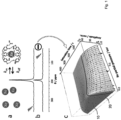
- the host CrA and the guest hpXe combine and dissociate rapidly in solution (see Fig. 1a ).
- rf irradiation rf - radio frequency
- the free xenon spins get depolarized because of saturation transfer by chemical exchange.
- hpXe binds reversibly to the host (CrA) with association and dissociation rates k on and k off , respectively.
- the saturation of the magnetization of host-bound hpXe by resonant rf irradiation leads to a diminished free hpXe signal which is easily detected as a strong NMR signal.
- the signal vanishes at characteristic rate k on in comparison to the case for mirror-symmetrical off-resonant irradiation.
- the acquired and processed free xenon signal shows up at 196 ppm in the spectra ( Fig. 1b ) while the signal of CrA-bound hpXe at 65 ppm is not visible at this concentration level.
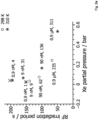
- the Hyper-CEST effect is the difference in signal intensities for off-resonant and resonant irradiation and can be mapped in dependence of the saturation transfer (rf irradiation) period and the free xenon concentration (or free xenon partial pressure).
- Experimental data (dots 10) are superimposed on the model function S( ⁇ , ⁇ ) (see below) evaluated for the parameter settings presented in Table 1 (see below) and a host concentration of 90 nM.
- the crest line 20 indicates maximum Hyper-CEST effect for each choice of xenon partial pressure. Experiments were performed on a sample of 90 nM CrA in aqueous solution at 298 K.
- the variables are the concentration of freely dissolved xenon ⁇ and the length of the saturation transfer (rf irradiation) period ⁇ .
- the second term refers to the NMR signal in case of the resonant irradiation (saturation transfer), while the first term indicates the NMR signal for off-resonant irradiation (no saturation transfer).
- the model function provided above may be applied for fitting curves of NMR signals detected for the host-guest system for quantitatively determining the analyte in the liquid sample, specifically the analyte concentration.
- the constant P 0 represents the maximum polarization which is obtained at vanishing xenon density, it is e.g. P 0 ⁇ 0.25 for the polarizer used for the experiments in Fig. 1 (see Korchak SE, Kilian W, Mitschang L, Appl Magn Reson 44, 65-80 (2013 )).
- the coefficient ⁇ can be determined empirically (see also discussion regarding Fig. 3 and 4 below with a derivation of the functional form for P provided below).
- the first term in the model function represents the signal intensity for off-resonant irradiation of length ⁇ .
- the rate R'( ⁇ ) comprises two contributions, one due to longitudinal relaxation and one due to possible direct rf saturation effects from the irradiation (see Zaiss et al., J Chem Phys 136(14), 144106 (2012 )).
- the longitudinal relaxation time of hpXe is typically in the range of minutes in aqueous solution and tens of seconds when bound to CrA. Because the residence time of xenon at CrA is on the millisecond scale, R '( ⁇ ) comprises an effective relaxation rate given by the population averaged - and thus ⁇ -dependent - mean of the relaxation rates in bound and unbound states.
- the weights are the concentration of free xenon, ⁇ , and the concentration of xenon occupied host, K ⁇ C tot /(1+ K ⁇ ) where C tot denotes the total CrA concentration and K the complex association constant.
- C tot denotes the total CrA concentration and K the complex association constant.
- R' ⁇ R because of the low host concentration.
- the final term in the model function represents the free xenon signal intensity when the CrA-bound spins are saturated by resonant irradiation for a period ⁇ .
- R comprises an irradiation related component identical to the one discussed for R'(p) and the longitudinal relaxation rate of free xenon in the solution when no host is present. It is assumed that the magnetization of hpXe after entering the host is completely destroyed by rf saturation at the time of leaving the complex. Spin relaxation then only occurs when residing in free solution.
- the first factor c + k ⁇ is the complex dissociation rate due to spontaneous decay and xenon release from the complex due to competitive binding partners other than xenon with rate coefficient c and degenerate exchange with rate coefficient k , respectively (see Korchak et al., Chem Commun 51, 1721-1724 (2015 )).
- the second factor is the ratio of the concentration of xenon occupied CrA to the concentration of free xenon.
- the signal vanishes at the characteristic rate k on in comparison to the case for off-resonant irradiation (no saturation transfer), as for low host concentration where the method may usually be applied to, R' ⁇ R .
- the parameters entering the model function can be determined independently from the Hyper-CEST approach.
- the relaxation rate of hpXe, either in solution or bound to a host, as well as the kinetic rate coefficients can be readily obtained by NMR using established measurement protocols (see Korchak et al., J Magn Reson 265, 139-145 (2016 )). Importantly, such measurements may be done at much higher host concentration than used in future applications while the results remain valid as long as the sample temperature and the solution conditions are kept.
- R' ⁇ R may be simply determined as part of the Hyper-CEST experiment for off-resonant irradiation applied at various durations.
- the association constant for hpXe binding to CrA can be conveniently determined by fluorescence quenching as previously demonstrated (see Hill et al., J Am Chem Soc 129, 9262-9263 (2007 )).
- a total number of 70 repetitions of both types of experiment were performed with 10 settings of the irradiation period in between 0 s and 350 s, and, independently, 7 settings of the xenon partial pressure in between 0.01 bar and 0.8 bar (amounting to a range of 43 ⁇ M to 3.5 mM for the free xenon concentration in the solution at a solubility of 4.32 mM bar -1 for xenon in water at 298 K).
- the temperature of the sample was held constant at 298 K.
- the Hyper-CEST effect was obtained as the difference of the intensity of the free xenon signal in the experiments without and with saturation transfer for a period the same length and conducted at the same xenon partial pressure.
- the model function and the corresponding experimental data in this example are a rather flat function in the variables ⁇ and ⁇ , except for a smooth decline towards small ⁇ and a steeper one towards small ⁇ .
- ⁇ max (ln[ R + k on ( ⁇ )]-ln[ R' ( ⁇ )])/( R - R' ( ⁇ )+ k on ( ⁇ )).
- Hyper-CEST therefore originate from the magnetization transfer rate k on ( ⁇ ).
- the dependence of k on ( ⁇ ) on the kinetic rate coefficients and the binding constant makes the Hyper-CEST effect specific to the host-guest interaction at the molecular level, rendering the method temperature dependent.
- a strong response in S( ⁇ , ⁇ ) may be also expected from changes in the total host concentration because of the proportionality to k on ( ⁇ ). It may thus be advantages to use the model function as a tool to predict, and possibly to optimize, applications of Hyper-CEST under different conditions of temperature or host concentration.
- the system parameters governing S( ⁇ , ⁇ ) were determined independently of the Hyper-CEST method also for a temperature of 310 K (Table 1).
- the relaxation rates and kinetic coefficients adopt at 310 K different numerical values, which are of particular relevance for in-vivo applications, such that the Hyper-CEST effect changes correspondingly.
- the model function was finally evaluated using the parameters at 298 K or at 310 K and assuming different levels of host concentration (see Fig. 4 ).
- the overall topology changes with a trend towards a more peaked shape for a smaller amount of host molecules in the solution and a host concentration dependent location of the maximum.
- the location of the maximum of the Hyper-CEST effect moves due to the dependence of the exchange rate k on on the total host concentration.
- the decay rate R'( ⁇ ) approaches R and ⁇ max becomes constant to 1 / R .
- the Hyper-CEST effect is miniscule. Indeed, S( ⁇ , ⁇ ) vanishes allover for vanishing host concentration, rendering the Hyper-CEST effect indifferent to changes in ⁇ .
- the ⁇ -position of the maximum for vanishing host concentration can be determined as 24.4 mbar and 37.8 for 298 K and 310 K, respectively.
- Hyper-CEST was performed in a dilution series in C tot to determine the detection limit of CrA at the maximum Hyper-CEST effect for both temperatures.
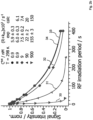
- FIG. 2a for dilution series in the host concentration at 298 K and 310 K the location of the maximum Hyper-CEST effect in the ⁇ , ⁇ -plane is depicted.
- Experimental data for the respective detection limits are shown in Figs. 2b and 2c , together with calculated depletion rates for comparison.
- Fig. 2b shows depletion curves for resonant irradiation 30, ..., 33 and off-resonant irradiation 34 at the various host concentration and at 298 K obtained by exponential fitting to the marked experimental data.
- Fig. 2c shows a diagram and data equivalent to Fig.
- the model function is used for quantification of parameters.
- the amount of host molecules present in the solution was determined which is the quantity of interest for many targeting applications.
- a first attempt is to resolve the model function for C tot .
- This approach is only feasible at low host concentration, when R' ( ⁇ ) ⁇ R as then C tot can be explicitly expressed in terms of the NMR parameters and the measured Hyper-CEST effect.
- R' ( ⁇ ) ⁇ R as then C tot can be explicitly expressed in terms of the NMR parameters and the measured Hyper-CEST effect.
- a difference of less than 1% in the rates R' ( ⁇ ) and R over the range of xenon partial pressures used in the experiments is marginal in this respect. From the 70 experimental intensity differences of this dataset ( Fig.
- An alternative embodiment is to use the saturation driven depletion rate R + k on ( ⁇ ) instead of the Hyper-CEST effect itself for quantification.
- This rate is simply linearly dependent on the host concentration and may be easily determined from a fit to the experimentally determined NMR signal depletion curve (curve fitting).
- An advantage of this approach comes thus with the inherent statistical averaging due to the determination of the depletion rate by fitting to a number of experimental data points. For the seven depletion curves at 90 nM host concentration and 298 K, each conducted at a fixed xenon partial pressure and at 10 different settings of the irradiation period, the mean with SD 92.2 ⁇ 5.0 nM is obtained.
- a further mode of quantification may be applied which is distinguished in not relying on prior knowledge about the system parameters except R .
- the exchange rate k on ( ⁇ ) is at conditions of constant sample temperature and free xenon concentration (constant ⁇ ) only susceptible to variations in the total host concentration. In such a situation, for a known host concentration C ref tot the depletion rate when resonantly irradiated, denoted by ⁇ satref , could be determined and subsequently used as a reference quantity in data evaluation.
- the approach was applied to the host dilution series at 298 K and 310 K.
- the sample with the highest host concentration (900 nM) was used to achieve a possibly low uncertainty in ⁇ ref .
- the nominal concentrations of 90 nM, 9 nM, and 0.9 nM were matched by the determinations 94 ⁇ 10 nM, 9.3 ⁇ 1.6 nM, 0.48 ⁇ 1.98 nM, and 96 ⁇ 4 nM, 8.7 ⁇ 1.2 nM, 0.93 ⁇ 0.49 nM, at 298 K and 310 K, respectively.
- the proposed methods for quantification of the host concentration using Hyper-CEST can be applied in an alternative way by resorting to individually experimentally measured off-resonant signal intensities or depletion rates instead of using the pre-determined rate R and polarizer performance A( ⁇ ) (using parameter ⁇ ).
- the first term of the model function stands for the signal intensity s 0 for off-resonant irradiation of specified duration ⁇ and at specified xenon partial pressure ⁇ expressed as A( ⁇ )exp(-R ⁇ ) , while the intensity for resonantly applied irradiation s sat is given by A( ⁇ )exp(-R ⁇ - k on ⁇ ).
- the different embodiments of the method may be applied in the field of biosensing with hyperpolarized xenon.
- a technology based on a model function for the key experimental approach is presented, the saturation transfer between host-bound and free xenon in the Hyper-CEST method.
- the amount of xenon (concentration) is introduced as the relevant quantity for controlling the experiment performance and data evaluation by the experimentalist based on knowledge about the NMR parameters governing the host-guest system.
- the optimal xenon concentration and saturation transfer period can be determined for applications at maximum effect, and quantitation of the amount of host becomes feasible.
- the method exemplified for the widely used host CrA, may be applicable to other host structures currently investigated (see Mynar et al.,, J Am Chem Soc 128, 6334-6335 (2006 ); Stevens et al., J Am Chem Soc 135(26), 9576-9579 (2013 ); Shapiro et al., Nat Chem 6(7), 629-634 (2014 ); Wang et al., Chem Commun 51, 8982-8985 (2015 )) because of the very same underlying mechanism of exchange driven saturation transfer.
- the model could be combined with a simulation of host based molecular imaging in deep tissue (see Shapiro et al., Nat Chem 6(7), 629-634 (2014 )).
- the model function may be provided with modifications in alternative applications. It is based on the assumption of complete deletion of the magnetization of host-bound hpXe and thus requires rf irradiation of sufficiently high power for given lifetime of the complex. Within the regime of the presented experiments saturation by rf irradiation was complete, as is evident by the consistency of the quantitative results and former work on the hpXe-CrA host-guest system ( see Korchak et al., J Magn Reson 265, 139-145 (2016 ); Schröder et al., Phys Rev Lett 100, 257603 (2008 )). For CrA at elevated temperature or for other hosts, e.g.
- the residence time can drop below the millisecond range, rendering rf saturation at manageable power levels difficult. It is, however, well known how to compensate for incomplete rf saturation in Hyper-CEST (see Zaiss et al., J Chem Phys 136 (14), 144106 (2012 ), Knuth M, Witte C, Schröder L, NMR Biomed 28(6), 601-606, (2015 )).
- the exchange rate k on needs to be scaled by the factor ⁇ 2 / ⁇ 2 + k off 2 to account for this effect.
- the angular frequency ⁇ denotes the rf saturation power expressed in units of the hpXe precession frequency and k off the rate coefficient for magnetization transfer due to hpXe leaving the complex with the host (rate of dissociation of the complex of the marker substance and hpXe; rate of dissociation of the host-bound state of hpXe).
- monoacidic acid CrA purchased from Kangyuan Jiyi Inc.
- the solution was sonicated for several hours at room temperature and finally pressed through a 0.2 ⁇ m-pore filter to remove non-dissolved particles.
- the concentration of CrA in the solution was measured by UV-Vis spectroscopy with the molar attenuation coefficient independently determined to be 16200 M -1 cm -1 . In this manner saturated solutions of CrA at concentrations less 7 ⁇ M were regularly obtained.
- a saturated stock solution was prepared as described and stepwise further diluted.
- the CrA-xenon association constant in water was determined using the fluorescence method described in Hill et al., J Am Chem Soc 129:9262-9263 (2007 ). The influence on the association constant of the 0.2 bar of N2 present in the gas mixture which was bubbled through the sample was independently determined analogously and taken into account.
- the kinetic exchange rate coefficients for CrA-xenon host-guest system in water at temperatures of 298 K and 310 K were determined by NMR exchange spectroscopy at variable xenon partial pressure (see Korchak et al., Chem Commun 51, 1721-1724 (2015 )).
- R' R was determined as the average of depletion rates from applications of the Hyper-CEST experiment off-resonantly.
- R' R was determined as the average of depletion rates from applications of the Hyper-CEST experiment off-resonantly.
- a usual one-dimensional xenon spectrum was acquired.
- the respective signal intensities are a measure of the function A( ⁇ ) describing the polarizer performance in dependence of xenon partial pressure and were used for determination of the polarization parameter ⁇ .
- Parameter uncertainties were determined by standard procedures, including statistical variances and error propagation.
- the hyperpolarized 129 Xe was generated by a custom-designed continuous-flow polarizer using spin-exchange-optical pumping ( Korchak et al., Appl Magn Reson 44, 65-80 (2013 )).
- the gas mixture of hpXe, nitrogen and helium at the outlet of the polarizer was transferred in a hose to the NMR tube in the spectrometer.
- the gas mixture was directly bubbled into the sample solution (3 ml) with the help of a spectrometer-triggered bubble dispenser (3.2 bar overpressure) via fused silica capillaries (Polymicro Technologies).
- the polarization depends on the xenon concentration subjected to the hyperpolarization process. A maximum of 25% was obtained at the lowest xenon partial pressure of 10 mbar while the minimum was 4% polarization at the highest xenon partial pressure of 0.8 bar.
- the signal in each spectrum was integrated over an area of 3 ppm centered at the signal's maximum amplitude.
- the software ACD/NMR Processor Academic Edition was used for spectrum integration. Identical procedures were applied for determination of signal intensities in case of the host dilution series but further processing applied.
- the signal intensities were modeled by functions in their dependence on the saturation transfer period for each setting of the xenon partial pressure by a non-linear least squares fit ( Figs. 2b , 2c ). In this way, the depletion rates were obtained for each setting of xenon partial pressure with error margins given by the standard error in the fit parameter due to deviations of the fitted curve from the data (square root of a main diagonal value of the Covariance Matrix).
- the commercially available software QtiPlot was used for data fitting.
- Hyperpolarized xenon-129 is in conjunction with molecular host structures where it can reversibly bind to a daunting magnetic resonance probe for targeting of molecular and cellular markers. Marker location or marker-related functional events can be sensed at unprecedented low levels of concentration using the exchange driven saturation transfer between host-bound and unbound xenon.
- the amount of xenon used to report about the state of the host-guest system is a critical quantity in some embodiments and is a tool for controlling the performance and improving the analysis of applications.
- the dependence of the intrinsic magnetic resonance parameters spin polarization, spin relaxation rate, and binding rate on the xenon concentration facilitates a concise description of the outcome of measurements. This modeling allows experiments to be conducted optimally, including performance at the limit of detection, and enables the prognosis of future applications. In addition, quantitation, particularly the determination of amount of substance, becomes feasible.
- the hyperpolarized gas molecule may bind to the marker substance molecule in exchange for a another gas molecule of the same kind which was bound to the marker substance molecule before.
- the method based on the model function may be applied to other host-guest systems showing similar behavior with regard to binding the hyperpolarized gas in the liquid sample.
- the modeling of the spin polarization P in dependence of the xenon partial pressure p is based on the hyperpolarization process by spin exchange optical pumping (SEOP) ( Freeman et al., Phys. Rev. A90:023406 (2014 ); Norquay et al., J. Appl. Phys. 113:044908 (2013 )).
- SEOP spin exchange optical pumping
- the polarizer used in the present study operates at a total gas pressure of constantly 3 bar.
- the 129Xe-relaxation rate ⁇ 1 mainly reflecting wall collisions and diffusion through magnetic field gradients, is a constant too because of the stable total gas pressure.
- the optical pumping rate yOP(z) is the spectral integral of the position-dependent laser intensity along the SEOP cell and the alkali-metal absorption cross section. For a given laser power and constant Rb concentration, this value again is independent the xenon partial pressure.
- the alkali-metal spin-destruction rate ⁇ SD ⁇ i G i ⁇ SD Rb ⁇ i is strongly dependent on the various buffer-gas densities [Gi] by way of the corresponding spin-destruction cross sections ⁇ SD Rb ⁇ i .
- xenon itself is the most dominant Rb-spin destroyer with a spin-destruction cross section about four orders of magnitude larger than for helium or nitrogen.
- Eq. (S1) may thus be simplified as P ⁇ P 0 1 + ⁇ p with P 0 equal to the second and third factor in Eq. S1 multiplied by ⁇ OP , p for the xenon partial pressure in the SEOP, and the parameter ⁇ approximately given by ⁇ SD Rb ⁇ Xe / ⁇ ⁇ OP ⁇ .
- the parameter ⁇ was determined for the polarizer in the present study by measuring the spin polarization in dependence of p (Eq. (S3)).
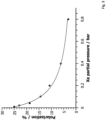
- Fig. 3 shows a graphical representation of a polarization of hpXe in dependence of xenon partial pressure.
- Experimental data black dots
- the amplitude P 0 is set by normalization to 25%.
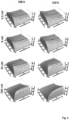
- Fig. 4 a graphical representation of an evaluation of the model function for the Hyper-CEST effect at temperature 298 K for an aqueous solution of CrA of (a) 0.9 nM, (b) 9 nM, (c) 90 nM, and (d) 900 nM, and at 310K for CrA concentrations of (e) 0.9 nM, (f) 9 nM, (g) 90 nM, and (h) 900 nM.
- the amplitudes are normalized to the maximum effect at 0.9 nM 298 K as is the case in Fig. 1c .
Landscapes
- Physics & Mathematics (AREA)
- High Energy & Nuclear Physics (AREA)
- General Health & Medical Sciences (AREA)
- General Physics & Mathematics (AREA)
- Health & Medical Sciences (AREA)
- Condensed Matter Physics & Semiconductors (AREA)
- Engineering & Computer Science (AREA)
- Signal Processing (AREA)
- Radiology & Medical Imaging (AREA)
- Nuclear Medicine, Radiotherapy & Molecular Imaging (AREA)
- Life Sciences & Earth Sciences (AREA)
- Molecular Biology (AREA)
- Spectroscopy & Molecular Physics (AREA)
- Chemical & Material Sciences (AREA)
- Analytical Chemistry (AREA)
- Biochemistry (AREA)
- Immunology (AREA)
- Pathology (AREA)
- Magnetic Resonance Imaging Apparatus (AREA)
Claims (9)
- Verfahren zur quantitativen Bestimmung eines Analyten in einer Flüssigkeitsprobe, umfassend- Bereitstellen einer Flüssigkeitsprobe, die einen Analyten von Interesse und eine an den Analyten gebundene Markersubstanz umfasst;- Herstellen einer gemischten Flüssigkeitsprobe durch Mischen der Flüssigkeitsprobe mit einem hyperpolarisierten Gas, wobei die Markersubstanz und das hyperpolarisierte Gas ein Wirts-Gast-System in der gemischten Flüssigkeitsprobe bereitstellen, wobei das hyperpolarisierte Gas eine Verschiebung der kernmagnetischen Resonanzfrequenzen im Falle eines Übergangs von einem frei gelösten Zustand zu einem wirtsgebundenen Zustand aufweist, in dem das hyperpolarisierte Gas an die Markersubstanz in der gemischten Flüssigkeitsprobe gebunden ist;- experimentelle Bestimmung der gemischten Flüssigkeitsprobe durch kernmagnetische Resonanzspektroskopie (NMR), wobei ein Hyper-CEST-Verfahren angewendet wird, das Folgendes umfasst:- in einer ersten Messung, Herstellen eines Sättigungstransfers für das hyperpolarisierte Gas im frei gelösten Zustand und im wirtsgebundenen Zustand, was das Depolarisieren des hyperpolarisierten Gases im wirtsgebundenen Zustand durch Anwenden von Hochfrequenz (HF)-Bestrahlung in Resonanz mit dem hyperpolarisierten Gas im wirtsgebundenen Zustand für eine Zeitlänge r umfasst,- in einer zweiten Messung, Herstellen eines Nicht-Sättigungstransfers für das hyperpolarisierte Gas im frei gelösten Zustand und im wirtsgebundenen Zustand; und- Nachweis von NMR-Signalen für das hyperpolarisierte Gas im frei gelösten Zustand;- Bestimmen einer Konzentration des hyperpolarisierten Gases in der gemischten Flüssigkeitsprobe für den frei gelösten Zustand; und- quantitative Bestimmung des Analyten in der Flüssigkeitsprobe;gekennzeichnet durch die Anwendung einer Modellfunktion S für das NMR-Signal wie folgt:
 wobei der erste Term der Modellfunktion S das NMR-Signal für nicht-resonante Bestrahlung ohne Sättigungstransfer angibt und der zweite Term der Modellfunktion das NMR-Signal im Falle der resonanten Bestrahlung mit Sättigungstransfer angibt, undwobei ρ - die Konzentration des hyperpolarisierten Gases im frei gelösten Zustand ist, kon - Assoziationsrate für die Bindung des hyperpolarisierten Gases an die Markersubstanz, R - Relaxations- und direkte Sättigungsrate des freien hyperpolarisierten Gases im Falle der HF-Bestrahlung in Resonanz mit dem wirtsgebundenen hyperpolarisierten Gas und R' - Relaxations- und direkte Sättigungsrate des freien hyperpolarisierten Gases im Falle der HF-Bestrahlung abseits der Resonanz mit dem wirtsgebundenen hyperpolarisierten Gas.
 - Verfahren nach Anspruch 1, wobei- die experimentelle Bestimmung der gemischten Flüssigkeitsprobe die experimentelle Bestimmung eines Verhältnisses der NMR-Signalintensitäten für den frei gelösten Zustand und den wirtsgebundenen Zustand des hyperpolarisierten Gases umfasst; und- die Bestimmung der Konzentration des hyperpolarisierten Gases die Bestimmung der Konzentration des hyperpolarisierten Gases im wirtsgebundenen Zustand in der gemischten Flüssigkeitsprobe aus dem Verhältnis der NMR-Signalintensitäten für den frei gelösten Zustand und den wirtsgebundenen Zustand des hyperpolarisierten Gases umfasst.
- Verfahren nach mindestens einem der vorhergehenden Ansprüche, wobei die Modellfunktion für R ≅ R' angewendet wird.
- Verfahren nach mindestens einem der vorhergehenden Ansprüche, dadurch gekennzeichnet, dass in der Modellfunktion die Assoziationsrate kon mit einem Faktor w2 /(w2 +koff 2) skaliert wird, wobei w eine Sättigungs-HF-Bestrahlungsleistung ist, ausgedrückt in Einheiten der Präzessionsfrequenz des hyperpolarisierten Gases, und koff eine Dissoziationsrate eines Markersubstanz-hyperpolarisierten Gaskomplexes ist.
- Verfahren nach mindestens einem der vorhergehenden Ansprüche, wobei die Herstellung das Mischen der Flüssigkeitsprobe mit hyperpolarisiertem Xe umfasst.
- Verfahren nach mindestens einem der vorhergehenden Ansprüche, wobei das Bereitstellen das Bereitstellen einer Flüssigkeitsprobe mit einer submikromolaren oder subnanomolaren Konzentration des interessierenden Analyten umfasst.
- Verfahren nach mindestens einem der vorhergehenden Ansprüche, wobei das Bereitstellen das Versehen einer Flüssigkeitsprobe mit der Markersubstanz, ausgewählt aus der folgenden Gruppe: Xenonbindende Substanz, Cryptophan und Cucurbituril, umfasst.
- Verfahren nach mindestens einem der Ansprüche 1 bis 7, wobei die Flüssigkeitsprobe eine flüssige biologische ex-vivo-Probe ist.
- Verwendung des Verfahrens nach mindestens einem der Ansprüche 1 bis 7 in einem Multiplexing-Modus zur Quantifizierung einer Vielzahl von Analyten durch verschiedene gleichzeitig verwendete Marker.
Priority Applications (1)
| Application Number | Priority Date | Filing Date | Title |
|---|---|---|---|
| EP16201736.2A EP3330729B8 (de) | 2016-12-01 | 2016-12-01 | Nmr-verfahren für den quantitativen nachweis eines analyten in einer flüssigprobe unter verwendung eines hyperpolarisierten gases |
Applications Claiming Priority (1)
| Application Number | Priority Date | Filing Date | Title |
|---|---|---|---|
| EP16201736.2A EP3330729B8 (de) | 2016-12-01 | 2016-12-01 | Nmr-verfahren für den quantitativen nachweis eines analyten in einer flüssigprobe unter verwendung eines hyperpolarisierten gases |
Publications (3)
| Publication Number | Publication Date |
|---|---|
| EP3330729A1 EP3330729A1 (de) | 2018-06-06 |
| EP3330729B1 true EP3330729B1 (de) | 2023-06-28 |
| EP3330729B8 EP3330729B8 (de) | 2023-10-25 |
Family
ID=57471700
Family Applications (1)
| Application Number | Title | Priority Date | Filing Date |
|---|---|---|---|
| EP16201736.2A Active EP3330729B8 (de) | 2016-12-01 | 2016-12-01 | Nmr-verfahren für den quantitativen nachweis eines analyten in einer flüssigprobe unter verwendung eines hyperpolarisierten gases |
Country Status (1)
| Country | Link |
|---|---|
| EP (1) | EP3330729B8 (de) |
Families Citing this family (3)
| Publication number | Priority date | Publication date | Assignee | Title |
|---|---|---|---|---|
| DE102021121238A1 (de) | 2021-08-16 | 2023-02-16 | Bundesrepublik Deutschland, Vertreten Durch Das Bundesministerium Für Wirtschaft Und Energie, Dieses Vertreten Durch Den Präsidenten Der Physikalisch-Technischen Bundesanstalt | Verfahren zum quantitativen Bestimmen einer Wirtsmolekül-Konzentration (Ctot) an Wirtsmolekülen und Konzentrationsmessgerät |
| CN119086618B (zh) * | 2023-09-06 | 2025-10-03 | 中国科学院精密测量科学与技术创新研究院 | 用于超极化129Xe磁共振分子探针流动采样的装置及方法 |
| DE102024108611A1 (de) * | 2024-03-26 | 2025-10-02 | Physikalisch-Technische Bundesanstalt Braunschweig Und Berlin | Verfahren zum Detektieren von an Xenon-bindende Wirtsmolekülen und Messgerät zum Detektieren von an Xenon-bindende Wirtsmolekülen |
-
2016
- 2016-12-01 EP EP16201736.2A patent/EP3330729B8/de active Active
Also Published As
| Publication number | Publication date |
|---|---|
| EP3330729A1 (de) | 2018-06-06 |
| EP3330729B8 (de) | 2023-10-25 |
Similar Documents
| Publication | Publication Date | Title |
|---|---|---|
| Babailov et al. | Paramagnetic lanthanides as magnetic resonance thermo-sensors and probes of molecular dynamics: Holmium-DOTA complex | |
| Saab et al. | Multicomponent T2 relaxation of in vivo skeletal muscle | |
| CN102859386B (zh) | 核自旋系统的纵向和横向弛豫时间的同时和动态确定 | |
| US10247799B2 (en) | System and method for sensitivity-enhanced multi-echo chemical exchange saturation transfer (MECEST) magentic resonance imaging | |
| Tee et al. | Evaluating the use of a continuous approximation for model-based quantification of pulsed chemical exchange saturation transfer (CEST) | |
| Palaniappan et al. | Molecular sensing using hyperpolarized xenon NMR spectroscopy | |
| Döpfert et al. | Time‐resolved monitoring of enzyme activity with ultrafast Hyper‐CEST spectroscopy | |
| EP3330729B1 (de) | Nmr-verfahren für den quantitativen nachweis eines analyten in einer flüssigprobe unter verwendung eines hyperpolarisierten gases | |
| Babailov et al. | Lanthanides as NMR probes of fast molecular dynamics at high magnetic fields and temperature sensors: conformational interconversion of erbium ethylenediaminetetraacetate complexes | |
| CN108369266B (zh) | 比率计量的脉冲cest成像 | |
| Korchak et al. | Design and comparison of exchange spectroscopy approaches to cryptophane–xenon host–guest kinetics | |
| Taguchi et al. | In vitro simultaneous mapping of the partial pressure of oxygen, pH and inorganic phosphate using electron paramagnetic resonance | |
| JP6195708B2 (ja) | 磁気共鳴分光システムを用いた化学平衡比の測定 | |
| Deng et al. | Application of magnetic field over-modulation for improved EPR linewidth measurements using probes with Lorentzian lineshape | |
| Korchak et al. | Quantitative biosensor detection by chemically exchanging hyperpolarized 129 Xe | |
| Du et al. | Direct imaging and quantification of carotid plaque calcification | |
| EP4388305B1 (de) | Verfahren zum quantitativen bestimmen einer wirtsmolekül-konzentration (ctot) an wirtsmolekülen und konzentrationsmessgerät | |
| Shepelytskyi et al. | R3-Noria-methanesulfonate: a molecular cage with superior hyperpolarized Xenon-129 MRI contrast | |
| Korchak et al. | Quantitative Assessment of Xenon Exchange Kinetics with Cucurbit [6] uril in Physiological Saline | |
| Thelwall et al. | Field dependence of 17O T1, T2 and SNR-in vitro and in vivo studies at 4.7, 11 and 17.6 Tesla | |
| US20220214292A1 (en) | Portable nmr instrumentation and methods for analysis of body fluids | |
| KR20220061899A (ko) | 블라인드 선택적 펄스를 이용한 반응 메커니즘 분석법 | |
| WO2025165307A1 (en) | Method of detecting and quantifying a paramagnetic metal ion using micromagnetic resonance relaxometry (mrr) | |
| JP2008504541A (ja) | 過分極化された媒体を使用する高分解能核磁気共鳴のための方法および装置 | |
| RU2547899C1 (ru) | Способ определения фактора насыщения электронных переходов парамагнитной подсистемы в веществе |
Legal Events
| Date | Code | Title | Description |
|---|---|---|---|
| PUAI | Public reference made under article 153(3) epc to a published international application that has entered the european phase |
Free format text: ORIGINAL CODE: 0009012 |
|
| STAA | Information on the status of an ep patent application or granted ep patent |
Free format text: STATUS: THE APPLICATION HAS BEEN PUBLISHED |
|
| AK | Designated contracting states |
Kind code of ref document: A1 Designated state(s): AL AT BE BG CH CY CZ DE DK EE ES FI FR GB GR HR HU IE IS IT LI LT LU LV MC MK MT NL NO PL PT RO RS SE SI SK SM TR |
|
| AX | Request for extension of the european patent |
Extension state: BA ME |
|
| STAA | Information on the status of an ep patent application or granted ep patent |
Free format text: STATUS: REQUEST FOR EXAMINATION WAS MADE |
|
| 17P | Request for examination filed |
Effective date: 20190312 |
|
| RBV | Designated contracting states (corrected) |
Designated state(s): AL AT BE BG CH CY CZ DE DK EE ES FI FR GB GR HR HU IE IS IT LI LT LU LV MC MK MT NL NO PL PT RO RS SE SI SK SM TR |
|
| STAA | Information on the status of an ep patent application or granted ep patent |
Free format text: STATUS: EXAMINATION IS IN PROGRESS |
|
| 17Q | First examination report despatched |
Effective date: 20210624 |
|
| GRAP | Despatch of communication of intention to grant a patent |
Free format text: ORIGINAL CODE: EPIDOSNIGR1 |
|
| STAA | Information on the status of an ep patent application or granted ep patent |
Free format text: STATUS: GRANT OF PATENT IS INTENDED |
|
| INTG | Intention to grant announced |
Effective date: 20230214 |
|
| GRAS | Grant fee paid |
Free format text: ORIGINAL CODE: EPIDOSNIGR3 |
|
| GRAA | (expected) grant |
Free format text: ORIGINAL CODE: 0009210 |
|
| STAA | Information on the status of an ep patent application or granted ep patent |
Free format text: STATUS: THE PATENT HAS BEEN GRANTED |
|
| AK | Designated contracting states |
Kind code of ref document: B1 Designated state(s): AL AT BE BG CH CY CZ DE DK EE ES FI FR GB GR HR HU IE IS IT LI LT LU LV MC MK MT NL NO PL PT RO RS SE SI SK SM TR |
|
| REG | Reference to a national code |
Ref country code: CH Ref legal event code: EP |
|
| REG | Reference to a national code |
Ref country code: AT Ref legal event code: REF Ref document number: 1583167 Country of ref document: AT Kind code of ref document: T Effective date: 20230715 |
|
| REG | Reference to a national code |
Ref country code: IE Ref legal event code: FG4D |
|
| REG | Reference to a national code |
Ref country code: DE Ref legal event code: R096 Ref document number: 602016080595 Country of ref document: DE |
|
| GRAT | Correction requested after decision to grant or after decision to maintain patent in amended form |
Free format text: ORIGINAL CODE: EPIDOSNCDEC |
|
| REG | Reference to a national code |
Ref country code: CH Ref legal event code: PK Free format text: BERICHTIGUNG B8 |
|
| P01 | Opt-out of the competence of the unified patent court (upc) registered |
Effective date: 20230830 |
|
| REG | Reference to a national code |
Ref country code: LT Ref legal event code: MG9D Ref country code: DE Ref legal event code: R081 Ref document number: 602016080595 Country of ref document: DE Owner name: BUNDESREPUBLIK DEUTSCHLAND, VERTRETEN DURCH DA, DE Free format text: FORMER OWNER: BUNDESREPUBLIK DEUTSCHLAND, VETRETEN DURCH DAS BUNDESMINISTERIUM FUER WIRTSCHAFT UND TECHNOLOGIE, DIESES VERTRETEN DURCH DEN, 38116 BRAUNSCHWEIG, DE |
|
| RAP4 | Party data changed (patent owner data changed or rights of a patent transferred) |
Owner name: BUNDESREPUBLIK DEUTSCHLAND, VERTRETEN DURCH DAS BUNDESMINISTERIUM FUER WIRTSCHAFT UND TECHNOLOGIE, DIESES VERTRETEN DURCH DEN PRAESIDENTEN |
|
| PG25 | Lapsed in a contracting state [announced via postgrant information from national office to epo] |
Ref country code: SE Free format text: LAPSE BECAUSE OF FAILURE TO SUBMIT A TRANSLATION OF THE DESCRIPTION OR TO PAY THE FEE WITHIN THE PRESCRIBED TIME-LIMIT Effective date: 20230628 Ref country code: NO Free format text: LAPSE BECAUSE OF FAILURE TO SUBMIT A TRANSLATION OF THE DESCRIPTION OR TO PAY THE FEE WITHIN THE PRESCRIBED TIME-LIMIT Effective date: 20230928 |
|
| REG | Reference to a national code |
Ref country code: CH Ref legal event code: PK Free format text: BERICHTIGUNGEN |
|
| REG | Reference to a national code |
Ref country code: NL Ref legal event code: MP Effective date: 20230628 |
|
| REG | Reference to a national code |
Ref country code: AT Ref legal event code: MK05 Ref document number: 1583167 Country of ref document: AT Kind code of ref document: T Effective date: 20230628 |
|
| PG25 | Lapsed in a contracting state [announced via postgrant information from national office to epo] |
Ref country code: RS Free format text: LAPSE BECAUSE OF FAILURE TO SUBMIT A TRANSLATION OF THE DESCRIPTION OR TO PAY THE FEE WITHIN THE PRESCRIBED TIME-LIMIT Effective date: 20230628 Ref country code: NL Free format text: LAPSE BECAUSE OF FAILURE TO SUBMIT A TRANSLATION OF THE DESCRIPTION OR TO PAY THE FEE WITHIN THE PRESCRIBED TIME-LIMIT Effective date: 20230628 Ref country code: LV Free format text: LAPSE BECAUSE OF FAILURE TO SUBMIT A TRANSLATION OF THE DESCRIPTION OR TO PAY THE FEE WITHIN THE PRESCRIBED TIME-LIMIT Effective date: 20230628 Ref country code: LT Free format text: LAPSE BECAUSE OF FAILURE TO SUBMIT A TRANSLATION OF THE DESCRIPTION OR TO PAY THE FEE WITHIN THE PRESCRIBED TIME-LIMIT Effective date: 20230628 Ref country code: HR Free format text: LAPSE BECAUSE OF FAILURE TO SUBMIT A TRANSLATION OF THE DESCRIPTION OR TO PAY THE FEE WITHIN THE PRESCRIBED TIME-LIMIT Effective date: 20230628 Ref country code: GR Free format text: LAPSE BECAUSE OF FAILURE TO SUBMIT A TRANSLATION OF THE DESCRIPTION OR TO PAY THE FEE WITHIN THE PRESCRIBED TIME-LIMIT Effective date: 20230929 |
|
| PG25 | Lapsed in a contracting state [announced via postgrant information from national office to epo] |
Ref country code: FI Free format text: LAPSE BECAUSE OF FAILURE TO SUBMIT A TRANSLATION OF THE DESCRIPTION OR TO PAY THE FEE WITHIN THE PRESCRIBED TIME-LIMIT Effective date: 20230628 |
|
| PG25 | Lapsed in a contracting state [announced via postgrant information from national office to epo] |
Ref country code: SK Free format text: LAPSE BECAUSE OF FAILURE TO SUBMIT A TRANSLATION OF THE DESCRIPTION OR TO PAY THE FEE WITHIN THE PRESCRIBED TIME-LIMIT Effective date: 20230628 |
|
| PG25 | Lapsed in a contracting state [announced via postgrant information from national office to epo] |
Ref country code: ES Free format text: LAPSE BECAUSE OF FAILURE TO SUBMIT A TRANSLATION OF THE DESCRIPTION OR TO PAY THE FEE WITHIN THE PRESCRIBED TIME-LIMIT Effective date: 20230628 |
|
| PG25 | Lapsed in a contracting state [announced via postgrant information from national office to epo] |
Ref country code: IS Free format text: LAPSE BECAUSE OF FAILURE TO SUBMIT A TRANSLATION OF THE DESCRIPTION OR TO PAY THE FEE WITHIN THE PRESCRIBED TIME-LIMIT Effective date: 20231028 |
|
| PG25 | Lapsed in a contracting state [announced via postgrant information from national office to epo] |
Ref country code: SM Free format text: LAPSE BECAUSE OF FAILURE TO SUBMIT A TRANSLATION OF THE DESCRIPTION OR TO PAY THE FEE WITHIN THE PRESCRIBED TIME-LIMIT Effective date: 20230628 Ref country code: SK Free format text: LAPSE BECAUSE OF FAILURE TO SUBMIT A TRANSLATION OF THE DESCRIPTION OR TO PAY THE FEE WITHIN THE PRESCRIBED TIME-LIMIT Effective date: 20230628 Ref country code: RO Free format text: LAPSE BECAUSE OF FAILURE TO SUBMIT A TRANSLATION OF THE DESCRIPTION OR TO PAY THE FEE WITHIN THE PRESCRIBED TIME-LIMIT Effective date: 20230628 Ref country code: PT Free format text: LAPSE BECAUSE OF FAILURE TO SUBMIT A TRANSLATION OF THE DESCRIPTION OR TO PAY THE FEE WITHIN THE PRESCRIBED TIME-LIMIT Effective date: 20231030 Ref country code: IS Free format text: LAPSE BECAUSE OF FAILURE TO SUBMIT A TRANSLATION OF THE DESCRIPTION OR TO PAY THE FEE WITHIN THE PRESCRIBED TIME-LIMIT Effective date: 20231028 Ref country code: ES Free format text: LAPSE BECAUSE OF FAILURE TO SUBMIT A TRANSLATION OF THE DESCRIPTION OR TO PAY THE FEE WITHIN THE PRESCRIBED TIME-LIMIT Effective date: 20230628 Ref country code: EE Free format text: LAPSE BECAUSE OF FAILURE TO SUBMIT A TRANSLATION OF THE DESCRIPTION OR TO PAY THE FEE WITHIN THE PRESCRIBED TIME-LIMIT Effective date: 20230628 Ref country code: CZ Free format text: LAPSE BECAUSE OF FAILURE TO SUBMIT A TRANSLATION OF THE DESCRIPTION OR TO PAY THE FEE WITHIN THE PRESCRIBED TIME-LIMIT Effective date: 20230628 Ref country code: AT Free format text: LAPSE BECAUSE OF FAILURE TO SUBMIT A TRANSLATION OF THE DESCRIPTION OR TO PAY THE FEE WITHIN THE PRESCRIBED TIME-LIMIT Effective date: 20230628 |
|
| PG25 | Lapsed in a contracting state [announced via postgrant information from national office to epo] |
Ref country code: PL Free format text: LAPSE BECAUSE OF FAILURE TO SUBMIT A TRANSLATION OF THE DESCRIPTION OR TO PAY THE FEE WITHIN THE PRESCRIBED TIME-LIMIT Effective date: 20230628 |
|
| REG | Reference to a national code |
Ref country code: DE Ref legal event code: R097 Ref document number: 602016080595 Country of ref document: DE |
|
| PG25 | Lapsed in a contracting state [announced via postgrant information from national office to epo] |
Ref country code: DK Free format text: LAPSE BECAUSE OF FAILURE TO SUBMIT A TRANSLATION OF THE DESCRIPTION OR TO PAY THE FEE WITHIN THE PRESCRIBED TIME-LIMIT Effective date: 20230628 |
|
| PLBE | No opposition filed within time limit |
Free format text: ORIGINAL CODE: 0009261 |
|
| STAA | Information on the status of an ep patent application or granted ep patent |
Free format text: STATUS: NO OPPOSITION FILED WITHIN TIME LIMIT |
|
| PG25 | Lapsed in a contracting state [announced via postgrant information from national office to epo] |
Ref country code: IT Free format text: LAPSE BECAUSE OF FAILURE TO SUBMIT A TRANSLATION OF THE DESCRIPTION OR TO PAY THE FEE WITHIN THE PRESCRIBED TIME-LIMIT Effective date: 20230628 |
|
| 26N | No opposition filed |
Effective date: 20240402 |
|
| PG25 | Lapsed in a contracting state [announced via postgrant information from national office to epo] |
Ref country code: SI Free format text: LAPSE BECAUSE OF FAILURE TO SUBMIT A TRANSLATION OF THE DESCRIPTION OR TO PAY THE FEE WITHIN THE PRESCRIBED TIME-LIMIT Effective date: 20230628 |
|
| PG25 | Lapsed in a contracting state [announced via postgrant information from national office to epo] |
Ref country code: LU Free format text: LAPSE BECAUSE OF NON-PAYMENT OF DUE FEES Effective date: 20231201 |
|
| PG25 | Lapsed in a contracting state [announced via postgrant information from national office to epo] |
Ref country code: MC Free format text: LAPSE BECAUSE OF FAILURE TO SUBMIT A TRANSLATION OF THE DESCRIPTION OR TO PAY THE FEE WITHIN THE PRESCRIBED TIME-LIMIT Effective date: 20230628 |
|
| REG | Reference to a national code |
Ref country code: BE Ref legal event code: MM Effective date: 20231231 |
|
| PG25 | Lapsed in a contracting state [announced via postgrant information from national office to epo] |
Ref country code: MC Free format text: LAPSE BECAUSE OF FAILURE TO SUBMIT A TRANSLATION OF THE DESCRIPTION OR TO PAY THE FEE WITHIN THE PRESCRIBED TIME-LIMIT Effective date: 20230628 Ref country code: LU Free format text: LAPSE BECAUSE OF NON-PAYMENT OF DUE FEES Effective date: 20231201 |
|
| REG | Reference to a national code |
Ref country code: IE Ref legal event code: MM4A |
|
| PG25 | Lapsed in a contracting state [announced via postgrant information from national office to epo] |
Ref country code: IE Free format text: LAPSE BECAUSE OF NON-PAYMENT OF DUE FEES Effective date: 20231201 |
|
| PG25 | Lapsed in a contracting state [announced via postgrant information from national office to epo] |
Ref country code: BE Free format text: LAPSE BECAUSE OF NON-PAYMENT OF DUE FEES Effective date: 20231231 |
|
| PG25 | Lapsed in a contracting state [announced via postgrant information from national office to epo] |
Ref country code: FR Free format text: LAPSE BECAUSE OF NON-PAYMENT OF DUE FEES Effective date: 20231231 |
|
| PG25 | Lapsed in a contracting state [announced via postgrant information from national office to epo] |
Ref country code: IE Free format text: LAPSE BECAUSE OF NON-PAYMENT OF DUE FEES Effective date: 20231201 Ref country code: FR Free format text: LAPSE BECAUSE OF NON-PAYMENT OF DUE FEES Effective date: 20231231 Ref country code: BE Free format text: LAPSE BECAUSE OF NON-PAYMENT OF DUE FEES Effective date: 20231231 |
|
| PG25 | Lapsed in a contracting state [announced via postgrant information from national office to epo] |
Ref country code: BG Free format text: LAPSE BECAUSE OF FAILURE TO SUBMIT A TRANSLATION OF THE DESCRIPTION OR TO PAY THE FEE WITHIN THE PRESCRIBED TIME-LIMIT Effective date: 20230628 |
|
| PG25 | Lapsed in a contracting state [announced via postgrant information from national office to epo] |
Ref country code: BG Free format text: LAPSE BECAUSE OF FAILURE TO SUBMIT A TRANSLATION OF THE DESCRIPTION OR TO PAY THE FEE WITHIN THE PRESCRIBED TIME-LIMIT Effective date: 20230628 |
|
| PGFP | Annual fee paid to national office [announced via postgrant information from national office to epo] |
Ref country code: DE Payment date: 20241224 Year of fee payment: 9 |
|
| PGFP | Annual fee paid to national office [announced via postgrant information from national office to epo] |
Ref country code: GB Payment date: 20241218 Year of fee payment: 9 |
|
| PGFP | Annual fee paid to national office [announced via postgrant information from national office to epo] |
Ref country code: CH Payment date: 20250101 Year of fee payment: 9 |
|
| PG25 | Lapsed in a contracting state [announced via postgrant information from national office to epo] |
Ref country code: CY Free format text: LAPSE BECAUSE OF FAILURE TO SUBMIT A TRANSLATION OF THE DESCRIPTION OR TO PAY THE FEE WITHIN THE PRESCRIBED TIME-LIMIT; INVALID AB INITIO Effective date: 20161201 |
|
| PG25 | Lapsed in a contracting state [announced via postgrant information from national office to epo] |
Ref country code: HU Free format text: LAPSE BECAUSE OF FAILURE TO SUBMIT A TRANSLATION OF THE DESCRIPTION OR TO PAY THE FEE WITHIN THE PRESCRIBED TIME-LIMIT; INVALID AB INITIO Effective date: 20161201 |