EP3330397A1 - Cast steel material - Google Patents
Cast steel material Download PDFInfo
- Publication number
- EP3330397A1 EP3330397A1 EP16830094.5A EP16830094A EP3330397A1 EP 3330397 A1 EP3330397 A1 EP 3330397A1 EP 16830094 A EP16830094 A EP 16830094A EP 3330397 A1 EP3330397 A1 EP 3330397A1
- Authority
- EP
- European Patent Office
- Prior art keywords
- cast steel
- cast
- less
- strength
- steel member
- Prior art date
- Legal status (The legal status is an assumption and is not a legal conclusion. Google has not performed a legal analysis and makes no representation as to the accuracy of the status listed.)
- Withdrawn
Links
- 229910001208 Crucible steel Inorganic materials 0.000 title claims abstract description 61
- 239000000463 material Substances 0.000 title description 14
- 239000012535 impurity Substances 0.000 claims abstract description 8
- 230000003247 decreasing effect Effects 0.000 description 16
- 230000000052 comparative effect Effects 0.000 description 12
- 238000005266 casting Methods 0.000 description 11
- 238000000034 method Methods 0.000 description 10
- 229910001018 Cast iron Inorganic materials 0.000 description 8
- 238000012360 testing method Methods 0.000 description 8
- 230000007547 defect Effects 0.000 description 7
- XEEYBQQBJWHFJM-UHFFFAOYSA-N Iron Chemical compound [Fe] XEEYBQQBJWHFJM-UHFFFAOYSA-N 0.000 description 6
- 230000007423 decrease Effects 0.000 description 6
- 238000009863 impact test Methods 0.000 description 6
- 239000013078 crystal Substances 0.000 description 5
- 239000007789 gas Substances 0.000 description 5
- 238000010438 heat treatment Methods 0.000 description 5
- 239000000203 mixture Substances 0.000 description 5
- 238000009864 tensile test Methods 0.000 description 5
- 229910000831 Steel Inorganic materials 0.000 description 4
- 238000002844 melting Methods 0.000 description 4
- 230000008018 melting Effects 0.000 description 4
- 239000010959 steel Substances 0.000 description 4
- 229910000859 α-Fe Inorganic materials 0.000 description 4
- CWYNVVGOOAEACU-UHFFFAOYSA-N Fe2+ Chemical compound [Fe+2] CWYNVVGOOAEACU-UHFFFAOYSA-N 0.000 description 3
- QVGXLLKOCUKJST-UHFFFAOYSA-N atomic oxygen Chemical compound [O] QVGXLLKOCUKJST-UHFFFAOYSA-N 0.000 description 3
- 229910052799 carbon Inorganic materials 0.000 description 3
- 230000000694 effects Effects 0.000 description 3
- 239000002184 metal Substances 0.000 description 3
- 229910052751 metal Inorganic materials 0.000 description 3
- 229910052760 oxygen Inorganic materials 0.000 description 3
- 239000001301 oxygen Substances 0.000 description 3
- 238000005204 segregation Methods 0.000 description 3
- 229910001562 pearlite Inorganic materials 0.000 description 2
- 238000007711 solidification Methods 0.000 description 2
- 230000008023 solidification Effects 0.000 description 2
- 238000007088 Archimedes method Methods 0.000 description 1
- OKTJSMMVPCPJKN-UHFFFAOYSA-N Carbon Chemical compound [C] OKTJSMMVPCPJKN-UHFFFAOYSA-N 0.000 description 1
- 229910052782 aluminium Inorganic materials 0.000 description 1
- 229910052804 chromium Inorganic materials 0.000 description 1
- 238000001816 cooling Methods 0.000 description 1
- 238000005336 cracking Methods 0.000 description 1
- 230000007613 environmental effect Effects 0.000 description 1
- 238000011156 evaluation Methods 0.000 description 1
- 239000000446 fuel Substances 0.000 description 1
- 230000005484 gravity Effects 0.000 description 1
- 238000004519 manufacturing process Methods 0.000 description 1
- 239000011159 matrix material Substances 0.000 description 1
- 238000005259 measurement Methods 0.000 description 1
- 229910052759 nickel Inorganic materials 0.000 description 1
- 229910052698 phosphorus Inorganic materials 0.000 description 1
- 229910052717 sulfur Inorganic materials 0.000 description 1
Images

Classifications
-
- C—CHEMISTRY; METALLURGY
- C22—METALLURGY; FERROUS OR NON-FERROUS ALLOYS; TREATMENT OF ALLOYS OR NON-FERROUS METALS
- C22C—ALLOYS
- C22C38/00—Ferrous alloys, e.g. steel alloys
- C22C38/18—Ferrous alloys, e.g. steel alloys containing chromium
- C22C38/40—Ferrous alloys, e.g. steel alloys containing chromium with nickel
- C22C38/42—Ferrous alloys, e.g. steel alloys containing chromium with nickel with copper
-
- B—PERFORMING OPERATIONS; TRANSPORTING
- B22—CASTING; POWDER METALLURGY
- B22C—FOUNDRY MOULDING
- B22C9/00—Moulds or cores; Moulding processes
- B22C9/22—Moulds for peculiarly-shaped castings
-
- B—PERFORMING OPERATIONS; TRANSPORTING
- B62—LAND VEHICLES FOR TRAVELLING OTHERWISE THAN ON RAILS
- B62D—MOTOR VEHICLES; TRAILERS
- B62D21/00—Understructures, i.e. chassis frame on which a vehicle body may be mounted
-
- B—PERFORMING OPERATIONS; TRANSPORTING
- B62—LAND VEHICLES FOR TRAVELLING OTHERWISE THAN ON RAILS
- B62D—MOTOR VEHICLES; TRAILERS
- B62D7/00—Steering linkage; Stub axles or their mountings
- B62D7/18—Steering knuckles; King pins
-
- C—CHEMISTRY; METALLURGY
- C22—METALLURGY; FERROUS OR NON-FERROUS ALLOYS; TREATMENT OF ALLOYS OR NON-FERROUS METALS
- C22C—ALLOYS
- C22C38/00—Ferrous alloys, e.g. steel alloys
-
- C—CHEMISTRY; METALLURGY
- C22—METALLURGY; FERROUS OR NON-FERROUS ALLOYS; TREATMENT OF ALLOYS OR NON-FERROUS METALS
- C22C—ALLOYS
- C22C38/00—Ferrous alloys, e.g. steel alloys
- C22C38/002—Ferrous alloys, e.g. steel alloys containing In, Mg, or other elements not provided for in one single group C22C38/001 - C22C38/60
-
- C—CHEMISTRY; METALLURGY
- C22—METALLURGY; FERROUS OR NON-FERROUS ALLOYS; TREATMENT OF ALLOYS OR NON-FERROUS METALS
- C22C—ALLOYS
- C22C38/00—Ferrous alloys, e.g. steel alloys
- C22C38/02—Ferrous alloys, e.g. steel alloys containing silicon
-
- C—CHEMISTRY; METALLURGY
- C22—METALLURGY; FERROUS OR NON-FERROUS ALLOYS; TREATMENT OF ALLOYS OR NON-FERROUS METALS
- C22C—ALLOYS
- C22C38/00—Ferrous alloys, e.g. steel alloys
- C22C38/04—Ferrous alloys, e.g. steel alloys containing manganese
-
- C—CHEMISTRY; METALLURGY
- C22—METALLURGY; FERROUS OR NON-FERROUS ALLOYS; TREATMENT OF ALLOYS OR NON-FERROUS METALS
- C22C—ALLOYS
- C22C38/00—Ferrous alloys, e.g. steel alloys
- C22C38/06—Ferrous alloys, e.g. steel alloys containing aluminium
-
- C—CHEMISTRY; METALLURGY
- C22—METALLURGY; FERROUS OR NON-FERROUS ALLOYS; TREATMENT OF ALLOYS OR NON-FERROUS METALS
- C22C—ALLOYS
- C22C38/00—Ferrous alloys, e.g. steel alloys
- C22C38/16—Ferrous alloys, e.g. steel alloys containing copper
-
- B—PERFORMING OPERATIONS; TRANSPORTING
- B60—VEHICLES IN GENERAL
- B60G—VEHICLE SUSPENSION ARRANGEMENTS
- B60G2206/00—Indexing codes related to the manufacturing of suspensions: constructional features, the materials used, procedures or tools
- B60G2206/01—Constructional features of suspension elements, e.g. arms, dampers, springs
- B60G2206/50—Constructional features of wheel supports or knuckles, e.g. steering knuckles, spindle attachments
-
- B—PERFORMING OPERATIONS; TRANSPORTING
- B60—VEHICLES IN GENERAL
- B60G—VEHICLE SUSPENSION ARRANGEMENTS
- B60G2206/00—Indexing codes related to the manufacturing of suspensions: constructional features, the materials used, procedures or tools
- B60G2206/01—Constructional features of suspension elements, e.g. arms, dampers, springs
- B60G2206/70—Materials used in suspensions
- B60G2206/72—Steel
-
- B—PERFORMING OPERATIONS; TRANSPORTING
- B60—VEHICLES IN GENERAL
- B60G—VEHICLE SUSPENSION ARRANGEMENTS
- B60G2206/00—Indexing codes related to the manufacturing of suspensions: constructional features, the materials used, procedures or tools
- B60G2206/01—Constructional features of suspension elements, e.g. arms, dampers, springs
- B60G2206/80—Manufacturing procedures
- B60G2206/81—Shaping
- B60G2206/8101—Shaping by casting
Definitions
- the present invention relates to a cast steel member, and, more particularly, to a cast steel member suitably applied to an undercarriage such as a steering knuckle of a vehicle.
- FCD Fluorrum Casting Ductile
- ferrous material and the forge steel material relatively easily acquire have rigidity, toughness, and a strength, but the shapes to be formed or worked of the ferrous material and the forge steel material are limited. It is therefore difficult to decrease the thickness, downsize, and significantly reduce the weight.
- Patent Literature 1 Japanese Examined Patent Publication No. 2008-7820
- cast steel is easily damaged and has a large internal stress (residual stress) as compared to cast iron.
- Material properties, in particular, a fatigue strength and an impact value, of cast steel are lowered.
- Cast steel may be broken at the time of use, and is, in fact, scarcely applied to the undercarriages of the vehicle.
- the thicker the cast steel is the easily a shrinkage cavity and a gas defect are generated.
- a heat treatment is necessary, which may increase the costs.
- FCD cast iron is frequently used for the undercarriages of the vehicle.
- strength of the FCD is increased to about more than 1000 MPa, there is a tendency that elongation (ductility) and an impact value (toughness) are significantly decreased.
- the rigidity (the Young's modulus) of the cast iron is lower than cast steel.
- Cast iron has rigidity of 170 to 180 GPa, and cast steel has rigidity of 190 to 210 GPa). Accordingly, even if it is tried to ensure the rigidity and the ductility required by the undercarriages of the vehicle by using the cast iron, there is a limit to decrease the thickness. Therefore, there is a problem that the weight cannot be significantly decreased.
- the present invention solves the above-mentioned problems, and has an object to provide a cast steel member having an excellent strength and toughness and being capable of decreasing the thickness and reducing the weight.
- both of the strength and the toughness can be improved by setting cast steel to have a predetermined composition.
- the strength and the toughness can be certainly improved.
- the cast steel member comprises: 0.15 to 0.40% of C, 1.1% to 2.0% of Si, 0.5 to 1.5% of Mn, 0.5 to 1.5% of Cu, residual Fe and inevitable impurities, as represented by weight%.
- an impact value (normal temperature) of the cast steel member is 15 J/cm 2 or more, a tensile strength is 680 MPa or more to less than 1000 MPa, a 0.2% yield strength is 450 MPa or more, and an elongation is 12% or more.
- the cast steel member has a minimum thickness of 10 mm or less.
- the cast steel member has a minimum thickness of 1 to 6 mm or less.
- the cast steel member is as-cast.
- the cast steel member is for an undercarriage.
- the cast steel member is formed into a steering knuckle.
- a cast steel member having excellent strength and toughness and being capable of decreasing the thickness and reducing the weight.
- C carbon
- C (carbon) significantly increases a tensile strength and a yield strength and decreases elongation and an impact value with respect to cast steel. If the C content is less than 0.10%, there are no effects to increase the yield strength and the tensile strength. If the C content is greater than 1.00%, the cast steel becomes hard and brittle, and the impact value is decreased. Accordingly, the C content is set to from 0.10 to 1.00%.
- the C content be set to from 0.15 to 0.40%, the tensile strength and the rigidity can be improved without decreasing the impact value.
- Si can reinforce ferrite, restrain the reduction of the elongation, and improve the yield strength, but coarsen crystal grain and decrease the impact value. If the Si content is 0.7% or less, the yield strength is not sufficiently increased. If the Si content is greater than 2.0%, the impact value is decreased. Accordingly, the Si content is set to greater than 0.7% to 2.0% or less.
- the yield strength (fatigue strength) can be further improved.
- Mn is an element that promotes providing a matrix structure with a strong pearlite structure and makes crystal grain finer. While the impact value is prevented from decreasing, the tensile strength is significantly increased. However, Mn decreases the elongation. If the Mn content is less than 0.3%, an effect to increase the strength is insufficiently provided. If the Mn content is greater than 2.0%, the elongation is significantly decreased. Accordingly, the Mn content is set to from 0.3 to 2.0%.
- the Mn content be set to from 0.50 to 1.50%, the yield strength (fatigue strength) can be further improved.
- Cu is highly effective to make crystal grain finer and dissolve into ferrite. While the elongation and the impact value are prevented from decreasing, the yield strength (fatigue strength) is especially improved. If the Cu content is greater than 2.0%, the structure other than ferrite is precipitated, which significantly embrittles the structure and cracking during manufacture easily occurs. Accordingly, the Cu content is set to 2.0% or less.
- the Cu content be set to from 0.5 to 1.50%, it be highly effective to make crystal grain finer, the elongation and the impact value be prevented from decreasing, and the yield strength (fatigue strength) and the tensile strength can be improved.
- the Fe content is preferably 95% or more.
- inevitable impurities include P, S, Ni, Cr, and Al.
- Al can be added as a deoxidizer.
- the oxygen content is preferably controlled to 80 ppm by weight or less based on the total oxygen content.
- the cast steel member according to the embodiment of the present invention is cast to have a minimum thickness of 10 mm or less.
- the thicker the cast steel is the easier the shrinkage cavity and the gas defect occur.
- a heat treatment is performed to homogenize segregation and the coarsened structure, to remove an internal stress, and to stabilize the structure. If no heat treatment is applied, the material properties such as the impact value and the fatigue strength are deteriorated. In particular, it is difficult to apply to a vehicle (undercarriages).
- the minimum thickness refers to a minimum thickness of an as-cast product, and does not include a thickness of a cast product that is originally thick and ground later. In this case, as the as-cast product leaves a casting surface (excluding dam and deburr), the as-cast product can be distinguished from the ground cast product.
- the cast steel is preferably cast to have the minimum thickness of 1 to 6 mm.
- the cast steel member according to the embodiment of the present invention has the improved fatigue strength even though no heat treatment is performed after casting, the cast steel can be used as-cast product.
- the cast steel member according to the embodiment of the present invention preferably has an impact value of 15 J/cm 2 or more at normal temperature, a tensile strength of 680 MPa or more to less than 1000 MPa, a 0.2% yield strength of 450 MPa or more, and an elongation of 12% or more.
- the cast steel member according to the embodiment of the present invention has the Young's modulus of 190 to 210 GPa and can achieve the Young's modulus higher than the Young's modulus (about 166 GPa) of the FCD cast iron material.
- the tensile strength is an index of evaluating the "strength”
- the 0.2 % yield strength is an index of evaluating the "fatigue strength”
- the elongation (breaking elongation) is an index of evaluating the "ductility”
- the Young's modulus is an index of evaluating the "rigidity”
- the impact value is an index of evaluating the "toughness”.
- the cast steel member according to the embodiment of the present invention can be produced by known methods.
- a melting furnace and a melting method are not especially limited.
- a casting method is not especially limited as long as fluidity is satisfied, and a gravity casting method, a reduced pressure casting method, or the like may be used as necessary.
- a cooling speed of each site of the mold be controlled for directional solidification.
- a chiller and a gate riser may be used.
- the chiller is set to the mold so as to rapidly and preferentially cool a thick site, and it can be controlled such that a final solidified site becomes the gate riser.
- the above-described method is preferable in that the thin cast steel member (preferably having the minimum thickness of 10 mm or less) can be stably cast.
- the balance between the strength and the toughness is excellent and high rigid and stable mechanical properties are provided as described above, which is suitable to decrease the weight of the vehicle parts.
- the present invention can be preferably used for an undercarriage (knuckle, upper arm, lower arm, brake caliper, trailing arm, bracket (brake support), etc.).
- undercarriage knuckle, upper arm, lower arm, brake caliper, trailing arm, bracket (brake support), etc.
- both of the strength and the rigidity are improved, and the parts can have a further light weight as compared with the material having only the improved strength is applied.
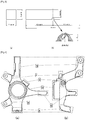
- Fig. 4 shows an example of applying the cast steel member of the present invention to a steering knuckle.
- Fig. 4 (a) and (b) each is a plan view and a side view of a steering knuckle 100.
- the sites shown by the symbols A to G are portions (holes) connecting to other parts, need working to match with the connection positions, and are therefore not as-cast. Accordingly, the minimum thickness of the steering knuckle 100 is of the as-cast site excluding the sites shown by the symbols A to G.
- the cast steel 10C had a bottom portion 2P having a thickness of 10 mm or less and a wide and thick upper portion 4P having a thickness of greater than 10 mm.
- the structure in each Example included ferrite and pearlite as main components (total of both components occupies 60% or more of cast steel).
- the cast steel 10 was not heat-treated and as-casted.
- a tensile test piece and an impact test piece having a size shown in Fig. 2 and Fig. 3 in each of Examples and Comparative Examples were produced by a turning process.
- the tensile test piece was in accordance with JIS Z2242 and the impact test piece was a U-notched impact test piece in accordance with JIS Z2242.
- a cube having 10 mm on a side was cut out from the cast steel 10C, and the Young's modulus test piece was produced.
- each test piece was produced from an area 2R of the bottom portion 2P of the cast steel 10 in each of Examples and Comparative Examples 1, 2, 4 to 6, and the test piece was produced from an area 4R of the upper portion 4P of the cast steel 10 in Comparative Example 3.
- a unit of the numerical values in Fig. 1 to Fig. 3 is mm.
- Fig. 2(a) and Fig. 3 (a) each shows a cross-sectional view of the test piece
- Fig. 2 (b) and Fig. 3 (b) each shows a plan view of the test piece.
- a partial enlarged view of a U-notch is pointed by an arrow.
- Tensile strength, 0.2% yield strength, and breaking elongation The tensile test was performed on each tensile test piece in accordance with JIS Z2241 using the Amsler universal testing machine to measure the tensile strength, the 0.2% yield strength, and the breaking elongation.
- Young's modulus The density of the Young's modulus test piece was measured by the Archimedes method. A longitudinal wave sound speed and a transversal wave sound speed were measured by an ultrasonic pulse method. From these values, the Young's modulus was calculated.
- As a measurement apparatus for the ultrasonic pulse method "digital ultrasonic flaw detector UI-25" (product name) manufactured by Ryoden Shonan Electronics Corporation was used. An oscillator for longitudinal and transverse waves manufactured by Eishin Kagaku Co., Ltd. was used.
- Impact value The impact test was performed on the impact test piece in accordance with JIS Z2242 using the Charby impact tester (50J) to measure the impact value at normal temperature (25°C).
- Table 1 shows the results.
- Component of cast steel [wt%] Young's modulus [GPa] 0.2% yield strength [MPa] Tensile stre ngth [MPa] Elongation [%] Impact value (normal temp) [J/cm2] C Si Mn P S Cr Ni Cu Al Relationship between Si(%) and C(%)
- Example 1 0.25 1.00 1.00 0.020 0.008 0.031 0.02 0.038 0.034 Si(%) ⁇ C(%) ⁇ 10 208 451 698 16.1 16.9
- Example 2 0.20 1.50 0.80 0.020 0.008 0.031 0.02 0.031 0.025 Si(%) ⁇ C(%) ⁇ 10 208 455 705 18.2 16.3
- Example 3 0.40 1.00 0.60 0.020 0.008 0.031 0.02 0.031 0.025 Si(%) ⁇ C(%) ⁇ 10 205 451 715 15.4 18.2
- Example 4 0.21 1.00 0.35 0.019 0.008 0.033 0.02 0.03 0.029
- Comparative Example 3 having the minimum thickness greater than 10 mm, the yield strength (fatigue strength), the strength, and the impact value were further lowered as compared to those in Comparative Example 1 having the same composition. It is contemplated that in the case of Comparative Example 3, the thickness is increased upon casting, the number of the internal defect is therefore increased, and segregation and the coarsened structure are generated. Accordingly, it can be concluded that the minimum thickness upon casting is preferably 10 mm or less.
Landscapes
- Chemical & Material Sciences (AREA)
- Engineering & Computer Science (AREA)
- Mechanical Engineering (AREA)
- Materials Engineering (AREA)
- Metallurgy (AREA)
- Organic Chemistry (AREA)
- Combustion & Propulsion (AREA)
- Transportation (AREA)
- Vehicle Body Suspensions (AREA)
- Molds, Cores, And Manufacturing Methods Thereof (AREA)
- Heat Treatment Of Articles (AREA)
Abstract
Description
- The present invention relates to a cast steel member, and, more particularly, to a cast steel member suitably applied to an undercarriage such as a steering knuckle of a vehicle.
- In recent years, in order to address environmental issues, it is desirable to improve fuel efficiency of a vehicle, to downsize, and to reduce the weight of whole vehicle parts. For example, an FCD (Ferrum Casting Ductile) cast iron material, a ferrous material, and a forge steel material have been widely used for undercarriages of a vehicle in the related art. In order to downsize and reduce weight of the parts made of these materials, it is desirable to increase a strength. Incidentally, the ferrous material and the forge steel material relatively easily acquire have rigidity, toughness, and a strength, but the shapes to be formed or worked of the ferrous material and the forge steel material are limited. It is therefore difficult to decrease the thickness, downsize, and significantly reduce the weight.
- On the other hand, cast steel having a higher strength than cast iron is focused attention as a structural material. For example, cast steel having an improved tensile strength of 1000 MPa has been developed (Patent Literature 1).
- [Patent Literature 1] Japanese Examined Patent Publication No.
2008-7820 - Incidentally, cast steel is easily damaged and has a large internal stress (residual stress) as compared to cast iron. Material properties, in particular, a fatigue strength and an impact value, of cast steel are lowered. Cast steel may be broken at the time of use, and is, in fact, scarcely applied to the undercarriages of the vehicle. In particular, the thicker the cast steel is, the easily a shrinkage cavity and a gas defect are generated. Further, in order to uniform a cast steel structure (segregation and coarsened structure), to remove the internal force, and to stabilize the structure, a heat treatment is necessary, which may increase the costs.
- On the other hand, FCD cast iron is frequently used for the undercarriages of the vehicle. However, if the strength of the FCD is increased to about more than 1000 MPa, there is a tendency that elongation (ductility) and an impact value (toughness) are significantly decreased. Not only the ductility and the toughness, but also the rigidity (the Young's modulus) of the cast iron is lower than cast steel. (Cast iron has rigidity of 170 to 180 GPa, and cast steel has rigidity of 190 to 210 GPa). Accordingly, even if it is tried to ensure the rigidity and the ductility required by the undercarriages of the vehicle by using the cast iron, there is a limit to decrease the thickness. Therefore, there is a problem that the weight cannot be significantly decreased.
- The present invention solves the above-mentioned problems, and has an object to provide a cast steel member having an excellent strength and toughness and being capable of decreasing the thickness and reducing the weight.
- In order to solve the above-mentioned problems, through intense studies by the present inventors, it has been found that both of the strength and the toughness can be improved by setting cast steel to have a predetermined composition. In particular, when the steel is cast with a minimum thickness being 10 mm or less, the strength and the toughness can be certainly improved.
- The present invention provides a cast steel member, comprising: 0.10 to 1.00% of C, greater than 0.7% to 2.0% or less of Si, 0.3 to 2.0% of Mn, 2.0% or less of Cu, residual Fe and inevitable impurities, as represented by weight%, wherein Si (%) <= C (%)×10.
- Preferably, the cast steel member comprises: 0.15 to 0.40% of C, 1.1% to 2.0% of Si, 0.5 to 1.5% of Mn, 0.5 to 1.5% of Cu, residual Fe and inevitable impurities, as represented by weight%.
- Preferably, an impact value (normal temperature) of the cast steel member is 15 J/cm2 or more, a tensile strength is 680 MPa or more to less than 1000 MPa, a 0.2% yield strength is 450 MPa or more, and an elongation is 12% or more.
- Preferably, the cast steel member has a minimum thickness of 10 mm or less.
- Preferably, the cast steel member has a minimum thickness of 1 to 6 mm or less.
- Preferably, the cast steel member is as-cast.
- Preferably, the cast steel member is for an undercarriage.
- Preferably, the cast steel member is formed into a steering knuckle.
- According to the present invention, there is provided a cast steel member having excellent strength and toughness and being capable of decreasing the thickness and reducing the weight.
-
- [
Fig. 1 ] A sectional perspective view showing a mold for producing Examples. - [
Fig. 2 ] A view showing a size of a tensile test piece for measuring a tensile strength in Examples and Comparative Examples. - [
Fig. 3 ] A view showing a size of an impact test piece for measuring an impact value in Examples and Comparative Examples. - [
Fig. 4 ] A view showing an example of applying a cast steel member of the present invention to a steering knuckle. - Hereinafter, embodiments according to the present invention will be described. In the context of the present invention, "%" denotes "weight %" unless otherwise specified.
- The cast steel member according to the embodiment of the present invention includes 0.10 to 1.00% of C, greater than 0.7% to 2.0% or less of Si, 0.3 to 2.0% of Mn, 2.0% or less of Cu, residual Fe and inevitable impurities, as represented by weight%, in which Si (%) <= C (%)×10.
- C (carbon) significantly increases a tensile strength and a yield strength and decreases elongation and an impact value with respect to cast steel. If the C content is less than 0.10%, there are no effects to increase the yield strength and the tensile strength. If the C content is greater than 1.00%, the cast steel becomes hard and brittle, and the impact value is decreased. Accordingly, the C content is set to from 0.10 to 1.00%.
- In particular, it is preferable that if the C content be set to from 0.15 to 0.40%, the tensile strength and the rigidity can be improved without decreasing the impact value.
- Si can reinforce ferrite, restrain the reduction of the elongation, and improve the yield strength, but coarsen crystal grain and decrease the impact value. If the Si content is 0.7% or less, the yield strength is not sufficiently increased. If the Si content is greater than 2.0%, the impact value is decreased. Accordingly, the Si content is set to greater than 0.7% to 2.0% or less.
- In particular, if the Si content is set to 1.1% or more to 2.0% or less, the yield strength (fatigue strength) can be further improved.
- In addition, if Si (%) <= C (%)×10, the percentage of Si and C contained in molten metal becomes appropriate, less gas defect is generated, a stable mold is formed, both of the impact value and the tensile strength are improved, and impact properties (normal temperature) can be certainly 15 J/cm2 or more. On the other hand, if Si and C do not satisfy the above-described relationship, the gas defect is easily generated, and it is difficult to produce a normal mold product by melting in the air.
- Mn is an element that promotes providing a matrix structure with a strong pearlite structure and makes crystal grain finer. While the impact value is prevented from decreasing, the tensile strength is significantly increased. However, Mn decreases the elongation. If the Mn content is less than 0.3%, an effect to increase the strength is insufficiently provided. If the Mn content is greater than 2.0%, the elongation is significantly decreased. Accordingly, the Mn content is set to from 0.3 to 2.0%.
- In particular, it is preferable that if the Mn content be set to from 0.50 to 1.50%, the yield strength (fatigue strength) can be further improved.
- Cu is highly effective to make crystal grain finer and dissolve into ferrite. While the elongation and the impact value are prevented from decreasing, the yield strength (fatigue strength) is especially improved. If the Cu content is greater than 2.0%, the structure other than ferrite is precipitated, which significantly embrittles the structure and cracking during manufacture easily occurs. Accordingly, the Cu content is set to 2.0% or less.
- In particular, it is preferable that if the Cu content be set to from 0.5 to 1.50%, it be highly effective to make crystal grain finer, the elongation and the impact value be prevented from decreasing, and the yield strength (fatigue strength) and the tensile strength can be improved.
- The Fe content is preferably 95% or more. Examples of inevitable impurities include P, S, Ni, Cr, and Al. In particular, Al can be added as a deoxidizer. In order to prevent the gas defect upon casting, the oxygen content is preferably controlled to 80 ppm by weight or less based on the total oxygen content.
- Preferably, the cast steel member according to the embodiment of the present invention is cast to have a minimum thickness of 10 mm or less. In a conventional cast steel, the thicker the cast steel is, the easier the shrinkage cavity and the gas defect occur. In addition, a heat treatment is performed to homogenize segregation and the coarsened structure, to remove an internal stress, and to stabilize the structure. If no heat treatment is applied, the material properties such as the impact value and the fatigue strength are deteriorated. In particular, it is difficult to apply to a vehicle (undercarriages).
- The cast steel having the above-described composition and the minimum thickness of 10 mm or less was cast. The internal stress was decreased by finer crystal grain, and the fatigue strength was successfully improved even though no heat treatment was applied. Herein, the minimum thickness refers to a minimum thickness of an as-cast product, and does not include a thickness of a cast product that is originally thick and ground later. In this case, as the as-cast product leaves a casting surface (excluding dam and deburr), the as-cast product can be distinguished from the ground cast product.
- In particular, the cast steel is preferably cast to have the minimum thickness of 1 to 6 mm.
- As described above, since the cast steel member according to the embodiment of the present invention has the improved fatigue strength even though no heat treatment is performed after casting, the cast steel can be used as-cast product.
- The cast steel member according to the embodiment of the present invention preferably has an impact value of 15 J/cm2 or more at normal temperature, a tensile strength of 680 MPa or more to less than 1000 MPa, a 0.2% yield strength of 450 MPa or more, and an elongation of 12% or more.
- In addition, the cast steel member according to the embodiment of the present invention has the Young's modulus of 190 to 210 GPa and can achieve the Young's modulus higher than the Young's modulus (about 166 GPa) of the FCD cast iron material.
- Note that the tensile strength is an index of evaluating the "strength", the 0.2 % yield strength is an index of evaluating the "fatigue strength", the elongation (breaking elongation) is an index of evaluating the "ductility", the Young's modulus is an index of evaluating the "rigidity", and the impact value is an index of evaluating the "toughness".
- The cast steel member according to the embodiment of the present invention can be produced by known methods. A melting furnace and a melting method are not especially limited. Also, a casting method is not especially limited as long as fluidity is satisfied, and a gravity casting method, a reduced pressure casting method, or the like may be used as necessary.
- In addition, in order to prevent a shrinkage cavity defect upon casting, it is preferable that a cooling speed of each site of the mold be controlled for directional solidification. As appropriate, a chiller and a gate riser may be used. In this case, the chiller is set to the mold so as to rapidly and preferentially cool a thick site, and it can be controlled such that a final solidified site becomes the gate riser. The above-described method is preferable in that the thin cast steel member (preferably having the minimum thickness of 10 mm or less) can be stably cast.
- According to the present invention, the balance between the strength and the toughness is excellent and high rigid and stable mechanical properties are provided as described above, which is suitable to decrease the weight of the vehicle parts. In particular, the present invention can be preferably used for an undercarriage (knuckle, upper arm, lower arm, brake caliper, trailing arm, bracket (brake support), etc.). In particular, when the present invention is applied to a steering knuckle that needs to have high strength and high toughness (impact properties), both of the strength and the rigidity are improved, and the parts can have a further light weight as compared with the material having only the improved strength is applied.
-
Fig. 4 shows an example of applying the cast steel member of the present invention to a steering knuckle.Fig. 4 (a) and (b) each is a plan view and a side view of asteering knuckle 100. - Note that the sites shown by the symbols A to G are portions (holes) connecting to other parts, need working to match with the connection positions, and are therefore not as-cast. Accordingly, the minimum thickness of the
steering knuckle 100 is of the as-cast site excluding the sites shown by the symbols A to G. - 100 kg of cast steel having each component composition shown in Table 1 was melted in a high frequency melting furnace, a deoxidizer was added thereto such that the total oxygen content was 80 ppm by weight or less to prepare molten metal. A Y-shaped block mold (see
Fig. 1 ) molded by a beta set method was provided with a chiller and a gate riser for directional solidification. The molten metal was casted into the mold to cast cast steel 10C. - As shown in
Fig. 1 , the cast steel 10C had abottom portion 2P having a thickness of 10 mm or less and a wide and thickupper portion 4P having a thickness of greater than 10 mm. The structure in each Example included ferrite and pearlite as main components (total of both components occupies 60% or more of cast steel). - The
cast steel 10 was not heat-treated and as-casted. A tensile test piece and an impact test piece having a size shown inFig. 2 andFig. 3 in each of Examples and Comparative Examples were produced by a turning process. The tensile test piece was in accordance with JIS Z2242 and the impact test piece was a U-notched impact test piece in accordance with JIS Z2242. A cube having 10 mm on a side was cut out from the cast steel 10C, and the Young's modulus test piece was produced. - Note that each test piece was produced from an
area 2R of thebottom portion 2P of thecast steel 10 in each of Examples and Comparative Examples 1, 2, 4 to 6, and the test piece was produced from anarea 4R of theupper portion 4P of thecast steel 10 in Comparative Example 3. A unit of the numerical values inFig. 1 to Fig. 3 is mm.Fig. 2(a) andFig. 3 (a) each shows a cross-sectional view of the test piece, andFig. 2 (b) andFig. 3 (b) each shows a plan view of the test piece. InFig. 3 (b) , a partial enlarged view of a U-notch is pointed by an arrow. - The following items are evaluated.
- Tensile strength, 0.2% yield strength, and breaking elongation: The tensile test was performed on each tensile test piece in accordance with JIS Z2241 using the Amsler universal testing machine to measure the tensile strength, the 0.2% yield strength, and the breaking elongation.
- Young's modulus: The density of the Young's modulus test piece was measured by the Archimedes method. A longitudinal wave sound speed and a transversal wave sound speed were measured by an ultrasonic pulse method. From these values, the Young's modulus was calculated. As a measurement apparatus for the ultrasonic pulse method, "digital ultrasonic flaw detector UI-25" (product name) manufactured by Ryoden Shonan Electronics Corporation was used. An oscillator for longitudinal and transverse waves manufactured by Eishin Kagaku Co., Ltd. was used.
- Impact value: The impact test was performed on the impact test piece in accordance with JIS Z2242 using the Charby impact tester (50J) to measure the impact value at normal temperature (25°C).
- Table 1 shows the results.
[Table 1] Component of cast steel [wt%] Young's modulus [GPa] 0.2% yield strength [MPa] Tensile stre ngth [MPa] Elongation [%] Impact value (normal temp) [J/cm2] C Si Mn P S Cr Ni Cu Al Relationship between Si(%) and C(%) Example 1 0.25 1.00 1.00 0.020 0.008 0.031 0.02 0.038 0.034 Si(%)<C(%) × 10 208 451 698 16.1 16.9 Example 2 0.20 1.50 0.80 0.020 0.008 0.031 0.02 0.031 0.025 Si(%)<C(%) × 10 208 455 705 18.2 16.3 Example 3 0.40 1.00 0.60 0.020 0.008 0.031 0.02 0.031 0.025 Si(%)<C(%) × 10 205 451 715 15.4 18.2 Example 4 0.21 1.00 0.35 0.019 0.008 0.033 0.02 0.03 0.029 Si(%)<C(%) × 10 202 450 680 19.0 16.0 Example 5 0.20 1.00 1.95 0.019 0.008 0.031 0.02 0.03 0.033 Si(%)<C(%) × 10 200 460 710 12.2 15.5 Example 6 0.40 2.00 1.00 0.019 0.008 0.031 0.02 0.031 0.035 Si(%)<C(%) × 10 205 494 725 15.0 15.0 Example 7 0.40 0.75 1.00 0.019 0.008 0.031 0.02 0.031 0.035 Si(%)<C(%) × 10 205 452 708 15.1 17.8 Example 8 1.00 2.00 1.00 0.019 0.008 0.031 0.02 0.031 0.035 Si(%)<C(%) × 10 195 457 680 16.1 15.0 Example 9 0.20 1.50 0.90 0.024 0.007 0.043 0.01 1.11 0.021 Si(%)<C(%) × 10 200 485 735 17.5 16.2 Example 10 0.21 1.10 0.95 0.020 0.008 0.035 0.02 1.50 0.025 Si(%)<C(%) × 10 202 490 730 17.2 16.4 Example 11 0.20 1.60 0.80 0.021 0.008 0.031 0.02 0.51 0.030 Si(%)<C(%) × 10 205 485 730 17.4 16.0 Comp-Example 1 0.23 2.50 0.70 0.019 0.008 0.031 0.02 0.031 0.035 Si(%)>C(%) × 10 208 427 679 5.9 8.7 Comp-Example 2 0.31 0.40 0.60 0.019 0.008 0.030 0.02 0.031 0.035 Si(%)<C(%) × 10 206 298 605 17.1 66.9 Comp-Example 3 0.23 2.50 0.70 0.019 0.006 0.031 0.01 0.03 0.025 Si(%)>C(%) × 10 208 370 650 11.5 6.8 Comp-Example 4 0.13 1.90 1.00 0.018 0.007 0.031 0.02 0.03 0.021 Si(%)>C(%) × 10 208 349 610 7.3 5.8 Comp-Example 5 1.00 2.00 0.20 0.019 0.008 0.031 0.02 0.031 0.035 Si(%)<C(%) × 10 195 270 655 18.1 17.0 Comp-Example 6 1.00 0.60 1.00 0.019 0.008 0.031 0.02 0.031 0.035 Si(%)<C(%) × 10 195 310 665 16.1 25.0 - As shown in Table 1, in each of Examples 1 to 11 containing 0.10 to 1.00% of C, greater than 0.7% to 2.0% of Si, 0.3 to 2.0% of Mn, residual Fe and inevitable impurities and cast having the minimum thickness of 10 mm or less, all of the yield strength, the strength, and the toughness were excellent.
- In particular, in Examples 1 to 7, 9 to 11 containing 0.15 to 0.40% of C, the elongation and the impact value were not decreased, and the tensile strength and the rigidity were improved as compared to Example 8.
- On the other hand, in Comparative Example 1 containing greater than 2.0% of Si, the impact value was significantly decreased.
- In Comparative Examples 2 and 6 containing 0.7% or less of Si, the yield strength was significantly decreased.
- In Comparative Examples 1 and 4 where Si (%) > C (%)x10, the elongation and the impact value were significantly lowered.
- In Comparative Example 3 having the minimum thickness greater than 10 mm, the yield strength (fatigue strength), the strength, and the impact value were further lowered as compared to those in Comparative Example 1 having the same composition. It is contemplated that in the case of Comparative Example 3, the thickness is increased upon casting, the number of the internal defect is therefore increased, and segregation and the coarsened structure are generated. Accordingly, it can be concluded that the minimum thickness upon casting is preferably 10 mm or less.
- In Comparative Example 5 containing less than 0.5% of Mn, the strength and the yield strength were decreased.
-
- 2P
- bottom portion of cast steel (thin portion having thickness of 10 mm or less)
- 4P
- upper portion of cast steel (thick portion having thickness of greater than 10 mm)
- 10C
- cast steel
- 100
- cast steel member (steering knuckle)
Claims (8)
- A cast steel member, comprising:
0.10 to 1.00% of C, greater than 0.7% to 2.0% or less of Si, 0.3 to 2.0% of Mn, 2.0% or less of Cu, residual Fe and inevitable impurities, as represented by weight%, wherein
Si (%) <= C (%)×10. - The cast steel member according to Claim 1, comprising:
0.15 to 0.40% of C, 1.1% to 2.0% of Si, 0.5 to 1.5% of Mn, 0.5 to 1.5% of Cu, residual Fe and inevitable impurities, as represented by weight%. - The cast steel member according to Claim 1 or 2, wherein
an impact value (normal temperature) is 15 J/cm2 or more, a tensile strength is 680 MPa or more to less than 1000 MPa, a 0.2% yield strength is 450 MPa or more, and an elongation is 12% or more. - The cast steel member according to any one of Claims 1 to 3, having a minimum thickness of 10 mm or less.
- The cast steel member according to Claim 4, having a minimum thickness of 1 to 6 mm or less.
- The cast steel member according to any one of Claims 1 to 5, which is as-cast.
- The cast steel member according to any one of Claims 1 to 6, which is for an undercarriage.
- The cast steel member according to Claim 7, which is formed into a steering knuckle.
Applications Claiming Priority (2)
| Application Number | Priority Date | Filing Date | Title |
|---|---|---|---|
| JP2015150639A JP6628999B2 (en) | 2015-07-30 | 2015-07-30 | Cast steel members |
| PCT/JP2016/058279 WO2017017989A1 (en) | 2015-07-30 | 2016-03-16 | Cast steel material |
Publications (2)
| Publication Number | Publication Date |
|---|---|
| EP3330397A1 true EP3330397A1 (en) | 2018-06-06 |
| EP3330397A4 EP3330397A4 (en) | 2019-04-17 |
Family
ID=57884336
Family Applications (1)
| Application Number | Title | Priority Date | Filing Date |
|---|---|---|---|
| EP16830094.5A Withdrawn EP3330397A4 (en) | 2015-07-30 | 2016-03-16 | CAST STEEL MATERIAL |
Country Status (5)
| Country | Link |
|---|---|
| US (1) | US20190003022A1 (en) |
| EP (1) | EP3330397A4 (en) |
| JP (1) | JP6628999B2 (en) |
| CN (1) | CN107923009A (en) |
| WO (1) | WO2017017989A1 (en) |
Families Citing this family (6)
| Publication number | Priority date | Publication date | Assignee | Title |
|---|---|---|---|---|
| DE112017001291A5 (en) * | 2016-03-14 | 2018-12-06 | Ksm Castings Group Gmbh | METHOD FOR PRODUCING A HEAT-TREATED WHEEL BEARING WHEEL BEARING A WHEEL BEARING |
| DE102017120874A1 (en) * | 2016-09-23 | 2018-03-29 | Ksm Castings Group Gmbh | pivot bearing |
| CN110423958A (en) * | 2019-07-11 | 2019-11-08 | 湖北文理学院 | A kind of spindle and its processing technology |
| US11745795B2 (en) * | 2019-07-24 | 2023-09-05 | Dana Automotive Systems Group, Llc | Joint assembly |
| JP7727519B2 (en) * | 2021-12-10 | 2025-08-21 | 本田金属技術株式会社 | Knuckle Castings |
| CN114657494B (en) * | 2022-03-02 | 2024-06-18 | 襄阳华中科技大学先进制造工程研究院 | Integrated automobile front extension beam precision machining process |
Family Cites Families (11)
| Publication number | Priority date | Publication date | Assignee | Title |
|---|---|---|---|---|
| US2035394A (en) * | 1934-02-09 | 1936-03-24 | Ford Motor Co | Cast steel |
| JPS5137022A (en) * | 1974-09-11 | 1976-03-29 | Tokyo Cheen Ankaa Kk | KOKOCHORYOKUSEINOANKAA |
| JPS5658947A (en) * | 1979-10-18 | 1981-05-22 | Mitsubishi Heavy Ind Ltd | Cast steel as steel casting |
| JP2615462B2 (en) * | 1988-02-01 | 1997-05-28 | 本田技研工業株式会社 | Caliper for disc brake device and method of manufacturing the same |
| KR0142274B1 (en) * | 1993-04-26 | 1998-07-15 | 미노루 다나까 | Steel sheet excellent in elongation-flange and manufacturing method thereof |
| JPH09157784A (en) * | 1995-12-04 | 1997-06-17 | Riken Corp | Production of graphite cast steel |
| US20050205169A1 (en) * | 2004-03-22 | 2005-09-22 | Alwin Mary E | High copper low alloy steel sheet |
| JP2006124815A (en) * | 2004-11-01 | 2006-05-18 | Jfe Steel Kk | Steel material with excellent machinability and fatigue strength |
| DE102007018838A1 (en) * | 2007-04-20 | 2008-10-30 | Benteler Automobiltechnik Gmbh | Use of a steel alloy |
| CN103215509B (en) * | 2013-04-24 | 2015-03-11 | 河南理工大学 | ZG30MnSiCu cast steel for coal mine and thermal treatment process |
| CN104087819B (en) * | 2014-07-09 | 2016-05-04 | 上海圣德曼铸造有限公司 | A kind of sedan steering is saved tough ferritic spheroidal graphite cast iron material of as cast condition low temperature and preparation method thereof |
-
2015
- 2015-07-30 JP JP2015150639A patent/JP6628999B2/en not_active Expired - Fee Related
-
2016
- 2016-03-16 WO PCT/JP2016/058279 patent/WO2017017989A1/en not_active Ceased
- 2016-03-16 US US15/748,743 patent/US20190003022A1/en not_active Abandoned
- 2016-03-16 EP EP16830094.5A patent/EP3330397A4/en not_active Withdrawn
- 2016-03-16 CN CN201680044458.4A patent/CN107923009A/en active Pending
Also Published As
| Publication number | Publication date |
|---|---|
| JP2017031451A (en) | 2017-02-09 |
| JP6628999B2 (en) | 2020-01-15 |
| WO2017017989A1 (en) | 2017-02-02 |
| CN107923009A (en) | 2018-04-17 |
| US20190003022A1 (en) | 2019-01-03 |
| EP3330397A4 (en) | 2019-04-17 |
Similar Documents
| Publication | Publication Date | Title |
|---|---|---|
| EP3330397A1 (en) | Cast steel material | |
| EP3246426B1 (en) | Method for manufacturing a thick high-toughness high-strength steel sheet | |
| JP5522321B1 (en) | Non-tempered steel | |
| CN101883874B (en) | High-strength untempered steel for fracture splitting and steel component for fracture splitting | |
| EP3015560B1 (en) | Spheroidal graphite cast iron | |
| JP2011105993A (en) | Spheroidal graphite cast iron tube and method for producing the same | |
| CN112981261A (en) | Non-quenched and tempered steel and application, product and manufacturing method thereof | |
| JP6838603B2 (en) | Method for manufacturing spheroidal graphite cast iron, cast articles made of spheroidal graphite cast iron, structural parts for automobiles, and cast articles made of spheroidal graphite cast iron. | |
| US9856961B2 (en) | Differential apparatus component, differential apparatus therewith and manufacturing method thereof | |
| KR101998496B1 (en) | Hot-rolled steel and section | |
| JP3509634B2 (en) | Low alloy cast steel and its heat treatment method | |
| JP6515957B2 (en) | Roll outer layer material for rolling having excellent wear resistance and composite roll for rolling | |
| JP5245544B2 (en) | Common rail with excellent fatigue characteristics | |
| JP4417149B2 (en) | Composite roll for rolling made by centrifugal casting | |
| JP2003306741A (en) | High tensile cast steel and method for producing the same | |
| EP3967785A1 (en) | Spheroidal graphite cast iron, method for manufacturing spheroidal graphite cast iron, and parts for vehicle wheel periphery | |
| JP4963444B2 (en) | Spheroidal graphite cast iron member | |
| JP7812779B2 (en) | Wear-resistant cast steel and its manufacturing method | |
| EP3026128B1 (en) | A method to control ausferritic as-cast microstructure in ductile iron parts | |
| JP2005256088A (en) | Spheroidal graphite cast iron member | |
| JP2001279386A (en) | Maraging steel excellent in castability and method for producing the same | |
| Banavasi Shashidhar et al. | Influence of high Mn-Cu-Mo on microstructure and fatigue characteristics of austempered ductile iron | |
| US11761067B2 (en) | Low carbon steel having improved hardness and methods of making the same | |
| KR102174021B1 (en) | Spheroidal graphite cast iron with excellent tensile property and preparation method thereof | |
| US20180112294A1 (en) | High rigid spheroidal graphite cast iron |
Legal Events
| Date | Code | Title | Description |
|---|---|---|---|
| PUAI | Public reference made under article 153(3) epc to a published international application that has entered the european phase |
Free format text: ORIGINAL CODE: 0009012 |
|
| 17P | Request for examination filed |
Effective date: 20180126 |
|
| AK | Designated contracting states |
Kind code of ref document: A1 Designated state(s): AL AT BE BG CH CY CZ DE DK EE ES FI FR GB GR HR HU IE IS IT LI LT LU LV MC MK MT NL NO PL PT RO RS SE SI SK SM TR |
|
| AX | Request for extension of the european patent |
Extension state: BA ME |
|
| DAV | Request for validation of the european patent (deleted) | ||
| DAX | Request for extension of the european patent (deleted) | ||
| A4 | Supplementary search report drawn up and despatched |
Effective date: 20190318 |
|
| RIC1 | Information provided on ipc code assigned before grant |
Ipc: C22C 38/00 20060101AFI20190312BHEP Ipc: B22C 9/22 20060101ALI20190312BHEP Ipc: C22C 38/16 20060101ALI20190312BHEP |
|
| 17Q | First examination report despatched |
Effective date: 20200416 |
|
| STAA | Information on the status of an ep patent application or granted ep patent |
Free format text: STATUS: THE APPLICATION IS DEEMED TO BE WITHDRAWN |
|
| 18D | Application deemed to be withdrawn |
Effective date: 20200827 |