EP3330249A1 - Amine-based compound and organic light emitting device comprising same - Google Patents
Amine-based compound and organic light emitting device comprising same Download PDFInfo
- Publication number
- EP3330249A1 EP3330249A1 EP16842354.9A EP16842354A EP3330249A1 EP 3330249 A1 EP3330249 A1 EP 3330249A1 EP 16842354 A EP16842354 A EP 16842354A EP 3330249 A1 EP3330249 A1 EP 3330249A1
- Authority
- EP
- European Patent Office
- Prior art keywords
- group
- substituted
- unsubstituted
- compound
- light emitting
- Prior art date
- Legal status (The legal status is an assumption and is not a legal conclusion. Google has not performed a legal analysis and makes no representation as to the accuracy of the status listed.)
- Granted
Links
- 0 *N(c1ccccc1)I Chemical compound *N(c1ccccc1)I 0.000 description 7
- YOOGRCXEPFVOTC-QXFGSWAMSA-N CC(C1(C(/C=C\C=C)=C)c2ccccc2C2C=CC=CC12)/C=C\C Chemical compound CC(C1(C(/C=C\C=C)=C)c2ccccc2C2C=CC=CC12)/C=C\C YOOGRCXEPFVOTC-QXFGSWAMSA-N 0.000 description 1
- RKNRWKSOJAUSDU-UHFFFAOYSA-N Cc1ccccc1C(C=C)=C Chemical compound Cc1ccccc1C(C=C)=C RKNRWKSOJAUSDU-UHFFFAOYSA-N 0.000 description 1
- IRUBWJMIJLVKCW-UHFFFAOYSA-N Fc(cc1)ccc1N(c(cc1)cc2c1-c1ccccc1C21c2ccccc2-c2c1cccc2)c1c(c2ccccc2c2c3cccc2)c3ccc1 Chemical compound Fc(cc1)ccc1N(c(cc1)cc2c1-c1ccccc1C21c2ccccc2-c2c1cccc2)c1c(c2ccccc2c2c3cccc2)c3ccc1 IRUBWJMIJLVKCW-UHFFFAOYSA-N 0.000 description 1
- YOJPCCJFSQVSOT-UHFFFAOYSA-N Fc(cc1)ccc1N(c1c2-c3ccccc3C3(c4ccccc4-c4c3cccc4)c2ccc1)c1c(c2ccccc2c2c3cccc2)c3ccc1 Chemical compound Fc(cc1)ccc1N(c1c2-c3ccccc3C3(c4ccccc4-c4c3cccc4)c2ccc1)c1c(c2ccccc2c2c3cccc2)c3ccc1 YOJPCCJFSQVSOT-UHFFFAOYSA-N 0.000 description 1
- NQAABKMRSYAKCG-UHFFFAOYSA-N Fc(cc1)ccc1N(c1ccc(C2(c3ccccc3-c3c2cccc3)c2ccccc2-2)c-2c1)c1c(c2ccccc2c2c3cccc2)c3ccc1 Chemical compound Fc(cc1)ccc1N(c1ccc(C2(c3ccccc3-c3c2cccc3)c2ccccc2-2)c-2c1)c1c(c2ccccc2c2c3cccc2)c3ccc1 NQAABKMRSYAKCG-UHFFFAOYSA-N 0.000 description 1
Images
Classifications
-
- C—CHEMISTRY; METALLURGY
- C07—ORGANIC CHEMISTRY
- C07C—ACYCLIC OR CARBOCYCLIC COMPOUNDS
- C07C255/00—Carboxylic acid nitriles
- C07C255/49—Carboxylic acid nitriles having cyano groups bound to carbon atoms of six-membered aromatic rings of a carbon skeleton
- C07C255/58—Carboxylic acid nitriles having cyano groups bound to carbon atoms of six-membered aromatic rings of a carbon skeleton containing cyano groups and singly-bound nitrogen atoms, not being further bound to other hetero atoms, bound to the carbon skeleton
-
- C—CHEMISTRY; METALLURGY
- C07—ORGANIC CHEMISTRY
- C07C—ACYCLIC OR CARBOCYCLIC COMPOUNDS
- C07C211/00—Compounds containing amino groups bound to a carbon skeleton
- C07C211/43—Compounds containing amino groups bound to a carbon skeleton having amino groups bound to carbon atoms of six-membered aromatic rings of the carbon skeleton
- C07C211/54—Compounds containing amino groups bound to a carbon skeleton having amino groups bound to carbon atoms of six-membered aromatic rings of the carbon skeleton having amino groups bound to two or three six-membered aromatic rings
-
- C—CHEMISTRY; METALLURGY
- C07—ORGANIC CHEMISTRY
- C07B—GENERAL METHODS OF ORGANIC CHEMISTRY; APPARATUS THEREFOR
- C07B59/00—Introduction of isotopes of elements into organic compounds ; Labelled organic compounds per se
- C07B59/001—Acyclic or carbocyclic compounds
-
- C—CHEMISTRY; METALLURGY
- C07—ORGANIC CHEMISTRY
- C07C—ACYCLIC OR CARBOCYCLIC COMPOUNDS
- C07C13/00—Cyclic hydrocarbons containing rings other than, or in addition to, six-membered aromatic rings
- C07C13/28—Polycyclic hydrocarbons or acyclic hydrocarbon derivatives thereof
- C07C13/32—Polycyclic hydrocarbons or acyclic hydrocarbon derivatives thereof with condensed rings
- C07C13/72—Spiro hydrocarbons
-
- C—CHEMISTRY; METALLURGY
- C07—ORGANIC CHEMISTRY
- C07C—ACYCLIC OR CARBOCYCLIC COMPOUNDS
- C07C15/00—Cyclic hydrocarbons containing only six-membered aromatic rings as cyclic parts
- C07C15/20—Polycyclic condensed hydrocarbons
- C07C15/38—Polycyclic condensed hydrocarbons containing four rings
-
- C—CHEMISTRY; METALLURGY
- C07—ORGANIC CHEMISTRY
- C07C—ACYCLIC OR CARBOCYCLIC COMPOUNDS
- C07C211/00—Compounds containing amino groups bound to a carbon skeleton
- C07C211/43—Compounds containing amino groups bound to a carbon skeleton having amino groups bound to carbon atoms of six-membered aromatic rings of the carbon skeleton
- C07C211/57—Compounds containing amino groups bound to a carbon skeleton having amino groups bound to carbon atoms of six-membered aromatic rings of the carbon skeleton having amino groups bound to carbon atoms of six-membered aromatic rings being part of condensed ring systems of the carbon skeleton
- C07C211/61—Compounds containing amino groups bound to a carbon skeleton having amino groups bound to carbon atoms of six-membered aromatic rings of the carbon skeleton having amino groups bound to carbon atoms of six-membered aromatic rings being part of condensed ring systems of the carbon skeleton with at least one of the condensed ring systems formed by three or more rings
-
- C—CHEMISTRY; METALLURGY
- C07—ORGANIC CHEMISTRY
- C07F—ACYCLIC, CARBOCYCLIC OR HETEROCYCLIC COMPOUNDS CONTAINING ELEMENTS OTHER THAN CARBON, HYDROGEN, HALOGEN, OXYGEN, NITROGEN, SULFUR, SELENIUM OR TELLURIUM
- C07F7/00—Compounds containing elements of Groups 4 or 14 of the Periodic Table
- C07F7/02—Silicon compounds
- C07F7/08—Compounds having one or more C—Si linkages
- C07F7/0803—Compounds with Si-C or Si-Si linkages
- C07F7/081—Compounds with Si-C or Si-Si linkages comprising at least one atom selected from the elements N, O, halogen, S, Se or Te
-
- C—CHEMISTRY; METALLURGY
- C09—DYES; PAINTS; POLISHES; NATURAL RESINS; ADHESIVES; COMPOSITIONS NOT OTHERWISE PROVIDED FOR; APPLICATIONS OF MATERIALS NOT OTHERWISE PROVIDED FOR
- C09K—MATERIALS FOR MISCELLANEOUS APPLICATIONS, NOT PROVIDED FOR ELSEWHERE
- C09K11/00—Luminescent materials, e.g. electroluminescent or chemiluminescent
- C09K11/06—Luminescent materials, e.g. electroluminescent or chemiluminescent containing organic luminescent materials
-
- H—ELECTRICITY
- H10—SEMICONDUCTOR DEVICES; ELECTRIC SOLID-STATE DEVICES NOT OTHERWISE PROVIDED FOR
- H10K—ORGANIC ELECTRIC SOLID-STATE DEVICES
- H10K50/00—Organic light-emitting devices
-
- H—ELECTRICITY
- H10—SEMICONDUCTOR DEVICES; ELECTRIC SOLID-STATE DEVICES NOT OTHERWISE PROVIDED FOR
- H10K—ORGANIC ELECTRIC SOLID-STATE DEVICES
- H10K85/00—Organic materials used in the body or electrodes of devices covered by this subclass
- H10K85/40—Organosilicon compounds, e.g. TIPS pentacene
-
- H—ELECTRICITY
- H10—SEMICONDUCTOR DEVICES; ELECTRIC SOLID-STATE DEVICES NOT OTHERWISE PROVIDED FOR
- H10K—ORGANIC ELECTRIC SOLID-STATE DEVICES
- H10K85/00—Organic materials used in the body or electrodes of devices covered by this subclass
- H10K85/60—Organic compounds having low molecular weight
- H10K85/631—Amine compounds having at least two aryl rest on at least one amine-nitrogen atom, e.g. triphenylamine
- H10K85/633—Amine compounds having at least two aryl rest on at least one amine-nitrogen atom, e.g. triphenylamine comprising polycyclic condensed aromatic hydrocarbons as substituents on the nitrogen atom
-
- C—CHEMISTRY; METALLURGY
- C07—ORGANIC CHEMISTRY
- C07B—GENERAL METHODS OF ORGANIC CHEMISTRY; APPARATUS THEREFOR
- C07B2200/00—Indexing scheme relating to specific properties of organic compounds
- C07B2200/05—Isotopically modified compounds, e.g. labelled
-
- C—CHEMISTRY; METALLURGY
- C07—ORGANIC CHEMISTRY
- C07C—ACYCLIC OR CARBOCYCLIC COMPOUNDS
- C07C2603/00—Systems containing at least three condensed rings
- C07C2603/02—Ortho- or ortho- and peri-condensed systems
- C07C2603/40—Ortho- or ortho- and peri-condensed systems containing four condensed rings
- C07C2603/42—Ortho- or ortho- and peri-condensed systems containing four condensed rings containing only six-membered rings
-
- C—CHEMISTRY; METALLURGY
- C07—ORGANIC CHEMISTRY
- C07C—ACYCLIC OR CARBOCYCLIC COMPOUNDS
- C07C2603/00—Systems containing at least three condensed rings
- C07C2603/56—Ring systems containing bridged rings
- C07C2603/86—Ring systems containing bridged rings containing four rings
-
- C—CHEMISTRY; METALLURGY
- C07—ORGANIC CHEMISTRY
- C07C—ACYCLIC OR CARBOCYCLIC COMPOUNDS
- C07C2603/00—Systems containing at least three condensed rings
- C07C2603/93—Spiro compounds
- C07C2603/94—Spiro compounds containing "free" spiro atoms
-
- C—CHEMISTRY; METALLURGY
- C07—ORGANIC CHEMISTRY
- C07C—ACYCLIC OR CARBOCYCLIC COMPOUNDS
- C07C2603/00—Systems containing at least three condensed rings
- C07C2603/93—Spiro compounds
- C07C2603/95—Spiro compounds containing "not free" spiro atoms
- C07C2603/96—Spiro compounds containing "not free" spiro atoms containing at least one ring with less than six members
- C07C2603/97—Spiro compounds containing "not free" spiro atoms containing at least one ring with less than six members containing five-membered rings
-
- C—CHEMISTRY; METALLURGY
- C09—DYES; PAINTS; POLISHES; NATURAL RESINS; ADHESIVES; COMPOSITIONS NOT OTHERWISE PROVIDED FOR; APPLICATIONS OF MATERIALS NOT OTHERWISE PROVIDED FOR
- C09K—MATERIALS FOR MISCELLANEOUS APPLICATIONS, NOT PROVIDED FOR ELSEWHERE
- C09K2211/00—Chemical nature of organic luminescent or tenebrescent compounds
- C09K2211/10—Non-macromolecular compounds
- C09K2211/1003—Carbocyclic compounds
-
- C—CHEMISTRY; METALLURGY
- C09—DYES; PAINTS; POLISHES; NATURAL RESINS; ADHESIVES; COMPOSITIONS NOT OTHERWISE PROVIDED FOR; APPLICATIONS OF MATERIALS NOT OTHERWISE PROVIDED FOR
- C09K—MATERIALS FOR MISCELLANEOUS APPLICATIONS, NOT PROVIDED FOR ELSEWHERE
- C09K2211/00—Chemical nature of organic luminescent or tenebrescent compounds
- C09K2211/10—Non-macromolecular compounds
- C09K2211/1003—Carbocyclic compounds
- C09K2211/1011—Condensed systems
-
- C—CHEMISTRY; METALLURGY
- C09—DYES; PAINTS; POLISHES; NATURAL RESINS; ADHESIVES; COMPOSITIONS NOT OTHERWISE PROVIDED FOR; APPLICATIONS OF MATERIALS NOT OTHERWISE PROVIDED FOR
- C09K—MATERIALS FOR MISCELLANEOUS APPLICATIONS, NOT PROVIDED FOR ELSEWHERE
- C09K2211/00—Chemical nature of organic luminescent or tenebrescent compounds
- C09K2211/10—Non-macromolecular compounds
- C09K2211/1003—Carbocyclic compounds
- C09K2211/1014—Carbocyclic compounds bridged by heteroatoms, e.g. N, P, Si or B
-
- H—ELECTRICITY
- H10—SEMICONDUCTOR DEVICES; ELECTRIC SOLID-STATE DEVICES NOT OTHERWISE PROVIDED FOR
- H10K—ORGANIC ELECTRIC SOLID-STATE DEVICES
- H10K50/00—Organic light-emitting devices
- H10K50/10—OLEDs or polymer light-emitting diodes [PLED]
- H10K50/11—OLEDs or polymer light-emitting diodes [PLED] characterised by the electroluminescent [EL] layers
-
- H—ELECTRICITY
- H10—SEMICONDUCTOR DEVICES; ELECTRIC SOLID-STATE DEVICES NOT OTHERWISE PROVIDED FOR
- H10K—ORGANIC ELECTRIC SOLID-STATE DEVICES
- H10K50/00—Organic light-emitting devices
- H10K50/10—OLEDs or polymer light-emitting diodes [PLED]
- H10K50/14—Carrier transporting layers
- H10K50/15—Hole transporting layers
-
- H—ELECTRICITY
- H10—SEMICONDUCTOR DEVICES; ELECTRIC SOLID-STATE DEVICES NOT OTHERWISE PROVIDED FOR
- H10K—ORGANIC ELECTRIC SOLID-STATE DEVICES
- H10K50/00—Organic light-emitting devices
- H10K50/10—OLEDs or polymer light-emitting diodes [PLED]
- H10K50/14—Carrier transporting layers
- H10K50/16—Electron transporting layers
-
- H—ELECTRICITY
- H10—SEMICONDUCTOR DEVICES; ELECTRIC SOLID-STATE DEVICES NOT OTHERWISE PROVIDED FOR
- H10K—ORGANIC ELECTRIC SOLID-STATE DEVICES
- H10K50/00—Organic light-emitting devices
- H10K50/10—OLEDs or polymer light-emitting diodes [PLED]
- H10K50/17—Carrier injection layers
-
- H—ELECTRICITY
- H10—SEMICONDUCTOR DEVICES; ELECTRIC SOLID-STATE DEVICES NOT OTHERWISE PROVIDED FOR
- H10K—ORGANIC ELECTRIC SOLID-STATE DEVICES
- H10K50/00—Organic light-emitting devices
- H10K50/10—OLEDs or polymer light-emitting diodes [PLED]
- H10K50/17—Carrier injection layers
- H10K50/171—Electron injection layers
-
- H—ELECTRICITY
- H10—SEMICONDUCTOR DEVICES; ELECTRIC SOLID-STATE DEVICES NOT OTHERWISE PROVIDED FOR
- H10K—ORGANIC ELECTRIC SOLID-STATE DEVICES
- H10K50/00—Organic light-emitting devices
- H10K50/10—OLEDs or polymer light-emitting diodes [PLED]
- H10K50/18—Carrier blocking layers
-
- H—ELECTRICITY
- H10—SEMICONDUCTOR DEVICES; ELECTRIC SOLID-STATE DEVICES NOT OTHERWISE PROVIDED FOR
- H10K—ORGANIC ELECTRIC SOLID-STATE DEVICES
- H10K50/00—Organic light-emitting devices
- H10K50/10—OLEDs or polymer light-emitting diodes [PLED]
- H10K50/18—Carrier blocking layers
- H10K50/181—Electron blocking layers
-
- H—ELECTRICITY
- H10—SEMICONDUCTOR DEVICES; ELECTRIC SOLID-STATE DEVICES NOT OTHERWISE PROVIDED FOR
- H10K—ORGANIC ELECTRIC SOLID-STATE DEVICES
- H10K85/00—Organic materials used in the body or electrodes of devices covered by this subclass
- H10K85/60—Organic compounds having low molecular weight
- H10K85/615—Polycyclic condensed aromatic hydrocarbons, e.g. anthracene
- H10K85/622—Polycyclic condensed aromatic hydrocarbons, e.g. anthracene containing four rings, e.g. pyrene
-
- H—ELECTRICITY
- H10—SEMICONDUCTOR DEVICES; ELECTRIC SOLID-STATE DEVICES NOT OTHERWISE PROVIDED FOR
- H10K—ORGANIC ELECTRIC SOLID-STATE DEVICES
- H10K85/00—Organic materials used in the body or electrodes of devices covered by this subclass
- H10K85/60—Organic compounds having low molecular weight
- H10K85/615—Polycyclic condensed aromatic hydrocarbons, e.g. anthracene
- H10K85/624—Polycyclic condensed aromatic hydrocarbons, e.g. anthracene containing six or more rings
-
- H—ELECTRICITY
- H10—SEMICONDUCTOR DEVICES; ELECTRIC SOLID-STATE DEVICES NOT OTHERWISE PROVIDED FOR
- H10K—ORGANIC ELECTRIC SOLID-STATE DEVICES
- H10K85/00—Organic materials used in the body or electrodes of devices covered by this subclass
- H10K85/60—Organic compounds having low molecular weight
- H10K85/615—Polycyclic condensed aromatic hydrocarbons, e.g. anthracene
- H10K85/626—Polycyclic condensed aromatic hydrocarbons, e.g. anthracene containing more than one polycyclic condensed aromatic rings, e.g. bis-anthracene
Definitions
- the present specification relates to an amine-based compound and an organic light emitting device including the same.
- an organic light emitting phenomenon refers to a phenomenon in which electric energy is converted into light energy by using an organic material.
- An organic light emitting device using the organic light emitting phenomenon usually has a structure including a positive electrode, a negative electrode, and an organic material layer interposed therebetween.
- the organic material layer may have a multi-layered structure composed of different materials in order to improve the efficiency and stability of an organic light emitting device in many cases, and for example, may be composed of a hole injection layer, a hole transport layer, a light emitting layer, an electron transport layer, an electron injection layer, and the like.
- the organic light emitting device In the structure of the organic light emitting device, if a voltage is applied between two electrodes, holes are injected from a positive electrode into the organic material layer and electrons are injected from a negative electrode into the organic material layer, and when the injected holes and electrons meet each other, an exciton is formed, and light is emitted when the exciton falls down again to a ground state.
- the present specification describes an amine-based compound and an organic light emitting device including the same.
- an exemplary embodiment of the present specification provides an organic light emitting device including: a first electrode; a second electrode provided to face the first electrode; and one or more organic material layers provided between the first electrode and the second electrode, in which one or more layers of the organic material layers include the compound of Chemical Formula 1.
- the compound described in the present specification may be used as a material for an organic material layer of an organic light emitting device.
- the compound according to at least one exemplary embodiment may improve the efficiency, achieve low driving voltage and/or improve lifetime characteristics in the organic light emitting device.
- the compound described in the present specification may be used as a material for hole injection, hole transport, hole injection and hole transport, light emission, electron transport, or electron injection.
- the compound described in the present specification may be preferably used as a material for a light emitting layer, and electron transport or electron injection.
- the compound may be used as a material for a hole injection layer, a hole transport layer, or an electron blocking layer.
- substituted or unsubstituted means being unsubstituted or substituted with one or more substituents selected from the group consisting of deuterium; a halogen group; a nitrile group; a nitro group; a hydroxy group; a carbonyl group; an ester group; an imide group; an amino group; a phosphine oxide group; an alkoxy group; an aryloxy group; an alkylthioxy group; an arylthioxy group; an alkylsulfoxy group; an arylsulfoxy group; a silyl group; a boron group; an alkyl group; a cycloalkyl group; an alkenyl group; an aryl group; an aralkyl group; an aralkenyl group; an alkylaryl group; an alkylamine group; an aralkylamine group; a heteroarylamine group; an arylamine group;
- the substituent to which two or more substituents are linked may be a biphenyl group. That is, the biphenyl group may also be an aryl group, and may be interpreted as a substituent to which two phenyl groups are linked.
- substituted or unsubstituted may preferably mean being unsubstituted or substituted with one or more substituents selected from the group consisting of deuterium, a halogen group, a nitrile group, an alkyl group having 1 to 5 carbon atoms, an aryl group having 6 to 30 carbon atoms, and a heterocyclic group having 2 to 30 carbon atoms.
- substituted or unsubstituted may preferably mean being unsubstituted or substituted with one or more substituents selected from the group consisting of deuterium, a halogen group, a nitrile group, an alkyl group, a trimethylsilyl group, an aryl group, and a heterocyclic group.
- substituted or unsubstituted may preferably mean being unsubstituted or substituted with one or more substituents selected from the group consisting of deuterium, a halogen group, a nitrile group, an alkyl group having 1 to 5 carbon atoms, a trimethylsilyl group, an aryl group having 6 to 30 carbon atoms, and a heterocyclic group having 2 to 30 carbon atoms.
- the "adjacent" group may mean a substituent substituted with an atom directly linked to an atom in which the corresponding substituent is substituted, a substituent disposed sterically closest to the corresponding substituent, or another substituent substituted with an atom in which the corresponding substituent is substituted.
- two substituents substituted at the ortho position in a benzene ring and two substituents substituted with the same carbon in an aliphatic ring may be interpreted as groups which are "adjacent" to each other.
- the number of carbon atoms of a carbonyl group is not particularly limited, but is preferably 1 to 40.
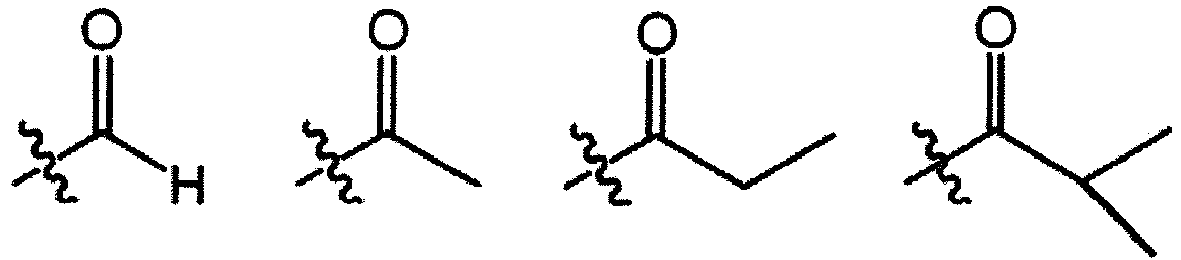
- the carbonyl group may be a compound having the following structures, but is not limited thereto.
- the oxygen of the ester group may be substituted with a straight-chained, branch-chained, or cyclic alkyl group having 1 to 25 carbon atoms, or an aryl group having 6 to 25 carbon atoms.
- the ester group may be a compound having the following structural formulae, but is not limited thereto.
- the number of carbon atoms of an imide group is not particularly limited, but is preferably 1 to 25.
- the imide group may be a compound having the following structures, but is not limited thereto.
- a silyl group may be represented by a formula of -SiRR'R", and R, R', and R" may be each hydrogen; a substituted or unsubstituted alkyl group; or a substituted or unsubstituted aryl group.
- Specific examples of the silyl group include a trimethylsilyl group, a triethylsilyl group, a t-butyldimethylsilyl group, a vinyldimethylsilyl group, a propyldimethylsilyl group, a triphenylsilyl group, a diphenylsilyl group, a phenylsilyl group, and the like, but are not limited thereto.
- a boron group may be represented by a formula of -BRR'R", and R, R', and R" may be each hydrogen; a substituted or unsubstituted alkyl group; or a substituted or unsubstituted aryl group.
- R, R', and R may be each hydrogen; a substituted or unsubstituted alkyl group; or a substituted or unsubstituted aryl group.
- Specific examples of the boron group include a trimethylboron group, a triethylboron group, a t-butyldimethylboron group, a triphenylboron group, a phenylboron group, and the like, but are not limited thereto.
- examples of a halogen group include fluorine, chlorine, bromine or iodine.
- the alkyl group may be straight-chained or branch-chained, and the number of carbon atoms thereof is not particularly limited, but is preferably 1 to 40. According to an exemplary embodiment, the number of carbon atoms of the alkyl group is 1 to 20. According to another exemplary embodiment, the number of carbon atoms of the alkyl group is 1 to 10. According to still another exemplary embodiment, the number of carbon atoms of the alkyl group is 1 to 6.
- alkyl group examples include methyl, ethyl, propyl, n-propyl, isopropyl, butyl, n-butyl, isobutyl, tert-butyl, sec-butyl, 1-methyl-butyl, 1-ethyl-butyl, pentyl, n-pentyl, isopentyl, neopentyl, tert-pentyl, hexyl, n-hexyl, 1-methylpentyl, 2-methylpentyl, 4-methyl-2-pentyl, 3,3-dimethylbutyl, 2-ethylbutyl, heptyl, n-heptyl, 1-methylhexyl, cyclopentylmethyl, cyclohexylmethyl, octyl, n-octyl, tert-octyl, 1-methylheptyl, 2-ethylhexyl, 2-
- the alkenyl group may be straight-chained or branch-chained, and the number of carbon atoms thereof is not particularly limited, but is preferably 2 to 40. According to an exemplary embodiment, the number of carbon atoms of the alkenyl group is 2 to 20. According to another exemplary embodiment, the number of carbon atoms of the alkenyl group is 2 to 10. According to still another exemplary embodiment, the number of carbon atoms of the alkenyl group is 2 to 6.
- Specific examples thereof include vinyl, 1-propenyl, isopropenyl, 1-butenyl, 2-butenyl, 3-butenyl, 1-pentenyl, 2-pentenyl, 3-pentenyl, 3-methyl-1-butenyl, 1,3-butadienyl, allyl, 1-phenylvinyl-1-yl, 2-phenylvinyl-1-yl, 2,2-diphenylvinyl-1-yl, 2-phenyl-2-(naphthyl-1-yl)vinyl-1-yl, 2,2-bis(diphenyl-1-yl)vinyl-1-yl, a stilbenyl group, a styrenyl group, and the like, but are not limited thereto.
- a cycloalkyl group is not particularly limited, but has preferably 3 to 60 carbon atoms, and according to an exemplary embodiment, the number of carbon atoms of the cycloalkyl group is 3 to 30. According to another exemplary embodiment, the number of carbon atoms of the cycloalkyl group is 3 to 20. According to still another exemplary embodiment, the number of carbon atoms of the cycloalkyl group is 3 to 6.
- cyclopropyl examples thereof include cyclopropyl, cyclobutyl, cyclopentyl, 3-methylcyclopentyl, 2,3-dimethylcyclopentyl, cyclohexyl, 3-methylcyclohexyl, 4-methylcyclohexyl, 2,3-dimethylcyclohexyl, 3,4,5-trimethylcyclohexyl, 4-tert-butylcyclohexyl, cycloheptyl, cyclooctyl, and the like, but are not limited thereto.
- examples of an arylamine group include a substituted or unsubstituted monoarylamine group, a substituted or unsubstituted diarylamine group, or a substituted or unsubstituted triarylamine group.
- the aryl group in the arylamine group may be a monocyclic aryl group or a polycyclic aryl group.
- the arylamine group including two or more aryl groups may include a monocyclic aryl group, a polycyclic aryl group, or both a monocyclic aryl group and a polycyclic aryl group.
- arylamine group examples include phenylamine, naphthylamine, biphenylamine, anthracenylamine, 3-methyl-phenylamine, 4-methyl-naphthylamine, 2-methyl-biphenylamine, 9-methyl-anthracenylamine, a diphenylamine group, a phenylnaphthylamine group, a ditolylamine group, a phenyltolylamine group, carbazole, a triphenylamine group, and the like, but are not limited thereto.
- examples of a heteroarylamine group include a substituted or unsubstituted monoheteroarylamine group, a substituted or unsubstituted diheteroarylamine group, or a substituted or unsubstituted triheteroarylamine group.
- the heteroaryl group in the heteroarylamine group may be a monocyclic heterocyclic group or a polycyclic heterocyclic group.
- the heteroarylamine group including two or more heterocyclic groups may include a monocyclic heterocyclic group, a polycyclic heterocyclic group, or both a monocyclic heterocyclic group and a polycyclic heterocyclic group.
- an arylheteroarylamine group means an amine group substituted with an aryl group and a heterocyclic group.
- examples of an arylphosphine group include a substituted or unsubstituted monoarylphosphine group, a substituted or unsubstituted diarylphosphine group, or a substituted or unsubstituted triarylphosphine group.
- the aryl group in the arylphosphine group may be a monocyclic aryl group, and may be a polycyclic aryl group.
- the arylphosphine group including two or more aryl groups may include a monocyclic aryl group, a polycyclic aryl group, or both a monocyclic aryl group and a polycyclic aryl group.
- an aryl group is not particularly limited, but has preferably 6 to 60 carbon atoms, and may be a monocyclic aryl group or a polycyclic aryl group. According to an exemplary embodiment, the number of carbon atoms of the aryl group is 6 to 30. According to an exemplary embodiment, the number of carbon atoms of the aryl group is 6 to 20.
- the aryl group is a monocyclic aryl group
- examples of the monocyclic aryl group include a phenyl group, a biphenyl group, a terphenyl group, and the like, but are not limited thereto.
- polycyclic aryl group examples include a naphthyl group, an anthracenyl group, a phenanthryl group, a pyrenyl group, a perylenyl group, a chrysenyl group, a fluorenyl group, a triphenylene group, a fluoranthene group, and the like, but are not limited thereto.
- the group may be and the like.
- the fluorenyl group is not limited thereto.
- a heterocyclic group is a heterocyclic group including one or more of N, O, P, S, Si, and Se as a hetero atom, and the number of carbon atoms thereof is not particularly limited, but is preferably 2 to 60.
- heterocyclic group examples include a thiophene group, a furan group, a pyrrole group, an imidazole group, a thiazole group, an oxazole group, an oxadiazole group, a pyridyl group, a bipyridyl group, a pyrimidyl group, a triazine group, a triazole group, an acridyl group, a pyridazine group, a pyrazinyl group, a qinolinyl group, a quinazoline group, a quinoxalinyl group, a phthalazinyl group, a pyridopyrimidinyl group, a pyridopyrazinyl group, a pyrazinopyrazinyl group, an isoquinoline group, an indole group, a carbazole group, a benzoxazole group, a benzimidazo
- heterocyclic group may be applied to a heteroaryl group except for an aromatic group.
- aryl group in an aryloxy group, an arylthioxy group, an arylsulfoxy group, an arylphosphine group, an aralkyl group, an aralkylamine group, an aralkenyl group, an alkylaryl group, an arylamine group, and an arylheteroarylamine group.
- alkyl group in an alkylthioxy group, an alkylsulfoxy group, an aralkyl group, an aralkylamine group, an alkylaryl group, and an alkylamine group.
- heterocyclic group in a heteroaryl group, a heteroarylamine group, and an arylheteroarylamine group.
- alkenyl group in an aralkenyl group.
- aryl group may be applied to an arylene except for a divalent arylene group.
- heterocyclic group may be applied to a heteroarylene except for a divalent heteroarylene group.
- combining with an adjacent group to form a ring means combining with an adjacent group to form a substituted or unsubstituted aliphatic hydrocarbon ring; a substituted or unsubstituted aromatic hydrocarbon ring; a substituted or unsubstituted aliphatic hetero ring; a substituted or unsubstituted aromatic hetero ring; or a fused ring thereof.
- the aliphatic hydrocarbon ring means a ring composed only of carbon and hydrogen atoms as a ring which is not an aromatic group.
- examples of an aromatic hydrocarbon ring include a phenyl group, a naphthyl group, an anthracenyl group, and the like, but are not limited thereto.
- an aliphatic hetero ring means an aliphatic ring including one or more of hetero atoms.
- an aromatic hetero ring means an aromatic ring including one or more of hetero atoms.
- the aliphatic hydrocarbon ring, the aromatic hydrocarbon ring, the aliphatic hetero ring, and the aromatic hetero ring may be monocyclic or polycyclic.
- Chemical Formula 1 may be represented by the following Chemical Formula 2 or 3.
- Chemical Formula 1 may be represented by any one of the following Chemical Formulae 4 to 6.
- Chemical Formula 1 may be represented by any one of the following Chemical Formulae 7 to 9.
- Chemical Formula 1 may be represented by any one of the following Chemical Formulae 10 to 12.
- L1 and L2 may be a direct bond, or any one selected from the following structures.
- A1 and A2 are the same as or different from each other, and are each independently hydrogen; deuterium; a halogen group; a nitrile group; an alkyl group having 1 to 5 carbon atoms; an aryl group having 6 to 30 carbon atoms; or a heterocyclic group having 2 to 20 carbon atoms, and the structures may be unsubstituted or substituted with one or more substituents selected from the group consisting of deuterium; a halogen group; a nitrile group; a nitro group; a hydroxy group; a carbonyl group; an ester group; an imide group; an amine group; a phosphine oxide group, an alkoxy group; an aryloxy group; an alkylthioxy group; an arylthioxy group; an alkylsulfoxy group; an arylsulfoxy group; a silyl group; a boron group; an alkyl group; a cycloalky
- L1 and L2 are the same as or different from each other, and are each independently a direct bond; or arylene.
- L1 and L2 are the same as or different from each other, and are each independently a direct bond; or an arylene having 6 to 30 carbon atoms.
- L1 and L2 are the same as or different from each other, and are each independently a direct bond; or an arylene having 6 to 20 carbon atoms.
- L1 and L2 are the same as or different from each other, and are each independently a direct bond; or an arylene having 6 to 18 carbon atoms.
- L1 and L2 are the same as or different from each other, and are each independently a direct bond; or a monocyclic to tetracyclic arylene.
- L1 and L2 are the same as or different from each other, and are each independently a direct bond; phenylene; naphthylene; biphenylylene; terphenylene; phenanthrylene; or fluorenylene.
- L1 and L2 are the same as or different from each other, and are each independently a direct bond; or a substituted or unsubstituted phenylene.
- L1 and L2 are the same as or different from each other, and are each independently a direct bond; or a phenylene which is unsubstituted or substituted with one or more substituents selected from the group consisting of deuterium, a halogen group, a nitrile group, an alkyl group having 1 to 5 carbon atoms, an aryl group having 6 to 30 carbon atoms, and a heterocyclic group having 2 to 30 carbon atoms.
- L1 and L2 are the same as or different from each other, and are each independently a direct bond; or phenylene.
- L1 and L2 are a direct bond.
- L1 is a direct bond
- L2 is phenylene
- L1 is phenylene
- L2 is a direct bond
- the moiety may be represented by any one selected from the following structures.
- B1 to B3 are the same as or different from each other, and are each independently hydrogen; deuterium; a halogen group; a nitrile group; an alkyl group; or a silyl group substituted with an alkyl group.
- B1 to B3 are the same as or different from each other, and are each independently hydrogen; deuterium; a halogen group; a nitrile group; an alkyl group having 1 to 10 carbon atoms; or a silyl group substituted with an alkyl group having 1 to 10 carbon atoms.
- B1 to B3 are the same as or different from each other, and are each independently hydrogen; deuterium; a halogen group; a nitrile group; an alkyl group having 1 to 5 carbon atoms; or a silyl group substituted with an alkyl group having 1 to 5 carbon atoms.
- B1 to B3 are the same as or different from each other, and are each independently hydrogen; deuterium; a halogen group; a nitrile group; an alkyl group having 1 to 5 carbon atoms; or a trimethylsilyl group.
- R6 is hydrogen; deuterium; a halogen group; a nitrile group; an alkyl group; or a silyl group substituted with an alkyl group.
- R6 is hydrogen; deuterium; a halogen group; a nitrile group; an alkyl group having 1 to 5 carbon atoms; or a silyl group substituted with an alkyl group having 1 to 5 carbon atoms.
- R6 is hydrogen; deuterium; a halogen group; a nitrile group; an alkyl group having 1 to 5 carbon atoms; or a trimethylsilyl group.
- R1 to R5 are hydrogen.
- R1 to R6 are hydrogen.
- p and q are the same as or different from each other, and are each independently 0 or 1.
- the compound of Chemical Formula 1 may be any one selected from the following compounds.
- the compound represented by Chemical Formula 1 may be prepared based on the Preparation Examples to be described below.
- the compound may be prepared by the method such as the following Reaction Formulae 1-1 and 1-2.
- Reaction Formulae 1-1 and 1-2 the definitions of the substituents are the same as those described above. Further, according to an exemplary embodiment of the present specification, the compound may be prepared by the method such as the following Reaction Formulae 2-1 and 2-2.
- the compound may be prepared by the process such as the following Reaction Formulae 3-1 to 3-3.
- an organic light emitting device including the compound represented by Chemical Formula 1.
- An exemplary embodiment of the present specification provides an organic light emitting device including: a first electrode; a second electrode provided to face the first electrode; and one or more organic material layers provided between the first electrode and the second electrode, in which one or more layers of the organic material layers include the compound of Chemical Formula 1.
- the organic material layer of the organic light emitting device of the present specification may also be composed of a single-layered structure, but may be composed of a multi-layered structure in which two or more organic material layers are stacked.
- the organic light emitting device of the present invention may have a structure including a hole injection layer, a hole transport layer, an electron blocking layer, a light emitting layer, an electron transport layer, an electron injection layer, and the like as organic material layers.
- the structure of the organic light emitting device is not limited thereto, and may include a fewer number of organic layers.
- the organic material layer includes a hole injection layer, a hole transport layer, or a layer which simultaneously injects and transports holes, and the hole injection layer, the hole transport layer, or the layer which simultaneously injects and transports holes includes the compound of Chemical Formula 1.
- the organic material layer includes a hole injection layer, a hole transport layer, an electron blocking layer, or a layer which simultaneously injects and transports holes, and the hole injection layer, the hole transport layer, the electron blocking layer, or the layer which simultaneously injects and transports holes includes the compound of Chemical Formula 1.
- the organic material layer includes a light emitting layer, and the light emitting layer includes the compound of Chemical Formula 1.
- the organic material layer includes an electron transport layer or an electron injection layer, and the electron transport layer or the electron injection layer includes the compound of Chemical Formula 1.
- the electron transport layer, the electron injection layer, or the layer which simultaneously transports and injects electrons includes the compound of Chemical Formula 1.
- the organic material layer includes a light emitting layer and an electron transport layer
- the electron transport layer includes the compound of Chemical Formula 1.
- the organic light emitting device may be an organic light emitting device having a structure (normal type) in which a positive electrode, one or more organic material layers, and a negative electrode are sequentially stacked on a substrate.
- the organic light emitting device may be an organic light emitting device having a reverse-direction structure (inverted type) in which a negative electrode, one or more organic material layers, and a positive electrode are sequentially stacked on a substrate.
- a reverse-direction structure inverted type in which a negative electrode, one or more organic material layers, and a positive electrode are sequentially stacked on a substrate.
- FIGS. 1 and 2 the structure of the organic light emitting device according to an exemplary embodiment of the present specification is exemplified in FIGS. 1 and 2 .
- FIG. 1 illustrates an example of an organic light emitting device composed of a substrate 1, a positive electrode 2, a light emitting layer 3, and a negative electrode 4.
- the compound may be included in the light emitting layer.
- FIG. 2 illustrates an example of an organic light emitting device composed of a substrate 1, a positive electrode 2, a hole injection layer 5, a hole transport layer 6, a light emitting layer 7, an electron transport layer 8, and a negative electrode 4.
- the compound may be included in one or more of the hole injection layer, the hole transport layer, the light emitting layer, and the electron transport layer.
- the organic light emitting device of the present specification may be manufactured by the materials and methods known in the art, except that one or more layers of the organic material layers include the compound of the present specification, that is, the compound of Chemical Formula 1.
- the organic material layers may be formed of the same material or different materials.
- An exemplary embodiment of the present specification provides an organic light emitting device including: a first electrode; a second electrode provided to face the first electrode; a light emitting layer provided between the first electrode and the second electrode; and two or more organic material layers provided between the light emitting layer and the first electrode, or between the light emitting layer and the second electrode, in which at least one of the two or more organic material layers includes the heterocyclic compound.
- two or more may be selected from the group consisting of an electron transport layer, an electron injection layer, a layer which simultaneously transports and injects electrons, and a hole blocking layer.
- the organic material layer includes two or more electron transport layers, and at least one of the two or more electron transport layers includes the heterocyclic compound.
- the heterocyclic compound may also be included in one layer of the two or more electron transport layers, and may be included in each of the two or more electron transport layers.
- the other materials except for the heterocyclic compound may be the same as or different from each other.
- the organic material layer includes a light emitting layer, and the light emitting layer includes a compound represented by the following Chemical Formula 1-A.
- the organic material layer includes a light emitting layer, and the light emitting layer includes the compound represented by Chemical Formula 1-A as a dopant of the light emitting layer.
- L4 is a direct bond.
- n1 is 2.
- Ar7 is a divalent pyrene group which is unsubstituted or substituted with deuterium, a methyl group, an ethyl group, or a tert-butyl group.
- Ar8 and Ar9 are the same as or different from each other, and are each independently a substituted or unsubstituted aryl group having 6 to 30 carbon atoms.
- Ar8 and Ar9 are the same as or different from each other, and are each independently an aryl group which is unsubstituted or substituted with a germanium group substituted with an alkyl group.
- Ar8 and Ar9 are the same as or different from each other, and are each independently an aryl group which is unsubstituted or substituted with a trimethylgermanium group.
- Ar8 and Ar9 are the same as or different from each other, and are each independently a substituted or unsubstituted phenyl group.
- Ar8 and Ar9 are a phenyl group which is unsubstituted or substituted with a trimethylgermanium group.
- Chemical Formula 1-A is represented by the following compound.
- the organic material layer includes a light emitting layer, and the light emitting layer includes a compound represented by the following Chemical Formula 2-A.
- the organic material layer includes a light emitting layer
- the light emitting layer includes the compound represented by Chemical Formula 2-A as a host of the light emitting layer.
- G11 is a 1-naphthyl group.
- G12 is a 2-naphthyl group.
- G13 and G14 are hydrogen.
- Chemical Formula 2-A is represented by the following compound.
- the organic light emitting device of the present specification may be manufactured by the materials and methods known in the art, except that one or more layers of the organic material layers include the compound of Chemical Formula 1, that is, the compound represented by Chemical Formula 1.
- the organic light emitting device of the present specification may be manufactured by sequentially stacking a first electrode, an organic material layer, and a second electrode on a substrate.
- the organic light emitting device may be manufactured by depositing a metal or a metal oxide having conductivity, or an alloy thereof on a substrate to form a positive electrode, forming an organic material layer including a hole injection layer, a hole transport layer, a light emitting layer, and an electron transport layer thereon, and then depositing a material, which may be used as a negative electrode, thereon, by using a physical vapor deposition (PVD) method such as sputtering or e-beam evaporation.
- PVD physical vapor deposition
- an organic light emitting device may be made by sequentially depositing a negative electrode material, an organic material layer, and a positive electrode material on a substrate.
- the compound of Chemical Formula 1 may be formed as an organic material layer by not only a vacuum deposition method, but also a solution application method when an organic light emitting device is manufactured.
- the solution application method means spin coating, dip coating, doctor blading, inkjet printing, screen printing, a spray method, roll coating, and the like, but is not limited thereto.
- an organic light emitting device may also be made by sequentially depositing a negative electrode material, an organic material layer, and a positive electrode material on a substrate (International Publication No. 2003/012890 ).
- the manufacturing method is not limited thereto.
- the first electrode is a positive electrode
- the second electrode is a negative electrode.
- the first electrode is a negative electrode
- the second electrode is a positive electrode
- the positive electrode material a material having a large work function is usually preferred so as to smoothly inject holes into an organic material layer.
- the positive electrode material which may be used in the present invention include: a metal, such as vanadium, chromium, copper, zinc, and gold, or alloys thereof; a metal oxide, such as zinc oxide, indium oxide, indium tin oxide (ITO), and indium zinc oxide (IZO); a combination of metal and oxide, such as ZnO:Al or SnO 2 :Sb; an electrically conductive polymer, such as poly(3-methylthiophene), poly[3,4-(ethylene-1,2-dioxy)thiophene] (PEDOT), polypyrrole, and polyaniline, and the like, but are not limited thereto.
- a metal such as vanadium, chromium, copper, zinc, and gold, or alloys thereof
- a metal oxide such as zinc oxide, indium oxide, indium tin oxide (ITO), and indium zinc oxide (IZO
- the negative electrode material a material having a small work function is usually preferred so as to smoothly inject electrons into an organic material layer.
- the negative electrode material include: a metal, such as magnesium, calcium, sodium, potassium, titanium, indium, yttrium, lithium, gadolinium, aluminum, silver, tin, and lead, or alloys thereof; a multi-layered structural material, such as LiF/Al or LiO 2 /Al, and the like, but are not limited thereto.
- the hole injection layer is a layer which injects holes from an electrode
- a hole injection material is preferably a compound which has a capability of transporting holes, and thus has an effect of injecting holes at a positive electrode and an excellent effect of injecting holes for a light emitting layer or a light emitting material, prevents excitons produced from the light emitting layer from moving to an electron injection layer or an electron injection material, and is also excellent in the ability to form a thin film. It is preferred that the highest occupied molecular orbital (HOMO) of the hole injection material is between the work function of the positive electrode material and the HOMO of a peripheral organic material layer.
- HOMO highest occupied molecular orbital
- the hole injection material examples include metal porphyrin, oligothiophene, an arylamine-based organic material, a hexanitrile hexaazatriphenylene-based organic material, a quinacridone-based organic material, a perylene-based organic material, anthraquinone, a polyaniline and polythiophene-based electrically conductive polymer, and the like, but are not limited thereto.
- the hole transport layer is a layer which receives holes from a hole injection layer and transports the holes to a light emitting layer
- a hole transport material is suitably a material which may receive holes transported from a positive electrode or a hole injection layer to transfer the holes to a light emitting layer, and has a large mobility for the holes.
- Specific examples thereof include an arylamine-based organic material, an electrically conductive polymer, a block copolymer in which a conjugate portion and a non-conjugate portion are present together, and the like, but are not limited thereto.
- the light emitting material is preferably a material which may receive holes and electrons transported from a hole transport layer and an electron transport layer, respectively, and combine the holes and the electrons to emit light in a visible ray region, and has good quantum efficiency to fluorescence or phosphorescence.
- an 8-hydroxy-quinoline aluminum complex Alq 3
- a carbazole-based compound a dimerized styryl compound; BAlq; a 10-hydroxybenzoquinoline-metal compound; a benzoxazole, benzthiazole and benzimidazole-based compound; a poly(p-phenylenevinylene) (PPV)-based polymer; a spiro compound; polyfluorene, lubrene, and the like, but are not limited thereto.
- PSV poly(p-phenylenevinylene)
- the light emitting layer may include a host material and a dopant material.
- the host material include a fused aromatic ring derivative, or a hetero ring-containing compound, and the like.
- the fused aromatic ring derivative include an anthracene derivative, a pyrene derivative, a naphthalene derivative, a pentacene derivative, a phenanthrene compound, a fluoranthene compound, and the like
- specific examples of the hetero ring-containing compound include a carbazole derivative, a dibenzofuran derivative, a ladder-type furan compound, a pyrimidine derivative, and the like, but the examples thereof are not limited thereto.
- the dopant material examples include an aromatic amine derivative, a styrylamine compound, a boron complex, a fluoranthene compound, a metal complex, and the like.
- the aromatic amine derivative is a fused aromatic ring derivative having a substituted or unsubstituted arylamino group, and examples thereof include a pyrene, an anthracene, a chrysene, a periflanthene, and the like, which have an arylamino group
- the styrylamine compound is a compound in which a substituted or unsubstituted arylamine is substituted with at least one arylvinyl group, and one or two or more substituents selected from the group consisting of an aryl group, a silyl group, an alkyl group, a cycloalkyl group, and an arylamino group are substituted or unsubstituted.
- examples thereof include styrylamine, styryldiamine, styryltriamine, styryltetramine, and the like, but are not limited thereto.
- examples of the metal complex include an iridium complex, a platinum complex, and the like, but are not limited thereto.
- the electron transport layer is a layer which receives electrons from an electron injection layer and transports the electrons to a light emitting layer
- an electron transport material is suitably a material which may receive electrons well from a negative electrode and transfer the electrons to a light emitting layer, and has a large mobility for electrons.
- Specific examples thereof include: an Al complex of 8-hydroxyquinoline; a complex including Alq 3 ; an organic radical compound; a hydroxyflavone-metal complex, and the like, but are not limited thereto.
- the electron transport layer may be used with any desired cathode material, as used according to the related art.
- appropriate examples of the cathode material are a typical material which has a low work function, followed by an aluminum layer or a silver layer.
- Specific examples thereof include cesium, barium, calcium, ytterbium, and samarium, in each case followed by an aluminum layer or a silver layer.
- the electron injection layer is a layer which injects electrons from an electrode, and is preferably a compound which has a capability of transporting electrons, has an effect of injecting electrons from a negative electrode and an excellent effect of injecting electrons into a light emitting layer or a light emitting material, prevents excitons produced from the light emitting layer from moving to a hole injection layer, and is also excellent in the ability to form a thin film.
- fluorenone anthraquinodimethane, diphenoquinone, thiopyran dioxide, oxazole, oxadiazole, triazole, imidazole, perylenetetracarboxylic acid, fluorenylidene methane, anthrone, and the like, and derivatives thereof, a metal complex compound, a nitrogen-containing 5-membered ring derivative, and the like, but are not limited thereto.
- Examples of the metal complex compound include 8-hydroxyquinolinato lithium, bis(8-hydroxyquinolinato) zinc, bis(8-hydroxyquinolinato) copper, bis(8-hydroxyquinolinato) manganese, tris(8-hydroxyquinolinato) aluminum, tris(2-methyl-8-hydroxyquinolinato) aluminum, tris(8-hydroxyquinolinato) gallium, bis(10-hydroxybenzo[h]quinolinato) beryllium, bis(10-hydroxybenzo[h]quinolinato) zinc, bis(2-methyl-8-quinolinato) chlorogallium, bis(2-methyl-8-quinolinato)(o-cresolato) gallium, bis(2-methyl-8-quinolinato)(1-naphtholato) aluminum, bis(2-methyl-8-quinolinato)(2-naphtholato) gallium, and the like, but are not limited thereto.
- the organic light emitting device may be a top emission type, a bottom emission type, or a dual emission type according to the material to be used.
- the compound of Chemical Formula 1 may be included in an organic solar cell or an organic transistor in addition to an organic light emitting device.
- Compounds 1-19 to 1-27 were prepared in the same manner as in the methods of preparing Compounds 1-1 to 1-9, except that a material which is Compound E was used instead of Compound C as a starting material in Preparation Examples 1 to 9.
- Compounds 1-28 to 1-36 were prepared in the same manner as in the methods of preparing Compounds 1-1 to 1-9, except that a material which is Compound B was used instead of Compound C as a starting material in Preparation Examples 1 to 9.
- a glass substrate thinly coated with indium tin oxide (ITO) to have a thickness of 1,000 ⁇ was put into distilled water in which a detergent was dissolved, and ultrasonically washed.
- ITO indium tin oxide
- a product manufactured by Fischer Co. was used as the detergent
- distilled water twice filtered using a filter manufactured by Millipore Co. was used as the distilled water.
- ultrasonic washing was conducted twice repeatedly using distilled water for 10 minutes.
- ultrasonic washing was conducted using isopropyl alcohol, acetone, and methanol solvents, and drying was conducted, and then the substrate was transferred to a plasma cleaner.
- the substrate was cleaned using oxygen plasma for 5 minutes, and then transferred to a vacuum evaporator.
- Hexanitrile hexaazatriphenylene (HAT) of the following Chemical Formula was thermally vacuum deposited to have a thickness of 500 ⁇ on the transparent ITO electrode, which was thus prepared, thereby forming a hole injection layer.
- NPB N-(1-naphthyl)-N-phenylamino]biphenyl
- the following Compound 1-1 was vacuum deposited to have a film thickness of 100 ⁇ on the hole transport layer, thereby forming an electron blocking layer.
- the following BH and BD were vacuum deposited at a weight ratio of 25:1 to have a film thickness of 300 ⁇ on the electron blocking layer, thereby forming a light emitting layer.
- Compound ET1 and Compound LiQ were vacuum deposited at a weight ratio of 1:1 on the light emitting layer, thereby forming an electron injection and transport layer having a thickness of 300 ⁇ .
- Lithium fluoride (LiF) and aluminum were sequentially deposited to have a thickness of 12 ⁇ and 2,000 ⁇ , respectively, on the electron injection and transport layer, thereby forming a negative electrode.
- the deposition rate of the organic material was maintained at 0.4 to 0.7 ⁇ /sec
- the deposition rates of lithium fluoride and aluminum of the negative electrode were maintained at 0.3 ⁇ /sec and at 2 ⁇ /sec, respectively
- the degree of vacuum during the deposition was maintained at 2 ⁇ 10 -7 to 5 ⁇ 10 -6 torr, thereby manufacturing an organic light emitting device.
- An organic light emitting device was manufactured in the same manner as in Experimental Example 1-1, except that Compound 1-2 was used instead of Compound 1-1 in Experimental Example 1-1.
- An organic light emitting device was manufactured in the same manner as in Experimental Example 1-1, except that Compound 1-3 was used instead of Compound 1-1 in Experimental Example 1-1.
- An organic light emitting device was manufactured in the same manner as in Experimental Example 1-1, except that Compound 1-4 was used instead of Compound 1-1 in Experimental Example 1-1.
- An organic light emitting device was manufactured in the same manner as in Experimental Example 1-1, except that Compound 1-5 was used instead of Compound 1-1 in Experimental Example 1-1.
- An organic light emitting device was manufactured in the same manner as in Experimental Example 1-1, except that Compound 1-6 was used instead of Compound 1-1 in Experimental Example 1-1.
- An organic light emitting device was manufactured in the same manner as in Experimental Example 1-1, except that Compound 1-7 was used instead of Compound 1-1 in Experimental Example 1-1.
- An organic light emitting device was manufactured in the same manner as in Experimental Example 1-1, except that Compound 1-10 was used instead of Compound 1-1 in Experimental Example 1-1.
- An organic light emitting device was manufactured in the same manner as in Experimental Example 1-1, except that Compound 1-19 was used instead of Compound 1-1 in Experimental Example 1-1.
- An organic light emitting device was manufactured in the same manner as in Experimental Example 1-1, except that Compound 1-28 was used instead of Compound 1-1 in Experimental Example 1-1.
- An organic light emitting device was manufactured in the same manner as in Experimental Example 1-1, except that Compound 1-37 was used instead of Compound 1-1 in Experimental Example 1-1.
- An organic light emitting device was manufactured in the same manner as in Experimental Example 1-1, except that Compound 1-38 was used instead of Compound 1-1 in Experimental Example 1-1.
- An organic light emitting device was manufactured in the same manner as in Experimental Example 1-1, except that EB 1 was used instead of Compound 1-1 in Experimental Example 1-1.
- An organic light emitting device was manufactured in the same manner as in Experimental Example 1-1, except that the following EB 2 was used instead of Compound 1 in Experimental Example 1-1.
- An organic light emitting device was manufactured in the same manner as in Experimental Example 1-1, except that the following EB 3 was used instead of Compound 1 in Experimental Example 1-1.
- the compound derivatives of the Chemical Formulae according to the present invention have an excellent electron suppressing capability, and thus exhibit low voltage and high efficiency characteristics, and may be applied to the electron blocking layer of the organic light emitting device.
- the compound derivatives of the Chemical Formulae according to the present invention also have an excellent hole transporting capability, and thus exhibit low voltage and high efficiency characteristics, and may be applied to the hole transport layer of the organic light emitting device.
Landscapes
- Chemical & Material Sciences (AREA)
- Organic Chemistry (AREA)
- Engineering & Computer Science (AREA)
- Materials Engineering (AREA)
- Physics & Mathematics (AREA)
- Spectroscopy & Molecular Physics (AREA)
- Optics & Photonics (AREA)
- Electroluminescent Light Sources (AREA)
- Organic Low-Molecular-Weight Compounds And Preparation Thereof (AREA)
Abstract
Description
- This application claims priority to and the benefit of Korean Patent Application No.
10-2015-0125525 - The present specification relates to an amine-based compound and an organic light emitting device including the same.
- In general, an organic light emitting phenomenon refers to a phenomenon in which electric energy is converted into light energy by using an organic material. An organic light emitting device using the organic light emitting phenomenon usually has a structure including a positive electrode, a negative electrode, and an organic material layer interposed therebetween. Here, the organic material layer may have a multi-layered structure composed of different materials in order to improve the efficiency and stability of an organic light emitting device in many cases, and for example, may be composed of a hole injection layer, a hole transport layer, a light emitting layer, an electron transport layer, an electron injection layer, and the like. In the structure of the organic light emitting device, if a voltage is applied between two electrodes, holes are injected from a positive electrode into the organic material layer and electrons are injected from a negative electrode into the organic material layer, and when the injected holes and electrons meet each other, an exciton is formed, and light is emitted when the exciton falls down again to a ground state.
- There is a continuous need for developing a new material for the aforementioned organic light emitting device.
- Official Gazette of Korean Patent Application Laid-Open No.
2000-0051826 - The present specification describes an amine-based compound and an organic light emitting device including the same.
- An exemplary embodiment of the present specification provides a compound represented by the following Chemical Formula 1:

- In Chemical Formula 1,
- L1 to L2 are the same as or different from each other, and are each independently a direct bond; or a substituted or unsubstituted arylene,
- R1 to R3 are the same as or different from each other, and are each independently hydrogen; deuterium; a halogen group; a nitrile group; a nitro group; a hydroxy group; a carbonyl group; an ester group; an imide group; an amino group; a substituted or unsubstituted silyl group; a substituted or unsubstituted boron group; a substituted or unsubstituted alkyl group; a substituted or unsubstituted cycloalkyl group; a substituted or unsubstituted alkoxy group; a substituted or unsubstituted aryloxy group; a substituted or unsubstituted alkylthioxy group; a substituted or unsubstituted arylthioxy group; a substituted or unsubstituted alkylsulfoxy group; a substituted or unsubstituted arylsulfoxy group; a substituted or unsubstituted alkenyl group; a substituted or unsubstituted aralkyl group; a substituted or unsubstituted aralkenyl group; a substituted or unsubstituted alkylaryl group; a substituted or unsubstituted alkylamine group; a substituted or unsubstituted aralkylamine group; a substituted or unsubstituted heteroarylamine group; a substituted or unsubstituted arylamine group; a substituted or unsubstituted arylheteroarylamine group; a substituted or unsubstituted arylphosphine group; a substituted or unsubstituted phosphine oxide group; or a substituted or unsubstituted heterocyclic group, or combine with an adjacent group to form a substituted or unsubstituted ring,
- R4 and R5 are the same as or different from each other, and are each independently hydrogen; deuterium; a halogen group; a nitrile group; a nitro group; a hydroxy group; a carbonyl group; an ester group; an imide group; an amino group; a substituted or unsubstituted silyl group; a substituted or unsubstituted boron group; a substituted or unsubstituted alkyl group; a substituted or unsubstituted cycloalkyl group; a substituted or unsubstituted alkoxy group; a substituted or unsubstituted aryloxy group; a substituted or unsubstituted alkylthioxy group; a substituted or unsubstituted arylthioxy group; a substituted or unsubstituted alkylsulfoxy group; a substituted or unsubstituted arylsulfoxy group; a substituted or unsubstituted alkenyl group; a substituted or unsubstituted aralkyl group; a substituted or unsubstituted aralkenyl group; a substituted or unsubstituted alkylaryl group; a substituted or unsubstituted alkylamine group; a substituted or unsubstituted aralkylamine group; a substituted or unsubstituted arylphosphine group; a substituted or unsubstituted phosphine oxide group; a substituted or unsubstituted aryl group; or a substituted or unsubstituted heterocyclic group, or combine with an adjacent group to form a substituted or unsubstituted ring,
- R6's are the same as or different from each other, and are each independently hydrogen; deuterium; a halogen group; a nitrile group; a nitro group; a hydroxy group; a carbonyl group; an ester group; an imide group; an amino group; a substituted or unsubstituted silyl group; a substituted or unsubstituted boron group; a substituted or unsubstituted alkyl group; a substituted or unsubstituted cycloalkyl group; a substituted or unsubstituted alkoxy group; a substituted or unsubstituted aryloxy group; a substituted or unsubstituted alkylthioxy group; a substituted or unsubstituted arylthioxy group; a substituted or unsubstituted alkylsulfoxy group; a substituted or unsubstituted arylsulfoxy group; a substituted or unsubstituted alkenyl group; a substituted or unsubstituted aralkyl group; a substituted or unsubstituted aralkenyl group; a substituted or unsubstituted alkylaryl group; a substituted or unsubstituted alkylamine group; a substituted or unsubstituted aralkylamine group; a substituted or unsubstituted heteroarylamine group; a substituted or unsubstituted arylamine group; a substituted or unsubstituted arylheteroarylamine group; a substituted or unsubstituted arylphosphine group; a substituted or unsubstituted phosphine oxide group; a substituted or unsubstituted aryl group; or a substituted or unsubstituted heterocyclic group, or combine with an adjacent group to form a substituted or unsubstituted ring,
- a and b are the same as or different from each other, and are each independently an integer of 0 to 4,
- c is an integer of 0 to 3,
- d is an integer of 0 to 7,
- e is an integer of 0 to 8,
- f is an integer of 0 to 5,
- p and q are the same as or different from each other, and are each independently an integer of 0 to 10, and
- when a, b, c, d, e, f, p, and q are each 2 or more, structures in the parenthesis are the same as or different from each other.
- Further, an exemplary embodiment of the present specification provides an organic light emitting device including: a first electrode; a second electrode provided to face the first electrode; and one or more organic material layers provided between the first electrode and the second electrode, in which one or more layers of the organic material layers include the compound of
Chemical Formula 1. - The compound described in the present specification may be used as a material for an organic material layer of an organic light emitting device. The compound according to at least one exemplary embodiment may improve the efficiency, achieve low driving voltage and/or improve lifetime characteristics in the organic light emitting device. In particular, the compound described in the present specification may be used as a material for hole injection, hole transport, hole injection and hole transport, light emission, electron transport, or electron injection. In addition, the compound described in the present specification may be preferably used as a material for a light emitting layer, and electron transport or electron injection. Furthermore, more preferably, according to an exemplary embodiment of the present specification, the compound may be used as a material for a hole injection layer, a hole transport layer, or an electron blocking layer.
-
-
FIG. 1 illustrates an example of an organic light emitting device composed of asubstrate 1, apositive electrode 2, alight emitting layer 3, and anegative electrode 4. -
FIG. 2 illustrates an example of an organic light emitting device composed of asubstrate 1, apositive electrode 2, ahole injection layer 5, ahole transport layer 6, alight emitting layer 7, anelectron transport layer 8, and anegative electrode 4. - Hereinafter, the present specification will be described in more detail.
- In the present specification, means a bond which is linked to another substituent.
- An exemplary embodiment of the present specification provides the compound represented by Chemical Formula 1. Examples of the substituents will be described below, but are not limited thereto.
- In the present specification, the term "substituted or unsubstituted" means being unsubstituted or substituted with one or more substituents selected from the group consisting of deuterium; a halogen group; a nitrile group; a nitro group; a hydroxy group; a carbonyl group; an ester group; an imide group; an amino group; a phosphine oxide group; an alkoxy group; an aryloxy group; an alkylthioxy group; an arylthioxy group; an alkylsulfoxy group; an arylsulfoxy group; a silyl group; a boron group; an alkyl group; a cycloalkyl group; an alkenyl group; an aryl group; an aralkyl group; an aralkenyl group; an alkylaryl group; an alkylamine group; an aralkylamine group; a heteroarylamine group; an arylamine group; an arylphosphine group; and a heterocyclic group, or being unsubstituted or substituted with a substituent to which two or more substituents among the substituents exemplified above are linked. For example, "the substituent to which two or more substituents are linked" may be a biphenyl group. That is, the biphenyl group may also be an aryl group, and may be interpreted as a substituent to which two phenyl groups are linked.
- According to an exemplary embodiment of the present specification, the term "substituted or unsubstituted" may preferably mean being unsubstituted or substituted with one or more substituents selected from the group consisting of deuterium, a halogen group, a nitrile group, an alkyl group having 1 to 5 carbon atoms, an aryl group having 6 to 30 carbon atoms, and a heterocyclic group having 2 to 30 carbon atoms.
- According to an exemplary embodiment of the present specification, the term "substituted or unsubstituted" may preferably mean being unsubstituted or substituted with one or more substituents selected from the group consisting of deuterium, a halogen group, a nitrile group, an alkyl group, a trimethylsilyl group, an aryl group, and a heterocyclic group.
- According to an exemplary embodiment of the present specification, the term "substituted or unsubstituted" may preferably mean being unsubstituted or substituted with one or more substituents selected from the group consisting of deuterium, a halogen group, a nitrile group, an alkyl group having 1 to 5 carbon atoms, a trimethylsilyl group, an aryl group having 6 to 30 carbon atoms, and a heterocyclic group having 2 to 30 carbon atoms.
- In the present specification, the "adjacent" group may mean a substituent substituted with an atom directly linked to an atom in which the corresponding substituent is substituted, a substituent disposed sterically closest to the corresponding substituent, or another substituent substituted with an atom in which the corresponding substituent is substituted. For example, two substituents substituted at the ortho position in a benzene ring and two substituents substituted with the same carbon in an aliphatic ring may be interpreted as groups which are "adjacent" to each other.
- In the present specification, the number of carbon atoms of a carbonyl group is not particularly limited, but is preferably 1 to 40. Specifically, the carbonyl group may be a compound having the following structures, but is not limited thereto.

- In the present specification, for an ester group, the oxygen of the ester group may be substituted with a straight-chained, branch-chained, or cyclic alkyl group having 1 to 25 carbon atoms, or an aryl group having 6 to 25 carbon atoms. Specifically, the ester group may be a compound having the following structural formulae, but is not limited thereto.


- In the present specification, the number of carbon atoms of an imide group is not particularly limited, but is preferably 1 to 25. Specifically, the imide group may be a compound having the following structures, but is not limited thereto.

- In the present specification, a silyl group may be represented by a formula of -SiRR'R", and R, R', and R" may be each hydrogen; a substituted or unsubstituted alkyl group; or a substituted or unsubstituted aryl group. Specific examples of the silyl group include a trimethylsilyl group, a triethylsilyl group, a t-butyldimethylsilyl group, a vinyldimethylsilyl group, a propyldimethylsilyl group, a triphenylsilyl group, a diphenylsilyl group, a phenylsilyl group, and the like, but are not limited thereto.
- In the present specification, a boron group may be represented by a formula of -BRR'R", and R, R', and R" may be each hydrogen; a substituted or unsubstituted alkyl group; or a substituted or unsubstituted aryl group. Specific examples of the boron group include a trimethylboron group, a triethylboron group, a t-butyldimethylboron group, a triphenylboron group, a phenylboron group, and the like, but are not limited thereto.
- In the present specification, examples of a halogen group include fluorine, chlorine, bromine or iodine.
- In the present specification, the alkyl group may be straight-chained or branch-chained, and the number of carbon atoms thereof is not particularly limited, but is preferably 1 to 40. According to an exemplary embodiment, the number of carbon atoms of the alkyl group is 1 to 20. According to another exemplary embodiment, the number of carbon atoms of the alkyl group is 1 to 10. According to still another exemplary embodiment, the number of carbon atoms of the alkyl group is 1 to 6. Specific examples of the alkyl group include methyl, ethyl, propyl, n-propyl, isopropyl, butyl, n-butyl, isobutyl, tert-butyl, sec-butyl, 1-methyl-butyl, 1-ethyl-butyl, pentyl, n-pentyl, isopentyl, neopentyl, tert-pentyl, hexyl, n-hexyl, 1-methylpentyl, 2-methylpentyl, 4-methyl-2-pentyl, 3,3-dimethylbutyl, 2-ethylbutyl, heptyl, n-heptyl, 1-methylhexyl, cyclopentylmethyl, cyclohexylmethyl, octyl, n-octyl, tert-octyl, 1-methylheptyl, 2-ethylhexyl, 2-propylpentyl, n-nonyl, 2,2-dimethylheptyl, 1-ethyl-propyl, 1,1-dimethylpropyl, isohexyl, 4-methylhexyl, 5-methylhexyl, and the like, but are not limited thereto.
- In the present specification, the alkenyl group may be straight-chained or branch-chained, and the number of carbon atoms thereof is not particularly limited, but is preferably 2 to 40. According to an exemplary embodiment, the number of carbon atoms of the alkenyl group is 2 to 20. According to another exemplary embodiment, the number of carbon atoms of the alkenyl group is 2 to 10. According to still another exemplary embodiment, the number of carbon atoms of the alkenyl group is 2 to 6. Specific examples thereof include vinyl, 1-propenyl, isopropenyl, 1-butenyl, 2-butenyl, 3-butenyl, 1-pentenyl, 2-pentenyl, 3-pentenyl, 3-methyl-1-butenyl, 1,3-butadienyl, allyl, 1-phenylvinyl-1-yl, 2-phenylvinyl-1-yl, 2,2-diphenylvinyl-1-yl, 2-phenyl-2-(naphthyl-1-yl)vinyl-1-yl, 2,2-bis(diphenyl-1-yl)vinyl-1-yl, a stilbenyl group, a styrenyl group, and the like, but are not limited thereto.
- In the present specification, a cycloalkyl group is not particularly limited, but has preferably 3 to 60 carbon atoms, and according to an exemplary embodiment, the number of carbon atoms of the cycloalkyl group is 3 to 30. According to another exemplary embodiment, the number of carbon atoms of the cycloalkyl group is 3 to 20. According to still another exemplary embodiment, the number of carbon atoms of the cycloalkyl group is 3 to 6. Specific examples thereof include cyclopropyl, cyclobutyl, cyclopentyl, 3-methylcyclopentyl, 2,3-dimethylcyclopentyl, cyclohexyl, 3-methylcyclohexyl, 4-methylcyclohexyl, 2,3-dimethylcyclohexyl, 3,4,5-trimethylcyclohexyl, 4-tert-butylcyclohexyl, cycloheptyl, cyclooctyl, and the like, but are not limited thereto.
- In the present specification, examples of an arylamine group include a substituted or unsubstituted monoarylamine group, a substituted or unsubstituted diarylamine group, or a substituted or unsubstituted triarylamine group. The aryl group in the arylamine group may be a monocyclic aryl group or a polycyclic aryl group. The arylamine group including two or more aryl groups may include a monocyclic aryl group, a polycyclic aryl group, or both a monocyclic aryl group and a polycyclic aryl group.
- Specific examples of the arylamine group include phenylamine, naphthylamine, biphenylamine, anthracenylamine, 3-methyl-phenylamine, 4-methyl-naphthylamine, 2-methyl-biphenylamine, 9-methyl-anthracenylamine, a diphenylamine group, a phenylnaphthylamine group, a ditolylamine group, a phenyltolylamine group, carbazole, a triphenylamine group, and the like, but are not limited thereto.
- In the present specification, examples of a heteroarylamine group include a substituted or unsubstituted monoheteroarylamine group, a substituted or unsubstituted diheteroarylamine group, or a substituted or unsubstituted triheteroarylamine group. The heteroaryl group in the heteroarylamine group may be a monocyclic heterocyclic group or a polycyclic heterocyclic group. The heteroarylamine group including two or more heterocyclic groups may include a monocyclic heterocyclic group, a polycyclic heterocyclic group, or both a monocyclic heterocyclic group and a polycyclic heterocyclic group.
- In the present specification, an arylheteroarylamine group means an amine group substituted with an aryl group and a heterocyclic group.
- In the present specification, examples of an arylphosphine group include a substituted or unsubstituted monoarylphosphine group, a substituted or unsubstituted diarylphosphine group, or a substituted or unsubstituted triarylphosphine group. The aryl group in the arylphosphine group may be a monocyclic aryl group, and may be a polycyclic aryl group. The arylphosphine group including two or more aryl groups may include a monocyclic aryl group, a polycyclic aryl group, or both a monocyclic aryl group and a polycyclic aryl group.
- In the present specification, an aryl group is not particularly limited, but has preferably 6 to 60 carbon atoms, and may be a monocyclic aryl group or a polycyclic aryl group. According to an exemplary embodiment, the number of carbon atoms of the aryl group is 6 to 30. According to an exemplary embodiment, the number of carbon atoms of the aryl group is 6 to 20. When the aryl group is a monocyclic aryl group, examples of the monocyclic aryl group include a phenyl group, a biphenyl group, a terphenyl group, and the like, but are not limited thereto. Examples of the polycyclic aryl group include a naphthyl group, an anthracenyl group, a phenanthryl group, a pyrenyl group, a perylenyl group, a chrysenyl group, a fluorenyl group, a triphenylene group, a fluoranthene group, and the like, but are not limited thereto.
- When the fluorenyl group is substituted, the group may be

- In the present specification, a heterocyclic group is a heterocyclic group including one or more of N, O, P, S, Si, and Se as a hetero atom, and the number of carbon atoms thereof is not particularly limited, but is preferably 2 to 60. Examples of the heterocyclic group include a thiophene group, a furan group, a pyrrole group, an imidazole group, a thiazole group, an oxazole group, an oxadiazole group, a pyridyl group, a bipyridyl group, a pyrimidyl group, a triazine group, a triazole group, an acridyl group, a pyridazine group, a pyrazinyl group, a qinolinyl group, a quinazoline group, a quinoxalinyl group, a phthalazinyl group, a pyridopyrimidinyl group, a pyridopyrazinyl group, a pyrazinopyrazinyl group, an isoquinoline group, an indole group, a carbazole group, a benzoxazole group, a benzimidazole group, a benzothiazole group, a benzocarbazole group, a benzothiophene group, a dibenzothiophene group, a benzofuranyl group, a phenanthroline group, a thiazolyl group, an isoxazolyl group, an oxadiazolyl group, a thiadiazolyl group, a benzothiazolyl group, a phenothiazinyl group, a dibenzofuranyl group, and the like, but are not limited thereto.
- In the present specification, the above-described description on the heterocyclic group may be applied to a heteroaryl group except for an aromatic group.
- In the present specification, the above-described description on the aryl group may be applied to an aryl group in an aryloxy group, an arylthioxy group, an arylsulfoxy group, an arylphosphine group, an aralkyl group, an aralkylamine group, an aralkenyl group, an alkylaryl group, an arylamine group, and an arylheteroarylamine group.
- In the present specification, the above-described description on the alkyl group may be applied to an alkyl group in an alkylthioxy group, an alkylsulfoxy group, an aralkyl group, an aralkylamine group, an alkylaryl group, and an alkylamine group.
- In the present specification, the above-described description on the heterocyclic group may be applied to a heteroaryl group in a heteroaryl group, a heteroarylamine group, and an arylheteroarylamine group.
- In the present specification, the above-described description on the alkenyl group may be applied to an alkenyl group in an aralkenyl group.
- In the present specification, the above-described description on the aryl group may be applied to an arylene except for a divalent arylene group.
- In the present specification, the above-described description on the heterocyclic group may be applied to a heteroarylene except for a divalent heteroarylene group.
- In the present specification, combining with an adjacent group to form a ring means combining with an adjacent group to form a substituted or unsubstituted aliphatic hydrocarbon ring; a substituted or unsubstituted aromatic hydrocarbon ring; a substituted or unsubstituted aliphatic hetero ring; a substituted or unsubstituted aromatic hetero ring; or a fused ring thereof.
- In the present specification, the aliphatic hydrocarbon ring means a ring composed only of carbon and hydrogen atoms as a ring which is not an aromatic group. In the present specification, examples of an aromatic hydrocarbon ring include a phenyl group, a naphthyl group, an anthracenyl group, and the like, but are not limited thereto.
- In the present specification, an aliphatic hetero ring means an aliphatic ring including one or more of hetero atoms.
- In the present specification, an aromatic hetero ring means an aromatic ring including one or more of hetero atoms.
- In the present specification, the aliphatic hydrocarbon ring, the aromatic hydrocarbon ring, the aliphatic hetero ring, and the aromatic hetero ring may be monocyclic or polycyclic.
- According to an exemplary embodiment of the present specification,
Chemical Formula 1 may be represented by the followingChemical Formula 


- In
Chemical Formulae
definitions of L1, L2, R1 to R6, p, q, a, b, c, d, e, and f are the same as those inChemical Formula 1. - According to an exemplary embodiment of the present specification,
Chemical Formula 1 may be represented by any one of the followingChemical Formulae 4 to 6.


- In
Chemical Formulae 4 to 6,
definitions of L1, L2, R1 to R6, p, q, a, b, c, d, e, and f are the same as those inChemical Formula 1. - According to an exemplary embodiment of the present specification,
Chemical Formula 1 may be represented by any one of the followingChemical Formulae 7 to 9.


- In
Chemical Formulae 7 to 9,
definitions of L1, L2, R1 to R6, p, q, a, b, c, d, e, and f are the same as those inChemical Formula 1. - According to an exemplary embodiment of the present specification,
Chemical Formula 1 may be represented by any one of the following Chemical Formulae 10 to 12.



- In Chemical Formulae 10 to 12,
definitions of L1, L2, R1 to R6, p, q, a, b, c, d, e, and f are the same as those inChemical Formula 1. - According to an exemplary embodiment of the present specification, L1 and L2 may be a direct bond, or any one selected from the following structures.


- In the structures,
A1 and A2 are the same as or different from each other, and are each independently hydrogen; deuterium; a halogen group; a nitrile group; an alkyl group having 1 to 5 carbon atoms; an aryl group having 6 to 30 carbon atoms; or a heterocyclic group having 2 to 20 carbon atoms, and
the structures may be unsubstituted or substituted with one or more substituents selected from the group consisting of deuterium; a halogen group; a nitrile group; a nitro group; a hydroxy group; a carbonyl group; an ester group; an imide group; an amine group; a phosphine oxide group, an alkoxy group; an aryloxy group; an alkylthioxy group; an arylthioxy group; an alkylsulfoxy group; an arylsulfoxy group; a silyl group; a boron group; an alkyl group; a cycloalkyl group; an alkenyl group; an aryl group; an aralkyl group; an aralkenyl group; an alkylaryl group; an alkylamine group; an aralkylamine group; a heteroarylamine group; an arylamine group; an arylheteroarylamine group; an arylphosphine group; and a heterocyclic group. - According to an exemplary embodiment of the present specification, L1 and L2 are the same as or different from each other, and are each independently a direct bond; or arylene.
- According to an exemplary embodiment of the present specification, L1 and L2 are the same as or different from each other, and are each independently a direct bond; or an arylene having 6 to 30 carbon atoms.
- According to an exemplary embodiment of the present specification, L1 and L2 are the same as or different from each other, and are each independently a direct bond; or an arylene having 6 to 20 carbon atoms.
- According to an exemplary embodiment of the present specification, L1 and L2 are the same as or different from each other, and are each independently a direct bond; or an arylene having 6 to 18 carbon atoms.
- According to an exemplary embodiment of the present specification, L1 and L2 are the same as or different from each other, and are each independently a direct bond; or a monocyclic to tetracyclic arylene.
- According to an exemplary embodiment of the present specification, L1 and L2 are the same as or different from each other, and are each independently a direct bond; phenylene; naphthylene; biphenylylene; terphenylene; phenanthrylene; or fluorenylene.
- According to an exemplary embodiment of the present specification, L1 and L2 are the same as or different from each other, and are each independently a direct bond; or a substituted or unsubstituted phenylene.
- According to an exemplary embodiment of the present specification, L1 and L2 are the same as or different from each other, and are each independently a direct bond; or a phenylene which is unsubstituted or substituted with one or more substituents selected from the group consisting of deuterium, a halogen group, a nitrile group, an alkyl group having 1 to 5 carbon atoms, an aryl group having 6 to 30 carbon atoms, and a heterocyclic group having 2 to 30 carbon atoms.
- According to an exemplary embodiment of the present specification, L1 and L2 are the same as or different from each other, and are each independently a direct bond; or phenylene.
- According to an exemplary embodiment of the present specification, L1 and L2 are a direct bond.
- According to an exemplary embodiment of the present specification, L1 is a direct bond, and L2 is phenylene.
- According to an exemplary embodiment of the present specification, L1 is phenylene, and L2 is a direct bond.
- According to an exemplary embodiment of the present specification, the


- In the structures,
B1 to B3 are the same as or different from each other, and are each independently hydrogen; deuterium; a halogen group; a nitrile group; an alkyl group; or a silyl group substituted with an alkyl group. - According to an exemplary embodiment of the present specification, B1 to B3 are the same as or different from each other, and are each independently hydrogen; deuterium; a halogen group; a nitrile group; an alkyl group having 1 to 10 carbon atoms; or a silyl group substituted with an alkyl group having 1 to 10 carbon atoms.
- According to an exemplary embodiment of the present specification, B1 to B3 are the same as or different from each other, and are each independently hydrogen; deuterium; a halogen group; a nitrile group; an alkyl group having 1 to 5 carbon atoms; or a silyl group substituted with an alkyl group having 1 to 5 carbon atoms.
- According to an exemplary embodiment of the present specification, B1 to B3 are the same as or different from each other, and are each independently hydrogen; deuterium; a halogen group; a nitrile group; an alkyl group having 1 to 5 carbon atoms; or a trimethylsilyl group.
- According to an exemplary embodiment of the present specification, R6 is hydrogen; deuterium; a halogen group; a nitrile group; an alkyl group; or a silyl group substituted with an alkyl group.
- According to an exemplary embodiment of the present specification, R6 is hydrogen; deuterium; a halogen group; a nitrile group; an alkyl group having 1 to 5 carbon atoms; or a silyl group substituted with an alkyl group having 1 to 5 carbon atoms.
- According to an exemplary embodiment of the present specification, R6 is hydrogen; deuterium; a halogen group; a nitrile group; an alkyl group having 1 to 5 carbon atoms; or a trimethylsilyl group.
- According to an exemplary embodiment of the present specification, R1 to R5 are hydrogen.
- According to an exemplary embodiment of the present specification, R1 to R6 are hydrogen.
- According to an exemplary embodiment of the present specification, p and q are the same as or different from each other, and are each independently 0 or 1.
- According to an exemplary embodiment of the present specification, the compound of
Chemical Formula 1 may be any one selected from the following
compounds.


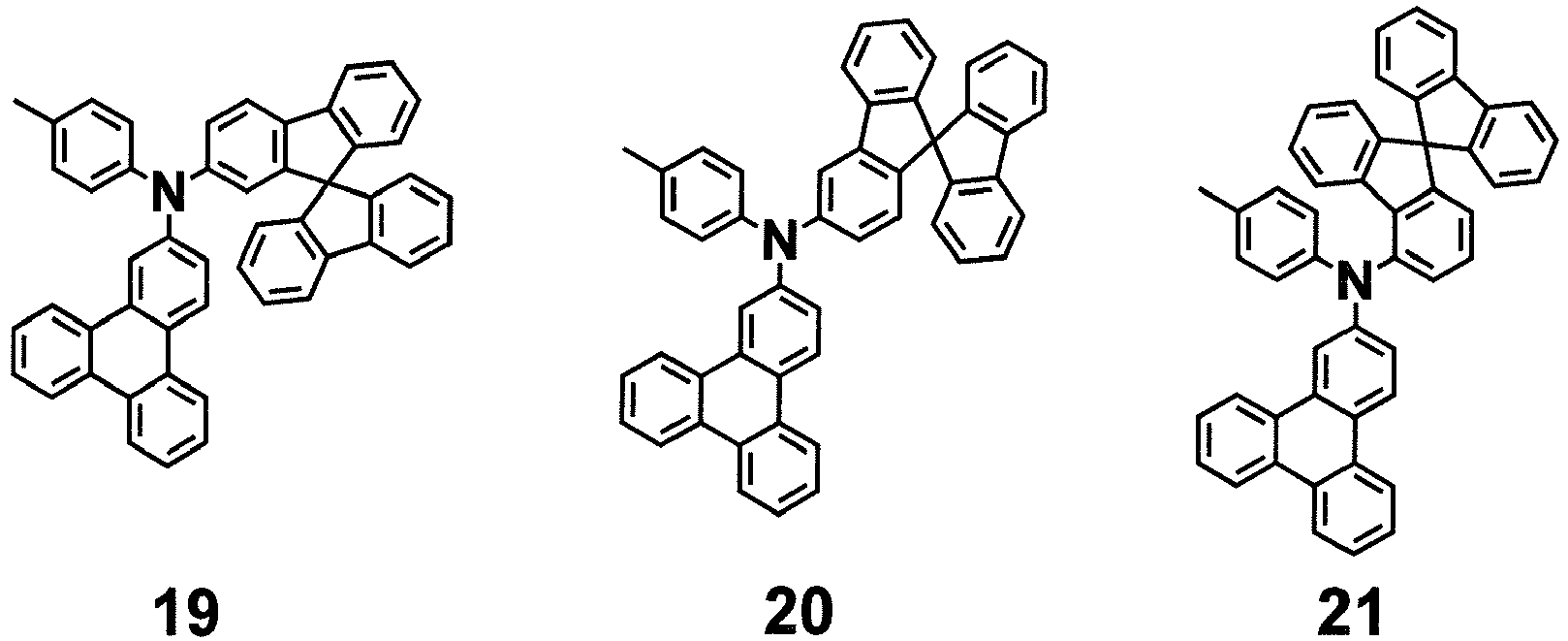


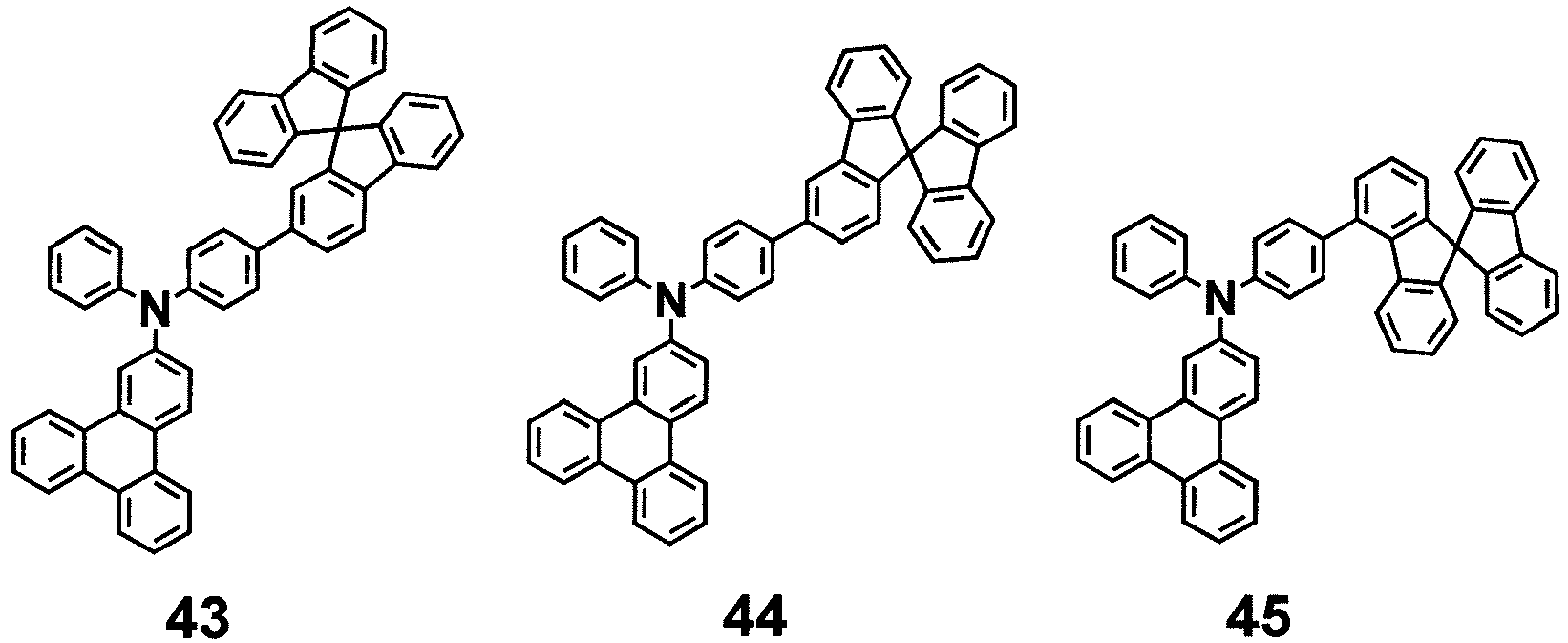
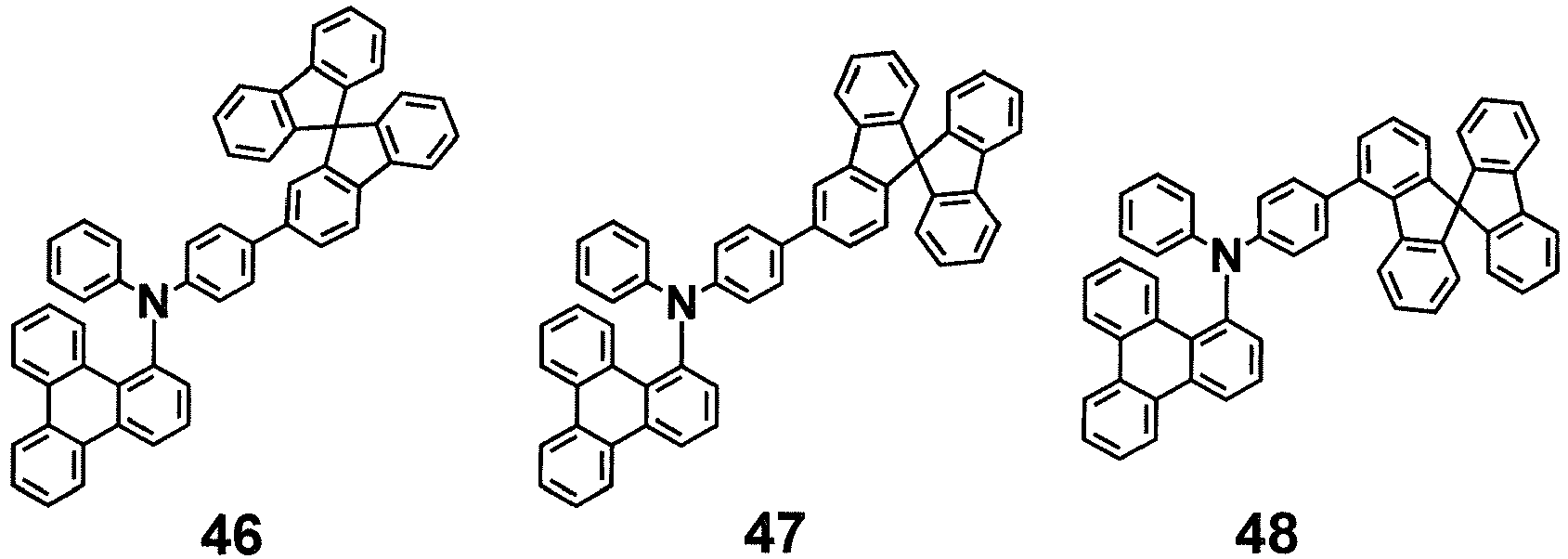


- The compound represented by
Chemical Formula 1 may be prepared based on the Preparation Examples to be described below. - According to an exemplary embodiment of the present specification, the compound may be prepared by the method such as the following Reaction Formulae 1-1 and 1-2.


- In Reaction Formulae 1-1 and 1-2, the definitions of the substituents are the same as those described above. Further, according to an exemplary embodiment of the present specification, the compound may be prepared by the method such as the following Reaction Formulae 2-1 and 2-2.


- In Reaction Formulae 2-1 and 2-2, the definitions of the substituents are the same as those described above.
- In addition, according to an exemplary embodiment of the present specification, the compound may be prepared by the process such as the following Reaction Formulae 3-1 to 3-3.


- Furthermore, the present specification provides an organic light emitting device including the compound represented by
Chemical Formula 1. - An exemplary embodiment of the present specification provides an organic light emitting device including: a first electrode; a second electrode provided to face the first electrode; and one or more organic material layers provided between the first electrode and the second electrode, in which one or more layers of the organic material layers include the compound of
Chemical Formula 1. - The organic material layer of the organic light emitting device of the present specification may also be composed of a single-layered structure, but may be composed of a multi-layered structure in which two or more organic material layers are stacked. For example, the organic light emitting device of the present invention may have a structure including a hole injection layer, a hole transport layer, an electron blocking layer, a light emitting layer, an electron transport layer, an electron injection layer, and the like as organic material layers. However, the structure of the organic light emitting device is not limited thereto, and may include a fewer number of organic layers.
- In an exemplary embodiment of the present specification, the organic material layer includes a hole injection layer, a hole transport layer, or a layer which simultaneously injects and transports holes, and the hole injection layer, the hole transport layer, or the layer which simultaneously injects and transports holes includes the compound of
Chemical Formula 1. - Further, in an exemplary embodiment of the present specification, the organic material layer includes a hole injection layer, a hole transport layer, an electron blocking layer, or a layer which simultaneously injects and transports holes, and the hole injection layer, the hole transport layer, the electron blocking layer, or the layer which simultaneously injects and transports holes includes the compound of
Chemical Formula 1. - In another exemplary embodiment, the organic material layer includes a light emitting layer, and the light emitting layer includes the compound of
Chemical Formula 1. - In an exemplary embodiment of the present specification, the organic material layer includes an electron transport layer or an electron injection layer, and the electron transport layer or the electron injection layer includes the compound of
Chemical Formula 1. - In an exemplary embodiment of the present specification, the electron transport layer, the electron injection layer, or the layer which simultaneously transports and injects electrons includes the compound of
Chemical Formula 1. - In another exemplary embodiment, the organic material layer includes a light emitting layer and an electron transport layer, and the electron transport layer includes the compound of
Chemical Formula 1. - In still another exemplary embodiment, the organic light emitting device may be an organic light emitting device having a structure (normal type) in which a positive electrode, one or more organic material layers, and a negative electrode are sequentially stacked on a substrate.
- In yet another exemplary embodiment, the organic light emitting device may be an organic light emitting device having a reverse-direction structure (inverted type) in which a negative electrode, one or more organic material layers, and a positive electrode are sequentially stacked on a substrate.
- For example, the structure of the organic light emitting device according to an exemplary embodiment of the present specification is exemplified in
FIGS. 1 and 2 . -
FIG. 1 illustrates an example of an organic light emitting device composed of asubstrate 1, apositive electrode 2, alight emitting layer 3, and anegative electrode 4. In the structure as described above, the compound may be included in the light emitting layer. -
FIG. 2 illustrates an example of an organic light emitting device composed of asubstrate 1, apositive electrode 2, ahole injection layer 5, ahole transport layer 6, alight emitting layer 7, anelectron transport layer 8, and anegative electrode 4. In the structure as described above, the compound may be included in one or more of the hole injection layer, the hole transport layer, the light emitting layer, and the electron transport layer. - The organic light emitting device of the present specification may be manufactured by the materials and methods known in the art, except that one or more layers of the organic material layers include the compound of the present specification, that is, the compound of
Chemical Formula 1. - When the organic light emitting device includes a plurality of organic material layers, the organic material layers may be formed of the same material or different materials.
- An exemplary embodiment of the present specification provides an organic light emitting device including: a first electrode; a second electrode provided to face the first electrode; a light emitting layer provided between the first electrode and the second electrode; and two or more organic material layers provided between the light emitting layer and the first electrode, or between the light emitting layer and the second electrode, in which at least one of the two or more organic material layers includes the heterocyclic compound. In one exemplary embodiment, as the two or more organic material layers, two or more may be selected from the group consisting of an electron transport layer, an electron injection layer, a layer which simultaneously transports and injects electrons, and a hole blocking layer.
- In an exemplary embodiment of the present specification, the organic material layer includes two or more electron transport layers, and at least one of the two or more electron transport layers includes the heterocyclic compound. Specifically, in an exemplary embodiment of the present specification, the heterocyclic compound may also be included in one layer of the two or more electron transport layers, and may be included in each of the two or more electron transport layers.
- In addition, in an exemplary embodiment of the present specification, when the heterocyclic compound is included in each of the two or more electron transporting layers, the other materials except for the heterocyclic compound may be the same as or different from each other.
- According to an exemplary embodiment of the present specification, the organic material layer includes a light emitting layer, and the light emitting layer includes a compound represented by the following Chemical Formula 1-A.

- In Chemical Formula 1-A,
- n1 is an integer of 1 or more,
- Ar7 is a substituted or unsubstituted monovalent or more benzofluorene group; a substituted or unsubstituted monovalent or more fluoranthene group; a substituted or unsubstituted monovalent or more pyrene group; or a substituted or unsubstituted monovalent or more chrysene group,
- L4 is a direct bond; a substituted or unsubstituted arylene group; or a substituted or unsubstituted heteroarylene group,
- Ar8 and Ar9 are the same as or different from each other, and are each independently a substituted or unsubstituted aryl group; a substituted or unsubstituted silyl group; a substituted or unsubstituted germanium group; a substituted or unsubstituted alkyl group; a substituted or unsubstituted arylalkyl group; or a substituted or unsubstituted heteroaryl group, or may combine with each other to form a substituted or unsubstituted ring, and
- when n1 is 2 or more, two or more structures in the parenthesis are the same as or different from each other.
- According to an exemplary embodiment of the present specification, the organic material layer includes a light emitting layer, and the light emitting layer includes the compound represented by Chemical Formula 1-A as a dopant of the light emitting layer.
- According to an exemplary embodiment of the present specification, L4 is a direct bond.
- According to an exemplary embodiment of the present specification, n1 is 2.
- In an exemplary embodiment of the present specification, Ar7 is a divalent pyrene group which is unsubstituted or substituted with deuterium, a methyl group, an ethyl group, or a tert-butyl group.
- According to an exemplary embodiment of the present specification, Ar8 and Ar9 are the same as or different from each other, and are each independently a substituted or unsubstituted aryl group having 6 to 30 carbon atoms.
- According to an exemplary embodiment of the present specification, Ar8 and Ar9 are the same as or different from each other, and are each independently an aryl group which is unsubstituted or substituted with a germanium group substituted with an alkyl group.
- According to an exemplary embodiment of the present specification, Ar8 and Ar9 are the same as or different from each other, and are each independently an aryl group which is unsubstituted or substituted with a trimethylgermanium group.
- According to an exemplary embodiment of the present specification, Ar8 and Ar9 are the same as or different from each other, and are each independently a substituted or unsubstituted phenyl group.
- According to an exemplary embodiment of the present specification, Ar8 and Ar9 are a phenyl group which is unsubstituted or substituted with a trimethylgermanium group.
- According to an exemplary embodiment of the present specification, Chemical Formula 1-A is represented by the following compound.

- According to an exemplary embodiment of the present specification, the organic material layer includes a light emitting layer, and the light emitting layer includes a compound represented by the following Chemical Formula 2-A.

- In Chemical Formula 2-A,
- G11 is a 1-naphthyl group, a 2-naphthyl group, a 1-anthryl group, a 2-anthryl group, a 1-phenanthryl group, a 2-phenanthryl group, a 3-phenanthryl group, a 4-phenanthryl group, a 9-phenanthryl group, a 1-naphthacenyl group, a 2-naphthacenyl group, a 9-naphthacenyl group, a 1-pyrenyl group, a 2-pyrenyl group, a 4-pyrenyl group, a 3-methyl-2-naphthyl group, a 4-methyl-1-naphthyl group, or the following Chemical Formula

- G12 is a phenyl group, a 1-naphthyl group, a 2-naphthyl group, a 1-anthryl group, a 2-anthryl group, a 9-anthryl group, a 1-phenanthryl group, a 2-phenanthryl group, a 3-phenanthryl group, a 4-phenanthryl group, a 9-phenanthryl group, a 1-naphthacenyl group, a 2-naphthacenyl group, a 9-naphthacenyl group, a 1-pyrenyl group, a 2-pyrenyl group, a 4-pyrenyl group, a 2-biphenylyl group, a 3-biphenylyl group, a 4-biphenylyl group, a p-terphenyl-4-yl group, a p-terphenyl-3-yl group, a p-terphenyl-2-yl group, an m-terphenyl-4-yl group, an m-terphenyl-3-yl group, an m-terphenyl-2-yl group, an o-tolyl group, an m-tolyl group, a p-tolyl group, a p-t-butylphenyl group, a p-(2-phenylpropyl)phenyl group, a 3-methyl-2-naphthyl group, a 4-methyl-1-naphthyl group, a 4-methyl-1-anthryl group, a 4'-methylbiphenylyl group, a 4"-t-butyl-p-terphenyl-4-yl group, or a 3-fluoranthenyl group,
- G13 and G14 are the same as or different from each other, and are each independently hydrogen; a substituted or unsubstituted alkyl group; a substituted or unsubstituted alkoxy group; a substituted or unsubstituted aryl group; or a substituted or unsubstituted heteroaryl group,
- g12 is an integer of 1 to 5,
- g13 and g14 are each an integer of 1 to 4, and
- when g12 to g14 are each 2 or more, two or more structures in the parenthesis are the same as or different from each other.
- According to an exemplary embodiment of the present specification, the organic material layer includes a light emitting layer, and the light emitting layer includes the compound represented by Chemical Formula 2-A as a host of the light emitting layer.
- According to an exemplary embodiment of the present specification, G11 is a 1-naphthyl group.
- According to an exemplary embodiment of the present specification, G12 is a 2-naphthyl group.
- According to an exemplary embodiment of the present specification, G13 and G14 are hydrogen.
- According to an exemplary embodiment of the present specification, Chemical Formula 2-A is represented by the following compound.

- The organic light emitting device of the present specification may be manufactured by the materials and methods known in the art, except that one or more layers of the organic material layers include the compound of
Chemical Formula 1, that is, the compound represented byChemical Formula 1. - For example, the organic light emitting device of the present specification may be manufactured by sequentially stacking a first electrode, an organic material layer, and a second electrode on a substrate. In this case, the organic light emitting device may be manufactured by depositing a metal or a metal oxide having conductivity, or an alloy thereof on a substrate to form a positive electrode, forming an organic material layer including a hole injection layer, a hole transport layer, a light emitting layer, and an electron transport layer thereon, and then depositing a material, which may be used as a negative electrode, thereon, by using a physical vapor deposition (PVD) method such as sputtering or e-beam evaporation. In addition to the method as described above, an organic light emitting device may be made by sequentially depositing a negative electrode material, an organic material layer, and a positive electrode material on a substrate.
- Further, the compound of
Chemical Formula 1 may be formed as an organic material layer by not only a vacuum deposition method, but also a solution application method when an organic light emitting device is manufactured. Here, the solution application method means spin coating, dip coating, doctor blading, inkjet printing, screen printing, a spray method, roll coating, and the like, but is not limited thereto. - In addition to the method as described above, an organic light emitting device may also be made by sequentially depositing a negative electrode material, an organic material layer, and a positive electrode material on a substrate (International Publication No.
2003/012890 ). However, the manufacturing method is not limited thereto. In an exemplary embodiment of the present specification, the first electrode is a positive electrode, and the second electrode is a negative electrode. - In another exemplary embodiment, the first electrode is a negative electrode, and the second electrode is a positive electrode.
- As the positive electrode material, a material having a large work function is usually preferred so as to smoothly inject holes into an organic material layer. Specific examples of the positive electrode material which may be used in the present invention include: a metal, such as vanadium, chromium, copper, zinc, and gold, or alloys thereof; a metal oxide, such as zinc oxide, indium oxide, indium tin oxide (ITO), and indium zinc oxide (IZO); a combination of metal and oxide, such as ZnO:Al or SnO2:Sb; an electrically conductive polymer, such as poly(3-methylthiophene), poly[3,4-(ethylene-1,2-dioxy)thiophene] (PEDOT), polypyrrole, and polyaniline, and the like, but are not limited thereto.
- As the negative electrode material, a material having a small work function is usually preferred so as to smoothly inject electrons into an organic material layer. Specific examples of the negative electrode material include: a metal, such as magnesium, calcium, sodium, potassium, titanium, indium, yttrium, lithium, gadolinium, aluminum, silver, tin, and lead, or alloys thereof; a multi-layered structural material, such as LiF/Al or LiO2/Al, and the like, but are not limited thereto. The hole injection layer is a layer which injects holes from an electrode, and a hole injection material is preferably a compound which has a capability of transporting holes, and thus has an effect of injecting holes at a positive electrode and an excellent effect of injecting holes for a light emitting layer or a light emitting material, prevents excitons produced from the light emitting layer from moving to an electron injection layer or an electron injection material, and is also excellent in the ability to form a thin film. It is preferred that the highest occupied molecular orbital (HOMO) of the hole injection material is between the work function of the positive electrode material and the HOMO of a peripheral organic material layer. Specific examples of the hole injection material include metal porphyrin, oligothiophene, an arylamine-based organic material, a hexanitrile hexaazatriphenylene-based organic material, a quinacridone-based organic material, a perylene-based organic material, anthraquinone, a polyaniline and polythiophene-based electrically conductive polymer, and the like, but are not limited thereto.
- The hole transport layer is a layer which receives holes from a hole injection layer and transports the holes to a light emitting layer, and a hole transport material is suitably a material which may receive holes transported from a positive electrode or a hole injection layer to transfer the holes to a light emitting layer, and has a large mobility for the holes. Specific examples thereof include an arylamine-based organic material, an electrically conductive polymer, a block copolymer in which a conjugate portion and a non-conjugate portion are present together, and the like, but are not limited thereto.
- The light emitting material is preferably a material which may receive holes and electrons transported from a hole transport layer and an electron transport layer, respectively, and combine the holes and the electrons to emit light in a visible ray region, and has good quantum efficiency to fluorescence or phosphorescence. Specific examples thereof include: an 8-hydroxy-quinoline aluminum complex (Alq3); a carbazole-based compound; a dimerized styryl compound; BAlq; a 10-hydroxybenzoquinoline-metal compound; a benzoxazole, benzthiazole and benzimidazole-based compound; a poly(p-phenylenevinylene) (PPV)-based polymer; a spiro compound; polyfluorene, lubrene, and the like, but are not limited thereto.
- The light emitting layer may include a host material and a dopant material. Examples of the host material include a fused aromatic ring derivative, or a hetero ring-containing compound, and the like. Specific examples of the fused aromatic ring derivative include an anthracene derivative, a pyrene derivative, a naphthalene derivative, a pentacene derivative, a phenanthrene compound, a fluoranthene compound, and the like, and specific examples of the hetero ring-containing compound include a carbazole derivative, a dibenzofuran derivative, a ladder-type furan compound, a pyrimidine derivative, and the like, but the examples thereof are not limited thereto.
- Examples of the dopant material include an aromatic amine derivative, a styrylamine compound, a boron complex, a fluoranthene compound, a metal complex, and the like. Specifically, the aromatic amine derivative is a fused aromatic ring derivative having a substituted or unsubstituted arylamino group, and examples thereof include a pyrene, an anthracene, a chrysene, a periflanthene, and the like, which have an arylamino group, and the styrylamine compound is a compound in which a substituted or unsubstituted arylamine is substituted with at least one arylvinyl group, and one or two or more substituents selected from the group consisting of an aryl group, a silyl group, an alkyl group, a cycloalkyl group, and an arylamino group are substituted or unsubstituted. Specific examples thereof include styrylamine, styryldiamine, styryltriamine, styryltetramine, and the like, but are not limited thereto. Further, examples of the metal complex include an iridium complex, a platinum complex, and the like, but are not limited thereto.
- The electron transport layer is a layer which receives electrons from an electron injection layer and transports the electrons to a light emitting layer, and an electron transport material is suitably a material which may receive electrons well from a negative electrode and transfer the electrons to a light emitting layer, and has a large mobility for electrons. Specific examples thereof include: an Al complex of 8-hydroxyquinoline; a complex including Alq3; an organic radical compound; a hydroxyflavone-metal complex, and the like, but are not limited thereto. The electron transport layer may be used with any desired cathode material, as used according to the related art. In particular, appropriate examples of the cathode material are a typical material which has a low work function, followed by an aluminum layer or a silver layer. Specific examples thereof include cesium, barium, calcium, ytterbium, and samarium, in each case followed by an aluminum layer or a silver layer.
- The electron injection layer is a layer which injects electrons from an electrode, and is preferably a compound which has a capability of transporting electrons, has an effect of injecting electrons from a negative electrode and an excellent effect of injecting electrons into a light emitting layer or a light emitting material, prevents excitons produced from the light emitting layer from moving to a hole injection layer, and is also excellent in the ability to form a thin film. Specific examples thereof include fluorenone, anthraquinodimethane, diphenoquinone, thiopyran dioxide, oxazole, oxadiazole, triazole, imidazole, perylenetetracarboxylic acid, fluorenylidene methane, anthrone, and the like, and derivatives thereof, a metal complex compound, a nitrogen-containing 5-membered ring derivative, and the like, but are not limited thereto. Examples of the metal complex compound include 8-hydroxyquinolinato lithium, bis(8-hydroxyquinolinato) zinc, bis(8-hydroxyquinolinato) copper, bis(8-hydroxyquinolinato) manganese, tris(8-hydroxyquinolinato) aluminum, tris(2-methyl-8-hydroxyquinolinato) aluminum, tris(8-hydroxyquinolinato) gallium, bis(10-hydroxybenzo[h]quinolinato) beryllium, bis(10-hydroxybenzo[h]quinolinato) zinc, bis(2-methyl-8-quinolinato) chlorogallium, bis(2-methyl-8-quinolinato)(o-cresolato) gallium, bis(2-methyl-8-quinolinato)(1-naphtholato) aluminum, bis(2-methyl-8-quinolinato)(2-naphtholato) gallium, and the like, but are not limited thereto.
- The organic light emitting device according to the present specification may be a top emission type, a bottom emission type, or a dual emission type according to the material to be used.
- In an exemplary embodiment of the present specification, the compound of
Chemical Formula 1 may be included in an organic solar cell or an organic transistor in addition to an organic light emitting device. - The preparation of the compound represented by
Chemical Formula 1 and the organic light emitting device including the same will be specifically described in the following Examples. However, the following Examples are provided for exemplifying the present specification, and the scope of the present specification is not limited thereby. -

- Under a nitrogen atmosphere, Compound C (10.0 g, 17.57 mmol) and bromobenzene (3.02 g, 19.33 mmol) were completely dissolved in 180 ml of xylene in a 500 ml-round bottom flask, and then sodium tert-butoxide (2.19 g, 22.84 mol) was added thereto, bis(tri-tert-butylphosphine) palladium(0) (0.09 g, 0.18 mmol) was put thereinto, and then the resulting mixture was heated and stirred for 3 hours. The temperature was lowered to normal temperature, the mixture was filtered to remove the base, and then xylene was concentrated under reduced pressure, and the residue was recrystallized with 260 ml of ethyl acetate to prepare Compound 1-1 (8.36 g, yield: 75%).
MS [M+H] += 634 -


- Under a nitrogen atmosphere, Compound C (10.0 g, 17.57 mmol) and 1-bromo-4-methylbenzene (3.23 g, 19.33 mmol) were completely dissolved in 160 ml of xylene in a 500 ml-round bottom flask, and then sodium tert-butoxide (2.19 g, 22.84 mol) was added thereto, bis(tri-tert-butylphosphine) palladium(0) (0.09 g, 0.18 mmol) was put thereinto, and then the resulting mixture was heated and stirred for 3 hours. The temperature was lowered to normal temperature, the mixture was filtered to remove the base, and then xylene was concentrated under reduced pressure, and the residue was recrystallized with 260 ml of ethyl acetate to prepare Compound 1-2 (8.14 g, yield: 73%).
MS[M+H]+= 648 -

- Under a nitrogen atmosphere, Compound C (10.0 g, 17.57 mmol) and 1-bromo-4-tert-butylbenzene (4.03 g, 19.33 mmol) were completely dissolved in 170 ml of xylene in a 500 ml-round bottom flask, and then sodium tert-butoxide (2.19 g, 22.84 mol) was added thereto, bis(tri-tert-butylphosphine) palladium(0) (0.09 g, 0.18 mmol) was put thereinto, and then the resulting mixture was heated and stirred for 4 hours. The temperature was lowered to normal temperature, the mixture was filtered to remove the base, and then xylene was concentrated under reduced pressure, and the residue was recrystallized with 260 ml of ethyl acetate to prepare Compound 1-3 (7.14 g, yield: 64%).
MS[M+H]+= 690 -

- Under a nitrogen atmosphere, Compound C (10.0 g, 17.57 mmol) and (4-bromophenyl)trimethylsilane (4.33 g, 19.33 mmol) were completely dissolved in 170 ml of xylene in a 500 ml-round bottom flask, and then sodium tert-butoxide (2.19 g, 22.84 mol) was added thereto, bis(tri-tert-butylphosphine) palladium(0) (0.09 g, 0.18 mmol) was put thereinto, and then the resulting mixture was heated and stirred for 4 hours. The temperature was lowered to normal temperature, the mixture was filtered to remove the base, and then xylene was concentrated under reduced pressure, and the residue was recrystallized with 260 ml of ethyl acetate to prepare Compound 1-4 (7.64 g, yield: 67%).
MS [M+H]+= 706 -
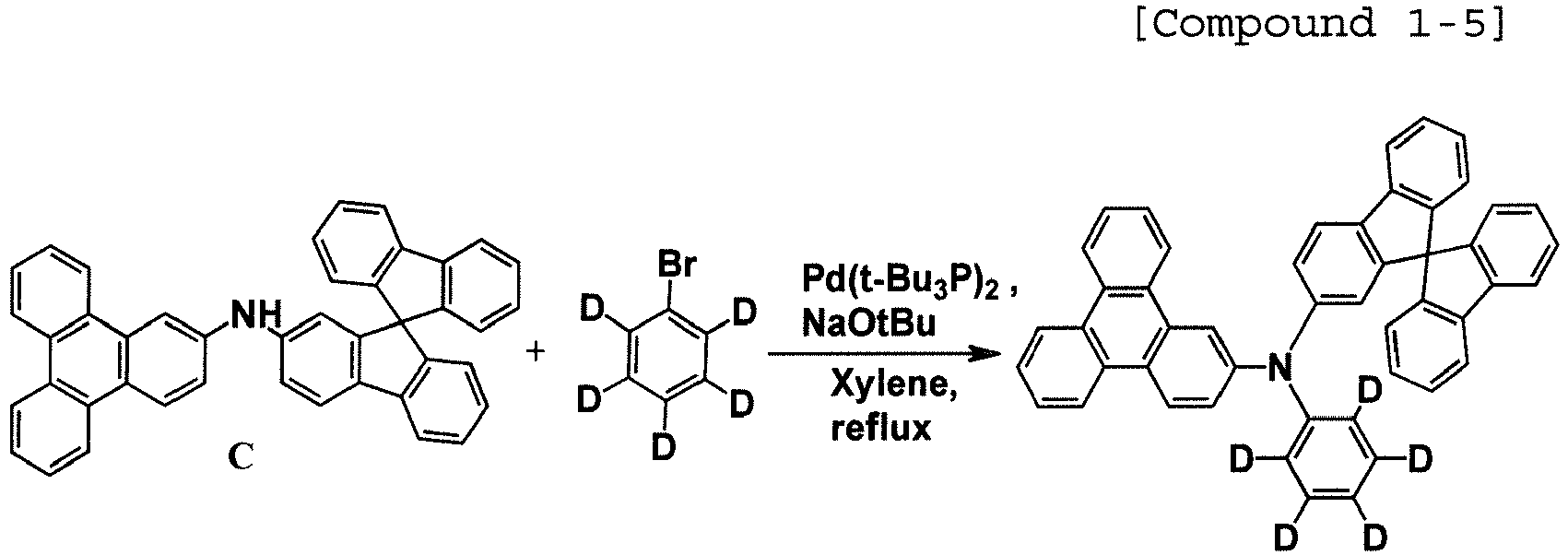
- Under a nitrogen atmosphere, Compound C (10.0 g, 17.57 mmol) and 1-bromobenzene-2,3,4,5,6-d5 (3.06 g, 19.33 mmol) were completely dissolved in 190 ml of xylene in a 500 ml-round bottom flask, and then sodium tert-butoxide (2.19 g, 22.84 mol) was added thereto, bis(tri-tert-butylphosphine) palladium(0) (0.09 g, 0.18 mmol) was put thereinto, and then the resulting mixture was heated and stirred for 5 hours. The temperature was lowered to normal temperature, the mixture was filtered to remove the base, and then xylene was concentrated under reduced pressure, and the residue was recrystallized with 230 ml of ethyl acetate to prepare Compound 1-5 (9.56 g, yield: 85%).
MS[M+H]+= 639 -

- Under a nitrogen atmosphere, Compound C (10.0 g, 17.57 mmol) and 1-bromo-3,5-dimethylbenzene (3.49 g, 19.33 mmol) were completely dissolved in 190 ml of xylene in a 500 ml-round bottom flask, and then sodium tert-butoxide (2.19 g, 22.84 mol) was added thereto, bis(tri-tert-butylphosphine) palladium(0) (0.09 g, 0.18 mmol) was put thereinto, and then the resulting mixture was heated and stirred for 2 hours. The temperature was lowered to normal temperature, the mixture was filtered to remove the base, and then xylene was concentrated under reduced pressure, and the residue was recrystallized with 260 ml of ethyl acetate to prepare Compound 1-6 (8.65 g, yield: 74%).
MS[M+H]+= 662 -

- Under a nitrogen atmosphere, Compound C (10.0 g, 17.57 mmol) and 1-bromo-4-ethylbenzene (3.49 g, 19.33 mmol) were completely dissolved in 150 ml of xylene in a 500 ml-round bottom flask, and then sodium tert-butoxide (2.19 g, 22.84 mol) was added thereto, bis(tri-tert-butylphosphine) palladium(0) (0.09 g, 0.18 mmol) was put thereinto, and then the resulting mixture was heated and stirred for 5 hours. The temperature was lowered to normal temperature, the mixture was filtered to remove the base, and then xylene was concentrated under reduced pressure, and the residue was recrystallized with 230 ml of ethyl acetate to prepare Compound 1-7 (8.14 g, yield: 73%).
MS[M+H]+= 662 -


- Under a nitrogen atmosphere, Compound C (10.0 g, 17.57 mmol) and 1-bromo-4-fluorobenzene (3.31 g, 19.33 mmol) were completely dissolved in 150 ml of xylene in a 500 ml-round bottom flask, and then sodium tert-butoxide (2.19 g, 22.84 mol) was added thereto, bis(tri-tert-butylphosphine) palladium(0) (0.09 g, 0.18 mmol) was put thereinto, and then the resulting mixture was heated and stirred for 5 hours. The temperature was lowered to normal temperature, the mixture was filtered to remove the base, and then xylene was concentrated under reduced pressure, and the residue was recrystallized with 230 ml of ethyl acetate to prepare Compound 1-8 (8.14 g, yield: 73%).
MS[M+H]+= 652 -

- Under a nitrogen atmosphere, Compound C (10.0 g, 17.57 mmol) and 4-bromobenzonitrile (3.44 g, 19.33 mmol) were completely dissolved in 160 ml of xylene in a 500 ml-round bottom flask, and then sodium tert-butoxide (2.19 g, 22.84 mol) was added thereto, bis(tri-tert-butylphosphine) palladium(0) (0.09 g, 0.18 mmol) was put thereinto, and then the resulting mixture was heated and stirred for 6 hours. The temperature was lowered to normal temperature, the mixture was filtered to remove the base, and then xylene was concentrated under reduced pressure, and the residue was recrystallized with 210 ml of ethyl acetate to prepare Compound 1-9 (8.14 g, yield: 73%).
MS[M+H]+= 659 -


- Compounds 1-10 to 1-18 were prepared in the same manner as in the methods of preparing Compounds 1-1 to 1-9, except that a material which is Compound D was used instead of Compound C as a starting material in Preparation Examples 1 to 9.
-


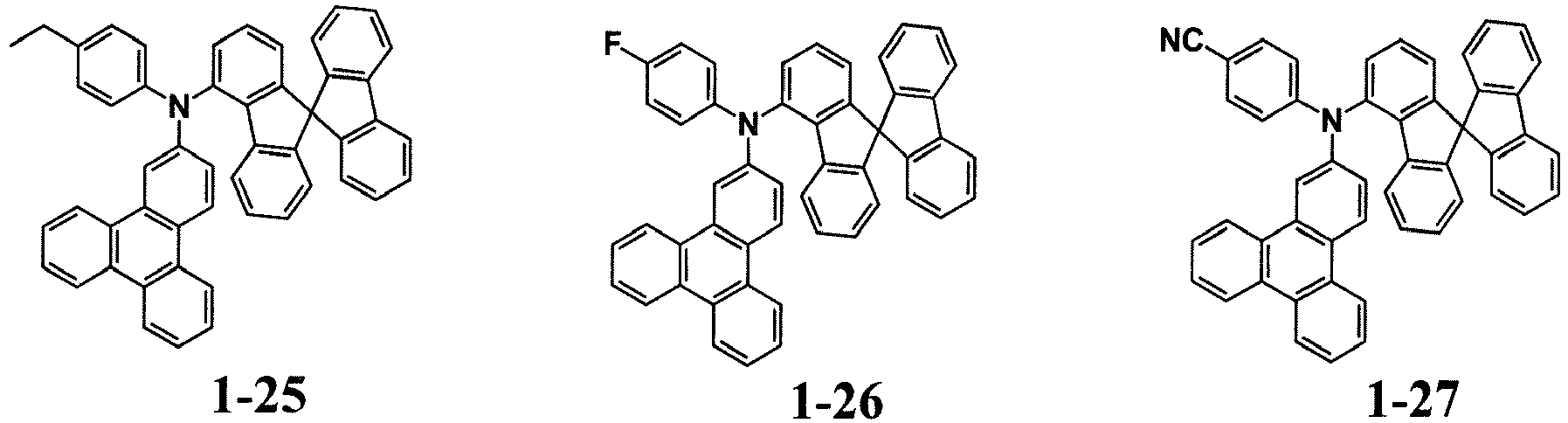
- Compounds 1-19 to 1-27 were prepared in the same manner as in the methods of preparing Compounds 1-1 to 1-9, except that a material which is Compound E was used instead of Compound C as a starting material in Preparation Examples 1 to 9.
-


- Compounds 1-28 to 1-36 were prepared in the same manner as in the methods of preparing Compounds 1-1 to 1-9, except that a material which is Compound B was used instead of Compound C as a starting material in Preparation Examples 1 to 9.
-

- Under a nitrogen atmosphere, Compound A (10.0 g, 31.35 mmol) and 2-(4-bromophenyl)-9,9'-spirobi[fluorene] (16.21 g, 34.48 mmol) were completely dissolved in 220 ml of xylene in a 500 ml-round bottom flask, and then sodium tert-butoxide (3.92 g, 40.76 mol) was added thereto, bis(tri-tert-butylphosphine) palladium(0) (0.15 g, 0.31 mmol) was put thereinto, and then the resulting mixture was heated and stirred for 4 hours. The temperature was lowered to normal temperature, the mixture was filtered to remove the base, and then xylene was concentrated under reduced pressure, and the residue was recrystallized with 310 ml of ethyl acetate to prepare Compound 1-37 (18.54 g, yield: 83%).
MS[M+H]+= 710 -


- Compound 1-38 was prepared in the same manner as in the method of preparing Compound 1-37, except that a material which is Compound B was used instead of Compound A as a starting material in Preparation Example 13.
MS[M+H]+= 710 - A glass substrate thinly coated with indium tin oxide (ITO) to have a thickness of 1,000 Å was put into distilled water in which a detergent was dissolved, and ultrasonically washed. In this case, a product manufactured by Fischer Co., was used as the detergent, and distilled water twice filtered using a filter manufactured by Millipore Co., was used as the distilled water. After the ITO was washed for 30 minutes, ultrasonic washing was conducted twice repeatedly using distilled water for 10 minutes. After the washing using distilled water was completed, ultrasonic washing was conducted using isopropyl alcohol, acetone, and methanol solvents, and drying was conducted, and then the substrate was transferred to a plasma cleaner. In addition, the substrate was cleaned using oxygen plasma for 5 minutes, and then transferred to a vacuum evaporator.
- Hexanitrile hexaazatriphenylene (HAT) of the following Chemical Formula was thermally vacuum deposited to have a thickness of 500 Å on the transparent ITO electrode, which was thus prepared, thereby forming a hole injection layer.

- The following compound 4-4'-bis[N-(1-naphthyl)-N-phenylamino]biphenyl (NPB) (300 Å), which is a material for transporting holes, was vacuum deposited on the hole injection layer, thereby forming a hole transport layer.

- Subsequently, the following Compound 1-1 was vacuum deposited to have a film thickness of 100 Å on the hole transport layer, thereby forming an electron blocking layer.

- Subsequently, the following BH and BD were vacuum deposited at a weight ratio of 25:1 to have a film thickness of 300 Å on the electron blocking layer, thereby forming a light emitting layer.


- Compound ET1 and Compound LiQ (lithium quinolate) were vacuum deposited at a weight ratio of 1:1 on the light emitting layer, thereby forming an electron injection and transport layer having a thickness of 300 Å. Lithium fluoride (LiF) and aluminum were sequentially deposited to have a thickness of 12 Å and 2,000 Å, respectively, on the electron injection and transport layer, thereby forming a negative electrode.
- In the aforementioned procedure, the deposition rate of the organic material was maintained at 0.4 to 0.7 Å/sec, the deposition rates of lithium fluoride and aluminum of the negative electrode were maintained at 0.3 Å/sec and at 2 Å/sec, respectively, and the degree of vacuum during the deposition was maintained at 2 × 10⁻⁷ to 5 × 10⁻⁶ torr, thereby manufacturing an organic light emitting device.
- An organic light emitting device was manufactured in the same manner as in Experimental Example 1-1, except that Compound 1-2 was used instead of Compound 1-1 in Experimental Example 1-1.
- An organic light emitting device was manufactured in the same manner as in Experimental Example 1-1, except that Compound 1-3 was used instead of Compound 1-1 in Experimental Example 1-1.
- An organic light emitting device was manufactured in the same manner as in Experimental Example 1-1, except that Compound 1-4 was used instead of Compound 1-1 in Experimental Example 1-1.
- An organic light emitting device was manufactured in the same manner as in Experimental Example 1-1, except that Compound 1-5 was used instead of Compound 1-1 in Experimental Example 1-1.
- An organic light emitting device was manufactured in the same manner as in Experimental Example 1-1, except that Compound 1-6 was used instead of Compound 1-1 in Experimental Example 1-1.
- An organic light emitting device was manufactured in the same manner as in Experimental Example 1-1, except that Compound 1-7 was used instead of Compound 1-1 in Experimental Example 1-1.
- An organic light emitting device was manufactured in the same manner as in Experimental Example 1-1, except that Compound 1-10 was used instead of Compound 1-1 in Experimental Example 1-1.
- An organic light emitting device was manufactured in the same manner as in Experimental Example 1-1, except that Compound 1-19 was used instead of Compound 1-1 in Experimental Example 1-1.
- An organic light emitting device was manufactured in the same manner as in Experimental Example 1-1, except that Compound 1-28 was used instead of Compound 1-1 in Experimental Example 1-1.
- An organic light emitting device was manufactured in the same manner as in Experimental Example 1-1, except that Compound 1-37 was used instead of Compound 1-1 in Experimental Example 1-1.
- An organic light emitting device was manufactured in the same manner as in Experimental Example 1-1, except that Compound 1-38 was used instead of Compound 1-1 in Experimental Example 1-1.
- An organic light emitting device was manufactured in the same manner as in Experimental Example 1-1, except that
EB 1 was used instead of Compound 1-1 in Experimental Example 1-1.
- An organic light emitting device was manufactured in the same manner as in Experimental Example 1-1, except that the following
EB 2 was used instead ofCompound 1 in Experimental Example 1-1.
- An organic light emitting device was manufactured in the same manner as in Experimental Example 1-1, except that the following
EB 3 was used instead ofCompound 1 in Experimental Example 1-1.
- When current was applied to the organic light emitting devices manufactured in Experimental Examples 1-1 to 1-12 and Comparative Examples 1-1 to 1-3, the results of Table 1 were obtained.
[Table 1] Compound (Electron blocking layer) Voltage (V@10mA/cm2) Efficiency (cd/A@10mA/cm2) Color coordinate (x, y) Experimental Example 1-1 Compound 1-1 3.35 6.02 (0.139, 0.125) Experimental Example 1-2 Compound 1-2 3.52 5.45 (0.138, 0.126) Experimental Example 1-3 Compound 1-3 3.57 5.76 (0.138, 0.127) Experimental Example 1-4 Compound 1-4 3.68 5.70 (0.137, 0.125) Experimental Example 1-5 Compound 1-5 3.69 5.68 (0.136, 0.125) Experimental Example 1-6 Compound 1-6 3.64 5.72 (0.136, 0.127) Experimental Example 1-7 Compound 1-7 3.63 5.70 (0.136, 0.125) Experimental Example 1-8 Compound 1-10 3.41 5.88 (0.137, 0.125) Experimental Example 1-9 Compound 1-19 3.40 5.89 (0.138, 0.125) Experimental Example 1-10 Compound 1-28 3.38 5.98 (0.136, 0.125) Experimental Example 1-11 Compound 1-37 3.43 5.91 (0.137, 0.125) Experimental Example 1-12 Compound 1-38 3.42 5.91 (0.136, 0.125) Comparative Example 1-1 EB 1 4.46 4.72 (0.138, 0.127) Comparative Example 1-2 EB 2 4.35 4.88 (0.139, 0.125) Comparative Example 1-3 EB 3 4.52 4.68 (0.139, 0.125) - As shown in Table 1, it can be seen that the compounds of Experimental Examples 1-1 to 1-12 were used as the electron blocking layer in the organic light emitting device, and exhibit lower voltage and higher efficiency characteristics than the organic light emitting devices of Comparative Example 1-1 in which the compound of the present invention was substituted with an alkyl group instead of spirobifluorene, Comparative Example 1-2 in which the compound of the present invention was substituted with an aryl group instead of spirobifluorene, and Comparative Example 1-3 in which two arylamine groups were substituted.
- It could be confirmed that the compound derivatives of the Chemical Formulae according to the present invention have an excellent electron suppressing capability, and thus exhibit low voltage and high efficiency characteristics, and may be applied to the electron blocking layer of the organic light emitting device.
- An experiment was performed in the same manner as in Experimental Example 1, except that TCTA was used as the electron blocking layer, and the compounds in Experimental Examples 1-1 to 1-12 were used instead of NPB as the hole transport layer.
- An experiment was performed in the same manner as in Experimental Example 2, except that TCTA was used as the electron blocking layer, and
HT 1 was used as the hole transport layer.
- An experiment was performed in the same manner as in Experimental Example 2, except that TCTA was used as the electron blocking layer, and
HT 2 was used as the hole transport layer.
- An experiment was performed in the same manner as in Experimental Example 2, except that TCTA was used as the electron blocking layer, and
HT 3 was used as the hole transport layer.
- When current was applied to the organic light emitting devices manufactured in Experimental Examples 2-1 to 2-12 and Comparative Examples 2-1 to 2-3, the results of Table 2 were obtained.
[Table 2] Compound (Hole transport layer) Voltage (V@10mA/cm2) Efficiency (cd/A@10mA/cm2) Color coordinate (x, y) Experimental Example 2-1 Compound 1-1 3.75 5.95 (0.139, 0.126) Experimental Example 2-2 Compound 1-2 3.72 5.98 (0.138, 0.126) Experimental Example 2-3 Compound 1-3 3.87 5.85 (0.138, 0.127) Experimental Example 2-4 Compound 1-4 3.88 5.84 (0.137, 0.125) Experimental Example 2-5 Compound 1-5 3.89 5.82 (0.136, 0.125) Experimental Example 2-6 Compound 1-6 3.84 5.83 (0.136, 0.127) Experimental Example 2-7 Compound 1-7 3.83 5.80 (0.136, 0.125) Experimental Example 2-8 Compound 1-10 3.84 5.81 (0.137, 0.125) Experimental Example 2-9 Compound 1-19 3.93 5.71 (0.138, 0.125) Experimental Example 2-10 Compound 1-28 3.98 5.72 (0.136, 0.125) Experimental Example 2-11 Compound 1-37 3.93 5.75 (0.137, 0.125) Experimental Example 2-12 Compound 1-38 3.95 5.75 (0.136, 0.125) Comparative Example 2-1 HT 1 4.55 4.83 (0.138, 0.127) Comparative Example 2-2 HT 2 4.63 4.75 (0.139, 0.125) Comparative Example 2-3 HT 3 4.44 4.94 (0.139, 0.126) - As shown in Table 2, it can be seen that the compounds of Experimental Examples 2-1 to 2-12 were used as the hole transport layer in the organic light emitting device, and exhibit lower voltage and higher efficiency characteristics than the organic light emitting devices of Comparative Example 2-1 in which the compound of the present invention was substituted with an alkyl group instead of spirobifluorene, Comparative Example 2-2 in which the compound of the present invention was substituted with an aryl group instead of spirobifluorene, and Comparative Example 2-3 in which two arylamine groups were substituted.
- It could be confirmed that the compound derivatives of the Chemical Formulae according to the present invention also have an excellent hole transporting capability, and thus exhibit low voltage and high efficiency characteristics, and may be applied to the hole transport layer of the organic light emitting device.
- Although the preferred exemplary embodiments (an electron blocking layer and a hole transport layer) of the present invention have been described above, the present invention is not limited thereto, and various modifications can be made and carried out within the scope of the claims and the detailed description of the invention, and also fall within the scope of the invention.
-
- 1:
- Substrate
- 2:
- Positive electrode
- 3:
- Light emitting layer
- 4:
- Negative electrode
- 5:
- Hole injection layer
- 6:
- Hole transport layer
- 7:
- Light emitting layer
- 8:
- Electron transport layer
Claims (20)
- A compound represented by the following Chemical Formula 1:
 L1 to L2 are the same as or different from each other, and are each independently a direct bond; or a substituted or unsubstituted arylene,R1 to R3 are the same as or different from each other, and are each independently hydrogen; deuterium; a halogen group; a nitrile group; a nitro group; a hydroxy group; a carbonyl group; an ester group; an imide group; an amino group; a substituted or unsubstituted silyl group; a substituted or unsubstituted boron group; a substituted or unsubstituted alkyl group; a substituted or unsubstituted cycloalkyl group; a substituted or unsubstituted alkoxy group; a substituted or unsubstituted aryloxy group; a substituted or unsubstituted alkylthioxy group; a substituted or unsubstituted arylthioxy group; a substituted or unsubstituted alkylsulfoxy group; a substituted or unsubstituted arylsulfoxy group; a substituted or unsubstituted alkenyl group; a substituted or unsubstituted aralkyl group; a substituted or unsubstituted aralkenyl group; a substituted or unsubstituted alkylaryl group; a substituted or unsubstituted alkylamine group; a substituted or unsubstituted aralkylamine group; a substituted or unsubstituted heteroarylamine group; a substituted or unsubstituted arylamine group; a substituted or unsubstituted arylheteroarylamine group; a substituted or unsubstituted arylphosphine group; a substituted or unsubstituted phosphine oxide group; or a substituted or unsubstituted heterocyclic group, or combine with an adjacent group to form a substituted or unsubstituted ring,R4 and R5 are the same as or different from each other, and are each independently hydrogen; deuterium; a halogen group; a nitrile group; a nitro group; a hydroxy group; a carbonyl group; an ester group; an imide group; an amino group; a substituted or unsubstituted silyl group; a substituted or unsubstituted boron group; a substituted or unsubstituted alkyl group; a substituted or unsubstituted cycloalkyl group; a substituted or unsubstituted alkoxy group; a substituted or unsubstituted aryloxy group; a substituted or unsubstituted alkylthioxy group; a substituted or unsubstituted arylthioxy group; a substituted or unsubstituted alkylsulfoxy group; a substituted or unsubstituted arylsulfoxy group; a substituted or unsubstituted alkenyl group; a substituted or unsubstituted aralkyl group; a substituted or unsubstituted aralkenyl group; a substituted or unsubstituted alkylaryl group; a substituted or unsubstituted alkylamine group; a substituted or unsubstituted aralkylamine group; a substituted or unsubstituted arylphosphine group; a substituted or unsubstituted phosphine oxide group; a substituted or unsubstituted aryl group; or a substituted or unsubstituted heterocyclic group, or combine with an adjacent group to form a substituted or unsubstituted ring,R6's are the same as or different from each other, and are each independently hydrogen; deuterium; a halogen group; a nitrile group; a nitro group; a hydroxy group; a carbonyl group; an ester group; an imide group; an amino group; a substituted or unsubstituted silyl group; a substituted or unsubstituted boron group; a substituted or unsubstituted alkyl group; a substituted or unsubstituted cycloalkyl group; a substituted or unsubstituted alkoxy group; a substituted or unsubstituted aryloxy group; a substituted or unsubstituted alkylthioxy group; a substituted or unsubstituted arylthioxy group; a substituted or unsubstituted alkylsulfoxy group; a substituted or unsubstituted arylsulfoxy group; a substituted or unsubstituted alkenyl group; a substituted or unsubstituted aralkyl group; a substituted or unsubstituted aralkenyl group; a substituted or unsubstituted alkylaryl group; a substituted or unsubstituted alkylamine group; a substituted or unsubstituted aralkylamine group; a substituted or unsubstituted heteroarylamine group; a substituted or unsubstituted arylamine group; a substituted or unsubstituted arylheteroarylamine group; a substituted or unsubstituted arylphosphine group; a substituted or unsubstituted phosphine oxide group; a substituted or unsubstituted aryl group; or a substituted or unsubstituted heterocyclic group, or combine with an adjacent group to form a substituted or unsubstituted ring,a and b are the same as or different from each other, and are each independently an integer of 0 to 4,c is an integer of 0 to 3,d is an integer of 0 to 7,e is an integer of 0 to 8,f is an integer of 0 to 5,p and q are the same as or different from each other, and are each independently an integer of 0 to 10, andwhen a, b, c, d, e, f, p, and q are each 2 or more, structures in the parenthesis are the same as or different from each other.
 - The compound of claim 1, wherein Chemical Formula 1 is represented by the following Chemical Formula 2 or 3:


definitions of L1, L2, R1 to R6, p, q, a, b, c, d, e, and f are the same as those in Chemical Formula 1. - The compound of claim 1, wherein Chemical Formula 1 is represented by any one of the following Chemical Formulae 4 to 6:




definitions of L1, L2, R1 to R6, p, q, a, b, c, d, e, and f are the same as those in Chemical Formula 1. - The compound of claim 1, wherein Chemical Formula 1 is represented by any one of the following Chemical Formulae 7 to 9:


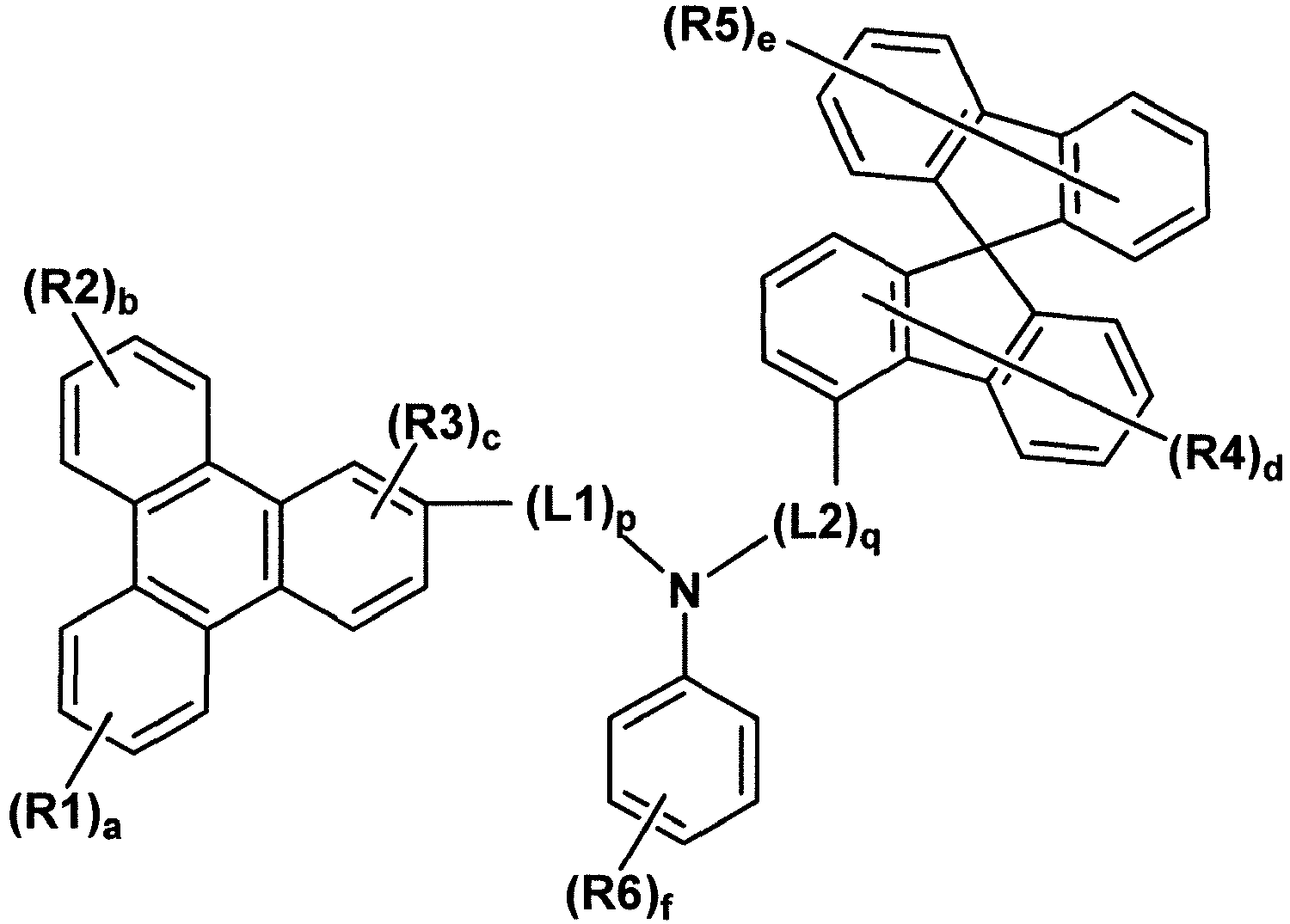
definitions of L1, L2, R1 to R6, p, q, a, b, c, d, e, and f are the same as those in Chemical Formula 1. - The compound of claim 1, wherein Chemical Formula 1 is represented by any one of the following Chemical Formulae 10 to 12:


definitions of L1, L2, R1 to R6, p, q, a, b, c, d, e, and f are the same as those in Chemical Formula 1. - The compound of claim 1, wherein L1 and L2 are a direct bond, or any one selected from the following structures:


A1 and A2 are the same as or different from each other, and are each independently hydrogen; deuterium; a halogen group; a nitrile group; an alkyl group having 1 to 5 carbon atoms; an aryl group having 6 to 30 carbon atoms; or a heterocyclic group having 2 to 20 carbon atoms, and the structures are optionally unsubstituted or substituted with one or more substituents selected from a group consisting of deuterium; a halogen group; a nitrile group; a nitro group; a hydroxy group; a carbonyl group; an ester group; an imide group; an amine group; a phosphine oxide group, an alkoxy group; an aryloxy group; an alkylthioxy group; an arylthioxy group; an alkylsulfoxy group; an arylsulfoxy group; a silyl group; a boron group; an alkyl group; a cycloalkyl group; an alkenyl group; an aryl group; an aralkyl group; an aralkenyl group; an alkylaryl group; an alkylamine group; an aralkylamine group; a heteroarylamine group; an arylamine group; an arylheteroarylamine group; an arylphosphine group; and a heterocyclic group. - The compound of claim 1, wherein L1 and L2 are the same as or different from each other, and are each independently a direct bond; or phenylene.
- The compound of claim 1, wherein R6 is hydrogen; deuterium; a halogen group; a nitrile group; an alkyl group having 1 to 5 carbon atoms; or a silyl group substituted with an alkyl group having 1 to 5 carbon atoms.
- The compound of claim 1, wherein R1 to R5 are hydrogen.
- The compound of claim 1, wherein the


B1 to B3 are the same as or different from each other, and are each independently hydrogen; deuterium; a halogen group; a nitrile group; an alkyl group; or a silyl group substituted with an alkyl group. - The compound of claim 1, wherein the compound of Chemical Formula 1 is any one selected from the following compounds:


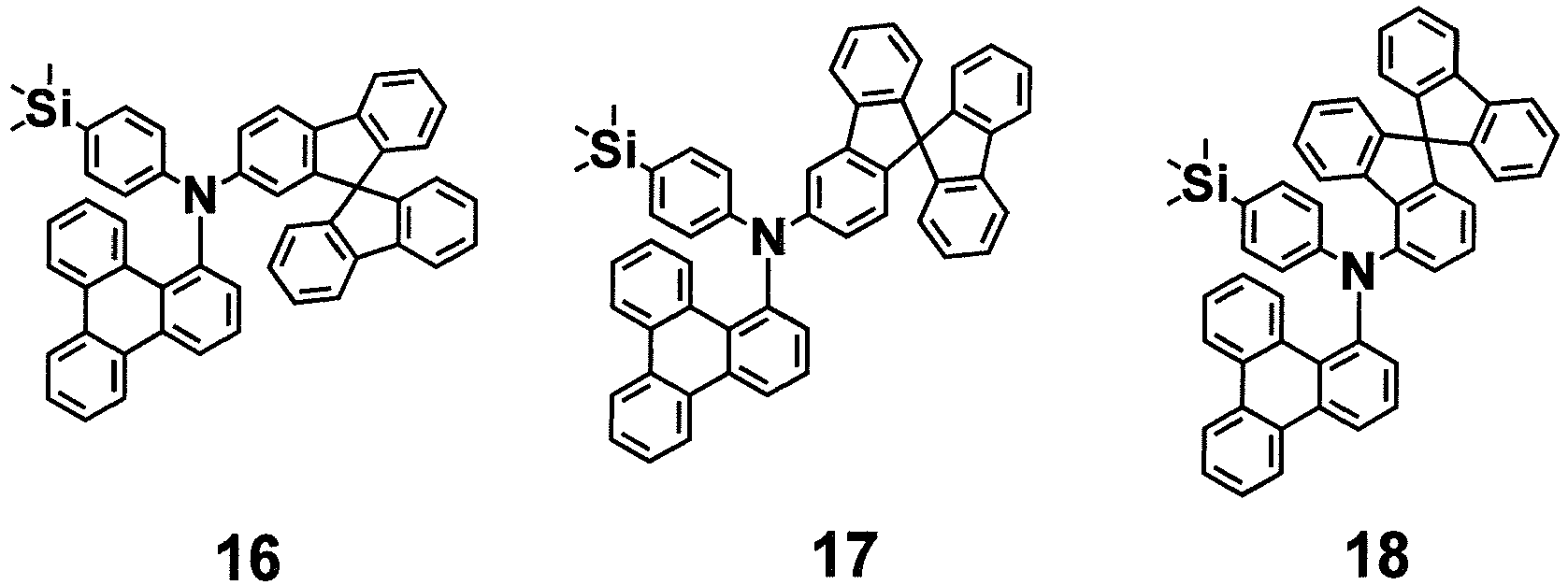


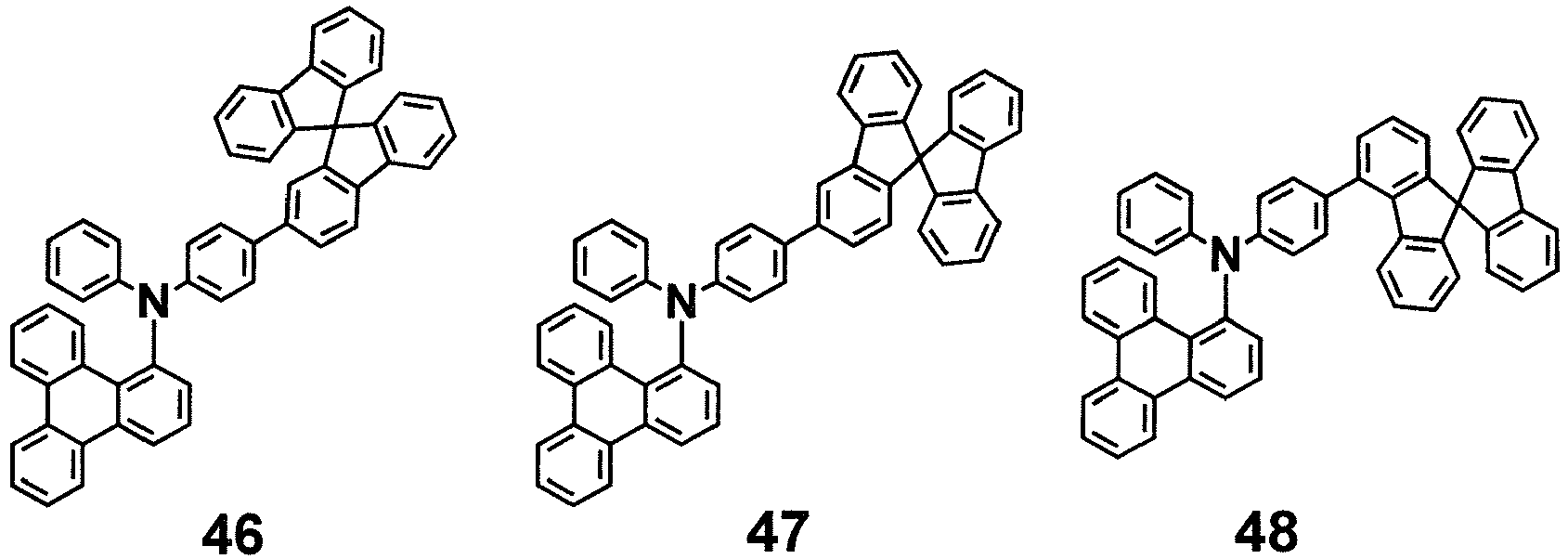

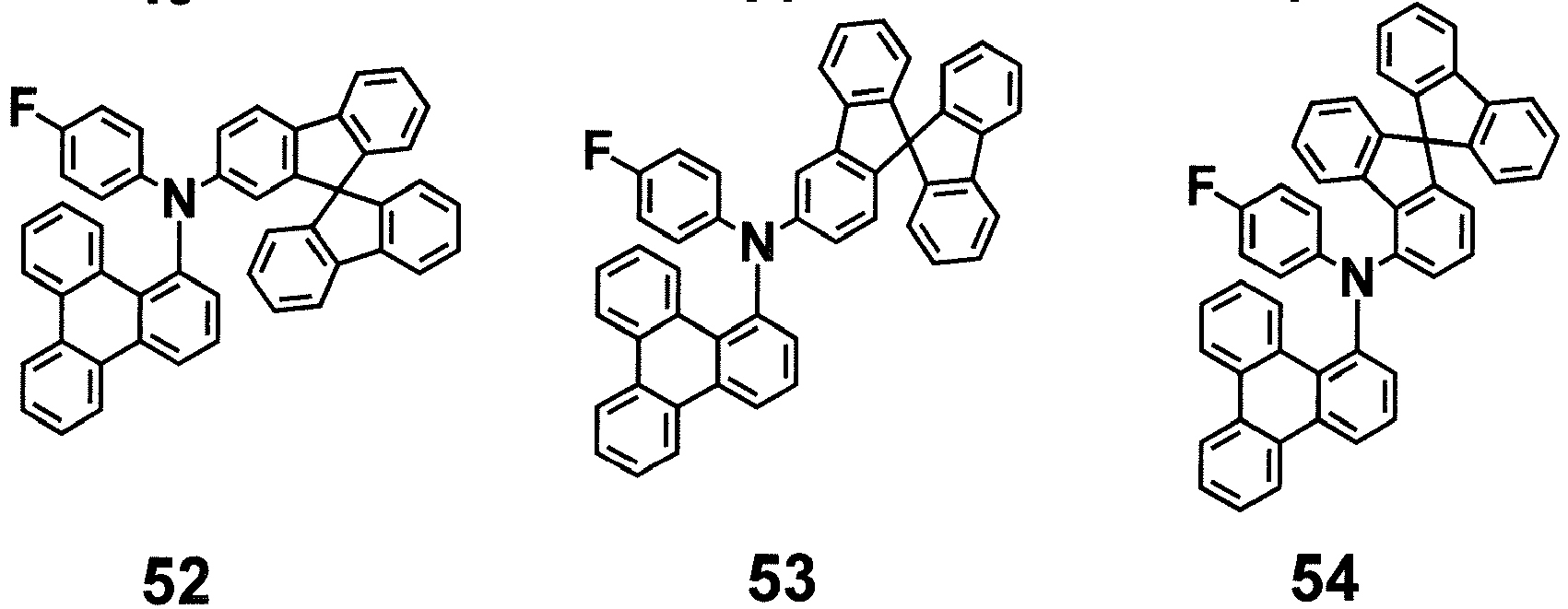

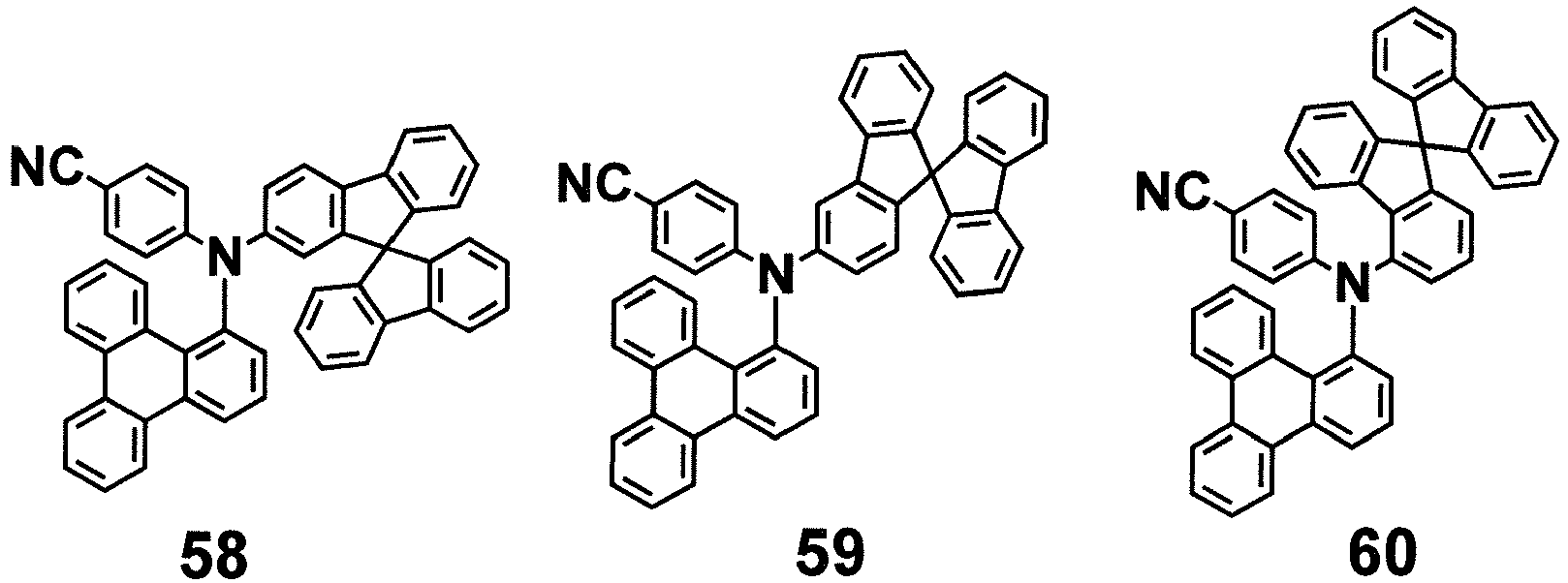
- An organic light emitting device comprising:a first electrode;a second electrode provided to face the first electrode; andone or more organic material layers provided between the first electrode and the second electrode,wherein one or more layers of the organic material layers comprise the compound of any one of claims 1 to 11.
- The organic light emitting device of claim 12,
wherein the organic material layer comprising the compound is a hole injection layer; a hole transport layer; an electron blocking layer; or a layer which simultaneously injects and transports holes. - The organic light emitting device of claim 12,
wherein the organic material layer comprising the compound is an electron injection layer; an electron transport layer; or a layer which simultaneously injects and transports electrons. - The organic light emitting device of claim 12,
wherein the organic material layer comprising the compound is a light emitting layer. - The organic light emitting device of claim 12,
wherein the organic material layer comprises a light emitting layer, and the light emitting layer comprises a compound represented by the following Chemical Formula 1-A: n1 is an integer of 1 or more,Ar7 is a substituted or unsubstituted monovalent or more benzofluorene group; a substituted or unsubstituted monovalent or more fluoranthene group; a substituted or unsubstituted monovalent or more pyrene group; or a substituted or unsubstituted monovalent or more chrysene group,L4 is a direct bond; a substituted or unsubstituted arylene group; or a substituted or unsubstituted heteroarylene group,Ar8 and Ar9 are the same as or different from each other, and are each independently a substituted or unsubstituted aryl group; a substituted or unsubstituted silyl group; a substituted or unsubstituted germanium group; a substituted or unsubstituted alkyl group; a substituted or unsubstituted arylalkyl group; or a substituted or unsubstituted heteroaryl group, or optionally combine with each other to form a substituted or unsubstituted ring, andwhen n1 is 2 or more, two or more structures in the parenthesis are the same as or different from each other.
 - The organic light emitting device of claim 16,
wherein L4 is a direct bond, Ar7 is a divalent pyrene group, Ar8 and Ar9 are the same as or different from each other, and are each independently an aryl group which is unsubstituted or substituted with a germanium group substituted with an alkyl group, and n1 is 2. - The organic light emitting device of claim 12,
wherein the organic material layer comprises a light emitting layer, and the light emitting layer comprises a compound represented by the following Chemical Formula 2-A: G11 is a 1-naphthyl group, a 2-naphthyl group, a 1-anthryl group, a 2-anthryl group, a 1-phenanthryl group, a 2-phenanthryl group, a 3-phenanthryl group, a 4-phenanthryl group, a 9-phenanthryl group, a 1-naphthacenyl group, a 2-naphthacenyl group, a 9-naphthacenyl group, a 1-pyrenyl group, a 2-pyrenyl group, a 4-pyrenyl group, a 3-methyl-2-naphthyl group, a 4-methyl-1-naphthyl group, or the following Chemical Formula
 G12 is a phenyl group, a 1-naphtyl group, a 2-naphtyl group, a 1-anthryl group, a 2-anthryl group, a 9-anthryl group, a 1-phenanthryl group, a 2-phenanthryl group, a 3-phenanthryl group, a 4-phenanthryl group, a 9-phenanthryl group, a 1-naphthacenyl group, a 2-naphthacenyl group, a 9-naphthacenyl group, a 1-pyrenyl group, a 2-pyrenyl group, a 4-pyrenyl group, a 2-biphenylyl group, a 3-biphenylyl group, a 4-biphenylyl group, a p-terphenyl-4-yl group, a p-terphenyl-3-yl group, a p-terphenyl-2-yl group, an m-terphenyl-4-yl group, an m-terphenyl-3-yl group, an m-terphenyl-2-yl group, an o-tolyl group, an m-tolyl group, a p-tolyl group, a p-t-butylphenyl group, a p-(2-phenylpropyl)phenyl group, a 3-methyl-2-naphthyl group, a 4-methyl-1-naphthyl group, a 4-methyl-1-anthryl group, a 4'-methylbiphenylyl group, a 4"-t-butyl-p-terphenyl-4-yl group, or a 3-fluoranthenyl group,G13 and G14 are the same as or different from each other, and are each independently hydrogen; a substituted or unsubstituted alkyl group; a substituted or unsubstituted alkoxy group; a substituted or unsubstituted aryl group; or a substituted or unsubstituted heteroaryl group,g12 is an integer of 1 to 5,g13 and g14 are each an integer of 1 to 4, andwhen g12 to g14 are each 2 or more, two or more structures in the parenthesis are the same as or different from each other.
 - The organic light emitting device of claim 18, wherein G11 is a 1-naphthyl group, and G12 is a 2-naphthyl group.
- The organic light emitting device of claim 16, wherein the light emitting layer comprises a compound represented by the following Chemical Formula 2-A:

 G11 is a phenyl group, a 1-naphthyl group, a 2-naphthyl group, a 1-anthryl group, a 2-anthryl group, a 1-phenanthryl group, a 2-phenanthryl group, a 3-phenanthryl group, a 4-phenanthryl group, a 9-phenanthryl group, a 1-naphthacenyl group, a 2-naphthacenyl group, a 9-naphthacenyl group, a 1-pyrenyl group, a 2-pyrenyl group, a 4-pyrenyl group, a 3-methyl-2-naphthyl group, a 4-methyl-1-naphthyl group, or the following Chemical Formula
 G12 is a phenyl group, a 1-naphtyl group, a 2-naphtyl group, a 1-anthryl group, a 2-anthryl group, a 9-anthryl group, a 1-phenanthryl group, a 2-phenanthryl group, a 3-phenanthryl group, a 4-phenanthryl group, a 9-phenanthryl group, a 1-naphthacenyl group, a 2-naphthacenyl group, a 9-naphthacenyl group, a 1-pyrenyl group, a 2-pyrenyl group, a 4-pyrenyl group, a 2-biphenylyl group, a 3-biphenylyl group, a 4-biphenylyl group, a p-terphenyl-4-yl group, a p-terphenyl-3-yl group, a p-terphenyl-2-yl group, an m-terphenyl-4-yl group, an m-terphenyl-3-yl group, an m-terphenyl-2-yl group, an o-tolyl group, an m-tolyl group, a p-tolyl group, a p-t-butylphenyl group, a p-(2-phenylpropyl)phenyl group, a 3-methyl-2-naphthyl group, a 4-methyl-1-naphthyl group, a 4-methyl-1-anthryl group, a 4'-methylbiphenylyl group, a 4"-t-butyl-p-terphenyl-4-yl group, or a 3-fluoranthenyl group,G13 and G14 are the same as or different from each other, and are each independently hydrogen; a substituted or unsubstituted alkyl group; a substituted or unsubstituted alkoxy group; a substituted or unsubstituted aryl group; or a substituted or unsubstituted heteroaryl group,g12 is an integer of 1 to 5,g13 and g14 are each an integer of 1 to 4, and when g12 to g14 are each 2 or more, two or more structures in the parenthesis are the same as or different from each other.
Applications Claiming Priority (2)
| Application Number | Priority Date | Filing Date | Title |
|---|---|---|---|
| KR20150125525 | 2015-09-04 | ||
| PCT/KR2016/009852 WO2017039388A1 (en) | 2015-09-04 | 2016-09-02 | Amine-based compound and organic light emitting device comprising same |
Publications (3)
| Publication Number | Publication Date |
|---|---|
| EP3330249A1 true EP3330249A1 (en) | 2018-06-06 |
| EP3330249A4 EP3330249A4 (en) | 2018-08-01 |
| EP3330249B1 EP3330249B1 (en) | 2021-01-06 |
Family
ID=58188989
Family Applications (1)
| Application Number | Title | Priority Date | Filing Date |
|---|---|---|---|
| EP16842354.9A Active EP3330249B1 (en) | 2015-09-04 | 2016-09-02 | Amine-based compound and organic light emitting device comprising same |
Country Status (7)
| Country | Link |
|---|---|
| US (1) | US10991886B2 (en) |
| EP (1) | EP3330249B1 (en) |
| JP (1) | JP6699873B2 (en) |
| KR (1) | KR101992348B1 (en) |
| CN (1) | CN107922310B (en) |
| TW (1) | TWI624448B (en) |
| WO (1) | WO2017039388A1 (en) |
Families Citing this family (6)
| Publication number | Priority date | Publication date | Assignee | Title |
|---|---|---|---|---|
| KR102010893B1 (en) | 2016-09-23 | 2019-08-14 | 주식회사 엘지화학 | Amine-based compound and organic light emitting device comprising the same |
| KR102064645B1 (en) * | 2017-06-08 | 2020-01-09 | 주식회사 엘지화학 | Organic light emitting device |
| KR102477844B1 (en) * | 2019-11-29 | 2022-12-15 | 주식회사 엘지화학 | Organic light emitting device |
| KR102870175B1 (en) * | 2020-11-19 | 2025-10-13 | 주식회사 엘지화학 | Compound and organic light emitting device comprising same |
| CN114957188B (en) * | 2021-02-26 | 2025-04-29 | 阜阳欣奕华新材料科技股份有限公司 | Compounds and organic electroluminescent devices and intermediate compounds |
| KR20240004351A (en) | 2021-04-28 | 2024-01-11 | 이데미쓰 고산 가부시키가이샤 | Compounds, materials for organic electroluminescent devices, organic electroluminescent devices and electronic devices |
Family Cites Families (11)
| Publication number | Priority date | Publication date | Assignee | Title |
|---|---|---|---|---|
| KR100430549B1 (en) | 1999-01-27 | 2004-05-10 | 주식회사 엘지화학 | New organomattalic complex molecule for the fabrication of organic light emitting diodes |
| KR100877876B1 (en) * | 2006-03-23 | 2009-01-13 | 주식회사 엘지화학 | Novel diamine derivative, preparation method thereof and organic electronic device using same |
| KR20100041043A (en) | 2008-10-13 | 2010-04-22 | 다우어드밴스드디스플레이머티리얼 유한회사 | Novel organic electroluminescent compounds and organic electroluminescent device using the same |
| KR101217979B1 (en) * | 2009-04-24 | 2013-01-02 | 이데미쓰 고산 가부시키가이샤 | Organic electroluminescent element comprising aromatic amine derivative |
| KR101917114B1 (en) * | 2012-05-09 | 2019-01-25 | 덕산네오룩스 주식회사 | Compound for organic electronic element, organic electronic element using the same, and a electronic device thereof |
| JP6140009B2 (en) | 2013-07-01 | 2017-05-31 | 株式会社ニューギン | Game machine |
| KR20150010016A (en) * | 2013-07-17 | 2015-01-28 | 롬엔드하스전자재료코리아유한회사 | Organic electroluminescent device |
| KR102157998B1 (en) | 2013-07-25 | 2020-09-22 | 롬엔드하스전자재료코리아유한회사 | An organic electroluminescent compound and an organic electroluminescent device comprising the same |
| KR102357467B1 (en) * | 2014-07-22 | 2022-02-04 | 롬엔드하스전자재료코리아유한회사 | Organic Electroluminescence Device |
| CN104557440A (en) | 2015-02-05 | 2015-04-29 | 江西冠能光电材料有限公司 | Substituted benzophenanthrene derivative organic light emitting diode material |
| JP6454226B2 (en) | 2015-06-08 | 2019-01-16 | 出光興産株式会社 | COMPOUND, MATERIAL FOR ORGANIC ELECTROLUMINESCENT ELEMENT, ORGANIC ELECTROLUMINESCENT ELEMENT, AND ELECTRONIC DEVICE |
-
2016
- 2016-09-02 KR KR1020160113367A patent/KR101992348B1/en active Active
- 2016-09-02 US US15/757,470 patent/US10991886B2/en active Active
- 2016-09-02 CN CN201680050760.0A patent/CN107922310B/en active Active
- 2016-09-02 EP EP16842354.9A patent/EP3330249B1/en active Active
- 2016-09-02 JP JP2018511190A patent/JP6699873B2/en active Active
- 2016-09-02 TW TW105128451A patent/TWI624448B/en active
- 2016-09-02 WO PCT/KR2016/009852 patent/WO2017039388A1/en not_active Ceased
Also Published As
| Publication number | Publication date |
|---|---|
| JP2018531903A (en) | 2018-11-01 |
| JP6699873B2 (en) | 2020-05-27 |
| WO2017039388A1 (en) | 2017-03-09 |
| US10991886B2 (en) | 2021-04-27 |
| KR20170028859A (en) | 2017-03-14 |
| TWI624448B (en) | 2018-05-21 |
| CN107922310B (en) | 2020-10-02 |
| KR101992348B1 (en) | 2019-06-24 |
| US20180248119A1 (en) | 2018-08-30 |
| TW201718464A (en) | 2017-06-01 |
| CN107922310A (en) | 2018-04-17 |
| EP3330249A4 (en) | 2018-08-01 |
| EP3330249B1 (en) | 2021-01-06 |
Similar Documents
| Publication | Publication Date | Title |
|---|---|---|
| EP3357912B1 (en) | Use of spiro compound and organic light emitting element comprising same | |
| KR101888249B1 (en) | Compound and organic electronic device comprising the same | |
| EP3378864B1 (en) | Spiro compound and organic light-emitting element comprising same | |
| EP3378853B1 (en) | Heterocyclic compound and organic light-emitting element comprising same | |
| EP3388438B1 (en) | Spiro-structured compound and organic electronic device comprising same | |
| EP3339293B1 (en) | Compound and organic electronic device comprising same | |
| EP3336077B1 (en) | Amine-based compound and organic light-emitting element comprising same | |
| EP3378865B1 (en) | Spiro compound and organic light-emitting element comprising same | |
| KR102020529B1 (en) | Compound and organic electronic device comprising the same | |
| EP3345891B1 (en) | Amine compound and organic light-emitting device comprising same | |
| EP3330249B1 (en) | Amine-based compound and organic light emitting device comprising same | |
| EP3321246B1 (en) | Double spiro compound and organic light-emitting element comprising same | |
| EP3351531A1 (en) | Heterocyclic compound and organic light emitting device comprising same | |
| KR101898334B1 (en) | Compound and organic electronic device comprising the same |
Legal Events
| Date | Code | Title | Description |
|---|---|---|---|
| STAA | Information on the status of an ep patent application or granted ep patent |
Free format text: STATUS: THE INTERNATIONAL PUBLICATION HAS BEEN MADE |
|
| PUAI | Public reference made under article 153(3) epc to a published international application that has entered the european phase |
Free format text: ORIGINAL CODE: 0009012 |
|
| STAA | Information on the status of an ep patent application or granted ep patent |
Free format text: STATUS: REQUEST FOR EXAMINATION WAS MADE |
|
| 17P | Request for examination filed |
Effective date: 20180228 |
|
| AK | Designated contracting states |
Kind code of ref document: A1 Designated state(s): AL AT BE BG CH CY CZ DE DK EE ES FI FR GB GR HR HU IE IS IT LI LT LU LV MC MK MT NL NO PL PT RO RS SE SI SK SM TR |
|
| AX | Request for extension of the european patent |
Extension state: BA ME |
|
| A4 | Supplementary search report drawn up and despatched |
Effective date: 20180703 |
|
| RIC1 | Information provided on ipc code assigned before grant |
Ipc: C07C 15/38 20060101ALI20180627BHEP Ipc: C07C 211/54 20060101AFI20180627BHEP Ipc: C09K 11/06 20060101ALI20180627BHEP Ipc: C07F 7/08 20060101ALI20180627BHEP Ipc: C07C 13/72 20060101ALI20180627BHEP Ipc: H01L 51/50 20060101ALI20180627BHEP Ipc: C07C 255/58 20060101ALI20180627BHEP Ipc: C07C 211/61 20060101ALI20180627BHEP |
|
| DAV | Request for validation of the european patent (deleted) | ||
| DAX | Request for extension of the european patent (deleted) | ||
| STAA | Information on the status of an ep patent application or granted ep patent |
Free format text: STATUS: EXAMINATION IS IN PROGRESS |
|
| 17Q | First examination report despatched |
Effective date: 20200331 |
|
| GRAP | Despatch of communication of intention to grant a patent |
Free format text: ORIGINAL CODE: EPIDOSNIGR1 |
|
| STAA | Information on the status of an ep patent application or granted ep patent |
Free format text: STATUS: GRANT OF PATENT IS INTENDED |
|
| RIC1 | Information provided on ipc code assigned before grant |
Ipc: C09K 11/06 20060101ALI20200831BHEP Ipc: H01L 51/50 20060101ALI20200831BHEP Ipc: C07C 255/58 20060101ALI20200831BHEP Ipc: C07C 13/72 20060101ALI20200831BHEP Ipc: C07F 7/08 20060101ALI20200831BHEP Ipc: C07B 59/00 20060101ALI20200831BHEP Ipc: C07C 211/54 20060101AFI20200831BHEP Ipc: C07C 15/38 20060101ALI20200831BHEP Ipc: C07C 211/61 20060101ALI20200831BHEP |
|
| INTG | Intention to grant announced |
Effective date: 20200925 |
|
| GRAS | Grant fee paid |
Free format text: ORIGINAL CODE: EPIDOSNIGR3 |
|
| GRAA | (expected) grant |
Free format text: ORIGINAL CODE: 0009210 |
|
| STAA | Information on the status of an ep patent application or granted ep patent |
Free format text: STATUS: THE PATENT HAS BEEN GRANTED |
|
| AK | Designated contracting states |
Kind code of ref document: B1 Designated state(s): AL AT BE BG CH CY CZ DE DK EE ES FI FR GB GR HR HU IE IS IT LI LT LU LV MC MK MT NL NO PL PT RO RS SE SI SK SM TR |
|
| REG | Reference to a national code |
Ref country code: GB Ref legal event code: FG4D |
|
| REG | Reference to a national code |
Ref country code: AT Ref legal event code: REF Ref document number: 1352214 Country of ref document: AT Kind code of ref document: T Effective date: 20210115 Ref country code: CH Ref legal event code: EP |
|
| REG | Reference to a national code |
Ref country code: DE Ref legal event code: R096 Ref document number: 602016051171 Country of ref document: DE |
|
| REG | Reference to a national code |
Ref country code: IE Ref legal event code: FG4D |
|
| REG | Reference to a national code |
Ref country code: NL Ref legal event code: MP Effective date: 20210106 |
|
| REG | Reference to a national code |
Ref country code: AT Ref legal event code: MK05 Ref document number: 1352214 Country of ref document: AT Kind code of ref document: T Effective date: 20210106 |
|
| REG | Reference to a national code |
Ref country code: LT Ref legal event code: MG9D |
|
| PG25 | Lapsed in a contracting state [announced via postgrant information from national office to epo] |
Ref country code: FI Free format text: LAPSE BECAUSE OF FAILURE TO SUBMIT A TRANSLATION OF THE DESCRIPTION OR TO PAY THE FEE WITHIN THE PRESCRIBED TIME-LIMIT Effective date: 20210106 Ref country code: GR Free format text: LAPSE BECAUSE OF FAILURE TO SUBMIT A TRANSLATION OF THE DESCRIPTION OR TO PAY THE FEE WITHIN THE PRESCRIBED TIME-LIMIT Effective date: 20210407 Ref country code: HR Free format text: LAPSE BECAUSE OF FAILURE TO SUBMIT A TRANSLATION OF THE DESCRIPTION OR TO PAY THE FEE WITHIN THE PRESCRIBED TIME-LIMIT Effective date: 20210106 Ref country code: PT Free format text: LAPSE BECAUSE OF FAILURE TO SUBMIT A TRANSLATION OF THE DESCRIPTION OR TO PAY THE FEE WITHIN THE PRESCRIBED TIME-LIMIT Effective date: 20210506 Ref country code: NO Free format text: LAPSE BECAUSE OF FAILURE TO SUBMIT A TRANSLATION OF THE DESCRIPTION OR TO PAY THE FEE WITHIN THE PRESCRIBED TIME-LIMIT Effective date: 20210406 Ref country code: LT Free format text: LAPSE BECAUSE OF FAILURE TO SUBMIT A TRANSLATION OF THE DESCRIPTION OR TO PAY THE FEE WITHIN THE PRESCRIBED TIME-LIMIT Effective date: 20210106 Ref country code: BG Free format text: LAPSE BECAUSE OF FAILURE TO SUBMIT A TRANSLATION OF THE DESCRIPTION OR TO PAY THE FEE WITHIN THE PRESCRIBED TIME-LIMIT Effective date: 20210406 |
|
| PG25 | Lapsed in a contracting state [announced via postgrant information from national office to epo] |
Ref country code: SE Free format text: LAPSE BECAUSE OF FAILURE TO SUBMIT A TRANSLATION OF THE DESCRIPTION OR TO PAY THE FEE WITHIN THE PRESCRIBED TIME-LIMIT Effective date: 20210106 Ref country code: AT Free format text: LAPSE BECAUSE OF FAILURE TO SUBMIT A TRANSLATION OF THE DESCRIPTION OR TO PAY THE FEE WITHIN THE PRESCRIBED TIME-LIMIT Effective date: 20210106 Ref country code: PL Free format text: LAPSE BECAUSE OF FAILURE TO SUBMIT A TRANSLATION OF THE DESCRIPTION OR TO PAY THE FEE WITHIN THE PRESCRIBED TIME-LIMIT Effective date: 20210106 Ref country code: LV Free format text: LAPSE BECAUSE OF FAILURE TO SUBMIT A TRANSLATION OF THE DESCRIPTION OR TO PAY THE FEE WITHIN THE PRESCRIBED TIME-LIMIT Effective date: 20210106 Ref country code: RS Free format text: LAPSE BECAUSE OF FAILURE TO SUBMIT A TRANSLATION OF THE DESCRIPTION OR TO PAY THE FEE WITHIN THE PRESCRIBED TIME-LIMIT Effective date: 20210106 |
|
| PG25 | Lapsed in a contracting state [announced via postgrant information from national office to epo] |
Ref country code: IS Free format text: LAPSE BECAUSE OF FAILURE TO SUBMIT A TRANSLATION OF THE DESCRIPTION OR TO PAY THE FEE WITHIN THE PRESCRIBED TIME-LIMIT Effective date: 20210506 |
|
| REG | Reference to a national code |
Ref country code: DE Ref legal event code: R097 Ref document number: 602016051171 Country of ref document: DE |
|
| PG25 | Lapsed in a contracting state [announced via postgrant information from national office to epo] |
Ref country code: CZ Free format text: LAPSE BECAUSE OF FAILURE TO SUBMIT A TRANSLATION OF THE DESCRIPTION OR TO PAY THE FEE WITHIN THE PRESCRIBED TIME-LIMIT Effective date: 20210106 Ref country code: EE Free format text: LAPSE BECAUSE OF FAILURE TO SUBMIT A TRANSLATION OF THE DESCRIPTION OR TO PAY THE FEE WITHIN THE PRESCRIBED TIME-LIMIT Effective date: 20210106 Ref country code: SM Free format text: LAPSE BECAUSE OF FAILURE TO SUBMIT A TRANSLATION OF THE DESCRIPTION OR TO PAY THE FEE WITHIN THE PRESCRIBED TIME-LIMIT Effective date: 20210106 |
|
| PLBE | No opposition filed within time limit |
Free format text: ORIGINAL CODE: 0009261 |
|
| STAA | Information on the status of an ep patent application or granted ep patent |
Free format text: STATUS: NO OPPOSITION FILED WITHIN TIME LIMIT |
|
| PG25 | Lapsed in a contracting state [announced via postgrant information from national office to epo] |
Ref country code: DK Free format text: LAPSE BECAUSE OF FAILURE TO SUBMIT A TRANSLATION OF THE DESCRIPTION OR TO PAY THE FEE WITHIN THE PRESCRIBED TIME-LIMIT Effective date: 20210106 Ref country code: RO Free format text: LAPSE BECAUSE OF FAILURE TO SUBMIT A TRANSLATION OF THE DESCRIPTION OR TO PAY THE FEE WITHIN THE PRESCRIBED TIME-LIMIT Effective date: 20210106 Ref country code: SK Free format text: LAPSE BECAUSE OF FAILURE TO SUBMIT A TRANSLATION OF THE DESCRIPTION OR TO PAY THE FEE WITHIN THE PRESCRIBED TIME-LIMIT Effective date: 20210106 |
|
| 26N | No opposition filed |
Effective date: 20211007 |
|
| PG25 | Lapsed in a contracting state [announced via postgrant information from national office to epo] |
Ref country code: AL Free format text: LAPSE BECAUSE OF FAILURE TO SUBMIT A TRANSLATION OF THE DESCRIPTION OR TO PAY THE FEE WITHIN THE PRESCRIBED TIME-LIMIT Effective date: 20210106 Ref country code: ES Free format text: LAPSE BECAUSE OF FAILURE TO SUBMIT A TRANSLATION OF THE DESCRIPTION OR TO PAY THE FEE WITHIN THE PRESCRIBED TIME-LIMIT Effective date: 20210106 |
|
| PG25 | Lapsed in a contracting state [announced via postgrant information from national office to epo] |
Ref country code: SI Free format text: LAPSE BECAUSE OF FAILURE TO SUBMIT A TRANSLATION OF THE DESCRIPTION OR TO PAY THE FEE WITHIN THE PRESCRIBED TIME-LIMIT Effective date: 20210106 |
|
| PG25 | Lapsed in a contracting state [announced via postgrant information from national office to epo] |
Ref country code: IT Free format text: LAPSE BECAUSE OF FAILURE TO SUBMIT A TRANSLATION OF THE DESCRIPTION OR TO PAY THE FEE WITHIN THE PRESCRIBED TIME-LIMIT Effective date: 20210106 |
|
| REG | Reference to a national code |
Ref country code: CH Ref legal event code: PL |
|
| REG | Reference to a national code |
Ref country code: BE Ref legal event code: MM Effective date: 20210930 |
|
| PG25 | Lapsed in a contracting state [announced via postgrant information from national office to epo] |
Ref country code: IS Free format text: LAPSE BECAUSE OF FAILURE TO SUBMIT A TRANSLATION OF THE DESCRIPTION OR TO PAY THE FEE WITHIN THE PRESCRIBED TIME-LIMIT Effective date: 20210506 Ref country code: MC Free format text: LAPSE BECAUSE OF FAILURE TO SUBMIT A TRANSLATION OF THE DESCRIPTION OR TO PAY THE FEE WITHIN THE PRESCRIBED TIME-LIMIT Effective date: 20210106 |
|
| PG25 | Lapsed in a contracting state [announced via postgrant information from national office to epo] |
Ref country code: LU Free format text: LAPSE BECAUSE OF NON-PAYMENT OF DUE FEES Effective date: 20210902 Ref country code: IE Free format text: LAPSE BECAUSE OF NON-PAYMENT OF DUE FEES Effective date: 20210902 Ref country code: BE Free format text: LAPSE BECAUSE OF NON-PAYMENT OF DUE FEES Effective date: 20210930 |
|
| PG25 | Lapsed in a contracting state [announced via postgrant information from national office to epo] |
Ref country code: LI Free format text: LAPSE BECAUSE OF NON-PAYMENT OF DUE FEES Effective date: 20210930 Ref country code: CH Free format text: LAPSE BECAUSE OF NON-PAYMENT OF DUE FEES Effective date: 20210930 |
|
| PG25 | Lapsed in a contracting state [announced via postgrant information from national office to epo] |
Ref country code: HU Free format text: LAPSE BECAUSE OF FAILURE TO SUBMIT A TRANSLATION OF THE DESCRIPTION OR TO PAY THE FEE WITHIN THE PRESCRIBED TIME-LIMIT; INVALID AB INITIO Effective date: 20160902 |
|
| PG25 | Lapsed in a contracting state [announced via postgrant information from national office to epo] |
Ref country code: NL Free format text: LAPSE BECAUSE OF NON-PAYMENT OF DUE FEES Effective date: 20210206 Ref country code: CY Free format text: LAPSE BECAUSE OF FAILURE TO SUBMIT A TRANSLATION OF THE DESCRIPTION OR TO PAY THE FEE WITHIN THE PRESCRIBED TIME-LIMIT Effective date: 20210106 |
|
| PG25 | Lapsed in a contracting state [announced via postgrant information from national office to epo] |
Ref country code: MK Free format text: LAPSE BECAUSE OF FAILURE TO SUBMIT A TRANSLATION OF THE DESCRIPTION OR TO PAY THE FEE WITHIN THE PRESCRIBED TIME-LIMIT Effective date: 20210106 |
|
| PG25 | Lapsed in a contracting state [announced via postgrant information from national office to epo] |
Ref country code: MT Free format text: LAPSE BECAUSE OF FAILURE TO SUBMIT A TRANSLATION OF THE DESCRIPTION OR TO PAY THE FEE WITHIN THE PRESCRIBED TIME-LIMIT Effective date: 20210106 |
|
| PGFP | Annual fee paid to national office [announced via postgrant information from national office to epo] |
Ref country code: DE Payment date: 20250820 Year of fee payment: 10 |
|
| PGFP | Annual fee paid to national office [announced via postgrant information from national office to epo] |
Ref country code: GB Payment date: 20250820 Year of fee payment: 10 |
|
| PGFP | Annual fee paid to national office [announced via postgrant information from national office to epo] |
Ref country code: FR Payment date: 20250821 Year of fee payment: 10 |
|
| PG25 | Lapsed in a contracting state [announced via postgrant information from national office to epo] |
Ref country code: TR Free format text: LAPSE BECAUSE OF FAILURE TO SUBMIT A TRANSLATION OF THE DESCRIPTION OR TO PAY THE FEE WITHIN THE PRESCRIBED TIME-LIMIT Effective date: 20210106 |