EP3320440B1 - Sicheres datenverwaltungssystem und -verfahren - Google Patents
Sicheres datenverwaltungssystem und -verfahren Download PDFInfo
- Publication number
- EP3320440B1 EP3320440B1 EP16833440.7A EP16833440A EP3320440B1 EP 3320440 B1 EP3320440 B1 EP 3320440B1 EP 16833440 A EP16833440 A EP 16833440A EP 3320440 B1 EP3320440 B1 EP 3320440B1
- Authority
- EP
- European Patent Office
- Prior art keywords
- cqp
- eds
- database
- management system
- data
- Prior art date
- Legal status (The legal status is an assumption and is not a legal conclusion. Google has not performed a legal analysis and makes no representation as to the accuracy of the status listed.)
- Active
Links
Images



Classifications
-
- G—PHYSICS
- G06—COMPUTING OR CALCULATING; COUNTING
- G06F—ELECTRIC DIGITAL DATA PROCESSING
- G06F21/00—Security arrangements for protecting computers, components thereof, programs or data against unauthorised activity
- G06F21/60—Protecting data
- G06F21/62—Protecting access to data via a platform, e.g. using keys or access control rules
-
- G—PHYSICS
- G06—COMPUTING OR CALCULATING; COUNTING
- G06F—ELECTRIC DIGITAL DATA PROCESSING
- G06F21/00—Security arrangements for protecting computers, components thereof, programs or data against unauthorised activity
- G06F21/60—Protecting data
- G06F21/62—Protecting access to data via a platform, e.g. using keys or access control rules
- G06F21/6218—Protecting access to data via a platform, e.g. using keys or access control rules to a system of files or objects, e.g. local or distributed file system or database
- G06F21/6227—Protecting access to data via a platform, e.g. using keys or access control rules to a system of files or objects, e.g. local or distributed file system or database where protection concerns the structure of data, e.g. records, types, queries
-
- G—PHYSICS
- G06—COMPUTING OR CALCULATING; COUNTING
- G06F—ELECTRIC DIGITAL DATA PROCESSING
- G06F16/00—Information retrieval; Database structures therefor; File system structures therefor
- G06F16/10—File systems; File servers
- G06F16/13—File access structures, e.g. distributed indices
-
- G—PHYSICS
- G06—COMPUTING OR CALCULATING; COUNTING
- G06F—ELECTRIC DIGITAL DATA PROCESSING
- G06F16/00—Information retrieval; Database structures therefor; File system structures therefor
- G06F16/10—File systems; File servers
- G06F16/17—Details of further file system functions
- G06F16/178—Techniques for file synchronisation in file systems
-
- G—PHYSICS
- G06—COMPUTING OR CALCULATING; COUNTING
- G06F—ELECTRIC DIGITAL DATA PROCESSING
- G06F16/00—Information retrieval; Database structures therefor; File system structures therefor
- G06F16/20—Information retrieval; Database structures therefor; File system structures therefor of structured data, e.g. relational data
- G06F16/21—Design, administration or maintenance of databases
-
- G—PHYSICS
- G06—COMPUTING OR CALCULATING; COUNTING
- G06F—ELECTRIC DIGITAL DATA PROCESSING
- G06F16/00—Information retrieval; Database structures therefor; File system structures therefor
- G06F16/20—Information retrieval; Database structures therefor; File system structures therefor of structured data, e.g. relational data
- G06F16/22—Indexing; Data structures therefor; Storage structures
- G06F16/2228—Indexing structures
- G06F16/2246—Trees, e.g. B+trees
-
- G—PHYSICS
- G06—COMPUTING OR CALCULATING; COUNTING
- G06F—ELECTRIC DIGITAL DATA PROCESSING
- G06F16/00—Information retrieval; Database structures therefor; File system structures therefor
- G06F16/20—Information retrieval; Database structures therefor; File system structures therefor of structured data, e.g. relational data
- G06F16/22—Indexing; Data structures therefor; Storage structures
- G06F16/2228—Indexing structures
- G06F16/2272—Management thereof
-
- G—PHYSICS
- G06—COMPUTING OR CALCULATING; COUNTING
- G06F—ELECTRIC DIGITAL DATA PROCESSING
- G06F16/00—Information retrieval; Database structures therefor; File system structures therefor
- G06F16/90—Details of database functions independent of the retrieved data types
- G06F16/903—Querying
-
- G—PHYSICS
- G06—COMPUTING OR CALCULATING; COUNTING
- G06F—ELECTRIC DIGITAL DATA PROCESSING
- G06F21/00—Security arrangements for protecting computers, components thereof, programs or data against unauthorised activity
- G06F21/60—Protecting data
- G06F21/62—Protecting access to data via a platform, e.g. using keys or access control rules
- G06F21/6218—Protecting access to data via a platform, e.g. using keys or access control rules to a system of files or objects, e.g. local or distributed file system or database
-
- H—ELECTRICITY
- H04—ELECTRIC COMMUNICATION TECHNIQUE
- H04L—TRANSMISSION OF DIGITAL INFORMATION, e.g. TELEGRAPHIC COMMUNICATION
- H04L63/00—Network architectures or network communication protocols for network security
- H04L63/04—Network architectures or network communication protocols for network security for providing a confidential data exchange among entities communicating through data packet networks
- H04L63/0428—Network architectures or network communication protocols for network security for providing a confidential data exchange among entities communicating through data packet networks wherein the data content is protected, e.g. by encrypting or encapsulating the payload
-
- H—ELECTRICITY
- H04—ELECTRIC COMMUNICATION TECHNIQUE
- H04L—TRANSMISSION OF DIGITAL INFORMATION, e.g. TELEGRAPHIC COMMUNICATION
- H04L63/00—Network architectures or network communication protocols for network security
- H04L63/10—Network architectures or network communication protocols for network security for controlling access to devices or network resources
-
- H—ELECTRICITY
- H04—ELECTRIC COMMUNICATION TECHNIQUE
- H04L—TRANSMISSION OF DIGITAL INFORMATION, e.g. TELEGRAPHIC COMMUNICATION
- H04L67/00—Network arrangements or protocols for supporting network services or applications
- H04L67/01—Protocols
- H04L67/10—Protocols in which an application is distributed across nodes in the network
- H04L67/1097—Protocols in which an application is distributed across nodes in the network for distributed storage of data in networks, e.g. transport arrangements for network file system [NFS], storage area networks [SAN] or network attached storage [NAS]
-
- H—ELECTRICITY
- H04—ELECTRIC COMMUNICATION TECHNIQUE
- H04L—TRANSMISSION OF DIGITAL INFORMATION, e.g. TELEGRAPHIC COMMUNICATION
- H04L9/00—Cryptographic mechanisms or cryptographic arrangements for secret or secure communications; Network security protocols
- H04L9/08—Key distribution or management, e.g. generation, sharing or updating, of cryptographic keys or passwords
- H04L9/0861—Generation of secret information including derivation or calculation of cryptographic keys or passwords
-
- H—ELECTRICITY
- H04—ELECTRIC COMMUNICATION TECHNIQUE
- H04L—TRANSMISSION OF DIGITAL INFORMATION, e.g. TELEGRAPHIC COMMUNICATION
- H04L9/00—Cryptographic mechanisms or cryptographic arrangements for secret or secure communications; Network security protocols
- H04L9/08—Key distribution or management, e.g. generation, sharing or updating, of cryptographic keys or passwords
- H04L9/0891—Revocation or update of secret information, e.g. encryption key update or rekeying
Definitions
- the present invention generally relates to database management and, more particularly, to a data management system which provides secure outsourced data management assurances which still guaranteeing that database transactions are processed reliably.
- a database is simply an organized collection of data.
- the data may be organized to model aspects of reality in a way that supports processes requiring information.
- data may be organized to model the availability of rooms in hotels in a way that supports finding a hotel with vacancies.
- the structured mechanisms available for managing data often define the utility of a given database.
- Database management systems are computer software applications that interact with the user, other applications, and a database itself to capture and analyze data.
- a general-purpose DBMS is designed to allow the definition, creation, querying, update, and administration of databases.
- Well-known DBMSs include MySQL, PostgreSQL, Microsoft SQL Server, Oracle, Sybase and IBM DB2.
- a database is not generally portable across different DBMSs, but different DBMS can interoperate by using standards such as SQL and ODBC or JDBC to allow a single application to work with more than one DBMS.
- Database management systems are often classified according to the database model that they support; the most popular database systems since the 1980s have all supported the relational model as represented by the SQL language. Because of the close relationship between them, the term "database” is often used casually to refer to both a database and the DBMS used to manipulate it.
- a DBMS may involve multiple servers or comprise a collection of DBMSes working together.
- DBMS may involve multiple servers or comprise a collection of DBMSes working together.
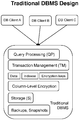
- a storage engine component reads and writes data in page units to and from a storage device or system.
- a query engine component processes the pages to execute client queries.
- a transaction manager component TM provides key transactional requirements such as Atomicity (A), Consistency (C), Isolation (I), and Durability (D).
- a DBMS usually needs to store its data during various stages of processing it as well as at rest.
- IMDBs In-memory databases
- MMDBs main memory database system
- memory resident database primarily rely on main computer memory for computer data storage. They are contrasted with "traditional" DBMS that employ disk storage mechanisms. IMDBs are faster than disk-based databases since the internal optimization algorithms are simpler and execute fewer CPU instructions. Accessing data in memory eliminates disk-specific seek times when querying the data, which provides faster and more predictable performance than disk. IMDBs suffer from the drawback of being limited by the size of the available memory; disk capacity used by traditional DBMS is usually significantly cheaper and more plentiful.
- DBMSes are using disk-based storage which stores data on a local or network-accessible hard disk or array of hard disks.
- tables and indexes may be stored on disk in one of a number of forms, including ordered/unordered flat files, ISAM (Indexed Sequential Access Method), heap files, hash buckets, or B+ trees.
- ISAM Indexed Sequential Access Method
- heap files heap files
- hash buckets hash buckets
- B+ trees Each form has its own particular advantages and disadvantages.
- the most commonly used forms are B+ trees and ISAM.
- DBMSes allow clients to access the database by submitting queries that the DBMS will process and return the result of to the clients. Queries are formulated in a "query language” which also corresponds to a “database model” which defines how the database structures itself and its data.
- Databases and DBMSs can be categorized according to the database model(s) that they support (such as relational or XML), the type(s) of computer they run on (from a server cluster to a mobile phone), the query language(s) used to access the database (such as SQL or XQuery), and their internal engineering, which affects performance, scalability, resilience, and security.
- database model(s) that they support such as relational or XML
- the type(s) of computer they run on from a server cluster to a mobile phone
- the query language(s) used to access the database such as SQL or XQuery
- their internal engineering which affects performance, scalability, resilience, and security.
- Database Models A large number of database models exist. Examples include: the Hierarchical database model, the Network model, the Relational model, the Entity-relationship model, the Enhanced entity-relationship model, the Object model, the Document model, the Entity-attribute-value model, the Star schema and so on.
- relational model which uses a table-based format.
- relational model uses a table-based format.
- Relational Model The relational model for database management is a database model based on " first-order predicate logic", first formulated and proposed in 1969 by Edgar F. Codd .
- all data is represented in terms of tuples (in most existing implementations tuples are also known as "rows"), grouped into relations (in most existing implementations relations are also known as "tables").
- a database organized in terms of the relational model is a relational database
- relational model The purpose of the relational model is to provide a declarative method for specifying data and queries: users directly state what information the database contains and what information they want from it, and let the database management system software take care of describing data structures for storing the data and retrieval procedures for answering queries.
- SQL Structured Query Language
- SQL Structured Query Language
- SQL Structured Query Language
- Most relational databases use the SQL data definition and query language; these systems implement what can be regarded as an engineering approximation to the relational model.
- a table in an SQL database schema corresponds to a predicate variable; the contents of a table to a relation; key constraints, other constraints, and SQL queries correspond to predicates. SQL databases, however, deviate from the relational model in many details, which will not be discussed here.
- a data definition language or data description language is a language for defining data structures, especially database schemas.
- SQL uses a collection of imperative verbs whose effect is to modify the schema of the database by adding, changing, or deleting definitions of tables or other objects. These statements can be freely mixed with other SQL statements, so the DDL is not truly a separate language.
- Each database is a set of schemas.
- a schema is a set of relations.
- Each relation is a set of tuples. Physically, each relation consists of one or more files. A file is further divided into pages.
- Clients are aware of data organization into databases, schemas, relations, and tuples. Clients are unaware of files and pages. Clients use SQL to create, modify and access tuple data. SQL queries are categorized into DDL and DML. DDL queries typically operate at the database, schema, and relation level. For example, "create database,” "drop relation,” and so forth.
- DML queries such as "select” and “update” queries, operate at the tuple level.
- DDL queries thus relate to data organization and DML queries to data access and modification.
- auxiliary relations are created and maintained by a DBMS.
- Auxiliary relations' data is organized similar to client-visible relations.
- Auxiliary relations include indexes (Btree, hash, etc), free-space maps, visibility maps, TOAST tables, etc.
- a database index is a data structure that improves the speed of data retrieval operations on a database table at the cost of additional writes and storage space to maintain the index data structure. Indexes are used to quickly locate data without having to search every row in a database table every time a database table is accessed. Indexes can be created using one or more columns of a database table, providing the basis for both rapid random lookups and efficient access of ordered records.
- B-trees are a "tree" data structure that keep data sorted and allow searches, sequential access, insertions, and deletions in logarithmic time.
- the B-tree is a generalization of a binary search tree in that a node can have more than two children. It is commonly used in databases and file-systems.
- Indices can be implemented using a variety of other data structures.
- Other popular indices include balanced trees, B+ trees and hashes.
- a typical DBMS deployment involves a number of entities, often including a "data owner,” a “database administrator” (which may be the same as the data owner), one or more "clients” which are authorized to query the database, and a database “server.”
- the database server may in fact comprise multiple computers or an entire server farm. "Server” is used herein to denote any of these setups.
- the data owner aided by the administrator, may initialize the database server, set up the database relational schema, and upload an initial data set into the database.
- the administrator may then set up database credentials for a number of authorized clients.
- Authorized clients may connect to the database server over a network connection and submit queries to the database.
- the database server executes the queries and returns the results to the clients.
- the data owner, database administrator and clients are part of the same organization and of a common implicit trust realm.
- Concurrency If someone is reading from a database at the same time as someone else is writing to it, it is possible that the reader will see a half-written or inconsistent piece of data. There are several ways of solving this problem, known as concurrency control methods. The simplest way is to make all readers wait until the writer is done, which is known as a lock.
- a lock (“read lock,” “write lock,” “range lock,” and so forth) is used when multiple parties (software processes, users etc.) need to access a database concurrently. Locks prevents data from being corrupted or invalidated when these multiple parties try to read while others write to the database. Any single party can only modify those database records (items in the database) for which it has “acquired” a lock that gives them exclusive access to the record until the lock is released. Locking not only provides exclusivity to writes but also prevents (or controls) reading of unfinished modifications ("uncommitted” data).
- a "read lock” can be used to prevent other users from reading a record which is being updated, so that others will not act upon soon-to-be-outdated information.
- Transactions allow clients to execute queries against their dataset. To ensure that queries submitted simultaneously by different clients do not interfere in unwanted ways (e.g., by modifying the same data unpredictably etc), the notion of "transaction" has been introduced. Multiple queries submitted by a client may be organized into a "transaction.”
- a transaction symbolizes a unit of work treated in a coherent and reliable way independent of other transactions.
- a transaction generally represents any change in database.
- Transactions in databases have two main purposes:
- ACID A database transaction, by definition, must be atomic, consistent, isolated and durable. Database practitioners often refer to these properties of database transactions using the acronym ACID. Transactions provide an "all-or-nothing" proposition, stating that each work-unit performed in a database must either complete in its entirety or have no effect whatsoever. Further, the system must isolate each transaction from other transactions, results must conform to existing constraints in the database, and transactions that complete successfully must get written to durable storage.
- Deadlock happens when two transactions A and B aim to update two rows of information but in the opposite order, such as if A updates row 1 then row 2 in the exact timeframe that B updates row 2 then row 1. In such a circumstance, A can't finish updating row 2 until B is finished, but B cannot finish updating row 1 until A is finished. No matter how much time is allowed to pass, this situation will never resolve itself. Because of this, a DBMS will typically kill the transaction that has done the least amount of work.
- isolation property is the one most often relaxed.
- a DBMS When attempting to maintain the highest level of isolation, a DBMS usually acquires "locks" on data or implements multi-version concurrency control (MVCC, discussed below), which may result in a loss of concurrency. This requires adding logic for the application to function correctly.
- MVCC multi-version concurrency control
- isolation levels which control the degree of locking that occurs when selecting data.
- the majority of database transactions can be constructed to avoid requiring high isolation levels (e.g. SERIALIZABLE isolation level, see below), thus reducing the locking overhead for the system.
- the programmer must carefully analyze database access code to ensure that any relaxation of isolation does not cause software bugs that are difficult to find. Conversely, if higher isolation levels are used, the possibility of deadlock is increased, which also requires careful analysis and programming techniques to avoid.
- the isolation levels defined by the ANSI/ISO SQL standard are listed as follows:
- each isolation level is stronger than those below - in that no higher isolation level allows an action forbidden by a lower one - the standard permits a DBMS to run a transaction at an isolation level stronger than that requested (e.g., a READ COMMITTED transaction may actually be performed at a REPEATABLE READ isolation level).
- Multiversion concurrency control is a concurrency control method commonly used by database management systems to provide concurrent access to the database and in programming languages to implement transactional memory.
- MVCC takes a different approach: each user connected to the database sees a snapshot of the database at a particular instant in time. Any changes made by a writer will not be seen by other users of the database until the changes have been completed (or, in database terms: until the transaction has been committed).
- an MVCC database When an MVCC database needs to update an item of data, it will not overwrite the old data with new data, but instead mark the old data as obsolete and add the newer version elsewhere. Thus, there are multiple versions stored, but only one is the latest. This allows readers to access the data that was there when they began reading, even if it was modified or deleted part way through by someone else. It also allows the database to avoid the overhead of filling in holes in memory or disk structures but requires (generally) the system to periodically sweep through and delete the old, obsolete data objects. For a document-oriented database it also allows the system to optimize documents by writing entire documents onto contiguous sections of disk-when updated, the entire document can be re-written rather than bits and pieces cut out or maintained in a linked, non-contiguous database structure.
- MVCC provides point in time consistent views. Read transactions under MVCC typically use a timestamp or transaction ID to determine what state of the DB to read, and read these versions of the data. Read and write transactions are thus isolated from each other without any need for locking. Writes create a newer version, while concurrent reads access the older version.
- the database server in an outsourced database setting, is physically off-premises and may reside in "the cloud” (i.e., in a data center managed by a cloud provider offering this service).
- a cloud database customer purchases the ability to place and query one or more datasets in the cloud-hosted server.
- PaaS Platform as a service
- DBaaS database as a service
- database administration duties are split between the cloud provider and the cloud database customer.
- the cloud provider manages the physical and logical administration of the server software.
- the cloud database customer may act as a data owner and also manage the authorized database client credentials.
- Other arbitrary administrative setups are possible. In most of them, the cloud database customer naturally is the data owner and provides the data sets to be hosted by the cloud database.
- a database is managed and hosted by a third party (the cloud database provider)
- a specific set of concerns appear mostly due to the fact that the data owner, data clients, and database server are not part of the same organization and trust realm. This brings about a shift in liability and data privacy and security concerns.
- the data is now hosted by a third party. Queries are executed by a remote server under the control of a third party.
- Privacy regulations demand service providers to ensure that personal information is not accessed for any purpose other than the intended provision of services. Specifically, privacy regulations require service providers to employ data confidentiality, de-identify personal information before distribution, seek explicit permission from individuals before disclosing personal information, and to notify individuals in case of unauthorized access to individuals' personal information. Examples of privacy-centric regulations include:
- an adversary may feature several adversarial behaviors: a software-only adversary may be also fully malicious, or a physical adversary may be also honest-but-curious, and so forth.
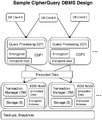
- a secure data management system and method which separates query processing operations from transaction management and data storage operations to provides secure outsourced data management assurances while remaining practically viable for commercial deployment.
- the secure data management system and method comprises a untrusted database module which performs transaction management and data storage operations on encrypted data from at least one network accessible computer and a trusted database module which processes user generated queries and commands on a secure client device by selectively accessing, decrypting and re-encrypting the encrypted data on the at least one network accessible computer.
- total privacy can be maintained while still outsourcing transaction management and data storage operations to untrusted third parties because all sensitive operations are performed in a secure environment and the transaction management and data storage operations can only access encrypted data.
- the secure data management system also resolves other main limitations of prior art, such as the inability to provide a system that can handle any type of query.
- a viable system may need to allow not only read queries but updates as well and provide an efficient implementation thereof.
- the system may need not require a-priori knowledge about allowable queries that will be submitted by clients.
- the system may need not require expensive pre-computation of metadata to support queries (as such, the system is "query-agnostic").
- the system also provides strongly encryption mechanisms to secure outsourced data management assurances of data confidentiality, query privacy and query authentication for the entire data set if requested by the customer.
- the use of weak encryption mechanisms such as order preserving encryption should not be necessary for the system to function.
- the security of the system should not be weakened or outright compromised by weak security constructs.
- Any viable system may need to allow the correct execution of queries submitted by multiple clients in parallel. Transactions submitted by multiple clients may need to be handled correctly and efficiently.
- ACID and strong transactional semantics are main elements of the value proposition of a modern database and any secure DBMS may need to at least offer the ability to run with different transactional semantics.
- sensitive assurances-enforcing code may need to be executed securely cloud-side in a "secure environment” (SE).
- SE secure environment
- "securely” may mean different things - the level of protection the SE needs to offer, and the associated technology required to enforce it, may be different.
- clients may require that SEs provide physical compromise protection, e.g., against data center insiders with physical access to the cloud hardware.
- physical compromise protection e.g., against data center insiders with physical access to the cloud hardware.
- protection may be offered by tamper-proof trusted hardware certified to detect and defend against physical adversaries.
- the SEs may use as a building block tamper-proof secure coprocessors.
- SEs provide protection against software-only compromise (e.g., software viruses or worms that may compromise the cloud operating system).
- software-only compromise e.g., software viruses or worms that may compromise the cloud operating system.
- different enforcement mechanisms may be appropriate, such as the use of Trusted Computing Group's Trusted Platform Modules (TPMs) which are not required to provide tamper-proof assurances but have other security functionality that can be used to defend against software compromise.
- TPMs Trusted Computing Group's Trusted Platform Modules
- the SE protection mechanisms need not be hardware only and may be offered by leveraging hardware, software, or a combination thereof.
- the system disclosed herein operates with different adversarial models and associated SEs of different protection levels, including future SEs and associated protection enforcement technologies. Overall, the system is not limited by assumptions of a given SE.
- Protected Code will denote code that is being run inside a SE; “unprotected code” will denote any other code.
- storage (S) and transaction management (TM) may be separate components.
- TDB Trusted Database
- CQP CQP
- TDBMS Trusted Database
- UDB untrusted database
- Atomicity and Durability do not require access to decrypted data, the system can be designed to enforce and implement them in unprotected code.
- the system may be designed to enforce Isolation through the interaction between protected and unprotected code. If an isolation level of REPEATABLE READ can be provided by unprotected code, then the system may be designed to provide both REPEATABLE READ and SERIALIZABLE isolation levels to its security-sensitive queries.
- Consistency may require access to decrypted data
- the system may require to implement some of the consistency enforcement in protected code. Certain consistency checks may not require access to decrypted data, however, and the system may implement these checks in unprotected code.
- the QP component's protected code may access the storage component S to retrieve data records as needed.
- QP may also request transaction processing be performed (e.g., by issuing "START TRANSACTION” and "END TRANSACTION” requests) by TM.
- QP may need to encrypt outgoing data and decrypt incoming data to ensure S only stores encrypted data.
- QP may need to encrypt/decrypt any transaction-specific information sent to TM.
- S may be offered by a traditional storage service.
- S may be a key-value pair storage system such as Cassandra.
- TM may also be offered by an external transaction manager.
- the system is designed to use one or more traditional DBMS (which provides both data storage and transaction management) to serve as both the external storage service S and the external transaction manager TM.
- traditional DBMS which provides both data storage and transaction management
- the system maps and organizes a data set of one or more trusted DBMSes within one or more untrusted databases while preserving a number of security and functionality properties.
- CQPs provide the same functionality as a traditional DBMS.
- a CQP receives SQL queries (or commands) from clients.
- CQP accesses encrypted pages stored with EDSs. If client requests data modification, CQPs modify and encrypt the relevant pages before storing the pages with EDSs.
- CQPs encrypt all pages.
- the encrypted pages are stored in an EDS.
- the EDS does not have access to decryption keys and cannot read page contents.
- EDSs store and serve pages as requested by CQPs.
- pages are decrypted by CQPs.
- the design gives ACID properties at tuple-level.
- CQP-EDS interaction protocols and query processing techniques An EDS provides Atomicity (A), Isolation (I), and Durability (D) on encrypted pages. The EDS thus gives A, I, and D from ACID.
- CQPs may be stateless. CQPs can be started or stopped at any time without compromising data confidentiality or ACID properties. For scaling, multiple CQPs can connect to one or more EDSs.
- the trusted environment for CQPs' deployment may be the enterprise or client machines or cloud-side secure hardware security module compute instances, containers or virtual machines, secured using client-acceptable hardware or software mechanisms.
- the system implements a TDB-EDS data mapping based on the following constraints:
- a CQP creates a relation E in an EDS.
- a CQP stores each page P of F as a unique, encrypted tuple in E.
- a CQP reads the corresponding tuple from E.
- a CQP modifies the corresponding tuple from E.
- Clients connect to CQPs.
- a client may issue multiple SQL queries during a single connection.
- a CQP maintains two connections to an EDS.
- the first connection which we refer to as transactional connection (TC) is used by a CQP for client SQL queries that require all ACID properties.
- TC transactional connection
- Typical operations performed using a TC include retrieving and storing encrypted pages, starting and committing transactions, getting transaction ids, and so forth.
- the second connection which we refer to as non-transactional connection (NTC) is used for processing client SQL queries that do not require Atomicity (A) from ACID, such as queries on sequence relations.
- NTC non-transactional connection
- CQPs provide full ACID transaction semantics to clients, partly by using the A, I, and D properties of EDSs.
- a CQP receives SQL queries (or commands) from clients. To process a client query, a CQP accesses encrypted pages stored with EDSs. If the client query requires data modifications, the CQP modifies and re-encrypts the relevant pages before storing the pages with EDSs.
- CQPs perform page retrievals and modifications using the Transactional Connection (TC).
- TC Transactional Connection
- a CQP maps each client transaction to a transaction on EDS. All page retrieval and modifications are performed within an EDS's transaction.
- a CQP executes a transaction command on an EDS for every transaction command that the CQP receives from clients.
- the table below gives mapping for all transaction processing commands that are covered by CQPs to guarantee A, I, D properties to clients
- Client-to-CQP Transaction Command Corresponding CQP-to-EDS Transaction Command BEGIN BEGIN COMMIT COMMIT ROLLBACK ROLLBACK CREATE SAVEPOINT X CREATE SAVEPOINT ENC(X) 1 RELEASE SAVEPOINT X RELEASE SAVEPOINT ENC(X) ROLLBACK TO SAVEPOINT X ROLLBACK TO SAVEPOINT ENC(X) 1
- ENC(X) is the encryption of X using a secret encryption key. The encryption key is known only to CQPs.
- Atomicity By mapping each client transaction to an EDS transaction, a CQP guarantees that (1) a client transaction commits only if the corresponding transaction on an EDS commits, (2) a client transaction aborts if the corresponding transaction on an EDS aborts. (1) and (2) together ensure atomicity.
- Isolation Mapping each client transaction to an EDS transaction ensures that a page modification within client transaction A is not visible to a simultaneously executing client transaction B, ensuring isolation.
- Repeatable Read Isolation Level A CQP always starts an EDS transaction at the "REPEATABLE READ" isolation level. Therefore, if page P read by a CQP during client transaction A is modified by a simultaneously executing client transaction B, transaction A is aborted - ensuring Repeatable Read level for client data.
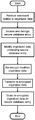
- FIG. 6 an illustration of the categorical steps through which each client transaction is mapped by a CQP to an EDS on the secure data management system of the instant disclosure is shown.
- the interactions between a client, CQP, and EDS are further detailed as an exemplary SELECT query (i.e. command) run by a client in a transaction with Repeatable Read isolation level as follows:
- Serializable Isolation Level to guarantee a SERIALIZABLE isolation level for client transactions, the system may be configured as follows:
- Durability In one embodiment, when a CQP receives a COMMIT command from a client, the CQP issues a COMMIT command to an EDS. After the commit on EDS succeeds, the CQP notifies client of the successful commit. By inherent property of EDS, a commit of an EDS's transaction ensures that the modified data is made durable.
- starting EDS transactions at the "REPEATABLE READ" isolation level as discussed above ensures that pages modifications performed within a client transaction A are not overwritten by a simultaneously executing client transaction B. Thus, changes made by transaction A are durable on commit of A.
- Consistency In one embodiment, all consistency checks are performed by CQPs. For consistency, CQPs decrypt pages retrieved from an EDS. Checks for consistencies are performed on decrypted data.
- the CQP may be the PostgreSQL or the MySQL databases or a combination thereof.
- databases such as PostgreSQL and MySQL organizes relations as files. Each relation is a collection of files. A file consists of fixed-size pages. Additionally a relation's files are organized in directories.
- the system :
- the EDS may be the PostgreSQL or the MySQL databases or a combination thereof.
- the database may be accessed by multiple clients.
- each of the clients may connect to one or more CQP which in turn may connect to the EDS that actually holds the data. Accordingly, multiple clients and CQPs can interact at the same time with an EDS.
- the CQP may be run in an environment which the client trusts so that a client may trust the CQP with their queries and access to the data.
- the CQP may be run on the client's computer which the client trusts.
- the CQP may be run inside a SE that is connected to the client and to the EDS.
- the SE may be located in the cloud.
- DBMSs use (often in-memory) caching for pages.
- Relational DBMSs typically use a single cache per DBMS. All client connections access data from the same cache.
- a cache stores a fixed number of pages.
- DBMSs typically implement the following set of cache operations.
- Mark Page Dirty When a page is modified this operation sets a flag on the page indicating that the page is dirty (has been modified). Marking the page as dirty is used as a hint to write the page to secondary (permanent) storage.
- Invalidate Page This operation invalidates a page in cache. Invalidation means that the cache entry is free and can be used to store another page fetched from secondary storage. Invalidation is performed after a page has been written to secondary storage or if the cache is full.
- a single DBMS instance performs all of the above operations. Having a single DBMS perform all of the above operations simplifies ensuring transactions semantics (ACID) since the single DBMS instance has a complete view of the entire in-memory cache.
- ACID transactions semantics
- the system proposed here may comprise multiple CQPs accessing one or more EDSes. Since the CQPs may not communicate or be aware of each other, each CQP may use a separate cache. To this end, in one embodiment, the system implements new cache operations that guarantee ACID properties even in the presence of multiple caches on separate CQPs as follows.
- CipherQuery Mark Page Dirty when a page is modified, this operation sets a flag on the page indicating that the page is dirty (has been modified). Marking the page as dirty is used as a hint to write the page to EDS.
- CipherQuery Invalidate Page In one embodiment, this operation invalidates a page in cache. Invalidation means that the cache entry is free and can be used to store another page fetched from secondary storage. Invalidation is performed after a page has been written to EDS or if the cache is full.
- CipherQuery Invalidate Cache In one embodiment, this operation invalidates all cache entries.
- CipherQuery Write Page In one embodiment, this operation compresses, encrypts and then write a page that has been marked dirty to EDS.
- the system deploys a set of bulk-write optimizations that avoid multiple page writes from CQP to EDS.
- the optimizations improve overall throughput and eliminating unnecessary network traffic and associated round-trip latencies.
- a CQP when a cache entry is marked dirty, a CQP does not write the page to an EDS immediately. Instead, a CQP batches up all dirty buffers and writes them out to an EDS at transaction commit time. Delaying writes until commit time is acceptable because intra-transaction work is not saved on an EDS until commit time (EDS provides Atomicity). If a CQP dies in between, transaction on the EDS is aborted.
- the system is designed to minimize overall latency and the impact of network latency between between a CQP and an EDS - interactions between CQPs and EDSs involve page reads. Each page access may result in a latency hit that is beneficial to avoid.
- DBMSs typically rely on the underlying storage mechanism (such as a File System) to perform read-aheads.
- a file system has no knowledge of DMBS read behavior and cannot optimally predict the pages that would be accessed next by a DBMS.
- CQPs batch reads together in a single request to an EDS. This is referred to herein as "read-ahead" since to batch reads it must be known in advance what pages we will be using next.
- read-ahead since to batch reads it must be known in advance what pages we will be using next.
- Several cases have been identified where it can be predicted with certainty what are the pages going to be requested from an EDS next. In these cases, a CQP batches reads together.
- Sequential Scan involves reading all pages of a relation to find tuples that comprise a query result.
- the CQP reads pages in bulk from an EDS.
- the number of pages that a CQP reads ahead is a configuration parameter.
- Index Scan DBMSes use auxiliary relations such as indexes to speed up query processing.
- An index is built on one or more relation attributes. If a DBMS determines that using an index would result in faster query execution, it first searches the index to determine the set of tuples that would form a query result. An index may not actually contain tuple data, but pointers to the main relation that contains the actual tuple data. In this case, a DBMS first finds an index entry that fits a query result, and then follows a pointer into the main relation to gather tuple data. This process is repeated separately for each index entry that satisfies query conditions.
- the CQP when an index is used by a CQP, the CQP first gathers a batch of tuple pointers (pointers to tuples in the main relation) that comprise a query result. Then, in a single bulk-read operation a CQP fetches all the pages from an EDS that contain the tuples' data.
- Bitmap Heap Scan A traditional plain DBMS index scan fetches one tuple-pointer at a time from the index, and immediately visits that tuple in the table.
- a bitmap scan fetches all the tuple-pointers from the index in one go, sorts them using an in-memory "bitmap" data structure, and then visits the table tuples in physical tuple-location order.
- the bitmap scan improves locality of reference to the table at the cost of more bookkeeping overhead to manage the "bitmap" data structure --- and at the cost that the data is no longer retrieved in index order, which doesn't matter for your query but would matter if you said ORDER BY.
- a Bitmap heap scan normally involves two steps. In step one, an index is scanned to find the pages from the main relation that possibly contain tuples that are part of the query result. Instead of immediately following pointers to locate tuples in a main relation, a bitmap is created of all page identifiers that potentially contain result tuples. In step two, the page corresponding to each page identifier contained in the bitmap is visited to construct query results.
- step two of bitmap heap scan is optimized to read pages in bulk (batch). Pages corresponding to a set of page identifiers from the bitmap are read in a single request from a CQP to an EDS. Note that existing DBMSes do not do batch reads (read-ahead) and instead rely on whatever read-ahead a file system may provide. But a file system cannot do read-ahead for heap scans since this requires knowing data semantics.
- DBMS sequences are special relations used as number generators.
- a sequence relation has a single tuple (contained within a single page) with a single numeric attribute.
- a sequence can be incrementing or decrementing.
- Sequence operations include the following: (i) Create Sequence - creates a new sequence relation; Setval - sets the value of the numeric attribute to a given value; nextval - gets the next value of the numeric attribute.
- sequence operations such as nextval do not follow transaction semantics (are not atomic). Even if a transaction that executes nextval() operation on a sequence aborts, the effect of nextval() persists.
- the create sequence operation is atomic. If a transaction that creates a sequence aborts, the sequence is not created.
- nextval operation is not atomic.
- a CQP fetches and writes pages of sequence relations from an EDS using a non-transactional connection (NTC). This ensures that even if client transaction on CQP is aborted, sequence page writes will be persisted on EDS.
- NTC non-transactional connection
- a CQP records the transaction id of the transaction that creates the sequence. Then, on a nextval operation a CQP performs the following operation:
- a caching infrastructure such as Memcache or Redis, with one or more caching nodes may be deployed to achieve significant savings and effective inter-CQP coordination. Note that this cache is different from the per-client-connection, in-memory cache discussed earlier.
- the caching infrastructure will be used in a stateless manner so as to not require management and allow for easy handling of crashes, failures and restarts.
- the CQP first checks the cache which may be hosted in close proximity, either client- or enterprise-side or in the cloud. Only if the data is not in cache, is a read request made to EDS. When a data page is read from an EDS it is saved in the cache. A page write goes directly from the CQP to the EDS and the system also invalidates the cache entry.
- Data in the cache system is encrypted.
- the cache can be located in untrusted environments.
- CQPs can connect to one or more cache nodes.
- isolation (I) the system includes mitigation mechanisms for the issue of stale cached data which may arise because cache nodes may not communicate or synchronize with each other.
- each page in an EDS contains the transaction identifier (ID) of the last transaction that modified the page. This ID is updated (by a CQP) on each page modification. Then, during transaction execution, a CQP records transaction IDs of the pages it read. At commit time, for each page read, the page's recorded transaction ID is compared with the transaction ID stored in EDS for that page. If the two transaction IDs match, a CQP is assured that no other CQP updated this page during the current CQP's client transaction. Hence, the commit proceeds. If the transaction IDs do not match, another CQP may have updated the page and committed its transaction. In this case, the current CQP aborts its client's transaction. This enables multiple, geographically distributed CQPs using the same, different, or overlapping cache nodes.
- the granularity of the concurrency mechanisms provided by EDSes are arbitrary.
- the system may use page-level concurrency.
- page-level concurrency may lead to a higher degree of update conflicts between clients than tuple-level concurrency would - especially at higher isolation levels (REPEATABLE READ and SERIALIZABLE).
- a CQP can transparently retry a transaction with an EDS - after an update conflict was detected and reported by the EDS - without propagating the information to the client before a certain number of retries fail.
- CQPs may automatically determine whether the current transaction can be retried and may then perform the retry if possible.
- clients can instruct a DBMS to read pages of certain relations (in background) from storage to in-memory cache.
- Asynchronous Reads are intelligently triggered and do not require specific requests from clients.
- CQPs transparently read catalog data and store it into the cache. The amount of data read is a function of current activity and cache capacity. CQP keeps cache utilization at a high reducing cache misses for other CQPs.
- this mechanism can be implemented using PostgreSQL's prewarm feature.
- a mechanism may be needed to coordinate transaction semantics between multiple (QP) components.
- read transactions under MVCC may typically use a timestamp or transaction ID to determine what state of the DB to read, and read these versions of the data. Read and write transactions may thus be isolated from each other without any need for locking. Writes may create a newer version, while concurrent reads may access the older version.
- each transaction executed by a CQP may require a unique transaction ID.
- the system may be designed to delegate new ID generation to the EDS: for each transaction, the CQP may query the EDS for a new, unique transaction ID.
- any schema changes performed by a client may need to be visible to other clients.
- the corresponding transaction ID may be recorded in the Untrusted DBMS.
- the CQP may also store the transaction ID locally.
- the CQP may read the transaction ID of the last transaction that performed a schema change from the EDS. If it is not same as the locally stored transaction ID, then, a schema change has occurred.
- a CQP may invalidate all schema-related data in its local cache.
- the system may need to also ensure integrity of data and correctness of query execution, including completeness of queries to the EDS which hosts the (S) and (TM) components.
- the system may guarantee that compromise and tampering of any data stored within an EDS is detected by a CQP.
- the system may be designed to use Merkle Hash Tree (MHT) based verification techniques. Further, portions of the MHT data may also be signed by a CQP.
- MHT Merkle Hash Tree
- a Merkle hash tree is a tree data structure in which every non-leaf node is labeled with a hash checksum of the labels of its children nodes. MHTs are useful because they allow efficient and secure verification of the contents of large data structures. MHTs can be used to verify any kind of data stored, handled and transferred in and between computers.
- a set of trusted SEs may be dedicated to store checksums of individual pages, or portions of relevant MHT data. Then, each time a CQP reads a page from an EDS, the CQP may verify the read page by fetching the page's checksum from a corresponding trusted SE. When updating pages, a CQP may also update the corresponding checksums with the SEs.
- a CQP may include the transaction id of the transaction that last modified the page in the page checksum.
- the transaction id of the last modifying transaction may be part of the page itself. This then ensures also that the id may already be included implicitly in the page checksum.
- a system may be designed to ensure:
- all outgoing data that protected code writes may be encrypted. Any incoming data may be decrypted.
- Confidentiality of data in-transit may also be achieved using encryption. All communication between entities running protected code may be encrypted.
- Encryption credentials may be comprised by one or more SE(s).
- the system may need to prevent unprotected code from accessing the queries. To this end, the system may encrypt the communication between clients and the protected code QP components.
- the system may deploy oblivious access mechanisms to prevent untrusted parties such as the cloud provider from understanding query semantics from underlying access patterns to data, e.g., such as may be evident in network traffic between a CQP and an EDS.
- ORAM Oblivious RAM
- ORAM Oblivious RAM
- ORAM is a useful primitive that allows a client to hide its data access patterns from an untrusted server in storage outsourcing applications. ORAM enables a client storing only a small amount of data locally to store a large amount of data in e.g., the cloud and access them while hiding the identities of the items being accessed. Informally, the adversary in ORAM (most often the server) should not be able to distinguish between equal-length sequences of queries made by the client to the server.
- a system may need to automatically and securely be able to scale and add resources (such as additional CQP nodes) on demand, e.g., as a function of incoming load.
- resources such as additional CQP nodes
- the system may endow protected code (such as the QP component of a CQP) running inside trusted SEs with the ability to securely "spawn” or “initiate” additional SEs and then upload into them the code (possibly a "clone” of the SE code itself) and credentials necessary to provide additional protected code running on behalf of the client.
- protected code such as the QP component of a CQP
- the different CQPs may not be able to directly communicate with each other, they may use an EDS as a communication conduit, while ensuring all communication is encrypted.
- a trusted query processor module CQP has decryption keys, can decrypt data and process queries.
- Untrusted storage module S and untrusted transaction manager module TM do not have access to decryption keys and only operate on encrypted data.
- One or more CQPs can work with one or more TM and S components.
- the sensitive client database data pages and index pages are stored encrypted and/or compressed in an external untrusted data store EDS, and referenced by page IDs.
- the EDS may comprise both TM and S components.
- the EDS may be a relational database (pages may be stored as database tuples), a key-value object storage (pages are stored as objects), a (transactional) file system (pages may be stored as files), and so forth.
- CQPs can be added and removed without impacting the database.
- CQP are configured do not require maintaining any state between transactions or to communicate with each other.
- CQPs are further configured to coordinate and correctly process transactions by intelligently storing and querying data and information about transactions (e.g., their IDs) including at least one the following:
- CQPs may further be configured to transparently retry certain transactions with the external EDS without notifying the client; The CQPs may determine automatically if said certain transactions can be retried.
- CQPs may be configured to efficiently access the EDS-stored pages through a non-transactional connection NTC for client query operations that do not require Atomicity (A), including queries on sequence relations. Further, CQPs may be configured to access the EDS-stored information through a transactional connection TC for client query operations that require transactional properties -- examples of such queries include retrieving and storing encrypted pages, starting and committing transactions, retrieving transaction IDs, etc.
- a CQP may start one or more transactions on the EDS and effectively map each client transaction to said one or more EDS transactions -- effectively, a CQP may be configured to execute at least one transaction command on an EDS for every transaction command that the CQP receives from clients.
- the EDS may be configured to then access the associated encrypted pages required by the client operations within the context of said EDS transactions.
- the EDS and said EDS transactions may be configured to have one or more of the following properties:
- CQPs may deploy checksums to validate the integrity of the EDS-provided data, including validating information about the last transaction that modified each data page. Said checksums may themselves be stored in the EDS and a CQP may authenticate them for example by using a Merkle Hash tree.
- Each CQP may be configured to maintain its own cache in a manner that guarantees ACID properties in the presence of multiple CQPs as well as to optimize throughput, including taking one or more of the following steps:
Landscapes
- Engineering & Computer Science (AREA)
- Theoretical Computer Science (AREA)
- General Engineering & Computer Science (AREA)
- Computer Security & Cryptography (AREA)
- Databases & Information Systems (AREA)
- Physics & Mathematics (AREA)
- General Physics & Mathematics (AREA)
- Computer Hardware Design (AREA)
- Computer Networks & Wireless Communication (AREA)
- Signal Processing (AREA)
- Software Systems (AREA)
- Data Mining & Analysis (AREA)
- Health & Medical Sciences (AREA)
- General Health & Medical Sciences (AREA)
- Bioethics (AREA)
- Computing Systems (AREA)
- Computational Linguistics (AREA)
- Information Retrieval, Db Structures And Fs Structures Therefor (AREA)
- Storage Device Security (AREA)
Claims (15)
- Ein Verfahren zum Verwalten gesicherter Daten unter Verwendung eines ungesicherten Datenbankverwaltungssystems, ohne dem ungesicherten Datenbankverwaltungssystem Zugriff auf Klartextdaten zu gewähren, umfassend die Schritte:Das Bereitstellen eines Datenbankverwaltungssystems (EDS) mit mindestens einem Prozessor und einem nicht vergänglichem Speicher, wobei das Datenbankverwaltungssystem (EDS) angepasst ist, um organisierte Daten als eine Vielzahl von individuell verschlüsselten Datenseiten, individuell verschlüsselten Indexseiten und individuell verschlüsselten Katalogseiten zu speichern und Datenbanktransaktionen in Bezug auf die gespeicherten organisierten Daten aus dem definierten Datensatz zu verwalten;Das Initialisieren durch eine Alpha-Client-Verarbeitungsgerät (CQP), die konfiguriert ist, um elektrische Signale mit dem Datenbankverwaltungssystem (EDS) zu übertragen, einergewünschten Datenbanktransaktion in Bezug auf organisierte Daten aus einem definierten Datensatz, der auf dem Datenbankverwaltungssystem (EDS) gespeichert wurde;Das Empfangen einer Aktionseingabe für die gewünschte Datenbanktransaktion durch das Alpha-Client-Verarbeitungsgerät (CQP), wobei die Aktionseingabe mindestens einen Datenbankbefehl umfasst und sich auf mindestens eine Zielseite bezieht, die mindestens einer individuell verschlüsselten Datenseite und in den gespeicherten organisierten Daten aus dem definierten Datensatz und einer individuell verschlüsselten Katalogseite in den gespeicherten organisierten Daten aus dem definierten Datensatz entspricht;Das Lokalisieren durch das Alpha-Client-Verarbeitungsgerät (CQP) der mindestens einen Zielseite in den gespeicherten organisierten Daten aus dem definierten Datensatz, wobei der Schritt des Lokalisierens umfasst, dass das Datenbankverwaltungssystem (EDS) veranlasst wird, mindestens eine verschlüsselte Indexseite in dem gespeicherten organisierten Daten aus dem definierten Datensatz, die sich auf die mindestens eine Zielseite beziehen, an das Alpha-Client-Verarbeitungsgerät (CQP) zu übertragen;wobei der Schritt des Lokalisierens ferner umfasst, dass das Alpha-Client-Verarbeitungsgerät (CQP) selektiv mindestens eine der einen verschlüsselten Indexseiten von dem Datenbankverwaltungssystem (EDS) herunterlädt und entschlüsselt, ohne dem Datenbankverwaltungssystem (EDS) Zugriff auf Entschlüsselungsschlüssel bereitzustellen, die erforderlich sind, um Entschlüsseln einer der verschlüsselten Indexseiten entschlüsseln zu können;Das Abrufen der mindestens einen Zielseite durch das Alpha-Client-Verarbeitungsgerät (CQP) basierend auf der mindestens einen der entschlüsselten Indexseiten,wobei der Schritt des Abrufens umfasst, dass das Datenbankverwaltungssystem (EDS) veranlasst wird, die mindestens eine Zielseite, während sie noch verschlüsselt ist, an das Alpha-Client-Verarbeitungsgerät (CQP) zu übertragen, und die übertragene mindestens eine Zielseite zu entschlüsseln; undDurchführen des mindestens einen Datenbankbefehls auf der entschlüsselten mindestens einen Zielseite durch das Alpha-Client-Verarbeitungsgerät (CQP),wobei das Verfahren ferner umfasst, dass der Alpha-Client die gesamte Abfrageverarbeitung in Bezug auf die Transaktion durchführt, wobei die Abfrageverarbeitung zumindest teilweise an unverschlüsselten Daten durchgeführt wird und Datenkonsistenz für die organisierten Daten bereitstellt,wobei das Verfahren ferner umfasst, dass das Datenbankverwaltungssystem (EDS) die gesamte Transaktionsverwaltung in Bezug auf die Transaktion durchführt, wobei die Transaktionsverwaltung an verschlüsselten Daten durchgeführt wird und Datenbank Datenbank-Atomizität, Isolierung und Dauerhaftigkeit bereitstellt,wobei die gesagte Datenbank-Atomizität, Isolierung und Dauerhaftigkeit erreicht wird durch die Kombination von, erstens, dass das Datenbankverwaltungssystem (EDS) eine relationale Datenbank umfasst, die Atomizität, Isolierung und Dauerhaftigkeit der darin gespeicherten Daten bereitstellt; zweitens durch das Verfahren, das den Schritt umfasst, dass das Alpha-Client-Verarbeitungsgerät (CQP) eine Eins-zu-Eins-Abbildung von den einzeln verschlüsselten Datenseiten auf einzelne relationale Datenbank-Tupel in dem Datenbankverwaltungssystem (EDS) durchführt; und drittens durch das Verfahren, das den Schritt umfasst, dass das Alpha-Client-Verarbeitungsgerät (CQP) das Datenbankverwaltungssystem (EDS) veranlasst, eine solche individuell verschlüsselte Datenseite als entsprechende relationale Tupel in einer Beziehung (E) in dem Datenbankverwaltungssystem zu speichern (EDS).
- Verfahren nach Anspruch 1, wobei
mehreren Client-Verarbeitungsgeräten (CQP) wird der Zugriff auf dasselbe Datenbankverwaltungssystem (EDS) gestattet. - Verfahren nach Anspruch 1 oder 2, wobei das Verfahren die folgenden zusätzlichen Schritte umfasst:ein relationales Datenbankverzeichnis des Alpha-Client-Verarbeitungsgeräts (CQP), wird auf ein relationales Schema im Datenbankverwaltungssystem (EDS) mappiert;jede eines Satzes von Dateien innerhalb des Verzeichnisses wird auf eine Beziehung im Schema die dem Elternverzeichnis entspricht der betreffenden Datei im Datenbankverwaltungssystem (EDS) mappiert; undjede eines Satzes von Seiten der fraglichen Datei wird auf ein Tupel in der entsprechenden Beziehung der Datei im Datenbankverwaltungssystem (EDS) mappiert.
- Verfahren nach einem der vorhergehenden Ansprüche, wobei das Verfahren den Schritt umfasst, dass das Alpha-Client-Verarbeitungsgerät (CQP) mit zwei Verbindungen zum Datenbankverwaltungssystem (EDS) ausgestattet wird, von denen eine erste Verbindung eine transaktionale Verbindung ist, die vom Alpha-Client-Verarbeitungsgerät (CQP) verwendet wird, um SQL-Abfragen zu verarbeiten, die Daten-Atomizität bedürfen, und von denen eine zweite Verbindung eine nicht-transaktionale Verbindung ist, die vom Alpha-Client-Verarbeitungsgerät (CQP) verwendet wird, um SQL-Abfragen zu verarbeiten, die Atomizität nicht bedürfen.
- Verfahren nach einem der vorhergehenden Ansprüche, zusätzlich umfassend die Schritte:Empfangen bei das Alpha-Client-Verarbeitungsgerät (CQP) einer Abschlusseingabe in Bezug auf den mindestens einen Datenbankbefehl und die mindestens eine Zielseite;als Reaktion auf die Abschlusseingabe, Befehlen des Datenbankverwaltungssystems (EDS) durch das Alpha-Client-Verarbeitungsgerät (CQP), die gewünschte Datenbanktransaktion zu kommittieren,wobei, wenn die gewünschte Datenbanktransaktion durch das Datenbankverwaltungssystem (EDS) erfolgreich kommittiert wurde, das Verfahren zusätzlich den Schritt des Benachrichtigens durch das Datenbankverwaltungssystem (EDS) des Alpha-Client-Verarbeitungsgerätes (CQP) umfasst, dass die gewünschte Datenbanktransaktion kommittiert wurde, wodurch das Alpha-Client-Verarbeitungsgerät (CQP) veranlasst wird, eine Ausgabe zu erzeugen, die anzeigt, dass die gewünschte Datenbanktransaktion kommittiert wurde; undwenn die gewünschte Datenbanktransaktion vom Datenbankverwaltungssystem (EDS) nicht erfolgreich kommittiert wird, umfasst das Verfahren zusätzlich den Schritt des Benachrichtigens durch das Datenbankverwaltungssystem (EDS) des Alpha-Client-Verarbeitungsgerätes (CQP), dass die gewünschte Datenbanktransaktion fehlgeschlagen ist, wodurch das Alpha-Client-Verarbeitungsgerät (CQP) veranlasst wird, eine Ausgabe zu erzeugen, die anzeigt, dass die gewünschte Datenbanktransaktion fehlgeschlagen ist; wodurch das Alpha-Client-Verarbeitungsgerät (CQP) veranlasst wird, mindestens einen der Schritte des Lokalisierens, Abrufens, Ausführens und Befehlens transparent erneut zu versuchen, um die gewünschte Datenbanktransaktion zu kommittieren; und/oder dadurch das Alpha-Client-Verarbeitungsgerät (CQP) veranlasst wird, transparent erneut, mindestens die Schritte des Lokalisierens, Abrufens, Ausführens und Befehlens zu versuchen, um die gewünschte Datenbanktransaktion zu kommittieren.
- Verfahren nach einem der vorhergehenden Ansprüche, wobei der Schritt des Lokalisierens durch das Durchlaufen mindestens eines Index auf dem Datenbankverwaltungssystem (EDS) durch das Alpha-Client-Verarbeitungsgerät (CQP) definiert wird, wobei der Schritt des Durchlaufens das Entschlüsseln umfasst durch das Alpha-Client-Verarbeitungsgerät (CQP) die mindestens eine Indexseite, die von dem Datenbankverwaltungssystem (EDS) an das Alpha-Client-Verarbeitungsgerät (CQP) übertragen wird.
- Verfahren nach Anspruch 6, wobei der Schritt des Durchlaufens durch das Alpha-Client-Verarbeitungsgerät (CQP) zusätzlich das Identifizieren einer verschlüsselten untergeordneten Indexseite aus dem mindestens einen Index relativ zu der entschlüsselten mindestens einen Indexseite umfasst, was bewirkt, dass das Datenbankverwaltungssystem (EDS), um die untergeordnete Indexseite zu übertragen, und Entschlüsseln durch das Alpha-Client-Verarbeitungsgerät (CQP) der untergeordneten Indexseite, die von dem Datenbankverwaltungssystem (EDS) übertragen wird.
- Verfahren nach einem der vorhergehenden Ansprüche, wobei der Schritt des Initialisierens zusätzlich das Befehlen des Datenbankverwaltungssystems (EDS) durch das Alpha-Client-Verarbeitungsgerät (CQP) umfasst, eine Datenbanktransaktion auf wiederholbarem Lese-Isolierungsniveau zu starten.
- Verfahren nach einem der vorhergehenden Ansprüche, wobei der Schritt des Durchführens zusätzlich umfasst:Modifizieren der entschlüsselten mindestens einen Zielseite durch das Alpha-Client-Verarbeitungsgerät (CQP);Verschlüsseln der modifizierten mindestens einen Zielseite durch das Alpha-Client-Verarbeitungsgerät (CQP); undÜbertragen durch das Alpha-Client-Verarbeitungsgerät (CQP) der verschlüsselten modifizierten mindestens einen Zielseite an das Datenbankverwaltungssystem (EDS).
- Verfahren nach einem der vorhergehenden Ansprüche, zusätzlich umfassend die Schritte:Empfangen durch das Alpha-Client-Verarbeitungsgerät (CQP), einer Verbindungseingabe, die durch eine Anforderung zum Starten einer serialisierbaren Isolierungsniveau Transaktion definiert ist; wobei der Schritt des Initialisierens zusätzlich das Befehlen des Datenbankverwaltungssystems (EDS) durch das Alpha-Client-Verarbeitungsgerät (CQP) umfasst, um eine Datenbanktransaktion auf wiederholbarem Lese-Isolierungsniveau zu starten;wobei der Schritt des Lokalisierens durch das Durchlaufen mindestens eines Index auf dem Datenbankverwaltungssystem (EDS) durch das Alpha-Client-Verarbeitungsgerät (CQP) definiert ist, wobei der Schritt des Durchlaufens das Entschlüsseln der mindestens einen durch das Datenbankverwaltungssystem (EDS) an das Alpha-Client-Verarbeitungsgerät (CQP) übertragenen Indexseite umfasst;Bestimmen durch das Alpha-Client-Verarbeitungsgerät (CQP) von Geschwisterknoten der entschlüsselten mindestens einen Indexseite; undAnfordern bei das Alpha-Client-Verarbeitungsgerät (CQP) einer Geschwistertransaktionskennung für die bestimmten Geschwisterknoten.
- Verfahren nach einem der vorhergehenden Ansprüche,
wobei, wenn die mindestens eine individuell verschlüsselte Indexseite, die von der externen Cache-Komponente angefordert wird, auf der externen Cache-Komponente vorhanden ist, der Schritt des Lokalisierens zusätzlich das Entschlüsseln durch das Alpha-Client-Verarbeitungsgerät (CQP) der mindestens einen durch das Alpha-Client-Verarbeitungsgerät (CQP) angeforderten verschlüsselten einen Indexseite umfasst;
wobei, wenn die mindestens eine individuell verschlüsselte Indexseite, die von der externen Cache-Komponente angefordert wird, nicht auf der externen Cache-Komponente vorhanden ist, der Schritt des Lokalisierens zusätzlich beinhaltet, dass das Datenbankverwaltungssystem (EDS) veranlasst wird, mindestens eine verschlüsselte Indexseite in der gespeicherten organisierte Daten aus dem definierten Datensatz, die sich auf die mindestens eine Zielseite beziehen, an das Alpha-Client-Verarbeitungsgerät (CQP) zu übertragen, Speichern der mindestens einen verschlüsselten Indexseite, die vom Datenbankverwaltungssystem (EDS) übertragen wird, auf der externen Cache-Komponente und Entschlüsseln durch das Alpha-Client-Verarbeitungsgerät (CQP) die mindestens eine Indexseite, die von dem Datenbankverwaltungssystem (EDS) übertragen wird;
Abrufen durch die Alpha-Client-Verarbeitungsgerät (CQP) der mindestens einen Zielseite, wobei der Schritt des Abrufens umfasst, dass das Datenbankverwaltungssystem (EDS) veranlasst wird, die mindestens eine Zielseite, während sie noch verschlüsselt ist, an das Alpha-Client-Verarbeitungsgerät zu übertragen (CQP) und Entschlüsseln der übertragenen mindestens einen Zielseite; und Ausführen des mindestens einen Datenbankbefehls auf der entschlüsselten mindestens einen Zielseite durch das Alpha-Client-Verarbeitungsgerät (CQP). - Sicheres Datenverwaltungssystem, umfassend:ein Datenbankverwaltungssystem (EDS), das mit mindestens einem Verwaltungscomputer integriert ist, der einen Prozessor und einen nichtflüchtigen Speicher hat, wobei das Datenbankverwaltungssystem (EDS) den mindestens einen Verwaltungscomputer so adaptiert, um organisierte Daten als eine Vielzahl von einzeln verschlüsselten Datenseiten und individuell verschlüsselte Indexseiten zu speichern, und Datenbanktransaktionen in Bezug auf die gespeicherten organisierten Daten aus dem definierten Datensatz, zu verwalten;mindestens ein Client-Verarbeitungsmodul, integriert mit mindestens eines Alpha-Client-Verarbeitungsgerätes (CQP), so adaptiert, um elektrische Signale mit dem mindestens einen Verwaltungscomputer zu kommunizieren, wobei das mindestens eine Client-Verarbeitungsmodul das Alpha-Client-Verarbeitungsgerät (CQP) adaptiert, um:(1) bei Empfang einer Verbindungseingabe, Initialisieren einer ersten Datenbanktransaktion bezüglich der organisierten Daten aus dem definierten Datensatz, der auf dem mindestens einen Verwaltungscomputer als die individuell verschlüsselten Datenseiten und die individuell verschlüsselten Indexseiten gespeichert ist;(2) nach Empfang einer Aktionseingabe, die mindestens einen Datenbankbefehl umfasst und sich auf mindestens eine Zielseite bezieht, die mindestens einer der individuell verschlüsselten Datenseiten entspricht, Lokalisieren der mindestens einen Zielseite durch selektives Herunterladen und Entschlüsseln von mindestens der einen verschlüsselten Indexseite von dem Datenbankverwaltungssystem (EDS), ohne dem gesagten Datenbankverwaltungssystem (EDS) Zugriff auf Entschlüsselungsschlüssel bereitzustellen, die zum Entschlüsseln irgendeiner der verschlüsselten Indexseiten erforderlich sind;(3) Abrufen und Entschlüsseln der mindestens einen Zielseite, basierend auf der mindestens einen der entschlüsselten Indexseiten, aus dem Datenbankverwaltungssystem (EDS), ohne dem Datenbankverwaltungssystem (EDS) Zugriff auf Entschlüsselungsschlüssel bereitzustellen, die zum Entschlüsseln von irgendwelchen der verschlüsselten Datenseiten erforderlich sind; und(4) Ausführen des mindestens einen Datenbankbefehls auf der entschlüsselten mindestens einen Zielseite,wobei der Alpha-Client eingerichtet ist, die gesamte Abfrageverarbeitung in Bezug auf die gesagte Transaktion durchzuführen und die gesagte Abfrageverarbeitung zumindest teilweise an unverschlüsselten Daten durchzuführen, um Datenkonsistenz für die gesagten organisierten Daten bereitzustellen,wobei das Datenbankverwaltungssystem (EDS) angeordnet ist, um die gesamte Transaktionsverwaltung in Bezug auf die gesagte Transaktion durchzuführen und die gesagte Transaktionsverwaltung an verschlüsselten Daten durchzuführen, um Datenbank Atomizität, Isolierung und Dauerhaftigkeit bereitzustellen,wobei das System eingerichtet ist, um die gesagte Atomizität, Isolierung und Dauerhaftigkeit der Datenbank zu erreichen durch die Kombination von erstens dass das Datenbankverwaltungssystem (EDS) eine relationale Datenbank umfasst, die Atomizität, Isolierung und Dauerhaftigkeit der darin gespeicherten Daten bereitstellt; zweitens dadurch, dass das Alpha-Client-Verarbeitungsgerät (CQP) eingerichtet ist, eine Eins-zu-Eins-Abbildung von den einzeln verschlüsselten Datenseiten auf einzelne relationale Datenbank-Tupel im Datenbankverwaltungssystem (EDS) durchzuführen; und drittens, indem das Alpha-Client-Verarbeitungsgerät (CQP) so angeordnet ist, dass sie das Datenbankverwaltungssystem (EDS) veranlasst, eine solche individuell verschlüsselte Datenseite als entsprechendes relationales Tupel in einer Beziehung (E) in dem Datenbankverwaltungssystem (EDS) zu speichern.
- Sicheres Datenverwaltungssystem nach Anspruch 12, wobei das mindestens eine Client-Verarbeitungsmodul das Alpha-Client-Verarbeitungsgerät (CQP) adaptiert, um die entschlüsselte mindestens eine Zielseite zu modifizieren, die modifizierte mindestens eine Zielseite zu verschlüsseln und die verschlüsselte modifizierte mindestens eine Zielseite an das Datenbankverwaltungssystem (EDS) zu übertragen, wenn der mindestens eine Datenbankbefehl ausgeführt wird, ohne es dem Datenbankverwaltungssystem (EDS) zu ermöglichen, auf die modifizierte mindestens eine Zielseite vor der Verschlüsselung zuzugreifen.
- Sicheres Datenverwaltungssystem nach Anspruch 12 oder 13, wobei das mindestens eine Client-Verarbeitungsmodul zusätzlich das Alpha-Client-Verarbeitungsgerät (CQP) adaptiert, um:bei Empfang einer Verbindungseingabe die erste Datenbanktransaktion auf einer ersten Verbindung mit dem mindestens einen Verwaltungscomputer initialisieren, die erste Transaktion auf wiederholbarem Lese-Isolierungsniveau setzen, eine zweite Datenbanktransaktion in Bezug auf die organisierten Daten aus dem definierten Datensatz die auf der mindestens eine Verwaltungscomputer als die individuell verschlüsselten Datenseiten und die individuell verschlüsselten Indexseiten gespeichert sind, auf einer zweiten Verbindung mit dem mindestens einen Verwaltungscomputer initialisieren, und der zweiten Transaktion, auf kommittierte Lese-Isolierungsniveau setzen;Lokalisieren der mindestens einen Zielseite und Abrufen und Entschlüsseln der mindestens einen Zielseite über die erste Verbindung; undwobei der mindestens eine Datenbankbefehl eine Sequenzoperation umfasst und die Sequenzoperation unter Verwendung der zweiten Verbindung ausgeführt wird.
- Sicheres Datenverwaltungssystem nach einem der Ansprüche 12-14, wobei das gesagte mindestens eine Client-Verarbeitungsmodul das Alpha-Client-Verarbeitungsgerät (CQP) zusätzlich adaptiert, um:beim Kommittieren einer Schemaänderungstransaktion, die Katalogdaten an den gespeicherten organisierten Daten aus dem definierten Datensatz ändert, Aufzeichnen eines eindeutigen Katalogänderungs-Identifikationswerts auf dem mindestens einen Verwaltungscomputer;Erfassen jeglicherÄnderung der Katalogdaten an den gespeicherten organisierten Daten aus dem definierten Datensatz vor dem Versuch einer Datenbanktransaktion durch Lesen des Wertes der eindeutigen Katalogänderungskennung auf dem mindestens einen Verwaltungscomputer.
Applications Claiming Priority (2)
| Application Number | Priority Date | Filing Date | Title |
|---|---|---|---|
| US201562189650P | 2015-07-07 | 2015-07-07 | |
| PCT/US2016/031393 WO2017023388A2 (en) | 2015-07-07 | 2016-05-07 | Secure data management system and method |
Publications (3)
| Publication Number | Publication Date |
|---|---|
| EP3320440A2 EP3320440A2 (de) | 2018-05-16 |
| EP3320440A4 EP3320440A4 (de) | 2018-12-12 |
| EP3320440B1 true EP3320440B1 (de) | 2021-08-11 |
Family
ID=57943983
Family Applications (2)
| Application Number | Title | Priority Date | Filing Date |
|---|---|---|---|
| EP16833437.3A Pending EP3320447A4 (de) | 2015-07-07 | 2016-05-06 | System und verfahren zur sicheren durchsuchbaren und gemeinsam verwendbaren fernspeicherung |
| EP16833440.7A Active EP3320440B1 (de) | 2015-07-07 | 2016-05-07 | Sicheres datenverwaltungssystem und -verfahren |
Family Applications Before (1)
| Application Number | Title | Priority Date | Filing Date |
|---|---|---|---|
| EP16833437.3A Pending EP3320447A4 (de) | 2015-07-07 | 2016-05-06 | System und verfahren zur sicheren durchsuchbaren und gemeinsam verwendbaren fernspeicherung |
Country Status (3)
| Country | Link |
|---|---|
| US (2) | US10762229B2 (de) |
| EP (2) | EP3320447A4 (de) |
| WO (2) | WO2017023385A2 (de) |
Families Citing this family (87)
| Publication number | Priority date | Publication date | Assignee | Title |
|---|---|---|---|---|
| US11789923B2 (en) * | 2015-10-23 | 2023-10-17 | Oracle International Corporation | Compression units in an index block |
| US9832024B2 (en) * | 2015-11-13 | 2017-11-28 | Visa International Service Association | Methods and systems for PKI-based authentication |
| CN106254302B (zh) * | 2015-11-30 | 2019-07-09 | 北京智谷睿拓技术服务有限公司 | 信息处理方法和设备 |
| CL2015003766A1 (es) * | 2015-12-30 | 2016-08-05 | Univ Chile | Sistema y método para comunicaciones electrónicas seguras mediante hardware de seguridad basado en criptografía umbral |
| KR101905771B1 (ko) * | 2016-01-29 | 2018-10-11 | 주식회사 엔오디비즈웨어 | 시스템 환경 및 사용자 행동 분석 기반의 자기 방어 보안 서버와 이의 작동 방법 |
| US10721232B2 (en) | 2016-01-29 | 2020-07-21 | Docusign, Inc. | Cloud-based coordination of remote service appliances |
| EP3394848B8 (de) | 2016-02-17 | 2021-04-21 | NEC Corporation | Verfahren zur datenspeicherung auf einer speichereinheit |
| US20170288866A1 (en) * | 2016-03-30 | 2017-10-05 | AVAST Software s.r.o. | Systems and methods of creating a distributed ring of trust |
| US11405192B2 (en) * | 2016-08-24 | 2022-08-02 | Robert Bosch Gmbh | Searchable symmetric encryption system and method of processing inverted index |
| EP3293653A1 (de) | 2016-09-09 | 2018-03-14 | Nagravision S.A. | System zur entschlüsselung und darstellung von inhalt |
| US11025596B1 (en) | 2017-03-02 | 2021-06-01 | Apple Inc. | Cloud messaging system |
| CN107124281B (zh) * | 2017-05-05 | 2020-02-28 | 国信嘉宁数据技术有限公司 | 一种数据保全方法和相关系统 |
| US11182349B2 (en) | 2017-06-04 | 2021-11-23 | Apple Inc. | Synchronizing content |
| US11063748B2 (en) | 2017-06-04 | 2021-07-13 | Apple Inc. | Synchronizing content |
| EP3649558B8 (de) | 2017-07-06 | 2024-04-17 | Chromaway AB | Verfahren und system für ein verteiltes datenverarbeitungssystem |
| US11829583B2 (en) | 2017-07-07 | 2023-11-28 | Open Text Sa Ulc | Systems and methods for content sharing through external systems |
| US11238164B2 (en) * | 2017-07-10 | 2022-02-01 | Burstiq, Inc. | Secure adaptive data storage platform |
| US12184781B2 (en) | 2017-07-10 | 2024-12-31 | Burstiq, Inc. | Systems and methods for accessing digital assets in a blockchain using owner consent contracts |
| WO2019053778A1 (ja) * | 2017-09-12 | 2019-03-21 | 三菱電機株式会社 | 登録端末、検索端末、検索サーバ、検索システム、登録プログラム及び検索プログラム |
| US10652308B2 (en) * | 2017-11-08 | 2020-05-12 | International Business Machines Corporation | Cognitive storage management for a mobile computing device |
| US10877992B2 (en) * | 2017-11-30 | 2020-12-29 | International Business Machines Corporation | Updating a database |
| US10715610B2 (en) | 2017-12-15 | 2020-07-14 | Slack Technologies, Inc. | System, method, and apparatus for generating a third party resource usage map in a group based communication system |
| US20190318118A1 (en) * | 2018-04-16 | 2019-10-17 | International Business Machines Corporation | Secure encrypted document retrieval |
| US11106810B2 (en) * | 2018-07-30 | 2021-08-31 | EMC IP Holding Company LLC | Multi-tenant deduplication with non-trusted storage system |
| US11227041B2 (en) * | 2018-08-24 | 2022-01-18 | Baskaran Dharmarajan | Identification service based authorization |
| US10984412B2 (en) * | 2018-09-20 | 2021-04-20 | Coinbase, Inc. | System and method for management of cryptocurrency systems |
| AU2019360160A1 (en) * | 2018-10-18 | 2021-05-27 | Lockbox Technologies Pty Ltd | Authentication system |
| US11196567B2 (en) | 2018-11-26 | 2021-12-07 | Amazon Technologies, Inc. | Cryptographic verification of database transactions |
| US10942910B1 (en) | 2018-11-26 | 2021-03-09 | Amazon Technologies, Inc. | Journal queries of a ledger-based database |
| US11119998B1 (en) | 2018-11-26 | 2021-09-14 | Amazon Technologies, Inc. | Index and view updates in a ledger-based database |
| US11036708B2 (en) | 2018-11-26 | 2021-06-15 | Amazon Technologies, Inc. | Indexes on non-materialized views |
| CN111274326A (zh) * | 2018-12-04 | 2020-06-12 | 北京嘀嘀无限科技发展有限公司 | 特征数据的导入方法、管控方法、装置及电子设备 |
| US11178117B2 (en) * | 2018-12-18 | 2021-11-16 | International Business Machines Corporation | Secure multiparty detection of sensitive data using private set intersection (PSI) |
| CN109889505B (zh) * | 2019-01-23 | 2022-05-27 | 平安科技(深圳)有限公司 | 数据持有性验证方法及终端设备 |
| CN109800235B (zh) * | 2019-01-28 | 2021-06-15 | 东北大学 | 一种基于认证树的外包数据库全操作查询验证系统及方法 |
| US11237963B2 (en) * | 2019-02-01 | 2022-02-01 | Red Hat, Inc. | Shared filesystem metadata caching |
| US12041039B2 (en) * | 2019-02-28 | 2024-07-16 | Nok Nok Labs, Inc. | System and method for endorsing a new authenticator |
| CN109992586A (zh) * | 2019-04-01 | 2019-07-09 | 王龙 | 一种用户转发信息获取系统 |
| US11102196B2 (en) * | 2019-04-06 | 2021-08-24 | International Business Machines Corporation | Authenticating API service invocations |
| US11669624B2 (en) | 2019-04-24 | 2023-06-06 | Google Llc | Response-hiding searchable encryption |
| US20220100900A1 (en) * | 2019-06-14 | 2022-03-31 | Hewlett-Packard Development Company, L.P. | Modifying data items |
| GB201913348D0 (en) * | 2019-09-16 | 2019-10-30 | Palantir Technologies Inc | Data deletion system and method |
| CN110852743A (zh) * | 2019-09-29 | 2020-02-28 | 恩亿科(北京)数据科技有限公司 | 一种数据获取方法及装置 |
| US12493532B2 (en) * | 2019-11-22 | 2025-12-09 | Microsoft Technology Licensing, Llc | System and method for database recovery for encrypted indexes |
| US12423363B2 (en) * | 2019-11-29 | 2025-09-23 | Amazon Technologies, Inc. | Warm tier storage for search service |
| US20220385480A1 (en) * | 2019-12-20 | 2022-12-01 | Hewlett-Packard Development Company, L.P. | Device registration |
| US11533168B2 (en) * | 2019-12-20 | 2022-12-20 | Sap Se | System and method for unlocking an encryption key chain without compromising security |
| CN111163461B (zh) * | 2019-12-23 | 2022-08-26 | 中国联合网络通信集团有限公司 | 终端数据防篡改方法及系统、防篡改服务器和存储介质 |
| CN111046249A (zh) * | 2019-12-26 | 2020-04-21 | 广州信天翁信息科技有限公司 | 一种数据存储、定位、应用方法及相关装置 |
| CN111163164B (zh) * | 2019-12-27 | 2022-09-13 | 山东乾云启创信息科技股份有限公司 | 一种基于鲲鹏芯片的云桌面安全传输方法及装置 |
| US12099997B1 (en) | 2020-01-31 | 2024-09-24 | Steven Mark Hoffberg | Tokenized fungible liabilities |
| JP6867718B1 (ja) * | 2020-02-20 | 2021-05-12 | Eaglys株式会社 | 情報処理システム、情報処理装置、情報処理方法、および、情報処理プログラム |
| US11573793B2 (en) * | 2020-03-18 | 2023-02-07 | Oracle International Corporation | Lazy push strategies for vectorized D-Heaps |
| US11204947B2 (en) * | 2020-03-18 | 2021-12-21 | International Business Machines Corporation | Centralized database system with geographically partitioned data |
| JP2021167993A (ja) * | 2020-04-09 | 2021-10-21 | 富士フイルムビジネスイノベーション株式会社 | 情報処理装置及びプログラム |
| US11777925B2 (en) * | 2020-04-12 | 2023-10-03 | Manomohan Pillai | System, method, and program product using ephemeral identity for digital user identification |
| US20210406395A1 (en) * | 2020-06-26 | 2021-12-30 | APPDIRECT, Inc. | Personal information vault |
| CA3177396A1 (en) * | 2020-06-29 | 2022-01-06 | Prabhu PALANISAMY | Temporary cloud provider credentials via secure discovery framework |
| WO2022005912A1 (en) | 2020-06-29 | 2022-01-06 | Illumina, Inc. | Policy-based genomic data sharing for software-as-a-service tenants |
| US12056259B2 (en) * | 2020-08-18 | 2024-08-06 | International Business Machines Corporation | Secure ingress and egress for data engines |
| US11651096B2 (en) | 2020-08-24 | 2023-05-16 | Burstiq, Inc. | Systems and methods for accessing digital assets in a blockchain using global consent contracts |
| CN112100188B (zh) * | 2020-09-01 | 2024-05-28 | 上海交通大学 | 基于机器学习的并发控制方法及系统 |
| US11797392B2 (en) * | 2020-09-09 | 2023-10-24 | Thales Dis France Sas | Backup and recovery of private information on edge devices onto surrogate edge devices |
| CN112115495B (zh) * | 2020-09-25 | 2024-07-02 | 深圳赛安特技术服务有限公司 | 可离线云端数据存储方法、系统、计算机设备及存储介质 |
| US11914731B1 (en) * | 2020-09-29 | 2024-02-27 | Amazon Technologies, Inc. | Cross-boundary data backup background |
| US20220166762A1 (en) * | 2020-11-25 | 2022-05-26 | Microsoft Technology Licensing, Llc | Integrated circuit for obtaining enhanced privileges for a network-based resource and performing actions in accordance therewith |
| US11645409B2 (en) * | 2020-12-18 | 2023-05-09 | Seagate Technology Llc | Search and access pattern hiding verifiable searchable encryption for distributed settings with malicious servers |
| EP4280537A4 (de) * | 2021-01-14 | 2024-01-24 | Fujitsu Limited | Steuerungsverfahren, steuerungsprogramm und informationsverarbeitungsvorrichtung |
| US11550946B2 (en) * | 2021-04-20 | 2023-01-10 | Fujitsu Limited | Searchable sets of data using trusted execution environment |
| US11706203B2 (en) * | 2021-05-14 | 2023-07-18 | Citrix Systems, Inc. | Method for secondary authentication |
| US12107954B2 (en) * | 2021-05-14 | 2024-10-01 | Atakama LLC | Location key search of encrypted files without decryption |
| US11403259B1 (en) | 2021-10-29 | 2022-08-02 | Snowflake Inc. | Catalog query framework on distributed key value store |
| CN114039990B (zh) * | 2021-11-01 | 2022-07-29 | 上海交通大学 | 不经意访问存储系统 |
| CN114372058A (zh) * | 2022-01-10 | 2022-04-19 | 北京新华夏信息技术有限公司 | 一种空间数据管理方法、装置、存储介质及区块链系统 |
| CN118575174A (zh) * | 2022-01-20 | 2024-08-30 | 皇家飞利浦有限公司 | 用于压缩快速加密相似性搜索和数据库分析的方法和系统 |
| US11593521B1 (en) * | 2022-02-04 | 2023-02-28 | Snowflake Inc. | Tag-based application of masking policy |
| CN114978594B (zh) * | 2022-04-18 | 2024-02-09 | 南京工程学院 | 一种面向云计算隐私保护的自适应访问控制方法 |
| CN116432199B (zh) * | 2023-03-03 | 2024-07-19 | 安超云软件有限公司 | 云平台远程数据备份方法及其恢复方法、电子设备 |
| US20240394654A1 (en) * | 2023-05-26 | 2024-11-28 | Sap Se | Sharing in multi-tier network for equipment management |
| US12443728B2 (en) | 2023-06-26 | 2025-10-14 | International Business Machines Corporation | Restricting data access to target databases |
| US12438715B2 (en) * | 2023-07-24 | 2025-10-07 | Kyndryl, Inc. | Preventing access of removed users to messages shared in a group chat |
| US20250094385A1 (en) * | 2023-09-15 | 2025-03-20 | Oracle International Corporation | Hyper-scale, elastic, smart, shared, database aware storage |
| US12423458B2 (en) * | 2023-11-06 | 2025-09-23 | Rubrik, Inc. | Aggregation of policy information for principals associated with a file system |
| US12613984B2 (en) * | 2023-11-06 | 2026-04-28 | Rubrik, Inc. | Indexing and querying of principals associated with a file system |
| CN119444218B (zh) * | 2025-01-09 | 2025-10-28 | 四川水利职业技术学院 | 一种支付交易数据处理方法 |
| CN120090888B (zh) * | 2025-05-08 | 2025-07-11 | 北京安证通信息科技股份有限公司 | 一种身份认证方法、系统、设备及介质 |
| CN120875756B (zh) * | 2025-08-13 | 2026-04-21 | 佛山市爱茹娣服饰有限公司 | 一种epr供应链库存数据管理方法和系统 |
Family Cites Families (18)
| Publication number | Priority date | Publication date | Assignee | Title |
|---|---|---|---|---|
| EP1410202B1 (de) * | 2001-03-16 | 2006-07-26 | Novell, Inc. | Client-server-modell zur synchronisation von dateien |
| BR0207375A (pt) | 2001-12-19 | 2004-06-15 | Irdeto Access Bv | Sistema de distribuição de conteúdo digital |
| US7685437B2 (en) * | 2003-05-30 | 2010-03-23 | International Business Machines Corporation | Query optimization in encrypted database systems |
| US7280956B2 (en) | 2003-10-24 | 2007-10-09 | Microsoft Corporation | System, method, and computer program product for file encryption, decryption and transfer |
| US8074220B2 (en) * | 2004-05-21 | 2011-12-06 | Computer Associates Think, Inc. | System and method for interfacing an application to a distributed transaction coordinator |
| US7774319B2 (en) * | 2004-08-11 | 2010-08-10 | Sap Ag | System and method for an optimistic database access |
| US7647329B1 (en) * | 2005-12-29 | 2010-01-12 | Amazon Technologies, Inc. | Keymap service architecture for a distributed storage system |
| US7716180B2 (en) * | 2005-12-29 | 2010-05-11 | Amazon Technologies, Inc. | Distributed storage system with web services client interface |
| US20140108796A1 (en) * | 2006-01-26 | 2014-04-17 | Unisys Corporation | Storage of cryptographically-split data blocks at geographically-separated locations |
| US20110289322A1 (en) * | 2007-12-14 | 2011-11-24 | Rasti Mehran | Protected use of identity identifier objects |
| CN101593196B (zh) * | 2008-05-30 | 2013-09-25 | 日电(中国)有限公司 | 用于快速密文检索的方法、装置和系统 |
| US8458451B2 (en) * | 2009-01-20 | 2013-06-04 | New York University | Database outsourcing with access privacy |
| US8930691B2 (en) | 2011-08-16 | 2015-01-06 | Microsoft Corporation | Dynamic symmetric searchable encryption |
| US9137222B2 (en) * | 2012-10-31 | 2015-09-15 | Vmware, Inc. | Crypto proxy for cloud storage services |
| US8874908B2 (en) * | 2012-11-07 | 2014-10-28 | Wolfgang Raudaschl | Process for storing data on a central server |
| US9418072B2 (en) * | 2013-03-04 | 2016-08-16 | Vmware, Inc. | Cross-file differential content synchronization |
| US9552492B2 (en) * | 2013-08-01 | 2017-01-24 | Bitglass, Inc. | Secure application access system |
| US9542563B2 (en) * | 2013-10-24 | 2017-01-10 | Globalfoundries Inc. | Accessing protected content for archiving |
-
2016
- 2016-05-06 EP EP16833437.3A patent/EP3320447A4/de active Pending
- 2016-05-06 WO PCT/US2016/031156 patent/WO2017023385A2/en not_active Ceased
- 2016-05-06 US US15/742,497 patent/US10762229B2/en active Active
- 2016-05-07 US US15/742,498 patent/US11003787B2/en active Active
- 2016-05-07 WO PCT/US2016/031393 patent/WO2017023388A2/en not_active Ceased
- 2016-05-07 EP EP16833440.7A patent/EP3320440B1/de active Active
Non-Patent Citations (1)
| Title |
|---|
| None * |
Also Published As
| Publication number | Publication date |
|---|---|
| EP3320447A4 (de) | 2019-05-22 |
| WO2017023388A2 (en) | 2017-02-09 |
| WO2017023388A3 (en) | 2017-03-09 |
| US10762229B2 (en) | 2020-09-01 |
| US20190087432A1 (en) | 2019-03-21 |
| EP3320440A2 (de) | 2018-05-16 |
| US11003787B2 (en) | 2021-05-11 |
| US20190087600A1 (en) | 2019-03-21 |
| WO2017023385A3 (en) | 2017-05-18 |
| WO2017023385A2 (en) | 2017-02-09 |
| EP3320447A2 (de) | 2018-05-16 |
| EP3320440A4 (de) | 2018-12-12 |
Similar Documents
| Publication | Publication Date | Title |
|---|---|---|
| EP3320440B1 (de) | Sicheres datenverwaltungssystem und -verfahren | |
| Samaraweera et al. | Security and privacy implications on database systems in big data era: A survey | |
| CN109791594B (zh) | 在关系数据库上执行写入和存储操作的方法及可读介质 | |
| US8806223B2 (en) | System and method for management of encrypted data | |
| US10860732B2 (en) | System and method for real-time transactional data obfuscation | |
| US8504844B2 (en) | System, method, and computer-readable medium for cryptographic key rotation in a database system | |
| Shmueli et al. | Implementing a database encryption solution, design and implementation issues | |
| US11940995B1 (en) | Key prefix driven data encryption in tree structures | |
| Antonopoulos et al. | Sql ledger: Cryptographically verifiable data in azure sql database | |
| CN111797425B (zh) | 利用字典编码的安全数据库 | |
| Chopade et al. | A data recovery technique for Redis using internal dictionary structure | |
| Wagner et al. | Detecting database file tampering through page carving | |
| Zhao et al. | VeriTxn: Verifiable transactions for cloud-native databases with storage disaggregation | |
| US11836130B2 (en) | Relational database blockchain accountability | |
| US9171271B2 (en) | Computer system, client device and method | |
| Anciaux et al. | Pluggable personal data servers | |
| Arasu et al. | Integrity-based Attacks for Encrypted Databases and Implications. | |
| EP4137978A1 (de) | Verbesserte datensicherheit durch kombination von verschlüsselung und vertikaler fragmentierung von tabellendaten | |
| US20250238543A1 (en) | Logical log generation in enclave database | |
| US20250238531A1 (en) | Logical log visibility control in enclave database | |
| Wang et al. | EncDB-FR $^{3} $: An Encrypted Database With Fault Recovery and Rollback Resistance | |
| Kyte et al. | Locking and issues | |
| Huang et al. | Confidential Databases Without Cryptographic Mappings | |
| Kuhn et al. | Locking and Latching | |
| US20210103578A1 (en) | Relational database blockchain accountability |
Legal Events
| Date | Code | Title | Description |
|---|---|---|---|
| STAA | Information on the status of an ep patent application or granted ep patent |
Free format text: STATUS: THE INTERNATIONAL PUBLICATION HAS BEEN MADE |
|
| PUAI | Public reference made under article 153(3) epc to a published international application that has entered the european phase |
Free format text: ORIGINAL CODE: 0009012 |
|
| STAA | Information on the status of an ep patent application or granted ep patent |
Free format text: STATUS: REQUEST FOR EXAMINATION WAS MADE |
|
| 17P | Request for examination filed |
Effective date: 20171211 |
|
| AK | Designated contracting states |
Kind code of ref document: A2 Designated state(s): AL AT BE BG CH CY CZ DE DK EE ES FI FR GB GR HR HU IE IS IT LI LT LU LV MC MK MT NL NO PL PT RO RS SE SI SK SM TR |
|
| AX | Request for extension of the european patent |
Extension state: BA ME |
|
| DAV | Request for validation of the european patent (deleted) | ||
| DAX | Request for extension of the european patent (deleted) | ||
| A4 | Supplementary search report drawn up and despatched |
Effective date: 20181112 |
|
| RIC1 | Information provided on ipc code assigned before grant |
Ipc: G06F 11/30 20060101AFI20181106BHEP Ipc: H04L 9/08 20060101ALI20181106BHEP Ipc: H04L 29/06 20060101ALI20181106BHEP |
|
| STAA | Information on the status of an ep patent application or granted ep patent |
Free format text: STATUS: EXAMINATION IS IN PROGRESS |
|
| 17Q | First examination report despatched |
Effective date: 20200508 |
|
| GRAP | Despatch of communication of intention to grant a patent |
Free format text: ORIGINAL CODE: EPIDOSNIGR1 |
|
| STAA | Information on the status of an ep patent application or granted ep patent |
Free format text: STATUS: GRANT OF PATENT IS INTENDED |
|
| INTG | Intention to grant announced |
Effective date: 20210518 |
|
| GRAS | Grant fee paid |
Free format text: ORIGINAL CODE: EPIDOSNIGR3 |
|
| GRAA | (expected) grant |
Free format text: ORIGINAL CODE: 0009210 |
|
| STAA | Information on the status of an ep patent application or granted ep patent |
Free format text: STATUS: THE PATENT HAS BEEN GRANTED |
|
| AK | Designated contracting states |
Kind code of ref document: B1 Designated state(s): AL AT BE BG CH CY CZ DE DK EE ES FI FR GB GR HR HU IE IS IT LI LT LU LV MC MK MT NL NO PL PT RO RS SE SI SK SM TR |
|
| REG | Reference to a national code |
Ref country code: CH Ref legal event code: EP |
|
| REG | Reference to a national code |
Ref country code: DE Ref legal event code: R096 Ref document number: 602016062137 Country of ref document: DE |
|
| REG | Reference to a national code |
Ref country code: IE Ref legal event code: FG4D Ref country code: AT Ref legal event code: REF Ref document number: 1420080 Country of ref document: AT Kind code of ref document: T Effective date: 20210915 |
|
| REG | Reference to a national code |
Ref country code: LT Ref legal event code: MG9D |
|
| REG | Reference to a national code |
Ref country code: NL Ref legal event code: MP Effective date: 20210811 |
|
| REG | Reference to a national code |
Ref country code: AT Ref legal event code: MK05 Ref document number: 1420080 Country of ref document: AT Kind code of ref document: T Effective date: 20210811 |
|
| PG25 | Lapsed in a contracting state [announced via postgrant information from national office to epo] |
Ref country code: LT Free format text: LAPSE BECAUSE OF FAILURE TO SUBMIT A TRANSLATION OF THE DESCRIPTION OR TO PAY THE FEE WITHIN THE PRESCRIBED TIME-LIMIT Effective date: 20210811 Ref country code: AT Free format text: LAPSE BECAUSE OF FAILURE TO SUBMIT A TRANSLATION OF THE DESCRIPTION OR TO PAY THE FEE WITHIN THE PRESCRIBED TIME-LIMIT Effective date: 20210811 Ref country code: BG Free format text: LAPSE BECAUSE OF FAILURE TO SUBMIT A TRANSLATION OF THE DESCRIPTION OR TO PAY THE FEE WITHIN THE PRESCRIBED TIME-LIMIT Effective date: 20211111 Ref country code: NO Free format text: LAPSE BECAUSE OF FAILURE TO SUBMIT A TRANSLATION OF THE DESCRIPTION OR TO PAY THE FEE WITHIN THE PRESCRIBED TIME-LIMIT Effective date: 20211111 Ref country code: PT Free format text: LAPSE BECAUSE OF FAILURE TO SUBMIT A TRANSLATION OF THE DESCRIPTION OR TO PAY THE FEE WITHIN THE PRESCRIBED TIME-LIMIT Effective date: 20211213 Ref country code: HR Free format text: LAPSE BECAUSE OF FAILURE TO SUBMIT A TRANSLATION OF THE DESCRIPTION OR TO PAY THE FEE WITHIN THE PRESCRIBED TIME-LIMIT Effective date: 20210811 Ref country code: ES Free format text: LAPSE BECAUSE OF FAILURE TO SUBMIT A TRANSLATION OF THE DESCRIPTION OR TO PAY THE FEE WITHIN THE PRESCRIBED TIME-LIMIT Effective date: 20210811 Ref country code: FI Free format text: LAPSE BECAUSE OF FAILURE TO SUBMIT A TRANSLATION OF THE DESCRIPTION OR TO PAY THE FEE WITHIN THE PRESCRIBED TIME-LIMIT Effective date: 20210811 Ref country code: RS Free format text: LAPSE BECAUSE OF FAILURE TO SUBMIT A TRANSLATION OF THE DESCRIPTION OR TO PAY THE FEE WITHIN THE PRESCRIBED TIME-LIMIT Effective date: 20210811 Ref country code: SE Free format text: LAPSE BECAUSE OF FAILURE TO SUBMIT A TRANSLATION OF THE DESCRIPTION OR TO PAY THE FEE WITHIN THE PRESCRIBED TIME-LIMIT Effective date: 20210811 |
|
| PG25 | Lapsed in a contracting state [announced via postgrant information from national office to epo] |
Ref country code: PL Free format text: LAPSE BECAUSE OF FAILURE TO SUBMIT A TRANSLATION OF THE DESCRIPTION OR TO PAY THE FEE WITHIN THE PRESCRIBED TIME-LIMIT Effective date: 20210811 Ref country code: LV Free format text: LAPSE BECAUSE OF FAILURE TO SUBMIT A TRANSLATION OF THE DESCRIPTION OR TO PAY THE FEE WITHIN THE PRESCRIBED TIME-LIMIT Effective date: 20210811 Ref country code: GR Free format text: LAPSE BECAUSE OF FAILURE TO SUBMIT A TRANSLATION OF THE DESCRIPTION OR TO PAY THE FEE WITHIN THE PRESCRIBED TIME-LIMIT Effective date: 20211112 |
|
| PG25 | Lapsed in a contracting state [announced via postgrant information from national office to epo] |
Ref country code: NL Free format text: LAPSE BECAUSE OF FAILURE TO SUBMIT A TRANSLATION OF THE DESCRIPTION OR TO PAY THE FEE WITHIN THE PRESCRIBED TIME-LIMIT Effective date: 20210811 |
|
| PG25 | Lapsed in a contracting state [announced via postgrant information from national office to epo] |
Ref country code: DK Free format text: LAPSE BECAUSE OF FAILURE TO SUBMIT A TRANSLATION OF THE DESCRIPTION OR TO PAY THE FEE WITHIN THE PRESCRIBED TIME-LIMIT Effective date: 20210811 |
|
| REG | Reference to a national code |
Ref country code: DE Ref legal event code: R097 Ref document number: 602016062137 Country of ref document: DE |
|
| PG25 | Lapsed in a contracting state [announced via postgrant information from national office to epo] |
Ref country code: SM Free format text: LAPSE BECAUSE OF FAILURE TO SUBMIT A TRANSLATION OF THE DESCRIPTION OR TO PAY THE FEE WITHIN THE PRESCRIBED TIME-LIMIT Effective date: 20210811 Ref country code: SK Free format text: LAPSE BECAUSE OF FAILURE TO SUBMIT A TRANSLATION OF THE DESCRIPTION OR TO PAY THE FEE WITHIN THE PRESCRIBED TIME-LIMIT Effective date: 20210811 Ref country code: RO Free format text: LAPSE BECAUSE OF FAILURE TO SUBMIT A TRANSLATION OF THE DESCRIPTION OR TO PAY THE FEE WITHIN THE PRESCRIBED TIME-LIMIT Effective date: 20210811 Ref country code: EE Free format text: LAPSE BECAUSE OF FAILURE TO SUBMIT A TRANSLATION OF THE DESCRIPTION OR TO PAY THE FEE WITHIN THE PRESCRIBED TIME-LIMIT Effective date: 20210811 Ref country code: CZ Free format text: LAPSE BECAUSE OF FAILURE TO SUBMIT A TRANSLATION OF THE DESCRIPTION OR TO PAY THE FEE WITHIN THE PRESCRIBED TIME-LIMIT Effective date: 20210811 Ref country code: AL Free format text: LAPSE BECAUSE OF FAILURE TO SUBMIT A TRANSLATION OF THE DESCRIPTION OR TO PAY THE FEE WITHIN THE PRESCRIBED TIME-LIMIT Effective date: 20210811 |
|
| PLBE | No opposition filed within time limit |
Free format text: ORIGINAL CODE: 0009261 |
|
| STAA | Information on the status of an ep patent application or granted ep patent |
Free format text: STATUS: NO OPPOSITION FILED WITHIN TIME LIMIT |
|
| 26N | No opposition filed |
Effective date: 20220512 |
|
| PG25 | Lapsed in a contracting state [announced via postgrant information from national office to epo] |
Ref country code: IT Free format text: LAPSE BECAUSE OF FAILURE TO SUBMIT A TRANSLATION OF THE DESCRIPTION OR TO PAY THE FEE WITHIN THE PRESCRIBED TIME-LIMIT Effective date: 20210811 |
|
| PG25 | Lapsed in a contracting state [announced via postgrant information from national office to epo] |
Ref country code: SI Free format text: LAPSE BECAUSE OF FAILURE TO SUBMIT A TRANSLATION OF THE DESCRIPTION OR TO PAY THE FEE WITHIN THE PRESCRIBED TIME-LIMIT Effective date: 20210811 |
|
| REG | Reference to a national code |
Ref country code: CH Ref legal event code: PL |
|
| REG | Reference to a national code |
Ref country code: BE Ref legal event code: MM Effective date: 20220531 |
|
| PG25 | Lapsed in a contracting state [announced via postgrant information from national office to epo] |
Ref country code: MC Free format text: LAPSE BECAUSE OF FAILURE TO SUBMIT A TRANSLATION OF THE DESCRIPTION OR TO PAY THE FEE WITHIN THE PRESCRIBED TIME-LIMIT Effective date: 20210811 Ref country code: LU Free format text: LAPSE BECAUSE OF NON-PAYMENT OF DUE FEES Effective date: 20220507 Ref country code: LI Free format text: LAPSE BECAUSE OF NON-PAYMENT OF DUE FEES Effective date: 20220531 Ref country code: CH Free format text: LAPSE BECAUSE OF NON-PAYMENT OF DUE FEES Effective date: 20220531 |
|
| PG25 | Lapsed in a contracting state [announced via postgrant information from national office to epo] |
Ref country code: IE Free format text: LAPSE BECAUSE OF NON-PAYMENT OF DUE FEES Effective date: 20220507 |
|
| PG25 | Lapsed in a contracting state [announced via postgrant information from national office to epo] |
Ref country code: BE Free format text: LAPSE BECAUSE OF NON-PAYMENT OF DUE FEES Effective date: 20220531 |
|
| P01 | Opt-out of the competence of the unified patent court (upc) registered |
Effective date: 20230427 |
|
| PG25 | Lapsed in a contracting state [announced via postgrant information from national office to epo] |
Ref country code: HU Free format text: LAPSE BECAUSE OF FAILURE TO SUBMIT A TRANSLATION OF THE DESCRIPTION OR TO PAY THE FEE WITHIN THE PRESCRIBED TIME-LIMIT; INVALID AB INITIO Effective date: 20160507 |
|
| PG25 | Lapsed in a contracting state [announced via postgrant information from national office to epo] |
Ref country code: MK Free format text: LAPSE BECAUSE OF FAILURE TO SUBMIT A TRANSLATION OF THE DESCRIPTION OR TO PAY THE FEE WITHIN THE PRESCRIBED TIME-LIMIT Effective date: 20210811 Ref country code: CY Free format text: LAPSE BECAUSE OF FAILURE TO SUBMIT A TRANSLATION OF THE DESCRIPTION OR TO PAY THE FEE WITHIN THE PRESCRIBED TIME-LIMIT Effective date: 20210811 |
|
| PG25 | Lapsed in a contracting state [announced via postgrant information from national office to epo] |
Ref country code: TR Free format text: LAPSE BECAUSE OF FAILURE TO SUBMIT A TRANSLATION OF THE DESCRIPTION OR TO PAY THE FEE WITHIN THE PRESCRIBED TIME-LIMIT Effective date: 20210811 |
|
| PG25 | Lapsed in a contracting state [announced via postgrant information from national office to epo] |
Ref country code: MT Free format text: LAPSE BECAUSE OF FAILURE TO SUBMIT A TRANSLATION OF THE DESCRIPTION OR TO PAY THE FEE WITHIN THE PRESCRIBED TIME-LIMIT Effective date: 20210811 |
|
| PGFP | Annual fee paid to national office [announced via postgrant information from national office to epo] |
Ref country code: DE Payment date: 20250409 Year of fee payment: 10 |
|
| PGFP | Annual fee paid to national office [announced via postgrant information from national office to epo] |
Ref country code: GB Payment date: 20260330 Year of fee payment: 11 |
|
| PGFP | Annual fee paid to national office [announced via postgrant information from national office to epo] |
Ref country code: FR Payment date: 20260330 Year of fee payment: 11 |