EP3319797B1 - Multilayer polymer film and multipack made thereof - Google Patents
Multilayer polymer film and multipack made thereof Download PDFInfo
- Publication number
- EP3319797B1 EP3319797B1 EP16747725.6A EP16747725A EP3319797B1 EP 3319797 B1 EP3319797 B1 EP 3319797B1 EP 16747725 A EP16747725 A EP 16747725A EP 3319797 B1 EP3319797 B1 EP 3319797B1
- Authority
- EP
- European Patent Office
- Prior art keywords
- layer
- polymer film
- multilayer polymer
- weight
- thickness
- Prior art date
- Legal status (The legal status is an assumption and is not a legal conclusion. Google has not performed a legal analysis and makes no representation as to the accuracy of the status listed.)
- Active
Links
- 229920006254 polymer film Polymers 0.000 title claims description 86
- 238000005452 bending Methods 0.000 claims description 42
- 239000000654 additive Substances 0.000 claims description 27
- 239000000203 mixture Substances 0.000 claims description 21
- 229920000728 polyester Polymers 0.000 claims description 21
- VTYYLEPIZMXCLO-UHFFFAOYSA-L Calcium carbonate Chemical compound [Ca+2].[O-]C([O-])=O VTYYLEPIZMXCLO-UHFFFAOYSA-L 0.000 claims description 14
- 239000002245 particle Substances 0.000 claims description 13
- GWEVSGVZZGPLCZ-UHFFFAOYSA-N Titan oxide Chemical compound O=[Ti]=O GWEVSGVZZGPLCZ-UHFFFAOYSA-N 0.000 claims description 12
- 150000002009 diols Chemical group 0.000 claims description 12
- 239000004088 foaming agent Substances 0.000 claims description 10
- -1 polyethylene terephthalate Polymers 0.000 claims description 10
- LYCAIKOWRPUZTN-UHFFFAOYSA-N Ethylene glycol Chemical compound OCCO LYCAIKOWRPUZTN-UHFFFAOYSA-N 0.000 claims description 9
- DNIAPMSPPWPWGF-UHFFFAOYSA-N Propylene glycol Chemical compound CC(O)CO DNIAPMSPPWPWGF-UHFFFAOYSA-N 0.000 claims description 9
- KRKNYBCHXYNGOX-UHFFFAOYSA-N citric acid Chemical compound OC(=O)CC(O)(C(O)=O)CC(O)=O KRKNYBCHXYNGOX-UHFFFAOYSA-N 0.000 claims description 9
- 229920000139 polyethylene terephthalate Polymers 0.000 claims description 9
- 239000005020 polyethylene terephthalate Substances 0.000 claims description 9
- 230000000996 additive effect Effects 0.000 claims description 8
- 239000011148 porous material Substances 0.000 claims description 8
- 229910000019 calcium carbonate Inorganic materials 0.000 claims description 7
- 239000000454 talc Substances 0.000 claims description 7
- 229910052623 talc Inorganic materials 0.000 claims description 7
- 239000005995 Aluminium silicate Substances 0.000 claims description 6
- UIIMBOGNXHQVGW-UHFFFAOYSA-M Sodium bicarbonate Chemical compound [Na+].OC([O-])=O UIIMBOGNXHQVGW-UHFFFAOYSA-M 0.000 claims description 6
- KKEYFWRCBNTPAC-UHFFFAOYSA-N Terephthalic acid Chemical compound OC(=O)C1=CC=C(C(O)=O)C=C1 KKEYFWRCBNTPAC-UHFFFAOYSA-N 0.000 claims description 6
- YXFVVABEGXRONW-UHFFFAOYSA-N Toluene Chemical compound CC1=CC=CC=C1 YXFVVABEGXRONW-UHFFFAOYSA-N 0.000 claims description 6
- 235000012211 aluminium silicate Nutrition 0.000 claims description 6
- 239000000440 bentonite Substances 0.000 claims description 6
- 229910000278 bentonite Inorganic materials 0.000 claims description 6
- SVPXDRXYRYOSEX-UHFFFAOYSA-N bentoquatam Chemical compound O.O=[Si]=O.O=[Al]O[Al]=O SVPXDRXYRYOSEX-UHFFFAOYSA-N 0.000 claims description 6
- WERYXYBDKMZEQL-UHFFFAOYSA-N butane-1,4-diol Chemical compound OCCCCO WERYXYBDKMZEQL-UHFFFAOYSA-N 0.000 claims description 6
- 239000004927 clay Substances 0.000 claims description 6
- QQVIHTHCMHWDBS-UHFFFAOYSA-N isophthalic acid Chemical compound OC(=O)C1=CC=CC(C(O)=O)=C1 QQVIHTHCMHWDBS-UHFFFAOYSA-N 0.000 claims description 6
- NLYAJNPCOHFWQQ-UHFFFAOYSA-N kaolin Chemical compound O.O.O=[Al]O[Si](=O)O[Si](=O)O[Al]=O NLYAJNPCOHFWQQ-UHFFFAOYSA-N 0.000 claims description 6
- 239000010445 mica Substances 0.000 claims description 6
- 229910052618 mica group Inorganic materials 0.000 claims description 6
- OGIDPMRJRNCKJF-UHFFFAOYSA-N titanium oxide Inorganic materials [Ti]=O OGIDPMRJRNCKJF-UHFFFAOYSA-N 0.000 claims description 6
- 239000010456 wollastonite Substances 0.000 claims description 6
- 229910052882 wollastonite Inorganic materials 0.000 claims description 6
- DQXBYHZEEUGOBF-UHFFFAOYSA-N but-3-enoic acid;ethene Chemical compound C=C.OC(=O)CC=C DQXBYHZEEUGOBF-UHFFFAOYSA-N 0.000 claims description 5
- 239000005038 ethylene vinyl acetate Substances 0.000 claims description 5
- 229920001200 poly(ethylene-vinyl acetate) Polymers 0.000 claims description 5
- IJGRMHOSHXDMSA-UHFFFAOYSA-N Atomic nitrogen Chemical compound N#N IJGRMHOSHXDMSA-UHFFFAOYSA-N 0.000 claims description 4
- CURLTUGMZLYLDI-UHFFFAOYSA-N Carbon dioxide Chemical group O=C=O CURLTUGMZLYLDI-UHFFFAOYSA-N 0.000 claims description 4
- USIUVYZYUHIAEV-UHFFFAOYSA-N diphenyl ether Chemical compound C=1C=CC=CC=1OC1=CC=CC=C1 USIUVYZYUHIAEV-UHFFFAOYSA-N 0.000 claims description 4
- DNIAPMSPPWPWGF-VKHMYHEASA-N (+)-propylene glycol Chemical compound C[C@H](O)CO DNIAPMSPPWPWGF-VKHMYHEASA-N 0.000 claims description 3
- YPFDHNVEDLHUCE-UHFFFAOYSA-N 1,3-propanediol Substances OCCCO YPFDHNVEDLHUCE-UHFFFAOYSA-N 0.000 claims description 3
- PXGZQGDTEZPERC-UHFFFAOYSA-N 1,4-cyclohexanedicarboxylic acid Chemical compound OC(=O)C1CCC(C(O)=O)CC1 PXGZQGDTEZPERC-UHFFFAOYSA-N 0.000 claims description 3
- FQXGHZNSUOHCLO-UHFFFAOYSA-N 2,2,4,4-tetramethyl-1,3-cyclobutanediol Chemical compound CC1(C)C(O)C(C)(C)C1O FQXGHZNSUOHCLO-UHFFFAOYSA-N 0.000 claims description 3
- JCTXKRPTIMZBJT-UHFFFAOYSA-N 2,2,4-trimethylpentane-1,3-diol Chemical compound CC(C)C(O)C(C)(C)CO JCTXKRPTIMZBJT-UHFFFAOYSA-N 0.000 claims description 3
- ALQSHHUCVQOPAS-UHFFFAOYSA-N Pentane-1,5-diol Chemical compound OCCCCCO ALQSHHUCVQOPAS-UHFFFAOYSA-N 0.000 claims description 3
- 239000004698 Polyethylene Substances 0.000 claims description 3
- YIMQCDZDWXUDCA-UHFFFAOYSA-N [4-(hydroxymethyl)cyclohexyl]methanol Chemical compound OCC1CCC(CO)CC1 YIMQCDZDWXUDCA-UHFFFAOYSA-N 0.000 claims description 3
- 125000004432 carbon atom Chemical group C* 0.000 claims description 3
- XXMIOPMDWAUFGU-UHFFFAOYSA-N hexane-1,6-diol Chemical compound OCCCCCCO XXMIOPMDWAUFGU-UHFFFAOYSA-N 0.000 claims description 3
- KYTZHLUVELPASH-UHFFFAOYSA-N naphthalene-1,2-dicarboxylic acid Chemical compound C1=CC=CC2=C(C(O)=O)C(C(=O)O)=CC=C21 KYTZHLUVELPASH-UHFFFAOYSA-N 0.000 claims description 3
- OEIJHBUUFURJLI-UHFFFAOYSA-N octane-1,8-diol Chemical compound OCCCCCCCCO OEIJHBUUFURJLI-UHFFFAOYSA-N 0.000 claims description 3
- 229920000573 polyethylene Polymers 0.000 claims description 3
- 229920000166 polytrimethylene carbonate Polymers 0.000 claims description 3
- 229910000030 sodium bicarbonate Inorganic materials 0.000 claims description 3
- RXVMKCWWKQUKDI-UHFFFAOYSA-N (sulfonylamino)urea;toluene Chemical compound CC1=CC=CC=C1.NC(=O)NN=S(=O)=O RXVMKCWWKQUKDI-UHFFFAOYSA-N 0.000 claims description 2
- MARUHZGHZWCEQU-UHFFFAOYSA-N 5-phenyl-2h-tetrazole Chemical compound C1=CC=CC=C1C1=NNN=N1 MARUHZGHZWCEQU-UHFFFAOYSA-N 0.000 claims description 2
- 239000004156 Azodicarbonamide Substances 0.000 claims description 2
- XOZUGNYVDXMRKW-AATRIKPKSA-N azodicarbonamide Chemical compound NC(=O)\N=N\C(N)=O XOZUGNYVDXMRKW-AATRIKPKSA-N 0.000 claims description 2
- 235000019399 azodicarbonamide Nutrition 0.000 claims description 2
- VJRITMATACIYAF-UHFFFAOYSA-N benzenesulfonohydrazide Chemical compound NNS(=O)(=O)C1=CC=CC=C1 VJRITMATACIYAF-UHFFFAOYSA-N 0.000 claims description 2
- 239000001569 carbon dioxide Substances 0.000 claims description 2
- 229910002092 carbon dioxide Inorganic materials 0.000 claims description 2
- 229910052757 nitrogen Inorganic materials 0.000 claims description 2
- 235000017557 sodium bicarbonate Nutrition 0.000 claims description 2
- 239000010410 layer Substances 0.000 description 176
- 239000004793 Polystyrene Substances 0.000 description 16
- 229920002223 polystyrene Polymers 0.000 description 16
- 230000035699 permeability Effects 0.000 description 15
- XLYOFNOQVPJJNP-UHFFFAOYSA-N water Chemical compound O XLYOFNOQVPJJNP-UHFFFAOYSA-N 0.000 description 15
- QVGXLLKOCUKJST-UHFFFAOYSA-N atomic oxygen Chemical compound [O] QVGXLLKOCUKJST-UHFFFAOYSA-N 0.000 description 14
- 239000000463 material Substances 0.000 description 14
- 239000001301 oxygen Substances 0.000 description 14
- 229910052760 oxygen Inorganic materials 0.000 description 14
- 239000002356 single layer Substances 0.000 description 14
- 235000013305 food Nutrition 0.000 description 13
- 229920000642 polymer Polymers 0.000 description 11
- 230000000052 comparative effect Effects 0.000 description 9
- 238000000034 method Methods 0.000 description 7
- 230000004888 barrier function Effects 0.000 description 6
- 230000005540 biological transmission Effects 0.000 description 6
- 238000009792 diffusion process Methods 0.000 description 6
- 239000004594 Masterbatch (MB) Substances 0.000 description 5
- SOGAXMICEFXMKE-UHFFFAOYSA-N Butylmethacrylate Chemical compound CCCCOC(=O)C(C)=C SOGAXMICEFXMKE-UHFFFAOYSA-N 0.000 description 4
- VYPSYNLAJGMNEJ-UHFFFAOYSA-N Silicium dioxide Chemical compound O=[Si]=O VYPSYNLAJGMNEJ-UHFFFAOYSA-N 0.000 description 4
- 239000000049 pigment Substances 0.000 description 4
- 229920000747 poly(lactic acid) Polymers 0.000 description 4
- 239000004626 polylactic acid Substances 0.000 description 4
- 238000003856 thermoforming Methods 0.000 description 4
- 239000001993 wax Substances 0.000 description 4
- 229920008790 Amorphous Polyethylene terephthalate Polymers 0.000 description 3
- VGGSQFUCUMXWEO-UHFFFAOYSA-N Ethene Chemical compound C=C VGGSQFUCUMXWEO-UHFFFAOYSA-N 0.000 description 3
- PPBRXRYQALVLMV-UHFFFAOYSA-N Styrene Chemical compound C=CC1=CC=CC=C1 PPBRXRYQALVLMV-UHFFFAOYSA-N 0.000 description 3
- 238000001125 extrusion Methods 0.000 description 3
- 239000007789 gas Substances 0.000 description 3
- 238000003384 imaging method Methods 0.000 description 3
- 229920001684 low density polyethylene Polymers 0.000 description 3
- 239000004702 low-density polyethylene Substances 0.000 description 3
- 238000004519 manufacturing process Methods 0.000 description 3
- 238000000926 separation method Methods 0.000 description 3
- 235000013618 yogurt Nutrition 0.000 description 3
- NIXOWILDQLNWCW-UHFFFAOYSA-M Acrylate Chemical compound [O-]C(=O)C=C NIXOWILDQLNWCW-UHFFFAOYSA-M 0.000 description 2
- BMWJNCVLMJQEJG-UHFFFAOYSA-N C(C(=C)C)(=O)O.C(CCC)C=CC1=CC=CC=C1 Chemical compound C(C(=C)C)(=O)O.C(CCC)C=CC1=CC=CC=C1 BMWJNCVLMJQEJG-UHFFFAOYSA-N 0.000 description 2
- 239000004609 Impact Modifier Substances 0.000 description 2
- 229920009204 Methacrylate-butadiene-styrene Polymers 0.000 description 2
- 239000006057 Non-nutritive feed additive Substances 0.000 description 2
- 239000004952 Polyamide Substances 0.000 description 2
- 239000012963 UV stabilizer Substances 0.000 description 2
- 230000002411 adverse Effects 0.000 description 2
- LKAVYBZHOYOUSX-UHFFFAOYSA-N buta-1,3-diene;2-methylprop-2-enoic acid;styrene Chemical compound C=CC=C.CC(=C)C(O)=O.C=CC1=CC=CC=C1 LKAVYBZHOYOUSX-UHFFFAOYSA-N 0.000 description 2
- WWNGFHNQODFIEX-UHFFFAOYSA-N buta-1,3-diene;methyl 2-methylprop-2-enoate;styrene Chemical compound C=CC=C.COC(=O)C(C)=C.C=CC1=CC=CC=C1 WWNGFHNQODFIEX-UHFFFAOYSA-N 0.000 description 2
- 239000003795 chemical substances by application Substances 0.000 description 2
- 239000011248 coating agent Substances 0.000 description 2
- 238000000576 coating method Methods 0.000 description 2
- 229910052681 coesite Inorganic materials 0.000 description 2
- 150000001875 compounds Chemical class 0.000 description 2
- 229910052906 cristobalite Inorganic materials 0.000 description 2
- 239000000975 dye Substances 0.000 description 2
- 239000003925 fat Substances 0.000 description 2
- 235000019197 fats Nutrition 0.000 description 2
- 230000002349 favourable effect Effects 0.000 description 2
- 239000003205 fragrance Substances 0.000 description 2
- 239000000417 fungicide Substances 0.000 description 2
- 230000036541 health Effects 0.000 description 2
- 239000012760 heat stabilizer Substances 0.000 description 2
- 235000015094 jam Nutrition 0.000 description 2
- 239000000314 lubricant Substances 0.000 description 2
- 238000005259 measurement Methods 0.000 description 2
- 238000000691 measurement method Methods 0.000 description 2
- 229910052751 metal Inorganic materials 0.000 description 2
- 239000002184 metal Substances 0.000 description 2
- 239000003607 modifier Substances 0.000 description 2
- 239000000178 monomer Substances 0.000 description 2
- 238000000465 moulding Methods 0.000 description 2
- 239000002667 nucleating agent Substances 0.000 description 2
- 230000000737 periodic effect Effects 0.000 description 2
- 229920002647 polyamide Polymers 0.000 description 2
- 229920000098 polyolefin Polymers 0.000 description 2
- 239000011814 protection agent Substances 0.000 description 2
- 239000000377 silicon dioxide Substances 0.000 description 2
- 235000012424 soybean oil Nutrition 0.000 description 2
- 239000012798 spherical particle Substances 0.000 description 2
- 229910052682 stishovite Inorganic materials 0.000 description 2
- 239000000126 substance Substances 0.000 description 2
- 229910052905 tridymite Inorganic materials 0.000 description 2
- 239000012463 white pigment Substances 0.000 description 2
- 241000700159 Rattus Species 0.000 description 1
- 238000000149 argon plasma sintering Methods 0.000 description 1
- 235000014121 butter Nutrition 0.000 description 1
- 238000003490 calendering Methods 0.000 description 1
- 238000005520 cutting process Methods 0.000 description 1
- 238000009826 distribution Methods 0.000 description 1
- 230000005183 environmental health Effects 0.000 description 1
- 238000010191 image analysis Methods 0.000 description 1
- 238000012432 intermediate storage Methods 0.000 description 1
- 238000003475 lamination Methods 0.000 description 1
- 239000011159 matrix material Substances 0.000 description 1
- 239000004005 microsphere Substances 0.000 description 1
- 230000003287 optical effect Effects 0.000 description 1
- 238000004806 packaging method and process Methods 0.000 description 1
- 230000003285 pharmacodynamic effect Effects 0.000 description 1
- 230000000704 physical effect Effects 0.000 description 1
- 238000013001 point bending Methods 0.000 description 1
- 239000000843 powder Substances 0.000 description 1
- 235000011962 puddings Nutrition 0.000 description 1
- 238000004445 quantitative analysis Methods 0.000 description 1
- 238000003860 storage Methods 0.000 description 1
- 239000004408 titanium dioxide Substances 0.000 description 1
- 230000000007 visual effect Effects 0.000 description 1
Images





Classifications
-
- B—PERFORMING OPERATIONS; TRANSPORTING
- B32—LAYERED PRODUCTS
- B32B—LAYERED PRODUCTS, i.e. PRODUCTS BUILT-UP OF STRATA OF FLAT OR NON-FLAT, e.g. CELLULAR OR HONEYCOMB, FORM
- B32B27/00—Layered products comprising a layer of synthetic resin
- B32B27/06—Layered products comprising a layer of synthetic resin as the main or only constituent of a layer, which is next to another layer of the same or of a different material
- B32B27/08—Layered products comprising a layer of synthetic resin as the main or only constituent of a layer, which is next to another layer of the same or of a different material of synthetic resin
-
- B—PERFORMING OPERATIONS; TRANSPORTING
- B32—LAYERED PRODUCTS
- B32B—LAYERED PRODUCTS, i.e. PRODUCTS BUILT-UP OF STRATA OF FLAT OR NON-FLAT, e.g. CELLULAR OR HONEYCOMB, FORM
- B32B27/00—Layered products comprising a layer of synthetic resin
- B32B27/18—Layered products comprising a layer of synthetic resin characterised by the use of special additives
-
- B—PERFORMING OPERATIONS; TRANSPORTING
- B32—LAYERED PRODUCTS
- B32B—LAYERED PRODUCTS, i.e. PRODUCTS BUILT-UP OF STRATA OF FLAT OR NON-FLAT, e.g. CELLULAR OR HONEYCOMB, FORM
- B32B27/00—Layered products comprising a layer of synthetic resin
- B32B27/06—Layered products comprising a layer of synthetic resin as the main or only constituent of a layer, which is next to another layer of the same or of a different material
- B32B27/065—Layered products comprising a layer of synthetic resin as the main or only constituent of a layer, which is next to another layer of the same or of a different material of foam
-
- B—PERFORMING OPERATIONS; TRANSPORTING
- B32—LAYERED PRODUCTS
- B32B—LAYERED PRODUCTS, i.e. PRODUCTS BUILT-UP OF STRATA OF FLAT OR NON-FLAT, e.g. CELLULAR OR HONEYCOMB, FORM
- B32B27/00—Layered products comprising a layer of synthetic resin
- B32B27/18—Layered products comprising a layer of synthetic resin characterised by the use of special additives
- B32B27/24—Layered products comprising a layer of synthetic resin characterised by the use of special additives using solvents or swelling agents
-
- B—PERFORMING OPERATIONS; TRANSPORTING
- B32—LAYERED PRODUCTS
- B32B—LAYERED PRODUCTS, i.e. PRODUCTS BUILT-UP OF STRATA OF FLAT OR NON-FLAT, e.g. CELLULAR OR HONEYCOMB, FORM
- B32B27/00—Layered products comprising a layer of synthetic resin
- B32B27/30—Layered products comprising a layer of synthetic resin comprising vinyl (co)polymers; comprising acrylic (co)polymers
- B32B27/306—Layered products comprising a layer of synthetic resin comprising vinyl (co)polymers; comprising acrylic (co)polymers comprising vinyl acetate or vinyl alcohol (co)polymers
-
- B—PERFORMING OPERATIONS; TRANSPORTING
- B32—LAYERED PRODUCTS
- B32B—LAYERED PRODUCTS, i.e. PRODUCTS BUILT-UP OF STRATA OF FLAT OR NON-FLAT, e.g. CELLULAR OR HONEYCOMB, FORM
- B32B27/00—Layered products comprising a layer of synthetic resin
- B32B27/32—Layered products comprising a layer of synthetic resin comprising polyolefins
-
- B—PERFORMING OPERATIONS; TRANSPORTING
- B32—LAYERED PRODUCTS
- B32B—LAYERED PRODUCTS, i.e. PRODUCTS BUILT-UP OF STRATA OF FLAT OR NON-FLAT, e.g. CELLULAR OR HONEYCOMB, FORM
- B32B27/00—Layered products comprising a layer of synthetic resin
- B32B27/36—Layered products comprising a layer of synthetic resin comprising polyesters
-
- B—PERFORMING OPERATIONS; TRANSPORTING
- B32—LAYERED PRODUCTS
- B32B—LAYERED PRODUCTS, i.e. PRODUCTS BUILT-UP OF STRATA OF FLAT OR NON-FLAT, e.g. CELLULAR OR HONEYCOMB, FORM
- B32B5/00—Layered products characterised by the non- homogeneity or physical structure, i.e. comprising a fibrous, filamentary, particulate or foam layer; Layered products characterised by having a layer differing constitutionally or physically in different parts
- B32B5/18—Layered products characterised by the non- homogeneity or physical structure, i.e. comprising a fibrous, filamentary, particulate or foam layer; Layered products characterised by having a layer differing constitutionally or physically in different parts characterised by features of a layer of foamed material
-
- B—PERFORMING OPERATIONS; TRANSPORTING
- B65—CONVEYING; PACKING; STORING; HANDLING THIN OR FILAMENTARY MATERIAL
- B65D—CONTAINERS FOR STORAGE OR TRANSPORT OF ARTICLES OR MATERIALS, e.g. BAGS, BARRELS, BOTTLES, BOXES, CANS, CARTONS, CRATES, DRUMS, JARS, TANKS, HOPPERS, FORWARDING CONTAINERS; ACCESSORIES, CLOSURES, OR FITTINGS THEREFOR; PACKAGING ELEMENTS; PACKAGES
- B65D1/00—Rigid or semi-rigid containers having bodies formed in one piece, e.g. by casting metallic material, by moulding plastics, by blowing vitreous material, by throwing ceramic material, by moulding pulped fibrous material or by deep-drawing operations performed on sheet material
- B65D1/40—Details of walls
-
- B—PERFORMING OPERATIONS; TRANSPORTING
- B32—LAYERED PRODUCTS
- B32B—LAYERED PRODUCTS, i.e. PRODUCTS BUILT-UP OF STRATA OF FLAT OR NON-FLAT, e.g. CELLULAR OR HONEYCOMB, FORM
- B32B2250/00—Layers arrangement
- B32B2250/05—5 or more layers
-
- B—PERFORMING OPERATIONS; TRANSPORTING
- B32—LAYERED PRODUCTS
- B32B—LAYERED PRODUCTS, i.e. PRODUCTS BUILT-UP OF STRATA OF FLAT OR NON-FLAT, e.g. CELLULAR OR HONEYCOMB, FORM
- B32B2250/00—Layers arrangement
- B32B2250/24—All layers being polymeric
-
- B—PERFORMING OPERATIONS; TRANSPORTING
- B32—LAYERED PRODUCTS
- B32B—LAYERED PRODUCTS, i.e. PRODUCTS BUILT-UP OF STRATA OF FLAT OR NON-FLAT, e.g. CELLULAR OR HONEYCOMB, FORM
- B32B2250/00—Layers arrangement
- B32B2250/24—All layers being polymeric
- B32B2250/244—All polymers belonging to those covered by group B32B27/36
-
- B—PERFORMING OPERATIONS; TRANSPORTING
- B32—LAYERED PRODUCTS
- B32B—LAYERED PRODUCTS, i.e. PRODUCTS BUILT-UP OF STRATA OF FLAT OR NON-FLAT, e.g. CELLULAR OR HONEYCOMB, FORM
- B32B2266/00—Composition of foam
- B32B2266/02—Organic
- B32B2266/0214—Materials belonging to B32B27/00
- B32B2266/0264—Polyester
-
- B—PERFORMING OPERATIONS; TRANSPORTING
- B32—LAYERED PRODUCTS
- B32B—LAYERED PRODUCTS, i.e. PRODUCTS BUILT-UP OF STRATA OF FLAT OR NON-FLAT, e.g. CELLULAR OR HONEYCOMB, FORM
- B32B2307/00—Properties of the layers or laminate
- B32B2307/70—Other properties
- B32B2307/72—Density
-
- B—PERFORMING OPERATIONS; TRANSPORTING
- B32—LAYERED PRODUCTS
- B32B—LAYERED PRODUCTS, i.e. PRODUCTS BUILT-UP OF STRATA OF FLAT OR NON-FLAT, e.g. CELLULAR OR HONEYCOMB, FORM
- B32B2307/00—Properties of the layers or laminate
- B32B2307/70—Other properties
- B32B2307/724—Permeability to gases, adsorption
- B32B2307/7242—Non-permeable
- B32B2307/7244—Oxygen barrier
-
- B—PERFORMING OPERATIONS; TRANSPORTING
- B32—LAYERED PRODUCTS
- B32B—LAYERED PRODUCTS, i.e. PRODUCTS BUILT-UP OF STRATA OF FLAT OR NON-FLAT, e.g. CELLULAR OR HONEYCOMB, FORM
- B32B2307/00—Properties of the layers or laminate
- B32B2307/70—Other properties
- B32B2307/724—Permeability to gases, adsorption
- B32B2307/7242—Non-permeable
- B32B2307/7246—Water vapor barrier
-
- B—PERFORMING OPERATIONS; TRANSPORTING
- B32—LAYERED PRODUCTS
- B32B—LAYERED PRODUCTS, i.e. PRODUCTS BUILT-UP OF STRATA OF FLAT OR NON-FLAT, e.g. CELLULAR OR HONEYCOMB, FORM
- B32B2307/00—Properties of the layers or laminate
- B32B2307/70—Other properties
- B32B2307/746—Slipping, anti-blocking, low friction
-
- B—PERFORMING OPERATIONS; TRANSPORTING
- B32—LAYERED PRODUCTS
- B32B—LAYERED PRODUCTS, i.e. PRODUCTS BUILT-UP OF STRATA OF FLAT OR NON-FLAT, e.g. CELLULAR OR HONEYCOMB, FORM
- B32B2439/00—Containers; Receptacles
-
- B—PERFORMING OPERATIONS; TRANSPORTING
- B32—LAYERED PRODUCTS
- B32B—LAYERED PRODUCTS, i.e. PRODUCTS BUILT-UP OF STRATA OF FLAT OR NON-FLAT, e.g. CELLULAR OR HONEYCOMB, FORM
- B32B2439/00—Containers; Receptacles
- B32B2439/40—Closed containers
-
- B—PERFORMING OPERATIONS; TRANSPORTING
- B32—LAYERED PRODUCTS
- B32B—LAYERED PRODUCTS, i.e. PRODUCTS BUILT-UP OF STRATA OF FLAT OR NON-FLAT, e.g. CELLULAR OR HONEYCOMB, FORM
- B32B2439/00—Containers; Receptacles
- B32B2439/70—Food packaging
-
- B—PERFORMING OPERATIONS; TRANSPORTING
- B32—LAYERED PRODUCTS
- B32B—LAYERED PRODUCTS, i.e. PRODUCTS BUILT-UP OF STRATA OF FLAT OR NON-FLAT, e.g. CELLULAR OR HONEYCOMB, FORM
- B32B2553/00—Packaging equipment or accessories not otherwise provided for
-
- Y—GENERAL TAGGING OF NEW TECHNOLOGICAL DEVELOPMENTS; GENERAL TAGGING OF CROSS-SECTIONAL TECHNOLOGIES SPANNING OVER SEVERAL SECTIONS OF THE IPC; TECHNICAL SUBJECTS COVERED BY FORMER USPC CROSS-REFERENCE ART COLLECTIONS [XRACs] AND DIGESTS
- Y10—TECHNICAL SUBJECTS COVERED BY FORMER USPC
- Y10T—TECHNICAL SUBJECTS COVERED BY FORMER US CLASSIFICATION
- Y10T428/00—Stock material or miscellaneous articles
- Y10T428/13—Hollow or container type article [e.g., tube, vase, etc.]
- Y10T428/1352—Polymer or resin containing [i.e., natural or synthetic]
-
- Y—GENERAL TAGGING OF NEW TECHNOLOGICAL DEVELOPMENTS; GENERAL TAGGING OF CROSS-SECTIONAL TECHNOLOGIES SPANNING OVER SEVERAL SECTIONS OF THE IPC; TECHNICAL SUBJECTS COVERED BY FORMER USPC CROSS-REFERENCE ART COLLECTIONS [XRACs] AND DIGESTS
- Y10—TECHNICAL SUBJECTS COVERED BY FORMER USPC
- Y10T—TECHNICAL SUBJECTS COVERED BY FORMER US CLASSIFICATION
- Y10T428/00—Stock material or miscellaneous articles
- Y10T428/13—Hollow or container type article [e.g., tube, vase, etc.]
- Y10T428/1352—Polymer or resin containing [i.e., natural or synthetic]
- Y10T428/1376—Foam or porous material containing
-
- Y—GENERAL TAGGING OF NEW TECHNOLOGICAL DEVELOPMENTS; GENERAL TAGGING OF CROSS-SECTIONAL TECHNOLOGIES SPANNING OVER SEVERAL SECTIONS OF THE IPC; TECHNICAL SUBJECTS COVERED BY FORMER USPC CROSS-REFERENCE ART COLLECTIONS [XRACs] AND DIGESTS
- Y10—TECHNICAL SUBJECTS COVERED BY FORMER USPC
- Y10T—TECHNICAL SUBJECTS COVERED BY FORMER US CLASSIFICATION
- Y10T428/00—Stock material or miscellaneous articles
- Y10T428/13—Hollow or container type article [e.g., tube, vase, etc.]
- Y10T428/1352—Polymer or resin containing [i.e., natural or synthetic]
- Y10T428/139—Open-ended, self-supporting conduit, cylinder, or tube-type article
- Y10T428/1393—Multilayer [continuous layer]
Definitions
- the present invention pertains to a multilayer polymer film with 3 to 10 layers and to a multipack comprising 2 to 40 containers, which is thermoformed from the multilayer polymer film.
- Multipacks for food produce such as yoghurt, pudding, jam or butter are known in the art.
- Customary multipacks comprising 2 to 40 packs, respectively containers or cups are thermoformed from white or colored single-layer polystyrene film having a thickness of 400 to 1200 ⁇ m.
- the containers of a multipack are arranged in a pattern of periodic rows and columns connected by planar strips of polystyrene film.
- the respective food produce may be filled into the containers of a multipack immediately after thermoforming (inline) or after intermediate storage of empty multipacks (offline). Subsequently, the multipack, respectively the containers holding the food produce are sealed with a lid film.
- the lid film and the surface of contiguous multipack strips extending between adjacent container rows and columns are incised to a preset depth using a cutting wheel or similar means in order to facilitate manual separation of individual containers by end consumers.
- said incisions are also termed as "snap incisions”.
- a polymer film suitable for the manufacture of multipacks must be thermoformable and sealable and provide adequate mechanical stability and diffusion barrier in order to prevent mechanical damage and preserve the food produce contained therein over an extended time period. Furthermore, the film material must not release harmful substances when directly contacting food produce over an extended time period.
- Customary multipacks are manufactured from homogeneous single-layer film on the basis of polystyrene.
- Polystyrene provides suitable thermal and mechanical properties at a favorable density of 0.96 to 1.04 g/cm 3 .
- polystyrene is known to have a low diffusion barrier for oxygen and water vapor, which in many instances can adversely affect food produce stored in polystyrene containers over an extended time period.
- polystyrene contains up to 1 % by weight of the lipid-soluble monomer styrene which migrates into food produce and can adversely affect human health (cf. J.R. Withey "Quantitative Analysis of Styrene Monomer in Polystyrene and Foods Including Some Preliminary Studies of the Uptake and Pharmacodynamics of the Monomer in Rats" Environmental Health Perspectives, Vol. 17, pp. 125-133, 1976 ).
- WO 2014/067923 A1 discloses an article being a bottle or a thermoformed cup, preferably in a multipack form or in an individual cup form, comprising at least one layer A of a non-foamed polylactic acid material A comprising polylactic acid, and one layer B of a foamed polylactic acid material B comprising polylactic acid and being substantially free of expanded microspheres, wherein material A and/or material B comprise an impact modifier.
- material A and/or material B comprise an impact modifier.
- further additives such as talc particles or titanium dioxide pigments, may be present in an amount of 0.1 to 15% by weight in material A and/or B, respectively as nucleating agent or pigment.
- ABA structures are also disclosed therein.
- the present invention has the objective to provide a thermoformable film for the manufacture of multipacks with improved diffusion barrier for oxygen and water vapour compared to conventional multipacks made from polystyrene in conjunction with suitable mechanical properties.
- inventive film when thermoformed, should be resistant against bending and kinking under mechanical load as occurring during storage and transport of multipacks filled with food produce, such as yoghurt.
- inventive multipack should provide easy separation of individual packs, respectively containers when equipped with snap incisions. This objective is achieved through a multilayer polymer film with 3 to 10 layers, wherein
- % by weight refers to the total weight of the film layer under consideration, e.g. to the total weight of the first, second, third or fourth layer of the inventive multilayer polymer film, wherein the total weight of the film layer under consideration represents 100 % by weight.
- the amount of a component in one of the film layers in units of "% by weight” corresponds to the amount of this component in the molding composition used for extrusion of the film layer, relative to the total weight of the molding composition.
- the present invention has the objective to provide a multipack having improved diffusion barrier for oxygen and adequate diffusion barrier for water vapour compared to conventional multipacks made from polystyrene in conjunction with suitable mechanical properties.
- the multipack should be resistant against bending and kinking under mechanical loads occurring for example, when twenty or more multipacks filled with food produce, such as jam or yoghurt are stacked upon each other.
- the inventive multipack should provide easy separation of individual packs, respectively containers when equipped with suitable incisions.
- This objective is achieved through a multipack comprising 2 to 40 containers, wherein the multipack is thermoformed from the inventive multilayer film as described above and wherein the first layer or the third layer of the multilayer polymer film constitute an upper surface of the multipack having concave portions.
- An advantageous implementation of the inventive multipack is characterized in that the multipack comprises 1 to 40 snap incisions extending from the upper surface of the multipack into the multilayer polymer film to a depth D, wherein D1 ⁇ D ⁇ D2, D1 extends to 80 % of the thickness of the first layer and D2 extends to 50 % of the thickness of the second layer.
- the multipack of the present invention may also comprise a lid film sealed onto contiguous planar strips of the multipack extending between adjacent container rows and columns.
- said lid film consists of a sealable single-layer or multilayer polymer film equipped with a metal coating and one or more print layers.
- inventive multilayer polymer film is prepared by known methods, such as coextrusion or calendering in conjunction with lamination.
- inventive multipack is manufactured using conventional thermoforming equipment and process parameters commensurate to those for multipacks made from polystyrene film.
- the inventive multilayer polymer film may consist of two or three layers, i.e. the first and second layer plus optionally either the third or fourth layer.
- Each of the layers of the inventive multilayer polymer film provides distinct functionality as explained hereafter.
- the first layer is porous, has reduced density compared to regular polyethylene terephthalate and thus lowers the overall density and weight of the multilayer polymer film.
- the first layer has a somewhat reduced elastic modulus and higher elongation at break which renders the multilayer polymer film more flexible and resistant against bending and tensile load. Also, due to its porosity the first layer can be easily cut and facilitates placement of snap incisions.
- the second layer which preferably contains a particulate inorganic additive, has a high elastic modulus compared to regular polyethylene terephthalate and imparts bending stiffness to the multilayer polymer film.
- the second layer is brittle and furthers "snappability" of multipacks thermoformed from the inventive multilayer polymer film.
- the term “snappability” refers to the suitability of a multipack for manually induced breakage along designated snap incisions.
- the snappability of the multilayer polymer film can be tuned to the application specific requirements for a multipack. Furthermore, the thickness of the first and second layer can also be adjusted in order to adapt the thickness of the multilayer polymer film to the specific requirement of a multipack thermoforming operation.
- the first and/or second layer comprises a polyolefin or a polyamide, preferably in conjunction with a compatibilizer such as ethylene vinyl acetate in order to increase the barrier against diffusion of oxygen and water vapor.
- a compatibilizer such as ethylene vinyl acetate
- the polyolefin or polyamide forms domains in the polyester matrix of the first and/or second layer and reduces the diffusivity of O 2 - and H 2 O-molecules.
- the third layer provides a smooth nonporous surface finish and insulates food produce contained in a multipack from the first layer of the inventive multilayer polymer film.
- the third layer increases the bending stiffness of the multilayer polymer film.
- the optional fourth layer enhances the visual appearance of multipacks thermoformed from the inventive multilayer polymer film.
- the outer surface of the fourth layer opposite to the second layer has a glossy surface finish.
- the fourth layer may comprise color additives which preferably are compliant with the requirements for food packaging.
- Fig. 1 shows a multilayer polymer film 10 not according to the present invention comprising a first layer 1 and a second layer 2.
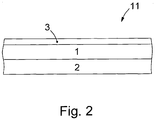
- Fig. 2 shows a multilayer polymer film 11 according to the present invention comprising a first layer 1, a second layer 2 and a third layer 3.
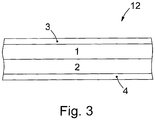
- Fig. 3 shows a multilayer polymer film 13 according to the present invention comprising a first layer 1, a second layer 2, a third layer 3 and a fourth layer 4.
- the inventive multilayer polymer film may consist of three layers, i.e. the first and second layer plus the third layer.
- the multilayer polymer film may consist of layers 1, 2 and 3 or layers 1, 2, 3 and 4.
- Fig. 4 shows a perspective view of an exemplary multipack 30 thermoformed from the multilayer polymer film of the present invention.
- the multipack 30 comprises six containers 31.
- containers 31 are arranged in a periodic pattern of parallel rows and columns.
- An upper surface 32 of the multipack 30 comprises concave portions, the shape of which corresponds to the shape of containers 31.
- the upper surface 32 is formed by the first layer or the third layer of the multilayer polymer film of the present invention.
- the upper surface 32 of multipack 30 further comprises incisions 33 and 34.
- incisions 33 and 34 are located symmetrically halfway between adjacent rows and columns of containers 31.
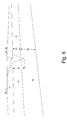
- Fig. 5 schematically shows details of incisions 33 and 34 in the upper surface 32 of a multipack thermoformed from a film according to the present invention, wherein said film comprises a first layer 21 and a second layer 22, corresponding to layer 1 and, respectively layer 2 of Fig. 1 .
- said film comprises a first layer 21 and a second layer 22, corresponding to layer 1 and, respectively layer 2 of Fig. 1 .
- the thickness of the first layer 21 is designated by reference sign "T1".
- Incisions 33 and 34 extend from the upper surface 32 into the first layer 21 down to depth D.
- depth D is equal or larger than 60 % of T1, i.e. D ⁇ 0.6 ⁇ T1, and more preferably equal or larger than 80 % of T1, i.e. D ⁇ 0.8 ⁇ T1 .
- Fig. 6 shows incisions 33 and 34 with depth D in the upper surface 32 of a multipack thermoformed from a film according to the present invention, wherein said film comprises a first layer 21 and a second layer 22, corresponding to layer 1 and, respectively layer 2 of Fig. 1 .
- Layer 21 and 22 have thickness T1 and, respectively T2.
- Incisions 33 and 34 extend through the first layer 21 into the second layer 22, preferably down to a depth D which corresponds to less or equal to 50 % of thickness T2 of second layer 22, i.e. D ⁇ T1 + 0.5 ⁇ T2 .
- the depth D of incisions 33 and 34 is preferably bounded according to the following relation 0.6 ⁇ T 1 ⁇ D ⁇ T 1 + 0.5 ⁇ T 2 and more preferably, according to the relation 0.8 ⁇ T 1 ⁇ D ⁇ T 1 + 0.5 ⁇ T 2
- Fig. 7 and 8 show incisions 33 and 34 with depth D in the upper surface 32 of a multipack thermoformed from a film according to the present invention, wherein said film comprises a first layer 21, a second layer 22 and a third layer 23, corresponding to layer 1, respectively layer 2 and, respectively layer 3 of Fig. 2 and 3 .
- Layer 21, 22 and 23 have thickness T1, respectively T2 and, respectively T3.
- Fig. 7 shows incissions 33 and 34 extending through the third layer 23 into the first layer 21, preferably down to a depth D which corresponds to at least 60 % of thickness T1 of first layer 21, i.e. D ⁇ T3 + 0.6 ⁇ T1, and more preferably at least 80 % of thickness T1, i.e. D ⁇ T3 + 0.8 ⁇ T1 .
- Fig. 8 shows incissions 33 and 34 extending through the third and first layer 23 and 21 into the second layer 22, preferably down to a depth D which is less or equal to 50 % of thickness T2 of second layer 22, i.e. D ⁇ T3 + T1 + 0.5 ⁇ T2.
- the depth D of incisions 33 and 34 is preferably bounded according to the following relation T 3 + 0.6 ⁇ T 1 ⁇ D ⁇ T 3 + T 1 + 0.5 ⁇ T 2 and more preferably, according to the relation T 3 + 0.8 ⁇ T 1 ⁇ D ⁇ T 3 + T 1 + 0.5 ⁇ T 2
- the multipack 30 of the present invention may also comprise a lid film sealed onto contiguous planar strips of the multipack 30 extending between adjacent container rows and columns.
- said lid film consists of a sealable single-layer or multilayer polymer film equipped with a metal coating and one or more print layers.
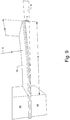
- Fig. 9 shows a perspective schematic of the geometry for measurement of bending stiffness according to DIN 53350.
- a film sample 10 having width W is fixated at one end by a clamp 50.
- the free standing end of film sample 10 is deflected in a direction perpendicular to the nominal film sample plane defined by clamp 50.
- distance L is also designated as bending length L.
- the deflection of film 10 is effected by an electronic actuator (not shown in Fig. 9 ) equipped with a load cell and a position transducer for measuring the bending force and corresponding deflection x.
- the bending stiffness is preferably measured using an automated instrument, such as 2-Point Bending Tester from Zwick Roell.
- the bending stiffness S is stated in physical units of [N ⁇ mm 2 per 1 mm film width].
- the physical bending stiffness of a film having a width of W in units of [mm] is then given by W ⁇ S .
- W ⁇ S In scientific and technical literature, it is also common to state bending stiffness S in width normalized units of [N ⁇ mm].
- the physical bending stiffness of a film having a width normalized bending stiffness S and a width of W in units of [mm] is then calculated as W ⁇ mm ⁇ ⁇ .
- the numerical values of physical bending stiffness S [N ⁇ mm 2 per 1 mm film width] and width normalized bending stiffness S [N ⁇ mm] are identical.
- a four-layer polymer film according to the present invention of type C/A/B/C was prepared using three extruders and a feedblock/die designed for overlay of four melt streams. The thickness and material composition of the four layers are listed beneath. Table 1: Composition of inventive example film Layer no.
- Table 2 The thickness, density, bending stiffness, oxygen permeability (OTR) and water vapor permeability (WVTR) of the thus obtained four-layer polymer film were measured according to the methods recited in Table 4 and following results obtained: Table 2: Inventive example film properties thickness 695 ⁇ m density 1.28 g ⁇ cm -3 bending stiffness 104.7 N ⁇ mm 2 per 1 mm width oxygen permeability 7.4 cm 3 / (m 2 ⁇ day ⁇ atm) water vapor permeability 1.61 g / (m 2 ⁇ day)
- the bending stiffness S of a film consisting of a homogeneous material is proportional to the elastic modulus E multiplied by the third power of the film thickness t, i.e. S ⁇ E ⁇ t 3 .
- the thickness/material adjusted bending stiffness of the inventive film example is 30 % larger than that of the comparative polystyrene film.
- the physical properties of the inventive film and additives are measured according to the following methods: Table 4: Measurement methods Film property Method Total film thickness DIN 53370:2006 Layer thickness Optical and electron microscope imaging of film section Density DIN EN ISO 1183:2005 Elastic modulus / Tensile modulus DIN EN ISO 527:2012 Bending stiffness DIN 53350 at a bending length of 100 mm using a film sample with 160 mm length, 30 mm width.
- Oxygen permeability / Oxygen transmission rate (OTR) DIN 53380-3:1998 at 23 °C and ⁇ 0.1 % relative humidity.
- Powder particle size, equivalent diameter Electron microsope imaging of more than 1000 particles in combination with software based image analysis; Light scattering using Horiba LA-300 laser diffraction particle size distribution analyzer for particle sizes from 0.01 to 5000 ⁇ m.
- the term "equivalent diameter” designates the diameter of an "equivalent” spherical particle having the same chemical composition and areal section (electron microscope imaging) or scattering intensity (laser diffraction) as the examined particle.
- areal section or scattering intensity of each examined (irregularly shaped) particle is assigned to a spherical particle having a diameter commensurate with the measured signal.
- homogeneous films i.e. single layer films were prepared from the polymer compound of the respective layer using the same machine settings, such as extruder torque, extruder slit width, extruder slit height and temperature profile as those used for the manufacture of the inventive multilayer film.
- the density and tensile modulus (elastic modulus) of a single layer film prepared in such manner are then measured according to DIN EN ISO 1183:2005 and, respectively DIN EN ISO 527:2012 and assigned to the layer of an inventive multilayer film prepared from the same compound under the same process conditions.
Landscapes
- Engineering & Computer Science (AREA)
- Ceramic Engineering (AREA)
- Mechanical Engineering (AREA)
- Laminated Bodies (AREA)
- Wrappers (AREA)
- Containers Having Bodies Formed In One Piece (AREA)
- Packages (AREA)
Description
- The present invention pertains to a multilayer polymer film with 3 to 10 layers and to a multipack comprising 2 to 40 containers, which is thermoformed from the multilayer polymer film.
- Multipacks for food produce, such as yoghurt, pudding, jam or butter are known in the art. Customary multipacks comprising 2 to 40 packs, respectively containers or cups are thermoformed from white or colored single-layer polystyrene film having a thickness of 400 to 1200 µm. Typically, the containers of a multipack are arranged in a pattern of periodic rows and columns connected by planar strips of polystyrene film. The respective food produce may be filled into the containers of a multipack immediately after thermoforming (inline) or after intermediate storage of empty multipacks (offline). Subsequently, the multipack, respectively the containers holding the food produce are sealed with a lid film. Thereafter, the lid film and the surface of contiguous multipack strips extending between adjacent container rows and columns are incised to a preset depth using a cutting wheel or similar means in order to facilitate manual separation of individual containers by end consumers. In the art as well as in the present invention said incisions are also termed as "snap incisions".
- A polymer film suitable for the manufacture of multipacks must be thermoformable and sealable and provide adequate mechanical stability and diffusion barrier in order to prevent mechanical damage and preserve the food produce contained therein over an extended time period. Furthermore, the film material must not release harmful substances when directly contacting food produce over an extended time period.
- Customary multipacks are manufactured from homogeneous single-layer film on the basis of polystyrene. Polystyrene provides suitable thermal and mechanical properties at a favorable density of 0.96 to 1.04 g/cm3. However, polystyrene is known to have a low diffusion barrier for oxygen and water vapor, which in many instances can adversely affect food produce stored in polystyrene containers over an extended time period.
- Furthermore, polystyrene contains up to 1 % by weight of the lipid-soluble monomer styrene which migrates into food produce and can adversely affect human health (cf. J.R. Withey "Quantitative Analysis of Styrene Monomer in Polystyrene and Foods Including Some Preliminary Studies of the Uptake and Pharmacodynamics of the Monomer in Rats" Environmental Health Perspectives, Vol. 17, pp. 125-133, 1976).
-
WO 2014/067923 A1 discloses an article being a bottle or a thermoformed cup, preferably in a multipack form or in an individual cup form, comprising at least one layer A of a non-foamed polylactic acid material A comprising polylactic acid, and one layer B of a foamed polylactic acid material B comprising polylactic acid and being substantially free of expanded microspheres, wherein material A and/or material B comprise an impact modifier. In addition to the impact modifiers in an amount 0.01 to 30% by weight, further additives such as talc particles or titanium dioxide pigments, may be present in an amount of 0.1 to 15% by weight in material A and/or B, respectively as nucleating agent or pigment. ABA structures are also disclosed therein. - Thus, there exists a need for a polymer film that does not pose a health risk, is suitable for multipacks and provides improved shelf life for food produce.
- Accordingly, the present invention has the objective to provide a thermoformable film for the manufacture of multipacks with improved diffusion barrier for oxygen and water vapour compared to conventional multipacks made from polystyrene in conjunction with suitable mechanical properties. In particular the inventive film, when thermoformed, should be resistant against bending and kinking under mechanical load as occurring during storage and transport of multipacks filled with food produce, such as yoghurt. Furthermore, the inventive multipack should provide easy separation of individual packs, respectively containers when equipped with snap incisions. This objective is achieved through a multilayer polymer film with 3 to 10 layers, wherein
- a first layer consists of 80 to 99.5 % by weight of polyester and 0.5 to 20 % by weight of additives, based on the total weight of the first layer and comprises pores;
- a second layer is bonded to a first surface of the first layer and consists of 50 to 90 % by weight of polyester and 10 to 50 % by weight of additives, wherein 1 to 30 % by weight of a first additive is selected from chalc, talc, mica, wollastonite, calcium carbonate, bentonite, kaolin, clay, titanium oxide and mixtures thereof, based on the total weight of the second layer;
- the polyester of the first and second layer independently from each other are selected from polyethylene terephthalate and polyesters which consist of (i) 80 to 100 mol-% of a diacid residue component selected from terephthalic acid, naphthalene dicarboxylic acid, 1,4-cyclohexanedicarboxylic acid, isophthalic acid and mixtures thereof and (ii) 80 to 100 mol-% of a diol residue component selected from diols containing 2 to 10 carbon atoms, in particular ethylene glycol, and mixtures thereof and 0 to 20 mol-% of a modifying diol selected from 1,3-propanediol, 1,4-butanediol, 1,5-pentanediol, 1,6-hexanediol, 1,8-octanediol, 1,4-cyclohexanedimethanol, 2,2,4-trimethyl-1,3-pentanediol, propylene glycol, 2,2,4,4-tetramethyl-1,3-cyclobutanediol, based on 100 mol-% diacid residues and, respectively 100 mol-% diol residues;
- the multilayer polymer film comprises a third layer bonded to a second surface of the first layer opposite to the second layer, the third layer consisting of 90 to 99.5 % by weight of polyester and 0.5 to 10 % by weight of additives, based on the total weight of the third layer and the third layer does not comprise a foaming agent and anorganic particles.
- Advantageous implementations of the inventive film are characterized in that:
- the multilayer polymer film has an oxygen permeability (oxygen transmission rate OTR) of 1 to 40 cm3 / (m2·day·atm), measured according to DIN 53380-3;
- the multilayer polymer film has a water vapor permeability (water vapor transmission rate WVTR) of 1 to 6 g / (m2·day), measured according to DIN EN ISO 15106-2;
- the multilayer polymer film has an oxygen transmission rate of 1 to 10 cm3 / (m2·day·atm), 1 to 5 cm3 / (m2·day·atm), 3 to 7 cm3 / (m2·day·atm) or 6 to 10 cm3 / (m2·day·atm), measured according to DIN 53380-3;
- the multilayer polymer film has a water vapor permeability (water vapor transmission rate WVTR) of 1 to 3 g / (m2·day), 1 to 2 g / (m2·day) or 2 to 3 g / (m2·day), measured according to DIN EN ISO 15106-2;
- the multilayer polymer film has a bending stiffness of 60 to 200 N·mm2 per 1 mm film width, measured according to DIN 53350;
- the multilayer polymer film has a bending stiffness of 50 to 120 N·mm2 per 1 mm film width, measured according to DIN 53350 at film thickness of 700 µm;
- the multilayer polymer film has a bending stiffness of 50 to 70 N·mm2 , 60 to 80 N·mm2 , 70 to 90 N·mm2 , 80 to 100 N·mm2 , 90 to 110 N·mm2 or 100 to 120 N·mm2 per 1 mm film width, measured according to DIN 53350 at film thickness of 700 µm;
- the multilayer polymer film has a bending stiffness of 146·t3 to 350·t3 N/mm per 1 mm film width, wherein t is the thickness of the multilayer polymer film in units of mm and the bending stiffness is measured according to DIN 53350;
- the multilayer polymer film has a bending stiffness of 146·t3 to 204·t3 N/mm, 175·t3 to 233·t3 N/mm, 204·t3 to 262·t3 N/mm, 233·t3 to 292·t3 N/mm, 262·t3 to 321 ·t3 N/mm or 292·t3 to 350·t3 N/mm per 1 mm film width, wherein t is the thickness of the multilayer polymer film in units of mm and the bending stiffness is measured according to DIN 53350;
- the multilayer polymer film has a density of 1 to 1.4 g/cm3 ;
- the multilayer polymer film has a density of 1 to 1.2 g/cm3 , 1.1 to 1.3 g/cm3 or 1.2 to 1.4 g/cm3 ;
- the multilayer polymer film is made by coextrusion, wherein multiple melt streams are overlayed and extruded through a coextrusion slit die;
- the first layer is formed by extrusion or coextrusion of a plastified mold composition containing a pressurized gas and pores in the first layer are generated through expansion of the pressurized gas;
- the first layer is formed by extrusion or coextrusion of a plastified mold composition containing a foaming agent and pores in the first layer are generated through expansion of a gas created by volatilization of the foaming agent;
- the first layer consists of 80 to 99.5 % by weight of polyester and 0.5 to 20 % by weight of additives, based on the total weight of the first layer, comprises pores and the additives are selected from processing aids, heat stabilizers, lubricants, waxes, fats, paraffins, epoxidized soya oil, polymeric modifiers, acrylate-based polymers, butyl-methacrylate-based polymers, methacrylate-butyl-styrene-based polymers, methacrylate-butadiene-styrene-based polymers, methylmethacrylate-butadiene-styrene-based polymers, dyes and pigments, fungicides, UV stabilizers, fire-protection agents and fragrances;
- the multilayer polymer film is not stretched;
- the multilayer polymer film is stretched in a first direction or in a first and second direction at a stretch ratio of 1.01 to 1.5 in the first and/or second direction independently from each other;
- the first layer is not stretched;
- the first layer is stretched in a first direction or in a first and second direction at a stretch ratio of 1.01 to 1.5 in the first and/or second direction independently from each other;
- the first layer consists of 80 to 99.5 % by weight of polyester and 0.5 to 20 % by weight of additives, based on the total weight of the first layer, comprises pores and has an elastic modulus of 700 to 2000 N/mm2, when prepared as single-layer film under the same conditions as the multilayer polymer film;
- the second layer is bonded to a first surface of the first layer and consists of 50 to 90 % by weight of polyester and 10 to 50 % by weight of additives, wherein 1 to 30 % by weight of a first additive is selected from chalc, talc, mica, wollastonite, calcium carbonate, bentonite, kaolin, clay, titanium oxide and mixtures thereof, based on the total weight of the second layer and further additives are selected from processing aids, heat stabilizers, lubricants, waxes, fats, paraffins, epoxidized soya oil, polymeric modifiers, acrylate-based polymers, butyl-methacrylate-based polymers, methacrylate-butyl-styrene-based polymers, methacrylate-butadiene-styrene-based polymers, methylmethacrylate-butadiene-styrene-based polymers, dyes and pigments, fungicides, UV stabilizers, fire-protection agents and fragrances;
- the second layer is bonded to a first surface of the first layer and consists of 50 to 90 % by weight of polyester and 10 to 50 % by weight of additives, wherein 1 to 30 % by weight of a first additive is selected from chalc, talc, mica, wollastonite, calcium carbonate, bentonite, kaolin, clay, titanium oxide and mixtures thereof, based on the total weight of the second layer and has an elastic modulus of 1800 to 3200 N/mm2, when prepared as single-layer film under the same conditions as the multilayer polymer film;
- the first layer has an elastic modulus of 700 to 1000 N/mm2, 800 to 1200 N/mm2, 1000 to 1400 N/mm2, 1200 to 1600 N/mm2, 1400 to 1800 N/mm2 or 1600 to 2000 N/mm2, when prepared as single-layer film under the same conditions as the multilayer polymer film;
- the second layer has an elastic modulus of 1800 to 2200 N/mm2, 2000 to 2400 N/mm2, 2200 to 2600 N/mm2, 2400 to 2800 N/mm2, 2600 to 3000 N/mm2 or 2800 to 3200 N/mm2, when prepared as single-layer film under the same conditions as the multilayer polymer film;
- the multilayer polymer film has a thickness of 400 to 1200 µm;
- the multilayer polymer film has a thickness of 400 to 800 µm, 600 to 1000 µm or 800 to 1200 µm;
- the ratio of thickness T1 of the first layer to thickness T2 of the second layer is in the range from 0.5 to 4, i.e. 0.5 ≤ T1 / T2 ≤ 4 ;
- the ratio of thickness T1 of the first layer to thickness T2 of the second layer is in the range from 0.5 to 2, i.e. 0.5 ≤ T1 / T2 ≤ 2 ;
- the ratio of thickness T1 of the first layer to thickness T2 of the second layer is in the range from 1 to 2, i.e. 1 ≤ T1 / T2 ≤ 2 ;
- the ratio of thickness T1 of the first layer to thickness T2 of the second layer is in the range from 1.5 to 2.5, i.e. 1.5 ≤ T1 / T2 ≤ 2.5 ;
- the ratio of thickness T1 of the first layer to thickness T2 of the second layer is in the range from 2 to 3, i.e. 2 ≤ T1 / T2 ≤ 3 ;
- the ratio of thickness T1 of the first layer to thickness T2 of the second layer is in the range from 2.5 to 3.5, i.e. 2.5 ≤ T1/ T2 ≤ 3.5 ;
- the ratio of thickness T1 of the first layer to thickness T2 of the second layer is in the range from 3 to 4, i.e. 3 ≤ T1 / T2 ≤ 4 ;
- the ratio of thickness T1 of the first layer to thickness T2 of the second layer is in the range from 0.5 to 0.9, i.e. 0.5 ≤ T1/ T2 ≤ 0.9 ;
- the first layer comprises pores and has a density of 0.8 to 1.1 g/cm3, when prepared as single-layer film under the same conditions as the multilayer polymer film;
- the first layer comprises pores and has a density of 0.8 to 1 g/cm3 or 0.9 to 1.1 g/cm3, when prepared as single-layer film under the same conditions as the multilayer polymer film;
- the second layer has a density of 1.3 to 1.5 g/cm3, when prepared as single-layer film under the same conditions as the multilayer polymer film;
- the second layer has a density of 1.3 to 1.4 g/cm3 or 1.4 to 1.5 g/cm3, when prepared as single-layer film under the same conditions as the multilayer polymer film;
- the first layer comprises 8 to 19.9 % by weight of polyethylene and 0.1 to 2 % by weight of ethylene vinyl acetate, based on the total weight of the first layer;
- the second layer comprises 8 to 24 % by weight of polyethylene and 0.1 to 2 % by weight of ethylene vinyl acetate, based on the total weight of the second layer;
- the first layer comprises 0.01 to 1 % by weight of a foaming agent, based on the total weight of the first layer;
- the foaming agent is selected from carbon dioxide, sodium hydrogen carbonate and citric acid, nitrogen, azodicarbonamide, oxy-bis-benzene sulfonylhydrazide, toluene sulfonylhydrazide, benzene sulfonylhydrazide, toluene sulfonylsemicarbazide, 5-phenyltetrazole, di-nitroso pentamethylene tetramine and mixtures thereof;
- the second layer comprises 1 to 30 % by weight of an additive selected from chalc, talc, mica, wollastonite, calcium carbonate, bentonite, kaolin, clay, titanium oxide and mixtures thereof, based on the total weight of the second layer, said additive consisting of particles having a particle size of less than 60 µm, from 0.01 to 50 µm, 0.01 to 40 µm, 0.01 to 30 µm or 1 to 50 µm;
- the second layer comprises 1 to 8 % by weight, 6 to 10 % by weight, 8 to 12 % by weight, 10 to 14 % by weight, 12 to 16 % by weight, 14 to 18 % by weight, 16 to 20 % by weight, 18 to 22 % by weight, 20 to 24 % by weight, 22 to 26 % by weight, 24 to 28 % by weight or 26 to 30 % by weight of an additive selected from chalc, talc, mica, wollastonite, calcium carbonate, bentonite, kaolin, clay, titanium oxide and mixtures thereof, based on the total weight of the second layer;
- the multilayer polymer film consists of 3 layers;
- the multilayer polymer film consists of 4 layers;
- the multilayer polymer film comprises a fourth layer bonded to a surface of the second layer opposite to the first layer, the fourth layer comprising 90 to 99.5 % by weight of polyester and 0.5 to 10 % by weight of additives, based on the total weight of the fourth layer;
- the multilayer polymer film comprises a fourth layer bonded to a surface of the second layer opposite to the first layer, the fourth layer comprising 90 to 99.5 % by weight of polyester and 0.5 to 10 % by weight of additives, based on the total weight of the fourth layer, and the fourth layer does not comprise a foaming agent;
- the multilayer polymer film comprises a fourth layer bonded to a surface of the second layer opposite to the first layer, the fourth layer comprising 90 to 99.5 % by weight of polyester and 0.5 to 10 % by weight of additives, based on the total weight of the fourth layer, and the fourth layer does not comprise anorganic particles;
- the one or more polyesters of the third and fourth layer independently from each other are selected from polyethylene terephthalate and polyesters which consist of (i) 80 to 100 mol-% of a diacid residue component selected from terephthalic acid, naphthalene dicarboxylic acid, 1,4-cyclohexanedicarboxylic acid, isophthalic acid and mixtures thereof and (ii) 80 to 100 mol-% of a diol residue component selected from diols containing 2 to 10 carbon atoms, in particular ethylene glycol, and mixtures thereof and 0 to 20 mol-% of a modifying diol selected from 1,3-propanediol, 1,4-butanediol, 1,5-pentanediol, 1,6-hexanediol, 1,8-octanediol, 1,4-cyclohexanedimethanol, 2,2,4-trimethyl-1,3-pentanediol, propylene glycol, 2,2,4,4-tetramethyl-1,3-cyclobutanediol, based on 100 mol-% diacid residues and, respectively 100 mol-% diol residues;
- the third layer has a thickness of 4 to 60 µm;
- the third layer has a thickness of 4 to 20 µm, 10 to 30 µm, 20 to 40 µm, 30 to 50 µm or 40 to 60 µm; and/or
- the fourth layer has a thickness of 4 to 60 µm.
- Throughout the present invention - unless explicitly stated otherwise - the term "% by weight" refers to the total weight of the film layer under consideration, e.g. to the total weight of the first, second, third or fourth layer of the inventive multilayer polymer film, wherein the total weight of the film layer under consideration represents 100 % by weight. The amount of a component in one of the film layers in units of "% by weight" corresponds to the amount of this component in the molding composition used for extrusion of the film layer, relative to the total weight of the molding composition.
- Furthermore, the present invention has the objective to provide a multipack having improved diffusion barrier for oxygen and adequate diffusion barrier for water vapour compared to conventional multipacks made from polystyrene in conjunction with suitable mechanical properties. In particular the multipack should be resistant against bending and kinking under mechanical loads occurring for example, when twenty or more multipacks filled with food produce, such as jam or yoghurt are stacked upon each other. Furthermore, the inventive multipack should provide easy separation of individual packs, respectively containers when equipped with suitable incisions.
- This objective is achieved through a multipack comprising 2 to 40 containers, wherein the multipack is thermoformed from the inventive multilayer film as described above and wherein the first layer or the third layer of the multilayer polymer film constitute an upper surface of the multipack having concave portions.
- An advantageous implementation of the inventive multipack is characterized in that the multipack comprises 1 to 40 snap incisions extending from the upper surface of the multipack into the multilayer polymer film to a depth D, wherein D1 ≤ D ≤ D2, D1 extends to 80 % of the thickness of the first layer and D2 extends to 50 % of the thickness of the second layer.
- The snap incisions may be applied after the thermoformed multipack has been filled with produce and sealed with a lid film. Thus, the multipack of the present invention may also comprise a lid film sealed onto contiguous planar strips of the multipack extending between adjacent container rows and columns. Preferably, said lid film consists of a sealable single-layer or multilayer polymer film equipped with a metal coating and one or more print layers.
- The inventive multilayer polymer film is prepared by known methods, such as coextrusion or calendering in conjunction with lamination. Similarly, the inventive multipack is manufactured using conventional thermoforming equipment and process parameters commensurate to those for multipacks made from polystyrene film.
- The inventive multilayer polymer film may consist of two or three layers, i.e. the first and second layer plus optionally either the third or fourth layer.
- Each of the layers of the inventive multilayer polymer film provides distinct functionality as explained hereafter.
- The first layer is porous, has reduced density compared to regular polyethylene terephthalate and thus lowers the overall density and weight of the multilayer polymer film. Coincidentally, the first layer has a somewhat reduced elastic modulus and higher elongation at break which renders the multilayer polymer film more flexible and resistant against bending and tensile load. Also, due to its porosity the first layer can be easily cut and facilitates placement of snap incisions.
- The second layer, which preferably contains a particulate inorganic additive, has a high elastic modulus compared to regular polyethylene terephthalate and imparts bending stiffness to the multilayer polymer film. In addition the second layer is brittle and furthers "snappability" of multipacks thermoformed from the inventive multilayer polymer film. The term "snappability" refers to the suitability of a multipack for manually induced breakage along designated snap incisions.
- By adjusting the thickness and mechanical properties, particularly the elastic modulus of the first and second layer the bending stiffness and - in conjunction with snap incision depth - the snappability of the multilayer polymer film can be tuned to the application specific requirements for a multipack. Furthermore, the thickness of the first and second layer can also be adjusted in order to adapt the thickness of the multilayer polymer film to the specific requirement of a multipack thermoforming operation.
- In an advantageous embodiment of the inventive multilayer polymer film the first and/or second layer comprises a polyolefin or a polyamide, preferably in conjunction with a compatibilizer such as ethylene vinyl acetate in order to increase the barrier against diffusion of oxygen and water vapor. The polyolefin or polyamide forms domains in the polyester matrix of the first and/or second layer and reduces the diffusivity of O2- and H2O-molecules.
- The third layer provides a smooth nonporous surface finish and insulates food produce contained in a multipack from the first layer of the inventive multilayer polymer film. In addition the third layer increases the bending stiffness of the multilayer polymer film.
- The optional fourth layer enhances the visual appearance of multipacks thermoformed from the inventive multilayer polymer film. Preferably, the outer surface of the fourth layer opposite to the second layer has a glossy surface finish. In addition the fourth layer may comprise color additives which preferably are compliant with the requirements for food packaging.
-
- Fig. 1-3
- are schematics of multilayer films of the present invention;
- Fig. 4
- shows a perspective view of a multipack made from the inventive film;
- Fig. 5-8
- show details of snap incisions in the multipack of the present invention;
- Fig. 9
- shows the geometry of the setup for measuring the bending stiffness of the inventive film.
-
Fig. 1 shows amultilayer polymer film 10 not according to the present invention comprising afirst layer 1 and asecond layer 2. -
Fig. 2 shows amultilayer polymer film 11 according to the present invention comprising afirst layer 1, asecond layer 2 and athird layer 3. -
Fig. 3 shows a multilayer polymer film 13 according to the present invention comprising afirst layer 1, asecond layer 2, athird layer 3 and a fourth layer 4. - The inventive multilayer polymer film may consist of three layers, i.e. the first and second layer plus the third layer. In particular the multilayer polymer film may consist of
layers layers -
Fig. 4 shows a perspective view of anexemplary multipack 30 thermoformed from the multilayer polymer film of the present invention. Themultipack 30 comprises sixcontainers 31. Preferably,containers 31 are arranged in a periodic pattern of parallel rows and columns. Anupper surface 32 of themultipack 30 comprises concave portions, the shape of which corresponds to the shape ofcontainers 31. Preferably, theupper surface 32 is formed by the first layer or the third layer of the multilayer polymer film of the present invention. Theupper surface 32 ofmultipack 30 further comprisesincisions incisions containers 31. -
Fig. 5 schematically shows details ofincisions upper surface 32 of a multipack thermoformed from a film according to the present invention, wherein said film comprises afirst layer 21 and asecond layer 22, corresponding tolayer 1 and, respectivelylayer 2 ofFig. 1 . In -
Fig. 5 the thickness of thefirst layer 21 is designated by reference sign "T1".Incisions upper surface 32 into thefirst layer 21 down to depth D. Preferably, depth D is equal or larger than 60 % of T1, i.e. D ≥ 0.6 × T1, and more preferably equal or larger than 80 % of T1, i.e. D ≥ 0.8 × T1 . - Similarly to
Fig. 5 ,Fig. 6 showsincisions upper surface 32 of a multipack thermoformed from a film according to the present invention, wherein said film comprises afirst layer 21 and asecond layer 22, corresponding tolayer 1 and, respectivelylayer 2 ofFig. 1 .Layer Incisions first layer 21 into thesecond layer 22, preferably down to a depth D which corresponds to less or equal to 50 % of thickness T2 ofsecond layer 22, i.e. D ≤ T1 + 0.5 × T2 . - With reference to
Fig. 5 and6 , the depth D ofincisions 

- Similarly to
Fig. 5 and6 ,Fig. 7 and8 show incisions upper surface 32 of a multipack thermoformed from a film according to the present invention, wherein said film comprises afirst layer 21, asecond layer 22 and athird layer 23, corresponding tolayer 1, respectivelylayer 2 and, respectivelylayer 3 ofFig. 2 and3 .Layer -
Fig. 7 shows incissions 33 and 34 extending through thethird layer 23 into thefirst layer 21, preferably down to a depth D which corresponds to at least 60 % of thickness T1 offirst layer 21, i.e. D≥T3 + 0.6×T1, and more preferably at least 80 % of thickness T1, i.e. D≥T3 + 0.8 × T1 . -
Fig. 8 shows incissions 33 and 34 extending through the third andfirst layer second layer 22, preferably down to a depth D which is less or equal to 50 % of thickness T2 ofsecond layer 22, i.e. D ≤ T3 + T1 + 0.5 × T2. - With reference to
Fig. 7 and8 , the depth D ofincisions relation 
relation 
- Despite not being shown in
Fig. 4 ,5 ,6 ,7 and8 , themultipack 30 of the present invention may also comprise a lid film sealed onto contiguous planar strips of themultipack 30 extending between adjacent container rows and columns. Preferably, said lid film consists of a sealable single-layer or multilayer polymer film equipped with a metal coating and one or more print layers. Regardless of whether or not theinventive multipack 30 comprises a lid film, the above stated bounds for the depth D ofsnap incisions upper surface 32 ofmultipack 30, formed by thefirst layer 21 orthird layer 23 of the inventive multilayer polymer film, are implemented. -
Fig. 9 shows a perspective schematic of the geometry for measurement of bending stiffness according to DIN 53350. Afilm sample 10 having width W is fixated at one end by aclamp 50. At distance L fromclamp 50 the free standing end offilm sample 10 is deflected in a direction perpendicular to the nominal film sample plane defined byclamp 50. In the present invention distance L is also designated as bending length L. - The perpendicular deflection is designated by reference sign "x" and the corresponding deflection angle by "φ", wherein φ = tan-1(x/L). The deflection of
film 10 is effected by an electronic actuator (not shown inFig. 9 ) equipped with a load cell and a position transducer for measuring the bending force and corresponding deflection x. The bending stiffness S is defined as the ratio of bending moment M to curvature κ, i.e. S = M / κ , wherein curvature κ is the inverse of the bending radius R, i.e. κ = 1/R. For small angular deflection φ ≤ 7 degree (i.e. φ ≤ 0.122 radian) the bending stiffness S can be approximated according to the formula S = F·L3 / (3·x) , wherein F designates the bending force. - In the present invention the bending stiffness is preferably measured using an automated instrument, such as 2-Point Bending Tester from Zwick Roell.
- In the invention the bending stiffness S is stated in physical units of [N·mm2 per 1 mm film width]. The physical bending stiffness of a film having a width of W in units of [mm] is then given by W × S . In scientific and technical literature, it is also common to state bending stiffness S in width normalized units of [N·mm]. The physical bending stiffness of a film having a width normalized bending stiffness S and a width of W in units of [mm], is then calculated as W × mm × Ŝ. Aside from differing units the numerical values of physical bending stiffness S [N·mm2 per 1 mm film width] and width normalized bending stiffness S [N·mm] are identical.
- A four-layer polymer film according to the present invention of type C/A/B/C was prepared using three extruders and a feedblock/die designed for overlay of four melt streams. The thickness and material composition of the four layers are listed beneath.
Table 1: Composition of inventive example film Layer no. / type Layer thickness† Layer material 3 / C 20 µm 96.5 wt-% APET RAMAPET†† N180 / 0.5 wt-% antiblock agent (wax + SiO2 Sukano T dc S479) / 3 wt-% masterbatch color (PET + white pigment) 1 / A 265 µm 97.5 wt-% BPET‡ / 2 wt-% masterbatch white (25 wt-% LDPE + 75 wt-% TiO2) / 0.5 wt-% foaming agent (NaHCO3 + citric acid + nucleating agent) 2 / B 395 µm 68 wt-% BPET‡ / 30 wt-% masterbatch chalk (20 wt-% PPH + 80 wt-% CaCO3 particle size < 5 µm) / 2 wt-% masterbatch white (25 wt-% LDPE + 75 wt-% TiO2) 4 / C 20 µm 96.5 wt-% APET RAMAPET†† N180 / 0.5 wt-% antiblock agent (wax + SiO2 Sukano T dc S479) / 3 wt-% masterbatch color (PET + white pigment) † nominal layer thickness based on amount and density of the respective layer material;
†† RAMAPET N180 having intrinsic viscosity of 0.8 dl/g ;
‡ BPET consisting of 85 wt-% PET (50 wt-% post consume recycled PET
+ 50 wt-% APET RAMAPET N180), 13 wt-% LDPE with melt flow rate of 3 to 8 g/min and 2 wt-% ethylene vinyl acetate. - The thickness, density, bending stiffness, oxygen permeability (OTR) and water vapor permeability (WVTR) of the thus obtained four-layer polymer film were measured according to the methods recited in Table 4 and following results obtained:
Table 2: Inventive example film properties thickness 695 µm density 1.28 g·cm-3 bending stiffness 104.7 N·mm2 per 1 mm width oxygen permeability 7.4 cm3 / (m2·day·atm) water vapor permeability 1.61 g / (m2·day) - A commercially available white polystyrene film for thermoforming of multipacks was tested using the same measurement methods and conditions as in the inventive example. For thickness, density, oxygen permeability and water vapor permeability of the white polystyrene film the following results were obtained:
Table 3: Comparative example film properties thickness 840 µm density 1.09 g·cm-3 bending stiffness 141.7 N·mm2 per 1 mm width oxygen permeability 220.0 cm3 / (m2·day·atm) water vapor permeability 3.80 g / (m2·day) - The bending stiffness S of a film consisting of a homogeneous material is proportional to the elastic modulus E multiplied by the third power of the film thickness t, i.e. S ~ E·t3. In order to compare the bending stiffness of the inventive and comparative example films on a thickness, respectively material adjusted basis the bending stiffness of the comparative example film is multiplied by a factor of (695 µm / 840 µm)3 = 0.57. Accordingly, for the thickness adjusted bending stiffness of the comparative example film a value of 0.57×141.7 N·mm2 = 80,26 N·mm2 per 1 mm film width is obtained. Thus, the thickness/material adjusted bending stiffness of the inventive film example is 30 % larger than that of the comparative polystyrene film.
- Similarly, in order to compare the oxygen permeability (OTR) and the water vapor permeability (WVTR) of the inventive and comparative film examples on a thickness/material adjusted basis, the respective values of the comparative film example are multiplied by a factor of 840 µm / 695 µm = 1.21 . Accordingly, for the comparative polystyrene film thickness/material adjusted values of 265.9 cm3 / (m2·day·atm) for OTR and 4.59 g / (m2·day) for WVTR are obtained. These values are larger by factors of 35.9 and, respectively 2.9 than the OTR and WVTR of the inventive film example.
- The above results show that the inventive film has favorable properties compared to conventional polystyrene film.
- The physical properties of the inventive film and additives are measured according to the following methods:
Table 4: Measurement methods Film property Method Total film thickness DIN 53370:2006 Layer thickness Optical and electron microscope imaging of film section Density DIN EN ISO 1183:2005 Elastic modulus / Tensile modulus DIN EN ISO 527:2012 Bending stiffness DIN 53350 at a bending length of 100 mm using a film sample with 160 mm length, 30 mm width. Oxygen permeability / Oxygen transmission rate (OTR) DIN 53380-3:1998 at 23 °C and < 0.1 % relative humidity. Water vapor permeability / Water vapor transmission rate (WVTR) DIN EN ISO 15106-2:2005 at 38 °C and 90 % relative humidity. Powder particle size, equivalent diameter Electron microsope imaging of more than 1000 particles in combination with software based image analysis; Light scattering using Horiba LA-300 laser diffraction particle size distribution analyzer for particle sizes from 0.01 to 5000 µm. Intrinsic viscosity DIN EN ISO 1628-5:1998 Melt flow rate DIN EN ISO 1133.2012 at 190 °C using a load of 2.16 kg and a standard nozzle having diameter of 2.095 mm and length of 8 mm. - In Table 4 and throughout the present invention the term "equivalent diameter" designates the diameter of an "equivalent" spherical particle having the same chemical composition and areal section (electron microscope imaging) or scattering intensity (laser diffraction) as the examined particle. In practice the areal section or scattering intensity of each examined (irregularly shaped) particle is assigned to a spherical particle having a diameter commensurate with the measured signal.
- In order to obtain representative values for the density and elastic modulus (tensile modulus) of individual layers of the inventive multilayer film, in particular the first and second layer, homogeneous films i.e. single layer films were prepared from the polymer compound of the respective layer using the same machine settings, such as extruder torque, extruder slit width, extruder slit height and temperature profile as those used for the manufacture of the inventive multilayer film. The density and tensile modulus (elastic modulus) of a single layer film prepared in such manner are then measured according to DIN EN ISO 1183:2005 and, respectively DIN EN ISO 527:2012 and assigned to the layer of an inventive multilayer film prepared from the same compound under the same process conditions.
Claims (13)
- A multilayer polymer film with 3 to 10 layers, characterized in that- a first layer consists of 80 to 99.5 % by weight of polyester and 0.5 to 20 % by weight of additives, based on the total weight of the first layer and comprises pores;- a second layer is bonded to a first surface of the first layer and consists of 50 to 90 % by weight of polyester and 10 to 50 % by weight of additives comprising 1 to 30 % by weight of a first additive selected from chalc, talc, mica, wollastonite, calcium carbonate, bentonite, kaolin, clay, titanium oxide and mixtures thereof, based on the total weight of the second layer;- the polyester of the first and second layer independently from each other are selected from polyethylene terephthalate and polyesters which consist of (i) 80 to 100 mol-% of a diacid residue component selected from terephthalic acid, naphthalene dicarboxylic acid, 1,4-cyclohexanedicarboxylic acid, isophthalic acid and mixtures thereof and (ii) 80 to 100 mol-% of a diol residue component selected from diols containing 2 to 10 carbon atoms, in particular ethylene glycol, and mixtures thereof and 0 to 20 mol-% of a modifying diol selected from 1,3-propanediol, 1,4-butanediol, 1,5-pentanediol, 1,6-hexanediol, 1,8-octanediol, 1,4-cyclohexanedimethanol, 2,2,4-trimethyl-1,3-pentanediol, propylene glycol, 2,2,4,4-tetramethyl-1,3-cyclobutanediol, based on 100 mol-% diacid residues and, respectively 100 mol-% diol residues;- the multilayer polymer film comprises a third layer bonded to a second surface of the first layer opposite to the second layer, the third layer consisting of 90 to 99.5 % by weight of polyester and 0.5 to 10 % by weight of additives, based on the total weight of the third layer and the third layer does not comprise a foaming agent and anorganic particles.
- The multilayer polymer film according to claim 1, characterized in that the multilayer polymer film has a thickness of 400 to 1200 µm.
- The multilayer polymer film according to claim 1 or 2, characterized in that the multilayer polymer film has a density of 1 to 1.4 g/cm3.
- The multilayer polymer film according to any one of claims 1 to 3, characterized in that the multilayer polymer film has a bending stiffness of 146·t3 to 350·t3 N/mm per 1 mm film width, wherein t is the thickness of the multilayer polymer film in units of mm and the bending stiffness is measured according to DIN 53350.
- The multilayer polymer film according to any one of claims 1 to 4, characterized in that the ratio of thickness T1 of the first layer to thickness T2 of the second layer is in the range from 0.5 to 4, i.e. 0.5 ≤ T1 / T2 ≤ 4 .
- The multilayer polymer film according to any one of claims 1 to 5, characterized in that the first and second layer independently from each other comprise 8 to 24 % by weight of polyethylene and 0.1 to 2 % by weight of ethylene vinyl acetate, based on the total weight of the first and, respectively the second layer.
- The multilayer polymer film according to any one of claims 1 to 6, characterized in that the first layer comprises 0.01 to 1 % by weight of a foaming agent, based on the total weight of the first layer.
- The multilayer polymer film according to claim 7, characterized in that the foaming agent is selected from carbon dioxide, sodium hydrogen carbonate and citric acid, nitrogen, azodicarbonamide, oxy-bis-benzene sulfonylhydrazide, toluene sulfonylhydrazide, benzene sulfonylhydrazide, toluene sulfonylsemicarbazide, 5-phenyltetrazole, di-nitroso pentamethylene tetramine and mixtures thereof.
- The multilayer polymer film according to any one of claims 1 to 8, characterized in that the multilayer polymer film comprises a fourth layer bonded to a surface of the second layer opposite to the first layer, the fourth layer comprising 90 to 99.5 % by weight of polyester and 0.5 to 10 % by weight of additives, based on the total weight of the fourth layer.
- The multilayer polymer film according to claim 8 or 9, characterized in that the third layer has a thickness of 4 to 60 µm.
- The multilayer polymer film according to any one of claims 8 to 10, characterized in that the fourth layer has a thickness of 4 to 60 µm.
- A multipack comprising 2 to 40 containers, characterized in that the multipack is thermoformed from the multilayer polymer film according to any one of claims 1 to 11 and the first layer or the third layer of the multilayer polymer film constitute an upper surface of the multipack having concave portions.
- The multipack according to claim 12, characterized in that the multipack comprises 1 to 40 snap incisions extending from the upper surface of the multipack into the multilayer polymer film to a depth D, wherein D1 ≤ D ≤ D2, D1 extends to 80 % of the thickness of the first layer and D2 extends to 50 % of the thickness of the second layer.
Priority Applications (1)
| Application Number | Priority Date | Filing Date | Title |
|---|---|---|---|
| PL16747725T PL3319797T3 (en) | 2015-07-07 | 2016-07-05 | Multilayer polymer film and multipack made thereof |
Applications Claiming Priority (2)
| Application Number | Priority Date | Filing Date | Title |
|---|---|---|---|
| DE102015008554.9A DE102015008554A1 (en) | 2015-07-07 | 2015-07-07 | Multilayer polymer film and multipack produced therefrom |
| PCT/EP2016/001145 WO2017005360A1 (en) | 2015-07-07 | 2016-07-05 | Multilayer polymer film and multipack made thereof |
Publications (2)
| Publication Number | Publication Date |
|---|---|
| EP3319797A1 EP3319797A1 (en) | 2018-05-16 |
| EP3319797B1 true EP3319797B1 (en) | 2021-09-08 |
Family
ID=56571287
Family Applications (1)
| Application Number | Title | Priority Date | Filing Date |
|---|---|---|---|
| EP16747725.6A Active EP3319797B1 (en) | 2015-07-07 | 2016-07-05 | Multilayer polymer film and multipack made thereof |
Country Status (21)
| Country | Link |
|---|---|
| US (1) | US20180194117A1 (en) |
| EP (1) | EP3319797B1 (en) |
| JP (1) | JP2018520911A (en) |
| KR (1) | KR20180030595A (en) |
| CN (1) | CN107848277A (en) |
| AR (1) | AR105270A1 (en) |
| AU (1) | AU2016289309A1 (en) |
| BR (1) | BR112017028561A2 (en) |
| CA (1) | CA2985142A1 (en) |
| CL (1) | CL2017003406A1 (en) |
| CO (1) | CO2017013053A2 (en) |
| DE (1) | DE102015008554A1 (en) |
| ES (1) | ES2895151T3 (en) |
| IL (1) | IL256356A (en) |
| MX (1) | MX2017016670A (en) |
| PE (1) | PE20180407A1 (en) |
| PL (1) | PL3319797T3 (en) |
| PT (1) | PT3319797T (en) |
| RU (1) | RU2715208C2 (en) |
| TN (1) | TN2017000525A1 (en) |
| WO (1) | WO2017005360A1 (en) |
Families Citing this family (7)
| Publication number | Priority date | Publication date | Assignee | Title |
|---|---|---|---|---|
| CN110612209B (en) * | 2017-12-18 | 2021-12-31 | 株式会社Huvis | Composite sheet for food container having excellent heat resistance and processability, and method for producing same |
| WO2020055275A1 (en) | 2018-09-10 | 2020-03-19 | Intraplas - Industria Transformadora De Plasticos, Sa | Multilayer polypropylene thermoplastic sheet and method to produce the same |
| WO2020055274A1 (en) | 2018-09-10 | 2020-03-19 | Intraplas - Industria Transformadora De Plasticos, Sa | Multilayer thermoplastic sheet and method to produce the same |
| DE102018125540B4 (en) * | 2018-10-15 | 2023-03-23 | Klöckner Pentaplast Gmbh | Thermoformable composite film with a metallic appearance |
| CN111629895B (en) * | 2018-12-28 | 2022-10-21 | 株式会社Huvis | Foamed sheet including surface layer, method of preparing the same, and food container including the same |
| WO2020231778A1 (en) * | 2019-05-10 | 2020-11-19 | Eastman Chemical Company | Recyclable molded articles from blends of copolyesters and recycled pet |
| TWI727646B (en) * | 2020-02-07 | 2021-05-11 | 南亞塑膠工業股份有限公司 | Polyester film for laser embossing and manufacturing method thereof |
Family Cites Families (14)
| Publication number | Priority date | Publication date | Assignee | Title |
|---|---|---|---|---|
| US3021001A (en) * | 1960-09-01 | 1962-02-13 | Silver Creek Prec Corp | Package for an individual portion |
| US5393603A (en) * | 1992-03-04 | 1995-02-28 | Oji Yuki Goseishi Co., Ltd. | Laminated resin sheet and process for producing the same |
| US5422175A (en) * | 1992-06-01 | 1995-06-06 | Toyo Boseki Kabushiki Kaisha | Void-containing composite film of polyester type |
| US5409127A (en) * | 1993-10-12 | 1995-04-25 | Berry Iowa Corporation | Multi-pack container assembly |
| SE502080C2 (en) * | 1993-11-30 | 1995-08-07 | Plm Ab | Packaging material, method of making it, containers consisting of such material and use of the material for the manufacture of containers |
| IT1311470B1 (en) * | 1999-05-19 | 2002-03-13 | Ipm Ind Plastica Monregalese | THERMOFORMABLE EXPANDED PLASTIC MATERIAL AND PROCEDURE FOR ITS PRODUCTION. |
| US20060135668A1 (en) * | 2004-12-21 | 2006-06-22 | Hayes Richard A | Polyesters containing natural mineral materials, processes for producing such polyesters, and shaped articles produced therefrom |
| DE102005058916A1 (en) * | 2005-12-09 | 2007-06-14 | Mitsubishi Polyester Film Gmbh | White biaxially oriented polyester film especially for use as a cover for yoghurt pots has a base layer containing a white pigment and a matte cover layer containing a white pigment and also an antiblocking agent |
| US20100255162A1 (en) * | 2009-04-06 | 2010-10-07 | Cryovac, Inc. | Packaging with on-demand oxygen generation |
| BR112012005319A2 (en) * | 2009-09-11 | 2016-03-22 | Invista Tech Sarl | method for producing an oxygen sequestering resin, composition and method for producing an article |
| US10351701B2 (en) * | 2010-03-22 | 2019-07-16 | Sonoco Development Inc. | Additive for performance enhancement of biopolymer articles |
| CN102211424B (en) * | 2011-05-11 | 2013-03-13 | 武汉金牛经济发展有限公司 | High-reflection and high-stiffness light reflecting film |
| US20150047774A1 (en) * | 2011-12-06 | 2015-02-19 | 3M Innovative Properties Company | Methods of bonding polyester substrates |
| WO2014068348A1 (en) * | 2012-10-30 | 2014-05-08 | Sa Des Eaux Minerales D'evian Saeme | Article comprising polylactic acid layers and process of making the same |
-
2015
- 2015-07-07 DE DE102015008554.9A patent/DE102015008554A1/en not_active Withdrawn
-
2016
- 2016-07-05 ES ES16747725T patent/ES2895151T3/en active Active
- 2016-07-05 RU RU2018104454A patent/RU2715208C2/en active
- 2016-07-05 WO PCT/EP2016/001145 patent/WO2017005360A1/en not_active Ceased
- 2016-07-05 KR KR1020187003834A patent/KR20180030595A/en not_active Withdrawn
- 2016-07-05 PE PE2018000011A patent/PE20180407A1/en unknown
- 2016-07-05 US US15/741,702 patent/US20180194117A1/en not_active Abandoned
- 2016-07-05 CN CN201680033156.7A patent/CN107848277A/en not_active Withdrawn
- 2016-07-05 MX MX2017016670A patent/MX2017016670A/en unknown
- 2016-07-05 EP EP16747725.6A patent/EP3319797B1/en active Active
- 2016-07-05 JP JP2017566371A patent/JP2018520911A/en active Pending
- 2016-07-05 TN TNP/2017/000525A patent/TN2017000525A1/en unknown
- 2016-07-05 CA CA2985142A patent/CA2985142A1/en not_active Abandoned
- 2016-07-05 PT PT167477256T patent/PT3319797T/en unknown
- 2016-07-05 PL PL16747725T patent/PL3319797T3/en unknown
- 2016-07-05 BR BR112017028561A patent/BR112017028561A2/en active Search and Examination
- 2016-07-05 AU AU2016289309A patent/AU2016289309A1/en not_active Abandoned
- 2016-07-06 AR ARP160102048A patent/AR105270A1/en active IP Right Grant
-
2017
- 2017-12-17 IL IL256356A patent/IL256356A/en unknown
- 2017-12-19 CO CONC2017/0013053A patent/CO2017013053A2/en unknown
- 2017-12-27 CL CL2017003406A patent/CL2017003406A1/en unknown
Also Published As
| Publication number | Publication date |
|---|---|
| PT3319797T (en) | 2021-10-28 |
| IL256356A (en) | 2018-02-28 |
| CN107848277A (en) | 2018-03-27 |
| WO2017005360A1 (en) | 2017-01-12 |
| PE20180407A1 (en) | 2018-02-28 |
| RU2018104454A3 (en) | 2019-08-07 |
| PL3319797T3 (en) | 2022-02-07 |
| BR112017028561A2 (en) | 2018-09-04 |
| AU2016289309A1 (en) | 2017-12-07 |
| CL2017003406A1 (en) | 2018-06-29 |
| JP2018520911A (en) | 2018-08-02 |
| TN2017000525A1 (en) | 2019-04-12 |
| RU2018104454A (en) | 2019-08-07 |
| AR105270A1 (en) | 2017-09-20 |
| MX2017016670A (en) | 2018-03-26 |
| EP3319797A1 (en) | 2018-05-16 |
| DE102015008554A1 (en) | 2017-01-12 |
| RU2715208C2 (en) | 2020-02-25 |
| CO2017013053A2 (en) | 2018-03-20 |
| US20180194117A1 (en) | 2018-07-12 |
| ES2895151T3 (en) | 2022-02-17 |
| KR20180030595A (en) | 2018-03-23 |
| CA2985142A1 (en) | 2017-01-12 |
Similar Documents
| Publication | Publication Date | Title |
|---|---|---|
| US20180194117A1 (en) | Multilayer polymer film and multipack made thereof | |
| WO2006121118A1 (en) | Heat-shrinkable film, moldings and heat-shrinkable labels made by using the film, and containers made by using the moldings or fitted with the labels | |
| JP6826785B2 (en) | Biaxially oriented polyester film and method for producing biaxially oriented polyester film | |
| KR20170117435A (en) | Thermoplastic resin film, method for manufacturing same, label for in-mold molding, plastic container with label, and method for manufacturing same | |
| KR101208827B1 (en) | Breathable Heat Sealable Composite Polymer Film | |
| JP4953587B2 (en) | Heat-shrinkable film and molded article and container using the film | |
| JP5033326B2 (en) | Heat-shrinkable pore-containing film, molded article using the film, heat-shrinkable label, and container | |
| JP2008069345A (en) | Heat-shrinkable film, molded article using the heat-shrinkable film, heat-shrinkable label, and container using or fitted with the molded article | |
| JP2007283531A (en) | Multilayer stretched film and method for producing the same | |
| WO2021241274A1 (en) | Biaxially oriented polypropylene resin film and package using same | |
| JP5354848B2 (en) | Heat-shrinkable pore-containing film, molded product based on the film, heat-shrinkable label, and container | |
| JPWO2005105440A1 (en) | Easy tear biaxially stretched polyester film | |
| JP2007320194A (en) | Heat-shrinkable pore-containing film, molded article using this film, heat-shrinkable label, and container | |
| US10780683B2 (en) | Modified polyester sheet having snapability | |
| JP6551087B2 (en) | Polylactic acid-based laminate film, heat-shrinkable laminate film using the laminate film, molded article using the heat-shrinkable laminate film, heat-shrinkable label, and using the molded article or the label container | |
| EP3825339B1 (en) | Additive for performance enhancement of pla articles | |
| EP0472679B1 (en) | Labelstock for in-mold labeling | |
| JP4616042B2 (en) | Polypropylene resin laminate foam and molded product thereof | |
| HK1246249A1 (en) | Multilayer polymer film and multipack made thereof | |
| JP3692288B2 (en) | Polypropylene-based resin laminated foam, method for producing the same, and molded article using the same | |
| JP5551003B2 (en) | Heat-shrinkable film, molded product using the film, heat-shrinkable label, and container using the molded product or equipped with the label | |
| CZ172195A3 (en) | Polyester foil usable for forming lids and process for preparing thereof | |
| JP4772491B2 (en) | Heat-shrinkable pore-containing film, molded article using this heat-shrinkable pore-containing film, heat-shrinkable label, and container using or mounting this molded article | |
| WO2007069615A1 (en) | Thermally shrinkable void-containing laminate film and thermally shrinkable void-containing film | |
| JP6244999B2 (en) | Polylactic acid-based heat-shrinkable film, molded product using the film, heat-shrinkable label, and container using or mounting the molded product |
Legal Events
| Date | Code | Title | Description |
|---|---|---|---|
| STAA | Information on the status of an ep patent application or granted ep patent |
Free format text: STATUS: THE INTERNATIONAL PUBLICATION HAS BEEN MADE |
|
| PUAI | Public reference made under article 153(3) epc to a published international application that has entered the european phase |
Free format text: ORIGINAL CODE: 0009012 |
|
| STAA | Information on the status of an ep patent application or granted ep patent |
Free format text: STATUS: REQUEST FOR EXAMINATION WAS MADE |
|
| 17P | Request for examination filed |
Effective date: 20180110 |
|
| AK | Designated contracting states |
Kind code of ref document: A1 Designated state(s): AL AT BE BG CH CY CZ DE DK EE ES FI FR GB GR HR HU IE IS IT LI LT LU LV MC MK MT NL NO PL PT RO RS SE SI SK SM TR |
|
| AX | Request for extension of the european patent |
Extension state: BA ME |
|
| DAV | Request for validation of the european patent (deleted) | ||
| DAX | Request for extension of the european patent (deleted) | ||
| GRAP | Despatch of communication of intention to grant a patent |
Free format text: ORIGINAL CODE: EPIDOSNIGR1 |
|
| STAA | Information on the status of an ep patent application or granted ep patent |
Free format text: STATUS: GRANT OF PATENT IS INTENDED |
|
| INTG | Intention to grant announced |
Effective date: 20210302 |
|
| GRAS | Grant fee paid |
Free format text: ORIGINAL CODE: EPIDOSNIGR3 |
|
| GRAA | (expected) grant |
Free format text: ORIGINAL CODE: 0009210 |
|
| STAA | Information on the status of an ep patent application or granted ep patent |
Free format text: STATUS: THE PATENT HAS BEEN GRANTED |
|
| AK | Designated contracting states |
Kind code of ref document: B1 Designated state(s): AL AT BE BG CH CY CZ DE DK EE ES FI FR GB GR HR HU IE IS IT LI LT LU LV MC MK MT NL NO PL PT RO RS SE SI SK SM TR |
|
| REG | Reference to a national code |
Ref country code: GB Ref legal event code: FG4D |
|
| REG | Reference to a national code |
Ref country code: CH Ref legal event code: EP Ref country code: AT Ref legal event code: REF Ref document number: 1428232 Country of ref document: AT Kind code of ref document: T Effective date: 20210915 |
|
| REG | Reference to a national code |
Ref country code: DE Ref legal event code: R096 Ref document number: 602016063443 Country of ref document: DE |
|
| REG | Reference to a national code |
Ref country code: IE Ref legal event code: FG4D |
|
| REG | Reference to a national code |
Ref country code: PT Ref legal event code: SC4A Ref document number: 3319797 Country of ref document: PT Date of ref document: 20211028 Kind code of ref document: T Free format text: AVAILABILITY OF NATIONAL TRANSLATION Effective date: 20211021 |
|
| REG | Reference to a national code |
Ref country code: NL Ref legal event code: FP |
|
| REG | Reference to a national code |
Ref country code: LT Ref legal event code: MG9D |
|
| PG25 | Lapsed in a contracting state [announced via postgrant information from national office to epo] |
Ref country code: RS Free format text: LAPSE BECAUSE OF FAILURE TO SUBMIT A TRANSLATION OF THE DESCRIPTION OR TO PAY THE FEE WITHIN THE PRESCRIBED TIME-LIMIT Effective date: 20210908 Ref country code: SE Free format text: LAPSE BECAUSE OF FAILURE TO SUBMIT A TRANSLATION OF THE DESCRIPTION OR TO PAY THE FEE WITHIN THE PRESCRIBED TIME-LIMIT Effective date: 20210908 Ref country code: HR Free format text: LAPSE BECAUSE OF FAILURE TO SUBMIT A TRANSLATION OF THE DESCRIPTION OR TO PAY THE FEE WITHIN THE PRESCRIBED TIME-LIMIT Effective date: 20210908 Ref country code: FI Free format text: LAPSE BECAUSE OF FAILURE TO SUBMIT A TRANSLATION OF THE DESCRIPTION OR TO PAY THE FEE WITHIN THE PRESCRIBED TIME-LIMIT Effective date: 20210908 Ref country code: NO Free format text: LAPSE BECAUSE OF FAILURE TO SUBMIT A TRANSLATION OF THE DESCRIPTION OR TO PAY THE FEE WITHIN THE PRESCRIBED TIME-LIMIT Effective date: 20211208 Ref country code: BG Free format text: LAPSE BECAUSE OF FAILURE TO SUBMIT A TRANSLATION OF THE DESCRIPTION OR TO PAY THE FEE WITHIN THE PRESCRIBED TIME-LIMIT Effective date: 20211208 Ref country code: LT Free format text: LAPSE BECAUSE OF FAILURE TO SUBMIT A TRANSLATION OF THE DESCRIPTION OR TO PAY THE FEE WITHIN THE PRESCRIBED TIME-LIMIT Effective date: 20210908 |
|
| REG | Reference to a national code |
Ref country code: AT Ref legal event code: MK05 Ref document number: 1428232 Country of ref document: AT Kind code of ref document: T Effective date: 20210908 |
|
| REG | Reference to a national code |
Ref country code: ES Ref legal event code: FG2A Ref document number: 2895151 Country of ref document: ES Kind code of ref document: T3 Effective date: 20220217 |
|
| PG25 | Lapsed in a contracting state [announced via postgrant information from national office to epo] |
Ref country code: LV Free format text: LAPSE BECAUSE OF FAILURE TO SUBMIT A TRANSLATION OF THE DESCRIPTION OR TO PAY THE FEE WITHIN THE PRESCRIBED TIME-LIMIT Effective date: 20210908 |
|
| PG25 | Lapsed in a contracting state [announced via postgrant information from national office to epo] |
Ref country code: AT Free format text: LAPSE BECAUSE OF FAILURE TO SUBMIT A TRANSLATION OF THE DESCRIPTION OR TO PAY THE FEE WITHIN THE PRESCRIBED TIME-LIMIT Effective date: 20210908 |
|
| PG25 | Lapsed in a contracting state [announced via postgrant information from national office to epo] |
Ref country code: IS Free format text: LAPSE BECAUSE OF FAILURE TO SUBMIT A TRANSLATION OF THE DESCRIPTION OR TO PAY THE FEE WITHIN THE PRESCRIBED TIME-LIMIT Effective date: 20220108 Ref country code: SM Free format text: LAPSE BECAUSE OF FAILURE TO SUBMIT A TRANSLATION OF THE DESCRIPTION OR TO PAY THE FEE WITHIN THE PRESCRIBED TIME-LIMIT Effective date: 20210908 Ref country code: SK Free format text: LAPSE BECAUSE OF FAILURE TO SUBMIT A TRANSLATION OF THE DESCRIPTION OR TO PAY THE FEE WITHIN THE PRESCRIBED TIME-LIMIT Effective date: 20210908 Ref country code: RO Free format text: LAPSE BECAUSE OF FAILURE TO SUBMIT A TRANSLATION OF THE DESCRIPTION OR TO PAY THE FEE WITHIN THE PRESCRIBED TIME-LIMIT Effective date: 20210908 Ref country code: EE Free format text: LAPSE BECAUSE OF FAILURE TO SUBMIT A TRANSLATION OF THE DESCRIPTION OR TO PAY THE FEE WITHIN THE PRESCRIBED TIME-LIMIT Effective date: 20210908 Ref country code: CZ Free format text: LAPSE BECAUSE OF FAILURE TO SUBMIT A TRANSLATION OF THE DESCRIPTION OR TO PAY THE FEE WITHIN THE PRESCRIBED TIME-LIMIT Effective date: 20210908 Ref country code: AL Free format text: LAPSE BECAUSE OF FAILURE TO SUBMIT A TRANSLATION OF THE DESCRIPTION OR TO PAY THE FEE WITHIN THE PRESCRIBED TIME-LIMIT Effective date: 20210908 |
|
| REG | Reference to a national code |
Ref country code: DE Ref legal event code: R097 Ref document number: 602016063443 Country of ref document: DE |
|
| PLBE | No opposition filed within time limit |
Free format text: ORIGINAL CODE: 0009261 |
|
| STAA | Information on the status of an ep patent application or granted ep patent |
Free format text: STATUS: NO OPPOSITION FILED WITHIN TIME LIMIT |
|
| PG25 | Lapsed in a contracting state [announced via postgrant information from national office to epo] |
Ref country code: DK Free format text: LAPSE BECAUSE OF FAILURE TO SUBMIT A TRANSLATION OF THE DESCRIPTION OR TO PAY THE FEE WITHIN THE PRESCRIBED TIME-LIMIT Effective date: 20210908 |
|
| PGFP | Annual fee paid to national office [announced via postgrant information from national office to epo] |
Ref country code: PT Payment date: 20220624 Year of fee payment: 7 |
|
| 26N | No opposition filed |
Effective date: 20220609 |
|
| PG25 | Lapsed in a contracting state [announced via postgrant information from national office to epo] |
Ref country code: SI Free format text: LAPSE BECAUSE OF FAILURE TO SUBMIT A TRANSLATION OF THE DESCRIPTION OR TO PAY THE FEE WITHIN THE PRESCRIBED TIME-LIMIT Effective date: 20210908 |
|
| PGFP | Annual fee paid to national office [announced via postgrant information from national office to epo] |
Ref country code: PL Payment date: 20220624 Year of fee payment: 7 |
|
| PGFP | Annual fee paid to national office [announced via postgrant information from national office to epo] |
Ref country code: NL Payment date: 20220725 Year of fee payment: 7 |
|
| PGFP | Annual fee paid to national office [announced via postgrant information from national office to epo] |
Ref country code: TR Payment date: 20220704 Year of fee payment: 7 Ref country code: IT Payment date: 20220729 Year of fee payment: 7 Ref country code: IE Payment date: 20220725 Year of fee payment: 7 Ref country code: GB Payment date: 20220729 Year of fee payment: 7 Ref country code: ES Payment date: 20220802 Year of fee payment: 7 |
|
| PGFP | Annual fee paid to national office [announced via postgrant information from national office to epo] |
Ref country code: FR Payment date: 20220720 Year of fee payment: 7 Ref country code: BE Payment date: 20220722 Year of fee payment: 7 |
|
| REG | Reference to a national code |
Ref country code: DE Ref legal event code: R082 Ref document number: 602016063443 Country of ref document: DE Representative=s name: HOFFMANN - EITLE PATENT- UND RECHTSANWAELTE PA, DE Ref country code: DE Ref legal event code: R082 Ref document number: 602016063443 Country of ref document: DE Representative=s name: HOFFMANN EITLE PATENT- UND RECHTSANWAELTE PART, DE |
|
| PGFP | Annual fee paid to national office [announced via postgrant information from national office to epo] |
Ref country code: DE Payment date: 20221018 Year of fee payment: 7 |
|
| PG25 | Lapsed in a contracting state [announced via postgrant information from national office to epo] |
Ref country code: MC Free format text: LAPSE BECAUSE OF FAILURE TO SUBMIT A TRANSLATION OF THE DESCRIPTION OR TO PAY THE FEE WITHIN THE PRESCRIBED TIME-LIMIT Effective date: 20210908 |
|
| REG | Reference to a national code |
Ref country code: CH Ref legal event code: PL |
|
| PG25 | Lapsed in a contracting state [announced via postgrant information from national office to epo] |
Ref country code: LU Free format text: LAPSE BECAUSE OF NON-PAYMENT OF DUE FEES Effective date: 20220705 Ref country code: LI Free format text: LAPSE BECAUSE OF NON-PAYMENT OF DUE FEES Effective date: 20220731 Ref country code: CH Free format text: LAPSE BECAUSE OF NON-PAYMENT OF DUE FEES Effective date: 20220731 |
|
| P01 | Opt-out of the competence of the unified patent court (upc) registered |
Effective date: 20230420 |
|
| REG | Reference to a national code |
Ref country code: DE Ref legal event code: R119 Ref document number: 602016063443 Country of ref document: DE |
|
| REG | Reference to a national code |
Ref country code: NL Ref legal event code: MM Effective date: 20230801 |
|
| REG | Reference to a national code |
Ref country code: BE Ref legal event code: MM Effective date: 20230731 |
|
| GBPC | Gb: european patent ceased through non-payment of renewal fee |
Effective date: 20230705 |
|
| PG25 | Lapsed in a contracting state [announced via postgrant information from national office to epo] |
Ref country code: HU Free format text: LAPSE BECAUSE OF FAILURE TO SUBMIT A TRANSLATION OF THE DESCRIPTION OR TO PAY THE FEE WITHIN THE PRESCRIBED TIME-LIMIT; INVALID AB INITIO Effective date: 20160705 |
|
| PG25 | Lapsed in a contracting state [announced via postgrant information from national office to epo] |
Ref country code: NL Free format text: LAPSE BECAUSE OF NON-PAYMENT OF DUE FEES Effective date: 20230801 |
|
| REG | Reference to a national code |
Ref country code: IE Ref legal event code: MM4A |
|
| PG25 | Lapsed in a contracting state [announced via postgrant information from national office to epo] |
Ref country code: NL Free format text: LAPSE BECAUSE OF NON-PAYMENT OF DUE FEES Effective date: 20230801 Ref country code: MK Free format text: LAPSE BECAUSE OF FAILURE TO SUBMIT A TRANSLATION OF THE DESCRIPTION OR TO PAY THE FEE WITHIN THE PRESCRIBED TIME-LIMIT Effective date: 20210908 Ref country code: DE Free format text: LAPSE BECAUSE OF NON-PAYMENT OF DUE FEES Effective date: 20240201 Ref country code: CY Free format text: LAPSE BECAUSE OF FAILURE TO SUBMIT A TRANSLATION OF THE DESCRIPTION OR TO PAY THE FEE WITHIN THE PRESCRIBED TIME-LIMIT Effective date: 20210908 Ref country code: GB Free format text: LAPSE BECAUSE OF NON-PAYMENT OF DUE FEES Effective date: 20230705 Ref country code: PT Free format text: LAPSE BECAUSE OF NON-PAYMENT OF DUE FEES Effective date: 20240105 |
|
| PG25 | Lapsed in a contracting state [announced via postgrant information from national office to epo] |
Ref country code: FR Free format text: LAPSE BECAUSE OF NON-PAYMENT OF DUE FEES Effective date: 20230731 Ref country code: BE Free format text: LAPSE BECAUSE OF NON-PAYMENT OF DUE FEES Effective date: 20230731 |
|
| PG25 | Lapsed in a contracting state [announced via postgrant information from national office to epo] |
Ref country code: IE Free format text: LAPSE BECAUSE OF NON-PAYMENT OF DUE FEES Effective date: 20230705 |
|
| PG25 | Lapsed in a contracting state [announced via postgrant information from national office to epo] |
Ref country code: IT Free format text: LAPSE BECAUSE OF NON-PAYMENT OF DUE FEES Effective date: 20230705 Ref country code: IE Free format text: LAPSE BECAUSE OF NON-PAYMENT OF DUE FEES Effective date: 20230705 |
|
| REG | Reference to a national code |
Ref country code: ES Ref legal event code: FD2A Effective date: 20240827 |
|
| PG25 | Lapsed in a contracting state [announced via postgrant information from national office to epo] |
Ref country code: MT Free format text: LAPSE BECAUSE OF FAILURE TO SUBMIT A TRANSLATION OF THE DESCRIPTION OR TO PAY THE FEE WITHIN THE PRESCRIBED TIME-LIMIT Effective date: 20210908 |
|
| PG25 | Lapsed in a contracting state [announced via postgrant information from national office to epo] |
Ref country code: ES Free format text: LAPSE BECAUSE OF NON-PAYMENT OF DUE FEES Effective date: 20230706 |
|
| PG25 | Lapsed in a contracting state [announced via postgrant information from national office to epo] |
Ref country code: ES Free format text: LAPSE BECAUSE OF NON-PAYMENT OF DUE FEES Effective date: 20230706 |
|
| PG25 | Lapsed in a contracting state [announced via postgrant information from national office to epo] |
Ref country code: GR Free format text: LAPSE BECAUSE OF NON-PAYMENT OF DUE FEES Effective date: 20210908 |
|
| PG25 | Lapsed in a contracting state [announced via postgrant information from national office to epo] |
Ref country code: GR Free format text: LAPSE BECAUSE OF NON-PAYMENT OF DUE FEES Effective date: 20210908 |
|
| PG25 | Lapsed in a contracting state [announced via postgrant information from national office to epo] |
Ref country code: PL Free format text: LAPSE BECAUSE OF NON-PAYMENT OF DUE FEES Effective date: 20230705 |
|
| PG25 | Lapsed in a contracting state [announced via postgrant information from national office to epo] |
Ref country code: PL Free format text: LAPSE BECAUSE OF NON-PAYMENT OF DUE FEES Effective date: 20230705 |