EP3316164B1 - Verifizierungsverfahren und vorrichtung basierend auf einem flexiblen anzeigebildschirm - Google Patents
Verifizierungsverfahren und vorrichtung basierend auf einem flexiblen anzeigebildschirm Download PDFInfo
- Publication number
- EP3316164B1 EP3316164B1 EP17162982.7A EP17162982A EP3316164B1 EP 3316164 B1 EP3316164 B1 EP 3316164B1 EP 17162982 A EP17162982 A EP 17162982A EP 3316164 B1 EP3316164 B1 EP 3316164B1
- Authority
- EP
- European Patent Office
- Prior art keywords
- verification
- display screen
- flexible display
- parts
- result
- Prior art date
- Legal status (The legal status is an assumption and is not a legal conclusion. Google has not performed a legal analysis and makes no representation as to the accuracy of the status listed.)
- Not-in-force
Links
Images





Classifications
-
- G—PHYSICS
- G06—COMPUTING OR CALCULATING; COUNTING
- G06F—ELECTRIC DIGITAL DATA PROCESSING
- G06F1/00—Details not covered by groups G06F3/00 - G06F13/00 and G06F21/00
- G06F1/16—Constructional details or arrangements
- G06F1/1613—Constructional details or arrangements for portable computers
- G06F1/1633—Constructional details or arrangements of portable computers not specific to the type of enclosures covered by groups G06F1/1615 - G06F1/1626
- G06F1/1637—Details related to the display arrangement, including those related to the mounting of the display in the housing
- G06F1/1652—Details related to the display arrangement, including those related to the mounting of the display in the housing the display being flexible, e.g. mimicking a sheet of paper, or rollable
-
- G—PHYSICS
- G06—COMPUTING OR CALCULATING; COUNTING
- G06F—ELECTRIC DIGITAL DATA PROCESSING
- G06F1/00—Details not covered by groups G06F3/00 - G06F13/00 and G06F21/00
- G06F1/16—Constructional details or arrangements
- G06F1/1613—Constructional details or arrangements for portable computers
- G06F1/1626—Constructional details or arrangements for portable computers with a single-body enclosure integrating a flat display, e.g. Personal Digital Assistants [PDAs]
-
- G—PHYSICS
- G06—COMPUTING OR CALCULATING; COUNTING
- G06F—ELECTRIC DIGITAL DATA PROCESSING
- G06F1/00—Details not covered by groups G06F3/00 - G06F13/00 and G06F21/00
- G06F1/16—Constructional details or arrangements
- G06F1/1613—Constructional details or arrangements for portable computers
- G06F1/1633—Constructional details or arrangements of portable computers not specific to the type of enclosures covered by groups G06F1/1615 - G06F1/1626
- G06F1/1684—Constructional details or arrangements related to integrated I/O peripherals not covered by groups G06F1/1635 - G06F1/1675
- G06F1/1694—Constructional details or arrangements related to integrated I/O peripherals not covered by groups G06F1/1635 - G06F1/1675 the I/O peripheral being a single or a set of motion sensors for pointer control or gesture input obtained by sensing movements of the portable computer
-
- G—PHYSICS
- G06—COMPUTING OR CALCULATING; COUNTING
- G06F—ELECTRIC DIGITAL DATA PROCESSING
- G06F21/00—Security arrangements for protecting computers, components thereof, programs or data against unauthorised activity
- G06F21/30—Authentication, i.e. establishing the identity or authorisation of security principals
- G06F21/31—User authentication
- G06F21/36—User authentication by graphic or iconic representation
-
- G—PHYSICS
- G06—COMPUTING OR CALCULATING; COUNTING
- G06F—ELECTRIC DIGITAL DATA PROCESSING
- G06F21/00—Security arrangements for protecting computers, components thereof, programs or data against unauthorised activity
- G06F21/30—Authentication, i.e. establishing the identity or authorisation of security principals
- G06F21/44—Program or device authentication
-
- G—PHYSICS
- G06—COMPUTING OR CALCULATING; COUNTING
- G06F—ELECTRIC DIGITAL DATA PROCESSING
- G06F21/00—Security arrangements for protecting computers, components thereof, programs or data against unauthorised activity
- G06F21/70—Protecting specific internal or peripheral components, in which the protection of a component leads to protection of the entire computer
- G06F21/82—Protecting input, output or interconnection devices
- G06F21/84—Protecting input, output or interconnection devices output devices, e.g. displays or monitors
-
- G—PHYSICS
- G06—COMPUTING OR CALCULATING; COUNTING
- G06F—ELECTRIC DIGITAL DATA PROCESSING
- G06F3/00—Input arrangements for transferring data to be processed into a form capable of being handled by the computer; Output arrangements for transferring data from processing unit to output unit, e.g. interface arrangements
- G06F3/01—Input arrangements or combined input and output arrangements for interaction between user and computer
- G06F3/048—Interaction techniques based on graphical user interfaces [GUI]
- G06F3/0487—Interaction techniques based on graphical user interfaces [GUI] using specific features provided by the input device, e.g. functions controlled by the rotation of a mouse with dual sensing arrangements, or of the nature of the input device, e.g. tap gestures based on pressure sensed by a digitiser
- G06F3/0488—Interaction techniques based on graphical user interfaces [GUI] using specific features provided by the input device, e.g. functions controlled by the rotation of a mouse with dual sensing arrangements, or of the nature of the input device, e.g. tap gestures based on pressure sensed by a digitiser using a touch-screen or digitiser, e.g. input of commands through traced gestures
- G06F3/04886—Interaction techniques based on graphical user interfaces [GUI] using specific features provided by the input device, e.g. functions controlled by the rotation of a mouse with dual sensing arrangements, or of the nature of the input device, e.g. tap gestures based on pressure sensed by a digitiser using a touch-screen or digitiser, e.g. input of commands through traced gestures by partitioning the display area of the touch-screen or the surface of the digitising tablet into independently controllable areas, e.g. virtual keyboards or menus
-
- G—PHYSICS
- G09—EDUCATION; CRYPTOGRAPHY; DISPLAY; ADVERTISING; SEALS
- G09F—DISPLAYING; ADVERTISING; SIGNS; LABELS OR NAME-PLATES; SEALS
- G09F9/00—Indicating arrangements for variable information in which the information is built-up on a support by selection or combination of individual elements
- G09F9/30—Indicating arrangements for variable information in which the information is built-up on a support by selection or combination of individual elements in which the desired character or characters are formed by combining individual elements
- G09F9/301—Indicating arrangements for variable information in which the information is built-up on a support by selection or combination of individual elements in which the desired character or characters are formed by combining individual elements flexible foldable or roll-able electronic displays, e.g. thin LCD, OLED
-
- G—PHYSICS
- G09—EDUCATION; CRYPTOGRAPHY; DISPLAY; ADVERTISING; SEALS
- G09G—ARRANGEMENTS OR CIRCUITS FOR CONTROL OF INDICATING DEVICES USING STATIC MEANS TO PRESENT VARIABLE INFORMATION
- G09G3/00—Control arrangements or circuits, of interest only in connection with visual indicators other than cathode-ray tubes
- G09G3/001—Control arrangements or circuits, of interest only in connection with visual indicators other than cathode-ray tubes using specific devices not provided for in groups G09G3/02 - G09G3/36, e.g. using an intermediate record carrier such as a film slide; Projection systems; Display of non-alphanumerical information, solely or in combination with alphanumerical information, e.g. digital display on projected diapositive as background
- G09G3/003—Control arrangements or circuits, of interest only in connection with visual indicators other than cathode-ray tubes using specific devices not provided for in groups G09G3/02 - G09G3/36, e.g. using an intermediate record carrier such as a film slide; Projection systems; Display of non-alphanumerical information, solely or in combination with alphanumerical information, e.g. digital display on projected diapositive as background to produce spatial visual effects
-
- G—PHYSICS
- G09—EDUCATION; CRYPTOGRAPHY; DISPLAY; ADVERTISING; SEALS
- G09G—ARRANGEMENTS OR CIRCUITS FOR CONTROL OF INDICATING DEVICES USING STATIC MEANS TO PRESENT VARIABLE INFORMATION
- G09G3/00—Control arrangements or circuits, of interest only in connection with visual indicators other than cathode-ray tubes
- G09G3/03—Control arrangements or circuits, of interest only in connection with visual indicators other than cathode-ray tubes specially adapted for displays having non-planar surfaces, e.g. curved displays
- G09G3/035—Control arrangements or circuits, of interest only in connection with visual indicators other than cathode-ray tubes specially adapted for displays having non-planar surfaces, e.g. curved displays for flexible display surfaces
-
- G—PHYSICS
- G09—EDUCATION; CRYPTOGRAPHY; DISPLAY; ADVERTISING; SEALS
- G09G—ARRANGEMENTS OR CIRCUITS FOR CONTROL OF INDICATING DEVICES USING STATIC MEANS TO PRESENT VARIABLE INFORMATION
- G09G3/00—Control arrangements or circuits, of interest only in connection with visual indicators other than cathode-ray tubes
- G09G3/20—Control arrangements or circuits, of interest only in connection with visual indicators other than cathode-ray tubes for presentation of an assembly of a number of characters, e.g. a page, by composing the assembly by combination of individual elements arranged in a matrix no fixed position being assigned to or needed to be assigned to the individual characters or partial characters
-
- G—PHYSICS
- G09—EDUCATION; CRYPTOGRAPHY; DISPLAY; ADVERTISING; SEALS
- G09G—ARRANGEMENTS OR CIRCUITS FOR CONTROL OF INDICATING DEVICES USING STATIC MEANS TO PRESENT VARIABLE INFORMATION
- G09G5/00—Control arrangements or circuits for visual indicators common to cathode-ray tube indicators and other visual indicators
-
- H—ELECTRICITY
- H04—ELECTRIC COMMUNICATION TECHNIQUE
- H04L—TRANSMISSION OF DIGITAL INFORMATION, e.g. TELEGRAPHIC COMMUNICATION
- H04L63/00—Network architectures or network communication protocols for network security
- H04L63/10—Network architectures or network communication protocols for network security for controlling access to devices or network resources
-
- H—ELECTRICITY
- H04—ELECTRIC COMMUNICATION TECHNIQUE
- H04L—TRANSMISSION OF DIGITAL INFORMATION, e.g. TELEGRAPHIC COMMUNICATION
- H04L63/00—Network architectures or network communication protocols for network security
- H04L63/14—Network architectures or network communication protocols for network security for detecting or protecting against malicious traffic
- H04L63/1441—Countermeasures against malicious traffic
-
- H—ELECTRICITY
- H04—ELECTRIC COMMUNICATION TECHNIQUE
- H04M—TELEPHONIC COMMUNICATION
- H04M1/00—Substation equipment, e.g. for use by subscribers
- H04M1/02—Constructional features of telephone sets
- H04M1/0202—Portable telephone sets, e.g. cordless phones, mobile phones or bar type handsets
- H04M1/026—Details of the structure or mounting of specific components
- H04M1/0266—Details of the structure or mounting of specific components for a display module assembly
- H04M1/0268—Details of the structure or mounting of specific components for a display module assembly including a flexible display panel
-
- H—ELECTRICITY
- H04—ELECTRIC COMMUNICATION TECHNIQUE
- H04M—TELEPHONIC COMMUNICATION
- H04M1/00—Substation equipment, e.g. for use by subscribers
- H04M1/66—Substation equipment, e.g. for use by subscribers with means for preventing unauthorised or fraudulent calling
- H04M1/667—Preventing unauthorised calls from a telephone set
- H04M1/67—Preventing unauthorised calls from a telephone set by electronic means
-
- G—PHYSICS
- G06—COMPUTING OR CALCULATING; COUNTING
- G06F—ELECTRIC DIGITAL DATA PROCESSING
- G06F2221/00—Indexing scheme relating to security arrangements for protecting computers, components thereof, programs or data against unauthorised activity
- G06F2221/21—Indexing scheme relating to G06F21/00 and subgroups addressing additional information or applications relating to security arrangements for protecting computers, components thereof, programs or data against unauthorised activity
- G06F2221/2103—Challenge-response
-
- G—PHYSICS
- G06—COMPUTING OR CALCULATING; COUNTING
- G06F—ELECTRIC DIGITAL DATA PROCESSING
- G06F2221/00—Indexing scheme relating to security arrangements for protecting computers, components thereof, programs or data against unauthorised activity
- G06F2221/21—Indexing scheme relating to G06F21/00 and subgroups addressing additional information or applications relating to security arrangements for protecting computers, components thereof, programs or data against unauthorised activity
- G06F2221/2133—Verifying human interaction, e.g., Captcha
-
- G—PHYSICS
- G09—EDUCATION; CRYPTOGRAPHY; DISPLAY; ADVERTISING; SEALS
- G09G—ARRANGEMENTS OR CIRCUITS FOR CONTROL OF INDICATING DEVICES USING STATIC MEANS TO PRESENT VARIABLE INFORMATION
- G09G2320/00—Control of display operating conditions
- G09G2320/06—Adjustment of display parameters
- G09G2320/068—Adjustment of display parameters for control of viewing angle adjustment
-
- G—PHYSICS
- G09—EDUCATION; CRYPTOGRAPHY; DISPLAY; ADVERTISING; SEALS
- G09G—ARRANGEMENTS OR CIRCUITS FOR CONTROL OF INDICATING DEVICES USING STATIC MEANS TO PRESENT VARIABLE INFORMATION
- G09G2340/00—Aspects of display data processing
- G09G2340/14—Solving problems related to the presentation of information to be displayed
Definitions
- the present invention relates to a technical field of display screen, and more particularly, to a verification method and device based on a flexible display screen.
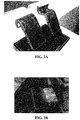
- FIG. 1A is a schematic diagram illustrating a verification method using character verification in related technology.
- Fig. 1B is a schematic diagram illustrating a verification method using image verification in the related technology. The principle of the verification methods shown in Fig.
- 1A and 1B is that the server has recorded the metadata of the shown image, and with the shown image, the client machine can hardly retrace the meaning of the image, but human eyes and human brain can easily recognize the meaning of the image, therefore, it may be effectively distinguished whether the client is a human being or a machine, so as to prevent a client machine from cracking passwords with brute force.
- Fig. 2A and Fig. 2B are photos illustrating handheld devices with flexible display screens.
- the shape of the flexible screen is more and more flexible, as shown in Fig. 2B , the flexible display screen may be fully folded.
- the verification method based on a flexible display screen is the same as the verification method based on a non-flexible display screen, which doesn't make full use of the deformable and bendable property of the flexible display screen to achieve the verification,
- a verification method and device based on a flexible display screen are provided by the present invention to overcome an existing problem in the related art.
- the invention is defined by the independent claims. In the following, aspects useful for understanding the invention are provided.
- the invention relates to a verification method based on a flexible display screen, method includes: generating a verification code, and dividing the verification code into a plurality of parts; displaying the plurality of parts on the flexible display screen separately; detecting deformation of the flexible display screen, and determining a splicing result of the plurality of parts based on the deformation of the flexible display screen; and determining a verification result based on the splicing result.
- a verification code may be a clear and readable character, a character string, an image and the like, which is not limited herein.
- determining the splicing result of the plurality of parts based on the deformation of the flexible display screen includes: determining a display position and a display direction of each of the plurality of parts based on the deformation of the flexible display screen; and determining the splicing result of the plurality of parts based on the display position and the display direction of each of the plurality of parts.
- determining the verification result based on the splicing result includes: calculating a similarity degree between the splicing result and the verification code; determining that the verification result is a success when the similarity degree is greater than a first preset value; determining that the verification result is a failure when the similarity degree is smaller than or equal to the first preset value.
- the method further includes: reducing verification difficulty and performing the verification again when the verification result is a failure.
- the method further includes: reducing verification difficulty and performing the verification again when the similarity degree is smaller than or equal to the first preset value and greater than a second preset value, wherein the second preset value is smaller than the first preset value.
- reducing the verification difficulty includes: reducing the number of the divided parts of the verification code.
- the method further includes: reminding a user to splice the plurality of parts by flexing the flexible display screen.
- the verification code is a character verification code or an image verification code.
- the invention relates to a verification device based on a flexible display screen, which includes: a division module configured to generate a verification code and divide the verification code into a plurality of parts; a display module configured to display the plurality of parts on the flexible display screen separately; a splicing result determination module configured to detect deformation of the flexible display screen and determine a splicing result of the plurality of parts based on the deformation of the flexible display screen; and a verification result determination module configured to determine a verification result based on the splicing result.
- the splicing result determination module includes: a display position and direction determination sub-module configured to determine a display position and a display direction of each of the plurality of parts based on the deformation of the flexible display screen; and a splicing result determination sub-module configured to determine the splicing result of the plurality of parts based on the display position and the display direction of each of the plurality of parts.
- the verification result determination module includes: a similarity degree calculation sub-module configured to calculate a similarity degree between the splicing result and the verification code; a first determination sub-module configured to determine that the verification result is a success when the similarity degree is greater than a first preset value; a second determination sub-module configured to determine that the verification result is a failure when the similarity degree is smaller than or equal to the first preset value.
- the device further includes: a first re-verification module configured to reduce verification difficulty and perform the verification again when the verification result is a failure.
- the device further includes: a second re-verification module configured to reduce verification difficulty and perform the verification again when the similarity degree is smaller than or equal to the first preset value and greater than a second preset value, wherein the second preset value is smaller than the first preset value.
- a second re-verification module configured to reduce verification difficulty and perform the verification again when the similarity degree is smaller than or equal to the first preset value and greater than a second preset value, wherein the second preset value is smaller than the first preset value.
- reducing the verification difficulty includes: reducing the number of the divided parts of the verification code.
- the device further includes: a reminding module configured to remind a user to splice the plurality of parts by flexing the flexible display screen.
- the verification code is a character verification code or an image verification code.
- the invention relates to a verification device based on a flexible display screen, which includes: a processor; and a memory for storing instructions executable by the processor; wherein the processor is configured to: generate a verification code, and divide the verification code into a plurality of parts; display the plurality of parts on the flexible display screen separately; detect deformation of the flexible display screen, and determine a splicing result of the plurality of parts based on the deformation of the flexible display screen; and determine a verification result based on the splicing result.
- Embodiments of the present invention may provide the following beneficial effects: by generating a verification code, and dividing the verification code into a plurality of parts; displaying the plurality of parts on the flexible display screen separately; detecting deformation of the flexible display screen, and determining a splicing result of the plurality of parts based on the deformation of the flexible display screen; and determining a verification result based on the splicing result, the verification method and device based on a flexible display screen may perform the verification using the deformable and bendable property of the flexible display screen, which improves the flexibility and security of the verification.
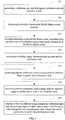
- Fig. 3 is a flow diagram illustrating a verification method based on a flexible display screen according to an exemplary embodiment.
- the method may be performed by a terminal device which has a flexible display screen, and as shown in Fig. 3 , the method may include the following steps.
- step S31 a verification code is generated, and the verification code is divided into a plurality of parts.
- the verification method based on a flexible display screen provided in the embodiment may be performed in various scenarios which need to use a verification code. For example, when it is detected a geographical location exception of a login system of the terminal device, or that a password is wrongly inputted for many times, the verification code may be enabled to reduce the probability of illegal access to the system. In another example, in order to improve the system security, a verification may be performed using the verification code when a user connects to a website (e.g., a train ticket booking website) or when an access traffic exception is detected (for example, a verification may be performed using the verification code when it's detected that the client makes research requests too soon). In another example, a verification may be performed using the verification code when an operation is required to unlock a screen or when an operation for answering a phone is required, to prevent a wrong triggering.
- a website e.g., a train ticket booking website
- an access traffic exception for example, a verification may be performed using the verification code when it's detected that the client makes research
- a verification code may be a clear and readable character, a character string, an image and the like, which is not limited herein.
- the verification code when it's required to perform a verification using the verification code, the verification code may be generated or may be extracted from a verification code base, and the verification code is divided into a plurality of parts. For example, if the verification code is a Chinese character, it may be divided based on the components of Chinese characters.
- the number of divided parts may be preset as N, wherein N is an integer greater than or equal to 2.
- step S32 the plurality of parts are displayed on the flexible display screen separately.
- the user may flex the flexible display screen, so as to splice the plurality of parts using the bendable property of the flexible display screen.
- step S33 deformation of the flexible display screen is detected, and a splicing result of the plurality of parts is determined based on the deformation of the flexible display screen.
- the deformation of the flexible display screen may be detected using Microsoft flexible transparent technology (FlexSense).
- FlexSense Microsoft flexible transparent technology
- step S34 the verification result is determined based on the splicing result.
- the verification result may be determined based on the perfection degree of the splice of the plurality of parts.
- a more intuitive and palpable method for inputting the verification code provided by the embodiment may perform the verification using the deformable and bendable property of the flexible display screen, which may improve the flexible and security of the verification.
- Fig. 4 is a flow diagram illustrating step S33 in a verification method based on a flexible display screen according to an exemplary embodiment, in which a splicing result of the plurality of parts is determined based on the deformation of the flexible display screen.
- determining the splicing result of the plurality of parts based on the deformation of the flexible display screen may include the flowing steps.
- step S41 a display position and a display direction of each of the plurality of parts are determined based on the deformation of the flexible display screen.
- step S42 the splicing result of the plurality of parts is determined based on the display position and the display direction of each of the plurality of parts.
- the display position and the display direction of each of the plurality of parts are determined based on the deformation of the flexible display screen, and the splicing result of the plurality of parts is determined based on the display position and the display direction of each of the plurality of parts, so as to ensure the accuracy of the determined splicing result.
- Fig. 5 is a flow diagram illustrating step 34 in a verification method based on a flexible display screen according to an exemplary embodiment. As shown in Fig. 5 , determining the verification result based on the splicing result may include the flowing steps.
- step S51 a similarity degree between the splicing result and the verification code is calculated.
- a first image may be determined based on the splicing result
- a second image may be determined based on the verification code
- the similarity degree between the first image and the second image may be calculated, such that the similarity between the first image and the second image may be determined as the similarity between the splicing result and the verification code.
- step S52 it is determined that the verification result is a success when the similarity degree is greater than a first preset value.
- step S53 it is determined that the verification result is a failure, when the similarity degree is smaller than or equal to the first preset value.
- the success of the verification is determined based on the similarity degree, which may improve the reliability of the verification.
- Fig. 6 is a flow diagram illustrating a verification method based on a flexible display screen according to an exemplary embodiment. As shown in Fig. 6 , the method may include the following steps.
- step S61 a verification code is generated, and the verification code is divided into a plurality of parts.
- step S62 the plurality of parts is displayed on the flexible display screen separately.
- step S63 deformation of the flexible display screen is detected, and a splicing result of the plurality of parts is determined based on the deformation of the flexible display screen.
- step S64 a similarity degree between the splicing result and the verification code is calculated.
- step S65 it is determined that the verification result is a success when the similarity degree is greater than a first preset value.
- step S66 it is determined that the verification result is a failure when the similarity degree is smaller than or equal to the first preset value.
- step S67 verification difficulty is reduced and the verification is performed again when the verification result is a failure.
- steps S61, S62 and S63 see the descriptions for steps S31, S32 and S33, and with respect to descriptions for steps S64, S65 and S66, see the descriptions for steps S51, S52 and S53.
- the verification difficulty when the verification is performed again, the verification difficulty may be reduced by reducing the number of the divided parts of the verification code or employing characters with simper strokes or a simpler image as the verification code.
- verification difficulty is reduced and the verification is performed again when the verification result is a failure, such that when the user flexed the flexible display screen by error or had a misoperation, another verification opportunity may be provided, and the verification difficulty may be reduced adaptively when the original verification difficulty is high, which may improve the user experience.
- Fig. 7 is a flow diagram illustrating a verification method based on a flexible display screen according to an exemplary embodiment. As shown in Fig. 7 , the method may include the following steps.
- step S71 a verification code is generated, and the verification code is divided into a plurality of parts.
- step S72 the plurality of parts is displayed on the flexible display screen separately.
- step S73 deformation of the flexible display screen is detected, and a splicing result of the plurality of parts is determined based on the deformation of the flexible display screen.
- step S74 a similarity degree between the splicing result and the verification code is calculated.
- step S75 it is determined that the verification result is a success when the similarity degree is greater than a first preset value.
- step S76 it is determined that the verification result is a failure when the similarity degree is smaller than or equal to the first preset value.
- step S77 verification difficulty is reduced and the verification is performed again when the similarity degree is smaller than or equal to the first preset value and greater than a second preset value, wherein the second preset value is smaller than the first preset value.
- steps S71, S72 and S73 see the descriptions for steps S31, S32 and S33, and with respect to descriptions for steps S74, S75 and S76, see the descriptions for steps S51, S52 and S53.
- the verification difficulty may be reduced by reducing the number of the divided parts of the verification code or employing characters with simper strokes or a simpler image as the verification code.
- verification difficulty is reduced and the verification is performed again when the similarity degree is smaller than or equal to the first preset value and greater than a second preset value, such that when the user flexed the flexible display screen by error or had a misoperation, another verification opportunity may be provided, and the verification difficulty may be reduced adaptively when the original verification difficulty is high, which may improve the user experience.
- a brute force attack by a machine may be determined and the verification cannot be performed again in a preset period when the similarity is smaller than or equal to the second preset value.
- Fig. 8 is a flow diagram illustrating a verification method based on a flexible display screen according to an exemplary embodiment. As shown in Fig. 8 , the method may include the following steps.
- step S81 a verification code is generated, and the verification code is divided into a plurality of parts.
- step S82 the plurality of parts is displayed on the flexible display screen separately.
- step S83 a user is reminded to splice the plurality of parts by flexing the flexible display screen.
- step S84 deformation of the flexible display screen is detected, and a splicing result of the plurality of parts is determined based on the deformation of the flexible display screen.
- step S85 a verification result is determined based on the splicing result.
- steps S81, S82, S83 and S84 see the descriptions for steps S31, S32, S33 and S34.
- the user may be reminded by words or voice to splice the plurality of parts displayed separately by flexing the flexible display screen.
- the user who is not familiar with the verification using the flexible display screen may receive a reminder, so as to improve the user experience.
- the verification code is a character verification code or an image verification code.
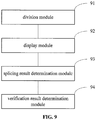
- Fig. 9 is a block diagram illustrating a verification device based on a flexible display screen according to an exemplary embodiment.
- the device may include a division module 91, a display module 92, a splicing result determination module 93 and a verification result determination module 94.
- the division module 91 is configured to generate a verification code and divide the verification code into a plurality of parts.
- the display module 92 is configured to display the plurality of parts on the flexible display screen separately.
- the splicing result determination module 93 is configured to detect deformation of the flexible display screen and determine a splicing result of the plurality of parts based on the deformation of the flexible display screen.
- the verification result determination module 94 is configured to determine a verification result based on the splicing result.
- Fig. 10 is a block diagram illustrating a verification device based on a flexible display screen according to an exemplary embodiment.
- the splicing result determination module 93 may include a display position and direction determination sub-module 931 configured to determine a display position and a display direction of each of the plurality of parts based on the deformation of the flexible display screen; and a splicing result determination sub-module 932 configured to determine the splicing result of the plurality of parts based on the display position and the display direction of each of the plurality of parts.
- the verification result determination module 94 may include: a similarity degree calculation sub-module 941 configured to calculate a similarity degree between the splicing result and the verification code; a first determination sub-module 942 configured to determine that the verification result is a success when the similarity degree is greater than a first preset value; a second determination sub-module 943 configured to determine that the verification result is a failure when the similarity degree is smaller than or equal to the first preset value.
- the device further include a first re-verification module 95 configured to reduce verification difficulty and perform the verification again when the verification result is a failure.
- the device further include a second re-verification module 96 configured to reduce verification difficulty and perform the verification again when the similarity degree is smaller than or equal to the first preset value and greater than a second preset value, wherein the second preset value is smaller than the first preset value.
- a second re-verification module 96 configured to reduce verification difficulty and perform the verification again when the similarity degree is smaller than or equal to the first preset value and greater than a second preset value, wherein the second preset value is smaller than the first preset value.
- reducing the verification difficulty may include reducing the number of the divided parts of the verification code.
- the device further include a reminding module 97 configured to remind a user to splice the plurality of parts by flexing the flexible display screen.
- the verification code is a character verification code or an image verification code.
- the verification device based on a flexible display screen may perform the verification using the deformable and bendable property of the flexible display screen, which improves the flexibility and security of the verification.
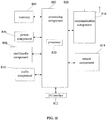
- Fig. 11 is a block diagram illustrating a verification device 800 based on a flexible display screen according to an exemplary embodiment.
- the device 800 may be a mobile phone, a computer, a digital broadcast terminal, a message transceiver, a game console, a tablet device, a medical equipment, a fitness equipment, a personal digital assistant, and the like.
- the device 800 may include one or more of the following components: a processing component 802, a memory 804, a power component 806, a multimedia component 808, an audio component 810, an input/output (I/O) interface 812, a sensor component 814, and a communication component 816.
- a processing component 802 a memory 804, a power component 806, a multimedia component 808, an audio component 810, an input/output (I/O) interface 812, a sensor component 814, and a communication component 816.
- the processing component 802 typically controls overall operations of the device 800, such as the operations associated with display, telephone calls, data communications, camera operations, and recording operations.
- the processing component 802 may include one or more processors 820 to execute instructions to perform all or part of the steps in the above described methods.
- the processing component 802 may include one or more modules which facilitate the interaction between the processing component 802 and other components.
- the processing component 802 may include a multimedia module to facilitate the interaction between the multimedia component 808 and the processing component 802.
- the memory 804 is configured to store various types of data to support the operation of the device 800. Examples of such data may include instructions for any applications or methods operated on the device 800, contact data, phonebook data, messages, pictures, video, etc.
- the memory 804 may be implemented using any type of volatile or non-volatile memory devices, or a combination thereof, such as a static random access memory (SRAM), an electrically erasable programmable read-only memory (EEPROM), an erasable programmable read-only memory (EPROM), a programmable read-only memory (PROM), a read-only memory (ROM), a magnetic memory, a flash memory, a magnetic or optical disk.
- SRAM static random access memory
- EEPROM electrically erasable programmable read-only memory
- EPROM erasable programmable read-only memory
- PROM programmable read-only memory
- ROM read-only memory
- magnetic memory a magnetic memory
- flash memory a flash memory
- magnetic or optical disk a magnetic or
- the power component 806 provides power to various components of the device 800.
- the power component 806 may include a power management system, one or more power sources, and any other components associated with the generation, management, and distribution of power in the device 800.
- the multimedia component 808 includes a screen providing an output interface between the device 800 and the user.
- the screen may include a liquid crystal display (LCD) and a touch panel (TP). If the screen includes the touch panel, the screen may be implemented as a touch screen to receive input signals from the user.
- the touch panel includes one or more touch sensors to sense touches, swipes, and gestures on the touch panel. The touch sensors may not only sense a boundary of a touch or swipe action, but also detect a period of time and a pressure associated with the touch or swipe action.
- the multimedia component 808 includes a front camera and/or a rear camera.
- the front camera and/or the rear camera may receive an external multimedia datum while the device 800 is in an operation mode, such as a photographing mode or a video mode.
- an operation mode such as a photographing mode or a video mode.
- Each of the front camera and the rear camera may be a fixed optical lens system or have focus and optical zoom capability.
- the audio component 810 is configured to output and/or input audio signals.
- the audio component 810 includes a microphone ("MIC") configured to receive an external audio signal when the device 800 is in an operation mode, such as a call mode, a recording mode, and a voice recognition mode.
- the received audio signal may be further stored in the memory 804 or transmitted via the communication component 816.
- the audio component 810 further includes a speaker to output audio signals.
- the I/O interface 812 provides an interface between the processing component 802 and peripheral interface modules, such as a keyboard, a click wheel, buttons, and the like.
- the buttons may include, but are not limited to, a home button, a volume button, a starting button, and a locking button.
- the sensor component 814 includes one or more sensors to provide status assessments of various aspects of the device 800. For instance, the sensor component 814 may detect an open/closed status of the device 800, relative positioning of components, e.g., the display and the keypad, of the device 800, a change in position of the device 800 or a component of the device 800, a presence or absence of user contact with the device 800, an orientation or an acceleration/deceleration of the device 800, and a change in temperature of the device 800.
- components e.g., the display and the keypad
- the sensor component 814 may include a proximity sensor configured to detect the presence of nearby objects without any physical contact.
- the sensor component 814 may also include a light sensor, such as a CMOS or CCD image sensor, for use in imaging applications.
- the sensor component 814 may also include an accelerometer sensor, a gyroscope sensor, a magnetic sensor, a distance sensor, a pressure sensor, or a temperature sensor.
- the communication component 816 is configured to facilitate communication, wired or wirelessly, between the device 800 and other devices.
- the device 800 can access a wireless network based on a communication standard, such as WiFi, 2G, or 3G, or a combination thereof.
- the communication component 816 receives a broadcast signal or broadcast associated information from an external broadcast management system via a broadcast channel.
- the communication component 816 further includes a near field communication (NFC) module to facilitate short-range communications.
- the NFC module may be implemented based on a radio frequency identification (RFID) technology, an infrared data association (IrDA) technology, an ultra-wideband (UWB) technology, a Bluetooth (BT) technology, and other technologies.
- RFID radio frequency identification
- IrDA infrared data association
- UWB ultra-wideband
- BT Bluetooth
- the device 800 may be implemented with one or more application specific integrated circuits (ASICs), digital signal processors (DSPs), digital signal processing devices (DSPDs), programmable logic devices (PLDs), field programmable gate arrays (FPGAs), controllers, micro-controllers, microprocessors, or other electronic components, for performing the above described methods.
- ASICs application specific integrated circuits
- DSPs digital signal processors
- DSPDs digital signal processing devices
- PLDs programmable logic devices
- FPGAs field programmable gate arrays
- controllers micro-controllers, microprocessors, or other electronic components, for performing the above described methods.
- non-transitory computer-readable storage medium including instructions, such as the memory 804 including instructions executable by the processor 820 in the device 800 to perform the above-described methods.
- the non-transitory computer-readable storage medium may be a ROM, a RAM, a CD-ROM, a magnetic tape, a floppy disc, an optical data storage device, and the like.
Landscapes
- Engineering & Computer Science (AREA)
- Theoretical Computer Science (AREA)
- Computer Hardware Design (AREA)
- Computer Security & Cryptography (AREA)
- General Physics & Mathematics (AREA)
- Physics & Mathematics (AREA)
- General Engineering & Computer Science (AREA)
- Signal Processing (AREA)
- Human Computer Interaction (AREA)
- Software Systems (AREA)
- Computer Networks & Wireless Communication (AREA)
- Computing Systems (AREA)
- User Interface Of Digital Computer (AREA)
- Controls And Circuits For Display Device (AREA)
Claims (13)
- Verifizierungsverfahren auf der Grundlage eines flexiblen Bildschirms, umfassend:Erzeugen (S31, S61, S71, S81) eines Verifizierungscodes und Aufteilen des Verifizierungscodes in mehrere Teile,getrenntes Anzeigen (S32, S62, S72, S82) der mehreren Teile auf dem flexiblen Bildschirm,Erfassen (S33, S63, S73, S84) der Verformung des flexiblen Bildschirms und Bestimmen eines Spleißergebnisses der mehreren Teile auf der Grundlage der Verformung des flexiblen Bildschirms undBestimmen (S34, S85) eines Verifizierungsergebnisses auf der Grundlage des Spleißergebnisses,wobei das Bestimmen (S34, S85) des Verifizierungsergebnisses auf der Grundlage des Spleißergebnisses umfasst:Berechnen (S51, S64, S74) eines Ähnlichkeitsgrades zwischen dem Spleißergebnis und dem Verifizierungscode,Bestimmen (S52, S65, S75), dass das Verifizierungsergebnis ein Erfolg ist, wenn der Ähnlichkeitsgrad größer als ein erster voreingestellter Wert ist,Bestimmen (S53, S66, S77), dass das Verifizierungsergebnis ein Fehler ist, wenn der Ähnlichkeitsgrad kleiner oder gleich dem ersten voreingestellten Wert ist.
- Verifizierungsverfahren nach Anspruch 1, wobei das Bestimmen (S33 S63, S73, S84) des Spleißergebnisses der mehreren Teile auf der Grundlage der Verformung des flexiblen Bildschirms umfasst:Bestimmen (S41) einer Anzeigeposition und einer Anzeigerichtung jedes der mehreren Teile auf der Grundlage der Verformung des flexiblen Bildschirms undBestimmen (S42) des Spleißergebnisses der mehreren Teile auf der Grundlage der Anzeigeposition und der Anzeigerichtung von jedem der mehreren Teile.
- Verifizierungsverfahren nach Anspruch 1, wobei nach der Bestimmung (S34, S85) des Verifizierungsergebnisses auf der Grundlage des Spleißergebnisses das Verfahren ferner umfasst:
Verringern (S67) des Verifizierungsproblems und erneutes Durchführen der Verifizierung, wenn das Verifizierungsergebnis ein Fehler ist. - Verifizierungsverfahren nach Anspruch 1, wobei nach der Bestimmung (S34, S85) des Verifizierungsergebnisses auf der Grundlage des Spleißergebnisses das Verfahren ferner umfasst:
Verringern (S77) des Verifizierungsproblems und erneutes Durchführen der Verifizierung, wenn der Ähnlichkeitsgrad kleiner oder gleich dem ersten voreingestellten Wert und größer als ein zweiter voreingestellter Wert ist, wobei der zweite voreingestellte Wert kleiner als der erste voreingestellte Wert ist. - Verifizierungsverfahren nach Anspruch 3 oder 4, wobei das Verringern (S67, S77) des Verifizierungsproblems umfasst:
Verringern der Anzahl der geteilten Teile des Verifizierungscodes, um das Verifizierungsproblem zu verringern. - Verifizierungsverfahren nach einem der Ansprüche 1 bis 5, wobei nach dem getrennten Anzeigen (S32, S62, S72, S82) der mehreren Teile auf dem flexiblen Bildschirm das Verfahren ferner umfasst:
Erinnern (S83) eines Benutzers, die mehreren Teile durch Biegen des flexiblen Bildschirms zu spleißen. - Verifizierungsverfahren nach einem der Ansprüche 1 bis 6, wobei der Verifizierungscode ein Zeichen-Verifizierungscode oder ein Bild-Verifizierungscode ist.
- Verifizierungsvorrichtung auf der Grundlage eines flexiblen Bildschirms, umfassend:ein Teilungsmodul (91), das konfiguriert ist, um einen Verifizierungscode zu erzeugen und den Verifizierungscode in mehrere Teile zu unterteilen,ein Anzeigemodul (92), das konfiguriert ist, um die mehreren Teile auf dem flexiblen Bildschirm getrennt anzuzeigen,ein Spleißergebnis-Bestimmungsmodul (93), das konfiguriert ist, um eine Verformung des flexiblen Bildschirms zu erfassen und ein Spleißergebnis der mehreren Teile auf der Grundlage der Verformung des flexiblen Bildschirms zu bestimmen, undein Verifizierungsergebnis-Bestimmungsmodul (94), das konfiguriert ist, um ein Verifizierungsergebnis auf der Grundlage von dem Spleißergebnis zu bestimmen,wobei das Verifizierungsergebnis-Bestimmungsmodul (94) umfasst:ein Submodul (941) zur Berechnung des Ähnlichkeitsgrades, das konfiguriert ist, einen Ähnlichkeitsgrad zwischen dem Spleißergebnis und dem Verifizierungscode zu berechnen,ein erstes Bestimmungs-Submodul (942), das konfiguriert ist, um zu bestimmen, dass das Verifizierungsergebnis ein Erfolg ist, wenn der Ähnlichkeitsgrad größer als ein erster voreingestellter Wert ist, undein zweites Bestimmungs-Submodul (943), das konfiguriert ist, um zu bestimmen, dass das Verifizierungsergebnis ein Fehler ist, wenn der Ähnlichkeitsgrad kleiner oder gleich einem ersten voreingestellten Wert ist.
- Verifizierungsvorrichtung nach Anspruch 8, wobei das Spleißergebnis-Bestimmungsmodul (93) umfasst:ein Anzeigepositions- und Richtungsbestimmungs-Submodul (931), das konfiguriert ist, um eine Anzeigeposition und eine Anzeigerichtung von jedem der mehreren Teile auf der Grundlage der Verformung des flexiblen Bildschirms zu bestimmen, undein Spleißergebnisbestimmungs-Submodul (932), das konfiguriert ist, um das Spleißergebnis der mehreren Teile auf der Grundlage der Anzeigeposition und der Anzeigerichtung von jedem der mehreren Teile zu bestimmen.
- Verifizierungsvorrichtung nach Anspruch 8 oder 9, ferner umfassend:ein erstes Re-Verifizierungsmodul (95), das konfiguriert ist, um das Verifizierungsproblem zu verringern und die Verifizierung erneut durchzuführen, wenn das Verifizierungsergebnis ein Fehler ist, undein zweites Re-Verifizierungsmodul (96), das konfiguriert ist, das Verifizierungsproblem zu verringern und die Verifizierung erneut durchzuführen, wenn der Ähnlichkeitsgrad kleiner oder gleich dem ersten voreingestellten Wert und größer als ein zweiter voreingestellter Wert ist, wobei der zweite voreingestellte Wert kleiner als der erste voreingestellte Wert ist.
- Verifizierungsvorrichtung nach Anspruch 10, wobei das erste Re-Verifizierungsmodul (95) und die zweite Re-Verifizierungsvorrichtung (96) ferner konfiguriert sind:
die Anzahl der geteilten Teile des Verifizierungscodes zu verringern, um das Verifizierungsproblem zu verringern. - Verifizierungsvorrichtung nach einem der Ansprüche 8 bis 11, ferner umfassend:
ein Erinnerungsmodul (97), das konfiguriert ist, um einen Benutzer daran zu erinnern, die mehreren Teile durch Biegen des flexiblen Bildschirms zu spleißen. - Verifizierungsvorrichtung nach einem der Ansprüche 8 bis 12, wobei der Verifizierungscode ein Zeichen-Verifizierungscode oder ein Bild-Verifizierungscode ist.
Applications Claiming Priority (1)
| Application Number | Priority Date | Filing Date | Title |
|---|---|---|---|
| CN201610946945.1A CN106503537B (zh) | 2016-10-26 | 2016-10-26 | 基于柔性显示屏的验证方法及装置 |
Publications (2)
| Publication Number | Publication Date |
|---|---|
| EP3316164A1 EP3316164A1 (de) | 2018-05-02 |
| EP3316164B1 true EP3316164B1 (de) | 2018-08-29 |
Family
ID=58321165
Family Applications (1)
| Application Number | Title | Priority Date | Filing Date |
|---|---|---|---|
| EP17162982.7A Not-in-force EP3316164B1 (de) | 2016-10-26 | 2017-03-27 | Verifizierungsverfahren und vorrichtung basierend auf einem flexiblen anzeigebildschirm |
Country Status (3)
| Country | Link |
|---|---|
| US (1) | US10423195B2 (de) |
| EP (1) | EP3316164B1 (de) |
| CN (1) | CN106503537B (de) |
Families Citing this family (5)
| Publication number | Priority date | Publication date | Assignee | Title |
|---|---|---|---|---|
| CN107704735B (zh) * | 2017-09-12 | 2020-03-27 | 珠海格力电器股份有限公司 | 一种授权管理方法、装置及电子设备 |
| CN107799120A (zh) * | 2017-11-10 | 2018-03-13 | 北京康力优蓝机器人科技有限公司 | 服务机器人识别唤醒方法及装置 |
| CN108196741A (zh) * | 2017-12-19 | 2018-06-22 | 努比亚技术有限公司 | 基于柔性屏的应用分屏方法、终端及计算机可读存储介质 |
| CN113778252B (zh) * | 2020-06-10 | 2024-04-16 | Oppo广东移动通信有限公司 | 应用于柔性显示屏的防误触方法、装置、终端及存储介质 |
| CN114218166A (zh) * | 2021-11-04 | 2022-03-22 | 北京百度网讯科技有限公司 | 数据处理方法、装置、电子设备及可读存储介质 |
Family Cites Families (12)
| Publication number | Priority date | Publication date | Assignee | Title |
|---|---|---|---|---|
| US20110029869A1 (en) * | 2008-02-29 | 2011-02-03 | Mclennan Hamish | Method and system responsive to intentional movement of a device |
| US8433916B2 (en) * | 2008-09-30 | 2013-04-30 | Microsoft Corporation | Active hip |
| US8339360B2 (en) * | 2010-06-02 | 2012-12-25 | International Business Machines Corporation | Flexible display security CAPTCHA bends |
| US8719930B2 (en) * | 2010-10-12 | 2014-05-06 | Sonus Networks, Inc. | Real-time network attack detection and mitigation infrastructure |
| US9141779B2 (en) * | 2011-05-19 | 2015-09-22 | Microsoft Technology Licensing, Llc | Usable security of online password management with sensor-based authentication |
| CN102890761B (zh) * | 2011-08-24 | 2015-06-10 | 北京文海思创科技有限公司 | 一种通过图形验证码验证的方法 |
| JP6546371B2 (ja) * | 2013-03-14 | 2019-07-17 | 矢崎総業株式会社 | コイルユニット及び非接触給電装置 |
| CN104580089A (zh) * | 2013-10-18 | 2015-04-29 | 深圳市腾讯计算机系统有限公司 | 一种用户验证方法及移动终端 |
| US9443116B2 (en) * | 2014-06-03 | 2016-09-13 | Lenovo Enterprise Solutions (Singapore) Pte. Ltd. | Authentication in a flexible display computing device |
| CN105323218A (zh) * | 2014-06-30 | 2016-02-10 | 腾讯科技(深圳)有限公司 | 身份验证方法及装置 |
| CN105323066B (zh) * | 2014-07-21 | 2020-03-17 | 腾讯科技(深圳)有限公司 | 身份验证方法及装置 |
| US9471767B2 (en) * | 2014-08-22 | 2016-10-18 | Oracle International Corporation | CAPTCHA techniques utilizing traceable images |
-
2016
- 2016-10-26 CN CN201610946945.1A patent/CN106503537B/zh active Active
-
2017
- 2017-03-27 EP EP17162982.7A patent/EP3316164B1/de not_active Not-in-force
- 2017-05-11 US US15/592,219 patent/US10423195B2/en active Active
Also Published As
| Publication number | Publication date |
|---|---|
| CN106503537B (zh) | 2019-04-16 |
| EP3316164A1 (de) | 2018-05-02 |
| CN106503537A (zh) | 2017-03-15 |
| US10423195B2 (en) | 2019-09-24 |
| US20180113489A1 (en) | 2018-04-26 |
Similar Documents
| Publication | Publication Date | Title |
|---|---|---|
| US10706173B2 (en) | Method and device for displaying notification information | |
| EP3413549B1 (de) | Verfahren und vorrichtung zum anzeigen von benachrichtigungsinformationen | |
| EP3133528B1 (de) | Verfahren und vorrichtung zur fingerabdruckidentifikation | |
| US10721196B2 (en) | Method and device for message reading | |
| EP3893182B1 (de) | Verfahren und vorrichtung zur verarbeitung eines kindermodus | |
| US20160277346A1 (en) | Method, apparatus, terminal and storage medium for displaying application messages | |
| US10425403B2 (en) | Method and device for accessing smart camera | |
| EP3260967A1 (de) | Verfahren und vorrichtung zur textauswahl | |
| EP3316164B1 (de) | Verifizierungsverfahren und vorrichtung basierend auf einem flexiblen anzeigebildschirm | |
| EP3300407A1 (de) | Verfahren und vorrichtung zur verarbeitung eines überprüfungscodes | |
| US20180053177A1 (en) | Resource transfer method, apparatus and storage medium | |
| CN106096964B (zh) | 支付方法及装置 | |
| EP3232301A1 (de) | Mobiles endgerät und verarbeitungsverfahren für virtuellen schlüssel | |
| CN113807253A (zh) | 人脸识别方法及装置、电子设备和存储介质 | |
| EP3098765A1 (de) | Verfahren und vorrichtung zur empfehlung einer cloud-karte | |
| US10095911B2 (en) | Methods, devices, and computer-readable mediums for verifying a fingerprint | |
| CN107145771B (zh) | 应用程序解锁方法、装置及终端 | |
| EP3337104B1 (de) | Verfahren, vorrichtung und speichermedium zur ausgabe einer kommunikationsnachricht | |
| US20190095163A1 (en) | Method and device for displaying an input interface and an electronic device | |
| US20170147593A1 (en) | Contact managing method and apparatus, and storage medium | |
| CN106712960B (zh) | 验证码信息的处理方法和装置 | |
| CN105608350B (zh) | 屏幕输入键盘生成方法及装置 | |
| HK40058726A (en) | Human face recognition method and device, electronic apparatus, and storage medium |
Legal Events
| Date | Code | Title | Description |
|---|---|---|---|
| PUAI | Public reference made under article 153(3) epc to a published international application that has entered the european phase |
Free format text: ORIGINAL CODE: 0009012 |
|
| STAA | Information on the status of an ep patent application or granted ep patent |
Free format text: STATUS: REQUEST FOR EXAMINATION WAS MADE |
|
| 17P | Request for examination filed |
Effective date: 20180109 |
|
| AK | Designated contracting states |
Kind code of ref document: A1 Designated state(s): AL AT BE BG CH CY CZ DE DK EE ES FI FR GB GR HR HU IE IS IT LI LT LU LV MC MK MT NL NO PL PT RO RS SE SI SK SM TR |
|
| AX | Request for extension of the european patent |
Extension state: BA ME |
|
| GRAP | Despatch of communication of intention to grant a patent |
Free format text: ORIGINAL CODE: EPIDOSNIGR1 |
|
| STAA | Information on the status of an ep patent application or granted ep patent |
Free format text: STATUS: GRANT OF PATENT IS INTENDED |
|
| RIC1 | Information provided on ipc code assigned before grant |
Ipc: H04L 29/06 20060101ALI20180427BHEP Ipc: H04M 1/02 20060101ALI20180427BHEP Ipc: H04M 1/67 20060101ALI20180427BHEP Ipc: G06F 21/84 20130101ALI20180427BHEP Ipc: G06F 21/36 20130101AFI20180427BHEP Ipc: G06F 21/44 20130101ALI20180427BHEP Ipc: G09F 9/30 20060101ALI20180427BHEP Ipc: G06F 1/16 20060101ALI20180427BHEP |
|
| INTG | Intention to grant announced |
Effective date: 20180518 |
|
| GRAS | Grant fee paid |
Free format text: ORIGINAL CODE: EPIDOSNIGR3 |
|
| GRAA | (expected) grant |
Free format text: ORIGINAL CODE: 0009210 |
|
| STAA | Information on the status of an ep patent application or granted ep patent |
Free format text: STATUS: THE PATENT HAS BEEN GRANTED |
|
| AK | Designated contracting states |
Kind code of ref document: B1 Designated state(s): AL AT BE BG CH CY CZ DE DK EE ES FI FR GB GR HR HU IE IS IT LI LT LU LV MC MK MT NL NO PL PT RO RS SE SI SK SM TR |
|
| REG | Reference to a national code |
Ref country code: GB Ref legal event code: FG4D |
|
| REG | Reference to a national code |
Ref country code: CH Ref legal event code: EP |
|
| REG | Reference to a national code |
Ref country code: AT Ref legal event code: REF Ref document number: 1035997 Country of ref document: AT Kind code of ref document: T Effective date: 20180915 |
|
| REG | Reference to a national code |
Ref country code: IE Ref legal event code: FG4D |
|
| REG | Reference to a national code |
Ref country code: DE Ref legal event code: R096 Ref document number: 602017000306 Country of ref document: DE |
|
| REG | Reference to a national code |
Ref country code: NL Ref legal event code: MP Effective date: 20180829 |
|
| REG | Reference to a national code |
Ref country code: LT Ref legal event code: MG4D |
|
| PG25 | Lapsed in a contracting state [announced via postgrant information from national office to epo] |
Ref country code: BG Free format text: LAPSE BECAUSE OF FAILURE TO SUBMIT A TRANSLATION OF THE DESCRIPTION OR TO PAY THE FEE WITHIN THE PRESCRIBED TIME-LIMIT Effective date: 20181129 Ref country code: NL Free format text: LAPSE BECAUSE OF FAILURE TO SUBMIT A TRANSLATION OF THE DESCRIPTION OR TO PAY THE FEE WITHIN THE PRESCRIBED TIME-LIMIT Effective date: 20180829 Ref country code: LT Free format text: LAPSE BECAUSE OF FAILURE TO SUBMIT A TRANSLATION OF THE DESCRIPTION OR TO PAY THE FEE WITHIN THE PRESCRIBED TIME-LIMIT Effective date: 20180829 Ref country code: RS Free format text: LAPSE BECAUSE OF FAILURE TO SUBMIT A TRANSLATION OF THE DESCRIPTION OR TO PAY THE FEE WITHIN THE PRESCRIBED TIME-LIMIT Effective date: 20180829 Ref country code: IS Free format text: LAPSE BECAUSE OF FAILURE TO SUBMIT A TRANSLATION OF THE DESCRIPTION OR TO PAY THE FEE WITHIN THE PRESCRIBED TIME-LIMIT Effective date: 20181229 Ref country code: NO Free format text: LAPSE BECAUSE OF FAILURE TO SUBMIT A TRANSLATION OF THE DESCRIPTION OR TO PAY THE FEE WITHIN THE PRESCRIBED TIME-LIMIT Effective date: 20181129 Ref country code: GR Free format text: LAPSE BECAUSE OF FAILURE TO SUBMIT A TRANSLATION OF THE DESCRIPTION OR TO PAY THE FEE WITHIN THE PRESCRIBED TIME-LIMIT Effective date: 20181130 Ref country code: FI Free format text: LAPSE BECAUSE OF FAILURE TO SUBMIT A TRANSLATION OF THE DESCRIPTION OR TO PAY THE FEE WITHIN THE PRESCRIBED TIME-LIMIT Effective date: 20180829 Ref country code: SE Free format text: LAPSE BECAUSE OF FAILURE TO SUBMIT A TRANSLATION OF THE DESCRIPTION OR TO PAY THE FEE WITHIN THE PRESCRIBED TIME-LIMIT Effective date: 20180829 |
|
| REG | Reference to a national code |
Ref country code: AT Ref legal event code: MK05 Ref document number: 1035997 Country of ref document: AT Kind code of ref document: T Effective date: 20180829 |
|
| PG25 | Lapsed in a contracting state [announced via postgrant information from national office to epo] |
Ref country code: LV Free format text: LAPSE BECAUSE OF FAILURE TO SUBMIT A TRANSLATION OF THE DESCRIPTION OR TO PAY THE FEE WITHIN THE PRESCRIBED TIME-LIMIT Effective date: 20180829 Ref country code: HR Free format text: LAPSE BECAUSE OF FAILURE TO SUBMIT A TRANSLATION OF THE DESCRIPTION OR TO PAY THE FEE WITHIN THE PRESCRIBED TIME-LIMIT Effective date: 20180829 Ref country code: AL Free format text: LAPSE BECAUSE OF FAILURE TO SUBMIT A TRANSLATION OF THE DESCRIPTION OR TO PAY THE FEE WITHIN THE PRESCRIBED TIME-LIMIT Effective date: 20180829 |
|
| PG25 | Lapsed in a contracting state [announced via postgrant information from national office to epo] |
Ref country code: ES Free format text: LAPSE BECAUSE OF FAILURE TO SUBMIT A TRANSLATION OF THE DESCRIPTION OR TO PAY THE FEE WITHIN THE PRESCRIBED TIME-LIMIT Effective date: 20180829 Ref country code: AT Free format text: LAPSE BECAUSE OF FAILURE TO SUBMIT A TRANSLATION OF THE DESCRIPTION OR TO PAY THE FEE WITHIN THE PRESCRIBED TIME-LIMIT Effective date: 20180829 Ref country code: EE Free format text: LAPSE BECAUSE OF FAILURE TO SUBMIT A TRANSLATION OF THE DESCRIPTION OR TO PAY THE FEE WITHIN THE PRESCRIBED TIME-LIMIT Effective date: 20180829 Ref country code: IT Free format text: LAPSE BECAUSE OF FAILURE TO SUBMIT A TRANSLATION OF THE DESCRIPTION OR TO PAY THE FEE WITHIN THE PRESCRIBED TIME-LIMIT Effective date: 20180829 Ref country code: PL Free format text: LAPSE BECAUSE OF FAILURE TO SUBMIT A TRANSLATION OF THE DESCRIPTION OR TO PAY THE FEE WITHIN THE PRESCRIBED TIME-LIMIT Effective date: 20180829 Ref country code: RO Free format text: LAPSE BECAUSE OF FAILURE TO SUBMIT A TRANSLATION OF THE DESCRIPTION OR TO PAY THE FEE WITHIN THE PRESCRIBED TIME-LIMIT Effective date: 20180829 Ref country code: CZ Free format text: LAPSE BECAUSE OF FAILURE TO SUBMIT A TRANSLATION OF THE DESCRIPTION OR TO PAY THE FEE WITHIN THE PRESCRIBED TIME-LIMIT Effective date: 20180829 |
|
| PG25 | Lapsed in a contracting state [announced via postgrant information from national office to epo] |
Ref country code: DK Free format text: LAPSE BECAUSE OF FAILURE TO SUBMIT A TRANSLATION OF THE DESCRIPTION OR TO PAY THE FEE WITHIN THE PRESCRIBED TIME-LIMIT Effective date: 20180829 Ref country code: SM Free format text: LAPSE BECAUSE OF FAILURE TO SUBMIT A TRANSLATION OF THE DESCRIPTION OR TO PAY THE FEE WITHIN THE PRESCRIBED TIME-LIMIT Effective date: 20180829 Ref country code: SK Free format text: LAPSE BECAUSE OF FAILURE TO SUBMIT A TRANSLATION OF THE DESCRIPTION OR TO PAY THE FEE WITHIN THE PRESCRIBED TIME-LIMIT Effective date: 20180829 |
|
| REG | Reference to a national code |
Ref country code: DE Ref legal event code: R097 Ref document number: 602017000306 Country of ref document: DE |
|
| PLBE | No opposition filed within time limit |
Free format text: ORIGINAL CODE: 0009261 |
|
| STAA | Information on the status of an ep patent application or granted ep patent |
Free format text: STATUS: NO OPPOSITION FILED WITHIN TIME LIMIT |
|
| 26N | No opposition filed |
Effective date: 20190531 |
|
| PG25 | Lapsed in a contracting state [announced via postgrant information from national office to epo] |
Ref country code: SI Free format text: LAPSE BECAUSE OF FAILURE TO SUBMIT A TRANSLATION OF THE DESCRIPTION OR TO PAY THE FEE WITHIN THE PRESCRIBED TIME-LIMIT Effective date: 20180829 |
|
| PG25 | Lapsed in a contracting state [announced via postgrant information from national office to epo] |
Ref country code: MC Free format text: LAPSE BECAUSE OF FAILURE TO SUBMIT A TRANSLATION OF THE DESCRIPTION OR TO PAY THE FEE WITHIN THE PRESCRIBED TIME-LIMIT Effective date: 20180829 |
|
| PG25 | Lapsed in a contracting state [announced via postgrant information from national office to epo] |
Ref country code: LU Free format text: LAPSE BECAUSE OF NON-PAYMENT OF DUE FEES Effective date: 20190327 |
|
| REG | Reference to a national code |
Ref country code: BE Ref legal event code: MM Effective date: 20190331 |
|
| PG25 | Lapsed in a contracting state [announced via postgrant information from national office to epo] |
Ref country code: IE Free format text: LAPSE BECAUSE OF NON-PAYMENT OF DUE FEES Effective date: 20190327 |
|
| PG25 | Lapsed in a contracting state [announced via postgrant information from national office to epo] |
Ref country code: BE Free format text: LAPSE BECAUSE OF NON-PAYMENT OF DUE FEES Effective date: 20190331 |
|
| PG25 | Lapsed in a contracting state [announced via postgrant information from national office to epo] |
Ref country code: TR Free format text: LAPSE BECAUSE OF FAILURE TO SUBMIT A TRANSLATION OF THE DESCRIPTION OR TO PAY THE FEE WITHIN THE PRESCRIBED TIME-LIMIT Effective date: 20180829 |
|
| PG25 | Lapsed in a contracting state [announced via postgrant information from national office to epo] |
Ref country code: PT Free format text: LAPSE BECAUSE OF FAILURE TO SUBMIT A TRANSLATION OF THE DESCRIPTION OR TO PAY THE FEE WITHIN THE PRESCRIBED TIME-LIMIT Effective date: 20181229 Ref country code: MT Free format text: LAPSE BECAUSE OF NON-PAYMENT OF DUE FEES Effective date: 20190327 |
|
| REG | Reference to a national code |
Ref country code: CH Ref legal event code: PL |
|
| PG25 | Lapsed in a contracting state [announced via postgrant information from national office to epo] |
Ref country code: CH Free format text: LAPSE BECAUSE OF NON-PAYMENT OF DUE FEES Effective date: 20200331 Ref country code: LI Free format text: LAPSE BECAUSE OF NON-PAYMENT OF DUE FEES Effective date: 20200331 |
|
| PG25 | Lapsed in a contracting state [announced via postgrant information from national office to epo] |
Ref country code: CY Free format text: LAPSE BECAUSE OF FAILURE TO SUBMIT A TRANSLATION OF THE DESCRIPTION OR TO PAY THE FEE WITHIN THE PRESCRIBED TIME-LIMIT Effective date: 20180829 |
|
| PG25 | Lapsed in a contracting state [announced via postgrant information from national office to epo] |
Ref country code: HU Free format text: LAPSE BECAUSE OF FAILURE TO SUBMIT A TRANSLATION OF THE DESCRIPTION OR TO PAY THE FEE WITHIN THE PRESCRIBED TIME-LIMIT; INVALID AB INITIO Effective date: 20170327 |
|
| PG25 | Lapsed in a contracting state [announced via postgrant information from national office to epo] |
Ref country code: MK Free format text: LAPSE BECAUSE OF FAILURE TO SUBMIT A TRANSLATION OF THE DESCRIPTION OR TO PAY THE FEE WITHIN THE PRESCRIBED TIME-LIMIT Effective date: 20180829 |
|
| REG | Reference to a national code |
Ref country code: DE Ref legal event code: R082 Ref document number: 602017000306 Country of ref document: DE Representative=s name: CBDL PATENTANWAELTE GBR, DE Ref country code: DE Ref legal event code: R082 Ref document number: 602017000306 Country of ref document: DE Representative=s name: CBDL PATENTANWAELTE EGBR, DE |
|
| P01 | Opt-out of the competence of the unified patent court (upc) registered |
Effective date: 20230523 |
|
| PGFP | Annual fee paid to national office [announced via postgrant information from national office to epo] |
Ref country code: DE Payment date: 20240320 Year of fee payment: 8 Ref country code: GB Payment date: 20240320 Year of fee payment: 8 |
|
| PGFP | Annual fee paid to national office [announced via postgrant information from national office to epo] |
Ref country code: FR Payment date: 20240328 Year of fee payment: 8 |
|
| REG | Reference to a national code |
Ref country code: DE Ref legal event code: R119 Ref document number: 602017000306 Country of ref document: DE |
|
| GBPC | Gb: european patent ceased through non-payment of renewal fee |
Effective date: 20250327 |
|
| PG25 | Lapsed in a contracting state [announced via postgrant information from national office to epo] |
Ref country code: DE Free format text: LAPSE BECAUSE OF NON-PAYMENT OF DUE FEES Effective date: 20251001 |
|
| PG25 | Lapsed in a contracting state [announced via postgrant information from national office to epo] |
Ref country code: GB Free format text: LAPSE BECAUSE OF NON-PAYMENT OF DUE FEES Effective date: 20250327 |
|
| PG25 | Lapsed in a contracting state [announced via postgrant information from national office to epo] |
Ref country code: FR Free format text: LAPSE BECAUSE OF NON-PAYMENT OF DUE FEES Effective date: 20250331 |