EP3312919A1 - Positive electrode for metal secondary battery and metal secondary battery including the same - Google Patents
Positive electrode for metal secondary battery and metal secondary battery including the same Download PDFInfo
- Publication number
- EP3312919A1 EP3312919A1 EP17197639.2A EP17197639A EP3312919A1 EP 3312919 A1 EP3312919 A1 EP 3312919A1 EP 17197639 A EP17197639 A EP 17197639A EP 3312919 A1 EP3312919 A1 EP 3312919A1
- Authority
- EP
- European Patent Office
- Prior art keywords
- group
- secondary battery
- substituted
- positive electrode
- unsubstituted
- Prior art date
- Legal status (The legal status is an assumption and is not a legal conclusion. Google has not performed a legal analysis and makes no representation as to the accuracy of the status listed.)
- Granted
Links
- SGVUHPSBDNVHKL-UHFFFAOYSA-N CC1CC(C)CCC1 Chemical compound CC1CC(C)CCC1 SGVUHPSBDNVHKL-UHFFFAOYSA-N 0.000 description 1
Images


Classifications
-
- H—ELECTRICITY
- H01—ELECTRIC ELEMENTS
- H01M—PROCESSES OR MEANS, e.g. BATTERIES, FOR THE DIRECT CONVERSION OF CHEMICAL ENERGY INTO ELECTRICAL ENERGY
- H01M4/00—Electrodes
- H01M4/02—Electrodes composed of, or comprising, active material
- H01M4/13—Electrodes for accumulators with non-aqueous electrolyte, e.g. for lithium-accumulators; Processes of manufacture thereof
- H01M4/137—Electrodes based on electro-active polymers
-
- H—ELECTRICITY
- H01—ELECTRIC ELEMENTS
- H01M—PROCESSES OR MEANS, e.g. BATTERIES, FOR THE DIRECT CONVERSION OF CHEMICAL ENERGY INTO ELECTRICAL ENERGY
- H01M4/00—Electrodes
- H01M4/02—Electrodes composed of, or comprising, active material
- H01M4/13—Electrodes for accumulators with non-aqueous electrolyte, e.g. for lithium-accumulators; Processes of manufacture thereof
- H01M4/136—Electrodes based on inorganic compounds other than oxides or hydroxides, e.g. sulfides, selenides, tellurides, halogenides or LiCoFy
-
- H—ELECTRICITY
- H01—ELECTRIC ELEMENTS
- H01M—PROCESSES OR MEANS, e.g. BATTERIES, FOR THE DIRECT CONVERSION OF CHEMICAL ENERGY INTO ELECTRICAL ENERGY
- H01M10/00—Secondary cells; Manufacture thereof
- H01M10/05—Accumulators with non-aqueous electrolyte
- H01M10/052—Li-accumulators
-
- H—ELECTRICITY
- H01—ELECTRIC ELEMENTS
- H01M—PROCESSES OR MEANS, e.g. BATTERIES, FOR THE DIRECT CONVERSION OF CHEMICAL ENERGY INTO ELECTRICAL ENERGY
- H01M10/00—Secondary cells; Manufacture thereof
- H01M10/05—Accumulators with non-aqueous electrolyte
- H01M10/052—Li-accumulators
- H01M10/0525—Rocking-chair batteries, i.e. batteries with lithium insertion or intercalation in both electrodes; Lithium-ion batteries
-
- H—ELECTRICITY
- H01—ELECTRIC ELEMENTS
- H01M—PROCESSES OR MEANS, e.g. BATTERIES, FOR THE DIRECT CONVERSION OF CHEMICAL ENERGY INTO ELECTRICAL ENERGY
- H01M10/00—Secondary cells; Manufacture thereof
- H01M10/05—Accumulators with non-aqueous electrolyte
- H01M10/056—Accumulators with non-aqueous electrolyte characterised by the materials used as electrolytes, e.g. mixed inorganic/organic electrolytes
-
- H—ELECTRICITY
- H01—ELECTRIC ELEMENTS
- H01M—PROCESSES OR MEANS, e.g. BATTERIES, FOR THE DIRECT CONVERSION OF CHEMICAL ENERGY INTO ELECTRICAL ENERGY
- H01M10/00—Secondary cells; Manufacture thereof
- H01M10/05—Accumulators with non-aqueous electrolyte
- H01M10/056—Accumulators with non-aqueous electrolyte characterised by the materials used as electrolytes, e.g. mixed inorganic/organic electrolytes
- H01M10/0564—Accumulators with non-aqueous electrolyte characterised by the materials used as electrolytes, e.g. mixed inorganic/organic electrolytes the electrolyte being constituted of organic materials only
- H01M10/0565—Polymeric materials, e.g. gel-type or solid-type
-
- H—ELECTRICITY
- H01—ELECTRIC ELEMENTS
- H01M—PROCESSES OR MEANS, e.g. BATTERIES, FOR THE DIRECT CONVERSION OF CHEMICAL ENERGY INTO ELECTRICAL ENERGY
- H01M10/00—Secondary cells; Manufacture thereof
- H01M10/42—Methods or arrangements for servicing or maintenance of secondary cells or secondary half-cells
-
- H—ELECTRICITY
- H01—ELECTRIC ELEMENTS
- H01M—PROCESSES OR MEANS, e.g. BATTERIES, FOR THE DIRECT CONVERSION OF CHEMICAL ENERGY INTO ELECTRICAL ENERGY
- H01M4/00—Electrodes
- H01M4/02—Electrodes composed of, or comprising, active material
- H01M4/36—Selection of substances as active materials, active masses, active liquids
- H01M4/58—Selection of substances as active materials, active masses, active liquids of inorganic compounds other than oxides or hydroxides, e.g. sulfides, selenides, tellurides, halogenides or LiCoFy; of polyanionic structures, e.g. phosphates, silicates or borates
- H01M4/582—Halogenides
-
- H—ELECTRICITY
- H01—ELECTRIC ELEMENTS
- H01M—PROCESSES OR MEANS, e.g. BATTERIES, FOR THE DIRECT CONVERSION OF CHEMICAL ENERGY INTO ELECTRICAL ENERGY
- H01M4/00—Electrodes
- H01M4/02—Electrodes composed of, or comprising, active material
- H01M4/36—Selection of substances as active materials, active masses, active liquids
- H01M4/60—Selection of substances as active materials, active masses, active liquids of organic compounds
-
- H—ELECTRICITY
- H01—ELECTRIC ELEMENTS
- H01M—PROCESSES OR MEANS, e.g. BATTERIES, FOR THE DIRECT CONVERSION OF CHEMICAL ENERGY INTO ELECTRICAL ENERGY
- H01M4/00—Electrodes
- H01M4/02—Electrodes composed of, or comprising, active material
- H01M4/62—Selection of inactive substances as ingredients for active masses, e.g. binders, fillers
-
- H—ELECTRICITY
- H01—ELECTRIC ELEMENTS
- H01M—PROCESSES OR MEANS, e.g. BATTERIES, FOR THE DIRECT CONVERSION OF CHEMICAL ENERGY INTO ELECTRICAL ENERGY
- H01M4/00—Electrodes
- H01M4/02—Electrodes composed of, or comprising, active material
- H01M4/62—Selection of inactive substances as ingredients for active masses, e.g. binders, fillers
- H01M4/621—Binders
- H01M4/622—Binders being polymers
-
- H—ELECTRICITY
- H01—ELECTRIC ELEMENTS
- H01M—PROCESSES OR MEANS, e.g. BATTERIES, FOR THE DIRECT CONVERSION OF CHEMICAL ENERGY INTO ELECTRICAL ENERGY
- H01M50/00—Constructional details or processes of manufacture of the non-active parts of electrochemical cells other than fuel cells, e.g. hybrid cells
- H01M50/40—Separators; Membranes; Diaphragms; Spacing elements inside cells
- H01M50/409—Separators, membranes or diaphragms characterised by the material
- H01M50/411—Organic material
- H01M50/414—Synthetic resins, e.g. thermoplastics or thermosetting resins
-
- H—ELECTRICITY
- H01—ELECTRIC ELEMENTS
- H01M—PROCESSES OR MEANS, e.g. BATTERIES, FOR THE DIRECT CONVERSION OF CHEMICAL ENERGY INTO ELECTRICAL ENERGY
- H01M50/00—Constructional details or processes of manufacture of the non-active parts of electrochemical cells other than fuel cells, e.g. hybrid cells
- H01M50/40—Separators; Membranes; Diaphragms; Spacing elements inside cells
- H01M50/409—Separators, membranes or diaphragms characterised by the material
- H01M50/449—Separators, membranes or diaphragms characterised by the material having a layered structure
-
- H—ELECTRICITY
- H01—ELECTRIC ELEMENTS
- H01M—PROCESSES OR MEANS, e.g. BATTERIES, FOR THE DIRECT CONVERSION OF CHEMICAL ENERGY INTO ELECTRICAL ENERGY
- H01M50/00—Constructional details or processes of manufacture of the non-active parts of electrochemical cells other than fuel cells, e.g. hybrid cells
- H01M50/40—Separators; Membranes; Diaphragms; Spacing elements inside cells
- H01M50/463—Separators, membranes or diaphragms characterised by their shape
-
- H—ELECTRICITY
- H01—ELECTRIC ELEMENTS
- H01M—PROCESSES OR MEANS, e.g. BATTERIES, FOR THE DIRECT CONVERSION OF CHEMICAL ENERGY INTO ELECTRICAL ENERGY
- H01M50/00—Constructional details or processes of manufacture of the non-active parts of electrochemical cells other than fuel cells, e.g. hybrid cells
- H01M50/40—Separators; Membranes; Diaphragms; Spacing elements inside cells
- H01M50/489—Separators, membranes, diaphragms or spacing elements inside the cells, characterised by their physical properties, e.g. swelling degree, hydrophilicity or shut down properties
- H01M50/491—Porosity
-
- C—CHEMISTRY; METALLURGY
- C01—INORGANIC CHEMISTRY
- C01D—COMPOUNDS OF ALKALI METALS, i.e. LITHIUM, SODIUM, POTASSIUM, RUBIDIUM, CAESIUM, OR FRANCIUM
- C01D15/00—Lithium compounds
-
- C—CHEMISTRY; METALLURGY
- C08—ORGANIC MACROMOLECULAR COMPOUNDS; THEIR PREPARATION OR CHEMICAL WORKING-UP; COMPOSITIONS BASED THEREON
- C08G—MACROMOLECULAR COMPOUNDS OBTAINED OTHERWISE THAN BY REACTIONS ONLY INVOLVING UNSATURATED CARBON-TO-CARBON BONDS
- C08G63/00—Macromolecular compounds obtained by reactions forming a carboxylic ester link in the main chain of the macromolecule
- C08G63/02—Polyesters derived from hydroxycarboxylic acids or from polycarboxylic acids and polyhydroxy compounds
- C08G63/06—Polyesters derived from hydroxycarboxylic acids or from polycarboxylic acids and polyhydroxy compounds derived from hydroxycarboxylic acids
-
- G—PHYSICS
- G01—MEASURING; TESTING
- G01N—INVESTIGATING OR ANALYSING MATERIALS BY DETERMINING THEIR CHEMICAL OR PHYSICAL PROPERTIES
- G01N23/00—Investigating or analysing materials by the use of wave or particle radiation, e.g. X-rays or neutrons, not covered by groups G01N3/00 – G01N17/00, G01N21/00 or G01N22/00
- G01N23/20—Investigating or analysing materials by the use of wave or particle radiation, e.g. X-rays or neutrons, not covered by groups G01N3/00 – G01N17/00, G01N21/00 or G01N22/00 by using diffraction of the radiation by the materials, e.g. for investigating crystal structure; by using scattering of the radiation by the materials, e.g. for investigating non-crystalline materials; by using reflection of the radiation by the materials
- G01N23/20075—Investigating or analysing materials by the use of wave or particle radiation, e.g. X-rays or neutrons, not covered by groups G01N3/00 – G01N17/00, G01N21/00 or G01N22/00 by using diffraction of the radiation by the materials, e.g. for investigating crystal structure; by using scattering of the radiation by the materials, e.g. for investigating non-crystalline materials; by using reflection of the radiation by the materials by measuring interferences of X-rays, e.g. Borrmann effect
-
- H—ELECTRICITY
- H01—ELECTRIC ELEMENTS
- H01M—PROCESSES OR MEANS, e.g. BATTERIES, FOR THE DIRECT CONVERSION OF CHEMICAL ENERGY INTO ELECTRICAL ENERGY
- H01M4/00—Electrodes
- H01M4/02—Electrodes composed of, or comprising, active material
- H01M2004/021—Physical characteristics, e.g. porosity, surface area
-
- H—ELECTRICITY
- H01—ELECTRIC ELEMENTS
- H01M—PROCESSES OR MEANS, e.g. BATTERIES, FOR THE DIRECT CONVERSION OF CHEMICAL ENERGY INTO ELECTRICAL ENERGY
- H01M4/00—Electrodes
- H01M4/02—Electrodes composed of, or comprising, active material
- H01M2004/026—Electrodes composed of, or comprising, active material characterised by the polarity
- H01M2004/028—Positive electrodes
-
- H—ELECTRICITY
- H01—ELECTRIC ELEMENTS
- H01M—PROCESSES OR MEANS, e.g. BATTERIES, FOR THE DIRECT CONVERSION OF CHEMICAL ENERGY INTO ELECTRICAL ENERGY
- H01M10/00—Secondary cells; Manufacture thereof
- H01M10/42—Methods or arrangements for servicing or maintenance of secondary cells or secondary half-cells
- H01M2010/4292—Aspects relating to capacity ratio of electrodes/electrolyte or anode/cathode
-
- H—ELECTRICITY
- H01—ELECTRIC ELEMENTS
- H01M—PROCESSES OR MEANS, e.g. BATTERIES, FOR THE DIRECT CONVERSION OF CHEMICAL ENERGY INTO ELECTRICAL ENERGY
- H01M4/00—Electrodes
- H01M4/02—Electrodes composed of, or comprising, active material
- H01M4/13—Electrodes for accumulators with non-aqueous electrolyte, e.g. for lithium-accumulators; Processes of manufacture thereof
- H01M4/134—Electrodes based on metals, Si or alloys
-
- Y—GENERAL TAGGING OF NEW TECHNOLOGICAL DEVELOPMENTS; GENERAL TAGGING OF CROSS-SECTIONAL TECHNOLOGIES SPANNING OVER SEVERAL SECTIONS OF THE IPC; TECHNICAL SUBJECTS COVERED BY FORMER USPC CROSS-REFERENCE ART COLLECTIONS [XRACs] AND DIGESTS
- Y02—TECHNOLOGIES OR APPLICATIONS FOR MITIGATION OR ADAPTATION AGAINST CLIMATE CHANGE
- Y02E—REDUCTION OF GREENHOUSE GAS [GHG] EMISSIONS, RELATED TO ENERGY GENERATION, TRANSMISSION OR DISTRIBUTION
- Y02E60/00—Enabling technologies; Technologies with a potential or indirect contribution to GHG emissions mitigation
- Y02E60/10—Energy storage using batteries
Definitions
- the present disclosure relates a positive electrode for a metal secondary battery and a metal secondary battery including the same.
- Secondary batteries using a liquid electrolyte may not have long-term stability due to flammability of the liquid electrolyte, despite high energy density thereof. Secondary batteries using a gel electrolyte or a solid electrolyte instead of the liquid electrolyte have drawn attention as ways of providing secondary batteries having long-term stability.
- a gel electrolyte may include poly(vinylidene fluoride-co-hexafluoropropene) (PVDF-HFP) and may be prepared by gelling a liquid electrolyte.
- PVDF-HFP poly(vinylidene fluoride-co-hexafluoropropene)
- a solid electrolyte polymer electrolytes and inorganic electrolytes have been used.
- An example of a polymer electrolyte is polyethylene oxide.
- LiPON, Li 1.5 Al 0.5 Ti 1.5 (PO 4 ) 3 (LATP), and Li 1.5 Al 0.5 Ge 1.5 (PO 4 ) 3 (LAGP) have each been used as an inorganic electrolyte.
- secondary batteries including such gel electrolytes or solid electrolytes have high stability, electrochemical properties thereof, such as initial charge/discharge capacity, charge/discharge efficiency, and lifespan characteristics may deteriorate.
- a positive electrode for a metal secondary battery including a positive active material layer including a positive active material, a salt including an alkali metal salt, an alkaline earth metal salt, or a combination thereof, and a polymeric first binder including a repeating unit represented by Formula 1.
- a metal secondary battery including the positive electrode.
- a positive electrode for a metal secondary battery includes a positive current collector; and a positive active material layer disposed on the positive current collector, wherein the positive active material layer includes: a positive active material, a salt comprising an alkali metal salt, an alkaline earth metal salt, or a combination thereof, and a polymeric first binder including a repeating unit represented by Formula 1 wherein R is a substituted or unsubstituted C2-C5 alkylene group, a substituted or unsubstituted C2-C6 alkoxylene group, a substituted or unsubstituted C2-C6 alkoxycarbonylene group, a substituted or unsubstituted C2-C6 alkylene oxide group, or a combination thereof, and n is an integer from 90 to 2,700.
- R is a substituted or unsubstituted C2-C5 alkylene group, a substituted or unsubstituted C2-C6 alkoxylene group, a substituted or unsubstituted
- a metal secondary battery includes a negative electrode including lithium metal or a lithium alloy, the positive electrode, and an electrolyte membrane or separator interposed between the negative electrode and the positive electrode.
- a method of preparing a positive electrode for metal secondary battery including providing a positive current collector; and disposing a positive active material layer on the positive current collector, wherein the positive active material layer includes: a positive active material, a salt including an alkali metal salt, an alkaline earth metal salt, or a combination thereof, and a polymeric first binder including a repeating unit represented by Formula 1: wherein R is a substituted or unsubstituted C2-C5 alkylene group, a substituted or unsubstituted C2-C6 alkoxylene group, a substituted or unsubstituted C2-C6 alkoxycarbonylene group, a substituted or unsubstituted C2-C6 alkylene oxide group, or a combination thereof, and n is an integer from 90 to 2,700.
- R is a substituted or unsubstituted C2-C5 alkylene group, a substituted or unsubstituted C2-C6 alkoxylene group, a substituted or un
- spatially relative terms such as “beneath,” “below,” “lower,” “above,” “upper,” and the like, may be used herein for ease of description to describe one element or feature's relationship to another element(s) or feature(s) as illustrated in the figures. It will be understood that the spatially relative terms are intended to encompass different orientations of the device in use or operation in addition to the orientation depicted in the figures. For example, if the device in the figures is turned over, elements described as “below” or “beneath” other elements or features would then be oriented “above” the other elements or features. Thus, the exemplary term “below” can encompass both an orientation of above and below. The device may be otherwise oriented (rotated 90 degrees or at other orientations) and the spatially relative descriptors used herein interpreted accordingly.
- Exemplary embodiments are described herein with reference to cross section illustrations that are schematic illustrations of idealized embodiments. As such, variations from the shapes of the illustrations as a result, for example, of manufacturing techniques and/or tolerances, are to be expected. Thus, embodiments described herein should not be construed as limited to the particular shapes of regions as illustrated herein but are to include deviations in shapes that result, for example, from manufacturing. For example, a region illustrated or described as flat may, typically, have rough and/or nonlinear features. Moreover, sharp angles that are illustrated may be rounded. Thus, the regions illustrated in the figures are schematic in nature and their shapes are not intended to illustrate the precise shape of a region and are not intended to limit the scope of the present claims.
- the C rate is a discharge rate of a cell, and is obtained by dividing a total capacity of the cell by a total discharge period of time of 1h, e.g., a C rate for a battery having a discharge capacity of 1.6 ampere-hours would be 1.6 amperes.
- a positive electrode for a metal secondary battery includes a positive current collector and a positive active material layer disposed on the positive current collector.
- the positive active material layer may include a positive active material, a salt comprising an alkali metal salt, an alkaline earth metal salt, or a combination thereof, and a polymeric first binder including a repeating unit represented by Formula 1.
- R may be a substituted or unsubstituted C2-C5 alkylene group, a substituted or unsubstituted C2-C6 alkoxylene group, a substituted or unsubstituted C2-C6 alkoxycarbonylene group, a substituted or unsubstituted C2-C6 alkylene oxide group, or a combination thereof, and n may be an integer from 90 to 2,700.
- the polymeric first binder including the repeating unit represented by Formula 1 may have a number average molecular weight (Mn) of about 10,000 Daltons (Da) to about 300,000 Da, about 20,000 Da to about 250,000 Da, or about 30,000 Da to about 200,000 Da.
- Mn number average molecular weight
- the polymeric first binder including the repeating unit represented by Formula 1 may enhance adhesiveness of the positive active material layer to the positive current collector in the positive electrode.
- interfacial contact resistance between the positive electrode and an electrolyte may be reduced and a metal secondary battery including the same may have improved electrochemical properties, e.g., improved initial charge/discharge capacity, charge/discharge efficiency, and lifespan characteristics.
- substituted used in the alkylene group, the alkoxylene group, the alkoxycarbonylene group, or the alkylene oxide group of Formula 1 indicates that at least one hydrogen atom of these groups is substituted with a halogen atom, a C1-C20 alkyl group substituted with a halogen atom (e.g., -CF 3 , -CHF 2 , -CH 2 F, and-CCl 3 ), a hydroxyl group, a nitro group, a cyano group, an amino group, an amidino group, a hydrazine group, a hydrazone group, a carboxylic acid group and a salt thereof, a benzylcarboxylic acid group and a salt thereof,_a sulfonic acid group and a salt thereof, a phosphoric acid group and a salt thereof, a C1-C20 alkyl group, a C2-C20 alkenyl group, a C2-C20
- alkylene group used in Formula 1 refers to a completely saturated, branched or unbranched (or straight-chain or linear) divalent hydrocarbon group.
- alkylene group may include methylene (-CH 2 -), ethylene(-CH 2 CH 2 -), n-propylene, isopropylene, n-butylene, isobutylene, sec-butylene, n-pentylene, isopentylene, neo-pentylene, 2,2-dimethylpentylene, and 2,3-dimethylpentylene, without being limited thereto, and when substituted at least one hydrogen atom of the alkylene group may be substituted with a substituent as defined above.
- alkoxylene group used in Formula 1 refers to an alkylene group linked to oxygen and further linked to an alkylene group, e.g., a group of the formula -R'-O-R'- wherein each R' is the same.
- alkoxylene group may include methoxylene (-CH 2 -O-CH 2 -), ethoxylene (-CH 2 CH 2 -O-CH 2 CH 2 -), and propoxylene (-C 3 H 6 -O-C 3 H 6 -), without being limited thereto, and when substituted at least one hydrogen atom of the alkoxylene group may be substituted with a substituent as defined above.
- alkylene oxide group used in Formula 1 refers to an alkylene group linked to oxygen, e.g., a group of the formula -R'O-.
- R is an alkylene oxide group
- the compound of formula 1 is a polycarbonate.
- alkylene oxide group may include ethylene oxide (-CH 2 CH 2 -O-), propylene oxide (-C 3 H 6 -O-), and butylene oxide, without being limited thereto, and when substituted at least one hydrogen atom of the alkylene oxide group may be substituted with a substituent defined above.
- the C2-C20 alkenyl group refers to a branched or unbranched hydrocarbon chain having 2 to 20 carbon atoms and at least one carbon-carbon double bond
- examples of the C2-C20 alkenyl group may include vinyl and allyl
- examples of the divalent C2-C20 alkenylene groups may include vinylene and allylene.
- the C2-C20 alkynyl group refers to a branched or unbranched hydrocarbon chain having 2 to 20 carbon atoms and at least one carbon-carbon triple bond, and examples of the C2-C20 alkynyl group may include ethynyl, isobutynyl, and isopropynyl.
- the C3-C20 cycloalkyl group refers to a saturated ring system of carbon atoms from which one hydrogen atom is removed, and examples of the C3-C20 cycloalkyl group may include cyclopropyl, cyclobutyl, cyclopentyl, and cyclohexyl.
- the C6-C20 aryl group refers to a carbocyclic aromatic system having at least one ring. Two or more rings may be fused to each other or linked to each other. Examples of the C6-C20 aryl group may include phenyl, naphthyl, and tetrahydronaphthyl.
- the C6-C20 heteroaryl group refers to an aromatic organic group including a hetero atom, wherein the hetero atom comprises N, O, P, S, or a combination thereof, with the remaining ring atoms being carbon atoms.
- Examples of the C6-C20 heteroaryl group may include pyridyl.
- the C7-C20 arylalkyl group and the C6-C20 heteroarylalkyl group, used as substituents, refer respectively to an aryl group and a heteroaryl group each having an alkyl group , attached via either the aryl (or heteroaryl) or alkyl group (e.g., benzyl or 3-methylphenyl).
- R may comprise an unsubstituted C2-C5 alkylene group, a C2-C5 alkylene group substituted with a methyl group, a C2-C5 alkylene group substituted with a dimethyl group (i.e., two methyl groups substituted on a single carbon atom), a C2-C5 alkylene group substituted with a phenyl group, a C2-C5 alkylene group substituted with a benzyl group, and a C2-C5 alkylene group substituted with a benzylcarboxyl group where either the carbonyl carbon atom or the oxygen atom of the carboxyl group can be attached to the benzyl group.
- R may be a group represented by Formulae 1-1 to 1-13, or a combination thereof.
- * is a binding site to a main chain of a polymer of the repeating unit represented by Formula 1.
- R may be a group represented by Formulae 1-3 or 1-4 in Formula 1, or a combination thereof. While not wanting to be bound by theory, it is understood that R provides a high degree of dissociation of the alkali metal salts and/or alkaline earth metal salts, a low glass transition temperature Tg, and high conductivity of alkali metal ions and/or alkaline earth metal ions.
- n may be an integer from about 100 to about 1,800, about 200 to about 1,600, about 300 to about 1,400, about 400 to about 1,200, about 500 to about 1,000, or about 600 to about 800. If n is within this range in Formula 1, the binder of the positive electrode for a metal secondary battery has appropriate viscosity without particles thereof being agglomerated, thereby enhancing adhesiveness of the positive active material layer to the positive current collector in the positive electrode. Thus, interfacial contact resistance between the positive electrode and the electrolyte may be reduced, and a metal secondary battery including the same may have improved electrochemical properties, e.g., improved initial charge/discharge capacity, charge/discharge efficiency, and lifespan characteristics.
- An amount of the polymeric first binder including the repeating unit represented by Formula 1 may be from about 0.1 parts by weight to about 30 parts by weight, about 1 parts by weight to about 20 parts by weight, or about 2 parts by weight to about 10 parts by weight, based on 100 parts by weight of the positive electrode.
- the positive active material of the positive active material layer may have appropriate viscosity in the positive electrode, and the metal secondary battery including the same may have improved electrochemical properties, e.g., improved initial charge/discharge capacity, charge/discharge efficiency, and lifespan characteristics.
- the salt may comprise LiSCN, LiN(CN) 2 , LiClO 4 , LiBF 4 , LiAsF 6 , LiPF 6 , LiCF 3 SO 3 , Li(CF 3 SO 2 ) 2 N, LiSbF 6 , Li(CF 3 SO 2 ) 3 C, LiN(SO 2 C 2 F 5 ) 2 , LiPF 3 (C 2 F 5 ) 3 , LiPF 3 (CF 3 ) 3 , LiB(C 2 O 4 ) 2 , NaSCN, NaSO 3 CF 3 , NaN(SO 2 CF 3 ) 2 , KN(SO 2 CF 3 ) 2 , Ba(N(SO 2 CF 3 ) 2 ) 2 , Ca(N(SO 2 CF 3 ) 2 ) 2 , or a combination thereof.
- the salt may comprise LiSCN, LiN(CN) 2 , LiClO 4 , LiBF 4 , LiAsF 6 , LiPF 6 , LiCF 3 SO 3 , Li(CF 3 SO 2 ) 2 N, LiSbF 6 , Li(CF 3 SO 2 ) 3 C, LiN(SO 2 C 2 F 5 ) 2 , LiPF 3 (C 2 F 5 ) 3 , LiPF 3 (CF 3 ) 3 , LiB(C 2 O 4 ) 2 , or a combination thereof.
- the positive electrode including the salt may enhance mobility and ion conductivity of alkali metal ions or alkaline earth metal ions of the metal secondary battery including the positive electrode.
- a weight ratio of the polymeric first binder having the repeating unit represented by Formula 1 to salt may be from about 9:1 to about 1:9.
- the weight ratio of the polymeric first binder including the repeating unit represented by Formula 1 to the salt may be from 8:2 to about 5:5, for example, from 7:3 to about 5:5.
- the alkali metal salt and/or alkaline earth metal salt does not precipitate and has appropriate solubility, thereby enhancing mobility and ion conductivity of alkali metal ions or alkaline earth metal ions. Also, mechanical properties thereof may be maintained.
- the positive active material layer may further comprise a second binder, an oligomer, an organic solvent, an ionic liquid, a plasticizer, or a combination thereof.
- the second binder may include polyvinylidene difluoride (PVdF), polyvinyl alcohol (PVA), a polyacrylic (C1-C6 alkyl) ester, a vinylidene fluoride-hexafluoro propylene (VDF-HFP) copolymer, chloropolyethylene, a polymethacrylic acid (C1-C6 alkyl) ester, an ethylene-vinyl alcohol copolymer, a polyimide, a polyamide, a polyamideimide, a hydride thereof, a carboxylic acid derivative thereof, or a combination thereof.
- PVdF polyvinylidene difluoride
- PVA polyvinyl alcohol
- VDF-HFP vinylidene fluoride-hexafluoro propylene copolymer
- chloropolyethylene chloropolyethylene
- C1-C6 alkyl a polymethacrylic acid (C1-C6 alkyl) ester
- An amount of the second binder may be from about 0.1 parts by weight to about 50 parts by weight, about 1 parts by weight to about 25 parts by weight, or about 2 parts by weight to about 10 parts by weight, based on 100 parts by weight of the positive electrode. When the amount of the second binder is within this range, a binding force of the positive active material layer may increase and/or adhesiveness between the positive active material layer and the positive current collector may be enhanced.
- the oligomer may comprise poly(ethylene oxide), poly(propylene oxide), poly(butylene oxide), poly(ethylene glycol), poly(ethylene glycol)diacrylate, poly(propylene glycol)diacrylate, poly(ethylene glycol)dimethacrylate, poly(propylene glycol)dimethacrylate, poly(ethylene glycol)urethane diacrylate, poly(ethylene glycol)urethane dimethacrylate, poly(ethylene glycol)urethane triacrylate, poly(ethylene glycol)urethane trimethacrylate, or a combination thereof.
- An amount of the oligomer may be from about 0.1 parts by weight to about 50 parts by weight, about 1 parts by weight to about 25 parts by weight, or about 2 parts by weight to about 10 parts by weight, based on 100 parts by weight of the positive electrode. When the amount of the oligomer is within this range, mobility of alkali metal ions and/or alkaline earth metal ions may further be enhanced between the electrolyte and the positive electrode.
- the organic solvent may comprise propylene carbonate, ethylene carbonate, fluoroethylene carbonate, butylene carbonate, dimethyl carbonate, diethyl carbonate, methylethyl carbonate, methylpropyl carbonate, ethylpropyl carbonate, methylisopropyl carbonate, dipropyl carbonate, dibutyl carbonate, benzonitrile, acetonitrile, tetrahydrofuran, 2-methyltetrahydrofuran, ⁇ -butyrolactone, dioxolane, 4-methyldioxolane, N,N-dimethyl formamide, N,N-dimethyl acetamide, dimethylsulfoxide, dioxane, 1,2-dimethoxyethane, sulfolane, dichloroethane, chlorobenzene, nitrobenzene, diethylene glycol, and dimethyl ether.
- An amount of the organic solvent may be from about 0.1 parts by weight to about 50 parts by weight, about 1 parts by weight to about 25 parts by weight, or about 2 parts by weight to about 10 parts by weight, based on 100 parts by weight of the positive electrode. When the amount of the organic solvent is within this range, conductivity of alkali metal ions and/or alkaline earth metal ions appropriate for performance of a battery may be obtained.
- the ionic liquid may be a salt in a liquid state, and may be a molten salt at room temperature composed solely of ions and having a melting point below room temperature.
- the ionic liquid may comprise a cation comprising an ammonium, pyrrolidinium, pyridinium, pyrimidinium, imidazolium, piperidinium, pyrazolium, oxazolium, pyridazinium, phosphonium, sulfonium, triazolium, or a combination thereof, and an anion comprising BF 4 - , PF 6 - , AsF 6 - , SbF 6 - , AlCl 4 - , HSO 4 - , ClO 4 - , Cl - , Br - , I - , SO 4 2- , CF 3 SO 3 - , CF 3 CO 2 - , (C 2 F 5 SO 2 )(CF 3 SO 2 )N -
- the ionic liquid may comprise N-methyl-N-propyl pyrrolidinium bis(trifluoromethane sulfonyl)imide, N-butyl-N-methyl pyrrolidinium bis(trifluoromethyl sulfonyl)imide, 1-butyl-3-methyl imidazolium bis(trifluoromethyl sulfonyl)imide, 1-ethyl-3-methyl imidazolium bis(trifluoromethyl sulfonyl)imide, or a combination thereof.
- a molar ratio of the ionic liquid to the salt may be from about 0.1:1 to about 2:1, about 0.2:1 to about 1.8:1, or about 0.5:1 to about 1:1.
- mobility and ion conductivity of alkali metal ions and/or alkaline earth metal ions may further be enhanced between the electrolyte and the positive electrode.
- the plasticizer may comprise a phthalate plasticizer, a trimellitate plasticizer, a phosphate plasticizer, a polyester plasticizer, a chloride plasticizer, or a combination thereof.
- phthalate plasticizer may include dibutylphthalate (DBP), diisononyl phthalate (DINP), diisodecyl phthalate (DIDP), butylbenzyl phthalate (BBP), or a combination thereof.
- DBP dibutylphthalate
- DINP diisononyl phthalate
- DIDP diisodecyl phthalate
- BBP butylbenzyl phthalate
- trimellitate plasticizer may include triethylhexyl trimellitate (TOTM), triisononyl trimellitate (TINTM), and triisodecyl trimellitate (TIDTM).
- the phosphate plasticizer may include tricresyl phosphate (TCP), tri-2-ethylhexyl phosphate (TOP), and cresyl diphenyl phosphate (CDP).
- TCP tricresyl phosphate
- TOP tri-2-ethylhexyl phosphate
- CDP cresyl diphenyl phosphate
- the polyester plasticizer may include polyester having a weight average molecular weight (Mw) of about 8,000 Daltons (Da) or less, e.g., about 500 Da to about 8000 Da, about 1000 Da to about 7000 Da, or about 2000 Da to about 6000 Da, against polystyrene standards, as measured by gel permeation chromatography in chloroform/hexafluoroisopropanol (5:95, volume/volume ratio) at 25° C.
- the chloride plasticizer may have chlorine content of about 35% to about 70%, about 40% to about 60%, or about 50% to about 55%.
- An amount of the plasticizer may be from about 1 parts by weight to about 25 parts by weight, or about 2 parts by weight to about 10 parts by weight, based on 100 parts by weight of the positive electrode. When the amount of the plasticizer is within this range, the positive active material layer has flexibility appropriate for being efficiently formed on the positive current collector.
- the positive active material may include a compound capable of intercalation and deintercalation of lithium, inorganic sulfur (S 8 ), or a sulfur-based compound.
- the compound capable of intercalation and deintercalation of lithium may be a lithium-containing metal oxide.
- the lithium-containing metal oxide may be any suitable metal oxide including lithium used in the art without limitation.
- the lithium-containing metal oxide may comprise a composite oxide of lithium and a metal selected from cobalt (Co), manganese (Mn), nickel (Ni), and a combination thereof.
- the lithium-containing metal oxide may be any compound represented by any of the formulae: Li a A 1-b B' b D' 2 (where 0.90 ⁇ a ⁇ 1 and 0 ⁇ b ⁇ 0.5); Li a E 1-b B' b O 2-c D' c (where 0.90 ⁇ a ⁇ 1, 0 ⁇ b ⁇ 0.5, and 0 ⁇ c ⁇ 0.05); LiE 2-b B' b O 4-c D' c (where 0 ⁇ b ⁇ 0.5 and 0 ⁇ c ⁇ 0.05); Li a Ni 1-b-c Co b B' c D' ⁇ (where 0.90 ⁇ a ⁇ 1, 0 ⁇ b ⁇ 0.5, 0 ⁇ c ⁇ 0.05, and 0 ⁇ ⁇ ⁇ ⁇
- A is Ni, Co, Mn, or a combination thereof
- B' is Al, Ni, Co, Mn, Cr, Fe, Mg, Sr, V, a rare earth element, or a combination thereof
- D' is O, F, S, P, or a combination thereof
- E is Co, Mn, or a combination thereof
- F' is F, S, P, or a combination thereof
- G is Al, Cr, Mn, Fe, Mg, La, Ce, Sr, V, or a combination thereof
- I' is Cr, V, Fe, Sc, Y, or a combination thereof
- J is V, Cr, Mn, Co, Ni, Cu, or a combination thereof.
- the positive active material may comprise lithium nickel oxide, lithium nickel cobalt oxide, lithium nickel cobalt manganese oxide, lithium nickel cobalt aluminum oxide, LiFePO 4 , or a combination thereof.
- the positive electrode may have an operating voltage of about 2.0 V to about 4.5 V (vs. Li/Li + ).
- the positive active material layer may have adhesiveness of 0.2 kiloNewtons per meter (kN/m) to the positive current collector.
- kN/m kiloNewtons per meter
- interfacial contact resistance between the positive electrode and the electrolyte may be reduced, and the metal secondary battery including the positive electrode may have improved electrochemical properties, e.g., improved initial charge/discharge capacity, charge/discharge efficiency, and lifespan characteristics at a high voltage of 4.2 V (vs. Li/Li + ).
- a metal secondary battery may include a negative electrode including a lithium metal or a lithium alloy, the positive electrode, and an electrolyte membrane or separator interposed between the negative electrode and the positive electrode.
- the metal secondary battery may be a lithium secondary battery.
- FIG. 1 is a schematic diagram of an embodiment of a lithium secondary battery 10.
- the lithium secondary battery 10 includes a lithium or lithium alloy negative electrode 12, and a positive electrode including a positive current collector 18 and a positive active material layer 14 disposed on the positive current collector 18.
- a polymer electrolyte membrane or separator 16 in which a polymer electrolyte coating layer is formed on two sides of a porous substrate, is disposed between the lithium or lithium alloy negative electrode 12 and the positive electrode.
- a protective layer 20 is disposed on one surface of the lithium or lithium alloy negative electrode 12.
- the protective layer 20 on the lithium negative electrode 12 is illustrated as an example, and the lithium or lithium alloy negative electrode 12 may be used alone without having the protective layer 20 thereon.
- the lithium or lithium alloy negative electrode 12 may include lithium metal or an alloy of lithium, and Si, Sn, Al, Ge, Pb, Bi, Sb, a Si-Y' alloy (where Y' is alkali metal, alkali earth metal, Groups 13 to 16 element, transition metal, rare earth element, or any combination thereof (except for Si)), or a Sn-Y' alloy (where Y' is alkali metal, alkali earth metal, Groups 13 to 16 element, transition metal, rare earth element, or any combination thereof (except for Sn)).
- the element Y' may be selected from Mg, Ca, Sr, Ba, Ra, Sc, Y, Ti, Zr, Hf, Rf, V, Nb, Ta, Db, Cr, Mo, W, Sg, Tc, Re, Bh, Fe, Pb, Ru, Os, Hs, Rh, Ir, Pd, Pt, Cu, Ag, Au, Zn, Cd, B, Al, Ga, Sn, In, Ge, P, As, Sb, Bi, S, Se, Te, Po, or any combination thereof.
- the lithium or lithium alloy negative electrode 12 may have a thickness of about 50 nanometers (nm) to about 100 micrometers ( ⁇ m).
- the protective layer 20 may include an ion-conductive polymer or a copolymer of an ion-conductive polymer and an ion-nonconductive polymer, and a lithium salt.
- the ion-conductive polymer may include polyethylene oxide (PEO), polysiloxane, polypropylene oxide (PPO), polyethylene oxide-grafted polymethyl methacrylate (PEO grafted PMMA), and polysiloxane-grafted PMMA.
- Examples of the ion-nonconductive polymer may include PMMA, polyvinyl pyridine, polyimide, polyethylene, polypropylene, polyvinylidene fluoride (PVdF), polyacrylonitrile (PAN), and polydimethyl siloxane (PDMS).
- the protective layer 20 may have a thickness of about 500 nm to about 2 ⁇ m.
- the protective layer 20 may be partially formed on a surface of the lithium or lithium alloy negative electrode 12 or as a separate single layer or as multiple layers.
- the protective layer 20 may be a gel phase or solid phase layer.
- the protective layer 20 is disposed on the lithium or lithium alloy negative electrode 12, dendrite growth may be inhibited on a surface of the lithium or lithium alloy negative electrode 12. Accordingly, the lithium secondary battery may have improved mechanical properties and improved lithium ion mobility.
- the lithium secondary battery may be prepared as follows.
- the lithium or lithium alloy negative electrode 12 may be prepared by the following method.
- the lithium or lithium alloy negative electrode 12 may be prepared by pressing a lithium or lithium alloy ingot on a negative current collector in a container, e.g., a sealed container. Also, the lithium or lithium alloy negative electrode 12 may be prepared via deposition by which the lithium or lithium alloy is deposited on a metal or plastic substrate to form a film.
- any suitable current collector may be used as the negative current collector, and a material, a form, and a manufacturing method thereof are not limited.
- a copper foil having a thickness of about 10 ⁇ m to about 100 ⁇ m, a perforated copper foil having a thickness of about 10 ⁇ m to about 100 ⁇ m and a pore diameter of about 0.1 mm to about 10 mm, an expanded metal, or a foamed metal plate may be used.
- the negative current collector may also be formed of stainless steel, titanium, nickel, or the like, as well as copper.
- the positive current collector 18 may be a metal such as nickel, aluminum, titanium, copper, gold, silver, platinum, an aluminum alloy, or stainless steel; a film prepared by plasma-spraying or arc-spraying a carbonaceous material; activated carbon fiber; nickel, aluminum, zinc, copper, tin, lead, or any alloy thereof; or a conductive film prepared by dispersing a conductive agent in rubber or a resin such as styrene-ethylene-butylene-styrene copolymer (SEBS).
- SEBS styrene-ethylene-butylene-styrene copolymer
- aluminum, nickel, or stainless steel may be used.
- aluminum may be used due to the efficiency by which aluminum may be processed into a thin film and manufacturing costs thereof.
- a form of the positive current collector 18 is not particularly limited.
- the positive current collector 18 may have a form of a thin film, a flat plate, a mesh, a net, a punched form, an embossed form, or a combination thereof, e.g., a meshed flat plate or the like.
- the positive current collector 18 may have an uneven surface formed by etching.
- the positive active material layer 14 may include a positive active material, a salt selected from an alkali metal salt, an alkaline earth metal salt, or a combination thereof, and a polymeric first binder having a repeating unit represented by Formula 1.
- R may be a substituted or unsubstituted C2-C5 alkylene group, a substituted or unsubstituted C2-C6 alkoxylene group, a substituted or unsubstituted C2-C6 alkoxycarbonylene group, a substituted or unsubstituted C2-C6 alkylene oxide group, or a combination thereof, and n may be an integer from about 90 to about 2,700, about 160 to about 2,000, about 240 to about 1500, about 360 to about 1,000, or about 500 to about 1,000.
- Types, examples, and amounts of the positive active material, the salt, and the polymeric first binder having the repeating unit represented by Formula 1, and the weight ratio of the polymeric first binder having the repeating unit represented by Formula 1 to the salt are described above, and thus, descriptions thereof will not be repeated hereinafter.
- the positive active material layer 14 may further comprise a second binder, an oligomer, an organic solvent, an ionic liquid, a plasticizer, or a combination thereof.
- a second binder an oligomer, an organic solvent, an ionic liquid, a plasticizer, or a combination thereof.
- Types and amounts of the second binder, the oligomer, the organic solvent, the ionic liquid, and the plasticizer, and the molar ratio of the ionic liquid to the salt are described above, and thus, descriptions thereof will not be repeated hereinafter.
- the positive active material layer 14 may further include a conductive material and a solvent.
- the conductive material examples include: carbon black, graphite, natural graphite particulates, artificial graphite, acetylene black, Ketjen black, and carbon fiber; carbon nanotube; copper, nickel, aluminum, and silver, each of which may be used in powder, fiber, or tube form; and a conductive polymer such as polyphenylene derivatives.
- the conductive material is not limited thereto, and any suitable conductive material used in the art may also be used.
- the solvent may include N-methylpyrrolidone (NMP), tetrahydrofuran (THF), acetone, or water.
- NMP N-methylpyrrolidone
- THF tetrahydrofuran
- acetone or water.
- the solvent is not limited thereto, and any suitable solvent used in the art may also be used.
- the positive electrode may be prepared as follows.
- the positive active material, the conductive material, the first binder and optionally the second binder, and the solvent are mixed to prepare a positive active material composition, e.g., a positive active material slurry.
- a positive active material composition is directly coated on the positive current collector 18 and dried to prepare a positive electrode on which the positive active material layer 14 is formed.
- the positive electrode may be prepared by casting the positive active material composition on a separate support and laminating a film separated from the support on the current collector. If desired, a plasticizer may further be added to the positive active material composition to form pores in the positive electrode.
- the positive active material, the conductive material, the first binder and optionally the second binder, and the solvent may be used in amounts used in lithium secondary batteries.
- One or more of the conductive material, the second binder, and the solvent may be omitted with in accordance with a purpose and a structure of a lithium secondary battery.
- the polymer electrolyte membrane or separator 16 in which a polymer electrolyte coating layer is formed on two surfaces of a substrate, is prepared for insertion between the lithium or lithium alloy negative electrode 12 and the positive electrode.
- the polymer electrolyte membrane 16 may comprise a salt and a polymer having a repeating unit represented by Formula 1 below.
- R may be a substituted or unsubstituted C2-C5 alkylene group, a substituted or unsubstituted C2-C6 alkoxylene group, a substituted or unsubstituted C2-C6 alkoxycarbonylene group, a substituted or unsubstituted C2-C6 alkylene oxide group, or any combination thereof, and n may be an integer from 90 to 2,700, about 90 to about 2,500, about 160 to about 2,000, or about 240 to about 1500.
- a liquid electrolyte is not used in the polymer electrolyte membrane 16, side reactions between the electrolyte and the positive electrode may be reduced.
- the polymer having the repeating unit represented by Formula 1 included in the polymer electrolyte membrane 16 may be dissolved in various organic solvents enabling easy processing of the polymer electrolyte membrane 16.
- the polymer having the repeating unit represented by Formula 1 included in the polymer electrolyte membrane 16 is a solid electrolyte compatible with a positive electrode for a high voltage of 4.2 V (vs. Li/Li + ), and may provide high energy density.
- a lithium secondary battery including the polymer electrolyte membrane 16 may have improved electrochemical properties, e.g., initial charge/discharge capacity, charge/discharge efficiency, and lifespan characteristics.
- the separator 16 may include a porous substrate, and a polymer electrolyte coating layer, formed on at least one surface of the porous substrate, including the salt and the polymer having the repeating unit represented by Formula 1.
- the porous substrate may include monolayered substrate such as polyethylene, polypropylene, or a multi-layered substrate such as a polyethylene/polypropylene double-layered substrate, a polyethylene/polypropylene/polyethylene triple-layered substrate, or a polypropylene/polyethylene/polypropylene triple-layered substrate.
- the separator 16 may further include a liquid electrolyte including the lithium salt and the organic solvent described above.
- the separator 16 like the polymer electrolyte membrane 16, is compatible with a positive electrode for a high voltage of 4.2 V (vs. Li/Li + ) and may provide high energy density.
- a lithium secondary battery including the separator 16 may have improved electrochemical properties, e.g., improved initial charge/discharge capacity, charge/discharge efficiency, and lifespan characteristics.
- the lithium secondary battery may have improved mechanical properties since the polymer electrolyte coating layer is formed on at least one surface of the porous substrate.
- the polymer electrolyte membrane or separator 16 may have a thickness of about 20 ⁇ m to about 100 ⁇ m. When the thickness of the polymer electrolyte membrane or separator 16 is within this range, improved mechanical strength and improved electrochemical properties, e.g., improved initial charge/discharge capacity, charge/discharge efficiency, and lifespan characteristics may be obtained.
- a weight ratio of the polymer having the repeating unit represented by Formula 1 to the salt may be from about 8:2 to about 5:5, for example, from about 7:3 to about 5:5.
- the alkali metal salt and/or alkaline earth metal salts do not precipitate and have appropriate solubility, thereby enhancing mobility and ion conductivity of the alkali metal ions or alkaline earth metal ions. Also, mechanical properties thereof may be maintained.
- the polymer electrolyte coating layer may have an oxidation initiation voltage of 4.35 V or greater (vs. Li/Li + ).
- the metal secondary battery may have a capacity retention of 80% or greater to a 20 th cycle at 60°C at an operating voltage of about 3.0 V to about 4.2 V (vs. Li/Li + ).
- the metal secondary battery may have an average Coulombic efficiency of 95% or greater to a 20 th cycle at 60°C at an operating voltage of about 3.0 to about 4.2 V (vs. Li/Li + ).
- the lithium secondary battery may be stacked in a bi-cell structure forming a battery structure.
- a plurality of battery structures may be stacked to form a battery pack suitable for an apparatuses to provide high capacity and high output, for example, notebook computers, smartphones, and electric vehicles.
- the lithium secondary battery having excellent storage stability, lifespan characteristics, and high-rate characteristics at high temperature may be applied to electric vehicles (EVs), e.g., hybrid electric vehicles such as plug-in hybrid electric vehicles (PHEVs).
- EVs electric vehicles
- PHEVs plug-in hybrid electric vehicles
- a positive active material slurry was prepared by adding LiNi 0.8 Co 0.15 Mn 0.05 O 2 as a positive active material powder, carbon black (Super-P®) as a conductive material, polyvinylidene fluoride (PVDF) as a second binder, and lithium bis(trifluoromethane sulfonyl)imide (Li(CF 3 SO 2 ) 2 N, LiTFSI) as a lithium salt powder to a solution prepared by dissolving 5% by weight of a polymeric first binder having a repeating unit represented by Formula 2 below (Sigma Aldrich, Mn: 80,000) in N-methylpyrrolidone (NMP) at 80°C for 1 hour, and blending the mixture such that a weight ratio of the positive active material: the conductive material: the first binder: the second binder: the lithium salt was 80:5:5:5:5.
- NMP N-methylpyrrolidone
- the positive active material slurry was coated on both surfaces of a 15 ⁇ m-thick aluminum foil to a thickness of a coating layer of 200 ⁇ m and dried at 120°C for 3 hours or longer, and the resultant structure was pressed to prepare a positive electrode having a thickness of 120 ⁇ m.
- a lithium ingot was placed on a 10 ⁇ m-thick copper foil current collector and pressed to prepare a lithium negative electrode having a thickness of 20 ⁇ m.
- a polymer electrolyte solution was prepared by adding lithium bis(trifluoromethane sulfonyl)imide (Li(CF 3 SO 2 ) 2 N, LiTFSI) as a lithium salt powder to a solution prepared by dissolving 5% by weight of a polymer having a repeating unit represented by Formula 2 above in tetrahydrofuran (THF) at 60°C for 1 hour, such that a weight ratio of the polymer to the lithium salt was 1:1.
- Li(CF 3 SO 2 ) 2 N, LiTFSI lithium bis(trifluoromethane sulfonyl)imide
- a polyethylene substrate having a thickness of about 20 ⁇ m (separator, STAR 20, available from Asahi) was impregnated with the polymer electrolyte solution and dried at 40°C in a convection oven for 2 hours, and then further dried at 60°C in a vacuum oven for 24 hours, to prepare a separator in which polymer electrolyte coating layers are formed on two sides of the polyethylene substrate to a thickness of 7 ⁇ m.
- a lithium secondary battery (coin cell) was prepared by winding the positive electrode, the negative electrode, and the separator having the polymer electrolyte coating layer in a predetermined size, and performing a cell assembling process.
- a lithium secondary battery (coin cell) was prepared in the same manner as in Example 1, except that a polymer electrolyte solution was prepared by adding lithium bis(trifluoromethane sulfonyl)imide (Li(CF 3 SO 2 ) 2 N, LiTFSI) as a lithium salt powder to the solution prepared by dissolving 5% by weight of the polymer having the repeating unit represented by Formula 2 above in tetrahydrofuran (THF) at 60°C for 1 hour, such that a weight ratio of the polymer to the lithium salt was 7:3 instead of 1:1 as in the preparation of the separator having the polymer electrolyte coating layer performed in operation (3) above.
- Li(CF 3 SO 2 ) 2 N, LiTFSI lithium bis(trifluoromethane sulfonyl)imide
- THF tetrahydrofuran
- a lithium secondary battery (coin cell) was prepared in the same manner as in Example 1, except that a polymer electrolyte solution was prepared by adding lithium bis(trifluoromethane sulfonyl)imide (Li(CF 3 SO 2 ) 2 N, LiTFSI) as a lithium salt powder to the solution prepared by dissolving 5% by weight of the polymer having the repeating unit represented by Formula 2 above in tetrahydrofuran (THF) at 60°C for 1 hour, such that a weight ratio of the polymer to the lithium salt was 3:7 instead of 1:1 as in the preparation of the separator having the polymer electrolyte coating layer performed in operation (3) above.
- Li(CF 3 SO 2 ) 2 N, LiTFSI lithium bis(trifluoromethane sulfonyl)imide
- THF tetrahydrofuran
- a lithium secondary battery (coin cell) was prepared in the same manner as in Example 1, except that LiFePO 4 as a positive active material powder, carbon black (Super-P®) as a conductive material, polyvinylidene fluoride (PVDF) as a second binder, and lithium bis(trifluoromethane sulfonyl)imide (Li(CF 3 SO 2 ) 2 N, LiTFSI) as a lithium salt powder were added to the solution prepared by dissolving 5% by weight of the polymeric first binder having the repeating unit represented by Formula 2 above (Sigma Aldrich, Mn: 80,000) in tetrahydrofuran (THF) at 60°C for 1 hour, such that the weight ratio of the positive active material: the conductive material: the first binder: the second binder: the lithium salt was 60:10:15:5:10 in the preparation of the positive electrode performed in operation (1) above, instead of adding LiNi 0.8 Co 0.15 Mn 0.05 O 2 as the positive active material powder
- a lithium secondary battery (coin cell) was prepared in the same manner as in Example 1, except that LiNi 0.8 Co 0.15 Mn 0.05 O 2 as a positive active material powder, carbon black (Super-P®) as a conductive material, polyvinylidene fluoride (PVDF) as a second binder, and lithium bis(trifluoromethane sulfonyl)imide (Li(CF 3 SO 2 ) 2 N, LiTFSI) as a lithium salt powder were added to a solution prepared by dissolving 5% by weight of polyethylene oxide as a first binder (Sigma Aldrich, Mn: 90,000), instead of the polymeric first binder having the repeating unit represented by Formula 2 (Sigma Aldrich, Mn: 80,000), in NMP at 80°C for 1 hour, such that the weight ratio of the positive active material: the conductive material: the first binder: the second binder: the lithium salt was 80:5:5:5:5 in the preparation of the positive electrode performed in operation (1) above
- a lithium secondary battery (coin cell) was prepared in the same manner as in Example 1, except that 5% by weight of a polymeric first binder having the repeating unit represented by Formula 2 above (Sigma Aldrich, Mn: 10,000) was used instead of the polymeric first binder having the repeating unit represented by Formula 2 above (Sigma Aldrich, Mn: 80,000) in the preparation of the positive electrode performed in operation (1) above.
- lithium bis(trifluoromethane sulfonyl)imide Li(CF 3 SO 2 ) 2 N, LiTFSI
- a polyethylene substrate having a thickness of about 20 ⁇ m (separator, STAR 20, available from Asahi) was impregnated with the polymer electrolyte solution and dried at 40°Cin a convection oven for 2 hours, and further dried at 60°C in a vacuum oven for 24 hours, to prepare a separator having polymer electrolyte coating layers on two sides thereof of a thickness of 7 ⁇ m.
- peaks are found at Bragg (2 ⁇ ) angles of 21.4° and 23.8° in the XRD spectrum of the polymer electrolyte coating layer of the separator prepared according to Reference Example 1. These peaks indicate that X-ray beams are diffracted by lattice planes (110) and (200) of the polymer having the repeating unit represented by Formula 2 above.
- Peaks of the polymer electrolyte coating layers of the separators of the lithium secondary batteries prepared according to Examples 1 and 3 gradually disappear at the Bragg (2 ⁇ ) angles of 21.4° and 23.8° in comparison with the polymer electrolyte coating layer of the separator prepared according to Reference Example 1.
- crystallinity of the polymer decreases as the amount of the lithium salt increases in the polymer having the repeating unit represented by Formula 2 above.
- Adhesiveness of the positive active material layers to the positive current collectors of the positive electrodes of the lithium secondary batteries prepared according to Example 1 and Comparative Example 1 were evaluated.
- adhesiveness of the positive active material layers to the positive current collectors of the positive electrodes prepared according to Example 1 and Comparative Example 1 was 0.8 kN/m and 0.1 kN/m, respectively.
- adhesiveness of the positive active material layer to the positive current collector of the positive electrode of the lithium secondary battery prepared according to Example 1 was greater than that according to Comparative Example 1.
- Tri-electrode cells as beaker cells, were prepared using the separators having the polymer electrolyte coating layers of the lithium secondary batteries prepared according to Example 1 and Comparative Example 1. Oxidation behaviors of the separators having the polymer electrolyte coating layers were evaluated at a working electrode. The results are shown in FIGS. 3A and 3B .
- a stainless steel electrode (SUS316) was used as a working electrode, and lithium metal was used as a counter electrode and as a reference electrode. Measurement was performed at 60°C at an open circuit voltage (OCV) of 5 V (vs. Li/Li + ) at a scan rate of 1 mV/sec.
- OCV open circuit voltage
- oxidation onset potentials of the separators having the polymer electrolyte coating layers of the lithium secondary batteries according to Example 1 and Comparative Example 1 were about 4.6 V (vs. Li/Li + , at 10 ⁇ A) and about 3 V (vs. Li/Li + , at 10 ⁇ A), respectively.
- the separator having the polymer electrolyte coating layer of the lithium secondary battery according to Example 1 had higher electrochemical oxidation stability than the separator having the polymer electrolyte coating layer of the lithium secondary battery prepared according to Comparative Example 1.
- Tri-electrode cells as beaker cells, were prepared using the separators having the polymer electrolyte coating layers of the lithium secondary batteries prepared according to Example 1 and Comparative Example 1. Oxidation behaviors of the separators having the polymer electrolyte coating layers were evaluated at a working electrode. The results are shown in FIGS. 4A and 4B .
- a stainless steel electrode (SUS316) was used as the working electrode, and lithium metal was used as a counter electrode and as a reference electrode. Measurement was performed at 60°C at 4.0 V, 4.2 V, and 4.4 V (vs. Li/Li + ) for 2 hours.
- the separator having the polymer electrolyte coating layer of the lithium secondary battery according to Example 1 has higher electrochemical oxidation stability than the separator having the polymer electrolyte coating layer of the lithium secondary battery according to Comparative Example 1.
- the lithium secondary batteries prepared according to Examples 1 to 3 and Comparative Example 1 were tested under standard charge/discharge conditions at 60°C in a charge/discharge voltage range of 3.0 V to about 4.2 V (vs. Li/Li + ).
- the lithium secondary batteries were charged at a constant current of 0.1 C (0.23 mA/cm 2 ) until the voltage reached 4.2 V, and charged at a constant voltage of 4.2 V until the current reached 0.05 C in a chamber at 60°C. Then, the batteries were discharged at a constant current of 0.1 C until the voltage reached 3.0 V, and initial charge/discharge capacity at a 1 st cycle was measured.
- cycle lifespan characteristics thereof were evaluated by repeating the charging and discharging 20 times. Discharge capacity of each battery was measured at each cycle to a 20 th cycle, and cycle lifespan characteristics were evaluated based on a cycle capacity retention (%). Coulomb efficiency and the cycle capacity retention (%) at 60°C were calculated using Equations 1 and 2 below, respectively. The results are shown in Table 2, FIGS. 5A , 5B , 7A, and 7B . In Table 2 below, Coulomb efficiency (%) refers to a value obtained by dividing discharge capacity at the 1 st cycle by charge capacity at the 1 st cycle and then multiplying by 100.
- the lithium secondary batteries prepared according to Examples 1 to 3 have higher initial charge capacity, initial discharge capacity, Coulomb efficiency, and cycle capacity retention than the lithium secondary battery prepared according to Comparative Example 1.
- the lithium secondary batteries prepared according to Example 1 and Comparative Example 1 were tested under standard charge/discharge conditions at 60°C in a charge/discharge voltage range of 3.0 V to about 4.4 V (vs. Li/Li + ).
- the lithium secondary battery prepared according to Example 1 had higher initial charge capacity, initial discharge capacity, and Coulomb efficiency than the lithium secondary battery prepared according to Comparative Example 1.
- the lithium secondary battery prepared according to Example 4 was tested under standard charge/discharge conditions at 60°C in a charge/discharge voltage range of 2.7 V to about 4.0 V (vs. Li/Li + ).
- the lithium secondary battery was charged at a constant current of 0.1 C (0.23 mA/cm 2 ) until the voltage reached 4.0 V and charged at a constant voltage of 4.0 V until the current reached 0.05C in a chamber at 60°C. Then, the battery was discharged at a constant current of 0.1 C until the voltage reached 2.7 V, and initial charge/discharge capacity at a 1 st cycle was measured.
- the lithium secondary battery was charged at a constant current of 0.2 C until the voltage reached 4.0 V and charged at a constant voltage of 4.0 V until the current reached 0.2 C.
- the battery was discharged at a constant current of 0.2 C until the voltage reached 2.7 V, and discharge capacity thereof was measured at a 2 nd cycle.
- the lithium secondary battery was charged at a constant current of 0.3 C until the voltage reached 4.0 V and charged at a constant voltage of 4.0 V until the current reached 0.3 C.
- the battery was discharged at a constant current of 0.3 C until the voltage reached 2.7 V, and discharge capacity thereof was measured at a 3 rd cycle.
- cycle lifespan characteristics were evaluated by repeating 25 cycles of charging and discharging at the same as the 3 rd cycle. Discharge capacity of the battery was measured at each cycle to a 25 th cycle, and cycle lifespan characteristics were evaluated based on a cycle capacity retention (%).
- the lithium secondary battery prepared according to Example 4 has a cycle capacity retention of 99%.
- the positive electrode for a metal secondary battery includes a positive active material layer comprising salt comprising an alkali metal salt, an alkaline earth metal salt, or a combination thereof, and the polymeric first binder having the repeating unit represented by Formula 1, the positive active material layer has improved adhesiveness to the positive current collector. Thus, interfacial contact resistance between the positive electrode and the electrolyte may be reduced.
- the metal secondary battery including the electrolyte membrane or separator having the polymer having the repeating unit represented by Formula 1 may have improved electrochemical oxidation stability at a high voltage of 4.2 V and improved initial charge/discharge capacity, charge/discharge efficiency, and lifespan characteristics.
Landscapes
- Chemical & Material Sciences (AREA)
- General Chemical & Material Sciences (AREA)
- Chemical Kinetics & Catalysis (AREA)
- Electrochemistry (AREA)
- Engineering & Computer Science (AREA)
- Manufacturing & Machinery (AREA)
- Materials Engineering (AREA)
- Inorganic Chemistry (AREA)
- Physics & Mathematics (AREA)
- Condensed Matter Physics & Semiconductors (AREA)
- Dispersion Chemistry (AREA)
- General Physics & Mathematics (AREA)
- Battery Electrode And Active Subsutance (AREA)
- Secondary Cells (AREA)
Abstract
Description
- The present disclosure relates a positive electrode for a metal secondary battery and a metal secondary battery including the same.
- Due to recent issues regarding the occurrence of explosions in mobile phones and/or electric vehicles, the safety of secondary batteries has received considerable attention.
- Secondary batteries using a liquid electrolyte may not have long-term stability due to flammability of the liquid electrolyte, despite high energy density thereof. Secondary batteries using a gel electrolyte or a solid electrolyte instead of the liquid electrolyte have drawn attention as ways of providing secondary batteries having long-term stability.
- A gel electrolyte may include poly(vinylidene fluoride-co-hexafluoropropene) (PVDF-HFP) and may be prepared by gelling a liquid electrolyte. As a solid electrolyte, polymer electrolytes and inorganic electrolytes have been used. An example of a polymer electrolyte is polyethylene oxide. Also, LiPON, Li1.5Al0.5Ti1.5(PO4)3 (LATP), and Li1.5Al0.5Ge1.5(PO4)3 (LAGP) have each been used as an inorganic electrolyte.
- However, although secondary batteries including such gel electrolytes or solid electrolytes have high stability, electrochemical properties thereof, such as initial charge/discharge capacity, charge/discharge efficiency, and lifespan characteristics may deteriorate.
- Thus, there is still a need to develop a positive electrode, an electrolyte, and a secondary battery including the same having improved electrochemical properties.
- Provided is a positive electrode for a metal secondary battery including a positive active material layer including a positive active material, a salt including an alkali metal salt, an alkaline earth metal salt, or a combination thereof, and a polymeric first binder including a repeating unit represented by Formula 1.
- Provided is a metal secondary battery including the positive electrode.
- Additional aspects will be set forth in part in the description which follows and, in part, will be apparent from the description, or may be learned by practice of the presented embodiments.
- According to an aspect, a positive electrode for a metal secondary battery includes a positive current collector; and a positive active material layer disposed on the positive current collector, wherein the positive active material layer includes: a positive active material, a salt comprising an alkali metal salt, an alkaline earth metal salt, or a combination thereof, and a polymeric first binder including a repeating unit represented by Formula 1

- According to another aspect, a metal secondary battery includes a negative electrode including lithium metal or a lithium alloy, the positive electrode, and an electrolyte membrane or separator interposed between the negative electrode and the positive electrode.
- Also disclosed is a method of preparing a positive electrode for metal secondary battery, the method including providing a positive current collector; and disposing a positive active material layer on the positive current collector, wherein the positive active material layer includes: a positive active material, a salt including an alkali metal salt, an alkaline earth metal salt, or a combination thereof, and a polymeric first binder including a repeating unit represented by Formula 1:

- These and/or other aspects will become apparent and more readily appreciated from the following description of the embodiments, taken in conjunction with the accompanying drawings in which:
-
FIG. 1 is a schematic diagram of an embodiment of a lithium secondary battery; -
FIG. 2 is a graph of intensity (arbitrary units, a.u.) versus diffraction angle (degrees two-theta, 2θ) illustrating X-ray diffraction (XRD) analysis results of polymer electrolyte layers of separators of lithium secondary batteries prepared according to Examples 1, 2, and 3 and a polymer electrolyte coating layer of a separator prepared according to Reference Example 1; -
FIGS. 3A and3B are each a graph of current (microamperes, µA) versus potential (volts versus Li/Li+) illustrating linear sweep voltammetry (LSV) results of separators having polymer electrolyte layers of the lithium secondary batteries prepared according to Example 1 and Comparative Example 1 at 60°C, respectively; -
FIGS. 4A and4B are each a graph of current (microamperes, µA) versus time (seconds, sec) illustrating chronoamperometry results of the separators having polymer electrolyte layers of the lithium secondary batteries prepared according to Example 1 and Comparative Example 1, respectively, at 60°C and with voltages of 4.0 V, 4.2 V, and 4.4 V (vs. Li/Li+); -
FIGS. 5A and5B are each a graph of voltage (volts, V) versus capacity (milliampere-hours per gram, mAh/g) illustrating initial charge/discharge capacity of the lithium secondary batteries prepared according to Example 1 and Comparative Example 1, respectively, at 60°C with a charge/discharge voltage of 3.0 V to 4.2 V (vs. Li/Li+) and a current of 0.1 C (0.23 mA/cm2); -
FIGS. 6A and6B are each a graph of voltage (volts, V) versus capacity (milliampere-hours per gram, mAh/g) illustrating initial charge/discharge capacity of the lithium secondary batteries prepared according to Example 1 and Comparative Example 1, respectively, at 60°C with a charge/discharge voltage of 3.0 V to 4.4 V (vs. Li/Li+) and a current of 0.1 C (0.23 mA/cm2); -
FIGS. 7A and 7B are each a graph of discharge capacity (milliampere-hours per gram, mAh/g) and coulombic efficiency (percent, %) versus number of cycles illustrating charge/discharge efficiency and lifespan characteristics of the lithium secondary batteries prepared according to Example 1 and Comparative Example 1, respectively, at 60°C with a charge/discharge voltage of 3.0 V to 4.2 V (vs. Li/Li+) and a current of 0.1 C (0.23 mA/cm2); and -
FIG. 8 is a graph of discharge capacity (milliampere-hours per gram, mAh/g) versus number of cycles illustrating lifespan characteristics of the lithium secondary battery prepared according to Example 4, at 60°C with a charge/discharge voltage of 2.7 V to 4.0 V (vs. Li/Li+) and a current of 0.1 C (0.23 mA/cm2). - Reference will now be made in detail to embodiments, examples of which are illustrated in the accompanying drawings, wherein like reference numerals refer to like elements throughout. In this regard, the present embodiments may have different forms and should not be construed as being limited to the descriptions set forth herein. Accordingly, the embodiments are merely described below, by referring to the figures, to explain aspects. As used herein, the term "and/or" includes any and all combinations of one or more of the associated listed items. "Or" means "and/or." Expressions such as "at least one of," when preceding a list of elements, modify the entire list of elements and do not modify the individual elements of the list.
- It will be understood that when an element is referred to as being "on" another element, it can be directly on the other element or intervening elements may be present therebetween. In contrast, when an element is referred to as being "directly on" another element, there are no intervening elements present.
- It will be understood that, although the terms "first," "second," "third," etc. may be used herein to describe various elements, components, regions, layers, and/or sections, these elements, components, regions, layers, and/or sections should not be limited by these terms. These terms are only used to distinguish one element, component, region, layer, or section from another element, component, region, layer, or section. Thus, "a first element," "component," "region," "layer," or "section" discussed below could be termed a second element, component, region, layer, or section without departing from the teachings herein.
- The terminology used herein is for the purpose of describing particular embodiments only and is not intended to be limiting. As used herein, the singular forms "a," "an," and "the" are intended to include the plural forms, including "at least one," unless the content clearly indicates otherwise. "At least one" is not to be construed as limiting "a" or "an." It will be further understood that the terms "comprises" and/or "comprising," or "includes" and/or "including" when used in this specification, specify the presence of stated features, regions, integers, steps, operations, elements, and/or components, but do not preclude the presence or addition of one or more other features, regions, integers, steps, operations, elements, components, and/or groups thereof. Thus the term "includes" in relation to an element does not preclude other elements but may further include another element, unless stated otherwise.
- Spatially relative terms, such as "beneath," "below," "lower," "above," "upper," and the like, may be used herein for ease of description to describe one element or feature's relationship to another element(s) or feature(s) as illustrated in the figures. It will be understood that the spatially relative terms are intended to encompass different orientations of the device in use or operation in addition to the orientation depicted in the figures. For example, if the device in the figures is turned over, elements described as "below" or "beneath" other elements or features would then be oriented "above" the other elements or features. Thus, the exemplary term "below" can encompass both an orientation of above and below. The device may be otherwise oriented (rotated 90 degrees or at other orientations) and the spatially relative descriptors used herein interpreted accordingly.
- "About" or "approximately" as used herein is inclusive of the stated value and means within an acceptable range of deviation for the particular value as determined by one of ordinary skill in the art, considering the measurement in question and the error associated with measurement of the particular quantity (i.e., the limitations of the measurement system). For example, "about" can mean within one or more standard deviations, or within ± 30%, 20%, 10%, or 5% of the stated value.
- Unless otherwise defined, all terms (including technical and scientific terms) used herein have the same meaning as commonly understood by one of ordinary skill in the art to which this disclosure belongs. It will be further understood that terms, such as those defined in commonly used dictionaries, should be interpreted as having a meaning that is consistent with their meaning in the context of the relevant art and the present disclosure, and will not be interpreted in an idealized or overly formal sense unless expressly so defined herein.
- Exemplary embodiments are described herein with reference to cross section illustrations that are schematic illustrations of idealized embodiments. As such, variations from the shapes of the illustrations as a result, for example, of manufacturing techniques and/or tolerances, are to be expected. Thus, embodiments described herein should not be construed as limited to the particular shapes of regions as illustrated herein but are to include deviations in shapes that result, for example, from manufacturing. For example, a region illustrated or described as flat may, typically, have rough and/or nonlinear features. Moreover, sharp angles that are illustrated may be rounded. Thus, the regions illustrated in the figures are schematic in nature and their shapes are not intended to illustrate the precise shape of a region and are not intended to limit the scope of the present claims.
- The C rate is a discharge rate of a cell, and is obtained by dividing a total capacity of the cell by a total discharge period of time of 1h, e.g., a C rate for a battery having a discharge capacity of 1.6 ampere-hours would be 1.6 amperes.
- Hereinafter, a positive electrode for a metal secondary battery and a metal secondary battery including the same according to embodiments will be disclosed in further detail.
- A positive electrode for a metal secondary battery according to an embodiment includes a positive current collector and a positive active material layer disposed on the positive current collector. The positive active material layer may include a positive active material, a salt comprising an alkali metal salt, an alkaline earth metal salt, or a combination thereof, and a polymeric first binder including a repeating unit represented by
Formula 1.
- In
Formula 1, R may be a substituted or unsubstituted C2-C5 alkylene group, a substituted or unsubstituted C2-C6 alkoxylene group, a substituted or unsubstituted C2-C6 alkoxycarbonylene group, a substituted or unsubstituted C2-C6 alkylene oxide group, or a combination thereof, and n may be an integer from 90 to 2,700. - For example, the polymeric first binder including the repeating unit represented by
Formula 1 may have a number average molecular weight (Mn) of about 10,000 Daltons (Da) to about 300,000 Da, about 20,000 Da to about 250,000 Da, or about 30,000 Da to about 200,000 Da. - The polymeric first binder including the repeating unit represented by
Formula 1 may enhance adhesiveness of the positive active material layer to the positive current collector in the positive electrode. Thus, interfacial contact resistance between the positive electrode and an electrolyte may be reduced and a metal secondary battery including the same may have improved electrochemical properties, e.g., improved initial charge/discharge capacity, charge/discharge efficiency, and lifespan characteristics. - Hereinafter, substituents used in
Formula 1 are defined as follows. - The term "substituted" used in the alkylene group, the alkoxylene group, the alkoxycarbonylene group, or the alkylene oxide group of
Formula 1 indicates that at least one hydrogen atom of these groups is substituted with a halogen atom, a C1-C20 alkyl group substituted with a halogen atom (e.g., -CF3, -CHF2, -CH2F, and-CCl3), a hydroxyl group, a nitro group, a cyano group, an amino group, an amidino group, a hydrazine group, a hydrazone group, a carboxylic acid group and a salt thereof, a benzylcarboxylic acid group and a salt thereof,_a sulfonic acid group and a salt thereof, a phosphoric acid group and a salt thereof, a C1-C20 alkyl group, a C2-C20 alkenyl group, a C2-C20 alkynyl group, a C3-C20 cycloalkyl group, a C6-C20 aryl group, a C6-C20 heteroaryl group, a C7-C20 arylalkyl group, or a C6-C20 heteroarylalkyl group. - The term "alkylene group" used in
Formula 1 refers to a completely saturated, branched or unbranched (or straight-chain or linear) divalent hydrocarbon group. - Examples of the "alkylene group" may include methylene (-CH2-), ethylene(-CH2CH2-), n-propylene, isopropylene, n-butylene, isobutylene, sec-butylene, n-pentylene, isopentylene, neo-pentylene, 2,2-dimethylpentylene, and 2,3-dimethylpentylene, without being limited thereto, and when substituted at least one hydrogen atom of the alkylene group may be substituted with a substituent as defined above.
- The term "alkoxylene group" used in
Formula 1 refers to an alkylene group linked to oxygen and further linked to an alkylene group, e.g., a group of the formula -R'-O-R'- wherein each R' is the same. - Examples of the "alkoxylene group" may include methoxylene (-CH2-O-CH2-), ethoxylene (-CH2CH2-O-CH2CH2-), and propoxylene (-C3H6-O-C3H6-), without being limited thereto, and when substituted at least one hydrogen atom of the alkoxylene group may be substituted with a substituent as defined above.
- The term "alkoxycarbonylene group" used in
Formula 1 refers to a combined group of an alkylene group linked to oxygen and a carbonylene group (-C(=O)-) further linked to an alkylene group, e.g., a group of the formula -R'-O(-C(=O)-R'- or-R'-(-C(=O)-O-R'- wherein each R' is the same. - Examples of the "alkoxycarbonylene group" may include methoxycarbonylene (-CH2-O-C(=O)CH2- or -CH2-C(=O)-O-CH2-), ethoxycarbonylene, and propoxycarbonylene, without being limited thereto, and when substituted at least one hydrogen atom of the alkoxycarbonylene group may be substituted with a substituent as defined above.
- The term "alkylene oxide group" used in
Formula 1 refers to an alkylene group linked to oxygen, e.g., a group of the formula -R'O-. When R is an alkylene oxide group, the compound offormula 1 is a polycarbonate. - Examples of the "alkylene oxide group" may include ethylene oxide (-CH2CH2-O-), propylene oxide (-C3H6-O-), and butylene oxide, without being limited thereto, and when substituted at least one hydrogen atom of the alkylene oxide group may be substituted with a substituent defined above.
- The C2-C20 alkenyl group, used as a substituent, refers to a branched or unbranched hydrocarbon chain having 2 to 20 carbon atoms and at least one carbon-carbon double bond, examples of the C2-C20 alkenyl group may include vinyl and allyl, and examples of the divalent C2-C20 alkenylene groups may include vinylene and allylene.
- The C2-C20 alkynyl group, used as a substituent, refers to a branched or unbranched hydrocarbon chain having 2 to 20 carbon atoms and at least one carbon-carbon triple bond, and examples of the C2-C20 alkynyl group may include ethynyl, isobutynyl, and isopropynyl.
- The C3-C20 cycloalkyl group, used as a substituent, refers to a saturated ring system of carbon atoms from which one hydrogen atom is removed, and examples of the C3-C20 cycloalkyl group may include cyclopropyl, cyclobutyl, cyclopentyl, and cyclohexyl.
- The C6-C20 aryl group, used as the substituent, refers to a carbocyclic aromatic system having at least one ring. Two or more rings may be fused to each other or linked to each other. Examples of the C6-C20 aryl group may include phenyl, naphthyl, and tetrahydronaphthyl.
- The C6-C20 heteroaryl group, used as a substituent, refers to an aromatic organic group including a hetero atom, wherein the hetero atom comprises N, O, P, S, or a combination thereof, with the remaining ring atoms being carbon atoms. Examples of the C6-C20 heteroaryl group may include pyridyl.
- The C7-C20 arylalkyl group and the C6-C20 heteroarylalkyl group, used as substituents, refer respectively to an aryl group and a heteroaryl group each having an alkyl group , attached via either the aryl (or heteroaryl) or alkyl group (e.g., benzyl or 3-methylphenyl).
- For example, in
Formula 1, R may comprise an unsubstituted C2-C5 alkylene group, a C2-C5 alkylene group substituted with a methyl group, a C2-C5 alkylene group substituted with a dimethyl group (i.e., two methyl groups substituted on a single carbon atom), a C2-C5 alkylene group substituted with a phenyl group, a C2-C5 alkylene group substituted with a benzyl group, and a C2-C5 alkylene group substituted with a benzylcarboxyl group where either the carbonyl carbon atom or the oxygen atom of the carboxyl group can be attached to the benzyl group. - For example, in
Formula 1, R may be a group represented by Formulae 1-1 to 1-13, or a combination thereof.


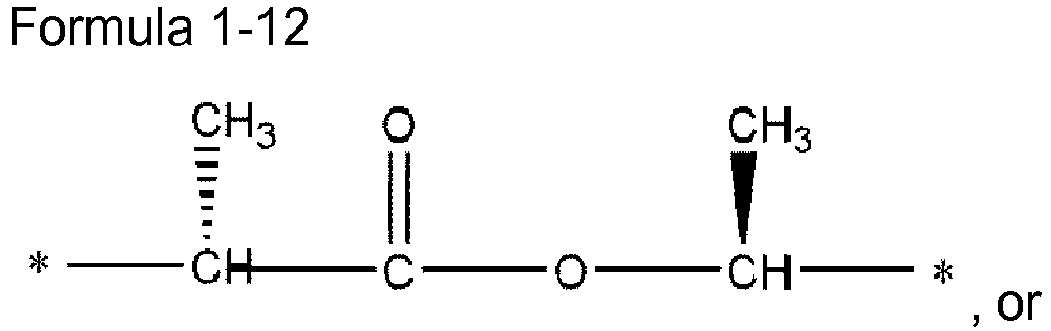

- In Formulae 1-1 to 1-13, * is a binding site to a main chain of a polymer of the repeating unit represented by
Formula 1. - For example, R may be a group represented by Formulae 1-3 or 1-4 in
Formula 1, or a combination thereof. While not wanting to be bound by theory, it is understood that R provides a high degree of dissociation of the alkali metal salts and/or alkaline earth metal salts, a low glass transition temperature Tg, and high conductivity of alkali metal ions and/or alkaline earth metal ions. - For example, in
Formula 1, n may be an integer from about 100 to about 1,800, about 200 to about 1,600, about 300 to about 1,400, about 400 to about 1,200, about 500 to about 1,000, or about 600 to about 800. If n is within this range inFormula 1, the binder of the positive electrode for a metal secondary battery has appropriate viscosity without particles thereof being agglomerated, thereby enhancing adhesiveness of the positive active material layer to the positive current collector in the positive electrode. Thus, interfacial contact resistance between the positive electrode and the electrolyte may be reduced, and a metal secondary battery including the same may have improved electrochemical properties, e.g., improved initial charge/discharge capacity, charge/discharge efficiency, and lifespan characteristics. - An amount of the polymeric first binder including the repeating unit represented by
Formula 1 may be from about 0.1 parts by weight to about 30 parts by weight, about 1 parts by weight to about 20 parts by weight, or about 2 parts by weight to about 10 parts by weight, based on 100 parts by weight of the positive electrode. When the amount of the polymeric first binder including the repeating unit represented byFormula 1 is in this range, the positive active material of the positive active material layer may have appropriate viscosity in the positive electrode, and the metal secondary battery including the same may have improved electrochemical properties, e.g., improved initial charge/discharge capacity, charge/discharge efficiency, and lifespan characteristics. - The salt may comprise LiSCN, LiN(CN)2, LiClO4, LiBF4, LiAsF6, LiPF6, LiCF3SO3, Li(CF3SO2)2N, LiSbF6, Li(CF3SO2)3C, LiN(SO2C2F5)2, LiPF3(C2F5)3, LiPF3(CF3)3, LiB(C2O4)2, NaSCN, NaSO3CF3, NaN(SO2CF3)2, KN(SO2CF3)2, Ba(N(SO2CF3)2)2, Ca(N(SO2CF3)2)2, or a combination thereof.
- For example, the salt may comprise LiSCN, LiN(CN)2, LiClO4, LiBF4, LiAsF6, LiPF6, LiCF3SO3, Li(CF3SO2)2N, LiSbF6, Li(CF3SO2)3C, LiN(SO2C2F5)2, LiPF3(C2F5)3, LiPF3(CF3)3, LiB(C2O4)2, or a combination thereof.
- The positive electrode including the salt may enhance mobility and ion conductivity of alkali metal ions or alkaline earth metal ions of the metal secondary battery including the positive electrode.
- A weight ratio of the polymeric first binder having the repeating unit represented by
Formula 1 to salt may be from about 9:1 to about 1:9. For example, the weight ratio of the polymeric first binder including the repeating unit represented byFormula 1 to the salt may be from 8:2 to about 5:5, for example, from 7:3 to about 5:5. - When the weight ratio of the polymeric first binder including the repeating unit represented by
Formula 1 to the salt is within these ranges, the alkali metal salt and/or alkaline earth metal salt does not precipitate and has appropriate solubility, thereby enhancing mobility and ion conductivity of alkali metal ions or alkaline earth metal ions. Also, mechanical properties thereof may be maintained. - The positive active material layer may further comprise a second binder, an oligomer, an organic solvent, an ionic liquid, a plasticizer, or a combination thereof.
- The second binder may include polyvinylidene difluoride (PVdF), polyvinyl alcohol (PVA), a polyacrylic (C1-C6 alkyl) ester, a vinylidene fluoride-hexafluoro propylene (VDF-HFP) copolymer, chloropolyethylene, a polymethacrylic acid (C1-C6 alkyl) ester, an ethylene-vinyl alcohol copolymer, a polyimide, a polyamide, a polyamideimide, a hydride thereof, a carboxylic acid derivative thereof, or a combination thereof.
- An amount of the second binder may be from about 0.1 parts by weight to about 50 parts by weight, about 1 parts by weight to about 25 parts by weight, or about 2 parts by weight to about 10 parts by weight, based on 100 parts by weight of the positive electrode. When the amount of the second binder is within this range, a binding force of the positive active material layer may increase and/or adhesiveness between the positive active material layer and the positive current collector may be enhanced.
- The oligomer may comprise poly(ethylene oxide), poly(propylene oxide), poly(butylene oxide), poly(ethylene glycol), poly(ethylene glycol)diacrylate, poly(propylene glycol)diacrylate, poly(ethylene glycol)dimethacrylate, poly(propylene glycol)dimethacrylate, poly(ethylene glycol)urethane diacrylate, poly(ethylene glycol)urethane dimethacrylate, poly(ethylene glycol)urethane triacrylate, poly(ethylene glycol)urethane trimethacrylate, or a combination thereof.
- An amount of the oligomer may be from about 0.1 parts by weight to about 50 parts by weight, about 1 parts by weight to about 25 parts by weight, or about 2 parts by weight to about 10 parts by weight, based on 100 parts by weight of the positive electrode. When the amount of the oligomer is within this range, mobility of alkali metal ions and/or alkaline earth metal ions may further be enhanced between the electrolyte and the positive electrode.
- The organic solvent may comprise propylene carbonate, ethylene carbonate, fluoroethylene carbonate, butylene carbonate, dimethyl carbonate, diethyl carbonate, methylethyl carbonate, methylpropyl carbonate, ethylpropyl carbonate, methylisopropyl carbonate, dipropyl carbonate, dibutyl carbonate, benzonitrile, acetonitrile, tetrahydrofuran, 2-methyltetrahydrofuran, γ-butyrolactone, dioxolane, 4-methyldioxolane, N,N-dimethyl formamide, N,N-dimethyl acetamide, dimethylsulfoxide, dioxane, 1,2-dimethoxyethane, sulfolane, dichloroethane, chlorobenzene, nitrobenzene, diethylene glycol, and dimethyl ether. An amount of the organic solvent may be from about 0.1 parts by weight to about 50 parts by weight, about 1 parts by weight to about 25 parts by weight, or about 2 parts by weight to about 10 parts by weight, based on 100 parts by weight of the positive electrode. When the amount of the organic solvent is within this range, conductivity of alkali metal ions and/or alkaline earth metal ions appropriate for performance of a battery may be obtained.
- The ionic liquid may be a salt in a liquid state, and may be a molten salt at room temperature composed solely of ions and having a melting point below room temperature. The ionic liquid may comprise a cation comprising an ammonium, pyrrolidinium, pyridinium, pyrimidinium, imidazolium, piperidinium, pyrazolium, oxazolium, pyridazinium, phosphonium, sulfonium, triazolium, or a combination thereof, and an anion comprising BF4 -, PF6 -, AsF6 -, SbF6 -, AlCl4 -, HSO4 -, ClO4 -, Cl-, Br-, I-, SO4 2-, CF3SO3 -, CF3CO2 -, (C2F5SO2)(CF3SO2)N-, NO3 -, Al2Cl7 -, CH3COO-, CH3SO3 -, (CF3SO2)3C-, (CF3CF2SO2)2N-, (CF3SO2)2N-, (FSO2)2N-, (CF3)2PF4 -, (CF3)3PF3 -, (CF3)4PF2 -, (CF3)5PF-, (CF3)6P-, SF5CF2SO3 -, SF5CHFCF2SO3 -, CF3CF2(CF3)2CO-, (CF3SO2)2CH-, (SF5)3C-, (O(CF3)2C2(CF3)2O)2PO-, or a combination thereof.
- For example, the ionic liquid may comprise N-methyl-N-propyl pyrrolidinium bis(trifluoromethane sulfonyl)imide, N-butyl-N-methyl pyrrolidinium bis(trifluoromethyl sulfonyl)imide, 1-butyl-3-methyl imidazolium bis(trifluoromethyl sulfonyl)imide, 1-ethyl-3-methyl imidazolium bis(trifluoromethyl sulfonyl)imide, or a combination thereof.
- A molar ratio of the ionic liquid to the salt may be from about 0.1:1 to about 2:1, about 0.2:1 to about 1.8:1, or about 0.5:1 to about 1:1. When the molar ratio of the ionic liquid to the salt is within this range, mobility and ion conductivity of alkali metal ions and/or alkaline earth metal ions may further be enhanced between the electrolyte and the positive electrode.
- The plasticizer may comprise a phthalate plasticizer, a trimellitate plasticizer, a phosphate plasticizer, a polyester plasticizer, a chloride plasticizer, or a combination thereof. Examples of the phthalate plasticizer may include dibutylphthalate (DBP), diisononyl phthalate (DINP), diisodecyl phthalate (DIDP), butylbenzyl phthalate (BBP), or a combination thereof. Examples of the trimellitate plasticizer may include triethylhexyl trimellitate (TOTM), triisononyl trimellitate (TINTM), and triisodecyl trimellitate (TIDTM). Examples of the phosphate plasticizer may include tricresyl phosphate (TCP), tri-2-ethylhexyl phosphate (TOP), and cresyl diphenyl phosphate (CDP). Examples of the polyester plasticizer may include polyester having a weight average molecular weight (Mw) of about 8,000 Daltons (Da) or less, e.g., about 500 Da to about 8000 Da, about 1000 Da to about 7000 Da, or about 2000 Da to about 6000 Da, against polystyrene standards, as measured by gel permeation chromatography in chloroform/hexafluoroisopropanol (5:95, volume/volume ratio) at 25° C.
- . The chloride plasticizer may have chlorine content of about 35% to about 70%, about 40% to about 60%, or about 50% to about 55%.
- An amount of the plasticizer may be from about 1 parts by weight to about 25 parts by weight, or about 2 parts by weight to about 10 parts by weight, based on 100 parts by weight of the positive electrode. When the amount of the plasticizer is within this range, the positive active material layer has flexibility appropriate for being efficiently formed on the positive current collector.
- The positive active material may include a compound capable of intercalation and deintercalation of lithium, inorganic sulfur (S8), or a sulfur-based compound.
- For example, the compound capable of intercalation and deintercalation of lithium may be a lithium-containing metal oxide. The lithium-containing metal oxide may be any suitable metal oxide including lithium used in the art without limitation.
- For example, the lithium-containing metal oxide may comprise a composite oxide of lithium and a metal selected from cobalt (Co), manganese (Mn), nickel (Ni), and a combination thereof. Particularly, the lithium-containing metal oxide may be any compound represented by any of the formulae: LiaA1-bB'bD'2 (where 0.90 ≤ a ≤ 1 and 0 ≤ b ≤ 0.5); LiaE1-bB'bO2-cD'c (where 0.90 ≤ a ≤ 1, 0 ≤ b ≤ 0.5, and 0 ≤ c ≤ 0.05); LiE2-bB'bO4-cD'c (where 0 ≤ b ≤ 0.5 and 0 ≤ c ≤ 0.05); LiaNi1-b-cCobB'cD'α (where 0.90 ≤ a ≤ 1, 0 ≤ b ≤ 0.5, 0 ≤ c ≤ 0.05, and 0 < α ≤ 2); LiaNi1-b-cCobB'cO2-αF'α (where 0.90 ≤ a ≤ 1, 0 ≤ b ≤ 0.5, 0 ≤ c ≤ 0.05, and 0 < α < 2); LiaNi1-b-cCobB'cO2-αF'2 (where 0.90 ≤ a ≤ 1, 0 ≤ b ≤ 0.5, 0 ≤ c ≤ 0.05, and 0 < α < 2); LiaNi1-b-cMnbB'cD'α (where 0.90 ≤ a ≤ 1, 0 ≤ b ≤ 0.5, 0 ≤ c ≤ 0.05, and 0 < α ≤ 2); LiaNi1-b-cMnbB'cO2-αF'α (where 0.90 ≤ a ≤ 1, 0 ≤ b ≤ 0.5, 0 ≤ c ≤ 0.05, and 0 < α < 2); LiaNi1-b-cMnbB'cO2-αF'2 (where 0.90 ≤ a ≤ 1, 0 ≤ b ≤ 0.5, 0 ≤ c ≤ 0.05, and 0 < α < 2); LiaNibEcGdO2 (where 0.90 ≤ a ≤ 1, 0 ≤ b ≤ 0.9, 0 ≤ c ≤ 0.5, and 0.001 ≤ d ≤ 0.1); LiaNibCocMndGeO2 (where 0.90 ≤ a ≤ 1, 0 ≤ b ≤ 0.9, 0 ≤ c ≤ 0.5, 0 ≤ d ≤0.5, and 0.001 ≤ e ≤ 0.1); LiaNiGbO2 (where 0.90 ≤ a ≤ 1 and 0.001 ≤ b ≤ 0.1); LiaCoGbO2 (where 0.90 ≤ a ≤ 1 and 0.001 ≤ b ≤ 0.1); LiaMnGbO2 (where 0.90 ≤ a ≤ 1 and 0.001 ≤ b ≤ 0.1); LiaMn2GbO4 (where 0.90 ≤ a ≤ 1 and 0.001 ≤ b ≤ 0.1); LiV2O5; Lil'O2; LiNiVO4; Li(3-f)J2(PO4)3 (0 ≤ f ≤ 2); Li(3-f)Fe2 (PO4)3(0 ≤ f ≤ 2); and LiFePO4.
- In the above formulae, A is Ni, Co, Mn, or a combination thereof; B' is Al, Ni, Co, Mn, Cr, Fe, Mg, Sr, V, a rare earth element, or a combination thereof; D' is O, F, S, P, or a combination thereof; E is Co, Mn, or a combination thereof; F' is F, S, P, or a combination thereof; G is Al, Cr, Mn, Fe, Mg, La, Ce, Sr, V, or a combination thereof; I' is Cr, V, Fe, Sc, Y, or a combination thereof; and J is V, Cr, Mn, Co, Ni, Cu, or a combination thereof.
- For example, the positive active material may comprise lithium nickel oxide, lithium nickel cobalt oxide, lithium nickel cobalt manganese oxide, lithium nickel cobalt aluminum oxide, LiFePO4, or a combination thereof.
- For example, the sulfur-based compound may be Li2Sn (n=1), an organosulfur compound, or a carbon-sulfur polymer ((C2Sx)n where x=2.5-50 and n=2).
- The positive electrode may have an operating voltage of about 2.0 V to about 4.5 V (vs. Li/Li+).
- The positive active material layer may have adhesiveness of 0.2 kiloNewtons per meter (kN/m) to the positive current collector. Thus, interfacial contact resistance between the positive electrode and the electrolyte may be reduced, and the metal secondary battery including the positive electrode may have improved electrochemical properties, e.g., improved initial charge/discharge capacity, charge/discharge efficiency, and lifespan characteristics at a high voltage of 4.2 V (vs. Li/Li+).
- A metal secondary battery according to another embodiment may include a negative electrode including a lithium metal or a lithium alloy, the positive electrode, and an electrolyte membrane or separator interposed between the negative electrode and the positive electrode. For example, the metal secondary battery may be a lithium secondary battery.
-
FIG. 1 is a schematic diagram of an embodiment of a lithiumsecondary battery 10. - As illustrated in
FIG. 1 , the lithiumsecondary battery 10 includes a lithium or lithium alloynegative electrode 12, and a positive electrode including a positivecurrent collector 18 and a positiveactive material layer 14 disposed on the positivecurrent collector 18. A polymer electrolyte membrane orseparator 16, in which a polymer electrolyte coating layer is formed on two sides of a porous substrate, is disposed between the lithium or lithium alloynegative electrode 12 and the positive electrode. Aprotective layer 20 is disposed on one surface of the lithium or lithium alloynegative electrode 12. Theprotective layer 20 on the lithiumnegative electrode 12 is illustrated as an example, and the lithium or lithium alloynegative electrode 12 may be used alone without having theprotective layer 20 thereon. - The lithium or lithium alloy
negative electrode 12 may include lithium metal or an alloy of lithium, and Si, Sn, Al, Ge, Pb, Bi, Sb, a Si-Y' alloy (where Y' is alkali metal, alkali earth metal, Groups 13 to 16 element, transition metal, rare earth element, or any combination thereof (except for Si)), or a Sn-Y' alloy (where Y' is alkali metal, alkali earth metal, Groups 13 to 16 element, transition metal, rare earth element, or any combination thereof (except for Sn)). In this regard, the element Y' may be selected from Mg, Ca, Sr, Ba, Ra, Sc, Y, Ti, Zr, Hf, Rf, V, Nb, Ta, Db, Cr, Mo, W, Sg, Tc, Re, Bh, Fe, Pb, Ru, Os, Hs, Rh, Ir, Pd, Pt, Cu, Ag, Au, Zn, Cd, B, Al, Ga, Sn, In, Ge, P, As, Sb, Bi, S, Se, Te, Po, or any combination thereof. The lithium or lithium alloynegative electrode 12 may have a thickness of about 50 nanometers (nm) to about 100 micrometers (µm). - The
protective layer 20 may include an ion-conductive polymer or a copolymer of an ion-conductive polymer and an ion-nonconductive polymer, and a lithium salt. Examples of the ion-conductive polymer may include polyethylene oxide (PEO), polysiloxane, polypropylene oxide (PPO), polyethylene oxide-grafted polymethyl methacrylate (PEO grafted PMMA), and polysiloxane-grafted PMMA. Examples of the ion-nonconductive polymer may include PMMA, polyvinyl pyridine, polyimide, polyethylene, polypropylene, polyvinylidene fluoride (PVdF), polyacrylonitrile (PAN), and polydimethyl siloxane (PDMS). Theprotective layer 20 may have a thickness of about 500 nm to about 2 µm. Theprotective layer 20 may be partially formed on a surface of the lithium or lithium alloynegative electrode 12 or as a separate single layer or as multiple layers. Theprotective layer 20 may be a gel phase or solid phase layer. - If the
protective layer 20 is disposed on the lithium or lithium alloynegative electrode 12, dendrite growth may be inhibited on a surface of the lithium or lithium alloynegative electrode 12. Accordingly, the lithium secondary battery may have improved mechanical properties and improved lithium ion mobility. - For example, the lithium secondary battery may be prepared as follows.
- First, the lithium or lithium alloy
negative electrode 12 may be prepared by the following method. - The lithium or lithium alloy
negative electrode 12 may be prepared by pressing a lithium or lithium alloy ingot on a negative current collector in a container, e.g., a sealed container. Also, the lithium or lithium alloynegative electrode 12 may be prepared via deposition by which the lithium or lithium alloy is deposited on a metal or plastic substrate to form a film. - Any suitable current collector may be used as the negative current collector, and a material, a form, and a manufacturing method thereof are not limited. For example, a copper foil having a thickness of about 10 µm to about 100 µm, a perforated copper foil having a thickness of about 10 µm to about 100 µm and a pore diameter of about 0.1 mm to about 10 mm, an expanded metal, or a foamed metal plate may be used. The negative current collector may also be formed of stainless steel, titanium, nickel, or the like, as well as copper.
- The positive
current collector 18 may be a metal such as nickel, aluminum, titanium, copper, gold, silver, platinum, an aluminum alloy, or stainless steel; a film prepared by plasma-spraying or arc-spraying a carbonaceous material; activated carbon fiber; nickel, aluminum, zinc, copper, tin, lead, or any alloy thereof; or a conductive film prepared by dispersing a conductive agent in rubber or a resin such as styrene-ethylene-butylene-styrene copolymer (SEBS). For example, aluminum, nickel, or stainless steel may be used. Particularly, aluminum may be used due to the efficiency by which aluminum may be processed into a thin film and manufacturing costs thereof. A form of the positivecurrent collector 18 is not particularly limited. For example, the positivecurrent collector 18 may have a form of a thin film, a flat plate, a mesh, a net, a punched form, an embossed form, or a combination thereof, e.g., a meshed flat plate or the like. For example, the positivecurrent collector 18 may have an uneven surface formed by etching. - The positive
active material layer 14 may include a positive active material, a salt selected from an alkali metal salt, an alkaline earth metal salt, or a combination thereof, and a polymeric first binder having a repeating unit represented byFormula 1.
- In
Formula 1, R may be a substituted or unsubstituted C2-C5 alkylene group, a substituted or unsubstituted C2-C6 alkoxylene group, a substituted or unsubstituted C2-C6 alkoxycarbonylene group, a substituted or unsubstituted C2-C6 alkylene oxide group, or a combination thereof, and n may be an integer from about 90 to about 2,700, about 160 to about 2,000, about 240 to about 1500, about 360 to about 1,000, or about 500 to about 1,000. - Types, examples, and amounts of the positive active material, the salt, and the polymeric first binder having the repeating unit represented by
Formula 1, and the weight ratio of the polymeric first binder having the repeating unit represented byFormula 1 to the salt are described above, and thus, descriptions thereof will not be repeated hereinafter. - The positive
active material layer 14 may further comprise a second binder, an oligomer, an organic solvent, an ionic liquid, a plasticizer, or a combination thereof. Types and amounts of the second binder, the oligomer, the organic solvent, the ionic liquid, and the plasticizer, and the molar ratio of the ionic liquid to the salt are described above, and thus, descriptions thereof will not be repeated hereinafter. - The positive
active material layer 14 may further include a conductive material and a solvent. - Examples of the conductive material include: carbon black, graphite, natural graphite particulates, artificial graphite, acetylene black, Ketjen black, and carbon fiber; carbon nanotube; copper, nickel, aluminum, and silver, each of which may be used in powder, fiber, or tube form; and a conductive polymer such as polyphenylene derivatives. However, the conductive material is not limited thereto, and any suitable conductive material used in the art may also be used.
- Examples of the solvent may include N-methylpyrrolidone (NMP), tetrahydrofuran (THF), acetone, or water. However, the solvent is not limited thereto, and any suitable solvent used in the art may also be used.
- The positive electrode may be prepared as follows.
- The positive active material, the conductive material, the first binder and optionally the second binder, and the solvent are mixed to prepare a positive active material composition, e.g., a positive active material slurry. The positive active material composition is directly coated on the positive
current collector 18 and dried to prepare a positive electrode on which the positiveactive material layer 14 is formed. Alternatively, the positive electrode may be prepared by casting the positive active material composition on a separate support and laminating a film separated from the support on the current collector. If desired, a plasticizer may further be added to the positive active material composition to form pores in the positive electrode. - The positive active material, the conductive material, the first binder and optionally the second binder, and the solvent may be used in amounts used in lithium secondary batteries. One or more of the conductive material, the second binder, and the solvent may be omitted with in accordance with a purpose and a structure of a lithium secondary battery.
- Next, the polymer electrolyte membrane or
separator 16, in which a polymer electrolyte coating layer is formed on two surfaces of a substrate, is prepared for insertion between the lithium or lithium alloynegative electrode 12 and the positive electrode. - The
polymer electrolyte membrane 16 may comprise a salt and a polymer having a repeating unit represented byFormula 1 below.

- In
Formula 1, R may be a substituted or unsubstituted C2-C5 alkylene group, a substituted or unsubstituted C2-C6 alkoxylene group, a substituted or unsubstituted C2-C6 alkoxycarbonylene group, a substituted or unsubstituted C2-C6 alkylene oxide group, or any combination thereof, and n may be an integer from 90 to 2,700, about 90 to about 2,500, about 160 to about 2,000, or about 240 to about 1500. - Since a liquid electrolyte is not used in the
polymer electrolyte membrane 16, side reactions between the electrolyte and the positive electrode may be reduced. The polymer having the repeating unit represented byFormula 1 included in thepolymer electrolyte membrane 16 may be dissolved in various organic solvents enabling easy processing of thepolymer electrolyte membrane 16. In addition, the polymer having the repeating unit represented byFormula 1 included in thepolymer electrolyte membrane 16 is a solid electrolyte compatible with a positive electrode for a high voltage of 4.2 V (vs. Li/Li+), and may provide high energy density. Thus, a lithium secondary battery including thepolymer electrolyte membrane 16 may have improved electrochemical properties, e.g., initial charge/discharge capacity, charge/discharge efficiency, and lifespan characteristics. - The
separator 16 may include a porous substrate, and a polymer electrolyte coating layer, formed on at least one surface of the porous substrate, including the salt and the polymer having the repeating unit represented byFormula 1. - The porous substrate may include monolayered substrate such as polyethylene, polypropylene, or a multi-layered substrate such as a polyethylene/polypropylene double-layered substrate, a polyethylene/polypropylene/polyethylene triple-layered substrate, or a polypropylene/polyethylene/polypropylene triple-layered substrate. The
separator 16 may further include a liquid electrolyte including the lithium salt and the organic solvent described above. - The
separator 16, like thepolymer electrolyte membrane 16, is compatible with a positive electrode for a high voltage of 4.2 V (vs. Li/Li+) and may provide high energy density. Thus, a lithium secondary battery including theseparator 16 may have improved electrochemical properties, e.g., improved initial charge/discharge capacity, charge/discharge efficiency, and lifespan characteristics. Also, the lithium secondary battery may have improved mechanical properties since the polymer electrolyte coating layer is formed on at least one surface of the porous substrate. - The polymer electrolyte membrane or
separator 16 may have a thickness of about 20 µm to about 100 µm. When the thickness of the polymer electrolyte membrane orseparator 16 is within this range, improved mechanical strength and improved electrochemical properties, e.g., improved initial charge/discharge capacity, charge/discharge efficiency, and lifespan characteristics may be obtained. - A weight ratio of the polymer having the repeating unit represented by
Formula 1 to the salt may be from about 8:2 to about 5:5, for example, from about 7:3 to about 5:5. - When the weight ratio of the polymeric first binder including the repeating unit represented by
Formula 1 to the salt is within these ranges, the alkali metal salt and/or alkaline earth metal salts do not precipitate and have appropriate solubility, thereby enhancing mobility and ion conductivity of the alkali metal ions or alkaline earth metal ions. Also, mechanical properties thereof may be maintained. - The polymer electrolyte coating layer may have an oxidation initiation voltage of 4.35 V or greater (vs. Li/Li+).
- The metal secondary battery may have a capacity retention of 80% or greater to a 20th cycle at 60°C at an operating voltage of about 3.0 V to about 4.2 V (vs. Li/Li+).
- The metal secondary battery may have an average Coulombic efficiency of 95% or greater to a 20th cycle at 60°C at an operating voltage of about 3.0 to about 4.2 V (vs. Li/Li+).
- Also, the lithium secondary battery may be stacked in a bi-cell structure forming a battery structure. Also, a plurality of battery structures may be stacked to form a battery pack suitable for an apparatuses to provide high capacity and high output, for example, notebook computers, smartphones, and electric vehicles.
- The lithium secondary battery having excellent storage stability, lifespan characteristics, and high-rate characteristics at high temperature may be applied to electric vehicles (EVs), e.g., hybrid electric vehicles such as plug-in hybrid electric vehicles (PHEVs).
- Hereinafter, an embodiment will be described in detail with reference to the following examples and comparative examples. However, these examples are not intended to limit the purpose and scope of the one or more example embodiments.
- A positive active material slurry was prepared by adding LiNi0.8Co0.15Mn0.05O2 as a positive active material powder, carbon black (Super-P®) as a conductive material, polyvinylidene fluoride (PVDF) as a second binder, and lithium bis(trifluoromethane sulfonyl)imide (Li(CF3SO2)2N, LiTFSI) as a lithium salt powder to a solution prepared by dissolving 5% by weight of a polymeric first binder having a repeating unit represented by
Formula 2 below (Sigma Aldrich, Mn: 80,000) in N-methylpyrrolidone (NMP) at 80°C for 1 hour, and blending the mixture such that a weight ratio of the positive active material: the conductive material: the first binder: the second binder: the lithium salt was 80:5:5:5:5. - The positive active material slurry was coated on both surfaces of a 15 µm-thick aluminum foil to a thickness of a coating layer of 200 µm and dried at 120°C for 3 hours or longer, and the resultant structure was pressed to prepare a positive electrode having a thickness of 120 µm.
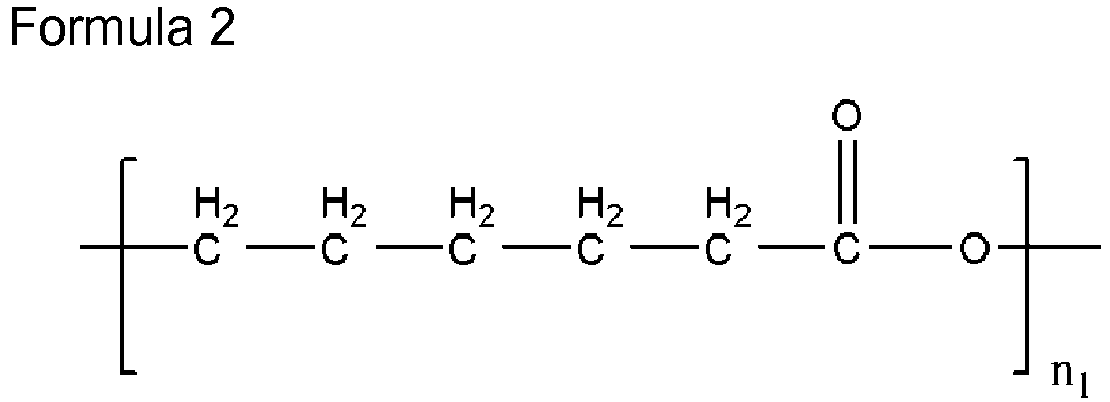
- A lithium ingot was placed on a 10 µm-thick copper foil current collector and pressed to prepare a lithium negative electrode having a thickness of 20 µm.
- A polymer electrolyte solution was prepared by adding lithium bis(trifluoromethane sulfonyl)imide (Li(CF3SO2)2N, LiTFSI) as a lithium salt powder to a solution prepared by dissolving 5% by weight of a polymer having a repeating unit represented by
Formula 2 above in tetrahydrofuran (THF) at 60°C for 1 hour, such that a weight ratio of the polymer to the lithium salt was 1:1. - A polyethylene substrate having a thickness of about 20 µm (separator,
STAR 20, available from Asahi) was impregnated with the polymer electrolyte solution and dried at 40°C in a convection oven for 2 hours, and then further dried at 60°C in a vacuum oven for 24 hours, to prepare a separator in which polymer electrolyte coating layers are formed on two sides of the polyethylene substrate to a thickness of 7 µm. - A lithium secondary battery (coin cell) was prepared by winding the positive electrode, the negative electrode, and the separator having the polymer electrolyte coating layer in a predetermined size, and performing a cell assembling process.
- A lithium secondary battery (coin cell) was prepared in the same manner as in Example 1, except that a polymer electrolyte solution was prepared by adding lithium bis(trifluoromethane sulfonyl)imide (Li(CF3SO2)2N, LiTFSI) as a lithium salt powder to the solution prepared by dissolving 5% by weight of the polymer having the repeating unit represented by
Formula 2 above in tetrahydrofuran (THF) at 60°C for 1 hour, such that a weight ratio of the polymer to the lithium salt was 7:3 instead of 1:1 as in the preparation of the separator having the polymer electrolyte coating layer performed in operation (3) above. - A lithium secondary battery (coin cell) was prepared in the same manner as in Example 1, except that a polymer electrolyte solution was prepared by adding lithium bis(trifluoromethane sulfonyl)imide (Li(CF3SO2)2N, LiTFSI) as a lithium salt powder to the solution prepared by dissolving 5% by weight of the polymer having the repeating unit represented by
Formula 2 above in tetrahydrofuran (THF) at 60°C for 1 hour, such that a weight ratio of the polymer to the lithium salt was 3:7 instead of 1:1 as in the preparation of the separator having the polymer electrolyte coating layer performed in operation (3) above. - A lithium secondary battery (coin cell) was prepared in the same manner as in Example 1, except that LiFePO4 as a positive active material powder, carbon black (Super-P®) as a conductive material, polyvinylidene fluoride (PVDF) as a second binder, and lithium bis(trifluoromethane sulfonyl)imide (Li(CF3SO2)2N, LiTFSI) as a lithium salt powder were added to the solution prepared by dissolving 5% by weight of the polymeric first binder having the repeating unit represented by Formula 2 above (Sigma Aldrich, Mn: 80,000) in tetrahydrofuran (THF) at 60°C for 1 hour, such that the weight ratio of the positive active material: the conductive material: the first binder: the second binder: the lithium salt was 60:10:15:5:10 in the preparation of the positive electrode performed in operation (1) above, instead of adding LiNi0.8Co0.15Mn0.05O2 as the positive active material powder, carbon black (Super-P®) as the conductive material, polyvinylidene fluoride (PVDF) as the second binder, and lithium bis(trifluoromethane sulfonyl)imide (Li(CF3SO2)2N, LiTFSI) as the lithium salt powder to the solution such that the weight ratio of the positive active material: the conductive material: the first binder: the second binder: the lithium salt was 80:5:5:5:5.
- A lithium secondary battery (coin cell) was prepared in the same manner as in Example 1, except that LiNi0.8Co0.15Mn0.05O2 as a positive active material powder, carbon black (Super-P®) as a conductive material, polyvinylidene fluoride (PVDF) as a second binder, and lithium bis(trifluoromethane sulfonyl)imide (Li(CF3SO2)2N, LiTFSI) as a lithium salt powder were added to a solution prepared by dissolving 5% by weight of polyethylene oxide as a first binder (Sigma Aldrich, Mn: 90,000), instead of the polymeric first binder having the repeating unit represented by Formula 2 (Sigma Aldrich, Mn: 80,000), in NMP at 80°C for 1 hour, such that the weight ratio of the positive active material: the conductive material: the first binder: the second binder: the lithium salt was 80:5:5:5:5 in the preparation of the positive electrode performed in operation (1) above, and except that a polymer electrolyte slurry was prepared by adding lithium bis(trifluoromethane sulfonyl)imide (Li(CF3SO2)2N, LiTFSI) as a lithium salt powder to a solution prepared by dissolving 5% by weight of the polyethylene oxide polymer (Sigma Aldrich, Mn: 90,000), instead of the polymer having the repeating unit represented by Formula 2 above, in THF at 60°C for 1 hour, such that the weight ratio of the polymer to the lithium salt was 1:1 in the preparation of the separator having the polymer electrolyte coating layer performed in operation (3).
- A lithium secondary battery (coin cell) was prepared in the same manner as in Example 1, except that 5% by weight of a polymeric first binder having the repeating unit represented by
Formula 2 above (Sigma Aldrich, Mn: 10,000) was used instead of the polymeric first binder having the repeating unit represented byFormula 2 above (Sigma Aldrich, Mn: 80,000) in the preparation of the positive electrode performed in operation (1) above. - A polymer electrolyte solution not including lithium bis(trifluoromethane sulfonyl)imide (Li(CF3SO2)2N, LiTFSI) as a lithium salt powder and prepared by dissolving 5% by weight of the polymer having the repeating unit represented by
Formula 2 above in THF at 60°C for 1 hour was prepared. - A polyethylene substrate having a thickness of about 20 µm (separator,
STAR 20, available from Asahi) was impregnated with the polymer electrolyte solution and dried at 40°Cin a convection oven for 2 hours, and further dried at 60°C in a vacuum oven for 24 hours, to prepare a separator having polymer electrolyte coating layers on two sides thereof of a thickness of 7 µm. - XRD tests were performed on the polymer electrolyte coating layers of the separators of the lithium secondary batteries prepared according to Examples 1, 2, and 3, and on the polymer electrolyte coating layer of the separator prepared according to Reference Example 1. The test results are shown in
FIG. 2 . - An X-ray diffractometer (Rigaku RINT2200HF+ diffractometer using CuKα radiation (1.540598Ǻ)) was used.
- Referring to
FIG. 2 , peaks are found at Bragg (2θ) angles of 21.4° and 23.8° in the XRD spectrum of the polymer electrolyte coating layer of the separator prepared according to Reference Example 1. These peaks indicate that X-ray beams are diffracted by lattice planes (110) and (200) of the polymer having the repeating unit represented byFormula 2 above. - Intensities of peaks of the polymer electrolyte coating layer of the separator of the lithium secondary battery prepared according to Example 2 were less than those of the polymer electrolyte coating layer of the separator prepared according to Reference Example 1 at the Bragg (2θ) angles of 21.4° and 23.8°.
- Peaks of the polymer electrolyte coating layers of the separators of the lithium secondary batteries prepared according to Examples 1 and 3 gradually disappear at the Bragg (2θ) angles of 21.4° and 23.8° in comparison with the polymer electrolyte coating layer of the separator prepared according to Reference Example 1.
- Thus, it may be confirmed that crystallinity of the polymer decreases as the amount of the lithium salt increases in the polymer having the repeating unit represented by
Formula 2 above. - Adhesiveness of the positive active material layers to the positive current collectors of the positive electrodes of the lithium secondary batteries prepared according to Example 1 and Comparative Example 1 were evaluated.
- To test adhesiveness, peel strength was evaluated in accordance with ASTM D6862 - 90 Degree Peel Resistance of Adhesives. After attaching 3M tape having a predetermined length and width to a surface of the positive active material layer, a 90°peel-off test was performed at a rate of 50 mm/min using a tensile strength tester (Shimadzu Corp.) to measure a force used to detach the positive active material layer from the positive current collector, i.e., adhesiveness (kN/m). The results are shown in Table 1 below.
Table 1 Adhesiveness (kN/m) Example 1 0.8 Comparative Example 1 0.1 - Referring to Table 1, adhesiveness of the positive active material layers to the positive current collectors of the positive electrodes prepared according to Example 1 and Comparative Example 1 was 0.8 kN/m and 0.1 kN/m, respectively.
- Thus, it was confirmed that adhesiveness of the positive active material layer to the positive current collector of the positive electrode of the lithium secondary battery prepared according to Example 1 was greater than that according to Comparative Example 1.
- Tri-electrode cells, as beaker cells, were prepared using the separators having the polymer electrolyte coating layers of the lithium secondary batteries prepared according to Example 1 and Comparative Example 1. Oxidation behaviors of the separators having the polymer electrolyte coating layers were evaluated at a working electrode. The results are shown in
FIGS. 3A and3B . - A stainless steel electrode (SUS316) was used as a working electrode, and lithium metal was used as a counter electrode and as a reference electrode. Measurement was performed at 60°C at an open circuit voltage (OCV) of 5 V (vs. Li/Li+) at a scan rate of 1 mV/sec.
- Referring to
FIGS. 3A and3B , oxidation onset potentials of the separators having the polymer electrolyte coating layers of the lithium secondary batteries according to Example 1 and Comparative Example 1 were about 4.6 V (vs. Li/Li+, at 10 µA) and about 3 V (vs. Li/Li+, at 10 µA), respectively. - Thus, it may be confirmed that the separator having the polymer electrolyte coating layer of the lithium secondary battery according to Example 1 had higher electrochemical oxidation stability than the separator having the polymer electrolyte coating layer of the lithium secondary battery prepared according to Comparative Example 1.
- Tri-electrode cells, as beaker cells, were prepared using the separators having the polymer electrolyte coating layers of the lithium secondary batteries prepared according to Example 1 and Comparative Example 1. Oxidation behaviors of the separators having the polymer electrolyte coating layers were evaluated at a working electrode. The results are shown in
FIGS. 4A and4B . - A stainless steel electrode (SUS316) was used as the working electrode, and lithium metal was used as a counter electrode and as a reference electrode. Measurement was performed at 60°C at 4.0 V, 4.2 V, and 4.4 V (vs. Li/Li+) for 2 hours.
- Referring to
FIGS. 4A and4B , currents of the separator having the polymer electrolyte coating layer of the lithium secondary battery according to Example 1 measured at 4.0 V, 4.2 V, and 4.4 V (vs. Li/Li+) after 2 hours were 0.08 µA, 0.20 µA, and 0.38 µA, respectively. Currents of the separator having the polymer electrolyte coating layer of the lithium secondary battery according to Comparative Example 1 measured at 4.0 V, 4.2 V, and 4.4 V (vs. Li/Li+) after 2 hours were 0.32 µA, 0.42 µA, and 0.71 µA, respectively. - Thus, it may be confirmed that the separator having the polymer electrolyte coating layer of the lithium secondary battery according to Example 1 has higher electrochemical oxidation stability than the separator having the polymer electrolyte coating layer of the lithium secondary battery according to Comparative Example 1.
- The lithium secondary batteries prepared according to Examples 1 to 3 and Comparative Example 1 were tested under standard charge/discharge conditions at 60°C in a charge/discharge voltage range of 3.0 V to about 4.2 V (vs. Li/Li+).
- Then, the lithium secondary batteries were charged at a constant current of 0.1 C (0.23 mA/cm2) until the voltage reached 4.2 V, and charged at a constant voltage of 4.2 V until the current reached 0.05 C in a chamber at 60°C. Then, the batteries were discharged at a constant current of 0.1 C until the voltage reached 3.0 V, and initial charge/discharge capacity at a 1st cycle was measured.
- Then, cycle lifespan characteristics thereof were evaluated by repeating the charging and discharging 20 times. Discharge capacity of each battery was measured at each cycle to a 20th cycle, and cycle lifespan characteristics were evaluated based on a cycle capacity retention (%). Coulomb efficiency and the cycle capacity retention (%) at 60°C were calculated using
Equations FIGS. 5A ,5B ,7A, and 7B . In Table 2 below, Coulomb efficiency (%) refers to a value obtained by dividing discharge capacity at the 1st cycle by charge capacity at the 1st cycle and then multiplying by 100.

Table 2 Initial charge capacity (mAh/g) Initial discharge capacity (mAh/g) Coulomb efficiency (%) Cycle capacity retention (%) Example 1 201 175 87 83 Example 2 183 165 90 65 Example 3 217 163 75 42 Comparative Example 1 175 121 69 0 - Referring to Table 2,
FIGS. 5A ,5B ,7A, and 7B , the lithium secondary batteries prepared according to Examples 1 to 3 have higher initial charge capacity, initial discharge capacity, Coulomb efficiency, and cycle capacity retention than the lithium secondary battery prepared according to Comparative Example 1. - The lithium secondary batteries prepared according to Example 1 and Comparative Example 1 were tested under standard charge/discharge conditions at 60°C in a charge/discharge voltage range of 3.0 V to about 4.4 V (vs. Li/Li+).
- Then, the lithium secondary batteries were charged at a constant current of 0.1 C (0.23 mA/cm2) until the voltage reached 4.4 V and charged at a constant voltage of 4.4 V until the current reached 0.05 C in a chamber at 60°C. Then, the batteries were discharged at a constant current of 0.1 C until the voltage reached 3.0 V, and initial charge/discharge capacity at a 1st cycle was measured. Coulomb efficiency (%) at the 1st cycle at 60°C were calculated using
Equation 1. The results are shown in Table 3 andFIGS. 6A and6B .Table 3 Initial charge capacity (mAh/g) Initial discharge capacity (mAh/g) Coulombic efficiency (%) Example 1 220 205 93 Comparative Example 1 210 33 15 - Referring to Table 3 and
FIGS. 6A and6B , the lithium secondary battery prepared according to Example 1 had higher initial charge capacity, initial discharge capacity, and Coulomb efficiency than the lithium secondary battery prepared according to Comparative Example 1. - The lithium secondary battery prepared according to Example 4 was tested under standard charge/discharge conditions at 60°C in a charge/discharge voltage range of 2.7 V to about 4.0 V (vs. Li/Li+).
- Then, the lithium secondary battery was charged at a constant current of 0.1 C (0.23 mA/cm2) until the voltage reached 4.0 V and charged at a constant voltage of 4.0 V until the current reached 0.05C in a chamber at 60°C. Then, the battery was discharged at a constant current of 0.1 C until the voltage reached 2.7 V, and initial charge/discharge capacity at a 1st cycle was measured.
- Then, the lithium secondary battery was charged at a constant current of 0.2 C until the voltage reached 4.0 V and charged at a constant voltage of 4.0 V until the current reached 0.2 C. The battery was discharged at a constant current of 0.2 C until the voltage reached 2.7 V, and discharge capacity thereof was measured at a 2nd cycle.
- Then, the lithium secondary battery was charged at a constant current of 0.3 C until the voltage reached 4.0 V and charged at a constant voltage of 4.0 V until the current reached 0.3 C. The battery was discharged at a constant current of 0.3 C until the voltage reached 2.7 V, and discharge capacity thereof was measured at a 3rd cycle.
- Then, cycle lifespan characteristics were evaluated by repeating 25 cycles of charging and discharging at the same as the 3rd cycle. Discharge capacity of the battery was measured at each cycle to a 25th cycle, and cycle lifespan characteristics were evaluated based on a cycle capacity retention (%).
- The cycle capacity retention (%) at 60°C was calculated using
Equation 2 above. The results are shown in Table 4 andFIG. 8 .Table 4 Cycle capacity retention (%) Example 4 99 - Referring to Table 4 and
FIG. 8 , the lithium secondary battery prepared according to Example 4 has a cycle capacity retention of 99%. - Since the positive electrode for a metal secondary battery according to an embodiment includes a positive active material layer comprising salt comprising an alkali metal salt, an alkaline earth metal salt, or a combination thereof, and the polymeric first binder having the repeating unit represented by
Formula 1, the positive active material layer has improved adhesiveness to the positive current collector. Thus, interfacial contact resistance between the positive electrode and the electrolyte may be reduced. - Also, the metal secondary battery including the electrolyte membrane or separator having the polymer having the repeating unit represented by
Formula 1 may have improved electrochemical oxidation stability at a high voltage of 4.2 V and improved initial charge/discharge capacity, charge/discharge efficiency, and lifespan characteristics. - It should be understood that embodiments described herein should be considered in a descriptive sense only and not for purposes of limitation. Descriptions of features, aspects, or advantages within each embodiment should typically be considered as available for other similar features, aspects, or advantages in other embodiments.
- While an embodiment has been described with reference to the figures, it will be understood by those of ordinary skill in the art that various changes in form and details may be made therein without departing from the scope as defined by the following claims.
Claims (15)
- A positive electrode for a metal secondary battery, the positive electrode comprising
a positive current collector; and
a positive active material layer disposed on the positive current collector, wherein the positive active material layer comprises:a positive active material,a salt comprising an alkali metal salt, an alkaline earth metal salt, or a combination thereof, anda polymeric first binder comprising a repeating unit represented by Formula 1: wherein R is a substituted or unsubstituted C2-C5 alkylene group, a substituted or unsubstituted C2-C6 alkoxylene group, a substituted or unsubstituted C2-C6 alkoxycarbonylene group, a substituted or unsubstituted C2-C6 alkylene oxide group, or a combination thereof, andn is an integer from 90 to 2,700, preferably an integer from 100 to 1,800.
 - The positive electrode for a metal secondary battery of claim 1, wherein R in Formula 1 comprises an unsubstituted C2-C5 alkylene group, a C2-C5 alkylene group substituted with a methyl group, a C2-C5 alkylene group substituted with a dimethyl group, a C2-C5 alkylene group substituted with a phenyl group, a C2-C5 alkylene group substituted with a benzyl group, a C2-C5 alkylene group substituted with a benzylcarboxyl group, or a combination thereof, preferably wherein R in Formula 1 comprises a group represented by Formulae 1-1 to 1-13, or a combination thereof:
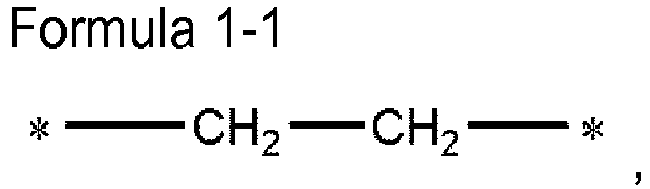


- The positive electrode for a metal secondary battery of claim 1 or 2, wherein an amount of the polymeric first binder comprising the repeating unit represented by Formula 1 is in a range of 0.1 parts by weight to 30 parts by weight, based on 100 parts by weight of the positive electrode.
- The positive electrode for a metal secondary battery of any of claims 1 to 3, wherein the salt comprises LiSCN, LiN(CN)2, LiClO4, LiBF4, LiAsF6, LiPF6, LiCF3SO3, Li(CF3SO2)2N, LiSbF6, Li(CF3SO2)3C, LiN(SO2C2F5)2, LiPF3(C2F5)3, LiPF3(CF3)3, LiB(C2O4)2, NaSCN, NaSO3CF3, NaN(SO2CF3)2, KN(SO2CF3)2, Ba(N(SO2CF3)2)2, Ca(N(SO2CF3)2)2, or a combination thereof.
- The positive electrode for a metal secondary battery of any of claims 1 to 4, wherein a weight ratio of the polymeric first binder comprising the repeating unit represented by Formula 1 to the salt is in a range of 9:1 to 1:9, preferably in a range of 8:2 to 5:5.
- The positive electrode for a metal secondary battery of any of claims 1 to 5, further comprising a second binder, an oligomer, an organic solvent, an ionic liquid, a plasticizer, or a combination thereof, preferably wherein the second binder comprises polyvinylidene difluoride, polyvinyl alcohol, a polyacrylic ester, a vinylidene fluoride-hexafluoro propylene copolymer, chloropolyethylene, a polymethacrylic acid ester, an ethylene-vinylalcohol copolymer, a polyimide, a polyamide, a polyamideimide, a carboxylic acid derivative thereof, or a combination thereof, and/or an amount of the second binder is in a range of 0.1 parts by weight to 50 parts by weight, based on 100 parts by weight of the positive electrode.
- The positive electrode for a metal secondary battery of claim 6, wherein the oligomer comprises poly(ethylene oxide), poly(propylene oxide), poly(butylene oxide), poly(ethylene glycol), poly(ethylene glycol)diacrylate, poly(propylene glycol)diacrylate, poly(ethylene glycol)dimethacrylate, poly(propylene glycol)dimethacrylate, poly(ethylene glycol)urethane diacrylate, poly(ethylene glycol)urethane dimethacrylate, poly(ethylene glycol)urethane triacrylate, poly(ethylene glycol)urethane trimethacrylate, or a combination thereof, and/or wherein an amount of the oligomer is in a range of 0.1 parts by weight to 50 parts by weight, based on 100 parts by weight of the positive electrode and/or wherein the organic solvent comprises propylene carbonate, ethylene carbonate, fluoroethylene carbonate, butylene carbonate, dimethyl carbonate, diethyl carbonate, methylethyl carbonate, methylpropyl carbonate, ethylpropyl carbonate, methylisopropyl carbonate, dipropyl carbonate, dibutyl carbonate, benzonitrile, acetonitrile, tetrahydrofuran, 2-methyltetrahydrofuran, γ-butyrolactone, dioxolane, 4-methyldioxolane, N,N-dimethyl formamide, N,N-dimethyl acetamide, dimethylsulfoxide, dioxane, 1,2-dimethoxyethane, sulforane, dichloroethane, chlorobenzene, nitrobenzene, diethylene glycol, dimethyl ether, or a combination thereof and/or wherein the ionic liquid comprises a compound comprising:a cation comprising ammonium, pyrrolidinium, pyridinium, pyrimidinium, imidazolium, piperidinium, pyrazolium, oxazolium, pyridazinium, phosphonium, sulfonium, triazolium, or a combination thereof; andan anion comprising BF4 -, PF6 -, AsF6 -, SbF6 -, AlCl4 -, HSO4 -, ClO4 -, Cl-, Br-, I-, SO4 2-, CF3SO3 -, CF3CO2 -, (C2F5SO2)(CF3SO2)N-, NO3 -, Al2Cl7 -, CH3COO-, CH3SO3 -, (CF3SO2)3C-, (CF3CF2SO2)2N-, (CF3SO2)2N-, (FSO2)2N-, (CF3)2PF4 -, (CF3)3PF3 -, (CF3)4PF2 -, (CF3)5PF-, (CF3)6P-, SF5CF2SO3 -, SF5CHFCF2SO3 -, CF3CF2(CF3)2CO-, (CF3SO2)2CH-, (SF5)3C-, (O(CF3)2C2(CF3)2O)2PO-, or combination thereof, and/or wherein a molar ratio of the ionic liquid to the salt is from 0.1 : 1 to 2 : 1.
- The positive electrode for a metal secondary battery of claim 6 or 7, wherein the plasticizer comprises a phthalate plasticizer, a trimellitate plasticizer, a phosphate plasticizer, a polyester plasticizer, a chloride plasticizer, or a combination thereof and/or wherein an amount of the plasticizer is in a range of 0.1 parts by weight to 50 parts by weight, based on 100 parts by weight of the positive electrode.
- The positive electrode for a metal secondary battery of any of claims 1 to 8, wherein the positive active material comprises a compound capable of intercalation and deintercalation of lithium, inorganic sulfur, or a sulfur compound.
- The positive electrode for a metal secondary battery of any of claims 1 to 9, wherein the positive electrode has an operating voltage of 2.0 Volts to 4.5 Volts vs. Li/Li and/or the positive active material layer has a peel strength of 0.2 kiloNewtons per meter or greater with respect to the positive current collector.
- A metal secondary battery comprising:a negative electrode comprising lithium metal or a lithium alloy;the positive electrode of claim 1; andan electrolyte membrane or a separator interposed between the negative electrode and the positive electrode, preferably wherein the electrolyte membrane and/or the separator each have a thickness of 20 micrometers to 100 micrometers.
- The metal secondary battery of claim 11, wherein the electrolyte membrane is a polymer electrolyte membrane comprising:a salt comprising an alkali metal salt, an alkaline earth metal salt, or a combination thereof; anda polymer comprising a repeating unit represented by Formula 1:
 wherein R is a substituted or unsubstituted C2-C5 alkylene group, a substituted or unsubstituted C2-C6 alkoxylene group, a substituted or unsubstituted C2-C6 alkoxycarbonylene group, a substituted or unsubstituted C2-C6 alkylene oxide group, or a combination thereof; andn is an integer from 90 to 2,700.
 - The metal secondary battery of claim 11 or 12, wherein the separator comprises:a porous substrate; anda polymer electrolyte layer disposed on a surface of the porous substrate, the polymer electrolyte layer comprisinga salt comprising an alkali metal salt, an alkaline earth metal salt, or a combination thereof, and a polymer comprising a repeating unit represented by Formula 1:
 wherein R is a substituted or unsubstituted C2-C5 alkylene group, a substituted or unsubstituted C2-C6 alkoxylene group, a substituted or unsubstituted C2-C6 alkoxycarbonylene group, a substituted or unsubstituted C2-C6 alkylene oxide group, or a combination thereof, andn is an integer from 90 to 2,700.
 - The metal secondary battery of claim 13, wherein a weight ratio of the polymer comprising the repeating unit represented by Formula 1 to the salt is in a range of 8:2 to 5:5 and/or the polymer electrolyte layer has an oxidation initiation voltage of 4.35 Volts or greater vs. Li/Li+ and/or the metal secondary battery has a capacity retention of 80% or greater to a 20th cycle at 60°C at an operating voltage of 3.0 Volts to 4.2 Volts vs. Li/Li+ and/or the metal secondary battery has an average coulombic efficiency of 95% or greater to a 20th cycle at 60°C at an operating voltage of 3.0 Volts to 4.2 Volts vs. Li/Li+.
- A method of preparing a positive electrode for metal secondary battery, the method comprising
providing a positive current collector; and
disposing a positive active material on the positive current collector,
wherein the positive active material layer comprises:a positive active material,a salt comprising an alkali metal salt, an alkaline earth metal salt, or a combination thereof, anda polymeric first binder comprising a repeating unit represented by Formula 1: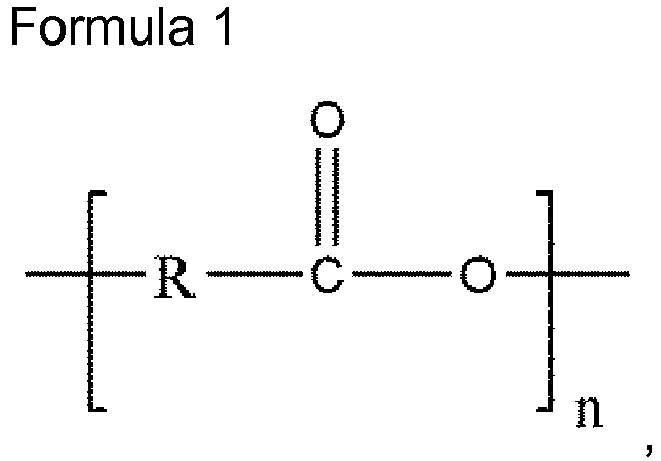 wherein R is a substituted or unsubstituted C2-C5 alkylene group, a substituted or unsubstituted C2-C6 alkoxylene group, a substituted or unsubstituted C2-C6 alkoxycarbonylene group, a substituted or unsubstituted C2-C6 alkylene oxide group, or a combination thereof, andn is an integer from 90 to 2,700.
Applications Claiming Priority (1)
| Application Number | Priority Date | Filing Date | Title |
|---|---|---|---|
| KR1020160138640A KR102760049B1 (en) | 2016-10-24 | 2016-10-24 | Positive electrode for metal secondary battery and metal secondary battery including the same |
Publications (2)
| Publication Number | Publication Date |
|---|---|
| EP3312919A1 true EP3312919A1 (en) | 2018-04-25 |
| EP3312919B1 EP3312919B1 (en) | 2020-12-30 |
Family
ID=60153216
Family Applications (1)
| Application Number | Title | Priority Date | Filing Date |
|---|---|---|---|
| EP17197639.2A Active EP3312919B1 (en) | 2016-10-24 | 2017-10-20 | Positive electrode for metal secondary battery and metal secondary battery including the same |
Country Status (4)
| Country | Link |
|---|---|
| US (1) | US11075373B2 (en) |
| EP (1) | EP3312919B1 (en) |
| KR (1) | KR102760049B1 (en) |
| CN (1) | CN107978733B (en) |
Cited By (2)
| Publication number | Priority date | Publication date | Assignee | Title |
|---|---|---|---|---|
| CN113270584A (en) * | 2021-05-13 | 2021-08-17 | 深圳大学 | Ionic supermolecule adhesive, preparation method and application |
| EP3975285A4 (en) * | 2019-05-20 | 2022-07-27 | Kureha Corporation | POSITIVE ELECTRODE MIX FOR SECONDARY LITHIUM ION BATTERY, PRODUCTION METHOD THEREOF, AND SECONDARY LITHIUM ION BATTERY PRODUCTION METHOD |
Families Citing this family (10)
| Publication number | Priority date | Publication date | Assignee | Title |
|---|---|---|---|---|
| KR102244905B1 (en) * | 2017-07-28 | 2021-04-26 | 주식회사 엘지화학 | Positive electrode for lithium-sulfur battery and lithium-sulfur battery comprising the same |
| CN111712959B (en) * | 2018-03-26 | 2023-09-05 | 丰田自动车欧洲公司 | Solid Electrolyte Materials for Solid State Batteries, Solid Electrolytes and Solid State Batteries |
| WO2020026705A1 (en) * | 2018-07-30 | 2020-02-06 | パナソニックIpマネジメント株式会社 | Lithium secondary battery |
| US11302955B2 (en) * | 2019-04-02 | 2022-04-12 | Chongqing Jinkang Powertrain New Energy Co., Ltd. | Battery cell design with a coated lithium reference electrode |
| CN114830380B (en) * | 2019-12-27 | 2024-10-11 | 日本瑞翁株式会社 | Binder composition for non-aqueous secondary battery electrode, slurry composition for non-aqueous secondary battery electrode, electrode for non-aqueous secondary battery, and non-aqueous secondary battery |
| US11342549B2 (en) * | 2020-01-15 | 2022-05-24 | GM Global Technology Operations LLC | Method for forming sulfur-containing electrode using salt additive |
| KR102902403B1 (en) * | 2020-09-29 | 2025-12-19 | 삼성디스플레이 주식회사 | Display panel, manufacturing method thereof, and electronic apparatus including the same |
| CN114573812B (en) * | 2020-12-29 | 2023-06-09 | 深圳市研一新材料有限责任公司 | Adhesive for lithium ion battery and preparation method thereof |
| EP4287324A4 (en) * | 2021-01-29 | 2025-07-09 | Kureha Corp | Binder for a secondary battery with anhydrous electrolyte, electrode mixture, electrode and secondary battery with anhydrous electrolyte |
| KR102535032B1 (en) * | 2022-01-21 | 2023-05-30 | 주식회사 한솔케미칼 | Dispersant comprising copolymer, cathode for secondary battery comprising the same and secondary battery comprising the cathode |
Citations (3)
| Publication number | Priority date | Publication date | Assignee | Title |
|---|---|---|---|---|
| EP1249882A1 (en) * | 1999-09-03 | 2002-10-16 | Zeon Corporation | Binder for use in electrolyte of lithium ion secondary cell and use thereof |
| US20140178756A1 (en) * | 2011-08-04 | 2014-06-26 | Zeon Corporation | Composite particles for electrochemical device electrode, material for electrochemical device electrode, electrochemical device electrode, and electrochemical device |
| EP2787564A1 (en) * | 2011-12-02 | 2014-10-08 | Mitsubishi Rayon Co., Ltd. | Binder resin for nonaqueous secondary battery electrode, binder resin composition for nonaqueous secondary battery electrode, slurry composition for nonaqueous secondary battery electrode, electrode for nonaqueous secondary battery, and nonaqueous secondary battery |
Family Cites Families (12)
| Publication number | Priority date | Publication date | Assignee | Title |
|---|---|---|---|---|
| KR20020063020A (en) | 2001-01-26 | 2002-08-01 | 한국과학기술연구원 | Method for Preparing Thin Fiber -Structured Polymer Webs |
| KR100463188B1 (en) | 2002-06-24 | 2004-12-23 | 삼성에스디아이 주식회사 | An electrolyte for a lithium ion battery and a lithium ion battery comprising the same |
| WO2007008006A1 (en) | 2005-07-13 | 2007-01-18 | Lg Chem, Ltd. | Lithium secondary battery containing capsule for controlled-release of additives |
| KR100998568B1 (en) * | 2008-03-26 | 2010-12-07 | 한국원자력연구원 | Separator manufacturing method for lithium secondary battery with excellent heat resistance and separator manufactured using the same |
| KR20100036136A (en) | 2008-09-29 | 2010-04-07 | 주식회사 벡셀 | Manufacturing method for vinylfluoride polymer separator using electrospinning and lithium secondary battery polymer separator manufactured by same method |
| JP5544699B2 (en) * | 2008-10-16 | 2014-07-09 | 東洋インキScホールディングス株式会社 | Positive electrode mixture paste for lithium secondary battery |
| RU2014122731A (en) * | 2011-11-07 | 2015-12-20 | Дэнки Кагаку Когио Кабусики Кайся | ELECTRODE BINDING COMPOSITION |
| CN105637685B (en) * | 2013-10-07 | 2017-12-12 | 日产自动车株式会社 | Electrode for nonaqueous electrolyte secondary battery material and the electrode for nonaqueous electrolyte secondary battery and rechargeable nonaqueous electrolytic battery for having used it |
| EP3069396A2 (en) * | 2013-11-13 | 2016-09-21 | R. R. Donnelley & Sons Company | Battery |
| KR20150063269A (en) * | 2013-11-29 | 2015-06-09 | 삼성전자주식회사 | Composite electrode for lithium air battery, preparing method thereof, and lithium air battery including the same |
| JP6096701B2 (en) * | 2014-03-28 | 2017-03-15 | 富士フイルム株式会社 | All-solid secondary battery, solid electrolyte composition and battery electrode sheet used therefor, method for producing battery electrode sheet, and method for producing all-solid secondary battery |
| KR101738769B1 (en) * | 2014-09-18 | 2017-05-23 | 주식회사 엘지화학 | Anode, lithium secondary battery comprising the same, battery module having the lithium secondary battery and method for manufacturing the anode |
-
2016
- 2016-10-24 KR KR1020160138640A patent/KR102760049B1/en active Active
-
2017
- 2017-10-18 US US15/787,149 patent/US11075373B2/en active Active
- 2017-10-20 CN CN201710984055.4A patent/CN107978733B/en active Active
- 2017-10-20 EP EP17197639.2A patent/EP3312919B1/en active Active
Patent Citations (3)
| Publication number | Priority date | Publication date | Assignee | Title |
|---|---|---|---|---|
| EP1249882A1 (en) * | 1999-09-03 | 2002-10-16 | Zeon Corporation | Binder for use in electrolyte of lithium ion secondary cell and use thereof |
| US20140178756A1 (en) * | 2011-08-04 | 2014-06-26 | Zeon Corporation | Composite particles for electrochemical device electrode, material for electrochemical device electrode, electrochemical device electrode, and electrochemical device |
| EP2787564A1 (en) * | 2011-12-02 | 2014-10-08 | Mitsubishi Rayon Co., Ltd. | Binder resin for nonaqueous secondary battery electrode, binder resin composition for nonaqueous secondary battery electrode, slurry composition for nonaqueous secondary battery electrode, electrode for nonaqueous secondary battery, and nonaqueous secondary battery |
Cited By (3)
| Publication number | Priority date | Publication date | Assignee | Title |
|---|---|---|---|---|
| EP3975285A4 (en) * | 2019-05-20 | 2022-07-27 | Kureha Corporation | POSITIVE ELECTRODE MIX FOR SECONDARY LITHIUM ION BATTERY, PRODUCTION METHOD THEREOF, AND SECONDARY LITHIUM ION BATTERY PRODUCTION METHOD |
| CN113270584A (en) * | 2021-05-13 | 2021-08-17 | 深圳大学 | Ionic supermolecule adhesive, preparation method and application |
| CN113270584B (en) * | 2021-05-13 | 2022-03-08 | 深圳大学 | Ionic supermolecule adhesive, preparation method and application |
Also Published As
| Publication number | Publication date |
|---|---|
| KR20180044746A (en) | 2018-05-03 |
| US20180114976A1 (en) | 2018-04-26 |
| CN107978733B (en) | 2022-02-18 |
| KR102760049B1 (en) | 2025-02-03 |
| CN107978733A (en) | 2018-05-01 |
| EP3312919B1 (en) | 2020-12-30 |
| US11075373B2 (en) | 2021-07-27 |
Similar Documents
| Publication | Publication Date | Title |
|---|---|---|
| EP3312919B1 (en) | Positive electrode for metal secondary battery and metal secondary battery including the same | |
| US20230134462A1 (en) | Composite electrolyte, protective film including composite electrolyte, protected negative electrode including the protective film, and lithium metal battery including the protected negative electrode | |
| EP3093906B1 (en) | Lithium metal battery | |
| EP3076470B1 (en) | Lithium secondary battery | |
| EP3240087B1 (en) | Negative electrode for lithium metal battery and lithium metal battery comprising the same | |
| KR102618538B1 (en) | Lithium metal battery including lithium metal anode, method of protecting the lithium metal anode, and protective layer prepared according to the method | |
| US10483547B2 (en) | Lithium metal battery | |
| EP3002814B1 (en) | Electrolyte, method of preparing the electrolyte, and secondary battery including the electrolyte | |
| EP3723169B1 (en) | Negative electrode for lithium metal battery and lithium metal battery comprising same | |
| EP3001495A2 (en) | Composite, method of preparing the composite, electrolyte comprising the composite, and lithium secondary battery comprising the electrolyte | |
| WO2007012174A1 (en) | Plastic crystal electrolyte in lithium-based electrochemical devices | |
| CN106058311A (en) | Electrolyte for lithium second battery, and lithium second battery comprising the electrolyte | |
| US10873108B2 (en) | Lithium battery | |
| CN110931853A (en) | Lithium battery | |
| EP4258382A1 (en) | Negative electrode, and lithium battery including same | |
| CN110931858B (en) | lithium battery | |
| CN110931857A (en) | lithium battery | |
| KR102650655B1 (en) | Stretchable electrode, electrochemical device including the same, and method of manufacturing the stretchable electrode | |
| EP4597683A1 (en) | Electrode for lithium secondary battery, and lithium secondary battery comprising same | |
| EP4693514A1 (en) | Binder, anode comprising same, and lithium battery | |
| KR20240070244A (en) | Electrode for lithium secondary battery and lithium secondary battery comprising the same | |
| Lingua | Newly designed single-ion conducting polymer electrolytes enabling advanced Li-metal solid-state batteries | |
| EP4693512A1 (en) | Binder, and anode and lithium battery comprising same | |
| KR20240085736A (en) | Electrode for lithium secondary battery and lithium secondary battery comprising the same |
Legal Events
| Date | Code | Title | Description |
|---|---|---|---|
| PUAI | Public reference made under article 153(3) epc to a published international application that has entered the european phase |
Free format text: ORIGINAL CODE: 0009012 |
|
| STAA | Information on the status of an ep patent application or granted ep patent |
Free format text: STATUS: THE APPLICATION HAS BEEN PUBLISHED |
|
| AK | Designated contracting states |
Kind code of ref document: A1 Designated state(s): AL AT BE BG CH CY CZ DE DK EE ES FI FR GB GR HR HU IE IS IT LI LT LU LV MC MK MT NL NO PL PT RO RS SE SI SK SM TR |
|
| AX | Request for extension of the european patent |
Extension state: BA ME |
|
| STAA | Information on the status of an ep patent application or granted ep patent |
Free format text: STATUS: REQUEST FOR EXAMINATION WAS MADE |
|
| 17P | Request for examination filed |
Effective date: 20181025 |
|
| RBV | Designated contracting states (corrected) |
Designated state(s): AL AT BE BG CH CY CZ DE DK EE ES FI FR GB GR HR HU IE IS IT LI LT LU LV MC MK MT NL NO PL PT RO RS SE SI SK SM TR |
|
| STAA | Information on the status of an ep patent application or granted ep patent |
Free format text: STATUS: EXAMINATION IS IN PROGRESS |
|
| 17Q | First examination report despatched |
Effective date: 20191029 |
|
| GRAP | Despatch of communication of intention to grant a patent |
Free format text: ORIGINAL CODE: EPIDOSNIGR1 |
|
| STAA | Information on the status of an ep patent application or granted ep patent |
Free format text: STATUS: GRANT OF PATENT IS INTENDED |
|
| INTG | Intention to grant announced |
Effective date: 20200723 |
|
| GRAS | Grant fee paid |
Free format text: ORIGINAL CODE: EPIDOSNIGR3 |
|
| GRAA | (expected) grant |
Free format text: ORIGINAL CODE: 0009210 |
|
| STAA | Information on the status of an ep patent application or granted ep patent |
Free format text: STATUS: THE PATENT HAS BEEN GRANTED |
|
| AK | Designated contracting states |
Kind code of ref document: B1 Designated state(s): AL AT BE BG CH CY CZ DE DK EE ES FI FR GB GR HR HU IE IS IT LI LT LU LV MC MK MT NL NO PL PT RO RS SE SI SK SM TR |
|
| REG | Reference to a national code |
Ref country code: GB Ref legal event code: FG4D |
|
| REG | Reference to a national code |
Ref country code: AT Ref legal event code: REF Ref document number: 1350840 Country of ref document: AT Kind code of ref document: T Effective date: 20210115 |
|
| REG | Reference to a national code |
Ref country code: DE Ref legal event code: R096 Ref document number: 602017030346 Country of ref document: DE |
|
| REG | Reference to a national code |
Ref country code: IE Ref legal event code: FG4D |
|
| PG25 | Lapsed in a contracting state [announced via postgrant information from national office to epo] |
Ref country code: GR Free format text: LAPSE BECAUSE OF FAILURE TO SUBMIT A TRANSLATION OF THE DESCRIPTION OR TO PAY THE FEE WITHIN THE PRESCRIBED TIME-LIMIT Effective date: 20210331 Ref country code: FI Free format text: LAPSE BECAUSE OF FAILURE TO SUBMIT A TRANSLATION OF THE DESCRIPTION OR TO PAY THE FEE WITHIN THE PRESCRIBED TIME-LIMIT Effective date: 20201230 Ref country code: NO Free format text: LAPSE BECAUSE OF FAILURE TO SUBMIT A TRANSLATION OF THE DESCRIPTION OR TO PAY THE FEE WITHIN THE PRESCRIBED TIME-LIMIT Effective date: 20210330 Ref country code: RS Free format text: LAPSE BECAUSE OF FAILURE TO SUBMIT A TRANSLATION OF THE DESCRIPTION OR TO PAY THE FEE WITHIN THE PRESCRIBED TIME-LIMIT Effective date: 20201230 |
|
| REG | Reference to a national code |
Ref country code: AT Ref legal event code: MK05 Ref document number: 1350840 Country of ref document: AT Kind code of ref document: T Effective date: 20201230 |
|
| PG25 | Lapsed in a contracting state [announced via postgrant information from national office to epo] |
Ref country code: SE Free format text: LAPSE BECAUSE OF FAILURE TO SUBMIT A TRANSLATION OF THE DESCRIPTION OR TO PAY THE FEE WITHIN THE PRESCRIBED TIME-LIMIT Effective date: 20201230 Ref country code: BG Free format text: LAPSE BECAUSE OF FAILURE TO SUBMIT A TRANSLATION OF THE DESCRIPTION OR TO PAY THE FEE WITHIN THE PRESCRIBED TIME-LIMIT Effective date: 20210330 Ref country code: LV Free format text: LAPSE BECAUSE OF FAILURE TO SUBMIT A TRANSLATION OF THE DESCRIPTION OR TO PAY THE FEE WITHIN THE PRESCRIBED TIME-LIMIT Effective date: 20201230 |
|
| REG | Reference to a national code |
Ref country code: NL Ref legal event code: MP Effective date: 20201230 |
|
| PG25 | Lapsed in a contracting state [announced via postgrant information from national office to epo] |
Ref country code: HR Free format text: LAPSE BECAUSE OF FAILURE TO SUBMIT A TRANSLATION OF THE DESCRIPTION OR TO PAY THE FEE WITHIN THE PRESCRIBED TIME-LIMIT Effective date: 20201230 |
|
| REG | Reference to a national code |
Ref country code: LT Ref legal event code: MG9D |
|
| PG25 | Lapsed in a contracting state [announced via postgrant information from national office to epo] |
Ref country code: RO Free format text: LAPSE BECAUSE OF FAILURE TO SUBMIT A TRANSLATION OF THE DESCRIPTION OR TO PAY THE FEE WITHIN THE PRESCRIBED TIME-LIMIT Effective date: 20201230 Ref country code: PT Free format text: LAPSE BECAUSE OF FAILURE TO SUBMIT A TRANSLATION OF THE DESCRIPTION OR TO PAY THE FEE WITHIN THE PRESCRIBED TIME-LIMIT Effective date: 20210430 Ref country code: SK Free format text: LAPSE BECAUSE OF FAILURE TO SUBMIT A TRANSLATION OF THE DESCRIPTION OR TO PAY THE FEE WITHIN THE PRESCRIBED TIME-LIMIT Effective date: 20201230 Ref country code: LT Free format text: LAPSE BECAUSE OF FAILURE TO SUBMIT A TRANSLATION OF THE DESCRIPTION OR TO PAY THE FEE WITHIN THE PRESCRIBED TIME-LIMIT Effective date: 20201230 Ref country code: EE Free format text: LAPSE BECAUSE OF FAILURE TO SUBMIT A TRANSLATION OF THE DESCRIPTION OR TO PAY THE FEE WITHIN THE PRESCRIBED TIME-LIMIT Effective date: 20201230 Ref country code: CZ Free format text: LAPSE BECAUSE OF FAILURE TO SUBMIT A TRANSLATION OF THE DESCRIPTION OR TO PAY THE FEE WITHIN THE PRESCRIBED TIME-LIMIT Effective date: 20201230 |
|
| PG25 | Lapsed in a contracting state [announced via postgrant information from national office to epo] |
Ref country code: PL Free format text: LAPSE BECAUSE OF FAILURE TO SUBMIT A TRANSLATION OF THE DESCRIPTION OR TO PAY THE FEE WITHIN THE PRESCRIBED TIME-LIMIT Effective date: 20201230 Ref country code: AT Free format text: LAPSE BECAUSE OF FAILURE TO SUBMIT A TRANSLATION OF THE DESCRIPTION OR TO PAY THE FEE WITHIN THE PRESCRIBED TIME-LIMIT Effective date: 20201230 |
|
| PG25 | Lapsed in a contracting state [announced via postgrant information from national office to epo] |
Ref country code: IS Free format text: LAPSE BECAUSE OF FAILURE TO SUBMIT A TRANSLATION OF THE DESCRIPTION OR TO PAY THE FEE WITHIN THE PRESCRIBED TIME-LIMIT Effective date: 20210430 |
|
| REG | Reference to a national code |
Ref country code: DE Ref legal event code: R097 Ref document number: 602017030346 Country of ref document: DE |
|
| PG25 | Lapsed in a contracting state [announced via postgrant information from national office to epo] |
Ref country code: AL Free format text: LAPSE BECAUSE OF FAILURE TO SUBMIT A TRANSLATION OF THE DESCRIPTION OR TO PAY THE FEE WITHIN THE PRESCRIBED TIME-LIMIT Effective date: 20201230 Ref country code: IT Free format text: LAPSE BECAUSE OF FAILURE TO SUBMIT A TRANSLATION OF THE DESCRIPTION OR TO PAY THE FEE WITHIN THE PRESCRIBED TIME-LIMIT Effective date: 20201230 |
|
| PLBE | No opposition filed within time limit |
Free format text: ORIGINAL CODE: 0009261 |
|
| STAA | Information on the status of an ep patent application or granted ep patent |
Free format text: STATUS: NO OPPOSITION FILED WITHIN TIME LIMIT |
|
| PG25 | Lapsed in a contracting state [announced via postgrant information from national office to epo] |
Ref country code: DK Free format text: LAPSE BECAUSE OF FAILURE TO SUBMIT A TRANSLATION OF THE DESCRIPTION OR TO PAY THE FEE WITHIN THE PRESCRIBED TIME-LIMIT Effective date: 20201230 |
|
| 26N | No opposition filed |
Effective date: 20211001 |
|
| PG25 | Lapsed in a contracting state [announced via postgrant information from national office to epo] |
Ref country code: ES Free format text: LAPSE BECAUSE OF FAILURE TO SUBMIT A TRANSLATION OF THE DESCRIPTION OR TO PAY THE FEE WITHIN THE PRESCRIBED TIME-LIMIT Effective date: 20201230 |
|
| PG25 | Lapsed in a contracting state [announced via postgrant information from national office to epo] |
Ref country code: SI Free format text: LAPSE BECAUSE OF FAILURE TO SUBMIT A TRANSLATION OF THE DESCRIPTION OR TO PAY THE FEE WITHIN THE PRESCRIBED TIME-LIMIT Effective date: 20201230 |
|
| REG | Reference to a national code |
Ref country code: CH Ref legal event code: PL |
|
| PG25 | Lapsed in a contracting state [announced via postgrant information from national office to epo] |
Ref country code: IS Free format text: LAPSE BECAUSE OF FAILURE TO SUBMIT A TRANSLATION OF THE DESCRIPTION OR TO PAY THE FEE WITHIN THE PRESCRIBED TIME-LIMIT Effective date: 20210430 |
|
| REG | Reference to a national code |
Ref country code: BE Ref legal event code: MM Effective date: 20211031 |
|
| PG25 | Lapsed in a contracting state [announced via postgrant information from national office to epo] |
Ref country code: MC Free format text: LAPSE BECAUSE OF FAILURE TO SUBMIT A TRANSLATION OF THE DESCRIPTION OR TO PAY THE FEE WITHIN THE PRESCRIBED TIME-LIMIT Effective date: 20201230 |
|
| PG25 | Lapsed in a contracting state [announced via postgrant information from national office to epo] |
Ref country code: LU Free format text: LAPSE BECAUSE OF NON-PAYMENT OF DUE FEES Effective date: 20211020 Ref country code: BE Free format text: LAPSE BECAUSE OF NON-PAYMENT OF DUE FEES Effective date: 20211031 |
|
| PG25 | Lapsed in a contracting state [announced via postgrant information from national office to epo] |
Ref country code: LI Free format text: LAPSE BECAUSE OF NON-PAYMENT OF DUE FEES Effective date: 20211031 Ref country code: CH Free format text: LAPSE BECAUSE OF NON-PAYMENT OF DUE FEES Effective date: 20211031 |
|
| PG25 | Lapsed in a contracting state [announced via postgrant information from national office to epo] |
Ref country code: IE Free format text: LAPSE BECAUSE OF NON-PAYMENT OF DUE FEES Effective date: 20211020 |
|
| PG25 | Lapsed in a contracting state [announced via postgrant information from national office to epo] |
Ref country code: HU Free format text: LAPSE BECAUSE OF FAILURE TO SUBMIT A TRANSLATION OF THE DESCRIPTION OR TO PAY THE FEE WITHIN THE PRESCRIBED TIME-LIMIT; INVALID AB INITIO Effective date: 20171020 |
|
| PG25 | Lapsed in a contracting state [announced via postgrant information from national office to epo] |
Ref country code: NL Free format text: LAPSE BECAUSE OF NON-PAYMENT OF DUE FEES Effective date: 20201230 Ref country code: CY Free format text: LAPSE BECAUSE OF FAILURE TO SUBMIT A TRANSLATION OF THE DESCRIPTION OR TO PAY THE FEE WITHIN THE PRESCRIBED TIME-LIMIT Effective date: 20201230 |
|
| P01 | Opt-out of the competence of the unified patent court (upc) registered |
Effective date: 20230530 |
|
| PG25 | Lapsed in a contracting state [announced via postgrant information from national office to epo] |
Ref country code: SM Free format text: LAPSE BECAUSE OF FAILURE TO SUBMIT A TRANSLATION OF THE DESCRIPTION OR TO PAY THE FEE WITHIN THE PRESCRIBED TIME-LIMIT Effective date: 20201230 |
|
| PG25 | Lapsed in a contracting state [announced via postgrant information from national office to epo] |
Ref country code: MK Free format text: LAPSE BECAUSE OF FAILURE TO SUBMIT A TRANSLATION OF THE DESCRIPTION OR TO PAY THE FEE WITHIN THE PRESCRIBED TIME-LIMIT Effective date: 20201230 |
|
| PG25 | Lapsed in a contracting state [announced via postgrant information from national office to epo] |
Ref country code: MT Free format text: LAPSE BECAUSE OF FAILURE TO SUBMIT A TRANSLATION OF THE DESCRIPTION OR TO PAY THE FEE WITHIN THE PRESCRIBED TIME-LIMIT Effective date: 20201230 |
|
| PGFP | Annual fee paid to national office [announced via postgrant information from national office to epo] |
Ref country code: GB Payment date: 20250911 Year of fee payment: 9 |
|
| PGFP | Annual fee paid to national office [announced via postgrant information from national office to epo] |
Ref country code: FR Payment date: 20250908 Year of fee payment: 9 |
|
| PG25 | Lapsed in a contracting state [announced via postgrant information from national office to epo] |
Ref country code: TR Free format text: LAPSE BECAUSE OF FAILURE TO SUBMIT A TRANSLATION OF THE DESCRIPTION OR TO PAY THE FEE WITHIN THE PRESCRIBED TIME-LIMIT Effective date: 20201230 |
|
| PGFP | Annual fee paid to national office [announced via postgrant information from national office to epo] |
Ref country code: DE Payment date: 20250910 Year of fee payment: 9 |