EP3312185A1 - Aerogel precursor and aerogel produced using same - Google Patents
Aerogel precursor and aerogel produced using same Download PDFInfo
- Publication number
- EP3312185A1 EP3312185A1 EP16894698.6A EP16894698A EP3312185A1 EP 3312185 A1 EP3312185 A1 EP 3312185A1 EP 16894698 A EP16894698 A EP 16894698A EP 3312185 A1 EP3312185 A1 EP 3312185A1
- Authority
- EP
- European Patent Office
- Prior art keywords
- group
- carbon atoms
- aerogel
- alkoxydisiloxane
- aerogel precursor
- Prior art date
- Legal status (The legal status is an assumption and is not a legal conclusion. Google has not performed a legal analysis and makes no representation as to the accuracy of the status listed.)
- Granted
Links
Images


Classifications
-
- C—CHEMISTRY; METALLURGY
- C01—INORGANIC CHEMISTRY
- C01B—NON-METALLIC ELEMENTS; COMPOUNDS THEREOF; METALLOIDS OR COMPOUNDS THEREOF NOT COVERED BY SUBCLASS C01C
- C01B33/00—Silicon; Compounds thereof
- C01B33/113—Silicon oxides; Hydrates thereof
- C01B33/12—Silica; Hydrates thereof, e.g. lepidoic silicic acid
- C01B33/14—Colloidal silica, e.g. dispersions, gels, sols
- C01B33/157—After-treatment of gels
- C01B33/158—Purification; Drying; Dehydrating
- C01B33/1585—Dehydration into aerogels
-
- B—PERFORMING OPERATIONS; TRANSPORTING
- B01—PHYSICAL OR CHEMICAL PROCESSES OR APPARATUS IN GENERAL
- B01J—CHEMICAL OR PHYSICAL PROCESSES, e.g. CATALYSIS OR COLLOID CHEMISTRY; THEIR RELEVANT APPARATUS
- B01J13/00—Colloid chemistry, e.g. the production of colloidal materials or their solutions, not otherwise provided for; Making microcapsules or microballoons
- B01J13/0091—Preparation of aerogels, e.g. xerogels
-
- C—CHEMISTRY; METALLURGY
- C01—INORGANIC CHEMISTRY
- C01B—NON-METALLIC ELEMENTS; COMPOUNDS THEREOF; METALLOIDS OR COMPOUNDS THEREOF NOT COVERED BY SUBCLASS C01C
- C01B33/00—Silicon; Compounds thereof
- C01B33/113—Silicon oxides; Hydrates thereof
- C01B33/12—Silica; Hydrates thereof, e.g. lepidoic silicic acid
- C01B33/14—Colloidal silica, e.g. dispersions, gels, sols
- C01B33/157—After-treatment of gels
- C01B33/158—Purification; Drying; Dehydrating
-
- C—CHEMISTRY; METALLURGY
- C07—ORGANIC CHEMISTRY
- C07F—ACYCLIC, CARBOCYCLIC OR HETEROCYCLIC COMPOUNDS CONTAINING ELEMENTS OTHER THAN CARBON, HYDROGEN, HALOGEN, OXYGEN, NITROGEN, SULFUR, SELENIUM OR TELLURIUM
- C07F7/00—Compounds containing elements of Groups 4 or 14 of the Periodic Table
- C07F7/02—Silicon compounds
- C07F7/08—Compounds having one or more C—Si linkages
-
- C—CHEMISTRY; METALLURGY
- C07—ORGANIC CHEMISTRY
- C07F—ACYCLIC, CARBOCYCLIC OR HETEROCYCLIC COMPOUNDS CONTAINING ELEMENTS OTHER THAN CARBON, HYDROGEN, HALOGEN, OXYGEN, NITROGEN, SULFUR, SELENIUM OR TELLURIUM
- C07F7/00—Compounds containing elements of Groups 4 or 14 of the Periodic Table
- C07F7/02—Silicon compounds
- C07F7/08—Compounds having one or more C—Si linkages
- C07F7/0834—Compounds having one or more O-Si linkage
- C07F7/0838—Compounds with one or more Si-O-Si sequences
- C07F7/087—Compounds of unknown structure containing a Si-O-Si sequence
-
- C—CHEMISTRY; METALLURGY
- C07—ORGANIC CHEMISTRY
- C07F—ACYCLIC, CARBOCYCLIC OR HETEROCYCLIC COMPOUNDS CONTAINING ELEMENTS OTHER THAN CARBON, HYDROGEN, HALOGEN, OXYGEN, NITROGEN, SULFUR, SELENIUM OR TELLURIUM
- C07F7/00—Compounds containing elements of Groups 4 or 14 of the Periodic Table
- C07F7/02—Silicon compounds
- C07F7/08—Compounds having one or more C—Si linkages
- C07F7/0834—Compounds having one or more O-Si linkage
- C07F7/0838—Compounds with one or more Si-O-Si sequences
- C07F7/0872—Preparation and treatment thereof
- C07F7/0874—Reactions involving a bond of the Si-O-Si linkage
-
- C—CHEMISTRY; METALLURGY
- C07—ORGANIC CHEMISTRY
- C07F—ACYCLIC, CARBOCYCLIC OR HETEROCYCLIC COMPOUNDS CONTAINING ELEMENTS OTHER THAN CARBON, HYDROGEN, HALOGEN, OXYGEN, NITROGEN, SULFUR, SELENIUM OR TELLURIUM
- C07F7/00—Compounds containing elements of Groups 4 or 14 of the Periodic Table
- C07F7/28—Titanium compounds
-
- C—CHEMISTRY; METALLURGY
- C08—ORGANIC MACROMOLECULAR COMPOUNDS; THEIR PREPARATION OR CHEMICAL WORKING-UP; COMPOSITIONS BASED THEREON
- C08G—MACROMOLECULAR COMPOUNDS OBTAINED OTHERWISE THAN BY REACTIONS ONLY INVOLVING UNSATURATED CARBON-TO-CARBON BONDS
- C08G77/00—Macromolecular compounds obtained by reactions forming a linkage containing silicon with or without sulfur, nitrogen, oxygen or carbon in the main chain of the macromolecule
- C08G77/04—Polysiloxanes
- C08G77/06—Preparatory processes
-
- C—CHEMISTRY; METALLURGY
- C08—ORGANIC MACROMOLECULAR COMPOUNDS; THEIR PREPARATION OR CHEMICAL WORKING-UP; COMPOSITIONS BASED THEREON
- C08G—MACROMOLECULAR COMPOUNDS OBTAINED OTHERWISE THAN BY REACTIONS ONLY INVOLVING UNSATURATED CARBON-TO-CARBON BONDS
- C08G77/00—Macromolecular compounds obtained by reactions forming a linkage containing silicon with or without sulfur, nitrogen, oxygen or carbon in the main chain of the macromolecule
- C08G77/04—Polysiloxanes
- C08G77/14—Polysiloxanes containing silicon bound to oxygen-containing groups
- C08G77/18—Polysiloxanes containing silicon bound to oxygen-containing groups to alkoxy or aryloxy groups
-
- C—CHEMISTRY; METALLURGY
- C08—ORGANIC MACROMOLECULAR COMPOUNDS; THEIR PREPARATION OR CHEMICAL WORKING-UP; COMPOSITIONS BASED THEREON
- C08G—MACROMOLECULAR COMPOUNDS OBTAINED OTHERWISE THAN BY REACTIONS ONLY INVOLVING UNSATURATED CARBON-TO-CARBON BONDS
- C08G77/00—Macromolecular compounds obtained by reactions forming a linkage containing silicon with or without sulfur, nitrogen, oxygen or carbon in the main chain of the macromolecule
- C08G77/04—Polysiloxanes
- C08G77/38—Polysiloxanes modified by chemical after-treatment
-
- C—CHEMISTRY; METALLURGY
- C09—DYES; PAINTS; POLISHES; NATURAL RESINS; ADHESIVES; COMPOSITIONS NOT OTHERWISE PROVIDED FOR; APPLICATIONS OF MATERIALS NOT OTHERWISE PROVIDED FOR
- C09K—MATERIALS FOR MISCELLANEOUS APPLICATIONS, NOT PROVIDED FOR ELSEWHERE
- C09K3/00—Materials not provided for elsewhere
- C09K3/30—Materials not provided for elsewhere for aerosols
-
- C—CHEMISTRY; METALLURGY
- C01—INORGANIC CHEMISTRY
- C01P—INDEXING SCHEME RELATING TO STRUCTURAL AND PHYSICAL ASPECTS OF SOLID INORGANIC COMPOUNDS
- C01P2006/00—Physical properties of inorganic compounds
- C01P2006/11—Powder tap density
-
- C—CHEMISTRY; METALLURGY
- C01—INORGANIC CHEMISTRY
- C01P—INDEXING SCHEME RELATING TO STRUCTURAL AND PHYSICAL ASPECTS OF SOLID INORGANIC COMPOUNDS
- C01P2006/00—Physical properties of inorganic compounds
- C01P2006/12—Surface area
-
- C—CHEMISTRY; METALLURGY
- C01—INORGANIC CHEMISTRY
- C01P—INDEXING SCHEME RELATING TO STRUCTURAL AND PHYSICAL ASPECTS OF SOLID INORGANIC COMPOUNDS
- C01P2006/00—Physical properties of inorganic compounds
- C01P2006/14—Pore volume
-
- C—CHEMISTRY; METALLURGY
- C01—INORGANIC CHEMISTRY
- C01P—INDEXING SCHEME RELATING TO STRUCTURAL AND PHYSICAL ASPECTS OF SOLID INORGANIC COMPOUNDS
- C01P2006/00—Physical properties of inorganic compounds
- C01P2006/16—Pore diameter
-
- C—CHEMISTRY; METALLURGY
- C01—INORGANIC CHEMISTRY
- C01P—INDEXING SCHEME RELATING TO STRUCTURAL AND PHYSICAL ASPECTS OF SOLID INORGANIC COMPOUNDS
- C01P2006/00—Physical properties of inorganic compounds
- C01P2006/32—Thermal properties
- C01P2006/37—Stability against thermal decomposition
Definitions
- the present disclosure relates to an aerogel precursor capable of enhancing high temperature thermal stability of an aerogel by forming hydrophobic pores having uniform size distribution in the aerogel preparation due to excellent hydrophobicity, and an aerogel prepared using the same.
- An aerogel is a material with a porous structure formed with SiO 2 nanostructures moderately entangled like non-woven fabric, and having air occupying 98% of the total volume.
- An aerogel has high porosity, nano-level micropores and a high specific surface area, and thereby exhibits ultralight, super-insulation and low dielectric properties, and applied researches as insulation materials and environmental-friendly high temperature insulation materials, extremely low dielectric thin films for high integrated devices, catalysts and catalyst carriers, electrodes for super capacitors or electrode materials for seawater desalination have been actively ongoing.
- a biggest advantage of an aerogel is super-insulation exhibiting thermal conductivity of 0.300W/mK or lower, which is lower than existing organic insulation materials such as Styrofoam.
- an aerogel is used as a high temperature insulation material since there is no concern over vulnerability to fire and harmful gas generation in the event of fire, which are fatal weaknesses of organic insulation materials.
- hydrophobization capable of preventing moisture penetration is essential.
- hydrophobic groups on the aerogel surface are stable without being oxidized by heat, excellent durability is obtained.
- TEOS tetraethoxysilane
- prehydrolyzed TEOS has been used as a precursor
- aerogels having hydrophobicity have been prepared by controlling a porosity of a wet gel using water, alcohol and an acid or base catalyst, and through atmospheric drying/supercritical drying after hydrophobic surface modification.
- the wet gel surface is hydrophobic surface modified after preparing the wet gel, the phase is a bi-phase of liquid/solid, and therefore, reaction efficiency therein is low compared to in a liquid state, a single phase.
- a surface hydrophobizing agent is used in large quantities when surface hydrophobizing the wet gel, and as a result, the aerogel is readily oxidized by heat due to the remaining surface hydrophobizing agent leading to a problem of high temperature durability decrease.
- Patent Document 1 Korean Patent Application Laid-Open Publication No. 2012-0070948 (published on 2012.07.02)
- the present disclosure is directed to provide an aerogel precursor capable of enhancing high temperature thermal stability of an aerogel by forming hydrophobic pores having uniform size distribution in the aerogel preparation due to excellent hydrophobicity, and a method for preparing the same.
- the present disclosure is also directed to provide an aerogel prepared using the aerogel precursor, and an insulation material including the same.
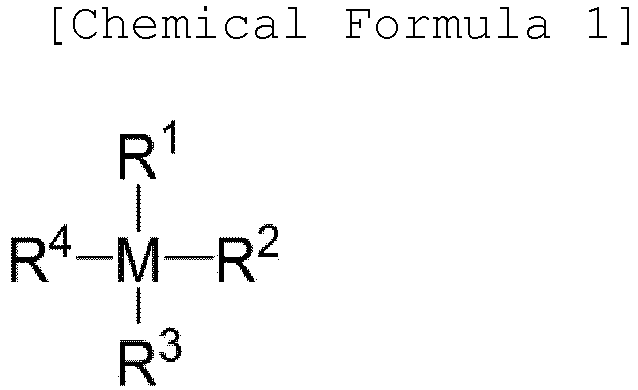
- an aerogel precursor including an alkoxydisiloxane-based prepolymer, and having a functional group derived from a hydrophobic sol-gel forming agent of the following Chemical Formula 1 on a surface thereof:
- M is any one selected from the group consisting of group 4 elements and group 14 elements
- R 1 to R 4 are each independently a hydrophobic functional group or a functional group reactive with the alkoxydisiloxane-based prepolymer, however, R 1 to R 4 are not a hydrophobic functional group or a functional group reactive with the alkoxydisiloxane-based prepolymer at the same time.
- Another embodiment of the present disclosure provides a method for preparing the aerogel precursor including preparing an alkoxydisiloxane-based prepolymer by hydrolyzing and polycondensation reacting an alkoxysilane-based compound; and reacting the alkoxydisiloxane-based prepolymer with the hydrophobic sol-gel forming agent of Chemical Formula 1.
- Still another embodiment of the present disclosure provides an aerogel prepared using the aerogel precursor.
- Yet another embodiment of the present disclosure provides an insulation material including the aerogel.
- An aerogel precursor according to the present disclosure has hydrophobicity itself, and accordingly, is capable of providing hydrophobic pores having uniform size distribution in aerogel preparation, and as a result, is capable of enhancing high temperature thermal stability of the aerogel.
- pore sizes may be uniformly controlled while hydrophobizing the inside of the pores when preparing an aerogel, and as a result, high temperature thermal stability of the aerogel may be enhanced.
- an aerogel precursor according to one embodiment of the present disclosure includes an alkoxydisiloxane-based prepolymer, and has a functional group derived from a hydrophobic sol-gel forming agent of the following Chemical Formula 1 on a surface thereof:
- M is any one selected from the group consisting of group 4 elements and group 14 elements
- R 1 to R 4 are each independently a hydrophobic functional group or a functional group reactive with the alkoxydisiloxane-based prepolymer, however R 1 to R 4 are not a hydrophobic functional group or a functional group reactive with the alkoxydisiloxane-based prepolymer at the same time.
- a prepolymer means a preliminary polymer partially polymerized by controlling a degree of hydrolysis in a polymerization or polycondensation reaction for preparing a polymer, and having a relatively low degree of polymerization.
- the prepolymer in the present disclosure has an m/z of 5000 or less and more specifically an m/z of 3000 or less when analyzing the mass using Matrix Associated Laser Desorption Ionization-Time of Flight mass spectroscopy (MALDI-TOF).
- MALDI-TOF Matrix Associated Laser Desorption Ionization-Time of Flight mass spectroscopy
- M may be selected from the group consisting of Ti, Hf, Si and Zr.
- R 1 to R 4 in Chemical Formula 1 are a hydrophobic functional group
- R 1 to R 4 may be each independently selected from the group consisting of a hydrocarbon group having 1 to 20 carbon atoms, a (meth)acryloyl group, an alkyloyl group having 1 to 20 carbon atoms and an alkyloyloxy group having 1 to 20 carbon atoms, and more specifically, may be selected from the group consisting of a linear or branched alkyl group having 1 to 20 carbon atoms such as a methyl group, an ethyl group, a propyl group or a butyl group; an alkenyl group having 2 to 20 carbon atoms such as an ethenyl group; an alkynyl group having 2 to 20 carbon atoms such as an ethynyl group; a cycloalkyl group having 3 to 20 carbon atoms such as a cyclobutyl group or a cyclohexyl group; an
- R 1 to R 4 when R 1 to R 4 is a functional group reactive with the alkoxydisiloxane-based prepolymer in Chemical Formula 1, R 1 to R 4 may be specifically selected from the group consisting of a halogen group such as a chloro group, a bromo group or an iode group; a hydroxyl group; and an alkoxy group having 1 to 20 carbon atoms such as a methoxy group, an ethoxy group and a propoxy group, and more specifically, may be a halogen group or an alkoxy group having 1 to 10 carbon atoms. Particularly, when M is Si in Chemical Formula 1, the reactive functional group may be a halogen group.
- the hydrophobic sol-gel forming agent of Chemical Formula 1 may be a compound of the following Chemical Formula 2 having a mono-halide reaction site:
- M 11 is a group 14 element, and more specifically Si
- R 11 is a mono-halide reaction site reacting with a silanol group in the alkoxydisiloxane-based prepolymer, and specifically, is a halogen group such as a chloro group, a bromo group or an iode group, and more specifically, is a chloro group or a bromo group
- R 12 to R 14 are each independently a hydrophobic functional group, and may be a hydrocarbon group having 1 to 20 carbon atoms, and specifically, may be selected from the group consisting of an alkyl group having 1 to 20 carbon atoms, an alkenyl group having 2 to 20 carbon atoms, an alkynyl group having 2 to 20 carbon atoms, a cycloalkyl group having 3 to 20 carbon atoms, an aryl group having 6 to 20 carbon atoms, an arylalkyl group having 7 to 20 carbon atoms and an alkylaryl group having 7 to
- M 11 is Si
- R 11 is a chloro group or a bromo group
- R 12 to R 14 may be each independently selected from the group consisting of an alkyl group having 1 to 12 carbon atoms, an aryl group having 6 to 12 carbon atoms, an arylalkyl group having 7 to 13 carbon atoms and an alkylaryl group having 7 to 13 carbon atoms
- M 11 is Si
- R 11 is a chloro group or a bromo group
- R 12 to R 14 may be each independently selected from the group consisting of an aryl group having 6 to 12 carbon atoms, an arylalkyl group having 7 to 13 carbon atoms and an alkylaryl group having 7 to 13 carbon atoms.
- Specific examples of the compound of Chemical Formula 2 may include chlorotrimethylsilane, chlorotriethylsilane, bromotrimethylsilane, bromotriethylsilane, chloro(methyl)diphenylsilane or the like, and compounds of any one, or two or more thereof may be used.
- the hydrophobic sol-gel forming agent of Chemical Formula 1 may be more specifically a compound of the following Chemical Formula 3:
- M 21 is specifically a group 4 element of Ti, Zr, Hf or Rf, and more specifically Ti or Zr, R 21 to R 24 are each independently a hydrophobic functional group selected from the group consisting of a hydrocarbon group having 1 to 20 carbon atoms, an alkyloyl group having 1 to 20 carbon atoms, and an alkyloyloxy group having 1 to 20 carbon atoms; or a reactive functional group selected from the group consisting of a halogen group, a hydroxyl group, and an alkoxy group having 1 to 20 carbon atoms, however, R 21 to R 24 are not a hydrophobic functional group or a functional group reactive with the alkoxydisiloxane-based prepolymer at the same time.
- R 21 to R 24 may be each independently a hydrophobic functional group selected from the group consisting of an alkyl group having 1 to 10 carbon atoms, a cycloalkyl group having 3 to 12 carbon atoms; an aryl group having 6 to 12 carbon atoms, an arylalkyl group having 7 to 13 carbon atoms, an alkylaryl group having 7 to 13 carbon atoms, an alkyloyl group having 10 to 20 carbon atoms and an alkyloyloxy group having 10 to 20 carbon atoms; or a reactive functional group that is a halogen group or an alkoxy group having 1 to 10 carbon atoms, however, R 21 to R 24 are not a hydrophobic functional group or a functional group reactive with the alkoxydisiloxane-based prepolymer at the same time.
- M 21 is Ti
- R 21 is an alkoxy group having 1 to 10 carbon atoms
- R 22 to R 23 are each independently an alkyloyloxy group having 10 to 20 carbon atoms.
- the compound of Chemical Formula 3 may include titanium triisostearoylisopropoxide, zirconium(IV) triisostearoylisopropoxide or the like, and any one or a mixture of two or more thereof may be used. More specifically, the compound of Chemical Formula 3 may be titanium triisostearoylisopropoxide.
- the functional group derived from the hydrophobic sol-gel forming agent of Chemical Formula 1 may be included in 0.1 mol% to 60 mol% with respect to the total mole of the alkoxy group in the alkoxydisiloxane-based prepolymer.
- the content of the functional group derived from the hydrophobic sol-gel forming agent being greater than 60 mol% may cause concern such that a wet gel may not be efficiently formed when preparing an aerogel thereafter. More specifically, the content may be from 1 mol% to 40 mol%, and even more specifically from 2 mol% to 20 mol%.
- the aerogel precursor according to one embodiment of the present disclosure is prepared by reacting the alkoxydisiloxane-based prepolymer prepared by hydrolyzing and polycondensation reacting an alkoxysilane-based compound with the hydrophobic sol-gel forming agent of Chemical Formula 1, and herein, thermal conductivity and structural stability may be further enhanced through controlling the silica (SiO 2 ) content in the alkoxydisiloxane-based prepolymer and the degree of hydrolysis, and the degree of polymerization or the molecular weight of the prepolymer.
- the alkoxydisiloxane-based prepolymer included in the aerogel precursor of the present disclosure may have a degree of hydrolysis of 50% to 85%.
- the alkoxydisiloxane-based prepolymer has a degree of hydrolysis of less than 50%, wet gel formation may take longer, and transparency and heat resistance of an aerogel may be reduced, and the degree of hydrolysis being greater than 85% may cause concern over stability decrease in the alkoxydisiloxane-based prepolymer itself.
- the degree of hydrolysis of the alkoxydisiloxane-based prepolymer may be from 60% to 80% and even more specifically from 65% to 75%.
- the functional group derived from the compound of Chemical Formula 1 is present binding at the end of the alkoxydisiloxane-based prepolymer or on the surface side of the alkoxydisiloxane-based prepolymer particles since the reaction with the compound of Chemical Formula 1 occurs after preparing the alkoxydisiloxane-based prepolymer. Due to such a position of the functional group, inside the pores may exhibit hydrophobicity when preparing an aerogel.
- the alkoxydisiloxane-based prepolymer has molecular weight distribution with an m/z (ratio of mass to charge) value of 650 to 3,000 when analyzing the mass by MALDI-TOF, and the molecular weight of the alkoxydisiloxane-derived repeating unit, a major repeating unit, may be from 60 Da to 140 Da.
- the alkoxydisiloxane-based prepolymer satisfying such a molecular weight condition may provide internal pores uniform for an aerogel and hydrophobized.
- the alkoxydisiloxane-based prepolymer has a degree of hydrolysis of 75% to 80%, and has an m/z value of 700 to 2,500 when analyzed by MALDI-TOF, and the molecular weight of the alkoxydisiloxane-derived repeating unit may be from 60 Da to 134 Da, and more specifically 60 Da.
- the aerogel precursor having such a structure may be specifically prepared using a preparation method including preparing an alkoxydisiloxane-based prepolymer by hydrolyzing and polycondensation reacting an alkoxysilane-based compound (step 1); and reacting the alkoxydisiloxane-based prepolymer with the hydrophobic sol-gel forming agent of Chemical Formula 1 (step 2). Accordingly, another embodiment of the present disclosure provides a method for preparing the aerogel precursor.
- the first step for preparing the aerogel precursor is a step of preparing an alkoxydisiloxane-based prepolymer preparing an alkoxydisiloxane-based prepolymer by hydrolyzing and polycondensation reacting an alkoxysilane-based compound.
- the alkoxysilane-based compound may specifically be a compound of the following Chemical Formula 4: [Chemical Formula 4] SiR 5 n (OR 6 ) 4-n
- R 5 and R 6 are each independently an alkyl group having 1 to 6 carbon atoms or a phenyl group, and n may be an integer of 0 to 2.
- n may be an integer of 0 to 2.
- R 5 and R 6 are each two or greater, the two or more R 5 s and the two or more R 6 s may be the same as or different from each other.
- examples of the alkoxysilane-based compound may include difunctional alkoxysilane such as dimethyldimethoxysilane, dimethyldiethoxysilane, diphenyldiethoxysilane, diphenyldimethoxysilane, methylphenyldiethoxysilane, methylphenyldimethoxysilane, diethyldiethoxysilane or diethyldimethoxysilane; trifunctional alkoxysilane such as methyltrimethoxysilane, methyltriethoxysilane, ethyltrimethoxysilane, ethyltriethoxysilane, phenyltrimethoxysilane or phenyltriethoxysilane; tetrafunctional ethoxysilane such as tetramethoxysilane or tetraethoxysilane, or the like, and any one or a mixture of two or more thereof may be used.
- Hydrolysis and condensation reaction of the alkoxysilane-based compound may be carried out by reacting the compound with water in a solvent under the presence of an acid or base catalyst.
- the degree of hydrolysis may be controlled depending on the equivalent of water used, and the content of silica in the prepared precursor may be controlled by controlling the amount of alcohol in the reactants.
- hydrochloric acid citric acid, acetic acid, sulfuric acid and the like may be included as the acid catalyst, and any one or a mixture of two or more thereof may be used.
- ammonia As the base catalyst, ammonia, piperidine and the like may be included, and any one or a mixture of two or more thereof may be used.
- solvents having compatibility with water and capable of dissolving alkoxysilane may be used without particular limit, and specific examples thereof may include alcohols such as methanol, ethanol, propanol, isopropanol and butanol, and any one or a mixture of two or more thereof may be used.
- Amounts of the materials used in the hydrolysis and condensation reaction of the alkoxysilane-based compound may be properly determined considering the degree of polymerization or the molecular weight of the finally prepared alkoxydisiloxane-based prepolymer.
- the acid catalyst or the base catalyst may be used in 0.0001 moles to 0.001 moles with respect to 1 mole of the alkoxysilane-based compound.
- the solvent may be used in 0.6 moles to 4.0 moles with respect to 1 mole of the alkoxysilane-based compound.
- the water may be used in 1.2 moles to 1.6 moles with respect to 1 mole of the alkoxysilane-based compound.
- the hydrolysis and condensation reaction of the alkoxysilane-based compound may be carried out at 50°C to 80°C, and more specifically at 65°C to 75°C.
- the hydrolysis and condensation reaction is sufficiently progressed, and the alkoxydisiloxane-based prepolymer satisfying such a molecular weight condition and the like may be prepared.
- the alkoxydisiloxane-based prepolymer having (SiO 2 ) m (herein, m is a positive integer) forming a skeleton, and including a silanol group is prepared.
- polyethoxydisiloxane (PEDS-P x ) is prepared as the alkoxydisiloxane-based prepolymer through the hydrolysis and condensation reaction as in the following Reaction Formula 1.
- Reaction Formula 1 Si(OC 2 H 5 ) 4 +nH 2 O ⁇ PEDS-P x +solvent (C 2 H 5 OH)
- n is a molar number of the water used, and n ⁇ 2.
- the prepared alkoxydisiloxane-based prepolymer has molecular weight distribution having an m/z (ratio of mass to charge) value of 650 to 3,000 when analyzing the mass by MALDI-TOF, and the molecular weight of the alkoxydisiloxane-derived repeating unit, a major repeating unit, may be from 60 Da to 140 Da, and more specifically from 60 Da to 134 Da.
- the step 2 for preparing the aerogel precursor is a step of surface hydrophobization by reacting the alkoxydisiloxane-based prepolymer prepared in the step 1 with the hydrophobic sol-gel forming agent of Chemical Formula 1.
- hydrophobic sol-gel forming agent of Chemical Formula 1 is dissolved in a solvent, and then reacted by being mixed with the alkoxydisiloxane-based prepolymer prepared in the step 1.
- solvents that do not react with the alkoxydisiloxane-based prepolymer, and is capable of dissolving the hydrophobic sol-gel forming agent may be used without particular limit.
- Specific examples thereof may include alcohol-based solvents such as ethanol and methanol; aromatic hydrocarbon-based solvents such as toluene and benzene; amide-based solvents such as N,N-dimethylformamide, and the like, and any one or a mixture of two or more thereof may be used.
- the hydrophobic sol-gel forming agent of Chemical Formula 1 is the same as described above, and may be used in an amount corresponding to 1 mol% to 60 mol% with respect to the total mole of the alkoxy group in the alkoxydisiloxane-based prepolymer.
- a replacement ratio for the alkoxydisiloxane-based prepolymer is low, and therefore, effects according to the present disclosure are insignificant, and when the content is greater than 60 mol%, the degree of hydrophobicity of the prepared aerogel precursor is excessively high causing concern such as inefficient formation of a wet gel.
- the hydrophobic sol-gel forming agent of Chemical Formula 1 reacts with a silanol group present at the end of the alkoxydisiloxane-based prepolymer or on the surface of the prepolymer particles, and the aerogel precursor having a functional group derived from the hydrophobic sol-gel forming agent binding on the surface is prepared therefrom.
- the aerogel precursor prepared through such processes is capable of forming uniform pores inside an aerogel, and an aerogel having high hydrophobicity may be prepared through surface hydrophobization.
- carbon content inside the aerogel precursor may be 20% by weight or greater and more specifically from 23% by weight to 35% by weight with respect to the total weight of the precursor.
- the functional group derived from the hydrophobic sol-gel forming agent is present at the end of the polymer or on a surface side of the polymer particles while forming uniform pores due to having identical repeating units in the polycondensation step, and therefore, when preparing an aerogel using the same, pores having uniform sizes and exhibiting hydrophobicity may be formed, and as a result, thermal stability of the aerogel may be enhanced.
- the aerogel precursor is obtained in a liquid state in which the surface hydrophobized alkoxydisiloxane-based prepolymer is dispersed into a dispersion medium.
- the dispersion medium may be a solvent used in the hydrolysis and polycondensation reaction of the alkoxysilane-based compound, or a solvent used in the reaction with the hydrophobic sol-gel forming agent, and the solvent may be removed through a common drying process.
- the aerogel precursor may also be used in a gel state in the aerogel preparation through a wet gel preparation process, or may be used in a liquid state itself in the aerogel preparation.
- Still another embodiment of the present disclosure provides an aerogel prepared using the aerogel precursor.
- the aerogel may be prepared by preparing a wet gel through mixing the aerogel precursor prepared above with an alcohol, and then drying the wet gel.
- an inorganic acid or a base may be further used selectively.
- the inorganic acid or the base may readily accomplish gelation by controlling a pH in the reaction system.
- nitric acid, hydrochloric acid, sulfuric acid, acetic acid, hydrofluoric acid or the like may be included as the inorganic acid, and any one or a mixture of two or more thereof may be used.
- Ammonia, piperidine or the like may be used as the base, and one or more types thereof may be used.
- the inorganic acid may be more specifically hydrochloric acid, and the base may be ammonia.
- the added amount of the inorganic acid is not particularly limited, however, the inorganic acid may be used in an amount to make the pH in the reaction system 4 to 7, and the base may be used in an amount to make the pH in the reaction system 9 to 12.
- the inorganic acid or the base may be introduced at once, or may be introduced in two installments.
- the inorganic acid or the base introduced in the second installment may induce gelation by facilitating the reaction of the unreacted alkoxy group in the aerogel precursor, and as a result, may increase crosslinking density of the hydrophobic wet gel and further increase hydrophobicity and preparation yields of the silica aerogel.
- a mixing process may be carried out for facilitating the reaction.
- the mixing process may be carried out using common mixing methods, and is not particularly limited.
- the mixing process may be carried out through stirring, and the stirring may be more specifically carried out for 10 seconds to 10 minutes with 400rpm to 800rpm using a magnetic bar, but is not limited thereto.
- the drying process for the prepared wet gel carried out thereafter may be carried out by an atmospheric drying process or a supercritical drying process using supercritical carbon dioxide.
- the atmospheric drying process may be carried out using common methods such as natural drying, hot-air drying or heat drying under atmospheric pressure (1 ⁇ 0.3atm), and more specifically, may be carried out for 6 hours to 12 hours in a 60°C to 100°C oven under atmospheric pressure (1 ⁇ 0.3atm) after removing a water layer from the washed hydrophobic wel gel.
- the supercritical drying process carries out a solvent exchange process in which the wet gel is placed in a supercritical drying reactor, and then the reactor is filled with CO 2 in a liquid state, and the alcohol solvent inside the wet gel is replaced by CO 2 .
- the temperature was raised to 40°C to 50°C at a constant temperature raising rate, specifically at a rate of 0.1/min to 1/min, and then maintained for a certain period of time, specifically for 20 minutes to 1 hour, in a supercritical state of carbon dioxide by maintaining at a pressure greater than a pressure at which carbon dioxide becomes a supercritical state, and specifically a pressure of 100 bar to 150 bar.
- carbon dioxide becomes a supercritical state at a temperature of 31°C and a pressure of 73.8bar.
- the supercritical drying process may be completed by slowly relieving the pressure.
- a washing process for obtaining a high purity aerogel may be further carried out by removing impurities (sodium ions, unreacted materials, byproducts and the like) produced during the wet gel preparation process.
- a solution extraction method such as a Soxhlet extraction method using a Soxhlet extractor may be used.
- the Soxhlet extractor is generally a device connecting an extraction tube on a solvent flask, and connecting a reflux condenser thereon, and when placing a sample in a cylindrical filter paper or a filtration tube (thimble) in the extraction tube and heating a solvent in the flask, the solvent evaporates to a vapor phase, and the vapor phase solvent is condensed in the reflux condenser filling the extraction tube to dissolve soluble components in the sample, and by a syphon arm, the filled liquid all comes back to the solvent flask when reaching the vertext, and the extraction tube is filled again with a new solvent.
- the extraction solvent may have a vapor pressure of 100 kPa or greater and specifically 100 kPa to 10 MPa at 20°C so as to be readily volatilized in the Soxhlet extraction process and prevent contractions and cracks in the pore structure inside the silica sol.
- the extraction solvent may preferably have low surface tension so as to prevent contractions and cracks in the pore structure inside the silica sol during the drying process.
- the extraction solvent may have surface tension of 12 mN/m or less and specifically 0.1 mN/m to 12 mN/m.
- the extraction solvent may be a nonpolar solvent such as carbon dioxide; or a polar solvent such as dimethyl ether satisfying the above-mentioned conditions. Even more specifically, the extraction solvent may be a nonpolar solvent satisfying the above-mentioned conditions such as carbon dioxide when considering excellence in the solvent exchange.
- the Soxhlet extraction may be carried out at a pressure of 5 bar to 70 bar
- the extraction solvent is carbon dioxide
- the Soxhlet extraction process may be carried out at a pressure of 40 bar to 70 bar and more specifically, may be carried out at a pressure of 40 bar to 60 bar.
- the extraction solvent is dimethyl ether
- the Soxhlet extraction may be carried out at a pressure of 5 bar to 20 bar.
- a hydrophobic aerogel may be prepared without an additional drying process as well as effectively extracting impurities in the wet gel. Additionally, solvent exchange of the hydrophobic wet gel that is not solvent exchanged may occur simultaneously with the washing.
- washing and the drying are not particularly limited, and methods commonly known in the art may be used.
- the washing process may be carried out by adding a nonpolar organic solvent to a hydrophobic wet gel, and stirring the result for 20 minutes to 1 hour.
- the nonpolar organic solvent may be the same as described above.
- the aerogel prepared according to the preparation method uses the aerogel precursor having hydrophobicity, and therefore, exhibits hydrophobicity inside and outside the pores, and the sizes of the formed pores are uniform, which enhances high temperature thermal stability of the aerogel.
- the aerogel may exhibit improved physical properties of low tap density and high specific surface area.
- the aerogel is a particulate porous structure including a plurality of micropores, and includes a microstructure forming a mesh-type cluster by the bindings of nano-sized first particles, specifically, first particles having an average particle diameter (D 50 ) of 100 nm or less, that is, a three-dimensional network structure.
- D 50 average particle diameter
- the aerogel may have carbon content of 5% by weight or greater, more specifically 7% by weight or greater and even more specifically 10% by weight to 15% by weight with respect to the total weight of the aerogel.
- the carbon content of the aerogel in the present disclosure may be measured using a carbon analyzer.
- the aerogel may have an average pore diameter of 10 nm to 15 nm and a total pore volume of 2 cm 3 /g to 5 cm 3 /g.
- the aerogel may have a specific surface area of 500 m 2 /g to 800 m 2 /g and tap density of 0.05 g/ml to 0.3 g/ml.
- the tap density of the aerogel may be measured using a tap density measuring instrument (TAP-2S, Logan Instruments Co.), and the specific surface area, the pore size and the pore volume may be analyzed as adsorbed/desorbed amounts of nitrogen depending on a partial pressure (0.11 ⁇ p/p o ⁇ 1) using an ASAP 2010 instrument of Micrometrics.
- TAP-2S tap density measuring instrument
- the specific surface area, the pore size and the pore volume may be analyzed as adsorbed/desorbed amounts of nitrogen depending on a partial pressure (0.11 ⁇ p/p o ⁇ 1) using an ASAP 2010 instrument of Micrometrics.
- the aerogel having such an improved pore structure and increased hydrophobicity may specifically have thermal conductivity of 20 mW/mK or less and more specifically 16 mW/mK or less.
- the thermal conductivity of the aerogel may be measured using a thermal conductivity measuring instrument.
- the aerogel having such low tap density, high specific surface area and high hydrophobicity is capable of maintaining low thermal conductivity, and therefore, may be used in various fields such as insulation materials, extremely low dielectric thin films, catalysts, catalyst carriers or blankets, and may be particularly useful in preparing insulation materials, particularly, insulation blankets since low thermal conductivity may be maintained due to such physical/pore properties.
- yet another embodiment of the present disclosure provides an insulation material or an insulation blanket prepared using the hydrophobic silica aerogel.
- the blanket may be prepared using common methods except that the aerogel-containing composition is used. More specifically, the blanket may be prepared by coating the aerogel-containing composition on at least one surface of a substrate for a blanket or immersing the substrate for a blanket into the composition, and drying the result. In addition, after the drying process, a compressing process for controlling the thickness and making the inside structure and the surface form of the blanket uniform, a forming process allowing to have a proper form or morphology depending on the use, or a laminating process laminating a separate functional layer may be further carried out.
- the aerogel-containing composition may further include a binder, a solvent, and selectively one or more types of additives such as a dispersing agent, a crosslinking agent or a foaming agent.
- the substrate for a blanket substrates of various materials may be used depending on the use of the insulation blanket.
- the substrate for a blanket may be a film, a sheet, a net, a fiber, a porous body, a foam, a non-woven fabric or a laminate of two or more layers thereof.
- the surface may have surface roughness formed thereon or may be patterned.
- the blanket may specifically include a substrate for a blanket and an aerogel disposed on at least one surface of the substrate for a blanket, and may further include an aerogel included in the substrate for a blanket.
- MALDI-TOF Matrix Associated Laser Desorption Ionization-Time of Flight mass spectrometry
- the obtained prepolymer had fragmented molecular weight distribution with an m/z of 700 to 2,300, and had an alkoxydisiloxane-derived repeating unit of 60 Da as a major repeating unit.
- the cooled reactant was vacuum filtered using a filter to remove impurities, and a 75% hydrolyzed prepolymer was obtained.
- the obtained prepolymer maintained fragmented molecular weight distribution with an m/z of 620 to 1,800.
- the cooled reactant was vacuum filtered using a filter to remove impurities, and a 50% hydrolyzed prepolymer was obtained.
- the obtained prepolymer maintained fragmented molecular weight distribution with an m/z of 620 to 1,800.
- An aerogel was prepared in the same manner as in Example 1 except that the hydrophobized prepolymer of Preparation Example 1-2 was used instead of the hydrophobized prepolymer of Preparation Example 1-1.
- An aerogel was prepared in the same manner as in Example 1 except that the hydrophobized prepolymer of Preparation Example 1-3 was used instead of the hydrophobized prepolymer of Preparation Example 1-1.
- An aerogel was prepared in the same manner as in Example 1 except that the hydrophobized prepolymer of Preparation Example 2-1 was used instead of the hydrophobized prepolymer of Preparation Example 1-1.
- An aerogel was prepared in the same manner as in Example 1 except that the hydrophobized prepolymer of Preparation Example 2-2 was used instead of the hydrophobized prepolymer of Preparation Example 1-1.
- An aerogel was prepared in the same manner as in Example 1 except that the prepolymer of Preparation Example 3-1 was used.
- An aerogel was prepared in the same manner as in Example 1 except that the prepolymer of Preparation Example 3-2 was used.
- the aerogels of Examples 1 to 6 prepared using an aerogel precursor in which an alkoxydisiloxane-based prepolymer was surface hydrophobized with a hydrophobic sol-gel forming agent exhibited uniform pore properties together with excellent hydrophobicity of 5% by weight or greater of carbon content.
- the aerogels of Examples 1 to 5 prepared using an aerogel precursor in which an alkoxydisilazane-based prepolymer was surface hydrophobized with a hydrophobic sol-gel forming agent exhibited more improved pore properties while exhibiting an equal level of hydrophobicity when compared to the aerogels of Comparative Examples 1 and 2 using the same hydrophobic sol-gel forming agent as a comonomer when preparing polyethoxydisiloxane, an aerogel precursor.
Landscapes
- Chemical & Material Sciences (AREA)
- Organic Chemistry (AREA)
- Dispersion Chemistry (AREA)
- Chemical Kinetics & Catalysis (AREA)
- Inorganic Chemistry (AREA)
- Health & Medical Sciences (AREA)
- Medicinal Chemistry (AREA)
- Polymers & Plastics (AREA)
- Engineering & Computer Science (AREA)
- Materials Engineering (AREA)
- General Chemical & Material Sciences (AREA)
- Silicon Polymers (AREA)
Abstract

Description
- The present application claims priority to and the benefits of Korean Patent Application No.
10-2016-0031444 - The present disclosure relates to an aerogel precursor capable of enhancing high temperature thermal stability of an aerogel by forming hydrophobic pores having uniform size distribution in the aerogel preparation due to excellent hydrophobicity, and an aerogel prepared using the same.
- An aerogel is a material with a porous structure formed with SiO2 nanostructures moderately entangled like non-woven fabric, and having air occupying 98% of the total volume. An aerogel has high porosity, nano-level micropores and a high specific surface area, and thereby exhibits ultralight, super-insulation and low dielectric properties, and applied researches as insulation materials and environmental-friendly high temperature insulation materials, extremely low dielectric thin films for high integrated devices, catalysts and catalyst carriers, electrodes for super capacitors or electrode materials for seawater desalination have been actively ongoing.
- A biggest advantage of an aerogel is super-insulation exhibiting thermal conductivity of 0.300W/mK or lower, which is lower than existing organic insulation materials such as Styrofoam. In addition, an aerogel is used as a high temperature insulation material since there is no concern over vulnerability to fire and harmful gas generation in the event of fire, which are fatal weaknesses of organic insulation materials.
- However, in high temperature insulation materials, durability is an important factor together with low thermal conductivity, and for durability, thermal denaturation caused by moisture penetration needs to be prevented.
- For this, surface hydrophobization capable of preventing moisture penetration is essential. As hydrophobic groups on the aerogel surface are stable without being oxidized by heat, excellent durability is obtained.
- In existing aerogel syntheses, tetraethoxysilane (TEOS) or prehydrolyzed TEOS has been used as a precursor, and aerogels having hydrophobicity have been prepared by controlling a porosity of a wet gel using water, alcohol and an acid or base catalyst, and through atmospheric drying/supercritical drying after hydrophobic surface modification. However, when the wet gel surface is hydrophobic surface modified after preparing the wet gel, the phase is a bi-phase of liquid/solid, and therefore, reaction efficiency therein is low compared to in a liquid state, a single phase. Accordingly, a surface hydrophobizing agent is used in large quantities when surface hydrophobizing the wet gel, and as a result, the aerogel is readily oxidized by heat due to the remaining surface hydrophobizing agent leading to a problem of high temperature durability decrease.
- (Patent Document 1) Korean Patent Application Laid-Open Publication No.
2012-0070948 - The present disclosure is directed to provide an aerogel precursor capable of enhancing high temperature thermal stability of an aerogel by forming hydrophobic pores having uniform size distribution in the aerogel preparation due to excellent hydrophobicity, and a method for preparing the same.
- The present disclosure is also directed to provide an aerogel prepared using the aerogel precursor, and an insulation material including the same.
- The present disclosure has been made in view of the above, and one embodiment of the present disclosure provides an aerogel precursor including an alkoxydisiloxane-based prepolymer, and having a functional group derived from a hydrophobic sol-gel forming agent of the following Chemical Formula 1 on a surface thereof:

- In Chemical Formula 1,
M is any one selected from the group consisting of group 4 elements and group 14 elements,
R1 to R4 are each independently a hydrophobic functional group or a functional group reactive with the alkoxydisiloxane-based prepolymer, however, R1 to R4 are not a hydrophobic functional group or a functional group reactive with the alkoxydisiloxane-based prepolymer at the same time. - Another embodiment of the present disclosure provides a method for preparing the aerogel precursor including preparing an alkoxydisiloxane-based prepolymer by hydrolyzing and polycondensation reacting an alkoxysilane-based compound; and reacting the alkoxydisiloxane-based prepolymer with the hydrophobic sol-gel forming agent of Chemical Formula 1.
- Still another embodiment of the present disclosure provides an aerogel prepared using the aerogel precursor.
- Yet another embodiment of the present disclosure provides an insulation material including the aerogel.
- An aerogel precursor according to the present disclosure has hydrophobicity itself, and accordingly, is capable of providing hydrophobic pores having uniform size distribution in aerogel preparation, and as a result, is capable of enhancing high temperature thermal stability of the aerogel.
- The following drawings attached to the present specification illustrate preferred embodiments of the present disclosure, and perform a role of further illuminating technological ideas of the present disclosure together with the descriptions of the disclosure provided above, and therefore, the present disclosure is not to be construed as being limited to such descriptions provided in the drawings.
-
FIG. 1a and FIG. 1b are graphs showing Matrix Associated Laser Desorption Ionization-Time of Flight mass spectrometry (MALDI-TOF) analysis results for a prepolymer prepared in Synthesis Example 1. -
FIG. 2a and FIG. 2b are graphs showing MALDI-TOF mass analysis results for a prepolymer prepared in Synthesis Example 2. - Hereinafter, the present disclosure will be described in more detail in order to illuminate the present disclosure.
- Terms or words used in the present specification and the claims are not to be interpreted limitedly to common or dictionary meanings, and shall be interpreted as meanings and concepts corresponding to technological ideas of the present disclosure based on a principle in which inventors may suitably define the concepts of terms in order to describe their own invention in the best possible way.
- In the present disclosure, by hydrophobizing a surface of an alkoxydisiloxane-based prepolymer for aerogel preparation using a hydrophobic sol-gel forming agent including a functional group reactive with the alkoxydisiloxane-based prepolymer together with a hydrophobic functional group, pore sizes may be uniformly controlled while hydrophobizing the inside of the pores when preparing an aerogel, and as a result, high temperature thermal stability of the aerogel may be enhanced.
- Specifically, an aerogel precursor according to one embodiment of the present disclosure includes an alkoxydisiloxane-based prepolymer, and has a functional group derived from a hydrophobic sol-gel forming agent of the following Chemical Formula 1 on a surface thereof:

- In Chemical Formula 1,
M is any one selected from the group consisting of group 4 elements and group 14 elements,
R1 to R4 are each independently a hydrophobic functional group or a functional group reactive with the alkoxydisiloxane-based prepolymer, however R1 to R4 are not a hydrophobic functional group or a functional group reactive with the alkoxydisiloxane-based prepolymer at the same time. - In the present disclosure, a prepolymer means a preliminary polymer partially polymerized by controlling a degree of hydrolysis in a polymerization or polycondensation reaction for preparing a polymer, and having a relatively low degree of polymerization. Specifically, the prepolymer in the present disclosure has an m/z of 5000 or less and more specifically an m/z of 3000 or less when analyzing the mass using Matrix Associated Laser Desorption Ionization-Time of Flight mass spectroscopy (MALDI-TOF).
- More specifically, in Chemical Formula 1, M may be selected from the group consisting of Ti, Hf, Si and Zr.
- In addition, when R1 to R4 in Chemical Formula 1 are a hydrophobic functional group , R1 to R4 may be each independently selected from the group consisting of a hydrocarbon group having 1 to 20 carbon atoms, a (meth)acryloyl group, an alkyloyl group having 1 to 20 carbon atoms and an alkyloyloxy group having 1 to 20 carbon atoms, and more specifically, may be selected from the group consisting of a linear or branched alkyl group having 1 to 20 carbon atoms such as a methyl group, an ethyl group, a propyl group or a butyl group; an alkenyl group having 2 to 20 carbon atoms such as an ethenyl group; an alkynyl group having 2 to 20 carbon atoms such as an ethynyl group; a cycloalkyl group having 3 to 20 carbon atoms such as a cyclobutyl group or a cyclohexyl group; an aryl group having 6 to 20 carbon atoms such as a phenyl group; an arylalkyl group having 7 to 20 carbon atoms such as a benzyl group; an alkylaryl group having 7 to 20 carbon atoms such as a 4-methylphenyl group; a (meth)acryloyl group such as an acryloyl group or a methacryloyl group; an alkyloyl group having 1 to 20 carbon atoms such as an acetyl group, a propionyl group, an n-butyryl group, an iso-butyryl group or a stearoyl group; and an alkyloyloxy group having 1 to 20 carbon atoms such as a propionyloxy group, an n-butyryloxy group or a stearoyloxy group, and even more specifically, may be selected from the group consisting of an alkyl group having 1 to 10 carbon atoms, a cycloalkyl group having 3 to 12 carbon atoms; an aryl group having 6 to 12 carbon atoms, an arylalkyl group having 7 to 13 carbon atoms, an alkylaryl group having 7 to 13 carbon atoms, an alkyloyl group having 10 to 20 carbon atoms and an alkyloyloxy group having 10 to 20 carbon atoms.
- In addition, when R1 to R4 is a functional group reactive with the alkoxydisiloxane-based prepolymer in Chemical Formula 1, R1 to R4 may be specifically selected from the group consisting of a halogen group such as a chloro group, a bromo group or an iode group; a hydroxyl group; and an alkoxy group having 1 to 20 carbon atoms such as a methoxy group, an ethoxy group and a propoxy group, and more specifically, may be a halogen group or an alkoxy group having 1 to 10 carbon atoms. Particularly, when M is Si in Chemical Formula 1, the reactive functional group may be a halogen group.
- More specifically, when considering that the degree of hydrophobicity in the pores may increase when preparing an aerogel, and as a result, high temperature thermal stability of the aerogel may be further improved, the hydrophobic sol-gel forming agent of Chemical Formula 1 may be a compound of the following Chemical Formula 2 having a mono-halide reaction site:

- In Chemical Formula 2,
M11 is a group 14 element, and more specifically Si,
R11 is a mono-halide reaction site reacting with a silanol group in the alkoxydisiloxane-based prepolymer, and specifically, is a halogen group such as a chloro group, a bromo group or an iode group, and more specifically, is a chloro group or a bromo group,
R12 to R14 are each independently a hydrophobic functional group, and may be a hydrocarbon group having 1 to 20 carbon atoms, and specifically, may be selected from the group consisting of an alkyl group having 1 to 20 carbon atoms, an alkenyl group having 2 to 20 carbon atoms, an alkynyl group having 2 to 20 carbon atoms, a cycloalkyl group having 3 to 20 carbon atoms, an aryl group having 6 to 20 carbon atoms, an arylalkyl group having 7 to 20 carbon atoms and an alkylaryl group having 7 to 20 carbon atoms, and more specifically, may be selected from the group consisting of an alkyl group having 1 to 12 carbon atoms, an aryl group having 6 to 12 carbon atoms, an arylalkyl group having 7 to 13 carbon atoms and an alkylaryl group having 7 to 13 carbon atoms. - Even more specifically, in Chemical Formula 2, M11 is Si, R11 is a chloro group or a bromo group, and R12 to R14 may be each independently selected from the group consisting of an alkyl group having 1 to 12 carbon atoms, an aryl group having 6 to 12 carbon atoms, an arylalkyl group having 7 to 13 carbon atoms and an alkylaryl group having 7 to 13 carbon atoms, and among these, M11 is Si, R11 is a chloro group or a bromo group, and R12 to R14 may be each independently selected from the group consisting of an aryl group having 6 to 12 carbon atoms, an arylalkyl group having 7 to 13 carbon atoms and an alkylaryl group having 7 to 13 carbon atoms.
- Specific examples of the compound of Chemical Formula 2 may include chlorotrimethylsilane, chlorotriethylsilane, bromotrimethylsilane, bromotriethylsilane, chloro(methyl)diphenylsilane or the like, and compounds of any one, or two or more thereof may be used.
- In addition, when considering advantages of forming uniform pores in aerogel preparation, fast surface hydrophobization due to high reactivity of the alkoxydisiloxane-based prepolymer with an alkoxy group, and excellence of heat resistance improving effects, the hydrophobic sol-gel forming agent of Chemical Formula 1 may be more specifically a compound of the following Chemical Formula 3:

- In Chemical Formula 3,
M21 is specifically a group 4 element of Ti, Zr, Hf or Rf, and more specifically Ti or Zr,
R21 to R24 are each independently a hydrophobic functional group selected from the group consisting of a hydrocarbon group having 1 to 20 carbon atoms, an alkyloyl group having 1 to 20 carbon atoms, and an alkyloyloxy group having 1 to 20 carbon atoms; or a reactive functional group selected from the group consisting of a halogen group, a hydroxyl group, and an alkoxy group having 1 to 20 carbon atoms, however, R21 to R24 are not a hydrophobic functional group or a functional group reactive with the alkoxydisiloxane-based prepolymer at the same time. Specifically, R21 to R24 may be each independently a hydrophobic functional group selected from the group consisting of an alkyl group having 1 to 10 carbon atoms, a cycloalkyl group having 3 to 12 carbon atoms; an aryl group having 6 to 12 carbon atoms, an arylalkyl group having 7 to 13 carbon atoms, an alkylaryl group having 7 to 13 carbon atoms, an alkyloyl group having 10 to 20 carbon atoms and an alkyloyloxy group having 10 to 20 carbon atoms; or a reactive functional group that is a halogen group or an alkoxy group having 1 to 10 carbon atoms, however, R21 to R24 are not a hydrophobic functional group or a functional group reactive with the alkoxydisiloxane-based prepolymer at the same time. - More specifically, in the compound of Chemical Formula 3, M21 is Ti, R21 is an alkoxy group having 1 to 10 carbon atoms, and R22 to R23 are each independently an alkyloyloxy group having 10 to 20 carbon atoms.
- Specific examples of the compound of Chemical Formula 3 may include titanium triisostearoylisopropoxide, zirconium(IV) triisostearoylisopropoxide or the like, and any one or a mixture of two or more thereof may be used. More specifically, the compound of Chemical Formula 3 may be titanium triisostearoylisopropoxide.
- The functional group derived from the hydrophobic sol-gel forming agent of Chemical Formula 1 may be included in 0.1 mol% to 60 mol% with respect to the total mole of the alkoxy group in the alkoxydisiloxane-based prepolymer. The content of the functional group derived from the hydrophobic sol-gel forming agent being greater than 60 mol% may cause concern such that a wet gel may not be efficiently formed when preparing an aerogel thereafter. More specifically, the content may be from 1 mol% to 40 mol%, and even more specifically from 2 mol% to 20 mol%.
- In addition, the aerogel precursor according to one embodiment of the present disclosure is prepared by reacting the alkoxydisiloxane-based prepolymer prepared by hydrolyzing and polycondensation reacting an alkoxysilane-based compound with the hydrophobic sol-gel forming agent of Chemical Formula 1, and herein, thermal conductivity and structural stability may be further enhanced through controlling the silica (SiO2) content in the alkoxydisiloxane-based prepolymer and the degree of hydrolysis, and the degree of polymerization or the molecular weight of the prepolymer.
- Specifically, the alkoxydisiloxane-based prepolymer included in the aerogel precursor of the present disclosure may have a degree of hydrolysis of 50% to 85%. When the alkoxydisiloxane-based prepolymer has a degree of hydrolysis of less than 50%, wet gel formation may take longer, and transparency and heat resistance of an aerogel may be reduced, and the degree of hydrolysis being greater than 85% may cause concern over stability decrease in the alkoxydisiloxane-based prepolymer itself. More specifically, the degree of hydrolysis of the alkoxydisiloxane-based prepolymer may be from 60% to 80% and even more specifically from 65% to 75%.
- In addition, as described above, the functional group derived from the compound of Chemical Formula 1 is present binding at the end of the alkoxydisiloxane-based prepolymer or on the surface side of the alkoxydisiloxane-based prepolymer particles since the reaction with the compound of Chemical Formula 1 occurs after preparing the alkoxydisiloxane-based prepolymer. Due to such a position of the functional group, inside the pores may exhibit hydrophobicity when preparing an aerogel.
- Furthermore, the alkoxydisiloxane-based prepolymer has molecular weight distribution with an m/z (ratio of mass to charge) value of 650 to 3,000 when analyzing the mass by MALDI-TOF, and the molecular weight of the alkoxydisiloxane-derived repeating unit, a major repeating unit, may be from 60 Da to 140 Da. The alkoxydisiloxane-based prepolymer satisfying such a molecular weight condition may provide internal pores uniform for an aerogel and hydrophobized.
- More specifically, the alkoxydisiloxane-based prepolymer has a degree of hydrolysis of 75% to 80%, and has an m/z value of 700 to 2,500 when analyzed by MALDI-TOF, and the molecular weight of the alkoxydisiloxane-derived repeating unit may be from 60 Da to 134 Da, and more specifically 60 Da.
- The aerogel precursor having such a structure may be specifically prepared using a preparation method including preparing an alkoxydisiloxane-based prepolymer by hydrolyzing and polycondensation reacting an alkoxysilane-based compound (step 1); and reacting the alkoxydisiloxane-based prepolymer with the hydrophobic sol-gel forming agent of Chemical Formula 1 (step 2). Accordingly, another embodiment of the present disclosure provides a method for preparing the aerogel precursor.
- Hereinafter, each step will be described in more detail. The first step for preparing the aerogel precursor is a step of preparing an alkoxydisiloxane-based prepolymer preparing an alkoxydisiloxane-based prepolymer by hydrolyzing and polycondensation reacting an alkoxysilane-based compound.
- The alkoxysilane-based compound may specifically be a compound of the following Chemical Formula 4:
[Chemical Formula 4] SiR5 n(OR6)4-n
- In Chemical Formula 4,
R5 and R6 are each independently an alkyl group having 1 to 6 carbon atoms or a phenyl group, and n may be an integer of 0 to 2. In addition, when R5 and R6 are each two or greater, the two or more R5s and the two or more R6s may be the same as or different from each other. - More specifically, examples of the alkoxysilane-based compound may include difunctional alkoxysilane such as dimethyldimethoxysilane, dimethyldiethoxysilane, diphenyldiethoxysilane, diphenyldimethoxysilane, methylphenyldiethoxysilane, methylphenyldimethoxysilane, diethyldiethoxysilane or diethyldimethoxysilane; trifunctional alkoxysilane such as methyltrimethoxysilane, methyltriethoxysilane, ethyltrimethoxysilane, ethyltriethoxysilane, phenyltrimethoxysilane or phenyltriethoxysilane; tetrafunctional ethoxysilane such as tetramethoxysilane or tetraethoxysilane, or the like, and any one or a mixture of two or more thereof may be used.
- Hydrolysis and condensation reaction of the alkoxysilane-based compound may be carried out by reacting the compound with water in a solvent under the presence of an acid or base catalyst. Herein, the degree of hydrolysis may be controlled depending on the equivalent of water used, and the content of silica in the prepared precursor may be controlled by controlling the amount of alcohol in the reactants.
- Herein, hydrochloric acid, citric acid, acetic acid, sulfuric acid and the like may be included as the acid catalyst, and any one or a mixture of two or more thereof may be used.
- As the base catalyst, ammonia, piperidine and the like may be included, and any one or a mixture of two or more thereof may be used.
- As the solvent, solvents having compatibility with water and capable of dissolving alkoxysilane may be used without particular limit, and specific examples thereof may include alcohols such as methanol, ethanol, propanol, isopropanol and butanol, and any one or a mixture of two or more thereof may be used.
- Amounts of the materials used in the hydrolysis and condensation reaction of the alkoxysilane-based compound may be properly determined considering the degree of polymerization or the molecular weight of the finally prepared alkoxydisiloxane-based prepolymer. Specifically, the acid catalyst or the base catalyst may be used in 0.0001 moles to 0.001 moles with respect to 1 mole of the alkoxysilane-based compound.
- The solvent may be used in 0.6 moles to 4.0 moles with respect to 1 mole of the alkoxysilane-based compound.
- The water may be used in 1.2 moles to 1.6 moles with respect to 1 mole of the alkoxysilane-based compound.
- In addition, the hydrolysis and condensation reaction of the alkoxysilane-based compound may be carried out at 50°C to 80°C, and more specifically at 65°C to 75°C. When carried out in the above-mentioned temperature ranges, the hydrolysis and condensation reaction is sufficiently progressed, and the alkoxydisiloxane-based prepolymer satisfying such a molecular weight condition and the like may be prepared.
- As a result of such a reaction, the alkoxydisiloxane-based prepolymer having (SiO2)m (herein, m is a positive integer) forming a skeleton, and including a silanol group is prepared.
- When using tetraethoxysilane as the alkoxysilane-based compound as one example, polyethoxydisiloxane (PEDS-Px) is prepared as the alkoxydisiloxane-based prepolymer through the hydrolysis and condensation reaction as in the following Reaction Formula 1.
[Reaction Formula 1] Si(OC2H5)4+nH2O→PEDS-Px+solvent (C2H5OH)
- In Reaction Formula 1, n is a molar number of the water used, and n<2.
- In addition, due to the preparation condition control, the prepared alkoxydisiloxane-based prepolymer has molecular weight distribution having an m/z (ratio of mass to charge) value of 650 to 3,000 when analyzing the mass by MALDI-TOF, and the molecular weight of the alkoxydisiloxane-derived repeating unit, a major repeating unit, may be from 60 Da to 140 Da, and more specifically from 60 Da to 134 Da.
- Next, the step 2 for preparing the aerogel precursor is a step of surface hydrophobization by reacting the alkoxydisiloxane-based prepolymer prepared in the step 1 with the hydrophobic sol-gel forming agent of Chemical Formula 1.
- Specifically, the hydrophobic sol-gel forming agent of Chemical Formula 1 is dissolved in a solvent, and then reacted by being mixed with the alkoxydisiloxane-based prepolymer prepared in the step 1.
- As the solvent, solvents that do not react with the alkoxydisiloxane-based prepolymer, and is capable of dissolving the hydrophobic sol-gel forming agent may be used without particular limit. Specific examples thereof may include alcohol-based solvents such as ethanol and methanol; aromatic hydrocarbon-based solvents such as toluene and benzene; amide-based solvents such as N,N-dimethylformamide, and the like, and any one or a mixture of two or more thereof may be used.
- The hydrophobic sol-gel forming agent of Chemical Formula 1 is the same as described above, and may be used in an amount corresponding to 1 mol% to 60 mol% with respect to the total mole of the alkoxy group in the alkoxydisiloxane-based prepolymer. When the hydrophobic sol-gel forming agent content is less than 1 mol%, a replacement ratio for the alkoxydisiloxane-based prepolymer is low, and therefore, effects according to the present disclosure are insignificant, and when the content is greater than 60 mol%, the degree of hydrophobicity of the prepared aerogel precursor is excessively high causing concern such as inefficient formation of a wet gel.
- Through such processes, the hydrophobic sol-gel forming agent of Chemical Formula 1 reacts with a silanol group present at the end of the alkoxydisiloxane-based prepolymer or on the surface of the prepolymer particles, and the aerogel precursor having a functional group derived from the hydrophobic sol-gel forming agent binding on the surface is prepared therefrom.
- When compared with an aerogel precursor prepared using existing alkoxysilane or prehydrolyzed alkoxysilane, the aerogel precursor prepared through such processes is capable of forming uniform pores inside an aerogel, and an aerogel having high hydrophobicity may be prepared through surface hydrophobization. Specifically, carbon content inside the aerogel precursor may be 20% by weight or greater and more specifically from 23% by weight to 35% by weight with respect to the total weight of the precursor.
- As described above, the functional group derived from the hydrophobic sol-gel forming agent is present at the end of the polymer or on a surface side of the polymer particles while forming uniform pores due to having identical repeating units in the polycondensation step, and therefore, when preparing an aerogel using the same, pores having uniform sizes and exhibiting hydrophobicity may be formed, and as a result, thermal stability of the aerogel may be enhanced.
- In addition, the aerogel precursor is obtained in a liquid state in which the surface hydrophobized alkoxydisiloxane-based prepolymer is dispersed into a dispersion medium. Herein, the dispersion medium may be a solvent used in the hydrolysis and polycondensation reaction of the alkoxysilane-based compound, or a solvent used in the reaction with the hydrophobic sol-gel forming agent, and the solvent may be removed through a common drying process.
- The aerogel precursor may also be used in a gel state in the aerogel preparation through a wet gel preparation process, or may be used in a liquid state itself in the aerogel preparation.
- Accordingly, still another embodiment of the present disclosure provides an aerogel prepared using the aerogel precursor.
- Specifically, the aerogel may be prepared by preparing a wet gel through mixing the aerogel precursor prepared above with an alcohol, and then drying the wet gel.
- When preparing the wet gel, an inorganic acid or a base may be further used selectively.
- The inorganic acid or the base may readily accomplish gelation by controlling a pH in the reaction system.
- Specifically, nitric acid, hydrochloric acid, sulfuric acid, acetic acid, hydrofluoric acid or the like may be included as the inorganic acid, and any one or a mixture of two or more thereof may be used. Ammonia, piperidine or the like may be used as the base, and one or more types thereof may be used. When considering effects of facilitating silica surface hydrophobization and gelation according to the use of the inorganic acid or the base, the inorganic acid may be more specifically hydrochloric acid, and the base may be ammonia. In addition, the added amount of the inorganic acid is not particularly limited, however, the inorganic acid may be used in an amount to make the pH in the reaction system 4 to 7, and the base may be used in an amount to make the pH in the reaction system 9 to 12.
- The inorganic acid or the base may be introduced at once, or may be introduced in two installments. When introduced in two installments, the inorganic acid or the base introduced in the second installment may induce gelation by facilitating the reaction of the unreacted alkoxy group in the aerogel precursor, and as a result, may increase crosslinking density of the hydrophobic wet gel and further increase hydrophobicity and preparation yields of the silica aerogel.
- In addition, after adding the inorganic acid or the base, a mixing process may be carried out for facilitating the reaction. Herein, the mixing process may be carried out using common mixing methods, and is not particularly limited. Specifically, the mixing process may be carried out through stirring, and the stirring may be more specifically carried out for 10 seconds to 10 minutes with 400rpm to 800rpm using a magnetic bar, but is not limited thereto.
- The drying process for the prepared wet gel carried out thereafter may be carried out by an atmospheric drying process or a supercritical drying process using supercritical carbon dioxide.
- Specifically, the atmospheric drying process may be carried out using common methods such as natural drying, hot-air drying or heat drying under atmospheric pressure (1±0.3atm), and more specifically, may be carried out for 6 hours to 12 hours in a 60°C to 100°C oven under atmospheric pressure (1±0.3atm) after removing a water layer from the washed hydrophobic wel gel.
- The supercritical drying process carries out a solvent exchange process in which the wet gel is placed in a supercritical drying reactor, and then the reactor is filled with CO2 in a liquid state, and the alcohol solvent inside the wet gel is replaced by CO2. After that, the temperature was raised to 40°C to 50°C at a constant temperature raising rate, specifically at a rate of 0.1/min to 1/min, and then maintained for a certain period of time, specifically for 20 minutes to 1 hour, in a supercritical state of carbon dioxide by maintaining at a pressure greater than a pressure at which carbon dioxide becomes a supercritical state, and specifically a pressure of 100 bar to 150 bar. Generally, carbon dioxide becomes a supercritical state at a temperature of 31°C and a pressure of 73.8bar. After maintaining at a certain temperature and a certain pressure at which carbon dioxide becomes a supercritical state for 2 hours to 12 hours and more specifically for 2 hours to 6 hours, the supercritical drying process may be completed by slowly relieving the pressure.
- In addition, prior to the drying process or with the drying process, a washing process for obtaining a high purity aerogel may be further carried out by removing impurities (sodium ions, unreacted materials, byproducts and the like) produced during the wet gel preparation process.
- Specifically, when the washing process and the drying process are carried out at the same time, a solution extraction method such as a Soxhlet extraction method using a Soxhlet extractor may be used. The Soxhlet extractor is generally a device connecting an extraction tube on a solvent flask, and connecting a reflux condenser thereon, and when placing a sample in a cylindrical filter paper or a filtration tube (thimble) in the extraction tube and heating a solvent in the flask, the solvent evaporates to a vapor phase, and the vapor phase solvent is condensed in the reflux condenser filling the extraction tube to dissolve soluble components in the sample, and by a syphon arm, the filled liquid all comes back to the solvent flask when reaching the vertext, and the extraction tube is filled again with a new solvent. Extraction is repeated with the new solvent as above, and when the extraction is complete, the flask is detached and by evaporating the liquid therein, a final product, a non-volatile component, is left inside the flask. The solution extraction method using the Soxhlet extractor may obtain an impurity-removed dried product through such steps.
- In addition, the extraction solvent may have a vapor pressure of 100 kPa or greater and specifically 100 kPa to 10 MPa at 20°C so as to be readily volatilized in the Soxhlet extraction process and prevent contractions and cracks in the pore structure inside the silica sol.
- Furthermore, the extraction solvent may preferably have low surface tension so as to prevent contractions and cracks in the pore structure inside the silica sol during the drying process. Specifically, the extraction solvent may have surface tension of 12 mN/m or less and specifically 0.1 mN/m to 12 mN/m.
- More specifically, the extraction solvent may be a nonpolar solvent such as carbon dioxide; or a polar solvent such as dimethyl ether satisfying the above-mentioned conditions. Even more specifically, the extraction solvent may be a nonpolar solvent satisfying the above-mentioned conditions such as carbon dioxide when considering excellence in the solvent exchange.
- Meanwhile, the Soxhlet extraction may be carried out at a pressure of 5 bar to 70 bar, and when the extraction solvent is carbon dioxide, the Soxhlet extraction process may be carried out at a pressure of 40 bar to 70 bar and more specifically, may be carried out at a pressure of 40 bar to 60 bar. In addition, when the extraction solvent is dimethyl ether, the Soxhlet extraction may be carried out at a pressure of 5 bar to 20 bar.
- When the washing and the drying are carried out at the same time using the solution extraction method such as Soxhlet extraction as described above, a hydrophobic aerogel may be prepared without an additional drying process as well as effectively extracting impurities in the wet gel. Additionally, solvent exchange of the hydrophobic wet gel that is not solvent exchanged may occur simultaneously with the washing.
- Meanwhile, when the washing and the drying are separated and carried out in consecutive order, methods of the washing and the drying are not particularly limited, and methods commonly known in the art may be used.
- Specifically, the washing process may be carried out by adding a nonpolar organic solvent to a hydrophobic wet gel, and stirring the result for 20 minutes to 1 hour. The nonpolar organic solvent may be the same as described above.
- The aerogel prepared according to the preparation method uses the aerogel precursor having hydrophobicity, and therefore, exhibits hydrophobicity inside and outside the pores, and the sizes of the formed pores are uniform, which enhances high temperature thermal stability of the aerogel. In addition, the aerogel may exhibit improved physical properties of low tap density and high specific surface area.
- Specifically, the aerogel is a particulate porous structure including a plurality of micropores, and includes a microstructure forming a mesh-type cluster by the bindings of nano-sized first particles, specifically, first particles having an average particle diameter (D50) of 100 nm or less, that is, a three-dimensional network structure.
- In addition, regarding an effect of hydrophobicity increase, the aerogel may have carbon content of 5% by weight or greater, more specifically 7% by weight or greater and even more specifically 10% by weight to 15% by weight with respect to the total weight of the aerogel. Herein, the carbon content of the aerogel in the present disclosure may be measured using a carbon analyzer.
- Regarding an effect of pore property improvement, the aerogel may have an average pore diameter of 10 nm to 15 nm and a total pore volume of 2 cm3/g to 5 cm3/g.
- In addition, the aerogel may have a specific surface area of 500 m2/g to 800 m2/g and tap density of 0.05 g/ml to 0.3 g/ml.
- In the present disclosure, the tap density of the aerogel may be measured using a tap density measuring instrument (TAP-2S, Logan Instruments Co.), and the specific surface area, the pore size and the pore volume may be analyzed as adsorbed/desorbed amounts of nitrogen depending on a partial pressure (0.11<p/po<1) using an ASAP 2010 instrument of Micrometrics.
- The aerogel having such an improved pore structure and increased hydrophobicity may specifically have thermal conductivity of 20 mW/mK or less and more specifically 16 mW/mK or less. In the present disclosure, the thermal conductivity of the aerogel may be measured using a thermal conductivity measuring instrument.
- The aerogel having such low tap density, high specific surface area and high hydrophobicity is capable of maintaining low thermal conductivity, and therefore, may be used in various fields such as insulation materials, extremely low dielectric thin films, catalysts, catalyst carriers or blankets, and may be particularly useful in preparing insulation materials, particularly, insulation blankets since low thermal conductivity may be maintained due to such physical/pore properties.
- Accordingly, yet another embodiment of the present disclosure provides an insulation material or an insulation blanket prepared using the hydrophobic silica aerogel.
- Specifically, the blanket may be prepared using common methods except that the aerogel-containing composition is used. More specifically, the blanket may be prepared by coating the aerogel-containing composition on at least one surface of a substrate for a blanket or immersing the substrate for a blanket into the composition, and drying the result. In addition, after the drying process, a compressing process for controlling the thickness and making the inside structure and the surface form of the blanket uniform, a forming process allowing to have a proper form or morphology depending on the use, or a laminating process laminating a separate functional layer may be further carried out.
- Together with the aerogel, the aerogel-containing composition may further include a binder, a solvent, and selectively one or more types of additives such as a dispersing agent, a crosslinking agent or a foaming agent.
- As the substrate for a blanket, substrates of various materials may be used depending on the use of the insulation blanket. Specifically, the substrate for a blanket may be a film, a sheet, a net, a fiber, a porous body, a foam, a non-woven fabric or a laminate of two or more layers thereof. In addition, depending on the use, the surface may have surface roughness formed thereon or may be patterned.
- The blanket may specifically include a substrate for a blanket and an aerogel disposed on at least one surface of the substrate for a blanket, and may further include an aerogel included in the substrate for a blanket.
- Hereinafter, the present disclosure will be described in more detail with reference to the following examples and test examples. However, the following examples and test examples are for illustrative purposes only, and the present disclosure is not limited to these example and test examples.
- After introducing 150g of tetraethoxysilane, 51g of ethanol and 0.04g of an aqueous 35% hydrochloric acid solution to a 500 mL reactor, the reaction temperature was raised to 70°C while stirring. When the reaction temperature was maintained at 70°C, 19.4g of acidified distilled water to which 0.02g of an aqueous 35% hydrochloric acid solution was introduced was slowly added dropwise thereto over 1 hour, and then the result was reacted for 8 hours. After the reaction was complete, the reactor temperature was lowered to room temperature (23±3°C). The cooled reactant was vacuum filtered using a filter to remove impurities, and a 75% hydrolyzed prepolymer was prepared.
- Matrix Associated Laser Desorption Ionization-Time of Flight mass spectrometry (MALDI-TOF) analysis was carried out on the obtained prepolymer, and the results are shown in
FIG. 1a and FIG. 1b . - As a result of the analysis, it was identified that the obtained prepolymer had fragmented molecular weight distribution with an m/z of 700 to 2,300, and had an alkoxydisiloxane-derived repeating unit of 60 Da as a major repeating unit.
- After introducing g of tetraethoxysilane, 197g of ethanol and 0.04g of an aqueous 35% hydrochloric acid solution to a 500 mL reactor, the reaction temperature was raised to 70°C while stirring. When the reaction temperature was maintained at 70°C, 12.8g of acidified distilled water to which 0.02g of an aqueous 35% hydrochloric acid solution was introduced was slowly added dropwise thereto over 1 hour, and then the result was reacted for 8 hours. After the reaction was complete, the reactor temperature was lowered to room temperature. The cooled reactant was vacuum filtered using a filter to remove impurities, and a 50% hydrolyzed prepolymer was prepared.
- MALDI-TOF mass analysis was carried out on the obtained prepolymer, and the results are shown in
FIG. 2a and FIG. 2b . As a result of the MALDI-TOF analysis, it was identified that the obtained prepolymer had fragmented molecular weight distribution with an m/z of 620 to 1,800, and had an alkoxydisiloxane-derived repeating unit of mixed 60 Da and 134 Da as a major repeating unit. - After cooling the prepolymer solution prepared in Synthesis Example 1 to 0°C, 3.9g (5 mol% of the tetraethoxysilane) of chlorotrimethylsilane diluted in 40g of ethanol was slowly added dropwise thereto over 1 hour, and then the result was reacted for 4 hours while vigorously stirring. After the reaction was complete, the reactor temperature was lowered to room temperature to prepare a surface-hydrophobized prepolymer. As a result of the MALDI-TOF analysis, the obtained prepolymer maintained fragmented molecular weight distribution with an m/z of 700 to 2,300, and a major repeating unit of 60 Da.
- After cooling the prepolymer solution prepared in Synthesis Example 1 to 0°C, 7.5g (5 mol% of the tetraethoxysilane) of chloro(methyl)diphenylsilane diluted in 40g of ethanol was slowly added dropwise thereto over 1 hour, and then the result was reacted for 4 hours while vigorously stirring. After the reaction was complete, the reactor temperature was lowered to room temperature to prepare a surface-hydrophobized prepolymer. As a result of the MALDI-TOF analysis, the obtained prepolymer maintained fragmented molecular weight distribution with an m/z of 700 to 2,400, and a major repeating unit of 60 Da.
- After cooling the prepolymer solution prepared in Synthesis Example 1 to 0°C, 11g (5 mol% of the tetraethoxysilane, CAS No. 61417-49-0) of titanium triisostearoylisopropoxide diluted in 40 g of ethanol was slowly added dropwise thereto over 1 hour, and then the result was reacted for 4 hours while vigorously stirring. After the reaction was complete, the reactor temperature was lowered to room temperature to prepare a surface-hydrophobized prepolymer. As a result of the MALDI-TOF analysis, the obtained prepolymer maintained fragmented molecular weight distribution with an m/z of 700 to 2,300, and a major repeating unit of 60 Da.
- After cooling the prepolymer solution prepared in Synthesis Example 2 to 0°C, 3.9g (5 mol% of the tetraethoxysilane) of chlorotrimethylsilane diluted in 40g of ethanol was slowly added dropwise thereto over 1 hour, and then the result was reacted for 4 hours while vigorously stirring. After the reaction was complete, the reactor temperature was lowered to room temperature to prepare a surface-hydrophobized prepolymer. As a result of the MALDI-TOF analysis, the obtained prepolymer maintained fragmented molecular weight distribution with an m/z of 620 to 1,800.
- After cooling the prepolymer solution prepared in Synthesis Example 2 to 0°C, 7.5 g (5 mol% of the tetraethoxysilane) of chloro(methyl)diphenylsilane diluted in 40 g of ethanol was slowly added dropwise thereto over 1 hour, and then the result was reacted for 4 hours while vigorously stirring. After the reaction was complete, the reactor temperature was lowered to room temperature to prepare a surface-hydrophobized prepolymer. As a result of the MALDI-TOF analysis, the obtained prepolymer maintained fragmented molecular weight distribution with an m/z of 620 to 1,800
- After introducing 150 g of tetraethoxysilane, 51g of ethanol, 3.9g (5 mol% of the tetraethoxysilane) of chlorotrimethylsilane and 0.04g of an aqueous 35% hydrochloric acid solution to a 500mL reactor, the reaction temperature was raised to 70°C while stirring. When the reaction temperature was maintained at 70°C, 19.4 g of acidified distilled water to which 0.02g of an aqueous 35% hydrochloric acid solution was introduced was slowly added dropwise thereto over 1 hour, and then the result was reacted for 8 hours. After the reaction was complete, the reactor temperature was lowered to room temperature. The cooled reactant was vacuum filtered using a filter to remove impurities, and a 75% hydrolyzed prepolymer was obtained. As a result of the MALDI-TOF analysis, the obtained prepolymer maintained fragmented molecular weight distribution with an m/z of 620 to 1,800.
- After introducing 150g of tetraethoxysilane, 197g of ethanol, 3.9g (5 mol% of the tetraethoxysilane) of chlorotrimethylsilane and 0.04g of an aqueous 35% hydrochloric acid solution to a 500mL reactor, the reaction temperature was raised to 70°C while stirring. When the reaction temperature was maintained at 70°C, 12.8 g of acidified distilled water to which 0.02 g of an aqueous 35% hydrochloric acid solution was introduced was slowly added dropwise thereto over 1 hour, and then the result was reacted for 8 hours. After the reaction was complete, the reactor temperature was lowered to room temperature. The cooled reactant was vacuum filtered using a filter to remove impurities, and a 50% hydrolyzed prepolymer was obtained. As a result of the MALDI-TOF analysis, the obtained prepolymer maintained fragmented molecular weight distribution with an m/z of 620 to 1,800.
- A mixture of ethanol, distilled water and an ammonia solution was slowly added to the hydrophobized prepolymer of Preparation Example 1-1 to be reacted. Herein, the reaction was carried out at room temperature (23±5°C) and a mixing weight ratio of the hydrophobized prepolymer:ethanol:distilled water:ammonia solution was 3:8:1:40.1. After stirring the result for approximately 10 minutes, the result was left still to obtain wet gel. Super critical drying was carried out on the obtained wet gel under a condition of 40°C and 80 atmospheres to prepare an aerogel.
- An aerogel was prepared in the same manner as in Example 1 except that the hydrophobized prepolymer of Preparation Example 1-2 was used instead of the hydrophobized prepolymer of Preparation Example 1-1.
- An aerogel was prepared in the same manner as in Example 1 except that the hydrophobized prepolymer of Preparation Example 1-3 was used instead of the hydrophobized prepolymer of Preparation Example 1-1.
- An aerogel was prepared in the same manner as in Example 1 except that the hydrophobized prepolymer of Preparation Example 2-1 was used instead of the hydrophobized prepolymer of Preparation Example 1-1.
- An aerogel was prepared in the same manner as in Example 1 except that the hydrophobized prepolymer of Preparation Example 2-2 was used instead of the hydrophobized prepolymer of Preparation Example 1-1.
- An aerogel was prepared in the same manner as in Example 1 except that the prepolymer of Preparation Example 3-1 was used.
- An aerogel was prepared in the same manner as in Example 1 except that the prepolymer of Preparation Example 3-2 was used.
- In order to comparatively analyze physical properties for the hydrophobic silica aerogels prepared in Examples 1 to 5, and Comparative Examples 1 and 2, tap density, specific surface area and carbon content of each powder were measured, and the results are shown in the following Table 1.
- 1) Tap Density
Tap density was analyzed using a tap density measuring instrument (TAP-2S, Logan Instruments Co.). - 2) Specific Surface Area (BET Surface Area), Average Pore Diameter (Dp) and Total Pore Volume (Vp)
A specific surface area, an average pore diameter and a pore volume were analyzed as adsorbed/desorbed amounts of nitrogen depending on a partial pressure (0.11<p/po<1) using an ASAP 2010 instrument of Micrometrics. - 3) Carbon Content
Carbon content was analyzed using a carbon analyzer. - As a result of the tests, the aerogels of Examples 1 to 6 prepared using an aerogel precursor in which an alkoxydisiloxane-based prepolymer was surface hydrophobized with a hydrophobic sol-gel forming agent exhibited uniform pore properties together with excellent hydrophobicity of 5% by weight or greater of carbon content.
- In addition, the aerogels of Examples 1 to 5 prepared using an aerogel precursor in which an alkoxydisilazane-based prepolymer was surface hydrophobized with a hydrophobic sol-gel forming agent exhibited more improved pore properties while exhibiting an equal level of hydrophobicity when compared to the aerogels of Comparative Examples 1 and 2 using the same hydrophobic sol-gel forming agent as a comonomer when preparing polyethoxydisiloxane, an aerogel precursor.
| Category | Tap Density (g/ml) | Carbon Content (% by Weight) | Specific Surface Area (m2/g) | Average Pore Diameter (nm) | Total Pore Volume (cm3/g) |
| Example 1 | 0.12 | 10.0 | 724 | 13.8 | 3.13 |
| Example 2 | 0.10 | 12.4 | 794 | 14.1 | 3.41 |
| Example 3 | 0.11 | 12.2 | 695 | 12.8 | 2.41 |
| Example 4 | 0.25 | 12.4 | 597 | 12.4 | 2.49 |
| Example 5 | 0.17 | 12.7 | 615 | 12.6 | 2.54 |
| Comparativ e Example 1 | 0.13 | 12.1 | 690 | 12.8 | 2.85 |
| Comparativ e Example 2 | 0.30 | 11.8 | 595 | 12.4 | 2.34 |
Claims (20)
- An aerogel precursor comprising an alkoxydisiloxane-based prepolymer, and having a functional group derived from a hydrophobic sol-gel forming agent of the following Chemical Formula 1 on a surface thereof:

M is any one selected from the group consisting of group 4 elements and group 14 elements; and
R1 to R4 are each independently a hydrophobic functional group or a functional group reactive with the alkoxydisiloxane-based prepolymer, however, R1 to R4 are not a hydrophobic functional group or a functional group reactive with the alkoxydisiloxane-based prepolymer at the same time. - The aerogel precursor of Claim 1, wherein M is selected from the group consisting of Ti, Hf, Si and Zr.
- The aerogel precursor of Claim 1, wherein the hydrophobic functional group is selected from the group consisting of a hydrocarbon group having 1 to 20 carbon atoms, (meth)acryloyl group, an alkyloyl group having 1 to 20 carbon atoms and an alkyloyloxy group having 1 to 20 carbon atoms.
- The aerogel precursor of Claim 1, wherein the functional group reactive with an alkoxydisiloxane-based prepolymer is selected from the group consisting of a halogen group, a hydroxyl group, and an alkoxy group having 1 to 20 carbon atoms.
- The aerogel precursor of Claim 1, wherein the hydrophobic sol-gel forming agent includes a compound of the following Chemical Formula 2:

M11 is Si;
R11 is a halogen group; and
R12 to R14 are each independently selected from the group consisting of an alkyl group having 1 to 20 carbon atoms, an alkenyl group having 2 to 20 carbon atoms, an alkynyl group having 2 to 20 carbon atoms, a cycloalkyl group having 3 to 20 carbon atoms, an aryl group having 6 to 20 carbon atoms, an arylalkyl group having 7 to 20 carbon atoms and an alkylaryl group having 7 to 20 carbon atoms. - The aerogel precursor of Claim 5, wherein, in Chemical Formula 2, M11 is Si, R11 is a chloro group or a bromo group, and R12 to R14 are each independently selected from the group consisting of an alkyl group having 1 to 12 carbon atoms, an aryl group having 6 to 12 carbon atoms, an arylalkyl group having 7 to 13 carbon atoms and an alkylaryl group having 7 to 13 carbon atoms.
- The aerogel precursor of Claim 1, wherein the hydrophobic sol-gel forming agent includes any one or a mixture of two or more selected from the group consisting of chlorotrimethylsilane, chlorotriethylsilane, bromotrimethylsilane, bromotriethylsilane and chloro(methyl)diphenylsilane.
- The aerogel precursor of Claim 1, wherein the hydrophobic sol-gel forming agent includes a compound of the following Chemical Formula 3:


M21 is Ti or Zr; and
R21 to R24 are each independently a hydrophobic functional group selected from the group consisting of an alkyl group having 1 to 10 carbon atoms, a cycloalkyl group having 3 to 12 carbon atoms, an aryl group having 6 to 12 carbon atoms, an arylalkyl group having 7 to 13 carbon atoms, an alkylaryl group having 7 to 13 carbon atoms, an alkyloyl group having 10 to 20 carbon atoms and an alkyloyloxy group having 10 to 20 carbon atoms; or a functional group reactive with the alkoxydisiloxane-based prepolymer that is a halogen group or an alkoxy group having 1 to 10 carbon atoms, however, R21 to R24 are not a hydrophobic functional group or a functional group reactive with the alkoxydisiloxane-based prepolymer at the same time. - The aerogel precursor of Claim 8, wherein, in Chemical Formula 3, M21 is Ti, R21 is an alkoxy group having 1 to 10 carbon atoms, and R22 to R23 are each independently an alkyloyloxy group having 10 to 20 carbon atoms.
- The aerogel precursor of Claim 1, wherein the hydrophobic sol-gel forming agent includes titanium triisostearoylisopropoxide.
- The aerogel precursor of Claim 1, wherein the functional group derived from the hydrophobic sol-gel forming agent is included in 0.1 mol% to 60 mol% with respect to a total mole of the alkoxy group in the alkoxydisiloxane-based prepolymer.
- The aerogel precursor of Claim 1, wherein the alkoxydisiloxane-based prepolymer has a degree of hydrolysis of 50% to 85%.
- The aerogel precursor of Claim 1, wherein the alkoxydisiloxane-based prepolymer has molecular weight distribution with an m/z (ratio of mass to charge) value of 650 to 3,000 when analyzing the mass.
- The aerogel precursor of Claim 1, wherein the alkoxydisiloxane-based prepolymer includes an alkoxydisiloxane-derived repeating unit having a molecular weight of 60 Da to 140 Da.
- The aerogel precursor of Claim 1, which has carbon content of 20% by weight or greater with respect to a total weight of the aerogel precursor.
- A method for preparing the aerogel precursor of Claim 1, the method comprising:preparing an alkoxydisiloxane-based prepolymer by hydrolyzing and polycondensation reacting an alkoxysilane-based compound; andreacting the alkoxydisiloxane-based prepolymer with a hydrophobic sol-gel forming agent of the following Chemical Formula 1:
 M is any one selected from the group consisting of group 4 elements and group 14 elements; andR1 to R4 are each independently a hydrophobic functional group or a functional group reactive with the alkoxydisiloxane-based prepolymer, however, R1 to R4 are not a hydrophobic functional group or a functional group reactive with the alkoxydisiloxane-based prepolymer at the same time.
 - The method for preparing the aerogel precursor of Claim 16, wherein the alkoxysilane-based compound includes tetraethoxysilane.
- An aerogel prepared using the aerogel precursor of any one of Claims 1 to 15, and having carbon content of 5% by weight of greater with respect to a total weight of the aerogel, having an average pore diameter of 10 nm to 15 nm and having a total pore volume of 2cm3/g to 5cm3/g.
- The aerogel of Claim 18, which has a specific surface area of 500m2/g to 800m2/g and tap density of 0.05 g/ml to 0.3g/ml.
- An insulation material comprising the aerogel of Claim 18.
Applications Claiming Priority (2)
| Application Number | Priority Date | Filing Date | Title |
|---|---|---|---|
| KR1020160031444A KR102024140B1 (en) | 2016-03-16 | 2016-03-16 | Aerogel precursor and aerogel preparaed by using the same |
| PCT/KR2016/014750 WO2017159968A1 (en) | 2016-03-16 | 2016-12-15 | Aerogel precursor and aerogel produced using same |
Publications (3)
| Publication Number | Publication Date |
|---|---|
| EP3312185A1 true EP3312185A1 (en) | 2018-04-25 |
| EP3312185A4 EP3312185A4 (en) | 2018-10-03 |
| EP3312185B1 EP3312185B1 (en) | 2022-08-10 |
Family
ID=59851073
Family Applications (1)
| Application Number | Title | Priority Date | Filing Date |
|---|---|---|---|
| EP16894698.6A Active EP3312185B1 (en) | 2016-03-16 | 2016-12-15 | Aerogel precursor and aerogel prepared using the same |
Country Status (5)
| Country | Link |
|---|---|
| US (1) | US11078084B2 (en) |
| EP (1) | EP3312185B1 (en) |
| KR (1) | KR102024140B1 (en) |
| CN (1) | CN107849067B (en) |
| WO (1) | WO2017159968A1 (en) |
Families Citing this family (5)
| Publication number | Priority date | Publication date | Assignee | Title |
|---|---|---|---|---|
| KR102092769B1 (en) * | 2016-09-12 | 2020-03-24 | 주식회사 엘지화학 | Method of preparing for silica aerogel and silica aerogel prepared by the same |
| KR102165319B1 (en) * | 2017-11-28 | 2020-10-13 | 주식회사 엘지화학 | Resin laminate |
| KR102176632B1 (en) * | 2017-12-08 | 2020-11-09 | 주식회사 엘지화학 | Aerogel precursor and aerogel preparaed by using the same |
| KR102429099B1 (en) * | 2018-12-20 | 2022-08-04 | 주식회사 엘지화학 | Supercritical drying method for silica wetgel blanket |
| US20240002241A1 (en) * | 2020-12-01 | 2024-01-04 | Aerobel Bv | Vertically integrated manufacturing of silica aerogels from various silica sources |
Family Cites Families (20)
| Publication number | Priority date | Publication date | Assignee | Title |
|---|---|---|---|---|
| DE4430642A1 (en) | 1994-08-29 | 1996-03-07 | Hoechst Ag | Airgel and xerogel composites, processes for their production and their use |
| US6319852B1 (en) | 1995-11-16 | 2001-11-20 | Texas Instruments Incorporated | Nanoporous dielectric thin film formation using a post-deposition catalyst |
| PL3120983T5 (en) | 2003-06-24 | 2024-04-22 | Aspen Aerogels, Inc. | Continuous sheet of gel material and continuous sheet of aerogel material |
| US8734906B2 (en) | 2003-11-21 | 2014-05-27 | Brismat Inc. | Films and method of production thereof |
| JP5183066B2 (en) | 2003-11-21 | 2013-04-17 | ブリスマット インコーポレイテッド | Silica membrane and method for producing the same |
| US8007868B2 (en) | 2005-05-31 | 2011-08-30 | Xerocoat Inc. | Control of morphology of silica films |
| WO2008051029A1 (en) | 2006-10-25 | 2008-05-02 | Korea Institute Of Industrial Technology | Aerogel sheet and method for preparing thereof |
| JP2008195851A (en) * | 2007-02-14 | 2008-08-28 | Daito Kasei Kogyo Kk | Polymer composite material |
| EP2246384A4 (en) * | 2008-02-22 | 2012-05-23 | Nippon Soda Co | Solution for formation of organic thin film, and method for production thereof |
| WO2010080237A2 (en) * | 2008-12-18 | 2010-07-15 | 3M Innovative Properties Company | Hydrophobic aerogels |
| KR101193987B1 (en) | 2010-01-11 | 2012-10-24 | 한국과학기술연구원 | Method for Preparing High-insulation Aerogel-Impregnated Fiber |
| JP2011190551A (en) | 2010-03-12 | 2011-09-29 | Asahi Kagaku Kk | Aerogel sheet production system |
| KR101147495B1 (en) | 2010-05-17 | 2012-05-21 | 주식회사 화인텍 | Manufacturing method for hydrophobic silica aerogel composites |
| KR20120070948A (en) | 2010-12-22 | 2012-07-02 | 주식회사 화인텍 | Manufacturing method of hydropobic silica aerogel powder with insulating performance |
| CN102557577B (en) | 2011-11-01 | 2014-03-19 | 厦门纳美特新材料科技有限公司 | Preparation method of silicon dioxide aerogel composite material |
| KR101409884B1 (en) | 2012-05-04 | 2014-06-27 | 한국과학기술연구원 | Preparation method of hydrophobic monolith type silica aerogel |
| KR101521793B1 (en) * | 2013-06-18 | 2015-05-20 | 한국에너지기술연구원 | Preparation method of silica aerogel powders for reducing preparating costs |
| KR101558502B1 (en) | 2014-01-27 | 2015-10-12 | 주식회사정양에스지 | A manufacturing method of multiple insulting material attached multiple aerogel material and multiple insulting material thereby |
| KR101555573B1 (en) | 2014-01-27 | 2015-09-25 | 주식회사 관평기술 | A manufacturing method of multiple insulting material binded to aerogel multiple material and multiple insulting material thereby |
| JP2016017255A (en) | 2014-07-10 | 2016-02-01 | パナソニックIpマネジメント株式会社 | Apparatus and method for impregnating liquid into substrate |
-
2016
- 2016-03-16 KR KR1020160031444A patent/KR102024140B1/en active Active
- 2016-12-15 EP EP16894698.6A patent/EP3312185B1/en active Active
- 2016-12-15 US US15/736,725 patent/US11078084B2/en active Active
- 2016-12-15 WO PCT/KR2016/014750 patent/WO2017159968A1/en not_active Ceased
- 2016-12-15 CN CN201680040403.6A patent/CN107849067B/en active Active
Also Published As
| Publication number | Publication date |
|---|---|
| CN107849067B (en) | 2021-02-19 |
| EP3312185A4 (en) | 2018-10-03 |
| KR20170107739A (en) | 2017-09-26 |
| US11078084B2 (en) | 2021-08-03 |
| EP3312185B1 (en) | 2022-08-10 |
| KR102024140B1 (en) | 2019-09-23 |
| WO2017159968A1 (en) | 2017-09-21 |
| CN107849067A (en) | 2018-03-27 |
| US20180162737A1 (en) | 2018-06-14 |
Similar Documents
| Publication | Publication Date | Title |
|---|---|---|
| JP6722283B2 (en) | Airgel blanket manufacturing method and airgel blanket manufactured thereby | |
| EP3312185B1 (en) | Aerogel precursor and aerogel prepared using the same | |
| CN108290745B (en) | Aerogel felt with low dust and high thermal insulation and preparation method thereof | |
| CN107922203B (en) | Preparation method of spherical silica aerogel particles and spherical silica aerogel particles prepared therefrom | |
| JP7085647B2 (en) | How to make an airgel blanket | |
| CN107406327A (en) | Preparation method of silica airgel-containing felt and silica airgel-containing mat prepared by the preparation method | |
| CN107001055A (en) | Preparation method of hydrophobic metal oxide-silicon dioxide composite airgel and the metal oxide-silicon dioxide composite airgel | |
| CN112135860B (en) | Process for the synthesis of prehydrolyzed polysilicates | |
| EP3357927B1 (en) | Aerogel precursor, preparation method therefor and aerogel preparation method using same | |
| KR102117617B1 (en) | Method for preparing hydrophobic silica aerogel and hydrophobic silica aerogel prepared by using the same | |
| KR100840603B1 (en) | Method for preparing airgel having permanent hydrophobicity and airgel manufactured therefrom | |
| CN101935044B (en) | Method for preparing silicon oxide mesoporous material with green template agent | |
| JP7127934B2 (en) | Airgel precursor and airgel produced using it | |
| KR20110064986A (en) | Airgel and its manufacturing method | |
| Shajesh et al. | Effect of 3-glycidoxypropyltrimethoxysilane precursor on the properties of ambient pressure dried silica aerogels | |
| Urata et al. | Preparation of mesostructured silica–micelle hybrids and their conversion to mesoporous silica modified controllably with immobilized hydrophobic blocks by using triethoxysilyl-terminated PEO–PPO–PEO triblock copolymer | |
| Chen et al. | Synthesis of Carbon Nanofoams and Nanospheres by Varying Ratio of Phenol–Formaldehyde Resin to Mesoporous Silica Foams | |
| EP4353770A1 (en) | Silica aerogel and silica aerogel blanket production method | |
| CN112119037A (en) | Preparation method of silica aerogel |
Legal Events
| Date | Code | Title | Description |
|---|---|---|---|
| STAA | Information on the status of an ep patent application or granted ep patent |
Free format text: STATUS: THE INTERNATIONAL PUBLICATION HAS BEEN MADE |
|
| PUAI | Public reference made under article 153(3) epc to a published international application that has entered the european phase |
Free format text: ORIGINAL CODE: 0009012 |
|
| STAA | Information on the status of an ep patent application or granted ep patent |
Free format text: STATUS: REQUEST FOR EXAMINATION WAS MADE |
|
| 17P | Request for examination filed |
Effective date: 20171211 |
|
| AK | Designated contracting states |
Kind code of ref document: A1 Designated state(s): AL AT BE BG CH CY CZ DE DK EE ES FI FR GB GR HR HU IE IS IT LI LT LU LV MC MK MT NL NO PL PT RO RS SE SI SK SM TR |
|
| AX | Request for extension of the european patent |
Extension state: BA ME |
|
| RIC1 | Information provided on ipc code assigned before grant |
Ipc: C07F 7/28 20060101ALI20180718BHEP Ipc: C01B 33/158 20060101ALI20180718BHEP Ipc: C07F 7/08 20060101AFI20180718BHEP Ipc: C09K 3/30 20060101ALI20180718BHEP Ipc: B01J 13/00 20060101ALI20180718BHEP |
|
| A4 | Supplementary search report drawn up and despatched |
Effective date: 20180905 |
|
| RIC1 | Information provided on ipc code assigned before grant |
Ipc: C07F 7/28 20060101ALI20180829BHEP Ipc: C07F 7/08 20060101AFI20180829BHEP Ipc: C01B 33/158 20060101ALI20180829BHEP Ipc: C09K 3/30 20060101ALI20180829BHEP Ipc: B01J 13/00 20060101ALI20180829BHEP |
|
| DAV | Request for validation of the european patent (deleted) | ||
| DAX | Request for extension of the european patent (deleted) | ||
| STAA | Information on the status of an ep patent application or granted ep patent |
Free format text: STATUS: EXAMINATION IS IN PROGRESS |
|
| 17Q | First examination report despatched |
Effective date: 20200311 |
|
| GRAP | Despatch of communication of intention to grant a patent |
Free format text: ORIGINAL CODE: EPIDOSNIGR1 |
|
| STAA | Information on the status of an ep patent application or granted ep patent |
Free format text: STATUS: GRANT OF PATENT IS INTENDED |
|
| INTG | Intention to grant announced |
Effective date: 20220519 |
|
| GRAS | Grant fee paid |
Free format text: ORIGINAL CODE: EPIDOSNIGR3 |
|
| GRAA | (expected) grant |
Free format text: ORIGINAL CODE: 0009210 |
|
| STAA | Information on the status of an ep patent application or granted ep patent |
Free format text: STATUS: THE PATENT HAS BEEN GRANTED |
|
| AK | Designated contracting states |
Kind code of ref document: B1 Designated state(s): AL AT BE BG CH CY CZ DE DK EE ES FI FR GB GR HR HU IE IS IT LI LT LU LV MC MK MT NL NO PL PT RO RS SE SI SK SM TR |
|
| REG | Reference to a national code |
Ref country code: AT Ref legal event code: REF Ref document number: 1510479 Country of ref document: AT Kind code of ref document: T Effective date: 20220815 Ref country code: CH Ref legal event code: EP |
|
| REG | Reference to a national code |
Ref country code: IE Ref legal event code: FG4D |
|
| REG | Reference to a national code |
Ref country code: DE Ref legal event code: R096 Ref document number: 602016074269 Country of ref document: DE |
|
| REG | Reference to a national code |
Ref country code: NL Ref legal event code: MP Effective date: 20220810 |
|
| REG | Reference to a national code |
Ref country code: LT Ref legal event code: MG9D |
|
| PG25 | Lapsed in a contracting state [announced via postgrant information from national office to epo] |
Ref country code: SE Free format text: LAPSE BECAUSE OF FAILURE TO SUBMIT A TRANSLATION OF THE DESCRIPTION OR TO PAY THE FEE WITHIN THE PRESCRIBED TIME-LIMIT Effective date: 20220810 Ref country code: RS Free format text: LAPSE BECAUSE OF FAILURE TO SUBMIT A TRANSLATION OF THE DESCRIPTION OR TO PAY THE FEE WITHIN THE PRESCRIBED TIME-LIMIT Effective date: 20220810 Ref country code: PT Free format text: LAPSE BECAUSE OF FAILURE TO SUBMIT A TRANSLATION OF THE DESCRIPTION OR TO PAY THE FEE WITHIN THE PRESCRIBED TIME-LIMIT Effective date: 20221212 Ref country code: NO Free format text: LAPSE BECAUSE OF FAILURE TO SUBMIT A TRANSLATION OF THE DESCRIPTION OR TO PAY THE FEE WITHIN THE PRESCRIBED TIME-LIMIT Effective date: 20221110 Ref country code: NL Free format text: LAPSE BECAUSE OF FAILURE TO SUBMIT A TRANSLATION OF THE DESCRIPTION OR TO PAY THE FEE WITHIN THE PRESCRIBED TIME-LIMIT Effective date: 20220810 Ref country code: LV Free format text: LAPSE BECAUSE OF FAILURE TO SUBMIT A TRANSLATION OF THE DESCRIPTION OR TO PAY THE FEE WITHIN THE PRESCRIBED TIME-LIMIT Effective date: 20220810 Ref country code: LT Free format text: LAPSE BECAUSE OF FAILURE TO SUBMIT A TRANSLATION OF THE DESCRIPTION OR TO PAY THE FEE WITHIN THE PRESCRIBED TIME-LIMIT Effective date: 20220810 Ref country code: FI Free format text: LAPSE BECAUSE OF FAILURE TO SUBMIT A TRANSLATION OF THE DESCRIPTION OR TO PAY THE FEE WITHIN THE PRESCRIBED TIME-LIMIT Effective date: 20220810 |
|
| REG | Reference to a national code |
Ref country code: AT Ref legal event code: MK05 Ref document number: 1510479 Country of ref document: AT Kind code of ref document: T Effective date: 20220810 |
|
| PG25 | Lapsed in a contracting state [announced via postgrant information from national office to epo] |
Ref country code: PL Free format text: LAPSE BECAUSE OF FAILURE TO SUBMIT A TRANSLATION OF THE DESCRIPTION OR TO PAY THE FEE WITHIN THE PRESCRIBED TIME-LIMIT Effective date: 20220810 Ref country code: IS Free format text: LAPSE BECAUSE OF FAILURE TO SUBMIT A TRANSLATION OF THE DESCRIPTION OR TO PAY THE FEE WITHIN THE PRESCRIBED TIME-LIMIT Effective date: 20221210 Ref country code: HR Free format text: LAPSE BECAUSE OF FAILURE TO SUBMIT A TRANSLATION OF THE DESCRIPTION OR TO PAY THE FEE WITHIN THE PRESCRIBED TIME-LIMIT Effective date: 20220810 Ref country code: GR Free format text: LAPSE BECAUSE OF FAILURE TO SUBMIT A TRANSLATION OF THE DESCRIPTION OR TO PAY THE FEE WITHIN THE PRESCRIBED TIME-LIMIT Effective date: 20221111 |
|
| PG25 | Lapsed in a contracting state [announced via postgrant information from national office to epo] |
Ref country code: SM Free format text: LAPSE BECAUSE OF FAILURE TO SUBMIT A TRANSLATION OF THE DESCRIPTION OR TO PAY THE FEE WITHIN THE PRESCRIBED TIME-LIMIT Effective date: 20220810 Ref country code: RO Free format text: LAPSE BECAUSE OF FAILURE TO SUBMIT A TRANSLATION OF THE DESCRIPTION OR TO PAY THE FEE WITHIN THE PRESCRIBED TIME-LIMIT Effective date: 20220810 Ref country code: ES Free format text: LAPSE BECAUSE OF FAILURE TO SUBMIT A TRANSLATION OF THE DESCRIPTION OR TO PAY THE FEE WITHIN THE PRESCRIBED TIME-LIMIT Effective date: 20220810 Ref country code: DK Free format text: LAPSE BECAUSE OF FAILURE TO SUBMIT A TRANSLATION OF THE DESCRIPTION OR TO PAY THE FEE WITHIN THE PRESCRIBED TIME-LIMIT Effective date: 20220810 Ref country code: CZ Free format text: LAPSE BECAUSE OF FAILURE TO SUBMIT A TRANSLATION OF THE DESCRIPTION OR TO PAY THE FEE WITHIN THE PRESCRIBED TIME-LIMIT Effective date: 20220810 Ref country code: AT Free format text: LAPSE BECAUSE OF FAILURE TO SUBMIT A TRANSLATION OF THE DESCRIPTION OR TO PAY THE FEE WITHIN THE PRESCRIBED TIME-LIMIT Effective date: 20220810 |
|
| REG | Reference to a national code |
Ref country code: DE Ref legal event code: R097 Ref document number: 602016074269 Country of ref document: DE |
|
| PG25 | Lapsed in a contracting state [announced via postgrant information from national office to epo] |
Ref country code: SK Free format text: LAPSE BECAUSE OF FAILURE TO SUBMIT A TRANSLATION OF THE DESCRIPTION OR TO PAY THE FEE WITHIN THE PRESCRIBED TIME-LIMIT Effective date: 20220810 Ref country code: EE Free format text: LAPSE BECAUSE OF FAILURE TO SUBMIT A TRANSLATION OF THE DESCRIPTION OR TO PAY THE FEE WITHIN THE PRESCRIBED TIME-LIMIT Effective date: 20220810 |
|
| PLBE | No opposition filed within time limit |
Free format text: ORIGINAL CODE: 0009261 |
|
| STAA | Information on the status of an ep patent application or granted ep patent |
Free format text: STATUS: NO OPPOSITION FILED WITHIN TIME LIMIT |
|
| PG25 | Lapsed in a contracting state [announced via postgrant information from national office to epo] |
Ref country code: AL Free format text: LAPSE BECAUSE OF FAILURE TO SUBMIT A TRANSLATION OF THE DESCRIPTION OR TO PAY THE FEE WITHIN THE PRESCRIBED TIME-LIMIT Effective date: 20220810 |
|
| 26N | No opposition filed |
Effective date: 20230511 |
|
| REG | Reference to a national code |
Ref country code: CH Ref legal event code: PL |
|
| GBPC | Gb: european patent ceased through non-payment of renewal fee |
Effective date: 20221215 |
|
| REG | Reference to a national code |
Ref country code: BE Ref legal event code: MM Effective date: 20221231 |
|
| PG25 | Lapsed in a contracting state [announced via postgrant information from national office to epo] |
Ref country code: SI Free format text: LAPSE BECAUSE OF FAILURE TO SUBMIT A TRANSLATION OF THE DESCRIPTION OR TO PAY THE FEE WITHIN THE PRESCRIBED TIME-LIMIT Effective date: 20220810 Ref country code: LU Free format text: LAPSE BECAUSE OF NON-PAYMENT OF DUE FEES Effective date: 20221215 |
|
| PG25 | Lapsed in a contracting state [announced via postgrant information from national office to epo] |
Ref country code: LI Free format text: LAPSE BECAUSE OF NON-PAYMENT OF DUE FEES Effective date: 20221231 Ref country code: IE Free format text: LAPSE BECAUSE OF NON-PAYMENT OF DUE FEES Effective date: 20221215 Ref country code: GB Free format text: LAPSE BECAUSE OF NON-PAYMENT OF DUE FEES Effective date: 20221215 Ref country code: CH Free format text: LAPSE BECAUSE OF NON-PAYMENT OF DUE FEES Effective date: 20221231 |
|
| PG25 | Lapsed in a contracting state [announced via postgrant information from national office to epo] |
Ref country code: BE Free format text: LAPSE BECAUSE OF NON-PAYMENT OF DUE FEES Effective date: 20221231 Ref country code: FR Free format text: LAPSE BECAUSE OF NON-PAYMENT OF DUE FEES Effective date: 20221231 |
|
| PG25 | Lapsed in a contracting state [announced via postgrant information from national office to epo] |
Ref country code: HU Free format text: LAPSE BECAUSE OF FAILURE TO SUBMIT A TRANSLATION OF THE DESCRIPTION OR TO PAY THE FEE WITHIN THE PRESCRIBED TIME-LIMIT; INVALID AB INITIO Effective date: 20161215 |
|
| PG25 | Lapsed in a contracting state [announced via postgrant information from national office to epo] |
Ref country code: CY Free format text: LAPSE BECAUSE OF FAILURE TO SUBMIT A TRANSLATION OF THE DESCRIPTION OR TO PAY THE FEE WITHIN THE PRESCRIBED TIME-LIMIT Effective date: 20220810 |
|
| PG25 | Lapsed in a contracting state [announced via postgrant information from national office to epo] |
Ref country code: MK Free format text: LAPSE BECAUSE OF FAILURE TO SUBMIT A TRANSLATION OF THE DESCRIPTION OR TO PAY THE FEE WITHIN THE PRESCRIBED TIME-LIMIT Effective date: 20220810 Ref country code: IT Free format text: LAPSE BECAUSE OF FAILURE TO SUBMIT A TRANSLATION OF THE DESCRIPTION OR TO PAY THE FEE WITHIN THE PRESCRIBED TIME-LIMIT Effective date: 20220810 |
|
| PG25 | Lapsed in a contracting state [announced via postgrant information from national office to epo] |
Ref country code: MC Free format text: LAPSE BECAUSE OF FAILURE TO SUBMIT A TRANSLATION OF THE DESCRIPTION OR TO PAY THE FEE WITHIN THE PRESCRIBED TIME-LIMIT Effective date: 20220810 |
|
| PG25 | Lapsed in a contracting state [announced via postgrant information from national office to epo] |
Ref country code: TR Free format text: LAPSE BECAUSE OF FAILURE TO SUBMIT A TRANSLATION OF THE DESCRIPTION OR TO PAY THE FEE WITHIN THE PRESCRIBED TIME-LIMIT Effective date: 20220810 Ref country code: MC Free format text: LAPSE BECAUSE OF FAILURE TO SUBMIT A TRANSLATION OF THE DESCRIPTION OR TO PAY THE FEE WITHIN THE PRESCRIBED TIME-LIMIT Effective date: 20220810 |
|
| PG25 | Lapsed in a contracting state [announced via postgrant information from national office to epo] |
Ref country code: BG Free format text: LAPSE BECAUSE OF FAILURE TO SUBMIT A TRANSLATION OF THE DESCRIPTION OR TO PAY THE FEE WITHIN THE PRESCRIBED TIME-LIMIT Effective date: 20220810 |
|
| PG25 | Lapsed in a contracting state [announced via postgrant information from national office to epo] |
Ref country code: MT Free format text: LAPSE BECAUSE OF FAILURE TO SUBMIT A TRANSLATION OF THE DESCRIPTION OR TO PAY THE FEE WITHIN THE PRESCRIBED TIME-LIMIT Effective date: 20220810 |
|
| PGFP | Annual fee paid to national office [announced via postgrant information from national office to epo] |
Ref country code: DE Payment date: 20251120 Year of fee payment: 10 |