EP3307692B1 - Advanced fiber reinforced concrete mix designs - Google Patents
Advanced fiber reinforced concrete mix designs Download PDFInfo
- Publication number
- EP3307692B1 EP3307692B1 EP16732511.7A EP16732511A EP3307692B1 EP 3307692 B1 EP3307692 B1 EP 3307692B1 EP 16732511 A EP16732511 A EP 16732511A EP 3307692 B1 EP3307692 B1 EP 3307692B1
- Authority
- EP
- European Patent Office
- Prior art keywords
- fibers
- concrete mix
- mpa
- concrete
- admixture
- Prior art date
- Legal status (The legal status is an assumption and is not a legal conclusion. Google has not performed a legal analysis and makes no representation as to the accuracy of the status listed.)
- Active
Links
Images
Classifications
-
- C—CHEMISTRY; METALLURGY
- C04—CEMENTS; CONCRETE; ARTIFICIAL STONE; CERAMICS; REFRACTORIES
- C04B—LIME, MAGNESIA; SLAG; CEMENTS; COMPOSITIONS THEREOF, e.g. MORTARS, CONCRETE OR LIKE BUILDING MATERIALS; ARTIFICIAL STONE; CERAMICS; REFRACTORIES; TREATMENT OF NATURAL STONE
- C04B16/00—Use of organic materials as fillers, e.g. pigments, for mortars, concrete or artificial stone; Treatment of organic materials specially adapted to enhance their filling properties in mortars, concrete or artificial stone
- C04B16/04—Macromolecular compounds
- C04B16/06—Macromolecular compounds fibrous
- C04B16/0675—Macromolecular compounds fibrous from polymers obtained otherwise than by reactions only involving carbon-to-carbon unsaturated bonds
- C04B16/0691—Polyamides; Polyaramides
-
- C—CHEMISTRY; METALLURGY
- C04—CEMENTS; CONCRETE; ARTIFICIAL STONE; CERAMICS; REFRACTORIES
- C04B—LIME, MAGNESIA; SLAG; CEMENTS; COMPOSITIONS THEREOF, e.g. MORTARS, CONCRETE OR LIKE BUILDING MATERIALS; ARTIFICIAL STONE; CERAMICS; REFRACTORIES; TREATMENT OF NATURAL STONE
- C04B14/00—Use of inorganic materials as fillers, e.g. pigments, for mortars, concrete or artificial stone; Treatment of inorganic materials specially adapted to enhance their filling properties in mortars, concrete or artificial stone
- C04B14/02—Granular materials, e.g. microballoons
- C04B14/04—Silica-rich materials; Silicates
-
- C—CHEMISTRY; METALLURGY
- C04—CEMENTS; CONCRETE; ARTIFICIAL STONE; CERAMICS; REFRACTORIES
- C04B—LIME, MAGNESIA; SLAG; CEMENTS; COMPOSITIONS THEREOF, e.g. MORTARS, CONCRETE OR LIKE BUILDING MATERIALS; ARTIFICIAL STONE; CERAMICS; REFRACTORIES; TREATMENT OF NATURAL STONE
- C04B14/00—Use of inorganic materials as fillers, e.g. pigments, for mortars, concrete or artificial stone; Treatment of inorganic materials specially adapted to enhance their filling properties in mortars, concrete or artificial stone
- C04B14/02—Granular materials, e.g. microballoons
- C04B14/04—Silica-rich materials; Silicates
- C04B14/06—Quartz; Sand
-
- C—CHEMISTRY; METALLURGY
- C04—CEMENTS; CONCRETE; ARTIFICIAL STONE; CERAMICS; REFRACTORIES
- C04B—LIME, MAGNESIA; SLAG; CEMENTS; COMPOSITIONS THEREOF, e.g. MORTARS, CONCRETE OR LIKE BUILDING MATERIALS; ARTIFICIAL STONE; CERAMICS; REFRACTORIES; TREATMENT OF NATURAL STONE
- C04B14/00—Use of inorganic materials as fillers, e.g. pigments, for mortars, concrete or artificial stone; Treatment of inorganic materials specially adapted to enhance their filling properties in mortars, concrete or artificial stone
- C04B14/38—Fibrous materials; Whiskers
-
- C—CHEMISTRY; METALLURGY
- C04—CEMENTS; CONCRETE; ARTIFICIAL STONE; CERAMICS; REFRACTORIES
- C04B—LIME, MAGNESIA; SLAG; CEMENTS; COMPOSITIONS THEREOF, e.g. MORTARS, CONCRETE OR LIKE BUILDING MATERIALS; ARTIFICIAL STONE; CERAMICS; REFRACTORIES; TREATMENT OF NATURAL STONE
- C04B14/00—Use of inorganic materials as fillers, e.g. pigments, for mortars, concrete or artificial stone; Treatment of inorganic materials specially adapted to enhance their filling properties in mortars, concrete or artificial stone
- C04B14/38—Fibrous materials; Whiskers
- C04B14/42—Glass
-
- C—CHEMISTRY; METALLURGY
- C04—CEMENTS; CONCRETE; ARTIFICIAL STONE; CERAMICS; REFRACTORIES
- C04B—LIME, MAGNESIA; SLAG; CEMENTS; COMPOSITIONS THEREOF, e.g. MORTARS, CONCRETE OR LIKE BUILDING MATERIALS; ARTIFICIAL STONE; CERAMICS; REFRACTORIES; TREATMENT OF NATURAL STONE
- C04B14/00—Use of inorganic materials as fillers, e.g. pigments, for mortars, concrete or artificial stone; Treatment of inorganic materials specially adapted to enhance their filling properties in mortars, concrete or artificial stone
- C04B14/38—Fibrous materials; Whiskers
- C04B14/48—Metal
-
- C—CHEMISTRY; METALLURGY
- C04—CEMENTS; CONCRETE; ARTIFICIAL STONE; CERAMICS; REFRACTORIES
- C04B—LIME, MAGNESIA; SLAG; CEMENTS; COMPOSITIONS THEREOF, e.g. MORTARS, CONCRETE OR LIKE BUILDING MATERIALS; ARTIFICIAL STONE; CERAMICS; REFRACTORIES; TREATMENT OF NATURAL STONE
- C04B16/00—Use of organic materials as fillers, e.g. pigments, for mortars, concrete or artificial stone; Treatment of organic materials specially adapted to enhance their filling properties in mortars, concrete or artificial stone
- C04B16/04—Macromolecular compounds
- C04B16/06—Macromolecular compounds fibrous
- C04B16/0616—Macromolecular compounds fibrous from polymers obtained by reactions only involving carbon-to-carbon unsaturated bonds
- C04B16/0625—Polyalkenes, e.g. polyethylene
-
- C—CHEMISTRY; METALLURGY
- C04—CEMENTS; CONCRETE; ARTIFICIAL STONE; CERAMICS; REFRACTORIES
- C04B—LIME, MAGNESIA; SLAG; CEMENTS; COMPOSITIONS THEREOF, e.g. MORTARS, CONCRETE OR LIKE BUILDING MATERIALS; ARTIFICIAL STONE; CERAMICS; REFRACTORIES; TREATMENT OF NATURAL STONE
- C04B16/00—Use of organic materials as fillers, e.g. pigments, for mortars, concrete or artificial stone; Treatment of organic materials specially adapted to enhance their filling properties in mortars, concrete or artificial stone
- C04B16/04—Macromolecular compounds
- C04B16/06—Macromolecular compounds fibrous
- C04B16/0616—Macromolecular compounds fibrous from polymers obtained by reactions only involving carbon-to-carbon unsaturated bonds
- C04B16/0625—Polyalkenes, e.g. polyethylene
- C04B16/0633—Polypropylene
-
- C—CHEMISTRY; METALLURGY
- C04—CEMENTS; CONCRETE; ARTIFICIAL STONE; CERAMICS; REFRACTORIES
- C04B—LIME, MAGNESIA; SLAG; CEMENTS; COMPOSITIONS THEREOF, e.g. MORTARS, CONCRETE OR LIKE BUILDING MATERIALS; ARTIFICIAL STONE; CERAMICS; REFRACTORIES; TREATMENT OF NATURAL STONE
- C04B28/00—Compositions of mortars, concrete or artificial stone, containing inorganic binders or the reaction product of an inorganic and an organic binder, e.g. polycarboxylate cements
- C04B28/02—Compositions of mortars, concrete or artificial stone, containing inorganic binders or the reaction product of an inorganic and an organic binder, e.g. polycarboxylate cements containing hydraulic cements other than calcium sulfates
- C04B28/04—Portland cements
-
- C—CHEMISTRY; METALLURGY
- C04—CEMENTS; CONCRETE; ARTIFICIAL STONE; CERAMICS; REFRACTORIES
- C04B—LIME, MAGNESIA; SLAG; CEMENTS; COMPOSITIONS THEREOF, e.g. MORTARS, CONCRETE OR LIKE BUILDING MATERIALS; ARTIFICIAL STONE; CERAMICS; REFRACTORIES; TREATMENT OF NATURAL STONE
- C04B2111/00—Mortars, concrete or artificial stone or mixtures to prepare them, characterised by specific function, property or use
- C04B2111/34—Non-shrinking or non-cracking materials
-
- C—CHEMISTRY; METALLURGY
- C04—CEMENTS; CONCRETE; ARTIFICIAL STONE; CERAMICS; REFRACTORIES
- C04B—LIME, MAGNESIA; SLAG; CEMENTS; COMPOSITIONS THEREOF, e.g. MORTARS, CONCRETE OR LIKE BUILDING MATERIALS; ARTIFICIAL STONE; CERAMICS; REFRACTORIES; TREATMENT OF NATURAL STONE
- C04B2201/00—Mortars, concrete or artificial stone characterised by specific physical values
- C04B2201/50—Mortars, concrete or artificial stone characterised by specific physical values for the mechanical strength
-
- Y—GENERAL TAGGING OF NEW TECHNOLOGICAL DEVELOPMENTS; GENERAL TAGGING OF CROSS-SECTIONAL TECHNOLOGIES SPANNING OVER SEVERAL SECTIONS OF THE IPC; TECHNICAL SUBJECTS COVERED BY FORMER USPC CROSS-REFERENCE ART COLLECTIONS [XRACs] AND DIGESTS
- Y02—TECHNOLOGIES OR APPLICATIONS FOR MITIGATION OR ADAPTATION AGAINST CLIMATE CHANGE
- Y02W—CLIMATE CHANGE MITIGATION TECHNOLOGIES RELATED TO WASTEWATER TREATMENT OR WASTE MANAGEMENT
- Y02W30/00—Technologies for solid waste management
- Y02W30/50—Reuse, recycling or recovery technologies
- Y02W30/91—Use of waste materials as fillers for mortars or concrete
Definitions
- the present invention relates to concrete formulations for high mechanical performances in structural designs, fiber reinforcement special mix designs to limit or avoid steel rebars or pre-stressing. More specifically, the invention discloses concrete mix designs with high volumetric content of fibers and that the concrete contains different types of fibers to form a so-called hybrid fiber system.
- Fiber reinforced concrete technology is known, it has been described in various National and International Norms e.g. RILEM 162 TDF International), Model Code 2010 (International), CNR DT 204 (Italy SS 812310 (Sweden), TR63 (UK) ACI 318 (USA) ACI 360 (USA), DBV (Germany), DAFSTB (Austria).
- Fiber reinforced concrete mix designs containing different types of fibers have been for examples disclosed for example in WO 2011/053103 and more recently in CN102976697 and KR100940550 . Such concrete are mainly used for pavement or deck repairs or to minimize the shrinkage of the concrete during hardening.
- shrinkage reducing agents namely ethylene glycol, free lime or calcium sulfoaluminate, is used in combination with polymer fibers (synthetic fibers) whose role is mainly to reduce cracking due to shrinkage.
- the workability of the concretes is located in the classes F5 to F6, yet no data are disclosed concerning the workability retention (opening time) of the final concrete produced. Furthermore, no data and results are disclosed concerning the compressive and flexural strength of the concretes according to the invention.
- one important disadvantage of the patent application WO 2011/053103 is the requirement to prepare a separate slurry containing water, cement and all shrinkage reducers and plasticizers (or water reducers admixture - namely powdered melamine or phosphonates), or fillers as well as fillers.
- the slurry is then added to the concrete prepared separately and the fibers are added.
- a further important drawback of the invention according to WO 2011/053103 is the fact that the final placed concrete has to be cured using water after placing.
- CN 102 976 697 A discloses a low shrinkage crack-resistant concrete used for paving bridge surface, comprises water, cementitious material, fine aggregate, coarse aggregate, toughening agent, internal curing agent, water reducing agent and hybrid fiber.
- Table 1 Consistency of concrete (slump) with respect to EN (European) and FR (French) Norms and normative tests.
- Table 2 Consistency of concrete (flow) with respect to EN 12350-8 (European) Norms EN 206-1 category Flow [mm] SF1 550 -650 SF2 660 -750 SF3 760 - 850
- the present invention provides a concrete mix comprising sand, fine aggregates, binder, fibers, and various admixtures, having a consistency from S2 to S5 and SF1 to SF3, a compressive strength in the range of 30-80 MPa and a ductility represented by the following values: 30 ⁇ fc ⁇ 80 MPa 3 ⁇ ffl ⁇ 12 MPa 3 ⁇ fR 1 ⁇ 12 ⁇ MPa 2.5 ⁇ fR 3 ⁇ 15 MPa wherein the concrete mix contains at least 390 Kg/cm 3 of binder, the concrete mix comprises a paste volume of 300-600 liters, the concrete mix contains at least two systems of fibers A and B, the fibers system A consists of metallic fibers with a dosage of 25-100 kg/m3 with respect to the concrete mix and having a mechanical resistance (or ultimate strength) of at least 1200 MPa, a length of 35-100 mm, the fibers system B have a dosage of 0.2%-0-9% by m 3 of the concrete
- fc compressive strength
- ffl flexural strength
- fR1 strength for crack mouth opening 0.5 mm
- fR2 strength at CMOD 1.5 mm
- fR3 is Strength at CMOD 2.5 mm.
- the concrete mix of the invention is for slabs, floors or structural constructions with high ductility and workability retention.
- the present invention proposes a solution to overcome the various drawbacks of WO 2011/053103 .
- the concrete mix designs according to the present invention are not limited to shrinkage resistance enhancement using shrinkage reducers and synthetic fibers for this unique goal and true structural properties to be used in structural engineering for decks, bridges, pillars, etc.
- the fiber reinforced fresh concrete mix designs according to the invention are engineered to comply with industrial production requirements, they are produced in conventional concrete mixing plants, can be transported over large distance since they have a high workability retention and do not need special curing techniques once placed.
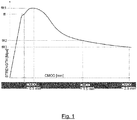
- the present invention enables to provide a concrete presenting a real ductility behavior in fracture (or stress hardening) as can be shown in the Figure 1 , from the matrix cracking point, exhibiting smooth post peak reinforcement without abrupt reduction in mechanical resistance.
- the fracture behavior in flexion shall not show any first crack evidence, so the slope of the stress/CMOD curve is always positive.
- Another embodiment is the concrete mix of the invention, further comprising coarse aggregates.
- Another embodiment is the concrete mix of the invention, wherein the dosing of the Admixture system I is of 0.5-5% weight percent with respect to the binder content and the dosing of the admixture system II is of 0.1-2% weight percent with respect to the binder.
- This concrete mix is for high ductile thin slabs or floors with a consistency of S5-SF3.
- Another embodiment is the concrete mix of the invention, wherein the dosing of the Admixture system I is of 0.1-1% weight percent with respect to the binder content and the dosing of the admixture system II is of 0.1-0.5% weight percent with respect to the binder.
- This concrete mix is for high ductile this slabs or floors with a consistency of S2-S4.
- the concrete mix of the invention comprises an admixture system III, wherein the third Admixture system III is obtained from a compound selected from the group consisting of cellulose microfibers, synthetic waxes, natural waxes, superabsorbing polymers, starch crosslinked polymers, acrylate crosslinked polymers, hexylene glycol (2-Methyl-2,4-pentanediol) and any combination thereof and the dosage of the admixture system III is of 0.3-6 weight percent with respect to the binder.
- the third Admixture system III is obtained from a compound selected from the group consisting of cellulose microfibers, synthetic waxes, natural waxes, superabsorbing polymers, starch crosslinked polymers, acrylate crosslinked polymers, hexylene glycol (2-Methyl-2,4-pentanediol) and any combination thereof and the dosage of the admixture system III is of 0.3-6 weight percent with respect to the binder.
- Another embodiment is the concrete mix of the invention, wherein fibers system C, comprising synthetic fibers, is added to the concrete mix.
- Another embodiment is the concrete mix of the invention, wherein the dosage of fibers system C is of 0.02% to 2% volume with respect to the concrete.
- Another embodiment is the concrete mix of the invention, wherein a part of the sand or the fine aggregates or the coarse aggregates are substituted by lightweight aggregates selected from the group consisting of expanded glass, expanded clay, pumice and expanded shale.
- Another embodiment is the concrete mix of the invention, wherein the substitution rate for all aggregates (sand or/and fine or/and coarse aggregates) is at least 30% in volume.
- the invention concerns special concrete mix designs to achieve any desired classes of compressive strength, while providing a high ductility and the fresh and hardened stages.
- the ductility at hardened stages (28 days) is measured using flexural stress - strain measurement according to Norm EN 14651 (load increase needed to further opening the mouth size of the notch using a CMOD (Crack Mouth Opening Device)).
- Table 3 indicates the resistances and ductility values expressed by the strength at various CMOD with respect to norm EN 14651.
- Table 3 Various requirements for the mechanical resistances in fiber reinforced concrete.
- the concrete mix designs according to the invention contain at least 2 Fibers Systems A and Fibers System B that in combination provides the targeted mechanical properties.
- the Fibers System A contains only metallic fibers as described in Table 4: Table 4: Characteristics of the Fibers System A (high resistance, structural) Geometry Hooked end wire, straight slit sheet or wire, deformed slit sheet or wire, flattened-end slit sheet or wire, machined chip, melt extract E modulus [Gpa] 150-250 Yielding strength YS [Mpa] 1000-4000 Ultimate strength [MPa] 1200-5000 length [mm] 35-100 length/diameter 30-120 coating no coating or zinc density [kg/m3] 6800-8000
- the Fibers System B can be made out of steels fibers, glass fibers, polyaramid, carbon fibers and/or basalt fibers or any combination thereof.
- the geometry of the none metallic fiber are normally straight whereas the metallic fibers in system B can be hooked end wire, straight slit sheet or wire, deformed slit sheet or wire, flattened-end slit sheet or wire, machined chip, melt extract, or straight, etc.
- the metallic fibers can be made of amorphous metal.
- the fibers in System A are used to bridge macro-cracks and provide ductility by pull-out whereas the B type fibers have mainly the function to bridge micro cracks and delay the micro-cracks propagation with energy dispersion on pull out and further micro-cracking.
- the fibers in system A are hooked, with a yield strength above 1000 MPa, preferably above 1200 MPa and even more preferably above 1400 MPa.
- the ratio length divided by diameter is typically located between 40 and 100, preferably between 45 and 95.
- the steel fibers in system B are hooked or straight with a yield strength above 1200 MPa, preferably above 1300 MPa and even more preferably above 1500 MPa.
- the ratio length divided by diameter is typically located between 50 and 95 preferably between 55 and 90.
- the fibers system B may contain non-metallic fibers like glass fibers, with a minimum ultimate strength of 900 MPa, more preferably over 1300 MPa and even more preferably above 1500 Mpa, and a minimum length of 5 mm.
- the fiber system B may also contain basalt fibers, preferably with a minimum strength of 2500 MPa and a minimum length of 5 mm. Both glass and basalt fibers used are straight and multifilament
- the fiber system B contains at least 2 types of fibers, one of them being high performance steel fibers.
- the content of high performance steel fibers in Fiber system B is located between 65% and 90% in volume, whereas the remaining fibers in Fiber system B can be glass or basalt or any mix thereof.
- a third synthetic fibers System C can be added to the concrete mix according to the invention, for instance acrylic fibers, polyethylene fibers, polypropylene fibers, polyester fibers to enhance properties like fire resistance or intrinsic shrinkage.
- acrylic fibers for instance acrylic fibers, polyethylene fibers, polypropylene fibers, polyester fibers to enhance properties like fire resistance or intrinsic shrinkage.
- cellulose fibers may be used in fibers system C.
- the concrete is designed to allow achieving the targeted performances in terms of strength, ductility, elasticity Modulus, placement and rheological properties, workability retention, etc.
- the targeted properties are not only achieved by selecting the appropriate fibers mix design.
- the concrete formulation also plays an important role and is an integral part of the invention. The required ductility and mechanical properties are thus obtained by a combined effect of the concrete matrix and the special design of the hybrid fiber mix design.
- the concrete according to the invention contains the following ingredients per cubic meter of produced concrete (Table 7).
- Table 7 Ingredients of the concrete matrix without admixture Systems Unit Value
- Other pozzolanic materials %mass of total binder 0-40 Fillers (limestone, ...) %mass of total binder 0-40
- By pass dust %mass of total binder 0-40 Total aggregates + sand kg/m3 1000-2000 Sand - 0/4 mm %volume of total aggregates 20-100 Aggregates - 4/8 mm or equivalent %volume of total aggregates 0-80 Aggregates > 7-8 mm, less than 20 mm %volume of total aggregates 0-50 Water/total binder in weight kg
- the cement is typically CEM I, II and III
- the fly ash is a conventional fly ash
- the sand is round or crushed sand, typically 0-4 mm and the fine or coarse aggregates are either round or crushed.
- All ingredients of the final concrete are mixed using conventional industrial concrete mixers.
- the mixing time is conventional for about 30 seconds to some minutes.
- the concrete mix has the following values of mechanical properties: 30 ⁇ fc ⁇ 80 MPa 3 ⁇ ffl ⁇ 12 Mpa 3 ⁇ fR 1 ⁇ 12 ⁇ Mpa 2.5 ⁇ fR 3 ⁇ 15 MPa with consistencies from S2 to SF3, the concrete mix of the invention preferably contains a total binder weight that is located between 370 and 800 Kg per m 3 of concrete, a water to total binder located between 0.2 and 0.6, more preferably between 0.3 and 0.55, a total volume of paste that is located between 300 and 600 liters, a total weight content of sand + fine aggregates+ coarse aggregates of 1000-1900 Kg per m 3 of concrete, the quantity of sand represents 30-60% of the total mass of the sand + fine + coarse aggregates.
- UPM Universal Testing Machine
- Zwick Roell Z250 was used to perform the flexure fracture tests
- the concrete mix of the invention preferably contains a total binder weight that is located between 370 and 800 Kg
- the concrete mix of the invention contains:
- a third optional third Fibers system C can be optionally used, whereas the fibers volume in Fibers system C ranges from 0 to 1.2 volume % of concrete.
- the concrete mix of the invention has the following characteristics: 30 ⁇ fc ⁇ 80 MPa 3.5 ⁇ ffl ⁇ 11 Mpa 3.5 ⁇ fR 1 ⁇ 11 Mpa 3.4 ⁇ fR 3 ⁇ 13 MPa
- the concrete mix of the invention optionally comprises:
- Fibers in System B contains either 100% volume metallic fibers or 100% none metallic fibers, or a mix of metallic and none metallic structural fibers.
- the non-metallic fibers are glass fibers or basalt fibers or any mix thereof.
- the concrete mix of the invention contains Fibers system C, a Fibers system A that is consisting of at least 2 different types of metallic fibers and a fibers system B that contains any mix or combination of high strength fibers metallic, organic, glass based, carbon based or basalt based.
- the 3 admixture systems I, II and III used according to the invention are characterized below:
- Admixture System I Superpiasticizing
- This admixture system is a combination of at least two polycarboxylate ethers, with homo- or co-polymeric backbone, based on acrylic, methacrylic, maleic or allilic constitutional repeating units:
- the dosage of the Admixture System I typically ranges from 0.05-5% solid content based on weight of total binder (total cement + total fly ash or slag + total silica fume) depending on the concrete placement properties targeted.
- the ratio in weight (dry solid content) of the strong water reducer PCE and the workability retention PCE is typically located between 20:80 and 60:40 depending of the targeted application.
- Admixture system II Stabilizing
- the stabilizer is a solid, a water solution, emulsion or dispersion of compounds such as:
- the dosage of the admixture system B is typically located between 0.05-2.5 % solid content based on weight of binder (total cement + total fly ash or slag + total silica fume), depending on the segregation risk related to the fibers and the workability retention targeted.
- the internal curing agent a solid, paste, a water solution, emulsion or dispersion of compounds such as:
- the total dosage of the admixture system I and system II cannot exceed however the value of 5 weight % of the total binder.
- the typical dosage of Admixture system III ranges from 0.05 to 6% solid content based on weight of binder depending on the conditions (size, temperature, relative humidity of the air, etc.).
- the concrete mix of the invention may have a partial of full substitution of the sand and aggregates with lightweight sand and aggregates (expanded shale, expanded clay, expanded glass or pumice, natural puzzolans, etc.). This enables to obtain lightweight structural fiber reinforced concretes with densities below 1800 kg/m 3 , preferably below 1600 Kg/m 3 or even more preferably below 1400 kg/m 3 .
- the concrete mix of the invention may contain strength development accelerators, to reach 4-6 MPa resistance after a couple of hours. This is important for post treatment of slabs (helicopter finishing for instance) that can be done a couple of hours after the casting of the slab, thus saving time and improving efficiency.
- the concrete mix of the invention may also include a retarding agent for instance and sugar modified structures, vinasses, molasses, or chelating agents, etc.
- the concrete mix of the invention may use an air entrainer (like surfactants, soaps or hydrophobic compounds) to ensure a trapped volume of air from 2 % to 15% in volume of the final concrete for freeze-thaw resistance or fire resistance depending on the application.
- an air entrainer like surfactants, soaps or hydrophobic compounds
- the general admixture System consisting of the 3 Admixture Systems I, II and III not only enables to obtain a controlled workability over various classes (S1 to SF3), it also enables to perfectly disperse the high amount of fibers in the Fibers Systems A and B (and optionally in fibers System C) providing a very good stability of the fibers in the concrete matrix, avoiding segregation of the fibers or bleeding of the none metallic fibers thanks to optimized mixing conditions. This explains why the concrete mix of the invention can be produced using conventional concrete mixing techniques.
- the first advantage is that the combination of the concrete mix designs, the fiber mix designs (fibers systems A, B and optionally C) and admixtures systems (I, II and III) enables to overcome all the problems from the prior art and provide a wide range of consistencies, that can by managed and controlled by the 3 admixture systems I, II and II.
- the invention provides concrete mixes having high volume of paste that can achieve very high shrinkage reducing and enables to cast very large slabs up to 3000 m 2 without the appearance of cracks due to elevated ductility and resistances without having to use synthetic fibers that are weakening the resistance of the matrix and limits the applications.
- the combined usage of the high strength fibers system B and the admixture systems provides an optimum combination of shrinkage reduction and mechanical performances (compressive strength, flexural strength and ductility).
- a further advantage of the invention is that the properties of the concrete paste, as the result of the combination of the paste content and the admixture systems, enable to use short (less than 40 mm) metallic fibers and/or high dosage of metallic fibers (over 70 Kg/m3 of concrete up to 165 kg/m3 of concrete) with no risks of segregation of without impacting the targeted consistency of the final concrete or the workability retention.
- the concrete mix of the invention doesn't require special time consuming and costs ineffective curing actions, due to the presence when needed of the admixture system III, enabling self curing.
- the concrete mix of the invention applies to wide range of construction elements, like slabs up to 3000 m2 without joints and without shrinkage cracks, floors, seismic applications, Insulated Concrete Frame for vertical walls, bridge segments, precast industry - tunnel lining segments, structural rehabilitation, etc.
- the controlled rheology of the concrete mix of the invention enables building flat slabs or slabs with a designed slope.
- the concrete mix of the invention has applications in large seamless thin slabs, floors and levels, bridges elements, concrete beams, concrete for impact resistance, seismic applications, etc.
- the concrete mix of the invention do not require any particular mixing processes or sequences and can be obtained in any dry of wet concrete batching plant.
- One further characteristic of the concrete mix of the invention is that it provides consistency up to the SF3 self placing and self leveling consistency classes in a controlled manner through a sophisticated overall system of admixtures, and do not require any specific curing protection (water spraying, surface covering, etc.).
- the concrete mix of the invention has high opening times or workability retention (period of time from the initial mixing of the ingredients during which the workability expressed by the consistency classes of the concrete S1 - S5 and SF1 - SF3 for self placing concretes) of the concrete does change, and remains in the same consistency class.
- the combination of the concrete mix design, the fibers mix design and the admixture system together enables to achieve the targeted improvements and properties.
- FIG. 1 Flexural test results showing Crack Mouth Opening (CMOD) versus Strength according to EN 14651. This figure shows the values ffl, fR1 and fR3.
- This other example uses only metallic fibers in Fiber system B.
- This example shows an alternative according to the inventions with 2 different types of metallic fibers used in fibers system A and only steel fibers in Fibers system B.
- This example uses only mineral fibers (basalt) in the Fibers system B.
- This mix design according to the invention includes the Fiber system C with synthetic low resistance fibers (Polypropylene) specifically designed for fire resistance applications.
- Example 9 shows that a typical concrete mix design containing only fibers system A (although with high resistance) that is a reference on the market. Example evidences the need for fibers system B to achieve the level of ductility according to the invention.
Landscapes
- Chemical & Material Sciences (AREA)
- Engineering & Computer Science (AREA)
- Ceramic Engineering (AREA)
- Organic Chemistry (AREA)
- Materials Engineering (AREA)
- Structural Engineering (AREA)
- Civil Engineering (AREA)
- Chemical Kinetics & Catalysis (AREA)
- Inorganic Chemistry (AREA)
- Curing Cements, Concrete, And Artificial Stone (AREA)
- Manufacture Of Alloys Or Alloy Compounds (AREA)
- Environmental & Geological Engineering (AREA)
- Preparation Of Clay, And Manufacture Of Mixtures Containing Clay Or Cement (AREA)
- On-Site Construction Work That Accompanies The Preparation And Application Of Concrete (AREA)
- Combustion & Propulsion (AREA)
Description
- The present invention relates to concrete formulations for high mechanical performances in structural designs, fiber reinforcement special mix designs to limit or avoid steel rebars or pre-stressing. More specifically, the invention discloses concrete mix designs with high volumetric content of fibers and that the concrete contains different types of fibers to form a so-called hybrid fiber system.
- Conventional fiber reinforced concrete technology is known, it has been described in various National and International Norms e.g. RILEM 162 TDF International), Model Code 2010 (International), CNR DT 204 (Italy SS 812310 (Sweden), TR63 (UK) ACI 318 (USA) ACI 360 (USA), DBV (Germany), DAFSTB (Austria). Fiber reinforced concrete mix designs containing different types of fibers have been for examples disclosed for example in
WO 2011/053103 and more recently inCN102976697 andKR100940550 - In
WO 2011/053103 , the main objective is to provide with a concrete to build large slabs, therefore, one property to be achieved is shrinkage resistance in order to avoid cracks formation. Therefore, shrinkage reducing agents, namely ethylene glycol, free lime or calcium sulfoaluminate, is used in combination with polymer fibers (synthetic fibers) whose role is mainly to reduce cracking due to shrinkage. - According to
WO 2011/053103 , the workability of the concretes is located in the classes F5 to F6, yet no data are disclosed concerning the workability retention (opening time) of the final concrete produced. Furthermore, no data and results are disclosed concerning the compressive and flexural strength of the concretes according to the invention. - Amongst others, one important disadvantage of the patent application
WO 2011/053103 is the requirement to prepare a separate slurry containing water, cement and all shrinkage reducers and plasticizers (or water reducers admixture - namely powdered melamine or phosphonates), or fillers as well as fillers. The slurry is then added to the concrete prepared separately and the fibers are added. - A further important drawback of the invention according to
WO 2011/053103 is the fact that the final placed concrete has to be cured using water after placing. - An additional drawback of the invention according to
WO 2011/053103 is that the volume of paste is very low to ensure limited shrinkage and avoid cracking, thus reducing the scope of application and placement properties and well as the level of mechanical resistances that can be achieved, both in terms of compressive strength and in terms of flexural strength or ductility. Finally the document does not disclose water/total binder content (kg/kg) others than 0.42 and 0.46, which limits drastically the type of properties that can be achieved. -
CN 102 976 697 A discloses a low shrinkage crack-resistant concrete used for paving bridge surface, comprises water, cementitious material, fine aggregate, coarse aggregate, toughening agent, internal curing agent, water reducing agent and hybrid fiber. - Relevant information related to Norms and normative tests mentioned in this patent application is described in Tables 1 and 2.
Table 1: Consistency of concrete (slump) with respect to EN (European) and FR (French) Norms and normative tests. EN 12350-2 NF P 18-305 Consistency slump [mm] Consistency slump [mm] S1 10 to 40 Stiff 0 to 40 S2 40 to 90 Plastic 50 to 90 S3 100 to 150 highly plastic 100 to 150 S4 160 to 210 fluid > 160 S5 > 220 Table 2: Consistency of concrete (flow) with respect to EN 12350-8 (European) Norms EN 206-1 category Flow [mm] SF1 550 -650 SF2 660 -750 SF3 760 - 850 - The present invention provides a concrete mix comprising sand, fine aggregates, binder, fibers, and various admixtures, having a consistency from S2 to S5 and SF1 to SF3, a compressive strength in the range of 30-80 MPa and a ductility represented by the following values:


- The meaning of fc, ffl, fR1 and fR3 is the following (see
Figure 1 ):
fc is compressive strength, ffl is flexural strength, fR1 is strength for crack mouth opening 0.5 mm, fR2 is strength at CMOD 1.5 mm and fR3 is Strength at CMOD 2.5 mm. - The concrete mix of the invention is for slabs, floors or structural constructions with high ductility and workability retention.
- The present invention proposes a solution to overcome the various drawbacks of
WO 2011/053103 . The concrete mix designs according to the present invention are not limited to shrinkage resistance enhancement using shrinkage reducers and synthetic fibers for this unique goal and true structural properties to be used in structural engineering for decks, bridges, pillars, etc. Also, the fiber reinforced fresh concrete mix designs according to the invention are engineered to comply with industrial production requirements, they are produced in conventional concrete mixing plants, can be transported over large distance since they have a high workability retention and do not need special curing techniques once placed. - Also, the present invention enables to provide a concrete presenting a real ductility behavior in fracture (or stress hardening) as can be shown in the
Figure 1 , from the matrix cracking point, exhibiting smooth post peak reinforcement without abrupt reduction in mechanical resistance. Ideally, the fracture behavior in flexion shall not show any first crack evidence, so the slope of the stress/CMOD curve is always positive. - Another embodiment is the concrete mix of the invention, further comprising coarse aggregates.
- Another embodiment is the concrete mix of the invention, wherein the dosing of the Admixture system I is of 0.5-5% weight percent with respect to the binder content and the dosing of the admixture system II is of 0.1-2% weight percent with respect to the binder. This concrete mix is for high ductile thin slabs or floors with a consistency of S5-SF3.
- Another embodiment is the concrete mix of the invention, wherein the dosing of the Admixture system I is of 0.1-1% weight percent with respect to the binder content and the dosing of the admixture system II is of 0.1-0.5% weight percent with respect to the binder. This concrete mix is for high ductile this slabs or floors with a consistency of S2-S4.
- Another embodiment is the concrete mix of the invention, wherein the concrete mix comprises an admixture system III, wherein the third Admixture system III is obtained from a compound selected from the group consisting of cellulose microfibers, synthetic waxes, natural waxes, superabsorbing polymers, starch crosslinked polymers, acrylate crosslinked polymers, hexylene glycol (2-Methyl-2,4-pentanediol) and any combination thereof and the dosage of the admixture system III is of 0.3-6 weight percent with respect to the binder.
- Another embodiment is the concrete mix of the invention, wherein fibers system C, comprising synthetic fibers, is added to the concrete mix.
- Another embodiment is the concrete mix of the invention, wherein the dosage of fibers system C is of 0.02% to 2% volume with respect to the concrete.
- Another embodiment is the concrete mix of the invention, wherein a part of the sand or the fine aggregates or the coarse aggregates are substituted by lightweight aggregates selected from the group consisting of expanded glass, expanded clay, pumice and expanded shale.
- Another embodiment is the concrete mix of the invention, wherein the substitution rate for all aggregates (sand or/and fine or/and coarse aggregates) is at least 30% in volume.
- The invention concerns special concrete mix designs to achieve any desired classes of compressive strength, while providing a high ductility and the fresh and hardened stages.
- The ductility at hardened stages (28 days) is measured using flexural stress - strain measurement according to Norm EN 14651 (load increase needed to further opening the mouth size of the notch using a CMOD (Crack Mouth Opening Device)).
- Table 3 indicates the resistances and ductility values expressed by the strength at various CMOD with respect to norm EN 14651.
Table 3: Various requirements for the mechanical resistances in fiber reinforced concrete. Application for fiber reinforced concrete Strength requirements fc [Mpa] ffl [Mpa] fR1 [Mpa] fR3 [Mpa] Industrial slab-on-grade 30-60 3-8 2-10 2-10 ICF 40-100 4-10 5-13 3-25 Structural rehabilitation /seismic design for ancien buildings/strengthtening of old structures 80-200 8-15 10-30 15-60 Precast industry - bridge segments 60-200 5-15 7-35 15-50 Precast industry - tunnel lining segments 30-100 3-8 2-12 2-20 Precast industry - new jersey 30-50 3-5 2-8 2-8 Precast industry - pipes 40-80 3-7 4-10 4-10 Precast industry - refractory concrete 40-100 4-9 8-30 5-15 Columns 30-200 3-10 3-10 5-40 - The concrete mix designs according to the invention contain at least 2 Fibers Systems A and Fibers System B that in combination provides the targeted mechanical properties. The Fibers System A contains only metallic fibers as described in Table 4:
Table 4: Characteristics of the Fibers System A (high resistance, structural) Geometry Hooked end wire, straight slit sheet or wire, deformed slit sheet or wire, flattened-end slit sheet or wire, machined chip, melt extract E modulus [Gpa] 150-250 Yielding strength YS [Mpa] 1000-4000 Ultimate strength [MPa] 1200-5000 length [mm] 35-100 length/diameter 30-120 coating no coating or zinc density [kg/m3] 6800-8000 - The Fibers system A can be prepared with different types of metallic fibers corresponding to the characteristics indicated in Table 4.
- The Fibers System B contains high strength fibers that are shorter than the Fibers of Fibers System A. and is described in table 5.
- The Fibers System B can be made out of steels fibers, glass fibers, polyaramid, carbon fibers and/or basalt fibers or any combination thereof.
- The geometry of the none metallic fiber are normally straight whereas the metallic fibers in system B can be hooked end wire, straight slit sheet or wire, deformed slit sheet or wire, flattened-end slit sheet or wire, machined chip, melt extract, or straight, etc. The metallic fibers can be made of amorphous metal.
- The fibers in System A are used to bridge macro-cracks and provide ductility by pull-out whereas the B type fibers have mainly the function to bridge micro cracks and delay the micro-cracks propagation with energy dispersion on pull out and further micro-cracking.
- Preferably, the fibers in system A are hooked, with a yield strength above 1000 MPa, preferably above 1200 MPa and even more preferably above 1400 MPa.
- The ratio length divided by diameter (mm/mm) is typically located between 40 and 100, preferably between 45 and 95.
- Preferably, the steel fibers in system B are hooked or straight with a yield strength above 1200 MPa, preferably above 1300 MPa and even more preferably above 1500 MPa.
- The ratio length divided by diameter (mm/mm) is typically located between 50 and 95 preferably between 55 and 90.
- Preferably the fibers system B may contain non-metallic fibers like glass fibers, with a minimum ultimate strength of 900 MPa, more preferably over 1300 MPa and even more preferably above 1500 Mpa, and a minimum length of 5 mm. The fiber system B may also contain basalt fibers, preferably with a minimum strength of 2500 MPa and a minimum length of 5 mm. Both glass and basalt fibers used are straight and multifilament
- In another preferred embodiment, the fiber system B contains at least 2 types of fibers, one of them being high performance steel fibers. Preferably, the content of high performance steel fibers in Fiber system B is located between 65% and 90% in volume, whereas the remaining fibers in Fiber system B can be glass or basalt or any mix thereof.
- Alternatively a third synthetic fibers System C can be added to the concrete mix according to the invention, for instance acrylic fibers, polyethylene fibers, polypropylene fibers, polyester fibers to enhance properties like fire resistance or intrinsic shrinkage. Alternatively, cellulose fibers may be used in fibers system C.
Table 6 Characteristics of the Fibers system C Acrylic Nylon Polyester Polyethylene Polypropylene E modulus [Gpa] 5-30 1-10 5-40 1-15 1-15 Ultimate strength (US) [Mpa] 150-1400 100-2000 500-1500 100-600 100-1100 length [mm] 1-100 1-100 1-100 1-100 1-100 length/diameter 30-150 30-150 30-150 30-150 30-150 bundling loose loose loose loose loose coating no coating no coating no coating no coating no coating density [kg/m3] 1000-1400 1000-1400 1200-1500 800-1200 800-1200 - The concrete is designed to allow achieving the targeted performances in terms of strength, ductility, elasticity Modulus, placement and rheological properties, workability retention, etc.
- The targeted properties are not only achieved by selecting the appropriate fibers mix design. The concrete formulation also plays an important role and is an integral part of the invention. The required ductility and mechanical properties are thus obtained by a combined effect of the concrete matrix and the special design of the hybrid fiber mix design.
- Typically, the concrete according to the invention contains the following ingredients per cubic meter of produced concrete (Table 7).
Table 7: Ingredients of the concrete matrix without admixture Systems Unit Value Total binder kg/m3 280-1000 Cement (any type) %mass of total binder 40-100 Fly ash %mass of total binder 0-50 Silica fume %mass of total binder 0-40 GGBS %mass of total binder 0-40 Other pozzolanic materials %mass of total binder 0-40 Fillers (limestone, ...) %mass of total binder 0-40 By pass dust %mass of total binder 0-40 Total aggregates + sand kg/m3 1000-2000 Sand - 0/4 mm %volume of total aggregates 20-100 Aggregates - 4/8 mm or equivalent %volume of total aggregates 0-80 Aggregates > 7-8 mm, less than 20 mm %volume of total aggregates 0-50 Water/total binder in weight kg/Kg 0.1-0.8 Air %volume of concrete 0.1-20 Volume of paste liters min 250 Volume of fibers System A % volume of concrete 0.03 to 4 Volume of fibers System B 0.03 to 3 Volume of fibers System C 0 to 2 PCE Admixtures systems dry solid content weight % of the total binder 0.1 to 5 Internal Curing admixture system dry solid content weight % of the total binder 0 to 3 - The cement is typically CEM I, II and III , the fly ash is a conventional fly ash the sand is round or crushed sand, typically 0-4 mm and the fine or coarse aggregates are either round or crushed.
- All ingredients of the final concrete are mixed using conventional industrial concrete mixers. The mixing time is conventional for about 30 seconds to some minutes.
- Concrete samples of dimensions 700 mm x 150 mm x 150 mm were prepared, de-molded at 24 hours and were cured for 28 days at constant temperature 22°C air humidity (relative humidity 95%) before mechanical testing.
- Test Machine was an Universal Testing Machine (UTM) a Zwick Roell Z250 was used to perform the flexure fracture tests
According to the invention, the concrete mix has the following values of mechanical properties:


- Preferably, the concrete mix of the invention contains:
- Fibers System A from 0.3 to 1.2 % volume of concrete
- Fibers System B from 0.1 to 1.2 % volume of concrete
- A third optional third Fibers system C can be optionally used, whereas the fibers volume in Fibers system C ranges from 0 to 1.2 volume % of concrete.
- More preferably, the concrete mix of the invention has the following characteristics:


- Fibers System A from 0.3 to 1 volume % of concrete 0.3-1
- Fibers System B from 0.2 to 0.9 volume % of concrete 0.2-0.9
- The concrete mix of the invention optionally comprises:
- Fibers System C from 0 to 0.08% volume % of concrete.
- Fibers in System B contains either 100% volume metallic fibers or 100% none metallic fibers, or a mix of metallic and none metallic structural fibers. Preferably the non-metallic fibers are glass fibers or basalt fibers or any mix thereof.
- According to other embodiment of the invention, the concrete mix of the invention contains Fibers system C, a Fibers system A that is consisting of at least 2 different types of metallic fibers and a fibers system B that contains any mix or combination of high strength fibers metallic, organic, glass based, carbon based or basalt based.
The 3 admixture systems I, II and III used according to the invention are characterized below: - This admixture system is a combination of at least two polycarboxylate ethers, with homo- or co-polymeric backbone, based on acrylic, methacrylic, maleic or allilic constitutional repeating units:
- A strong water reducer PCE of molecular weight ranging from 20000 to 100000 g/mol, with grafting density ranging from 10 to 35%, ethereal side chains ranging from 750 to 5000 g/mol, optionally cross-linked with ethereal and alkylic bridges of lenght up to 14 EO (Ethylene Oxide Unit), PO (Propylene Oxide Units), Carbon unit, optionally containing etheroatomic functions, such as Sulphonate or Phosphonate organic derivatives.
- As workability retention PCE, of molecular weight ranging from 20000 to 100000 g/mol, with grafting density ranging from 10 to 60%, ethereal side chains ranging from 750 to 5000 g/mol, optionally cross-linked with ethereal and alkylic bridges of lenght up to 14 EO, PO, Carbon unit, optionally containing etheroatomic functions, such as Sulphonate or Phosphonate organic derivatives, optionally bearing protective groups on acrylic residues, based on linear and branched alcohols, alkyl methoxy, ethoxy, propoxy end-capped linear groups or ethereal chains up to 5000 g/mol.
- The dosage of the Admixture System I typically ranges from 0.05-5% solid content based on weight of total binder (total cement + total fly ash or slag + total silica fume) depending on the concrete placement properties targeted.
- The ratio in weight (dry solid content) of the strong water reducer PCE and the workability retention PCE is typically located between 20:80 and 60:40 depending of the targeted application.
- The stabilizer is a solid, a water solution, emulsion or dispersion of compounds such as:
- Modified cellulose, such as carboxymethyl cellulose, hydroxyethyl cellulose, hydroxypropyl methyl cellulose.
- Natural and modified starch, preferably branched.
- Naturals gums such as Xanthan gum.
- Fine silica, such as colloidal silica,
or any combination thereof. - The dosage of the admixture system B is typically located between 0.05-2.5 % solid content based on weight of binder (total cement + total fly ash or slag + total silica fume), depending on the segregation risk related to the fibers and the workability retention targeted.
- The internal curing agent: a solid, paste, a water solution, emulsion or dispersion of compounds such as:
- Cellulose microfibers
- Synthetic or natural waxes
- Superabsorbing polymers, such as modified starch or acrylate crosslinked polymers.
- Hexylene glycol (2-Methyl-2,4-pentanediol)
- The total dosage of the admixture system I and system II cannot exceed however the value of 5 weight % of the total binder.
- The typical dosage of Admixture system III ranges from 0.05 to 6% solid content based on weight of binder depending on the conditions (size, temperature, relative humidity of the air, etc.).
- Alternatively, the concrete mix of the invention may have a partial of full substitution of the sand and aggregates with lightweight sand and aggregates (expanded shale, expanded clay, expanded glass or pumice, natural puzzolans, etc.). This enables to obtain lightweight structural fiber reinforced concretes with densities below 1800 kg/m3, preferably below 1600 Kg/m3 or even more preferably below 1400 kg/m3.
- The concrete mix of the invention may contain strength development accelerators, to reach 4-6 MPa resistance after a couple of hours. This is important for post treatment of slabs (helicopter finishing for instance) that can be done a couple of hours after the casting of the slab, thus saving time and improving efficiency.
- The concrete mix of the invention may also include a retarding agent for instance and sugar modified structures, vinasses, molasses, or chelating agents, etc.
- The concrete mix of the invention may use an air entrainer (like surfactants, soaps or hydrophobic compounds) to ensure a trapped volume of air from 2 % to 15% in volume of the final concrete for freeze-thaw resistance or fire resistance depending on the application.
- The general admixture System, consisting of the 3 Admixture Systems I, II and III not only enables to obtain a controlled workability over various classes (S1 to SF3), it also enables to perfectly disperse the high amount of fibers in the Fibers Systems A and B (and optionally in fibers System C) providing a very good stability of the fibers in the concrete matrix, avoiding segregation of the fibers or bleeding of the none metallic fibers thanks to optimized mixing conditions. This explains why the concrete mix of the invention can be produced using conventional concrete mixing techniques.
- There are many advantages associated with the concretes according to the invention as will be seen from the examples below.
- The first advantage is that the combination of the concrete mix designs, the fiber mix designs (fibers systems A, B and optionally C) and admixtures systems (I, II and III) enables to overcome all the problems from the prior art and provide a wide range of consistencies, that can by managed and controlled by the 3 admixture systems I, II and II.
- Furthermore, the invention provides concrete mixes having high volume of paste that can achieve very high shrinkage reducing and enables to cast very large slabs up to 3000 m2 without the appearance of cracks due to elevated ductility and resistances without having to use synthetic fibers that are weakening the resistance of the matrix and limits the applications. The combined usage of the high strength fibers system B and the admixture systems provides an optimum combination of shrinkage reduction and mechanical performances (compressive strength, flexural strength and ductility).
- A further advantage of the invention is that the properties of the concrete paste, as the result of the combination of the paste content and the admixture systems, enable to use short (less than 40 mm) metallic fibers and/or high dosage of metallic fibers (over 70 Kg/m3 of concrete up to 165 kg/m3 of concrete) with no risks of segregation of without impacting the targeted consistency of the final concrete or the workability retention.
- The concrete mix of the invention doesn't require special time consuming and costs ineffective curing actions, due to the presence when needed of the admixture system III, enabling self curing.
- The concrete mix of the invention applies to wide range of construction elements, like slabs up to 3000 m2 without joints and without shrinkage cracks, floors, seismic applications, Insulated Concrete Frame for vertical walls, bridge segments, precast industry - tunnel lining segments, structural rehabilitation, etc.
- The controlled rheology of the concrete mix of the invention enables building flat slabs or slabs with a designed slope.
- The concrete mix of the invention has applications in large seamless thin slabs, floors and levels, bridges elements, concrete beams, concrete for impact resistance, seismic applications, etc. The concrete mix of the invention do not require any particular mixing processes or sequences and can be obtained in any dry of wet concrete batching plant.
- One further characteristic of the concrete mix of the invention is that it provides consistency up to the SF3 self placing and self leveling consistency classes in a controlled manner through a sophisticated overall system of admixtures, and do not require any specific curing protection (water spraying, surface covering, etc.).
- The concrete mix of the invention has high opening times or workability retention (period of time from the initial mixing of the ingredients during which the workability expressed by the consistency classes of the concrete S1 - S5 and SF1 - SF3 for self placing concretes) of the concrete does change, and remains in the same consistency class. The combination of the concrete mix design, the fibers mix design and the admixture system together enables to achieve the targeted improvements and properties.
-
- Hydraulic binder
- Material with cementing properties that sets and hardens due to hydration even under water. Hydraulic binders produce calcium silicate hydrates also known as CSH.
- Cement
- Binder that sets and hardens and bring materials together. The most common cement is the ordinary Portland cement (OPC) and a series of Portland cements blended with other cementitious materials.
- Ordinary Portland cement
- Hydraulic cement made from grinding clinker with gypsum. Portland cement contains calcium silicate, calcium aluminate and calcium ferroaluminate phases. These mineral phases react with water to produce strength.
- Mineral Addition
- Mineral admixture (including the following powders: silica fume, fly ash, slags) added to concrete to enhance fresh properties, compressive strength development and improve durability.
- Silica fume
- Source of amorphous silicon obtained as a byproduct of the silicon and ferrosilicon alloy production. Also known as microsilica.
- Total binder
- Is the sum of all cementitious components (cement, flay ash, slag, silica fume, etc.)
- Volume of paste
- Is the total volume of the cement, + fly ash + slag + silica fume + water + entrained air
- Fibers
- Material used to increase concrete's structural performance. Fibers include: steel fibers, glass fibers, synthetic fibers and natural fibers.
- Alumino silicate - by-product (Fly Ash - bottom ash)
- Alkali reactive binder components that together with the activator form the cementitious paste. These are minerals rich in alumina and silica in both, amorphous and crystalline structure.
- Natural Pozzolan
- Aluminosilicate material of volcanic origin that reacts with calcium hydroxide to produce calcium silicate hydrates or CSH as known in Portland cement hydration.
- Inert Filler
- A material that does alter physical properties of concrete but does not take place in hydration reaction.
- Admixture
- Chemical component in an admixture formulation system of one main
- raw material
- chemical polymer.
- Admixture
- Chemical admixtures used to modify or improve concrete's properties in fresh and hardened state. These could be air entrainers, water reducers, set retarders, accelerators, stabilizers, superplasticizers and others.
- Air entrained
- Total volume of air entrained in the concrete by the air entrainer.
- PCE
- PCE are Polycarboxylic Acid Co-Polymers used as a class of cement and concrete admixtures, and are comb type polymers that are based on: a polymer backbone made of acrylic, methacrylic, maleic acid, and related monomers, which is grafted with polyoxyalkylene side-chain such as EO and/or PO. The grafting could be, but is not limited to, ester, ether, amide or imide.
- Initial dispersant
- Initial dispersant is a chemical admixtures used in hydraulic cement compositions such as Portland cement concrete, part of the plasticizer and superplasticizer familiy, which allow a good dispersion of cement particles during the initial hydration stage.
- Superplasticizers
- Superplasticizer relates to a class of chemical admixture used in hydraulic cement compositions such as Portland cement concrete having the ability to highly reduce the water demand while maintaining a good dispersion of cement particles. In particular, superplasticizers avoid particle aggregation and improve the rheological properties and workability of cement and concrete at the different stage of the hydration reaction.
- Concrete
- Concrete is primarily a combination of hydraulic binder, sand, fine and/or coarse aggregates, water. Admixture can also be added to provide specific properties such as flow, lower water content, acceleration...
- Pourable construction materials
- A material is consider as pourable as soon as its fluidity (with our without vibration) allow to full fill a formwork or to be collocate in a definite surface.
- Construction materials
- Any materials that can be use to build construction element or structure. It includes concrete, masonries (bricks - blocks), stone, ICF...
- Structural applications
- A construction material is consider as structural as soon as the compressive strength of the material is greater than 25MPa
- Workability
- The workability of a material is measure with a slump test (table 1: slump)
- Workability retention
- Is the capability of a mix to maintain its workability during the time. The total time required depends on the application and the transportation.
- Internal Curing Admixture
- Admixture agent that retains water and release the eater internally in a delayed matter to compensated form water depletion due to drying
- Strength development - setting / hardening
- The setting time start when the construction material change from plastic to rigid. In the rigid stage the material cannot be poured or moved anymore. After this phase the strength development corresponding to the hardening of the material
- Coarse Aggregates
- Manufactured, natural or recycled minerals with a particle size greater than 6mm and a maximum size lower than 32mm
- Fines Aggregates
- Manufactured, natural or recycled minerals with a particle size typically greater than 3mm and a maximum size lower than 10 mm
- Sand aggregates
- Manufactured, natural or recycled minerals with a particle size lower than 3 or 4mm
- Ductility
- Is the capacity of the concrete to deform in a none elastic way, keeping resistances expressed by residual strength a certain displacement (CMOD) according to norm EN 14651
- Yield strength
- Is the strength measured in traction or tension from witch the constitutive law between elongation and applied stress in no longer linear
- Flexural strength
- Is the strength measured on 3 points bending tests (notched prismatic samples 500 mm x 150 mm x 150 mm) according to norm EN 14651
- Ultimate strength (US)
- Ultimate strength of the fibers before rupture
- w/b
- Total free water (w) mass in Kg divided by the total binder mass in Kg
-
Figure 1 . Flexural test results showing Crack Mouth Opening (CMOD) versus Strength according to EN 14651. This figure shows the values ffl, fR1 and fR3. - Various examples of mix designs and corresponding results are presented here according to the invention.
-
Material Unit Quantity Total binder content kg/m3 390 CEM II 32.5N A-LL kg/m3 390 w/b eff - 0.4 Admix System I % total binder content 0.80% Admix System II % total binder content 0.30% Sand 0/4 round kg/m3 736 Fine aggregates gravel 4/8round kg/m3 461 Coarse aggregates gravel 8/16 round kg/m3 646 Fiber type A - l/d=65-l=60mm, US=1350 Mpa, YS= 1200 Mpa hooked %volume 1.00% Fiber type B - steel - l/d=60-l=16mm, US=2350 Mpa, YS= 2100 MPa straight %volume 0.20% Entrained air l/m3 25 Paste volume l/m3 308.87 Results Unit Value Slump class - S3 Slump flow mm 145 Workability retention min 80 fc Mpa 32 ffl Mpa 4.1 fr1 Mpa 3.6 fr3 Mpa 3.9 E modulus Gpa 27.9 - This example with a low paste volume enable to achieve SF2 slump class (or consistency). In this example, only steel fibers are used in Fiber system B.
-
Material Unit Quantity Total binder content kg/m3 430 CEM I 42.5 N kg/m3 300 Fly ash kg/m3 130 w/b eff - 0.55 Admix System I % total binder content 0.10% Admix System II % total binder content 0.20% Sand 0/4 round kg/m3 735 Fine aggregates gravel 4/8round kg/m3 327 Coarse aggregate gravel 8/11 crushed kg/m3 573 Fiber type A - l/d=50-l=55mm, US=1780 Mpa, YS= 1530 MPa hooked %volume 0.35% Fiber type B - glass - l/d=57-l=12mm, US=1650 Mpa, straight %volume 0.20% Entrained air l/m3 20 Paste volume l/m3 385.90 Results Unit Value Slump class - S4 Slump mm 165 Workability retention min 85 fc Mpa 35.2 ffl Mpa 3.9 fr1 Mpa 3.3 fr3 Mpa 3.6 E modulus Gpa 27.2 - This other example uses only metallic fibers in Fiber system B.
-
Material Unit Quantity Total binder content kg/m3 510 CEM II 42.5 R / A-P kg/m3 330 Fly ash kg/m3 130 Silica fume kg/m3 50 w/b eff - 0.45 Admix System I % total binder content 1.30% Admix System II % total binder content 1.30% Admix System III % total binder content 2.80% Gluconate retarder % total binder content 0.20% Sand 0/2 round kg/m3 311 Sand 0/4 crushed kg/m3 543 Fine aggregates gravel 4/7 crushed kg/m3 389 Coarse aggregates gravel 6/12 crushed kg/m3 311 Fiber type A - l/d=80-l=44mm, US=2540 Mpa, YS= 2350 MPa, hooked %volume 0.35% Fiber type A - l/d=90-l=50mm, US=3020 Mpa, YS=2860 Mpa, hooked %volume 0.25% Fiber type B - steel - l/d=60-l=6mm, US=2130 Mpa, YS=1810 MPa, straight %volume 0.20% Entrained air l/m3 12 Paste volume l/m3 423.16 Slump class - SF3 Slump flow mm 810 Workability retention min 120 Results Unit Value fc Mpa 57.9 ffl Mpa 6.8 fr1 Mpa 8 fr3 Mpa 7.8 E modulus Gpa 30.7 - This example shows an alternative according to the inventions with 2 different types of metallic fibers used in fibers system A and only steel fibers in Fibers system B.
-
Material Unit Quantity Total binder content kg/m3 520 CEM III/A 42.5N kg/m3 400 Limestone Filler kg/m3 120 w/b eff - 0.4 Admix System I % total binder content 0.80% Admix System II % total binder content 0.48% Admix System III % total binder content 5.10% Sand 0/4 round kg/m3 1021 Fine aggregates gravel 4/9 Crushed kg/m3 682 Fiber type A - l/d=50-l=50mm, US=1250 Mpa, YS=1080 MPa, straight %volume 0.35% Fiber type B - Basalt - l/d=1100-l=12mm, US=3500 Mpa, straight %volume 0.35% Entrained air l/m3 34 Paste volume l/m3 417.59 Results Unit Value Slump class - S4 Slump mm 175 Workability retention min 60 fc Mpa 51.2 ffl Mpa 5.7 fr1 Mpa 5.1 fr3 Mpa 4.7 E modulus Gpa 34.9 - This example uses only mineral fibers (basalt) in the Fibers system B.
-
Material Unit Quantity Total binder content kg/m3 650 CEM I 42.5 R kg/m3 400 Silica fume kg/m3 70 GGBS kg/m3 180 w/b eff - 0.38 Admix System I % total binder content 3.70% Admix System II % total binder content 1.80% Admix System III % total binder content 0.70% Sand 0/1 round kg/m3 308 Sand 0/4 crushed kg/m3 228 Fine aggregates gravel 2/6 round kg/m3 403 Coarse aggregates gravel 4/13 round kg/m3 403 Fiber type A - l/d=92-l=60mm, US=2470 Mpa, YS=2250 MPa, hooked %volume 0.70% Fiber type B - Steel - l/d=60-l=30mm, US=2850 Mpa, YS= 2650 hooked %volume 0.25% Fiber type B - Aramid - l/d=100-l=18mm, US=4500 Mpa, straight %volume 0.10% Entrained air l/m3 17 Paste volume l/m3 484.66 Results Unit Value Slump class - SF1 Slump mm 600 Workability retention min 120 fc Mpa 78 ffl Mpa 11.4 fr1 Mpa 11.6 fr3 Mpa 14.3 E modulus Gpa 41.2 - Example of very high ductility concrete, with 2 types of high strength fibers in Fibers system B (steel and aramid).
-
Material Unit Quantity Total binder content kg/m3 500 CEM II/A-T 42.5N kg/m3 300 Fly ash kg/m3 200 w/b eff - 0.49 Admix System I % total binder content 0.90% Admix System II % total binder content 0.20% Admix System III % total binder content 2.50% Accelerator - calcium formate % total binder content 2.00% Sand 0/4 round kg/m3 703 fine and coarse Gravel 4/12 round 861 Fiber type A - l/d=50-l=50mm, US=1220 Mpa, YS= 1070 MPa, hooked %volume 0.50% Fiber type B - Steel - l/d=80-l=30mm, US=3020 Mpa, YS 2810=MPahooked %volume 0.25% Fiber type B - Glass - l/d=80-l=30mm, US=3020 Mpa, %volume 0.10% Entrained air l/m3 24 Paste volume l/m3 447.57143 Results Unit Value Slump class - S5 Slump flow mm 220 Workability retention min 45 fc Mpa 46 ffl Mpa 4.9 fr1 Mpa 5.4 fr3 Mpa 5.7 E modulus Gpa 28.5 - Example according to the invention where the Fibers system B contains both metallic and glass high strength fibers and a strength accelerator using calcium formiate in the admixtures system.
-
Material Unit Quantity Total binder content kg/m3 430 CEM II 32.5 B-LL kg/m3 280 Fly ash kg/m3 150 w/b eff - 0.58 Admix System I % total binder content 1.70% Admix System II % total binder content 0.60% Sand 0/3 round kg/m3 725 Fine aggregates gravel 3/10 round kg/m3 403 Coarse aggregates gravel 10/20 round kg/m3 484 Fiber type A - ld=65-l=55mm, US=1570 Mpa, YS= 1380 MPa, hooked %volume 0.30% Fiber type B - Steel - l/d=55-l=18mm, US=2360 Mpa, YS= 2130 MPa, straight %volume 0.20% Fiber type C - Polypropylene - l/d=80-l=50mm, US=750 Mpa, straight %volume 0.28% Entrained air l/m3 26 Paste volume l/m3 431.23 Results Unit Value Slump class - SF2 Slump mm 710 Workability retention min 90 fc Mpa 34.9 ffl Mpa 3.5 fr1 Mpa 3.1 fr3 Mpa 4.7 E modulus Gpa 25.7 - This mix design according to the invention includes the Fiber system C with synthetic low resistance fibers (Polypropylene) specifically designed for fire resistance applications.
-
Material Unit Quantity Total binder content kg/m3 390 CEM II 32.5 N A-LL kg/m3 390 w/b eff - 0.4 Admix System I % total binder content 0.80% Admix System II % total binder content 0.30% Sand 0/4 round kg/m3 736 Gravel 4/8 round kg/m3 461 Gravel 4/16 round kg/m3 646 Fiber type A - l/d=85-l=50mm, YS= 670 MPa, US=755 Mpa, straight %volume 0.50% Fiber type B - Steel - l/d=60-l=20mm, YS=2740 Mpa, US=3020 Mpa, hooked %volume 0.25% Fiber type B - Glass - l/d=57-l=12mm, US=2750 Mpa, straight %volume 0.05% Entrained air l/m3 32 Paste volume l/m3 311.81 Slump class - S3 Slump mm 120 Workability retention min 80 fc Mpa 31.2 ffl Mpa 3.5 fr1 Mpa 2.1 fr3 Mpa 1.4 E modulus Gpa 26.7 - This example shows that the ductility and mechanical resistance requirements are not achieved since the fibers in fibers system A have a resistance (YS and US) that are not matching the invention.
-
Material Unit Quantity Total binder content kg/m3 390 CEM II 32.5 N A-LL kg/m3 390 w/b eff - 0.4 Admix System I % total binder content 0.80% Admix System II % total binder content 0.30% Sand 0/4 round kg/m3 736 Gravel 4/8 round kg/m3 461 Gravel 4/16 round kg/m3 646 Fiber type A - l/d=85-l=50mm, YS= 1680 Mpa, US=1845 Mpa, hooked %volume 0.40% Entrained air l/m3 32 Paste volume l/m3 311.81 Slump class - S4 Slump mm 170 Workability retention min 80 fc Mpa 31.2 ffl Mpa 3.8 fr1 Mpa 1.4 fr3 Mpa 0.8 E modulus Gpa 27.3 - Example 9 shows that a typical concrete mix design containing only fibers system A (although with high resistance) that is a reference on the market. Example evidences the need for fibers system B to achieve the level of ductility according to the invention.
- It is clear that the invention is not limited to the provided examples and that the selection of the various ingredients depend on the final application, placing and mechanical targeted properties and cost of the mix design.
| Glass | Aramid | Carbon | Basalt | Steel | |
| E modulus [Gpa] | 40-100 | 40-200 | 100-400 | 50-500 | 150-220 |
| Ultimate strength (US) [MPa] in tension | 900 - 1800 | 3500 - 4500 | 1000-7000 | 2000-6000 | 1300 -5000 |
| Yield strength YS [MPa] in tension | na | 3000-4000 | na | na | 1200-4000 |
| length [mm] | 5-60 | 5-60 | 0.1-30 | 5-100 | 5-35 |
| length/diameter | 10-300 | 30-150 | 10-1000 | 10-10000 | 30-120 |
| coating | no coating | no coating | no coating | no coating | no coating or zinc |
| density [kg/m3] | 2000-4000 | 1200-1600 | 800-2500 | 1500-4000 | 6800-8000 |
Claims (10)
- A concrete mix comprising sand, fine aggregates, binder, fibers, and various admixtures, having a consistency from S2-S5 and SF1-SF3, wherein S means slump of concrete in mm and SF means flow of concrete in mm, a compressive strength in the range of 30-80 MPa and a ductility represented by the following values:


 wherein fc is compressive strength, ffl is flexural strength, fR1 is strength at crack mouth opening 0.5 mm and fR3 is strength at crack mouth opening 2.5 mm,wherein the concrete mix contains at least 390 Kg/m3 of binder, the concrete mix comprises a paste volume of 300-600 liters, the concrete mix contains at least two systems of fibers A and B, the fibers system A consists of metallic fibers with a dosage of 25-100 kg/m3 with respect to the concrete mix and having an ultimate strength of at least 1200 MPa, a length of 35-100 mm, the fibers system B have a dosage of 0.2%-0-9% by m3 of the concrete mix, wherein the fibers system B comprises 65-90% in volume of metallic fibers having a length of 5-35 mm, the concrete mix contains a general admixture system that is composed of at least 2 sub-admixture systems I and II, wherein the first Admixture system I comprises at least 2 polycarboxylic acid co-polymers (PCE), a strong water reducer PCE and a workability retention PCE, wherein the second Admixture system II is a stabilizer obtained from a compound selected from the group consisting of modified cellulose, carboxymethyl cellulose, hydroxyethyl cellulose, hydroxypropyl methyl cellulose, natural starch, modified starch, branched modified starch, naturals gums, Xanthan gum, fine silica, colloidal silica, silica fume and any combination thereof.
 - Concrete mix according to claim 1, further comprising coarse aggregates.
- Concrete mix according toany one of claims 1 to 2, characterized in that the dosing of the Admixture system I is of 0.5-5% weight percent with respect to the binder content and the dosing of the admixture system II is of 0.1-2% weight percent with respect to the binder.
- Concrete mix according to any one of claims 1 to 3, characterized in that the dosing of the Admixture system I is of 0.1-1% weight percent with respect to the binder content and the dosing of the admixture system II is of 0.1-0.5% weight percent with respect to the binder.
- Concrete mix according to any one of claims 1 to 4, characterized in that the concrete mix comprises an admixture system III, wherein the third Admixture system III is obtained from a compound selected from the group consisting of cellulose microfibers, synthetic waxes, natural waxes, superabsorbing polymers, starch crosslinked polymers, acrylate crosslinked polymers, hexylene glycol (2-Methyl-2,4-pentanediol) and any combination thereof and the dosage of the admixture system III is of 0.3-6 weight percent with respect to the binder.
- Concrete mix according to any one of claims 1 to 5, characterized in that fibers system C, comprising synthetic fibers, is added to the concrete mix.
- Concrete mix according to claim 6, characterized in that the dosage of fibers system C is of 0.02% to 2% volume with respect to the concrete.
- Concrete mix according to any one of claims 1 to 7, characterized in that the fiber system B contain glass fibers.
- Concrete mix according to any one of claims 2 to 8, characterized in that a part of the sand or the fine aggregates or the coarse aggregates are substituted by lightweight aggregates selected from the group consisting of expanded glass, expanded clay, pumice and expanded shale.
- Concrete mix according to claim 9, characterized in that the substitution rate for sand or/and fine or/and coarse aggregates is at least 30% in volume.
Applications Claiming Priority (2)
| Application Number | Priority Date | Filing Date | Title |
|---|---|---|---|
| PCT/EP2015/063045 WO2016198108A1 (en) | 2015-06-11 | 2015-06-11 | Advanced fiber reinforced concrete mix designs |
| PCT/EP2016/063312 WO2016198608A1 (en) | 2015-06-11 | 2016-06-10 | Advanced fiber reinforced concrete mix designs and admixtures systems |
Publications (2)
| Publication Number | Publication Date |
|---|---|
| EP3307692A1 EP3307692A1 (en) | 2018-04-18 |
| EP3307692B1 true EP3307692B1 (en) | 2019-10-09 |
Family
ID=53396486
Family Applications (3)
| Application Number | Title | Priority Date | Filing Date |
|---|---|---|---|
| EP15728838.2A Withdrawn EP3307690A1 (en) | 2015-06-11 | 2015-06-11 | Advanced fiber reinforced concrete mix designs |
| EP16732507.5A Withdrawn EP3307691A1 (en) | 2015-06-11 | 2016-06-10 | Concrete mix designs using a plurality of reinforcement fibers systems |
| EP16732511.7A Active EP3307692B1 (en) | 2015-06-11 | 2016-06-10 | Advanced fiber reinforced concrete mix designs |
Family Applications Before (2)
| Application Number | Title | Priority Date | Filing Date |
|---|---|---|---|
| EP15728838.2A Withdrawn EP3307690A1 (en) | 2015-06-11 | 2015-06-11 | Advanced fiber reinforced concrete mix designs |
| EP16732507.5A Withdrawn EP3307691A1 (en) | 2015-06-11 | 2016-06-10 | Concrete mix designs using a plurality of reinforcement fibers systems |
Country Status (10)
| Country | Link |
|---|---|
| US (3) | US20180141867A1 (en) |
| EP (3) | EP3307690A1 (en) |
| BR (2) | BR112017025418A2 (en) |
| CO (2) | CO2017012578A2 (en) |
| CR (2) | CR20170561A (en) |
| ES (1) | ES2764135T3 (en) |
| IL (2) | IL255597A (en) |
| MA (1) | MA43201A (en) |
| MX (2) | MX2017015680A (en) |
| WO (3) | WO2016198108A1 (en) |
Cited By (1)
| Publication number | Priority date | Publication date | Assignee | Title |
|---|---|---|---|---|
| WO2025056169A1 (en) | 2023-09-15 | 2025-03-20 | Cemex Innovation Holding Ag | Formless production process to place a construction material in a continuous manner |
Families Citing this family (14)
| Publication number | Priority date | Publication date | Assignee | Title |
|---|---|---|---|---|
| CR20170561A (en) * | 2015-06-11 | 2018-07-24 | Cemex Res Group Ag | ADVANCED DESIGNS OF CONCRETE BLEND REINFORCED WITH FIBER AND ADDITIVES. |
| AU2016341065B2 (en) * | 2015-10-21 | 2020-08-27 | Sika Technology Ag | Additive for internal post treatment of mineral binder compositions |
| AU2017343641B2 (en) * | 2016-10-14 | 2022-03-10 | Gcp Applied Technologies Inc. | Controllable high flow concrete |
| US11718561B2 (en) | 2017-10-31 | 2023-08-08 | Perma Edge Industries, LLC | Composition and structures created therewith |
| EP4082610B1 (en) * | 2018-08-31 | 2023-09-20 | Neuboron Therapy System Ltd. | Neutron capture therapy system |
| CN111714786B (en) * | 2019-03-18 | 2025-12-19 | 中硼(厦门)医疗器械有限公司 | Neutron capture therapy system |
| CN111423192B (en) * | 2020-06-01 | 2020-12-01 | 中铁二局集团有限公司 | A method for improving the deformability of high ductility concrete |
| WO2022154794A1 (en) * | 2021-01-15 | 2022-07-21 | Skychase Holdings Corporation | Lattice girder and method of concrete reinforcement |
| CN113111490B (en) * | 2021-03-12 | 2022-04-29 | 重庆交通大学 | A strength design method for ultra-high performance concrete based on strength threshold |
| CN113831071B (en) * | 2021-10-22 | 2022-10-21 | 福建省闽宏建材实业有限公司 | Durable concrete |
| CN114853424B (en) * | 2022-05-24 | 2023-01-10 | 绍兴上虞南方普银混凝土有限公司 | Super-retarding durable concrete and preparation process thereof |
| CN114751706B (en) * | 2022-05-26 | 2022-11-29 | 浙大宁波理工学院 | Concrete crack repairing material based on nano material and preparation method thereof |
| US20250368573A1 (en) | 2023-05-25 | 2025-12-04 | Blue Evolution Inc. | Ecofriendly biopolymer admixture for cement and concrete applications |
| CN119260890B (en) * | 2024-12-11 | 2025-03-04 | 浙江兴亦欣科技有限公司 | High-fluidization anti-separation anti-cracking anti-permeability durable composite material and production equipment thereof |
Family Cites Families (8)
| Publication number | Priority date | Publication date | Assignee | Title |
|---|---|---|---|---|
| FR2804952B1 (en) * | 2000-02-11 | 2002-07-26 | Rhodia Chimie Sa | ULTRA HIGH PERFORMANCE FIRE RESISTANT CONCRETE COMPOSITION |
| KR100940550B1 (en) | 2009-06-08 | 2010-02-10 | (주)오래건설 | Reinforcing concrete structure and method using hybrid fiber composite |
| LV14122B (en) * | 2009-10-26 | 2010-04-20 | Primeteh As | Composite concrete mixture for building industrial floors and foundation slabs |
| CN102092996A (en) * | 2010-11-30 | 2011-06-15 | 南京理工大学 | Cement-based composite material with high-temperature resistance and superhigh performance and preparation method thereof |
| CN102206068A (en) * | 2011-04-15 | 2011-10-05 | 上海交通大学 | Shock-resistance carbon fiber assorted fiber concrete |
| CZ2012903A3 (en) * | 2012-12-17 | 2014-05-21 | České vysoké učenà technické v Praze - fakulta stavebnà | Steel-fiber-reinforced concrete of ultrahigh strength |
| CN102976697B (en) * | 2012-12-24 | 2014-07-02 | 武汉理工大学 | High-ductility low-shrinkage anti-cracking concrete for bridge deck pavement and preparation method thereof |
| CR20170561A (en) * | 2015-06-11 | 2018-07-24 | Cemex Res Group Ag | ADVANCED DESIGNS OF CONCRETE BLEND REINFORCED WITH FIBER AND ADDITIVES. |
-
2015
- 2015-06-10 CR CR20170561A patent/CR20170561A/en unknown
- 2015-06-11 US US15/573,678 patent/US20180141867A1/en not_active Abandoned
- 2015-06-11 EP EP15728838.2A patent/EP3307690A1/en not_active Withdrawn
- 2015-06-11 WO PCT/EP2015/063045 patent/WO2016198108A1/en not_active Ceased
-
2016
- 2016-06-10 EP EP16732507.5A patent/EP3307691A1/en not_active Withdrawn
- 2016-06-10 MA MA043201A patent/MA43201A/en unknown
- 2016-06-10 MX MX2017015680A patent/MX2017015680A/en unknown
- 2016-06-10 MX MX2017015570A patent/MX389471B/en unknown
- 2016-06-10 US US15/573,389 patent/US10259747B2/en active Active
- 2016-06-10 BR BR112017025418-2A patent/BR112017025418A2/en not_active Application Discontinuation
- 2016-06-10 US US15/573,391 patent/US20180134620A1/en not_active Abandoned
- 2016-06-10 EP EP16732511.7A patent/EP3307692B1/en active Active
- 2016-06-10 ES ES16732511T patent/ES2764135T3/en active Active
- 2016-06-10 WO PCT/EP2016/063312 patent/WO2016198608A1/en not_active Ceased
- 2016-06-10 WO PCT/EP2016/063302 patent/WO2016198603A1/en not_active Ceased
- 2016-06-10 BR BR112017026256-8A patent/BR112017026256A2/en not_active Application Discontinuation
- 2016-06-10 CR CR20170560A patent/CR20170560A/en unknown
-
2017
- 2017-11-12 IL IL255597A patent/IL255597A/en unknown
- 2017-11-12 IL IL255598A patent/IL255598B/en active IP Right Grant
- 2017-12-06 CO CONC2017/0012578A patent/CO2017012578A2/en unknown
- 2017-12-06 CO CONC2017/0012589A patent/CO2017012589A2/en unknown
Non-Patent Citations (1)
| Title |
|---|
| None * |
Cited By (2)
| Publication number | Priority date | Publication date | Assignee | Title |
|---|---|---|---|---|
| WO2025056169A1 (en) | 2023-09-15 | 2025-03-20 | Cemex Innovation Holding Ag | Formless production process to place a construction material in a continuous manner |
| WO2025056194A1 (en) | 2023-09-15 | 2025-03-20 | Cemex Innovation Holding Ag | Ready-mix construction material 3d printing method |
Also Published As
| Publication number | Publication date |
|---|---|
| BR112017025418A2 (en) | 2018-08-07 |
| IL255597A (en) | 2018-01-31 |
| EP3307690A1 (en) | 2018-04-18 |
| MX2017015680A (en) | 2018-04-18 |
| CO2017012589A2 (en) | 2018-02-28 |
| WO2016198603A1 (en) | 2016-12-15 |
| MX2017015570A (en) | 2018-04-26 |
| CR20170560A (en) | 2018-07-24 |
| US20180111876A1 (en) | 2018-04-26 |
| EP3307691A1 (en) | 2018-04-18 |
| MA43201A (en) | 2018-09-19 |
| WO2016198108A1 (en) | 2016-12-15 |
| US10259747B2 (en) | 2019-04-16 |
| US20180141867A1 (en) | 2018-05-24 |
| BR112017026256A2 (en) | 2018-09-11 |
| EP3307692A1 (en) | 2018-04-18 |
| IL255598A (en) | 2018-01-31 |
| ES2764135T3 (en) | 2020-06-02 |
| CR20170561A (en) | 2018-07-24 |
| WO2016198608A1 (en) | 2016-12-15 |
| US20180134620A1 (en) | 2018-05-17 |
| CO2017012578A2 (en) | 2018-02-28 |
| MX389471B (en) | 2025-03-20 |
| IL255598B (en) | 2020-07-30 |
Similar Documents
| Publication | Publication Date | Title |
|---|---|---|
| US10259747B2 (en) | Advanced fiber reinforced concrete mix designs and admixtures systems | |
| Djelloul et al. | Performance of self-compacting concrete made with coarse and fine recycled concrete aggregates and ground granulated blast-furnace slag | |
| Shannag | High strength concrete containing natural pozzolan and silica fume | |
| US7799127B2 (en) | High early strength engineered cementitious composites | |
| EP2067753A1 (en) | Concrete Mix | |
| JP7395633B2 (en) | polymer cement mortar | |
| US20070125273A1 (en) | Lightweight concrete mix and method of using same | |
| JP5713540B2 (en) | Spraying method of ultra high strength fiber reinforced mortar and cured mortar | |
| KR101246114B1 (en) | Concrete composition for manufacturing by the use of tbm method and the high-performance concrete segment | |
| JP7085050B1 (en) | Cement admixture, hard mortar concrete material, hard mortar concrete composition, and hardened material | |
| JP2566099B2 (en) | Grout material for repairing concrete section | |
| JP5326247B2 (en) | Hydraulic mortar | |
| JP4709677B2 (en) | Premix high toughness polymer cement mortar material and high toughness polymer cement mortar | |
| TWI336318B (en) | Cement admixture, cement composition, mortar and concrete | |
| JP2581803B2 (en) | Cement admixture and cement composition | |
| JP4809575B2 (en) | Cement composition for civil engineering structure and concrete product using the same | |
| JP3672518B2 (en) | Cement admixture, cement composition and concrete using the same | |
| JP5574758B2 (en) | Cement-containing powder composition and hydraulic composition | |
| JP7229826B2 (en) | Polymer-cement mortar composition, polymer-cement mortar and steel-concrete composite structure | |
| JP5335176B2 (en) | Polymer cement grout material | |
| JP6985177B2 (en) | Hydraulic composition and concrete | |
| JP2009023878A (en) | Sectional repair concrete and section repair method for concrete structures using the concrete | |
| Soloviova et al. | Improving the properties of composite materials for civil engineering | |
| JPH0834652A (en) | Concrete composition and concrete | |
| JP7803960B2 (en) | Cement composition, repair method and concrete structure |
Legal Events
| Date | Code | Title | Description |
|---|---|---|---|
| STAA | Information on the status of an ep patent application or granted ep patent |
Free format text: STATUS: THE INTERNATIONAL PUBLICATION HAS BEEN MADE |
|
| PUAI | Public reference made under article 153(3) epc to a published international application that has entered the european phase |
Free format text: ORIGINAL CODE: 0009012 |
|
| STAA | Information on the status of an ep patent application or granted ep patent |
Free format text: STATUS: REQUEST FOR EXAMINATION WAS MADE |
|
| 17P | Request for examination filed |
Effective date: 20171115 |
|
| AK | Designated contracting states |
Kind code of ref document: A1 Designated state(s): AL AT BE BG CH CY CZ DE DK EE ES FI FR GB GR HR HU IE IS IT LI LT LU LV MC MK MT NL NO PL PT RO RS SE SI SK SM TR |
|
| AX | Request for extension of the european patent |
Extension state: BA ME |
|
| DAX | Request for extension of the european patent (deleted) | ||
| RAV | Requested validation state of the european patent: fee paid |
Extension state: MA Effective date: 20171115 |
|
| GRAP | Despatch of communication of intention to grant a patent |
Free format text: ORIGINAL CODE: EPIDOSNIGR1 |
|
| STAA | Information on the status of an ep patent application or granted ep patent |
Free format text: STATUS: GRANT OF PATENT IS INTENDED |
|
| INTG | Intention to grant announced |
Effective date: 20190719 |
|
| GRAS | Grant fee paid |
Free format text: ORIGINAL CODE: EPIDOSNIGR3 |
|
| GRAA | (expected) grant |
Free format text: ORIGINAL CODE: 0009210 |
|
| STAA | Information on the status of an ep patent application or granted ep patent |
Free format text: STATUS: THE PATENT HAS BEEN GRANTED |
|
| AK | Designated contracting states |
Kind code of ref document: B1 Designated state(s): AL AT BE BG CH CY CZ DE DK EE ES FI FR GB GR HR HU IE IS IT LI LT LU LV MC MK MT NL NO PL PT RO RS SE SI SK SM TR |
|
| REG | Reference to a national code |
Ref country code: GB Ref legal event code: FG4D |
|
| REG | Reference to a national code |
Ref country code: CH Ref legal event code: EP |
|
| REG | Reference to a national code |
Ref country code: IE Ref legal event code: FG4D |
|
| REG | Reference to a national code |
Ref country code: DE Ref legal event code: R096 Ref document number: 602016022120 Country of ref document: DE |
|
| REG | Reference to a national code |
Ref country code: AT Ref legal event code: REF Ref document number: 1188611 Country of ref document: AT Kind code of ref document: T Effective date: 20191115 |
|
| REG | Reference to a national code |
Ref country code: NL Ref legal event code: MP Effective date: 20191009 |
|
| REG | Reference to a national code |
Ref country code: LT Ref legal event code: MG4D |
|
| REG | Reference to a national code |
Ref country code: AT Ref legal event code: MK05 Ref document number: 1188611 Country of ref document: AT Kind code of ref document: T Effective date: 20191009 |
|
| PG25 | Lapsed in a contracting state [announced via postgrant information from national office to epo] |
Ref country code: NO Free format text: LAPSE BECAUSE OF FAILURE TO SUBMIT A TRANSLATION OF THE DESCRIPTION OR TO PAY THE FEE WITHIN THE PRESCRIBED TIME-LIMIT Effective date: 20200109 Ref country code: PT Free format text: LAPSE BECAUSE OF FAILURE TO SUBMIT A TRANSLATION OF THE DESCRIPTION OR TO PAY THE FEE WITHIN THE PRESCRIBED TIME-LIMIT Effective date: 20200210 Ref country code: LT Free format text: LAPSE BECAUSE OF FAILURE TO SUBMIT A TRANSLATION OF THE DESCRIPTION OR TO PAY THE FEE WITHIN THE PRESCRIBED TIME-LIMIT Effective date: 20191009 Ref country code: SE Free format text: LAPSE BECAUSE OF FAILURE TO SUBMIT A TRANSLATION OF THE DESCRIPTION OR TO PAY THE FEE WITHIN THE PRESCRIBED TIME-LIMIT Effective date: 20191009 Ref country code: AT Free format text: LAPSE BECAUSE OF FAILURE TO SUBMIT A TRANSLATION OF THE DESCRIPTION OR TO PAY THE FEE WITHIN THE PRESCRIBED TIME-LIMIT Effective date: 20191009 Ref country code: LV Free format text: LAPSE BECAUSE OF FAILURE TO SUBMIT A TRANSLATION OF THE DESCRIPTION OR TO PAY THE FEE WITHIN THE PRESCRIBED TIME-LIMIT Effective date: 20191009 Ref country code: NL Free format text: LAPSE BECAUSE OF FAILURE TO SUBMIT A TRANSLATION OF THE DESCRIPTION OR TO PAY THE FEE WITHIN THE PRESCRIBED TIME-LIMIT Effective date: 20191009 Ref country code: PL Free format text: LAPSE BECAUSE OF FAILURE TO SUBMIT A TRANSLATION OF THE DESCRIPTION OR TO PAY THE FEE WITHIN THE PRESCRIBED TIME-LIMIT Effective date: 20191009 Ref country code: FI Free format text: LAPSE BECAUSE OF FAILURE TO SUBMIT A TRANSLATION OF THE DESCRIPTION OR TO PAY THE FEE WITHIN THE PRESCRIBED TIME-LIMIT Effective date: 20191009 Ref country code: GR Free format text: LAPSE BECAUSE OF FAILURE TO SUBMIT A TRANSLATION OF THE DESCRIPTION OR TO PAY THE FEE WITHIN THE PRESCRIBED TIME-LIMIT Effective date: 20200110 Ref country code: BG Free format text: LAPSE BECAUSE OF FAILURE TO SUBMIT A TRANSLATION OF THE DESCRIPTION OR TO PAY THE FEE WITHIN THE PRESCRIBED TIME-LIMIT Effective date: 20200109 |
|
| REG | Reference to a national code |
Ref country code: DE Ref legal event code: R081 Ref document number: 602016022120 Country of ref document: DE Owner name: CEMEX INNOVATION HOLDING LTD., CH Free format text: FORMER OWNER: CEMEX RESEARCH GROUP AG, BRUEGG BEI BIEL, CH |
|
| REG | Reference to a national code |
Ref country code: GB Ref legal event code: 732E Free format text: REGISTERED BETWEEN 20200430 AND 20200506 |
|
| PG25 | Lapsed in a contracting state [announced via postgrant information from national office to epo] |
Ref country code: IS Free format text: LAPSE BECAUSE OF FAILURE TO SUBMIT A TRANSLATION OF THE DESCRIPTION OR TO PAY THE FEE WITHIN THE PRESCRIBED TIME-LIMIT Effective date: 20200224 Ref country code: HR Free format text: LAPSE BECAUSE OF FAILURE TO SUBMIT A TRANSLATION OF THE DESCRIPTION OR TO PAY THE FEE WITHIN THE PRESCRIBED TIME-LIMIT Effective date: 20191009 Ref country code: RS Free format text: LAPSE BECAUSE OF FAILURE TO SUBMIT A TRANSLATION OF THE DESCRIPTION OR TO PAY THE FEE WITHIN THE PRESCRIBED TIME-LIMIT Effective date: 20191009 |
|
| REG | Reference to a national code |
Ref country code: ES Ref legal event code: FG2A Ref document number: 2764135 Country of ref document: ES Kind code of ref document: T3 Effective date: 20200602 |
|
| PG25 | Lapsed in a contracting state [announced via postgrant information from national office to epo] |
Ref country code: AL Free format text: LAPSE BECAUSE OF FAILURE TO SUBMIT A TRANSLATION OF THE DESCRIPTION OR TO PAY THE FEE WITHIN THE PRESCRIBED TIME-LIMIT Effective date: 20191009 |
|
| REG | Reference to a national code |
Ref country code: DE Ref legal event code: R097 Ref document number: 602016022120 Country of ref document: DE |
|
| PG2D | Information on lapse in contracting state deleted |
Ref country code: IS |
|
| PG25 | Lapsed in a contracting state [announced via postgrant information from national office to epo] |
Ref country code: DK Free format text: LAPSE BECAUSE OF FAILURE TO SUBMIT A TRANSLATION OF THE DESCRIPTION OR TO PAY THE FEE WITHIN THE PRESCRIBED TIME-LIMIT Effective date: 20191009 Ref country code: EE Free format text: LAPSE BECAUSE OF FAILURE TO SUBMIT A TRANSLATION OF THE DESCRIPTION OR TO PAY THE FEE WITHIN THE PRESCRIBED TIME-LIMIT Effective date: 20191009 Ref country code: CZ Free format text: LAPSE BECAUSE OF FAILURE TO SUBMIT A TRANSLATION OF THE DESCRIPTION OR TO PAY THE FEE WITHIN THE PRESCRIBED TIME-LIMIT Effective date: 20191009 Ref country code: RO Free format text: LAPSE BECAUSE OF FAILURE TO SUBMIT A TRANSLATION OF THE DESCRIPTION OR TO PAY THE FEE WITHIN THE PRESCRIBED TIME-LIMIT Effective date: 20191009 Ref country code: IS Free format text: LAPSE BECAUSE OF FAILURE TO SUBMIT A TRANSLATION OF THE DESCRIPTION OR TO PAY THE FEE WITHIN THE PRESCRIBED TIME-LIMIT Effective date: 20200209 |
|
| PLBE | No opposition filed within time limit |
Free format text: ORIGINAL CODE: 0009261 |
|
| STAA | Information on the status of an ep patent application or granted ep patent |
Free format text: STATUS: NO OPPOSITION FILED WITHIN TIME LIMIT |
|
| PG25 | Lapsed in a contracting state [announced via postgrant information from national office to epo] |
Ref country code: SK Free format text: LAPSE BECAUSE OF FAILURE TO SUBMIT A TRANSLATION OF THE DESCRIPTION OR TO PAY THE FEE WITHIN THE PRESCRIBED TIME-LIMIT Effective date: 20191009 Ref country code: IT Free format text: LAPSE BECAUSE OF FAILURE TO SUBMIT A TRANSLATION OF THE DESCRIPTION OR TO PAY THE FEE WITHIN THE PRESCRIBED TIME-LIMIT Effective date: 20191009 Ref country code: SM Free format text: LAPSE BECAUSE OF FAILURE TO SUBMIT A TRANSLATION OF THE DESCRIPTION OR TO PAY THE FEE WITHIN THE PRESCRIBED TIME-LIMIT Effective date: 20191009 |
|
| 26N | No opposition filed |
Effective date: 20200710 |
|
| PG25 | Lapsed in a contracting state [announced via postgrant information from national office to epo] |
Ref country code: SI Free format text: LAPSE BECAUSE OF FAILURE TO SUBMIT A TRANSLATION OF THE DESCRIPTION OR TO PAY THE FEE WITHIN THE PRESCRIBED TIME-LIMIT Effective date: 20191009 |
|
| PG25 | Lapsed in a contracting state [announced via postgrant information from national office to epo] |
Ref country code: MC Free format text: LAPSE BECAUSE OF FAILURE TO SUBMIT A TRANSLATION OF THE DESCRIPTION OR TO PAY THE FEE WITHIN THE PRESCRIBED TIME-LIMIT Effective date: 20191009 |
|
| REG | Reference to a national code |
Ref country code: CH Ref legal event code: PL |
|
| PG25 | Lapsed in a contracting state [announced via postgrant information from national office to epo] |
Ref country code: LU Free format text: LAPSE BECAUSE OF NON-PAYMENT OF DUE FEES Effective date: 20200610 |
|
| REG | Reference to a national code |
Ref country code: BE Ref legal event code: MM Effective date: 20200630 |
|
| PG25 | Lapsed in a contracting state [announced via postgrant information from national office to epo] |
Ref country code: IE Free format text: LAPSE BECAUSE OF NON-PAYMENT OF DUE FEES Effective date: 20200610 Ref country code: LI Free format text: LAPSE BECAUSE OF NON-PAYMENT OF DUE FEES Effective date: 20200630 Ref country code: CH Free format text: LAPSE BECAUSE OF NON-PAYMENT OF DUE FEES Effective date: 20200630 |
|
| PG25 | Lapsed in a contracting state [announced via postgrant information from national office to epo] |
Ref country code: BE Free format text: LAPSE BECAUSE OF NON-PAYMENT OF DUE FEES Effective date: 20200630 |
|
| VS25 | Lapsed in a validation state [announced via postgrant information from nat. office to epo] |
Ref country code: MA Free format text: LAPSE BECAUSE OF FAILURE TO SUBMIT A TRANSLATION OF THE DESCRIPTION OR TO PAY THE FEE WITHIN THE PRESCRIBED TIME-LIMIT Effective date: 20191009 |
|
| PG25 | Lapsed in a contracting state [announced via postgrant information from national office to epo] |
Ref country code: TR Free format text: LAPSE BECAUSE OF FAILURE TO SUBMIT A TRANSLATION OF THE DESCRIPTION OR TO PAY THE FEE WITHIN THE PRESCRIBED TIME-LIMIT Effective date: 20191009 Ref country code: MT Free format text: LAPSE BECAUSE OF FAILURE TO SUBMIT A TRANSLATION OF THE DESCRIPTION OR TO PAY THE FEE WITHIN THE PRESCRIBED TIME-LIMIT Effective date: 20191009 Ref country code: CY Free format text: LAPSE BECAUSE OF FAILURE TO SUBMIT A TRANSLATION OF THE DESCRIPTION OR TO PAY THE FEE WITHIN THE PRESCRIBED TIME-LIMIT Effective date: 20191009 |
|
| PG25 | Lapsed in a contracting state [announced via postgrant information from national office to epo] |
Ref country code: MK Free format text: LAPSE BECAUSE OF FAILURE TO SUBMIT A TRANSLATION OF THE DESCRIPTION OR TO PAY THE FEE WITHIN THE PRESCRIBED TIME-LIMIT Effective date: 20191009 |
|
| PGFP | Annual fee paid to national office [announced via postgrant information from national office to epo] |
Ref country code: DE Payment date: 20250423 Year of fee payment: 10 |
|
| PGFP | Annual fee paid to national office [announced via postgrant information from national office to epo] |
Ref country code: GB Payment date: 20250416 Year of fee payment: 10 |
|
| PGFP | Annual fee paid to national office [announced via postgrant information from national office to epo] |
Ref country code: FR Payment date: 20250625 Year of fee payment: 10 |
|
| PGFP | Annual fee paid to national office [announced via postgrant information from national office to epo] |
Ref country code: ES Payment date: 20250704 Year of fee payment: 10 |