EP3305860A1 - Copolymer of triisopropylsilyl (meth)acrylate with (meth)acrylic acid derivative and making method - Google Patents
Copolymer of triisopropylsilyl (meth)acrylate with (meth)acrylic acid derivative and making method Download PDFInfo
- Publication number
- EP3305860A1 EP3305860A1 EP17194292.3A EP17194292A EP3305860A1 EP 3305860 A1 EP3305860 A1 EP 3305860A1 EP 17194292 A EP17194292 A EP 17194292A EP 3305860 A1 EP3305860 A1 EP 3305860A1
- Authority
- EP
- European Patent Office
- Prior art keywords
- meth
- copolymer
- acrylate
- hydrocarbon group
- group
- Prior art date
- Legal status (The legal status is an assumption and is not a legal conclusion. Google has not performed a legal analysis and makes no representation as to the accuracy of the status listed.)
- Granted
Links
Classifications
-
- C—CHEMISTRY; METALLURGY
- C09—DYES; PAINTS; POLISHES; NATURAL RESINS; ADHESIVES; COMPOSITIONS NOT OTHERWISE PROVIDED FOR; APPLICATIONS OF MATERIALS NOT OTHERWISE PROVIDED FOR
- C09D—COATING COMPOSITIONS, e.g. PAINTS, VARNISHES OR LACQUERS; FILLING PASTES; CHEMICAL PAINT OR INK REMOVERS; INKS; CORRECTING FLUIDS; WOODSTAINS; PASTES OR SOLIDS FOR COLOURING OR PRINTING; USE OF MATERIALS THEREFOR
- C09D5/00—Coating compositions, e.g. paints, varnishes or lacquers, characterised by their physical nature or the effects produced; Filling pastes
- C09D5/16—Antifouling paints; Underwater paints
- C09D5/1606—Antifouling paints; Underwater paints characterised by the anti-fouling agent
- C09D5/1637—Macromolecular compounds
- C09D5/165—Macromolecular compounds containing hydrolysable groups
-
- C—CHEMISTRY; METALLURGY
- C08—ORGANIC MACROMOLECULAR COMPOUNDS; THEIR PREPARATION OR CHEMICAL WORKING-UP; COMPOSITIONS BASED THEREON
- C08F—MACROMOLECULAR COMPOUNDS OBTAINED BY REACTIONS ONLY INVOLVING CARBON-TO-CARBON UNSATURATED BONDS
- C08F2/00—Processes of polymerisation
- C08F2/44—Polymerisation in the presence of compounding ingredients, e.g. plasticisers, dyestuffs, fillers
-
- C—CHEMISTRY; METALLURGY
- C08—ORGANIC MACROMOLECULAR COMPOUNDS; THEIR PREPARATION OR CHEMICAL WORKING-UP; COMPOSITIONS BASED THEREON
- C08F—MACROMOLECULAR COMPOUNDS OBTAINED BY REACTIONS ONLY INVOLVING CARBON-TO-CARBON UNSATURATED BONDS
- C08F220/00—Copolymers of compounds having one or more unsaturated aliphatic radicals, each having only one carbon-to-carbon double bond, and only one being terminated by only one carboxyl radical or a salt, anhydride ester, amide, imide or nitrile thereof
- C08F220/02—Monocarboxylic acids having less than ten carbon atoms; Derivatives thereof
- C08F220/10—Esters
- C08F220/12—Esters of monohydric alcohols or phenols
- C08F220/14—Methyl esters, e.g. methyl (meth)acrylate
-
- C—CHEMISTRY; METALLURGY
- C08—ORGANIC MACROMOLECULAR COMPOUNDS; THEIR PREPARATION OR CHEMICAL WORKING-UP; COMPOSITIONS BASED THEREON
- C08F—MACROMOLECULAR COMPOUNDS OBTAINED BY REACTIONS ONLY INVOLVING CARBON-TO-CARBON UNSATURATED BONDS
- C08F220/00—Copolymers of compounds having one or more unsaturated aliphatic radicals, each having only one carbon-to-carbon double bond, and only one being terminated by only one carboxyl radical or a salt, anhydride ester, amide, imide or nitrile thereof
- C08F220/02—Monocarboxylic acids having less than ten carbon atoms; Derivatives thereof
- C08F220/10—Esters
- C08F220/12—Esters of monohydric alcohols or phenols
- C08F220/16—Esters of monohydric alcohols or phenols of phenols or of alcohols containing two or more carbon atoms
- C08F220/18—Esters of monohydric alcohols or phenols of phenols or of alcohols containing two or more carbon atoms with acrylic or methacrylic acids
-
- C—CHEMISTRY; METALLURGY
- C08—ORGANIC MACROMOLECULAR COMPOUNDS; THEIR PREPARATION OR CHEMICAL WORKING-UP; COMPOSITIONS BASED THEREON
- C08F—MACROMOLECULAR COMPOUNDS OBTAINED BY REACTIONS ONLY INVOLVING CARBON-TO-CARBON UNSATURATED BONDS
- C08F220/00—Copolymers of compounds having one or more unsaturated aliphatic radicals, each having only one carbon-to-carbon double bond, and only one being terminated by only one carboxyl radical or a salt, anhydride ester, amide, imide or nitrile thereof
- C08F220/02—Monocarboxylic acids having less than ten carbon atoms; Derivatives thereof
- C08F220/10—Esters
- C08F220/26—Esters containing oxygen in addition to the carboxy oxygen
- C08F220/32—Esters containing oxygen in addition to the carboxy oxygen containing epoxy radicals
- C08F220/325—Esters containing oxygen in addition to the carboxy oxygen containing epoxy radicals containing glycidyl radical, e.g. glycidyl (meth)acrylate
-
- C—CHEMISTRY; METALLURGY
- C08—ORGANIC MACROMOLECULAR COMPOUNDS; THEIR PREPARATION OR CHEMICAL WORKING-UP; COMPOSITIONS BASED THEREON
- C08F—MACROMOLECULAR COMPOUNDS OBTAINED BY REACTIONS ONLY INVOLVING CARBON-TO-CARBON UNSATURATED BONDS
- C08F230/00—Copolymers of compounds having one or more unsaturated aliphatic radicals, each having only one carbon-to-carbon double bond, and containing phosphorus, selenium, tellurium or a metal
- C08F230/04—Copolymers of compounds having one or more unsaturated aliphatic radicals, each having only one carbon-to-carbon double bond, and containing phosphorus, selenium, tellurium or a metal containing a metal
- C08F230/08—Copolymers of compounds having one or more unsaturated aliphatic radicals, each having only one carbon-to-carbon double bond, and containing phosphorus, selenium, tellurium or a metal containing a metal containing silicon
-
- C—CHEMISTRY; METALLURGY
- C08—ORGANIC MACROMOLECULAR COMPOUNDS; THEIR PREPARATION OR CHEMICAL WORKING-UP; COMPOSITIONS BASED THEREON
- C08K—Use of inorganic or non-macromolecular organic substances as compounding ingredients
- C08K3/00—Use of inorganic substances as compounding ingredients
- C08K3/16—Halogen-containing compounds
-
- C—CHEMISTRY; METALLURGY
- C08—ORGANIC MACROMOLECULAR COMPOUNDS; THEIR PREPARATION OR CHEMICAL WORKING-UP; COMPOSITIONS BASED THEREON
- C08K—Use of inorganic or non-macromolecular organic substances as compounding ingredients
- C08K5/00—Use of organic ingredients
- C08K5/04—Oxygen-containing compounds
- C08K5/14—Peroxides
-
- C—CHEMISTRY; METALLURGY
- C08—ORGANIC MACROMOLECULAR COMPOUNDS; THEIR PREPARATION OR CHEMICAL WORKING-UP; COMPOSITIONS BASED THEREON
- C08K—Use of inorganic or non-macromolecular organic substances as compounding ingredients
- C08K5/00—Use of organic ingredients
- C08K5/16—Nitrogen-containing compounds
- C08K5/22—Compounds containing nitrogen bound to another nitrogen atom
- C08K5/23—Azo-compounds
-
- C—CHEMISTRY; METALLURGY
- C08—ORGANIC MACROMOLECULAR COMPOUNDS; THEIR PREPARATION OR CHEMICAL WORKING-UP; COMPOSITIONS BASED THEREON
- C08K—Use of inorganic or non-macromolecular organic substances as compounding ingredients
- C08K5/00—Use of organic ingredients
- C08K5/54—Silicon-containing compounds
- C08K5/541—Silicon-containing compounds containing oxygen
- C08K5/5415—Silicon-containing compounds containing oxygen containing at least one Si—O bond
-
- C—CHEMISTRY; METALLURGY
- C09—DYES; PAINTS; POLISHES; NATURAL RESINS; ADHESIVES; COMPOSITIONS NOT OTHERWISE PROVIDED FOR; APPLICATIONS OF MATERIALS NOT OTHERWISE PROVIDED FOR
- C09D—COATING COMPOSITIONS, e.g. PAINTS, VARNISHES OR LACQUERS; FILLING PASTES; CHEMICAL PAINT OR INK REMOVERS; INKS; CORRECTING FLUIDS; WOODSTAINS; PASTES OR SOLIDS FOR COLOURING OR PRINTING; USE OF MATERIALS THEREFOR
- C09D133/00—Coating compositions based on homopolymers or copolymers of compounds having one or more unsaturated aliphatic radicals, each having only one carbon-to-carbon double bond, and at least one being terminated by only one carboxyl radical, or of salts, anhydrides, esters, amides, imides, or nitriles thereof; Coating compositions based on derivatives of such polymers
- C09D133/04—Homopolymers or copolymers of esters
- C09D133/06—Homopolymers or copolymers of esters of esters containing only carbon, hydrogen and oxygen, the oxygen atom being present only as part of the carboxyl radical
- C09D133/062—Copolymers with monomers not covered by C09D133/06
- C09D133/068—Copolymers with monomers not covered by C09D133/06 containing glycidyl groups
-
- C—CHEMISTRY; METALLURGY
- C09—DYES; PAINTS; POLISHES; NATURAL RESINS; ADHESIVES; COMPOSITIONS NOT OTHERWISE PROVIDED FOR; APPLICATIONS OF MATERIALS NOT OTHERWISE PROVIDED FOR
- C09D—COATING COMPOSITIONS, e.g. PAINTS, VARNISHES OR LACQUERS; FILLING PASTES; CHEMICAL PAINT OR INK REMOVERS; INKS; CORRECTING FLUIDS; WOODSTAINS; PASTES OR SOLIDS FOR COLOURING OR PRINTING; USE OF MATERIALS THEREFOR
- C09D133/00—Coating compositions based on homopolymers or copolymers of compounds having one or more unsaturated aliphatic radicals, each having only one carbon-to-carbon double bond, and at least one being terminated by only one carboxyl radical, or of salts, anhydrides, esters, amides, imides, or nitriles thereof; Coating compositions based on derivatives of such polymers
- C09D133/04—Homopolymers or copolymers of esters
- C09D133/06—Homopolymers or copolymers of esters of esters containing only carbon, hydrogen and oxygen, the oxygen atom being present only as part of the carboxyl radical
- C09D133/10—Homopolymers or copolymers of methacrylic acid esters
- C09D133/12—Homopolymers or copolymers of methyl methacrylate
-
- C—CHEMISTRY; METALLURGY
- C09—DYES; PAINTS; POLISHES; NATURAL RESINS; ADHESIVES; COMPOSITIONS NOT OTHERWISE PROVIDED FOR; APPLICATIONS OF MATERIALS NOT OTHERWISE PROVIDED FOR
- C09D—COATING COMPOSITIONS, e.g. PAINTS, VARNISHES OR LACQUERS; FILLING PASTES; CHEMICAL PAINT OR INK REMOVERS; INKS; CORRECTING FLUIDS; WOODSTAINS; PASTES OR SOLIDS FOR COLOURING OR PRINTING; USE OF MATERIALS THEREFOR
- C09D143/00—Coating compositions based on homopolymers or copolymers of compounds having one or more unsaturated aliphatic radicals, each having only one carbon-to-carbon double bond, and containing boron, silicon, phosphorus, selenium, tellurium, or a metal; Coating compositions based on derivatives of such polymers
- C09D143/04—Homopolymers or copolymers of monomers containing silicon
-
- C—CHEMISTRY; METALLURGY
- C09—DYES; PAINTS; POLISHES; NATURAL RESINS; ADHESIVES; COMPOSITIONS NOT OTHERWISE PROVIDED FOR; APPLICATIONS OF MATERIALS NOT OTHERWISE PROVIDED FOR
- C09D—COATING COMPOSITIONS, e.g. PAINTS, VARNISHES OR LACQUERS; FILLING PASTES; CHEMICAL PAINT OR INK REMOVERS; INKS; CORRECTING FLUIDS; WOODSTAINS; PASTES OR SOLIDS FOR COLOURING OR PRINTING; USE OF MATERIALS THEREFOR
- C09D5/00—Coating compositions, e.g. paints, varnishes or lacquers, characterised by their physical nature or the effects produced; Filling pastes
- C09D5/16—Antifouling paints; Underwater paints
- C09D5/1606—Antifouling paints; Underwater paints characterised by the anti-fouling agent
- C09D5/1637—Macromolecular compounds
-
- C—CHEMISTRY; METALLURGY
- C09—DYES; PAINTS; POLISHES; NATURAL RESINS; ADHESIVES; COMPOSITIONS NOT OTHERWISE PROVIDED FOR; APPLICATIONS OF MATERIALS NOT OTHERWISE PROVIDED FOR
- C09D—COATING COMPOSITIONS, e.g. PAINTS, VARNISHES OR LACQUERS; FILLING PASTES; CHEMICAL PAINT OR INK REMOVERS; INKS; CORRECTING FLUIDS; WOODSTAINS; PASTES OR SOLIDS FOR COLOURING OR PRINTING; USE OF MATERIALS THEREFOR
- C09D5/00—Coating compositions, e.g. paints, varnishes or lacquers, characterised by their physical nature or the effects produced; Filling pastes
- C09D5/16—Antifouling paints; Underwater paints
- C09D5/1656—Antifouling paints; Underwater paints characterised by the film-forming substance
- C09D5/1662—Synthetic film-forming substance
-
- C—CHEMISTRY; METALLURGY
- C09—DYES; PAINTS; POLISHES; NATURAL RESINS; ADHESIVES; COMPOSITIONS NOT OTHERWISE PROVIDED FOR; APPLICATIONS OF MATERIALS NOT OTHERWISE PROVIDED FOR
- C09D—COATING COMPOSITIONS, e.g. PAINTS, VARNISHES OR LACQUERS; FILLING PASTES; CHEMICAL PAINT OR INK REMOVERS; INKS; CORRECTING FLUIDS; WOODSTAINS; PASTES OR SOLIDS FOR COLOURING OR PRINTING; USE OF MATERIALS THEREFOR
- C09D5/00—Coating compositions, e.g. paints, varnishes or lacquers, characterised by their physical nature or the effects produced; Filling pastes
- C09D5/16—Antifouling paints; Underwater paints
- C09D5/1656—Antifouling paints; Underwater paints characterised by the film-forming substance
- C09D5/1662—Synthetic film-forming substance
- C09D5/1668—Vinyl-type polymers
-
- C—CHEMISTRY; METALLURGY
- C09—DYES; PAINTS; POLISHES; NATURAL RESINS; ADHESIVES; COMPOSITIONS NOT OTHERWISE PROVIDED FOR; APPLICATIONS OF MATERIALS NOT OTHERWISE PROVIDED FOR
- C09D—COATING COMPOSITIONS, e.g. PAINTS, VARNISHES OR LACQUERS; FILLING PASTES; CHEMICAL PAINT OR INK REMOVERS; INKS; CORRECTING FLUIDS; WOODSTAINS; PASTES OR SOLIDS FOR COLOURING OR PRINTING; USE OF MATERIALS THEREFOR
- C09D7/00—Features of coating compositions, not provided for in group C09D5/00; Processes for incorporating ingredients in coating compositions
- C09D7/20—Diluents or solvents
-
- C—CHEMISTRY; METALLURGY
- C09—DYES; PAINTS; POLISHES; NATURAL RESINS; ADHESIVES; COMPOSITIONS NOT OTHERWISE PROVIDED FOR; APPLICATIONS OF MATERIALS NOT OTHERWISE PROVIDED FOR
- C09D—COATING COMPOSITIONS, e.g. PAINTS, VARNISHES OR LACQUERS; FILLING PASTES; CHEMICAL PAINT OR INK REMOVERS; INKS; CORRECTING FLUIDS; WOODSTAINS; PASTES OR SOLIDS FOR COLOURING OR PRINTING; USE OF MATERIALS THEREFOR
- C09D7/00—Features of coating compositions, not provided for in group C09D5/00; Processes for incorporating ingredients in coating compositions
- C09D7/40—Additives
- C09D7/65—Additives macromolecular
-
- C—CHEMISTRY; METALLURGY
- C08—ORGANIC MACROMOLECULAR COMPOUNDS; THEIR PREPARATION OR CHEMICAL WORKING-UP; COMPOSITIONS BASED THEREON
- C08F—MACROMOLECULAR COMPOUNDS OBTAINED BY REACTIONS ONLY INVOLVING CARBON-TO-CARBON UNSATURATED BONDS
- C08F230/00—Copolymers of compounds having one or more unsaturated aliphatic radicals, each having only one carbon-to-carbon double bond, and containing phosphorus, selenium, tellurium or a metal
- C08F230/04—Copolymers of compounds having one or more unsaturated aliphatic radicals, each having only one carbon-to-carbon double bond, and containing phosphorus, selenium, tellurium or a metal containing a metal
- C08F230/08—Copolymers of compounds having one or more unsaturated aliphatic radicals, each having only one carbon-to-carbon double bond, and containing phosphorus, selenium, tellurium or a metal containing a metal containing silicon
- C08F230/085—Copolymers of compounds having one or more unsaturated aliphatic radicals, each having only one carbon-to-carbon double bond, and containing phosphorus, selenium, tellurium or a metal containing a metal containing silicon the monomer being a polymerisable silane, e.g. (meth)acryloyloxy trialkoxy silanes or vinyl trialkoxysilanes
-
- C—CHEMISTRY; METALLURGY
- C08—ORGANIC MACROMOLECULAR COMPOUNDS; THEIR PREPARATION OR CHEMICAL WORKING-UP; COMPOSITIONS BASED THEREON
- C08F—MACROMOLECULAR COMPOUNDS OBTAINED BY REACTIONS ONLY INVOLVING CARBON-TO-CARBON UNSATURATED BONDS
- C08F2438/00—Living radical polymerisation
- C08F2438/01—Atom Transfer Radical Polymerization [ATRP] or reverse ATRP
-
- C—CHEMISTRY; METALLURGY
- C08—ORGANIC MACROMOLECULAR COMPOUNDS; THEIR PREPARATION OR CHEMICAL WORKING-UP; COMPOSITIONS BASED THEREON
- C08F—MACROMOLECULAR COMPOUNDS OBTAINED BY REACTIONS ONLY INVOLVING CARBON-TO-CARBON UNSATURATED BONDS
- C08F2438/00—Living radical polymerisation
- C08F2438/03—Use of a di- or tri-thiocarbonylthio compound, e.g. di- or tri-thioester, di- or tri-thiocarbamate, or a xanthate as chain transfer agent, e.g . Reversible Addition Fragmentation chain Transfer [RAFT] or Macromolecular Design via Interchange of Xanthates [MADIX]
Definitions
- This invention relates to a copolymer of triisopropylsilyl (meth)acrylate with a (meth)acrylic acid derivative and a method for preparing the same, and more particularly to a copolymer of triisopropylsilyl (meth)acrylate with a (meth)acrylic acid derivative which is suited as a hydrolyzable self-polishing polymer for use in antifouling paints and the like, and a method for preparing the same.
- Patent Documents 1 and 2 propose water-soluble antifouling paints. These water-soluble antifouling paints are poor in water resistance and unsatisfactory in antifouling performance.
- Patent Document 3 discloses an antifouling paint using a non-aqueous dispersion (NAD) polymer. Since the NAD polymer is dispersed in a solvent of the paint composition, the composition is difficult to form a uniform film by coating.
- NAD non-aqueous dispersion
- copolymers of silyl (meth)acrylates with (meth)acrylic acid derivatives are used in antifouling paint compositions of hydrolyzable self-polishing type.
- Antifouling paints comprising copolymers using triisopropylsilyl acrylate or triisopropylsilyl methacrylate as the silyl (meth)acrylate component form coatings having an adequately controlled hydrolysis rate so that the coatings sustain for a long period of time. See Patent Document 4, for example.
- antifouling paints are prepared using copolymers of silyl (mcth)acrylatcs with (meth)acrylic acid derivatives, organic solvents are used. This is because if antifouling paints have too high a viscosity during coating, they may fail to exert sufficient coating properties.
- VOC volatile organic compounds
- Patent Document 5 intends to reduce the weight average molecular weight of a copolymer comprising silyl (meth)acrylate to lower its viscosity for thereby achieving a saving of the organic solvent.
- the copolymer in Example of Patent Document 5 is given a low viscosity by reducing the weight average molecular weight. Since the copolymer is prepared by radical polymerization, it has a wide polydispersity and a number average molecular weight of less than 6,000. The influence of a low molecular weight fraction such as oligomers becomes stronger, adversely affecting the film-forming ability of the paint. Such copolymer is unacceptable on practical use.
- An object of the invention is to provide a copolymer of monomers containing triisopropylsilyl (meth)acrylate and a (meth)acrylic acid derivative, which is used to formulate a paint composition having as low a viscosity as possible and containing a less amount of an organic solvent than the prior art paint compositions, and a method for preparing the same.
- the inventors have found that by narrowing the polydispersity of a copolymer of triisopropylsilyl (meth)acrylate with a (meth)acrylic acid derivative, the influences of a low molecular weight fraction which detracts from film-forming ability and a high molecular weight fraction which contributes to a viscosity buildup can be eliminated, and the amount of an organic solvent used for paint preparation be reduced.
- the invention provides a copolymer of monomers containing triisopropylsilyl (meth)acrylate having the general formula (1) and a (meth)acrylic acid derivative, the copolymer having a number average molecular weight of 6,000 to 100,000 and a polydispersity index (Mw/Mn) of up to 2.0.
- R 1 is hydrogen or methyl.
- the (meth)acrylic acid derivative has the general formula (2).
- R 2 is hydrogen or methyl and R 3 is a C 1 -C 20 alkoxy group, a C 6 -C 20 aryloxy group, a C 1 -C 20 monovalent hydrocarbon group (which may contain at least one divalent moiety selected from -O-, -S- and -NR- wherein R is hydrogen or a C 1 -C 20 monovalent hydrocarbon group, with the proviso that heteroatoms such as oxygen, sulfur and nitrogen do not adjoin, and which may be substituted with silyl, carbonyl or halogen), an amino group, a siloxy group (exclusive of triisopropylsiloxy), a halogen atom or a hydroxyl group.
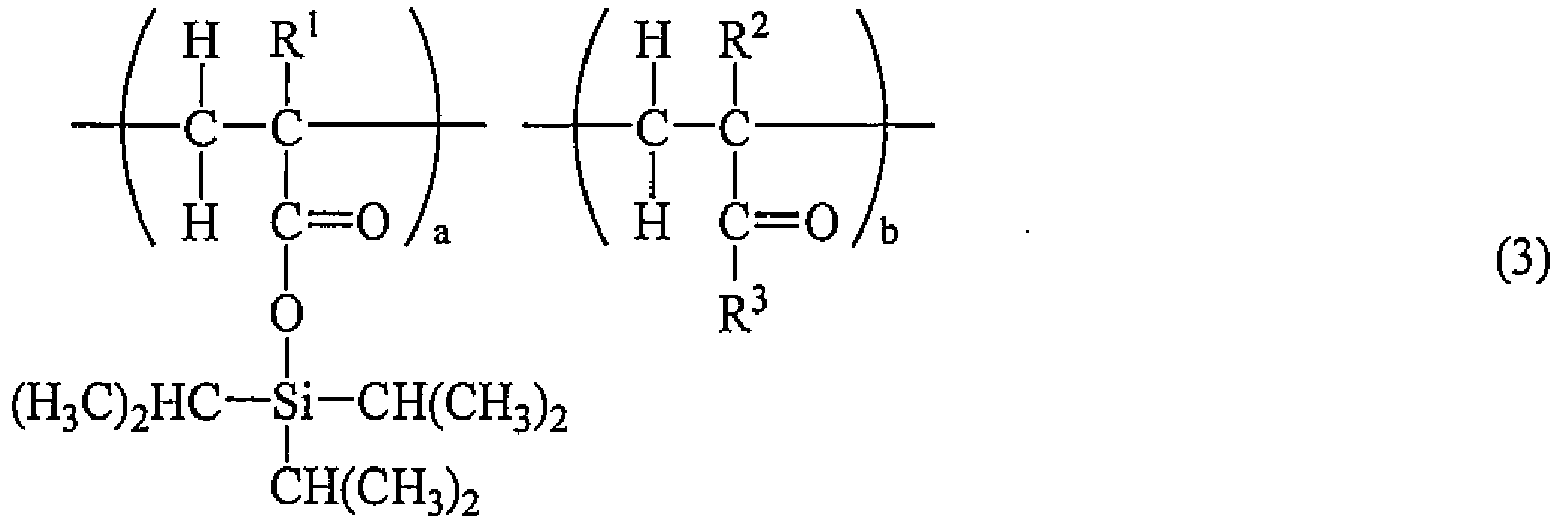
- a copolymer comprising repeating units having the general formula (3) is preferred.
- a copolymer comprising repeating units having the general formula (4) is more preferred.
- R 6 is a C 1 -C 20 divalent hydrocarbon group which may contain -O-, with the proviso that oxygen atoms do not adjoin
- R 7 is hydrogen or a C 1 -C 20 monovalent hydrocarbon group
- n is an integer of 1 to 15
- R 8 and R 9 each are a C 1 -C 20 divalent hydrocarbon group
- R 10 is hydrogen or a C 1 -C 20 monovalent hydrocarbon group
- m is an integer of 1 to 15.
- the invention provides a composition comprising the copolymer defined above and an organic solvent.
- the organic solvent is an aromatic hydrocarbon solvent.
- composition is for use as antifouling paint.
- the invention provides a method for preparing the copolymer defined above, comprising the step of effecting group-transfer polymerization of monomers containing triisopropylsilyl (meth)acrylate having the formula (1) defined above and a (meth)acrylic acid derivative in the presence of a catalyst using a silylketene acetal having the general formula (7) as an initiator.
- R 11 is a C 1 -C 10 monovalent hydrocarbon group or a substituent: SiR 12 R 13 R 14 , R 12 to R 14 each are a C 1 -C 10 monovalent hydrocarbon group, R 15 and R 16 each are hydrogen or a C 1 -C 10 monovalent hydrocarbon group.
- the invention provides a method for preparing the copolymer defined above, comprising the step of effecting atomic transfer radical polymerization of monomers containing triisopropylsilyl (meth)acrylate having the formula (1) defined above and a (meth)acrylic acid derivative in the presence of a heavy metal salt and a ligand using a halogen compound having the general formula (8) as an initiator.
- R 17 to R 19 each are a halogen atom or C 1 -C 10 monovalent hydrocarbon group, any one of R 17 to R 19 being halogen
- R 20 is a C 1 -C 20 monovalent hydrocarbon group which may contain oxygen, sulfur or halogen.
- the heavy metal salt is a heavy metal halide
- the ligand is an amine ligand
- the invention provides a method for preparing the copolymer defined above, comprising the step of effecting reversible addition-fragmentation chain-transfer polymerization of monomers containing triisopropylsilyl (meth)acrylate having the formula (1) defined above and a (meth)acrylic acid derivative in the presence of a sulfur-containing compound using a radical compound as an initiator.
- the radical compound is an azo compound or organic peroxide
- the sulfur-containing compound is a compound having trithiocarbonate, dithioester, thioamide, thiocarbamate or dithiocarbamate as a polymerization initiator group.
- the copolymer of triisopropylsilyl (meth)acrylate with (meth)acrylic acid derivative has a narrow polydispersity and low viscosity, the amount of an organic solvent used for preparation of paint compositions can be reduced.
- the reduced content of organic solvent is effective for decreasing spray-dust during paint coating operation and improving the efficiency of paint coating and the leveling property of a coating.
- the copolymer is suited as an ingredient for an antifouling paint composition, specifically as a hydrolyzable self-polishing polymer in antifouling paint for ship hulls and fishing nets.
- Cn-Cm means a group containing from n to m carbon atoms per group.
- polydispersity index is a molecular weight distribution and given as Mw/Mn wherein Mw and Mn are weight and number average molecular weights, respectively.
- the invention provides a copolymer of monomers containing triisopropylsilyl (meth)acrylate having the general formula (1) and a (meth)acrylic acid derivative, having a number average molecular weight (Mn) of 6,000 to 100,000 and a polydispersity index (Mw/Mn) of up to 2.0.
- the copolymer may be a random or block copolymer of triisopropylsilyl (meth)acrylate with (meth)acrylic acid derivative.
- R 1 is hydrogen or methyl. That is, formula (1) represents triisopropylsilyl acrylate or triisopropylsilyl methacrylate, which may be used alone or in admixture.
- the (meth)acrylic acid derivative has the general formula (2).
- R 2 is hydrogen or methyl.
- R 3 is an alkoxy group of 1 to 20 carbon atoms, preferably 1 to 16 carbon atoms, and more preferably 1 to 12 carbon atoms; an aryloxy group of 6 to 20 carbon atoms, preferably 6 to 16 carbon atoms, and more preferably 6 to 12 carbon atoms; a monovalent hydrocarbon group of 1 to 20 carbon atoms, preferably 1 to 16 carbon atoms, and more preferably 1 to 12 carbon atoms, which may contain at least one divalent moiety selected from -O-, -S-, and -NR- (wherein R is hydrogen or a monovalent hydrocarbon group of 1 to 20 carbon atoms, preferably 1 to 16 carbon atoms, and more preferably 1 to 12 carbon atoms), with the proviso that heteroatoms such as oxygen, sulfur and nitrogen do not adjoin each other, and which may be substituted with silyl, carbonyl or halogen; an amino group; a siloxy group (exclusive of triiso)
- Suitable groups R 3 include linear alkoxy groups such as methoxy, ethoxy, propoxy, n-butoxy, n-pentyloxy, hexyloxy, heptyloxy, octyloxy, nonyloxy, decyloxy, dodecyloxy, octadecyloxy, vinyloxy, and allyloxy; branched alkoxy groups such as isopropoxy, isobutoxy, tert-butoxy, isopentyloxy, sec-pentyloxy, tert-pentyloxy, neopentyloxy, 1-methylpentyloxy, isooctyloxy, and isodecyloxy; cyclic alkoxy groups such as cyclohexyloxy, 4-tert-butylcyclohexyloxy, and cyclodecyloxy; aryloxy groups such as phenoxy, benzyloxy, p-methylphenoxy, nap
- R in the monovalent hydrocarbon group containing -NR- examples include saturated hydrocarbon groups, typically linear alkyl groups such as methyl, ethyl, n-propyl, n-butyl, n-hexyl, n-heptyl, n-octyl, n-nonyl, and n-decyl, branched alkyl groups such as isopropyl, isobutyl, sec-butyl, tert-butyl, isopentyl, 2-pentyl, 3-pentyl, and tert-pentyl, and cyclic alkyl groups such as cyclopropyl, cyclohexyl, cyclopentyl, and cyclooctyl; unsaturated hydrocarbon groups including alkenyl groups such as vinyl, allyl, 1-propenyl, 1-methylpropenyl, butcnyl, pcntcnyl, hexenyl
- Examples of the (meth)acrylic acid derivative include (meth)acrylic acid, (meth)acrylates such as methyl (meth)acrylate, ethyl (meth)acrylate, n-propyl (meth)acrylate, isopropyl (meth)acrylate, n-butyl (meth)acrylate, isobutyl (meth)acrylate, tert-butyl (meth)acrylate, pentyl (meth)acrylate, hexyl (meth)acrylate, 2,3,4-trimethylhexyl (meth)acrylate, heptyl (meth)acrylate, octyl (meth)acrylate, isooctyl (meth)acrylate, nonyl (meth)acrylate, decyl (meth)acrylate, isodedyl (meth)acrylate, dodecyl (meth)acrylate, octadecyl (meth)acrylate,
- Examples of the (meth)acrylic acid derivative also include dicyclopentanyloxyethyl (meth)acrylate, glycidyl (meth)acrylate, 3-hydroxy-1-adamantyl (meth)acrylate, methoxymethyl (meth)acrylate, ethoxymethyl (meth)acrylate, 2-methoxyethyl (meth)acrylate, 3-methoxypropyl (meth)acrylate, 4-methoxybutyl (meth)acrylate, 5-methoxy-3-oxapentyl (meth)acrylate, 8-methoxy-3,6-dioxaoctyl (meth)acrylate, 2-ethoxyethyl (meth)acrylate, 3-ethoxypropyl (meth)acrylate, 4-ethoxybutyl (meth)acrylate, 2-hydroxyethyl (meth)acrylate, 3-hydroxypropyl (meth)acrylate, 4-hydroxybutyl (meth)acrylate, 5-hydroxy
- the copolymer obtained from the above monomers contains repeating units having the general formula (3).
- R 1 to R 3 are as defined above.
- the copolymer contains repeating units having the general formula (4).
- R 4 is hydrogen or methyl
- R 5 is a substituent group having the general formula (5) or (6).
- R 6 is a divalent hydrocarbon group of 1 to 20 carbon atoms, preferably 1 to 16 carbon atoms, and more preferably 1 to 12 carbon atoms, which may contain -O-, with the proviso that oxygen atoms do not adjoin
- R 7 is hydrogen or a monovalent hydrocarbon group of 1 to 20 carbon atoms, preferably 1 to 16 carbon atoms, and more preferably 1 to 12 carbon atoms
- n is an integer of 1 to 15.
- R 8 and R 9 each are a divalent hydrocarbon group of 1 to 20 carbon atoms, preferably 1 to 16 carbon atoms, and more preferably 1 to 12 carbon atoms
- R 10 is hydrogen or a monovalent hydrocarbon group of 1 to 20 carbon atoms, preferably 1 to 16 carbon atoms, and more preferably 1 to 12 carbon atoms
- m is an integer of 1 to 15. It is noted that the hydrocarbon moiety in the hydrocarbon group may be linear, branched or cyclic.
- Examples of the monovalent hydrocarbon groups R 7 and R 10 include saturated hydrocarbon groups including linear alkyl groups such as methyl, ethyl, n-propyl, n-butyl, n-hexyl, n-heptyl, n-octyl, n-nonyl, and n-decyl, branched alkyl groups isopropyl, isobutyl, sec-butyl, tert-butyl, isopentyl, 2-pentyl, 3-pentyl, and tert-pentyl, and cyclic alkyl groups such as cyclopropyl, cyclohexyl, cyclopentyl, and cyclooctyl; unsaturated hydrocarbon groups including alkenyl groups such as vinyl, allyl, 1-propenyl, 1-methylpropenyl, butenyl, pentenyl, hexenyl, heptenyl, oc
- Examples of the divalent hydrocarbon groups R 6 , R 8 and R 9 include C 1 -C 20 alkylene groups such as methylene, ethylene, trimethylene, propylene, tetramethylene, and pentamethylene.
- substituent group having the formula (5) examples include hydroxyalkyl groups such as hydroxymethyl, 2-hydroxyethyl, 3-hydroxypropyl, 4-hydroxybutyl, 5-hydroxypentyl, and 6-hydroxyhexyl; alkoxyalkyl groups such as methoxymethyl, ethoxymethyl, 2-methoxyethyl, 3-methoxypropyl, 4-methoxybutyl, 2-ethoxyethyl, 3-ethoxypropyl, and 4-ethoxybutyl; and groups wherein R 6 contains an ether bond, such as 5-methoxy-3-oxa-pentyl, 8-methoxy-3,6-dioxaoctyl, 11-methoxy-3,6,9-trioxaundecyl, 7-methoxy-4-oxaheptyl, 9-methoxy-5-oxanonyl, 5-ethoxy-3-oxapentyl, 8-ethoxy-3,6-dioxa
- Examples of the substituent group having the formula (6) include carbonyl-containing groups such as 2-(3-methoxypropyl)carbonyloxyethyl, 2-(4-methoxybutyl)carbonyloxyethyl, 2-(5-methoxypentyl)carbonyloxyethyl, 3-(3-methoxypropyl)carbonyloxypropyl, 3-(4-methoxybutyl)carbonyloxypropyl, 3-(5-methoxypentyl)carbonyloxypropyl, 4-(3-methoxypropyl)carbonyloxybutyl, 4-(4-methoxybutyl)carbonyloxybutyl, 4-(5-methoxypentyl)carbonyloxybutyl, 2-(3-hydroxypropyl)carbonyloxyethyl, 2-(4-hydroxybutyl)carbonyloxyethyl, 2-(5-hydroxypentyl)carbonyloxyethyl, 3-(
- Copolymerization of components having these substituent groups enables to hydrophilize the surface of a coating as applied and adjust the self-polishing ability.
- the copolymer should have a number average molecular weight (Mn) of 6,000 to 100,000. With Mn in the range, a coating does not become brittle and the hydrolysis rate thereof is adequately suppressed. Mn is preferably 7,000 to 70,000, more preferably 9,000 to 50,000. If Mn is less than 6,000, the paint composition may have poor film-forming ability.
- Mn number average molecular weight
- the copolymer should have a polydispersity (Mw/Mn) of up to 2.0 from the aspect of eliminating the influences of high and low molecular weight fractions.
- Mw/Mn is up to 1.8, more preferably up to 1.6. If Mw/Mn of the copolymer exceeds 2.0, a high molecular weight fraction may act as a flocculant to increase the viscosity of the copolymer. If a low molecular weight fraction is included, it may detract from the film-forming ability of the paint.
- the lower limit of polydispersity is preferably 1.0 though not critical.
- the Mn and Mw/Mn are determined by gel permeation chromatography (GPC) versus polystyrene standards under the following GPC conditions.
- GPC conditions Analyzer HLC-8220GPC (Tosoh Co., Ltd.) Column: KF-402.5HQ (4.6 mm ⁇ 250 mm) + KF-404HQ (4.6 mm ⁇ 250 mm) (Shodex) Eluent: tetrahydrofuran (THF) Flow rate: 0.35 mL/min Detector: RI Column oven temperature: 40°C Standards: polystyrene
- the copolymer is obtained from polymerization of triisopropylsilyl (meth)acrylate of formula (1), a (meth)acrylic acid derivative, and an initiator in the presence of a catalyst.
- the polymerization technique which is preferred from the aspect of a narrow polydispersity is living polymerization.
- the living polymerization include well-known living anion polymerization, living radical polymerization, and living cation polymerization.
- group-transfer polymerization (GTP) which is one type of living anion polymerization
- ATRP atomic transfer radical polymerization
- RAFT reversible addition-fragmentation chain-transfer polymerization
- the GTP is a technique for polymerizing (meth)acrylates in the presence of a catalyst using a silylketene acetal having the general formula (7) as an initiator. Specifically, any two of the monomer, catalyst and initiator are mixed prior to reaction. When the remaining one is added thereto, polymerization starts. The order of addition is not critical. Polymerization starts even when they are added in any order.
- the reactor may be charged with all monomers at the start of the reaction.
- the reaction may start with one or two monomers. Once the reaction reaches the desired rate of polymerization, the remaining monomers may be added one after another to yield a block copolymer.
- the silylketene acetal used as the initiator in the GTP technique has the general formula (7).
- R 11 is a monovalent hydrocarbon group of 1 to 10 carbon atoms, preferably 1 to 8 carbon atoms, and more preferably 1 to 6 carbon atoms, or a substituent group: SiR 12 R 13 R 14 , and R 12 to R 14 each are a monovalent hydrocarbon group of 1 to 10 carbon atoms, preferably 1 to 8 carbon atoms, and more preferably 1 to 6 carbon atoms.
- substituent group: SiR 12 R 13 R 14 include trimethylsilyl, triethylsilyl, triisopropylsilyl, triisobutylsilyl, triphenylsilyl, methyldiphenylsilyl, and dimethylphenylsilyl.
- R 15 and R 16 each are a monovalent hydrocarbon group of 1 to 10 carbon atoms, preferably 1 to 8 carbon atoms, and more preferably 1 to 6 carbon atoms, or hydrogen.
- Examples of these monovalent hydrocarbon groups are as illustrated above for R 7 and R 10 while their hydrocarbon moiety may be either linear, branched or cyclic.
- Examples of the compound having formula (7) include methyl(trimethylsilyl)dimethylketene acetal, methyl(triethylsilyl)dimethylketene acetal, methyl(triisopropylsilyl)dimethylketene acetal, methyl(triisobutylsilyl)dimethylketene acetal, methyl(trimethylsilyl)diethylketene acetal, methyl(triphenylsilyl)dimethylketene acetal, methyl(methyldiphenylsilyl)dimethylketene acetal, methyl(dimethylphenylsilyl)dimethylketene acetal, bis(trimethylsilyl)dimethylketene acetal, bis(triethylsilyl)dimethylketene acetal, and bis(triisopropylsilyl)dimethylketene acetal.
- methyl(trimethylsilyl)dimethylketene acetal preference is given to methyl(trimethylsilyl)dimethylketene acetal, methyl(triethylsilyl)dimethylketene acetal, methyl(triisopropylsilyl)dimethylketene acetal, and bis(trimethylsilyl)dimethylketene acetal, from the standpoint of a high degree of conversion of monomers.
- Suitable catalysts include onium compounds having a counter anion in the form of fluorine, azide, cyanide, carboxylate, or a salt with conjugated acid of the foregoing, metal fluorides, organophosphorus compounds, imidazolium salts, Lewis acids, and Bronsted acids. Of these, the onium compounds, Lewis acids and Bronsted acids are preferred because a copolymer with a narrow polydispersity is obtainable.
- Examples include onium compounds such as tetrabutylammonium fluoride, tetrabutylammonium bifluoride, tetraethylammonium fluoride, tetramethylammonium fluoride, tetrabutylammonium acetate, tetrabutylammonium biacetate, tetrabutylammonium benzoate, tetrabutylammonium m-chlorobenzoate, tetrabutylammonium bibenzoate, tetrabutylammonium cyanide, tris(dimethylamino)sulfonium difluorotrimethylsilicate, tris(dimethylamino)sulfonium azide, tris(dimethylamino)sulfonium cyanide, and tris(dimethylamino)sulfonium bifluoride; metal fluorides such as potassium fluoride, sodium fluoride, and
- tetrabutylammonium compounds such as tetrabutylammonium bifluoride, tetrabutylammonium acetate, tetrabutylammonium biacetate, tetrabutylammonium benzoate, tetrabutylammonium m-chlorobenzoate, and tetrabutylammonium bibenzoate; tris(dimethylamino)sulfonium difluorotrimethylsilicate, N-(trimethylsilyl)bis(trifluoromethanesulfonyl)imide, and 2,3,4,5,6- pentafluorophenylbis(trifluoromethanesulfonyl)methane.
- the molecular weight may be set depending on the amount of the initiator, silylketene acetal of formula (7) used.
- the degree of polymerization corresponds to (moles of monomer)/(moles of initiator)
- the degree of polymerization multiplied by the molecular weight of the monomer and the conversion of the monomer gives the theoretical molecular weight.
- the initiator is preferably used in an amount of 0.001 to 0.2 equivalent, more preferably 0.005 to 0.15 equivalent, and most preferably 0.01 to 0.1 equivalent based on the entire monomers used. As long as the initiator is used within the range, a desired copolymer is prepared in high yields.
- the amount of the catalyst used is not particularly limited. From the aspects of reactivity and productivity, the catalyst is preferably used in an amount of 0.0001 to 1 mole, more preferably 0.0005 to 0.1 mole, and most preferably 0.001 to 0.05 mole per mole of the silylketene acetal of formula (7).
- the reaction temperature is preferably in a range of -100°C to 200°C, more preferably -50°C to 100°C, and even more preferably 0°C to 50°C, though not limited thereto.
- the reaction time is preferably 0.1 to 30 hours, more preferably 0.5 to 20 hours, even more preferably 1 to 10 hours, though not limited thereto.
- an inert gas atmosphere such as nitrogen or argon is preferred.
- a solvent may be used.
- Suitable solvents include hydrocarbon solvents such as pentane, hexane, cyclohexane, heptane, isooctane, toluene, xylene, and mesitylene; aprotic polar solvents such as ethyl acetate, acetonitrile, propionitrile, N,N-dimethylformamide, and N-methylpyrrolidone; halogenated hydrocarbon solvents such as dichloromcthane, dichloroethane, and chlorobenzene; and ether solvents such as diethyl ether, tetrahydrofuran, dioxanc, and dimethoxyethane. These solvents may be used alone or in admixture of two or more. Inter alia, toluene, xylene, mesitylene and tetrahydrofuran are preferred.
- the copolymer obtained from GTP has a structure which contains the initiator's silyl group at one end of the copolymer after the completion of reaction.
- the silyl group at one end of the copolymer may be converted to a carboxylic acid or ester by addition of water or alcohol.
- Suitable alcohols include methanol, ethanol, 1-propanol, 2-propanol, 1-butanol, and 2-butanol.
- the amount of the water or alcohol used is not particularly limited.
- the water or alcohol is preferably used in an amount of 0.1 to 10 moles, more preferably 0.5 to 7 moles, and most preferably 1 to 5 moles per mole of the initiator.
- ATRP atomic transfer radical polymerization
- the ATRP is a technique for polymerizing (meth)acrylate in the presence of a heavy metal salt and a ligand using a halogen compound having the general formula (8) as an initiator. Specifically, the reactor is charged with the monomer, heavy metal salt, ligand and initiator prior to reaction. When the reactor is heated, polymerization starts.
- the reactor may be charged with all monomers at the start of the reaction.
- the reaction may start with one or two monomers. Once the desired rate of polymerization is reached, the remaining monomers may be added one after another to yield a block copolymer.
- R 17 to R 19 each are a halogen atom or a monovalent hydrocarbon group of 1 to 10 carbon atoms, preferably 1 to 8 carbon atoms, more preferably 1 to 6 carbon atoms, with the proviso that any one of R 17 to R 19 is halogen.
- R 20 is a monovalent hydrocarbon group of 1 to 20 carbon atoms, preferably 1 to 15 carbon atoms, more preferably 1 to 12 carbon atoms, which may contain an oxygen, sulfur or halogen atom.
- Examples of these monovalent hydrocarbon groups are as illustrated above for R 7 and R 10 while their hydrocarbon moiety may be either linear, branched or cyclic.
- halogen compound having formula (8) examples include tert-butyl 2-bromoisobutyrate, methyl 2-bromoisobutyrate, ethyl 2-bromoisobutyrate, 2-hydroxycthyl 2-bromoisobutyrate, ethylene bis(2-bromoisobutyratc), bis[2-(2-bromoisobutyloxy)ethyl]disulfide, 10-undecenyl 2-bromoisobutyrate, dodecyl 2-bromoisobutyrate, and octadecyl 2-bromoisobutyrate.
- methyl 2-bromoisobutyrate ethyl 2-bromoisobutyrate, 10-undecenyl 2-bromoisobutyrate, and dodecyl 2-bromoisobutyrate are preferred from the standpoint of a high polymerization initiation ability.
- the heavy metal salt is typically a heavy metal halide, examples of which include copper halides such as copper(I) bromide, copper(II) bromide, copper(I) chloride and copper(II) chloride; titanium halides such as titanium(II) chloride, titanium(III) chloride, titanium(IV) chloride and titanium(IV) bromide; iron halides such as iron(II) chloride, iron(III) chloride, iron(II) bromide, and iron(III) bromide; cobalt halides such as cobalt(II) chloride and cobalt(II) bromide; nickel halides such as nickel(II) chloride and nickel(II) bromide; molybdenum halides such as molybdenum(III) chloride and molybdenum(V) chloride; and ruthenium halides such as ruthenium(III) chloride. Of these, copper(I) bromide and copper(I) chloride are preferred
- the ligand is typically an amine ligand, examples of which include bidentate ligands such as 2,2'-bipyridine, 4,4'-dinonyl-2,2'-bipyridine, N-(butyl)-2-pyridylmethanimine, and N-(octyl)-2-pyridylmethanimine; tridentate ligands such as N,N,N',N",N"-pentamethyldiethylenetriamine; and tetradentate ligands such as N-propyl-N,N-di(2-pyridylmethyl)amine, 1,1,4,7,10,10-hexamethyltriethylenetetramine, hexamethyltris(2-aminoethyl)amine, N,N-bis(2-dimethylaminoethyl)-N,N'-dimethylethylenediamine, tris(2-pyridylmethyl)amine, tris[2-(dimethyla
- 2,2'-bipyridine, 4,4'-dinonyl-2,2' -bipyridine, N,N,N',N",N"-pentamethyldiethylenetriamine, 1,1,4,7,10,10-hexamethyltriethylenetetramine, tris[2-(dimethylamino)ethyl]amine, and tris(2-pyridylmethyl)amine are preferred for increasing polymerization activity and obtaining a copolymer with a narrow polydispersity.
- the molecular weight may be set depending on the amount of the compound of formula (8) used as initiator.
- the initiator is preferably used in an amount of 0.001 to 0.2 equivalent, more preferably 0.003 to 0.15 equivalent, and most preferably 0.005 to 0.1 equivalent based on the entire monomers used. As long as the initiator is used within the range, a desired copolymer is prepared in high yields.
- the heavy metal salt is used in an amount of 0.001 to 0.2 equivalent, more preferably 0.003 to 0.15 equivalent, and most preferably 0.005 to 0.1 equivalent based on the entire monomers used although the amount is not limited thereto.
- the ligand is used in an amount of 0.001 to 0.2 equivalent, more preferably 0.003 to 0.15 equivalent, and most preferably 0.005 to 0.1 equivalent based on the entire monomers used although the amount is not limited thereto.
- the reaction temperature is preferably in a range of -50°C to 200°C, more preferably 0°C to 150°C, and even more preferably 20°C to 130°C, though not limited thereto.
- the reaction time is preferably 1 to 30 hours, more preferably 3 to 20 hours, even more preferably 5 to 10 hours, though not limited thereto.
- an inert gas atmosphere such as nitrogen or argon is preferred.
- a solvent may be used.
- Suitable solvents include hydrocarbon solvents such as pentane, hexane, cyclohexane, heptane, isooctane, toluene, xylene, and mesitylene; aprotic polar solvents such as ethyl acetate, acetonitrile, acetone, propionitrile, N,N-dimethylformamide, and N-methylpyrrolidone; protic polar solvents such as water, methanol, ethanol, and hexafluoro-2-propanol; halogenated hydrocarbon solvents such as dichloromethane, dichloroethane, and chlorobenzene; and ether solvents such as diethyl ether, tetrahydrofuran, dioxane, and dimethoxyethane.
- hydrocarbon solvents such as pentane, hexane, cyclohexane, h
- solvents may be used alone or in admixture of two or more.
- toluene, xylene, mesitylene, ethyl acetate, acetone, methanol, ethanol and N,N-dimethylformamide are preferred.
- RAFT reversible addition-fragmentation chain-transfer polymerization
- the RAFT is a technique for polymerizing (meth)acrylate in the presence of a sulfur-containing compound as a chain-transfer agent (RAFT agent) using a radical compound as an initiator. Specifically, the reactor is charged with the monomer, radical initiator and RAFT agent prior to reaction. When the reactor is heated, polymerization starts.
- RAFT agent chain-transfer agent
- the reactor may be charged with all monomers at the start of the reaction.
- the reaction may start with one or two monomers. Once the desired rate of polymerization is reached, the remaining monomers may be added one after another to yield a block copolymer.
- Suitable radical compounds used as the initiator include azo compounds and organic peroxides.
- Suitable azo compounds include 1,1'-azobis(cyclohexanecarbonitrile), 2,2'-azobis(4-methoxy-2,4-dimethylvaleronitrile), 2,2'-azobis(2,4-dimethylvaleronitrile), 2,2'-azobis(isobutyronitrile), 2,2'-azobis(2-methylbutyronitrile), 2,2'-azobis[2-(2-imidazolin-2-yl)propane]dihydrochloride, 2,2'-azobis[2-(2-imidazolin-2-yl)propane], 2,2'-azobis(2-aminopropane)dihydrochloride, 2,2'-azobis[N-(2-carboxyethyl)-2-methylpropionamidine]-n-hydrate, 2,2'-azobis[2-methyl-N-(2-hydroxyethyl)propionamide], 2,2
- 1,1'-azobis(cyclohexanecarbonitrile), 2,2'-azobis(isobutyronitrile), 2,2'-azobis(2-methylbutyronitrile), 2,2'-azobis(2-aminopropane)dihydrochloride, and 4,4'-azobis(4-cyanovaleric acid) are preferred for increasing the conversion rate of monomers.
- organic peroxide examples include di-tert-butyl peroxide, tert-butyl hydroperoxide, and benzoyl peroxide.
- sulfur-containing compound used as the chain-transfer agent examples include compounds having trithiocarbonate, dithioester, thioamide, thiocarbamate or dithiocarbamate as a polymerization initiator group. Of these, compounds having trithiocarbonate and dithioester are preferred for increasing the conversion rate of monomers and obtaining a copolymer with a narrow polydispersity.
- chain-transfer agent examples include 4-cyano-4-[(dodecylsulfanylthiocarbonyl)sulfanyl]pentanoic acid, 2-cyano-2-propyldodecyltrithiocarbonate, 4-cyano-4-[(dodecylsulfanylthiocarbonyl)sulfanyl]pentanol, poly(ethylene glycol) methyl ether 4-cyano-4-[(dodecylsulfanylthiocarbonyl)sulfanyl]-pentanoate (av.
- the molecular weight may be set depending on the amount of the RAFT agent used.
- the RAFT agent is preferably used in an amount of 0.001 to 0.2 equivalent, more preferably 0.003 to 0.15 equivalent, and most preferably 0.005 to 0.1 equivalent based on the entire monomers used. As long as the RAFT agent is used within the range, a desired copolymer is prepared in high yields.
- the amount of the radical initiator used is preferably 0.0002 to 0.04 equivalent, more preferably 0.0006 to 0.03 equivalent, and most preferably 0.001 to 0.02 equivalent based on the entire monomers used, but not limited thereto.
- the reaction temperature is preferably in a range of -50°C to 200°C, more preferably 0°C to 150°C, and even more preferably 20°C to 130°C, though not limited thereto.
- the reaction time is preferably 1 to 30 hours, more preferably 3 to 20 hours, even more preferably 5 to 10 hours, though not limited thereto.
- an inert gas atmosphere such as nitrogen or argon is preferred.
- a solvent may be used.
- Suitable solvents include hydrocarbon solvents such as pentane, hexane, cyclohexane, heptane, isooctane, toluene, xylene, and mesitylene; aprotic polar solvents such as ethyl acetate, acetonitrile, acetone, propionitrile, N,N-dimethylformamide, and N-methylpyrrolidone; protic polar solvents such as water, methanol, ethanol, and hexafluoro-2-propanol; halogenated hydrocarbon solvents such as dichloromethane, dichloroethane, and chlorobenzene; and ether solvents such as diethyl ether, tetrahydrofuran, dioxane, and dimethoxyethane.
- hydrocarbon solvents such as pentane, hexane, cyclohexane, h
- solvents may be used alone or in admixture of two or more.
- toluene, xylene, mesitylene, ethyl acetate, tetrahydrofuran, methanol, ethanol and N,N-dimethylformamide are preferred.
- a further embodiment of the invention is a composition comprising at least the copolymer defined above and an organic solvent.
- the composition may be used for resin modifiers, pigment dispersants, and the like as well as antifouling paints.
- the content of the copolymer is 20 to 90 wt%, preferably 30 to 80 wt% based on the total weight of the composition.
- Suitable organic solvents include aromatic hydrocarbon solvents such as toluene, xylene, and ethylbenzene; ketone solvents such as methyl ethyl ketone, methyl isobutyl ketone, and cyclohexanone; alcohol solvents such as ethanol and isopropanol; and ester solvents such as ethyl acetate and butyl acetate.
- aromatic hydrocarbon solvents such as toluene and xylene are preferred from the aspects of productivity and manufacturing operation.
- the organic solvent is preferably used in an amount of 10 to 80 wt%, preferably 20 to 70 wt% based on the total weight of the composition. From the aspect of VOC reduction, it is desirable to decrease the amount of the organic solvent used. Since the copolymer has a low viscosity, the amount of organic solvent used can be reduced.
- the copolymer is suited for antifouling paints, especially effective for antifouling paints to ship hulls and fishing nets.
- the antifouling paint may be prepared by adding an antifouling agent, a leaching control agent, and other additives to the copolymer and the organic solvent and mixing and dispersing them.
- the antifouling agent is not particularly limited as long as it has biocidal and repellent effects to fouling marine organisms.
- Examples include copper(I) oxide, copper rhodanide, copper pyrithione, and zinc pyrithione.
- the leaching control agent is not particularly limited as long as it enhances leaching of the antifouling agent from the antifouling coating and improves static antifouling properties.
- examples include rosin derivatives such as gum rosins, wood rosins, hydrogenated rosins, and disproportionated rosins, aliphatic and cycloaliphatic monocarboxylic acids, and derivatives and metal salts of these monocarboxylic acids.
- Examples of the monocarboxylic acid compound include naphthenic acid, cycloalkenylcarboxylic acid, bicycloalkenylcarboxylic acid, versatic acid, trimethylisobutenylcyclohexenecarboxylic acid, stearic acid, hydroxystearic acid, salicylic acid, and metal salts thereof.
- the pigment is not particularly limited as long as it can adjust the color of the antifouling coating or impart the desired color.
- Any organic or inorganic pigments may be used. Suitable organic pigments include Carbon Black, Naphthol Red, and Phthalocyanine Blue. Suitable inorganic pigments include red iron oxide, talc, titanium oxide, silica, calcium carbonate, barium sulfate, mica, and clay. In order to improve the effect of preventing color unevenness of an antifouling coating, a pigment dispersant may be added.
- Typical of the organic pigment dispersant are aliphatic amines and organic acids.
- Typical of the inorganic pigment dispersant is ethylsilicate.
- the plasticizer is not particularly limited as long as it can improve the crack resistance of an antifouling coating. Suitable plasticizers include chlorinated paraffins, petroleum resins, ketone resins, tricresyl phosphate (TCP), polyvinyl ether, and dialkyl phthalates.
- the sag-control agent is not particularly limited as long as it can suppress sagging when the antifouling paint composition is applied to a structure. Suitable sag-control agents include amide wax, hydrogenated castor oil wax, and finely divided synthetic silica.
- the anti-settling agent is not particularly limited as long as it can prevent precipitation in the antifouling paint composition during storage.
- Typical of the anti-settling agent is polyethylene oxide wax.
- the dehydrating agent is not particularly limited as long as it can prevent viscosity buildup during storage.
- a typical dehydrating agent is ethyl silicate.
- the antifouling paint composition using the copolymer of the invention may be prepared by any well-known methods.
- the antifouling paint composition may be prepared by adding the copolymer and other components to a milling vessel at a time or in any desired order and mixing them by a well-known stirring and mixing means.
- Suitable stirring and mixing means include a high speed disperser, sand grind mill, basket mill, and ball mill.
- kinematic viscosity (in cSt) of a copolymer solution is measured at the liquid temperature of 25°C by a Ubbelohde viscometer (Sibata Scientific Technology Ltd.).
- a 100-ml four-neck round bottom flask equipped with a reflux condenser, thermometer, and stirrer was purged with nitrogen and charged with 5.0 g (0.0581 mol) of methyl acrylate, 5.0 g (0.0219 mol) of triisopropylsilyl acrylate, 190.9 mg (1.095 mmol) of methyl(trimethylsilyl)dimethylketene acetal, and 10.0 g of xylene.
- 10.8 mg (0.024 mmol) of 2,3,4,5,6-pentafuluorophenylbis(trifluoromethanesulfonyl)methane was added at room temperature.
- a solution of copolymer A-2 or A-3 was obtained from polymerization reaction by the same method as in Example 1 aside from using the acrylate, triisopropylsilyl acrylate, polymerization initiator, catalyst, and organic solvent shown in Table 1.
- the kinematic viscosity, Mn, Mw, and Mw/Mn of copolymers A-2 and A-3 are shown in Table 1.
- a 100-ml four-neck round bottom flask equipped with a reflux condenser, thermometer, and stirrer was purged with nitrogen and charged with 2.4 g (0.0581 mol) of methyl methacrylate, 2.4 g (0.0219 mol) of triisopropylsilyl methacrylate, 122.0 mg (0.70 mmol) of methyl(trimethylsilyl)dimethylketene acetal, and 5.0 g of tetrahydrofuran.
- 6.8 mg (0.024 mmol) of tetrabutylammonium bibenzoate in a small amount of tetrahydrofuran was added at 65°C. The solution was stirred for 30 minutes.
- copolymer A-5 was obtained from polymerization reaction by the same method as in Example 4 aside from using the methacrylate, triisopropylsilyl methacrylate, polymerization initiator, catalyst, and organic solvent shown in Table 1.
- the kinematic viscosity, Mn, Mw, and Mw/Mn of copolymer A-5 are shown in Table 1.
- a 100-ml four-neck round bottom flask equipped with a reflux condenser, thermometer, and stirrer was purged with nitrogen and charged with 60 g of xylene.
- a mixture of 30.0 g (0.348 mol) of methyl acrylate, 30.0 g (0.131 mol) of triisopropylsilyl acrylate and 0.6 g of 2,2'-azobis(2-methylbutyronitrile) was added dropwise over 2.5 hours. The solution was stirred for one hour at the temperature.
- copolymer B-2 or B-3 was obtained from polymerization reaction by the same method as in Comparative Example 1 aside from using the acrylate, triisopropylsilyl acrylate, polymerization initiator, and organic solvent shown in Table 1.
- the kinematic viscosity, Mn, Mw, and Mw/Mn of copolymers B-2 and B-3 are shown in Table 1.
- a solution of copolymer B-5 was obtained from polymerization reaction by the same method as in Comparative Example 4 aside from using the methacrylate, triisopropylsilyl methacrylate, polymerization initiator, and organic solvent shown in Table 1 and then adding the predetermined amount of xylene to the reaction solution.
- the kinematic viscosity, Mn, Mw, and Mw/Mn of copolymer B-5 are shown in Table 1.
- copolymers A-1, A-2, and A-3 in Examples 1 to 3 have a lower kinematic viscosity than copolymers B-1, B-2, and B-3 in Comparative Examples 1 to 3.
- copolymers typically have a high kinematic viscosity. When such copolymers are used for paints, they must be diluted with organic solvents. Copolymers having a lower kinematic viscosity need a less amount of organic solvent for dilution.
- copolymers A-4, A-5, A-6, A-7, A-8, and A-9 in Examples 4 to 9 also have a lower kinematic viscosity than copolymers B-4 and B-5 in Comparative Examples 4 and 5. It has been demonstrated that using the inventive copolymer, the amount of organic solvent needed for dilution is reduced.
Landscapes
- Chemical & Material Sciences (AREA)
- Organic Chemistry (AREA)
- Life Sciences & Earth Sciences (AREA)
- Engineering & Computer Science (AREA)
- Materials Engineering (AREA)
- Wood Science & Technology (AREA)
- Health & Medical Sciences (AREA)
- Chemical Kinetics & Catalysis (AREA)
- Medicinal Chemistry (AREA)
- Polymers & Plastics (AREA)
- Addition Polymer Or Copolymer, Post-Treatments, Or Chemical Modifications (AREA)
- Paints Or Removers (AREA)
- Polymerization Catalysts (AREA)
Abstract
Description
- This non-provisional application claims priority under 35 U.S.C. §119(a) on Patent Application No.
2016-196079 filed in Japan on October 4, 2016, the entire contents of which are hereby incorporated by reference. - This invention relates to a copolymer of triisopropylsilyl (meth)acrylate with a (meth)acrylic acid derivative and a method for preparing the same, and more particularly to a copolymer of triisopropylsilyl (meth)acrylate with a (meth)acrylic acid derivative which is suited as a hydrolyzable self-polishing polymer for use in antifouling paints and the like, and a method for preparing the same.
- Ship hulls, fishing nets and other structures which are immersed in seawater for a long term suffer the fouling problem that their surface is susceptible to settlement of marine organisms. For example, the fouling of marine organisms increases the surface roughness of ship hulls, causing to reduce the ship speed and increase the fuel cost. Also, marine fouling can clog fishing nets. For preventing marine organisms from fouling the structure, antifouling paints are typically applied to the structure surfaces.
- For example, Patent Documents 1 and 2 propose water-soluble antifouling paints. These water-soluble antifouling paints are poor in water resistance and unsatisfactory in antifouling performance. Patent Document 3 discloses an antifouling paint using a non-aqueous dispersion (NAD) polymer. Since the NAD polymer is dispersed in a solvent of the paint composition, the composition is difficult to form a uniform film by coating.
- On the other hand, copolymers of silyl (meth)acrylates with (meth)acrylic acid derivatives are used in antifouling paint compositions of hydrolyzable self-polishing type. Antifouling paints comprising copolymers using triisopropylsilyl acrylate or triisopropylsilyl methacrylate as the silyl (meth)acrylate component form coatings having an adequately controlled hydrolysis rate so that the coatings sustain for a long period of time. See Patent Document 4, for example.
- When antifouling paints are prepared using copolymers of silyl (mcth)acrylatcs with (meth)acrylic acid derivatives, organic solvents are used. This is because if antifouling paints have too high a viscosity during coating, they may fail to exert sufficient coating properties.
- To meet the current regulations of volatile organic compounds (VOC), there is a need for environment-friendly antifouling paint. Also, from the aspect of coating operation environment, it is desired to have a paint containing less VOC.
- As the means for reducing the amount of organic solvent used, Patent Document 5 intends to reduce the weight average molecular weight of a copolymer comprising silyl (meth)acrylate to lower its viscosity for thereby achieving a saving of the organic solvent.
-
- Patent Document 1:
-
JP-A 2009-173914 - Patent Document 2:
-
JP-A 2008-001804 - Patent Document 3:
-
WO 2005/042649 - Patent Document 4:
-
WO 2013/073580 - Patent Document 5:
-
JP-A 2014-205846 USP 7691938 ,EP 1641862 ) - Since the copolymer of triisopropylsilyl (meth)acrylate with a (meth)acrylic acid derivative described in Patent Document 4 has a wide polydispersity, a high molecular weight fraction may act as a flocculant to increase the viscosity of the copolymer. Then, a larger amount of organic solvent must be used.
- The copolymer in Example of Patent Document 5 is given a low viscosity by reducing the weight average molecular weight. Since the copolymer is prepared by radical polymerization, it has a wide polydispersity and a number average molecular weight of less than 6,000. The influence of a low molecular weight fraction such as oligomers becomes stronger, adversely affecting the film-forming ability of the paint. Such copolymer is unacceptable on practical use.
- From the aspects of environmental protection and coating operation environment, it is desired to have a paint composition having a low viscosity, a saving of VOC, and excellent antifouling properties.
- An object of the invention is to provide a copolymer of monomers containing triisopropylsilyl (meth)acrylate and a (meth)acrylic acid derivative, which is used to formulate a paint composition having as low a viscosity as possible and containing a less amount of an organic solvent than the prior art paint compositions, and a method for preparing the same.
- The inventors have found that by narrowing the polydispersity of a copolymer of triisopropylsilyl (meth)acrylate with a (meth)acrylic acid derivative, the influences of a low molecular weight fraction which detracts from film-forming ability and a high molecular weight fraction which contributes to a viscosity buildup can be eliminated, and the amount of an organic solvent used for paint preparation be reduced.
- In one aspect, the invention provides a copolymer of monomers containing triisopropylsilyl (meth)acrylate having the general formula (1) and a (meth)acrylic acid derivative, the copolymer having a number average molecular weight of 6,000 to 100,000 and a polydispersity index (Mw/Mn) of up to 2.0.

- Preferably the (meth)acrylic acid derivative has the general formula (2).

- A copolymer comprising repeating units having the general formula (3) is preferred.
- A copolymer comprising repeating units having the general formula (4) is more preferred.


- In another aspect, the invention provides a composition comprising the copolymer defined above and an organic solvent.
- Preferably, the organic solvent is an aromatic hydrocarbon solvent.
- Typically the composition is for use as antifouling paint.
- In a further aspect, the invention provides a method for preparing the copolymer defined above, comprising the step of effecting group-transfer polymerization of monomers containing triisopropylsilyl (meth)acrylate having the formula (1) defined above and a (meth)acrylic acid derivative in the presence of a catalyst using a silylketene acetal having the general formula (7) as an initiator.

- In a still further aspect, the invention provides a method for preparing the copolymer defined above, comprising the step of effecting atomic transfer radical polymerization of monomers containing triisopropylsilyl (meth)acrylate having the formula (1) defined above and a (meth)acrylic acid derivative in the presence of a heavy metal salt and a ligand using a halogen compound having the general formula (8) as an initiator.

- Preferably, the heavy metal salt is a heavy metal halide, and the ligand is an amine ligand.
- In a still further aspect, the invention provides a method for preparing the copolymer defined above, comprising the step of effecting reversible addition-fragmentation chain-transfer polymerization of monomers containing triisopropylsilyl (meth)acrylate having the formula (1) defined above and a (meth)acrylic acid derivative in the presence of a sulfur-containing compound using a radical compound as an initiator.
- Preferably, the radical compound is an azo compound or organic peroxide, and the sulfur-containing compound is a compound having trithiocarbonate, dithioester, thioamide, thiocarbamate or dithiocarbamate as a polymerization initiator group.
- Since the copolymer of triisopropylsilyl (meth)acrylate with (meth)acrylic acid derivative has a narrow polydispersity and low viscosity, the amount of an organic solvent used for preparation of paint compositions can be reduced. The reduced content of organic solvent is effective for decreasing spray-dust during paint coating operation and improving the efficiency of paint coating and the leveling property of a coating. By virtue of these advantages, the copolymer is suited as an ingredient for an antifouling paint composition, specifically as a hydrolyzable self-polishing polymer in antifouling paint for ship hulls and fishing nets.
- As used herein, the notation (Cn-Cm) means a group containing from n to m carbon atoms per group. The term polydispersity (index) is a molecular weight distribution and given as Mw/Mn wherein Mw and Mn are weight and number average molecular weights, respectively.
- The invention provides a copolymer of monomers containing triisopropylsilyl (meth)acrylate having the general formula (1) and a (meth)acrylic acid derivative, having a number average molecular weight (Mn) of 6,000 to 100,000 and a polydispersity index (Mw/Mn) of up to 2.0. The copolymer may be a random or block copolymer of triisopropylsilyl (meth)acrylate with (meth)acrylic acid derivative.

- In formula (1), R1 is hydrogen or methyl. That is, formula (1) represents triisopropylsilyl acrylate or triisopropylsilyl methacrylate, which may be used alone or in admixture.
- The (meth)acrylic acid derivative has the general formula (2).

- In formula (2), R2 is hydrogen or methyl. R3 is an alkoxy group of 1 to 20 carbon atoms, preferably 1 to 16 carbon atoms, and more preferably 1 to 12 carbon atoms; an aryloxy group of 6 to 20 carbon atoms, preferably 6 to 16 carbon atoms, and more preferably 6 to 12 carbon atoms; a monovalent hydrocarbon group of 1 to 20 carbon atoms, preferably 1 to 16 carbon atoms, and more preferably 1 to 12 carbon atoms, which may contain at least one divalent moiety selected from -O-, -S-, and -NR- (wherein R is hydrogen or a monovalent hydrocarbon group of 1 to 20 carbon atoms, preferably 1 to 16 carbon atoms, and more preferably 1 to 12 carbon atoms), with the proviso that heteroatoms such as oxygen, sulfur and nitrogen do not adjoin each other, and which may be substituted with silyl, carbonyl or halogen; an amino group; a siloxy group (exclusive of triisopropylsiloxy); a halogen atom; or a hydroxyl group. It is noted that the alkoxy group and the hydrocarbon moiety in the monovalent hydrocarbon group may be linear, branched or cyclic.
- Suitable groups R3 include linear alkoxy groups such as methoxy, ethoxy, propoxy, n-butoxy, n-pentyloxy, hexyloxy, heptyloxy, octyloxy, nonyloxy, decyloxy, dodecyloxy, octadecyloxy, vinyloxy, and allyloxy; branched alkoxy groups such as isopropoxy, isobutoxy, tert-butoxy, isopentyloxy, sec-pentyloxy, tert-pentyloxy, neopentyloxy, 1-methylpentyloxy, isooctyloxy, and isodecyloxy; cyclic alkoxy groups such as cyclohexyloxy, 4-tert-butylcyclohexyloxy, and cyclodecyloxy; aryloxy groups such as phenoxy, benzyloxy, p-methylphenoxy, naphthoxy, isobornyloxy, glycidyloxy, 2-ethyl-2-adamantyloxy, and 3-hydroxy-1-adamantyloxy; monovalent hydrocarbon groups containing -O- such as 2-ethylhexyloxy, methoxymethyloxy, ethoxymethyloxy, 2-methoxyethyloxy, 3-methoxypropyloxy, 4-methoxybutyloxy, 2-ethoxyethyloxy, 3-ethoxypropyloxy, 4-ethoxybutyloxy, 5-methoxy-3-oxa-pentyloxy, 8-methoxy-3,6-dioxaoctyloxy, 2-hydroxyethoxy, 3-hydroxypropoxy, 4-hydroxybutoxy, 5-hydroxypentyloxy, 6-hydroxyhexyloxy, and tetrahydrofurfuryloxy; monovalent hydrocarbon groups containing -S- such as methylthio and ethylthio; monovalent hydrocarbon groups containing -NR- such as N-(methoxymethyl)methylamino, N-(2-methoxyethyl)methylamino, N-(dimethylaminomethyl)methylamino, and N-(2-dimethylaminoethyl)methylamino; monovalent hydrocarbon groups containing -NR- and -O- such as dimethylaminomethyloxy, 2-dimethylaminoethyloxy, 2-diethylaminoethyloxy, 2-ethylmethylaminoethyloxy, tert-butylaminoethyloxy, 2,2,6,6-tetramethyl-4-piperidyloxy, and N-succinimidyloxy; monovalent hydrocarbon groups in which one or more or even all hydrogen atoms are substituted by silyl, such as 3-[diethoxy(methyl)silyl]propyloxy and 3-(trimethylsilyl)propyloxy; monovalent hydrocarbon groups in which some or all hydrogen atoms are substituted by carbonyl, such as 2-carboxyethyloxy, 2-methoxycarbonylethyloxy, 3-carboxypropyloxy, 3-methoxycarbonylpropyloxy, and 3-methoxy-2-carbonylpropyloxy; monovalent hydrocarbon groups in which one or more or even all hydrogen atoms are substituted by halogen, such as 2,2,3,3,4,4,5,5,6,6,7,7-dodecafluoroheptyloxy, 1,1,1,3,3,3-hexafluoroisopropoxy, 2,2,2-trifluoroethoxy, 2,2,3,3-tetrafluoropropoxy, 1H,1H,5H-octafluoropentyloxy,1H,1H,2H,2H-nonafluorohexyloxy, 2,2,3,3,3-pentafluoropropoxy, and 1H,1H,2H,2H-tridecafluoro-n-octyloxy; amino groups, e.g., dialkylamino, alkylamino and arylamino groups such as dimethylamino, diethylamino, n-propylamino, tert-butylamino, 3-(dimethylamino)propylamino, dibutylamino, methylamino, and phenylamino; siloxy groups, e.g., trialkylsiloxy (exclusive of triisopropylsiloxy), dialkylarylsiloxy and alkyldiarylsiloxy groups such as trimethylsiloxy, trimethoxysiloxy, triethylsiloxy, tri-n-propylsiloxy, tri-n-butylsiloxy, phenyldimethylsiloxy, diphenylmethylsiloxy, methyldiethylsiloxy, ethyldimethylsiloxy, and tert-butyldimethylsiloxy; halogen atoms such as fluorine, chlorine, bromine, and iodine; and a hydroxyl group.
- Examples of R in the monovalent hydrocarbon group containing -NR- include saturated hydrocarbon groups, typically linear alkyl groups such as methyl, ethyl, n-propyl, n-butyl, n-hexyl, n-heptyl, n-octyl, n-nonyl, and n-decyl, branched alkyl groups such as isopropyl, isobutyl, sec-butyl, tert-butyl, isopentyl, 2-pentyl, 3-pentyl, and tert-pentyl, and cyclic alkyl groups such as cyclopropyl, cyclohexyl, cyclopentyl, and cyclooctyl; unsaturated hydrocarbon groups including alkenyl groups such as vinyl, allyl, 1-propenyl, 1-methylpropenyl, butcnyl, pcntcnyl, hexenyl, heptenyl, octenyl, nonenyl, decenyl, undecenyl, and octadecenyl and alkynyl groups such as ethynyl and propynyl; aryl groups such as phenyl, tolyl, xylyl, mesityl, naphthyl, and biphenyl; and aralkyl groups such as benzyl, phenethyl, phenylpropyl, and phenylbutyl.
- Examples of the (meth)acrylic acid derivative include (meth)acrylic acid, (meth)acrylates such as methyl (meth)acrylate, ethyl (meth)acrylate, n-propyl (meth)acrylate, isopropyl (meth)acrylate, n-butyl (meth)acrylate, isobutyl (meth)acrylate, tert-butyl (meth)acrylate, pentyl (meth)acrylate, hexyl (meth)acrylate, 2,3,4-trimethylhexyl (meth)acrylate, heptyl (meth)acrylate, octyl (meth)acrylate, isooctyl (meth)acrylate, nonyl (meth)acrylate, decyl (meth)acrylate, isodedyl (meth)acrylate, dodecyl (meth)acrylate, octadecyl (meth)acrylate, vinyl (meth)acrylate, allyl (meth)acrylate, cyclohexyl (meth)acrylate, 4-tert-butylcyclohexyl (meth)acrylate, cyclodecyl (meth)acrylate, dicyclopentanyl (meth)acrylate, benzyl (meth)acrylate, phenyl (meth)acrylate, p-methylphenyl (meth)acrylate, naphthyl (meth)acrylate, isobornyl (meth)acrylate, 2-ethyl-2-adamantyl (meth)acrylate, 2-ethylhexyl (meth)acrylate, dimethylaminomethyl (meth)acrylate, diethylaminomethyl (meth)acrylate, 2-dimethylaminoethyl (meth)acrylate, 2-diethylaminoethyl (meth)acrylate, 2-ethylmethylaminoethyl (meth)acrylate, tert-butylaminoethyl (meth)acrylate, 2,2,6,6-tetramethyl-4-piperidine (meth)acrylate, N-succinimidyl (meth)acrylate, trimethylsilyl (meth)acrylate, trimethoxysilyl (meth)acrylate, triethoxysilyl (meth)acrylate, triethylsilyl (meth)acrylate, tri-n-butylsilyl (meth)acrylate, trimethylsilyl (meth)acrylate, triethylsilyl (meth)acrylate, tripropylsilyl (meth)acrylate, tri-n-butylsilyl (meth)acrylate, dimethylphenylsilyl (meth)acrylate, methyldiphenylsilyl (meth)acrylate, triphenylsilyl (meth)acrylate, diethylmethylsilyl (meth)acrylate, ethyldimethylsilyl (meth)acrylate, tert-butyldimethylsilyl (meth)acrylate, 3-[diethoxy(methyl)silyl]propyl (meth)acrylate, 3-(trimethylsilyl)propyl (meth)acrylate, 2,2,3,3,4,4,5,5,6,6,7,7-dodecafluoroheptyl (meth)acrylate, 1,1,1,3,3,3-hexafluoroisopropyl (meth)acrylate, 2,2,2-trifluoroethyl (meth)acrylate, 2,2,3,3-tetrafluoropropyl (meth)acrylate, 1H,1H,5H-octafluoropentyl (meth)acrylate, 1H,1H,2H,2H-nonafluorohexyl (meth)acrylate, 2,2,3,3,3-pentafluoropropyl (meth)acrylate, and 1H,1H,2H,2H-tridecafluoro-n-octyl (meth)acrylate; (meth)acrylic amides such as (meth)acrylamide, N-propyl(meth)acrylamide, N-isopropyl(meth)acrylamide, N-tert-butyl(meth)acrylamide, N-[3-(dimethylamino)-propyl] (meth)acrylamide, N-phenyl(meth)acrylamide, N,N-dimethyl(meth)acrylamide, N,N-diethyl(meth)acrylamide, N-(methoxymethyl)methyl(meth)acrylamide, N-(2-methoxyethyl)methyl(meth)acrylamide, N-(dimethylaminomethyl)methyl(meth)-acrylamide, and N-(2-dimethylaminoethyl)methyl(meth)acrylamide; S-methyl thiomethacrylate, S-thioethyl thio(meth)acrylate, (meth)acryloyl chloride, and (meth)acryloyl bromide, which are compounds corresponding to repeating unit (b) in the general formulae (3) and (4).
- Examples of the (meth)acrylic acid derivative also include dicyclopentanyloxyethyl (meth)acrylate, glycidyl (meth)acrylate, 3-hydroxy-1-adamantyl (meth)acrylate, methoxymethyl (meth)acrylate, ethoxymethyl (meth)acrylate, 2-methoxyethyl (meth)acrylate, 3-methoxypropyl (meth)acrylate, 4-methoxybutyl (meth)acrylate, 5-methoxy-3-oxapentyl (meth)acrylate, 8-methoxy-3,6-dioxaoctyl (meth)acrylate, 2-ethoxyethyl (meth)acrylate, 3-ethoxypropyl (meth)acrylate, 4-ethoxybutyl (meth)acrylate, 2-hydroxyethyl (meth)acrylate, 3-hydroxypropyl (meth)acrylate, 4-hydroxybutyl (meth)acrylate, 5-hydroxypentyl (meth)acrylate, 6-hydroxyhexyl (meth)acrylate, poly(ethylene glycol) (meth)acrylate, poly(propylene glycol) (meth)acrylate, and tetrahydrofurfuryl (meth)acrylate, which are compounds corresponding to repeating unit (c) in the general formula (4).
- The copolymer obtained from the above monomers contains repeating units having the general formula (3).

- Herein R1 to R3 are as defined above. From the aspects of stable coating solubility and long-term antifouling performance of an antifouling paint composition, a and b are numbers in the range: 0.2 ≤ a ≤ 0.8, 0.2 ≤ b ≤ 0.8, preferably 0.2 ≤ a ≤ 0.75, 0.25 ≤ b ≤ 0.8, and more preferably 0.2 ≤ a ≤ 0.7, 0.3 ≤ b s 0.8 and a+b = 1.
- More preferably, the copolymer contains repeating units having the general formula (4).

- Herein R4 is hydrogen or methyl, and R5 is a substituent group having the general formula (5) or (6). From the aspects of stable coating solubility and long-term antifouling performance of an antifouling paint composition, a, b and c are numbers in the range: 0.2 ≤ a≤ 0.8, 0.2 ≤ b ≤ 0.8, 0.2 ≤ c ≤ 0.8, preferably 0.25 ≤ a ≤ 0.8,0.2 ≤ b ≤ 0.75, 0.2 ≤ c ≤ 0.75, and more preferably 0.3 ≤ a ≤ 0.8, 0.2 ≤ b ≤ 0.7, 0.2 ≤ c ≤ 0.7 and a+b+c = 1.


- In formula (5), R6 is a divalent hydrocarbon group of 1 to 20 carbon atoms, preferably 1 to 16 carbon atoms, and more preferably 1 to 12 carbon atoms, which may contain -O-, with the proviso that oxygen atoms do not adjoin, R7 is hydrogen or a monovalent hydrocarbon group of 1 to 20 carbon atoms, preferably 1 to 16 carbon atoms, and more preferably 1 to 12 carbon atoms, and n is an integer of 1 to 15.
- In formula (6), R8 and R9 each are a divalent hydrocarbon group of 1 to 20 carbon atoms, preferably 1 to 16 carbon atoms, and more preferably 1 to 12 carbon atoms, R10 is hydrogen or a monovalent hydrocarbon group of 1 to 20 carbon atoms, preferably 1 to 16 carbon atoms, and more preferably 1 to 12 carbon atoms, and m is an integer of 1 to 15. It is noted that the hydrocarbon moiety in the hydrocarbon group may be linear, branched or cyclic.
- Examples of the monovalent hydrocarbon groups R7 and R10 include saturated hydrocarbon groups including linear alkyl groups such as methyl, ethyl, n-propyl, n-butyl, n-hexyl, n-heptyl, n-octyl, n-nonyl, and n-decyl, branched alkyl groups isopropyl, isobutyl, sec-butyl, tert-butyl, isopentyl, 2-pentyl, 3-pentyl, and tert-pentyl, and cyclic alkyl groups such as cyclopropyl, cyclohexyl, cyclopentyl, and cyclooctyl; unsaturated hydrocarbon groups including alkenyl groups such as vinyl, allyl, 1-propenyl, 1-methylpropenyl, butenyl, pentenyl, hexenyl, heptenyl, octenyl, nonyl, decenyl, undecenyl, and octadecenyl and alkynyl groups such as ethynyl and propynyl; aryl groups such as phenyl, tolyl, xylyl, mesityl, naphthyl, and biphenyl; and aralkyl groups such as benzyl, phenethyl, phenylpropyl, and phenylbutyl.
- Examples of the divalent hydrocarbon groups R6, R8 and R9 include C1-C20 alkylene groups such as methylene, ethylene, trimethylene, propylene, tetramethylene, and pentamethylene.
- Examples of the substituent group having the formula (5) include hydroxyalkyl groups such as hydroxymethyl, 2-hydroxyethyl, 3-hydroxypropyl, 4-hydroxybutyl, 5-hydroxypentyl, and 6-hydroxyhexyl; alkoxyalkyl groups such as methoxymethyl, ethoxymethyl, 2-methoxyethyl, 3-methoxypropyl, 4-methoxybutyl, 2-ethoxyethyl, 3-ethoxypropyl, and 4-ethoxybutyl; and groups wherein R6 contains an ether bond, such as 5-methoxy-3-oxa-pentyl, 8-methoxy-3,6-dioxaoctyl, 11-methoxy-3,6,9-trioxaundecyl, 7-methoxy-4-oxaheptyl, 9-methoxy-5-oxanonyl, 5-ethoxy-3-oxapentyl, 8-ethoxy-3,6-dioxaoctyl, and 9-ethoxy-5-oxanonyl.
- Examples of the substituent group having the formula (6) include carbonyl-containing groups such as 2-(3-methoxypropyl)carbonyloxyethyl, 2-(4-methoxybutyl)carbonyloxyethyl, 2-(5-methoxypentyl)carbonyloxyethyl, 3-(3-methoxypropyl)carbonyloxypropyl, 3-(4-methoxybutyl)carbonyloxypropyl, 3-(5-methoxypentyl)carbonyloxypropyl, 4-(3-methoxypropyl)carbonyloxybutyl, 4-(4-methoxybutyl)carbonyloxybutyl, 4-(5-methoxypentyl)carbonyloxybutyl, 2-(3-hydroxypropyl)carbonyloxyethyl, 2-(4-hydroxybutyl)carbonyloxyethyl, 2-(5-hydroxypentyl)carbonyloxyethyl, 3-(3-hydroxypropyl)carbonyloxypropyl, 3-(4-hydroxybutyl)carbonyloxypropyl, 3-(5-hydroxypentyl)carbonyloxypropyl, 4-(3-hydroxypropyl)carbonyloxybutyl, 4-(4-hydroxybutyl)carbonyloxybutyl, and 4-(5-hydroxypentyl)carbonyloxybutyl.
- Copolymerization of components having these substituent groups enables to hydrophilize the surface of a coating as applied and adjust the self-polishing ability.
- The copolymer should have a number average molecular weight (Mn) of 6,000 to 100,000. With Mn in the range, a coating does not become brittle and the hydrolysis rate thereof is adequately suppressed. Mn is preferably 7,000 to 70,000, more preferably 9,000 to 50,000. If Mn is less than 6,000, the paint composition may have poor film-forming ability.
- Also the copolymer should have a polydispersity (Mw/Mn) of up to 2.0 from the aspect of eliminating the influences of high and low molecular weight fractions. Preferably, Mw/Mn is up to 1.8, more preferably up to 1.6. If Mw/Mn of the copolymer exceeds 2.0, a high molecular weight fraction may act as a flocculant to increase the viscosity of the copolymer. If a low molecular weight fraction is included, it may detract from the film-forming ability of the paint. The lower limit of polydispersity is preferably 1.0 though not critical.
- The Mn and Mw/Mn are determined by gel permeation chromatography (GPC) versus polystyrene standards under the following GPC conditions.
GPC conditions Analyzer: HLC-8220GPC (Tosoh Co., Ltd.) Column: KF-402.5HQ (4.6 mm × 250 mm) + KF-404HQ (4.6 mm × 250 mm) (Shodex) Eluent: tetrahydrofuran (THF) Flow rate: 0.35 mL/min Detector: RI Column oven temperature: 40°C Standards: polystyrene - Now the method for preparing the copolymer is described. The copolymer is obtained from polymerization of triisopropylsilyl (meth)acrylate of formula (1), a (meth)acrylic acid derivative, and an initiator in the presence of a catalyst.
- The polymerization technique which is preferred from the aspect of a narrow polydispersity is living polymerization. Examples of the living polymerization include well-known living anion polymerization, living radical polymerization, and living cation polymerization. Inter alia, group-transfer polymerization (GTP) which is one type of living anion polymerization, atomic transfer radical polymerization (ATRP) which is one type of living radical polymerization, and reversible addition-fragmentation chain-transfer polymerization (RAFT) are especially preferred because a degree of monomer conversion is relatively high and a (meth)acrylate polymer having a narrow polydispersity can be produced.
- First, the group-transfer polymerization (GTP) is described. The GTP is a technique for polymerizing (meth)acrylates in the presence of a catalyst using a silylketene acetal having the general formula (7) as an initiator. Specifically, any two of the monomer, catalyst and initiator are mixed prior to reaction. When the remaining one is added thereto, polymerization starts. The order of addition is not critical. Polymerization starts even when they are added in any order.
- In copolymerization using two or more monomers, the reactor may be charged with all monomers at the start of the reaction. Alternatively, the reaction may start with one or two monomers. Once the reaction reaches the desired rate of polymerization, the remaining monomers may be added one after another to yield a block copolymer.
- The silylketene acetal used as the initiator in the GTP technique has the general formula (7).

- Herein R11 is a monovalent hydrocarbon group of 1 to 10 carbon atoms, preferably 1 to 8 carbon atoms, and more preferably 1 to 6 carbon atoms, or a substituent group: SiR12R13R14, and R12 to R14 each are a monovalent hydrocarbon group of 1 to 10 carbon atoms, preferably 1 to 8 carbon atoms, and more preferably 1 to 6 carbon atoms. Examples of the substituent group: SiR12R13R14 include trimethylsilyl, triethylsilyl, triisopropylsilyl, triisobutylsilyl, triphenylsilyl, methyldiphenylsilyl, and dimethylphenylsilyl.
- R15 and R16 each are a monovalent hydrocarbon group of 1 to 10 carbon atoms, preferably 1 to 8 carbon atoms, and more preferably 1 to 6 carbon atoms, or hydrogen.
- Examples of these monovalent hydrocarbon groups are as illustrated above for R7 and R10 while their hydrocarbon moiety may be either linear, branched or cyclic.
- Examples of the compound having formula (7) include methyl(trimethylsilyl)dimethylketene acetal, methyl(triethylsilyl)dimethylketene acetal, methyl(triisopropylsilyl)dimethylketene acetal, methyl(triisobutylsilyl)dimethylketene acetal, methyl(trimethylsilyl)diethylketene acetal, methyl(triphenylsilyl)dimethylketene acetal, methyl(methyldiphenylsilyl)dimethylketene acetal, methyl(dimethylphenylsilyl)dimethylketene acetal, bis(trimethylsilyl)dimethylketene acetal, bis(triethylsilyl)dimethylketene acetal, and bis(triisopropylsilyl)dimethylketene acetal. Inter alia, preference is given to methyl(trimethylsilyl)dimethylketene acetal, methyl(triethylsilyl)dimethylketene acetal, methyl(triisopropylsilyl)dimethylketene acetal, and bis(trimethylsilyl)dimethylketene acetal, from the standpoint of a high degree of conversion of monomers.
- Suitable catalysts include onium compounds having a counter anion in the form of fluorine, azide, cyanide, carboxylate, or a salt with conjugated acid of the foregoing, metal fluorides, organophosphorus compounds, imidazolium salts, Lewis acids, and Bronsted acids. Of these, the onium compounds, Lewis acids and Bronsted acids are preferred because a copolymer with a narrow polydispersity is obtainable.
- Examples include onium compounds such as tetrabutylammonium fluoride, tetrabutylammonium bifluoride, tetraethylammonium fluoride, tetramethylammonium fluoride, tetrabutylammonium acetate, tetrabutylammonium biacetate, tetrabutylammonium benzoate, tetrabutylammonium m-chlorobenzoate, tetrabutylammonium bibenzoate, tetrabutylammonium cyanide, tris(dimethylamino)sulfonium difluorotrimethylsilicate, tris(dimethylamino)sulfonium azide, tris(dimethylamino)sulfonium cyanide, and tris(dimethylamino)sulfonium bifluoride; metal fluorides such as potassium fluoride, sodium fluoride, and cesium fluoride; organophosphorus compounds such as phosphazene bases and tris(2,4,6-trimethoxyphenyl)phosphine; imidazolium salts such as 1,3-diisopropyl-4,5-dimethylimidazol-2-ylidene, 1,3-diisopropylimidazol-2-ylidene, and 1,3-di-tert-butylimidazol-2-ylidene; Lewis acids such as zinc chloride, zinc bromide, zinc iodide, diethylaluminum chloride, ethylaluminum chloride, dimethyl aluminum chloride, diisobutylaluminum chloride, aluminum chloride, titanium(IV) chloride, tris(pentafluorophenyl)borane, triphenylmethyl tetrakis(pentafluorophenyl)borate, and N-(trimethylsilyl)bis(trifluoromethanesulfonyl)imide; and Bronsted acids such as bis(trifluoromethanesulfonyl)imide and 2,3,4,5,6-pentafluorophenylbis(trifluoromethanesulfonyl)methane. Inter alia, preference is given to tetrabutylammonium compounds such as tetrabutylammonium bifluoride, tetrabutylammonium acetate, tetrabutylammonium biacetate, tetrabutylammonium benzoate, tetrabutylammonium m-chlorobenzoate, and tetrabutylammonium bibenzoate; tris(dimethylamino)sulfonium difluorotrimethylsilicate, N-(trimethylsilyl)bis(trifluoromethanesulfonyl)imide, and 2,3,4,5,6- pentafluorophenylbis(trifluoromethanesulfonyl)methane.
- In the GTP, the molecular weight may be set depending on the amount of the initiator, silylketene acetal of formula (7) used.
- Since the degree of polymerization corresponds to (moles of monomer)/(moles of initiator), the degree of polymerization multiplied by the molecular weight of the monomer and the conversion of the monomer gives the theoretical molecular weight. Thus, once the amounts of the monomer and the initiator used are properly selected, a copolymer having a certain molecular weight is obtainable.
- The initiator is preferably used in an amount of 0.001 to 0.2 equivalent, more preferably 0.005 to 0.15 equivalent, and most preferably 0.01 to 0.1 equivalent based on the entire monomers used. As long as the initiator is used within the range, a desired copolymer is prepared in high yields.
- The amount of the catalyst used is not particularly limited. From the aspects of reactivity and productivity, the catalyst is preferably used in an amount of 0.0001 to 1 mole, more preferably 0.0005 to 0.1 mole, and most preferably 0.001 to 0.05 mole per mole of the silylketene acetal of formula (7). The reaction temperature is preferably in a range of -100°C to 200°C, more preferably -50°C to 100°C, and even more preferably 0°C to 50°C, though not limited thereto. The reaction time is preferably 0.1 to 30 hours, more preferably 0.5 to 20 hours, even more preferably 1 to 10 hours, though not limited thereto. Although the ambient atmosphere is acceptable, an inert gas atmosphere such as nitrogen or argon is preferred.
- Although the polymerization reaction may take place in a solventless system, a solvent may be used. Suitable solvents include hydrocarbon solvents such as pentane, hexane, cyclohexane, heptane, isooctane, toluene, xylene, and mesitylene; aprotic polar solvents such as ethyl acetate, acetonitrile, propionitrile, N,N-dimethylformamide, and N-methylpyrrolidone; halogenated hydrocarbon solvents such as dichloromcthane, dichloroethane, and chlorobenzene; and ether solvents such as diethyl ether, tetrahydrofuran, dioxanc, and dimethoxyethane. These solvents may be used alone or in admixture of two or more. Inter alia, toluene, xylene, mesitylene and tetrahydrofuran are preferred.
- The copolymer obtained from GTP has a structure which contains the initiator's silyl group at one end of the copolymer after the completion of reaction. The silyl group at one end of the copolymer may be converted to a carboxylic acid or ester by addition of water or alcohol. Suitable alcohols include methanol, ethanol, 1-propanol, 2-propanol, 1-butanol, and 2-butanol. The amount of the water or alcohol used is not particularly limited. The water or alcohol is preferably used in an amount of 0.1 to 10 moles, more preferably 0.5 to 7 moles, and most preferably 1 to 5 moles per mole of the initiator.
- Next, the atomic transfer radical polymerization (ATRP) is described.
- The ATRP is a technique for polymerizing (meth)acrylate in the presence of a heavy metal salt and a ligand using a halogen compound having the general formula (8) as an initiator. Specifically, the reactor is charged with the monomer, heavy metal salt, ligand and initiator prior to reaction. When the reactor is heated, polymerization starts.
- In copolymerization using two or more monomers, the reactor may be charged with all monomers at the start of the reaction. Alternatively, the reaction may start with one or two monomers. Once the desired rate of polymerization is reached, the remaining monomers may be added one after another to yield a block copolymer.

- In formula (8), R17 to R19 each are a halogen atom or a monovalent hydrocarbon group of 1 to 10 carbon atoms, preferably 1 to 8 carbon atoms, more preferably 1 to 6 carbon atoms, with the proviso that any one of R17 to R19 is halogen. R20 is a monovalent hydrocarbon group of 1 to 20 carbon atoms, preferably 1 to 15 carbon atoms, more preferably 1 to 12 carbon atoms, which may contain an oxygen, sulfur or halogen atom.
- Examples of these monovalent hydrocarbon groups are as illustrated above for R7 and R10 while their hydrocarbon moiety may be either linear, branched or cyclic.
- Examples of the halogen compound having formula (8) include tert-butyl 2-bromoisobutyrate, methyl 2-bromoisobutyrate, ethyl 2-bromoisobutyrate, 2-hydroxycthyl 2-bromoisobutyrate, ethylene bis(2-bromoisobutyratc), bis[2-(2-bromoisobutyloxy)ethyl]disulfide, 10-undecenyl 2-bromoisobutyrate, dodecyl 2-bromoisobutyrate, and octadecyl 2-bromoisobutyrate. Of these, methyl 2-bromoisobutyrate, ethyl 2-bromoisobutyrate, 10-undecenyl 2-bromoisobutyrate, and dodecyl 2-bromoisobutyrate are preferred from the standpoint of a high polymerization initiation ability.
- The heavy metal salt is typically a heavy metal halide, examples of which include copper halides such as copper(I) bromide, copper(II) bromide, copper(I) chloride and copper(II) chloride; titanium halides such as titanium(II) chloride, titanium(III) chloride, titanium(IV) chloride and titanium(IV) bromide; iron halides such as iron(II) chloride, iron(III) chloride, iron(II) bromide, and iron(III) bromide; cobalt halides such as cobalt(II) chloride and cobalt(II) bromide; nickel halides such as nickel(II) chloride and nickel(II) bromide; molybdenum halides such as molybdenum(III) chloride and molybdenum(V) chloride; and ruthenium halides such as ruthenium(III) chloride. Of these, copper(I) bromide and copper(I) chloride are preferred from the standpoint of a high polymerization initiation ability.
- The ligand is typically an amine ligand, examples of which include bidentate ligands such as 2,2'-bipyridine, 4,4'-dinonyl-2,2'-bipyridine, N-(butyl)-2-pyridylmethanimine, and N-(octyl)-2-pyridylmethanimine; tridentate ligands such as N,N,N',N",N"-pentamethyldiethylenetriamine; and tetradentate ligands such as N-propyl-N,N-di(2-pyridylmethyl)amine, 1,1,4,7,10,10-hexamethyltriethylenetetramine, hexamethyltris(2-aminoethyl)amine, N,N-bis(2-dimethylaminoethyl)-N,N'-dimethylethylenediamine, tris(2-pyridylmethyl)amine, tris[2-(dimethylamino)ethyl]amine, 1,4,8,11-tetrazacyclotetradecane, 1,4,8,11-tetramethyl-1,4,8,11-tetrazacyclotetradecane, and N,N,N',N'-tetrakis(2-pyridylmethyl)ethylenediamine. Of these, 2,2'-bipyridine, 4,4'-dinonyl-2,2' -bipyridine, N,N,N',N",N"-pentamethyldiethylenetriamine, 1,1,4,7,10,10-hexamethyltriethylenetetramine, tris[2-(dimethylamino)ethyl]amine, and tris(2-pyridylmethyl)amine are preferred for increasing polymerization activity and obtaining a copolymer with a narrow polydispersity.
- In the ATRP, the molecular weight may be set depending on the amount of the compound of formula (8) used as initiator. The initiator is preferably used in an amount of 0.001 to 0.2 equivalent, more preferably 0.003 to 0.15 equivalent, and most preferably 0.005 to 0.1 equivalent based on the entire monomers used. As long as the initiator is used within the range, a desired copolymer is prepared in high yields. The heavy metal salt is used in an amount of 0.001 to 0.2 equivalent, more preferably 0.003 to 0.15 equivalent, and most preferably 0.005 to 0.1 equivalent based on the entire monomers used although the amount is not limited thereto. The ligand is used in an amount of 0.001 to 0.2 equivalent, more preferably 0.003 to 0.15 equivalent, and most preferably 0.005 to 0.1 equivalent based on the entire monomers used although the amount is not limited thereto.
- The reaction temperature is preferably in a range of -50°C to 200°C, more preferably 0°C to 150°C, and even more preferably 20°C to 130°C, though not limited thereto. The reaction time is preferably 1 to 30 hours, more preferably 3 to 20 hours, even more preferably 5 to 10 hours, though not limited thereto. Although the ambient atmosphere is acceptable, an inert gas atmosphere such as nitrogen or argon is preferred.
- Although the polymerization reaction may take place in a solventless system, a solvent may be used. Suitable solvents include hydrocarbon solvents such as pentane, hexane, cyclohexane, heptane, isooctane, toluene, xylene, and mesitylene; aprotic polar solvents such as ethyl acetate, acetonitrile, acetone, propionitrile, N,N-dimethylformamide, and N-methylpyrrolidone; protic polar solvents such as water, methanol, ethanol, and hexafluoro-2-propanol; halogenated hydrocarbon solvents such as dichloromethane, dichloroethane, and chlorobenzene; and ether solvents such as diethyl ether, tetrahydrofuran, dioxane, and dimethoxyethane. These solvents may be used alone or in admixture of two or more. Inter alia, toluene, xylene, mesitylene, ethyl acetate, acetone, methanol, ethanol and N,N-dimethylformamide are preferred.
- Next, the reversible addition-fragmentation chain-transfer polymerization (RAFT) is described.
- The RAFT is a technique for polymerizing (meth)acrylate in the presence of a sulfur-containing compound as a chain-transfer agent (RAFT agent) using a radical compound as an initiator. Specifically, the reactor is charged with the monomer, radical initiator and RAFT agent prior to reaction. When the reactor is heated, polymerization starts.
- In copolymerization using two or more monomers, the reactor may be charged with all monomers at the start of the reaction. Alternatively, the reaction may start with one or two monomers. Once the desired rate of polymerization is reached, the remaining monomers may be added one after another to yield a block copolymer.
- Suitable radical compounds used as the initiator include azo compounds and organic peroxides. Suitable azo compounds include 1,1'-azobis(cyclohexanecarbonitrile), 2,2'-azobis(4-methoxy-2,4-dimethylvaleronitrile), 2,2'-azobis(2,4-dimethylvaleronitrile), 2,2'-azobis(isobutyronitrile), 2,2'-azobis(2-methylbutyronitrile), 2,2'-azobis[2-(2-imidazolin-2-yl)propane]dihydrochloride, 2,2'-azobis[2-(2-imidazolin-2-yl)propane], 2,2'-azobis(2-aminopropane)dihydrochloride, 2,2'-azobis[N-(2-carboxyethyl)-2-methylpropionamidine]-n-hydrate, 2,2'-azobis[2-methyl-N-(2-hydroxyethyl)propionamide], 2,2'-azobis[N-(2-propenyl)-2-methylpropionamide], 2,2'-azobis(N-butyl-2-methylpropionamide), dimethyl-2,2'-azobis(isobutyrate), and 4,4'-azobis(4-cyanovaleric acid). Of these, 1,1'-azobis(cyclohexanecarbonitrile), 2,2'-azobis(isobutyronitrile), 2,2'-azobis(2-methylbutyronitrile), 2,2'-azobis(2-aminopropane)dihydrochloride, and 4,4'-azobis(4-cyanovaleric acid) are preferred for increasing the conversion rate of monomers.
- Examples of the organic peroxide include di-tert-butyl peroxide, tert-butyl hydroperoxide, and benzoyl peroxide.
- Examples of the sulfur-containing compound used as the chain-transfer agent (RAFT agent) include compounds having trithiocarbonate, dithioester, thioamide, thiocarbamate or dithiocarbamate as a polymerization initiator group. Of these, compounds having trithiocarbonate and dithioester are preferred for increasing the conversion rate of monomers and obtaining a copolymer with a narrow polydispersity.
- Specific examples of the chain-transfer agent (RAFT agent) include 4-cyano-4-[(dodecylsulfanylthiocarbonyl)sulfanyl]pentanoic acid, 2-cyano-2-propyldodecyltrithiocarbonate, 4-cyano-4-[(dodecylsulfanylthiocarbonyl)sulfanyl]pentanol, poly(ethylene glycol) methyl ether 4-cyano-4-[(dodecylsulfanylthiocarbonyl)sulfanyl]-pentanoate (av. Mn = 10,400), poly(ethylene glycol) methyl ether 4-cyano-4-pentanoate dodecyltrithiocarbonate (av. Mn = 5,400), poly(ethylene glycol) methyl ether 4-cyano-4-pentanoate dodecyltrithiocarbonate (av. Mn = 2,400), poly(ethylene glycol) methyl ether 4-cyano-4-pentanoate dodecyltrithiocarbonate (av. Mn - 1,400), 2-phenyl-2-propylbenzodithioate, 1-(methoxycarbonyl)ethyl benzodithioate, 1-(methoxycarbonyl)ethyl benzodithioate, 2-cyano-2-propyl-4-cyanobenzodithioate, 4-cyano-4-(phenylcarbonothioylthio)pentanoic acid, 2-cyano-2-propyl benzodithioate, benzyl benzodithioate, ethyl 2-methyl-2-(phenylthiocarbonylthio)propionate, methyl 2-phenyl-2-(phenylcarbonothioyl)acetate, ethyl 2-(phenylcarbonothioylthio)propionate, 2-(dodecylthiocarbonothioylthio)propionic acid, 2-(dodecylthiocarbonothioylthio)-2-methylpropionic acid, 2-(dodecylthiocarbonothioylthio)-2-methylpropionate, 2-(dodecylthiocarbonothioylthio)-2-methylpropionic acid N-hydroxysuccinimide ether, poly(ethylene glycol) methyl ether 2-methyl-2-propionic acid dodecyltrithiocarbonate (av. Mn = 10,400), poly(ethylene glycol)bis[2-(dodecylthiocarbonothio)-2-methylpropionate] (av. Mn = 10,800), 2-(dodecylthiocarbonothio)-2-methylpropionic acid 3-azido-1-propanol, 2-(dodecylthiocarbonothio)-2-methylpropionic acid pentafluorophenyl, poly(ethylene glycol) methyl ether 2-(dodecylthiocarbonothio)-2-methylpropionate (av. Mn = 1,100), poly(ethylene glycol) methyl ether 2-(dodecylthiocarbonothio)-2-methylpropionate (av. Mn = 5,000), poly(ethylene glycol) methyl ether 2-(dodecylthiocarbonothio)-2-methylpropionate (av. Mn = 2,000), cyanomethyldodecyl trithiocarbonate, poly(ethylene glycol) bis[2-(dodecylthiocarbonothioylthio)-2-methylpropionate] (av. Mn = 5,700), cyanomethyl(phenyl)carbamodithioate, benzyl-1H-pyrrole-1-carbodithioate, bis(thiobenzoyl)disulfide, and bis(dodecylsulfanylthiocarbonyl)disulfide.
- In the RAFT, the molecular weight may be set depending on the amount of the RAFT agent used. The RAFT agent is preferably used in an amount of 0.001 to 0.2 equivalent, more preferably 0.003 to 0.15 equivalent, and most preferably 0.005 to 0.1 equivalent based on the entire monomers used. As long as the RAFT agent is used within the range, a desired copolymer is prepared in high yields.
- From the standpoints of reactivity and productivity, the amount of the radical initiator used is preferably 0.0002 to 0.04 equivalent, more preferably 0.0006 to 0.03 equivalent, and most preferably 0.001 to 0.02 equivalent based on the entire monomers used, but not limited thereto.
- The reaction temperature is preferably in a range of -50°C to 200°C, more preferably 0°C to 150°C, and even more preferably 20°C to 130°C, though not limited thereto. The reaction time is preferably 1 to 30 hours, more preferably 3 to 20 hours, even more preferably 5 to 10 hours, though not limited thereto. Although the ambient atmosphere is acceptable, an inert gas atmosphere such as nitrogen or argon is preferred.
- Although the polymerization reaction may take place in a solventless system, a solvent may be used. Suitable solvents include hydrocarbon solvents such as pentane, hexane, cyclohexane, heptane, isooctane, toluene, xylene, and mesitylene; aprotic polar solvents such as ethyl acetate, acetonitrile, acetone, propionitrile, N,N-dimethylformamide, and N-methylpyrrolidone; protic polar solvents such as water, methanol, ethanol, and hexafluoro-2-propanol; halogenated hydrocarbon solvents such as dichloromethane, dichloroethane, and chlorobenzene; and ether solvents such as diethyl ether, tetrahydrofuran, dioxane, and dimethoxyethane. These solvents may be used alone or in admixture of two or more. Inter alia, toluene, xylene, mesitylene, ethyl acetate, tetrahydrofuran, methanol, ethanol and N,N-dimethylformamide are preferred.
- A further embodiment of the invention is a composition comprising at least the copolymer defined above and an organic solvent. The composition may be used for resin modifiers, pigment dispersants, and the like as well as antifouling paints. In the composition, the content of the copolymer is 20 to 90 wt%, preferably 30 to 80 wt% based on the total weight of the composition.
- Suitable organic solvents include aromatic hydrocarbon solvents such as toluene, xylene, and ethylbenzene; ketone solvents such as methyl ethyl ketone, methyl isobutyl ketone, and cyclohexanone; alcohol solvents such as ethanol and isopropanol; and ester solvents such as ethyl acetate and butyl acetate. Inter alia, aromatic hydrocarbon solvents such as toluene and xylene are preferred from the aspects of productivity and manufacturing operation. The organic solvent is preferably used in an amount of 10 to 80 wt%, preferably 20 to 70 wt% based on the total weight of the composition. From the aspect of VOC reduction, it is desirable to decrease the amount of the organic solvent used. Since the copolymer has a low viscosity, the amount of organic solvent used can be reduced.
- The copolymer is suited for antifouling paints, especially effective for antifouling paints to ship hulls and fishing nets. The antifouling paint may be prepared by adding an antifouling agent, a leaching control agent, and other additives to the copolymer and the organic solvent and mixing and dispersing them.
- The antifouling agent is not particularly limited as long as it has biocidal and repellent effects to fouling marine organisms. Examples include copper(I) oxide, copper rhodanide, copper pyrithione, and zinc pyrithione.
- The leaching control agent is not particularly limited as long as it enhances leaching of the antifouling agent from the antifouling coating and improves static antifouling properties. Examples include rosin derivatives such as gum rosins, wood rosins, hydrogenated rosins, and disproportionated rosins, aliphatic and cycloaliphatic monocarboxylic acids, and derivatives and metal salts of these monocarboxylic acids. Examples of the monocarboxylic acid compound include naphthenic acid, cycloalkenylcarboxylic acid, bicycloalkenylcarboxylic acid, versatic acid, trimethylisobutenylcyclohexenecarboxylic acid, stearic acid, hydroxystearic acid, salicylic acid, and metal salts thereof.
- Further, other additives such as pigments, plasticizers, sag-control agents, anti-settling agents and dehydrating agents may be added to the antifouling paint composition, if necessary. The pigment is not particularly limited as long as it can adjust the color of the antifouling coating or impart the desired color. Any organic or inorganic pigments may be used. Suitable organic pigments include Carbon Black, Naphthol Red, and Phthalocyanine Blue. Suitable inorganic pigments include red iron oxide, talc, titanium oxide, silica, calcium carbonate, barium sulfate, mica, and clay. In order to improve the effect of preventing color unevenness of an antifouling coating, a pigment dispersant may be added. Typical of the organic pigment dispersant are aliphatic amines and organic acids. Typical of the inorganic pigment dispersant is ethylsilicate. The plasticizer is not particularly limited as long as it can improve the crack resistance of an antifouling coating. Suitable plasticizers include chlorinated paraffins, petroleum resins, ketone resins, tricresyl phosphate (TCP), polyvinyl ether, and dialkyl phthalates. The sag-control agent is not particularly limited as long as it can suppress sagging when the antifouling paint composition is applied to a structure. Suitable sag-control agents include amide wax, hydrogenated castor oil wax, and finely divided synthetic silica. The anti-settling agent is not particularly limited as long as it can prevent precipitation in the antifouling paint composition during storage. Typical of the anti-settling agent is polyethylene oxide wax. The dehydrating agent is not particularly limited as long as it can prevent viscosity buildup during storage. A typical dehydrating agent is ethyl silicate.
- The antifouling paint composition using the copolymer of the invention may be prepared by any well-known methods. For example, the antifouling paint composition may be prepared by adding the copolymer and other components to a milling vessel at a time or in any desired order and mixing them by a well-known stirring and mixing means. Suitable stirring and mixing means include a high speed disperser, sand grind mill, basket mill, and ball mill.
- Examples of the invention are given below by way of illustration and not by way of limitation. The kinematic viscosity (in cSt) of a copolymer solution is measured at the liquid temperature of 25°C by a Ubbelohde viscometer (Sibata Scientific Technology Ltd.).
- A 100-ml four-neck round bottom flask equipped with a reflux condenser, thermometer, and stirrer was purged with nitrogen and charged with 5.0 g (0.0581 mol) of methyl acrylate, 5.0 g (0.0219 mol) of triisopropylsilyl acrylate, 190.9 mg (1.095 mmol) of methyl(trimethylsilyl)dimethylketene acetal, and 10.0 g of xylene. To the flask, 10.8 mg (0.024 mmol) of 2,3,4,5,6-pentafuluorophenylbis(trifluoromethanesulfonyl)methane in a small amount of xylene was added at room temperature. The solution was stirred for 30 minutes. A small amount of methanol was then added to quench the reaction, obtaining a solution of copolymer A-1 in a substantially quantitative manner. The kinematic viscosity, Mn, Mw, and Mw/Mn of copolymer A-1 are shown in Table 1.
- A solution of copolymer A-2 or A-3 was obtained from polymerization reaction by the same method as in Example 1 aside from using the acrylate, triisopropylsilyl acrylate, polymerization initiator, catalyst, and organic solvent shown in Table 1. The kinematic viscosity, Mn, Mw, and Mw/Mn of copolymers A-2 and A-3 are shown in Table 1.
- A 100-ml four-neck round bottom flask equipped with a reflux condenser, thermometer, and stirrer was purged with nitrogen and charged with 2.4 g (0.0581 mol) of methyl methacrylate, 2.4 g (0.0219 mol) of triisopropylsilyl methacrylate, 122.0 mg (0.70 mmol) of methyl(trimethylsilyl)dimethylketene acetal, and 5.0 g of tetrahydrofuran. To the flask, 6.8 mg (0.024 mmol) of tetrabutylammonium bibenzoate in a small amount of tetrahydrofuran was added at 65°C. The solution was stirred for 30 minutes. A small amount of methanol was then added to quench the reaction, obtaining a solution of a copolymer in a substantially quantitative manner. Tetrahydrofuran was distilled off from the reaction solution under vacuum. Xylene, 9.6 g, was added to the residue, obtaining a solution of copolymer A-4. The kinematic viscosity, Mn, Mw, and Mw/Mn of copolymer A-4 are shown in Table 1.
- A solution of copolymer A-5 was obtained from polymerization reaction by the same method as in Example 4 aside from using the methacrylate, triisopropylsilyl methacrylate, polymerization initiator, catalyst, and organic solvent shown in Table 1. The kinematic viscosity, Mn, Mw, and Mw/Mn of copolymer A-5 are shown in Table 1.
- A 100-ml four-neck round bottom flask equipped with a reflux condenser, thermometer, and stirrer was purged with nitrogen and charged with 5.0 g (0.050 mol) of methyl methacrylate, 5.0 g (0.021 mol) of triisopropylsilyl methacrylate, 195.1 mg (0.001 mol) of ethyl 2-bromoisobutyrate, 143.5 mg (0.001 mol) of copper(I) bromide, 230.4 mg (0.001 mmol) of 1,1,4,7,10,10-hexamethyltriethylenetetramine, and 10.0 g of xylene. The solution was heated and stirred at 85°C for 18 hours, obtaining a solution of copolymer A-6. The kinematic viscosity, Mn, Mw, and Mw/Mn of copolymer A-6 are shown in Table 2.
- A 100-ml four-neck round bottom flask equipped with a reflux condenser, thermometer, and stirrer was purged with nitrogen and charged with 3.0 g (0.030 mol) of methyl methacrylate, 4.0 g (0.017 mol) of triisopropylsilyl methacrylate, 3.0 g (0.021 mol) of 2-methoxyethyl methacrylate, 195.1 mg (0.001 mol) of ethyl 2-bromoisobutyrate, 143.5 mg (0.001 mol) of copper(I) bromide, 230.4 mg (0.001 mmol) of 1,1,4,7,10,10-hexamethyltriethylenetetramine, and 10.0 g of xylene. The solution was heated and stirred at 80°C for 7 hours, obtaining a solution of copolymer A-7. The kinematic viscosity, Mn, Mw, and Mw/Mn of copolymer A-7 are shown in Table 2.
- A 100-mi four-neck round bottom flask equipped with a reflux condenser, thermometer, and stirrer was purged with nitrogen and charged with 3.0 g (0.030 mol) of methyl methacrylate, 4.0 g (0.017 mol) of triisopropylsilyl methacrylate, 3.0 g (0.021 mol) of 2-methoxyethyl methacrylate, 403.7 mg (0.001 mol) of 4-cyano-4-[(dodecylsulfanylthiocarbonyl)sulfanyl]pentanoic acid, 32.8 mg (0.0002 mol) of azobisisobutyronitrile, and 10.0 g of xylene. The solution was heated and stirred at 80°C for 10 hours, obtaining a solution of copolymer A-8. The kinematic viscosity, Mn, Mw, and Mw/Mn of copolymer A-8 are shown in Table 2.
- A 100-ml four-neck round bottom flask equipped with a reflux condenser, thermometer, and stirrer was purged with nitrogen and charged with 3.0 g (0.030 mol) of methyl methacrylate, 4.0 g (0.018 mol) of triisopropylsilyl acrylate, 3.0 g (0.021 mol) of 2-methoxyethyl methacrylate, 403.7 mg (0.001 mol) of 4-cyano-4-[(dodecylsulfanylthiocarbonyl)sulfanyl]pentanoic acid, 32.8 mg (0.0002 mol) of azobisisobutyronitrile, and 10.0 g of xylene. The solution was heated and stirred at 80°C for 10 hours, obtaining a solution of copolymer A-9. The kinematic viscosity, Mn, Mw, and Mw/Mn of copolymer A-9 are shown in Table 2.
- A 100-ml four-neck round bottom flask equipped with a reflux condenser, thermometer, and stirrer was purged with nitrogen and charged with 60 g of xylene. With stirring at 85±5°C, a mixture of 30.0 g (0.348 mol) of methyl acrylate, 30.0 g (0.131 mol) of triisopropylsilyl acrylate and 0.6 g of 2,2'-azobis(2-methylbutyronitrile) was added dropwise over 2.5 hours. The solution was stirred for one hour at the temperature. Thereafter, 0.6 g of 2,2'-azobis(2-methylbutyronitrile) was added to the solution, which was stirred for a further 2 hours, obtaining a solution of copolymer B-1. The kinematic viscosity, Mn, Mw, and Mw/Mn of copolymer B-1 are shown in Table 1.
- A solution of copolymer B-2 or B-3 was obtained from polymerization reaction by the same method as in Comparative Example 1 aside from using the acrylate, triisopropylsilyl acrylate, polymerization initiator, and organic solvent shown in Table 1. The kinematic viscosity, Mn, Mw, and Mw/Mn of copolymers B-2 and B-3 are shown in Table 1.
- A 100-ml four-neck round bottom flask equipped with a reflux condenser, thermometer, and stirrer was purged with nitrogen and charged with 6 g of xylene. With stirring at 85±5°C, a mixture of 3.0 g (0.0348 mol) of methyl methacrylate, 3.0 g (0.131 mol) of triisopropylsilyl methacrylate and 0.6 g of 2,2'-azobis(2-methylbutyronitrile) was added dropwise over 2.5 hours. The solution was stirred for one hour at the temperature. Thereafter, 0.6 g of 2,2'-azobis(2-methylbutyronitrile) was added to the solution, which was stirred for a further 2 hours. Xylene, 6 g, was added thereto, obtaining a solution of copolymer B-4. The kinematic viscosity, Mn, Mw, and Mw/Mn of copolymer B-4 are shown in Table 1.
- A solution of copolymer B-5 was obtained from polymerization reaction by the same method as in Comparative Example 4 aside from using the methacrylate, triisopropylsilyl methacrylate, polymerization initiator, and organic solvent shown in Table 1 and then adding the predetermined amount of xylene to the reaction solution. The kinematic viscosity, Mn, Mw, and Mw/Mn of copolymer B-5 are shown in Table 1.
Table 1 Example Comparative Example 1 2 3 4 5 1 2 3 4 5 (Meth)acrylate (wt%) Methyl acrylate 50 30 30 50 30 30 2-Methoxyethyl acrylate 20 10 20 10 Methyl methacrylate 50 30 50 30 2-Methoxyethyl methacrylate 30 30 Triisopropylsilyl (meth)acrylate (wt%) Triisopropylsilyl acrylate 50 50 60 50 50 60 Triisopropylsilyl methacrylate 50 40 50 40 Polymerization initiator (wt%) Methyl(trimethylsilyl)-dimethylketene acetal 1.9 2.5 2.5 2.5 2.5 2,2'-Azobis(2-methylbutyronitrile) 0.02 0.02 0.02 0.02 0.02 Catalyst (wt%) 2,3,4,5,6-Pentafuluorophenylbis(trifluoromethanesulfonyl)methane 0.11 0.12 0.12 tetrabutylammonium bibenzoate 0.14 0.14 Organic solvent (wt%) Xylene 100 100 100 200 200 100 100 100 200 200 Copolymer solution Kinematic viscosity (cSt) 40 18 29 30 40 71 58 112 49 95 Mn (×102) 100 90 120 110 120 90 80 82 120 100 Mw (×102) 115 108 135 135 140 340 184 380 320 320 Mw/Mn 1.15 1.20 1.13 1.23 1.17 3.78 2.30 4.63 2.67 3.20 Designation of copolymer in solution A-1 A-2 A-3 A-4 A-5 B-1 B-2 B-3 B-4 B-5 Table 2 Example 6 7 8 9 (Meth)acrylate (wt%) Methyl methacrylate 50 30 30 30 2-Methoxyethyl methacrylate 30 30 30 Triisopropylsilyl (meth)acrylate (wt%) Triisopropylsilyl methacrylate 50 40 40 Triisopropylsilyl acrylate 40 Radical initiator (wt%) 2,2'Azobis(2-methylbutyronitrile) 0.3 0.3 RAFT agent (wt%) 4-Cyano-4-[(dodecylsulfanylthiocarbonyl)-sulfanyl]pentanoic acid 4.0 4.0 Heavy metal salt (wt%) Copper(I) bromide 1.4 1.4 ATRP initiator (wt%) Ethyl 2-bromoisobutyrate 2.0 2.0 Ligand (wt%) 1,1,4,7,10,10-Hexamethyltriethylenetetramine 2.3 2.3 Organic solvent (wt%) Xylene 200 200 200 200 Copolymer solution Kinematic viscosity (cSt) 18 42 29 39 Mn (×102) 49 81 77 75 Mw (×102) 67 120 92 99 Mw/Mn 1.37 1.40 1.19 1.33 Designation of copolymer in solution A-6 A-7 A-8 A-9 - As seen from Table 1, copolymers A-1, A-2, and A-3 in Examples 1 to 3 have a lower kinematic viscosity than copolymers B-1, B-2, and B-3 in Comparative Examples 1 to 3.
- Typically copolymers have a high kinematic viscosity. When such copolymers are used for paints, they must be diluted with organic solvents. Copolymers having a lower kinematic viscosity need a less amount of organic solvent for dilution.
- As seen from Tables 1 and 2, copolymers A-4, A-5, A-6, A-7, A-8, and A-9 in Examples 4 to 9 also have a lower kinematic viscosity than copolymers B-4 and B-5 in Comparative Examples 4 and 5. It has been demonstrated that using the inventive copolymer, the amount of organic solvent needed for dilution is reduced.
- Japanese Patent Application No.
2016-196079 - Although some preferred embodiments have been described, many modifications and variations may be made thereto in light of the above teachings. It is therefore to be understood that the invention may be practiced otherwise than as specifically described without departing from the scope of the appended claims.
Claims (14)
- A copolymer of monomers containing triisopropylsilyl (meth)acrylate having the general formula (1) and a (meth)acrylic acid derivative, the copolymer having a number average molecular weight of 6,000 to 100,000 and a polydispersity index (Mw/Mn) of up to 2.0,

- The copolymer of claim 1 wherein the (meth)acrylic acid derivative has the general formula (2):

- The copolymer of claim 1 or 2, comprising repeating units having the general formula (3):
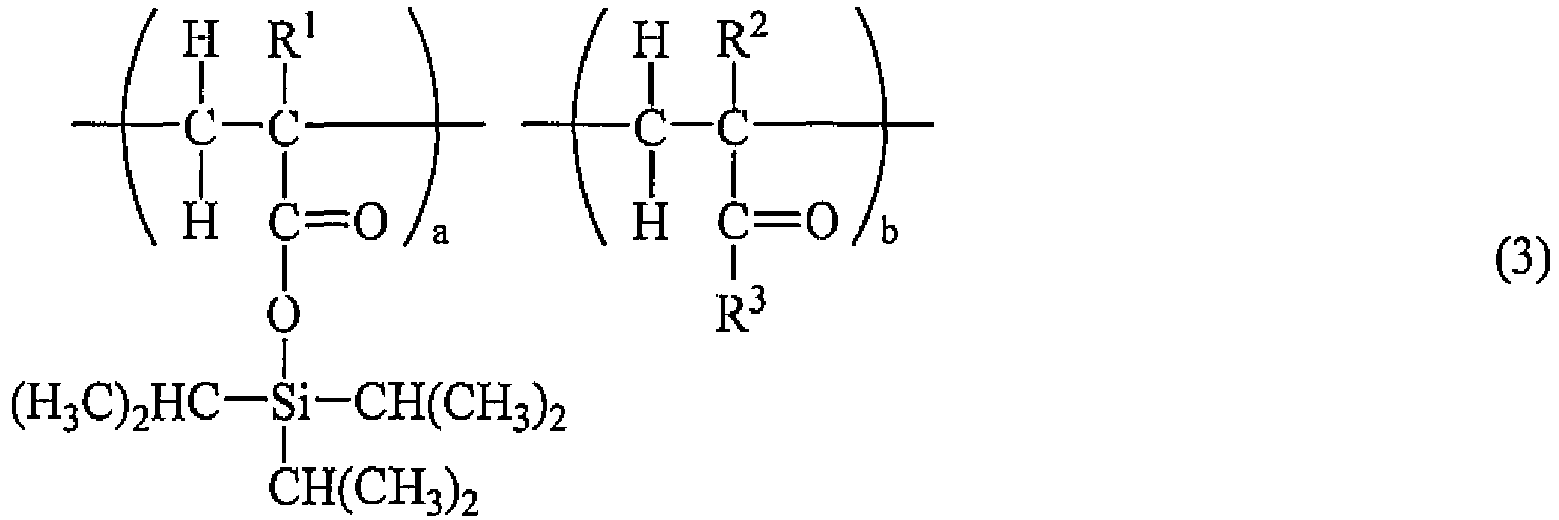
- The copolymer of claim 1 or 2, comprising repeating units having the general formula (4):


- A composition comprising the copolymer of any one of claims 1 to 4 and an organic solvent.
- The composition of claim 5 wherein the organic solvent is an aromatic hydrocarbon solvent.
- The composition of claim 5 or 6 for use as antifouling paint.
- A method for preparing the copolymer of any one of claims 1 to 4, comprising the step of effecting group-transfer polymerization of monomers containing triisopropylsilyl (meth)acrylate having the formula (1) defined above and a (meth)acrylic acid derivative in the presence of a catalyst using a silylketene acetal having the general formula (7) as an initiator,

- A method for preparing the copolymer of any one of claims 1 to 4, comprising the step of effecting atomic transfer radical polymerization of monomers containing triisopropylsilyl (meth)acrylate having the formula (1) defined above and a (meth)acrylic acid derivative in the presence of a heavy metal salt and a ligand using a halogen compound having the general formula (8) as an initiator,

- The method of claim 9 wherein the heavy metal salt is a heavy metal halide.
- The method of claim 9 or 10 wherein the ligand is an amine ligand.
- A method for preparing the copolymer of any one of claims 1 to 4, comprising the step of effecting reversible addition-fragmentation chain-transfer polymerization of monomers containing triisopropylsilyl (meth)acrylate having the formula (1) defined above and a (meth)acrylic acid derivative in the presence of a sulfur-containing compound using a radical compound as an initiator.
- The method of claim 12 wherein the radical compound is an azo compound or organic peroxide.
- The method of claim 12 or 13 wherein the sulfur-containing compound is a compound having trithiocarbonate, dithioester, thioamide, thiocarbamate or dithiocarbamate as a polymerization initiator group.
Applications Claiming Priority (1)
| Application Number | Priority Date | Filing Date | Title |
|---|---|---|---|
| JP2016196079 | 2016-10-04 |
Publications (2)
| Publication Number | Publication Date |
|---|---|
| EP3305860A1 true EP3305860A1 (en) | 2018-04-11 |
| EP3305860B1 EP3305860B1 (en) | 2020-03-25 |
Family
ID=60153047
Family Applications (1)
| Application Number | Title | Priority Date | Filing Date |
|---|---|---|---|
| EP17194292.3A Active EP3305860B1 (en) | 2016-10-04 | 2017-10-02 | Copolymer of triisopropylsilyl (meth)acrylate with (meth)acrylic acid derivative and making method |
Country Status (6)
| Country | Link |
|---|---|
| US (1) | US20180094092A1 (en) |
| EP (1) | EP3305860B1 (en) |
| JP (1) | JP6907856B2 (en) |
| KR (1) | KR102309040B1 (en) |
| CN (1) | CN107892729B (en) |
| TW (1) | TW201829488A (en) |
Cited By (1)
| Publication number | Priority date | Publication date | Assignee | Title |
|---|---|---|---|---|
| CN111801362A (en) * | 2018-12-13 | 2020-10-20 | 株式会社Lg化学 | Acrylic copolymer, its preparation method and acrylic copolymer composition containing it |
Families Citing this family (13)
| Publication number | Priority date | Publication date | Assignee | Title |
|---|---|---|---|---|
| SG11201904881SA (en) * | 2017-01-25 | 2019-08-27 | Nitto Kasei Co Ltd | Copolymer for antifouling coating composition, antifouling coating composition, antifouling coating film formed from said composition, coated object having said coating film in surface, and antifouling treatment method for forming said coating film |
| GB201718898D0 (en) * | 2017-11-15 | 2017-12-27 | Jotun As | Antifouling composition |
| CN111148833B (en) | 2018-03-26 | 2021-04-02 | 国立大学法人神户大学 | Method for changing target site of double-stranded DNA possessed by cell |
| CN111886304B (en) * | 2018-04-20 | 2022-02-01 | 日东化成株式会社 | Antifouling coating composition |
| CN112218901B (en) * | 2018-06-11 | 2023-08-25 | 株式会社日本触媒 | Vinyl ether group-containing (meth)acrylate polymer, method for producing the same, and polymer composition |
| MX2020013819A (en) * | 2018-07-19 | 2021-03-09 | Dow Global Technologies Llc | Weatherable and durable coating compositions. |
| GB201813454D0 (en) * | 2018-08-17 | 2018-10-03 | Jotun As | Antifouling composition |
| CN110922542B (en) * | 2018-09-20 | 2022-09-30 | 陈建添 | Block copolymer and process for producing the same |
| JP7082023B6 (en) * | 2018-10-03 | 2023-12-22 | 信越化学工業株式会社 | Polymer polymerization initiator and method for producing polymer polymerization initiator |
| KR102812445B1 (en) * | 2019-08-27 | 2025-05-23 | 가부시키가이샤 닛폰 쇼쿠바이 | Curable composition |
| JP7312648B2 (en) * | 2019-08-27 | 2023-07-21 | 株式会社日本触媒 | adhesive composition |
| CN111925485A (en) * | 2020-06-30 | 2020-11-13 | 六安科瑞达新型材料有限公司 | Powder coating leveling agent |
| WO2022050358A1 (en) * | 2020-09-03 | 2022-03-10 | ダイキン工業株式会社 | Silicone copolymer |
Citations (9)
| Publication number | Priority date | Publication date | Assignee | Title |
|---|---|---|---|---|
| WO2005042649A1 (en) | 2003-10-23 | 2005-05-12 | The Sherwin-Williams Company | Self-polishing anti-fouling compositions |
| EP1641862A1 (en) | 2003-07-07 | 2006-04-05 | Akzo Nobel Coatings International B.V. | Silyl ester copolymer compositions |
| JP3906936B2 (en) * | 1995-06-01 | 2007-04-18 | 中国塗料株式会社 | Antifouling coating composition, coating film formed from the antifouling coating composition, antifouling method using the antifouling coating composition, and hull or underwater structure coated with the coating |
| JP2008001804A (en) | 2006-06-22 | 2008-01-10 | Nkm Coatings Co Ltd | Water-based antifouling paint composition |
| JP2009173914A (en) | 2007-12-27 | 2009-08-06 | Chugoku Marine Paints Ltd | Water-based antifouling paint composition, production method thereof, coating film thereof, substrate coated with the coating film, and antifouling method |
| EP2161316A1 (en) * | 2007-06-22 | 2010-03-10 | Nitto Kasei Co., Ltd. | Antifouling coating composition, process for producing the composition, antifouling coating film formed from the composition, coated object having the coating film on surface, and method of antifouling treatment by formation of the coating film |
| WO2013073580A1 (en) | 2011-11-14 | 2013-05-23 | 中国塗料株式会社 | Antifouling coating composition, antifouling coating film, anti-foul base material, and process for manufacturing anti-foul base material |
| WO2015097240A2 (en) * | 2013-12-24 | 2015-07-02 | Ppg Coatings Europe B.V. | Block copolymer and method of preparation |
| JP2016196079A (en) | 2015-04-02 | 2016-11-24 | ホンダ リサーチ インスティテュート ヨーロッパ ゲーエムベーハーHonda Research Institute Europe GmbH | Method of improving motion of robot |
Family Cites Families (12)
| Publication number | Priority date | Publication date | Assignee | Title |
|---|---|---|---|---|
| MY115462A (en) * | 1995-06-01 | 2003-06-30 | Chugoku Marine Paints | Antifouling coating composition, coating film formed from said antifouling coating composition, antifouling method using said antifouling coating composition and hull or underwater structure coated with said coating film |
| PL200670B1 (en) * | 1998-12-28 | 2009-01-30 | Chugoku Marine Paints | Silylmethacrylate copolymers, methods of obtaining them, antifoulding painting compositions containing such copolymers, antifoulding films formed of such painting compositions, methods of preventing surface fouling using such painting compositions and und |
| US6992120B2 (en) * | 2001-11-13 | 2006-01-31 | Arkema Inc. | Coating compositions |
| JP4776838B2 (en) * | 2000-10-25 | 2011-09-21 | 中国塗料株式会社 | Novel (poly) oxyalkylene block silyl ester copolymer |
| JP4361239B2 (en) * | 2002-03-06 | 2009-11-11 | 中国塗料株式会社 | Antifouling paint composition, coating film comprising the composition, substrate coated with the coating film, and antifouling method |
| CN101730713B (en) * | 2007-07-06 | 2013-03-13 | 佐顿公司 | Branched polymer and antifouling coating composition comprising the polymer |
| JP2011026357A (en) * | 2007-11-21 | 2011-02-10 | Nitto Kasei Co Ltd | Contamination-proof coating composition, manufacturing method for the composition, contamination-proof coating film formed using the composition, coated article having the coating film on surface, and contamination-proofing treatment method for forming the coating film |
| JP5373070B2 (en) * | 2008-06-11 | 2013-12-18 | ヨツン エーエス | Binder for antifouling paint composition and antifouling paint composition containing binder |
| JP5415551B2 (en) * | 2009-10-13 | 2014-02-12 | 日本ペイントマリン株式会社 | Antifouling paint composition, and antifouling coating film, composite coating film and underwater structure |
| JP6048724B2 (en) * | 2011-06-30 | 2016-12-21 | 大日本塗料株式会社 | High solid content antifouling paint composition |
| WO2013190121A1 (en) * | 2012-06-22 | 2013-12-27 | Ppg Coatings Europe B.V. | Antifouling coating composition |
| KR20150104114A (en) * | 2012-12-19 | 2015-09-14 | 요툰 에이/에스 | Silyl ester copolymer |
-
2017
- 2017-09-22 JP JP2017182292A patent/JP6907856B2/en active Active
- 2017-09-28 KR KR1020170125758A patent/KR102309040B1/en active Active
- 2017-10-02 EP EP17194292.3A patent/EP3305860B1/en active Active
- 2017-10-03 TW TW106134140A patent/TW201829488A/en unknown
- 2017-10-03 US US15/724,063 patent/US20180094092A1/en not_active Abandoned
- 2017-10-09 CN CN201710929262.XA patent/CN107892729B/en active Active
Patent Citations (11)
| Publication number | Priority date | Publication date | Assignee | Title |
|---|---|---|---|---|
| JP3906936B2 (en) * | 1995-06-01 | 2007-04-18 | 中国塗料株式会社 | Antifouling coating composition, coating film formed from the antifouling coating composition, antifouling method using the antifouling coating composition, and hull or underwater structure coated with the coating |
| EP1641862A1 (en) | 2003-07-07 | 2006-04-05 | Akzo Nobel Coatings International B.V. | Silyl ester copolymer compositions |
| US7691938B2 (en) | 2003-07-07 | 2010-04-06 | Akzo Nobel Coatings International B.V. | Silyl ester copolymer compositions |
| JP2014205846A (en) | 2003-07-07 | 2014-10-30 | アクゾ ノーベル コーティングス インターナショナル ビー ヴィ | Silyl ester copolymer compositions |
| WO2005042649A1 (en) | 2003-10-23 | 2005-05-12 | The Sherwin-Williams Company | Self-polishing anti-fouling compositions |
| JP2008001804A (en) | 2006-06-22 | 2008-01-10 | Nkm Coatings Co Ltd | Water-based antifouling paint composition |
| EP2161316A1 (en) * | 2007-06-22 | 2010-03-10 | Nitto Kasei Co., Ltd. | Antifouling coating composition, process for producing the composition, antifouling coating film formed from the composition, coated object having the coating film on surface, and method of antifouling treatment by formation of the coating film |
| JP2009173914A (en) | 2007-12-27 | 2009-08-06 | Chugoku Marine Paints Ltd | Water-based antifouling paint composition, production method thereof, coating film thereof, substrate coated with the coating film, and antifouling method |
| WO2013073580A1 (en) | 2011-11-14 | 2013-05-23 | 中国塗料株式会社 | Antifouling coating composition, antifouling coating film, anti-foul base material, and process for manufacturing anti-foul base material |
| WO2015097240A2 (en) * | 2013-12-24 | 2015-07-02 | Ppg Coatings Europe B.V. | Block copolymer and method of preparation |
| JP2016196079A (en) | 2015-04-02 | 2016-11-24 | ホンダ リサーチ インスティテュート ヨーロッパ ゲーエムベーハーHonda Research Institute Europe GmbH | Method of improving motion of robot |
Non-Patent Citations (2)
| Title |
|---|
| MARLÈNE LEJARS ET AL: "Synthesis and characterization of diblock and statistical copolymers based on hydrolyzable siloxy silylester methacrylate monomers", POLYMER CHEMISTRY, vol. 5, no. 6, 4 December 2013 (2013-12-04), GB, pages 2109 - 2117, XP055177302, ISSN: 1759-9954, DOI: 10.1039/c3py01603j * |
| SOGAH D Y ET AL: "Group Transfer Polymerization. Polymerization of Acrylic Monomers", MACROMOLECULES, AMERICAN CHEMICAL SOCIETY, US, vol. 20, no. 7, 1 January 1987 (1987-01-01), pages 1473 - 1488, XP002403865, ISSN: 0024-9297, DOI: 10.1021/MA00173A006 * |
Cited By (4)
| Publication number | Priority date | Publication date | Assignee | Title |
|---|---|---|---|---|
| CN111801362A (en) * | 2018-12-13 | 2020-10-20 | 株式会社Lg化学 | Acrylic copolymer, its preparation method and acrylic copolymer composition containing it |
| EP3750928A4 (en) * | 2018-12-13 | 2021-08-25 | Lg Chem, Ltd. | ACRYLIC COPOLYMER, ASSOCIATED PREPARATION PROCESS AND ACRYLIC COPOLYMER COMPOSITION CONTAINING IT |
| US11421059B2 (en) * | 2018-12-13 | 2022-08-23 | Lg Chem, Ltd. | Acrylic copolymer, method of preparing the same, and acrylic copolymer composition including the same |
| CN111801362B (en) * | 2018-12-13 | 2022-10-04 | 株式会社Lg化学 | Acrylic copolymer, method for preparing the same, and acrylic copolymer composition comprising the same |
Also Published As
| Publication number | Publication date |
|---|---|
| TW201829488A (en) | 2018-08-16 |
| EP3305860B1 (en) | 2020-03-25 |
| JP6907856B2 (en) | 2021-07-21 |
| KR20180037587A (en) | 2018-04-12 |
| KR102309040B1 (en) | 2021-10-07 |
| US20180094092A1 (en) | 2018-04-05 |
| JP2018059073A (en) | 2018-04-12 |
| CN107892729A (en) | 2018-04-10 |
| CN107892729B (en) | 2022-09-06 |
Similar Documents
| Publication | Publication Date | Title |
|---|---|---|
| EP3305860B1 (en) | Copolymer of triisopropylsilyl (meth)acrylate with (meth)acrylic acid derivative and making method | |
| US12110469B2 (en) | Polymer composition, lubricant additive, viscosity index improver, lubricant composition, method for producing polymer composition, and method for producing macromonomer | |
| CN105694646B (en) | Fluoro-containing composition for porous substrate surface treatment | |
| KR20060041214A (en) | Silyl ester copolymer composition | |
| CN106986969B (en) | A kind of main chain degradable copper polyacrylate resin and its preparation method and application | |
| KR20170118966A (en) | Antifouling coating composition | |
| US20100190884A1 (en) | resin composition, an antifouling coating and processes of productions thereof | |
| KR20110105828A (en) | Antifouling coating comprising a resin composition, barnacle antifouling agent and method for producing same | |
| CN110922526B (en) | A fluoropolymer and protective coating agent comprising the fluoropolymer | |
| CN110563895B (en) | Water-based hybrid epoxy resin and preparation method thereof | |
| CN111886304B (en) | Antifouling coating composition | |
| US8598289B2 (en) | Amphiphilic block copolymer and method for preparing same | |
| US8512465B2 (en) | Use of copolymers as adhesion promoters in lacquers | |
| TW202136199A (en) | Polyalkylene glycol mono (meth) acrylate and polymer thereof, and film composition | |
| JP7510945B2 (en) | Water-soluble (meth)acrylic resin and its use | |
| JP2712584B2 (en) | Fluorine-containing copolymer and coating composition | |
| CN101845129B (en) | Silicone (methyl)acrylate ABA-type block copolymer, and preparation method and application thereof | |
| CN117511322B (en) | Waterborne epoxy ester resin composition with initial water resistance and its preparation method | |
| CN118632877A (en) | Amide group-containing monomer composition and method for improving storage stability of amide group-containing monomer | |
| JPH11310672A (en) | Fluorine-containing copolymer solution having excellent storage stability | |
| JPH0673331A (en) | Coating resin composition and coating material | |
| JPH1180656A (en) | Production of coating composition | |
| JPH07330833A (en) | Fluorine-containing copolymer for coating | |
| JPH0776667A (en) | Composition for fluororesin coating compound |
Legal Events
| Date | Code | Title | Description |
|---|---|---|---|
| PUAI | Public reference made under article 153(3) epc to a published international application that has entered the european phase |
Free format text: ORIGINAL CODE: 0009012 |
|
| STAA | Information on the status of an ep patent application or granted ep patent |
Free format text: STATUS: THE APPLICATION HAS BEEN PUBLISHED |
|
| AK | Designated contracting states |
Kind code of ref document: A1 Designated state(s): AL AT BE BG CH CY CZ DE DK EE ES FI FR GB GR HR HU IE IS IT LI LT LU LV MC MK MT NL NO PL PT RO RS SE SI SK SM TR |
|
| AX | Request for extension of the european patent |
Extension state: BA ME |
|
| STAA | Information on the status of an ep patent application or granted ep patent |
Free format text: STATUS: REQUEST FOR EXAMINATION WAS MADE |
|
| 17P | Request for examination filed |
Effective date: 20181008 |
|
| RBV | Designated contracting states (corrected) |
Designated state(s): AL AT BE BG CH CY CZ DE DK EE ES FI FR GB GR HR HU IE IS IT LI LT LU LV MC MK MT NL NO PL PT RO RS SE SI SK SM TR |
|
| STAA | Information on the status of an ep patent application or granted ep patent |
Free format text: STATUS: EXAMINATION IS IN PROGRESS |
|
| 17Q | First examination report despatched |
Effective date: 20190219 |
|
| GRAP | Despatch of communication of intention to grant a patent |
Free format text: ORIGINAL CODE: EPIDOSNIGR1 |
|
| STAA | Information on the status of an ep patent application or granted ep patent |
Free format text: STATUS: GRANT OF PATENT IS INTENDED |
|
| INTG | Intention to grant announced |
Effective date: 20191031 |
|
| GRAS | Grant fee paid |
Free format text: ORIGINAL CODE: EPIDOSNIGR3 |
|
| GRAA | (expected) grant |
Free format text: ORIGINAL CODE: 0009210 |
|
| STAA | Information on the status of an ep patent application or granted ep patent |
Free format text: STATUS: THE PATENT HAS BEEN GRANTED |
|
| AK | Designated contracting states |
Kind code of ref document: B1 Designated state(s): AL AT BE BG CH CY CZ DE DK EE ES FI FR GB GR HR HU IE IS IT LI LT LU LV MC MK MT NL NO PL PT RO RS SE SI SK SM TR |
|
| REG | Reference to a national code |
Ref country code: GB Ref legal event code: FG4D |
|
| REG | Reference to a national code |
Ref country code: DE Ref legal event code: R096 Ref document number: 602017013530 Country of ref document: DE |
|
| REG | Reference to a national code |
Ref country code: AT Ref legal event code: REF Ref document number: 1248513 Country of ref document: AT Kind code of ref document: T Effective date: 20200415 Ref country code: IE Ref legal event code: FG4D |
|
| REG | Reference to a national code |
Ref country code: NL Ref legal event code: FP |
|
| REG | Reference to a national code |
Ref country code: NO Ref legal event code: T2 Effective date: 20200325 |
|
| PG25 | Lapsed in a contracting state [announced via postgrant information from national office to epo] |
Ref country code: RS Free format text: LAPSE BECAUSE OF FAILURE TO SUBMIT A TRANSLATION OF THE DESCRIPTION OR TO PAY THE FEE WITHIN THE PRESCRIBED TIME-LIMIT Effective date: 20200325 Ref country code: FI Free format text: LAPSE BECAUSE OF FAILURE TO SUBMIT A TRANSLATION OF THE DESCRIPTION OR TO PAY THE FEE WITHIN THE PRESCRIBED TIME-LIMIT Effective date: 20200325 |
|
| PG25 | Lapsed in a contracting state [announced via postgrant information from national office to epo] |
Ref country code: SE Free format text: LAPSE BECAUSE OF FAILURE TO SUBMIT A TRANSLATION OF THE DESCRIPTION OR TO PAY THE FEE WITHIN THE PRESCRIBED TIME-LIMIT Effective date: 20200325 Ref country code: LV Free format text: LAPSE BECAUSE OF FAILURE TO SUBMIT A TRANSLATION OF THE DESCRIPTION OR TO PAY THE FEE WITHIN THE PRESCRIBED TIME-LIMIT Effective date: 20200325 Ref country code: BG Free format text: LAPSE BECAUSE OF FAILURE TO SUBMIT A TRANSLATION OF THE DESCRIPTION OR TO PAY THE FEE WITHIN THE PRESCRIBED TIME-LIMIT Effective date: 20200625 Ref country code: GR Free format text: LAPSE BECAUSE OF FAILURE TO SUBMIT A TRANSLATION OF THE DESCRIPTION OR TO PAY THE FEE WITHIN THE PRESCRIBED TIME-LIMIT Effective date: 20200626 Ref country code: HR Free format text: LAPSE BECAUSE OF FAILURE TO SUBMIT A TRANSLATION OF THE DESCRIPTION OR TO PAY THE FEE WITHIN THE PRESCRIBED TIME-LIMIT Effective date: 20200325 |
|
| REG | Reference to a national code |
Ref country code: LT Ref legal event code: MG4D |
|
| PG25 | Lapsed in a contracting state [announced via postgrant information from national office to epo] |
Ref country code: SK Free format text: LAPSE BECAUSE OF FAILURE TO SUBMIT A TRANSLATION OF THE DESCRIPTION OR TO PAY THE FEE WITHIN THE PRESCRIBED TIME-LIMIT Effective date: 20200325 Ref country code: SM Free format text: LAPSE BECAUSE OF FAILURE TO SUBMIT A TRANSLATION OF THE DESCRIPTION OR TO PAY THE FEE WITHIN THE PRESCRIBED TIME-LIMIT Effective date: 20200325 Ref country code: EE Free format text: LAPSE BECAUSE OF FAILURE TO SUBMIT A TRANSLATION OF THE DESCRIPTION OR TO PAY THE FEE WITHIN THE PRESCRIBED TIME-LIMIT Effective date: 20200325 Ref country code: IS Free format text: LAPSE BECAUSE OF FAILURE TO SUBMIT A TRANSLATION OF THE DESCRIPTION OR TO PAY THE FEE WITHIN THE PRESCRIBED TIME-LIMIT Effective date: 20200725 Ref country code: LT Free format text: LAPSE BECAUSE OF FAILURE TO SUBMIT A TRANSLATION OF THE DESCRIPTION OR TO PAY THE FEE WITHIN THE PRESCRIBED TIME-LIMIT Effective date: 20200325 Ref country code: PT Free format text: LAPSE BECAUSE OF FAILURE TO SUBMIT A TRANSLATION OF THE DESCRIPTION OR TO PAY THE FEE WITHIN THE PRESCRIBED TIME-LIMIT Effective date: 20200818 Ref country code: RO Free format text: LAPSE BECAUSE OF FAILURE TO SUBMIT A TRANSLATION OF THE DESCRIPTION OR TO PAY THE FEE WITHIN THE PRESCRIBED TIME-LIMIT Effective date: 20200325 Ref country code: CZ Free format text: LAPSE BECAUSE OF FAILURE TO SUBMIT A TRANSLATION OF THE DESCRIPTION OR TO PAY THE FEE WITHIN THE PRESCRIBED TIME-LIMIT Effective date: 20200325 |
|
| REG | Reference to a national code |
Ref country code: AT Ref legal event code: MK05 Ref document number: 1248513 Country of ref document: AT Kind code of ref document: T Effective date: 20200325 |
|
| REG | Reference to a national code |
Ref country code: DE Ref legal event code: R097 Ref document number: 602017013530 Country of ref document: DE |
|
| PG25 | Lapsed in a contracting state [announced via postgrant information from national office to epo] |
Ref country code: ES Free format text: LAPSE BECAUSE OF FAILURE TO SUBMIT A TRANSLATION OF THE DESCRIPTION OR TO PAY THE FEE WITHIN THE PRESCRIBED TIME-LIMIT Effective date: 20200325 Ref country code: AT Free format text: LAPSE BECAUSE OF FAILURE TO SUBMIT A TRANSLATION OF THE DESCRIPTION OR TO PAY THE FEE WITHIN THE PRESCRIBED TIME-LIMIT Effective date: 20200325 Ref country code: DK Free format text: LAPSE BECAUSE OF FAILURE TO SUBMIT A TRANSLATION OF THE DESCRIPTION OR TO PAY THE FEE WITHIN THE PRESCRIBED TIME-LIMIT Effective date: 20200325 Ref country code: IT Free format text: LAPSE BECAUSE OF FAILURE TO SUBMIT A TRANSLATION OF THE DESCRIPTION OR TO PAY THE FEE WITHIN THE PRESCRIBED TIME-LIMIT Effective date: 20200325 |
|
| PLBE | No opposition filed within time limit |
Free format text: ORIGINAL CODE: 0009261 |
|
| STAA | Information on the status of an ep patent application or granted ep patent |
Free format text: STATUS: NO OPPOSITION FILED WITHIN TIME LIMIT |
|
| PG25 | Lapsed in a contracting state [announced via postgrant information from national office to epo] |
Ref country code: PL Free format text: LAPSE BECAUSE OF FAILURE TO SUBMIT A TRANSLATION OF THE DESCRIPTION OR TO PAY THE FEE WITHIN THE PRESCRIBED TIME-LIMIT Effective date: 20200325 |
|
| 26N | No opposition filed |
Effective date: 20210112 |
|
| PG25 | Lapsed in a contracting state [announced via postgrant information from national office to epo] |
Ref country code: SI Free format text: LAPSE BECAUSE OF FAILURE TO SUBMIT A TRANSLATION OF THE DESCRIPTION OR TO PAY THE FEE WITHIN THE PRESCRIBED TIME-LIMIT Effective date: 20200325 |
|
| REG | Reference to a national code |
Ref country code: CH Ref legal event code: PL |
|
| PG25 | Lapsed in a contracting state [announced via postgrant information from national office to epo] |
Ref country code: LU Free format text: LAPSE BECAUSE OF NON-PAYMENT OF DUE FEES Effective date: 20201002 Ref country code: MC Free format text: LAPSE BECAUSE OF FAILURE TO SUBMIT A TRANSLATION OF THE DESCRIPTION OR TO PAY THE FEE WITHIN THE PRESCRIBED TIME-LIMIT Effective date: 20200325 |
|
| REG | Reference to a national code |
Ref country code: BE Ref legal event code: MM Effective date: 20201031 |
|
| PG25 | Lapsed in a contracting state [announced via postgrant information from national office to epo] |
Ref country code: LI Free format text: LAPSE BECAUSE OF NON-PAYMENT OF DUE FEES Effective date: 20201031 Ref country code: BE Free format text: LAPSE BECAUSE OF NON-PAYMENT OF DUE FEES Effective date: 20201031 Ref country code: CH Free format text: LAPSE BECAUSE OF NON-PAYMENT OF DUE FEES Effective date: 20201031 |
|
| PG25 | Lapsed in a contracting state [announced via postgrant information from national office to epo] |
Ref country code: IE Free format text: LAPSE BECAUSE OF NON-PAYMENT OF DUE FEES Effective date: 20201002 |
|
| PG25 | Lapsed in a contracting state [announced via postgrant information from national office to epo] |
Ref country code: TR Free format text: LAPSE BECAUSE OF FAILURE TO SUBMIT A TRANSLATION OF THE DESCRIPTION OR TO PAY THE FEE WITHIN THE PRESCRIBED TIME-LIMIT Effective date: 20200325 Ref country code: MT Free format text: LAPSE BECAUSE OF FAILURE TO SUBMIT A TRANSLATION OF THE DESCRIPTION OR TO PAY THE FEE WITHIN THE PRESCRIBED TIME-LIMIT Effective date: 20200325 Ref country code: CY Free format text: LAPSE BECAUSE OF FAILURE TO SUBMIT A TRANSLATION OF THE DESCRIPTION OR TO PAY THE FEE WITHIN THE PRESCRIBED TIME-LIMIT Effective date: 20200325 |
|
| PG25 | Lapsed in a contracting state [announced via postgrant information from national office to epo] |
Ref country code: MK Free format text: LAPSE BECAUSE OF FAILURE TO SUBMIT A TRANSLATION OF THE DESCRIPTION OR TO PAY THE FEE WITHIN THE PRESCRIBED TIME-LIMIT Effective date: 20200325 Ref country code: AL Free format text: LAPSE BECAUSE OF FAILURE TO SUBMIT A TRANSLATION OF THE DESCRIPTION OR TO PAY THE FEE WITHIN THE PRESCRIBED TIME-LIMIT Effective date: 20200325 |
|
| PGFP | Annual fee paid to national office [announced via postgrant information from national office to epo] |
Ref country code: NL Payment date: 20251021 Year of fee payment: 9 |
|
| PGFP | Annual fee paid to national office [announced via postgrant information from national office to epo] |
Ref country code: DE Payment date: 20251021 Year of fee payment: 9 |
|
| PGFP | Annual fee paid to national office [announced via postgrant information from national office to epo] |
Ref country code: GB Payment date: 20251024 Year of fee payment: 9 |
|
| PGFP | Annual fee paid to national office [announced via postgrant information from national office to epo] |
Ref country code: NO Payment date: 20251024 Year of fee payment: 9 |
|
| PGFP | Annual fee paid to national office [announced via postgrant information from national office to epo] |
Ref country code: FR Payment date: 20251030 Year of fee payment: 9 |