EP3302232B1 - Dispositif non invasif de detection de lesion hepatique - Google Patents
Dispositif non invasif de detection de lesion hepatique Download PDFInfo
- Publication number
- EP3302232B1 EP3302232B1 EP16727453.9A EP16727453A EP3302232B1 EP 3302232 B1 EP3302232 B1 EP 3302232B1 EP 16727453 A EP16727453 A EP 16727453A EP 3302232 B1 EP3302232 B1 EP 3302232B1
- Authority
- EP
- European Patent Office
- Prior art keywords
- score
- constructed
- calculating device
- calculating
- liver
- Prior art date
- Legal status (The legal status is an assumption and is not a legal conclusion. Google has not performed a legal analysis and makes no representation as to the accuracy of the status listed.)
- Active
Links
Images
Classifications
-
- A—HUMAN NECESSITIES
- A61—MEDICAL OR VETERINARY SCIENCE; HYGIENE
- A61B—DIAGNOSIS; SURGERY; IDENTIFICATION
- A61B8/00—Diagnosis using ultrasonic, sonic or infrasonic waves
- A61B8/08—Clinical applications
-
- A—HUMAN NECESSITIES
- A61—MEDICAL OR VETERINARY SCIENCE; HYGIENE
- A61B—DIAGNOSIS; SURGERY; IDENTIFICATION
- A61B5/00—Measuring for diagnostic purposes; Identification of persons
- A61B5/42—Detecting, measuring or recording for evaluating the gastrointestinal, the endocrine or the exocrine systems
- A61B5/4222—Evaluating particular parts, e.g. particular organs
- A61B5/4244—Evaluating particular parts, e.g. particular organs liver
-
- A—HUMAN NECESSITIES
- A61—MEDICAL OR VETERINARY SCIENCE; HYGIENE
- A61B—DIAGNOSIS; SURGERY; IDENTIFICATION
- A61B5/00—Measuring for diagnostic purposes; Identification of persons
- A61B5/48—Other medical applications
- A61B5/4842—Monitoring progression or stage of a disease
-
- A—HUMAN NECESSITIES
- A61—MEDICAL OR VETERINARY SCIENCE; HYGIENE
- A61B—DIAGNOSIS; SURGERY; IDENTIFICATION
- A61B5/00—Measuring for diagnostic purposes; Identification of persons
- A61B5/72—Signal processing specially adapted for physiological signals or for diagnostic purposes
- A61B5/7235—Details of waveform analysis
- A61B5/7264—Classification of physiological signals or data, e.g. using neural networks, statistical classifiers, expert systems or fuzzy systems
-
- A—HUMAN NECESSITIES
- A61—MEDICAL OR VETERINARY SCIENCE; HYGIENE
- A61B—DIAGNOSIS; SURGERY; IDENTIFICATION
- A61B5/00—Measuring for diagnostic purposes; Identification of persons
- A61B5/72—Signal processing specially adapted for physiological signals or for diagnostic purposes
- A61B5/7271—Specific aspects of physiological measurement analysis
- A61B5/7275—Determining trends in physiological measurement data; Predicting development of a medical condition based on physiological measurements, e.g. determining a risk factor
-
- A—HUMAN NECESSITIES
- A61—MEDICAL OR VETERINARY SCIENCE; HYGIENE
- A61B—DIAGNOSIS; SURGERY; IDENTIFICATION
- A61B8/00—Diagnosis using ultrasonic, sonic or infrasonic waves
- A61B8/48—Diagnostic techniques
- A61B8/485—Diagnostic techniques involving measuring strain or elastic properties
-
- A—HUMAN NECESSITIES
- A61—MEDICAL OR VETERINARY SCIENCE; HYGIENE
- A61B—DIAGNOSIS; SURGERY; IDENTIFICATION
- A61B8/00—Diagnosis using ultrasonic, sonic or infrasonic waves
- A61B8/52—Devices using data or image processing specially adapted for diagnosis using ultrasonic, sonic or infrasonic waves
- A61B8/5215—Devices using data or image processing specially adapted for diagnosis using ultrasonic, sonic or infrasonic waves involving processing of medical diagnostic data
- A61B8/5223—Devices using data or image processing specially adapted for diagnosis using ultrasonic, sonic or infrasonic waves involving processing of medical diagnostic data for extracting a diagnostic or physiological parameter from medical diagnostic data
-
- G—PHYSICS
- G16—INFORMATION AND COMMUNICATION TECHNOLOGY [ICT] SPECIALLY ADAPTED FOR SPECIFIC APPLICATION FIELDS
- G16H—HEALTHCARE INFORMATICS, i.e. INFORMATION AND COMMUNICATION TECHNOLOGY [ICT] SPECIALLY ADAPTED FOR THE HANDLING OR PROCESSING OF MEDICAL OR HEALTHCARE DATA
- G16H50/00—ICT specially adapted for medical diagnosis, medical simulation or medical data mining; ICT specially adapted for detecting, monitoring or modelling epidemics or pandemics
- G16H50/30—ICT specially adapted for medical diagnosis, medical simulation or medical data mining; ICT specially adapted for detecting, monitoring or modelling epidemics or pandemics for calculating health indices; for individual health risk assessment
Definitions
- the invention relates to a non-invasive device for detecting liver damage using ultrasonic waves and shear waves.
- This device can be used for humans and for animals and is for example intended for the detection of a hepatic lesion of the steatohepatitis type of alcoholic origin (also known by the acronym ASH for Alcoholic SteatoHepatitis in English) or non-alcoholic (also known by the acronym NASH for Non Alcoholic Steato Hepatitis in English).
- the invention also relates to a score reflecting liver damage.
- liver tissue diseases generate liver damage such as fibrosis.
- Fibrosis is a fibrous scarring process of liver tissue resulting from inflammation.
- the evolution of initially asymptomatic fibrosis can progress to cirrhosis.
- the elasticity of liver tissue is a marker of liver fibrosis.
- impulse elastography as described, for example, in patent application number EN 2843290 .
- This document presents an implementation of a device according to the prior art.
- This device is composed of a probe provided with a vibration generator generating a low frequency elastic wave in a tissue, for example by vibration, and analyzing the propagation of this low frequency elastic wave using high frequency ultrasonic waves. transmitted and received by an ultrasonic transducer. The measurements obtained via this device make it possible to quantify the elasticity of the hepatic tissue.
- This device also makes it possible to quantify the ultrasonic attenuation of tissues, as described, for example, in patent application number EN 2949965 . Quantification of ultrasound attenuation in the liver correlates with the amount of steatosis.
- NASH Newcastle disease senor
- certain diseases for example NASH, are not necessarily linked only to the quantity of fibrosis or the quantity of steatosis alone, and may, for example, associate steatosis-type lesions (presence of fatty in the liver) and inflammation with or without fibrosis. Therefore, NASH stage or progression to NASH cannot be diagnosed by a single parameter.
- the present invention aims to solve at least one of the aforementioned drawbacks of the state of the art.
- the invention proposes a non-invasive device for detecting liver damage taking into account various parameters.
- the invention also provides a score reflecting a type of hepatic lesion.
- one aspect of the invention relates to a device for calculating a score for humans or animals, said score being a quantitative or semi-quantitative evaluation of a hepatic lesion of the steatohepatitis d type.
- alcoholic or non-alcoholic origin according to claim 1.
- This embodiment has in particular the advantage of allowing early detection of certain types of hepatic lesion, such as for example NASH, NASH possibly being correlated with inflammation, fibrosis and steatosis.
- NAFLD for Non-Alcoholic Fatty Liver Disease
- Embodiments of the invention relate to a device according to one of claims 2 to 9.
- the device according to the invention is constructed and arranged to deliver the score concomitantly with the physical parameters measured.
- the echograph or the device constructed and arranged to measure at least the hepatic elasticity measures physical parameters and the device according to the invention calculates the score by taking into account at least the physical parameters measured.
- the parameter correlated with the steatosis is a measurement of the attenuation of the ultrasonic waves, for example the parameter called CAP as described in the article Sasso, M., et al. (2010).
- Controlled attenuation parameter (CAP) a novel VCTE guided ultrasonic attenuation measurement for the evaluation of hepatic steatosis: preliminary study and validation in a cohort of patients with chronic liver disease from various causes.”
- the parameter correlated with the steatosis is a measurement of viscosity of the hepatic tissue.
- the calculation device is constructed and arranged to communicate with a score display device.
- the score can be displayed as a numerical value, a binary indicator, a probability or a risk.
- This embodiment has in particular the advantage of allowing simplicity of interpretation of the analysis of the score reflecting a state of a calculated hepatic connection.
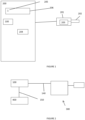
- FIG. 1 represents a device 100 for calculating a score reflecting a state of hepatic damage integrated into a device 200 constructed and arranged to measure hepatic elasticity.
- the device 200 comprises an elastography probe 201 equipped with an ultrasonic transducer 202 built and arranged to emit and receive ultrasonic waves.
- the elastography probe 201 further comprises means for generating a shear wave in the hepatic tissue.
- Said means can be an electrodynamic actuator 203 constructed and arranged to generate a low frequency wave.
- the device 200 is therefore constructed and arranged to measure physical parameters, for example parameters which are correlated with inflammation and/or fibrosis and parameters which are correlated with steatosis.
- a parameter linked to fibrosis can be the elasticity of the liver. This measure of elasticity constitutes a marker of the pathological state of the liver tissue.
- the parameter correlated with steatosis may be a measure of attenuation of ultrasound waves in liver tissue.
- Fatty liver disease is an accumulation of fat in the liver. The measurement of the attenuation of the propagation of ultrasonic waves therefore makes it possible to quantify the steatosis.
- the device 100 for calculating a score reflecting a state of liver damage is constructed and arranged to calculate a score by means of a parameter correlated to the inflammation of the hepatic tissue and/or a parameter correlated to the fibrosis. In the example described, these parameters are measured by means of the elastography probe 201.
- the device 200 also comprises a man-machine interface 204 built and arranged to enter marker parameters of the metabolic syndrome used for the calculation of the score.
- an operator can enter, via the man-machine interface 204, marker parameters of the metabolic syndrome.
- metabolic syndrome we mean the association of a series of health problems having in common a poor body metabolism, it is a group of risk factors more or less linked by an origin, metabolic targets or common mechanisms.
- This group of parameters may thus include: HDL cholesterol, triglycerides, glycaemia, blood pressure, and/or waist circumference.
- This man-machine interface 204 is also constructed and arranged to enter biological parameters used for calculating the score. These biological parameters can be: transaminases (ALT, AST), GGT, PAL, serum iron, cholesterol, HDL cholesterol, glycaemia, insulinaemia, bilirubin, a2macroglobulin, haptoglobin, apolipoprotein A1, CK18, triglycerides, adiponectin, and/or leptin.
- transaminases ALT, AST
- GGT GGT
- PAL PAL
- serum iron cholesterol
- HDL cholesterol glycaemia
- insulinaemia insulinaemia
- bilirubin a2macroglobulin
- haptoglobin apolipoprotein A1
- CK18 triglycerides
- adiponectin adiponectin
- This man-machine interface 204 is also constructed and arranged to enter anthropomorphic and demographic parameters used for calculating the score. These demographic and anthropomorphic parameters are for example formed by the age, sex, height, weight, waist circumference, hip circumference or chest circumference of a person.
- the calculation device 100 calculates a score by means of a logistic regression or any other scoring method, for example of the decision tree type, Bayesian classifier, random forests, large-margin splitter decision trees (SVM), or even neural networks.
- a logistic regression or any other scoring method for example of the decision tree type, Bayesian classifier, random forests, large-margin splitter decision trees (SVM), or even neural networks.
- the calculation device 100 can be formed by one or more microprocessors constructed and adapted to execute sequences of instructions allowing implementation of the aforementioned logistic regression or any other scoring method.
- the calculated score is represented in the form of a binary indicator 205 equal to 1 and displayed on a screen 206 of the device 200.
- This binary indicator 205 can be used to recommend that a patient carry out a consultation with from a specialist. For example, when the indicator is equal to 1, the patient is diagnosed as being at risk and requires further investigation or additional tests must be performed.
- the indicator when the indicator is equal to 0, the patient should not consult a specialist.
- This indicator can also be different, it can be implemented as a value.
- the measurements of physical parameters, the entry of other parameters, the calculation of the score and the display of the score are carried out on the device 200.
- this embodiment has in particular the advantage of calculating in real time the score (in other words on the place where the measurements of the physical parameters are carried out), then to display the score thus allowing a speed of analysis.
- the device 200 can be formed by an ultrasound scanner, an MRI, or an MRI implementing magnetic resonance elastography (MRE).
- MRE magnetic resonance elastography
- the device for calculating a score reflecting a state of liver damage 100 is constructed and arranged to communicate with a remote ultrasound scanner 300 .
- the computing device 100 is remote from the ultrasound scanner 300.
- the measurements are made on the ultrasound scanner 300 then transmitted by a network link 140, for example an Ethernet or Bluetooth type link. or Wi-Fi, to the computing device 100.
- a network link 140 for example an Ethernet or Bluetooth type link. or Wi-Fi
- this computer 400 can communicate with the computing device 100 via an Ethernet or Wi-Fi link 150.
- the computing device 100 can be materialized by one or multiple processors.
- the computer can be integrated into the 300 ultrasound system.
- the display of the score can be carried out on the echograph 300, on the computer 400 or both.
Landscapes
- Health & Medical Sciences (AREA)
- Life Sciences & Earth Sciences (AREA)
- Engineering & Computer Science (AREA)
- Physics & Mathematics (AREA)
- Public Health (AREA)
- Medical Informatics (AREA)
- General Health & Medical Sciences (AREA)
- Pathology (AREA)
- Biomedical Technology (AREA)
- Surgery (AREA)
- Heart & Thoracic Surgery (AREA)
- Animal Behavior & Ethology (AREA)
- Veterinary Medicine (AREA)
- Biophysics (AREA)
- Molecular Biology (AREA)
- Physiology (AREA)
- Radiology & Medical Imaging (AREA)
- Nuclear Medicine, Radiotherapy & Molecular Imaging (AREA)
- Artificial Intelligence (AREA)
- Computer Vision & Pattern Recognition (AREA)
- Gastroenterology & Hepatology (AREA)
- Psychiatry (AREA)
- Signal Processing (AREA)
- Mathematical Physics (AREA)
- Fuzzy Systems (AREA)
- Evolutionary Computation (AREA)
- Endocrinology (AREA)
- Primary Health Care (AREA)
- Epidemiology (AREA)
- Databases & Information Systems (AREA)
- Data Mining & Analysis (AREA)
- Ultra Sonic Daignosis Equipment (AREA)
- Measurement Of The Respiration, Hearing Ability, Form, And Blood Characteristics Of Living Organisms (AREA)
- Investigating Or Analysing Biological Materials (AREA)
Description
- L'invention concerne un dispositif non invasif de détection de lésion hépatique utilisant les ondes ultrasonores et les ondes de cisaillement. Ce dispositif peut être utilisé pour l'homme et pour l'animal et est par exemple destiné à la détection d'une lésion hépatique de type stéato-hépatite d'origine alcoolique (également connue sous l'acronyme ASH pour Alcoholic SteatoHepatitis en anglais) ou non alcoolique (également connue sous l'acronyme NASH pour Non Alcoholic Steato Hepatitis en anglais). L'invention se rapporte également à un score reflétant une lésion hépatique.
- Habituellement, les maladies chroniques du tissu hépatique génèrent des lésions hépatiques telles que la fibrose. La fibrose est un processus de cicatrisation fibreux du tissu hépatique résultant d'une inflammation. L'évolution de la fibrose initialement asymptomatique peut évoluer vers une cirrhose. L'élasticité du tissu hépatique constitue un marqueur de la fibrose hépatique. Afin de mesurer et quantifier l'élasticité du tissu hépatique, il est connu d'utiliser l'élastographie impulsionnelle, comme décrit, par exemple, dans la demande de brevet numéro
FR 2843290 - Ce document présente une mise en oeuvre d'un dispositif selon l'art antérieur. Ce dispositif est composé d'une sonde munie d'un générateur de vibration générant une onde élastique basse fréquence dans un tissu, par exemple par vibration, et analysant la propagation de cette onde élastique basse fréquence à l'aide d'ondes ultrasonores haute fréquence émises et reçues par un transducteur ultrasonore. Les mesures obtenues via ce dispositif permettent de quantifier l'élasticité du tissu hépatique. Ce dispositif permet également de quantifier l'atténuation ultrasonore des tissus, comme décrit, par exemple, dans la demande de brevet numéro
FR 2949965 - Des exemples de l'art antérieur de méthodes d'évaluation de la fibrose et de la stéatose, en particulier chez des sujets atteints de maladies stéato-hépatiques telle que la NASH, peuvent être trouvés dans MIETTE ET AL. « Liver Stiffness measurement using transient elastography in patients with non-alcoholic fatty liver (NAFLD) and non-alcoholic steatohepatitis (NASH) », IEEE ULTRASONICS SYMPOSIUM, 2007 et dans
WO 2013/025798 A1 . - En revanche, chez l'homme certaines maladies, par exemple la NASH, ne sont pas nécessairement liées qu'à la seule quantité de fibrose ou à la seule quantité de stéatose, et peut par exemple associer des lésions de type stéatose (présence de graisse dans le foie) et inflammation avec ou sans fibrose. Par conséquent, le stade de NASH ou l'évolution vers la NASH ne peut pas être diagnostiqué au moyen d'un seul paramètre.
- Des exemples de systèmes de l'art antérieur pour calculer un score humain ou animal, en particulier relatif à un état de santé du foie, peuvent être trouvés dans
WO2015/014763 A2 . - La présente invention vise à résoudre au moins un des inconvénients de l'état de la technique précités. Pour cela, l'invention propose un dispositif non invasif de détection de lésion hépatique prenant en compte différents paramètres. L'invention propose également un score reflétant un type de lésion hépatique.
- A cette fin, un aspect de l'invention a pour objet un dispositif de calcul d'un score pour l'homme ou l'animal ledit score étant une évaluation quantitative ou semi-quantitative d'une lésion hépatique de type stéato-hépatite d'origine alcoolique ou non-alcoolique selon la revendication 1.
- Ce mode de réalisation présente notamment l'avantage de permettre une détection précoce de certains types de lésion hépatique, comme par exemple la NASH, la NASH pouvant être corrélée à une inflammation, à une fibrose et à une stéatose. En revanche, la NAFLD (pour Non-Alcoholic Fatty Liver Disease) est corrélée simplement à la stéatose. Grâce au score, il est donc possible de différencier des patients atteints d'une maladie de type NAFLD des patients atteints d'une maladie de type NASH.
- Des modes de réalisation de l'invention concernent un dispositif selon l'une des revendications 2 à 9.
- Dans une mise en oeuvre non limitative, le dispositif selon l'invention est construit et agencé pour délivrer le score de manière concomitante aux paramètres physiques mesurés. En d'autres termes, l'échographe ou le dispositif construit et agencé pour mesurer au moins l'élasticité hépatique mesure des paramètres physiques et le dispositif selon l'invention calcule le score en prenant compte au moins des paramètres physiques mesurés.
- Dans une mise en oeuvre non limitative du dispositif de calcul selon l'invention, le dispositif de calcul est construit et agencé pour communiquer avec :
- un échographe distant, ou
- un dispositif distant construit et agencé pour mesurer au moins l'élasticité hépatique.
- Dans une mise en oeuvre non limitative du dispositif selon l'invention, le paramètre corrélé à la stéatose est une mesure de l'atténuation des ondes ultrasonores, par exemple le paramètre appelé CAP tel que décrit dans l'article Sasso, M., et al. (2010). "Controlled atténuation parameter (CAP): a novel VCTE guided ultrasonic atténuation measurement for the évaluation of hepatic steatosis: preliminary study and validation in a cohort of patients with chronic liver disease from various causes." Ultrasound Med Biol 36(11): 1825-1835.
- Dans une mise en oeuvre non limitative du dispositif selon l'invention, le paramètre corrélé à la stéatose est une mesure de viscosité du tissu hépatique.
- Dans une mise en oeuvre non limitative du dispositif selon l'invention, le dispositif de calcul est construit et agencé pour communiquer avec un dispositif d'affichage du score. Le score peut être affiché sous la forme d'une valeur numérique, d'un indicateur binaire, une probabilité ou un risque. Ce mode de réalisation présente notamment l'avantage de permettre une simplicité d'interprétation de l'analyse du score reflétant un état d'une liaison hépatique calculée.
- D'autres caractéristiques et avantages de l'invention ressortiront clairement de la description qui en est donnée ci-après, à titre indicatif et nullement limitatif, en référence :
- à la
figure 1 illustrant, de façon schématique, un premier exemple de réalisation d'un dispositif de calcul d'un score reflétant un état d'une lésion hépatique intégré dans un dispositif construit et agencé pour mesurer l'élasticité hépatique, - à la
figure 2 illustrant, de façon schématique, un deuxième exemple de réalisation d'un dispositif de calcul d'un score reflétant un état d'une lésion hépatique construit et agencé pour communiquer avec un échographe distant. - La
figure 1 représente un dispositif 100 de calcul d'un score reflétant un état d'une lésion hépatique intégré dans un dispositif 200 construit et agencé pour mesurer l'élasticité hépatique. - Dans ce mode de réalisation non limitatif, le dispositif 200 comporte une sonde d'élastographie 201 munie d'un transducteur ultrasonore 202 construit et agencé pour émettre et recevoir des ondes ultrasonores. Dans ce mode de réalisation, la sonde d'élastographie 201 comporte en outre des moyens pour générer une onde de cisaillement dans le tissu hépatique. Lesdits moyens peuvent être un actionneur électrodynamique 203 construit et agencé pour générer une onde basse fréquence. Le dispositif 200 est donc construit et agencé pour mesurer des paramètres physiques, par exemple des paramètres qui sont corrélés à l'inflammation et/ou à la fibrose et des paramètres qui sont corrélés à la stéatose.
- A titre d'exemple, un paramètre lié à la fibrose peut être l'élasticité du foie. Cette mesure d'élasticité constitue un marqueur de l'état pathologique du tissu hépatique.
- Le paramètre corrélé à la stéatose peut être une mesure de l'atténuation des ondes ultrasonores dans le tissu hépatique. La stéatose hépatique est une accumulation de graisse dans le foie. La mesure de l'atténuation de la propagation des ondes ultrasonores permet donc de quantifier la stéatose.
- Le dispositif 100 de calcul d'un score reflétant un état d'une lésion hépatique est construit et agencé pour calculer un score au moyen d'un paramètre corrélé à l'inflammation du tissu hépatique et/ou un paramètre corrélé à la fibrose. Dans l'exemple décrit, ces paramètres sont mesurés au moyen de la sonde d'élastographie 201.
- Dans l'exemple illustré, le dispositif 200 comporte également une interface homme-machine 204 construite et agencée pour entrer des paramètres marqueurs du syndrome métabolique utilisés pour le calcul du score.
- Ainsi, un opérateur peut entrer, via l'interface homme-machine 204, des paramètres marqueurs du syndrome métabolique. On entend par syndrome métabolique, l'association d'une série de problèmes de santé ayant en commun un mauvais métabolisme corporel, il s'agit d'un regroupement de facteurs de risque plus ou moins liés par une origine, des cibles métaboliques ou des mécanismes communs. Ce groupe de paramètres peut ainsi comporter : le cholestérol HDL, les triglycérides, la glycémie, la tension artérielle, et/ou le tour de taille.
- Cette interface homme-machine 204 est également construite et agencée pour entrer des paramètres biologiques utilisés pour le calcul du score. Ces paramètres biologiques peuvent être : les transaminases (ALAT, ASAT), GGT, PAL, Fer sérique, cholestérol, cholestérol HDL, glycémie, insulinémie, bilirubine, a2macroglobuline, haptoglobine, apolipoprotéine A1, CK18, triglycérides, adiponectine, et/ou leptine.
- Cette interface homme-machine 204 est également construite et agencée pour entrer des paramètres anthropomorphiques et démographiques utilisés pour le calcul du score. Ces paramètres démographiques et anthropomorphiques sont par exemple formés par l'âge, le sexe, la taille, le poids, le tour de taille, le tour de hanche ou le périmètre thoracique d'une personne.
- En fonction de ces différents paramètres, le dispositif de calcul 100 calcule un score au moyen d'une régression logistique ou toute autre méthode de scoring, par exemple du type arbres de décisions, classificateur bayésien, forêts aléatoires, arbres de décision séparateurs à vaste marge (SVM), ou encore réseau de neurone.
- A cette fin, le dispositif de calcul 100 peut être formé par un ou plusieurs microprocesseurs construit(s) et adapté(s) pour exécuter des séquences d'instructions permettant une mise en oeuvre de la régression logistiques précitée ou toute autre méthode de scoring.
- Dans l'exemple illustré, le score calculé est représenté sous la forme d'un indicateur binaire 205 égal à 1 et affiché sur un écran 206 du dispositif 200. Cet indicateur binaire 205 peut être utilisé pour recommander à un patient de réaliser une consultation auprès d'un spécialiste. Par exemple, lorsque l'indicateur est égal à 1, le patient est diagnostiqué comme étant à risque et nécessite une investigation plus poussée ou des examens complémentaires doivent être réalisés.
- A contrario, lorsque l'indicateur est égal à 0, le patient ne doit pas consulter de spécialiste. Cet indicateur peut également être différent, il peut être implémenté sous la forme d'une valeur.
- Dans cette réalisation non limitative, les mesures de paramètres physiques, l'entrée d'autres paramètres, le calcul du score et l'affichage du score sont réalisés sur le dispositif 200. Ainsi, ce mode de réalisation présente notamment l'avantage de calculer en temps réel le score (autrement dit sur le lieu où sont réalisées les mesures des paramètres physiques), puis d'afficher le score permettant ainsi une rapidité d'analyse.
- Dans des exemples différents non limitatifs, le dispositif 200 peut être formé par un échographe, un IRM, ou un IRM mettant en oeuvre l'élastographie par résonance magnétique (MRE).
- Dans une mise en oeuvre non limitative illustrée sur la
figure 2 , le dispositif de calcul d'un score reflétant un état d'une lésion hépatique 100 est construit et agencé pour communiquer avec un échographe 300 distant. Autrement-dit, le dispositif de calcul 100 est déporté vis-à-vis de l'échographe 300. Ainsi, les mesures sont réalisés sur l'échographe 300 puis transmises par une liaison réseau 140, par exemple une liaison de type Ethernet ou Bluetooth ou Wi-Fi, au dispositif de calcul 100. Il est également possible de transmettre d'autres paramètres, par exemple de type anthropomorphiques ou démographiques, au dispositif de calcul 100 via un ordinateur 400. De façon similaire, cet ordinateur 400 peut communiquer avec le dispositif de calcul 100 via une liaison Ethernet ou Wi-Fi 150. Le dispositif de calcul 100 peut être matérialisé par un ou plusieurs processeurs. Par ailleurs, l'ordinateur peut être intégré dans l'échographe 300. - Dans cette réalisation non limitative, l'affichage du score peut être réalisé sur l'échographe 300, sur l'ordinateur 400 ou les deux.
Claims (9)
- Dispositif de calcul (100) d'un score (205) pour l'homme ou l'animal ledit score (205) étant une évaluation quantitative ou semi-quantitative d'une lésion hépatique de type stéato-hépatite d'origine alcoolique ou non-alcoolique, ledit dispositif de calcul (100) étant construit et agencé pour calculer un score (205) au moyen des paramètres au moins physiques voire biologiques suivants :- Un paramètre corrélé à la fibrose,- Un paramètre corrélé à la stéatose, et- Un paramètre supplémentaire corrélé à l'activité inflammatoire,le paramètre supplémentaire corrélé à l'activité inflammatoire étant choisi parmi : ALAT, ASAT, les GGT,le paramètre corrélé à la fibrose étant l'élasticité,le paramètre corrélé à la stéatose étant une mesure de l'atténuation des ondes ultrasonores ou de la viscosité hépatique,le dispositif calculant le score en fonction desdits paramètres, le score étant calculé au moyen d'une régression logistique.
- Dispositif de calcul (100) selon la revendication 1 caractérisé en ce qu'il est embarqué dans :- un échographe, ou- un dispositif construit et agencé pour mesurer au moins l'élasticité hépatique.
- Dispositif de calcul (100) selon la revendication 2 précédente caractérisé en ce qu'il est construit et agencé pour délivrer le score de manière concomitante aux paramètres physiques mesurés
- Dispositif de calcul (100) selon la revendication1 caractérisé en ce qu'il est construit et agencé pour communiquer avec :- un échographe distant, ou- un dispositif distant construit et agencé pour mesurer au moins l'élasticité hépatique.
- Dispositif de calcul (100) selon l'une quelconque des revendications précédentes caractérisé en ce qu'il est construit et agencé pour calculer le score au moyen d'au moins un paramètre supplémentaire corrélé au syndrome métabolique.
- Dispositif de calcul (100) selon l'une quelconque des revendications précédentes caractérisé en ce qu'il est construit et agencé pour calculer le score au moyen d'au moins un paramètre supplémentaire de type anthropomorphique.
- Dispositif de calcul (100) selon l'une quelconque des revendications précédentes caractérisé en ce qu'il est construit et agencé pour calculer le score au moyen d'au moins un paramètre supplémentaire de type biologique.
- Dispositif de calcul (100) selon l'une quelconque des revendications précédentes caractérisé en ce qu'il est construit et agencé pour communiquer avec un dispositif d'affichage (206) du score (205).
- Dispositif de calcul (100) selon la revendication précédente caractérisé en ce que le score (205) est affiché sous la forme d'une valeur numérique, d'un indicateur binaire, une probabilité ou un risque.
Priority Applications (1)
| Application Number | Priority Date | Filing Date | Title |
|---|---|---|---|
| EP23172405.5A EP4233730B1 (fr) | 2015-06-02 | 2016-06-01 | Dispositif non invasif de détection de lésion hépatique |
Applications Claiming Priority (2)
| Application Number | Priority Date | Filing Date | Title |
|---|---|---|---|
| FR1554995A FR3036943A1 (fr) | 2015-06-02 | 2015-06-02 | Dispositif non invasif de detection de lesion hepatique |
| PCT/EP2016/062392 WO2016193312A1 (fr) | 2015-06-02 | 2016-06-01 | Dispositif non invasif de detection de lesion hepatique |
Related Child Applications (2)
| Application Number | Title | Priority Date | Filing Date |
|---|---|---|---|
| EP23172405.5A Division EP4233730B1 (fr) | 2015-06-02 | 2016-06-01 | Dispositif non invasif de détection de lésion hépatique |
| EP23172405.5A Division-Into EP4233730B1 (fr) | 2015-06-02 | 2016-06-01 | Dispositif non invasif de détection de lésion hépatique |
Publications (2)
| Publication Number | Publication Date |
|---|---|
| EP3302232A1 EP3302232A1 (fr) | 2018-04-11 |
| EP3302232B1 true EP3302232B1 (fr) | 2023-08-09 |
Family
ID=54356424
Family Applications (2)
| Application Number | Title | Priority Date | Filing Date |
|---|---|---|---|
| EP23172405.5A Active EP4233730B1 (fr) | 2015-06-02 | 2016-06-01 | Dispositif non invasif de détection de lésion hépatique |
| EP16727453.9A Active EP3302232B1 (fr) | 2015-06-02 | 2016-06-01 | Dispositif non invasif de detection de lesion hepatique |
Family Applications Before (1)
| Application Number | Title | Priority Date | Filing Date |
|---|---|---|---|
| EP23172405.5A Active EP4233730B1 (fr) | 2015-06-02 | 2016-06-01 | Dispositif non invasif de détection de lésion hépatique |
Country Status (12)
| Country | Link |
|---|---|
| US (2) | US11039781B2 (fr) |
| EP (2) | EP4233730B1 (fr) |
| JP (2) | JP2018516138A (fr) |
| KR (1) | KR20180014773A (fr) |
| CN (2) | CN114795290A (fr) |
| BR (1) | BR112017026037A2 (fr) |
| ES (1) | ES2961559T3 (fr) |
| FR (1) | FR3036943A1 (fr) |
| RU (1) | RU2017144043A (fr) |
| TW (1) | TWI739744B (fr) |
| WO (1) | WO2016193312A1 (fr) |
| ZA (1) | ZA201708716B (fr) |
Families Citing this family (15)
| Publication number | Priority date | Publication date | Assignee | Title |
|---|---|---|---|---|
| US11350844B2 (en) * | 2016-11-23 | 2022-06-07 | Mayo Foundation For Medical Education And Research | System and method for generating nonalcoholic fatty liver disease activity score (NAS) using magnetic resonance elastography |
| US11553901B2 (en) | 2017-04-06 | 2023-01-17 | Siemens Medical Solutions Usa, Inc. | Liver disease activity estimation with ultrasound medical imaging |
| CN107368689B (zh) * | 2017-07-31 | 2019-11-19 | 董云鹏 | 人体数据采集和分析系统 |
| CN110327074A (zh) * | 2019-08-02 | 2019-10-15 | 无锡海斯凯尔医学技术有限公司 | 肝脏评价方法、装置、设备及计算机可读存储介质 |
| CN110338843A (zh) * | 2019-08-02 | 2019-10-18 | 无锡海斯凯尔医学技术有限公司 | 组织评价方法、装置、设备及计算机可读存储介质 |
| US11647988B2 (en) | 2019-11-19 | 2023-05-16 | Siemens Medical Solutions Usa, Inc. | Additional diagnostic data in parametric ultrasound medical imaging |
| WO2021128083A1 (fr) * | 2019-12-25 | 2021-07-01 | 深圳迈瑞生物医疗电子股份有限公司 | Procédé et appareil de mesure de viscoélasticité ultrasonore, et support de stockage |
| KR102617857B1 (ko) * | 2020-03-12 | 2023-12-22 | 지멘스 메디컬 솔루션즈 유에스에이, 인크. | 초음파 의료 이미징을 사용한 간 질환 활성도 추정 |
| EP3939514B1 (fr) * | 2020-07-15 | 2025-03-26 | Echosens | Système et procédé permettant de déterminer un état de santé du foie d'un sujet |
| US20220142614A1 (en) * | 2020-11-09 | 2022-05-12 | Siemens Medical Solutions Usa, Inc. | Ultrasound-derived proxy for physical quantity |
| WO2022161915A1 (fr) * | 2021-01-27 | 2022-08-04 | Koninklijke Philips N.V. | Appareil et procédé d'interprétation augmentée de résonance magnétique et élastographie par ondes ultrasonores de cisaillement pour la surveillance de la fibrose hépatique |
| RU2755974C1 (ru) * | 2021-03-11 | 2021-09-23 | Федеральное государственное бюджетное образовательное учреждение высшего образования "Пермский государственный медицинский университет имени академика Е.А. Вагнера" Министерства здравоохранения Российской Федерации | Способ диагностики неалкогольного стеатоза печени |
| KR20230067338A (ko) | 2021-11-09 | 2023-05-16 | 삼성전자주식회사 | 이미지 센서 |
| KR102670008B1 (ko) * | 2021-12-28 | 2024-05-29 | 전주대학교 산학협력단 | 초음파 영상에서 초음파 주사 주파수별 지방간 정량화를 진단하는 장치 및 사용방법 |
| CN114983477A (zh) * | 2022-06-30 | 2022-09-02 | 无锡海斯凯尔医学技术有限公司 | 用于评估肝脏病变状况的计算装置、肝脏弹性测量装置、远程工作站和介质 |
Family Cites Families (20)
| Publication number | Priority date | Publication date | Assignee | Title |
|---|---|---|---|---|
| US20040015079A1 (en) * | 1999-06-22 | 2004-01-22 | Teratech Corporation | Ultrasound probe with integrated electronics |
| FR2843290B1 (fr) | 2002-08-08 | 2005-06-24 | Echosens | Dispositif et procede pour la mesure de l'elasticite d'un organe humain ou animal |
| US7578789B2 (en) * | 2002-08-08 | 2009-08-25 | Echosens | Device and method for measuring the elasticity of a human or animal organ |
| US8118744B2 (en) * | 2007-02-09 | 2012-02-21 | Duke University | Methods, systems and computer program products for ultrasound shear wave velocity estimation and shear modulus reconstruction |
| US9364194B2 (en) * | 2008-09-18 | 2016-06-14 | General Electric Company | Systems and methods for detecting regions of altered stiffness |
| WO2010097472A1 (fr) * | 2009-02-26 | 2010-09-02 | Universite D'angers | Diagnostic amélioré de la fibrose du foie ou de la cirrhose |
| FR2949965B1 (fr) * | 2009-09-17 | 2012-09-28 | Echosens | Procede pour la mesure d'au moins une propriete de tissu biologique |
| US8824762B2 (en) * | 2010-10-22 | 2014-09-02 | The Johns Hopkins University | Method and system for processing ultrasound data |
| US8494791B2 (en) * | 2010-12-16 | 2013-07-23 | General Electric Company | Methods and systems for improved correlation of shear displacement waveforms |
| US20180098728A1 (en) * | 2011-03-11 | 2018-04-12 | Centre Hospitalier Universitaire D'angers | Non-invasive method for assessing the presence or severity of liver fibrosis based on a new detailed classification |
| US20140148697A1 (en) * | 2011-05-17 | 2014-05-29 | University Of Rochester | Non-invasive assessment of liver fat by crawling wave dispersion |
| EP2727520B1 (fr) * | 2011-06-29 | 2019-08-21 | Inner Mongolia Furui Medical Science Co., Ltd | Appareil et système de détection de la fibrose hépatique |
| US8532430B2 (en) * | 2011-07-28 | 2013-09-10 | General Electric Company | Methods for reducing motion artifacts in shear wave images |
| US20140316267A1 (en) * | 2011-08-15 | 2014-10-23 | University Of Rochester | Non-invasive assessment of liver fat by crawling wave dispersion with emphasis on attenuation |
| AU2012363033B2 (en) | 2011-12-28 | 2016-06-02 | Galectin Therapeutics, Inc. | Composition of novel carbohydrate drug for treatment of human diseases |
| WO2014008408A1 (fr) * | 2012-07-03 | 2014-01-09 | University Of Pittsburgh - Of The Commonwealth System Of Higher Education | Procédé et appareil permettant de détecter des teneurs lipidiques dans des tissus au moyen d'ultrasons |
| CA2904129A1 (fr) | 2013-03-15 | 2014-09-18 | Mochida Pharmaceutical Co., Ltd. | Compositions et methodes de traitement de la steatohepatite non alcoolique |
| RU2016107170A (ru) * | 2013-08-02 | 2017-09-07 | Экоусенс | Неинвазивная система для вычисления достоверной, стандартизованной и полной оценки человека или животного |
| US9420996B2 (en) * | 2014-01-30 | 2016-08-23 | General Electric Company | Methods and systems for display of shear-wave elastography and strain elastography images |
| US10194889B2 (en) * | 2014-04-23 | 2019-02-05 | Duke University | Methods, systems and computer program products for multi-resolution imaging and analysis |
-
2015
- 2015-06-02 FR FR1554995A patent/FR3036943A1/fr not_active Withdrawn
- 2015-06-30 CN CN202210471100.7A patent/CN114795290A/zh active Pending
- 2015-06-30 CN CN201510387108.5A patent/CN106264612A/zh active Pending
-
2016
- 2016-06-01 BR BR112017026037-9A patent/BR112017026037A2/pt not_active Application Discontinuation
- 2016-06-01 EP EP23172405.5A patent/EP4233730B1/fr active Active
- 2016-06-01 KR KR1020177037743A patent/KR20180014773A/ko not_active Ceased
- 2016-06-01 ES ES16727453T patent/ES2961559T3/es active Active
- 2016-06-01 EP EP16727453.9A patent/EP3302232B1/fr active Active
- 2016-06-01 US US15/579,016 patent/US11039781B2/en active Active
- 2016-06-01 RU RU2017144043A patent/RU2017144043A/ru unknown
- 2016-06-01 WO PCT/EP2016/062392 patent/WO2016193312A1/fr not_active Ceased
- 2016-06-01 JP JP2017562707A patent/JP2018516138A/ja active Pending
- 2016-06-02 TW TW105117366A patent/TWI739744B/zh active
-
2017
- 2017-12-20 ZA ZA2017/08716A patent/ZA201708716B/en unknown
-
2021
- 2021-02-10 JP JP2021019507A patent/JP7175336B2/ja active Active
- 2021-05-19 US US17/324,775 patent/US20210361223A1/en not_active Abandoned
Non-Patent Citations (2)
| Title |
|---|
| PHILIP N NEWSOME ET AL: "FibroScan-AST (FAST) score for the non-invasive identification of patients with non-alcoholic steatohepatitis with significant activity and fibrosis: a prospective derivation and global validation study", THE LANCET - GASTROENTEROLOGY & HEPATOLOGY, vol. 5, no. 4, 11 March 2020 (2020-03-11), US, pages 362 - 373, XP055761789, ISSN: 2468-1253, DOI: 10.1016/S2468-1253(19)30383-8 * |
| SASSO M ET AL: "Controlled Attenuation Parameter (CAP): A Novel VCTE(TM) Guided Ultrasonic Attenuation Measurement for the Evaluation of Hepatic Steatosis: Preliminary Study and Validation in a Cohort of Patients with Chronic Liver Disease from Various Causes", ULTRASOUND IN MEDICINE AND BIOLOGY, NEW YORK, NY, US, vol. 36, no. 11, 1 November 2010 (2010-11-01), pages 1825 - 1835, XP027430252, ISSN: 0301-5629, [retrieved on 20100926], DOI: 10.1016/J.ULTRASMEDBIO.2010.07.005 * |
Also Published As
| Publication number | Publication date |
|---|---|
| US11039781B2 (en) | 2021-06-22 |
| BR112017026037A2 (pt) | 2018-08-14 |
| TWI739744B (zh) | 2021-09-21 |
| US20210361223A1 (en) | 2021-11-25 |
| US20180140247A1 (en) | 2018-05-24 |
| EP4233730A3 (fr) | 2023-11-01 |
| ZA201708716B (en) | 2019-06-26 |
| JP7175336B2 (ja) | 2022-11-18 |
| EP4233730B1 (fr) | 2025-03-12 |
| KR20180014773A (ko) | 2018-02-09 |
| WO2016193312A1 (fr) | 2016-12-08 |
| CN114795290A (zh) | 2022-07-29 |
| JP2021073017A (ja) | 2021-05-13 |
| RU2017144043A3 (fr) | 2019-10-10 |
| FR3036943A1 (fr) | 2016-12-09 |
| EP3302232A1 (fr) | 2018-04-11 |
| RU2017144043A (ru) | 2019-06-17 |
| ES2961559T3 (es) | 2024-03-12 |
| JP2018516138A (ja) | 2018-06-21 |
| EP4233730A2 (fr) | 2023-08-30 |
| TW201701835A (zh) | 2017-01-16 |
| CN106264612A (zh) | 2017-01-04 |
| EP4233730C0 (fr) | 2025-03-12 |
Similar Documents
| Publication | Publication Date | Title |
|---|---|---|
| EP4233730B1 (fr) | Dispositif non invasif de détection de lésion hépatique | |
| Li et al. | Non-invasive tests of non-alcoholic fatty liver disease | |
| Hermans et al. | Estimated glomerular filtration rate and urinary albumin excretion are independently associated with greater arterial stiffness: the Hoorn Study | |
| Khoury et al. | Cardiac and vascular target organ damage in pediatric hypertension | |
| Cuspidi et al. | Ambulatory blood pressure, target organ damage and left atrial size in never-treated essential hypertensive individuals | |
| Zhang et al. | A novel noninvasive ultrasound vibro-elastography technique for assessing patients with erectile dysfunction and Peyronie disease | |
| Li et al. | Liver fat content is associated with increased carotid atherosclerosis in a Chinese middle-aged and elderly population: the Shanghai Changfeng study | |
| Perazzo et al. | Factors that could impact on liver fibrosis staging by transient elastography | |
| Maldonado et al. | Arterial stiffness predicts cardiovascular outcome in a low-to-moderate cardiovascular risk population: the EDIVA (Estudo de DIstensibilidade VAscular) project | |
| Saito et al. | Noninvasive assessment of arterial stiffness by pulse wave analysis | |
| Kidawa et al. | Real-time 3D echocardiography and tissue Doppler echocardiography in the assessment of right ventricle systolic function in patients with right ventricular myocardial infarction | |
| JPWO2007063619A1 (ja) | 超音波診断装置 | |
| Stea et al. | Relationship between wave reflection and renal damage in hypertensive patients: a retrospective analysis | |
| Park et al. | Association of central hemodynamics with estimated 24-h urinary sodium in patients with hypertension | |
| Kotsis et al. | Ambulatory blood pressure monitoring and target organ damage: effects of age and sex | |
| Sandoo et al. | The relationship between cardiovascular disease risk prediction scores and vascular function and morphology in rheumatoid arthritis | |
| Mehta et al. | Assessment of EndoPAT Scores in men with vasculogenic and non‐vasculogenic erectile dysfunction | |
| Plantinga et al. | Peripheral wave reflection and endothelial function in untreated essential hypertensive patients with and without the metabolic syndrome | |
| Duprez | Arterial stiffness/elasticity in the contribution to progression of heart failure | |
| Yuksel et al. | Assessment of impact of weight loss on left and right ventricular functions and value of tissue Doppler echocardiography in obese patients | |
| Hope et al. | Predictors and consequences of pediatric hypertension: have advanced echocardiography and vascular testing arrived? | |
| Yinping et al. | Establishment and preliminary verification of threshold model for assessing carotid stiffness quantified with real-time ultrafast pulse wave velocity in healthy adults | |
| Harpaz et al. | The correlation between isolated interventricular septal hypertrophy and 24-h ambulatory blood pressure monitoring in apparently healthy air crew | |
| Han et al. | Impact of steatotic liver disease and non‐alcoholic steatohepatitis on cognitive impairment in people living with HIV: A cross‐sectional study | |
| Weber et al. | Diurnal and Pulsatile Hemodynamics in Individuals with Prehypertension |
Legal Events
| Date | Code | Title | Description |
|---|---|---|---|
| STAA | Information on the status of an ep patent application or granted ep patent |
Free format text: STATUS: THE INTERNATIONAL PUBLICATION HAS BEEN MADE |
|
| PUAI | Public reference made under article 153(3) epc to a published international application that has entered the european phase |
Free format text: ORIGINAL CODE: 0009012 |
|
| STAA | Information on the status of an ep patent application or granted ep patent |
Free format text: STATUS: REQUEST FOR EXAMINATION WAS MADE |
|
| 17P | Request for examination filed |
Effective date: 20180102 |
|
| AK | Designated contracting states |
Kind code of ref document: A1 Designated state(s): AL AT BE BG CH CY CZ DE DK EE ES FI FR GB GR HR HU IE IS IT LI LT LU LV MC MK MT NL NO PL PT RO RS SE SI SK SM TR |
|
| AX | Request for extension of the european patent |
Extension state: BA ME |
|
| DAV | Request for validation of the european patent (deleted) | ||
| DAX | Request for extension of the european patent (deleted) | ||
| STAA | Information on the status of an ep patent application or granted ep patent |
Free format text: STATUS: EXAMINATION IS IN PROGRESS |
|
| 17Q | First examination report despatched |
Effective date: 20181010 |
|
| GRAP | Despatch of communication of intention to grant a patent |
Free format text: ORIGINAL CODE: EPIDOSNIGR1 |
|
| STAA | Information on the status of an ep patent application or granted ep patent |
Free format text: STATUS: GRANT OF PATENT IS INTENDED |
|
| INTG | Intention to grant announced |
Effective date: 20230228 |
|
| GRAS | Grant fee paid |
Free format text: ORIGINAL CODE: EPIDOSNIGR3 |
|
| P01 | Opt-out of the competence of the unified patent court (upc) registered |
Effective date: 20230524 |
|
| GRAA | (expected) grant |
Free format text: ORIGINAL CODE: 0009210 |
|
| STAA | Information on the status of an ep patent application or granted ep patent |
Free format text: STATUS: THE PATENT HAS BEEN GRANTED |
|
| RAP3 | Party data changed (applicant data changed or rights of an application transferred) |
Owner name: ECHOSENS |
|
| AK | Designated contracting states |
Kind code of ref document: B1 Designated state(s): AL AT BE BG CH CY CZ DE DK EE ES FI FR GB GR HR HU IE IS IT LI LT LU LV MC MK MT NL NO PL PT RO RS SE SI SK SM TR |
|
| REG | Reference to a national code |
Ref country code: GB Ref legal event code: FG4D Free format text: NOT ENGLISH |
|
| REG | Reference to a national code |
Ref country code: CH Ref legal event code: EP |
|
| REG | Reference to a national code |
Ref country code: DE Ref legal event code: R096 Ref document number: 602016081759 Country of ref document: DE |
|
| REG | Reference to a national code |
Ref country code: IE Ref legal event code: FG4D Free format text: LANGUAGE OF EP DOCUMENT: FRENCH |
|
| REG | Reference to a national code |
Ref country code: LT Ref legal event code: MG9D |
|
| REG | Reference to a national code |
Ref country code: AT Ref legal event code: MK05 Ref document number: 1596526 Country of ref document: AT Kind code of ref document: T Effective date: 20230809 |
|
| PG25 | Lapsed in a contracting state [announced via postgrant information from national office to epo] |
Ref country code: GR Free format text: LAPSE BECAUSE OF FAILURE TO SUBMIT A TRANSLATION OF THE DESCRIPTION OR TO PAY THE FEE WITHIN THE PRESCRIBED TIME-LIMIT Effective date: 20231110 |
|
| PG25 | Lapsed in a contracting state [announced via postgrant information from national office to epo] |
Ref country code: IS Free format text: LAPSE BECAUSE OF FAILURE TO SUBMIT A TRANSLATION OF THE DESCRIPTION OR TO PAY THE FEE WITHIN THE PRESCRIBED TIME-LIMIT Effective date: 20231209 |
|
| PG25 | Lapsed in a contracting state [announced via postgrant information from national office to epo] |
Ref country code: SE Free format text: LAPSE BECAUSE OF FAILURE TO SUBMIT A TRANSLATION OF THE DESCRIPTION OR TO PAY THE FEE WITHIN THE PRESCRIBED TIME-LIMIT Effective date: 20230809 Ref country code: RS Free format text: LAPSE BECAUSE OF FAILURE TO SUBMIT A TRANSLATION OF THE DESCRIPTION OR TO PAY THE FEE WITHIN THE PRESCRIBED TIME-LIMIT Effective date: 20230809 Ref country code: PT Free format text: LAPSE BECAUSE OF FAILURE TO SUBMIT A TRANSLATION OF THE DESCRIPTION OR TO PAY THE FEE WITHIN THE PRESCRIBED TIME-LIMIT Effective date: 20231211 Ref country code: NO Free format text: LAPSE BECAUSE OF FAILURE TO SUBMIT A TRANSLATION OF THE DESCRIPTION OR TO PAY THE FEE WITHIN THE PRESCRIBED TIME-LIMIT Effective date: 20231109 Ref country code: NL Free format text: LAPSE BECAUSE OF FAILURE TO SUBMIT A TRANSLATION OF THE DESCRIPTION OR TO PAY THE FEE WITHIN THE PRESCRIBED TIME-LIMIT Effective date: 20230809 Ref country code: LV Free format text: LAPSE BECAUSE OF FAILURE TO SUBMIT A TRANSLATION OF THE DESCRIPTION OR TO PAY THE FEE WITHIN THE PRESCRIBED TIME-LIMIT Effective date: 20230809 Ref country code: LT Free format text: LAPSE BECAUSE OF FAILURE TO SUBMIT A TRANSLATION OF THE DESCRIPTION OR TO PAY THE FEE WITHIN THE PRESCRIBED TIME-LIMIT Effective date: 20230809 Ref country code: IS Free format text: LAPSE BECAUSE OF FAILURE TO SUBMIT A TRANSLATION OF THE DESCRIPTION OR TO PAY THE FEE WITHIN THE PRESCRIBED TIME-LIMIT Effective date: 20231209 Ref country code: HR Free format text: LAPSE BECAUSE OF FAILURE TO SUBMIT A TRANSLATION OF THE DESCRIPTION OR TO PAY THE FEE WITHIN THE PRESCRIBED TIME-LIMIT Effective date: 20230809 Ref country code: GR Free format text: LAPSE BECAUSE OF FAILURE TO SUBMIT A TRANSLATION OF THE DESCRIPTION OR TO PAY THE FEE WITHIN THE PRESCRIBED TIME-LIMIT Effective date: 20231110 Ref country code: FI Free format text: LAPSE BECAUSE OF FAILURE TO SUBMIT A TRANSLATION OF THE DESCRIPTION OR TO PAY THE FEE WITHIN THE PRESCRIBED TIME-LIMIT Effective date: 20230809 Ref country code: AT Free format text: LAPSE BECAUSE OF FAILURE TO SUBMIT A TRANSLATION OF THE DESCRIPTION OR TO PAY THE FEE WITHIN THE PRESCRIBED TIME-LIMIT Effective date: 20230809 |
|
| PG25 | Lapsed in a contracting state [announced via postgrant information from national office to epo] |
Ref country code: PL Free format text: LAPSE BECAUSE OF FAILURE TO SUBMIT A TRANSLATION OF THE DESCRIPTION OR TO PAY THE FEE WITHIN THE PRESCRIBED TIME-LIMIT Effective date: 20230809 |
|
| REG | Reference to a national code |
Ref country code: ES Ref legal event code: FG2A Ref document number: 2961559 Country of ref document: ES Kind code of ref document: T3 Effective date: 20240312 |
|
| PG25 | Lapsed in a contracting state [announced via postgrant information from national office to epo] |
Ref country code: SM Free format text: LAPSE BECAUSE OF FAILURE TO SUBMIT A TRANSLATION OF THE DESCRIPTION OR TO PAY THE FEE WITHIN THE PRESCRIBED TIME-LIMIT Effective date: 20230809 Ref country code: RO Free format text: LAPSE BECAUSE OF FAILURE TO SUBMIT A TRANSLATION OF THE DESCRIPTION OR TO PAY THE FEE WITHIN THE PRESCRIBED TIME-LIMIT Effective date: 20230809 Ref country code: EE Free format text: LAPSE BECAUSE OF FAILURE TO SUBMIT A TRANSLATION OF THE DESCRIPTION OR TO PAY THE FEE WITHIN THE PRESCRIBED TIME-LIMIT Effective date: 20230809 Ref country code: DK Free format text: LAPSE BECAUSE OF FAILURE TO SUBMIT A TRANSLATION OF THE DESCRIPTION OR TO PAY THE FEE WITHIN THE PRESCRIBED TIME-LIMIT Effective date: 20230809 Ref country code: CZ Free format text: LAPSE BECAUSE OF FAILURE TO SUBMIT A TRANSLATION OF THE DESCRIPTION OR TO PAY THE FEE WITHIN THE PRESCRIBED TIME-LIMIT Effective date: 20230809 Ref country code: SK Free format text: LAPSE BECAUSE OF FAILURE TO SUBMIT A TRANSLATION OF THE DESCRIPTION OR TO PAY THE FEE WITHIN THE PRESCRIBED TIME-LIMIT Effective date: 20230809 |
|
| REG | Reference to a national code |
Ref country code: DE Ref legal event code: R097 Ref document number: 602016081759 Country of ref document: DE |
|
| PLBE | No opposition filed within time limit |
Free format text: ORIGINAL CODE: 0009261 |
|
| STAA | Information on the status of an ep patent application or granted ep patent |
Free format text: STATUS: NO OPPOSITION FILED WITHIN TIME LIMIT |
|
| PGFP | Annual fee paid to national office [announced via postgrant information from national office to epo] |
Ref country code: GB Payment date: 20240627 Year of fee payment: 9 |
|
| 26N | No opposition filed |
Effective date: 20240513 |
|
| PG25 | Lapsed in a contracting state [announced via postgrant information from national office to epo] |
Ref country code: SI Free format text: LAPSE BECAUSE OF FAILURE TO SUBMIT A TRANSLATION OF THE DESCRIPTION OR TO PAY THE FEE WITHIN THE PRESCRIBED TIME-LIMIT Effective date: 20230809 |
|
| PGFP | Annual fee paid to national office [announced via postgrant information from national office to epo] |
Ref country code: IT Payment date: 20240627 Year of fee payment: 9 Ref country code: FR Payment date: 20240627 Year of fee payment: 9 |
|
| PGFP | Annual fee paid to national office [announced via postgrant information from national office to epo] |
Ref country code: DE Payment date: 20240729 Year of fee payment: 9 |
|
| PGFP | Annual fee paid to national office [announced via postgrant information from national office to epo] |
Ref country code: ES Payment date: 20240730 Year of fee payment: 9 |
|
| PG25 | Lapsed in a contracting state [announced via postgrant information from national office to epo] |
Ref country code: BG Free format text: LAPSE BECAUSE OF FAILURE TO SUBMIT A TRANSLATION OF THE DESCRIPTION OR TO PAY THE FEE WITHIN THE PRESCRIBED TIME-LIMIT Effective date: 20230809 |
|
| PG25 | Lapsed in a contracting state [announced via postgrant information from national office to epo] |
Ref country code: BG Free format text: LAPSE BECAUSE OF FAILURE TO SUBMIT A TRANSLATION OF THE DESCRIPTION OR TO PAY THE FEE WITHIN THE PRESCRIBED TIME-LIMIT Effective date: 20230809 |
|
| PG25 | Lapsed in a contracting state [announced via postgrant information from national office to epo] |
Ref country code: MC Free format text: LAPSE BECAUSE OF FAILURE TO SUBMIT A TRANSLATION OF THE DESCRIPTION OR TO PAY THE FEE WITHIN THE PRESCRIBED TIME-LIMIT Effective date: 20230809 |
|
| REG | Reference to a national code |
Ref country code: CH Ref legal event code: PL |
|
| PG25 | Lapsed in a contracting state [announced via postgrant information from national office to epo] |
Ref country code: LU Free format text: LAPSE BECAUSE OF NON-PAYMENT OF DUE FEES Effective date: 20240601 |
|
| PG25 | Lapsed in a contracting state [announced via postgrant information from national office to epo] |
Ref country code: IE Free format text: LAPSE BECAUSE OF NON-PAYMENT OF DUE FEES Effective date: 20240601 |
|
| PG25 | Lapsed in a contracting state [announced via postgrant information from national office to epo] |
Ref country code: BE Free format text: LAPSE BECAUSE OF NON-PAYMENT OF DUE FEES Effective date: 20240630 Ref country code: CH Free format text: LAPSE BECAUSE OF NON-PAYMENT OF DUE FEES Effective date: 20240630 |
|
| REG | Reference to a national code |
Ref country code: BE Ref legal event code: MM Effective date: 20240630 |
|
| PG25 | Lapsed in a contracting state [announced via postgrant information from national office to epo] |
Ref country code: CY Free format text: LAPSE BECAUSE OF FAILURE TO SUBMIT A TRANSLATION OF THE DESCRIPTION OR TO PAY THE FEE WITHIN THE PRESCRIBED TIME-LIMIT; INVALID AB INITIO Effective date: 20160601 |
|
| REG | Reference to a national code |
Ref country code: DE Ref legal event code: R119 Ref document number: 602016081759 Country of ref document: DE |
|
| GBPC | Gb: european patent ceased through non-payment of renewal fee |
Effective date: 20250601 |
|
| PG25 | Lapsed in a contracting state [announced via postgrant information from national office to epo] |
Ref country code: HU Free format text: LAPSE BECAUSE OF FAILURE TO SUBMIT A TRANSLATION OF THE DESCRIPTION OR TO PAY THE FEE WITHIN THE PRESCRIBED TIME-LIMIT; INVALID AB INITIO Effective date: 20160601 |
|
| PG25 | Lapsed in a contracting state [announced via postgrant information from national office to epo] |
Ref country code: GB Free format text: LAPSE BECAUSE OF NON-PAYMENT OF DUE FEES Effective date: 20250601 |
|
| PG25 | Lapsed in a contracting state [announced via postgrant information from national office to epo] |
Ref country code: DE Free format text: LAPSE BECAUSE OF NON-PAYMENT OF DUE FEES Effective date: 20260101 |
|
| PG25 | Lapsed in a contracting state [announced via postgrant information from national office to epo] |
Ref country code: IT Free format text: LAPSE BECAUSE OF NON-PAYMENT OF DUE FEES Effective date: 20250601 |
|
| PG25 | Lapsed in a contracting state [announced via postgrant information from national office to epo] |
Ref country code: FR Free format text: LAPSE BECAUSE OF NON-PAYMENT OF DUE FEES Effective date: 20250630 |