EP3302228B1 - Verfahren und vorrichtung zur blickerkennung - Google Patents
Verfahren und vorrichtung zur blickerkennung Download PDFInfo
- Publication number
- EP3302228B1 EP3302228B1 EP16726869.7A EP16726869A EP3302228B1 EP 3302228 B1 EP3302228 B1 EP 3302228B1 EP 16726869 A EP16726869 A EP 16726869A EP 3302228 B1 EP3302228 B1 EP 3302228B1
- Authority
- EP
- European Patent Office
- Prior art keywords
- interest
- zone
- scene
- gaze
- bitmap
- Prior art date
- Legal status (The legal status is an assumption and is not a legal conclusion. Google has not performed a legal analysis and makes no representation as to the accuracy of the status listed.)
- Active
Links
Images


Classifications
-
- G—PHYSICS
- G06—COMPUTING OR CALCULATING; COUNTING
- G06F—ELECTRIC DIGITAL DATA PROCESSING
- G06F3/00—Input arrangements for transferring data to be processed into a form capable of being handled by the computer; Output arrangements for transferring data from processing unit to output unit, e.g. interface arrangements
- G06F3/01—Input arrangements or combined input and output arrangements for interaction between user and computer
- G06F3/011—Arrangements for interaction with the human body, e.g. for user immersion in virtual reality
- G06F3/013—Eye tracking input arrangements
-
- A—HUMAN NECESSITIES
- A61—MEDICAL OR VETERINARY SCIENCE; HYGIENE
- A61B—DIAGNOSIS; SURGERY; IDENTIFICATION
- A61B3/00—Apparatus for testing the eyes; Instruments for examining the eyes
- A61B3/10—Objective types, i.e. instruments for examining the eyes independent of the patients' perceptions or reactions
- A61B3/113—Objective types, i.e. instruments for examining the eyes independent of the patients' perceptions or reactions for determining or recording eye movement
-
- G—PHYSICS
- G01—MEASURING; TESTING
- G01C—MEASURING DISTANCES, LEVELS OR BEARINGS; SURVEYING; NAVIGATION; GYROSCOPIC INSTRUMENTS; PHOTOGRAMMETRY OR VIDEOGRAMMETRY
- G01C21/00—Navigation; Navigational instruments not provided for in groups G01C1/00 - G01C19/00
- G01C21/10—Navigation; Navigational instruments not provided for in groups G01C1/00 - G01C19/00 by using measurements of speed or acceleration
- G01C21/12—Navigation; Navigational instruments not provided for in groups G01C1/00 - G01C19/00 by using measurements of speed or acceleration executed aboard the object being navigated; Dead reckoning
- G01C21/16—Navigation; Navigational instruments not provided for in groups G01C1/00 - G01C19/00 by using measurements of speed or acceleration executed aboard the object being navigated; Dead reckoning by integrating acceleration or speed, i.e. inertial navigation
- G01C21/165—Navigation; Navigational instruments not provided for in groups G01C1/00 - G01C19/00 by using measurements of speed or acceleration executed aboard the object being navigated; Dead reckoning by integrating acceleration or speed, i.e. inertial navigation combined with non-inertial navigation instruments
-
- G—PHYSICS
- G05—CONTROLLING; REGULATING
- G05D—SYSTEMS FOR CONTROLLING OR REGULATING NON-ELECTRIC VARIABLES
- G05D1/00—Control of position, course, altitude or attitude of land, water, air or space vehicles, e.g. using automatic pilots
- G05D1/02—Control of position or course in two dimensions
- G05D1/021—Control of position or course in two dimensions specially adapted to land vehicles
- G05D1/0231—Control of position or course in two dimensions specially adapted to land vehicles using optical position detecting means
- G05D1/0242—Control of position or course in two dimensions specially adapted to land vehicles using optical position detecting means using non-visible light signals, e.g. IR or UV signals
-
- G—PHYSICS
- G05—CONTROLLING; REGULATING
- G05D—SYSTEMS FOR CONTROLLING OR REGULATING NON-ELECTRIC VARIABLES
- G05D1/00—Control of position, course, altitude or attitude of land, water, air or space vehicles, e.g. using automatic pilots
- G05D1/02—Control of position or course in two dimensions
- G05D1/021—Control of position or course in two dimensions specially adapted to land vehicles
- G05D1/0231—Control of position or course in two dimensions specially adapted to land vehicles using optical position detecting means
- G05D1/0244—Control of position or course in two dimensions specially adapted to land vehicles using optical position detecting means using reflecting strips
-
- G—PHYSICS
- G05—CONTROLLING; REGULATING
- G05D—SYSTEMS FOR CONTROLLING OR REGULATING NON-ELECTRIC VARIABLES
- G05D1/00—Control of position, course, altitude or attitude of land, water, air or space vehicles, e.g. using automatic pilots
- G05D1/02—Control of position or course in two dimensions
- G05D1/021—Control of position or course in two dimensions specially adapted to land vehicles
- G05D1/0259—Control of position or course in two dimensions specially adapted to land vehicles using magnetic or electromagnetic means
- G05D1/0263—Control of position or course in two dimensions specially adapted to land vehicles using magnetic or electromagnetic means using magnetic strips
-
- G—PHYSICS
- G05—CONTROLLING; REGULATING
- G05D—SYSTEMS FOR CONTROLLING OR REGULATING NON-ELECTRIC VARIABLES
- G05D1/00—Control of position, course, altitude or attitude of land, water, air or space vehicles, e.g. using automatic pilots
- G05D1/02—Control of position or course in two dimensions
- G05D1/021—Control of position or course in two dimensions specially adapted to land vehicles
- G05D1/0268—Control of position or course in two dimensions specially adapted to land vehicles using internal positioning means
- G05D1/027—Control of position or course in two dimensions specially adapted to land vehicles using internal positioning means comprising intertial navigation means, e.g. azimuth detector
-
- G—PHYSICS
- G06—COMPUTING OR CALCULATING; COUNTING
- G06T—IMAGE DATA PROCESSING OR GENERATION, IN GENERAL
- G06T19/00—Manipulating three-dimensional [3D] models or images for computer graphics
- G06T19/006—Mixed reality
-
- G—PHYSICS
- G06—COMPUTING OR CALCULATING; COUNTING
- G06T—IMAGE DATA PROCESSING OR GENERATION, IN GENERAL
- G06T7/00—Image analysis
- G06T7/20—Analysis of motion
-
- G—PHYSICS
- G06—COMPUTING OR CALCULATING; COUNTING
- G06T—IMAGE DATA PROCESSING OR GENERATION, IN GENERAL
- G06T7/00—Image analysis
- G06T7/70—Determining position or orientation of objects or cameras
-
- G—PHYSICS
- G06—COMPUTING OR CALCULATING; COUNTING
- G06V—IMAGE OR VIDEO RECOGNITION OR UNDERSTANDING
- G06V10/00—Arrangements for image or video recognition or understanding
- G06V10/20—Image preprocessing
- G06V10/25—Determination of region of interest [ROI] or a volume of interest [VOI]
-
- G—PHYSICS
- G06—COMPUTING OR CALCULATING; COUNTING
- G06V—IMAGE OR VIDEO RECOGNITION OR UNDERSTANDING
- G06V40/00—Recognition of biometric, human-related or animal-related patterns in image or video data
- G06V40/10—Human or animal bodies, e.g. vehicle occupants or pedestrians; Body parts, e.g. hands
- G06V40/18—Eye characteristics, e.g. of the iris
-
- G—PHYSICS
- G06—COMPUTING OR CALCULATING; COUNTING
- G06T—IMAGE DATA PROCESSING OR GENERATION, IN GENERAL
- G06T2207/00—Indexing scheme for image analysis or image enhancement
- G06T2207/10—Image acquisition modality
- G06T2207/10004—Still image; Photographic image
- G06T2207/10012—Stereo images
Definitions
- the present invention relates to tracking a user's gaze when the user is observing a 3D scene, and in particular how to determine if a user's gaze is directed in the direction of a zone of interest in the 3D scene.
- US 2012/290401 discloses a head-mounted gaze tracking device comprising a scene camera (120) for capturing frames of a real-world view (paragraphs 19-20) and a gaze tracking camera (121) directed towards the eyes.
- the gaze direction information can be correlated to the scene images acquired by scene camera 120 to determine at what item (e.g., person, place, or thing) the user was directly looking at when viewing the external scene through lens elements 110 and 112 (paragraph 21).
- US 2012/294478 discloses an eyeglass frame (11) with a scene camera (12, 41) and two eye-tracking cameras 13a-b.
- a processor is configured to process images acquired by the scene camera to determine the orientation of the scene camera with respect to reference points 45a-d affixed to a computer monitor within the captured scene (paragraph 46). On the basis of the determined orientation and the gaze direction obtained by the eye-tracking camera the processor can control the position of a cursor displayed on the monitor (paragraph 47).
- EP 2709060 discloses a system comprising an eye tracker (paragraph 107), a 3D structure detector for measuring the 3D structure of objects (paragraph 109), a scene camera (paragraph 110), means for obtaining 3D gaze position from data from the previous components and mapping the 3D gaze point onto the scene image (paragraph 111).
- an eye and its gaze direction can be done, for example by: illuminating a region in which the eye is sought with infrared radiation; capturing an image of the region; and detecting bright spots in the image that derive from the pupil and cornea of the eye.
- This approach exploits the bright-eye or "red-eye” effect known to photographers whereby light enters the eye and is reflected or absorbed and re-emitted through the pupil, making the pupil appear brighter than the rest of the eye and the face.
- a separate, smaller bright spot also referred to as a glint
- the relative positions of the pupil and the corneal glint can be used to determine the direction of the gaze of the eye.
- infrared illuminators are spaced from an image sensor, thus an image captured by the image sensor has a non-bright pupil, otherwise known as a "dark pupil” effect.
- This gaze tracking technology may be implemented in a remote gaze tracker located adjacent a display for example, or in a wearable device such as a pair of glasses, virtual reality headset, augmented reality headset, helmet or the like.
- Such gaze tracking technology can be used to determine if a user is looking at a particular object or area on a screen (these objects or areas are generically referred to as 'zones' in the present document). This could be as part of a game, for example. This allows users to interact with images on a screen by looking at them (the act of looking at the image having a predetermined result) or by a combination of looking at an image and another control (e.g. a user pressing a key on a keyboard or mouse whilst their gaze is directed at the image).
- an image on a screen may contain gaze-interactable zones as well as zones which are not gaze-interactable.
- Previous methods for determining whether a user's gaze is directed to a gaze-interactable zone in an image tend to be based upon the need for a developer to specify an 'interaction mask' to indicate the location on the screen of the interactable elements. These can work well within certain constraints. Those constraints include use of a static "camera” (i.e. the view point from which the image on the screen is determined), and maintaining a small number of moveable objects that are "occluders" (elements that need to be marked as gaze-interactable, but only for the purpose of transmitting visual culling information, not to be "interactable” per se themselves). Also, such systems typically rely on the gaze-interactable objects being visible in the visual scene.'
- the object or region may be invisible, or may no longer be within the bounds of the image displayed on the screen.
- the present invention aims to at least partially overcome this problem.
- a method for determining if a user's gaze is directed in the direction of a zone of interest in a 3D scene comprising: the features of claim 1.
- This method effectively allows for dynamic and efficient generation of an 'interactor mask', in the form of the bitmap. As such, the burden on the game developer is reduced and gaze-interaction can be more readily incorporated into 3D scenarios.
- the step of detecting can comprise detecting the direction of the user's gaze relative to the bitmap or another projection of the 3D scene.
- the method can further comprise providing a visual representation for the user, corresponding to the 3D scene; and the step of detecting can comprise detecting the direction of the user's gaze within the visual representation.
- a viewport for the bitmap and a viewport for the visual representation can be at the same position with respect to the 3D scene.
- a viewport for the bitmap and a viewport for the visual representation can be not at the same position with respect to the 3D scene.
- a viewport for the visual representation can be of a second scene corresponding to the 3D scene.
- the zone of interest, or part of the zone of interest may not be visible within the visual representation.
- the zone of interest, or the part of the zone of interest may not be visible within the visual representation because it is hidden behind one or more other objects.
- the method can further comprise determining that the user's gaze is directed to the zone of interest, or the part of the zone of interest, that is not visible within the visual representation.
- the step of creating can include creating a bitmap with a pixel containing multiple properties of zones of interest, and the step of creating can further comprise allocating the properties in the pixel an index to indicate the relative depth of the zones of interest within the scene.
- the property can be one of an identifier for the zone of interest, information concerning the motion of the zone of interest, or information concerning the visual importance of the zone of interest.
- the method can further comprise associating multiple properties with the, or each, zone of interest.
- the 3D scene can be a simulated 3D scene.
- the bitmap is created using depth buffer and/or stencil buffer data corresponding to the 3D scene.
- an apparatus for determining if a user's gaze is directed in the direction of a zone of interest in a 3D scene comprising the features of claim 14.
- the present invention relates to gaze tracking with respect to a 3D scene.
- gaze tracking is used herein to refer to any system that detects and/or monitors the location of an eye and/or the direction of the gaze of an eye. The skilled reader will be aware of, and understand, such systems.
- 'gaze-interactable' objects or zones This phrase is intended to indicate objects that the system can detect a user's gaze being directed towards. This may or may not lead to an overt 'interaction' for the user. For example, the user may see no sign when a system detects their gaze being directed at a gaze-interactable object. However, the fact that the object has been looked at will have been detected and may be used by the system (e.g. for statistical analysis) in a non-overt manner. Therefore, the term 'gaze-interactable' should not be interpreted to require an overt interaction with the user.
- Fig. 1 provides an example of a 3D scene.
- a scene is a virtual 3D scene 10, such as in a computer game or created for a virtual reality headset.
- the scene 10 contains 3D objects 1.
- Such objects 1 may move within the scene 10 over time. Indeed, the objects 1 may also move out of the scene 10 and other objects 1 may move into the scene.
- the monitor or screen presents a 2D image representing a view on the 3D scene from a particular location in space, through a viewport 2.
- the viewport 2 delimits the image that would be seen by a camera or eye located at a notional position with respect to the 3D scene 10.
- the combination of the camera position and the viewport 2 sets the field of view 4.
- Fig. 1 also shows the view frustum 3, which is the region of the 3D scene 10 (i.e. extending to the rearmost part of the 3D scene 10) that is shown in the viewport 2.
- the Fig. 1 diagram also applies to stereoscopic images, such as used in virtual reality headsets for example.
- each eye of a user is presented with a slightly different viewport onto a scene, from which the user's brain then perceives a single 3D image.
- each image is usually deformed in a non-linear fashion to compensate for lens characteristics.
- the underlying concepts are the same as discussed with reference to Fig. 1 for each image presented to each of the user's eye.
- the 3D objects 1 may be notionally infinitely complex 3D shapes, constructed from polygons.
- the image viewed via the viewport 2 is a 2D projection of the 3D objects 1 onto the plane of the viewport 2 as seen from the camera position, as discussed above.
- the screens on which the 2D viewport 2 images are displayed are composed of arrays of discrete elements or pixels.
- the projections of the 3D objects 1 must be rasterized onto a display grid, by sampling the projected image at each of the screen pixel locations, to produce the image that will be presented as the visual scene (i.e. the scene observed through the viewport 2).
- the pixel values are stored in a memory area or buffer, as a 2D "bitmap" corresponding to the same dimensions as the screen or viewport 2.
- bitmap has a number of possible meanings. In the context of the present invention, and as is common in the field of computer graphics, it is used to refer to the concept of a spatially mapped array of pixels, which can also be known as a "pixmap".
- bitmap is not intended to convey any limitation in terms of the bit depth of the stored information. In the present invention, the bit depth of the stored information can be variable.
- the present invention utilizes a bitmap that specifically stores information about the gaze-interactable zones in a 3D scene 10. That bitmap may be combined with a visual bitmap or may be entirely separate.
- the use of such a bitmap according to the invention is effectively a dynamic and efficient way of generating the 'interaction masks' that a developer would otherwise have to manually specify in the 3D scene. The efficiency is partly achieved because the development of the mask is considered as 'screen space' issue, rather than a 3D scene issue.
- the starting point for the invention is to realise that gaze-tracking is performed with respect to a 2D window or viewport (typically, but not necessarily, the screen).
- the 'mask' can be created based upon that 2D window, rather than in the 3D world.
- the bitmap used for gaze detection will correspond to the visual scene observed by the user on the screen in a predetermined way. For example, they could represent the same 3D scene 10 observed from the same camera position through the same viewport (but nonetheless store different information, because the gaze-detection bitmap will only be concerned about properties of gaze-interactable objects, as discussed below). However, that relationship is not the only possibility.
- the cameras used for the gaze detection bitmap and the visual scene may be coincident, but the visual scene displayed to the user may not be complete.
- the gaze detection bitmap it may be possible to use the gaze detection bitmap to follow whether a user's gaze is tracking the position of an object as it passes through a region of the screen showing a different, overlaid, image.
- the same object may appear in a different form in the visual and gaze interaction renderings of the 3D scene 10.
- an object 1 may have an increased size in the gaze interaction rendering, to make it easier for the user's gaze to register as being directed to that object 1.
- Other different possibilities are discussed below.
- the viewport used for the gaze-interaction bitmap may be different to the visual scene viewport. This could be the case, for example, if it is desired to track whether a user's gaze continues to be directed to an object that moves out of the view frustum 3.
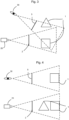
- the camera for the gaze interaction bitmap may be located at the same notional position as the camera for the visual scene viewport, but the size of the gaze interaction viewport may be larger. This is illustrated in Fig. 2 . It is noted that although Figs 2-4 illustrate 3D concepts, they are presented as a 2D plan views for simplicity.
- 3D gaze-interactable objects 1 are viewed from the same location by both the visual camera 20 and the gaze detection camera 30.
- the corresponding gaze detection camera has a wider field of view giving rise to a larger gaze detection viewport 5 compared to the smaller visual scene viewport 2 (N.B. features 2 and 5 are shown slightly separated in Fig. 2 for the sake of clarity, but are considered as coincident for the purposes of the present discussion).
- there may be other differences in optical parameters between the cameras such as distortion including barrelling, pincushion and the like, depth of focus and resolution etc.,
- the visual camera 20 only sees the square 3D object 1, but the triangular 3D object 1 is partly visible to the gaze detection camera through the gaze detection viewport 5.
- Fig. 3 depicts an alternative possibility, in which the location of the visual scene camera 20 and the corresponding gaze-tracking camera 30 are not coincident. This could be, for example, to take account of an offset between the position and orientation of a screen compared to a user's eyes.
- Fig. 3 not only will different gaze-interactable objects 1 be visible via the different viewports 2, 5 (gaze detection viewport 5 showing both the triangular and the square objects 1, whereas visual viewport 2 shows only the square object 1), but the viewports 2, 5 will also show different projections of the square object 1 as it is being viewed from different angles.
- Fig. 4 In another scenario, as mentioned above, not all objects within a scene may be gaze-interactable. This is illustrated in Fig. 4 . In Fig. 4 , only the square object 1 is gaze-interactable, and so this is the only object 1 which is rendered to the viewport 5 of the gaze detection camera 30. However, both the square and the triangular objects 1 are rendered to the corresponding visual viewport 2.
- the square object 1 is rendered to the gaze detection viewport 5, even though it may not be visible (or is at least partly blocked) in the visual scene because of the positioning of the triangular object 1 between the square object 1 and the viewport 2.
- the non-gaze-interactable objects are effectively ignored in the creation of the gaze interaction bitmap.
- the visual and the corresponding gaze-interactable scene could be rendered entirely independently, for example.
- objects within a single virtual scene 10 could be provided with properties to identify them as objects that are or are not rendered in one or other of the visual or gaze detection scenes.
- a scene may contain sectors, areas or regions which are gaze-interactable, but which do not correspond to a specific visual object.
- a scene in a game may contain a "dangerous" region that will trigger a response if the user's gaze is directed towards it.
- Fig. 5 shows a schematic view of a system 40 in which the gaze-detection may be implemented.
- the system 40 includes a screen or monitor 41 and gaze-detector 42.
- the screen may take a conventional, or non-conventional form including a virtual screen such as a retinal projector or a heads up display in a vehicle.
- Both the gaze detector 42 and the screen 41 are connected to a computer 43.
- the graphical processing unit (GPU) 45 is often 10-100x faster than the central processing unit (CPU) 44 for parallelizable computations. As such, it is preferable to implement the present invention using the GPU 45.
- the invention could be implemented using any suitable processor such as a CPU 44.
- the computer further comprises a memory 46 which contains a buffer into which the gaze detection bitmap 47 can be stored.
- the buffer is preferably of variable bit depth.
- the buffer contains at least enough bit depth to encode one property representative of each gaze-interactable zone 1 (where, as mentioned above, the term "zone” is used to include both 3D objects as well as regions of 3D space) present in the scene 10.
- the buffer could be implemented in conjunction with the visual buffer.
- the visual buffer is implemented in the RGBA format, it is common that there are bits in the alpha channel that are not used. In some implementations of the present invention, those spare bits could be used to store the information relating to zones 1 of interest.
- the buffer is used to store a bitmap 47 representing the viewport 5 onto the 3D scene from the gaze interaction camera 30.
- the pixels of the bitmap 47, on to which gaze-interactable zones 1 are projected, are used to store a property of the gaze-interactable zones 1.
- the property stored in the bitmap 47 may be a unique identifier (ID), identifying the particular gaze-interactable zone.
- ID unique identifier
- the pixels of the bitmap 47 may be used to store information about more than one property of the zones of interest. For example, in combination with (or instead of) a unique ID, it may be desirable to store other information related to gaze interaction.
- Such gaze interaction information could be metadata associated with an object 1, for example indicating the relative visual importance of an object 1. This information can be used to assist in algorithms for detecting whether a user is looking at a particular object if two gaze-interactable objects 1 are located near to each other: if it is difficult to determine which of the two objects a user is looking at, it may be assumed that the user is looking at the most visually "important" object.
- Other useful gaze interaction information may also include information about an object's 1 motion, such as its velocity and/or acceleration. This information may be relevant to heuristics weighting the likelihood of a user's gaze being directed at any particular object in a particular area (e.g. a faster moving object being more likely to attract a user's attention). Any other variables used for such weightings may also (or alternatively) be stored in the bitmap 47
- Creating the gaze interaction bitmap 47 in addition to the visual scene information, increases computation requirements.
- the only items rendered to the gaze interaction bitmap 47 are objects and areas identified as gaze-interactable zones 1. Such objects and areas are pre-defined during the programming / design of the 3D scene 10.
- the information stored in the bitmap 47 can include any relevant properties as defined in connection with the gaze-interactable zones 1 when creating the scene 10. In some cases, it may be desirable to store information about multiple objects in the same pixel of the bitmap (i.e. if multiple gaze-interactable objects are aligned behind each other), and in that case an associated index may also be stored, to indicate the order of closeness of the objects with respect to the viewport for example.
- any available depth buffer and/or stencil buffer data may be utilised.
- This approach is possible by considering the 'interaction-mask' in a 2D context, in the same way as the projection of the scene to the viewport, and thus leveraging existing graphics rendering capabilities in the creation of the mask (i.e. the bitmap 47).
- the bitmap 47 Once the bitmap 47 has been created and stored, it can be used in conjunction with any eye tracking hardware 42 to determine if a user's gaze is directed to a gaze-interactable zone 1.
- the gaze interaction bitmap 47 can be used to determine if the gaze is directed to a gaze-interactable zone 1, by referencing the property information stored in the bitmap 47. Any information relating to the properties of a gaze-interactable zone 1 to which the user's gaze is directed can then be used to determine the consequence of the user looking at the particular zone 1.
- the present invention allows for efficient determination of whether a user is looking at a gaze-interactable object in a 3D scene, by effectively rendering a gaze interaction scene.
- the information relating to the gaze-interactable scene can be used, for example, in conjunction with the visual scene, to determine the consequences of the direction of the user's gaze.
Landscapes
- Engineering & Computer Science (AREA)
- Physics & Mathematics (AREA)
- General Physics & Mathematics (AREA)
- Theoretical Computer Science (AREA)
- Health & Medical Sciences (AREA)
- Radar, Positioning & Navigation (AREA)
- Remote Sensing (AREA)
- Life Sciences & Earth Sciences (AREA)
- General Engineering & Computer Science (AREA)
- Human Computer Interaction (AREA)
- Automation & Control Theory (AREA)
- Multimedia (AREA)
- General Health & Medical Sciences (AREA)
- Ophthalmology & Optometry (AREA)
- Aviation & Aerospace Engineering (AREA)
- Computer Vision & Pattern Recognition (AREA)
- Electromagnetism (AREA)
- Public Health (AREA)
- Biomedical Technology (AREA)
- Biophysics (AREA)
- Veterinary Medicine (AREA)
- Heart & Thoracic Surgery (AREA)
- Animal Behavior & Ethology (AREA)
- Surgery (AREA)
- Molecular Biology (AREA)
- Medical Informatics (AREA)
- Software Systems (AREA)
- Computer Hardware Design (AREA)
- Computer Graphics (AREA)
- User Interface Of Digital Computer (AREA)
- Processing Or Creating Images (AREA)
Claims (14)
- Computerimplementiertes
Verfahren zum Bestimmen, ob der Blick eines Benutzers in die Richtung einer Zone von Interesse (1) in einer virtuellen 3D-Szene (10) gerichtet ist, das Verfahren umfassend:Bereitstellen einer virtuellen 3D-Szene, die eine Zone von Interesse enthält;Zuordnen einer Eigenschaft zu der Zone von Interesse;Erstellen einer Bitmap (47), die den Ort der Zone von Interesse in einer projizierten Ansicht (2) der virtuellen 3D-Szene darstellt, wobei jedes Pixel der Bitmap, auf das die Zone von Interesse projiziert wird, die Eigenschaft der Zone von Interesse speichert;Erfassen, von einem Detektor, der Richtung des Blicks des Benutzers;Verwenden der Bitmap, um zu bestimmen, ob der Blick des erkannten Benutzers in die Richtung der Zone von Interesse gerichtet ist;wobei die Bitmap unter Verwendung von Tiefenpuffer- und/oder Schablonenpufferdaten erstellt wird, die der virtuellen 3D-Szene entsprechen. - Verfahren nach Anspruch 1, ferner umfassend:
wobei der Schritt des Erkennens das Erkennen der Richtung des Blicks des Benutzers relativ zu der Bitmap oder einer anderen Projektion der virtuellen 3D-Szene umfasst. - Verfahren nach Anspruch 2, ferner umfassend:Bereitstellen einer visuellen Darstellung für den Benutzer, die der virtuellen 3D-Szene entspricht; undwobei der Schritt des Erkennens das Erkennen der Richtung des Blicks des Benutzers innerhalb der visuellen Darstellung umfasst.
- Verfahren nach Anspruch 3, wobei ein Viewport für die Bitmap und ein Viewport für die visuelle Darstellung Folgendes sind:an der gleichen Position in Bezug auf die virtuelle 3D-Szene; odernicht an der gleichen Position in Bezug auf die virtuelle 3D-Szene sind.
- Verfahren nach Anspruch 3, wobei ein Viewport für die visuelle Darstellung von einer zweiten Szene ist, die der virtuellen 3D-Szene entspricht.
- Verfahren nach einem der Ansprüche 3 bis 5, wobei die Zone von Interesse oder ein Teil der Zone von Interesse innerhalb der visuellen Darstellung nicht sichtbar ist.
- Verfahren nach Anspruch 6, wobei die Zone von Interesse oder der Teil der Zone von Interesse in der visuellen Darstellung nicht sichtbar ist, da er hinter einem oder mehreren anderen Objekten verborgen ist.
- Verfahren nach Anspruch 6 oder Anspruch 7, ferner umfassend das Bestimmen, dass der Blick des Benutzers auf die Zone von Interesse oder den Teil der Zone von Interesse gerichtet ist, der in der visuellen Darstellung nicht sichtbar ist.
- Verfahren nach einem der vorstehenden Ansprüche, wobei mehrere es mehrere Zonen von Interesse gibt, optional wobei unterschiedliche Zonen von Interesse unterschiedlichen Eigenschaften zugeordnet sind.
- Verfahren nach Anspruch 9, wobei der Schritt des Erstellens das Erstellen einer Bitmap mit einem Pixel einschließt, das mehrere Eigenschaften von Zonen von Interesse enthält, und wobei der Schritt des Erstellens ferner das Zuweisen eines Indexes zu den Eigenschaften in dem Pixel umfasst, um die relative Tiefe der Zone von Interesse innerhalb der Szene anzugeben.
- Verfahren nach einem der vorstehenden Ansprüche, wobei:die Eigenschaft eines von einer Kennung für die Zone von Interesse, Informationen, die die Bewegung der Zone von Interesse betreffen oder Informationen, die die visuelle Bedeutung der Zone von Interesse betrifft, ist und/oderferner umfassend das Zuordnen mehrerer Eigenschaften zu der oder jeder Zone von Interesse.
- Verfahren nach einem der vorstehenden Ansprüche, wobei die virtuelle 3D-Szene eine simulierte 3D-Szene ist.
- Verfahren nach Anspruch 1, wobei die Bitmap ferner einer nichtlinearen Deformation unterzogen wird.
- Vorrichtung zum Bestimmen, ob der Blick eines Benutzers in die Richtung einer Zone von Interesse (1) in einer virtuellen 3D-Szene (10) gerichtet ist, die Vorrichtung umfassend:einen Puffer (46), der zum Speichern einer Bitmap (47) konfiguriert ist, die den Ort einer Zone von Interesse in einer projizierten Ansicht (2) einer 3D-Szene darstellt, wobei jedes Pixel der Bitmap, auf das die Zone von Interesse projiziert wird, eine Eigenschaft der Zone von Interesse speichert;einen Detektor (42) zum Erkennen der Richtung des Blicks des Benutzers;einen Prozessor (44, 45)), der geeignet ist zum:- Bereitstellen einer virtuellen 3D-Szene, die eine Zone von Interesse enthält;- Zuordnen einer Eigenschaft zu der Zone von Interesse;- Erstellen einer Bitmap (47), die den Ort der Zone von Interesse in einer projizierten Ansicht (2) der virtuellen 3D-Szene darstellt, wobei jedes Pixel der Bitmap, auf das die Zone von Interesse projiziert wird, die Eigenschaft der Zone von Interesse speichert;- Erfassen, von dem Detektor, der Richtung des Blicks des Benutzers; unter Verwendung der Bitmap, um zu bestimmen, ob der Blick, der durch den Detektor erkannt wird, in die Richtung der Zone von Interesse gerichtet ist;wobei die Bitmap unter Verwendung von Tiefenpuffer- und/oder Schablonenpufferdaten erstellt wird, die der virtuellen 3D-Szene entsprechen.
Applications Claiming Priority (2)
| Application Number | Priority Date | Filing Date | Title |
|---|---|---|---|
| GB1509622.5A GB2539009B (en) | 2015-06-03 | 2015-06-03 | Gaze detection method and apparatus |
| PCT/EP2016/062555 WO2016193394A1 (en) | 2015-06-03 | 2016-06-02 | Gaze detection method and apparatus |
Publications (2)
| Publication Number | Publication Date |
|---|---|
| EP3302228A1 EP3302228A1 (de) | 2018-04-11 |
| EP3302228B1 true EP3302228B1 (de) | 2024-11-27 |
Family
ID=53677710
Family Applications (1)
| Application Number | Title | Priority Date | Filing Date |
|---|---|---|---|
| EP16726869.7A Active EP3302228B1 (de) | 2015-06-03 | 2016-06-02 | Verfahren und vorrichtung zur blickerkennung |
Country Status (6)
| Country | Link |
|---|---|
| US (3) | US10216268B2 (de) |
| EP (1) | EP3302228B1 (de) |
| KR (1) | KR20180033138A (de) |
| CN (2) | CN112215220A (de) |
| GB (1) | GB2539009B (de) |
| WO (1) | WO2016193394A1 (de) |
Families Citing this family (44)
| Publication number | Priority date | Publication date | Assignee | Title |
|---|---|---|---|---|
| EP3062142B1 (de) | 2015-02-26 | 2018-10-03 | Nokia Technologies OY | Vorrichtung für augennahe Anzeige |
| JP6553418B2 (ja) * | 2015-06-12 | 2019-07-31 | パナソニック インテレクチュアル プロパティ コーポレーション オブ アメリカPanasonic Intellectual Property Corporation of America | 表示制御方法、表示制御装置及び制御プログラム |
| US10650552B2 (en) | 2016-12-29 | 2020-05-12 | Magic Leap, Inc. | Systems and methods for augmented reality |
| EP3343267B1 (de) | 2016-12-30 | 2024-01-24 | Magic Leap, Inc. | Polychromatische lichtauskopplungsvorrichtung, augennahe anzeige damit und verfahren zur polychromatischem lichtauskopplung |
| US10578870B2 (en) | 2017-07-26 | 2020-03-03 | Magic Leap, Inc. | Exit pupil expander |
| KR102596429B1 (ko) | 2017-12-10 | 2023-10-30 | 매직 립, 인코포레이티드 | 광학 도파관들 상의 반사―방지 코팅들 |
| KR102761610B1 (ko) | 2017-12-20 | 2025-01-31 | 매직 립, 인코포레이티드 | 증강 현실 뷰잉 디바이스용 인서트 |
| CN112136152B (zh) * | 2018-03-15 | 2025-02-07 | 奇跃公司 | 由观看设备的部件变形导致的图像校正 |
| US20190295503A1 (en) * | 2018-03-22 | 2019-09-26 | Oculus Vr, Llc | Apparatuses, systems, and methods for displaying mixed bit-depth images |
| CN114935974B (zh) * | 2018-03-30 | 2025-04-25 | 托比股份公司 | 用于确定注视关注目标的对物体映射的多线迹注视 |
| US10721510B2 (en) | 2018-05-17 | 2020-07-21 | At&T Intellectual Property I, L.P. | Directing user focus in 360 video consumption |
| US10482653B1 (en) | 2018-05-22 | 2019-11-19 | At&T Intellectual Property I, L.P. | System for active-focus prediction in 360 video |
| CN112236713B (zh) | 2018-05-30 | 2023-01-24 | 奇跃公司 | 紧凑的可变聚焦配置 |
| JP7319303B2 (ja) | 2018-05-31 | 2023-08-01 | マジック リープ, インコーポレイテッド | レーダ頭部姿勢位置特定 |
| US10827225B2 (en) | 2018-06-01 | 2020-11-03 | AT&T Intellectual Propety I, L.P. | Navigation for 360-degree video streaming |
| CN112400157B (zh) | 2018-06-05 | 2024-07-09 | 奇跃公司 | 观看系统的基于单应性变换矩阵的温度校准 |
| CN112513785B (zh) | 2018-06-08 | 2024-11-05 | 奇跃公司 | 具有自动表面选择放置和内容取向放置的增强现实观看器 |
| WO2020010097A1 (en) | 2018-07-02 | 2020-01-09 | Magic Leap, Inc. | Pixel intensity modulation using modifying gain values |
| US11856479B2 (en) | 2018-07-03 | 2023-12-26 | Magic Leap, Inc. | Systems and methods for virtual and augmented reality along a route with markers |
| US11510027B2 (en) | 2018-07-03 | 2022-11-22 | Magic Leap, Inc. | Systems and methods for virtual and augmented reality |
| JP7374981B2 (ja) | 2018-07-10 | 2023-11-07 | マジック リープ, インコーポレイテッド | クロス命令セットアーキテクチャプロシージャ呼出のためのスレッドウィービング |
| US11624929B2 (en) | 2018-07-24 | 2023-04-11 | Magic Leap, Inc. | Viewing device with dust seal integration |
| CN119197613A (zh) | 2018-07-24 | 2024-12-27 | 奇跃公司 | 移动检测设备的依赖于温度的校准 |
| WO2020028834A1 (en) | 2018-08-02 | 2020-02-06 | Magic Leap, Inc. | A viewing system with interpupillary distance compensation based on head motion |
| JP7438188B2 (ja) | 2018-08-03 | 2024-02-26 | マジック リープ, インコーポレイテッド | ユーザ相互作用システムにおけるトーテムの融合姿勢の非融合姿勢ベースのドリフト補正 |
| JP7487176B2 (ja) | 2018-08-22 | 2024-05-20 | マジック リープ, インコーポレイテッド | 患者視認システム |
| JP7434303B2 (ja) | 2018-10-12 | 2024-02-20 | マジック リープ, インコーポレイテッド | 運動追跡システムの正確度を検証するためのステージングシステム |
| EP3881279A4 (de) | 2018-11-16 | 2022-08-17 | Magic Leap, Inc. | Durch bildgrösse ausgelöste klärung zur aufrechterhaltung der bildschärfe |
| JP7543274B2 (ja) | 2018-12-21 | 2024-09-02 | マジック リープ, インコーポレイテッド | 導波管内の全内部反射を助長するための空気ポケット構造 |
| SE543121C2 (en) | 2019-02-04 | 2020-10-13 | Tobii Ab | Method and system for determining a current gaze direction |
| WO2020163603A1 (en) | 2019-02-06 | 2020-08-13 | Magic Leap, Inc. | Target intent-based clock speed determination and adjustment to limit total heat generated by multiple processors |
| WO2020185405A1 (en) | 2019-03-12 | 2020-09-17 | Magic Leap, Inc. | Registration of local content between first and second augmented reality viewers |
| EP3963565A4 (de) | 2019-05-01 | 2022-10-12 | Magic Leap, Inc. | Inhaltsbereitstellungssystem und -verfahren |
| EP3744568B1 (de) * | 2019-05-29 | 2022-01-19 | Ningbo Geely Automobile Research & Development Co. Ltd. | System und verfahren zur bereitstellung einer gewünschten ansicht für einen fahrzeuginsassen |
| JP7609844B2 (ja) | 2019-07-26 | 2025-01-07 | マジック リープ, インコーポレイテッド | 拡張現実のためのシステムおよび方法 |
| CN114730490A (zh) | 2019-11-14 | 2022-07-08 | 奇跃公司 | 用于虚拟现实和增强现实的系统和方法 |
| EP4058979A4 (de) | 2019-11-15 | 2023-01-11 | Magic Leap, Inc. | Betrachtungssystem zur verwendung in einer chirurgischen umgebung |
| CN118192800B (zh) | 2020-03-31 | 2025-04-25 | 托比股份公司 | 用于对可视化数据进行预处理的方法、计算机程序产品和处理电路系统 |
| EP4134867A4 (de) * | 2020-04-30 | 2023-05-31 | Huawei Technologies Co., Ltd. | Identifikationsverfahren und identifikationsvorrichtung für ein interessierendes objekt eines benutzers |
| US11503998B1 (en) | 2021-05-05 | 2022-11-22 | Innodem Neurosciences | Method and a system for detection of eye gaze-pattern abnormalities and related neurological diseases |
| SE545378C2 (en) * | 2021-12-30 | 2023-07-25 | Tobii Ab | Method and system for determining a current gaze direction |
| US12204689B2 (en) | 2022-09-27 | 2025-01-21 | Tobii Dynavox Ab | Method, system, and computer program product for drawing and fine-tuned motor controls |
| CN116246043B (zh) * | 2023-02-07 | 2023-09-29 | 广东工业大学 | 增强现实的视听内容的呈现方法、装置、设备及存储介质 |
| US12422937B1 (en) | 2024-05-31 | 2025-09-23 | Microsoft Technology Licensing, Llc | Techniques for 3-D scene decomposition, interoperability and cross-device compatibility for mixed reality experiences |
Family Cites Families (18)
| Publication number | Priority date | Publication date | Assignee | Title |
|---|---|---|---|---|
| US5802492A (en) * | 1994-06-24 | 1998-09-01 | Delorme Publishing Company, Inc. | Computer aided routing and positioning system |
| US6152563A (en) | 1998-02-20 | 2000-11-28 | Hutchinson; Thomas E. | Eye gaze direction tracker |
| EP1805744A2 (de) * | 2004-08-10 | 2007-07-11 | The General Hospital Corporation | Verfahren und vorrichtungen zur simulation von endovaskulären und endoluminalen prozeduren |
| KR100820639B1 (ko) * | 2006-07-25 | 2008-04-10 | 한국과학기술연구원 | 시선 기반 3차원 인터랙션 시스템 및 방법 그리고 3차원시선 추적 시스템 및 방법 |
| US20110128223A1 (en) * | 2008-08-07 | 2011-06-02 | Koninklijke Phillips Electronics N.V. | Method of and system for determining a head-motion/gaze relationship for a user, and an interactive display system |
| WO2012021967A1 (en) * | 2010-08-16 | 2012-02-23 | Tandemlaunch Technologies Inc. | System and method for analyzing three-dimensional (3d) media content |
| US20130154913A1 (en) * | 2010-12-16 | 2013-06-20 | Siemens Corporation | Systems and methods for a gaze and gesture interface |
| CN102750720A (zh) * | 2011-04-20 | 2012-10-24 | 鸿富锦精密工业(深圳)有限公司 | 三维效果模拟系统及方法 |
| US8510166B2 (en) * | 2011-05-11 | 2013-08-13 | Google Inc. | Gaze tracking system |
| US8885877B2 (en) * | 2011-05-20 | 2014-11-11 | Eyefluence, Inc. | Systems and methods for identifying gaze tracking scene reference locations |
| US9135508B2 (en) * | 2011-12-20 | 2015-09-15 | Microsoft Technology Licensing, Llc. | Enhanced user eye gaze estimation |
| US10129524B2 (en) * | 2012-06-26 | 2018-11-13 | Google Llc | Depth-assigned content for depth-enhanced virtual reality images |
| EP2709060B1 (de) * | 2012-09-17 | 2020-02-26 | Apple Inc. | Verfahren und Vorrichtung zur Bestimmung eines Blickpunkts auf ein dreidimensionales Objekt |
| US20140164056A1 (en) * | 2012-12-07 | 2014-06-12 | Cascade Strategies, Inc. | Biosensitive response evaluation for design and research |
| KR20150020918A (ko) * | 2013-08-19 | 2015-02-27 | 엘지전자 주식회사 | 디스플레이 장치 및 그것의 제어 방법 |
| FR3011952B1 (fr) * | 2013-10-14 | 2017-01-27 | Suricog | Procede d'interaction par le regard et dispositif associe |
| US10416760B2 (en) * | 2014-07-25 | 2019-09-17 | Microsoft Technology Licensing, Llc | Gaze-based object placement within a virtual reality environment |
| EP3223245B1 (de) * | 2016-03-24 | 2024-04-24 | Ecole Nationale de l'Aviation Civile | Ansichtspunktauswahl in virtueller 3d-umgebung |
-
2015
- 2015-06-03 GB GB1509622.5A patent/GB2539009B/en active Active
-
2016
- 2016-06-02 CN CN202010966831.XA patent/CN112215220A/zh active Pending
- 2016-06-02 WO PCT/EP2016/062555 patent/WO2016193394A1/en not_active Ceased
- 2016-06-02 KR KR1020177037525A patent/KR20180033138A/ko not_active Abandoned
- 2016-06-02 US US15/171,548 patent/US10216268B2/en active Active
- 2016-06-02 CN CN201680044591.XA patent/CN107920734B/zh active Active
- 2016-06-02 EP EP16726869.7A patent/EP3302228B1/de active Active
-
2019
- 2019-01-24 US US16/256,427 patent/US10579142B2/en active Active
-
2020
- 2020-01-27 US US16/773,056 patent/US11709545B2/en active Active
Also Published As
| Publication number | Publication date |
|---|---|
| US20200285311A1 (en) | 2020-09-10 |
| EP3302228A1 (de) | 2018-04-11 |
| CN112215220A (zh) | 2021-01-12 |
| US10579142B2 (en) | 2020-03-03 |
| US11709545B2 (en) | 2023-07-25 |
| KR20180033138A (ko) | 2018-04-02 |
| GB2539009A (en) | 2016-12-07 |
| CN107920734B (zh) | 2020-10-02 |
| WO2016193394A1 (en) | 2016-12-08 |
| GB201509622D0 (en) | 2015-07-15 |
| US20190155383A1 (en) | 2019-05-23 |
| GB2539009B (en) | 2021-07-21 |
| US10216268B2 (en) | 2019-02-26 |
| CN107920734A (zh) | 2018-04-17 |
| US20160357255A1 (en) | 2016-12-08 |
Similar Documents
| Publication | Publication Date | Title |
|---|---|---|
| US11709545B2 (en) | Gaze detection method and apparatus | |
| US11688128B2 (en) | Multi line trace gaze to object mapping for determining gaze focus targets | |
| US11270499B2 (en) | Multi line trace gaze to object mapping for determining gaze focus targets | |
| KR102291461B1 (ko) | 디스플레이를 위한 캡처된 이미지의 시각을 조정하는 기술들 | |
| KR102544062B1 (ko) | 가상 이미지 표시 방법, 저장 매체 및 이를 위한 전자 장치 | |
| US9740282B1 (en) | Gaze direction tracking | |
| KR102539427B1 (ko) | 화상 처리장치, 화상 처리방법, 및 기억매체 | |
| JP2022179473A (ja) | 前の目線からのレンダリングされたコンテンツおよびレンダリングされなかったコンテンツを使用した新しいフレームの生成 | |
| WO2018219091A1 (zh) | 用于显示弹幕的方法、装置以及存储介质 | |
| CN114026603A (zh) | 渲染计算机生成现实文本 | |
| EP3547079B1 (de) | Darstellung von bildern auf einer anzeigevorrichtung | |
| JP2020523957A (ja) | マルチ・ビュー・コンテンツを観察するユーザに情報を提示する方法及び機器 | |
| JP2019102828A (ja) | 画像処理装置、画像処理方法、及び画像処理プログラム | |
| US12366916B2 (en) | Method and system for determining a current gaze direction | |
| US20230412792A1 (en) | Rendering format selection based on virtual distance | |
| US20260057598A1 (en) | Image processing apparatus, image processing method, and storage medium | |
| TR201708836A2 (tr) | Birleştirilmiş 2D ve 3D Görüntüleme Çıkışı için Yöntem |
Legal Events
| Date | Code | Title | Description |
|---|---|---|---|
| STAA | Information on the status of an ep patent application or granted ep patent |
Free format text: STATUS: THE INTERNATIONAL PUBLICATION HAS BEEN MADE |
|
| PUAI | Public reference made under article 153(3) epc to a published international application that has entered the european phase |
Free format text: ORIGINAL CODE: 0009012 |
|
| STAA | Information on the status of an ep patent application or granted ep patent |
Free format text: STATUS: REQUEST FOR EXAMINATION WAS MADE |
|
| 17P | Request for examination filed |
Effective date: 20171219 |
|
| AK | Designated contracting states |
Kind code of ref document: A1 Designated state(s): AL AT BE BG CH CY CZ DE DK EE ES FI FR GB GR HR HU IE IS IT LI LT LU LV MC MK MT NL NO PL PT RO RS SE SI SK SM TR |
|
| AX | Request for extension of the european patent |
Extension state: BA ME |
|
| DAV | Request for validation of the european patent (deleted) | ||
| DAX | Request for extension of the european patent (deleted) | ||
| STAA | Information on the status of an ep patent application or granted ep patent |
Free format text: STATUS: EXAMINATION IS IN PROGRESS |
|
| 17Q | First examination report despatched |
Effective date: 20210324 |
|
| RAP3 | Party data changed (applicant data changed or rights of an application transferred) |
Owner name: TOBII AB |
|
| RAP3 | Party data changed (applicant data changed or rights of an application transferred) |
Owner name: TOBII AB |
|
| GRAP | Despatch of communication of intention to grant a patent |
Free format text: ORIGINAL CODE: EPIDOSNIGR1 |
|
| STAA | Information on the status of an ep patent application or granted ep patent |
Free format text: STATUS: GRANT OF PATENT IS INTENDED |
|
| INTG | Intention to grant announced |
Effective date: 20240718 |
|
| GRAS | Grant fee paid |
Free format text: ORIGINAL CODE: EPIDOSNIGR3 |
|
| GRAA | (expected) grant |
Free format text: ORIGINAL CODE: 0009210 |
|
| STAA | Information on the status of an ep patent application or granted ep patent |
Free format text: STATUS: THE PATENT HAS BEEN GRANTED |
|
| P01 | Opt-out of the competence of the unified patent court (upc) registered |
Free format text: CASE NUMBER: APP_53680/2024 Effective date: 20240926 |
|
| AK | Designated contracting states |
Kind code of ref document: B1 Designated state(s): AL AT BE BG CH CY CZ DE DK EE ES FI FR GB GR HR HU IE IS IT LI LT LU LV MC MK MT NL NO PL PT RO RS SE SI SK SM TR |
|
| REG | Reference to a national code |
Ref country code: GB Ref legal event code: FG4D |
|
| REG | Reference to a national code |
Ref country code: CH Ref legal event code: EP |
|
| REG | Reference to a national code |
Ref country code: IE Ref legal event code: FG4D |
|
| REG | Reference to a national code |
Ref country code: DE Ref legal event code: R096 Ref document number: 602016090388 Country of ref document: DE |
|
| REG | Reference to a national code |
Ref country code: LT Ref legal event code: MG9D |
|
| REG | Reference to a national code |
Ref country code: NL Ref legal event code: MP Effective date: 20241127 |
|
| PG25 | Lapsed in a contracting state [announced via postgrant information from national office to epo] |
Ref country code: HR Free format text: LAPSE BECAUSE OF FAILURE TO SUBMIT A TRANSLATION OF THE DESCRIPTION OR TO PAY THE FEE WITHIN THE PRESCRIBED TIME-LIMIT Effective date: 20241127 Ref country code: PT Free format text: LAPSE BECAUSE OF FAILURE TO SUBMIT A TRANSLATION OF THE DESCRIPTION OR TO PAY THE FEE WITHIN THE PRESCRIBED TIME-LIMIT Effective date: 20250327 Ref country code: IS Free format text: LAPSE BECAUSE OF FAILURE TO SUBMIT A TRANSLATION OF THE DESCRIPTION OR TO PAY THE FEE WITHIN THE PRESCRIBED TIME-LIMIT Effective date: 20250327 |
|
| PG25 | Lapsed in a contracting state [announced via postgrant information from national office to epo] |
Ref country code: NL Free format text: LAPSE BECAUSE OF FAILURE TO SUBMIT A TRANSLATION OF THE DESCRIPTION OR TO PAY THE FEE WITHIN THE PRESCRIBED TIME-LIMIT Effective date: 20241127 Ref country code: FI Free format text: LAPSE BECAUSE OF FAILURE TO SUBMIT A TRANSLATION OF THE DESCRIPTION OR TO PAY THE FEE WITHIN THE PRESCRIBED TIME-LIMIT Effective date: 20241127 |
|
| REG | Reference to a national code |
Ref country code: AT Ref legal event code: MK05 Ref document number: 1744868 Country of ref document: AT Kind code of ref document: T Effective date: 20241127 |
|
| PG25 | Lapsed in a contracting state [announced via postgrant information from national office to epo] |
Ref country code: BG Free format text: LAPSE BECAUSE OF FAILURE TO SUBMIT A TRANSLATION OF THE DESCRIPTION OR TO PAY THE FEE WITHIN THE PRESCRIBED TIME-LIMIT Effective date: 20241127 |
|
| PG25 | Lapsed in a contracting state [announced via postgrant information from national office to epo] |
Ref country code: ES Free format text: LAPSE BECAUSE OF FAILURE TO SUBMIT A TRANSLATION OF THE DESCRIPTION OR TO PAY THE FEE WITHIN THE PRESCRIBED TIME-LIMIT Effective date: 20241127 |
|
| PG25 | Lapsed in a contracting state [announced via postgrant information from national office to epo] |
Ref country code: NO Free format text: LAPSE BECAUSE OF FAILURE TO SUBMIT A TRANSLATION OF THE DESCRIPTION OR TO PAY THE FEE WITHIN THE PRESCRIBED TIME-LIMIT Effective date: 20250227 |
|
| PG25 | Lapsed in a contracting state [announced via postgrant information from national office to epo] |
Ref country code: LV Free format text: LAPSE BECAUSE OF FAILURE TO SUBMIT A TRANSLATION OF THE DESCRIPTION OR TO PAY THE FEE WITHIN THE PRESCRIBED TIME-LIMIT Effective date: 20241127 Ref country code: GR Free format text: LAPSE BECAUSE OF FAILURE TO SUBMIT A TRANSLATION OF THE DESCRIPTION OR TO PAY THE FEE WITHIN THE PRESCRIBED TIME-LIMIT Effective date: 20250228 Ref country code: AT Free format text: LAPSE BECAUSE OF FAILURE TO SUBMIT A TRANSLATION OF THE DESCRIPTION OR TO PAY THE FEE WITHIN THE PRESCRIBED TIME-LIMIT Effective date: 20241127 |
|
| PG25 | Lapsed in a contracting state [announced via postgrant information from national office to epo] |
Ref country code: PL Free format text: LAPSE BECAUSE OF FAILURE TO SUBMIT A TRANSLATION OF THE DESCRIPTION OR TO PAY THE FEE WITHIN THE PRESCRIBED TIME-LIMIT Effective date: 20241127 |
|
| PG25 | Lapsed in a contracting state [announced via postgrant information from national office to epo] |
Ref country code: RS Free format text: LAPSE BECAUSE OF FAILURE TO SUBMIT A TRANSLATION OF THE DESCRIPTION OR TO PAY THE FEE WITHIN THE PRESCRIBED TIME-LIMIT Effective date: 20250227 |
|
| PG25 | Lapsed in a contracting state [announced via postgrant information from national office to epo] |
Ref country code: SM Free format text: LAPSE BECAUSE OF FAILURE TO SUBMIT A TRANSLATION OF THE DESCRIPTION OR TO PAY THE FEE WITHIN THE PRESCRIBED TIME-LIMIT Effective date: 20241127 |
|
| PGFP | Annual fee paid to national office [announced via postgrant information from national office to epo] |
Ref country code: DE Payment date: 20250617 Year of fee payment: 10 |
|
| PG25 | Lapsed in a contracting state [announced via postgrant information from national office to epo] |
Ref country code: DK Free format text: LAPSE BECAUSE OF FAILURE TO SUBMIT A TRANSLATION OF THE DESCRIPTION OR TO PAY THE FEE WITHIN THE PRESCRIBED TIME-LIMIT Effective date: 20241127 |
|
| PGFP | Annual fee paid to national office [announced via postgrant information from national office to epo] |
Ref country code: GB Payment date: 20250617 Year of fee payment: 10 |
|
| PG25 | Lapsed in a contracting state [announced via postgrant information from national office to epo] |
Ref country code: EE Free format text: LAPSE BECAUSE OF FAILURE TO SUBMIT A TRANSLATION OF THE DESCRIPTION OR TO PAY THE FEE WITHIN THE PRESCRIBED TIME-LIMIT Effective date: 20241127 |
|
| PGFP | Annual fee paid to national office [announced via postgrant information from national office to epo] |
Ref country code: FR Payment date: 20250618 Year of fee payment: 10 |
|
| PG25 | Lapsed in a contracting state [announced via postgrant information from national office to epo] |
Ref country code: RO Free format text: LAPSE BECAUSE OF FAILURE TO SUBMIT A TRANSLATION OF THE DESCRIPTION OR TO PAY THE FEE WITHIN THE PRESCRIBED TIME-LIMIT Effective date: 20241127 |
|
| PG25 | Lapsed in a contracting state [announced via postgrant information from national office to epo] |
Ref country code: SK Free format text: LAPSE BECAUSE OF FAILURE TO SUBMIT A TRANSLATION OF THE DESCRIPTION OR TO PAY THE FEE WITHIN THE PRESCRIBED TIME-LIMIT Effective date: 20241127 |
|
| PG25 | Lapsed in a contracting state [announced via postgrant information from national office to epo] |
Ref country code: CZ Free format text: LAPSE BECAUSE OF FAILURE TO SUBMIT A TRANSLATION OF THE DESCRIPTION OR TO PAY THE FEE WITHIN THE PRESCRIBED TIME-LIMIT Effective date: 20241127 |
|
| PG25 | Lapsed in a contracting state [announced via postgrant information from national office to epo] |
Ref country code: IT Free format text: LAPSE BECAUSE OF FAILURE TO SUBMIT A TRANSLATION OF THE DESCRIPTION OR TO PAY THE FEE WITHIN THE PRESCRIBED TIME-LIMIT Effective date: 20241127 |
|
| REG | Reference to a national code |
Ref country code: DE Ref legal event code: R097 Ref document number: 602016090388 Country of ref document: DE |
|
| PG25 | Lapsed in a contracting state [announced via postgrant information from national office to epo] |
Ref country code: SE Free format text: LAPSE BECAUSE OF FAILURE TO SUBMIT A TRANSLATION OF THE DESCRIPTION OR TO PAY THE FEE WITHIN THE PRESCRIBED TIME-LIMIT Effective date: 20241127 |
|
| PLBE | No opposition filed within time limit |
Free format text: ORIGINAL CODE: 0009261 |
|
| STAA | Information on the status of an ep patent application or granted ep patent |
Free format text: STATUS: NO OPPOSITION FILED WITHIN TIME LIMIT |
|
| REG | Reference to a national code |
Ref country code: CH Ref legal event code: L10 Free format text: ST27 STATUS EVENT CODE: U-0-0-L10-L00 (AS PROVIDED BY THE NATIONAL OFFICE) Effective date: 20251008 |
|
| 26N | No opposition filed |
Effective date: 20250828 |
|
| REG | Reference to a national code |
Ref country code: CH Ref legal event code: H13 Free format text: ST27 STATUS EVENT CODE: U-0-0-H10-H13 (AS PROVIDED BY THE NATIONAL OFFICE) Effective date: 20260127 |
|
| PG25 | Lapsed in a contracting state [announced via postgrant information from national office to epo] |
Ref country code: MC Free format text: LAPSE BECAUSE OF FAILURE TO SUBMIT A TRANSLATION OF THE DESCRIPTION OR TO PAY THE FEE WITHIN THE PRESCRIBED TIME-LIMIT Effective date: 20241127 |
|
| PG25 | Lapsed in a contracting state [announced via postgrant information from national office to epo] |
Ref country code: LU Free format text: LAPSE BECAUSE OF NON-PAYMENT OF DUE FEES Effective date: 20250602 |
|
| REG | Reference to a national code |
Ref country code: BE Ref legal event code: MM Effective date: 20250630 |
|
| PG25 | Lapsed in a contracting state [announced via postgrant information from national office to epo] |
Ref country code: IE Free format text: LAPSE BECAUSE OF NON-PAYMENT OF DUE FEES Effective date: 20250602 |
|
| PG25 | Lapsed in a contracting state [announced via postgrant information from national office to epo] |
Ref country code: BE Free format text: LAPSE BECAUSE OF NON-PAYMENT OF DUE FEES Effective date: 20250630 |
|
| PG25 | Lapsed in a contracting state [announced via postgrant information from national office to epo] |
Ref country code: CH Free format text: LAPSE BECAUSE OF NON-PAYMENT OF DUE FEES Effective date: 20250630 |