EP3301942A1 - A method and a system for delivering an ott advertisement content for television content delivered using a constant bit rate network - Google Patents
A method and a system for delivering an ott advertisement content for television content delivered using a constant bit rate network Download PDFInfo
- Publication number
- EP3301942A1 EP3301942A1 EP16191636.6A EP16191636A EP3301942A1 EP 3301942 A1 EP3301942 A1 EP 3301942A1 EP 16191636 A EP16191636 A EP 16191636A EP 3301942 A1 EP3301942 A1 EP 3301942A1
- Authority
- EP
- European Patent Office
- Prior art keywords
- content
- ott
- over
- advertisement content
- bit rate
- Prior art date
- Legal status (The legal status is an assumption and is not a legal conclusion. Google has not performed a legal analysis and makes no representation as to the accuracy of the status listed.)
- Withdrawn
Links
Images


Classifications
-
- H—ELECTRICITY
- H04—ELECTRIC COMMUNICATION TECHNIQUE
- H04N—PICTORIAL COMMUNICATION, e.g. TELEVISION
- H04N21/00—Selective content distribution, e.g. interactive television or video on demand [VOD]
- H04N21/40—Client devices specifically adapted for the reception of or interaction with content, e.g. set-top-box [STB]; Operations thereof
- H04N21/43—Processing of content or additional data, e.g. demultiplexing additional data from a digital video stream; Elementary client operations, e.g. monitoring of home network or synchronising decoder's clock; Client middleware
- H04N21/44—Processing of video elementary streams, e.g. splicing a video clip retrieved from local storage with an incoming video stream or rendering scenes according to encoded video stream scene graphs
- H04N21/44016—Processing of video elementary streams, e.g. splicing a video clip retrieved from local storage with an incoming video stream or rendering scenes according to encoded video stream scene graphs involving splicing one content stream with another content stream, e.g. for substituting a video clip
-
- H—ELECTRICITY
- H04—ELECTRIC COMMUNICATION TECHNIQUE
- H04N—PICTORIAL COMMUNICATION, e.g. TELEVISION
- H04N21/00—Selective content distribution, e.g. interactive television or video on demand [VOD]
- H04N21/60—Network structure or processes for video distribution between server and client or between remote clients; Control signalling between clients, server and network components; Transmission of management data between server and client, e.g. sending from server to client commands for recording incoming content stream; Communication details between server and client
- H04N21/65—Transmission of management data between client and server
- H04N21/654—Transmission by server directed to the client
- H04N21/6543—Transmission by server directed to the client for forcing some client operations, e.g. recording
Definitions
- a method and a system for delivering an over-the top (OTT) advertisement content for television content delivered using a constant bit rate network is disclosed.
- DVB Digital Video Broadcasting
- the DVB standards utilize a QAM (Quadrature Amplitude Modulation) or QPSK (Quadrature Phase Shift Keying) modulation infrastructure for transferring data which have a constant bit rate and a push mode which means the content is constantly available from a source either as ready to broadcast files (e.g. clips) or is received from some other providers in a broadcast mode as well, regardless on the amount subscribers watching the program.
- QAM Quadrature Amplitude Modulation
- QPSK Quadrature Phase Shift Keying
- an audio and video content is coded and sent in a MPEG-2 or MPEG-4 compression system.
- a signalling definition i.e. advertisement presentation blocks definition, bases on SCTE-35 (ANSI/SCTE 35 2013) and SCTE-104 (ANSI/SCTE 104 2012) standards that respectively describe the inline insertion of cue tones in MPEG-TS streams and translate communications between the automation and compression points of the system that inserts the SCTE 35 sections.
- a broadcast television content is delivered to a CPE (Customer Premises Equipment) device using operator's media delivery path i.e. according to DVB-S/S2/C/T/T2 or IP (Internet Protocol) standards.
- CPE Customer Premises Equipment
- the advertisement is delivered in blocks in order to facilitate authoring advertisement clips into segments.
- Currently known solutions allow content source providers to embed their own advertisement blocks including signalling of those blocks definition.
- a mutual agreement between an operator and a local content provider is defined by a contract, wherein the advertisement blocks can be locally replaced by broadcast affiliates.
- BBC or Euro-Sport channels are available at most European countries, hence providing dedicated country tailored advertisements.
- advertisement content embedded in the stream is uniform for all subscribers group, therefore it cannot be targeted towards individual watchers.
- Over-the-top television is gaining in popularity as an alternative in television broadcasting. It provides television programs, which are offered by stationary broadcasters (such as cable television), over the Internet. In some cases part of a programming content is available only in the OTT form - for example due to lack of satellite broadcast of specific channels in a given region. Moreover, the OTT may provide an advertisement content which is tailored to a specific group of subscribers or individual subscribers basing on their preferences.
- a method for receiving an over-the-top advertisement content for television content delivered using a constant bit rate network comprising the steps of: receiving the television content over a first media delivery path which is a constant bit rate network infrastructure; receiving the OTT advertisement content from an advertisement content source over a second media delivery path which is a content delivery network accessible over an Internet Protocol (IP) network infrastructure; and analysing the incoming television content to detect a cue tone for an advertising command and in case the advertising command is a 'start' command, displaying the received OTT advertisement content.
- IP Internet Protocol
- the method may further comprise determining a subscriber profile of the CPE and receiving the OTT advertisement content depending on the subscriber profile parameters.
- the OTT advertisement content and the television content can be synchronized according to the ANSI/SCTE 35 2013 time signalling.
- Non-transitory computer readable storage medium comprising instructions that, when executed by a computer, enable delivering an over-the-top content in a constant bit rate television network in accordance with the method as disclosed herein.
- a system for delivering an over-the-top advertisement content for television content delivered using a constant bit rate network comprising: a head-end configured to deliver the television content over a first media delivery path which is a constant bit rate network infrastructure; a content delivery network configured to deliver the OTT advertisement content from an advertisement content source over a second media delivery path accessible over an Internet Protocol (IP) network infrastructure.
- IP Internet Protocol
- the system may further comprise a customer premises equipment connected to the constant bit rate network infrastructure for receiving the television content and to the Internet Protocol (IP) network infrastructure for receiving the OTT advertisement content.
- IP Internet Protocol
- Fig. 1 presents a prior art transmission system structure, the system being capable of providing advertisement content by means of delivering an SCTE-35/104 signalling to local head-end premises.
- the television broadcast system utilizes a broadcast content source 110 that typically consists of satellite and terrestrial reception blocks responsible for receiving signal, deciphering, if applicable, and de-multiplexing it.
- a broadcast content source 110 typically consists of satellite and terrestrial reception blocks responsible for receiving signal, deciphering, if applicable, and de-multiplexing it.
- Such signal is delivered via a transmission channel 101 to an operator's head-end (a master facility for receiving television signals for processing and distribution over a cable television system) 120.
- the signal is delivered to a broadcast head-end 122 (being a part of the operator's head-end 120) where the operator may transcode the received signals and multiplex them according to local needs.
- the signal is modulated in order to be delivered via a transmission channel 102 to a Radio Frequency (RF) infrastructure 130 that connects, via a transmission channel 103, the head-end and Customer Premises Equipment (CPE) 140 located at subscribers' homes.
- the broadcast head-end 122 additionally comprises an audio-video signal splicer 123 that is responsible for seamless replacing of the broadcast signal with the advertisement signal provided by an advertisement content source 124 (an advertisement server comprised within the operator's head end 120).
- Another option for delivering the advertisement content to the subscribers is designed for CPE equipped with a storage e.g. a hard drive or/and flash.
- a storage e.g. a hard drive or/and flash.
- advertisement clips are delivered to the CPE storage ahead of time.
- SCTE-35/104 signalling is used by CPE software in order to replace the advertisement on the fly in an appropriate moment with predetermined clips that are already preloaded to the CPE storage.
- Fig. 2 presents a new transmission system structure.
- the system comprises a broadcast content source 110 (typically comprising satellite and terrestrial reception blocks responsible for receiving signal, deciphering, if applicable, and de-multiplexing).
- a broadcast content source 110 typically comprising satellite and terrestrial reception blocks responsible for receiving signal, deciphering, if applicable, and de-multiplexing.
- the signal is delivered via a transmission channel 101 to an operator's broadcast head-end 122 which together with an advertisement content source 124 forms an operator's head-end 120.
- the operator may transcode the received signals, multiplex them according to local needs and cipher again using dedicated Conditional Access (CA) infrastructure.
- CA Conditional Access
- the signal gets modulated in order to be delivered via a transmission channel 102 to a Radio Frequency (RF) infrastructure 130 that connects via a transmission channel 103 the head-end and Customer Premises Equipment (CPE) 140 located at subscribers' homes.
- the advertisement content source 124 is responsible for providing advertisement clips via a transmission channel 201 to a content delivery network (CDN) 220 that is part of an IP infrastructure 210 that is either public Internet or operator's private network.
- CDN content delivery network
- the advertisement content is delivered directly to the CPE 140 of a subscriber, wherein the CPE 140 is equipped with a network interface card (NIC) and has access to the Internet or the operator's network.
- NIC network interface card
- the first path delivers programming content utilizing the DVB standards and the second path delivers advertisement content utilizing a dedicated Over-the-top service available through a content delivery network CDN 210 (Internet or the operator's network).
- CDN 210 Internet or the operator's network
- the advertisement content which is tailored to individual subscriber preferences (acquired from the CPE profile that defines owners preferences - for example basing on the content which is consumed by the subscriber on that particular CPE) which enhances operator's ability by offering on demand targeted advertising.
- the SCTE-35/104 signalling is delivered to the CPE 140 in a DVB standard (broadcast), whereas the advertisement content is delivered over the network 210 using dedicated advertisement OTT (Over-The-Top) service.
- OTT Over-The-Top
- the OTT transmission requires considering propagation time from the advertisement origin server(s) 124 to the CPE 140.
- the origin server(s) 124 that serve(s) all the advertisement assets chunks to the CPE 140 are connected through the CDN (Content Delivery Network).
- CDN 220 architecture i.e. the number of nodes/hopes between the CPE 140 and the advertisement server 124, the time of delivery may vary.
- a predetermined CDN cache loading mechanism is employed.
- the advertisement system is aware of advertisement blocks presentation window, thus it controls the CDN 220 in order to push and keep the advertisement blocks in the cache for an appropriate period of time, thus resolving CDN propagation issue. This results in fast data acquisition and seamless display on the CPE 140.
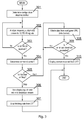
- Fig. 3 presents a data processing diagram.
- a configuration of a subscriber is determined (e.g. the subscriber profile that determines the type of advertising content interesting for that subscriber).
- an incoming stream is analysed towards detection of SCTE-35 signals. If the STCE-35 signals are detected in step 303, then the procedure moves to step 304, otherwise it loops back to step 302.
- step 304 and 305 the type of STCE-35 command is determined. If the command is "start" the procedure moves to step 308 in which advertisement data is obtained from the configured URL (the advertisement server). The advertisement data obtained can be selected according to the configuration of the subscriber.
- step 309 it is checked if a minimum threshold is exceeded, if not the procedure loops back to step 308 otherwise it continues to final step 310 in which the received content is displayed.
- the minimum threshold value depends on OTT delivery method and may vary. For example, it can be set to 3 consequent segment for HLS. If the command in step 305 is "stop" then in step 306 the advertisement displaying is terminated and the broadcast stream is displayed again. In step 307 fetching of the data from the OTT is terminated and the procedure is finished.
Landscapes
- Engineering & Computer Science (AREA)
- Multimedia (AREA)
- Signal Processing (AREA)
- Two-Way Televisions, Distribution Of Moving Picture Or The Like (AREA)
- Information Transfer Between Computers (AREA)
Abstract
A method for receiving an over-the-top (OTT) advertisement content for television content delivered using a constant bit rate network, in a customer premises equipment (CPE), the method comprising the steps of: receiving the television content over a first media delivery path which is a constant bit rate network infrastructure (130); receiving (308) the OTT advertisement content from an advertisement content source (124) over a second media delivery path which is a content delivery network (220) accessible over an Internet Protocol (IP) network infrastructure (210); and analysing (302) the incoming television content to detect a cue tone for an advertising command and in case the advertising command is a 'start' command (304), displaying (310) the received OTT advertisement content.
Description
- A method and a system for delivering an over-the top (OTT) advertisement content for television content delivered using a constant bit rate network.
- Typically, television programming is delivered by means of a cable television system utilizing one of Digital Video Broadcasting (DVB) standards - DVB-S/S2/C/C2/T/T2. The DVB standards utilize a QAM (Quadrature Amplitude Modulation) or QPSK (Quadrature Phase Shift Keying) modulation infrastructure for transferring data which have a constant bit rate and a push mode which means the content is constantly available from a source either as ready to broadcast files (e.g. clips) or is received from some other providers in a broadcast mode as well, regardless on the amount subscribers watching the program. Typically, in the DVB standard, an audio and video content is coded and sent in a MPEG-2 or MPEG-4 compression system.
- Nowadays advertisement is an integral part of programming delivered to subscribers as a broadcast or an on-demand television content. There are defined, within the programming signal, periods of time when advertisements shall be present. A signalling definition, i.e. advertisement presentation blocks definition, bases on SCTE-35 (ANSI/
SCTE 35 2013) and SCTE-104 (ANSI/SCTE 104 2012) standards that respectively describe the inline insertion of cue tones in MPEG-TS streams and translate communications between the automation and compression points of the system that inserts theSCTE 35 sections. A broadcast television content is delivered to a CPE (Customer Premises Equipment) device using operator's media delivery path i.e. according to DVB-S/S2/C/T/T2 or IP (Internet Protocol) standards. The advertisement is delivered in blocks in order to facilitate authoring advertisement clips into segments. Currently known solutions allow content source providers to embed their own advertisement blocks including signalling of those blocks definition. A mutual agreement between an operator and a local content provider is defined by a contract, wherein the advertisement blocks can be locally replaced by broadcast affiliates. For example, BBC or Euro-Sport channels are available at most European countries, hence providing dedicated country tailored advertisements. However in such type of broadcasting (DVB), advertisement content embedded in the stream is uniform for all subscribers group, therefore it cannot be targeted towards individual watchers. - Over-the-top television (OTT) is gaining in popularity as an alternative in television broadcasting. It provides television programs, which are offered by stationary broadcasters (such as cable television), over the Internet. In some cases part of a programming content is available only in the OTT form - for example due to lack of satellite broadcast of specific channels in a given region. Moreover, the OTT may provide an advertisement content which is tailored to a specific group of subscribers or individual subscribers basing on their preferences.
- Therefore, there is a need to provide a method and a system for delivering a tailored advertisement content in a form of an over-the-top television content wherein a programming content is delivered using a constant bit rate network, such as defined by DVB standards.
- There is disclosed a method for receiving an over-the-top advertisement content for television content delivered using a constant bit rate network, in a customer premises equipment, the method comprising the steps of: receiving the television content over a first media delivery path which is a constant bit rate network infrastructure; receiving the OTT advertisement content from an advertisement content source over a second media delivery path which is a content delivery network accessible over an Internet Protocol (IP) network infrastructure; and analysing the incoming television content to detect a cue tone for an advertising command and in case the advertising command is a 'start' command, displaying the received OTT advertisement content.
- The method may further comprise determining a subscriber profile of the CPE and receiving the OTT advertisement content depending on the subscriber profile parameters.
- The OTT advertisement content and the television content can be synchronized according to the ANSI/
SCTE 35 2013 time signalling. - There is also disclosed a non-transitory computer readable storage medium comprising instructions that, when executed by a computer, enable delivering an over-the-top content in a constant bit rate television network in accordance with the method as disclosed herein.
- There is also disclosed a system for delivering an over-the-top advertisement content for television content delivered using a constant bit rate network, to a customer premises equipment, the system comprising: a head-end configured to deliver the television content over a first media delivery path which is a constant bit rate network infrastructure; a content delivery network configured to deliver the OTT advertisement content from an advertisement content source over a second media delivery path accessible over an Internet Protocol (IP) network infrastructure.
- The system may further comprise a customer premises equipment connected to the constant bit rate network infrastructure for receiving the television content and to the Internet Protocol (IP) network infrastructure for receiving the OTT advertisement content.
- Further details and features of the present invention, its nature and various advantages will become more apparent from the following detailed description of the preferred embodiments shown in drawings, in which:
- Fig. 1
- presents a prior art transmission system structure;
- Fig. 2
- presents a new transmission system structure;
- Fig. 3
- presents a flowchart of data processing.
-
Fig. 1 presents a prior art transmission system structure, the system being capable of providing advertisement content by means of delivering an SCTE-35/104 signalling to local head-end premises. Typical, the television broadcast system utilizes abroadcast content source 110 that typically consists of satellite and terrestrial reception blocks responsible for receiving signal, deciphering, if applicable, and de-multiplexing it. Such signal is delivered via atransmission channel 101 to an operator's head-end (a master facility for receiving television signals for processing and distribution over a cable television system) 120. In particular, the signal is delivered to a broadcast head-end 122 (being a part of the operator's head-end 120) where the operator may transcode the received signals and multiplex them according to local needs. Finally the signal is modulated in order to be delivered via atransmission channel 102 to a Radio Frequency (RF)infrastructure 130 that connects, via atransmission channel 103, the head-end and Customer Premises Equipment (CPE) 140 located at subscribers' homes. The broadcast head-end 122 additionally comprises an audio-video signal splicer 123 that is responsible for seamless replacing of the broadcast signal with the advertisement signal provided by an advertisement content source 124 (an advertisement server comprised within the operator's head end 120). - Another option for delivering the advertisement content to the subscribers is designed for CPE equipped with a storage e.g. a hard drive or/and flash. In this method optional advertisement clips are delivered to the CPE storage ahead of time. Next the SCTE-35/104 signalling is used by CPE software in order to replace the advertisement on the fly in an appropriate moment with predetermined clips that are already preloaded to the CPE storage.
-
Fig. 2 presents a new transmission system structure. The system comprises a broadcast content source 110 (typically comprising satellite and terrestrial reception blocks responsible for receiving signal, deciphering, if applicable, and de-multiplexing). Next the signal is delivered via atransmission channel 101 to an operator's broadcast head-end 122 which together with anadvertisement content source 124 forms an operator's head-end 120. In the operator's broadcast head-end 120, the operator may transcode the received signals, multiplex them according to local needs and cipher again using dedicated Conditional Access (CA) infrastructure. Next, the signal gets modulated in order to be delivered via atransmission channel 102 to a Radio Frequency (RF)infrastructure 130 that connects via atransmission channel 103 the head-end and Customer Premises Equipment (CPE) 140 located at subscribers' homes. Theadvertisement content source 124 is responsible for providing advertisement clips via atransmission channel 201 to a content delivery network (CDN) 220 that is part of anIP infrastructure 210 that is either public Internet or operator's private network. Next the advertisement content is delivered directly to theCPE 140 of a subscriber, wherein theCPE 140 is equipped with a network interface card (NIC) and has access to the Internet or the operator's network. - As a result, in the new system there are two different parallel media delivery paths for content delivery. The first path delivers programming content utilizing the DVB standards and the second path delivers advertisement content utilizing a dedicated Over-the-top service available through a content delivery network CDN 210 (Internet or the operator's network).
- Therefore, it is possible to deliver the advertisement content which is tailored to individual subscriber preferences (acquired from the CPE profile that defines owners preferences - for example basing on the content which is consumed by the subscriber on that particular CPE) which enhances operator's ability by offering on demand targeted advertising.
- In the aforementioned system, the SCTE-35/104 signalling is delivered to the
CPE 140 in a DVB standard (broadcast), whereas the advertisement content is delivered over thenetwork 210 using dedicated advertisement OTT (Over-The-Top) service. When utilizing two different parallel media delivery paths, a synchronization of the streams is required. The OTT transmission requires considering propagation time from the advertisement origin server(s) 124 to theCPE 140. The origin server(s) 124 that serve(s) all the advertisement assets chunks to theCPE 140 are connected through the CDN (Content Delivery Network). Depending on the CDN 220 architecture i.e. the number of nodes/hopes between theCPE 140 and theadvertisement server 124, the time of delivery may vary. In order to avoid "black screen" effect on theCPE 140, a predetermined CDN cache loading mechanism is employed. The advertisement system is aware of advertisement blocks presentation window, thus it controls theCDN 220 in order to push and keep the advertisement blocks in the cache for an appropriate period of time, thus resolving CDN propagation issue. This results in fast data acquisition and seamless display on theCPE 140. The synchronization between broadcast-TV stream and the advertisement content delivered over the OTT bases on SCTE-35 time signalling. -
Fig. 3 presents a data processing diagram. In thefirst step 301, a configuration of a subscriber is determined (e.g. the subscriber profile that determines the type of advertising content interesting for that subscriber). Next, instep 302 an incoming stream is analysed towards detection of SCTE-35 signals. If the STCE-35 signals are detected instep 303, then the procedure moves to step 304, otherwise it loops back tostep 302. Instep step 309 it is checked if a minimum threshold is exceeded, if not the procedure loops back to step 308 otherwise it continues tofinal step 310 in which the received content is displayed. The minimum threshold value depends on OTT delivery method and may vary. For example, it can be set to 3 consequent segment for HLS. If the command instep 305 is "stop" then instep 306 the advertisement displaying is terminated and the broadcast stream is displayed again. Instep 307 fetching of the data from the OTT is terminated and the procedure is finished.
Claims (6)
- A method for receiving an over-the-top (OTT) advertisement content for television content delivered using a constant bit rate network, in a customer premises equipment (CPE), the method comprising the steps of:- receiving the television content over a first media delivery path which is a constant bit rate network infrastructure (130);- receiving (308) the OTT advertisement content from an advertisement content source (124) over a second media delivery path which is a content delivery network (220) accessible over an Internet Protocol (IP) network infrastructure (210); and- analysing (302) the incoming television content to detect a cue tone for an advertising command and in case the advertising command is a 'start' command (304), displaying (310) the received OTT advertisement content.
- The method according to claim 1, further comprising determining (301) a subscriber profile of the CPE and receiving (308) the OTT advertisement content depending on the subscriber profile parameters.
- The method according to any of the above claims, wherein the OTT advertisement content and the television content are synchronized according to the ANSI/SCTE 35 2013 time signalling.
- A non-transitory computer readable storage medium comprising instructions that, when executed by a computer, enable delivering an over-the-top (OTT) content in a constant bit rate television network in accordance with the method according to any of claims 1-3.
- A system for delivering an over-the-top (OTT) advertisement content for television content delivered using a constant bit rate network, to a customer premises equipment (CPE), the system comprising:- a head-end (122) configured to deliver the television content over a first media delivery path which is a constant bit rate network infrastructure (130);- a content delivery network (220) configured to deliver the OTT advertisement content from an advertisement content source (124) over a second media delivery path accessible over an Internet Protocol (IP) network infrastructure (210).
- The system according to claim 5, further comprising a customer premises equipment (140) connected to the constant bit rate network infrastructure (130) for receiving the television content and to the Internet Protocol (IP) network infrastructure (210) for receiving the OTT advertisement content.
Priority Applications (1)
| Application Number | Priority Date | Filing Date | Title |
|---|---|---|---|
| EP16191636.6A EP3301942A1 (en) | 2016-09-30 | 2016-09-30 | A method and a system for delivering an ott advertisement content for television content delivered using a constant bit rate network |
Applications Claiming Priority (1)
| Application Number | Priority Date | Filing Date | Title |
|---|---|---|---|
| EP16191636.6A EP3301942A1 (en) | 2016-09-30 | 2016-09-30 | A method and a system for delivering an ott advertisement content for television content delivered using a constant bit rate network |
Publications (1)
| Publication Number | Publication Date |
|---|---|
| EP3301942A1 true EP3301942A1 (en) | 2018-04-04 |
Family
ID=57047075
Family Applications (1)
| Application Number | Title | Priority Date | Filing Date |
|---|---|---|---|
| EP16191636.6A Withdrawn EP3301942A1 (en) | 2016-09-30 | 2016-09-30 | A method and a system for delivering an ott advertisement content for television content delivered using a constant bit rate network |
Country Status (1)
| Country | Link |
|---|---|
| EP (1) | EP3301942A1 (en) |
Cited By (2)
| Publication number | Priority date | Publication date | Assignee | Title |
|---|---|---|---|---|
| CN112449214A (en) * | 2020-11-25 | 2021-03-05 | 恩亿科(北京)数据科技有限公司 | OTT advertisement putting method, system, computer equipment and storage medium |
| AU2019397411B2 (en) * | 2018-12-12 | 2025-04-10 | Bloomberg Finance L.P. | Content delivery system for television broadcast systems |
Citations (2)
| Publication number | Priority date | Publication date | Assignee | Title |
|---|---|---|---|---|
| US20090210900A1 (en) * | 2008-02-20 | 2009-08-20 | Ilan Kaftan | Out-of-band delivery of targeted advertising |
| WO2016098059A1 (en) * | 2014-12-19 | 2016-06-23 | Telefonaktiebolaget Lm Ericsson (Publ) | End user-based personalized ad insertion in broadcast-broadband hybrid terminals |
-
2016
- 2016-09-30 EP EP16191636.6A patent/EP3301942A1/en not_active Withdrawn
Patent Citations (2)
| Publication number | Priority date | Publication date | Assignee | Title |
|---|---|---|---|---|
| US20090210900A1 (en) * | 2008-02-20 | 2009-08-20 | Ilan Kaftan | Out-of-band delivery of targeted advertising |
| WO2016098059A1 (en) * | 2014-12-19 | 2016-06-23 | Telefonaktiebolaget Lm Ericsson (Publ) | End user-based personalized ad insertion in broadcast-broadband hybrid terminals |
Cited By (3)
| Publication number | Priority date | Publication date | Assignee | Title |
|---|---|---|---|---|
| AU2019397411B2 (en) * | 2018-12-12 | 2025-04-10 | Bloomberg Finance L.P. | Content delivery system for television broadcast systems |
| CN112449214A (en) * | 2020-11-25 | 2021-03-05 | 恩亿科(北京)数据科技有限公司 | OTT advertisement putting method, system, computer equipment and storage medium |
| CN112449214B (en) * | 2020-11-25 | 2023-12-08 | 恩亿科(北京)数据科技有限公司 | OTT advertisement putting method, OTT advertisement putting system, computer equipment and storage medium |
Similar Documents
| Publication | Publication Date | Title |
|---|---|---|
| US9167278B2 (en) | Method and system for automatic content recognition (ACR) based broadcast synchronization | |
| US11418823B2 (en) | Delivering content | |
| US11917240B2 (en) | Dynamic content serving using automated content recognition (ACR) and digital media watermarks | |
| US12549825B2 (en) | Automated program promotion detection in a video streaming system | |
| US8959539B2 (en) | Message delivery mechanism | |
| US8978060B2 (en) | Systems, methods, and media for presenting advertisements | |
| US20170078717A1 (en) | Selecting and Providing of Supplemental Content for Video Transport Stream | |
| US20120144420A1 (en) | Targeted advertisement distribution in an sdv environment | |
| US11991403B2 (en) | Dynamic watermarking of media based on transport-stream metadata, to facilitate action by downstream entity | |
| US20250343980A1 (en) | Use of watermarking to trigger fingerprint-related action | |
| US20220417617A1 (en) | Watermark-based metadata acquisition and processing | |
| KR20120083747A (en) | Method and apparatus for transmission in integrating system of broadcasting-communication service and multimedia service | |
| US11172269B2 (en) | Automated commercial content shifting in a video streaming system | |
| US20170164071A1 (en) | Broadcast signal transmission apparatus, broadcast signal reception apparatus, broadcast signal transmission method, and broadcast signal reception method | |
| CN103763588A (en) | Stream forwarding method, device, server and system for video advertising insertion | |
| US20190037273A1 (en) | Content delivery using location awareness | |
| EP2341680B1 (en) | Method and apparatus for adaptation of a multimedia content | |
| KR101488068B1 (en) | Advertise embedded system, advertisement embedded methodm and recording medium thereof | |
| JP7768885B2 (en) | System and method for ingesting and displaying alternative video and/or audio media synchronized with the display of linear video and audio content based on periodic evaluation of relevant environmental parameters, and maintaining the quality and integrity of the ingested content | |
| Bringuier | Increasing ad personalization with server-side ad insertion |
Legal Events
| Date | Code | Title | Description |
|---|---|---|---|
| PUAI | Public reference made under article 153(3) epc to a published international application that has entered the european phase |
Free format text: ORIGINAL CODE: 0009012 |
|
| STAA | Information on the status of an ep patent application or granted ep patent |
Free format text: STATUS: THE APPLICATION HAS BEEN PUBLISHED |
|
| AK | Designated contracting states |
Kind code of ref document: A1 Designated state(s): AL AT BE BG CH CY CZ DE DK EE ES FI FR GB GR HR HU IE IS IT LI LT LU LV MC MK MT NL NO PL PT RO RS SE SI SK SM TR |
|
| AX | Request for extension of the european patent |
Extension state: BA ME |
|
| STAA | Information on the status of an ep patent application or granted ep patent |
Free format text: STATUS: THE APPLICATION IS DEEMED TO BE WITHDRAWN |
|
| 18D | Application deemed to be withdrawn |
Effective date: 20181005 |