EP3299499B1 - Multifunctional viscose fibre and preparation method therefor - Google Patents
Multifunctional viscose fibre and preparation method therefor Download PDFInfo
- Publication number
- EP3299499B1 EP3299499B1 EP16799199.1A EP16799199A EP3299499B1 EP 3299499 B1 EP3299499 B1 EP 3299499B1 EP 16799199 A EP16799199 A EP 16799199A EP 3299499 B1 EP3299499 B1 EP 3299499B1
- Authority
- EP
- European Patent Office
- Prior art keywords
- graphene
- solution
- nanosilver
- viscose
- viscose fibre
- Prior art date
- Legal status (The legal status is an assumption and is not a legal conclusion. Google has not performed a legal analysis and makes no representation as to the accuracy of the status listed.)
- Active
Links
Images

Classifications
-
- D—TEXTILES; PAPER
- D01—NATURAL OR MAN-MADE THREADS OR FIBRES; SPINNING
- D01F—CHEMICAL FEATURES IN THE MANUFACTURE OF ARTIFICIAL FILAMENTS, THREADS, FIBRES, BRISTLES OR RIBBONS; APPARATUS SPECIALLY ADAPTED FOR THE MANUFACTURE OF CARBON FILAMENTS
- D01F2/00—Monocomponent artificial filaments or the like of cellulose or cellulose derivatives; Manufacture thereof
- D01F2/06—Monocomponent artificial filaments or the like of cellulose or cellulose derivatives; Manufacture thereof from viscose
- D01F2/08—Composition of the spinning solution or the bath
-
- C—CHEMISTRY; METALLURGY
- C01—INORGANIC CHEMISTRY
- C01B—NON-METALLIC ELEMENTS; COMPOUNDS THEREOF; METALLOIDS OR COMPOUNDS THEREOF NOT COVERED BY SUBCLASS C01C
- C01B32/00—Carbon; Compounds thereof
- C01B32/15—Nano-sized carbon materials
- C01B32/182—Graphene
-
- C—CHEMISTRY; METALLURGY
- C01—INORGANIC CHEMISTRY
- C01B—NON-METALLIC ELEMENTS; COMPOUNDS THEREOF; METALLOIDS OR COMPOUNDS THEREOF NOT COVERED BY SUBCLASS C01C
- C01B32/00—Carbon; Compounds thereof
- C01B32/15—Nano-sized carbon materials
- C01B32/182—Graphene
- C01B32/184—Preparation
-
- C—CHEMISTRY; METALLURGY
- C01—INORGANIC CHEMISTRY
- C01B—NON-METALLIC ELEMENTS; COMPOUNDS THEREOF; METALLOIDS OR COMPOUNDS THEREOF NOT COVERED BY SUBCLASS C01C
- C01B32/00—Carbon; Compounds thereof
- C01B32/15—Nano-sized carbon materials
- C01B32/182—Graphene
- C01B32/194—After-treatment
-
- D—TEXTILES; PAPER
- D01—NATURAL OR MAN-MADE THREADS OR FIBRES; SPINNING
- D01F—CHEMICAL FEATURES IN THE MANUFACTURE OF ARTIFICIAL FILAMENTS, THREADS, FIBRES, BRISTLES OR RIBBONS; APPARATUS SPECIALLY ADAPTED FOR THE MANUFACTURE OF CARBON FILAMENTS
- D01F2/00—Monocomponent artificial filaments or the like of cellulose or cellulose derivatives; Manufacture thereof
- D01F2/06—Monocomponent artificial filaments or the like of cellulose or cellulose derivatives; Manufacture thereof from viscose
- D01F2/08—Composition of the spinning solution or the bath
- D01F2/10—Addition to the spinning solution or spinning bath of substances which exert their effect equally well in either
-
- D—TEXTILES; PAPER
- D01—NATURAL OR MAN-MADE THREADS OR FIBRES; SPINNING
- D01D—MECHANICAL METHODS OR APPARATUS IN THE MANUFACTURE OF ARTIFICIAL FILAMENTS, THREADS, FIBRES, BRISTLES OR RIBBONS
- D01D5/00—Formation of filaments, threads, or the like
- D01D5/06—Wet spinning methods
Definitions
- the present invention relates to the field of viscose fibres, and more particularly to a viscose fibre and preparation method thereof.
- Viscose fibre is mainly prepared by using high-purity cellulose dissolving pulp as raw material, which is prepared from cellulose derived from cotton linter, wood and plant straw by a series of processes of acid hydrolysis, alkali hydrolysis, bleaching and others, and by a series of processes of alkali impregnation, pressing, aging, yellowing, dissolving, filtering, spinning, post-processing and others.
- Ordinary viscose fibre has similar properties with cotton fibre, having wearing comfortability, good hygroscopicity and dyeability, and has advantages which other chemical fibres cannot match.
- viscose fibre has become one of the hotspots of research, as the consumer has higher and higher requirements on functions of clothing and other materials, such as far infrared, anti-ultraviolet, anti-radiation, anti-static, antibacterial and bacteriostatic functions .
- Chinese Patent Application CN 1936124 A discloses a silver-containing antibacterial viscose fibre and preparation method thereof, and the method comprises steps of mixing, making glue, spinning, beaming, cutting, refining, drying, packing, and a colloidal solution of nanosilver with a nanoparticle size of 50-65nm was added during the process of making glue or spinning.
- the viscose fibre obtained by this method has strong antibacterial, bactericidal and certain anti-static functions.
- this method cannot well solve the problem of agglomeration of nanosilver particles in the process of making glue and spinning, which affects the effect of nanosilver particles.
- the obtained viscose fibre has bacteriostatic property, other properties such as far infrared, anti-radiation properties and others, are not prominent. Accordingly, the present inventors have considered the preparation of a viscose fibre having good far infrared, anti-ultraviolet, anti-radiation, anti-static, bacteriostatic, antibacterial and other functions.
- WO 2010/107762 discloses fibers comprising a composition including a polymer and graphene sheets.
- CN 104328523 A relates to a graphene-containing viscose fiber and a preparation method thereof.
- the purpose of the present invention is to provide a viscose fibre and preparation method thereof.
- the viscose fibre provided in the present invention has uniform distribution of nanoparticles and has good far-infrared, anti-ultraviolet, anti-radiation, anti-static, bacteriostatic and antibacterial properties, etc.
- the present invention provides a viscose fibre comprising: viscose fibres, graphene and nanosilver, wherein the nanosilver is loaded on the graphene sheet and covalently bonded.
- the graphene is prepared by the following process:
- the nanosilver accounts for 1 wt% to 50 wt% of the graphene; and the graphene accounts for 0.01 wt% to 10 wt% of the viscose fibres.
- the nanosilver accounts for 2 wt% to 30 wt% of the graphene; and the graphene accounts for 0.1 wt% to 5 wt% of the viscose fibres.
- the cellulose is a porous cellulose; and the activator is one or more of nickel chloride, nickel nitrate, nickel sulfate, nickel acetate, ferric chloride, ferrous chloride, ferric nitrate, ferric sulfate, ferrous sulfate, ferric acetate, cobalt chloride, cobalt nitrate, cobalt sulfate, cobalt acetate, manganese chloride, manganese nitrate, manganese sulfate and manganese acetate.
- the present invention also provides a method for preparing a viscose fibre according to claim 1, characterized by comprising:
- the graphene is prepared by the following process:
- said step a) specifically comprises:
- the stabilizer is one or more of sodium carboxymethylcellulose, polyvinyl alcohol, Tween 80, sodium dodecyl sulfate or sodium dodecylbenzenesulfonate.
- the silver salt is silver nitrate
- the reducing agent is one or more of sodium borohydride, ethylene glycol, glucose or citric acid; and the molar ratio of the reducing agent to the silver salt is 1-10: 1
- the resulting reaction product is subjected to ultrasonic treatment.
- the ultrasonic treatment is preformed for 10 min to 60 min.
- the present invention firstly obtains a nanosilver-loaded graphene by liquid phase synthesis in situ, and then obtains a viscose fibre added with nanosilver and graphene by adding the nanosilver-loaded graphene to a viscose solution and spinning.
- the obtained viscose fibre has good far-infrared, anti-ultraviolet, anti-static, anti-radiation, bacteriostatic and antibacterial properties, etc.
- the viscose fibre obtained by only adding graphene has improved antibacterial property and anti-radiation property, but the improvement is not obvious;
- the viscose fibre obtained by only adding nanosilver has a higher requirement on the degree of dispersion of nanosilver particles, and the improvements of far infrared temperature increase performance, anti-ultraviolet performance and anti-radiation performance of this viscose fibre are not obvious;
- the viscose fibre obtained by adding both nanosilver and graphene prepared by improved Hummers method also has non-obvious improvements in far-infrared performance, antibacterial performance and anti-radiation performance; however, the viscose fibre obtained by firstly loading nanosilver onto graphene sheet and then adding the nanosilver-loaded graphene into viscose fibre has effectively improved far-infrared performance, antibacterial performance and anti-radiation performance, wherein, by loading nanosilver onto graphene prepared by improved Hummers method and then adding the nanosilver-loaded graph
- the viscose fibre prepared by the present invention has a far infrared temperature increase performance increased by not less than 100%, an ultraviolet protecting coefficient increased by not less than 70%, and a bacteriostatic performance reaching 99.9% and increased by not less than 100%, while the viscose fibres prepared by other methods have a far infrared temperature increase performance increased by less than 50%, an ultraviolet protecting coefficient increased by less than 40%, and a bacteriostatic performance increased by less than 50%.
- the present invention provides a viscose fibre comprising viscose fibres, graphene and nanosilver, wherein the nanosilver is loaded on the graphene sheet and covalently bonded.
- the present invention utilizes graphene as a carrier.
- the graphene is firstly loaded with nanosilver and then added into viscose fibres, which can remarkably improve the properties of the viscose fibre, such as far-infrared, anti-ultraviolet, anti-radiation, anti-static, antibacterial and bacteriostatic properties, etc.
- the graphene is not particularly limited in the present invention, and the graphene prepared by an improved Hummers method may be used.
- the graphene used in the present invention is preferably prepared by the following process:
- the cellulose is a porous cellulose.
- the method for preparing the porous cellulose comprises the following steps: A) hydrolyzing a biomass resource in an acid to obtain lignocellulose, wherein the biomass resource includes one or more of plants, and agroforestry wastes; B) treating the lignocellulose to obtain a porous cellulose, wherein the treatment includes acid treatment, salt treatment or organic solvent treatment.
- the temperature for hydrolysis is preferably 90°C to 180°C, more preferably 120°C to 150°C.
- the time for hydrolysis is preferably 2 h to 10 h, more preferably 2 h to 8 h, and most preferably 3 h to 6 h.
- the acid for hydrolysis is preferably one or more of sulfuric acid, nitric acid, hydrochloric acid, formic acid, sulfurous acid, phosphoric acid and acetic acid, more preferably sulfuric acid, nitric acid hydrochloric acid or acetic acid, and most preferably sulfuric acid, nitric acid or hydrochloric acid.
- the amount of acid used in the hydrolysis is preferably 3 wt% to 20 wt%, more preferably 5 wt% to 15 wt%, and most preferably 8 wt% to 12 wt% of the biomass resource.
- the salt treatment is preferably carried out by an acidic sulfite process treatment or an alkali sulfite process treatment.
- the pH value during the acidic sulfite process treatment is preferably 1 to 7, more preferably 2 to 5, and most preferably 3 to 4.
- the temperature for the acidic sulfite process treatment is preferably 70°C to 180°C, more preferably 90°C to 150°C, and most preferably 100°C to 120°C.
- the time for the acidic sulfite process treatment is preferably 1h to 6h, more preferably 2h to 5h, and most preferably 3h to 4h.
- the acid in the acidic sulfite process treatment is preferably sulfuric acid.
- the amount of acid used in the acidic sulfite process treatment is preferably 4 wt% to 30 wt%, more preferably 8 wt% to 25 wt%, and most preferably 10 wt% to 20 wt% of the lignocellulose.
- the weight percent concentration of the acid in the acidic sulfite process treatment is preferably such that the liquid to solid ratio is (2-20): 1, more preferably (4-16): 1, and most preferably (8-12): 1.
- the sulfite in the acidic sulfite process treatment is preferably calcium sulfite, magnesium sulfite, sodium sulfite or ammonium sulfite, and more preferably magnesium sulfite or sodium sulfite.
- the amount of sulfite used in the acidic sulfite process treatment of the present invention is not particularly limited, and the amount of sulfite used in the sulfite pulping process well known to those skilled in the art can be used.
- the pH value in the alkali sulfite process treatment is preferably 7 to 14, more preferably 8 to 13, and most preferably 9 to 12.
- the temperature for the alkali sulfite process treatment is preferably 70°C to 180°C, more preferably 90°C to 150°C, and most preferably 100°C to 120°C.
- the time for the alkali sulfite process treatment is preferably 1 h to 6 h, more preferably 2 h to 5 h, and most preferably 3 h to 4 h
- the alkali in the alkali sulfite process treatment is preferably calcium hydroxide, sodium hydroxide, ammonium hydroxide or magnesium hydroxide, and more preferably sodium hydroxide or magnesium hydroxide.
- the amount of the alkali used in the alkali sulfite process treatment is preferably 4 wt% to 30 wt%, more preferably 8 wt% to 25 wt%, and most preferably 10 wt% to 20 wt% of the lignocellulose.
- the weight percentage concentration of the alkali in the alkali sulfite process treatment is preferably such that the liquid to solid ratio is (2-20): 1, more preferably (4-16): 1, and most preferably (8-12): 1.
- the sulfite in the alkali sulfite process treatment is preferably calcium sulfite, magnesium sulfite, sodium sulfite or ammonium sulfite, and more preferably magnesium sulfite or sodium sulfite.
- the amount of sulfite used in the alkali sulfite process treatment of the present invention is not particularly limited, and the amount of sulfite used in the sulfite pulping process well known to those skilled in the art can be used.
- the biomass resource in step A) is agroforestry wastes.
- the agroforestry waste includes one or more of corn stalk, corn cob, sorghum stalk, beet residue, bagasse, furfural residue, xylose residue, sawdust, cotton stalk and reed.
- the agroforestry waste is corn cob.
- the acid in step A) includes one or more of sulfuric acid, nitric acid, hydrochloric acid, formic acid, sulfurous acid, phosphoric acid and acetic acid.
- the amount of acid in step A) is from 3% to 20% by weight of the biomass resource.
- the temperature for hydrolysis in step A) is from 90°C to 180°C;
- the time for hydrolysis in step A) is from 10 min to 10 h.
- the salt treatment in step B) is carried out by an acidic sulfite process treatment or an alkali sulfite process treatment.
- the pH value in the acidic sulfite process treatment is from 1 to 7.
- the amount of acid used in the acidic sulfite process treatment is from 4 wt% to 30 wt% of the lignocellulose;
- the weight percent concentration of the acid in the acidic sulfite process treatment is such that the liquid to solid ratio is (2-20): 1.
- the temperature for the acidic sulfite process treatment is 70°C to 180°C;
- the time for the acidic sulfite process treatment is 1h to 6h.
- the pH value in the alkali sulfite process treatment is preferably 7 to 14;
- the amount of the alkali used in the alkali sulfite process treatment is 4 wt% to 30 wt% of the lignocellulose.
- the weight percentage concentration of the alkali in the alkali sulfite process treatment is such that the liquid to solid ratio is (2-20): 1.
- the temperature for the alkali sulfite process treatment is 70°C to 180°C;
- the time for the alkali sulfite process treatment is 1 h to 6 h.
- the mass ratio of the activator to the cellulose in the step 2) is (0.05-0.9): 1.
- the activator is one or more of nickel chloride, nickel nitrate, nickel sulfate, nickel acetate, ferric chloride, ferrous chloride, ferric nitrate, ferric sulfate, ferrous sulfate, ferric acetate, cobalt chloride, cobalt nitrate, cobalt sulfate, cobalt acetate, manganese chloride, manganese nitrate, manganese sulfate or manganese acetate.
- the protective gas in step 3) is selected from one or more of nitrogen and inert gases.
- the cellulose referred to in the present invention is preferably corncob cellulose.
- Corncob cellulose fibres are short, and have good dispersibility, a small cross-density between the fibres, and are enhanced in activity by bleaching with hydrogen peroxide or sodium hypochlorite. Meanwhile, under the catalysis of the metal activator and nitrogen protection, the temperature does not need to be greatly changed, and an activated biomass graphene is obtained at 600°C to 1400°C.
- the prepared activated biomass graphene has good electrical conductivity and good dispersibility in solution. The experimental results show that the conductivity of the activated biomass graphene prepared by the method provided in the present invention can reach up to 40,000 S/m.
- the graphene prepared by the above method was subjected to transmission electron microscopy test. The results show that the sheet of the graphene is thin, and the graphene is a biomass graphene having not more than 10 layers, for example 3-7 layers.
- the graphene prepared by the above method was subjected to Raman spectroscopy test. The results show that the graphene has a high degree of Sp 2 hybridization.
- the conductivity of the biomass graphene prepared by the above method was tested by a conductivity tester. The results show that the conductivity of the biomass graphene can be up to 40,000 S/m.
- the activated porous graphene prepared by the above-mentioned method is thin and has a high degree of Sp 2 hybridization.
- nanosilver is loaded in the graphene prepared by the above-mentioned method, more specifically loaded on the surface of the graphene sheet.
- the nanosilver can be uniformly distributed in the structure of the graphene sheet, and the particle size of the nanosilver particles is controllable and uniform.
- the nanosilver preferably accounts for 2 wt% to 50 wt%, more preferably 5 wt% to 20 wt% of the graphene.
- the particle size of the nanosilver is preferably less than 50 nm.
- the graphene preferably accounts for 0.01 wt% to 5 wt%, more preferably 0.1 wt% to 3 wt% of the viscose fibre.
- the viscose fibre may be one or more of corncob cellulose, reed cellulose, bamboo cellulose, corn stalk cellulose, cotton stalk cellulose, wood pulp cellulose, or a cellulose raw material prepared by waste residues such as xylose residue and bagasse, and the present invention is not particularly limited thereto.
- the silver nanoparticles are completely loaded on the surface of the graphene sheet and covalently bonded, so that the prepared solution of graphene loaded with silver nanoparticles does not need to be subjected to subsequent filtration and dehydration step, and can maintain the stable dispersion of the solution of nanosilver-loaded graphene, such that the solution can be directly mixed with viscose solution.
- the nanosilver-loaded graphene was added to the viscose fibre without affecting the wearing comfortability of the viscose fibre and the subsequent color adjusting and color matching process.
- the viscose fibre provided by the present invention has good far-infrared function and can be used in far-infrared fabric or clothing to improve the temperature of the human body surface.
- the viscose fibre provided by the present invention has good antibacterial, deodorization and other functions, and can be used for preparing antibacterial mask, underwear, deodorant socks, bandage and gauze.
- the viscose fibre provided by the present invention has good anti-ultraviolet, anti-static, anti-radiation and other functions, and can be used for preparing anti-ultraviolet, anti-static and anti-radiation fabrics and clothing.
- the present invention also provides a method for preparing a viscose fibre comprising:
- the graphene dispersion solution can be obtained by the following method:
- the graphene is ultrasonically dispersed in water, and then centrifuged or allowed to stand to be stratified, and the supernatant is a stable dispersion of the graphene colloidal solution.
- the time for ultrasonic dispersion is 10 min to 120 min, more preferably 30 min to 100 min.
- the condition for centrifugation treatment is 1000 rpm to 4000 rpm, more preferably 1500 rpm to 3500 rpm, and the time for centrifugation treatment is 2 min to 30 min, more preferably from 5 min to 10 min.
- the time for standing is preferably 20 h to 30 h, more preferably 24 h.
- the mass ratio of the graphene to water is preferably 0.01-5:100, more preferably 0.1-3.5:100.
- the obtained homogeneous graphene dispersion solution is mixed with a stabilizer to stabilize the dispersion of the graphene, preventing the agglomeration of the graphene colloidal solution.
- the stabilizer is a surfactant including, but not limited to, Tween-type surfactants, sulfonate-based surfactants or sulfate-based surfactants, and the like, preferably sodium dodecyl benzene sulfonate (SDBS), sodium dodecyl sulfate (SDS) or Tween 80, and the like.
- SDBS sodium dodecyl benzene sulfonate
- SDS sodium dodecyl sulfate
- Tween 80 Tween 80
- a silver salt is dissolved in the graphene dispersion solution, and a reducing agent is also added to perform reduction reaction to obtain a solution of nanosilver-loaded graphene.
- the silver salt is preferably silver nitrate.
- the silver salt is preferably dissolved in the graphene dispersion solution under stirring, and the addition amount of silver nitrate is 1 wt% to 50 wt%, more preferably 5 wt% to 30 wt% of the graphene.
- the reducing agent is preferably sodium borohydride, ethylene glycol, glucose or citric acid, and more preferably sodium borohydride.
- the reducing agent is preferably added under stirring; and the molar ratio of the reducing agent to the silver salt is preferably 1-10:1, more preferably 2-8: 1; the reaction is preferably carried out under stirring at room temperature; and the reaction time is preferably 30 min to 120 min, more preferably 50 min to 100 min.
- the obtained reaction product is subjected to ultrasonic treatment to obtain a solution of nanosilver-loaded graphene.
- the time for the ultrasonic treatment is preferably 10 min to 60 min, more preferably 20 min to 50 min.
- the solution of nanosilver-loaded graphene After the solution of nanosilver-loaded graphene is obtained, it is homogeneously mixed with the viscose solution, and a viscose fibre can be obtained after spinning.
- the proportion of graphene in the viscose fibre is preferably 0.1 ⁇ to 5%, more preferably 0.1% to 3%.
- the solution of nanosilver-loaded graphene is preferably added to the viscose solution slowly and mixed with quick stirring to make the dispersion solution of nanosilver-loaded graphene fully mixed.
- the viscose solution is a viscos solution well-known in the art, and the preparation method thereof is carried out by using a pulp as a raw material, and by processes such as impregnating, pressing, pulverizing, aging, yellowing, dissolving, ripening, filtering and defoaming.
- the pulp was impregnated with an aqueous solution of sodium hydroxide at a concentration of about 18% to convert cellulose into alkali cellulose, and hemicellulose was dissolved out, and the degree of polymerization was partially lowered, and then the excess lye was removed by pressing step; the bulk alkali cellulose became a loose floc after being crushed on a pulverizer, resulting in an increase in the subsequent chemical reaction uniformity due to the increase of surface area.
- Alkali cellulose was subjected to oxidative cracking in the role of oxygen, reducing the average degree of polymerization, which is called aging.
- alkali cellulose was reacted with carbon disulfide to form cellulose sulfonate, which is called sulfonation, making the hydrogen bonds between macromolecules further weakened. Due to the hydrophilicity of sulfonic acid groups, the solubility of cellulose in dilute alkali solution was greatly improved. The solid cellulose sulfonate was dissolved in dilute alkali solution, and a viscose solution was obtained.
- the dispersion solution of nanosilver-loaded graphene was added therein according to the above-mentioned method, and then spinning was carried out according to methods well known to those skilled in the art to obtain a viscose fibre.
- the just-made viscose solution is not easy to shape due to higher viscosity and salt value, and also need to be placed at a certain temperature for a certain period of time after adding the dispersion solution of nanosilver-loaded graphene, i.e.
- the source of the pulp is not limited in the present invention, and may be corncob cellulose, reed cellulose, bamboo cellulose, corn stalk cellulose, cotton stalk cellulose, wood pulp cellulose, or a cellulose raw material prepared by waste residues such as xylose residue and bagasse.
- the silver nanoparticles are completely loaded on the surface of the graphene sheet and covalently bonded, so that the prepared solution of graphene loaded with silver nanoparticles does not need to be subjected to subsequent filtration and dehydration step, and can maintain the stable dispersion of the solution of nanosilver-loaded graphene, such that the solution can be directly mixed with viscose solution.
- the viscose fibre provided by the present invention has good far infrared function, anti-ultraviolet, anti-static, anti-radiation, antibacterial and bacteriostatic functions, etc., and can be used for preparing far-infrared fabric or clothing, antibacterial mask, underwear, deodorant socks, bandage, gauze, anti-ultraviolet clothing, anti-static clothing, and anti-radiation clothing, etc.
- the viscose fibre provided by the present invention and preparation method thereof are further illustrated below in combination with examples.
- Corn cob was hydrolyzed in sulfuric acid at 120°C for 30 min to obtain lignocellulose, wherein the mass of the sulfuric acid was 3% of the mass of the corn cob;
- the lignocellulose was subjected to an acidic sulfite process treatment at 70°C for 1 h to obtain a porous cellulose, wherein the pH value in the acidic sulfite process was 1, the acid was sulfuric acid, the sulfite was magnesium sulfite, the mass of the sulfuric acid was 4% of the mass of the lignocellulose, and the liquid to solid ratio was 2:1;
- the porous cellulose was bleached with hydrogen peroxide, wherein the mass of hydrogen peroxide was 5% of the mass of the porous cellulose, the bleaching temperature for bleaching with hydrogen peroxide was 100°C, and the bleaching time was 5 hours.
- the bleached porous cellulose was activated with nickel chloride at 20°C under stirring for 2 hours, wherein the mass ratio of the nickel chloride and the porous cellulose was 0.1:1; and the resulting activated product was dried at 70°C to obtain a product having a water content of less than 10% by weight;
- the above product was placed in a carbonization furnace, and nitrogen gas was introduced into the carbonization furnace as a protective gas at a gas introduction rate of 200 mL/min, and the temperature was raised to 800°C and kept for 6 hours and then cooled to 60°C or lower; At a temperature of 60°C, the cooled product was washed for 4 hours in an aqueous solution of sodium hydroxide having a mass concentration of 3% to obtain a first washed product; at 70°C, the first washed product was washed for 4 hours in an aqueous solution of hydrochloric acid having a mass concentration of 4% to obtain a second washed product; the second washed product was washed
- Figure 1 is a Raman spectrum of graphene obtained in Example 1 of the present invention.
- the graphene prepared by the method provided by Example 1 of the present invention has a high degree of sp 2 hybridization.
- the graphene prepared by Example 1 of the present invention was subjected to transmission electron microscopy test, and the results were shown in Figures 2-3.
- Figures 2-3 are transmission electron micrographs of the graphene obtained in Example 1 of the present invention.
- the sheet of the graphene prepared by Example 1 of the present invention is thin, and the graphene is a biomass graphene having 10 layers or less.
- the above graphene colloidal solution was ultrasonically dispersed again in water for 100 min to obtain a graphene dispersion solution.
- 0.02 mol/L silver nitrate was added to the graphene dispersion solution under stirring, dissolved under stirring away from light, and then 0.2 mol/L sodium borohydride solution was slowly added and the mixture was reacted at room temperature for 100 min; wherein the mass ratio of silver nitrate to graphene is 1:10, and the molar ratio of sodium borohydride to silver nitrate is 10:1.
- the reactants obtained after the reaction were sonicated for 30 min to obtain a solution of nanosilver-loaded graphene.
- coagulation bath composition was: sulfuric acid 105 g/L, sodium sulfate 200 g/L, and zinc sulfate 12 g/L.
- the obtained solution of nanosilver-loaded graphene was leached, and the filtrate is collected and washed until there is no silver ion in the filtrate, and then was dried at 60°C under vacuum to obtain a nanosilver-loaded graphene.
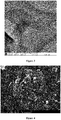
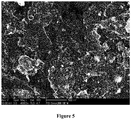
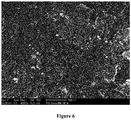
- the nanosilver-loaded graphene was scanned by a scanning electron microscope, and the results are shown in Figures 4 , 5 and 6 .
- Figure 4 is a scanning electron micrograph of graphene without nanosilver loaded
- Figures 5 and 6 are scanning electron micrographs of graphene loaded with nanosilver.
- the nanosilver has a uniform particle size and a uniform loading on the surface of graphene.
- a viscose fibre was prepared according to the method and steps disclosed in Example 2, except that corn stalk cellulose was used instead of corncob cellulose.
- a viscose fibre was prepared according to the method and steps disclosed in Example 2, except that the mass ratio of silver nitrate to graphene is 1:100.
- a viscose fibre was prepared according to the method and steps disclosed in Example 2, except that the mass ratio of silver nitrate to graphene is 1:2.
- a viscose fibre was prepared according to the method and steps disclosed in Example 2, except that graphene was 0.05% of corncob cellulose.
- a viscose fibre was prepared according to the method and steps disclosed in Example 2, except that graphene was 5% of corncob cellulose.
- a viscose fibre was prepared according to the method and steps disclosed in Example 2, except that solution of nanosilver-loaded graphene was prepared according to the following method: 100 ml of AgNO 3 aqueous solution with a concentration of 0.02 M was added into 0.3 g of graphene prepared in Example 1 and dispersed by ultrasonic three times. 19 mL of an aqueous solution of NaBH 4 with a concentration of 0.2 M was slowly added dropwise therein under rapid stirring, and then the stirring was continued for 2 h until reduction reaction was completed.
- a viscose fibre was prepared according to the method and steps disclosed in Example 8, except that 80 mL of an aqueous solution of NaBH4 with a concentration of 0.05 M was slowly added dropwise.
- a viscose fibre was prepared according to the method and steps disclosed in Example 8, except that 5 mL of an ethylene glycol solution with a concentration of 0.2 M was slowly added dropwise.
- coagulation bath composition was: sulfuric acid 105 g/L, sodium sulfate 200 g/L, and zinc sulfate 12 g/L.
- the graphene prepared in Example 1 was ultrasonically dispersed in water for 100 min to obtain a graphene dispersion solution.
- Nanosilver was ultrasonically dispersed in water for 100 min to obtain a nanosilver dispersion solution.
- coagulation bath composition was: sulfuric acid 105 g/L, sodium sulfate 200 g/L, and zinc sulfate 12 g/L.
- the graphene prepared in Example 1 was ultrasonically dispersed in water for 100 min to obtain a graphene dispersion solution.
- Nanosilver was ultrasonically dispersed in water for 100 min to obtain a nanosilver dispersion solution.
- Sulfonated corncob cellulose was dissolved in dilute sodium hydroxide solution, and then the above nanosilver dispersion solution and graphene dispersion solution were added therein, and a 8% viscose solution was obtained after ripening, and then the viscose solution was stirred at a high speed for 1h, wherein nanosilver was 0.1% of corncob cellulose and graphene dispersion solution was 0.1% of corncob cellulose.
- a viscose fibre was obtained after filtering, defoaming, and then spinning, desulfurizing, water-washing, and drying.
- coagulation bath composition was: sulfuric acid 105 g/L, sodium sulfate 200 g/L, and zinc sulfate 12 g/L.
- a graphene was prepared by modified Hummers method using graphite powder as a raw material.
- the prepared graphene was ultrasonically dispersed in water for 100 min to obtain a graphene dispersion solution.
- Nanosilver was ultrasonically dispersed in water for 100 min to obtain a nanosilver dispersion solution.
- Sulfonated corncob cellulose was dissolved in dilute sodium hydroxide solution, and then the above nanosilver dispersion solution and graphene dispersion solution were added therein, and a 8% viscose solution was obtained after ripening, and then the viscose solution was stirred at a high speed for 1h, wherein nanosilver was 0.1% of corncob cellulose and graphene dispersion solution was 0.1% of corncob cellulose.
- a viscose fibre was obtained after filtering, defoaming, and then spinning, desulfurizing, water-washing, and drying.
- coagulation bath composition was: sulfuric acid 105 g/L, sodium sulfate 200 g/L, and zinc sulfate 12 g/L.
- a graphene was prepared by modified Hummers method using graphite powder as a raw material.
- the prepared graphene was ultrasonically dispersed in water for 100 min to obtain a graphene dispersion solution.
- the reactants obtained after the reaction were sonicated for 30 min to obtain a solution of nanosilver-loaded graphene.
- a graphene oxide was prepared by modified Hummers method using graphite powder as a raw material.
- the prepared graphene oxide was ultrasonically dispersed in water for 100 min to obtain a graphene oxide dispersion solution.
- the reactants obtained after the reaction were sonicated for 30 min to obtain a nanosilver-loaded graphene oxide solution.
- Table 1 shows the test results of properties of the viscose fibres prepared in the examples and comparative examples of the present invention.
- Table 1 Test results of properties of the viscose fibres prepared in the examples and comparative examples of the present invention.
- Example 2 3.3 5.5 1.7 99.8 Example 3 3.2 5.2 1.7 99.5 Example 4 3.3 4.4 1.8 90.3 Example 5 3.4 6.6 1.5 99.1 Example 6 2.4 5.1 1.9 94.5 Example 7 11 7.5 1.2 99.9 Example 8 3.3 5.4 1.6 99.9 Example 9 3.3 5.3 1.7 95.7 Example 10 3.3 5.3 1.6 95.3 Example 11 3.0 5.2 1.8 99.3 Comparative Example 1 1.6 3.2 2.6 45.3 Comparative Example 2 2.3 3.7 2.0 72.3 Comparative Example 3 1.7 3.4 2.1 75.8 Comparative Example 4 2.3 3.6 1.6 75.4 Comparative Example 5 2.2 3.7 2.0 70.6 Comparative Example 6 2.2 3.6 2.0 74.5
- the viscose fibres provided by the present invention have large improvements in far infrared property, anti-ultraviolet property, anti-static property, antibacterial and bacteriostatic property.
Landscapes
- Chemical & Material Sciences (AREA)
- Engineering & Computer Science (AREA)
- Organic Chemistry (AREA)
- Chemical Kinetics & Catalysis (AREA)
- General Chemical & Material Sciences (AREA)
- Textile Engineering (AREA)
- Inorganic Chemistry (AREA)
- Nanotechnology (AREA)
- Materials Engineering (AREA)
- Artificial Filaments (AREA)
- Life Sciences & Earth Sciences (AREA)
- General Life Sciences & Earth Sciences (AREA)
- Geology (AREA)
- Chemical Or Physical Treatment Of Fibers (AREA)
Description
- The present invention relates to the field of viscose fibres, and more particularly to a viscose fibre and preparation method thereof.
- Viscose fibre is mainly prepared by using high-purity cellulose dissolving pulp as raw material, which is prepared from cellulose derived from cotton linter, wood and plant straw by a series of processes of acid hydrolysis, alkali hydrolysis, bleaching and others, and by a series of processes of alkali impregnation, pressing, aging, yellowing, dissolving, filtering, spinning, post-processing and others. Ordinary viscose fibre has similar properties with cotton fibre, having wearing comfortability, good hygroscopicity and dyeability, and has advantages which other chemical fibres cannot match. viscose fibre has become one of the hotspots of research, as the consumer has higher and higher requirements on functions of clothing and other materials, such as far infrared, anti-ultraviolet, anti-radiation, anti-static, antibacterial and bacteriostatic functions .
- Currently, the prior art discloses a variety of viscose fibres. For example,
Chinese Patent Application CN 1936124 A discloses a silver-containing antibacterial viscose fibre and preparation method thereof, and the method comprises steps of mixing, making glue, spinning, beaming, cutting, refining, drying, packing, and a colloidal solution of nanosilver with a nanoparticle size of 50-65nm was added during the process of making glue or spinning. The viscose fibre obtained by this method has strong antibacterial, bactericidal and certain anti-static functions. However, this method cannot well solve the problem of agglomeration of nanosilver particles in the process of making glue and spinning, which affects the effect of nanosilver particles. Moreover, in this method, since nanosilver colloidal solution was directly added, although the obtained viscose fibre has bacteriostatic property, other properties such as far infrared, anti-radiation properties and others, are not prominent. Accordingly, the present inventors have considered the preparation of a viscose fibre having good far infrared, anti-ultraviolet, anti-radiation, anti-static, bacteriostatic, antibacterial and other functions. -
WO 2010/107762 discloses fibers comprising a composition including a polymer and graphene sheets. -
CN 104328523 A relates to a graphene-containing viscose fiber and a preparation method thereof. - The article by Jia Tang et al in ACS APPLIED MATERIALS & INTERFACES, vol. 5, no. 9, 8 May 2013, pages 3867-3874, relates to graphene oxide-silver nanocomposite as a highly effective antibacterial agent with species-specific mechanisms.
- The article by Soon Wei Chook et al in CELLULOSE, vol. 21, no. 6, 29 August 2014, pages 4261-427, relates to a graphene oxide which facilitated a highly porous and effective antibacterial regenerated cellulose membrane containing stabilized silver nanoparticles.
- In view of this, the purpose of the present invention is to provide a viscose fibre and preparation method thereof. The viscose fibre provided in the present invention has uniform distribution of nanoparticles and has good far-infrared, anti-ultraviolet, anti-radiation, anti-static, bacteriostatic and antibacterial properties, etc.
- The present invention provides a viscose fibre comprising: viscose fibres, graphene and nanosilver, wherein the nanosilver is loaded on the graphene sheet and covalently bonded.
- Preferably, the graphene is prepared by the following process:
- bleaching cellulose with hydrogen peroxide or sodium hypochlorite to obtain a first intermediate product;
- activating the first intermediate product with an activator to obtain a second intermediate product, the activator being one or more of nickel salts, iron salts, cobalt salts or manganese salts; and
- carbonizing the second intermediate product at 600 °C to 1400°C under a condition of a protective gas, and performing post-treatment to obtain a graphene.
- Preferably, the nanosilver accounts for 1 wt% to 50 wt% of the graphene; and the graphene accounts for 0.01 wt% to 10 wt% of the viscose fibres.
- Preferably, the nanosilver accounts for 2 wt% to 30 wt% of the graphene; and the graphene accounts for 0.1 wt% to 5 wt% of the viscose fibres.
- Preferably, the cellulose is a porous cellulose; and the activator is one or more of nickel chloride, nickel nitrate, nickel sulfate, nickel acetate, ferric chloride, ferrous chloride, ferric nitrate, ferric sulfate, ferrous sulfate, ferric acetate, cobalt chloride, cobalt nitrate, cobalt sulfate, cobalt acetate, manganese chloride, manganese nitrate, manganese sulfate and manganese acetate.
- The present invention also provides a method for preparing a viscose fibre according to claim 1, characterized by comprising:
- a) dispersing graphene in an aqueous solution to obtain a graphene dispersion solution;
- b) dissolving a silver salt into the graphene dispersion solution, and adding a reducing agent to perform a reduction reaction to obtain a solution of nanosilver-loaded graphene; and
- c) uniformly mixing the solution of nanosilver-loaded graphene with a viscose solution, and performing spinning to obtain a viscose fibre.
- Preferably, the graphene is prepared by the following process:
- bleaching cellulose with hydrogen peroxide or sodium hypochlorite to obtain a first intermediate product;
- activating the first intermediate product with an activator to obtain a second intermediate product, the activator being one or more of nickel salts, iron salts, cobalt salts or manganese salts; and
- carbonizing the second intermediate product at 600 °C to 1400°C under a condition of a protective gas, and performing post-treatment to obtain a graphene.
- Preferably, said step a) specifically comprises:
- a1) ultrasonically dispersing graphene in water, centrifuging or standing to obtain a homogeneous graphene dispersion solution;
- a2) mixing the homogeneous graphene dispersion solution with a stabilizer to obtain a stable graphene dispersion solution.
- Preferably, in step a2), the stabilizer is one or more of sodium carboxymethylcellulose, polyvinyl alcohol, Tween 80, sodium dodecyl sulfate or sodium dodecylbenzenesulfonate.
- Preferably, in step b), the silver salt is silver nitrate, and the reducing agent is one or more of sodium borohydride, ethylene glycol, glucose or citric acid; and the molar ratio of the reducing agent to the silver salt is 1-10: 1
- Preferably, after the reducing agent is added and reduction reaction is performed in step b), the resulting reaction product is subjected to ultrasonic treatment.
- Preferably, the ultrasonic treatment is preformed for 10 min to 60 min.
- Compared with the prior art, the present invention firstly obtains a nanosilver-loaded graphene by liquid phase synthesis in situ, and then obtains a viscose fibre added with nanosilver and graphene by adding the nanosilver-loaded graphene to a viscose solution and spinning. The obtained viscose fibre has good far-infrared, anti-ultraviolet, anti-static, anti-radiation, bacteriostatic and antibacterial properties, etc.
- Applicant in this research found that: the viscose fibre obtained by only adding graphene has improved antibacterial property and anti-radiation property, but the improvement is not obvious; the viscose fibre obtained by only adding nanosilver has a higher requirement on the degree of dispersion of nanosilver particles, and the improvements of far infrared temperature increase performance, anti-ultraviolet performance and anti-radiation performance of this viscose fibre are not obvious; the viscose fibre obtained by adding both nanosilver and graphene prepared by improved Hummers method also has non-obvious improvements in far-infrared performance, antibacterial performance and anti-radiation performance; however, the viscose fibre obtained by firstly loading nanosilver onto graphene sheet and then adding the nanosilver-loaded graphene into viscose fibre has effectively improved far-infrared performance, antibacterial performance and anti-radiation performance, wherein, by loading nanosilver onto graphene prepared by improved Hummers method and then adding the nanosilver-loaded graphene into viscose fibre can effectively improve far-infrared performance, antibacterial performance and anti-radiation performance of the obtained viscose fibre; by loading nanosilver in situ onto graphene having less sheet defects prepared by specifical methods and then adding the nanosilver-loaded graphene into viscose fibre can significally improve far-infrared performance, antibacterial performance and anti-radiation performance of the obtained viscose fibre. Experimental results show that as compared to viscose fibre with no nanosilver-loaded graphene added, the viscose fibre prepared by the present invention has a far infrared temperature increase performance increased by not less than 100%, an ultraviolet protecting coefficient increased by not less than 70%, and a bacteriostatic performance reaching 99.9% and increased by not less than 100%, while the viscose fibres prepared by other methods have a far infrared temperature increase performance increased by less than 50%, an ultraviolet protecting coefficient increased by less than 40%, and a bacteriostatic performance increased by less than 50%.
- In order to illustrate the examples of the present invention or the technical solutions in the prior art more clearly, drawings which are required in the descriptions of examples and the prior art will be briefly described in the following. Obviously, the following drawings are only examples of the present invention, and those skilled in the art can obtain other drawings based on the drawings provided herein without paying creative work.
-
Figure 1 is a Raman spectrum of graphene obtained in Example 1 of the present invention; -
Figure 2 is a transmission electron micrograph of graphene obtained in Example 1 of the present invention; -
Figure 3 is a transmission electron micrograph of graphene obtained in Example 1 of the present invention; -
Figure 4 is a scanning electron micrograph of graphene without nanosilver loaded; -
Figure 5 is a scanning electron micrograph of graphene loaded with nanosilver; -
Figure 6 is a scanning electron micrograph of graphene loaded with nanosilver. - The technical solutions in the examples of the present invention will be described clearly and completely in the following with reference to the accompanying drawings in the examples of the present invention.
- The present invention provides a viscose fibre comprising viscose fibres, graphene and nanosilver, wherein the nanosilver is loaded on the graphene sheet and covalently bonded.
- The present invention utilizes graphene as a carrier. The graphene is firstly loaded with nanosilver and then added into viscose fibres, which can remarkably improve the properties of the viscose fibre, such as far-infrared, anti-ultraviolet, anti-radiation, anti-static, antibacterial and bacteriostatic properties, etc.
- The graphene is not particularly limited in the present invention, and the graphene prepared by an improved Hummers method may be used.
- In order to obtain a viscose fibre with better properties, the graphene used in the present invention is preferably prepared by the following process:
- 1) bleaching cellulose with hydrogen peroxide or sodium hypochlorite to obtain a first intermediate product;
in the present invention, the mass of the hydrogen peroxide or sodium hypochlorite is preferably 1% to 10% by mass of the porous cellulose, more preferably 2% to 8%; in the present invention, the temperature for bleaching with hydrogen peroxide or sodium hypochlorite is preferably 60°C to 130°C, more preferably 80°C to 100°C; the time for bleaching with hydrogen peroxide or sodium hypochlorite is preferably 1 h to 10 h, more preferably 2 h to 8 h; - 2) activating the first intermediate product with an activator to obtain a second intermediate product;
in the present invention, the activation temperature is preferably 20°C to 180°C, more preferably 50°C to 150°C, and most preferably 80°C to 140°C; in the present invention, the mixing time is preferably 2 h to 10 h, more preferably 5 h to 7 h; - 3) carbonizing the second intermediate product at 600 °C to 1400°C under a condition of a protective gas, and performing post-treatment to obtain an active porous graphene;
- The cellulose is a porous cellulose.
- The method for preparing the porous cellulose comprises the following steps: A) hydrolyzing a biomass resource in an acid to obtain lignocellulose, wherein the biomass resource includes one or more of plants, and agroforestry wastes; B) treating the lignocellulose to obtain a porous cellulose, wherein the treatment includes acid treatment, salt treatment or organic solvent treatment. In the present invention, the temperature for hydrolysis is preferably 90°C to 180°C, more preferably 120°C to 150°C. In the present invention, the time for hydrolysis is preferably 2 h to 10 h, more preferably 2 h to 8 h, and most preferably 3 h to 6 h. In the present invention, the acid for hydrolysis is preferably one or more of sulfuric acid, nitric acid, hydrochloric acid, formic acid, sulfurous acid, phosphoric acid and acetic acid, more preferably sulfuric acid, nitric acid hydrochloric acid or acetic acid, and most preferably sulfuric acid, nitric acid or hydrochloric acid. In the present invention, the amount of acid used in the hydrolysis is preferably 3 wt% to 20 wt%, more preferably 5 wt% to 15 wt%, and most preferably 8 wt% to 12 wt% of the biomass resource.
- In the present invention, the salt treatment is preferably carried out by an acidic sulfite process treatment or an alkali sulfite process treatment. In the present invention, the pH value during the acidic sulfite process treatment is preferably 1 to 7, more preferably 2 to 5, and most preferably 3 to 4. In the present invention, the temperature for the acidic sulfite process treatment is preferably 70°C to 180°C, more preferably 90°C to 150°C, and most preferably 100°C to 120°C. In the present invention, the time for the acidic sulfite process treatment is preferably 1h to 6h, more preferably 2h to 5h, and most preferably 3h to 4h.
- In the present invention, the acid in the acidic sulfite process treatment is preferably sulfuric acid. In the present invention, the amount of acid used in the acidic sulfite process treatment is preferably 4 wt% to 30 wt%, more preferably 8 wt% to 25 wt%, and most preferably 10 wt% to 20 wt% of the lignocellulose. In the present invention, the weight percent concentration of the acid in the acidic sulfite process treatment is preferably such that the liquid to solid ratio is (2-20): 1, more preferably (4-16): 1, and most preferably (8-12): 1.
- In the present invention, the sulfite in the acidic sulfite process treatment is preferably calcium sulfite, magnesium sulfite, sodium sulfite or ammonium sulfite, and more preferably magnesium sulfite or sodium sulfite. The amount of sulfite used in the acidic sulfite process treatment of the present invention is not particularly limited, and the amount of sulfite used in the sulfite pulping process well known to those skilled in the art can be used.
- In the present invention, the pH value in the alkali sulfite process treatment is preferably 7 to 14, more preferably 8 to 13, and most preferably 9 to 12. In the present invention, the temperature for the alkali sulfite process treatment is preferably 70°C to 180°C, more preferably 90°C to 150°C, and most preferably 100°C to 120°C. In the present invention, the time for the alkali sulfite process treatment is preferably 1 h to 6 h, more preferably 2 h to 5 h, and most preferably 3 h to 4 h
- In the present invention, the alkali in the alkali sulfite process treatment is preferably calcium hydroxide, sodium hydroxide, ammonium hydroxide or magnesium hydroxide, and more preferably sodium hydroxide or magnesium hydroxide. In the present invention, the amount of the alkali used in the alkali sulfite process treatment is preferably 4 wt% to 30 wt%, more preferably 8 wt% to 25 wt%, and most preferably 10 wt% to 20 wt% of the lignocellulose. In the present invention, the weight percentage concentration of the alkali in the alkali sulfite process treatment is preferably such that the liquid to solid ratio is (2-20): 1, more preferably (4-16): 1, and most preferably (8-12): 1.
- In the present invention, the sulfite in the alkali sulfite process treatment is preferably calcium sulfite, magnesium sulfite, sodium sulfite or ammonium sulfite, and more preferably magnesium sulfite or sodium sulfite. The amount of sulfite used in the alkali sulfite process treatment of the present invention is not particularly limited, and the amount of sulfite used in the sulfite pulping process well known to those skilled in the art can be used.
- The biomass resource in step A) is agroforestry wastes.
- The agroforestry waste includes one or more of corn stalk, corn cob, sorghum stalk, beet residue, bagasse, furfural residue, xylose residue, sawdust, cotton stalk and reed.
- The agroforestry waste is corn cob.
- The acid in step A) includes one or more of sulfuric acid, nitric acid, hydrochloric acid, formic acid, sulfurous acid, phosphoric acid and acetic acid.
- The amount of acid in step A) is from 3% to 20% by weight of the biomass resource.
- The temperature for hydrolysis in step A) is from 90°C to 180°C;
- The time for hydrolysis in step A) is from 10 min to 10 h.
- The salt treatment in step B) is carried out by an acidic sulfite process treatment or an alkali sulfite process treatment.
- The pH value in the acidic sulfite process treatment is from 1 to 7.
- The amount of acid used in the acidic sulfite process treatment is from 4 wt% to 30 wt% of the lignocellulose;
- The weight percent concentration of the acid in the acidic sulfite process treatment is such that the liquid to solid ratio is (2-20): 1.
- The temperature for the acidic sulfite process treatment is 70°C to 180°C;
- The time for the acidic sulfite process treatment is 1h to 6h.
- The pH value in the alkali sulfite process treatment is preferably 7 to 14;
- The amount of the alkali used in the alkali sulfite process treatment is 4 wt% to 30 wt% of the lignocellulose.
- The weight percentage concentration of the alkali in the alkali sulfite process treatment is such that the liquid to solid ratio is (2-20): 1.
- The temperature for the alkali sulfite process treatment is 70°C to 180°C;
- The time for the alkali sulfite process treatment is 1 h to 6 h.
- The mass ratio of the activator to the cellulose in the step 2) is (0.05-0.9): 1.
- The activator is one or more of nickel chloride, nickel nitrate, nickel sulfate, nickel acetate, ferric chloride, ferrous chloride, ferric nitrate, ferric sulfate, ferrous sulfate, ferric acetate, cobalt chloride, cobalt nitrate, cobalt sulfate, cobalt acetate, manganese chloride, manganese nitrate, manganese sulfate or manganese acetate.
- The protective gas in step 3) is selected from one or more of nitrogen and inert gases.
- The cellulose referred to in the present invention is preferably corncob cellulose. Corncob cellulose fibres are short, and have good dispersibility, a small cross-density between the fibres, and are enhanced in activity by bleaching with hydrogen peroxide or sodium hypochlorite. Meanwhile, under the catalysis of the metal activator and nitrogen protection, the temperature does not need to be greatly changed, and an activated biomass graphene is obtained at 600°C to 1400°C. The prepared activated biomass graphene has good electrical conductivity and good dispersibility in solution. The experimental results show that the conductivity of the activated biomass graphene prepared by the method provided in the present invention can reach up to 40,000 S/m.
- The graphene prepared by the above method was subjected to transmission electron microscopy test. The results show that the sheet of the graphene is thin, and the graphene is a biomass graphene having not more than 10 layers, for example 3-7 layers. The graphene prepared by the above method was subjected to Raman spectroscopy test. The results show that the graphene has a high degree of Sp2 hybridization. The conductivity of the biomass graphene prepared by the above method was tested by a conductivity tester. The results show that the conductivity of the biomass graphene can be up to 40,000 S/m. In summary, the activated porous graphene prepared by the above-mentioned method is thin and has a high degree of Sp2 hybridization.
- In the viscose fibre provided by the present invention, nanosilver is loaded in the graphene prepared by the above-mentioned method, more specifically loaded on the surface of the graphene sheet. By loading in such a way, the nanosilver can be uniformly distributed in the structure of the graphene sheet, and the particle size of the nanosilver particles is controllable and uniform. In the present invention, the nanosilver preferably accounts for 2 wt% to 50 wt%, more preferably 5 wt% to 20 wt% of the graphene. In the present invention, the particle size of the nanosilver is preferably less than 50 nm.
- In the viscose fibre provided by the present invention, the graphene preferably accounts for 0.01 wt% to 5 wt%, more preferably 0.1 wt% to 3 wt% of the viscose fibre.
- In the viscose fibre provided by the present invention, the viscose fibre may be one or more of corncob cellulose, reed cellulose, bamboo cellulose, corn stalk cellulose, cotton stalk cellulose, wood pulp cellulose, or a cellulose raw material prepared by waste residues such as xylose residue and bagasse, and the present invention is not particularly limited thereto.
- In the viscose fibre provided by the present invention, the silver nanoparticles are completely loaded on the surface of the graphene sheet and covalently bonded, so that the prepared solution of graphene loaded with silver nanoparticles does not need to be subjected to subsequent filtration and dehydration step, and can maintain the stable dispersion of the solution of nanosilver-loaded graphene, such that the solution can be directly mixed with viscose solution. In addition, in the present invention, the nanosilver-loaded graphene was added to the viscose fibre without affecting the wearing comfortability of the viscose fibre and the subsequent color adjusting and color matching process.
- The viscose fibre provided by the present invention has good far-infrared function and can be used in far-infrared fabric or clothing to improve the temperature of the human body surface.
- The viscose fibre provided by the present invention has good antibacterial, deodorization and other functions, and can be used for preparing antibacterial mask, underwear, deodorant socks, bandage and gauze.
- The viscose fibre provided by the present invention has good anti-ultraviolet, anti-static, anti-radiation and other functions, and can be used for preparing anti-ultraviolet, anti-static and anti-radiation fabrics and clothing.
- The present invention also provides a method for preparing a viscose fibre comprising:
- a) dispersing graphene in an aqueous solution to obtain a graphene dispersion solution;
- b) dissolving a silver salt into the graphene dispersion solution, and adding a reducing agent to perform a reduction reaction to obtain a solution of nanosilver-loaded graphene; and
- c) uniformly mixing the solution of nanosilver-loaded graphene with a viscose solution, and performing spinning to obtain a viscose fibre.
- After the graphene was prepared according to the method described above, it was dispersed in water to obtain a graphene dispersion solution. In particular, the graphene dispersion solution can be obtained by the following method:
- a1) ultrasonically dispersing graphene in water, centrifuging or standing to obtain a homogeneous graphene dispersion solution;
- a2) mixing the homogeneous graphene dispersion solution with a stabilizer to obtain a stable graphene dispersion solution.
- Firstly, the graphene is ultrasonically dispersed in water, and then centrifuged or allowed to stand to be stratified, and the supernatant is a stable dispersion of the graphene colloidal solution. In the present invention, the time for ultrasonic dispersion is 10 min to 120 min, more preferably 30 min to 100 min. The condition for centrifugation treatment is 1000 rpm to 4000 rpm, more preferably 1500 rpm to 3500 rpm, and the time for centrifugation treatment is 2 min to 30 min, more preferably from 5 min to 10 min. The time for standing is preferably 20 h to 30 h, more preferably 24 h. The mass ratio of the graphene to water is preferably 0.01-5:100, more preferably 0.1-3.5:100.
- The obtained homogeneous graphene dispersion solution is mixed with a stabilizer to stabilize the dispersion of the graphene, preventing the agglomeration of the graphene colloidal solution. In the present invention, the stabilizer is a surfactant including, but not limited to, Tween-type surfactants, sulfonate-based surfactants or sulfate-based surfactants, and the like, preferably sodium dodecyl benzene sulfonate (SDBS), sodium dodecyl sulfate (SDS) or Tween 80, and the like. The addition amount of the stabilizer is not specifically limited in the present invention, as long as it can maintain the stable dispersion of the graphene colloidal solution.
- After the graphene dispersion solution is obtained, a silver salt is dissolved in the graphene dispersion solution, and a reducing agent is also added to perform reduction reaction to obtain a solution of nanosilver-loaded graphene. In the present invention, the silver salt is preferably silver nitrate. In the present invention, the silver salt is preferably dissolved in the graphene dispersion solution under stirring, and the addition amount of silver nitrate is 1 wt% to 50 wt%, more preferably 5 wt% to 30 wt% of the graphene. The reducing agent is preferably sodium borohydride, ethylene glycol, glucose or citric acid, and more preferably sodium borohydride. In the present invention, the reducing agent is preferably added under stirring; and the molar ratio of the reducing agent to the silver salt is preferably 1-10:1, more preferably 2-8: 1; the reaction is preferably carried out under stirring at room temperature; and the reaction time is preferably 30 min to 120 min, more preferably 50 min to 100 min.
- After completion of the reaction, the obtained reaction product is subjected to ultrasonic treatment to obtain a solution of nanosilver-loaded graphene. The time for the ultrasonic treatment is preferably 10 min to 60 min, more preferably 20 min to 50 min.
- After the solution of nanosilver-loaded graphene is obtained, it is homogeneously mixed with the viscose solution, and a viscose fibre can be obtained after spinning. In the present invention, the proportion of graphene in the viscose fibre is preferably 0.1 ‰ to 5%, more preferably 0.1% to 3%. In the present invention, the solution of nanosilver-loaded graphene is preferably added to the viscose solution slowly and mixed with quick stirring to make the dispersion solution of nanosilver-loaded graphene fully mixed.
- In the present invention, the viscose solution is a viscos solution well-known in the art, and the preparation method thereof is carried out by using a pulp as a raw material, and by processes such as impregnating, pressing, pulverizing, aging, yellowing, dissolving, ripening, filtering and defoaming. The pulp was impregnated with an aqueous solution of sodium hydroxide at a concentration of about 18% to convert cellulose into alkali cellulose, and hemicellulose was dissolved out, and the degree of polymerization was partially lowered, and then the excess lye was removed by pressing step; the bulk alkali cellulose became a loose floc after being crushed on a pulverizer, resulting in an increase in the subsequent chemical reaction uniformity due to the increase of surface area. Alkali cellulose was subjected to oxidative cracking in the role of oxygen, reducing the average degree of polymerization, which is called aging. After aging, alkali cellulose was reacted with carbon disulfide to form cellulose sulfonate, which is called sulfonation, making the hydrogen bonds between macromolecules further weakened. Due to the hydrophilicity of sulfonic acid groups, the solubility of cellulose in dilute alkali solution was greatly improved. The solid cellulose sulfonate was dissolved in dilute alkali solution, and a viscose solution was obtained.
- After the viscose solution was obtained, the dispersion solution of nanosilver-loaded graphene was added therein according to the above-mentioned method, and then spinning was carried out according to methods well known to those skilled in the art to obtain a viscose fibre. The just-made viscose solution is not easy to shape due to higher viscosity and salt value, and also need to be placed at a certain temperature for a certain period of time after adding the dispersion solution of nanosilver-loaded graphene, i.e. ripening, to make sodium cellulose sulfonate in the viscose hydrolyzed and saponified gradually, and degree of esterification decreased, and the stability of the effect of viscosity on the electrolyte would also change accordingly. After ripening, defoaming and filtering were carried out to remove air bubbles and impurities, and then spinning was carried out according to methods well known to those skilled in the art.
- The source of the pulp is not limited in the present invention, and may be corncob cellulose, reed cellulose, bamboo cellulose, corn stalk cellulose, cotton stalk cellulose, wood pulp cellulose, or a cellulose raw material prepared by waste residues such as xylose residue and bagasse.
- In the viscose fibre provided by the present invention, the silver nanoparticles are completely loaded on the surface of the graphene sheet and covalently bonded, so that the prepared solution of graphene loaded with silver nanoparticles does not need to be subjected to subsequent filtration and dehydration step, and can maintain the stable dispersion of the solution of nanosilver-loaded graphene, such that the solution can be directly mixed with viscose solution.
- The viscose fibre provided by the present invention has good far infrared function, anti-ultraviolet, anti-static, anti-radiation, antibacterial and bacteriostatic functions, etc., and can be used for preparing far-infrared fabric or clothing, antibacterial mask, underwear, deodorant socks, bandage, gauze, anti-ultraviolet clothing, anti-static clothing, and anti-radiation clothing, etc.
- The viscose fibre provided by the present invention and preparation method thereof are further illustrated below in combination with examples.
- Corn cob was hydrolyzed in sulfuric acid at 120°C for 30 min to obtain lignocellulose, wherein the mass of the sulfuric acid was 3% of the mass of the corn cob;
The lignocellulose was subjected to an acidic sulfite process treatment at 70°C for 1 h to obtain a porous cellulose, wherein the pH value in the acidic sulfite process was 1, the acid was sulfuric acid, the sulfite was magnesium sulfite, the mass of the sulfuric acid was 4% of the mass of the lignocellulose, and the liquid to solid ratio was 2:1;
The porous cellulose was bleached with hydrogen peroxide, wherein the mass of hydrogen peroxide was 5% of the mass of the porous cellulose, the bleaching temperature for bleaching with hydrogen peroxide was 100°C, and the bleaching time was 5 hours. - The bleached porous cellulose was activated with nickel chloride at 20°C under stirring for 2 hours, wherein the mass ratio of the nickel chloride and the porous cellulose was 0.1:1; and the resulting activated product was dried at 70°C to obtain a product having a water content of less than 10% by weight;
The above product was placed in a carbonization furnace, and nitrogen gas was introduced into the carbonization furnace as a protective gas at a gas introduction rate of 200 mL/min, and the temperature was raised to 800°C and kept for 6 hours and then cooled to 60°C or lower;
At a temperature of 60°C, the cooled product was washed for 4 hours in an aqueous solution of sodium hydroxide having a mass concentration of 3% to obtain a first washed product; at 70°C, the first washed product was washed for 4 hours in an aqueous solution of hydrochloric acid having a mass concentration of 4% to obtain a second washed product; the second washed product was washed with distilled water to neutral and dried to obtain a biomass graphene. - The obtained graphene was subjected to Raman spectroscopy test, and the result was shown in
Figure 1. Figure 1 is a Raman spectrum of graphene obtained in Example 1 of the present invention. As seen fromFigure 1 , the graphene prepared by the method provided by Example 1 of the present invention has a high degree of sp2 hybridization. The graphene prepared by Example 1 of the present invention was subjected to transmission electron microscopy test, and the results were shown inFigures 2-3. Figures 2-3 are transmission electron micrographs of the graphene obtained in Example 1 of the present invention. As can be seen fromFigures 2-3 , the sheet of the graphene prepared by Example 1 of the present invention is thin, and the graphene is a biomass graphene having 10 layers or less. - 1 g of the graphene prepared in Example 1 was ultrasonically dispersed in 100 g of water for 100 min and centrifuged at 2000 rpm for 5 min. The supernatant was obtained and SDS was added to the supernatant to obtain a graphene colloidal solution. The graphene colloidal solution was again ultrasonically dispersed in water for 100 min to obtain a graphene colloidal solution.
- The above graphene colloidal solution was ultrasonically dispersed again in water for 100 min to obtain a graphene dispersion solution. 0.02 mol/L silver nitrate was added to the graphene dispersion solution under stirring, dissolved under stirring away from light, and then 0.2 mol/L sodium borohydride solution was slowly added and the mixture was reacted at room temperature for 100 min; wherein the mass ratio of silver nitrate to graphene is 1:10, and the molar ratio of sodium borohydride to silver nitrate is 10:1.
- The reactants obtained after the reaction were sonicated for 30 min to obtain a solution of nanosilver-loaded graphene.
- Sulfonated corncob cellulose was dissolved in dilute sodium hydroxide solution, and then the above solution of nanosilver-loaded graphene was added therein, and a 8% viscose solution was obtained after ripening, and then the viscose solution was stirred at a high speed for 1h, wherein graphene was 0.1% of corncob cellulose. A viscose fibre was obtained after filtering, defoaming, and then spinning, desulfurizing, water-washing, and drying. Wherein, coagulation bath composition was: sulfuric acid 105 g/L, sodium sulfate 200 g/L, and zinc sulfate 12 g/L.
- The obtained solution of nanosilver-loaded graphene was leached, and the filtrate is collected and washed until there is no silver ion in the filtrate, and then was dried at 60°C under vacuum to obtain a nanosilver-loaded graphene. The nanosilver-loaded graphene was scanned by a scanning electron microscope, and the results are shown in
Figures 4 ,5 and6 .Figure 4 is a scanning electron micrograph of graphene without nanosilver loaded;Figures 5 and6 are scanning electron micrographs of graphene loaded with nanosilver. As can be seen fromFigures 4-6 , in the method provided by the present invention, the nanosilver has a uniform particle size and a uniform loading on the surface of graphene. - A viscose fibre was prepared according to the method and steps disclosed in Example 2, except that corn stalk cellulose was used instead of corncob cellulose.
- A viscose fibre was prepared according to the method and steps disclosed in Example 2, except that the mass ratio of silver nitrate to graphene is 1:100.
- A viscose fibre was prepared according to the method and steps disclosed in Example 2, except that the mass ratio of silver nitrate to graphene is 1:2.
- A viscose fibre was prepared according to the method and steps disclosed in Example 2, except that graphene was 0.05% of corncob cellulose.
- A viscose fibre was prepared according to the method and steps disclosed in Example 2, except that graphene was 5% of corncob cellulose.
- A viscose fibre was prepared according to the method and steps disclosed in Example 2, except that solution of nanosilver-loaded graphene was prepared according to the following method:
100 ml of AgNO3 aqueous solution with a concentration of 0.02 M was added into 0.3 g of graphene prepared in Example 1 and dispersed by ultrasonic three times. 19 mL of an aqueous solution of NaBH4 with a concentration of 0.2 M was slowly added dropwise therein under rapid stirring, and then the stirring was continued for 2 h until reduction reaction was completed. - A viscose fibre was prepared according to the method and steps disclosed in Example 8, except that 80 mL of an aqueous solution of NaBH4 with a concentration of 0.05 M was slowly added dropwise.
- A viscose fibre was prepared according to the method and steps disclosed in Example 8, except that 5 mL of an ethylene glycol solution with a concentration of 0.2 M was slowly added dropwise.
- Sulfonated corncob cellulose was dissolved in dilute sodium hydroxide solution, and a 8% viscose solution was obtained after ripening, and then the viscose solution was stirred at a high speed for 1h. A viscose fibre was obtained after filtering, defoaming, and then spinning, desulfurizing, water-washing, and drying. Wherein, coagulation bath composition was: sulfuric acid 105 g/L, sodium sulfate 200 g/L, and zinc sulfate 12 g/L.
- The graphene prepared in Example 1 was ultrasonically dispersed in water for 100 min to obtain a graphene dispersion solution.
- Sulfonated corncob cellulose was dissolved in dilute sodium hydroxide solution, and then the above graphene dispersion solution was added therein, and a 8% viscose solution was obtained after ripening, and then the viscose solution was stirred at a high speed for 1h, wherein graphene was 0.1% of corncob cellulose. A viscose fibre was obtained after filtering, defoaming, and then spinning, desulfurizing, water-washing, and drying. Wherein, coagulation bath composition was: sulfuric acid 105 g/L, sodium sulfate 200 g/L, and zinc sulfate 12 g/L.
- Nanosilver was ultrasonically dispersed in water for 100 min to obtain a nanosilver dispersion solution.
- Sulfonated corncob cellulose was dissolved in dilute sodium hydroxide solution, and then the above nanosilver dispersion solution was added therein, and a 8% viscose solution was obtained after ripening, and then the viscose solution was stirred at a high speed for 1h, wherein nanosilver was 0.1% of corncob cellulose. A viscose fibre was obtained after filtering, defoaming, and then spinning, desulfurizing, water-washing with, and drying. Wherein, coagulation bath composition was: sulfuric acid 105 g/L, sodium sulfate 200 g/L, and zinc sulfate 12 g/L.
- The graphene prepared in Example 1 was ultrasonically dispersed in water for 100 min to obtain a graphene dispersion solution.
- Nanosilver was ultrasonically dispersed in water for 100 min to obtain a nanosilver dispersion solution.
- Sulfonated corncob cellulose was dissolved in dilute sodium hydroxide solution, and then the above nanosilver dispersion solution and graphene dispersion solution were added therein, and a 8% viscose solution was obtained after ripening, and then the viscose solution was stirred at a high speed for 1h, wherein nanosilver was 0.1% of corncob cellulose and graphene dispersion solution was 0.1% of corncob cellulose. A viscose fibre was obtained after filtering, defoaming, and then spinning, desulfurizing, water-washing, and drying. Wherein, coagulation bath composition was: sulfuric acid 105 g/L, sodium sulfate 200 g/L, and zinc sulfate 12 g/L.
- A graphene was prepared by modified Hummers method using graphite powder as a raw material. The prepared graphene was ultrasonically dispersed in water for 100 min to obtain a graphene dispersion solution.
- Nanosilver was ultrasonically dispersed in water for 100 min to obtain a nanosilver dispersion solution.
- Sulfonated corncob cellulose was dissolved in dilute sodium hydroxide solution, and then the above nanosilver dispersion solution and graphene dispersion solution were added therein, and a 8% viscose solution was obtained after ripening, and then the viscose solution was stirred at a high speed for 1h, wherein nanosilver was 0.1% of corncob cellulose and graphene dispersion solution was 0.1% of corncob cellulose. A viscose fibre was obtained after filtering, defoaming, and then spinning, desulfurizing, water-washing, and drying. Wherein, coagulation bath composition was: sulfuric acid 105 g/L, sodium sulfate 200 g/L, and zinc sulfate 12 g/L.
- A graphene was prepared by modified Hummers method using graphite powder as a raw material. The prepared graphene was ultrasonically dispersed in water for 100 min to obtain a graphene dispersion solution.
- 0.02 mol/L silver nitrate was added to the graphene dispersion solution under stirring, dissolved under stirring away from light, and then 0.2 mol/L sodium borohydride solution was slowly added and the mixture was reacted at room temperature for 100 min; wherein the mass ratio of silver nitrate to graphene is 1:10, and the molar ratio of sodium borohydride to silver nitrate is 10:1.
- The reactants obtained after the reaction were sonicated for 30 min to obtain a solution of nanosilver-loaded graphene.
- Sulfonated corncob cellulose was dissolved in dilute sodium hydroxide solution, and then the above solution of nanosilver-loaded graphene was added therein, and a 8% viscose solution was obtained after ripening, and then the viscose solution was stirred at a high speed for 1h, wherein graphene dispersion solution was 0.1% of corncob cellulose. A viscose fibre was obtained after filtering, defoaming, and then spinning, desulfurizing, water-washing, and drying. Wherein, coagulation bath composition was: sulfuric acid 105 g/L, sodium sulfate 200 g/L, and zinc sulfate 12 g/L.
- A graphene oxide was prepared by modified Hummers method using graphite powder as a raw material. The prepared graphene oxide was ultrasonically dispersed in water for 100 min to obtain a graphene oxide dispersion solution.
- 0.02 mol/L silver nitrate was added to the graphene oxide dispersion solution under stirring, dissolved under stirring away from light, and then 0.2 mol/L sodium borohydride solution was slowly added and the mixture was reacted at room temperature for 100 min; wherein the mass ratio of silver nitrate to graphene oxide is 1:10, and the molar ratio of sodium borohydride to silver nitrate is 10:1.
- The reactants obtained after the reaction were sonicated for 30 min to obtain a nanosilver-loaded graphene oxide solution.
- Sulfonated corncob cellulose was dissolved in dilute sodium hydroxide solution, and then the above nanosilver-loaded graphene oxide solution was added therein, and a 8% viscose solution was obtained after ripening, and then the viscose solution was stirred at a high speed for 1h, wherein the graphene oxide dispersion was 0.1% of the corncob cellulose. A viscose fibre was obtained after filtering, defoaming, and then spinning, desulfurizing, water-washing, and drying. Wherein, coagulation bath composition was: sulfuric acid 105 g/L, sodium sulfate 200 g/L, and zinc sulfate 12 g/L.
- Properties of viscose fibres prepared in Examples 2 to 11 and Comparative Examples 1 to 6 were tested as follows:
Far infrared function was tested according to CAS 115-2005 "Health Care Functional Textiles" and GBT 7287-2008 infrared radiation heater test method; anti-ultraviolet property was evaluated according to GBT 18830-2002; anti-static property was evaluated according to GB/T 12703.1-2008; and antibacterial and bacteriostatic property was evaluated according to GB/T 20944.3-2008. - The results are shown in Table 1, and Table 1 shows the test results of properties of the viscose fibres prepared in the examples and comparative examples of the present invention.
Table 1 Test results of properties of the viscose fibres prepared in the examples and comparative examples of the present invention. Far infrared temperature increase property (°C, 30s) UV protection factor (UPF) Half-life (s) anti-static property Antibacterial and bacteriostatic property % Example 2 3.3 5.5 1.7 99.8 Example 3 3.2 5.2 1.7 99.5 Example 4 3.3 4.4 1.8 90.3 Example 5 3.4 6.6 1.5 99.1 Example 6 2.4 5.1 1.9 94.5 Example 7 11 7.5 1.2 99.9 Example 8 3.3 5.4 1.6 99.9 Example 9 3.3 5.3 1.7 95.7 Example 10 3.3 5.3 1.6 95.3 Example 11 3.0 5.2 1.8 99.3 Comparative Example 1 1.6 3.2 2.6 45.3 Comparative Example 2 2.3 3.7 2.0 72.3 Comparative Example 3 1.7 3.4 2.1 75.8 Comparative Example 4 2.3 3.6 1.6 75.4 Comparative Example 5 2.2 3.7 2.0 70.6 Comparative Example 6 2.2 3.6 2.0 74.5 - As can be seen from Table 1, the viscose fibres provided by the present invention have large improvements in far infrared property, anti-ultraviolet property, anti-static property, antibacterial and bacteriostatic property.
Claims (10)
- A viscose fibre, comprising: viscose fibres, graphene and nanosilver, wherein the nanosilver is loaded on the sheet of the graphene and covalently bonded.
- The viscose fibre of claim 1, characterized in that the graphene is prepared by the following process:bleaching cellulose with hydrogen peroxide or sodium hypochlorite to obtain a first intermediate product;activating the first intermediate product with an activator to obtain a second intermediate product, the activator being one or more of nickel salts, iron salts, cobalt salts or manganese salts; andcarbonizing the second intermediate product at 600 to 1400°C under a condition of a protective gas, and performing post-treatment to obtain a graphene.
- The viscose fibre of claim 1, characterized in that the nanosilver accounts for 1 wt% to 50 wt% of the graphene; and the graphene accounts for 0.01 wt% to 10 wt% of the viscose fibre.
- The viscose fibre of claim 3, characterized in that the nanosilver accounts for 2 wt% to 30 wt% of the graphene; and the graphene accounts for 0.1 wt% to 5 wt% of the viscose fibre.
- The viscose fibre of claim 1, characterized in that the cellulose is a porous cellulose; and the activator is one or more of nickel chloride, nickel nitrate, nickel sulfate, nickel acetate, ferric chloride, ferrous chloride, ferric nitrate, ferric sulfate, ferrous sulfate, ferric acetate, cobalt chloride, cobalt nitrate, cobalt sulfate, cobalt acetate, manganese chloride, manganese nitrate, manganese sulfate and manganese acetate.
- A method for preparing the viscose fibre of claim 1, characterized in comprising:a) dispersing graphene in an aqueous solution to obtain a graphene dispersion solution;b) dissolving a silver salt into the graphene dispersion solution, and adding a reducing agent to perform a reduction reaction to obtain a solution of nanosilver-loaded graphene; andc) uniformly mixing the solution of nanosilver-loaded graphene with a viscose solution, and performing spinning to obtain a viscose fibre.
- The method of claim 6, characterized in that the step a) specifically comprises:a1) ultrasonically dispersing graphene in aqueous solution, centrifuging or standing to obtain a homogeneous graphene dispersion solution;a2) mixing the homogeneous graphene dispersion solution with a stabilizer to obtain a stable graphene dispersion solution.
- The method of claim 7, characterized in that in step a2), the stabilizer is one or more of sodium carboxymethylcellulose, polyvinyl alcohol, polysorbate 80, sodium dodecyl sulfate or sodium dodecylbenzenesulfonate.
- The method of claim 6, characterized in that in step b), the silver salt is silver nitrate, and the reducing agent is one or more of sodium borohydride, ethylene glycol, glucose or citric acid; and the molar ratio of the reducing agent to the silver salt is 1-10: 1.
- The method of claim 6, characterized in that after the reducing agent is added and reduction reaction is performed in step b), the resulting reaction product is subjected to ultrasonic treatment.
Applications Claiming Priority (2)
| Application Number | Priority Date | Filing Date | Title |
|---|---|---|---|
| CN201510267761.8A CN104831389B (en) | 2015-05-22 | 2015-05-22 | Multifunctional viscose and preparation method thereof |
| PCT/CN2016/081120 WO2016188310A1 (en) | 2015-05-22 | 2016-05-05 | Multifunctional viscose fibre and preparation method therefor |
Publications (3)
| Publication Number | Publication Date |
|---|---|
| EP3299499A1 EP3299499A1 (en) | 2018-03-28 |
| EP3299499A4 EP3299499A4 (en) | 2018-12-05 |
| EP3299499B1 true EP3299499B1 (en) | 2021-07-07 |
Family
ID=53809573
Family Applications (1)
| Application Number | Title | Priority Date | Filing Date |
|---|---|---|---|
| EP16799199.1A Active EP3299499B1 (en) | 2015-05-22 | 2016-05-05 | Multifunctional viscose fibre and preparation method therefor |
Country Status (6)
| Country | Link |
|---|---|
| US (1) | US10544520B2 (en) |
| EP (1) | EP3299499B1 (en) |
| JP (1) | JP6516876B2 (en) |
| KR (1) | KR101951138B1 (en) |
| CN (1) | CN104831389B (en) |
| WO (1) | WO2016188310A1 (en) |
Families Citing this family (50)
| Publication number | Priority date | Publication date | Assignee | Title |
|---|---|---|---|---|
| CN104831389B (en) | 2015-05-22 | 2017-04-19 | 济南圣泉集团股份有限公司 | Multifunctional viscose and preparation method thereof |
| WO2017063434A1 (en) | 2015-10-15 | 2017-04-20 | 济南圣泉集团股份有限公司 | Carbon-containing nanostructure composite, polymer material using same and preparation method |
| US10689501B2 (en) | 2015-10-27 | 2020-06-23 | Jinan Shengquan Group Share Holding Co., Ltd. | Composite polyester material, composite polyester fiber, processes for preparing the same and uses thereof |
| KR101960619B1 (en) | 2015-10-27 | 2019-07-15 | 지난 셩취엔 그룹 쉐어 홀딩 코., 엘티디. | Composite polyurethane foam comprising graphene, preparation method and use thereof |
| CN105525377B (en) | 2015-11-26 | 2018-08-17 | 济南圣泉集团股份有限公司 | A kind of functional regenerated cellulose fibre and its preparation method and application |
| JP6853249B2 (en) | 2015-11-20 | 2021-03-31 | 済南聖泉集団股▲ふん▼有限公司Jinan Shengquan Group Share Holding Co., Ltd | Modified latex containing graphene and its preparation method and use |
| JP6663991B2 (en) * | 2015-11-20 | 2020-03-13 | 済南聖泉集団股▲ふん▼有限公司Jinan Shengquan Group Share Holding Co., Ltd | Functional regenerated cellulose fiber and its preparation method and use |
| CN105266238B (en) * | 2015-11-25 | 2017-08-11 | 常州纳美生物科技有限公司 | A kind of antibacterial green haze-proof mask based on graphene oxide and preparation method thereof |
| CN105603554B (en) * | 2016-01-18 | 2017-10-31 | 恒天海龙(潍坊)新材料有限责任公司 | Graphene functionalized cellulose fiber and preparation method thereof |
| CN106467985B (en) * | 2016-03-04 | 2019-08-06 | 济南圣泉集团股份有限公司 | A kind of ice is felt well regenerated celulose fibre and preparation method thereof and textile |
| CN106012148A (en) * | 2016-07-15 | 2016-10-12 | 义乌市麻尚生针织品有限公司 | Preparation method of cotton-hemp insulation chameleon fiber blended yarn |
| CN106192063A (en) * | 2016-07-21 | 2016-12-07 | 山传雷 | A kind of Graphene viscose rayon and preparation method thereof |
| CN106850906B (en) * | 2016-07-21 | 2019-10-08 | 济南圣泉集团股份有限公司 | Application of the biomass graphene in wireless telecommunications system shell |
| CN106435811A (en) * | 2016-09-09 | 2017-02-22 | 泉州信和石墨烯研究院有限公司 | Graphene antibacterial and deodorizing sneaker and preparation method thereof |
| CN106723389B (en) * | 2016-11-29 | 2018-06-01 | 东莞市广信知识产权服务有限公司 | A kind of preparation method of long-acting magnetotherapy thermal underwear |
| CN106579573B (en) * | 2016-11-29 | 2018-05-04 | 东莞市广信知识产权服务有限公司 | A kind of long acting antibiotic cold-proof underwear and preparation method thereof |
| JP6852200B2 (en) * | 2017-03-15 | 2021-03-31 | 山東聖泉新材料股▲フン▼有限公司 | Modified textile products, preparation methods and their use |
| CN107190395A (en) * | 2017-06-08 | 2017-09-22 | 江苏田园新材料股份有限公司 | A kind of face fabric for automobile seat and its handling process |
| CN107584618A (en) * | 2017-07-20 | 2018-01-16 | 广德县泉村竹制品有限公司 | A kind of inexpensive bamboo mat preparation method of environmental protection |
| CN108113800B (en) * | 2017-12-20 | 2021-08-10 | 健尔康医疗科技股份有限公司 | Elastic bandage |
| CN108239884A (en) * | 2018-02-24 | 2018-07-03 | 璧典附 | A kind of feather material based on graphene/nano silver and preparation method thereof |
| CN109402815B (en) * | 2018-10-29 | 2019-08-30 | 福建祥业生物工程技术有限公司 | Graphene composite fiber yarn and its preparation method and application |
| CN111778577A (en) * | 2019-04-03 | 2020-10-16 | 上海水星家用纺织品股份有限公司 | Preparation method of nano platinum viscose fiber |
| CN110438796A (en) * | 2019-07-10 | 2019-11-12 | 陈婷婷 | A kind of preparation method with biological antibiotic performance cotton |
| CN110339717A (en) * | 2019-07-17 | 2019-10-18 | 安徽智泓净化科技股份有限公司 | Antibacterial reverse osmosis membrane based on viscose rayon substrate |
| CN112680811B (en) * | 2019-10-17 | 2024-02-27 | 中国石油化工股份有限公司 | Graphene/polyacrylonitrile composite fiber, spinning solution and preparation method thereof |
| CN110946148A (en) * | 2019-11-29 | 2020-04-03 | 陕西速源节能科技有限公司 | Preparation method of environment-friendly antibacterial agent |
| CN111118644B (en) * | 2019-12-24 | 2022-09-06 | 广州市中诚新型材料科技有限公司 | Graphene multifunctional acrylic fiber and preparation method thereof |
| CN111155186B (en) * | 2019-12-24 | 2022-10-28 | 广州市中诚新型材料科技有限公司 | Graphene multifunctional viscose fiber and preparation method thereof |
| CN111329135A (en) * | 2020-02-12 | 2020-06-26 | 佛山轻子精密测控技术有限公司 | Underwear fabric compounded with nano antibacterial fibers and preparation method thereof |
| CN111808401A (en) * | 2020-06-10 | 2020-10-23 | 安徽银龙泵阀股份有限公司 | Preparation method of corrosion-resistant magnetic pump spacer sleeve |
| CN112320791A (en) * | 2020-11-18 | 2021-02-05 | 上海市质量监督检验技术研究院 | A kind of extraction method of graphene particles in graphene regenerated cellulose fibers |
| CN112342634B (en) * | 2020-11-25 | 2022-12-16 | 赛得利(九江)纤维有限公司 | Preparation method of antibacterial nano cellulose fibers |
| CN112609469B (en) * | 2020-12-17 | 2022-06-07 | 广东金发科技有限公司 | Graphene melt-blown non-woven fabric and preparation method thereof |
| CN113123159B (en) * | 2021-04-09 | 2022-11-22 | 陕西科技大学 | Cellulose nano-fibril suspension and preparation method thereof |
| KR102484745B1 (en) * | 2021-04-12 | 2023-01-04 | 강원대학교산학협력단 | Carbon dot-Cellulose Nanofibril complex, Carbon dot-Cellulose Nanofibril complex Nano Paper and Manufacturing Method Thereof |
| EP4347478A1 (en) * | 2021-05-26 | 2024-04-10 | Direct Air Capture, Llc | Apparatus, system and method for making a carbon nanomaterial fiber and textiles from carbon dioxide and materials and materials and products thereof |
| CN113832567A (en) * | 2021-06-28 | 2021-12-24 | 中国人民解放军北部战区总医院 | A kind of health care clothing for osteoporosis |
| CN113638070A (en) * | 2021-08-06 | 2021-11-12 | 南通强生石墨烯科技有限公司 | Graphene antiviral viscose fiber and preparation method thereof |
| CN113604923A (en) * | 2021-08-23 | 2021-11-05 | 武汉纺织大学 | Graphene/silver composite elastic core-spun yarn and preparation method and application thereof |
| ES2952015B2 (en) * | 2022-03-18 | 2024-03-06 | Ancor Tecnologica Canaria S L | BIOCIDAL AND PHOTOLUMINESCENT TREATMENT OF VISCOSE FIBER IMMEDIATELY AFTER THE ADDING OF CARBON DISULFIDE IN THE PROCESS OF CONVERSION OF CELLULOSE INTO VISCOSE (XANTATHIATION) |
| CN114672894B (en) * | 2022-04-21 | 2023-09-22 | 浙江锦事达化纤有限公司 | Antibacterial nylon yarn and preparation process thereof |
| CN114808174B (en) * | 2022-06-24 | 2022-09-27 | 山东天纤新材料有限公司 | Viscose fiber containing orange and tea active ingredients and preparation method thereof |
| CN115961368B (en) * | 2022-11-30 | 2023-09-12 | 新乡化纤股份有限公司 | Ionic liquid method fungus grass regenerated cellulose fiber and preparation method thereof |
| CN116180296B (en) * | 2023-01-04 | 2023-11-03 | 江苏瑞洋安泰新材料科技有限公司 | Antibacterial fabric and preparation method thereof |
| CN116427051A (en) * | 2023-05-05 | 2023-07-14 | 东华大学 | Graphene oxide loaded cuprous oxide antibacterial fiber and its preparation method and application |
| CN116716675A (en) * | 2023-06-25 | 2023-09-08 | 河南煜和科技集团有限公司 | A kind of preparation method of antibacterial and antiviral viscose fiber |
| CN117005088A (en) * | 2023-08-07 | 2023-11-07 | 陕西元丰纺织技术研究有限公司 | A high-performance biomass graphene multifunctional activated carbon fabric and its preparation method |
| CN116856089B (en) * | 2023-08-11 | 2023-12-26 | 广州宝恒纺织科技有限公司 | Antibacterial viscose composite yarn and preparation method thereof |
| CN119800543A (en) * | 2025-02-13 | 2025-04-11 | 江苏衣分子纺织有限公司 | A preparation process of antibacterial acrylic fabric |
Family Cites Families (25)
| Publication number | Priority date | Publication date | Assignee | Title |
|---|---|---|---|---|
| CN1376814A (en) | 2002-04-29 | 2002-10-30 | 上海弘康科技发展有限公司 | Ag-carried multifunctional tourmalinite fibre and its preparing process |
| CN100362152C (en) | 2004-11-26 | 2008-01-16 | 新乡化纤股份有限公司 | A kind of antibacterial viscose fiber and production method thereof |
| CN1936124B (en) * | 2005-09-22 | 2011-04-20 | 河北吉藁化纤有限责任公司 | Silver-containing antibacterial viscose fiber and its preparing method |
| KR101948691B1 (en) * | 2009-03-16 | 2019-05-21 | 보르벡크 머터리얼스 코포레이션 | Polymeric fibers and articles made therefrom |
| CN102337602A (en) * | 2010-07-16 | 2012-02-01 | 周刚 | Antibiotic fiber and preparation method of fiber product |
| KR20120077772A (en) * | 2010-12-31 | 2012-07-10 | 주식회사 효성 | Graphene-polyamide composite fiber having an excellent electro-conductivity and the method of preparing the same |
| KR20130033794A (en) * | 2011-09-27 | 2013-04-04 | 한국전자통신연구원 | Filter fabrication method and the filter fomred thereby |
| CN102614871B (en) * | 2012-03-05 | 2013-10-09 | 天津大学 | A kind of method that liquid phase method prepares graphene/silver nanoparticle composite material |
| KR101432541B1 (en) * | 2012-07-13 | 2014-08-25 | 한국과학기술연구원 | Carbon fiber composition including graphene nano-powders and fabrication method for carbon fiber by using the same |
| FR2997097B1 (en) * | 2012-10-22 | 2015-04-10 | Arkema France | PROCESS FOR PRODUCING CARBON FIBER, PRECURSOR MATERIAL USED BY THE PROCESS AND CARBON FIBER OBTAINED |
| KR101450731B1 (en) * | 2013-04-02 | 2014-10-16 | 국립대학법인 울산과학기술대학교 산학협력단 | Bi-metallic reduced graphene oxide nano powder and method of manufacturing the same |
| US10577638B2 (en) * | 2013-09-23 | 2020-03-03 | Board Of Regents, The University Of Texas System | Systems, devices, and methods for microbial detection and identification, and antimicrobial susceptibility testing |
| CN103966690B (en) * | 2014-04-30 | 2015-12-30 | 四川大学 | The preparation method of silver oxide antibacterial viscose fiber and reaction in-situ thereof |
| CN104399998A (en) * | 2014-10-22 | 2015-03-11 | 苏州正业昌智能科技有限公司 | Preparation method of graphene/nano-silver composite material |
| CN104353842A (en) * | 2014-10-22 | 2015-02-18 | 苏州正业昌智能科技有限公司 | Preparation method of nanosilver-graphene composite material |
| CN104326523A (en) | 2014-10-22 | 2015-02-04 | 陕西华陆化工环保有限公司 | Method for degrading drinking water chlorination disinfection by-products |
| CN104328523B (en) * | 2014-11-20 | 2016-01-20 | 济南圣泉集团股份有限公司 | Viscose comprising Graphene and preparation method thereof |
| CN104831389B (en) * | 2015-05-22 | 2017-04-19 | 济南圣泉集团股份有限公司 | Multifunctional viscose and preparation method thereof |
| US10689501B2 (en) | 2015-10-27 | 2020-06-23 | Jinan Shengquan Group Share Holding Co., Ltd. | Composite polyester material, composite polyester fiber, processes for preparing the same and uses thereof |
| CN105266238B (en) | 2015-11-25 | 2017-08-11 | 常州纳美生物科技有限公司 | A kind of antibacterial green haze-proof mask based on graphene oxide and preparation method thereof |
| CN105603554B (en) | 2016-01-18 | 2017-10-31 | 恒天海龙(潍坊)新材料有限责任公司 | Graphene functionalized cellulose fiber and preparation method thereof |
| CN106012148A (en) | 2016-07-15 | 2016-10-12 | 义乌市麻尚生针织品有限公司 | Preparation method of cotton-hemp insulation chameleon fiber blended yarn |
| CN106192063A (en) | 2016-07-21 | 2016-12-07 | 山传雷 | A kind of Graphene viscose rayon and preparation method thereof |
| CN106723389B (en) | 2016-11-29 | 2018-06-01 | 东莞市广信知识产权服务有限公司 | A kind of preparation method of long-acting magnetotherapy thermal underwear |
| CN106579573B (en) | 2016-11-29 | 2018-05-04 | 东莞市广信知识产权服务有限公司 | A kind of long acting antibiotic cold-proof underwear and preparation method thereof |
-
2015
- 2015-05-22 CN CN201510267761.8A patent/CN104831389B/en active Active
-
2016
- 2016-05-05 EP EP16799199.1A patent/EP3299499B1/en active Active
- 2016-05-05 JP JP2017560548A patent/JP6516876B2/en active Active
- 2016-05-05 KR KR1020177037008A patent/KR101951138B1/en active Active
- 2016-05-05 US US15/576,158 patent/US10544520B2/en not_active Expired - Fee Related
- 2016-05-05 WO PCT/CN2016/081120 patent/WO2016188310A1/en not_active Ceased
Non-Patent Citations (1)
| Title |
|---|
| None * |
Also Published As
| Publication number | Publication date |
|---|---|
| KR101951138B1 (en) | 2019-02-21 |
| WO2016188310A1 (en) | 2016-12-01 |
| EP3299499A1 (en) | 2018-03-28 |
| US20180209071A1 (en) | 2018-07-26 |
| JP6516876B2 (en) | 2019-05-22 |
| US10544520B2 (en) | 2020-01-28 |
| KR20180010256A (en) | 2018-01-30 |
| CN104831389B (en) | 2017-04-19 |
| JP2018514661A (en) | 2018-06-07 |
| CN104831389A (en) | 2015-08-12 |
| EP3299499A4 (en) | 2018-12-05 |
Similar Documents
| Publication | Publication Date | Title |
|---|---|---|
| US10544520B2 (en) | Multifunctional viscose fiber and preparation method therefor | |
| RU2689580C2 (en) | Graphene-containing viscose fiber and method of its production | |
| EP3161009B1 (en) | Method for making cellulose carbamate | |
| JP6254335B2 (en) | Cellulose xanthate nanofiber | |
| EP3254706B1 (en) | Deodorant and method for manufacturing same | |
| JP2016509477A (en) | Method for isolating cellulose from cellulosic biomass, isolated type I cellulose, and composite material using same | |
| EP4021946B1 (en) | Cellulose pretreatment | |
| CN105970302B (en) | A kind of production technology of the bamboo fiber based on cellulase treatment technology | |
| CN104099794A (en) | Preparation method for nanocellulose | |
| JP6663991B2 (en) | Functional regenerated cellulose fiber and its preparation method and use | |
| WO2020177485A1 (en) | Nano silver particle/cellulosic fiber composite material and preparation method | |
| CN112694537A (en) | Preparation method of oxidized nanocellulose | |
| KR20010077423A (en) | Method of manufacturing a regenerated cellulose fiber from the rice straw | |
| CN119640426B (en) | Deodorized and markable regenerated cellulose fiber and preparation method thereof | |
| JP2016191002A (en) | Cellulose nano-fiber dispersion |
Legal Events
| Date | Code | Title | Description |
|---|---|---|---|
| STAA | Information on the status of an ep patent application or granted ep patent |
Free format text: STATUS: THE INTERNATIONAL PUBLICATION HAS BEEN MADE |
|
| PUAI | Public reference made under article 153(3) epc to a published international application that has entered the european phase |
Free format text: ORIGINAL CODE: 0009012 |
|
| STAA | Information on the status of an ep patent application or granted ep patent |
Free format text: STATUS: REQUEST FOR EXAMINATION WAS MADE |
|
| 17P | Request for examination filed |
Effective date: 20171221 |
|
| AK | Designated contracting states |
Kind code of ref document: A1 Designated state(s): AL AT BE BG CH CY CZ DE DK EE ES FI FR GB GR HR HU IE IS IT LI LT LU LV MC MK MT NL NO PL PT RO RS SE SI SK SM TR |
|
| AX | Request for extension of the european patent |
Extension state: BA ME |
|
| DAV | Request for validation of the european patent (deleted) | ||
| DAX | Request for extension of the european patent (deleted) | ||
| A4 | Supplementary search report drawn up and despatched |
Effective date: 20181031 |
|
| RIC1 | Information provided on ipc code assigned before grant |
Ipc: D01D 5/06 20060101ALI20181024BHEP Ipc: C01B 32/20 20170101ALI20181024BHEP Ipc: D01F 2/10 20060101ALI20181024BHEP Ipc: C01B 32/184 20170101ALI20181024BHEP Ipc: C01B 32/194 20170101ALI20181024BHEP Ipc: D01F 2/08 20060101AFI20181024BHEP |
|
| STAA | Information on the status of an ep patent application or granted ep patent |
Free format text: STATUS: EXAMINATION IS IN PROGRESS |
|
| RIC1 | Information provided on ipc code assigned before grant |
Ipc: D01F 2/10 20060101ALI20181024BHEP Ipc: C01B 32/20 20170101ALI20181024BHEP Ipc: D01D 5/06 20060101ALI20181024BHEP Ipc: C01B 32/184 20170101ALI20181024BHEP Ipc: D01F 2/08 20060101AFI20181024BHEP Ipc: C01B 32/194 20170101ALI20181024BHEP |
|
| 17Q | First examination report despatched |
Effective date: 20190124 |
|
| GRAP | Despatch of communication of intention to grant a patent |
Free format text: ORIGINAL CODE: EPIDOSNIGR1 |
|
| STAA | Information on the status of an ep patent application or granted ep patent |
Free format text: STATUS: GRANT OF PATENT IS INTENDED |
|
| INTG | Intention to grant announced |
Effective date: 20210324 |
|
| GRAS | Grant fee paid |
Free format text: ORIGINAL CODE: EPIDOSNIGR3 |
|
| GRAA | (expected) grant |
Free format text: ORIGINAL CODE: 0009210 |
|
| STAA | Information on the status of an ep patent application or granted ep patent |
Free format text: STATUS: THE PATENT HAS BEEN GRANTED |
|
| AK | Designated contracting states |
Kind code of ref document: B1 Designated state(s): AL AT BE BG CH CY CZ DE DK EE ES FI FR GB GR HR HU IE IS IT LI LT LU LV MC MK MT NL NO PL PT RO RS SE SI SK SM TR |
|
| REG | Reference to a national code |
Ref country code: GB Ref legal event code: FG4D |
|
| REG | Reference to a national code |
Ref country code: AT Ref legal event code: REF Ref document number: 1408694 Country of ref document: AT Kind code of ref document: T Effective date: 20210715 |
|
| REG | Reference to a national code |
Ref country code: DE Ref legal event code: R096 Ref document number: 602016060375 Country of ref document: DE |
|
| REG | Reference to a national code |
Ref country code: IE Ref legal event code: FG4D |
|
| REG | Reference to a national code |
Ref country code: LT Ref legal event code: MG9D |
|
| REG | Reference to a national code |
Ref country code: NL Ref legal event code: MP Effective date: 20210707 |
|
| REG | Reference to a national code |
Ref country code: AT Ref legal event code: MK05 Ref document number: 1408694 Country of ref document: AT Kind code of ref document: T Effective date: 20210707 |
|
| PG25 | Lapsed in a contracting state [announced via postgrant information from national office to epo] |
Ref country code: SE Free format text: LAPSE BECAUSE OF FAILURE TO SUBMIT A TRANSLATION OF THE DESCRIPTION OR TO PAY THE FEE WITHIN THE PRESCRIBED TIME-LIMIT Effective date: 20210707 Ref country code: RS Free format text: LAPSE BECAUSE OF FAILURE TO SUBMIT A TRANSLATION OF THE DESCRIPTION OR TO PAY THE FEE WITHIN THE PRESCRIBED TIME-LIMIT Effective date: 20210707 Ref country code: BG Free format text: LAPSE BECAUSE OF FAILURE TO SUBMIT A TRANSLATION OF THE DESCRIPTION OR TO PAY THE FEE WITHIN THE PRESCRIBED TIME-LIMIT Effective date: 20211007 Ref country code: AT Free format text: LAPSE BECAUSE OF FAILURE TO SUBMIT A TRANSLATION OF THE DESCRIPTION OR TO PAY THE FEE WITHIN THE PRESCRIBED TIME-LIMIT Effective date: 20210707 Ref country code: LT Free format text: LAPSE BECAUSE OF FAILURE TO SUBMIT A TRANSLATION OF THE DESCRIPTION OR TO PAY THE FEE WITHIN THE PRESCRIBED TIME-LIMIT Effective date: 20210707 Ref country code: NL Free format text: LAPSE BECAUSE OF FAILURE TO SUBMIT A TRANSLATION OF THE DESCRIPTION OR TO PAY THE FEE WITHIN THE PRESCRIBED TIME-LIMIT Effective date: 20210707 Ref country code: PT Free format text: LAPSE BECAUSE OF FAILURE TO SUBMIT A TRANSLATION OF THE DESCRIPTION OR TO PAY THE FEE WITHIN THE PRESCRIBED TIME-LIMIT Effective date: 20211108 Ref country code: NO Free format text: LAPSE BECAUSE OF FAILURE TO SUBMIT A TRANSLATION OF THE DESCRIPTION OR TO PAY THE FEE WITHIN THE PRESCRIBED TIME-LIMIT Effective date: 20211007 Ref country code: HR Free format text: LAPSE BECAUSE OF FAILURE TO SUBMIT A TRANSLATION OF THE DESCRIPTION OR TO PAY THE FEE WITHIN THE PRESCRIBED TIME-LIMIT Effective date: 20210707 Ref country code: ES Free format text: LAPSE BECAUSE OF FAILURE TO SUBMIT A TRANSLATION OF THE DESCRIPTION OR TO PAY THE FEE WITHIN THE PRESCRIBED TIME-LIMIT Effective date: 20210707 Ref country code: FI Free format text: LAPSE BECAUSE OF FAILURE TO SUBMIT A TRANSLATION OF THE DESCRIPTION OR TO PAY THE FEE WITHIN THE PRESCRIBED TIME-LIMIT Effective date: 20210707 |
|
| PG25 | Lapsed in a contracting state [announced via postgrant information from national office to epo] |
Ref country code: PL Free format text: LAPSE BECAUSE OF FAILURE TO SUBMIT A TRANSLATION OF THE DESCRIPTION OR TO PAY THE FEE WITHIN THE PRESCRIBED TIME-LIMIT Effective date: 20210707 Ref country code: LV Free format text: LAPSE BECAUSE OF FAILURE TO SUBMIT A TRANSLATION OF THE DESCRIPTION OR TO PAY THE FEE WITHIN THE PRESCRIBED TIME-LIMIT Effective date: 20210707 Ref country code: GR Free format text: LAPSE BECAUSE OF FAILURE TO SUBMIT A TRANSLATION OF THE DESCRIPTION OR TO PAY THE FEE WITHIN THE PRESCRIBED TIME-LIMIT Effective date: 20211008 |
|
| REG | Reference to a national code |
Ref country code: DE Ref legal event code: R097 Ref document number: 602016060375 Country of ref document: DE |
|
| PG25 | Lapsed in a contracting state [announced via postgrant information from national office to epo] |
Ref country code: DK Free format text: LAPSE BECAUSE OF FAILURE TO SUBMIT A TRANSLATION OF THE DESCRIPTION OR TO PAY THE FEE WITHIN THE PRESCRIBED TIME-LIMIT Effective date: 20210707 |
|
| PLBE | No opposition filed within time limit |
Free format text: ORIGINAL CODE: 0009261 |
|
| STAA | Information on the status of an ep patent application or granted ep patent |
Free format text: STATUS: NO OPPOSITION FILED WITHIN TIME LIMIT |
|
| PG25 | Lapsed in a contracting state [announced via postgrant information from national office to epo] |
Ref country code: SM Free format text: LAPSE BECAUSE OF FAILURE TO SUBMIT A TRANSLATION OF THE DESCRIPTION OR TO PAY THE FEE WITHIN THE PRESCRIBED TIME-LIMIT Effective date: 20210707 Ref country code: SK Free format text: LAPSE BECAUSE OF FAILURE TO SUBMIT A TRANSLATION OF THE DESCRIPTION OR TO PAY THE FEE WITHIN THE PRESCRIBED TIME-LIMIT Effective date: 20210707 Ref country code: RO Free format text: LAPSE BECAUSE OF FAILURE TO SUBMIT A TRANSLATION OF THE DESCRIPTION OR TO PAY THE FEE WITHIN THE PRESCRIBED TIME-LIMIT Effective date: 20210707 Ref country code: EE Free format text: LAPSE BECAUSE OF FAILURE TO SUBMIT A TRANSLATION OF THE DESCRIPTION OR TO PAY THE FEE WITHIN THE PRESCRIBED TIME-LIMIT Effective date: 20210707 Ref country code: CZ Free format text: LAPSE BECAUSE OF FAILURE TO SUBMIT A TRANSLATION OF THE DESCRIPTION OR TO PAY THE FEE WITHIN THE PRESCRIBED TIME-LIMIT Effective date: 20210707 Ref country code: AL Free format text: LAPSE BECAUSE OF FAILURE TO SUBMIT A TRANSLATION OF THE DESCRIPTION OR TO PAY THE FEE WITHIN THE PRESCRIBED TIME-LIMIT Effective date: 20210707 |
|
| 26N | No opposition filed |
Effective date: 20220408 |
|
| PG25 | Lapsed in a contracting state [announced via postgrant information from national office to epo] |
Ref country code: IT Free format text: LAPSE BECAUSE OF FAILURE TO SUBMIT A TRANSLATION OF THE DESCRIPTION OR TO PAY THE FEE WITHIN THE PRESCRIBED TIME-LIMIT Effective date: 20210707 |
|
| REG | Reference to a national code |
Ref country code: DE Ref legal event code: R119 Ref document number: 602016060375 Country of ref document: DE |
|
| REG | Reference to a national code |
Ref country code: CH Ref legal event code: PL |
|
| REG | Reference to a national code |
Ref country code: BE Ref legal event code: MM Effective date: 20220531 |
|
| GBPC | Gb: european patent ceased through non-payment of renewal fee |
Effective date: 20220505 |
|
| PG25 | Lapsed in a contracting state [announced via postgrant information from national office to epo] |
Ref country code: MC Free format text: LAPSE BECAUSE OF FAILURE TO SUBMIT A TRANSLATION OF THE DESCRIPTION OR TO PAY THE FEE WITHIN THE PRESCRIBED TIME-LIMIT Effective date: 20210707 Ref country code: LU Free format text: LAPSE BECAUSE OF NON-PAYMENT OF DUE FEES Effective date: 20220505 Ref country code: LI Free format text: LAPSE BECAUSE OF NON-PAYMENT OF DUE FEES Effective date: 20220531 Ref country code: CH Free format text: LAPSE BECAUSE OF NON-PAYMENT OF DUE FEES Effective date: 20220531 |
|
| PG25 | Lapsed in a contracting state [announced via postgrant information from national office to epo] |
Ref country code: IE Free format text: LAPSE BECAUSE OF NON-PAYMENT OF DUE FEES Effective date: 20220505 Ref country code: FR Free format text: LAPSE BECAUSE OF NON-PAYMENT OF DUE FEES Effective date: 20220531 |
|
| PG25 | Lapsed in a contracting state [announced via postgrant information from national office to epo] |
Ref country code: GB Free format text: LAPSE BECAUSE OF NON-PAYMENT OF DUE FEES Effective date: 20220505 Ref country code: DE Free format text: LAPSE BECAUSE OF NON-PAYMENT OF DUE FEES Effective date: 20221201 Ref country code: BE Free format text: LAPSE BECAUSE OF NON-PAYMENT OF DUE FEES Effective date: 20220531 |
|
| PG25 | Lapsed in a contracting state [announced via postgrant information from national office to epo] |
Ref country code: HU Free format text: LAPSE BECAUSE OF FAILURE TO SUBMIT A TRANSLATION OF THE DESCRIPTION OR TO PAY THE FEE WITHIN THE PRESCRIBED TIME-LIMIT; INVALID AB INITIO Effective date: 20160505 |
|
| PG25 | Lapsed in a contracting state [announced via postgrant information from national office to epo] |
Ref country code: MK Free format text: LAPSE BECAUSE OF FAILURE TO SUBMIT A TRANSLATION OF THE DESCRIPTION OR TO PAY THE FEE WITHIN THE PRESCRIBED TIME-LIMIT Effective date: 20210707 Ref country code: CY Free format text: LAPSE BECAUSE OF FAILURE TO SUBMIT A TRANSLATION OF THE DESCRIPTION OR TO PAY THE FEE WITHIN THE PRESCRIBED TIME-LIMIT Effective date: 20210707 |
|
| PG25 | Lapsed in a contracting state [announced via postgrant information from national office to epo] |
Ref country code: MT Free format text: LAPSE BECAUSE OF FAILURE TO SUBMIT A TRANSLATION OF THE DESCRIPTION OR TO PAY THE FEE WITHIN THE PRESCRIBED TIME-LIMIT Effective date: 20210707 |
|
| PG25 | Lapsed in a contracting state [announced via postgrant information from national office to epo] |
Ref country code: TR Free format text: LAPSE BECAUSE OF FAILURE TO SUBMIT A TRANSLATION OF THE DESCRIPTION OR TO PAY THE FEE WITHIN THE PRESCRIBED TIME-LIMIT Effective date: 20210707 |