EP3298061B1 - A curing agent for thermosetting epoxy resins, and a process for the preparation of insulation systems for electrical engineering - Google Patents
A curing agent for thermosetting epoxy resins, and a process for the preparation of insulation systems for electrical engineering Download PDFInfo
- Publication number
- EP3298061B1 EP3298061B1 EP16725399.6A EP16725399A EP3298061B1 EP 3298061 B1 EP3298061 B1 EP 3298061B1 EP 16725399 A EP16725399 A EP 16725399A EP 3298061 B1 EP3298061 B1 EP 3298061B1
- Authority
- EP
- European Patent Office
- Prior art keywords
- methylimidazole
- hydroxyphenyl
- curing agent
- epoxy resin
- tetrakis
- Prior art date
- Legal status (The legal status is an assumption and is not a legal conclusion. Google has not performed a legal analysis and makes no representation as to the accuracy of the status listed.)
- Active
Links
- 0 C*(C(c(cc1*)cc(*)c1O)c(cc1*)cc(*)c1O)C(c(cc1*)cc(*)c1O)c(cc1*)cc(*)c1O Chemical compound C*(C(c(cc1*)cc(*)c1O)c(cc1*)cc(*)c1O)C(c(cc1*)cc(*)c1O)c(cc1*)cc(*)c1O 0.000 description 2
Classifications
-
- C—CHEMISTRY; METALLURGY
- C08—ORGANIC MACROMOLECULAR COMPOUNDS; THEIR PREPARATION OR CHEMICAL WORKING-UP; COMPOSITIONS BASED THEREON
- C08G—MACROMOLECULAR COMPOUNDS OBTAINED OTHERWISE THAN BY REACTIONS ONLY INVOLVING UNSATURATED CARBON-TO-CARBON BONDS
- C08G59/00—Polycondensates containing more than one epoxy group per molecule; Macromolecules obtained by polymerising compounds containing more than one epoxy group per molecule using curing agents or catalysts which react with the epoxy groups
- C08G59/18—Macromolecules obtained by polymerising compounds containing more than one epoxy group per molecule using curing agents or catalysts which react with the epoxy groups ; e.g. general methods of curing
- C08G59/40—Macromolecules obtained by polymerising compounds containing more than one epoxy group per molecule using curing agents or catalysts which react with the epoxy groups ; e.g. general methods of curing characterised by the curing agents used
- C08G59/50—Amines
- C08G59/5033—Amines aromatic
-
- C—CHEMISTRY; METALLURGY
- C08—ORGANIC MACROMOLECULAR COMPOUNDS; THEIR PREPARATION OR CHEMICAL WORKING-UP; COMPOSITIONS BASED THEREON
- C08G—MACROMOLECULAR COMPOUNDS OBTAINED OTHERWISE THAN BY REACTIONS ONLY INVOLVING UNSATURATED CARBON-TO-CARBON BONDS
- C08G59/00—Polycondensates containing more than one epoxy group per molecule; Macromolecules obtained by polymerising compounds containing more than one epoxy group per molecule using curing agents or catalysts which react with the epoxy groups
- C08G59/18—Macromolecules obtained by polymerising compounds containing more than one epoxy group per molecule using curing agents or catalysts which react with the epoxy groups ; e.g. general methods of curing
-
- C—CHEMISTRY; METALLURGY
- C08—ORGANIC MACROMOLECULAR COMPOUNDS; THEIR PREPARATION OR CHEMICAL WORKING-UP; COMPOSITIONS BASED THEREON
- C08G—MACROMOLECULAR COMPOUNDS OBTAINED OTHERWISE THAN BY REACTIONS ONLY INVOLVING UNSATURATED CARBON-TO-CARBON BONDS
- C08G59/00—Polycondensates containing more than one epoxy group per molecule; Macromolecules obtained by polymerising compounds containing more than one epoxy group per molecule using curing agents or catalysts which react with the epoxy groups
- C08G59/18—Macromolecules obtained by polymerising compounds containing more than one epoxy group per molecule using curing agents or catalysts which react with the epoxy groups ; e.g. general methods of curing
- C08G59/40—Macromolecules obtained by polymerising compounds containing more than one epoxy group per molecule using curing agents or catalysts which react with the epoxy groups ; e.g. general methods of curing characterised by the curing agents used
- C08G59/50—Amines
- C08G59/5046—Amines heterocyclic
- C08G59/5053—Amines heterocyclic containing only nitrogen as a heteroatom
- C08G59/5073—Amines heterocyclic containing only nitrogen as a heteroatom having two nitrogen atoms in the ring
-
- C—CHEMISTRY; METALLURGY
- C08—ORGANIC MACROMOLECULAR COMPOUNDS; THEIR PREPARATION OR CHEMICAL WORKING-UP; COMPOSITIONS BASED THEREON
- C08G—MACROMOLECULAR COMPOUNDS OBTAINED OTHERWISE THAN BY REACTIONS ONLY INVOLVING UNSATURATED CARBON-TO-CARBON BONDS
- C08G59/00—Polycondensates containing more than one epoxy group per molecule; Macromolecules obtained by polymerising compounds containing more than one epoxy group per molecule using curing agents or catalysts which react with the epoxy groups
- C08G59/18—Macromolecules obtained by polymerising compounds containing more than one epoxy group per molecule using curing agents or catalysts which react with the epoxy groups ; e.g. general methods of curing
- C08G59/40—Macromolecules obtained by polymerising compounds containing more than one epoxy group per molecule using curing agents or catalysts which react with the epoxy groups ; e.g. general methods of curing characterised by the curing agents used
- C08G59/50—Amines
- C08G59/56—Amines together with other curing agents
-
- C—CHEMISTRY; METALLURGY
- C08—ORGANIC MACROMOLECULAR COMPOUNDS; THEIR PREPARATION OR CHEMICAL WORKING-UP; COMPOSITIONS BASED THEREON
- C08G—MACROMOLECULAR COMPOUNDS OBTAINED OTHERWISE THAN BY REACTIONS ONLY INVOLVING UNSATURATED CARBON-TO-CARBON BONDS
- C08G59/00—Polycondensates containing more than one epoxy group per molecule; Macromolecules obtained by polymerising compounds containing more than one epoxy group per molecule using curing agents or catalysts which react with the epoxy groups
- C08G59/18—Macromolecules obtained by polymerising compounds containing more than one epoxy group per molecule using curing agents or catalysts which react with the epoxy groups ; e.g. general methods of curing
- C08G59/40—Macromolecules obtained by polymerising compounds containing more than one epoxy group per molecule using curing agents or catalysts which react with the epoxy groups ; e.g. general methods of curing characterised by the curing agents used
- C08G59/62—Alcohols or phenols
- C08G59/621—Phenols
-
- H—ELECTRICITY
- H01—ELECTRIC ELEMENTS
- H01F—MAGNETS; INDUCTANCES; TRANSFORMERS; SELECTION OF MATERIALS FOR THEIR MAGNETIC PROPERTIES
- H01F38/00—Adaptations of transformers or inductances for specific applications or functions
- H01F38/20—Instruments transformers
- H01F38/22—Instruments transformers for single phase AC
- H01F38/24—Voltage transformers
-
- H—ELECTRICITY
- H01—ELECTRIC ELEMENTS
- H01H—ELECTRIC SWITCHES; RELAYS; SELECTORS; EMERGENCY PROTECTIVE DEVICES
- H01H33/00—High-tension or heavy-current switches with arc-extinguishing or arc-preventing means
- H01H33/02—Details
- H01H33/021—Use of solid insulating compounds resistant to the contacting fluid dielectrics and their decomposition products, e.g. to SF6
Definitions
- the present invention relates to a curing agent for thermosetting epoxy resins, a multiple component thermosetting epoxy resin composition comprising the said curing agent, a process for the preparation of insulation systems for electrical engineering, wherein the epoxy resin composition is used, and the articles obtained by the said process.
- the thermosetting epoxy resin composition has a good pot life and a high reactivity.
- the insulation encased articles obtained are suitable for electrical applications, exhibit good mechanical, electrical and dielectrical properties and can be used as, for example, insulators, bushings, switchgears and instrument transformers.
- Epoxy resin compositions are commonly used for the preparation of insulation systems for electrical engineering. However, most of these epoxy resin compositions utilize anhydrides as curing agents. Due to the developing regulatory framework for chemicals, it is expected that the use of anhydrides in epoxy resins will be restricted in the near future, because of their R42 label (respiratory sensitizer). Therefore, some anhydrides are already on the SVHC candidate list (substances of very high concern) of the REACH regulation. It is likely that in some years these substances may no longer be used without special authorisation. As all known anhydrides are R42-labeled and even yet unknown anhydrides would be expected by toxicologists to be also R42-labeled, a solution that is free of anhydrides is desirable.
- Amines as curing agents for epoxy resins are well known, in particular, for the preparation of composite materials.
- amine curing agents are often too reactive to be processable in electrical potting or encapsulation applications.
- control of the exotherm becomes vital.
- the uncontrolled release of heat from the curing of the thermoset due to its mass may result in the degradation of the thermoset's mechanical properties, or even to thermal decomposition of the thermoset.
- degradation of the mechanical properties of the structural parts in contact with the thermoset is likely to occur.
- APG automatic pressure gelation process
- the cure profile of epoxy resin compositions is inappropriate and the exotherm is too high for application in APG, when amines are used as curing agents.
- aromatic amines/polyamines In order to cope with the problem of an inappropriate cure profile of epoxy resins containing amine curing agents, the use of aromatic amines/polyamines was suggested. However, several factors limit the practical utility of aromatic amines/polyamines in admixture with the epoxy resins, such as their toxicity, pot life, reactivity, and the physical properties which it imparts to the cured resin.
- Curing agent compositions for epoxy resins containing a sterically hindered aromatic diamine and a complex of boron trifluoride and a cycloaliphatic amine as an accelerator are suggested in US-A-4775736 .
- Hindered aromatic diamines are used instead of unhindered aromatic diamines, because of their lower toxicity.
- the compositions of the prior art still have some disadvantages with regard to the properties required, in particular, when the compositions are used in potting or casting applications for the preparation of insulation systems for electrical engineering which contain fillers.
- thermosetting, anhydride-free epoxy compositions which advantageously can be used in potting or encapsulation applications for manufacturing of electrical insulation systems, such as switchgear or transformer applications.
- the properties of the cured products shall be competitive with anhydride cured thermosets, such as long term aging, tracking resistance or arc resistance.
- thermosetting epoxy resins along with a multiple component thermosetting epoxy resin composition comprising the said curing agent.
- the epoxy resin composition shall be R42-free and SVHC-free, and distinguished by a long pot life and a high reactivity at elevated processing temperatures.
- the epoxy resin composition shall be especially suitable for the preparation of insulation systems for electrical engineering, such as automatic pressure gelation (APG). It is desirable that the cure profile can be controlled in the desired manner.
- Still another object of the present invention is to provide the encased articles obtained from potting or encapsulation process which exhibit good mechanical, electrical and dielectrical properties, for example, as insulators, bushings, switchgears and instrument transformers in electrical engineering.
- the present invention relates to a curing agent for thermosetting epoxy resins comprising
- aromatic amine (a) containing at least two amino groups all aromatic amines come into consideration, which contain, for example, two, three or four amino groups per molecule.
- Suitable aromatic amines for the curing of epoxy resins are known to the skilled person.
- the aromatic amine (a) is an aromatic diamine and is, for example, selected from the group of o-phenylenediamine, m-phenylenediamine, p-phenylenediamine, diaminodiphenylmethane, diaminodiphenylsulfone, m-xylenediamine, 3,5-diethyl-2,4-diaminotoluene, 3,5-diethyl-2,6-diaminotoluene, 1,3,5-triethyl-2,4-diaminobenzene, 1-ethyl-3,5-diisopropyl-2,6-diaminobenzene, 1,3,4,6-tetramethyl-2,5-diaminobenzene, 1,4-dimethyl-3,6-diethyl-2,5-diaminobenzene, 4,4'-methylenebis(2,6-diisopropylaniline), 4,4'-m
- the aromatic amine (a) is an aromatic diamine which is sterically hindered.
- Sterically hindered aromatic diamines bear in at least one position ortho to each amino group a substituent, usually a C 1 -C 4 alkyl, C 1 -C 4 alkoxy or C 1 -C 4 alkylthio group, for example, methyl, ethyl, n-propyl, isopropyl, n-butyl, sec-butyl, tert-butyl, isobutyl, methoxy, ethoxy, n-propoxy, isopropoxy, n-butoxy or isobutoxy, methylthio, ethylthio, n-propylthio, isopropylthio, n-butylthio or isobutylthio.
- a hindered aromatic diamine useful in the practice of the present invention is, for example, selected from the group of 1,3,5-triethyl-2,4-diaminobenzene, 1-ethyl-3,5-diisopropyl-2,6-diaminobenzene, 1,3,4,6-tetramethyl-2,5-diaminobenzene, 1,4-dimethyl-3,6-diethyl-2,5-diaminobenzene, 4,4'-methylenebis(2,6-diisopropylaniline), 4,4'-methylenebis(2,6-diethylaniline), 4,4'-methylenebis(2-methyl-6-ethylaniline), 2,4,6-tri(methylthio)-1,3-diaminobenzene, 3,5-di(methylthio)-2,4-diaminotoluene, 3,5-di(ethylthio)-2,4-diaminotoluene
- diethyltoluene diamine for example, 3,5-diethyl-2,4-diaminotoluene and 3,5-diethyl-2,6-diaminotoluene, or a mixture thereof.
- the at least one aromatic amine (a) containing at least two amino groups is either commercially available or can be prepared according to processes known per se.
- R 1 , R 2 , R 3 , R 4 , R 5 , R 6 , R 7 , R 8 , R 10 , R 11 , R 12 , R 13 , R 14 and R 15 each independently of one another, for example, methyl, ethyl, n-propyl, isopropyl, n-butyl, sec-butyl, tert-butyl or isobutyl.
- R 1 -C 4 alkoxy there come into consideration for R 1 , R 2 , R 3 , R 4 , R 5 , R 6 , R 7 , R 8 , R 10 , R 11 , R 12 , R 13 , R 14 and R 15 each independently of one another, for example, methoxy, ethoxy, n-propoxy, isopropoxy, n-butoxy or isobutoxy.
- the exemplifications also apply to C 1 -C 4 alkoxy as an optional substituent of R 1 , R 2 , R 3 , R 4 , R 5 , R 6 , R 7 , R 8 , R 10 , and R 11 in the meaning of substituted phenyl.
- R 1 , R 2 , R 3 , R 4 , R 5 , R 6 , R 7 , R 8 , R 10 , R 11 , R 12 , R 13 , R 14 and R 15 each independently of one another, for example, bromine, chlorine or fluorine.
- the exemplifications also apply to halogen as an optional substituent of R 1 , R 2 , R 3 , R 4 , R 5 , R 6 , R 7 , R 8 , R 10 , and R 11 in the meaning of substituted phenyl.
- any tetrakisphenol of formula (1) can be used as the host molecule for the preparation of the clathrate compound (b), for example, 1,1,2,2-tetrakis(4-hydroxyphenyl)ethane, 1,1,2,2-tetrakis(3-methyl-4-hydroxyphenyl)ethane, 1,1,2,2-tetrakis(3,5-dimethyl-4-hydroxyphenyl)ethane, 1,1,2,2-tetrakis(3-chloro-4-hydroxyphenyl)ethane, 1,1,2,2-tetrakis(3,5-dichloro-4-hydroxyphenyl)ethane, 1,1,2,2-tetrakis(3-bromo-4-hydroxyphenyl)ethane, 1,1,2,2-tetrakis(3,5-dibromo-4-hydroxyphenyl)ethane, 1,1,2,2-tetrakis(3-t-butyl-4-hydroxyphenyl)ethane, 1,1,2,2-tetrakis(
- tetrakis phenol compounds can be used in either form of single or a combination of two or more.
- the tetrakis phenol compound is 1,1,2,2-tetrakis(4-hydroxyphenyl)ethane, 1,1,2,2-tetrakis(3-methyl-4-hydroxyphenyl)ethane, 1,1,2,2-tetrakis(3,5-dimethyl-4-hydroxyphenyl)ethane or 1,1,2,2-tetrakis(3-chloro-4-hydroxyphenyl)ethane.
- n in formula (1) is the number 0 or 1, especially the number 0.
- Any 9,9-Bis(4-hydroxyphenyl)fluorene of formula (2) can be used as the host molecule for the preparation of the clathrate compound (b), for example, 9,9-Bis(4-hydroxyphenyl)fluorene or derivatives thereof as specified in formula (2).
- Imidazole or imidazolium derivatives which may come into consideration as the guest molecule for the preparation of the clathrate compound (b) are, for example, imidazole, 1-methylimidazole , 2-methylimidazole, 2-ethylimidazole, 2-isopropylimidazole, 2-n-propylimidazole, 2-undecylimidazole, 2-heptadecylimidazole, 1,2-dimethylimidazole, 2-ethyl-4-methylimidazole, 2-phenylimidazole, 2-phenyl-4-methylimidazole, 1-benzyl-2-methylimidazole, 1-benzyl-2-phenylimidazole, 1-isopropyl-2-methylimidazole, 1-cyanoethyl-2-methylimidazole, 1-cyanoethyl-2-ethyl-4-methylimidazole, 1-cyanoethyl-2-undecylimidazole
- Suitable salts of imidazole derivatives which may come into consideration are, for example, hydrochloric acid-, sulfonic acid-, carboxylic acid-, hexafluoroantimonic acid-salts.
- the guest molecule of the clathrate compound (b) is an imidazole derivative of the formula wherein
- R 1 , R 2 , R 3 , R 4 , R 5 , R 6 , R 7 , R 8 , R 10 , R 11 , R 12 , R 13 , R 14 and R 15 also apply to C 1 -C 4 alkyl, C 1 -C 4 alkoxy or halogen as optional substituents of R 16 , R 17 , R 18 and R 19 in the meaning of substituted phenyl.
- R 16 and R 17 each independently of one another, for example, methyl, ethyl, n-propyl, isopropyl, n-butyl, sec-butyl, tert-butyl, isobutyl, n-pentyl, isopentyl, neopentyl, n-hexyl, n-heptyl, n-octyl, n-nonyl, n-decyl, n-undecyl, n-dodecyl, n-pentadecyl, n-hexadecyl or n-heptadecyl.
- R 18 and R 19 each independently of one another, for example, methyl, ethyl, n-propyl, isopropyl, n-butyl, sec-butyl, tert-butyl or isobutyl, each of which may be unsubstituted or substituted by hydroxy, halogen, such as bromine or chlorine, or C 1 -C 4 alkoxy, which in turn may be substituted by cyano.
- R 18 and R 19 each independently of one another, for example, bromine or chlorine.
- Preferred as the guest molecule for the preparation of the clathrate compound (b) is an imidazole derivative, for example, imidazole, 1-methylimidazole , 2-methylimidazole, 2-ethylimidazole, 2-isopropylimidazole, 2-n-propylimidazole, 2-undecylimidazole, 2-heptadecylimidazole, 1,2-dimethylimidazole, 2-ethyl-4-methylimidazole, 2-phenylimidazole, 2-phenyl-4-methylimidazole, 1-benzyl-2-methylimidazole, 1-benzyl-2-phenylimidazole, 1-isopropyl-2-methylimidazole, 1-cyanoethyl-2-methylimidazole, 1-cyanoethyl-2-ethyl-4-methylimidazole, 1-cyanoethyl-2-undecylimidazole, 1-cyanoethyl-2
- the at least one clathrate compound (b) is obtained by reacting a tetrakisphenol of the formula (1) as the host molecule and an imidazole or an imidazolium derivative as the guest molecule, wherein the definitions and preferences given above apply.
- the curing agent according to the present invention can advantageously be used for the curing of epoxy resins, for example, in potting or encapsulation applications for manufacturing of electrical insulation systems.
- thermosetting epoxy resin composition comprising
- the at least one epoxy resin (A) is a compound containing at least one glycidyl ether group, preferably more than one glycidyl ether groups, for example, two or three glycidyl ether groups.
- the epoxy resin may be saturated or unsaturated aliphatic, saturated or unsaturated cycloaliphatic, aromatic or heterocyclic and may be substituted.
- the epoxy resin may also be a monomeric or a polymeric compound.
- a survey of epoxy resins useful for the use in the present invention can be found, for example, in Lee, H. and Neville, Handbook of Epoxy Resins, McGraw-Hill Book Company, New York (1982 ).
- the epoxy resin (A) may vary and include conventional and commercially available epoxy resins, which may be used alone or in combinations of two or more. In choosing epoxy resins for the compositions according to the present invention, consideration should not only be given to properties of the final product, but also to viscosity and other properties that may influence the processing of the resin composition.
- the epoxy resin (A) may have an epoxy equivalent weight of about 160 to about 400, preferably from about 170 to about 250. If the epoxy resin is halogenated, the equivalent weight may be somewhat higher.
- the epoxy resin (A) contains an epoxy diluent.
- the epoxy diluent component is, for example, a glycidyl terminated compound.
- compounds containing glycidyl or ⁇ -methylglycidyl groups directly attached to an atom of oxygen, nitrogen, or sulfur are particularly preferred.
- Such resins include polyglycidyl and poly(p-methylglycidyl) esters obtainable by the reaction of a substance containing two or more carboxylic acid groups per molecule with epichlorohydrin, glycerol dichlorohydrin, or p-methylepichlorohydrin in the presence of alkali.
- the polyglycidyl esters may be derived from aliphatic carboxylic acids, e.g. oxalic acid, succinic acid, adipic acid, sebacic acid, or dimerised or trimerised linoleic acid, from cycloaliphatic carboxylic acids such as hexahydrophthalic, 4-methylhexahydrophthalic, tetrahydrophthalic, and 4-methyltetrahydrophthalic acid, or from aromatic carboxylic acids, such as phthalic acid, isophthalic acid, and terephthalic acid.
- aliphatic carboxylic acids e.g. oxalic acid, succinic acid, adipic acid, sebacic acid, or dimerised or trimerised linoleic acid
- cycloaliphatic carboxylic acids such as hexahydrophthalic, 4-methylhexahydrophthalic, tetrahydrophthalic, and 4-methyltetrahydrophthalic
- Particularly suitable epoxy resins (A) known to the skilled worker are based on reaction products of polyfunctional alcohols, phenols, cycloaliphatic carboxylic acids, aromatic amines, or aminophenols with epichlorohydrin.
- Aliphatic alcohols which come into consideration for reaction with epichlorhydrin to form suitable polyglycidyl ethers are, for example, ethylene glycol and poly(oxyethylene)glycols such as diethylene glycol and triethylene glycol, propylene glycol and poly(oxypropylene)-glycols, propane-1,3-diol, butane-1,4-diol, pentane-1,5-diol, hexane-1,6-diol, hexane-2,4,6-triol, glycerol, 1,1,1-trimethylolpropane, and pentaerythritol.
- ethylene glycol and poly(oxyethylene)glycols such as diethylene glycol and triethylene glycol
- propylene glycol and poly(oxypropylene)-glycols propane-1,3-diol, butane-1,4-diol, pentane-1,5-diol, he
- Cycloaliphatic alcohols which come into consideration for reaction with epichlorhydrin to form suitable polyglycidyl ethers are, for example, 1,4-cyclohexanediol (quinitol), 1,1-bis(hydroxymethyl)cyclohex-3-ene, bis(4-hydroxycyclohexyl)methane, and 2,2-bis(4-hydroxycyclohexyl)-propan e.
- Alcohols containing aromatic nuclei which come into consideration for reaction with epichlorhydrin to form suitable polyglycidyl ethers are, for example, N,N-bis-(2-hydroxyethyl)aniline and 4,4'-bis(2-hydroxyethylamino)diphenylmethane.
- the polyglycidyl ethers are derived from substances containing two or more phenolic hydroxy groups per molecule, for example, resorcinol, catechol, hydroquinone, bis(4-hydroxyphenyl)methane (bisphenol F), 1,1,2,2-tetrakis(4-hydroxyphenyl)ethane, 4,4'-dihydroxydiphenyl, bis(4-hydroxyphenyl)sulphone (bisphenol S), 1,1-bis(4-hydroxylphenyl)-1-phenyl ethane (bisphenol AP), 1,1-bis(4-hydroxylphenyl)ethylene (bisphenol AD), phenolformaldehyde or cresol-formaldehyde novolac resins, 2,2-bis(4-hydroxyphenyl)propane (bisphenol A), and 2,2-bis(3,5-dibromo-4-hydroxyphenyl)propane, especially 2,2-bis(4-hydroxyphenyl)propane (bisphenol A).
- bisphenol F
- the at least one epoxy resin (A) is a diglycidylether of bisphenol A having an epoxy equivalent weight of about 180 to about 190.
- Another few non-limiting embodiments include, for example, triglycidyl ethers of paraaminophenols. It is also possible to use a mixture of two or more epoxy resins.
- the at least one epoxy resin component (A) is either commercially available or can be prepared according to processes known per se.
- Commercially available products are, for example, D.E.R. 330, D.E.R. 331, D.E.R.332, D.E.R. 334, D.E.R. 354, D.E.R. 580, D.E.N. 431, D.E.N. 438, D.E.R. 736, or D.E.R. 732 available from The Dow Chemical Company, or ARALDITE® MY 740 or ARALDITE® CY 228 from Huntsman Corporation.
- the amount of epoxy resin (A) in the final composition can vary in wide ranges and is dependent on the use of the composition.
- the amount of epoxy resin (A) is, for example, of from 40 weight percent (wt %) to 98 wt %, based on the total weight of components (A) and (B) in the composition.
- the amount of the epoxy resin (A) is, for example, of from 50 wt % to 90 wt %, based on the total weight of the components (A) and (B).
- 0.5 to 1.2 equivalents of the at least one aromatic amine containing at least two amino groups (a) of the curing agent (B) are applied per equivalent of the epoxy resin (A).
- 0.1 to 10 parts by weight, preferably 1 to 5 parts by weight, of the at least one clathrate compound (b) of the curing agent (B) are applied per 100 parts by weight of epoxy resin (A).
- the curing agent (B) may be applied alone, or alternatively, in combination with one or more other suitable curing agents known in the art for the curing of epoxy resins, for example, primary or secondary amines, polyetheramines, acids, lewis acids, lewis bases and phenols.
- suitable curing agents known in the art for the curing of epoxy resins, for example, primary or secondary amines, polyetheramines, acids, lewis acids, lewis bases and phenols.
- suitable curing agents known in the art for the curing of epoxy resins, for example, primary or secondary amines, polyetheramines, acids, lewis acids, lewis bases and phenols.
- the curing agent (B) is applied alone.
- the total amount of curing agent (B) in the final composition can vary in wide ranges and is dependent on the use of the composition.
- the total amount of curing agent (B) in the final composition is, for example, of from 2 weight percent (wt %) to 60 wt %, based on the total weight of components (A) and (B) in the composition.
- the total amount of curing agent (B) is, for example, of from 10 wt % to 50 wt %, based on the total weight of the components (A) and (B).
- the present invention relates to a multiple component thermosetting epoxy resin composition
- a multiple component thermosetting epoxy resin composition comprising
- the multiple component thermosetting epoxy resin composition according to the present invention may contain at least one filler (C) generally used in insulation systems, which are selected from the group consisting of metal powder, wood flour, glass powder, glass beads, semi-metal oxides, metal oxides, metal hydroxides, semi-metal and metal nitrides, semi-metal and metal carbides, metal carbonates, metal sulfates, and natural or synthetic minerals.
- C filler
- a preferred filler (C) is selected from the group consisting of quartz sand, quartz powder, silica, aluminium oxide, titanium oxide, zirconium oxide, Mg(OH) 2 , AlOH) 3 , dolomite [CaMg (CO 3 ) 2 ], AlOH) 3 , AIO(OH), silicon nitride, boron nitrides, aluminium nitride, silicon carbide, boron carbides, dolomite, chalk, calcium carbonate, barite, gypsum, hydromagnesite, zeolites, talcum, mica, kaolin and wollastonite. Especially preferred is quarz, silica, wollastonite or calcium carbonate.
- the filler material may optionally be coated, for example, with a silane or a siloxane known in the art for coating of filler materials, either before the filler is added to the epoxy resin composition, or alternatively, by adding the filler and the coating material to the epoxy resin composition, whereupon the coated filler is formed in the composition.
- a silane or a siloxane known in the art for coating of filler materials
- the amount of filler (C) in the final composition can vary in wide ranges and is dependent on the use of the composition.
- the amount of filler (C) is, for example, of from 30 weight percent (wt %) to 75 wt %, based on the total weight of the thermosetting epoxy resin composition.
- the amount of filler (C) is, for example, of from 40 wt % to 75 wt %, based on the total weight of the thermosetting epoxy resin composition.
- the amount of filler (C) is, for example, of from 50 wt % to 70 wt %, based on the total weight of the thermosetting epoxy resin composition.
- Further additives may be selected from processing aids to improve the rheological properties of the liquid mix resin, hydrophobic compounds including silicones, wetting/dispersing agents, plasticizers, reactive or non-reactive diluents, flexibilizers, accelerators, antioxidants, light absorbers, pigments, flame retardants, fibers and other additives generally used in electrical applications. These additives are known to the person skilled in the art.
- filler (C) may be omitted.
- the epoxy resin composition according to the present invention is R42-free and SVHC-free, and distinguished by a long pot life and a high reactivity at elevated processing temperatures.
- the epoxy resin composition according to the present invention can advantageously be used for the manufacturing of insulation systems for electrical engineering, for example, encased articles obtained from casting, potting, encapsulation, and impregnation processes, such as gravity casting, vacuum casting, automatic pressure gelation (APG), vacuum pressure gelation (VPG), filament winding, pultrusion and infusion, which exhibit good mechanical, electrical and dielectrical properties, for example, insulators, bushings, switchgears and instrument transformers, or dry type distribution transformers, hollow core insulators, or composite insulators.
- APG automatic pressure gelation
- VPG vacuum pressure gelation
- filament winding pultrusion and infusion
- insulators for example, insulators, bushings, switchgears and instrument transformers, or dry type distribution transformers, hollow core insulators, or composite insulators.
- inventive composition can also be used as adhesive, or for the manufacturing of other cured articles, for example, composite articles, such as water pipes and water containers, or coatings for air core reactors via trickle impregnation or vacuum pressure impregnation (VPI).
- composite articles such as water pipes and water containers, or coatings for air core reactors via trickle impregnation or vacuum pressure impregnation (VPI).
- VPI vacuum pressure impregnation
- the present invention furthermore relates to a process for the preparation of cured articles, wherein a multiple component thermosetting epoxy resin composition is used, said epoxy resin composition comprising
- the cured articles are, for example, insulation systems for electrical engineering which are prepared by casting, potting, encapsulation and impregnation processes, such as gravity casting, vacuum casting, automatic pressure gelation (APG), vacuum pressure gelation (VPG), infusion, and the like.
- insulation systems for electrical engineering which are prepared by casting, potting, encapsulation and impregnation processes, such as gravity casting, vacuum casting, automatic pressure gelation (APG), vacuum pressure gelation (VPG), infusion, and the like.
- the present invention also relates to a process for the preparation of an insulation system for electrical engineering by a casting, potting, encapsulation, or an impregnation process, wherein a multiple component thermosetting epoxy resin composition is used, said epoxy resin composition comprising
- the at least one clathrate compound (b) is commercially available and and/or can be prepared according to processes known per se. Such processes are described, for example, in US-A-5364977 , US-A-6727325 , JP-A-2012232994 , JP-A-2007039449 and CN-A-102875470 .
- TEP-2E4MHZ of Nippon Soda a clathrate compound prepared from 1,1,2,2-tetrakis(4-hydroxyphenyl)ethane and 2-ethyl-4-methylimidazole
- HIPA-2P4MHZ of Nippon Soda a clathrate compound prepared from 5-hydroxyisophthalic acid and 2-phenyl-4-methyl-5-hydroxymethylimidazole
- HIPA-2E4MHZ of Nippon Soda a clathrate compound prepared from 5-hydroxyisophthalic acid and and 2-ethyl-4-methylimidazole
- AN-110 of Nippon Soda a clathrate compound prepared from 9,9-Bis(4-hydroxyphenyl)fluorene and and 2-ethyl-4-methylimidazole.
- an APG apparatus to carry out the APG process includes a pair of molds (herafter called mold), a resin mixing and degassing tank connected to the mold through a pipe, and an opening and closing system for opening and closing the mold.
- a metal conductor or an insert which is pre-heated and dried, is placed into the mold located in a vacuum chamber.
- the epoxy resin composition is injected into the mold from an inlet located at the bottom of the mold by applying pressure to the resin mixing tank.
- the resin composition is normally held at a moderate temperature of 40 to 60°C to ensure an appropriate pot life (usable time of the epoxy resin), while the temperature of the mold is kept at around 120°C or above to obtain the casting products within a reasonably short time.
- the resin composition cures while the pressure applied to the epoxy resin in the resin mixing tank is kept at about 0.1 to 0.5 MPa.
- casting products made of more than 10 kg of resin may be produced conveniently by the APG process within a short time, for example, of from 20 to 60 minutes. Normally, the casting product released from the mold is post cured in a separate curing oven to complete the reaction of the epoxy resin.
- the said cured articles are insulation systems for electrical engineering, which are prepared by casting, potting, encapsulation, and impregnation processes, for example, gravity casting, vacuum casting, automatic pressure gelation (APG), vacuum pressure gelation (VPG), filament winding, pultrusion and infusion.
- APG automatic pressure gelation
- VPG vacuum pressure gelation
- the cured articles are composite articles, such as water pipes and water containers, or coatings for air core reactors.
- the insulation systems for electrical engineering are prepared by automatic pressure gelation (APG), or vacuum casting, especially by automatic pressure gelation (APG).
- APG automatic pressure gelation
- APG automatic pressure gelation
- the epoxy resin compositions according to the present invention are, in particular, distinguished by a long pot life and a high reactivity at elevated processing temperatures.
- the properties are similar to the properties of known epoxy compositions based on respiratory sensitizing anhydride cure, which are mainly used for the preparation of insulation systems for electrical engineering. Therefore, the inventive compositions are suitable to replace the compositions of the prior art in these applications.
- a lower exothermic peak temperature allows to control the cure profile, i.e. gelation front within the mold, as known for epoxy resin compositions based on anhydride cure.
- the present invention finally refers to the cured articles obtained by the process according to the present invention.
- the glass transition temperature of the cured article is in the same range as for known high temperature cure anhydride based thermosetting epoxy resin compositions, for example, in the range of from 70°C to 150°C.
- the tensile strength of the cured article is 70 MPa or higher.
- the articles prepared in accordance with the inventive process are used in medium and high voltage switchgear applications, as medium and high voltage instrument transformers, as post insulators, and as bushings and transformers.
- TEP-2E4MHZ 3.0 g of TEP-2E4MHZ are dispersed in 100.0 g of ARALDITE® MY 740 at room temperature within 5 minutes by means of a disperser stirrer. 23.8 g of DETDA are added at room temperature to the dispersion obtained within 2 minutes under stirring with a blade agitator.
- TEP-2E4MHZ 3.0 g of TEP-2E4MHZ are dispersed in 100.0 g of ARALDITE® MY 740 at room temperature within 5 minutes by means of a disperser stirrer. 23.8 g of DETDA are added at room temperature to the dispersion obtained within 2 minutes under stirring with a blade agitator. Upon addition of 190.2 g of W12 to the composition, mixing is continued for 5 minutes. The mixture is slightly heated to 60°C to facilitate filling of the gel norm tube.
- TEP-2E4MHZ 3.0 g of TEP-2E4MHZ are dispersed in 100.0 g of ARALDITE® MY 740 at room temperature within 5 minutes by means of a disperser stirrer. 20 g of DETDA are added at room temperature to the dispersion obtained within 2 minutes under stirring with a blade agitator. Upon addition of 184.5 g of W12 to the composition, mixing is continued for 5 minutes. The mixture is slightly heated to 60°C to facilitate filling of the gel norm tube.
- Accelerator DY 9577 is heated in an oven at 40°C for 30min. Subsequently, 100.0 g of ARALDITE® MY 740, 23.8 g of DETDA and 1.0 g of heated accelerator DY 9577 are mixed at room temperature within 5 minutes under stirring with a blade agitator.
- Accelerator DY 9577 is heated in an oven at 40°C for 30min. Subsequently, 100.0 g of ARALDITE® MY 740, 23.8 g of DETDA and 1.0 g of heated accelerator DY 9577 are mixed at room temperature within 5 minutes under stirring with a blade agitator. Upon addition of 187.2 g of W12 to the composition, mixing is continued for 5 minutes. The reactive mixture is slightly heated to 60°C to facilitate filling of the gel norm tube.
- Example 1a exhibits a good pot life, as can be seen from the Gel Time at 80°C, and a high reactivity, as can be seen from the gel time at 140°C, whereas reactivity and pot life of the compositions of Comparative Examples 1a and 2a, respectively, are insufficient.
- Comparative Example 3a exhibits a high reactivity, but an insufficient pot life, as can be seen from the gel times at 140°C and 80°C, respectively.
- the composition of Comparative Example 4a does not satisfy the requirements as to reactivity and pot life.
- the inventive composition of Example 1b exhibits a good pot life, as can be seen from the gel time at 80°C, and a high reactivity, as can be seen from the gel time at 140°C, whereas reactivity and pot life of the compositions of Comparative Examples 1b and 2b, respectively, are insufficient.
- Comparative Example 3b exhibits poor reactivity, whereas the pot life moves into an acceptable range, as can be seen from the gel times at 140°C and 80°C, respectively.
- the filled composition of Comparative Example 4b does not satisfy the requirements as to reactivity and the pot life.
- Comparative Example 5b represents a state of the art system showing high reactivity combined with sufficient pot life, as can be seen from the gel times at 140°C and 80°C.
- the said composition is based on anhydride curing, which nowadays is not desired.
- compositions of Examples 1b and 2b demonstrate that the approach in accordance with the present invention provides thermosetting epoxy compositions which exhibit good pot life at 80°C and, at the same time, a high reactivity at 140°C, even in the presence of a filler.
- inventive compositions are free of the R 42 label and not toxic.
- compositions of Examples 1b and 2b exhibit a similar Tg level as the composition of Comparative Example 5b, and even slightly improved mechanical properties (higher tensile strength, better elongation at break, and slightly higher fracture energy).
- slightly improved mechanical properties add to a significantly improved thermal cycle crack resistance of-10°C instead of 4°C as demonstrated by Example 1b.
Landscapes
- Chemical & Material Sciences (AREA)
- Health & Medical Sciences (AREA)
- Chemical Kinetics & Catalysis (AREA)
- Medicinal Chemistry (AREA)
- Polymers & Plastics (AREA)
- Organic Chemistry (AREA)
- Engineering & Computer Science (AREA)
- Power Engineering (AREA)
- Epoxy Resins (AREA)
- Insulators (AREA)
Description
- The present invention relates to a curing agent for thermosetting epoxy resins, a multiple component thermosetting epoxy resin composition comprising the said curing agent, a process for the preparation of insulation systems for electrical engineering, wherein the epoxy resin composition is used, and the articles obtained by the said process. The thermosetting epoxy resin composition has a good pot life and a high reactivity. The insulation encased articles obtained are suitable for electrical applications, exhibit good mechanical, electrical and dielectrical properties and can be used as, for example, insulators, bushings, switchgears and instrument transformers.
- Epoxy resin compositions are commonly used for the preparation of insulation systems for electrical engineering. However, most of these epoxy resin compositions utilize anhydrides as curing agents. Due to the developing regulatory framework for chemicals, it is expected that the use of anhydrides in epoxy resins will be restricted in the near future, because of their R42 label (respiratory sensitizer). Therefore, some anhydrides are already on the SVHC candidate list (substances of very high concern) of the REACH regulation. It is likely that in some years these substances may no longer be used without special authorisation. As all known anhydrides are R42-labeled and even yet unknown anhydrides would be expected by toxicologists to be also R42-labeled, a solution that is free of anhydrides is desirable.
- Amines as curing agents for epoxy resins are well known, in particular, for the preparation of composite materials. However, amine curing agents are often too reactive to be processable in electrical potting or encapsulation applications. As the mass of the epoxy resin composition to be processed increases, control of the exotherm becomes vital. The uncontrolled release of heat from the curing of the thermoset due to its mass may result in the degradation of the thermoset's mechanical properties, or even to thermal decomposition of the thermoset. Also degradation of the mechanical properties of the structural parts in contact with the thermoset is likely to occur. In particular in automatic pressure gelation process (APG), it is important to provide for a lower exothermic peak temperature to control the cure profile, i.e. gelation front within the mold. The cure profile of epoxy resin compositions is inappropriate and the exotherm is too high for application in APG, when amines are used as curing agents.
- In order to cope with the problem of an inappropriate cure profile of epoxy resins containing amine curing agents, the use of aromatic amines/polyamines was suggested. However, several factors limit the practical utility of aromatic amines/polyamines in admixture with the epoxy resins, such as their toxicity, pot life, reactivity, and the physical properties which it imparts to the cured resin.
- It is also known that the reactivity of aromatic amine/polyamine curing agents can be increased by the addition of an accelerator. However, the presence of an accelerator in an epoxy resin/aromatic diamine composition shortens the pot life to an extent, where the composition is no longer suitable for use in various applications.
- Curing agent compositions for epoxy resins containing a sterically hindered aromatic diamine and a complex of boron trifluoride and a cycloaliphatic amine as an accelerator are suggested in
US-A-4775736 . Hindered aromatic diamines are used instead of unhindered aromatic diamines, because of their lower toxicity. However, the compositions of the prior art still have some disadvantages with regard to the properties required, in particular, when the compositions are used in potting or casting applications for the preparation of insulation systems for electrical engineering which contain fillers. - Accordingly, there is still a need for new thermosetting, anhydride-free epoxy compositions which advantageously can be used in potting or encapsulation applications for manufacturing of electrical insulation systems, such as switchgear or transformer applications. The properties of the cured products shall be competitive with anhydride cured thermosets, such as long term aging, tracking resistance or arc resistance.
- It is an object of the present invention to provide an anhydride-free curing agent for thermosetting epoxy resins along with a multiple component thermosetting epoxy resin composition comprising the said curing agent. The epoxy resin composition shall be R42-free and SVHC-free, and distinguished by a long pot life and a high reactivity at elevated processing temperatures. The epoxy resin composition shall be especially suitable for the preparation of insulation systems for electrical engineering, such as automatic pressure gelation (APG). It is desirable that the cure profile can be controlled in the desired manner. Still another object of the present invention is to provide the encased articles obtained from potting or encapsulation process which exhibit good mechanical, electrical and dielectrical properties, for example, as insulators, bushings, switchgears and instrument transformers in electrical engineering.
- Accordingly, the present invention relates to a curing agent for thermosetting epoxy resins comprising
- (a) at least one aromatic amine containing at least two amino groups, and
- (b) at least one clathrate compound obtained by reacting a tetrakisphenol of the formula
- R1, R2, R3, R4, R5, R6, R7, R8, R10, and R11 are each independently of one another hydrogen, halogen, C1-C4alkyl, C1-C4alkoxy, or phenyl which is unsubstituted or substituted by C1-C4alkyl, C1-C4alkoxy or halogen,
- R12, R13, R14 and R15 are each independently of one another hydrogen, halogen, C1-C4alkyl or C1-C4alkoxy, and
- n is the number 0, 1, 2 or 3.
- As the at least one aromatic amine (a) containing at least two amino groups all aromatic amines come into consideration, which contain, for example, two, three or four amino groups per molecule. Suitable aromatic amines for the curing of epoxy resins are known to the skilled person.
- In one embodiment the aromatic amine (a) is an aromatic diamine and is, for example, selected from the group of o-phenylenediamine, m-phenylenediamine, p-phenylenediamine, diaminodiphenylmethane, diaminodiphenylsulfone, m-xylenediamine, 3,5-diethyl-2,4-diaminotoluene, 3,5-diethyl-2,6-diaminotoluene, 1,3,5-triethyl-2,4-diaminobenzene, 1-ethyl-3,5-diisopropyl-2,6-diaminobenzene, 1,3,4,6-tetramethyl-2,5-diaminobenzene, 1,4-dimethyl-3,6-diethyl-2,5-diaminobenzene, 4,4'-methylenebis(2,6-diisopropylaniline), 4,4'-methylenebis(2,6-diethylaniline), 4,4'-methylenebis(2-methyl-6-ethylaniline), 2,4,6-tri(methylthio)-1,3-diaminobenzene, 3,5-di(methylthio)-2,4-diaminotoluene, 3,5-di(ethylthio)-2,4-diaminotoluene, 3-methylthio-5-ethylthio-2,4-diaminotoluene, 3,5-di(methylthio)-2,6-diaminotoluene, 4,4'-diamino-3,3',5,5'-tetra(methylthio)biphenyl, 4,4'-ethylidenebis[2,6-di(methylthio)aniline], and 4,4'-methylenebis[2,6-di(ethylthio)aniline].
- In a preferred embodiment the aromatic amine (a) is an aromatic diamine which is sterically hindered. Sterically hindered aromatic diamines bear in at least one position ortho to each amino group a substituent, usually a C1-C4alkyl, C1-C4alkoxy or C1-C4alkylthio group, for example, methyl, ethyl, n-propyl, isopropyl, n-butyl, sec-butyl, tert-butyl, isobutyl, methoxy, ethoxy, n-propoxy, isopropoxy, n-butoxy or isobutoxy, methylthio, ethylthio, n-propylthio, isopropylthio, n-butylthio or isobutylthio.
- A hindered aromatic diamine useful in the practice of the present invention is, for example, selected from the group of 1,3,5-triethyl-2,4-diaminobenzene, 1-ethyl-3,5-diisopropyl-2,6-diaminobenzene, 1,3,4,6-tetramethyl-2,5-diaminobenzene, 1,4-dimethyl-3,6-diethyl-2,5-diaminobenzene, 4,4'-methylenebis(2,6-diisopropylaniline), 4,4'-methylenebis(2,6-diethylaniline), 4,4'-methylenebis(2-methyl-6-ethylaniline), 2,4,6-tri(methylthio)-1,3-diaminobenzene, 3,5-di(methylthio)-2,4-diaminotoluene, 3,5-di(ethylthio)-2,4-diaminotoluene, 3-methylthio-5-ethylthio-2,4-diaminotoluene, 3,5-di(methylthio)-2,6-diaminotoluene, 4,4'-diamino-3,3',5,5'-tetra(methylthio)biphenyl, 4,4'-ethylidenebis[2,6-di(methylthio)aniline], 4,4'-methylenebis[2,6-di(ethylthio)aniline], and diethyltoluene diamine, such as 3,5-diethyl-2,4-diaminotoluene or 3,5-diethyl-2,6-diaminotoluene. Especially preferred is a diethyltoluene diamine, for example, 3,5-diethyl-2,4-diaminotoluene and 3,5-diethyl-2,6-diaminotoluene, or a mixture thereof.
- The at least one aromatic amine (a) containing at least two amino groups is either commercially available or can be prepared according to processes known per se.
- Concrete embodiments of the radicals R1, R2, R3, R4, R5, R6, R7, R8, R10, R11, R12, R13, R14 and R15 of formulae (1) and (2) are given below.
- As C1-C4alkyl there come into consideration for R1, R2, R3, R4, R5, R6, R7, R8, R10, R11, R12, R13, R14 and R15 each independently of one another, for example, methyl, ethyl, n-propyl, isopropyl, n-butyl, sec-butyl, tert-butyl or isobutyl. The exemplifications also apply to C1-C4alkyl as an optional substituent of R1, R2, R3, R4, R5, R6, R7, R8, R10, and R11 in the meaning of substituted phenyl.
- As C1-C4alkoxy there come into consideration for R1, R2, R3, R4, R5, R6, R7, R8, R10, R11, R12, R13, R14 and R15 each independently of one another, for example, methoxy, ethoxy, n-propoxy, isopropoxy, n-butoxy or isobutoxy. The exemplifications also apply to C1-C4alkoxy as an optional substituent of R1, R2, R3, R4, R5, R6, R7, R8, R10, and R11 in the meaning of substituted phenyl.
- As halogen there come into consideration for R1, R2, R3, R4, R5, R6, R7, R8, R10, R11, R12, R13, R14 and R15 each independently of one another, for example, bromine, chlorine or fluorine. The exemplifications also apply to halogen as an optional substituent of R1, R2, R3, R4, R5, R6, R7, R8, R10, and R11 in the meaning of substituted phenyl.
- Any tetrakisphenol of formula (1) can be used as the host molecule for the preparation of the clathrate compound (b), for example, 1,1,2,2-tetrakis(4-hydroxyphenyl)ethane, 1,1,2,2-tetrakis(3-methyl-4-hydroxyphenyl)ethane, 1,1,2,2-tetrakis(3,5-dimethyl-4-hydroxyphenyl)ethane, 1,1,2,2-tetrakis(3-chloro-4-hydroxyphenyl)ethane, 1,1,2,2-tetrakis(3,5-dichloro-4-hydroxyphenyl)ethane, 1,1,2,2-tetrakis(3-bromo-4-hydroxyphenyl)ethane, 1,1,2,2-tetrakis(3,5-dibromo-4-hydroxyphenyl)ethane, 1,1,2,2-tetrakis(3-t-butyl-4-hydroxyphenyl)ethane, 1,1,2,2-tetrakis(3,5-di-t-butyl-4-hydroxyphenyl)ethane, 1,1,2,2-tetrakis(3-fluoro-4-hydroxyphenyl)ethane, 1,1,2,2-tetrakis(3,5-difluoro-4-hydroxyphenyl)ethane, 1,1,2,2-tetrakis(3-methoxy-4-hydroxyphenyl)ethane, 1,1,2,2-tetrakis(3,5-dimethoxy-4-hydroxyphenyl)ethane, 1,1,2,2-tetrakis(3-chloro-5-methyl-4-hydroxyphenyl)ethane, 1,1,2,2-tetrakis(3-bromo-5-methyl-4-hydroxyphenyl)ethane, 1,1,2,2-tetrakis(3-methoxy-5-methyl-4-hydroxyphenyl)ethane, 1,1,2,2-tetrakis(3-t-butyl-5-methyl-4-hydroxyphenyl)ethane, 1,1,2,2-tetrakis(3-chloro-5-bromo-4-hydroxyphenyl)ethane, 1,1,2,2-tetrakis(3-chloro-5-phenyl-4-hydroxyphenyl)ethane, 1,1,2,2-tetrakis[(4-hydroxy-3-phenyl)phenyl]ethane, 1,1,3,3-tetrakis(4-hydroxyphenyl)propane, 1,1,3,3-tetrakis(3-methyl-4-hydroxyphenyl)propane, 1,1,3,3-tetrakis(3,5-dimethyl-4-hydroxyphenyl)propane, 1,1,3,3-tetrakis(3-chloro-4-hydroxyphenyl)propane, 1,1,3,3-tetrakis(3,5-dichloro-4-hydroxyphenyl)propane, 1,1,3,3-tetrakis(3-bromo-4-hydroxyphenyl)propane, 1,1,3,3-tetrakis(3,5-dibromo-4-hydroxyphenyl)propane, 1,1,3,3-tetrakis(3-phenyl-4-hydroxyphenyl)propane, 1,1,3,3-tetrakis(3,5-diphenyl-4-hydroxyphenyl)propane, 1,1,3,3-tetrakis(3-methoxy-4-hydroxyphenyl)propane, 1,1,3,3-tetrakis(3,5-dimethoxy-4-hydroxyphenyl)propane, 1,1,3,3-tetrakis(3-t-butyl-4-hydroxyphenyl)propane, 1,1,3,3-tetrakis(3,5-di-t-butyl-4-hydroxyphenyl)propane, 1,1,4,4-tetrakis(4-hydroxyphenyl)butane, 1,1,4,4-tetrakis(3-methyl-4-hydroxyphenyl)butane, 1,1,4,4-tetrakis(3,5-dimethyl-4-hydroxyphenyl)butane, 1,1,4,4-tetrakis(3-chloro-4-hydroxyphenyl)butane, 1,1,4,4-tetrakis(3,5-dichloro-4-hydroxyphenyl)butane, 1,1,4,4-tetrakis(3-methoxy-4-hydroxyphenyl)butane, 1,1,4,4-tetrakis(3,5-dimethoxy-4-hydroxyphenyl)butane, 1,1,4,4-tetrakis(3-bromo-4-hydroxyphenyl)butane, 1,1,4,4-tetrakis(3,5-dibromo-4-hydroxyphenyl)butane, 1,1,4,4-tetrakis(3-t-butyl-4-hydroxyphenyl)butane or 1,1,4,4-tetrakis(3,5-di-t-butyl-4-hydroxyphenyl)butane and the like. These tetrakis phenol compounds can be used in either form of single or a combination of two or more. In a certain embodiment the tetrakis phenol compound is 1,1,2,2-tetrakis(4-hydroxyphenyl)ethane, 1,1,2,2-tetrakis(3-methyl-4-hydroxyphenyl)ethane, 1,1,2,2-tetrakis(3,5-dimethyl-4-hydroxyphenyl)ethane or 1,1,2,2-tetrakis(3-chloro-4-hydroxyphenyl)ethane.
- Preferably, n in formula (1) is the number 0 or 1, especially the number 0.
- Any 9,9-Bis(4-hydroxyphenyl)fluorene of formula (2) can be used as the host molecule for the preparation of the clathrate compound (b), for example, 9,9-Bis(4-hydroxyphenyl)fluorene or derivatives thereof as specified in formula (2).
- Imidazole or imidazolium derivatives which may come into consideration as the guest molecule for the preparation of the clathrate compound (b) are, for example, imidazole, 1-methylimidazole , 2-methylimidazole, 2-ethylimidazole, 2-isopropylimidazole, 2-n-propylimidazole, 2-undecylimidazole, 2-heptadecylimidazole, 1,2-dimethylimidazole, 2-ethyl-4-methylimidazole, 2-phenylimidazole, 2-phenyl-4-methylimidazole, 1-benzyl-2-methylimidazole, 1-benzyl-2-phenylimidazole, 1-isopropyl-2-methylimidazole, 1-cyanoethyl-2-methylimidazole, 1-cyanoethyl-2-ethyl-4-methylimidazole, 1-cyanoethyl-2-undecylimidazole, 1-cyanoethyl-2-phenylimidazole, 2-phenyl-4-methyl-5-hydroxymethylimidazole, 2-phenylimidazole, 2-phenyl-4,5-dihydroxymethylimidazole, 1,2-phenyl-4-methyl-5-hydroxymethylimidazole, 1-dodecyl-2-methylimidazole, 1-cyanoethyl-2-phenyl-4,5-di(2-cyanoethoxy)methylimidazole, 1-butyl-3-methylimidazolium chloride, 1-dodecyl-2-methyl-3-benzylimidazolium chloride, 1,3-dimethylimidazolium chloride, 1-benzyl-2-phenylimidazole hydrochloride and 1-benzyl-2-phenylimidazolium trimellitate.
- Suitable salts of imidazole derivatives which may come into consideration are, for example, hydrochloric acid-, sulfonic acid-, carboxylic acid-, hexafluoroantimonic acid-salts.
- In a certain embodiment of the present invention the guest molecule of the clathrate compound (b) is an imidazole derivative of the formula

- R16 is hydrogen, C1-C20alkyl, benzyl, cyanoethyl, or phenyl which is unsubstituted or substituted by C1-C4alkyl, C1-C4alkoxy or halogen, and
- R17 is hydrogen, C1-C20alkyl, or phenyl which is unsubstituted or substituted by C1-C4alkyl, C1-C4alkoxy or halogen,
- R18 and R19 are each independently of one another hydrogen; halogen; phenyl which is unsubstituted or substituted by C1-C4alkyl, C1-C4alkoxy or halogen; C1-C4alkyl which is unsubstituted or substituted by hydroxy, halogen, C1-C4alkoxy, or cyano substituted C1-C4alkoxy.
- The concrete embodiments listed above for R1, R2, R3, R4, R5, R6, R7, R8, R10, R11, R12, R13, R14 and R15 also apply to C1-C4alkyl, C1-C4alkoxy or halogen as optional substituents of R16, R17, R18 and R19 in the meaning of substituted phenyl.
- As C1-C20alkyl there come into consideration for R16 and R17 each independently of one another, for example, methyl, ethyl, n-propyl, isopropyl, n-butyl, sec-butyl, tert-butyl, isobutyl, n-pentyl, isopentyl, neopentyl, n-hexyl, n-heptyl, n-octyl, n-nonyl, n-decyl, n-undecyl, n-dodecyl, n-pentadecyl, n-hexadecyl or n-heptadecyl.
- As C1-C4alkyl there come into consideration for R18 and R19 each independently of one another, for example, methyl, ethyl, n-propyl, isopropyl, n-butyl, sec-butyl, tert-butyl or isobutyl, each of which may be unsubstituted or substituted by hydroxy, halogen, such as bromine or chlorine, or C1-C4alkoxy, which in turn may be substituted by cyano.
- As halogen there come into consideration for R18 and R19 each independently of one another, for example, bromine or chlorine.
- Preferred as the guest molecule for the preparation of the clathrate compound (b) is an imidazole derivative, for example, imidazole, 1-methylimidazole , 2-methylimidazole, 2-ethylimidazole, 2-isopropylimidazole, 2-n-propylimidazole, 2-undecylimidazole, 2-heptadecylimidazole, 1,2-dimethylimidazole, 2-ethyl-4-methylimidazole, 2-phenylimidazole, 2-phenyl-4-methylimidazole, 1-benzyl-2-methylimidazole, 1-benzyl-2-phenylimidazole, 1-isopropyl-2-methylimidazole, 1-cyanoethyl-2-methylimidazole, 1-cyanoethyl-2-ethyl-4-methylimidazole, 1-cyanoethyl-2-undecylimidazole, 1-cyanoethyl-2-phenylimidazole, 2-phenyl-4-methyl-5-hydroxymethylimidazole, 2-phenylimidazole, 2-phenyl-4,5-dihydroxymethylimidazole, 1,2-phenyl-4-methyl-5-hydroxymethylimidazole, 1-dodecyl-2-methylimidazole or 1-cyanoethyl-2-phenyl-4,5-di(2-cyanoethoxy)methylimidazole, especially, 2-methylimidazole, 2-ethylimidazole, 2-isopropylimidazole, 2-ethyl-4-methylimidazole, 1-isopropyl-2-methylimidazole, 2-phenylimidazole, or 1-benzyl-2-methylimidazole, or mixtures thereof. In a particular embodiment of the present invention 2-ethyl-4-methylimidazole, 2-phenyl-4-methyl-5-hydroxymethylimidazole or 2-methylimidazole, especially 2-ethyl-4-methylimidazole is used.
- In a preferred embodiment, the at least one clathrate compound (b) is obtained by reacting a tetrakisphenol of the formula (1) as the host molecule and an imidazole or an imidazolium derivative as the guest molecule, wherein the definitions and preferences given above apply.
- The curing agent according to the present invention can advantageously be used for the curing of epoxy resins, for example, in potting or encapsulation applications for manufacturing of electrical insulation systems.
- Accordingly, the present invention also relates to a multiple component thermosetting epoxy resin composition comprising
- (A) at least one epoxy resin, and
- (B) at least one curing agent, comprising
- (a) at least one aromatic amine containing at least two amino groups, and
- (b) at least one clathrate compound obtained by reacting a tetrakisphenol of the formula
- R1, R2, R3, R4, R5, R6, R7, R8, R10, and R11 are each independently of one another hydrogen, halogen, C1-C4alkyl, C1-C4alkoxy, or phenyl which is unsubstituted or substituted by C1-C4alkyl, C1-C4alkoxy or halogen,
- R12, R13, R14 and R15 are each independently of one another hydrogen, halogen, C1-C4alkyl or C1-C4alkoxy, and
- n is the number 0, 1, 2 or 3, wherein the definitions and preferences given above apply.
- The at least one epoxy resin (A) is a compound containing at least one glycidyl ether group, preferably more than one glycidyl ether groups, for example, two or three glycidyl ether groups. The epoxy resin may be saturated or unsaturated aliphatic, saturated or unsaturated cycloaliphatic, aromatic or heterocyclic and may be substituted. The epoxy resin may also be a monomeric or a polymeric compound. A survey of epoxy resins useful for the use in the present invention can be found, for example, in Lee, H. and Neville, Handbook of Epoxy Resins, McGraw-Hill Book Company, New York (1982).
- The epoxy resin (A) may vary and include conventional and commercially available epoxy resins, which may be used alone or in combinations of two or more. In choosing epoxy resins for the compositions according to the present invention, consideration should not only be given to properties of the final product, but also to viscosity and other properties that may influence the processing of the resin composition.
- The epoxy resin (A) may have an epoxy equivalent weight of about 160 to about 400, preferably from about 170 to about 250. If the epoxy resin is halogenated, the equivalent weight may be somewhat higher.
- If required the epoxy resin (A) contains an epoxy diluent. The epoxy diluent component is, for example, a glycidyl terminated compound. Especially preferred are compounds containing glycidyl or β-methylglycidyl groups directly attached to an atom of oxygen, nitrogen, or sulfur. Such resins include polyglycidyl and poly(p-methylglycidyl) esters obtainable by the reaction of a substance containing two or more carboxylic acid groups per molecule with epichlorohydrin, glycerol dichlorohydrin, or p-methylepichlorohydrin in the presence of alkali. The polyglycidyl esters may be derived from aliphatic carboxylic acids, e.g. oxalic acid, succinic acid, adipic acid, sebacic acid, or dimerised or trimerised linoleic acid, from cycloaliphatic carboxylic acids such as hexahydrophthalic, 4-methylhexahydrophthalic, tetrahydrophthalic, and 4-methyltetrahydrophthalic acid, or from aromatic carboxylic acids, such as phthalic acid, isophthalic acid, and terephthalic acid.
- Particularly suitable epoxy resins (A) known to the skilled worker are based on reaction products of polyfunctional alcohols, phenols, cycloaliphatic carboxylic acids, aromatic amines, or aminophenols with epichlorohydrin.
- Aliphatic alcohols which come into consideration for reaction with epichlorhydrin to form suitable polyglycidyl ethers are, for example, ethylene glycol and poly(oxyethylene)glycols such as diethylene glycol and triethylene glycol, propylene glycol and poly(oxypropylene)-glycols, propane-1,3-diol, butane-1,4-diol, pentane-1,5-diol, hexane-1,6-diol, hexane-2,4,6-triol, glycerol, 1,1,1-trimethylolpropane, and pentaerythritol.
- Cycloaliphatic alcohols which come into consideration for reaction with epichlorhydrin to form suitable polyglycidyl ethers are, for example, 1,4-cyclohexanediol (quinitol), 1,1-bis(hydroxymethyl)cyclohex-3-ene, bis(4-hydroxycyclohexyl)methane, and 2,2-bis(4-hydroxycyclohexyl)-propan e.
- Alcohols containing aromatic nuclei which come into consideration for reaction with epichlorhydrin to form suitable polyglycidyl ethers are, for example, N,N-bis-(2-hydroxyethyl)aniline and 4,4'-bis(2-hydroxyethylamino)diphenylmethane.
- Preferably the polyglycidyl ethers are derived from substances containing two or more phenolic hydroxy groups per molecule, for example, resorcinol, catechol, hydroquinone, bis(4-hydroxyphenyl)methane (bisphenol F), 1,1,2,2-tetrakis(4-hydroxyphenyl)ethane, 4,4'-dihydroxydiphenyl, bis(4-hydroxyphenyl)sulphone (bisphenol S), 1,1-bis(4-hydroxylphenyl)-1-phenyl ethane (bisphenol AP), 1,1-bis(4-hydroxylphenyl)ethylene (bisphenol AD), phenolformaldehyde or cresol-formaldehyde novolac resins, 2,2-bis(4-hydroxyphenyl)propane (bisphenol A), and 2,2-bis(3,5-dibromo-4-hydroxyphenyl)propane, especially 2,2-bis(4-hydroxyphenyl)propane (bisphenol A).
- In a particular embodiment, the at least one epoxy resin (A) is a diglycidylether of bisphenol A having an epoxy equivalent weight of about 180 to about 190.
- Another few non-limiting embodiments include, for example, triglycidyl ethers of paraaminophenols. It is also possible to use a mixture of two or more epoxy resins.
- The at least one epoxy resin component (A) is either commercially available or can be prepared according to processes known per se. Commercially available products are, for example, D.E.R. 330, D.E.R. 331, D.E.R.332, D.E.R. 334, D.E.R. 354, D.E.R. 580, D.E.N. 431, D.E.N. 438, D.E.R. 736, or D.E.R. 732 available from The Dow Chemical Company, or ARALDITE® MY 740 or ARALDITE® CY 228 from Huntsman Corporation.
- The amount of epoxy resin (A) in the final composition can vary in wide ranges and is dependent on the use of the composition. In case the composition is used for the preparation of insulation systems for electrical engineering, the amount of epoxy resin (A) is, for example, of from 40 weight percent (wt %) to 98 wt %, based on the total weight of components (A) and (B) in the composition. In another embodiment, the amount of the epoxy resin (A) is, for example, of from 50 wt % to 90 wt %, based on the total weight of the components (A) and (B).
- In a certain embodiment 0.5 to 1.2 equivalents of the at least one aromatic amine containing at least two amino groups (a) of the curing agent (B) are applied per equivalent of the epoxy resin (A). In this certain embodiment 0.1 to 10 parts by weight, preferably 1 to 5 parts by weight, of the at least one clathrate compound (b) of the curing agent (B) are applied per 100 parts by weight of epoxy resin (A).
- The curing agent (B) may be applied alone, or alternatively, in combination with one or more other suitable curing agents known in the art for the curing of epoxy resins, for example, primary or secondary amines, polyetheramines, acids, lewis acids, lewis bases and phenols. The identity of many of these curing agents and their curing mechanisms are discussed in Lee and Neville, Handbook of Epoxy Resins, McGraw-Hill (1982). Preferably, the curing agent (B) is applied alone.
- The total amount of curing agent (B) in the final composition can vary in wide ranges and is dependent on the use of the composition. In case the composition is used for the preparation of insulation systems for electrical engineering, the total amount of curing agent (B) in the final composition is, for example, of from 2 weight percent (wt %) to 60 wt %, based on the total weight of components (A) and (B) in the composition. In another embodiment, the total amount of curing agent (B) is, for example, of from 10 wt % to 50 wt %, based on the total weight of the components (A) and (B).
- In one embodiment, the present invention relates to a multiple component thermosetting epoxy resin composition comprising
- (A) 90 to 110 parts by weight, preferably 100 parts by weight, of a diglycidylether of bisphenol A having an epoxy equivalent weight of about 180 to about 190, and
- (B) a curing agent, consisting of
- (a) 18 to 26 parts by weight, preferably 20 to 24 parts by weight, of diethyltoluene diamine, and
- (b) 1 to 5 parts by weight, preferably 2 to 4 parts by weight, of a clathrate compound obtained by reacting 1,1,2,2-tetrakis(4 hydroxyphenyl)ethane as the host molecule and 2-ethyl-4-methylimidazole as the guest molecule.
- The multiple component thermosetting epoxy resin composition according to the present invention may contain at least one filler (C) generally used in insulation systems, which are selected from the group consisting of metal powder, wood flour, glass powder, glass beads, semi-metal oxides, metal oxides, metal hydroxides, semi-metal and metal nitrides, semi-metal and metal carbides, metal carbonates, metal sulfates, and natural or synthetic minerals.
- A preferred filler (C) is selected from the group consisting of quartz sand, quartz powder, silica, aluminium oxide, titanium oxide, zirconium oxide, Mg(OH)2, AlOH)3, dolomite [CaMg (CO3)2], AlOH)3, AIO(OH), silicon nitride, boron nitrides, aluminium nitride, silicon carbide, boron carbides, dolomite, chalk, calcium carbonate, barite, gypsum, hydromagnesite, zeolites, talcum, mica, kaolin and wollastonite. Especially preferred is quarz, silica, wollastonite or calcium carbonate.
- The filler material may optionally be coated, for example, with a silane or a siloxane known in the art for coating of filler materials, either before the filler is added to the epoxy resin composition, or alternatively, by adding the filler and the coating material to the epoxy resin composition, whereupon the coated filler is formed in the composition.
- The amount of filler (C) in the final composition can vary in wide ranges and is dependent on the use of the composition. In case the composition is used for the preparation of insulation systems for electrical engineering, the amount of filler (C) is, for example, of from 30 weight percent (wt %) to 75 wt %, based on the total weight of the thermosetting epoxy resin composition. In one embodiment, the amount of filler (C) is, for example, of from 40 wt % to 75 wt %, based on the total weight of the thermosetting epoxy resin composition. In another embodiment, the amount of filler (C) is, for example, of from 50 wt % to 70 wt %, based on the total weight of the thermosetting epoxy resin composition.
- Further additives may be selected from processing aids to improve the rheological properties of the liquid mix resin, hydrophobic compounds including silicones, wetting/dispersing agents, plasticizers, reactive or non-reactive diluents, flexibilizers, accelerators, antioxidants, light absorbers, pigments, flame retardants, fibers and other additives generally used in electrical applications. These additives are known to the person skilled in the art.
- In case the composition is used for the preparation of cured articles other than insulation systems for electrical engineering, for example, the preparation of composite articles or coatings for air core reactors, filler (C) may be omitted.
- The epoxy resin composition according to the present invention is R42-free and SVHC-free, and distinguished by a long pot life and a high reactivity at elevated processing temperatures.
- The epoxy resin composition according to the present invention can advantageously be used for the manufacturing of insulation systems for electrical engineering, for example, encased articles obtained from casting, potting, encapsulation, and impregnation processes, such as gravity casting, vacuum casting, automatic pressure gelation (APG), vacuum pressure gelation (VPG), filament winding, pultrusion and infusion, which exhibit good mechanical, electrical and dielectrical properties, for example, insulators, bushings, switchgears and instrument transformers, or dry type distribution transformers, hollow core insulators, or composite insulators.
- The inventive composition can also be used as adhesive, or for the manufacturing of other cured articles, for example, composite articles, such as water pipes and water containers, or coatings for air core reactors via trickle impregnation or vacuum pressure impregnation (VPI).
- Accordingly, the present invention furthermore relates to a process for the preparation of cured articles, wherein a multiple component thermosetting epoxy resin composition is used, said epoxy resin composition comprising
- (A) at least one epoxy resin, and
- (B) at least one curing agent, comprising
- (a) at least one aromatic amine containing at least two amino groups, and
- (b) at least one clathrate compound obtained by reacting a tetrakisphenol of the abovementioned formula (1), or a 9,9-Bis(4-hydroxyphenyl)fluorene of the abovementioned formula (2) as the host molecule and an imidazole or an imidazolium derivative as the guest molecule, wherein the definitions and preferences given above apply.
- In one embodiment the cured articles are, for example, insulation systems for electrical engineering which are prepared by casting, potting, encapsulation and impregnation processes, such as gravity casting, vacuum casting, automatic pressure gelation (APG), vacuum pressure gelation (VPG), infusion, and the like.
- Accordingly, the present invention also relates to a process for the preparation of an insulation system for electrical engineering by a casting, potting, encapsulation, or an impregnation process, wherein a multiple component thermosetting epoxy resin composition is used, said epoxy resin composition comprising
- (A) at least one epoxy resin, and
- (B) at least one curing agent, comprising
- (a) at least one aromatic amine containing at least two amino groups, and
- (b) at least one clathrate compound obtained by reacting a tetrakisphenol of the formula (1)
- R1, R2, R3, R4, R5, R6, R7, R8, R10, and R11 are each independently of one another hydrogen, halogen, C1-C4alkyl, C1-C4alkoxy, or phenyl which is unsubstituted or substituted by C1-C4alkyl, C1-C4alkoxy or halogen,
- R12, R13, R14 and R15 are each independently of one another hydrogen, halogen, C1-C4alkyl or C1-C4alkoxy, and
- n is the number 0, 1, 2 or 3, wherein the definitions and preferences given above apply.
- The at least one clathrate compound (b) is commercially available and and/or can be prepared according to processes known per se. Such processes are described, for example, in
US-A-5364977 ,US-A-6727325 ,JP-A-2012232994 JP-A-2007039449 CN-A-102875470 . Commercially available products are, for example, TEP-2E4MHZ of Nippon Soda, a clathrate compound prepared from 1,1,2,2-tetrakis(4-hydroxyphenyl)ethane and 2-ethyl-4-methylimidazole; HIPA-2P4MHZ of Nippon Soda, a clathrate compound prepared from 5-hydroxyisophthalic acid and 2-phenyl-4-methyl-5-hydroxymethylimidazole; HIPA-2E4MHZ of Nippon Soda, a clathrate compound prepared from 5-hydroxyisophthalic acid and and 2-ethyl-4-methylimidazole; and AN-110 of Nippon Soda, a clathrate compound prepared from 9,9-Bis(4-hydroxyphenyl)fluorene and and 2-ethyl-4-methylimidazole. - APG allows for the preparation of a casting product made of an epoxy resin in a short period of time by hardening and forming the epoxy resin. In general, an APG apparatus to carry out the APG process includes a pair of molds (herafter called mold), a resin mixing and degassing tank connected to the mold through a pipe, and an opening and closing system for opening and closing the mold.
- In a typical APG process, a metal conductor or an insert, which is pre-heated and dried, is placed into the mold located in a vacuum chamber. After closing of the mold by an opening and closing system, the epoxy resin composition is injected into the mold from an inlet located at the bottom of the mold by applying pressure to the resin mixing tank. Before injection, the resin composition is normally held at a moderate temperature of 40 to 60°C to ensure an appropriate pot life (usable time of the epoxy resin), while the temperature of the mold is kept at around 120°C or above to obtain the casting products within a reasonably short time. After injection of the epoxy resin composition into the hot mold, the resin composition cures while the pressure applied to the epoxy resin in the resin mixing tank is kept at about 0.1 to 0.5 MPa.
- Large casting products made of more than 10 kg of resin may be produced conveniently by the APG process within a short time, for example, of from 20 to 60 minutes. Normally, the casting product released from the mold is post cured in a separate curing oven to complete the reaction of the epoxy resin.
- In one embodiment of the inventive process, the said cured articles are insulation systems for electrical engineering, which are prepared by casting, potting, encapsulation, and impregnation processes, for example, gravity casting, vacuum casting, automatic pressure gelation (APG), vacuum pressure gelation (VPG), filament winding, pultrusion and infusion.
- In another embodiment of the inventive process, the cured articles are composite articles, such as water pipes and water containers, or coatings for air core reactors.
- In a preferred embodiment, the insulation systems for electrical engineering are prepared by automatic pressure gelation (APG), or vacuum casting, especially by automatic pressure gelation (APG).
- The epoxy resin compositions according to the present invention are, in particular, distinguished by a long pot life and a high reactivity at elevated processing temperatures. The properties are similar to the properties of known epoxy compositions based on respiratory sensitizing anhydride cure, which are mainly used for the preparation of insulation systems for electrical engineering. Therefore, the inventive compositions are suitable to replace the compositions of the prior art in these applications. Moreover, in casting applications, a lower exothermic peak temperature allows to control the cure profile, i.e. gelation front within the mold, as known for epoxy resin compositions based on anhydride cure.
- The present invention finally refers to the cured articles obtained by the process according to the present invention. The glass transition temperature of the cured article is in the same range as for known high temperature cure anhydride based thermosetting epoxy resin compositions, for example, in the range of from 70°C to 150°C. The tensile strength of the cured article is 70 MPa or higher.
- In particular the articles prepared in accordance with the inventive process are used in medium and high voltage switchgear applications, as medium and high voltage instrument transformers, as post insulators, and as bushings and transformers.
- The following Examples serve to illustrate the invention. Unless otherwise indicated, the temperatures are given in degrees Celsius, parts are parts by weight and percentages relate to % by weight. Parts by weight relate to parts by volume in a ratio of kilograms to litres.
- Description of ingredients:
- ARALDITE® MY 740: bisphenol-A diglycidylether epoxy resin with an epoxy equivalent of 180-190 g/eq. Supplier: Huntsman.
- DETDA: diethyltoluene diamine. Supplier: Lonza.
- Accelerator DY 9577: boron trichloride octyldimethylamine complex. Supplier: Huntsman.
- ARADUR® HZ 5933: solution of boron trifluoride isophorondiamine complex in methanol. Supplier: Huntsman. Before use, the dry crystalline boron trifluoride isophorondiamine complex is isolated from its solution by evaporation of methanol at 50°C under vacuum.
- 2,4-EMI: 2-ethyl-4-methylimidazole. Supplier: BASF.
- ARALDITE® CY 228: modified bisphenol A diglycidylether epoxy resin with an epoxy equivalent of 188-200 g/eq. Supplier: Huntsman.
- ARADUR® HY 918-1: Anhydride hardener consisting of various isomers of methyltetrahydrophtalic anhydride. Supplier: Huntsman.
- Accelerator DY 062: tertiary amine, catalyst. Supplier: Huntsman.
- W12 (filler): silica flour flower with an average particle size of 16 micron. Supplier: Quarzwerke.
- TEP-2E4MHZ: clathrate prepared from 1,1,2,2-tetrakis (4-hydroxyphenyl) ethane as host molecule and 2-ethyl-4-methylimidazole as guest molecule. Supplier: Nippon Soda Japan.
- 3.0 g of TEP-2E4MHZ are dispersed in 100.0 g of ARALDITE® MY 740 at room temperature within 5 minutes by means of a disperser stirrer. 23.8 g of DETDA are added at room temperature to the dispersion obtained within 2 minutes under stirring with a blade agitator.
- 3.0 g of TEP-2E4MHZ are dispersed in 100.0 g of ARALDITE® MY 740 at room temperature within 5 minutes by means of a disperser stirrer. 23.8 g of DETDA are added at room temperature to the dispersion obtained within 2 minutes under stirring with a blade agitator. Upon addition of 190.2 g of W12 to the composition, mixing is continued for 5 minutes. The mixture is slightly heated to 60°C to facilitate filling of the gel norm tube.
- 3.0 g of TEP-2E4MHZ are dispersed in 100.0 g of ARALDITE® MY 740 at room temperature within 5 minutes by means of a disperser stirrer. 20 g of DETDA are added at room temperature to the dispersion obtained within 2 minutes under stirring with a blade agitator. Upon addition of 184.5 g of W12 to the composition, mixing is continued for 5 minutes. The mixture is slightly heated to 60°C to facilitate filling of the gel norm tube.
- 100.0 g of ARALDITE® MY 740 and 23.8 g of DETDA are mixed at room temperature within 5 minutes under stirring with a blade agitator.
- 100.0 g of ARALDITE® MY 740, 23.8 g of DETDA and 1.0 g of 2,4-EMI are mixed at room temperature within 5 minutes under stirring with a blade agitator.
- 1.0 g of isolated boron trifluoride isophorondiamine complex, isolated from ARADUR® HZ 5933, is dispersed in 100.0 g of ARALDITE® MY 740 at room temperature within 5 minutes by means of a disperser stirrer. 23.8 g of DETDA are added at room temperature to the dispersion obtained within 2 minutes under stirring with a blade agitator.
- Accelerator DY 9577 is heated in an oven at 40°C for 30min. Subsequently, 100.0 g of ARALDITE® MY 740, 23.8 g of DETDA and 1.0 g of heated accelerator DY 9577 are mixed at room temperature within 5 minutes under stirring with a blade agitator.
- 100.0 g of ARALDITE® MY 740 and 23.8 g of DETDA are mixed at room temperature within 2 minutes under stirring with a blade agitator. 186.0 g of W12 are added to the mixture obtained and mixing is continued for 5 minutes. The reactive mixture is slightly heated to 60°C to facilitate filling of the gel norm tube.
- 100.0 g of ARALDITE® MY 740, 23.8 g of DETDA and 1.0 g of 2,4-EMI are mixed at room within 2 minutes under stirring with a blade agitator. 187.2 g of W12 are added to the mixture obtained and mixing is continued for 5 minutes.
- 1.0 g of isolated boron trifluoride isophorondiamine complex, isolated from ARADUR® HZ 5933, is dispersed in 100.0 g of ARALDITE® MY 740 at room temperature within 5 minutes by means of a disperser stirrer. 23.8 g of DETDA are added at room temperature to the dispersion obtained within 2 minutes under stirring with a blade agitator. Upon addition of 187.2 g of W12 to the composition, mixing is continued for 5 minutes. The mixture is slightly heated to 60°C to facilitate filling of the gel norm tube.
- Accelerator DY 9577 is heated in an oven at 40°C for 30min. Subsequently, 100.0 g of ARALDITE® MY 740, 23.8 g of DETDA and 1.0 g of heated accelerator DY 9577 are mixed at room temperature within 5 minutes under stirring with a blade agitator. Upon addition of 187.2 g of W12 to the composition, mixing is continued for 5 minutes. The reactive mixture is slightly heated to 60°C to facilitate filling of the gel norm tube.
- 100.0 g of ARALDITE® CY 228, 85.0 g of ARADUR® HY 918-1 and 0.8 g of accelerator DY 062 are mixed at room temperature within 5 minutes under stirring with a blade agitator. 279.0 g of W12 are added to the mixture obtained and mixing is continued for 5 minutes. The reactive mixture is slightly heated to 60°C to facilitate filling of the gel norm tube.
- The gel times of the reactive mixtures obtained in accordance with the Examples and Comparative Examples above are determined with a gel norm / gel timer at 80°C and 140°C according to the ISO 9396.
Table 1: Test data of unfilled compositions Example Comp Ex 1a Comp Ex 2a Comp Ex 3a Comp Ex 4a Ex 1a Gel time at 80°C1) [min] 358 90 84 353 134 Gel time at 140°C1) [min] 33 10.5 4.1 28.5 6.7 Ea9) [kJ/mol] 48.1 43.4 61.0 50.8 60.5 1) ISO 9396; Gel norm method Table 2: Test data of filled compositions Example Comp Ex 1b Comp Ex 2b Comp Ex 3b Comp Ex 4b Comp Ex 5b Ex 1b Ex 2b Gel time at 80°C1) [min] 243 92.5 131 272 120 142 151 Gel time at 140°C1) [min] 33 11.2 15 31.3 5 6.7 5.7 Ea [kJ/mol] 40.3 42.6 43.8 43.7 64.2 61.7 66.2 Tg2) [°C] 1st/2nd run 107/111 98/105 111/116 Tensile Strength3) [MPa] 76 81 79 Elongation at Break3) [%] 0.93 1.02 1.1 K1C 10) [MPa √m] 2.06 2.13 G1C 4)[J/m2] 374 403 CTE5)[10-6/K] 40 39 40 T [°C] at 5% weight loss6) 370 375 εr at 25°C11) 3.9 4.3 4.2 Tracking Resistance7) CTI>600-<1mm CTI>600-<1mm Simulated Crack Temp8) [°C] 4 -10 1) ISO 9396; Gel norm method
2) Glass transition temperature; IE 1006; Differential Scanning Calorimetry on a Mettler SC 822e (range: 20 to 250°C at 10°C min-1)
3) ISO 527
4) Fracture Energy; double torsion test (Huntsman proprietary test method)
5) Coefficient of Thermal Expansion; ISO 11359-2
6) TGA; Temperature where the weight loss reaches 5%; temperature rise dT/dt = 20 K/min
7) Comparative Tracking Index; IEC 60112
8) Simulated Crack Temperature is described in columns 9 and 10 ofUS-A-6638567 , and calculated according to the formula
- RI means Simulated Crack Temperature in °C
- Z means Elongation at Break in %
- G means G1C in J/m2;
- A means CTE in 10-6/K
- T means Tg in °C
-
- As given in Table 1, the inventive composition of Example 1a exhibits a good pot life, as can be seen from the Gel Time at 80°C, and a high reactivity, as can be seen from the gel time at 140°C, whereas reactivity and pot life of the compositions of Comparative Examples 1a and 2a, respectively, are insufficient.
- The composition of Comparative Example 3a according to
US-A-4775736 exhibits a high reactivity, but an insufficient pot life, as can be seen from the gel times at 140°C and 80°C, respectively. The composition of Comparative Example 4a does not satisfy the requirements as to reactivity and pot life. - As given in Table 2 for the compositions containing a filler, the inventive composition of Example 1b exhibits a good pot life, as can be seen from the gel time at 80°C, and a high reactivity, as can be seen from the gel time at 140°C, whereas reactivity and pot life of the compositions of Comparative Examples 1b and 2b, respectively, are insufficient.
- The filled composition of Comparative Example 3b according to
US-A-4775736 exhibits poor reactivity, whereas the pot life moves into an acceptable range, as can be seen from the gel times at 140°C and 80°C, respectively. The filled composition of Comparative Example 4b does not satisfy the requirements as to reactivity and the pot life. - The composition of Comparative Example 5b represents a state of the art system showing high reactivity combined with sufficient pot life, as can be seen from the gel times at 140°C and 80°C. However, the said composition is based on anhydride curing, which nowadays is not desired.
- The compositions of Examples 1b and 2b demonstrate that the approach in accordance with the present invention provides thermosetting epoxy compositions which exhibit good pot life at 80°C and, at the same time, a high reactivity at 140°C, even in the presence of a filler. Advantageously, the inventive compositions are free of the R 42 label and not toxic.
- The inventive compositions of Examples 1b and 2b exhibit a similar Tg level as the composition of Comparative Example 5b, and even slightly improved mechanical properties (higher tensile strength, better elongation at break, and slightly higher fracture energy). In summary, the slightly improved mechanical properties add to a significantly improved thermal cycle crack resistance of-10°C instead of 4°C as demonstrated by Example 1b.


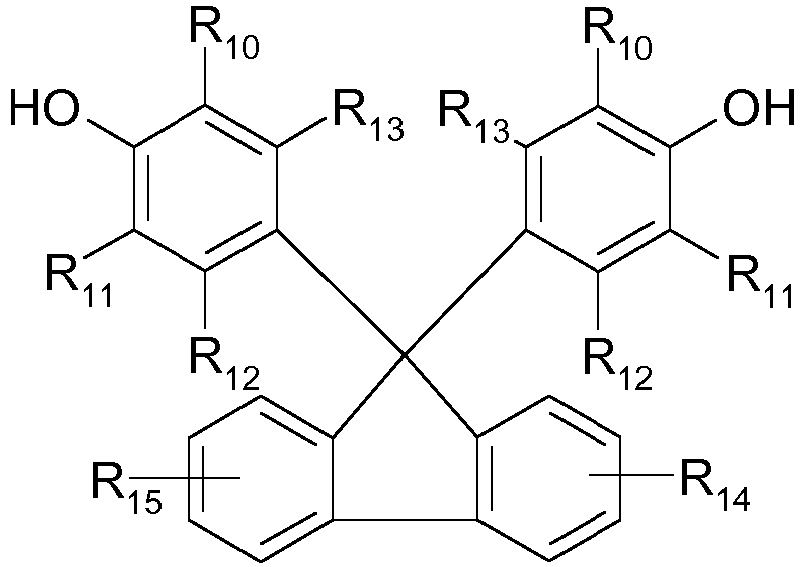
9) Ea = (ln((gel time at 80 °C)/min)-In((gel time at 140 °C)/min))/(1/(80°C+273°C)*K/°C-1/(140°C+273°C)*K/°C)*8.31 J/(mol*K)/1000J/kJ
10) Kritical stress intensity factor mode I; double torsion test (Huntsman proprietary test method)
11) IEC 60250
Claims (17)
- A curing agent for thermosetting epoxy resins comprising(a) at least one aromatic amine containing at least two amino groups, and(b) at least one clathrate compound obtained by reacting a tetrakisphenol of the formula

 R1, R2, R3, R4, R5, R6, R7, R8, R10, and R11 are each independently of one another hydrogen, halogen, C1-C4alkyl, C1-C4alkoxy, or phenyl which is unsubstituted or substituted by C1-C4alkyl, C1-C4alkoxy or halogen,R12, R13, R14 and R15 are each independently of one another hydrogen, halogen, C1-C4alkyl or C1-C4alkoxy, andn is the number 0, 1, 2 or 3.
 - The curing agent according to claim 1, wherein the aromatic amine (a) containing at least two amino groups is a sterically hindered aromatic diamine which bears a substituent in at least one position ortho to each amino group.
- The curing agent according to either claim 1 or claim 2, wherein the aromatic amine (a) containing at least two amino groups is selected from the group of 1,3,5-triethyl-2,4-diaminobenzene, 1-ethyl-3,5-diisopropyl-2,6-diaminobenzene, 1,3,4,6-tetramethyl-2,5-diaminobenzene, 1,4-dimethyl-3,6-diethyl-2,5-diaminobenzene, 4,4'-methylenebis(2,6-diisopropylaniline), 4,4'-methylenebis(2,6-diethylaniline), 4,4'-methylenebis(2-methyl-6-ethylaniline), 2,4,6-tri(methylthio)-1,3-diaminobenzene, 3,5-di(methylthio)-2,4-diaminotoluene, 3,5-di(ethylthio)-2,4-diaminotoluene, 3-methylthio-5-ethylthio-2,4-diaminotoluene, 3,5-di(methylthio)-2,6-diaminotoluene, 4,4'-diamino-3,3',5,5'-tetra(methylthio)biphenyl, 4,4'-ethylidenebis[2,6-di(methylthio)aniline], 4,4'-methylenebis[2,6-di(ethylthio)aniline], and diethyltoluene diamine, such as 3,5-diethyl-2,4-diaminotoluene or 3,5-diethyl-2,6-diaminotoluene, or a mixture thereof.
- The curing agent according to any one of claims 1 to 3, wherein the aromatic amine (a) containing at least two amino groups is diethyltoluene diamine, such as 3,5-diethyl-2,4-diaminotoluene or 3,5-diethyl-2,6-diaminotoluene, or a mixture thereof.
- The curing agent according to any one of claims 1 to 4, wherein
n in formula (1) is the number 0 or 1. - The curing agent according to any one of claims 1 to 5, wherein the host molecule of the clathrate compound (b) is selected from the group of 1,1,2,2-tetrakis(4-hydroxyphenyl)ethane, 1,1,2,2-tetrakis(3-methyl-4-hydroxyphenyl)ethane, 1,1,2,2-tetrakis(3,5-dimethyl-4-hydroxyphenyl)ethane and 1,1,2,2-tetrakis(3-chloro-4-hydroxyphenyl)ethane.
- The curing agent according to any one of claims 1 to 5, wherein the host molecule of the clathrate compound (b) is 9,9-Bis(4-hydroxyphenyl)fluorene.
- The curing agent according to any one of claims 1 to 7, wherein the guest molecule of the clathrate compound (b) is selected from the group of imidazole, 1-methylimidazole , 2-methylimidazole, 2-ethylimidazole, 2-isopropylimidazole, 2-n-propylimidazole, 2-undecylimidazole, 2-heptadecylimidazole, 1,2-dimethylimidazole, 2-ethyl-4-methylimidazole, 2-phenylimidazole, 2-phenyl-4-methylimidazole, 1-benzyl-2-methylimidazole, 1-benzyl-2-phenylimidazole, 1-isopropyl-2-methylimidazole, 1-cyanoethyl-2-methylimidazole, 1-cyanoethyl-2-ethyl-4-methylimidazole, 1-cyanoethyl-2-undecylimidazole, 1-cyanoethyl-2-phenylimidazole, 2-phenyl-4-methyl-5-hydroxymethylimidazole, 2-phenylimidazole, 2-phenyl-4,5-dihydroxymethylimidazole, 1,2-phenyl-4-methyl-5-hydroxymethylimidazole, 1-dodecyl-2-methylimidazole or 1-cyanoethyl-2-phenyl-4,5-di(2-cyanoethoxy)methylimidazole, especially, 2-methylimidazole, 2-ethylimidazole, 2-isopropylimidazole, 2-ethyl-4-methylimidazole, 1-isopropyl-2-methylimidazole, 2-phenylimidazole, and 1-benzyl-2-methylimidazole,
- The curing agent according to any one of claims 1 to 7, wherein the guest molecule of the clathrate compound (b) is 2-ethyl-4-methylimidazole or 2-methylimidazole.
- A multiple component thermosetting epoxy resin composition comprising(A) at least one epoxy resin, and(B) at least one curing agent, comprising(a) at least one aromatic amine containing at least two amino groups, and(b) at least one clathrate compound obtained by reacting a tetrakisphenol of the formula

 R1, R2, R3, R4, R5, R6, R7, R8, R10, and R11 are each independently of one another hydrogen, halogen, C1-C4alkyl, C1-C4alkoxy, or phenyl which is unsubstituted or substituted by C1-C4alkyl, C1-C4alkoxy or halogen,R12, R13, R14 and R15 are each independently of one another hydrogen, halogen, C1-C4alkyl or C1-C4alkoxy, andn is the number 0, 1, 2 or 3.
 - The multiple component thermosetting epoxy resin composition according to claim 10, comprising(A) 90 to 110 parts by weight of a diglycidylether of bisphenol A having an epoxy equivalent weight of about 180 to about 190, and(B) a curing agent, consisting of(a) 18 to 26 parts by weight of diethyltoluene diamine, and(b) 1 to 5 parts by weight of a clathrate compound obtained by reacting 1,1,2,2-tetrakis(4 hydroxyphenyl)ethane as the host molecule and 2-ethyl-4-methylimidazole as the guest molecule.
- The multiple component thermosetting epoxy resin composition according to either claim 10 or claim 11, further comprising
(C) at least one filler selected from the group consisting of quartz sand, quartz powder, silica, aluminium oxide, titanium oxide, zirconium oxide, Mg(OH)2, Al(OH)3, dolomite [CaMg (CO3)2], Al(OH)3, AlO(OH), silicon nitride, boron nitrides, aluminium nitride, silicon carbide, boron carbides, dolomite, chalk, calcium carbonate, barite, gypsum, hydromagnesite, zeolites, talcum, mica, kaolin and wollastonite, which may optionally be coated with a silane or a siloxane. - A process for the preparation of a cured article, wherein a multiple component thermosetting epoxy resin composition according to claim 1 is used.
- A process for the preparation of an insulation system for electrical engineering by a casting, potting, encapsulation, or an impregnation process, wherein a multiple component thermosetting epoxy resin composition is used, said epoxy resin composition comprising(A) at least one epoxy resin, and(B) at least one curing agent, comprising(a) at least one aromatic amine containing at least two amino groups, and(b) at least one clathrate compound obtained by reacting a tetrakisphenol of the formula

 R1, R2, R3, R4, R5, R6, R7, Rg, R10, and R11 are each independently of one another hydrogen, halogen, C1-C4alkyl, C1-C4alkoxy, or phenyl which is unsubstituted or substituted by C1-C4alkyl, C1-C4alkoxy or halogen,R12, R13, R14 and R15 are each independently of one another hydrogen, halogen, C1-C4alkyl or C1-C4alkoxy, andn is the number 0, 1, 2 or 3.
 - The process according to claim 14, wherein the insulation system for electrical engineering is prepared by automatic pressure gelation (APG).
- The cured article obtained by the process according to any one of claims 13 to 15.
- Use of the cured article according to claim 16, in medium and high voltage switchgear applications, as medium and high voltage instrument transformers, as post insulators, and as bushings and transformers.
Priority Applications (1)
| Application Number | Priority Date | Filing Date | Title |
|---|---|---|---|
| PL16725399T PL3298061T3 (en) | 2015-05-19 | 2016-05-11 | A curing agent for thermosetting epoxy resins, and a process for the preparation of insulation systems for electrical engineering |
Applications Claiming Priority (2)
| Application Number | Priority Date | Filing Date | Title |
|---|---|---|---|
| EP15168065 | 2015-05-19 | ||
| PCT/EP2016/060558 WO2016184749A1 (en) | 2015-05-19 | 2016-05-11 | A curing agent for thermosetting epoxy resins, and a process for the preparation of insulation systems for electrical engineering |
Publications (2)
| Publication Number | Publication Date |
|---|---|
| EP3298061A1 EP3298061A1 (en) | 2018-03-28 |
| EP3298061B1 true EP3298061B1 (en) | 2020-09-09 |
Family
ID=53180604
Family Applications (1)
| Application Number | Title | Priority Date | Filing Date |
|---|---|---|---|
| EP16725399.6A Active EP3298061B1 (en) | 2015-05-19 | 2016-05-11 | A curing agent for thermosetting epoxy resins, and a process for the preparation of insulation systems for electrical engineering |
Country Status (13)
| Country | Link |
|---|---|
| US (1) | US10851201B2 (en) |
| EP (1) | EP3298061B1 (en) |
| JP (1) | JP6944879B2 (en) |
| KR (1) | KR102572379B1 (en) |
| CN (1) | CN107636039B (en) |
| CA (1) | CA2983679C (en) |
| DK (1) | DK3298061T3 (en) |
| ES (1) | ES2834894T3 (en) |
| HU (1) | HUE052763T2 (en) |
| MX (1) | MX2017014697A (en) |
| PL (1) | PL3298061T3 (en) |
| TW (1) | TWI734686B (en) |
| WO (1) | WO2016184749A1 (en) |
Families Citing this family (8)
| Publication number | Priority date | Publication date | Assignee | Title |
|---|---|---|---|---|
| TWI734686B (en) * | 2015-05-19 | 2021-08-01 | 瑞士商亨斯邁先進材料授權(瑞士)有限公司 | A curing agent for thermosetting epoxy resins, and a process for the preparation of insulation systems for electrical engineering |
| JP6734287B2 (en) * | 2015-09-16 | 2020-08-05 | 日本曹達株式会社 | Inclusion compound |
| MX2019008819A (en) * | 2017-01-26 | 2019-09-26 | Huntsman Adv Mat Licensing Switzerland Gmbh | A thermosetting epoxy resin composition for the preparation of articles for electrical engineering, and the articles obtained therefrom. |
| GB2569614B (en) * | 2017-12-21 | 2022-04-06 | Hexcel Composites Ltd | A curative composition and a resin composition containing the curative composition |
| TWI847997B (en) * | 2018-08-17 | 2024-07-11 | 德商漢高股份有限及兩合公司 | Liquid compression molding or encapsulant compositions |
| TW202337995A (en) * | 2021-11-17 | 2023-10-01 | 德商漢高股份有限及兩合公司 | Liquid mold compounds, reaction products of which become platable upon exposure to laser energy |
| CN115926115A (en) * | 2022-12-19 | 2023-04-07 | 湖南肆玖科技有限公司 | Modified epoxy resin curing agent, preparation method and use method thereof |
| KR102954877B1 (en) | 2023-11-06 | 2026-04-20 | 주식회사 에이치알에스 | Silicone potting composition containing ionic liquid and method for producing the same |
Family Cites Families (24)
| Publication number | Priority date | Publication date | Assignee | Title |
|---|---|---|---|---|
| JPS58214225A (en) * | 1982-06-07 | 1983-12-13 | 三菱電機株式会社 | Method of producing resin coated electric device |
| US4775736A (en) | 1985-12-27 | 1988-10-04 | Ethyl Corporation | Epoxy curing agent composition |
| JPS6460625A (en) * | 1987-08-31 | 1989-03-07 | Toshiba Corp | Casting epoxy resin composition |
| US5364977A (en) | 1992-12-01 | 1994-11-15 | Nippon Soda Co., Ltd. | Clathrate compounds comprising tetrakisphenols as host |
| EP1520867A3 (en) * | 1996-12-27 | 2008-04-30 | Nippon Soda Co., Ltd. | Curatives for epoxy resin, curing accelerator, and epoxy resin composition |
| US7495060B2 (en) * | 1996-12-27 | 2009-02-24 | Nippon Soda Co., Ltd. | Tetrakisphenol and non-clathrated curing agent for epoxy resin |
| JP3904311B2 (en) * | 1996-12-27 | 2007-04-11 | 日本曹達株式会社 | Curing agent / curing accelerator for epoxy resin and epoxy resin composition |
| JPH10324826A (en) * | 1997-03-25 | 1998-12-08 | Kansai Paint Co Ltd | Curable coating composition |
| DE19813190B4 (en) * | 1997-03-25 | 2004-02-12 | Kansai Paint Co., Ltd., Amagasaki | Curable coating composition |
| EP1705740A4 (en) * | 2003-12-18 | 2009-02-25 | Kurita Water Ind Ltd | FUEL FOR FUEL CELL, FUEL CELL AND USE THEREOF |
| JP5068045B2 (en) | 2005-07-06 | 2012-11-07 | 日本曹達株式会社 | Inclusion compound, curing catalyst, cured resin forming composition and cured resin |
| JP2012232994A (en) | 2005-07-06 | 2012-11-29 | Nippon Soda Co Ltd | Inclusion compound, curing catalyst, cured resin-forming composition, and cured resin |
| CN102875470B (en) | 2006-12-21 | 2015-09-09 | 日本曹达株式会社 | Inclusion compound, curing catalysts, cured resin formation composition and cured resin |
| KR101132999B1 (en) * | 2007-09-21 | 2012-04-09 | 닛뽕소다 가부시키가이샤 | Inclusion complex containing epoxy resin composition for semiconductor encapsulation |
| JP5576595B2 (en) | 2008-03-27 | 2014-08-20 | 大阪瓦斯株式会社 | Inclusion compounds using compounds containing a fluorene skeleton |
| CN102341430B (en) * | 2009-03-11 | 2013-11-06 | 日本曹达株式会社 | Epoxy resin composition, curing agent and curing accelerator |
| EP2424917A1 (en) * | 2009-04-30 | 2012-03-07 | Dow Global Technologies LLC | Thermosettable resin compositions |
| US9068074B2 (en) * | 2009-10-16 | 2015-06-30 | Nippon Soda Co., Ltd. | Composition for formation of cured epoxy resin, and cured products thereof |
| US20130059942A1 (en) | 2010-05-21 | 2013-03-07 | Nippon Soda Co., Ltd. | Curable powder coating composition, and cured product of same |
| MX349722B (en) * | 2011-08-31 | 2017-08-10 | Huntsman Adv Mat Licensing Switzerland Gmbh | Use of hydrophobic epoxide resin system for encapsulation of a instrument transformer. |
| JP6046894B2 (en) * | 2011-12-28 | 2016-12-21 | ナミックス株式会社 | Liquid encapsulant |
| JP2014185115A (en) * | 2013-03-25 | 2014-10-02 | Nippon Soda Co Ltd | Novel inclusion compound |
| TWI734686B (en) * | 2015-05-19 | 2021-08-01 | 瑞士商亨斯邁先進材料授權(瑞士)有限公司 | A curing agent for thermosetting epoxy resins, and a process for the preparation of insulation systems for electrical engineering |
| JP6734287B2 (en) * | 2015-09-16 | 2020-08-05 | 日本曹達株式会社 | Inclusion compound |
-
2016
- 2016-05-06 TW TW105114110A patent/TWI734686B/en not_active IP Right Cessation
- 2016-05-11 DK DK16725399.6T patent/DK3298061T3/en active
- 2016-05-11 CA CA2983679A patent/CA2983679C/en active Active
- 2016-05-11 MX MX2017014697A patent/MX2017014697A/en unknown
- 2016-05-11 CN CN201680028631.1A patent/CN107636039B/en not_active Expired - Fee Related
- 2016-05-11 EP EP16725399.6A patent/EP3298061B1/en active Active
- 2016-05-11 PL PL16725399T patent/PL3298061T3/en unknown
- 2016-05-11 WO PCT/EP2016/060558 patent/WO2016184749A1/en not_active Ceased
- 2016-05-11 KR KR1020177036621A patent/KR102572379B1/en active Active
- 2016-05-11 US US15/575,270 patent/US10851201B2/en active Active
- 2016-05-11 HU HUE16725399A patent/HUE052763T2/en unknown
- 2016-05-11 ES ES16725399T patent/ES2834894T3/en active Active
- 2016-05-11 JP JP2017558739A patent/JP6944879B2/en not_active Expired - Fee Related
Non-Patent Citations (1)
| Title |
|---|
| None * |
Also Published As
| Publication number | Publication date |
|---|---|
| TW201700525A (en) | 2017-01-01 |
| WO2016184749A1 (en) | 2016-11-24 |
| KR102572379B1 (en) | 2023-09-01 |
| CA2983679C (en) | 2023-08-08 |
| JP6944879B2 (en) | 2021-10-06 |
| EP3298061A1 (en) | 2018-03-28 |
| TWI734686B (en) | 2021-08-01 |
| CN107636039B (en) | 2020-11-24 |
| HUE052763T2 (en) | 2021-05-28 |
| KR20180008782A (en) | 2018-01-24 |
| CN107636039A (en) | 2018-01-26 |
| MX2017014697A (en) | 2018-01-24 |
| PL3298061T3 (en) | 2021-05-31 |
| US10851201B2 (en) | 2020-12-01 |
| DK3298061T3 (en) | 2020-11-16 |
| JP2018517018A (en) | 2018-06-28 |
| ES2834894T3 (en) | 2021-06-21 |
| CA2983679A1 (en) | 2016-11-24 |
| US20180142058A1 (en) | 2018-05-24 |
Similar Documents
| Publication | Publication Date | Title |
|---|---|---|
| US10851201B2 (en) | Curing agent for thermosetting epoxy resins, and a process for the preparation of insulation systems for electrical engineering | |
| EP3274390B1 (en) | A thermosetting epoxy resin composition for the preparation of outdoor articles, and the articles obtained therefrom | |
| EP3317318B1 (en) | A thermosetting epoxy resin composition for the preparation of outdoor articles, and the articles obtained therefrom | |
| EP3275002B2 (en) | A process for the preparation of insulation systems for electrical engineering, and the use thereof | |
| JP7365118B2 (en) | Process for the production of insulation systems for electrical engineering, products obtained therefrom and their use | |
| US11525054B2 (en) | Thermosetting epoxy resin composition for the preparation of articles for electrical engineering, and the articles obtained therefrom | |
| CA3049683C (en) | A thermosetting epoxy resin composition for the preparation of articles for electrical engineering, and the articles obtained therefrom | |
| CA3016634C (en) | A process for the preparation of insulation systems for electrical engineering, the articles obtained therefrom and the use thereof |
Legal Events
| Date | Code | Title | Description |
|---|---|---|---|
| STAA | Information on the status of an ep patent application or granted ep patent |
Free format text: STATUS: THE INTERNATIONAL PUBLICATION HAS BEEN MADE |
|
| PUAI | Public reference made under article 153(3) epc to a published international application that has entered the european phase |
Free format text: ORIGINAL CODE: 0009012 |
|
| STAA | Information on the status of an ep patent application or granted ep patent |
Free format text: STATUS: REQUEST FOR EXAMINATION WAS MADE |
|
| 17P | Request for examination filed |
Effective date: 20171114 |
|
| AK | Designated contracting states |
Kind code of ref document: A1 Designated state(s): AL AT BE BG CH CY CZ DE DK EE ES FI FR GB GR HR HU IE IS IT LI LT LU LV MC MK MT NL NO PL PT RO RS SE SI SK SM TR |
|
| AX | Request for extension of the european patent |
Extension state: BA ME |
|
| DAV | Request for validation of the european patent (deleted) | ||
| DAX | Request for extension of the european patent (deleted) | ||
| RAP1 | Party data changed (applicant data changed or rights of an application transferred) |
Owner name: HUNTSMAN ADVANCED MATERIALS LICENSING (SWITZERLAND |
|
| GRAP | Despatch of communication of intention to grant a patent |
Free format text: ORIGINAL CODE: EPIDOSNIGR1 |
|
| STAA | Information on the status of an ep patent application or granted ep patent |
Free format text: STATUS: GRANT OF PATENT IS INTENDED |
|
| INTG | Intention to grant announced |
Effective date: 20200702 |
|
| GRAS | Grant fee paid |
Free format text: ORIGINAL CODE: EPIDOSNIGR3 |
|
| GRAA | (expected) grant |
Free format text: ORIGINAL CODE: 0009210 |
|
| STAA | Information on the status of an ep patent application or granted ep patent |
Free format text: STATUS: THE PATENT HAS BEEN GRANTED |
|
| AK | Designated contracting states |
Kind code of ref document: B1 Designated state(s): AL AT BE BG CH CY CZ DE DK EE ES FI FR GB GR HR HU IE IS IT LI LT LU LV MC MK MT NL NO PL PT RO RS SE SI SK SM TR |
|
| REG | Reference to a national code |
Ref country code: GB Ref legal event code: FG4D |
|
| REG | Reference to a national code |
Ref country code: AT Ref legal event code: REF Ref document number: 1311492 Country of ref document: AT Kind code of ref document: T Effective date: 20200915 Ref country code: CH Ref legal event code: EP |
|
| REG | Reference to a national code |
Ref country code: DE Ref legal event code: R096 Ref document number: 602016043669 Country of ref document: DE |
|
| REG | Reference to a national code |
Ref country code: IE Ref legal event code: FG4D |
|
| REG | Reference to a national code |
Ref country code: DE Ref legal event code: R082 Ref document number: 602016043669 Country of ref document: DE Representative=s name: WEIDNER STERN JESCHKE PATENTANWAELTE PARTNERSC, DE |
|
| REG | Reference to a national code |
Ref country code: DK Ref legal event code: T3 Effective date: 20201113 |
|
| REG | Reference to a national code |
Ref country code: SE Ref legal event code: TRGR Ref country code: FI Ref legal event code: FGE |
|
| REG | Reference to a national code |
Ref country code: NO Ref legal event code: T2 Effective date: 20200909 |
|
| REG | Reference to a national code |
Ref country code: NL Ref legal event code: FP |
|
| REG | Reference to a national code |
Ref country code: LT Ref legal event code: MG4D |
|
| PG25 | Lapsed in a contracting state [announced via postgrant information from national office to epo] |
Ref country code: GR Free format text: LAPSE BECAUSE OF FAILURE TO SUBMIT A TRANSLATION OF THE DESCRIPTION OR TO PAY THE FEE WITHIN THE PRESCRIBED TIME-LIMIT Effective date: 20201210 Ref country code: LT Free format text: LAPSE BECAUSE OF FAILURE TO SUBMIT A TRANSLATION OF THE DESCRIPTION OR TO PAY THE FEE WITHIN THE PRESCRIBED TIME-LIMIT Effective date: 20200909 Ref country code: BG Free format text: LAPSE BECAUSE OF FAILURE TO SUBMIT A TRANSLATION OF THE DESCRIPTION OR TO PAY THE FEE WITHIN THE PRESCRIBED TIME-LIMIT Effective date: 20201209 Ref country code: HR Free format text: LAPSE BECAUSE OF FAILURE TO SUBMIT A TRANSLATION OF THE DESCRIPTION OR TO PAY THE FEE WITHIN THE PRESCRIBED TIME-LIMIT Effective date: 20200909 |
|
| PG25 | Lapsed in a contracting state [announced via postgrant information from national office to epo] |
Ref country code: RS Free format text: LAPSE BECAUSE OF FAILURE TO SUBMIT A TRANSLATION OF THE DESCRIPTION OR TO PAY THE FEE WITHIN THE PRESCRIBED TIME-LIMIT Effective date: 20200909 Ref country code: LV Free format text: LAPSE BECAUSE OF FAILURE TO SUBMIT A TRANSLATION OF THE DESCRIPTION OR TO PAY THE FEE WITHIN THE PRESCRIBED TIME-LIMIT Effective date: 20200909 |
|
| PG25 | Lapsed in a contracting state [announced via postgrant information from national office to epo] |
Ref country code: RO Free format text: LAPSE BECAUSE OF FAILURE TO SUBMIT A TRANSLATION OF THE DESCRIPTION OR TO PAY THE FEE WITHIN THE PRESCRIBED TIME-LIMIT Effective date: 20200909 Ref country code: PT Free format text: LAPSE BECAUSE OF FAILURE TO SUBMIT A TRANSLATION OF THE DESCRIPTION OR TO PAY THE FEE WITHIN THE PRESCRIBED TIME-LIMIT Effective date: 20210111 Ref country code: SM Free format text: LAPSE BECAUSE OF FAILURE TO SUBMIT A TRANSLATION OF THE DESCRIPTION OR TO PAY THE FEE WITHIN THE PRESCRIBED TIME-LIMIT Effective date: 20200909 Ref country code: EE Free format text: LAPSE BECAUSE OF FAILURE TO SUBMIT A TRANSLATION OF THE DESCRIPTION OR TO PAY THE FEE WITHIN THE PRESCRIBED TIME-LIMIT Effective date: 20200909 |
|
| REG | Reference to a national code |
Ref country code: HU Ref legal event code: AG4A Ref document number: E052763 Country of ref document: HU |
|
| PG25 | Lapsed in a contracting state [announced via postgrant information from national office to epo] |
Ref country code: AL Free format text: LAPSE BECAUSE OF FAILURE TO SUBMIT A TRANSLATION OF THE DESCRIPTION OR TO PAY THE FEE WITHIN THE PRESCRIBED TIME-LIMIT Effective date: 20200909 Ref country code: IS Free format text: LAPSE BECAUSE OF FAILURE TO SUBMIT A TRANSLATION OF THE DESCRIPTION OR TO PAY THE FEE WITHIN THE PRESCRIBED TIME-LIMIT Effective date: 20210109 |
|
| REG | Reference to a national code |
Ref country code: DE Ref legal event code: R097 Ref document number: 602016043669 Country of ref document: DE |
|
| REG | Reference to a national code |
Ref country code: ES Ref legal event code: FG2A Ref document number: 2834894 Country of ref document: ES Kind code of ref document: T3 Effective date: 20210621 |
|
| PG25 | Lapsed in a contracting state [announced via postgrant information from national office to epo] |
Ref country code: SK Free format text: LAPSE BECAUSE OF FAILURE TO SUBMIT A TRANSLATION OF THE DESCRIPTION OR TO PAY THE FEE WITHIN THE PRESCRIBED TIME-LIMIT Effective date: 20200909 |
|
| PLBE | No opposition filed within time limit |
Free format text: ORIGINAL CODE: 0009261 |
|
| STAA | Information on the status of an ep patent application or granted ep patent |
Free format text: STATUS: NO OPPOSITION FILED WITHIN TIME LIMIT |
|
| 26N | No opposition filed |
Effective date: 20210610 |
|
| PG25 | Lapsed in a contracting state [announced via postgrant information from national office to epo] |
Ref country code: SI Free format text: LAPSE BECAUSE OF FAILURE TO SUBMIT A TRANSLATION OF THE DESCRIPTION OR TO PAY THE FEE WITHIN THE PRESCRIBED TIME-LIMIT Effective date: 20200909 |
|
| PG25 | Lapsed in a contracting state [announced via postgrant information from national office to epo] |
Ref country code: MC Free format text: LAPSE BECAUSE OF FAILURE TO SUBMIT A TRANSLATION OF THE DESCRIPTION OR TO PAY THE FEE WITHIN THE PRESCRIBED TIME-LIMIT Effective date: 20200909 Ref country code: LU Free format text: LAPSE BECAUSE OF NON-PAYMENT OF DUE FEES Effective date: 20210511 |
|
| REG | Reference to a national code |
Ref country code: AT Ref legal event code: UEP Ref document number: 1311492 Country of ref document: AT Kind code of ref document: T Effective date: 20200909 |
|
| PG25 | Lapsed in a contracting state [announced via postgrant information from national office to epo] |
Ref country code: IE Free format text: LAPSE BECAUSE OF NON-PAYMENT OF DUE FEES Effective date: 20210511 |
|
| PG25 | Lapsed in a contracting state [announced via postgrant information from national office to epo] |
Ref country code: CY Free format text: LAPSE BECAUSE OF FAILURE TO SUBMIT A TRANSLATION OF THE DESCRIPTION OR TO PAY THE FEE WITHIN THE PRESCRIBED TIME-LIMIT Effective date: 20200909 |
|
| PG25 | Lapsed in a contracting state [announced via postgrant information from national office to epo] |
Ref country code: MK Free format text: LAPSE BECAUSE OF FAILURE TO SUBMIT A TRANSLATION OF THE DESCRIPTION OR TO PAY THE FEE WITHIN THE PRESCRIBED TIME-LIMIT Effective date: 20200909 |
|
| PGFP | Annual fee paid to national office [announced via postgrant information from national office to epo] |
Ref country code: NL Payment date: 20240527 Year of fee payment: 9 |
|
| PGFP | Annual fee paid to national office [announced via postgrant information from national office to epo] |
Ref country code: GB Payment date: 20240521 Year of fee payment: 9 |
|
| PGFP | Annual fee paid to national office [announced via postgrant information from national office to epo] |
Ref country code: DE Payment date: 20240529 Year of fee payment: 9 |
|
| PGFP | Annual fee paid to national office [announced via postgrant information from national office to epo] |
Ref country code: DK Payment date: 20240527 Year of fee payment: 9 |
|
| PGFP | Annual fee paid to national office [announced via postgrant information from national office to epo] |
Ref country code: CH Payment date: 20240602 Year of fee payment: 9 |
|
| PGFP | Annual fee paid to national office [announced via postgrant information from national office to epo] |
Ref country code: ES Payment date: 20240610 Year of fee payment: 9 |
|
| PGFP | Annual fee paid to national office [announced via postgrant information from national office to epo] |
Ref country code: AT Payment date: 20240521 Year of fee payment: 9 Ref country code: CZ Payment date: 20240502 Year of fee payment: 9 |
|
| PGFP | Annual fee paid to national office [announced via postgrant information from national office to epo] |
Ref country code: NO Payment date: 20240521 Year of fee payment: 9 Ref country code: FR Payment date: 20240527 Year of fee payment: 9 Ref country code: FI Payment date: 20240527 Year of fee payment: 9 |
|
| PGFP | Annual fee paid to national office [announced via postgrant information from national office to epo] |
Ref country code: PL Payment date: 20240502 Year of fee payment: 9 |
|
| PGFP | Annual fee paid to national office [announced via postgrant information from national office to epo] |
Ref country code: SE Payment date: 20240527 Year of fee payment: 9 Ref country code: HU Payment date: 20240514 Year of fee payment: 9 Ref country code: BE Payment date: 20240527 Year of fee payment: 9 |
|
| PG25 | Lapsed in a contracting state [announced via postgrant information from national office to epo] |
Ref country code: MT Free format text: LAPSE BECAUSE OF FAILURE TO SUBMIT A TRANSLATION OF THE DESCRIPTION OR TO PAY THE FEE WITHIN THE PRESCRIBED TIME-LIMIT Effective date: 20200909 |
|
| PGFP | Annual fee paid to national office [announced via postgrant information from national office to epo] |
Ref country code: IT Payment date: 20240524 Year of fee payment: 9 |
|
| P01 | Opt-out of the competence of the unified patent court (upc) registered |
Free format text: CASE NUMBER: APP_66662/2024 Effective date: 20241217 |
|
| REG | Reference to a national code |
Ref country code: DE Ref legal event code: R119 Ref document number: 602016043669 Country of ref document: DE |
|
| PG25 | Lapsed in a contracting state [announced via postgrant information from national office to epo] |
Ref country code: TR Free format text: LAPSE BECAUSE OF FAILURE TO SUBMIT A TRANSLATION OF THE DESCRIPTION OR TO PAY THE FEE WITHIN THE PRESCRIBED TIME-LIMIT Effective date: 20200909 |
|
| REG | Reference to a national code |
Ref country code: DK Ref legal event code: EBP Effective date: 20250531 |
|
| REG | Reference to a national code |
Ref country code: CH Ref legal event code: H13 Free format text: ST27 STATUS EVENT CODE: U-0-0-H10-H13 (AS PROVIDED BY THE NATIONAL OFFICE) Effective date: 20251223 |
|
| REG | Reference to a national code |
Ref country code: NL Ref legal event code: MM Effective date: 20250601 |
|
| PG25 | Lapsed in a contracting state [announced via postgrant information from national office to epo] |
Ref country code: NO Free format text: LAPSE BECAUSE OF NON-PAYMENT OF DUE FEES Effective date: 20250531 |
|
| PG25 | Lapsed in a contracting state [announced via postgrant information from national office to epo] |
Ref country code: AT Free format text: LAPSE BECAUSE OF NON-PAYMENT OF DUE FEES Effective date: 20250511 |
|
| PG25 | Lapsed in a contracting state [announced via postgrant information from national office to epo] |
Ref country code: FI Free format text: LAPSE BECAUSE OF NON-PAYMENT OF DUE FEES Effective date: 20250511 |
|
| PG25 | Lapsed in a contracting state [announced via postgrant information from national office to epo] |
Ref country code: HU Free format text: LAPSE BECAUSE OF NON-PAYMENT OF DUE FEES Effective date: 20250512 |
|
| REG | Reference to a national code |
Ref country code: AT Ref legal event code: MM01 Ref document number: 1311492 Country of ref document: AT Kind code of ref document: T Effective date: 20250511 |
|
| PG25 | Lapsed in a contracting state [announced via postgrant information from national office to epo] |
Ref country code: CH Free format text: LAPSE BECAUSE OF NON-PAYMENT OF DUE FEES Effective date: 20250531 |
|
| PG25 | Lapsed in a contracting state [announced via postgrant information from national office to epo] |
Ref country code: SE Free format text: LAPSE BECAUSE OF NON-PAYMENT OF DUE FEES Effective date: 20250512 Ref country code: CZ Free format text: LAPSE BECAUSE OF NON-PAYMENT OF DUE FEES Effective date: 20250511 |
|
| REG | Reference to a national code |
Ref country code: SE Ref legal event code: EUG |
|
| GBPC | Gb: european patent ceased through non-payment of renewal fee |
Effective date: 20250511 |
|
| REG | Reference to a national code |
Ref country code: BE Ref legal event code: MM Effective date: 20250531 |
|
| PG25 | Lapsed in a contracting state [announced via postgrant information from national office to epo] |
Ref country code: NL Free format text: LAPSE BECAUSE OF NON-PAYMENT OF DUE FEES Effective date: 20250601 |
|
| PG25 | Lapsed in a contracting state [announced via postgrant information from national office to epo] |
Ref country code: GB Free format text: LAPSE BECAUSE OF NON-PAYMENT OF DUE FEES Effective date: 20250511 |
|
| PG25 | Lapsed in a contracting state [announced via postgrant information from national office to epo] |
Ref country code: DK Free format text: LAPSE BECAUSE OF NON-PAYMENT OF DUE FEES Effective date: 20250531 Ref country code: DE Free format text: LAPSE BECAUSE OF NON-PAYMENT OF DUE FEES Effective date: 20251202 |
|
| PG25 | Lapsed in a contracting state [announced via postgrant information from national office to epo] |
Ref country code: BE Free format text: LAPSE BECAUSE OF NON-PAYMENT OF DUE FEES Effective date: 20250531 Ref country code: IT Free format text: LAPSE BECAUSE OF NON-PAYMENT OF DUE FEES Effective date: 20250511 |
|
| PG25 | Lapsed in a contracting state [announced via postgrant information from national office to epo] |
Ref country code: FR Free format text: LAPSE BECAUSE OF NON-PAYMENT OF DUE FEES Effective date: 20250531 |