EP3297586B1 - Oral appliance - Google Patents
Oral appliance Download PDFInfo
- Publication number
- EP3297586B1 EP3297586B1 EP16798936.7A EP16798936A EP3297586B1 EP 3297586 B1 EP3297586 B1 EP 3297586B1 EP 16798936 A EP16798936 A EP 16798936A EP 3297586 B1 EP3297586 B1 EP 3297586B1
- Authority
- EP
- European Patent Office
- Prior art keywords
- oral
- appliance
- breathing
- appliances
- web
- Prior art date
- Legal status (The legal status is an assumption and is not a legal conclusion. Google has not performed a legal analysis and makes no representation as to the accuracy of the status listed.)
- Active
Links
Images
Classifications
-
- A—HUMAN NECESSITIES
- A61—MEDICAL OR VETERINARY SCIENCE; HYGIENE
- A61F—FILTERS IMPLANTABLE INTO BLOOD VESSELS; PROSTHESES; DEVICES PROVIDING PATENCY TO, OR PREVENTING COLLAPSING OF, TUBULAR STRUCTURES OF THE BODY, e.g. STENTS; ORTHOPAEDIC, NURSING OR CONTRACEPTIVE DEVICES; FOMENTATION; TREATMENT OR PROTECTION OF EYES OR EARS; BANDAGES, DRESSINGS OR ABSORBENT PADS; FIRST-AID KITS
- A61F5/00—Orthopaedic methods or devices for non-surgical treatment of bones or joints; Nursing devices ; Anti-rape devices
- A61F5/56—Devices for preventing snoring
-
- A—HUMAN NECESSITIES
- A61—MEDICAL OR VETERINARY SCIENCE; HYGIENE
- A61F—FILTERS IMPLANTABLE INTO BLOOD VESSELS; PROSTHESES; DEVICES PROVIDING PATENCY TO, OR PREVENTING COLLAPSING OF, TUBULAR STRUCTURES OF THE BODY, e.g. STENTS; ORTHOPAEDIC, NURSING OR CONTRACEPTIVE DEVICES; FOMENTATION; TREATMENT OR PROTECTION OF EYES OR EARS; BANDAGES, DRESSINGS OR ABSORBENT PADS; FIRST-AID KITS
- A61F5/00—Orthopaedic methods or devices for non-surgical treatment of bones or joints; Nursing devices ; Anti-rape devices
- A61F5/56—Devices for preventing snoring
- A61F5/566—Intra-oral devices
Definitions
- the disclosure also extends to a system of appliances for treating a patient having SBD and/or training a patient to nose breathe rather than mouth breathe.
- OSA pathogenesis of OSA involves a combination of reduced upper airway size and altered upper airway muscle activity, which causes oral tissue to collapse, and hence a blockage to occur.
- muscles hold the pharyngeal airway open. These muscles can relax when sleeping.
- Other factors which are thought to contribute to OSA include weight, tongue size, soft palate volume, a retrognathic mandible, an anteroposterior discrepancy between the maxilla and the mandible, and obesity.
- Snoring and OSA are often associated as generally both are caused by blockage of the pharyngeal airway by, for example, excess tissue when various muscles of the body, including the tongue, relax. As the tongue relaxes, it moves posteriorly, blocking the pharyngeal airway. When the pharyngeal airway is blocked, exhaled air is forced through the airway with increased velocity thereby causing vibration of the tongue, tissue, or other obstruction, thereby creating noise.
- Snoring is caused by the partial obstruction of breathing during sleep while OSA occurs when the tongue and soft palate collapse onto the back of the throat and completely block the pharyngeal airway, thereby stopping breathing during sleep and restricting the flow of essential oxygen.
- OSA occurs when the tongue and soft palate collapse onto the back of the throat and completely block the pharyngeal airway, thereby stopping breathing during sleep and restricting the flow of essential oxygen.
- CPAP treatment uses a positive air pressure to hold the airway open during sleep.
- the positive air pressure is generated by a pump and is applied through a small mask which fits over the nose, or the nose and mouth.
- CPAP stops snoring by preventing structures in the airway from vibrating. Equally as important, CPAP prevents the airway from becoming narrow and obstructing breathing.
- breathing becomes regular and unobstructed, the body's oxygen levels remain stable and the patient does not snore.
- CPAP does not cure obstructive sleep apnoea - it only treats the symptoms of OSA. Therefore, if patients cease using CPAP, snoring and obstructive sleep apnoea will usually return. For this reason, CPAP treatment must be used every night. CPAP is also a bulky, inconvenient and uncomfortable method of treatment, causing the majority patients to stop treatment and live with the complaint.
- S DB including snoring and OSA is also very common in childhood often begins when adenotonsillar enlargement peaks in the 2 - 5 year old age range.
- the American Academy of Sleep Medicine reports that the prevalence of OSA is approximately two percent in otherwise healthy young children. Chronic snoring occurs in almost 10% of children of both sexes.
- This set of oral appliances is based upon an understanding of the biochemistry and physiology of breathing and the critical role that is played by CO 2 . It may be appreciated that this is an entirely different approach to prior art MAD devices that are only concerned with physically advancing the mandible.
- Myofunctional therapy includes facial and tongue exercises and behavior modification techniques to promote proper tongue position, improved breathing, chewing, and swallowing.
- Myofunctional therapy requires strict compliance with the exercises set by the myofunctional therapist and regular therapeutic sessions. Not all patients, and in particular children, are compliant.
- the present inventor believes that the step wise reduction in breathing holes of the appliance that slowly causes the patient to start breathing through the nose also assists in retraining and strengthening the orofacial muscles such as the lip muscles that keep the mouth closed.
- the upper and lower dental arch receiving channels of the first and/or second oral appliance may be configured so that when the appliance is worn in the mouth, the patient lower dental arch is advanced. This brings the tongue forward and may alleviate any obstruction of the pharyngeal airway.
- the degree of mandibular displacement, if present, may suitable decrease from the first to the second oral appliance.
- the final stage oral appliance may have no mandibular displacement.
- All the appliances include a web interconnecting the inner wall and the outer wall which is positioned between the dentition on the upper and the lower arches when the oral appliance is fitted within the patient's mouth.
- the web lies broadly in the occlusal plane between the dentition of the upper and the lower arches in use.
- the thickened portions of the web are compressible. Compression may be achieved by providing a section of softer or more compressible material. Suitably compression is achieved by providing one or more holes through the trailing ends of the arms of the web.
- the combination of the airfoil shape and the ability to compress that part of the web between the rear molars can alleviate TMJ pain and other discomfort that is felt by users of conventional rigid devices.
- many prior art MAD devices of the mouthguard type are similar to mouth guards of the boil and bite type. These are well known and are formed of a heat deformable plastic such as ethylene vinyl acetate in which the guards are user molded to the shape of a user teeth and arch.
- the inner wall may have two major surfaces, namely a lingual surface which faces inward towards the tongue, and a channel surface which faces outward into the arch receiving channels.
- the outer wall may also have two major surfaces, namely a buccal surface which faces outward towards the buccal mucosa, and a channel surface which faces into the arch receiving channels.
- the inner and outer walls are dimensioned such that may be retained within the oral cavity when the patient is asleep with the mouth open.
- the inner and outer walls include a front portion and two arm portions extending away from the front portion.
- the front portion of the inner wall may incline rearward away from the outer wall as it extends up from the web. This angle of inclination is suitably selected to adopt the natural curvature of the palate so as to provide comfort when wearing the appliance.
- the appliance may include a tongue tag formed in the upper portion of the inner wall, e.g. substantially centrally on the inner wall, or substantially midway along the inner wall, corresponding to the midline of the patient's dentition.
- the tongue tag may serve as an indicator for the correct positioning of the tongue in a forward position to enlarge a restricted airway.
- the tongue tag will be discussed further below.
- the appliance body may be formed from a polymeric material.
- the appliance body is formed from a polymeric material that is polyurethane or silicone, e.g. by injection moulding.
- Silicone is particularly suitable as it is pliable and does not require moulding to a user teeth. This may improve comfort; allow the user some jaw movement that will also contribute to user comfort and thus compliance.
- the appliance body may be made in a number of different sizes and the sizes may be selected so that a majority of the population can select an appliance that can be fitted over their upper arch with a reasonable fit. Typically there may be three to four different sizes of the appliance body.
- the air holes provide a degree of flex that allows gentle compression of the jaw joints.
- the second appliance suitably has a similar number of holes. Alternatively, the number of holes may be reduced.
- a final stage appliance may have and holes with a width or diameter of 1mm or less.
- the last stage appliance may have no breathing holes at all.
- the thickness of the web may decrease with successive appliances.
- the thickness of the web determines how far the jaws are held apart by the appliance. Decreasing the thickness of the web, allows for the jaws to get closer over the treatment regime towards being fully closed for nasal breathing.
- the upper and lower arch receiving channels may be configured so that when worn, the mandible is advanced.
- the methods may use appliances in which the degree of mandibular advancement decreases together with the total cross sectional area for breathing.
- any one or more of the stages of treatment may further include wearing the oral appliance whilst awake. This may enhance the effect of regulating breathing and training the transition. Suitable times for wearing the appliance when awake include between about 20 minutes to about four hours, suitably between about one to about three hours, more suitably between about one to about 2 hours.
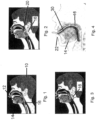
- Figure 1 is a schematic illustration of a person 10 at sleep breathing normally through the nose 12.
- the tongue 14 is positioned forwardly of the pharyngeal airway 16.
- the mouth 18 is closed and the person is breathing completely through the nose 12.
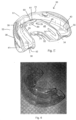
- the outer wall 36 has a front buccal surface 72 that is dimensioned so that it substantially covers the buccal aspects of the upper and lower posterior teeth when the mouth is closed. In this way any force from overactive lip muscles can be dispersed over the surface 72 rather than applied to the teeth.
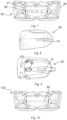
- Each arm of the web 38 also has a single hole 74 towards the trailing ends of the arms that may be seen more clearly in Figure 9 . These holes will be discussed further below.
- Figure 7 is a rear view of the appliance that also the four breathing holes 80 that extend though the front of the appliance.
- Figure 8 is a side view of another appliance 90 showing a series of holes 74 that is located in each arm of the web 38.
- the hole(s) 74 in the arms of the web not only assist in breathing but provide a degree of compression to that part of the web. This provides a degree of cushioning and resilience that not only provides comfort to the patient, but allows the patient to slightly move the teeth relative to each other. This can reduce the discomfort felt by wearing a rigid inflexible MAD device. Movement also allows exercise of orofacial muscles that is important in retraining the patient to nasal breathe.
- Figure 10 is the rear view of another oral appliance 100 in which the four holes 80 in the front thereof, have a total cross sectional area that is less than that of the appliance shown in Figure 7 .
- the appliance as shown in Figure 7 would be used in a first treatment stage.
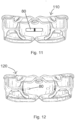
- FIG 11 is rear view of a still further appliance 110 that has two front breathing holes, thereby having a lower total cross sectional area for breathing through as compared to the appliance shown in Figures 5 - 7 .
- This appliance may also be used in a second or further stage of treatment.
- FIG 12 shows a still further appliance 120 with two much smaller breathing holes 80 in the front of the appliance. This appliance has an even further reduced total cross sectional area for breathing.
- the three different appliances shown in Figures 5-7 , 10 , 11 and 12 may be used in a method for treating SDB.
- the appliance shown in figures 5-7 will be worn by a patient every night for a period of about 1 to 4 months.
- the patient arterial blood CO 2 should raise and hypoxia should reduce.
- the patient should begin to feel more refreshed after sleep. Further any snoring may be less due to the opening of the pharyngeal airways by the combined mandibular advancement and placement of the tongue.
- the patient should be beginning to breathe more through their nose.
- the appliance shown in Figure 10 will be worn by a patient every night for a further period of about 1 to 4 months.
- the patient will be required to breathe more through their nose with a further change in the CO 2 level in the exhaled air.
- the appliance shown in Figure 11 will be worn by a patient every night for a further period of about 1 to 4 months.
- the patient will be required to breathe even more through their nose with a further change in the CO 2 level in the exhaled air.
- the patient will be beginning to feel the benefits of better oxygen supply to the body and beginning to approach a normal breathing pattern rather than hyperventilation. Snoring should be noticeably reduced or absent.
- the patient breathing mode should be retrained so that the patient can nose breathe without any appliance.
- the tongue is in the forward position and will not fall back to obstruct the airway. The patientwill no longer be required to wear a CPAP nor a DSA.
- the silicone appliances do not require boil and bite or custom fitting, they are flexible, comfortable and have a degree of compression so as to alleviate stress on the TMJ .
- the tongue tag causes the tongue to project forward and therefore further assists in opening the pharyngeal airway. This may mean that it may not be necessary to over advance the mandible to the same extent as prior art MAD devices. This means that there is less discomfort and more importantly less likelihood of damage.
- the devices as disclosed herein may therefore be safely used in children.
- appliances and methods allow for retraining to breathe through the nose, thereby alleviating and addressing the underlying problem of S BD that is caused by and associated with mouth breathing.
Landscapes
- Health & Medical Sciences (AREA)
- Otolaryngology (AREA)
- Pulmonology (AREA)
- Nursing (AREA)
- Orthopedic Medicine & Surgery (AREA)
- Engineering & Computer Science (AREA)
- Biomedical Technology (AREA)
- Heart & Thoracic Surgery (AREA)
- Vascular Medicine (AREA)
- Life Sciences & Earth Sciences (AREA)
- Animal Behavior & Ethology (AREA)
- General Health & Medical Sciences (AREA)
- Public Health (AREA)
- Veterinary Medicine (AREA)
- Orthopedics, Nursing, And Contraception (AREA)
- Rehabilitation Tools (AREA)
- Dental Tools And Instruments Or Auxiliary Dental Instruments (AREA)
Applications Claiming Priority (2)
| Application Number | Priority Date | Filing Date | Title |
|---|---|---|---|
| AU2015901890A AU2015901890A0 (en) | 2015-05-22 | Oral appliance | |
| PCT/AU2016/000174 WO2016187646A1 (en) | 2015-05-22 | 2016-05-20 | Oral appliance |
Publications (4)
| Publication Number | Publication Date |
|---|---|
| EP3297586A1 EP3297586A1 (en) | 2018-03-28 |
| EP3297586A4 EP3297586A4 (en) | 2019-02-27 |
| EP3297586B1 true EP3297586B1 (en) | 2025-04-09 |
| EP3297586C0 EP3297586C0 (en) | 2025-04-09 |
Family
ID=57392260
Family Applications (1)
| Application Number | Title | Priority Date | Filing Date |
|---|---|---|---|
| EP16798936.7A Active EP3297586B1 (en) | 2015-05-22 | 2016-05-20 | Oral appliance |
Country Status (11)
| Country | Link |
|---|---|
| US (2) | US10898369B2 (enExample) |
| EP (1) | EP3297586B1 (enExample) |
| JP (1) | JP6899380B2 (enExample) |
| CN (1) | CN107613913B (enExample) |
| CA (1) | CA2985360C (enExample) |
| ES (1) | ES3030343T3 (enExample) |
| GB (1) | GB2555055B (enExample) |
| NZ (1) | NZ738327A (enExample) |
| PL (1) | PL3297586T3 (enExample) |
| RU (1) | RU2706502C2 (enExample) |
| WO (1) | WO2016187646A1 (enExample) |
Families Citing this family (26)
| Publication number | Priority date | Publication date | Assignee | Title |
|---|---|---|---|---|
| USD790068S1 (en) * | 2015-09-25 | 2017-06-20 | Lm-Instruments Oy | Oral appliance |
| CA168308S (en) * | 2015-11-09 | 2017-03-22 | Myosa Pty Ltd | Oral appliance |
| US20180085247A1 (en) * | 2016-09-29 | 2018-03-29 | Sleep Better Products, Inc. | Systems, Methods, and Devices for Improving Airflow-Related Sleep Problems |
| AU201710942S (en) * | 2017-02-16 | 2017-10-06 | Orthodontic appliance | |
| EP4613342A3 (en) * | 2017-09-13 | 2025-11-12 | Christopher John Farrell | An oral training appliance |
| AU201813153S (en) * | 2018-05-25 | 2019-01-25 | An oral appliance | |
| AU201813151S (en) * | 2018-05-25 | 2019-01-24 | An oral appliance | |
| USD909586S1 (en) * | 2018-05-25 | 2021-02-02 | Christopher John Farrell | Oral appliance |
| EP4279110B1 (en) | 2018-07-20 | 2025-01-15 | Myosa Pty Ltd | Oral appliance |
| CA188766S (en) * | 2019-01-25 | 2020-12-21 | Farrell Dr Christopher John | Oral appliance |
| FR3098393B1 (fr) * | 2019-07-10 | 2021-06-04 | Philippe Coat | Orthèse linguale de type gouttière à dégagement arrière. |
| CA206749S (en) | 2019-10-11 | 2023-07-25 | Farrell Christopher John | Oral appliance |
| RU202617U1 (ru) * | 2020-05-14 | 2021-03-01 | Ольга Сергеевна Чепуряева | Пластмассовый базис с пластмассовым валиком на нижнюю челюсть |
| USD939763S1 (en) | 2020-06-18 | 2021-12-28 | Jovanka Vojvodic | Lip protector device |
| US12102555B2 (en) | 2020-08-24 | 2024-10-01 | Sleeping Well Inc. | Oral appliance |
| USD955583S1 (en) | 2020-08-24 | 2022-06-21 | Sleeping Well Llc | Oral appliance |
| CA202322S (en) * | 2020-10-08 | 2024-03-12 | Myosa Pty Ltd | Oral appliance |
| RU204804U1 (ru) * | 2021-03-31 | 2021-06-11 | Федеральное государственное бюджетное образовательное учреждение высшего образования «Казанский государственный медицинский университет» Министерства здравоохранения Российской Федерации | Устройство для лечения контрактуры жевательных мышц и редукции тризма челюстей |
| RU207536U1 (ru) * | 2021-06-03 | 2021-11-01 | Федеральное государственное бюджетное образовательное учреждение высшего образования «Волгоградский государственный медицинский университет» Министерства здравоохранения Российской Федерации | Каппа с площадкой для позиционирования языка |
| US12295877B2 (en) | 2021-08-31 | 2025-05-13 | II David Si GERGEN | Mandibular advancement device and method |
| WO2023046848A1 (en) * | 2021-09-23 | 2023-03-30 | Nocker Bayer Heike | Occlusion orthosis |
| CN113827354B (zh) * | 2021-10-28 | 2025-03-11 | 罗慕科技(北京)有限公司 | 一种可放置辅料并能监控佩戴时间的矫治器 |
| US12097120B2 (en) | 2022-03-07 | 2024-09-24 | Sleep Mechanics Llc | Bone implant device |
| US11793665B1 (en) | 2022-04-14 | 2023-10-24 | Gregory Todd Steiger | Vented dental appliance for bruxism relief |
| US20250073058A1 (en) * | 2023-09-01 | 2025-03-06 | Thomas Patrick Roemer | Anti-snoring appliance that repositions tongue and mandible |
| US20260091264A1 (en) * | 2024-09-27 | 2026-04-02 | Brepal Inc. | Breath practice and monitoring system |
Citations (1)
| Publication number | Priority date | Publication date | Assignee | Title |
|---|---|---|---|---|
| EP1203570B1 (de) * | 2000-11-03 | 2006-03-08 | Winfried Dr. Toussaint | Aufbissschiene zur Verhinderung von Schnarchen und von obstruktiver Schlafapnoe sowie zur künstlichen Beatmung |
Family Cites Families (18)
| Publication number | Priority date | Publication date | Assignee | Title |
|---|---|---|---|---|
| US6055986A (en) * | 1992-11-16 | 2000-05-02 | Meade; Thomas E. | Apparatus and method for the reduction of snoring |
| NZ245730A (en) * | 1993-04-21 | 1995-06-27 | Gary John Jacobsen | Anti-snoring device which will maintain forward position of lower jaw - upper mould includes a rearwardly extending canopy |
| US6295988B1 (en) | 1997-09-17 | 2001-10-02 | Steven K. Sue | Tongue lift and lip seal mouthpiece |
| EP1538970B1 (en) | 2002-08-09 | 2020-06-17 | Intercure Ltd. | Generalized metronome for modification of biorhythmic activity |
| US7004172B1 (en) * | 2002-11-07 | 2006-02-28 | Christopher Zacco | Mouthpiece for reducing snoring |
| US8025063B2 (en) * | 2004-03-10 | 2011-09-27 | Apneos Corporation | System and method for treatment of upper airway disorders |
| US20100196837A1 (en) * | 2004-10-14 | 2010-08-05 | Christopher John Farrell | Orthodontic appliance |
| US7427269B2 (en) | 2005-12-12 | 2008-09-23 | The Regents Of The University Of California | Accurate method to characterize airway nitric oxide using different breath-hold times including axial diffusion of nitric oxide using heliox and breath hold |
| US20080076094A1 (en) | 2006-09-27 | 2008-03-27 | Jeffrey Hindin | System And Method For Facilitating Adjustment Of An Oral Appliance |
| US7861721B2 (en) * | 2007-03-28 | 2011-01-04 | Ortho-Tain Inc | Appliance, system and method for preventing snoring |
| JP2009028389A (ja) * | 2007-07-30 | 2009-02-12 | Akira Sugo | 腹圧呼吸法習得のための訓練補助用マウスピース |
| US8127769B2 (en) * | 2007-11-18 | 2012-03-06 | Dreamscape Medical Llc | Integrated oral appliance for sleep-disordered breathing |
| WO2011085391A2 (en) * | 2010-01-11 | 2011-07-14 | Sleep Medicine Network | Mandibular positioning appliance |
| EA201001656A1 (ru) * | 2010-09-16 | 2012-02-28 | Геннадий Владимирович ЕРОШКИН | Устройство для предупреждения и лечения храпа |
| US20120186589A1 (en) * | 2011-01-26 | 2012-07-26 | Singh Pankaj P | Apparatus and method for treatment of sleep apnea and snoring |
| CN203220476U (zh) * | 2013-05-08 | 2013-10-02 | 王涛 | 止鼾器 |
| CN204192837U (zh) * | 2014-01-17 | 2015-03-11 | 许香立 | 一种止鼾器 |
| WO2015123718A1 (en) * | 2014-02-18 | 2015-08-27 | John Batty | A mask |
-
2016
- 2016-05-20 WO PCT/AU2016/000174 patent/WO2016187646A1/en not_active Ceased
- 2016-05-20 PL PL16798936.7T patent/PL3297586T3/pl unknown
- 2016-05-20 NZ NZ738327A patent/NZ738327A/en unknown
- 2016-05-20 EP EP16798936.7A patent/EP3297586B1/en active Active
- 2016-05-20 GB GB1720802.6A patent/GB2555055B/en active Active
- 2016-05-20 JP JP2018512454A patent/JP6899380B2/ja active Active
- 2016-05-20 RU RU2017144299A patent/RU2706502C2/ru active
- 2016-05-20 CN CN201680028990.7A patent/CN107613913B/zh active Active
- 2016-05-20 ES ES16798936T patent/ES3030343T3/es active Active
- 2016-05-20 CA CA2985360A patent/CA2985360C/en active Active
-
2017
- 2017-11-21 US US15/819,197 patent/US10898369B2/en active Active
-
2020
- 2020-12-23 US US17/132,562 patent/US11547600B2/en active Active
Patent Citations (1)
| Publication number | Priority date | Publication date | Assignee | Title |
|---|---|---|---|---|
| EP1203570B1 (de) * | 2000-11-03 | 2006-03-08 | Winfried Dr. Toussaint | Aufbissschiene zur Verhinderung von Schnarchen und von obstruktiver Schlafapnoe sowie zur künstlichen Beatmung |
Also Published As
| Publication number | Publication date |
|---|---|
| WO2016187646A1 (en) | 2016-12-01 |
| US20210137726A1 (en) | 2021-05-13 |
| JP6899380B2 (ja) | 2021-07-07 |
| US20180078405A1 (en) | 2018-03-22 |
| EP3297586A4 (en) | 2019-02-27 |
| CA2985360A1 (en) | 2016-12-01 |
| EP3297586A1 (en) | 2018-03-28 |
| GB201720802D0 (en) | 2018-01-24 |
| JP2018519132A (ja) | 2018-07-19 |
| NZ738327A (en) | 2022-07-01 |
| CN107613913B (zh) | 2020-06-02 |
| EP3297586C0 (en) | 2025-04-09 |
| RU2017144299A (ru) | 2019-06-24 |
| HK1245061A1 (zh) | 2018-08-24 |
| US10898369B2 (en) | 2021-01-26 |
| GB2555055A (en) | 2018-04-18 |
| RU2017144299A3 (enExample) | 2019-09-24 |
| RU2706502C2 (ru) | 2019-11-19 |
| CN107613913A (zh) | 2018-01-19 |
| GB2555055B (en) | 2022-07-13 |
| CA2985360C (en) | 2022-06-14 |
| US11547600B2 (en) | 2023-01-10 |
| PL3297586T3 (pl) | 2026-07-06 |
| ES3030343T3 (en) | 2025-06-27 |
Similar Documents
| Publication | Publication Date | Title |
|---|---|---|
| CA2985360C (en) | Oral appliance | |
| US20230277366A1 (en) | Breathing assist device | |
| AU2024205577B2 (en) | Oral appliance. | |
| EP3681431B1 (en) | An oral training appliance | |
| US5915385A (en) | Snore and stress relieving device | |
| CN101123927B (zh) | 牙科矫正装置 | |
| JPH10508762A (ja) | 顎の位置を調節する口内装置 | |
| WO2002071989A1 (en) | Appliances for treating sleep apnoea | |
| AU2017265041B2 (en) | Oral appliance | |
| JP2014147623A (ja) | 呼吸矯正具 | |
| HK1245061B (en) | Oral appliance | |
| HK40048888A (en) | Oral appliance | |
| HK40048888B (en) | Oral appliance |
Legal Events
| Date | Code | Title | Description |
|---|---|---|---|
| STAA | Information on the status of an ep patent application or granted ep patent |
Free format text: STATUS: THE INTERNATIONAL PUBLICATION HAS BEEN MADE |
|
| PUAI | Public reference made under article 153(3) epc to a published international application that has entered the european phase |
Free format text: ORIGINAL CODE: 0009012 |
|
| STAA | Information on the status of an ep patent application or granted ep patent |
Free format text: STATUS: REQUEST FOR EXAMINATION WAS MADE |
|
| 17P | Request for examination filed |
Effective date: 20171220 |
|
| AK | Designated contracting states |
Kind code of ref document: A1 Designated state(s): AL AT BE BG CH CY CZ DE DK EE ES FI FR GB GR HR HU IE IS IT LI LT LU LV MC MK MT NL NO PL PT RO RS SE SI SK SM TR |
|
| AX | Request for extension of the european patent |
Extension state: BA ME |
|
| DAV | Request for validation of the european patent (deleted) | ||
| DAX | Request for extension of the european patent (deleted) | ||
| A4 | Supplementary search report drawn up and despatched |
Effective date: 20190124 |
|
| RIC1 | Information provided on ipc code assigned before grant |
Ipc: A61F 5/56 20060101AFI20190118BHEP |
|
| STAA | Information on the status of an ep patent application or granted ep patent |
Free format text: STATUS: EXAMINATION IS IN PROGRESS |
|
| 17Q | First examination report despatched |
Effective date: 20220627 |
|
| RBV | Designated contracting states (corrected) |
Designated state(s): AL AT BE BG CH CY CZ DE DK EE ES FI FR GR HR HU IE IS IT LI LT LU LV MC MK MT NL NO PL PT RO RS SE SI SK SM TR |
|
| GRAP | Despatch of communication of intention to grant a patent |
Free format text: ORIGINAL CODE: EPIDOSNIGR1 |
|
| STAA | Information on the status of an ep patent application or granted ep patent |
Free format text: STATUS: GRANT OF PATENT IS INTENDED |
|
| INTG | Intention to grant announced |
Effective date: 20241029 |
|
| GRAS | Grant fee paid |
Free format text: ORIGINAL CODE: EPIDOSNIGR3 |
|
| GRAA | (expected) grant |
Free format text: ORIGINAL CODE: 0009210 |
|
| STAA | Information on the status of an ep patent application or granted ep patent |
Free format text: STATUS: THE PATENT HAS BEEN GRANTED |
|
| AK | Designated contracting states |
Kind code of ref document: B1 Designated state(s): AL AT BE BG CH CY CZ DE DK EE ES FI FR GR HR HU IE IS IT LI LT LU LV MC MK MT NL NO PL PT RO RS SE SI SK SM TR |
|
| REG | Reference to a national code |
Ref country code: CH Ref legal event code: EP |
|
| REG | Reference to a national code |
Ref country code: DE Ref legal event code: R096 Ref document number: 602016091852 Country of ref document: DE |
|
| REG | Reference to a national code |
Ref country code: IE Ref legal event code: FG4D |
|
| U01 | Request for unitary effect filed |
Effective date: 20250508 |
|
| U07 | Unitary effect registered |
Designated state(s): AT BE BG DE DK EE FI FR IT LT LU LV MT NL PT RO SE SI Effective date: 20250515 |
|
| U20 | Renewal fee for the european patent with unitary effect paid |
Year of fee payment: 10 Effective date: 20250516 |
|
| REG | Reference to a national code |
Ref country code: ES Ref legal event code: FG2A Ref document number: 3030343 Country of ref document: ES Kind code of ref document: T3 Effective date: 20250627 |
|
| PG25 | Lapsed in a contracting state [announced via postgrant information from national office to epo] |
Ref country code: GR Free format text: LAPSE BECAUSE OF FAILURE TO SUBMIT A TRANSLATION OF THE DESCRIPTION OR TO PAY THE FEE WITHIN THE PRESCRIBED TIME-LIMIT Effective date: 20250710 Ref country code: NO Free format text: LAPSE BECAUSE OF FAILURE TO SUBMIT A TRANSLATION OF THE DESCRIPTION OR TO PAY THE FEE WITHIN THE PRESCRIBED TIME-LIMIT Effective date: 20250709 |
|
| PG25 | Lapsed in a contracting state [announced via postgrant information from national office to epo] |
Ref country code: HR Free format text: LAPSE BECAUSE OF FAILURE TO SUBMIT A TRANSLATION OF THE DESCRIPTION OR TO PAY THE FEE WITHIN THE PRESCRIBED TIME-LIMIT Effective date: 20250409 |
|
| PG25 | Lapsed in a contracting state [announced via postgrant information from national office to epo] |
Ref country code: RS Free format text: LAPSE BECAUSE OF FAILURE TO SUBMIT A TRANSLATION OF THE DESCRIPTION OR TO PAY THE FEE WITHIN THE PRESCRIBED TIME-LIMIT Effective date: 20250709 |
|
| PG25 | Lapsed in a contracting state [announced via postgrant information from national office to epo] |
Ref country code: IS Free format text: LAPSE BECAUSE OF FAILURE TO SUBMIT A TRANSLATION OF THE DESCRIPTION OR TO PAY THE FEE WITHIN THE PRESCRIBED TIME-LIMIT Effective date: 20250809 |
|
| REG | Reference to a national code |
Ref country code: CH Ref legal event code: H13 Free format text: ST27 STATUS EVENT CODE: U-0-0-H10-H13 (AS PROVIDED BY THE NATIONAL OFFICE) Effective date: 20251223 |
|
| PG25 | Lapsed in a contracting state [announced via postgrant information from national office to epo] |
Ref country code: SM Free format text: LAPSE BECAUSE OF FAILURE TO SUBMIT A TRANSLATION OF THE DESCRIPTION OR TO PAY THE FEE WITHIN THE PRESCRIBED TIME-LIMIT Effective date: 20250409 |
|
| PG25 | Lapsed in a contracting state [announced via postgrant information from national office to epo] |
Ref country code: CH Free format text: LAPSE BECAUSE OF NON-PAYMENT OF DUE FEES Effective date: 20250531 |
|
| PG25 | Lapsed in a contracting state [announced via postgrant information from national office to epo] |
Ref country code: CZ Free format text: LAPSE BECAUSE OF FAILURE TO SUBMIT A TRANSLATION OF THE DESCRIPTION OR TO PAY THE FEE WITHIN THE PRESCRIBED TIME-LIMIT Effective date: 20250409 |
|
| PG25 | Lapsed in a contracting state [announced via postgrant information from national office to epo] |
Ref country code: SK Free format text: LAPSE BECAUSE OF FAILURE TO SUBMIT A TRANSLATION OF THE DESCRIPTION OR TO PAY THE FEE WITHIN THE PRESCRIBED TIME-LIMIT Effective date: 20250409 |
|
| PG25 | Lapsed in a contracting state [announced via postgrant information from national office to epo] |
Ref country code: MC Free format text: LAPSE BECAUSE OF FAILURE TO SUBMIT A TRANSLATION OF THE DESCRIPTION OR TO PAY THE FEE WITHIN THE PRESCRIBED TIME-LIMIT Effective date: 20250409 |
|
| PLBE | No opposition filed within time limit |
Free format text: ORIGINAL CODE: 0009261 |
|
| STAA | Information on the status of an ep patent application or granted ep patent |
Free format text: STATUS: NO OPPOSITION FILED WITHIN TIME LIMIT |
|
| REG | Reference to a national code |
Ref country code: CH Ref legal event code: L10 Free format text: ST27 STATUS EVENT CODE: U-0-0-L10-L00 (AS PROVIDED BY THE NATIONAL OFFICE) Effective date: 20260218 |
|
| 26N | No opposition filed |
Effective date: 20260112 |
|
| PG25 | Lapsed in a contracting state [announced via postgrant information from national office to epo] |
Ref country code: IE Free format text: LAPSE BECAUSE OF NON-PAYMENT OF DUE FEES Effective date: 20250520 |
|
| U20 | Renewal fee for the european patent with unitary effect paid |
Year of fee payment: 11 Effective date: 20260415 |
|
| PGFP | Annual fee paid to national office [announced via postgrant information from national office to epo] |
Ref country code: ES Payment date: 20260601 Year of fee payment: 11 |
|
| PGFP | Annual fee paid to national office [announced via postgrant information from national office to epo] |
Ref country code: PL Payment date: 20260318 Year of fee payment: 11 |
|
| PG25 | Lapsed in a contracting state [announced via postgrant information from national office to epo] |
Ref country code: CY Free format text: LAPSE BECAUSE OF FAILURE TO SUBMIT A TRANSLATION OF THE DESCRIPTION OR TO PAY THE FEE WITHIN THE PRESCRIBED TIME-LIMIT Effective date: 20250409 |