EP3290597A1 - Method of controlling a main control valve of an excavator and apparatus for performing the same - Google Patents
Method of controlling a main control valve of an excavator and apparatus for performing the same Download PDFInfo
- Publication number
- EP3290597A1 EP3290597A1 EP17187385.4A EP17187385A EP3290597A1 EP 3290597 A1 EP3290597 A1 EP 3290597A1 EP 17187385 A EP17187385 A EP 17187385A EP 3290597 A1 EP3290597 A1 EP 3290597A1
- Authority
- EP
- European Patent Office
- Prior art keywords
- arm
- boom
- joystick
- cylinder
- flux
- Prior art date
- Legal status (The legal status is an assumption and is not a legal conclusion. Google has not performed a legal analysis and makes no representation as to the accuracy of the status listed.)
- Granted
Links
Images


Classifications
-
- E—FIXED CONSTRUCTIONS
- E02—HYDRAULIC ENGINEERING; FOUNDATIONS; SOIL SHIFTING
- E02F—DREDGING; SOIL-SHIFTING
- E02F9/00—Component parts of dredgers or soil-shifting machines, not restricted to one of the kinds covered by groups E02F3/00 - E02F7/00
- E02F9/20—Drives; Control devices
- E02F9/22—Hydraulic or pneumatic drives
- E02F9/2264—Arrangements or adaptations of elements for hydraulic drives
-
- E—FIXED CONSTRUCTIONS
- E02—HYDRAULIC ENGINEERING; FOUNDATIONS; SOIL SHIFTING
- E02F—DREDGING; SOIL-SHIFTING
- E02F9/00—Component parts of dredgers or soil-shifting machines, not restricted to one of the kinds covered by groups E02F3/00 - E02F7/00
- E02F9/20—Drives; Control devices
- E02F9/22—Hydraulic or pneumatic drives
- E02F9/2221—Control of flow rate; Load sensing arrangements
-
- E—FIXED CONSTRUCTIONS
- E02—HYDRAULIC ENGINEERING; FOUNDATIONS; SOIL SHIFTING
- E02F—DREDGING; SOIL-SHIFTING
- E02F9/00—Component parts of dredgers or soil-shifting machines, not restricted to one of the kinds covered by groups E02F3/00 - E02F7/00
- E02F9/20—Drives; Control devices
- E02F9/22—Hydraulic or pneumatic drives
- E02F9/2221—Control of flow rate; Load sensing arrangements
- E02F9/2225—Control of flow rate; Load sensing arrangements using pressure-compensating valves
-
- E—FIXED CONSTRUCTIONS
- E02—HYDRAULIC ENGINEERING; FOUNDATIONS; SOIL SHIFTING
- E02F—DREDGING; SOIL-SHIFTING
- E02F9/00—Component parts of dredgers or soil-shifting machines, not restricted to one of the kinds covered by groups E02F3/00 - E02F7/00
- E02F9/20—Drives; Control devices
- E02F9/2004—Control mechanisms, e.g. control levers
-
- E—FIXED CONSTRUCTIONS
- E02—HYDRAULIC ENGINEERING; FOUNDATIONS; SOIL SHIFTING
- E02F—DREDGING; SOIL-SHIFTING
- E02F9/00—Component parts of dredgers or soil-shifting machines, not restricted to one of the kinds covered by groups E02F3/00 - E02F7/00
- E02F9/20—Drives; Control devices
- E02F9/22—Hydraulic or pneumatic drives
- E02F9/2221—Control of flow rate; Load sensing arrangements
- E02F9/2239—Control of flow rate; Load sensing arrangements using two or more pumps with cross-assistance
- E02F9/2242—Control of flow rate; Load sensing arrangements using two or more pumps with cross-assistance including an electronic controller
-
- E—FIXED CONSTRUCTIONS
- E02—HYDRAULIC ENGINEERING; FOUNDATIONS; SOIL SHIFTING
- E02F—DREDGING; SOIL-SHIFTING
- E02F9/00—Component parts of dredgers or soil-shifting machines, not restricted to one of the kinds covered by groups E02F3/00 - E02F7/00
- E02F9/20—Drives; Control devices
- E02F9/22—Hydraulic or pneumatic drives
- E02F9/2278—Hydraulic circuits
- E02F9/2292—Systems with two or more pumps
-
- F—MECHANICAL ENGINEERING; LIGHTING; HEATING; WEAPONS; BLASTING
- F15—FLUID-PRESSURE ACTUATORS; HYDRAULICS OR PNEUMATICS IN GENERAL
- F15B—SYSTEMS ACTING BY MEANS OF FLUIDS IN GENERAL; FLUID-PRESSURE ACTUATORS, e.g. SERVOMOTORS; DETAILS OF FLUID-PRESSURE SYSTEMS, NOT OTHERWISE PROVIDED FOR
- F15B11/00—Servomotor systems without provision for follow-up action; Circuits therefor
- F15B11/16—Servomotor systems without provision for follow-up action; Circuits therefor with two or more servomotors
- F15B11/17—Servomotor systems without provision for follow-up action; Circuits therefor with two or more servomotors using two or more pumps
-
- F—MECHANICAL ENGINEERING; LIGHTING; HEATING; WEAPONS; BLASTING
- F15—FLUID-PRESSURE ACTUATORS; HYDRAULICS OR PNEUMATICS IN GENERAL
- F15B—SYSTEMS ACTING BY MEANS OF FLUIDS IN GENERAL; FLUID-PRESSURE ACTUATORS, e.g. SERVOMOTORS; DETAILS OF FLUID-PRESSURE SYSTEMS, NOT OTHERWISE PROVIDED FOR
- F15B13/00—Details of servomotor systems ; Valves for servomotor systems
- F15B13/02—Fluid distribution or supply devices characterised by their adaptation to the control of servomotors
-
- F—MECHANICAL ENGINEERING; LIGHTING; HEATING; WEAPONS; BLASTING
- F15—FLUID-PRESSURE ACTUATORS; HYDRAULICS OR PNEUMATICS IN GENERAL
- F15B—SYSTEMS ACTING BY MEANS OF FLUIDS IN GENERAL; FLUID-PRESSURE ACTUATORS, e.g. SERVOMOTORS; DETAILS OF FLUID-PRESSURE SYSTEMS, NOT OTHERWISE PROVIDED FOR
- F15B13/00—Details of servomotor systems ; Valves for servomotor systems
- F15B13/02—Fluid distribution or supply devices characterised by their adaptation to the control of servomotors
- F15B13/06—Fluid distribution or supply devices characterised by their adaptation to the control of servomotors for use with two or more servomotors
-
- B—PERFORMING OPERATIONS; TRANSPORTING
- B60—VEHICLES IN GENERAL
- B60Y—INDEXING SCHEME RELATING TO ASPECTS CROSS-CUTTING VEHICLE TECHNOLOGY
- B60Y2200/00—Type of vehicle
- B60Y2200/40—Special vehicles
- B60Y2200/41—Construction vehicles, e.g. graders, excavators
- B60Y2200/412—Excavators
-
- E—FIXED CONSTRUCTIONS
- E02—HYDRAULIC ENGINEERING; FOUNDATIONS; SOIL SHIFTING
- E02F—DREDGING; SOIL-SHIFTING
- E02F3/00—Dredgers; Soil-shifting machines
- E02F3/04—Dredgers; Soil-shifting machines mechanically-driven
- E02F3/28—Dredgers; Soil-shifting machines mechanically-driven with digging tools mounted on a dipper- or bucket-arm, i.e. there is either one arm or a pair of arms, e.g. dippers, buckets
- E02F3/36—Component parts
- E02F3/42—Drives for dippers, buckets, dipper-arms or bucket-arms
- E02F3/425—Drive systems for dipper-arms, backhoes or the like
-
- E—FIXED CONSTRUCTIONS
- E02—HYDRAULIC ENGINEERING; FOUNDATIONS; SOIL SHIFTING
- E02F—DREDGING; SOIL-SHIFTING
- E02F9/00—Component parts of dredgers or soil-shifting machines, not restricted to one of the kinds covered by groups E02F3/00 - E02F7/00
- E02F9/20—Drives; Control devices
- E02F9/22—Hydraulic or pneumatic drives
- E02F9/2264—Arrangements or adaptations of elements for hydraulic drives
- E02F9/2267—Valves or distributors
-
- F—MECHANICAL ENGINEERING; LIGHTING; HEATING; WEAPONS; BLASTING
- F15—FLUID-PRESSURE ACTUATORS; HYDRAULICS OR PNEUMATICS IN GENERAL
- F15B—SYSTEMS ACTING BY MEANS OF FLUIDS IN GENERAL; FLUID-PRESSURE ACTUATORS, e.g. SERVOMOTORS; DETAILS OF FLUID-PRESSURE SYSTEMS, NOT OTHERWISE PROVIDED FOR
- F15B2211/00—Circuits for servomotor systems
- F15B2211/20—Fluid pressure source, e.g. accumulator or variable axial piston pump
- F15B2211/205—Systems with pumps
- F15B2211/20576—Systems with pumps with multiple pumps
-
- F—MECHANICAL ENGINEERING; LIGHTING; HEATING; WEAPONS; BLASTING
- F15—FLUID-PRESSURE ACTUATORS; HYDRAULICS OR PNEUMATICS IN GENERAL
- F15B—SYSTEMS ACTING BY MEANS OF FLUIDS IN GENERAL; FLUID-PRESSURE ACTUATORS, e.g. SERVOMOTORS; DETAILS OF FLUID-PRESSURE SYSTEMS, NOT OTHERWISE PROVIDED FOR
- F15B2211/00—Circuits for servomotor systems
- F15B2211/30—Directional control
- F15B2211/305—Directional control characterised by the type of valves
- F15B2211/3056—Assemblies of multiple valves
- F15B2211/3059—Assemblies of multiple valves having multiple valves for multiple output members
-
- F—MECHANICAL ENGINEERING; LIGHTING; HEATING; WEAPONS; BLASTING
- F15—FLUID-PRESSURE ACTUATORS; HYDRAULICS OR PNEUMATICS IN GENERAL
- F15B—SYSTEMS ACTING BY MEANS OF FLUIDS IN GENERAL; FLUID-PRESSURE ACTUATORS, e.g. SERVOMOTORS; DETAILS OF FLUID-PRESSURE SYSTEMS, NOT OTHERWISE PROVIDED FOR
- F15B2211/00—Circuits for servomotor systems
- F15B2211/30—Directional control
- F15B2211/35—Directional control combined with flow control
-
- F—MECHANICAL ENGINEERING; LIGHTING; HEATING; WEAPONS; BLASTING
- F15—FLUID-PRESSURE ACTUATORS; HYDRAULICS OR PNEUMATICS IN GENERAL
- F15B—SYSTEMS ACTING BY MEANS OF FLUIDS IN GENERAL; FLUID-PRESSURE ACTUATORS, e.g. SERVOMOTORS; DETAILS OF FLUID-PRESSURE SYSTEMS, NOT OTHERWISE PROVIDED FOR
- F15B2211/00—Circuits for servomotor systems
- F15B2211/50—Pressure control
- F15B2211/51—Pressure control characterised by the positions of the valve element
-
- F—MECHANICAL ENGINEERING; LIGHTING; HEATING; WEAPONS; BLASTING
- F15—FLUID-PRESSURE ACTUATORS; HYDRAULICS OR PNEUMATICS IN GENERAL
- F15B—SYSTEMS ACTING BY MEANS OF FLUIDS IN GENERAL; FLUID-PRESSURE ACTUATORS, e.g. SERVOMOTORS; DETAILS OF FLUID-PRESSURE SYSTEMS, NOT OTHERWISE PROVIDED FOR
- F15B2211/00—Circuits for servomotor systems
- F15B2211/50—Pressure control
- F15B2211/52—Pressure control characterised by the type of actuation
- F15B2211/521—Pressure control characterised by the type of actuation mechanically
- F15B2211/523—Pressure control characterised by the type of actuation mechanically manually, e.g. by using a lever or pedal
-
- F—MECHANICAL ENGINEERING; LIGHTING; HEATING; WEAPONS; BLASTING
- F15—FLUID-PRESSURE ACTUATORS; HYDRAULICS OR PNEUMATICS IN GENERAL
- F15B—SYSTEMS ACTING BY MEANS OF FLUIDS IN GENERAL; FLUID-PRESSURE ACTUATORS, e.g. SERVOMOTORS; DETAILS OF FLUID-PRESSURE SYSTEMS, NOT OTHERWISE PROVIDED FOR
- F15B2211/00—Circuits for servomotor systems
- F15B2211/60—Circuit components or control therefor
- F15B2211/63—Electronic controllers
- F15B2211/6303—Electronic controllers using input signals
- F15B2211/6346—Electronic controllers using input signals representing a state of input means, e.g. joystick position
-
- F—MECHANICAL ENGINEERING; LIGHTING; HEATING; WEAPONS; BLASTING
- F15—FLUID-PRESSURE ACTUATORS; HYDRAULICS OR PNEUMATICS IN GENERAL
- F15B—SYSTEMS ACTING BY MEANS OF FLUIDS IN GENERAL; FLUID-PRESSURE ACTUATORS, e.g. SERVOMOTORS; DETAILS OF FLUID-PRESSURE SYSTEMS, NOT OTHERWISE PROVIDED FOR
- F15B2211/00—Circuits for servomotor systems
- F15B2211/60—Circuit components or control therefor
- F15B2211/665—Methods of control using electronic components
-
- F—MECHANICAL ENGINEERING; LIGHTING; HEATING; WEAPONS; BLASTING
- F15—FLUID-PRESSURE ACTUATORS; HYDRAULICS OR PNEUMATICS IN GENERAL
- F15B—SYSTEMS ACTING BY MEANS OF FLUIDS IN GENERAL; FLUID-PRESSURE ACTUATORS, e.g. SERVOMOTORS; DETAILS OF FLUID-PRESSURE SYSTEMS, NOT OTHERWISE PROVIDED FOR
- F15B2211/00—Circuits for servomotor systems
- F15B2211/60—Circuit components or control therefor
- F15B2211/665—Methods of control using electronic components
- F15B2211/6654—Flow rate control
-
- F—MECHANICAL ENGINEERING; LIGHTING; HEATING; WEAPONS; BLASTING
- F15—FLUID-PRESSURE ACTUATORS; HYDRAULICS OR PNEUMATICS IN GENERAL
- F15B—SYSTEMS ACTING BY MEANS OF FLUIDS IN GENERAL; FLUID-PRESSURE ACTUATORS, e.g. SERVOMOTORS; DETAILS OF FLUID-PRESSURE SYSTEMS, NOT OTHERWISE PROVIDED FOR
- F15B2211/00—Circuits for servomotor systems
- F15B2211/70—Output members, e.g. hydraulic motors or cylinders or control therefor
- F15B2211/705—Output members, e.g. hydraulic motors or cylinders or control therefor characterised by the type of output members or actuators
- F15B2211/7051—Linear output members
-
- F—MECHANICAL ENGINEERING; LIGHTING; HEATING; WEAPONS; BLASTING
- F15—FLUID-PRESSURE ACTUATORS; HYDRAULICS OR PNEUMATICS IN GENERAL
- F15B—SYSTEMS ACTING BY MEANS OF FLUIDS IN GENERAL; FLUID-PRESSURE ACTUATORS, e.g. SERVOMOTORS; DETAILS OF FLUID-PRESSURE SYSTEMS, NOT OTHERWISE PROVIDED FOR
- F15B2211/00—Circuits for servomotor systems
- F15B2211/70—Output members, e.g. hydraulic motors or cylinders or control therefor
- F15B2211/71—Multiple output members, e.g. multiple hydraulic motors or cylinders
-
- F—MECHANICAL ENGINEERING; LIGHTING; HEATING; WEAPONS; BLASTING
- F15—FLUID-PRESSURE ACTUATORS; HYDRAULICS OR PNEUMATICS IN GENERAL
- F15B—SYSTEMS ACTING BY MEANS OF FLUIDS IN GENERAL; FLUID-PRESSURE ACTUATORS, e.g. SERVOMOTORS; DETAILS OF FLUID-PRESSURE SYSTEMS, NOT OTHERWISE PROVIDED FOR
- F15B2211/00—Circuits for servomotor systems
- F15B2211/70—Output members, e.g. hydraulic motors or cylinders or control therefor
- F15B2211/75—Control of speed of the output member
Definitions
- Example embodiments relate to a method of controlling a main control valve of an excavator and an apparatus for performing the same. More particularly, example embodiments relate to a method of controlling a main control valve configured to operate a boom and an arm of an excavator, and an apparatus for performing the method.
- a boom and an arm of an excavator may be operated by a flux.
- the flux may be transferred to the boom and the arm from a hydraulic pump through a main control valve.
- a recent excavator may include a first hydraulic pump and a second hydraulic pump.
- the main control valve may include first and second boom control spools arranged between the first and second hydraulic pumps and a boom cylinder, and first and second arm control spools arranged between the first and second hydraulic pumps and an arm cylinder.
- a first flux generated from the first hydraulic pump and a second flux generated from the second hydraulic pump may be supplied to the boom cylinder or the arm cylinder through the first and second boom control spools or the first and second arm control spools.
- the first flux may be partially supplied to the arm cylinder through the second arm control spool and the second flux may be partially supplied to the boom cylinder through the second boom control spool.
- a part of the first flux may pass through the second arm control spool and a part of the second flux may pass through the second boom control spool so that pressure loss may be generated.
- Example embodiments provide a method of controlling a main control valve of an excavator that may be capable of reducing pressure loss.
- Example embodiments also provide an apparatus for performing the above-mentioned method.
- a method of controlling a main control valve of an excavator when speeds of a boom cylinder and an arm cylinder may be increased by handling a boom joystick and an arm joystick, a second arm control spool between a first hydraulic pump and the arm cylinder may be closed.
- a first boom control spool between the first hydraulic pump and the boom cylinder may be opened to supply a first flux generated from the first hydraulic pump to the boom cylinder.
- a second boom control spool between a second hydraulic pump and the boom cylinder may be closed.
- a first arm control spool between the second hydraulic pump and the arm cylinder may be opened to supply a second flux generated from the second hydraulic pump to the arm cylinder.
- supplying the first flux to the boom cylinder may include partially opening the second arm control spool to supply a part of the first flux to the arm cylinder.
- supplying the second flux to the arm cylinder may include partially opening the second boom control spool to supply a part of the second flux to the boom cylinder.
- the method may further include partially opening the second arm control spool to supply a part of the first flux to the arm cylinder when the boom joystick may be handled in a decreasing direction or the arm joystick may be handled in an increasing direction.
- the method may further include partially opening the second boom control spool to supply a part of the second flux to the boom cylinder when the boom joystick may be handled to an increasing direction or the arm joystick may be handled in a decreasing direction.
- the boom joystick may be partially handled compared than the arm joystick.
- the method may further include partially opening the second arm control spool to supply a part of the first flux to the arm cylinder when the boom joystick may be handled in a decreasing direction with stopping of the arm joystick after the boom joystick may be partially handled.
- the method may further include selectively controlling opening/closing of the first and second boom control spools and the first and second arm control spools by handling any one of the boom joystick and the arm joystick in an increasing direction or a decreasing direction after the speeds of the boom cylinder and the arm cylinder may be increased by handling the boom joystick and the arm joystick.
- an apparatus for controlling a main control valve of an excavator may include a boom joystick, an arm joystick and a controller.
- the boom joystick may be configured to operate a first boom control spool between a first hydraulic pump and a boom cylinder, and a second boom control spool between the boom cylinder and a second hydraulic pump.
- the arm joystick may be configured to operate a first arm control spool between the second hydraulic pump and an arm cylinder, and a second arm control spool between the arm cylinder and the first hydraulic pump.
- the controller may be configured to selectively supply a first flux generated from the first hydraulic pump and a second flux generated from the second hydraulic pump to the first and second boom control spools and the first and second arm control spools in accordance with handing directions and handing strokes of the boom joystick and the boom joystick.
- the controller may close the second arm control spool and open the first boom control spool to supply the first flux to the boom cylinder. Further, the controller may close the second boom control spool and open the first arm control spool to supply the second flux to the arm cylinder.
- the controller may partially open the second arm control spool to supply a part of the first flux to the arm cylinder when the boom joystick may be handled in a decreasing direction or the arm joystick may be handled in an increasing direction.
- the controller may partially open the second boom control spool to supply a part of the second flux to the boom cylinder when the boom joystick may be handled in an increasing direction or the arm joystick may be handled in a decreasing direction.
- the boom joystick may be partially handled compared than the arm joystick.
- the controller may partially open the second arm control spool to supply a part of the first flux to the arm cylinder when the boom joystick may be handled in a decreasing direction with stopping of the arm joystick after the boom joystick may be partially handled.
- the controller may selectively control opening/closing of the first and second boom control spools and the first and second arm control spools by handling any one of the boom joystick and the arm joystick in an increasing direction or a decreasing direction after the speeds of the boom cylinder and the arm cylinder may be increased by handling the boom joystick and the arm joystick.
- the first flux may be supplied to the boom cylinder through only the first boom control spool and the second flux may be supplied to the arm cylinder through only the first arm control spools.
- the second arm control spool and/or the second boom control spool may be selectively controlled by handling the boom joystick and/or the arm joystick. Therefore, a pressure loss caused by passing of the flux through the second boom control spool and the second arm control spool may be reduced.
- FIGS. 1 to 5 represent non-limiting, example embodiments as described herein.
- first, second, third etc. may be used herein to describe various elements, components, regions, layers and/or sections, these elements, components, regions, layers and/or sections should not be limited by these terms. These terms are only used to distinguish one element, component, region, layer or section from another region, layer or section. Thus, a first element, component, region, layer or section discussed below could be termed a second element, component, region, layer or section without departing from the teachings of the present invention.
- spatially relative terms such as “beneath,” “below,” “lower,” “above,” “upper” and the like, may be used herein for ease of description to describe one element or feature's relationship to another element(s) or feature(s) as illustrated in the figures. It will be understood that the spatially relative terms are intended to encompass different orientations of the device in use or operation in addition to the orientation depicted in the figures. For example, if the device in the figures is turned over, elements described as “below” or “beneath” other elements or features would then be oriented “above” the other elements or features. Thus, the exemplary term “below” can encompass both an orientation of above and below. The device may be otherwise oriented (rotated 90 degrees or at other orientations) and the spatially relative descriptors used herein interpreted accordingly.
- Example embodiments are described herein with reference to cross-sectional illustrations that are schematic illustrations of idealized example embodiments (and intermediate structures). As such, variations from the shapes of the illustrations as a result, for example, of manufacturing techniques and/or tolerances, are to be expected. Thus, example embodiments should not be construed as limited to the particular shapes of regions illustrated herein but are to include deviations in shapes that result, for example, from manufacturing. For example, an implanted region illustrated as a rectangle will, typically, have rounded or curved features and/or a gradient of implant concentration at its edges rather than a binary change from implanted to non-implanted region.
- a buried region formed by implantation may result in some implantation in the region between the buried region and the surface through which the implantation takes place.
- the regions illustrated in the figures are schematic in nature and their shapes are not intended to illustrate the actual shape of a region of a device and are not intended to limit the scope of the present invention.
- FIG. 1 is a hydraulic circuit diagram illustrating a method of controlling a main control valve when only a boom is operated in accordance with example embodiments.
- an excavator may include a first hydraulic pump 110, a second hydraulic pump 112, a main control valve, a boom cylinder 140 and an arm cylinder 150.
- the first hydraulic pump 110 may be configured to generate a first flux.
- the second hydraulic pump 120 may be configured to generate a second flux.
- the first flux and the second flux may have substantially the same pressure.
- the first flux and the second flux may have different pressures.
- the main control valve may be arranged between the first and second hydraulic pumps 110 and 112 and the boom and arm cylinders 140 and 150.
- the main control valve may be configured to selectively supply the first and second fluxes to the boom cylinder 140 and the arm cylinder 150.
- the boom cylinder 140 may be connected with a boom.
- the boom cylinder 140 may be configured to supply the first flux and/or the second flux to the boom.
- the arm cylinder 150 may be connected with an arm.
- the arm cylinder 150 may be configured to supply the first flux and/or the second flux to the arm.
- the first hydraulic pump 110 may be connected with the boom cylinder 140 through a first boom line 120.
- the second hydraulic pump 120 may be connected with the boom cylinder 140 through a second boom line 122.
- the second hydraulic pump 120 may be connected with the arm cylinder 150 through a first arm line 130.
- the first hydraulic pump 110 may be connected with the arm cylinder 150 through a second arm line 132.
- the main control valve may include a first boom control spool 160, a second boom control spool 162, a first arm control spool 170 and a second arm control spool 172.
- the first boom control spool 160 may be installed on the first boom line 120.
- the second boom control spool 162 may be installed on the second boom line 122.
- the first boom control spool 160 and the second boom control spool 162 may be controlled by control signals of a controller 180 in accordance with handling directions and handling strokes of a boom joystick 164.
- the first arm control spool 170 may be installed on the first arm line 130.
- the second arm control spool 172 may be installed on the second arm line 132.
- the first arm control spool 170 and the second arm control spool 172 may be controlled by control signals of the controller 180 in accordance with handling directions and handling strokes of an arm joystick 174.
- the first arm control spool 170 and the second arm control spool 172 may be closed by the control signal of the controller 180 in accordance with handling of the arm joystick 174.
- the first boom control spool 160 and the second boom control spool 162 may be opened by the control signal of the controller 180 in accordance with handling of the boom joystick 164.
- 100% of the first flux generated from the first hydraulic pump 110 may be transferred to the boom cylinder 140 through the first boom line 120.
- 100% of the second flux generated from the second hydraulic pump 112 may be transferred to the boom cylinder 140 through the second boom line 122.
- a total flux supplied to the boom cylinder 140 may be a sum of 100% of the first flux and 100% of the second flux.
- FIG. 2 is a hydraulic circuit diagram illustrating a method of controlling a main control valve when only an arm is operated in accordance with example embodiments.
- the first boom control spool 160 and the second boom control spool 162 may be closed by the control signal of the controller 180 in accordance with handling of the boom joystick 164.
- the first arm control spool 170 and the second arm control spool 172 may be opened by the control signal of the controller 180 in accordance with handling of the arm joystick 174.
- 100% of the first flux generated from the first hydraulic pump 110 may be transferred to the arm cylinder 150 through the first arm line 130.
- 100% of the second flux generated from the second hydraulic pump 112 may be transferred to the arm cylinder 150 through the second arm line 132.
- a total flux supplied to the arm cylinder 150 may be a sum of 100% of the first flux and 100% of the second flux.
- FIG. 3 is a hydraulic circuit diagram illustrating a method of controlling a main control valve when fluxes are separately supplied to the boom and the arm without passing of the fluxes through a join spool in accordance with example embodiments.
- the second arm control spool 172 and the second boom control spool 162 may be closed by the control signal of the controller 180 in accordance with handlings of the boom joystick 164 and the arm joystick 174.
- the first boom control spool 160 and the first arm control spool 170 may be opened by the control signal of the controller 180 in accordance with handlings of the boom joystick 164 and the arm joystick 174.
- the first flux generated from the first hydraulic pump 110 may not be supplied to the arm cylinder 150.
- the first flux may be supplied to only the boom cylinder 140 through the first boom line 120.
- the second flux generated from the second hydraulic pump 112 may not be supplied to the boom cylinder 140.
- the second flux may be supplied to only the arm cylinder 150 through the first arm line 130.
- the hydraulic circuit connected with the boom cylinder may be separated from the hydraulic circuit connected with the arm cylinder 150.
- the first flux generated from the first hydraulic pump 110 may be supplied to the boom cylinder 140 through only one first boom control spool 160.
- the second flux generated from the second hydraulic pump 112 may be supplied to the arm cylinder 150 through only one first arm control spool 170. As a result, a pressure loss caused by passing of the fluxes through the second control spools may be reduced.
- FIG. 4 is a hydraulic circuit diagram illustrating a method of controlling a main control valve when a relatively great amount of the flux is supplied to the boom cylinder to increase a speed of the boom in accordance with example embodiments.
- the controller 180 may determine the increasing of the speed of the boom to close the second arm control spool 172.
- the first boom control spool 160 and the first arm control spool 170 may be opened.
- the second boom control spool 162 may be partially opened.
- the first flux generated from the first hydraulic pump 110 may not be supplied to the arm cylinder 150.
- the first flux may be supplied to the boom cylinder 140 through the first boom line 112.
- a great part of the second flux generated from the second hydraulic pump 112 may be supplied to the arm cylinder 150 through the first arm line 130.
- a part of the second flux may be supplied to the boom cylinder 140 through the second boom line 122.
- a total flux supplied to the boom cylinder 140 may be a sum of 100% of the first flux and the part of the second flux. Further, a total flux supplied to the arm cylinder 150 may be the great part of the second flux except for the part of the second flux passing through the second boom line 122. As a result, because the total flux supplied to the boom cylinder 140 may be higher than the total flux supplied to the arm cylinder 150, the speed of the boom may be increased and the speed of the arm may be decreased.
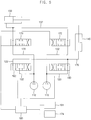
- FIG. 5 is a hydraulic circuit diagram illustrating a method of controlling a main control valve when a relatively great amount of the flux is supplied to the arm cylinder to increase a speed of the arm in accordance with example embodiments.
- the controller 180 may determine the increasing of the speed of the arm to close the second boom control spool 162.
- the first boom control spool 160 and the first arm control spool 170 may be opened.
- the second arm control spool 172 may be partially opened.
- a great part of the first flux generated from the first hydraulic pump 110 may be supplied to the boom cylinder 140 through the first boom line 120.
- a part of the first flux may be supplied to the arm cylinder 150 through the second arm line 132.
- the second flux generated from the second hydraulic pump 112 may not be supplied to the boom cylinder 140.
- the second flux may be supplied to the arm cylinder 150 through the first arm line 130.
- the boom joystick 164 may be partially handled compared than the arm joystick 174. After partially handling the boom joystick 164, when the boom joystick 164 may be handled in the decreasing direction with stopping of the arm joystick 174, the second boom control spool 162 may be closed. In contrast, the first boom control spool 160 and the first arm control spool 170 may be opened. The second arm control spool 172 may be partially opened.
- a total flux supplied to the arm cylinder 150 may be a sum of 100% of the second flux and the part of the first flux. Further, a total flux supplied to the boom cylinder 140 may be the great part of the first flux except for the part of the first flux passing through the second arm line 132. As a result, because the total flux supplied to the arm cylinder 150 may be higher than the total flux supplied to the boom cylinder 140, the speed of the arm may be increased and the speed of the boom may be decreased.
- the controller 180 may selectively open/close the first and second boom control spools 160 and 162 and the first and second arm control spools 170 and 172 in accordance with the handling directions of any one of the boom joystick 164 and the arm joystick 174 so that the pressure loss may be reduced.
- the first flux may be supplied to the boom cylinder through only the first boom control spool and the second flux may be supplied to the arm cylinder through only the first arm control spools.
- the second arm control spool and/or the second boom control spool may be selectively controlled by handling the boom joystick and/or the arm joystick. Therefore, the pressure loss caused by passing of the flux through the second boom control spool and the second arm control spool may be reduced.
Landscapes
- Engineering & Computer Science (AREA)
- General Engineering & Computer Science (AREA)
- Mining & Mineral Resources (AREA)
- Civil Engineering (AREA)
- Structural Engineering (AREA)
- Physics & Mathematics (AREA)
- Fluid Mechanics (AREA)
- Mechanical Engineering (AREA)
- Operation Control Of Excavators (AREA)
- Fluid-Pressure Circuits (AREA)
Abstract
Description
- Example embodiments relate to a method of controlling a main control valve of an excavator and an apparatus for performing the same. More particularly, example embodiments relate to a method of controlling a main control valve configured to operate a boom and an arm of an excavator, and an apparatus for performing the method.
- Generally, a boom and an arm of an excavator may be operated by a flux. The flux may be transferred to the boom and the arm from a hydraulic pump through a main control valve. A recent excavator may include a first hydraulic pump and a second hydraulic pump. Thus, the main control valve may include first and second boom control spools arranged between the first and second hydraulic pumps and a boom cylinder, and first and second arm control spools arranged between the first and second hydraulic pumps and an arm cylinder.
- According to related arts, when the boom or the arm may be separately operated, a first flux generated from the first hydraulic pump and a second flux generated from the second hydraulic pump may be supplied to the boom cylinder or the arm cylinder through the first and second boom control spools or the first and second arm control spools.
- When the boom and the arm may be simultaneously operated, the first flux may be partially supplied to the arm cylinder through the second arm control spool and the second flux may be partially supplied to the boom cylinder through the second boom control spool.
- Therefore, when the boom and the arm may be simultaneously operated, a part of the first flux may pass through the second arm control spool and a part of the second flux may pass through the second boom control spool so that pressure loss may be generated.
- Example embodiments provide a method of controlling a main control valve of an excavator that may be capable of reducing pressure loss.
- Example embodiments also provide an apparatus for performing the above-mentioned method.
- According to example embodiments, there may be provided a method of controlling a main control valve of an excavator. In the method of controlling the main control valve of the excavator, when speeds of a boom cylinder and an arm cylinder may be increased by handling a boom joystick and an arm joystick, a second arm control spool between a first hydraulic pump and the arm cylinder may be closed. A first boom control spool between the first hydraulic pump and the boom cylinder may be opened to supply a first flux generated from the first hydraulic pump to the boom cylinder. A second boom control spool between a second hydraulic pump and the boom cylinder may be closed. A first arm control spool between the second hydraulic pump and the arm cylinder may be opened to supply a second flux generated from the second hydraulic pump to the arm cylinder.
- In example embodiments, supplying the first flux to the boom cylinder may include partially opening the second arm control spool to supply a part of the first flux to the arm cylinder.
- In example embodiments, supplying the second flux to the arm cylinder may include partially opening the second boom control spool to supply a part of the second flux to the boom cylinder.
- In example embodiments, the method may further include partially opening the second arm control spool to supply a part of the first flux to the arm cylinder when the boom joystick may be handled in a decreasing direction or the arm joystick may be handled in an increasing direction.
- In example embodiments, the method may further include partially opening the second boom control spool to supply a part of the second flux to the boom cylinder when the boom joystick may be handled to an increasing direction or the arm joystick may be handled in a decreasing direction.
- In example embodiments, the boom joystick may be partially handled compared than the arm joystick. The method may further include partially opening the second arm control spool to supply a part of the first flux to the arm cylinder when the boom joystick may be handled in a decreasing direction with stopping of the arm joystick after the boom joystick may be partially handled.
- In example embodiments, the method may further include selectively controlling opening/closing of the first and second boom control spools and the first and second arm control spools by handling any one of the boom joystick and the arm joystick in an increasing direction or a decreasing direction after the speeds of the boom cylinder and the arm cylinder may be increased by handling the boom joystick and the arm joystick.
- According to example embodiments, there may be provided an apparatus for controlling a main control valve of an excavator. The apparatus may include a boom joystick, an arm joystick and a controller. The boom joystick may be configured to operate a first boom control spool between a first hydraulic pump and a boom cylinder, and a second boom control spool between the boom cylinder and a second hydraulic pump. The arm joystick may be configured to operate a first arm control spool between the second hydraulic pump and an arm cylinder, and a second arm control spool between the arm cylinder and the first hydraulic pump. The controller may be configured to selectively supply a first flux generated from the first hydraulic pump and a second flux generated from the second hydraulic pump to the first and second boom control spools and the first and second arm control spools in accordance with handing directions and handing strokes of the boom joystick and the boom joystick. When speeds of the boom cylinder and the arm cylinder may be increased by handling the boom joystick and the arm joystick, the controller may close the second arm control spool and open the first boom control spool to supply the first flux to the boom cylinder. Further, the controller may close the second boom control spool and open the first arm control spool to supply the second flux to the arm cylinder.
- In example embodiments, the controller may partially open the second arm control spool to supply a part of the first flux to the arm cylinder when the boom joystick may be handled in a decreasing direction or the arm joystick may be handled in an increasing direction.
- In example embodiments, the controller may partially open the second boom control spool to supply a part of the second flux to the boom cylinder when the boom joystick may be handled in an increasing direction or the arm joystick may be handled in a decreasing direction.
- In example embodiments, the boom joystick may be partially handled compared than the arm joystick. The controller may partially open the second arm control spool to supply a part of the first flux to the arm cylinder when the boom joystick may be handled in a decreasing direction with stopping of the arm joystick after the boom joystick may be partially handled.
- In example embodiments, the controller may selectively control opening/closing of the first and second boom control spools and the first and second arm control spools by handling any one of the boom joystick and the arm joystick in an increasing direction or a decreasing direction after the speeds of the boom cylinder and the arm cylinder may be increased by handling the boom joystick and the arm joystick.
- According to example embodiments, when the boom and the arm may be simultaneously operated, the first flux may be supplied to the boom cylinder through only the first boom control spool and the second flux may be supplied to the arm cylinder through only the first arm control spools. Particularly, the second arm control spool and/or the second boom control spool may be selectively controlled by handling the boom joystick and/or the arm joystick. Therefore, a pressure loss caused by passing of the flux through the second boom control spool and the second arm control spool may be reduced.
- Example embodiments will be more clearly understood from the following detailed description taken in conjunction with the accompanying drawings.
FIGS. 1 to 5 represent non-limiting, example embodiments as described herein. -
FIG. 1 is a hydraulic circuit diagram illustrating a method of controlling a main control valve when only a boom is operated in accordance with example embodiments; -
FIG. 2 is a hydraulic circuit diagram illustrating a method of controlling a main control valve when only an arm is operated in accordance with example embodiments; -
FIG. 3 is a hydraulic circuit diagram illustrating a method of controlling a main control valve when fluxes are separately supplied to the boom and the arm without passing of the fluxes through a join spool in accordance with example embodiments; -
FIG. 4 is a hydraulic circuit diagram illustrating a method of controlling a main control valve when a relatively great amount of the flux is supplied to the boom cylinder to increase a speed of the boom in accordance with example embodiments; and -
FIG. 5 is a hydraulic circuit diagram illustrating a method of controlling a main control valve when a relatively great amount of the flux is supplied to the arm cylinder to increase a speed of the arm in accordance with example embodiments. - Various example embodiments will be described more fully hereinafter with reference to the accompanying drawings, in which some example embodiments are shown. The present invention may, however, be embodied in many different forms and should not be construed as limited to the example embodiments set forth herein. Rather, these example embodiments are provided so that this disclosure will be thorough and complete, and will fully convey the scope of the present invention to those skilled in the art. In the drawings, the sizes and relative sizes of layers and regions may be exaggerated for clarity.
- It will be understood that when an element or layer is referred to as being "on," "connected to" or "coupled to" another element or layer, it can be directly on, connected or coupled to the other element or layer or intervening elements or layers may be present. In contrast, when an element is referred to as being "directly on," "directly connected to" or "directly coupled to" another element or layer, there are no intervening elements or layers present. Like numerals refer to like elements throughout. As used herein, the term "and/or" includes any and all combinations of one or more of the associated listed items.
- It will be understood that, although the terms first, second, third etc. may be used herein to describe various elements, components, regions, layers and/or sections, these elements, components, regions, layers and/or sections should not be limited by these terms. These terms are only used to distinguish one element, component, region, layer or section from another region, layer or section. Thus, a first element, component, region, layer or section discussed below could be termed a second element, component, region, layer or section without departing from the teachings of the present invention.
- Spatially relative terms, such as "beneath," "below," "lower," "above," "upper" and the like, may be used herein for ease of description to describe one element or feature's relationship to another element(s) or feature(s) as illustrated in the figures. It will be understood that the spatially relative terms are intended to encompass different orientations of the device in use or operation in addition to the orientation depicted in the figures. For example, if the device in the figures is turned over, elements described as "below" or "beneath" other elements or features would then be oriented "above" the other elements or features. Thus, the exemplary term "below" can encompass both an orientation of above and below. The device may be otherwise oriented (rotated 90 degrees or at other orientations) and the spatially relative descriptors used herein interpreted accordingly.
- The terminology used herein is for the purpose of describing particular example embodiments only and is not intended to be limiting of the present invention. As used herein, the singular forms "a," "an" and "the" are intended to include the plural forms as well, unless the context clearly indicates otherwise. It will be further understood that the terms "comprises" and/or "comprising," when used in this specification, specify the presence of stated features, integers, steps, operations, elements, and/or components, but do not preclude the presence or addition of one or more other features, integers, steps, operations, elements, components, and/or groups thereof.
- Example embodiments are described herein with reference to cross-sectional illustrations that are schematic illustrations of idealized example embodiments (and intermediate structures). As such, variations from the shapes of the illustrations as a result, for example, of manufacturing techniques and/or tolerances, are to be expected. Thus, example embodiments should not be construed as limited to the particular shapes of regions illustrated herein but are to include deviations in shapes that result, for example, from manufacturing. For example, an implanted region illustrated as a rectangle will, typically, have rounded or curved features and/or a gradient of implant concentration at its edges rather than a binary change from implanted to non-implanted region. Likewise, a buried region formed by implantation may result in some implantation in the region between the buried region and the surface through which the implantation takes place. Thus, the regions illustrated in the figures are schematic in nature and their shapes are not intended to illustrate the actual shape of a region of a device and are not intended to limit the scope of the present invention.
- Unless otherwise defined, all terms (including technical and scientific terms) used herein have the same meaning as commonly understood by one of ordinary skill in the art to which this invention belongs. It will be further understood that terms, such as those defined in commonly used dictionaries, should be interpreted as having a meaning that is consistent with their meaning in the context of the relevant art and will not be interpreted in an idealized or overly formal sense unless expressly so defined herein.
- Hereinafter, example embodiments will be explained in detail with reference to the accompanying drawings.
-
FIG. 1 is a hydraulic circuit diagram illustrating a method of controlling a main control valve when only a boom is operated in accordance with example embodiments. - Referring to
FIG. 1 , an excavator may include a firsthydraulic pump 110, a secondhydraulic pump 112, a main control valve, aboom cylinder 140 and anarm cylinder 150. - The first
hydraulic pump 110 may be configured to generate a first flux. The secondhydraulic pump 120 may be configured to generate a second flux. In example embodiments, the first flux and the second flux may have substantially the same pressure. Alternatively, the first flux and the second flux may have different pressures. - The main control valve may be arranged between the first and second
hydraulic pumps arm cylinders boom cylinder 140 and thearm cylinder 150. - The
boom cylinder 140 may be connected with a boom. Theboom cylinder 140 may be configured to supply the first flux and/or the second flux to the boom. Thearm cylinder 150 may be connected with an arm. Thearm cylinder 150 may be configured to supply the first flux and/or the second flux to the arm. - The first
hydraulic pump 110 may be connected with theboom cylinder 140 through afirst boom line 120. The secondhydraulic pump 120 may be connected with theboom cylinder 140 through asecond boom line 122. - The second
hydraulic pump 120 may be connected with thearm cylinder 150 through afirst arm line 130. The firsthydraulic pump 110 may be connected with thearm cylinder 150 through asecond arm line 132. - The main control valve may include a first
boom control spool 160, a secondboom control spool 162, a firstarm control spool 170 and a secondarm control spool 172. - The first
boom control spool 160 may be installed on thefirst boom line 120. The secondboom control spool 162 may be installed on thesecond boom line 122. The firstboom control spool 160 and the secondboom control spool 162 may be controlled by control signals of acontroller 180 in accordance with handling directions and handling strokes of aboom joystick 164. - The first
arm control spool 170 may be installed on thefirst arm line 130. The secondarm control spool 172 may be installed on thesecond arm line 132. The firstarm control spool 170 and the secondarm control spool 172 may be controlled by control signals of thecontroller 180 in accordance with handling directions and handling strokes of anarm joystick 174. - When only the boom may be operated, the first
arm control spool 170 and the secondarm control spool 172 may be closed by the control signal of thecontroller 180 in accordance with handling of thearm joystick 174. In contrast, the firstboom control spool 160 and the secondboom control spool 162 may be opened by the control signal of thecontroller 180 in accordance with handling of theboom joystick 164. Thus, 100% of the first flux generated from the firsthydraulic pump 110 may be transferred to theboom cylinder 140 through thefirst boom line 120. Further, 100% of the second flux generated from the secondhydraulic pump 112 may be transferred to theboom cylinder 140 through thesecond boom line 122. As a result, because all of the first flux and the second flux may be supplied to theboom cylinder 140, a total flux supplied to theboom cylinder 140 may be a sum of 100% of the first flux and 100% of the second flux. -
FIG. 2 is a hydraulic circuit diagram illustrating a method of controlling a main control valve when only an arm is operated in accordance with example embodiments. - When only the arm may be operated, the first
boom control spool 160 and the secondboom control spool 162 may be closed by the control signal of thecontroller 180 in accordance with handling of theboom joystick 164. In contrast, the firstarm control spool 170 and the secondarm control spool 172 may be opened by the control signal of thecontroller 180 in accordance with handling of thearm joystick 174. Thus, 100% of the first flux generated from the firsthydraulic pump 110 may be transferred to thearm cylinder 150 through thefirst arm line 130. Further, 100% of the second flux generated from the secondhydraulic pump 112 may be transferred to thearm cylinder 150 through thesecond arm line 132. As a result, because all of the first flux and the second flux may be supplied to thearm cylinder 150, a total flux supplied to thearm cylinder 150 may be a sum of 100% of the first flux and 100% of the second flux. -
FIG. 3 is a hydraulic circuit diagram illustrating a method of controlling a main control valve when fluxes are separately supplied to the boom and the arm without passing of the fluxes through a join spool in accordance with example embodiments. - When the speeds of the boom and the arm may be increased, the second
arm control spool 172 and the secondboom control spool 162 may be closed by the control signal of thecontroller 180 in accordance with handlings of theboom joystick 164 and thearm joystick 174. In contrast, the firstboom control spool 160 and the firstarm control spool 170 may be opened by the control signal of thecontroller 180 in accordance with handlings of theboom joystick 164 and thearm joystick 174. Thus, the first flux generated from the firsthydraulic pump 110 may not be supplied to thearm cylinder 150. The first flux may be supplied to only theboom cylinder 140 through thefirst boom line 120. Further, the second flux generated from the secondhydraulic pump 112 may not be supplied to theboom cylinder 140. The second flux may be supplied to only thearm cylinder 150 through thefirst arm line 130. - Therefore, when the speeds of the boom and the arm may be increased, the hydraulic circuit connected with the boom cylinder may be separated from the hydraulic circuit connected with the
arm cylinder 150. The first flux generated from the firsthydraulic pump 110 may be supplied to theboom cylinder 140 through only one firstboom control spool 160. The second flux generated from the secondhydraulic pump 112 may be supplied to thearm cylinder 150 through only one firstarm control spool 170. As a result, a pressure loss caused by passing of the fluxes through the second control spools may be reduced. -
FIG. 4 is a hydraulic circuit diagram illustrating a method of controlling a main control valve when a relatively great amount of the flux is supplied to the boom cylinder to increase a speed of the boom in accordance with example embodiments. - When the speed of the arm may be decreased so as to provide the boom with the speed faster than the speed of the arm, a worker may handle the
boom joystick 164 in an increasing direction or thearm joystick 174 in a decreasing direction. Thecontroller 180 may determine the increasing of the speed of the boom to close the secondarm control spool 172. In contrast, the firstboom control spool 160 and the firstarm control spool 170 may be opened. The secondboom control spool 162 may be partially opened. Thus, the first flux generated from the firsthydraulic pump 110 may not be supplied to thearm cylinder 150. The first flux may be supplied to theboom cylinder 140 through thefirst boom line 112. Further, a great part of the second flux generated from the secondhydraulic pump 112 may be supplied to thearm cylinder 150 through thefirst arm line 130. A part of the second flux may be supplied to theboom cylinder 140 through thesecond boom line 122. - Therefore, a total flux supplied to the
boom cylinder 140 may be a sum of 100% of the first flux and the part of the second flux. Further, a total flux supplied to thearm cylinder 150 may be the great part of the second flux except for the part of the second flux passing through thesecond boom line 122. As a result, because the total flux supplied to theboom cylinder 140 may be higher than the total flux supplied to thearm cylinder 150, the speed of the boom may be increased and the speed of the arm may be decreased. -
FIG. 5 is a hydraulic circuit diagram illustrating a method of controlling a main control valve when a relatively great amount of the flux is supplied to the arm cylinder to increase a speed of the arm in accordance with example embodiments. - When the speed of the boom may be decreased so as to provide the arm with the speed faster than the speed of the boom, a worker may handle the
boom joystick 164 in the decreasing direction or thearm joystick 174 in the increasing direction. Thecontroller 180 may determine the increasing of the speed of the arm to close the secondboom control spool 162. In contrast, the firstboom control spool 160 and the firstarm control spool 170 may be opened. The secondarm control spool 172 may be partially opened. Thus, a great part of the first flux generated from the firsthydraulic pump 110 may be supplied to theboom cylinder 140 through thefirst boom line 120. A part of the first flux may be supplied to thearm cylinder 150 through thesecond arm line 132. Further, the second flux generated from the secondhydraulic pump 112 may not be supplied to theboom cylinder 140. The second flux may be supplied to thearm cylinder 150 through thefirst arm line 130. - Further, the
boom joystick 164 may be partially handled compared than thearm joystick 174. After partially handling theboom joystick 164, when theboom joystick 164 may be handled in the decreasing direction with stopping of thearm joystick 174, the secondboom control spool 162 may be closed. In contrast, the firstboom control spool 160 and the firstarm control spool 170 may be opened. The secondarm control spool 172 may be partially opened. - Therefore, a total flux supplied to the
arm cylinder 150 may be a sum of 100% of the second flux and the part of the first flux. Further, a total flux supplied to theboom cylinder 140 may be the great part of the first flux except for the part of the first flux passing through thesecond arm line 132. As a result, because the total flux supplied to thearm cylinder 150 may be higher than the total flux supplied to theboom cylinder 140, the speed of the arm may be increased and the speed of the boom may be decreased. - As mentioned above, after the speeds of the
boom cylinder 140 and thearm cylinder 150 may be increased by handling theboom joystick 164 and thearm joystick 174, thecontroller 180 may selectively open/close the first and second boom control spools 160 and 162 and the first and second arm control spools 170 and 172 in accordance with the handling directions of any one of theboom joystick 164 and thearm joystick 174 so that the pressure loss may be reduced. - According to example embodiments, when the boom and the arm may be simultaneously operated, the first flux may be supplied to the boom cylinder through only the first boom control spool and the second flux may be supplied to the arm cylinder through only the first arm control spools. Particularly, the second arm control spool and/or the second boom control spool may be selectively controlled by handling the boom joystick and/or the arm joystick. Therefore, the pressure loss caused by passing of the flux through the second boom control spool and the second arm control spool may be reduced.
- The foregoing is illustrative of example embodiments and is not to be construed as limiting thereof. Although a few example embodiments have been described, those skilled in the art will readily appreciate that many modifications are possible in the example embodiments without materially departing from the novel teachings and advantages of the present invention. Accordingly, all such modifications are intended to be included within the scope of the present invention as defined in the claims. In the claims, means-plus-function clauses are intended to cover the structures described herein as performing the recited function and not only structural equivalents but also equivalent structures. Therefore, it is to be understood that the foregoing is illustrative of various example embodiments and is not to be construed as limited to the specific example embodiments disclosed, and that modifications to the disclosed example embodiments, as well as other example embodiments, are intended to be included within the scope of the appended claims.
Claims (12)
- A method of controlling a main control valve of an excavator when speeds of a boom cylinder and an arm cylinder are increased by handling a boom joystick and an arm joystick, the method comprising:closing a second arm control spool between a first hydraulic pump and the arm cylinder;opening a first boom control spool between the first hydraulic pump and the boom cylinder to supply a first flux generated from the first hydraulic pump to the boom cylinder;closing a second boom control spool between a second hydraulic pump and the boom cylinder; andopening a first arm control spool between the second hydraulic pump and the arm cylinder to supply a second flux generated from the second hydraulic pump to the arm cylinder.
- The method of claim 1, wherein supplying the first flux to the boom cylinder comprises partially opening the second arm control spool to supply a part of the first flux to the arm cylinder.
- The method of claim 1, wherein supplying the second flux to the arm cylinder comprises partially opening the second boom control spool to supply a part of the second flux to the boom cylinder.
- The method of claim 1, further comprising partially opening the second arm control spool to supply a part of the first flux to the arm cylinder when the boom joystick is handled in a decreasing direction or the arm joystick is handled in an increasing direction.
- The method of claim 1, further comprising partially opening the second boom control spool to supply a part of the second flux to the boom cylinder when the boom joystick is handled in an increasing direction or the arm joystick is handled in a decreasing direction.
- The method of claim 1, further comprising partially opening the second arm control spool to supply a part of the first flux to the arm cylinder when the boom joystick is handled in a decreasing direction with stopping of the arm joystick after the boom joystick is partially handled compared than the arm joystick.
- The method of claim 1, further comprising selectively controlling opening/closing of the first and second boom control spools and the first and second arm control spools by handling any one of the boom joystick and the arm joystick in an increasing direction or a decreasing direction after increasing the speeds of the boom cylinder and the arm cylinder by handling the boom joystick and the arm joystick.
- An apparatus for controlling a main control valve of an excavator, the apparatus comprising:a boom joystick configured to operate a first boom control spool between a first hydraulic pump and a boom cylinder and a second boom control spool between the boom cylinder and a second hydraulic pump;an arm joystick configured to operate a first arm control spool between the second hydraulic pump and an arm cylinder and a second arm control spool between the arm cylinder and the first hydraulic pump; anda controller configured to selectively supply a first flux generated from the first hydraulic pump and a second flux generated from the second hydraulic pump to the first and second boom control spools and the first and second arm control spools in accordance with handling directions and handling strokes of the boom joystick and the arm joystick,wherein the controller closes the second arm control spool and open the first boom control spool to supply the first flux to the boom cylinder, and closes the second boom control spool and opens the first arm control spool to supply the second flux to the arm cylinder when speeds of the boom cylinder and the arm cylinder are increased by handling the boom joystick and the arm joystick.
- The apparatus of claim 8, wherein the controller partially opens the second arm control spool to supply a part of the first flux to the arm cylinder when the boom joystick is handled in a decreasing direction or the arm joystick is handled in an increasing direction.
- The apparatus of claim 8, wherein the controller partially opens the second boom control spool to supply a part of the second flux to the boom cylinder when the boom joystick is handled in an increasing direction or the arm joystick is handled in a decreasing direction.
- The apparatus of claim 8, wherein the controller partially opens the second arm control spool to supply a part of the first flux to the arm cylinder when the boom joystick is handled in a decreasing direction with stopping of the arm joystick after the boom joystick is partially handled compared than the arm joystick.
- The apparatus of claim 8, wherein the controller selectively controls opening/closing of the first and second boom control spools and the first and second arm control spools by handling any one of the boom joystick and the arm joystick in an increasing direction or a decreasing direction after increasing the speeds of the boom cylinder and the arm cylinder by handling the boom joystick and the arm joystick.
Applications Claiming Priority (1)
| Application Number | Priority Date | Filing Date | Title |
|---|---|---|---|
| KR1020160114233A KR102571079B1 (en) | 2016-09-06 | 2016-09-06 | Method of controlling a main control valve of an excavator and apparatus for performing the same |
Publications (2)
| Publication Number | Publication Date |
|---|---|
| EP3290597A1 true EP3290597A1 (en) | 2018-03-07 |
| EP3290597B1 EP3290597B1 (en) | 2023-04-12 |
Family
ID=59686830
Family Applications (1)
| Application Number | Title | Priority Date | Filing Date |
|---|---|---|---|
| EP17187385.4A Active EP3290597B1 (en) | 2016-09-06 | 2017-08-23 | Method of controlling a main control valve of an excavator and apparatus for performing the same |
Country Status (4)
| Country | Link |
|---|---|
| US (1) | US10392779B2 (en) |
| EP (1) | EP3290597B1 (en) |
| KR (1) | KR102571079B1 (en) |
| CN (1) | CN107794969B (en) |
Cited By (1)
| Publication number | Priority date | Publication date | Assignee | Title |
|---|---|---|---|---|
| EP4202232A1 (en) * | 2021-12-21 | 2023-06-28 | Danfoss Scotland Limited | Hydraulic system |
Families Citing this family (1)
| Publication number | Priority date | Publication date | Assignee | Title |
|---|---|---|---|---|
| KR101798914B1 (en) * | 2013-12-26 | 2017-11-17 | 두산인프라코어 주식회사 | Method and device for controlling main control valve of construction machinery |
Citations (5)
| Publication number | Priority date | Publication date | Assignee | Title |
|---|---|---|---|---|
| JPS58146629A (en) * | 1982-02-24 | 1983-09-01 | Hitachi Constr Mach Co Ltd | Oil-pressure circuit for civil work and construction machine |
| JPH10176347A (en) * | 1996-12-19 | 1998-06-30 | Sumitomo Constr Mach Co Ltd | Hydraulic shovel control circuit |
| EP1672127A2 (en) * | 2004-12-16 | 2006-06-21 | Doosan Infracore Co., Ltd. | Hydraulic control device for controlling a boom-arm combined operation in an excavator |
| KR100923396B1 (en) * | 2004-02-23 | 2009-10-23 | 현대중공업 주식회사 | Variable priority system of excavator working equipment |
| US20160252107A1 (en) * | 2013-10-31 | 2016-09-01 | Kawasaki Jukogyo Kabushiki Kaisha | Hydraulic excavator drive system |
Family Cites Families (7)
| Publication number | Priority date | Publication date | Assignee | Title |
|---|---|---|---|---|
| KR100348128B1 (en) * | 1994-09-30 | 2002-11-22 | 볼보 컨스트럭션 이키프먼트 홀딩 스웨덴 에이비 | Control valve with variable priority |
| JP2006029468A (en) * | 2004-07-16 | 2006-02-02 | Shin Caterpillar Mitsubishi Ltd | Fluid pressure control device |
| JP4655795B2 (en) * | 2005-07-15 | 2011-03-23 | コベルコ建機株式会社 | Hydraulic control device of excavator |
| JP2009275769A (en) * | 2008-05-13 | 2009-11-26 | Caterpillar Japan Ltd | Fluid pressure cylinder control circuit |
| JP5572586B2 (en) * | 2011-05-19 | 2014-08-13 | 日立建機株式会社 | Hydraulic drive device for work machine |
| KR20140074324A (en) * | 2011-10-07 | 2014-06-17 | 볼보 컨스트럭션 이큅먼트 에이비 | Priority control system for construction machine |
| US20130318959A1 (en) * | 2012-06-04 | 2013-12-05 | Caterpillar, Inc. | Hydraulic Circuits with Energy Conservation Features for Overrunning Load Conditions |
-
2016
- 2016-09-06 KR KR1020160114233A patent/KR102571079B1/en active Active
-
2017
- 2017-08-22 US US15/683,107 patent/US10392779B2/en active Active
- 2017-08-23 EP EP17187385.4A patent/EP3290597B1/en active Active
- 2017-09-05 CN CN201710792183.9A patent/CN107794969B/en active Active
Patent Citations (5)
| Publication number | Priority date | Publication date | Assignee | Title |
|---|---|---|---|---|
| JPS58146629A (en) * | 1982-02-24 | 1983-09-01 | Hitachi Constr Mach Co Ltd | Oil-pressure circuit for civil work and construction machine |
| JPH10176347A (en) * | 1996-12-19 | 1998-06-30 | Sumitomo Constr Mach Co Ltd | Hydraulic shovel control circuit |
| KR100923396B1 (en) * | 2004-02-23 | 2009-10-23 | 현대중공업 주식회사 | Variable priority system of excavator working equipment |
| EP1672127A2 (en) * | 2004-12-16 | 2006-06-21 | Doosan Infracore Co., Ltd. | Hydraulic control device for controlling a boom-arm combined operation in an excavator |
| US20160252107A1 (en) * | 2013-10-31 | 2016-09-01 | Kawasaki Jukogyo Kabushiki Kaisha | Hydraulic excavator drive system |
Cited By (1)
| Publication number | Priority date | Publication date | Assignee | Title |
|---|---|---|---|---|
| EP4202232A1 (en) * | 2021-12-21 | 2023-06-28 | Danfoss Scotland Limited | Hydraulic system |
Also Published As
| Publication number | Publication date |
|---|---|
| KR20180027088A (en) | 2018-03-14 |
| CN107794969A (en) | 2018-03-13 |
| US10392779B2 (en) | 2019-08-27 |
| EP3290597B1 (en) | 2023-04-12 |
| US20180066417A1 (en) | 2018-03-08 |
| KR102571079B1 (en) | 2023-09-06 |
| CN107794969B (en) | 2021-02-19 |
Similar Documents
| Publication | Publication Date | Title |
|---|---|---|
| EP3283696B1 (en) | Hydraulic circuit and working machine | |
| US10519628B2 (en) | Control system for construction machinery and control method for construction machinery | |
| EP1895060A2 (en) | Straight traveling hydraulic circuit | |
| US10577777B2 (en) | Control system for construction machinery | |
| KR101718835B1 (en) | Hydraulic control valve for construction machinery | |
| US10047771B2 (en) | Construction machine | |
| EP1972726A1 (en) | Hydraulic circuit to prevent bucket separation from bucket rest during traveling of heavy equipment | |
| EP2778435A1 (en) | Fluid pressure control device | |
| EP3290597B1 (en) | Method of controlling a main control valve of an excavator and apparatus for performing the same | |
| US9605693B2 (en) | Hydraulic pressure control device for swing motor for construction machinery | |
| CN203248431U (en) | Unloading valve, hydraulic oil cylinder oil return backpressure unloading device and engineering machine | |
| US10167615B2 (en) | Control system for construction machinery and control method for construction machinery using the same | |
| US9618019B2 (en) | Hydraulic pressure control device for construction machinery | |
| EP1726723A2 (en) | Working machine | |
| CN104895138B (en) | Oil pressure driving system of building machinery | |
| EP3249114A1 (en) | Control valve for construction equipment | |
| US20170121943A1 (en) | Method and device for controlling main control valve of construction machinery | |
| US20030116010A1 (en) | Hydraulic valve control device for heavy construction equipment | |
| US9021796B2 (en) | Pipelayer | |
| CN104595291A (en) | Energy recovery valve group, hydraulic system of winch mechanism and construction machinery | |
| CN107313998A (en) | Hydraulic energy-saving system and front crane | |
| US10273124B2 (en) | Rotation control system for material handling machines | |
| CN103727078A (en) | Crane and hydraulic system thereof | |
| JP6381228B2 (en) | Hydraulic drive | |
| JP3807581B2 (en) | Hydraulic drive circuit using swash plate type variable displacement pump |
Legal Events
| Date | Code | Title | Description |
|---|---|---|---|
| PUAI | Public reference made under article 153(3) epc to a published international application that has entered the european phase |
Free format text: ORIGINAL CODE: 0009012 |
|
| STAA | Information on the status of an ep patent application or granted ep patent |
Free format text: STATUS: THE APPLICATION HAS BEEN PUBLISHED |
|
| AK | Designated contracting states |
Kind code of ref document: A1 Designated state(s): AL AT BE BG CH CY CZ DE DK EE ES FI FR GB GR HR HU IE IS IT LI LT LU LV MC MK MT NL NO PL PT RO RS SE SI SK SM TR |
|
| AX | Request for extension of the european patent |
Extension state: BA ME |
|
| STAA | Information on the status of an ep patent application or granted ep patent |
Free format text: STATUS: REQUEST FOR EXAMINATION WAS MADE |
|
| 17P | Request for examination filed |
Effective date: 20180907 |
|
| RBV | Designated contracting states (corrected) |
Designated state(s): AL AT BE BG CH CY CZ DE DK EE ES FI FR GB GR HR HU IE IS IT LI LT LU LV MC MK MT NL NO PL PT RO RS SE SI SK SM TR |
|
| STAA | Information on the status of an ep patent application or granted ep patent |
Free format text: STATUS: EXAMINATION IS IN PROGRESS |
|
| 17Q | First examination report despatched |
Effective date: 20190305 |
|
| RAP3 | Party data changed (applicant data changed or rights of an application transferred) |
Owner name: HYUNDAI DOOSAN INFRACORE CO., LTD. |
|
| GRAP | Despatch of communication of intention to grant a patent |
Free format text: ORIGINAL CODE: EPIDOSNIGR1 |
|
| STAA | Information on the status of an ep patent application or granted ep patent |
Free format text: STATUS: GRANT OF PATENT IS INTENDED |
|
| INTG | Intention to grant announced |
Effective date: 20221102 |
|
| GRAS | Grant fee paid |
Free format text: ORIGINAL CODE: EPIDOSNIGR3 |
|
| GRAA | (expected) grant |
Free format text: ORIGINAL CODE: 0009210 |
|
| STAA | Information on the status of an ep patent application or granted ep patent |
Free format text: STATUS: THE PATENT HAS BEEN GRANTED |
|
| AK | Designated contracting states |
Kind code of ref document: B1 Designated state(s): AL AT BE BG CH CY CZ DE DK EE ES FI FR GB GR HR HU IE IS IT LI LT LU LV MC MK MT NL NO PL PT RO RS SE SI SK SM TR |
|
| REG | Reference to a national code |
Ref country code: GB Ref legal event code: FG4D |
|
| REG | Reference to a national code |
Ref country code: CH Ref legal event code: EP |
|
| REG | Reference to a national code |
Ref country code: DE Ref legal event code: R096 Ref document number: 602017067634 Country of ref document: DE |
|
| REG | Reference to a national code |
Ref country code: IE Ref legal event code: FG4D |
|
| REG | Reference to a national code |
Ref country code: AT Ref legal event code: REF Ref document number: 1559858 Country of ref document: AT Kind code of ref document: T Effective date: 20230515 |
|
| REG | Reference to a national code |
Ref country code: LT Ref legal event code: MG9D |
|
| REG | Reference to a national code |
Ref country code: NL Ref legal event code: MP Effective date: 20230412 |
|
| REG | Reference to a national code |
Ref country code: AT Ref legal event code: MK05 Ref document number: 1559858 Country of ref document: AT Kind code of ref document: T Effective date: 20230412 |
|
| PG25 | Lapsed in a contracting state [announced via postgrant information from national office to epo] |
Ref country code: NL Free format text: LAPSE BECAUSE OF FAILURE TO SUBMIT A TRANSLATION OF THE DESCRIPTION OR TO PAY THE FEE WITHIN THE PRESCRIBED TIME-LIMIT Effective date: 20230412 |
|
| PG25 | Lapsed in a contracting state [announced via postgrant information from national office to epo] |
Ref country code: SE Free format text: LAPSE BECAUSE OF FAILURE TO SUBMIT A TRANSLATION OF THE DESCRIPTION OR TO PAY THE FEE WITHIN THE PRESCRIBED TIME-LIMIT Effective date: 20230412 Ref country code: PT Free format text: LAPSE BECAUSE OF FAILURE TO SUBMIT A TRANSLATION OF THE DESCRIPTION OR TO PAY THE FEE WITHIN THE PRESCRIBED TIME-LIMIT Effective date: 20230814 Ref country code: NO Free format text: LAPSE BECAUSE OF FAILURE TO SUBMIT A TRANSLATION OF THE DESCRIPTION OR TO PAY THE FEE WITHIN THE PRESCRIBED TIME-LIMIT Effective date: 20230712 Ref country code: ES Free format text: LAPSE BECAUSE OF FAILURE TO SUBMIT A TRANSLATION OF THE DESCRIPTION OR TO PAY THE FEE WITHIN THE PRESCRIBED TIME-LIMIT Effective date: 20230412 Ref country code: AT Free format text: LAPSE BECAUSE OF FAILURE TO SUBMIT A TRANSLATION OF THE DESCRIPTION OR TO PAY THE FEE WITHIN THE PRESCRIBED TIME-LIMIT Effective date: 20230412 |
|
| PG25 | Lapsed in a contracting state [announced via postgrant information from national office to epo] |
Ref country code: RS Free format text: LAPSE BECAUSE OF FAILURE TO SUBMIT A TRANSLATION OF THE DESCRIPTION OR TO PAY THE FEE WITHIN THE PRESCRIBED TIME-LIMIT Effective date: 20230412 Ref country code: PL Free format text: LAPSE BECAUSE OF FAILURE TO SUBMIT A TRANSLATION OF THE DESCRIPTION OR TO PAY THE FEE WITHIN THE PRESCRIBED TIME-LIMIT Effective date: 20230412 Ref country code: LV Free format text: LAPSE BECAUSE OF FAILURE TO SUBMIT A TRANSLATION OF THE DESCRIPTION OR TO PAY THE FEE WITHIN THE PRESCRIBED TIME-LIMIT Effective date: 20230412 Ref country code: LT Free format text: LAPSE BECAUSE OF FAILURE TO SUBMIT A TRANSLATION OF THE DESCRIPTION OR TO PAY THE FEE WITHIN THE PRESCRIBED TIME-LIMIT Effective date: 20230412 Ref country code: IS Free format text: LAPSE BECAUSE OF FAILURE TO SUBMIT A TRANSLATION OF THE DESCRIPTION OR TO PAY THE FEE WITHIN THE PRESCRIBED TIME-LIMIT Effective date: 20230812 Ref country code: HR Free format text: LAPSE BECAUSE OF FAILURE TO SUBMIT A TRANSLATION OF THE DESCRIPTION OR TO PAY THE FEE WITHIN THE PRESCRIBED TIME-LIMIT Effective date: 20230412 Ref country code: GR Free format text: LAPSE BECAUSE OF FAILURE TO SUBMIT A TRANSLATION OF THE DESCRIPTION OR TO PAY THE FEE WITHIN THE PRESCRIBED TIME-LIMIT Effective date: 20230713 Ref country code: AL Free format text: LAPSE BECAUSE OF FAILURE TO SUBMIT A TRANSLATION OF THE DESCRIPTION OR TO PAY THE FEE WITHIN THE PRESCRIBED TIME-LIMIT Effective date: 20230412 |
|
| REG | Reference to a national code |
Ref country code: DE Ref legal event code: R081 Ref document number: 602017067634 Country of ref document: DE Owner name: HD HYUNDAI INFRACORE CO., LTD., KR Free format text: FORMER OWNER: HYUNDAI DOOSAN INFRACORE CO., LTD., INCHEON, KR |
|
| PG25 | Lapsed in a contracting state [announced via postgrant information from national office to epo] |
Ref country code: FI Free format text: LAPSE BECAUSE OF FAILURE TO SUBMIT A TRANSLATION OF THE DESCRIPTION OR TO PAY THE FEE WITHIN THE PRESCRIBED TIME-LIMIT Effective date: 20230412 |
|
| REG | Reference to a national code |
Ref country code: DE Ref legal event code: R097 Ref document number: 602017067634 Country of ref document: DE |
|
| PG25 | Lapsed in a contracting state [announced via postgrant information from national office to epo] |
Ref country code: SK Free format text: LAPSE BECAUSE OF FAILURE TO SUBMIT A TRANSLATION OF THE DESCRIPTION OR TO PAY THE FEE WITHIN THE PRESCRIBED TIME-LIMIT Effective date: 20230412 |
|
| PG25 | Lapsed in a contracting state [announced via postgrant information from national office to epo] |
Ref country code: SM Free format text: LAPSE BECAUSE OF FAILURE TO SUBMIT A TRANSLATION OF THE DESCRIPTION OR TO PAY THE FEE WITHIN THE PRESCRIBED TIME-LIMIT Effective date: 20230412 Ref country code: SK Free format text: LAPSE BECAUSE OF FAILURE TO SUBMIT A TRANSLATION OF THE DESCRIPTION OR TO PAY THE FEE WITHIN THE PRESCRIBED TIME-LIMIT Effective date: 20230412 Ref country code: RO Free format text: LAPSE BECAUSE OF FAILURE TO SUBMIT A TRANSLATION OF THE DESCRIPTION OR TO PAY THE FEE WITHIN THE PRESCRIBED TIME-LIMIT Effective date: 20230412 Ref country code: EE Free format text: LAPSE BECAUSE OF FAILURE TO SUBMIT A TRANSLATION OF THE DESCRIPTION OR TO PAY THE FEE WITHIN THE PRESCRIBED TIME-LIMIT Effective date: 20230412 Ref country code: DK Free format text: LAPSE BECAUSE OF FAILURE TO SUBMIT A TRANSLATION OF THE DESCRIPTION OR TO PAY THE FEE WITHIN THE PRESCRIBED TIME-LIMIT Effective date: 20230412 Ref country code: CZ Free format text: LAPSE BECAUSE OF FAILURE TO SUBMIT A TRANSLATION OF THE DESCRIPTION OR TO PAY THE FEE WITHIN THE PRESCRIBED TIME-LIMIT Effective date: 20230412 |
|
| PLBE | No opposition filed within time limit |
Free format text: ORIGINAL CODE: 0009261 |
|
| STAA | Information on the status of an ep patent application or granted ep patent |
Free format text: STATUS: NO OPPOSITION FILED WITHIN TIME LIMIT |
|
| PG25 | Lapsed in a contracting state [announced via postgrant information from national office to epo] |
Ref country code: MC Free format text: LAPSE BECAUSE OF FAILURE TO SUBMIT A TRANSLATION OF THE DESCRIPTION OR TO PAY THE FEE WITHIN THE PRESCRIBED TIME-LIMIT Effective date: 20230412 |
|
| 26N | No opposition filed |
Effective date: 20240115 |
|
| REG | Reference to a national code |
Ref country code: CH Ref legal event code: PL |
|
| PG25 | Lapsed in a contracting state [announced via postgrant information from national office to epo] |
Ref country code: MC Free format text: LAPSE BECAUSE OF FAILURE TO SUBMIT A TRANSLATION OF THE DESCRIPTION OR TO PAY THE FEE WITHIN THE PRESCRIBED TIME-LIMIT Effective date: 20230412 |
|
| PG25 | Lapsed in a contracting state [announced via postgrant information from national office to epo] |
Ref country code: LU Free format text: LAPSE BECAUSE OF NON-PAYMENT OF DUE FEES Effective date: 20230823 |
|
| PG25 | Lapsed in a contracting state [announced via postgrant information from national office to epo] |
Ref country code: LU Free format text: LAPSE BECAUSE OF NON-PAYMENT OF DUE FEES Effective date: 20230823 Ref country code: CH Free format text: LAPSE BECAUSE OF NON-PAYMENT OF DUE FEES Effective date: 20230831 |
|
| PG25 | Lapsed in a contracting state [announced via postgrant information from national office to epo] |
Ref country code: SI Free format text: LAPSE BECAUSE OF FAILURE TO SUBMIT A TRANSLATION OF THE DESCRIPTION OR TO PAY THE FEE WITHIN THE PRESCRIBED TIME-LIMIT Effective date: 20230412 |
|
| REG | Reference to a national code |
Ref country code: BE Ref legal event code: MM Effective date: 20230831 |
|
| REG | Reference to a national code |
Ref country code: IE Ref legal event code: MM4A |
|
| PG25 | Lapsed in a contracting state [announced via postgrant information from national office to epo] |
Ref country code: SI Free format text: LAPSE BECAUSE OF FAILURE TO SUBMIT A TRANSLATION OF THE DESCRIPTION OR TO PAY THE FEE WITHIN THE PRESCRIBED TIME-LIMIT Effective date: 20230412 Ref country code: IT Free format text: LAPSE BECAUSE OF FAILURE TO SUBMIT A TRANSLATION OF THE DESCRIPTION OR TO PAY THE FEE WITHIN THE PRESCRIBED TIME-LIMIT Effective date: 20230412 |
|
| PG25 | Lapsed in a contracting state [announced via postgrant information from national office to epo] |
Ref country code: IE Free format text: LAPSE BECAUSE OF NON-PAYMENT OF DUE FEES Effective date: 20230823 |
|
| PG25 | Lapsed in a contracting state [announced via postgrant information from national office to epo] |
Ref country code: IE Free format text: LAPSE BECAUSE OF NON-PAYMENT OF DUE FEES Effective date: 20230823 |
|
| PG25 | Lapsed in a contracting state [announced via postgrant information from national office to epo] |
Ref country code: BE Free format text: LAPSE BECAUSE OF NON-PAYMENT OF DUE FEES Effective date: 20230831 |
|
| PG25 | Lapsed in a contracting state [announced via postgrant information from national office to epo] |
Ref country code: BG Free format text: LAPSE BECAUSE OF FAILURE TO SUBMIT A TRANSLATION OF THE DESCRIPTION OR TO PAY THE FEE WITHIN THE PRESCRIBED TIME-LIMIT Effective date: 20230412 |
|
| PG25 | Lapsed in a contracting state [announced via postgrant information from national office to epo] |
Ref country code: BG Free format text: LAPSE BECAUSE OF FAILURE TO SUBMIT A TRANSLATION OF THE DESCRIPTION OR TO PAY THE FEE WITHIN THE PRESCRIBED TIME-LIMIT Effective date: 20230412 |
|
| PG25 | Lapsed in a contracting state [announced via postgrant information from national office to epo] |
Ref country code: CY Free format text: LAPSE BECAUSE OF FAILURE TO SUBMIT A TRANSLATION OF THE DESCRIPTION OR TO PAY THE FEE WITHIN THE PRESCRIBED TIME-LIMIT; INVALID AB INITIO Effective date: 20170823 |
|
| PG25 | Lapsed in a contracting state [announced via postgrant information from national office to epo] |
Ref country code: HU Free format text: LAPSE BECAUSE OF FAILURE TO SUBMIT A TRANSLATION OF THE DESCRIPTION OR TO PAY THE FEE WITHIN THE PRESCRIBED TIME-LIMIT; INVALID AB INITIO Effective date: 20170823 |
|
| PGFP | Annual fee paid to national office [announced via postgrant information from national office to epo] |
Ref country code: DE Payment date: 20250702 Year of fee payment: 9 |
|
| PGFP | Annual fee paid to national office [announced via postgrant information from national office to epo] |
Ref country code: GB Payment date: 20250703 Year of fee payment: 9 |
|
| PGFP | Annual fee paid to national office [announced via postgrant information from national office to epo] |
Ref country code: FR Payment date: 20250703 Year of fee payment: 9 |
|
| PG25 | Lapsed in a contracting state [announced via postgrant information from national office to epo] |
Ref country code: TR Free format text: LAPSE BECAUSE OF FAILURE TO SUBMIT A TRANSLATION OF THE DESCRIPTION OR TO PAY THE FEE WITHIN THE PRESCRIBED TIME-LIMIT Effective date: 20230412 |