EP3290590A1 - A method and a tool assembly for the removal of a monopile foundation - Google Patents
A method and a tool assembly for the removal of a monopile foundation Download PDFInfo
- Publication number
- EP3290590A1 EP3290590A1 EP16186217.2A EP16186217A EP3290590A1 EP 3290590 A1 EP3290590 A1 EP 3290590A1 EP 16186217 A EP16186217 A EP 16186217A EP 3290590 A1 EP3290590 A1 EP 3290590A1
- Authority
- EP
- European Patent Office
- Prior art keywords
- pile
- lid
- monopile
- recess
- tool assembly
- Prior art date
- Legal status (The legal status is an assumption and is not a legal conclusion. Google has not performed a legal analysis and makes no representation as to the accuracy of the status listed.)
- Withdrawn
Links
- 238000000034 method Methods 0.000 title claims abstract description 33
- 238000007789 sealing Methods 0.000 claims abstract description 43
- XLYOFNOQVPJJNP-UHFFFAOYSA-N water Substances O XLYOFNOQVPJJNP-UHFFFAOYSA-N 0.000 claims abstract description 18
- 238000004873 anchoring Methods 0.000 claims abstract description 17
- 238000005086 pumping Methods 0.000 claims abstract description 14
- 239000012530 fluid Substances 0.000 claims abstract description 8
- 238000004891 communication Methods 0.000 claims abstract description 6
- 238000003801 milling Methods 0.000 claims description 10
- 239000011800 void material Substances 0.000 claims description 8
- 230000000295 complement effect Effects 0.000 claims description 6
- 230000002093 peripheral effect Effects 0.000 claims description 6
- 229910000831 Steel Inorganic materials 0.000 description 12
- 239000010959 steel Substances 0.000 description 12
- 238000009434 installation Methods 0.000 description 3
- 238000011161 development Methods 0.000 description 2
- 230000018109 developmental process Effects 0.000 description 2
- 230000007613 environmental effect Effects 0.000 description 2
- 239000007788 liquid Substances 0.000 description 2
- 238000004064 recycling Methods 0.000 description 2
- 238000002360 preparation method Methods 0.000 description 1
Images



Classifications
-
- E—FIXED CONSTRUCTIONS
- E02—HYDRAULIC ENGINEERING; FOUNDATIONS; SOIL SHIFTING
- E02D—FOUNDATIONS; EXCAVATIONS; EMBANKMENTS; UNDERGROUND OR UNDERWATER STRUCTURES
- E02D9/00—Removing sheet piles bulkheads, piles, mould-pipes or other moulds or parts thereof
- E02D9/04—Removing sheet piles bulkheads, piles, mould-pipes or other moulds or parts thereof by cutting-off under water
Definitions
- the present invention relates to a method and a tool assembly for the removal of a tubular foundation monopile mounted in the ground, such as a monopile in a seabed for an offshore structure, for instance a wind turbine.
- Monopile foundations are commonly employed to support offshore structures, such as offshore wind turbines, gas or oil rigs, etc.
- the monopile comprises a large diameter cylindrical shaped tubular pile which is driven into the seabed.
- the monopile is driven into the seabed so that it extends a predetermined length upwards, such that the top of the monopile extends above the sea surface.
- On top of the monopile the structure is then mounted thereon.
- Monopiles may also be used to support landbased structures, where the pile is driven sufficiently into the ground to provide a foundation for a structure to be mounted thereon, such as a wind turbine or the like.
- This decommissioning of monopiles today is often by cutting off the pile at a predetermined level at or below the seabed (or at ground level if it is an onshore installation). This method of decommissioning monopiles is both extensive and time consuming, and furthermore it leaves a part of the monopile at the location. However, compared to removing the monopiles the cutting off may be the most efficient from a cost perspective and from a practical perspective as such monopiles are typically located remove (offshore) positions.
- a tubular foundation monopile mounted in the ground such as a monopile in a seabed for an offshore structure, for instance a wind turbine
- said method comprising the steps of providing a bottom sealing plug on seabed inside the tubular pile; closing the top of the pile with a pressure-tight lid, said pile having anchoring means for receiving and fixing said lid to the pile such that the lid is sealing the upper opening of the pile, thereby providing an inner volume inside the pile between the bottom sealing plug and the lid; connecting pump means in fluid communication with the inner volume, and then pumping water at pressure into the inner volume, such that the inner volume extends as the pile is pulled out of the ground.
- the bottom sealing plug defines the lower end of the inner volume and this plug prevents the pressurised water in the inner volume to escape into the seabed. This in turn means that when applying a fluid pressure at a sufficiently high value inside the monopile, the lid is pressed upwards whereby the entire monopile is lifted up.
- the monopile is "converted" into a hydraulic cylinder.
- the method according to the invention is advantageous as the entire monopile is retrieved whereby all of the steel of the monopile is available for recycling. Also, it is advantageous from a cost perspective since it is substantially less cost intensive to decommission a monopile using the method according to the invention compared to hitherto known methods. The time it takes to remove the monopile is also significantly reduced using the method according to the invention.
- the anchoring means comprises an annular recess provided on the inside of the pile which is adapted to form a locking engagement with a locking ring provided on the lid. Accordingly, the method further comprises the steps of cutting said annular recess for the locking ring inside the pile, preferably by placing a milling tool inside the pile in a predetermined position, and then removing the milling tool before placing the lid inside the pile and releasing the locking ring to secure the lid to the monopile.
- the anchoring means comprises at least one recess, such as an annual recess or a series of recesses in an annular configuration, provided on the outside of the pile in a predetermined distance from the upper opening of the pile, and radially inwardly extendable locking pins are provided along the periphery of the lid to form a locking engagement with the at least one recess.
- the cutting of the recess is preferably achieved by using a subsea milling tool.
- a subsea milling tool Such type of fully submersible tool is commercially available and can be submerged and operated from a vessel.
- the step of placing a lid inside the pile includes lowering the lid to the predetermined position and then releasing the locking ring, which thereby expands into locking engagement with the recess.
- the locking ring may be hydraulically retracted during the positioning of the lid inside the monopile and the when correctly positioned the locking ring is released.
- the recess is preferably provided with an upper surface portion which is substantially horizontal, and a lower surface portion which is wedge-shaped, and that the locking ring is provided with a substantially complementary peripheral shape to secure a wedge-locking engagement between the lid and the monopile via the locking ring and the recess. This means that when the locking ring is released the lid is self-centring as well as fluid tightly self-sealing to the inside of the pile as the locking ring thereby engages the recess.
- the water is pumped into the inner volume at a pressure up to approx.1000 bar.
- the pumping of water is continued until the pile is driven out of the ground and can be lifted by suitable lifting means, such as a crane.
- the monopile is initially cut off horizontally to provide an upper opening of the pile in a predetermined distance from the seabed.
- a tool assembly for removal of a tubular foundation monopile mounted in the ground, such as a monopile in a seabed for an offshore structure, for instance a wind turbine, said apparatus comprising a bottom sealing plug on seabed inside the tubular pile; a pressure-tight lid closing the top of the pile, said pile having anchoring means for receiving and fixing said lid to the pile such that the lid is sealing the upper opening of the pile, thereby providing an inner volume inside the pile between the bottom sealing plug and the lid; and pumping means in fluid communication with the inner volume for pumping water into the inner volume at a pressure, such as a pressure of up to approx. 1000 bar.
- the anchoring means comprises an annular recess provided on the inside of the pile which is adapted to form a locking engagement with a locking ring provided on the lid.
- the recess is provided with an upper surface portion which is substantially horizontal, and a lower surface portion which is wedge-shaped, and that the locking ring is provided with a substantially complementary peripheral shape to secure a wedge-locking engagement between the lid and the monopile via the locking ring and the recess.
- the anchoring means comprises at least one recess, such as an annual recess or a series of recesses in an annular configuration, provided on the outside of the pile in a predetermined distance from the upper opening of the pile, and radially inwardly extendable locking pins are provided along the periphery of the lid to form a locking engagement with the at least one recess.
- These radially inwardly extendable locking pins are preferably hydraulically driven locking pins.
- the bottom sealing plug having an annular sealing member, such as rubber sealing ring, mounted between an upper plate and a lower plate that are provided with a pressurised void space in-between, so that the sealing plug is adapted to withstand a predetermined threshold pressure, such as 4 bars, before the upper plate is pressed towards the lower plate and the void space is reduced due to the pressure exceeding said threshold pressure thereby radially expanding the sealing member to close and seal against the inner surface of the monopile.
- a predetermined threshold pressure such as 4 bars
- a wire is provided between the bottom sealing plug and the lid.
- the bottom plug can be lifted up together with the pile.
- fig. 1 the situation for decommissioning of a monopile 1 is schematically illustrated.
- the monopile 1 used to serve as a foundation for a structure (not shown), such as an offshore wind turbine.
- the monopile 1 is installed in a seabed 2.
- a vessel 3 carrying a crane 4 is then positioned next to the monopile 1 for lifting the monopile 1 out of the seabed 2 and thereby retrieving the monopile 1 for recycling.
- a tool assembly 5 is installed in the monopile 1.
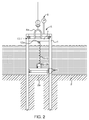
- An embodiment of such tool assembly is shown in fig. 2 installed in the monopile 1.
- the tool assembly 5 comprises a bottom sealing plug 6 positioned on the seabed 2a inside the tubular monopile 1.
- a pressure-tight lid 7 is provided at the top of the monopile 1, where anchoring means are provided for receiving and fixing the lid 7 to the monopile 1 such that the lid 7 is sealing the upper opening of the pile.
- a liquid-tight inner volume inside the monopile 1 is provided between the bottom sealing plug 6 and the lid 7.
- Pumping means 8 are provided in fluid communication with this inner volume for pumping water into the inner volume at a pressure, such as a pressure of up to approx.1000 bar. This causes the monopile 1 to move upwards as the lid 7 is anchored to the monopile 1 and the water at pressure cannot escape into the seabed 2a inside the monopile 1.
- the cylindrical monopile 1 with the tool assembly installed acts as a hydraulic cylinder.
- anchoring means are provided for securing the lid 7 to the monopile 1.
- the anchoring means comprises a locking ring 10 provided on the lid 7.
- the locking ring 10 cooperates with a recess 11 provided on the inside of the monopile 1 by milling or otherwise cutting this slot or recess 11 on cite.
- the locking ring 10 is hydraulically retracted using a hydraulic actuator 10b.
- a wedge member 10a is inserted to complete the annular locking ring 10.
- the locking ring 10 is shown in its retracted position where the wedge member 10a is retracted from the periphery of the locking ring 10.
- the recess 11 is provided with an upper surface portion 11 a which is substantially horizontal, and a lower surface portion 11 b which is inclined or wedge-shaped (see figs. 5 and 6 ).
- the locking ring 10 is provided with a substantially complementary peripheral shape to secure a wedge-locking engagement between the lid 7 and the monopile 1 via the locking ring 10 and the recess 11 (see figs. 5 and 6 ).
- the hook-like engagement between the locking ring 10 and the recess 11 also provides a liquid-tight seal, as indicated in fig. 6 .
- This geometry of the locking ring 10 and the recess 11 also ensures that the locking ring 10 is self-centring and self-sealing due to the wedge form.
- the locking ring 10 is provided with an annular hook-like mounting flange 10c which fits into a slot formed by a complementary annular mounting flange 7a provided along the periphery on the upper side of the lid 7.
- the bottom plug 6 comprises an upper steel plate 6a and a lower steel plate 6b. Between the two steel plates 6a, 6b a void space 6c is provided. The two steel plates 6a, 6b are positioned with a distance between each other due to spring members 6e provided in the void space 6c. Along the annular periphery the void space 6c is closed by a sealing ring 6d, which may be a rubber seal or a liquid expandable sealing member. The void space 6c may be pressurised. As indicated in fig.
- the sealing ring 6d is provided with an inclined surface portion 6f engaging an equally inclined annular peripheral surface of the upper steel plate 6a so that the sealing ring 6d is expanded in diameter as the upper steel plate 6a is pressed towards the lower steel plate 6b. Thereby, the sealing ring 6d is pressed against the inside of the monopile 1 and seals the bottom plug against the inside of the monopile 1.
- the bottom plug 6 according to this embodiment is designed to hold against a predetermined pressure, such as approx. 4 bars. A higher water pressure in the inner volume above the bottom plug 6 will compress the spring members 6e and then allow the seal to expand to close the gap between the periphery and the inside of the monopile 1.
- a second embodiment of the bottom plug 6 is shown.
- the upper steel plate 6a and the lower steel plate 6b are spaced apart by a distance piece 6g, which is provided with a small diameter than the two plates 6a, 6b.
- Both the upper and lower steel plates 6a, 6b are provided with inflatable sealing members 6h at their peripheries.
- the sealing members 6h may be inflated by pumping air or liquid under pressure into the sealing members 6h. This design ensures that the bottom plug 6 does not tilt during installation or during the build-up of pressure from above, e.g. due to a soft seabed or the like.
- the bottom plug 6 is preferably provided with a lifting eye 12b and the lid 7 is accordingly also provided with a mounting eye 12a so that a messenger wire 12 can be fitted to lift up the bottom plug 6 when the entire monopile 1 and the lid 7 is lifted up (see figs 1 and 2 ).
- the lid 7 is preferably also provided with a lifting eye 4a for securing the lifting wire of the crane 4 to the tool assembly when this assembly 5 is installed on the monopile 1 to be retrieved.
- the process of preparing the monopile for decommissioning according to the invention preferably includes the actions of:
- the bottom seal 6 will drop out and can be retrieved via messenger wire 12.
- the monopile 1 only has its own weight to be lifted, and once the pile 1 is on deck of the vessel 3, the lid 7 is removed by retracting the locking ring 10 and retrieving the lid 7 so that the components of the tool assembly can be used to repeat the process with the next monopile.
- a second embodiment is shown where the lid 7 is adapted for being anchored to the top of the monopile 1 externally.
- the lid 7 is fitted with an outside skirt 76 to enclose the monopile 1 when fitted (see fig. 11 ).
- the skirt 76 is fitted with sufficient hydraulic cylinders 71 to withstand the internal water pressure during retrieval of the monopile 1.
- the hydraulic cylinders 71 are fitted with hydraulic connections 73 for operating the cylinders 71.
- the monopile 1 is milled with an external recess 75, which fits the cylinders 71 on the skirt 76.
- the lid 7 is fitted to the monopile 1 (as shown in fig. 11 )
- the cylinders 71 are engaged and engagement pins 72 are extended radially inwardly into the recess 75, whereby the lid 7 is firmly mounted on the monopile 1 and the seal 74 inside the lid 7 is tight against the monopile top surface.
- the water can be injected through the water inlet 8 and the pressure will lift the monopile 1 in the manner described above.
- the monopile 1 is lifted as it comes loose by means of the lifting pad eye 4a fitted on the hook of a crane 4 or similar lifting device.
- the hydraulic cylinders 71 can be disengaged and the lid 7 removed for usage on the next pile.
Landscapes
- Engineering & Computer Science (AREA)
- Life Sciences & Earth Sciences (AREA)
- General Life Sciences & Earth Sciences (AREA)
- Mining & Mineral Resources (AREA)
- Paleontology (AREA)
- Civil Engineering (AREA)
- General Engineering & Computer Science (AREA)
- Structural Engineering (AREA)
- Foundations (AREA)
- Placing Or Removing Of Piles Or Sheet Piles, Or Accessories Thereof (AREA)
Abstract
The present invention concerns a method and a tool assembly for the removal of a tubular monopile foundation mounted in the ground, such as a monopile in a seabed for an offshore structure, for instance a wind turbine, said tool assembly comprising:
a bottom sealing plug on seabed inside the tubular pile;
a pressure-tight lid closing the top of the pile, said pile having anchoring means for receiving and fixing said lid to the pile such that the lid is sealing the upper opening of the pile, thereby providing an inner volume inside the pile between the bottom sealing plug and the lid; and
pumping means in fluid communication with the inner volume for pumping water into the inner volume at a pressure, such as a pressure of up to approx.1000 bar.
a bottom sealing plug on seabed inside the tubular pile;
a pressure-tight lid closing the top of the pile, said pile having anchoring means for receiving and fixing said lid to the pile such that the lid is sealing the upper opening of the pile, thereby providing an inner volume inside the pile between the bottom sealing plug and the lid; and
pumping means in fluid communication with the inner volume for pumping water into the inner volume at a pressure, such as a pressure of up to approx.1000 bar.
Description
- The present invention relates to a method and a tool assembly for the removal of a tubular foundation monopile mounted in the ground, such as a monopile in a seabed for an offshore structure, for instance a wind turbine.
- Monopile foundations are commonly employed to support offshore structures, such as offshore wind turbines, gas or oil rigs, etc. The monopile comprises a large diameter cylindrical shaped tubular pile which is driven into the seabed. The monopile is driven into the seabed so that it extends a predetermined length upwards, such that the top of the monopile extends above the sea surface. On top of the monopile the structure is then mounted thereon.
- Monopiles may also be used to support landbased structures, where the pile is driven sufficiently into the ground to provide a foundation for a structure to be mounted thereon, such as a wind turbine or the like.
- When the structures are no longer in service, the structures and their foundations are required to be removed. Most jurisdictions require that installations are removed if no longer in use and that the seabed is returned to its original state. Whether monopiles have to be fully removed or cut off a safe distance below the seabed will probably be decided on a case-by-case basis, depending on how much environmental damage might be caused trying to remove them.
- This decommissioning of monopiles today is often by cutting off the pile at a predetermined level at or below the seabed (or at ground level if it is an onshore installation). This method of decommissioning monopiles is both extensive and time consuming, and furthermore it leaves a part of the monopile at the location. However, compared to removing the monopiles the cutting off may be the most efficient from a cost perspective and from a practical perspective as such monopiles are typically located remove (offshore) positions.
- In the offshore wind industry the preparation of plans for the decommissioning of structures placed on the seabed has now become a major consideration in obtaining the necessary approval for offshore developments as also environmental considerations become more important. It is becoming increasingly apparent that decommissioning plans will become important if not critical during the development of offshore wind farms, since decommissioning is so extremely costly.
- Compared to other foundations the monopile solutions are found to be associated with the least costs with regard to decommissioning.
- However, it is acknowledged the decommissioning of the monopiles can be achieved by cutting off the monopile at or below seabed level, and that a jet cutting technique or mechanical cutter can be utilised for either option. Hereby, salvaged steel of approx. 18 m could be relatively easy to handle with potentially high scrap value. However, it is also acknowledged in the industry that it is unlikely for a monopile pile to be pulled out entirely considering overwhelming forces.
- In view of this background it is an object by the present invention to provide a more cost-effective method of decommissioning monopiles and in particular it is an object to provide a suitable method and equipment for retrieving a monopile.
- These objects are achieved by in a first aspect of the invention providing a method of removing a tubular foundation monopile mounted in the ground, such as a monopile in a seabed for an offshore structure, for instance a wind turbine, said method comprising the steps of providing a bottom sealing plug on seabed inside the tubular pile; closing the top of the pile with a pressure-tight lid, said pile having anchoring means for receiving and fixing said lid to the pile such that the lid is sealing the upper opening of the pile, thereby providing an inner volume inside the pile between the bottom sealing plug and the lid; connecting pump means in fluid communication with the inner volume, and then pumping water at pressure into the inner volume, such that the inner volume extends as the pile is pulled out of the ground.
- The bottom sealing plug defines the lower end of the inner volume and this plug prevents the pressurised water in the inner volume to escape into the seabed. This in turn means that when applying a fluid pressure at a sufficiently high value inside the monopile, the lid is pressed upwards whereby the entire monopile is lifted up. Thus, by this method according to the invention, the monopile is "converted" into a hydraulic cylinder.
- This method is found advantageous compared to the decommissioning method cutting off the pile at the seabed level for several reasons. The method according to the invention is advantageous as the entire monopile is retrieved whereby all of the steel of the monopile is available for recycling. Also, it is advantageous from a cost perspective since it is substantially less cost intensive to decommission a monopile using the method according to the invention compared to hitherto known methods. The time it takes to remove the monopile is also significantly reduced using the method according to the invention.
- In one embodiment, the anchoring means comprises an annular recess provided on the inside of the pile which is adapted to form a locking engagement with a locking ring provided on the lid. Accordingly, the method further comprises the steps of cutting said annular recess for the locking ring inside the pile, preferably by placing a milling tool inside the pile in a predetermined position, and then removing the milling tool before placing the lid inside the pile and releasing the locking ring to secure the lid to the monopile.
- In an alternative second embodiment, the anchoring means comprises at least one recess, such as an annual recess or a series of recesses in an annular configuration, provided on the outside of the pile in a predetermined distance from the upper opening of the pile, and radially inwardly extendable locking pins are provided along the periphery of the lid to form a locking engagement with the at least one recess.
- The cutting of the recess is preferably achieved by using a subsea milling tool. Such type of fully submersible tool is commercially available and can be submerged and operated from a vessel.
- Preferably, the step of placing a lid inside the pile includes lowering the lid to the predetermined position and then releasing the locking ring, which thereby expands into locking engagement with the recess. The locking ring may be hydraulically retracted during the positioning of the lid inside the monopile and the when correctly positioned the locking ring is released. Furthermore, the recess is preferably provided with an upper surface portion which is substantially horizontal, and a lower surface portion which is wedge-shaped, and that the locking ring is provided with a substantially complementary peripheral shape to secure a wedge-locking engagement between the lid and the monopile via the locking ring and the recess. This means that when the locking ring is released the lid is self-centring as well as fluid tightly self-sealing to the inside of the pile as the locking ring thereby engages the recess.
- In the preferred embodiments of the invention, the water is pumped into the inner volume at a pressure up to approx.1000 bar. The pumping of water is continued until the pile is driven out of the ground and can be lifted by suitable lifting means, such as a crane.
- To prepare the decommissioning of the monopile but before applying the tool for performing the method according to the invention, the monopile is initially cut off horizontally to provide an upper opening of the pile in a predetermined distance from the seabed.
- In a second aspect of the invention, there is provided a tool assembly for removal of a tubular foundation monopile mounted in the ground, such as a monopile in a seabed for an offshore structure, for instance a wind turbine, said apparatus comprising a bottom sealing plug on seabed inside the tubular pile;a pressure-tight lid closing the top of the pile, said pile having anchoring means for receiving and fixing said lid to the pile such that the lid is sealing the upper opening of the pile, thereby providing an inner volume inside the pile between the bottom sealing plug and the lid; and pumping means in fluid communication with the inner volume for pumping water into the inner volume at a pressure, such as a pressure of up to approx. 1000 bar.
- As mentioned above, in a first embodiment the anchoring means comprises an annular recess provided on the inside of the pile which is adapted to form a locking engagement with a locking ring provided on the lid. The recess is provided with an upper surface portion which is substantially horizontal, and a lower surface portion which is wedge-shaped, and that the locking ring is provided with a substantially complementary peripheral shape to secure a wedge-locking engagement between the lid and the monopile via the locking ring and the recess.
- As an alternative second embodiment, the anchoring means comprises at least one recess, such as an annual recess or a series of recesses in an annular configuration, provided on the outside of the pile in a predetermined distance from the upper opening of the pile, and radially inwardly extendable locking pins are provided along the periphery of the lid to form a locking engagement with the at least one recess. These radially inwardly extendable locking pins are preferably hydraulically driven locking pins.
- Advantageously, the bottom sealing plug having an annular sealing member, such as rubber sealing ring, mounted between an upper plate and a lower plate that are provided with a pressurised void space in-between, so that the sealing plug is adapted to withstand a predetermined threshold pressure, such as 4 bars, before the upper plate is pressed towards the lower plate and the void space is reduced due to the pressure exceeding said threshold pressure thereby radially expanding the sealing member to close and seal against the inner surface of the monopile. It is of importance that the seabed exposed to the inside of the monopile is covered by the bottom plug to ensure that the water from the pressurised inner volume does not enter into the ground underneath the pile as this would destabilise the seabed.
- Preferably, a wire is provided between the bottom sealing plug and the lid. Hereby, the bottom plug can be lifted up together with the pile.
- In the following the invention is described in more detail with reference to the embodiments shown in the accompanying drawings, in which:
-
Fig. 1 is a schematic view of a monopile positioned in a seabed; -
Fig. 2 is a schematic cross-section view of the monopile with the retrieval tool installed; -
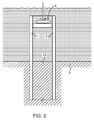
Fig. 3 is a schematic view of the monopile being prepared for retrieval; -
Fig. 4 is a schematic top view of the locking ring of the lid; -
Figs. 5 and6 are detailed cross-sectional views of the anchoring mechanism of the lid and the inside of the monopile; -
Fig. 7 is a detailed cross-sectional view of the bottom plug according to a first embodiment; -
Fig. 8 is a detailed cross-sectional view of the bottom plug according to a second embodiment; -
Fig. 9 is a schematic view from below of a lid according to a second embodiment; -
Fig. 10 is a top view of same; and -
Fig. 11 is a detailed cross-sectional view of the lid connected to the top of the monopile. - In
fig. 1 the situation for decommissioning of amonopile 1 is schematically illustrated. Themonopile 1 used to serve as a foundation for a structure (not shown), such as an offshore wind turbine. In the example shown infig. 1 , themonopile 1 is installed in aseabed 2. A vessel 3 carrying acrane 4 is then positioned next to themonopile 1 for lifting themonopile 1 out of theseabed 2 and thereby retrieving themonopile 1 for recycling. - In order for the
crane 4 to lift the monopile 1 atool assembly 5 is installed in themonopile 1. An embodiment of such tool assembly is shown infig. 2 installed in themonopile 1. - The
tool assembly 5 comprises abottom sealing plug 6 positioned on theseabed 2a inside thetubular monopile 1. A pressure-tight lid 7 is provided at the top of themonopile 1, where anchoring means are provided for receiving and fixing thelid 7 to themonopile 1 such that thelid 7 is sealing the upper opening of the pile. Hereby a liquid-tight inner volume inside themonopile 1 is provided between thebottom sealing plug 6 and thelid 7. Pumping means 8 are provided in fluid communication with this inner volume for pumping water into the inner volume at a pressure, such as a pressure of up to approx.1000 bar. This causes themonopile 1 to move upwards as thelid 7 is anchored to themonopile 1 and the water at pressure cannot escape into theseabed 2a inside themonopile 1. Thus, thecylindrical monopile 1 with the tool assembly installed acts as a hydraulic cylinder. - As mentioned above, anchoring means are provided for securing the
lid 7 to themonopile 1. With reference tofigures 4 to 6 , the anchoring means comprises a lockingring 10 provided on thelid 7. The lockingring 10 cooperates with arecess 11 provided on the inside of themonopile 1 by milling or otherwise cutting this slot orrecess 11 on cite. The lockingring 10 is hydraulically retracted using ahydraulic actuator 10b. When the lockingring 10 is then released awedge member 10a is inserted to complete theannular locking ring 10. Infig. 4 thelocking ring 10 is shown in its retracted position where thewedge member 10a is retracted from the periphery of the lockingring 10. - The
recess 11 is provided with anupper surface portion 11 a which is substantially horizontal, and alower surface portion 11 b which is inclined or wedge-shaped (seefigs. 5 and6 ). The lockingring 10 is provided with a substantially complementary peripheral shape to secure a wedge-locking engagement between thelid 7 and themonopile 1 via the lockingring 10 and the recess 11 (seefigs. 5 and6 ). The hook-like engagement between the lockingring 10 and therecess 11 also provides a liquid-tight seal, as indicated infig. 6 . This geometry of the lockingring 10 and therecess 11 also ensures that the lockingring 10 is self-centring and self-sealing due to the wedge form. As also shown infigs. 5 and6 , the lockingring 10 is provided with an annular hook-like mounting flange 10c which fits into a slot formed by a complementaryannular mounting flange 7a provided along the periphery on the upper side of thelid 7. - Before the
lid 7 is installed inside (or outside - seefigures 9 to 11 ) themonopile 1, thebottom sealing plug 6 is lowered into position at theseafloor 2a inside themonopile 1. Infigures 7 and8 two embodiments of this sealingplug 6 are shown. - With reference to
fig. 7 , thebottom plug 6 comprises anupper steel plate 6a and alower steel plate 6b. Between the twosteel plates void space 6c is provided. The twosteel plates spring members 6e provided in thevoid space 6c. Along the annular periphery thevoid space 6c is closed by asealing ring 6d, which may be a rubber seal or a liquid expandable sealing member. Thevoid space 6c may be pressurised. As indicated infig. 7 , thesealing ring 6d is provided with aninclined surface portion 6f engaging an equally inclined annular peripheral surface of theupper steel plate 6a so that thesealing ring 6d is expanded in diameter as theupper steel plate 6a is pressed towards thelower steel plate 6b. Thereby, thesealing ring 6d is pressed against the inside of themonopile 1 and seals the bottom plug against the inside of themonopile 1. Thebottom plug 6 according to this embodiment is designed to hold against a predetermined pressure, such as approx. 4 bars. A higher water pressure in the inner volume above thebottom plug 6 will compress thespring members 6e and then allow the seal to expand to close the gap between the periphery and the inside of themonopile 1. - In
fig. 8 , a second embodiment of thebottom plug 6 is shown. In this embodiment, theupper steel plate 6a and thelower steel plate 6b are spaced apart by adistance piece 6g, which is provided with a small diameter than the twoplates lower steel plates inflatable sealing members 6h at their peripheries. The sealingmembers 6h may be inflated by pumping air or liquid under pressure into the sealingmembers 6h. This design ensures that thebottom plug 6 does not tilt during installation or during the build-up of pressure from above, e.g. due to a soft seabed or the like. - Although not shown in the
figures 7 and8 , thebottom plug 6 is preferably provided with alifting eye 12b and thelid 7 is accordingly also provided with a mounting eye 12a so that a messenger wire 12 can be fitted to lift up thebottom plug 6 when theentire monopile 1 and thelid 7 is lifted up (seefigs 1 and2 ). Thelid 7 is preferably also provided with a liftingeye 4a for securing the lifting wire of thecrane 4 to the tool assembly when thisassembly 5 is installed on themonopile 1 to be retrieved. - The process of preparing the monopile for decommissioning according to the invention preferably includes the actions of:
- Cutting the monopile horizontally at a predetermined height relative to the sea level.
- Placing the
bottom seal 6 on seabed inside the pile. - Placing a subsea milling tool 9 (see
fig. 3 ) insidemonopile 1 in a predetermined position and then milling a recess for a locking ring inside (or outside) the pile. - When the
recess 11 is cut, the milling tool is retrieved, and thelid 7 is placed inside themonopile 1, or outside in the alternative version. - The locking
ring 10 is then released and secured with thewedge 10a. - Then the
pump 8 is attached to the hoses of the lid and water pressure up to approx.1000 bar is applied. - When the tool assembly is properly installed, the operator keeps pumping until the
monopile 1 can be lifted by thecrane 4. - Once the pile can be lifted freely the
bottom seal 6 will drop out and can be retrieved via messenger wire 12. Themonopile 1 only has its own weight to be lifted, and once thepile 1 is on deck of the vessel 3, thelid 7 is removed by retracting the lockingring 10 and retrieving thelid 7 so that the components of the tool assembly can be used to repeat the process with the next monopile. - With reference to
figures 9 to 11 , a second embodiment is shown where thelid 7 is adapted for being anchored to the top of themonopile 1 externally. Thelid 7 is fitted with anoutside skirt 76 to enclose themonopile 1 when fitted (seefig. 11 ). Theskirt 76 is fitted with sufficienthydraulic cylinders 71 to withstand the internal water pressure during retrieval of themonopile 1. Thehydraulic cylinders 71 are fitted withhydraulic connections 73 for operating thecylinders 71. - The
monopile 1 is milled with anexternal recess 75, which fits thecylinders 71 on theskirt 76. When thelid 7 is fitted to the monopile 1 (as shown infig. 11 ), thecylinders 71 are engaged and engagement pins 72 are extended radially inwardly into therecess 75, whereby thelid 7 is firmly mounted on themonopile 1 and theseal 74 inside thelid 7 is tight against the monopile top surface. In this manner the water can be injected through thewater inlet 8 and the pressure will lift themonopile 1 in the manner described above. - The
monopile 1 is lifted as it comes loose by means of thelifting pad eye 4a fitted on the hook of acrane 4 or similar lifting device. When themonopile 1 is completely retrieved from the seabed and loaded on the vessel or barge, thehydraulic cylinders 71 can be disengaged and thelid 7 removed for usage on the next pile. - Above, the invention is described with reference to some currently preferred embodiments. However, by the invention it is realised that other embodiments and variants may be provided without departing from the scope of the invention as defined in the accompanying claims. For instance although the invention is described with reference to the retrieval of off-shore mounted monopiles, it is realised that the invention is also applicable to the retrieval of monopiles on land.
Claims (18)
- A method of removing a tubular foundation monopile mounted in the ground, such as a monopile in a seabed for an offshore structure, for instance a wind turbine, said method comprising the steps of:- providing a bottom sealing plug on seabed inside the tubular pile;- closing the top of the pile with a pressure-tight lid, said pile having anchoring means for receiving and fixing said lid to the pile such that the lid is sealing the upper opening of the pile, thereby providing an inner volume inside the pile between the bottom sealing plug and the lid;- connecting pump means in fluid communication with the inner volume, and then- pumping water at pressure into the inner volume, such that the inner volume extends as the pile is pulled out of the ground.
- A method according to claim 1, whereby the anchoring means comprises an annular recess provided on the inside of the pile which is adapted to form a locking engagement with a locking ring provided on the lid.
- A method according to claim 2, whereby the method further comprises the steps ofcutting said annular recess for the locking ring inside the pile, preferably by placing a milling tool inside the pile in a predetermined position, and thenremoving the milling tool before placing the lid inside the pile.
- A method according to any one of claims 2 or 3, wherein the cutting of the recess is achieved by a subsea milling tool.
- A method according to any one of claims 2 to 4, whereby the step of placing a lid inside the pile includes lowering the lid to the predetermined position and then releasing the locking ring, which thereby expands into locking engagement with the recess.
- A method according to any one of claims 2 to 5, whereby the recess is provided with an upper surface portion which is substantially horizontal, and a lower surface portion which is wedge-shaped, and that the locking ring is provided with a substantially complementary peripheral shape to secure a wedge-locking engagement between the lid and the monopile via the locking ring and the recess.
- A method according to any one of the preceding claims, whereby the water is pumped into the inner volume at a pressure up to approx.1000 bar.
- A method according to claim 1, whereby the anchoring means comprises at least one recess, such as an annual recess or a series of recesses in an annular configuration, provided on the outside of the pile in a predetermined distance from the upper opening of the pile, and radially inwardly extendable locking pins are provided along the periphery of the lid to form a locking engagement with at least one recess.
- A method according to any one of the preceding claims, whereby the monopile is initially cut off horizontally to provide an upper opening of the pile in a predetermined distance from the seabed.
- A method according to any one of the preceding claims, whereby the pumping of water is continued until the pile can be lifted by suitable lifting means, such as a crane.
- A tool assembly for removal of a tubular foundation monopile mounted in the ground, such as a monopile in a seabed for an offshore structure, for instance a wind turbine, said tool assembly comprising:a bottom sealing plug on seabed inside the tubular pile;a pressure-tight lid closing the top of the pile, said pile having anchoring means for receiving and fixing said lid to the pile such that the lid is sealing the upper opening of the pile, thereby providing an inner volume inside the pile between the bottom sealing plug and the lid; andpumping means in fluid communication with the inner volume for pumping water into the inner volume at a pressure, such as a pressure of up to approx.1000 bar.
- A tool assembly according to claim 11, wherein the anchoring means comprises an annular recess provided on the inside of the pile which is adapted to form a locking engagement with a locking ring provided on the lid.
- A tool assembly according to claim 12, wherein the recess is provided with an upper surface portion which is substantially horizontal, and a lower surface portion which is wedge-shaped, and that the locking ring is provided with a substantially complementary peripheral shape to secure a wedge-locking engagement between the lid and the monopile via the locking ring and the recess.
- A tool assembly according to claim 11, wherein the anchoring means comprises at least one recess, such as an annual recess or a series of recesses in an annular configuration, provided on the outside of the pile in a predetermined distance from the upper opening of the pile, and radially inwardly extendable locking pins are provided along the periphery of the lid to form a locking engagement with the at least one recess.
- A tool assembly according to claim 14, wherein the radially inwardly extendable locking pins are hydraulically driven locking pins.
- A tool assembly according to any one of claims 11 to 15, wherein the bottom sealing plug having an annular sealing member, such as rubber sealing ring, mounted between an upper plate and a lower plate that are provided with a pressurised void space in-between, so that the sealing plug is adapted to withstand a predetermined threshold pressure, such as 4 bars, before the upper plate is pressed towards the lower plate and the void space is reduced due to the pressure exceeding said threshold pressure thereby radially expanding the sealing member to close and seal against the inner surface of the monopile.
- A tool assembly according to any one of claims 11 to 15, wherein a wire is provided between the bottom sealing plug and the lid.
- A tool assembly according to any one of claims 11 to 17, wherein the tool assembly is performing a method according to any of the claims 1 to 10.
Priority Applications (1)
| Application Number | Priority Date | Filing Date | Title |
|---|---|---|---|
| EP16186217.2A EP3290590A1 (en) | 2016-08-30 | 2016-08-30 | A method and a tool assembly for the removal of a monopile foundation |
Applications Claiming Priority (1)
| Application Number | Priority Date | Filing Date | Title |
|---|---|---|---|
| EP16186217.2A EP3290590A1 (en) | 2016-08-30 | 2016-08-30 | A method and a tool assembly for the removal of a monopile foundation |
Publications (1)
| Publication Number | Publication Date |
|---|---|
| EP3290590A1 true EP3290590A1 (en) | 2018-03-07 |
Family
ID=56842725
Family Applications (1)
| Application Number | Title | Priority Date | Filing Date |
|---|---|---|---|
| EP16186217.2A Withdrawn EP3290590A1 (en) | 2016-08-30 | 2016-08-30 | A method and a tool assembly for the removal of a monopile foundation |
Country Status (1)
| Country | Link |
|---|---|
| EP (1) | EP3290590A1 (en) |
Cited By (3)
| Publication number | Priority date | Publication date | Assignee | Title |
|---|---|---|---|---|
| CN113718819A (en) * | 2021-08-31 | 2021-11-30 | 江苏砺诚交通科技有限公司 | Prefabricated assembly type wind power tower cylinder foundation and assembly method |
| WO2022038219A1 (en) | 2020-08-21 | 2022-02-24 | Treehouse Denmark Aps | A method and a tool assembly for the removal of a monopile foundation |
| CN116591165A (en) * | 2023-04-26 | 2023-08-15 | 江苏科技大学 | A new camelback system and method for removing offshore wind power pile foundations |
Citations (2)
| Publication number | Priority date | Publication date | Assignee | Title |
|---|---|---|---|---|
| US4808037A (en) * | 1987-02-25 | 1989-02-28 | Franklin C. Wade | Method and apparatus for removal of submerged offshore objects |
| US20150211202A1 (en) * | 2014-01-28 | 2015-07-30 | Paige Melancon | Pile Cutter |
-
2016
- 2016-08-30 EP EP16186217.2A patent/EP3290590A1/en not_active Withdrawn
Patent Citations (2)
| Publication number | Priority date | Publication date | Assignee | Title |
|---|---|---|---|---|
| US4808037A (en) * | 1987-02-25 | 1989-02-28 | Franklin C. Wade | Method and apparatus for removal of submerged offshore objects |
| US20150211202A1 (en) * | 2014-01-28 | 2015-07-30 | Paige Melancon | Pile Cutter |
Cited By (3)
| Publication number | Priority date | Publication date | Assignee | Title |
|---|---|---|---|---|
| WO2022038219A1 (en) | 2020-08-21 | 2022-02-24 | Treehouse Denmark Aps | A method and a tool assembly for the removal of a monopile foundation |
| CN113718819A (en) * | 2021-08-31 | 2021-11-30 | 江苏砺诚交通科技有限公司 | Prefabricated assembly type wind power tower cylinder foundation and assembly method |
| CN116591165A (en) * | 2023-04-26 | 2023-08-15 | 江苏科技大学 | A new camelback system and method for removing offshore wind power pile foundations |
Similar Documents
| Publication | Publication Date | Title |
|---|---|---|
| US20240286713A1 (en) | Marine suction anchor | |
| CN107905238B (en) | A kind of soil plug pullout type suction anchor foundation and its construction method | |
| JP7098635B2 (en) | System used in cranes for surface vessels | |
| KR101633440B1 (en) | Installing apparatus of leg for fixing vessel and installing method of leg using the same | |
| US9868492B1 (en) | Tool assembly for installing a suction pile | |
| NO20111073A1 (en) | Rigeless abandon system | |
| US20150240440A1 (en) | Methods and Connectors for Making Structural Connections Without Offshore Welding of Connectors | |
| US6203248B1 (en) | Sliding-resistant bottom-founded offshore structures | |
| EP3333321B1 (en) | Method and apparatus for elevating a marine platform | |
| DK201700561A1 (en) | Method for installing a pile | |
| EP3794183B1 (en) | Method for removal of an offshore fixed platform | |
| US20110253024A1 (en) | Anchor and methods | |
| US8678707B1 (en) | Well-head blowout containment system | |
| KR20150116738A (en) | A assist device for refloating of concreat structure in the sea | |
| WO2022038219A1 (en) | A method and a tool assembly for the removal of a monopile foundation | |
| AU2009294225B2 (en) | Tideway anchor system | |
| US12509839B2 (en) | System and method for suction anchor deployment with solid lid | |
| US20130011202A1 (en) | Tideway positioning system | |
| KR20180012612A (en) | Mooring apparatus | |
| KR20250172661A (en) | Device for anchoring on the seabed | |
| WO2008068482A1 (en) | Apparatus and method for recovery of marine structures | |
| TW202612978A (en) | Anchor system with low-friction follower and method | |
| KR20160009326A (en) | Pile construction method for supporting offshore structure | |
| GB2403976A (en) | Frame apparatus for deploying a sub-sea structure | |
| HK1221270B (en) | Method for elevating a marine platform |
Legal Events
| Date | Code | Title | Description |
|---|---|---|---|
| PUAI | Public reference made under article 153(3) epc to a published international application that has entered the european phase |
Free format text: ORIGINAL CODE: 0009012 |
|
| AK | Designated contracting states |
Kind code of ref document: A1 Designated state(s): AL AT BE BG CH CY CZ DE DK EE ES FI FR GB GR HR HU IE IS IT LI LT LU LV MC MK MT NL NO PL PT RO RS SE SI SK SM TR |
|
| AX | Request for extension of the european patent |
Extension state: BA ME |
|
| STAA | Information on the status of an ep patent application or granted ep patent |
Free format text: STATUS: THE APPLICATION IS DEEMED TO BE WITHDRAWN |
|
| 18D | Application deemed to be withdrawn |
Effective date: 20180908 |