EP3290393A1 - Method for manufacturing lithium hydroxide and lithium carbonate, and device therefor - Google Patents
Method for manufacturing lithium hydroxide and lithium carbonate, and device therefor Download PDFInfo
- Publication number
- EP3290393A1 EP3290393A1 EP16786799.3A EP16786799A EP3290393A1 EP 3290393 A1 EP3290393 A1 EP 3290393A1 EP 16786799 A EP16786799 A EP 16786799A EP 3290393 A1 EP3290393 A1 EP 3290393A1
- Authority
- EP
- European Patent Office
- Prior art keywords
- lithium
- dialysis membrane
- solution
- aqueous
- selective
- Prior art date
- Legal status (The legal status is an assumption and is not a legal conclusion. Google has not performed a legal analysis and makes no representation as to the accuracy of the status listed.)
- Granted
Links
Images


Classifications
-
- C—CHEMISTRY; METALLURGY
- C01—INORGANIC CHEMISTRY
- C01D—COMPOUNDS OF ALKALI METALS, i.e. LITHIUM, SODIUM, POTASSIUM, RUBIDIUM, CAESIUM, OR FRANCIUM
- C01D15/00—Lithium compounds
- C01D15/08—Carbonates; Bicarbonates
-
- B—PERFORMING OPERATIONS; TRANSPORTING
- B01—PHYSICAL OR CHEMICAL PROCESSES OR APPARATUS IN GENERAL
- B01D—SEPARATION
- B01D53/00—Separation of gases or vapours; Recovering vapours of volatile solvents from gases; Chemical or biological purification of waste gases, e.g. engine exhaust gases, smoke, fumes, flue gases, aerosols
- B01D53/34—Chemical or biological purification of waste gases
- B01D53/46—Removing components of defined structure
-
- B—PERFORMING OPERATIONS; TRANSPORTING
- B01—PHYSICAL OR CHEMICAL PROCESSES OR APPARATUS IN GENERAL
- B01D—SEPARATION
- B01D61/00—Processes of separation using semi-permeable membranes, e.g. dialysis, osmosis or ultrafiltration; Apparatus, accessories or auxiliary operations specially adapted therefor
- B01D61/42—Electrodialysis; Electro-osmosis ; Electro-ultrafiltration; Membrane capacitive deionization
- B01D61/44—Ion-selective electrodialysis
-
- B—PERFORMING OPERATIONS; TRANSPORTING
- B01—PHYSICAL OR CHEMICAL PROCESSES OR APPARATUS IN GENERAL
- B01D—SEPARATION
- B01D61/00—Processes of separation using semi-permeable membranes, e.g. dialysis, osmosis or ultrafiltration; Apparatus, accessories or auxiliary operations specially adapted therefor
- B01D61/42—Electrodialysis; Electro-osmosis ; Electro-ultrafiltration; Membrane capacitive deionization
- B01D61/44—Ion-selective electrodialysis
- B01D61/445—Ion-selective electrodialysis with bipolar membranes; Water splitting
-
- B—PERFORMING OPERATIONS; TRANSPORTING
- B01—PHYSICAL OR CHEMICAL PROCESSES OR APPARATUS IN GENERAL
- B01D—SEPARATION
- B01D61/00—Processes of separation using semi-permeable membranes, e.g. dialysis, osmosis or ultrafiltration; Apparatus, accessories or auxiliary operations specially adapted therefor
- B01D61/42—Electrodialysis; Electro-osmosis ; Electro-ultrafiltration; Membrane capacitive deionization
- B01D61/44—Ion-selective electrodialysis
- B01D61/46—Apparatus therefor
-
- B—PERFORMING OPERATIONS; TRANSPORTING
- B01—PHYSICAL OR CHEMICAL PROCESSES OR APPARATUS IN GENERAL
- B01D—SEPARATION
- B01D61/00—Processes of separation using semi-permeable membranes, e.g. dialysis, osmosis or ultrafiltration; Apparatus, accessories or auxiliary operations specially adapted therefor
- B01D61/42—Electrodialysis; Electro-osmosis ; Electro-ultrafiltration; Membrane capacitive deionization
- B01D61/44—Ion-selective electrodialysis
- B01D61/46—Apparatus therefor
- B01D61/463—Apparatus therefor comprising the membrane sequence AC or CA, where C is a cation exchange membrane
-
- B—PERFORMING OPERATIONS; TRANSPORTING
- B01—PHYSICAL OR CHEMICAL PROCESSES OR APPARATUS IN GENERAL
- B01D—SEPARATION
- B01D61/00—Processes of separation using semi-permeable membranes, e.g. dialysis, osmosis or ultrafiltration; Apparatus, accessories or auxiliary operations specially adapted therefor
- B01D61/42—Electrodialysis; Electro-osmosis ; Electro-ultrafiltration; Membrane capacitive deionization
- B01D61/44—Ion-selective electrodialysis
- B01D61/46—Apparatus therefor
- B01D61/465—Apparatus therefor comprising the membrane sequence AB or BA, where B is a bipolar membrane
-
- B—PERFORMING OPERATIONS; TRANSPORTING
- B01—PHYSICAL OR CHEMICAL PROCESSES OR APPARATUS IN GENERAL
- B01D—SEPARATION
- B01D61/00—Processes of separation using semi-permeable membranes, e.g. dialysis, osmosis or ultrafiltration; Apparatus, accessories or auxiliary operations specially adapted therefor
- B01D61/42—Electrodialysis; Electro-osmosis ; Electro-ultrafiltration; Membrane capacitive deionization
- B01D61/44—Ion-selective electrodialysis
- B01D61/46—Apparatus therefor
- B01D61/48—Apparatus therefor having one or more compartments filled with ion-exchange material, e.g. electrodeionisation
-
- B—PERFORMING OPERATIONS; TRANSPORTING
- B01—PHYSICAL OR CHEMICAL PROCESSES OR APPARATUS IN GENERAL
- B01D—SEPARATION
- B01D61/00—Processes of separation using semi-permeable membranes, e.g. dialysis, osmosis or ultrafiltration; Apparatus, accessories or auxiliary operations specially adapted therefor
- B01D61/42—Electrodialysis; Electro-osmosis ; Electro-ultrafiltration; Membrane capacitive deionization
- B01D61/44—Ion-selective electrodialysis
- B01D61/46—Apparatus therefor
- B01D61/50—Stacks of the plate-and-frame type
-
- B—PERFORMING OPERATIONS; TRANSPORTING
- B01—PHYSICAL OR CHEMICAL PROCESSES OR APPARATUS IN GENERAL
- B01J—CHEMICAL OR PHYSICAL PROCESSES, e.g. CATALYSIS OR COLLOID CHEMISTRY; THEIR RELEVANT APPARATUS
- B01J19/00—Chemical, physical or physico-chemical processes in general; Their relevant apparatus
- B01J19/08—Processes employing the direct application of electric or wave energy, or particle radiation; Apparatus therefor
-
- C—CHEMISTRY; METALLURGY
- C01—INORGANIC CHEMISTRY
- C01D—COMPOUNDS OF ALKALI METALS, i.e. LITHIUM, SODIUM, POTASSIUM, RUBIDIUM, CAESIUM, OR FRANCIUM
- C01D15/00—Lithium compounds
-
- C—CHEMISTRY; METALLURGY
- C01—INORGANIC CHEMISTRY
- C01D—COMPOUNDS OF ALKALI METALS, i.e. LITHIUM, SODIUM, POTASSIUM, RUBIDIUM, CAESIUM, OR FRANCIUM
- C01D15/00—Lithium compounds
- C01D15/02—Oxides; Hydroxides
-
- C—CHEMISTRY; METALLURGY
- C01—INORGANIC CHEMISTRY
- C01D—COMPOUNDS OF ALKALI METALS, i.e. LITHIUM, SODIUM, POTASSIUM, RUBIDIUM, CAESIUM, OR FRANCIUM
- C01D15/00—Lithium compounds
- C01D15/04—Halides
-
- C—CHEMISTRY; METALLURGY
- C25—ELECTROLYTIC OR ELECTROPHORETIC PROCESSES; APPARATUS THEREFOR
- C25B—ELECTROLYTIC OR ELECTROPHORETIC PROCESSES FOR THE PRODUCTION OF COMPOUNDS OR NON-METALS; APPARATUS THEREFOR
- C25B1/00—Electrolytic production of inorganic compounds or non-metals
- C25B1/01—Products
- C25B1/14—Alkali metal compounds
-
- C—CHEMISTRY; METALLURGY
- C25—ELECTROLYTIC OR ELECTROPHORETIC PROCESSES; APPARATUS THEREFOR
- C25B—ELECTROLYTIC OR ELECTROPHORETIC PROCESSES FOR THE PRODUCTION OF COMPOUNDS OR NON-METALS; APPARATUS THEREFOR
- C25B1/00—Electrolytic production of inorganic compounds or non-metals
- C25B1/01—Products
- C25B1/18—Alkaline earth metal compounds or magnesium compounds
- C25B1/20—Hydroxides
-
- B—PERFORMING OPERATIONS; TRANSPORTING
- B01—PHYSICAL OR CHEMICAL PROCESSES OR APPARATUS IN GENERAL
- B01D—SEPARATION
- B01D2311/00—Details relating to membrane separation process operations and control
- B01D2311/25—Recirculation, recycling or bypass, e.g. recirculation of concentrate into the feed
-
- B—PERFORMING OPERATIONS; TRANSPORTING
- B01—PHYSICAL OR CHEMICAL PROCESSES OR APPARATUS IN GENERAL
- B01D—SEPARATION
- B01D2311/00—Details relating to membrane separation process operations and control
- B01D2311/26—Further operations combined with membrane separation processes
- B01D2311/263—Chemical reaction
-
- C—CHEMISTRY; METALLURGY
- C01—INORGANIC CHEMISTRY
- C01P—INDEXING SCHEME RELATING TO STRUCTURAL AND PHYSICAL ASPECTS OF SOLID INORGANIC COMPOUNDS
- C01P2006/00—Physical properties of inorganic compounds
- C01P2006/80—Compositional purity
-
- Y—GENERAL TAGGING OF NEW TECHNOLOGICAL DEVELOPMENTS; GENERAL TAGGING OF CROSS-SECTIONAL TECHNOLOGIES SPANNING OVER SEVERAL SECTIONS OF THE IPC; TECHNICAL SUBJECTS COVERED BY FORMER USPC CROSS-REFERENCE ART COLLECTIONS [XRACs] AND DIGESTS
- Y02—TECHNOLOGIES OR APPLICATIONS FOR MITIGATION OR ADAPTATION AGAINST CLIMATE CHANGE
- Y02W—CLIMATE CHANGE MITIGATION TECHNOLOGIES RELATED TO WASTEWATER TREATMENT OR WASTE MANAGEMENT
- Y02W10/00—Technologies for wastewater treatment
- Y02W10/30—Wastewater or sewage treatment systems using renewable energies
- Y02W10/37—Wastewater or sewage treatment systems using renewable energies using solar energy
Definitions
- a method for manufacturing lithium hydroxide and lithium carbonate and an apparatus therefor are disclosed.
- lithium hydroxide and lithium carbonate having a purity of over the certain level concentration for a commercial view
- a lithium concentration is required to be appropriately concentrated enough to be carbonated while removing impurities existed in a lithium-containing solution.
- a chemical precipitation is generally known as a method of removing impurities of ion moiety into less than or equal to the predetermined concentration.
- it causes a problem in that the chemical reagent costs for them are excessively demanded, and furthermore, the added chemical reagent becomes another impurity so to be purified again.
- the present Inventors suggest an effective alternative of economically manufacturing lithium hydroxide and lithium carbonate according to other method except the chemical precipitation and the natural evaporation.
- a method for manufacturing lithium hydroxide includes: a step of dissolving lithium phosphate in an acid; a step of preparing a monovalent ion selective-type electrodialysis device disposed in the order of a cathode cell containing a cathode separator, a monovalent anion selective-type dialysis membrane for selectively permeating a monovalent anion, a monovalent cation selective-type dialysis membrane for selectively permeating a monovalent cation, and an anode cell containing an anode separator, injecting the lithium phosphate dissolved in the acid between the anode separator of the anode cell and the monovalent cation selective-type dialysis membrane, and between the cathode separator of the cathode cell and the monovalent anion selective-type dialysis membrane, respectively, and injecting water between the monovalent cation selective-type dialysis membrane and the monovalent anion selective-type dialysis membrane; a
- the step of converting the obtained aqueous lithium chloride solution into an aqueous lithium hydroxide solution may include a step of preparing a bipolar electrodialysis device disposed in the order of an anode cell containing an anode; a first bipolar membrane; an anion selective-type dialysis membrane; a cation selective-type dialysis membrane, a second bipolar membrane; and a cathode cell containing a cathode, injecting the aqueous lithium chloride solution between the cation selective-type dialysis membrane and the anion selective-type dialysis membrane, and injecting water between the first bipolar membrane and the anion selective-type dialysis membrane and between the second bipolar membrane and the cation selective-type dialysis membrane, respectively; and a step of obtaining an aqueous lithium hydroxide solution and at the same time, obtaining a aqueous hydrochloric acid solution formed as a byproduct by applying an electric current to the bipolar electrodialysis device.
- the step of preparing the lithium phosphate may include a step of preparing a lithium-containing solution; and injecting a phosphorus supplying material to the lithium-containing solution to precipitate dissolved lithium as lithium phosphate.
- the aqueous phosphoric acid solution obtained by the monovalent ion selective-type electrodialysis device may be used as a phosphorus supplying material in the step of injecting a phosphorus supplying material to the lithium-containing solution to precipitate dissolved lithium as lithium phosphate.
- the aqueous hydrochloric acid solution obtained by the bipolar electrodialysis device may be used for a part or a whole of the acid in the step of dissolving the lithium phosphate in an acid.
- the method may further include a step of concentrating the aqueous lithium hydroxide solution to crystallize it; and a step of drying the crystallized lithium hydroxide to obtain lithium hydroxide in a powder form.
- the lithium-containing solution may be selected from a solution extracting lithium dissolved in the ocean, a solution generated in a process of recycling a wasted lithium battery, a lithium mineral-leaching solution, a brine, a lithium-containing hot spring water, a lithium-containing underground water, a lithium-containing bittern, and a combination thereof.
- the method may further include a step of removing a divalent ion impurity in the lithium-containing solution.
- the step of removing a divalent ion impurity in the lithium-containing solution may be a step of removing a calcium ion and a magnesium ion by injecting a compound selected from sodium hydroxide (NaOH), sodium carbonate (Na 2 CO 3 ), calcium hydroxide (Ca(OH) 2 ), sodium sulfate (Na 2 SO 4 ), and a combination thereof to the lithium-containing solution.
- a compound selected from sodium hydroxide (NaOH), sodium carbonate (Na 2 CO 3 ), calcium hydroxide (Ca(OH) 2 ), sodium sulfate (Na 2 SO 4 ), and a combination thereof to the lithium-containing solution.
- the acid that dissolves lithium phosphate may be selected from hydrochloric acid (HCl), sulfuric acid (H 2 SO 4 ), nitric acid (HNO 3 ), hydrofluoric acid (HF), hydrogen bromide (HBr), and a combination thereof.
- the cathode cell and the anode cell may include an electrode solution selected from lithium sulfate (Li
- a concentration of the electrode solution may be 0.1 to 20 wt%.
- electrical conductivity of the electrode solution may be 10 to 100 ms/cm.
- the step of obtaining an aqueous lithium chloride solution, and at the same time, obtaining an aqueous phosphoric acid solution produced as a by-product, by applying an electric current to the monovalent ion selective-type electrodialysis device may include: permeating lithium ions in the lithium phosphate dissolved in the acid through the monovalent cation selective-type dialysis membrane to be transferred in a direction to the cathode; permeating the chlorine ion in the lithium phosphate dissolved in the acid through the monovalent anion selective-type dialysis membrane to be transferred in a direction to the anode; concentrating the transferred lithium ion and the transferred chlorine ion between the monovalent cation selective-type dialysis membrane and the monovalent anion selective-type dialysis membrane to provide the aqueous lithium chloride solution; and concentrating phosphoric acid ion and hydrochloric acid ion in the lithium phosphate dissolved in the acid remained between the anode separator of the anode cell
- a concentration of the recovered aqueous phosphoric acid solution may be 0.1 to 3.0 M.
- a weight ratio of an injection amount of water relative to an injection amount of the aqueous lithium chloride solution may be 1:20 to 1:2.
- the step of obtaining an aqueous lithium hydroxide solution and at the same time, obtaining a aqueous hydrochloric acid solution formed as a byproduct by applying an electric current to the bipolar electrodialysis device may include: hydrolyzing the water in the first bipolar membrane and the second bipolar membrane to generate hydroxide ion and proton; permeating lithium ions in the aqueous lithium chloride solution through the cation selective-type dialysis membrane to be transferred in a direction to the cathode; concentrating the lithium ion generated in the second bipolar membrane and the transferred lithium ion between the cation selective-type dialysis membrane and the second bipolar membrane to provide an aqueous lithium hydroxide solution; permeating chlorine ion in the aqueous lithium chloride solution through the anion selective-type dialysis membrane to be transferred in a direction to the anode; and concentrating proton generated in the first bipolar membrane and the transferred chlorine ion between the anion selective-type dialysis
- a concentration of the separated aqueous hydrochloric acid solution may be 0.1 to 3.0 M.
- the monovalent ion selective-type electrodialysis device may be one that the monovalent cation selective-type dialysis membrane and the monovalent anion selective-type dialysis membrane are paired into a pair, and a plurality of the dialysis membrane pairs is continuously formed.
- the bipolar electrodialysis device may be one that a bipolar membrane; an anion selective-type dialysis membrane and a cation selective-type dialysis membrane are paired into a pair, and a plurality of the dialysis membrane pairs is continuously formed.
- a method of manufacturing lithium carbonate includes a step of preparing the aqueous lithium hydroxide solution obtained by the method; and a step of carbonating the aqueous lithium hydroxide solution to obtain lithium carbonate.
- the step of carbonating the aqueous lithium hydroxide solution to obtain lithium carbonate may be performed by a reaction of the aqueous lithium hydroxide solution with carbon dioxide (CO 2 ).
- Yet another embodiment of the present invention provides an apparatus of manufacturing a lithium compound including a stacked electrodialysis device in which a pair of a first anion selective-type dialysis membrane selectively permeating monovalent anion and a first cation selective-type dialysis membrane selectively permeating monovalent cation is continuously disposed between a first cathode cell including a first cathode and a first cathode separator and a first anode cell including a first anode and a first anode separator, consisting of: an electrode solution supplying line supplying an electrode solution into the first cathode cell and the first anode cell; a lithium phosphate supplying line supplying lithium phosphate dissolved in an acid and a water supplying line supplying water which are alternatively disposed each between the pair of the first anion selective-type dialysis membrane and the first cation selective-type dialysis membrane; and an aqueous lithium chloride solution discharging line discharging the aqueous lithium
- the pair of the first anion selective-type dialysis membrane and the first cation selective-type dialysis membrane may be continuously disposed in tens to thousands pars, and the pair of the third bipolar membrane and the second anion selective-type dialysis membrane and the second cation selective-type dialysis membrane may be continuously disposed in tens to thousands pairs.
- the aqueous phosphoric acid solution discharged from the stacked electrodialysis device may be re-supplied for a phosphorus supplying material of the lithium phosphate manufacturing process.
- the aqueous hydrochloric acid solution discharged from the stacked bipolar electrodialysis device may be re-supplied to a supplying part of the lithium phosphate dissolved in the acid.
- It may further include a carbonation device converting the discharged aqueous lithium hydroxide solution into lithium carbonate.
- lithium hydroxide and lithium carbonate may be each obtained with a high purity and a high concentration with a high efficiency and a low process cost.
- the lithium phosphate when dialyzed using the monovalent ion selective-type electrodialysis device, it may effectively separate the impurity of phosphoric acid, and at the same time, it may obtain an aqueous lithium chloride solution that lithium is concentrated in a high concentration.
- the aqueous lithium chloride solution when dialyzed using the bipolar electrodialysis device, it may effectively separate the impurity of hydrochloric acid, and at the same time, it may obtain an aqueous lithium hydroxide solution that lithium is concentrated in a high concentration.
- the separated phosphoric acid and hydrochloric acid according to embodiments of the present invention may be recycled by inputting each of them into the process of the present invention again, so it may economically produce lithium hydroxide and lithium carbonate.
- lithium hydroxide and lithium carbonate in a powder form from the aqueous lithium hydroxide solution.
- the present Inventors suggest a series of processes including i) a step of converting lithium phosphate into lithium chloride, ii) a step of converting the lithium chloride into lithium hydroxide, and iii) a step of obtaining the lithium hydroxide by itself in a powder form or carbonating the lithium hydroxide to obtain a lithium carbonate, and they consider following matters in each step.
- lithium is concentrated in a high concentration in the each process, and simultaneously, it is effectively separated from the inevitably generated by-product, so each of the material may be obtained with a high efficiency, and the by-product may be mqved to an appropriate process and recycled, so it is economical.
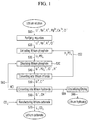
- the series of processes may be collectively summarized as in FIG. 1 , so a method of manufacturing each material is described referring to the same.
- the lithium phosphate may be obtained with a high purity by purifying divalent ion such as Ca 2+ , Mg 2+ or the like in a lithium-containing solution (for example, a solution extracting lithium dissolved in ocean, a solution generated during a recycling process of a wasted lithium battery, a lithium mineral leaching solution, brine, lithium-containing hot spring water, lithium-containing underground water, lithium-containing bittern, etc.) and then adding a phosphorus supplying material.
- a lithium-containing solution for example, a solution extracting lithium dissolved in ocean, a solution generated during a recycling process of a wasted lithium battery, a lithium mineral leaching solution, brine, lithium-containing hot spring water, lithium-containing underground water, lithium-containing bittern, etc.
- the general components included in the lithium-containing solution may be Li + , Na + , K + , Ca 2+ , Mg 2+ , Cl - , SO 4 2- , and the like.
- the other components except the Li + may be referred to impurity in the process of manufacturing lithium chloride, lithium hydroxide, and lithium carbonate according to exemplary embodiments of the present invention, particularly, since the impurities may be also carbonated and precipitated together with the lithium carbonate during the process of manufacturing lithium carbonate, the impurities are required to be removed (S10).
- Ca 2+ and Mg 2+ may be precipitated on the surface of cation selective-type dialysis membrane in the later-described bipolar electrodialysis device, causing a membrane contamination, as well as they are difficult components to be removed even by hot water cleaning due to the low solubility, so they are needed to be first removed.
- a method of removing the Ca 2+ and Mg 2+ is not particularly limited, but may be one using the following Reaction Scheme 1 to 3 or the like.
- Reaction Scheme 1 Ca 2+ + 2NaOH -> 2Na + + Ca(OH) 2 ( ⁇ ), Mg 2+ + 2NaOH -> 2Na + + Mg(OH) 2 ( ⁇ )
- Reaction Scheme 2 Ca 2+ + Na 2 CO 3 -> 2Na + + CaCO 3 ( ⁇ ), Mg 2+ + Na 2 CO 3 -> 2Na + + MgCO 3 ( ⁇ )
- Reaction Scheme 3 Mg 2+ + Ca(OH) 2 -> Ca 2+ + Mg(OH) 2 ( ⁇ ), Ca 2+ + Na 2 SO 4 -> 2Na + + CaSO 4 ( ⁇ )
- Ca 2+ and the Mg 2+ may be precipitated as Ca(OH) 2 , Mg(OH) 2 , CaCO 2 , MgCO 3 , CaSO 4 , and the like by injecting NaOH, Na 2 CO 3 , Ca(OH) 2 , Na 2 SO 4 , and the like sequentially and appropriately to the lithium-containing solution.
- Examples of the phosphorus supplying material may include phosphoric acid and the like.
- the aqueous phosphoric acid solution which is a by-product generated during a process of converting lithium phosphate into lithium chloride, may be recycled to use the phosphorus supplying material.
- a monovalent ion selective-type electrodialysis device that a monovalent cation selective-type dialysis membrane 140 and monovalent anion selective-type dialysis membrane 130, which are selectively permeating a monovalent cation and a monovalent anion, respectively, are disposed between an anode cell and a cathode cell.
- the anode cell includes an anode 160 and an anode separator 150
- the cathode cell includes a cathode 110 and a cathode separator 120
- an electrode solution is injected into between the anode 160 and the anode separator 150 and between the cathode 110 and the cathode separator 120.
- the monovalent ion selective-type electrodialysis device 100 is schematically shown in FIG. 2 , so it is described with reference to this.
- the lithium phosphate is dissolved in an acid and followed by injecting the same into each of between the anode separator 150 of the anode cell and the monovalent cation selective-type dialysis membrane 140 and between the cathode separator 120 of the cathode cell and the monovalent anion selective-type dialysis membrane 130, and injecting water into between the monovalent cation selective-type dialysis membrane 140 and the monovalent anion selective-type dialysis membrane 130 to prepare an electrodialysis.
- the electrode solution injected into the cathode cell and the anode cell respectively may include an electrode solution selected from lithium sulfate (Li 2 SO 4 ), lithium hydroxide (LiOH), lithium dihydrogen phosphate (LiH 2 PO 4 ), phosphoric acid (H 3 PO 4 ), and a combination thereof.
- the electrode solution is circulated to smoothly transfer electron in each cell
- the electrode solution may have a concentration of 0.1 to 20 wt%.
- the electrode solution may have an electrical conductivity of 10 to 100 ms/cm.
- the electrical conductivity of the electrode solution is proportional to the concentration of the electrode solution.
- the terms "proportional to” do not mean only directly proportional to, but substantially means a trendy that the electrical conductivity is also increased as the concentration of the electrode solution is going to be increased.
- the ion transferring speed is instead delayed in the monovalent ion selective-type electrodialysis device 100, and the electrical resistance is occurred, causing an increase in voltage, a reduction of electric current, a reduction of current efficiency, an increase in power costs, and the like.
- the concentration difference from each solution i.e., the lithium phosphate dissolved in an acid and the water
- the concentration difference causes a diffusion force, and the diffusing force is driven in an opposition direction to the originally desired direction of transferring ion.
- the concentration of the electrode solution is needed to be 0.1 to 20 wt%, and the electrical conductivity is needed to be 10 to 100 ms/cm.
- a kind of the acid dissolving the lithium phosphate is not particularly limited, but may be selected from hydrochloric acid (HCl), sulfuric acid (H 2 SO 4 ), nitric acid HNO 3 , hydrofluoric acid (HF), hydrogen bromide (HBr), and a combination thereof, and hydrochloric acid (HCl) is more preferably.
- hydrochloric acid (HCl) is more preferably.
- the aqueous hydrochloric acid solution which is produced as a by-product in the process of converting lithium chloride to lithium hydroxide (S50) is recycled (S62) to be used as the dissolving acid, which is described in later.
- chlorine ion which is monovalent ion in the anions may be permeated through the monovalent anion selective-type dialysis membrane 130, but phosphoric acid ion may be not permeated.
- lithium ion which is monovalent cation may be permeated through the monovalent cation selective-type dialysis membrane 140 in an opposite direction to the chlorine ion.
- the lithium ion is continuously concentrated together with the chlorine ion between the monovalent cation selective-type dialysis membrane 140 and the monovalent anion selective-type dialysis membrane 130 to provide an aqueous lithium chloride solution.
- phosphoric acid ion and hydrochloric acid ion of the lithium phosphate dissolved in the acid which are remained between the anode separator 150 of the anode cell and the monovalent cation selective-type dialysis membrane 140 and between the cathode separator 120 of the cathode cell and the monovalent anion selective-type dialysis membrane 130 are concentrated to provide an aqueous phosphoric acid solution.
- the aqueous lithium chloride solution may be recovered between the monovalent cation selective-type dialysis membrane 140 and the monovalent anion selective-type dialysis membrane 130
- the aqueous phosphoric acid solution may be recovered from between the anode separator 150 of the anode cell and the monovalent cation selective-type dialysis membrane 140 and between the cathode separator 120 of the cathode cell and the monovalent anion selective-type dialysis membrane 130.
- the lithium phosphate when used as a raw material, and the monovalent ion selective-type electrodialysis device 100 is used, it may prepare an aqueous lithium chloride solution that lithium is concentrated in a high concentration, and it may be effectively separated from the aqueous phosphoric acid solution generated at the same time.
- the concentration of the aqueous phosphoric acid solution may be 0.1 to 3.0 M.
- the aqueous phosphoric acid solution is recovered and recycled (S52)
- the aqueous phosphoric acid solution having a concentration of greater than 3.0 M is recycled, it generates a diffusion force due to the concentration difference, causing an increase in voltage, a reduction of current, a reduction of current efficiency, an increase in powder costs, so it is required to recover the aqueous phosphoric acid solution in less than or equal to 3.0 M.
- the aqueous phosphoric acid solution may be recovered and recycles (S52) as a phosphorus supplying material for the process of preparing lithium phosphate, as mentioned above.
- aqueous lithium chloride solution separated from the aqueous phosphoric acid solution may be used as a raw material for being converted to the aqueous lithium hydroxide solution.
- the monovalent ion selective-type electrodialysis device 100 may be employed as a stacked one that a plurality of the same are sequentially stacked.
- the monovalent ion selective-type electrodialysis device 100 When the monovalent ion selective-type electrodialysis device 100 is made in a stacked one as in above, it may have a structure that the monovalent cation selective-type dialysis membrane 140 and monovalent anion selective-type dialysis membrane 130 are paired, and several ten to several thousand pairs thereof are disposed between the anode cell and the cathode cell.
- the stacked electrodialysis device may include supplying lines connecting each of lithium phosphate dissolved in an acid and water to be supplied for the stack and discharging lines connecting each of an aqueous lithium chloride solution and an aqueous phosphoric acid solution to be discharged from the stack. More detailed stacked electrodialysis device will be described in later.
- a bipolar electrodialysis device 200 used for converting the lithium chloride into lithium hydroxide may be one that, as shown in FIG. 3 , an anode cell including an anode 210, a first bipolar membrane 220, an anion selective-type dialysis membrane 230, a cation selective-type dialysis membrane 240, a second bipolar membrane 250, a cathode cell including a cathode 260 are sequentially disposed.
- the aqueous lithium chloride solution is injected between the anion selective-type dialysis membrane 230 and the cation selective-type dialysis membrane 240, water is injected to each of between the first bipolar membrane 220 and the anion selective-type dialysis membrane 230 and between the second bipolar membrane 250 and the cation selective-type dialysis membrane 240 to prepare the bipolar electrodialysis.
- a weight ratio of an injection amount of water relative to an injection amount of the aqueous lithium chloride solution may be controlled at 1:20 to 1:2.
- the injected water amount refers to the water amount injected into each of between the first bipolar membrane 220 and the anion selective-type dialysis membrane 230 and between the second bipolar membrane 250 and the cation selective-type dialysis membrane 240.
- Pure water including no impurity is preferable as the water used in the example embodiment of the present invention, and the pure water includes distilled water, and ion-exchanged water is more preferable.
- Hydroxide ion generated in the second bipolar membrane 250 and the transferred lithium ion are concentrated between the cation selective-type dialysis membrane 240 and the second bipolar membrane 250 to provide an aqueous lithium hydroxide solution.
- proton generated in the first bipolar membrane 220 and the transferred chlorine ion are concentrated between the anion selective-type dialysis membrane 230 and the first bipolar membrane 220 to provide an aqueous hydrochloric acid solution.
- the aqueous lithium hydroxide solution may be recovered between the second bipolar membrane 250 and the cation selective-type dialysis membrane 240, and the aqueous hydrochloric acid solution may be recovered between the first bipolar membrane 220 and the anion selective-type dialysis membrane 230.
- the aqueous hydrochloric acid solution may be used as a part or a whole of the acid of the step (S62) of dissolving the lithium phosphate in an acid.
- the aqueous lithium hydroxide solution may be used as a raw material for preparing a lithium carbonate or may be recovered in a powder phase (S60-S70) through a crystallizing process and a drying process.
- the lithium carbonate may be easily prepared by spraying carbon dioxide to the aqueous lithium hydroxide solution.
- the powder phase of lithium hydroxide may be obtained by concentrating the aqueous lithium hydroxide solution according to the vacuum evaporation and crystallizing the same (S64-S66) and then drying the same by a steam drier.
- the bipolar electrodialysis device may be employed in a stack that a plurality thereof are sequentially stacked, as shown in FIG. 5 .
- the bipolar electrodialysis device When the bipolar electrodialysis device is structured in a stacked one, it may have a structure that a third bipolar membrane 455 and an anion selective-type dialysis membrane 430 and a cation selective-type dialysis membrane 440 are paired between the two third bipolar layer 455, and the several tens to several hundreds of the pairs are disposed between the anode cell and the cathode cell.
- the stacked bipolar electrodialysis device When using the stacked bipolar electrodialysis device, it may be provided with supplying lines connecting each of aqueous lithium chloride solution and water which are supplied to the stack and discharging lines connecting each of the aqueous lithium hydroxide solution and the aqueous hydrochloric acid solution which are discharged from the stack.
- a stacked electrodialysis device and a stacked bipolar electrodialysis device according to further another exemplary embodiment of the present invention are detailed described with reference to FIGS. 4 and 5 .
- a first anion selective-type dialysis membrane 330 selectively permeating a monovalent anion and a first cation selective-type dialysis membrane 340 selectively permeating a monovalent cation are paired, and continuously disposed between a first cathode cell including a first cathode 310 and a first cathode separator 320 and a first anode cell including a first anode 360 and a first anode separator 350.
- the pair of the selective-type dialysis membrane 330 and 340 may be continuously disposed in several ten to several thousand pairs.
- electrode solution supplying lines (not shown) supplying an electrode solution to the first cathode cell and the first anode cell are each formed on and below the stacked electrodialysis device in a closed shape to circulate the electrode solution to the stacked electrodialysis device, and a predetermined region of the electrode solution supplying line is interposed and connected to an electrode solution supplying tank (not shown) capable of refilling the electrode solution and a control valve (not shown).
- a motor capable of circulating the electrode solution may be mounted in the electrode solution supplying tank.
- the used electrode solution may be selected from lithium sulfate (Li 2 SO 4 ), lithium hydroxide (LiOH), lithium dihydrogen phosphate (LiH 2 PO 4 ), phosphoric acid (H 3 PO 4 ), and a combination thereof.
- a lithium phosphate supplying line 370 and a water supplying line 375 supplying lithium phosphate dissolved in an acid and water, respectively, may be alternatively disposed each of between a pair of the first anion selective-type dialysis membrane 330 and the first cation selective-type dialysis membrane 340.
- an aqueous lithium chloride solution discharging line 380 and an aqueous phosphoric acid solution discharging line 385 are alternatively disposed each between the pair of the first anion selective-type dialysis membrane 330 and the first cation selective-type dialysis membrane 340.
- the aqueous lithium chloride solution obtained from the stacked electrodialysis device as above may be supplied to the bipolar electrodialysis device which will be described later, and the separated and recovered aqueous phosphoric acid solution may be re-supplied as a phosphorus supplying material for a process of preparing lithium phosphate (S52).
- a third bipolar membrane 455 and a second anion selective-type dialysis membrane 430 and a second cation selective-type dialysis membrane 440 are paired, and continuously disposed between a second anode cell including a second anode 410 and a second cathode cell including a second cathode 460.
- the pair of the bipolar membrane and the selective-type dialysis membranes may be continuously disposed in several ten to several thousand pairs.
- a second electrode solution supplying lines (not shown) supplying a second electrode solution to the second cathode cell and the second anode cell are formed on and below the stacked bipolar electrodialysis device in a closed shape to circulate the second electrode solution to the stacked bipolar electrodialysis device, and a predetermined part of the second electrode solution supplying line is interposed and connected to a second electrode solution supplying tank (not shown) capable of refilling the second electrode solution and a second control valve (not shown).
- a second motor (not shown) capable of circulating the second electrode solution may be mounted in the second electrode solution supplying tank.
- the used second electrode solution may be selected from any one of lithium hydroxide (LiOH) and potassium chloride (KCI) or a combination thereof.
- a lithium chloride supplying line 470 and a second water supplying line 475 supplying lithium phosphate dissolved in an acid and water, respectively, may be displaced.
- the aqueous lithium chloride solution supplying line 470 may have an inlet between the second anion selective-type dialysis membrane 430 and the second cation selective-type dialysis membrane 440
- the second water supplying line 475 may have an inlet in each of between the third bipolar membrane 455 and the second anion selective-type dialysis membrane 430 and between the second cation selective-type dialysis membrane 440 and the third bipolar membrane 455.
- an aqueous lithium hydroxide solution discharging line 480 and an aqueous hydrochloric acid solution discharging line 483 and a remaining aqueous lithium chloride solution discharging line 485 may be formed in the stacked bipolar electrodialysis device.
- the aqueous lithium hydroxide solution discharging line 480 may have an outlet between the second cation selective-type dialysis membrane 440 and the third bipolar membrane 455, and the aqueous hydrochloric acid solution discharging line 483 may have an outlet between the third bipolar membrane 455 and the second anion selective-type dialysis membrane 430, and the remaining aqueous lithium chloride solution discharging line 485 may have an outlet between the second anion selective-type dialysis membrane 430 and the second cation selective-type dialysis membrane 440.
- the aqueous lithium hydroxide solution obtained from the stacked bipolar electrodialysis device may be recovered in a powder phase through a crystallizing process and a drying process, or may be used as a raw material for preparing lithium carbonate.
- the aqueous hydrochloric acid solution obtained from the stacked bipolar electrodialysis device may be used as a part of or a whole of the acid in "the step of dissolving lithium phosphate in an acid.”
- a part or a whole of the remaining aqueous lithium chloride solution discharged from the stacked bipolar electrodialysis device may be recycled to the aqueous lithium chloride solution supplying line 470.
- the mentioned stacked electrodialysis device and the mentioned stacked bipolar electrodialysis device may be continuously mounted to provide an apparatus of manufacturing a lithium compound.
- the process of converting lithium phosphate into an aqueous lithium chloride solution by the stacked electrodialysis device and the process of converting the converted aqueous lithium chloride solution into an aqueous lithium hydroxide solution by the stacked bipolar electrodialysis device may be continuously performed.
- the apparatus of manufacturing a lithium compound may further include a carbonation device converting the aqueous lithium hydroxide solution obtained from the stacked bipolar electrodialysis device into lithium carbonate.
- a reagent grade lithium phosphate (Japan Pure Chemical Co., Ltd.) was used as a raw material, and the monovalent ion selective-type electrodialysis device shown in FIG. 2 was used to prepared a lithium chloride.
- an aqueous phosphoric acid solution having a concentration of 0.5 mol was used as an electrode solution, and an electric current of 2.2A was applied at a voltage of 12V for 140 minutes.
- the result may recover a concentrated aqueous lithium chloride solution between a monovalent cation selective-type dialysis membrane and a monovalent anion selective-type dialysis membrane of the monovalent ion selective-type electrodialysis device and also recover an aqueous phosphoric acid solution separated therefrom.
- the recovered aqueous lithium chloride solution was measured to have a lithium concentration of 18 g/L and a phosphor concentration of 4.4 g/L.
- the recovered aqueous phosphoric acid solution was measured to have a phosphor concentration of 47.3 g/L and a lithium concentration of 4.0 g/L.
- the remaining phosphoric acid in the aqueous lithium chloride solution may be precipitated to lithium phosphate during the converting process to the aqueous lithium hydroxide solution, so it may be recovered during the process.
- the aqueous phosphoric acid solution may be used as a raw material for extracting lithium phosphate.
- the recovered aqueous lithium chloride solution was used as a raw material, and a bipolar electrodialysis device shown in FIG. 3 was used to prepare a lithium hydroxide.
- aqueous lithium chloride solution having a the lithium concentration of 18 g/L and 0.5 L of water were used, and a bipolar electrodialysis device was applied with an electric current of 4.4A at a voltage of 30V for 140 minutes while inputting the same, as shown in FIG. 3 .
- the result may recover an aqueous hydrochloric acid solution between an anion selective-type dialysis membrane and a first bipolar membrane of the bipolar electrodialysis device and also recover an aqueous lithium hydroxide solution between a cation selective-type dialysis membrane and a second bipolar membrane.
- a lithium carbonate was prepared according to a carbonation reaction.
- the aqueous lithium hydroxide solution having a lithium concentration of 18.9g/L and 60 g of carbon dioxide were each placed in separated nozzles, and then they were simultaneously sprayed to induce a carbonation reaction, so as to obtain a lithium carbonate.
- a filterate of the carbonation reaction may be recycled as a desalted solution of the bipolar electrodialysis device.
Landscapes
- Chemical & Material Sciences (AREA)
- Engineering & Computer Science (AREA)
- Organic Chemistry (AREA)
- Materials Engineering (AREA)
- Water Supply & Treatment (AREA)
- Chemical Kinetics & Catalysis (AREA)
- Inorganic Chemistry (AREA)
- Health & Medical Sciences (AREA)
- Urology & Nephrology (AREA)
- Metallurgy (AREA)
- Electrochemistry (AREA)
- General Health & Medical Sciences (AREA)
- Toxicology (AREA)
- Biomedical Technology (AREA)
- Environmental & Geological Engineering (AREA)
- Analytical Chemistry (AREA)
- General Chemical & Material Sciences (AREA)
- Oil, Petroleum & Natural Gas (AREA)
- Separation Using Semi-Permeable Membranes (AREA)
- Removal Of Specific Substances (AREA)
- Water Treatment By Electricity Or Magnetism (AREA)
Abstract
Description
- A method for manufacturing lithium hydroxide and lithium carbonate and an apparatus therefor are disclosed.
- In order to economically manufacture lithium hydroxide and lithium carbonate having a purity of over the certain level concentration for a commercial view, a lithium concentration is required to be appropriately concentrated enough to be carbonated while removing impurities existed in a lithium-containing solution.
- However, the costs for removing impurity and concentrating lithium cover most of the whole expenses causing a problem, so it has been researched to solve the problem.
- First, a chemical precipitation is generally known as a method of removing impurities of ion moiety into less than or equal to the predetermined concentration. However, it causes a problem in that the chemical reagent costs for them are excessively demanded, and furthermore, the added chemical reagent becomes another impurity so to be purified again.
- Meanwhile, a technique of evaporating natural brine using solar heat to remove impurities and to concentrate lithium has been suggested as a method of concentrating lithium. However, if depending upon a natural evaporation, it spends a long time for greater than or equal to 1 year, so a huge evaporation facility (ex., artificial pond for evaporation, etc.) is required to solve the time problem. In this case, a huge facility investment cost, an operation cost, a maintenance cost, and the like for this are additionally occurred.
- Accordingly, in order to economically manufacture lithium hydroxide and lithium carbonate having a purity in greater than or equal to the predetermined concentration, a technique substituting the chemical precipitation and the natural evaporation is demanded, but effective alternatives have not suggested yet.
- The present Inventors suggest an effective alternative of economically manufacturing lithium hydroxide and lithium carbonate according to other method except the chemical precipitation and the natural evaporation.
- Specifically, they have developed a series of processes: dialyzing lithium phosphate using a monovalent ion selective-type electrodialysis device to be separated into an aqueous lithium chloride solution and an aqueous phosphoric acid solution; dialyzing the separated lithium chloride using a bipolar electrodialysis device to be separated into an aqueous lithium hydroxide solution and an aqueous hydrochloric acid solution, and finally obtaining powder phases of lithium hydroxide and lithium carbonate from the separated lithium hydroxide solution.
- Herein, each of methods of manufacturing lithium hydroxide and lithium carbonate is suggested as an exemplary embodiment of the present invention.
- In one embodiment of the present invention, a method for manufacturing lithium hydroxide includes: a step of dissolving lithium phosphate in an acid;
a step of preparing a monovalent ion selective-type electrodialysis device disposed in the order of a cathode cell containing a cathode separator, a monovalent anion selective-type dialysis membrane for selectively permeating a monovalent anion, a monovalent cation selective-type dialysis membrane for selectively permeating a monovalent cation, and an anode cell containing an anode separator, injecting the lithium phosphate dissolved in the acid between the anode separator of the anode cell and the monovalent cation selective-type dialysis membrane, and between the cathode separator of the cathode cell and the monovalent anion selective-type dialysis membrane, respectively, and injecting water between the monovalent cation selective-type dialysis membrane and the monovalent anion selective-type dialysis membrane;
a step of obtaining an aqueous lithium chloride solution, and at the same time, obtaining a phosphoric acid aqueous solution formed as a byproduct, by applying an electric current to the monovalent ion selective-type electrodialysis device; and
a step of converting the obtained aqueous lithium chloride solution into an aqueous lithium hydroxide solution. - Hereinafter, the each step is described.
- The step of converting the obtained aqueous lithium chloride solution into an aqueous lithium hydroxide solution may include a step of preparing a bipolar electrodialysis device disposed in the order of an anode cell containing an anode; a first bipolar membrane; an anion selective-type dialysis membrane; a cation selective-type dialysis membrane, a second bipolar membrane; and a cathode cell containing a cathode, injecting the aqueous lithium chloride solution between the cation selective-type dialysis membrane and the anion selective-type dialysis membrane, and injecting water between the first bipolar membrane and the anion selective-type dialysis membrane and between the second bipolar membrane and the cation selective-type dialysis membrane, respectively; and a step of obtaining an aqueous lithium hydroxide solution and at the same time, obtaining a aqueous hydrochloric acid solution formed as a byproduct by applying an electric current to the bipolar electrodialysis device.
- The step of preparing the lithium phosphate may include a step of preparing a lithium-containing solution; and injecting a phosphorus supplying material to the lithium-containing solution to precipitate dissolved lithium as lithium phosphate.
- The aqueous phosphoric acid solution obtained by the monovalent ion selective-type electrodialysis device may be used as a phosphorus supplying material in the step of injecting a phosphorus supplying material to the lithium-containing solution to precipitate dissolved lithium as lithium phosphate.
- The aqueous hydrochloric acid solution obtained by the bipolar electrodialysis device may be used for a part or a whole of the acid in the step of dissolving the lithium phosphate in an acid.
- After the step of obtaining an aqueous lithium hydroxide solution and at the same time, obtaining a aqueous hydrochloric acid solution formed as a byproduct by applying an electric current to the bipolar electrodialysis device, the method may further include a step of concentrating the aqueous lithium hydroxide solution to crystallize it; and a step of drying the crystallized lithium hydroxide to obtain lithium hydroxide in a powder form.
- In the step of preparing a lithium-containing solution, the lithium-containing solution may be selected from a solution extracting lithium dissolved in the ocean, a solution generated in a process of recycling a wasted lithium battery, a lithium mineral-leaching solution, a brine, a lithium-containing hot spring water, a lithium-containing underground water, a lithium-containing bittern, and a combination thereof.
- Before the step of injecting a phosphorus supplying material to the lithium-containing solution to precipitate dissolved lithium as lithium phosphate, the method may further include a step of removing a divalent ion impurity in the lithium-containing solution.
- Specifically, the step of removing a divalent ion impurity in the lithium-containing solution may be a step of removing a calcium ion and a magnesium ion by injecting a compound selected from sodium hydroxide (NaOH), sodium carbonate (Na2CO3), calcium hydroxide (Ca(OH)2), sodium sulfate (Na2SO4), and a combination thereof to the lithium-containing solution.
- In the step of dissolving lithium phosphate in an acid, the acid that dissolves lithium phosphate may be selected from hydrochloric acid (HCl), sulfuric acid (H2SO4), nitric acid (HNO3), hydrofluoric acid (HF), hydrogen bromide (HBr), and a combination thereof.
- In another embodiment of the present invention, in the step of preparing a monovalent ion selective-type electrodialysis device disposed in the order of a cathode cell containing a cathode separator; a monovalent anion selective-type dialysis membrane for selectively permeating a monovalent anion; a monovalent cation selective-type dialysis membrane for selectively permeating a monovalent cation; and an anode cell containing an anode separator; injecting the lithium phosphate dissolved in the acid between the anode separator of the anode cell and the monovalent cation selective-type dialysis membrane, and between the cathode separator of the cathode cell and the monovalent anion selective-type dialysis membrane, respectively, and injecting water between the monovalent cation selective-type dialysis membrane and the monovalent anion selective-type dialysis membrane, the cathode cell and the anode cell may include an electrode solution selected from lithium sulfate (Li2SO4), lithium hydroxide (LiOH), lithium dihydrogen phosphate (LiH2PO4), phosphoric acid (H3PO4), and a combination thereof, respectively.
- Specifically, a concentration of the electrode solution may be 0.1 to 20 wt%.
- In addition, electrical conductivity of the electrode solution may be 10 to 100 ms/cm.
- The step of obtaining an aqueous lithium chloride solution, and at the same time, obtaining an aqueous phosphoric acid solution produced as a by-product, by applying an electric current to the monovalent ion selective-type electrodialysis device may include: permeating lithium ions in the lithium phosphate dissolved in the acid through the monovalent cation selective-type dialysis membrane to be transferred in a direction to the cathode; permeating the chlorine ion in the lithium phosphate dissolved in the acid through the monovalent anion selective-type dialysis membrane to be transferred in a direction to the anode; concentrating the transferred lithium ion and the transferred chlorine ion between the monovalent cation selective-type dialysis membrane and the monovalent anion selective-type dialysis membrane to provide the aqueous lithium chloride solution; and concentrating phosphoric acid ion and hydrochloric acid ion in the lithium phosphate dissolved in the acid remained between the anode separator of the anode cell and the monovalent cation selective-type dialysis membrane and the cathode separator of the cathode cell and the monovalent anion selective-type dialysis membrane to provide the aqueous phosphoric acid solution.
- In the step of obtaining an aqueous lithium chloride solution, and at the same time, obtaining a phosphoric acid aqueous solution formed as a byproduct, by applying an electric current to the monovalent ion selective-type electrodialysis device, a concentration of the recovered aqueous phosphoric acid solution may be 0.1 to 3.0 M.
- In the step of preparing a bipolar electrodialysis device disposed in the order of an anode cell containing an anode; a first bipolar membrane; an anion selective-type dialysis membrane; a cation selective-type dialysis membrane, a second bipolar membrane; and a cathode cell containing a cathode, injecting the aqueous lithium chloride solution between the cation selective-type dialysis membrane and the anion selective-type dialysis membrane, and injecting water between the first bipolar membrane and the anion selective-type dialysis membrane and between the second bipolar membrane and the cation selective-type dialysis membrane, respectively, a weight ratio of an injection amount of water relative to an injection amount of the aqueous lithium chloride solution (water: aqueous lithium chloride solution) may be 1:20 to 1:2.
- Specifically, the step of obtaining an aqueous lithium hydroxide solution and at the same time, obtaining a aqueous hydrochloric acid solution formed as a byproduct by applying an electric current to the bipolar electrodialysis device may include: hydrolyzing the water in the first bipolar membrane and the second bipolar membrane to generate hydroxide ion and proton; permeating lithium ions in the aqueous lithium chloride solution through the cation selective-type dialysis membrane to be transferred in a direction to the cathode; concentrating the lithium ion generated in the second bipolar membrane and the transferred lithium ion between the cation selective-type dialysis membrane and the second bipolar membrane to provide an aqueous lithium hydroxide solution; permeating chlorine ion in the aqueous lithium chloride solution through the anion selective-type dialysis membrane to be transferred in a direction to the anode; and concentrating proton generated in the first bipolar membrane and the transferred chlorine ion between the anion selective-type dialysis membrane and the first bipolar membrane to provide an aqueous hydrochloric acid solution.
- In the step of obtaining an aqueous lithium hydroxide solution and at the same time, obtaining an aqueous hydrochloric acid solution formed as a byproduct by applying an electric current to the bipolar electrodialysis device, a concentration of the separated aqueous hydrochloric acid solution may be 0.1 to 3.0 M.
- The monovalent ion selective-type electrodialysis device may be one that the monovalent cation selective-type dialysis membrane and the monovalent anion selective-type dialysis membrane are paired into a pair, and a plurality of the dialysis membrane pairs is continuously formed.
- The bipolar electrodialysis device may be one that a bipolar membrane; an anion selective-type dialysis membrane and a cation selective-type dialysis membrane are paired into a pair, and a plurality of the dialysis membrane pairs is continuously formed.
- In another embodiment of the present invention, a method of manufacturing lithium carbonate includes a step of preparing the aqueous lithium hydroxide solution obtained by the method; and a step of carbonating the aqueous lithium hydroxide solution to obtain lithium carbonate.
- On the other hand, the step of carbonating the aqueous lithium hydroxide solution to obtain lithium carbonate may be performed by a reaction of the aqueous lithium hydroxide solution with carbon dioxide (CO2).
- Yet another embodiment of the present invention provides an apparatus of manufacturing a lithium compound including a stacked electrodialysis device in which a pair of a first anion selective-type dialysis membrane selectively permeating monovalent anion and a first cation selective-type dialysis membrane selectively permeating monovalent cation is continuously disposed between a first cathode cell including a first cathode and a first cathode separator and a first anode cell including a first anode and a first anode separator, consisting of: an electrode solution supplying line supplying an electrode solution into the first cathode cell and the first anode cell; a lithium phosphate supplying line supplying lithium phosphate dissolved in an acid and a water supplying line supplying water which are alternatively disposed each between the pair of the first anion selective-type dialysis membrane and the first cation selective-type dialysis membrane; and an aqueous lithium chloride solution discharging line discharging the aqueous lithium chloride solution generated after performing the electrodialysis and an aqueous phosphoric acid solution discharging line discharging the aqueous phosphoric acid solution which are alternatively disposed each between the pair of the first anion selective-type dialysis membrane and the first cation selective-type dialysis membrane, so as to continuously convert the supplied lithium phosphate into the aqueous lithium chloride solution.
- Further yet another embodiment of the present invention provides an apparatus of manufacturing a lithium compound further including a stacked bipolar electrodialysis device in which a pair of a third bipolar layer and a second anion selective-type dialysis membrane and a second cation selective-type dialysis membrane is continuously disposed between a second cathode cell including a second cathode and a second anode cell including a second anode, consisting of a second electrode solution supplying line supplying an electrode solution into the second cathode cell and the second anode cell; an aqueous lithium chloride solution supplying line supplying the aqueous lithium chloride solution discharged from the stacked electrodialysis device into between the second anion selective-type dialysis membrane and the second cation selective-type dialysis membrane; a second water supplying line supplying water into each of between the third bipolar layer and the second anion selective-type dialysis membrane and between the second cation selective-type dialysis membrane and the third bipolar layer; an aqueous lithium hydroxide solution discharging line discharging an aqueous lithium hydroxide solution generated after performing the bipolar electrodialysis and disposed between the second cation selective-type dialysis membrane and the third bipolar layer; an aqueous hydrochloric acid solution discharging line discharging an aqueous hydrochloric acid solution generated after performing the electrodialysis and disposed between the third bipolar layer and the second anion selective-type dialysis membrane: and a remaining aqueous lithium chloride solution discharging line discharging a remaining aqueous lithium chloride solution generated after performing the bipolar electrodialysis and disposed between the second anion selective-type dialysis membrane and the second cation selective-type dialysis membrane, so as to continuously convert the supplied aqueous lithium chloride solution into the aqueous lithium hydroxide solution.
- The pair of the first anion selective-type dialysis membrane and the first cation selective-type dialysis membrane may be continuously disposed in tens to thousands pars, and the pair of the third bipolar membrane and the second anion selective-type dialysis membrane and the second cation selective-type dialysis membrane may be continuously disposed in tens to thousands pairs.
- The aqueous phosphoric acid solution discharged from the stacked electrodialysis device may be re-supplied for a phosphorus supplying material of the lithium phosphate manufacturing process.
- The aqueous hydrochloric acid solution discharged from the stacked bipolar electrodialysis device may be re-supplied to a supplying part of the lithium phosphate dissolved in the acid.
- It may further include a carbonation device converting the discharged aqueous lithium hydroxide solution into lithium carbonate.
- According to embodiments of the present invention, lithium hydroxide and lithium carbonate may be each obtained with a high purity and a high concentration with a high efficiency and a low process cost.
- Specifically, when the lithium phosphate is dialyzed using the monovalent ion selective-type electrodialysis device, it may effectively separate the impurity of phosphoric acid, and at the same time, it may obtain an aqueous lithium chloride solution that lithium is concentrated in a high concentration. In addition, when the aqueous lithium chloride solution is dialyzed using the bipolar electrodialysis device, it may effectively separate the impurity of hydrochloric acid, and at the same time, it may obtain an aqueous lithium hydroxide solution that lithium is concentrated in a high concentration.
- In addition, the separated phosphoric acid and hydrochloric acid according to embodiments of the present invention may be recycled by inputting each of them into the process of the present invention again, so it may economically produce lithium hydroxide and lithium carbonate.
- Furthermore, it may finally obtain lithium hydroxide and lithium carbonate in a powder form from the aqueous lithium hydroxide solution.
-
-
FIG. 1 is a flowchart collectively summarizing a method of manufacturing lithium hydroxide and lithium carbonate according to exemplary embodiments of the present invention. -
FIG. 2 schematically shows a method of manufacturing lithium chloride using a monovalent ion selective-type electrodialysis device according to one exemplary embodiment according to the present invention. -
FIG. 3 schematically shows a method of manufacturing lithium hydroxide using a bipolar electrodialysis device according to one exemplary embodiment according to the present invention. -
FIG. 4 schematically shows a method of manufacturing lithium chloride using a stacked monovalent ion selective-type electrodialysis device according to one exemplary embodiment according to the present invention. -
FIG. 5 schematically shows a method of preparing lithium hydroxide using a stacked bipolar electrodialysis device according to one exemplary embodiment according to the present invention. - Hereinafter, embodiments of the present invention are described in detail. However, these embodiments are exemplary, the present invention is not limited thereto and the present invention is defined by the scope of claims.
- Unless otherwise defined, all terms (including technical and scientific terms) used herein have the same meaning as commonly understood by a person skilled in the art. Through the specification, unless explicitly described to the contrary, the word "comprise" and variations such as "comprises" or "comprising" will be understood to imply the inclusion of stated elements but not the exclusion of any other elements. Further, the singular forms are intended to include the plural forms as well, unless the context clearly indicates otherwise.
- As mentioned in above, a chemical precipitation and a natural evaporation are inappropriate as an economical method of manufacturing a lithium hydroxide and a lithium carbonate having a high purity in greater than or equal to a predetermined concentration, so the method substituting the same is required.
- The present Inventors suggest a series of processes including i) a step of converting lithium phosphate into lithium chloride, ii) a step of converting the lithium chloride into lithium hydroxide, and iii) a step of obtaining the lithium hydroxide by itself in a powder form or carbonating the lithium hydroxide to obtain a lithium carbonate, and they consider following matters in each step.
- i) First, the step of converting lithium phosphate into lithium chloride corresponds to dissolving the lithium phosphate in an acid and injecting the same into a monovalent ion selective-type electrodialysis device together with water to separate an aqueous lithium chloride solution and an aqueous phosphoric acid solution.
Specifically, when the lithium phosphate is dissolved in the acid, the lithium chloride having a high concentration is produced by a chemical reaction and simultaneously, a phosphoric acid is produced as a by-product. When the product is added directly into the carbonation process, a lithium carbonate is produced by the carbonation of the lithium chloride, but simultaneously, a large amount of impurity generated by the phosphoric acid is inevitably produced. Meanwhile, the phosphoric acid is an expensive material and is also a material including phosphorus (P) which is an environmentally hazardous material.
Considering this, it should recover and recycle the phosphoric acid, separate from the lithium chloride while obtaining the lithium chloride that lithium is concentrated in a high concentration, which may be accomplished by the monovalent ion selective-type electrodialysis device. - ii) Meanwhile, a step of converting the lithium chloride into a lithium hydroxide corresponds to a step of injecting the separated aqueous lithium chloride solution into a bipolar electrodialysis device to separate an aqueous lithium hydroxide solution and an aqueous hydrochloric acid solution.
Specifically, in order to directly carbonate the separated aqueous lithium chloride solution, it may adjust pH around 11 by adding an additive such as caustic soda and the like. In this case, the obtained lithium carbonate inevitably includes a large amount of impurity produced by the additives, so an additional process such as a hot water cleaning and the like is unnecessarily, causing problems that a lithium yield is reduced, and the cost is increased.
Unlike this, the lithium hydroxide does not require to add an additive for increasing pH during the carbonation process, so it may provide a lithium carbonate with a high yield without the additional process. The bipolar electrodialysis device may effectively separate the lithium chloride from the by-product of hydrochloric acid while converting the same into a lithium hydroxide having a high concentration. - iii) In addition, the separated aqueous lithium hydroxide solution is suitable to be applied for an electrode material of a rechargeable battery or the like, by adding the same in a carbonation process to provide a lithium carbonate or by being provided in a powder form.
- Overall, lithium is concentrated in a high concentration in the each process, and simultaneously, it is effectively separated from the inevitably generated by-product, so each of the material may be obtained with a high efficiency, and the by-product may be mqved to an appropriate process and recycled, so it is economical.
- The series of processes may be collectively summarized as in
FIG. 1 , so a method of manufacturing each material is described referring to the same. - First, a process of preparing lithium phosphate (S10-S20), which is a raw material for the process of manufacturing lithium chloride, is described.
- The lithium phosphate may be obtained with a high purity by purifying divalent ion such as Ca2+, Mg2+ or the like in a lithium-containing solution (for example, a solution extracting lithium dissolved in ocean, a solution generated during a recycling process of a wasted lithium battery, a lithium mineral leaching solution, brine, lithium-containing hot spring water, lithium-containing underground water, lithium-containing bittern, etc.) and then adding a phosphorus supplying material.
- The general components included in the lithium-containing solution may be Li+, Na+, K+, Ca2+, Mg2+, Cl-, SO4 2-, and the like. However, the other components except the Li+ may be referred to impurity in the process of manufacturing lithium chloride, lithium hydroxide, and lithium carbonate according to exemplary embodiments of the present invention, particularly, since the impurities may be also carbonated and precipitated together with the lithium carbonate during the process of manufacturing lithium carbonate, the impurities are required to be removed (S10).
- Above the rest in the impurities, Ca2+ and Mg2+ may be precipitated on the surface of cation selective-type dialysis membrane in the later-described bipolar electrodialysis device, causing a membrane contamination, as well as they are difficult components to be removed even by hot water cleaning due to the low solubility, so they are needed to be first removed.
- A method of removing the Ca2+ and Mg2+ is not particularly limited, but may be one using the following Reaction Scheme 1 to 3 or the like.
[Reaction Scheme 1] Ca2+ + 2NaOH -> 2Na+ + Ca(OH)2(↓), Mg2+ + 2NaOH -> 2Na+ + Mg(OH)2(↓)
[Reaction Scheme 2] Ca2+ + Na2CO3 -> 2Na+ + CaCO3(↓), Mg2+ + Na2CO3 -> 2Na+ + MgCO3(↓)
[Reaction Scheme 3] Mg2+ + Ca(OH)2 -> Ca2+ + Mg(OH)2(↓), Ca2+ + Na2SO4 -> 2Na+ + CaSO4(↓)
- Considering Reaction Schemes 1 to 3, Ca2+ and the Mg2+ may be precipitated as Ca(OH)2, Mg(OH)2, CaCO2, MgCO3, CaSO4, and the like by injecting NaOH, Na2CO3, Ca(OH)2, Na2SO4, and the like sequentially and appropriately to the lithium-containing solution.
- In the lithium-containing solution that the Ca2+, Mg2+ are selectively separated and removed, Li+, Na+, K+, Cl- are remained. When a phosphorus supplying material is added thereto and followed by appropriately adjusting pH, a lithium phosphate may be obtained (S20).
- Examples of the phosphorus supplying material may include phosphoric acid and the like. According to one embodiment of the present invention, in order to save a raw material cost and to prevent the environmental pollution, the aqueous phosphoric acid solution, which is a by-product generated during a process of converting lithium phosphate into lithium chloride, may be recycled to use the phosphorus supplying material.
- - Relating this, a description on a process of converting lithium phosphate to lithium chloride (S30-S40) is followed.
- As described in above, in order to obtain lithium chloride that lithium is concentrated in a high concentration and also to recover and recycle the phosphoric acid (S52) besides the lithium chloride, it may employ a monovalent ion selective-type electrodialysis device that a monovalent cation selective-
type dialysis membrane 140 and monovalent anion selective-type dialysis membrane 130, which are selectively permeating a monovalent cation and a monovalent anion, respectively, are disposed between an anode cell and a cathode cell. The anode cell includes ananode 160 and ananode separator 150, and the cathode cell includes acathode 110 and acathode separator 120, and an electrode solution is injected into between theanode 160 and theanode separator 150 and between thecathode 110 and thecathode separator 120. The monovalent ion selective-type electrodialysis device 100 is schematically shown inFIG. 2 , so it is described with reference to this. - The lithium phosphate is dissolved in an acid and followed by injecting the same into each of between the
anode separator 150 of the anode cell and the monovalent cation selective-type dialysis membrane 140 and between thecathode separator 120 of the cathode cell and the monovalent anion selective-type dialysis membrane 130, and injecting water into between the monovalent cation selective-type dialysis membrane 140 and the monovalent anion selective-type dialysis membrane 130 to prepare an electrodialysis. - Specifically, the electrode solution injected into the cathode cell and the anode cell respectively may include an electrode solution selected from lithium sulfate (Li2SO4), lithium hydroxide (LiOH), lithium dihydrogen phosphate (LiH2PO4), phosphoric acid (H3PO4), and a combination thereof. The electrode solution is circulated to smoothly transfer electron in each cell
- In this case, the electrode solution may have a concentration of 0.1 to 20 wt%. In addition, the electrode solution may have an electrical conductivity of 10 to 100 ms/cm. Specifically, the electrical conductivity of the electrode solution is proportional to the concentration of the electrode solution. Meanwhile, the terms "proportional to" do not mean only directly proportional to, but substantially means a trendy that the electrical conductivity is also increased as the concentration of the electrode solution is going to be increased.
- Relating this, it is required to smoothly transfer ion in the monovalent ion selective-
type electrodialysis device 100, and for this, it is required to provide each of the concentration of the electrode solution and the electrical conductivity with greater than or equal to a certain level. - However, when each of the concentration and the electrical conductivity of the electrode solution is excessively high, the ion transferring speed is instead delayed in the monovalent ion selective-
type electrodialysis device 100, and the electrical resistance is occurred, causing an increase in voltage, a reduction of electric current, a reduction of current efficiency, an increase in power costs, and the like. - More specifically, when the concentration and the electrical conductivity of the electrode solution are each excessively high, the concentration difference from each solution (i.e., the lithium phosphate dissolved in an acid and the water) injected into the monovalent ion selective-type electrodialysis device may be risen, and the concentration difference causes a diffusion force, and the diffusing force is driven in an opposition direction to the originally desired direction of transferring ion.
- Collectively considering the above, the concentration of the electrode solution is needed to be 0.1 to 20 wt%, and the electrical conductivity is needed to be 10 to 100 ms/cm.
- A kind of the acid dissolving the lithium phosphate is not particularly limited, but may be selected from hydrochloric acid (HCl), sulfuric acid (H2SO4), nitric acid HNO3, hydrofluoric acid (HF), hydrogen bromide (HBr), and a combination thereof, and hydrochloric acid (HCl) is more preferably. In one exemplary embodiment of the present invention, the aqueous hydrochloric acid solution which is produced as a by-product in the process of converting lithium chloride to lithium hydroxide (S50) is recycled (S62) to be used as the dissolving acid, which is described in later.
- Meanwhile, when electricity is applied to a monovalent ion selective-
type electrodialysis device 100 where the lithium phosphate dissolved in the acid and the water are being injected, anion is transferred toward theanode 160 by the electrophoresis effect, and cation is transferred toward thecathode 110. - Specifically, lithium phosphate and hydrochloric acid in the lithium phosphate dissolved in the acid are reacted as shown in the following
Reaction Scheme 4, resultantly, the transferred ions according to the electrophoresis effect are Li+, Cl-, PO4 3-, H+ or the like.
[Reaction Scheme 4] Li3PO4 + 3HCl -> H3PO4 +3LiCl
- In this case, only chlorine ion which is monovalent ion in the anions may be permeated through the monovalent anion selective-
type dialysis membrane 130, but phosphoric acid ion may be not permeated. In addition, lithium ion which is monovalent cation may be permeated through the monovalent cation selective-type dialysis membrane 140 in an opposite direction to the chlorine ion. - Thereby, the lithium ion is continuously concentrated together with the chlorine ion between the monovalent cation selective-
type dialysis membrane 140 and the monovalent anion selective-type dialysis membrane 130 to provide an aqueous lithium chloride solution. Meanwhile, phosphoric acid ion and hydrochloric acid ion of the lithium phosphate dissolved in the acid which are remained between theanode separator 150 of the anode cell and the monovalent cation selective-type dialysis membrane 140 and between thecathode separator 120 of the cathode cell and the monovalent anion selective-type dialysis membrane 130 are concentrated to provide an aqueous phosphoric acid solution. - Thereby, the aqueous lithium chloride solution may be recovered between the monovalent cation selective-
type dialysis membrane 140 and the monovalent anion selective-type dialysis membrane 130, and the aqueous phosphoric acid solution may be recovered from between theanode separator 150 of the anode cell and the monovalent cation selective-type dialysis membrane 140 and between thecathode separator 120 of the cathode cell and the monovalent anion selective-type dialysis membrane 130. - Resultantly, when the lithium phosphate is used as a raw material, and the monovalent ion selective-
type electrodialysis device 100 is used, it may prepare an aqueous lithium chloride solution that lithium is concentrated in a high concentration, and it may be effectively separated from the aqueous phosphoric acid solution generated at the same time. - In this case, the concentration of the aqueous phosphoric acid solution may be 0.1 to 3.0 M. Specifically, in order that the aqueous phosphoric acid solution is recovered and recycled (S52), it is required to ensure that the concentration is greater than or equal to 0.1 M. On the other hand, when the aqueous phosphoric acid solution having a concentration of greater than 3.0 M is recycled, it generates a diffusion force due to the concentration difference, causing an increase in voltage, a reduction of current, a reduction of current efficiency, an increase in powder costs, so it is required to recover the aqueous phosphoric acid solution in less than or equal to 3.0 M.
- In this case, the aqueous phosphoric acid solution may be recovered and recycles (S52) as a phosphorus supplying material for the process of preparing lithium phosphate, as mentioned above.
- In addition, the aqueous lithium chloride solution separated from the aqueous phosphoric acid solution may be used as a raw material for being converted to the aqueous lithium hydroxide solution.
- Meanwhile, the monovalent ion selective-
type electrodialysis device 100 may be employed as a stacked one that a plurality of the same are sequentially stacked. - When the monovalent ion selective-
type electrodialysis device 100 is made in a stacked one as in above, it may have a structure that the monovalent cation selective-type dialysis membrane 140 and monovalent anion selective-type dialysis membrane 130 are paired, and several ten to several thousand pairs thereof are disposed between the anode cell and the cathode cell. - When using the stacked electrodialysis device, it may include supplying lines connecting each of lithium phosphate dissolved in an acid and water to be supplied for the stack and discharging lines connecting each of an aqueous lithium chloride solution and an aqueous phosphoric acid solution to be discharged from the stack. More detailed stacked electrodialysis device will be described in later.
- Next, a process of transferring the lithium chloride into lithium hydroxide (S50) is described.
- A
bipolar electrodialysis device 200 used for converting the lithium chloride into lithium hydroxide may be one that, as shown inFIG. 3 , an anode cell including ananode 210, a firstbipolar membrane 220, an anion selective-type dialysis membrane 230, a cation selective-type dialysis membrane 240, a secondbipolar membrane 250, a cathode cell including acathode 260 are sequentially disposed. - For the
bipolar electrodialysis device 200, the aqueous lithium chloride solution is injected between the anion selective-type dialysis membrane 230 and the cation selective-type dialysis membrane 240, water is injected to each of between the firstbipolar membrane 220 and the anion selective-type dialysis membrane 230 and between the secondbipolar membrane 250 and the cation selective-type dialysis membrane 240 to prepare the bipolar electrodialysis. - When electricity is applied to the bipolar electrodialysis device to be injected with the aqueous lithium chloride solution and the water, the concentrate of water is hydrolyzed in each bipolar membrane, and cation and anion in the aqueous lithium chloride solution are transferred toward the
cathode 260 and theanode 210, respectively, by the electrophoresis effect. - In this case, a weight ratio of an injection amount of water relative to an injection amount of the aqueous lithium chloride solution (water: aqueous lithium chloride solution) may be controlled at 1:20 to 1:2. Specifically, the injected water amount refers to the water amount injected into each of between the first
bipolar membrane 220 and the anion selective-type dialysis membrane 230 and between the secondbipolar membrane 250 and the cation selective-type dialysis membrane 240. - When the injected water amount is small amount of below the range, a concentration of the obtained aqueous lithium chloride solution is excessively increased, and a diffusion force is generated by the concentration difference, so causing that voltage is increased, current is reduced, current efficiency is decreased, power cost is increased, and the like.
- Unlike this, when the water injected amount is excessive amount of over the range, a concentration of the obtained aqueous lithium chloride solution is excessively low, so additional concentrating process is required for providing lithium hydroxide and lithium carbonate using the same, and thereby an energy cost is occurred.
- Pure water including no impurity is preferable as the water used in the example embodiment of the present invention, and the pure water includes distilled water, and ion-exchanged water is more preferable.
- Hydroxide ion generated in the second
bipolar membrane 250 and the transferred lithium ion are concentrated between the cation selective-type dialysis membrane 240 and the secondbipolar membrane 250 to provide an aqueous lithium hydroxide solution. In addition, proton generated in the firstbipolar membrane 220 and the transferred chlorine ion are concentrated between the anion selective-type dialysis membrane 230 and the firstbipolar membrane 220 to provide an aqueous hydrochloric acid solution. - Thereby, the aqueous lithium hydroxide solution may be recovered between the second
bipolar membrane 250 and the cation selective-type dialysis membrane 240, and the aqueous hydrochloric acid solution may be recovered between the firstbipolar membrane 220 and the anion selective-type dialysis membrane 230. - Resultantly, when the aqueous lithium chloride solution is used as a raw material, and the
bipolar electrodialysis device 200 is used, it may obtain an aqueous lithium hydroxide solution that lithium is concentrated in a high concentration, and simultaneously, it may effectively separated from the aqueous hydrochloric acid solution generated at the same time. The chemical reaction at this time is collectively shown as the following Reaction Scheme 5.
[Reaction Scheme 5] LiCl + H2O -> LiOH + HCl
- It is already mentioned that the aqueous hydrochloric acid solution may be used as a part or a whole of the acid of the step (S62) of dissolving the lithium phosphate in an acid. Furthermore, the aqueous lithium hydroxide solution may be used as a raw material for preparing a lithium carbonate or may be recovered in a powder phase (S60-S70) through a crystallizing process and a drying process.
- Specifically, the lithium carbonate may be easily prepared by spraying carbon dioxide to the aqueous lithium hydroxide solution. Meanwhile, the powder phase of lithium hydroxide may be obtained by concentrating the aqueous lithium hydroxide solution according to the vacuum evaporation and crystallizing the same (S64-S66) and then drying the same by a steam drier.
- Meanwhile, the bipolar electrodialysis device may be employed in a stack that a plurality thereof are sequentially stacked, as shown in
FIG. 5 . - When the bipolar electrodialysis device is structured in a stacked one, it may have a structure that a third
bipolar membrane 455 and an anion selective-type dialysis membrane 430 and a cation selective-type dialysis membrane 440 are paired between the two thirdbipolar layer 455, and the several tens to several hundreds of the pairs are disposed between the anode cell and the cathode cell. - When using the stacked bipolar electrodialysis device, it may be provided with supplying lines connecting each of aqueous lithium chloride solution and water which are supplied to the stack and discharging lines connecting each of the aqueous lithium hydroxide solution and the aqueous hydrochloric acid solution which are discharged from the stack.
- Hereinafter, a stacked electrodialysis device and a stacked bipolar electrodialysis device according to further another exemplary embodiment of the present invention are detailed described with reference to
FIGS. 4 and5 . - First, as shown in
FIG. 4 , in the stacked electrodialysis device, a first anion selective-type dialysis membrane 330 selectively permeating a monovalent anion and a first cation selective-type dialysis membrane 340 selectively permeating a monovalent cation are paired, and continuously disposed between a first cathode cell including afirst cathode 310 and afirst cathode separator 320 and a first anode cell including afirst anode 360 and afirst anode separator 350. The pair of the selective-type dialysis membrane - Further, electrode solution supplying lines (not shown) supplying an electrode solution to the first cathode cell and the first anode cell are each formed on and below the stacked electrodialysis device in a closed shape to circulate the electrode solution to the stacked electrodialysis device, and a predetermined region of the electrode solution supplying line is interposed and connected to an electrode solution supplying tank (not shown) capable of refilling the electrode solution and a control valve (not shown). In addition, a motor (not shown) capable of circulating the electrode solution may be mounted in the electrode solution supplying tank. In this case, the used electrode solution may be selected from lithium sulfate (Li2SO4), lithium hydroxide (LiOH), lithium dihydrogen phosphate (LiH2PO4), phosphoric acid (H3PO4), and a combination thereof.
- Meanwhile, in the stacked electrodialysis device, a lithium
phosphate supplying line 370 and awater supplying line 375 supplying lithium phosphate dissolved in an acid and water, respectively, may be alternatively disposed each of between a pair of the first anion selective-type dialysis membrane 330 and the first cation selective-type dialysis membrane 340. In addition, for discharging the aqueous lithium chloride solution and the aqueous phosphoric acid solution generated after performing the electrodialysis to the outside of the stacked electrodialysis device, an aqueous lithium chloridesolution discharging line 380 and an aqueous phosphoric acidsolution discharging line 385 are alternatively disposed each between the pair of the first anion selective-type dialysis membrane 330 and the first cation selective-type dialysis membrane 340. - When electricity is applied to the mentioned stacked electrodialysis device with continuously supplying lithium phosphate dissolved in an acid and water in a separated state from each other through the lithium
phosphate supplying line 370 and thewater supplying line 375, the aqueous lithium chloride solution and the aqueous phosphoric acid solution which are generated by the electrophoresis effect are continuously discharged in a separated state from each other through the aqueous lithium chloridesolution discharging line 380 and the aqueous phosphoric acidsolution discharging line 385, respectively. - The aqueous lithium chloride solution obtained from the stacked electrodialysis device as above may be supplied to the bipolar electrodialysis device which will be described later, and the separated and recovered aqueous phosphoric acid solution may be re-supplied as a phosphorus supplying material for a process of preparing lithium phosphate (S52).
- Hereinafter, a stacked bipolar electrodialysis device is described.
- As shown in
FIG. 5 , in a stacked bipolar electrodialysis device, a thirdbipolar membrane 455 and a second anion selective-type dialysis membrane 430 and a second cation selective-type dialysis membrane 440 are paired, and continuously disposed between a second anode cell including asecond anode 410 and a second cathode cell including asecond cathode 460. The pair of the bipolar membrane and the selective-type dialysis membranes may be continuously disposed in several ten to several thousand pairs. - Furthermore, a second electrode solution supplying lines (not shown) supplying a second electrode solution to the second cathode cell and the second anode cell are formed on and below the stacked bipolar electrodialysis device in a closed shape to circulate the second electrode solution to the stacked bipolar electrodialysis device, and a predetermined part of the second electrode solution supplying line is interposed and connected to a second electrode solution supplying tank (not shown) capable of refilling the second electrode solution and a second control valve (not shown). In addition, a second motor (not shown) capable of circulating the second electrode solution may be mounted in the second electrode solution supplying tank. In this case, the used second electrode solution may be selected from any one of lithium hydroxide (LiOH) and potassium chloride (KCI) or a combination thereof.
- Meanwhile, in the stacked bipolar electrodialysis device, a lithium
chloride supplying line 470 and a secondwater supplying line 475 supplying lithium phosphate dissolved in an acid and water, respectively, may be displaced. In this case, the aqueous lithium chloridesolution supplying line 470 may have an inlet between the second anion selective-type dialysis membrane 430 and the second cation selective-type dialysis membrane 440, and the secondwater supplying line 475 may have an inlet in each of between the thirdbipolar membrane 455 and the second anion selective-type dialysis membrane 430 and between the second cation selective-type dialysis membrane 440 and the thirdbipolar membrane 455. - In addition, for discharging the aqueous lithium hydroxide solution and the aqueous hydrochloric acid solution and the remaining aqueous lithium chloride solution, which are generated after performing the bipolar electrodialysis, to the outside of the stacked bipolar electrodialysis device, an aqueous lithium hydroxide
solution discharging line 480 and an aqueous hydrochloric acidsolution discharging line 483 and a remaining aqueous lithium chloridesolution discharging line 485 may be formed in the stacked bipolar electrodialysis device. In this case, the aqueous lithium hydroxidesolution discharging line 480 may have an outlet between the second cation selective-type dialysis membrane 440 and the thirdbipolar membrane 455, and the aqueous hydrochloric acidsolution discharging line 483 may have an outlet between the thirdbipolar membrane 455 and the second anion selective-type dialysis membrane 430, and the remaining aqueous lithium chloridesolution discharging line 485 may have an outlet between the second anion selective-type dialysis membrane 430 and the second cation selective-type dialysis membrane 440. - When electricity is applied to the mentioned stacked bipolar electrodialysis device with continuously supplying aqueous lithium chloride solution and water through the aqueous lithium
chloride supplying line 470 and the secondwater supplying line 475, the aqueous lithium hydroxide solution and the aqueous hydrochloric acid solution and the remaining aqueous lithium chloride solution, which are generated by the electrophoresis effect, are continuously discharged in a separated state through the aqueous lithium hydroxidesolution discharging line 480 and the aqueous hydrochloric acidsolution discharging line 483 and the remaining aqueous lithium chloridesolution discharging line 485, respectively. - The aqueous lithium hydroxide solution obtained from the stacked bipolar electrodialysis device may be recovered in a powder phase through a crystallizing process and a drying process, or may be used as a raw material for preparing lithium carbonate. In addition, the aqueous hydrochloric acid solution obtained from the stacked bipolar electrodialysis device may be used as a part of or a whole of the acid in "the step of dissolving lithium phosphate in an acid."
- Furthermore, a part or a whole of the remaining aqueous lithium chloride solution discharged from the stacked bipolar electrodialysis device may be recycled to the aqueous lithium chloride
solution supplying line 470. - The mentioned stacked electrodialysis device and the mentioned stacked bipolar electrodialysis device may be continuously mounted to provide an apparatus of manufacturing a lithium compound. When using the apparatus of manufacturing a lithium compound, the process of converting lithium phosphate into an aqueous lithium chloride solution by the stacked electrodialysis device and the process of converting the converted aqueous lithium chloride solution into an aqueous lithium hydroxide solution by the stacked bipolar electrodialysis device may be continuously performed.
- The apparatus of manufacturing a lithium compound may further include a carbonation device converting the aqueous lithium hydroxide solution obtained from the stacked bipolar electrodialysis device into lithium carbonate.
- Although the embodiments of the present invention are collectively described with references to
FIGS. 1 to 5 , each of embodiments of the present invention may be separately performed or other specific modification may be performed. - Hereinafter, preferable examples of the present invention are described. However, the examples are preferable examples of the present invention and the present invention is not limited by the examples.
- A reagent grade lithium phosphate (Japan Pure Chemical Co., Ltd.) was used as a raw material, and the monovalent ion selective-type electrodialysis device shown in
FIG. 2 was used to prepared a lithium chloride. - Specifically, 1 M lithium phosphate was dissolved in 3 M hydrochloric acid to provide total 1 L of a solution, and 0.5L of water was prepared, and then an electric current is applied while inputting the same into a monovalent ion selective-type electrodialysis device and, as shown in
FIG. 2 . - In this case, in the monovalent ion selective-type electrodialysis device, an aqueous phosphoric acid solution having a concentration of 0.5 mol was used as an electrode solution, and an electric current of 2.2A was applied at a voltage of 12V for 140 minutes.
- As the result, it may recover a concentrated aqueous lithium chloride solution between a monovalent cation selective-type dialysis membrane and a monovalent anion selective-type dialysis membrane of the monovalent ion selective-type electrodialysis device and also recover an aqueous phosphoric acid solution separated therefrom.
- Theoretically, in the solution that the lithium phosphate was dissolved in hydrochloric acid, 1 M phosphoric acid and 3M lithium chloride may be generated according to the following Reaction Scheme 4:
[Reaction Scheme 4] Li3PO4 + 3HCl -> H3PO4 +3LiCl
- Actually, the recovered aqueous lithium chloride solution was measured to have a lithium concentration of 18 g/L and a phosphor concentration of 4.4 g/L. In addition, the recovered aqueous phosphoric acid solution was measured to have a phosphor concentration of 47.3 g/L and a lithium concentration of 4.0 g/L.
- Thereby, it is understood that 83.5% of lithium in the raw material of lithium phosphate was converted to lithium chloride.
- Meanwhile, the remaining phosphoric acid in the aqueous lithium chloride solution may be precipitated to lithium phosphate during the converting process to the aqueous lithium hydroxide solution, so it may be recovered during the process. In addition, as the remaining lithium was present in the aqueous phosphoric acid solution, the aqueous phosphoric acid solution may be used as a raw material for extracting lithium phosphate.
- The recovered aqueous lithium chloride solution was used as a raw material, and a bipolar electrodialysis device shown in
FIG. 3 was used to prepare a lithium hydroxide. - Specifically, 1 L of the aqueous lithium chloride solution having a the lithium concentration of 18 g/L and 0.5 L of water were used, and a bipolar electrodialysis device was applied with an electric current of 4.4A at a voltage of 30V for 140 minutes while inputting the same, as shown in
FIG. 3 . - As the result, it may recover an aqueous hydrochloric acid solution between an anion selective-type dialysis membrane and a first bipolar membrane of the bipolar electrodialysis device and also recover an aqueous lithium hydroxide solution between a cation selective-type dialysis membrane and a second bipolar membrane.
- In this case, it was measured that a lithium concentration of the recovered aqueous lithium hydroxide solution was 18.9 g/L, so it is confirmed that the lithium conversion rate was 93%.
- Using the aqueous lithium hydroxide solution recovered from Example 1 as a raw material, a lithium carbonate was prepared according to a carbonation reaction.
- Specifically, the aqueous lithium hydroxide solution having a lithium concentration of 18.9g/L and 60 g of carbon dioxide were each placed in separated nozzles, and then they were simultaneously sprayed to induce a carbonation reaction, so as to obtain a lithium carbonate.
- It was measured that a lithium concentration in the recovered aqueous lithium hydroxide solution was 2.84 g/, and it is understood that 85% of lithium in the aqueous lithium hydroxide solution was converted to lithium carbonate.
- Meanwhile, a filterate of the carbonation reaction may be recycled as a desalted solution of the bipolar electrodialysis device.
- The present invention is not limited by the example embodiments and may be performed in various forms, and those skilled in the art will be able to understand that the present invention can be implemented in other detailed forms without changing the technical spirit or an essential characteristic. Therefore, the aforementioned embodiments should be understood to be exemplary but not limiting the present invention in any way.
Claims (29)
- A method for manufacturing lithium hydroxide, comprising
a step of dissolving lithium phosphate in an acid;
a step of preparing a monovalent ion selective-type electrodialysis device disposed in the order of a cathode cell containing a cathode separator, a monovalent anion selective-type dialysis membrane for selectively permeating a monovalent anion, a monovalent cation selective-type dialysis membrane for selectively permeating a monovalent cation, and an anode cell containing an anode separator, injecting the lithium phosphate dissolved in the acid between the anode separator of the anode cell and the monovalent cation selective-type dialysis membrane, and between the cathode separator of the cathode cell and the monovalent anion selective-type dialysis membrane, respectively, and injecting water between the monovalent cation selective-type dialysis membrane and the monovalent anion selective-type dialysis membrane;
a step of obtaining an aqueous lithium chloride solution, and at the same time, obtaining a phosphoric acid aqueous solution formed as a byproduct, by applying an electric current to the monovalent ion selective-type electrodialysis device; and
a step of converting the obtained aqueous lithium chloride solution into an aqueous lithium hydroxide solution. - The method for manufacturing lithium hydroxide of claim 1, wherein the step of converting the obtained aqueous lithium chloride solution into an aqueous lithium hydroxide solution includes
a step of preparing a bipolar electrodialysis device disposed in the order of an anode cell containing an anode; a first bipolar membrane; an anion selective-type dialysis membrane; a cation selective-type dialysis membrane, a second bipolar membrane; and a cathode cell containing a cathode, injecting the aqueous lithium chloride solution between the cation selective-type dialysis membrane and the anion selective-type dialysis membrane, and injecting water between the first bipolar membrane and the anion selective-type dialysis membrane and between the second bipolar membrane and the cation selective-type dialysis membrane, respectively; and
a step of obtaining an aqueous lithium hydroxide solution and at the same time, obtaining a aqueous hydrochloric acid solution formed as a byproduct by applying an electric current to the bipolar electrodialysis device. - The method for manufacturing lithium hydroxide of claim 2, wherein the step of preparing the lithium phosphate includes
a step of preparing a lithium-containing solution; and
a step of injecting a phosphorus supplying material to the lithium-containing solution to precipitate a dissolved lithium as lithium phosphate. - The method for manufacturing lithium hydroxide of claim 3, wherein the aqueous phosphoric acid solution obtained by the monovalent ion selective-type electrodialysis device is used as a phosphorus supplying material in the step of injecting a phosphorus supplying material to the lithium-containing solution to precipitate a dissolved lithium as lithium phosphate.
- The method for manufacturing lithium hydroxide of claim 4, wherein the aqueous hydrochloric acid solution obtained by the bipolar electrodialysis device is used as a part of or a whole of the acid in the step of dissolving lithium phosphate in an acid.
- The method for manufacturing lithium hydroxide of claim 2, wherein after the step of obtaining an aqueous lithium hydroxide solution and at the same time, obtaining a aqueous hydrochloric acid solution formed as a byproduct by applying an electric current to the bipolar electrodialysis device,
the method further includes a step of concentrating the aqueous lithium hydroxide solution to crystallize it; and
a step of drying the crystallized lithium hydroxide to obtain lithium hydroxide in a powder form. - The method for manufacturing lithium hydroxide of claim 6, wherein in the step of preparing a lithium-containing solution,
the lithium-containing solution is selected from a solution extracting lithium dissolved in the ocean, a solution generated in a process of recycling a wasted lithium battery, a lithium mineral-leaching solution, a brine, a lithium-containing hot spring water, a lithium-containing underground water, a lithium-containing bittern, and a combination thereof. - The method for manufacturing lithium hydroxide of claim 7, wherein before the step of injecting a phosphorus supplying material to the lithium-containing solution to precipitate dissolved lithium as lithium phosphate,
the method further includes a step of removing a divalent ion impurity in the lithium-containing solution. - The method for manufacturing lithium hydroxide of claim 8, wherein the step of removing a divalent ion impurity in the lithium-containing solution includes
a step of removing a calcium ion and a magnesium ion by injecting a compound selected from sodium hydroxide (NaOH), sodium carbonate (Na2CO3), calcium hydroxide (Ca(OH)2), sodium sulfate (Na2SO4), and a
combination thereof to the lithium-containing solution. - The method for manufacturing lithium hydroxide of any one of claim 1 to claim 9, wherein in the step of dissolving lithium phosphate in an acid,
the acid that dissolves lithium phosphate is selected from hydrochloric acid (HCl), sulfuric acid (H2SO4), nitric acid (HNO3), hydrofluoric acid (HF), hydrogen bromide (HBr), and a combination thereof. - The method for manufacturing lithium hydroxide of claim 10, wherein in the step of preparing a monovalent ion selective-type electrodialysis device disposed in the order of a cathode cell containing a cathode separator, a monovalent anion selective-type dialysis membrane for selectively permeating a monovalent anion, a monovalent cation selective-type dialysis membrane for selectively permeating a monovalent cation, and an anode cell containing an anode separator, injecting the lithium phosphate dissolved in the acid between the anode separator of the anode cell and the monovalent cation selective-type dialysis membrane, and between the cathode separator of the cathode cell and the monovalent anion selective-type dialysis membrane, respectively, and injecting water between the monovalent cation selective-type dialysis membrane and the monovalent anion selective-type dialysis membrane,
the cathode cell and the anode cell include an electrode solution selected from lithium sulfate (Li2SO4), lithium hydroxide (LiOH), lithium dihydrogen phosphate (LiH2PO4), phosphoric acid (H3PO4), and a combination thereof, respectively. - The method for manufacturing lithium hydroxide of claim 11, wherein a concentration of the electrode solution is 0.1 to 20 wt%.
- The method for manufacturing lithium hydroxide of claim 11, wherein electrical conductivity of the electrode solution is 10 to 100 ms/cm.
- The method for manufacturing lithium hydroxide of claim 10, wherein the step of obtaining an aqueous lithium chloride solution, and at the same time, obtaining a phosphoric acid aqueous solution formed as a byproduct, by applying an electric current to the monovalent ion selective-type electrodialysis device comprises:a step of permeating lithium ions in the lithium phosphate dissolved in the acid through the monovalent cation selective-type dialysis membrane to be transferred in a direction to the cathode;a step of permeating the chlorine ion in the lithium phosphate dissolved in the acid through the monovalent anion selective-type dialysis membrane to be transferred in a direction to the anode;a step of concentrating the transferred lithium ion and the transferred chlorine ion between the monovalent cation selective-type dialysis membrane and the monovalent anion selective-type dialysis membrane to provide the aqueous lithium chloride solution; anda step of concentrating phosphoric acid ion and hydrochloric acid ion in the lithium phosphate dissolved in the acid remained between the anode separator of the anode cell and the monovalent cation selective-type dialysis membrane and between the cathode separator of the cathode cell and the monovalent anion selective-type dialysis membrane to provide the aqueous phosphoric acid solution.
- The method for manufacturing lithium hydroxide of claim 14, wherein in the step of obtaining an aqueous lithium chloride solution, and at the same time, obtaining a phosphoric acid aqueous solution formed as a byproduct, by applying an electric current to the monovalent ion selective-type electrodialysis device,
a concentration of the obtained aqueous phosphoric acid solution is 0.1 to 3.0 M. - The method for manufacturing lithium hydroxide of claim 10, wherein the step of preparing a bipolar electrodialysis device disposed in the order of an anode cell containing an anode; a first bipolar membrane; an anion selective-type dialysis membrane; a cation selective-type dialysis membrane, a second bipolar membrane; and a cathode cell containing a cathode, injecting the aqueous lithium chloride solution between the cation selective-type dialysis membrane and the anion selective-type dialysis membrane, and injecting water between the first bipolar membrane and the anion selective-type dialysis membrane and between the second bipolar membrane and the cation selective-type dialysis membrane, respectively,
a weight ratio of an injection amount of water relative to an injection amount of the aqueous lithium chloride solution (water: aqueous lithium chloride solution) is 1:20 to 1:2. - The method for manufacturing lithium hydroxide of claim 16, wherein the step of obtaining an aqueous lithium hydroxide solution and at the same time, obtaining a aqueous hydrochloric acid solution formed as a byproduct by applying an electric current to the bipolar electrodialysis device comprise:a step of hydrolyzing the water in the first bipolar membrane and the second bipolar membrane to generate hydroxide ion and proton;a step of permeating lithium ions in the aqueous lithium chloride solution through the cation selective-type dialysis membrane to be transferred in a direction to the cathode;a step of concentrating the hydroxide ion generated in the second bipolar membrane and the transferred lithium ion between the cation selective-type dialysis membrane and the second bipolar membrane to provide an aqueous lithium hydroxide solution;
a step of permeating chlorine ion in the aqueous lithium chloride solution ion through the anion selective-type dialysis membrane to be transferred in a direction to the anode; and
a step of concentrating proton generated in the first bipolar membrane and the transferred chlorine ion between the anion selective-type dialysis membrane and the first bipolar membrane to provide an aqueous hydrochloric acid solution. - The method for manufacturing lithium hydroxide of claim 17, wherein in the step of obtaining an aqueous lithium hydroxide solution and at the same time, obtaining a aqueous hydrochloric acid solution formed as a byproduct by applying an electric current to the bipolar electrodialysis device,
a concentration of the separated aqueous hydrochloric acid solution is 0.1 to 3.0 M. - The method for manufacturing lithium hydroxide of claim 10, wherein the monovalent ion selective-type electrodialysis device is one that the monovalent cation selective-type dialysis membrane and the monovalent anion selective-type dialysis membrane are paired, and a plurality of the dialysis membrane pairs are continuously formed.
- The method for manufacturing lithium hydroxide of claim 19, wherein the bipolar electrodialysis device is one that the bipolar membrane; the anion selective-type dialysis membrane and the cation selective-type dialysis membrane are paired, and a plurality of the dialysis membrane pairs are continuously formed.
- A method of manufacturing lithium carbonate, further comprising
a step of preparing the aqueous lithium hydroxide solution obtained by the method of claim 10; and
a step of carbonating the aqueous lithium hydroxide solution to obtain lithium carbonate. - The method of manufacturing lithium carbonate of claim 21, wherein the step of carbonating the aqueous lithium hydroxide solution to obtain lithium carbonate is performed by a reaction of the aqueous lithium hydroxide solution with carbon dioxide (CO2).
- An apparatus for manufacturing a lithium compound comprising a stacked electrodialysis device in which a first anion selective-type dialysis membrane selectively permeating a monovalent anion and a first cation selective-type dialysis membrane selectively permeating a monovalent cation are paired, and continuously disposed between a first cathode cell including a first cathode and a first cathode separator and a first anode cell comprising a first anode and a first anode separator, comprises:
an electrode solution supplying line supplying an electrode solution into the first cathode cell and the first anode cell;
a lithium phosphate supplying line supplying lithium phosphate dissolved in an acid and a water supplying line supplying water which are alternatively disposed each of between the paired first anion selective-type dialysis membrane and first cation selective-type dialysis membrane; and
an aqueous lithium chloride solution discharging line discharging an aqueous lithium chloride solution generated after performing an electrodyalysis and an aqueous phosphoric acid solution discharging an aqueous phosphoric acid solution which are alternatively disposed each of between the paired first anion selective-type dialysis membrane and first cation selective-type dialysis membrane; and
wherein the supplied lithium phosphate is continuously converted to the aqueous lithium chloride solution. - The apparatus for manufacturing a lithium compound of claim 23, further comprising a stacked bipolar electrodialysis device in which a third bipolar membrane and a second anion selective-type dialysis membrane and a second cation selective-type dialysis membrane are paired and continuously disposed between a second anode cell comprising a second anode and a second cathode cell comprising a second cathode, comprises:a second electrode solution supplying line supplying a second electrode solution into the second anode cell and the second cathode cell;an aqueous lithium chloride solution supplying line supplying the aqueous lithium chloride solution discharged from the stacked electrodialysis device into between the second anion selective-type dialysis membrane and the second cation selective-type dialysis membrane;a second water supplying line supplying water to each of between the third bipolar membrane and the second anion selective-type dialysis membrane and between the second cation selective-type dialysis membrane and the third bipolar membrane;an aqueous lithium hydroxide solution discharging line discharging the aqueous lithium hydroxide solution generated after performing the bipolar electrodialysis and disposed between the second cation selective-type dialysis membrane and the third bipolar membrane;an aqueous hydrochloric acid solution discharging line discharging the aqueous hydrochloric acid solution generated after performing the bipolar electrodialysis and disposed between the third bipolar membrane and the second anion selective-type dialysis membrane; anda remaining aqueous lithium chloride solution discharging line discharging a remaining aqueous lithium chloride solution generated after performing the bipolar electrodialysis and formed between the second anion selective-type dialysis membrane and the second cation selective-type dialysis membrane;wherein the supplied aqueous lithium chloride solution is continuously converted to an aqueous lithium hydroxide solution.
- The apparatus for manufacturing a lithium compound of claim 24, wherein the paired first anion selective-type dialysis membrane and first cation selective-type dialysis membrane is continuously disposed in several ten to several thousand pairs.
- The apparatus for manufacturing a lithium compound of claim 25, wherein the paired third bipolar membrane and second anion selective-type dialysis membrane and the second cation selective-type dialysis membrane is continuously disposed in several ten to several hundred pairs.
- The apparatus for manufacturing a lithium compound of claim 26, wherein the aqueous phosphoric acid solution discharged from the stacked electrodialysis device is recycled as a phosphorus supplying material for a process of preparing lithium phosphate.
- The apparatus for manufacturing a lithium compound of claim 27, wherein the aqueous hydrochloric acid solution discharged from the stacked bipolar electrodialysis device is re-supplied to a supplying part of the lithium phosphate dissolved in the acid.
- The apparatus for manufacturing a lithium compound of any one of claim 23 to claim 28, further comprising:a carbonation device converting the discharged aqueous lithium hydroxide solution into a lithium carbonate.
Priority Applications (1)
| Application Number | Priority Date | Filing Date | Title |
|---|---|---|---|
| PL16786799T PL3290393T3 (en) | 2015-04-30 | 2016-04-29 | Method for manufacturing lithium hydroxide and lithium carbonate, and device therefor |
Applications Claiming Priority (3)
| Application Number | Priority Date | Filing Date | Title |
|---|---|---|---|
| KR20150061914 | 2015-04-30 | ||
| KR1020150080872A KR101700684B1 (en) | 2015-04-30 | 2015-06-08 | Method and apparatus for manufacturing lithium hydroxide, and lithium carbonate |
| PCT/KR2016/004548 WO2016175613A1 (en) | 2015-04-30 | 2016-04-29 | Method for manufacturing lithium hydroxide and lithium carbonate, and device therefor |
Publications (3)
| Publication Number | Publication Date |
|---|---|
| EP3290393A1 true EP3290393A1 (en) | 2018-03-07 |
| EP3290393A4 EP3290393A4 (en) | 2019-01-23 |
| EP3290393B1 EP3290393B1 (en) | 2022-01-19 |
Family
ID=57529505
Family Applications (1)
| Application Number | Title | Priority Date | Filing Date |
|---|---|---|---|
| EP16786799.3A Active EP3290393B1 (en) | 2015-04-30 | 2016-04-29 | Method for manufacturing lithium hydroxide and lithium carbonate, and device therefor |
Country Status (10)
| Country | Link |
|---|---|
| US (1) | US10759671B2 (en) |
| EP (1) | EP3290393B1 (en) |
| JP (1) | JP6602893B2 (en) |
| KR (1) | KR101700684B1 (en) |
| CN (1) | CN107787302B (en) |
| AU (1) | AU2016254855B2 (en) |
| CA (1) | CA2984567C (en) |
| CL (1) | CL2017002736A1 (en) |
| PL (1) | PL3290393T3 (en) |
| RU (1) | RU2684384C1 (en) |
Cited By (3)
| Publication number | Priority date | Publication date | Assignee | Title |
|---|---|---|---|---|
| US10661227B2 (en) | 2015-05-13 | 2020-05-26 | Research Institute Of Industrial Science & Technology | Method for producing lithium hydroxide and lithium carbonate |
| WO2020126974A1 (en) * | 2018-12-20 | 2020-06-25 | Lanxess Deutschland Gmbh | Production of high purity lithium carbonate from brines |
| DE102022130083A1 (en) * | 2022-11-14 | 2024-05-16 | EnBW Energie Baden-Württemberg AG | Process and apparatus for the extraction of lithium carbonate from brine |
Families Citing this family (30)
| Publication number | Priority date | Publication date | Assignee | Title |
|---|---|---|---|---|
| WO2017213272A1 (en) | 2016-06-07 | 2017-12-14 | 재단법인 포항산업과학연구원 | Method for manufacturing metal lithium |
| KR101888181B1 (en) * | 2016-12-23 | 2018-08-13 | 주식회사 포스코 | Method for manufacturing lithium hydroxide and lithium carbonate |
| US11365128B2 (en) | 2017-06-15 | 2022-06-21 | Energysource Minerals Llc | Process for selective adsorption and recovery of lithium from natural and synthetic brines |
| US10604414B2 (en) | 2017-06-15 | 2020-03-31 | Energysource Minerals Llc | System and process for recovery of lithium from a geothermal brine |
| CZ2018250A3 (en) * | 2018-05-29 | 2020-01-15 | Membrain S.R.O. | A method of producing lithium chemical compounds by an electrodialysis method and a device for carrying out the method |
| WO2020033988A1 (en) * | 2018-08-17 | 2020-02-20 | Lithtech Industries Pty Ltd | An improved electrochemical cell arrangement and method for separating impurities |
| AU2019322251B2 (en) * | 2018-08-17 | 2024-04-18 | Lithtech Industries Pty Ltd | An improved method for lithium processing |
| KR102145110B1 (en) * | 2018-11-07 | 2020-08-14 | 전웅 | Method of extracting lithium |
| CN109534369B (en) * | 2018-12-07 | 2023-07-28 | 杭州水处理技术研究开发中心有限公司 | Membrane integrated lithium chloride preparation equipment and method thereof |
| KR20200078393A (en) * | 2018-12-21 | 2020-07-01 | 동우 화인켐 주식회사 | Manufacturing method of lithium carbonate from waste solution containing lithium-ion |
| KR20210126606A (en) * | 2019-01-18 | 2021-10-20 | 세인트-조지스 에코-마이닝 코포레이션. | How to recover minerals |
| CN110616438B (en) * | 2019-08-19 | 2021-09-28 | 南京宁智高新材料研究院有限公司 | Device and method for electrochemically preparing high-purity battery-grade lithium hydroxide |
| KR102401348B1 (en) | 2019-12-20 | 2022-05-23 | 재단법인 포항산업과학연구원 | Method of extracting lithium from lithium-containing solution |
| AU2020426496A1 (en) | 2020-01-29 | 2022-09-01 | Uong Chon | Lithium extraction method |
| JP7156322B2 (en) * | 2020-02-17 | 2022-10-19 | 住友金属鉱山株式会社 | Method for producing lithium hydroxide |
| CN112299451A (en) * | 2020-03-25 | 2021-02-02 | 意定(上海)信息科技有限公司 | Method for preparing lithium hydroxide from lithium-containing low-magnesium brine in lithium phosphate form |
| CN111825108A (en) * | 2020-06-16 | 2020-10-27 | 四川兴晟锂业有限责任公司 | Lithium hydroxide mother liquor for removing calcium ions in intermediate material lithium sulfate solution and method thereof |
| CN117125683A (en) * | 2020-11-21 | 2023-11-28 | 周思齐 | Method for producing battery-grade lithium phosphate from salt lake brine |
| KR102242686B1 (en) * | 2020-12-14 | 2021-04-21 | 한국지질자원연구원 | Method for manufacturing lithium concentrate and method for manufacturing lithium compound using lithium concentrate manufactured therefrom |
| RU2769609C2 (en) * | 2021-03-31 | 2022-04-04 | Общество с ограниченной ответственностью "Экостар-Наутех" | Method for obtaining lithium hydroxide monohydrate of high purity from materials containing lithium salts |
| CN113666396B (en) * | 2021-08-25 | 2022-12-30 | 中国科学技术大学 | Ion rectification method for preparing lithium chloride from salt lake brine |
| US20230098644A1 (en) * | 2021-09-24 | 2023-03-30 | American Battery Technology Company | Systems and methods for lithium extraction from sedimentary deposits |
| CN113828160A (en) * | 2021-09-30 | 2021-12-24 | 合肥学院 | Bipolar membrane electrodialysis device for preparing lithium hydroxide |
| CN115301087B (en) * | 2022-08-20 | 2023-03-17 | 西藏旭升矿业开发有限公司 | Electrodialysis ion exchange membrane for electrode liquid recovery and preparation method thereof |
| CN115159550B (en) * | 2022-08-26 | 2024-05-24 | 江苏特丰新材料科技有限公司 | Process and device for circularly extracting lithium from salt lake brine |
| CN116143091B (en) * | 2022-12-06 | 2023-09-12 | 四川思特瑞锂业有限公司 | Method for producing battery grade lithium dihydrogen phosphate from brine lithium chloride |
| KR20240094902A (en) * | 2022-12-16 | 2024-06-25 | 포스코홀딩스 주식회사 | Separation method of lithium salt using bipolar membrane |
| KR20250045634A (en) * | 2023-09-26 | 2025-04-02 | 포스코홀딩스 주식회사 | Simultaneous production methode of lithium hydroxide and sulfuric acid |
| WO2026070247A1 (en) * | 2024-09-25 | 2026-04-02 | Jx Metals Circular Solutions Co., Ltd. | Method for recovering metals from lithium ion battery waste |
| CN119258769A (en) * | 2024-12-11 | 2025-01-07 | 南京工业大学 | A bipolar membrane electrodialysis device for simultaneously capturing carbon dioxide, extracting lithium and producing lithium carbonate |
Family Cites Families (16)
| Publication number | Priority date | Publication date | Assignee | Title |
|---|---|---|---|---|
| US4740281A (en) | 1986-10-14 | 1988-04-26 | Allied Corporation | Recovery of acids from materials comprising acid and salt |
| RU2090503C1 (en) | 1994-09-06 | 1997-09-20 | Научно-производственное акционерное общество "Экостар" | Method of preparing lithium hydroxide or salts thereof of high purity from mother liquors |
| US5567293A (en) * | 1994-12-22 | 1996-10-22 | Pulp And Paper Research Institute Of Canada | Electromembrane processes for the treatment of kraft mill electrostatic precipitator catch |
| US6803491B1 (en) * | 2003-11-13 | 2004-10-12 | Arco Chemical Technology, L.P. | Preparation of lithium phosphate catalysts |
| JP2009269810A (en) | 2008-05-07 | 2009-11-19 | Kee:Kk | Method for producing high-purity lithium hydroxide |
| MX2011005159A (en) * | 2008-11-17 | 2011-07-28 | Chemetall Foote Corp | Recovery of lithium from aqueous solutions. |
| WO2012021033A2 (en) * | 2010-08-12 | 2012-02-16 | Research Institute Of Industrial Science & Technology | Method of extracting lithium with high purity from lithium bearing solution by electrolysis |
| KR101181922B1 (en) * | 2010-12-07 | 2012-09-11 | 재단법인 포항산업과학연구원 | Manufacturing method of lithium hydroxide and lithium carbonate with high purity from brine |
| KR101257434B1 (en) * | 2010-12-14 | 2013-04-24 | 재단법인 포항산업과학연구원 | Method for extracting economically lithium phosphate with high purity from brine |
| JP5864120B2 (en) * | 2011-03-31 | 2016-02-17 | 公益財団法人 塩事業センター | Li salt recovery method |
| KR101370633B1 (en) * | 2012-02-10 | 2014-03-10 | 주식회사 포스코 | Lithium compound recovering device, method for recovering lithium compound and lithium compound recovering system |
| CA2871092C (en) | 2012-04-23 | 2017-05-09 | Nemaska Lithium Inc. | Processes for preparing lithium hydroxide |
| CN103114211B (en) | 2013-02-19 | 2014-06-11 | 宁波莲华环保科技股份有限公司 | Method for extracting lithium from primary lithium extraction solution of lithium ore |
| KR20140144379A (en) * | 2013-06-10 | 2014-12-19 | 재단법인 포항산업과학연구원 | Efficient method for recovery of lithium chloride from brine |
| CN106795015B (en) | 2015-04-07 | 2020-07-17 | 苏特沃克技术有限公司 | Method and apparatus for multivalent ion desalination |
| CN106379919B (en) * | 2016-08-29 | 2018-03-23 | 中国科学院青海盐湖研究所 | A kind of method of comprehensive utilization of the waste liquid containing lithium |
-
2015
- 2015-06-08 KR KR1020150080872A patent/KR101700684B1/en active Active
-
2016
- 2016-04-29 EP EP16786799.3A patent/EP3290393B1/en active Active
- 2016-04-29 CA CA2984567A patent/CA2984567C/en active Active
- 2016-04-29 US US15/570,400 patent/US10759671B2/en active Active
- 2016-04-29 CN CN201680025927.8A patent/CN107787302B/en active Active
- 2016-04-29 RU RU2017141578A patent/RU2684384C1/en active
- 2016-04-29 JP JP2017556892A patent/JP6602893B2/en active Active
- 2016-04-29 PL PL16786799T patent/PL3290393T3/en unknown
- 2016-04-29 AU AU2016254855A patent/AU2016254855B2/en active Active
-
2017
- 2017-10-30 CL CL2017002736A patent/CL2017002736A1/en unknown
Cited By (3)
| Publication number | Priority date | Publication date | Assignee | Title |
|---|---|---|---|---|
| US10661227B2 (en) | 2015-05-13 | 2020-05-26 | Research Institute Of Industrial Science & Technology | Method for producing lithium hydroxide and lithium carbonate |
| WO2020126974A1 (en) * | 2018-12-20 | 2020-06-25 | Lanxess Deutschland Gmbh | Production of high purity lithium carbonate from brines |
| DE102022130083A1 (en) * | 2022-11-14 | 2024-05-16 | EnBW Energie Baden-Württemberg AG | Process and apparatus for the extraction of lithium carbonate from brine |
Also Published As
| Publication number | Publication date |
|---|---|
| CN107787302B (en) | 2020-12-04 |
| US10759671B2 (en) | 2020-09-01 |
| EP3290393A4 (en) | 2019-01-23 |
| RU2684384C1 (en) | 2019-04-08 |
| AU2016254855A1 (en) | 2017-11-23 |
| KR20160129657A (en) | 2016-11-09 |
| JP6602893B2 (en) | 2019-11-06 |
| JP2018522709A (en) | 2018-08-16 |
| PL3290393T3 (en) | 2022-04-25 |
| AU2016254855B2 (en) | 2019-12-12 |
| CL2017002736A1 (en) | 2018-06-01 |
| CA2984567A1 (en) | 2016-11-03 |
| CA2984567C (en) | 2020-12-01 |
| US20180148342A1 (en) | 2018-05-31 |
| EP3290393B1 (en) | 2022-01-19 |
| KR101700684B1 (en) | 2017-01-31 |
| CN107787302A (en) | 2018-03-09 |
Similar Documents
| Publication | Publication Date | Title |
|---|---|---|
| EP3290393B1 (en) | Method for manufacturing lithium hydroxide and lithium carbonate, and device therefor | |
| EP3326974B1 (en) | Method for producing lithium hydroxide and lithium carbonate | |
| KR101674393B1 (en) | Method for manufacturing lithium hydroxide and lithium carbonate | |
| CN103097586B (en) | Method for extracting high-purity lithium from lithium-containing solution by electrolysis | |
| CN103882468B (en) | A kind of electrolysis-bipolar membrane electrodialysis system and production method thereof of being produced lithium hydroxide by Quilonum Retard | |
| KR101888181B1 (en) | Method for manufacturing lithium hydroxide and lithium carbonate | |
| KR101909724B1 (en) | Method of Preparing Lithium Hydroxide, and Method of Preparing Lithium Carbonate | |
| CN103864249A (en) | Method for extracting lithium hydroxide by salt lake brine | |
| JP2011031232A (en) | Method of manufacturing lithium hydroxide | |
| KR101674394B1 (en) | Method for manufacturing lithium hydroxide and lithium carbonate | |
| WO2016175613A1 (en) | Method for manufacturing lithium hydroxide and lithium carbonate, and device therefor | |
| KR101746039B1 (en) | Method for producing lithium chloride | |
| US20250376384A1 (en) | Carbon dioxide negative direct lithium extraction (dle) process: bipolar electrodialysis (bped) to lithium hydroxide monohydrate and lithium carbonate | |
| CN109136971A (en) | A kind of technique of electroosmose process production lithium hydroxide | |
| CN115652326A (en) | Method for separating Mg and Li from salt lake brine by using anion exchange membrane electrolyzed water | |
| US20240174527A1 (en) | System for the production of lithium hydroxide (lioh) directly from lithium chloride (lici), without the need for the intermediate production of lithium carbonate or the like | |
| JP7706177B2 (en) | Method for obtaining high purity lithium salt from low grade lithium carbonate | |
| HK40102532A (en) | System for the production of lithium hydroxide (lioh) directly from lithium chloride (lici), without the need for the intermediate production of lithium carbonate or the like |
Legal Events
| Date | Code | Title | Description |
|---|---|---|---|
| STAA | Information on the status of an ep patent application or granted ep patent |
Free format text: STATUS: THE INTERNATIONAL PUBLICATION HAS BEEN MADE |
|
| PUAI | Public reference made under article 153(3) epc to a published international application that has entered the european phase |
Free format text: ORIGINAL CODE: 0009012 |
|
| STAA | Information on the status of an ep patent application or granted ep patent |
Free format text: STATUS: REQUEST FOR EXAMINATION WAS MADE |
|
| 17P | Request for examination filed |
Effective date: 20171128 |
|
| AK | Designated contracting states |
Kind code of ref document: A1 Designated state(s): AL AT BE BG CH CY CZ DE DK EE ES FI FR GB GR HR HU IE IS IT LI LT LU LV MC MK MT NL NO PL PT RO RS SE SI SK SM TR |
|
| AX | Request for extension of the european patent |
Extension state: BA ME |
|
| DAV | Request for validation of the european patent (deleted) | ||
| DAX | Request for extension of the european patent (deleted) | ||
| REG | Reference to a national code |
Ref country code: DE Ref legal event code: R079 Ref document number: 602016068497 Country of ref document: DE Free format text: PREVIOUS MAIN CLASS: C01D0015000000 Ipc: C25B0001140000 |
|
| A4 | Supplementary search report drawn up and despatched |
Effective date: 20181221 |
|
| RIC1 | Information provided on ipc code assigned before grant |
Ipc: B01D 61/50 20060101ALI20181217BHEP Ipc: C01D 15/02 20060101ALI20181217BHEP Ipc: B01D 61/44 20060101ALI20181217BHEP Ipc: C01D 15/08 20060101ALI20181217BHEP Ipc: C01D 15/04 20060101ALI20181217BHEP Ipc: C25B 1/16 20060101ALI20181217BHEP Ipc: C25B 1/14 20060101AFI20181217BHEP |
|
| STAA | Information on the status of an ep patent application or granted ep patent |
Free format text: STATUS: EXAMINATION IS IN PROGRESS |
|
| 17Q | First examination report despatched |
Effective date: 20200211 |
|
| GRAP | Despatch of communication of intention to grant a patent |
Free format text: ORIGINAL CODE: EPIDOSNIGR1 |
|
| STAA | Information on the status of an ep patent application or granted ep patent |
Free format text: STATUS: GRANT OF PATENT IS INTENDED |
|
| INTG | Intention to grant announced |
Effective date: 20210811 |
|
| GRAS | Grant fee paid |
Free format text: ORIGINAL CODE: EPIDOSNIGR3 |
|
| GRAA | (expected) grant |
Free format text: ORIGINAL CODE: 0009210 |
|
| STAA | Information on the status of an ep patent application or granted ep patent |
Free format text: STATUS: THE PATENT HAS BEEN GRANTED |
|
| AK | Designated contracting states |
Kind code of ref document: B1 Designated state(s): AL AT BE BG CH CY CZ DE DK EE ES FI FR GB GR HR HU IE IS IT LI LT LU LV MC MK MT NL NO PL PT RO RS SE SI SK SM TR |
|
| REG | Reference to a national code |
Ref country code: GB Ref legal event code: FG4D |
|
| REG | Reference to a national code |
Ref country code: CH Ref legal event code: EP |
|
| REG | Reference to a national code |
Ref country code: DE Ref legal event code: R096 Ref document number: 602016068497 Country of ref document: DE |
|
| REG | Reference to a national code |
Ref country code: AT Ref legal event code: REF Ref document number: 1463844 Country of ref document: AT Kind code of ref document: T Effective date: 20220215 |
|
| REG | Reference to a national code |
Ref country code: IE Ref legal event code: FG4D |
|
| REG | Reference to a national code |
Ref country code: LT Ref legal event code: MG9D |
|
| REG | Reference to a national code |
Ref country code: NL Ref legal event code: MP Effective date: 20220119 |
|
| REG | Reference to a national code |
Ref country code: AT Ref legal event code: MK05 Ref document number: 1463844 Country of ref document: AT Kind code of ref document: T Effective date: 20220119 |
|
| PG25 | Lapsed in a contracting state [announced via postgrant information from national office to epo] |
Ref country code: NL Free format text: LAPSE BECAUSE OF FAILURE TO SUBMIT A TRANSLATION OF THE DESCRIPTION OR TO PAY THE FEE WITHIN THE PRESCRIBED TIME-LIMIT Effective date: 20220119 |
|
| PG25 | Lapsed in a contracting state [announced via postgrant information from national office to epo] |
Ref country code: SE Free format text: LAPSE BECAUSE OF FAILURE TO SUBMIT A TRANSLATION OF THE DESCRIPTION OR TO PAY THE FEE WITHIN THE PRESCRIBED TIME-LIMIT Effective date: 20220119 Ref country code: RS Free format text: LAPSE BECAUSE OF FAILURE TO SUBMIT A TRANSLATION OF THE DESCRIPTION OR TO PAY THE FEE WITHIN THE PRESCRIBED TIME-LIMIT Effective date: 20220119 Ref country code: PT Free format text: LAPSE BECAUSE OF FAILURE TO SUBMIT A TRANSLATION OF THE DESCRIPTION OR TO PAY THE FEE WITHIN THE PRESCRIBED TIME-LIMIT Effective date: 20220519 Ref country code: NO Free format text: LAPSE BECAUSE OF FAILURE TO SUBMIT A TRANSLATION OF THE DESCRIPTION OR TO PAY THE FEE WITHIN THE PRESCRIBED TIME-LIMIT Effective date: 20220419 Ref country code: LT Free format text: LAPSE BECAUSE OF FAILURE TO SUBMIT A TRANSLATION OF THE DESCRIPTION OR TO PAY THE FEE WITHIN THE PRESCRIBED TIME-LIMIT Effective date: 20220119 Ref country code: HR Free format text: LAPSE BECAUSE OF FAILURE TO SUBMIT A TRANSLATION OF THE DESCRIPTION OR TO PAY THE FEE WITHIN THE PRESCRIBED TIME-LIMIT Effective date: 20220119 Ref country code: ES Free format text: LAPSE BECAUSE OF FAILURE TO SUBMIT A TRANSLATION OF THE DESCRIPTION OR TO PAY THE FEE WITHIN THE PRESCRIBED TIME-LIMIT Effective date: 20220119 Ref country code: BG Free format text: LAPSE BECAUSE OF FAILURE TO SUBMIT A TRANSLATION OF THE DESCRIPTION OR TO PAY THE FEE WITHIN THE PRESCRIBED TIME-LIMIT Effective date: 20220419 |
|
| PG25 | Lapsed in a contracting state [announced via postgrant information from national office to epo] |
Ref country code: LV Free format text: LAPSE BECAUSE OF FAILURE TO SUBMIT A TRANSLATION OF THE DESCRIPTION OR TO PAY THE FEE WITHIN THE PRESCRIBED TIME-LIMIT Effective date: 20220119 Ref country code: GR Free format text: LAPSE BECAUSE OF FAILURE TO SUBMIT A TRANSLATION OF THE DESCRIPTION OR TO PAY THE FEE WITHIN THE PRESCRIBED TIME-LIMIT Effective date: 20220420 Ref country code: FI Free format text: LAPSE BECAUSE OF FAILURE TO SUBMIT A TRANSLATION OF THE DESCRIPTION OR TO PAY THE FEE WITHIN THE PRESCRIBED TIME-LIMIT Effective date: 20220119 Ref country code: AT Free format text: LAPSE BECAUSE OF FAILURE TO SUBMIT A TRANSLATION OF THE DESCRIPTION OR TO PAY THE FEE WITHIN THE PRESCRIBED TIME-LIMIT Effective date: 20220119 |
|
| PG25 | Lapsed in a contracting state [announced via postgrant information from national office to epo] |
Ref country code: IS Free format text: LAPSE BECAUSE OF FAILURE TO SUBMIT A TRANSLATION OF THE DESCRIPTION OR TO PAY THE FEE WITHIN THE PRESCRIBED TIME-LIMIT Effective date: 20220519 |
|
| REG | Reference to a national code |
Ref country code: DE Ref legal event code: R097 Ref document number: 602016068497 Country of ref document: DE |
|
| PG25 | Lapsed in a contracting state [announced via postgrant information from national office to epo] |
Ref country code: SM Free format text: LAPSE BECAUSE OF FAILURE TO SUBMIT A TRANSLATION OF THE DESCRIPTION OR TO PAY THE FEE WITHIN THE PRESCRIBED TIME-LIMIT Effective date: 20220119 Ref country code: SK Free format text: LAPSE BECAUSE OF FAILURE TO SUBMIT A TRANSLATION OF THE DESCRIPTION OR TO PAY THE FEE WITHIN THE PRESCRIBED TIME-LIMIT Effective date: 20220119 Ref country code: RO Free format text: LAPSE BECAUSE OF FAILURE TO SUBMIT A TRANSLATION OF THE DESCRIPTION OR TO PAY THE FEE WITHIN THE PRESCRIBED TIME-LIMIT Effective date: 20220119 Ref country code: EE Free format text: LAPSE BECAUSE OF FAILURE TO SUBMIT A TRANSLATION OF THE DESCRIPTION OR TO PAY THE FEE WITHIN THE PRESCRIBED TIME-LIMIT Effective date: 20220119 Ref country code: DK Free format text: LAPSE BECAUSE OF FAILURE TO SUBMIT A TRANSLATION OF THE DESCRIPTION OR TO PAY THE FEE WITHIN THE PRESCRIBED TIME-LIMIT Effective date: 20220119 |
|
| PLBE | No opposition filed within time limit |
Free format text: ORIGINAL CODE: 0009261 |
|
| STAA | Information on the status of an ep patent application or granted ep patent |
Free format text: STATUS: NO OPPOSITION FILED WITHIN TIME LIMIT |
|
| PG25 | Lapsed in a contracting state [announced via postgrant information from national office to epo] |
Ref country code: AL Free format text: LAPSE BECAUSE OF FAILURE TO SUBMIT A TRANSLATION OF THE DESCRIPTION OR TO PAY THE FEE WITHIN THE PRESCRIBED TIME-LIMIT Effective date: 20220119 |
|
| REG | Reference to a national code |
Ref country code: CH Ref legal event code: PL |
|
| 26N | No opposition filed |
Effective date: 20221020 |
|
| GBPC | Gb: european patent ceased through non-payment of renewal fee |
Effective date: 20220429 |
|
| REG | Reference to a national code |
Ref country code: BE Ref legal event code: MM Effective date: 20220430 |
|
| PG25 | Lapsed in a contracting state [announced via postgrant information from national office to epo] |
Ref country code: MC Free format text: LAPSE BECAUSE OF FAILURE TO SUBMIT A TRANSLATION OF THE DESCRIPTION OR TO PAY THE FEE WITHIN THE PRESCRIBED TIME-LIMIT Effective date: 20220119 Ref country code: LU Free format text: LAPSE BECAUSE OF NON-PAYMENT OF DUE FEES Effective date: 20220429 Ref country code: LI Free format text: LAPSE BECAUSE OF NON-PAYMENT OF DUE FEES Effective date: 20220430 Ref country code: GB Free format text: LAPSE BECAUSE OF NON-PAYMENT OF DUE FEES Effective date: 20220429 Ref country code: CH Free format text: LAPSE BECAUSE OF NON-PAYMENT OF DUE FEES Effective date: 20220430 |
|
| PG25 | Lapsed in a contracting state [announced via postgrant information from national office to epo] |
Ref country code: SI Free format text: LAPSE BECAUSE OF FAILURE TO SUBMIT A TRANSLATION OF THE DESCRIPTION OR TO PAY THE FEE WITHIN THE PRESCRIBED TIME-LIMIT Effective date: 20220119 Ref country code: BE Free format text: LAPSE BECAUSE OF NON-PAYMENT OF DUE FEES Effective date: 20220430 |
|
| PG25 | Lapsed in a contracting state [announced via postgrant information from national office to epo] |
Ref country code: IE Free format text: LAPSE BECAUSE OF NON-PAYMENT OF DUE FEES Effective date: 20220429 |
|
| PG25 | Lapsed in a contracting state [announced via postgrant information from national office to epo] |
Ref country code: IT Free format text: LAPSE BECAUSE OF FAILURE TO SUBMIT A TRANSLATION OF THE DESCRIPTION OR TO PAY THE FEE WITHIN THE PRESCRIBED TIME-LIMIT Effective date: 20220119 |
|
| PG25 | Lapsed in a contracting state [announced via postgrant information from national office to epo] |
Ref country code: HU Free format text: LAPSE BECAUSE OF FAILURE TO SUBMIT A TRANSLATION OF THE DESCRIPTION OR TO PAY THE FEE WITHIN THE PRESCRIBED TIME-LIMIT; INVALID AB INITIO Effective date: 20160429 |
|
| PG25 | Lapsed in a contracting state [announced via postgrant information from national office to epo] |
Ref country code: MK Free format text: LAPSE BECAUSE OF FAILURE TO SUBMIT A TRANSLATION OF THE DESCRIPTION OR TO PAY THE FEE WITHIN THE PRESCRIBED TIME-LIMIT Effective date: 20220119 Ref country code: CY Free format text: LAPSE BECAUSE OF FAILURE TO SUBMIT A TRANSLATION OF THE DESCRIPTION OR TO PAY THE FEE WITHIN THE PRESCRIBED TIME-LIMIT Effective date: 20220119 |
|
| PG25 | Lapsed in a contracting state [announced via postgrant information from national office to epo] |
Ref country code: MT Free format text: LAPSE BECAUSE OF FAILURE TO SUBMIT A TRANSLATION OF THE DESCRIPTION OR TO PAY THE FEE WITHIN THE PRESCRIBED TIME-LIMIT Effective date: 20220119 |
|
| PGFP | Annual fee paid to national office [announced via postgrant information from national office to epo] |
Ref country code: DE Payment date: 20250325 Year of fee payment: 10 |
|
| PGFP | Annual fee paid to national office [announced via postgrant information from national office to epo] |
Ref country code: CZ Payment date: 20250423 Year of fee payment: 10 |
|
| PG25 | Lapsed in a contracting state [announced via postgrant information from national office to epo] |
Ref country code: TR Free format text: LAPSE BECAUSE OF FAILURE TO SUBMIT A TRANSLATION OF THE DESCRIPTION OR TO PAY THE FEE WITHIN THE PRESCRIBED TIME-LIMIT Effective date: 20220119 |
|
| PGFP | Annual fee paid to national office [announced via postgrant information from national office to epo] |
Ref country code: FR Payment date: 20260323 Year of fee payment: 11 |
|
| PGFP | Annual fee paid to national office [announced via postgrant information from national office to epo] |
Ref country code: PL Payment date: 20260327 Year of fee payment: 11 |