EP3288222B1 - Paketfilterungsvorrichtung sowie paketfilterungsverfahren - Google Patents
Paketfilterungsvorrichtung sowie paketfilterungsverfahren Download PDFInfo
- Publication number
- EP3288222B1 EP3288222B1 EP15892514.9A EP15892514A EP3288222B1 EP 3288222 B1 EP3288222 B1 EP 3288222B1 EP 15892514 A EP15892514 A EP 15892514A EP 3288222 B1 EP3288222 B1 EP 3288222B1
- Authority
- EP
- European Patent Office
- Prior art keywords
- packet
- zdd
- rule
- logical
- value
- Prior art date
- Legal status (The legal status is an assumption and is not a legal conclusion. Google has not performed a legal analysis and makes no representation as to the accuracy of the status listed.)
- Active
Links
Images


Classifications
-
- H—ELECTRICITY
- H04—ELECTRIC COMMUNICATION TECHNIQUE
- H04L—TRANSMISSION OF DIGITAL INFORMATION, e.g. TELEGRAPHIC COMMUNICATION
- H04L63/00—Network architectures or network communication protocols for network security
- H04L63/02—Network architectures or network communication protocols for network security for separating internal from external traffic, e.g. firewalls
- H04L63/0227—Filtering policies
- H04L63/0263—Rule management
-
- H—ELECTRICITY
- H04—ELECTRIC COMMUNICATION TECHNIQUE
- H04L—TRANSMISSION OF DIGITAL INFORMATION, e.g. TELEGRAPHIC COMMUNICATION
- H04L12/00—Data switching networks
- H04L12/66—Arrangements for connecting between networks having differing types of switching systems, e.g. gateways
-
- H—ELECTRICITY
- H04—ELECTRIC COMMUNICATION TECHNIQUE
- H04L—TRANSMISSION OF DIGITAL INFORMATION, e.g. TELEGRAPHIC COMMUNICATION
- H04L63/00—Network architectures or network communication protocols for network security
- H04L63/14—Network architectures or network communication protocols for network security for detecting or protecting against malicious traffic
- H04L63/1408—Network architectures or network communication protocols for network security for detecting or protecting against malicious traffic by monitoring network traffic
- H04L63/1416—Event detection, e.g. attack signature detection
-
- H—ELECTRICITY
- H04—ELECTRIC COMMUNICATION TECHNIQUE
- H04L—TRANSMISSION OF DIGITAL INFORMATION, e.g. TELEGRAPHIC COMMUNICATION
- H04L63/00—Network architectures or network communication protocols for network security
- H04L63/14—Network architectures or network communication protocols for network security for detecting or protecting against malicious traffic
- H04L63/1441—Countermeasures against malicious traffic
-
- H—ELECTRICITY
- H04—ELECTRIC COMMUNICATION TECHNIQUE
- H04L—TRANSMISSION OF DIGITAL INFORMATION, e.g. TELEGRAPHIC COMMUNICATION
- H04L69/00—Network arrangements, protocols or services independent of the application payload and not provided for in the other groups of this subclass
- H04L69/22—Parsing or analysis of headers
Definitions
- the present invention relates to: a packet filtering apparatus that represents a rule set for packet filtering being a technique for preventing a cyber-attack, using a tree structure suitable for calculation of a logical expression, thereby improving processing efficiency; and a packet filtering method thereof.
- the cyber-attack on an information system is rapidly increasing, and a countermeasure against the cyber-attack is required.
- a network and a USB memory are well known.
- the packet filter has a mechanism to permit or deny a packet to pass in accordance with the rule set.
- the rule set consists of a condition to be satisfied by the packet and a rule describing an action of when the packet satisfies the condition.
- the action herein is to permit or deny the packet to pass.
- There is order in a sequence of rules within the rule set and the packet is collated with the rule in accordance with the order.
- the packet matches the rule” or "the packet and the rule much” means that the packet satisfies the condition described in the rule.
- the packet filter collates the packet with the rule in accordance with the order within the rule set. If the packet matches the rule, the packet is permitted or denied in accordance with the action defined in the rule. If the packet does not match the rule, it is continued to collate the packet with a next rule.
- a rule called a default rule which matches all packets is set. Accordingly, even if the packet does not match any other rule, the packet is always processed by the default rule.
- Patent Literature 1 discloses a technique for speeding up a packet filter by swapping order of rules within a rule set.
- An idea of Patent Literature 1 is to improve processing efficiency by moving a rule which matches a packet more frequently earlier in the order, and a rule which matches a packet less frequently later in the order.
- the rules are dynamically swapped in the rule set. That is, at a time of operating the packet filter, the number of times each rule matches a packet is recorded, and in accordance with that number of times, the rules are swapped. However, it is not allowed to result in changing meaning of the rule set by swapping the rules. Thus, only when two rules do not conflict with each other, these two rules are swapped.
- the two rules are said to conflict with each other if actions of these rules are different, and if there is an overlap in any of conditions described in these rules.
- a condition specified in a destination address is considered. If a range from 192.168.0.1 to 192.168.0.100 is described in a rule as a condition, and a range from 192.168.0.50 to 192.168.0.150 is described in other rule as a condition, these conditions are overlapped with each other.
- Non-Patent Literature 1 discloses a technique for speeding up a packet filter by, before performing usual collation, performing other collation processing to filter out most of packets at high speed. If it is supposed that a rule is a logical expression and a bit string of a packet is a value to be substituted into the logical expression, the packet matches the rule only when a value of the logical expression is 1 and matching is limited at that time. Therefore, collation of the packet with the rule can be realized by the calculation of the logical expression. Hence, high speed collation can be realized by a data structure suitable for the calculation of the value of the logical expression. In Non-Patent Literature 1, the high speed collation is realized by a data structure which is a tree structure called a BDD.
- Patent Literature 1 JP 2000-174808 A
- US 6,651,096 B1 describes a method and apparatus for efficiently organizing, storing and evaluating access control lists (ACLs) for use by an intermediate network device of a computer network.
- the intermediate network device includes an ACL converter which, in turn, includes a Boolean transformation engine that is operatively coupled to a boolean manipulation engine.
- the boolean transformation engine is configured to access the ACLs in first format and to translate them into a first boolean representation, such as binary decision diagram (EDD) format.
- EDD binary decision diagram
- Non-Patent Literature 1 El-Atawy, et al., "Adaptive Early Packet Filtering for Defending Firewalls against DoS Attacks, " IEEE INFOCOM, 2009 .
- the BDD is the data structure which is the tree structure.
- the necessary storage area exponentially increases. Therefore, a problem arises that since the entire rule set cannot be held in the storage area, processing using the BDD need be terminated to the certain depth.
- the present invention has been conceived to solve a problem described above and aims to realize a high speed packet filter by enabling an entire rule set to be processed with a tree structure suitable for calculation of a logical expression.
- the invention is defined by the subject-matter of the independent claims.
- An advantageous enhancement is subject to the dependent claim.
- an effect can be obtained such that it is possible to reduce a data size to be held for calculation of a logical expression by describing the logical expression using a ZDD, and although a calculation error occurs when the ZDD is used for the calculation of the logical expression, it is also possible to calculate the logical expression correctly at high speed by providing a mechanism to correct the error.
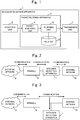
- Fig. 1 is a diagram illustrating a configuration example of the packet filtering apparatus according to a first embodiment.
- Fig. 2 is a diagram illustrating a network configuration example (No. 1) of an intrusion detection apparatus to which the packet filtering apparatus according to the first embodiment is applied.
- Fig. 3 is a diagram illustrating a network configuration example (No. 2) of the intrusion detection apparatus to which the packet filtering apparatus according to the first embodiment is applied.
- FIG. 2 illustrates a configuration in which the intrusion detection apparatus is added to a standard network configuration as described above. That is, an internal network 10 such as the in-house LAN is connected to an external network 8 such as the Internet, via an intrusion detection apparatus 1 and a firewall 9.
- the firewall 9 and the intrusion detection apparatus 1 are illustrated as different blocks due to a functional difference, the firewall 9 and the intrusion detection apparatus 1 may be different apparatuses or the same apparatus, as a physical apparatus.
- the network configuration of Fig. 3 illustrates another example of the network configuration to which the packet filtering apparatus is applied.
- a difference from Fig. 2 is a position where the intrusion detection apparatus 1 is installed.
- the intrusion detection apparatus 1 is installed at the midway of a communication line connecting the firewall 9 and the internal network 10, and communication between the firewall 9 and the internal network 10 is blocked.
- the intrusion detection apparatus 1 is installed at the end of a communication line which is branched from the midway of a communication line between the firewall 9 and the internal network 10, and communication between the firewall 9 and the internal network 10 is not blocked.
- This difference in the installation position is associated with how to process a packet as a result of intrusion detection to the packet. That is, in a case where the packet is blocked as the result of intrusion detection, the configuration of Fig. 2 is necessary. In a case where the packet is not blocked, and for example, only an alert is raised, the configuration of Fig. 3 is sufficient.
- the intrusion detection apparatus 1 includes a reception unit 2 that receives a packet passed through the firewall 9, a packet filtering apparatus 3 that permits or denies communication of the received packet, and a transmission unit 7 that transmits the packet the communication of which has been permitted to an internal network.
- the packet filtering apparatus 3 includes a packet analyzing unit 4, a rule set 5, and a filtering unit 6.
- the packet analyzing unit 4 analyzes the received packet and extracts collation information to be collated with a condition of a rule.
- the rule set 5 contains the rule in which the condition and an action are associated with each other.
- the filtering unit 6 collates the collation information extracted from the packet with the condition of the rule and executes the action of the rule such that the collation information matches the condition.
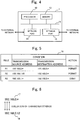
- Fig. 4 is a diagram illustrating a hardware configuration example of the intrusion detection apparatus 1.
- the intrusion detection apparatus 1 is realized as a hardware configuration which is the same as that of a general computer, and has a configuration in which a processor 12, a memory 13, and network ports 14 and 15 for a LAN and the like are connected to a bus 11.
- a processor 12 a memory 13
- network ports 14 and 15 for a LAN and the like are connected to a bus 11.
- two network ports are included on the assumption of the system configuration of Fig. 2 , and the network port 14 is connected to the external network side and the network port 15 is connected to the internal network side.
- the reception unit 2 is the network port 14, and the transmission unit 7 is the network port 15.
- the processor 12 is a Central Processing Unit (CPU) or the like that executes a program.
- the memory 13 is, for example, a Random Access Memory (RAM) or the like.
- the program is loaded into the memory 13 to be sequentially read and executed by the processor 12.
- This program is a program that realizes functions described as the packet analyzing unit 4 and the filtering unit 6 constituting the packet filtering apparatus 3.
- information and data stored in the rule set 5, and information, data, a signal value, and a variable value indicating a result of processing of the filtering unit 6 are stored as a file in the memory 13.
- Fig. 4 is merely an example of a hardware configuration of each apparatus, and the hardware configuration of each apparatus is not limited to the configuration illustrated in Fig. 4 , but may be another configuration.
- Fig. 5 is a diagram illustrating an example of a rule set for detecting intrusion.
- Fig. 5 illustrates a rule set 16 consisting of 3 rules, as the example of the rule set for detecting intrusion.
- the rule set 16 indicates an example in which a transmission source address and a transmission destination address of an IP packet are collated as a condition, and communication is permitted or denied as an action in accordance with a collation result.
- An asterisk * included in the rule represents a wildcard allowing an arbitrary value.
- a rule R1 means that if the transmission source address and the transmission destination address of a packet are 192.168.0.* and 192.168.0.*, respectively, communication of that packet is permitted.
- a rule R2 means that if the transmission source address and the transmission destination address of a packet are 192.168.1.10 and 192.168.0.*, respectively, communication of that packet is permitted.
- a rule R3 means that if the transmission source address and the transmission destination address of a packet are 192.168.1.* and 192.168.0.*, respectively, communication of that packet is denied.
- rule set 16 of Fig. 5 is described as a text file, and the collation of packets and rules described above is realized as collation of character strings.
- Fig. 6 is a diagram explaining collation of character strings of a packet and a rule.
- Fig. 6 it is determined whether or not the rule and the packet match by comparing, character string by character string, a character string 17 of the transmission source address described in the rule and a character string 18 of the transmission source address of the packet.
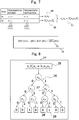
- Fig. 7 is a diagram explaining the example in which the rule set is described by the logical expression.
- an address is a 3-bit value (an integer value in a range from 0 to 7), and an action of when a rule and a packet matches is omitted.
- values of transmission source and transmission destination that are conditions of matching are represented in binary notation. For example, a rule R1 matches a packet whose transmission source address is 11* and transmission destination address is ***. If this is represented in decimal notation, the rule R1 matches a packet whose transmission source address is 6 or 7 and transmission destination address is in a range from 0 to 7.
- 6 bits in total which are the transmission source and transmission destination addresses are used as a condition. It is supposed that the respective 6 bits are regarded as logical variables x1, x2, ..., and x6. Then, the rule R1 is satisfied when both of x1 and x2 are 1, and the values of the other logical variables may be any value.
- Such a condition can be represented by a logical product of logical variables. In a case of the rule R1, it can be represented as a logical product 19. In fact, since the logical product 19 is 1 only when both of x1 and x2 are 1, the matching of the packet and the rule can be determined based on whether or not the value of the logical product 19 is 1.
- a rule R2 can be represented as a logical product 20, and a rule in which the rules R1 and R2 are combined can be represented as a logical sum 21 of those.
- a dependency relationship between rules and a filtering result changes depending on order in which the rules are collated. Therefore, it is necessary to note that such a dependency relationship will be lost if a logical sum such as 21 is simply taken. In order to prevent this, it is necessary to change the rule before taking the logical sum and to take a logical sum as indicated in 22.
- f(R) represents a logical expression corresponding to a rule R.
- a logical product 23 means that "the rule R1 is not satisfied, and the rule R2 is satisfied".
- the rule R1 is satisfied
- the logical product 23 is not satisfied. That is, whether or not the rule R2 is satisfied is ignored. Therefore, it is understood that the original dependency relationship is realized in which the rule R1 is collated first.
- Fig. 8 is a diagram explaining the example in which the logical expression is represented by the tree structure.
- a logical expression 25 is represented by the tree structure called a binary decision tree.
- the binary decision tree if a branch is followed in accordance with a value of a logical variable, a value of a logical expression is given as a terminal node.
- a logical expression is calculated by a data structure called a Zero-Suppressed Binary Decision Diagram (ZDD) in which a binary decision tree is simplified.
- ZDD Zero-Suppressed Binary Decision Diagram
- Fig. 9 is a diagram illustrating an example in which the logical expression is represented by the data structure using the ZDD.
- a ZDD 30 is a simplified version of the binary decision tree 24 in accordance with a simplification rule described below.
- the ZDD is a data structure suitable for performing an operation on a combination set such as 31.
- the combination set is a set whose element is a combination of variables.
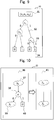
- Fig. 10 is a diagram explaining the simplification rule of the binary decision tree.
- a branch source of the node 38 is a subtree 37
- a destination branched from the node 38 with a value 0 is a subtree 39
- a destination branched from the node 38 with a value 1 is a terminal node 40
- the value of the terminal node 40 is 0.
- the node 38 is deleted, simplification to connect the subtree 37 and the subtree 39 is executed, and a simplified binary decision tree 41 is obtained.
- the ZDD is utilized not for an operation on a combination set, but for calculation of a logical expression.
- Fig. 11 is a diagram illustrating an example of a calculation result of a logical expression using the ZDD.
- Fig. 11 the logical expression to be calculated is 42, and this is the same as 25 in Fig. 8 .
- This logical expression is represented by the ZDD indicated by 30 in Fig. 10 , and a value of this logical expression is calculated by following branches of the ZDD indicated by 30. Calculation results obtained in this way is indicated in Fig. 11 .
- this calculation result is correct even if a check whether or not a value is 0 is omitted in the middle, that is, even if a value of a logical variable whose check is omitted is any value.
- This fact is derived from the simplification rule indicated in 35 of Fig. 10 .
- a calculation error using the ZDD occurs when a calculation result using the ZDD is 1 and when a logical variable whose value is 1 is included in logical variables whose check of values is omitted during a calculation process using the ZDD. Therefore, when the calculation result using the ZDD is 1, the calculation result using the ZDD is correct if all of values of variables are 0, the values whose check is omitted during the calculation process of the ZDD. Otherwise, the calculation result using the ZDD is incorrect, and a correct result is 0. From this fact, when the calculation result using the ZDD is 1, the correct result can be obtained by checking whether or not all of the values are 0 with respect to the variables whose check of values is omitted during the calculation process of the ZDD.
- Fig. 12 is the flowchart illustrating a calculation flow of the logical expression using the ZDD.
- n-bit input data 44 is input to the filtering unit 6.
- This input data corresponds to the collation information to be collated with the condition of the rule output by the packet analyzing unit 4.
- the filtering unit 6 holds the input data 44 in an n-bit temporary variable 45.
- a k-th bit of the input data corresponds to a logical variable x(k)
- a k-th bit of the temporary variable 45 is represented as x(k).
- x (x(1), ..., x(n)).
- steps S102 to S106 are a loop corresponding to a process of following a branch in the ZDD. According to this, the calculation of the logical expression using the ZDD is executed. If it is assumed that x(k) is a logical variable of a node which is currently paid attention in the ZDD, a value of x(k) being the k-th bit of the temporary variable is checked in a step S103. In accordance with that value, the branch is followed in a step S104. Then, x(k) being the k-th bit of the temporary variable is set to 0 in a step S105.
- the loop is exited and the process is branched in accordance with the calculation result of the ZDD in a step S107. If the calculation result is 0, it is confirmed that this is a correct result so that 0 is output as a final result in a step S109. On the other hand, if the calculation result is 1 in the step S107, it is not yet confirmed whether or not this calculation result is correct. Thus, in order to confirm that, the process proceeds to the 0 determination in a step S108.
- step S108 it is determined whether or not the temporary variable x is 0. If 0, 1 is output as the final result in a step S110. If not 0, 0 is output as the final result in the step S109. However, in the 0 determination in the step S108, the 0 determination for each bit x(k) is not performed n times in total, but the 0 determination for the n-bit value x is performed once.
- an effect can be obtained such that, in the packet filtering apparatus of the first embodiment, it is possible to reduce a data size to be held for calculation of a logical expression by describing the logical expression using a ZDD, and although a calculation error occurs when the ZDD is used for the calculation of the logical expression, it is also possible to calculate the logical expression correctly at high speed by providing a mechanism to correct the error.
- a ZDD increases an effect of reducing a size by simplification.
- the size can be further reduced at a time when a logical expression is described using the ZDD by converting a logical variable to make data sparse by utilizing statistical property of actual communication generated in a target system before describing a rule of a packet filter as the logical expression.
- the rate at which each bit is 0 will be higher in the packet data after inversion.
- the rate at which each bit of the packet data is 0 or 1 can be obtained by observing the actual communication in advance before full operation of the target system.
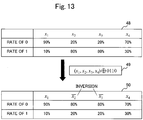
- Fig. 13 is a diagram explaining a bit inversion process according to the second embodiment.
- Fig. 13 illustrates a method of making the rate at which each bit in the packet data is 0 higher by inverting values of logical variables.
- a table 48 illustrates an example of the statistical data obtained as a result of observing the actual communication in a certain system.
- a rate at which the first bit x1 of a packet is 0 is 90 %, and a rate at which the first bit x1 of the packet is 1 is 10%.
- the rate at which 0 appears is higher. Therefore, when the ZDD is used to express the logical expression, it is expected that a part related to x1 will be largely simplified.
- a rate at which the second bit x2 is 0 is 20%, and a rate at which the second bit x2 is 1 is 80%. In the second bit, the rate at which 1 appears is higher. Therefore, when the ZDD is used to express the logical expression, it is considered that a part related to x2 is not much simplified.
- the rate of 0 is set to 80%, and the rate of 1 is set to 20%. As a result, the rate at which 0 appears becomes higher in the inverted second bit.
- the ZDD is used to express the logical expression, it is expected that a part related to the inverted x2 will be largely simplified.
- inversion of a bit corresponds to taking logical negation for a logical variable, and "the inverted x2" means "logical negation of x2".
- exclusive OR with a 4-bit value 0110 is performed on a 4-bit value (x1, x2, x3, x4) as illustrated in a logical expression 49 and values of the second and third bits are thereby inverted, it is possible to make the rate at which 0 appears is higher in all of the bits as illustrated in a table 50.
- the small-sized ZDD can be obtained.
- the ZDD created with performing the bit inversion process is called a bit inversion ZDD.
- a filtering result for the packet after the bit inversion is equal to a filtering result for the original packet. Therefore, the same filtering result as the original can be obtained while the size of the ZDD is reduced by the bit inversion process.
- the bit inversion process is performed as needed so that the rate at which the value is 0 is higher in all of the bits and thus the data becomes sparse. Therefore, an effect can be obtained such that when the rule for the packet filter is expressed by the logical expression using the logical variables corresponding to the sparse data and the rule is expressed using the ZDD, it is possible to reduce the size of the ZDD.
Landscapes
- Engineering & Computer Science (AREA)
- Computer Security & Cryptography (AREA)
- Computer Networks & Wireless Communication (AREA)
- Signal Processing (AREA)
- Computer Hardware Design (AREA)
- Computing Systems (AREA)
- General Engineering & Computer Science (AREA)
- Business, Economics & Management (AREA)
- General Business, Economics & Management (AREA)
- Data Exchanges In Wide-Area Networks (AREA)
Claims (3)
- Paketfilterungsvorrichtung (3), die Folgendes umfasst:einen Regelsatz (5), der eine Regel, in der ein Zustand und eine Aktion einander zugeordnet sind, und ein null-unterdrücktes binäres Entscheidungsdiagramm, ZDD, umfasst, das einen Logikausdruck umfasst, in dem der Zustand der Regel mithilfe einer logischen Variablen beschrieben ist;eine Paketanalyseeinheit (4) zum Analysieren eines von einem Netzwerk empfangenen Pakets und Extrahieren von Kollationsinformationen, die eine zu kollatierende Zeichenfolge sind; undeine Filtereinheit (6) zum Kollatieren der von der Paketanalyseeinheit (4) extrahierten Kollationsinformationen mit dem ZDD, Ausführen der Aktion, die dem zu den Kollationsinformationen passenden Zustand zugeordnet ist, und Zulassen oder Verweigern der Kommunikation des Pakets,dadurch gekennzeichnet, dassdie Filtereinheit (6) beim Kollatieren der Kollationsinformationen mit dem ZDD einen Wert der logischen Variable, für den das Kollatieren mit 0 abgeschlossen wurde, überschreibt und bestimmt, ob ein Wert des Logikausdrucks, einschließlich der mit 0 überschriebenen logischen Variable, 0 ist, wenn das Kollatieren im gesamten ZDD abgeschlossen wurde.
- Paketfilterungsvorrichtung (3) nach Anspruch 1,
wobei die Filterungsvorrichtung (6), wenn das Kollatieren im gesamten ZDD abgeschlossen ist, falls der mithilfe des ZDD berechnete Wert des Logikausdrucks 0 ist, ein Bestimmungsergebnis des Werts des Logikausdrucks auf 0 setzt; falls der mithilfe des ZDD berechnete Wert des Logikausdrucks 1 ist, das Bestimmungsergebnis des Werts des Logikausdrucks auf 1 setzt, wenn der Wert des Logikausdrucks, einschließlich der mit 0 überschriebenen logischen Variable, 0 ist, und das Bestimmungsergebnis des Werts des Logikausdrucks auf 0 setzt, wenn der Wert des Logikausdrucks, einschließlich der mit 0 überschriebenen logischen Variable, nicht 0 ist. - Paketfilterungsverfahren einer Paketfilterungsvorrichtung (3), umfassend eine Speichereinheit zum Speichern eines Regelsatzes (5), der eine Regel, in der ein Zustand und eine Aktion einander zugeordnet sind, und ein null-unterdrücktes binäres Entscheidungsdiagramm, ZDD, umfasst, das einen Logikausdruck umfasst, in dem der Zustand der Regel mithilfe einer logischen Variable beschrieben ist, eine Paketanalyseeinheit (4) und eine Filtereinheit (6), wobei das Paketfilterungsverfahren Folgendes umfasst:einen Paketanalyseschritt zum Analysieren eines von einem Netzwerk empfangenen Pakets und Extrahieren von Kollationsinformationen, die eine zu kontierende Zeichenfolge sind, durch die Paketanalyseeinheit (4); undeinen Filterungsschritt zum Kollatieren der von der Paketanalyseeinheit (4) extrahierten Kollationsinformationen mit dem in der Speichereinheit gespeicherten ZDD, Ausführen der Aktion, die dem zu den Kollationsinformationen passenden Zustand zugeordnet ist, und Zulassen oder Verweigern der Kommunikation des Pakets, durch die Filtereinheit (6);dadurch gekennzeichnet, dassdie Filtereinheit (6) beim Kollatieren der Kollationsinformationen mit dem ZDD einen Wert der logischen Variable, für den das Kollatieren mit 0 abgeschlossen wurde, überschreibt und bestimmt, ob ein Wert des Logikausdrucks, einschließlich der mit 0 überschriebenen logischen Variable, 0 ist, wenn das Kollatieren im gesamten ZDD abgeschlossen wurde.
Applications Claiming Priority (1)
| Application Number | Priority Date | Filing Date | Title |
|---|---|---|---|
| PCT/JP2015/064024 WO2016185513A1 (ja) | 2015-05-15 | 2015-05-15 | パケットフィルタ装置、及びパケットフィルタ方法 |
Publications (3)
| Publication Number | Publication Date |
|---|---|
| EP3288222A1 EP3288222A1 (de) | 2018-02-28 |
| EP3288222A4 EP3288222A4 (de) | 2018-12-05 |
| EP3288222B1 true EP3288222B1 (de) | 2019-11-13 |
Family
ID=57319573
Family Applications (1)
| Application Number | Title | Priority Date | Filing Date |
|---|---|---|---|
| EP15892514.9A Active EP3288222B1 (de) | 2015-05-15 | 2015-05-15 | Paketfilterungsvorrichtung sowie paketfilterungsverfahren |
Country Status (6)
| Country | Link |
|---|---|
| US (1) | US9979697B2 (de) |
| EP (1) | EP3288222B1 (de) |
| JP (1) | JP6355836B2 (de) |
| CN (1) | CN107534601B (de) |
| TW (1) | TWI598763B (de) |
| WO (1) | WO2016185513A1 (de) |
Families Citing this family (5)
| Publication number | Priority date | Publication date | Assignee | Title |
|---|---|---|---|---|
| PL3618389T3 (pl) | 2018-08-27 | 2021-04-06 | Ovh | Systemy i sposoby obsługiwania urządzenia sieciowego |
| JP7186637B2 (ja) * | 2019-02-21 | 2022-12-09 | 三菱電機株式会社 | 検知ルール群調整装置および検知ルール群調整プログラム |
| CN112583763B (zh) * | 2019-09-27 | 2022-09-09 | 财团法人资讯工业策进会 | 入侵侦测装置以及入侵侦测方法 |
| TWI736457B (zh) * | 2020-10-27 | 2021-08-11 | 財團法人資訊工業策進會 | 動態網路特徵處理裝置以及動態網路特徵處理方法 |
| JP2022167309A (ja) * | 2021-04-23 | 2022-11-04 | 富士通株式会社 | 要素追加プログラム及び要素追加方法 |
Family Cites Families (22)
| Publication number | Priority date | Publication date | Assignee | Title |
|---|---|---|---|---|
| US5493504A (en) | 1992-10-28 | 1996-02-20 | Nippon Telegraph And Telephone Corporation | System and method for processing logic function and fault diagnosis using binary tree representation |
| JP2985922B2 (ja) | 1992-10-28 | 1999-12-06 | 日本電信電話株式会社 | 論理関数データ処理装置 |
| CA2287689C (en) | 1998-12-03 | 2003-09-30 | P. Krishnan | Adaptive re-ordering of data packet filter rules |
| US6651096B1 (en) * | 1999-04-20 | 2003-11-18 | Cisco Technology, Inc. | Method and apparatus for organizing, storing and evaluating access control lists |
| US6473763B1 (en) | 2000-03-31 | 2002-10-29 | International Business Machines Corporation | System, method and computer program for filtering multi-action rule set |
| US7188091B2 (en) * | 2001-03-21 | 2007-03-06 | Resolutionebs, Inc. | Rule processing system |
| US7761397B2 (en) * | 2001-03-21 | 2010-07-20 | Huelsman David L | Rule processing method and apparatus providing automatic user input selections |
| US7366910B2 (en) | 2001-07-17 | 2008-04-29 | The Boeing Company | System and method for string filtering |
| US7962591B2 (en) | 2004-06-23 | 2011-06-14 | Mcafee, Inc. | Object classification in a capture system |
| EP1762079A1 (de) | 2004-06-23 | 2007-03-14 | Qualcomm Incorporated | Effiziente netzwerkpaketeklassifizierung |
| US7540025B2 (en) | 2004-11-18 | 2009-05-26 | Cisco Technology, Inc. | Mitigating network attacks using automatic signature generation |
| JP4774307B2 (ja) | 2006-02-06 | 2011-09-14 | アラクサラネットワークス株式会社 | 不正アクセス監視装置及びパケット中継装置 |
| US8429749B2 (en) * | 2007-03-27 | 2013-04-23 | National Institute Of Advanced Industrial Science And Technology | Packet data comparator as well as virus filter, virus checker and network system using the same |
| JP5223380B2 (ja) * | 2008-03-03 | 2013-06-26 | 富士通株式会社 | 評価方法および検索装置 |
| US8290934B2 (en) | 2008-08-06 | 2012-10-16 | Fujitsu Limited | Method and system for processing access control lists using a hashing scheme |
| US8254502B2 (en) | 2008-12-22 | 2012-08-28 | Qualcomm Incorporated | Post decoding soft interference cancellation |
| CN102262707B (zh) * | 2010-05-28 | 2016-01-13 | 南德克萨斯加速研究治疗有限责任公司 | 用于管理临床研究数据的机器和方法 |
| US20130235884A1 (en) * | 2012-03-11 | 2013-09-12 | Broadcom Corporation | Mixed serial and parallel stream channel bonding architecture |
| US9578061B2 (en) * | 2013-03-13 | 2017-02-21 | FireMon, LLC | System and method for modeling a networking device policy |
| US9838729B2 (en) * | 2013-11-06 | 2017-12-05 | Avago Technologies General Ip (Singapore) Pte. Ltd. | Recovering channel bonded program streams |
| CN104202303A (zh) * | 2014-08-11 | 2014-12-10 | 华中科技大学 | 一种sdn应用的策略冲突检测方法及系统 |
| WO2017042396A1 (en) * | 2015-09-10 | 2017-03-16 | F. Hoffmann-La Roche Ag | Informatics platform for integrated clinical care |
-
2015
- 2015-05-15 US US15/559,787 patent/US9979697B2/en not_active Expired - Fee Related
- 2015-05-15 CN CN201580079357.6A patent/CN107534601B/zh not_active Expired - Fee Related
- 2015-05-15 EP EP15892514.9A patent/EP3288222B1/de active Active
- 2015-05-15 WO PCT/JP2015/064024 patent/WO2016185513A1/ja not_active Ceased
- 2015-05-15 JP JP2017518626A patent/JP6355836B2/ja not_active Expired - Fee Related
- 2015-05-25 TW TW104116608A patent/TWI598763B/zh not_active IP Right Cessation
Non-Patent Citations (1)
| Title |
|---|
| None * |
Also Published As
| Publication number | Publication date |
|---|---|
| TW201640403A (zh) | 2016-11-16 |
| EP3288222A4 (de) | 2018-12-05 |
| US20180069835A1 (en) | 2018-03-08 |
| EP3288222A1 (de) | 2018-02-28 |
| JP6355836B2 (ja) | 2018-07-11 |
| CN107534601A (zh) | 2018-01-02 |
| TWI598763B (zh) | 2017-09-11 |
| US9979697B2 (en) | 2018-05-22 |
| CN107534601B (zh) | 2018-11-20 |
| JPWO2016185513A1 (ja) | 2017-07-20 |
| WO2016185513A1 (ja) | 2016-11-24 |
Similar Documents
| Publication | Publication Date | Title |
|---|---|---|
| Clincy et al. | Web application firewall: Network security models and configuration | |
| US9602532B2 (en) | Method and apparatus for optimizing finite automata processing | |
| EP3796196A1 (de) | Vorrichtung und verfahren zur erfassung von anomalien | |
| US9979697B2 (en) | Packet filtering apparatus and packet filtering method | |
| US10339319B2 (en) | Method and apparatus for identifying vulnerability information using keyword analysis for banner of open port | |
| CN112887304A (zh) | 基于字符级神经网络的web应用入侵检测方法及系统 | |
| EP3522488B1 (de) | Automatische decoy-ableitung durch patch-transformation | |
| US8543528B2 (en) | Exploitation of transition rule sharing based on short state tags to improve the storage efficiency | |
| EP3192226B1 (de) | Vorrichtung und verfahren zur steuerung eines kommunikationsnetzwerks | |
| US8380991B2 (en) | Hash function based on polymorphic code | |
| EP3935540B1 (de) | Rückorientierter programmierschutz | |
| US12596812B2 (en) | Attack route extraction system, attack route extraction method, and program | |
| CN113765852B (zh) | 数据包的检测方法、系统、存储介质和计算设备 | |
| CN119046951B (zh) | 固件漏洞挖掘的方法、装置、设备及存储介质 | |
| US20160292416A1 (en) | System and method for identifying a file path using tree data structure | |
| US12361126B2 (en) | Automatic detection of malware families and variants without the presence of malware files based on structure presentation | |
| US10419346B1 (en) | Hash computation using memristor-implemented dot product engine | |
| CN115277087B (zh) | 一种规则匹配方法及装置 | |
| JP7552897B2 (ja) | 分析装置、分析方法、および、分析システム | |
| WO2020070918A1 (ja) | 変換装置及び変換プログラム | |
| JP7483174B2 (ja) | 攻撃検知装置、攻撃検知方法、及び攻撃検知プログラム | |
| WO2020012474A1 (en) | Return-oriented programming attack protection system and method |
Legal Events
| Date | Code | Title | Description |
|---|---|---|---|
| STAA | Information on the status of an ep patent application or granted ep patent |
Free format text: STATUS: THE INTERNATIONAL PUBLICATION HAS BEEN MADE |
|
| PUAI | Public reference made under article 153(3) epc to a published international application that has entered the european phase |
Free format text: ORIGINAL CODE: 0009012 |
|
| STAA | Information on the status of an ep patent application or granted ep patent |
Free format text: STATUS: REQUEST FOR EXAMINATION WAS MADE |
|
| 17P | Request for examination filed |
Effective date: 20171025 |
|
| AK | Designated contracting states |
Kind code of ref document: A1 Designated state(s): AL AT BE BG CH CY CZ DE DK EE ES FI FR GB GR HR HU IE IS IT LI LT LU LV MC MK MT NL NO PL PT RO RS SE SI SK SM TR |
|
| AX | Request for extension of the european patent |
Extension state: BA ME |
|
| DAV | Request for validation of the european patent (deleted) | ||
| DAX | Request for extension of the european patent (deleted) | ||
| A4 | Supplementary search report drawn up and despatched |
Effective date: 20181106 |
|
| RIC1 | Information provided on ipc code assigned before grant |
Ipc: H04L 29/06 20060101ALI20181030BHEP Ipc: H04L 12/66 20060101AFI20181030BHEP |
|
| GRAP | Despatch of communication of intention to grant a patent |
Free format text: ORIGINAL CODE: EPIDOSNIGR1 |
|
| STAA | Information on the status of an ep patent application or granted ep patent |
Free format text: STATUS: GRANT OF PATENT IS INTENDED |
|
| INTG | Intention to grant announced |
Effective date: 20190710 |
|
| GRAS | Grant fee paid |
Free format text: ORIGINAL CODE: EPIDOSNIGR3 |
|
| GRAA | (expected) grant |
Free format text: ORIGINAL CODE: 0009210 |
|
| STAA | Information on the status of an ep patent application or granted ep patent |
Free format text: STATUS: THE PATENT HAS BEEN GRANTED |
|
| AK | Designated contracting states |
Kind code of ref document: B1 Designated state(s): AL AT BE BG CH CY CZ DE DK EE ES FI FR GB GR HR HU IE IS IT LI LT LU LV MC MK MT NL NO PL PT RO RS SE SI SK SM TR |
|
| REG | Reference to a national code |
Ref country code: CH Ref legal event code: EP Ref country code: AT Ref legal event code: REF Ref document number: 1202837 Country of ref document: AT Kind code of ref document: T Effective date: 20191115 |
|
| REG | Reference to a national code |
Ref country code: DE Ref legal event code: R096 Ref document number: 602015041853 Country of ref document: DE |
|
| REG | Reference to a national code |
Ref country code: IE Ref legal event code: FG4D |
|
| REG | Reference to a national code |
Ref country code: NL Ref legal event code: MP Effective date: 20191113 |
|
| REG | Reference to a national code |
Ref country code: LT Ref legal event code: MG4D |
|
| PG25 | Lapsed in a contracting state [announced via postgrant information from national office to epo] |
Ref country code: PT Free format text: LAPSE BECAUSE OF FAILURE TO SUBMIT A TRANSLATION OF THE DESCRIPTION OR TO PAY THE FEE WITHIN THE PRESCRIBED TIME-LIMIT Effective date: 20200313 Ref country code: LV Free format text: LAPSE BECAUSE OF FAILURE TO SUBMIT A TRANSLATION OF THE DESCRIPTION OR TO PAY THE FEE WITHIN THE PRESCRIBED TIME-LIMIT Effective date: 20191113 Ref country code: SE Free format text: LAPSE BECAUSE OF FAILURE TO SUBMIT A TRANSLATION OF THE DESCRIPTION OR TO PAY THE FEE WITHIN THE PRESCRIBED TIME-LIMIT Effective date: 20191113 Ref country code: PL Free format text: LAPSE BECAUSE OF FAILURE TO SUBMIT A TRANSLATION OF THE DESCRIPTION OR TO PAY THE FEE WITHIN THE PRESCRIBED TIME-LIMIT Effective date: 20191113 Ref country code: NO Free format text: LAPSE BECAUSE OF FAILURE TO SUBMIT A TRANSLATION OF THE DESCRIPTION OR TO PAY THE FEE WITHIN THE PRESCRIBED TIME-LIMIT Effective date: 20200213 Ref country code: GR Free format text: LAPSE BECAUSE OF FAILURE TO SUBMIT A TRANSLATION OF THE DESCRIPTION OR TO PAY THE FEE WITHIN THE PRESCRIBED TIME-LIMIT Effective date: 20200214 Ref country code: LT Free format text: LAPSE BECAUSE OF FAILURE TO SUBMIT A TRANSLATION OF THE DESCRIPTION OR TO PAY THE FEE WITHIN THE PRESCRIBED TIME-LIMIT Effective date: 20191113 Ref country code: FI Free format text: LAPSE BECAUSE OF FAILURE TO SUBMIT A TRANSLATION OF THE DESCRIPTION OR TO PAY THE FEE WITHIN THE PRESCRIBED TIME-LIMIT Effective date: 20191113 Ref country code: BG Free format text: LAPSE BECAUSE OF FAILURE TO SUBMIT A TRANSLATION OF THE DESCRIPTION OR TO PAY THE FEE WITHIN THE PRESCRIBED TIME-LIMIT Effective date: 20200213 Ref country code: NL Free format text: LAPSE BECAUSE OF FAILURE TO SUBMIT A TRANSLATION OF THE DESCRIPTION OR TO PAY THE FEE WITHIN THE PRESCRIBED TIME-LIMIT Effective date: 20191113 |
|
| PG25 | Lapsed in a contracting state [announced via postgrant information from national office to epo] |
Ref country code: RS Free format text: LAPSE BECAUSE OF FAILURE TO SUBMIT A TRANSLATION OF THE DESCRIPTION OR TO PAY THE FEE WITHIN THE PRESCRIBED TIME-LIMIT Effective date: 20191113 Ref country code: IS Free format text: LAPSE BECAUSE OF FAILURE TO SUBMIT A TRANSLATION OF THE DESCRIPTION OR TO PAY THE FEE WITHIN THE PRESCRIBED TIME-LIMIT Effective date: 20200313 Ref country code: HR Free format text: LAPSE BECAUSE OF FAILURE TO SUBMIT A TRANSLATION OF THE DESCRIPTION OR TO PAY THE FEE WITHIN THE PRESCRIBED TIME-LIMIT Effective date: 20191113 |
|
| PG25 | Lapsed in a contracting state [announced via postgrant information from national office to epo] |
Ref country code: AL Free format text: LAPSE BECAUSE OF FAILURE TO SUBMIT A TRANSLATION OF THE DESCRIPTION OR TO PAY THE FEE WITHIN THE PRESCRIBED TIME-LIMIT Effective date: 20191113 |
|
| PG25 | Lapsed in a contracting state [announced via postgrant information from national office to epo] |
Ref country code: RO Free format text: LAPSE BECAUSE OF FAILURE TO SUBMIT A TRANSLATION OF THE DESCRIPTION OR TO PAY THE FEE WITHIN THE PRESCRIBED TIME-LIMIT Effective date: 20191113 Ref country code: DK Free format text: LAPSE BECAUSE OF FAILURE TO SUBMIT A TRANSLATION OF THE DESCRIPTION OR TO PAY THE FEE WITHIN THE PRESCRIBED TIME-LIMIT Effective date: 20191113 Ref country code: EE Free format text: LAPSE BECAUSE OF FAILURE TO SUBMIT A TRANSLATION OF THE DESCRIPTION OR TO PAY THE FEE WITHIN THE PRESCRIBED TIME-LIMIT Effective date: 20191113 Ref country code: ES Free format text: LAPSE BECAUSE OF FAILURE TO SUBMIT A TRANSLATION OF THE DESCRIPTION OR TO PAY THE FEE WITHIN THE PRESCRIBED TIME-LIMIT Effective date: 20191113 Ref country code: CZ Free format text: LAPSE BECAUSE OF FAILURE TO SUBMIT A TRANSLATION OF THE DESCRIPTION OR TO PAY THE FEE WITHIN THE PRESCRIBED TIME-LIMIT Effective date: 20191113 |
|
| REG | Reference to a national code |
Ref country code: DE Ref legal event code: R097 Ref document number: 602015041853 Country of ref document: DE |
|
| REG | Reference to a national code |
Ref country code: AT Ref legal event code: MK05 Ref document number: 1202837 Country of ref document: AT Kind code of ref document: T Effective date: 20191113 |
|
| PG25 | Lapsed in a contracting state [announced via postgrant information from national office to epo] |
Ref country code: SM Free format text: LAPSE BECAUSE OF FAILURE TO SUBMIT A TRANSLATION OF THE DESCRIPTION OR TO PAY THE FEE WITHIN THE PRESCRIBED TIME-LIMIT Effective date: 20191113 Ref country code: SK Free format text: LAPSE BECAUSE OF FAILURE TO SUBMIT A TRANSLATION OF THE DESCRIPTION OR TO PAY THE FEE WITHIN THE PRESCRIBED TIME-LIMIT Effective date: 20191113 |
|
| PLBE | No opposition filed within time limit |
Free format text: ORIGINAL CODE: 0009261 |
|
| STAA | Information on the status of an ep patent application or granted ep patent |
Free format text: STATUS: NO OPPOSITION FILED WITHIN TIME LIMIT |
|
| 26N | No opposition filed |
Effective date: 20200814 |
|
| PG25 | Lapsed in a contracting state [announced via postgrant information from national office to epo] |
Ref country code: SI Free format text: LAPSE BECAUSE OF FAILURE TO SUBMIT A TRANSLATION OF THE DESCRIPTION OR TO PAY THE FEE WITHIN THE PRESCRIBED TIME-LIMIT Effective date: 20191113 Ref country code: AT Free format text: LAPSE BECAUSE OF FAILURE TO SUBMIT A TRANSLATION OF THE DESCRIPTION OR TO PAY THE FEE WITHIN THE PRESCRIBED TIME-LIMIT Effective date: 20191113 |
|
| REG | Reference to a national code |
Ref country code: DE Ref legal event code: R119 Ref document number: 602015041853 Country of ref document: DE |
|
| PG25 | Lapsed in a contracting state [announced via postgrant information from national office to epo] |
Ref country code: LI Free format text: LAPSE BECAUSE OF NON-PAYMENT OF DUE FEES Effective date: 20200531 Ref country code: IT Free format text: LAPSE BECAUSE OF FAILURE TO SUBMIT A TRANSLATION OF THE DESCRIPTION OR TO PAY THE FEE WITHIN THE PRESCRIBED TIME-LIMIT Effective date: 20191113 Ref country code: CH Free format text: LAPSE BECAUSE OF NON-PAYMENT OF DUE FEES Effective date: 20200531 Ref country code: MC Free format text: LAPSE BECAUSE OF FAILURE TO SUBMIT A TRANSLATION OF THE DESCRIPTION OR TO PAY THE FEE WITHIN THE PRESCRIBED TIME-LIMIT Effective date: 20191113 |
|
| REG | Reference to a national code |
Ref country code: BE Ref legal event code: MM Effective date: 20200531 |
|
| GBPC | Gb: european patent ceased through non-payment of renewal fee |
Effective date: 20200515 |
|
| PG25 | Lapsed in a contracting state [announced via postgrant information from national office to epo] |
Ref country code: LU Free format text: LAPSE BECAUSE OF NON-PAYMENT OF DUE FEES Effective date: 20200515 |
|
| PG25 | Lapsed in a contracting state [announced via postgrant information from national office to epo] |
Ref country code: GB Free format text: LAPSE BECAUSE OF NON-PAYMENT OF DUE FEES Effective date: 20200515 Ref country code: IE Free format text: LAPSE BECAUSE OF NON-PAYMENT OF DUE FEES Effective date: 20200515 Ref country code: FR Free format text: LAPSE BECAUSE OF NON-PAYMENT OF DUE FEES Effective date: 20200531 |
|
| PG25 | Lapsed in a contracting state [announced via postgrant information from national office to epo] |
Ref country code: BE Free format text: LAPSE BECAUSE OF NON-PAYMENT OF DUE FEES Effective date: 20200531 Ref country code: DE Free format text: LAPSE BECAUSE OF NON-PAYMENT OF DUE FEES Effective date: 20201201 |
|
| PG25 | Lapsed in a contracting state [announced via postgrant information from national office to epo] |
Ref country code: TR Free format text: LAPSE BECAUSE OF FAILURE TO SUBMIT A TRANSLATION OF THE DESCRIPTION OR TO PAY THE FEE WITHIN THE PRESCRIBED TIME-LIMIT Effective date: 20191113 Ref country code: MT Free format text: LAPSE BECAUSE OF FAILURE TO SUBMIT A TRANSLATION OF THE DESCRIPTION OR TO PAY THE FEE WITHIN THE PRESCRIBED TIME-LIMIT Effective date: 20191113 Ref country code: CY Free format text: LAPSE BECAUSE OF FAILURE TO SUBMIT A TRANSLATION OF THE DESCRIPTION OR TO PAY THE FEE WITHIN THE PRESCRIBED TIME-LIMIT Effective date: 20191113 |
|
| PG25 | Lapsed in a contracting state [announced via postgrant information from national office to epo] |
Ref country code: MK Free format text: LAPSE BECAUSE OF FAILURE TO SUBMIT A TRANSLATION OF THE DESCRIPTION OR TO PAY THE FEE WITHIN THE PRESCRIBED TIME-LIMIT Effective date: 20191113 |