EP3281935A1 - Acrylic acid derivative-containing composition, and method for stabilizing acrylic acid derivative - Google Patents
Acrylic acid derivative-containing composition, and method for stabilizing acrylic acid derivative Download PDFInfo
- Publication number
- EP3281935A1 EP3281935A1 EP16776719.3A EP16776719A EP3281935A1 EP 3281935 A1 EP3281935 A1 EP 3281935A1 EP 16776719 A EP16776719 A EP 16776719A EP 3281935 A1 EP3281935 A1 EP 3281935A1
- Authority
- EP
- European Patent Office
- Prior art keywords
- acrylic acid
- acid derivative
- composition
- alcohol
- fluoroalkyl
- Prior art date
- Legal status (The legal status is an assumption and is not a legal conclusion. Google has not performed a legal analysis and makes no representation as to the accuracy of the status listed.)
- Granted
Links
Classifications
-
- C—CHEMISTRY; METALLURGY
- C07—ORGANIC CHEMISTRY
- C07C—ACYCLIC OR CARBOCYCLIC COMPOUNDS
- C07C67/00—Preparation of carboxylic acid esters
- C07C67/48—Separation; Purification; Stabilisation; Use of additives
- C07C67/62—Use of additives, e.g. for stabilisation
-
- C—CHEMISTRY; METALLURGY
- C07—ORGANIC CHEMISTRY
- C07C—ACYCLIC OR CARBOCYCLIC COMPOUNDS
- C07C69/00—Esters of carboxylic acids; Esters of carbonic or haloformic acids
- C07C69/62—Halogen-containing esters
- C07C69/65—Halogen-containing esters of unsaturated acids
- C07C69/653—Acrylic acid esters; Methacrylic acid esters; Haloacrylic acid esters; Halomethacrylic acid esters
-
- C—CHEMISTRY; METALLURGY
- C07—ORGANIC CHEMISTRY
- C07C—ACYCLIC OR CARBOCYCLIC COMPOUNDS
- C07C31/00—Saturated compounds having hydroxy or O-metal groups bound to acyclic carbon atoms
- C07C31/02—Monohydroxylic acyclic alcohols
Definitions
- the present invention relates to a composition containing an acrylic acid derivative, a method for stabilizing an acrylic acid derivative, and the like.
- Acrylic acid derivatives are widely used for (1) materials of water-absorbing polymers, (2) materials of acrylic resins as a substitute for inorganic glass for use in window materials for buildings and vehicles, coverings for lighting equipment, lantern signs, road signs, daily necessities, office supplies, crafts, windscreens of watches, and the like, and (3) acrylic resin coating materials.
- fluorine-containing acrylic acid derivatives are useful as synthetic intermediates of pharmaceuticals (e.g., antibiotics), synthetic intermediates for sheath materials of optical fibers, synthetic intermediates of coating materials, synthetic intermediates of semiconductor resist materials, and monomers of functional polymers.
- Examples of known methods for producing an acrylic acid derivative include a method of producing an acrylic acid derivative by oxidizing isobutylene or propylene, and a method of producing an acrylic acid derivative using ethylene, propyne, or the like as a starting material using a transition metal catalyst.
- Patent Document 1 discloses a method of reacting a 2-fluoropropionic ester with a nitrogen-bromine-bond-containing brominating agent in the presence of a radical initiator
- Patent Document 2 discloses a process for converting a 3-halo-2-fluoropropionic acid derivative to a substituted 2-fluoroacrylic acid derivative in the presence of at least one kind of base and at least one kind of polymerization inhibitor.
- an acrylic acid derivative containsan active unsaturated bond due to its structure, it is unstable against external stimuli such as heat, light, and oxygen, and may easily change into an oligomer or a polymer by a polymerization reaction or the like.
- An object of the present invention is to provide a method for stabilizing an acrylic acid derivative, and a composition comprising an acrylic acid derivative in which the acrylic acid derivative is stabilized.
- the present invention includes the following aspects.
- a composition comprising:
- composition according to Item 1 wherein alcohol (B) is C 1-6 alcohol.
- composition according to Item 2 wherein alcohol (B) is methanol.
- composition according to any one of Items 1 to 3, wherein R 1 is hydrogen, C 1-20 alkyl, or C 1-20 fluoroalkyl.
- composition according to any one of Items 1 to 5, wherein R 2 is hydrogen, C 1-20 alkyl, or C 1-20 fluoroalkyl.
- composition according to any one of Items 1 to 8, wherein X is C 1-20 fluoroalkyl, fluorine, or chlorine.
- composition according to any one of Items 1 to 9, wherein X is fluorine.
- composition of the present invention contains an acrylic acid derivative; in the composition, the acrylic acid derivative is stabilized.
- the method of the present invention stabilizes an acrylic acid derivative.
- stabilization of an acrylic acid derivative refers to preventing an acrylic acid derivative from changing into a different substance, such as a polymer.
- alkyl (the term “alkyl” encompasses the “alkyl” moiety in “fluoroalkyl” or the like) may be a cyclic, linear, or branched alkyl.
- alkyl may be, for example, a C 1-20 , C 1-12 , C 1-6 , C 1-4 , or C 1-3 alkyl.
- alkyl examples include methyl, ethyl, propyl, isopropyl, butyl, isobutyl, sec-butyl, tert-butyl, pentyl, neopentyl, hexyl, and like linear or branched alkyl.
- alkyl examples include cyclopropyl, cyclobutyl, cyclopentyl, cyclohexyl and like C 3-6 cyclic alkyl (cycloalkyl).
- fluoroalkyl refers to an alkyl in which at least one hydrogen is replaced by fluorine.
- the number of fluorines in the "fluoroalkyl” may be one or more (the maximum replaceable number from 1; e.g., 1 to 3, 1 to 6, or 1 to 12).
- fluoroalkyl encompasses perfluoroalkyl.
- perfluoroalkyl refers to an alkyl in which all of the hydrogens are replaced by fluorines.
- fluoroalkyl examples include C 1-20 , C 1-12 , C 1-6 , C 1-4 , and C 1-3 fluoroalkyls.
- fluoroalkyl may be a linear or branched fluoroalkyl.
- fluoroalkyl examples include fluoromethyl, difluoromethyl, trifluoromethyl, 2,2,2-trifluoroethyl, pentafluoroethyl, tetrafluoropropyl (e.g., HCF 2 CF 2 CH 2 -), hexafluoropropyl (e.g., (CF 3 ) 2 CH-), nonafluorobutyl, octafluoropentyl (e.g., HCF 2 CF 2 CF 2 CF 2 CH 2 -), and tridecafluorohexyl.
- fluoroalkyl examples include fluoromethyl, difluoromethyl, trifluoromethyl, 2,2,2-trifluoroethyl, pentafluoroethyl, tetrafluoropropyl (e.g., HCF 2 CF 2 CH 2 -), hexafluoropropyl (e.g., (CF 3 ) 2
- aryl examples include phenyl and naphthyl.
- halogen examples include fluorine, chlorine, bromine, and iodine.
- alkoxy is an alkyl-0-group.
- acyl examples include alkanoyl (i.e., alkyl-CO-group).
- ester examples include alkylcarbonyloxy (i.e., alkyl-CO-O-group), and alkoxycarbonyl (i.e., alkyl-O-CO-group).
- composition of the present invention comprises:
- substituents of the "aryl that may have one or more substituents" represented by R 1 , R 2 , and R 3 include fluorine, alkyl, alkoxy, acyl, ester, cyano, nitro, and fluoroalkyl. More preferable examples include fluorine.
- the number of "the substituents” is preferably 0 (i.e., unsubstituted), 1, 2, or 3.
- R 1 is preferably hydrogen, C 1-20 (preferably C 1-12 , more preferably C 1-6 , further preferably C 1-4 , further more preferably C 1-3 , particularly preferably C 1 or C 2 ) alkyl, or C 1-20 fluoroalkyl, and more preferably hydrogen.
- R 2 is preferably hydrogen, C 1-20 (preferably C 1-12 , more preferably C 1-6 , further preferably C 1-4 , further more preferably C 1-3 , particularly preferably C 1 or C 2 ) alkyl, or C 1-20 (preferably C 1-12 , more preferably C 1-6 , further preferably C 1-4 , further more preferably C 1-3 , particularly preferably C 1 or C 2 ) fluoroalkyl, and more preferably hydrogen.
- R 3 is preferably C 1-20 (preferably C 1-12 , more preferably C 1-6 , further preferably C 1-4 , further more preferably C 1-3 , particularly preferably C 1 or C 2 ) linear alkyl.
- X is C 1-20 (preferably C 1-12 , more preferably C 1-6 , further preferably C 1-4 , further more preferably C 1-3 , particularly preferably C 1 or C 2 ) fluoroalkyl, fluorine, or chlorine, and more preferably fluorine.
- R 1 is hydrogen
- R 2 is hydrogen
- R 3 is methyl or ethyl (more preferably methyl)
- X is fluorine or chlorine (more preferably fluorine).
- composition of the present invention may comprise one or more kinds of acrylic acid derivative (A); however, the composition of the present invention preferably comprises only one kind of acrylic acid derivative (A).
- Acrylic acid derivative (A) used in the present invention may be produced by a known method or a similar method thereof, or may be obtained from commercial suppliers.
- Acrylic acid derivative (A) used in the present invention may be produced, for example, through the production methods disclosed in International Publication No. 2014/034906 , JP2014-24755A , U.S Patent No. 3262968 , and the like, or similar methods thereof.
- the content of acrylic acid derivative (A) in the composition of the present invention is 30%(w/w) or more.
- acrylic acid derivative (A) when the concentration of acrylic acid derivative (A) is high, unintended polymerization reaction or the like more easily occurs. However, in the composition of the present invention, even when the content of acrylic acid derivative (A) is high, acrylic acid derivative (A) is stable.
- the content of acrylic acid derivative (A) in the composition of the present invention is preferably 35%(w/w) or more, 40%(w/w) or more, 50%(w/w) or more, 60%(w/w) or more, 70%(w/w) or more, 80%(w/w) or more, or 90%(w/w) or more.
- the content of acrylic acid derivative (A) in the composition of the present invention is preferably 30 to 90%(w/w), 30 to 80%(w/w), 35 to 70%(w/w), or 35 to 65%(w/w).
- the upper limit of the content of acrylic acid derivative (A) in the composition of the present invention is, for example, but not particularly limited to, 98%(w/w), 95%(w/w), 90%(w/w), 80%(w/w), 70%(w/w), or 65%(w/w).
- the upper limit of the content of acrylic acid derivative (A) in the composition of the present invention may be limited depending on the amount of alcohol (B) contained in the composition of the present invention.
- Alcohol (B) contained in the composition of the present invention is preferably C 1-6 alcohol.
- Examples of alcohol (B) contained in the composition of the present invention include methanol, ethanol, n-propanol, isopropanol, n-butanol, isobutanol, tert-butanol, pentanol, and hexanol.
- Alcohol (B) contained in the composition of the present invention is particularly preferably methanol.
- alcohol (B) may be a single kind or a combination of two or more kinds of alcohol (B).
- the lower limit of the content of alcohol (B) in the composition of the present invention is preferably 0.02%(w/w), more preferably 0.03%(w/w), further preferably 0.1%(w/w), further more preferably, 0.3%(w/w), particularly preferably 0.5%(w/w), and particularly preferably 1%(w/w), 1.5%(w/w), 2.0%(w/w), particularly preferably 3.0%, more particularly preferably 5.0%(w/w).
- the upper limit of the content of alcohol (B) is not particularly limited; however, using alcohol (B) in an amount more than the amount ensuring the desired stabilization of acrylic acid derivative (A) is a disadvantage in terms of cost. Therefore, the upper limit of the content of alcohol (B) in the composition of the present invention is generally, for example, 70%(w/w), 50%(w/w), 40%(w/w), 30%(w/w), 20%(w/w), 15%(w/w), 10%(w/w), 7%(w/w), 6%(w/w), 5%(w/w), 4%(w/w), or 3%(w/w).
- the content of alcohol (B) in the composition of the present invention is preferably 0.01 to 70%(w/w), 0.01 to 50%(w/w), or in a range of 0.02 to 6%(w/w), more preferably in a range of 0.03 to 5%(w/w), further preferably in a range of 0.1 to 4%(w/w), further more preferably in a range of 0.3 to 3.5(w/w), particularly preferably 0.5 to 3%(w/w), and further particularly preferably in a range of 1 to 3%(w/w).
- the lower limit of the ratio of alcohol (B) to acrylic acid derivative (A) [alcohol (B)/acrylic acid derivative (A)] is preferably 0.02%(w/w), more preferably 0.03%(w/w), further preferably 0.1%(w/w), further more preferably 0.3%(w/w), particularly preferably 0.5%(w/w), and particularly preferably 1%(w/w).
- the upper limit of the ratio of alcohol (B) to acrylic acid derivative (A) [alcohol (B)/acrylic acid derivative (A)] is not particularly limited; however, using alcohol (B) in an amount more than the amount ensuring the desired stabilization of acrylic acid derivative (A) is a disadvantage in terms of cost.
- the upper limit of the ratio of alcohol (B) to acrylic acid derivative (A) [alcohol (B)/acrylic acid derivative (A)] is generally, for example, 200%(w/w), 190%(w/w), 170%(w/w), 150%(w/w), 100%(w/w), 70%(w/w), 50%(w/w), 40%(w/w), 30%(w/w), 20%(w/w), 15%(w/w), 10%(w/w), 7%(w/w), 6%(w/w), 5%(w/w), 4%(w/w), or 3%(w/w).
- the ratio of alcohol (B) to acrylic acid derivative (A) is preferably 0.01 to 200%(w/w), 0.01 to 190%(w/w), 0.01 to 170%(w/w), 0.01 to 100%(w/w), or in a range of 0.02 to 6%(w/w), more preferably in a range of 0.03 to 5%(w/w), further preferably in a range of 0.1 to 4%(w/w), further more preferably in a range of 0.3 to 3.5(w/w), particularly preferably 0.5 to 3%(w/w), and particularly preferably in a range of 1 to 3%(w/w).
- composition of the present invention may contain optional components in addition to acrylic acid derivative (A) and alcohol (B).
- the optional components may be impurities that coexist with acrylic acid derivative (A) or alcohol (B) prepared for the production of the composition of the present invention.
- Examples of the optional components include water and organic solvents.
- composition of the present invention since acrylic acid derivative (A) is stabilized by alcohol (B), the significance of using a polymerization inhibitor for the purpose of stabilizing acrylic acid derivative (A) is small; however, the composition of the present invention may contain a polymerization inhibitor as an optional component.
- acrylic acid derivative (A) may be exposed to various conditions, for example, upon storage or at the time of use. Since the boiling points of versatile polymerization inhibitors greatly differ from that of an acrylic acid derivative, it is often difficult to make them coexist with an acrylic acid derivative. In this case, the polymerization inhibitors cannot fully exhibit its function.
- acrylic acid derivative (A) is stabilized. More specifically, acrylic acid derivative (A) contained in the composition of the present invention has high stability.
- acrylic acid derivative (A) in the composition of the present invention is prevented from changing into a polymer or the like, compared with a case in which acrylic acid derivative (A) does not coexist with alcohol (B).
- the change of acrylic acid derivative (A) into a different substance may be analyzed, for example, using NMR analysis or the like. Further, for example, the change of acrylic acid derivative into a polymer may be easily detected by observation of a change of a colorless transparent solution of acrylic acid derivative into a solid, or the like.
- acrylic acid derivative (A) is stabilized by the coexistence with alcohol (B).
- a method for making the acrylic acid derivative coexist with a polymerization inhibitor has been known as a means for stabilizing an acrylic acid derivative.
- acrylic acid derivative (A) may be exposed to various conditions, for example, upon storage or at the time of use, the coexistence of a polymerization inhibitor with an acrylic acid derivative may be difficult in some cases. In this case, the polymerization inhibitor cannot fully exhibit its function.
- alcohol (B) may have a boiling point similar to that of acrylic acid derivative (A), it is easy to make alcohol (B) coexist with acrylic acid derivative (A). Therefore, acrylic acid derivative (A) in the composition of the present invention is stable under various conditions.
- acrylic acid derivative (A) in the composition of the present invention is subjected to a polymerization reaction or the like, optionally, the reactivity of acrylic acid derivative (A) can be increased by removing alcohol (B) by a usual method such as washing with water.
- composition of the present invention may be produced by mixing acrylic acid derivative (A), alcohol (B), and optional components using, for example, a usual method such as stirring.
- alcohol (B) may be contained as an impurity or an additive in acrylic acid derivative (A) prepared for the production of the composition of the present invention.
- the method for stabilizing the acrylic acid derivative (acrylic acid derivative (A)) represented by Formula (I) of the present invention comprises making acrylic acid derivative (A) coexist with alcohol (alcohol (B)).
- the method for making acrylic acid derivative (A) coexist with alcohol (B) is not particularly limited. Examples of the method include:
- acrylic acid derivative (A) as that regarding the composition of the present invention can be applied to acrylic acid derivative (A) used in the method for stabilizing acrylic acid derivative (A) of the present invention.
- alcohol (B) as that regarding the composition of the present invention can be applied to alcohol (B) used in the method for stabilizing acrylic acid derivative (A) of the present invention.
- alcohol (B) is used at a predetermined ratio relative to acrylic acid derivative (A).
- the ratio is as described above regarding the composition of the present invention.
- compositions having the formulations shown in Table 1 were prepared.
- the compositions were colorless and transparent liquids.
- Each composition was placed in a container, which was closed with a stopper. Stirring was performed for an hour at an outside temperature of 65°C, and generation of a solid was visually confirmed, thereby confirming whether a polymer was generated.
- Comparative Example 1 performed under the same conditions (methanol was not added), generation of polymer was confirmed.
- Composition f was placed in a container, which was closed with a stopper. Stirring was performed for 30 minutes at an outside temperature of 40°C, and generation of a solid was visually confirmed, thereby confirming whether a polymer was generated.
- 2-fluoroacrylic acid methyl ester purified by distillation as an acrylic acid derivative and methyl alcohol at a weight ratio of 35:65 were placed in a 10-mL test tube.
- the test tube was closed with a stopper and mixing was performed, thereby preparing a sample.
- the composition sample was a colorless and transparent liquid.
- the test tube containing the sample was allowed to stand at 40°C, and the appearance and the characteristics of the sample were confirmed after six hours; the composition sample was a colorless and transparent liquid.
- 2-fluoroacrylic acid methyl ester purified by distillation as an acrylic acid derivative and methyl alcohol at a weight ratio of 60:40 were placed in a 10-mL test tube.
- the test tube was closed with a stopper and mixing was performed, thereby preparing a sample.
- the composition sample was a colorless and transparent liquid.
- the test tube containing the sample was allowed to stand at 40°C, and the appearance and the characteristics of the sample were confirmed after six hours; the composition sample was a colorless and transparent liquid.
- 2-fluoroacrylic acid methyl ester purified by distillation as an acrylic acid derivative and methyl alcohol at a weight ratio of 35:65 were placed in a 10-mL test tube.
- the test tube was closed with a stopper and mixing was performed, thereby preparing a sample.
- the composition sample was a colorless and transparent liquid.
- the test tube containing the sample was allowed to stand at 65°C, and the appearance and the characteristics of the sample were confirmed after six hours; the composition sample was a colorless and transparent liquid.
- 2-fluoroacrylic acid methyl ester purified by distillation as an acrylic acid derivative and methyl alcohol at a weight ratio of 60:40 were placed in a 10 mL test tube.
- the test tube was closed with a stopper and mixing was performed, thereby preparing a sample.
- the composition sample was a colorless and transparent liquid.
- the test tube containing the sample was allowed to stand at 65°C, and the appearance and the characteristics of the sample were confirmed after six hours; the composition sample was a colorless and transparent liquid.
Landscapes
- Chemical & Material Sciences (AREA)
- Organic Chemistry (AREA)
- Organic Low-Molecular-Weight Compounds And Preparation Thereof (AREA)
- Addition Polymer Or Copolymer, Post-Treatments, Or Chemical Modifications (AREA)
Abstract
(A) an acrylic acid derivative represented by Formula (I) :

(B) alcohol,
wherein the content of acrylic acid derivative (A) is 30%(w/w) or more.
Description
- The present invention relates to a composition containing an acrylic acid derivative, a method for stabilizing an acrylic acid derivative, and the like.
- Acrylic acid derivatives are widely used for (1) materials of water-absorbing polymers, (2) materials of acrylic resins as a substitute for inorganic glass for use in window materials for buildings and vehicles, coverings for lighting equipment, lantern signs, road signs, daily necessities, office supplies, crafts, windscreens of watches, and the like, and (3) acrylic resin coating materials. Among acrylic acid derivatives, fluorine-containing acrylic acid derivatives are useful as synthetic intermediates of pharmaceuticals (e.g., antibiotics), synthetic intermediates for sheath materials of optical fibers, synthetic intermediates of coating materials, synthetic intermediates of semiconductor resist materials, and monomers of functional polymers.
- Examples of known methods for producing an acrylic acid derivative include a method of producing an acrylic acid derivative by oxidizing isobutylene or propylene, and a method of producing an acrylic acid derivative using ethylene, propyne, or the like as a starting material using a transition metal catalyst.
- Further, as examples of methods for producing a fluorine-containing acrylic acid derivative, for example, Patent Document 1 discloses a method of reacting a 2-fluoropropionic ester with a nitrogen-bromine-bond-containing brominating agent in the presence of a radical initiator, and Patent Document 2 discloses a process for converting a 3-halo-2-fluoropropionic acid derivative to a substituted 2-fluoroacrylic acid derivative in the presence of at least one kind of base and at least one kind of polymerization inhibitor.
-
- Patent Document 1:
JP2011-001340A - Patent Document 2:
JP2012-530756A - Since an acrylic acid derivative containsan active unsaturated bond due to its structure, it is unstable against external stimuli such as heat, light, and oxygen, and may easily change into an oligomer or a polymer by a polymerization reaction or the like.
- Therefore, a method for stabilizing an acrylic acid derivative, and a composition comprising an acrylic acid derivative in which the acrylic acid derivative is stabilized, have been in demand.
- An object of the present invention is to provide a method for stabilizing an acrylic acid derivative, and a composition comprising an acrylic acid derivative in which the acrylic acid derivative is stabilized.
- The inventors of the present invention conducted extensive research and found that the above problem can be solved by a composition comprising:
- (A) an acrylic acid derivative represented by Formula (I) :

- (B) alcohol.
- With this finding, the inventors completed the present invention.
- The present invention includes the following aspects.
- A composition comprising:
- (A) an acrylic acid derivative represented by Formula (I) :
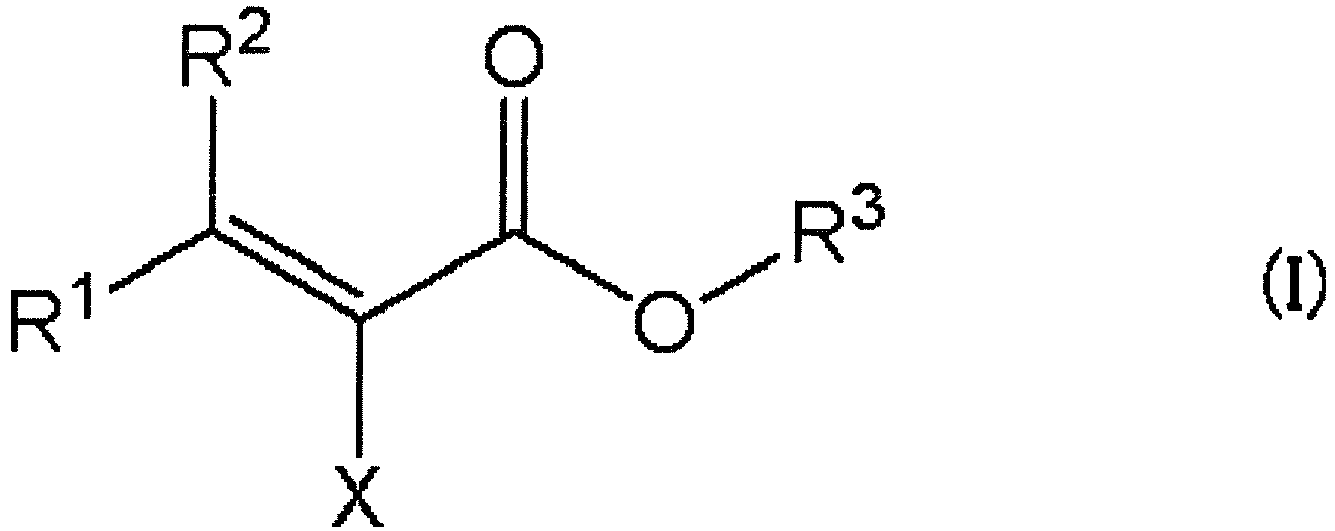
- (B) alcohol,
wherein the content of acrylic acid derivative (A) is 30%(w/w) or more. - The composition according to Item 1, wherein alcohol (B) is C1-6 alcohol.
- The composition according to Item 2, wherein alcohol (B) is methanol.
- The composition according to any one of Items 1 to 3, wherein R1 is hydrogen, C1-20 alkyl, or C1-20 fluoroalkyl.
- The composition according to any one of Items 1 to 4, wherein R1 is hydrogen.
- The composition according to any one of Items 1 to 5, wherein R2 is hydrogen, C1-20 alkyl, or C1-20 fluoroalkyl.
- The composition according to any one of Items 1 to 6, wherein R2 is hydrogen.
- The composition according to any one of Items 1 to 7, wherein R3 is C1-20 linear alkyl.
- The composition according to any one of Items 1 to 8, wherein X is C1-20 fluoroalkyl, fluorine, or chlorine.
- The composition according to any one of Items 1 to 9, wherein X is fluorine.
- A method for stabilizing an acrylic acid derivative represented by Formula (I):

- (wherein R1 and R2 are the same or different, and each represents alkyl, fluoroalkyl, aryl that may have one or more substituents, halogen, or hydrogen; R3 represents alkyl, fluoroalkyl, aryl that may have one or more substituents, or hydrogen; and X represents fluoroalkyl, alkyl, halogen, or hydrogen),
- the method comprising making the acrylic acid derivative represented by Formula (I) coexist with alcohol.
- The composition of the present invention contains an acrylic acid derivative; in the composition, the acrylic acid derivative is stabilized.
- The method of the present invention stabilizes an acrylic acid derivative.
- The symbols and the abbreviations in this specification are to be interpreted as having the general meanings in the related technical field to which the present invention pertains, according to the context of this specification, unless otherwise specified.
- In this specification, the term "comprise/contain" is intended to mean both "consist essentially of" and "consist of."
- In this specification, "stabilization" of an acrylic acid derivative refers to preventing an acrylic acid derivative from changing into a different substance, such as a polymer.
- In this specification, "alkyl" (the term "alkyl" encompasses the "alkyl" moiety in "fluoroalkyl" or the like) may be a cyclic, linear, or branched alkyl.
- In this specification, "alkyl" may be, for example, a C1-20, C1-12, C1-6, C1-4, or C1-3 alkyl.
- In this specification, specific examples of "alkyl" include methyl, ethyl, propyl, isopropyl, butyl, isobutyl, sec-butyl, tert-butyl, pentyl, neopentyl, hexyl, and like linear or branched alkyl.
- In this specification, specific examples of "alkyl" include cyclopropyl, cyclobutyl, cyclopentyl, cyclohexyl and like C3-6 cyclic alkyl (cycloalkyl).
- In this specification, "fluoroalkyl" refers to an alkyl in which at least one hydrogen is replaced by fluorine.
- In this specification, the number of fluorines in the "fluoroalkyl" may be one or more (the maximum replaceable number from 1; e.g., 1 to 3, 1 to 6, or 1 to 12).
- The "fluoroalkyl" encompasses perfluoroalkyl. The "perfluoroalkyl" refers to an alkyl in which all of the hydrogens are replaced by fluorines.
- In this specification, examples of "fluoroalkyl" include C1-20, C1-12, C1-6, C1-4, and C1-3 fluoroalkyls.
- In this specification, the "fluoroalkyl" may be a linear or branched fluoroalkyl.
- In this specification, specific examples of "fluoroalkyl" include fluoromethyl, difluoromethyl, trifluoromethyl, 2,2,2-trifluoroethyl, pentafluoroethyl, tetrafluoropropyl (e.g., HCF2CF2CH2-), hexafluoropropyl (e.g., (CF3)2CH-), nonafluorobutyl, octafluoropentyl (e.g., HCF2CF2CF2CF2CH2-), and tridecafluorohexyl.
- In this specification, examples of "aryl" include phenyl and naphthyl.
- In this specification, examples of "halogen" include fluorine, chlorine, bromine, and iodine.
- In this specification, the "alkoxy" is an alkyl-0-group.
- In this specification, examples of "acyl" include alkanoyl (i.e., alkyl-CO-group).
- In this specification, examples of "ester" include alkylcarbonyloxy (i.e., alkyl-CO-O-group), and alkoxycarbonyl (i.e., alkyl-O-CO-group).
- The composition of the present invention comprises:
- (A) an acrylic acid derivative represented by Formula (I) :

- (B) alcohol,
wherein the content of acrylic acid derivative (A) is 30%(w/w) or more. - Each symbol in Formula (1) representing acrylic acid derivative (A) is explained below.
- Preferable examples of the substituents of the "aryl that may have one or more substituents" represented by R1, R2, and R3 include fluorine, alkyl, alkoxy, acyl, ester, cyano, nitro, and fluoroalkyl. More preferable examples include fluorine.
- The number of "the substituents" is preferably 0 (i.e., unsubstituted), 1, 2, or 3.
- R1 is preferably hydrogen, C1-20 (preferably C1-12, more preferably C1-6, further preferably C1-4, further more preferably C1-3, particularly preferably C1 or C2) alkyl, or C1-20 fluoroalkyl, and more preferably hydrogen.
- R2 is preferably hydrogen, C1-20 (preferably C1-12, more preferably C1-6, further preferably C1-4, further more preferably C1-3, particularly preferably C1 or C2) alkyl, or C1-20 (preferably C1-12, more preferably C1-6, further preferably C1-4, further more preferably C1-3, particularly preferably C1 or C2) fluoroalkyl, and more preferably hydrogen.
- R3 is preferably C1-20 (preferably C1-12, more preferably C1-6, further preferably C1-4, further more preferably C1-3, particularly preferably C1 or C2) linear alkyl.
- X is C1-20 (preferably C1-12, more preferably C1-6, further preferably C1-4, further more preferably C1-3, particularly preferably C1 or C2) fluoroalkyl, fluorine, or chlorine, and more preferably fluorine.
- In Formula (I), preferably,
R1 is hydrogen,
R2 is hydrogen,
R3 is methyl or ethyl (more preferably methyl), and
X is fluorine or chlorine (more preferably fluorine). - The composition of the present invention may comprise one or more kinds of acrylic acid derivative (A); however, the composition of the present invention preferably comprises only one kind of acrylic acid derivative (A).
- Acrylic acid derivative (A) used in the present invention may be produced by a known method or a similar method thereof, or may be obtained from commercial suppliers.
- Acrylic acid derivative (A) used in the present invention may be produced, for example, through the production methods disclosed in International Publication No.
2014/034906 ,JP2014-24755A U.S Patent No. 3262968 , and the like, or similar methods thereof. - The content of acrylic acid derivative (A) in the composition of the present invention is 30%(w/w) or more.
- Generally, when the concentration of acrylic acid derivative (A) is high, unintended polymerization reaction or the like more easily occurs. However, in the composition of the present invention, even when the content of acrylic acid derivative (A) is high, acrylic acid derivative (A) is stable.
- Further, the content of acrylic acid derivative (A) in the composition of the present invention is preferably 35%(w/w) or more, 40%(w/w) or more, 50%(w/w) or more, 60%(w/w) or more, 70%(w/w) or more, 80%(w/w) or more, or 90%(w/w) or more.
- Further, the content of acrylic acid derivative (A) in the composition of the present invention is preferably 30 to 90%(w/w), 30 to 80%(w/w), 35 to 70%(w/w), or 35 to 65%(w/w).
- The upper limit of the content of acrylic acid derivative (A) in the composition of the present invention is, for example, but not particularly limited to, 98%(w/w), 95%(w/w), 90%(w/w), 80%(w/w), 70%(w/w), or 65%(w/w). However, as it would be obvious to a person skilled in the art, the upper limit of the content of acrylic acid derivative (A) in the composition of the present invention may be limited depending on the amount of alcohol (B) contained in the composition of the present invention.
- Alcohol (B) contained in the composition of the present invention is preferably C1-6 alcohol.
- Examples of alcohol (B) contained in the composition of the present invention include methanol, ethanol, n-propanol, isopropanol, n-butanol, isobutanol, tert-butanol, pentanol, and hexanol.
- Alcohol (B) contained in the composition of the present invention is particularly preferably methanol.
- In the present invention, alcohol (B) may be a single kind or a combination of two or more kinds of alcohol (B).
- The lower limit of the content of alcohol (B) in the composition of the present invention is preferably 0.02%(w/w), more preferably 0.03%(w/w), further preferably 0.1%(w/w), further more preferably, 0.3%(w/w), particularly preferably 0.5%(w/w), and particularly preferably 1%(w/w), 1.5%(w/w), 2.0%(w/w), particularly preferably 3.0%, more particularly preferably 5.0%(w/w).
- In accomplishing the stabilization of acrylic acid derivative (A), in the composition of the present invention, the upper limit of the content of alcohol (B) is not particularly limited; however, using alcohol (B) in an amount more than the amount ensuring the desired stabilization of acrylic acid derivative (A) is a disadvantage in terms of cost. Therefore, the upper limit of the content of alcohol (B) in the composition of the present invention is generally, for example, 70%(w/w), 50%(w/w), 40%(w/w), 30%(w/w), 20%(w/w), 15%(w/w), 10%(w/w), 7%(w/w), 6%(w/w), 5%(w/w), 4%(w/w), or 3%(w/w).
- The content of alcohol (B) in the composition of the present invention is preferably 0.01 to 70%(w/w), 0.01 to 50%(w/w), or in a range of 0.02 to 6%(w/w), more preferably in a range of 0.03 to 5%(w/w), further preferably in a range of 0.1 to 4%(w/w), further more preferably in a range of 0.3 to 3.5(w/w), particularly preferably 0.5 to 3%(w/w), and further particularly preferably in a range of 1 to 3%(w/w).
- In the composition of the present invention, the lower limit of the ratio of alcohol (B) to acrylic acid derivative (A) [alcohol (B)/acrylic acid derivative (A)] is preferably 0.02%(w/w), more preferably 0.03%(w/w), further preferably 0.1%(w/w), further more preferably 0.3%(w/w), particularly preferably 0.5%(w/w), and particularly preferably 1%(w/w).
- In accomplishing the stabilization of acrylic acid derivative (A), the upper limit of the ratio of alcohol (B) to acrylic acid derivative (A) [alcohol (B)/acrylic acid derivative (A)] is not particularly limited; however, using alcohol (B) in an amount more than the amount ensuring the desired stabilization of acrylic acid derivative (A) is a disadvantage in terms of cost. Therefore, the upper limit of the ratio of alcohol (B) to acrylic acid derivative (A) [alcohol (B)/acrylic acid derivative (A)] is generally, for example, 200%(w/w), 190%(w/w), 170%(w/w), 150%(w/w), 100%(w/w), 70%(w/w), 50%(w/w), 40%(w/w), 30%(w/w), 20%(w/w), 15%(w/w), 10%(w/w), 7%(w/w), 6%(w/w), 5%(w/w), 4%(w/w), or 3%(w/w).
- In the composition of the present invention, the ratio of alcohol (B) to acrylic acid derivative (A) is preferably 0.01 to 200%(w/w), 0.01 to 190%(w/w), 0.01 to 170%(w/w), 0.01 to 100%(w/w), or in a range of 0.02 to 6%(w/w), more preferably in a range of 0.03 to 5%(w/w), further preferably in a range of 0.1 to 4%(w/w), further more preferably in a range of 0.3 to 3.5(w/w), particularly preferably 0.5 to 3%(w/w), and particularly preferably in a range of 1 to 3%(w/w).
- The composition of the present invention may contain optional components in addition to acrylic acid derivative (A) and alcohol (B). The optional components may be impurities that coexist with acrylic acid derivative (A) or alcohol (B) prepared for the production of the composition of the present invention.
- Examples of the optional components include water and organic solvents.
- In the composition of the present invention, since acrylic acid derivative (A) is stabilized by alcohol (B), the significance of using a polymerization inhibitor for the purpose of stabilizing acrylic acid derivative (A) is small; however, the composition of the present invention may contain a polymerization inhibitor as an optional component.
- As a method for preventing unintended polymerization reaction or the like, a method of using a polymerization inhibitor, such as the polymerization inhibitor disclosed in Patent Document 2, has been known. However, acrylic acid derivative (A) may be exposed to various conditions, for example, upon storage or at the time of use. Since the boiling points of versatile polymerization inhibitors greatly differ from that of an acrylic acid derivative, it is often difficult to make them coexist with an acrylic acid derivative. In this case, the polymerization inhibitors cannot fully exhibit its function.
- In the composition of the present invention, acrylic acid derivative (A) is stabilized. More specifically, acrylic acid derivative (A) contained in the composition of the present invention has high stability.
- Specifically, for example, acrylic acid derivative (A) in the composition of the present invention is prevented from changing into a polymer or the like, compared with a case in which acrylic acid derivative (A) does not coexist with alcohol (B).
- In the present invention, the change of acrylic acid derivative (A) into a different substance may be analyzed, for example, using NMR analysis or the like. Further, for example, the change of acrylic acid derivative into a polymer may be easily detected by observation of a change of a colorless transparent solution of acrylic acid derivative into a solid, or the like.
- In the composition of the present invention, acrylic acid derivative (A) is stabilized by the coexistence with alcohol (B).
- A method for making the acrylic acid derivative coexist with a polymerization inhibitor has been known as a means for stabilizing an acrylic acid derivative.
- However, since acrylic acid derivative (A) may be exposed to various conditions, for example, upon storage or at the time of use, the coexistence of a polymerization inhibitor with an acrylic acid derivative may be difficult in some cases. In this case, the polymerization inhibitor cannot fully exhibit its function.
- In contrast, since alcohol (B) may have a boiling point similar to that of acrylic acid derivative (A), it is easy to make alcohol (B) coexist with acrylic acid derivative (A). Therefore, acrylic acid derivative (A) in the composition of the present invention is stable under various conditions.
- In addition, when acrylic acid derivative (A) in the composition of the present invention is subjected to a polymerization reaction or the like, optionally, the reactivity of acrylic acid derivative (A) can be increased by removing alcohol (B) by a usual method such as washing with water.
- The composition of the present invention may be produced by mixing acrylic acid derivative (A), alcohol (B), and optional components using, for example, a usual method such as stirring.
- Some or all of alcohol (B) may be contained as an impurity or an additive in acrylic acid derivative (A) prepared for the production of the composition of the present invention.
- The method for stabilizing the acrylic acid derivative (acrylic acid derivative (A)) represented by Formula (I) of the present invention comprises making acrylic acid derivative (A) coexist with alcohol (alcohol (B)).
- The method for making acrylic acid derivative (A) coexist with alcohol (B) is not particularly limited. Examples of the method include:
- [1] a method of mixing acrylic acid derivative (A) and alcohol (B);
- [2] a method of producing alcohol (B) in a system containing acrylic acid derivative (A);
- [3] a method of producing acrylic acid derivative (A) in a system containing alcohol (B); and
- [4] a method of individually producing acrylic acid derivative (A) and alcohol (B) in a single system.
- The same explanation of acrylic acid derivative (A) as that regarding the composition of the present invention can be applied to acrylic acid derivative (A) used in the method for stabilizing acrylic acid derivative (A) of the present invention.
- The same explanation of alcohol (B) as that regarding the composition of the present invention can be applied to alcohol (B) used in the method for stabilizing acrylic acid derivative (A) of the present invention.
- In the method for stabilizing acrylic acid derivative (A) of the present invention, preferably, alcohol (B) is used at a predetermined ratio relative to acrylic acid derivative (A). The ratio is as described above regarding the composition of the present invention.
- The details of the method for stabilizing acrylic acid derivative (A) including the above matters can be understood from the above explanation regarding the composition of the present invention.
- The present invention is described below in more detail with reference to Examples. However, the present invention is not limited to these Examples.
- Compositions having the formulations shown in Table 1 were prepared. The compositions were colorless and transparent liquids.
- Each composition was placed in a container, which was closed with a stopper. Stirring was performed for an hour at an outside temperature of 65°C, and generation of a solid was visually confirmed, thereby confirming whether a polymer was generated.
- Generation of polymer was not confirmed in Composition a, b, c, d, or e.
- In contrast, in Comparative Example 1 performed under the same conditions (methanol was not added), generation of polymer was confirmed.
- Composition f was placed in a container, which was closed with a stopper. Stirring was performed for 30 minutes at an outside temperature of 40°C, and generation of a solid was visually confirmed, thereby confirming whether a polymer was generated.
- Generation of polymer was not confirmed in composition f.
- In contrast, in Comparative Example 2 performed under the same conditions (methanol was not added), generation of polymer was confirmed.
Table 1 Composition MeOH 2-Fluoroacrylic Acid Methyl Ester a 2.4 %(w/w) 97.6 %(w/w) b 2.0 %(w/w) 98.0 %(w/w) c 2.3 %(w/w) 97.7 %(w/w) d 5.1 %(w/w) 94.9 %(w/w) e 0.3 %(w/w) 99.7 %(w/w) Comparative Example 1 Not added 100 %(w/w) f 0.02 %(w/w) 99.98 %(w/w) Comparative Example 2 Not added 100 %(w/w) - 2-fluoroacrylic acid methyl ester purified by distillation as an acrylic acid derivative and methyl alcohol at a weight ratio of 35:65 were placed in a 10-mL test tube. The test tube was closed with a stopper and mixing was performed, thereby preparing a sample. Regarding the appearance and the characteristics of the composition sample immediately after the preparation, the composition sample was a colorless and transparent liquid.
- The test tube containing the sample was allowed to stand at 40°C, and the appearance and the characteristics of the sample were confirmed after six hours; the composition sample was a colorless and transparent liquid.
- 2-fluoroacrylic acid methyl ester purified by distillation as an acrylic acid derivative and methyl alcohol at a weight ratio of 60:40 were placed in a 10-mL test tube. The test tube was closed with a stopper and mixing was performed, thereby preparing a sample. Regarding the appearance and the characteristics of the composition sample immediately after the preparation, the composition sample was a colorless and transparent liquid.
- The test tube containing the sample was allowed to stand at 40°C, and the appearance and the characteristics of the sample were confirmed after six hours; the composition sample was a colorless and transparent liquid.
- 2-fluoroacrylic acid methyl ester purified by distillation as an acrylic acid derivative and methyl alcohol at a weight ratio of 35:65 were placed in a 10-mL test tube. The test tube was closed with a stopper and mixing was performed, thereby preparing a sample. Regarding the appearance and the characteristics of the composition sample immediately after the preparation, the composition sample was a colorless and transparent liquid.
- The test tube containing the sample was allowed to stand at 65°C, and the appearance and the characteristics of the sample were confirmed after six hours; the composition sample was a colorless and transparent liquid.
- 2-fluoroacrylic acid methyl ester purified by distillation as an acrylic acid derivative and methyl alcohol at a weight ratio of 60:40 were placed in a 10 mL test tube. The test tube was closed with a stopper and mixing was performed, thereby preparing a sample. Regarding the appearance and the characteristics of the composition sample immediately after the preparation, the composition sample was a colorless and transparent liquid.
- The test tube containing the sample was allowed to stand at 65°C, and the appearance and the characteristics of the sample were confirmed after six hours; the composition sample was a colorless and transparent liquid.
Claims (11)
- A composition comprising:(A) an acrylic acid derivative represented by Formula (I) :
 (B) alcohol,
wherein the content of acrylic acid derivative (A) is 30%(w/w) or more. - The composition according to claim 1, wherein alcohol (B) is C1-6 alcohol.
- The composition according to claim 2, wherein alcohol (B) is methanol.
- The composition according to any one of claims 1 to 3, wherein R1 is hydrogen, C1-20 alkyl, or C1-20 fluoroalkyl.
- The composition according to any one of claims 1 to 4, wherein R1 is hydrogen.
- The composition according to any one of claims 1 to 5, wherein R2 is hydrogen, C1-20 alkyl, or C1-20 fluoroalkyl.
- The composition according to any one of claims 1 to 6, wherein R2 is hydrogen.
- The composition according to any one of claims 1 to 7, wherein R3 is C1-20 linear alkyl.
- The composition according to any one of claims 1 to 8, wherein X is C1-20 fluoroalkyl, fluorine, or chlorine.
- The composition according to any one of claims 1 to 9, wherein X is fluorine.
- A method for stabilizing (A) an acrylic acid derivative represented by Formula (I):
 (wherein R1 and R2 are the same or different, and each represents alkyl, fluoroalkyl, aryl that may have one or more substituents, halogen, or hydrogen; R3 represents alkyl, fluoroalkyl, aryl that may have one or more substituents, or hydrogen; and X represents fluoroalkyl, alkyl, halogen, or hydrogen),the method comprising making the acrylic acid derivative represented by Formula (I) coexist with alcohol.
Priority Applications (1)
| Application Number | Priority Date | Filing Date | Title |
|---|---|---|---|
| EP22163806.7A EP4053099B1 (en) | 2015-04-09 | 2016-04-08 | Acrylic acid derivative-containing composition, and method for stabilizing acrylic acid derivative |
Applications Claiming Priority (2)
| Application Number | Priority Date | Filing Date | Title |
|---|---|---|---|
| JP2015080383 | 2015-04-09 | ||
| PCT/JP2016/061626 WO2016163553A1 (en) | 2015-04-09 | 2016-04-08 | Acrylic acid derivative-containing composition, and method for stabilizing acrylic acid derivative |
Related Child Applications (2)
| Application Number | Title | Priority Date | Filing Date |
|---|---|---|---|
| EP22163806.7A Division EP4053099B1 (en) | 2015-04-09 | 2016-04-08 | Acrylic acid derivative-containing composition, and method for stabilizing acrylic acid derivative |
| EP22163806.7A Division-Into EP4053099B1 (en) | 2015-04-09 | 2016-04-08 | Acrylic acid derivative-containing composition, and method for stabilizing acrylic acid derivative |
Publications (3)
| Publication Number | Publication Date |
|---|---|
| EP3281935A1 true EP3281935A1 (en) | 2018-02-14 |
| EP3281935A4 EP3281935A4 (en) | 2018-12-05 |
| EP3281935B1 EP3281935B1 (en) | 2022-05-18 |
Family
ID=57072258
Family Applications (2)
| Application Number | Title | Priority Date | Filing Date |
|---|---|---|---|
| EP22163806.7A Active EP4053099B1 (en) | 2015-04-09 | 2016-04-08 | Acrylic acid derivative-containing composition, and method for stabilizing acrylic acid derivative |
| EP16776719.3A Active EP3281935B1 (en) | 2015-04-09 | 2016-04-08 | Acrylic acid derivative-containing composition, and method for stabilizing acrylic acid derivative |
Family Applications Before (1)
| Application Number | Title | Priority Date | Filing Date |
|---|---|---|---|
| EP22163806.7A Active EP4053099B1 (en) | 2015-04-09 | 2016-04-08 | Acrylic acid derivative-containing composition, and method for stabilizing acrylic acid derivative |
Country Status (7)
| Country | Link |
|---|---|
| US (1) | US10099997B2 (en) |
| EP (2) | EP4053099B1 (en) |
| JP (3) | JP6160734B2 (en) |
| CN (2) | CN107428667B (en) |
| HU (1) | HUE059571T2 (en) |
| RU (1) | RU2723556C2 (en) |
| WO (1) | WO2016163553A1 (en) |
Families Citing this family (1)
| Publication number | Priority date | Publication date | Assignee | Title |
|---|---|---|---|---|
| US12606661B2 (en) | 2021-02-03 | 2026-04-21 | Donaldson Company, Inc. | Compositions and articles including perfluoropolyether bottlebrush polymers and methods of making and using same |
Family Cites Families (20)
| Publication number | Priority date | Publication date | Assignee | Title |
|---|---|---|---|---|
| US2886494A (en) * | 1957-05-01 | 1959-05-12 | Gen Aniline & Film Corp | Process for inhibiting the polymerization of alpha-chloracrylate esters and the resultant compositions |
| US3262968A (en) | 1963-11-07 | 1966-07-26 | American Cyanamid Co | Process for the preparation of alpha-fluoroacrylates |
| FR1445618A (en) * | 1965-05-31 | 1966-07-15 | Centre Nat Rech Scient | Process for obtaining alpha-fluoracrylic esters, in particular butyl alpha-fluoracrylate |
| JPS56122331A (en) * | 1980-03-04 | 1981-09-25 | Mitsubishi Chem Ind Ltd | Preparation of methyl methacrylate |
| JPS6078941A (en) * | 1983-10-07 | 1985-05-04 | Daikin Ind Ltd | Production of alpha-fluoroacrylic acid ester |
| JPS60158136A (en) * | 1984-01-30 | 1985-08-19 | Daikin Ind Ltd | Method for preventing polymerization of fluorine-containing acrylic acid or derivative thereof |
| US4590301A (en) * | 1984-10-24 | 1986-05-20 | Barnes-Hind, Inc. | Polymerization inhibitors |
| JPH0751534B2 (en) * | 1987-05-29 | 1995-06-05 | ダイセル化学工業株式会社 | Method for stabilizing the quality of chloropropionate |
| JP2534323B2 (en) * | 1988-07-05 | 1996-09-11 | 株式会社クラレ | Method for stabilizing methyl methacrylate |
| JPH02193944A (en) * | 1989-01-20 | 1990-07-31 | Daicel Chem Ind Ltd | Production of (meth)acrylic acid ester |
| JPH10504553A (en) * | 1994-08-18 | 1998-05-06 | シエル・インターナシヨネイル・リサーチ・マーチヤツピイ・ベー・ウイ | Preparation method of purified acrylic acid ester |
| JP2005239564A (en) * | 2004-02-24 | 2005-09-08 | Mitsubishi Rayon Co Ltd | Method for producing (meth) acrylic acid ester |
| DE102007052891A1 (en) | 2007-11-02 | 2009-05-07 | Evonik Degussa Gmbh | Process for the stabilization of olefinically unsaturated monomers |
| JP5521640B2 (en) | 2009-05-19 | 2014-06-18 | セントラル硝子株式会社 | Method for producing 2-fluoroacrylic acid ester |
| DE102009030681A1 (en) | 2009-06-26 | 2010-12-30 | Saltigo Gmbh | Preparation of substituted 2-fluoroacrylic acid derivatives |
| DE102009058058A1 (en) * | 2009-12-14 | 2011-06-16 | Basf Se | Process for the polymerization inhibition of (meth) acrylic acid and / or meth) acrylic esters |
| JP5928219B2 (en) | 2012-07-24 | 2016-06-01 | ダイキン工業株式会社 | Method for producing α-fluoroacrylic acid ester |
| CN104583174B (en) | 2012-08-30 | 2017-06-13 | 大金工业株式会社 | Method for producing α-fluoroacrylate |
| JP6237223B2 (en) * | 2012-12-28 | 2017-11-29 | ダイキン工業株式会社 | Method for producing α-fluoroacrylic acid ester |
| JP2014214147A (en) * | 2013-04-30 | 2014-11-17 | ダイキン工業株式会社 | Method of producing 2-fluoro-3-halopropanoic acid derivative |
-
2016
- 2016-04-08 RU RU2017135003A patent/RU2723556C2/en active
- 2016-04-08 US US15/564,926 patent/US10099997B2/en active Active
- 2016-04-08 HU HUE16776719A patent/HUE059571T2/en unknown
- 2016-04-08 CN CN201680020688.7A patent/CN107428667B/en active Active
- 2016-04-08 EP EP22163806.7A patent/EP4053099B1/en active Active
- 2016-04-08 JP JP2016078463A patent/JP6160734B2/en not_active Expired - Fee Related
- 2016-04-08 WO PCT/JP2016/061626 patent/WO2016163553A1/en not_active Ceased
- 2016-04-08 CN CN202111079432.2A patent/CN113773198B/en active Active
- 2016-04-08 EP EP16776719.3A patent/EP3281935B1/en active Active
-
2017
- 2017-02-22 JP JP2017031475A patent/JP6859742B2/en not_active Expired - Fee Related
-
2021
- 2021-01-07 JP JP2021001400A patent/JP7025674B2/en active Active
Also Published As
| Publication number | Publication date |
|---|---|
| CN113773198A (en) | 2021-12-10 |
| WO2016163553A1 (en) | 2016-10-13 |
| JP2021073205A (en) | 2021-05-13 |
| RU2017135003A (en) | 2019-04-08 |
| RU2017135003A3 (en) | 2019-04-08 |
| US20180093940A1 (en) | 2018-04-05 |
| US10099997B2 (en) | 2018-10-16 |
| CN113773198B (en) | 2024-07-16 |
| CN107428667A (en) | 2017-12-01 |
| CN107428667B (en) | 2024-07-05 |
| EP4053099A2 (en) | 2022-09-07 |
| EP4053099A3 (en) | 2022-11-30 |
| JP6859742B2 (en) | 2021-04-14 |
| JP2017122104A (en) | 2017-07-13 |
| RU2723556C2 (en) | 2020-06-16 |
| JP7025674B2 (en) | 2022-02-25 |
| HUE059571T2 (en) | 2022-11-28 |
| EP4053099B1 (en) | 2026-01-28 |
| EP3281935A4 (en) | 2018-12-05 |
| EP3281935B1 (en) | 2022-05-18 |
| JP2016199542A (en) | 2016-12-01 |
| JP6160734B2 (en) | 2017-07-12 |
Similar Documents
| Publication | Publication Date | Title |
|---|---|---|
| EP2851393B1 (en) | Method for preparing ester-based plasticizer, and ester-based plasticizer prepared thereby | |
| JP2018030857A (en) | Method for producing α-fluoroacrylic acid ester | |
| JP7025674B2 (en) | Acrylic acid derivative-containing composition and method for stabilizing acrylic acid derivative | |
| EP3281934B1 (en) | Stabilization of 2-fluoroacrylic acid derivatives with aldehydes | |
| US10723683B2 (en) | Conversion of a perfluorinated vinyl ether into a partially fluorinated saturated ether derivative | |
| US10577302B2 (en) | Composition containing acrylic acid derivative, and method for stabilizing acrylic acid derivative | |
| EP4048661B1 (en) | Process for preparing glycerol carbonate (meth)acrylate | |
| WO2016163551A1 (en) | Composition containing acrylic acid derivative, and method for stabilizing acrylic acid derivative | |
| JP2017114896A (en) | Composition | |
| US20180222842A1 (en) | Water elimination method | |
| EP3023413A1 (en) | Method for purifying acrylamide alkyl sulfonic acid | |
| AU2016393267A1 (en) | High purity disorbate ester of triethylene glycol | |
| WO2018016126A1 (en) | METHOD FOR PRESERVATION OF α, α-DIFLUOROACETALDEHYDE ALKYL HEMIACETAL | |
| KR20150135096A (en) | A Method for Producing highly pure Allyl Alcohol and Process system for Producing highly pure Allyl Alcohol | |
| EP2985274A1 (en) | Method for preparation of trifluoroacetylacetic acid |
Legal Events
| Date | Code | Title | Description |
|---|---|---|---|
| STAA | Information on the status of an ep patent application or granted ep patent |
Free format text: STATUS: THE INTERNATIONAL PUBLICATION HAS BEEN MADE |
|
| PUAI | Public reference made under article 153(3) epc to a published international application that has entered the european phase |
Free format text: ORIGINAL CODE: 0009012 |
|
| STAA | Information on the status of an ep patent application or granted ep patent |
Free format text: STATUS: REQUEST FOR EXAMINATION WAS MADE |
|
| 17P | Request for examination filed |
Effective date: 20171017 |
|
| AK | Designated contracting states |
Kind code of ref document: A1 Designated state(s): AL AT BE BG CH CY CZ DE DK EE ES FI FR GB GR HR HU IE IS IT LI LT LU LV MC MK MT NL NO PL PT RO RS SE SI SK SM TR |
|
| AX | Request for extension of the european patent |
Extension state: BA ME |
|
| DAV | Request for validation of the european patent (deleted) | ||
| DAX | Request for extension of the european patent (deleted) | ||
| A4 | Supplementary search report drawn up and despatched |
Effective date: 20181029 |
|
| RIC1 | Information provided on ipc code assigned before grant |
Ipc: C07C 67/62 20060101AFI20181023BHEP Ipc: C07C 69/653 20060101ALI20181023BHEP |
|
| STAA | Information on the status of an ep patent application or granted ep patent |
Free format text: STATUS: EXAMINATION IS IN PROGRESS |
|
| 17Q | First examination report despatched |
Effective date: 20190603 |
|
| GRAP | Despatch of communication of intention to grant a patent |
Free format text: ORIGINAL CODE: EPIDOSNIGR1 |
|
| STAA | Information on the status of an ep patent application or granted ep patent |
Free format text: STATUS: GRANT OF PATENT IS INTENDED |
|
| INTG | Intention to grant announced |
Effective date: 20211126 |
|
| GRAS | Grant fee paid |
Free format text: ORIGINAL CODE: EPIDOSNIGR3 |
|
| GRAA | (expected) grant |
Free format text: ORIGINAL CODE: 0009210 |
|
| STAA | Information on the status of an ep patent application or granted ep patent |
Free format text: STATUS: THE PATENT HAS BEEN GRANTED |
|
| AK | Designated contracting states |
Kind code of ref document: B1 Designated state(s): AL AT BE BG CH CY CZ DE DK EE ES FI FR GB GR HR HU IE IS IT LI LT LU LV MC MK MT NL NO PL PT RO RS SE SI SK SM TR |
|
| REG | Reference to a national code |
Ref country code: GB Ref legal event code: FG4D |
|
| REG | Reference to a national code |
Ref country code: CH Ref legal event code: EP |
|
| REG | Reference to a national code |
Ref country code: IE Ref legal event code: FG4D |
|
| REG | Reference to a national code |
Ref country code: DE Ref legal event code: R096 Ref document number: 602016072258 Country of ref document: DE |
|
| REG | Reference to a national code |
Ref country code: AT Ref legal event code: REF Ref document number: 1493078 Country of ref document: AT Kind code of ref document: T Effective date: 20220615 |
|
| REG | Reference to a national code |
Ref country code: LT Ref legal event code: MG9D |
|
| REG | Reference to a national code |
Ref country code: NL Ref legal event code: MP Effective date: 20220518 |
|
| PG25 | Lapsed in a contracting state [announced via postgrant information from national office to epo] |
Ref country code: SE Free format text: LAPSE BECAUSE OF FAILURE TO SUBMIT A TRANSLATION OF THE DESCRIPTION OR TO PAY THE FEE WITHIN THE PRESCRIBED TIME-LIMIT Effective date: 20220518 Ref country code: PT Free format text: LAPSE BECAUSE OF FAILURE TO SUBMIT A TRANSLATION OF THE DESCRIPTION OR TO PAY THE FEE WITHIN THE PRESCRIBED TIME-LIMIT Effective date: 20220919 Ref country code: NO Free format text: LAPSE BECAUSE OF FAILURE TO SUBMIT A TRANSLATION OF THE DESCRIPTION OR TO PAY THE FEE WITHIN THE PRESCRIBED TIME-LIMIT Effective date: 20220818 Ref country code: NL Free format text: LAPSE BECAUSE OF FAILURE TO SUBMIT A TRANSLATION OF THE DESCRIPTION OR TO PAY THE FEE WITHIN THE PRESCRIBED TIME-LIMIT Effective date: 20220518 Ref country code: LT Free format text: LAPSE BECAUSE OF FAILURE TO SUBMIT A TRANSLATION OF THE DESCRIPTION OR TO PAY THE FEE WITHIN THE PRESCRIBED TIME-LIMIT Effective date: 20220518 Ref country code: HR Free format text: LAPSE BECAUSE OF FAILURE TO SUBMIT A TRANSLATION OF THE DESCRIPTION OR TO PAY THE FEE WITHIN THE PRESCRIBED TIME-LIMIT Effective date: 20220518 Ref country code: GR Free format text: LAPSE BECAUSE OF FAILURE TO SUBMIT A TRANSLATION OF THE DESCRIPTION OR TO PAY THE FEE WITHIN THE PRESCRIBED TIME-LIMIT Effective date: 20220819 Ref country code: FI Free format text: LAPSE BECAUSE OF FAILURE TO SUBMIT A TRANSLATION OF THE DESCRIPTION OR TO PAY THE FEE WITHIN THE PRESCRIBED TIME-LIMIT Effective date: 20220518 Ref country code: ES Free format text: LAPSE BECAUSE OF FAILURE TO SUBMIT A TRANSLATION OF THE DESCRIPTION OR TO PAY THE FEE WITHIN THE PRESCRIBED TIME-LIMIT Effective date: 20220518 Ref country code: BG Free format text: LAPSE BECAUSE OF FAILURE TO SUBMIT A TRANSLATION OF THE DESCRIPTION OR TO PAY THE FEE WITHIN THE PRESCRIBED TIME-LIMIT Effective date: 20220818 |
|
| REG | Reference to a national code |
Ref country code: HU Ref legal event code: AG4A Ref document number: E059571 Country of ref document: HU |
|
| PG25 | Lapsed in a contracting state [announced via postgrant information from national office to epo] |
Ref country code: RS Free format text: LAPSE BECAUSE OF FAILURE TO SUBMIT A TRANSLATION OF THE DESCRIPTION OR TO PAY THE FEE WITHIN THE PRESCRIBED TIME-LIMIT Effective date: 20220518 Ref country code: PL Free format text: LAPSE BECAUSE OF FAILURE TO SUBMIT A TRANSLATION OF THE DESCRIPTION OR TO PAY THE FEE WITHIN THE PRESCRIBED TIME-LIMIT Effective date: 20220518 Ref country code: LV Free format text: LAPSE BECAUSE OF FAILURE TO SUBMIT A TRANSLATION OF THE DESCRIPTION OR TO PAY THE FEE WITHIN THE PRESCRIBED TIME-LIMIT Effective date: 20220518 Ref country code: IS Free format text: LAPSE BECAUSE OF FAILURE TO SUBMIT A TRANSLATION OF THE DESCRIPTION OR TO PAY THE FEE WITHIN THE PRESCRIBED TIME-LIMIT Effective date: 20220918 |
|
| PG25 | Lapsed in a contracting state [announced via postgrant information from national office to epo] |
Ref country code: SM Free format text: LAPSE BECAUSE OF FAILURE TO SUBMIT A TRANSLATION OF THE DESCRIPTION OR TO PAY THE FEE WITHIN THE PRESCRIBED TIME-LIMIT Effective date: 20220518 Ref country code: SK Free format text: LAPSE BECAUSE OF FAILURE TO SUBMIT A TRANSLATION OF THE DESCRIPTION OR TO PAY THE FEE WITHIN THE PRESCRIBED TIME-LIMIT Effective date: 20220518 Ref country code: RO Free format text: LAPSE BECAUSE OF FAILURE TO SUBMIT A TRANSLATION OF THE DESCRIPTION OR TO PAY THE FEE WITHIN THE PRESCRIBED TIME-LIMIT Effective date: 20220518 Ref country code: EE Free format text: LAPSE BECAUSE OF FAILURE TO SUBMIT A TRANSLATION OF THE DESCRIPTION OR TO PAY THE FEE WITHIN THE PRESCRIBED TIME-LIMIT Effective date: 20220518 Ref country code: DK Free format text: LAPSE BECAUSE OF FAILURE TO SUBMIT A TRANSLATION OF THE DESCRIPTION OR TO PAY THE FEE WITHIN THE PRESCRIBED TIME-LIMIT Effective date: 20220518 Ref country code: CZ Free format text: LAPSE BECAUSE OF FAILURE TO SUBMIT A TRANSLATION OF THE DESCRIPTION OR TO PAY THE FEE WITHIN THE PRESCRIBED TIME-LIMIT Effective date: 20220518 |
|
| REG | Reference to a national code |
Ref country code: DE Ref legal event code: R097 Ref document number: 602016072258 Country of ref document: DE |
|
| PLBE | No opposition filed within time limit |
Free format text: ORIGINAL CODE: 0009261 |
|
| STAA | Information on the status of an ep patent application or granted ep patent |
Free format text: STATUS: NO OPPOSITION FILED WITHIN TIME LIMIT |
|
| PG25 | Lapsed in a contracting state [announced via postgrant information from national office to epo] |
Ref country code: AL Free format text: LAPSE BECAUSE OF FAILURE TO SUBMIT A TRANSLATION OF THE DESCRIPTION OR TO PAY THE FEE WITHIN THE PRESCRIBED TIME-LIMIT Effective date: 20220518 |
|
| 26N | No opposition filed |
Effective date: 20230221 |
|
| PG25 | Lapsed in a contracting state [announced via postgrant information from national office to epo] |
Ref country code: SI Free format text: LAPSE BECAUSE OF FAILURE TO SUBMIT A TRANSLATION OF THE DESCRIPTION OR TO PAY THE FEE WITHIN THE PRESCRIBED TIME-LIMIT Effective date: 20220518 |
|
| P01 | Opt-out of the competence of the unified patent court (upc) registered |
Effective date: 20230525 |
|
| REG | Reference to a national code |
Ref country code: AT Ref legal event code: UEP Ref document number: 1493078 Country of ref document: AT Kind code of ref document: T Effective date: 20220518 |
|
| PG25 | Lapsed in a contracting state [announced via postgrant information from national office to epo] |
Ref country code: LU Free format text: LAPSE BECAUSE OF NON-PAYMENT OF DUE FEES Effective date: 20230408 |
|
| PG25 | Lapsed in a contracting state [announced via postgrant information from national office to epo] |
Ref country code: MC Free format text: LAPSE BECAUSE OF FAILURE TO SUBMIT A TRANSLATION OF THE DESCRIPTION OR TO PAY THE FEE WITHIN THE PRESCRIBED TIME-LIMIT Effective date: 20220518 |
|
| PG25 | Lapsed in a contracting state [announced via postgrant information from national office to epo] |
Ref country code: MC Free format text: LAPSE BECAUSE OF FAILURE TO SUBMIT A TRANSLATION OF THE DESCRIPTION OR TO PAY THE FEE WITHIN THE PRESCRIBED TIME-LIMIT Effective date: 20220518 |
|
| REG | Reference to a national code |
Ref country code: IE Ref legal event code: MM4A |
|
| PG25 | Lapsed in a contracting state [announced via postgrant information from national office to epo] |
Ref country code: IE Free format text: LAPSE BECAUSE OF NON-PAYMENT OF DUE FEES Effective date: 20230408 |
|
| PG25 | Lapsed in a contracting state [announced via postgrant information from national office to epo] |
Ref country code: IE Free format text: LAPSE BECAUSE OF NON-PAYMENT OF DUE FEES Effective date: 20230408 |
|
| PG25 | Lapsed in a contracting state [announced via postgrant information from national office to epo] |
Ref country code: BG Free format text: LAPSE BECAUSE OF FAILURE TO SUBMIT A TRANSLATION OF THE DESCRIPTION OR TO PAY THE FEE WITHIN THE PRESCRIBED TIME-LIMIT Effective date: 20220518 |
|
| PG25 | Lapsed in a contracting state [announced via postgrant information from national office to epo] |
Ref country code: BG Free format text: LAPSE BECAUSE OF FAILURE TO SUBMIT A TRANSLATION OF THE DESCRIPTION OR TO PAY THE FEE WITHIN THE PRESCRIBED TIME-LIMIT Effective date: 20220518 |
|
| PGFP | Annual fee paid to national office [announced via postgrant information from national office to epo] |
Ref country code: DE Payment date: 20250305 Year of fee payment: 10 |
|
| PGFP | Annual fee paid to national office [announced via postgrant information from national office to epo] |
Ref country code: HU Payment date: 20250327 Year of fee payment: 10 |
|
| PGFP | Annual fee paid to national office [announced via postgrant information from national office to epo] |
Ref country code: CH Payment date: 20250501 Year of fee payment: 10 |
|
| PGFP | Annual fee paid to national office [announced via postgrant information from national office to epo] |
Ref country code: AT Payment date: 20250325 Year of fee payment: 10 |
|
| PG25 | Lapsed in a contracting state [announced via postgrant information from national office to epo] |
Ref country code: CY Free format text: LAPSE BECAUSE OF FAILURE TO SUBMIT A TRANSLATION OF THE DESCRIPTION OR TO PAY THE FEE WITHIN THE PRESCRIBED TIME-LIMIT; INVALID AB INITIO Effective date: 20160408 |
|
| PG25 | Lapsed in a contracting state [announced via postgrant information from national office to epo] |
Ref country code: TR Free format text: LAPSE BECAUSE OF FAILURE TO SUBMIT A TRANSLATION OF THE DESCRIPTION OR TO PAY THE FEE WITHIN THE PRESCRIBED TIME-LIMIT Effective date: 20220518 |
|
| PGFP | Annual fee paid to national office [announced via postgrant information from national office to epo] |
Ref country code: GB Payment date: 20260313 Year of fee payment: 11 |
|
| PGFP | Annual fee paid to national office [announced via postgrant information from national office to epo] |
Ref country code: BE Payment date: 20260317 Year of fee payment: 11 Ref country code: IT Payment date: 20260320 Year of fee payment: 11 |
|
| PGFP | Annual fee paid to national office [announced via postgrant information from national office to epo] |
Ref country code: FR Payment date: 20260309 Year of fee payment: 11 |
|
| REG | Reference to a national code |
Ref country code: CH Ref legal event code: U11 Free format text: ST27 STATUS EVENT CODE: U-0-0-U10-U11 (AS PROVIDED BY THE NATIONAL OFFICE) Effective date: 20260501 |