EP3279148A1 - Lithium cobalt composite oxide for lithium secondary battery and lithium secondary battery including positive electrode including the same - Google Patents
Lithium cobalt composite oxide for lithium secondary battery and lithium secondary battery including positive electrode including the same Download PDFInfo
- Publication number
- EP3279148A1 EP3279148A1 EP17183608.3A EP17183608A EP3279148A1 EP 3279148 A1 EP3279148 A1 EP 3279148A1 EP 17183608 A EP17183608 A EP 17183608A EP 3279148 A1 EP3279148 A1 EP 3279148A1
- Authority
- EP
- European Patent Office
- Prior art keywords
- composite oxide
- cobalt composite
- lithium
- lithium cobalt
- secondary battery
- Prior art date
- Legal status (The legal status is an assumption and is not a legal conclusion. Google has not performed a legal analysis and makes no representation as to the accuracy of the status listed.)
- Granted
Links
Images



Classifications
-
- H—ELECTRICITY
- H01—ELECTRIC ELEMENTS
- H01M—PROCESSES OR MEANS, e.g. BATTERIES, FOR THE DIRECT CONVERSION OF CHEMICAL ENERGY INTO ELECTRICAL ENERGY
- H01M4/00—Electrodes
- H01M4/02—Electrodes composed of, or comprising, active material
- H01M4/36—Selection of substances as active materials, active masses, active liquids
- H01M4/58—Selection of substances as active materials, active masses, active liquids of inorganic compounds other than oxides or hydroxides, e.g. sulfides, selenides, tellurides, halogenides or LiCoFy; of polyanionic structures, e.g. phosphates, silicates or borates
- H01M4/583—Carbonaceous material, e.g. graphite-intercalation compounds or CFx
- H01M4/587—Carbonaceous material, e.g. graphite-intercalation compounds or CFx for inserting or intercalating light metals
-
- C—CHEMISTRY; METALLURGY
- C01—INORGANIC CHEMISTRY
- C01G—COMPOUNDS CONTAINING METALS NOT COVERED BY SUBCLASSES C01D OR C01F
- C01G45/00—Compounds of manganese
- C01G45/12—Complex oxides containing manganese and at least one other metal element
- C01G45/1221—Manganates or manganites with trivalent manganese, tetravalent manganese or mixtures thereof
- C01G45/1228—Manganates or manganites with trivalent manganese, tetravalent manganese or mixtures thereof of the type (MnO2)-, e.g. LiMnO2 or Li(MxMn1-x)O2
-
- C—CHEMISTRY; METALLURGY
- C01—INORGANIC CHEMISTRY
- C01G—COMPOUNDS CONTAINING METALS NOT COVERED BY SUBCLASSES C01D OR C01F
- C01G51/00—Compounds of cobalt
- C01G51/40—Complex oxides containing cobalt and at least one other metal element
- C01G51/42—Complex oxides containing cobalt and at least one other metal element containing alkali metals, e.g. LiCoO2
-
- C—CHEMISTRY; METALLURGY
- C01—INORGANIC CHEMISTRY
- C01G—COMPOUNDS CONTAINING METALS NOT COVERED BY SUBCLASSES C01D OR C01F
- C01G51/00—Compounds of cobalt
- C01G51/40—Complex oxides containing cobalt and at least one other metal element
- C01G51/42—Complex oxides containing cobalt and at least one other metal element containing alkali metals, e.g. LiCoO2
- C01G51/44—Complex oxides containing cobalt and at least one other metal element containing alkali metals, e.g. LiCoO2 containing manganese
- C01G51/50—Complex oxides containing cobalt and at least one other metal element containing alkali metals, e.g. LiCoO2 containing manganese of the type (MnO2)n-, e.g. Li(CoxMn1-x)O2 or Li(MyCoxMn1-x-y)O2
-
- C—CHEMISTRY; METALLURGY
- C01—INORGANIC CHEMISTRY
- C01G—COMPOUNDS CONTAINING METALS NOT COVERED BY SUBCLASSES C01D OR C01F
- C01G53/00—Compounds of nickel
- C01G53/40—Complex oxides containing nickel and at least one other metal element
- C01G53/42—Complex oxides containing nickel and at least one other metal element containing alkali metals, e.g. LiNiO2
- C01G53/44—Complex oxides containing nickel and at least one other metal element containing alkali metals, e.g. LiNiO2 containing manganese
- C01G53/50—Complex oxides containing nickel and at least one other metal element containing alkali metals, e.g. LiNiO2 containing manganese of the type (MnO2)n-, e.g. Li(NixMn1-x)O2 or Li(MyNixMn1-x-y)O2
-
- H—ELECTRICITY
- H01—ELECTRIC ELEMENTS
- H01M—PROCESSES OR MEANS, e.g. BATTERIES, FOR THE DIRECT CONVERSION OF CHEMICAL ENERGY INTO ELECTRICAL ENERGY
- H01M4/00—Electrodes
- H01M4/02—Electrodes composed of, or comprising, active material
- H01M4/13—Electrodes for accumulators with non-aqueous electrolyte, e.g. for lithium-accumulators; Processes of manufacture thereof
- H01M4/131—Electrodes based on mixed oxides or hydroxides, or on mixtures of oxides or hydroxides, e.g. LiCoOx
-
- H—ELECTRICITY
- H01—ELECTRIC ELEMENTS
- H01M—PROCESSES OR MEANS, e.g. BATTERIES, FOR THE DIRECT CONVERSION OF CHEMICAL ENERGY INTO ELECTRICAL ENERGY
- H01M4/00—Electrodes
- H01M4/02—Electrodes composed of, or comprising, active material
- H01M4/13—Electrodes for accumulators with non-aqueous electrolyte, e.g. for lithium-accumulators; Processes of manufacture thereof
- H01M4/131—Electrodes based on mixed oxides or hydroxides, or on mixtures of oxides or hydroxides, e.g. LiCoOx
- H01M4/1315—Electrodes based on mixed oxides or hydroxides, or on mixtures of oxides or hydroxides, e.g. LiCoOx containing halogen atoms, e.g. LiCoOxFy
-
- H—ELECTRICITY
- H01—ELECTRIC ELEMENTS
- H01M—PROCESSES OR MEANS, e.g. BATTERIES, FOR THE DIRECT CONVERSION OF CHEMICAL ENERGY INTO ELECTRICAL ENERGY
- H01M4/00—Electrodes
- H01M4/02—Electrodes composed of, or comprising, active material
- H01M4/13—Electrodes for accumulators with non-aqueous electrolyte, e.g. for lithium-accumulators; Processes of manufacture thereof
- H01M4/133—Electrodes based on carbonaceous material, e.g. graphite-intercalation compounds or CFx
-
- H—ELECTRICITY
- H01—ELECTRIC ELEMENTS
- H01M—PROCESSES OR MEANS, e.g. BATTERIES, FOR THE DIRECT CONVERSION OF CHEMICAL ENERGY INTO ELECTRICAL ENERGY
- H01M4/00—Electrodes
- H01M4/02—Electrodes composed of, or comprising, active material
- H01M4/36—Selection of substances as active materials, active masses, active liquids
- H01M4/48—Selection of substances as active materials, active masses, active liquids of inorganic oxides or hydroxides
- H01M4/50—Selection of substances as active materials, active masses, active liquids of inorganic oxides or hydroxides of manganese
- H01M4/505—Selection of substances as active materials, active masses, active liquids of inorganic oxides or hydroxides of manganese of mixed oxides or hydroxides containing manganese for inserting or intercalating light metals, e.g. LiMn2O4 or LiMn2OxFy
-
- H—ELECTRICITY
- H01—ELECTRIC ELEMENTS
- H01M—PROCESSES OR MEANS, e.g. BATTERIES, FOR THE DIRECT CONVERSION OF CHEMICAL ENERGY INTO ELECTRICAL ENERGY
- H01M4/00—Electrodes
- H01M4/02—Electrodes composed of, or comprising, active material
- H01M4/36—Selection of substances as active materials, active masses, active liquids
- H01M4/48—Selection of substances as active materials, active masses, active liquids of inorganic oxides or hydroxides
- H01M4/52—Selection of substances as active materials, active masses, active liquids of inorganic oxides or hydroxides of nickel, cobalt or iron
- H01M4/525—Selection of substances as active materials, active masses, active liquids of inorganic oxides or hydroxides of nickel, cobalt or iron of mixed oxides or hydroxides containing iron, cobalt or nickel for inserting or intercalating light metals, e.g. LiNiO2, LiCoO2 or LiCoOxFy
-
- H—ELECTRICITY
- H01—ELECTRIC ELEMENTS
- H01M—PROCESSES OR MEANS, e.g. BATTERIES, FOR THE DIRECT CONVERSION OF CHEMICAL ENERGY INTO ELECTRICAL ENERGY
- H01M4/00—Electrodes
- H01M4/02—Electrodes composed of, or comprising, active material
- H01M4/36—Selection of substances as active materials, active masses, active liquids
- H01M4/58—Selection of substances as active materials, active masses, active liquids of inorganic compounds other than oxides or hydroxides, e.g. sulfides, selenides, tellurides, halogenides or LiCoFy; of polyanionic structures, e.g. phosphates, silicates or borates
- H01M4/582—Halogenides
-
- C—CHEMISTRY; METALLURGY
- C01—INORGANIC CHEMISTRY
- C01P—INDEXING SCHEME RELATING TO STRUCTURAL AND PHYSICAL ASPECTS OF SOLID INORGANIC COMPOUNDS
- C01P2002/00—Crystal-structural characteristics
- C01P2002/50—Solid solutions
- C01P2002/52—Solid solutions containing elements as dopants
-
- H—ELECTRICITY
- H01—ELECTRIC ELEMENTS
- H01M—PROCESSES OR MEANS, e.g. BATTERIES, FOR THE DIRECT CONVERSION OF CHEMICAL ENERGY INTO ELECTRICAL ENERGY
- H01M10/00—Secondary cells; Manufacture thereof
- H01M10/05—Accumulators with non-aqueous electrolyte
- H01M10/052—Li-accumulators
- H01M10/0525—Rocking-chair batteries, i.e. batteries with lithium insertion or intercalation in both electrodes; Lithium-ion batteries
-
- Y—GENERAL TAGGING OF NEW TECHNOLOGICAL DEVELOPMENTS; GENERAL TAGGING OF CROSS-SECTIONAL TECHNOLOGIES SPANNING OVER SEVERAL SECTIONS OF THE IPC; TECHNICAL SUBJECTS COVERED BY FORMER USPC CROSS-REFERENCE ART COLLECTIONS [XRACs] AND DIGESTS
- Y02—TECHNOLOGIES OR APPLICATIONS FOR MITIGATION OR ADAPTATION AGAINST CLIMATE CHANGE
- Y02E—REDUCTION OF GREENHOUSE GAS [GHG] EMISSIONS, RELATED TO ENERGY GENERATION, TRANSMISSION OR DISTRIBUTION
- Y02E60/00—Enabling technologies; Technologies with a potential or indirect contribution to GHG emissions mitigation
- Y02E60/10—Energy storage using batteries
Definitions
- the present invention relates to a lithium cobalt composite oxide for a lithium secondary battery and a lithium secondary battery including a positive electrode including the same.
- Lithium cobalt oxide (LiCoO 2 ) is widely used as a positive electrode active material of a lithium secondary battery.
- lithium secondary batteries are widely used in portable information electronic devices as well as in motor-driven tools, automobile vehicles, and the like, safe, high-capacity lithium secondary batteries with high power output are in strong demand.
- An amount of F in the lithium cobalt composite oxide may be about 0.2 mol% to about 2 mol%, based on a total number of moles of the lithium cobalt composite oxide.
- the F may be doped inside the Mg-doped lithium cobalt composite oxide.
- An atomic ratio of a sum of atoms of Li and Mg to Co may be about 1.00:1 or less.
- the lithium cobalt composite oxide may be a compound represented by Formula 1 below: ⁇ Formula 1> Li 1-x Mg x CoO 2-a F a wherein, in Formula 1, 0 ⁇ x ⁇ 0.04 and 0 ⁇ a ⁇ 0.02.
- the lithium cobalt composite oxide may include Li 0.995 Mg 0.005 CoO 1.99 F 0.01 , Li 0.99325 Mg 0.00675 CoO 1.9875 F 0.0125 , Li 0.9925 Mg 0.0075 CoO 1.985 F 0.015 , Li 0.995 Mg 0.005 CoO 1.995 F 0.005 , Li 0.99325 Mg 0.00675 CoO 1.99325 F 0.00675 , Li 0.9925 Mg 0.0075 CoO 1.9925 F 0.0075 , Li 0.99 Mg 0.01 CoO 1.99 F 0.01 , or Li 0.99 Mg 0.01 CoO 1.98 F 0.02 .
- the atomic ratio of Mg to Co of the lithium cobalt composite oxide may be about 0.005:1 to about 0.0075:1.
- the present invention provides a lithium secondary battery, comprising a positive electrode comprising a lithium cobalt composite oxide, the lithium cobalt composite oxide comprising a magnesium (Mg)-doped lithium cobalt composite oxide having an atomic ratio of Mg to cobalt (Co) of about 0.0035:1 to about 0.01:1, wherein the Mg-doped lithium cobalt composite oxide further comprises fluorine (F).
- a lithium secondary battery comprising a positive electrode comprising a lithium cobalt composite oxide, the lithium cobalt composite oxide comprising a magnesium (Mg)-doped lithium cobalt composite oxide having an atomic ratio of Mg to cobalt (Co) of about 0.0035:1 to about 0.01:1, wherein the Mg-doped lithium cobalt composite oxide further comprises fluorine (F).
- the lithium secondary battery may have a charging voltage of about 4.5 V or higher.
- An amount of F in the lithium cobalt composite oxide may be about 0.2 mol% to about 2 mol%, based on a total number of moles of the lithium cobalt composite oxide.
- the F may be doped inside the Mg-doped lithium cobalt composite oxide.
- the atomic ratio of Mg to Co may be about 0.005:1 to about 0.01:1.
- An atomic ratio of a sum of atoms of Li and Mg to Co may be about 1.00:1 or less.
- the lithium cobalt composite oxide may include Li 0.995 Mg 0.005 CoO 1.99 F 0.01 , Li 0.99325 Mg 0.00675 CoO 1.9875 F 0.0125 , Li 0.9925 Mg 0.0075 CoO 1.985 F 0.015 , Li 0.995 Mg 0.005 CoO 1.995 F 0.005 , Li 0.99325 Mg 0.00675 CoO 1.99325 F 0.00675 , Li 0.9925 Mg 0.0075 CoO 1.9925 F 0.0075 , Li 0.99 Mg 0.01 CoO 1.99 F 0.01 , or Li 0.99 Mg 0.01 CoO 1.98 F 0.02 .
- the atomic ratio of Mg to Co of the lithium cobalt composite oxide may be about 0.005:1 to about 0.0075:1.
- the term "and/or" includes any and all combinations of one or more of the associated listed items. Expressions such as “at least one of,” when preceding a list of elements, modify the entire list of elements and do not modify the individual elements of the list.
- lithium cobalt composite oxides according to example embodiments and lithium secondary batteries including positive electrodes including the same will be described in more detail.
- a lithium cobalt composite oxide for a lithium secondary battery may include a magnesium (Mg)-doped lithium cobalt composite oxide having an atomic ratio of Mg to Co of about 0.0035 to about 0.01 (e.g., about 0.0035:1 to about 0.01:1).
- the Mg-doped lithium cobalt composite oxide may further include fluorine (F).
- the atomic ratio of Mg to Co may be, e.g., from about 0.004:1 to about 0.01:1.
- lithium cobalt oxide LiCoO 2
- a phase transition of O 3 to H 1-3 to O 1 may occur in a high voltage region.
- cell performance of the lithium secondary battery may deteriorate.
- the F element is included in the lithium cobalt composite oxide.
- the F element may be disposed on a surface of the Mg-doped lithium cobalt composite oxide or in a state mixed with the Mg-doped lithium cobalt composite oxide. In the latter case, the Mg-doped lithium cobalt composite oxide may be surface-treated with the F element in an anion form to produce a compound having the formula (Li 1-x Mg x )CoO 2-a F a .
- the amount of F may be from about 0.4 mol% to about 2 mol%, based on a total number of moles of the lithium cobalt composite oxide.
- the amount of F is within the above range, the phase transition at a high voltage may be suppressed and, accordingly, a lithium cobalt composite oxide with enhanced stability may be obtained.
- the F element may be doped inside the Mg-doped lithium cobalt composite oxide.
- the F element may be doped at the O site of the Mg-doped lithium cobalt composite oxide.
- the atomic ratio of Mg to Co may be, e.g., from about 0.005:1 to about 0.0075:1.
- an atomic ratio of F to Mg may be, e.g., from about 1:1 to about 2:1.
- an atomic ratio of a sum of Li and Mg to Co may be about 1.00:1 or less, e.g., from about 0.96:1 to about 1.00:1.
- a lithium cobalt composite oxide having a strong phase transition-suppressing ability may be obtained.
- the lithium cobalt composite oxide may be a compound represented by Formula 1 below: ⁇ Formula 1> Li 1-x Mg x CoO 2-a F a
- the lithium cobalt composite oxide may have a structure in which Mg is included in an amount of about 4 mol% or less, doped in the Li site, and F may be included in an amount of about 2 mol% or less, doped in the O site.
- Mg may be doped in the Co site.
- x may be 0.001 to 0.01, e.g., 0.005, 0.00625, 0.0075, or 0.001.
- a may be 0.001 to 0.2, e.g., 0.005 to 0.015.
- a may be 0.005, 0.0075, 0.01, 0.0125, or 0.015.
- the lithium cobalt composite oxide may be, e.g., Li 0.995 Mg 0.005 CoO 1.99 F 0.01 , Li 0.99325 Mg 0.00675 CoO 1.9875 F 0.0125 , Li 0.9925 Mg 0.0075 CoO 1.985 F 0.015 , Li 0.995 Mg 0.005 CoO 1.995 F 0.005 , Li 0.99325 Mg 0.00675 CoO 1.99325 F 0.00675 , Li 0.9925 Mg 0.0075 CoO 1.9925 F 0.0075 , Li 0.99 Mg 0.01 CoO 1.99 F 0.01 , or Li 0.99 Mg 0.01 CoO 1.98 F 0.02 .
- Mg ions may be present in a space in a Li layer thereof and thus, although all the Li ions may be removed from the Li layer, a 03-type structure of the lithium cobalt composite oxide may be more stable in a high voltage region.
- Mg may be doped in the Li site of the Li layer, and Mg may act as a support, enhancing structural stability, even though Li ions may be removed from the layered structure.
- the 03-type structure may have a high stability at a high voltage of about 4.5 V or higher.
- the lithium cobalt composite oxide may include F, and some sites of O atoms may be replaced by F.
- an average oxidation number of Co ions may be decreased from +4 by a number of moles of the substituted F and an oxidation number of Co on a surface of the lithium cobalt composite oxide may be further decreased.
- the decrease in the average oxidation number of Co ions may facilitate enhanced structural stability of the lithium cobalt composite oxide.
- ion binding properties may be enhanced by Co-F bonding and thus O 2 gas generation and Co elution may be suppressed, thereby enhancing chemical stability of LCO.
- the mixing process may be, e.g., dry mixing such as mechanical mixing using a ball mill, a Banbury mixer, a homogenizer, or the like.
- the mechanical mixing may be performed using zirconia balls or the like.
- the mechanical mixing time may vary, e.g., from about 20 minutes to about 10 hours, or from 30 minutes to about 3 hours.
- Dry mixing may lower manufacturing costs relative to wet mixing.
- wet mixing may be performed using a solvent, e.g., an alcohol such as ethanol, or the like, to thereby increase mixing efficiency of the precursor mixture.
- a solvent e.g., an alcohol such as ethanol, or the like
- the amount of the solvent may be from about 100 parts by weight to about 3,000 parts by weight based on a total amount (100 parts by weight) of the precursors. When the amount of the solvent is within the above range, a mixture with the precursors uniformly dissolved therein may be obtained.
- Heat treatment may be performed for an amount of time that may vary, e.g., from about 3 hours to about 20 hours. The amount of time for which heat treatment is performed may depend upon a heat treatment temperature.
- the lithium cobalt composite oxide maybe prepared using a suitable preparation method, e.g., by spray pyrolysis or the like, in addition to the solid phase method described above.
- the mixture may be heat-treated under an air or oxygen atmosphere to obtain a lithium cobalt composite oxide.
- the heat treatment process may be performed under an air or oxygen atmosphere at a temperature ranging from about 400 °C to about 1,200 °C, e.g., about 900 °C to about 1100 °C.
- the oxygen atmosphere maybe formed using oxygen alone or a combination of oxygen, nitrogen, and an inert gas.
- the heat treatment time may vary, e.g. from about 5 hours to about 20 hours.
- the amount of time for which heat treatment is performed may vary according to the heat treatment temperature.
- Li precursor may include lithium hydroxide (LiOH), lithium carbonate (Li 2 CO 3 ), lithium sulfate (Li 2 SO 4 ), and lithium nitrate (LiNO 3 ).
- Co precursor may include cobalt carbonate, cobalt hydroxide, cobalt chloride, cobalt sulfate, and cobalt nitrate.
- Mg precursor may include magnesium chloride, magnesium carbonate, magnesium hydroxide, magnesium sulfate, magnesium nitrate, and magnesium fluoride.
- the F precursor may include, e.g., magnesium fluoride or the like.
- the Li, Co, Mg, and F precursors may include suitable Li, Co, Mg and F precursors.
- the lithium cobalt composite oxide obtained using the preparation method described above may have, eg.., a specific surface area of about 0.1 m 2 /g to about 3 m 2 /g and an average particle diameter of about 1 ⁇ m to about 20 ⁇ m.
- Average particle diameter maybe measured according to standard techniques, such as those described in standard ISO 9276. Average particle diameter may be measured by particle size analyzer(USA), and the specific surface area may be measured by BET method.
- a lithium secondary battery including a positive electrode including the lithium cobalt composite oxide of the first aspect.
- a positive electrode may be prepared in the following manner.
- a lithium cobalt composite oxide according to the first aspect of the present invention as a positive electrode active material, a binder, and a solvent may be mixed to prepare a positive electrode active material composition.
- a conducting agent maybe further included in the positive electrode active material composition.
- the positive electrode active material composition may be directly coated and dried on a metallic current collector to prepare a positive electrode plate.
- the positive electrode active material composition may be cast on a separate support to form a positive electrode active material film, which may then be separated from the support and laminated on a metallic current collector to prepare a positive electrode plate.
- the positive electrode may further include a first positive electrode active material, which is a suitable positive electrode active material in a lithium secondary battery, during preparation of the positive electrode plate.
- the first positive electrode active material may further include, e.g., at least one selected from lithium cobalt oxide, lithium nickel cobalt manganese oxide, lithium nickel cobalt aluminum oxide, lithium iron phosphate oxide, and lithium manganese oxide, and a suitable positive electrode active material maybe used.
- the positive electrode active material may further comprise a compound represented by any of following formulas: Li a A 1-b R b D 2 (where, 0.90 ⁇ a ⁇ 1.8, and 0 ⁇ b ⁇ 0.5); Li a E 1-b R b O 2-c D c (where 0.90 ⁇ a ⁇ 1.8, 0 ⁇ b ⁇ 0.5, and 0 ⁇ c ⁇ 0.05); LiE 2-b R b O 4-c D c (where 0 ⁇ b ⁇ 0.5 and 0 ⁇ c ⁇ 0.05); Li a Ni 1-b-c Co b R c D ⁇ (where 0.90 ⁇ a ⁇ 1.8, 0 ⁇ b ⁇ 0.5, 0 ⁇ c ⁇ 0.05, and 0 ⁇ ⁇ ⁇ 2); Li a Ni 1-b-c Co b R c O 2- ⁇ X ⁇ (where 0.90 ⁇ a ⁇ 1.8, 0 ⁇ b ⁇ 0.5); Li
- A may be Ni, Co, Mn, or a combination thereof; R maybe Al, Ni, Co, Mn, Cr, Fe, Mg, Sr, V, a rare earth element, or a combination thereof; D may be O, F, S, P, or a combination thereof; E may be Co, Mn, or a combination thereof; X may be F, S, P, or a combination thereof; G maybe Al, Cr, Mn, Fe, Mg, La, Ce, Sr, V, or a combination thereof; Q may be Ti, Mo, Mn, or a combination thereof; M' may be Cr, V, Fe, Sc, Y, or a combination thereof; and J may be V, Cr, Mn, Co, Ni, Cu, or a combination thereof.
- the binder may include, e.g., polyamideimide, polyacrylic acid (“PAA”), polyvinylidene fluoride, polyvinyl alcohol, carboxymethylcellulose (“CMC”), starch, hydroxypropyl cellulose, regenerated cellulose, polyvinylpyrrolidone, tetrafluoroethylene, polyethylene, polypropylene, polystyrene, lithium polyacrylate, lithium polymethacrylate, ethylene-propylene-diene monomer (“EPDM”), sulfonated EPDM, styrene butadiene rubber, fluoride rubber, or various polymers.
- PAA polyacrylic acid
- CMC carboxymethylcellulose
- EPDM ethylene-propylene-diene monomer
- EPDM sulfonated EPDM
- styrene butadiene rubber fluoride rubber, or various polymers.
- the conducting agent may include at least one carbonaceous material selected from carbon black, carbon fibers, and graphite.
- the carbon black maybe selected from acetylene black, Ketjen black, super P, channel black, furnace black, lamp black, and thermal black.
- the graphite may be natural graphite or artificial graphite.
- the solvent maybe at least one selected from N-methylpyrrolidone, butanol, acetonitrile, acetone, methanol, ethanol, or N-methyl-2-pyrrolidone (NMP), or a suitable solvent may be used.
- a plasticizer maybe further added to the positive electrode active material composition and/or negative electrode active material composition to help form pores in the electrode plate.
- Amounts of the positive electrode active material, the conducting agent, the binder, and the solvent maybe in ranges that are suitably used in lithium batteries.
- at least one of the conducting agent, the binder, and the solvent may be omitted according to the use and the structure of the lithium battery.
- the negative electrode may be prepared by using the same method used to prepare the positive electrode, except that a negative electrode active material may be used instead of the positive electrode active material in the preparation of the positive electrode.
- the negative electrode active material may be a carbonaceous material, silicon, a silicon oxide, a silicon-based alloy, a silicon-carbonaceous material composite, tin, a tin-based alloy, a tin-carbon composite, a metal oxide, or a combination thereof.
- the carbonaceous material may be crystalline carbon, amorphous carbon, or a mixture thereof.
- the crystalline carbon may include graphite such as natural graphite or artificial graphite in non-shaped, plate-shaped, flake, spherical, or fibrous form
- examples of the amorphous carbon may include soft carbon (carbon sintered at low temperature), hard carbon, meso-phase pitch carbonization products, sintered coke, graphene, carbon black, fullerene soot, carbon nanotubes, or carbon fibers, or a suitable material available as a carbonaceous material in the art may be used.
- the negative electrode active material may be selected from, e.g., Si, SiOx (where, 0 ⁇ x ⁇ 2, or, for example, 0.5 ⁇ x ⁇ 1.5), Sn, SnO 2 , a silicon-containing metal alloy, and a mixture thereof.
- a metal for forming the silicon-containing metal alloy may include, e.g., at least one selected from Al, Sn, Ag, Fe, Bi, Mg, Zn, in, Ge, Pb, and Ti.
- the negative electrode active material may include a metal/ semi-metal alloyable with lithium, an alloy thereof, or an oxide thereof.
- the metal/metalloid alloyable with lithium, an alloy thereof, or an oxide thereof may include Si, Sn, Al, Ge, Pb, Bi, Sb, a Si-Y' alloy (where, Y' is an alkali metal, an alkali earth metal, a Group 13 element, a Group 14 element, a transition metal, a rare-earth element, or a combination thereof, but not Si), a Sn-Y' alloy (where, Y' is an alkali metal, an alkali earth metal, a Group 13 element, a Group 14 element, a transition metal, a rare-earth element, or a combination thereof, but not Sn), and MnO x (where, 0 ⁇ x ⁇ 2).
- the element Y' may be Mg, Ca, Sr, Ba, Ra, Sc, Y, Ti, Zr, Hf, Rf, V, Nb, Ta, Db, Cr, Mo, W, Sg, Tc, Re, Bh, Fe, Pb, Ru, Os, Hs, Rh, Ir, Pd, Pt, Cu, Ag, Au, Zn, Cd, B, Al, Ga, Sn, In, Ge, P, As, Sb, Bi, S, Se, Te, Po, or a combination thereof.
- the oxide of the metal/ metalloid alloyable with lithium may include a lithium titanium oxide, a vanadium oxide, a lithium vanadium oxide, SnO 2 , and SiO x (where, 0 ⁇ x ⁇ 2).
- the negative electrode active material may include, e.g., at least one selected from Group 13 elements, Group 14 elements, and Group 15 elements.
- the negative electrode active material may include, e.g., at least one selected from Si, Ge, and Sn.
- the conducting agent, the binder, and the solvent may be the same with those used in preparation of the positive electrode active material composition. Also, amounts of the negative electrode active material, the conducting agent, the binder, and the solvent used herein maybe in ranges that are suitably used in lithium batteries.
- a separator may be disposed between the positive electrode and the negative electrode, and the separator may hbe an insulating thin film having a high ion permeability and a high mechanical strength.
- a pore diameter of the separator may be in a range of about 0.01 ⁇ m to about 10 ⁇ m, and a thickness of the separator may be in a range of about 5 ⁇ m to about 20 ⁇ m.
- the separator may be, e.g., an olefin-based polymer such as polypropylene; or a sheet or nonwoven fabric formed of glass fibers or polyethylene.
- the solid polymer electrolyte may serve as a separator at the same time.
- the separator may have a multi-layer structure including at least two layers of polyethylene, polypropylene, or polyvinylidene fluoride, and a mixed multi-layer structure may be used, wherein examples of the mixed multi-layer structure may include a two-layer separator of polyethylene/polypropylene, a three-layer separator of polyethylene/polypropylene/polyethylene, and a three-layer separator of polyprolyene/polyethylene/polypropylene.
- a lithium salt-containing non-aqueous based electrolyte solution may include a non-aqueous electrolyte and a lithium salt.
- non-aqueous electrolyte may include a non-aqueous electrolyte solution, an organic solid electrolyte, and an inorganic solid electrolyte.
- the non-aqueous electrolyte solution may include an organic solvent, which may be a suitable material available as an organic solvent.
- the organic solvent may include propylene carbonate, ethylene carbonate, fluoroethylene carbonate, butylene carbonate, dimethyl carbonate, diethyl carbonate, methylethyl carbonate, methylpropyl carbonate, ethylpropyl carbonate, methylisopropyl carbonate, dipropyl carbonate, dibutyl carbonate, fluoroethylene carbonate, benzonitrile, acetonitrile, tetrahydrofuran, 2-methyltetrahydrofuran, ⁇ -butyrolactone, dioxolane, 4-methyldioxolane, N,N-dimethylformamide, N,N-dimethylacetamide, dimethylsulfoxide, dioxane, 1,2-dimethoxyethane, sulfolane, dichloroethane, chlorobenzene, nitro
- organic solid electrolyte may include polyethylene derivatives, polyethylene oxide derivatives, polypropylene oxide derivatives, phosphoric acid ester polymers, polyester sulfide, polyvinyl alcohols, and polyvinylidene fluoride.
- Examples of the inorganic solid electrolyte may include Li 3 N, LiI, Li 5 NI 2 , Li 3 N-LiI-LiOH, Li 2 SiS 3 , Li 4 SiO 4 , Li 4 SiO 4 -LiI-LiOH, or Li 3 PO 4 -Li 2 S-SiS 2 .
- the lithium salt may be soluble in the non-aqueous electrolyte.
- the lithium salt may include LiPF 6 , LiBF 4 , LiSbF 6 , LiAsF 6 , LiClO 4 , LiCF 3 SO 3 , Li(CF 3 SO 2 ) 2 N, Li(FSO 2 ) 2 N, LiC 4 F 9 SO 3 , LiAlO 2 , LiAlCl 4 , LiN(C x F 2x+1 SO 2 )(C y F 2y+1 SO 2 ) (where, x and y are a natural number), LiCl, LiI, or a mixture thereof.
- the non-aqueous electrolyte may further include pyridine, triethylphosphite, triethanolamine, cyclic ether, ethylenediamine, n-glyme, hexamethyl phosphoramide, nitrobenzene derivatives, sulfur, quinone imide dyes, N-substituted oxazolidinone, N,N-substituted imidazolidine, ethyleneglycol dialkylether, ammonium salts, pyrrole, 2-methoxyethanol, or aluminum trichloride.
- the electrolyte may further include a halogen-containing solvent such as carbon tetrachloride or ethylene trifluoride.
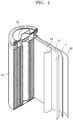
- a lithium secondary battery may include a positive electrode 13, a negative electrode 12, and a separator 14.
- the positive electrode 13, the negative electrode 12, and the separator 14 may be wound and/or folded to be accommodated in a battery case 15. Then, an organic electrolyte solution may be injected into the battery case 15, and the battery case 15 may be sealed with a cap assembly 16, thereby completing the manufacture of the lithium battery.
- the battery case 15 may have a shape of, e.g., a cylinder, a box, or a film.
- a battery assembly may be prepared by disposing a separator between a positive electrode and a negative electrode.
- a plurality of the battery assemblies may be stacked in a bi-cell structure and impregnated with an organic electrolyte solution. The resultant may then be put into a pouch and sealed, thereby completing the manufacture of a lithium ion polymer battery.
- a plurality of the battery assemblies may be stacked to form a battery pack, which may be used in a suitable device that requires high capacity and high output, e.g., in a laptop computer, a smartphone, or an electric vehicle.
- Lithium carbonate as a Li precursor, cobalt oxide as a Co precursor, magnesium carbonate as a Mg precursor, and magnesium fluoride or lithium fluoride as a F precursor were subjected to dry mixing in a Henschel mixer for about 3 minutes to obtain a mixture having a molar ratio of Li:Co:Mg:F:O of 0.9925:1.00:0.0075:0.015:1.985.
- the mixture was heat-treated in an air atmosphere at about 1,000 °C for about 10 hours, and the heat-treated product was pulverized and classified to obtain a lithium cobalt-based composite oxide (Li 0.9925 Mg 0.0075 CoO 1.985 F 0.015 ) as a positive electrode active material.
- a lithium cobalt-based composite oxide (Li 0.995 Mg 0.005 CoO 1.99 F 0.01 ) was obtained in the same manner as in Example 1, except that the mixing ratio of the Li precursor, the Co precursor, the Mg precursor, and the F precursor was changed so that the molar ratio of Li:Co:Mg:F:O was 0.995:1.00:0.005:0.01:1.99.
- a lithium cobalt-based composite oxide (Li 0.99325 Mg 0.00675 CoO 1.9875 F 0.0125 ) was obtained in the same manner as in Example 1, except that the mixing ratio of the Li precursor, the Co precursor, the Mg precursor, and the F precursor was changed so that the molar ratio of Li:Co:Mg:F:O was 0.99325:1.00:0.00675:0.0125:1.9875.
- Lithium carbonate as a Li precursor and cobalt carbonate as a Co precursor were subjected to dry mixing in a Henschel mixer for about 3 minutes to obtain a mixture having a molar ratio of Li:Co:O of 1.00:1.00:2.
- the mixture was heat-treated in an air atmosphere at about 1,000 °C for about 10 hours, and the heat-treated product was pulverized and classified to obtain lithium cobalt oxide (LiCoO 2 ).
- a lithium cobalt-based composite oxide (Li 0.9975 Mg 0.0025 CoO 1.995 F 0.005 ) was obtained in the same manner as in Example 1, except that the mixing ratio of the Li precursor, the Co precursor, the Mg precursor, and the F precursor was changed so that the molar ratio of Li:Co:Mg:F:O was 0.9975:1.00:0.0025:0.005:1.995.
- a lithium cobalt-based composite oxide (Li 0.99625 Mg 0.00375 CoO 1.9925 F 0.0075 ) was obtained in the same manner as in Example 1, except that the mixing ratio of the Li precursor, the Co precursor, the Mg precursor, and the F precursor was changed so that the molar ratio of Li:Co:Mg:F:O was 0.99625:1.00:0.00375:0.0075:1.9925.
- a coin half-cell was manufactured as follows using the positive electrode active material prepared according to Example 1.
- a mixture of the positive electrode active material of Example 1, polyvinylidene fluoride, and carbon black as a conductive agent were uniformly dispersed using a mixer, with air bubbles removed therefrom, to prepare a slurry for forming a positive electrode active material layer.
- N-methylpyrrolidone as a solvent was added to the mixture, and a weight mixing ratio of the composite positive electrode active material, polyvinylidene fluoride, and carbon black was 92:4:4.
- the slurry prepared according to the above processes was coated on aluminum foil using a doctor blade to thereby fabricate a thin plate, and the thin plate was dried at 135 °C for over 3 hours, followed by pressing and vacuum drying, to manufacture a positive electrode.
- the positive electrode and Li metal electrode as a counter electrode were used to manufacture a 2032 coin half-cell.
- a separator (thickness: about 16 ⁇ m) composed of a porous polyethylene (PE) film was disposed between the positive electrode and the Li metal electrode, and an electrolyte was injected thereinto to manufacture a coin half-cell.
- a 1.1 M solution including LiPF 6 dissolved in a mixed solvent of ethylene carbonate (EC), ethyl methyl carbonate (EMC), and dimethyl carbonate (DMC) in a volume ratio of 3:4:3 was used.
- each coin half-cell was charged at a constant current of 0.2 C until the voltage reached 4.6 V.
- the completely charged coin half-cells were rested for about 10 minutes, and then each coin half-cell was discharged at a constant current of 0.2 C until the voltage reached 3 V.
- each coin half-cell was charged at a constant current of 0.2 C until the voltage reached 4.6 V.
- the completely charged coin half-cells were rested for about 10 minutes, and then each coin half-cell was discharged at a constant current of 0.2 C until the voltage reached 3 V.
- each of the lithium secondary batteries of Manufacture Examples 1 to 3 and Comparative Manufacture Examples 1 to 3 was charged at a constant current of 0.1 Crate until the voltage reached 4.6 V (vs. Li). Subsequently, each lithium secondary battery was discharged at a constant current of 0.1 C until the voltage reached 3.0 V (vs. Li) (formation operation, 1 st cycle).
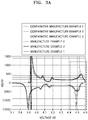
- Each lithium secondary battery after the formation operation was charged at a constant current of 0.2 C at 25°C until the voltage reached 4.6 V (vs. Li). Subsequently, each lithium secondary battery was discharged at a constant current of 0.2 C until the voltage reached 3.0 V (vs. Li), and dQ/ dV profiles of the lithium secondary batteries were compared with one another.
- FIG. 3B illustrates an enlarged view of a rectangular area represented by a dotted line of FIG. 3A .
- the lithium secondary batteries of Manufacture Examples 1 to 3 had a smaller intensity at a peak representing a phase transition of O 3 ⁇ H 1-3 ⁇ O 1 during charging than that of the lithium secondary batteries of Comparative Manufacture Examples 1 to 3.
- reversibility of the phase transition of O 1 ⁇ H 1-3 ⁇ O 3 was enhanced.
- doping amounts of Mg and F were 0.5 mol% and 1 mol% or more, respectively, optimum phase transition properties were obtained.
- each coin half-cell was charged at a constant current of 0.1 C until the voltage reached 4.6 V.
- the completely charged coin half-cells were rested for about 10 minutes, and then each coin half-cell was discharged at a constant current of 0.1 C until the voltage reached 3 V.
- each coin half-cell was charged at a constant current of 0.2 C until the voltage reached 4.6 V.
- the completely charged coin half-cells were rested for about 10 minutes and then were discharged at a constant current of 0.2 C until the voltage reached 3 V.
- each coin half-cell was charged at a constant current of 1 C until the voltage reached 4.6 V.
- the completely charged coin half-cells were rested for about 10 minutes and were then discharged at a constant current of 1 C until the voltage reached 3 V. This cycle of charging and discharging was repeated 50 times.
- the lifespan evaluation results are shown in FIG. 4 .
- a phase transition may be effectively suppressed at a high voltage, thereby enhancing stability at a high voltage.
- a lithium secondary battery with enhanced charge/discharge and lifespan characteristics may be manufactured using the lithium cobalt composite oxide.
- the embodiments may provide lithium secondary batteries using the lithium cobalt composite oxides and thus having enhanced stability at high voltages and enhanced cell performance.
Landscapes
- Chemical & Material Sciences (AREA)
- Inorganic Chemistry (AREA)
- Chemical Kinetics & Catalysis (AREA)
- Electrochemistry (AREA)
- General Chemical & Material Sciences (AREA)
- Organic Chemistry (AREA)
- Engineering & Computer Science (AREA)
- Materials Engineering (AREA)
- Manufacturing & Machinery (AREA)
- Battery Electrode And Active Subsutance (AREA)
- Secondary Cells (AREA)
Abstract
Description
- The present invention relates to a lithium cobalt composite oxide for a lithium secondary battery and a lithium secondary battery including a positive electrode including the same.
- Lithium cobalt oxide (LiCoO2) is widely used as a positive electrode active material of a lithium secondary battery. As lithium secondary batteries are widely used in portable information electronic devices as well as in motor-driven tools, automobile vehicles, and the like, safe, high-capacity lithium secondary batteries with high power output are in strong demand.
- In a first aspect, the present invention provides a lithium cobalt composite oxide for a lithium secondary battery, the lithium cobalt composite oxide comprising a magnesium (Mg)-doped lithium cobalt composite oxide having an atomic ratio of Mg to cobalt (Co) of about 0.0035:1 to about 0.01:1, wherein the Mg-doped lithium cobalt composite oxide further comprises fluorine (F).
- An amount of F in the lithium cobalt composite oxide may be about 0.2 mol% to about 2 mol%, based on a total number of moles of the lithium cobalt composite oxide.
- The F may be doped inside the Mg-doped lithium cobalt composite oxide.
- The atomic ratio of Mg to Co may be about 0.005:1 to about 0.01:1.
- An atomic ratio of a sum of atoms of Li and Mg to Co may be about 1.00:1 or less.
- The lithium cobalt composite oxide may be a compound represented by Formula 1 below:
<Formula 1> Li1-xMgxCoO2-aFa
wherein, in Formula 1, 0<x<0.04 and 0<a≤0.02. - In Formula 1, 0.001≤x≤0.01 and 0.005≤a≤0.015.
- The lithium cobalt composite oxide may include Li0.995Mg0.005CoO1.99F0.01, Li0.99325Mg0.00675CoO1.9875F0.0125, Li0.9925Mg0.0075CoO1.985F0.015, Li0.995Mg0.005CoO1.995F0.005, Li0.99325Mg0.00675CoO1.99325F0.00675, Li0.9925Mg0.0075CoO1.9925F0.0075, Li0.99Mg0.01CoO1.99F0.01, or Li0.99Mg0.01CoO1.98F0.02.
- The atomic ratio of Mg to Co of the lithium cobalt composite oxide may be about 0.005:1 to about 0.0075:1.
- In a second aspect, the present invention provides a lithium secondary battery, comprising a positive electrode comprising a lithium cobalt composite oxide, the lithium cobalt composite oxide comprising a magnesium (Mg)-doped lithium cobalt composite oxide having an atomic ratio of Mg to cobalt (Co) of about 0.0035:1 to about 0.01:1, wherein the Mg-doped lithium cobalt composite oxide further comprises fluorine (F).
- The lithium secondary battery may have a charging voltage of about 4.5 V or higher.
- An amount of F in the lithium cobalt composite oxide may be about 0.2 mol% to about 2 mol%, based on a total number of moles of the lithium cobalt composite oxide.
- The F may be doped inside the Mg-doped lithium cobalt composite oxide.
- The atomic ratio of Mg to Co may be about 0.005:1 to about 0.01:1.
- An atomic ratio of a sum of atoms of Li and Mg to Co may be about 1.00:1 or less.
- The lithium cobalt composite oxide may be a compound represented by Formula 1 below:
<Formula 1> Li1-xMgxCoO2-aFa
wherein, in Formula 1, 0<x<0.04 and 0<a≤0.02. - In Formula 1, 0.001≤x≤0.01 and 0.005≤a≤0.015.
- The lithium cobalt composite oxide may include Li0.995Mg0.005CoO1.99F0.01, Li0.99325Mg0.00675CoO1.9875F0.0125, Li0.9925Mg0.0075CoO1.985F0.015, Li0.995Mg0.005CoO1.995F0.005, Li0.99325Mg0.00675CoO1.99325F0.00675, Li0.9925Mg0.0075CoO1.9925F0.0075, Li0.99Mg0.01CoO1.99F0.01, or Li0.99Mg0.01CoO1.98F0.02.
- The atomic ratio of Mg to Co of the lithium cobalt composite oxide may be about 0.005:1 to about 0.0075:1.
- Features will be apparent to those of skill in the art by describing in detail exemplary embodiments with reference to the attached drawings in which:
-
FIG. 1 illustrates a schematic view of a structure of a lithium secondary battery according to an example embodiment; -
FIG. 2 illustrates a graph showing voltage profiles of coin half-cells manufactured according to Manufacture Examples 1 to 3 and Comparative Manufacture Examples 1 to 3; -
FIGS. 3A and3B illustrate graphs showing differential capacity curves of the coin half-cells of Manufacture Examples 1 to 3 and Comparative Manufacture Examples 1 to 3; and -
FIG. 4 illustrates a graph showing lifespan characteristics of the coin half-cells of Manufacture Examples 1 to 3 and Comparative Manufacture Examples 1 to 3. - Example embodiments will now be described more fully hereinafter with reference to the accompanying drawings; however, they may be embodied in different forms and should not be construed as limited to the embodiments set forth herein. Rather, these embodiments are provided so that this disclosure will be thorough and complete, and will fully convey exemplary implementations to those skilled in the art.
- In the drawing figures, the dimensions of layers and regions may be exaggerated for clarity of illustration. It will also be understood that when a layer or element is referred to as being "on" another layer or element, it can be directly on the other layer or element, or intervening layers may also be present. In addition, it will also be understood that when a layer is referred to as being "between" two layers, it can be the only layer between the two layers, or one or more intervening layers may also be present. Like reference numerals refer to like elements throughout.
- As used herein, the term "and/or" includes any and all combinations of one or more of the associated listed items. Expressions such as "at least one of," when preceding a list of elements, modify the entire list of elements and do not modify the individual elements of the list.
- Hereinafter, lithium cobalt composite oxides according to example embodiments and lithium secondary batteries including positive electrodes including the same will be described in more detail.
- According to an example embodiment, a lithium cobalt composite oxide for a lithium secondary battery may include a magnesium (Mg)-doped lithium cobalt composite oxide having an atomic ratio of Mg to Co of about 0.0035 to about 0.01 (e.g., about 0.0035:1 to about 0.01:1). The Mg-doped lithium cobalt composite oxide may further include fluorine (F).
- The atomic ratio of Mg to Co may be, e.g., from about 0.004:1 to about 0.01:1.
- When lithium cobalt oxide (LiCoO2) is used as a positive electrode active material, a phase transition of O3 to H1-3 to O1 may occur in a high voltage region. When such lithium cobalt oxide having gone through the phase transition is used as a positive electrode active material in a lithium secondary battery, cell performance of the lithium secondary battery may deteriorate.
- The phase transition of O3 → H1-3 → O1 occurring in a high voltage region may be effectively suppressed by a lithium cobalt composite oxide doped with Mg, having an atomic ratio of Mg to Co of about 0.004:1 to about 0.01:1, and also including F. As a result, when such a lithium cobalt composite oxide is used, high-voltage stability may be enhanced, resulting in enhancement of charge and discharge capacities as well as enhanced lifespan characteristics of a lithium secondary battery at a high voltage. The high voltage region may be, e.g., about 4.5 V or higher, or from about 4.55 V to about 4.63 V.
- The F element is included in the lithium cobalt composite oxide. The F element may be disposed on a surface of the Mg-doped lithium cobalt composite oxide or in a state mixed with the Mg-doped lithium cobalt composite oxide. In the latter case, the Mg-doped lithium cobalt composite oxide may be surface-treated with the F element in an anion form to produce a compound having the formula (Li1-xMgx)CoO2-aFa.
- The amount of F may be from about 0.4 mol% to about 2 mol%, based on a total number of moles of the lithium cobalt composite oxide. When the amount of F is within the above range, the phase transition at a high voltage may be suppressed and, accordingly, a lithium cobalt composite oxide with enhanced stability may be obtained.
- According to one example embodiment, the F element may be doped inside the Mg-doped lithium cobalt composite oxide. For example, the F element may be doped at the O site of the Mg-doped lithium cobalt composite oxide.
- In an implementation, the atomic ratio of Mg to Co may be, e.g., from about 0.005:1 to about 0.0075:1. In an implementation, an atomic ratio of F to Mg may be, e.g., from about 1:1 to about 2:1.
- In an implementation, an atomic ratio of a sum of Li and Mg to Co may be about 1.00:1 or less, e.g., from about 0.96:1 to about 1.00:1. When the atomic ratio of a sum of Li and Mg to Co is within the above ranges, a lithium cobalt composite oxide having a strong phase transition-suppressing ability may be obtained.
- The lithium cobalt composite oxide may be a compound represented by Formula 1 below:
<Formula 1> Li1-xMgxCoO2-aFa
- In Formula 1, 0<x<0.04 and 0<a≤0.02.
- As shown in
Formula 1 above, the lithium cobalt composite oxide may have a structure in which Mg is included in an amount of about 4 mol% or less, doped in the Li site, and F may be included in an amount of about 2 mol% or less, doped in the O site. When the amount of Mg is about 4 mol% or more, Mg may be doped in the Co site. - In
Formula 1 above, x may be 0.001 to 0.01, e.g., 0.005, 0.00625, 0.0075, or 0.001. In addition, a may be 0.001 to 0.2, e.g., 0.005 to 0.015. For example, a may be 0.005, 0.0075, 0.01, 0.0125, or 0.015. - The lithium cobalt composite oxide may be, e.g., Li0.995Mg0.005CoO1.99F0.01, Li0.99325Mg0.00675CoO1.9875F0.0125, Li0.9925Mg0.0075CoO1.985F0.015, Li0.995Mg0.005CoO1.995F0.005, Li0.99325Mg0.00675CoO1.99325F0.00675, Li0.9925Mg0.0075CoO1.9925F0.0075, Li0.99Mg0.01CoO1.99F0.01, or Li0.99Mg0.01CoO1.98F0.02.
- In the lithium cobalt composite oxide, as shown in
Formula 1 above, Mg ions may be present in a space in a Li layer thereof and thus, although all the Li ions may be removed from the Li layer, a 03-type structure of the lithium cobalt composite oxide may be more stable in a high voltage region. As such, Mg may be doped in the Li site of the Li layer, and Mg may act as a support, enhancing structural stability, even though Li ions may be removed from the layered structure. For example, the 03-type structure may have a high stability at a high voltage of about 4.5 V or higher. - The lithium cobalt composite oxide may include F, and some sites of O atoms may be replaced by F. Thus, an average oxidation number of Co ions may be decreased from +4 by a number of moles of the substituted F and an oxidation number of Co on a surface of the lithium cobalt composite oxide may be further decreased. As such, the decrease in the average oxidation number of Co ions may facilitate enhanced structural stability of the lithium cobalt composite oxide. In addition, ion binding properties may be enhanced by Co-F bonding and thus O2 gas generation and Co elution may be suppressed, thereby enhancing chemical stability of LCO.
- In an implementation, the lithium cobalt composite oxide may be further doped with at least one selected from, e.g., titanium, aluminum, manganese, zirconium, sodium, potassium, calcium, and zinc.
- Hereinafter, a method of preparing the lithium cobalt composite oxide, according to an example embodiment will be described.
- First, a Li precursor, a Co precursor, a Mg precursor, and a F precursor may be mixed in a predetermined molar ratio to obtain a precursor mixture. In this regard, a mixing ratio of the Li precursor, the Co precursor, the Mg precursor, and the F precursor may be stoichiometrically controlled to obtain a desired lithium cobalt composite oxide.
- The mixing process may be, e.g., dry mixing such as mechanical mixing using a ball mill, a Banbury mixer, a homogenizer, or the like. The mechanical mixing may be performed using zirconia balls or the like. The mechanical mixing time may vary, e.g., from about 20 minutes to about 10 hours, or from 30 minutes to about 3 hours.
- Dry mixing may lower manufacturing costs relative to wet mixing.
- In the mechanical mixing process, wet mixing may be performed using a solvent, e.g., an alcohol such as ethanol, or the like, to thereby increase mixing efficiency of the precursor mixture.
- The amount of the solvent may be from about 100 parts by weight to about 3,000 parts by weight based on a total amount (100 parts by weight) of the precursors. When the amount of the solvent is within the above range, a mixture with the precursors uniformly dissolved therein may be obtained. Heat treatment may be performed for an amount of time that may vary, e.g., from about 3 hours to about 20 hours. The amount of time for which heat treatment is performed may depend upon a heat treatment temperature.
- The lithium cobalt composite oxide maybe prepared using a suitable preparation method, e.g., by spray pyrolysis or the like, in addition to the solid phase method described above.
- The mixture may be heat-treated under an air or oxygen atmosphere to obtain a lithium cobalt composite oxide.
- In an implementation, the heat treatment process may be performed under an air or oxygen atmosphere at a temperature ranging from about 400 °C to about 1,200 °C, e.g., about 900 °C to about 1100 °C. In this regard, the oxygen atmosphere maybe formed using oxygen alone or a combination of oxygen, nitrogen, and an inert gas.
- The heat treatment time may vary, e.g. from about 5 hours to about 20 hours. The amount of time for which heat treatment is performed may vary according to the heat treatment temperature.
- Examples of the Li precursor may include lithium hydroxide (LiOH), lithium carbonate (Li2CO3), lithium sulfate (Li2SO4), and lithium nitrate (LiNO3).
- Examples of the Co precursor may include cobalt carbonate, cobalt hydroxide, cobalt chloride, cobalt sulfate, and cobalt nitrate. Examples of the Mg precursor may include magnesium chloride, magnesium carbonate, magnesium hydroxide, magnesium sulfate, magnesium nitrate, and magnesium fluoride.
- The F precursor may include, e.g., magnesium fluoride or the like.
- In an implementation, the Li, Co, Mg, and F precursors may include suitable Li, Co, Mg and F precursors.
- The lithium cobalt composite oxide obtained using the preparation method described above may have, eg.., a specific surface area of about 0.1 m2/g to about 3 m2/g and an average particle diameter of about 1 µm to about 20 µm. Average particle diameter maybe measured according to standard techniques, such as those described in standard ISO 9276. Average particle diameter may be measured by particle size analyzer(USA), and the specific surface area may be measured by BET method.
- According to the second aspect of the present invention, provided is a lithium secondary battery including a positive electrode including the lithium cobalt composite oxide of the first aspect.
- First, a positive electrode may be prepared in the following manner.
- For example, a lithium cobalt composite oxide according to the first aspect of the present invention as a positive electrode active material, a binder, and a solvent may be mixed to prepare a positive electrode active material composition.
- In an implementation, a conducting agent maybe further included in the positive electrode active material composition.
- In an implementation, the positive electrode active material composition may be directly coated and dried on a metallic current collector to prepare a positive electrode plate. In an implementation, the positive electrode active material composition may be cast on a separate support to form a positive electrode active material film, which may then be separated from the support and laminated on a metallic current collector to prepare a positive electrode plate.
- The positive electrode may further include a first positive electrode active material, which is a suitable positive electrode active material in a lithium secondary battery, during preparation of the positive electrode plate.
- The first positive electrode active material may further include, e.g., at least one selected from lithium cobalt oxide, lithium nickel cobalt manganese oxide, lithium nickel cobalt aluminum oxide, lithium iron phosphate oxide, and lithium manganese oxide, and a suitable positive electrode active material maybe used.
- In an implementation, the positive electrode active material may further comprise a compound represented by any of following formulas: LiaA1-bRbD2 (where, 0.90 ≤ a ≤ 1.8, and 0 ≤ b ≤ 0.5); LiaE1-bRbO2-cDc (where 0.90 ≤ a ≤ 1.8, 0 ≤ b ≤ 0.5, and 0 ≤ c ≤ 0.05); LiE2-bRbO4-cDc (where 0 ≤ b ≤ 0.5 and 0 ≤ c ≤ 0.05); LiaNi1-b-cCobRcDα (where 0.90 ≤ a ≤ 1.8, 0 ≤ b ≤ 0.5, 0 ≤ c ≤ 0.05, and 0 < α ≤ 2); LiaNi1-b-cCobRcO2-αXα (where 0.90 ≤ a ≤ 1.8, 0 ≤ b ≤ 0.5, 0 ≤ c ≤ 0.05, and 0 < α < 2); LiaNi1-b-cCobRcO2-αX2 (where 0.90 ≤ a ≤ 1.8, 0 ≤ b ≤ 0.5, 0 ≤ c ≤ 0.05, and 0 < α < 2); LiaNi1-b-cMnbRcDα (where 0.90 ≤ a ≤ 1.8, 0 ≤ b ≤ 0.5, 0 ≤ c ≤ 0.05, and 0 < α ≤ 2); LiaNi1-b-cMnbRcO2-αXα (where 0.90 ≤ a ≤ 1.8, 0 ≤ b ≤ 0.5, 0 ≤ c ≤ 0.05, and 0 < α < 2); LiaNi1-b-cMnbRcO2-αXα (where 0.90 ≤ a ≤ 1.8, 0 ≤ b ≤ 0.5, 0 ≤ c ≤ 0.05, and o < α < 2); LiaNibEcGdO2 (where 0.90 ≤ a ≤ 1.8, 0 ≤ b ≤ 0.9, 0 ≤ c ≤ 0.5, and 0.001 ≤ d ≤ 0.1.); LiaNibCocMndGeO2 (where 0.90 ≤ a ≤ 1.8, 0 ≤ b ≤ 0.9, 0 ≤ c ≤ 0.5, 0 ≤ d ≤ 0.5, and 0.001 ≤ e ≤ 0.1.); LiaNiGbO2 (where 0.90 ≤ a ≤ 1.8 and 0.001 ≤ b ≤ 0.1); LiaCoGbO2 (where 0.90 ≤ a ≤ 1.8 and 0.001 ≤ b ≤ 0.1); LiaMnGbO2 (where 0.90 ≤ a ≤ 1.8 and 0.001 ≤ b ≤ 0.1); LiaMn2GbO4 (where 0.90 ≤ a ≤ 1.8 and 0.001 ≤ b ≤ 0.1); QO2; QS2; LiQS2; V2O5; LiV2O5; LiM'O2; LiNiVO4; Li(3-f)J2(PO4)3 (where 0 ≤ f ≤ 2); Li(3-f)Fe2(PO4)3 (where 0 ≤ f ≤ 2); and LiFePO4.
- In the above formulae, A may be Ni, Co, Mn, or a combination thereof; R maybe Al, Ni, Co, Mn, Cr, Fe, Mg, Sr, V, a rare earth element, or a combination thereof; D may be O, F, S, P, or a combination thereof; E may be Co, Mn, or a combination thereof; X may be F, S, P, or a combination thereof; G maybe Al, Cr, Mn, Fe, Mg, La, Ce, Sr, V, or a combination thereof; Q may be Ti, Mo, Mn, or a combination thereof; M' may be Cr, V, Fe, Sc, Y, or a combination thereof; and J may be V, Cr, Mn, Co, Ni, Cu, or a combination thereof.
- In the positive electrode active material composition, the binder may include, e.g., polyamideimide, polyacrylic acid ("PAA"), polyvinylidene fluoride, polyvinyl alcohol, carboxymethylcellulose ("CMC"), starch, hydroxypropyl cellulose, regenerated cellulose, polyvinylpyrrolidone, tetrafluoroethylene, polyethylene, polypropylene, polystyrene, lithium polyacrylate, lithium polymethacrylate, ethylene-propylene-diene monomer ("EPDM"), sulfonated EPDM, styrene butadiene rubber, fluoride rubber, or various polymers.
- In an implementation, the conducting agent may include at least one carbonaceous material selected from carbon black, carbon fibers, and graphite. In an implementation, the carbon black maybe selected from acetylene black, Ketjen black, super P, channel black, furnace black, lamp black, and thermal black.
- The graphite may be natural graphite or artificial graphite.
- The solvent maybe at least one selected from N-methylpyrrolidone, butanol, acetonitrile, acetone, methanol, ethanol, or N-methyl-2-pyrrolidone (NMP), or a suitable solvent may be used.
- In an implementation, a plasticizer maybe further added to the positive electrode active material composition and/or negative electrode active material composition to help form pores in the electrode plate.
- Amounts of the positive electrode active material, the conducting agent, the binder, and the solvent maybe in ranges that are suitably used in lithium batteries. In an implementation, at least one of the conducting agent, the binder, and the solvent may be omitted according to the use and the structure of the lithium battery.
- The negative electrode may be prepared by using the same method used to prepare the positive electrode, except that a negative electrode active material may be used instead of the positive electrode active material in the preparation of the positive electrode.
- The negative electrode active material may be a carbonaceous material, silicon, a silicon oxide, a silicon-based alloy, a silicon-carbonaceous material composite, tin, a tin-based alloy, a tin-carbon composite, a metal oxide, or a combination thereof.
- The carbonaceous material may be crystalline carbon, amorphous carbon, or a mixture thereof. Examples of the crystalline carbon may include graphite such as natural graphite or artificial graphite in non-shaped, plate-shaped, flake, spherical, or fibrous form, and examples of the amorphous carbon may include soft carbon (carbon sintered at low temperature), hard carbon, meso-phase pitch carbonization products, sintered coke, graphene, carbon black, fullerene soot, carbon nanotubes, or carbon fibers, or a suitable material available as a carbonaceous material in the art may be used.
- The negative electrode active material may be selected from, e.g., Si, SiOx (where, 0<x<2, or, for example, 0.5<x<1.5), Sn, SnO2, a silicon-containing metal alloy, and a mixture thereof. A metal for forming the silicon-containing metal alloy may include, e.g., at least one selected from Al, Sn, Ag, Fe, Bi, Mg, Zn, in, Ge, Pb, and Ti.
- The negative electrode active material may include a metal/ semi-metal alloyable with lithium, an alloy thereof, or an oxide thereof. Examples of the metal/metalloid alloyable with lithium, an alloy thereof, or an oxide thereof may include Si, Sn, Al, Ge, Pb, Bi, Sb, a Si-Y' alloy (where, Y' is an alkali metal, an alkali earth metal, a
Group 13 element, aGroup 14 element, a transition metal, a rare-earth element, or a combination thereof, but not Si), a Sn-Y' alloy (where, Y' is an alkali metal, an alkali earth metal, aGroup 13 element, aGroup 14 element, a transition metal, a rare-earth element, or a combination thereof, but not Sn), and MnOx (where, 0<x≤2). The element Y' may be Mg, Ca, Sr, Ba, Ra, Sc, Y, Ti, Zr, Hf, Rf, V, Nb, Ta, Db, Cr, Mo, W, Sg, Tc, Re, Bh, Fe, Pb, Ru, Os, Hs, Rh, Ir, Pd, Pt, Cu, Ag, Au, Zn, Cd, B, Al, Ga, Sn, In, Ge, P, As, Sb, Bi, S, Se, Te, Po, or a combination thereof. Examples of the oxide of the metal/ metalloid alloyable with lithium may include a lithium titanium oxide, a vanadium oxide, a lithium vanadium oxide, SnO2, and SiOx (where, 0<x<2). - The negative electrode active material may include, e.g., at least one selected from
Group 13 elements,Group 14 elements, andGroup 15 elements. - The negative electrode active material may include, e.g., at least one selected from Si, Ge, and Sn.
- In the negative electrode active material composition, the conducting agent, the binder, and the solvent may be the same with those used in preparation of the positive electrode active material composition. Also, amounts of the negative electrode active material, the conducting agent, the binder, and the solvent used herein maybe in ranges that are suitably used in lithium batteries.
- A separator may be disposed between the positive electrode and the negative electrode, and the separator may hbe an insulating thin film having a high ion permeability and a high mechanical strength.
- A pore diameter of the separator may be in a range of about 0.01 µm to about 10 µm, and a thickness of the separator may be in a range of about 5 µm to about 20 µm. The separator may be, e.g., an olefin-based polymer such as polypropylene; or a sheet or nonwoven fabric formed of glass fibers or polyethylene. When a solid polymer electrolyte is used as the electrolyte, the solid polymer electrolyte may serve as a separator at the same time.
- In an implementation, the separator may have a multi-layer structure including at least two layers of polyethylene, polypropylene, or polyvinylidene fluoride, and a mixed multi-layer structure may be used, wherein examples of the mixed multi-layer structure may include a two-layer separator of polyethylene/polypropylene, a three-layer separator of polyethylene/polypropylene/polyethylene, and a three-layer separator of polyprolyene/polyethylene/polypropylene.
- A lithium salt-containing non-aqueous based electrolyte solution may include a non-aqueous electrolyte and a lithium salt.
- Examples of the non-aqueous electrolyte may include a non-aqueous electrolyte solution, an organic solid electrolyte, and an inorganic solid electrolyte.
- The non-aqueous electrolyte solution may include an organic solvent, which may be a suitable material available as an organic solvent. Examples of the organic solvent may include propylene carbonate, ethylene carbonate, fluoroethylene carbonate, butylene carbonate, dimethyl carbonate, diethyl carbonate, methylethyl carbonate, methylpropyl carbonate, ethylpropyl carbonate, methylisopropyl carbonate, dipropyl carbonate, dibutyl carbonate, fluoroethylene carbonate, benzonitrile, acetonitrile, tetrahydrofuran, 2-methyltetrahydrofuran, γ-butyrolactone, dioxolane, 4-methyldioxolane, N,N-dimethylformamide, N,N-dimethylacetamide, dimethylsulfoxide, dioxane, 1,2-dimethoxyethane, sulfolane, dichloroethane, chlorobenzene, nitrobenzene, diethyleneglycol, dimethyl ether, or a mixture thereof.
- Examples of the organic solid electrolyte may include polyethylene derivatives, polyethylene oxide derivatives, polypropylene oxide derivatives, phosphoric acid ester polymers, polyester sulfide, polyvinyl alcohols, and polyvinylidene fluoride.
- Examples of the inorganic solid electrolyte may include Li3N, LiI, Li5NI2, Li3N-LiI-LiOH, Li2SiS3, Li4SiO4, Li4SiO4-LiI-LiOH, or Li3PO4-Li2S-SiS2.
- The lithium salt may be soluble in the non-aqueous electrolyte. Examples of the lithium salt may include LiPF6, LiBF4, LiSbF6, LiAsF6, LiClO4, LiCF3SO3, Li(CF3SO2)2N, Li(FSO2)2N, LiC4F9SO3, LiAlO2, LiAlCl4, LiN(CxF2x+1SO2)(CyF2y+1SO2) (where, x and y are a natural number), LiCl, LiI, or a mixture thereof. In an implementation, in order to help improve charging/discharging characteristics or flame resistance of the electrolyte, e.g., the non-aqueous electrolyte may further include pyridine, triethylphosphite, triethanolamine, cyclic ether, ethylenediamine, n-glyme, hexamethyl phosphoramide, nitrobenzene derivatives, sulfur, quinone imide dyes, N-substituted oxazolidinone, N,N-substituted imidazolidine, ethyleneglycol dialkylether, ammonium salts, pyrrole, 2-methoxyethanol, or aluminum trichloride. In an implementation, in order to help impart incombustibility, the electrolyte may further include a halogen-containing solvent such as carbon tetrachloride or ethylene trifluoride.
- As shown in
FIG. 1 , a lithium secondary battery may include apositive electrode 13, anegative electrode 12, and aseparator 14. Thepositive electrode 13, thenegative electrode 12, and theseparator 14 may be wound and/or folded to be accommodated in abattery case 15. Then, an organic electrolyte solution may be injected into thebattery case 15, and thebattery case 15 may be sealed with acap assembly 16, thereby completing the manufacture of the lithium battery. Thebattery case 15 may have a shape of, e.g., a cylinder, a box, or a film. - A battery assembly may be prepared by disposing a separator between a positive electrode and a negative electrode. A plurality of the battery assemblies may be stacked in a bi-cell structure and impregnated with an organic electrolyte solution. The resultant may then be put into a pouch and sealed, thereby completing the manufacture of a lithium ion polymer battery.
- In an implementation, a plurality of the battery assemblies may be stacked to form a battery pack, which may be used in a suitable device that requires high capacity and high output, e.g., in a laptop computer, a smartphone, or an electric vehicle.
- The following Examples and Comparative Examples are provided in order to highlight characteristics of one or more embodiments, but it will be understood that the Examples and Comparative Examples are not to be construed as limiting the scope of the invention, nor are the Comparative Examples to be construed as being outside the scope of the invention. Further, it will be understood that the embodiments are not limited to the particular details described in the Examples and Comparative Examples.
- Lithium carbonate as a Li precursor, cobalt oxide as a Co precursor, magnesium carbonate as a Mg precursor, and magnesium fluoride or lithium fluoride as a F precursor were subjected to dry mixing in a Henschel mixer for about 3 minutes to obtain a mixture having a molar ratio of Li:Co:Mg:F:O of 0.9925:1.00:0.0075:0.015:1.985. The mixture was heat-treated in an air atmosphere at about 1,000 °C for about 10 hours, and the heat-treated product was pulverized and classified to obtain a lithium cobalt-based composite oxide (Li0.9925Mg0.0075CoO1.985F0.015) as a positive electrode active material.
- A lithium cobalt-based composite oxide (Li0.995Mg0.005CoO1.99F0.01) was obtained in the same manner as in Example 1, except that the mixing ratio of the Li precursor, the Co precursor, the Mg precursor, and the F precursor was changed so that the molar ratio of Li:Co:Mg:F:O was 0.995:1.00:0.005:0.01:1.99.
- A lithium cobalt-based composite oxide (Li0.99325Mg0.00675CoO1.9875F0.0125) was obtained in the same manner as in Example 1, except that the mixing ratio of the Li precursor, the Co precursor, the Mg precursor, and the F precursor was changed so that the molar ratio of Li:Co:Mg:F:O was 0.99325:1.00:0.00675:0.0125:1.9875.
- Lithium carbonate as a Li precursor and cobalt carbonate as a Co precursor were subjected to dry mixing in a Henschel mixer for about 3 minutes to obtain a mixture having a molar ratio of Li:Co:O of 1.00:1.00:2. The mixture was heat-treated in an air atmosphere at about 1,000 °C for about 10 hours, and the heat-treated product was pulverized and classified to obtain lithium cobalt oxide (LiCoO2).
- A lithium cobalt-based composite oxide (Li0.9975Mg0.0025CoO1.995F0.005) was obtained in the same manner as in Example 1, except that the mixing ratio of the Li precursor, the Co precursor, the Mg precursor, and the F precursor was changed so that the molar ratio of Li:Co:Mg:F:O was 0.9975:1.00:0.0025:0.005:1.995.
- A lithium cobalt-based composite oxide (Li0.99625Mg0.00375CoO1.9925F0.0075) was obtained in the same manner as in Example 1, except that the mixing ratio of the Li precursor, the Co precursor, the Mg precursor, and the F precursor was changed so that the molar ratio of Li:Co:Mg:F:O was 0.99625:1.00:0.00375:0.0075:1.9925.
- A coin half-cell was manufactured as follows using the positive electrode active material prepared according to Example 1.
- A mixture of the positive electrode active material of Example 1, polyvinylidene fluoride, and carbon black as a conductive agent were uniformly dispersed using a mixer, with air bubbles removed therefrom, to prepare a slurry for forming a positive electrode active material layer. N-methylpyrrolidone as a solvent was added to the mixture, and a weight mixing ratio of the composite positive electrode active material, polyvinylidene fluoride, and carbon black was 92:4:4.
- The slurry prepared according to the above processes was coated on aluminum foil using a doctor blade to thereby fabricate a thin plate, and the thin plate was dried at 135 °C for over 3 hours, followed by pressing and vacuum drying, to manufacture a positive electrode.
- The positive electrode and Li metal electrode as a counter electrode were used to manufacture a 2032 coin half-cell. A separator (thickness: about 16 µm) composed of a porous polyethylene (PE) film was disposed between the positive electrode and the Li metal electrode, and an electrolyte was injected thereinto to manufacture a coin half-cell. As the electrolyte, a 1.1 M solution including LiPF6 dissolved in a mixed solvent of ethylene carbonate (EC), ethyl methyl carbonate (EMC), and dimethyl carbonate (DMC) in a volume ratio of 3:4:3 was used.
- Coin half-cells were manufactured in the same manner as in Manufacture Example 1, except that the positive electrode active materials prepared according to Examples 2 and 3 were each used instead of the positive electrode active material of Example 1. Comparative Manufacture Examples 1 to 3: Manufacture of coin half-cells
- Coin half-cells were manufactured in the same manner as in Manufacture Example 1, except that the positive electrode active materials prepared according to Comparative Examples 1 to 3 were each used instead of the positive electrode active material of Example 1.
- Charge and discharge characteristics of the coin half-cells manufactured according to Manufacture Examples 1 to 3 and Comparative Manufacture Examples 1 to 3 were evaluated using a charger/discharger.
- In the 1st charging/ discharging cycle, charging was performed at a constant current of 0.1 C until the voltage reached 4.6 V. The completely charged coin half-cells were rested for about 10 minutes, and then each coin half-cell was discharged at a constant current of 0.1 C until the voltage reached 3 V. In the 2nd charging/ discharging cycle, each coin half-cell was charged at a constant current of 0.2 C until the voltage reached 4.6 V. The completely charged coin half-cells were rested for about 10 minutes, and then each coin half-cell was discharged at a constant current of 0.2 C until the voltage reached 3 V.
- From the charge/discharge characteristics evaluation described above, results of the changes in voltage according to specific capacity are shown in
FIG. 2 . - From the results shown in
FIG. 2 , it may be seen that an increase in doping amounts of Mg and F resulted in a decrease in specific capacity. - Each of the lithium secondary batteries of Manufacture Examples 1 to 3 and Comparative Manufacture Examples 1 to 3 was charged at a constant current of 0.1 Crate until the voltage reached 4.6 V (vs. Li). Subsequently, each lithium secondary battery was discharged at a constant current of 0.1 C until the voltage reached 3.0 V (vs. Li) (formation operation, 1st cycle).
- Each lithium secondary battery after the formation operation was charged at a constant current of 0.2 C at 25°C until the voltage reached 4.6 V (vs. Li). Subsequently, each lithium secondary battery was discharged at a constant current of 0.2 C until the voltage reached 3.0 V (vs. Li), and dQ/ dV profiles of the lithium secondary batteries were compared with one another.
- Differential capacity characteristics of the lithium secondary batteries after the cycles described above were evaluated and the results thereof are shown in
FIGS. 3A and3B. FIG. 3B illustrates an enlarged view of a rectangular area represented by a dotted line ofFIG. 3A . - Referring to
FIGS. 3A and3B , the lithium secondary batteries of Manufacture Examples 1 to 3 had a smaller intensity at a peak representing a phase transition of O3 → H1-3 → O1 during charging than that of the lithium secondary batteries of Comparative Manufacture Examples 1 to 3. In addition, during discharging, reversibility of the phase transition of O1 → H1-3 → O3 was enhanced. In addition, it may be seen that, when doping amounts of Mg and F were 0.5 mol% and 1 mol% or more, respectively, optimum phase transition properties were obtained. - Charge/ discharge characteristics of the coin half-cells of Manufacture Examples 1 to 3 and Comparative Manufacture Examples 1 to 3 were evaluated using a charger/ discharger under the following conditions.
- In the 1st charging/ discharging cycle, each coin half-cell was charged at a constant current of 0.1 C until the voltage reached 4.6 V. The completely charged coin half-cells were rested for about 10 minutes, and then each coin half-cell was discharged at a constant current of 0.1 C until the voltage reached 3 V. In the 2nd charging/ discharging cycle, each coin half-cell was charged at a constant current of 0.2 C until the voltage reached 4.6 V. The completely charged coin half-cells were rested for about 10 minutes and then were discharged at a constant current of 0.2 C until the voltage reached 3 V.
- To evaluate a lifespan of each coin half-cell, each coin half-cell was charged at a constant current of 1 C until the voltage reached 4.6 V. The completely charged coin half-cells were rested for about 10 minutes and were then discharged at a constant current of 1 C until the voltage reached 3 V. This cycle of charging and discharging was repeated 50 times.
- The lifespan evaluation results are shown in
FIG. 4 . - From the results shown in
FIG. 4 , it may be seen that the lithium secondary batteries of Manufacture Examples 1 to 3 had longer lifespans than that of the lithium secondary batteries of Comparative Manufacture Examples 1 to 3. - By way of summation and review, research on performance improvement of LiCoO2 has been actively ongoing to address capacity limitation and safety of LiCoO2.
- As is apparent from the foregoing description, in a lithium cobalt composite oxide according to an example embodiment, a phase transition may be effectively suppressed at a high voltage, thereby enhancing stability at a high voltage. In addition, a lithium secondary battery with enhanced charge/discharge and lifespan characteristics may be manufactured using the lithium cobalt composite oxide.
- The embodiments may provide lithium secondary batteries using the lithium cobalt composite oxides and thus having enhanced stability at high voltages and enhanced cell performance.
- Example embodiments have been disclosed herein, and although specific terms are employed, they are used and are to be interpreted in a generic and descriptive sense only and not for purpose of limitation. In some instances, as would be apparent to one of ordinary skill in the art as of the filing of the present application, features, characteristics, and/or elements described in connection with a particular embodiment may be used singly or in combination with features, characteristics, and/or elements described in connection with other embodiments unless otherwise specifically indicated. Accordingly, it will be understood by those of skill in the art that various changes in form and details may be made without departing from the scope of the present invention as set forth in the following claims.
Claims (11)
- A lithium cobalt composite oxide for a lithium secondary battery, the lithium cobalt composite oxide comprising a magnesium (Mg)-doped lithium cobalt composite oxide having an atomic ratio of Mg to cobalt (Co) of about 0.0035:1 to about 0.01:1,
wherein the Mg-doped lithium cobalt composite oxide further comprises fluorine (F). - The lithium cobalt composite oxide as claimed in claim 1, wherein an amount of F in the lithium cobalt composite oxide is about 0.2 mol% to about 2 mol%, based on a total number of moles of the lithium cobalt composite oxide.
- The lithium cobalt composite oxide as claimed in claim 1 or 2, wherein the F is doped inside the Mg-doped lithium cobalt composite oxide.
- The lithium cobalt composite oxide as claimed in any one of claims 1 to 3, wherein the atomic ratio of Mg to Co is about 0.005:1 to about 0.01:1.
- The lithium cobalt composite oxide as claimed in any one of claims 1 to 4, wherein an atomic ratio of a sum of atoms of Li and Mg to Co is about 1.00:1 or less.
- The lithium cobalt composite oxide as claimed in any one of claims 3 to 5, wherein the lithium cobalt composite oxide is a compound represented by Formula 1 below:
<Formula 1> $Li1-xMgxCoO2-aFa
wherein, in Formula 0<x<0.04 and 0<a≤0.02. - The lithium cobalt composite oxide as claimed in claim 6, wherein, in Formula 1, 0.001≤x≤0.01 and 0.005≤a≤0.015.
- The lithium cobalt composite oxide as claimed in claim 1, wherein the lithium cobalt composite oxide comprises Li0.995Mg0.005CoO1.99F0.01, Li0.99325Mg0.00675CoO1.9875F0.0125, Li0.9925Mg0.0075CoO1.985F0.015, Li0.995Mg0.005CoO1.995F0.005, Li0.99325Mg0.00675CoO1.99325F0.00675, Li0.9925Mg0.0075CoO1.9925F0.0075, Li0.99Mg0.01CoO1.99F0.01, or Li0.99Mg0.01CoO1.98F0.02.
- The lithium cobalt composite oxide as claimed in claim wherein the atomic ratio of Mg to Co of the lithium cobalt composite oxide is about 0.005:1 to about 0.0075:1.
- A lithium secondary battery, comprising a positive electrode comprising a lithium cobalt composite oxide as defined in any one of the preceding claims.
- The lithium secondary battery as claimed in claim 10, wherein the lithium secondary battery has a charging voltage of about 4.5 V or higher.
Applications Claiming Priority (1)
| Application Number | Priority Date | Filing Date | Title |
|---|---|---|---|
| KR1020160098449A KR102256296B1 (en) | 2016-08-02 | 2016-08-02 | Lithium cobalt composite oxide for lithium secondary battery and lithium secondary battery including positive electrode comprising the same |
Publications (2)
| Publication Number | Publication Date |
|---|---|
| EP3279148A1 true EP3279148A1 (en) | 2018-02-07 |
| EP3279148B1 EP3279148B1 (en) | 2021-02-17 |
Family
ID=59416619
Family Applications (1)
| Application Number | Title | Priority Date | Filing Date |
|---|---|---|---|
| EP17183608.3A Active EP3279148B1 (en) | 2016-08-02 | 2017-07-27 | Lithium cobalt composite oxide for lithium secondary battery and lithium secondary battery including positive electrode including the same |
Country Status (3)
| Country | Link |
|---|---|
| US (1) | US10854878B2 (en) |
| EP (1) | EP3279148B1 (en) |
| KR (1) | KR102256296B1 (en) |
Families Citing this family (9)
| Publication number | Priority date | Publication date | Assignee | Title |
|---|---|---|---|---|
| CN116565296A (en) | 2016-07-05 | 2023-08-08 | 株式会社半导体能源研究所 | Lithium-ion secondary battery |
| US12308421B2 (en) | 2016-09-12 | 2025-05-20 | Semiconductor Energy Laboratory Co., Ltd. | Electrode and power storage device comprising graphene compound |
| CN115188931A (en) | 2016-10-12 | 2022-10-14 | 株式会社半导体能源研究所 | Positive electrode active material particle and method for producing positive electrode active material particle |
| CN110546794A (en) | 2017-05-12 | 2019-12-06 | 株式会社半导体能源研究所 | Positive electrode active material particles |
| KR20240023214A (en) | 2017-05-19 | 2024-02-20 | 가부시키가이샤 한도오따이 에네루기 켄큐쇼 | Positive electrode active material, method for manufacturing positive electrode active material, and secondary battery |
| CN112201844A (en) | 2017-06-26 | 2021-01-08 | 株式会社半导体能源研究所 | Manufacturing method of positive electrode active material and secondary battery |
| JP7397792B2 (en) | 2018-06-22 | 2023-12-13 | 株式会社半導体エネルギー研究所 | Positive electrode active material, positive electrode, secondary battery, and method for producing positive electrode |
| JP7558811B2 (en) * | 2018-11-16 | 2024-10-01 | 株式会社半導体エネルギー研究所 | Positive electrode active material, secondary battery, electronic device and vehicle |
| WO2020110799A1 (en) * | 2018-11-30 | 2020-06-04 | 株式会社村田製作所 | Secondary battery |
Citations (4)
| Publication number | Priority date | Publication date | Assignee | Title |
|---|---|---|---|---|
| US20060154146A1 (en) * | 2004-04-30 | 2006-07-13 | Seimi Chemical Co., Ltd. | Process for producing lithium-containing composite oxide for positive electrode for lithium secondary battery |
| US20060222951A1 (en) * | 2003-08-19 | 2006-10-05 | Koji Tatsumi | Positive electrode material for lithium secondary cell and process for producing the same |
| US20070254214A1 (en) * | 2005-09-27 | 2007-11-01 | Agc Seimi Chemical Co., Ltd. | Process for producing lithium-containing composite oxide for positive electrode for lithium secondary battery |
| US20080076027A1 (en) * | 2005-05-17 | 2008-03-27 | Agc Seimi Chemical Co., Ltd. | Process for producing lithium-containing composite oxide for positive electrode of lithium secondary battery |
Family Cites Families (8)
| Publication number | Priority date | Publication date | Assignee | Title |
|---|---|---|---|---|
| JP2004079386A (en) | 2002-08-20 | 2004-03-11 | Sumitomo Metal Mining Co Ltd | Cobalt oxide for positive electrode active material for non-aqueous electrolyte secondary battery and method for producing the same |
| CN100517818C (en) | 2002-09-25 | 2009-07-22 | 清美化学股份有限公司 | Positive electrode material for lithium secondary battery and process for producing the same |
| JP4841133B2 (en) | 2004-11-16 | 2011-12-21 | 三洋電機株式会社 | Nonaqueous electrolyte secondary battery |
| JP4105202B2 (en) * | 2006-09-26 | 2008-06-25 | 新光電気工業株式会社 | Manufacturing method of semiconductor device |
| PL3366648T3 (en) | 2007-06-29 | 2020-04-30 | Umicore | High density lithium cobalt oxide for rechargeable batteries |
| WO2010053328A2 (en) | 2008-11-10 | 2010-05-14 | 주식회사 엘지화학 | Positive active material with improved high voltage characteristics |
| KR101550956B1 (en) | 2012-07-31 | 2015-09-18 | 주식회사 엘지화학 | Metal-doped cathode active material |
| JP6414589B2 (en) * | 2014-03-11 | 2018-10-31 | 三洋電機株式会社 | Nonaqueous electrolyte secondary battery |
-
2016
- 2016-08-02 KR KR1020160098449A patent/KR102256296B1/en active Active
-
2017
- 2017-07-27 EP EP17183608.3A patent/EP3279148B1/en active Active
- 2017-07-28 US US15/662,987 patent/US10854878B2/en active Active
Patent Citations (4)
| Publication number | Priority date | Publication date | Assignee | Title |
|---|---|---|---|---|
| US20060222951A1 (en) * | 2003-08-19 | 2006-10-05 | Koji Tatsumi | Positive electrode material for lithium secondary cell and process for producing the same |
| US20060154146A1 (en) * | 2004-04-30 | 2006-07-13 | Seimi Chemical Co., Ltd. | Process for producing lithium-containing composite oxide for positive electrode for lithium secondary battery |
| US20080076027A1 (en) * | 2005-05-17 | 2008-03-27 | Agc Seimi Chemical Co., Ltd. | Process for producing lithium-containing composite oxide for positive electrode of lithium secondary battery |
| US20070254214A1 (en) * | 2005-09-27 | 2007-11-01 | Agc Seimi Chemical Co., Ltd. | Process for producing lithium-containing composite oxide for positive electrode for lithium secondary battery |
Also Published As
| Publication number | Publication date |
|---|---|
| US10854878B2 (en) | 2020-12-01 |
| KR20180014956A (en) | 2018-02-12 |
| US20180040897A1 (en) | 2018-02-08 |
| KR102256296B1 (en) | 2021-05-26 |
| EP3279148B1 (en) | 2021-02-17 |
Similar Documents
| Publication | Publication Date | Title |
|---|---|---|
| EP3279148B1 (en) | Lithium cobalt composite oxide for lithium secondary battery and lithium secondary battery including positive electrode including the same | |
| KR102183992B1 (en) | Positive active material, positive electrode and lithium battery containing the same, and manufacturing method thereof | |
| CN110809831B (en) | Positive electrode active material for lithium secondary battery, method for producing same, and positive electrode for lithium secondary battery and lithium secondary battery comprising same | |
| KR102379563B1 (en) | Composite positive active material, method for preparation thereof, positive electrode comprising the same and lithium battery comprising the positive electrode | |
| JP7260573B2 (en) | Composite positive electrode active material for lithium ion battery, manufacturing method thereof, and lithium ion battery including positive electrode containing the same | |
| EP3018740B1 (en) | Anode for secondary battery and secondary battery including same | |
| EP3279149B1 (en) | Lithium cobalt composite oxide for lithium secondary battery and lithium secondary battery including positive electrode including the lithium cobalt composite oxide | |
| EP2696409B1 (en) | High energy density lithium secondary battery having enhanced energy density characteristic | |
| US10340510B2 (en) | Positive electrode active material for lithium secondary battery, preparing method thereof, and lithium secondary battery including positive electrode including the same | |
| US20150030923A1 (en) | Lithium secondary battery having anode containing aqueous binder | |
| US10141565B2 (en) | Non-aqueous electrolyte secondary battery comprising surface-coated positive electrode material | |
| EP2942329B1 (en) | Lithium manganese-based oxide and positive electrode active substance comprising same | |
| KR102091214B1 (en) | Positive Electrode Active Material for Lithium Secondary Battery Comprising High-voltage Lithium Cobalt Oxide Particle and Method of Manufacturing the Same | |
| KR102010014B1 (en) | Lithium secondary battery and operating method thereof | |
| EP2621003A2 (en) | Positive electrode active material comprising lithium manganese oxide and non-aqueous electrolyte secondary battery | |
| KR20180057388A (en) | Positive Electrode Active Material Particle Comprising Core Having Lithium Cobalt Oxide and Shell Having Lithium Cobalt Phosphate and Method of Manufacturing the Same | |
| KR102341409B1 (en) | Composite positive electrode active material for lithium ion battery, preparing method thereof, and lithium ion battery including positive electrode comprising the same | |
| EP2693537B1 (en) | High energy density lithium secondary battery having enhanced energy density characteristic | |
| EP2874227A1 (en) | Lithium secondary battery | |
| EP2876722B1 (en) | Lithium secondary battery | |
| US20230146800A1 (en) | Composite positive electrode active material for lithium secondary battery, method of preparing same, and lithium secondary battery containing positive electrode including same | |
| EP4164004A1 (en) | Sacrificial positive electrode material with reduced gas emissions, and lithium secondary battery comprising same | |
| KR101762480B1 (en) | Positive electrode material for lithium secondary battery and method for manufacturing the same | |
| EP2874226B1 (en) | Lithium secondary battery | |
| KR101301564B1 (en) | Positive Electrode for Secondary Battery Comprising Lithium Manganese-Based Oxide of High Capacity and Spinel Crystal Structure, and Lithium Secondary Battery Comprising the Same |
Legal Events
| Date | Code | Title | Description |
|---|---|---|---|
| PUAI | Public reference made under article 153(3) epc to a published international application that has entered the european phase |
Free format text: ORIGINAL CODE: 0009012 |
|
| STAA | Information on the status of an ep patent application or granted ep patent |
Free format text: STATUS: REQUEST FOR EXAMINATION WAS MADE |
|
| 17P | Request for examination filed |
Effective date: 20170727 |
|
| AK | Designated contracting states |
Kind code of ref document: A1 Designated state(s): AL AT BE BG CH CY CZ DE DK EE ES FI FR GB GR HR HU IE IS IT LI LT LU LV MC MK MT NL NO PL PT RO RS SE SI SK SM TR |
|
| AX | Request for extension of the european patent |
Extension state: BA ME |
|
| STAA | Information on the status of an ep patent application or granted ep patent |
Free format text: STATUS: EXAMINATION IS IN PROGRESS |
|
| 17Q | First examination report despatched |
Effective date: 20180906 |
|
| GRAP | Despatch of communication of intention to grant a patent |
Free format text: ORIGINAL CODE: EPIDOSNIGR1 |
|
| STAA | Information on the status of an ep patent application or granted ep patent |
Free format text: STATUS: GRANT OF PATENT IS INTENDED |
|
| RIC1 | Information provided on ipc code assigned before grant |
Ipc: H01M 4/525 20100101ALI20200827BHEP Ipc: H01M 10/0525 20100101ALI20200827BHEP Ipc: C01G 51/00 20060101AFI20200827BHEP Ipc: H01M 4/1315 20100101ALI20200827BHEP |
|
| INTG | Intention to grant announced |
Effective date: 20200922 |
|
| GRAS | Grant fee paid |
Free format text: ORIGINAL CODE: EPIDOSNIGR3 |
|
| GRAA | (expected) grant |
Free format text: ORIGINAL CODE: 0009210 |
|
| STAA | Information on the status of an ep patent application or granted ep patent |
Free format text: STATUS: THE PATENT HAS BEEN GRANTED |
|
| AK | Designated contracting states |
Kind code of ref document: B1 Designated state(s): AL AT BE BG CH CY CZ DE DK EE ES FI FR GB GR HR HU IE IS IT LI LT LU LV MC MK MT NL NO PL PT RO RS SE SI SK SM TR |
|
| REG | Reference to a national code |
Ref country code: GB Ref legal event code: FG4D |
|
| REG | Reference to a national code |
Ref country code: CH Ref legal event code: EP |
|
| REG | Reference to a national code |
Ref country code: DE Ref legal event code: R096 Ref document number: 602017032532 Country of ref document: DE |
|
| REG | Reference to a national code |
Ref country code: AT Ref legal event code: REF Ref document number: 1361232 Country of ref document: AT Kind code of ref document: T Effective date: 20210315 |
|
| REG | Reference to a national code |
Ref country code: IE Ref legal event code: FG4D |
|
| REG | Reference to a national code |
Ref country code: LT Ref legal event code: MG9D |
|
| REG | Reference to a national code |
Ref country code: NL Ref legal event code: MP Effective date: 20210217 |
|
| PG25 | Lapsed in a contracting state [announced via postgrant information from national office to epo] |
Ref country code: GR Free format text: LAPSE BECAUSE OF FAILURE TO SUBMIT A TRANSLATION OF THE DESCRIPTION OR TO PAY THE FEE WITHIN THE PRESCRIBED TIME-LIMIT Effective date: 20210518 Ref country code: FI Free format text: LAPSE BECAUSE OF FAILURE TO SUBMIT A TRANSLATION OF THE DESCRIPTION OR TO PAY THE FEE WITHIN THE PRESCRIBED TIME-LIMIT Effective date: 20210217 Ref country code: HR Free format text: LAPSE BECAUSE OF FAILURE TO SUBMIT A TRANSLATION OF THE DESCRIPTION OR TO PAY THE FEE WITHIN THE PRESCRIBED TIME-LIMIT Effective date: 20210217 Ref country code: PT Free format text: LAPSE BECAUSE OF FAILURE TO SUBMIT A TRANSLATION OF THE DESCRIPTION OR TO PAY THE FEE WITHIN THE PRESCRIBED TIME-LIMIT Effective date: 20210617 Ref country code: NO Free format text: LAPSE BECAUSE OF FAILURE TO SUBMIT A TRANSLATION OF THE DESCRIPTION OR TO PAY THE FEE WITHIN THE PRESCRIBED TIME-LIMIT Effective date: 20210517 Ref country code: BG Free format text: LAPSE BECAUSE OF FAILURE TO SUBMIT A TRANSLATION OF THE DESCRIPTION OR TO PAY THE FEE WITHIN THE PRESCRIBED TIME-LIMIT Effective date: 20210517 Ref country code: LT Free format text: LAPSE BECAUSE OF FAILURE TO SUBMIT A TRANSLATION OF THE DESCRIPTION OR TO PAY THE FEE WITHIN THE PRESCRIBED TIME-LIMIT Effective date: 20210217 |
|
| REG | Reference to a national code |
Ref country code: AT Ref legal event code: MK05 Ref document number: 1361232 Country of ref document: AT Kind code of ref document: T Effective date: 20210217 |
|
| PG25 | Lapsed in a contracting state [announced via postgrant information from national office to epo] |
Ref country code: SE Free format text: LAPSE BECAUSE OF FAILURE TO SUBMIT A TRANSLATION OF THE DESCRIPTION OR TO PAY THE FEE WITHIN THE PRESCRIBED TIME-LIMIT Effective date: 20210217 Ref country code: PL Free format text: LAPSE BECAUSE OF FAILURE TO SUBMIT A TRANSLATION OF THE DESCRIPTION OR TO PAY THE FEE WITHIN THE PRESCRIBED TIME-LIMIT Effective date: 20210217 Ref country code: NL Free format text: LAPSE BECAUSE OF FAILURE TO SUBMIT A TRANSLATION OF THE DESCRIPTION OR TO PAY THE FEE WITHIN THE PRESCRIBED TIME-LIMIT Effective date: 20210217 Ref country code: LV Free format text: LAPSE BECAUSE OF FAILURE TO SUBMIT A TRANSLATION OF THE DESCRIPTION OR TO PAY THE FEE WITHIN THE PRESCRIBED TIME-LIMIT Effective date: 20210217 Ref country code: RS Free format text: LAPSE BECAUSE OF FAILURE TO SUBMIT A TRANSLATION OF THE DESCRIPTION OR TO PAY THE FEE WITHIN THE PRESCRIBED TIME-LIMIT Effective date: 20210217 |
|
| PG25 | Lapsed in a contracting state [announced via postgrant information from national office to epo] |
Ref country code: IS Free format text: LAPSE BECAUSE OF FAILURE TO SUBMIT A TRANSLATION OF THE DESCRIPTION OR TO PAY THE FEE WITHIN THE PRESCRIBED TIME-LIMIT Effective date: 20210617 |
|
| PG25 | Lapsed in a contracting state [announced via postgrant information from national office to epo] |
Ref country code: AT Free format text: LAPSE BECAUSE OF FAILURE TO SUBMIT A TRANSLATION OF THE DESCRIPTION OR TO PAY THE FEE WITHIN THE PRESCRIBED TIME-LIMIT Effective date: 20210217 Ref country code: SM Free format text: LAPSE BECAUSE OF FAILURE TO SUBMIT A TRANSLATION OF THE DESCRIPTION OR TO PAY THE FEE WITHIN THE PRESCRIBED TIME-LIMIT Effective date: 20210217 Ref country code: CZ Free format text: LAPSE BECAUSE OF FAILURE TO SUBMIT A TRANSLATION OF THE DESCRIPTION OR TO PAY THE FEE WITHIN THE PRESCRIBED TIME-LIMIT Effective date: 20210217 Ref country code: EE Free format text: LAPSE BECAUSE OF FAILURE TO SUBMIT A TRANSLATION OF THE DESCRIPTION OR TO PAY THE FEE WITHIN THE PRESCRIBED TIME-LIMIT Effective date: 20210217 |
|
| REG | Reference to a national code |
Ref country code: DE Ref legal event code: R097 Ref document number: 602017032532 Country of ref document: DE |
|
| PG25 | Lapsed in a contracting state [announced via postgrant information from national office to epo] |
Ref country code: DK Free format text: LAPSE BECAUSE OF FAILURE TO SUBMIT A TRANSLATION OF THE DESCRIPTION OR TO PAY THE FEE WITHIN THE PRESCRIBED TIME-LIMIT Effective date: 20210217 Ref country code: RO Free format text: LAPSE BECAUSE OF FAILURE TO SUBMIT A TRANSLATION OF THE DESCRIPTION OR TO PAY THE FEE WITHIN THE PRESCRIBED TIME-LIMIT Effective date: 20210217 Ref country code: SK Free format text: LAPSE BECAUSE OF FAILURE TO SUBMIT A TRANSLATION OF THE DESCRIPTION OR TO PAY THE FEE WITHIN THE PRESCRIBED TIME-LIMIT Effective date: 20210217 |
|
| PLBE | No opposition filed within time limit |
Free format text: ORIGINAL CODE: 0009261 |
|
| STAA | Information on the status of an ep patent application or granted ep patent |
Free format text: STATUS: NO OPPOSITION FILED WITHIN TIME LIMIT |
|
| 26N | No opposition filed |
Effective date: 20211118 |
|
| PG25 | Lapsed in a contracting state [announced via postgrant information from national office to epo] |
Ref country code: AL Free format text: LAPSE BECAUSE OF FAILURE TO SUBMIT A TRANSLATION OF THE DESCRIPTION OR TO PAY THE FEE WITHIN THE PRESCRIBED TIME-LIMIT Effective date: 20210217 Ref country code: ES Free format text: LAPSE BECAUSE OF FAILURE TO SUBMIT A TRANSLATION OF THE DESCRIPTION OR TO PAY THE FEE WITHIN THE PRESCRIBED TIME-LIMIT Effective date: 20210217 |
|
| PG25 | Lapsed in a contracting state [announced via postgrant information from national office to epo] |
Ref country code: SI Free format text: LAPSE BECAUSE OF FAILURE TO SUBMIT A TRANSLATION OF THE DESCRIPTION OR TO PAY THE FEE WITHIN THE PRESCRIBED TIME-LIMIT Effective date: 20210217 |
|
| REG | Reference to a national code |
Ref country code: CH Ref legal event code: PL |
|
| PG25 | Lapsed in a contracting state [announced via postgrant information from national office to epo] |
Ref country code: MC Free format text: LAPSE BECAUSE OF FAILURE TO SUBMIT A TRANSLATION OF THE DESCRIPTION OR TO PAY THE FEE WITHIN THE PRESCRIBED TIME-LIMIT Effective date: 20210217 |
|
| REG | Reference to a national code |
Ref country code: BE Ref legal event code: MM Effective date: 20210731 |
|
| PG25 | Lapsed in a contracting state [announced via postgrant information from national office to epo] |
Ref country code: LI Free format text: LAPSE BECAUSE OF NON-PAYMENT OF DUE FEES Effective date: 20210731 Ref country code: IT Free format text: LAPSE BECAUSE OF FAILURE TO SUBMIT A TRANSLATION OF THE DESCRIPTION OR TO PAY THE FEE WITHIN THE PRESCRIBED TIME-LIMIT Effective date: 20210217 Ref country code: CH Free format text: LAPSE BECAUSE OF NON-PAYMENT OF DUE FEES Effective date: 20210731 |
|
| PG25 | Lapsed in a contracting state [announced via postgrant information from national office to epo] |
Ref country code: IS Free format text: LAPSE BECAUSE OF FAILURE TO SUBMIT A TRANSLATION OF THE DESCRIPTION OR TO PAY THE FEE WITHIN THE PRESCRIBED TIME-LIMIT Effective date: 20210617 Ref country code: LU Free format text: LAPSE BECAUSE OF NON-PAYMENT OF DUE FEES Effective date: 20210727 |
|
| PG25 | Lapsed in a contracting state [announced via postgrant information from national office to epo] |
Ref country code: IE Free format text: LAPSE BECAUSE OF NON-PAYMENT OF DUE FEES Effective date: 20210727 Ref country code: BE Free format text: LAPSE BECAUSE OF NON-PAYMENT OF DUE FEES Effective date: 20210731 |
|
| PG25 | Lapsed in a contracting state [announced via postgrant information from national office to epo] |
Ref country code: HU Free format text: LAPSE BECAUSE OF FAILURE TO SUBMIT A TRANSLATION OF THE DESCRIPTION OR TO PAY THE FEE WITHIN THE PRESCRIBED TIME-LIMIT; INVALID AB INITIO Effective date: 20170727 |
|
| PG25 | Lapsed in a contracting state [announced via postgrant information from national office to epo] |
Ref country code: CY Free format text: LAPSE BECAUSE OF FAILURE TO SUBMIT A TRANSLATION OF THE DESCRIPTION OR TO PAY THE FEE WITHIN THE PRESCRIBED TIME-LIMIT Effective date: 20210217 |
|
| P01 | Opt-out of the competence of the unified patent court (upc) registered |
Effective date: 20230528 |
|
| PG25 | Lapsed in a contracting state [announced via postgrant information from national office to epo] |
Ref country code: MK Free format text: LAPSE BECAUSE OF FAILURE TO SUBMIT A TRANSLATION OF THE DESCRIPTION OR TO PAY THE FEE WITHIN THE PRESCRIBED TIME-LIMIT Effective date: 20210217 |
|
| PG25 | Lapsed in a contracting state [announced via postgrant information from national office to epo] |
Ref country code: MT Free format text: LAPSE BECAUSE OF FAILURE TO SUBMIT A TRANSLATION OF THE DESCRIPTION OR TO PAY THE FEE WITHIN THE PRESCRIBED TIME-LIMIT Effective date: 20210217 |
|
| PGFP | Annual fee paid to national office [announced via postgrant information from national office to epo] |
Ref country code: GB Payment date: 20250626 Year of fee payment: 9 |
|
| PGFP | Annual fee paid to national office [announced via postgrant information from national office to epo] |
Ref country code: FR Payment date: 20250623 Year of fee payment: 9 |
|
| PGFP | Annual fee paid to national office [announced via postgrant information from national office to epo] |
Ref country code: DE Payment date: 20250624 Year of fee payment: 9 |
|
| PG25 | Lapsed in a contracting state [announced via postgrant information from national office to epo] |
Ref country code: TR Free format text: LAPSE BECAUSE OF FAILURE TO SUBMIT A TRANSLATION OF THE DESCRIPTION OR TO PAY THE FEE WITHIN THE PRESCRIBED TIME-LIMIT Effective date: 20210217 |