EP3275933A1 - Vinyl chloride-based resin composition - Google Patents
Vinyl chloride-based resin composition Download PDFInfo
- Publication number
- EP3275933A1 EP3275933A1 EP16768387.9A EP16768387A EP3275933A1 EP 3275933 A1 EP3275933 A1 EP 3275933A1 EP 16768387 A EP16768387 A EP 16768387A EP 3275933 A1 EP3275933 A1 EP 3275933A1
- Authority
- EP
- European Patent Office
- Prior art keywords
- acid
- group
- vinyl chloride
- carbon atoms
- based resin
- Prior art date
- Legal status (The legal status is an assumption and is not a legal conclusion. Google has not performed a legal analysis and makes no representation as to the accuracy of the status listed.)
- Granted
Links
- 0 CC(C(C=C1)O*)C(O)=C1c1nc(-c(ccc(O*)c2*)c2O)nc(-c(ccc(O*)c2C)c2O)n1 Chemical compound CC(C(C=C1)O*)C(O)=C1c1nc(-c(ccc(O*)c2*)c2O)nc(-c(ccc(O*)c2C)c2O)n1 0.000 description 2
Classifications
-
- C—CHEMISTRY; METALLURGY
- C08—ORGANIC MACROMOLECULAR COMPOUNDS; THEIR PREPARATION OR CHEMICAL WORKING-UP; COMPOSITIONS BASED THEREON
- C08K—Use of inorganic or non-macromolecular organic substances as compounding ingredients
- C08K5/00—Use of organic ingredients
- C08K5/16—Nitrogen-containing compounds
- C08K5/34—Heterocyclic compounds having nitrogen in the ring
- C08K5/3467—Heterocyclic compounds having nitrogen in the ring having more than two nitrogen atoms in the ring
- C08K5/3477—Six-membered rings
- C08K5/3492—Triazines
-
- C—CHEMISTRY; METALLURGY
- C08—ORGANIC MACROMOLECULAR COMPOUNDS; THEIR PREPARATION OR CHEMICAL WORKING-UP; COMPOSITIONS BASED THEREON
- C08K—Use of inorganic or non-macromolecular organic substances as compounding ingredients
- C08K3/00—Use of inorganic substances as compounding ingredients
- C08K3/18—Oxygen-containing compounds, e.g. metal carbonyls
- C08K3/24—Acids; Salts thereof
- C08K3/26—Carbonates; Bicarbonates
-
- C—CHEMISTRY; METALLURGY
- C08—ORGANIC MACROMOLECULAR COMPOUNDS; THEIR PREPARATION OR CHEMICAL WORKING-UP; COMPOSITIONS BASED THEREON
- C08K—Use of inorganic or non-macromolecular organic substances as compounding ingredients
- C08K5/00—Use of organic ingredients
- C08K5/04—Oxygen-containing compounds
- C08K5/07—Aldehydes; Ketones
-
- C—CHEMISTRY; METALLURGY
- C08—ORGANIC MACROMOLECULAR COMPOUNDS; THEIR PREPARATION OR CHEMICAL WORKING-UP; COMPOSITIONS BASED THEREON
- C08K—Use of inorganic or non-macromolecular organic substances as compounding ingredients
- C08K5/00—Use of organic ingredients
- C08K5/04—Oxygen-containing compounds
- C08K5/09—Carboxylic acids; Metal salts thereof; Anhydrides thereof
- C08K5/098—Metal salts of carboxylic acids
-
- C—CHEMISTRY; METALLURGY
- C08—ORGANIC MACROMOLECULAR COMPOUNDS; THEIR PREPARATION OR CHEMICAL WORKING-UP; COMPOSITIONS BASED THEREON
- C08L—COMPOSITIONS OF MACROMOLECULAR COMPOUNDS
- C08L27/00—Compositions of homopolymers or copolymers of compounds having one or more unsaturated aliphatic radicals, each having only one carbon-to-carbon double bond, and at least one being terminated by a halogen; Compositions of derivatives of such polymers
- C08L27/02—Compositions of homopolymers or copolymers of compounds having one or more unsaturated aliphatic radicals, each having only one carbon-to-carbon double bond, and at least one being terminated by a halogen; Compositions of derivatives of such polymers not modified by chemical after-treatment
- C08L27/04—Compositions of homopolymers or copolymers of compounds having one or more unsaturated aliphatic radicals, each having only one carbon-to-carbon double bond, and at least one being terminated by a halogen; Compositions of derivatives of such polymers not modified by chemical after-treatment containing chlorine atoms
- C08L27/06—Homopolymers or copolymers of vinyl chloride
-
- C—CHEMISTRY; METALLURGY
- C08—ORGANIC MACROMOLECULAR COMPOUNDS; THEIR PREPARATION OR CHEMICAL WORKING-UP; COMPOSITIONS BASED THEREON
- C08K—Use of inorganic or non-macromolecular organic substances as compounding ingredients
- C08K3/00—Use of inorganic substances as compounding ingredients
- C08K3/18—Oxygen-containing compounds, e.g. metal carbonyls
- C08K3/24—Acids; Salts thereof
- C08K3/26—Carbonates; Bicarbonates
- C08K2003/267—Magnesium carbonate
Definitions
- the present invention relates to a vinyl chloride-based resin composition, and specifically to a vinyl chloride-based resin composition having excellent weather resistance and coloration resistance.
- Vinyl chloride-based resins can be used in hard products, and can also be used in various applications ranging from agricultural sheets to building materials such as window frames because the hardness thereof can be easily adjusted by using a plasticizer.
- the present invention provides a vinyl chloride-based resin composition including:
- the present invention further provides the vinyl chloride-based resin composition, wherein the triazine-based compounds represented by Formula (1) are triazine-based compounds represented by Formula (2): wherein R 7 to R 9 are optionally the same or different and represent a linear or branched alkyl group having 1 to 12 carbon atoms, wherein the alkyl group is optionally substituted with a hydroxy group, a halogen atom, or an alkoxy group having 1 to 12 carbon atoms, or interrupted by an oxygen atom, a sulfur atom, a carbonyl group, an ester group, an amide group, or an imino group.
- the triazine-based compounds represented by Formula (1) are triazine-based compounds represented by Formula (2): wherein R 7 to R 9 are optionally the same or different and represent a linear or branched alkyl group having 1 to 12 carbon atoms, wherein the alkyl group is optionally substituted with a hydroxy group, a halogen atom, or an alkoxy group having
- the present invention further provides the vinyl chloride-based resin stabilizer composition, further including a hydrotalcite compound as a component (D) in an amount of 0.01 to 10.0 parts by mass.
- the present invention further provides the vinyl chloride-based resin composition, which is to be used in transparent products.
- the present invention further provides a molded article made of the vinyl chloride-based resin composition.
- a vinyl chloride-based resin composition having excellent weather resistance, coloration resistance, and thermal stability can be provided.
- a vinyl chloride-based resin composition having excellent weather resistance, coloration resistance, and thermal stability as well as excellent transparency can be provided.
- a molded article having excellent weather resistance, coloration resistance, and thermal stability can be provided.
- a molded article having excellent weather resistance, coloration resistance, and thermal stability as well as excellent transparency can be provided.
- the vinyl chloride-based resin is obtained through bulk polymerization, solution polymerization, suspension polymerization, emulsion polymerization, or the like, but there is no particular limitation to these polymerization methods.
- vinyl chloride-based resin examples include: vinyl chloride-based resins such as polyvinyl chloride, chlorinated polyvinyl chloride, polyvinylidene chloride, chlorinated polyethylene, a vinyl chloride-vinyl acetate copolymer, a vinyl chloride-ethylene copolymer, a vinyl chloride-propylene copolymer, a vinyl chloride-styrene copolymer, a vinyl chloride-isobutylene copolymer, a vinyl chloride-vinylidene chloride copolymer, a vinyl chloride-styrene-maleic anhydride terpolymer, a vinyl chloride-styrene-acrylonitrile copolymer, a vinyl chloride-butadiene copolymer, a vinyl chloride-isoprene copolymer, a vinyl chloride-chlorinated propylene copolymer, a vinyl chloride-vinylidene chloride-vinyl
- polyvinyl chloride as the vinyl chloride-based resin to be used in the present invention in terms of weather resistance, coloration resistance, and thermal stability.
- an organic acid zinc salt is used as the component (A).
- the organic acid zinc salt include zinc salts of organic carboxylic acids, phenols, and organic phosphoric acids.
- organic carboxylic acid examples include: monovalent carboxylic acids such as acetic acid, propionic acid, butyric acid, valeric acid, caproic acid, enanthic acid, caprylic acid, pelargonic acid, 2-ethylhexylic acid, neodecanoic acid, capric acid, undecanoic acid, lauric acid, tridecanoic acid, myristic acid, palmitic acid, isostearic acid, stearic acid, 12-hydroxystearic acid, behenic acid, montanic acid, benzoic acid, monochlorobenzoic acid, p-tertiary-butylbenzoic acid, dimethylhydroxybenzoic acid, 3,5-di-tertiary-butyl-4-hydroxybenzoic acid, toluic acid, dimethylbenzoic acid, ethylbenzoic acid, cumic acid, n-propylbenzoic acid, aminobenzoic acid, N,N-dimethylamin
- phenols examples include tertiary-butylphenol, nonylphenol, dinonylphenol, cyclohexylphenol, phenylphenol, octylphenol, phenol, cresol, xylenol, n-butylphenol, isoamylphenol, ethylphenol, isopropylphenol, isooctylphenol, 2-ethylhexylphenol, tertiary-nonylphenol, decylphenol, tertiary-octylphenol, isohexylphenol, octadecylphenol, di-isobutylphenol, methylpropylphenol, diamylphenol, methylisohexylphenol, and methyl-tertiary-octylphenol.
- organic phosphoric acids examples include mono- or di-octylphosphoric acid, mono- or di-dodecyl phosphoric acid, mono- or di-octadecylphosphoric acid, mono- or di-(nonylphenyl)phosphoric acid, nonylphenyl phosphonate, and stearyl phosphonate.
- the organic acid zinc salt serving as the component (A) of the present invention may be an acid salt, a neutral salt, a basic salt, or an overbased complex obtained by neutralizing a portion or all of the bases in a basic salt with carbonic acid.
- the organic acid zinc salts may be used alone or in combination of two or more.
- an organic carboxylic acid salt as the organic acid zinc salt serving as the component (A) in terms of thermal stability and coloration resistance.
- the content of the component (A) in the vinyl chloride-based resin composition of the present invention is 0.01 to 10.0 parts by mass with respect to 100 parts by mass of the vinyl chloride-based resin, and preferably 0.05 to 5.0 parts by mass and more preferably 0.1 to 3.0 parts by mass in terms of thermal stability and coloration resistance.
- the thermal stability and coloration resistance are insufficient, and when the content thereof exceeds 10.0 parts by mass, the thermal stability may decrease.
- a ⁇ -diketone compound is used as the component (B).
- the ⁇ -diketone compound include acetylacetone, triacetylmethane, 2,4,6-heptatrione, butanoylacetylmethane, lauroylacetylmethane, palmitoylacetylmethane, stearoylbenzoylmethane, palmitoylbenzoylmethane, distearoylmethane, stearoylacetylmethane, phenylacetylacetylmethane, dicyclohexylcarbonylmethane, benzoylformylmethane, benzoylacetylmethane, dibenzoylmethane, octylbenzoylmethane, bis(4-octylbenzoyl)methane, benzoyldiacetylmethane, 4-methoxybenzoylbenz
- Metal salts thereof are also useful.
- metals contained in the metal salts include lithium salts, sodium salts, potassium salts, calcium salts, zinc salts, magnesium salts, and aluminum salts.
- Preferred examples of the metal salts include calcium acetylacetonate and zinc acetylacetonate.
- the ⁇ -diketone compounds may be used alone or in combination of two or more.
- debenzoylmethane and stearoylbenzoylmethane are preferable in terms of thermal stability and coloration resistance.
- the content of the ⁇ -diketone compound serving as the component (B) in the vinyl chloride-based resin composition of the present invention is 0.01 to 10.0 parts by mass with respect to 100 parts by mass of the vinyl chloride-based resin, and preferably 0.03 to 5.0 parts by mass and more preferably 0.05 to 3.0 parts by mass in terms of thermal stability and coloration resistance.
- the content thereof is smaller than 0.01 parts by mass, the coloration resistance is insufficient, and when the content thereof exceeds 10.0 parts by mass, the thermal stability may decrease.
- the vinyl chloride-based resin composition of the present invention contains one or more triazine-based compounds represented by Formula (1) as the component (C).
- R 1 to R 3 are optionally the same or different and represent a linear or branched alkyl group having 1 to 12 carbon atoms, a cycloalkyl group having 3 to 8 carbon atoms, an alkenyl group having 2 to 8 carbon atoms, an aryl group having 6 to 18 carbon atoms, an alkylaryl group having 7 to 18 carbon atoms, or an arylalkyl group having 7 to 18 carbon atoms.
- alkyl group, cycloalkyl group, alkenyl group, aryl group, alkylaryl group, or arylalkyl group is optionally substituted with a hydroxy group, a halogen atom, an alkyl group having 1 to 12 carbon atoms, or an alkoxy group having 1 to 12 carbon atoms, or interrupted by an oxygen atom, a sulfur atom, a carbonyl group, an ester group, an amide group, or an imino group.
- substitutions and interruptions are optionally used in combination.
- R 4 to R 6 are optionally the same or different and represent an alkyl group having 1 to 8 carbon atoms or an alkenyl group having 2 to 8 carbon atoms.
- examples of the linear or branched alkyl group having 1 to 12 carbon atoms represented by R 1 to R 3 include linear or branched alkyl groups such as methyl, ethyl, propyl, isopropyl, butyl, isobutyl, secondary-butyl, tertiary-butyl, amyl, tertiary-amyl, hexyl, octyl, secondary-octyl, tertiary-octyl, 2-ethylhexyl, decyl, undecyl, and dodecyl;
- examples of the cycloalkyl group having 3 to 8 carbon atoms include a cyclopropyl group, a cyclopentyl group, a cyclohexyl group, a cycloheptyl group, and a cyclooctyl group;
- examples of the alkenyl group having 2 to 8 carbon atoms include linear
- the alkyl group, cycloalkyl group, alkenyl group, aryl group, alkylaryl group, or arylalkyl group is optionally substituted with a hydroxy group, a halogen atom, an alkyl group having 1 to 12 carbon atoms, or an alkoxy group having 1 to 12 carbon atoms, or interrupted by an oxygen atom, a sulfur atom, a carbonyl group, an ester group, an amide group, or an imido group.
- substitutions and interruptions may be used in combination, but interruptions by oxygen atoms are not adjacently located.
- Examples of the alkyl group having 1 to 12 carbon atoms include the same groups as those shown as the examples of the linear or branched alkyl group represented by R 1 to R 3 in Formula (1), and examples of the alkoxy group having 1 to 12 carbon atoms include a methoxy group, an ethoxy group, a propoxy group, a butoxy group, a pentoxy group, a hexaoxy group, an octoxy group, a nonyloxy group, a decyloxy group, an undecyloxy group, and a dodecyloxy group.
- the ester group is a group formed through dehydration condensation of a carboxylic acid and an alcohol
- the amide group is a group formed through dehydration condensation of a carboxylic acid and an amine
- Examples of the alkyl group or cycloalkyl group having the substituent group or interruption include a 2-hydroxypropyl group, a 2-methoxyethyl group, a 3-sulfonyl-2-hydroxypropyl group, and a 4-methylcyclohexyl group
- examples of the aryl group having the substituent group or interruption include a 4-methylphenyl group, a 3-chlorophenyl group, a 4-benzyloxyphenyl group, a 4-cyanophenyl group, a 4-phenoxyphenyl group, a 4-glycidyloxyphenyl group, and a 4-isocyanuratephenyl group.
- a linear or branched alkyl group having 1 to 12 carbon atoms that is optionally interrupted by an oxygen atom, a carbonyl group, or an ester group is preferable, a linear alkyl group having 4 to 8 carbon atoms is more preferable, and a hexyl group is even more preferable, in terms of weather resistance, coloration resistance, and thermal stability.
- Examples of the alkyl group having 1 to 8 carbon atoms represented by R 4 to R 6 include a methyl group, an ethyl group, a propyl group, an isopropyl group, a butyl group, a secondary-butyl group, a tertiary-butyl group, an isobutyl group, an amyl group, a tertiary-amyl group, a hexyl group, an octyl group, and a tertiary-octyl group, and examples of the alkenyl group having 2 to 8 carbon atoms include the alkenyl groups having 2 to 8 carbon atoms represented by R 1 to R 3 in Formula (1).
- alkyl group having 1 to 8 carbon atoms, particularly a methyl group, as R 4 to R 6 is preferable to use in terms of weather resistance, coloration resistance, and thermal stability.
- R 7 to R 9 are optionally the same or different and represent a linear or branched alkyl group having 1 to 12 carbon atoms. It should be noted that the alkyl group is optionally substituted with a hydroxy group, a halogen atom, or an alkoxy group having 1 to 12 carbon atoms, or interrupted by an oxygen atom, a sulfur atom, a carbonyl group, an ester group, an amide group, or an imino group.
- Examples of the linear or branched alkyl group having 1 to 12 carbon atoms represented by R 7 to R 9 in Formula (2) include the same groups as those shown as the examples of the linear or branched alkyl group represented by R 1 to R 3 in Formula (1).
- Examples of the alkoxy group having 1 to 12 carbon atoms with which the alkyl group is optionally substituted include the same groups as those shown as the examples of the alkoxy group having 1 to 12 carbon atoms with which the alkyl group or the like represented by R 1 to R 3 in Formula (1) is optionally substituted.
- a linear or branched alkyl group having 1 to 12 carbon atoms that is optionally interrupted by an oxygen atom, a carbonyl group, or an ester group is preferable, a linear alkyl group having 4 to 8 carbon atoms is more preferable, and a hexyl group is even more preferable in terms of weather resistance, coloration resistance, and thermal stability.
- Examples of the triazine-based compounds represented by Formula (1) or (2) according to the present invention include compounds such as Compounds No. 1 to No. 5.
- the content of the triazine-based compound serving as the component (C) in the vinyl chloride-based resin composition of the present invention is 0.01 to 20.0 parts by mass with respect to 100 parts by mass of the vinyl chloride-based resin, and preferably 0.05 to 10.0 parts by mass and more preferably 0.1 to 5.0 parts by mass in terms of weather resistance, coloration resistance, and thermal stability.
- a hydrotalcite compound as a component (D) is preferable to blend into the vinyl chloride-based resin composition of the present invention.
- the hydrotalcite compound refers to a carbonate double salt compound containing magnesium and/or zinc and aluminum.
- the hydrotalcite compound may be a natural product or a synthetic product. Examples of the method of synthesizing the synthetic product include known methods disclosed in JP S46-2280B , JP S50-30039B , JP S51-29129B , JP S61-174270A , and the like.
- the hydrotalcite compound can be used without being limited by the crystal structures, the crystal particle diameters, the presence or absence of crystal water, the amount of crystal water, and the like.
- the hydrotalcite may be treated with perchloric acid.
- the hydrotalcite may also be coated with a higher fatty acid such as stearic acid, a metal salt of a higher fatty acid such as an alkali metal oleate, a metal salt of an organic sulfonic acid such as an alkali metal dodecylbenzenesulfonate, a higher fatty acid amide, a higher fatty acid ester, wax, or the like.
- Examples of the hydrotalcite compound serving as the component (D) includes compounds represented by Formula (3).
- x1 and x2 in the formula are numbers that satisfy the conditions shown by the following formulae: 0 ⁇ x2/x1 ⁇ 10 and 2 ⁇ x1+x2 ⁇ 20, and m is a real number.
- a zinc-modified hydrotalcite compound as the hydrotalcite compound serving as the component (D) of the present invention in terms of thermal stability and coloration resistance.
- the zinc-modified hydrotalcite compound is particularly preferable when the vinyl chloride-based resin composition is to be used in a transparent product.
- M in the formula is magnesium, or magnesium and calcium
- m is 0 or any positive number
- zinc-modified hydrotalcite compound used in the present invention include compounds as shown below: Mg 0.38 Zn 0.3 Al 0.32 (OH) 2 (CO 3 ) 0.16 ⁇ 0.2H 2 O Mg 0.45 Zn 0.23 Al 0.32 (OH) 2 (CO 3 ) 0.16 Mg 0.48 Zn 0.18 Al 0.34 (OH) 2 (CO 3 ) 0.17 Mg 0.48 Zn 0.2 Al 0.32 (OH) 2 (CO 3 ) 0.16 Mg 0.5 Zn 0.17 Al 0.33 (OH) 2 (CO 3 ) 0.165 ⁇ 0.45H 2 O Mg 0.5 Zn 0.18 Al 0.32 ( OH) 2 (CO 3 ) 0.16 Mgo. 5 Zno. 2 Alo.
- ALCAMIZER 4 ALCAMIZER P-93
- ALCAMIZER 7 products manufactured by Kyowa Chemical Industries Co., Ltd.
- ALCAMIZER 4 ALCAMIZER P-93
- thermal resistance and coloration resistance as well as transparency in a case of being blended into the vinyl chloride-based resin composition to be used in transparent products.
- the refractive index of the zinc-modified hydrotalcite compound is preferably 1.52 to 1.56 in terms of transparency.
- the hydrotalcite compounds may be used alone or in combination of two or more.
- the hydrotalcite compound may also be coated with a higher fatty acid such as stearic acid, a metal salt of a higher fatty acid such as an alkali metal oleate, a metal salt of an organic sulfonic acid such as an alkali metal dodecylbenzenesulfonate, a higher fatty acid amide, a higher fatty acid ester, wax, or the like.
- a hydrotalcite compound from which crystal water has been removed may also be used.
- the content of the hydrotalcite compound serving as the component (D) in the vinyl chloride-based resin composition of the present invention is preferably 0.01 to 10.0 parts by mass with respect to 100 parts by mass of the vinyl chloride-based resin in terms of thermal stability and coloration resistance, and more preferably 0.1 to 6.0 parts by mass and even more preferably 0.5 to 4.0 parts by mass.
- the content thereof is smaller than 0.01 parts by mass, the thermal stability is insufficient, and when the content thereof exceeds 10.0 parts by mass, the coloration resistance may decrease.
- An organic acid calcium salt may be further blended into the vinyl chloride-based resin composition of the present invention in terms of thermal stability and coloration resistance.
- Examples of the organic acid calcium salt include calcium salts of organic carboxylic acids, phenols, and organic phosphoric acids.
- organic carboxylic acid examples include: monovalent carboxylic acids such as acetic acid, propionic acid, butyric acid, valeric acid, caproic acid, enanthic acid, caprylic acid, pelargonic acid, 2-ethylhexylic acid, neodecanoic acid, capric acid, undecanoic acid, lauric acid, tridecanoic acid, myristic acid, palmitic acid, isostearic acid, stearic acid, 12-hydroxystearic acid, behenic acid, montanic acid, benzoic acid, monochlorobenzoic acid, p-tertiary-butylbenzoic acid, dimethylhydroxybenzoic acid, 3,5-di-tertiary-butyl-4-hydroxybenzoic acid, toluic acid, dimethylbenzoic acid, ethylbenzoic acid, cumic acid, n-propylbenzoic acid, aminobenzoic acid, N,N-dimethylamin
- phenols examples include tertiary-butylphenol, nonylphenol, dinonylphenol, cyclohexylphenol, phenylphenol, octylphenol, phenol, cresol, xylenol, n-butylphenol, isoamylphenol, ethylphenol, isopropylphenol, isooctylphenol, 2-ethylhexylphenol, tertiary-nonylphenol, decylphenol, tertiary-octylphenol, isohexylphenol, octadecylphenol, di-isobutylphenol, methylpropylphenol, diamylphenol, methylisohexylphenol, and methyl-tertiary-octylphenol.
- organic phosphoric acids examples include mono- or di-octylphosphoric acid, mono- or di-dodecyl phosphoric acid, mono- or di-octadecylphosphoric acid, mono- or di-(nonylphenyl)phosphoric acid, nonylphenyl phosphonate, and stearyl phosphonate.
- the organic acid calcium salt of the present invention may be an acid salt, a neutral salt, a basic salt, or an overbased complex obtained by neutralizing a portion or all of the bases in a basic salt with carbonic acid.
- the organic acid calcium salts may be used alone or in combination of two or more.
- a calcium salt of an organic carboxylic acid as the organic acid calcium salt in terms of thermal stability and coloration resistance.
- the mass ratio thereof with respect to the organic acid zinc salt serving as the component (A) is preferably 0.1 to 2.0, and more preferably 0.2 to 1.5. It should be noted that it is preferable to use only the organic acid zinc salt when the vinyl chloride-based resin composition is to be used in transparent products.
- An organic acid barium salt may be further blended into the vinyl chloride-based resin composition of the present invention.
- Examples of the organic acid barium salt include calcium salts of organic carboxylic acids, phenols, and organic phosphoric acids.
- organic carboxylic acid examples include: monovalent carboxylic acids such as acetic acid, propionic acid, butyric acid, valeric acid, caproic acid, enanthic acid, caprylic acid, pelargonic acid, 2-ethylhexylic acid, neodecanoic acid, capric acid, undecanoic acid, lauric acid, tridecanoic acid, myristic acid, palmitic acid, isostearic acid, stearic acid, 12-hydroxystearic acid, behenic acid, montanic acid, benzoic acid, monochlorobenzoic acid, p-tertiary-butylbenzoic acid, dimethylhydroxybenzoic acid, 3,5-di-tertiary-butyl-4-hydroxybenzoic acid, toluic acid, dimethylbenzoic acid, ethylbenzoic acid, cumic acid, n-propylbenzoic acid, aminobenzoic acid, N,N-dimethylamin
- phenols examples include tertiary-butylphenol, nonylphenol, dinonylphenol, cyclohexylphenol, phenylphenol, octylphenol, phenol, cresol, xylenol, n-butylphenol, isoamylphenol, ethylphenol, isopropylphenol, isooctylphenol, 2-ethylhexylphenol, tertiary-nonylphenol, decylphenol, tertiary-octylphenol, isohexylphenol, octadecylphenol, di-isobutylphenol, methylpropylphenol, diamylphenol, methylisohexylphenol, and methyl-tertiary-octylphenol.
- organic phosphoric acids examples include mono- or di-octylphosphoric acid, mono- or di-dodecyl phosphoric acid, mono- or di-octadecylphosphoric acid, mono- or di-(nonylphenyl)phosphoric acid, nonylphenyl phosphonate, and stearyl phosphonate.
- the organic acid barium salt of the present invention may be an acid salt, a neutral salt, a basic salt, or an overbased complex obtained by neutralizing a portion or all of the bases in a basic salt with carbonic acid.
- the organic acid barium salts may be used alone or in combination of two or more.
- a barium salt of an organic carboxylic acid is preferable in terms of thermal stability and coloration resistance.
- the organic barium salt can be blended into the vinyl chloride-based resin composition of the present invention in terms of thermal stability and coloration resistance, but when the vinyl chloride-based resin composition of the present invention is used in an application where the influence of a barium salt on the human body or the environment should be taken into consideration, it is preferable to not blend the organic acid barium salt but the organic acid calcium salt.
- the mass ratio thereof with respect to the organic acid zinc salt serving as the component (A) is preferably 0.1 to 2.0, and more preferably 0.2 to 1.5. It should be noted that it is preferable to use only the organic acid zinc salt when the vinyl chloride-based resin composition is to be used in transparent products.
- organic acid magnesium salt may be further blended into the vinyl chloride-based resin composition of the present invention.
- organic acid barium salt include calcium salts of organic carboxylic acids, phenols, and organic phosphoric acids.
- organic carboxylic acid examples include: monovalent carboxylic acids such as acetic acid, propionic acid, butyric acid, valeric acid, caproic acid, enanthic acid, caprylic acid, pelargonic acid, 2-ethylhexylic acid, neodecanoic acid, capric acid, undecanoic acid, lauric acid, tridecanoic acid, myristic acid, palmitic acid, isostearic acid, stearic acid, 12-hydroxystearic acid, behenic acid, montanic acid, benzoic acid, monochlorobenzoic acid, p-tertiary-butylbenzoic acid, dimethylhydroxybenzoic acid, 3,5-di-tertiary-butyl-4-hydroxybenzoic acid, toluic acid, dimethylbenzoic acid, ethylbenzoic acid, cumic acid, n-propylbenzoic acid, aminobenzoic acid, N,N-dimethylamin
- phenols examples include tertiary-butylphenol, nonylphenol, dinonylphenol, cyclohexylphenol, phenylphenol, octylphenol, phenol, cresol, xylenol, n-butylphenol, isoamylphenol, ethylphenol, isopropylphenol, isooctylphenol, 2-ethylhexylphenol, tertiary-nonylphenol, decylphenol, tertiary-octylphenol, isohexylphenol, octadecylphenol, di-isobutylphenol, methylpropylphenol, diamylphenol, methylisohexylphenol, and methyl-tertiary-octylphenol.
- organic phosphoric acids examples include mono- or di-octylphosphoric acid, mono- or di-dodecyl phosphoric acid, mono- or di-octadecylphosphoric acid, mono- or di-(nonylphenyl)phosphoric acid, nonylphenyl phosphonate, and stearyl phosphonate.
- the organic acid magnesium salt of the present invention may be an acid salt, a neutral salt, a basic salt, or an overbased complex obtained by neutralizing a portion or all of the bases in a basic salt with carbonic acid.
- the organic acid magnesium salts may be used alone or in combination of two or more.
- a magnesium salt of an organic carboxylic acid is preferable in terms of thermal stability and coloration resistance.
- the mass ratio thereof with respect to the organic acid zinc salt serving as the component (A) is preferably 0.1 to 2.0, and more preferably 0.2 to 1.5. It should be noted that it is preferable to use only the organic acid zinc salt when the vinyl chloride-based resin composition is to be used in transparent products.
- phenol-based antioxidant examples include 2,6-di-tertiary-butyl-p-cresol, 2,6-diphenyl-4-octadecyloxyphenol, stearyl(3,5-di-tertiary-butyl-4-hydroxyphenyl)-propionate, distearyl(3,5-di-tertiary-butyl-4-hydroxybenzyl) phosphonate, thiodiethylene glycol bis[(3,5-di-tertiary-butyl-4-hydroxyphenyl) propionate], 1,6-hexamethylenebis[(3,5-di-tertiary-butyl-4-hydroxyphenyl) propionate], 1,6-hexamethylenebis[(3,5-di-tertiary-butyl-4-hydroxyphenyl)propionic acid amide], 4,4'-thiobis(6-tertiary-butyl-m-cresol), 2,2'-thiobis(6-tert
- the content of the phenol-based antioxidant in the vinyl chloride-based resin composition of the present invention is preferably 0.01 to 5.0 parts by mass with respect to 100 parts by mass of the vinyl chloride-based resin, more preferably 0.03 to 3.0 parts by mass, and even more preferably 0.05 to 1.0 part by mass, in terms of thermal stability and coloration resistance.
- a lead-based stabilizer, a (organic) tin-based stabilizer, and a cadmium-based stabilizer, out of metal-based stabilizers to be used in a vinyl chloride-based resin, to the vinyl chloride-based resin composition of the present invention is not preferable in terms of the influence on the environment and toxicity.
- the vinyl chloride-based resin composition of the present invention can be used in hard products without a plasticizer being blended thereinto, or can be used in semi-hard products with a small amount of a plasticizer being blended thereinto, that is, a plasticizer being blended thereinto in an amount of 30 parts by mass or less with respect to 100 parts by mass of the vinyl chloride-based resin, for example, or can be used in soft products with a plasticizer being blended thereinto in an amount of more than 30 parts by mass with respect to 100 parts by mass of the vinyl chloride-based resin.
- plasticizer examples include: phthalate-based plasticizers such as dibutyl phthalate, butylhexyl phthalate, diheptyl phthalate, dioctyl phthalate, diisononyl phthalate, diisodecyl phthalate, dilauryl phthalate, dicyclohexyl phthalate, and dioctyl terephthalate; adipate-based plasticizers such as dioctyl adipate, diisononyl adipate, diisodecyl adipate, and di(butyldiglycol) adipate; phosphate-based plasticizers such as triphenyl phosphate, tricresyl phosphate, trixylenyl phosphate, tri(isopropylphenyl) phosphate, triethyl phosphate, tributyl phosphate, trioctyl phosphate, tri(butoxye
- the component (D), which is a preferred blend component, and the components that may be blended a lubricant, a phosphorus-based antioxidant, a sulfur-based antioxidant, a processing aid, a polyhydric alcohol compound, an epoxy compound, an ultraviolet absorber other than the triazine-based compounds represented by Formula (1), a light stabilizer such as a hindered amine-based light stabilizer, an impact resistance improving agent, a filler, a flame retardant, a flame retardant aid, a zeolite compound, a perchlorate, a foaming agent, and the like can be blended, as optional components, into the vinyl chloride-based resin composition of the present invention as long as the effects of the present invention are not impaired.
- a lubricant such as a hindered amine-based light stabilizer, an impact resistance improving agent, a filler, a flame retardant, a flame retardant aid, a zeolite compound, a perchlorate, a foaming agent, and the like
- the lubricant examples include: hydrocarbon-based lubricants such as small-molecular wax, paraffin wax, polyethylene wax, chlorinated hydrocarbons, and fluorocarbon; natural wax-based lubricants such as carnauba wax and candelilla wax; fatty acid-based lubricants including higher fatty acids such as lauric acid, stearic acid, and behenic acid, hydroxyfatty acids such as hydroxystearic acid, and the like; aliphatic amide-based lubricants including aliphatic amide compounds such as stearylamide, laurylamide, and oleylamide, alkylenebis aliphatic amides such as methylenebisstearylamide and ethylenebisstearylamide, and the like; fatty acid-alcohol ester-based lubricants including fatty acid-monohydric alcohol ester compounds such as stearyl stearate, butyl stearate, and distearyl phthalate, fatty acid-poly
- a fatty acid-alcohol ester-based lubricant such as a composite ester compound formed through a reaction of a monovalent fatty acid and a polybasic organic acid with a polyhydric alcohol, particularly when the vinyl chloride-based resin is to be used in transparent products.
- the lubricant is preferably used in an amount of 0.01 to 5.0 parts by mass with respect to 100 parts by mass of the vinyl chloride-based resin, and more preferably in an amount of 0.05 to 3.0 parts by mass and even more preferably in an amount of 0.1 to 2.0 parts by mass in terms of processability.
- Examples of the phosphorus-based antioxidant include triphenyl phosphite, tris(2,4-di-tertiary-butylphenyl) phosphite, tris(nonylphenyl) phosphite, tris(dinonylphenyl) phosphite, tris(mono-, di- mixed nonylphenyl) phosphite, bis(2-tertiary-butyl-4,6-dimethylphenyl)-ethyl phosphite, diphenyl acid phosphite, 2,2'-methylenebis(4,6-di-tertiary-butylphenyl)octyl phosphite, diphenyldecyl phosphite, phenyldiisodecyl phosphite, tributyl phosphite, tris(2-ethylhexyl) pho
- These phosphorus-based antioxidants may be used alone or in combination of two or more.
- the phosphorus-based antioxidant is preferably used in an amount of 0.01 to 5.0 parts by mass with respect to 100 parts by mass of the vinyl chloride-based resin in terms of thermal stability and coloration resistance, and more preferably in an amount of 0.03 to 3.0 parts by mass and even more preferably in an amount of 0.05 to 2.0 parts by mass.
- sulfur-based antioxidant examples include dialkyl thiodipropionates such as dilauryl thiodipropionate, dimyristyl thiodipropionate, and distearyl thiodipropionate, and pentaerythritoltetra( ⁇ -alkylthiopropionic acid) esters.
- the sulfur-based antioxidant is preferably used in an amount of 0.01 to 5.0 parts by mass with respect to 100 parts by mass of the vinyl chloride-based resin in terms of thermal stability and coloration resistance, and more preferably in an amount of 0.03 to 3.0 parts by mass and even more preferably in an amount of 0.05 to 1.0 part by mass.
- processing aid can be selected from known processing aids as appropriate, acrylic acid-based processing aids are preferable.
- the processing aid include: homopolymers or copolymers of alkyl methacrylates such as methyl methacrylate, ethyl methacrylate, and butyl methacrylate; copolymers of the alkyl methacrylates and alkyl acrylates such as methyl acrylate, ethyl acrylate, and butyl acrylate; copolymers of the alkyl methacrylates and aromatic vinyl compounds such as styrene, ⁇ -methylstyrene, and vinyltoluene; and copolymers of the alkyl methacrylates and vinylcyan compounds such as acrylonitrile and methacrylonitrile.
- These processing aids may be used alone or in combination of two or more.
- the processing aid is preferably used in an amount of 0.01 to 10 parts by mass with respect to 100 parts by mass of the vinyl chloride-based resin, and more preferably in an amount of 0.05 to 5 parts by mass.
- polyhydric alcohol compounds examples include pentaerythritol, dipentaerythritol, tripentaerythritol, polypentaerythritol, neopentyl glycol, trimethylolpropane, ditrimethylolpropane, 1,3,5-tris(2-hydroxyethyl) isocyanurate, polyethylene glycol, glycerin, diglycerin, mannitol, maltitol, lactitol, sorbitol, erythritol, xylitol, xylose, sucrose, trehalose, inositol, fructose, maltose, and lactose. These may be used in combination of two or more.
- the polyhydric alcohol compound is preferably used in an amount of 0.001 to 5.0 parts by mass with respect to 100 parts by mass of the vinyl chloride-based resin, more preferably in an amount of 0.005 to 3.0 parts by mass, and even more preferably in an amount of 0.01 to 2.0 parts by mass, in terms of thermal stability and coloration resistance as well as transparency in a case where the vinyl chloride-based resin is to be used in transparent products.
- epoxy compound examples include: epoxidized animal oils and epoxidized plant oils such as epoxidized soybean oil, epoxidized linseed oil, epoxidized tung oil, epoxidized fish oil, epoxidized beef tallow oil, epoxidized castor oil, and epoxidized safflower oil; and epoxy compounds such as epoxidized methyl stearate, epoxidized butyl stearate, epoxidized 2-ethylhexyl stearate, epoxidized stearic acid stearyl ester, epoxidized polybutadiene, tris(epoxypropyl) isocyanurate, epoxidized tall oil fatty acid ester, epoxidized linseed oil fatty acid ester, bisphenol A diglycidyl ether, vinylcyclohexene diepoxide, dicyclohexene diepoxide, 3,4-
- Examples of the ultraviolet absorber other than the triazine-based compounds represented by Formula (1) include: 2-hydroxybenzophenones such as 2,4-dihydroxybenzophenone, 2-hydroxy-4-methoxybenzophenone, 2-hydroxy-4-octoxybenzophenone, and 5,5'-methylenebis(2-hydroxy-4-methoxybenzophenone); 2-(2-hydroxyphenyl)benzotriazoles such as 2-(2-hydroxy-5-methylphenyl)benzotriazole, 2-(2-hydroxy-5-tertiary-octylphenyl)benzotriazole, 2-(2-hydroxy-3,5-di-tertiary-butylphenyl)-5-chlorobenzotriazole, 2-(2-hydroxy-3-tertiary-butyl-5-methylphenyl)-5-chlorobenzotriazole, 2-(2-hydroxy-3,5-dicumylphenyl)benzotriazole, 2,2'-methylenebis(4-tertiary-octyl
- hindered amine-based light stabilizer examples include hindered amine compounds such as 2,2,6,6-tetramethyl-4-piperidyl stearate, 1,2,2,6,6-pentamethyl-4-piperidyl stearate, 2,2,6,6-tetramethyl-4-piperidyl benzoate, bis(2,2,6,6-tetramethyl-4-piperidyl) sebacate, bis(1,2,2,6,6-pentamethyl-4-piperidyl) sebacate, tetrakis(2,2,6,6-tetramethyl-4-piperidyl)butane tetracarboxylate, tetrakis(1,2,2,6,6-pentamethyl-4-piperidyl)butane tetracarboxylate, bis(1,2,2,6,6-pentamethyl-4-piperidyl)-di(tridecyl)-1,2,3,4-butane tetracarboxylate, bis(1,2,2,6,6-penta
- the impact resistance improving agent examples include polybutadiene, polyisoprene, polychloroprene, fluoro rubber, styrene-butadiene-based copolymer rubber, methyl methacrylate-butadiene-styrene-based copolymer, methyl methacrylate-butadiene-styrene-based graft copolymer, acrylonitrile-styrene-butadiene-based copolymer rubber, acrylonitrile-styrene-butadiene-based graft copolymer, styrene-butadiene-styrene block copolymer rubber, styrene-isoprene-styrene copolymer rubber, styrene-ethylene-butylene-styrene copolymer rubber, ethylene-propylene copolymer rubber, ethylene-propylene-diene copolymer rubber (EPDM
- examples of the diene in the ethylene-propylene-diene copolymer rubber include 1,4-hexanediene, dicyclopentadiene, methylenenorbornene, ethylidenenorbornene, and propenylnorbornene.
- the filler include calcium carbonate, calcium oxide, calcium hydroxide, zinc hydroxide, zinc carbonate, zinc sulfide, magnesium oxide, magnesium hydroxide, magnesium carbonate, aluminum oxide, aluminum hydroxide, metal silicate salts such as sodium aluminasilicate, hydrocalumite, aluminum silicate, magnesium silicate, calcium silicate, and zeolite, activated clay, talc, clay, red iron oxide, asbestos, antimonous oxide, silica, glass beads, mica, sericite, glass flakes, wollastonite, potassium titanate, PMF, gypsum fibers, zonolite, MOS, phosphate fibers, glass fibers, carbon fibers, and aramid fibers.
- metal silicate salts such as sodium aluminasilicate, hydrocalumite, aluminum silicate, magnesium silicate, calcium silicate, and zeolite, activated clay, talc, clay, red iron oxide, asbestos, antimonous oxide, silica, glass beads, mica, sericite,
- Examples of the flame retardant and flame retardant aid include triazine ring-containing compounds, metal hydroxides, other inorganic phosphorus, halogen-based flame retardants, silicone-based flame retardants, phosphoric acid ester-based flame retardants, condensed phosphoric acid ester-based flame retardants, intumescent flame retardants, antimony oxides such as antimonous oxide, and other inorganic flame retardant aids and organic flame retardant aids.
- triazine ring-containing compound examples include melamine, ammeline, benzoguanamine, acetoguanamine, phthalodiguanamine, melamine cyanurate, melamine pyrophosphate, butylenediguanamine, norbornenediguanamine, methylenediguanamine, ethylenedimelamine, trimethylenedimelamine, tetramethylenedimelamine, hexamethylenedimelamine, and 1,3-hexylenedimelamine.
- metal hydroxide examples include magnesium hydroxide, aluminum hydroxide, calcium hydroxide, barium hydroxide, zinc hydroxide, and KISUMA 5A (magnesium hydroxide: manufactured by Kyowa Chemical Industries Co., Ltd.).
- Examples of the phosphoric acid ester-based flame retardant include trimethyl phosphate, triethyl phosphate, tributyl phosphate, tributoxyethyl phosphate, trischloroethyl phosphate, trisdichloropropyl phosphate, triphenyl phosphate, tricresyl phosphate, cresyldiphenyl phosphate, trixylenyl phosphate, octyldiphenyl phosphate, xylenyldiphenyl phosphate, trisisopropylphenyl phosphate, 2-ethylhexyldiphenyl phosphate, t-butylphenyldiphenyl phosphate, bis-(t-butylphenyl)phenyl phosphate, tris-(t-butylphenyl) phosphate, isopropylphenyldiphenyl phosphate, bis-(isopropyl
- Examples of the condensed phosphoric acid ester-based flame retardant include 1,3-phenylenebis(diphenyl phosphate), 1,3-phenylenebis(dixylenyl phosphate), and bisphenol A bis(diphenyl phosphate), and examples of the intumescent flame retardant include ammonium salts and amine salts of polyphosphoric acid such as ammonium polyphosphate, melamine polyphosphate, piperazine polyphosphate, ammonium pyrophosphate, melamine pyrophosphate, and piperazine pyrophosphate.
- Examples of the other inorganic flame retardant aids include inorganic compounds such as titanium oxide, aluminum oxide, magnesium oxide, and talc, and surface-treated products thereof, and various commercially available products such as TIPAQUE R-680 (titanium oxide: manufactured by Ishihara Sangyo Kaisha Ltd.) and KYOWAMAG 150 (magnesium oxide: manufactured by Kyowa Chemical Industries Co., Ltd.) can be used, for example.
- inorganic compounds such as titanium oxide, aluminum oxide, magnesium oxide, and talc
- various commercially available products such as TIPAQUE R-680 (titanium oxide: manufactured by Ishihara Sangyo Kaisha Ltd.) and KYOWAMAG 150 (magnesium oxide: manufactured by Kyowa Chemical Industries Co., Ltd.) can be used, for example.
- organic flame retardant aids examples include pentaerythritol and dipentaerythritol.
- the zeolite compound is an aluminosilicate of an alkali metal or an alkali earth metal having a unique three-dimensional zeolite crystal structure.
- Typical examples thereof include A-type zeolite, X-type zeolite, Y-type zeolite, P-type zeolite, mordenite, analcite, sodalite-group aluminosilicates, clinoptilolite, erionite, and chabazite.
- These zeolite compounds may be hydrate compounds containing crystal water (i.e., zeolite water) or anhydrides from which crystal water has been removed.
- the zeolite compounds having a particle diameter of 0.1 to 50 ⁇ m can be used, and the zeolite compounds having a particle diameter of 0.5 to 10 ⁇ m are particularly preferable.
- perchlorate examples include metal perchlorates, ammonium perchlorate, and perchloric acid treated silicate.
- metals included in the metal salts include lithium, sodium, potassium, calcium, magnesium, strontium, barium, zinc, cadmium, lead, and aluminum.
- the metal perchlorates may be anhydrides or hydrate salts.
- the metal perchlorates may also be those dissolved in an alcohol-based or ester-based solvent such as butyl diglycol or butyl diglycol adipate, and dehydrated products thereof.
- foaming agent examples include: decomposition-type organic foaming agents such as azodicarbonamide, azobisisobutyronitrile, p,p'-oxybisbenzenesulfonylhydrazide, n,n'-dinitrosopentamethylenetetramine, p-toluenesulfonylsemicarbazide, and trihydrazotriazine; and decomposition-type inorganic foaming agents such as sodium bicarbonate, ammonium carbonate, ammonium bicarbonate, ammonium nitrite, azide compounds, and sodium borohydride.
- decomposition-type organic foaming agents such as azodicarbonamide, azobisisobutyronitrile, p,p'-oxybisbenzenesulfonylhydrazide, n,n'-dinitrosopentamethylenetetramine, p-toluenesulfonylsemicarbazide, and trihydrazotria
- examples of the optional components include stabilizing aids that are generally used in a vinyl chloride-based resin, and the stabilizing aids can be added to the vinyl chloride-based resin as long as the effects of the present invention are not impaired.
- examples of the stabilizing aids include diphenylthiourea, anilinodithiotriazine, melamine, benzoic acid, cinnamic acid, p-tertiary-butylbenzoic acid, zeolite, and perchlorates.
- additives that are generally used in a vinyl chloride-based resin such as a cross-linking agent, an antistatic agent, an antifogging agent, a plate-out preventing agent, a surface-treating agent, a fluorescent agent, an antifungal agent, an antiseptic agent, a metal deactivator, a mold release agent, pigments such as white pigments including titanium dioxide and the like and blue pigments including ultramarine blue, phthalocyanine blue, and the like, can be blended into a stabilizer composition for the vinyl chloride-based resin of the present invention or a resin composition for vinyl chloride as long as the effects of the present invention are not impaired.
- the vinyl chloride-based resin composition of the present invention can be favorably used in any processing method such as roll processing, extrusion molding processing, a melt-cast method, and press molding processing.
- Molded articles made of the vinyl chloride-based resin composition of the present invention can be used in products including piping materials such as pipes, joints, and piping parts; building and structural materials such as wall materials, flooring materials, window frames, corrugated sheets, and gutters; interior and exterior materials for automobiles; coating materials for electric wires; agricultural materials; food packaging materials; miscellaneous goods such as packing, gaskets, hoses, sheets, trays, bottles, and toys; and decorative panels, industrial panels, IC cases, and the like.
- the molded articles can be favorably used for transparent products.
- Blend components shown in Table 1 were blended, and thus hard vinyl chloride-based resin compositions for transparent products of the present invention were obtained.
- Compound No. 1 was used as the component (C).
- the obtained resin compositions were subjected to roll kneading in the conditions of 190°C ⁇ 30 rpm ⁇ 0.6 mm ⁇ 3 minutes to produce sheets.
- the obtained sheets were placed in gear ovens in which the temperatures were set to 190°C and 200°C, and blackening time (minutes) was measured for thermal stability testing. Table 1 shows the results.
- the sheets having a thickness of 0.6 mm obtained as described above were joined together and then pressed at 190°C for 5 minutes to produce a sheet having a thickness of 1 mm. Moreover, the sheets having a thickness of 0.6 mm obtained as described above were joined together and then pressed at 190°C for 30 minutes to produce a sheet having a thickness of 1 mm.
- Comparative Ultraviolet Absorbers 1 to 6 were used instead of Compound No. 1, which was the component (C) of Example 1.
- the yellowness index (YI) of each of the sheets having a thickness of 1 mm obtained through pressing at 90°C for 30 minutes was measured. The smaller the numerical value of the yellowness index is, the more the coloration is suppressed, and it can be said that the thermal coloration resistance is excellent.
- Metal Weather, Model KU-R5NCI manufactured by Daipla Wintes Co., Ltd. was used to perform, in the testing conditions, accelerated weather resistance testing for 4 days on each of the sheets having a thickness of 1 mm obtained through pressing at 190°C for 5 minutes.
- the yellowness indices (YI) of each sheet prior to and after the testing were measured, and the difference between the yellowness indices prior to and after the testing ( ⁇ YI) was evaluated as the weathering coloration resistance.
- Blend components shown in Table 3 were blended, and thus soft vinyl chloride-based resin compositions of the present invention were obtained.
- Compound No. 1 used in Examples 1 and 2 was used as the component (C).
- the obtained resin compositions were subjected to roll kneading in the conditions of 160°C ⁇ 30 rpm ⁇ 0.7 mm ⁇ 5 minutes to produce sheets.
- the obtained sheets having a thickness of 0.7 mm were joined together and then pressed at 180°C for 5 minutes to produce a sheet having a thickness of 1 mm.
- Comparative testing using the comparative examples having the compositions shown in Table 3 was performed in the same manner as in Example 3.
- Table 3 shows the results.
- the Comparative Ultraviolet Absorbers 1 to 6 were used instead of Compound No. 1, which was the component (C) of Example 3.
- Model KU-R5NCI manufactured by Daipla Wintes Co., Ltd. was used to perform, in the testing conditions, accelerated weather resistance testing for 6 days on each of the sheets having a thickness of 1 mm obtained through pressing at 190°C for 5 minutes.
- the yellowness indices (YI) of each sheet prior to and after the testing were measured, and the difference between the yellowness indices prior to and after the testing ( ⁇ YI) was evaluated as the weathering coloration resistance.
Landscapes
- Chemical & Material Sciences (AREA)
- Health & Medical Sciences (AREA)
- Chemical Kinetics & Catalysis (AREA)
- Medicinal Chemistry (AREA)
- Polymers & Plastics (AREA)
- Organic Chemistry (AREA)
- Compositions Of Macromolecular Compounds (AREA)
Abstract
Description
- The present invention relates to a vinyl chloride-based resin composition, and specifically to a vinyl chloride-based resin composition having excellent weather resistance and coloration resistance.
- Vinyl chloride-based resins can be used in hard products, and can also be used in various applications ranging from agricultural sheets to building materials such as window frames because the hardness thereof can be easily adjusted by using a plasticizer.
- However, it is known that vinyl chloride-based resins have poor light stability and poor thermal stability and thus are likely to decompose mainly due to dehydrohalogenation while heat molding is being performed or while products are being used. Therefore, attempts have been made to improve the stability of vinyl chloride-based resins by blending various stabilizers such as a thermal stabilizer, a stabilizing aid, an antioxidant, and an ultraviolet absorber. In particular, an ultraviolet absorber is used in order to impart weather resistance (Patent Literature 1 and 2).
- However, with conventional formulations, sufficient weather resistance cannot be obtained, and properties such as thermal stability and coloration resistance for preventing yellowing are insufficient. Furthermore, when the conventional formulations are used in transparent products that require transparency, a problem arises in that sufficient transparency cannot be obtained.
-
- Patent Literature 1:
JP 2001-181461A - Patent Literature 2:
US 2006/0122293A1 - Therefore, it is an object of the present invention to provide a vinyl chloride-based resin composition having excellent weather resistance, coloration resistance, and thermal stability. It is also an object thereof to provide a vinyl chloride-based resin composition having excellent weather resistance, coloration resistance, and thermal stability as well as excellent transparency. It is also an object thereof to provide a molded article having excellent weather resistance, coloration resistance, and thermal stability. It is also an object thereof to provide a molded article having excellent weather resistance, coloration resistance, and thermal stability as well as excellent transparency.
- As a result of intensive research to solve the foregoing problems, the inventors achieved the present invention.
- The present invention provides a vinyl chloride-based resin composition including:
- a vinyl chloride-based resin in an amount of 100 parts by mass;
- an organic acid zinc salt as a component (A) in an amount of 0.01 to 10.0 parts by mass;
- a β-diketone compound as a component (B) in an amount of 0.01 to 10.0 parts by mass; and
- one or more triazine-based compounds as a component (C) in an amount of 0.01 to 20.0 parts by mass, the triazine-based compounds being represented by Formula (1):


- R1 to R3 are optionally the same or different and represent a linear or branched alkyl group having 1 to 12 carbon atoms, a cycloalkyl group having 3 to 8 carbon atoms, an alkenyl group having 2 to 8 carbon atoms, an aryl group having 6 to 18 carbon atoms, an alkylaryl group having 7 to 18 carbon atoms, or an arylalkyl group having 7 to 18 carbon atoms,
- the alkyl group, cycloalkyl group, alkenyl group, aryl group, alkylaryl group, or arylalkyl group is optionally substituted with a hydroxy group, a halogen atom, an alkyl group having 1 to 12 carbon atoms, or an alkoxy group having 1 to 12 carbon atoms, or interrupted by an oxygen atom, a sulfur atom, a carbonyl group, an ester group, an amide group, or an imino group,
- the substitutions and interruptions are optionally used in combination; and
- R4 to R6 are optionally the same or different and represent an alkyl group having 1 to 8 carbon atoms or an alkenyl group having 2 to 8 carbon atoms.
- The present invention further provides the vinyl chloride-based resin composition, wherein the triazine-based compounds represented by Formula (1) are triazine-based compounds represented by Formula (2):


- The present invention further provides the vinyl chloride-based resin stabilizer composition, further including a hydrotalcite compound as a component (D) in an amount of 0.01 to 10.0 parts by mass.
- The present invention further provides the vinyl chloride-based resin composition, which is to be used in transparent products.
- The present invention further provides a molded article made of the vinyl chloride-based resin composition.
- With the present invention, a vinyl chloride-based resin composition having excellent weather resistance, coloration resistance, and thermal stability can be provided. Also, a vinyl chloride-based resin composition having excellent weather resistance, coloration resistance, and thermal stability as well as excellent transparency can be provided. Moreover, a molded article having excellent weather resistance, coloration resistance, and thermal stability can be provided. Furthermore, a molded article having excellent weather resistance, coloration resistance, and thermal stability as well as excellent transparency can be provided.
- Hereinafter, the present invention will be described in detail based on a preferred embodiment.
- First, a vinyl chloride-based resin to be used in a vinyl chloride-based resin composition of the present invention will be described. The vinyl chloride-based resin is obtained through bulk polymerization, solution polymerization, suspension polymerization, emulsion polymerization, or the like, but there is no particular limitation to these polymerization methods. Examples of the vinyl chloride-based resin include: vinyl chloride-based resins such as polyvinyl chloride, chlorinated polyvinyl chloride, polyvinylidene chloride, chlorinated polyethylene, a vinyl chloride-vinyl acetate copolymer, a vinyl chloride-ethylene copolymer, a vinyl chloride-propylene copolymer, a vinyl chloride-styrene copolymer, a vinyl chloride-isobutylene copolymer, a vinyl chloride-vinylidene chloride copolymer, a vinyl chloride-styrene-maleic anhydride terpolymer, a vinyl chloride-styrene-acrylonitrile copolymer, a vinyl chloride-butadiene copolymer, a vinyl chloride-isoprene copolymer, a vinyl chloride-chlorinated propylene copolymer, a vinyl chloride-vinylidene chloride-vinyl acetate terpolymer, a vinyl chloride-maleate copolymer, a vinyl chloride-methacrylate copolymer, a vinyl chloride-acrylonitrile copolymer, copolymers of vinyl chloride and various vinyl ethers; blends of the vinyl chloride-based resins; and blends, block copolymers, and graft copolymers of these resins and other synthetic resins containing no chlorine such as an acrylonitrile-styrene copolymer, an acrylonitrile-butadiene-styrene copolymer, an ethylene-vinyl acetate copolymer, an ethylene-ethyl (meth)acrylate copolymer, and polyester. Two or more of these vinyl chloride-based resins may be mixed or the vinyl chloride-based resins may be mixed with other synthetic resins.
- It is preferable to use polyvinyl chloride as the vinyl chloride-based resin to be used in the present invention in terms of weather resistance, coloration resistance, and thermal stability.
- Next, a component (A) of the vinyl chloride-based resin composition of the present invention will be described.
- In the present invention, an organic acid zinc salt is used as the component (A). Examples of the organic acid zinc salt include zinc salts of organic carboxylic acids, phenols, and organic phosphoric acids.
- Examples of the organic carboxylic acid include: monovalent carboxylic acids such as acetic acid, propionic acid, butyric acid, valeric acid, caproic acid, enanthic acid, caprylic acid, pelargonic acid, 2-ethylhexylic acid, neodecanoic acid, capric acid, undecanoic acid, lauric acid, tridecanoic acid, myristic acid, palmitic acid, isostearic acid, stearic acid, 12-hydroxystearic acid, behenic acid, montanic acid, benzoic acid, monochlorobenzoic acid, p-tertiary-butylbenzoic acid, dimethylhydroxybenzoic acid, 3,5-di-tertiary-butyl-4-hydroxybenzoic acid, toluic acid, dimethylbenzoic acid, ethylbenzoic acid, cumic acid, n-propylbenzoic acid, aminobenzoic acid, N,N-dimethylaminobenzoic acid, acetoxybenzoic acid, salicylic acid, p-tertiary-octylsalicylic acid, elaidic acid, oleic acid, linoleic acid, linolenic acid, thioglycollic acid, mercaptopropionic acid, and octylmercaptopropionic acid; divalent carboxylic acids such as oxalic acid, malonic acid, succinic acid, glutaric acid, adipic acid, pimelic acid, suberic acid, azelaic acid, sebacic acid, phthalic acid, isophthalic acid, terephthalic acid, hydroxyphthalic acid, chlorophthalic acid, aminophthalic acid, maleic acid, fumaric acid, citraconic acid, mesaconic acid, itaconic acid, aconitic acid, and thiodipropionic acid, or monoester or monoamide compounds thereof; and diester or triester compounds of trivalent or tetravalent carboxylic acids such as butanetricarboxylic acid, butanetetracarboxylic acid, hemimellitic acid, trimellitic acid, mellophanic acid, and pyromellitic acid.
- Examples of the phenols include tertiary-butylphenol, nonylphenol, dinonylphenol, cyclohexylphenol, phenylphenol, octylphenol, phenol, cresol, xylenol, n-butylphenol, isoamylphenol, ethylphenol, isopropylphenol, isooctylphenol, 2-ethylhexylphenol, tertiary-nonylphenol, decylphenol, tertiary-octylphenol, isohexylphenol, octadecylphenol, di-isobutylphenol, methylpropylphenol, diamylphenol, methylisohexylphenol, and methyl-tertiary-octylphenol.
- Examples of the organic phosphoric acids include mono- or di-octylphosphoric acid, mono- or di-dodecyl phosphoric acid, mono- or di-octadecylphosphoric acid, mono- or di-(nonylphenyl)phosphoric acid, nonylphenyl phosphonate, and stearyl phosphonate.
- The organic acid zinc salt serving as the component (A) of the present invention may be an acid salt, a neutral salt, a basic salt, or an overbased complex obtained by neutralizing a portion or all of the bases in a basic salt with carbonic acid.
- The organic acid zinc salts may be used alone or in combination of two or more.
- In the present invention, it is preferable to use an organic carboxylic acid salt as the organic acid zinc salt serving as the component (A) in terms of thermal stability and coloration resistance.
- The content of the component (A) in the vinyl chloride-based resin composition of the present invention is 0.01 to 10.0 parts by mass with respect to 100 parts by mass of the vinyl chloride-based resin, and preferably 0.05 to 5.0 parts by mass and more preferably 0.1 to 3.0 parts by mass in terms of thermal stability and coloration resistance. When the content thereof is smaller than 0.01 parts by mass, the thermal stability and coloration resistance are insufficient, and when the content thereof exceeds 10.0 parts by mass, the thermal stability may decrease.
- Next, a component (B) of the vinyl chloride-based resin composition of the present invention will be described.
- In the present invention, a β-diketone compound is used as the component (B). Examples of the β-diketone compound include acetylacetone, triacetylmethane, 2,4,6-heptatrione, butanoylacetylmethane, lauroylacetylmethane, palmitoylacetylmethane, stearoylbenzoylmethane, palmitoylbenzoylmethane, distearoylmethane, stearoylacetylmethane, phenylacetylacetylmethane, dicyclohexylcarbonylmethane, benzoylformylmethane, benzoylacetylmethane, dibenzoylmethane, octylbenzoylmethane, bis(4-octylbenzoyl)methane, benzoyldiacetylmethane, 4-methoxybenzoylbenzoylmethane, bis(4-carboxymethylbenzoyl)methane, 2-carboxymethylbenzoylacetyloctylmethane, dehydroacetic acid, ethyl acetoacetate, cyclohexane-1,3-dione, methyl 3,6-dimethyl-2,4-dioxycyclohexane-1 carboxylate, 2-acetylcyclohexanone, dimedone, and 2-benzoylcyclohexane. Metal salts thereof are also useful. Examples of metals contained in the metal salts include lithium salts, sodium salts, potassium salts, calcium salts, zinc salts, magnesium salts, and aluminum salts. Preferred examples of the metal salts include calcium acetylacetonate and zinc acetylacetonate. The β-diketone compounds may be used alone or in combination of two or more.
- Out of the β-diketone compounds serving as the component (B), debenzoylmethane and stearoylbenzoylmethane are preferable in terms of thermal stability and coloration resistance.
- The content of the β-diketone compound serving as the component (B) in the vinyl chloride-based resin composition of the present invention is 0.01 to 10.0 parts by mass with respect to 100 parts by mass of the vinyl chloride-based resin, and preferably 0.03 to 5.0 parts by mass and more preferably 0.05 to 3.0 parts by mass in terms of thermal stability and coloration resistance. When the content thereof is smaller than 0.01 parts by mass, the coloration resistance is insufficient, and when the content thereof exceeds 10.0 parts by mass, the thermal stability may decrease.
- Next, a component (C) of the vinyl chloride-based resin composition of the present invention will be described.
- The vinyl chloride-based resin composition of the present invention contains one or more triazine-based compounds represented by Formula (1) as the component (C).

- In Formula (1), examples of the linear or branched alkyl group having 1 to 12 carbon atoms represented by R1 to R3 include linear or branched alkyl groups such as methyl, ethyl, propyl, isopropyl, butyl, isobutyl, secondary-butyl, tertiary-butyl, amyl, tertiary-amyl, hexyl, octyl, secondary-octyl, tertiary-octyl, 2-ethylhexyl, decyl, undecyl, and dodecyl;
examples of the cycloalkyl group having 3 to 8 carbon atoms include a cyclopropyl group, a cyclopentyl group, a cyclohexyl group, a cycloheptyl group, and a cyclooctyl group;
examples of the alkenyl group having 2 to 8 carbon atoms include linear or branched alkenyl groups such as a propenyl group, a butenyl group, a pentenyl group, a hexenyl group, a heptenyl group, and an octenyl group, where an unsaturated bond may be located at any position;
examples of the aryl group having 6 to 18 carbon atoms include a phenyl group, a naphthyl group, and a biphenyl group;
examples of the alkylaryl group having 7 to 18 carbon atoms include a methylphenyl group, a dimethylphenyl group, an ethylphenyl group, and an octylphenyl group; and
examples of the arylalkyl group having 7 to 18 carbon atoms include a benzyl group, a 2-phenylethyl group, and a 1-methyl-1-phenylethyl group. - The alkyl group, cycloalkyl group, alkenyl group, aryl group, alkylaryl group, or arylalkyl group is optionally substituted with a hydroxy group, a halogen atom, an alkyl group having 1 to 12 carbon atoms, or an alkoxy group having 1 to 12 carbon atoms, or interrupted by an oxygen atom, a sulfur atom, a carbonyl group, an ester group, an amide group, or an imido group. "Interrupted by an oxygen atom, a sulfur atom, a carbonyl group, an ester group, an amide group, or an imido group" means that -CH2- or -CH= in the alkyl group, cycloalkyl group, alkenyl group, aryl group, alkylaryl group, or arylalkyl group is substituted with an oxygen atom, a sulfur atom, a carbonyl group, an ester group, an amide group, or an imido group.
- The substitutions and interruptions may be used in combination, but interruptions by oxygen atoms are not adjacently located.
- Examples of the alkyl group having 1 to 12 carbon atoms include the same groups as those shown as the examples of the linear or branched alkyl group represented by R1 to R3 in Formula (1), and examples of the alkoxy group having 1 to 12 carbon atoms include a methoxy group, an ethoxy group, a propoxy group, a butoxy group, a pentoxy group, a hexaoxy group, an octoxy group, a nonyloxy group, a decyloxy group, an undecyloxy group, and a dodecyloxy group.
- The ester group is a group formed through dehydration condensation of a carboxylic acid and an alcohol, and the amide group is a group formed through dehydration condensation of a carboxylic acid and an amine.
- Examples of the alkyl group or cycloalkyl group having the substituent group or interruption include a 2-hydroxypropyl group, a 2-methoxyethyl group, a 3-sulfonyl-2-hydroxypropyl group, and a 4-methylcyclohexyl group, and examples of the aryl group having the substituent group or interruption include a 4-methylphenyl group, a 3-chlorophenyl group, a 4-benzyloxyphenyl group, a 4-cyanophenyl group, a 4-phenoxyphenyl group, a 4-glycidyloxyphenyl group, and a 4-isocyanuratephenyl group.
- Out of the groups represented by R1 to R3, a linear or branched alkyl group having 1 to 12 carbon atoms that is optionally interrupted by an oxygen atom, a carbonyl group, or an ester group is preferable, a linear alkyl group having 4 to 8 carbon atoms is more preferable, and a hexyl group is even more preferable, in terms of weather resistance, coloration resistance, and thermal stability.
- Examples of the alkyl group having 1 to 8 carbon atoms represented by R4 to R6 include a methyl group, an ethyl group, a propyl group, an isopropyl group, a butyl group, a secondary-butyl group, a tertiary-butyl group, an isobutyl group, an amyl group, a tertiary-amyl group, a hexyl group, an octyl group, and a tertiary-octyl group, and examples of the alkenyl group having 2 to 8 carbon atoms include the alkenyl groups having 2 to 8 carbon atoms represented by R1 to R3 in Formula (1).
- It is preferable to use the alkyl group having 1 to 8 carbon atoms, particularly a methyl group, as R4 to R6 in terms of weather resistance, coloration resistance, and thermal stability.
- Out of the triazine-based compounds represented by Formula (1), compounds represented by Formula (2) are preferable in terms of weather resistance, coloration resistance, and thermal stability.

- Examples of the linear or branched alkyl group having 1 to 12 carbon atoms represented by R7 to R9 in Formula (2) include the same groups as those shown as the examples of the linear or branched alkyl group represented by R1 to R3 in Formula (1).
- Examples of the alkoxy group having 1 to 12 carbon atoms with which the alkyl group is optionally substituted include the same groups as those shown as the examples of the alkoxy group having 1 to 12 carbon atoms with which the alkyl group or the like represented by R1 to R3 in Formula (1) is optionally substituted.
- As R7 to R9, a linear or branched alkyl group having 1 to 12 carbon atoms that is optionally interrupted by an oxygen atom, a carbonyl group, or an ester group is preferable, a linear alkyl group having 4 to 8 carbon atoms is more preferable, and a hexyl group is even more preferable in terms of weather resistance, coloration resistance, and thermal stability.
- Examples of the triazine-based compounds represented by Formula (1) or (2) according to the present invention include compounds such as Compounds No. 1 to No. 5.


- The content of the triazine-based compound serving as the component (C) in the vinyl chloride-based resin composition of the present invention is 0.01 to 20.0 parts by mass with respect to 100 parts by mass of the vinyl chloride-based resin, and preferably 0.05 to 10.0 parts by mass and more preferably 0.1 to 5.0 parts by mass in terms of weather resistance, coloration resistance, and thermal stability.
- It is preferable to blend a hydrotalcite compound as a component (D) into the vinyl chloride-based resin composition of the present invention.
- In the present invention, the hydrotalcite compound refers to a carbonate double salt compound containing magnesium and/or zinc and aluminum. The hydrotalcite compound may be a natural product or a synthetic product. Examples of the method of synthesizing the synthetic product include known methods disclosed in
JP S46-2280B JP S50-30039B JP S51-29129B JP S61-174270A - The hydrotalcite may be treated with perchloric acid. The hydrotalcite may also be coated with a higher fatty acid such as stearic acid, a metal salt of a higher fatty acid such as an alkali metal oleate, a metal salt of an organic sulfonic acid such as an alkali metal dodecylbenzenesulfonate, a higher fatty acid amide, a higher fatty acid ester, wax, or the like.
- Examples of the hydrotalcite compound serving as the component (D) includes compounds represented by Formula (3).
Mgx1Znx2Al2(OH)2(x1+x2)+4·CO3·mH2O (3)
(It should be noted that x1 and x2 in the formula are numbers that satisfy the conditions shown by the following formulae: 0≤x2/x1<10 and 2≤x1+x2<20, and m is a real number.) - It is preferable to use a zinc-modified hydrotalcite compound as the hydrotalcite compound serving as the component (D) of the present invention in terms of thermal stability and coloration resistance. The zinc-modified hydrotalcite compound is particularly preferable when the vinyl chloride-based resin composition is to be used in a transparent product.
- It is preferable to use compounds represented by Formula (4) as the zinc-modified hydrotalcite compound.
My1Zny2Alx(OH)2(CO3)x/2·mH2O (4)
(It should be noted that M in the formula is magnesium, or magnesium and calcium, and m is 0 or any positive number, x, y1 and y2 are numbers that satisfy the conditions shown by the following formulae: 0<x≤0.5, y1+y2=1-x, y1≥y2, 0.3≤y1<1, and 0<y2<0.5.) - Specific examples of the zinc-modified hydrotalcite compound used in the present invention include compounds as shown below:
Mg0.38Zn0.3Al0.32(OH)2(CO3)0.16·0.2H2O
Mg0.45Zn0.23Al0.32(OH)2(CO3)0.16
Mg0.48Zn0.18Al0.34(OH)2(CO3)0.17
Mg0.48Zn0.2Al0.32(OH)2(CO3)0.16
Mg0.5Zn0.17Al0.33(OH)2(CO3)0.165·0.45H2O
Mg0.5Zn0.18Al0.32( OH)2(CO3)0.16
Mgo.5Zno.2Alo.3(OH)2(CO3)0.16
Mg0.5Zn0.2Al0.3(OH)2(CO3)0.15·0.52H2O
Mg0.5Zn0.25Al0.25(OH)2(CO3)0.125
Mg0.51Zn0.17Al0.32(OH)2(CO3)0.16
Mg0.52Zn0.16Al0.32(OH)2(CO3)0.16·0.5H2O
Mg0.55Zn0.15Al0.32(OH)2(CO3)0.15
Mg0.6Zn0.14Al0.26(OH)2(CO3)0.13
Mg0.6Zn0.16Al0.24(OH)2(CO3)0.12
Mg0.6Zn0.2Al0.2(OH)2(CO3)0.1
Mg0.4Ca0.1Zn0.18Al0.32(OH)2(CO3)0.16
Mg0.3Ca0.2Zn0.2Al0.3(OH)2(CO3)0.15
Mg0.5Zn0.17Al0.33(OH)2(CO3)0.17·0.5H2O
Mg0.5Zn0.17Al0.33(OH)2(CO3)0.17·0.42H2O
Mg0.6Zn0.166Al0.24(OH)2(CO3)0.12·0.45H2O
Mg0.5Zn0.25Al0.25(OH)2(CO3)0.13·0.39H2O
Mg0.5Zn0.17Al0.33(OH)2(CO3)0.17
Mg0.5Zn0.25Al0.25(OH)2(CO3)0.13
Mg3/6Zn1/6Al2/6(OH)2(CO3)1/6·0.5H2O
Mg3/6Zn1/6Al2/6(OH)2(CO3)1/6
Mg3.0ZnAl2(OH)12(CO3)·3H2O.
- Examples of a commercially available product include ALCAMIZER 4 (ALCAMIZER P-93) and ALCAMIZER 7 (products manufactured by Kyowa Chemical Industries Co., Ltd.). It is preferable to use ALCAMIZER 4 (ALCAMIZER P-93) in terms of thermal resistance and coloration resistance, as well as transparency in a case of being blended into the vinyl chloride-based resin composition to be used in transparent products.
- The refractive index of the zinc-modified hydrotalcite compound is preferably 1.52 to 1.56 in terms of transparency.
- In the present invention, the hydrotalcite compounds may be used alone or in combination of two or more.
- In the present invention, the hydrotalcite compound may also be coated with a higher fatty acid such as stearic acid, a metal salt of a higher fatty acid such as an alkali metal oleate, a metal salt of an organic sulfonic acid such as an alkali metal dodecylbenzenesulfonate, a higher fatty acid amide, a higher fatty acid ester, wax, or the like. A hydrotalcite compound from which crystal water has been removed may also be used.
- The content of the hydrotalcite compound serving as the component (D) in the vinyl chloride-based resin composition of the present invention is preferably 0.01 to 10.0 parts by mass with respect to 100 parts by mass of the vinyl chloride-based resin in terms of thermal stability and coloration resistance, and more preferably 0.1 to 6.0 parts by mass and even more preferably 0.5 to 4.0 parts by mass. When the content thereof is smaller than 0.01 parts by mass, the thermal stability is insufficient, and when the content thereof exceeds 10.0 parts by mass, the coloration resistance may decrease.
- An organic acid calcium salt may be further blended into the vinyl chloride-based resin composition of the present invention in terms of thermal stability and coloration resistance. Examples of the organic acid calcium salt include calcium salts of organic carboxylic acids, phenols, and organic phosphoric acids.
- Examples of the organic carboxylic acid include: monovalent carboxylic acids such as acetic acid, propionic acid, butyric acid, valeric acid, caproic acid, enanthic acid, caprylic acid, pelargonic acid, 2-ethylhexylic acid, neodecanoic acid, capric acid, undecanoic acid, lauric acid, tridecanoic acid, myristic acid, palmitic acid, isostearic acid, stearic acid, 12-hydroxystearic acid, behenic acid, montanic acid, benzoic acid, monochlorobenzoic acid, p-tertiary-butylbenzoic acid, dimethylhydroxybenzoic acid, 3,5-di-tertiary-butyl-4-hydroxybenzoic acid, toluic acid, dimethylbenzoic acid, ethylbenzoic acid, cumic acid, n-propylbenzoic acid, aminobenzoic acid, N,N-dimethylaminobenzoic acid, acetoxybenzoic acid, salicylic acid, p-tertiary-octylsalicylic acid, elaidic acid, oleic acid, linoleic acid, linolenic acid, thioglycollic acid, mercaptopropionic acid, and octylmercaptopropionic acid; divalent carboxylic acids such as oxalic acid, malonic acid, succinic acid, glutaric acid, adipic acid, pimelic acid, suberic acid, azelaic acid, sebacic acid, phthalic acid, isophthalic acid, terephthalic acid, hydroxyphthalic acid, chlorophthalic acid, aminophthalic acid, maleic acid, fumaric acid, citraconic acid, mesaconic acid, itaconic acid, aconitic acid, and thiodipropionic acid, or monoester or mono amide compounds thereof; and diester or triester compounds of trivalent or tetravalent carboxylic acids such as butanetricarboxylic acid, butanetetracarboxylic acid, hemimellitic acid, trimellitic acid, mellophanic acid, and pyromellitic acid.
- Examples of the phenols include tertiary-butylphenol, nonylphenol, dinonylphenol, cyclohexylphenol, phenylphenol, octylphenol, phenol, cresol, xylenol, n-butylphenol, isoamylphenol, ethylphenol, isopropylphenol, isooctylphenol, 2-ethylhexylphenol, tertiary-nonylphenol, decylphenol, tertiary-octylphenol, isohexylphenol, octadecylphenol, di-isobutylphenol, methylpropylphenol, diamylphenol, methylisohexylphenol, and methyl-tertiary-octylphenol.
- Examples of the organic phosphoric acids include mono- or di-octylphosphoric acid, mono- or di-dodecyl phosphoric acid, mono- or di-octadecylphosphoric acid, mono- or di-(nonylphenyl)phosphoric acid, nonylphenyl phosphonate, and stearyl phosphonate.
- The organic acid calcium salt of the present invention may be an acid salt, a neutral salt, a basic salt, or an overbased complex obtained by neutralizing a portion or all of the bases in a basic salt with carbonic acid.
- The organic acid calcium salts may be used alone or in combination of two or more.
- In the present invention, it is particularly preferable to use a calcium salt of an organic carboxylic acid as the organic acid calcium salt in terms of thermal stability and coloration resistance.
- When the organic acid calcium salt is blended into the vinyl chloride-based resin composition of the present invention, the mass ratio thereof with respect to the organic acid zinc salt serving as the component (A) (organic acid calcium salt/organic acid zinc salt) is preferably 0.1 to 2.0, and more preferably 0.2 to 1.5. It should be noted that it is preferable to use only the organic acid zinc salt when the vinyl chloride-based resin composition is to be used in transparent products.
- An organic acid barium salt may be further blended into the vinyl chloride-based resin composition of the present invention. Examples of the organic acid barium salt include calcium salts of organic carboxylic acids, phenols, and organic phosphoric acids.
- Examples of the organic carboxylic acid include: monovalent carboxylic acids such as acetic acid, propionic acid, butyric acid, valeric acid, caproic acid, enanthic acid, caprylic acid, pelargonic acid, 2-ethylhexylic acid, neodecanoic acid, capric acid, undecanoic acid, lauric acid, tridecanoic acid, myristic acid, palmitic acid, isostearic acid, stearic acid, 12-hydroxystearic acid, behenic acid, montanic acid, benzoic acid, monochlorobenzoic acid, p-tertiary-butylbenzoic acid, dimethylhydroxybenzoic acid, 3,5-di-tertiary-butyl-4-hydroxybenzoic acid, toluic acid, dimethylbenzoic acid, ethylbenzoic acid, cumic acid, n-propylbenzoic acid, aminobenzoic acid, N,N-dimethylaminobenzoic acid, acetoxybenzoic acid, salicylic acid, p-tertiary-octylsalicylic acid, elaidic acid, oleic acid, linoleic acid, linolenic acid, thioglycollic acid, mercaptopropionic acid, and octylmercaptopropionic acid; divalent carboxylic acids such as oxalic acid, malonic acid, succinic acid, glutaric acid, adipic acid, pimelic acid, suberic acid, azelaic acid, sebacic acid, phthalic acid, isophthalic acid, terephthalic acid, hydroxyphthalic acid, chlorophthalic acid, aminophthalic acid, maleic acid, fumaric acid, citraconic acid, mesaconic acid, itaconic acid, aconitic acid, and thiodipropionic acid, or monoester or monoamide compounds thereof; and diester or triester compounds of trivalent or tetravalent carboxylic acids such as butanetricarboxylic acid, butanetetracarboxylic acid, hemimellitic acid, trimellitic acid, mellophanic acid, and pyromellitic acid.
- Examples of the phenols include tertiary-butylphenol, nonylphenol, dinonylphenol, cyclohexylphenol, phenylphenol, octylphenol, phenol, cresol, xylenol, n-butylphenol, isoamylphenol, ethylphenol, isopropylphenol, isooctylphenol, 2-ethylhexylphenol, tertiary-nonylphenol, decylphenol, tertiary-octylphenol, isohexylphenol, octadecylphenol, di-isobutylphenol, methylpropylphenol, diamylphenol, methylisohexylphenol, and methyl-tertiary-octylphenol.
- Examples of the organic phosphoric acids include mono- or di-octylphosphoric acid, mono- or di-dodecyl phosphoric acid, mono- or di-octadecylphosphoric acid, mono- or di-(nonylphenyl)phosphoric acid, nonylphenyl phosphonate, and stearyl phosphonate.
- The organic acid barium salt of the present invention may be an acid salt, a neutral salt, a basic salt, or an overbased complex obtained by neutralizing a portion or all of the bases in a basic salt with carbonic acid.
- The organic acid barium salts may be used alone or in combination of two or more.
- In the present invention, out of the organic acid barium salts, a barium salt of an organic carboxylic acid is preferable in terms of thermal stability and coloration resistance.
- The organic barium salt can be blended into the vinyl chloride-based resin composition of the present invention in terms of thermal stability and coloration resistance, but when the vinyl chloride-based resin composition of the present invention is used in an application where the influence of a barium salt on the human body or the environment should be taken into consideration, it is preferable to not blend the organic acid barium salt but the organic acid calcium salt.
- When the organic acid barium salt is blended into the vinyl chloride-based resin composition of the present invention, the mass ratio thereof with respect to the organic acid zinc salt serving as the component (A) (organic acid barium salt/organic acid zinc salt) is preferably 0.1 to 2.0, and more preferably 0.2 to 1.5. It should be noted that it is preferable to use only the organic acid zinc salt when the vinyl chloride-based resin composition is to be used in transparent products.
- An organic acid magnesium salt may be further blended into the vinyl chloride-based resin composition of the present invention. Examples of the organic acid barium salt include calcium salts of organic carboxylic acids, phenols, and organic phosphoric acids.
- Examples of the organic carboxylic acid include: monovalent carboxylic acids such as acetic acid, propionic acid, butyric acid, valeric acid, caproic acid, enanthic acid, caprylic acid, pelargonic acid, 2-ethylhexylic acid, neodecanoic acid, capric acid, undecanoic acid, lauric acid, tridecanoic acid, myristic acid, palmitic acid, isostearic acid, stearic acid, 12-hydroxystearic acid, behenic acid, montanic acid, benzoic acid, monochlorobenzoic acid, p-tertiary-butylbenzoic acid, dimethylhydroxybenzoic acid, 3,5-di-tertiary-butyl-4-hydroxybenzoic acid, toluic acid, dimethylbenzoic acid, ethylbenzoic acid, cumic acid, n-propylbenzoic acid, aminobenzoic acid, N,N-dimethylaminobenzoic acid, acetoxybenzoic acid, salicylic acid, p-tertiary-octylsalicylic acid, elaidic acid, oleic acid, linoleic acid, linolenic acid, thioglycollic acid, mercaptopropionic acid, and octylmercaptopropionic acid; divalent carboxylic acids such as oxalic acid, malonic acid, succinic acid, glutaric acid, adipic acid, pimelic acid, suberic acid, azelaic acid, sebacic acid, phthalic acid, isophthalic acid, terephthalic acid, hydroxyphthalic acid, chlorophthalic acid, aminophthalic acid, maleic acid, fumaric acid, citraconic acid, mesaconic acid, itaconic acid, aconitic acid, and thiodipropionic acid, or monoester or monoamide compounds thereof; and diester or triester compounds of trivalent or tetravalent carboxylic acids such as butanetricarboxylic acid, butanetetracarboxylic acid, hemimellitic acid, trimellitic acid, mellophanic acid, and pyromellitic acid.
- Examples of the phenols include tertiary-butylphenol, nonylphenol, dinonylphenol, cyclohexylphenol, phenylphenol, octylphenol, phenol, cresol, xylenol, n-butylphenol, isoamylphenol, ethylphenol, isopropylphenol, isooctylphenol, 2-ethylhexylphenol, tertiary-nonylphenol, decylphenol, tertiary-octylphenol, isohexylphenol, octadecylphenol, di-isobutylphenol, methylpropylphenol, diamylphenol, methylisohexylphenol, and methyl-tertiary-octylphenol.
- Examples of the organic phosphoric acids include mono- or di-octylphosphoric acid, mono- or di-dodecyl phosphoric acid, mono- or di-octadecylphosphoric acid, mono- or di-(nonylphenyl)phosphoric acid, nonylphenyl phosphonate, and stearyl phosphonate.
- The organic acid magnesium salt of the present invention may be an acid salt, a neutral salt, a basic salt, or an overbased complex obtained by neutralizing a portion or all of the bases in a basic salt with carbonic acid.
- The organic acid magnesium salts may be used alone or in combination of two or more.
- In the present invention, out of the organic acid magnesium salts, a magnesium salt of an organic carboxylic acid is preferable in terms of thermal stability and coloration resistance.
- When the organic acid magnesium salt is blended into the vinyl chloride-based resin composition of the present invention, the mass ratio thereof with respect to the organic acid zinc salt serving as the component (A) (organic acid magnesium salt/organic acid zinc salt) is preferably 0.1 to 2.0, and more preferably 0.2 to 1.5. It should be noted that it is preferable to use only the organic acid zinc salt when the vinyl chloride-based resin composition is to be used in transparent products.
- It is preferable to further blend a phenol-based antioxidant into the vinyl chloride-based resin composition of the present invention.
- Examples of the phenol-based antioxidant to be used in the present invention include 2,6-di-tertiary-butyl-p-cresol, 2,6-diphenyl-4-octadecyloxyphenol, stearyl(3,5-di-tertiary-butyl-4-hydroxyphenyl)-propionate, distearyl(3,5-di-tertiary-butyl-4-hydroxybenzyl) phosphonate, thiodiethylene glycol bis[(3,5-di-tertiary-butyl-4-hydroxyphenyl) propionate], 1,6-hexamethylenebis[(3,5-di-tertiary-butyl-4-hydroxyphenyl) propionate], 1,6-hexamethylenebis[(3,5-di-tertiary-butyl-4-hydroxyphenyl)propionic acid amide], 4,4'-thiobis(6-tertiary-butyl-m-cresol), 2,2'-methylenebis(4-methyl-6-tertiary-butylphenol), 2,2'-methylenebis(4-ethyl-6-tertiary-butylphenol), bis[3,3-bis(4-hydroxy-3-tertiary-butylphenyl)butylic acid]glycol ester, 4,4'-butylidenebis(6-tertiary-butyl-m-cresol), 2,2'-ethylidenebis(4,6-di-tertiary-butylphenol), 2,2'-ethylidenebis(4-secondary-butyl-6-tertiary-butylphenol), 1,1,3-tris(2-methyl-4-hydroxy-5-tertiary-butylphenyl) butane, bis[2-tertiary-butyl-4-methyl-6-(2-hydroxy-3-tertiary-butyl-5-methylbenzyl)phenyl] terephthalate, 1,3,5-tris(2,6-dimethyl-3-hydroxy-4-tertiary-butylbenzyl) isocyanurate, 1,3,5-tris(3,5-di-tertiary-butyl-4-hydroxybenzyl) isocyanurate, 1,3,5-tris(3,5-di-tertiary-butyl-4-hydroxybenzyl)-2,4,6-trimethylbenzene, 1,3,5-tris[(3,5-di-tertiary-butyl-4-hydroxyphenyl)propionyloxyethyl] isocyanurate, tetrakis[methylene-3-(3',5'-di-tertiary-butyl-4'-hydroxyphenyl) propionate]methane, 2-tertiary-butyl-4-methyl-6-(2-acryloyloxy-3-tertiary-butyl-5-methylbenzyl)phenol, 3,9-bis[1,1-dimethyl-2-{(3-tertiary-butyl-4-hydroxy-5-methylphenyl)propionyloxy}ethyl] -2,4,8,10-tetraoxaspiro[5.5]undecane, and triethylene glycol bis[(3-tertiary-butyl-4-hydroxy-5-methylphenyl) propionate]. These phenol-based antioxidants may be used alone or in combination of two or more.
- The content of the phenol-based antioxidant in the vinyl chloride-based resin composition of the present invention is preferably 0.01 to 5.0 parts by mass with respect to 100 parts by mass of the vinyl chloride-based resin, more preferably 0.03 to 3.0 parts by mass, and even more preferably 0.05 to 1.0 part by mass, in terms of thermal stability and coloration resistance.
- The addition of a lead-based stabilizer, a (organic) tin-based stabilizer, and a cadmium-based stabilizer, out of metal-based stabilizers to be used in a vinyl chloride-based resin, to the vinyl chloride-based resin composition of the present invention is not preferable in terms of the influence on the environment and toxicity.
- The vinyl chloride-based resin composition of the present invention can be used in hard products without a plasticizer being blended thereinto, or can be used in semi-hard products with a small amount of a plasticizer being blended thereinto, that is, a plasticizer being blended thereinto in an amount of 30 parts by mass or less with respect to 100 parts by mass of the vinyl chloride-based resin, for example, or can be used in soft products with a plasticizer being blended thereinto in an amount of more than 30 parts by mass with respect to 100 parts by mass of the vinyl chloride-based resin.
- Examples of the plasticizer include: phthalate-based plasticizers such as dibutyl phthalate, butylhexyl phthalate, diheptyl phthalate, dioctyl phthalate, diisononyl phthalate, diisodecyl phthalate, dilauryl phthalate, dicyclohexyl phthalate, and dioctyl terephthalate; adipate-based plasticizers such as dioctyl adipate, diisononyl adipate, diisodecyl adipate, and di(butyldiglycol) adipate; phosphate-based plasticizers such as triphenyl phosphate, tricresyl phosphate, trixylenyl phosphate, tri(isopropylphenyl) phosphate, triethyl phosphate, tributyl phosphate, trioctyl phosphate, tri(butoxyethyl) phosphate, and octyldiphenyl phosphate; and polyester-based plasticizers using a polyhydric alcohol such as ethylene glycol, diethylene glycol, triethylene glycol, 1,2-propylene glycol, 1,3-propylene glycol, 1,3-butanediol, 1,4-butanediol, 1,5-hexanediol, 1,6-hexanediol, or neopentyl glycol, and a dibasic acid such as oxalic acid, malonic acid, succinic acid, glutaric acid, adipic acid, pimelic acid, suberic acid, azelaic acid, sebacic acid, phthalic acid, isophthalic acid, or terephthalic acid, and optionally a monohydric alcohol and a monocarboxylic acid as stoppers; and in addition, tetrahydrophthalic acid-based plasticizers, azelaic acid-based plasticizers, sebacic acid-based plasticizers, stearic acid-based plasticizers, citric acid-based plasticizers, trimellitic acid-based plasticizers, pyromellitic acid-based plasticizers, and biphenylenepolycarboxylic acid-based plasticizers.
- In addition to the components (A) to (C), which are essential components, the component (D), which is a preferred blend component, and the components that may be blended, a lubricant, a phosphorus-based antioxidant, a sulfur-based antioxidant, a processing aid, a polyhydric alcohol compound, an epoxy compound, an ultraviolet absorber other than the triazine-based compounds represented by Formula (1), a light stabilizer such as a hindered amine-based light stabilizer, an impact resistance improving agent, a filler, a flame retardant, a flame retardant aid, a zeolite compound, a perchlorate, a foaming agent, and the like can be blended, as optional components, into the vinyl chloride-based resin composition of the present invention as long as the effects of the present invention are not impaired.
- Examples of the lubricant include: hydrocarbon-based lubricants such as small-molecular wax, paraffin wax, polyethylene wax, chlorinated hydrocarbons, and fluorocarbon; natural wax-based lubricants such as carnauba wax and candelilla wax; fatty acid-based lubricants including higher fatty acids such as lauric acid, stearic acid, and behenic acid, hydroxyfatty acids such as hydroxystearic acid, and the like; aliphatic amide-based lubricants including aliphatic amide compounds such as stearylamide, laurylamide, and oleylamide, alkylenebis aliphatic amides such as methylenebisstearylamide and ethylenebisstearylamide, and the like; fatty acid-alcohol ester-based lubricants including fatty acid-monohydric alcohol ester compounds such as stearyl stearate, butyl stearate, and distearyl phthalate, fatty acid-polyhydric alcohol ester compounds such as glycerin tristearate, sorbitan tristearate, pentaerythritol tetrastearate, dipentaerythritol hexastearate, polyglycerin polyricinoleate, and hydrogenated castor oil, composite ester compounds formed through a reaction of a monovalent fatty acid and a polybasic organic acid with a polyhydric alcohol such as adipic acid-stearic acid ester of dipentaerythritol, and the like; aliphatic alcohol-based lubricants such as stearyl alcohol, lauryl alcohol, and palmityl alcohol; metal soaps; montanic acid-based lubricants such as partially saponified montanic acid ester; acryl-based lubricants; and silicone oil. These lubricants may be used alone or in combination of two or more.
- In the present invention, it is preferable to use a fatty acid-alcohol ester-based lubricant such as a composite ester compound formed through a reaction of a monovalent fatty acid and a polybasic organic acid with a polyhydric alcohol, particularly when the vinyl chloride-based resin is to be used in transparent products.
- The lubricant is preferably used in an amount of 0.01 to 5.0 parts by mass with respect to 100 parts by mass of the vinyl chloride-based resin, and more preferably in an amount of 0.05 to 3.0 parts by mass and even more preferably in an amount of 0.1 to 2.0 parts by mass in terms of processability.
- Examples of the phosphorus-based antioxidant include triphenyl phosphite, tris(2,4-di-tertiary-butylphenyl) phosphite, tris(nonylphenyl) phosphite, tris(dinonylphenyl) phosphite, tris(mono-, di- mixed nonylphenyl) phosphite, bis(2-tertiary-butyl-4,6-dimethylphenyl)-ethyl phosphite, diphenyl acid phosphite, 2,2'-methylenebis(4,6-di-tertiary-butylphenyl)octyl phosphite, diphenyldecyl phosphite, phenyldiisodecyl phosphite, tributyl phosphite, tris(2-ethylhexyl) phosphite, tridecyl phosphite, trilauryl phosphite, dibutyl acid phosphite, dilauryl acid phosphite, trilauryltrithio phosphite, bis(neopentyl glycol)-1,4-cyclohexanedimethyl diphosphite, bis(2,4-di-tertiary-butylphenyl)pentaerythritol diphosphite, bis(2,6-di-tertiary-butyl-4-methylphenyl)pentaerythritol diphosphite, distearylpentaerythritol diphosphite, tetra(C12-15 mixed alkyl)-4,4'-isopropylidenediphenyl phosphite, bis[2,2'-methylenebis(4,6-diamylphenyl)]-isopropylidenediphenyl phosphite, hydrogenated-4,4'-isopropylidenediphenol polyphosphite, tetratridecyl[4,4'-butylidenebis(2-tertiary-butyl-5-methylphenol)] diphosphite, hexakis(tridecyl)-1,1,3-tris(2'-methyl-5'-tertiary-butyl-4'-hydroxyphenyl)butane triphosphite, 9,10-dihydro-9-oxa-10-phosphaphenanthrene-10-oxide, and 2-butyl-2-ethylpropanediol-2,4,6-tri-tertiary-butylphenol monophosphite.
- These phosphorus-based antioxidants may be used alone or in combination of two or more.
- The phosphorus-based antioxidant is preferably used in an amount of 0.01 to 5.0 parts by mass with respect to 100 parts by mass of the vinyl chloride-based resin in terms of thermal stability and coloration resistance, and more preferably in an amount of 0.03 to 3.0 parts by mass and even more preferably in an amount of 0.05 to 2.0 parts by mass.
- Examples of the sulfur-based antioxidant include dialkyl thiodipropionates such as dilauryl thiodipropionate, dimyristyl thiodipropionate, and distearyl thiodipropionate, and pentaerythritoltetra(β-alkylthiopropionic acid) esters.
- The sulfur-based antioxidant is preferably used in an amount of 0.01 to 5.0 parts by mass with respect to 100 parts by mass of the vinyl chloride-based resin in terms of thermal stability and coloration resistance, and more preferably in an amount of 0.03 to 3.0 parts by mass and even more preferably in an amount of 0.05 to 1.0 part by mass.
- Although the processing aid can be selected from known processing aids as appropriate, acrylic acid-based processing aids are preferable. Examples of the processing aid include: homopolymers or copolymers of alkyl methacrylates such as methyl methacrylate, ethyl methacrylate, and butyl methacrylate; copolymers of the alkyl methacrylates and alkyl acrylates such as methyl acrylate, ethyl acrylate, and butyl acrylate; copolymers of the alkyl methacrylates and aromatic vinyl compounds such as styrene, α-methylstyrene, and vinyltoluene; and copolymers of the alkyl methacrylates and vinylcyan compounds such as acrylonitrile and methacrylonitrile. These processing aids may be used alone or in combination of two or more.
- The processing aid is preferably used in an amount of 0.01 to 10 parts by mass with respect to 100 parts by mass of the vinyl chloride-based resin, and more preferably in an amount of 0.05 to 5 parts by mass.
- Examples of the polyhydric alcohol compounds include pentaerythritol, dipentaerythritol, tripentaerythritol, polypentaerythritol, neopentyl glycol, trimethylolpropane, ditrimethylolpropane, 1,3,5-tris(2-hydroxyethyl) isocyanurate, polyethylene glycol, glycerin, diglycerin, mannitol, maltitol, lactitol, sorbitol, erythritol, xylitol, xylose, sucrose, trehalose, inositol, fructose, maltose, and lactose. These may be used in combination of two or more.
- The polyhydric alcohol compound is preferably used in an amount of 0.001 to 5.0 parts by mass with respect to 100 parts by mass of the vinyl chloride-based resin, more preferably in an amount of 0.005 to 3.0 parts by mass, and even more preferably in an amount of 0.01 to 2.0 parts by mass, in terms of thermal stability and coloration resistance as well as transparency in a case where the vinyl chloride-based resin is to be used in transparent products.
- Examples of the epoxy compound include: epoxidized animal oils and epoxidized plant oils such as epoxidized soybean oil, epoxidized linseed oil, epoxidized tung oil, epoxidized fish oil, epoxidized beef tallow oil, epoxidized castor oil, and epoxidized safflower oil; and epoxy compounds such as epoxidized methyl stearate, epoxidized butyl stearate, epoxidized 2-ethylhexyl stearate, epoxidized stearic acid stearyl ester, epoxidized polybutadiene, tris(epoxypropyl) isocyanurate, epoxidized tall oil fatty acid ester, epoxidized linseed oil fatty acid ester, bisphenol A diglycidyl ether, vinylcyclohexene diepoxide, dicyclohexene diepoxide, 3,4-epoxycyclohexylmethyl, and epoxycyclohexane carboxylate.
- Examples of the ultraviolet absorber other than the triazine-based compounds represented by Formula (1) include: 2-hydroxybenzophenones such as 2,4-dihydroxybenzophenone, 2-hydroxy-4-methoxybenzophenone, 2-hydroxy-4-octoxybenzophenone, and 5,5'-methylenebis(2-hydroxy-4-methoxybenzophenone); 2-(2-hydroxyphenyl)benzotriazoles such as 2-(2-hydroxy-5-methylphenyl)benzotriazole, 2-(2-hydroxy-5-tertiary-octylphenyl)benzotriazole, 2-(2-hydroxy-3,5-di-tertiary-butylphenyl)-5-chlorobenzotriazole, 2-(2-hydroxy-3-tertiary-butyl-5-methylphenyl)-5-chlorobenzotriazole, 2-(2-hydroxy-3,5-dicumylphenyl)benzotriazole, 2,2'-methylenebis(4-tertiary-octyl-6-benzotriazolyl)phenol, and polyethyleneglycol ester of 2-(2-hydroxy-3-tertiary-butyl-5-carboxyphenyl)benzotriazole; benzoates such as phenyl salicylate, resorcinol monobenzoate, 2,4-di-tertiary-butylphenyl-3,5-di-tertiary-butyl-4-hydroxybenzoate, and hexadecyl-3,5-di-tertiary-butyl-4-hydroxybenzoate; substituted oxanilides such as 2-ethyl-2'-ethoxyoxanilide and 2-ethoxy-4'-dodecyloxanilide; cyanoacrylates such as ethyl-α-cyano-β,β-diphenyl acrylate and methyl-2-cyano-3-methyl-3-(p-methoxyphenyl) acrylate; and triaryltriazines such as 2-(2-hydroxy-4-octoxyphenyl)-4,6-bis(2,4-dimethylphenyl)-s-triazine, 2-(2-hydroxy-4-hexyloxyphenyl)-4,6-diphenyl-s-triazine, 2-(2-hydroxy-4-propoxy-5-methylphenyl)-4,6-bis(2,4-dimethylphenyl)-s-triazine, 2-(2-hydroxy-4-hexyloxyphenyl)-4,6-dibiphenyl-s-triazine, 2,4-bis(2-hydroxy-4-octoxyphenyl)-6-(2,4-dimethylphenyl)-s-triazine, 2,4,6-tris(2-hydroxy-4-octoxyphenyl)-s-triazine, and 2-(4-isooctyloxycarbonylethoxyphenyl)-4,6-diphenyl-s-triazine.
- Examples of the hindered amine-based light stabilizer include hindered amine compounds such as 2,2,6,6-tetramethyl-4-piperidyl stearate, 1,2,2,6,6-pentamethyl-4-piperidyl stearate, 2,2,6,6-tetramethyl-4-piperidyl benzoate, bis(2,2,6,6-tetramethyl-4-piperidyl) sebacate, bis(1,2,2,6,6-pentamethyl-4-piperidyl) sebacate, tetrakis(2,2,6,6-tetramethyl-4-piperidyl)butane tetracarboxylate, tetrakis(1,2,2,6,6-pentamethyl-4-piperidyl)butane tetracarboxylate, bis(1,2,2,6,6-pentamethyl-4-piperidyl)-di(tridecyl)-1,2,3,4-butane tetracarboxylate, bis(1,2,2,6,6-pentamethyl-4-piperidyl)-2-butyl-2-(3,5-di-tertiary-butyl-4-hydroxybenzyl) malonate, 1-(2-hydroxyethyl)-2,2,6,6-tetramethyl-4-piperidinol/diethyl succinate polycondensate, 1,6-bis(2,2,6,6-tetraethyl-4-piperidylamino)hexane/dibromoethane polycondensate, 1,6-bis(2,2,6,6-tetramethyl-4-piperidylamino)hexane/2,4-dichloro-6-morpholino-s-triazin e polycondensate, 1,6-bis(2,2,6,6-tetramethyl-4-piperidylamino)hexane/2,4-dichloro-6-tertiary-octylamino-s -triazine polycondensate, 1,5,8,12-tetrakis[2,4-bis(N-butyl-N-(2,2,6,6-tetramethyl-4-piperidyl)amino)-s-triazin-6-yl ]-1,5,8,12-tetraazadodecane, 1,5,8,12-tetrakis[2,4-bis(N-butyl-N-(1,2,2,6,6-pentamethyl-4-piperidyl)amino)-s-triazin-6 -yl]-1,5,8,12-tetraazadodecane, 1,6,11-tris[2,4-bis(N-butyl-N-(2,2,6,6-tetramethyl-4-piperidyl)amino)-s-triazin-6-ylamino ]undecane, and 1,6,11-tris[2,4-bis(N-butyl-N-(1,2,2,6,6-pentamethyl-4-piperidyl)amino)-s-triazin-6-ylami no]undecane.
- Examples of the impact resistance improving agent include polybutadiene, polyisoprene, polychloroprene, fluoro rubber, styrene-butadiene-based copolymer rubber, methyl methacrylate-butadiene-styrene-based copolymer, methyl methacrylate-butadiene-styrene-based graft copolymer, acrylonitrile-styrene-butadiene-based copolymer rubber, acrylonitrile-styrene-butadiene-based graft copolymer, styrene-butadiene-styrene block copolymer rubber, styrene-isoprene-styrene copolymer rubber, styrene-ethylene-butylene-styrene copolymer rubber, ethylene-propylene copolymer rubber, ethylene-propylene-diene copolymer rubber (EPDM), silicone-containing acryl-based rubber, silicone/acryl composite rubber-based graft copolymer, and silicone-based rubber. It should be noted that examples of the diene in the ethylene-propylene-diene copolymer rubber (EPDM) include 1,4-hexanediene, dicyclopentadiene, methylenenorbornene, ethylidenenorbornene, and propenylnorbornene.
- Specific examples of the filler include calcium carbonate, calcium oxide, calcium hydroxide, zinc hydroxide, zinc carbonate, zinc sulfide, magnesium oxide, magnesium hydroxide, magnesium carbonate, aluminum oxide, aluminum hydroxide, metal silicate salts such as sodium aluminasilicate, hydrocalumite, aluminum silicate, magnesium silicate, calcium silicate, and zeolite, activated clay, talc, clay, red iron oxide, asbestos, antimonous oxide, silica, glass beads, mica, sericite, glass flakes, wollastonite, potassium titanate, PMF, gypsum fibers, zonolite, MOS, phosphate fibers, glass fibers, carbon fibers, and aramid fibers.
- Examples of the flame retardant and flame retardant aid include triazine ring-containing compounds, metal hydroxides, other inorganic phosphorus, halogen-based flame retardants, silicone-based flame retardants, phosphoric acid ester-based flame retardants, condensed phosphoric acid ester-based flame retardants, intumescent flame retardants, antimony oxides such as antimonous oxide, and other inorganic flame retardant aids and organic flame retardant aids.
- Examples of the triazine ring-containing compound include melamine, ammeline, benzoguanamine, acetoguanamine, phthalodiguanamine, melamine cyanurate, melamine pyrophosphate, butylenediguanamine, norbornenediguanamine, methylenediguanamine, ethylenedimelamine, trimethylenedimelamine, tetramethylenedimelamine, hexamethylenedimelamine, and 1,3-hexylenedimelamine.
- Examples of the metal hydroxide include magnesium hydroxide, aluminum hydroxide, calcium hydroxide, barium hydroxide, zinc hydroxide, and KISUMA 5A (magnesium hydroxide: manufactured by Kyowa Chemical Industries Co., Ltd.).
- Examples of the phosphoric acid ester-based flame retardant include trimethyl phosphate, triethyl phosphate, tributyl phosphate, tributoxyethyl phosphate, trischloroethyl phosphate, trisdichloropropyl phosphate, triphenyl phosphate, tricresyl phosphate, cresyldiphenyl phosphate, trixylenyl phosphate, octyldiphenyl phosphate, xylenyldiphenyl phosphate, trisisopropylphenyl phosphate, 2-ethylhexyldiphenyl phosphate, t-butylphenyldiphenyl phosphate, bis-(t-butylphenyl)phenyl phosphate, tris-(t-butylphenyl) phosphate, isopropylphenyldiphenyl phosphate, bis-(isopropylphenyl)diphenyl phosphate, and tris-(isopropylphenyl) phosphate.
- Examples of the condensed phosphoric acid ester-based flame retardant include 1,3-phenylenebis(diphenyl phosphate), 1,3-phenylenebis(dixylenyl phosphate), and bisphenol A bis(diphenyl phosphate), and examples of the intumescent flame retardant include ammonium salts and amine salts of polyphosphoric acid such as ammonium polyphosphate, melamine polyphosphate, piperazine polyphosphate, ammonium pyrophosphate, melamine pyrophosphate, and piperazine pyrophosphate.
- Examples of the other inorganic flame retardant aids include inorganic compounds such as titanium oxide, aluminum oxide, magnesium oxide, and talc, and surface-treated products thereof, and various commercially available products such as TIPAQUE R-680 (titanium oxide: manufactured by Ishihara Sangyo Kaisha Ltd.) and KYOWAMAG 150 (magnesium oxide: manufactured by Kyowa Chemical Industries Co., Ltd.) can be used, for example.
- Examples of the other organic flame retardant aids include pentaerythritol and dipentaerythritol.
- The zeolite compound is an aluminosilicate of an alkali metal or an alkali earth metal having a unique three-dimensional zeolite crystal structure. Typical examples thereof include A-type zeolite, X-type zeolite, Y-type zeolite, P-type zeolite, mordenite, analcite, sodalite-group aluminosilicates, clinoptilolite, erionite, and chabazite. These zeolite compounds may be hydrate compounds containing crystal water (i.e., zeolite water) or anhydrides from which crystal water has been removed. The zeolite compounds having a particle diameter of 0.1 to 50 µm can be used, and the zeolite compounds having a particle diameter of 0.5 to 10 µm are particularly preferable.
- Examples of the perchlorate include metal perchlorates, ammonium perchlorate, and perchloric acid treated silicate. Examples of the metals included in the metal salts include lithium, sodium, potassium, calcium, magnesium, strontium, barium, zinc, cadmium, lead, and aluminum. The metal perchlorates may be anhydrides or hydrate salts. The metal perchlorates may also be those dissolved in an alcohol-based or ester-based solvent such as butyl diglycol or butyl diglycol adipate, and dehydrated products thereof.
- Examples of the foaming agent include: decomposition-type organic foaming agents such as azodicarbonamide, azobisisobutyronitrile, p,p'-oxybisbenzenesulfonylhydrazide, n,n'-dinitrosopentamethylenetetramine, p-toluenesulfonylsemicarbazide, and trihydrazotriazine; and decomposition-type inorganic foaming agents such as sodium bicarbonate, ammonium carbonate, ammonium bicarbonate, ammonium nitrite, azide compounds, and sodium borohydride.
- Furthermore, examples of the optional components include stabilizing aids that are generally used in a vinyl chloride-based resin, and the stabilizing aids can be added to the vinyl chloride-based resin as long as the effects of the present invention are not impaired. Examples of the stabilizing aids include diphenylthiourea, anilinodithiotriazine, melamine, benzoic acid, cinnamic acid, p-tertiary-butylbenzoic acid, zeolite, and perchlorates.
- In addition, additives that are generally used in a vinyl chloride-based resin, such as a cross-linking agent, an antistatic agent, an antifogging agent, a plate-out preventing agent, a surface-treating agent, a fluorescent agent, an antifungal agent, an antiseptic agent, a metal deactivator, a mold release agent, pigments such as white pigments including titanium dioxide and the like and blue pigments including ultramarine blue, phthalocyanine blue, and the like, can be blended into a stabilizer composition for the vinyl chloride-based resin of the present invention or a resin composition for vinyl chloride as long as the effects of the present invention are not impaired.
- The vinyl chloride-based resin composition of the present invention can be favorably used in any processing method such as roll processing, extrusion molding processing, a melt-cast method, and press molding processing.
- Molded articles made of the vinyl chloride-based resin composition of the present invention can be used in products including piping materials such as pipes, joints, and piping parts; building and structural materials such as wall materials, flooring materials, window frames, corrugated sheets, and gutters; interior and exterior materials for automobiles; coating materials for electric wires; agricultural materials; food packaging materials; miscellaneous goods such as packing, gaskets, hoses, sheets, trays, bottles, and toys; and decorative panels, industrial panels, IC cases, and the like. The molded articles can be favorably used for transparent products.
- Hereinafter, the present invention will be described more specifically by way of examples and comparative examples, but the present invention is not limited thereto.
- Blend components shown in Table 1 were blended, and thus hard vinyl chloride-based resin compositions for transparent products of the present invention were obtained. In the examples, Compound No. 1 was used as the component (C). The obtained resin compositions were subjected to roll kneading in the conditions of 190°C × 30 rpm × 0.6 mm × 3 minutes to produce sheets.
- The obtained sheets were placed in gear ovens in which the temperatures were set to 190°C and 200°C, and blackening time (minutes) was measured for thermal stability testing. Table 1 shows the results.
- The sheets having a thickness of 0.6 mm obtained as described above were joined together and then pressed at 190°C for 5 minutes to produce a sheet having a thickness of 1 mm. Moreover, the sheets having a thickness of 0.6 mm obtained as described above were joined together and then pressed at 190°C for 30 minutes to produce a sheet having a thickness of 1 mm.
- These sheets were subjected to transparency testing, thermal coloration resistance testing, and weathering coloration resistance testing-1 using the following methods. Table 1 shows the results.

- Comparative testing using the comparative examples having the compositions shown in Tables 1 and 2 was performed in the same manner as in Example 1. Tables 1 and 2 show the results.
- In the comparative examples, Comparative Ultraviolet Absorbers 1 to 6 were used instead of Compound No. 1, which was the component (C) of Example 1.


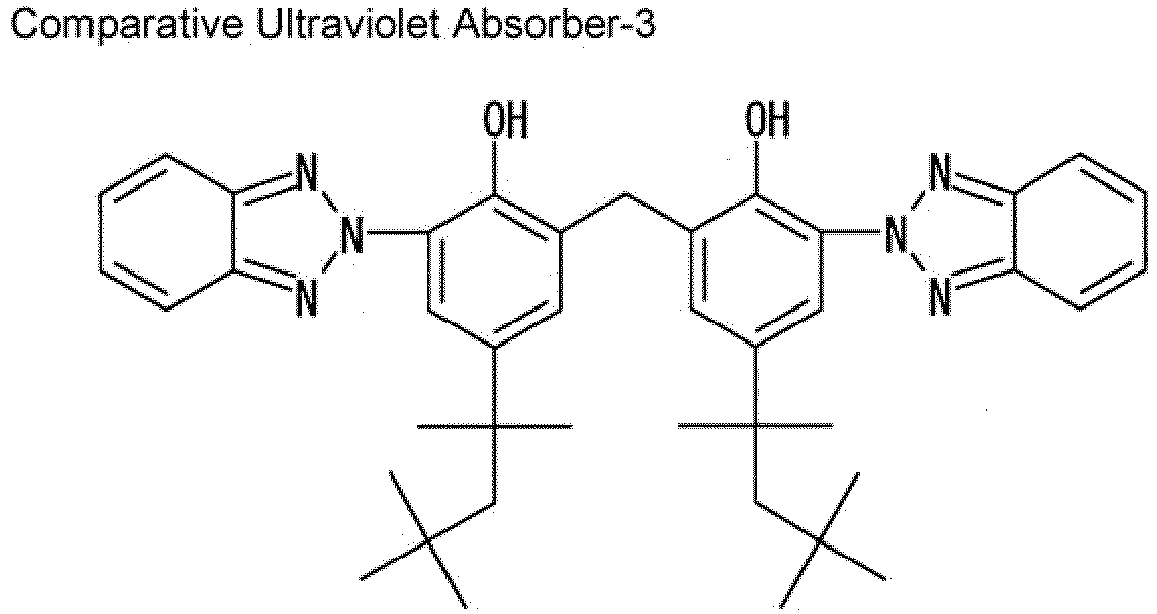

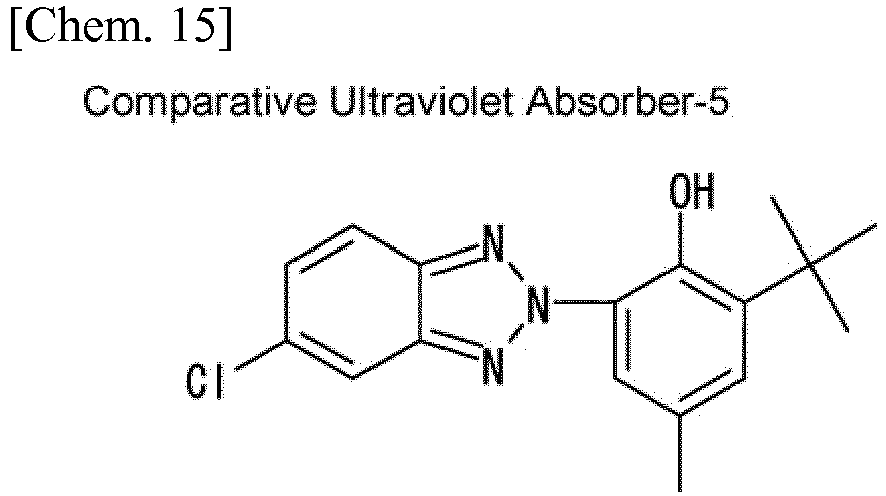

- Regarding the thermal coloration resistance, the yellowness index (YI) of each of the sheets having a thickness of 1 mm obtained through pressing at 90°C for 30 minutes was measured. The smaller the numerical value of the yellowness index is, the more the coloration is suppressed, and it can be said that the thermal coloration resistance is excellent.
- Metal Weather, Model KU-R5NCI (manufactured by Daipla Wintes Co., Ltd.) was used to perform, in the testing conditions, accelerated weather resistance testing for 4 days on each of the sheets having a thickness of 1 mm obtained through pressing at 190°C for 5 minutes. The yellowness indices (YI) of each sheet prior to and after the testing were measured, and the difference between the yellowness indices prior to and after the testing (ΔYI) was evaluated as the weathering coloration resistance. The smaller the numerical value of ΔYI is, the more the coloration is suppressed, and it can be said that the weather resistance is excellent.
-
- Light source: Water-cooling metal halide lamp
- Irradiance: 39.6 mW/cm2
- Irradiation condition: The following cycle was repeated:
- Lighting: at 50°C and 50%RH for 4 hours
- Water spray: 10 seconds
- No lighting: at 30°C and 98%RH for 4 hours
- Water spray: 10 seconds
- The haze value of each of the sheets having a thickness of 1 mm obtained through pressing at 190°C for 5 minutes was measured.
[Table 1] Example Comparative Example 1 2 1 2 3 4 5 6 7 Vinyl chloride resin*1 100 100 100 100 100 100 100 100 100 Component (A) Zinc laurate 0.3 0.3 0.3 0.3 0.3 0.3 0.3 0.3 0.3 Component (B) Stearoylbenzoylmethane 0.5 0.5 0.5 0.5 0.5 0.5 0.5 0.5 0.5 Component (C) Compound No. 1 0.2 0.4 Component (D) ALCAMIZER P-93*2 2.7 2.7 2.7 2.7 2.7 2.7 2.7 2.7 2.7 Phenol-based antioxidant*3 0.1 0.1 0.1 0.1 0.1 0.1 0.1 0.1 0.5 Lubricant*4 0.5 0.5 0.5 0.5 0.5 0.5 0.5 0.5 0.5 Comparative Ultraviolet Absorber-1 0.2 0.4 Comparative Ultraviolet Absorber-2 0.2 0.4 Comparative Ultraviolet Absorber-3 0.2 0.4 Thermal stability (blackening time: min) 190°C 195 195 180 180 180 165 180 150 120 200°C 105 120 90 105 105 90 90 90 75 Thermal coloration resistance (YI) 123.8 107.8 135.1 144.3 140.4 130.9 133.8 130.2 145.3 Weathering coloration resistance (ΔYI) 23.1 12.2 139.6 38.3 23.4 31.2 34.2 35.0 20.8 Transparency Haze value (%) 3.07 3.20 3.32 3.06 3.24 3.10 3.22 3.09 3.25 (blend components are expressed in parts by mass)
*1: ZEST 1000Z (manufactured by Shin Dai-Ichi Vinyl Corporation)
*2: Zinc-modified hydrotalcite (manufactured by Kyowa Chemical Industries Co., Ltd.) Mg3.0ZnAl2(OH)12(CO3)·3H2O
*3: Tetrakis[methylene-3-(3',5'-di-tertiary-butyl-4'-hydroxyphenyl) propionate]methane, ADK STAB AO-60 (manufactured by ADEKA Corporation)
*4: G-72 (fatty acid-alcohol ester-based lubricant (composite ester)) (manufactured by Emery Oleochemicals Japan)[Table 2] Comparative Example 8 9 10 11 12 13 Vinyl chloride resin*1 100 100 100 100 100 100 Component (A) 0.3 0.3 0.3 0.3 0.3 0.3 Zinc laurate Component (B) 0.5 0.5 0.5 0.5 0.5 0.5 Stearoylbenzoylmethane Component (C) Compound No. 1 Component (D) 2.7 2.7 2.7 2.7 2.7 2.7 ALCAMIZER P-93*2 Phenol-based antioxidant*3 0.1 0.1 0.1 0.1 0.1 0.1 Lubricant*4 0.5 0.5 0.5 0.5 0.5 0.5 Comparative Ultraviolet Absorber-4 0.2 0.4 Comparative Ultraviolet Absorber-5 0.2 0.4 Comparative Ultraviolet Absorber-6 0.2 0.4 Thermal stability (blackening time: min) 190°C 180 180 180 180 180 180 200°C 90 90 105 105 105 105 Thermal coloration resistance (YI) 120.1 122.7 127.2 131.4 135.2 120.2 Weathering coloration resistance (ΔYI) 41.6 23.1 34.6 22.5 56.1 42.2 Transparency Haze value (%) 3.07 3.15 3.08 3.18 3.03 3.16 (blend components are expressed in parts by mass)
*1: ZEST 1000Z (manufactured by Shin Dai-Ichi Vinyl Corporation)
*2: Zinc-modified hydrotalcite (manufactured by Kyowa Chemical Industries Co., Ltd.) Mg3.0ZnAl2(OH)12(CO3)·3H2O
*3: Tetrakis[methylene-3-(3',5'-di-tertiary-butyl-4'-hydroxyphenyl) propionate]methane, ADK STAB AO-60 (manufactured by ADEKA Corporation)
*4: G-72 (fatty acid-alcohol ester-based lubricant (composite ester)) (manufactured by Emery Oleochemicals Japan) - Blend components shown in Table 3 were blended, and thus soft vinyl chloride-based resin compositions of the present invention were obtained. In the example, Compound No. 1 used in Examples 1 and 2 was used as the component (C). The obtained resin compositions were subjected to roll kneading in the conditions of 160°C × 30 rpm × 0.7 mm × 5 minutes to produce sheets. The obtained sheets having a thickness of 0.7 mm were joined together and then pressed at 180°C for 5 minutes to produce a sheet having a thickness of 1 mm.
- These sheets were subjected to weathering coloration resistance testing-2 using the following method. Table 3 shows the results.
- Comparative testing using the comparative examples having the compositions shown in Table 3 was performed in the same manner as in Example 3. Table 3 shows the results. In the comparative examples, the Comparative Ultraviolet Absorbers 1 to 6 were used instead of Compound No. 1, which was the component (C) of Example 3.
- Metal Weather, Model KU-R5NCI (manufactured by Daipla Wintes Co., Ltd.) was used to perform, in the testing conditions, accelerated weather resistance testing for 6 days on each of the sheets having a thickness of 1 mm obtained through pressing at 190°C for 5 minutes. The yellowness indices (YI) of each sheet prior to and after the testing were measured, and the difference between the yellowness indices prior to and after the testing (ΔYI) was evaluated as the weathering coloration resistance. The smaller the numerical value of ΔYI is, the more the coloration is suppressed, and it can be said that the weather resistance is excellent.
-
- Light source: water-cooling metal halide lamp
- Irradiance: 75 mW/cm2
- Irradiation condition: Continuous irradiation at 63°C and 50%RH.
- Water spray for 120 seconds every 2 hours.
| Example | Comparative Example | ||||||
| 3 | 14 | 15 | 16 | 17 | 18 | 19 | |
| Vinyl chloride resin*1 | 100 | 100 | 100 | 100 | 100 | 100 | 100 |
| Component (A) | 0.35 | 0.35 | 0.35 | 0.35 | 0.35 | 0.35 | 0.35 |
| Zinc stearate | |||||||
| Component (B) | 0.05 | 0.05 | 0.05 | 0.05 | 0.05 | 0.05 | 0.05 |
| Dibenzoylmethane | |||||||
| Component (C) | 0.4 | ||||||
| Compound No. 1 | |||||||
| Component (D) | 1.8 | 1.8 | 1.8 | 1.8 | 1.8 | 1.8 | 1.8 |
| MAGCELER 1*2 | |||||||
| Phosphorus-based antioxidant*3 | 1.5 | 1.5 | 1.5 | 1.5 | 1.5 | 1.5 | 1.5 |
| Plasticizer*4 | 60 | 60 | 60 | 60 | 60 | 60 | 60 |
| Comparative Ultraviolet Absorber-1 | 0.4 | ||||||
| Comparative Ultraviolet Absorber-2 | 0.4 | ||||||
| Comparative Ultraviolet Absorber-3 | 0.4 | ||||||
| Comparative Ultraviolet Absorber-4 | 0.4 | ||||||
| Comparative Ultraviolet Absorber-5 | 0.4 | ||||||
| Comparative Ultraviolet Absorber-6 | 0.4 | ||||||
| Weathering coloration resistance (ΔYI) | 12.7 | 21.4 | 22.7 | 57.8 | 31.6 | 51.2 | 68.5 |
| (blend components are expressed in parts by mass) *1: ZEST 1000Z (manufactured by Shin Dai-Ichi Vinyl Corporation) *2: Hydrotalcite (manufactured by Kyowa Chemical Industries Co., Ltd.) Mg4.2Al2(OH)13(CO3)·3H2O *3: ADK STAB 1500 (manufactured by ADEKA Corporation) *4: Diisononyl phthalate |
Claims (5)
- A vinyl chloride-based resin composition comprising:a vinyl chloride-based resin in an amount of 100 parts by mass;an organic acid zinc salt as a component (A) in an amount of 0.01 to 10.0 parts by mass;a β-diketone compound as a component (B) in an amount of 0.01 to 10.0 parts by mass; andone or more triazine-based compounds as a component (C) in an amount of 0.01 to 20.0 parts by mass, the triazine-based compounds being represented by Formula (1):
 R1 to R3 are optionally the same or different and represent a linear or branched alkyl group having 1 to 12 carbon atoms, a cycloalkyl group having 3 to 8 carbon atoms, an alkenyl group having 2 to 8 carbon atoms, an aryl group having 6 to 18 carbon atoms, an alkylaryl group having 7 to 18 carbon atoms, or an arylalkyl group having 7 to 18 carbon atoms,the alkyl group, cycloalkyl group, alkenyl group, aryl group, alkylaryl group, or arylalkyl group is optionally substituted with a hydroxy group, a halogen atom, an alkyl group having 1 to 12 carbon atoms, or an alkoxy group having 1 to 12 carbon atoms, or interrupted by an oxygen atom, a sulfur atom, a carbonyl group, an ester group, an amide group, or an imino group,the substitutions and interruptions are optionally used in combination; andR4 to R6 are optionally the same or different and represent an alkyl group having 1 to 8 carbon atoms or an alkenyl group having 2 to 8 carbon atoms.
 - The vinyl chloride-based resin composition according to claim 1, wherein the triazine-based compounds represented by Formula (1) are triazine-based compounds represented by Formula (2):

- The vinyl chloride-based resin stabilizer composition according to claim 1 or 2, further comprising a hydrotalcite compound as a component (D) in an amount of 0.01 to 10.0 parts by mass.
- The vinyl chloride-based resin composition according to any one of claims 1 to 3, which is to be used in transparent products.
- A molded article made of the vinyl chloride-based resin composition according to any one of claims 1 to 4.
Applications Claiming Priority (2)
| Application Number | Priority Date | Filing Date | Title |
|---|---|---|---|
| JP2015064111 | 2015-03-26 | ||
| PCT/JP2016/057016 WO2016152484A1 (en) | 2015-03-26 | 2016-03-07 | Vinyl chloride-based resin composition |
Publications (3)
| Publication Number | Publication Date |
|---|---|
| EP3275933A1 true EP3275933A1 (en) | 2018-01-31 |
| EP3275933A4 EP3275933A4 (en) | 2018-12-05 |
| EP3275933B1 EP3275933B1 (en) | 2020-10-14 |
Family
ID=56978848
Family Applications (1)
| Application Number | Title | Priority Date | Filing Date |
|---|---|---|---|
| EP16768387.9A Not-in-force EP3275933B1 (en) | 2015-03-26 | 2016-03-07 | Vinyl chloride-based resin composition |
Country Status (5)
| Country | Link |
|---|---|
| US (1) | US20180030243A1 (en) |
| EP (1) | EP3275933B1 (en) |
| JP (1) | JP6626091B2 (en) |
| CN (1) | CN107250256A (en) |
| WO (1) | WO2016152484A1 (en) |
Cited By (1)
| Publication number | Priority date | Publication date | Assignee | Title |
|---|---|---|---|---|
| EP4143022B1 (en) | 2020-07-02 | 2024-03-27 | Gerflor | Floor covering with fireproof wear layer |
Families Citing this family (2)
| Publication number | Priority date | Publication date | Assignee | Title |
|---|---|---|---|---|
| CN111961295A (en) * | 2020-08-21 | 2020-11-20 | 浙江禾运科技有限公司 | High-toughness LVT floor and manufacturing method thereof |
| CN117836366A (en) * | 2021-09-30 | 2024-04-05 | 日本瑞翁株式会社 | Vinyl chloride resin composition, vinyl chloride resin molded article, and laminate |
Family Cites Families (5)
| Publication number | Priority date | Publication date | Assignee | Title |
|---|---|---|---|---|
| JP4070157B2 (en) * | 1997-08-29 | 2008-04-02 | 株式会社Adeka | Triazine compounds and UV absorbers |
| CN102604271A (en) * | 2012-04-09 | 2012-07-25 | 浙江嘉澳环保科技股份有限公司 | Magnesium-zinc composite thermal stabilizer for polyvinyl chloride products and preparation method thereof |
| CN102964719B (en) * | 2012-11-19 | 2014-11-05 | 南京工业大学 | Ultraviolet light resistant transparent polyvinyl chloride elastic calendered film and preparation method thereof |
| KR20150127075A (en) * | 2013-03-12 | 2015-11-16 | 가부시키가이샤 아데카 | Vinyl chloride resin composition for transparent article |
| JP2015000880A (en) * | 2013-06-13 | 2015-01-05 | 株式会社Adeka | Vinyl chloride resin composition for transparent products |
-
2016
- 2016-03-07 EP EP16768387.9A patent/EP3275933B1/en not_active Not-in-force
- 2016-03-07 CN CN201680010949.7A patent/CN107250256A/en active Pending
- 2016-03-07 JP JP2017508171A patent/JP6626091B2/en active Active
- 2016-03-07 WO PCT/JP2016/057016 patent/WO2016152484A1/en not_active Ceased
- 2016-03-07 US US15/552,507 patent/US20180030243A1/en not_active Abandoned
Cited By (1)
| Publication number | Priority date | Publication date | Assignee | Title |
|---|---|---|---|---|
| EP4143022B1 (en) | 2020-07-02 | 2024-03-27 | Gerflor | Floor covering with fireproof wear layer |
Also Published As
| Publication number | Publication date |
|---|---|
| US20180030243A1 (en) | 2018-02-01 |
| CN107250256A (en) | 2017-10-13 |
| EP3275933A4 (en) | 2018-12-05 |
| JP6626091B2 (en) | 2019-12-25 |
| WO2016152484A1 (en) | 2016-09-29 |
| EP3275933B1 (en) | 2020-10-14 |
| JPWO2016152484A1 (en) | 2018-01-18 |
Similar Documents
| Publication | Publication Date | Title |
|---|---|---|
| EP2676997B2 (en) | Vinyl chloride resin composition | |
| EP2471862B1 (en) | Vinyl chloride resin composition for transparent products | |
| CN102177203B (en) | Vinyl chloride resin composition for transparent product, and transparent molded product produced by molding the composition | |
| JP6514637B2 (en) | Vinyl chloride resin composition for semi-rigid or rigid transparent products | |
| EP2256161B1 (en) | Flame-retardant chlorine-containing resin composition | |
| CN106604963B (en) | Vinyl chloride resin stabiliser compositions, vinyl chloride resin composition and its formed products containing the stabiliser compositions | |
| JP2012241119A (en) | Vinyl chloride resin composition for injection molding | |
| JP5709246B2 (en) | Vinyl chloride resin composition | |
| EP3275933B1 (en) | Vinyl chloride-based resin composition | |
| CN102770488B (en) | Weather-resistant vinyl chloride resin composition | |
| JPWO2012014583A1 (en) | Vinyl chloride resin composition for transparent products | |
| JP2015000880A (en) | Vinyl chloride resin composition for transparent products | |
| JP2012021122A (en) | Vinyl chloride-based resin composition | |
| JP2015017145A (en) | Stabilized vinyl chloride resin composition |
Legal Events
| Date | Code | Title | Description |
|---|---|---|---|
| STAA | Information on the status of an ep patent application or granted ep patent |
Free format text: STATUS: THE INTERNATIONAL PUBLICATION HAS BEEN MADE |
|
| PUAI | Public reference made under article 153(3) epc to a published international application that has entered the european phase |
Free format text: ORIGINAL CODE: 0009012 |
|
| STAA | Information on the status of an ep patent application or granted ep patent |
Free format text: STATUS: REQUEST FOR EXAMINATION WAS MADE |
|
| 17P | Request for examination filed |
Effective date: 20170810 |
|
| AK | Designated contracting states |
Kind code of ref document: A1 Designated state(s): AL AT BE BG CH CY CZ DE DK EE ES FI FR GB GR HR HU IE IS IT LI LT LU LV MC MK MT NL NO PL PT RO RS SE SI SK SM TR |
|
| AX | Request for extension of the european patent |
Extension state: BA ME |
|
| DAV | Request for validation of the european patent (deleted) | ||
| DAX | Request for extension of the european patent (deleted) | ||
| A4 | Supplementary search report drawn up and despatched |
Effective date: 20181026 |
|
| RIC1 | Information provided on ipc code assigned before grant |
Ipc: C08L 27/06 20060101AFI20181022BHEP Ipc: C08K 3/26 20060101ALI20181022BHEP Ipc: C08K 5/3492 20060101ALI20181022BHEP Ipc: C08K 5/07 20060101ALI20181022BHEP Ipc: C08K 5/098 20060101ALI20181022BHEP |
|
| GRAP | Despatch of communication of intention to grant a patent |
Free format text: ORIGINAL CODE: EPIDOSNIGR1 |
|
| STAA | Information on the status of an ep patent application or granted ep patent |
Free format text: STATUS: GRANT OF PATENT IS INTENDED |
|
| INTG | Intention to grant announced |
Effective date: 20200507 |
|
| GRAS | Grant fee paid |
Free format text: ORIGINAL CODE: EPIDOSNIGR3 |
|
| GRAA | (expected) grant |
Free format text: ORIGINAL CODE: 0009210 |
|
| STAA | Information on the status of an ep patent application or granted ep patent |
Free format text: STATUS: THE PATENT HAS BEEN GRANTED |
|
| AK | Designated contracting states |
Kind code of ref document: B1 Designated state(s): AL AT BE BG CH CY CZ DE DK EE ES FI FR GB GR HR HU IE IS IT LI LT LU LV MC MK MT NL NO PL PT RO RS SE SI SK SM TR |
|
| REG | Reference to a national code |
Ref country code: GB Ref legal event code: FG4D |
|
| REG | Reference to a national code |
Ref country code: AT Ref legal event code: REF Ref document number: 1323512 Country of ref document: AT Kind code of ref document: T Effective date: 20201015 Ref country code: CH Ref legal event code: EP |
|
| REG | Reference to a national code |
Ref country code: DE Ref legal event code: R096 Ref document number: 602016045884 Country of ref document: DE |
|
| REG | Reference to a national code |
Ref country code: IE Ref legal event code: FG4D |
|
| REG | Reference to a national code |
Ref country code: AT Ref legal event code: MK05 Ref document number: 1323512 Country of ref document: AT Kind code of ref document: T Effective date: 20201014 |
|
| REG | Reference to a national code |
Ref country code: NL Ref legal event code: MP Effective date: 20201014 |
|
| PG25 | Lapsed in a contracting state [announced via postgrant information from national office to epo] |
Ref country code: NO Free format text: LAPSE BECAUSE OF FAILURE TO SUBMIT A TRANSLATION OF THE DESCRIPTION OR TO PAY THE FEE WITHIN THE PRESCRIBED TIME-LIMIT Effective date: 20210114 Ref country code: NL Free format text: LAPSE BECAUSE OF FAILURE TO SUBMIT A TRANSLATION OF THE DESCRIPTION OR TO PAY THE FEE WITHIN THE PRESCRIBED TIME-LIMIT Effective date: 20201014 Ref country code: PT Free format text: LAPSE BECAUSE OF FAILURE TO SUBMIT A TRANSLATION OF THE DESCRIPTION OR TO PAY THE FEE WITHIN THE PRESCRIBED TIME-LIMIT Effective date: 20210215 Ref country code: RS Free format text: LAPSE BECAUSE OF FAILURE TO SUBMIT A TRANSLATION OF THE DESCRIPTION OR TO PAY THE FEE WITHIN THE PRESCRIBED TIME-LIMIT Effective date: 20201014 Ref country code: GR Free format text: LAPSE BECAUSE OF FAILURE TO SUBMIT A TRANSLATION OF THE DESCRIPTION OR TO PAY THE FEE WITHIN THE PRESCRIBED TIME-LIMIT Effective date: 20210115 Ref country code: FI Free format text: LAPSE BECAUSE OF FAILURE TO SUBMIT A TRANSLATION OF THE DESCRIPTION OR TO PAY THE FEE WITHIN THE PRESCRIBED TIME-LIMIT Effective date: 20201014 |
|
| REG | Reference to a national code |
Ref country code: LT Ref legal event code: MG4D |
|
| PG25 | Lapsed in a contracting state [announced via postgrant information from national office to epo] |
Ref country code: AT Free format text: LAPSE BECAUSE OF FAILURE TO SUBMIT A TRANSLATION OF THE DESCRIPTION OR TO PAY THE FEE WITHIN THE PRESCRIBED TIME-LIMIT Effective date: 20201014 Ref country code: ES Free format text: LAPSE BECAUSE OF FAILURE TO SUBMIT A TRANSLATION OF THE DESCRIPTION OR TO PAY THE FEE WITHIN THE PRESCRIBED TIME-LIMIT Effective date: 20201014 Ref country code: BG Free format text: LAPSE BECAUSE OF FAILURE TO SUBMIT A TRANSLATION OF THE DESCRIPTION OR TO PAY THE FEE WITHIN THE PRESCRIBED TIME-LIMIT Effective date: 20210114 Ref country code: IS Free format text: LAPSE BECAUSE OF FAILURE TO SUBMIT A TRANSLATION OF THE DESCRIPTION OR TO PAY THE FEE WITHIN THE PRESCRIBED TIME-LIMIT Effective date: 20210214 Ref country code: PL Free format text: LAPSE BECAUSE OF FAILURE TO SUBMIT A TRANSLATION OF THE DESCRIPTION OR TO PAY THE FEE WITHIN THE PRESCRIBED TIME-LIMIT Effective date: 20201014 Ref country code: LV Free format text: LAPSE BECAUSE OF FAILURE TO SUBMIT A TRANSLATION OF THE DESCRIPTION OR TO PAY THE FEE WITHIN THE PRESCRIBED TIME-LIMIT Effective date: 20201014 Ref country code: SE Free format text: LAPSE BECAUSE OF FAILURE TO SUBMIT A TRANSLATION OF THE DESCRIPTION OR TO PAY THE FEE WITHIN THE PRESCRIBED TIME-LIMIT Effective date: 20201014 |
|
| PG25 | Lapsed in a contracting state [announced via postgrant information from national office to epo] |
Ref country code: HR Free format text: LAPSE BECAUSE OF FAILURE TO SUBMIT A TRANSLATION OF THE DESCRIPTION OR TO PAY THE FEE WITHIN THE PRESCRIBED TIME-LIMIT Effective date: 20201014 |
|
| REG | Reference to a national code |
Ref country code: DE Ref legal event code: R097 Ref document number: 602016045884 Country of ref document: DE |
|
| PG25 | Lapsed in a contracting state [announced via postgrant information from national office to epo] |
Ref country code: LT Free format text: LAPSE BECAUSE OF FAILURE TO SUBMIT A TRANSLATION OF THE DESCRIPTION OR TO PAY THE FEE WITHIN THE PRESCRIBED TIME-LIMIT Effective date: 20201014 Ref country code: SM Free format text: LAPSE BECAUSE OF FAILURE TO SUBMIT A TRANSLATION OF THE DESCRIPTION OR TO PAY THE FEE WITHIN THE PRESCRIBED TIME-LIMIT Effective date: 20201014 Ref country code: CZ Free format text: LAPSE BECAUSE OF FAILURE TO SUBMIT A TRANSLATION OF THE DESCRIPTION OR TO PAY THE FEE WITHIN THE PRESCRIBED TIME-LIMIT Effective date: 20201014 Ref country code: EE Free format text: LAPSE BECAUSE OF FAILURE TO SUBMIT A TRANSLATION OF THE DESCRIPTION OR TO PAY THE FEE WITHIN THE PRESCRIBED TIME-LIMIT Effective date: 20201014 Ref country code: RO Free format text: LAPSE BECAUSE OF FAILURE TO SUBMIT A TRANSLATION OF THE DESCRIPTION OR TO PAY THE FEE WITHIN THE PRESCRIBED TIME-LIMIT Effective date: 20201014 Ref country code: SK Free format text: LAPSE BECAUSE OF FAILURE TO SUBMIT A TRANSLATION OF THE DESCRIPTION OR TO PAY THE FEE WITHIN THE PRESCRIBED TIME-LIMIT Effective date: 20201014 |
|
| PLBE | No opposition filed within time limit |
Free format text: ORIGINAL CODE: 0009261 |
|
| STAA | Information on the status of an ep patent application or granted ep patent |
Free format text: STATUS: NO OPPOSITION FILED WITHIN TIME LIMIT |
|
| PG25 | Lapsed in a contracting state [announced via postgrant information from national office to epo] |
Ref country code: DK Free format text: LAPSE BECAUSE OF FAILURE TO SUBMIT A TRANSLATION OF THE DESCRIPTION OR TO PAY THE FEE WITHIN THE PRESCRIBED TIME-LIMIT Effective date: 20201014 |
|
| 26N | No opposition filed |
Effective date: 20210715 |
|
| PG25 | Lapsed in a contracting state [announced via postgrant information from national office to epo] |
Ref country code: AL Free format text: LAPSE BECAUSE OF FAILURE TO SUBMIT A TRANSLATION OF THE DESCRIPTION OR TO PAY THE FEE WITHIN THE PRESCRIBED TIME-LIMIT Effective date: 20201014 Ref country code: IT Free format text: LAPSE BECAUSE OF FAILURE TO SUBMIT A TRANSLATION OF THE DESCRIPTION OR TO PAY THE FEE WITHIN THE PRESCRIBED TIME-LIMIT Effective date: 20201014 Ref country code: MC Free format text: LAPSE BECAUSE OF FAILURE TO SUBMIT A TRANSLATION OF THE DESCRIPTION OR TO PAY THE FEE WITHIN THE PRESCRIBED TIME-LIMIT Effective date: 20201014 |
|
| REG | Reference to a national code |
Ref country code: CH Ref legal event code: PL |
|
| GBPC | Gb: european patent ceased through non-payment of renewal fee |
Effective date: 20210307 |
|
| PG25 | Lapsed in a contracting state [announced via postgrant information from national office to epo] |
Ref country code: SI Free format text: LAPSE BECAUSE OF FAILURE TO SUBMIT A TRANSLATION OF THE DESCRIPTION OR TO PAY THE FEE WITHIN THE PRESCRIBED TIME-LIMIT Effective date: 20201014 |
|
| REG | Reference to a national code |
Ref country code: BE Ref legal event code: MM Effective date: 20210331 |
|
| PG25 | Lapsed in a contracting state [announced via postgrant information from national office to epo] |
Ref country code: GB Free format text: LAPSE BECAUSE OF NON-PAYMENT OF DUE FEES Effective date: 20210307 Ref country code: FR Free format text: LAPSE BECAUSE OF NON-PAYMENT OF DUE FEES Effective date: 20210331 Ref country code: IE Free format text: LAPSE BECAUSE OF NON-PAYMENT OF DUE FEES Effective date: 20210307 Ref country code: LI Free format text: LAPSE BECAUSE OF NON-PAYMENT OF DUE FEES Effective date: 20210331 Ref country code: LU Free format text: LAPSE BECAUSE OF NON-PAYMENT OF DUE FEES Effective date: 20210307 Ref country code: CH Free format text: LAPSE BECAUSE OF NON-PAYMENT OF DUE FEES Effective date: 20210331 |
|
| PG25 | Lapsed in a contracting state [announced via postgrant information from national office to epo] |
Ref country code: IS Free format text: LAPSE BECAUSE OF FAILURE TO SUBMIT A TRANSLATION OF THE DESCRIPTION OR TO PAY THE FEE WITHIN THE PRESCRIBED TIME-LIMIT Effective date: 20210214 |
|
| PG25 | Lapsed in a contracting state [announced via postgrant information from national office to epo] |
Ref country code: BE Free format text: LAPSE BECAUSE OF NON-PAYMENT OF DUE FEES Effective date: 20210331 |
|
| P01 | Opt-out of the competence of the unified patent court (upc) registered |
Effective date: 20230522 |
|
| PG25 | Lapsed in a contracting state [announced via postgrant information from national office to epo] |
Ref country code: CY Free format text: LAPSE BECAUSE OF FAILURE TO SUBMIT A TRANSLATION OF THE DESCRIPTION OR TO PAY THE FEE WITHIN THE PRESCRIBED TIME-LIMIT Effective date: 20201014 |
|
| PG25 | Lapsed in a contracting state [announced via postgrant information from national office to epo] |
Ref country code: HU Free format text: LAPSE BECAUSE OF FAILURE TO SUBMIT A TRANSLATION OF THE DESCRIPTION OR TO PAY THE FEE WITHIN THE PRESCRIBED TIME-LIMIT; INVALID AB INITIO Effective date: 20160307 |
|
| PG25 | Lapsed in a contracting state [announced via postgrant information from national office to epo] |
Ref country code: MK Free format text: LAPSE BECAUSE OF FAILURE TO SUBMIT A TRANSLATION OF THE DESCRIPTION OR TO PAY THE FEE WITHIN THE PRESCRIBED TIME-LIMIT Effective date: 20201014 |
|
| PGFP | Annual fee paid to national office [announced via postgrant information from national office to epo] |
Ref country code: DE Payment date: 20240320 Year of fee payment: 9 |
|
| PG25 | Lapsed in a contracting state [announced via postgrant information from national office to epo] |
Ref country code: TR Free format text: LAPSE BECAUSE OF FAILURE TO SUBMIT A TRANSLATION OF THE DESCRIPTION OR TO PAY THE FEE WITHIN THE PRESCRIBED TIME-LIMIT Effective date: 20201014 |
|
| PG25 | Lapsed in a contracting state [announced via postgrant information from national office to epo] |
Ref country code: MT Free format text: LAPSE BECAUSE OF FAILURE TO SUBMIT A TRANSLATION OF THE DESCRIPTION OR TO PAY THE FEE WITHIN THE PRESCRIBED TIME-LIMIT Effective date: 20201014 |
|
| REG | Reference to a national code |
Ref country code: DE Ref legal event code: R119 Ref document number: 602016045884 Country of ref document: DE |
|
| PG25 | Lapsed in a contracting state [announced via postgrant information from national office to epo] |
Ref country code: DE Free format text: LAPSE BECAUSE OF NON-PAYMENT OF DUE FEES Effective date: 20251001 |