EP3272040B1 - Data transfer using non-radio frequency (rf) and rf signals - Google Patents
Data transfer using non-radio frequency (rf) and rf signals Download PDFInfo
- Publication number
- EP3272040B1 EP3272040B1 EP16707320.4A EP16707320A EP3272040B1 EP 3272040 B1 EP3272040 B1 EP 3272040B1 EP 16707320 A EP16707320 A EP 16707320A EP 3272040 B1 EP3272040 B1 EP 3272040B1
- Authority
- EP
- European Patent Office
- Prior art keywords
- radio frequency
- capabilities
- data
- ultrasonic
- frequency interface
- Prior art date
- Legal status (The legal status is an assumption and is not a legal conclusion. Google has not performed a legal analysis and makes no representation as to the accuracy of the status listed.)
- Not-in-force
Links
Images




Classifications
-
- H—ELECTRICITY
- H04—ELECTRIC COMMUNICATION TECHNIQUE
- H04W—WIRELESS COMMUNICATION NETWORKS
- H04W88/00—Devices specially adapted for wireless communication networks, e.g. terminals, base stations or access point devices
- H04W88/02—Terminal devices
- H04W88/06—Terminal devices adapted for operation in multiple networks or having at least two operational modes, e.g. multi-mode terminals
-
- H—ELECTRICITY
- H04—ELECTRIC COMMUNICATION TECHNIQUE
- H04B—TRANSMISSION
- H04B11/00—Transmission systems employing sonic, ultrasonic or infrasonic waves
-
- H—ELECTRICITY
- H04—ELECTRIC COMMUNICATION TECHNIQUE
- H04W—WIRELESS COMMUNICATION NETWORKS
- H04W12/00—Security arrangements; Authentication; Protecting privacy or anonymity
- H04W12/06—Authentication
-
- H—ELECTRICITY
- H04—ELECTRIC COMMUNICATION TECHNIQUE
- H04W—WIRELESS COMMUNICATION NETWORKS
- H04W76/00—Connection management
- H04W76/10—Connection setup
-
- H—ELECTRICITY
- H04—ELECTRIC COMMUNICATION TECHNIQUE
- H04W—WIRELESS COMMUNICATION NETWORKS
- H04W84/00—Network topologies
- H04W84/02—Hierarchically pre-organised networks, e.g. paging networks, cellular networks, WLAN [Wireless Local Area Network] or WLL [Wireless Local Loop]
- H04W84/10—Small scale networks; Flat hierarchical networks
- H04W84/12—WLAN [Wireless Local Area Networks]
Definitions
- Certain aspects of the present disclosure generally relate to wireless communications and, more particularly, to using ultrasonic (or near-ultrasonic) and radio frequency signals for data transfer.
- Wireless communication networks are widely deployed to provide various communication services such as voice, video, packet data, messaging, broadcast, etc. These wireless networks may be multiple-access networks capable of supporting multiple users by sharing the available network resources. Examples of such multiple-access networks include Code Division Multiple Access (CDMA) networks, Time Division Multiple Access (TDMA) networks, Frequency Division Multiple Access (FDMA) networks, Orthogonal FDMA (OFDMA) networks, and Single-Carrier FDMA (SC-FDMA) networks.
- CDMA Code Division Multiple Access
- TDMA Time Division Multiple Access
- FDMA Frequency Division Multiple Access
- OFDMA Orthogonal FDMA
- SC-FDMA Single-Carrier FDMA
- the 60GHz band is an unlicensed band which features a large amount of bandwidth and a large worldwide overlap.
- the large bandwidth means that a very high volume of information can be transmitted wirelessly.
- multiple applications each requiring transmission of large amounts of data, can be developed to allow wireless communication around the 60GHz band. Examples for such applications include, but are not limited to, game controllers, mobile interactive devices, wireless high definition TV (HDTV), wireless docking stations, wireless Gigabit Ethernet, and many others.
- the apparatus typically includes a first interface configured to obtain, via a non-radio frequency signal, identification information; a second interface for communicating via a radio frequency signal; and a processing system configured to use the identification information to establish a connection with the second device, via the second interface, and transfer the data between the first and second devices via the second interface.
- the apparatus typically includes a first interface configured to output, via a non-radio frequency signal, identification information; a second interface configured to obtain, via a radio frequency signal, a request for communicating with the first device, the request including the identification information; and a processing system configured to establish a connection with the second device, via the second interface, and transfer data between the first and second devices via the second interface.
- Certain aspects of the present disclosure also provide various apparatus, methods, and computer program products for performing the operations described above.
- aspects of the present disclosure provide techniques for using information received from a non-radio frequency signal (e.g., a signal transmitted at ultrasonic or near ultrasonic frequencies) to connect with and perform data transmission between devices using a radio access technology.
- a non-radio frequency signal e.g., a signal transmitted at ultrasonic or near ultrasonic frequencies
- the techniques described herein may be used for various broadband wireless communication systems, including communication systems that are based on an orthogonal multiplexing scheme.
- Examples of such communication systems include Spatial Division Multiple Access (SDMA), Time Division Multiple Access (TDMA), Orthogonal Frequency Division Multiple Access (OFDMA) systems, Single-Carrier Frequency Division Multiple Access (SC-FDMA) systems, and so forth.
- SDMA Spatial Division Multiple Access
- TDMA Time Division Multiple Access
- OFDMA Orthogonal Frequency Division Multiple Access
- SC-FDMA Single-Carrier Frequency Division Multiple Access
- An SDMA system may utilize sufficiently different directions to simultaneously transmit data belonging to multiple user terminals.
- a TDMA system may allow multiple user terminals to share the same frequency channel by dividing the transmission signal into different time slots, each time slot being assigned to different user terminal.
- An OFDMA system utilizes orthogonal frequency division multiplexing (OFDM), which is a modulation technique that partitions the overall system bandwidth into multiple orthogonal sub-carriers. These sub-carriers may also be called tones, bins, etc. With OFDM, each sub-carrier may be independently modulated with data.
- An SC-FDMA system may utilize interleaved FDMA (IFDMA) to transmit on sub-carriers that are distributed across the system bandwidth, localized FDMA (LFDMA) to transmit on a block of adjacent sub-carriers, or enhanced FDMA (EFDMA) to transmit on multiple blocks of adjacent sub-carriers.
- IFDMA interleaved FDMA
- LFDMA localized FDMA
- EFDMA enhanced FDMA
- modulation symbols are sent in the frequency domain with OFDM and in the time domain with SC-FDMA.
- a wireless node implemented in accordance with the teachings herein may comprise an access point or an access terminal.
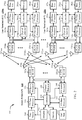
- FIG. 1 illustrates a wireless system 100 with access points and user terminals in which aspects of the present disclosure may be practiced.
- Wireless system 100 may, but need not, implement multiple-input multiple-output capabilities for communications between AP 110, UTs 120, and data source device 140.
- User terminals (hereinafter "UT") 120 may be configured to perform or direct operations 500 in FIG. 5 to obtain identification information, via a non-radio frequency signal, from another UT and use the identification information to establish a connection with another UT for transferring data between the UTs via radio frequency signals.
- UTs 120 may also be configured to perform or direct operations 600 in FIG. 6 to transmit information usable by another UT to initiate a connection with the UT and communicate with another UT for transferring data via radio frequency signals.
- An access point AP may comprise, be implemented as, or known as a Node B, Radio Network Controller (“RNC”), evolved Node B (eNB), Base Station Controller (“BSC”), Base Transceiver Station (“BTS”), Base Station (“BS”), Transceiver Function (“TF”), Radio Router, Radio Transceiver, Basic Service Set (“BSS”), Extended Service Set (“ESS”), Radio Base Station (“RBS”), or some other terminology.
- RNC Radio Network Controller
- eNB evolved Node B
- BSC Base Station Controller
- BTS Base Transceiver Station
- BS Base Station
- Transceiver Function TF
- Radio Router Radio Transceiver
- BSS Basic Service Set
- ESS Extended Service Set
- RBS Radio Base Station
- a user terminal may be fixed or mobile and may comprise, be implemented as, or known as a subscriber station, a subscriber unit, a mobile station (MS), a remote station, a remote terminal, an access terminal (AT), a user agent, a user device, user equipment (UE), a user station, or some other terminology.
- an access terminal may comprise a cellular telephone, a cordless telephone, a Session Initiation Protocol ("SIP") phone, a wireless local loop (“WLL”) station, a personal digital assistant (“PDA”), a handheld device having wireless connection capability, a Station (“STA”), or some other suitable processing device connected to a wireless modem.
- SIP Session Initiation Protocol
- WLL wireless local loop
- PDA personal digital assistant
- STA Station
- a phone e.g., a cellular phone or smart phone
- a computer e.g., a laptop
- a tablet e.g., a portable communication device
- a portable computing device e.g., a personal data assistant
- an entertainment device e.g., a music or video device, or a satellite radio
- GPS global positioning system
- the node is a wireless node.
- Such wireless node may provide, for example, connectivity for or to a network (e.g., a wide area network such as the Internet or a cellular network) via a wired or wireless communication link.
- AP 110 may communicate with one or more user terminals 120 at any given moment on the downlink and uplink.
- the downlink i.e., forward link
- the uplink i.e., reverse link
- a user terminal may also communicate peer-to-peer with another user terminal.
- a system controller 130 couples to and provides coordination and control for the access points.
- user terminals 120 capable of communicating via Spatial Division Multiple Access (SDMA)
- the user terminals 120 may also include some user terminals that do not support SDMA.
- an AP 110 may be configured to communicate with both SDMA and non-SDMA user terminals. This approach may conveniently allow older versions of user terminals ("legacy" stations) to remain deployed in an enterprise, extending their useful lifetime, while allowing newer SDMA user terminals to be introduced as deemed appropriate.
- Some UTs may include a microphone that can be used to obtain a non-radio frequency signal from a data source device 140.
- Data source 140 may include a speaker, which may generate a non-audible, non-radio frequency signal, as described herein, and a radio frequency transceiver.
- a UT capable of obtaining and processing a non-radio frequency signal from a data source device 140 may use information transmitted on the non-radio frequency signal to establish a radio connection with data source device 140 and transmit data to or receive data from data source device 140, as described herein.
- the system 100 employs multiple transmit and multiple receive antennas for data transmission on the downlink and uplink.
- the access point 110 is equipped with N ap antennas and represents the multiple-input (MI) for downlink transmissions and the multiple-output (MO) for uplink transmissions.
- a set of K selected user terminals 120 collectively represents the multiple-output for downlink transmissions and the multiple-input for uplink transmissions.
- MI multiple-input
- MO multiple-output
- K selected user terminals 120 collectively represents the multiple-output for downlink transmissions and the multiple-input for uplink transmissions.
- N ap ⁇ K ⁇ 1 if the data symbol streams for the K user terminals are not multiplexed in code, frequency or time by some means.
- K may be greater than N ap if the data symbol streams can be multiplexed using TDMA technique, different code channels with CDMA, disjoint sets of subbands with OFDM, and so on.
- Each selected user terminal transmits user-specific data to and/or receives user-specific data from the access point.
- each selected user terminal may be equipped with one or multiple antennas (i.e., N ut ⁇ 1).
- the K selected user terminals can have the same or different number of antennas.
- the SDMA system may be a time division duplex (TDD) system or a frequency division duplex (FDD) system.
- TDD time division duplex
- FDD frequency division duplex
- MIMO system 100 may also utilize a single carrier or multiple carriers for transmission.
- Each user terminal may be equipped with a single antenna (e.g., in order to keep costs down) or multiple antennas (e.g., where the additional cost can be supported).
- the system 100 may also be a TDMA system if the user terminals 120 share the same frequency channel by dividing transmission/reception into different time slots, each time slot being assigned to different user terminal 120.
- FIG. 2 illustrates a block diagram of access point 110 and two user terminals 120m and 120x in MIMO system 100.
- the access point 110 is equipped with N t antennas 224a through 224t.
- User terminal 120m is equipped with N ut,m antennas 252ma through 252mu
- user terminal 120x is equipped with N ut,x antennas 252xa through 252xu.
- the access point 110 is a transmitting entity for the downlink and a receiving entity for the uplink.
- Each user terminal 120 is a transmitting entity for the uplink and a receiving entity for the downlink.
- a “transmitting entity” is an independently operated apparatus or device capable of transmitting data via a wireless channel
- a “receiving entity” is an independently operated apparatus or device capable of receiving data via a wireless channel.
- the subscript "dn” denotes the downlink
- the subscript "up” denotes the uplink
- N up user terminals are selected for simultaneous transmission on the uplink
- N dn user terminals are selected for simultaneous transmission on the downlink
- N up may or may not be equal to N dn
- N up and N dn may be static values or can change for each scheduling interval.
- the beam-steering or some other spatial processing technique may be used at the access point and user terminal.
- a transmit (TX) data processor 288 receives traffic data from a data source 286 and control data from a controller 280.
- TX data processor 288 processes (e.g., encodes, interleaves, and modulates) the traffic data for the user terminal based on the coding and modulation schemes associated with the rate selected for the user terminal and provides a data symbol stream.
- a TX spatial processor 290 performs spatial processing on the data symbol stream and provides N ut,m transmit symbol streams for the N ut , m antennas.
- Each transmitter unit (TMTR) 254 receives and processes (e.g., converts to analog, amplifies, filters, and frequency upconverts) a respective transmit symbol stream to generate an uplink signal.
- N ut,m transmitter units 254 provide N ut,m uplink signals for transmission from N ut,m antennas 252 to the access point.
- N up user terminals may be scheduled for simultaneous transmission on the uplink.
- Each of these user terminals performs spatial processing on its data symbol stream and transmits its set of transmit symbol streams on the uplink to the access point.
- N ap antennas 224a through 224ap receive the uplink signals from all N up user terminals transmitting on the uplink.
- Each antenna 224 provides a received signal to a respective receiver unit (RCVR) 222.
- Each receiver unit 222 performs processing complementary to that performed by transmitter unit 254 and provides a received symbol stream.
- An RX spatial processor 240 performs receiver spatial processing on the N ap received symbol streams from N ap receiver units 222 and provides N up recovered uplink data symbol streams.
- the receiver spatial processing is performed in accordance with the channel correlation matrix inversion (CCMI), minimum mean square error (MMSE), soft interference cancellation (SIC), or some other technique.
- Each recovered uplink data symbol stream is an estimate of a data symbol stream transmitted by a respective user terminal.
- An RX data processor 242 processes (e.g., demodulates, deinterleaves, and decodes) each recovered uplink data symbol stream in accordance with the rate used for that stream to obtain decoded data.
- the decoded data for each user terminal may be provided to a data sink 244 for storage and/or a controller 230 for further processing.
- a TX data processor 210 receives traffic data from a data source 208 for N dn user terminals scheduled for downlink transmission, control data from a controller 230, and possibly other data from a scheduler 234. The various types of data may be sent on different transport channels. TX data processor 210 processes (e.g., encodes, interleaves, and modulates) the traffic data for each user terminal based on the rate selected for that user terminal. TX data processor 210 provides N dn downlink data symbol streams for the N dn user terminals.
- a TX spatial processor 220 performs spatial processing (such as a precoding or beamforming, as described in the present disclosure) on the N dn downlink data symbol streams, and provides N ap transmit symbol streams for the N ap antennas.
- Each transmitter unit 222 receives and processes a respective transmit symbol stream to generate a downlink signal.
- N ap transmitter units 222 providing N ap downlink signals for transmission from N ap antennas 224 to the user terminals.
- N ut,m antennas 252 receive the N ap downlink signals from access point 110.
- Each receiver unit 254 processes a received signal from an associated antenna 252 and provides a received symbol stream.
- An RX spatial processor 260 performs receiver spatial processing on N ut,m received symbol streams from N ut,m receiver units 254 and provides a recovered downlink data symbol stream for the user terminal. The receiver spatial processing is performed in accordance with the CCMI, MMSE or some other technique.
- An RX data processor 270 processes (e.g., demodulates, deinterleaves and decodes) the recovered downlink data symbol stream to obtain decoded data for the user terminal.
- a channel estimator 278 estimates the downlink channel response and provides downlink channel estimates, which may include channel gain estimates, SNR estimates, noise variance and so on.
- a channel estimator 228 estimates the uplink channel response and provides uplink channel estimates.
- Controller 280 for each user terminal typically derives the spatial filter matrix for the user terminal based on the downlink channel response matrix H dn,m for that user terminal.
- Controller 230 derives the spatial filter matrix for the access point based on the effective uplink channel response matrix H up,eff .
- Controller 280 for each user terminal may send feedback information (e.g., the downlink and/or uplink eigenvectors, eigenvalues, SNR estimates, and so on) to the access point.
- Controllers 230 and 280 also control the operation of various processing units at access point 110 and user terminal 120, respectively.
- aspects of the present disclosure provide techniques for exchanging data using a non-radio frequency signal (e.g., a signal transmitted at an ultrasonic or near-ultrasonic frequency) and using the data to connect with and perform data transfer between devices using a radio access technology.
- a non-radio frequency signal e.g., a signal transmitted at an ultrasonic or near-ultrasonic frequency
- close proximity communications may be achieved without requiring specialized hardware for transmission and reception (e.g., near-field communications (NFC) equipment, such as RFID transmitters and receivers).
- NFC near-field communications
- a mobile device can discover other devices and/or services provided by other devices using an already-existing microphone to obtain information via a received non-radio frequency signal.
- non-radio frequency signals of a sufficient strength data transmission between devices may be performed without requiring the devices to be in close proximity (e.g., within 4 inches, as may be required by NFC devices) or in contact with each other.
- FIG. 3 illustrates various components that may be utilized in a wireless device 302 that may be employed within the MIMO system 100.
- the wireless device 302 is an example of a device that may be configured to implement the various methods described herein.
- the wireless device 302 may be an access point 110 or a user terminal 120.
- the wireless device 302 may include a processor 304 which controls operation of the wireless device 302.
- the processor 304 may also be referred to as a central processing unit (CPU).
- Memory 306 which may include both read-only memory (ROM) and random access memory (RAM), provides instructions and data to the processor 304.
- a portion of the memory 306 may also include non-volatile random access memory (NVRAM).
- the processor 304 typically performs logical and arithmetic operations based on program instructions stored within the memory 306.
- the instructions in the memory 306 may be executable (e.g., by processor 304) to implement the methods described herein.
- the wireless device 302 may also include a housing 308 that may include a radio frequency (RF) transmitter 310 and an RF receiver 312 to allow transmission and reception of data between the wireless device 302 and a remote location.
- the transmitter 310 and receiver 312 may be combined into a transceiver 314.
- transceiver 314 may operate at least at a 60 GHz frequency band.
- transceiver 314 may operate on bands used by other radio access technologies (RATs), such as the 900 MHz, 2.4 GHz, or 5 GHz bands.
- RATs radio access technologies
- transceiver 314 may operate using a wireless local area network (WLAN) technology.
- a single or a plurality of transmit antennas 316 may be attached to the housing 308 and electrically coupled to the transceiver 314.
- the wireless device 302 may also include (not shown) multiple transmitters, multiple receivers, and multiple transceivers.
- the wireless device 302 may also include a signal detector 318 that may be used in an effort to detect and quantify the level of signals received by the transceiver 314.
- the signal detector 318 may detect such signals as total energy, energy per subcarrier per symbol, power spectral density and other signals.
- the wireless device 302 may also include a digital signal processor (DSP) 320 for use in processing signals.
- DSP digital signal processor
- the wireless device 302 may further include an ultrasonic receiver 324 to allow for the reception of data using non-radio frequency signals from a transmitting device.
- a microphone 326 may be attached to the housing 308 and electrically coupled to the ultrasonic receiver 324.
- Microphone 326 may be configured to filter audible and non-audible (e.g., ultrasonic or near-ultrasonic) signals such that signals in an ultrasonic or near-ultrasonic frequency range are routed to ultrasonic receiver 324 for processing, while audible sound is routed to, for example, processor 304 for processing and transmission via RF transmitter 310 ( e.g., if wireless device 302 is being used for a voice or video call) or discarded.
- audible and non-audible e.g., ultrasonic or near-ultrasonic
- the various components of the wireless device 302 may be coupled together by a bus system 322, which may include a power bus, a control signal bus, and a status signal bus in addition to a data bus.
- a bus system 322 may include a power bus, a control signal bus, and a status signal bus in addition to a data bus.
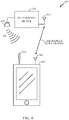
- FIG. 4 illustrates an example scenario in which a mobile device can discover other devices and/or information about services provided by other devices, for example, using an already-existing microphone.
- a microphone can be used to detect signals transmitted at an ultrasonic or near-ultrasonic frequency from other devices.
- a mobile device can connect with a data source and obtain data from the data source using a radio frequency connection.
- data source device 410 may include an antenna 412 and a speaker 414.
- Antenna 412 may be coupled to a radio transceiver used to communicate via a wireless connection.
- the transceiver may support an 802.11 standard (e.g., 802.11ac, 802.11ad, etc.), a cellular standard (e.g., Long Term Evolution (LTE), LTE-Advanced (LTE-A), or High Speed Packet Access (HSPA), etc.), or other wireless protocols.
- Speaker 414 may be configured to generate a non-radio frequency signal at a non-audible frequency. In some cases, the signal may be generated at a frequency exceeding 20 kHz ( i.e., an ultrasonic signal).
- a non-audible, non-radio frequency signal may be generated at a near-ultrasonic frequency (e.g., between 17 kHz and 20 kHz), which may still be inaudible to humans due to the frequency and sound level of the signal.
- a near-ultrasonic frequency e.g., between 17 kHz and 20 kHz
- Receiver device 420 may be, for example, a mobile phone, a tablet, etc.
- Receiver device 420 may include an antenna 422 and a microphone 424.
- antenna 422 may be coupled to a radio transceiver, such as a transceiver supporting an 802.11 standard.
- Microphone 424 may be configured to record audio data and data in ultrasonic frequencies for processing the receiver device 420.
- Receiver device 420 may provide a user interface for a user to select from a list of options provided by data source device 410.
- information about the list of options may be provided from a data source device as part of the information carried on a non-radio frequency signal or from data transferred from data source device 410 after receiver device 420 establishes a connection with data source device 410 (e.g., using an ID obtained via the non-radio frequency signal).
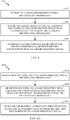
- FIG. 5 illustrates example operations 500 that may be performed by a first device for obtaining information from a second device to initiate a connection with the second device, according to certain aspects of the present disclosure.
- Operations 500 may begin at 502, where the first device obtains, via a non-radio frequency signal, identification information.
- the first device uses the identification information to establish a connection with a second device for transferring data between the first device and the second device via a radio frequency interface (e.g., a WLAN interface).
- a radio frequency interface e.g., a WLAN interface
- FIG. 6 illustrates example operations that may be performed by a first device for transmitting information usable by a second device to initiate a connection with the wireless device, according to certain aspects of the present disclosure.
- Operations 600 may begin at 602, where the first device outputs, via a non-radio frequency signal, identification information.
- the first device obtains, via a radio frequency interface, a request for communicating with the first device. The request may include the identification information.
- the first device establishes a connection with the second device for transferring data between the first and second devices via the radio frequency interface.
- the non-radio frequency signal may be modulated orthogonal frequency division multiplexing (OFDM).
- the non-radio frequency signal may be modulated using single carrier frequency division multiple access (SC-FDMA).
- SC-FDMA single carrier frequency division multiple access
- the modulation may use a low sampling frequency and a small working bandwidth (e.g., for signals transmitted at frequencies between 17 kHz and 20 kHz, a bandwidth of 3 kHz).
- the non-radio frequency signal may be encoded using a conventional coding scheme, such as a Viterbi + Reed-Solomon scheme, a turbo coding scheme, or a low-density parity check (LDPC) scheme.
- a conventional coding scheme such as a Viterbi + Reed-Solomon scheme, a turbo coding scheme, or a low-density parity check (LDPC) scheme.
- data transmitted using the non-radio frequency signal may be encoded with a code rate of 1 ⁇ 2; however, data transmitted using the non-radio frequency signal may be encoded with any appropriate code rate.
- Data transmitted using the non-radio frequency signal may also include an error detection code (e.g., a cyclic redundancy check (CRC) code) that a receiver can use to determine if the data was received correctly.
- CRC cyclic redundancy check
- FIG. 7 illustrates example communications between a data source device and a receiver device, according to certain aspects of the present disclosure.
- a receiver device receives information identifying the data source device via a non-radio frequency signal transmitted from data source device 410 via speaker 414.
- the non-radio frequency signal may be detected by receiver device 420 via microphone 424 and decoded.
- the information transmitted via the non-radio frequency signal may include identification information for the data source device and may provide information usable by the receiver device to set up a wireless connection with the transmitting device.
- the non-radio frequency signal may include a password that the receiver device can use to set up the wireless connection.
- the information transmitted via the non-radio frequency signal may include an identification of the transmitting device and additional information.
- the non-radio frequency signal may carry information about the capabilities of the transmitting device.
- the non-radio frequency signal may include information indicating that a color or brightness of the light can be modified.
- the non-radio frequency signal may include information indicating acceptable payment cards or a list of selections of downloadable content (e.g., multimedia content, such as audio, video, or text data; web content, etc.) that a user can choose from.
- a user may be prompted, through a user interface displayed on receiver device 420, for a selection from a list of selections provided from a data source device 410 via the non-radio frequency signal. Based on the selection, the receiver device can connect with a data source device 410.
- the list of selections may include a list of a particular data source device 410 that receiver device 420 should establish a connection with.
- the list of selections may include a list of content available to be downloaded from a data source device 410.
- receiver device 420 After receiver device 420 detects and decodes the non-radio frequency signal, the receiver device 420 proceeds to establish a connection using the received identification information with data source device 410 via a message transmitted using a wireless transceiver coupled to antenna 422.
- the message may be received by antenna 412 coupled to a wireless transceiver at data source device 410.
- the message may include the identification information received via the non-radio frequency signal.
- data may be exchanged between data source device 410 and receiver device 420.
- the data may be transmitted and received via RAT transceivers at data source device 410 and receiver device 420.
- a transceiver coupled to antenna 412 at data source device 410 and a transceiver coupled to antenna 422 at receiver device 420 may implement various wireless technologies.
- the implemented wireless technology may comprise a wireless local area network (WLAN) technology (e.g., 802.11n, 802.11ac, 802.11ad, etc.).
- the implemented wireless technology may comprise a wireless technology operating at least at a 60 GHz frequency band.
- a user interface displayed on receiver device 420 may be used to provide acknowledgment prior to transferring data between data source device 410 and receiver device 420.
- a user interface may request a selection of at least one of the options from the list of options via the user interface before transferring data corresponding to the selected at least one of the plurality of options from data source device 410.
- a point of sale system provides a gateway for downloading multimedia content, such as one of a plurality of movies
- the user interface may display a list of the multimedia content that a user can download from data source device 410.
- receiver device 420 may communicate the selected choice to data source device 410 and initiate transfer of the selected multimedia content.
- the receiver device may use the identification information to retrieve and/or transmit additional information via the wireless interface prior to allowing the user to provide acknowledgment prior to the transferring of data between data source device 410 and receiver device 420.
- the additional information may include payment information associated with the user.
- previously stored payment information may be retrieved from data source device 410, and a user can confirm that the payment information is to be used to purchase multimedia content.
- the user can provide new payment information to data source device 410 before performing a selection of the multimedia content to be purchased using the new payment information.
- the receiver device may receive, via the wireless interface, information about a list of options that a user can select from after the receiver device establishes a connection with data source device 410 using the identification information received from a non-radio frequency signal.
- the receiver device may display information about the options to a user via a user interface and receive a selection of at least one option from the list of options.
- the receiver device may use information about the selection of the at least one option to initiate transfer of the appropriate data from a data source device 410.
- the receiver device may connect with a data source device 410 and receive, via the wireless interface, a list of multimedia content available to be downloaded from data source device 410 via the wireless interface. After displaying the list on a user interface and receiving a selection, the receiver device can request that data source device 410 transmit data associated with the selection to the receiver device.
- the various operations of methods described above may be performed by any suitable means capable of performing the corresponding functions.
- the means may include various hardware and/or software component(s) and/or module(s), including, but not limited to a circuit, an application specific integrated circuit (ASIC), or processor.
- ASIC application specific integrated circuit
- operations 500, and 600 illustrated in FIGs. 5 and 6 correspond to means 500A and 600A illustrated in FIGs. 5A and 6A , respectively.
- means for transmitting may comprise a transmitter (e.g., the transmitter unit 222) and/or an antenna(s) 224 of the access point 110 illustrated in FIG. 2 or the transmitter 310 and/or antenna(s) 316 depicted in FIG. 3 .
- Means for receiving may comprise a receiver (e.g., the receiver unit 222) and/or an antenna(s) 224 of the access point 110 illustrated in FIG. 2 or the receiver 312 and/or antenna(s) 316 depicted in FIG. 3 .
- Means for processing, means for determining, means for detecting, means for scanning, means for selecting, or means for terminating operation may comprise a processing system, which may include one or more processors, such as the RX data processor 242, the TX data processor 210, and/or the controller 230 of the access point 110 illustrated in FIG. 2 or the processor 304 and/or the DSP 320 portrayed in FIG. 3 .
- processors such as the RX data processor 242, the TX data processor 210, and/or the controller 230 of the access point 110 illustrated in FIG. 2 or the processor 304 and/or the DSP 320 portrayed in FIG. 3 .
- such means may be implemented by processing systems configured to perform the corresponding functions by implementing various algorithms (e.g., in hardware or by executing software instructions) described above for performing fast association.
- means for using identification information to establish a connection with a second device via a radio frequency interface may be implemented by a processing system performing an algorithm that uses the identification information to generate one or more messages to establish a connection via the radio frequency interface.
- determining encompasses a wide variety of actions. For example, “determining” may include calculating, computing, processing, deriving, investigating, looking up (e.g., looking up in a table, a database or another data structure), ascertaining and the like. Also, “determining” may include receiving (e.g., receiving information), accessing (e.g., accessing data in a memory) and the like. Also, “determining” may include resolving, selecting, choosing, establishing and the like.
- a phrase referring to "at least one of' a list of items refers to any combination of those items, including single members.
- "at least one of: a, b, or c” is intended to cover a, b, c, a-b, a-c, b-c, and a-b-c, as well as any combination with multiples of the same element (e.g., a-a, a-a-a, a-a-b, a-a-c, a-b-b, a-c-c, b-b, b-b-b, b-b-c, c-c, and c-c-c or any other ordering of a, b, and c).
- DSP digital signal processor
- ASIC application specific integrated circuit
- FPGA field programmable gate array signal
- PLD programmable logic device
- a general purpose processor may be a microprocessor, but in the alternative, the processor may be any commercially available processor, controller, microcontroller or state machine.
- a processor may also be implemented as a combination of computing devices, e.g., a combination of a DSP and a microprocessor, a plurality of microprocessors, one or more microprocessors in conjunction with a DSP core, or any other such configuration.
- the functions described may be implemented in hardware, software, firmware, or any combination thereof. If implemented in software, the functions may be stored on or transmitted over as one or more instructions or code on a computer-readable medium.
- Computer-readable media includes both computer storage media and communication media including any medium that facilitates transfer of a computer program from one place to another.
- a storage media may be any available media that can be accessed by a computer.
- such computer-readable media can comprise RAM, ROM, EEPROM, CD-ROM or other optical disk storage, magnetic disk storage or other magnetic storage devices, or any other medium that can be used to carry or store desired program code in the form of instructions or data structures and that can be accessed by a computer.
- any connection is properly termed a computer-readable medium.
- the software is transmitted from a website, server, or other remote source using a coaxial cable, fiber optic cable, twisted pair, digital subscriber line (DSL), or wireless technologies such as infrared, radio, and microwave
- the coaxial cable, fiber optic cable, twisted pair, DSL, or wireless technologies such as infrared, radio, and microwave are included in the definition of medium.
- Disk and disc includes compact disc (CD), laser disc, optical disc, digital versatile disc (DVD), floppy disk, and Blu-ray® disc where disks usually reproduce data magnetically, while discs reproduce data optically with lasers.
- computer readable medium may comprise non-transitory computer readable medium (e.g., tangible media).
- computer readable medium may comprise transitory computer readable medium (e.g., a signal). Combinations of the above should also be included within the scope of computer-readable media.
- certain aspects may comprise a computer program product for performing the operations presented herein.
- a computer program product may comprise a computer readable medium having instructions stored (and/or encoded) thereon, the instructions being executable by one or more processors to perform the operations described herein.
- the computer program product may include packaging material.
- the methods disclosed herein comprise one or more steps or actions for achieving the described method.
- the method steps and/or actions may be interchanged with one another without departing from the scope of the claims.
- the order and/or use of specific steps and/or actions may be modified without departing from the scope of the claims.
- Software or instructions may also be transmitted over a transmission medium.
- a transmission medium For example, if the software is transmitted from a website, server, or other remote source using a coaxial cable, fiber optic cable, twisted pair, digital subscriber line (DSL), or wireless technologies such as infrared, radio, and microwave, then the coaxial cable, fiber optic cable, twisted pair, DSL, or wireless technologies such as infrared, radio, and microwave are included in the definition of transmission medium.
- DSL digital subscriber line
- modules and/or other appropriate means for performing the methods and techniques described herein can be downloaded and/or otherwise obtained by a user terminal and/or base station as applicable.
- a user terminal and/or base station can be coupled to a server to facilitate the transfer of means for performing the methods described herein.
- various methods described herein can be provided via storage means (e.g., RAM, ROM, a physical storage medium such as a compact disc (CD) or floppy disk, etc.), such that a user terminal and/or base station can obtain the various methods upon coupling or providing the storage means to the device.
- storage means e.g., RAM, ROM, a physical storage medium such as a compact disc (CD) or floppy disk, etc.
- CD compact disc
- floppy disk etc.
- any other suitable technique for providing the methods and techniques described herein to a device can be utilized.
Landscapes
- Engineering & Computer Science (AREA)
- Computer Networks & Wireless Communication (AREA)
- Signal Processing (AREA)
- Computer Security & Cryptography (AREA)
- Mobile Radio Communication Systems (AREA)
- Telephone Function (AREA)
Applications Claiming Priority (2)
| Application Number | Priority Date | Filing Date | Title |
|---|---|---|---|
| US14/664,454 US10057942B2 (en) | 2015-03-20 | 2015-03-20 | Data transfer using non-radio frequency (RF) and RF signals |
| PCT/US2016/017991 WO2016153629A1 (en) | 2015-03-20 | 2016-02-16 | Data transfer using non-radio frequency (rf) and rf signals |
Publications (2)
| Publication Number | Publication Date |
|---|---|
| EP3272040A1 EP3272040A1 (en) | 2018-01-24 |
| EP3272040B1 true EP3272040B1 (en) | 2018-12-12 |
Family
ID=55447145
Family Applications (1)
| Application Number | Title | Priority Date | Filing Date |
|---|---|---|---|
| EP16707320.4A Not-in-force EP3272040B1 (en) | 2015-03-20 | 2016-02-16 | Data transfer using non-radio frequency (rf) and rf signals |
Country Status (7)
| Country | Link |
|---|---|
| US (1) | US10057942B2 (enExample) |
| EP (1) | EP3272040B1 (enExample) |
| JP (1) | JP2018511979A (enExample) |
| KR (1) | KR20170129743A (enExample) |
| CN (1) | CN108307684A (enExample) |
| BR (1) | BR112017020103A2 (enExample) |
| WO (1) | WO2016153629A1 (enExample) |
Families Citing this family (4)
| Publication number | Priority date | Publication date | Assignee | Title |
|---|---|---|---|---|
| EP3151433A1 (en) * | 2015-10-01 | 2017-04-05 | Mitsubishi Electric R&D Centre Europe B.V. | Method for demodulating received symbols using a turbo-demodulation scheme comprising an iterative de-mapping and wherein an iterative channel decoder is used in the turbo-demodulation scheme |
| EP3151432B1 (en) * | 2015-10-01 | 2018-08-01 | Mitsubishi Electric R&D Centre Europe B.V. | Method and a device for demodulating received symbols using a turbo-demodulation scheme comprising an iterative mimo decoder and wherein an iterative channel decoder is used in the turbo-demodulation scheme |
| CN106603139B (zh) * | 2016-12-21 | 2022-08-26 | 浙江中新电力发展集团有限公司 | 一种无线通信模块延长装置 |
| CN108964787B (zh) * | 2018-07-06 | 2021-02-19 | 南京航空航天大学 | 一种基于超声波的信息广播方法 |
Family Cites Families (20)
| Publication number | Priority date | Publication date | Assignee | Title |
|---|---|---|---|---|
| US8699944B2 (en) * | 2005-06-10 | 2014-04-15 | The Invention Science Fund I, Llc | Device pairing using device generated sound |
| US7471200B2 (en) * | 2005-06-30 | 2008-12-30 | Nokia Corporation | RFID optimized capability negotiation |
| JP4634878B2 (ja) | 2005-07-07 | 2011-02-16 | 株式会社東芝 | 無線通信装置 |
| KR20070114606A (ko) | 2006-05-29 | 2007-12-04 | 삼성전자주식회사 | 통신 시스템과 VoIP기기 및 데이터 통신방법 |
| US20080121687A1 (en) * | 2006-11-28 | 2008-05-29 | Motorola, Inc. | Method and system for detecting an end of transaction for contactless transactions on a mobile device |
| US8041333B2 (en) * | 2007-06-14 | 2011-10-18 | Broadcom Corporation | Method and system for 60 GHz antenna adaptation and user coordination based on base station beacons |
| WO2009105115A2 (en) * | 2008-02-22 | 2009-08-27 | T-Mobile Usa, Inc. | Data exchange initiated by tapping devices |
| RU2398356C2 (ru) * | 2008-10-31 | 2010-08-27 | Cамсунг Электроникс Ко., Лтд | Способ установления беспроводной линии связи и система для установления беспроводной связи |
| CN102571708B (zh) * | 2010-12-27 | 2015-08-26 | 联想(北京)有限公司 | 安全认证方法、便携终端及便携移动设备 |
| US8854985B2 (en) | 2010-12-31 | 2014-10-07 | Yossef TSFATY | System and method for using ultrasonic communication |
| JP6135055B2 (ja) * | 2011-09-16 | 2017-05-31 | 株式会社リコー | 情報提供装置、伝送システムおよびプログラム |
| US9706340B2 (en) * | 2012-02-16 | 2017-07-11 | Lg Electronics Inc. | Method and apparatus performing proximity service in wireless communication system |
| US9088864B2 (en) | 2012-10-09 | 2015-07-21 | Brigham Young University | Systems and methods for establishing secure communication using close proximity wireless communication |
| JP5788612B2 (ja) | 2012-11-30 | 2015-10-07 | 楽天株式会社 | 電子マネーシステム、電子バリュー移転方法、携帯端末、携帯端末の制御方法、プログラム及びプログラムが記録された記録媒体 |
| US10707971B2 (en) * | 2012-12-10 | 2020-07-07 | Apple Inc. | Ultrasound ranging for mobile devices |
| JP6139121B2 (ja) * | 2012-12-12 | 2017-05-31 | Kddi株式会社 | 無線lan設定端末、無線lan端末および無線lan設定方法 |
| US9241016B2 (en) * | 2013-03-05 | 2016-01-19 | Cisco Technology, Inc. | System and associated methodology for detecting same-room presence using ultrasound as an out-of-band channel |
| US9621645B2 (en) * | 2013-12-30 | 2017-04-11 | Google Inc. | Device pairing via a cloud server |
| US9918213B2 (en) * | 2014-05-07 | 2018-03-13 | DewMobile Inc. | Discovery and networking of proximate wireless devices by acoustic messaging |
| US20150348003A1 (en) * | 2014-05-28 | 2015-12-03 | Scot Anthony Reader | Method and System for Facilitating Customer Reactions to Proximity Mobile Payment Transactions |
-
2015
- 2015-03-20 US US14/664,454 patent/US10057942B2/en not_active Expired - Fee Related
-
2016
- 2016-02-16 JP JP2017544919A patent/JP2018511979A/ja active Pending
- 2016-02-16 BR BR112017020103-8A patent/BR112017020103A2/pt not_active Application Discontinuation
- 2016-02-16 WO PCT/US2016/017991 patent/WO2016153629A1/en not_active Ceased
- 2016-02-16 CN CN201680016482.7A patent/CN108307684A/zh active Pending
- 2016-02-16 EP EP16707320.4A patent/EP3272040B1/en not_active Not-in-force
- 2016-02-16 KR KR1020177025995A patent/KR20170129743A/ko not_active Ceased
Non-Patent Citations (1)
| Title |
|---|
| None * |
Also Published As
| Publication number | Publication date |
|---|---|
| WO2016153629A1 (en) | 2016-09-29 |
| US20160278161A1 (en) | 2016-09-22 |
| BR112017020103A2 (pt) | 2018-05-29 |
| JP2018511979A (ja) | 2018-04-26 |
| CN108307684A (zh) | 2018-07-20 |
| US10057942B2 (en) | 2018-08-21 |
| EP3272040A1 (en) | 2018-01-24 |
| KR20170129743A (ko) | 2017-11-27 |
Similar Documents
| Publication | Publication Date | Title |
|---|---|---|
| US9860037B2 (en) | Method and apparatus for ordering sub-fields of VHT-SIG-A and VIT-SIG-B fields | |
| US10448390B2 (en) | Transmission techniques for enabling an immediate response | |
| KR101805746B1 (ko) | 프레임에서의 대역폭 표시 | |
| KR101773491B1 (ko) | Phy 및 mac 계층들 사이의 시그널링 | |
| KR101518150B1 (ko) | Tv 화이트 스페이스 디바이스들을 위한 전력 제어 | |
| WO2017189580A1 (en) | Reconciling different spatial reuse modes | |
| EP3272040B1 (en) | Data transfer using non-radio frequency (rf) and rf signals | |
| WO2017132430A1 (en) | Dual receiver for millimeter wave communications | |
| US9414252B2 (en) | Traffic indication map information element indicator for TIM segmentation | |
| WO2017136393A2 (en) | Efficient clear channel assessment (cca) with request-to-send (rts) frame and clear-to-send (cts) frame | |
| US9781235B2 (en) | Subframe format indication field | |
| US9288009B2 (en) | Modulation coding scheme selection for response frames in case of transmit power imbalance | |
| US20150124747A1 (en) | Aid switch negotiation |
Legal Events
| Date | Code | Title | Description |
|---|---|---|---|
| STAA | Information on the status of an ep patent application or granted ep patent |
Free format text: STATUS: THE INTERNATIONAL PUBLICATION HAS BEEN MADE |
|
| PUAI | Public reference made under article 153(3) epc to a published international application that has entered the european phase |
Free format text: ORIGINAL CODE: 0009012 |
|
| STAA | Information on the status of an ep patent application or granted ep patent |
Free format text: STATUS: REQUEST FOR EXAMINATION WAS MADE |
|
| 17P | Request for examination filed |
Effective date: 20171018 |
|
| AK | Designated contracting states |
Kind code of ref document: A1 Designated state(s): AL AT BE BG CH CY CZ DE DK EE ES FI FR GB GR HR HU IE IS IT LI LT LU LV MC MK MT NL NO PL PT RO RS SE SI SK SM TR |
|
| AX | Request for extension of the european patent |
Extension state: BA ME |
|
| GRAP | Despatch of communication of intention to grant a patent |
Free format text: ORIGINAL CODE: EPIDOSNIGR1 |
|
| STAA | Information on the status of an ep patent application or granted ep patent |
Free format text: STATUS: GRANT OF PATENT IS INTENDED |
|
| DAV | Request for validation of the european patent (deleted) | ||
| DAX | Request for extension of the european patent (deleted) | ||
| INTG | Intention to grant announced |
Effective date: 20180619 |
|
| GRAS | Grant fee paid |
Free format text: ORIGINAL CODE: EPIDOSNIGR3 |
|
| GRAA | (expected) grant |
Free format text: ORIGINAL CODE: 0009210 |
|
| STAA | Information on the status of an ep patent application or granted ep patent |
Free format text: STATUS: THE PATENT HAS BEEN GRANTED |
|
| AK | Designated contracting states |
Kind code of ref document: B1 Designated state(s): AL AT BE BG CH CY CZ DE DK EE ES FI FR GB GR HR HU IE IS IT LI LT LU LV MC MK MT NL NO PL PT RO RS SE SI SK SM TR |
|
| REG | Reference to a national code |
Ref country code: GB Ref legal event code: FG4D |
|
| REG | Reference to a national code |
Ref country code: CH Ref legal event code: EP |
|
| REG | Reference to a national code |
Ref country code: AT Ref legal event code: REF Ref document number: 1077376 Country of ref document: AT Kind code of ref document: T Effective date: 20181215 |
|
| REG | Reference to a national code |
Ref country code: DE Ref legal event code: R096 Ref document number: 602016008176 Country of ref document: DE |
|
| REG | Reference to a national code |
Ref country code: IE Ref legal event code: FG4D |
|
| REG | Reference to a national code |
Ref country code: NL Ref legal event code: MP Effective date: 20181212 |
|
| REG | Reference to a national code |
Ref country code: LT Ref legal event code: MG4D |
|
| PG25 | Lapsed in a contracting state [announced via postgrant information from national office to epo] |
Ref country code: FI Free format text: LAPSE BECAUSE OF FAILURE TO SUBMIT A TRANSLATION OF THE DESCRIPTION OR TO PAY THE FEE WITHIN THE PRESCRIBED TIME-LIMIT Effective date: 20181212 Ref country code: NO Free format text: LAPSE BECAUSE OF FAILURE TO SUBMIT A TRANSLATION OF THE DESCRIPTION OR TO PAY THE FEE WITHIN THE PRESCRIBED TIME-LIMIT Effective date: 20190312 Ref country code: HR Free format text: LAPSE BECAUSE OF FAILURE TO SUBMIT A TRANSLATION OF THE DESCRIPTION OR TO PAY THE FEE WITHIN THE PRESCRIBED TIME-LIMIT Effective date: 20181212 Ref country code: LT Free format text: LAPSE BECAUSE OF FAILURE TO SUBMIT A TRANSLATION OF THE DESCRIPTION OR TO PAY THE FEE WITHIN THE PRESCRIBED TIME-LIMIT Effective date: 20181212 Ref country code: ES Free format text: LAPSE BECAUSE OF FAILURE TO SUBMIT A TRANSLATION OF THE DESCRIPTION OR TO PAY THE FEE WITHIN THE PRESCRIBED TIME-LIMIT Effective date: 20181212 Ref country code: BG Free format text: LAPSE BECAUSE OF FAILURE TO SUBMIT A TRANSLATION OF THE DESCRIPTION OR TO PAY THE FEE WITHIN THE PRESCRIBED TIME-LIMIT Effective date: 20190312 Ref country code: LV Free format text: LAPSE BECAUSE OF FAILURE TO SUBMIT A TRANSLATION OF THE DESCRIPTION OR TO PAY THE FEE WITHIN THE PRESCRIBED TIME-LIMIT Effective date: 20181212 |
|
| PGFP | Annual fee paid to national office [announced via postgrant information from national office to epo] |
Ref country code: DE Payment date: 20181213 Year of fee payment: 4 |
|
| REG | Reference to a national code |
Ref country code: AT Ref legal event code: MK05 Ref document number: 1077376 Country of ref document: AT Kind code of ref document: T Effective date: 20181212 |
|
| PG25 | Lapsed in a contracting state [announced via postgrant information from national office to epo] |
Ref country code: AL Free format text: LAPSE BECAUSE OF FAILURE TO SUBMIT A TRANSLATION OF THE DESCRIPTION OR TO PAY THE FEE WITHIN THE PRESCRIBED TIME-LIMIT Effective date: 20181212 Ref country code: SE Free format text: LAPSE BECAUSE OF FAILURE TO SUBMIT A TRANSLATION OF THE DESCRIPTION OR TO PAY THE FEE WITHIN THE PRESCRIBED TIME-LIMIT Effective date: 20181212 Ref country code: RS Free format text: LAPSE BECAUSE OF FAILURE TO SUBMIT A TRANSLATION OF THE DESCRIPTION OR TO PAY THE FEE WITHIN THE PRESCRIBED TIME-LIMIT Effective date: 20181212 Ref country code: GR Free format text: LAPSE BECAUSE OF FAILURE TO SUBMIT A TRANSLATION OF THE DESCRIPTION OR TO PAY THE FEE WITHIN THE PRESCRIBED TIME-LIMIT Effective date: 20190313 |
|
| PGFP | Annual fee paid to national office [announced via postgrant information from national office to epo] |
Ref country code: FR Payment date: 20190220 Year of fee payment: 4 |
|
| PG25 | Lapsed in a contracting state [announced via postgrant information from national office to epo] |
Ref country code: NL Free format text: LAPSE BECAUSE OF FAILURE TO SUBMIT A TRANSLATION OF THE DESCRIPTION OR TO PAY THE FEE WITHIN THE PRESCRIBED TIME-LIMIT Effective date: 20181212 |
|
| PG25 | Lapsed in a contracting state [announced via postgrant information from national office to epo] |
Ref country code: CZ Free format text: LAPSE BECAUSE OF FAILURE TO SUBMIT A TRANSLATION OF THE DESCRIPTION OR TO PAY THE FEE WITHIN THE PRESCRIBED TIME-LIMIT Effective date: 20181212 Ref country code: IT Free format text: LAPSE BECAUSE OF FAILURE TO SUBMIT A TRANSLATION OF THE DESCRIPTION OR TO PAY THE FEE WITHIN THE PRESCRIBED TIME-LIMIT Effective date: 20181212 Ref country code: PL Free format text: LAPSE BECAUSE OF FAILURE TO SUBMIT A TRANSLATION OF THE DESCRIPTION OR TO PAY THE FEE WITHIN THE PRESCRIBED TIME-LIMIT Effective date: 20181212 Ref country code: PT Free format text: LAPSE BECAUSE OF FAILURE TO SUBMIT A TRANSLATION OF THE DESCRIPTION OR TO PAY THE FEE WITHIN THE PRESCRIBED TIME-LIMIT Effective date: 20190412 |
|
| PG25 | Lapsed in a contracting state [announced via postgrant information from national office to epo] |
Ref country code: SM Free format text: LAPSE BECAUSE OF FAILURE TO SUBMIT A TRANSLATION OF THE DESCRIPTION OR TO PAY THE FEE WITHIN THE PRESCRIBED TIME-LIMIT Effective date: 20181212 Ref country code: EE Free format text: LAPSE BECAUSE OF FAILURE TO SUBMIT A TRANSLATION OF THE DESCRIPTION OR TO PAY THE FEE WITHIN THE PRESCRIBED TIME-LIMIT Effective date: 20181212 Ref country code: IS Free format text: LAPSE BECAUSE OF FAILURE TO SUBMIT A TRANSLATION OF THE DESCRIPTION OR TO PAY THE FEE WITHIN THE PRESCRIBED TIME-LIMIT Effective date: 20190412 Ref country code: RO Free format text: LAPSE BECAUSE OF FAILURE TO SUBMIT A TRANSLATION OF THE DESCRIPTION OR TO PAY THE FEE WITHIN THE PRESCRIBED TIME-LIMIT Effective date: 20181212 Ref country code: SK Free format text: LAPSE BECAUSE OF FAILURE TO SUBMIT A TRANSLATION OF THE DESCRIPTION OR TO PAY THE FEE WITHIN THE PRESCRIBED TIME-LIMIT Effective date: 20181212 |
|
| REG | Reference to a national code |
Ref country code: DE Ref legal event code: R097 Ref document number: 602016008176 Country of ref document: DE |
|
| REG | Reference to a national code |
Ref country code: CH Ref legal event code: PL |
|
| PLBE | No opposition filed within time limit |
Free format text: ORIGINAL CODE: 0009261 |
|
| STAA | Information on the status of an ep patent application or granted ep patent |
Free format text: STATUS: NO OPPOSITION FILED WITHIN TIME LIMIT |
|
| PG25 | Lapsed in a contracting state [announced via postgrant information from national office to epo] |
Ref country code: AT Free format text: LAPSE BECAUSE OF FAILURE TO SUBMIT A TRANSLATION OF THE DESCRIPTION OR TO PAY THE FEE WITHIN THE PRESCRIBED TIME-LIMIT Effective date: 20181212 Ref country code: DK Free format text: LAPSE BECAUSE OF FAILURE TO SUBMIT A TRANSLATION OF THE DESCRIPTION OR TO PAY THE FEE WITHIN THE PRESCRIBED TIME-LIMIT Effective date: 20181212 Ref country code: LU Free format text: LAPSE BECAUSE OF NON-PAYMENT OF DUE FEES Effective date: 20190216 Ref country code: MC Free format text: LAPSE BECAUSE OF FAILURE TO SUBMIT A TRANSLATION OF THE DESCRIPTION OR TO PAY THE FEE WITHIN THE PRESCRIBED TIME-LIMIT Effective date: 20181212 |
|
| 26N | No opposition filed |
Effective date: 20190913 |
|
| REG | Reference to a national code |
Ref country code: BE Ref legal event code: MM Effective date: 20190228 |
|
| REG | Reference to a national code |
Ref country code: IE Ref legal event code: MM4A |
|
| PG25 | Lapsed in a contracting state [announced via postgrant information from national office to epo] |
Ref country code: LI Free format text: LAPSE BECAUSE OF NON-PAYMENT OF DUE FEES Effective date: 20190228 Ref country code: CH Free format text: LAPSE BECAUSE OF NON-PAYMENT OF DUE FEES Effective date: 20190228 |
|
| PG25 | Lapsed in a contracting state [announced via postgrant information from national office to epo] |
Ref country code: IE Free format text: LAPSE BECAUSE OF NON-PAYMENT OF DUE FEES Effective date: 20190216 |
|
| PG25 | Lapsed in a contracting state [announced via postgrant information from national office to epo] |
Ref country code: BE Free format text: LAPSE BECAUSE OF NON-PAYMENT OF DUE FEES Effective date: 20190228 |
|
| PG25 | Lapsed in a contracting state [announced via postgrant information from national office to epo] |
Ref country code: TR Free format text: LAPSE BECAUSE OF FAILURE TO SUBMIT A TRANSLATION OF THE DESCRIPTION OR TO PAY THE FEE WITHIN THE PRESCRIBED TIME-LIMIT Effective date: 20181212 |
|
| PG25 | Lapsed in a contracting state [announced via postgrant information from national office to epo] |
Ref country code: MT Free format text: LAPSE BECAUSE OF NON-PAYMENT OF DUE FEES Effective date: 20190216 |
|
| REG | Reference to a national code |
Ref country code: DE Ref legal event code: R119 Ref document number: 602016008176 Country of ref document: DE |
|
| GBPC | Gb: european patent ceased through non-payment of renewal fee |
Effective date: 20200216 |
|
| PG25 | Lapsed in a contracting state [announced via postgrant information from national office to epo] |
Ref country code: DE Free format text: LAPSE BECAUSE OF NON-PAYMENT OF DUE FEES Effective date: 20200901 Ref country code: GB Free format text: LAPSE BECAUSE OF NON-PAYMENT OF DUE FEES Effective date: 20200216 Ref country code: FR Free format text: LAPSE BECAUSE OF NON-PAYMENT OF DUE FEES Effective date: 20200229 |
|
| PG25 | Lapsed in a contracting state [announced via postgrant information from national office to epo] |
Ref country code: CY Free format text: LAPSE BECAUSE OF FAILURE TO SUBMIT A TRANSLATION OF THE DESCRIPTION OR TO PAY THE FEE WITHIN THE PRESCRIBED TIME-LIMIT Effective date: 20181212 |
|
| PG25 | Lapsed in a contracting state [announced via postgrant information from national office to epo] |
Ref country code: HU Free format text: LAPSE BECAUSE OF FAILURE TO SUBMIT A TRANSLATION OF THE DESCRIPTION OR TO PAY THE FEE WITHIN THE PRESCRIBED TIME-LIMIT; INVALID AB INITIO Effective date: 20160216 |
|
| PG25 | Lapsed in a contracting state [announced via postgrant information from national office to epo] |
Ref country code: SI Free format text: LAPSE BECAUSE OF FAILURE TO SUBMIT A TRANSLATION OF THE DESCRIPTION OR TO PAY THE FEE WITHIN THE PRESCRIBED TIME-LIMIT Effective date: 20181212 |
|
| PG25 | Lapsed in a contracting state [announced via postgrant information from national office to epo] |
Ref country code: MK Free format text: LAPSE BECAUSE OF FAILURE TO SUBMIT A TRANSLATION OF THE DESCRIPTION OR TO PAY THE FEE WITHIN THE PRESCRIBED TIME-LIMIT Effective date: 20181212 |