EP3269146B1 - Permissions management for watermarked data in a broadcast environment - Google Patents
Permissions management for watermarked data in a broadcast environment Download PDFInfo
- Publication number
- EP3269146B1 EP3269146B1 EP16713200.0A EP16713200A EP3269146B1 EP 3269146 B1 EP3269146 B1 EP 3269146B1 EP 16713200 A EP16713200 A EP 16713200A EP 3269146 B1 EP3269146 B1 EP 3269146B1
- Authority
- EP
- European Patent Office
- Prior art keywords
- data
- processor
- resident application
- receiver device
- media receiver
- Prior art date
- Legal status (The legal status is an assumption and is not a legal conclusion. Google has not performed a legal analysis and makes no representation as to the accuracy of the status listed.)
- Active
Links
Images

Classifications
-
- H—ELECTRICITY
- H04—ELECTRIC COMMUNICATION TECHNIQUE
- H04N—PICTORIAL COMMUNICATION, e.g. TELEVISION
- H04N21/00—Selective content distribution, e.g. interactive television or video on demand [VOD]
- H04N21/20—Servers specifically adapted for the distribution of content, e.g. VOD servers; Operations thereof
- H04N21/25—Management operations performed by the server for facilitating the content distribution or administrating data related to end-users or client devices, e.g. end-user or client device authentication, learning user preferences for recommending movies
- H04N21/254—Management at additional data server, e.g. shopping server, rights management server
- H04N21/2541—Rights Management
-
- G—PHYSICS
- G06—COMPUTING OR CALCULATING; COUNTING
- G06T—IMAGE DATA PROCESSING OR GENERATION, IN GENERAL
- G06T1/00—General purpose image data processing
- G06T1/0021—Image watermarking
-
- H—ELECTRICITY
- H04—ELECTRIC COMMUNICATION TECHNIQUE
- H04N—PICTORIAL COMMUNICATION, e.g. TELEVISION
- H04N21/00—Selective content distribution, e.g. interactive television or video on demand [VOD]
- H04N21/40—Client devices specifically adapted for the reception of or interaction with content, e.g. set-top-box [STB]; Operations thereof
- H04N21/45—Management operations performed by the client for facilitating the reception of or the interaction with the content or administrating data related to the end-user or to the client device itself, e.g. learning user preferences for recommending movies, resolving scheduling conflicts
- H04N21/462—Content or additional data management e.g. creating a master electronic programme guide from data received from the Internet and a Head-end or controlling the complexity of a video stream by scaling the resolution or bit-rate based on the client capabilities
- H04N21/4627—Rights management associated to the content
-
- H—ELECTRICITY
- H04—ELECTRIC COMMUNICATION TECHNIQUE
- H04N—PICTORIAL COMMUNICATION, e.g. TELEVISION
- H04N21/00—Selective content distribution, e.g. interactive television or video on demand [VOD]
- H04N21/40—Client devices specifically adapted for the reception of or interaction with content, e.g. set-top-box [STB]; Operations thereof
- H04N21/47—End-user applications
- H04N21/488—Data services, e.g. news ticker
- H04N21/4882—Data services, e.g. news ticker for displaying messages, e.g. warnings, reminders
-
- H—ELECTRICITY
- H04—ELECTRIC COMMUNICATION TECHNIQUE
- H04N—PICTORIAL COMMUNICATION, e.g. TELEVISION
- H04N21/00—Selective content distribution, e.g. interactive television or video on demand [VOD]
- H04N21/60—Network structure or processes for video distribution between server and client or between remote clients; Control signalling between clients, server and network components; Transmission of management data between server and client, e.g. sending from server to client commands for recording incoming content stream; Communication details between server and client
- H04N21/65—Transmission of management data between client and server
- H04N21/654—Transmission by server directed to the client
- H04N21/6543—Transmission by server directed to the client for forcing some client operations, e.g. recording
-
- H—ELECTRICITY
- H04—ELECTRIC COMMUNICATION TECHNIQUE
- H04N—PICTORIAL COMMUNICATION, e.g. TELEVISION
- H04N21/00—Selective content distribution, e.g. interactive television or video on demand [VOD]
- H04N21/80—Generation or processing of content or additional data by content creator independently of the distribution process; Content per se
- H04N21/81—Monomedia components thereof
- H04N21/8166—Monomedia components thereof involving executable data, e.g. software
- H04N21/8173—End-user applications, e.g. Web browser, game
-
- H—ELECTRICITY
- H04—ELECTRIC COMMUNICATION TECHNIQUE
- H04N—PICTORIAL COMMUNICATION, e.g. TELEVISION
- H04N21/00—Selective content distribution, e.g. interactive television or video on demand [VOD]
- H04N21/80—Generation or processing of content or additional data by content creator independently of the distribution process; Content per se
- H04N21/83—Generation or processing of protective or descriptive data associated with content; Content structuring
- H04N21/835—Generation of protective data, e.g. certificates
- H04N21/8358—Generation of protective data, e.g. certificates involving watermark
-
- H—ELECTRICITY
- H04—ELECTRIC COMMUNICATION TECHNIQUE
- H04N—PICTORIAL COMMUNICATION, e.g. TELEVISION
- H04N21/00—Selective content distribution, e.g. interactive television or video on demand [VOD]
- H04N21/80—Generation or processing of content or additional data by content creator independently of the distribution process; Content per se
- H04N21/85—Assembly of content; Generation of multimedia applications
- H04N21/858—Linking data to content, e.g. by linking an URL to a video object, by creating a hotspot
- H04N21/8586—Linking data to content, e.g. by linking an URL to a video object, by creating a hotspot by using a URL
-
- G—PHYSICS
- G06—COMPUTING OR CALCULATING; COUNTING
- G06T—IMAGE DATA PROCESSING OR GENERATION, IN GENERAL
- G06T2201/00—General purpose image data processing
- G06T2201/005—Image watermarking
- G06T2201/0064—Image watermarking for copy protection or copy management, e.g. CGMS, copy only once, one-time copy
Definitions
- watermark data is often used to enable content providers to deliver information directly to end users without the interference of broadcasters of the content, such as channel operators, cable/satellite companies, etc.
- Content watermarking involves embedding information into transmitted media (audio or video).
- content providers such as Disney or ABC, may include small amounts of useful data within program data to be broadcast over the air or via other broadcast platform (e.g., a cable or satellite).
- Various embodiments include methods and media receiver devices implementing the methods enabling a watermark client executing on the media receiver device to manage access to data related to watermark data from broadcast streams.
- Various embodiments may include receiving a broadcast stream from a broadcast channel, identifying watermark data within the received broadcast stream, obtaining data based on the identified watermark data, receiving a request for the obtained data from a resident application executing on the media receiver device, and determining whether the resident application is eligible to access the obtained data.
- receiving a request for the obtained data from a resident application executing on the media receiver device may include receiving a request from the resident application to set up a connection to the broadcast stream, and establishing a connection to the broadcast stream in response to the received request, wherein the broadcast stream from a broadcast channel is received via the established connection. Some embodiments may further include propagating an event to the resident application in response to identifying the watermark data within the received broadcast stream.
- determining whether the resident application is eligible to access the obtained data comprises one or more of determining whether the resident application is eligible to access the obtained data based on a stored white list, determining whether an origin of the resident application is the same as a URL indicated in the watermark data of the broadcast stream, determining whether the resident application triggered a transmission of the broadcast stream, or determining whether a stored application manifest associated with the resident application indicates any relation to the broadcast stream.
- Some embodiments may further include updating a white list to indicate that the resident application eligible to receive data related to broadcast stream in response to determining that the resident application is eligible to access the obtained data.
- Some embodiments may further include performing a clean-up on the white list.
- the broadcast stream may be received in the media receiver device from a multichannel video program distributor.
- the obtained data may be obtained by a wide area network or broadband connection.
- Some embodiments may further include providing a denial message to the resident application in response to determining that the resident application is not eligible to access the obtained data, and providing the obtained data to the resident application in response to determining that the resident application is eligible to access the obtained data.
- Some embodiments may include receiving a request from the resident application to set up a connection to a broadcast stream, establishing a connection to the broadcast stream in response to the received request, receiving a broadcast stream from a broadcast channel, identifying watermark data within the received broadcast stream, propagating an event to the resident application in response to identifying the watermark data within the received broadcast stream, obtaining data based on the identified watermark data, and determining whether the resident application is eligible to access the obtained data.
- determining whether the resident application is eligible to access the obtained data may include one or more of determining whether the resident application is eligible to access the obtained data based on a stored white list, determining whether an origin of the resident application is the same as a URL indicated in the watermark data of the broadcast stream, determining whether the resident application triggered a transmission of the broadcast stream, or determining whether a stored application manifest associated with the resident application indicates any relation to the broadcast stream. Some embodiments may further include updating a white list to indicate that the resident application eligible to receive data related to broadcast stream in response to determining that the resident application is eligible to access the obtained data. Some embodiments may further include performing a clean-up on the white list.
- the broadcast stream may be received in the media receiver device by a multichannel video program distributor. Some embodiments may further include providing a denial message to the resident application in response to determining that the resident application is not eligible to access the obtained data, and providing the obtained data to the resident application in response to determining that the resident application is eligible to access the obtained data.
- FIG. 2005/021967 A1 discloses a method of controlling access to a resource using a verifying device.
- a watermarking device embeds an authorization code in a signal using watermarking technology.
- the watermarked signal is then transmitted to a verifying device, e.g. as a television or radio program or as a commercial related to the resource.
- the authorization code is extracted from the watermarked signal and an operation to be performed on the resource is authorized in dependence on the extracted authorization code.
- the authorization comprises permission for executing a program, rendering and/or copying a multimedia object or for activating a cheat function in an electronic game.
- US 2013/204415 A1 discloses systems and methods for using a hidden audio signal.
- US 7 003 731 B1 discloses methods and systems for associating watermark enabled objects with machine behaviors.
- US 2012/054235 A1 discloses a reception apparatus for receiving data, including: a determination block configured to determine an acquisition source of a file to be acquired by the reception apparatus in a predetermined sequence from among a plurality of storage media in which the file is stored; an acquisition block configured to acquire the file from the acquisition source on the basis of file acquisition information for use in acquiring the file in the plurality of storage media, the file acquisition information being common to the plurality of storage media; and an execution block configured to execute the acquired file.
- a watermark client executing on the media receiver device may determine the resident applications also executing on the media receiver device that may access data related to the watermark data. For example, using a URL from watermark data, the watermark client may determine the resident applications that may have access to the watermark data and/or data obtained from remote sources using or based on the URL form the watermark data.
- computing device is used herein to refer to an electronic device equipped with at least a processor.
- Examples of computing devices may include mobile devices (e.g., cellular telephones, wearable devices, smart-phones, web-pads, tablet computers, Internet enabled cellular telephones, Wi-Fi® enabled electronic devices, personal data assistants (PDA's), laptop computers, etc.), personal computers, set top boxes, and server computing devices.
- mobile devices e.g., cellular telephones, wearable devices, smart-phones, web-pads, tablet computers, Internet enabled cellular telephones, Wi-Fi® enabled electronic devices, personal data assistants (PDA's), laptop computers, etc.
- PDA's personal data assistants
- laptop computers etc.
- computing devices may be configured with memory or storage as well as networking capabilities, such as network transceiver(s) and antenna(s) configured to establish a wide area network (WAN) connection (e.g., a cellular network connection, etc.) and/or a local area network (LAN) connection (e.g., a wired/wireless connection to the Internet via a Wi-Fi® router, etc.).
- WAN wide area network
- LAN local area network
- server is used to refer to any computing device capable of functioning as a server, such as a master exchange server, web server, mail server, document server, and a personal or mobile computing device configured with software to execute server functions (e.g., a "light server").
- a server may be a dedicated computing device or a computing device including a server module (e.g., running an application that may cause the computing device to operate as a server).
- a server module (or server application) may be a full function server module, or a light or secondary server module (e.g., light or secondary server application).
- Media receiver devices may be configured to at least execute various resident applications and a watermark client configured to process incoming broadcast streams and watermark data within the broadcast streams.
- a watermark client executing on an end user's media receiver device may extract watermark data from broadcast streams and use that watermark data to enable end user interactivity with the media.
- a set top box receiver device or smart TV receiver device may use a watermark client to identify a URL related to a television show in order to retrieve data from a corresponding website to be rendered in combination with the show, thereby expanding the viewer's experience.
- An embodiment media receiver device is illustrated in FIG. 5 .
- Digital watermarking is a mature method of embedding information into media such as video or audio without significantly affecting the end user experience (e.g. due to distortion of the source media).
- Watermarking is of particular interest in the area of broadcast content, due to desire among content providers (e.g., Disney, ABC, CBS, etc.) to be able to provide information directly to end users (e.g., television viewers) that would enable interactivity without intermediation by broadcasters (e.g., cable providers, satellite providers, etc.).
- Watermark data may effectively be used as triggers to cause actions in media receiver devices, such as start downloading related/ supplemental content from a remote server.
- watermark data within a broadcast football game may include a URL that may be used to fetch a statistics feed for fantasy football that otherwise could not be transmitted via the broadcast signal due to size.
- Broadcasters may include digitally-embedded watermarks within program data from content providers during standard broadcasting operations, such as transcoding. For example, an overhead channel with data may be adjusted or stripped out by broadcasters.
- transcoding For example, an overhead channel with data may be adjusted or stripped out by broadcasters.
- Watermarking is generally considered a low-throughput mechanism for information transmission. This is due to the desire to minimize modification of the media. Information embedding via watermarking can occur through several different mechanisms, such as least-significant bit manipulation in images or phase encoding in audio. However, the net effect is that information throughput is typically limited to under 1 kbps. As a result, embedded watermarks in broadcast content are often hyperlinks through which a media receiver device can retrieve additional content via a broadband connection, such as by downloading data from a web server via a highspeed Internet connection.
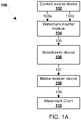
- FIG. 1 illustrates an embodiment communication flow 100 of data including watermark data from components of a typical broadcast system.
- a content source device 102 such as a server associated with a content provider, may transmit audio/visual feeds and related information 103a and meta-data 103b to a watermark inserter module 104.
- the watermark inserter module 104 may be a device, and/or circuitry, logic, software, etc. supported by or included within a device, such as within the content source device 102 and/or a broadcaster device 106 (e.g., broadcasting server, etc.).
- the watermark inserter module 104 may insert watermark data within broadcast streams and provide these watermarked streams 105 to a broadcaster device 106 (i.e., multichannel video program distributor device (MVPD), system, network, or platform).
- the broadcaster device 106 may broadcast streams 107 with the watermarked content that are received by one or more media receiver devices 108.
- Broadcast streams 107 may contain the same content as the watermarked data streams 105 received by the broadcast server 106, but may be further formatted and/or time stamped for broadcasting. Such streams 107 may be compressed and/or otherwise processed for efficient and correct transmission via the various MVPD routes.
- the media receiver device 108 may process the received broadcast streams, and may relay uncompressed audio and/or video feeds 109 that include watermark data to various components of the media receiver device 108.
- digital watermark data from the uncompressed audio/video information 109 may be interpreted by a watermark client 110 executing on the media receiver device 108 that has received the streams 107 of the content originated by the content provider of the content source device 102.
- the watermark client 110 may be configured to interpret the embedded watermark data and pass the media from broadcast streams 107 along to a receiver-based renderer and/or other components of the media receiver device 108.
- information within broadcast streams 107 may be handled in the media receiver device 108 in two ways: (1) being passed directly to an application resident on the media receiver device 108 that is configured to interpret the data (illustrated in FIG. IB), or (2) being leveraged by the watermark client 110 to retrieve more information (i.e., metadata) related to the content from a server (illustrated in FIG. 1C ).
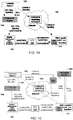
- FIG. 1B illustrates embodiment communications of data in a broadcast system in which watermark data received in a media receiver device 108 includes data that may be used directly by resident applications.
- FIG. 1C illustrates embodiment communications of data in a broadcast system in which watermark data received in a media receiver device 108 includes codes that may be transmitted to a remote server 190 for obtaining data useable by resident applications, such as URLs or other data.
- broadband capability may not always be present due to factors such as intermittent connectivity or end users failing to properly configure the broadband connection.
- embedded data carried via watermarking (or watermark data within a broadcast stream) may be limited in the amount of information that can be retrieved by the broadcast connection. This includes any policies related to which applications resident in the media receiver device may access watermark-associated data retrieved by the watermark client.
- Broadcast-capable media receiver devices such as smart TV's, are starting to resemble many other computing devices that allow for the installation of third-party applications.
- media receiver devices may be driven by web runtime engines (e.g., LGE's WebOS TV's, Comcast's RDK, and Samsung's Tizen OS). Therefore, it is possible to leverage web paradigms for data access based on application origin to also retrieve information from a watermark client.
- web runtime engines e.g., LGE's WebOS TV's, Comcast's RDK, and Samsung's Tizen OS. Therefore, it is possible to leverage web paradigms for data access based on application origin to also retrieve information from a watermark client.
- the various embodiments provide methods, devices, systems, and non-transitory process-readable storage media for leveraging watermark data from broadcast streams to form permissions policies for managing resident applications' access to data in a media receiver device.
- a watermark client executing on the media receiver device may be configured to determine the resident applications also executing on the media receiver device that can or are authorized to access data related to the watermark data. For example, using a URL from watermark data, the watermark client may determine the resident applications that may have access to the watermark data and/or data obtained from remote sources using or based on the URL form the watermark data.
- a primary advantage of the embodiment techniques over similar solutions e.g. OMA DM
- OMA DM A primary advantage of the embodiment techniques over similar solutions (e.g. OMA DM) is that no explicit permissions policy needs to be sent or retrieved by the watermark client.
- the watermark client may construct and maintain access policies for resident applications by leveraging watermark data via broadcast channels alone. This may be beneficial as sending application-specific policies over a broadcast channel may not be feasible given the limited throughput of broadcast interfaces and/or the lack of direct business relationship between content providers and broadcasters.
- the watermark client may utilize stored data associating the resident applications to watermark data, URLs, and/or other information that may indicate access permissions (i.e., "whitelist" data).
- the whitelist may include a table listing various applications as corresponding to URLs that may be transmitted within watermark data from broadcast programs. "Whitelisting" may be performed by the watermark client on a rolling basis, such that as the watermark client identifies more and more data (e.g., URLs), the watermark client may add more permissions to the whitelist associated with resident applications eligible to access related data.
- the origin can be matched to resident applications. This origin may be added to a white list of origins derived from previously-sent watermarks. In another embodiment, applications that initiate or trigger download actions to access the media stream can also have their origins added to the white list.
- the watermark client may identify resident applications' eligibility to obtain data related to watermark data based on application manifests that may include data indicating connections to broadcast streams, content providers, etc. In some embodiments, the watermark client may infer connections between resident applications and watermark data and/or broadcast streams based on developer, content provider identity, and/or parent companies that are similar between the applications and the broadcast streams. For example, the white list may be inferred by the actual information of the watermark data, even if that information is intended to enhance end user interactivity with the media. In other words, context from the watermark data may be used to interpret permission policies and updates to the white list.
- the watermark client 110 may be configured to identify and notify all resident applications on the media receiver device that have access to newly received or incoming watermark data and/or related obtained data. In some embodiments, the watermark client 110 may utilize a subscription service that various resident applications may subscribe to in order to receive notifications indicating the receipt of related watermark data and/or obtained data.
- the watermark client may typically receive a bit stream of low throughput, on the order of 100 bits/second. Therefore, it may be unlikely, though not impossible, for the watermark data to contain an application permission policy similar to that which could be obtained through an OMA DM system.
- the embedded watermark data may contain a URL given the low throughput.
- a URL's origin may be used to match against any receiver-based application origin to determine permissions for access.
- hyperlink reliability given the low throughput associated with embedded watermark data, it may not be possible to add redundancy to watermarking payload data.
- the embedded watermark data may be associated with content interactivity, and in many cases a broadband connection (which may or may not be present) may be required to retrieve information related to this interactivity. As a result, the actual multimedia service may not be degraded from an end user perspective if the watermark client retrieves payload data with errors.
- URL whitelisting may have security implications, and weak or non-existing error protection may not be sufficient.
- the media receiver device may perform an algorithm (e.g., a sequence of operations) for maintaining the white list based on incoming watermark data. If radio link quality measurements are available from a modem of the media receiver device, then this may be used as a metric to determine reliability in the absence of error protection. This may be similar to known concepts dating back to the early days of cellular communication. If such information is available it may be leveraged by the media receiver device.
- the following algorithm/ operations may be executed by the watermark client to verify redundancy over a pre-specified time duration of ⁇ and a redundancy of L:
- the media receiver device may execute a majority vote algorithm that includes receiving a URL via watermark data, assuming the URL is repeated, and averaging over several different copies at the reception.
- hyperlink reliability testing may utilize embedded URL watermark data in a least significant bit (LSB) in each pixel of still images.
- the still images may each still look visible when rendered by the media receiver device even with the least significant bits taken out and/or including corrupted data.
- devices may be configured to perform various simulations to confirm the operations and/or watermark data described above that correspond to the media receiver device. The following is an illustration of one such simulation.
- a DVB-T system may be simulated in which an 80 x 50 image may be sent with the least significant bit of each pixel modulated with a URL (e.g., "a.com").
- the simulation may be at the bit-level using the outer and inner DVB-T codes (e.g., Reed-Solomon and convolutional, respectively), with random bit errors added to the output of the convolutional encoder.
- the decode error may be calculated, such as the decode error for the URL "a.com”.
- word detection probability may be assumed to be increased to the point where a repetition method may result in receiver detection.
- Further embodiments include a computing device configured with processor-executable instructions for performing operations of the various methods described herein. Further embodiments include a non-transitory processor-readable medium on which is stored processor-executable instructions configured to cause a computing device (e.g., media receiver device) to perform operations of the methods described herein. Further embodiments include a communication system including a computing device configured with processor-executable instructions to perform operations of the methods described herein.
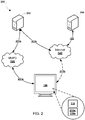
- FIG. 2 illustrates an embodiment broadcast communication system 200 suitable for use in various embodiments.
- the system 200 may include at least a content source server 202 configured to generate and/or deliver data streams of broadcast content (e.g., TV shows, sporting events, etc.), a multichannel video program distributor (MVPD) 106 (e.g., cable, satellite providers/ broadcasters and associated servers and other equipment), and a media receiver device 108 configured to receive and render the data streams of broadcast content (e.g., a set top box, smart TV, etc.).
- the data streams may include audio/ visual data as well as watermark data and may be delivered from the content source server 202 to the MVPD 106 via a connection 203a.
- the MVPD 106 may deliver the watermarked data streams of content to the media receiver device 108 via a connection 211a, such as various coaxial or fiber optic cables that connect with the media receiver device 108.
- the media receiver device 108 may include various components, such as a processor and storage/ memory, and further may be configured to execute various operations, routines, applications, and software instructions.
- the media receiver device 108 may be configured to execute at least a watermark client 110, such as an application, module, logic, and/or other functionality configured to identify, process, and utilize watermark data received in incoming data streams (e.g., program feeds originated by the content source server 202).
- applications e.g., "host” applications
- client applications may act as intermediaries for other applications (e.g., "client” applications) that may leverage dynamically updateable policies to determine the applications that may access data or functionalities controlled by the host applications.
- OMA DM Open Mobile Alliance's Device Management specification
- applications such as a watermark client 110
- MO's management objects
- OMA DM server a management object that is provided by an OMA DM server.
- These MO's may contain access policies by which a watermark client 110 may manage data that it derives from embedded watermarks.
- the media receiver device 108 may further execute other software or instruction sets, such as a plurality of resident applications 210a-210n associated with various third-parties.
- the media receiver device 108 may be configured to install and execute applications (or "apps") associated with particular cable channels (e.g., ABC Family, ESPN, etc.).
- the resident applications 210a-210n may be pre-installed on the media receiver device 108 and/or downloaded from a remote source.
- the media receiver device 108 may utilize various operating systems, thread-technologies, hypervisor/arbiter routines or processes, and/or other logic to control the communications and execution of the resident applications 210a-210n and the watermark client 110.
- the content source server 202 may also connect to a wide area network, such as the Internet 140, via a connection 203b.
- various other servers 250 e.g., web servers, data servers, etc.
- the media receiver device 108 may utilize a connection 211b to the Internet 140 (e.g., a broadband connection) in order to exchange messaging and data with remote sources, such as the other servers 250.
- the media receiver device 108 may be configured to request particular data packets or feeds from the other servers 250 in response to obtaining watermark data within program data streams received via the MVPD 106.
- the presence of broadband connections in media receiver devices 108 may not always be available.
- connection 211b may be used as end users may choose not to configure broadband connectivity for the media receiver device 108, or the users may be in markets where broadband access to the home is intermittent or even non-existent. Therefore, various embodiments may provide a dynamic permission management model that may or may not leverage only the broadcast transmission stream via the connection 211a.
- the connection 211b to the Internet 140 may be wired or wireless, such as an Ethernet or Wi-Fi® local area network connection.
- FIG. 3 illustrates a diagram 300 of embodiment communications between a watermark client 110 and a resident application 210a executing on a media receiver device (e.g., a smart TV, etc.) according to some embodiments.
- the watermark client 110 may receive incoming streams 302 (i.e., broadcast streams/ data streams) that include watermark data and perform operations 304 to process the incoming streams 302, such as identifying the watermark data individual from any audio/ visual data included in the incoming streams 302.
- the watermark data may be separately provided to the watermark client 110, and in other embodiments the incoming stream 302 may include uncompressed audio/video data.
- the operations 304 may also include utilizing the identified watermark data to download data from a remote data source, such as a web server or database associated with the incoming stream 302.
- a remote data source such as a web server or database associated with the incoming stream 302.
- the watermark client 110 may transmit a request via the Internet to a web server associated with a fantasy football league in order to download a data feed of statistics relevant to a football game depicted in the incoming stream 302.
- the watermark client 110 may be configured to perform data extraction from incoming streams 302, store information, and perform permissions arbitration for access to the stored data as described below.
- the resident application 210a may be configured to send a request message 306 to the watermark client 110 requesting data related to the incoming stream 302.
- the request message 306 may correspond to the watermark data within the incoming stream 302 and/or any data obtained by the watermark client 110 in response to the execution of the operations 304 (e.g., downloaded data using a uniform resource locator (URL) from the watermark data).
- URL uniform resource locator
- the watermark client 110 may perform various permissions checks 308 (or permission arbitration operations) to determine whether the resident application 210a has the appropriate authorizations or permissions to receive any data from the watermark client 110 regarding the incoming stream 302. For example, the watermark client 110 may compare the resident application 210a identifier to those within a stored "white list" of authorized applications for the incoming stream 302 and/or associated watermark data (e.g., URLs, etc.).
- permissions checks 308 or permission arbitration operations
- the watermark client 110 may transmit a response message 310 to the resident application 210a that either confirms that the resident application 210a is allowed or denied access to the data from the watermark client 110. If the resident application 210a has permission to retrieve the data, the watermark client 110 may also transmit data 312 to the resident application 210a, such as downloaded feed data from a remote source identified within the watermark data and associated with the incoming stream 302.
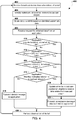
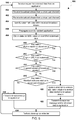
- FIG. 4 illustrates an embodiment method 400 for a processor of a media receiver device to manage access to data related to watermarking information of broadcast streams, and provide obtained data related to the watermarking to one or more of a plurality of resident applications executing on the media receiver device.
- some or all of the operations of the method 400 may be performed via a watermark client executing on the processor of the media receiver device.
- the processor of the media receiver device may receive a broadcast stream from a broadcast channel.
- a MVPD e.g., cable provider, satellite provider, etc.
- the media receiver device may receive incoming program broadcast data/streams that depict sporting events, television shows, the news, etc.
- the broadcast stream may be received via a wired or wireless network interface, such as a network interface connected to a wide area or local area network, or wireless transceiver coupled to a wireless wide area network (e.g., a cellular data network) or a wireless local area network (e.g., a Wi-Fi access point).
- a wireless wide area network e.g., a cellular data network
- a wireless local area network e.g., a Wi-Fi access point
- the processor of the media receiver device may identify watermark data within the received broadcast stream. For example, the media receiver device may uncompress the received broadcast stream data, if necessary, and analyze the data to separate watermark data from audio/visual data included in the stream.
- the identified watermark data may include website addresses (e.g., URLs), codes, links, hints, messages, and/or other information that may be used by the watermark client on the media receiver device to obtain more data that may be used by various resident applications.
- the watermark data may include a code that may be transmitted to a remote server via the Internet in order to receive a URL for downloading data packets related to the broadcast stream.
- the processor of the media receiver device may obtain data via a wide area network (i.e., Internet) based on the identified watermark data. For example, based on a URL within the watermark data of a football program, the media receiver device via its watermark client may transmit requests to a web server related to a football statistics service in order to receive statistics data feeds.
- a wide area network i.e., Internet
- the processor of the media receiver device may receive a request for the obtained data from a resident (or local) application executing on the media receiver device. For example, an internal signal, message, or other communication may be delivered to the watermark client from a resident application indicating that the obtained data can be used with the resident application.
- the media receiver device may determine whether the resident application is eligible to receive the obtained data using any combination of the following determinations in blocks 410-416.
- content providers may provide a URL by which the watermark client may retrieve information directly from a web server.
- Such URLs received over time via specific broadcast channels may be used to form a white list of allowed origins.
- resident applications on the media receiver device may also access information available to the watermark client based on the application origin (e.g., derived from the application uniform resource identifier (URI)).
- the processor of the media receiver device may determine whether the resident application is eligible to access the obtained data based on a stored white list.
- the watermark client may be configured to continually update entries within a database or other data structure that relate the identities of various resident applications to watermark data, program data streams, and/or other attributes associated with incoming data having watermarking information.
- the watermark client may store a list of all the resident applications that are already known to be eligible, authorized, and/or permitted to receive watermark data and/or obtained data based on the watermark data due to a common-developer or content provider affiliation (e.g., application related to the television channel may have authorization to access downloaded data from the television channel's website, etc.).
- the processor of the media receiver device may determine whether the resident application's origin is the same as an origin indicated in the watermark data (e.g., same URLs). In other words, the media receiver device may determine whether the origin of the resident application is the same as a URL conveyed in the watermark data of the received broadcast stream.
- a resident application that is used for rendering a particular broadcast stream may have its origin be part of the white list.
- an installed (or resident) application on the media receiver device normally may have a URL associated with it based on a file system reference (e.g., fs://myapp.exe). Under general web paradigms, this kind of reference may be treated as a unique origin.
- the processor of the media receiver device may determine whether the application triggered the receipt (or the transmission to the media receiver device) of the broadcast stream. If an installed application triggers the download of the broadcast media stream with the associated embedded watermarking content (i.e., watermark data), the watermark client may identify that application as having permission to access any associated content related to that broadcast stream (i.e., use a permissions policy that the particular application has rights to direct access of the associated information).
- an application located at fs://path that triggers or invokes a stream (associated with a broadcast channel) with an embedded watermark data may always be assumed to have permission to access the embedded data.
- File URL's may be considered unique origins, so this permission would not extend to other applications.
- that application may then have access to any data retrieved due to NBC watermark data because the application triggered the tuning to receive the broadcast stream from NBC.
- a CBS Sports application on the media receiver device may have rights to the watermark data for causing the tuning to the CBS affiliate.
- a resident application tells the media receiver device to receive a broadcast stream, that application may have rights to any other data retrieved by the media receiver device due to watermark data from the broadcast stream.
- the operating system of the media receiver device may or may not assign or recognize origins for installed resident applications (other than their location on the file system). In this case, origins may be inferred by querying the application manifest, if it is available.
- the W3C-defined manifest for web applications may include a "start_URL,” which may ideally be the origin of the application.
- the operating system may assign an origin to the application that is not based on the file system and corresponds to a network location.
- the application manifest may be an XML-based manifest that the watermark client may evaluate to see how an included URL attribute compares to watermark data of a broadcast stream.
- the watermark client may evaluate a manifest and compare an included URI to a broadcast feed to see if there are similarities.
- inferences may be made based on external information obtained by the watermark client.
- the watermark client may identify various identities (e.g., parent companies, domain names, etc.) associated with the broadcast stream for comparison to the identity of the resident application in order to determine whether there are any commonalities.
- the watermark client may determine whether there is a match between the parent company of an ESPN application and a broadcast feed from ABC Family in order to determine whether the ESPN application has permission to access watermark data or downloaded data using the watermark data from the ABC Family.
- watermark client may likely determine there is an inferred relation and thus permission.
- content source e.g., ESPN
- watermark client may determine that there is still a relation and allow an ESPN application to access any related downloaded data from ABC.com.
- the processor of the media receiver device may transmit an acceptance message and/or the obtained data to the resident application that is eligible and authorized.
- the processor of the media receiver device may perform a clean-up on the white list in block 424, such as removing unnecessary entries (e.g., out-dated, not accessed within a predetermined time frame, etc.).
- the white list may be dynamic and maintained over time, with origin expiry based on business logic (e.g., if an embedded watermark has not reproduced a particular origin within X amount of time then the origin is deleted from the white list).
- the media receiver device may continue with the receiving operations in block 402.
- FIG. 5 illustrates an embodiment method 500 for a processor of a media receiver device to manage access to data related to watermarking information of broadcast streams, and provide obtained data related to the watermarking to one or more of a plurality of resident applications executing on the media receiver device.
- some or all of the operations of the method 500 may be performed via a watermark client executing on the processor of the media receiver device.
- the processor of the media receiver may receive a request from an application to establish a connection to a broadcast stream.
- the application may be a resident (or local) application executing on the media receiver device.
- an internal signal, message, or other communication may be delivered to the watermark client from a resident application indicating that the resident application would like to obtain data from a broadcast stream.
- the processor of the media receiver device may establish a connection with the requested broadcast stream via a broadcast channel.
- a transceiver e.g., antenna(s)
- a remote server e.g., remote server 190 and/or content and signaling server located on a remote network.
- the processor of the media receiver device may, upon establishing a connection with the broadcast stream, receiver device may receive a broadcast stream from the established broadcast channel as described for the like numbered block in the method 400.
- the processor of the media receiver device may identify watermark data within the received broadcast stream as described for the like numbered block in the method 400.
- the processor of the media receiver device may propagate an event to the requesting resident application in response to identifying the watermark data within the received broadcast stream.
- the processor of the media receiver device may obtain data via a wide area network (i.e., Internet) based on the identified watermark data as described for the like numbered block in the method 400.
- a wide area network i.e., Internet
- the processor of the media receiver device may then perform the operations of blocks 410 through 424 as described for the like numbered block in the method 400.
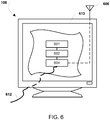
- Such computing devices may typically include, at least, the components illustrated in FIG. 6 , which illustrates an example television-type (e.g., smart TV) media receiver device 108.
- a media receiver device 108 may typically include a processor 601 capable of executing various software instructions, routines, logic, and/or operations (e.g., applications, operating system, etc.).
- the processor 601 may be coupled to volatile memory 602 and/or other storage or devices (e.g., a large capacity nonvolatile memory, such as a disk drive, a floppy disc drive, compact disc (CD) or DVD disc drive coupled to the processor 601, etc.).
- the media receiver device 108 may also include various network interfaces 604 or access ports coupled to the processor 601 for establishing data connections with a network to receive broadcast streams, such as the Internet and/or a local area network coupled to other system computers and servers.
- the network interface 604 may be connected to a wide area or local area network via a cable 612 or other physical connection.
- the network interface 604 may be a wireless transceiver coupled to an antenna 606 and configured to establish a wireless communication link to a wireless wide area network (e.g., a cellular data network) or a wireless local area network (e.g., a Wi-Fi access point).
- the network interface 604 may or may not utilize or otherwise include a cord 612 or other physical connection.
- the media receiver device 108 may also include a display element 610 for rendering program data or other information. Components 601-602 of the media receiver device 108 may be interconnected via a bus or similar wired or wireless connectivity.
- the various processors described herein may be any programmable microprocessor, microcomputer or multiple processor chip or chips that can be configured by software instructions (applications) to perform a variety of functions, including the functions of the various embodiments described herein.
- multiple processors may be provided, such as one processor dedicated to wireless communication functions and one processor dedicated to running other applications.
- software applications may be stored in internal memory before they are accessed and loaded into the processors.
- the processors may include internal memory sufficient to store the application software instructions.
- the internal memory may be a volatile or nonvolatile memory, such as flash memory, or a mixture of both.
- a general reference to memory refers to memory accessible by the processors including internal memory or removable memory plugged into the various devices and memory within the processors.
- DSP digital signal processor
- ASIC application specific integrated circuit
- FPGA field programmable gate array
- a general-purpose processor may be a microprocessor, but, in the alternative, the processor may be any conventional processor, controller, microcontroller, or state machine.
- a processor may also be implemented as a combination of computing devices, e.g., a combination of a DSP and a microprocessor, a plurality of microprocessors, one or more microprocessors in conjunction with a DSP core, or any other such configuration. Alternatively, some operations or methods may be performed by circuitry that is specific to a given function.
- the functions described may be implemented in hardware, software, firmware, or any combination thereof. If implemented in software, the functions may be stored on or transmitted over as one or more instructions or code on a non-transitory processor-readable, computer-readable, or server-readable medium or a non-transitory processor-readable storage medium.
- the operations of a method or algorithm disclosed herein may be embodied in a processor-executable software module or processor-executable software instructions that may reside on a non-transitory computer-readable storage medium, a non-transitory server-readable storage medium, and/or a non-transitory processor-readable storage medium.
- such instructions may be stored processor-executable instructions or stored processor-executable software instructions.
- Tangible, non-transitory computer-readable storage media may be any available media that may be accessed by a computer.
- such non-transitory computer-readable media may comprise RAM, ROM, EEPROM, CD-ROM or other optical disk storage, magnetic disk storage or other magnetic storage devices, or any other medium that may be used to store desired program code in the form of instructions or data structures and that may be accessed by a computer.
- Disk and disc includes compact disc (CD), laser disc, optical disc, digital versatile disc (DVD), floppy disk, and Blu-ray disc where disks usually reproduce data magnetically, while discs reproduce data optically with lasers. Combinations of the above should also be included within the scope of non-transitory computer-readable media.
- the operations of a method or algorithm may reside as one or any combination or set of codes and/or instructions on a tangible, non-transitory processor-readable storage medium and/or computer-readable medium, which may be incorporated into a computer program product.
Landscapes
- Engineering & Computer Science (AREA)
- Multimedia (AREA)
- Signal Processing (AREA)
- Computer Security & Cryptography (AREA)
- Databases & Information Systems (AREA)
- Software Systems (AREA)
- General Engineering & Computer Science (AREA)
- Physics & Mathematics (AREA)
- General Physics & Mathematics (AREA)
- Theoretical Computer Science (AREA)
- Two-Way Televisions, Distribution Of Moving Picture Or The Like (AREA)
- Television Systems (AREA)
- Editing Of Facsimile Originals (AREA)
Applications Claiming Priority (3)
| Application Number | Priority Date | Filing Date | Title |
|---|---|---|---|
| US201562132766P | 2015-03-13 | 2015-03-13 | |
| US15/066,294 US10277934B2 (en) | 2015-03-13 | 2016-03-10 | Permissions management for watermarked data in a broadcast environment |
| PCT/US2016/021979 WO2016149087A1 (en) | 2015-03-13 | 2016-03-11 | Permissions management for watermarked data in a broadcast environment |
Publications (2)
| Publication Number | Publication Date |
|---|---|
| EP3269146A1 EP3269146A1 (en) | 2018-01-17 |
| EP3269146B1 true EP3269146B1 (en) | 2020-02-05 |
Family
ID=56886998
Family Applications (1)
| Application Number | Title | Priority Date | Filing Date |
|---|---|---|---|
| EP16713200.0A Active EP3269146B1 (en) | 2015-03-13 | 2016-03-11 | Permissions management for watermarked data in a broadcast environment |
Country Status (5)
| Country | Link |
|---|---|
| US (1) | US10277934B2 (enExample) |
| EP (1) | EP3269146B1 (enExample) |
| JP (1) | JP6630735B2 (enExample) |
| CN (1) | CN107431847A (enExample) |
| WO (1) | WO2016149087A1 (enExample) |
Families Citing this family (10)
| Publication number | Priority date | Publication date | Assignee | Title |
|---|---|---|---|---|
| JP2017011503A (ja) * | 2015-06-22 | 2017-01-12 | ソニー株式会社 | 受信装置、送信装置、及び、データ処理方法 |
| US9866459B1 (en) * | 2016-03-04 | 2018-01-09 | Amazon Technologies, Inc. | Origin failover for live streaming |
| TWI640195B (zh) * | 2016-12-14 | 2018-11-01 | 日商夏普股份有限公司 | 具有統一資源識別符訊息浮水印有效負載之廣播系統 |
| US11770595B2 (en) * | 2017-08-10 | 2023-09-26 | Saturn Licensing Llc | Transmission apparatus, transmission method, reception apparatus, and reception method |
| US10320882B2 (en) | 2017-08-29 | 2019-06-11 | At&T Intellectual Property I, L.P. | Uniform resource locator discovery and tracking for managing sponsored data |
| US10277924B1 (en) | 2018-03-22 | 2019-04-30 | Amazon Technologies, Inc. | Stitching content streams together |
| US11140460B2 (en) * | 2018-05-29 | 2021-10-05 | At&T Intellectual Property I, L.P. | Content distribution pipeline watermarking |
| US10904595B2 (en) * | 2018-08-21 | 2021-01-26 | Prime Focus Technologies, Inc. | System and method for just in time embedded watermarking of streaming proxies |
| US11800539B2 (en) | 2020-05-18 | 2023-10-24 | Lynk Global, Inc. | Messaging from an orbital base station to cellular user equipment applications with message processing via a card operating system |
| AU2022386566A1 (en) * | 2021-11-10 | 2024-05-23 | Audazzio Inc. | Secure scalable transmission of inaudible or ultrasound packet url instructions for second screen applications |
Family Cites Families (16)
| Publication number | Priority date | Publication date | Assignee | Title |
|---|---|---|---|---|
| US5796829A (en) * | 1994-09-09 | 1998-08-18 | The Titan Corporation | Conditional access system |
| US7003731B1 (en) | 1995-07-27 | 2006-02-21 | Digimare Corporation | User control and activation of watermark enabled objects |
| EP1474924A2 (en) | 2002-02-01 | 2004-11-10 | Koninklijke Philips Electronics N.V. | Watermark-based access control method and device |
| CA2675595C (en) * | 2007-01-17 | 2016-10-25 | Intertrust Technologies Corporation | Methods, systems, and apparatus for fragmented file sharing |
| JP5335622B2 (ja) * | 2009-08-31 | 2013-11-06 | レノボ・シンガポール・プライベート・リミテッド | 設定情報データベースを管理するコンピュータ・プログラム |
| US10511887B2 (en) | 2010-08-30 | 2019-12-17 | Saturn Licensing Llc | Reception apparatus, reception method, transmission apparatus, transmission method, program, and broadcasting system |
| US8918801B2 (en) * | 2010-08-30 | 2014-12-23 | Sony Corporation | Transmission apparatus, transmission method, reception apparatus, reception method, program, and broadcasting system |
| US8838977B2 (en) * | 2010-09-16 | 2014-09-16 | Verance Corporation | Watermark extraction and content screening in a networked environment |
| US20120167133A1 (en) * | 2010-12-23 | 2012-06-28 | Carroll John W | Dynamic content insertion using content signatures |
| US20130204415A1 (en) | 2011-03-25 | 2013-08-08 | Verisign, Inc. | Systems and methods for using signal-derived segmented identifiers to manage resource contention and control access to data and functions |
| US9374620B2 (en) * | 2011-10-21 | 2016-06-21 | Sony Corporation | Terminal apparatus, server apparatus, information processing method, program, and interlocked application feed system |
| US9223941B2 (en) * | 2013-03-15 | 2015-12-29 | Google Inc. | Using a URI whitelist |
| GB2513140B (en) * | 2013-04-16 | 2016-05-04 | Canon Kk | Methods, devices, and computer programs for streaming partitioned timed media data |
| US10171501B2 (en) * | 2013-09-20 | 2019-01-01 | Open Text Sa Ulc | System and method for remote wipe |
| US10263952B2 (en) * | 2013-10-31 | 2019-04-16 | Avaya Inc. | Providing origin insight for web applications via session traversal utilities for network address translation (STUN) messages, and related methods, systems, and computer-readable media |
| US9596521B2 (en) * | 2014-03-13 | 2017-03-14 | Verance Corporation | Interactive content acquisition using embedded codes |
-
2016
- 2016-03-10 US US15/066,294 patent/US10277934B2/en not_active Expired - Fee Related
- 2016-03-11 WO PCT/US2016/021979 patent/WO2016149087A1/en not_active Ceased
- 2016-03-11 CN CN201680015331.XA patent/CN107431847A/zh active Pending
- 2016-03-11 EP EP16713200.0A patent/EP3269146B1/en active Active
- 2016-03-11 JP JP2017544906A patent/JP6630735B2/ja not_active Expired - Fee Related
Non-Patent Citations (1)
| Title |
|---|
| None * |
Also Published As
| Publication number | Publication date |
|---|---|
| WO2016149087A1 (en) | 2016-09-22 |
| CN107431847A (zh) | 2017-12-01 |
| EP3269146A1 (en) | 2018-01-17 |
| JP6630735B2 (ja) | 2020-01-15 |
| US10277934B2 (en) | 2019-04-30 |
| JP2018514102A (ja) | 2018-05-31 |
| US20160269765A1 (en) | 2016-09-15 |
Similar Documents
| Publication | Publication Date | Title |
|---|---|---|
| US10277934B2 (en) | Permissions management for watermarked data in a broadcast environment | |
| US9363572B2 (en) | Method and system for media adaption | |
| EP3413566B1 (en) | Watermark variant obfuscation for content distribution | |
| US12273601B2 (en) | Live video streaming architecture with real-time frame and subframe level live watermarking | |
| US20200260158A1 (en) | Broadcast receiver and method for launching broadcaster application based on url in application signaling information | |
| US9319755B2 (en) | Common distribution and rendering for emergency alert services | |
| CA3028354C (en) | Systems and methods for communicating user settings in conjunction with execution of an application | |
| CN105430431B (zh) | 多媒体数据播放方法及装置 | |
| EP4340378A2 (en) | Automated video content processing | |
| CN108702548A (zh) | 使用水印来信令资源标识符的系统和方法 | |
| KR102160585B1 (ko) | 이벤트 등록 및 통보 | |
| EP3494707B1 (en) | Method and device for checking authenticity of a hbbtv related application | |
| US10878076B2 (en) | Receiving apparatus, transmitting apparatus, and data processing method | |
| GB2535146B (en) | Broadcast application security | |
| US20190227866A1 (en) | Information processing device and method | |
| US12395686B2 (en) | Methods and devices for providing personalized audio to a user | |
| JP2021520083A (ja) | アドレス指定可能なテレビジョン広告のためのカスタムゾーニング | |
| KR20230104931A (ko) | 맞춤화된 오디오 및/또는 비디오 콘텐츠 전달을 위한 방법 및 시스템 | |
| KR20080109521A (ko) | 데이터 방송 신호를 처리하는 방법 및 수신하는 장치 | |
| GB2562796A (en) | Audio and/or video receiving and transmitting apparatuses and methods | |
| EP4358523A1 (en) | Methods for multimedia data delivery and apparatuses for implementing the same | |
| EP4371306A1 (en) | Atsc 3 application context switching and sharing | |
| WO2017084567A1 (zh) | 一种自适应的信息植入方法、装置及相关设备 |
Legal Events
| Date | Code | Title | Description |
|---|---|---|---|
| STAA | Information on the status of an ep patent application or granted ep patent |
Free format text: STATUS: THE INTERNATIONAL PUBLICATION HAS BEEN MADE |
|
| PUAI | Public reference made under article 153(3) epc to a published international application that has entered the european phase |
Free format text: ORIGINAL CODE: 0009012 |
|
| STAA | Information on the status of an ep patent application or granted ep patent |
Free format text: STATUS: REQUEST FOR EXAMINATION WAS MADE |
|
| 17P | Request for examination filed |
Effective date: 20170721 |
|
| AK | Designated contracting states |
Kind code of ref document: A1 Designated state(s): AL AT BE BG CH CY CZ DE DK EE ES FI FR GB GR HR HU IE IS IT LI LT LU LV MC MK MT NL NO PL PT RO RS SE SI SK SM TR |
|
| AX | Request for extension of the european patent |
Extension state: BA ME |
|
| DAV | Request for validation of the european patent (deleted) | ||
| DAX | Request for extension of the european patent (deleted) | ||
| STAA | Information on the status of an ep patent application or granted ep patent |
Free format text: STATUS: EXAMINATION IS IN PROGRESS |
|
| 17Q | First examination report despatched |
Effective date: 20181001 |
|
| GRAP | Despatch of communication of intention to grant a patent |
Free format text: ORIGINAL CODE: EPIDOSNIGR1 |
|
| STAA | Information on the status of an ep patent application or granted ep patent |
Free format text: STATUS: GRANT OF PATENT IS INTENDED |
|
| INTG | Intention to grant announced |
Effective date: 20190923 |
|
| GRAS | Grant fee paid |
Free format text: ORIGINAL CODE: EPIDOSNIGR3 |
|
| GRAA | (expected) grant |
Free format text: ORIGINAL CODE: 0009210 |
|
| STAA | Information on the status of an ep patent application or granted ep patent |
Free format text: STATUS: THE PATENT HAS BEEN GRANTED |
|
| AK | Designated contracting states |
Kind code of ref document: B1 Designated state(s): AL AT BE BG CH CY CZ DE DK EE ES FI FR GB GR HR HU IE IS IT LI LT LU LV MC MK MT NL NO PL PT RO RS SE SI SK SM TR |
|
| REG | Reference to a national code |
Ref country code: GB Ref legal event code: FG4D |
|
| REG | Reference to a national code |
Ref country code: AT Ref legal event code: REF Ref document number: 1230745 Country of ref document: AT Kind code of ref document: T Effective date: 20200215 |
|
| REG | Reference to a national code |
Ref country code: DE Ref legal event code: R096 Ref document number: 602016029098 Country of ref document: DE |
|
| REG | Reference to a national code |
Ref country code: IE Ref legal event code: FG4D |
|
| REG | Reference to a national code |
Ref country code: CH Ref legal event code: EP |
|
| PGFP | Annual fee paid to national office [announced via postgrant information from national office to epo] |
Ref country code: GB Payment date: 20200212 Year of fee payment: 5 Ref country code: DE Payment date: 20200212 Year of fee payment: 5 |
|
| REG | Reference to a national code |
Ref country code: NL Ref legal event code: MP Effective date: 20200205 |
|
| PG25 | Lapsed in a contracting state [announced via postgrant information from national office to epo] |
Ref country code: NO Free format text: LAPSE BECAUSE OF FAILURE TO SUBMIT A TRANSLATION OF THE DESCRIPTION OR TO PAY THE FEE WITHIN THE PRESCRIBED TIME-LIMIT Effective date: 20200505 Ref country code: PT Free format text: LAPSE BECAUSE OF FAILURE TO SUBMIT A TRANSLATION OF THE DESCRIPTION OR TO PAY THE FEE WITHIN THE PRESCRIBED TIME-LIMIT Effective date: 20200628 Ref country code: RS Free format text: LAPSE BECAUSE OF FAILURE TO SUBMIT A TRANSLATION OF THE DESCRIPTION OR TO PAY THE FEE WITHIN THE PRESCRIBED TIME-LIMIT Effective date: 20200205 Ref country code: FI Free format text: LAPSE BECAUSE OF FAILURE TO SUBMIT A TRANSLATION OF THE DESCRIPTION OR TO PAY THE FEE WITHIN THE PRESCRIBED TIME-LIMIT Effective date: 20200205 |
|
| REG | Reference to a national code |
Ref country code: LT Ref legal event code: MG4D |
|
| PG25 | Lapsed in a contracting state [announced via postgrant information from national office to epo] |
Ref country code: GR Free format text: LAPSE BECAUSE OF FAILURE TO SUBMIT A TRANSLATION OF THE DESCRIPTION OR TO PAY THE FEE WITHIN THE PRESCRIBED TIME-LIMIT Effective date: 20200506 Ref country code: IS Free format text: LAPSE BECAUSE OF FAILURE TO SUBMIT A TRANSLATION OF THE DESCRIPTION OR TO PAY THE FEE WITHIN THE PRESCRIBED TIME-LIMIT Effective date: 20200605 Ref country code: HR Free format text: LAPSE BECAUSE OF FAILURE TO SUBMIT A TRANSLATION OF THE DESCRIPTION OR TO PAY THE FEE WITHIN THE PRESCRIBED TIME-LIMIT Effective date: 20200205 Ref country code: LV Free format text: LAPSE BECAUSE OF FAILURE TO SUBMIT A TRANSLATION OF THE DESCRIPTION OR TO PAY THE FEE WITHIN THE PRESCRIBED TIME-LIMIT Effective date: 20200205 Ref country code: SE Free format text: LAPSE BECAUSE OF FAILURE TO SUBMIT A TRANSLATION OF THE DESCRIPTION OR TO PAY THE FEE WITHIN THE PRESCRIBED TIME-LIMIT Effective date: 20200205 Ref country code: BG Free format text: LAPSE BECAUSE OF FAILURE TO SUBMIT A TRANSLATION OF THE DESCRIPTION OR TO PAY THE FEE WITHIN THE PRESCRIBED TIME-LIMIT Effective date: 20200505 |
|
| PG25 | Lapsed in a contracting state [announced via postgrant information from national office to epo] |
Ref country code: NL Free format text: LAPSE BECAUSE OF FAILURE TO SUBMIT A TRANSLATION OF THE DESCRIPTION OR TO PAY THE FEE WITHIN THE PRESCRIBED TIME-LIMIT Effective date: 20200205 |
|
| PG25 | Lapsed in a contracting state [announced via postgrant information from national office to epo] |
Ref country code: ES Free format text: LAPSE BECAUSE OF FAILURE TO SUBMIT A TRANSLATION OF THE DESCRIPTION OR TO PAY THE FEE WITHIN THE PRESCRIBED TIME-LIMIT Effective date: 20200205 Ref country code: LT Free format text: LAPSE BECAUSE OF FAILURE TO SUBMIT A TRANSLATION OF THE DESCRIPTION OR TO PAY THE FEE WITHIN THE PRESCRIBED TIME-LIMIT Effective date: 20200205 Ref country code: RO Free format text: LAPSE BECAUSE OF FAILURE TO SUBMIT A TRANSLATION OF THE DESCRIPTION OR TO PAY THE FEE WITHIN THE PRESCRIBED TIME-LIMIT Effective date: 20200205 Ref country code: CZ Free format text: LAPSE BECAUSE OF FAILURE TO SUBMIT A TRANSLATION OF THE DESCRIPTION OR TO PAY THE FEE WITHIN THE PRESCRIBED TIME-LIMIT Effective date: 20200205 Ref country code: SK Free format text: LAPSE BECAUSE OF FAILURE TO SUBMIT A TRANSLATION OF THE DESCRIPTION OR TO PAY THE FEE WITHIN THE PRESCRIBED TIME-LIMIT Effective date: 20200205 Ref country code: EE Free format text: LAPSE BECAUSE OF FAILURE TO SUBMIT A TRANSLATION OF THE DESCRIPTION OR TO PAY THE FEE WITHIN THE PRESCRIBED TIME-LIMIT Effective date: 20200205 Ref country code: SM Free format text: LAPSE BECAUSE OF FAILURE TO SUBMIT A TRANSLATION OF THE DESCRIPTION OR TO PAY THE FEE WITHIN THE PRESCRIBED TIME-LIMIT Effective date: 20200205 Ref country code: DK Free format text: LAPSE BECAUSE OF FAILURE TO SUBMIT A TRANSLATION OF THE DESCRIPTION OR TO PAY THE FEE WITHIN THE PRESCRIBED TIME-LIMIT Effective date: 20200205 |
|
| REG | Reference to a national code |
Ref country code: CH Ref legal event code: PL |
|
| REG | Reference to a national code |
Ref country code: DE Ref legal event code: R097 Ref document number: 602016029098 Country of ref document: DE |
|
| REG | Reference to a national code |
Ref country code: AT Ref legal event code: MK05 Ref document number: 1230745 Country of ref document: AT Kind code of ref document: T Effective date: 20200205 |
|
| PG25 | Lapsed in a contracting state [announced via postgrant information from national office to epo] |
Ref country code: MC Free format text: LAPSE BECAUSE OF FAILURE TO SUBMIT A TRANSLATION OF THE DESCRIPTION OR TO PAY THE FEE WITHIN THE PRESCRIBED TIME-LIMIT Effective date: 20200205 |
|
| PLBE | No opposition filed within time limit |
Free format text: ORIGINAL CODE: 0009261 |
|
| STAA | Information on the status of an ep patent application or granted ep patent |
Free format text: STATUS: NO OPPOSITION FILED WITHIN TIME LIMIT |
|
| REG | Reference to a national code |
Ref country code: BE Ref legal event code: MM Effective date: 20200331 |
|
| PG25 | Lapsed in a contracting state [announced via postgrant information from national office to epo] |
Ref country code: LU Free format text: LAPSE BECAUSE OF NON-PAYMENT OF DUE FEES Effective date: 20200311 |
|
| 26N | No opposition filed |
Effective date: 20201106 |
|
| PG25 | Lapsed in a contracting state [announced via postgrant information from national office to epo] |
Ref country code: LI Free format text: LAPSE BECAUSE OF NON-PAYMENT OF DUE FEES Effective date: 20200331 Ref country code: IT Free format text: LAPSE BECAUSE OF FAILURE TO SUBMIT A TRANSLATION OF THE DESCRIPTION OR TO PAY THE FEE WITHIN THE PRESCRIBED TIME-LIMIT Effective date: 20200205 Ref country code: CH Free format text: LAPSE BECAUSE OF NON-PAYMENT OF DUE FEES Effective date: 20200331 Ref country code: AT Free format text: LAPSE BECAUSE OF FAILURE TO SUBMIT A TRANSLATION OF THE DESCRIPTION OR TO PAY THE FEE WITHIN THE PRESCRIBED TIME-LIMIT Effective date: 20200205 Ref country code: FR Free format text: LAPSE BECAUSE OF NON-PAYMENT OF DUE FEES Effective date: 20200405 Ref country code: IE Free format text: LAPSE BECAUSE OF NON-PAYMENT OF DUE FEES Effective date: 20200311 |
|
| PG25 | Lapsed in a contracting state [announced via postgrant information from national office to epo] |
Ref country code: BE Free format text: LAPSE BECAUSE OF NON-PAYMENT OF DUE FEES Effective date: 20200331 Ref country code: SI Free format text: LAPSE BECAUSE OF FAILURE TO SUBMIT A TRANSLATION OF THE DESCRIPTION OR TO PAY THE FEE WITHIN THE PRESCRIBED TIME-LIMIT Effective date: 20200205 Ref country code: PL Free format text: LAPSE BECAUSE OF FAILURE TO SUBMIT A TRANSLATION OF THE DESCRIPTION OR TO PAY THE FEE WITHIN THE PRESCRIBED TIME-LIMIT Effective date: 20200205 |
|
| REG | Reference to a national code |
Ref country code: DE Ref legal event code: R119 Ref document number: 602016029098 Country of ref document: DE |
|
| GBPC | Gb: european patent ceased through non-payment of renewal fee |
Effective date: 20210311 |
|
| PG25 | Lapsed in a contracting state [announced via postgrant information from national office to epo] |
Ref country code: DE Free format text: LAPSE BECAUSE OF NON-PAYMENT OF DUE FEES Effective date: 20211001 Ref country code: GB Free format text: LAPSE BECAUSE OF NON-PAYMENT OF DUE FEES Effective date: 20210311 |
|
| PG25 | Lapsed in a contracting state [announced via postgrant information from national office to epo] |
Ref country code: TR Free format text: LAPSE BECAUSE OF FAILURE TO SUBMIT A TRANSLATION OF THE DESCRIPTION OR TO PAY THE FEE WITHIN THE PRESCRIBED TIME-LIMIT Effective date: 20200205 Ref country code: MT Free format text: LAPSE BECAUSE OF FAILURE TO SUBMIT A TRANSLATION OF THE DESCRIPTION OR TO PAY THE FEE WITHIN THE PRESCRIBED TIME-LIMIT Effective date: 20200205 Ref country code: CY Free format text: LAPSE BECAUSE OF FAILURE TO SUBMIT A TRANSLATION OF THE DESCRIPTION OR TO PAY THE FEE WITHIN THE PRESCRIBED TIME-LIMIT Effective date: 20200205 |
|
| PG25 | Lapsed in a contracting state [announced via postgrant information from national office to epo] |
Ref country code: MK Free format text: LAPSE BECAUSE OF FAILURE TO SUBMIT A TRANSLATION OF THE DESCRIPTION OR TO PAY THE FEE WITHIN THE PRESCRIBED TIME-LIMIT Effective date: 20200205 Ref country code: AL Free format text: LAPSE BECAUSE OF FAILURE TO SUBMIT A TRANSLATION OF THE DESCRIPTION OR TO PAY THE FEE WITHIN THE PRESCRIBED TIME-LIMIT Effective date: 20200205 |