EP3268411B1 - A polyorganosiloxane and a moisture and radiation curable adhesive composition comprising the same - Google Patents
A polyorganosiloxane and a moisture and radiation curable adhesive composition comprising the same Download PDFInfo
- Publication number
- EP3268411B1 EP3268411B1 EP15884230.2A EP15884230A EP3268411B1 EP 3268411 B1 EP3268411 B1 EP 3268411B1 EP 15884230 A EP15884230 A EP 15884230A EP 3268411 B1 EP3268411 B1 EP 3268411B1
- Authority
- EP
- European Patent Office
- Prior art keywords
- polyorganosiloxane
- moisture
- methyl
- integer
- weight
- Prior art date
- Legal status (The legal status is an assumption and is not a legal conclusion. Google has not performed a legal analysis and makes no representation as to the accuracy of the status listed.)
- Active
Links
- 239000000203 mixture Substances 0.000 title claims description 99
- 239000000853 adhesive Substances 0.000 title claims description 56
- 230000001070 adhesive effect Effects 0.000 title claims description 56
- 230000005855 radiation Effects 0.000 title claims description 40
- -1 C1-C20 alkoxyl Chemical group 0.000 claims description 129
- 229920000435 poly(dimethylsiloxane) Polymers 0.000 claims description 44
- 125000002496 methyl group Chemical group [H]C([H])([H])* 0.000 claims description 39
- 239000004205 dimethyl polysiloxane Substances 0.000 claims description 34
- 239000003054 catalyst Substances 0.000 claims description 31
- 125000000956 methoxy group Chemical group [H]C([H])([H])O* 0.000 claims description 22
- 239000000758 substrate Substances 0.000 claims description 22
- 239000000047 product Substances 0.000 claims description 19
- 125000003545 alkoxy group Chemical group 0.000 claims description 16
- 239000004014 plasticizer Substances 0.000 claims description 14
- 230000003287 optical effect Effects 0.000 claims description 12
- 239000004970 Chain extender Substances 0.000 claims description 10
- 125000003837 (C1-C20) alkyl group Chemical group 0.000 claims description 9
- 239000004971 Cross linker Substances 0.000 claims description 9
- 238000000034 method Methods 0.000 claims description 9
- 125000003358 C2-C20 alkenyl group Chemical group 0.000 claims description 7
- 125000005372 silanol group Chemical group 0.000 claims description 7
- 125000004648 C2-C8 alkenyl group Chemical group 0.000 claims description 6
- 125000003710 aryl alkyl group Chemical group 0.000 claims description 6
- 125000004209 (C1-C8) alkyl group Chemical group 0.000 claims description 5
- 125000006552 (C3-C8) cycloalkyl group Chemical group 0.000 claims description 5
- 239000007795 chemical reaction product Substances 0.000 claims description 4
- 125000000732 arylene group Chemical group 0.000 claims description 3
- 238000004519 manufacturing process Methods 0.000 claims description 3
- 235000013870 dimethyl polysiloxane Nutrition 0.000 description 40
- IJGRMHOSHXDMSA-UHFFFAOYSA-N Atomic nitrogen Chemical compound N#N IJGRMHOSHXDMSA-UHFFFAOYSA-N 0.000 description 20
- CURLTUGMZLYLDI-UHFFFAOYSA-N Carbon dioxide Chemical compound O=C=O CURLTUGMZLYLDI-UHFFFAOYSA-N 0.000 description 20
- VLKZOEOYAKHREP-UHFFFAOYSA-N n-Hexane Chemical compound CCCCCC VLKZOEOYAKHREP-UHFFFAOYSA-N 0.000 description 18
- MZRVEZGGRBJDDB-UHFFFAOYSA-N N-Butyllithium Chemical compound [Li]CCCC MZRVEZGGRBJDDB-UHFFFAOYSA-N 0.000 description 14
- 239000004820 Pressure-sensitive adhesive Substances 0.000 description 14
- 239000011541 reaction mixture Substances 0.000 description 14
- CXQXSVUQTKDNFP-UHFFFAOYSA-N octamethyltrisiloxane Chemical compound C[Si](C)(C)O[Si](C)(C)O[Si](C)(C)C CXQXSVUQTKDNFP-UHFFFAOYSA-N 0.000 description 12
- 238000004987 plasma desorption mass spectroscopy Methods 0.000 description 12
- 239000000376 reactant Substances 0.000 description 12
- 239000013500 performance material Substances 0.000 description 11
- 125000003118 aryl group Chemical group 0.000 description 10
- 229910052757 nitrogen Inorganic materials 0.000 description 10
- 125000001979 organolithium group Chemical group 0.000 description 10
- 239000000126 substance Substances 0.000 description 10
- 238000010438 heat treatment Methods 0.000 description 9
- 239000000463 material Substances 0.000 description 8
- 238000013008 moisture curing Methods 0.000 description 8
- 125000004169 (C1-C6) alkyl group Chemical group 0.000 description 7
- VYPSYNLAJGMNEJ-UHFFFAOYSA-N Silicium dioxide Chemical compound O=[Si]=O VYPSYNLAJGMNEJ-UHFFFAOYSA-N 0.000 description 7
- 230000015572 biosynthetic process Effects 0.000 description 7
- 239000001569 carbon dioxide Substances 0.000 description 7
- 229910002092 carbon dioxide Inorganic materials 0.000 description 7
- 238000006243 chemical reaction Methods 0.000 description 7
- 238000001723 curing Methods 0.000 description 7
- 239000012530 fluid Substances 0.000 description 7
- 125000004432 carbon atom Chemical group C* 0.000 description 6
- 235000011089 carbon dioxide Nutrition 0.000 description 6
- NKSJNEHGWDZZQF-UHFFFAOYSA-N ethenyl(trimethoxy)silane Chemical compound CO[Si](OC)(OC)C=C NKSJNEHGWDZZQF-UHFFFAOYSA-N 0.000 description 6
- 239000012467 final product Substances 0.000 description 6
- 125000002887 hydroxy group Chemical group [H]O* 0.000 description 6
- 239000007788 liquid Substances 0.000 description 6
- 229920001296 polysiloxane Polymers 0.000 description 6
- 238000010791 quenching Methods 0.000 description 6
- 239000000243 solution Substances 0.000 description 6
- 238000003786 synthesis reaction Methods 0.000 description 6
- XLYOFNOQVPJJNP-UHFFFAOYSA-N water Substances O XLYOFNOQVPJJNP-UHFFFAOYSA-N 0.000 description 6
- 241000579895 Chlorostilbon Species 0.000 description 5
- 125000002947 alkylene group Chemical group 0.000 description 5
- 239000003795 chemical substances by application Substances 0.000 description 5
- 229910052876 emerald Inorganic materials 0.000 description 5
- 239000010976 emerald Substances 0.000 description 5
- 125000001495 ethyl group Chemical group [H]C([H])([H])C([H])([H])* 0.000 description 5
- 229920001519 homopolymer Polymers 0.000 description 5
- 125000001449 isopropyl group Chemical group [H]C([H])([H])C([H])(*)C([H])([H])[H] 0.000 description 5
- 229910052744 lithium Inorganic materials 0.000 description 5
- 229910052751 metal Inorganic materials 0.000 description 5
- 239000002184 metal Substances 0.000 description 5
- 125000004108 n-butyl group Chemical group [H]C([H])([H])C([H])([H])C([H])([H])C([H])([H])* 0.000 description 5
- 125000002914 sec-butyl group Chemical group [H]C([H])([H])C([H])([H])C([H])(*)C([H])([H])[H] 0.000 description 5
- 125000000999 tert-butyl group Chemical group [H]C([H])([H])C(*)(C([H])([H])[H])C([H])([H])[H] 0.000 description 5
- 238000012360 testing method Methods 0.000 description 5
- PZJJKWKADRNWSW-UHFFFAOYSA-N trimethoxysilicon Chemical compound CO[Si](OC)OC PZJJKWKADRNWSW-UHFFFAOYSA-N 0.000 description 5
- XMLYCEVDHLAQEL-UHFFFAOYSA-N 2-hydroxy-2-methyl-1-phenylpropan-1-one Chemical compound CC(C)(O)C(=O)C1=CC=CC=C1 XMLYCEVDHLAQEL-UHFFFAOYSA-N 0.000 description 4
- WHXSMMKQMYFTQS-UHFFFAOYSA-N Lithium Chemical compound [Li] WHXSMMKQMYFTQS-UHFFFAOYSA-N 0.000 description 4
- BLRPTPMANUNPDV-UHFFFAOYSA-N Silane Chemical compound [SiH4] BLRPTPMANUNPDV-UHFFFAOYSA-N 0.000 description 4
- XKSLFMSMRRTJKN-UHFFFAOYSA-L [2,2-dimethyloctanoyloxy(dimethyl)stannyl] 2,2-dimethyloctanoate Chemical compound CCCCCCC(C)(C)C(=O)O[Sn](C)(C)OC(=O)C(C)(C)CCCCCC XKSLFMSMRRTJKN-UHFFFAOYSA-L 0.000 description 4
- NJSVDVPGINTNGX-UHFFFAOYSA-N [dimethoxy(propyl)silyl]oxymethanamine Chemical compound CCC[Si](OC)(OC)OCN NJSVDVPGINTNGX-UHFFFAOYSA-N 0.000 description 4
- 125000000217 alkyl group Chemical group 0.000 description 4
- PNEYBMLMFCGWSK-UHFFFAOYSA-N aluminium oxide Inorganic materials [O-2].[O-2].[O-2].[Al+3].[Al+3] PNEYBMLMFCGWSK-UHFFFAOYSA-N 0.000 description 4
- 150000001875 compounds Chemical class 0.000 description 4
- 238000001816 cooling Methods 0.000 description 4
- JJQZDUKDJDQPMQ-UHFFFAOYSA-N dimethoxy(dimethyl)silane Chemical compound CO[Si](C)(C)OC JJQZDUKDJDQPMQ-UHFFFAOYSA-N 0.000 description 4
- FFUAGWLWBBFQJT-UHFFFAOYSA-N hexamethyldisilazane Chemical compound C[Si](C)(C)N[Si](C)(C)C FFUAGWLWBBFQJT-UHFFFAOYSA-N 0.000 description 4
- 125000000959 isobutyl group Chemical group [H]C([H])([H])C([H])(C([H])([H])[H])C([H])([H])* 0.000 description 4
- 238000010030 laminating Methods 0.000 description 4
- 239000010410 layer Substances 0.000 description 4
- 125000001570 methylene group Chemical group [H]C([H])([*:1])[*:2] 0.000 description 4
- 125000000843 phenylene group Chemical group C1(=C(C=CC=C1)*)* 0.000 description 4
- 229920003023 plastic Polymers 0.000 description 4
- 125000001436 propyl group Chemical group [H]C([*])([H])C([H])([H])C([H])([H])[H] 0.000 description 4
- 229910000077 silane Inorganic materials 0.000 description 4
- XAASNKQYFKTYTR-UHFFFAOYSA-N tris(trimethylsilyloxy)silicon Chemical compound C[Si](C)(C)O[Si](O[Si](C)(C)C)O[Si](C)(C)C XAASNKQYFKTYTR-UHFFFAOYSA-N 0.000 description 4
- 239000012956 1-hydroxycyclohexylphenyl-ketone Substances 0.000 description 3
- KBQVDAIIQCXKPI-UHFFFAOYSA-N 3-trimethoxysilylpropyl prop-2-enoate Chemical compound CO[Si](OC)(OC)CCCOC(=O)C=C KBQVDAIIQCXKPI-UHFFFAOYSA-N 0.000 description 3
- VGGSQFUCUMXWEO-UHFFFAOYSA-N Ethene Chemical compound C=C VGGSQFUCUMXWEO-UHFFFAOYSA-N 0.000 description 3
- 239000005977 Ethylene Substances 0.000 description 3
- 238000013019 agitation Methods 0.000 description 3
- MQDJYUACMFCOFT-UHFFFAOYSA-N bis[2-(1-hydroxycyclohexyl)phenyl]methanone Chemical compound C=1C=CC=C(C(=O)C=2C(=CC=CC=2)C2(O)CCCCC2)C=1C1(O)CCCCC1 MQDJYUACMFCOFT-UHFFFAOYSA-N 0.000 description 3
- GAURFLBIDLSLQU-UHFFFAOYSA-N diethoxy(methyl)silicon Chemical compound CCO[Si](C)OCC GAURFLBIDLSLQU-UHFFFAOYSA-N 0.000 description 3
- UAOMVDZJSHZZME-UHFFFAOYSA-N diisopropylamine Chemical compound CC(C)NC(C)C UAOMVDZJSHZZME-UHFFFAOYSA-N 0.000 description 3
- PKTOVQRKCNPVKY-UHFFFAOYSA-N dimethoxy(methyl)silicon Chemical compound CO[Si](C)OC PKTOVQRKCNPVKY-UHFFFAOYSA-N 0.000 description 3
- VFHVQBAGLAREND-UHFFFAOYSA-N diphenylphosphoryl-(2,4,6-trimethylphenyl)methanone Chemical compound CC1=CC(C)=CC(C)=C1C(=O)P(=O)(C=1C=CC=CC=1)C1=CC=CC=C1 VFHVQBAGLAREND-UHFFFAOYSA-N 0.000 description 3
- 239000010408 film Substances 0.000 description 3
- 239000011521 glass Substances 0.000 description 3
- 125000004051 hexyl group Chemical group [H]C([H])([H])C([H])([H])C([H])([H])C([H])([H])C([H])([H])C([H])([H])* 0.000 description 3
- 125000001147 pentyl group Chemical group C(CCCC)* 0.000 description 3
- 125000001997 phenyl group Chemical group [H]C1=C([H])C([H])=C(*)C([H])=C1[H] 0.000 description 3
- 229920003229 poly(methyl methacrylate) Polymers 0.000 description 3
- 239000004926 polymethyl methacrylate Substances 0.000 description 3
- 238000002360 preparation method Methods 0.000 description 3
- 150000004756 silanes Chemical class 0.000 description 3
- 239000000377 silicon dioxide Substances 0.000 description 3
- 239000000454 talc Substances 0.000 description 3
- 229910052623 talc Inorganic materials 0.000 description 3
- 239000013008 thixotropic agent Substances 0.000 description 3
- 238000002834 transmittance Methods 0.000 description 3
- PIZHFBODNLEQBL-UHFFFAOYSA-N 2,2-diethoxy-1-phenylethanone Chemical compound CCOC(OCC)C(=O)C1=CC=CC=C1 PIZHFBODNLEQBL-UHFFFAOYSA-N 0.000 description 2
- KWVGIHKZDCUPEU-UHFFFAOYSA-N 2,2-dimethoxy-2-phenylacetophenone Chemical compound C=1C=CC=CC=1C(OC)(OC)C(=O)C1=CC=CC=C1 KWVGIHKZDCUPEU-UHFFFAOYSA-N 0.000 description 2
- UHFFVFAKEGKNAQ-UHFFFAOYSA-N 2-benzyl-2-(dimethylamino)-1-(4-morpholin-4-ylphenyl)butan-1-one Chemical compound C=1C=C(N2CCOCC2)C=CC=1C(=O)C(CC)(N(C)C)CC1=CC=CC=C1 UHFFVFAKEGKNAQ-UHFFFAOYSA-N 0.000 description 2
- LWRBVKNFOYUCNP-UHFFFAOYSA-N 2-methyl-1-(4-methylsulfanylphenyl)-2-morpholin-4-ylpropan-1-one Chemical compound C1=CC(SC)=CC=C1C(=O)C(C)(C)N1CCOCC1 LWRBVKNFOYUCNP-UHFFFAOYSA-N 0.000 description 2
- RIWRBSMFKVOJMN-UHFFFAOYSA-N 2-methyl-1-phenylpropan-2-ol Chemical compound CC(C)(O)CC1=CC=CC=C1 RIWRBSMFKVOJMN-UHFFFAOYSA-N 0.000 description 2
- 125000003903 2-propenyl group Chemical group [H]C([*])([H])C([H])=C([H])[H] 0.000 description 2
- VTYYLEPIZMXCLO-UHFFFAOYSA-L Calcium carbonate Chemical compound [Ca+2].[O-]C([O-])=O VTYYLEPIZMXCLO-UHFFFAOYSA-L 0.000 description 2
- ROSDSFDQCJNGOL-UHFFFAOYSA-N Dimethylamine Chemical compound CNC ROSDSFDQCJNGOL-UHFFFAOYSA-N 0.000 description 2
- UQSXHKLRYXJYBZ-UHFFFAOYSA-N Iron oxide Chemical compound [Fe]=O UQSXHKLRYXJYBZ-UHFFFAOYSA-N 0.000 description 2
- UFWIBTONFRDIAS-UHFFFAOYSA-N Naphthalene Chemical compound C1=CC=CC2=CC=CC=C21 UFWIBTONFRDIAS-UHFFFAOYSA-N 0.000 description 2
- 239000004698 Polyethylene Substances 0.000 description 2
- 238000003848 UV Light-Curing Methods 0.000 description 2
- XLOMVQKBTHCTTD-UHFFFAOYSA-N Zinc monoxide Chemical compound [Zn]=O XLOMVQKBTHCTTD-UHFFFAOYSA-N 0.000 description 2
- LFOXEOLGJPJZAA-UHFFFAOYSA-N [(2,6-dimethoxybenzoyl)-(2,4,4-trimethylpentyl)phosphoryl]-(2,6-dimethoxyphenyl)methanone Chemical compound COC1=CC=CC(OC)=C1C(=O)P(=O)(CC(C)CC(C)(C)C)C(=O)C1=C(OC)C=CC=C1OC LFOXEOLGJPJZAA-UHFFFAOYSA-N 0.000 description 2
- PGQPMLCDSAVZNJ-BGSQTJHASA-L [dimethyl-[(z)-octadec-9-enoyl]oxystannyl] (z)-octadec-9-enoate Chemical compound CCCCCCCC\C=C/CCCCCCCC(=O)O[Sn](C)(C)OC(=O)CCCCCCC\C=C/CCCCCCCC PGQPMLCDSAVZNJ-BGSQTJHASA-L 0.000 description 2
- NNVDGGDSRRQJMV-UHFFFAOYSA-L [dioctyl(2,2,5,5-tetramethylhexanoyloxy)stannyl] 2,2,5,5-tetramethylhexanoate Chemical compound CCCCCCCC[Sn](OC(=O)C(C)(C)CCC(C)(C)C)(OC(=O)C(C)(C)CCC(C)(C)C)CCCCCCCC NNVDGGDSRRQJMV-UHFFFAOYSA-L 0.000 description 2
- 150000008062 acetophenones Chemical class 0.000 description 2
- TZCXTZWJZNENPQ-UHFFFAOYSA-L barium sulfate Chemical compound [Ba+2].[O-]S([O-])(=O)=O TZCXTZWJZNENPQ-UHFFFAOYSA-L 0.000 description 2
- WURBFLDFSFBTLW-UHFFFAOYSA-N benzil Chemical compound C=1C=CC=CC=1C(=O)C(=O)C1=CC=CC=C1 WURBFLDFSFBTLW-UHFFFAOYSA-N 0.000 description 2
- 125000002837 carbocyclic group Chemical group 0.000 description 2
- 229910052799 carbon Inorganic materials 0.000 description 2
- 230000000052 comparative effect Effects 0.000 description 2
- 239000000470 constituent Substances 0.000 description 2
- 125000000392 cycloalkenyl group Chemical group 0.000 description 2
- 125000000753 cycloalkyl group Chemical group 0.000 description 2
- JGFBRKRYDCGYKD-UHFFFAOYSA-N dibutyl(oxo)tin Chemical compound CCCC[Sn](=O)CCCC JGFBRKRYDCGYKD-UHFFFAOYSA-N 0.000 description 2
- AYOHIQLKSOJJQH-UHFFFAOYSA-N dibutyltin Chemical compound CCCC[Sn]CCCC AYOHIQLKSOJJQH-UHFFFAOYSA-N 0.000 description 2
- HGQSXVKHVMGQRG-UHFFFAOYSA-N dioctyltin Chemical compound CCCCCCCC[Sn]CCCCCCCC HGQSXVKHVMGQRG-UHFFFAOYSA-N 0.000 description 2
- 239000000945 filler Substances 0.000 description 2
- 238000009472 formulation Methods 0.000 description 2
- 239000003517 fume Substances 0.000 description 2
- 239000011261 inert gas Substances 0.000 description 2
- 239000011256 inorganic filler Substances 0.000 description 2
- 229910003475 inorganic filler Inorganic materials 0.000 description 2
- 230000007774 longterm Effects 0.000 description 2
- SWGZAKPJNWCPRY-UHFFFAOYSA-N methyl-bis(trimethylsilyloxy)silicon Chemical compound C[Si](C)(C)O[Si](C)O[Si](C)(C)C SWGZAKPJNWCPRY-UHFFFAOYSA-N 0.000 description 2
- 125000001280 n-hexyl group Chemical group C(CCCCC)* 0.000 description 2
- 125000001624 naphthyl group Chemical group 0.000 description 2
- 125000004957 naphthylene group Chemical group 0.000 description 2
- 239000012788 optical film Substances 0.000 description 2
- 239000012766 organic filler Substances 0.000 description 2
- 239000004033 plastic Substances 0.000 description 2
- 229920000728 polyester Polymers 0.000 description 2
- 229920000573 polyethylene Polymers 0.000 description 2
- 229920000642 polymer Polymers 0.000 description 2
- 230000009257 reactivity Effects 0.000 description 2
- 239000000565 sealant Substances 0.000 description 2
- 150000004819 silanols Chemical class 0.000 description 2
- 125000001424 substituent group Chemical group 0.000 description 2
- 229910052718 tin Inorganic materials 0.000 description 2
- QQQSFSZALRVCSZ-UHFFFAOYSA-N triethoxysilane Chemical compound CCO[SiH](OCC)OCC QQQSFSZALRVCSZ-UHFFFAOYSA-N 0.000 description 2
- UBMUZYGBAGFCDF-UHFFFAOYSA-N trimethoxy(2-phenylethyl)silane Chemical compound CO[Si](OC)(OC)CCC1=CC=CC=C1 UBMUZYGBAGFCDF-UHFFFAOYSA-N 0.000 description 2
- GFKCWAROGHMSTC-UHFFFAOYSA-N trimethoxy(6-trimethoxysilylhexyl)silane Chemical compound CO[Si](OC)(OC)CCCCCC[Si](OC)(OC)OC GFKCWAROGHMSTC-UHFFFAOYSA-N 0.000 description 2
- 125000000391 vinyl group Chemical group [H]C([*])=C([H])[H] 0.000 description 2
- 229920002554 vinyl polymer Polymers 0.000 description 2
- QNODIIQQMGDSEF-UHFFFAOYSA-N (1-hydroxycyclohexyl)-phenylmethanone Chemical compound C=1C=CC=CC=1C(=O)C1(O)CCCCC1 QNODIIQQMGDSEF-UHFFFAOYSA-N 0.000 description 1
- WYTZZXDRDKSJID-UHFFFAOYSA-N (3-aminopropyl)triethoxysilane Chemical compound CCO[Si](OCC)(OCC)CCCN WYTZZXDRDKSJID-UHFFFAOYSA-N 0.000 description 1
- LTQBNYCMVZQRSD-UHFFFAOYSA-N (4-ethenylphenyl)-trimethoxysilane Chemical compound CO[Si](OC)(OC)C1=CC=C(C=C)C=C1 LTQBNYCMVZQRSD-UHFFFAOYSA-N 0.000 description 1
- 125000006710 (C2-C12) alkenyl group Chemical group 0.000 description 1
- 125000006656 (C2-C4) alkenyl group Chemical group 0.000 description 1
- 125000006736 (C6-C20) aryl group Chemical group 0.000 description 1
- 125000006835 (C6-C20) arylene group Chemical group 0.000 description 1
- QMTFKWDCWOTPGJ-KVVVOXFISA-N (z)-octadec-9-enoic acid;tin Chemical compound [Sn].CCCCCCCC\C=C/CCCCCCCC(O)=O QMTFKWDCWOTPGJ-KVVVOXFISA-N 0.000 description 1
- QWOVEJBDMKHZQK-UHFFFAOYSA-N 1,3,5-tris(3-trimethoxysilylpropyl)-1,3,5-triazinane-2,4,6-trione Chemical compound CO[Si](OC)(OC)CCCN1C(=O)N(CCC[Si](OC)(OC)OC)C(=O)N(CCC[Si](OC)(OC)OC)C1=O QWOVEJBDMKHZQK-UHFFFAOYSA-N 0.000 description 1
- HSDGFGSXXVWDET-UHFFFAOYSA-N 1,3-bis(3-trimethoxysilylpropyl)urea Chemical compound CO[Si](OC)(OC)CCCNC(=O)NCCC[Si](OC)(OC)OC HSDGFGSXXVWDET-UHFFFAOYSA-N 0.000 description 1
- VXNZUUAINFGPBY-UHFFFAOYSA-N 1-Butene Chemical group CCC=C VXNZUUAINFGPBY-UHFFFAOYSA-N 0.000 description 1
- AFFLGGQVNFXPEV-UHFFFAOYSA-N 1-decene Chemical group CCCCCCCCC=C AFFLGGQVNFXPEV-UHFFFAOYSA-N 0.000 description 1
- KUQVFOOAIOMQOT-UHFFFAOYSA-N 2-methylpropyltin Chemical compound CC(C)C[Sn] KUQVFOOAIOMQOT-UHFFFAOYSA-N 0.000 description 1
- 125000000094 2-phenylethyl group Chemical group [H]C1=C([H])C([H])=C(C([H])=C1[H])C([H])([H])C([H])([H])* 0.000 description 1
- DOYKFSOCSXVQAN-UHFFFAOYSA-N 3-[diethoxy(methyl)silyl]propyl 2-methylprop-2-enoate Chemical compound CCO[Si](C)(OCC)CCCOC(=O)C(C)=C DOYKFSOCSXVQAN-UHFFFAOYSA-N 0.000 description 1
- IKYAJDOSWUATPI-UHFFFAOYSA-N 3-[dimethoxy(methyl)silyl]propane-1-thiol Chemical compound CO[Si](C)(OC)CCCS IKYAJDOSWUATPI-UHFFFAOYSA-N 0.000 description 1
- LZMNXXQIQIHFGC-UHFFFAOYSA-N 3-[dimethoxy(methyl)silyl]propyl 2-methylprop-2-enoate Chemical compound CO[Si](C)(OC)CCCOC(=O)C(C)=C LZMNXXQIQIHFGC-UHFFFAOYSA-N 0.000 description 1
- BRUFYILNWNCKJT-UHFFFAOYSA-N 3-acetylpentane-2,4-dione;dibutyltin Chemical compound CCCC[Sn]CCCC.CC(=O)C(C(C)=O)C(C)=O BRUFYILNWNCKJT-UHFFFAOYSA-N 0.000 description 1
- OXYZDRAJMHGSMW-UHFFFAOYSA-N 3-chloropropyl(trimethoxy)silane Chemical compound CO[Si](OC)(OC)CCCCl OXYZDRAJMHGSMW-UHFFFAOYSA-N 0.000 description 1
- RWLDCNACDPTRMY-UHFFFAOYSA-N 3-triethoxysilyl-n-(3-triethoxysilylpropyl)propan-1-amine Chemical compound CCO[Si](OCC)(OCC)CCCNCCC[Si](OCC)(OCC)OCC RWLDCNACDPTRMY-UHFFFAOYSA-N 0.000 description 1
- DCQBZYNUSLHVJC-UHFFFAOYSA-N 3-triethoxysilylpropane-1-thiol Chemical compound CCO[Si](OCC)(OCC)CCCS DCQBZYNUSLHVJC-UHFFFAOYSA-N 0.000 description 1
- URDOJQUSEUXVRP-UHFFFAOYSA-N 3-triethoxysilylpropyl 2-methylprop-2-enoate Chemical compound CCO[Si](OCC)(OCC)CCCOC(=O)C(C)=C URDOJQUSEUXVRP-UHFFFAOYSA-N 0.000 description 1
- LVNLBBGBASVLLI-UHFFFAOYSA-N 3-triethoxysilylpropylurea Chemical compound CCO[Si](OCC)(OCC)CCCNC(N)=O LVNLBBGBASVLLI-UHFFFAOYSA-N 0.000 description 1
- SJECZPVISLOESU-UHFFFAOYSA-N 3-trimethoxysilylpropan-1-amine Chemical compound CO[Si](OC)(OC)CCCN SJECZPVISLOESU-UHFFFAOYSA-N 0.000 description 1
- UUEWCQRISZBELL-UHFFFAOYSA-N 3-trimethoxysilylpropane-1-thiol Chemical compound CO[Si](OC)(OC)CCCS UUEWCQRISZBELL-UHFFFAOYSA-N 0.000 description 1
- XDLMVUHYZWKMMD-UHFFFAOYSA-N 3-trimethoxysilylpropyl 2-methylprop-2-enoate Chemical compound CO[Si](OC)(OC)CCCOC(=O)C(C)=C XDLMVUHYZWKMMD-UHFFFAOYSA-N 0.000 description 1
- SIXWIUJQBBANGK-UHFFFAOYSA-N 4-(4-fluorophenyl)-1h-pyrazol-5-amine Chemical compound N1N=CC(C=2C=CC(F)=CC=2)=C1N SIXWIUJQBBANGK-UHFFFAOYSA-N 0.000 description 1
- NIXOWILDQLNWCW-UHFFFAOYSA-M Acrylate Chemical compound [O-]C(=O)C=C NIXOWILDQLNWCW-UHFFFAOYSA-M 0.000 description 1
- 125000006374 C2-C10 alkenyl group Chemical group 0.000 description 1
- 125000000882 C2-C6 alkenyl group Chemical group 0.000 description 1
- 125000005915 C6-C14 aryl group Chemical group 0.000 description 1
- 239000004215 Carbon black (E152) Substances 0.000 description 1
- FEWJPZIEWOKRBE-JCYAYHJZSA-N Dextrotartaric acid Chemical compound OC(=O)[C@H](O)[C@@H](O)C(O)=O FEWJPZIEWOKRBE-JCYAYHJZSA-N 0.000 description 1
- XBPCUCUWBYBCDP-UHFFFAOYSA-N Dicyclohexylamine Chemical compound C1CCCCC1NC1CCCCC1 XBPCUCUWBYBCDP-UHFFFAOYSA-N 0.000 description 1
- VQTUBCCKSQIDNK-UHFFFAOYSA-N Isobutene Chemical group CC(C)=C VQTUBCCKSQIDNK-UHFFFAOYSA-N 0.000 description 1
- 239000005909 Kieselgur Substances 0.000 description 1
- CERQOIWHTDAKMF-UHFFFAOYSA-M Methacrylate Chemical compound CC(=C)C([O-])=O CERQOIWHTDAKMF-UHFFFAOYSA-M 0.000 description 1
- 239000005062 Polybutadiene Substances 0.000 description 1
- 239000004793 Polystyrene Substances 0.000 description 1
- 125000005631 S-sulfonamido group Chemical group 0.000 description 1
- 229910052581 Si3N4 Inorganic materials 0.000 description 1
- XUIMIQQOPSSXEZ-UHFFFAOYSA-N Silicon Chemical group [Si] XUIMIQQOPSSXEZ-UHFFFAOYSA-N 0.000 description 1
- 244000028419 Styrax benzoin Species 0.000 description 1
- 235000000126 Styrax benzoin Nutrition 0.000 description 1
- 235000008411 Sumatra benzointree Nutrition 0.000 description 1
- ATJFFYVFTNAWJD-UHFFFAOYSA-N Tin Chemical compound [Sn] ATJFFYVFTNAWJD-UHFFFAOYSA-N 0.000 description 1
- GWEVSGVZZGPLCZ-UHFFFAOYSA-N Titan oxide Chemical compound O=[Ti]=O GWEVSGVZZGPLCZ-UHFFFAOYSA-N 0.000 description 1
- RTAQQCXQSZGOHL-UHFFFAOYSA-N Titanium Chemical compound [Ti] RTAQQCXQSZGOHL-UHFFFAOYSA-N 0.000 description 1
- 239000007983 Tris buffer Substances 0.000 description 1
- XSQUKJJJFZCRTK-UHFFFAOYSA-N Urea Chemical class NC(N)=O XSQUKJJJFZCRTK-UHFFFAOYSA-N 0.000 description 1
- 229920004482 WACKER® Polymers 0.000 description 1
- QCWXUUIWCKQGHC-UHFFFAOYSA-N Zirconium Chemical compound [Zr] QCWXUUIWCKQGHC-UHFFFAOYSA-N 0.000 description 1
- ISKQADXMHQSTHK-UHFFFAOYSA-N [4-(aminomethyl)phenyl]methanamine Chemical compound NCC1=CC=C(CN)C=C1 ISKQADXMHQSTHK-UHFFFAOYSA-N 0.000 description 1
- FGPCETMNRYMFJR-UHFFFAOYSA-L [7,7-dimethyloctanoyloxy(dimethyl)stannyl] 7,7-dimethyloctanoate Chemical compound CC(C)(C)CCCCCC(=O)O[Sn](C)(C)OC(=O)CCCCCC(C)(C)C FGPCETMNRYMFJR-UHFFFAOYSA-L 0.000 description 1
- QVYYOKWPCQYKEY-UHFFFAOYSA-N [Fe].[Co] Chemical compound [Fe].[Co] QVYYOKWPCQYKEY-UHFFFAOYSA-N 0.000 description 1
- LHFURYICKMKJHJ-UHFFFAOYSA-L [benzoyloxy(dibutyl)stannyl] benzoate Chemical compound CCCC[Sn+2]CCCC.[O-]C(=O)C1=CC=CC=C1.[O-]C(=O)C1=CC=CC=C1 LHFURYICKMKJHJ-UHFFFAOYSA-L 0.000 description 1
- HAAANJSJNWKVMX-UHFFFAOYSA-L [butanoyloxy(dimethyl)stannyl] butanoate Chemical compound CCCC(=O)O[Sn](C)(C)OC(=O)CCC HAAANJSJNWKVMX-UHFFFAOYSA-L 0.000 description 1
- UKLDJPRMSDWDSL-UHFFFAOYSA-L [dibutyl(dodecanoyloxy)stannyl] dodecanoate Chemical compound CCCCCCCCCCCC(=O)O[Sn](CCCC)(CCCC)OC(=O)CCCCCCCCCCC UKLDJPRMSDWDSL-UHFFFAOYSA-L 0.000 description 1
- YBUIRAZOPRQNDE-UHFFFAOYSA-N [dimethoxy(methyl)silyl]methyl 2-methylprop-2-enoate Chemical compound CO[Si](C)(OC)COC(=O)C(C)=C YBUIRAZOPRQNDE-UHFFFAOYSA-N 0.000 description 1
- RMKZLFMHXZAGTM-UHFFFAOYSA-N [dimethoxy(propyl)silyl]oxymethyl prop-2-enoate Chemical compound CCC[Si](OC)(OC)OCOC(=O)C=C RMKZLFMHXZAGTM-UHFFFAOYSA-N 0.000 description 1
- 125000002252 acyl group Chemical group 0.000 description 1
- 239000000654 additive Substances 0.000 description 1
- 125000003342 alkenyl group Chemical group 0.000 description 1
- 125000004414 alkyl thio group Chemical group 0.000 description 1
- 125000000304 alkynyl group Chemical group 0.000 description 1
- 230000005260 alpha ray Effects 0.000 description 1
- WNROFYMDJYEPJX-UHFFFAOYSA-K aluminium hydroxide Chemical compound [OH-].[OH-].[OH-].[Al+3] WNROFYMDJYEPJX-UHFFFAOYSA-K 0.000 description 1
- 229910021502 aluminium hydroxide Inorganic materials 0.000 description 1
- OJMOMXZKOWKUTA-UHFFFAOYSA-N aluminum;borate Chemical compound [Al+3].[O-]B([O-])[O-] OJMOMXZKOWKUTA-UHFFFAOYSA-N 0.000 description 1
- 150000001412 amines Chemical class 0.000 description 1
- 125000004653 anthracenylene group Chemical group 0.000 description 1
- 125000005428 anthryl group Chemical group [H]C1=C([H])C([H])=C2C([H])=C3C(*)=C([H])C([H])=C([H])C3=C([H])C2=C1[H] 0.000 description 1
- 229910052787 antimony Inorganic materials 0.000 description 1
- WATWJIUSRGPENY-UHFFFAOYSA-N antimony atom Chemical compound [Sb] WATWJIUSRGPENY-UHFFFAOYSA-N 0.000 description 1
- 125000005110 aryl thio group Chemical group 0.000 description 1
- 125000004104 aryloxy group Chemical group 0.000 description 1
- 125000000751 azo group Chemical group [*]N=N[*] 0.000 description 1
- 239000011324 bead Substances 0.000 description 1
- 239000000440 bentonite Substances 0.000 description 1
- 229910000278 bentonite Inorganic materials 0.000 description 1
- SVPXDRXYRYOSEX-UHFFFAOYSA-N bentoquatam Chemical compound O.O=[Si]=O.O=[Al]O[Al]=O SVPXDRXYRYOSEX-UHFFFAOYSA-N 0.000 description 1
- 229960002130 benzoin Drugs 0.000 description 1
- 239000012965 benzophenone Substances 0.000 description 1
- 150000008366 benzophenones Chemical class 0.000 description 1
- 229910052797 bismuth Inorganic materials 0.000 description 1
- JCXGWMGPZLAOME-UHFFFAOYSA-N bismuth atom Chemical compound [Bi] JCXGWMGPZLAOME-UHFFFAOYSA-N 0.000 description 1
- 239000006227 byproduct Substances 0.000 description 1
- 229910000019 calcium carbonate Inorganic materials 0.000 description 1
- 239000000378 calcium silicate Substances 0.000 description 1
- 229910052918 calcium silicate Inorganic materials 0.000 description 1
- OYACROKNLOSFPA-UHFFFAOYSA-N calcium;dioxido(oxo)silane Chemical compound [Ca+2].[O-][Si]([O-])=O OYACROKNLOSFPA-UHFFFAOYSA-N 0.000 description 1
- BVKZGUZCCUSVTD-UHFFFAOYSA-N carbonic acid Chemical class OC(O)=O BVKZGUZCCUSVTD-UHFFFAOYSA-N 0.000 description 1
- 125000002915 carbonyl group Chemical group [*:2]C([*:1])=O 0.000 description 1
- 239000000969 carrier Substances 0.000 description 1
- 239000000919 ceramic Substances 0.000 description 1
- 239000003153 chemical reaction reagent Substances 0.000 description 1
- 239000003086 colorant Substances 0.000 description 1
- 238000007796 conventional method Methods 0.000 description 1
- PMHQVHHXPFUNSP-UHFFFAOYSA-M copper(1+);methylsulfanylmethane;bromide Chemical compound Br[Cu].CSC PMHQVHHXPFUNSP-UHFFFAOYSA-M 0.000 description 1
- 239000006059 cover glass Substances 0.000 description 1
- 238000004132 cross linking Methods 0.000 description 1
- 125000004093 cyano group Chemical group *C#N 0.000 description 1
- 230000003247 decreasing effect Effects 0.000 description 1
- 239000013530 defoamer Substances 0.000 description 1
- ISAOCJYIOMOJEB-UHFFFAOYSA-N desyl alcohol Natural products C=1C=CC=CC=1C(O)C(=O)C1=CC=CC=C1 ISAOCJYIOMOJEB-UHFFFAOYSA-N 0.000 description 1
- GUJOJGAPFQRJSV-UHFFFAOYSA-N dialuminum;dioxosilane;oxygen(2-);hydrate Chemical compound O.[O-2].[O-2].[O-2].[Al+3].[Al+3].O=[Si]=O.O=[Si]=O.O=[Si]=O.O=[Si]=O GUJOJGAPFQRJSV-UHFFFAOYSA-N 0.000 description 1
- 239000012975 dibutyltin dilaurate Substances 0.000 description 1
- ZXDVQYBUEVYUCG-UHFFFAOYSA-N dibutyltin(2+);methanolate Chemical compound CCCC[Sn](OC)(OC)CCCC ZXDVQYBUEVYUCG-UHFFFAOYSA-N 0.000 description 1
- OTARVPUIYXHRRB-UHFFFAOYSA-N diethoxy-methyl-[3-(oxiran-2-ylmethoxy)propyl]silane Chemical compound CCO[Si](C)(OCC)CCCOCC1CO1 OTARVPUIYXHRRB-UHFFFAOYSA-N 0.000 description 1
- HPNMFZURTQLUMO-UHFFFAOYSA-N diethylamine Chemical compound CCNCC HPNMFZURTQLUMO-UHFFFAOYSA-N 0.000 description 1
- OLLFKUHHDPMQFR-UHFFFAOYSA-N dihydroxy(diphenyl)silane Chemical compound C=1C=CC=CC=1[Si](O)(O)C1=CC=CC=C1 OLLFKUHHDPMQFR-UHFFFAOYSA-N 0.000 description 1
- 229940043279 diisopropylamine Drugs 0.000 description 1
- 239000003085 diluting agent Substances 0.000 description 1
- XYYQWMDBQFSCPB-UHFFFAOYSA-N dimethoxymethylsilane Chemical compound COC([SiH3])OC XYYQWMDBQFSCPB-UHFFFAOYSA-N 0.000 description 1
- HZFCYILHRCIPJG-UHFFFAOYSA-N dioctyltin;tripropoxysilicon Chemical compound CCCO[Si](OCCC)OCCC.CCCO[Si](OCCC)OCCC.CCCCCCCC[Sn]CCCCCCCC HZFCYILHRCIPJG-UHFFFAOYSA-N 0.000 description 1
- 239000000975 dye Substances 0.000 description 1
- 150000002148 esters Chemical class 0.000 description 1
- FWDBOZPQNFPOLF-UHFFFAOYSA-N ethenyl(triethoxy)silane Chemical compound CCO[Si](OCC)(OCC)C=C FWDBOZPQNFPOLF-UHFFFAOYSA-N 0.000 description 1
- 125000001301 ethoxy group Chemical group [H]C([H])([H])C([H])([H])O* 0.000 description 1
- 238000001914 filtration Methods 0.000 description 1
- 125000003983 fluorenyl group Chemical group C1(=CC=CC=2C3=CC=CC=C3CC12)* 0.000 description 1
- 125000005567 fluorenylene group Chemical group 0.000 description 1
- 125000000524 functional group Chemical group 0.000 description 1
- 230000005251 gamma ray Effects 0.000 description 1
- 235000019382 gum benzoic Nutrition 0.000 description 1
- 239000010440 gypsum Substances 0.000 description 1
- 229910052602 gypsum Inorganic materials 0.000 description 1
- 125000004438 haloalkoxy group Chemical group 0.000 description 1
- 125000001188 haloalkyl group Chemical group 0.000 description 1
- 229910052736 halogen Inorganic materials 0.000 description 1
- 150000002367 halogens Chemical class 0.000 description 1
- 125000003187 heptyl group Chemical group [H]C([*])([H])C([H])([H])C([H])([H])C([H])([H])C([H])([H])C([H])([H])C([H])([H])[H] 0.000 description 1
- 125000004475 heteroaralkyl group Chemical group 0.000 description 1
- 125000001072 heteroaryl group Chemical group 0.000 description 1
- 125000000623 heterocyclic group Chemical group 0.000 description 1
- CZWLNMOIEMTDJY-UHFFFAOYSA-N hexyl(trimethoxy)silane Chemical compound CCCCCC[Si](OC)(OC)OC CZWLNMOIEMTDJY-UHFFFAOYSA-N 0.000 description 1
- 150000007857 hydrazones Chemical class 0.000 description 1
- 229930195733 hydrocarbon Natural products 0.000 description 1
- 150000002430 hydrocarbons Chemical class 0.000 description 1
- 125000004435 hydrogen atom Chemical group [H]* 0.000 description 1
- 239000004615 ingredient Substances 0.000 description 1
- 230000001678 irradiating effect Effects 0.000 description 1
- 150000002576 ketones Chemical class 0.000 description 1
- 239000010985 leather Substances 0.000 description 1
- XGZVUEUWXADBQD-UHFFFAOYSA-L lithium carbonate Chemical compound [Li+].[Li+].[O-]C([O-])=O XGZVUEUWXADBQD-UHFFFAOYSA-L 0.000 description 1
- 229910052808 lithium carbonate Inorganic materials 0.000 description 1
- WDDOQHLJFOUQMW-UHFFFAOYSA-N lithium;ethynyl(trimethyl)silane Chemical compound [Li+].C[Si](C)(C)C#[C-] WDDOQHLJFOUQMW-UHFFFAOYSA-N 0.000 description 1
- GNSLYOGEBCFYDE-UHFFFAOYSA-N lithium;ethynylbenzene Chemical compound [Li+].[C-]#CC1=CC=CC=C1 GNSLYOGEBCFYDE-UHFFFAOYSA-N 0.000 description 1
- IQIWJEAPUNWDLC-UHFFFAOYSA-N lithium;octane Chemical compound [Li+].CCCCCCC[CH2-] IQIWJEAPUNWDLC-UHFFFAOYSA-N 0.000 description 1
- KBJKWYZQIJZAOZ-UHFFFAOYSA-N lithium;oxidosilane Chemical class [Li+].[SiH3][O-] KBJKWYZQIJZAOZ-UHFFFAOYSA-N 0.000 description 1
- 239000000314 lubricant Substances 0.000 description 1
- ZLNQQNXFFQJAID-UHFFFAOYSA-L magnesium carbonate Chemical compound [Mg+2].[O-]C([O-])=O ZLNQQNXFFQJAID-UHFFFAOYSA-L 0.000 description 1
- 239000001095 magnesium carbonate Substances 0.000 description 1
- 229910000021 magnesium carbonate Inorganic materials 0.000 description 1
- VTHJTEIRLNZDEV-UHFFFAOYSA-L magnesium dihydroxide Chemical compound [OH-].[OH-].[Mg+2] VTHJTEIRLNZDEV-UHFFFAOYSA-L 0.000 description 1
- 239000000347 magnesium hydroxide Substances 0.000 description 1
- 229910001862 magnesium hydroxide Inorganic materials 0.000 description 1
- 239000000395 magnesium oxide Substances 0.000 description 1
- CPLXHLVBOLITMK-UHFFFAOYSA-N magnesium oxide Inorganic materials [Mg]=O CPLXHLVBOLITMK-UHFFFAOYSA-N 0.000 description 1
- AXZKOIWUVFPNLO-UHFFFAOYSA-N magnesium;oxygen(2-) Chemical compound [O-2].[Mg+2] AXZKOIWUVFPNLO-UHFFFAOYSA-N 0.000 description 1
- WPBNNNQJVZRUHP-UHFFFAOYSA-L manganese(2+);methyl n-[[2-(methoxycarbonylcarbamothioylamino)phenyl]carbamothioyl]carbamate;n-[2-(sulfidocarbothioylamino)ethyl]carbamodithioate Chemical compound [Mn+2].[S-]C(=S)NCCNC([S-])=S.COC(=O)NC(=S)NC1=CC=CC=C1NC(=S)NC(=O)OC WPBNNNQJVZRUHP-UHFFFAOYSA-L 0.000 description 1
- GCHSKZYGFZYKBO-UHFFFAOYSA-N methoxycarbonyl(phenyl)tin Chemical compound COC(=O)[Sn]C1=CC=CC=C1 GCHSKZYGFZYKBO-UHFFFAOYSA-N 0.000 description 1
- 238000002156 mixing Methods 0.000 description 1
- 239000003607 modifier Substances 0.000 description 1
- 238000012544 monitoring process Methods 0.000 description 1
- 229910052901 montmorillonite Inorganic materials 0.000 description 1
- INJVFBCDVXYHGQ-UHFFFAOYSA-N n'-(3-triethoxysilylpropyl)ethane-1,2-diamine Chemical compound CCO[Si](OCC)(OCC)CCCNCCN INJVFBCDVXYHGQ-UHFFFAOYSA-N 0.000 description 1
- PHQOGHDTIVQXHL-UHFFFAOYSA-N n'-(3-trimethoxysilylpropyl)ethane-1,2-diamine Chemical compound CO[Si](OC)(OC)CCCNCCN PHQOGHDTIVQXHL-UHFFFAOYSA-N 0.000 description 1
- MQWFLKHKWJMCEN-UHFFFAOYSA-N n'-[3-[dimethoxy(methyl)silyl]propyl]ethane-1,2-diamine Chemical compound CO[Si](C)(OC)CCCNCCN MQWFLKHKWJMCEN-UHFFFAOYSA-N 0.000 description 1
- KBJFYLLAMSZSOG-UHFFFAOYSA-N n-(3-trimethoxysilylpropyl)aniline Chemical compound CO[Si](OC)(OC)CCCNC1=CC=CC=C1 KBJFYLLAMSZSOG-UHFFFAOYSA-N 0.000 description 1
- 125000000740 n-pentyl group Chemical group [H]C([H])([H])C([H])([H])C([H])([H])C([H])([H])C([H])([H])* 0.000 description 1
- 125000004123 n-propyl group Chemical group [H]C([H])([H])C([H])([H])C([H])([H])* 0.000 description 1
- 150000002832 nitroso derivatives Chemical class 0.000 description 1
- 125000006574 non-aromatic ring group Chemical group 0.000 description 1
- 229910052755 nonmetal Inorganic materials 0.000 description 1
- 125000000962 organic group Chemical group 0.000 description 1
- 150000001451 organic peroxides Chemical class 0.000 description 1
- NHKJPPKXDNZFBJ-UHFFFAOYSA-N phenyllithium Chemical compound [Li]C1=CC=CC=C1 NHKJPPKXDNZFBJ-UHFFFAOYSA-N 0.000 description 1
- 230000000704 physical effect Effects 0.000 description 1
- 239000000049 pigment Substances 0.000 description 1
- 229920001490 poly(butyl methacrylate) polymer Polymers 0.000 description 1
- 229920001483 poly(ethyl methacrylate) polymer Polymers 0.000 description 1
- 229920002239 polyacrylonitrile Polymers 0.000 description 1
- 229920002857 polybutadiene Polymers 0.000 description 1
- 239000004417 polycarbonate Substances 0.000 description 1
- 229920000515 polycarbonate Polymers 0.000 description 1
- 229920001195 polyisoprene Polymers 0.000 description 1
- 229920002223 polystyrene Polymers 0.000 description 1
- 239000003755 preservative agent Substances 0.000 description 1
- 230000002335 preservative effect Effects 0.000 description 1
- 125000002924 primary amino group Chemical group [H]N([H])* 0.000 description 1
- 238000012545 processing Methods 0.000 description 1
- 125000004805 propylene group Chemical group [H]C([H])([H])C([H])([*:1])C([H])([H])[*:2] 0.000 description 1
- WVIICGIFSIBFOG-UHFFFAOYSA-N pyrylium Chemical class C1=CC=[O+]C=C1 WVIICGIFSIBFOG-UHFFFAOYSA-N 0.000 description 1
- 150000004053 quinones Chemical class 0.000 description 1
- 238000003847 radiation curing Methods 0.000 description 1
- 230000002040 relaxant effect Effects 0.000 description 1
- 239000011347 resin Substances 0.000 description 1
- 229920005989 resin Polymers 0.000 description 1
- 238000000926 separation method Methods 0.000 description 1
- SCPYDCQAZCOKTP-UHFFFAOYSA-N silanol Chemical compound [SiH3]O SCPYDCQAZCOKTP-UHFFFAOYSA-N 0.000 description 1
- HQVNEWCFYHHQES-UHFFFAOYSA-N silicon nitride Chemical compound N12[Si]34N5[Si]62N3[Si]51N64 HQVNEWCFYHHQES-UHFFFAOYSA-N 0.000 description 1
- 239000007787 solid Substances 0.000 description 1
- 239000003381 stabilizer Substances 0.000 description 1
- 239000004575 stone Substances 0.000 description 1
- 238000003860 storage Methods 0.000 description 1
- 125000004646 sulfenyl group Chemical group S(*)* 0.000 description 1
- 125000000475 sulfinyl group Chemical group [*:2]S([*:1])=O 0.000 description 1
- 125000000472 sulfonyl group Chemical group *S(*)(=O)=O 0.000 description 1
- 125000002813 thiocarbonyl group Chemical group *C(*)=S 0.000 description 1
- 125000003396 thiol group Chemical class [H]S* 0.000 description 1
- 150000003606 tin compounds Chemical class 0.000 description 1
- XOLBLPGZBRYERU-UHFFFAOYSA-N tin dioxide Chemical compound O=[Sn]=O XOLBLPGZBRYERU-UHFFFAOYSA-N 0.000 description 1
- 229910001887 tin oxide Inorganic materials 0.000 description 1
- KSBAEPSJVUENNK-UHFFFAOYSA-L tin(ii) 2-ethylhexanoate Chemical compound [Sn+2].CCCCC(CC)C([O-])=O.CCCCC(CC)C([O-])=O KSBAEPSJVUENNK-UHFFFAOYSA-L 0.000 description 1
- 239000010936 titanium Substances 0.000 description 1
- 229910052719 titanium Inorganic materials 0.000 description 1
- OGIDPMRJRNCKJF-UHFFFAOYSA-N titanium oxide Inorganic materials [Ti]=O OGIDPMRJRNCKJF-UHFFFAOYSA-N 0.000 description 1
- 125000003944 tolyl group Chemical group 0.000 description 1
- LSZKGNJKKQYFLR-UHFFFAOYSA-J tri(butanoyloxy)stannyl butanoate Chemical compound [Sn+4].CCCC([O-])=O.CCCC([O-])=O.CCCC([O-])=O.CCCC([O-])=O LSZKGNJKKQYFLR-UHFFFAOYSA-J 0.000 description 1
- FOQJQXVUMYLJSU-UHFFFAOYSA-N triethoxy(1-triethoxysilylethyl)silane Chemical compound CCO[Si](OCC)(OCC)C(C)[Si](OCC)(OCC)OCC FOQJQXVUMYLJSU-UHFFFAOYSA-N 0.000 description 1
- OSAJVUUALHWJEM-UHFFFAOYSA-N triethoxy(8-triethoxysilyloctyl)silane Chemical compound CCO[Si](OCC)(OCC)CCCCCCCC[Si](OCC)(OCC)OCC OSAJVUUALHWJEM-UHFFFAOYSA-N 0.000 description 1
- YYJNCOSWWOMZHX-UHFFFAOYSA-N triethoxy-(4-triethoxysilylphenyl)silane Chemical compound CCO[Si](OCC)(OCC)C1=CC=C([Si](OCC)(OCC)OCC)C=C1 YYJNCOSWWOMZHX-UHFFFAOYSA-N 0.000 description 1
- FBBATURSCRIBHN-UHFFFAOYSA-N triethoxy-[3-(3-triethoxysilylpropyldisulfanyl)propyl]silane Chemical compound CCO[Si](OCC)(OCC)CCCSSCCC[Si](OCC)(OCC)OCC FBBATURSCRIBHN-UHFFFAOYSA-N 0.000 description 1
- VTHOKNTVYKTUPI-UHFFFAOYSA-N triethoxy-[3-(3-triethoxysilylpropyltetrasulfanyl)propyl]silane Chemical compound CCO[Si](OCC)(OCC)CCCSSSSCCC[Si](OCC)(OCC)OCC VTHOKNTVYKTUPI-UHFFFAOYSA-N 0.000 description 1
- JXUKBNICSRJFAP-UHFFFAOYSA-N triethoxy-[3-(oxiran-2-ylmethoxy)propyl]silane Chemical compound CCO[Si](OCC)(OCC)CCCOCC1CO1 JXUKBNICSRJFAP-UHFFFAOYSA-N 0.000 description 1
- CPRPKIMXLHBUGA-UHFFFAOYSA-N triethyltin Chemical compound CC[Sn](CC)CC CPRPKIMXLHBUGA-UHFFFAOYSA-N 0.000 description 1
- 125000005423 trihalomethanesulfonamido group Chemical group 0.000 description 1
- 125000005152 trihalomethanesulfonyl group Chemical group 0.000 description 1
- GNBPMOQUHWCSGK-UHFFFAOYSA-N trimethoxy(1-trimethoxysilyldecan-2-yl)silane Chemical compound CCCCCCCCC([Si](OC)(OC)OC)C[Si](OC)(OC)OC GNBPMOQUHWCSGK-UHFFFAOYSA-N 0.000 description 1
- SHCGUUKICQTMGF-UHFFFAOYSA-N trimethoxy(8-trimethoxysilyloctyl)silane Chemical compound CO[Si](OC)(OC)CCCCCCCC[Si](OC)(OC)OC SHCGUUKICQTMGF-UHFFFAOYSA-N 0.000 description 1
- DQZNLOXENNXVAD-UHFFFAOYSA-N trimethoxy-[2-(7-oxabicyclo[4.1.0]heptan-4-yl)ethyl]silane Chemical compound C1C(CC[Si](OC)(OC)OC)CCC2OC21 DQZNLOXENNXVAD-UHFFFAOYSA-N 0.000 description 1
- BPSIOYPQMFLKFR-UHFFFAOYSA-N trimethoxy-[3-(oxiran-2-ylmethoxy)propyl]silane Chemical compound CO[Si](OC)(OC)CCCOCC1CO1 BPSIOYPQMFLKFR-UHFFFAOYSA-N 0.000 description 1
- QJOOZNCPHALTKK-UHFFFAOYSA-N trimethoxysilylmethanethiol Chemical compound CO[Si](CS)(OC)OC QJOOZNCPHALTKK-UHFFFAOYSA-N 0.000 description 1
- AAPLIUHOKVUFCC-UHFFFAOYSA-N trimethylsilanol Chemical compound C[Si](C)(C)O AAPLIUHOKVUFCC-UHFFFAOYSA-N 0.000 description 1
- NLSXASIDNWDYMI-UHFFFAOYSA-N triphenylsilanol Chemical compound C=1C=CC=CC=1[Si](C=1C=CC=CC=1)(O)C1=CC=CC=C1 NLSXASIDNWDYMI-UHFFFAOYSA-N 0.000 description 1
- 238000009281 ultraviolet germicidal irradiation Methods 0.000 description 1
- PGOLTJPQCISRTO-UHFFFAOYSA-N vinyllithium Chemical compound [Li]C=C PGOLTJPQCISRTO-UHFFFAOYSA-N 0.000 description 1
- 239000002023 wood Substances 0.000 description 1
- 150000003752 zinc compounds Chemical class 0.000 description 1
- 239000011787 zinc oxide Substances 0.000 description 1
- 229910052726 zirconium Inorganic materials 0.000 description 1
Classifications
-
- C—CHEMISTRY; METALLURGY
- C08—ORGANIC MACROMOLECULAR COMPOUNDS; THEIR PREPARATION OR CHEMICAL WORKING-UP; COMPOSITIONS BASED THEREON
- C08G—MACROMOLECULAR COMPOUNDS OBTAINED OTHERWISE THAN BY REACTIONS ONLY INVOLVING UNSATURATED CARBON-TO-CARBON BONDS
- C08G77/00—Macromolecular compounds obtained by reactions forming a linkage containing silicon with or without sulfur, nitrogen, oxygen or carbon in the main chain of the macromolecule
- C08G77/04—Polysiloxanes
- C08G77/14—Polysiloxanes containing silicon bound to oxygen-containing groups
-
- C—CHEMISTRY; METALLURGY
- C08—ORGANIC MACROMOLECULAR COMPOUNDS; THEIR PREPARATION OR CHEMICAL WORKING-UP; COMPOSITIONS BASED THEREON
- C08G—MACROMOLECULAR COMPOUNDS OBTAINED OTHERWISE THAN BY REACTIONS ONLY INVOLVING UNSATURATED CARBON-TO-CARBON BONDS
- C08G77/00—Macromolecular compounds obtained by reactions forming a linkage containing silicon with or without sulfur, nitrogen, oxygen or carbon in the main chain of the macromolecule
- C08G77/42—Block-or graft-polymers containing polysiloxane sequences
- C08G77/44—Block-or graft-polymers containing polysiloxane sequences containing only polysiloxane sequences
-
- C—CHEMISTRY; METALLURGY
- C08—ORGANIC MACROMOLECULAR COMPOUNDS; THEIR PREPARATION OR CHEMICAL WORKING-UP; COMPOSITIONS BASED THEREON
- C08G—MACROMOLECULAR COMPOUNDS OBTAINED OTHERWISE THAN BY REACTIONS ONLY INVOLVING UNSATURATED CARBON-TO-CARBON BONDS
- C08G77/00—Macromolecular compounds obtained by reactions forming a linkage containing silicon with or without sulfur, nitrogen, oxygen or carbon in the main chain of the macromolecule
- C08G77/04—Polysiloxanes
- C08G77/20—Polysiloxanes containing silicon bound to unsaturated aliphatic groups
-
- C—CHEMISTRY; METALLURGY
- C08—ORGANIC MACROMOLECULAR COMPOUNDS; THEIR PREPARATION OR CHEMICAL WORKING-UP; COMPOSITIONS BASED THEREON
- C08J—WORKING-UP; GENERAL PROCESSES OF COMPOUNDING; AFTER-TREATMENT NOT COVERED BY SUBCLASSES C08B, C08C, C08F, C08G or C08H
- C08J3/00—Processes of treating or compounding macromolecular substances
- C08J3/24—Crosslinking, e.g. vulcanising, of macromolecules
- C08J3/243—Two or more independent types of crosslinking for one or more polymers
-
- C—CHEMISTRY; METALLURGY
- C08—ORGANIC MACROMOLECULAR COMPOUNDS; THEIR PREPARATION OR CHEMICAL WORKING-UP; COMPOSITIONS BASED THEREON
- C08K—Use of inorganic or non-macromolecular organic substances as compounding ingredients
- C08K5/00—Use of organic ingredients
- C08K5/0008—Organic ingredients according to more than one of the "one dot" groups of C08K5/01 - C08K5/59
- C08K5/0025—Crosslinking or vulcanising agents; including accelerators
-
- C—CHEMISTRY; METALLURGY
- C08—ORGANIC MACROMOLECULAR COMPOUNDS; THEIR PREPARATION OR CHEMICAL WORKING-UP; COMPOSITIONS BASED THEREON
- C08L—COMPOSITIONS OF MACROMOLECULAR COMPOUNDS
- C08L83/00—Compositions of macromolecular compounds obtained by reactions forming in the main chain of the macromolecule a linkage containing silicon with or without sulfur, nitrogen, oxygen or carbon only; Compositions of derivatives of such polymers
-
- C—CHEMISTRY; METALLURGY
- C08—ORGANIC MACROMOLECULAR COMPOUNDS; THEIR PREPARATION OR CHEMICAL WORKING-UP; COMPOSITIONS BASED THEREON
- C08L—COMPOSITIONS OF MACROMOLECULAR COMPOUNDS
- C08L83/00—Compositions of macromolecular compounds obtained by reactions forming in the main chain of the macromolecule a linkage containing silicon with or without sulfur, nitrogen, oxygen or carbon only; Compositions of derivatives of such polymers
- C08L83/04—Polysiloxanes
- C08L83/06—Polysiloxanes containing silicon bound to oxygen-containing groups
-
- C—CHEMISTRY; METALLURGY
- C09—DYES; PAINTS; POLISHES; NATURAL RESINS; ADHESIVES; COMPOSITIONS NOT OTHERWISE PROVIDED FOR; APPLICATIONS OF MATERIALS NOT OTHERWISE PROVIDED FOR
- C09J—ADHESIVES; NON-MECHANICAL ASPECTS OF ADHESIVE PROCESSES IN GENERAL; ADHESIVE PROCESSES NOT PROVIDED FOR ELSEWHERE; USE OF MATERIALS AS ADHESIVES
- C09J183/00—Adhesives based on macromolecular compounds obtained by reactions forming in the main chain of the macromolecule a linkage containing silicon, with or without sulfur, nitrogen, oxygen, or carbon only; Adhesives based on derivatives of such polymers
- C09J183/04—Polysiloxanes
- C09J183/06—Polysiloxanes containing silicon bound to oxygen-containing groups
-
- C—CHEMISTRY; METALLURGY
- C09—DYES; PAINTS; POLISHES; NATURAL RESINS; ADHESIVES; COMPOSITIONS NOT OTHERWISE PROVIDED FOR; APPLICATIONS OF MATERIALS NOT OTHERWISE PROVIDED FOR
- C09J—ADHESIVES; NON-MECHANICAL ASPECTS OF ADHESIVE PROCESSES IN GENERAL; ADHESIVE PROCESSES NOT PROVIDED FOR ELSEWHERE; USE OF MATERIALS AS ADHESIVES
- C09J183/00—Adhesives based on macromolecular compounds obtained by reactions forming in the main chain of the macromolecule a linkage containing silicon, with or without sulfur, nitrogen, oxygen, or carbon only; Adhesives based on derivatives of such polymers
- C09J183/10—Block or graft copolymers containing polysiloxane sequences
-
- C—CHEMISTRY; METALLURGY
- C08—ORGANIC MACROMOLECULAR COMPOUNDS; THEIR PREPARATION OR CHEMICAL WORKING-UP; COMPOSITIONS BASED THEREON
- C08G—MACROMOLECULAR COMPOUNDS OBTAINED OTHERWISE THAN BY REACTIONS ONLY INVOLVING UNSATURATED CARBON-TO-CARBON BONDS
- C08G77/00—Macromolecular compounds obtained by reactions forming a linkage containing silicon with or without sulfur, nitrogen, oxygen or carbon in the main chain of the macromolecule
- C08G77/04—Polysiloxanes
- C08G77/14—Polysiloxanes containing silicon bound to oxygen-containing groups
- C08G77/18—Polysiloxanes containing silicon bound to oxygen-containing groups to alkoxy or aryloxy groups
-
- C—CHEMISTRY; METALLURGY
- C08—ORGANIC MACROMOLECULAR COMPOUNDS; THEIR PREPARATION OR CHEMICAL WORKING-UP; COMPOSITIONS BASED THEREON
- C08J—WORKING-UP; GENERAL PROCESSES OF COMPOUNDING; AFTER-TREATMENT NOT COVERED BY SUBCLASSES C08B, C08C, C08F, C08G or C08H
- C08J2383/00—Characterised by the use of macromolecular compounds obtained by reactions forming in the main chain of the macromolecule a linkage containing silicon with or without sulfur, nitrogen, oxygen, or carbon only; Derivatives of such polymers
- C08J2383/04—Polysiloxanes
- C08J2383/06—Polysiloxanes containing silicon bound to oxygen-containing groups
-
- C—CHEMISTRY; METALLURGY
- C08—ORGANIC MACROMOLECULAR COMPOUNDS; THEIR PREPARATION OR CHEMICAL WORKING-UP; COMPOSITIONS BASED THEREON
- C08L—COMPOSITIONS OF MACROMOLECULAR COMPOUNDS
- C08L2201/00—Properties
- C08L2201/02—Flame or fire retardant/resistant
-
- C—CHEMISTRY; METALLURGY
- C08—ORGANIC MACROMOLECULAR COMPOUNDS; THEIR PREPARATION OR CHEMICAL WORKING-UP; COMPOSITIONS BASED THEREON
- C08L—COMPOSITIONS OF MACROMOLECULAR COMPOUNDS
- C08L2205/00—Polymer mixtures characterised by other features
- C08L2205/02—Polymer mixtures characterised by other features containing two or more polymers of the same C08L -group
-
- C—CHEMISTRY; METALLURGY
- C09—DYES; PAINTS; POLISHES; NATURAL RESINS; ADHESIVES; COMPOSITIONS NOT OTHERWISE PROVIDED FOR; APPLICATIONS OF MATERIALS NOT OTHERWISE PROVIDED FOR
- C09J—ADHESIVES; NON-MECHANICAL ASPECTS OF ADHESIVE PROCESSES IN GENERAL; ADHESIVE PROCESSES NOT PROVIDED FOR ELSEWHERE; USE OF MATERIALS AS ADHESIVES
- C09J2301/00—Additional features of adhesives in the form of films or foils
- C09J2301/40—Additional features of adhesives in the form of films or foils characterized by the presence of essential components
- C09J2301/416—Additional features of adhesives in the form of films or foils characterized by the presence of essential components use of irradiation
Definitions
- the present invention relates to a polyorganosiloxane and a moisture and radiation curable adhesive composition comprising the same, in particular, to a polyorganosiloxane and a moisture and radiation curable adhesive composition used in a liquid optical clear adhesive (LOCA) for handheld device and display (HHDD).
- LOCA liquid optical clear adhesive
- HHDD handheld device and display
- optical clear adhesives OCA
- LOCA liquid optical clear adhesives
- OCA optical clear adhesives
- Optical clear adhesives used in the area of HHDDs will have potential problem of light leaking after long term use, especially for big displays after long-term temperature/humidity change.
- the root cause is the build-up of the stress on the distortion sensitive substrate and on the adhesive. The stress will result in the change of the orientation of the molecules in the substrate. As a result, the path of the light will be changed, and the light from the device will be guided to the edges, and in turn the quality of the images will be reduced.
- US 20130271828 A1 discloses an optical bonding layer including an optical film e.g. pressure sensitive adhesive (PSA) film and a first liquid optically clear adhesive (LOCA) positioned adjacent the optical film.
- PSA pressure sensitive adhesive
- LOCA liquid optically clear adhesive
- the LOCA was used to relieve the stress on the PSA and on the polarizer.
- the process becomes more complicated, since two steps of the application of both PSA and LOCA are required.
- the LOCA was cured instantly, and the stress from the PSA during the paving and the stress from the LOCA during the curing will be added up.
- US 5,795,650 A discloses a pressure-sensitive adhesive sheet which comprises a base material layer; and a pressure-sensitive adhesive layer which contains a pressure-sensitive adhesive composition and a plasticizer, wherein the weight-average molecular weight of the main polymer of the pressure-sensitive adhesive composition of the pressure-sensitive adhesive layer is 600,000 to 2,000,000.
- the plasticizer is supposed to be effective in relaxing a stress due to the polarizer shrinkage.
- using a PSA with the capacity for stress relaxation to relieve the stress build-up in a polarizer unit shows insufficient durability in resisting the formation and growth of bubbles and edge lifting in high temperature and high humidity conditions.
- US 6,800,366 B2 discloses an acryl-based PSA composition comprising a component having a positive stress optical coefficient.
- the purpose of introducing the component was to compensate the birefringence caused by the stress in the polarizer and PSA.
- the control on the compensation cannot be precise due to the complicated change in the structures of the polarizer and the PSA during the thermal cycles.
- the light leaking cannot be avoided.
- One aspect of the present invention is a polyorganosiloxane represented by the structural formula (1): wherein:
- Another aspect is a process for producing the polyorganosiloxane according to the present invention, comprising the steps of:
- Yet another aspect is a moisture and radiation curable composition, comprising:
- Yet another aspect is a cured reaction product of the moisture and radiation curable adhesive composition according to the present invention.
- Yet another aspect is a coated substrate which is coated on at least one surface with the moisture and radiation curable adhesive composition or the cured product according to the present invention.
- Yet another aspect is the use of the polyorganosiloxane, the moisture and radiation curable adhesive composition or the cured product according to the present invention in manufacturing display panels, touch panels or optical devices.
- C 1 -C 20 alkyl refers to a monovalent linear or branched moiety containing only single bonds between carbon atoms in the moiety and including, for example, C 1 -C 18 -, C 1 -C 12 -, C 1 -C 10 -, C 1 -C 8 -, C 1 -C 6 - or C 1 -C 4 - alkyl.
- Examples thereof are methyl, ethyl, propyl, isopropyl, n-butyl, sec-butyl, isobutyl, tert-butyl, n-pentyl, n-hexyl, heptyl, 2,4,4-trimethylpentyl, 2-ethylhexyl, n-octyl, n-nonyl, n-decyl, n-undecyl, n-dodecyl, n-hexadecyl, n-octadecyl and n-eicosyl.
- C 2 -C 20 alkenyl group refers to a straight or branched chain hydrocarbon having from two to twenty carbon atoms, with at least one unsaturation, and including, for example, C 2 -C 18 -, C 2 -C 12 -, C 2 -C 10 -, C 2 -C 8 -, C 2 -C 6 - or C 2 -C 4 - alkenyl.
- Typical examples are groups such as vinyl, allyl, 1-propen-2-yl, 1-buten-4-yl, 2-buten-4-yl and 1-penten-5-yl.
- C 1 -C 20 alkoxyl refers to the group -O-R wherein R is C 1 -C 20 -alkyl as defined above, and including for example, C 1 -C 18 -, C 1 -C 12 -, C 1 -C 10 -, C 1 -C 8 -, C 1 -C 6 - or C 1 -C 4 - alkoxyl.
- C 6 -C 20 aryl refers to an monovalent unsaturated aromatic carbocyclic group of from 6 to 20 carbon atoms having a single ring (e.g., phenyl) or multiple condensed (fused) rings, wherein at least one ring is aromatic (e.g., naphthyl, dihydrophenanthrenyl, fluorenyl, or anthryl).
- aromatic e.g., naphthyl, dihydrophenanthrenyl, fluorenyl, or anthryl.
- Preferred examples include phenyl, naphthyl, phenantrenyl and the like.
- C 7 -C 22 alkylaryl refers to aryl groups having from 7 to 22 carbon atoms and an alkyl substituent, including methyl phenyl, ethyl phenyl, methyl naphthyl, ethyl naphthyl, and the like.
- C 1 -C 20 alkylene refers to a divalent linear or branched moiety containing only single bonds between carbon atoms in the moiety and including, for example, C 1 -C 18 -, C 1 -C 12 -, C 1 -C 10 -, C 1 -C 8 -, C 1 -C 6 - or C 1 -C 4 - alkylene.
- Examples thereof are methylene, ethylene, propylene, isopropylene, n-butylene, sec-butylene, isobutylene, tert-butylene, n-pentylene, n-hexylene, n-heptylene, 2,4,4-trimethylpentylene, 2-ethylhexylene, n-octylene, n-nonylene, n-decylene, n-undecylene, n-dodecylene, n-hexadecylene, n-octadecylene and n-eicosylene.
- C 6 -C 20 arylene refers to a divalent unsaturated aromatic carbocyclic group of from 6 to 20 carbon atoms having a single ring (e.g., phenylene) or multiple condensed (fused) rings, wherein at least one ring is aromatic (e.g., naphthylene, dihydrophenanthrenylene, fluorenylene, or anthrylene).
- aromatic e.g., naphthylene, dihydrophenanthrenylene, fluorenylene, or anthrylene.
- Preferred examples include phenylene, naphthylene, phenantrenylene and the like.
- (meth)acryloxy group represents both acryloxy and methacryloxy groups.
- the above groups may be further substituted or unsubstituted.
- substituent group(s) that is(are) one or more group(s) independently selected from alkyl, alkenyl, alkynyl, cycloalkyl, cycloalkenyl, cycloalkynyl, aryl, heteroaryl, heteroalicyclyl, aralkyl, heteroaralkyl, (heteroalicyclyl)alkyl, hydroxy, protected hydroxyl, alkoxy, aryloxy, acyl, ester, mercapto, alkylthio, arylthio, cyano, halogen, carbonyl, thiocarbonyl, O-carbamyl, N-carbamyl, O-thiocarbamyl, N-thiocarbamyl, C-amido, N-amido, S-sulfonamido, N-sulfona
- substituents on an aryl group may form a non-aromatic ring fused to the aryl group, including a cycloalkyl, cycloalkenyl, cycloalkynyl, and heterocyclyl.
- the present disclosure is generally directed to a polyorganosiloxane represented by the structural formula (1): wherein:
- R 1 to R 14 are each independently selected from the group consisting of C 1 -C 20 alkyl, C 1 -C 20 alkoxyl, C 2 -C 20 alkenyl, C 3 -C 20 cycloalkyl, C 7 -C 22 aralkyl, and (meth)acryloxy, preferably selected from the group consisting of C 1 -C 8 alkyl, C 1 -C 8 alkoxyl, C 2 -C 8 alkenyl, C 3 -C 8 cycloalkyl, and C 7 -C 16 aralkyl, more preferably C 1 -C 6 alkyl or C 1 -C 6 alkoxyl.
- At least one of R 1 to R 4 is C 1 -C 8 alkoxyl, and the others of R 1 to R 14 are each independently selected from the group consisting of C 1 -C 8 alkyl, C 2 -C 8 alkenyl, C 3 -C 8 cycloalkyl, and C 7 -C 16 aralkyl.
- R 1 to R 4 is C 1 -C 6 alkoxyl
- the others of R 1 to R 14 are each independently selected from C 1 -C 6 alkyl and C 1 -C 6 alkoxyl, for example, methyl, ethyl, propyl, isopropyl, n-butyl, sec-butyl, isobutyl, tert-butyl, pentyl, hexyl, methoxy, ethoxy, propoxy, n-butoxy, sec-butoxy, isobutoxy, tert-butoxy, n-pentoxy, n-hexoxy, etc.
- R 1 to R 4 are C 1 -C 6 alkoxyl, preferably methoxy, and the others of R 1 to R 14 are independently C 1 -C 6 alkyl, preferably methyl.
- R 1 to R 14 is each independently C 1 -C 6 alkyl, preferably methyl.
- the indices a, b, I and m are each independently of an integer of from 1 to 800, preferably from 50 to 400, and n is an integer of from 1 to 1200, preferably from 100 to 800.
- R 15 is C 1 -C 8 alkylene, preferably C 1 -C 4 alkylene, more preferably methylene or ethylene.
- R 16 is C 6 -C 9 alkylene, preferably phenylene or naphthalene.
- R 17 is C 1 -C 8 alkylene, preferably C 1 -C 4 alkylene, more preferably methylene or ethylene.
- the index c is an integer of from 1 to 5, preferably from 1 to 3
- d is an integer of from 0 to 5, preferably from 0 to 3
- e is an integer of from 0 to 5, preferably from 0 to 3.
- R 15 is methylene, a is 3, b and c are 0, and thus A 1 and A 2 each independently is (meth)acryloxypropyl group, preferably acryloxypropyl group.
- R 15 is ethylene
- R 16 is phenylene
- R 17 is methylene
- a, b and c are 1, and thus A 1 and A 2 each independently is (meth)acryloxymethylphenethyl group, preferably acryloxymethylphenethyl group.
- the present invention provides a mixture of polyorganosiloxanes, each represented by formula (1), wherein:
- the present invention provides a mixture of polyorganosiloxanes, each represented by formula (1), wherein:
- the present invention provides a mixture of polyorganosiloxanes, each represented by formula (1), wherein:
- the mixtures of polyorganosiloxane according to the present invention can comprise both (meth)acryloxy and alkoxyl groups in the structure. These groups allow the polyorganosiloxanes to cure when exposed to moisture and photo radiation.
- the polyorganosiloxane according to the present invention is prepared by the process comprising the steps of:
- step (1) the reactants are reacted with agitation in the absence of moisture and in the presence of organolithium catalyst until the desired amount of silanol capping has occurred.
- the desired equivalent ratio of silanol groups to alkoxysilane is preferably from about 1:0.95 to about 1:1.5, and more preferably from about 1:1 to about 1:1.2.
- Any volatile materials remaining in the reaction mixture after the capping has reached the required level can be removed by a mild heating e.g. 50°C to 100 °C under reduced pressure.
- An inert gas can be passed through the reaction mixture during the removal of the volatile materials.
- the silanol-terminated reactant used in step (1) can be virtually any useful silanol-terminated material within the formula (3): wherein R 20 and R 21 are each independently selected from the group consisting of C 1 -C 20 alkyl, C 1 -C 20 alkoxyl, C 2 -C 20 alkenyl, C 3 -C 20 cycloalkyl, and C 7 -C 22 aralkyl; R 19 and R 22 are selected from the group consisting of hydroxyl, C 1 -C 20 alkyl, C 1 -C 20 alkoxyl, C 2 -C 20 alkenyl, C 3 -C 20 cycloalkyl, and C 7 -C 22 aralkyl, and at least one of R 19 and R 22 is hydroxyl; and x is from about 1 to about 1,200, such as about 10 to about 1,000.
- the silanol-terminated polyorganosiloxane in step (1) is an ⁇ , ⁇ -hydroxyl terminated polydimethyls
- R 20 and R 21 are each independently selected from the group consisting of C 1 -C 8 alkyl, C 1 -C 8 alkoxyl, C 2 -C 8 alkenyl, C 3 -C 8 cycloalkyl, and C 7 -C 16 aralkyl.
- R 20 to R 21 are each independently selected from C 1 -C 6 alkyl and C 1 -C 6 alkoxyl, for example, methyl, ethyl, propyl, isopropyl, n-butyl, sec-butyl, isobutyl, tert-butyl, pentyl, hexyl, methoxy, ethoxy, propoxy, n-butoxy, sec-butoxy, isobutoxy, tert-butoxy, n-pentoxy, n-hexoxy, etc.
- R 19 and R 20 are both methyl.
- R 19 is hydroxyl and R 22 is selected from the group consisting of C 1 -C 8 alkyl, C 1 -C 8 alkoxyl, C 2 -C 8 alkenyl, C 3 -C 8 cycloalkyl, and C 7 -C 16 aralkyl, more preferably C 1 -C 6 alkyl and C 1 -C 6 alkoxyl, for example, methyl, ethyl, propyl, isopropyl, n-butyl, sec-butyl, isobutyl, tert-butyl, pentyl, hexyl, methoxy, ethoxy, propoxy, n-butoxy, sec-butoxy, isobutoxy, tert-butoxy, n-pentoxy, n-hexoxy, etc, and thus the reactant is a monosilanol-terminated polyorganosiloxane, preferably monosilanol-terminated polydimethyl
- R 19 and R 22 are both hydroxyl, and thus the reactant is a disilanol-terminated polyorganosiloxane, preferably disilanol-terminated polydimethylsiloxane.
- the viscosities of the silanol-terminated organopolysiloxanes in step (1) are within the range of from about 1 cps to about 150,000 cps, preferably from about 100 cps to about 10,000 cps measured using a Brookfield viscometer, at a temperature of about 25° C (room temperature).
- the alkoxysilane having (meth)acryloxy group includes a silane containing at least two alkoxy groups and at least one (meth)acryloxy group. More specifically, the alkoxysilane having (meth)acryloxy group includes at least one compound of the formula (5): (R 23 ) f (R 24 ) g Si(OR 25 ) 4-(f+g) (5) wherein R 23 to R 25 are each independently selected from the group consisting of C 1-20 alkyl, C 2-20 alkyl and C 6-20 aryl, preferably C 1-6 alkyl, C 2-6 alkyl and C 6-14 aryl such as methyl, ethyl, n-propyl, isopropyl, phenyl, vinyl, and allyl groups. At least one of R 23 and R 24 is (meth)acryloxy group, and f is 0, 1 or 2; g is 0, 1 or 2; and f+g is 1 or 2.
- Representative alkoxysilane having (meth)acryloxy group useful in the present invention include: ( ⁇ -acryloxymethyl)phenethyltrimethoxysilane, ( ⁇ -acryloxymethyl)trimethoxysilane, ( ⁇ -acryloxypropyl)methylbis(trimethylsiloxy)silane, ( ⁇ -acryloxypropyl)methyldimethoxysilane, ( ⁇ -acryloxypropyl)methyldiethoxysilane, ( ⁇ -acryloxypropyl)trimethoxysilane, ( ⁇ -acryloxypropyl)tris(trimethylsiloxy)silane, ( ⁇ -methacryloxypropyl)bis(trimethylsiloxy)methylsilane, ( ⁇ -methacryloxymethyl)bis(trimethylsiloxy)methylsilane, ( ⁇ -methacryloxymethyl)methyldimethoxysilane, ( ⁇ -methacryloxymethylphenethyl)tris(trimethylsiloxy)silane, ( ⁇ -methacryloxymethyl)tri
- the alkoxysilane having (meth)acryloxy group is selected from ( ⁇ -acryloxymethyl)phenethyltrimethoxysilane, ( ⁇ -acryloxypropyl)trimethoxysilane, ( ⁇ -acryloxymethyl)trimethoxysilane, and combination thereof.
- the organolithium reagent is preferably an alkyl lithium, such as methyl, n-butyl, sec-butyl, t-butyl, n-hexyl, 2-ethylhexyl and n-octyl lithium.
- alkyl lithium such as methyl, n-butyl, sec-butyl, t-butyl, n-hexyl, 2-ethylhexyl and n-octyl lithium.
- Other useful catalysts include phenyl lithium, vinyl lithium, lithium phenylacetylide, lithium (trimethylsilyl) acetylide, lithium silanolates and lithium siloxanolates.
- the organo group can also be an amine-containing group, such as dimethylamine, diethylamine, diisopropylamine or dicyclohexylamine, or a silicone-containing group.
- the amount of lithium in the reaction mixture is from 1 ppm to about 1000 ppm, preferably from about 5 ppm to about 500 ppm, such as from about 8 ppm to about 200 ppm, based on the weight of the reactants in step (1).
- the amount of the organolithium catalyst used in the catalyst system depends on the reactivity of the silanol group-containing reactant and the reactivity of the alkoxysilane containing the polymerizable ethylenically unsaturated group. The amount chosen may be readily determined by those persons skilled in the art.
- the reaction in step (1) can be carried out at temperatures of from about room temperature (about 25°C) to about 150°C.
- the temperature at which the steps are conducted depends on the particular reactants chosen, the identity and amount of the constituents of the catalyst system and the length of time the reaction can proceed.
- step (2) the reactants are reacted with agitation in the absence of moisture and in the presence of organolithium catalyst until the desired amount of chain extension has occurred by monitoring the viscosity of the product in the reaction.
- the desired equivalent ratio of silanol groups to alkoxy in the polyorganosiloxane obtained in step (1) is preferably from about 1:0.95 to about 1:1.5, and more preferably from about 1:1 to about 1:1.2.
- Any volatile materials remaining in the reaction mixture after the chain extension has reached the required level can be removed by a mild heating e.g. 50°C to 100 °C under reduced pressure.
- An inert gas can be passed through the reaction mixture during the removal of the volatile materials.
- the silanol-terminated reactant used in step (2) can be also represented by the formula (3) as described above and has a viscosity in the range as described above.
- the organolithium catalyst in steps (2) can be the same as used in step (1), and the amount of lithium in the reaction mixture is from 1 ppm to about 1000 ppm, preferably from about 5 ppm to about 500 ppm, such as from about 8 ppm to about 200 ppm, based on the weight of the reactants in step (2).
- the silanol-terminated polyorganosiloxane (1) is a monosilanol-terminated polyorganosiloxane, preferably monosilanol-terminated polydimethylsiloxane ( ⁇ -hydroxyl terminated polydimethylsiloxane), and the silanol-terminated polyorganosiloxane (2) is a disilanol-terminated polyorganosiloxane, preferably disilanol-terminated polydimethylsiloxane ( ⁇ , ⁇ -hydroxyl terminated polydimethylsiloxane).
- the silanol-terminated polyorganosiloxane (1) is a disilanol-terminated polyorganosiloxane, preferably disilanol-terminated polydimethylsiloxane
- the silanol-terminated polyorganosiloxane (2) is a monosilanol-terminated polyorganosiloxane, preferably monosilanol-terminated polydimethylsiloxane.
- both of the silanol-terminated polyorganosiloxanes (1) and (2) are disilanol-terminated polyorganosiloxanes, preferably disilanol-terminated polydimethylsiloxanes.
- the end-capping of step (1) and the chain extension in step (2) are undergone simultaneously during the reaction.
- the reaction in step (2) can be carried out at temperatures of from about room temperature (about 25°C) to about 150°C.
- the temperature at which the steps are conducted depends on the particular reactants chosen, the identity and amount of the constituents of the catalyst system and the length of time the reaction can proceed.
- step (3) the residual silanols contained in the polyorganosiloxane obtained in step (2) and an end-capping agent are reacted with agitation in the absence of moisture and in the presence of organolithium catalyst until the residual silanol group in the product are end-capped.
- the organolithium catalyst in steps (3) can be the same as used in step (1) and/or (2), and the amount of lithium in the reaction mixture is from 1 ppm to about 1000 ppm, preferably from about 5 ppm to about 500 ppm, such as from about 8 ppm to about 200 ppm, based on the weight of the reactants in step (2).
- the organolithium catalysts in steps (1) to (3) are identical, for example n-butyl lithium, and thus the organolithium catalyst in an amount sufficient for steps (1) to (3) is added in step (1) for the sake of simplification of the process.
- the organolithium catalyst can be reacted with carbon dioxide, precipitated as lithium carbonate and removed from the reaction mixture by liquid-solid separation means such as centrifuging, filtration and the like.
- End-capping agent for example silanes having an end-capping functionality are known to the person skilled in the art. These are silanes which do not contain any sterically bulky radicals and are thus also able to react with the residual silanols contained in the polyorganosiloxane.
- Suitable silanes used as end-capping agent are, for example, dimethyldimethoxysilane or hexamethyldisilazane.
- the present invention provides a moisture and radiation curable composition, comprising the components:
- the polyorganosiloxane as described above is present in an amount from 20 to 90% by weight, preferably 30 to 80% by weight, based on the total weight of the components.
- a mixture of different polyorganosiloxanes as described above can be used as component (a).
- the moisture and radiation curable adhesive composition further comprises a photoinitiator to initiate the radiation curing, preferably UV curing of the composition upon receiving sufficient UV radiation.
- Suitable photoinitiators include, but are not limited to, organic peroxides, azo compounds, quinones, benzophenones, nitroso compounds, acryl halides, hydrazones, mercapto compounds, pyrylium compounds, triacrylimidazoles, bisimidazoles, chloroalkyltriazines, benzoin ethers, benzil ketals, thioxanthones, acetophenones, acylphosphine oxides, alpha hydroxyl ketones, alpha amino ketones, derivatives of the aforementioned compounds, and mixtures thereof.
- Exemplary photoinitiators are benzil ketals such as 2,2-dimethoxy-2-phenyl acetophenone (available from Ciba Specialty Chemicals under the trademark Irgacure 651); acetophenone derivatives such as 2,2-diethoxyacetophenone ("DEAP", available from First Chemical Corporation); 2-hydroxy-2-methyl-1-phenyl-propan-1-one ("HMPP", available from Ciba Specialty Chemicals under the trademark Darocur 1173); 1-hydroxy-cyclohexyl-phenyl ketone (available from Ciba Specialty Chemicals under the name Irgacure 184); 2-benzyl-2-N, N-dimethylamino-1-(4-morpho linophenyl)-1-butanone (available from Ciba Specialty Chemicals under the trademark Irgacure 369); 2-methyl-1-(4-(methylthio)phenyl)-2-morpholinopropan-1-one (available from Ciba Specialt
- the photoinitiator useful in the present invention is selected from the group consisting of 2-hydroxy-2-methyl-1-phenyl-propan-1-one, bis(2,4,6-trimethylbenzoyfl)-phenylphosphine oxide, 1-hydroxy-cyclohexyl-phenyl ketone, 2,4,6-trimethylbenzoyl diphenylphosphine oxide, and the combination thereof. More preferably, the photoinitiator is 2-hydroxy-2-methyl-1-phenyl-propan-1-one.
- the component (b) is present in an amount from 0.1 to 5% by weight, preferably 1 to 3% by weight, based on the total weight of the components.
- the moisture and radiation curable adhesive composition further comprises a moisture curing catalyst which initiates the moisture curing of the composition in the presence of moisture.
- the moisture curing catalysts typically used in the moisture and radiation curable adhesive compositions of this invention include those known to be useful for facilitating moisture curing.
- the catalysts include metal and non-metal catalysts.
- Examples of the metal portion of the metal catalysts useful in the present invention include tin, titanium, zirconium, lead, iron cobalt, antimony, manganese, bismuth and zinc compounds.
- the tin compounds useful for facilitating the moisture curing of the composition include but are not limited to dimethyldineodecanoatetin (available from Momentive Performance Materials Inc. under the trade name of FOMREZ UL-28 A), dibutyltindilaurate, dibutyltindiacetate, dibutyltindimethoxide, tinoctoate, isobutyltintriceroate, dibutyltinoxide, solubilized dibutyl tin oxide, dibutyltin bis diisooctylphthalate, bis-tripropoxysilyl dioctyltin, dibutyltin bis-acetylacetone, silylated dibutyltin dioxide, carbomethoxyphenyl tin tris-uberate, isobutyltin triceroate, dimethyltin dibutyrate, dimethyltin di-neodecanoate, triethyltin tartarate,
- the moisture curing catalyst is selected from the group consisting of dimethyldineodecanoatetin (available from Momentive Performance Materials Inc. under the trade name of FOMREZ UL-28, dioctyltin didecylmercaptide (available from Momentive Performance Materials Inc. under the trade name of FOMREZ UL-32), bis(neodecanoyloxy)dioctylstannane (available from Momentive Performance Materials Inc. under the trade name of FOMREZ UL-38), dimethylbis(oleoyloxy)stannane (available from Momentive Performance Materials Inc. under the trade name of FOMREZ UL-50), and combination thereof. More preferably, the moisture curing catalyst is dimethyldineodecanoatetin.
- the component (c) is present in an amount from 0.1 to 0.5% by weight, preferably 0.1 to 0.3% by weight, based on the total weight of all components.
- the moisture and radiation curable adhesive composition may further comprises a reactive plasticizer.
- reactive plasticizer refers to a high molecular weight plasticizer having reactive silicon groups at its terminals or main chain, reacts the polyorganosiloxane and presents in the crosslinking network during curing.
- the reactive plasticizer useful in the present invention is a mono(meth)acryloxy terminated linear polyorganosiloxane homopolymer which can be prepared by conventional methods known in the art, for example as disclosed in US 6140444 A , the content of which is incorporated by reference in its entirety.
- the mono(meth)acryloxy terminated polyorganosiloxane homopolymer is selected from the group consisting of linear polydimethylsiloxanes terminated by ((meth)acryloxymethyl)phenethyl, (meth)acryloxymethyl, and (meth)acryloxyproxyl groups.
- the polyorganosiloxane homopolymer used as reactive plasticizer is both terminated by (meth)acryloxy and C 1 to C 20 alkoxy, preferably C 1 to C 6 alkoxy, more preferably methyl.
- the component (d) is present in an amount from 10 to 60% by weight, preferably 15 to 50% by weight, based on the total weight of the components.
- the moisture and radiation curable adhesive composition may optionally comprises a moisture crosslinker.
- Exemplary moisture crosslinker are vinyltrichiorosilane, vinyltrimethoxysilane, vinyltriethoxysilane, ⁇ -(3,4-epoxycyclohexyl)ethyltrimethoxysilane, ⁇ -glycidoxypropyltrimethoxysilane, ⁇ -glycidoxypropylmethyldiethoxysilane, ⁇ -glycidoxypropyltriethoxysilane, ⁇ -methacryloxypropylmethyldimethoxysilane, p-styryltrimethoxysilane, ⁇ -methacryloxypropyltrimethoxysilane, ⁇ -methacryloxypropylmethyldiethoxysilane, ⁇ -methacryloxypropyltriethoxysilane, ⁇ -acryloxypropyltrimethoxysilane, N-( ⁇ -aminoethyl)- ⁇ -aminopropylmethyldimethoxysilane, N-(
- the moisture and radiation curable adhesive composition contains a moisture crosslinker, and is selected from the group consisting of vinyltrimethoxysilane, 1,6-bis(trimethoxysilyl)hexane, 1,8-bis(trimethoxysilyl)octane, ⁇ -(meth)acryloxypropyltrimethoxysilane, and combination thereof.
- the moisture crosslinker is vinyltrimethoxysilane available from Evonik under the trade name of Dynasylan VTMO.
- the component (e) is present in an amount from 1 to 5% by weight, preferably 0.1 to 3% by weight based on the total weight of all components.
- the moisture and radiation curable adhesive composition may further comprise one or more optional additives, resin components and the like to improve or modify properties of the sealant composition, such as flowability, dispensing property, storage stability, curing property and physical property of the cured product.
- the components that may be contained in the sealant composition as needed include, but are not limited to, for example, chain extender, organic or inorganic filler, thixotropic agent, diluent, modifier, coloring agent such as pigment and dye, preservative, stabilizer, plasticizer, lubricant, defoamer, leveling agent and the like.
- Suitable chain extender useful in the present invention includes but is not limited to methoxy, ethoxy, triethoxysilylethyl terminated terminated polydimethylsiloxanes, etc.
- Exemplary chain extenders are methoxy terminated polydimethylsiloxanes such as DMS-XM11 (available from Gelest, Inc., Morrisville, Pa.), dimethoxy(epoxypropoxypropyl) terminated polydimethylsiloxanes such as DMS-EX21 (available from Gelest, Inc., Morrisville, Pa.), ethoxy terminated dimethylsiloxanes such as DMS-XE11 (available from Gelest, Inc., Morrisville, Pa.), and triethoxysilylethyl terminated polydimethylsiloxanes such as DMS XT11 (available from Gelest, Inc., Morrisville, Pa.).
- the component (e) is present in an amount from 5 to 30% by weight, preferably 10 to 20% by weight, based on the total weight of all components of the moisture and radiation curable adhesive composition according to the present invention.
- Suitable fillers which can be optionally used in the present invention includes, but are not limited to, inorganic fillers such as silica, diatomaceous earth, alumina, zinc oxide, iron oxide, magnesium oxide, tin oxide, titanium oxide, magnesium hydroxide, aluminium hydroxide, magnesium carbonate, barium sulphate, gypsum, calcium silicate, talc, glass bead, sericite activated white earth, bentonite, aluminum nitride, silicon nitride, and the like; organic fillers, such as polymethyl methacrylate, polyethyl methacrylate, polypropyl methacrylate, polybutyl methacrylate, poly acrylonitrile, polystyrene, polybutadiene, polypentadiene, polyisoprene, polyisopropylene, and the like.
- the filler may be used alone or in combination thereof.
- Suitable thixotropic agents which can be optionally used in the present invention includes, but are not limited to, talc, fume silica, superfine surface-treated calcium carbonate, fine particulate alumina, plate-like alumina; layered compound such as montmorillonite, spicular compound such as aluminium borate whisker, and the like. Talc, fume silica and fine alumina are preferred thixotropic agents.
- the present invention provides a moisture and radiation curable adhesive composition comprising:
- the moisture and radiation curable adhesive composition of the present invention is in the form of liquid, and the Brookfield viscosity of the composition is preferably about 50 cps to about 40,000 cps at 25° C.
- the liquid adhesive composition in such range of viscosity has a good flowing property which makes it easy to be applied or injected onto a substrate.
- the Brookfield viscosity here is measured by using a Brookfield rotational viscometer (digital Brookfield viscometer, DV-II+, available from BROOKFIELD, US) with a spindle at 25° C. according to ASTM D1084-1997. The selection of spindle for testing will depend on the viscosity level of the adhesive composition.
- the moisture and radiation curable adhesive composition of the present invention has a clear appearance, and maintains the clear appearance and excellent optical properties, for example, a light transmittance of greater than 95%, and a haze of less than 1% after curing by radiation and moisture.
- a mixer equipped with a mechanical stirrer, condenser, thermometer, heating mantle, nitrogen inlet, and an addition funnel is charged with components (a) and (d), and heated up to 80 °C.
- the contents are mixed at 120 rpm under vacuum for 3 hours, then cooled under vacuum to room temperature.
- the component (c), (d), (e) and/or chain extender are then added to the mixer under vacuum. The vacuum is broken with nitrogen after 1 hour of mixing for all components.
- Another aspect of the present invention provides a process of bonding substrates, comprising,
- the adhesive composition according to the present invention may be coated under pressure onto the surface of the substrate following the predetermined route by means of an automatic dispensing system. Subsequently, another substrate is laminated onto the adhesive, and the height difference between the two substrates is controlled by a dispenser, e.g., Dispenser KAR03, manufactured by IINUMA-GAUGE MFG LTD. After the adhesive is self-leveled on the whole bonding area, photo irradiation is conducted from top to bottom for curing.
- a dispenser e.g., Dispenser KAR03, manufactured by IINUMA-GAUGE MFG LTD.
- Light source such as ultraviolet light and visible light
- high energy ray such as electronic beam, ⁇ -ray, ⁇ -ray and X-ray
- the energy dose is 3000 mJ/cm2 or more, the power density is about 100 mW/cm 2 .
- the UV lamp used may be such as Loctite UVALOC 1000, and the irradiation time may generally be about 5 s to about 30 s. Since the marginal areas are within the nontransparent part, it cannot be cured by UV irradiation.
- the bonded parts can be completely cured by storing the parts at room temperature for about 24 hours, according to the moisture-curable character of the present adhesive composition, without any need for additional equipment and processing.
- Another aspect of the present invention also provides a cured adhesive product produced from the moisture and radiation curable adhesive composition.
- the cured adhesive product of the adhesive composition according to the present invention is very soft and specifically exhibited a lower Shore 00 hardness and improved elongation, meanwhile maintaining an excellent properties including good stability under high temperature and humidity and high transparency.
- the cured adhesive product is suitable to be used in display panels, touch panels and optical devices, and can significantly decrease the shrinkage and absorb the stress built up in the substrate, which is known to cause light leakage.
- the cured reaction product of the composition has a Shore 00 hardness of from 0 to 50, preferably from 15 to 45, after 7 days from curing, at 25°C, as measured according to ASTM D2240.
- the cured reaction product of the composition has an elongation of from 100% to 400%, preferably 150% to 350%, after 7 days from curing, at 25°C, as measured according to ASTM D412.
- the moisture and radiation curable adhesive composition of the present invention may be used as a liquid optical clear adhesive (LOCA) for handheld device and display (HHDD), especially for bonding or laminating various elements in the manufacture of display panels, touch panels and optical devices.
- LOCA liquid optical clear adhesive
- HHDD handheld device and display
- the moisture and radiation curable adhesive composition of the present invention can be used in bonding or laminating a transparent substrate with another transparent substrate, or bonding or laminating a transparent substrate with a non-transparent substrate.
- the transparent substrate comprises glass and transparent plastic etc.
- the non-transparent substrate comprises metal, non-transparent plastic, ceramic, stone, leather and wood etc.
- Plastic may be for example poly(methyl methacrylate) (PMMA), polycarbonate (PC) or polyester (PET) etc.
- a 5 liter, 4-neck round bottom flask equipped with mechanical stirrer, heating mantle, sparge tube and thermometer was charged with 350 g of a ⁇ -hydroxyl terminated polydimethylsiloxane (having a viscosity of 100 cps, commercially available from AB Specialty Silicones under the trade name of MOH 100).
- the fluid was heated to a temperature of 60 °C and sparged with nitrogen for a period of time of 30 minutes followed by vacuum for another 30 minutes to remove any volatile components such as water and carbon dioxide.
- the reactor was then charged with 2187.5 g of an ⁇ , ⁇ -hydroxyl terminated polydimethylsiloxane (having a viscosity of 6000 cps, commercially available from Emerald Performance Materials under the trade name of Masil SFR 6000) under nitrogen protection.
- the fluid was heated to a temperature of 60 °C under vacuum and maintained for a period of time of 60 minutes.
- Dimethyldimethoxysilane (10.5 g, commercially available from Gelest) was slowly added into the reactor under nitrogen protection, and the mixture was maintained at 60 °C for a period of time of 3 hours. Dry ice (1 g) was then added to the reaction mixture to quench the catalyst.
- CE-APDMST-1 PDMS is a mixture of chain-extended acryloxypropyldimethoxysilyl-terminated PDMSs (polydimethylsiloxanes) represented by formula (1), wherein:
- a 1 gallon reactor equipped with mechanical stirrer, heating/cooling jacket was charged with 1500 g (79.0%) of an ⁇ , ⁇ -hydroxyl terminated polydimethylsiloxane (having a viscosity of 6000 cps, commercially available from Emerald Performance Materials under the trade name of Masil SFR 6000).
- the fluid was heated to a temperature of 80 °C and vacuum was applied for 60 minutes to remove any volatile component such as water and carbon dioxide.
- APTMS 11.69 g, 0.92%, commercially available from Gelest
- n-butyl lithium in hexane solution (1.6M; 1.21 ml, 0.042%, commercially available from Sigma-Aldrich) were sequentially added to the reactor.
- the mixture was maintained at a temperature of 60 °C under vacuum for a period of time of 1.5 hours.
- the reactor was then charged with 312 g (16.43%) of a ⁇ -hydroxyl terminated polydimethylsiloxane (having a viscosity of 100 cps, commercially available from AB Specialty Silicones under the trade name of MOH 100) under nitrogen protection.
- the mixture was maintained at the temperature of 60 °C under vacuum for 2.5 hours.
- 75 g (5.92%) of dimethyldimethoxysilane (commercially available from Gelest) was slowly added into the reactor under nitrogen protection, and the mixture was maintained at 60 °C for a period of time of 3 hours. Dry ice (1 g) was then added to the reaction mixture to quench the catalyst. The mixture was vacuum stripped to remove the volatile components.
- the final product (designated as CE-APDMST-2 PDMS) is a mixture of chain-extended acryloxypropyldimethoxysilyl-terminated PDMSs represented by formula (1), wherein:
- a 2 gallon reactor equipped with mechanical stirrer, heating/cooling jacket was charged with 4483.5 g (97.95%) of an ⁇ , ⁇ -hydroxyl terminated polydimethylsiloxane (having a viscosity of 750 cps, commercially available from Emerald Performance Materials under the trade name of Masil SFR 750).
- the fluid was heated to a temperature of 80 °C and vacuum was applied for 60 minutes to remove any volatile component such as water and carbon dioxide.
- Methacryloxymethylmethyldimethoxysilane 45.77 g, 1.0%, commercially available from Wacker under the trade name of XL-32
- n-butyl lithium in hexane solution 1.6M; 3.52 ml, 0.05%, commercially available from Gelest
- CE-APDMST-3 PDMS is a mixture of chain-extended methacryloxymethyldimethylsilyl-terminated PDMSs represented by formula (1), wherein:
- a 2 gallon reactor equipped with mechanical stirrer, heating/cooling jacket was charged with 4932.5 g of an ⁇ , ⁇ -hydroxyl terminated polydimethylsiloxane (having a viscosity of 6000 cps, commercially available from Emerald Performance Materials under the trade name of Masil SFR 6000).
- the fluid was heated to a temperature of 50 °C and vacuum was applied for 60 minutes to remove any volatile component such as water and carbon dioxide.
- APTMS 65 g, commercially available from Gelest
- n-butyl lithium in hexane solution 1.6M; 3.9 ml, commercially available from Sigma-Aldrich
- the mixture was maintained at a temperature of 50 °C under vacuum for a period of time of 4 hours. Dry ice (1 g) was then added to the reaction mixture to quench the catalyst. The mixture was vacuum stripped to remove the volatile components.
- the final product is a diacryloxypropyldimethoxysilyl-terminated linear PDMS homopolymer, and designated as DMA-6000 used in the comparative example.
- a 5 liter, 4-neck round bottom flask equipped with mechanical stirrer, heating mantle, sparge tube and thermometer was charged with 2425 g of a ⁇ -hydroxyl terminated polydimethylsiloxane (having a viscosity of 1000 cps, commercially available from AB Specialty Silicones under the trade name of MOH 1000).
- the fluid was heated to a temperature of 60 °C and sparged with nitrogen for a period of time of 30 minutes followed by vacuum for another 30 minutes to remove any volatile components such as water and carbon dioxide.
- ⁇ -Acryloxypropyltrimethoxysilane (APTMS", 36 g, commercially available from Gelest) and n-butyl lithium in hexane solution (1.6M; 1.89 ml, commercially available from Sigma-Aldrich) were sequentially added to the reactor. The mixture was maintained at a temperature of 60 °C under vacuum for a period of time of 3 hours. Dry ice (1 g) was then added to the reaction mixture to quench the catalyst.
- the mixture was vacuum stripped to remove the volatile components.
- the final product is a monoacryloxypropyldimethoxysilyl-terminated linear PDMS, and used as the reactive plasticizer in the adhesive compositions as shown in Table 1.
- a 2 gallon reactor equipped with mechanical stirrer, heating/cooling jacket was charged with 4400 g of an ⁇ , ⁇ -hydroxyl terminated polydimethylsiloxane (having a viscosity of 70 cps, commercially available from Emerald Performance Materials under the trade name of Masil SFR 70).
- the fluid was heated to a temperature of 60 °C and vacuum was applied for 60 minutes to remove any volatile component such as water and carbon dioxide.
- Dimethyldimethoxysilane (320 g, commercially available from Gelest) and n-butyl lithium in hexane solution (1.6M; 3.64 ml, commercially available from Sigma-Aldrich) were sequentially added to the reactor.
- the mixture was maintained at a temperature of 60 °C under nitrogen protection for a period of time of 3 hours. Dry ice (1 g) was then added to the reaction mixture to quench the catalyst. The mixture was vacuum stripped to remove the volatile components. The final product will be used as the chain extender in the examples.
- compositions according to the present invention were obtained. Names and amounts of the components are listed in Table 1. Table 1.
- Table 1. The compositions of Examples A to G (Ex. A to Ex. G) Amount (wt%) Component Ex. A Ex. B Ex. C Ex. D Ex. E Ex. F Ex.
- Moisture catalyst dimethyldineodecanoatetin, commercially available from Momentive Performance Materials Inc. under the trade name of FOMREZ UL-28.
- Chain extender linear structured PDMS end-capped with methoxy groups synthesized as above.
- Moisture crosslinker vinyltrimethoxysilane available from Evonik under the trade name of Dynasylan VTMO.
- Examples A to F are inventive examples of adhesive compositions having the chain extended polyorganosiloxanes according to the present invention.
- Example G only comprises one di(meth)acryloxy terminated linear polyorganosiloxane homopolymer and is listed as a comparative example which is a typical example of conventional adhesive formulations.
- the Shore 00 hardness results of the cured products of Examples A to F are within the range of 25 to 40, which are significantly lower than the range (50 to 70) of conventional UV and moisture curing silicone based adhesives, e.g. Example G.
- the inventive adhesives also exhibited properties including good adhesion to different substrates, good transmittance, good stability under room temperature, high temperature and high humidity.
Landscapes
- Chemical & Material Sciences (AREA)
- Chemical Kinetics & Catalysis (AREA)
- Organic Chemistry (AREA)
- Health & Medical Sciences (AREA)
- Medicinal Chemistry (AREA)
- Polymers & Plastics (AREA)
- Adhesives Or Adhesive Processes (AREA)
- Macromonomer-Based Addition Polymer (AREA)
- Compositions Of Macromolecular Compounds (AREA)
- Silicon Polymers (AREA)
Description
- The present invention relates to a polyorganosiloxane and a moisture and radiation curable adhesive composition comprising the same, in particular, to a polyorganosiloxane and a moisture and radiation curable adhesive composition used in a liquid optical clear adhesive (LOCA) for handheld device and display (HHDD).
- In display applications, optical clear adhesives (OCA) or liquid optical clear adhesives (LOCA) are usually used to bond a touch panel or cover glass to a substrate which could be distortion sensitive. Optical clear adhesives used in the area of HHDDs will have potential problem of light leaking after long term use, especially for big displays after long-term temperature/humidity change. The root cause is the build-up of the stress on the distortion sensitive substrate and on the adhesive. The stress will result in the change of the orientation of the molecules in the substrate. As a result, the path of the light will be changed, and the light from the device will be guided to the edges, and in turn the quality of the images will be reduced.
- Many efforts have been made to provide LOCAs which can significantly decrease or eliminate the build-up of the stress and avoid the light leaking.
- For example,
US 20130271828 A1 discloses an optical bonding layer including an optical film e.g. pressure sensitive adhesive (PSA) film and a first liquid optically clear adhesive (LOCA) positioned adjacent the optical film. The LOCA was used to relieve the stress on the PSA and on the polarizer. However, the process becomes more complicated, since two steps of the application of both PSA and LOCA are required. In addition, the LOCA was cured instantly, and the stress from the PSA during the paving and the stress from the LOCA during the curing will be added up. -
US 5,795,650 A discloses a pressure-sensitive adhesive sheet which comprises a base material layer; and a pressure-sensitive adhesive layer which contains a pressure-sensitive adhesive composition and a plasticizer, wherein the weight-average molecular weight of the main polymer of the pressure-sensitive adhesive composition of the pressure-sensitive adhesive layer is 600,000 to 2,000,000. The plasticizer is supposed to be effective in relaxing a stress due to the polarizer shrinkage. However, using a PSA with the capacity for stress relaxation to relieve the stress build-up in a polarizer unit shows insufficient durability in resisting the formation and growth of bubbles and edge lifting in high temperature and high humidity conditions. -
US 6,800,366 B2 discloses an acryl-based PSA composition comprising a component having a positive stress optical coefficient. The purpose of introducing the component was to compensate the birefringence caused by the stress in the polarizer and PSA. However, the control on the compensation cannot be precise due to the complicated change in the structures of the polarizer and the PSA during the thermal cycles. In addition, the light leaking cannot be avoided. - As such, there remains a need to develop an improved adhesive composition which can solve the problem of the build-up of the stress and light leaking, while remaining other performances such as high transmittance and high stability under high temperature/humidity.
- One aspect of the present invention is a polyorganosiloxane represented by the structural formula (1):
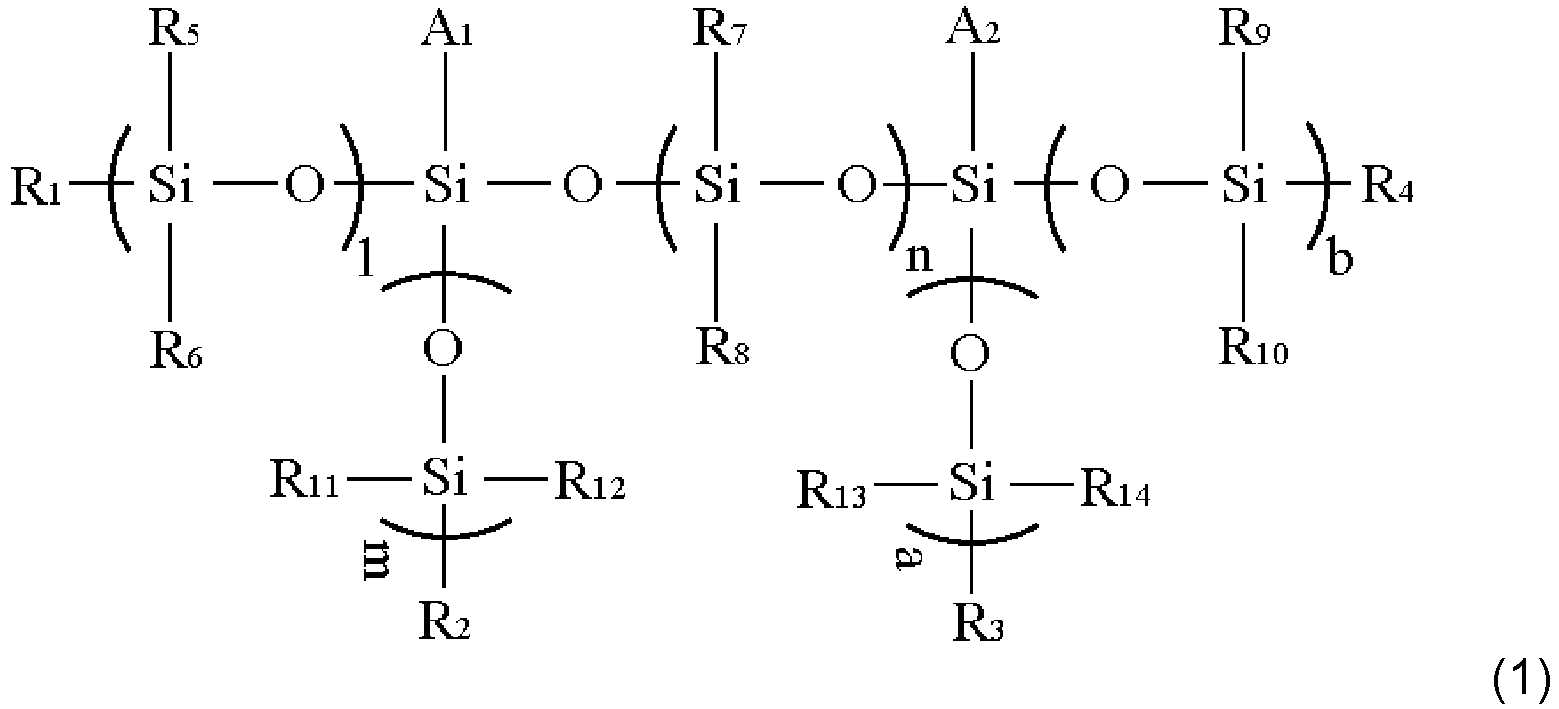
- R1 to R14 are each independently selected from the group consisting of C1-C20 alkyl, C1-C20 alkoxyl, C2-C20 alkenyl, C3-C20 cycloalkyl, C7-C22 aralkyl, and (meth)acryloxy,
- a is an integer of from 0 to 1000,
- b is an integer of from 0 to 1000,
- I is an integer of from 0 to 1000,
- m is an integer of from 1 to 1000,
- n is an integer of from 1 to 1500,
- A1 and A2 are each independently represented by the formula (2):
(R15)c(R16)d(R17)eR18 (2)
wherein:- R15 is C1-C20 alkylene,
- R16 is C6-C21 arylene,
- R17 is C1-C20 alkylene,
- R18 is (meth)acryloxy,
- c is an integer of from 0 to 10,
- d is an integer of from 0 to 10, and
- e is an integer of from 0 to 10.
- Another aspect is a process for producing the polyorganosiloxane according to the present invention, comprising the steps of:
- (1) end-capping a silanol-terminated polyorganosiloxane with an alkoxysilane having a (meth)acryloxy group;
- (2) extending the chain of the polyorganosiloxane obtained in step (1) by reacting with a silanol-terminated polyorganosiloxane; and
- (3) end-capping the residual silanol groups contained in the product obtained in step (2).
- Yet another aspect is a moisture and radiation curable composition, comprising:
- (a) the polyorganosiloxane according to the present invention,
- (b) a photoinitiator,
- (c) a moisture catalyst,
- (d) a reactive plasticizer, and
- (e) optionally, a moisture crosslinker.
- Yet another aspect is a cured reaction product of the moisture and radiation curable adhesive composition according to the present invention.
- Yet another aspect is a coated substrate which is coated on at least one surface with the moisture and radiation curable adhesive composition or the cured product according to the present invention.
- Yet another aspect is the use of the polyorganosiloxane, the moisture and radiation curable adhesive composition or the cured product according to the present invention in manufacturing display panels, touch panels or optical devices.
- Other features and aspects of the subject matter are set forth in greater detail below.
- It is to be understood by one of ordinary skill in the art that the present discussion is a description of exemplary embodiments only, and is not intended as limiting the broader aspects of the present invention.
- As used herein, the term "C1-C20 alkyl" refers to a monovalent linear or branched moiety containing only single bonds between carbon atoms in the moiety and including, for example, C1-C18-, C1-C12-, C1-C10-, C1-C8-, C1-C6- or C1-C4- alkyl. Examples thereof are methyl, ethyl, propyl, isopropyl, n-butyl, sec-butyl, isobutyl, tert-butyl, n-pentyl, n-hexyl, heptyl, 2,4,4-trimethylpentyl, 2-ethylhexyl, n-octyl, n-nonyl, n-decyl, n-undecyl, n-dodecyl, n-hexadecyl, n-octadecyl and n-eicosyl.
- As used herein, "C2-C20 alkenyl group" refers to a straight or branched chain hydrocarbon having from two to twenty carbon atoms, with at least one unsaturation, and including, for example, C2-C18-, C2-C12-, C2-C10-, C2-C8-, C2-C6- or C2-C4- alkenyl. Typical examples are groups such as vinyl, allyl, 1-propen-2-yl, 1-buten-4-yl, 2-buten-4-yl and 1-penten-5-yl.
- As used herein, the term "C1-C20 alkoxyl" refers to the group -O-R wherein R is C1-C20-alkyl as defined above, and including for example, C1-C18-, C1-C12-, C1-C10-, C1-C8-, C1-C6- or C1-C4- alkoxyl.
- As used herein, the term "C6-C20 aryl" refers to an monovalent unsaturated aromatic carbocyclic group of from 6 to 20 carbon atoms having a single ring (e.g., phenyl) or multiple condensed (fused) rings, wherein at least one ring is aromatic (e.g., naphthyl, dihydrophenanthrenyl, fluorenyl, or anthryl). Preferred examples include phenyl, naphthyl, phenantrenyl and the like.
- As used herein, the term "C7-C22 alkylaryl" refers to aryl groups having from 7 to 22 carbon atoms and an alkyl substituent, including methyl phenyl, ethyl phenyl, methyl naphthyl, ethyl naphthyl, and the like.
- As used herein, the term "C1-C20 alkylene" refers to a divalent linear or branched moiety containing only single bonds between carbon atoms in the moiety and including, for example, C1-C18-, C1-C12-, C1-C10-, C1-C8-, C1-C6- or C1-C4- alkylene. Examples thereof are methylene, ethylene, propylene, isopropylene, n-butylene, sec-butylene, isobutylene, tert-butylene, n-pentylene, n-hexylene, n-heptylene, 2,4,4-trimethylpentylene, 2-ethylhexylene, n-octylene, n-nonylene, n-decylene, n-undecylene, n-dodecylene, n-hexadecylene, n-octadecylene and n-eicosylene.
- As used herein, the term "C6-C20 arylene" refers to a divalent unsaturated aromatic carbocyclic group of from 6 to 20 carbon atoms having a single ring (e.g., phenylene) or multiple condensed (fused) rings, wherein at least one ring is aromatic (e.g., naphthylene, dihydrophenanthrenylene, fluorenylene, or anthrylene). Preferred examples include phenylene, naphthylene, phenantrenylene and the like.
- As used herein, the term "(meth)acryloxy group" represents both acryloxy and methacryloxy groups.
- As used herein, the above groups may be further substituted or unsubstituted. When substituted, hydrogen atoms on the groups are replaced by substituent group(s) that is(are) one or more group(s) independently selected from alkyl, alkenyl, alkynyl, cycloalkyl, cycloalkenyl, cycloalkynyl, aryl, heteroaryl, heteroalicyclyl, aralkyl, heteroaralkyl, (heteroalicyclyl)alkyl, hydroxy, protected hydroxyl, alkoxy, aryloxy, acyl, ester, mercapto, alkylthio, arylthio, cyano, halogen, carbonyl, thiocarbonyl, O-carbamyl, N-carbamyl, O-thiocarbamyl, N-thiocarbamyl, C-amido, N-amido, S-sulfonamido, N-sulfonamido, C-carboxy, protected C-carboxy, O-carboxy, isocyanato, thiocyanato, isothiocyanato, nitro, silyl, sulfenyl, sulfinyl, sulfonyl, haloalkyl, haloalkoxy, trihalomethanesulfonyl, trihalomethanesulfonamido, and amino, including mono- and di-substituted amino groups, and the protected derivatives thereof. In case that an aryl is substituted, substituents on an aryl group may form a non-aromatic ring fused to the aryl group, including a cycloalkyl, cycloalkenyl, cycloalkynyl, and heterocyclyl.
- All percentages, parts and ratios are based upon the total weight of the compositions of the present invention, unless otherwise specified. All such weights as they pertain to listed ingredients are based on the active level and, therefore, do not include carriers or by-products that may be included in commercially available materials.
- In one aspect, the present disclosure is generally directed to a polyorganosiloxane represented by the structural formula (1):

- R1 to R14 are each independently selected from the group consisting of C1-C20 alkyl, C1-C20 alkoxyl, C2-C20 alkenyl, C3-C20 cycloalkyl, C7-C22 aralkyl, and (meth)acryloxy,
- a is an integer of from 0 to 1000,
- b is an integer of from 0 to 1000,
- I is an integer of from 0 to 1000,
- m is an integer of from 1 to 1000,
- n is an integer of from 1 to 1500,
- A1 and A2 are each independently represented by the formula (2):
(R15)c(R16)d(R17)eR18 (2)
wherein:- R15 is C1-C20 alkylene,
- R16 is C6-C21 arylene,
- R17 is C1-C20 alkylene,
- R18 is (meth)acryloxy,
- c is an integer of from 0 to 10,
- d is an integer of from 0 to 10, and
- e is an integer of from 0 to 10.
- In one embodiment, R1 to R14 are each independently selected from the group consisting of C1-C20 alkyl, C1-C20 alkoxyl, C2-C20 alkenyl, C3-C20 cycloalkyl, C7-C22 aralkyl, and (meth)acryloxy, preferably selected from the group consisting of C1-C8 alkyl, C1-C8 alkoxyl, C2-C8 alkenyl, C3-C8 cycloalkyl, and C7-C16 aralkyl, more preferably C1-C6 alkyl or C1-C6 alkoxyl.
- In one embodiment, at least one of R1 to R4 is C1-C8 alkoxyl, and the others of R1 to R14 are each independently selected from the group consisting of C1-C8 alkyl, C2-C8 alkenyl, C3-C8cycloalkyl, and C7-C16 aralkyl. More preferably, at least two of R1 to R4 is C1-C6 alkoxyl, and the others of R1 to R14 are each independently selected from C1-C6 alkyl and C1-C6 alkoxyl, for example, methyl, ethyl, propyl, isopropyl, n-butyl, sec-butyl, isobutyl, tert-butyl, pentyl, hexyl, methoxy, ethoxy, propoxy, n-butoxy, sec-butoxy, isobutoxy, tert-butoxy, n-pentoxy, n-hexoxy, etc.
- In one preferred embodiment, at least two of R1 to R4 are C1-C6 alkoxyl, preferably methoxy, and the others of R1 to R14 are independently C1-C6 alkyl, preferably methyl.
- In another preferred embodiment, R1 to R14 is each independently C1-C6 alkyl, preferably methyl.
- In another embodiment, the indices a, b, I and m are each independently of an integer of from 1 to 800, preferably from 50 to 400, and n is an integer of from 1 to 1200, preferably from 100 to 800.
- In yet another embodiment, with respect to A1 and A2 represented by the formula:
(R15)c(R16)d(R17)eR18 (2)
R15 is C1-C8 alkylene, preferably C1-C4 alkylene, more preferably methylene or ethylene. R16 is C6-C9 alkylene, preferably phenylene or naphthalene. R17 is C1-C8 alkylene, preferably C1-C4 alkylene, more preferably methylene or ethylene. The index c is an integer of from 1 to 5, preferably from 1 to 3, d is an integer of from 0 to 5, preferably from 0 to 3, and e is an integer of from 0 to 5, preferably from 0 to 3. - In one preferred embodiment, R15 is methylene, a is 3, b and c are 0, and thus A1 and A2 each independently is (meth)acryloxypropyl group, preferably acryloxypropyl group.
- In another preferred embodiment, R15 is ethylene, R16 is phenylene, R17 is methylene, a, b and c are 1, and thus A1 and A2 each independently is (meth)acryloxymethylphenethyl group, preferably acryloxymethylphenethyl group.
- In one embodiment, the present invention provides a polyorganosiloxane represented by formula (1), wherein n = 430, m and a = 68, l and b = 0, A1 and A2 = acryloxypropyl, R2, R3, R5 to R14 = methyl, R1 and R4 = methoxy.
- In another embodiment, the present invention provides a polyorganosiloxane represented by formula (1), wherein n, a, and m = 190, l and b = 0, A1 and A2 = methacryloxymethyl, R1 to R14 = methyl.
- In another embodiment, the present invention provides a mixture of polyorganosiloxanes, each represented by formula (1), wherein:
- (i) n = 430, m and a = 68, l and b = 0, A1 and A2 = acryloxypropyl, R1 and R4 = methoxy, and R2, R3, R5 to R14 = methyl;
- (ii) n = 430, I, m and a = 68, b = 0, A1 and A2 = acryloxypropyl, R1 to R3 and R5 to R14 = methyl, and R4 = methoxy; and
- (iii) n = 430, I, m, a and b = 68, A1 and A2 = acryloxypropyl, R1 to R14= methyl.
- In yet another embodiment, the present invention provides a mixture of polyorganosiloxanes, each represented by formula (1), wherein:
- (i) n = 430, m and a = 68, l and b = 0, A1 and A2 = acryloxypropyl, R1 and R4 = methoxy, and R2, R3, R5 to R14 = methyl;
- (ii) n = 430, m = 68, a, b and l = 0, A1 and A2 = acryloxypropyl, R1 = methoxy, R2 to R14 = methyl; and
- (iii) m and n = 430, a = 68, b and I = 0, A1 and A2 = acryloxypropyl, R1 and R4 = methoxy, and R2, R3, R5 to R14 = methyl.
- In yet another embodiment, the present invention provides a mixture of polyorganosiloxanes, each represented by formula (1), wherein:
- (i) n, a and m = 190, l and b = 0, A1 and A2 = methacryloxymethyl, R1 to R14 = methyl;
- (ii) n = 190, m = 190, I, a and b = 0, A1 and A2 = methacryloxymethyl, R1 to R3 and R5 to R14, R4 = methoxy; and
- (iii) m and n = 190, I, a and b = 0, A1 and A2 = methacryloxymethyl, R1 to R14= methyl.
- The mixtures of polyorganosiloxane according to the present invention can comprise both (meth)acryloxy and alkoxyl groups in the structure. These groups allow the polyorganosiloxanes to cure when exposed to moisture and photo radiation.
- The polyorganosiloxane according to the present invention is prepared by the process comprising the steps of:
- (1) end-capping silanol-terminated polyorganosiloxane (1) with an alkoxysilane having a (meth)acryloxy group;
- (2) extending the chain of the polyorganosiloxane obtained in step (1) by reacting the polyorganosiloxane with silanol-terminated polyorganosiloxane (2); and
- (3) end-capping the residual silanol groups contained in the product obtained in step (2).
- More specifically, in step (1), the reactants are reacted with agitation in the absence of moisture and in the presence of organolithium catalyst until the desired amount of silanol capping has occurred. The desired equivalent ratio of silanol groups to alkoxysilane is preferably from about 1:0.95 to about 1:1.5, and more preferably from about 1:1 to about 1:1.2.
- Any volatile materials remaining in the reaction mixture after the capping has reached the required level can be removed by a mild heating e.g. 50°C to 100 °C under reduced pressure. An inert gas can be passed through the reaction mixture during the removal of the volatile materials.
- The silanol-terminated reactant used in step (1) can be virtually any useful silanol-terminated material within the formula (3):

- Preferably, R20 and R21 are each independently selected from the group consisting of C1-C8 alkyl, C1-C8 alkoxyl, C2-C8 alkenyl, C3-C8 cycloalkyl, and C7-C16 aralkyl. More preferably, R20 to R21 are each independently selected from C1-C6 alkyl and C1-C6 alkoxyl, for example, methyl, ethyl, propyl, isopropyl, n-butyl, sec-butyl, isobutyl, tert-butyl, pentyl, hexyl, methoxy, ethoxy, propoxy, n-butoxy, sec-butoxy, isobutoxy, tert-butoxy, n-pentoxy, n-hexoxy, etc. Most preferably, R19 and R20 are both methyl.
- In one embodiment, R19 is hydroxyl and R22 is selected from the group consisting of C1-C8 alkyl, C1-C8 alkoxyl, C2-C8 alkenyl, C3-C8 cycloalkyl, and C7-C16 aralkyl, more preferably C1-C6 alkyl and C1-C6 alkoxyl, for example, methyl, ethyl, propyl, isopropyl, n-butyl, sec-butyl, isobutyl, tert-butyl, pentyl, hexyl, methoxy, ethoxy, propoxy, n-butoxy, sec-butoxy, isobutoxy, tert-butoxy, n-pentoxy, n-hexoxy, etc, and thus the reactant is a monosilanol-terminated polyorganosiloxane, preferably monosilanol-terminated polydimethylsiloxane.
- In another embodiment, R19 and R22 are both hydroxyl, and thus the reactant is a disilanol-terminated polyorganosiloxane, preferably disilanol-terminated polydimethylsiloxane.
- The viscosities of the silanol-terminated organopolysiloxanes in step (1) are within the range of from about 1 cps to about 150,000 cps, preferably from about 100 cps to about 10,000 cps measured using a Brookfield viscometer, at a temperature of about 25° C (room temperature).
- The alkoxysilane having (meth)acryloxy group includes a silane containing at least two alkoxy groups and at least one (meth)acryloxy group. More specifically, the alkoxysilane having (meth)acryloxy group includes at least one compound of the formula (5):
(R23)f(R24)gSi(OR25)4-(f+g) (5)
wherein R23 to R25 are each independently selected from the group consisting of C1-20 alkyl, C2-20 alkyl and C6-20 aryl, preferably C1-6 alkyl, C2-6 alkyl and C6-14 aryl such as methyl, ethyl, n-propyl, isopropyl, phenyl, vinyl, and allyl groups. At least one of R23 and R24 is (meth)acryloxy group, and f is 0, 1 or 2; g is 0, 1 or 2; and f+g is 1 or 2. - Representative alkoxysilane having (meth)acryloxy group useful in the present invention include: (γ-acryloxymethyl)phenethyltrimethoxysilane, (γ-acryloxymethyl)trimethoxysilane, (γ-acryloxypropyl)methylbis(trimethylsiloxy)silane, (γ-acryloxypropyl)methyldimethoxysilane, (γ-acryloxypropyl)methyldiethoxysilane, (γ-acryloxypropyl)trimethoxysilane, (γ-acryloxypropyl)tris(trimethylsiloxy)silane, (γ-methacryloxypropyl)bis(trimethylsiloxy)methylsilane, (γ-methacryloxymethyl)bis(trimethylsiloxy)methylsilane, (γ-methacryloxymethyl)methyldimethoxysilane, (γ-methacryloxymethylphenethyl)tris(trimethylsiloxy)silane, (γ-methacryloxymethyl)tris(trimethylsiloxy)silane, (γ-methacryloxypropyl)methyldimethoxysilane, (γ-methacryloxypropyl)methyldiethoxysilane, (γ-methacηloxypropyl)triethoxysilane, (γ-methacryloxypropyl)triisopropoxysilane, (γ-methacryloxypropyl)trimethoxysilane, (γ-methacryloxypropyl)tris(methoxyethoxy)silane, and (γ-methacryloxypropyl)tris(trimethylsiloxy)silane.
- Preferably, the alkoxysilane having (meth)acryloxy group is selected from (γ-acryloxymethyl)phenethyltrimethoxysilane, (γ-acryloxypropyl)trimethoxysilane, (γ-acryloxymethyl)trimethoxysilane, and combination thereof.
- The organolithium reagent is preferably an alkyl lithium, such as methyl, n-butyl, sec-butyl, t-butyl, n-hexyl, 2-ethylhexyl and n-octyl lithium. Other useful catalysts include phenyl lithium, vinyl lithium, lithium phenylacetylide, lithium (trimethylsilyl) acetylide, lithium silanolates and lithium siloxanolates. The organo group can also be an amine-containing group, such as dimethylamine, diethylamine, diisopropylamine or dicyclohexylamine, or a silicone-containing group.
- Generally, the amount of lithium in the reaction mixture is from 1 ppm to about 1000 ppm, preferably from about 5 ppm to about 500 ppm, such as from about 8 ppm to about 200 ppm, based on the weight of the reactants in step (1).
- The amount of the organolithium catalyst used in the catalyst system depends on the reactivity of the silanol group-containing reactant and the reactivity of the alkoxysilane containing the polymerizable ethylenically unsaturated group. The amount chosen may be readily determined by those persons skilled in the art.
- The reaction in step (1) can be carried out at temperatures of from about room temperature (about 25°C) to about 150°C. The temperature at which the steps are conducted depends on the particular reactants chosen, the identity and amount of the constituents of the catalyst system and the length of time the reaction can proceed.
- In step (2), the reactants are reacted with agitation in the absence of moisture and in the presence of organolithium catalyst until the desired amount of chain extension has occurred by monitoring the viscosity of the product in the reaction. The desired equivalent ratio of silanol groups to alkoxy in the polyorganosiloxane obtained in step (1) is preferably from about 1:0.95 to about 1:1.5, and more preferably from about 1:1 to about 1:1.2.
- Any volatile materials remaining in the reaction mixture after the chain extension has reached the required level can be removed by a mild heating e.g. 50°C to 100 °C under reduced pressure. An inert gas can be passed through the reaction mixture during the removal of the volatile materials.
- The silanol-terminated reactant used in step (2) can be also represented by the formula (3) as described above and has a viscosity in the range as described above.
- The organolithium catalyst in steps (2) can be the same as used in step (1), and the amount of lithium in the reaction mixture is from 1 ppm to about 1000 ppm, preferably from about 5 ppm to about 500 ppm, such as from about 8 ppm to about 200 ppm, based on the weight of the reactants in step (2).
- In one preferred embodiment, the silanol-terminated polyorganosiloxane (1) is a monosilanol-terminated polyorganosiloxane, preferably monosilanol-terminated polydimethylsiloxane (ω-hydroxyl terminated polydimethylsiloxane), and the silanol-terminated polyorganosiloxane (2) is a disilanol-terminated polyorganosiloxane, preferably disilanol-terminated polydimethylsiloxane (α,ω-hydroxyl terminated polydimethylsiloxane).
- In another preferred embodiment, the silanol-terminated polyorganosiloxane (1) is a disilanol-terminated polyorganosiloxane, preferably disilanol-terminated polydimethylsiloxane, and the silanol-terminated polyorganosiloxane (2) is a monosilanol-terminated polyorganosiloxane, preferably monosilanol-terminated polydimethylsiloxane.
- In another preferred embodiment, both of the silanol-terminated polyorganosiloxanes (1) and (2) are disilanol-terminated polyorganosiloxanes, preferably disilanol-terminated polydimethylsiloxanes. As such, the end-capping of step (1) and the chain extension in step (2) are undergone simultaneously during the reaction.
- The reaction in step (2) can be carried out at temperatures of from about room temperature (about 25°C) to about 150°C. The temperature at which the steps are conducted depends on the particular reactants chosen, the identity and amount of the constituents of the catalyst system and the length of time the reaction can proceed.
- In step (3), the residual silanols contained in the polyorganosiloxane obtained in step (2) and an end-capping agent are reacted with agitation in the absence of moisture and in the presence of organolithium catalyst until the residual silanol group in the product are end-capped.
- The organolithium catalyst in steps (3) can be the same as used in step (1) and/or (2), and the amount of lithium in the reaction mixture is from 1 ppm to about 1000 ppm, preferably from about 5 ppm to about 500 ppm, such as from about 8 ppm to about 200 ppm, based on the weight of the reactants in step (2).
- Preferably, the organolithium catalysts in steps (1) to (3) are identical, for example n-butyl lithium, and thus the organolithium catalyst in an amount sufficient for steps (1) to (3) is added in step (1) for the sake of simplification of the process.
- After the reaction, the organolithium catalyst can be reacted with carbon dioxide, precipitated as lithium carbonate and removed from the reaction mixture by liquid-solid separation means such as centrifuging, filtration and the like.
- There is not particular limitation to the end-capping agent. End-capping agent, for example silanes having an end-capping functionality are known to the person skilled in the art. These are silanes which do not contain any sterically bulky radicals and are thus also able to react with the residual silanols contained in the polyorganosiloxane.
- Suitable silanes used as end-capping agent are, for example, dimethyldimethoxysilane or hexamethyldisilazane.
- In another aspect, the present invention provides a moisture and radiation curable composition, comprising the components:
- (a) the polyorganosiloxane according to the present invention,
- (b) a photoinitiator,
- (c) a moisture catalyst,
- (d) a reactive plasticizer, and
- (e) optionally, a moisture crosslinker.
- The polyorganosiloxane as described above is present in an amount from 20 to 90% by weight, preferably 30 to 80% by weight, based on the total weight of the components. A mixture of different polyorganosiloxanes as described above can be used as component (a).
- The moisture and radiation curable adhesive composition further comprises a photoinitiator to initiate the radiation curing, preferably UV curing of the composition upon receiving sufficient UV radiation.
- There is no particular limitation to the photoinitiator useful in the present invention. Suitable photoinitiators include, but are not limited to, organic peroxides, azo compounds, quinones, benzophenones, nitroso compounds, acryl halides, hydrazones, mercapto compounds, pyrylium compounds, triacrylimidazoles, bisimidazoles, chloroalkyltriazines, benzoin ethers, benzil ketals, thioxanthones, acetophenones, acylphosphine oxides, alpha hydroxyl ketones, alpha amino ketones, derivatives of the aforementioned compounds, and mixtures thereof.
- Exemplary photoinitiators are benzil ketals such as 2,2-dimethoxy-2-phenyl acetophenone (available from Ciba Specialty Chemicals under the trademark Irgacure 651); acetophenone derivatives such as 2,2-diethoxyacetophenone ("DEAP", available from First Chemical Corporation); 2-hydroxy-2-methyl-1-phenyl-propan-1-one ("HMPP", available from Ciba Specialty Chemicals under the trademark Darocur 1173); 1-hydroxy-cyclohexyl-phenyl ketone (available from Ciba Specialty Chemicals under the name Irgacure 184); 2-benzyl-2-N, N-dimethylamino-1-(4-morpho linophenyl)-1-butanone (available from Ciba Specialty Chemicals under the trademark Irgacure 369); 2-methyl-1-(4-(methylthio)phenyl)-2-morpholinopropan-1-one (available from Ciba Specialty Chemicals under the trademark Irgacure 907); or acylphosphine oxides such as 2,4,6-trimethylbenzoyl diphenylphosphine oxide ("TPO", available from Ciba Specialty Chemicals in 50/50 wt% blends with HMPP (as Irgacure 4265)), bis(2,6-dimethoxybenzoyl)-2,4,4-trimethylpentylphosphine oxide (available from Ciba Specialty Chemicals in the form of blends with other ketones including: 25/75 wt% blend with HMPP as Irgacure 1700, and 1-hydroxy-cyclohexyl-phenyl-ketone, (or HCPK) as Irgacure 1850 or 1800 depending on proportions), or bis(2,4,6-trimethylbenzoyfl)-phenylphosphine oxide (available from Ciba Specialty Chemicals under the trademark Irgacure 819).
- In one preferred embodiment, the photoinitiator useful in the present invention is selected from the group consisting of 2-hydroxy-2-methyl-1-phenyl-propan-1-one, bis(2,4,6-trimethylbenzoyfl)-phenylphosphine oxide, 1-hydroxy-cyclohexyl-phenyl ketone, 2,4,6-trimethylbenzoyl diphenylphosphine oxide, and the combination thereof. More preferably, the photoinitiator is 2-hydroxy-2-methyl-1-phenyl-propan-1-one.
- In the moisture and radiation curable adhesive composition according to the present invention, the component (b) is present in an amount from 0.1 to 5% by weight, preferably 1 to 3% by weight, based on the total weight of the components.
- The moisture and radiation curable adhesive composition further comprises a moisture curing catalyst which initiates the moisture curing of the composition in the presence of moisture.
- The moisture curing catalysts typically used in the moisture and radiation curable adhesive compositions of this invention include those known to be useful for facilitating moisture curing. The catalysts include metal and non-metal catalysts. Examples of the metal portion of the metal catalysts useful in the present invention include tin, titanium, zirconium, lead, iron cobalt, antimony, manganese, bismuth and zinc compounds.
- In one embodiment, the tin compounds useful for facilitating the moisture curing of the composition include but are not limited to dimethyldineodecanoatetin (available from Momentive Performance Materials Inc. under the trade name of FOMREZ UL-28 A), dibutyltindilaurate, dibutyltindiacetate, dibutyltindimethoxide, tinoctoate, isobutyltintriceroate, dibutyltinoxide, solubilized dibutyl tin oxide, dibutyltin bis diisooctylphthalate, bis-tripropoxysilyl dioctyltin, dibutyltin bis-acetylacetone, silylated dibutyltin dioxide, carbomethoxyphenyl tin tris-uberate, isobutyltin triceroate, dimethyltin dibutyrate, dimethyltin di-neodecanoate, triethyltin tartarate, dibutyltin dibenzoate, tin oleate, tin naphthenate, butyltintri-2-ethylhexylhexoate, tinbutyrate, dioctyltin didecylmercaptide, bis(neodecanoyloxy)dioctylstannane, dimethylbis(oleoyloxy)stannane.
- In one preferred embodiment, the moisture curing catalyst is selected from the group consisting of dimethyldineodecanoatetin (available from Momentive Performance Materials Inc. under the trade name of FOMREZ UL-28, dioctyltin didecylmercaptide (available from Momentive Performance Materials Inc. under the trade name of FOMREZ UL-32), bis(neodecanoyloxy)dioctylstannane (available from Momentive Performance Materials Inc. under the trade name of FOMREZ UL-38), dimethylbis(oleoyloxy)stannane (available from Momentive Performance Materials Inc. under the trade name of FOMREZ UL-50), and combination thereof. More preferably, the moisture curing catalyst is dimethyldineodecanoatetin.
- In the moisture and radiation curable adhesive composition according to the present invention, the component (c) is present in an amount from 0.1 to 0.5% by weight, preferably 0.1 to 0.3% by weight, based on the total weight of all components.
- The moisture and radiation curable adhesive composition may further comprises a reactive plasticizer.
- As used herein, the term "reactive plasticizer" refers to a high molecular weight plasticizer having reactive silicon groups at its terminals or main chain, reacts the polyorganosiloxane and presents in the crosslinking network during curing.
- There is no particular limitation to the reactive plasticizer useful in the present invention. One suitable examples is a mono(meth)acryloxy terminated linear polyorganosiloxane homopolymer which can be prepared by conventional methods known in the art, for example as disclosed in
US 6140444 A , the content of which is incorporated by reference in its entirety. Specifically, the mono(meth)acryloxy terminated polyorganosiloxane homopolymer is selected from the group consisting of linear polydimethylsiloxanes terminated by ((meth)acryloxymethyl)phenethyl, (meth)acryloxymethyl, and (meth)acryloxyproxyl groups. More specifically, the polyorganosiloxane homopolymer used as reactive plasticizer is both terminated by (meth)acryloxy and C1 to C20 alkoxy, preferably C1 to C6 alkoxy, more preferably methyl. - In the moisture and radiation curable adhesive composition according to the present invention, the component (d) is present in an amount from 10 to 60% by weight, preferably 15 to 50% by weight, based on the total weight of the components.
- The moisture and radiation curable adhesive composition may optionally comprises a moisture crosslinker.
- Exemplary moisture crosslinker are vinyltrichiorosilane, vinyltrimethoxysilane, vinyltriethoxysilane, β-(3,4-epoxycyclohexyl)ethyltrimethoxysilane, γ-glycidoxypropyltrimethoxysilane, γ-glycidoxypropylmethyldiethoxysilane, γ-glycidoxypropyltriethoxysilane, γ-methacryloxypropylmethyldimethoxysilane, p-styryltrimethoxysilane, γ-methacryloxypropyltrimethoxysilane, γ-methacryloxypropylmethyldiethoxysilane, γ-methacryloxypropyltriethoxysilane, γ-acryloxypropyltrimethoxysilane, N-(β-aminoethyl)-γ-aminopropylmethyldimethoxysilane, N-(β-aminoethyl)-γ-aminopropyltrimethoxysilane, N-(β-aminoethyl)-γ-aminopropyltriethoxysilane, γ-aminopropyltrimethoxysilane, γ-aminopropyltriethoxysilane, N-phenyl-γ-aminopropyltrimethoxysilane, N-2-(aminoethyl)-γ-aminopropyltriethoxysilane, γ-mercaptopropyltrimethoxysilane, γ-mercaptopropyltriethoxysilane, mercaptomethyltrimethoxysilane, dimethoxy-3-mercaptopropylmethylsilane, 2-(2-aminoethylthioethyl)diethoxymethylsilane, 3-(2-acetoxyethylthiopropyl)dimethoxymethylsilane, 2-(2-aminoethylthioethyl)triethoxysilane, dimethoxymethyl-3-(3-phenoxypropylthiopropyl)silane, bis(triethoxysilylpropyl)disulfide, bis(triethoxysilylpropyl)tetrasulfide, 1,4-bis(triethoxysilyl)benzene, bis(triethoxysilyl)ethane, 1,6-bis(trimethoxysilyl)hexane, 1,8-bis(triethoxysilyl)octane, 1,2-bis(trimethoxysilyl)decane, bis(triethoxysilylpropyl)amine, bis(trimethoxysilylpropyl)urea, tris-(3-trimethoxysilylpropyl)isocyanurate, γ-chloropropyltrimethoxysilane, γ-ureidopropyltriethoxysilane, trimethylsilanol, diphenylsilanediol, triphenylsilanol, γ-triethoxysilylpropyl(meth)acrylate, and hexyltrimethoxysilane.
- Preferably, the moisture and radiation curable adhesive composition contains a moisture crosslinker, and is selected from the group consisting of vinyltrimethoxysilane, 1,6-bis(trimethoxysilyl)hexane, 1,8-bis(trimethoxysilyl)octane, γ-(meth)acryloxypropyltrimethoxysilane, and combination thereof. More preferably, the moisture crosslinker is vinyltrimethoxysilane available from Evonik under the trade name of Dynasylan VTMO.
- The component (e) is present in an amount from 1 to 5% by weight, preferably 0.1 to 3% by weight based on the total weight of all components.
- The moisture and radiation curable adhesive composition may further comprise one or more optional additives, resin components and the like to improve or modify properties of the sealant composition, such as flowability, dispensing property, storage stability, curing property and physical property of the cured product.
- The components that may be contained in the sealant composition as needed include, but are not limited to, for example, chain extender, organic or inorganic filler, thixotropic agent, diluent, modifier, coloring agent such as pigment and dye, preservative, stabilizer, plasticizer, lubricant, defoamer, leveling agent and the like.
- Suitable chain extender useful in the present invention includes but is not limited to methoxy, ethoxy, triethoxysilylethyl terminated terminated polydimethylsiloxanes, etc. Exemplary chain extenders are methoxy terminated polydimethylsiloxanes such as DMS-XM11 (available from Gelest, Inc., Morrisville, Pa.), dimethoxy(epoxypropoxypropyl) terminated polydimethylsiloxanes such as DMS-EX21 (available from Gelest, Inc., Morrisville, Pa.), ethoxy terminated dimethylsiloxanes such as DMS-XE11 (available from Gelest, Inc., Morrisville, Pa.), and triethoxysilylethyl terminated polydimethylsiloxanes such as DMS XT11 (available from Gelest, Inc., Morrisville, Pa.).
- If present, the component (e) is present in an amount from 5 to 30% by weight, preferably 10 to 20% by weight, based on the total weight of all components of the moisture and radiation curable adhesive composition according to the present invention.
- Suitable fillers, which can be optionally used in the present invention includes, but are not limited to, inorganic fillers such as silica, diatomaceous earth, alumina, zinc oxide, iron oxide, magnesium oxide, tin oxide, titanium oxide, magnesium hydroxide, aluminium hydroxide, magnesium carbonate, barium sulphate, gypsum, calcium silicate, talc, glass bead, sericite activated white earth, bentonite, aluminum nitride, silicon nitride, and the like; organic fillers, such as polymethyl methacrylate, polyethyl methacrylate, polypropyl methacrylate, polybutyl methacrylate, poly acrylonitrile, polystyrene, polybutadiene, polypentadiene, polyisoprene, polyisopropylene, and the like. The filler may be used alone or in combination thereof.
- Suitable thixotropic agents, which can be optionally used in the present invention includes, but are not limited to, talc, fume silica, superfine surface-treated calcium carbonate, fine particulate alumina, plate-like alumina; layered compound such as montmorillonite, spicular compound such as aluminium borate whisker, and the like. Talc, fume silica and fine alumina are preferred thixotropic agents.
- In one embodiment, the present invention provides a moisture and radiation curable adhesive composition comprising:
- 20 to 90% by weight, preferably 30 to 80% by weight of component (a);
- 0.1 to 5% by weight, preferably 1 to 3% by weight of component (b);
- 0.1 to 0.5% by weight, preferably 0.1 to 0.3% by weight of component (c);
- 10 to 60% by weight, preferably 15 to 50% by weight of component (d);
- 1 to 5% by weight, preferably 1 to 3% by weight of component (e); and
- 5 to 30% by weight, preferably 10 to 20% by weight of chain extender,
- The moisture and radiation curable adhesive composition of the present invention is in the form of liquid, and the Brookfield viscosity of the composition is preferably about 50 cps to about 40,000 cps at 25° C. The liquid adhesive composition in such range of viscosity has a good flowing property which makes it easy to be applied or injected onto a substrate. The Brookfield viscosity here is measured by using a Brookfield rotational viscometer (digital Brookfield viscometer, DV-II+, available from BROOKFIELD, US) with a spindle at 25° C. according to ASTM D1084-1997. The selection of spindle for testing will depend on the viscosity level of the adhesive composition.
- The moisture and radiation curable adhesive composition of the present invention has a clear appearance, and maintains the clear appearance and excellent optical properties, for example, a light transmittance of greater than 95%, and a haze of less than 1% after curing by radiation and moisture.
- A mixer equipped with a mechanical stirrer, condenser, thermometer, heating mantle, nitrogen inlet, and an addition funnel is charged with components (a) and (d), and heated up to 80 °C. The contents are mixed at 120 rpm under vacuum for 3 hours, then cooled under vacuum to room temperature. The component (c), (d), (e) and/or chain extender are then added to the mixer under vacuum. The vacuum is broken with nitrogen after 1 hour of mixing for all components.
- Another aspect of the present invention provides a process of bonding substrates, comprising,
- (i) applying the moisture and radiation adhesive composition according to the present invention onto the substrate to be bonded;
- (ii) laminating or stacking the substrate to be bonded to form an assembly;
- (iii) photo irradiating the assembly; and
- (iv) placing the assembly under the room temperature.
- Specifically, the adhesive composition according to the present invention may be coated under pressure onto the surface of the substrate following the predetermined route by means of an automatic dispensing system. Subsequently, another substrate is laminated onto the adhesive, and the height difference between the two substrates is controlled by a dispenser, e.g., Dispenser KAR03, manufactured by IINUMA-GAUGE MFG LTD. After the adhesive is self-leveled on the whole bonding area, photo irradiation is conducted from top to bottom for curing. Light source (such as ultraviolet light and visible light) and high energy ray (such as electronic beam, α-ray, γ-ray and X-ray) can be used herein for photo irradiation, with preference given to ultraviolet light in the wavelength range of about 200 nm to about 400 nm. The energy dose is 3000 mJ/cm2 or more, the power density is about 100 mW/cm2. The UV lamp used may be such as Loctite UVALOC 1000, and the irradiation time may generally be about 5 s to about 30 s. Since the marginal areas are within the nontransparent part, it cannot be cured by UV irradiation. The bonded parts can be completely cured by storing the parts at room temperature for about 24 hours, according to the moisture-curable character of the present adhesive composition, without any need for additional equipment and processing.
- Another aspect of the present invention also provides a cured adhesive product produced from the moisture and radiation curable adhesive composition.
- Surprisingly, the cured adhesive product of the adhesive composition according to the present invention is very soft and specifically exhibited a lower Shore 00 hardness and improved elongation, meanwhile maintaining an excellent properties including good stability under high temperature and humidity and high transparency. As such, the cured adhesive product is suitable to be used in display panels, touch panels and optical devices, and can significantly decrease the shrinkage and absorb the stress built up in the substrate, which is known to cause light leakage.
- In one embodiment, the cured reaction product of the composition has a Shore 00 hardness of from 0 to 50, preferably from 15 to 45, after 7 days from curing, at 25°C, as measured according to ASTM D2240.
- In another embodiment, the cured reaction product of the composition has an elongation of from 100% to 400%, preferably 150% to 350%, after 7 days from curing, at 25°C, as measured according to ASTM D412.
- The moisture and radiation curable adhesive composition of the present invention may be used as a liquid optical clear adhesive (LOCA) for handheld device and display (HHDD), especially for bonding or laminating various elements in the manufacture of display panels, touch panels and optical devices.
- For example, the moisture and radiation curable adhesive composition of the present invention can be used in bonding or laminating a transparent substrate with another transparent substrate, or bonding or laminating a transparent substrate with a non-transparent substrate. The transparent substrate comprises glass and transparent plastic etc., and the non-transparent substrate comprises metal, non-transparent plastic, ceramic, stone, leather and wood etc. Plastic may be for example poly(methyl methacrylate) (PMMA), polycarbonate (PC) or polyester (PET) etc.
- The following examples are intended to assist one skilled in the art to better understand and practice the present invention. The scope of the invention is not limited by the examples but is defined in the appended claims. All parts and percentages are based on weight unless otherwise stated.
- A 5 liter, 4-neck round bottom flask equipped with mechanical stirrer, heating mantle, sparge tube and thermometer was charged with 350 g of a ω-hydroxyl terminated polydimethylsiloxane (having a viscosity of 100 cps, commercially available from AB Specialty Silicones under the trade name of MOH 100). The fluid was heated to a temperature of 60 °C and sparged with nitrogen for a period of time of 30 minutes followed by vacuum for another 30 minutes to remove any volatile components such as water and carbon dioxide. 3-Acryloxypropyltrimethoxysilane ("APTMS", 15.56 g, commercially available from Gelest) and n-butyl lithium in hexane solution (1.6M; 0.12 ml, commercially available from Sigma-Aldrich) were sequentially added to the reactor. The mixture was maintained at a temperature of 60 °C under vacuum for a period of time of 3 hours.
- The reactor was then charged with 2187.5 g of an α,ω-hydroxyl terminated polydimethylsiloxane (having a viscosity of 6000 cps, commercially available from Emerald Performance Materials under the trade name of Masil SFR 6000) under nitrogen protection. The fluid was heated to a temperature of 60 °C under vacuum and maintained for a period of time of 60 minutes. Dimethyldimethoxysilane (10.5 g, commercially available from Gelest) was slowly added into the reactor under nitrogen protection, and the mixture was maintained at 60 °C for a period of time of 3 hours. Dry ice (1 g) was then added to the reaction mixture to quench the catalyst.
- The mixture was vacuum stripped to remove the volatile components. The final product (designated as CE-APDMST-1 PDMS,) is a mixture of chain-extended acryloxypropyldimethoxysilyl-terminated PDMSs (polydimethylsiloxanes) represented by formula (1), wherein:
- (i) n = 430, m and a = 68, l and b = 0, A1 and A2 = acryloxypropyl, R1 and R4 = methoxy, and R2, R3, R5 to R14 = methyl (>80% by weight of the mixture);
- (ii) n = 430, I, m and a = 68, b = 0, A1 and A2 = acryloxypropyl, R1 to R3 and R5 to R14 = methyl, and R4 = methoxy (about 5% by weight of the mixture); and
- (iii) n = 430, I, m, a and b = 68, A1 and A2 = acryloxypropyl, R1 to R14= methyl (<5% by weight of the mixture).;
- A 1 gallon reactor equipped with mechanical stirrer, heating/cooling jacket was charged with 1500 g (79.0%) of an α,ω-hydroxyl terminated polydimethylsiloxane (having a viscosity of 6000 cps, commercially available from Emerald Performance Materials under the trade name of Masil SFR 6000). The fluid was heated to a temperature of 80 °C and vacuum was applied for 60 minutes to remove any volatile component such as water and carbon dioxide. APTMS (11.69 g, 0.92%, commercially available from Gelest) and n-butyl lithium in hexane solution (1.6M; 1.21 ml, 0.042%, commercially available from Sigma-Aldrich) were sequentially added to the reactor. The mixture was maintained at a temperature of 60 °C under vacuum for a period of time of 1.5 hours.
- The reactor was then charged with 312 g (16.43%) of a ω-hydroxyl terminated polydimethylsiloxane (having a viscosity of 100 cps, commercially available from AB Specialty Silicones under the trade name of MOH 100) under nitrogen protection. The mixture was maintained at the temperature of 60 °C under vacuum for 2.5 hours. 75 g (5.92%) of dimethyldimethoxysilane (commercially available from Gelest) was slowly added into the reactor under nitrogen protection, and the mixture was maintained at 60 °C for a period of time of 3 hours. Dry ice (1 g) was then added to the reaction mixture to quench the catalyst. The mixture was vacuum stripped to remove the volatile components. The final product (designated as CE-APDMST-2 PDMS) is a mixture of chain-extended acryloxypropyldimethoxysilyl-terminated PDMSs represented by formula (1), wherein:
- (i) n = 430, m and a = 68, l and b = 0, A1 and A2 = acryloxypropyl, R2, R3, R5 to R14 = methyl, R1 and R4= methoxy (>70% by weight of the mixture);
- (ii) n = 430, m = 68, a, b and I = 0, A1 and A2 = acryloxypropyl, R1 = methoxy, R2 to R14 = methyl; and
- (iii) m and n = 430, a = 68, b and I = 0, A1 and A2 = acryloxypropyl, R1 and R4 = methoxy, R2, R3, R5 to R14 = methyl.
- A 2 gallon reactor equipped with mechanical stirrer, heating/cooling jacket was charged with 4483.5 g (97.95%) of an α,ω-hydroxyl terminated polydimethylsiloxane (having a viscosity of 750 cps, commercially available from Emerald Performance Materials under the trade name of Masil SFR 750). The fluid was heated to a temperature of 80 °C and vacuum was applied for 60 minutes to remove any volatile component such as water and carbon dioxide. Methacryloxymethylmethyldimethoxysilane (45.77 g, 1.0%, commercially available from Wacker under the trade name of XL-32) and n-butyl lithium in hexane solution (1.6M; 3.52 ml, 0.05%, commercially available from Gelest) were sequentially added to the reactor. The mixture was maintained at a temperature of 50 °C under vacuum for a period of time of 3 hours.
- Dry ice (1 g) was then added to the reaction mixture to quench the catalyst, and vacuum was applied 30 minutes later to remove the volatile components. 45.77 g (1%) of hexamethyldisilazane (commercially available from Gelest) was slowly added into the reactor under nitrogen protection, and the mixture was heated up to 120 °C and maintained for a period of time of 6 hours. The mixture was stripped under vacuum at 120 °C for 2 hours to remove the volatile components, and then cooled down to room temperature. The final product (designated as CE-APDMST-3 PDMS) is a mixture of chain-extended methacryloxymethyldimethylsilyl-terminated PDMSs represented by formula (1), wherein:
- (i) n, a and m = 190, l and b = 0, A1 and A2 = methacryloxymethyl, R1 to R14 = methyl (about 80% by weight of the mixture);
- (ii) n = 190, m = 190, I, a and b = 0, A1 and A2 = methacryloxymethyl, R1 to R3 and R5 to R14 = methyl, and R4 = methoxy; and
- (iii) m and n = 190, I, a and b = 0, A1 and A2 = methacryloxymethyl, R1 to R14 = methyl.
- A 2 gallon reactor equipped with mechanical stirrer, heating/cooling jacket was charged with 4932.5 g of an α,ω-hydroxyl terminated polydimethylsiloxane (having a viscosity of 6000 cps, commercially available from Emerald Performance Materials under the trade name of Masil SFR 6000). The fluid was heated to a temperature of 50 °C and vacuum was applied for 60 minutes to remove any volatile component such as water and carbon dioxide. APTMS (65 g, commercially available from Gelest) and n-butyl lithium in hexane solution (1.6M; 3.9 ml, commercially available from Sigma-Aldrich) were sequentially added to the reactor. The mixture was maintained at a temperature of 50 °C under vacuum for a period of time of 4 hours. Dry ice (1 g) was then added to the reaction mixture to quench the catalyst. The mixture was vacuum stripped to remove the volatile components. The final product is a diacryloxypropyldimethoxysilyl-terminated linear PDMS homopolymer, and designated as DMA-6000 used in the comparative example.
- A 5 liter, 4-neck round bottom flask equipped with mechanical stirrer, heating mantle, sparge tube and thermometer was charged with 2425 g of a ω-hydroxyl terminated polydimethylsiloxane (having a viscosity of 1000 cps, commercially available from AB Specialty Silicones under the trade name of MOH 1000). The fluid was heated to a temperature of 60 °C and sparged with nitrogen for a period of time of 30 minutes followed by vacuum for another 30 minutes to remove any volatile components such as water and carbon dioxide. γ-Acryloxypropyltrimethoxysilane ("APTMS", 36 g, commercially available from Gelest) and n-butyl lithium in hexane solution (1.6M; 1.89 ml, commercially available from Sigma-Aldrich) were sequentially added to the reactor. The mixture was maintained at a temperature of 60 °C under vacuum for a period of time of 3 hours. Dry ice (1 g) was then added to the reaction mixture to quench the catalyst.
- The mixture was vacuum stripped to remove the volatile components. The final product is a monoacryloxypropyldimethoxysilyl-terminated linear PDMS, and used as the reactive plasticizer in the adhesive compositions as shown in Table 1.
- A 2 gallon reactor equipped with mechanical stirrer, heating/cooling jacket was charged with 4400 g of an α,ω-hydroxyl terminated polydimethylsiloxane (having a viscosity of 70 cps, commercially available from Emerald Performance Materials under the trade name of Masil SFR 70). The fluid was heated to a temperature of 60 °C and vacuum was applied for 60 minutes to remove any volatile component such as water and carbon dioxide. Dimethyldimethoxysilane (320 g, commercially available from Gelest) and n-butyl lithium in hexane solution (1.6M; 3.64 ml, commercially available from Sigma-Aldrich) were sequentially added to the reactor. The mixture was maintained at a temperature of 60 °C under nitrogen protection for a period of time of 3 hours. Dry ice (1 g) was then added to the reaction mixture to quench the catalyst. The mixture was vacuum stripped to remove the volatile components. The final product will be used as the chain extender in the examples.
- Following the above-mentioned preparation process, adhesive compositions according to the present invention were obtained. Names and amounts of the components are listed in Table 1.
Table 1. The compositions of Examples A to G (Ex. A to Ex. G) Amount (wt%) Component Ex. A Ex. B Ex. C Ex. D Ex. E Ex. F Ex. G comp CE-APDMST-1 PDMS 65.0 60.0 58.0 - - - - CE-APDMST-2 PDMS - - - 36.0 48.0 - - CE-APDMST-3 PDMS - - - - - 80.0 - DMA-6000 - - - - - - 95.8 Photoinitiator1 2.0 2.0 2.0 2.0 2.0 2.0 2.0 Moisture catalyst2 0.2 0.2 0.2 0.2 0.2 0.2 0.2 Reactive plasticizer 20.8 15.8 27.8 49.8 27.8 15.8 - Chain extender3 10 20 10 10 20 - - Moisture crosslinker4 2.0 2.0 2.0 2.0 2.0 2.0 2.0 1 Photoinitiator: 2-hydroxy-2-methyl-1-phenyl-propan-1-one, commercially available from Ciba Specialty Chemicals under the trade name of Darocur 1173.
2 Moisture catalyst: dimethyldineodecanoatetin, commercially available from Momentive Performance Materials Inc. under the trade name of FOMREZ UL-28.
3 Chain extender: linear structured PDMS end-capped with methoxy groups synthesized as above.
4 Moisture crosslinker: vinyltrimethoxysilane available from Evonik under the trade name of Dynasylan VTMO. - For the tests, all components (with a total amount about 50 grams) were added to a plastic jar which was then spanned 3 times in a speed mixer at 3000 rpm for 30 seconds each time. 32 grams of the material was poured into a 6 inches x 6 inches metal frame with a polyethylene film and a piece of glass on each side, followed by a 60 second UV exposure from both sides with UVA intensity at 75 mW/cm2. The polyethylene films were peeled off and the cured products to be tested were then kept in a 25 °C, 50% relative humidity chamber for 7 days.
- The hardness according to ASTM D2240 and the elongation according to ASTM D412 of the cured products of the compositions in Table 1 are listed in Table 2.
Table 2. Test results of the examples Results Test Ex. A Ex. B Ex. C Ex. D Ex. E Ex. F Ex. G comp Shore 00 Hardness 35 25 27 25 31 40 68 Elongation (%) 200 310 250 210 200 340 75 After 7 day at 25°C - As shown in Table 1, Examples A to F are inventive examples of adhesive compositions having the chain extended polyorganosiloxanes according to the present invention. Example G only comprises one di(meth)acryloxy terminated linear polyorganosiloxane homopolymer and is listed as a comparative example which is a typical example of conventional adhesive formulations.
- As demonstrated in Table 2, the Shore 00 hardness results of the cured products of Examples A to F are within the range of 25 to 40, which are significantly lower than the range (50 to 70) of conventional UV and moisture curing silicone based adhesives, e.g. Example G.
- It is also clear in Table 2 that elongation results of the cured products of Examples A to F are much larger than that of Example G, which indicates that the inventive adhesive compositions are much softer than conventional formulations.
- It is believed that such excellent results are due to the assumption that the controlling of the crosslinkable functional groups on the polymer chain of the polyorganosiloxanes brings about the improvement of the softness and elongation of the cured products. Therefore, the stress built up in the substrates during assembly and light leaking can be largely absorbed and decreased by the inventive adhesives.
- In addition, during the test, the inventive adhesives also exhibited properties including good adhesion to different substrates, good transmittance, good stability under room temperature, high temperature and high humidity.
Claims (15)
- A polyorganosiloxane represented by the structural formula (1):
 R1 to R14 are each independently selected from the group consisting of C1-C20 alkyl, C1-C20 alkoxyl, C2-C20 alkenyl, C3-C20 cycloalkyl, C7-C22 aralkyl, and (meth)acryloxy,a is an integer of from 0 to 1000,b is an integer of from 0 to 1000,I is an integer of from 0 to 1000,m is an integer of from 1 to 1000,n is an integer of from 1 to 1500,A1 and A2 are each independently represented by the formula (2):
(R15)c(R16)d(R17)eR18 (2)
wherein:R15 is C1-C20 alkylene,R16 is C6-C21 arylene,R17 is C1-C20 alkylene,R18 is (meth)acryloxy,c is an integer of from 0 to 10,d is an integer of from 0 to 10, ande is an integer of from 0 to 10. - The polyorganosiloxane according to claim 1, wherein R1 to R14 are each independently selected from the group consisting of C1-C8 alkyl, C1-C8 alkoxyl, C2-C8 alkenyl, C3-C8 cycloalkyl, and C7-C16 aralkyl.
- The polyorganosiloxane according to claim 1 or 2, wherein c is an integer of from 1 to 5, preferably from 1 to 3, d is an integer of from 1 to 5, preferably from 1 to 3, and e is an integer of from 1 to 5, preferably from 1 to 3.
- The polyorganosiloxane according to claim 1, wherein n is 430, m and a are 68, l and b are 0, A1 and A2 are acryloxypropyl, R2, R3, R5 to R14 are methyl, and R1 and R4 = methoxy; or n, a and m are 190, l and b are 0, A1 and A2 are methacryloxymethyl, and R1 to R14 are methyl.
- The process for producing the polyorganosiloxane according to any of claims 1 to 3, comprising the steps of:(1) end-capping a silanol-terminated polyorganosiloxane with an alkoxysilane having (meth)acryloxy;(2) extending the chain of the polyorganosiloxane obtained in step (1) by reacting with a silanol-terminated polyorganosiloxane; and(3) end-capping the residual silanol groups contained in the product obtained in step (2).
- The process according to claim 5, wherein the silanol-terminated polyorganosiloxane in step (1) is an α,ω-hydroxyl terminated polydimethylsiloxane or an ω-hydroxyl terminated polydimethylsiloxane.
- The process according to claim 5 or 6, wherein the silanol-terminated polyorganosiloxane in step (2) is an α,ω-hydroxyl terminated polydimethylsiloxane or an ω-hydroxyl terminated polydimethylsiloxane.
- A moisture and radiation curable composition, comprising:(a) the polyorganosiloxane according to any of claims 1 to 4,(b) a photoinitiator,(c) a moisture catalyst,(d) a reactive plasticizer, and(e) optionally, a moisture crosslinker.
- The moisture and radiation curable composition according to claim 8, wherein component (a) is a mixture of different polyorganosiloxanes with each polyorganosiloxane according to any of claims 1 to 4.
- The moisture and radiation curable composition according to claim 8, wherein component (a) comprises a mixture of different polyorganosiloxanes, each polyorganosiloxane selected from:(i) n = 430, m and a = 68, l and b = 0, A1 and A2 = acryloxypropyl, R1 and R4 = methoxy, and R2, R3, R5 to R14 = methyl;(ii) n = 430, I, m and a = 68, b = 0, A1 and A2 = acryloxypropyl, R1 to R3 and R5 to R14 = methyl, and R4 = methoxy;(iii) n = 430, I, m, a and b = 68, A1 and A2 = acryloxypropyl, R1 to R14= methyl;(iv) n = 430, m = 68, a, b and I = 0, A1 and A2 = acryloxypropyl, R1 = methoxy, R2 to R14 = methyl;(v) m and n = 430, a = 68, b and I = 0, A1 and A2 = acryloxypropyl, R1 and R4 = methoxy, and R2, R3, R5 to R14 = methyl;(vi) n, a and m = 190, l and b = 0, A1 and A2 = methacryloxymethyl, R1 to R14 = methyl;(vii) n = 190, m = 190, I, a and b = 0, A1 and A2 = methacryloxymethyl, R1 to R3 and R5 to R14 = methyl, and R4 = methoxy; and(viii) m and n = 190, I, a and b = 0, A1 and A2 = methacryloxymethyl, R1 to R14 = methyl.
- The moisture and radiation curable composition according to any of claims 8 to 10, wherein component (a) is present in an amount from 20 to 90% by weight, preferably 30 to 80% by weight, based on the total weight of the components; and/or component (d) is present in an amount from 10 to 60% by weight, preferably 15 to 50% by weight, based on the total weight of the components; and/or component (e) is present in an amount from 1 to 5% by weight, preferably 1 to 3% by weight based on the total weight of the components.
- The moisture and radiation curable composition according to any of claims 8 to 11, wherein the composition further comprises a chain extender present in an amount from 5 to 30% by weight, preferably 10 to 20% by weight based on the total weight of the components.
- A cured reaction product of the moisture and radiation curable adhesive composition according to any of claims 8 to 12.
- A coated substrate which is coated on at least one surface with the moisture and radiation curable adhesive composition according to any of claims 8 to 12 or the cured product according to claim 13.
- The use of the polyorganosiloxane according to claims 1 to 4, the moisture and radiation curable adhesive composition according to any of claims 8 to 12 or the cured product according to claim 13 in manufacturing display panels, touch panels or optical devices.
Priority Applications (1)
| Application Number | Priority Date | Filing Date | Title |
|---|---|---|---|
| PL15884230T PL3268411T3 (en) | 2015-03-10 | 2015-03-10 | A polyorganosiloxane and a moisture and radiation curable adhesive composition comprising the same |
Applications Claiming Priority (1)
| Application Number | Priority Date | Filing Date | Title |
|---|---|---|---|
| PCT/CN2015/073943 WO2016141547A1 (en) | 2015-03-10 | 2015-03-10 | A polyorganosiloxane and a moisture and radiation curable adhesive composition comprising the same |
Publications (3)
| Publication Number | Publication Date |
|---|---|
| EP3268411A1 EP3268411A1 (en) | 2018-01-17 |
| EP3268411A4 EP3268411A4 (en) | 2018-09-05 |
| EP3268411B1 true EP3268411B1 (en) | 2019-11-27 |
Family
ID=56878741
Family Applications (1)
| Application Number | Title | Priority Date | Filing Date |
|---|---|---|---|
| EP15884230.2A Active EP3268411B1 (en) | 2015-03-10 | 2015-03-10 | A polyorganosiloxane and a moisture and radiation curable adhesive composition comprising the same |
Country Status (9)
| Country | Link |
|---|---|
| US (1) | US10100155B2 (en) |
| EP (1) | EP3268411B1 (en) |
| JP (1) | JP6483274B2 (en) |
| KR (1) | KR101859349B1 (en) |
| CN (1) | CN107849253B (en) |
| ES (1) | ES2769866T3 (en) |
| PL (1) | PL3268411T3 (en) |
| TW (1) | TWI695857B (en) |
| WO (1) | WO2016141547A1 (en) |
Families Citing this family (15)
| Publication number | Priority date | Publication date | Assignee | Title |
|---|---|---|---|---|
| JP7137616B2 (en) * | 2017-07-31 | 2022-09-14 | ダウ グローバル テクノロジーズ エルエルシー | Moisture curable compositions for wire and cable insulation and jacket layers |
| TWI782066B (en) | 2017-08-03 | 2022-11-01 | 德商漢高股份有限及兩合公司 | Curable silicone optically clear adhesives and uses thereof |
| TWI801443B (en) | 2017-10-27 | 2023-05-11 | 美商陶氏有機矽公司 | Curable polyorganosiloxane composition, cured body obtained by curing said compositions, and electronic device comprising the same |
| KR20230148381A (en) | 2017-12-27 | 2023-10-24 | 헨켈 아게 운트 코. 카게아아 | Optically clear pressure sensitive adhesives and uses thereof |
| CN108913088A (en) * | 2018-06-25 | 2018-11-30 | 江苏科琪高分子材料研究院有限公司 | High temperature resistant dual cure three proofings glue composition and application thereof |
| CN112442177B (en) * | 2019-08-30 | 2022-07-12 | 万华化学集团股份有限公司 | Dual-curable polysiloxane, and preparation method and application thereof |
| TW202130739A (en) | 2019-11-24 | 2021-08-16 | 美商陶氏有機矽公司 | Photocurable silicone composition and cured product thereof |
| JP7617095B2 (en) | 2019-11-24 | 2025-01-17 | ダウ・東レ株式会社 | Photocurable silicone composition and cured product thereof |
| KR20220111298A (en) | 2019-12-11 | 2022-08-09 | 신에쓰 가가꾸 고교 가부시끼가이샤 | Organopolysiloxane compound and method for preparing same, and composition comprising the compound |
| EP3910411B1 (en) * | 2020-05-13 | 2025-04-02 | Essilor International | Primer for ophthalmic lenses |
| WO2022114186A1 (en) * | 2020-11-30 | 2022-06-02 | 積水化学工業株式会社 | Moisture-curable resin composition and adhesive for electronic appliance |
| KR102595290B1 (en) * | 2021-07-08 | 2023-10-30 | 주식회사 케이비지 | Silicone conformal coating composition, silicone cured film prepared therefrom, and use thereof |
| KR102695839B1 (en) * | 2021-08-04 | 2024-08-16 | 주식회사 한솔케미칼 | Super soft moisture-curable water-resistant coating agent composition and super soft moisture-curable water-resistant coating agent comprising the same |
| CN114196021B (en) * | 2022-01-06 | 2023-05-26 | 万华化学集团股份有限公司 | Anchoring agent and preparation method and application thereof |
| JP7748006B2 (en) * | 2023-11-01 | 2025-10-02 | ダイキン工業株式会社 | Polymer, water repellent, textile product, and method for manufacturing textile product |
Family Cites Families (18)
| Publication number | Priority date | Publication date | Assignee | Title |
|---|---|---|---|---|
| US5663269A (en) * | 1992-03-31 | 1997-09-02 | Loctite Corporation | Organosiloxane fluids prepared using organo-lithium reagents |
| JP2551306B2 (en) * | 1992-08-27 | 1996-11-06 | 東亞合成株式会社 | Method for producing silicone-based graft polymer having excellent storage stability |
| JP3272921B2 (en) * | 1995-09-27 | 2002-04-08 | リンテック株式会社 | Adhesive sheet |
| US6140444A (en) * | 1999-01-19 | 2000-10-31 | Loctite Corporation | Catalyst system, process, and silicone compositions |
| US6828355B1 (en) * | 1999-07-19 | 2004-12-07 | Henkel Corporation | Resin-reinforced UV, moisture and UV/moisture dual curable silicone compositions |
| AU2001257506A1 (en) * | 2000-05-02 | 2001-11-12 | Henkel Loctite Corporation | Curable silicone compositions having enhanced cure-through-volume |
| JP2002012638A (en) * | 2000-06-30 | 2002-01-15 | Dow Corning Toray Silicone Co Ltd | High energy ray-curable composition and resin molded article |
| EP1268699B1 (en) | 2000-12-21 | 2007-06-13 | LG Chem Ltd. | Acrylic adhesive compositions for polarizing film and the polarizer film using the same |
| JP2004182942A (en) * | 2002-12-06 | 2004-07-02 | Ge Toshiba Silicones Co Ltd | Room temperature curable organopolysiloxane composition |
| US7452937B2 (en) | 2005-11-28 | 2008-11-18 | Henkel Corporation | Highly elongated single component, non-corrosive RTV silicone compositions |
| WO2008088523A1 (en) * | 2006-12-21 | 2008-07-24 | Dow Corning Corporation | Dual curing polymers and methods for their preparation and use |
| JP5600869B2 (en) * | 2008-11-05 | 2014-10-08 | 横浜ゴム株式会社 | Heat-curable resin composition for encapsulating optical semiconductor and optical semiconductor encapsulant using the same |
| JP5425597B2 (en) * | 2009-11-24 | 2014-02-26 | 株式会社カネカ | Resin composition, molded body thereof, and container |
| CN102408569B (en) * | 2010-09-21 | 2013-07-24 | 北京化工大学 | Dual-curable polysiloxane acrylate resin and preparation method thereof |
| WO2012087804A1 (en) | 2010-12-21 | 2012-06-28 | 3M Innovative Properties Company | Articles having optical adhesives and method of making same |
| DE102011078544A1 (en) * | 2011-07-01 | 2013-01-03 | Wacker Chemie Ag | Process for the preparation of organopolysiloxanes |
| CN102627943A (en) * | 2012-04-11 | 2012-08-08 | 北京化工大学常州先进材料研究院 | Moisture/ultraviolet double-curing organic silicon adhesive |
| CN103554169B (en) * | 2013-10-29 | 2016-03-16 | 烟台德邦先进硅材料有限公司 | The preparation method of a kind of organic silicon acrylic ester for UV cured resin and organosilicon methacrylate monomer |
-
2015
- 2015-03-10 KR KR1020177026989A patent/KR101859349B1/en not_active Expired - Fee Related
- 2015-03-10 PL PL15884230T patent/PL3268411T3/en unknown
- 2015-03-10 EP EP15884230.2A patent/EP3268411B1/en active Active
- 2015-03-10 ES ES15884230T patent/ES2769866T3/en active Active
- 2015-03-10 WO PCT/CN2015/073943 patent/WO2016141547A1/en not_active Ceased
- 2015-03-10 CN CN201580079460.0A patent/CN107849253B/en not_active Expired - Fee Related
- 2015-03-10 JP JP2017547556A patent/JP6483274B2/en not_active Expired - Fee Related
-
2016
- 2016-03-09 TW TW105107249A patent/TWI695857B/en not_active IP Right Cessation
-
2017
- 2017-09-05 US US15/695,104 patent/US10100155B2/en not_active Expired - Fee Related
Non-Patent Citations (1)
| Title |
|---|
| None * |
Also Published As
| Publication number | Publication date |
|---|---|
| ES2769866T3 (en) | 2020-06-29 |
| US20180009953A1 (en) | 2018-01-11 |
| WO2016141547A1 (en) | 2016-09-15 |
| EP3268411A4 (en) | 2018-09-05 |
| TW201641540A (en) | 2016-12-01 |
| JP2018514599A (en) | 2018-06-07 |
| KR20170121245A (en) | 2017-11-01 |
| CN107849253A (en) | 2018-03-27 |
| PL3268411T3 (en) | 2020-06-01 |
| JP6483274B2 (en) | 2019-03-13 |
| CN107849253B (en) | 2021-02-05 |
| TWI695857B (en) | 2020-06-11 |
| EP3268411A1 (en) | 2018-01-17 |
| US10100155B2 (en) | 2018-10-16 |
| WO2016141547A8 (en) | 2017-10-12 |
| KR101859349B1 (en) | 2018-05-18 |
Similar Documents
| Publication | Publication Date | Title |
|---|---|---|
| US10100155B2 (en) | Polyorganosiloxane and a moisture and radiation curable adhesive composition comprising the same | |
| EP3268443B1 (en) | A moisture and radiation curable adhesive composition and the use thereof | |
| JP5587519B1 (en) | Dam material composition for image display device and image display device using the same | |
| US9688851B2 (en) | Polysiloxane composition, hardened material and optical device | |
| JP7442508B2 (en) | Dual curable organopolysiloxane composition | |
| JPWO2009044763A1 (en) | Sealant for display element | |
| JP7852672B2 (en) | Two-component room-temperature rapidly curing organopolysiloxane composition and article, and method for improving the deep curing properties of a two-component room-temperature curing organopolysiloxane composition. | |
| JP6422277B2 (en) | Ultraviolet and / or thermosetting silicone resin composition and image display device using the same | |
| KR101574249B1 (en) | Organic-inorganic hybrid copolymer, method of producing the copolymer, solution for producing the copolymer and application thereof | |
| JP2006131824A (en) | Room temperature curable organopolysiloxane composition | |
| JP2016060782A (en) | Ultraviolet curable silicone resin composition and image display device using the same | |
| JP7681610B2 (en) | Photocurable silicone composition and cured product thereof | |
| JP2006213780A (en) | Room temperature curable organopolysiloxane composition | |
| CN116082642A (en) | Acryloyloxy alkoxy-terminated polysiloxane, sealant and preparation method and application thereof | |
| JPH0797518A (en) | Single-component polysiloxane compound | |
| JP2005330405A (en) | Method of improving surface smoothness of cured product and cured product with improved surface smoothness | |
| JP2021084955A (en) | Ultraviolet curable silicone composition and article based on the same | |
| WO2024075543A1 (en) | Room-temperature-curable organopolysiloxane composition | |
| JP2022178857A (en) | Curable silicone resin composition, silicone resin cured product, dam material, sealing material and semiconductor device | |
| JP2019167544A (en) | Ultraviolet curable silicone resin composition, and image display device using the same | |
| JP2010265361A (en) | Curable composition |
Legal Events
| Date | Code | Title | Description |
|---|---|---|---|
| STAA | Information on the status of an ep patent application or granted ep patent |
Free format text: STATUS: THE INTERNATIONAL PUBLICATION HAS BEEN MADE |
|
| PUAI | Public reference made under article 153(3) epc to a published international application that has entered the european phase |
Free format text: ORIGINAL CODE: 0009012 |
|
| STAA | Information on the status of an ep patent application or granted ep patent |
Free format text: STATUS: REQUEST FOR EXAMINATION WAS MADE |
|
| 17P | Request for examination filed |
Effective date: 20171002 |
|
| AK | Designated contracting states |
Kind code of ref document: A1 Designated state(s): AL AT BE BG CH CY CZ DE DK EE ES FI FR GB GR HR HU IE IS IT LI LT LU LV MC MK MT NL NO PL PT RO RS SE SI SK SM TR |
|
| AX | Request for extension of the european patent |
Extension state: BA ME |
|
| RIN1 | Information on inventor provided before grant (corrected) |
Inventor name: ZHANG, YONG Inventor name: LU, ZHENG Inventor name: LI, JINYOU Inventor name: LI, ZHIMING Inventor name: LU, ZHIXIANG |
|
| RIN1 | Information on inventor provided before grant (corrected) |
Inventor name: LU, ZHENG Inventor name: LI, JINYOU Inventor name: ZHANG, YONG Inventor name: LI, ZHIMING Inventor name: LU, ZHIXIANG |
|
| DAV | Request for validation of the european patent (deleted) | ||
| DAX | Request for extension of the european patent (deleted) | ||
| A4 | Supplementary search report drawn up and despatched |
Effective date: 20180807 |
|
| RIC1 | Information provided on ipc code assigned before grant |
Ipc: C08G 77/06 20060101ALI20180801BHEP Ipc: C08G 77/04 20060101AFI20180801BHEP Ipc: C09J 183/04 20060101ALI20180801BHEP |
|
| GRAP | Despatch of communication of intention to grant a patent |
Free format text: ORIGINAL CODE: EPIDOSNIGR1 |
|
| STAA | Information on the status of an ep patent application or granted ep patent |
Free format text: STATUS: GRANT OF PATENT IS INTENDED |
|
| INTG | Intention to grant announced |
Effective date: 20190624 |
|
| GRAS | Grant fee paid |
Free format text: ORIGINAL CODE: EPIDOSNIGR3 |
|
| GRAA | (expected) grant |
Free format text: ORIGINAL CODE: 0009210 |
|
| STAA | Information on the status of an ep patent application or granted ep patent |
Free format text: STATUS: THE PATENT HAS BEEN GRANTED |
|
| AK | Designated contracting states |
Kind code of ref document: B1 Designated state(s): AL AT BE BG CH CY CZ DE DK EE ES FI FR GB GR HR HU IE IS IT LI LT LU LV MC MK MT NL NO PL PT RO RS SE SI SK SM TR |
|
| REG | Reference to a national code |
Ref country code: GB Ref legal event code: FG4D |
|
| REG | Reference to a national code |
Ref country code: CH Ref legal event code: EP |
|
| REG | Reference to a national code |
Ref country code: AT Ref legal event code: REF Ref document number: 1206622 Country of ref document: AT Kind code of ref document: T Effective date: 20191215 |
|
| REG | Reference to a national code |
Ref country code: DE Ref legal event code: R096 Ref document number: 602015042742 Country of ref document: DE |
|
| REG | Reference to a national code |
Ref country code: IE Ref legal event code: FG4D |
|
| REG | Reference to a national code |
Ref country code: NL Ref legal event code: MP Effective date: 20191127 |
|
| REG | Reference to a national code |
Ref country code: LT Ref legal event code: MG4D |
|
| PG25 | Lapsed in a contracting state [announced via postgrant information from national office to epo] |
Ref country code: BG Free format text: LAPSE BECAUSE OF FAILURE TO SUBMIT A TRANSLATION OF THE DESCRIPTION OR TO PAY THE FEE WITHIN THE PRESCRIBED TIME-LIMIT Effective date: 20200227 Ref country code: FI Free format text: LAPSE BECAUSE OF FAILURE TO SUBMIT A TRANSLATION OF THE DESCRIPTION OR TO PAY THE FEE WITHIN THE PRESCRIBED TIME-LIMIT Effective date: 20191127 Ref country code: NO Free format text: LAPSE BECAUSE OF FAILURE TO SUBMIT A TRANSLATION OF THE DESCRIPTION OR TO PAY THE FEE WITHIN THE PRESCRIBED TIME-LIMIT Effective date: 20200227 Ref country code: GR Free format text: LAPSE BECAUSE OF FAILURE TO SUBMIT A TRANSLATION OF THE DESCRIPTION OR TO PAY THE FEE WITHIN THE PRESCRIBED TIME-LIMIT Effective date: 20200228 Ref country code: LT Free format text: LAPSE BECAUSE OF FAILURE TO SUBMIT A TRANSLATION OF THE DESCRIPTION OR TO PAY THE FEE WITHIN THE PRESCRIBED TIME-LIMIT Effective date: 20191127 Ref country code: LV Free format text: LAPSE BECAUSE OF FAILURE TO SUBMIT A TRANSLATION OF THE DESCRIPTION OR TO PAY THE FEE WITHIN THE PRESCRIBED TIME-LIMIT Effective date: 20191127 Ref country code: SE Free format text: LAPSE BECAUSE OF FAILURE TO SUBMIT A TRANSLATION OF THE DESCRIPTION OR TO PAY THE FEE WITHIN THE PRESCRIBED TIME-LIMIT Effective date: 20191127 Ref country code: NL Free format text: LAPSE BECAUSE OF FAILURE TO SUBMIT A TRANSLATION OF THE DESCRIPTION OR TO PAY THE FEE WITHIN THE PRESCRIBED TIME-LIMIT Effective date: 20191127 |
|
| PG25 | Lapsed in a contracting state [announced via postgrant information from national office to epo] |
Ref country code: IS Free format text: LAPSE BECAUSE OF FAILURE TO SUBMIT A TRANSLATION OF THE DESCRIPTION OR TO PAY THE FEE WITHIN THE PRESCRIBED TIME-LIMIT Effective date: 20200327 Ref country code: HR Free format text: LAPSE BECAUSE OF FAILURE TO SUBMIT A TRANSLATION OF THE DESCRIPTION OR TO PAY THE FEE WITHIN THE PRESCRIBED TIME-LIMIT Effective date: 20191127 Ref country code: RS Free format text: LAPSE BECAUSE OF FAILURE TO SUBMIT A TRANSLATION OF THE DESCRIPTION OR TO PAY THE FEE WITHIN THE PRESCRIBED TIME-LIMIT Effective date: 20191127 |
|
| REG | Reference to a national code |
Ref country code: ES Ref legal event code: FG2A Ref document number: 2769866 Country of ref document: ES Kind code of ref document: T3 Effective date: 20200629 |
|
| PG25 | Lapsed in a contracting state [announced via postgrant information from national office to epo] |
Ref country code: AL Free format text: LAPSE BECAUSE OF FAILURE TO SUBMIT A TRANSLATION OF THE DESCRIPTION OR TO PAY THE FEE WITHIN THE PRESCRIBED TIME-LIMIT Effective date: 20191127 |
|
| PG25 | Lapsed in a contracting state [announced via postgrant information from national office to epo] |
Ref country code: DK Free format text: LAPSE BECAUSE OF FAILURE TO SUBMIT A TRANSLATION OF THE DESCRIPTION OR TO PAY THE FEE WITHIN THE PRESCRIBED TIME-LIMIT Effective date: 20191127 Ref country code: EE Free format text: LAPSE BECAUSE OF FAILURE TO SUBMIT A TRANSLATION OF THE DESCRIPTION OR TO PAY THE FEE WITHIN THE PRESCRIBED TIME-LIMIT Effective date: 20191127 Ref country code: PT Free format text: LAPSE BECAUSE OF FAILURE TO SUBMIT A TRANSLATION OF THE DESCRIPTION OR TO PAY THE FEE WITHIN THE PRESCRIBED TIME-LIMIT Effective date: 20200419 Ref country code: RO Free format text: LAPSE BECAUSE OF FAILURE TO SUBMIT A TRANSLATION OF THE DESCRIPTION OR TO PAY THE FEE WITHIN THE PRESCRIBED TIME-LIMIT Effective date: 20191127 |
|
| REG | Reference to a national code |
Ref country code: DE Ref legal event code: R097 Ref document number: 602015042742 Country of ref document: DE |
|
| PG25 | Lapsed in a contracting state [announced via postgrant information from national office to epo] |
Ref country code: SM Free format text: LAPSE BECAUSE OF FAILURE TO SUBMIT A TRANSLATION OF THE DESCRIPTION OR TO PAY THE FEE WITHIN THE PRESCRIBED TIME-LIMIT Effective date: 20191127 Ref country code: SK Free format text: LAPSE BECAUSE OF FAILURE TO SUBMIT A TRANSLATION OF THE DESCRIPTION OR TO PAY THE FEE WITHIN THE PRESCRIBED TIME-LIMIT Effective date: 20191127 |
|
| REG | Reference to a national code |
Ref country code: AT Ref legal event code: MK05 Ref document number: 1206622 Country of ref document: AT Kind code of ref document: T Effective date: 20191127 |
|
| PLBE | No opposition filed within time limit |
Free format text: ORIGINAL CODE: 0009261 |
|
| STAA | Information on the status of an ep patent application or granted ep patent |
Free format text: STATUS: NO OPPOSITION FILED WITHIN TIME LIMIT |
|
| PG25 | Lapsed in a contracting state [announced via postgrant information from national office to epo] |
Ref country code: MC Free format text: LAPSE BECAUSE OF FAILURE TO SUBMIT A TRANSLATION OF THE DESCRIPTION OR TO PAY THE FEE WITHIN THE PRESCRIBED TIME-LIMIT Effective date: 20191127 |
|
| REG | Reference to a national code |
Ref country code: CH Ref legal event code: PL |
|
| 26N | No opposition filed |
Effective date: 20200828 |
|
| PG25 | Lapsed in a contracting state [announced via postgrant information from national office to epo] |
Ref country code: AT Free format text: LAPSE BECAUSE OF FAILURE TO SUBMIT A TRANSLATION OF THE DESCRIPTION OR TO PAY THE FEE WITHIN THE PRESCRIBED TIME-LIMIT Effective date: 20191127 Ref country code: SI Free format text: LAPSE BECAUSE OF FAILURE TO SUBMIT A TRANSLATION OF THE DESCRIPTION OR TO PAY THE FEE WITHIN THE PRESCRIBED TIME-LIMIT Effective date: 20191127 |
|
| REG | Reference to a national code |
Ref country code: BE Ref legal event code: MM Effective date: 20200331 |
|
| PG25 | Lapsed in a contracting state [announced via postgrant information from national office to epo] |
Ref country code: LU Free format text: LAPSE BECAUSE OF NON-PAYMENT OF DUE FEES Effective date: 20200310 |
|
| PG25 | Lapsed in a contracting state [announced via postgrant information from national office to epo] |
Ref country code: CH Free format text: LAPSE BECAUSE OF NON-PAYMENT OF DUE FEES Effective date: 20200331 Ref country code: LI Free format text: LAPSE BECAUSE OF NON-PAYMENT OF DUE FEES Effective date: 20200331 Ref country code: IE Free format text: LAPSE BECAUSE OF NON-PAYMENT OF DUE FEES Effective date: 20200310 |
|
| PG25 | Lapsed in a contracting state [announced via postgrant information from national office to epo] |
Ref country code: BE Free format text: LAPSE BECAUSE OF NON-PAYMENT OF DUE FEES Effective date: 20200331 |
|
| PGFP | Annual fee paid to national office [announced via postgrant information from national office to epo] |
Ref country code: IT Payment date: 20210329 Year of fee payment: 7 Ref country code: FR Payment date: 20210323 Year of fee payment: 7 Ref country code: CZ Payment date: 20210310 Year of fee payment: 7 |
|
| PGFP | Annual fee paid to national office [announced via postgrant information from national office to epo] |
Ref country code: DE Payment date: 20210319 Year of fee payment: 7 Ref country code: PL Payment date: 20210226 Year of fee payment: 7 Ref country code: GB Payment date: 20210324 Year of fee payment: 7 |
|
| PGFP | Annual fee paid to national office [announced via postgrant information from national office to epo] |
Ref country code: ES Payment date: 20210525 Year of fee payment: 7 |
|
| PG25 | Lapsed in a contracting state [announced via postgrant information from national office to epo] |
Ref country code: TR Free format text: LAPSE BECAUSE OF FAILURE TO SUBMIT A TRANSLATION OF THE DESCRIPTION OR TO PAY THE FEE WITHIN THE PRESCRIBED TIME-LIMIT Effective date: 20191127 Ref country code: MT Free format text: LAPSE BECAUSE OF FAILURE TO SUBMIT A TRANSLATION OF THE DESCRIPTION OR TO PAY THE FEE WITHIN THE PRESCRIBED TIME-LIMIT Effective date: 20191127 Ref country code: CY Free format text: LAPSE BECAUSE OF FAILURE TO SUBMIT A TRANSLATION OF THE DESCRIPTION OR TO PAY THE FEE WITHIN THE PRESCRIBED TIME-LIMIT Effective date: 20191127 |
|
| PG25 | Lapsed in a contracting state [announced via postgrant information from national office to epo] |
Ref country code: MK Free format text: LAPSE BECAUSE OF FAILURE TO SUBMIT A TRANSLATION OF THE DESCRIPTION OR TO PAY THE FEE WITHIN THE PRESCRIBED TIME-LIMIT Effective date: 20191127 |
|
| REG | Reference to a national code |
Ref country code: DE Ref legal event code: R119 Ref document number: 602015042742 Country of ref document: DE |
|
| PG25 | Lapsed in a contracting state [announced via postgrant information from national office to epo] |
Ref country code: CZ Free format text: LAPSE BECAUSE OF NON-PAYMENT OF DUE FEES Effective date: 20220310 |
|
| GBPC | Gb: european patent ceased through non-payment of renewal fee |
Effective date: 20220310 |
|
| PG25 | Lapsed in a contracting state [announced via postgrant information from national office to epo] |
Ref country code: GB Free format text: LAPSE BECAUSE OF NON-PAYMENT OF DUE FEES Effective date: 20220310 Ref country code: FR Free format text: LAPSE BECAUSE OF NON-PAYMENT OF DUE FEES Effective date: 20220331 Ref country code: DE Free format text: LAPSE BECAUSE OF NON-PAYMENT OF DUE FEES Effective date: 20221001 |
|
| REG | Reference to a national code |
Ref country code: ES Ref legal event code: FD2A Effective date: 20230428 |
|
| PG25 | Lapsed in a contracting state [announced via postgrant information from national office to epo] |
Ref country code: PL Free format text: LAPSE BECAUSE OF NON-PAYMENT OF DUE FEES Effective date: 20220310 Ref country code: IT Free format text: LAPSE BECAUSE OF NON-PAYMENT OF DUE FEES Effective date: 20220310 |
|
| PG25 | Lapsed in a contracting state [announced via postgrant information from national office to epo] |
Ref country code: ES Free format text: LAPSE BECAUSE OF NON-PAYMENT OF DUE FEES Effective date: 20220311 |