EP3266656B1 - Skin-covered interior trim pad - Google Patents
Skin-covered interior trim pad Download PDFInfo
- Publication number
- EP3266656B1 EP3266656B1 EP17180000.6A EP17180000A EP3266656B1 EP 3266656 B1 EP3266656 B1 EP 3266656B1 EP 17180000 A EP17180000 A EP 17180000A EP 3266656 B1 EP3266656 B1 EP 3266656B1
- Authority
- EP
- European Patent Office
- Prior art keywords
- eaves
- skin
- interior trim
- cover
- covered
- Prior art date
- Legal status (The legal status is an assumption and is not a legal conclusion. Google has not performed a legal analysis and makes no representation as to the accuracy of the status listed.)
- Active
Links
Images


Classifications
-
- B—PERFORMING OPERATIONS; TRANSPORTING
- B60—VEHICLES IN GENERAL
- B60R—VEHICLES, VEHICLE FITTINGS, OR VEHICLE PARTS, NOT OTHERWISE PROVIDED FOR
- B60R13/00—Elements for body-finishing, identifying, or decorating; Arrangements or adaptations for advertising purposes
- B60R13/02—Internal Trim mouldings ; Internal Ledges; Wall liners for passenger compartments; Roof liners
-
- B—PERFORMING OPERATIONS; TRANSPORTING
- B32—LAYERED PRODUCTS
- B32B—LAYERED PRODUCTS, i.e. PRODUCTS BUILT-UP OF STRATA OF FLAT OR NON-FLAT, e.g. CELLULAR OR HONEYCOMB, FORM
- B32B15/00—Layered products comprising a layer of metal
- B32B15/04—Layered products comprising a layer of metal comprising metal as the main or only constituent of a layer, which is next to another layer of the same or of a different material
- B32B15/046—Layered products comprising a layer of metal comprising metal as the main or only constituent of a layer, which is next to another layer of the same or of a different material of foam
-
- B—PERFORMING OPERATIONS; TRANSPORTING
- B32—LAYERED PRODUCTS
- B32B—LAYERED PRODUCTS, i.e. PRODUCTS BUILT-UP OF STRATA OF FLAT OR NON-FLAT, e.g. CELLULAR OR HONEYCOMB, FORM
- B32B27/00—Layered products comprising a layer of synthetic resin
- B32B27/32—Layered products comprising a layer of synthetic resin comprising polyolefins
-
- B—PERFORMING OPERATIONS; TRANSPORTING
- B32—LAYERED PRODUCTS
- B32B—LAYERED PRODUCTS, i.e. PRODUCTS BUILT-UP OF STRATA OF FLAT OR NON-FLAT, e.g. CELLULAR OR HONEYCOMB, FORM
- B32B3/00—Layered products comprising a layer with external or internal discontinuities or unevennesses, or a layer of non-planar shape; Layered products comprising a layer having particular features of form
- B32B3/02—Layered products comprising a layer with external or internal discontinuities or unevennesses, or a layer of non-planar shape; Layered products comprising a layer having particular features of form characterised by features of form at particular places, e.g. in edge regions
- B32B3/04—Layered products comprising a layer with external or internal discontinuities or unevennesses, or a layer of non-planar shape; Layered products comprising a layer having particular features of form characterised by features of form at particular places, e.g. in edge regions characterised by at least one layer folded at the edge, e.g. over another layer ; characterised by at least one layer enveloping or enclosing a material
-
- B—PERFORMING OPERATIONS; TRANSPORTING
- B32—LAYERED PRODUCTS
- B32B—LAYERED PRODUCTS, i.e. PRODUCTS BUILT-UP OF STRATA OF FLAT OR NON-FLAT, e.g. CELLULAR OR HONEYCOMB, FORM
- B32B5/00—Layered products characterised by the non- homogeneity or physical structure, i.e. comprising a fibrous, filamentary, particulate or foam layer; Layered products characterised by having a layer differing constitutionally or physically in different parts
- B32B5/18—Layered products characterised by the non- homogeneity or physical structure, i.e. comprising a fibrous, filamentary, particulate or foam layer; Layered products characterised by having a layer differing constitutionally or physically in different parts characterised by features of a layer of foamed material
-
- B—PERFORMING OPERATIONS; TRANSPORTING
- B32—LAYERED PRODUCTS
- B32B—LAYERED PRODUCTS, i.e. PRODUCTS BUILT-UP OF STRATA OF FLAT OR NON-FLAT, e.g. CELLULAR OR HONEYCOMB, FORM
- B32B7/00—Layered products characterised by the relation between layers; Layered products characterised by the relative orientation of features between layers, or by the relative values of a measurable parameter between layers, i.e. products comprising layers having different physical, chemical or physicochemical properties; Layered products characterised by the interconnection of layers
- B32B7/04—Interconnection of layers
- B32B7/12—Interconnection of layers using interposed adhesives or interposed materials with bonding properties
-
- B—PERFORMING OPERATIONS; TRANSPORTING
- B32—LAYERED PRODUCTS
- B32B—LAYERED PRODUCTS, i.e. PRODUCTS BUILT-UP OF STRATA OF FLAT OR NON-FLAT, e.g. CELLULAR OR HONEYCOMB, FORM
- B32B9/00—Layered products comprising a layer of a particular substance not covered by groups B32B11/00 - B32B29/00
- B32B9/02—Layered products comprising a layer of a particular substance not covered by groups B32B11/00 - B32B29/00 comprising animal or vegetable substances, e.g. cork, bamboo, starch
- B32B9/025—Layered products comprising a layer of a particular substance not covered by groups B32B11/00 - B32B29/00 comprising animal or vegetable substances, e.g. cork, bamboo, starch comprising leather
-
- B—PERFORMING OPERATIONS; TRANSPORTING
- B32—LAYERED PRODUCTS
- B32B—LAYERED PRODUCTS, i.e. PRODUCTS BUILT-UP OF STRATA OF FLAT OR NON-FLAT, e.g. CELLULAR OR HONEYCOMB, FORM
- B32B9/00—Layered products comprising a layer of a particular substance not covered by groups B32B11/00 - B32B29/00
- B32B9/04—Layered products comprising a layer of a particular substance not covered by groups B32B11/00 - B32B29/00 comprising such particular substance as the main or only constituent of a layer, which is next to another layer of the same or of a different material
- B32B9/045—Layered products comprising a layer of a particular substance not covered by groups B32B11/00 - B32B29/00 comprising such particular substance as the main or only constituent of a layer, which is next to another layer of the same or of a different material of synthetic resin
-
- B—PERFORMING OPERATIONS; TRANSPORTING
- B32—LAYERED PRODUCTS
- B32B—LAYERED PRODUCTS, i.e. PRODUCTS BUILT-UP OF STRATA OF FLAT OR NON-FLAT, e.g. CELLULAR OR HONEYCOMB, FORM
- B32B9/00—Layered products comprising a layer of a particular substance not covered by groups B32B11/00 - B32B29/00
- B32B9/04—Layered products comprising a layer of a particular substance not covered by groups B32B11/00 - B32B29/00 comprising such particular substance as the main or only constituent of a layer, which is next to another layer of the same or of a different material
- B32B9/046—Layered products comprising a layer of a particular substance not covered by groups B32B11/00 - B32B29/00 comprising such particular substance as the main or only constituent of a layer, which is next to another layer of the same or of a different material of foam
-
- B—PERFORMING OPERATIONS; TRANSPORTING
- B60—VEHICLES IN GENERAL
- B60R—VEHICLES, VEHICLE FITTINGS, OR VEHICLE PARTS, NOT OTHERWISE PROVIDED FOR
- B60R21/00—Arrangements or fittings on vehicles for protecting or preventing injuries to occupants or pedestrians in case of accidents or other traffic risks
- B60R21/02—Occupant safety arrangements or fittings, e.g. crash pads
- B60R21/16—Inflatable occupant restraints or confinements designed to inflate upon impact or impending impact, e.g. air bags
- B60R21/20—Arrangements for storing inflatable members in their non-use or deflated condition; Arrangement or mounting of air bag modules or components
- B60R21/203—Arrangements for storing inflatable members in their non-use or deflated condition; Arrangement or mounting of air bag modules or components in steering wheels or steering columns
-
- B—PERFORMING OPERATIONS; TRANSPORTING
- B60—VEHICLES IN GENERAL
- B60R—VEHICLES, VEHICLE FITTINGS, OR VEHICLE PARTS, NOT OTHERWISE PROVIDED FOR
- B60R21/00—Arrangements or fittings on vehicles for protecting or preventing injuries to occupants or pedestrians in case of accidents or other traffic risks
- B60R21/02—Occupant safety arrangements or fittings, e.g. crash pads
- B60R21/16—Inflatable occupant restraints or confinements designed to inflate upon impact or impending impact, e.g. air bags
- B60R21/20—Arrangements for storing inflatable members in their non-use or deflated condition; Arrangement or mounting of air bag modules or components
- B60R21/215—Arrangements for storing inflatable members in their non-use or deflated condition; Arrangement or mounting of air bag modules or components characterised by the covers for the inflatable member
-
- B—PERFORMING OPERATIONS; TRANSPORTING
- B32—LAYERED PRODUCTS
- B32B—LAYERED PRODUCTS, i.e. PRODUCTS BUILT-UP OF STRATA OF FLAT OR NON-FLAT, e.g. CELLULAR OR HONEYCOMB, FORM
- B32B2266/00—Composition of foam
- B32B2266/02—Organic
- B32B2266/0214—Materials belonging to B32B27/00
- B32B2266/0278—Polyurethane
-
- B—PERFORMING OPERATIONS; TRANSPORTING
- B32—LAYERED PRODUCTS
- B32B—LAYERED PRODUCTS, i.e. PRODUCTS BUILT-UP OF STRATA OF FLAT OR NON-FLAT, e.g. CELLULAR OR HONEYCOMB, FORM
- B32B2307/00—Properties of the layers or laminate
- B32B2307/30—Properties of the layers or laminate having particular thermal properties
-
- B—PERFORMING OPERATIONS; TRANSPORTING
- B32—LAYERED PRODUCTS
- B32B—LAYERED PRODUCTS, i.e. PRODUCTS BUILT-UP OF STRATA OF FLAT OR NON-FLAT, e.g. CELLULAR OR HONEYCOMB, FORM
- B32B2605/00—Vehicles
- B32B2605/08—Cars
Definitions
- the present invention relates to an interior trim pad provided with a skin that is used in automobiles and the like, for example, to a steering wheel pad, passenger-side airbag cover, door trim, door-mounted side airbag cover, pillar garnish, and the like.
- a leather-covered pad cover has been known as a conventional art which is disposed to cover an airbag folded and stored in a boss section of a steering wheel and includes a rupture-expected part to be ruptured to form an opening in the leather-covered pad cover for allowing the airbag to project from the opening when the leather-covered pad cover is pushed by the inflated airbag, a cover main body, and a leather sheet disposed on a surface of the cover main body.
- the rupture-expected part is formed by a groove extending from a back surface side of the cover main body into the leather sheet, and the groove is formed after the leather sheet is pasted on and integrated with the cover main body (see, for example, claims, specification, and FIGS. 1 to 12 of Japanese Patent Application Laid-Open No. 2005-145329 ).
- DE 10 2013 222 713 A1 discloses a similar interior trim pad.
- Interior trim parts covered with natural leather such as one in the conventional art described above have been conventionally applied by preference to a superior automobile model or a higher-grade automobile of the same automobile model, or to a sporty automobile or a high-performance automobile.
- the product quality of such interior trim parts themselves and a level required for parts combination quality of such interior trim parts are high in order for the interior trim parts to be appropriate for vehicles as stated above.
- the natural leather has the property in that the natural leather shrinks at a high temperature, whereas a resin material forming resin parts has a tendency to inflate when temperature increases. In addition, the resin material is softened to be easily deformed when temperature increases.
- a combination portion at which an interior trim part is combined with an adjacent part is sometimes located externally from a mounting piece or upright wall.
- a center pad and lower cover of a steering wheel are not connected to and not in contact with each other and their edges face each other with a minute clearance therebetween.
- the center pad serves as a pushbutton of a horn switch, and bears on a main body of the steering wheel by means of predetermined biasing and guiding mechanisms such that an operational load can be moderate. Accordingly, the position of the center pad cannot be directly restricted, for example, by abutting the center pad against the lower cover.
- a line at which the center pad and the lower cover are positioned to each other is visible from a driver or the like, and therefore it is not preferable that the clearance of the line is non-uniform, that is, it is not preferable that the line is wide at some points and narrow at other points.
- the center pad In a case where the center pad is covered with a skin such as leather, the center pad deforms due to a tensile force applied thereto when the skin shrinks on the center pad (base material) due to high temperature. This causes deterioration in the parts combination quality for combination with adjacent parts, and the clearance is widened to be left open or deforms in a non-uniform manner to have a wavy shape, so that the quality level of the external appearance is reduced. In this way, the object of upgrading by providing leather cannot be achieved.
- the object of the present invention is to provide a skin-covered interior trim pad by which the aforementioned problem is solved.
- a first aspect of the present invention is a skin-covered interior trim pad as recited in claim 1, which is described as follows: the skin-covered interior trim pad includes a main portion, an eaves portion extending out from an outer edge of the main portion, and a skin covering the main portion and the eaves portion.
- the skin includes an end edge portion curving along an end portion of the eaves portion, an eaves-front-surface portion covering a front surface of the eaves portion on a side of the front surface of the eaves portion, and an eaves-back-surface portion which extends on a side of a back surface of the eaves portion toward the outer edge to cover the back surface of the eaves portion, the eaves-back-surface portion having the same thermal shrinkage rate as the eaves-front-surface portion, and the eaves-front-surface portion being located across the end edge portion from the eaves-back-surface portion.
- a second aspect of the present invention is a skin-covered interior trim pad as recited in claim 2, which is described as follows: in addition to the features of claim 1, the skin-covered interior trim pad further includes an upright wall protruding from the outer edge on the side of the back surface of the eaves portion, and a rib connecting the back surface of the eaves portion to the upright wall.
- the eaves-back-surface portion includes a cutout opened for the rib.
- a third aspect of the present invention is a skin-covered interior trim pad as recited in claim 3, which is described as follows: in addition to the features of claim 1, the eaves-back-surface portion extends toward the outer edge such that a tensile force cancelling a tensile force applied to the eaves-front-surface portion is applied to the eaves-back-surface portion.
- a skin-covered interior trim pad according to the present invention has the above-described features and thus has the following effects.
- a skin-covered interior trim pad includes a main portion, an eaves portion extending out from an outer edge of the main portion, and a skin covering the main portion and the eaves portion, in which: the skin includes an end edge portion curving along an end portion of the eaves portion, an eaves-front-surface portion covering a front surface of the eaves portion on a side of the front surface of the eaves portion, and an eaves-back-surface portion which extends on a side of a back surface of the eaves portion toward the outer edge to cover the back surface of the eaves portion, the eaves-back-surface portion having the same thermal shrinkage rate as the eaves-front-surface portion, and the eaves-front-surface portion being located across the end edge portion from the eaves-back-surface portion.
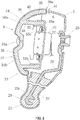
- FIG. 1 is an overall perspective view of steering wheel 1, and FIG. 2 is a sectional view along line A-A in FIG. 1 .
- Airbag module 3 is mounted on the center of steering wheel main body 2.
- Steering wheel main body 2 includes annular rim 21, boss section 22 having, at its central portion, boss 25 to be attached to a shaft on the vehicle body side, and spokes 23 (right spoke 23R, central spoke 23C, and left spoke 23L) to connect rim 21 to boss section 22.
- Rim 21 and spokes 23 include core bar 26 made of a light alloy (for example, a magnesium alloy) covered with cover portion 27 of soft foamed polyurethane and, on the surface of cover portion 27, further wrapped with cowhide 28 as natural leather.
- Finisher 24 is attached to spokes 23 when appropriate, and a base material of finisher 24 made of a resin such as ABS, polycarbonate, or the like is decorated with colors and/or patterns of a silver metallic color, of carbon composite, and of wood-grain pattern by plating, printing, and/or painting.
- Various switches, indicator, microphone of a hands-free phone, and/or the like may be incorporated into finisher 24.
- airbag module 3 includes container 33 containing airbag 32 which is ordinarily compactly folded and which receives a supply of an inflation gas from inflator 31.
- Container 33 includes back plate 33a, retainer 33b, and module cover 34, in which airbag 32 is held and fixed onto retainer 33b by means of retaining rings 33c by tightening nuts and bolts (not illustrated).
- Module cover 34 includes base material portion 35 molded by means of injection molding of a thermoplastic elastomer resin, and skin 36 that is a cowhide covering the front surface side facing a driver. Module cover 34 is decorated with dummy stitches 34b that are decorations concentric with ornament 34a attached in a recess.
- Module cover 34 includes front portion 37 that is a main portion to which the aforementioned ornament 34a is attached and which may be ruptured and opened at a rupture expectation line (not illustrated), upright wall 38 forming a peripheral wall of container 33, and eaves portion 39 extending out in a cantilever fashion from the outer edge of front portion 37 over upright wall 38.
- Upright wall 38 protrudes from the outer edge of front portion 37 on the side of back surface 39c of eaves portion 39.
- Lower cover 5 is attached to steering wheel main body 2 in such a manner as to cover the back surface of airbag module 3.
- Edge 51 facing end edge portion 39a of eaves portion 39 is disposed at a predetermined spacing from end edge portion 39a, for example, at a spacing of 2 mm such that edge 51 and end edge portion 39a defines therebetween clearance 6 having a longitudinally constant width.
- Lower cover 5 is molded by means of injection molding of a polypropylene resin, for example, and the outer surface of lower cover 5 is provided with a grain having a color tone and texture that match skin 36.
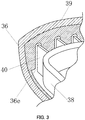
- ribs 40 for example four ribs 40 are disposed in parallel with each other at eaves portion 39 (three of them are illustrated).
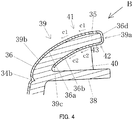
- eaves-front-surface portion 36a of skin 36 covering front side 41, eaves-back-surface portion 36b of skin 36 covering back side 42, and end edge portion 36d of skin 36 covering end edge portion 39a respectively covers front surface 39b of eaves portion 39, back surface 39c of eaves portion 39, and end portion 43 of eaves portion 39 by means of an adhesive agent applied to their entire surfaces.
- End edge portion 36d curves along the end portion of eaves portion 39.
- Eaves-front-surface portion 36a covers front surface 39b of eaves portion 39 on the side of front surface 39b of eaves portion 39.
- Eaves-front-surface portion 36a is located across end edge portion 36d from eaves-back-surface portion 36b.
- Eaves-back-surface portion 36b extends on the side of back surface 39c of eaves portion 39 toward the outer edge of front portion 37 to cover back surface 39c of eaves portion 39.
- an adhesive strength is obtained by close adhesion, for example, by manufacturing a block body in the shape of a space between upright wall 38 and eaves portion 39 from wood, clay, or ultraviolet-curable resin (shaped using a three-dimensional printer), and holding this block body against temporally inserted eaves-back-surface portion 36b while curing the adhesive agent.
- Eaves-back-surface portion 36b is provided with cutouts 36e opened for receiving ribs 40 connecting back surface 39c of eaves portion 39 to upright wall 38 so as to reinforce eaves portion 39 (see FIG. 3 ).
- eaves portion 39 takes the form of a so-called three-layer structure (sandwich structure) of skin, core material, and skin in which eaves portion 39 is provided with eaves-front-surface portion 36a and eaves-back-surface portion 36b over the substantially entire areas of front side 41 and back side 42, respectively.
- the vehicle cabin temperature would increase to a high temperature due to the sun and the atmospheric temperature in situations such as in a vehicle parked under the blazing sun and tightly shut.
- Skin 36 of eaves portion 39 shrinks in this case. That is, the cowhide of skin 36 shrinks while an olefin elastomer (TPO) of base material portion 35 is slightly softened and, in contrast to skin 36, the dimensions of base material portion 35 slightly increase (expand).
- TPO olefin elastomer
- Eaves portion 39 nevertheless substantially keeps the shape illustrated in FIG. 4 . That is, a tensile force is applied in the direction along arrow C1 at the surface of eaves-front-surface portion 36a, but at the same time another tensile force is also applied in the direction along arrow C2 at the surface of eaves-back-surface portion 36b. These tensile forces are equal to each other in magnitude, and therefore eaves portion 39 suffers no substantial visible deformation.
- eaves-back-surface portion 36b extends toward the outer edge of front portion 37 such that a tensile force cancelling a tensile force applied to eaves-front-surface portion 36a is applied to eaves-back-surface portion 36b, so that deformation can be prevented.
- FIG. 5A illustrates steering wheel 1 of an embodied product of the present invention viewed in the direction of arrow B in FIG. 4 .
- clearance 6 has not increased and is substantially constant along the width direction (the direction of arrow D).
- a tensile force is applied in the direction of arrow C1 shown on the surface and there is no force for cancelling the tensile force, so that the skin on a front side is tightened, and as illustrated in FIGS.
- the present invention is applied, it is not necessary to provide a component having eaves portion 39 covered with skin 36 with a shape and structure strong enough to withstand shrinkage. Accordingly, when it is desirable to differentiate between a mass-market grade automobile and an upper grade automobile among automobiles of a single model by the presence or absence of leather, it is advantageous that two kinds of specifications, that is, the specifications for the mass-market grade automobile in which a design surface is a grained surface of resin (the specifications without genuine leather upholstery) and the specifications for the upper grade automobile having genuine leather upholstery are possible by a pad base material intended for use without genuine leather upholstery.
- a pad base material for the upper grade having the strong structure resistant to deformation do not have to be used also for production of a pad of the mass-market grade, or pad base materials for the respective grades do not have to be prepared, so that the total production cost can be reduced.
- the present invention can be utilized for interior trim pads mounted to a variety of automobiles.
Landscapes
- Engineering & Computer Science (AREA)
- Mechanical Engineering (AREA)
- Ceramic Engineering (AREA)
- Vehicle Interior And Exterior Ornaments, Soundproofing, And Insulation (AREA)
- Steering Controls (AREA)
- Air Bags (AREA)
Description
- This application is entitled to and claims the benefit of Japanese Patent Application No.
2016-135505 filed on July 7, 2016 - The present invention relates to an interior trim pad provided with a skin that is used in automobiles and the like, for example, to a steering wheel pad, passenger-side airbag cover, door trim, door-mounted side airbag cover, pillar garnish, and the like.
- A leather-covered pad cover has been known as a conventional art which is disposed to cover an airbag folded and stored in a boss section of a steering wheel and includes a rupture-expected part to be ruptured to form an opening in the leather-covered pad cover for allowing the airbag to project from the opening when the leather-covered pad cover is pushed by the inflated airbag, a cover main body, and a leather sheet disposed on a surface of the cover main body. In the leather-covered pad cover, the rupture-expected part is formed by a groove extending from a back surface side of the cover main body into the leather sheet, and the groove is formed after the leather sheet is pasted on and integrated with the cover main body (see, for example, claims, specification, and
FIGS. 1 to 12 of Japanese Patent Application Laid-Open No.2005-145329 DE 10 2013 222 713 A1 discloses a similar interior trim pad. - Interior trim parts covered with natural leather such as one in the conventional art described above have been conventionally applied by preference to a superior automobile model or a higher-grade automobile of the same automobile model, or to a sporty automobile or a high-performance automobile. The product quality of such interior trim parts themselves and a level required for parts combination quality of such interior trim parts are high in order for the interior trim parts to be appropriate for vehicles as stated above.
- The thermal shrinkage behaviors of the natural leather and of a resin base material covered therewith, however, are quite different from each other.
- That is, the natural leather has the property in that the natural leather shrinks at a high temperature, whereas a resin material forming resin parts has a tendency to inflate when temperature increases. In addition, the resin material is softened to be easily deformed when temperature increases.
- A combination portion at which an interior trim part is combined with an adjacent part is sometimes located externally from a mounting piece or upright wall.
- By way of example, a center pad and lower cover of a steering wheel are not connected to and not in contact with each other and their edges face each other with a minute clearance therebetween. The center pad serves as a pushbutton of a horn switch, and bears on a main body of the steering wheel by means of predetermined biasing and guiding mechanisms such that an operational load can be moderate. Accordingly, the position of the center pad cannot be directly restricted, for example, by abutting the center pad against the lower cover. In addition, a line at which the center pad and the lower cover are positioned to each other is visible from a driver or the like, and therefore it is not preferable that the clearance of the line is non-uniform, that is, it is not preferable that the line is wide at some points and narrow at other points.
- In a case where the center pad is covered with a skin such as leather, the center pad deforms due to a tensile force applied thereto when the skin shrinks on the center pad (base material) due to high temperature. This causes deterioration in the parts combination quality for combination with adjacent parts, and the clearance is widened to be left open or deforms in a non-uniform manner to have a wavy shape, so that the quality level of the external appearance is reduced. In this way, the object of upgrading by providing leather cannot be achieved.
- The object of the present invention is to provide a skin-covered interior trim pad by which the aforementioned problem is solved.
- A first aspect of the present invention is a skin-covered interior trim pad as recited in
claim 1, which is described as follows:
the skin-covered interior trim pad includes a main portion, an eaves portion extending out from an outer edge of the main portion, and a skin covering the main portion and the eaves portion. In the skin-covered interior trim pad, the skin includes an end edge portion curving along an end portion of the eaves portion, an eaves-front-surface portion covering a front surface of the eaves portion on a side of the front surface of the eaves portion, and an eaves-back-surface portion which extends on a side of a back surface of the eaves portion toward the outer edge to cover the back surface of the eaves portion, the eaves-back-surface portion having the same thermal shrinkage rate as the eaves-front-surface portion, and the eaves-front-surface portion being located across the end edge portion from the eaves-back-surface portion. - A second aspect of the present invention is a skin-covered interior trim pad as recited in
claim 2, which is described as follows:
in addition to the features ofclaim 1, the skin-covered interior trim pad further includes an upright wall protruding from the outer edge on the side of the back surface of the eaves portion, and a rib connecting the back surface of the eaves portion to the upright wall. In the skin-covered interior trim pad, the eaves-back-surface portion includes a cutout opened for the rib. - A third aspect of the present invention is a skin-covered interior trim pad as recited in
claim 3, which is described as follows:
in addition to the features ofclaim 1, the eaves-back-surface portion extends toward the outer edge such that a tensile force cancelling a tensile force applied to the eaves-front-surface portion is applied to the eaves-back-surface portion. - A skin-covered interior trim pad according to the present invention has the above-described features and thus has the following effects.
- (1) An eaves portion, also referred to as an overhang portion, is a portion with the shape of a cantilever which extends out from an outer edge of a main portion, or which is supported by an upright wall and/or mounting piece depending on embodiments. A portion overhanging from the main portion in one direction is very susceptible to loads, that is, a great degree of freedom is allowed in deformation of that portion. The eaves portion is warped up by shrinkage of the skin, so that a clearance defined by the eaves portion and an adjacent portion increases. In addition, the eaves portion is lifted, so that these two portions which are designed such as to present a contiguous surface are made discontiguous and accordingly the external appearance is marred.
In the present invention, shrinkage is generated on both front and back sides of a base material and accordingly deformation of the eaves portion is reduced, so that a good external appearance can be achieved in a wide temperature range. - (2) The present invention can equalize deformation at places where a connecting rib is present with that at places where a connecting rib is absent, so as to reduce waving.
- (3) By causing the same level of shrinkage on both front and back sides, phenomena of being warped up and lifted due to shrinkage of the skin at the outer surface can be mitigated.
It is preferable that the eaves portion be covered with the skin on the front and back sides integrally. The skin covering the front surface is wound around the edge to extend on the back surface to the vicinity of the upright wall or mounting piece, so as to form a three-layer structure of skin, base material, and skin at the eaves portion.
By integrally covering the front and back surfaces, the skin can follow the shape of the base material at its edge or in the vicinity thereof to cover the base material, and therefore no portion is required on the skin for bonding between the surfaces thereof. The skin can easily be positioned since the edge has a folded-back shape, and accordingly shrinkage on the front and back sides can affect preferably. In addition, processing the edge of the skin is not required and also an increase in the thickness of the skin of when the skin is laid on top of another is not caused. Accordingly, the skin-covered interior trim pad according to the present invention can easily be shaped sharply. - (4) The front and back surfaces may be covered with respective separate skin panels when no importance is attached to the above advantages. In this case, a front surface portion and a small margin for being wound around can be cut from leather as raw material, and the remaining pieces of leather as raw material can be cut to be utilized as a skin for covering the back surface.
In this way, a yield of the skin can be improved, and accordingly a production cost can be reduced. Skins for the front and back surfaces do not have to be cut from a single leather material (raw material) or leather materials of the same kind as long as the front-surface portion and back-surface portion shrink equally or their shrinkage rates are equal to each other, and the front-surface and back-surface portions may also be prepared from different materials having properties similar to each other. In the meanwhile, the process of covering the back surface with the skin is an additional process but is not remarkably difficult by using a suitable jig. -
-
FIG. 1 is an overall perspective view illustrating an exemplary steering wheel in which a skin-covered interior trim pad according to the present invention is adopted; -
FIG. 2 is a sectional view along line A-A inFIG. 1 ; -
FIG. 3 is a partially enlarged perspective view illustrating features of a leather upholstery cover of the steering wheel as one embodiment of the skin-covered interior trim pad according to the present invention; -
FIG. 4 is a partially enlarged sectional view of an area including an eaves portion of the steering wheel as one embodiment of the skin-covered interior trim pad according to the present invention; and -
FIGS. 5A to 5C illustrate a steering wheel as an embodiment according to the present invention and a steering wheel for the purpose of comparative explanation in which a conventional skin-covered interior trim pad is applied,FIG. 5A is a partly sectioned schematic perspective view of the embodiment of the present invention viewed in the direction of arrow B inFIG. 4 ,FIG. 5B is a partial perspective view illustrating a portion of the conventional interior trim pad corresponding to the portion illustrated inFIG. 5A, and FIG. 5C is a partially enlarged view of an area including an eaves portion ofFIG. 5B . - A skin-covered interior trim pad according to one aspect of the present disclosure includes a main portion, an eaves portion extending out from an outer edge of the main portion, and a skin covering the main portion and the eaves portion, in which: the skin includes an end edge portion curving along an end portion of the eaves portion, an eaves-front-surface portion covering a front surface of the eaves portion on a side of the front surface of the eaves portion, and an eaves-back-surface portion which extends on a side of a back surface of the eaves portion toward the outer edge to cover the back surface of the eaves portion, the eaves-back-surface portion having the same thermal shrinkage rate as the eaves-front-surface portion, and the eaves-front-surface portion being located across the end edge portion from the eaves-back-surface portion.
- One embodiment of the skin-covered interior trim pad according to the present invention will be explained based on the accompanying drawings.
-
FIG. 1 is an overall perspective view ofsteering wheel 1, andFIG. 2 is a sectional view along line A-A inFIG. 1 .Airbag module 3 is mounted on the center of steering wheelmain body 2. Steering wheelmain body 2 includesannular rim 21,boss section 22 having, at its central portion,boss 25 to be attached to a shaft on the vehicle body side, and spokes 23 (right spoke 23R,central spoke 23C, and left spoke 23L) to connectrim 21 toboss section 22. -
Rim 21 and spokes 23 includecore bar 26 made of a light alloy (for example, a magnesium alloy) covered withcover portion 27 of soft foamed polyurethane and, on the surface ofcover portion 27, further wrapped withcowhide 28 as natural leather.Finisher 24 is attached to spokes 23 when appropriate, and a base material offinisher 24 made of a resin such as ABS, polycarbonate, or the like is decorated with colors and/or patterns of a silver metallic color, of carbon composite, and of wood-grain pattern by plating, printing, and/or painting. Various switches, indicator, microphone of a hands-free phone, and/or the like may be incorporated intofinisher 24. - As illustrated in
FIG. 2 ,airbag module 3 includescontainer 33 containingairbag 32 which is ordinarily compactly folded and which receives a supply of an inflation gas frominflator 31.Container 33 includes backplate 33a,retainer 33b, andmodule cover 34, in whichairbag 32 is held and fixed ontoretainer 33b by means of retainingrings 33c by tightening nuts and bolts (not illustrated). -
Module cover 34 includesbase material portion 35 molded by means of injection molding of a thermoplastic elastomer resin, andskin 36 that is a cowhide covering the front surface side facing a driver.Module cover 34 is decorated with dummy stitches 34b that are decorations concentric withornament 34a attached in a recess. -
Module cover 34 includesfront portion 37 that is a main portion to which theaforementioned ornament 34a is attached and which may be ruptured and opened at a rupture expectation line (not illustrated),upright wall 38 forming a peripheral wall ofcontainer 33, andeaves portion 39 extending out in a cantilever fashion from the outer edge offront portion 37 overupright wall 38.Upright wall 38 protrudes from the outer edge offront portion 37 on the side ofback surface 39c ofeaves portion 39. -
Lower cover 5 is attached to steering wheelmain body 2 in such a manner as to cover the back surface ofairbag module 3.Edge 51 facingend edge portion 39a ofeaves portion 39 is disposed at a predetermined spacing fromend edge portion 39a, for example, at a spacing of 2 mm such thatedge 51 andend edge portion 39a definestherebetween clearance 6 having a longitudinally constant width. -
Lower cover 5 is molded by means of injection molding of a polypropylene resin, for example, and the outer surface oflower cover 5 is provided with a grain having a color tone and texture that matchskin 36. - As illustrated in
FIG. 3 ,ribs 40, for example fourribs 40 are disposed in parallel with each other at eaves portion 39 (three of them are illustrated). As illustrated inFIG. 4 , eaves-front-surface portion 36a ofskin 36 coveringfront side 41, eaves-back-surface portion 36b ofskin 36 covering backside 42, and endedge portion 36d ofskin 36 coveringend edge portion 39a respectively coversfront surface 39b ofeaves portion 39, backsurface 39c ofeaves portion 39, andend portion 43 ofeaves portion 39 by means of an adhesive agent applied to their entire surfaces.End edge portion 36d curves along the end portion ofeaves portion 39. Eaves-front-surface portion 36a coversfront surface 39b ofeaves portion 39 on the side offront surface 39b ofeaves portion 39. Eaves-front-surface portion 36a is located acrossend edge portion 36d from eaves-back-surface portion 36b. Eaves-back-surface portion 36b extends on the side ofback surface 39c ofeaves portion 39 toward the outer edge offront portion 37 to cover backsurface 39c ofeaves portion 39. - In covering process, an adhesive strength is obtained by close adhesion, for example, by manufacturing a block body in the shape of a space between
upright wall 38 andeaves portion 39 from wood, clay, or ultraviolet-curable resin (shaped using a three-dimensional printer), and holding this block body against temporally inserted eaves-back-surface portion 36b while curing the adhesive agent. - Eaves-back-
surface portion 36b is provided withcutouts 36e opened for receivingribs 40 connecting backsurface 39c ofeaves portion 39 toupright wall 38 so as to reinforce eaves portion 39 (seeFIG. 3 ). In this way,eaves portion 39 takes the form of a so-called three-layer structure (sandwich structure) of skin, core material, and skin in whicheaves portion 39 is provided with eaves-front-surface portion 36a and eaves-back-surface portion 36b over the substantially entire areas offront side 41 and backside 42, respectively. - Next, effects of the skin-covered interior trim pad according to the present invention will be described.
- The vehicle cabin temperature would increase to a high temperature due to the sun and the atmospheric temperature in situations such as in a vehicle parked under the blazing sun and tightly shut.
Skin 36 ofeaves portion 39 shrinks in this case. That is, the cowhide ofskin 36 shrinks while an olefin elastomer (TPO) ofbase material portion 35 is slightly softened and, in contrast toskin 36, the dimensions ofbase material portion 35 slightly increase (expand). -
Eaves portion 39 nevertheless substantially keeps the shape illustrated inFIG. 4 . That is, a tensile force is applied in the direction along arrow C1 at the surface of eaves-front-surface portion 36a, but at the same time another tensile force is also applied in the direction along arrow C2 at the surface of eaves-back-surface portion 36b. These tensile forces are equal to each other in magnitude, and thereforeeaves portion 39 suffers no substantial visible deformation. In other words, eaves-back-surface portion 36b extends toward the outer edge offront portion 37 such that a tensile force cancelling a tensile force applied to eaves-front-surface portion 36a is applied to eaves-back-surface portion 36b, so that deformation can be prevented. By way of example, it is desirable that the thermal shrinkage rates of eaves-front-surface portion 36a and eaves-back-surface portion 36b be equal to each other. -
FIG. 5A illustrates steeringwheel 1 of an embodied product of the present invention viewed in the direction of arrow B inFIG. 4 . Here,clearance 6 has not increased and is substantially constant along the width direction (the direction of arrow D). In a steering wheel which is not based on the present invention and in which only a margin of an end portion for being wound around is wound around an end edge portion (FIG. 5C ), a tensile force is applied in the direction of arrow C1 shown on the surface and there is no force for cancelling the tensile force, so that the skin on a front side is tightened, and as illustrated inFIGS. 5B and 5C the eaves portion is lifted to widen clearance 6' and as a result clearance 6' deforms differently from one place to another depending on the presence or absence ofrib 40 so as to be a non-uniform clearance along the direction of arrow D. - If the present invention is applied, it is not necessary to provide a component having
eaves portion 39 covered withskin 36 with a shape and structure strong enough to withstand shrinkage. Accordingly, when it is desirable to differentiate between a mass-market grade automobile and an upper grade automobile among automobiles of a single model by the presence or absence of leather, it is advantageous that two kinds of specifications, that is, the specifications for the mass-market grade automobile in which a design surface is a grained surface of resin (the specifications without genuine leather upholstery) and the specifications for the upper grade automobile having genuine leather upholstery are possible by a pad base material intended for use without genuine leather upholstery. A pad base material for the upper grade having the strong structure resistant to deformation do not have to be used also for production of a pad of the mass-market grade, or pad base materials for the respective grades do not have to be prepared, so that the total production cost can be reduced. - The present invention can be utilized for interior trim pads mounted to a variety of automobiles.
-
- 1 Steering wheel
- 2 Steering wheel main body
- 3 Airbag module
- 5 Lower cover
- 6 Clearance
- 6' Clearance of lifted eaves portion
- 21 Rim
- 22 Boss section
- 23 Spokes
- 23C Central spoke
- 23L Left spoke
- 23R Right spoke
- 24 Finisher
- 25 Boss
- 26 Core metal
- 27 Cover portion
- 28 Cowhide
- 31 Inflator
- 32 Airbag
- 33 Container
- 33a Back plate
- 33b Retainer
- 33c Retaining ring
- 34 Module cover
- 34a Ornament
- 34b Dummy stitch
- 35 Base material portion
- 36 Skin
- 36a Eaves-front-surface portion
- 36b Eaves-back-surface portion
- 36d End edge portion
- 36e Cutout
- 37 Front portion
- 38 Upright wall
- 39 Eaves portion
- 39a End edge portion
- 39b Front surface
- 39c Back surface
- 40 Rib
- 41 Front side
- 42 Back side
- 43 End portion
- 51 Edge portion
Claims (2)
- A skin-covered interior trim pad, comprising:a main portion (37);an eaves portion (39) extending out from an outer edge of the main portion (37); anda skin (36) covering the main portion (37) and the eaves portion (39),wherein the skin (36) includes:an end edge portion (36d) curving along an end portion (39a) of the eaves portion (39),an eaves-front-surface portion (36a) covering a front surface (39b) of the eaves portion (39) on a side of the front surface (39b) of the eaves portion (39) to cover the front surface (39b) of the eaves portion (39), by means of an adhesive agent applied to their entire surfaces andan eaves-back-surface portion (36b) which extends on a side of a back surface (39c) of the eaves portion (39) toward the outer edge to cover the back surface (39c) of the eaves portion (39), by means of an adhesive agent applied to their entire surfaces, the eaves-back-surface portion (36b) having the same thermal shrinkage rate as the eaves-front-surface portion (36a), and the eaves-front-surface portion (36a) being located across the end edge portion (36d) from the eaves-back-surface portion (36b).
- The skin-covered interior trim pad according to claim 1, further comprising:an upright wall (38) protruding from the outer edge of the main portion (37) on the side of the back surface (39c) of the eaves portion (39) and being fixed relative to an airbag (32) of an airbag module (3) mounted to a steering wheel main body (2); anda rib (40) connecting the back surface (39c) of the eaves portion (39) to the upright wall (38), wherein:
the eaves-back-surface portion (36b) includes a cutout (36e) opened for the rib (40).
Applications Claiming Priority (1)
| Application Number | Priority Date | Filing Date | Title |
|---|---|---|---|
| JP2016135505A JP6731803B2 (en) | 2016-07-07 | 2016-07-07 | Skin-wrapped interior trim pad |
Publications (2)
| Publication Number | Publication Date |
|---|---|
| EP3266656A1 EP3266656A1 (en) | 2018-01-10 |
| EP3266656B1 true EP3266656B1 (en) | 2019-04-03 |
Family
ID=59295067
Family Applications (1)
| Application Number | Title | Priority Date | Filing Date |
|---|---|---|---|
| EP17180000.6A Active EP3266656B1 (en) | 2016-07-07 | 2017-07-06 | Skin-covered interior trim pad |
Country Status (3)
| Country | Link |
|---|---|
| US (1) | US10391953B2 (en) |
| EP (1) | EP3266656B1 (en) |
| JP (1) | JP6731803B2 (en) |
Family Cites Families (5)
| Publication number | Priority date | Publication date | Assignee | Title |
|---|---|---|---|---|
| JP2538159B2 (en) * | 1992-03-18 | 1996-09-25 | 日本プラスト株式会社 | Airbag cover body |
| JP3745035B2 (en) * | 1996-07-09 | 2006-02-15 | 株式会社イノアックコーポレーション | How to apply the epidermis |
| JP2005145329A (en) * | 2003-11-18 | 2005-06-09 | Toyoda Gosei Co Ltd | Leather-lined pad cover |
| JP6006021B2 (en) * | 2012-06-29 | 2016-10-12 | 日本プラスト株式会社 | Method of attaching skin material in skin decoration and skin decoration |
| JP5974398B2 (en) * | 2012-11-14 | 2016-08-23 | トヨタ紡織株式会社 | Vehicle door trim |
-
2016
- 2016-07-07 JP JP2016135505A patent/JP6731803B2/en active Active
-
2017
- 2017-07-06 EP EP17180000.6A patent/EP3266656B1/en active Active
- 2017-07-06 US US15/642,458 patent/US10391953B2/en active Active
Non-Patent Citations (1)
| Title |
|---|
| None * |
Also Published As
| Publication number | Publication date |
|---|---|
| JP2018002097A (en) | 2018-01-11 |
| US10391953B2 (en) | 2019-08-27 |
| US20180009396A1 (en) | 2018-01-11 |
| EP3266656A1 (en) | 2018-01-10 |
| JP6731803B2 (en) | 2020-07-29 |
Similar Documents
| Publication | Publication Date | Title |
|---|---|---|
| US7766371B2 (en) | Airbag cover for airbag apparatus | |
| KR100211712B1 (en) | Invisible air bag cover door | |
| US8104813B2 (en) | Vehicle interior trim panel | |
| US7108311B2 (en) | Method of forming a vehicle panel assembly | |
| US6398897B1 (en) | Foil-covered automotive interior plastic part having a decorative preform and method of making same | |
| US20050121818A1 (en) | Method of manufacturing an airbag assembly and vehicle trim component | |
| US8091919B2 (en) | Airbag module cover | |
| US7014208B2 (en) | Interior vehicle trim panel | |
| US8240703B2 (en) | Airbag door connecting structure of passenger seat in vehicle | |
| US20090226676A1 (en) | Molded article with in-molded decorative element | |
| US20090133527A1 (en) | Steering wheel core metal, steering wheel, and steering apparatus | |
| US10391953B2 (en) | Skin-covered interior trim pad | |
| US20050104338A1 (en) | Applique film airbag cover | |
| JPH05162606A (en) | Color-marked cover for air bag storage | |
| JPH0450055A (en) | Air bag holding cover | |
| US20120074675A1 (en) | Cover for airbag apparatus | |
| WO2007143396A2 (en) | Insert molded feature for airbag covers | |
| JP3319969B2 (en) | Cover body of airbag device | |
| CN101341048A (en) | Decorative panel for the interior of a motor vehicle and method of manufacturing the decorative panel | |
| JP5013990B2 (en) | Cover body of airbag device and airbag device | |
| US7726728B2 (en) | Headliner having a sunroof opening | |
| US12043198B2 (en) | Airbag cover of a vehicle | |
| JP3337378B2 (en) | Airbag device | |
| JP2005112254A (en) | Airbag device | |
| JPH07108540B2 (en) | Method for manufacturing resin molded products |
Legal Events
| Date | Code | Title | Description |
|---|---|---|---|
| PUAI | Public reference made under article 153(3) epc to a published international application that has entered the european phase |
Free format text: ORIGINAL CODE: 0009012 |
|
| STAA | Information on the status of an ep patent application or granted ep patent |
Free format text: STATUS: REQUEST FOR EXAMINATION WAS MADE |
|
| 17P | Request for examination filed |
Effective date: 20170706 |
|
| AK | Designated contracting states |
Kind code of ref document: A1 Designated state(s): AL AT BE BG CH CY CZ DE DK EE ES FI FR GB GR HR HU IE IS IT LI LT LU LV MC MK MT NL NO PL PT RO RS SE SI SK SM TR |
|
| AX | Request for extension of the european patent |
Extension state: BA ME |
|
| RIC1 | Information provided on ipc code assigned before grant |
Ipc: B60R 13/02 20060101AFI20181009BHEP Ipc: B32B 9/02 20060101ALI20181009BHEP |
|
| GRAP | Despatch of communication of intention to grant a patent |
Free format text: ORIGINAL CODE: EPIDOSNIGR1 |
|
| STAA | Information on the status of an ep patent application or granted ep patent |
Free format text: STATUS: GRANT OF PATENT IS INTENDED |
|
| INTG | Intention to grant announced |
Effective date: 20181116 |
|
| GRAS | Grant fee paid |
Free format text: ORIGINAL CODE: EPIDOSNIGR3 |
|
| GRAA | (expected) grant |
Free format text: ORIGINAL CODE: 0009210 |
|
| STAA | Information on the status of an ep patent application or granted ep patent |
Free format text: STATUS: THE PATENT HAS BEEN GRANTED |
|
| AK | Designated contracting states |
Kind code of ref document: B1 Designated state(s): AL AT BE BG CH CY CZ DE DK EE ES FI FR GB GR HR HU IE IS IT LI LT LU LV MC MK MT NL NO PL PT RO RS SE SI SK SM TR |
|
| REG | Reference to a national code |
Ref country code: GB Ref legal event code: FG4D |
|
| REG | Reference to a national code |
Ref country code: CH Ref legal event code: EP Ref country code: AT Ref legal event code: REF Ref document number: 1115333 Country of ref document: AT Kind code of ref document: T Effective date: 20190415 |
|
| REG | Reference to a national code |
Ref country code: DE Ref legal event code: R096 Ref document number: 602017003048 Country of ref document: DE |
|
| REG | Reference to a national code |
Ref country code: IE Ref legal event code: FG4D |
|
| REG | Reference to a national code |
Ref country code: NL Ref legal event code: MP Effective date: 20190403 |
|
| REG | Reference to a national code |
Ref country code: LT Ref legal event code: MG4D |
|
| REG | Reference to a national code |
Ref country code: AT Ref legal event code: MK05 Ref document number: 1115333 Country of ref document: AT Kind code of ref document: T Effective date: 20190403 |
|
| PG25 | Lapsed in a contracting state [announced via postgrant information from national office to epo] |
Ref country code: NL Free format text: LAPSE BECAUSE OF FAILURE TO SUBMIT A TRANSLATION OF THE DESCRIPTION OR TO PAY THE FEE WITHIN THE PRESCRIBED TIME-LIMIT Effective date: 20190403 |
|
| PG25 | Lapsed in a contracting state [announced via postgrant information from national office to epo] |
Ref country code: AL Free format text: LAPSE BECAUSE OF FAILURE TO SUBMIT A TRANSLATION OF THE DESCRIPTION OR TO PAY THE FEE WITHIN THE PRESCRIBED TIME-LIMIT Effective date: 20190403 Ref country code: ES Free format text: LAPSE BECAUSE OF FAILURE TO SUBMIT A TRANSLATION OF THE DESCRIPTION OR TO PAY THE FEE WITHIN THE PRESCRIBED TIME-LIMIT Effective date: 20190403 Ref country code: PT Free format text: LAPSE BECAUSE OF FAILURE TO SUBMIT A TRANSLATION OF THE DESCRIPTION OR TO PAY THE FEE WITHIN THE PRESCRIBED TIME-LIMIT Effective date: 20190803 Ref country code: NO Free format text: LAPSE BECAUSE OF FAILURE TO SUBMIT A TRANSLATION OF THE DESCRIPTION OR TO PAY THE FEE WITHIN THE PRESCRIBED TIME-LIMIT Effective date: 20190703 Ref country code: SE Free format text: LAPSE BECAUSE OF FAILURE TO SUBMIT A TRANSLATION OF THE DESCRIPTION OR TO PAY THE FEE WITHIN THE PRESCRIBED TIME-LIMIT Effective date: 20190403 Ref country code: FI Free format text: LAPSE BECAUSE OF FAILURE TO SUBMIT A TRANSLATION OF THE DESCRIPTION OR TO PAY THE FEE WITHIN THE PRESCRIBED TIME-LIMIT Effective date: 20190403 Ref country code: LT Free format text: LAPSE BECAUSE OF FAILURE TO SUBMIT A TRANSLATION OF THE DESCRIPTION OR TO PAY THE FEE WITHIN THE PRESCRIBED TIME-LIMIT Effective date: 20190403 Ref country code: HR Free format text: LAPSE BECAUSE OF FAILURE TO SUBMIT A TRANSLATION OF THE DESCRIPTION OR TO PAY THE FEE WITHIN THE PRESCRIBED TIME-LIMIT Effective date: 20190403 Ref country code: CZ Free format text: LAPSE BECAUSE OF FAILURE TO SUBMIT A TRANSLATION OF THE DESCRIPTION OR TO PAY THE FEE WITHIN THE PRESCRIBED TIME-LIMIT Effective date: 20190403 |
|
| PG25 | Lapsed in a contracting state [announced via postgrant information from national office to epo] |
Ref country code: RS Free format text: LAPSE BECAUSE OF FAILURE TO SUBMIT A TRANSLATION OF THE DESCRIPTION OR TO PAY THE FEE WITHIN THE PRESCRIBED TIME-LIMIT Effective date: 20190403 Ref country code: LV Free format text: LAPSE BECAUSE OF FAILURE TO SUBMIT A TRANSLATION OF THE DESCRIPTION OR TO PAY THE FEE WITHIN THE PRESCRIBED TIME-LIMIT Effective date: 20190403 Ref country code: BG Free format text: LAPSE BECAUSE OF FAILURE TO SUBMIT A TRANSLATION OF THE DESCRIPTION OR TO PAY THE FEE WITHIN THE PRESCRIBED TIME-LIMIT Effective date: 20190703 Ref country code: GR Free format text: LAPSE BECAUSE OF FAILURE TO SUBMIT A TRANSLATION OF THE DESCRIPTION OR TO PAY THE FEE WITHIN THE PRESCRIBED TIME-LIMIT Effective date: 20190704 Ref country code: PL Free format text: LAPSE BECAUSE OF FAILURE TO SUBMIT A TRANSLATION OF THE DESCRIPTION OR TO PAY THE FEE WITHIN THE PRESCRIBED TIME-LIMIT Effective date: 20190403 |
|
| PG25 | Lapsed in a contracting state [announced via postgrant information from national office to epo] |
Ref country code: IS Free format text: LAPSE BECAUSE OF FAILURE TO SUBMIT A TRANSLATION OF THE DESCRIPTION OR TO PAY THE FEE WITHIN THE PRESCRIBED TIME-LIMIT Effective date: 20190803 Ref country code: AT Free format text: LAPSE BECAUSE OF FAILURE TO SUBMIT A TRANSLATION OF THE DESCRIPTION OR TO PAY THE FEE WITHIN THE PRESCRIBED TIME-LIMIT Effective date: 20190403 |
|
| REG | Reference to a national code |
Ref country code: DE Ref legal event code: R097 Ref document number: 602017003048 Country of ref document: DE |
|
| PG25 | Lapsed in a contracting state [announced via postgrant information from national office to epo] |
Ref country code: EE Free format text: LAPSE BECAUSE OF FAILURE TO SUBMIT A TRANSLATION OF THE DESCRIPTION OR TO PAY THE FEE WITHIN THE PRESCRIBED TIME-LIMIT Effective date: 20190403 Ref country code: DK Free format text: LAPSE BECAUSE OF FAILURE TO SUBMIT A TRANSLATION OF THE DESCRIPTION OR TO PAY THE FEE WITHIN THE PRESCRIBED TIME-LIMIT Effective date: 20190403 Ref country code: RO Free format text: LAPSE BECAUSE OF FAILURE TO SUBMIT A TRANSLATION OF THE DESCRIPTION OR TO PAY THE FEE WITHIN THE PRESCRIBED TIME-LIMIT Effective date: 20190403 Ref country code: SK Free format text: LAPSE BECAUSE OF FAILURE TO SUBMIT A TRANSLATION OF THE DESCRIPTION OR TO PAY THE FEE WITHIN THE PRESCRIBED TIME-LIMIT Effective date: 20190403 |
|
| PLBE | No opposition filed within time limit |
Free format text: ORIGINAL CODE: 0009261 |
|
| STAA | Information on the status of an ep patent application or granted ep patent |
Free format text: STATUS: NO OPPOSITION FILED WITHIN TIME LIMIT |
|
| PG25 | Lapsed in a contracting state [announced via postgrant information from national office to epo] |
Ref country code: MC Free format text: LAPSE BECAUSE OF FAILURE TO SUBMIT A TRANSLATION OF THE DESCRIPTION OR TO PAY THE FEE WITHIN THE PRESCRIBED TIME-LIMIT Effective date: 20190403 Ref country code: SM Free format text: LAPSE BECAUSE OF FAILURE TO SUBMIT A TRANSLATION OF THE DESCRIPTION OR TO PAY THE FEE WITHIN THE PRESCRIBED TIME-LIMIT Effective date: 20190403 Ref country code: IT Free format text: LAPSE BECAUSE OF FAILURE TO SUBMIT A TRANSLATION OF THE DESCRIPTION OR TO PAY THE FEE WITHIN THE PRESCRIBED TIME-LIMIT Effective date: 20190403 |
|
| 26N | No opposition filed |
Effective date: 20200106 |
|
| PG25 | Lapsed in a contracting state [announced via postgrant information from national office to epo] |
Ref country code: TR Free format text: LAPSE BECAUSE OF FAILURE TO SUBMIT A TRANSLATION OF THE DESCRIPTION OR TO PAY THE FEE WITHIN THE PRESCRIBED TIME-LIMIT Effective date: 20190403 |
|
| REG | Reference to a national code |
Ref country code: BE Ref legal event code: MM Effective date: 20190731 |
|
| PG25 | Lapsed in a contracting state [announced via postgrant information from national office to epo] |
Ref country code: SI Free format text: LAPSE BECAUSE OF FAILURE TO SUBMIT A TRANSLATION OF THE DESCRIPTION OR TO PAY THE FEE WITHIN THE PRESCRIBED TIME-LIMIT Effective date: 20190403 Ref country code: LU Free format text: LAPSE BECAUSE OF NON-PAYMENT OF DUE FEES Effective date: 20190706 Ref country code: BE Free format text: LAPSE BECAUSE OF NON-PAYMENT OF DUE FEES Effective date: 20190731 |
|
| PG25 | Lapsed in a contracting state [announced via postgrant information from national office to epo] |
Ref country code: FR Free format text: LAPSE BECAUSE OF NON-PAYMENT OF DUE FEES Effective date: 20190731 |
|
| PG25 | Lapsed in a contracting state [announced via postgrant information from national office to epo] |
Ref country code: IE Free format text: LAPSE BECAUSE OF NON-PAYMENT OF DUE FEES Effective date: 20190706 |
|
| REG | Reference to a national code |
Ref country code: CH Ref legal event code: PL |
|
| PG25 | Lapsed in a contracting state [announced via postgrant information from national office to epo] |
Ref country code: CH Free format text: LAPSE BECAUSE OF NON-PAYMENT OF DUE FEES Effective date: 20200731 Ref country code: LI Free format text: LAPSE BECAUSE OF NON-PAYMENT OF DUE FEES Effective date: 20200731 |
|
| PG25 | Lapsed in a contracting state [announced via postgrant information from national office to epo] |
Ref country code: CY Free format text: LAPSE BECAUSE OF FAILURE TO SUBMIT A TRANSLATION OF THE DESCRIPTION OR TO PAY THE FEE WITHIN THE PRESCRIBED TIME-LIMIT Effective date: 20190403 |
|
| PG25 | Lapsed in a contracting state [announced via postgrant information from national office to epo] |
Ref country code: HU Free format text: LAPSE BECAUSE OF FAILURE TO SUBMIT A TRANSLATION OF THE DESCRIPTION OR TO PAY THE FEE WITHIN THE PRESCRIBED TIME-LIMIT; INVALID AB INITIO Effective date: 20170706 Ref country code: MT Free format text: LAPSE BECAUSE OF FAILURE TO SUBMIT A TRANSLATION OF THE DESCRIPTION OR TO PAY THE FEE WITHIN THE PRESCRIBED TIME-LIMIT Effective date: 20190403 |
|
| PG25 | Lapsed in a contracting state [announced via postgrant information from national office to epo] |
Ref country code: MK Free format text: LAPSE BECAUSE OF FAILURE TO SUBMIT A TRANSLATION OF THE DESCRIPTION OR TO PAY THE FEE WITHIN THE PRESCRIBED TIME-LIMIT Effective date: 20190403 |
|
| PGFP | Annual fee paid to national office [announced via postgrant information from national office to epo] |
Ref country code: GB Payment date: 20250529 Year of fee payment: 9 |
|
| PGFP | Annual fee paid to national office [announced via postgrant information from national office to epo] |
Ref country code: DE Payment date: 20250528 Year of fee payment: 9 |