EP3264998B1 - Embolization particulates for occluding a blood vessel - Google Patents
Embolization particulates for occluding a blood vessel Download PDFInfo
- Publication number
- EP3264998B1 EP3264998B1 EP16758532.2A EP16758532A EP3264998B1 EP 3264998 B1 EP3264998 B1 EP 3264998B1 EP 16758532 A EP16758532 A EP 16758532A EP 3264998 B1 EP3264998 B1 EP 3264998B1
- Authority
- EP
- European Patent Office
- Prior art keywords
- embolization
- beads
- particulates
- protruding portions
- blood vessel
- Prior art date
- Legal status (The legal status is an assumption and is not a legal conclusion. Google has not performed a legal analysis and makes no representation as to the accuracy of the status listed.)
- Not-in-force
Links
Images

Classifications
-
- A—HUMAN NECESSITIES
- A61—MEDICAL OR VETERINARY SCIENCE; HYGIENE
- A61B—DIAGNOSIS; SURGERY; IDENTIFICATION
- A61B17/00—Surgical instruments, devices or methods
- A61B17/12—Surgical instruments, devices or methods for ligaturing or otherwise compressing tubular parts of the body, e.g. blood vessels or umbilical cord
- A61B17/12022—Occluding by internal devices, e.g. balloons or releasable wires
- A61B17/12099—Occluding by internal devices, e.g. balloons or releasable wires characterised by the location of the occluder
- A61B17/12109—Occluding by internal devices, e.g. balloons or releasable wires characterised by the location of the occluder in a blood vessel
-
- A—HUMAN NECESSITIES
- A61—MEDICAL OR VETERINARY SCIENCE; HYGIENE
- A61B—DIAGNOSIS; SURGERY; IDENTIFICATION
- A61B17/00—Surgical instruments, devices or methods
- A61B17/12—Surgical instruments, devices or methods for ligaturing or otherwise compressing tubular parts of the body, e.g. blood vessels or umbilical cord
- A61B17/12022—Occluding by internal devices, e.g. balloons or releasable wires
- A61B17/12131—Occluding by internal devices, e.g. balloons or releasable wires characterised by the type of occluding device
- A61B17/12181—Occluding by internal devices, e.g. balloons or releasable wires characterised by the type of occluding device formed by fluidized, gelatinous or cellular remodelable materials, e.g. embolic liquids, foams or extracellular matrices
-
- A—HUMAN NECESSITIES
- A61—MEDICAL OR VETERINARY SCIENCE; HYGIENE
- A61B—DIAGNOSIS; SURGERY; IDENTIFICATION
- A61B17/00—Surgical instruments, devices or methods
- A61B17/12—Surgical instruments, devices or methods for ligaturing or otherwise compressing tubular parts of the body, e.g. blood vessels or umbilical cord
- A61B17/12022—Occluding by internal devices, e.g. balloons or releasable wires
- A61B17/12131—Occluding by internal devices, e.g. balloons or releasable wires characterised by the type of occluding device
- A61B17/12181—Occluding by internal devices, e.g. balloons or releasable wires characterised by the type of occluding device formed by fluidized, gelatinous or cellular remodelable materials, e.g. embolic liquids, foams or extracellular matrices
- A61B17/12186—Occluding by internal devices, e.g. balloons or releasable wires characterised by the type of occluding device formed by fluidized, gelatinous or cellular remodelable materials, e.g. embolic liquids, foams or extracellular matrices liquid materials adapted to be injected
-
- A—HUMAN NECESSITIES
- A61—MEDICAL OR VETERINARY SCIENCE; HYGIENE
- A61F—FILTERS IMPLANTABLE INTO BLOOD VESSELS; PROSTHESES; DEVICES PROVIDING PATENCY TO, OR PREVENTING COLLAPSING OF, TUBULAR STRUCTURES OF THE BODY, e.g. STENTS; ORTHOPAEDIC, NURSING OR CONTRACEPTIVE DEVICES; FOMENTATION; TREATMENT OR PROTECTION OF EYES OR EARS; BANDAGES, DRESSINGS OR ABSORBENT PADS; FIRST-AID KITS
- A61F2/00—Filters implantable into blood vessels; Prostheses, i.e. artificial substitutes or replacements for parts of the body; Appliances for connecting them with the body; Devices providing patency to, or preventing collapsing of, tubular structures of the body, e.g. stents
- A61F2/01—Filters implantable into blood vessels
- A61F2/011—Instruments for their placement or removal
-
- A—HUMAN NECESSITIES
- A61—MEDICAL OR VETERINARY SCIENCE; HYGIENE
- A61K—PREPARATIONS FOR MEDICAL, DENTAL OR TOILETRY PURPOSES
- A61K31/00—Medicinal preparations containing organic active ingredients
- A61K31/70—Carbohydrates; Sugars; Derivatives thereof
- A61K31/7028—Compounds having saccharide radicals attached to non-saccharide compounds by glycosidic linkages
- A61K31/7034—Compounds having saccharide radicals attached to non-saccharide compounds by glycosidic linkages attached to a carbocyclic compound, e.g. phloridzin
- A61K31/704—Compounds having saccharide radicals attached to non-saccharide compounds by glycosidic linkages attached to a carbocyclic compound, e.g. phloridzin attached to a condensed carbocyclic ring system, e.g. sennosides, thiocolchicosides, escin, daunorubicin
-
- A—HUMAN NECESSITIES
- A61—MEDICAL OR VETERINARY SCIENCE; HYGIENE
- A61K—PREPARATIONS FOR MEDICAL, DENTAL OR TOILETRY PURPOSES
- A61K9/00—Medicinal preparations characterised by special physical form
- A61K9/0012—Galenical forms characterised by the site of application
- A61K9/0019—Injectable compositions; Intramuscular, intravenous, arterial, subcutaneous administration; Compositions to be administered through the skin in an invasive manner
-
- A—HUMAN NECESSITIES
- A61—MEDICAL OR VETERINARY SCIENCE; HYGIENE
- A61K—PREPARATIONS FOR MEDICAL, DENTAL OR TOILETRY PURPOSES
- A61K9/00—Medicinal preparations characterised by special physical form
- A61K9/14—Particulate form, e.g. powders, Processes for size reducing of pure drugs or the resulting products, Pure drug nanoparticles
- A61K9/16—Agglomerates; Granulates; Microbeadlets ; Microspheres; Pellets; Solid products obtained by spray drying, spray freeze drying, spray congealing,(multiple) emulsion solvent evaporation or extraction
- A61K9/167—Agglomerates; Granulates; Microbeadlets ; Microspheres; Pellets; Solid products obtained by spray drying, spray freeze drying, spray congealing,(multiple) emulsion solvent evaporation or extraction with an outer layer or coating comprising drug; with chemically bound drugs or non-active substances on their surface
- A61K9/1676—Agglomerates; Granulates; Microbeadlets ; Microspheres; Pellets; Solid products obtained by spray drying, spray freeze drying, spray congealing,(multiple) emulsion solvent evaporation or extraction with an outer layer or coating comprising drug; with chemically bound drugs or non-active substances on their surface having a drug-free core with discrete complete coating layer containing drug
-
- A—HUMAN NECESSITIES
- A61—MEDICAL OR VETERINARY SCIENCE; HYGIENE
- A61L—METHODS OR APPARATUS FOR STERILISING MATERIALS OR OBJECTS IN GENERAL; DISINFECTION, STERILISATION OR DEODORISATION OF AIR; CHEMICAL ASPECTS OF BANDAGES, DRESSINGS, ABSORBENT PADS OR SURGICAL ARTICLES; MATERIALS FOR BANDAGES, DRESSINGS, ABSORBENT PADS OR SURGICAL ARTICLES
- A61L24/00—Surgical adhesives or cements; Adhesives for colostomy devices
- A61L24/001—Use of materials characterised by their function or physical properties
- A61L24/0015—Medicaments; Biocides
-
- A—HUMAN NECESSITIES
- A61—MEDICAL OR VETERINARY SCIENCE; HYGIENE
- A61L—METHODS OR APPARATUS FOR STERILISING MATERIALS OR OBJECTS IN GENERAL; DISINFECTION, STERILISATION OR DEODORISATION OF AIR; CHEMICAL ASPECTS OF BANDAGES, DRESSINGS, ABSORBENT PADS OR SURGICAL ARTICLES; MATERIALS FOR BANDAGES, DRESSINGS, ABSORBENT PADS OR SURGICAL ARTICLES
- A61L24/00—Surgical adhesives or cements; Adhesives for colostomy devices
- A61L24/02—Surgical adhesives or cements; Adhesives for colostomy devices containing inorganic materials
-
- A—HUMAN NECESSITIES
- A61—MEDICAL OR VETERINARY SCIENCE; HYGIENE
- A61M—DEVICES FOR INTRODUCING MEDIA INTO, OR ONTO, THE BODY; DEVICES FOR TRANSDUCING BODY MEDIA OR FOR TAKING MEDIA FROM THE BODY; DEVICES FOR PRODUCING OR ENDING SLEEP OR STUPOR
- A61M25/00—Catheters; Hollow probes
- A61M25/0021—Catheters; Hollow probes characterised by the form of the tubing
-
- A—HUMAN NECESSITIES
- A61—MEDICAL OR VETERINARY SCIENCE; HYGIENE
- A61M—DEVICES FOR INTRODUCING MEDIA INTO, OR ONTO, THE BODY; DEVICES FOR TRANSDUCING BODY MEDIA OR FOR TAKING MEDIA FROM THE BODY; DEVICES FOR PRODUCING OR ENDING SLEEP OR STUPOR
- A61M25/00—Catheters; Hollow probes
- A61M25/0021—Catheters; Hollow probes characterised by the form of the tubing
- A61M25/0023—Catheters; Hollow probes characterised by the form of the tubing by the form of the lumen, e.g. cross-section, variable diameter
- A61M25/0026—Multi-lumen catheters with stationary elements
- A61M25/003—Multi-lumen catheters with stationary elements characterized by features relating to least one lumen located at the distal part of the catheter, e.g. filters, plugs or valves
-
- A—HUMAN NECESSITIES
- A61—MEDICAL OR VETERINARY SCIENCE; HYGIENE
- A61M—DEVICES FOR INTRODUCING MEDIA INTO, OR ONTO, THE BODY; DEVICES FOR TRANSDUCING BODY MEDIA OR FOR TAKING MEDIA FROM THE BODY; DEVICES FOR PRODUCING OR ENDING SLEEP OR STUPOR
- A61M25/00—Catheters; Hollow probes
- A61M25/0067—Catheters; Hollow probes characterised by the distal end, e.g. tips
- A61M25/0068—Static characteristics of the catheter tip, e.g. shape, atraumatic tip, curved tip or tip structure
- A61M25/007—Side holes, e.g. their profiles or arrangements; Provisions to keep side holes unblocked
-
- A—HUMAN NECESSITIES
- A61—MEDICAL OR VETERINARY SCIENCE; HYGIENE
- A61M—DEVICES FOR INTRODUCING MEDIA INTO, OR ONTO, THE BODY; DEVICES FOR TRANSDUCING BODY MEDIA OR FOR TAKING MEDIA FROM THE BODY; DEVICES FOR PRODUCING OR ENDING SLEEP OR STUPOR
- A61M25/00—Catheters; Hollow probes
- A61M25/0067—Catheters; Hollow probes characterised by the distal end, e.g. tips
- A61M25/0074—Dynamic characteristics of the catheter tip, e.g. openable, closable, expandable or deformable
-
- A—HUMAN NECESSITIES
- A61—MEDICAL OR VETERINARY SCIENCE; HYGIENE
- A61M—DEVICES FOR INTRODUCING MEDIA INTO, OR ONTO, THE BODY; DEVICES FOR TRANSDUCING BODY MEDIA OR FOR TAKING MEDIA FROM THE BODY; DEVICES FOR PRODUCING OR ENDING SLEEP OR STUPOR
- A61M5/00—Devices for bringing media into the body in a subcutaneous, intra-vascular or intramuscular way; Accessories therefor, e.g. filling or cleaning devices, arm-rests
- A61M5/007—Devices for bringing media into the body in a subcutaneous, intra-vascular or intramuscular way; Accessories therefor, e.g. filling or cleaning devices, arm-rests for contrast media
-
- A—HUMAN NECESSITIES
- A61—MEDICAL OR VETERINARY SCIENCE; HYGIENE
- A61P—SPECIFIC THERAPEUTIC ACTIVITY OF CHEMICAL COMPOUNDS OR MEDICINAL PREPARATIONS
- A61P25/00—Drugs for disorders of the nervous system
-
- A—HUMAN NECESSITIES
- A61—MEDICAL OR VETERINARY SCIENCE; HYGIENE
- A61P—SPECIFIC THERAPEUTIC ACTIVITY OF CHEMICAL COMPOUNDS OR MEDICINAL PREPARATIONS
- A61P35/00—Antineoplastic agents
-
- A—HUMAN NECESSITIES
- A61—MEDICAL OR VETERINARY SCIENCE; HYGIENE
- A61B—DIAGNOSIS; SURGERY; IDENTIFICATION
- A61B17/00—Surgical instruments, devices or methods
- A61B17/12—Surgical instruments, devices or methods for ligaturing or otherwise compressing tubular parts of the body, e.g. blood vessels or umbilical cord
- A61B17/12022—Occluding by internal devices, e.g. balloons or releasable wires
- A61B2017/1205—Introduction devices
-
- A—HUMAN NECESSITIES
- A61—MEDICAL OR VETERINARY SCIENCE; HYGIENE
- A61F—FILTERS IMPLANTABLE INTO BLOOD VESSELS; PROSTHESES; DEVICES PROVIDING PATENCY TO, OR PREVENTING COLLAPSING OF, TUBULAR STRUCTURES OF THE BODY, e.g. STENTS; ORTHOPAEDIC, NURSING OR CONTRACEPTIVE DEVICES; FOMENTATION; TREATMENT OR PROTECTION OF EYES OR EARS; BANDAGES, DRESSINGS OR ABSORBENT PADS; FIRST-AID KITS
- A61F2/00—Filters implantable into blood vessels; Prostheses, i.e. artificial substitutes or replacements for parts of the body; Appliances for connecting them with the body; Devices providing patency to, or preventing collapsing of, tubular structures of the body, e.g. stents
- A61F2/01—Filters implantable into blood vessels
- A61F2002/016—Filters implantable into blood vessels made from wire-like elements
-
- A—HUMAN NECESSITIES
- A61—MEDICAL OR VETERINARY SCIENCE; HYGIENE
- A61L—METHODS OR APPARATUS FOR STERILISING MATERIALS OR OBJECTS IN GENERAL; DISINFECTION, STERILISATION OR DEODORISATION OF AIR; CHEMICAL ASPECTS OF BANDAGES, DRESSINGS, ABSORBENT PADS OR SURGICAL ARTICLES; MATERIALS FOR BANDAGES, DRESSINGS, ABSORBENT PADS OR SURGICAL ARTICLES
- A61L2300/00—Biologically active materials used in bandages, wound dressings, absorbent pads or medical devices
- A61L2300/20—Biologically active materials used in bandages, wound dressings, absorbent pads or medical devices containing or releasing organic materials
- A61L2300/23—Carbohydrates
-
- A—HUMAN NECESSITIES
- A61—MEDICAL OR VETERINARY SCIENCE; HYGIENE
- A61L—METHODS OR APPARATUS FOR STERILISING MATERIALS OR OBJECTS IN GENERAL; DISINFECTION, STERILISATION OR DEODORISATION OF AIR; CHEMICAL ASPECTS OF BANDAGES, DRESSINGS, ABSORBENT PADS OR SURGICAL ARTICLES; MATERIALS FOR BANDAGES, DRESSINGS, ABSORBENT PADS OR SURGICAL ARTICLES
- A61L2300/00—Biologically active materials used in bandages, wound dressings, absorbent pads or medical devices
- A61L2300/40—Biologically active materials used in bandages, wound dressings, absorbent pads or medical devices characterised by a specific therapeutic activity or mode of action
- A61L2300/416—Anti-neoplastic or anti-proliferative or anti-restenosis or anti-angiogenic agents, e.g. paclitaxel, sirolimus
-
- A—HUMAN NECESSITIES
- A61—MEDICAL OR VETERINARY SCIENCE; HYGIENE
- A61L—METHODS OR APPARATUS FOR STERILISING MATERIALS OR OBJECTS IN GENERAL; DISINFECTION, STERILISATION OR DEODORISATION OF AIR; CHEMICAL ASPECTS OF BANDAGES, DRESSINGS, ABSORBENT PADS OR SURGICAL ARTICLES; MATERIALS FOR BANDAGES, DRESSINGS, ABSORBENT PADS OR SURGICAL ARTICLES
- A61L2430/00—Materials or treatment for tissue regeneration
- A61L2430/36—Materials or treatment for tissue regeneration for embolization or occlusion, e.g. vaso-occlusive compositions or devices
-
- A—HUMAN NECESSITIES
- A61—MEDICAL OR VETERINARY SCIENCE; HYGIENE
- A61M—DEVICES FOR INTRODUCING MEDIA INTO, OR ONTO, THE BODY; DEVICES FOR TRANSDUCING BODY MEDIA OR FOR TAKING MEDIA FROM THE BODY; DEVICES FOR PRODUCING OR ENDING SLEEP OR STUPOR
- A61M25/00—Catheters; Hollow probes
- A61M25/0021—Catheters; Hollow probes characterised by the form of the tubing
- A61M2025/0042—Microcatheters, cannula or the like having outside diameters around 1 mm or less
-
- A—HUMAN NECESSITIES
- A61—MEDICAL OR VETERINARY SCIENCE; HYGIENE
- A61M—DEVICES FOR INTRODUCING MEDIA INTO, OR ONTO, THE BODY; DEVICES FOR TRANSDUCING BODY MEDIA OR FOR TAKING MEDIA FROM THE BODY; DEVICES FOR PRODUCING OR ENDING SLEEP OR STUPOR
- A61M25/00—Catheters; Hollow probes
- A61M25/0043—Catheters; Hollow probes characterised by structural features
- A61M2025/0057—Catheters delivering medicament other than through a conventional lumen, e.g. porous walls or hydrogel coatings
-
- A—HUMAN NECESSITIES
- A61—MEDICAL OR VETERINARY SCIENCE; HYGIENE
- A61M—DEVICES FOR INTRODUCING MEDIA INTO, OR ONTO, THE BODY; DEVICES FOR TRANSDUCING BODY MEDIA OR FOR TAKING MEDIA FROM THE BODY; DEVICES FOR PRODUCING OR ENDING SLEEP OR STUPOR
- A61M25/00—Catheters; Hollow probes
- A61M25/0067—Catheters; Hollow probes characterised by the distal end, e.g. tips
- A61M25/0068—Static characteristics of the catheter tip, e.g. shape, atraumatic tip, curved tip or tip structure
- A61M2025/0073—Tip designed for influencing the flow or the flow velocity of the fluid, e.g. inserts for twisted or vortex flow
Definitions
- the present invention in some embodiments thereof, relates to injectable embolization particulates (e.g., particles, microstructures, beads) employed in embolization procedures, for facilitating blood vessel occlusion. Some embodiments of the present invention further relate to compositions of the disclosed embolization particulates.
- injectable embolization particulates e.g., particles, microstructures, beads
- embolization involves the introduction of particles into the circulation to occlude blood vessels, for example, so as to either arrest or prevent hemorrhage, or to cut off blood flow to a tissue or an organ. Blood vessel occlusion is desirable for managing various diseases and conditions.
- An embolization procedure is typically associated with an insertion of a catheter or a microcathter (depending on the size of the target blood vessel) into a blood vessel and injection of an embolic agent through the catheter/microcatheter.
- the embolic agent is chosen, for example, based on the size of the vessel to be occluded, the desired duration of occlusion, or/and the type of disease or condition to be treated (e.g., hypervascular tumors, uterine fibroids, etc.), among other factors.
- Widely known embolic agents are oils, foam, plug, microspheres. or beads.
- a follow-up angiogram may be performed to determine the specificity and completeness of an arterial occlusion. Blocking the blood supply to the tissue is intended to result in shrinkage or/and death of the tissue.
- Embolization therapy is currently used to treat advanced liver cancer in patients that are not candidates for liver transplantation or liver resection. and also employed for treating other cancer types.
- embolic therapies There are currently numerous embolic therapies available. Exemplary therapies are trans-arterial embolization (or TAE), transarterial chemoembolization (TACE), drug eluting bead (DEB) therapy, and trans-arterial radioembolization (TARE).
- TAE trans-arterial embolization
- TACE transarterial chemoembolization
- DEB drug eluting bead
- TARE trans-arterial radioembolization
- TAE also known as bland embolization
- embolic particles injected into arteries feeding the tumor to stop blood flow to the tumor, thus causing necrosis.
- the embolic particles do not contain a drug.
- TACE involves initial localized injections of a chemotherapeutic drug followed immediately by injection of embolic particles to prevent drug reflux and to cause embolization.
- TACE provides for both embolization (necrosis) of tumor cells and chemotherapy.
- DEB involves combining / integrating an (elutable) drug into embolic particles, and similar to TACE involves two modes of action. In contrast to TACE, DEB provides sustained drug release. However, currently available DEB products show in-vitro rapid release (i.e., within hours) of the drug from the embolic particles. Also, current DEB therapy utilizes biostable particles, thereby precluding re-treatment. Embolic therapies are not curative, however, in most therapeutic situations, a single therapy delays tumor progression.
- TARE Trans-arterial radioembolization
- the present invention is disclosed in the appended set of claims.
- the present invention in some embodiments thereof, relates to injectable embolization particulates (e.g., particles, microstructures, beads) employed in embolization procedures, for facilitating blood vessel occlusion.
- Some embodiments of the present invention further relate to compositions of the disclosed embolization particulates including a plurality of shaped embolization beads.
- embolization particulates suitable for occluding a blood vessel comprising: a plurality of embolization beads, each of the embolization beads comprises: a plurality of outwardly protruding portions, wherein, upon a first one and a second one of the embolization beads accumulating against a boundary of the small blood vessel, the protruding portions of the first embolization bead are configured to intermesh with the protruding portions of the second embolization bead, so as to occlude the blood vessel.
- an embolization bead suitable for occluding a blood vessel comprising: a plurality of outwardly protruding portions, wherein, upon a first one and a second one of the embolization beads accumulating against a boundary of the small blood vessel, the protruding portions of the first embolization bead are configured to intermesh with the protruding portions of the second embolization bead, so as to occlude the blood vessel.
- the embolization beads are configured to resist or/and dissipate forces generated by, or originating from, fluid flow during an embolization procedure.
- at least one of the outwardly protruding portions is hydrodynamically shaped to facilitate laminar or/and unhindered flow there around and to diminish impact of incoming fluid flow directed thereto.
- the embolization beads have three outwardly protruding portions. According to some embodiments of the invention, the embolization beads have a tetrapod-like shape. According to some embodiments of the invention, at least one of the outwardly protruding portions includes at least one concavity. According to some embodiments of the invention, at least one of the outwardly protruding portions includes at least one hole passing through the outwardly protruding portion. According to some embodiments of the invention, at least one concavity or/and the hole is filled with a therapeutic agent.
- the embolization beads are prepared from a glass, a metal, a polymer, or a combination thereof. According to some embodiments of the invention, the embolization beads have a diameter in a range of between about 5 micrometers and about 500 micrometers, or in a range of between about 5 micrometers and about 100 micrometers, wherein the diameter is measured between external surfaces of two opposing protruding portions of one of the embolization beads.
- a composition comprising: the embolization particulates, and a pharmaceutically acceptable excipient or carrier.
- the composition further comprises a contrasting agent or a therapeutic agent.
- the contrasting agent is selected from the group consisting of tantalum, tantalum oxide, and barium sulfate.
- the therapeutic agent is a chemotherapeutic agent.
- a method for embolizing or occluding a blood vessel in a subject comprising: injecting into the blood vessel a sufficient amount of the embolization particulates, or of a composition thereof, thereby allowing the embolization beads to aggregate into a chosen aggregated structure prior to or/and during embolization.
- the blood vessel feeds a tumor or an arteriovenous malformation.
- the embolization particulates, or a composition thereof, for use in embolizing a blood vessel feeding a tumor or an arteriovenous malformation is provided.
- a method of treating a disease or disorder that may benefit from occluding a blood vessel feeding an organ associated with the disease or disorder comprising: injecting into the blood vessel a sufficient amount of the embolization particulates, or of a composition thereof.
- the disease or disorder is selected from: cancer, an arteriovenous malformation, and hemorrhage.
- the embolization particulates, or a composition thereof for use in treating a disease or disorder that may benefit from occluding a blood vessel feeding an organ associated with the disease or disorder.
- the disease or disorder is selected from: cancer, arteriovenous malformations, and hemorrhage.
- the present invention in some embodiments thereof, relates to injectable embolization particulates (e.g., particles, microstructures, beads) employed in embolization procedures, for facilitating blood vessel occlusion. Some embodiments of the present invention further relate to compositions of the disclosed embolization particulates including a plurality of shaped embolization beads.
- injectable embolization particulates e.g., particles, microstructures, beads
- embolization particulates particles, microstructures, beads
- Such undesirable non-target embolization or/and particulate deposition may occur by infiltration of embolization particulates from a target embolization site to a non-target location, for example, via body vasculature or/and abnormal shunts.
- a possible way to prevent, or at least diminish, such undesirable side effects from occurring during embolization procedures is to develop means which enable embolization particulates, for example, via their inherent characteristics and behavior, to aggregate (i.e., gather, collect, or combine together) under local conditions (such as flow rate, flow pressure, among other possible conditions) during an embolization process. Accordingly, it may be advantageous to provide new and improved vascular embolic materials, such as embolization particulates (e.g., in the form of particles, microstructures, beads), which may facilitate safer and more efficient occlusion of a blood vessel.
- embolization particulates e.g., in the form of particles, microstructures, beads
- the embolization particulates are characterizable by a particular shape that may advantageously facilitate blood vessel occlusion while preventing, or at least diminishing, back flow (i.e., reflux) of embolic material.
- the embolization particulates for example, in the form of beads, may be coated or impregnated with a therapeutic agent, or with a radioactive isotope, for increasing one or more desirable therapeutic effects.
- symbolization and “embolizing” are herein used in conjunction with the terms “embolization material” and “embolization therapy”, and refer to a process wherein a medicinal substance or material injected into a blood vessel hardens, fills, plugs, or/and occludes the blood vessel or/and encourages clot formation so that blood flow through the vessel ceases.
- Blood vessel embolization is useful in preventing/controlling bleeding (e.g., organ bleeding, gastrointestinal bleeding, vascular bleeding, bleeding associated with an aneurysm), or as a treatment of a disease (e.g., cancers) by preventing its blood supply.
- aggregation and “aggregated” are herein used in conjunction with the term “aggregated structure”, and refer to a process wherein a particulate mass (e.g., in a form of infusion suspension of beads) assembles into a concentrated depot, being more concentrated or/and dense than concentration/density of the infusion suspension at exit of distal outlet (infusion opening) of the embolization catheter.
- a particulate mass e.g., in a form of infusion suspension of beads
- a concentrated depot is characterized by at least some of its particles physically (mechanically) or/and chemically interconnecting among themselves.
- particle (inter-particle) aggregation may be considered as a preliminary stage before creation of a local emboli in a blood vessel.
- the unique shape or/and weight distribution in a bead improves its inherent ability to resist aggregation or/and concertation at a too early stage of the embolization delivery process (e.g., close to distal outlet of the embolization catheter or/and at relatively high blood flow rate), so that a farther distal arterial occlusion can be achieved.
- the unique shape or/and weight distribution in a bead improves its inherent ability to increase likelihood, strength, density, or/and concertation of a final aggregation in a mature stage of the embolization delivery process (e.g., relatively distant from distal outlet of the embolization catheter or/and at relatively low blood flow rate), in order to diminish likelihood / quantity of beads (particles) non-target deposition phenomenon.
- beam refers to a substance, for example, in the form of a minute portion or a fragment of material, that may be formed from a variety of materials (e.g., a glass, a polymer, a metal), and have characteristic sizes (lengths, widths, diameters) in an exemplary range of between about 10 microns (micrometers) and about 1,000 microns (micrometers), and may be suitable for medical applications (e.g., occluding a blood vessel), for example, for delivery as a suspended material in an infusion suspension.
- materials e.g., a glass, a polymer, a metal
- characteristic sizes lengths, widths, diameters
- embolization particulates in a form of particles, microstructures, or beads
- the embolization particulates include a plurality of embolization beads, with each of the embolization bead having a plurality of outwardly protruding portions, wherein, upon a first one and a second one of the embolization beads accumulating against a boundary of the small blood vessel, the protruding portions of the first embolization bead are configured to intermesh with the protruding portions of the second embolization bead, so as to occlude the blood vessel.
- an embolization bead suitable for occluding a blood vessel comprising: a plurality of outwardly protruding portions, wherein, upon a first one and a second one of the embolization beads accumulating against a boundary of the small blood vessel, the protruding portions of the first embolization bead are configured to intermesh with the protruding portions of the second embolization bead, so as to occlude the blood vessel.
- An aspect of some embodiments of the invention is provision of a composition including the embolization particulates and a pharmaceutically acceptable excipient or carrier.
- An aspect of some aspects is provision of a method for embolizing or occluding a blood vessel in a subject, the method including: injecting into the blood vessel a sufficient amount of the embolization particulates, or of a composition thereof, thereby allowing the embolization beads to aggregate into a chosen aggregated structure prior to or/and during embolization.
- An aspect of the disclosure is provision of a method of treating a disease or disorder that may benefit from occluding a blood vessel feeding an organ associated with the disease or disorder, the method including: injecting into the blood vessel a sufficient amount of the embolization particulates, or of a composition thereof.
- An aspect of some embodiments of the invention is provision of the embolization particulates, or a composition thereof, for use in treating a disease or disorder that may benefit from occluding a blood vessel feeding an organ associated with the disease or disorder.
- the invention is not necessarily limited in its application to particular details of construction of the embolization particulates (or embolization beads thereof), or to any particular sequential ordering of method steps or procedures, set forth in the following illustrative description.
- the invention is capable of other embodiments or of being practiced or carried out in various ways.
- the following exemplary embodiments may be described in the context of exemplary embolization procedures for ease of description and understanding.
- the invention may be adapted to various clinical applications without departing from the overall scope of the invention, for example, any local injected deposition of a pharmaceutical or non-pharmaceutical particulates within a bodily lumen.
- the embolization beads of the invention include a plurality of outwardly protruding portions, wherein outwardly protruding portions of a first bead are configured to intermesh with outwardly protruding portions of a second bead.
- the beads may have various shapes, as long as the beads are capable of intermeshing with each other and block blood flow.
- the beads may be symmetric or asymmetric.
- the embolization bead is having two or more, three or more, four or more, five or more, or six or more protruding portions.
- the beads protruding portions may extend from the central portion of the bead.
- the beads have a spherical body and the protruding portions may extend from the central spherical portion of the bead.
- the beads have a body with an elongated shape and the protruding portions may extend from any portion of the bead body.
- the embolization beads have a tetrapod-like shape.
- at least one of the outwardly protruding portions has a multi-faced type shape, for example, a tetrahedron (tetrahedral) or tetrahedron-like (tetrahedral-like) shape.
- At least one of the outwardly protruding portions includes at least one concavity. In exemplary embodiments, at least one of the outwardly protruding portions includes at least one hole passing through the outwardly protruding portion.
- FIG. 1 schematically illustrates a perspective view of an exemplary embolization bead 200 having exemplary bead protruding portions 201.
- FIG. 2 schematically illustrates a perspective view of an exemplary embodiment of embolization particulates, for example, as an aggregated structure 100 of a plurality of exemplary embolization beads 200 (of FIG. 1 ), particularly highlighting intermeshing (engaging) of embolization bead protruding portions 201.
- embolization bead 200 is configured for creating an embolus during an embolization procedure, and includes a plurality of outwardly protruding portions 201.
- Embolization bead 200 may have a substantially spherical body, for example, spherical body 202 shown in FIGs. 1 and 2 , and the outwardly protruding portions 201 may extend from the spherical body 202.
- embolization beads 200 are illustrated having three protruding portions 201, but may have a different number of protruding portions (e.g., two, or four, or more protruding portions).
- At least one of the outwardly protruding portion 201 is hydrodynamically shaped to facilitate laminar or/and unhindered flow there around and to diminish impact of incoming fluid flow directed thereto.
- embolization bead 200 is also configured, based on its design and dimensions, such that whereupon at least a first and a second thereof, accumulating against a boundary of a target bodily part within a small blood vessel, for example, feeding a target bodily part, the protruding portions of a first embolization bead will have an increased probability to intermesh with the protruding portions of a second embolization bead (as shown, in an exemplary non-limiting manner, in FIGs. 2 and 5 ), optionally particularly at low (e.g., close to null) blood flow rates.
- aggregated structure 100 or/and embolization bead 200 is further configured to resist or/and dissipate forces generated by or originating from fluid flow during the embolization procedure.
- embolization bead 200 has, or is similar at least in part to, a tetrapod-like shape.
- at least one outwardly protruding portion 201 has a multi-faced type shape, for example, a tetrahedron (tetrahedral) or tetrahedron-like (tetrahedral-like) shape.
- at least one outwardly protruding portion 201 includes at least one concavity or/and at least one hole passing therethrough the outwardly protruding portion, which, optionally, is filled with a pharmaceutical agent.
- FIG. 3 schematically illustrates a perspective view of an exemplary embolization bead 300 having exemplary bead protruding portions 301.
- FIG. 4 schematically illustrates a perspective view of an exemplary embodiment of embolization particulates, for example, as a aggregated structure 400 of a plurality of exemplary embolization beads 300, particularly highlighting intermeshing (engaging) of embolization bead protruding portions 301.
- embolization bead 300 is configured for creating an embolus during an embolization procedure, and includes a plurality of outwardly protruding portions 301.
- Embolization bead 300 includes a first bead end 303, a second bead end 304, and a bead body 302 extending between the first bead end 303 and the second bead end 304.
- Two outwardly protruding portions 301 oppositely extend from the first bead end 303, and two outwardly protruding portions 301 oppositely extend from the second bead end 304.
- Embolization beads 300 are illustrated having four protruding portions, but may also have a different number of protruding portions (e.g., two, three, five, or more protruding portions).
- Protruding portions 301 of embolization bead 300, extending from the first bead end 303 may be disposed to form any angle in a range of between about 180 degrees and about 0 degrees with respect to protruding portions 301, extending from the second bead end 304.
- Embolization bead 300 is also configured, based on its design and dimensions, such that whereupon at least a first and a second thereof, accumulating against a boundary of a target bodily part within a small blood vessel, feeding the target bodily part, the protruding portions of the first embolization bead shall have an increased probability to intermesh with the protruding portions of the second embolization bead (as shown, for demonstrative purposes only, in FIGs. 4 and 5 ).
- embolization bead 300 is further configured to resist or/and dissipate forces generated by or originating from fluid flow during the embolization procedure.
- at least one outwardly protruding portion 301 has a multi-faced type shape, for example, a tetrahedron (tetrahedral) or tetrahedron-like (tetrahedral-like) shape.
- at least one outwardly protruding portion 301 includes at least one concavity or/and at least one hole passing therethrough the outwardly protruding portion, which, optionally, is filled with a pharmaceutical agent.
- the embolization beads may be prepared in various sizes.
- the embolization bead diameter sizes may vary and range between 10 microns ( ⁇ m) and 1,500 microns, between 10 microns and 1,200 microns, between 10 microns and 1,000 microns, between 100 microns and 900 microns, between 10 microns and 500 microns, between 10 microns and 100 microns, between 10 microns and 50 microns, between 50 microns and 100 microns, between 100 microns and 300 microns, between 300 microns and 500 microns, between 500 microns and 700 microns, or between 700 microns and 900 microns.
- the size and shape of the embolization beads may be measured by any method known in the art. For example, microscopic equipment (such as, Leica DM IRB (Leica) microscope equipped by Evolution MP Color CCD Camera (Media Cybernatics)) may be used. The analysis of size may be performed by Image Pro PlusTM (Media Cybernatics). An electron microscope (such as, scanning electron microscope (SEM)) to obtain a sample's surface topography and composition may be used.
- SEM scanning electron microscope
- the embolization beads are prepared from a material such as, but not limited to, a polymer, a metal, a glass, a ceramic material or any combination thereof.
- a metal is used for the preparation of the embolization beads, visualization of the embolic material under X-ray radiation may be facilitated.
- Exemplary glass embolization beads are, without limitation, silicon dioxide (SiO2), sodium oxide (Na2O), sodium carbonate (Na2CO3), calcium oxide (CaO), or any combination thereof.
- Exemplary polymers suitable for implementing embodiments of the invention include, without limitation, polyvinyl alcohol (PVA), polytetrafluoroethylene (PTFE), carboxymethyl chitosan (CCN), carboxymethyl cellulose (CMC), 2-acrylamido-2-methyl-1-1-propane-sulphonoc acid (AMPS), poly(lactide-co-glycolide) (PLCG), poly(L-lactic acid) (PLLA), trisacrylgelatin having a coating of collagen, or any combination thereof.
- PVA polyvinyl alcohol
- PTFE polytetrafluoroethylene
- CCN carboxymethyl chitosan
- CMC carboxymethyl cellulose
- AMPS 2-acrylamido-2-methyl-1-1-propane-sulphonoc acid
- PLCG poly(lactide-co-glycolide)
- PLLA poly(L-lactic acid)
- trisacrylgelatin having a coating of collagen, or any combination thereof.
- Suitable metals include, without limitation, silver, gold, palladium, platinum, tantalum (e.g. tantalum oxide), tungsten, iridium, titanium, magnesium, Strontium, Zinc, Lanthanum, barium (e.g. barium sulfate), and stainless steel.
- a metal that may be used in preparing the embolization beads may include, without limitation, TiO2, Pt or a mixture thereof.
- the glass embolization beads may be made from a combination of metals and glass and may include one or more of: zinc (e.g., ZnO), Lanthanum (e.g., La3O2), Titanium (e.g., TiO2), Magnesium (e.g., MgO), Strontium (e.g., SrO) and sodium (e.g., Na2O).
- zinc e.g., ZnO
- Lanthanum e.g., La3O2
- Titanium e.g., TiO2
- Magnesium e.g., MgO
- Strontium e.g., SrO
- sodium e.g., Na2O
- the embolization beads have a weight that vary and depend on the material used for producing the bead.
- the embolization bead weight may be uniform within the entire bead, or may be non-uniform having a center-of-mass not necessarily same as geometric center.
- Non-uniform embolization bead weight may be controlled or produced by combining at least two materials each having a different weight and producing the beads to include those material in a non-homogenous fashion.
- the embolization beads may also include an isotope, thus allowing delivery of ⁇ -ray or/and ⁇ -ray.
- Suitable isotopes that may be incorporated or impregnated to the embolization beads of the invention, include, without limitation, yttrium-90 (Y90), rhenium-188 ( 188 Re), 99 mTc, 32 P, 166 Ho, 109 Pb, 140 La 153 Sm, 165 Dy, and 169 Er.
- the embolization beads may also include a therapeutic agent.
- Suitable exemplary therapeutic agents that may be incorporated to the embolization beads of the invention include, without limitation, a chemotherapeutic agent, a peptide or polypeptide or any other chemical moiety or entity having a therapeutic effect.
- An exemplary chemotherapeutics that may be incorporated into the embolization beads of the invention include, for example, paclitaxel, doxorubicin, nemorubicin hydrochloride (a derivative of doxorubicin).
- An aspect of some aspects of the present disclosure relates to a method for producing embolization beads according to the embodiments of the invention.
- the method includes homogenously admixing together the components from which the embolization beads are to be prepared and pouring a liquid mixture to a premade scaffold or mold.
- the method further includes, removing the molded particulates.
- the process for preparing the embolization beads include, weighing and preparing a homogenous mixture of powders and melting the powders to form the desired composition.
- the purity of each raw material is, for example, greater than 90%.
- the mixture may be placed for melting (e.g., in a platinum crucible).
- the crucibles containing the powdered batch are heated to 1500° to 1600°C, depending upon the composition, by a furnace. In this temperature range, the batch melts to form a liquid which is stirred several times to decrease its chemical heterogeneity.
- the melt should remain at 1500° to 1600° C until all solid material in the batch is totally dissolved (usually 2-5 hours being sufficient).
- the crucible is removed from the furnace and the melt is quickly quenched to a glass by pouring the melt onto a cold mold or scaffold.
- the final step is to examine a representative sample of the embolization beads in a scanning electron microscope to evaluate the size range and shape of the beads.
- a composition of the embolization beads can be checked by energy dispersive x-ray analysis to confirm that there is no chemical contamination.
- the embolization beads are packaged dry in clean containers and sterilized (for example, using 30 kGy gamma irradiation).
- the obtained embolization beads are treated to incorporate a therapeutic agent.
- the embolization beads in accordance with this embodiment act as carriers of the therapeutic agent.
- the therapeutic agent may be incorporated to the embolization beads of the invention, in any method known in the art.
- the therapeutic agent may be included within holes formed in the embolization beads or within concavity shapes based on the surface of the protruding portions.
- Methods for coating the embolization beads with a therapeutic agent include, without limitation, immersion coating, spray coating, and spin coat administration.
- Immersion coating of therapeutic agent includes impregnating surface of interest of the embolization beads with the therapeutic agent.
- coating may be performed by dissolving the therapeutic agent at a desired concentration that represents clinically applicable doses, admixing the therapeutic agent with the embolization beads and incubating those substances for a period of from a few minutes to a few hours.
- Drug release may be evaluated following incubation in an aqueous solution (Phosphate Buffer Saline (PBS)) or human plasma from human subjects for a few days.
- PBS Phosphate Buffer Saline
- a method for embolizing or occluding a blood vessel in a subject in need thereof including injecting into the blood vessel a sufficient amount of embolization beads of the invention, thereby allowing the embolization beads to aggregate into an aggregated structure prior to or/and during embolization.
- a method of treating a disease or disorder that may benefit from occluding a blood vessel feeding an organ associated with the disease or disorder including injecting into the blood vessel a sufficient amount of embolization beads of the invention.
- the term “embolizing” as used in conjunction with the term “occluding” refers to creating an embolus or clot within a blood vessel.
- treating encompasses substantially ameliorating, relieving, alleviating and preventing symptoms of the disease in a patient in need thereof.
- the term "injecting” is interchangeable with the tern “administering” and refers to the delivery of a suspension of the disclosed embolization beads within a blood vessel.
- the embolization beads are particularly useful in occluding small blood vessels (such as capillaries).
- the embolization beads are useful to treat any disease condition or illness which may benefit, abolished, or ablated by colluding a blood vessel within the body or that feeds the diseased or afflicted body organ.
- the embolization beads may be used in conjunction with a transarterial chemoembolization (TACE), drug eluting bead (DEB) therapy and radio-embolization.
- TACE transarterial chemoembolization
- DEB drug eluting bead
- radio-embolization As used herein the term "a disease or disorder that may benefit from occluding a blood vessel feeding an organ associated with the disease or disorder” refers to any disease, disorder, or condition that may be treated with embolization material to abolish or relief symptoms associated with the disease, disorder, or condition. The term is interchangeable with the term "a disease or disorder amenable to an embolization therapy”.
- the embolization beads may be used to treat angiogenesis-dependent diseases (i.e., those diseases which require or induce vascular growth).
- angiogenesis-dependent diseases i.e., those diseases which require or induce vascular growth.
- Suitable cancers include, without limitation, a cancer that has spread (metastasized) to the liver from a primary tumor elsewhere (e.g., colorectal cancer, breast cancer, lung cancer and neuroendocrine tumors), cancer originating in the liver (such as hepatocellular carcinoma and cholangiocarcinoma), renal tumors (benign and malignant), tumor within the uterine (e.g., uterine fibroid), brain, central nervous system, kidneys, gall bladders, head and neck, oral cavity, thyroid, skin, mucous membranes, glandular organs, blood vessels, bone tissues, lymph nodes, lungs, esophagus, stomach, lacteal glands, pancreas, eyes, nasopharynge, womb,
- the embolization beads are used to prevent/control bleeding (e.g., organ bleeding, gastrointestinal bleeding, vascular bleeding, bleeding associated with an aneurysm).
- the embolization beads are applicable to treat: hemorrhage (such as hemorrhage associated with pelvic fracture).
- a composition including the embolization beads which is for example, administered to a patient in need of an embolization therapy having a tumor, for instance a hepatocellular carcinoma, is firstly prepared.
- the embolization beads may be administered alone or along (usually after) administration of a composition including a therapeutic agent (e.g. chemotherapeutics).
- a therapeutic agent e.g. chemotherapeutics
- the embolization beads may be administered when bound to a chemotherapeutic agent. It is often desirable for the suspension to be mixed prior to delivery with an imaging agent such as a conventional radio-opaque agent.
- the compositions for administration are thus prepared according to the therapy of interest.
- the embolization beads may be loaded with the appropriate dose of a therapeutic agent just prior to administration or may be preloaded and ready for immediate use.
- the appropriate dose of the therapeutic agent may be dissolved in adequate solution, and is then mixed with a suitable amount of beads.
- the pharmaceutical composition containing the therapeutic agent bound to embolization beads may allow a fast loading (about 1-2 h incubation) and a loading rate of the therapeutic agent into the beads (>99%) able to guarantee an easy administration of therapeutic doses to patients.
- the reconstituted therapeutic agent solution must be added to the embolization beads and agitated gently to encourage mixing.
- the selection of the size of the embolization beads is based on the vascular target/vessel size.
- a delivery catheter/microcatheter must be introduced into the target vessel according to standard interventional radiology technique.
- the embolization must be monitored under fluoroscopic visualization by adding a desired amount of contrast medium (such as a conventional radio-opaque agent) to a suspension fluid containing the embolization beads.
- a desired amount of contrast medium such as a conventional radio-opaque agent
- the embolization beads are slowly injected into the delivery catheter/microcatheter under fluoroscopic visualization while observing the contrast flow rate.
- the catheter/microcatheter is removed while maintaining gentle suction so as not to dislodge embolization beads still within the catheter/microcatheter lumen.
- the embolic composition as administered to the patient in need of embolization therapy may be delivered as a single one-off dosage. It may be found to be desirable for subsequent doses of an embolic composition useful in the invention, to be delivered at a time interval after the previous dose, for instance to embolise newly formed blood vessels supplying a tumor (e.g. after 4 to 12 weeks from the previous treatment).
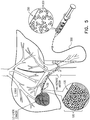
- FIG. 5 schematically illustrates an exemplary method of performing an embolization therapy, to treat a liver cancer (LC), utilizing a suspension 250 comprising an infusion fluid and embolization beads (e.g., beads 200) of the present disclosure.
- the embolization beads are configured to engage to form, following injection to a blood vessel (i.e., Hepatic Artery; HA) an aggregated structure (similar or identical to aggregated structure 100 of FIGs. 1 and 2 ) before or/and during embolization process for forming an embolus within the blood vessel, resulting with occluded blood vessel portion 130.
- the method includes, utilization of embolization beads 200 of the invention, but may be applicable to any of the aforementioned embolization beads, in accordance with the aspects of the disclosure.
- Embolization beads 200 may be used in conjunction with any suitable technique or/and procedure of embolization therapy (e.g., TAE, TACE, TARE) and may be introduced within a blood vessel feeding a tumor with any know and suitable catheter.
- TARE a radioactive isotope
- TACE a chemotherapeutic agent administration
- TACE a therapeutic agent is coated within the beads
- DEB DEB-TACE
- TAE or bland embolization
- a catheter for treating liver cancer, a catheter (a thin and flexible tube) is introduced through a small cut in the inner thigh and threaded up into the hepatic artery (HA) in the liver (L).
- a contrast enhancement material is usually injected into the bloodstream at this time to assist in monitoring the path of the catheter via angiography.
- embolization beads 200 are injected into the artery. Once accumulated in the blood vessels, embolization beads 200 are arranged such that protruding portions of a first embolization bead 200 intermesh with protruding portions of a second embolization bead 200. Multiple embolization beads 200, thus create emboli within boundaries of a blood vessel, blood supply to the tumor is diminished, effecting tumor starvation and necrosis.
- compositions including the embolization particulates (beads)
- the present invention also provides pharmaceutical compositions including the herein disclosed embolization beads, and a pharmaceutical acceptable carrier or excipient.
- composition encompasses formulated preparations including the herein disclosed embolization beads, and one or more pharmaceutically acceptable excipients, diluents or carriers.
- pharmaceutically acceptable means approved by a regulatory agency of a federal or a state government or listed in a recognized pharmacopeia for use in humans or animals.
- carrier refers to a diluent, adjuvant, excipient, or vehicle with which the therapeutic is administered.
- Such pharmaceutical carriers can be sterile aqueous liquids (e.g., saline, or PBS) or, oils, including those of petroleum, animal, vegetable or synthetic origin, such as peanut oil, soybean oil, mineral oil, sesame oil and the like.
- Suitable pharmaceutical excipients include starch, glucose, lactose, sucrose, gelatin, malt, rice, flour, chalk, silica gel, sodium stearate, glycerol monostearate, talc, sodium chloride, dried skim milk, glycerol, propylene, glycol, water, ethanol and the like.
- the carrier(s) must be "acceptable” in the sense of being compatible with the other ingredients of the composition and not deleterious to the recipients thereof.
- the composition including the embolization beads is typically referred to as a suspension.
- the suspension may be an infusion suspension comprising the beads and an infusion fluid (i.e., pharmaceutically acceptable excipients, diluents or carriers).
- the embolization beads may have a relatively low specific gravity. The embolization beads thus benefit from a buoyancy effect for reduced energy expenditure and prevent sedimentation when provided within a pharmaceutical composition or/and when injected within the blood.
- the embolization beads have a density within the range of between about 0.8 and about 2 g/cm 3 , 0.8 and about 1.8 g/cm 3 , 0.8 and about 1.6 g/cm 3 , 0.8 and about 1.4 g/cm 3 , 0.8 and about 1.2 g/cm3, between about 0.9 and about 1.1 g/cm3, between about 0.9 and about 1.0 g/cm3.
- 0.8 and about 2 g/cm 3 0.8 and about 1.8 g/cm 3 , 0.8 and about 1.6 g/cm 3 , 0.8 and about 1.4 g/cm 3 , 0.8 and about 1.2 g/cm3, between about 0.9 and about 1.1 g/cm3, between about 0.9 and about 1.0 g/cm3.
- Example 1 a process for preparing embolization beads capable of intermeshing
- Analytical grade reagents including one or more of: silicon dioxide, calcium carbonate, zinc oxide, magnesium oxide, lanthanum (III) oxide, strontium carbonate, titanium dioxide and sodium carbonate are weighed and homogeneously blended. The blend is then heated to a temperature within the range of from about 1500° to 1600° C for a time period of 30 min to 5 hours. A volume is then injected to a premade cold scaffold or mold having a predetermined shape to thereby form particulates of embolization beads having customized diameter which may vary to be between the ranges of 10 ⁇ m and 1,000 ⁇ m. The formed particulates are then extracted from the mold. The formed particulates may then be sterilized (for example, using 30 kGy gamma irradiation). Optionally, the embolization beads are treated to incorporate a therapeutic agent within holes or a concavity shape that may be included within the protruding portions of the beads. Holes may be patched by ejector pins.
- a radioactive isotope may be impregnated onto the embolization beads.
- Example 2 beads coating with a therapeutic agent
- Beads prepared as exemplified in Example 1 are coated with a desired therapeutic agent as follows: a therapeutic agent (e.g., doxorubicin) is dissolving in an appropriate solvent and admixed with the beads. The system is allowed for incubation for up to 24 hours under gentle agitation and at a temperature of 37°C. The coated beads may then be dried by an appropriate technique such as by freeze-drying.
- a therapeutic agent e.g., doxorubicin
- a beads suspension is inserted to a pre-swollen dialysis bag, the dialysis bag is clamped at both ends, and transferred to a container containing PBS.
- the system is allowed for incubation under gentle agitation at a temperature of 37°C and a sample f is taken at various time intervals to evaluate drug release under spectrophotometer.
- Beas are incubated in a solution including a radioisotope for up to 24 hours. Following incubation, beads are washed twice with saline or PBS. Beads are centrifuged for 60 seconds at 6000 rpm, and the supernatant is removed. Each sample is then washed with 1 mL of saline and agitated for seconds. Final solutions are disposed in vials with 20 mL of scintillation liquid each, and counted for activity by a liquid scintillation analyzer.
- 'a', 'an', and 'the' means 'at least one', or 'one or more'. Use of the phrase 'one or more' herein does not alter this intended meaning of 'a', 'an', or 'the'. Accordingly, the terms 'a', 'an', and 'the', as used herein, may also refer to, and encompass, a plurality of the stated entity or object, unless otherwise specifically defined or stated herein , or, unless the context clearly dictates otherwise.
- phrases: 'a unit', 'a device', 'an assembly', 'a mechanism', 'a component', 'an element', and 'a step or procedure' may also refer to, and encompass, a plurality of units, a plurality of devices, a plurality of assemblies, a plurality of mechanisms, a plurality of components, a plurality of elements, and, a plurality of steps or procedures, respectively.
- Each of these terms is considered equivalent in meaning to the phrase 'consisting essentially of.
- phrases 'consisting essentially of, as used herein, means that the stated entity or item (system, system unit, system sub-unit, device, assembly, sub-assembly, mechanism, structure, component, element, or, peripheral equipment, utility, accessory, or material, method or process, step or procedure, sub-step or sub-procedure), which is an entirety or part of an exemplary embodiment of the disclosed invention, or/and which is used for implementing an exemplary embodiment of the disclosed invention, may include at least one additional 'feature or characteristic' being a system unit, system sub-unit, device, assembly, sub-assembly, mechanism, structure, component, or element, or, peripheral equipment, utility, accessory, or material, step or procedure, sub-step or sub-procedure), but only if each such additional 'feature or characteristic' does not materially alter the basic novel and inventive characteristics or special technical features, of the claimed entity or item.
- 'method' refers to steps, procedures, manners, means, or/and techniques, for accomplishing a given task including, but not limited to, those steps, procedures, manners, means, or/and techniques, either known to, or readily developed from known steps, procedures, manners, means, or/and techniques, by practitioners in the relevant field(s) of the disclosed invention.
- a numerical value of a parameter, feature, characteristic, object, or dimension may be stated or described in terms of a numerical range format.
- Such a numerical range format illustrates implementation of some exemplary embodiments of the invention, and does not inflexibly limit the scope of the exemplary embodiments of the invention. Accordingly, a stated or described numerical range also refers to, and encompasses, all possible sub-ranges and individual numerical values (where a numerical value may be expressed as a whole, integral, or fractional number) within that stated or described numerical range.
- a stated or described numerical range 'from 1 to 6' also refers to, and encompasses, all possible sub-ranges, such as 'from 1 to 3', 'from 1 to 4', 'from 1 to 5', 'from 2 to 4', 'from 2 to 6', 'from 3 to 6', etc., and individual numerical values, such as '1', '1.3', '2', '2.8', '3', '3.5', '4', '4.6', '5', '5.2', and '6', within the stated or described numerical range of 'from 1 to 6'.
- the phrase 'in a range of between about a first numerical value and about a second numerical value' is considered equivalent to, and meaning the same as, the phrase 'in a range of from about a first numerical value to about a second numerical value', and, thus, the two equivalently meaning phrases may be used interchangeably.
Landscapes
- Health & Medical Sciences (AREA)
- Life Sciences & Earth Sciences (AREA)
- Veterinary Medicine (AREA)
- Public Health (AREA)
- General Health & Medical Sciences (AREA)
- Animal Behavior & Ethology (AREA)
- Engineering & Computer Science (AREA)
- Surgery (AREA)
- Biomedical Technology (AREA)
- Heart & Thoracic Surgery (AREA)
- Chemical & Material Sciences (AREA)
- Nuclear Medicine, Radiotherapy & Molecular Imaging (AREA)
- Molecular Biology (AREA)
- Vascular Medicine (AREA)
- Epidemiology (AREA)
- Reproductive Health (AREA)
- Medical Informatics (AREA)
- Pharmacology & Pharmacy (AREA)
- Medicinal Chemistry (AREA)
- Bioinformatics & Cheminformatics (AREA)
- Anesthesiology (AREA)
- Hematology (AREA)
- Biophysics (AREA)
- Pulmonology (AREA)
- General Chemical & Material Sciences (AREA)
- Organic Chemistry (AREA)
- Chemical Kinetics & Catalysis (AREA)
- Inorganic Chemistry (AREA)
- Materials Engineering (AREA)
- Dermatology (AREA)
- Neurosurgery (AREA)
- Neurology (AREA)
- Oral & Maxillofacial Surgery (AREA)
- Transplantation (AREA)
- Cardiology (AREA)
- Surgical Instruments (AREA)
- Media Introduction/Drainage Providing Device (AREA)
- Medicinal Preparation (AREA)
- Pharmaceuticals Containing Other Organic And Inorganic Compounds (AREA)
- Medicines That Contain Protein Lipid Enzymes And Other Medicines (AREA)
Description
- The present invention, in some embodiments thereof, relates to injectable embolization particulates (e.g., particles, microstructures, beads) employed in embolization procedures, for facilitating blood vessel occlusion. Some embodiments of the present invention further relate to compositions of the disclosed embolization particulates.
- The technique of embolization involves the introduction of particles into the circulation to occlude blood vessels, for example, so as to either arrest or prevent hemorrhage, or to cut off blood flow to a tissue or an organ. Blood vessel occlusion is desirable for managing various diseases and conditions. An embolization procedure is typically associated with an insertion of a catheter or a microcathter (depending on the size of the target blood vessel) into a blood vessel and injection of an embolic agent through the catheter/microcatheter. The embolic agent is chosen, for example, based on the size of the vessel to be occluded, the desired duration of occlusion, or/and the type of disease or condition to be treated (e.g., hypervascular tumors, uterine fibroids, etc.), among other factors. Widely known embolic agents are oils, foam, plug, microspheres. or beads.
- A follow-up angiogram may be performed to determine the specificity and completeness of an arterial occlusion. Blocking the blood supply to the tissue is intended to result in shrinkage or/and death of the tissue.
- Embolization therapy is currently used to treat advanced liver cancer in patients that are not candidates for liver transplantation or liver resection. and also employed for treating other cancer types. There are currently numerous embolic therapies available. Exemplary therapies are trans-arterial embolization (or TAE), transarterial chemoembolization (TACE), drug eluting bead (DEB) therapy, and trans-arterial radioembolization (TARE).
- TAE (also known as bland embolization) utilizes embolic particles injected into arteries feeding the tumor to stop blood flow to the tumor, thus causing necrosis. Typically, the embolic particles do not contain a drug.
- TACE involves initial localized injections of a chemotherapeutic drug followed immediately by injection of embolic particles to prevent drug reflux and to cause embolization. TACE provides for both embolization (necrosis) of tumor cells and chemotherapy.
- DEB involves combining / integrating an (elutable) drug into embolic particles, and similar to TACE involves two modes of action. In contrast to TACE, DEB provides sustained drug release. However, currently available DEB products show in-vitro rapid release (i.e., within hours) of the drug from the embolic particles. Also, current DEB therapy utilizes biostable particles, thereby precluding re-treatment. Embolic therapies are not curative, however, in most therapeutic situations, a single therapy delays tumor progression.
- Trans-arterial radioembolization (TARE) involves (injective) administration of radioactively labeled microspheres into a blood vessel. The injected microspheres emit radiation to surrounding tissues which then undergo necrosis.
- In spite of known teachings and practices in the field and art of the invention, there is an on-going need for developing new and improved injectable embolization particulates (e.g., particles, microstructures, beads) and compositions thereof.
- Document
US2005/095428 discloses embolization particulates according to the preamble of claim 1. - The present invention is disclosed in the appended set of claims. The present invention, in some embodiments thereof, relates to injectable embolization particulates (e.g., particles, microstructures, beads) employed in embolization procedures, for facilitating blood vessel occlusion. Some embodiments of the present invention further relate to compositions of the disclosed embolization particulates including a plurality of shaped embolization beads.
- According to the present invention, there is provided embolization particulates suitable for occluding a blood vessel, the embolization particulates comprising: a plurality of embolization beads, each of the embolization beads comprises: a plurality of outwardly protruding portions, wherein, upon a first one and a second one of the embolization beads accumulating against a boundary of the small blood vessel, the protruding portions of the first embolization bead are configured to intermesh with the protruding portions of the second embolization bead, so as to occlude the blood vessel.
- According to the present invention, there is provided an embolization bead suitable for occluding a blood vessel, the embolization bead comprising: a plurality of outwardly protruding portions, wherein, upon a first one and a second one of the embolization beads accumulating against a boundary of the small blood vessel, the protruding portions of the first embolization bead are configured to intermesh with the protruding portions of the second embolization bead, so as to occlude the blood vessel.
- According to some embodiments of the invention, the embolization beads are configured to resist or/and dissipate forces generated by, or originating from, fluid flow during an embolization procedure. According to some embodiments of the invention, at least one of the outwardly protruding portions is hydrodynamically shaped to facilitate laminar or/and unhindered flow there around and to diminish impact of incoming fluid flow directed thereto.
- According to some embodiments of the invention, the embolization beads have three outwardly protruding portions. According to some embodiments of the invention, the embolization beads have a tetrapod-like shape. According to some embodiments of the invention, at least one of the outwardly protruding portions includes at least one concavity. According to some embodiments of the invention, at least one of the outwardly protruding portions includes at least one hole passing through the outwardly protruding portion. According to some embodiments of the invention, at least one concavity or/and the hole is filled with a therapeutic agent.
- According to some embodiments of the invention, the embolization beads are prepared from a glass, a metal, a polymer, or a combination thereof. According to some embodiments of the invention, the embolization beads have a diameter in a range of between about 5 micrometers and about 500 micrometers, or in a range of between about 5 micrometers and about 100 micrometers, wherein the diameter is measured between external surfaces of two opposing protruding portions of one of the embolization beads.
- According to an aspect of some embodiments of the present invention, there is provided a composition comprising: the embolization particulates, and a pharmaceutically acceptable excipient or carrier. According to some embodiments of the invention, the composition further comprises a contrasting agent or a therapeutic agent. According to some embodiments of the invention, the contrasting agent is selected from the group consisting of tantalum, tantalum oxide, and barium sulfate. According to some embodiments of the invention, the therapeutic agent is a chemotherapeutic agent.
- According to an aspect of the disclosure, there is provided a method for embolizing or occluding a blood vessel in a subject, the method comprising: injecting into the blood vessel a sufficient amount of the embolization particulates, or of a composition thereof, thereby allowing the embolization beads to aggregate into a chosen aggregated structure prior to or/and during embolization. According to some embodiments of the invention, the blood vessel feeds a tumor or an arteriovenous malformation.
- According to an aspect of some embodiments of the present invention, there is provided the embolization particulates, or a composition thereof, for use in embolizing a blood vessel feeding a tumor or an arteriovenous malformation.
- It is further disclosed a method of treating a disease or disorder that may benefit from occluding a blood vessel feeding an organ associated with the disease or disorder, the method comprising: injecting into the blood vessel a sufficient amount of the embolization particulates, or of a composition thereof. In said method, the disease or disorder is selected from: cancer, an arteriovenous malformation, and hemorrhage.
- According to an aspect of some embodiments of the present invention, there is provided the embolization particulates, or a composition thereof, for use in treating a disease or disorder that may benefit from occluding a blood vessel feeding an organ associated with the disease or disorder. According to some embodiments of the invention, the disease or disorder is selected from: cancer, arteriovenous malformations, and hemorrhage.
- Unless otherwise defined, all technical or/and scientific terms used herein have the same meaning as commonly understood by one of ordinary skill in the art to which the invention pertains.
- Some embodiments of the invention are herein described, by way of example only, with reference to the accompanying drawings. With specific reference now to the drawings in detail, it is stressed that the particulars shown are by way of example and for purposes of illustrative discussion of embodiments of the invention. In this regard, the description taken with the drawings makes apparent to those skilled in the art how embodiments of the invention may be practiced.
- In the drawings:
-
FIG. 1 is a schematic perspective view of an exemplary embodiment of an embolization bead having three protruding portions extending from the center of the bead, in accordance with some embodiments of the invention; -
FIG. 2 is a schematic perspective view of an exemplary embodiment of embolization particulates as an aggregation of a plurality of the embolization bead ofFIG. 1 , particularly highlighting intermeshing (engaging) of protruding portions of several embolization beads, in accordance with some embodiments of the invention; -
FIG. 3 is a schematic perspective view of an exemplary embodiment of an embolization bead having four protruding portions, each two protruding portions extending from opposite sides of a bead end, -
FIG. 4 is a schematic perspective view of an exemplary embodiment of embolization particulates as an aggregation of a plurality of the embolization bead ofFIG. 3 , particularly highlighting intermeshing (engaging) of protruding portions of several embolization beads and -
FIG. 5 is a schematic presentation of an exemplary suspension of embolization particulates (as embolization beads ofFIGs. 1 and 2 ), following injection into a blood vessel (e.g., a hepatic artery) feeding a tumor within the liver, and engaging to form a dense aggregated structure before or/and during an embolization process, so as to form an embolus within the blood vessel, thereby occluding the blood vessel. - The present invention, in some embodiments thereof, relates to injectable embolization particulates (e.g., particles, microstructures, beads) employed in embolization procedures, for facilitating blood vessel occlusion. Some embodiments of the present invention further relate to compositions of the disclosed embolization particulates including a plurality of shaped embolization beads.
- There is still a need to prevent, or at least diminish, possibility of non-target embolization or/and non-target deposition of embolization particulates (particles, microstructures, beads) which can adversely affect non-target locations or/and organs of a subject. Such undesirable non-target embolization or/and particulate deposition may occur by infiltration of embolization particulates from a target embolization site to a non-target location, for example, via body vasculature or/and abnormal shunts.
- A possible way to prevent, or at least diminish, such undesirable side effects from occurring during embolization procedures, is to develop means which enable embolization particulates, for example, via their inherent characteristics and behavior, to aggregate (i.e., gather, collect, or combine together) under local conditions (such as flow rate, flow pressure, among other possible conditions) during an embolization process. Accordingly, it may be advantageous to provide new and improved vascular embolic materials, such as embolization particulates (e.g., in the form of particles, microstructures, beads), which may facilitate safer and more efficient occlusion of a blood vessel.
- For example, according to some embodiments of the disclosed invention, the embolization particulates, for example, in the form of beads, are characterizable by a particular shape that may advantageously facilitate blood vessel occlusion while preventing, or at least diminishing, back flow (i.e., reflux) of embolic material. According to some embodiments of the invention, the embolization particulates, for example, in the form of beads, may be coated or impregnated with a therapeutic agent, or with a radioactive isotope, for increasing one or more desirable therapeutic effects.
- The terms "embolization" and "embolizing" are herein used in conjunction with the terms "embolization material" and "embolization therapy", and refer to a process wherein a medicinal substance or material injected into a blood vessel hardens, fills, plugs, or/and occludes the blood vessel or/and encourages clot formation so that blood flow through the vessel ceases. Blood vessel embolization is useful in preventing/controlling bleeding (e.g., organ bleeding, gastrointestinal bleeding, vascular bleeding, bleeding associated with an aneurysm), or as a treatment of a disease (e.g., cancers) by preventing its blood supply.
- The terms "aggregation" and "aggregated" are herein used in conjunction with the term "aggregated structure", and refer to a process wherein a particulate mass (e.g., in a form of infusion suspension of beads) assembles into a concentrated depot, being more concentrated or/and dense than concentration/density of the infusion suspension at exit of distal outlet (infusion opening) of the embolization catheter. Such a particulate mass (concentrated depot) is characterized by at least some of its particles physically (mechanically) or/and chemically interconnecting among themselves. In some embodiments of the invention, particle (inter-particle) aggregation may be considered as a preliminary stage before creation of a local emboli in a blood vessel. In some embodiments, the unique shape or/and weight distribution in a bead, according to embodiments of the invention, improves its inherent ability to resist aggregation or/and concertation at a too early stage of the embolization delivery process (e.g., close to distal outlet of the embolization catheter or/and at relatively high blood flow rate), so that a farther distal arterial occlusion can be achieved. Optionally, additionally or alternatively, the unique shape or/and weight distribution in a bead, according to embodiments of the invention, improves its inherent ability to increase likelihood, strength, density, or/and concertation of a final aggregation in a mature stage of the embolization delivery process (e.g., relatively distant from distal outlet of the embolization catheter or/and at relatively low blood flow rate), in order to diminish likelihood / quantity of beads (particles) non-target deposition phenomenon.
- The term "bead" is herein used in conjunction with "particle" or "particulate", and refers to a substance, for example, in the form of a minute portion or a fragment of material, that may be formed from a variety of materials (e.g., a glass, a polymer, a metal), and have characteristic sizes (lengths, widths, diameters) in an exemplary range of between about 10 microns (micrometers) and about 1,000 microns (micrometers), and may be suitable for medical applications (e.g., occluding a blood vessel), for example, for delivery as a suspended material in an infusion suspension.
- An aspect of some embodiments of the invention is provision of embolization particulates (in a form of particles, microstructures, or beads) suitable for occluding a blood vessel. In exemplary embodiments, the embolization particulates include a plurality of embolization beads, with each of the embolization bead having a plurality of outwardly protruding portions, wherein, upon a first one and a second one of the embolization beads accumulating against a boundary of the small blood vessel, the protruding portions of the first embolization bead are configured to intermesh with the protruding portions of the second embolization bead, so as to occlude the blood vessel.
- According to an aspect of some embodiments of the present invention, there is provided an embolization bead suitable for occluding a blood vessel, the embolization bead comprising: a plurality of outwardly protruding portions, wherein, upon a first one and a second one of the embolization beads accumulating against a boundary of the small blood vessel, the protruding portions of the first embolization bead are configured to intermesh with the protruding portions of the second embolization bead, so as to occlude the blood vessel.
- An aspect of some embodiments of the invention is provision of a composition including the embolization particulates and a pharmaceutically acceptable excipient or carrier.
- An aspect of some aspects is provision of a method for embolizing or occluding a blood vessel in a subject, the method including: injecting into the blood vessel a sufficient amount of the embolization particulates, or of a composition thereof, thereby allowing the embolization beads to aggregate into a chosen aggregated structure prior to or/and during embolization. An aspect of the disclosure is provision of a method of treating a disease or disorder that may benefit from occluding a blood vessel feeding an organ associated with the disease or disorder, the method including: injecting into the blood vessel a sufficient amount of the embolization particulates, or of a composition thereof. An aspect of some embodiments of the invention is provision of the embolization particulates, or a composition thereof, for use in treating a disease or disorder that may benefit from occluding a blood vessel feeding an organ associated with the disease or disorder.
- The preceding aspects of exemplary embodiments of the present invention, and characteristics and features thereof, are better understood with reference to the following illustrative description and accompanying drawings. Throughout the following illustrative description and accompanying drawings, same reference notation and terminology (i.e., numbers, letters, symbols) are consistently used and refer to same structures, components, elements, steps or procedures, or/and features.
- It is to be understood that the invention is not necessarily limited in its application to particular details of construction of the embolization particulates (or embolization beads thereof), or to any particular sequential ordering of method steps or procedures, set forth in the following illustrative description. The invention is capable of other embodiments or of being practiced or carried out in various ways. For example, the following exemplary embodiments may be described in the context of exemplary embolization procedures for ease of description and understanding. However, the invention may be adapted to various clinical applications without departing from the overall scope of the invention, for example, any local injected deposition of a pharmaceutical or non-pharmaceutical particulates within a bodily lumen.
- In exemplary embodiments, the embolization beads of the invention include a plurality of outwardly protruding portions, wherein outwardly protruding portions of a first bead are configured to intermesh with outwardly protruding portions of a second bead. The beads may have various shapes, as long as the beads are capable of intermeshing with each other and block blood flow. In exemplary embodiments, the beads may be symmetric or asymmetric. In exemplary aspects, the embolization bead is having two or more, three or more, four or more, five or more, or six or more protruding portions. In exemplary embodiments, the beads protruding portions may extend from the central portion of the bead. In exemplary aspects, the beads have a spherical body and the protruding portions may extend from the central spherical portion of the bead. In exemplary aspects, the beads have a body with an elongated shape and the protruding portions may extend from any portion of the bead body. Z In the present invention, the embolization beads have a tetrapod-like shape. In exemplary aspects, at least one of the outwardly protruding portions has a multi-faced type shape, for example, a tetrahedron (tetrahedral) or tetrahedron-like (tetrahedral-like) shape. In exemplary embodiments, at least one of the outwardly protruding portions includes at least one concavity. In exemplary embodiments, at least one of the outwardly protruding portions includes at least one hole passing through the outwardly protruding portion.
- Reference is now made to the drawings.
FIG. 1 schematically illustrates a perspective view of anexemplary embolization bead 200 having exemplarybead protruding portions 201.FIG. 2 schematically illustrates a perspective view of an exemplary embodiment of embolization particulates, for example, as an aggregatedstructure 100 of a plurality of exemplary embolization beads 200 (ofFIG. 1 ), particularly highlighting intermeshing (engaging) of embolizationbead protruding portions 201. - In exemplary embodiments,
embolization bead 200 is configured for creating an embolus during an embolization procedure, and includes a plurality of outwardly protrudingportions 201.Embolization bead 200 may have a substantially spherical body, for example,spherical body 202 shown inFIGs. 1 and 2 , and the outwardly protrudingportions 201 may extend from thespherical body 202. InFIGs. 1 and 2 ,embolization beads 200 are illustrated having three protrudingportions 201, but may have a different number of protruding portions (e.g., two, or four, or more protruding portions). - In exemplary embodiments, during the course of injecting the beads within a blood vessel and prior to accumulation of a plurality of the beads into an aggregated structure, such as aggregated
structure 100, at least one of the outwardly protrudingportion 201 is hydrodynamically shaped to facilitate laminar or/and unhindered flow there around and to diminish impact of incoming fluid flow directed thereto. - In exemplary embodiments,
embolization bead 200 is also configured, based on its design and dimensions, such that whereupon at least a first and a second thereof, accumulating against a boundary of a target bodily part within a small blood vessel, for example, feeding a target bodily part, the protruding portions of a first embolization bead will have an increased probability to intermesh with the protruding portions of a second embolization bead (as shown, in an exemplary non-limiting manner, inFIGs. 2 and5 ), optionally particularly at low (e.g., close to null) blood flow rates. - In some embodiments, aggregated
structure 100 or/andembolization bead 200 is further configured to resist or/and dissipate forces generated by or originating from fluid flow during the embolization procedure. - In exemplary aspects,
embolization bead 200 has, or is similar at least in part to, a tetrapod-like shape. Optionally, at least one outwardly protrudingportion 201 has a multi-faced type shape, for example, a tetrahedron (tetrahedral) or tetrahedron-like (tetrahedral-like) shape. Optionally, at least one outwardly protrudingportion 201 includes at least one concavity or/and at least one hole passing therethrough the outwardly protruding portion, which, optionally, is filled with a pharmaceutical agent. -
FIG. 3 schematically illustrates a perspective view of anexemplary embolization bead 300 having exemplarybead protruding portions 301.FIG. 4 schematically illustrates a perspective view of an exemplary embodiment of embolization particulates, for example, as a aggregatedstructure 400 of a plurality ofexemplary embolization beads 300, particularly highlighting intermeshing (engaging) of embolizationbead protruding portions 301. - In exemplary embodiments,
embolization bead 300 is configured for creating an embolus during an embolization procedure, and includes a plurality of outwardly protrudingportions 301.Embolization bead 300 includes afirst bead end 303, asecond bead end 304, and abead body 302 extending between thefirst bead end 303 and thesecond bead end 304. Two outwardly protrudingportions 301 oppositely extend from thefirst bead end 303, and two outwardly protrudingportions 301 oppositely extend from thesecond bead end 304.Embolization beads 300 are illustrated having four protruding portions, but may also have a different number of protruding portions (e.g., two, three, five, or more protruding portions). Protrudingportions 301 ofembolization bead 300, extending from thefirst bead end 303 may be disposed to form any angle in a range of between about 180 degrees and about 0 degrees with respect to protrudingportions 301, extending from thesecond bead end 304. -
Embolization bead 300 is also configured, based on its design and dimensions, such that whereupon at least a first and a second thereof, accumulating against a boundary of a target bodily part within a small blood vessel, feeding the target bodily part, the protruding portions of the first embolization bead shall have an increased probability to intermesh with the protruding portions of the second embolization bead (as shown, for demonstrative purposes only, inFIGs. 4 and5 ). - In some embodiments,
embolization bead 300 is further configured to resist or/and dissipate forces generated by or originating from fluid flow during the embolization procedure. In exemplary embodiments, at least one outwardly protrudingportion 301 has a multi-faced type shape, for example, a tetrahedron (tetrahedral) or tetrahedron-like (tetrahedral-like) shape. Optionally, at least one outwardly protrudingportion 301 includes at least one concavity or/and at least one hole passing therethrough the outwardly protruding portion, which, optionally, is filled with a pharmaceutical agent. - In exemplary embodiments, the embolization beads may be prepared in various sizes. The embolization bead diameter sizes (when measured to extend between two opposite protrusions) may vary and range between 10 microns (µm) and 1,500 microns, between 10 microns and 1,200 microns, between 10 microns and 1,000 microns, between 100 microns and 900 microns, between 10 microns and 500 microns, between 10 microns and 100 microns, between 10 microns and 50 microns, between 50 microns and 100 microns, between 100 microns and 300 microns, between 300 microns and 500 microns, between 500 microns and 700 microns, or between 700 microns and 900 microns.
- The size and shape of the embolization beads may be measured by any method known in the art. For example, microscopic equipment (such as, Leica DM IRB (Leica) microscope equipped by Evolution MP Color CCD Camera (Media Cybernatics)) may be used. The analysis of size may be performed by Image Pro Plus™ (Media Cybernatics). An electron microscope (such as, scanning electron microscope (SEM)) to obtain a sample's surface topography and composition may be used.
- In exemplary embodiments, the embolization beads are prepared from a material such as, but not limited to, a polymer, a metal, a glass, a ceramic material or any combination thereof. When a metal is used for the preparation of the embolization beads, visualization of the embolic material under X-ray radiation may be facilitated. Exemplary glass embolization beads are, without limitation, silicon dioxide (SiO2), sodium oxide (Na2O), sodium carbonate (Na2CO3), calcium oxide (CaO), or any combination thereof. Exemplary polymers suitable for implementing embodiments of the invention include, without limitation, polyvinyl alcohol (PVA), polytetrafluoroethylene (PTFE), carboxymethyl chitosan (CCN), carboxymethyl cellulose (CMC), 2-acrylamido-2-methyl-1-1-propane-sulphonoc acid (AMPS), poly(lactide-co-glycolide) (PLCG), poly(L-lactic acid) (PLLA), trisacrylgelatin having a coating of collagen, or any combination thereof. The polymer used may be chosen to have an appropriate molecular weight. In an exemplary embodiment, and when PVA is the polymer of choice, the PVA may have a molecular weight within the range of about 50,000 Da and about 300,000 Da. Suitable metals include, without limitation, silver, gold, palladium, platinum, tantalum (e.g. tantalum oxide), tungsten, iridium, titanium, magnesium, Strontium, Zinc, Lanthanum, barium (e.g. barium sulfate), and stainless steel. In an exemplary embodiment, a metal that may be used in preparing the embolization beads may include, without limitation, TiO2, Pt or a mixture thereof. In a further exemplary embodiment, the glass embolization beads may be made from a combination of metals and glass and may include one or more of: zinc (e.g., ZnO), Lanthanum (e.g., La3O2), Titanium (e.g., TiO2), Magnesium (e.g., MgO), Strontium (e.g., SrO) and sodium (e.g., Na2O).
- In exemplary embodiments, the embolization beads have a weight that vary and depend on the material used for producing the bead. The embolization bead weight may be uniform within the entire bead, or may be non-uniform having a center-of-mass not necessarily same as geometric center. Non-uniform embolization bead weight may be controlled or produced by combining at least two materials each having a different weight and producing the beads to include those material in a non-homogenous fashion.
- In exemplary embodiments, and in order to further enhance the therapeutic effect (i.e. treating cancer), the embolization beads may also include an isotope, thus allowing delivery of β-ray or/and γ-ray. Suitable isotopes that may be incorporated or impregnated to the embolization beads of the invention, include, without limitation, yttrium-90 (Y90), rhenium-188 (188Re), 99mTc, 32P, 166Ho, 109Pb, 140La 153Sm, 165Dy, and 169Er.
- According to further embodiments, and in order to further enhance the therapeutic effect (e.g., in treating cancer), the embolization beads may also include a therapeutic agent. Suitable exemplary therapeutic agents that may be incorporated to the embolization beads of the invention, include, without limitation, a chemotherapeutic agent, a peptide or polypeptide or any other chemical moiety or entity having a therapeutic effect. An exemplary chemotherapeutics that may be incorporated into the embolization beads of the invention, include, for example, paclitaxel, doxorubicin, nemorubicin hydrochloride (a derivative of doxorubicin).
- An aspect of some aspects of the present disclosure relates to a method for producing embolization beads according to the embodiments of the invention.
- The method includes homogenously admixing together the components from which the embolization beads are to be prepared and pouring a liquid mixture to a premade scaffold or mold. The method further includes, removing the molded particulates.
- In an exemplary aspect, and when the embolization beads are prepared from metals, or glass or a combination thereof, the process for preparing the embolization beads include, weighing and preparing a homogenous mixture of powders and melting the powders to form the desired composition. The purity of each raw material is, for example, greater than 90%. After either dry or wet mixing of the powders to achieve a homogeneous mixture, the mixture may be placed for melting (e.g., in a platinum crucible). The crucibles containing the powdered batch are heated to 1500° to 1600°C, depending upon the composition, by a furnace. In this temperature range, the batch melts to form a liquid which is stirred several times to decrease its chemical heterogeneity. The melt should remain at 1500° to 1600° C until all solid material in the batch is totally dissolved (usually 2-5 hours being sufficient). When melting and stirring is complete, the crucible is removed from the furnace and the melt is quickly quenched to a glass by pouring the melt onto a cold mold or scaffold.
- The final step is to examine a representative sample of the embolization beads in a scanning electron microscope to evaluate the size range and shape of the beads. A composition of the embolization beads can be checked by energy dispersive x-ray analysis to confirm that there is no chemical contamination. The embolization beads are packaged dry in clean containers and sterilized (for example, using 30 kGy gamma irradiation).
- In exemplary aspects, the obtained embolization beads are treated to incorporate a therapeutic agent. The embolization beads in accordance with this embodiment act as carriers of the therapeutic agent. The therapeutic agent may be incorporated to the embolization beads of the invention, in any method known in the art. The therapeutic agent may be included within holes formed in the embolization beads or within concavity shapes based on the surface of the protruding portions.
- Methods for coating the embolization beads with a therapeutic agent include, without limitation, immersion coating, spray coating, and spin coat administration. Immersion coating of therapeutic agent includes impregnating surface of interest of the embolization beads with the therapeutic agent.
- For example, coating may be performed by dissolving the therapeutic agent at a desired concentration that represents clinically applicable doses, admixing the therapeutic agent with the embolization beads and incubating those substances for a period of from a few minutes to a few hours. Drug release may be evaluated following incubation in an aqueous solution (Phosphate Buffer Saline (PBS)) or human plasma from human subjects for a few days.
- According to an aspect of the disclosure, there is provided a method for embolizing or occluding a blood vessel in a subject in need thereof, the method including injecting into the blood vessel a sufficient amount of embolization beads of the invention, thereby allowing the embolization beads to aggregate into an aggregated structure prior to or/and during embolization.
- According to yet another aspect of the disclosure, there is provided a method of treating a disease or disorder that may benefit from occluding a blood vessel feeding an organ associated with the disease or disorder, the method including injecting into the blood vessel a sufficient amount of embolization beads of the invention.
- As used herein, the term "embolizing" as used in conjunction with the term "occluding" refers to creating an embolus or clot within a blood vessel.
- As used herein, the term "treating" encompasses substantially ameliorating, relieving, alleviating and preventing symptoms of the disease in a patient in need thereof.
- As used herein, the term "injecting" is interchangeable with the tern "administering" and refers to the delivery of a suspension of the disclosed embolization beads within a blood vessel.
- The embolization beads are particularly useful in occluding small blood vessels (such as capillaries). The embolization beads are useful to treat any disease condition or illness which may benefit, abolished, or ablated by colluding a blood vessel within the body or that feeds the diseased or afflicted body organ.
- The embolization beads may be used in conjunction with a transarterial chemoembolization (TACE), drug eluting bead (DEB) therapy and radio-embolization. As used herein the term "a disease or disorder that may benefit from occluding a blood vessel feeding an organ associated with the disease or disorder" refers to any disease, disorder, or condition that may be treated with embolization material to abolish or relief symptoms associated with the disease, disorder, or condition. The term is interchangeable with the term "a disease or disorder amenable to an embolization therapy".
- In exemplary embodiments, the embolization beads may be used to treat angiogenesis-dependent diseases (i.e., those diseases which require or induce vascular growth). Amongst such angiogenesis-dependent diseases the most prominent is cancer. Suitable cancers include, without limitation, a cancer that has spread (metastasized) to the liver from a primary tumor elsewhere (e.g., colorectal cancer, breast cancer, lung cancer and neuroendocrine tumors), cancer originating in the liver (such as hepatocellular carcinoma and cholangiocarcinoma), renal tumors (benign and malignant), tumor within the uterine (e.g., uterine fibroid), brain, central nervous system, kidneys, gall bladders, head and neck, oral cavity, thyroid, skin, mucous membranes, glandular organs, blood vessels, bone tissues, lymph nodes, lungs, esophagus, stomach, lacteal glands, pancreas, eyes, nasopharynge, womb, ovaries, endometrium, cervix, prostate gland, bladders, colon and rectum. For example, metastatic colorectal cancer in the liver and hepatocellular carcinoma are the cancers most often considered for radioembolization treatment. In exemplary embodiments, the embolization beads are used to prevent/control bleeding (e.g., organ bleeding, gastrointestinal bleeding, vascular bleeding, bleeding associated with an aneurysm). For example, the embolization beads are applicable to treat: hemorrhage (such as hemorrhage associated with pelvic fracture).
- In exemplary aspects of the present disclosure, there is provided a method of treating a condition or disease, using the embolization beads of the invention. A composition including the embolization beads, which is for example, administered to a patient in need of an embolization therapy having a tumor, for instance a hepatocellular carcinoma, is firstly prepared. The embolization beads may be administered alone or along (usually after) administration of a composition including a therapeutic agent (e.g. chemotherapeutics). The embolization beads may be administered when bound to a chemotherapeutic agent. It is often desirable for the suspension to be mixed prior to delivery with an imaging agent such as a conventional radio-opaque agent.
- The compositions for administration are thus prepared according to the therapy of interest. The embolization beads may be loaded with the appropriate dose of a therapeutic agent just prior to administration or may be preloaded and ready for immediate use. When the embolization beads are coated with a therapeutic agent just prior to administration, the appropriate dose of the therapeutic agent, may be dissolved in adequate solution, and is then mixed with a suitable amount of beads. The pharmaceutical composition containing the therapeutic agent bound to embolization beads may allow a fast loading (about 1-2 h incubation) and a loading rate of the therapeutic agent into the beads (>99%) able to guarantee an easy administration of therapeutic doses to patients. The reconstituted therapeutic agent solution must be added to the embolization beads and agitated gently to encourage mixing.
- The selection of the size of the embolization beads is based on the vascular target/vessel size.
- A delivery catheter/microcatheter must be introduced into the target vessel according to standard interventional radiology technique. The embolization must be monitored under fluoroscopic visualization by adding a desired amount of contrast medium (such as a conventional radio-opaque agent) to a suspension fluid containing the embolization beads.
- In exemplary aspects, the embolization beads are slowly injected into the delivery catheter/microcatheter under fluoroscopic visualization while observing the contrast flow rate. Upon completion of the treatment, the catheter/microcatheter is removed while maintaining gentle suction so as not to dislodge embolization beads still within the catheter/microcatheter lumen. The embolic composition as administered to the patient in need of embolization therapy, may be delivered as a single one-off dosage. It may be found to be desirable for subsequent doses of an embolic composition useful in the invention, to be delivered at a time interval after the previous dose, for instance to embolise newly formed blood vessels supplying a tumor (e.g. after 4 to 12 weeks from the previous treatment).
- Reference is now made to
FIG. 5 which schematically illustrates an exemplary method of performing an embolization therapy, to treat a liver cancer (LC), utilizing asuspension 250 comprising an infusion fluid and embolization beads (e.g., beads 200) of the present disclosure. The embolization beads are configured to engage to form, following injection to a blood vessel (i.e., Hepatic Artery; HA) an aggregated structure (similar or identical to aggregatedstructure 100 ofFIGs. 1 and 2 ) before or/and during embolization process for forming an embolus within the blood vessel, resulting with occludedblood vessel portion 130. The method includes, utilization ofembolization beads 200 of the invention, but may be applicable to any of the aforementioned embolization beads, in accordance with the aspects of the disclosure. -
Embolization beads 200 may be used in conjunction with any suitable technique or/and procedure of embolization therapy (e.g., TAE, TACE, TARE) and may be introduced within a blood vessel feeding a tumor with any know and suitable catheter. For example, when the beads are provided with a radioactive isotope the technique is referred to as TARE. When the beads are injected thereafter a chemotherapeutic agent administration, the technique is referred to as TACE. When a therapeutic agent is coated within the beads, the technique is referred to as DEB (or DEB-TACE), and when the beads are provided without any substance, the technique may be referred to as TAE (or bland embolization). - Typically, for treating liver cancer, a catheter (a thin and flexible tube) is introduced through a small cut in the inner thigh and threaded up into the hepatic artery (HA) in the liver (L). A contrast enhancement material is usually injected into the bloodstream at this time to assist in monitoring the path of the catheter via angiography. Once the catheter is in positioned as appropriate,
embolization beads 200 are injected into the artery. Once accumulated in the blood vessels,embolization beads 200 are arranged such that protruding portions of afirst embolization bead 200 intermesh with protruding portions of asecond embolization bead 200.Multiple embolization beads 200, thus create emboli within boundaries of a blood vessel, blood supply to the tumor is diminished, effecting tumor starvation and necrosis. - According to yet another aspect, the present invention also provides pharmaceutical compositions including the herein disclosed embolization beads, and a pharmaceutical acceptable carrier or excipient.
- The term "pharmaceutical composition", as used herein, encompasses formulated preparations including the herein disclosed embolization beads, and one or more pharmaceutically acceptable excipients, diluents or carriers.
- The term "pharmaceutically acceptable", as used herein, means approved by a regulatory agency of a federal or a state government or listed in a recognized pharmacopeia for use in humans or animals.
- The term "carrier", as used herein, refers to a diluent, adjuvant, excipient, or vehicle with which the therapeutic is administered. Such pharmaceutical carriers can be sterile aqueous liquids (e.g., saline, or PBS) or, oils, including those of petroleum, animal, vegetable or synthetic origin, such as peanut oil, soybean oil, mineral oil, sesame oil and the like. Suitable pharmaceutical excipients include starch, glucose, lactose, sucrose, gelatin, malt, rice, flour, chalk, silica gel, sodium stearate, glycerol monostearate, talc, sodium chloride, dried skim milk, glycerol, propylene, glycol, water, ethanol and the like. The carrier(s) must be "acceptable" in the sense of being compatible with the other ingredients of the composition and not deleterious to the recipients thereof.
- The composition including the embolization beads is typically referred to as a suspension. The suspension may be an infusion suspension comprising the beads and an infusion fluid (i.e., pharmaceutically acceptable excipients, diluents or carriers). In exemplary embodiments, the embolization beads may have a relatively low specific gravity. The embolization beads thus benefit from a buoyancy effect for reduced energy expenditure and prevent sedimentation when provided within a pharmaceutical composition or/and when injected within the blood. In exemplary embodiments, the embolization beads have a density within the range of between about 0.8 and about 2 g/cm3, 0.8 and about 1.8 g/cm3, 0.8 and about 1.6 g/cm3, 0.8 and about 1.4 g/cm3, 0.8 and about 1.2 g/cm3, between about 0.9 and about 1.1 g/cm3, between about 0.9 and about 1.0 g/cm3. Each possibility represents a separate embodiment of the invention.
- The following examples are presented in order to more fully illustrate certain embodiments of the invention. They should in no way, however, be construed as limiting the broad scope of the invention. One skilled in the art can readily devise many variations and modifications of the principles disclosed herein without departing from the scope of the invention.
- Analytical grade reagents including one or more of: silicon dioxide, calcium carbonate, zinc oxide, magnesium oxide, lanthanum (III) oxide, strontium carbonate, titanium dioxide and sodium carbonate are weighed and homogeneously blended. The blend is then heated to a temperature within the range of from about 1500° to 1600° C for a time period of 30 min to 5 hours. A volume is then injected to a premade cold scaffold or mold having a predetermined shape to thereby form particulates of embolization beads having customized diameter which may vary to be between the ranges of 10 µm and 1,000 µm. The formed particulates are then extracted from the mold. The formed particulates may then be sterilized (for example, using 30 kGy gamma irradiation). Optionally, the embolization beads are treated to incorporate a therapeutic agent within holes or a concavity shape that may be included within the protruding portions of the beads. Holes may be patched by ejector pins.
- Also optionally, a radioactive isotope may be impregnated onto the embolization beads.
- Beads prepared as exemplified in Example 1 are coated with a desired therapeutic agent as follows: a therapeutic agent (e.g., doxorubicin) is dissolving in an appropriate solvent and admixed with the beads. The system is allowed for incubation for up to 24 hours under gentle agitation and at a temperature of 37°C. The coated beads may then be dried by an appropriate technique such as by freeze-drying.
- A beads suspension is inserted to a pre-swollen dialysis bag, the dialysis bag is clamped at both ends, and transferred to a container containing PBS. The system is allowed for incubation under gentle agitation at a temperature of 37°C and a sample f is taken at various time intervals to evaluate drug release under spectrophotometer.
- Beas are incubated in a solution including a radioisotope for up to 24 hours. Following incubation, beads are washed twice with saline or PBS. Beads are centrifuged for 60 seconds at 6000 rpm, and the supernatant is removed. Each sample is then washed with 1 mL of saline and agitated for seconds. Final solutions are disposed in vials with 20 mL of scintillation liquid each, and counted for activity by a liquid scintillation analyzer.
- Each of the following terms written in singular grammatical form: 'a', 'an', and 'the', as used herein, means 'at least one', or 'one or more'. Use of the phrase 'one or more' herein does not alter this intended meaning of 'a', 'an', or 'the'. Accordingly, the terms 'a', 'an', and 'the', as used herein, may also refer to, and encompass, a plurality of the stated entity or object, unless otherwise specifically defined or stated herein, or, unless the context clearly dictates otherwise. For example, the phrases: 'a unit', 'a device', 'an assembly', 'a mechanism', 'a component', 'an element', and 'a step or procedure', as used herein, may also refer to, and encompass, a plurality of units, a plurality of devices, a plurality of assemblies, a plurality of mechanisms, a plurality of components, a plurality of elements, and, a plurality of steps or procedures, respectively.
- Each of the following terms: 'includes', 'including', 'has', 'having', 'comprises', and 'comprising', and, their linguistic / grammatical variants, derivatives, or/and conjugates, as used herein, means 'including, but not limited to', and is to be taken as specifying the stated component(s), feature(s), characteristic(s), parameter(s), integer(s), or step(s), and does not preclude addition of one or more additional component(s), feature(s), characteristic(s), parameter(s), integer(s), step(s), or groups thereof. Each of these terms is considered equivalent in meaning to the phrase 'consisting essentially of.
- Each of the phrases 'consisting of' and 'consists of, as used herein, means 'including and limited to'.
- The phrase 'consisting essentially of, as used herein, means that the stated entity or item (system, system unit, system sub-unit, device, assembly, sub-assembly, mechanism, structure, component, element, or, peripheral equipment, utility, accessory, or material, method or process, step or procedure, sub-step or sub-procedure), which is an entirety or part of an exemplary embodiment of the disclosed invention, or/and which is used for implementing an exemplary embodiment of the disclosed invention, may include at least one additional 'feature or characteristic' being a system unit, system sub-unit, device, assembly, sub-assembly, mechanism, structure, component, or element, or, peripheral equipment, utility, accessory, or material, step or procedure, sub-step or sub-procedure), but only if each such additional 'feature or characteristic' does not materially alter the basic novel and inventive characteristics or special technical features, of the claimed entity or item.
- The term 'method', as used herein, refers to steps, procedures, manners, means, or/and techniques, for accomplishing a given task including, but not limited to, those steps, procedures, manners, means, or/and techniques, either known to, or readily developed from known steps, procedures, manners, means, or/and techniques, by practitioners in the relevant field(s) of the disclosed invention.
- Throughout this disclosure, a numerical value of a parameter, feature, characteristic, object, or dimension, may be stated or described in terms of a numerical range format. Such a numerical range format, as used herein, illustrates implementation of some exemplary embodiments of the invention, and does not inflexibly limit the scope of the exemplary embodiments of the invention. Accordingly, a stated or described numerical range also refers to, and encompasses, all possible sub-ranges and individual numerical values (where a numerical value may be expressed as a whole, integral, or fractional number) within that stated or described numerical range. For example, a stated or described numerical range 'from 1 to 6' also refers to, and encompasses, all possible sub-ranges, such as 'from 1 to 3', 'from 1 to 4', 'from 1 to 5', 'from 2 to 4', 'from 2 to 6', 'from 3 to 6', etc., and individual numerical values, such as '1', '1.3', '2', '2.8', '3', '3.5', '4', '4.6', '5', '5.2', and '6', within the stated or described numerical range of 'from 1 to 6'. This applies regardless of the numerical breadth, extent, or size, of the stated or described numerical range.
- Moreover, for stating or describing a numerical range, the phrase 'in a range of between about a first numerical value and about a second numerical value', is considered equivalent to, and meaning the same as, the phrase 'in a range of from about a first numerical value to about a second numerical value', and, thus, the two equivalently meaning phrases may be used interchangeably.
- The term 'about', as used herein, refers to ± 10 % of the stated numerical value.
- It is to be fully understood that certain aspects, characteristics, and features, of the invention, which are, for clarity, illustratively described and presented in the context or format of a plurality of separate embodiments, may also be illustratively described and presented in any suitable combination or sub-combination in the context or format of a single embodiment. Conversely, various aspects, characteristics, and features, of the invention which are illustratively described and presented in combination or sub-combination in the context or format of a single embodiment, may also be illustratively described and presented in the context or format of a plurality of separate embodiments.
- Although the invention has been described in conjunction with specific embodiments thereof, it is evident that many alternatives, modifications and variations will be apparent to those skilled in the art. Accordingly, it is intended to embrace all such alternatives, modifications and variations that fall within the scope of the appended claims.
Claims (15)
- Embolization particulates suitable for occluding a blood vessel, the embolization particulates comprising:
a plurality of embolization beads (200), each of said embolization beads (200) comprises:a plurality of outwardly protruding portions (201), wherein, upon a first one and a second one of said embolization beads (200) accumulating against a boundary of the blood vessel, said protruding portions (201) of said first embolization bead (200) are configured to intermesh with said protruding portions (201) of said second embolization bead (200), so as to occlude the blood vessel;wherein said embolization beads (200) are characterized by having a tetrapod-like shape. - The embolization particulates of claim 1, wherein said particulates have a density within the range of between about 0.8 and about 1.6 g/cm3.
- The embolization particulates of any one of claims 1-2, wherein at least one of said outwardly protruding portions (201) includes at least one concavity; preferably wherein said at least one concavity is filled with a therapeutic agent.
- The embolization particulates of any one of claims 1-3, wherein at least one of said outwardly protruding portions (201) includes at least one hole passing through said outwardly protruding portion; preferably, wherein said at least one hole is filled with a therapeutic agent.
- The embolization particulates of any one of claims 1-4, wherein said embolization beads (200) are prepared from glass, a metal, a polymer, or a combination thereof.
- The embolization particulates of claim 5, wherein the polymer comprises polyvinyl alcohol (PVA), polytetrafluoroethylene (PTFE), carboxymethyl chitosan (CCN), carboxymethyl cellulose (CMC), 2-acrylamido-2-methyl-1-1-propane-sulphonoc acid (AMPS), poly(lactide-co-glycolide) (PLCG), poly(L-lactic acid) (PLLA), trisacrylgelatin having a coating of collagen, or any combination thereof.
- The embolization particulates of claim 6, wherein the polymer is PVA having a molecular weight of about 50,000 Da to about 300,000 Da.
- The embolization particulates of claim 5, wherein the metal comprises silver, gold, palladium, platinum, tantalum, tungsten, iridium, titanium, magnesium, Strontium, Zinc, Lanthanum, barium, stainless steel or any combination thereof.
- The embolization particulates of claim 8, wherein the metal is titanium oxide and/or platinum.
- The embolization particulates of claim 5, wherein the embolization beads (200) are made of a combination of glass and metal.
- The embolization particulates of claim 10, wherein the metal comprises zinc, lanthanum, titanium, magnesium, strontium, sodium or any combination thereof.
- The embolization particulates of any one of claims 1-11, wherein said embolization beads (200) have a maximal diameter in a range of between about 5 microns and about 1,000 microns, wherein said diameter is measured between external surfaces of two opposing protruding portions (201) of one of said embolization beads (200).
- The embolization bead of any one of claims 1-12, having a maximal diameter within the range of 5 microns and 500 microns; preferably wherein said diameter is in a range of between about 5 microns and about 100 microns.
- A composition comprising: embolization particulates according to any one of claims 1-13, and a pharmaceutically acceptable excipient or carrier.
- The composition according to claim 14, further comprising a contrasting agent or a therapeutic agent; preferably wherein said contrasting agent is selected from the group consisting of tantalum, tantalum oxide, and barium sulfate; wherein said therapeutic agent is a chemotherapeutic agent.
Applications Claiming Priority (2)
| Application Number | Priority Date | Filing Date | Title |
|---|---|---|---|
| US201562127036P | 2015-03-02 | 2015-03-02 | |
| PCT/IB2016/051167 WO2016139590A1 (en) | 2015-03-02 | 2016-03-02 | Embolization particulates for occluding a blood vessel |
Publications (3)
| Publication Number | Publication Date |
|---|---|
| EP3264998A1 EP3264998A1 (en) | 2018-01-10 |
| EP3264998A4 EP3264998A4 (en) | 2018-02-21 |
| EP3264998B1 true EP3264998B1 (en) | 2020-10-21 |
Family
ID=55646802
Family Applications (4)
| Application Number | Title | Priority Date | Filing Date |
|---|---|---|---|
| EP18211307.6A Active EP3469996B1 (en) | 2015-03-02 | 2016-03-02 | Catheters with side openings for modifying and delivering suspensions to a subject |
| EP16758535.5A Active EP3265024B9 (en) | 2015-03-02 | 2016-03-02 | Preventing non-target embolization |
| EP16713591.2A Active EP3264997B1 (en) | 2015-03-02 | 2016-03-02 | Catheters with side openings for modifying and delivering suspensions to a subject |
| EP16758532.2A Not-in-force EP3264998B1 (en) | 2015-03-02 | 2016-03-02 | Embolization particulates for occluding a blood vessel |
Family Applications Before (3)
| Application Number | Title | Priority Date | Filing Date |
|---|---|---|---|
| EP18211307.6A Active EP3469996B1 (en) | 2015-03-02 | 2016-03-02 | Catheters with side openings for modifying and delivering suspensions to a subject |
| EP16758535.5A Active EP3265024B9 (en) | 2015-03-02 | 2016-03-02 | Preventing non-target embolization |
| EP16713591.2A Active EP3264997B1 (en) | 2015-03-02 | 2016-03-02 | Catheters with side openings for modifying and delivering suspensions to a subject |
Country Status (12)
| Country | Link |
|---|---|
| US (5) | US10456235B2 (en) |
| EP (4) | EP3469996B1 (en) |
| JP (4) | JP7055021B2 (en) |
| KR (1) | KR102579386B1 (en) |
| CN (1) | CN107530157B (en) |
| BR (1) | BR112017018851B1 (en) |
| CA (1) | CA2978394C (en) |
| ES (3) | ES2907571T3 (en) |
| HK (1) | HK1248500A1 (en) |
| IL (1) | IL254240B (en) |
| PL (1) | PL3264997T3 (en) |
| WO (3) | WO2016139597A2 (en) |
Families Citing this family (63)
| Publication number | Priority date | Publication date | Assignee | Title |
|---|---|---|---|---|
| US9867931B2 (en) | 2013-10-02 | 2018-01-16 | Cook Medical Technologies Llc | Therapeutic agents for delivery using a catheter and pressure source |
| WO2016123278A1 (en) | 2015-01-29 | 2016-08-04 | Redsmith, Inc. | Rapid insertion integrated catheter and method of using an integrated catheter |
| CA3021780C (en) | 2016-05-04 | 2020-09-08 | Accurate Medical Therapeutics Ltd. | Embolization microcatheter head having slitted pattern |
| EP3522798A4 (en) * | 2016-10-06 | 2020-05-13 | Mivi Neuroscience, Inc. | HYDRAULIC DISPLACEMENT AND ELIMINATION OF THROMBUS CLOTS AND CATHETERS TO PERFORM HYDRAULIC DISPLACEMENT |
| WO2018071254A1 (en) * | 2016-10-13 | 2018-04-19 | The Cleveland Clinic Foundation | Systems and methods for peripheral vascular cannulation |
| US12102331B2 (en) | 2017-02-13 | 2024-10-01 | Daniel Ezra Walzman | Single lumen microcatheter for executing plugs near distal terminus of lumen |
| US12089851B2 (en) | 2017-02-13 | 2024-09-17 | Daniel Ezra Walzman | Microcatheters for injecting embolic liquid agents into vessels |
| US12029432B2 (en) | 2017-02-13 | 2024-07-09 | Daniel Ezra Walzman | Single lumen microcatheter for executing plugs near distal terminus of lumen and method |
| CN111447882B (en) * | 2017-11-02 | 2024-05-24 | 阿克瑞特医学治疗有限公司 | Embolic catheter with integrated filter |
| WO2019195860A2 (en) | 2018-04-04 | 2019-10-10 | Vdyne, Llc | Devices and methods for anchoring transcatheter heart valve |
| EP3758772B1 (en) * | 2018-04-06 | 2024-10-09 | Frank Levy | Apparatus for producing an enriched medical suspension |
| US12186187B2 (en) | 2018-09-20 | 2025-01-07 | Vdyne, Inc. | Transcatheter deliverable prosthetic heart valves and methods of delivery |
| US10595994B1 (en) | 2018-09-20 | 2020-03-24 | Vdyne, Llc | Side-delivered transcatheter heart valve replacement |
| US10321995B1 (en) | 2018-09-20 | 2019-06-18 | Vdyne, Llc | Orthogonally delivered transcatheter heart valve replacement |
| US11071627B2 (en) | 2018-10-18 | 2021-07-27 | Vdyne, Inc. | Orthogonally delivered transcatheter heart valve frame for valve in valve prosthesis |
| US11278437B2 (en) | 2018-12-08 | 2022-03-22 | Vdyne, Inc. | Compression capable annular frames for side delivery of transcatheter heart valve replacement |
| US11344413B2 (en) | 2018-09-20 | 2022-05-31 | Vdyne, Inc. | Transcatheter deliverable prosthetic heart valves and methods of delivery |
| US11109969B2 (en) | 2018-10-22 | 2021-09-07 | Vdyne, Inc. | Guidewire delivery of transcatheter heart valve |
| US11253359B2 (en) | 2018-12-20 | 2022-02-22 | Vdyne, Inc. | Proximal tab for side-delivered transcatheter heart valves and methods of delivery |
| WO2020146842A1 (en) | 2019-01-10 | 2020-07-16 | Vdyne, Llc | Anchor hook for side-delivery transcatheter heart valve prosthesis |
| US11185409B2 (en) | 2019-01-26 | 2021-11-30 | Vdyne, Inc. | Collapsible inner flow control component for side-delivered transcatheter heart valve prosthesis |
| US11273032B2 (en) | 2019-01-26 | 2022-03-15 | Vdyne, Inc. | Collapsible inner flow control component for side-deliverable transcatheter heart valve prosthesis |
| WO2020160738A1 (en) * | 2019-02-08 | 2020-08-13 | Coloplast A/S | A urinary catheter |
| EP4729034A2 (en) | 2019-03-05 | 2026-04-22 | VDyne, Inc. | Tricuspid regurgitation control devices for orthogonal transcatheter heart valve prosthesis |
| US11076956B2 (en) | 2019-03-14 | 2021-08-03 | Vdyne, Inc. | Proximal, distal, and anterior anchoring tabs for side-delivered transcatheter mitral valve prosthesis |
| US11173027B2 (en) | 2019-03-14 | 2021-11-16 | Vdyne, Inc. | Side-deliverable transcatheter prosthetic valves and methods for delivering and anchoring the same |
| AU2020267390B2 (en) | 2019-05-04 | 2025-12-04 | Vdyne, Inc. | Cinch device and method for deployment of a side-delivered prosthetic heart valve in a native annulus |
| WO2020234889A1 (en) * | 2019-05-23 | 2020-11-26 | Accurate Medical Therapeutics Ltd. | Embolization catheter for reflux free delivery of microspheres |
| WO2021035032A1 (en) | 2019-08-20 | 2021-02-25 | Vdyne, Inc. | Delivery and retrieval devices and methods for side-deliverable transcatheter prosthetic valves |
| EP4684767A3 (en) | 2019-08-26 | 2026-04-08 | VDyne, Inc. | Side-deliverable transcatheter prosthetic valves |
| BR112022003606A2 (en) | 2019-09-10 | 2022-05-24 | Bard Access Systems Inc | Quickly inserted central catheter and methods thereof |
| CN213252379U (en) | 2019-09-24 | 2021-05-25 | 巴德阿克塞斯系统股份有限公司 | Catheter assembly for accessing the vasculature of a patient |
| CN112691280A (en) | 2019-10-22 | 2021-04-23 | 巴德阿克塞斯系统股份有限公司 | Rapidly insertable central catheter and method |
| CN112704801B (en) | 2019-10-25 | 2025-11-04 | 巴德阿克塞斯系统股份有限公司 | Guide wire management device and method |
| US11234813B2 (en) | 2020-01-17 | 2022-02-01 | Vdyne, Inc. | Ventricular stability elements for side-deliverable prosthetic heart valves and methods of delivery |
| CN113144380B (en) | 2020-01-23 | 2025-10-14 | 巴德阿克塞斯系统股份有限公司 | Detachable catheter docking station systems and methods |
| EP4096533A4 (en) * | 2020-01-31 | 2024-02-28 | Daniel Ezra Walzmann | MICROCATHETER FOR INJECTING EMBOLIC LIQUID AGENTS INTO VESSELS |
| BR112022017350A2 (en) | 2020-03-13 | 2022-10-18 | Bard Access Systems Inc | GUIDE WIRE MANAGEMENT DEVICES AND METHODS THEREOF. |
| US12186494B2 (en) | 2020-03-13 | 2025-01-07 | Bard Access Systems, Inc. | Guidewire-management devices and methods thereof |
| CN215916116U (en) | 2020-04-23 | 2022-03-01 | 巴德阿克塞斯系统股份有限公司 | Quick-insertion central catheter assembly |
| JP7781778B2 (en) | 2020-05-21 | 2025-12-08 | バード・アクセス・システムズ,インコーポレーテッド | Rapid insertion central venous catheter including catheter assembly and method thereof |
| EP4161346A2 (en) | 2020-06-05 | 2023-04-12 | Cook Medical Technologies LLC | Medical scopes for delivering therapeutic agents |
| CA3186443A1 (en) | 2020-06-29 | 2022-01-06 | Bard Access Systems, Inc. | Rapidly insertable central catheters including catheter assemblies and methods thereof |
| JP7695967B2 (en) | 2020-06-29 | 2025-06-19 | バード・アクセス・システムズ,インコーポレーテッド | Central Venous Catheter Assembly |
| US12605528B2 (en) | 2020-07-31 | 2026-04-21 | Bard Access Systems, Inc. | Two-piece rapidly insertable central catheters, introducers therefor, and methods thereof |
| CN114053557B (en) | 2020-08-03 | 2026-05-12 | 巴德阿克塞斯系统股份有限公司 | Detachable needle and dilator catheter placement apparatus and related methods |
| US12290644B2 (en) | 2020-10-28 | 2025-05-06 | Bard Access Systems, Inc. | Catheter placement system with stiffening system |
| KR102516178B1 (en) * | 2020-10-29 | 2023-03-30 | 최돈경 | Urine Drainage Catheter |
| WO2022115554A1 (en) * | 2020-11-25 | 2022-06-02 | Endobar Solutions Llc | System for delivering a therapeutic radioactive substance into a subject |
| CN217041052U (en) | 2020-12-03 | 2022-07-26 | 巴德阿克塞斯系统股份有限公司 | Guide wire |
| US12220540B2 (en) * | 2020-12-04 | 2025-02-11 | Phoenix Children's Hospital, Inc. | Anti-reflux plug forming detachable tip microcatheter |
| CN217187395U (en) | 2020-12-17 | 2022-08-16 | 巴德阿克塞斯系统股份有限公司 | Central catheter capable of being inserted rapidly and assembly thereof |
| CN217566954U (en) | 2020-12-21 | 2022-10-14 | 巴德阿克塞斯系统股份有限公司 | Catheter insertion system and catheter placement system |
| CN216985885U (en) | 2020-12-21 | 2022-07-19 | 巴德阿克塞斯系统股份有限公司 | Catheter placement system |
| KR102593281B1 (en) * | 2021-07-05 | 2023-10-24 | 주식회사 바이오솔루션 | Injection device for implantation of spheroid cell therapy products |
| WO2023287654A1 (en) | 2021-07-14 | 2023-01-19 | Cook Medical Technologies, LLC | Systems and methods for preventing clogging of a delivery system |
| CN115999013A (en) * | 2021-10-22 | 2023-04-25 | 上海拓脉医疗科技有限公司 | A kind of medical catheter and medical kit |
| CN114081568B (en) * | 2021-11-19 | 2022-08-30 | 心凯诺医疗科技(上海)有限公司 | Assembly comprising embolic material and delivery system therefor |
| EP4601585A1 (en) | 2022-10-14 | 2025-08-20 | Vdyne, Inc. | Devices and methods for delivering a prosthetic heart valve using supra-annular support |
| US12496429B2 (en) | 2022-10-18 | 2025-12-16 | Cook Medical Technologies Llc | Systems and methods for delivering pressurized fluid to a target site alone or in conjunction with therapeutic agents |
| US20240165294A1 (en) * | 2022-11-23 | 2024-05-23 | Case Western Reserve University | Tunable, stable sclerosing foam for vascular interventions |
| US12599748B2 (en) | 2022-12-06 | 2026-04-14 | Bard Access Systems, Inc. | Catheter tips for rapidly insertable central catheters and methods thereof |
| WO2025122700A1 (en) * | 2023-12-05 | 2025-06-12 | The Regents Of The University Of California | System and method for minimally invasive tubal sterilization |
Family Cites Families (90)
| Publication number | Priority date | Publication date | Assignee | Title |
|---|---|---|---|---|
| US3888249A (en) * | 1973-11-02 | 1975-06-10 | David L Spencer | Arterial infusion catheter |
| US5178611A (en) | 1991-05-01 | 1993-01-12 | Paul Rosenberg | Device and method for inhibiting intravascular device associated infection |
| CA2117088A1 (en) | 1991-09-05 | 1993-03-18 | David R. Holmes | Flexible tubular device for use in medical applications |
| US5318032A (en) | 1992-02-05 | 1994-06-07 | Devices For Vascular Intervention | Guiding catheter having soft tip |
| US5601539A (en) | 1993-11-03 | 1997-02-11 | Cordis Corporation | Microbore catheter having kink-resistant metallic tubing |
| JPH07178176A (en) * | 1993-12-24 | 1995-07-18 | Terumo Corp | Catheter |
| ZA954936B (en) * | 1994-06-17 | 1996-02-27 | Trudell Medical Ltd | Nebulizing catheter system and methods of use and manufacture |
| SE505125C2 (en) | 1995-10-10 | 1997-06-30 | Gambro Ab | Catheter, especially for peritoneal dialysis |
| US6102903A (en) * | 1995-12-14 | 2000-08-15 | Medtronics, Inc. | Device and method for selectively delivering fluid into an anatomical lumen |
| US5749894A (en) | 1996-01-18 | 1998-05-12 | Target Therapeutics, Inc. | Aneurysm closure method |
| WO1997048436A2 (en) | 1996-06-17 | 1997-12-24 | Cardeon Corporation | Externally valved catheter for controlled antegrade and retrograde fluid flow |
| US5833671A (en) * | 1996-06-17 | 1998-11-10 | Cardeon Corporation | Triple lumen catheter with controllable antegrade and retrograde fluid flow |
| US5735289A (en) * | 1996-08-08 | 1998-04-07 | Pfeffer; Herbert G. | Method and apparatus for organic specimen retrieval |
| US5817057A (en) | 1996-09-13 | 1998-10-06 | Micro Interventional Systems, Inc. | Fluid propulsion steerable catheter and method |
| JP3527378B2 (en) * | 1997-01-31 | 2004-05-17 | テルモ株式会社 | Contrast catheter |
| US6676682B1 (en) * | 1997-05-08 | 2004-01-13 | Scimed Life Systems, Inc. | Percutaneous catheter and guidewire having filter and medical device deployment capabilities |
| US5911734A (en) * | 1997-05-08 | 1999-06-15 | Embol-X, Inc. | Percutaneous catheter and guidewire having filter and medical device deployment capabilities |
| US5848964A (en) * | 1997-06-06 | 1998-12-15 | Samuels; Shaun Lawrence Wilkie | Temporary inflatable filter device and method of use |
| US5941896A (en) * | 1997-09-08 | 1999-08-24 | Montefiore Hospital And Medical Center | Filter and method for trapping emboli during endovascular procedures |
| US5957901A (en) * | 1997-10-14 | 1999-09-28 | Merit Medical Systems, Inc. | Catheter with improved spray pattern for pharmaco-mechanical thrombolysis therapy |
| US6146373A (en) | 1997-10-17 | 2000-11-14 | Micro Therapeutics, Inc. | Catheter system and method for injection of a liquid embolic composition and a solidification agent |
| JPH11276592A (en) | 1998-03-30 | 1999-10-12 | Terumo Corp | Catheter and medical tube |
| JP3685617B2 (en) * | 1998-03-31 | 2005-08-24 | テルモ株式会社 | catheter |
| WO2001013984A2 (en) | 1999-08-24 | 2001-03-01 | Neuron Therapeutics, Inc. | Lumbar drainage catheter |
| US6695809B1 (en) | 1999-09-13 | 2004-02-24 | Advanced Cardiovascular Systems, Inc. | Catheter balloon with a discontinuous elastomeric outer layer |
| US6786884B1 (en) | 1999-10-29 | 2004-09-07 | Bard Access Systems, Inc. | Bolus tip design for a multi-lumen catheter |
| US7033776B2 (en) | 1999-12-17 | 2006-04-25 | Amgen Inc. | Method for treatment of indwelling catheter occlusion using fibrinolytic metalloproteinases |
| DE60130544T2 (en) | 2000-03-13 | 2008-06-26 | Biocure, Inc. | EMBOLIC COMPOSITIONS |
| US6936059B2 (en) * | 2001-01-16 | 2005-08-30 | Scimed Life Systems, Inc. | Endovascular guidewire filter and methods of use |
| US8979801B2 (en) | 2001-01-17 | 2015-03-17 | Medtronic Vascular, Inc. | Microcatheter devices and methods for targeted substance delivery |
| US6610077B1 (en) * | 2001-01-23 | 2003-08-26 | Endovascular Technologies, Inc. | Expandable emboli filter and thrombectomy device |
| US6602269B2 (en) | 2001-03-30 | 2003-08-05 | Scimed Life Systems | Embolic devices capable of in-situ reinforcement |
| US6887257B2 (en) * | 2001-10-19 | 2005-05-03 | Incept Llc | Vascular embolic filter exchange devices and methods of use thereof |
| US7153320B2 (en) * | 2001-12-13 | 2006-12-26 | Scimed Life Systems, Inc. | Hydraulic controlled retractable tip filter retrieval catheter |
| US6958074B2 (en) * | 2002-01-07 | 2005-10-25 | Cordis Corporation | Releasable and retrievable vascular filter system |
| US8647359B2 (en) | 2002-01-10 | 2014-02-11 | Boston Scientific Scimed, Inc. | Distal protection filter |
| US20030176884A1 (en) * | 2002-03-12 | 2003-09-18 | Marwane Berrada | Everted filter device |
| AU2003234601A1 (en) | 2002-05-14 | 2003-12-02 | Bacchus Vascular, Inc. | Apparatus and method for removing occlusive material within blood vessels |
| US20040122362A1 (en) | 2002-09-10 | 2004-06-24 | Houser Russell A. | Pseudo aneurysm repair system |
| US7220271B2 (en) * | 2003-01-30 | 2007-05-22 | Ev3 Inc. | Embolic filters having multiple layers and controlled pore size |
| ES2308149T3 (en) | 2003-02-12 | 2008-12-01 | Biocompatibles Uk Limited | COMPOSITION FOR THE CHEMIOEMBOLOTHERAPY OF SOLID TUMORS. |
| US7413564B2 (en) | 2003-03-06 | 2008-08-19 | Medtronic, Inc. | Slit valve catheters |
| AU2004221408A1 (en) | 2003-03-18 | 2004-09-30 | Catharos Medical Systems, Inc. | Methods and devices for retrieval of a medical agent from a physiological efferent fluid collection site |
| US7901770B2 (en) * | 2003-11-04 | 2011-03-08 | Boston Scientific Scimed, Inc. | Embolic compositions |
| JP2007511290A (en) | 2003-11-15 | 2007-05-10 | メドラッド インコーポレーテッド | Catheters used for diagnostic imaging and treatment procedures |
| US20050175709A1 (en) | 2003-12-11 | 2005-08-11 | Baty Ace M.Iii | Therapeutic microparticles |
| US7998060B2 (en) * | 2004-04-19 | 2011-08-16 | The Invention Science Fund I, Llc | Lumen-traveling delivery device |
| US20060004316A1 (en) | 2004-07-02 | 2006-01-05 | Difiore Attilio E | Reduction of recirculation in catheters |
| CA2574429A1 (en) | 2004-08-19 | 2006-03-02 | Veinrx, Inc. | An occludable intravascular catheter for drug delivery and method of using the same |
| US8221446B2 (en) * | 2005-03-15 | 2012-07-17 | Cook Medical Technologies | Embolic protection device |
| US20080188928A1 (en) * | 2005-09-16 | 2008-08-07 | Amr Salahieh | Medical device delivery sheath |
| US8012117B2 (en) | 2007-02-06 | 2011-09-06 | Medrad, Inc. | Miniature flexible thrombectomy catheter |
| US20070082021A1 (en) | 2005-09-30 | 2007-04-12 | Bates Brian L | Coated vaso-occlusion device |
| US8251963B2 (en) | 2005-12-08 | 2012-08-28 | Boston Scientific Scimed, Inc. | Flexible needle |
| JPWO2007094134A1 (en) * | 2006-02-14 | 2009-07-02 | 国立大学法人 東京大学 | Bone filler manufacturing method, bone filler and three-dimensional cell culture carrier, chromatographic separation carrier |
| EP1857134A1 (en) | 2006-05-15 | 2007-11-21 | JOANNEUM RESEARCH Forschungsgesellschaft mbH | Catheter having an oblong slit |
| US7938799B2 (en) | 2006-08-10 | 2011-05-10 | Boston Scientific Scimed, Inc. | Medical device for vessel compatibility during high pressure infusion |
| US8702649B2 (en) * | 2006-11-28 | 2014-04-22 | Bayer Medical Care Inc. | Multiple lumen diffusion catheter |
| US9149610B2 (en) | 2007-05-31 | 2015-10-06 | Abbott Cardiovascular Systems Inc. | Method and apparatus for improving delivery of an agent to a kidney |
| US20090068279A1 (en) * | 2007-09-12 | 2009-03-12 | Boston Scientific Scimed, Inc. | Microspheres with surface projections |
| US8066757B2 (en) * | 2007-10-17 | 2011-11-29 | Mindframe, Inc. | Blood flow restoration and thrombus management methods |
| US8403911B2 (en) | 2008-04-22 | 2013-03-26 | Becton, Dickinson And Company | Systems and methods for improving catheter hole array efficiency |
| CN102083493A (en) * | 2008-05-01 | 2011-06-01 | 安纽克罗斯有限责任公司 | Aneurysm occlusion device |
| GB0814302D0 (en) | 2008-08-05 | 2008-10-01 | Coretherapix Slu | Compounds and methods |
| AU2009282868B2 (en) * | 2008-08-19 | 2013-09-05 | Covidien Lp | Detachable tip microcatheter |
| EP2331187A4 (en) | 2008-09-02 | 2011-09-28 | By Pass Inc | MICROPOROUS BALLOON CATHETER |
| US20100131002A1 (en) | 2008-11-24 | 2010-05-27 | Connor Robert A | Stent with a net layer to embolize and aneurysm |
| BE1018733A3 (en) * | 2009-04-29 | 2011-07-05 | Cardio3 Biosciences Sa | DEVICE FOR DELIVERING A THERAPEUTIC AGENT. |
| BE1018521A5 (en) * | 2009-04-29 | 2011-02-01 | Cardio3 Biosciences Sa | INJECTION CATHETER FOR DELIVERING A THERAPEUTIC AGENT IN A SUBSTRATE. |
| US12371522B2 (en) * | 2011-10-12 | 2025-07-29 | The Johns Hopkins University | Bioreducible poly (beta-amino ester)s for siRNA delivery |
| DE102010009017A1 (en) | 2009-08-31 | 2011-03-10 | Siemens Aktiengesellschaft | Process for the formation of an endovascular treatment adjuvant by means of self-assembling, catomeres (Cat) nanorobots and associated system |
| EP2803370B1 (en) | 2009-10-06 | 2019-02-27 | Regents of the University of Minnesota | Bioresorbable embolization microspheres |
| US8696698B2 (en) | 2009-12-02 | 2014-04-15 | Surefire Medical, Inc. | Microvalve protection device and method of use for protection against embolization agent reflux |
| US9539081B2 (en) | 2009-12-02 | 2017-01-10 | Surefire Medical, Inc. | Method of operating a microvalve protection device |
| US20110152741A1 (en) | 2009-12-21 | 2011-06-23 | Michael Banchieri | Cannula system |
| WO2011091275A1 (en) * | 2010-01-23 | 2011-07-28 | Duke University | Jetless intravenous catheters and mechanical assist devices for hand-injection of contrast media during dynamic computer tomography and methods of using same |
| EP2351779B1 (en) | 2010-01-27 | 2019-04-24 | Biosphere Medical, Inc. | Microspheres and method of making the microspheres |
| EP2558005B1 (en) | 2010-04-13 | 2022-03-30 | MIVI Neuroscience, Inc | Embolectomy devices for treatment of acute ischemic stroke condition |
| EP4122523A1 (en) | 2010-08-12 | 2023-01-25 | C. R. Bard, Inc. | Trimmable catheter including distal portion stability features |
| US9445819B2 (en) * | 2010-12-30 | 2016-09-20 | Cook Medical Technologies Llc | Venous nitinol embolization inserts |
| US8936581B2 (en) | 2011-03-22 | 2015-01-20 | Becton, Dickinson And Company | Catheter having a spiral slit |
| EP2816970B1 (en) | 2012-02-21 | 2019-06-26 | Hospi Corporation | A method and apparatus for a clog resistant orifice |
| US10124087B2 (en) * | 2012-06-19 | 2018-11-13 | Covidien Lp | Detachable coupling for catheter |
| WO2014047179A1 (en) | 2012-09-19 | 2014-03-27 | University Of Virginia Patent Foundation | Method and system for enhanced imaging visualization of deep brain anatomy using infusion |
| US9138567B2 (en) | 2013-03-11 | 2015-09-22 | Covidien Lp | Controlling catheter flow |
| US9205226B2 (en) * | 2013-05-08 | 2015-12-08 | Embolx, Inc. | Device and methods for transvascular tumor embolization with integrated flow regulation |
| ITCT20130016A1 (en) * | 2013-07-04 | 2015-01-05 | Stefano Riccardo De | CANNULA FOR ENDOVENOUS CATHETER AND METHOD FOR ITS REALIZATION |
| US10226595B2 (en) | 2014-06-16 | 2019-03-12 | Edwards Lifesciences Corporation | Spring cannulae |
| US10780246B2 (en) | 2014-09-12 | 2020-09-22 | Callisyn Biomedical, Inc. | Vascular microcatheter |
| ES2853581T3 (en) | 2015-01-09 | 2021-09-16 | Accurate Medical Therapeutics Ltd | Embolization microcatheter |
-
2016
- 2016-03-02 EP EP18211307.6A patent/EP3469996B1/en active Active
- 2016-03-02 WO PCT/IB2016/051175 patent/WO2016139597A2/en not_active Ceased
- 2016-03-02 US US15/554,850 patent/US10456235B2/en not_active Expired - Fee Related
- 2016-03-02 ES ES16758535T patent/ES2907571T3/en active Active
- 2016-03-02 WO PCT/IB2016/051186 patent/WO2016139606A1/en not_active Ceased
- 2016-03-02 KR KR1020177028005A patent/KR102579386B1/en active Active
- 2016-03-02 PL PL16713591T patent/PL3264997T3/en unknown
- 2016-03-02 ES ES18211307T patent/ES3048258T3/en active Active
- 2016-03-02 BR BR112017018851-1A patent/BR112017018851B1/en active IP Right Grant
- 2016-03-02 EP EP16758535.5A patent/EP3265024B9/en active Active
- 2016-03-02 CN CN201680022906.0A patent/CN107530157B/en active Active
- 2016-03-02 EP EP16713591.2A patent/EP3264997B1/en active Active
- 2016-03-02 JP JP2017546148A patent/JP7055021B2/en active Active
- 2016-03-02 WO PCT/IB2016/051167 patent/WO2016139590A1/en not_active Ceased
- 2016-03-02 JP JP2017546151A patent/JP6703547B2/en active Active
- 2016-03-02 HK HK18108208.1A patent/HK1248500A1/en unknown
- 2016-03-02 EP EP16758532.2A patent/EP3264998B1/en not_active Not-in-force
- 2016-03-02 CA CA2978394A patent/CA2978394C/en active Active
- 2016-03-02 JP JP2017546150A patent/JP2018508283A/en active Pending
- 2016-03-02 US US15/554,772 patent/US20180049860A1/en not_active Abandoned
- 2016-03-02 ES ES16713591T patent/ES2721312T3/en active Active
- 2016-03-02 US US15/554,825 patent/US11344314B2/en active Active
-
2017
- 2017-08-31 IL IL254240A patent/IL254240B/en unknown
-
2019
- 2019-09-22 US US16/578,362 patent/US20200030077A1/en not_active Abandoned
-
2020
- 2020-12-04 JP JP2020201628A patent/JP7058317B2/en active Active
-
2021
- 2021-04-29 US US17/243,996 patent/US11931042B2/en active Active
Non-Patent Citations (1)
| Title |
|---|
| None * |
Also Published As
Similar Documents
| Publication | Publication Date | Title |
|---|---|---|
| US10456235B2 (en) | Embolization particulates for occluding a blood vessel | |
| JP5148030B2 (en) | Novel high viscosity embolization composition | |
| JP4229699B2 (en) | Polymer-based radionuclide-containing particulate material | |
| US5888546A (en) | Embolic material for endovascular occlusion of abnormal vasculature and method for using the same | |
| JP2003502131A (en) | Method for embolizing a vascular site using an embolizing composition | |
| JP2001509133A (en) | Compositions for use in occluded vessels | |
| CN113398320B (en) | Suspended particle contrast liquid embolic agent and preparation method thereof | |
| US20050175709A1 (en) | Therapeutic microparticles | |
| US20250032416A1 (en) | Biodegradable drug eluting microsphere for the treatment of solid tumors | |
| US20120123355A1 (en) | Erodible embolization material | |
| WO2022134409A1 (en) | Radioactive resin microsphere injection, preparation method, and use | |
| CN101564558A (en) | Alginate-barium sulfate microsphere, preparation method and application thereof | |
| Li et al. | Preparation of microspheres encapsulating sorafenib and catalase and their application in rabbit VX2 liver tumor | |
| JP5083864B2 (en) | Composition for use in vascular embolization, comprising a high concentration of contrast agent | |
| Li et al. | Emulsion‐Based Multi‐Phase Integrated Microbeads with Inner Multi‐Interface Structure Enable Dual‐Modal Imaging for Precision Endovascular Embolization | |
| WO2018137633A1 (en) | Liquid embolic material and preparation method therefor | |
| WO2022051530A1 (en) | Liquid embolic compositions with controlled release of radiopaque and therapeutic compounds and methods of using the same | |
| CN114306723A (en) | Liquid embolic agent and preparation method and application thereof | |
| CN107875436B (en) | Sodium bicarbonate powder-loaded liquid embolic agent composition and application thereof | |
| WO2022134408A1 (en) | Radioactive glass microsphere injection, preparation method, and use | |
| CN114344551A (en) | Liquid embolism composition and application thereof, medical intervention apparatus and intervention treatment medicine | |
| WO2008138758A1 (en) | Pharmaceutical composition of an anthracycline | |
| Bi et al. | Pi-induced in-situ aggregation of sevelamer nanoparticles for vascular embolization | |
| WO2022134410A1 (en) | Radioactive silicon microsphere injection, preparation method, and use | |
| Rajan et al. | A COMPREHENSIVE REVIEW OF MICROSPHERES AND ITS USES IN CANCER TREATMENT |
Legal Events
| Date | Code | Title | Description |
|---|---|---|---|
| STAA | Information on the status of an ep patent application or granted ep patent |
Free format text: STATUS: THE INTERNATIONAL PUBLICATION HAS BEEN MADE |
|
| PUAI | Public reference made under article 153(3) epc to a published international application that has entered the european phase |
Free format text: ORIGINAL CODE: 0009012 |
|
| STAA | Information on the status of an ep patent application or granted ep patent |
Free format text: STATUS: REQUEST FOR EXAMINATION WAS MADE |
|
| 17P | Request for examination filed |
Effective date: 20170927 |
|
| AK | Designated contracting states |
Kind code of ref document: A1 Designated state(s): AL AT BE BG CH CY CZ DE DK EE ES FI FR GB GR HR HU IE IS IT LI LT LU LV MC MK MT NL NO PL PT RO RS SE SI SK SM TR |
|
| AX | Request for extension of the european patent |
Extension state: BA ME |
|
| A4 | Supplementary search report drawn up and despatched |
Effective date: 20180119 |
|
| RIC1 | Information provided on ipc code assigned before grant |
Ipc: A61B 17/12 20060101AFI20180115BHEP |
|
| DAV | Request for validation of the european patent (deleted) | ||
| DAX | Request for extension of the european patent (deleted) | ||
| REG | Reference to a national code |
Ref country code: HK Ref legal event code: DE Ref document number: 1248500 Country of ref document: HK |
|
| STAA | Information on the status of an ep patent application or granted ep patent |
Free format text: STATUS: EXAMINATION IS IN PROGRESS |
|
| 17Q | First examination report despatched |
Effective date: 20181022 |
|
| GRAP | Despatch of communication of intention to grant a patent |
Free format text: ORIGINAL CODE: EPIDOSNIGR1 |
|
| STAA | Information on the status of an ep patent application or granted ep patent |
Free format text: STATUS: GRANT OF PATENT IS INTENDED |
|
| INTG | Intention to grant announced |
Effective date: 20200429 |
|
| GRAS | Grant fee paid |
Free format text: ORIGINAL CODE: EPIDOSNIGR3 |
|
| GRAA | (expected) grant |
Free format text: ORIGINAL CODE: 0009210 |
|
| STAA | Information on the status of an ep patent application or granted ep patent |
Free format text: STATUS: THE PATENT HAS BEEN GRANTED |
|
| AK | Designated contracting states |
Kind code of ref document: B1 Designated state(s): AL AT BE BG CH CY CZ DE DK EE ES FI FR GB GR HR HU IE IS IT LI LT LU LV MC MK MT NL NO PL PT RO RS SE SI SK SM TR |
|
| REG | Reference to a national code |
Ref country code: GB Ref legal event code: FG4D |
|
| REG | Reference to a national code |
Ref country code: CH Ref legal event code: EP |
|
| REG | Reference to a national code |
Ref country code: IE Ref legal event code: FG4D |
|
| REG | Reference to a national code |
Ref country code: DE Ref legal event code: R096 Ref document number: 602016046271 Country of ref document: DE |
|
| REG | Reference to a national code |
Ref country code: AT Ref legal event code: REF Ref document number: 1325006 Country of ref document: AT Kind code of ref document: T Effective date: 20201115 |
|
| REG | Reference to a national code |
Ref country code: AT Ref legal event code: MK05 Ref document number: 1325006 Country of ref document: AT Kind code of ref document: T Effective date: 20201021 |
|
| REG | Reference to a national code |
Ref country code: NL Ref legal event code: MP Effective date: 20201021 |
|
| PG25 | Lapsed in a contracting state [announced via postgrant information from national office to epo] |
Ref country code: FI Free format text: LAPSE BECAUSE OF FAILURE TO SUBMIT A TRANSLATION OF THE DESCRIPTION OR TO PAY THE FEE WITHIN THE PRESCRIBED TIME-LIMIT Effective date: 20201021 Ref country code: GR Free format text: LAPSE BECAUSE OF FAILURE TO SUBMIT A TRANSLATION OF THE DESCRIPTION OR TO PAY THE FEE WITHIN THE PRESCRIBED TIME-LIMIT Effective date: 20210122 Ref country code: RS Free format text: LAPSE BECAUSE OF FAILURE TO SUBMIT A TRANSLATION OF THE DESCRIPTION OR TO PAY THE FEE WITHIN THE PRESCRIBED TIME-LIMIT Effective date: 20201021 Ref country code: PT Free format text: LAPSE BECAUSE OF FAILURE TO SUBMIT A TRANSLATION OF THE DESCRIPTION OR TO PAY THE FEE WITHIN THE PRESCRIBED TIME-LIMIT Effective date: 20210222 Ref country code: NL Free format text: LAPSE BECAUSE OF FAILURE TO SUBMIT A TRANSLATION OF THE DESCRIPTION OR TO PAY THE FEE WITHIN THE PRESCRIBED TIME-LIMIT Effective date: 20201021 Ref country code: NO Free format text: LAPSE BECAUSE OF FAILURE TO SUBMIT A TRANSLATION OF THE DESCRIPTION OR TO PAY THE FEE WITHIN THE PRESCRIBED TIME-LIMIT Effective date: 20210121 |
|
| REG | Reference to a national code |
Ref country code: LT Ref legal event code: MG4D |
|
| PG25 | Lapsed in a contracting state [announced via postgrant information from national office to epo] |
Ref country code: ES Free format text: LAPSE BECAUSE OF FAILURE TO SUBMIT A TRANSLATION OF THE DESCRIPTION OR TO PAY THE FEE WITHIN THE PRESCRIBED TIME-LIMIT Effective date: 20201021 Ref country code: AT Free format text: LAPSE BECAUSE OF FAILURE TO SUBMIT A TRANSLATION OF THE DESCRIPTION OR TO PAY THE FEE WITHIN THE PRESCRIBED TIME-LIMIT Effective date: 20201021 Ref country code: BG Free format text: LAPSE BECAUSE OF FAILURE TO SUBMIT A TRANSLATION OF THE DESCRIPTION OR TO PAY THE FEE WITHIN THE PRESCRIBED TIME-LIMIT Effective date: 20210121 Ref country code: LV Free format text: LAPSE BECAUSE OF FAILURE TO SUBMIT A TRANSLATION OF THE DESCRIPTION OR TO PAY THE FEE WITHIN THE PRESCRIBED TIME-LIMIT Effective date: 20201021 Ref country code: IS Free format text: LAPSE BECAUSE OF FAILURE TO SUBMIT A TRANSLATION OF THE DESCRIPTION OR TO PAY THE FEE WITHIN THE PRESCRIBED TIME-LIMIT Effective date: 20210221 Ref country code: PL Free format text: LAPSE BECAUSE OF FAILURE TO SUBMIT A TRANSLATION OF THE DESCRIPTION OR TO PAY THE FEE WITHIN THE PRESCRIBED TIME-LIMIT Effective date: 20201021 Ref country code: SE Free format text: LAPSE BECAUSE OF FAILURE TO SUBMIT A TRANSLATION OF THE DESCRIPTION OR TO PAY THE FEE WITHIN THE PRESCRIBED TIME-LIMIT Effective date: 20201021 |
|
| PG25 | Lapsed in a contracting state [announced via postgrant information from national office to epo] |
Ref country code: HR Free format text: LAPSE BECAUSE OF FAILURE TO SUBMIT A TRANSLATION OF THE DESCRIPTION OR TO PAY THE FEE WITHIN THE PRESCRIBED TIME-LIMIT Effective date: 20201021 |
|
| REG | Reference to a national code |
Ref country code: DE Ref legal event code: R097 Ref document number: 602016046271 Country of ref document: DE |
|
| PG25 | Lapsed in a contracting state [announced via postgrant information from national office to epo] |
Ref country code: SK Free format text: LAPSE BECAUSE OF FAILURE TO SUBMIT A TRANSLATION OF THE DESCRIPTION OR TO PAY THE FEE WITHIN THE PRESCRIBED TIME-LIMIT Effective date: 20201021 Ref country code: RO Free format text: LAPSE BECAUSE OF FAILURE TO SUBMIT A TRANSLATION OF THE DESCRIPTION OR TO PAY THE FEE WITHIN THE PRESCRIBED TIME-LIMIT Effective date: 20201021 Ref country code: SM Free format text: LAPSE BECAUSE OF FAILURE TO SUBMIT A TRANSLATION OF THE DESCRIPTION OR TO PAY THE FEE WITHIN THE PRESCRIBED TIME-LIMIT Effective date: 20201021 Ref country code: LT Free format text: LAPSE BECAUSE OF FAILURE TO SUBMIT A TRANSLATION OF THE DESCRIPTION OR TO PAY THE FEE WITHIN THE PRESCRIBED TIME-LIMIT Effective date: 20201021 Ref country code: CZ Free format text: LAPSE BECAUSE OF FAILURE TO SUBMIT A TRANSLATION OF THE DESCRIPTION OR TO PAY THE FEE WITHIN THE PRESCRIBED TIME-LIMIT Effective date: 20201021 Ref country code: EE Free format text: LAPSE BECAUSE OF FAILURE TO SUBMIT A TRANSLATION OF THE DESCRIPTION OR TO PAY THE FEE WITHIN THE PRESCRIBED TIME-LIMIT Effective date: 20201021 |
|
| PLBE | No opposition filed within time limit |
Free format text: ORIGINAL CODE: 0009261 |
|
| STAA | Information on the status of an ep patent application or granted ep patent |
Free format text: STATUS: NO OPPOSITION FILED WITHIN TIME LIMIT |
|
| PG25 | Lapsed in a contracting state [announced via postgrant information from national office to epo] |
Ref country code: DK Free format text: LAPSE BECAUSE OF FAILURE TO SUBMIT A TRANSLATION OF THE DESCRIPTION OR TO PAY THE FEE WITHIN THE PRESCRIBED TIME-LIMIT Effective date: 20201021 |
|
| 26N | No opposition filed |
Effective date: 20210722 |
|
| REG | Reference to a national code |
Ref country code: DE Ref legal event code: R119 Ref document number: 602016046271 Country of ref document: DE |
|
| PG25 | Lapsed in a contracting state [announced via postgrant information from national office to epo] |
Ref country code: MC Free format text: LAPSE BECAUSE OF FAILURE TO SUBMIT A TRANSLATION OF THE DESCRIPTION OR TO PAY THE FEE WITHIN THE PRESCRIBED TIME-LIMIT Effective date: 20201021 Ref country code: AL Free format text: LAPSE BECAUSE OF FAILURE TO SUBMIT A TRANSLATION OF THE DESCRIPTION OR TO PAY THE FEE WITHIN THE PRESCRIBED TIME-LIMIT Effective date: 20201021 Ref country code: IT Free format text: LAPSE BECAUSE OF FAILURE TO SUBMIT A TRANSLATION OF THE DESCRIPTION OR TO PAY THE FEE WITHIN THE PRESCRIBED TIME-LIMIT Effective date: 20201021 |
|
| REG | Reference to a national code |
Ref country code: CH Ref legal event code: PL |
|
| GBPC | Gb: european patent ceased through non-payment of renewal fee |
Effective date: 20210302 |
|
| PG25 | Lapsed in a contracting state [announced via postgrant information from national office to epo] |
Ref country code: SI Free format text: LAPSE BECAUSE OF FAILURE TO SUBMIT A TRANSLATION OF THE DESCRIPTION OR TO PAY THE FEE WITHIN THE PRESCRIBED TIME-LIMIT Effective date: 20201021 |
|
| REG | Reference to a national code |
Ref country code: BE Ref legal event code: MM Effective date: 20210331 |
|
| PG25 | Lapsed in a contracting state [announced via postgrant information from national office to epo] |
Ref country code: DE Free format text: LAPSE BECAUSE OF NON-PAYMENT OF DUE FEES Effective date: 20211001 Ref country code: CH Free format text: LAPSE BECAUSE OF NON-PAYMENT OF DUE FEES Effective date: 20210331 Ref country code: LU Free format text: LAPSE BECAUSE OF NON-PAYMENT OF DUE FEES Effective date: 20210302 Ref country code: LI Free format text: LAPSE BECAUSE OF NON-PAYMENT OF DUE FEES Effective date: 20210331 Ref country code: IE Free format text: LAPSE BECAUSE OF NON-PAYMENT OF DUE FEES Effective date: 20210302 Ref country code: GB Free format text: LAPSE BECAUSE OF NON-PAYMENT OF DUE FEES Effective date: 20210302 Ref country code: FR Free format text: LAPSE BECAUSE OF NON-PAYMENT OF DUE FEES Effective date: 20210331 |
|
| PG25 | Lapsed in a contracting state [announced via postgrant information from national office to epo] |
Ref country code: IS Free format text: LAPSE BECAUSE OF FAILURE TO SUBMIT A TRANSLATION OF THE DESCRIPTION OR TO PAY THE FEE WITHIN THE PRESCRIBED TIME-LIMIT Effective date: 20210221 |
|
| PG25 | Lapsed in a contracting state [announced via postgrant information from national office to epo] |
Ref country code: BE Free format text: LAPSE BECAUSE OF NON-PAYMENT OF DUE FEES Effective date: 20210331 |
|
| PG25 | Lapsed in a contracting state [announced via postgrant information from national office to epo] |
Ref country code: CY Free format text: LAPSE BECAUSE OF FAILURE TO SUBMIT A TRANSLATION OF THE DESCRIPTION OR TO PAY THE FEE WITHIN THE PRESCRIBED TIME-LIMIT Effective date: 20201021 |
|
| PG25 | Lapsed in a contracting state [announced via postgrant information from national office to epo] |
Ref country code: HU Free format text: LAPSE BECAUSE OF FAILURE TO SUBMIT A TRANSLATION OF THE DESCRIPTION OR TO PAY THE FEE WITHIN THE PRESCRIBED TIME-LIMIT; INVALID AB INITIO Effective date: 20160302 |
|
| PG25 | Lapsed in a contracting state [announced via postgrant information from national office to epo] |
Ref country code: MK Free format text: LAPSE BECAUSE OF FAILURE TO SUBMIT A TRANSLATION OF THE DESCRIPTION OR TO PAY THE FEE WITHIN THE PRESCRIBED TIME-LIMIT Effective date: 20201021 |
|
| PG25 | Lapsed in a contracting state [announced via postgrant information from national office to epo] |
Ref country code: TR Free format text: LAPSE BECAUSE OF FAILURE TO SUBMIT A TRANSLATION OF THE DESCRIPTION OR TO PAY THE FEE WITHIN THE PRESCRIBED TIME-LIMIT Effective date: 20201021 |
|
| REG | Reference to a national code |
Ref country code: HK Ref legal event code: WD Ref document number: 1248500 Country of ref document: HK |
|
| PG25 | Lapsed in a contracting state [announced via postgrant information from national office to epo] |
Ref country code: MT Free format text: LAPSE BECAUSE OF FAILURE TO SUBMIT A TRANSLATION OF THE DESCRIPTION OR TO PAY THE FEE WITHIN THE PRESCRIBED TIME-LIMIT Effective date: 20201021 |