EP3260460A1 - Ligand compound, organic chrome compound, catalyst system for olefin oligomerization, and method for olefin oligomerization using same - Google Patents
Ligand compound, organic chrome compound, catalyst system for olefin oligomerization, and method for olefin oligomerization using same Download PDFInfo
- Publication number
- EP3260460A1 EP3260460A1 EP15895068.3A EP15895068A EP3260460A1 EP 3260460 A1 EP3260460 A1 EP 3260460A1 EP 15895068 A EP15895068 A EP 15895068A EP 3260460 A1 EP3260460 A1 EP 3260460A1
- Authority
- EP
- European Patent Office
- Prior art keywords
- group
- carbon atoms
- chromium
- chemical formula
- compound
- Prior art date
- Legal status (The legal status is an assumption and is not a legal conclusion. Google has not performed a legal analysis and makes no representation as to the accuracy of the status listed.)
- Granted
Links
Classifications
-
- C—CHEMISTRY; METALLURGY
- C07—ORGANIC CHEMISTRY
- C07C—ACYCLIC OR CARBOCYCLIC COMPOUNDS
- C07C11/00—Aliphatic unsaturated hydrocarbons
- C07C11/02—Alkenes
- C07C11/107—Alkenes with six carbon atoms
-
- C—CHEMISTRY; METALLURGY
- C08—ORGANIC MACROMOLECULAR COMPOUNDS; THEIR PREPARATION OR CHEMICAL WORKING-UP; COMPOSITIONS BASED THEREON
- C08F—MACROMOLECULAR COMPOUNDS OBTAINED BY REACTIONS ONLY INVOLVING CARBON-TO-CARBON UNSATURATED BONDS
- C08F4/00—Polymerisation catalysts
- C08F4/42—Metals; Metal hydrides; Metallo-organic compounds; Use thereof as catalyst precursors
- C08F4/44—Metals; Metal hydrides; Metallo-organic compounds; Use thereof as catalyst precursors selected from light metals, zinc, cadmium, mercury, copper, silver, gold, boron, gallium, indium, thallium, rare earths or actinides
- C08F4/60—Metals; Metal hydrides; Metallo-organic compounds; Use thereof as catalyst precursors selected from light metals, zinc, cadmium, mercury, copper, silver, gold, boron, gallium, indium, thallium, rare earths or actinides together with refractory metals, iron group metals, platinum group metals, manganese, rhenium technetium or compounds thereof
- C08F4/62—Refractory metals or compounds thereof
- C08F4/69—Chromium, molybdenum, tungsten or compounds thereof
-
- C—CHEMISTRY; METALLURGY
- C07—ORGANIC CHEMISTRY
- C07C—ACYCLIC OR CARBOCYCLIC COMPOUNDS
- C07C2/00—Preparation of hydrocarbons from hydrocarbons containing a smaller number of carbon atoms
- C07C2/02—Preparation of hydrocarbons from hydrocarbons containing a smaller number of carbon atoms by addition between unsaturated hydrocarbons
- C07C2/04—Preparation of hydrocarbons from hydrocarbons containing a smaller number of carbon atoms by addition between unsaturated hydrocarbons by oligomerisation of well-defined unsaturated hydrocarbons without ring formation
- C07C2/06—Preparation of hydrocarbons from hydrocarbons containing a smaller number of carbon atoms by addition between unsaturated hydrocarbons by oligomerisation of well-defined unsaturated hydrocarbons without ring formation of alkenes, i.e. acyclic hydrocarbons having only one carbon-to-carbon double bond
- C07C2/08—Catalytic processes
-
- C—CHEMISTRY; METALLURGY
- C07—ORGANIC CHEMISTRY
- C07F—ACYCLIC, CARBOCYCLIC OR HETEROCYCLIC COMPOUNDS CONTAINING ELEMENTS OTHER THAN CARBON, HYDROGEN, HALOGEN, OXYGEN, NITROGEN, SULFUR, SELENIUM OR TELLURIUM
- C07F11/00—Compounds containing elements of Groups 6 or 16 of the Periodic Table
-
- C—CHEMISTRY; METALLURGY
- C07—ORGANIC CHEMISTRY
- C07F—ACYCLIC, CARBOCYCLIC OR HETEROCYCLIC COMPOUNDS CONTAINING ELEMENTS OTHER THAN CARBON, HYDROGEN, HALOGEN, OXYGEN, NITROGEN, SULFUR, SELENIUM OR TELLURIUM
- C07F7/00—Compounds containing elements of Groups 4 or 14 of the Periodic Table
- C07F7/003—Compounds containing elements of Groups 4 or 14 of the Periodic Table without C-Metal linkages
-
- C—CHEMISTRY; METALLURGY
- C07—ORGANIC CHEMISTRY
- C07F—ACYCLIC, CARBOCYCLIC OR HETEROCYCLIC COMPOUNDS CONTAINING ELEMENTS OTHER THAN CARBON, HYDROGEN, HALOGEN, OXYGEN, NITROGEN, SULFUR, SELENIUM OR TELLURIUM
- C07F9/00—Compounds containing elements of Groups 5 or 15 of the Periodic Table
- C07F9/005—Compounds of elements of Group 5 of the Periodic Table without metal-carbon linkages
-
- C—CHEMISTRY; METALLURGY
- C07—ORGANIC CHEMISTRY
- C07F—ACYCLIC, CARBOCYCLIC OR HETEROCYCLIC COMPOUNDS CONTAINING ELEMENTS OTHER THAN CARBON, HYDROGEN, HALOGEN, OXYGEN, NITROGEN, SULFUR, SELENIUM OR TELLURIUM
- C07F9/00—Compounds containing elements of Groups 5 or 15 of the Periodic Table
- C07F9/02—Phosphorus compounds
-
- C—CHEMISTRY; METALLURGY
- C07—ORGANIC CHEMISTRY
- C07F—ACYCLIC, CARBOCYCLIC OR HETEROCYCLIC COMPOUNDS CONTAINING ELEMENTS OTHER THAN CARBON, HYDROGEN, HALOGEN, OXYGEN, NITROGEN, SULFUR, SELENIUM OR TELLURIUM
- C07F9/00—Compounds containing elements of Groups 5 or 15 of the Periodic Table
- C07F9/02—Phosphorus compounds
- C07F9/28—Phosphorus compounds with one or more P—C bonds
-
- C—CHEMISTRY; METALLURGY
- C07—ORGANIC CHEMISTRY
- C07F—ACYCLIC, CARBOCYCLIC OR HETEROCYCLIC COMPOUNDS CONTAINING ELEMENTS OTHER THAN CARBON, HYDROGEN, HALOGEN, OXYGEN, NITROGEN, SULFUR, SELENIUM OR TELLURIUM
- C07F9/00—Compounds containing elements of Groups 5 or 15 of the Periodic Table
- C07F9/02—Phosphorus compounds
- C07F9/28—Phosphorus compounds with one or more P—C bonds
- C07F9/46—Phosphinous acids [R2POH], [R2P(= O)H]: Thiophosphinous acids including[R2PSH]; [R2P(=S)H]; Aminophosphines [R2PNH2]; Derivatives thereof
-
- C—CHEMISTRY; METALLURGY
- C07—ORGANIC CHEMISTRY
- C07F—ACYCLIC, CARBOCYCLIC OR HETEROCYCLIC COMPOUNDS CONTAINING ELEMENTS OTHER THAN CARBON, HYDROGEN, HALOGEN, OXYGEN, NITROGEN, SULFUR, SELENIUM OR TELLURIUM
- C07F9/00—Compounds containing elements of Groups 5 or 15 of the Periodic Table
- C07F9/02—Phosphorus compounds
- C07F9/28—Phosphorus compounds with one or more P—C bonds
- C07F9/50—Organo-phosphines
-
- C—CHEMISTRY; METALLURGY
- C07—ORGANIC CHEMISTRY
- C07F—ACYCLIC, CARBOCYCLIC OR HETEROCYCLIC COMPOUNDS CONTAINING ELEMENTS OTHER THAN CARBON, HYDROGEN, HALOGEN, OXYGEN, NITROGEN, SULFUR, SELENIUM OR TELLURIUM
- C07F9/00—Compounds containing elements of Groups 5 or 15 of the Periodic Table
- C07F9/02—Phosphorus compounds
- C07F9/547—Heterocyclic compounds, e.g. containing phosphorus as a ring hetero atom
- C07F9/655—Heterocyclic compounds, e.g. containing phosphorus as a ring hetero atom having oxygen atoms, with or without sulfur, selenium, or tellurium atoms, as the only ring hetero atoms
- C07F9/65515—Heterocyclic compounds, e.g. containing phosphorus as a ring hetero atom having oxygen atoms, with or without sulfur, selenium, or tellurium atoms, as the only ring hetero atoms the oxygen atom being part of a five-membered ring
- C07F9/65517—Heterocyclic compounds, e.g. containing phosphorus as a ring hetero atom having oxygen atoms, with or without sulfur, selenium, or tellurium atoms, as the only ring hetero atoms the oxygen atom being part of a five-membered ring condensed with carbocyclic rings or carbocyclic ring systems
-
- C—CHEMISTRY; METALLURGY
- C07—ORGANIC CHEMISTRY
- C07F—ACYCLIC, CARBOCYCLIC OR HETEROCYCLIC COMPOUNDS CONTAINING ELEMENTS OTHER THAN CARBON, HYDROGEN, HALOGEN, OXYGEN, NITROGEN, SULFUR, SELENIUM OR TELLURIUM
- C07F9/00—Compounds containing elements of Groups 5 or 15 of the Periodic Table
- C07F9/66—Arsenic compounds
- C07F9/70—Organo-arsenic compounds
-
- C—CHEMISTRY; METALLURGY
- C07—ORGANIC CHEMISTRY
- C07F—ACYCLIC, CARBOCYCLIC OR HETEROCYCLIC COMPOUNDS CONTAINING ELEMENTS OTHER THAN CARBON, HYDROGEN, HALOGEN, OXYGEN, NITROGEN, SULFUR, SELENIUM OR TELLURIUM
- C07F9/00—Compounds containing elements of Groups 5 or 15 of the Periodic Table
- C07F9/90—Antimony compounds
-
- C—CHEMISTRY; METALLURGY
- C08—ORGANIC MACROMOLECULAR COMPOUNDS; THEIR PREPARATION OR CHEMICAL WORKING-UP; COMPOSITIONS BASED THEREON
- C08F—MACROMOLECULAR COMPOUNDS OBTAINED BY REACTIONS ONLY INVOLVING CARBON-TO-CARBON UNSATURATED BONDS
- C08F10/00—Homopolymers and copolymers of unsaturated aliphatic hydrocarbons having only one carbon-to-carbon double bond
Definitions
- the present invention relates to a ligand compound, an organic chromium compound, a catalyst system for olefin oligomerization containing the ligand compound or the organic chromium compound, and a method for oligomerizing olefins using the same.
- Linear alpha-olefins such as 1-hexene, 1-octene, and like are used in detergents, lubricants, plasticizers, and so on, and in particular, they are widely used as comonomers for controlling the density of a polymer during the preparation of linear low-density polyethylene (LLDPE).
- LLDPE linear low-density polyethylene
- One embodiment of the present invention provides a ligand compound containing at least one group represented by the following chemical formula 1 in a molecule: in Chemical Formula 1,
- Another embodiment of the present invention provides an organic chromium compound comprising the ligand compound and chromium (Cr).
- Still another embodiment of the present invention provides a catalyst system for olefin oligomerization comprising the above-described ligand compound, a source of chromium, and a cocatalyst.
- a further embodiment of the present invention provides a method for oligomerizing olefins comprising the step of performing an oligomerization reaction of olefins in the presence of the above-described catalyst system to form alpha-olefins.
- One embodiment of the present invention provides a ligand compound containing a catalyst system for olefin oligomerization according to the present invention exhibits high selectivity to 1-hexene or 1-octene while having excellent catalytic activity, thus enabling more efficient preparation of alpha-olefins.
- catalyst system means what can be obtained as the catalyst composition having activity by mixing three components including a source of chromium, a ligand compound, and a cocatalyst, or alternatively two components of an organic chromium compound and a cocatalyst, at the same time or in an arbitrary order. Said three components or two components of the catalyst system may be mixed in the presence or absence of a proper solvent and a monomer, and it may be used in the form of being supported or unsupported.
- the ligand compound includes a group represented by Chemical Formula 1 (particularly, a diphosphino aminyl moiety) in the molecule, in which the terminal of the diphosphino aminyl moiety is connected with a aryl group having a specific substituent, thereby providing a form capable of acting as a strong electron donating group by itself.
- the ligand compounds can be applied to a catalyst system for olefin oligomerization and thus exhibit high oligomerization reaction activity, and in particula exhibit high selectivity to 1-hexene, 1-octene and the like. This can be seen to be attributed to the interaction between the respective adjacent chromium active sites.
- aryl substituted or linked by a specific substituent is connected to phosphorus (P) atom of the diphosphino aminyl group, the electron density increases at the phosphorus (P) atom and the nitrogen (N) atom included in the diphosphinoaminyl group, and the electrical and steric properties of the entire ligand compound may change.
- the bond between the ligand and the chromium atom is changed, and so the structure of the catalyst can be more stabilized.
- the energy of the transition state that is, the activation energy of the reaction, is changed, by allowing the formation of alpha-olefins with higher activity and selectivity, compared to conventional metallacycloheptane or metallacyclononane forms, and it becomes possible to further reduce the amount of by-products such as high molecular weight solid alpha-olefins such as PE wax.
- the amount of the 1-hexene isomer which greatly affects the product even in a small amount in the oligomerization reaction can be greatly reduced and, incidentally, separation may be unnecessary due to increase of 1-hexene and decrease of 1-hexene isomer, thereby bringing about an energy saving effect.
- each X in Chemical Formula 1 may be independently phosphorus (P), arsenic (As) or antimony (Sb).
- the group represented by Chemical Formula 1 may be a diphosphino aminyl moiety in which each X is phosphorus (P).
- R 1 to R 4 are an aryl group having 6 to 20 carbon atoms in which at least one substituent selected from the group consisting of an alkyl group, an alkoxy group, an alkylsulfanyl group, and an alkylsilyl group is substituted or bonded.
- R 1 to R 4 in Chemical Formula 1 may be each independently an aryl group having 6 to 20 carbon atoms in which at least one substituent selected from the group consisting of an alkyl group having 1 to 10 carbon atoms, an alkoxy group having 1 to 10 carbon atoms, an alkylsulfanyl group having 1 to 10 carbon atoms and an alkylsilyl group having 1 to 10 carbon atoms is substituted or bonded.
- R 1 to R 4 are each independently a phenyl group having 6 to 20 carbon atoms in total, in which only one of the meta positions of the X-linking moiety is substituted or bonded by at least one substituent selected from the group consisting of an alkyl group having 1 to 10 carbon atoms, an alkoxy group having 1 to 10 carbon atoms, an alkylsulfanyl group having 1 to 10 carbon atoms, and an alkylsilyl group having 1 to 10 carbon atoms.
- R 1 to R 4 are each independently a phenyl group having 6 to 20 carbon atoms in total, in which at least two of the meta- and para- positions of the X-linking moiety is substituted or bonded by at least one substituent selected from the group consisting of an alkyl group having 1 to 10 carbon atoms, an alkoxy group having 1 to 10 carbon atoms, an alkylsulfanyl group having 1 to 10 carbon atoms, and an alkylsilyl group having 1 to 10 carbon atoms.
- X in Chemical Formula 1 is phosphorus (P), and the moieties represented by (R 1 )(R 2 )X- and (R 3 )(R 4 )X- in Chemical Formula 1 may be represented by the following structural formulas, but are not limited thereto.
- two or more groups represented by Chemical Formula 1 may be included in one compound.
- the linker connecting the two groups may include an aliphatic group having 2 to 20 carbon atoms, a heteroaliphatic group having 2 to 20 carbon atoms, an alicyclic group having 2 to 20 carbon atoms, a heteroalicyclic group having 2 to 20 carbon atoms, or the aliphatic group, the heteroaliphatic group, the alicyclic group, and the heteroalicyclic group.
- the linker may be an aliphatic group having 2 to 8 carbon atoms (for example, an alkylene group, an alkenylene group, an alkynylene group or a heteroaliphatic group containing a hetero atom in the aliphatic group), an alicyclic group having 2 to 20 carbon atoms (for example, a cycloalkylene group, a cycloalkenylene group, a cycloalkynylene group, or a heteroalicyclic group containing a heteroatom in the alicyclic group), in which 2 to 8 carbon atoms is linked between two or more groups represented by Chemical Formula 1, or a form in which the aliphatic (or heteroaliphatic) group and the alicyclic (or heteroalicyclic) group are bonded.
- an aliphatic group having 2 to 8 carbon atoms for example, an alkylene group, an alkenylene group, an alkynylene group or a heteroaliphatic group containing a hetero atom in the
- Non-limiting examples of the above-described ligand compound may include a compound having the following structure.
- the group represented by Chemical Formula 1 is represented by [A], [A'] or [A"] for convenience, and [A], [A'] and [A]] may be the same or different.
- the ligand compound according to the present invention may be implemented by various combinations in the range satisfying the above-mentioned conditions in addition to the compounds of the above examples. And, the ligand compound can be synthesized by applying known reactions, and the detailed synthesis method will be described in detail in Examples section.
- an organic chromium compound including the above-mentioned ligand compound and chromium (Cr).
- the organic chromium compound may be a compound having a chromium atom as a central metal in which the aforementioned ligand compound is coordinated, and may include, for example, a group represented by the following chemical formula 1-1. in Chemical Formula 1-1,
- the organic chromium compound may be a chromium complex compound of the above-mentioned ligand compound, and may have a structure in which the chromium of the source of chromium forms a coordinate bond with the X moiety of the group represented by Chemical Formula 1.
- Such organic chromium compounds can be applied to catalyst systems for the oligomerization reaction of olefins and thus exhibit excellent catalytic activity and high selectivity to 1-hexene or 1-octene.
- a catalyst system for olefin oligomerization i) comprising a source of chromium, the above-described ligand compound and a cocatalyst; or ii) comprising an organic chromium compound including a group represented by the following chemical formula 1-1, and a cocatalyst.
- Chemical Formula 1-1
- the catalyst system for olefin oligomerization may be i) a tricomponent catalyst system including a source of chromium , the above-described ligand compound, and a cocatalyst, or ii) a bicomponent catalyst system including the above-described organic chromium compound and a cocatalyst.
- the source of chromium may be an organic or inorganic chromium compound having an oxidation state of chromium of 0 to 6, and examples thereof include a chromium metal, or a compound in which any organic or inorganic radical is bonded to chromium.
- the organic radicals may be alkyl, alkoxy, ester, ketone, amido, carboxylate radicals having 1 to 20 carbon atoms per radical, and the inorganic radicals may be halides, sulfates, oxides, and the like.
- the source of chromium is a compound which can exhibit a high activity for oligomerization of olefins and which is easily usable and available.
- the source of chromium may be at least one compound selected from the group consisting of chromium (III) acetylacetonate, chromium (III) chloride tetrahydrofuran, chromium (III) 2-ethylhexanoate, chromium (III) acetate, chromium (III) butyrate, chromium (III) pentanoate, chromium (III) laurate, chromium (III) tris(2,2,6,6-tetramethyl-3,5-heptenedionate), and chromium (III) stearate.
- the cocatalyst is an organic metal compound including a Group 13 metal, and any cocatalyst can be used without particular limitation as long as it is any compound which can be generally used for polymerizing an olefin in the presence of a catalyst of a transition metal compound.
- the cocatalyst may be at least one compound selected from the group consisting of compounds represented by the following chemical formulas 4 to 6: [Chemical Formula 4] -[Al(Rx)-O] c - in Chemical Formula 4, Rx is the same or different and is each independently a halogen radical, a hydrocarbyl radical having 1 to 20 carbon atoms, or a hydrocarbyl radical having 1 to 20 carbon atoms substituted with a halogen, and c is an integer of 2 or more, [Chemical Formula 5] D(RY) 3 in Chemical Formula 5, D is aluminum or boron, Ry is hydrocarbyl having 1 to 20 carbon atoms or hydrocarbyl having 1 to 20 carbon atoms substituted with halogen, [Chemical Formula 6] [L-H] + [Q(E) 4 ] - in Chemical Formula 6, L is a neutral Lewis base, [L-H] + is a Bronsted acid, Q is boron or aluminum of a +3 oxidation state
- the compound represented by Chemical Formula 4 may be an alkyl aluminoxane such as methyl aluminoxane, ethyl aluminoxane, isobutyl aluminoxane, butyl aluminoxane, and the like.
- the compound represented by Chemical Formula 5 may be trimethylaluminum, triethylaluminum, triisobutylaluminum, tripropylaluminum, tributylaluminum, dimethylchloroaluminum, dimethylisobutylaluminum, dimethylethylaluminum, diethylchloroaluminum, triisopropylaluminum, tri-s-butylaluminum, tricyclopentylaluminum, tripentylaluminum, triisopentylaluminum, trihexylaluminum, ethyldimethylaluminum, methyldiethylaluminum, triphenylaluminum, tri-p-tolylaluminum, dimethylaluminummethoxide, dimethylaluminumethoxide, trimethylboron, triethylboron, triisobutylboron, tripropylboron, tributylaluminum
- the compound represented by Chemical Formula 6 may be triethylammonium tetraphenylborate, tributylammonium tetraphenylborate, trimethylammonium tetraphenylborate, tripropylammonium tetraphenylborate, trimethylammonium tetra(p-tolyl)borate, tripropylammonium tetra(p-tolyl)borate, triethylammonium tetra(o,p-dimethylphenyl)borate, trimethylammonium tetra(o,p-dimethylphenyl)borate, tributylammonium tetra(p-trifluoromethylphenyl)borate, trimethylammonium tetra(p-trifluoromethylphenyl)borate, tributylammonium tetrapentafluorophenylborate, N,N-dieth
- the cocatalyst may be an organic aluminum compound, an organic boron compound, an organic magnesium compound, an organic zinc compound, an organic lithium compound, or a mixture thereof.
- the cocatalyst is preferably an organic aluminum compound, more preferably at least one compound selected from the group consisting of trimethyl aluminum, triethyl aluminum, triisopropyl aluminum, triisobutyl aluminum, ethylaluminum sesquichloride, diethylaluminum chloride, ethyl aluminum dichloride, methyl aluminoxane, and modified methyl aluminoxane.
- the content ratio of the components constituting the catalyst system may be determined by considering the catalytic activity and the selectivity to linear alpha-olefins.
- the mole ratio of diphosphino aminyl moiety of the ligand compound : the source of chromium : the cocatalyst is controlled to be about 1:1:1 to 10:1:10,000, or about 1:1:100 to 5:1:3,000.
- the mole ratio of diphosphino aminyl moiety of the organic chromium compound to the cocatalyst is controlled to be 1:1 to 1:10,000, or 1:1 to 1:5,000, or 1:1 to 1:3,000.
- the components constituting the catalyst system may be mixed at the same time or in an arbitrary order in the presence or absence of a proper solvent and a monomer for acting as an active catalyst system.
- the proper solvent may be heptane, toluene, cyclohexane, mehtylcyclohexane, 1-hexene, 1-octene, diethylether, tetrahydrofuran, acetonitrile, dichloromethane, chloroform, chlorobenzene, methanol, acetone, and so on.
- the catalyst system may further include a supporting material. That is, the ligand compound of Chemical Formula 1 may be applied to the oligomerization of ethylene in the form of being supported on the supporting material.
- the supporting material may be metals, metal salts, metal oxides, or the like, which are commonly applied to a supported catalyst.
- the supporting material may be silica, silica-alumina, silica-magnesia, and the like, and may include oxides, carbonates, sulfates, nitrates of metals such as Na 2 O, K 2 CO 3 , BaSO 4 , and Mg(NO 3 ) 2 .
- Such catalyst system can preferably be used for the tetramerization reaction of ethylene, and it becomes possible to prepare 1-octene with high selectivity as mentioned above.
- a method for oligomerizing an olefin comprising the step of carrying out an oligomerization reaction of an olefin in the presence of the above-described catalyst system to form an alpha-olefin.
- the above oligomerization reaction of olefin can be a tetramerization reaction of ethylene, and may result in the formation of 1-octene as the reaction product.
- the method for oligomerization of olefin according to the present invention may be carried out by using an olefin (for example, ethylene) as a raw material and applying the above-mentioned catalyst system and a common device and contact technology.
- the oligomerization reaction of olefin may be carried out by a homogeneous liquid phase reaction in the presence or absence of an inert solvent, by a slurry reaction using the catalyst system that is partially or not totally dissolved, by a bulk reaction in which the alpha-olefin, the product, acts as a main medium, or by a gas phase reaction.
- the oligomerization reaction of olefin may be carried out in the presence of an inert solvent.
- the inert solvent may be benzene, toluene, xylene, cumene, chlorobenzene, dichlorobenzene, heptane, cyclohexane, methylcyclohexane, methylcyclopentane, n-hexane, 1-hexene, 1-octene, and so on.
- the oligomerization reaction of olefin may be carried out at a temperature of about 0 to about 200°C, or about 0 to about 150°C, about 30 to about 100°C, or about 50 to about 100°C. Furthermore, the reaction may be carried out at a pressure of about 15 to about 3,000 psig, or about 15 to about 1,500 psig, or about 15 to about 1,000 psig.
- Chromium (III) acetylacetonate (17.5 mg, 0.05 mmol) and the ligand compound (0.025 mmol) according to Synthesis Examples and Comparative Synthesis Examples were added to a flask under an argon gas atmosphere, to which 10 ml of cyclohexane was added, and the mixture was stirred to prepare a 5 mM (based on Cr) catalyst solution.
- the ethylene line valve was closed, the reactor was cooled to 0°C with a dry ice/acetone bath, and then, non-reacted ethylene was slowly vented, and 0.5 ml of nonane(GC internal standard) was injected. After stirring for 10 seconds, 2 mL of the liquid part of the reactor was taken and quenched with water, the obtained organic part was filtered with a PTFE syringe filter to make a GC-FID sample. And, the distribution of liquid product was was analyzed by GC. In addition, to the remaining reaction solution, 400 mL of ethanol/HCl (10 vol% of aqueous 12 M HCl solution) was added, and the mixture was stirred and filtered, and the amount of solids was analyzed. The resulting polymer was dried overnight in a 65°C vacuum oven.
- the selectivity to alpha-olefin (1-hexene and 1-octene) could be improved, and the amount of PE wax which is an alpha-olefin and a solid alpha-olefin in the form of an undesirable isomer could be reduced.
Landscapes
- Chemical & Material Sciences (AREA)
- Organic Chemistry (AREA)
- Health & Medical Sciences (AREA)
- Molecular Biology (AREA)
- Biochemistry (AREA)
- General Health & Medical Sciences (AREA)
- Life Sciences & Earth Sciences (AREA)
- Chemical Kinetics & Catalysis (AREA)
- Medicinal Chemistry (AREA)
- Polymers & Plastics (AREA)
- Engineering & Computer Science (AREA)
- Materials Engineering (AREA)
- Organic Low-Molecular-Weight Compounds And Preparation Thereof (AREA)
- Catalysts (AREA)
- Low-Molecular Organic Synthesis Reactions Using Catalysts (AREA)
Abstract
Description
- This application claims the benefit of priority based on Korean Patent Application No.
10-2015-0083650 filed on June 12, 2015 10-2015-0182257 filed on December 18, 2015 - The present invention relates to a ligand compound, an organic chromium compound, a catalyst system for olefin oligomerization containing the ligand compound or the organic chromium compound, and a method for oligomerizing olefins using the same.
- Linear alpha-olefins such as 1-hexene, 1-octene, and like are used in detergents, lubricants, plasticizers, and so on, and in particular, they are widely used as comonomers for controlling the density of a polymer during the preparation of linear low-density polyethylene (LLDPE).
- Such linear alpha-olefins were mainly produced through a Shell Higher Olefin Process. However, since the above process synthesizes alpha-olefins of various lengths simultaneously in accordance with Schultz-Flory distribution, there was an inconvenicence of requiring an additional separation step in order to obtain a specific alpha-olefin.
- To solve this problem, a method of selectively synthesizing 1-hexene through a trimerization reaction of ethylene or a method of selectively synthesizing 1-octene through a tetramerization reaction of ethylene has been proposed. Further, various studies have been conducted on a catalyst system enabling such selective oligomerization of ethylene.
- It is an object of the present invention to provide a novel ligand compound capable of exhibiting high catalytic activity and selectivity in olefin oligomerization reaction.
- It is another object of the present invention to provide a novel organic chromium compound capable of exhibiting high catalytic activity and selectivity in olefin oligomerization reaction.
- It is still another object of the present invention to provide a catalyst system for olefin oligomerization containing the ligand compound or the organic chromium compound.
- It is a further object of the present invention to provide a method for oligomerizing olefins using the catalyst system.
- One embodiment of the present invention provides a ligand compound containing at least one group represented by the following chemical formula 1 in a molecule:

- * means that the group represented by Chemical Formula 1 is a radical,
- A is boron (B), nitrogen (N), phosphorus (P) or antimony (Sb),
- each X is independently phosphorus (P), arsenic (As), or antimony (Sb),
- R1 to R4 are each independently an aryl group having 6 to 20 carbon atoms in which at least one substituent selected from the group consisting of an alkyl group, an alkoxy group, an alkylsulfanyl group and an alkylsilyl group is optionally substituted or bonded at the meta or para position.
- Another embodiment of the present invention provides an organic chromium compound comprising the ligand compound and chromium (Cr).
- Still another embodiment of the present invention provides a catalyst system for olefin oligomerization comprising the above-described ligand compound, a source of chromium, and a cocatalyst.
- A further embodiment of the present invention provides a method for oligomerizing olefins comprising the step of performing an oligomerization reaction of olefins in the presence of the above-described catalyst system to form alpha-olefins.
- One embodiment of the present invention provides a ligand compound containing a catalyst system for olefin oligomerization according to the present invention exhibits high selectivity to 1-hexene or 1-octene while having excellent catalytic activity, thus enabling more efficient preparation of alpha-olefins.
- Hereinafter, the ligand compound, the organic chromium compound, the catalyst system for olefin oligomerization, and the method for oligomerizing an olefin using the same according to the embodiments of the present invention will be described in more detail.
- Technical terms used in the present specification are only for mentioning specific embodiments, and they are not intended to restrict the present invention unless there is a particular mention about them. The singular expressions used herein may include plural expressions unless the context explicitly indicate otherwise. The terms such as "including", "comprising", or "having" as used herein are intended to embody specific features, numbers, steps, components, and/or combinations thereof, and does not exclude existence or addition of other specific features, numbers, steps, components, and/or comninations thereof.
- As the present invention allows for various changes and numerous embodiments, particular embodiments will be illustrated and described in detail below. However, this is not intended to limit the present invention to particular modes of practice, and it is to be appreciated that all changes, equivalents, and substitutes that do not depart from the spirit and technical scope of the present invention are encompassed in the present invention.
- In the present specification, "catalyst system" means what can be obtained as the catalyst composition having activity by mixing three components including a source of chromium, a ligand compound, and a cocatalyst, or alternatively two components of an organic chromium compound and a cocatalyst, at the same time or in an arbitrary order. Said three components or two components of the catalyst system may be mixed in the presence or absence of a proper solvent and a monomer, and it may be used in the form of being supported or unsupported.
- Accordeing to one aspect of the present invention, there is provided a ligand compound containing at least one group represented by the following chemical formula 1 in a molecule:


- * means that the group represented by Chemical Formula 1 is a radical,
- A is boron (B), nitrogen (N), phosphorus (P) or antimony (Sb),
- each X is independently phosphorus (P), arsenic (As), or antimony (Sb),
- R1 to R4 are each independently an aryl group having 6 to 20 carbon atoms in which at least one substituent selected from the group consisting of an alkyl group, an alkoxy group, an alkylsulfanyl group and an alkylsilyl group is optionally substituted or bonded at the meta or para position.
- As the results of successive experiments of the present inventors, it has been found that, when the ligand compound is applied to a catalyst system for olefin oligomerization, it exhibits excellent selectivity to 1-hexene or 1-octene while exhibiting excellent catalytic activity, thus enabling more efficient preparation of alpha-olefins.
- According to one embodiment of the present invention, the ligand compound includes a group represented by Chemical Formula 1 (particularly, a diphosphino aminyl moiety) in the molecule, in which the terminal of the diphosphino aminyl moiety is connected with a aryl group having a specific substituent, thereby providing a form capable of acting as a strong electron donating group by itself.
- Due to these structural features, the ligand compounds can be applied to a catalyst system for olefin oligomerization and thus exhibit high oligomerization reaction activity, and in particula exhibit high selectivity to 1-hexene, 1-octene and the like. This can be seen to be attributed to the interaction between the respective adjacent chromium active sites. Especially when aryl substituted or linked by a specific substituent is connected to phosphorus (P) atom of the diphosphino aminyl group, the electron density increases at the phosphorus (P) atom and the nitrogen (N) atom included in the diphosphinoaminyl group, and the electrical and steric properties of the entire ligand compound may change.
- As a result, the bond between the ligand and the chromium atom is changed, and so the structure of the catalyst can be more stabilized. Further, the energy of the transition state, that is, the activation energy of the reaction, is changed, by allowing the formation of alpha-olefins with higher activity and selectivity, compared to conventional metallacycloheptane or metallacyclononane forms, and it becomes possible to further reduce the amount of by-products such as high molecular weight solid alpha-olefins such as PE wax.
- Furthermore, the amount of the 1-hexene isomer which greatly affects the product even in a small amount in the oligomerization reaction can be greatly reduced and, incidentally, separation may be unnecessary due to increase of 1-hexene and decrease of 1-hexene isomer, thereby bringing about an energy saving effect.
- Meanwhile, according to one embodiment of the present invention, each X in Chemical Formula 1 may be independently phosphorus (P), arsenic (As) or antimony (Sb). Preferably, the group represented by Chemical Formula 1 may be a diphosphino aminyl moiety in which each X is phosphorus (P).
- In Chemical Formula 1, R1 to R4 are an aryl group having 6 to 20 carbon atoms in which at least one substituent selected from the group consisting of an alkyl group, an alkoxy group, an alkylsulfanyl group, and an alkylsilyl group is substituted or bonded.
- More specifically, R1 to R4 in Chemical Formula 1 may be each independently an aryl group having 6 to 20 carbon atoms in which at least one substituent selected from the group consisting of an alkyl group having 1 to 10 carbon atoms, an alkoxy group having 1 to 10 carbon atoms, an alkylsulfanyl group having 1 to 10 carbon atoms and an alkylsilyl group having 1 to 10 carbon atoms is substituted or bonded.
- As for the substitution type of R1 to R4, more specifically, R1 to R4 are each independently a phenyl group having 6 to 20 carbon atoms in total, in which only one of the meta positions of the X-linking moiety is substituted or bonded by at least one substituent selected from the group consisting of an alkyl group having 1 to 10 carbon atoms, an alkoxy group having 1 to 10 carbon atoms, an alkylsulfanyl group having 1 to 10 carbon atoms, and an alkylsilyl group having 1 to 10 carbon atoms.
- Alternatively, R1 to R4 are each independently a phenyl group having 6 to 20 carbon atoms in total, in which at least two of the meta- and para- positions of the X-linking moiety is substituted or bonded by at least one substituent selected from the group consisting of an alkyl group having 1 to 10 carbon atoms, an alkoxy group having 1 to 10 carbon atoms, an alkylsulfanyl group having 1 to 10 carbon atoms, and an alkylsilyl group having 1 to 10 carbon atoms.
- According to an embodiment of the present invention, X in Chemical Formula 1 is phosphorus (P), and the moieties represented by (R1)(R2)X- and (R3)(R4)X- in Chemical Formula 1 may be represented by the following structural formulas, but are not limited thereto.



- In addition, two or more groups represented by Chemical Formula 1 may be included in one compound. In this case, the linker connecting the two groups may include an aliphatic group having 2 to 20 carbon atoms, a heteroaliphatic group having 2 to 20 carbon atoms, an alicyclic group having 2 to 20 carbon atoms, a heteroalicyclic group having 2 to 20 carbon atoms, or the aliphatic group, the heteroaliphatic group, the alicyclic group, and the heteroalicyclic group. More specifically, by way of a non-limiting example, the linker may be an aliphatic group having 2 to 8 carbon atoms (for example, an alkylene group, an alkenylene group, an alkynylene group or a heteroaliphatic group containing a hetero atom in the aliphatic group), an alicyclic group having 2 to 20 carbon atoms (for example, a cycloalkylene group, a cycloalkenylene group, a cycloalkynylene group, or a heteroalicyclic group containing a heteroatom in the alicyclic group), in which 2 to 8 carbon atoms is linked between two or more groups represented by Chemical Formula 1, or a form in which the aliphatic (or heteroaliphatic) group and the alicyclic (or heteroalicyclic) group are bonded.
- Non-limiting examples of the above-described ligand compound may include a compound having the following structure. In the examples below, the group represented by Chemical Formula 1 is represented by [A], [A'] or [A"] for convenience, and [A], [A'] and [A]] may be the same or different.
- (i) a compound having a group linking two or three carbon atoms between a plurality of A:


- (ii) a compound having a group linking four carbon atoms between a plurality of A:

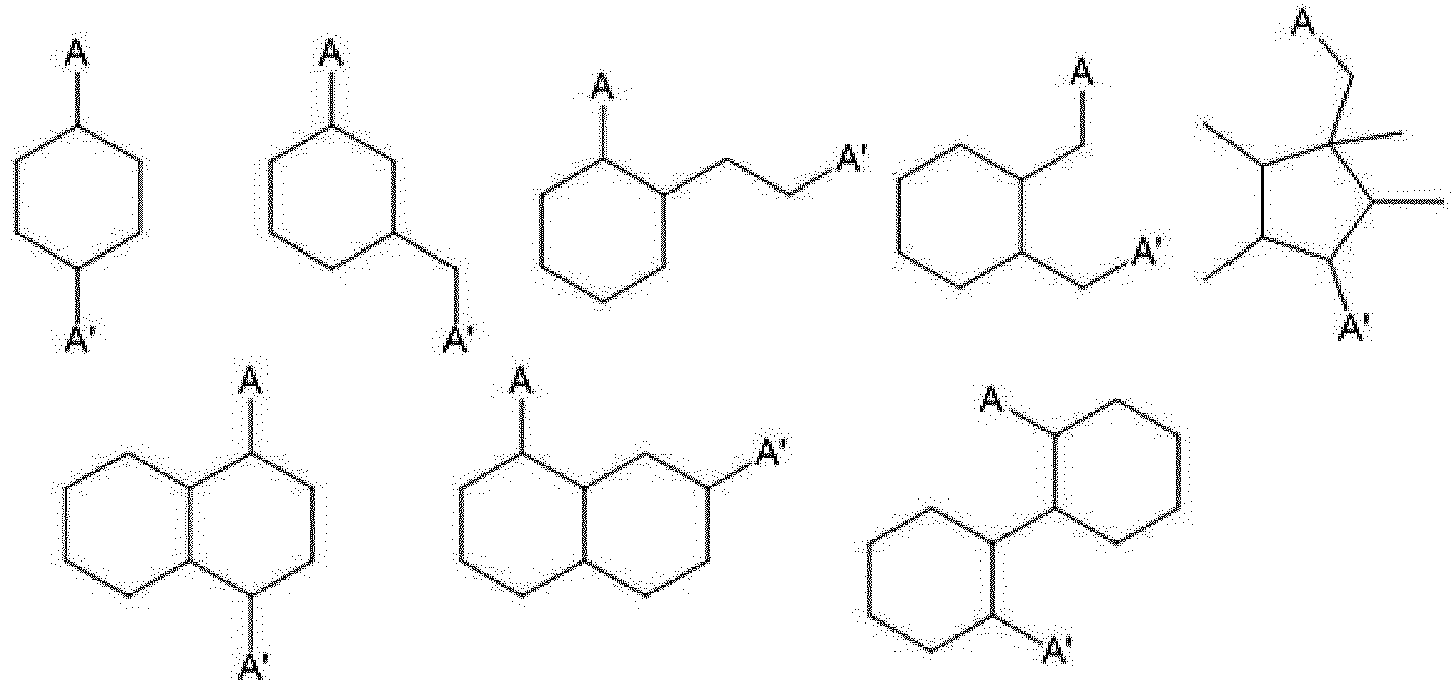
- (iii) a compound having a group linking five or more carbon atoms between a plurality of A:


- The ligand compound according to the present invention may be implemented by various combinations in the range satisfying the above-mentioned conditions in addition to the compounds of the above examples. And, the ligand compound can be synthesized by applying known reactions, and the detailed synthesis method will be described in detail in Examples section.
- Meanwhile, according to another aspect of the present invention, there is provided an organic chromium compound including the above-mentioned ligand compound and chromium (Cr).
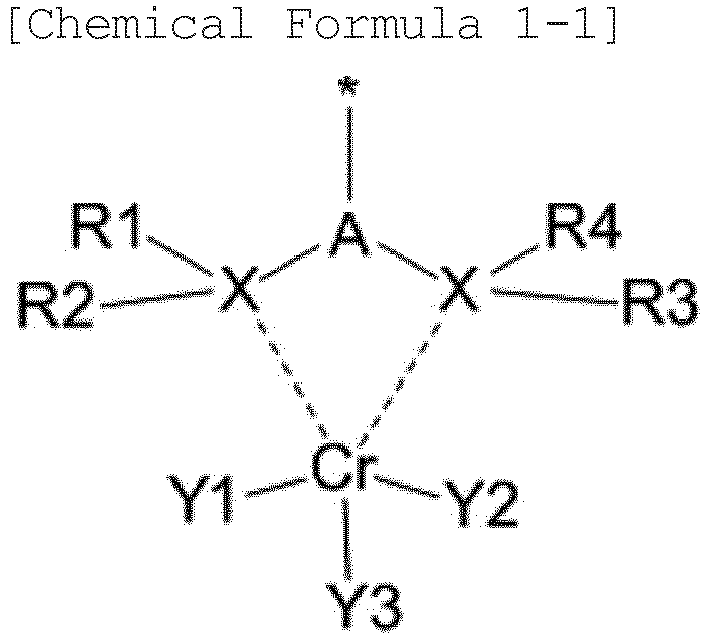
- The organic chromium compound may be a compound having a chromium atom as a central metal in which the aforementioned ligand compound is coordinated, and may include, for example, a group represented by the following chemical formula 1-1.


- * means that the group represented by Chemical Formula 1-1 is a radical,
- A is boron (B), nitrogen (N), phosphorus (P) or antimony (Sb),
- each X is independently phosphorus (P), arsenic (As), or antimony (Sb),
- R1 to R4 are each independently an aryl group having 6 to 20 carbon atoms in which at least one substituent selected from the group consisting of an alkyl group, an alkoxy group, an alkylsulfanyl group and an alkylsilyl group is optionally substituted or bonded at meta or para position;
- Cr is chromium, and
- Y1 to Y3 are each independently a halogen, a hydrogen, a hydrocarbyl having 1 to 10 carbon atoms, or a heterohydrocarbyl having 1 to 10 carbon atoms.
- The organic chromium compound may be a chromium complex compound of the above-mentioned ligand compound, and may have a structure in which the chromium of the source of chromium forms a coordinate bond with the X moiety of the group represented by Chemical Formula 1. Such organic chromium compounds can be applied to catalyst systems for the oligomerization reaction of olefins and thus exhibit excellent catalytic activity and high selectivity to 1-hexene or 1-octene.
- In Chemical Formula 1-1, details and specific examples about X and R1 to R4 are the same as described for the ligand compound of Chemical Formula 1.
- Meanwhile, according to another aspect of the present invention, there is provided a catalyst system for olefin oligomerization i) comprising a source of chromium, the above-described ligand compound and a cocatalyst; or ii) comprising an organic chromium compound including a group represented by the following chemical formula 1-1, and a cocatalyst.

- * means that the group represented by Chemical Formula 1-1 is a radical,
- A is boron (B), nitrogen (N), phosphorus (P) or antimony (Sb),
- each X is independently phosphorus (P), arsenic (As), or antimony (Sb),
- R1 to R4 are each independently an aryl group having 6 to 20 carbon atoms in which at least one substituent selected from the group consisting of an alkyl group, an alkoxy group, an alkylsulfanyl group and an alkylsilyl group is optionally substituted or bonded at the meta or para position;
- Cr is chromium, and
- Y1 to Y3 are each independently a halogen, a hydrogen, a hydrocarbyl having 1 to 10 carbon atoms, or a heterohydrocarbyl having 1 to 10 carbon atoms.
- Details and specific examples about the ligand compound and the organic chromium compound are the same as disclosed above.
- According to one embodiment, the catalyst system for olefin oligomerization may be i) a tricomponent catalyst system including a source of chromium , the above-described ligand compound, and a cocatalyst, or ii) a bicomponent catalyst system including the above-described organic chromium compound and a cocatalyst.
- In the catalyst system, the source of chromium may be an organic or inorganic chromium compound having an oxidation state of chromium of 0 to 6, and examples thereof include a chromium metal, or a compound in which any organic or inorganic radical is bonded to chromium. Here, the organic radicals may be alkyl, alkoxy, ester, ketone, amido, carboxylate radicals having 1 to 20 carbon atoms per radical, and the inorganic radicals may be halides, sulfates, oxides, and the like.
- Preferably, the source of chromium is a compound which can exhibit a high activity for oligomerization of olefins and which is easily usable and available. The source of chromium may be at least one compound selected from the group consisting of chromium (III) acetylacetonate, chromium (III) chloride tetrahydrofuran, chromium (III) 2-ethylhexanoate, chromium (III) acetate, chromium (III) butyrate, chromium (III) pentanoate, chromium (III) laurate, chromium (III) tris(2,2,6,6-tetramethyl-3,5-heptenedionate), and chromium (III) stearate.
- Preferably, the cocatalyst is an organic metal compound including a Group 13 metal, and any cocatalyst can be used without particular limitation as long as it is any compound which can be generally used for polymerizing an olefin in the presence of a catalyst of a transition metal compound.
- For example, the cocatalyst may be at least one compound selected from the group consisting of compounds represented by the following chemical formulas 4 to 6:
[Chemical Formula 4] -[Al(Rx)-O]c-
in Chemical Formula 4, Rx is the same or different and is each independently a halogen radical, a hydrocarbyl radical having 1 to 20 carbon atoms, or a hydrocarbyl radical having 1 to 20 carbon atoms substituted with a halogen, and c is an integer of 2 or more,
[Chemical Formula 5] D(RY)3
in Chemical Formula 5, D is aluminum or boron, Ry is hydrocarbyl having 1 to 20 carbon atoms or hydrocarbyl having 1 to 20 carbon atoms substituted with halogen,
[Chemical Formula 6] [L-H]+[Q(E)4]-
in Chemical Formula 6,
L is a neutral Lewis base, [L-H]+ is a Bronsted acid, Q is boron or aluminum of a +3 oxidation state, and each E is independently a C6-C20 aryl group or a C1-C20 alkyl group of which at least one hydrogen is substituted or unsubstituted with a halogen, a C1-C20 hydrocarbyl, an alkoxy functional group, or a phenoxy functional group. - According to one embodiment, the compound represented by Chemical Formula 4 may be an alkyl aluminoxane such as methyl aluminoxane, ethyl aluminoxane, isobutyl aluminoxane, butyl aluminoxane, and the like.
- According to one embodiment, the compound represented by Chemical Formula 5 may be trimethylaluminum, triethylaluminum, triisobutylaluminum, tripropylaluminum, tributylaluminum, dimethylchloroaluminum, dimethylisobutylaluminum, dimethylethylaluminum, diethylchloroaluminum, triisopropylaluminum, tri-s-butylaluminum, tricyclopentylaluminum, tripentylaluminum, triisopentylaluminum, trihexylaluminum, ethyldimethylaluminum, methyldiethylaluminum, triphenylaluminum, tri-p-tolylaluminum, dimethylaluminummethoxide, dimethylaluminumethoxide, trimethylboron, triethylboron, triisobutylboron, tripropylboron, tributylboron, and so on.
- Furthermore, according to one embodiment, the compound represented by Chemical Formula 6 may be triethylammonium tetraphenylborate, tributylammonium tetraphenylborate, trimethylammonium tetraphenylborate, tripropylammonium tetraphenylborate, trimethylammonium tetra(p-tolyl)borate, tripropylammonium tetra(p-tolyl)borate, triethylammonium tetra(o,p-dimethylphenyl)borate, trimethylammonium tetra(o,p-dimethylphenyl)borate, tributylammonium tetra(p-trifluoromethylphenyl)borate, trimethylammonium tetra(p-trifluoromethylphenyl)borate, tributylammonium tetrapentafluorophenylborate, N,N-diethylanilinium tetraphenylborate, N,N-diethylanilinium tetraphenylborate, N,N-diethylanilinium tetrapentafluorophenylborate, diethylammonium tetrapentafluorophenylborate, triphenylphosphonium tetraphenylborate, trimethylphosphonium tetraphenylborate, triethylammonium tetraphenylaluminum, tributylammonium tetraphenylaluminum, trimethylammonium tetraphenylaluminum, tripropylammonium tetraphenylaluminum, trimethylammonium tetra(p-tolyl)aluminum, tripropylammonium tetra(p-tolyl)aluminum, triethylammonium tetra(o,p-dimethylphenyl)aluminum, tributylammonium tetra(p-trifluoromethylphenyl)aluminum, trimethylammonium tetra(p-trifluoromethylphenyl)aluminum, tributylammonium tetrapentafluorophenylaluminum, N,N-diethylanilinium tetraphenylaluminum, N,N-diethylanilinium tetraphenylaluminum, N,N-diethylanilinium tetrapentafluorophenylaluminum, diethylammonium tetrapentafluorophenylaluminum, triphenylphosphonium tetraphenylaluminum, trimethylphosphonium tetraphenylaluminum, triphenylcarbonium tetraphenylborate, triphenylcarbonium tetraphenylaluminum, triphenylcarbonium tetra(p-trifluoromethylphenyl)borate, triphenylcarbonium tetrapentafluorophenylborate, and so on.
- Moreover, as a non-limiting example, the cocatalyst may be an organic aluminum compound, an organic boron compound, an organic magnesium compound, an organic zinc compound, an organic lithium compound, or a mixture thereof. According to one embodiment, the cocatalyst is preferably an organic aluminum compound, more preferably at least one compound selected from the group consisting of trimethyl aluminum, triethyl aluminum, triisopropyl aluminum, triisobutyl aluminum, ethylaluminum sesquichloride, diethylaluminum chloride, ethyl aluminum dichloride, methyl aluminoxane, and modified methyl aluminoxane.
- Meanwhile, the content ratio of the components constituting the catalyst system may be determined by considering the catalytic activity and the selectivity to linear alpha-olefins. According to one embodiment, when the catalyst system is a tricomponent catalyst system, it is preferable that the mole ratio of diphosphino aminyl moiety of the ligand compound : the source of chromium : the cocatalyst is controlled to be about 1:1:1 to 10:1:10,000, or about 1:1:100 to 5:1:3,000. Further, when the catalyst system is a bicomponent catalyst system, it is preferable that the mole ratio of diphosphino aminyl moiety of the organic chromium compound to the cocatalyst is controlled to be 1:1 to 1:10,000, or 1:1 to 1:5,000, or 1:1 to 1:3,000.
- The components constituting the catalyst system may be mixed at the same time or in an arbitrary order in the presence or absence of a proper solvent and a monomer for acting as an active catalyst system. In this case, the proper solvent may be heptane, toluene, cyclohexane, mehtylcyclohexane, 1-hexene, 1-octene, diethylether, tetrahydrofuran, acetonitrile, dichloromethane, chloroform, chlorobenzene, methanol, acetone, and so on.
- Further, according to an embodiment of the present invention, the catalyst system may further include a supporting material. That is, the ligand compound of Chemical Formula 1 may be applied to the oligomerization of ethylene in the form of being supported on the supporting material. The supporting material may be metals, metal salts, metal oxides, or the like, which are commonly applied to a supported catalyst. By way of non-limiting examples, the supporting material may be silica, silica-alumina, silica-magnesia, and the like, and may include oxides, carbonates, sulfates, nitrates of metals such as Na2O, K2CO3, BaSO4, and Mg(NO3)2.
- Such catalyst system can preferably be used for the tetramerization reaction of ethylene, and it becomes possible to prepare 1-octene with high selectivity as mentioned above.
- Meanwhile, according to another aspect of the present invention, there is provided a method for oligomerizing an olefin, comprising the step of carrying out an oligomerization reaction of an olefin in the presence of the above-described catalyst system to form an alpha-olefin.
- Preferably, the above oligomerization reaction of olefin can be a tetramerization reaction of ethylene, and may result in the formation of 1-octene as the reaction product.
- The method for oligomerization of olefin according to the present invention may be carried out by using an olefin (for example, ethylene) as a raw material and applying the above-mentioned catalyst system and a common device and contact technology. By way of non-limiting examples, the oligomerization reaction of olefin may be carried out by a homogeneous liquid phase reaction in the presence or absence of an inert solvent, by a slurry reaction using the catalyst system that is partially or not totally dissolved, by a bulk reaction in which the alpha-olefin, the product, acts as a main medium, or by a gas phase reaction.
- Further, the oligomerization reaction of olefin may be carried out in the presence of an inert solvent. By way of non-limiting examples, the inert solvent may be benzene, toluene, xylene, cumene, chlorobenzene, dichlorobenzene, heptane, cyclohexane, methylcyclohexane, methylcyclopentane, n-hexane, 1-hexene, 1-octene, and so on.
- The oligomerization reaction of olefin may be carried out at a temperature of about 0 to about 200°C, or about 0 to about 150°C, about 30 to about 100°C, or about 50 to about 100°C. Furthermore, the reaction may be carried out at a pressure of about 15 to about 3,000 psig, or about 15 to about 1,500 psig, or about 15 to about 1,000 psig.
- Hereinafter, the action and effect of the present invention will be described in more detail by way of specific Examples. However, these Examples are given for illustrative purposes only, and the scope of the invention is not intended to be limited by these Examples.
- In the following, all the reactions were performed using Schlenk technique or a glovebox under argon. The synthesized ligands were analyzed by 1H (500 MHz) and 31P (202 MHz) NMR spectra using a Varian 500 MHz spectrometer. Shift was expressed in ppm, downfield from TMS, with a residual solvent peak as a reference. Phosphorous probe was calibrated with aqueous H3PO4.
-

- 2-ethyl-6-methylaniline (10 mmol) and triethylamine (3 equiv. to amine) were dissolved in dichloromethane (80 mL) under an argon atmosphere. While a flask was immersed in a water bath, chlorobis(3,5-dimethylphenyl)phosphine (20 mmol) was slowly added thereto, and the mixture was stirred overnight. After the solvent was removed under vacuum, diethyl ether, tetrahydrofuran or hexane was added as other solvent to the mixture, thoroughly stirred and filtered with an air-free glass filter to remove triethylammonium chloride salt. The solvent was removed from the filtrate to yield a final product.
31P NMR (202 MHz, CDCl3) : 49.6 (br m), 53.8 (br m), 61.8 (br s) -

- 2-Ethyl-6-methylaniline (10 mmol) and triethylamine (3 equiv. to amine) were dissolved in dichloromethane (80 mL) under an argon atmosphere. While a flask was immersed in a water bath, chlorobis(3-methylphenyl)phosphine (20 mmol) was slowly added thereto, and the mixture was stirred overnight. After the solvent was removed under vacuum, diethyl ether, tetrahydrofuran or hexane was added as other solvent to the mixture, thoroughly stirred and filtered with an air-free glass filter to remove triethylammonium chloride salt. The solvent was removed from the filtrate to yield a final product.
31P NMR (202 MHz, CDCl3) : 56.2 (br s) -

- 2-Ethyl-6-methylaniline (10 mmol) and triethylamine (3 equiv. to amine) were dissolved in dichloromethane (80 mL) under an argon atmosphere. While a flask was immersed in a water bath, chlorobis(3,4-dimethylphenyl)phosphine (20 mmol) was slowly added thereto, and the mixture was stirred overnight. After the solvent was removed under vacuum, diethyl ether, tetrahydrofuran or hexane was added as other solvent to the mixture, thoroughly stirred and filtered with an air-free glass filter to remove triethylammonium chloride salt. The solvent was removed from the filtrate to yield a final product.
31P NMR (202 MHz, CDCl3) : 50.0 (m) -

- 2-Isopropylcyclohexan-1-amine (10 mmol) and triethylamine (3 equiv. to amine) were dissolved in dichloromethane (80 mL) under an argon atmosphere. While a flask was immersed in a water bath, chlorobis(3,5-dimethylphenyl)phosphine (20 mmol) was slowly added thereto, and the mixture was stirred overnight. After the solvent was removed under vacuum, diethyl ether, tetrahydrofuran or hexane was added as other solvent to the mixture, thoroughly stirred and filtered with an air-free glass filter to remove triethylammonium chloride salt. The solvent was removed from the filtrate to yield a final product.
31P NMR (202 MHz, CDCl3) : 52.3 (s) -

- 2-Isopropylcyclohexan-1-amine (10 mmol) and triethylamine (3 equiv. to amine) were dissolved in dichloromethane (80 mL) under an argon atmosphere. While a flask was immersed in a water bath, chlorobis(3-methylphenyl)phosphine (20 mmol) was slowly added thereto, and the mixture was stirred overnight. After the solvent was removed under vacuum, diethyl ether, tetrahydrofuran or hexane was added as other solvent to the mixture, thoroughly stirred and filtered with an air-free glass filter to remove triethylammonium chloride salt. The solvent was removed from the filtrate to yield a final product.
31P NMR (202 MHz, CDCl3) : 51.8 (br s) -

- 2-Isopropylcyclohexan-1-amine (10 mmol) and triethylamine (3 equiv. to amine) were dissolved in dichloromethane (80 mL) under an argon atmosphere. While a flask was immersed in a water bath, chlorobis(3,4-dimethylphenyl)phosphine (20 mmol) was slowly added thereto, and the mixture was stirred overnight. After the solvent was removed under vacuum, diethyl ether, tetrahydrofuran or hexane was added as other solvent to the mixture, thoroughly stirred and filtered with an air-free glass filter to remove triethylammonium chloride salt. The solvent was removed from the filtrate to yield a final product.
31P NMR (202 MHz, CDCl3) : 54.5 (br s) -

- 2-Aminopropane (10 mmol) and triethylamine (3 to 10 equiv. to amine) were dissolved in dichloromethane (80 mL) under an argon atmosphere. While a flask was immersed in a water bath, chlorodiphenylphosphine (20 mmol) was slowly added thereto, and the mixture was stirred overnight. After the solvent was removed under vacuum, tetrahydrofuran was added to the mixture, thoroughly stirred and filtered with an air-free glass filter to remove triethylammonium chloride salt. The solvent was removed from the filtrate to yield a final product.
31P NMR (202 MHz, CDCl3) : 48.4 (br s) -

- 3-(Aminomethyl)-3,5,5-trimethylcyclohexanamine (5 mmol) and triethylamine (3 to 10 equiv. to amine) were dissolved in dichloromethane (80 mL) under an argon atmosphere. While a flask was immersed in a water bath, chlorodiphenylphosphine (20 mmol) was slowly added thereto, and the mixture was stirred overnight. After the solvent was removed under vacuum, tetrahydrofuran was added to the mixture, thoroughly stirred and filtered with an air-free glass filter to remove triethylammonium chloride salt. The solvent was removed from the filtrate to yield a final product.
31P NMR (202 MHz, CDCl3) : 45.6 (br s), 56.2 (br s) - Chromium (III) acetylacetonate (17.5 mg, 0.05 mmol) and the ligand compound (0.025 mmol) according to Synthesis Examples and Comparative Synthesis Examples were added to a flask under an argon gas atmosphere, to which 10 ml of cyclohexane was added, and the mixture was stirred to prepare a 5 mM (based on Cr) catalyst solution.
- A 600 mL Parr reactor was prepared, vacuum was applied at 120°C for 2 hours, and then, the inside was replaced with argon, and the temperature was decreased to 60°C. After that, 180 ml of cyclohexane and 2 ml of MMAO(isoheptane solution, Al/Cr=1200) were injected, and 0.5 ml (2.5 µmol Cr) of the catalyst solution was injected. The mixture was stirred at 500 rpm for 2 minutes, and then, a valve of an ethylene line adjusted to 60 bar was opened to fill the inside of the reactor with ethylene, followed by removing heat to 45°C, and stirring at 500 rpm for 15 minutes. The ethylene line valve was closed, the reactor was cooled to 0°C with a dry ice/acetone bath, and then, non-reacted ethylene was slowly vented, and 0.5 ml of nonane(GC internal standard) was injected. After stirring for 10 seconds, 2 mL of the liquid part of the reactor was taken and quenched with water, the obtained organic part was filtered with a PTFE syringe filter to make a GC-FID sample. And, the distribution of liquid product was was analyzed by GC. In addition, to the remaining reaction solution, 400 mL of ethanol/HCl (10 vol% of aqueous 12 M HCl solution) was added, and the mixture was stirred and filtered, and the amount of solids was analyzed. The resulting polymer was dried overnight in a 65°C vacuum oven.
- The results of Examples and Comparative Examples are summarized in table below.
[Table 1] Activit y 1-C6 1-C8 C10-C40 HAO HAO+ PE C6 iso. C8 iso. Total ton/mol Cr/hr wt% wt% wt% wt% wt% wt% wt% wt% wt% Example 1 156 39.2 52.6 6.4 91.9 98.3 0.1 1 0.3 99.8 Example 2 308 35.6 56.4 5.8 92 97.7 0.2 1.4 0.4 99.7 Example 3 212 19.2 68.6 9 87.8 96.8 0.6 1.6 0.4 99.6 Example 4 110 42.1 50.6 5.8 92.7 98.5 0.4 0.66 0.17 99.8 Example 5 254 60.4 31.9 6.7 92.3 98.9 0.03 0.7 0.2 99.8 Example 6 44 42.4 49.9 5.4 92.3 97.7 0.8 0.9 0.2 99.6 Comparat ive Example 1a 4 11.2 68.8 - 80.7 - 0.5 4.5 - - Comparat ive Example 2 162 49.5 40.5 5.9 90 95.9 1.6 1.5 0.3 99.3 Comparative Example 1a = 45°C / 45 bar, Cr(acac)3 / [cat] = 0.014 mM / Al/Cr = 1200 (MMAO) / 60°C / 60 bar / 15 min - Referring to Table 1, it was confirmed that Examples of the present invention exhibited improved selectivity to HAO (higher alpha olefin) as compared with Comparative Examples, and that the content of PE wax, a solid alpha-olefin, was decreased.
- That is, when an aryl group substituted with a different substituent was included in the diphosphine group of the ligand compound having a specific structure as in the present invention, the selectivity to alpha-olefin (1-hexene and 1-octene) could be improved, and the amount of PE wax which is an alpha-olefin and a solid alpha-olefin in the form of an undesirable isomer could be reduced.
Claims (13)
- A ligand compound containing at least one group represented by the following chemical formula 1 in a molecule:
 * means that the group represented by Chemical Formula 1 is a radical,A is boron (B), nitrogen (N), phosphorus (P) or antimony (Sb),each X is independently phosphorus (P), arsenic (As), or antimony (Sb),R1 to R4 are each independently an aryl group having 6 to 20 carbon atoms in which at least one substituent selected from the group consisting of an alkyl group, an alkoxy group, an alkylsulfanyl group and an alkylsilyl group is optionally substituted or bonded at the meta or para position.
 - The ligand compound of claim 1, wherein R1 to R4 in Chemical Formula 1 are each independently an aryl group having 6 to 20 carbon atoms in which at least one substituent selected from the group consisting of an alkyl group having 1 to 10 carbon atoms, an alkoxy group having 1 to 10 carbon atoms, an alkylsulfanyl group having 1 to 10 carbon atoms, and an alkylsilyl group having 1 to 10 carbon atoms is substituted or bonded.
- The ligand compound of claim 1, wherein R1 to R4 in Chemical Formula 1 are each independently a phenyl group having 6 to 20 carbon atoms in total in which only one of the meta positions of the X-linking moiety is substituted or bonded by at least one substituent selected from the group consisting of an alkyl group having 1 to 10 carbon atoms, an alkoxy group having 1 to 10 carbon atoms, an alkylsulfanyl group having 1 to 10 carbon atoms, and an alkylsilyl group having 1 to 10 carbon atoms.
- The ligand compound of claim 1, wherein R1 to R4 in Chemical Formula 1 are each independently a phenyl group having 6 to 20 carbon atoms in total in which at least two of the meta and para positions of the X-linking moiety is substituted or bonded by at least one substituent selected from the group consisting of an alkyl group having 1 to 10 carbon atoms, an alkoxy group having 1 to 10 carbon atoms, an alkylsulfanyl group having 1 to 10 carbon atoms, and an alkylsilyl group having 1 to 10 carbon atoms.
- The ligand compound of claim 1, wherein X in Chemical Formula 1 is phosphorus (P), A is nitrogen (N) and the moieties represented by (R1)(R2)X- and (R3)(R4)X- in Chemical Formula 1 are represented by the following structural formulas.


- An organic chromium compound comprising the ligand compound of any one of claims 1 to 5 and chromium (Cr).
- The organic chromium compound of claim 6, including a group represented by the following chemical formula 1-1.
 * means that the group represented by Chemical Formula 1-1 is a radical,A is boron (B), nitrogen (N), phosphorus (P) or antimony (Sb),each X is independently phosphorus (P), arsenic (As), or antimony (Sb),R1 to R4 are each independently an aryl group having 6 to 20 carbon atoms in which at least one substituent selected from the group consisting of an alkyl group, an alkoxy group, an alkylsulfanyl group and an alkylsilyl group is optionally substituted or bonded at the meta or para position;Cr is chromium, andY1 to Y3 are each independently a halogen, a hydrogen, a hydrocarbyl having 1 to 10 carbon atoms, or a heterohydrocarbyl having 1 to 10 carbon atoms.
 - A catalyst system for olefin oligomerization i) comprising a source of chromium, the ligand compound of any one of claims 1 to 5 and a cocatalyst; or ii) comprising an organic chromium compound including a group represented by the following chemical formula 1-1, and a cocatalyst.

 * means that the group represented by Chemical Formula 1-1 is a radical,A is boron (B), nitrogen (N), phosphorus (P) or antimony (Sb),each X is independently phosphorus (P), arsenic (As), or antimony (Sb),R1 to R4 are each independently an aryl group having 6 to 20 carbon atoms in which at least one substituent selected from the group consisting of an alkyl group, an alkoxy group, an alkylsulfanyl group and an alkylsilyl group is optionally substituted or bonded at the meta or para position;Cr is chromium, andY1 to Y3 are each independently a halogen, a hydrogen, a hydrocarbyl having 1 to 10 carbon atoms, or a heterohydrocarbyl having 1 to 10 carbon atoms.
 - The catalyst system for olefin oligomerization of claim 8, wherein the source of chromium inlcudes at least one selected from the group consisting of chromium (III) acetylacetonate, chromium (III) chloride tetrahydrofuran, chromium (III) 2-ethylhexanoate, chromium (III) acetate, chromium (III) butyrate, chromium (III) pentanoate, chromium (III) laurate, chromium (III) tris(2,2,6,6-tetramethyl-3,5-heptenedionate), and chromium (III) stearate.
- The catalyst system for olefin oligomerization of claim 8, wherein the cocatalyst includes at least one selected from the group consisting of trimethyl aluminum, triethyl aluminum, triisopropyl aluminum, triisobutyl aluminum, ethylaluminum sesquichloride, diethylaluminum chloride, ethyl aluminum dichloride, methyl aluminoxane, and modified methyl aluminoxane.
- The catalyst system of claim 8 for use in a tetramerization reaction of ethylene.
- A method for oligomerizing an olefin, comprising the step of carrying out an oligomerization reaction of an olefin in the presence of the catalyst system of claim 8 to form an alpha-olefin.
- A method for preparing 1-octene, comprising the step of carrying out a tetramerization reaction of ethylene in the presence of the catalyst system of claim 8 to form 1-octene.
Applications Claiming Priority (3)
| Application Number | Priority Date | Filing Date | Title |
|---|---|---|---|
| KR20150083650 | 2015-06-12 | ||
| KR1020150182257A KR101757835B1 (en) | 2015-06-12 | 2015-12-18 | Ligand compound, organic chromium compound, catalyst system for oligomerization of olefins and method for oligomerization of olefins using the catalyst system |
| PCT/KR2015/014032 WO2016200000A1 (en) | 2015-06-12 | 2015-12-21 | Ligand compound, organic chrome compound, catalyst system for olefin oligomerization, and method for olefin oligomerization using same |
Publications (3)
| Publication Number | Publication Date |
|---|---|
| EP3260460A1 true EP3260460A1 (en) | 2017-12-27 |
| EP3260460A4 EP3260460A4 (en) | 2018-11-14 |
| EP3260460B1 EP3260460B1 (en) | 2021-09-08 |
Family
ID=57735024
Family Applications (1)
| Application Number | Title | Priority Date | Filing Date |
|---|---|---|---|
| EP15895068.3A Active EP3260460B1 (en) | 2015-06-12 | 2015-12-21 | Ligand compound, organic chrome compound, catalyst system for olefin oligomerization, and method for olefin oligomerization using same |
Country Status (5)
| Country | Link |
|---|---|
| US (1) | US10392451B2 (en) |
| EP (1) | EP3260460B1 (en) |
| JP (1) | JP6507262B2 (en) |
| KR (1) | KR101757835B1 (en) |
| CN (1) | CN107438616B (en) |
Cited By (4)
| Publication number | Priority date | Publication date | Assignee | Title |
|---|---|---|---|---|
| EP3225637B1 (en) * | 2015-05-15 | 2020-02-05 | LG Chem, Ltd. | Catalytic system for olefin oligomerization reaction and method for olefin oligomerization using same |
| EP3805240A4 (en) * | 2018-06-07 | 2021-06-30 | Ajou University Industry-Academic Cooperation Foundation | BISPHOSPHINE LIGAND COMPOUND, CHROME COMPOUND, ETHYLENE OLIGOMERIZATION CATALYST SYSTEM AND ETHYLENE OLIGOMER PREPARATION PROCESS |
| CN114395056A (en) * | 2022-02-16 | 2022-04-26 | 青岛科技大学 | Preparation of NNO-coordinated chromium metal catalyst and application of NNO-coordinated chromium metal catalyst in olefin polymerization |
| EP4450511A4 (en) * | 2022-03-14 | 2025-04-16 | LG Chem, Ltd. | LIGAND COMPOUND, ORGANIC CHROMIUM COMPOUND AND CATALYTIC COMPOSITION COMPRISING SAME |
Families Citing this family (7)
| Publication number | Priority date | Publication date | Assignee | Title |
|---|---|---|---|---|
| KR102185162B1 (en) * | 2019-05-09 | 2020-12-01 | 아주대학교산학협력단 | Chromium complex, ethylene oligomerization catalyst system using the same and manufacturing method for ethylene oligomer |
| KR102087994B1 (en) * | 2018-06-07 | 2020-03-12 | 아주대학교산학협력단 | Method for preparing ethylene tetramerization catalyst system, ethylene tetramerization catalyst system, manufacturing method for ethylene tetramer and bisphosphine ligand compound |
| CN115989233A (en) * | 2020-09-15 | 2023-04-18 | 株式会社Lg化学 | Ligand compound, organochromium compound and catalyst system comprising same |
| CN113773430B (en) * | 2021-09-13 | 2023-01-13 | 万华化学集团股份有限公司 | Preparation method of alpha-olefin copolymer |
| CN114315905B (en) * | 2021-12-28 | 2023-10-20 | 万华化学集团股份有限公司 | Preparation of a PCPN ligand, ethylene oligomerization catalyst and its application |
| KR20230100968A (en) * | 2021-12-29 | 2023-07-06 | 한화토탈에너지스 주식회사 | Method for ethylene oligomerization and ethylene oligomer thereof |
| WO2023177130A1 (en) * | 2022-03-14 | 2023-09-21 | 주식회사 엘지화학 | Ligand compound, organic chrome compound, and catalyst composition comprising same |
Family Cites Families (23)
| Publication number | Priority date | Publication date | Assignee | Title |
|---|---|---|---|---|
| GB9918635D0 (en) * | 1999-08-06 | 1999-10-13 | Bp Chem Int Ltd | Polymerisation process |
| GB0016895D0 (en) | 2000-07-11 | 2000-08-30 | Bp Chem Int Ltd | Olefin oligomerisation |
| CA2509700A1 (en) * | 2002-12-20 | 2004-07-08 | Sasol Technology (Pty) Limited | Tandem tetramerisation-polymerisation of olefins |
| JP2006511625A (en) * | 2002-12-20 | 2006-04-06 | サソル テクノロジー (ピーティーワイ) リミテッド | Tetramerization of olefins |
| KR20060002742A (en) | 2002-12-20 | 2006-01-09 | 사솔 테크날러지 (프로프라이어터리) 리미티드 | Tetramerization of Olefin |
| CN101052605B (en) * | 2004-06-18 | 2011-12-21 | Sasol技术股份有限公司 | Oligomerisation of olefinic compounds in an aliphatic medium |
| CN1651142A (en) | 2004-12-27 | 2005-08-10 | 中国石油大庆石化分公司研究院 | Catalyst component used for ethylene oligomerization, preparing process and application thereof |
| US7323611B2 (en) * | 2005-06-28 | 2008-01-29 | Sumitomo Chemical Company Limited | Process for producing olefin oligomer |
| CN100443178C (en) | 2006-03-10 | 2008-12-17 | 中国石油天然气股份有限公司 | Catalyst composition for ethylene oligomerization and application thereof |
| WO2008004986A1 (en) | 2006-07-05 | 2008-01-10 | National University Of Singapore | Catalyst system for oligomerization of olefins |
| KR101074202B1 (en) | 2007-01-18 | 2011-10-14 | 에스케이종합화학 주식회사 | Ethylene tetramerization catalyst systems and method for preparing 1-octene using the same |
| KR101074223B1 (en) | 2007-01-18 | 2011-10-14 | 에스케이종합화학 주식회사 | Ethylene trimerization catalyst systems and method for preparing 1-hexene using the same |
| JP5158726B2 (en) | 2007-07-11 | 2013-03-06 | リンデ アーゲー | Catalyst composition and process for di-, tri- and / or tetramerization of ethylene |
| KR101057576B1 (en) | 2007-08-16 | 2011-08-17 | 에스케이종합화학 주식회사 | Selective Ethylene Oligomerization Catalyst System |
| MY150515A (en) | 2007-11-28 | 2014-01-30 | Linde Ag | Catalyst composition and process for oligomerization of ethylene |
| CA2639882C (en) | 2008-09-29 | 2016-07-12 | Nova Chemicals Corporation | Tetramerization |
| CN102040624B (en) * | 2009-10-19 | 2014-06-11 | 中国石油化工股份有限公司 | Method for synthesizing ligand for ethylene trimerization or tetramerization catalyst and ligand synthesized thereby and application thereof |
| CN102107146B (en) | 2009-12-29 | 2013-10-16 | 中国石油天然气股份有限公司 | A kind of catalyst and application thereof for ethylene trimerization into hexene-1 |
| US20120172645A1 (en) | 2010-12-29 | 2012-07-05 | Chevron Phillips Chemical Company Lp | Olefin Oligomerization catalysts and Methods of Making and Using Same |
| CN103285926A (en) | 2012-03-01 | 2013-09-11 | 中国石油天然气股份有限公司 | A kind of catalyst composition of ethylene oligomerization and its application |
| KR101638980B1 (en) | 2013-09-30 | 2016-07-12 | 주식회사 엘지화학 | Ligand compound, organic chromium compound, catalyst system for ethylene oligomerization and method for ethylene oligomerization using the same |
| KR101757370B1 (en) | 2015-06-01 | 2017-07-12 | 주식회사 엘지화학 | 1-Octene composition |
| WO2016195168A1 (en) | 2015-06-01 | 2016-12-08 | 주식회사 엘지화학 | 1-octene composition |
-
2015
- 2015-12-18 KR KR1020150182257A patent/KR101757835B1/en active Active
- 2015-12-21 EP EP15895068.3A patent/EP3260460B1/en active Active
- 2015-12-21 JP JP2017556205A patent/JP6507262B2/en active Active
- 2015-12-21 US US15/566,120 patent/US10392451B2/en active Active
- 2015-12-21 CN CN201580078751.8A patent/CN107438616B/en active Active
Cited By (5)
| Publication number | Priority date | Publication date | Assignee | Title |
|---|---|---|---|---|
| EP3225637B1 (en) * | 2015-05-15 | 2020-02-05 | LG Chem, Ltd. | Catalytic system for olefin oligomerization reaction and method for olefin oligomerization using same |
| EP3805240A4 (en) * | 2018-06-07 | 2021-06-30 | Ajou University Industry-Academic Cooperation Foundation | BISPHOSPHINE LIGAND COMPOUND, CHROME COMPOUND, ETHYLENE OLIGOMERIZATION CATALYST SYSTEM AND ETHYLENE OLIGOMER PREPARATION PROCESS |
| CN114395056A (en) * | 2022-02-16 | 2022-04-26 | 青岛科技大学 | Preparation of NNO-coordinated chromium metal catalyst and application of NNO-coordinated chromium metal catalyst in olefin polymerization |
| CN114395056B (en) * | 2022-02-16 | 2023-07-21 | 青岛科技大学 | Preparation of a NNO-coordinated chromium metal catalyst and its application in olefin polymerization |
| EP4450511A4 (en) * | 2022-03-14 | 2025-04-16 | LG Chem, Ltd. | LIGAND COMPOUND, ORGANIC CHROMIUM COMPOUND AND CATALYTIC COMPOSITION COMPRISING SAME |
Also Published As
| Publication number | Publication date |
|---|---|
| KR101757835B1 (en) | 2017-07-13 |
| US10392451B2 (en) | 2019-08-27 |
| CN107438616B (en) | 2022-01-11 |
| CN107438616A (en) | 2017-12-05 |
| JP6507262B2 (en) | 2019-04-24 |
| EP3260460A4 (en) | 2018-11-14 |
| KR20160146482A (en) | 2016-12-21 |
| US20180086860A1 (en) | 2018-03-29 |
| EP3260460B1 (en) | 2021-09-08 |
| JP2018515464A (en) | 2018-06-14 |
Similar Documents
| Publication | Publication Date | Title |
|---|---|---|
| EP3260460B1 (en) | Ligand compound, organic chrome compound, catalyst system for olefin oligomerization, and method for olefin oligomerization using same | |
| EP3257873B1 (en) | Method for preparing oligomerization catalyst system, and oligomerization catalyst system prepared by same | |
| EP3231808B1 (en) | Ligand compound, catalyst system for oligomerizing, and method for olefin oligomerization using same | |
| JP6427205B2 (en) | Ligand compound, organochromium compound, catalyst system for olefin oligomerization, and olefin oligomerization method using the same | |
| EP3190118B1 (en) | Ligand compound, organic chrome compound, catalyst system for olefin oligomerization, and method for oligomerizing olefin using same | |
| WO2016200000A1 (en) | Ligand compound, organic chrome compound, catalyst system for olefin oligomerization, and method for olefin oligomerization using same | |
| US10947256B2 (en) | Ligand compound, organic chromium compound, catalyst system for olefin oligomerizatin, and method for oligomerizing olefin using same | |
| JP6524330B2 (en) | 1-octene composition | |
| KR20170032766A (en) | Method for oligomerization of olefins | |
| KR20160110079A (en) | Catalyst system for oligomerization and method of olefin oligomerization | |
| KR102080285B1 (en) | Ligand compound, organic chromium compound, catalyst system for oligomerization of olefins and method for oligomerization of olefins using the catalyst system | |
| KR102086057B1 (en) | Organic chromium compound, catalyst system for oligomerization of olefins or polymerization of ehylene, and method for preparing olefin oligomer or polyehylene using the catalyst system |
Legal Events
| Date | Code | Title | Description |
|---|---|---|---|
| STAA | Information on the status of an ep patent application or granted ep patent |
Free format text: STATUS: THE INTERNATIONAL PUBLICATION HAS BEEN MADE |
|
| PUAI | Public reference made under article 153(3) epc to a published international application that has entered the european phase |
Free format text: ORIGINAL CODE: 0009012 |
|
| STAA | Information on the status of an ep patent application or granted ep patent |
Free format text: STATUS: REQUEST FOR EXAMINATION WAS MADE |
|
| 17P | Request for examination filed |
Effective date: 20170918 |
|
| AK | Designated contracting states |
Kind code of ref document: A1 Designated state(s): AL AT BE BG CH CY CZ DE DK EE ES FI FR GB GR HR HU IE IS IT LI LT LU LV MC MK MT NL NO PL PT RO RS SE SI SK SM TR |
|
| AX | Request for extension of the european patent |
Extension state: BA ME |
|
| DAV | Request for validation of the european patent (deleted) | ||
| DAX | Request for extension of the european patent (deleted) | ||
| A4 | Supplementary search report drawn up and despatched |
Effective date: 20181011 |
|
| RIC1 | Information provided on ipc code assigned before grant |
Ipc: C08F 4/69 20060101ALI20181005BHEP Ipc: C07F 9/00 20060101ALI20181005BHEP Ipc: C07F 9/28 20060101AFI20181005BHEP Ipc: C07F 9/90 20060101ALI20181005BHEP Ipc: C07F 9/46 20060101ALI20181005BHEP Ipc: C07C 2/08 20060101ALI20181005BHEP Ipc: C07F 11/00 20060101ALI20181005BHEP Ipc: C07F 9/655 20060101ALI20181005BHEP Ipc: C07F 7/00 20060101ALI20181005BHEP |
|
| STAA | Information on the status of an ep patent application or granted ep patent |
Free format text: STATUS: EXAMINATION IS IN PROGRESS |
|
| 17Q | First examination report despatched |
Effective date: 20200701 |
|
| GRAP | Despatch of communication of intention to grant a patent |
Free format text: ORIGINAL CODE: EPIDOSNIGR1 |
|
| STAA | Information on the status of an ep patent application or granted ep patent |
Free format text: STATUS: GRANT OF PATENT IS INTENDED |
|
| INTG | Intention to grant announced |
Effective date: 20210630 |
|
| GRAS | Grant fee paid |
Free format text: ORIGINAL CODE: EPIDOSNIGR3 |
|
| GRAA | (expected) grant |
Free format text: ORIGINAL CODE: 0009210 |
|
| STAA | Information on the status of an ep patent application or granted ep patent |
Free format text: STATUS: THE PATENT HAS BEEN GRANTED |
|
| AK | Designated contracting states |
Kind code of ref document: B1 Designated state(s): AL AT BE BG CH CY CZ DE DK EE ES FI FR GB GR HR HU IE IS IT LI LT LU LV MC MK MT NL NO PL PT RO RS SE SI SK SM TR |
|
| REG | Reference to a national code |
Ref country code: GB Ref legal event code: FG4D |
|
| REG | Reference to a national code |
Ref country code: CH Ref legal event code: EP Ref country code: AT Ref legal event code: REF Ref document number: 1428524 Country of ref document: AT Kind code of ref document: T Effective date: 20210915 |
|
| REG | Reference to a national code |
Ref country code: DE Ref legal event code: R096 Ref document number: 602015073206 Country of ref document: DE |
|
| REG | Reference to a national code |
Ref country code: IE Ref legal event code: FG4D |
|
| REG | Reference to a national code |
Ref country code: LT Ref legal event code: MG9D |
|
| REG | Reference to a national code |
Ref country code: NL Ref legal event code: MP Effective date: 20210908 |
|
| PG25 | Lapsed in a contracting state [announced via postgrant information from national office to epo] |
Ref country code: SE Free format text: LAPSE BECAUSE OF FAILURE TO SUBMIT A TRANSLATION OF THE DESCRIPTION OR TO PAY THE FEE WITHIN THE PRESCRIBED TIME-LIMIT Effective date: 20210908 Ref country code: RS Free format text: LAPSE BECAUSE OF FAILURE TO SUBMIT A TRANSLATION OF THE DESCRIPTION OR TO PAY THE FEE WITHIN THE PRESCRIBED TIME-LIMIT Effective date: 20210908 Ref country code: HR Free format text: LAPSE BECAUSE OF FAILURE TO SUBMIT A TRANSLATION OF THE DESCRIPTION OR TO PAY THE FEE WITHIN THE PRESCRIBED TIME-LIMIT Effective date: 20210908 Ref country code: LT Free format text: LAPSE BECAUSE OF FAILURE TO SUBMIT A TRANSLATION OF THE DESCRIPTION OR TO PAY THE FEE WITHIN THE PRESCRIBED TIME-LIMIT Effective date: 20210908 Ref country code: BG Free format text: LAPSE BECAUSE OF FAILURE TO SUBMIT A TRANSLATION OF THE DESCRIPTION OR TO PAY THE FEE WITHIN THE PRESCRIBED TIME-LIMIT Effective date: 20211208 Ref country code: NO Free format text: LAPSE BECAUSE OF FAILURE TO SUBMIT A TRANSLATION OF THE DESCRIPTION OR TO PAY THE FEE WITHIN THE PRESCRIBED TIME-LIMIT Effective date: 20211208 Ref country code: FI Free format text: LAPSE BECAUSE OF FAILURE TO SUBMIT A TRANSLATION OF THE DESCRIPTION OR TO PAY THE FEE WITHIN THE PRESCRIBED TIME-LIMIT Effective date: 20210908 Ref country code: ES Free format text: LAPSE BECAUSE OF FAILURE TO SUBMIT A TRANSLATION OF THE DESCRIPTION OR TO PAY THE FEE WITHIN THE PRESCRIBED TIME-LIMIT Effective date: 20210908 |
|
| REG | Reference to a national code |
Ref country code: AT Ref legal event code: MK05 Ref document number: 1428524 Country of ref document: AT Kind code of ref document: T Effective date: 20210908 |
|
| PG25 | Lapsed in a contracting state [announced via postgrant information from national office to epo] |
Ref country code: LV Free format text: LAPSE BECAUSE OF FAILURE TO SUBMIT A TRANSLATION OF THE DESCRIPTION OR TO PAY THE FEE WITHIN THE PRESCRIBED TIME-LIMIT Effective date: 20210908 Ref country code: GR Free format text: LAPSE BECAUSE OF FAILURE TO SUBMIT A TRANSLATION OF THE DESCRIPTION OR TO PAY THE FEE WITHIN THE PRESCRIBED TIME-LIMIT Effective date: 20211209 |
|
| PG25 | Lapsed in a contracting state [announced via postgrant information from national office to epo] |
Ref country code: AT Free format text: LAPSE BECAUSE OF FAILURE TO SUBMIT A TRANSLATION OF THE DESCRIPTION OR TO PAY THE FEE WITHIN THE PRESCRIBED TIME-LIMIT Effective date: 20210908 |
|
| PG25 | Lapsed in a contracting state [announced via postgrant information from national office to epo] |
Ref country code: IS Free format text: LAPSE BECAUSE OF FAILURE TO SUBMIT A TRANSLATION OF THE DESCRIPTION OR TO PAY THE FEE WITHIN THE PRESCRIBED TIME-LIMIT Effective date: 20220108 Ref country code: SM Free format text: LAPSE BECAUSE OF FAILURE TO SUBMIT A TRANSLATION OF THE DESCRIPTION OR TO PAY THE FEE WITHIN THE PRESCRIBED TIME-LIMIT Effective date: 20210908 Ref country code: SK Free format text: LAPSE BECAUSE OF FAILURE TO SUBMIT A TRANSLATION OF THE DESCRIPTION OR TO PAY THE FEE WITHIN THE PRESCRIBED TIME-LIMIT Effective date: 20210908 Ref country code: RO Free format text: LAPSE BECAUSE OF FAILURE TO SUBMIT A TRANSLATION OF THE DESCRIPTION OR TO PAY THE FEE WITHIN THE PRESCRIBED TIME-LIMIT Effective date: 20210908 Ref country code: PT Free format text: LAPSE BECAUSE OF FAILURE TO SUBMIT A TRANSLATION OF THE DESCRIPTION OR TO PAY THE FEE WITHIN THE PRESCRIBED TIME-LIMIT Effective date: 20220110 Ref country code: PL Free format text: LAPSE BECAUSE OF FAILURE TO SUBMIT A TRANSLATION OF THE DESCRIPTION OR TO PAY THE FEE WITHIN THE PRESCRIBED TIME-LIMIT Effective date: 20210908 Ref country code: NL Free format text: LAPSE BECAUSE OF FAILURE TO SUBMIT A TRANSLATION OF THE DESCRIPTION OR TO PAY THE FEE WITHIN THE PRESCRIBED TIME-LIMIT Effective date: 20210908 Ref country code: EE Free format text: LAPSE BECAUSE OF FAILURE TO SUBMIT A TRANSLATION OF THE DESCRIPTION OR TO PAY THE FEE WITHIN THE PRESCRIBED TIME-LIMIT Effective date: 20210908 Ref country code: CZ Free format text: LAPSE BECAUSE OF FAILURE TO SUBMIT A TRANSLATION OF THE DESCRIPTION OR TO PAY THE FEE WITHIN THE PRESCRIBED TIME-LIMIT Effective date: 20210908 Ref country code: AL Free format text: LAPSE BECAUSE OF FAILURE TO SUBMIT A TRANSLATION OF THE DESCRIPTION OR TO PAY THE FEE WITHIN THE PRESCRIBED TIME-LIMIT Effective date: 20210908 |
|
| REG | Reference to a national code |
Ref country code: DE Ref legal event code: R097 Ref document number: 602015073206 Country of ref document: DE |
|
| PLBE | No opposition filed within time limit |
Free format text: ORIGINAL CODE: 0009261 |
|
| STAA | Information on the status of an ep patent application or granted ep patent |
Free format text: STATUS: NO OPPOSITION FILED WITHIN TIME LIMIT |
|
| PG25 | Lapsed in a contracting state [announced via postgrant information from national office to epo] |
Ref country code: MC Free format text: LAPSE BECAUSE OF FAILURE TO SUBMIT A TRANSLATION OF THE DESCRIPTION OR TO PAY THE FEE WITHIN THE PRESCRIBED TIME-LIMIT Effective date: 20210908 Ref country code: DK Free format text: LAPSE BECAUSE OF FAILURE TO SUBMIT A TRANSLATION OF THE DESCRIPTION OR TO PAY THE FEE WITHIN THE PRESCRIBED TIME-LIMIT Effective date: 20210908 |
|
| REG | Reference to a national code |
Ref country code: CH Ref legal event code: PL |
|
| 26N | No opposition filed |
Effective date: 20220609 |
|
| PG25 | Lapsed in a contracting state [announced via postgrant information from national office to epo] |
Ref country code: SI Free format text: LAPSE BECAUSE OF FAILURE TO SUBMIT A TRANSLATION OF THE DESCRIPTION OR TO PAY THE FEE WITHIN THE PRESCRIBED TIME-LIMIT Effective date: 20210908 |
|
| REG | Reference to a national code |
Ref country code: BE Ref legal event code: MM Effective date: 20211231 |
|
| PG25 | Lapsed in a contracting state [announced via postgrant information from national office to epo] |
Ref country code: LU Free format text: LAPSE BECAUSE OF NON-PAYMENT OF DUE FEES Effective date: 20211221 Ref country code: IE Free format text: LAPSE BECAUSE OF NON-PAYMENT OF DUE FEES Effective date: 20211221 |
|
| PG25 | Lapsed in a contracting state [announced via postgrant information from national office to epo] |
Ref country code: BE Free format text: LAPSE BECAUSE OF NON-PAYMENT OF DUE FEES Effective date: 20211231 |
|
| PG25 | Lapsed in a contracting state [announced via postgrant information from national office to epo] |
Ref country code: LI Free format text: LAPSE BECAUSE OF NON-PAYMENT OF DUE FEES Effective date: 20211231 Ref country code: CH Free format text: LAPSE BECAUSE OF NON-PAYMENT OF DUE FEES Effective date: 20211231 |
|
| PG25 | Lapsed in a contracting state [announced via postgrant information from national office to epo] |
Ref country code: IT Free format text: LAPSE BECAUSE OF FAILURE TO SUBMIT A TRANSLATION OF THE DESCRIPTION OR TO PAY THE FEE WITHIN THE PRESCRIBED TIME-LIMIT Effective date: 20210908 |
|
| PG25 | Lapsed in a contracting state [announced via postgrant information from national office to epo] |
Ref country code: HU Free format text: LAPSE BECAUSE OF FAILURE TO SUBMIT A TRANSLATION OF THE DESCRIPTION OR TO PAY THE FEE WITHIN THE PRESCRIBED TIME-LIMIT; INVALID AB INITIO Effective date: 20151221 |
|
| PG25 | Lapsed in a contracting state [announced via postgrant information from national office to epo] |
Ref country code: CY Free format text: LAPSE BECAUSE OF FAILURE TO SUBMIT A TRANSLATION OF THE DESCRIPTION OR TO PAY THE FEE WITHIN THE PRESCRIBED TIME-LIMIT Effective date: 20210908 |
|
| PG25 | Lapsed in a contracting state [announced via postgrant information from national office to epo] |
Ref country code: MK Free format text: LAPSE BECAUSE OF FAILURE TO SUBMIT A TRANSLATION OF THE DESCRIPTION OR TO PAY THE FEE WITHIN THE PRESCRIBED TIME-LIMIT Effective date: 20210908 |
|
| PG25 | Lapsed in a contracting state [announced via postgrant information from national office to epo] |
Ref country code: MT Free format text: LAPSE BECAUSE OF FAILURE TO SUBMIT A TRANSLATION OF THE DESCRIPTION OR TO PAY THE FEE WITHIN THE PRESCRIBED TIME-LIMIT Effective date: 20210908 |
|
| PG25 | Lapsed in a contracting state [announced via postgrant information from national office to epo] |
Ref country code: TR Free format text: LAPSE BECAUSE OF FAILURE TO SUBMIT A TRANSLATION OF THE DESCRIPTION OR TO PAY THE FEE WITHIN THE PRESCRIBED TIME-LIMIT Effective date: 20210908 |
|
| PGFP | Annual fee paid to national office [announced via postgrant information from national office to epo] |
Ref country code: DE Payment date: 20251120 Year of fee payment: 11 |
|
| PGFP | Annual fee paid to national office [announced via postgrant information from national office to epo] |
Ref country code: GB Payment date: 20251120 Year of fee payment: 11 |
|
| PGFP | Annual fee paid to national office [announced via postgrant information from national office to epo] |
Ref country code: FR Payment date: 20251125 Year of fee payment: 11 |