EP3260451A1 - Liquid crystalline compound having benzothiophene, liquid crystal composition and liquid crystal display element - Google Patents
Liquid crystalline compound having benzothiophene, liquid crystal composition and liquid crystal display element Download PDFInfo
- Publication number
- EP3260451A1 EP3260451A1 EP16752384.4A EP16752384A EP3260451A1 EP 3260451 A1 EP3260451 A1 EP 3260451A1 EP 16752384 A EP16752384 A EP 16752384A EP 3260451 A1 EP3260451 A1 EP 3260451A1
- Authority
- EP
- European Patent Office
- Prior art keywords
- compound
- carbons
- ring
- independently
- piece
- Prior art date
- Legal status (The legal status is an assumption and is not a legal conclusion. Google has not performed a legal analysis and makes no representation as to the accuracy of the status listed.)
- Withdrawn
Links
- 150000001875 compounds Chemical class 0.000 title claims abstract description 323
- 239000004973 liquid crystal related substance Substances 0.000 title claims abstract description 132
- 239000000203 mixture Substances 0.000 title claims abstract description 122
- FCEHBMOGCRZNNI-UHFFFAOYSA-N 1-benzothiophene Chemical compound C1=CC=C2SC=CC2=C1 FCEHBMOGCRZNNI-UHFFFAOYSA-N 0.000 title description 7
- 239000007788 liquid Substances 0.000 title description 5
- 125000000217 alkyl group Chemical group 0.000 claims abstract description 55
- 125000003342 alkenyl group Chemical group 0.000 claims abstract description 34
- 125000004955 1,4-cyclohexylene group Chemical group [H]C1([H])C([H])([H])C([H])([*:1])C([H])([H])C([H])([H])C1([H])[*:2] 0.000 claims abstract description 30
- 125000003545 alkoxy group Chemical group 0.000 claims abstract description 18
- 125000001140 1,4-phenylene group Chemical group [H]C1=C([H])C([*:2])=C([H])C([H])=C1[*:1] 0.000 claims abstract description 15
- 229910052731 fluorine Inorganic materials 0.000 claims description 119
- -1 1,4-phenylene, tetrahydropyran-2,5-diyl Chemical group 0.000 claims description 66
- 229910052739 hydrogen Inorganic materials 0.000 claims description 62
- 239000001257 hydrogen Substances 0.000 claims description 62
- UFHFLCQGNIYNRP-UHFFFAOYSA-N Hydrogen Chemical compound [H][H] UFHFLCQGNIYNRP-UHFFFAOYSA-N 0.000 claims description 53
- 229910052736 halogen Inorganic materials 0.000 claims description 38
- 150000002367 halogens Chemical class 0.000 claims description 38
- 239000011737 fluorine Substances 0.000 claims description 36
- 125000000876 trifluoromethoxy group Chemical group FC(F)(F)O* 0.000 claims description 22
- 239000000460 chlorine Substances 0.000 claims description 14
- 125000000816 ethylene group Chemical group [H]C([H])([*:1])C([H])([H])[*:2] 0.000 claims description 14
- 125000002947 alkylene group Chemical group 0.000 claims description 12
- ZAMOUSCENKQFHK-UHFFFAOYSA-N Chlorine atom Chemical compound [Cl] ZAMOUSCENKQFHK-UHFFFAOYSA-N 0.000 claims description 10
- 229910052801 chlorine Inorganic materials 0.000 claims description 10
- 150000002431 hydrogen Chemical class 0.000 claims description 9
- 125000005714 2,5- (1,3-dioxanylene) group Chemical group [H]C1([H])OC([H])([*:1])OC([H])([H])C1([H])[*:2] 0.000 claims description 7
- 125000002496 methyl group Chemical group [H]C([H])([H])* 0.000 claims description 6
- 239000003963 antioxidant agent Substances 0.000 claims description 5
- 230000003078 antioxidant effect Effects 0.000 claims description 5
- 239000002250 absorbent Substances 0.000 claims description 2
- 230000002745 absorbent Effects 0.000 claims description 2
- PXGOKWXKJXAPGV-UHFFFAOYSA-N Fluorine Chemical compound FF PXGOKWXKJXAPGV-UHFFFAOYSA-N 0.000 claims 15
- 230000003287 optical effect Effects 0.000 abstract description 27
- YXFVVABEGXRONW-UHFFFAOYSA-N Toluene Chemical compound CC1=CC=CC=C1 YXFVVABEGXRONW-UHFFFAOYSA-N 0.000 description 57
- 230000000704 physical effect Effects 0.000 description 39
- HEDRZPFGACZZDS-MICDWDOJSA-N Trichloro(2H)methane Chemical compound [2H]C(Cl)(Cl)Cl HEDRZPFGACZZDS-MICDWDOJSA-N 0.000 description 34
- 230000007704 transition Effects 0.000 description 27
- 230000015572 biosynthetic process Effects 0.000 description 24
- 238000000034 method Methods 0.000 description 23
- YCKRFDGAMUMZLT-UHFFFAOYSA-N Fluorine atom Chemical compound [F] YCKRFDGAMUMZLT-UHFFFAOYSA-N 0.000 description 21
- 238000003786 synthesis reaction Methods 0.000 description 20
- LFQSCWFLJHTTHZ-UHFFFAOYSA-N Ethanol Chemical compound CCO LFQSCWFLJHTTHZ-UHFFFAOYSA-N 0.000 description 19
- 239000000243 solution Substances 0.000 description 19
- 238000005259 measurement Methods 0.000 description 18
- XLYOFNOQVPJJNP-UHFFFAOYSA-N water Substances O XLYOFNOQVPJJNP-UHFFFAOYSA-N 0.000 description 18
- 238000005160 1H NMR spectroscopy Methods 0.000 description 17
- 239000011541 reaction mixture Substances 0.000 description 17
- 239000004990 Smectic liquid crystal Substances 0.000 description 14
- 239000011521 glass Substances 0.000 description 14
- 239000000758 substrate Substances 0.000 description 13
- IMNFDUFMRHMDMM-UHFFFAOYSA-N N-Heptane Chemical compound CCCCCCC IMNFDUFMRHMDMM-UHFFFAOYSA-N 0.000 description 12
- 239000013078 crystal Substances 0.000 description 12
- ZCSHNCUQKCANBX-UHFFFAOYSA-N lithium diisopropylamide Chemical compound [Li+].CC(C)[N-]C(C)C ZCSHNCUQKCANBX-UHFFFAOYSA-N 0.000 description 12
- VLKZOEOYAKHREP-UHFFFAOYSA-N n-Hexane Chemical compound CCCCCC VLKZOEOYAKHREP-UHFFFAOYSA-N 0.000 description 12
- 238000006243 chemical reaction Methods 0.000 description 10
- CSNNHWWHGAXBCP-UHFFFAOYSA-L Magnesium sulfate Chemical compound [Mg+2].[O-][S+2]([O-])([O-])[O-] CSNNHWWHGAXBCP-UHFFFAOYSA-L 0.000 description 9
- 238000000605 extraction Methods 0.000 description 9
- 239000012299 nitrogen atmosphere Substances 0.000 description 9
- 0 CC(**)c1ccc(*c2ccc(cc(*c3ccc(**)cc3)[s]3)c3c2F)cc1 Chemical compound CC(**)c1ccc(*c2ccc(cc(*c3ccc(**)cc3)[s]3)c3c2F)cc1 0.000 description 8
- MZRVEZGGRBJDDB-UHFFFAOYSA-N N-Butyllithium Chemical compound [Li]CCCC MZRVEZGGRBJDDB-UHFFFAOYSA-N 0.000 description 8
- 230000000694 effects Effects 0.000 description 8
- BWHMMNNQKKPAPP-UHFFFAOYSA-L potassium carbonate Chemical compound [K+].[K+].[O-]C([O-])=O BWHMMNNQKKPAPP-UHFFFAOYSA-L 0.000 description 8
- 238000010898 silica gel chromatography Methods 0.000 description 8
- ZMXDDKWLCZADIW-UHFFFAOYSA-N N,N-Dimethylformamide Chemical compound CN(C)C=O ZMXDDKWLCZADIW-UHFFFAOYSA-N 0.000 description 7
- 125000000219 ethylidene group Chemical group [H]C(=[*])C([H])([H])[H] 0.000 description 7
- QUJIDNSQCMTYNG-UHFFFAOYSA-N 5-[4-(4-butylphenyl)-2-fluorophenyl]-2-[difluoro-(3,4,5-trifluorophenoxy)methyl]-1,3-difluorobenzene Chemical compound C1=CC(CCCC)=CC=C1C1=CC=C(C=2C=C(F)C(=C(F)C=2)C(F)(F)OC=2C=C(F)C(F)=C(F)C=2)C(F)=C1 QUJIDNSQCMTYNG-UHFFFAOYSA-N 0.000 description 6
- 230000001965 increasing effect Effects 0.000 description 6
- 125000005647 linker group Chemical group 0.000 description 6
- 239000012044 organic layer Substances 0.000 description 6
- 239000007787 solid Substances 0.000 description 6
- 238000002834 transmittance Methods 0.000 description 6
- KDLHZDBZIXYQEI-UHFFFAOYSA-N Palladium Chemical compound [Pd] KDLHZDBZIXYQEI-UHFFFAOYSA-N 0.000 description 5
- 230000007423 decrease Effects 0.000 description 5
- 125000000956 methoxy group Chemical group [H]C([H])([H])O* 0.000 description 5
- 150000002896 organic halogen compounds Chemical class 0.000 description 5
- VHYFNPMBLIVWCW-UHFFFAOYSA-N 4-Dimethylaminopyridine Chemical compound CN(C)C1=CC=NC=C1 VHYFNPMBLIVWCW-UHFFFAOYSA-N 0.000 description 4
- TYZNCUASDJPXMP-UHFFFAOYSA-N 4-[4-(4-ethylcyclohexyl)phenyl]-1,2-difluorobenzene Chemical compound C1CC(CC)CCC1C1=CC=C(C=2C=C(F)C(F)=CC=2)C=C1 TYZNCUASDJPXMP-UHFFFAOYSA-N 0.000 description 4
- VEXZGXHMUGYJMC-UHFFFAOYSA-N Hydrochloric acid Chemical compound Cl VEXZGXHMUGYJMC-UHFFFAOYSA-N 0.000 description 4
- 239000000853 adhesive Substances 0.000 description 4
- 230000001070 adhesive effect Effects 0.000 description 4
- ZADPBFCGQRWHPN-UHFFFAOYSA-N boronic acid Chemical compound OBO ZADPBFCGQRWHPN-UHFFFAOYSA-N 0.000 description 4
- 150000001732 carboxylic acid derivatives Chemical class 0.000 description 4
- 239000000543 intermediate Substances 0.000 description 4
- 239000000463 material Substances 0.000 description 4
- 238000002156 mixing Methods 0.000 description 4
- NFHFRUOZVGFOOS-UHFFFAOYSA-N palladium;triphenylphosphane Chemical compound [Pd].C1=CC=CC=C1P(C=1C=CC=CC=1)C1=CC=CC=C1.C1=CC=CC=C1P(C=1C=CC=CC=1)C1=CC=CC=C1.C1=CC=CC=C1P(C=1C=CC=CC=1)C1=CC=CC=C1.C1=CC=CC=C1P(C=1C=CC=CC=1)C1=CC=CC=C1 NFHFRUOZVGFOOS-UHFFFAOYSA-N 0.000 description 4
- 229910000027 potassium carbonate Inorganic materials 0.000 description 4
- 238000001953 recrystallisation Methods 0.000 description 4
- 238000010992 reflux Methods 0.000 description 4
- 125000000391 vinyl group Chemical group [H]C([*])=C([H])[H] 0.000 description 4
- LILXDMFJXYAKMK-UHFFFAOYSA-N 2-bromo-1,1-diethoxyethane Chemical compound CCOC(CBr)OCC LILXDMFJXYAKMK-UHFFFAOYSA-N 0.000 description 3
- XEKOWRVHYACXOJ-UHFFFAOYSA-N Ethyl acetate Chemical compound CCOC(C)=O XEKOWRVHYACXOJ-UHFFFAOYSA-N 0.000 description 3
- OKKJLVBELUTLKV-UHFFFAOYSA-N Methanol Chemical compound OC OKKJLVBELUTLKV-UHFFFAOYSA-N 0.000 description 3
- 239000004642 Polyimide Substances 0.000 description 3
- 239000000654 additive Substances 0.000 description 3
- 239000002518 antifoaming agent Substances 0.000 description 3
- 230000000052 comparative effect Effects 0.000 description 3
- 230000018044 dehydration Effects 0.000 description 3
- 238000006297 dehydration reaction Methods 0.000 description 3
- 125000005675 difluoroethenyl group Chemical group [H]C(*)=C(F)F 0.000 description 3
- 239000002019 doping agent Substances 0.000 description 3
- 238000013213 extrapolation Methods 0.000 description 3
- 125000002485 formyl group Chemical class [H]C(*)=O 0.000 description 3
- 238000010438 heat treatment Methods 0.000 description 3
- 239000003999 initiator Substances 0.000 description 3
- 239000004611 light stabiliser Substances 0.000 description 3
- WGOPGODQLGJZGL-UHFFFAOYSA-N lithium;butane Chemical compound [Li+].CC[CH-]C WGOPGODQLGJZGL-UHFFFAOYSA-N 0.000 description 3
- 150000004714 phosphonium salts Chemical class 0.000 description 3
- 229920001721 polyimide Polymers 0.000 description 3
- 229920000137 polyphosphoric acid Polymers 0.000 description 3
- 229940124543 ultraviolet light absorber Drugs 0.000 description 3
- 239000006097 ultraviolet radiation absorber Substances 0.000 description 3
- KOFASFPAZGQDKP-UHFFFAOYSA-N 2-[difluoro-(3,4,5-trifluorophenoxy)methyl]-1,3-difluoro-5-[2-fluoro-4-(4-pentylphenyl)phenyl]benzene Chemical compound C1=CC(CCCCC)=CC=C1C1=CC=C(C=2C=C(F)C(=C(F)C=2)C(F)(F)OC=2C=C(F)C(F)=C(F)C=2)C(F)=C1 KOFASFPAZGQDKP-UHFFFAOYSA-N 0.000 description 2
- 101100396152 Arabidopsis thaliana IAA19 gene Proteins 0.000 description 2
- CURLTUGMZLYLDI-UHFFFAOYSA-N Carbon dioxide Chemical compound O=C=O CURLTUGMZLYLDI-UHFFFAOYSA-N 0.000 description 2
- 102100039292 Cbp/p300-interacting transactivator 1 Human genes 0.000 description 2
- XDTMQSROBMDMFD-UHFFFAOYSA-N Cyclohexane Chemical compound C1CCCCC1 XDTMQSROBMDMFD-UHFFFAOYSA-N 0.000 description 2
- QOSSAOTZNIDXMA-UHFFFAOYSA-N Dicylcohexylcarbodiimide Chemical compound C1CCCCC1N=C=NC1CCCCC1 QOSSAOTZNIDXMA-UHFFFAOYSA-N 0.000 description 2
- ZHNUHDYFZUAESO-UHFFFAOYSA-N Formamide Chemical compound NC=O ZHNUHDYFZUAESO-UHFFFAOYSA-N 0.000 description 2
- 239000007818 Grignard reagent Substances 0.000 description 2
- 101000888413 Homo sapiens Cbp/p300-interacting transactivator 1 Proteins 0.000 description 2
- MHAJPDPJQMAIIY-UHFFFAOYSA-N Hydrogen peroxide Chemical compound OO MHAJPDPJQMAIIY-UHFFFAOYSA-N 0.000 description 2
- KFZMGEQAYNKOFK-UHFFFAOYSA-N Isopropanol Chemical compound CC(C)O KFZMGEQAYNKOFK-UHFFFAOYSA-N 0.000 description 2
- FYYHWMGAXLPEAU-UHFFFAOYSA-N Magnesium Chemical compound [Mg] FYYHWMGAXLPEAU-UHFFFAOYSA-N 0.000 description 2
- 101100274486 Mus musculus Cited2 gene Proteins 0.000 description 2
- 238000005481 NMR spectroscopy Methods 0.000 description 2
- 101150096622 Smr2 gene Proteins 0.000 description 2
- UIIMBOGNXHQVGW-UHFFFAOYSA-M Sodium bicarbonate Chemical compound [Na+].OC([O-])=O UIIMBOGNXHQVGW-UHFFFAOYSA-M 0.000 description 2
- NINIDFKCEFEMDL-UHFFFAOYSA-N Sulfur Chemical compound [S] NINIDFKCEFEMDL-UHFFFAOYSA-N 0.000 description 2
- 238000009825 accumulation Methods 0.000 description 2
- 230000000996 additive effect Effects 0.000 description 2
- 125000003302 alkenyloxy group Chemical group 0.000 description 2
- 125000004183 alkoxy alkyl group Chemical group 0.000 description 2
- 125000005742 alkyl ethenyl group Chemical group 0.000 description 2
- 239000007864 aqueous solution Substances 0.000 description 2
- 238000004364 calculation method Methods 0.000 description 2
- 229910052799 carbon Inorganic materials 0.000 description 2
- 239000003054 catalyst Substances 0.000 description 2
- MVPPADPHJFYWMZ-UHFFFAOYSA-N chlorobenzene Chemical compound ClC1=CC=CC=C1 MVPPADPHJFYWMZ-UHFFFAOYSA-N 0.000 description 2
- 125000004786 difluoromethoxy group Chemical group [H]C(F)(F)O* 0.000 description 2
- 230000005684 electric field Effects 0.000 description 2
- 150000004795 grignard reagents Chemical class 0.000 description 2
- 150000002366 halogen compounds Chemical class 0.000 description 2
- 239000012760 heat stabilizer Substances 0.000 description 2
- 238000005984 hydrogenation reaction Methods 0.000 description 2
- 239000010410 layer Substances 0.000 description 2
- 229910003002 lithium salt Inorganic materials 0.000 description 2
- 159000000002 lithium salts Chemical class 0.000 description 2
- 239000011777 magnesium Substances 0.000 description 2
- 229910052749 magnesium Inorganic materials 0.000 description 2
- 238000002844 melting Methods 0.000 description 2
- 230000008018 melting Effects 0.000 description 2
- 125000000962 organic group Chemical group 0.000 description 2
- 229920000642 polymer Polymers 0.000 description 2
- 125000001424 substituent group Chemical group 0.000 description 2
- JOXIMZWYDAKGHI-UHFFFAOYSA-N toluene-4-sulfonic acid Chemical compound CC1=CC=C(S(O)(=O)=O)C=C1 JOXIMZWYDAKGHI-UHFFFAOYSA-N 0.000 description 2
- RIOQSEWOXXDEQQ-UHFFFAOYSA-N triphenylphosphine Chemical compound C1=CC=CC=C1P(C=1C=CC=CC=1)C1=CC=CC=C1 RIOQSEWOXXDEQQ-UHFFFAOYSA-N 0.000 description 2
- JIAARYAFYJHUJI-UHFFFAOYSA-L zinc dichloride Chemical compound [Cl-].[Cl-].[Zn+2] JIAARYAFYJHUJI-UHFFFAOYSA-L 0.000 description 2
- ZKJNETINGMOHJG-GGWOSOGESA-N (e)-1-[(e)-prop-1-enoxy]prop-1-ene Chemical compound C\C=C\O\C=C\C ZKJNETINGMOHJG-GGWOSOGESA-N 0.000 description 1
- VNQNXQYZMPJLQX-UHFFFAOYSA-N 1,3,5-tris[(3,5-ditert-butyl-4-hydroxyphenyl)methyl]-1,3,5-triazinane-2,4,6-trione Chemical compound CC(C)(C)C1=C(O)C(C(C)(C)C)=CC(CN2C(N(CC=3C=C(C(O)=C(C=3)C(C)(C)C)C(C)(C)C)C(=O)N(CC=3C=C(C(O)=C(C=3)C(C)(C)C)C(C)(C)C)C2=O)=O)=C1 VNQNXQYZMPJLQX-UHFFFAOYSA-N 0.000 description 1
- 238000004293 19F NMR spectroscopy Methods 0.000 description 1
- MEKOFIRRDATTAG-UHFFFAOYSA-N 2,2,5,8-tetramethyl-3,4-dihydrochromen-6-ol Chemical compound C1CC(C)(C)OC2=C1C(C)=C(O)C=C2C MEKOFIRRDATTAG-UHFFFAOYSA-N 0.000 description 1
- JECYNCQXXKQDJN-UHFFFAOYSA-N 2-(2-methylhexan-2-yloxymethyl)oxirane Chemical compound CCCCC(C)(C)OCC1CO1 JECYNCQXXKQDJN-UHFFFAOYSA-N 0.000 description 1
- ZMWRRFHBXARRRT-UHFFFAOYSA-N 2-(benzotriazol-2-yl)-4,6-bis(2-methylbutan-2-yl)phenol Chemical compound CCC(C)(C)C1=CC(C(C)(C)CC)=CC(N2N=C3C=CC=CC3=N2)=C1O ZMWRRFHBXARRRT-UHFFFAOYSA-N 0.000 description 1
- OLFNXLXEGXRUOI-UHFFFAOYSA-N 2-(benzotriazol-2-yl)-4,6-bis(2-phenylpropan-2-yl)phenol Chemical compound C=1C(N2N=C3C=CC=CC3=N2)=C(O)C(C(C)(C)C=2C=CC=CC=2)=CC=1C(C)(C)C1=CC=CC=C1 OLFNXLXEGXRUOI-UHFFFAOYSA-N 0.000 description 1
- IYAZLDLPUNDVAG-UHFFFAOYSA-N 2-(benzotriazol-2-yl)-4-(2,4,4-trimethylpentan-2-yl)phenol Chemical compound CC(C)(C)CC(C)(C)C1=CC=C(O)C(N2N=C3C=CC=CC3=N2)=C1 IYAZLDLPUNDVAG-UHFFFAOYSA-N 0.000 description 1
- VFBJXXJYHWLXRM-UHFFFAOYSA-N 2-[2-[3-(3,5-ditert-butyl-4-hydroxyphenyl)propanoyloxy]ethylsulfanyl]ethyl 3-(3,5-ditert-butyl-4-hydroxyphenyl)propanoate Chemical compound CC(C)(C)C1=C(O)C(C(C)(C)C)=CC(CCC(=O)OCCSCCOC(=O)CCC=2C=C(C(O)=C(C=2)C(C)(C)C)C(C)(C)C)=C1 VFBJXXJYHWLXRM-UHFFFAOYSA-N 0.000 description 1
- SITYOOWCYAYOKL-UHFFFAOYSA-N 2-[4,6-bis(2,4-dimethylphenyl)-1,3,5-triazin-2-yl]-5-(3-dodecoxy-2-hydroxypropoxy)phenol Chemical compound OC1=CC(OCC(O)COCCCCCCCCCCCC)=CC=C1C1=NC(C=2C(=CC(C)=CC=2)C)=NC(C=2C(=CC(C)=CC=2)C)=N1 SITYOOWCYAYOKL-UHFFFAOYSA-N 0.000 description 1
- 125000005449 2-fluoro-1,4-phenylene group Chemical group [H]C1=C([*:2])C([H])=C(F)C([*:1])=C1[H] 0.000 description 1
- BMYNFMYTOJXKLE-UHFFFAOYSA-N 3-azaniumyl-2-hydroxypropanoate Chemical compound NCC(O)C(O)=O BMYNFMYTOJXKLE-UHFFFAOYSA-N 0.000 description 1
- QRLSTWVLSWCGBT-UHFFFAOYSA-N 4-((4,6-bis(octylthio)-1,3,5-triazin-2-yl)amino)-2,6-di-tert-butylphenol Chemical compound CCCCCCCCSC1=NC(SCCCCCCCC)=NC(NC=2C=C(C(O)=C(C=2)C(C)(C)C)C(C)(C)C)=N1 QRLSTWVLSWCGBT-UHFFFAOYSA-N 0.000 description 1
- MZWDAEVXPZRJTQ-WUXMJOGZSA-N 4-[(e)-(4-fluorophenyl)methylideneamino]-3-methyl-1h-1,2,4-triazole-5-thione Chemical compound CC1=NNC(=S)N1\N=C\C1=CC=C(F)C=C1 MZWDAEVXPZRJTQ-WUXMJOGZSA-N 0.000 description 1
- SIJVBIZDVKSGSG-UHFFFAOYSA-N 7-fluoro-1-benzothiophene Chemical compound FC1=CC=CC2=C1SC=C2 SIJVBIZDVKSGSG-UHFFFAOYSA-N 0.000 description 1
- NIXOWILDQLNWCW-UHFFFAOYSA-M Acrylate Chemical compound [O-]C(=O)C=C NIXOWILDQLNWCW-UHFFFAOYSA-M 0.000 description 1
- DCKHVXMBBJIIRG-ONEGZZNKSA-N C/C=C/C(CC1)CCC1c([s]c1c2C(F)(F)F)cc1ccc2OC Chemical compound C/C=C/C(CC1)CCC1c([s]c1c2C(F)(F)F)cc1ccc2OC DCKHVXMBBJIIRG-ONEGZZNKSA-N 0.000 description 1
- LFKDJZZUPFMKEY-UHFFFAOYSA-N CCC1CCC(COC(CC2)CCC2c([s]c2c3F)cc2ccc3OCC)CC1 Chemical compound CCC1CCC(COC(CC2)CCC2c([s]c2c3F)cc2ccc3OCC)CC1 LFKDJZZUPFMKEY-UHFFFAOYSA-N 0.000 description 1
- IBPAZGCUJFDCMN-UHFFFAOYSA-N CCCC(CC1)CC=C1c(cc1)ccc1OC(c(cc1)ccc1-c([s]c1c2F)cc1ccc2OCC)=O Chemical compound CCCC(CC1)CC=C1c(cc1)ccc1OC(c(cc1)ccc1-c([s]c1c2F)cc1ccc2OCC)=O IBPAZGCUJFDCMN-UHFFFAOYSA-N 0.000 description 1
- XYJPFQGZSLNULA-UHFFFAOYSA-N CCCC(CC1)CCC1/C=[O]/c([s]c1c2F)cc1ccc2OCC Chemical compound CCCC(CC1)CCC1/C=[O]/c([s]c1c2F)cc1ccc2OCC XYJPFQGZSLNULA-UHFFFAOYSA-N 0.000 description 1
- XYRSOSXERLYIOQ-UHFFFAOYSA-N CCCC(CC1)CCC1C(CC1)CCC1c(ccc(-c1cc(ccc(OCC)c2F)c2[s]1)c1F)c1F Chemical compound CCCC(CC1)CCC1C(CC1)CCC1c(ccc(-c1cc(ccc(OCC)c2F)c2[s]1)c1F)c1F XYRSOSXERLYIOQ-UHFFFAOYSA-N 0.000 description 1
- PEDJXJZUJMTWBB-UHFFFAOYSA-N CCCC(CC1)CCC1C1COc2ccc(cccc3)c3c2-c(c2ccccc2cc2)c2OC1 Chemical compound CCCC(CC1)CCC1C1COc2ccc(cccc3)c3c2-c(c2ccccc2cc2)c2OC1 PEDJXJZUJMTWBB-UHFFFAOYSA-N 0.000 description 1
- LOTREWXRDWNBJQ-UHFFFAOYSA-N CCCC(CC1)CCC1OC(c(ccc(-c([s]c1c2F)cc1ccc2OCC)c1F)c1F)=O Chemical compound CCCC(CC1)CCC1OC(c(ccc(-c([s]c1c2F)cc1ccc2OCC)c1F)c1F)=O LOTREWXRDWNBJQ-UHFFFAOYSA-N 0.000 description 1
- MHMSCRXXRYIIJG-UHFFFAOYSA-N CCCC(CC1)CCC1c(ccc(OCc(ccc1c2[s]c(CCC)c1)c2F)c1F)c1F Chemical compound CCCC(CC1)CCC1c(ccc(OCc(ccc1c2[s]c(CCC)c1)c2F)c1F)c1F MHMSCRXXRYIIJG-UHFFFAOYSA-N 0.000 description 1
- WTVZXYDSHLAXFI-UHFFFAOYSA-N CCCC(CC1)CCC1c1cc(ccc(OCC)c2F)c2[s]1 Chemical compound CCCC(CC1)CCC1c1cc(ccc(OCC)c2F)c2[s]1 WTVZXYDSHLAXFI-UHFFFAOYSA-N 0.000 description 1
- IJFKQWAAOLNLQF-UHFFFAOYSA-N CCCC(CC1)CCC1c1ccc(cc(OC(c2ccc(CCC)cc2)=O)[s]2)c2c1F Chemical compound CCCC(CC1)CCC1c1ccc(cc(OC(c2ccc(CCC)cc2)=O)[s]2)c2c1F IJFKQWAAOLNLQF-UHFFFAOYSA-N 0.000 description 1
- HWGSSVRDNCHVOC-UHFFFAOYSA-N CCCC1CCC(COc2ccc(cc(C3COC(CCC)CC3)[s]3)c3c2F)CC1 Chemical compound CCCC1CCC(COc2ccc(cc(C3COC(CCC)CC3)[s]3)c3c2F)CC1 HWGSSVRDNCHVOC-UHFFFAOYSA-N 0.000 description 1
- RLAJLUVLRZNKOA-UHFFFAOYSA-N CCCCCc(cc1)ccc1-c(cc1)cc(F)c1-c1cc(ccc(OCC)c2F)c2[s]1 Chemical compound CCCCCc(cc1)ccc1-c(cc1)cc(F)c1-c1cc(ccc(OCC)c2F)c2[s]1 RLAJLUVLRZNKOA-UHFFFAOYSA-N 0.000 description 1
- VBEOQGMOJKHIMN-UHFFFAOYSA-N CCCc(cc1)cc(F)c1-c(cc1)ccc1-c1cc(ccc(OCC)c2F)c2[s]1 Chemical compound CCCc(cc1)cc(F)c1-c(cc1)ccc1-c1cc(ccc(OCC)c2F)c2[s]1 VBEOQGMOJKHIMN-UHFFFAOYSA-N 0.000 description 1
- YNCPQUYTXBBTJA-UHFFFAOYSA-N CCCc(cc1)ccc1-c1cc2ccc(C)c(C(F)(F)F)c2[s]1 Chemical compound CCCc(cc1)ccc1-c1cc2ccc(C)c(C(F)(F)F)c2[s]1 YNCPQUYTXBBTJA-UHFFFAOYSA-N 0.000 description 1
- ASCFUPHFSRTVAM-UHFFFAOYSA-N CCCc(cc1)ccc1OC(c1cc2ccc(CCC)c(F)c2[s]1)(F)F Chemical compound CCCc(cc1)ccc1OC(c1cc2ccc(CCC)c(F)c2[s]1)(F)F ASCFUPHFSRTVAM-UHFFFAOYSA-N 0.000 description 1
- VKVHZXHCXQSCKF-UHFFFAOYSA-N CCCc(ccc(C(CC1)CCC1c([s]c1c2F)cc1ccc2OCC)c1)c1F Chemical compound CCCc(ccc(C(CC1)CCC1c([s]c1c2F)cc1ccc2OCC)c1)c1F VKVHZXHCXQSCKF-UHFFFAOYSA-N 0.000 description 1
- QDAUTXSIASLEDB-UHFFFAOYSA-N CCOc(ccc([Br]=C)c1F)c1F Chemical compound CCOc(ccc([Br]=C)c1F)c1F QDAUTXSIASLEDB-UHFFFAOYSA-N 0.000 description 1
- XINJRVHKDZZWLC-UHFFFAOYSA-N CCOc1ccc(cc(-c(ccc(OCC)c2F)c2F)[s]2)c2c1F Chemical compound CCOc1ccc(cc(-c(ccc(OCC)c2F)c2F)[s]2)c2c1F XINJRVHKDZZWLC-UHFFFAOYSA-N 0.000 description 1
- NKYRNLDVHWCQRN-UHFFFAOYSA-N CCc1c(C(F)(F)F)c([s]c(-c(cc2)ccc2OCC)c2)c2cc1 Chemical compound CCc1c(C(F)(F)F)c([s]c(-c(cc2)ccc2OCC)c2)c2cc1 NKYRNLDVHWCQRN-UHFFFAOYSA-N 0.000 description 1
- BVKZGUZCCUSVTD-UHFFFAOYSA-L Carbonate Chemical compound [O-]C([O-])=O BVKZGUZCCUSVTD-UHFFFAOYSA-L 0.000 description 1
- YZCKVEUIGOORGS-OUBTZVSYSA-N Deuterium Chemical compound [2H] YZCKVEUIGOORGS-OUBTZVSYSA-N 0.000 description 1
- 239000004593 Epoxy Substances 0.000 description 1
- OKOBUGCCXMIKDM-UHFFFAOYSA-N Irganox 1098 Chemical compound CC(C)(C)C1=C(O)C(C(C)(C)C)=CC(CCC(=O)NCCCCCCNC(=O)CCC=2C=C(C(O)=C(C=2)C(C)(C)C)C(C)(C)C)=C1 OKOBUGCCXMIKDM-UHFFFAOYSA-N 0.000 description 1
- CERQOIWHTDAKMF-UHFFFAOYSA-M Methacrylate Chemical compound CC(=C)C([O-])=O CERQOIWHTDAKMF-UHFFFAOYSA-M 0.000 description 1
- ISWSIDIOOBJBQZ-UHFFFAOYSA-N Phenol Chemical compound OC1=CC=CC=C1 ISWSIDIOOBJBQZ-UHFFFAOYSA-N 0.000 description 1
- JKIJEFPNVSHHEI-UHFFFAOYSA-N Phenol, 2,4-bis(1,1-dimethylethyl)-, phosphite (3:1) Chemical compound CC(C)(C)C1=CC(C(C)(C)C)=CC=C1OP(OC=1C(=CC(=CC=1)C(C)(C)C)C(C)(C)C)OC1=CC=C(C(C)(C)C)C=C1C(C)(C)C JKIJEFPNVSHHEI-UHFFFAOYSA-N 0.000 description 1
- OAICVXFJPJFONN-UHFFFAOYSA-N Phosphorus Chemical compound [P] OAICVXFJPJFONN-UHFFFAOYSA-N 0.000 description 1
- LFMFPKKYRXFHHZ-UHFFFAOYSA-N R24 Chemical group C1=C(Cl)C(C)=CC=C1NC1=NC(N)=C(C=CC=C2)C2=N1 LFMFPKKYRXFHHZ-UHFFFAOYSA-N 0.000 description 1
- DPOPAJRDYZGTIR-UHFFFAOYSA-N Tetrazine Chemical compound C1=CN=NN=N1 DPOPAJRDYZGTIR-UHFFFAOYSA-N 0.000 description 1
- 101100020289 Xenopus laevis koza gene Proteins 0.000 description 1
- BGYHLZZASRKEJE-UHFFFAOYSA-N [3-[3-(3,5-ditert-butyl-4-hydroxyphenyl)propanoyloxy]-2,2-bis[3-(3,5-ditert-butyl-4-hydroxyphenyl)propanoyloxymethyl]propyl] 3-(3,5-ditert-butyl-4-hydroxyphenyl)propanoate Chemical compound CC(C)(C)C1=C(O)C(C(C)(C)C)=CC(CCC(=O)OCC(COC(=O)CCC=2C=C(C(O)=C(C=2)C(C)(C)C)C(C)(C)C)(COC(=O)CCC=2C=C(C(O)=C(C=2)C(C)(C)C)C(C)(C)C)COC(=O)CCC=2C=C(C(O)=C(C=2)C(C)(C)C)C(C)(C)C)=C1 BGYHLZZASRKEJE-UHFFFAOYSA-N 0.000 description 1
- 239000002253 acid Substances 0.000 description 1
- 125000005452 alkenyloxyalkyl group Chemical group 0.000 description 1
- 125000005082 alkoxyalkenyl group Chemical group 0.000 description 1
- 150000001412 amines Chemical class 0.000 description 1
- PYKYMHQGRFAEBM-UHFFFAOYSA-N anthraquinone Natural products CCC(=O)c1c(O)c2C(=O)C3C(C=CC=C3O)C(=O)c2cc1CC(=O)OC PYKYMHQGRFAEBM-UHFFFAOYSA-N 0.000 description 1
- 150000004056 anthraquinones Chemical class 0.000 description 1
- 125000005337 azoxy group Chemical group [N+]([O-])(=N*)* 0.000 description 1
- 150000001558 benzoic acid derivatives Chemical class 0.000 description 1
- 150000008366 benzophenones Chemical class 0.000 description 1
- FLPKSBDJMLUTEX-UHFFFAOYSA-N bis(1,2,2,6,6-pentamethylpiperidin-4-yl) 2-butyl-2-[(3,5-ditert-butyl-4-hydroxyphenyl)methyl]propanedioate Chemical compound C1C(C)(C)N(C)C(C)(C)CC1OC(=O)C(C(=O)OC1CC(C)(C)N(C)C(C)(C)C1)(CCCC)CC1=CC(C(C)(C)C)=C(O)C(C(C)(C)C)=C1 FLPKSBDJMLUTEX-UHFFFAOYSA-N 0.000 description 1
- XITRBUPOXXBIJN-UHFFFAOYSA-N bis(2,2,6,6-tetramethylpiperidin-4-yl) decanedioate Chemical compound C1C(C)(C)NC(C)(C)CC1OC(=O)CCCCCCCCC(=O)OC1CC(C)(C)NC(C)(C)C1 XITRBUPOXXBIJN-UHFFFAOYSA-N 0.000 description 1
- 239000004327 boric acid Substances 0.000 description 1
- OCWYEMOEOGEQAN-UHFFFAOYSA-N bumetrizole Chemical compound CC(C)(C)C1=CC(C)=CC(N2N=C3C=C(Cl)C=CC3=N2)=C1O OCWYEMOEOGEQAN-UHFFFAOYSA-N 0.000 description 1
- 125000000484 butyl group Chemical group [H]C([*])([H])C([H])([H])C([H])([H])C([H])([H])[H] 0.000 description 1
- 238000001354 calcination Methods 0.000 description 1
- 239000001569 carbon dioxide Substances 0.000 description 1
- 229910002092 carbon dioxide Inorganic materials 0.000 description 1
- 239000003153 chemical reaction reagent Substances 0.000 description 1
- 239000003638 chemical reducing agent Substances 0.000 description 1
- 125000004122 cyclic group Chemical group 0.000 description 1
- 125000000113 cyclohexyl group Chemical group [H]C1([H])C([H])([H])C([H])([H])C([H])(*)C([H])([H])C1([H])[H] 0.000 description 1
- 230000003247 decreasing effect Effects 0.000 description 1
- 239000011903 deuterated solvents Substances 0.000 description 1
- 229910052805 deuterium Inorganic materials 0.000 description 1
- 239000010432 diamond Substances 0.000 description 1
- 125000000118 dimethyl group Chemical group [H]C([H])([H])* 0.000 description 1
- 238000005516 engineering process Methods 0.000 description 1
- 125000005670 ethenylalkyl group Chemical group 0.000 description 1
- 125000001301 ethoxy group Chemical group [H]C([H])([H])C([H])([H])O* 0.000 description 1
- 125000001495 ethyl group Chemical group [H]C([H])([H])C([H])([H])* 0.000 description 1
- 239000000706 filtrate Substances 0.000 description 1
- 239000006260 foam Substances 0.000 description 1
- 150000004820 halides Chemical class 0.000 description 1
- 125000005843 halogen group Chemical group 0.000 description 1
- 230000002140 halogenating effect Effects 0.000 description 1
- 125000003187 heptyl group Chemical group [H]C([*])([H])C([H])([H])C([H])([H])C([H])([H])C([H])([H])C([H])([H])C([H])([H])[H] 0.000 description 1
- 125000004051 hexyl group Chemical group [H]C([H])([H])C([H])([H])C([H])([H])C([H])([H])C([H])([H])C([H])([H])* 0.000 description 1
- 230000003301 hydrolyzing effect Effects 0.000 description 1
- 230000001939 inductive effect Effects 0.000 description 1
- DZVCFNFOPIZQKX-LTHRDKTGSA-M merocyanine Chemical compound [Na+].O=C1N(CCCC)C(=O)N(CCCC)C(=O)C1=C\C=C\C=C/1N(CCCS([O-])(=O)=O)C2=CC=CC=C2O\1 DZVCFNFOPIZQKX-LTHRDKTGSA-M 0.000 description 1
- UKVIEHSSVKSQBA-UHFFFAOYSA-N methane;palladium Chemical compound C.[Pd] UKVIEHSSVKSQBA-UHFFFAOYSA-N 0.000 description 1
- 125000001160 methoxycarbonyl group Chemical group [H]C([H])([H])OC(*)=O 0.000 description 1
- PVWOIHVRPOBWPI-UHFFFAOYSA-N n-propyl iodide Chemical compound CCCI PVWOIHVRPOBWPI-UHFFFAOYSA-N 0.000 description 1
- 229910052757 nitrogen Inorganic materials 0.000 description 1
- 238000000655 nuclear magnetic resonance spectrum Methods 0.000 description 1
- 238000006053 organic reaction Methods 0.000 description 1
- AHHWIHXENZJRFG-UHFFFAOYSA-N oxetane Chemical compound C1COC1 AHHWIHXENZJRFG-UHFFFAOYSA-N 0.000 description 1
- 239000007800 oxidant agent Substances 0.000 description 1
- 230000001590 oxidative effect Effects 0.000 description 1
- PIBWKRNGBLPSSY-UHFFFAOYSA-L palladium(II) chloride Chemical compound Cl[Pd]Cl PIBWKRNGBLPSSY-UHFFFAOYSA-L 0.000 description 1
- UCUUFSAXZMGPGH-UHFFFAOYSA-N penta-1,4-dien-3-one Chemical compound C=CC(=O)C=C UCUUFSAXZMGPGH-UHFFFAOYSA-N 0.000 description 1
- 125000006340 pentafluoro ethyl group Chemical group FC(F)(F)C(F)(F)* 0.000 description 1
- 125000001147 pentyl group Chemical group C(CCCC)* 0.000 description 1
- 125000001997 phenyl group Chemical group [H]C1=C([H])C([H])=C(*)C([H])=C1[H] 0.000 description 1
- 229910052698 phosphorus Inorganic materials 0.000 description 1
- 239000011574 phosphorus Substances 0.000 description 1
- 229920003216 poly(methylphenylsiloxane) Polymers 0.000 description 1
- 239000003505 polymerization initiator Substances 0.000 description 1
- 238000006116 polymerization reaction Methods 0.000 description 1
- LPNYRYFBWFDTMA-UHFFFAOYSA-N potassium tert-butoxide Chemical compound [K+].CC(C)(C)[O-] LPNYRYFBWFDTMA-UHFFFAOYSA-N 0.000 description 1
- 239000002244 precipitate Substances 0.000 description 1
- 239000000047 product Substances 0.000 description 1
- 125000001436 propyl group Chemical group [H]C([*])([H])C([H])([H])C([H])([H])[H] 0.000 description 1
- 238000000746 purification Methods 0.000 description 1
- IZMJMCDDWKSTTK-UHFFFAOYSA-N quinoline yellow Chemical compound C1=CC=CC2=NC(C3C(C4=CC=CC=C4C3=O)=O)=CC=C21 IZMJMCDDWKSTTK-UHFFFAOYSA-N 0.000 description 1
- 239000002994 raw material Substances 0.000 description 1
- 230000002441 reversible effect Effects 0.000 description 1
- 229920006395 saturated elastomer Polymers 0.000 description 1
- 229920002545 silicone oil Polymers 0.000 description 1
- 235000017557 sodium bicarbonate Nutrition 0.000 description 1
- 229910000030 sodium bicarbonate Inorganic materials 0.000 description 1
- 239000012279 sodium borohydride Substances 0.000 description 1
- 229910000033 sodium borohydride Inorganic materials 0.000 description 1
- 239000007858 starting material Substances 0.000 description 1
- 229910052717 sulfur Inorganic materials 0.000 description 1
- 230000002459 sustained effect Effects 0.000 description 1
- 238000001308 synthesis method Methods 0.000 description 1
- 230000002194 synthesizing effect Effects 0.000 description 1
- JRMUNVKIHCOMHV-UHFFFAOYSA-M tetrabutylammonium bromide Chemical compound [Br-].CCCC[N+](CCCC)(CCCC)CCCC JRMUNVKIHCOMHV-UHFFFAOYSA-M 0.000 description 1
- CZDYPVPMEAXLPK-UHFFFAOYSA-N tetramethylsilane Chemical compound C[Si](C)(C)C CZDYPVPMEAXLPK-UHFFFAOYSA-N 0.000 description 1
- 229920001187 thermosetting polymer Polymers 0.000 description 1
- 230000001052 transient effect Effects 0.000 description 1
- CYRMSUTZVYGINF-UHFFFAOYSA-N trichlorofluoromethane Chemical compound FC(Cl)(Cl)Cl CYRMSUTZVYGINF-UHFFFAOYSA-N 0.000 description 1
- FZMJEGJVKFTGMU-UHFFFAOYSA-N triethoxy(octadecyl)silane Chemical compound CCCCCCCCCCCCCCCCCC[Si](OCC)(OCC)OCC FZMJEGJVKFTGMU-UHFFFAOYSA-N 0.000 description 1
- IMNIMPAHZVJRPE-UHFFFAOYSA-N triethylenediamine Chemical compound C1CN2CCN1CC2 IMNIMPAHZVJRPE-UHFFFAOYSA-N 0.000 description 1
- WRECIMRULFAWHA-UHFFFAOYSA-N trimethyl borate Chemical compound COB(OC)OC WRECIMRULFAWHA-UHFFFAOYSA-N 0.000 description 1
- LHJSLDBKUGXPMI-UHFFFAOYSA-N tris(2-methylpropyl) borate Chemical compound CC(C)COB(OCC(C)C)OCC(C)C LHJSLDBKUGXPMI-UHFFFAOYSA-N 0.000 description 1
- 229920002554 vinyl polymer Polymers 0.000 description 1
- 235000005074 zinc chloride Nutrition 0.000 description 1
- 239000011592 zinc chloride Substances 0.000 description 1
Classifications
-
- C—CHEMISTRY; METALLURGY
- C09—DYES; PAINTS; POLISHES; NATURAL RESINS; ADHESIVES; COMPOSITIONS NOT OTHERWISE PROVIDED FOR; APPLICATIONS OF MATERIALS NOT OTHERWISE PROVIDED FOR
- C09K—MATERIALS FOR MISCELLANEOUS APPLICATIONS, NOT PROVIDED FOR ELSEWHERE
- C09K19/00—Liquid crystal materials
- C09K19/04—Liquid crystal materials characterised by the chemical structure of the liquid crystal components, e.g. by a specific unit
- C09K19/06—Non-steroidal liquid crystal compounds
- C09K19/34—Non-steroidal liquid crystal compounds containing at least one heterocyclic ring
- C09K19/3491—Non-steroidal liquid crystal compounds containing at least one heterocyclic ring having sulfur as hetero atom
-
- C—CHEMISTRY; METALLURGY
- C07—ORGANIC CHEMISTRY
- C07D—HETEROCYCLIC COMPOUNDS
- C07D333/00—Heterocyclic compounds containing five-membered rings having one sulfur atom as the only ring hetero atom
- C07D333/50—Heterocyclic compounds containing five-membered rings having one sulfur atom as the only ring hetero atom condensed with carbocyclic rings or ring systems
- C07D333/52—Benzo[b]thiophenes; Hydrogenated benzo[b]thiophenes
- C07D333/54—Benzo[b]thiophenes; Hydrogenated benzo[b]thiophenes with only hydrogen atoms, hydrocarbon or substituted hydrocarbon radicals, directly attached to carbon atoms of the hetero ring
-
- C—CHEMISTRY; METALLURGY
- C07—ORGANIC CHEMISTRY
- C07D—HETEROCYCLIC COMPOUNDS
- C07D333/00—Heterocyclic compounds containing five-membered rings having one sulfur atom as the only ring hetero atom
- C07D333/50—Heterocyclic compounds containing five-membered rings having one sulfur atom as the only ring hetero atom condensed with carbocyclic rings or ring systems
- C07D333/52—Benzo[b]thiophenes; Hydrogenated benzo[b]thiophenes
- C07D333/54—Benzo[b]thiophenes; Hydrogenated benzo[b]thiophenes with only hydrogen atoms, hydrocarbon or substituted hydrocarbon radicals, directly attached to carbon atoms of the hetero ring
- C07D333/56—Radicals substituted by oxygen atoms
-
- C—CHEMISTRY; METALLURGY
- C07—ORGANIC CHEMISTRY
- C07D—HETEROCYCLIC COMPOUNDS
- C07D333/00—Heterocyclic compounds containing five-membered rings having one sulfur atom as the only ring hetero atom
- C07D333/50—Heterocyclic compounds containing five-membered rings having one sulfur atom as the only ring hetero atom condensed with carbocyclic rings or ring systems
- C07D333/52—Benzo[b]thiophenes; Hydrogenated benzo[b]thiophenes
- C07D333/62—Benzo[b]thiophenes; Hydrogenated benzo[b]thiophenes with hetero atoms or with carbon atoms having three bonds to hetero atoms with at the most one bond to halogen, e.g. ester or nitrile radicals, directly attached to carbon atoms of the hetero ring
- C07D333/64—Oxygen atoms
-
- C—CHEMISTRY; METALLURGY
- C07—ORGANIC CHEMISTRY
- C07D—HETEROCYCLIC COMPOUNDS
- C07D409/00—Heterocyclic compounds containing two or more hetero rings, at least one ring having sulfur atoms as the only ring hetero atoms
- C07D409/02—Heterocyclic compounds containing two or more hetero rings, at least one ring having sulfur atoms as the only ring hetero atoms containing two hetero rings
- C07D409/04—Heterocyclic compounds containing two or more hetero rings, at least one ring having sulfur atoms as the only ring hetero atoms containing two hetero rings directly linked by a ring-member-to-ring-member bond
-
- C—CHEMISTRY; METALLURGY
- C07—ORGANIC CHEMISTRY
- C07D—HETEROCYCLIC COMPOUNDS
- C07D409/00—Heterocyclic compounds containing two or more hetero rings, at least one ring having sulfur atoms as the only ring hetero atoms
- C07D409/02—Heterocyclic compounds containing two or more hetero rings, at least one ring having sulfur atoms as the only ring hetero atoms containing two hetero rings
- C07D409/08—Heterocyclic compounds containing two or more hetero rings, at least one ring having sulfur atoms as the only ring hetero atoms containing two hetero rings linked by a carbon chain containing alicyclic rings
-
- C—CHEMISTRY; METALLURGY
- C07—ORGANIC CHEMISTRY
- C07D—HETEROCYCLIC COMPOUNDS
- C07D409/00—Heterocyclic compounds containing two or more hetero rings, at least one ring having sulfur atoms as the only ring hetero atoms
- C07D409/02—Heterocyclic compounds containing two or more hetero rings, at least one ring having sulfur atoms as the only ring hetero atoms containing two hetero rings
- C07D409/10—Heterocyclic compounds containing two or more hetero rings, at least one ring having sulfur atoms as the only ring hetero atoms containing two hetero rings linked by a carbon chain containing aromatic rings
-
- C—CHEMISTRY; METALLURGY
- C07—ORGANIC CHEMISTRY
- C07D—HETEROCYCLIC COMPOUNDS
- C07D409/00—Heterocyclic compounds containing two or more hetero rings, at least one ring having sulfur atoms as the only ring hetero atoms
- C07D409/02—Heterocyclic compounds containing two or more hetero rings, at least one ring having sulfur atoms as the only ring hetero atoms containing two hetero rings
- C07D409/12—Heterocyclic compounds containing two or more hetero rings, at least one ring having sulfur atoms as the only ring hetero atoms containing two hetero rings linked by a chain containing hetero atoms as chain links
-
- C—CHEMISTRY; METALLURGY
- C09—DYES; PAINTS; POLISHES; NATURAL RESINS; ADHESIVES; COMPOSITIONS NOT OTHERWISE PROVIDED FOR; APPLICATIONS OF MATERIALS NOT OTHERWISE PROVIDED FOR
- C09K—MATERIALS FOR MISCELLANEOUS APPLICATIONS, NOT PROVIDED FOR ELSEWHERE
- C09K19/00—Liquid crystal materials
- C09K19/04—Liquid crystal materials characterised by the chemical structure of the liquid crystal components, e.g. by a specific unit
- C09K19/06—Non-steroidal liquid crystal compounds
- C09K19/08—Non-steroidal liquid crystal compounds containing at least two non-condensed rings
- C09K19/30—Non-steroidal liquid crystal compounds containing at least two non-condensed rings containing saturated or unsaturated non-aromatic rings, e.g. cyclohexane rings
-
- C—CHEMISTRY; METALLURGY
- C09—DYES; PAINTS; POLISHES; NATURAL RESINS; ADHESIVES; COMPOSITIONS NOT OTHERWISE PROVIDED FOR; APPLICATIONS OF MATERIALS NOT OTHERWISE PROVIDED FOR
- C09K—MATERIALS FOR MISCELLANEOUS APPLICATIONS, NOT PROVIDED FOR ELSEWHERE
- C09K19/00—Liquid crystal materials
- C09K19/04—Liquid crystal materials characterised by the chemical structure of the liquid crystal components, e.g. by a specific unit
- C09K19/06—Non-steroidal liquid crystal compounds
- C09K19/32—Non-steroidal liquid crystal compounds containing condensed ring systems, i.e. fused, bridged or spiro ring systems
-
- C—CHEMISTRY; METALLURGY
- C09—DYES; PAINTS; POLISHES; NATURAL RESINS; ADHESIVES; COMPOSITIONS NOT OTHERWISE PROVIDED FOR; APPLICATIONS OF MATERIALS NOT OTHERWISE PROVIDED FOR
- C09K—MATERIALS FOR MISCELLANEOUS APPLICATIONS, NOT PROVIDED FOR ELSEWHERE
- C09K19/00—Liquid crystal materials
- C09K19/04—Liquid crystal materials characterised by the chemical structure of the liquid crystal components, e.g. by a specific unit
- C09K19/06—Non-steroidal liquid crystal compounds
- C09K19/34—Non-steroidal liquid crystal compounds containing at least one heterocyclic ring
-
- C—CHEMISTRY; METALLURGY
- C09—DYES; PAINTS; POLISHES; NATURAL RESINS; ADHESIVES; COMPOSITIONS NOT OTHERWISE PROVIDED FOR; APPLICATIONS OF MATERIALS NOT OTHERWISE PROVIDED FOR
- C09K—MATERIALS FOR MISCELLANEOUS APPLICATIONS, NOT PROVIDED FOR ELSEWHERE
- C09K19/00—Liquid crystal materials
- C09K19/04—Liquid crystal materials characterised by the chemical structure of the liquid crystal components, e.g. by a specific unit
- C09K19/42—Mixtures of liquid crystal compounds covered by two or more of the preceding groups C09K19/06 - C09K19/40
-
- C—CHEMISTRY; METALLURGY
- C09—DYES; PAINTS; POLISHES; NATURAL RESINS; ADHESIVES; COMPOSITIONS NOT OTHERWISE PROVIDED FOR; APPLICATIONS OF MATERIALS NOT OTHERWISE PROVIDED FOR
- C09K—MATERIALS FOR MISCELLANEOUS APPLICATIONS, NOT PROVIDED FOR ELSEWHERE
- C09K19/00—Liquid crystal materials
- C09K19/52—Liquid crystal materials characterised by components which are not liquid crystals, e.g. additives with special physical aspect: solvents, solid particles
- C09K19/54—Additives having no specific mesophase characterised by their chemical composition
-
- C—CHEMISTRY; METALLURGY
- C09—DYES; PAINTS; POLISHES; NATURAL RESINS; ADHESIVES; COMPOSITIONS NOT OTHERWISE PROVIDED FOR; APPLICATIONS OF MATERIALS NOT OTHERWISE PROVIDED FOR
- C09K—MATERIALS FOR MISCELLANEOUS APPLICATIONS, NOT PROVIDED FOR ELSEWHERE
- C09K19/00—Liquid crystal materials
- C09K19/52—Liquid crystal materials characterised by components which are not liquid crystals, e.g. additives with special physical aspect: solvents, solid particles
- C09K19/54—Additives having no specific mesophase characterised by their chemical composition
- C09K19/542—Macromolecular compounds
-
- C—CHEMISTRY; METALLURGY
- C09—DYES; PAINTS; POLISHES; NATURAL RESINS; ADHESIVES; COMPOSITIONS NOT OTHERWISE PROVIDED FOR; APPLICATIONS OF MATERIALS NOT OTHERWISE PROVIDED FOR
- C09K—MATERIALS FOR MISCELLANEOUS APPLICATIONS, NOT PROVIDED FOR ELSEWHERE
- C09K19/00—Liquid crystal materials
- C09K19/52—Liquid crystal materials characterised by components which are not liquid crystals, e.g. additives with special physical aspect: solvents, solid particles
- C09K19/58—Dopants or charge transfer agents
- C09K19/586—Optically active dopants; chiral dopants
-
- G—PHYSICS
- G02—OPTICS
- G02F—OPTICAL DEVICES OR ARRANGEMENTS FOR THE CONTROL OF LIGHT BY MODIFICATION OF THE OPTICAL PROPERTIES OF THE MEDIA OF THE ELEMENTS INVOLVED THEREIN; NON-LINEAR OPTICS; FREQUENCY-CHANGING OF LIGHT; OPTICAL LOGIC ELEMENTS; OPTICAL ANALOGUE/DIGITAL CONVERTERS
- G02F1/00—Devices or arrangements for the control of the intensity, colour, phase, polarisation or direction of light arriving from an independent light source, e.g. switching, gating or modulating; Non-linear optics
- G02F1/01—Devices or arrangements for the control of the intensity, colour, phase, polarisation or direction of light arriving from an independent light source, e.g. switching, gating or modulating; Non-linear optics for the control of the intensity, phase, polarisation or colour
- G02F1/13—Devices or arrangements for the control of the intensity, colour, phase, polarisation or direction of light arriving from an independent light source, e.g. switching, gating or modulating; Non-linear optics for the control of the intensity, phase, polarisation or colour based on liquid crystals, e.g. single liquid crystal display cells
-
- C—CHEMISTRY; METALLURGY
- C09—DYES; PAINTS; POLISHES; NATURAL RESINS; ADHESIVES; COMPOSITIONS NOT OTHERWISE PROVIDED FOR; APPLICATIONS OF MATERIALS NOT OTHERWISE PROVIDED FOR
- C09K—MATERIALS FOR MISCELLANEOUS APPLICATIONS, NOT PROVIDED FOR ELSEWHERE
- C09K19/00—Liquid crystal materials
- C09K19/52—Liquid crystal materials characterised by components which are not liquid crystals, e.g. additives with special physical aspect: solvents, solid particles
- C09K19/54—Additives having no specific mesophase characterised by their chemical composition
- C09K19/542—Macromolecular compounds
- C09K2019/548—Macromolecular compounds stabilizing the alignment; Polymer stabilized alignment
Definitions
- the invention relates to a liquid crystal compound, a liquid crystal composition and a liquid crystal display device. More specifically, the invention relates to a compound having 7-fluoro-benzothiophene and negative dielectric anisotropy, a liquid crystal composition containing the compound, and a liquid crystal display device including the composition.
- a liquid crystal display device has been widely used in a display of a personal computer, a television and so forth.
- the device utilizes optical anisotropy, dielectric anisotropy and so forth of a liquid crystal compound.
- an operating mode of the liquid crystal display device such a mode is known as a phase change (PC) mode, a twisted nematic (TN) mode, a super twisted nematic (STN) mode, a bistable twisted nematic (BTN) mode, an electrically controlled birefringence (ECB) mode, an optically compensated bend (OCB) mode, an in-plane switching (IPS) mode, a vertical alignment (VA) mode, a fringe field switching (FFS) mode and a polymer sustained alignment (PSA) mode.
- PC phase change
- TN twisted nematic
- STN super twisted nematic
- BTN bistable twisted nematic
- ECB electrically controlled birefringence
- OCB optical
- the IPS mode, the FFS mode and the VA mode are known to improve narrowness of a viewing angle, being a disadvantage of the operating mode such as the TN mode and the STN mode.
- a liquid crystal composition having negative dielectric anisotropy is mainly used.
- a liquid crystal compound contained in the composition preferably has physical properties described in (1) to (8) below.
- a compound having the high stability to heat, light and so forth as described in (1) increases a voltage holding ratio of the device. Thus, a service life of the device becomes longer.
- a compound having the high clearing point as described in (2) extends a temperature range in which the device can be used.
- a compound having the low minimum temperature of the liquid crystal phase such as the nematic phase and a smectic phase as described in (3), particular a compound having the low minimum temperature of the nematic phase, also extends the temperature range in which the device can be used.
- a compound having the small viscosity as described in (4) shortens a response time of the device.
- a compound having suitable optical anisotropy as described in (5) improves contrast of the device.
- a compound having large optical anisotropy or small optical anisotropy more specifically, a compound having the suitable optical anisotropy is required.
- a compound having large optical anisotropy is suitable.
- a compound having large negative dielectric anisotropy as described in (6) decreases a threshold voltage of the device. Thus, electric power consumption of the device is reduced.
- a compound having a large elastic constant shortens the response time of the device.
- a compound having a small elastic constant decreases the threshold voltage of the device. Therefore, the suitable elastic constant is required according to the characteristics that are desirably improved.
- a compound having the excellent compatibility with other liquid crystal compounds as described in (8) is preferred. The reason is that the physical properties of the composition are adjusted by mixing liquid crystal compounds having different physical properties.
- the new compound In a new compound, excellent physical properties that are not found in a conventional compound can be expected.
- the new compound is expected to have a suitable balance between two physical properties required upon preparing the liquid crystal composition. In view of such a situation, development has been desired for a compound having excellent physical properties and a suitable balance regarding the physical properties with regard to (1) to (8) as described above.
- Patent literature No. 1 JP 2000-328062 A .
- a first object of the invention is to provide high stability to heat, light and so forth, a high clearing point, low minimum temperature of a liquid crystal phase, small viscosity, suitable optical anisotropy, large negative dielectric anisotropy, a suitable elastic constant and excellent compatibility with other liquid crystal compounds.
- a second object is to provide a liquid crystal composition contains the compound, and has high maximum temperature of a nematic phase, low minimum temperature of the nematic phase, small viscosity, suitable optical anisotropy, large negative dielectric anisotropy, and a suitable elastic constant.
- the object is to provide a liquid crystal composition having a suitable balance regarding at least two of the physical properties.
- a third object is to provide a liquid crystal display device includes the composition, and has a wide temperature range in which the device can be used, a short response time, a large voltage holding ratio, low threshold voltage, a large contrast ratio and a long service life.
- the invention concerns a compound represented by formula (1), a liquid crystal composition containing the compound, and a liquid crystal display device including the composition: wherein, in formula (1),
- a first advantage of the invention is to provide a liquid crystal compound having high stability to heat, light and so forth, a high clearing point, low minimum temperature of a liquid crystal phase, small viscosity, suitable optical anisotropy, large negative dielectric anisotropy, a suitable elastic constant and excellent compatibility with other liquid crystal compounds.
- a second advantage is to provide a liquid crystal composition that contains the compound and has high maximum temperature of a nematic phase, low minimum temperature of the nematic phase, small viscosity, suitable optical anisotropy, large negative dielectric anisotropy and a suitable elastic constant.
- the object is to provide a liquid crystal composition having a suitable balance regarding at least two of the physical properties.
- a third advantage is to provide a liquid crystal display device that includes the composition and has a wide temperature range in which the device can be used, a short response time, a large voltage holding ratio, low threshold voltage, a large contrast ratio and a long service life.
- a liquid crystal compound is a generic term for a compound having a liquid crystal phase such as a nematic phase or a smectic phase, and also a compound having no liquid crystal phase but being useful as a component of the liquid crystal composition.
- the liquid crystal compound, a liquid crystal composition and a liquid crystal display device may be occasionally abbreviated as "compound,” “composition” and “device,” respectively.
- the liquid crystal display device is a generic term for a liquid crystal display panel and a liquid crystal display module.
- a clearing point is transition temperature between the liquid crystal phase and an isotropic phase in the liquid crystal compound.
- a minimum temperature of the liquid crystal phase is transition temperature between a solid and the liquid crystal phase (a smectic phase, a nematic phase or the like) in the liquid crystal compound.
- the maximum temperature of the nematic phase is transition temperature between the nematic phase and the isotropic phase in the liquid crystal composition, and may be occasionally abbreviated as "maximum temperature.”
- a minimum temperature of the nematic phase may be occasionally abbreviated as "minimum temperature.”
- a compound represented by formula (1-1) may be occasionally abbreviated as "compound (1-1).” The abbreviation may also apply occasionally to a compound represented by formula (2) or the like.
- formula (2) or the like a symbol of A 1 , D 1 or the like surrounded by a hexagonal shape corresponds to ring A 1 and ring D 1 , respectively.
- a plurality of rings A 1 are described in one formula or in different formulas.
- two groups represented by two of arbitrary ring A 1 may be identical or different.
- a same rule also applies to a symbol of ring A 2 , Z 2 or the like.
- the same rule also applies to two of ring A 1 when l is 2.
- An amount of a compound expressed in terms of "percentage” is expressed in terms of "weight percent (% by weight)" based on the total amount of the composition.
- An expression “at least one piece of "A” may be replaced by “B”” means that, when the number of "A” is 1, a position of "A” is arbitrary, and also when the number of "A” is 2 or more, positions thereof can be selected without restriction.
- An expression “at least one piece of A may be replaced by B, C or D” includes a case where arbitrary A is replaced by B, a case where arbitrary A is replaced by C, and a case where arbitrary A is replaced by D, and also a case where a plurality of pieces of A are replaced by at least two pieces of B, C and D.
- alkyl or the like a case where -CH 2 - of a methyl part (-CH 2 -H) is replaced by -O- to form -O-H is not preferred, either.
- 2-fluoro-1,4-phenylene means two divalent groups described below. Fluorine may be leftward or rightward. A same rule applies also to an asymmetrical divalent group, such as tetrahydropyran-2,5-diyl.
- the invention includes the content described in item 1 to item 15 described below.
- R 1 and R 2 are independently chlorine, fluorine, alkyl having 1 to 10 carbons, alkoxy having 1 to 9 carbons, alkenyl having 2 to 10 carbons, polyfluoroalkyl having 1 to 10 carbons or polyfluoroalkyl having 1 to 9 carbons;
- ring A 1 and ring A 2 are independently 1,4-cyclohexylene, 1,4-cyclohexenylene, 1,4-phenylene in which at least one piece of hydrogen may be replaced by halogen, or tetrahydropyran-2,5-diyl;
- Item 7 The compound according to item 6, represented by any one of formulas (1-2-4), (1-2-7) and (1-2-9):
- Item 8 The compound according to item 6, represented by any one of formulas (1-2-1), (1-2-5), (1-2-8) and (1-2-10), wherein, R 1 is alkoxy having 1 to 6 carbons:
- Item 9 A liquid crystal composition, containing at least one compound according to any one of items 1 to 8.
- Item 10 The liquid crystal composition according to item 9, further containing at least one compound selected from the group of compounds represented by formulas (6) to (12): wherein in formulas (6) to (12),
- Item 11 The liquid crystal composition according to items 9 or 10, further containing at least one compound selected from the group of compounds represented by formulas (13) to (15): wherein in formulas (13) to (15),
- Item 12 The liquid crystal composition according to any one of items 9 to 11, further containing at least one compound selected from the group of compounds represented by formulas (2) to (4): wherein in formulas (2) to (4),
- Item 13 The liquid crystal composition according to any one of items 9 to 12, further containing at least one optically active compound and/or at least one polymerizable compound.
- Item 14 The liquid crystal composition according to any one of items 9 to 13, further containing at least one antioxidant and/or at least one ultraviolet light absorbent.
- a liquid crystal display device including the liquid crystal composition according to any one of items 9 to 14.
- Item 16 The liquid crystal display device according to item 15, wherein the liquid crystal composition according to any one of items 9 to 14 is encapsulated.
- the groups have a straight chain or a branched chain, and include no cyclic group such as cyclohexyl. In the groups, the straight chain is preferred to the branched chain.
- An alkenyl compound having a preferred configuration has a high clearing point or a wide temperature range of the liquid crystal phase.
- a detailed description is found in Mol. Cryst. Liq. Cryst., 1985, 131, 109 and Mol. Cryst. Liq. Cryst., 1985, 131 and 327.
- R 1 or R 2 include alkyl, alkoxy, alkenyl and alkenyloxy. Further preferred examples of R 1 or R 2 include alkyl, alkoxy and alkenyl.
- alkyl examples include -CH 3 , -C 2 H 5 , -C 3 H 7 , -C 4 H 9 , -C 5 H 11 , -C 6 H 13 , -C 7 H 15 , -C 8 H 17 , -C 9 H 19 , -C 10 H 21 , -C 11 H 23 , -C 12 H 25 , -C 13 H 27 , -C 14 H 29 and -C 15 H 31 .
- alkoxy examples include -OCH 3 , -OC 2 H 5 , -OC 3 H 7 , -OC 4 H 9 , -OC 5 H 11 , -OC 6 H 13 , -OC 7 H 15 , -OC 8 H 17 , -OC 9 H 19 , -OC 10 H 21 , -OC 11 H 23 , -OC 12 H 25 , -OC 13 H 27 and -OC 14 H 29 .
- alkoxyalkyl examples include -CH 2 OCH 3 , -CH 2 OC 2 H 5 , -CH 2 OC 3 H 7 , -(CH 2 ) 2 -OCH 3 , -(CH 2 ) 2 -OC 2 H 5 , -(CH 2 ) 2 -OC 3 H 7 , -(CH 2 ) 3 -OCH 3 , -(CH 2 ) 4 -OCH 3 and -(CH 2 ) 5 -OCH 3 .
- alkyl in which at least one piece of hydrogen is replaced by halogen include -CH 2 F, -CHF 2 , -CF 3 , -(CH 2 ) 2 -F, -CF 2 CH 3 , -CF 2 CH 2 F, -CF 2 CHF 2 , -CH 2 CF 3 , -CF 2 CF 3 , -(CH 2 ) 3 -F, -CF 2 CH 2 CH 3 , -CH 2 CHFCH 3 , -CH 2 CF 2 CH 3 , -(CF 2 ) 3 -F, -CF 2 CHFCF 3 , -CHFCF 2 CF 3 , -(CH 2 ) 4 -F, -CF 2 (CH 2 ) 2 CH 3 , -(CF 2 ) 4 -F, -(CH 2 ) 5 -F, -(CF 2 ) 5 -F, -CH 2 Cl, -CHCl 2 , -CCl 3 ,
- alkoxy in which at least one piece of hydrogen is replaced by halogen include -OCH 2 F, -OCHF 2 , -OCF 3 , -O-(CH 2 ) 2 -F, -OCF 2 CH 2 F, -OCF 2 CHF 2 , -OCH 2 CF 3 , -O-(CH 2 ) 3 -F, -O-(CF 2 ) 3 -F, -OCF 2 CHFCF 3 , -OCHFCF 2 CF 3 , -O(CH 2 ) 4 -F, -O-(CF 2 ) 4 -F, -O-(CH 2 ) 5 -F, -O-(CF 2 ) 5 -F, -OCH 2 CHFCH 2 CH 3 , -OCH 2 Cl, -OCHCl 2 , -OCCl 3 , -O-(CH 2 ) 2 -Cl, -OCCl 2 CH 2 Cl, -OCCCH 2
- ring A 1 and ring A 2 are independently 1,4-cyclohexylene, 1,4-cyclohexenylene, 1,4-phenylene, tetrahydropyran-2,5-diyl,1,3-dioxane-2,5-diyl, pyrimidine-2,5-diyl, 2,6,7-trioxabicyclo[2.2.2]octane-1,4-diyl, naphthalene-2, 6-diyl or pyridine-2, 5-diyl, and at least one piece of hydrogen on the rings may be replaced by halogen.
- preferred ring A 1 or ring A 2 include 1,4-cyclohexylene, 1,4-cyclohexenylene, 1,4-phenylene, 1, 4-phenylene in which at least one piece of hydrogen is replaced by fluorine, tetrahydropyran-2,5-diyl and 5,5,6,6-tetrafluoro-1,3-cyclohexadiene-1,4-diyl. Further preferred examples include 1,4-cyclohexylene, 1,4-phenylene, 1, 4-phenylene in which at least one piece of hydrogen is replaced by fluorine, and tetrahydropyran-2,5-diyl. Then, 1,4-cyclohexylene has cis and trans configurations. From a viewpoint of high maximum temperature, the trans configuration is preferred.
- preferred 1,4-phenylene in which at least one piece of hydrogen is replaced by halogen include a group represented by formulas (A-1) to (A-17) .
- the group represented by formulas (A-1), (A-5), (A-6), (A-7), (A-8), (A-9), (A-10) or (A-11) is further preferred.
- Z 3 is -O- or a single bond.
- a compound in which Z 3 is -O- has large negative dielectric anisotropy, high maximum temperature and large refractive index anisotropy, and therefore such a compound is preferred.
- a compound in which Z 3 is a single bond has small viscosity, and therefore such a compound is preferred.
- a and b are independently 0, 1, 2, 3 or 4, and a sum of a and b is 4 or less. If the compatibility with other liquid crystal compounds is taken into consideration, a compound in which a sum of a and b is 3 or less is preferred. When a sum of a and b is 1 or 0, the viscosity is small. When a sum of a and b is 2, balance regarding the viscosity and the maximum temperature is excellent. When a sum of a and b is 3, the maximum temperature is high.
- L 1 is F, CF 3 or CF 2 H, when L 1 is CF 3 or CF 2 H, the dielectric anisotropy is large, and when L 1 is F, balance regarding the characteristics is good.
- Compound (1) has a 7-L 1 , 2, 6-di-substituented benzothiophene skeleton. Due to an effect of such structure, the compound has a high clearing point, low minimum temperature of a liquid crystal phase, small viscosity, suitable optical anisotropy, large negative dielectric anisotropy, a suitable elastic constant and excellent compatibility with other liquid crystal compounds. Compound (1) is superb in the characteristics in comparison with a benzothiophene compound in which L 1 in 7-position and substituents in 2-position and 6-position of the benzothiophene skeleton are substituted in other positions.
- Compound (1) may contain a larger amount of isotope such as 2 H (deuterium) and 13 C than the amount of natural abundance because no significant difference exists in the physical properties of the compound.
- Preferred examples of compound (1) include compounds (1-2-1) to (1-2-10). Further preferred examples of compound (1) include the compound described in item 6 and item 7.
- Preferred examples of ring A 3 and ring A 4 in compounds (1-2-1) to (1-2-10), and an effect of the groups on physical properties are similar to the preferred examples and the effect of ring A 1 and ring A 2 in formula (1).
- preferred examples of Z 4 and Z 5 , and the effect of the groups on physical properties are similar to the preferred examples and the effect of Z 1 and Z 2 in formula (1).
- Compound (1) can be prepared by suitably combining techniques in synthetic organic chemistry. Methods for introducing an objective terminal group, ring and bonding group into a starting material are described in books such as “ Organic Syntheses” (John Wiley & Sons, Inc. ), “ Organic Reactions” (John Wiley & Sons, Inc. ), “ Comprehensive Organic Synthesis” (Pergamon Press ) and “ New Experimental Chemistry Course (Shin Jikken Kagaku Koza in Japanese)” (Maruzen Co., Ltd. ).
- MSG1 is a monovalent organic group having at least one ring.
- Monovalent organic groups represented by a plurality of MSG1 (or MSG2) may be identical or different.
- Compounds (1A) to (1D) correspond to compound (1).
- Aldehyde (a2) is obtained by allowing an intermediate obtained by allowing organohalogen compound (a1) to react with butyllithium (or magnesium) with formamide such as N,N-dimethylformamide (DMF).
- Compound (a4) having a double bond is obtained by allowing aldehyde (a2) to react with phosphorus ylide obtained by treating phosphonium salt (a3) with a base such as potassium t-butoxide.
- Compound (1A) is prepared by hydrogenating compound (a4) in the presence of a catalyst such as palladium on carbon (Pd/C).
- a Grignard reagent (or lithium salt) is prepared by allowing organohalogen compound (a1) to react with magnesium (or butyllithium).
- Dihydroxyborane (a5) is obtained by allowing the Grignard reagent (or lithium salt) to react with a boric acid ester such as trimethyl borate, and then by hydrolyzing the resulting product in the presence of acid such as hydrochloric acid.
- Compound (1B) is prepared by allowing compound (a5) to react with organohalogen compound (a6) in an aqueous carbonate solution in the presence of a tetrakis(triphenylphosphine)palladium (Pd(PPh 3 ) 4 ) catalyst.
- Organohalogen compound (a6) is allowed to react with butyl lithium and further with zinc chloride.
- Compound (1B) is prepared by allowing the resulting intermediate to react with compound (a1) in the presence of bistriphenylphosphine dichloropalladium (Pd(PPh 3 ) 2 C 12 ).
- Alcohol (a7) is obtained by oxidizing dihydroxyborane (a5) with an oxidizing agent such as hydrogen peroxide.
- alcohol (a8) is obtained by reducing aldehyde (a3) with a reducing agent such as sodium borohydride.
- Halogen compound (a9) is obtained by halogenating the alcohol (a8) with hydrobromic acid or the like.
- Compound (1C) is prepared by allowing the halide (a9) to react, in the presence of potassium carbonate or the like, with the alcohol (a7) previously obtained.
- Carboxylic acid (a10) is obtained by allowing compound (a6) to react with n-butyllithium and subsequently with carbon dioxide.
- Compound (1D) having -COO- is prepared by dehydration of carboxylic acid (a10) and phenol (a11) in the presence of 1,3-dicyclohexylcarbodiimide (DCC) and 4-dimethylaminopyridine (DMAP).
- DCC 1,3-dicyclohexylcarbodiimide
- DMAP 4-dimethylaminopyridine
- a compound having -OCO- can also be prepared according to the method.
- composition (1) contains at least one compound (1) as component A.
- the composition (1) may contain two or more compounds (1).
- a component of the liquid crystal composition may be compound (1) only.
- composition (1) preferably contains at least one of compounds (1) in the range of 1 to 99% by weight.
- a preferred content of compound (1) is in the range of 5 to 60% by weight.
- a preferred content of compound (1) is 30% by weight or less.
- Composition (1) may also contain compound (1) and various liquid crystal compounds that are not described herein.
- a preferred composition contains a compound selected from components B, C, D and E shown below.
- a component thereof can be selected, for example, by taking dielectric anisotropy of compound (1) into consideration.
- a composition prepared by suitably selecting the components has high maximum temperature of a nematic phase, low minimum temperature of the nematic phase, small viscosity, suitable optical anisotropy, large dielectric anisotropy and a suitable elastic constant.
- Component B includes compounds (2) to (4).
- Component C is compound (5).
- Component D includes compounds (6) to (12).
- Component E includes compounds (13) to (15). The components will be described in the order.
- Component B is a compound having a halogen-containing group or a fluorine-containing group at a right terminal.
- Preferred examples of component B include compounds (2-1) to (2-16), compounds (3-1) to (3-113) and compounds (4-1) to (4-57).
- R 11 and X 11 are defined in a manner identical with the definitions in the formulas (2) to (4).
- Component B has positive dielectric anisotropy and superb stability to heat, light and so forth, and therefore is used when a composition for the TFT mode or the PSA mode is prepared.
- a content of component B is suitably in the range of 1 to 99% by weight, preferably in the range of 10 to 97% by weight, and further preferably in the range of 40 to 95% by weight, based on the total weight of the composition.
- Viscosity of the composition can be adjusted by further adding compounds (12) to (14) (component E) thereto.
- Component C is a compound having -C ⁇ N or -C ⁇ C-C ⁇ N at a right terminal group.
- Preferred examples of component C include compounds (5-1) to (5-64).
- R 12 and X 12 are defined in a manner identical with the definitions in formula (5).
- Component C has positive dielectric anisotropy, and a large value thereof, and therefore is mainly used when a composition for the STN mode, the TN mode or the PSA mode is prepared. Dielectric anisotropy of the composition can be increased by adding the component C thereto. Component C is effective in extending the temperature range of the liquid crystal phase, adjusting the viscosity or adjusting the optical anisotropy. Component C is useful also for adjustment of a voltage-transmittance curve of the device.
- a content of component C is preferably in the range of 1 to 99% by weight, preferably in the range of 10 to 97% by weight, and further preferably in the range of 40 to 95% by weight, based on the total weight of the composition.
- the temperature range of the liquid crystal phase, the viscosity, the optical anisotropy, the dielectric anisotropy or the like of the composition can be adjusted by adding component E thereto.
- Component D includes compounds (6) to (12).
- the compounds have a benzene ring in which hydrogen in lateral positions are replaced by two halogen atoms, suchas2,3-difluoro-1,4-phenylene.
- Preferred examples of component D include compounds (6-1) to (6-8), compounds (7-1) to (7-17), compound (8-1), compounds (9-1) to (9-3), compounds (10-1) to (10-11), compounds (11-1) to (11-3) and compounds (12-1) to (12-3).
- R 13 , R 14 and R 15 are defined in a manner identical with the definitions in the formulas (6) to (12).
- Component D is a compound having negative dielectric anisotropy.
- Component D is mainly used when a composition for the VA mode or the PSA mode is prepared.
- compound (6) is a bicyclic compound, and therefore is effective mainly in adjusting the viscosity, the optical anisotropy or the dielectric anisotropy.
- Compounds (7) and (8) are a tricyclic compound, and therefore effective in increasing the maximum temperature, the optical anisotropy or the dielectric anisotropy.
- Compounds (9) to (12) are effective in increasing the dielectric anisotropy.
- a content of component D is preferably 40% by weight or more, and further preferably in the range of 50 to 95% by weight, based on the total weight of the composition.
- the content of component D is preferably 30% by weight or less based on the total weight of the composition.
- the elastic constant of the composition and the voltage-transmittance curve of the device can be adjusted by adding component D.
- Component E is a compound in which two terminal groups are alkyl or the like.
- Preferred examples of component E include compounds (13-1) to (13-11), compounds (14-1) to (14-19) and compounds (15-1) to (15-7).
- R 16 and R 17 are defined in a manner identical with the definitions in the formulas (13) to (15).
- Component E has a small absolute value of dielectric anisotropy, and therefore is a compound close to neutrality.
- Compound (13) is effective mainly in adjusting the viscosity or adjusting the optical anisotropy.
- Compound (14) and (15) are effective in extending the temperature range of the nematic phase by increasing the maximum temperature, or in adjusting the optical anisotropy.
- the content of component E is preferably 30% by weight or more, and further preferably 40% by weight or more, based on the total weight of the composition.
- Composition (1) is prepared by a method of dissolving necessary components at a high temperature, or the like.
- an additive may be added to the composition.
- the additive include an optically active compound, a polymerizable compound, a polymerization initiator, an antioxidant, an ultraviolet light absorber, a light stabilizer, a heat stabilizer and a defoaming agent.
- Such additives are well known to those skilled in the art, and described in literature.
- Composition (1) may further contain at least one optically active compound.
- a publicly known chiral dopant can be added as the optically active compound.
- the chiral dopant is effective in inducing a helical structure in liquid crystal molecules to give a necessary twist angle, thereby preventing a reverse twist.
- Preferred examples of the chiral dopant include compounds (Op-1) to (Op-18) below.
- ring J is 1, 4-cyclohexylene or 1, 4-phenylene
- R 24 is alkyl having 1 to 10 carbons.
- a helical pitch is adjusted by addition of such an optically active compound.
- the helical pitch is preferably adjusted to the range of 40 to 200 micrometers in a composition for the TFT mode and the TN mode.
- the helical pitch is preferably adjusted to the range of 6 to 20 micrometers in a composition for the STN mode.
- the helical pitch is preferably adjusted to the range of 1.5 to 4 micrometers.
- Two or more optically active compounds may be added for the purpose of adjusting temperature dependence of the helical pitch.
- Composition (1) can also be used for the PSA mode by adding the polymerizable compound.
- the polymerizable compound include acrylate, methacrylate, a vinyl compound, a vinyloxy compound, propenyl ether, an epoxy compound (oxirane, oxetane) and vinyl ketone, and preferred examples include compounds (M-1) to (M-12) described below.
- the polymerizable compound is polymerized by irradiation with ultraviolet light or the like.
- the compound may be polymerized in the presence of a suitable initiator such as a photopolymerization initiator. Suitable conditions for polymerization, suitable types of the initiator and suitable amounts thereof are known to those skilled in the art and are described in literature.
- R 20 is hydrogen or methyl; s is independently 0 or 1, respectively; and t and u are independently an integer from 1 to 10, respectively.
- a parenthesized symbol F stands for independently hydrogen or fluorine, respectively.
- the antioxidant is effective for maintaining the large voltage holding ratio.
- a preferred antioxidant include compounds (AO-1) and (AO-2) described below; and IRGANOX 415, IRGANOX 565, IRGANOX 1010, IRGANOX 1035, IRGANOX 3114 and IRGANOX 1098 (trade names: BASF SE).
- the ultraviolet light absorber is effective for preventing a decrease of the maximum temperature.
- Specific examples of a preferred ultraviolet light absorber include a benzophenone derivative, a benzoate derivative and a triazole derivative.
- AO-3 and (AO-4) described below include compounds (AO-3) and (AO-4) described below; TINUVIN 329, TINUVIN P, TINUVIN 326, TINUVIN 234, TINUVIN 213, TINUVIN 400, TINUVIN 328 and TINUVIN 99-2 (trade names: BASF SE); and 1,4-diazabicyclo[2.2.2]octane (DABCO).
- the light stabilizer such as an amine having steric hindrance is preferred for maintaining the large voltage holding ratio.
- a preferred light stabilizer include compounds (AO-5) and (AO-6) described below; and TINUVIN 144, TINUVIN 765 and TINUVIN 770DF (trade names: BASF SE).
- the heat stabilizer is also effective for maintaining the large voltage holding ratio, and preferred examples include IRGAFOS 168 (trade name: BASF SE).
- the antifoaming agent is effective for preventing foam formation.
- Specific examples of a preferred antifoaming agent include dimethyl silicone oil and methylphenyl silicone oil.
- R 25 is alkyl having 1 to 20 carbons, alkoxy having 1 to 20 carbons, -COOR 26 or -CH 2 CH 2 COOR 26 ; wherein, R 26 is alkyl having 1 to 20 carbons.
- R 27 is alkyl having 1 to 20 carbons.
- ring K and ring L are 1,4-cyclohexylene or 1,4-phenylene, v is 0, 1 or 2, and R 28 is hydrogen, methyl or O ⁇ .
- Composition (1) can be used for a guest host (GH) mode by addition of a dichroic dye of a merocyanine type, a stylyl type, an azo type, an azomethine type, an azoxy type, a quinophthalone type, an anthraquinone type, a tetrazine type or the like.
- the maximum temperature can be adjusted to be 70°C or higher and the minimum temperature can be adjusted to be -10°C or lower by suitably adjusting a kind and a proportion of component compounds, and therefore the temperature range of the nematic phase is wide. Accordingly, a liquid crystal display device including the composition can be used in the wide temperature range.
- the optical anisotropy can be adjusted to the range of 0.10 to 0.13 or to the range of 0.05 to 0.18 by suitably adjusting a kind and a proportion of component compounds.
- the dielectric anisotropy can be adjusted to the range of -5.0 to -2.0.
- Preferred dielectric anisotropy is in the range of -4.5 to -2.5.
- Composition (1) having dielectric anisotropy in the range can be preferably used in a liquid crystal display device that operates in the IPS mode, the VA mode or the PSA mode.
- Composition (1) can be used in an AM device.
- the composition can also be used in a PM device.
- the composition can also be used in the AM device and the PM device each having a mode such as the PC mode, the TN mode, the STN mode, the ECB mode, the OCB mode, the IPS mode, the FFS mode, the VA mode, the PSA and the FPA mode.
- Use in the AM device having the TN mode, the OCB mode, the IPS mode or the FFS mode is particularly preferred.
- alignment of liquid crystal molecules in a state in which no voltage is applied may be parallel or vertical to a panel substrate.
- the devices may be of a reflective type, a transmissive type or a transflective type.
- the composition can also be used in an amorphous silicon-TFT device or a polycrystal silicon-TFT device.
- the composition can also be used in a nematic curvilinear aligned phase (NCAP) device prepared by microencapsulating the composition and a polymer dispersed (PD) device in which a three-dimensional network-polymer is formed in the composition.
- NCAP nematic curvilinear aligned phase
- PD polymer dispersed
- Composition (1) has negative dielectric anisotropy, and therefore can be suitably used in the liquid crystal display device having an operating mode such as the VA mode, the IPS mode or the PSA mode, and driven by the AM mode.
- the composition can be particularly suitably used in a liquid crystal display device having the VA mode, and driven by the AM mode.
- a direction of an electric field is vertical to a direction of a liquid crystal layer.
- the direction of the electric field is parallel to the direction of the liquid crystal layer.
- Compound (1) was prepared according to procedures described below. The thus prepared compound was identified by methods such as an NMR analysis. Physical properties of the compound were measured by methods described below.
- DRX-500 (made by Bruker BioSpin Corporation) was used as a measuring apparatus.
- 1 H-NMR measurement a sample was dissolved in a deuterated solvent such as CDCl 3 , and measurement was carried out under conditions of room temperature, 500 MHz and 16 times of accumulation. Tetramethylsilane was used as an internal standard.
- 19 F-NMR measurement CFCl 3 was used as an internal standard, and measurement was carried out under conditions of 24 times of accumulation.
- s, d, t, q, quin, sex and m stand for a singlet, a doublet, a triplet, a quartet, a quintet, a sextet and a multiplet, and br being broad, respectively.
- a liquid crystal compound itself was used as a sample.
- a composition prepared by mixing the compound with a base liquid crystal was used as a sample.
- a ratio of the compound to the base liquid crystal was changed in the order of (10% by weight : 90% by weight), (5% by weight : 95% by weight) and (1% by weight : 99% by weight), and physical properties of the sample at a ratio at which no crystals (or no smectic phase) precipitated at 25°C were measured.
- the ratio of the compound to base liquid crystal was 15% by weight : 85% by weight.
- base liquid crystal (i) As the base liquid crystal, base liquid crystal (i) described below was used. A proportion of the components of base liquid crystal (i) are expressed in terms of weight percent (% by weight).
- JEITA Japan Electronics and Information Technology Industries Association
- a sample was placed on a hot plate in a melting point apparatus (FP52 Hot Stage made by Mettler-Toledo International Inc.) equipped with a polarizing microscope, and a state of a phase and a change thereof were observed with the polarizing microscope while the sample was heated at a rate of 3°C per minute, and a kind of the phase was specified.
- FP52 Hot Stage made by Mettler-Toledo International Inc.
- a sample was heated and then cooled at a rate of 3°C per minute using a differential scanning calorimeter, DSC-7 System or Diamond DSC System, made by PerkinElmer, Inc., and a starting point of an endothermic peak or an exothermic peak caused by a phase change of the sample was determined by extrapolation, and thus a transition temperature was determined.
- Temperature at which a compound undergoes transition from a solid to a liquid crystal phase such as the smectic phase and the nematic phase may be occasionally abbreviated as "minimum temperature of the liquid crystal phase.”
- Temperature at which the compound undergoes transition from the liquid crystal phase to liquid may be occasionally abbreviated as "clearing point.”
- a crystal was expressed as C. When kinds of the crystals were distinguishable, each of the crystals was expressed as C 1 or C 2 .
- the smectic phase or the nematic phase was expressed as S or N.
- S A phase, Smectic B phase, smectic C phase or smectic F phase was distinguishable among the smectic phases, the phases were expressed as S A , S B , S C or S F , respectively.
- a liquid (isotropic) was expressed as I.
- a transition temperature was expressed as "C 50.0 N 100.0 I," for example. The expression indicates that a transition temperature from the crystals to the nematic phase is 50.0°C, and a transition temperature from the nematic phase to the liquid is 100.0°C.
- Samples in which the base liquid crystal and the compound were mixed for proportions of the compounds to be 20% by weight, 15% by weight, 10% by weight, 5% by weight, 3% by weight and 1% by weight were prepared, and put in glass vials. After the glass vials were kept in freezers at -10°C or -20°C for a predetermined period of time, whether or not crystals (or a smectic phase) precipitated was observed.
- a sample was placed on a hot plate in a melting point apparatus equipped with a polarizing microscope, and heated at a rate of 1°C per minute. Temperature when part of the sample began to change from a nematic phase to an isotropic liquid was measured. A maximum temperature of the nematic phase may be occasionally abbreviated as "maximum temperature.” When the sample was a mixture of a compound and the base liquid crystal, the maximum temperature was expressed in terms of a symbol TNI. When the sample was a mixture of a compound and component B and so forth, the maximum temperature was expressed in terms of a symbol NI.
- Tc T c ⁇ -20°C.
- a minimum temperature of the nematic phase may be occasionally abbreviated as "minimum temperature.”
- Viscosity (bulk viscosity; ⁇ ; measured at 20°C; mPa ⁇ s)
- a cone-plate (E-type) rotational viscometer was used for measurement.
- Viscosity (rotational viscosity; ⁇ 1; measured at 25°C; mPa ⁇ s)
- Measurement was carried out according to a method described in M. Imai et al., Molecular Crystals and Liquid Crystals, Vol. 259, p. 37 (1995 ).
- a sample was put in a VA device in which a distance (cell gap) between two glass substrates was 20 micrometers. Voltage was applied stepwise to the device in the range of 30 V to 50 V at an increment of 1 V. After a period of 0.2 second with no voltage application, voltage was repeatedly applied under conditions of only one rectangular wave (rectangular pulse; 0.2 second) and no voltage application (2 seconds). A peak current and a peak time of transient current generated by the applied voltage were measured. A value of rotational viscosity was obtained from the measured values and calculation equation (8) described on page 40 of the paper presented by M. Imai et al. In dielectric anisotropy required for the calculation, a value measured according to items of dielectric anisotropy described below was used.
- Measurement was carried out by an Abbe refractometer with a polarizing plate mounted on an ocular, using light at a wavelength of 589 nanometers. A surface of a main prism was rubbed in one direction, and then a sample was added dropwise onto the main prism. A refractive index (n
- ) was measured when a direction of polarized light was parallel to a direction of rubbing. A refractive index (n ⁇ ) was measured when the direction of polarized light was perpendicular to the direction of rubbing. A value of optical anisotropy ( ⁇ n) was calculated from an equation: ⁇ n n
- and ⁇ ) was measured as described below.
- Elastic Constant Measurement System Model EC-1 made by TOYO Corporation was used. A sample was put in a vertical alignment device in which a distance (cell gap) between two glass substrates was 20 micrometers. An electric charge of 20 V to 0 V was applied to the device, and electrostatic capacity and applied voltage were measured. Values of electrostatic capacity (C) and applied voltage (V) were fitted to equation (2.98) and equation (2.101) on page 75 of "Liquid Crystal Device Handbook" (Ekisho Debaisu Handobukku in Japanese; Nikkan Kogyo Shimbun, Ltd.), and a value of elastic constant was obtained from equation (2.100).
- Threshold voltage (Vth; measured at 25°C; V)
- an LCD-5100 luminance meter made by Otsuka Electronics Co., Ltd. was used.
- a light source was a halogen lamp.
- a sample was put in a normally black mode VA device in which a distance (cell gap) between two glass substrates was 4 micrometers and a rubbing direction was anti-parallel, and the device was sealed with an ultraviolet-curable adhesive.
- a voltage (60 Hz, rectangular waves) to be applied to the device was stepwise increased from 0 V to 20 V at an increment of 0.02 V.
- the device was irradiated with light from a direction perpendicular to the device, and an amount of light transmitted through the device was measured.
- a voltage-transmittance curve was prepared, in which the maximum amount of light corresponds to 100% transmittance and the minimum amount of light corresponds to 0% transmittance.
- a threshold voltage is expressed in terms of a voltage at 10% transmittance.
- VHR-1 Voltage holding ratio
- a TN device used for measurement has a polyimide alignment film, and a distance (cell gap) between two glass substrates is 5 micrometers.
- a sample was put in the device, and then the device was sealed with an ultraviolet-curable adhesive.
- a pulse voltage 60 microseconds at 5 V was applied to the TN device and the device was charged.
- a decaying voltage was measured for 16.7 milliseconds with a high-speed voltmeter, and area A between a voltage curve and a horizontal axis in a unit cycle was determined.
- Area B is an area without decay.
- a voltage holding ratio is a percentage of area A to area B.
- a TN device used for measurement had a polyimide alignment film, and a distance (cell gap) between two glass substrates is 5 micrometers.
- a sample was put in the device, and then the device was sealed with an ultraviolet-curable adhesive.
- a pulse voltage 60 microseconds at 5 V was applied to the TN device and the device was charged.
- a decaying voltage was measured for 16.7 milliseconds with a high-speed voltmeter, and area A between a voltage curve and a horizontal axis in a unit cycle was determined.
- Area B is an area without decay.
- a voltage holding ratio is a percentage of area A to area B.
- Solmix A-11 (registered trademark) is a mixture of ethanol (85.5% by weight), methanol (13.4% by weight) and isopropanol (1.1% by weight), and was purchased from Japan Alcohol Trading Co., Ltd.
- reaction mixture was poured into water, and the resulting reaction mixture was subjected to extraction with toluene. An organic layer was washed with water, and dried over anhydrous magnesium sulfate. The resulting solution was concentrated under reduced pressure, and a residue was purified by silica gel chromatography (toluene) to obtain (S-2) (31 g).
- Example 1 compound (No.41) was obtained by using compound (S-7) in place of compound (S-4).
- Example 3 compound (No.9) was obtained by using compound (S-10) in place of compound (S-9).
- reaction mixture was poured into water, and the resulting reaction mixture was subjected to extraction with toluene, and washed with water, and then dried over anhydrous magnesium sulfate and concentrated under reduced pressure to obtain a light brown solid.
- reaction mixture was poured into water, and the resulting reaction mixture was subjected to extraction with toluene. An organic layer was washed with water, and dried over anhydrous magnesium sulfate. The resulting solution was concentrated under reduced pressure, and the residue was purified by silica gel chromatography (toluene) to obtain (S-15) (7.8 g).
- reaction mixture was poured into water, and the resulting reaction mixture was subjected to extraction with toluene, and washed with water, and then dried over anhydrous magnesium sulfate and concentrated under reduced pressure to obtain a light brown solid.
- Example 3 compound (No. 56) was obtained by using compound (S-19) in place of compound (S-9).
- Example 3 compound (No. 241) was obtained by using compound (S-19) in place of compound (S-9).
- Example 3 compound (No. 242) was obtained by using compound (S-20) in place of compound (S-9).
- Example 3 compound (No. 244) was obtained by using compound (S-21) in place of compound (S-9).
- Example 3 compound (No. 14) was obtained by using compound (S-22) in place of compound (S-9).
- Example 3 compound (No. 243) was obtained by using compound (S-23) in place of compound (S-9).
- (S-23) can be prepared according to a method described in Examples in JP 2010-270074 A , or the like.
- Example 3 compound (No. 247) was obtained by using compound (S-24) in place of compound (S-9). In addition, (S-24) is commercially available.
- Example 3 compound (No. 249) was obtained by using compound (S-25) in place of compound (S-9).
- Comparative compound (C-1) that is similar to the compound described in Examples in Patent literature No. 1 was prepared, in which an ethoxy group in a 6-position moves to a 5-position, and further fluorine is introduced to the 6-position in comparison with compound (No. 9).
- Liquid crystal composition (1) of the invention will be described in detail by way of Examples.
- the compounds in Examples were represented using symbols according to definitions in a table described below.
- Table 1 the configuration of 1,4-cyclohexylene is trans.
- a parenthesized number next to a symbolized compound in Examples corresponds to the number of the compound.
- a symbol (-) means any other liquid crystal compound.
- a proportion (percentage) of the liquid crystal compound is expressed in terms of weight percent (% by weight) based on the total weight of the liquid crystal composition.
- Values of the physical properties of the composition are summarized in a last part. The physical properties were measured according to the methods described above, and measured values are directly described without extrapolation. Table 1.
- a liquid crystal compound of the invention has high stability to heat, light and so forth, a high clearing point, low minimum temperature of a liquid crystal phase, small viscosity, suitable optical anisotropy, large negative dielectric anisotropy, a suitable elastic constant and excellent compatibility with other liquid crystal compounds.
- a liquid crystal composition of the invention contains the compound, and has high maximum temperature of a nematic phase, low minimum temperature of the nematic phase, small viscosity, suitable optical anisotropy, large negative dielectric anisotropy and a suitable elastic constant. The composition has a suitable balance regarding at least two of physical properties.
- a liquid crystal display device of the invention includes the composition, and has a wide temperature range in which the device can be used, a short response time, a large voltage holding ratio, low threshold voltage, a large contrast ratio and a long service life. Accordingly, the device can be widely used in a display of a personal computer, a television and so forth.
Landscapes
- Chemical & Material Sciences (AREA)
- Organic Chemistry (AREA)
- Crystallography & Structural Chemistry (AREA)
- Engineering & Computer Science (AREA)
- Materials Engineering (AREA)
- Physics & Mathematics (AREA)
- Nonlinear Science (AREA)
- General Physics & Mathematics (AREA)
- Optics & Photonics (AREA)
- Liquid Crystal Substances (AREA)
- Plural Heterocyclic Compounds (AREA)
Abstract

Description
- The invention relates to a liquid crystal compound, a liquid crystal composition and a liquid crystal display device. More specifically, the invention relates to a compound having 7-fluoro-benzothiophene and negative dielectric anisotropy, a liquid crystal composition containing the compound, and a liquid crystal display device including the composition.
- A liquid crystal display device has been widely used in a display of a personal computer, a television and so forth. The device utilizes optical anisotropy, dielectric anisotropy and so forth of a liquid crystal compound. As an operating mode of the liquid crystal display device, such a mode is known as a phase change (PC) mode, a twisted nematic (TN) mode, a super twisted nematic (STN) mode, a bistable twisted nematic (BTN) mode, an electrically controlled birefringence (ECB) mode, an optically compensated bend (OCB) mode, an in-plane switching (IPS) mode, a vertical alignment (VA) mode, a fringe field switching (FFS) mode and a polymer sustained alignment (PSA) mode.
- Among the modes, the IPS mode, the FFS mode and the VA mode are known to improve narrowness of a viewing angle, being a disadvantage of the operating mode such as the TN mode and the STN mode. In the liquid crystal display device having the mode of the kind, a liquid crystal composition having negative dielectric anisotropy is mainly used. In order to further improve characteristics of the liquid crystal display device, a liquid crystal compound contained in the composition preferably has physical properties described in (1) to (8) below.
- (1) High stability to heat, light and so forth,
- (2) a high clearing point,
- (3) low minimum temperature of a liquid crystal phase,
- (4) small viscosity (η),
- (5) suitable optical anisotropy (Δn),
- (6) large negative dielectric anisotropy (Δε),
- (7) a suitable elastic constant (K33: bend elastic constant) and
- (8) excellent compatibility with other liquid crystal compounds.
- An effect of physical properties of the liquid crystal compound on the characteristics of the device is as described below. A compound having the high stability to heat, light and so forth as described in (1) increases a voltage holding ratio of the device. Thus, a service life of the device becomes longer. A compound having the high clearing point as described in (2) extends a temperature range in which the device can be used. A compound having the low minimum temperature of the liquid crystal phase such as the nematic phase and a smectic phase as described in (3), particular a compound having the low minimum temperature of the nematic phase, also extends the temperature range in which the device can be used. A compound having the small viscosity as described in (4) shortens a response time of the device.
- A compound having suitable optical anisotropy as described in (5) improves contrast of the device. According to a design of the device, a compound having large optical anisotropy or small optical anisotropy, more specifically, a compound having the suitable optical anisotropy is required. When the response time is shortened by decreasing a cell gap of the device, a compound having large optical anisotropy is suitable. A compound having large negative dielectric anisotropy as described in (6) decreases a threshold voltage of the device. Thus, electric power consumption of the device is reduced.
- With regard to (7), a compound having a large elastic constant shortens the response time of the device. A compound having a small elastic constant decreases the threshold voltage of the device. Therefore, the suitable elastic constant is required according to the characteristics that are desirably improved. A compound having the excellent compatibility with other liquid crystal compounds as described in (8) is preferred. The reason is that the physical properties of the composition are adjusted by mixing liquid crystal compounds having different physical properties.
- Several liquid crystal compounds having benzothiophene skeleton have so far been prepared. Compounds (A) to (C) or the like are shown in patent literature No. 1. However, the compounds have small Δε or the like and a position of substituent on a benzothiophene ring does not optimal, and therefore the compounds are far from sufficiently suitable for use in a liquid crystal display device as a liquid crystal compound.


- In a new compound, excellent physical properties that are not found in a conventional compound can be expected. The new compound is expected to have a suitable balance between two physical properties required upon preparing the liquid crystal composition. In view of such a situation, development has been desired for a compound having excellent physical properties and a suitable balance regarding the physical properties with regard to (1) to (8) as described above.
- Patent literature No. 1:
JP 2000-328062 A - A first object of the invention is to provide high stability to heat, light and so forth, a high clearing point, low minimum temperature of a liquid crystal phase, small viscosity, suitable optical anisotropy, large negative dielectric anisotropy, a suitable elastic constant and excellent compatibility with other liquid crystal compounds. A second object is to provide a liquid crystal composition contains the compound, and has high maximum temperature of a nematic phase, low minimum temperature of the nematic phase, small viscosity, suitable optical anisotropy, large negative dielectric anisotropy, and a suitable elastic constant. The object is to provide a liquid crystal composition having a suitable balance regarding at least two of the physical properties. A third object is to provide a liquid crystal display device includes the composition, and has a wide temperature range in which the device can be used, a short response time, a large voltage holding ratio, low threshold voltage, a large contrast ratio and a long service life.
- The invention concerns a compound represented by formula (1), a liquid crystal composition containing the compound, and a liquid crystal display device including the composition:

- R1 and R2 are independently hydrogen, halogen or alkyl having 1 to 20 carbons, and in the alkyl, at least one piece of -CH2-may be replaced by -O- or -S-, at least one piece of -(CH2)2- may replace by -CH=CH-, and in the groups, at least one piece of hydrogen may be replaced by halogen;
- ring A1 and ring A2 are independently 1,4-cyclohexylene, 1,4-cyclohexenylene, 1,4-phenylene, tetrahydropyran-2,5-diyl, 1,3-dioxane-2,5-diyl, pyrimidine-2,5-diyl, 2,6,7-trioxabicyclo[2.2.2]octane-1,4-diyl, naphthalene-2, 6-diyl or pyridine-2, 5-diyl, and at least one piece of hydrogen on the rings may be replaced by halogen;
- Z1 and Z2 are independently a single bond or alkylene having 1 to 4 carbons, in the alkylene, at least one piece of -CH2- may be replaced by -O- or -COO-, and at least one piece of -(CH2)2-may replace by -CH=CH- or -C≡C-, and in the groups, at least one piece of hydrogen may be replaced by halogen;
- Z3 is -O- or a single bond;
- L1 is F, CF3 or CF2H; and
- a and b are independently 0, 1, 2, 3 or 4, and a sum of a and b is 4 or less, and when a or b is 2 or more, two of ring A1 and A2, and two of Z1 and Z2 may be identical or different.
- A first advantage of the invention is to provide a liquid crystal compound having high stability to heat, light and so forth, a high clearing point, low minimum temperature of a liquid crystal phase, small viscosity, suitable optical anisotropy, large negative dielectric anisotropy, a suitable elastic constant and excellent compatibility with other liquid crystal compounds. A second advantage is to provide a liquid crystal composition that contains the compound and has high maximum temperature of a nematic phase, low minimum temperature of the nematic phase, small viscosity, suitable optical anisotropy, large negative dielectric anisotropy and a suitable elastic constant. The object is to provide a liquid crystal composition having a suitable balance regarding at least two of the physical properties. A third advantage is to provide a liquid crystal display device that includes the composition and has a wide temperature range in which the device can be used, a short response time, a large voltage holding ratio, low threshold voltage, a large contrast ratio and a long service life.
- Usage of terms herein is as described below. A liquid crystal compound is a generic term for a compound having a liquid crystal phase such as a nematic phase or a smectic phase, and also a compound having no liquid crystal phase but being useful as a component of the liquid crystal composition. The liquid crystal compound, a liquid crystal composition and a liquid crystal display device may be occasionally abbreviated as "compound," "composition" and "device," respectively. The liquid crystal display device is a generic term for a liquid crystal display panel and a liquid crystal display module. A clearing point is transition temperature between the liquid crystal phase and an isotropic phase in the liquid crystal compound. A minimum temperature of the liquid crystal phase is transition temperature between a solid and the liquid crystal phase (a smectic phase, a nematic phase or the like) in the liquid crystal compound. The maximum temperature of the nematic phase is transition temperature between the nematic phase and the isotropic phase in the liquid crystal composition, and may be occasionally abbreviated as "maximum temperature." A minimum temperature of the nematic phase may be occasionally abbreviated as "minimum temperature." A compound represented by formula (1-1) may be occasionally abbreviated as "compound (1-1)." The abbreviation may also apply occasionally to a compound represented by formula (2) or the like. In formula (1-1), formula (2) or the like, a symbol of A1, D1 or the like surrounded by a hexagonal shape corresponds to ring A1 and ring D1, respectively. A plurality of rings A1 are described in one formula or in different formulas. In the compounds, two groups represented by two of arbitrary ring A1 may be identical or different. A same rule also applies to a symbol of ring A2, Z2 or the like. Moreover, the same rule also applies to two of ring A1 when l is 2. An amount of a compound expressed in terms of "percentage" is expressed in terms of "weight percent (% by weight)" based on the total amount of the composition.
- An expression "at least one piece of "A" may be replaced by "B"" means that, when the number of "A" is 1, a position of "A" is arbitrary, and also when the number of "A" is 2 or more, positions thereof can be selected without restriction. An expression "at least one piece of A may be replaced by B, C or D" includes a case where arbitrary A is replaced by B, a case where arbitrary A is replaced by C, and a case where arbitrary A is replaced by D, and also a case where a plurality of pieces of A are replaced by at least two pieces of B, C and D. For example, "alkyl in which at least one piece of -CH2- may be replaced by -O- or -CH=CH-" includes alkyl, alkenyl, alkoxy, alkoxyalkyl, alkoxyalkenyl and alkenyloxyalkyl. In addition, a case where two pieces of consecutive -CH2- are replaced by -O- to form -O-O- is not preferred. In alkyl or the like, a case where -CH2- of a methyl part (-CH2-H) is replaced by -O- to form -O-H is not preferred, either.
- Then, 2-fluoro-1,4-phenylene means two divalent groups described below. Fluorine may be leftward or rightward. A same rule applies also to an asymmetrical divalent group, such as tetrahydropyran-2,5-diyl.

- The invention includes the content described in item 1 to item 15 described below.
- Item 1. A compound, represented by formula (1):

- R1 and R2 are independently hydrogen, halogen or alkyl having 1 to 20 carbons, and in the alkyl, at least one piece of -CH2-may be replaced by -O- or -S-, at least one piece of -(CH2)2- may replace by -CH=CH-, and in the groups, at least one piece of hydrogen may be replaced by halogen;
- ring A1 and ring A2 are independently 1,4-cyclohexylene, 1,4-cyclohexenylene, 1,4-phenylene, tetrahydropyran-2,5-diyl, 1,3-dioxane-2,5-diyl, pyrimidine-2,5-diyl, 2,6,7-trioxabicyclo[2.2.2]octane-1,4-diyl, naphthalene-2, 6-diyl or pyridine-2, 5-diyl, and at least one piece of hydrogen on the rings may be replaced by halogen;
- Z1 and Z2 are independently a single bond or alkylene having 1 to 4 carbons, in the alkylene, at least one piece of -CH2- may be replaced by -O- or -COO-, and at least one piece of -(CH2)2-may replace by -CH=CH- or -C≡C-, and in the groups, at least one piece of hydrogen may be replaced by halogen;
- Z3 is -O- or a single bond;
- L1 is F, CF3 or CF2H; and
- a and b are independently 0, 1, 2, 3 or 4, and a sum of a and b is 4 or less, and when a or b is 2 or more, two of arbitrary ring A1, two of arbitrary ring A2, two pieces of arbitrary Z1 or two pieces of arbitrary Z2 may be identical or different.
- Item 2. The compound according to item 1, represented by formula (1-2):

- R1 and R2 are independently hydrogen, halogen or alkyl having 1 to 20 carbons, and in the alkyl, at least one piece of -CH2-may be replaced by -O- or -S-, at least one piece of -(CH2)2- may replace by -CH=CH-, and in the groups, at least one piece of hydrogen may be replaced by halogen;
- ring A1 and ring A2 are independently 1,4-cyclohexylene, 1,4-cyclohexenylene, 1,4-phenylene, tetrahydropyran-2,5-diyl, 1,3-dioxane-2,5-diyl, pyrimidine-2,5-diyl, 2,6,7-trioxabicyclo[2.2.2]octane-1,4-diyl, naphthalene-2, 6-diyl or pyridine-2, 5-diyl, and at least one piece of hydrogen on the rings may be replaced by halogen;
- Z1 and Z2 are independently a single bond or alkylene having 1 to 4 carbons, in the alkylene, at least one piece of -CH2- may be replaced by -O- or -COO-, and at least one piece of -(CH2)2- may replace by -CH=CH- or -C≡C-, and in the groups, at least one piece of hydrogen may be replaced by halogen;
- Z3 is -O- or a single bond; and
- a and b are independently 0, 1, 2, 3 or 4, and a sum of a and b is 4 or less, and when a or b is 2 or more, two of ring A1 and A2, and two of Z1 and Z2 may be identical or different.
- Item 3. The compound according to item 2, wherein, in formula (1-2) described in item 2, R1 and R2 are independently chlorine, fluorine, alkyl having 1 to 10 carbons, alkoxy having 1 to 9 carbons, alkenyl having 2 to 10 carbons, polyfluoroalkyl having 1 to 10 carbons or polyfluoroalkyl having 1 to 9 carbons;
ring A1 and ring A2 are independently 1,4-cyclohexylene, 1,4-cyclohexenylene, 1,4-phenylene in which at least one piece of hydrogen may be replaced by halogen, or tetrahydropyran-2,5-diyl;
Z1 and Z2 are independently a single bond, -(CH2)2-, -CH=CH-, -CF=CF-, -C≡C-, -COO-, -OCO-, -CF2O-, -OCF2-, -CH2O-, -OCH2-, -(CH2)4-, -(CH2)2CF2O-, -(CH2)OCF2-, -CF2O(CH2)2-, -OCF2(CH2)2-, -CH=CH-(CH2)2- or -(CH2)2-CH=CH-; and
a and b are independently 0, 1, 2, 3 or 4, and a sum of a and b is 4 or less. - Item 4. The compound according to item 2 or 3, wherein, in formula (1-2), a sum of a and b is 0, 1, 2 or 3;
R1 and R2 are independently chlorine, fluorine, alkyl having 1 to 10 carbons, alkoxy having 1 to 9 carbons, alkenyl having 2 to 10 carbons, polyfluoroalkyl having 1 to 10 carbons or polyfluoroalkyl having 1 to 9 carbons;
ring A1 and ring A2 are independently 1,4-cyclohexylene, 1,4-cyclohexenylene, 1,4-phenylene in which at least one piece of hydrogen may be replaced by halogen, or tetrahydropyran-2,5-diyl; and
Z1 and Z2 are independently a single bond, -(CH2)2-, -CH=CH-, -CF=CF-, -C≡C-, -COO-, -OCO-, -CF2O-, -OCF2-, -CH2O-, -OCH2-, -(CH2)4-, -(CH2)2CF2O-, -(CH2)2OCF2-, -CF2O(CH2)2-, -OCF2(CH2)2-, -CH=CH-(CH2)2- or -(CH2)2-CH=CH-.
- Item 5. The compound according to any one of items 1 to 4, represented by any one of formulas (1-2-1) to (1-2-10):





ring A1, ring A2, ring A3 and ring A4 are independently 1,4-cyclohexylene, 1,4-cyclohexenylene, 1,4-phenylene, 1, 4-phenylene in which at least one piece of hydrogen is replaced by halogen, or tetrahydropyran-2,5-diyl; and
Z1, Z2, Z4 and Z5 are independently a single bond, -(CH2)2-, -CH=CH-, -CF=CF-, -C≡C-, -COO-, -OCO-, -CF2O-, -OCF2-, -CH2O-, -OCH2-, -(CH2)4-, -(CH2)2CF2O-, -(CH2)2OCF2-, -CF2O(CH2)2-, -OCF2(CH2)2-, -CH=CH-(CH2)2- or -(CH2)2-CH=CH-. - Item 6. The compound according to item 5, wherein, in formulas (1-2-1) to (1-2-10) described in item 5, R1 and R2 are independently fluorine, alkyl having 1 to 10 carbons, alkoxy having 1 to 9 carbons, alkenyl having 2 to 10 carbons or polyfluoroalkyl having 1 to 9 carbons;
ring A1, ring A2, ring A3 and ring A4 are independently 1,4-cyclohexylene, 1,4-cyclohexenylene, 1,4-phenylene in which at least one piece of hydrogen may be replaced by halogen, or tetrahydropyran-2,5-diyl; and
Z1, Z2, Z4 and Z5 are independently a single bond, -(CH2)2-, -CH=CH-, -CF2O-, -OCF2-, -CH2O- or -OCH2-. - Item 7. The compound according to item 6, represented by any one of formulas (1-2-4), (1-2-7) and (1-2-9):


- Item 8. The compound according to item 6, represented by any one of formulas (1-2-1), (1-2-5), (1-2-8) and (1-2-10), wherein, R1 is alkoxy having 1 to 6 carbons:


- Item 9. A liquid crystal composition, containing at least one compound according to any one of items 1 to 8.
- Item 10. The liquid crystal composition according to item 9, further containing at least one compound selected from the group of compounds represented by formulas (6) to (12):


- R13 is alkyl having 1 to 10 carbons or alkenyl having 2 to 10 carbons, and in the alkyl and the alkenyl, at least one piece of -CH2- may be replaced by -O-, and at least one piece of hydrogen may be replaced by fluorine;
- R14 is alkyl having 1 to 10 carbons, in the alkyl, at least one piece of -CH2- may be replaced by -O-, and at least one piece of hydrogen may be replaced by fluorine;
- R15 is hydrogen, fluorine, alkyl having 1 to 10 carbons or alkenyl having 2 to 10 carbons, and in the alkyl and the alkenyl, at least one piece of -CH2- may be replaced by -O-, and at least one piece of hydrogen may be replaced by fluorine;
- S11 is hydrogen or methyl;
- X is -CF2-, -O- or -CHF-;
- ring D1, ring D2, ring D3 and ring D4 are independently 1,4-cyclohexylene, 1,4-cyclohexenylene, 1,4-phenylene in which at least one piece of hydrogen may be replaced by fluorine, tetrahydropyran-2,5-diyl,or decahydronaphthalene-2,6-diyl;
- ring D5 and ring D6 are independently 1,4-cyclohexylene, 1,4-cyclohexenylene, 1,4-phenylene, tetrahydropyran-2,5-diyl or decahydronaphthalene-2,6-diyl;
- Z15, Z16, Z17 and Z18 are independently a single bond, -CH2CH2-, -COO-, -CH2O-, -OCF2- or -OCF2CH2CH2-;
- L15 and L16 are independently fluorine or chlorine; and
- j, k, m, n, p, q, r and s are independently 0 or 1, a sum of k, m, n and p is 1 or 2, and a sum of q, r and s is 0, 1, 2 or 3, and t is 1, 2 or 3.
- Item 11. The liquid crystal composition according to items 9 or 10, further containing at least one compound selected from the group of compounds represented by formulas (13) to (15):


- R16 and R17 are independently alkyl having 1 to 10 carbons or alkenyl having 2 to 10 carbons, and in the alkyl and the alkenyl, at least one piece of -CH2- may be replaced by -O-, and at least one piece of hydrogen may be replaced by fluorine;
- ring E1, ring E2, ring E3 and ring E4 are independently 1,4-cyclohexylene, 1,4-phenylene, 2-fluoro-1,4-phenylene, 2,5-difluoro-1,4-phenylene or pyrimidine-2,5-diyl; and
- Z19, Z20 and Z21 are independently a single bond, -CH2CH2-, -CH=CH-, -C≡C- or -COO-.
- Item 12. The liquid crystal composition according to any one of items 9 to 11, further containing at least one compound selected from the group of compounds represented by formulas (2) to (4):


- R11 is alkyl having 1 to 10 carbons or alkenyl having 2 to 10 carbons, and in the alkyl and the alkenyl, at least one piece of hydrogen may be replaced by fluorine, and at least one piece of -CH2- may be replaced by -O-;
- X11 is fluorine, chlorine, -OCF3, -OCHF2, -CF3, -CHF2, -CH2F, -OCF2CHF2 or -OCF2CHFCF3;
- ring B1, ring B2 and ring B3 are independently 1,4-cyclohexylene, 1,4-phenylene in which at least one piece of hydrogen may be replaced by fluorine, tetrahydropyran-2,5-diyl, 1,3-dioxane-2,5-diyl, or pyrimidine-2,5-diyl;
- Z11, Z12 and Z13 are independently a single bond, -CH2CH2-, -CH=CH-, -C≡C-, -COO-, -CF2O-, -OCF2-, -CH2O- or -(CH2)4-; and L11 and L12 are independently hydrogen or fluorine.
- Item 13. The liquid crystal composition according to any one of items 9 to 12, further containing at least one optically active compound and/or at least one polymerizable compound.
- Item 14. The liquid crystal composition according to any one of items 9 to 13, further containing at least one antioxidant and/or at least one ultraviolet light absorbent.
- Item 15. A liquid crystal display device, including the liquid crystal composition according to any one of items 9 to 14.
- Item 16. The liquid crystal display device according to item 15, wherein the liquid crystal composition according to any one of items 9 to 14 is encapsulated.
- Compound (1) of the invention will be described. Preferred examples of a terminal group, a ring structure and a bonding group in compound (1), and an effect of the groups on physical properties applies also to a compound represented by a subordinate formula of formula (1) for compound (1):

- In formula (1), R1 and R2 are independently hydrogen, halogen or alkyl having 1 to 20 carbons, in the alkyl, at least one piece of -CH2- may be replaced by -O- or -S-, and at least one piece of - (CH2)2- may be replace by -CH=CH-, and in the groups, at least one piece of hydrogen may be replaced by halogen. The groups have a straight chain or a branched chain, and include no cyclic group such as cyclohexyl. In the groups, the straight chain is preferred to the branched chain.
- A preferred configuration of -CH=CH- in the alkenyl depends on a position of a double bond. A trans configuration is preferred in alkenyl having the double bond in an odd-numbered position, such as -CH=CHCH3, -CH=CHC2H5, -CH=CHC3H7, -CH=CHC4H9, -C2H4CH=CHCH3 or -C2H4CH=CHC2H5. A cis configuration is preferred in alkenyl having the double bond in an even-numbered position, such as -CH2CH=CHCH3, -CH2CH=CHC2H5 or -CH2CH=CHC3H7. An alkenyl compound having a preferred configuration has a high clearing point or a wide temperature range of the liquid crystal phase. A detailed description is found in Mol. Cryst. Liq. Cryst., 1985, 131, 109 and Mol. Cryst. Liq. Cryst., 1985, 131 and 327.
- Preferred examples of R1 or R2 include alkyl, alkoxy, alkenyl and alkenyloxy. Further preferred examples of R1 or R2 include alkyl, alkoxy and alkenyl.
- Specific examples of alkyl include -CH3, -C2H5, -C3H7, -C4H9, -C5H11, -C6H13, -C7H15, -C8H17 , -C9H19, -C10H21, -C11H23, -C12H25, -C13H27, -C14H29 and -C15H31.
- Specific examples of alkoxy include -OCH3, -OC2H5, -OC3H7, -OC4H9, -OC5H11 , -OC6H13, -OC7H15, -OC8H17, -OC9H19, -OC10H21, -OC11H23, -OC12H25, -OC13H27 and -OC14H29.
- Specific examples of alkoxyalkyl include -CH2OCH3, -CH2OC2H5, -CH2OC3H7, -(CH2)2-OCH3, -(CH2)2-OC2H5, -(CH2)2-OC3H7, -(CH2)3-OCH3, -(CH2)4-OCH3 and -(CH2)5-OCH3.
- Specific examples of alkenyl include -CH=CH2, -CH=CHCH3, -CH2CH=CH2, -CH=CHC2H5, -CH2CH=CHCH3, -(CH2)2-CH=CH2, -CH=CHC3H7, -CH2CH=CHC2H5, -(CH2)2-CH=CHCH3 and -(CH2)3-CH=CH2.
- Specific examples of alkenyloxy include -OCH2CH=CH2, -OCH2CH=CHCH3 and -OCH2CH=CHC2H5.
- Specific examples of alkyl in which at least one piece of hydrogen is replaced by halogen include -CH2F, -CHF2, -CF3, -(CH2)2-F, -CF2CH3, -CF2CH2F, -CF2CHF2, -CH2CF3, -CF2CF3, -(CH2)3-F, -CF2CH2CH3, -CH2CHFCH3, -CH2CF2CH3, -(CF2)3-F, -CF2CHFCF3, -CHFCF2CF3, -(CH2)4-F, -CF2(CH2)2CH3, -(CF2)4-F, -(CH2)5-F, -(CF2)5-F, -CH2Cl, -CHCl2 , -CCl3, -(CH2)2-Cl, -CCl2CH3, -CCl2CH2Cl, -CCl2CHCl2 , -CH2CCl3, -CCl2CCl3, -(CH2)3-Cl, -CCl2CH2CH3, -(CCl2)3-Cl, -CCl2CHClCCl3, -CHClCCl2CCl3, -(CH2)4-Cl, -(CCl2)4-Cl, -CCl2(CH2)2CH3, -(CH2)5-Cl and -(CCl2)5-Cl.
- Specific examples of alkoxy in which at least one piece of hydrogen is replaced by halogen include -OCH2F, -OCHF2, -OCF3, -O-(CH2)2-F, -OCF2CH2F, -OCF2CHF2, -OCH2CF3, -O-(CH2)3-F, -O-(CF2)3-F, -OCF2CHFCF3, -OCHFCF2CF3, -O(CH2)4-F, -O-(CF2)4-F, -O-(CH2)5-F, -O-(CF2)5-F, -OCH2CHFCH2CH3, -OCH2Cl, -OCHCl2, -OCCl3, -O-(CH2)2-Cl, -OCCl2CH2Cl, -OCCl2CHCl2, -OCH2CCl3, -O-(CH2)3-Cl, -O-(CCl2)3-Cl, -OCCl2CHClCCl3, -OCHClCCl2CCl3, -O(CH2)4-Cl, -O-(CCl2)4-Cl, -O-(CH2)5-Cl and -O-(CCl2)5-Cl.
- Specific examples of alkenyl in which at least one piece of hydrogen is replaced by halogen include -CH=CHF, -CH=CF2 , -CF=CHF, -CH=CHCH2F, -CH=CHCF3, -(CH2)2-CH=CF2, -CH2CH=CHCF3, -CH=CHCF2CF3, -CH=CHCl, -CH=CCl2, -CCl=CHCl, -CH=CHCH2Cl -CH=CHCCl3, -(CH2)2-CH=CCl2, -CH2CH=CHCCl3 and -CH=CHCCl2CCl3.
- In formula (1), ring A1 and ring A2 are independently 1,4-cyclohexylene, 1,4-cyclohexenylene, 1,4-phenylene, tetrahydropyran-2,5-diyl,1,3-dioxane-2,5-diyl, pyrimidine-2,5-diyl, 2,6,7-trioxabicyclo[2.2.2]octane-1,4-diyl, naphthalene-2, 6-diyl or pyridine-2, 5-diyl, and at least one piece of hydrogen on the rings may be replaced by halogen.
- Specific examples of preferred ring A1 or ring A2 include 1,4-cyclohexylene, 1,4-cyclohexenylene, 1,4-phenylene, 1, 4-phenylene in which at least one piece of hydrogen is replaced by fluorine, tetrahydropyran-2,5-diyl and 5,5,6,6-tetrafluoro-1,3-cyclohexadiene-1,4-diyl. Further preferred examples include 1,4-cyclohexylene, 1,4-phenylene, 1, 4-phenylene in which at least one piece of hydrogen is replaced by fluorine, and tetrahydropyran-2,5-diyl. Then, 1,4-cyclohexylene has cis and trans configurations. From a viewpoint of high maximum temperature, the trans configuration is preferred.
- Specific examples of preferred 1,4-phenylene in which at least one piece of hydrogen is replaced by halogen include a group represented by formulas (A-1) to (A-17) . In order to have large negative dielectric anisotropy, the group represented by formulas (A-1), (A-5), (A-6), (A-7), (A-8), (A-9), (A-10) or (A-11) is further preferred.


- In formula (1), Z1 and Z2 are independently a single bond or alkylene having 1 to 4 carbons, in the alkylene, at least one piece of -CH2- may be replaced by -O- or -COO-, and at least one piece of -(CH2)2- may replace by CH=CH- or -C≡C-, and in the groups, at least one piece of hydrogen may be replaced by halogen.
- Preferred examples of Z1 or Z2 include a single bond, -(CH2)2-, -CH=CH-, -CF=CF-, -C≡C-, -COO-, -OCO-, -CF2O-, -OCF2-, -CH2O-, -OCH2-, -(CH2)4-, -(CH2)2CF2O-, -(CH2)2OCF2-, -CF2O(CH2)2-, -OCF2(CH2)2-, -CH=CH-(CH2)2- and -(CH2)2-CH=CH-. Further preferred examples include a single bond, -(CH2)2-, -CH=CH-, -COO-, -OCO-, -CF2O-, -OCF2-, -CH2O- and -OCH2-. Still further preferred examples include a single bond, -(CH2)2-, -CH2O- and -OCH2-.
- In formula (1), Z3 is -O- or a single bond. A compound in which Z3 is -O- has large negative dielectric anisotropy, high maximum temperature and large refractive index anisotropy, and therefore such a compound is preferred. A compound in which Z3 is a single bond has small viscosity, and therefore such a compound is preferred.
- In formula (1), a and b are independently 0, 1, 2, 3 or 4, and a sum of a and b is 4 or less. If the compatibility with other liquid crystal compounds is taken into consideration, a compound in which a sum of a and b is 3 or less is preferred. When a sum of a and b is 1 or 0, the viscosity is small. When a sum of a and b is 2, balance regarding the viscosity and the maximum temperature is excellent. When a sum of a and b is 3, the maximum temperature is high.
- In formula (1), L1 is F, CF3 or CF2H, when L1 is CF3 or CF2H, the dielectric anisotropy is large, and when L1 is F, balance regarding the characteristics is good.
- Compound (1) has a 7-L1, 2, 6-di-substituented benzothiophene skeleton. Due to an effect of such structure, the compound has a high clearing point, low minimum temperature of a liquid crystal phase, small viscosity, suitable optical anisotropy, large negative dielectric anisotropy, a suitable elastic constant and excellent compatibility with other liquid crystal compounds. Compound (1) is superb in the characteristics in comparison with a benzothiophene compound in which L1 in 7-position and substituents in 2-position and 6-position of the benzothiophene skeleton are substituted in other positions.
- As described above, a compound having objective physical properties can be obtained by suitably selecting kinds of the terminal groups, the ring structures, the bonding groups and so forth. Compound (1) may contain a larger amount of isotope such as 2H (deuterium) and 13C than the amount of natural abundance because no significant difference exists in the physical properties of the compound.
- Preferred examples of compound (1) include compounds (1-2-1) to (1-2-10). Further preferred examples of compound (1) include the compound described in item 6 and item 7.


- Preferred examples of ring A3 and ring A4 in compounds (1-2-1) to (1-2-10), and an effect of the groups on physical properties are similar to the preferred examples and the effect of ring A1 and ring A2 in formula (1). Then, preferred examples of Z4 and Z5, and the effect of the groups on physical properties are similar to the preferred examples and the effect of Z1 and Z2 in formula (1).
- A method for synthesizing compound (1) will be described. Compound (1) can be prepared by suitably combining techniques in synthetic organic chemistry. Methods for introducing an objective terminal group, ring and bonding group into a starting material are described in books such as "Organic Syntheses" (John Wiley & Sons, Inc.), "Organic Reactions" (John Wiley & Sons, Inc.), "Comprehensive Organic Synthesis" (Pergamon Press) and "New Experimental Chemistry Course (Shin Jikken Kagaku Koza in Japanese)" (Maruzen Co., Ltd.).
- An example of a method for forming a bonding group in compound (1) is as described in a scheme below. In the scheme, MSG1 (or MSG2) is a monovalent organic group having at least one ring. Monovalent organic groups represented by a plurality of MSG1 (or MSG2) may be identical or different. Compounds (1A) to (1D) correspond to compound (1).


- Aldehyde (a2) is obtained by allowing an intermediate obtained by allowing organohalogen compound (a1) to react with butyllithium (or magnesium) with formamide such as N,N-dimethylformamide (DMF). Compound (a4) having a double bond is obtained by allowing aldehyde (a2) to react with phosphorus ylide obtained by treating phosphonium salt (a3) with a base such as potassium t-butoxide. Compound (1A) is prepared by hydrogenating compound (a4) in the presence of a catalyst such as palladium on carbon (Pd/C).
- A Grignard reagent (or lithium salt) is prepared by allowing organohalogen compound (a1) to react with magnesium (or butyllithium). Dihydroxyborane (a5) is obtained by allowing the Grignard reagent (or lithium salt) to react with a boric acid ester such as trimethyl borate, and then by hydrolyzing the resulting product in the presence of acid such as hydrochloric acid. Compound (1B) is prepared by allowing compound (a5) to react with organohalogen compound (a6) in an aqueous carbonate solution in the presence of a tetrakis(triphenylphosphine)palladium (Pd(PPh3)4) catalyst.
- A method described below can also be applied thereto. Organohalogen compound (a6) is allowed to react with butyl lithium and further with zinc chloride. Compound (1B) is prepared by allowing the resulting intermediate to react with compound (a1) in the presence of bistriphenylphosphine dichloropalladium (Pd(PPh3)2C12).
- Alcohol (a7) is obtained by oxidizing dihydroxyborane (a5) with an oxidizing agent such as hydrogen peroxide. Separately, alcohol (a8) is obtained by reducing aldehyde (a3) with a reducing agent such as sodium borohydride. Halogen compound (a9) is obtained by halogenating the alcohol (a8) with hydrobromic acid or the like. Compound (1C) is prepared by allowing the halide (a9) to react, in the presence of potassium carbonate or the like, with the alcohol (a7) previously obtained.
- Carboxylic acid (a10) is obtained by allowing compound (a6) to react with n-butyllithium and subsequently with carbon dioxide. Compound (1D) having -COO- is prepared by dehydration of carboxylic acid (a10) and phenol (a11) in the presence of 1,3-dicyclohexylcarbodiimide (DCC) and 4-dimethylaminopyridine (DMAP). A compound having -OCO- can also be prepared according to the method.
- An example of a method for preparing compound (1) is as described below. In the compounds, definitions of R1, R2, ring A1, ring A2, Z1, Z2, a and b are identical to definitions described in the above section 1. Then, (b-2) is obtained by lithiating, with sec-BuLi, compound (b-1) prepared according to a publicly known method, and allowing the resulting material to react with S and bromoacetaldehyde diethyl acetal. Then, (b-3) is obtained by allowing (b-2) to react with polyphosphoric acid in toluene or chlorobenzene. Various intermediates are obtained by lithiating, with LDA, (b-3) into (b-4), and allowing (b-4) to react with various reagents. Compound (1) is derived therefrom, by using the intermediates, by a publicly known method.


- A liquid crystal composition (1) of the invention will be described. The composition (1) contains at least one compound (1) as component A. The composition (1) may contain two or more compounds (1). A component of the liquid crystal composition may be compound (1) only. In order to develop excellent physical properties, composition (1) preferably contains at least one of compounds (1) in the range of 1 to 99% by weight. In a composition having positive dielectric anisotropy, a preferred content of compound (1) is in the range of 5 to 60% by weight. In a composition having negative dielectric anisotropy, a preferred content of compound (1) is 30% by weight or less. Composition (1) may also contain compound (1) and various liquid crystal compounds that are not described herein.
- A preferred composition contains a compound selected from components B, C, D and E shown below. When composition (1) is prepared, a component thereof can be selected, for example, by taking dielectric anisotropy of compound (1) into consideration. A composition prepared by suitably selecting the components has high maximum temperature of a nematic phase, low minimum temperature of the nematic phase, small viscosity, suitable optical anisotropy, large dielectric anisotropy and a suitable elastic constant.
- Component B includes compounds (2) to (4). Component C is compound (5). Component D includes compounds (6) to (12). Component E includes compounds (13) to (15). The components will be described in the order.
- Component B is a compound having a halogen-containing group or a fluorine-containing group at a right terminal. Preferred examples of component B include compounds (2-1) to (2-16), compounds (3-1) to (3-113) and compounds (4-1) to (4-57).


- In the compounds (component B), R11 and X11 are defined in a manner identical with the definitions in the formulas (2) to (4).
- Component B has positive dielectric anisotropy and superb stability to heat, light and so forth, and therefore is used when a composition for the TFT mode or the PSA mode is prepared. A content of component B is suitably in the range of 1 to 99% by weight, preferably in the range of 10 to 97% by weight, and further preferably in the range of 40 to 95% by weight, based on the total weight of the composition. Viscosity of the composition can be adjusted by further adding compounds (12) to (14) (component E) thereto.
- Component C is a compound having -C≡N or -C≡C-C≡N at a right terminal group. Preferred examples of component C include compounds (5-1) to (5-64).


- In the compounds (component C), R12 and X12 are defined in a manner identical with the definitions in formula (5).
- Component C has positive dielectric anisotropy, and a large value thereof, and therefore is mainly used when a composition for the STN mode, the TN mode or the PSA mode is prepared. Dielectric anisotropy of the composition can be increased by adding the component C thereto. Component C is effective in extending the temperature range of the liquid crystal phase, adjusting the viscosity or adjusting the optical anisotropy. Component C is useful also for adjustment of a voltage-transmittance curve of the device.
- When a composition for the STN mode or the TN mode is prepared, a content of component C is preferably in the range of 1 to 99% by weight, preferably in the range of 10 to 97% by weight, and further preferably in the range of 40 to 95% by weight, based on the total weight of the composition. The temperature range of the liquid crystal phase, the viscosity, the optical anisotropy, the dielectric anisotropy or the like of the composition can be adjusted by adding component E thereto.
- Component D includes compounds (6) to (12). The compounds have a benzene ring in which hydrogen in lateral positions are replaced by two halogen atoms, suchas2,3-difluoro-1,4-phenylene. Preferred examples of component D include compounds (6-1) to (6-8), compounds (7-1) to (7-17), compound (8-1), compounds (9-1) to (9-3), compounds (10-1) to (10-11), compounds (11-1) to (11-3) and compounds (12-1) to (12-3).


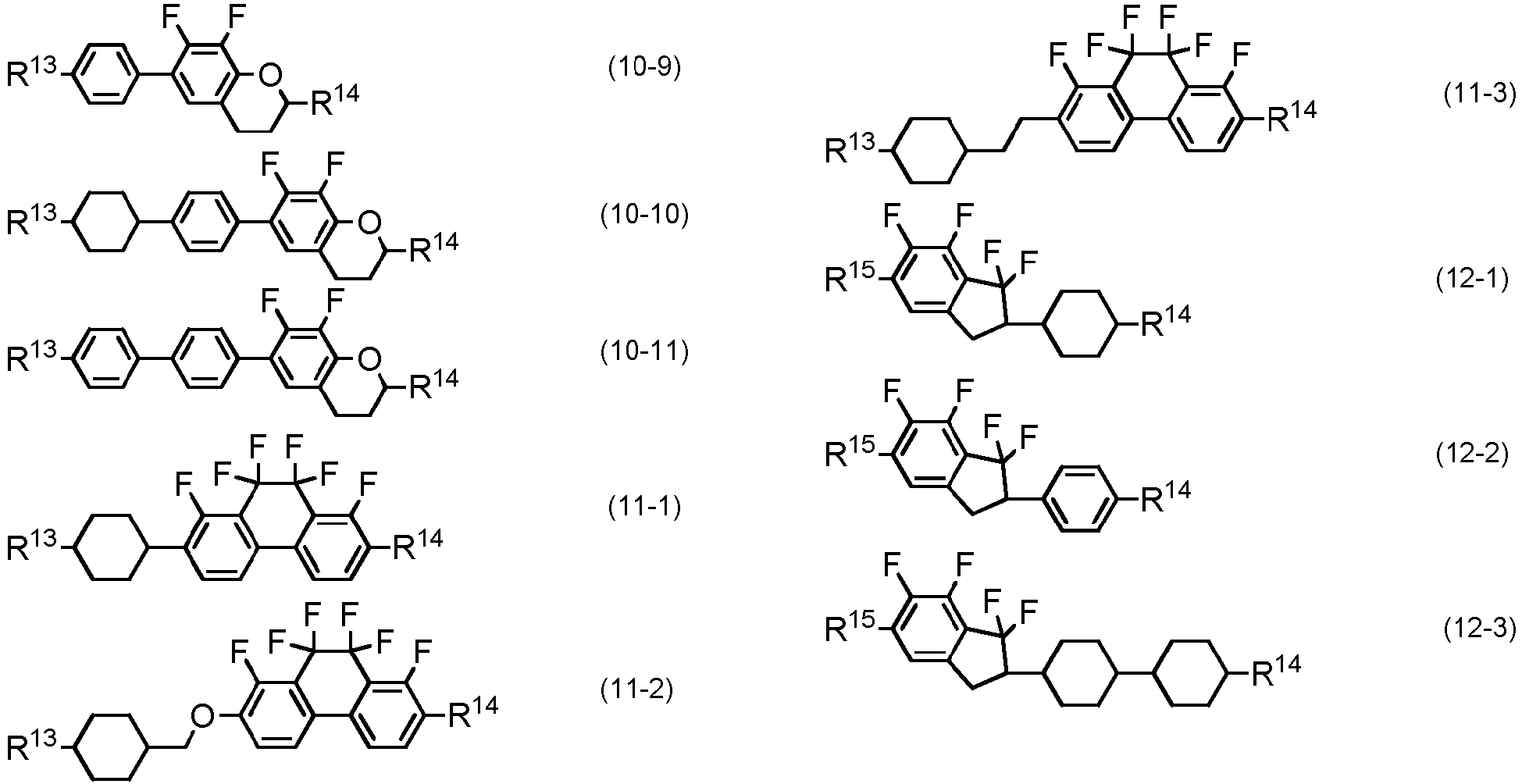
- In the compounds (component D), R13, R14 and R15 are defined in a manner identical with the definitions in the formulas (6) to (12).
- Component D is a compound having negative dielectric anisotropy. Component D is mainly used when a composition for the VA mode or the PSA mode is prepared. Among types of component D, compound (6) is a bicyclic compound, and therefore is effective mainly in adjusting the viscosity, the optical anisotropy or the dielectric anisotropy. Compounds (7) and (8) are a tricyclic compound, and therefore effective in increasing the maximum temperature, the optical anisotropy or the dielectric anisotropy. Compounds (9) to (12) are effective in increasing the dielectric anisotropy.
- When a composition for the VA mode or the PSA mode is prepared, a content of component D is preferably 40% by weight or more, and further preferably in the range of 50 to 95% by weight, based on the total weight of the composition. When component D is added to a composition having positive dielectric anisotropy, the content of component D is preferably 30% by weight or less based on the total weight of the composition. The elastic constant of the composition and the voltage-transmittance curve of the device can be adjusted by adding component D.
- Component E is a compound in which two terminal groups are alkyl or the like. Preferred examples of component E include compounds (13-1) to (13-11), compounds (14-1) to (14-19) and compounds (15-1) to (15-7).



- In the compounds (component E), R16 and R17 are defined in a manner identical with the definitions in the formulas (13) to (15).
- Component E has a small absolute value of dielectric anisotropy, and therefore is a compound close to neutrality. Compound (13) is effective mainly in adjusting the viscosity or adjusting the optical anisotropy. Compound (14) and (15) are effective in extending the temperature range of the nematic phase by increasing the maximum temperature, or in adjusting the optical anisotropy.
- When a content of component E is increased, the viscosity of the composition decreases, but the dielectric anisotropy also decreases. Thus, as long as a desired value of threshold voltage of the device is met, the content is preferably as large as possible. Accordingly, when a composition for the VA mode or the PSA mode is prepared, the content of component E is preferably 30% by weight or more, and further preferably 40% by weight or more, based on the total weight of the composition.
- Composition (1) is prepared by a method of dissolving necessary components at a high temperature, or the like. According to an application, an additive may be added to the composition. Specific examples of the additive include an optically active compound, a polymerizable compound, a polymerization initiator, an antioxidant, an ultraviolet light absorber, a light stabilizer, a heat stabilizer and a defoaming agent. Such additives are well known to those skilled in the art, and described in literature.
- Composition (1) may further contain at least one optically active compound. A publicly known chiral dopant can be added as the optically active compound. The chiral dopant is effective in inducing a helical structure in liquid crystal molecules to give a necessary twist angle, thereby preventing a reverse twist. Preferred examples of the chiral dopant include compounds (Op-1) to (Op-18) below. In compound (Op-18), ring J is 1, 4-cyclohexylene or 1, 4-phenylene, and R24 is alkyl having 1 to 10 carbons.







- In composition (1), a helical pitch is adjusted by addition of such an optically active compound. The helical pitch is preferably adjusted to the range of 40 to 200 micrometers in a composition for the TFT mode and the TN mode. The helical pitch is preferably adjusted to the range of 6 to 20 micrometers in a composition for the STN mode. In the case of a composition for a BTN mode, the helical pitch is preferably adjusted to the range of 1.5 to 4 micrometers. Two or more optically active compounds may be added for the purpose of adjusting temperature dependence of the helical pitch.
- Composition (1) can also be used for the PSA mode by adding the polymerizable compound. Specific examples of the polymerizable compound include acrylate, methacrylate, a vinyl compound, a vinyloxy compound, propenyl ether, an epoxy compound (oxirane, oxetane) and vinyl ketone, and preferred examples include compounds (M-1) to (M-12) described below. The polymerizable compound is polymerized by irradiation with ultraviolet light or the like. The compound may be polymerized in the presence of a suitable initiator such as a photopolymerization initiator. Suitable conditions for polymerization, suitable types of the initiator and suitable amounts thereof are known to those skilled in the art and are described in literature.
- In compounds (M-1) to (M-12), R20 is hydrogen or methyl; s is independently 0 or 1, respectively; and t and u are independently an integer from 1 to 10, respectively. A parenthesized symbol F stands for independently hydrogen or fluorine, respectively.






- The antioxidant is effective for maintaining the large voltage holding ratio. Specific examples of a preferred antioxidant include compounds (AO-1) and (AO-2) described below; and IRGANOX 415, IRGANOX 565, IRGANOX 1010, IRGANOX 1035, IRGANOX 3114 and IRGANOX 1098 (trade names: BASF SE). The ultraviolet light absorber is effective for preventing a decrease of the maximum temperature. Specific examples of a preferred ultraviolet light absorber include a benzophenone derivative, a benzoate derivative and a triazole derivative. Specific examples include compounds (AO-3) and (AO-4) described below; TINUVIN 329, TINUVIN P, TINUVIN 326, TINUVIN 234, TINUVIN 213, TINUVIN 400, TINUVIN 328 and TINUVIN 99-2 (trade names: BASF SE); and 1,4-diazabicyclo[2.2.2]octane (DABCO).
- The light stabilizer such as an amine having steric hindrance is preferred for maintaining the large voltage holding ratio. Specific examples of a preferred light stabilizer include compounds (AO-5) and (AO-6) described below; and TINUVIN 144, TINUVIN 765 and TINUVIN 770DF (trade names: BASF SE). The heat stabilizer is also effective for maintaining the large voltage holding ratio, and preferred examples include IRGAFOS 168 (trade name: BASF SE). The antifoaming agent is effective for preventing foam formation. Specific examples of a preferred antifoaming agent include dimethyl silicone oil and methylphenyl silicone oil.


- In compound (AO-1), R25 is alkyl having 1 to 20 carbons, alkoxy having 1 to 20 carbons, -COOR26 or -CH2CH2COOR26; wherein, R26 is alkyl having 1 to 20 carbons. In compounds (AO-2) and (AO-5), R27 is alkyl having 1 to 20 carbons. In compound (AO-5), ring K and ring L are 1,4-cyclohexylene or 1,4-phenylene, v is 0, 1 or 2, and R28 is hydrogen, methyl or O˙.
- Composition (1) can be used for a guest host (GH) mode by addition of a dichroic dye of a merocyanine type, a stylyl type, an azo type, an azomethine type, an azoxy type, a quinophthalone type, an anthraquinone type, a tetrazine type or the like.
- In composition (1), the maximum temperature can be adjusted to be 70°C or higher and the minimum temperature can be adjusted to be -10°C or lower by suitably adjusting a kind and a proportion of component compounds, and therefore the temperature range of the nematic phase is wide. Accordingly, a liquid crystal display device including the composition can be used in the wide temperature range.
- In composition (1), the optical anisotropy can be adjusted to the range of 0.10 to 0.13 or to the range of 0.05 to 0.18 by suitably adjusting a kind and a proportion of component compounds. In a similar manner, the dielectric anisotropy can be adjusted to the range of -5.0 to -2.0. Preferred dielectric anisotropy is in the range of -4.5 to -2.5. Composition (1) having dielectric anisotropy in the range can be preferably used in a liquid crystal display device that operates in the IPS mode, the VA mode or the PSA mode.
- Composition (1) can be used in an AM device. The composition can also be used in a PM device. The composition can also be used in the AM device and the PM device each having a mode such as the PC mode, the TN mode, the STN mode, the ECB mode, the OCB mode, the IPS mode, the FFS mode, the VA mode, the PSA and the FPA mode. Use in the AM device having the TN mode, the OCB mode, the IPS mode or the FFS mode is particularly preferred. In the AM device having the IPS mode or the FFS mode, alignment of liquid crystal molecules in a state in which no voltage is applied may be parallel or vertical to a panel substrate. The devices may be of a reflective type, a transmissive type or a transflective type. Use in the transmissive device is preferred. The composition can also be used in an amorphous silicon-TFT device or a polycrystal silicon-TFT device. The composition can also be used in a nematic curvilinear aligned phase (NCAP) device prepared by microencapsulating the composition and a polymer dispersed (PD) device in which a three-dimensional network-polymer is formed in the composition.
- Composition (1) has negative dielectric anisotropy, and therefore can be suitably used in the liquid crystal display device having an operating mode such as the VA mode, the IPS mode or the PSA mode, and driven by the AM mode. The composition can be particularly suitably used in a liquid crystal display device having the VA mode, and driven by the AM mode.
- In a liquid crystal display device that operates in the TN mode, the VA mode or the like, a direction of an electric field is vertical to a direction of a liquid crystal layer. On the other hand, in a liquid crystal display device that operates in the IPS mode or the like, the direction of the electric field is parallel to the direction of the liquid crystal layer. A structure of a liquid crystal display device that operates in the VA mode is reported in K. Ohmuro, S. Kataoka, T. Sasaki and Y. Koike, SID ' 97 Digest of Technical Papers, 28, 845 (1997). A structure of a liquid crystal display device that operates in the IPS mode is reported in
WO 91/10936 A US 5576867 B ). - The invention will be described in greater detail by way of Examples. However, the invention is not limited by the Examples.
- Compound (1) was prepared according to procedures described below. The thus prepared compound was identified by methods such as an NMR analysis. Physical properties of the compound were measured by methods described below.
- As a measuring apparatus, DRX-500 (made by Bruker BioSpin Corporation) was used. In 1H-NMR measurement, a sample was dissolved in a deuterated solvent such as CDCl3, and measurement was carried out under conditions of room temperature, 500 MHz and 16 times of accumulation. Tetramethylsilane was used as an internal standard. In 19F-NMR measurement, CFCl3 was used as an internal standard, and measurement was carried out under conditions of 24 times of accumulation. In explaining nuclear magnetic resonance spectra obtained, s, d, t, q, quin, sex and m stand for a singlet, a doublet, a triplet, a quartet, a quintet, a sextet and a multiplet, and br being broad, respectively.
- Upon measuring phase structure and a transition temperature, a liquid crystal compound itself was used as a sample. Upon measuring physical properties such as maximum temperature of a nematic phase, viscosity, optical anisotropy and dielectric anisotropy, a composition prepared by mixing the compound with a base liquid crystal was used as a sample.
- When the sample prepared by mixing the compound with the base liquid crystal was used, measurement was carried out according to a method described below. The sample was prepared by mixing 15% by weight of the compound and 85% by weight of the base liquid crystal. Then, an extrapolated value was calculated from a measured value of the sample, according to an extrapolation method, represented by an equation below, and the value was described: [extrapolated value] = (100 × [measured value of a sample] - [% by weight of a base liquid crystal] × [measured value of the base liquid crystal]) / [% by weight of a compound].
- When crystals (or a smectic phase) precipitated at 25°C even at the ratio of the compound to the base liquid crystal, a ratio of the compound to the base liquid crystal was changed in the order of (10% by weight : 90% by weight), (5% by weight : 95% by weight) and (1% by weight : 99% by weight), and physical properties of the sample at a ratio at which no crystals (or no smectic phase) precipitated at 25°C were measured. In addition, unless otherwise noted, the ratio of the compound to base liquid crystal was 15% by weight : 85% by weight.
- As the base liquid crystal, base liquid crystal (i) described below was used. A proportion of the components of base liquid crystal (i) are expressed in terms of weight percent (% by weight).


- Physical properties were measured according to methods described below. Most of the measuring methods are applied as described in the Standard of Japan Electronics and Information Technology Industries Association (hereinafter abbreviated as JEITA) (JEITA ED-2521A) discussed and established by JEITA, or modified thereon. No TFT was attached to a TN device used for measurement.
- A sample was placed on a hot plate in a melting point apparatus (FP52 Hot Stage made by Mettler-Toledo International Inc.) equipped with a polarizing microscope, and a state of a phase and a change thereof were observed with the polarizing microscope while the sample was heated at a rate of 3°C per minute, and a kind of the phase was specified.
- A sample was heated and then cooled at a rate of 3°C per minute using a differential scanning calorimeter, DSC-7 System or Diamond DSC System, made by PerkinElmer, Inc., and a starting point of an endothermic peak or an exothermic peak caused by a phase change of the sample was determined by extrapolation, and thus a transition temperature was determined. Temperature at which a compound undergoes transition from a solid to a liquid crystal phase such as the smectic phase and the nematic phase may be occasionally abbreviated as "minimum temperature of the liquid crystal phase." Temperature at which the compound undergoes transition from the liquid crystal phase to liquid may be occasionally abbreviated as "clearing point."
- A crystal was expressed as C. When kinds of the crystals were distinguishable, each of the crystals was expressed as C1 or C2. The smectic phase or the nematic phase was expressed as S or N. When smectic A phase, smectic B phase, smectic C phase or smectic F phase was distinguishable among the smectic phases, the phases were expressed as SA, SB, SC or SF, respectively. A liquid (isotropic) was expressed as I. A transition temperature was expressed as "C 50.0 N 100.0 I," for example. The expression indicates that a transition temperature from the crystals to the nematic phase is 50.0°C, and a transition temperature from the nematic phase to the liquid is 100.0°C.
- Samples in which the base liquid crystal and the compound were mixed for proportions of the compounds to be 20% by weight, 15% by weight, 10% by weight, 5% by weight, 3% by weight and 1% by weight were prepared, and put in glass vials. After the glass vials were kept in freezers at -10°C or -20°C for a predetermined period of time, whether or not crystals (or a smectic phase) precipitated was observed.
- A sample was placed on a hot plate in a melting point apparatus equipped with a polarizing microscope, and heated at a rate of 1°C per minute. Temperature when part of the sample began to change from a nematic phase to an isotropic liquid was measured. A maximum temperature of the nematic phase may be occasionally abbreviated as "maximum temperature." When the sample was a mixture of a compound and the base liquid crystal, the maximum temperature was expressed in terms of a symbol TNI. When the sample was a mixture of a compound and component B and so forth, the maximum temperature was expressed in terms of a symbol NI.
- Samples each having a nematic phase were kept in freezers at temperatures of 0°C, -10°C, -20°C, -30°C and -40°C for 10 days, and then liquid crystal phases were observed. For example, when the sample was maintained in the nematic phase at -20 °C and changed to crystals or a smectic phase at -30°C, Tc was expressed as Tc ≤ -20°C. A minimum temperature of the nematic phase may be occasionally abbreviated as "minimum temperature."
- A cone-plate (E-type) rotational viscometer was used for measurement.
- Measurement was carried out according to a method described in M. Imai et al., Molecular Crystals and Liquid Crystals, Vol. 259, p. 37 (1995). A sample was put in a VA device in which a distance (cell gap) between two glass substrates was 20 micrometers. Voltage was applied stepwise to the device in the range of 30 V to 50 V at an increment of 1 V. After a period of 0.2 second with no voltage application, voltage was repeatedly applied under conditions of only one rectangular wave (rectangular pulse; 0.2 second) and no voltage application (2 seconds). A peak current and a peak time of transient current generated by the applied voltage were measured. A value of rotational viscosity was obtained from the measured values and calculation equation (8) described on page 40 of the paper presented by M. Imai et al. In dielectric anisotropy required for the calculation, a value measured according to items of dielectric anisotropy described below was used.
- Measurement was carried out by an Abbe refractometer with a polarizing plate mounted on an ocular, using light at a wavelength of 589 nanometers. A surface of a main prism was rubbed in one direction, and then a sample was added dropwise onto the main prism. A refractive index (n||) was measured when a direction of polarized light was parallel to a direction of rubbing. A refractive index (n⊥) was measured when the direction of polarized light was perpendicular to the direction of rubbing. A value of optical anisotropy (Δn) was calculated from an equation: Δn = n|| - n⊥.
- A value of dielectric anisotropy was calculated from an equation: Δε = ε|| - ε⊥. A dielectric constant (ε|| and ε⊥) was measured as described below.
- (1) Measurement of dielectric constant (ε||) : An ethanol (20 mL) solution of octadecyltriethoxysilane (0.16 mL) was applied to a well-cleaned glass substrate. After rotating the glass substrate with a spinner, the glass substrate was heated at 150°C for 1 hour. A sample was put in a VA device in which a distance (cell gap) between two glass substrates was 4 micrometers, and the device was sealed with an ultraviolet-curable adhesive. Sine waves (0.5 V, 1 kHz) were applied to the device, and after 2 seconds, a dielectric constant (ε||) of liquid crystal molecules in a major axis direction was measured.
- (2) Measurement of dielectric constant (ε⊥) : A polyimide solution was applied to a well-cleaned glass substrate. After calcining the glass substrate, rubbing treatment was applied to the alignment film obtained. A sample was put in a TN device in which a distance (cell gap) between two glass substrates was 9 micrometers and a twist angle was 80 degrees. Sine waves (0.5 V, 1 kHz) were applied to the device, and after 2 seconds, a dielectric constant (ε⊥) of liquid crystal molecules in a minor axis direction was measured.
- For measurement, Elastic Constant Measurement System Model EC-1 made by TOYO Corporation was used. A sample was put in a vertical alignment device in which a distance (cell gap) between two glass substrates was 20 micrometers. An electric charge of 20 V to 0 V was applied to the device, and electrostatic capacity and applied voltage were measured. Values of electrostatic capacity (C) and applied voltage (V) were fitted to equation (2.98) and equation (2.101) on page 75 of "Liquid Crystal Device Handbook" (Ekisho Debaisu Handobukku in Japanese; Nikkan Kogyo Shimbun, Ltd.), and a value of elastic constant was obtained from equation (2.100).
- For measurement, an LCD-5100 luminance meter made by Otsuka Electronics Co., Ltd. was used. A light source was a halogen lamp. A sample was put in a normally black mode VA device in which a distance (cell gap) between two glass substrates was 4 micrometers and a rubbing direction was anti-parallel, and the device was sealed with an ultraviolet-curable adhesive. A voltage (60 Hz, rectangular waves) to be applied to the device was stepwise increased from 0 V to 20 V at an increment of 0.02 V. On the occasion, the device was irradiated with light from a direction perpendicular to the device, and an amount of light transmitted through the device was measured. A voltage-transmittance curve was prepared, in which the maximum amount of light corresponds to 100% transmittance and the minimum amount of light corresponds to 0% transmittance. A threshold voltage is expressed in terms of a voltage at 10% transmittance.
- A TN device used for measurement has a polyimide alignment film, and a distance (cell gap) between two glass substrates is 5 micrometers. A sample was put in the device, and then the device was sealed with an ultraviolet-curable adhesive. A pulse voltage (60 microseconds at 5 V) was applied to the TN device and the device was charged. A decaying voltage was measured for 16.7 milliseconds with a high-speed voltmeter, and area A between a voltage curve and a horizontal axis in a unit cycle was determined. Area B is an area without decay. A voltage holding ratio is a percentage of area A to area B.
- A TN device used for measurement had a polyimide alignment film, and a distance (cell gap) between two glass substrates is 5 micrometers. A sample was put in the device, and then the device was sealed with an ultraviolet-curable adhesive. A pulse voltage (60 microseconds at 5 V) was applied to the TN device and the device was charged. A decaying voltage was measured for 16.7 milliseconds with a high-speed voltmeter, and area A between a voltage curve and a horizontal axis in a unit cycle was determined. Area B is an area without decay. A voltage holding ratio is a percentage of area A to area B.
- Solmix A-11 (registered trademark) is a mixture of ethanol (85.5% by weight), methanol (13.4% by weight) and isopropanol (1.1% by weight), and was purchased from Japan Alcohol Trading Co., Ltd.
-

- Under a nitrogen atmosphere, compound (S-1) (40 g) and THF (300 mL) were put in a reaction vessel, and the resulting mixture was cooled down to -74°C. Thereto, sec-butyl lithium (1 M; n-hexane, a cyclohexane solution; 313 mL) was added dropwise, and further the resulting mixture was stirred for 2 hours. Subsequently, sulfur powder (11.8 g) was added thereto and stirred for 2 hours while returning the resulting mixture to 25°C. Then, bromoacetaldehyde diethyl acetal (84 g) was added thereto, and subjected to reflux for 2 hours. A reaction mixture was poured into water, and the resulting reaction mixture was subjected to extraction with toluene. An organic layer was washed with water, and dried over anhydrous magnesium sulfate. The resulting solution was concentrated under reduced pressure, and a residue was purified by silica gel chromatography (toluene) to obtain (S-2) (31 g).
- Under a nitrogen atmosphere, compound (S-2) (31 g), polyphosphoric acid (150 g) and toluene (250 mL) were put in a reaction vessel, and subjected to reflux under heating for 3 hours. A reaction mixture was poured into water, and the resulting reaction mixture was subjected to extraction with toluene. An organic layer was washed with water, and dried over anhydrous magnesium sulfate. The resulting solution was concentrated under reduced pressure, and a residue was purified by silica gel chromatography (toluene: heptane = 2 : 3 in a volume ratio) to obtain (S-3) (12.9 g).
- Under a nitrogen atmosphere, compound (S-3) (6 g) and THF (100 mL) were put in a reaction vessel, and the resulting mixture was cooled down to -74°C. Thereto, LDA (1 M; n-hexane, a THF solution; 37 mL) was added dropwise, and further the resulting mixture was stirred for 2 hours. Subsequently, (S-4) (6 g) was added thereto and stirred for 2 hours while returning the resulting mixture to 25°C. A reaction mixture was poured into water, and the resulting reaction mixture was subjected to extraction with toluene. An organic layer was washed with water, and dried over anhydrous magnesium sulfate to obtain (S-5). After then, a dehydration under adding P-toluenesulfonic acid thereto was performed according to a publicly known method described in the above scheme and to give (S-6), and a hydrogenation reaction and purification were performed with palladium carbon to obtain compound No.18 (1.7g). In addition, if referring to Example described in
WO 2009150966 A or the like, the dehydration and the hydrogenation reaction performed herein are easy to be implemented. - 1 H-NMR (δ ppm; CDCl3): 7.32 (d, 1H), 7.03 (t, 1H), 6.91 (d, 1H), 4.17 (q, 2H), 2.78 (tt, 1H), 2.12 (dd, 2H), 1.88 (dd, 2H), 1 . 60 - 1.20 (m, 10H), 0.91(t, 3H).
- Physical properties of compound (No. 18) were as described below. Transition temperature: C 68.4 N 86.0 I. TNI = 83.9°C; Δn = 0.153; Δε = -3.12; η = 31.2 mPa·s.
- In Example 1, compound (No.41) was obtained by using compound (S-7) in place of compound (S-4).

- 1H-NMR (δ ppm; CDCl3): 7.32 (d, 1H), 7.02 (t, 1H), 6.99 (d, 1H), 4.16 (q, 2H), 2.75 (tt, 1H), 2.13 (dd, 2H), 1.85 (d, 2H),1.74 (t, 4H), 1 . 60 - 1.20 (m, 18H), 0.88 (t, 3H).
- Physical properties of compound (No. 41) were as described below. Transition temperature: C 95.3 N 260.7 I. TNI = 210.6°C; Δn = 0.167; Δε = -3.29; η = 53.4 mPa·s.
-

- Under a nitrogen atmosphere, compound (S-3) (3 g) and THF (100 mL) were put in a reaction vessel, and the resulting mixture was cooled down to -74°C. Thereto, lithium diisopropylamide (1 M; an n-hexane solution; 18.34 mL) was added dropwise in a temperature range of -74°C to -70°C, and further the resulting mixture was stirred for 2 hours. Subsequently, a THF (10 mL) solution of triisobutyl borate (4.02 g) was added thereto in a temperature range of -75°C to -70°C, and stirred for 8 hours while returning the resulting mixture to 25°C. A reaction mixture was poured into hydrochloric acid aqueous solution, and the resulting reaction mixture was subjected to extraction with ethyl acetate. A combined organic layer was washed with water, saturated aqueous solution of sodium hydrogencarbonate and water, and dried over anhydrous magnesium sulfate. The resulting solution was concentrated under reduced pressure to obtain compound (S-8) (1.9g).
- Then, (S-8) (1.3 g) and (S-9) (1.8 g) were dissolved in toluene, and water, ethanol, Pd(PPh3)4 (0.6g), TBAB (0.17g) and potassium carbonate (2.2 g) were added thereto, and the resulting mixture was refluxed under heating for 6 hours. After completion of the reaction, the resulting mixture was subjected to extraction with toluene, and washed with water, and then dried over anhydrous magnesium sulfate and concentrated under reduced pressure to obtain a light brown solid. The resulting solid was formed into a solution, and subjected to silica gel column chromatography (heptane : toluene = 3 : 2 in a volume ratio) and recrystallization (ethanol) to obtain (No. 43) as a colorless crystal (1.5 g).
- 1H-NMR (δ ppm; CDCl3): 7.73 (d, 2H), 7.64 (d, 2H), 7.55 (d, 2H), 7.48 (d, 1H), 7.44 (d, 1H), 7.27 (d, 2H), 7.07 (t, 1H), 4.20 (q, 2H), 2.63 (t, 2H), 1.69 (sex, 2H), 1.47 (t, 3H), 0.98(t, 3H).
- Physical properties of compound (No. 43) were as described below. Transition temperature: C 205.9 S 265.6 N 295.5 I. TNI = 224.6°C; Δn = 0.587; Δε = -5.47; η = 109.6 mPa·s. In addition, the sample for measurement was prepared from 1% by weight of compound (No. 43) and 99% by weight of base liquid crystal (i).
- In Example 3, compound (No.9) was obtained by using compound (S-10) in place of compound (S-9).

- 1H-NMR (δ ppm; CDCl3): 7.59 (d, 2H), 7.43 (d, 1H), 7.41 (d, 1H), 7.23 (d, 2H), 7.07 (t, 1H), 4.20 (q, 2H), 2.62 (t, 2H), 1.67 (sex, 2H), 1.47 (t, 3H), 0.97(t, 3H).
- Physical properties of compound (No. 9) were as described below. Transition temperature: C 89.5 N 99.4 I. TNI = 101.9°C; Δn = 0.287; Δε = -3.83; η = 38.8 mPa·s.
-

- Under a nitrogen atmosphere, compound (S-3) (3 g) and THF (100 mL) were put in a reaction vessel, and the resulting mixture was cooled down to -74°C. Thereto, lithium diisopropylamide (1 M; n-hexane solution; 16.82 mL) was added dropwise in a temperature range of -74°C to -70°C, and further the resulting mixture was stirred for 2 hours. Subsequently, a THF (10 mL) solution of (S-11) (4.99 g) was added dropwise thereto in a temperature range of -75°C to -70°C, and stirred for 8 hours while returning the resulting mixture to 25°C. A reaction mixture was poured into water, and the resulting reaction mixture was subjected to extraction with toluene, and washed with water, and then dried over anhydrous magnesium sulfate and concentrated under reduced pressure to obtain a light brown solid. The resulting material was subjected to silica gel column chromatography (heptane: toluene = 3 : 1 in a volume ratio) and recrystallization (ethanol) to obtain (No. 25) as a colorless crystal (3.15 g).
- 1H-NMR (δ ppm; CDCl3): 7.28 (d, 1H), 7.02 (t, 1H), 6.89 (d, 1H), 4.16 (q, 2H), 2.87 (t, 2H), 1.79 (d, 2H), 1.73 (d, 2H), 1.62(q, 2H), 1.44 (t, 3H), 1.35 - 0.79 (m, 10H), 0.88(t, 3H).
- Physical properties of compound (No. 25) were as described below. Transition temperature: C 88.2 I. TNI = 59.9°C; Δn = 0.133; Δε = -3.16; η = 38.7 mPa·s.
-
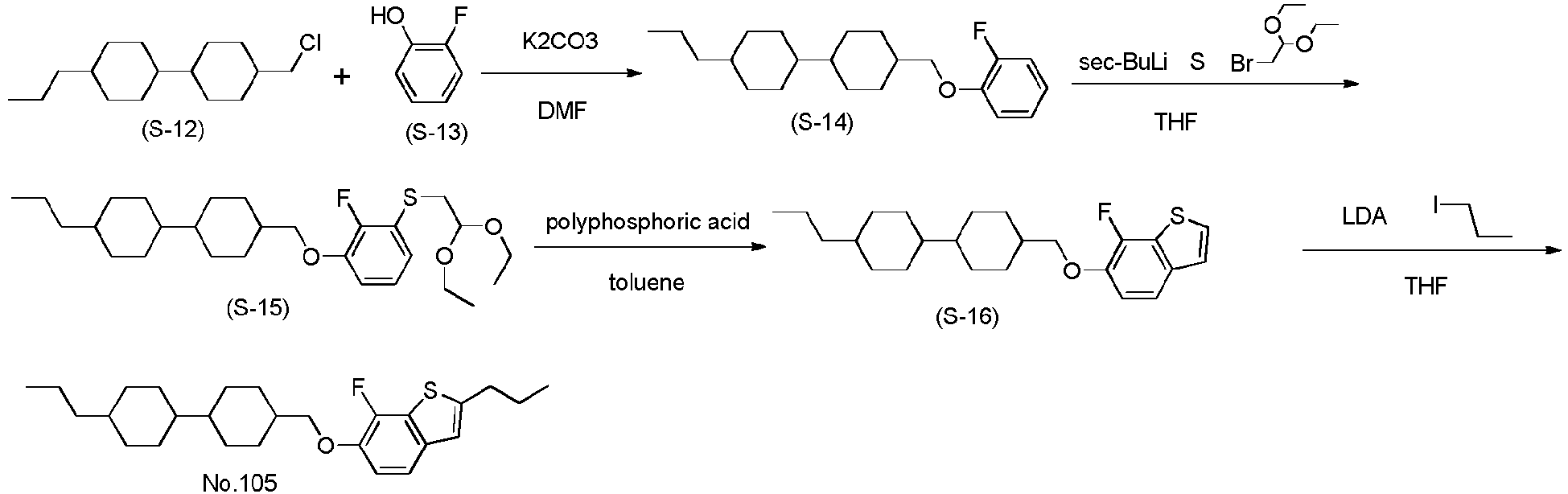
- Under a nitrogen atmosphere, compound (S-12) (22.9 g), (S-13) (10.0 g), potassium carbonate (K2CO3; 18.5 g) and DMF (150 mL) were put in a reaction vessel, and the resulting mixture was stirred for 2 hours at 100°C. A reaction mixture was cooled to 25°C, and then a precipitate was filtered, and the filtrate was concentrated. A residue was purified by silica gel chromatography (heptane), and further purified by recrystallization from ethanol to obtain compound (S-14) (23.0 g).
- Under a nitrogen atmosphere, compound (S-14) (10 g) and THF (100 mL) were put in a reaction vessel, and the resulting mixture was cooled down to -74°C. Thereto, sec-butyl lithium (1 M; n-hexane, a cyclohexane solution; 33 mL) was added dropwise, and further the resulting mixture was stirred for 2 hours. Subsequently, sulfur powder (1.25 g) was added thereto, and stirred for 2 hours while returning the resulting mixture to 25°C. Then, bromoacetaldehyde diethyl acetal (8.89 g) was added thereto, and the resulting material was subjected to reflux for 2 hours. A reaction mixture was poured into water, and the resulting reaction mixture was subjected to extraction with toluene. An organic layer was washed with water, and dried over anhydrous magnesium sulfate. The resulting solution was concentrated under reduced pressure, and the residue was purified by silica gel chromatography (toluene) to obtain (S-15) (7.8 g).
- Under a nitrogen atmosphere, compound (S-15) (7.7 g), polyphosphoric acid (20 g) and toluene (150 mL) were put in a reaction vessel, and subjected to reflux under heating for 3 hours. A reaction mixture was poured into water, and the resulting reaction mixture was subjected to extraction with toluene. An organic layer was washed with water, and dried over anhydrous magnesium sulfate. The resulting solution was concentrated under reduced pressure, and a residue was purified by silica gel chromatography (toluene: heptane = 2 : 3 in a volume ratio) to obtain (S-16) (3.9 g).
- Under a nitrogen atmosphere, compound (S-16) (3.9 g) and THF (100 mL) were put in a reaction vessel, and the resulting mixture was cooled down to -74°C. Thereto, lithium diisopropylamide (LDA, 1 M; an n-hexane solution; 16.82 mL) was added dropwise in a temperature range of -74°C to -70°C, and further the resulting mixture was stirred for 2 hours. Subsequently, a THF (10 mL) solution of iodopropane (2.4 g) was added dropwise thereto in a temperature range of -75°C to -70°C, and stirred for 8 hours while returning the resulting mixture to 25°C. A reaction mixture was poured into water, and the resulting reaction mixture was subjected to extraction with toluene, and washed with water, and then dried over anhydrous magnesium sulfate and concentrated under reduced pressure to obtain a light brown solid. The resulting material was subjected to silica gel column chromatography (heptane: toluene = 4 : 1 in a volume ratio) and recrystallization (ethanol) to obtain (No. 105) as a colorless crystal (2.7 g).
- 1H-NMR (δ ppm; CDCl3): 7.31 (d, 1H), 7.01 (t, 1H), 6.90 (d, 1H), 3.88 (d, 2H), 2.83 (t, 2H), 1.95 (br, 2H), 1.79 - 1.69 (m, 9H), 1.30 (sex, 2H), 1.2 - 0.8 (m, 13H), 1.00 (t, 3H), 0.88 (t, 3H).
- Physical properties of compound (No. 105) were as described below. Transition temperature: C 74.0 N 171.2 I. TNI = 145°C; Δn = 0.127; Δε = -2.0; η = 51.4 mPa·s.
- In first step and second step in Example 1, (S-18) was prepared by using compound (S-17) in place of compound (S-1), and in Example 3, compound (No. 8) was obtained by using compound (S-10) in place of compound (S-9) and using (S-18) in place of compound (S-3).
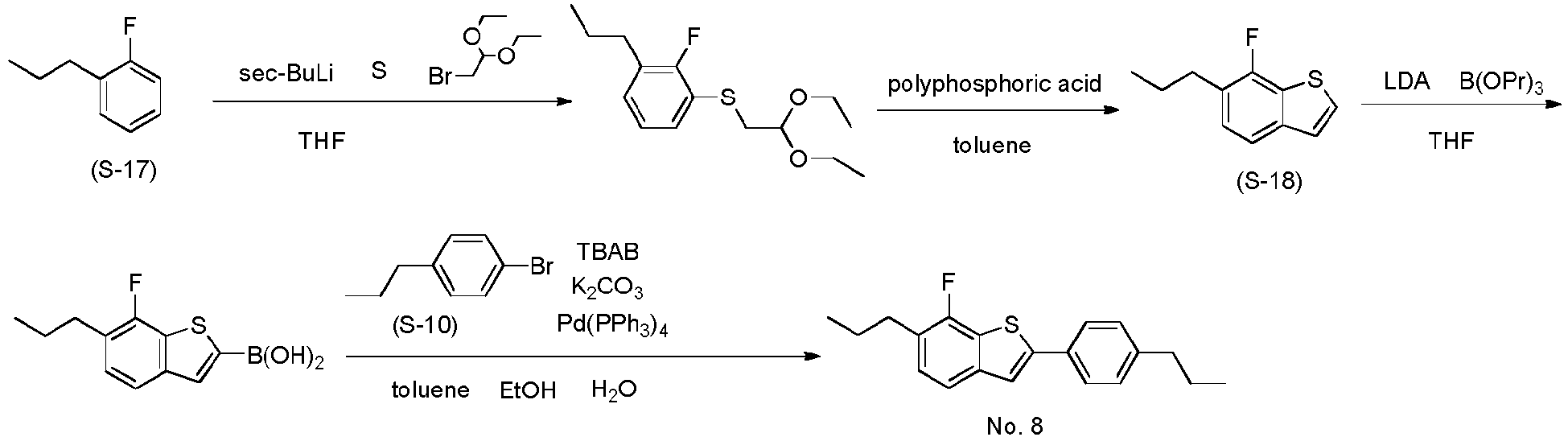
- 1H-NMR (δ ppm; CDCl3): 7.62 (d, 2H), 7.45 (s, 1H), 7.45 (d, 1H), 7.24 (d, 2H), 7.15 (t, 1H), 2.72 (t, 2H), 2.62 (t, 2H), 1.68 (sex, 2H), 1.67 (sex, 2H), 0.98 (t, 3H), 0.97(t, 3H).
- Physical properties of compound (No. 8) were as described below. Transition temperature: C 56.6 S 62.0 N 66.5 I. TNI - 65.0°C; Δn = 0.260; Δε = -0.7; η = 40.8 mPa·s.
- In Example 3, compound (No. 56) was obtained by using compound (S-19) in place of compound (S-9).

- 1H-NMR (δ ppm; CDCl3): 7.70 (t, 1H), 7.67 (dd, 1H), 7.54 (d, 2H), 7.48 (d, 1H), 7.43 (dd, 1H), 7.41 (dd, 1H), 7.27 (d, 2H), 7.09 (t, 1H), 4.21 (q, 2H), 2.64 (t, 2H), 1.69 (sex, 2H), 1.47 (t, 3H), 0.98 (t, 3H).
- Physical properties of compound (No. 56) were as described below. Transition temperature: C 111.2 N 263.3 I. TNI = 201.7°C; Δn = 0.364; Δε = -3.80; η = 66.4 mPa·s.
- In Example 3, compound (No. 241) was obtained by using compound (S-19) in place of compound (S-9).

- 1H-NMR (δ ppm; CDCl3): 7.70 (t, 1H), 7.67 (dd, 1H), 7.53 (d, 2H), 7.48 (d, 1H), 7.43 (dd, 1H), 7.40 (dd, 1H), 7.27 (d, 2H), 7.09 (t, 1H), 4.21 (q, 2H), 2.65 (t, 2H), 1.66 (quint, 2H), 1.47 (t, 3H), 1 . 40 - 1.30 (m, 4H), 0.91 (t, 3H).
- Physical properties of compound (No. 241) were as described below. Transition temperature: C 110.3 N 249.9 I. TNI = 192.7°C; Δn = 0.357; Δε = -3.70; η = 61.7 mPa·s.
- In Example 3, compound (No. 242) was obtained by using compound (S-20) in place of compound (S-9).

- 1H-NMR (δ ppm; CDCl3): 7.69 (t, 1H), 7.66 (dd, 1H), 7.54 (d, 2H), 7.47 (d, 1H), 7.40 (dd, 1H), 7.37 (dd, 1H), 7.09 (t, 1H), 6.98 (d, 2H), 4.21 (q, 2H), 4.01 (t, 2H), 2.64 (t, 2H), 1.80 (quint, 2H), 1.51 (sex, 2H), 1.48 (t, 3H), 0.99 (t, 3H).
- Physical properties of compound (No. 242) were as described below. Transition temperature: C 128.5 N 281.3 I. TNI = 209.7°C; Δn = 0.377; Δε = -3.86; η = 76.7 mPa·s.
- In Example 3, compound (No. 244) was obtained by using compound (S-21) in place of compound (S-9).

- 1H-NMR (δ ppm; CDCl3): 7.69 (t, 1H), 7.66 (dd, 1H), 7.47 (d, 1H), 7.40 (dd, 1H), 7.37 (dd, 1H), 7.09 (t, 1H), 4.21 (q, 2H), 4.01 (t, 2H), 2.64 (t, 2H), 1.69 (sex, 2H), 1.47 (t, 3H), 0.98 (t, 3H).
- Physical properties of compound (No. 244) were as described below. Transition temperature: C 56.6 N 68.6 I. TNI = 88.4°C; Δn = 0.250; Δε = -3.89; η = 37.4 mPa·s.
- In Example 3, compound (No. 14) was obtained by using compound (S-22) in place of compound (S-9).

- 1H-NMR (δ ppm; CDCl3): 7.54 (dd, 1H), 7.46 (d, 1H), 7.29 (td, 1H), 7.08 (t, 1H), 6.78 (td, 1H), 4.21 (q, 2H), 4.16 (q, 2H), 1.47 (t, 3H), 1.46 (t, 3H).
- Physical properties of compound (No. 14) were as described below. Transition temperature: C 140.4 I. TNI = 154.3°C; Δn = 0.387; Δε = -10.46; η = 69.6 mPa·s.
- In Example 3, compound (No. 243) was obtained by using compound (S-23) in place of compound (S-9). In addition, (S-23) can be prepared according to a method described in Examples in
JP 2010-270074 A 
- 1H-NMR (δ ppm; CDCl3): 7.54 (dd, 1H), 7.46 (d, 1H), 7.29 (td, 1H), 7.08 (t, 1H), 6.77 (td, 1H), 4.21 (q, 2H), 3.87 (d, 2H), 1.92 (d, 2H), 1 . 85 - 1.75 (m, 3H), 1.47 (t, 3H), 1.35 - 0.91 (m, 10H), 0.88 (t, 3H).
- Physical properties of compound (No. 243) were as described below. Transition temperature: C 118.4 N 209.5 I. TNI = 190.3°C; Δn = 0.267; Δε = -3.69; η = 79.4 mPa·s.
- In Example 3, compound (No. 247) was obtained by using compound (S-24) in place of compound (S-9). In addition, (S-24) is commercially available.

- 1H-NMR (δ ppm; CDCl3): 7.56 (d, 1H), 7.51 (d, 1H), 7.28 (d, 2H), 7.13 (t, 1H), 6.98 (t, 2H), 4.23 (q, 2H), 1.40 (t, 3H).
- Physical properties of compound (No. 247) were as described below. Transition temperature: C 153.6 I. TNI = 111.7°C; Δn = 0.337; Δε = -0.98; η = 77.5 mPa·s.
- In Example 3, compound (No. 249) was obtained by using compound (S-25) in place of compound (S-9).

- 1H-NMR (δ ppm; CDCl3): 7.69 (t, 1H), 7.67 (dd, 1H), 7.52 (d, 2H), 7.47 (d, 1H), 7.42 (dd, 1H), 7.40 (dd, 1H), 7.27 (d, 2H), 7.08 (t, 1H), 4.21 (q, 2H), 2.66 (t, 2H), 1.65 (quint, 2H), 1.48 (t, 3H), 1.37 (sex, 2H), 0.95(t, 3H).
- Physical properties of compound (No. 249) were as described below. Transition temperature: C 102.24 N 249.2 I. TNI = 194.4°C; Δn = 0.350; Δε = -2.6; η = 62.2 mPa·s.
- Compounds (No. 1) to (No. 240) shown below can be prepared in a manner similar to the synthesis methods described in Examples 1 to 7.
No. No. 1 
11 
2 
12 
3 
13 
4 
14 
5 
15 
6 
16 
7 
17 
8 
18 
9 
19 
10 
20 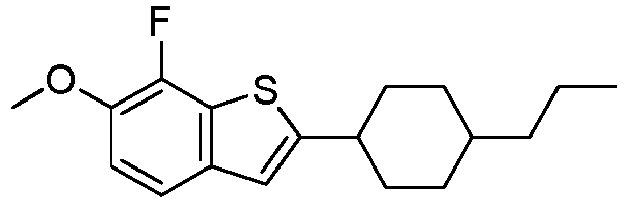
21 
31 
22 
32 
23 
33 
24 
34 
25 
35 
26 
36 
27 
37 
28 
38 
29 
39 
30 
40 
No. No. No. 41 
51 
42 
52 
43 
53 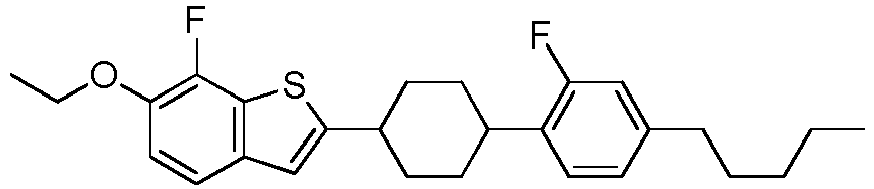
44 
54 
45 
55 
46 
56 
47 
57 
48 
58 
49 
59 
50 
60 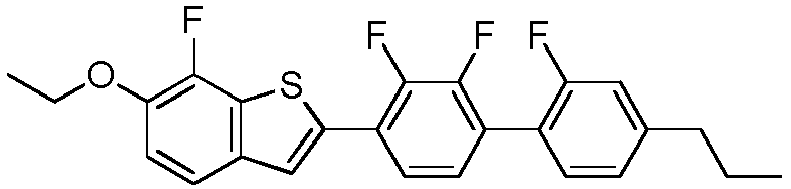
No. No. 61 
71 
62 
72 
63 
73 
64 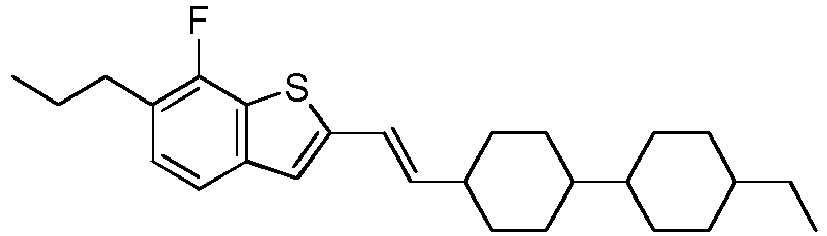
74 
65 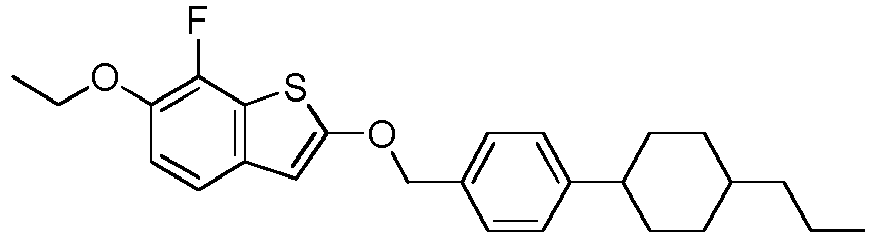
75 
66 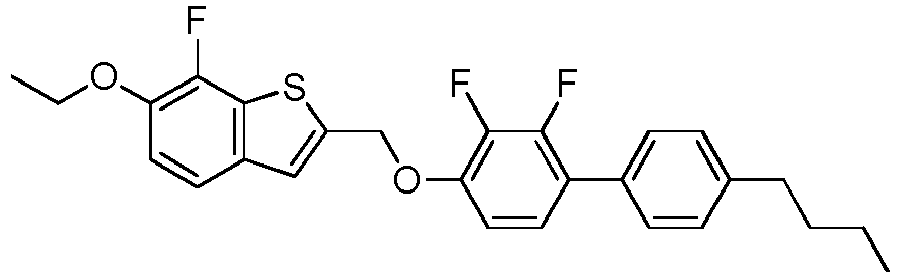
76 
67 
77 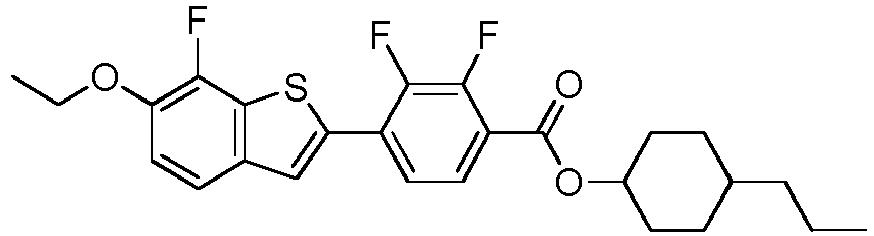
68 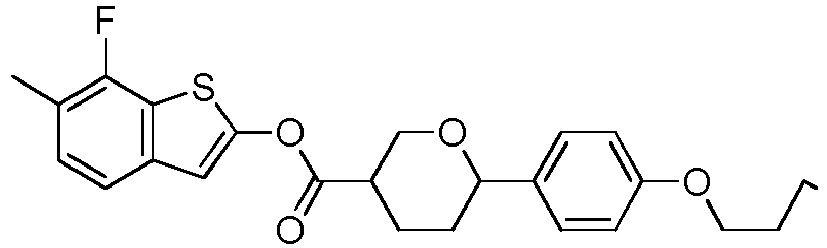
78 
69 
79 
70 
80 
81 
91 
82 
92 
83 
93 
84 
94 
85 
95 
86 
96 
87 
97 
88 
98 
89 

90 
100 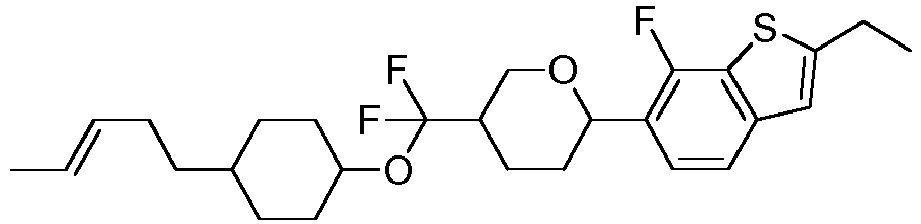
101 
111 
102 
112 
103 
113 
104 
114 
105 
115 
106 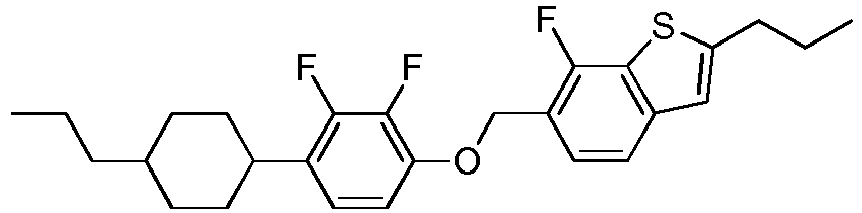
116 
107 
117 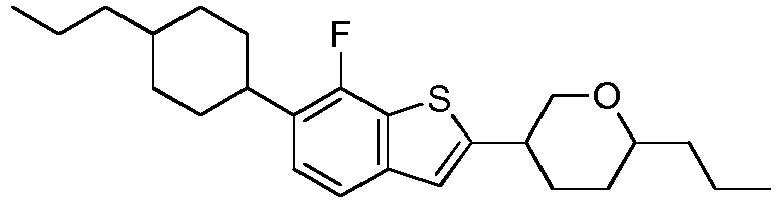
108 
118 
109 
119 
110 
120 
121 
131 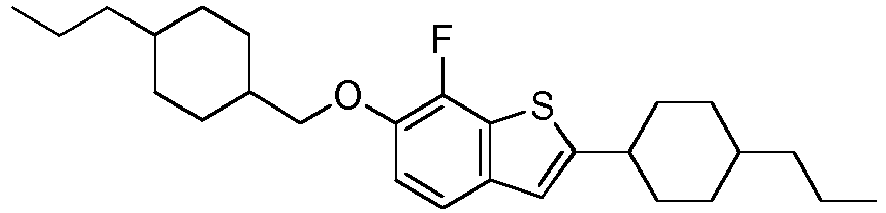
122 
132 
123 
133 
124 
134 
125 
135 
126 
136 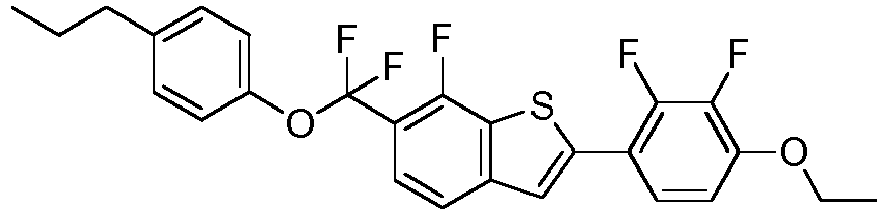
127 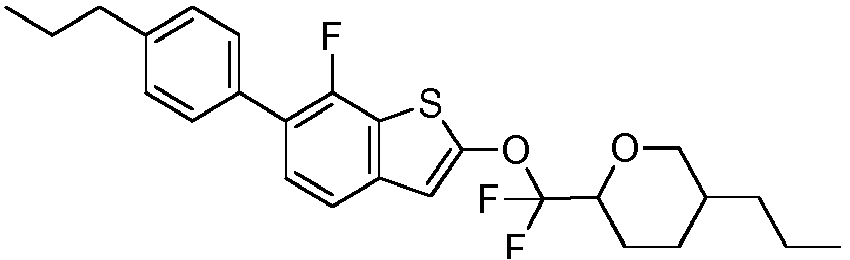
137 
128 
138 
129 
139 
130 
140 
141 
151 
142 
152 
143 
153 
144 
154 
145 
155 
146 
156 
147 
157 
148 
158 
149 
159 
150 
160 
161 
171 
162 
172 
163 
173 
164 
174 
165 
175 
166 
176 
167 
177 
168 
178 
169 
179 
170 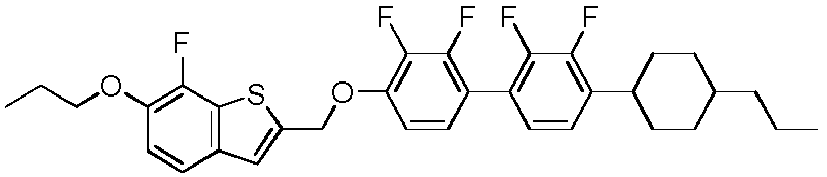
180 
181 
191 
182 
192 
183 
193 
184 
194 
185 
195 
186 
196 
187 
197 
188 
198 
189 
199 
190 
200 
201 
211 
202 
212 
203 
213 
204 
214 
205 
215 
206 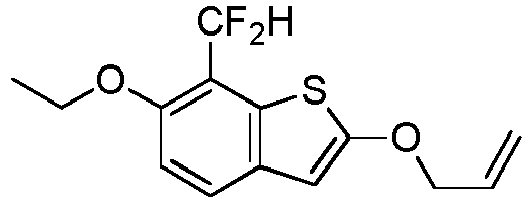
216 
207 
217 
208 
218 
209 
219 
210 
220 
221 
231 
222 
232 
223 
233 
224 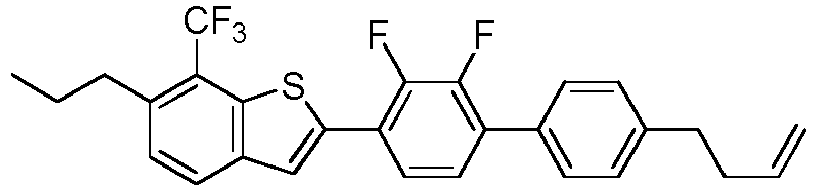
234 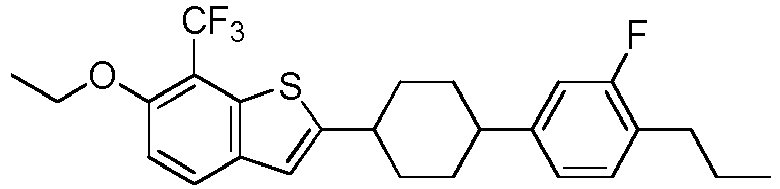
225 
235 
226 
236 
227 
237 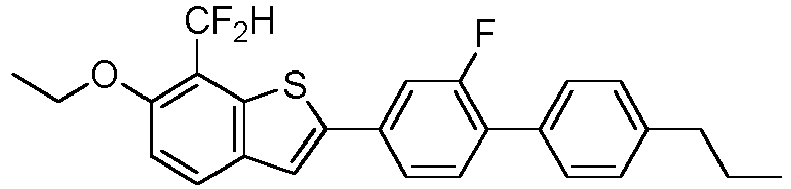
228 
238 
229 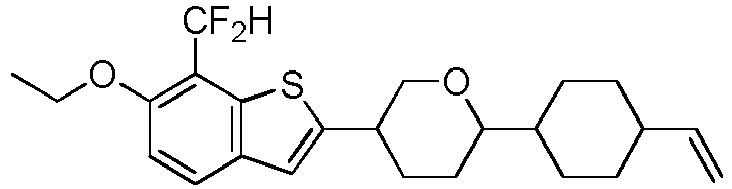
239 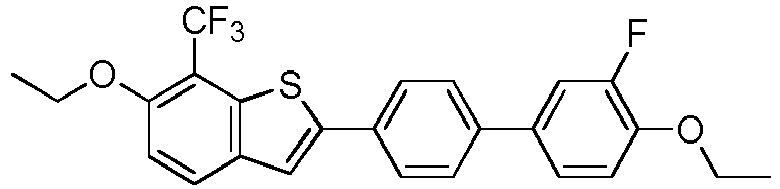
230 
240 
- Comparative compound (C-1) that is similar to the compound described in Examples in Patent literature No. 1 was prepared, in which an ethoxy group in a 6-position moves to a 5-position, and further fluorine is introduced to the 6-position in comparison with compound (No. 9).
-

- In the first step to the third step in Example 1, compounds (S-20) and (S-21) were prepared by using (S-19) in place of compound (S-1), and in the first step and the second step in Example 3, compound (C-1) was prepared by using compound (S-21) in place of compound (S-3) and using (S-10) in place of compound (S-9).
- 1H-NMR (δ ppm; CDCl3): 7.58 (d, 2H), 7.37 (d, 1H), 7.24 (d, 2H), 7.05 (d, 1H), 4.16 (q, 2H), 2.62 (t, 2H), 1.67 (sex, 2H), 1.50 (t, 3H), 0.96 (t, 3H).
- Physical properties of compound (C-1) were as described below. Transition temperature: C 86.5 I. TNI = 41.0°C; Δn = 0.214; Δε = -3.0; η = 112.7 mPa·s.
- In comparison compound (C-1) with compound (No. 9) of the invention, compound (No. 9) of the invention exhibited larger negative dielectric anisotropy (Δε = -3.83), higher maximum temperature (TNI = 101), smaller viscosity (η = 38.8) and larger optical anisotropy (Δn = 0.287).
- Liquid crystal composition (1) of the invention will be described in detail by way of Examples. The compounds in Examples were represented using symbols according to definitions in a table described below. In Table 1, the configuration of 1,4-cyclohexylene is trans. A parenthesized number next to a symbolized compound in Examples corresponds to the number of the compound. A symbol (-) means any other liquid crystal compound. A proportion (percentage) of the liquid crystal compound is expressed in terms of weight percent (% by weight) based on the total weight of the liquid crystal composition. Values of the physical properties of the composition are summarized in a last part. The physical properties were measured according to the methods described above, and measured values are directly described without extrapolation.
Table 1. Method for Description of Compounds using Symbols R-(A1)-Z1-·····-Zn-(An)-R' 1) Left-terminal Group R- Symbol 4) Ring Structure -An- Symbol CnH2n+1- n- 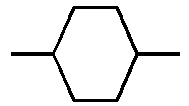
H CnH2n+1O- nO- CmH2m+1OCnH2n- mOn- 
B CH2=CH- V- CnH2n+1-CH=CH- nV- CH2=CH-CnH2n- Vn- 
B(F) CmH2m+1-CH=CH-CnH2n- mVn- CF2=CH- VFF- CF2=CH-CnH2n- VFFn- 
B(2F) 2) Right-terminal Group -R' Symbol -CnH2n+1 -n -OCnH2n+1 -On 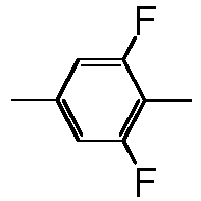
B(F,F) -COOCH3 -EMe -CH=CH2 -V -CH=CH-CnH2n+1 -Vn 
B(2F,5F) -CnH2n-CH=CH2 -nV -CmH2m-CH=CH-CnH2n+1 -mVn -CH=CF2 -VFF 
B(2F,3F) -F -F -Cl -CL -OCF3 -OCF3 
Py -OCF2H -OCF2H -CF3 -CF3 -OCH=CH-CF3 -OVCF3 
G -C≡N -C 3) Bonding Group -Zn- Symbol -CnH2n- n 
Dh -COO- E -CH=CH- V 
dh -CH2O- 1O -OCH2- O1 -CF2O- X 
bt(7F) -OCF2- x -C≡C- T 5) Examples of Description Example 1 2O-bt(7F)H-3 Example 2 3-BB(F,F)XB(F,F)-F 

-
2O-bt(7F)H-3 (No. 18) 5% 3-HB-O2 (13-5) 10% 5-HB-CL (2-2) 13% 3-HBB(F,F)-F (3-24) 7% 3-PyB(F)-F (3-81) 10% 5-PyB(F)-F (3-81) 10% 3-PyBB-F (3-80) 10% 4-PyBB-F (3-80) 8% 5-PyBB-F (3-80) 7% 5-HBB(F)B-2 (15-5) 10% 5-HBB(F)B-3 (15-5) 10% -
20-bt(7F)2H-3 (No. 25) 4% 2-HB-C (5-1) 5% 3-HB-C (5-1) 11% 3-HB-O2 (13-5) 14% 2-BTB-1 (13-10) 3% 3-HHB-F (3-1) 4% 3-HHB-1 (14-1) 8% 3-HHB-O1 (14-1) 5% 3-HHB-3 (14-1) 14% 3-HHEB-F (3-10) 4% 5-HHEB-F (3-10) 3% 2-HHB(F)-F (3-2) 7% 3-HHB(F)-F (3-2) 6% 5-HHB(F)-F (3-2) 7% 3-HHB(F,F)-F (3-3) 5% -
20-bt(7F)2H-3 (No. 25) 5% 7-HB(F,F)-F (2-3) 3% 3-HB-O2 (13-5) 7% 2-HHB(F)-F (3-2) 9% 3-HHB(F)-F (3-2) 9% 5-HHB(F)-F (3-2) 9% 2-HBB(F)-F (3-23) 9% 3-HBB(F)-F (3-23) 9% 5-HBB(F)-F (3-23) 14% 2-HBB-F (3-22) 4% 3-HBB-F (3-22) 4% 5-HBB-F (3-22) 3% 3-HBB(F,F)-F (3-24) 6% 5-HBB(F,F)-F (3-24) 9% -
3-HH1Obt(7F)-3 (No. 105) 5% 5-HB-CL (2-2) 13% 3-HH-4 (13-1) 12% 3-HH-5 (13-1) 4% 3-HHB-F (3-1) 4% 3-HHB-CL (3-1) 3% 4-HHB-CL (3-1) 4% 3-HHB(F)-F (3-2) 10% 4-HHB(F)-F (3-2) 8% 5-HHB(F)-F (3-2) 8% 7-HHB(F)-F (3-2) 8% 5-HBB(F)-F (3-23) 3% 1O1-HBBH-5 (15-1) 3% 3-HHBB(F,F)-F (4-6) 3% 4-HHBB(F,F)-F (4-6) 3% 5-HHBB(F,F)-F (4-6) 3% 3-HH2BB(F,F)-F (4-15) 3% 4-HH2BB(F,F)-F (4-15) 3% -
2O-bt(7F)BB-3 (No. 43) 1% 2O-bt(7F)HVH-3 (No. 73) 2% 3-HHB(F,F)-F (3-3) 9% 3-H2HB(F,F)-F (3-15) 7% 4-H2HB(F,F)-F (3-15) 8% 5-H2HB(F,F)-F (3-15) 8% 3-HBB(F,F)-F (3-24) 20% 5-HBB(F,F)-F (3-24) 20% 3-H2BB (F, F) -F (3-27) 9% 5-HHBB(F,F)-F (4-6) 3% 5-HHEBB-F (4-17) 2% 3-HH2BB(F,F)-F (4-15) 3% 1O1-HBBH-4 (15-1) 4% 1O1-HBBH-5 (15-1) 4% -
3-bt(7F)B-3 (No. 8) 4% 5-HB-F (2-2) 12% 6-HB-F (2-2) 9% 7-HB-F (2-2) 7% 2-HHB-OCF3 (3-1) 7% 3-HHB-OCF3 (3-1) 7% 4-HHB-OCF3 (3-1) 7% 5-HHB-OCF3 (3-1) 5% 3-HH2B-OCF3 (5-36) 4% 5-HH2B-OCF3 (5-36) 4% 3-HHB(F,F)-OCF2H (5-30) 3% 3-HHB(F,F)-OCF3 (5-30) 5% 3-HH2B(F)-F (5-37) 3% 3-HBB(F)-F (5-32) 8% 5-HBB(F)-F (5-32) 9% 5-HBBH-3 (15-1) 3% 3-HB(F)BH-3 (15-2) 3% -
2O-bt(7F)B-3 (No. 9) 5% 5-HB-CL (2-2) 11% 3-HH-4 (13-1) 8% 3-HHB-1 (14-1) 5% 3-HHB(F,F)-F (3-3) 7% 3-HBB(F,F)-F (3-24) 20% 5-HBB(F,F)-F (3-24) 14% 3-HHEB(F,F)-F (3-12) 9% 4-HHEB(F,F)-F (3-12) 3% 5-HHEB(F,F)-F (3-12) 3% 2-HBEB(F,F)-F (3-39) 3% 3-HBEB(F,F)-F (3-39) 4% 5-HBEB(F,F)-F (3-39) 3% 3-HHBB(F,F)-F (4-6) 5% -
2O-B(2F,3F)bt(7F)-3 (No. 35) 5% 3-HB-CL (2-2) 6% 5-HB-CL (2-2) 4% 3-HHB-OCF3 (3-1) 5% 3-H2HB-OCF3 (3-13) 5% 5-H4HB-OCF3 (3-13) 13% V-HHB(F)-F (3-3) 5% 3-HHB(F)-F (3-3) 4% 5-HHB(F)-F (3-3) 5% 3-H4HB(F,F)-CF3 (3-21) 8% 5-H4HB(F,F)-CF3 (3-21) 9% 5-H2HB(F,F)-F (3-15) 5% 5-H4HB(F,F)-F (3-21) 7% 2-H2BB(F)-F (3-14) 4% 3-H2BB(F)-F (3-14) 10% 3-HBEB(F,F)-F (3-39) 5% -
2O-bt(7F)B(2F,3F)-O2 (No. 14) 5% 5-HB-CL (2-2) 17% 7-HB(F,F)-F (2-4) 3% 3-HH-4 (13-1) 10% 3-HH-5 (13-1) 3% 3-HB-O2 (13-5) 12% 3-HHB-1 (14-1) 8% 3-HHB-O1 (14-1) 5% 2-HHB(F)-F (3-2) 7% 3-HHB(F)-F (3-2) 7% 5-HHB(F)-F (3-2) 7% 3-HHB(F,F)-F (3-3) 6% 3-H2HB(F,F)-F (3-15) 5% 4-H2HB(F,F)-F (3-15) 5% -
2O-bt(7F)1OB(2F,3F)-O2 (No. 32) 5% 5-HB-CL (2-2) 3% 7-HB(F)-F (2-3) 6% 3-HH-4 (13-1) 8% 3-HH-EMe (13-2) 22% 3-HHEB-F (3-10) 8% 5-HHEB-F (3-10) 8% 3-HHEB(F,F)-F (3-12) 10% 4-HHEB(F,F)-F (3-12) 4% 4-HGB(F,F)-F (3-103) 4% 5-HGB(F,F)-F (3-103) 6% 2-H2GB(F,F)-F (3-106) 4% 3-H2GB(F,F)-F (3-106) 5% 5-GHB(F,F)-F (3-109) 7% -
3-Dhbt(7F)-3 (No. 37) 4% 1V2-BEB(F,F)-C (5-15) 6% 3-HB-C (5-1) 15% 2-BTB-1 (13-10) 10% 5-HH-VFF (13-1) 29% 3-HHB-1 (14-1) 4% VFF-HHB-1 (14-1) 8% VFF2-HHB-1 (14-1) 11% 3-H2BTB-2 (14-17) 5% 3-H2BTB-3 (14-17) 4% 3-H2BTB-4 (14-17) 4% -
2O-bt(7F)xH-3 (No. 30) 5% 3-GB(F)B(F,F)XB(F,F)-F (4-57) 5% 3-BB(F)B(F,F)XB(F,F)-F (4-47) 3% 4-BB(F)B(F,F)XB(F,F)-F (4-47) 5% 5-BB(F)B(F,F)XB(F,F)-F (4-47) 3% 3-HH-V (13-1) 41% 3-HH-V1 (13-1) 6% 3-HHEH-5 (14-13) 3% 3-HHB-1 (14-1) 4% V-HHB-1 (14-1) 4% V2-BB(F)B-1 (14-6) 5% 1V2-BB-F (2-1) 3% 3-BB(F,F)XB(F,F)-F (3-97) 10% 3-HHBB(F,F)-F (4-6) 3% -
2O-bt(7F)dh-3 (No. 24) 5% 3-GB(F)B(F,F)XB(F,F)-F (4-57) 5% 3-BB(F)B(F,F)XB(F,F)-F (4-47) 3% 4-BB(F)B(F,F)XB(F,F)-F (4-47) 6% 5-BB(F)B(F,F)XB(F,F)-F (4-47) 3% 3-HH-V (13-1) 38% 3-HH-V1 (13-1) 7% 3-HHEH-5 (14-13) 3% 3-HHB-1 (14-1) 4% V-HHB-1 (14-1) 4% V2-BB(F)B-1 (14-6) 5% 1V2-BB-F (2-1) 3% 3-BB(F,F)XB(F,F)-F (3-97) 6% 3-GB(F,F)XB(F,F)-F (3-113) 5% 3-HHBB(F,F)-F (4-6) 3% -
2O-bt(7F)B(2F)B-3 (No. 56) 3% 2O-bt(7F)B(2F,3F)-O2 (No. 14) 1% 7-HB(F,F)-F (2-3) 3% 3-HB-O2 (13-5) 7% 2-HHB(F)-F (3-2) 8% 3-HHB(F)-F (3-2) 9% 5-HHB(F)-F (3-2) 9% 2-HBB(F)-F (3-23) 9% 3-HBB(F)-F (3-23) 9% 5-HBB(F)-F (3-23) 16% 2-HBB-F (3-22) 4% 3-HBB-F (3-22) 4% 5-HBB-F (3-22) 3% 3-HBB(F,F)-F (3-24) 5% 5-HBB(F,F)-F (3-24) 10% -
2O-bt(7F)B(2F)B-5 (No. 241) 3% 2O-bt(7F)B(2F,3F)O1H-3 (No. 243) 1% 5-HB-F (2-2) 12% 6-HB-F (2-2) 9% 7-HB-F (2-2) 7% 2-HHB-OCF3 (3-1) 7% 3-HHB-OCF3 (3-1) 5% 4-HHB-OCF3 (3-1) 7% 5-HHB-OCF3 (3-1) 5% 3-HH2B-OCF3 (5-36) 4% 5-HH2B-OCF3 (5-36) 4% 3-HHB(F,F)-OCF2H (5-30) 3% 3-HHB(F,F)-OCF3 (5-30) 4% 3-HH2B(F)-F (5-37) 3% 3-HBB(F)-F (5-32) 10% 5-HBB(F)-F (5-32) 10% 5-HBBH-3 (15-1) 3% 3-HB(F)BH-3 (15-2) 3% -
2O-bt(7F)B(2F)B-O4 (No. 242) 3% 2O-bt(7F)B(F,F)XB(F,F)-F (No. 247) 1% 5-HB-CL (2-2) 3% 7-HB(F)-F (2-3) 7% 3-HH-4 (13-1) 9% 3-HH-EMe (13-2) 22% 3-HHEB-F (3-10) 8% 5-HHEB-F (3-10) 8% 3-HHEB(F,F)-F (3-12) 10% 4-HHEB(F,F)-F (3-12) 5% 4-HGB(F,F)-F (3-103) 4% 5-HGB(F,F)-F (3-103) 5% 2-H2GB(F,F)-F (3-106) 4% 3-H2GB(F,F)-F (3-106) 5% 5-GHB(F,F)-F (3-109) 6% -
2O-bt(7F)B(2F)-3 (No. 244) 4% 2O-bt(7F)B(2F)B-4 (No. 249) 5% 3-HB-O2 (13-5) 10% 5-HB-CL (2-2) 11% 3-HBB(F,F)-F (3-24) 8% 3-PyB(F)-F (3-81) 10% 5-PyB(F)-F (3-81) 10% 3-PyBB-F (3-80) 7% 4-PyBB-F (3-80) 8% 5-PyBB-F (3-80) 9% 5-HBB(F)B-2 (15-5) 9% 5-HBB(F)B-3 (15-5) 9% - A liquid crystal compound of the invention has high stability to heat, light and so forth, a high clearing point, low minimum temperature of a liquid crystal phase, small viscosity, suitable optical anisotropy, large negative dielectric anisotropy, a suitable elastic constant and excellent compatibility with other liquid crystal compounds. A liquid crystal composition of the invention contains the compound, and has high maximum temperature of a nematic phase, low minimum temperature of the nematic phase, small viscosity, suitable optical anisotropy, large negative dielectric anisotropy and a suitable elastic constant. The composition has a suitable balance regarding at least two of physical properties. A liquid crystal display device of the invention includes the composition, and has a wide temperature range in which the device can be used, a short response time, a large voltage holding ratio, low threshold voltage, a large contrast ratio and a long service life. Accordingly, the device can be widely used in a display of a personal computer, a television and so forth.
Claims (16)
- A compound, represented by formula (1):
 R1 and R2 are independently hydrogen, halogen or alkyl having 1 to 20 carbons, and in the alkyl, at least one piece of -CH2-may be replaced by -O- or -S-, at least one piece of -(CH2)2- may replace by -CH=CH-, and in the groups, at least one piece of hydrogen may be replaced by halogen;ring A1 and ring A2 are independently 1,4-cyclohexylene, 1,4-cyclohexenylene, 1,4-phenylene, tetrahydropyran-2,5-diyl, 1,3-dioxane-2,5-diyl, pyrimidine-2,5-diyl, 2,6,7-trioxabicyclo[2.2.2]octane-1,4-diyl, naphthalene-2, 6-diyl or pyridine-2, 5-diyl, and at least one piece of hydrogen on the rings may be replaced by halogen;Z1 and Z2 are independently a single bond or alkylene having 1 to 4 carbons, in the alkylene, at least one piece of -CH2- may be replaced by -O- or -COO-, and at least one piece of -(CH2)2-may replace by -CH=CH- or -C≡C-, and in the groups, at least one piece of hydrogen may be replaced by halogen;Z3 is -O- or a single bond;L1 is F, CF3 or CF2H; anda and b are independently 0, 1, 2, 3 or 4, and a sum of a and b is 4 or less, and when a or b is 2 or more, two of arbitrary ring A1, two of arbitrary ring A2, two pieces of arbitrary Z1 or two pieces of arbitrary Z2 may be identical or different.
 - The compound according to claim 1, represented by formula (1-2):
 R1 and R2 are independently hydrogen, halogen or alkyl having 1 to 20 carbons, and in the alkyl, at least one piece of -CH2-may be replaced by -O- or -S-, at least one piece of -(CH2)2- may replace by -CH=CH-, and in the groups, at least one piece of hydrogen may be replaced by halogen;ring A1 and ring A2 are independently 1,4-cyclohexylene, 1,4-cyclohexenylene, 1,4-phenylene, tetrahydropyran-2,5-diyl, 1,3-dioxane-2,5-diyl, pyrimidine-2,5-diyl, 2,6,7-trioxabicyclo[2.2.2]octane-1,4-diyl, naphthalene-2, 6-diyl or pyridine-2, 5-diyl, and at least one piece of hydrogen on the rings may be replaced by halogen;Z1 and Z2 are independently a single bond or alkylene having 1 to 4 carbons, in the alkylene, at least one piece of -CH2- may be replaced by -O- or -COO-, and at least one piece of -(CH2)2-may replace by -CH=CH- or -C≡C-, and in the groups, at least one piece of hydrogen may be replaced by halogen;Z3 is -O- or a single bond; anda and b are independently 0, 1, 2, 3 or 4, and a sum of a and b is 4 or less, and when a or b is 2 or more, two of ring A1 and A2, and two of Z1 and Z2 may be identical or different.
 - The compound according to claim 2, wherein, in formula (1-2) described in claim 2, R1 and R2 are independently chlorine, fluorine, alkyl having 1 to 10 carbons, alkoxy having 1 to 9 carbons, alkenyl having 2 to 10 carbons, polyfluoroalkyl having 1 to 10 carbons or polyfluoroalkyl having 1 to 9 carbons;
ring A1 and ring A2 are independently 1,4-cyclohexylene, 1,4-cyclohexenylene, 1,4-phenylene in which at least one piece of hydrogen may be replaced by halogen, or tetrahydropyran-2,5-diyl;
Z1 and Z2 are independently a single bond, -(CH2)2-, -CH=CH-, -CF=CF-, -C≡C-, -COO-, -OCO-, -CF2O-, -OCF2-, -CH2O-, -OCH2-, -(CH2)4-, -(CH2)2CF2-O-, -(CH2)2OCF2-, -CF2O(CH2)2-, -OCF2(CH2)2-, -CH=CH(CH2)2- or -(CH2)2-CH=CH-; and
a and b are independently 0, 1, 2, 3 or 4, and a sum of a and b is 4 or less. - The compound according to claim 2 or 3, wherein, in formula (1-2), a sum of a and b is 0, 1, 2 or 3;
R1 and R2 are independently chlorine, fluorine, alkyl having 1 to 10 carbons, alkoxy having 1 to 9 carbons, alkenyl having 2 to 10 carbons, polyfluoroalkyl having 1 to 10 carbons or polyfluoroalkyl having 1 to 9 carbons;
ring A1 and ring A2 are independently 1,4-cyclohexylene, 1,4-cyclohexenylene, 1,4-phenylene in which at least one piece of hydrogen may be replaced by halogen, or tetrahydropyran-2,5-diyl; and
Z1 and Z2 are independently a single bond, -(CH2)2-, -CH=CH-, -CF=CF-, -C≡C-, -COO-, -OCO-, -CF2O-, -OCF2-, -CH2O-, -OCH2-, -(CH2)4-, -(CH2)2CF2-O-, -(CH2)2OCF2-, -CF2O(CH2)2-, -OCF2(CH2)2-, -CH=CH-(CH2)2- or -(CH2)2-CH=CH-.
- The compound according to any one of claims 1 to 4, represented by any one of formulas (1-2-1) to (1-2-10):


 wherein, in formulas (1-2-1) to (1-2-10), R1 and R2 are independently chlorine, fluorine, alkyl having 1 to 10 carbons, alkoxy having 1 to 9 carbons, alkenyl having 2 to 10 carbons, polyfluoroalkyl having 1 to 10 carbons or polyfluoroalkyl having 1 to 9 carbons;ring A1, ring A2, ring A3 and ring A4 are independently 1,4-cyclohexylene, 1,4-cyclohexenylene, 1,4-phenylene, 1, 4-phenylene in which at least one piece of hydrogen is replaced by halogen, or tetrahydropyran-2,5-diyl; andZ1, Z2, Z4 and Z5 are independently a single bond, -(CH2)2-, -CH=CH-, -CF=CF-, -C≡C-, -COO-, -OCO-, -CF2O-, -OCF2-, -CH2O-, -OCH2-, -(CH2)4-, -(CH2)CF2O-, -(CH2)2OCF2-, -CF2O(CH2)2-, -OCF2(CH2)2 -, -CH=CH-(CH2)2- or -(CH2)2-CH=CH-.
 - The compound according to claim 5, wherein, in formulas (1-2-1) to (1-2-10) described in claim 5, R1 and R2 are independently fluorine, alkyl having 1 to 10 carbons, alkoxy having 1 to 9 carbons, alkenyl having 2 to 10 carbons or polyfluoroalkyl having 1 to 9 carbons;
ring A1, ring A2, ring A3 and ring A4 are independently 1,4-cyclohexylene, 1,4-cyclohexenylene, 1,4-phenylene in which at least one piece of hydrogen may be replaced by halogen, or tetrahydropyran-2,5-diyl; and
Z1, Z2, Z4 and Z5 are independently a single bond, -(CH2)2-, -CH=CH-, -CF2O-, -OCF2-, -CH2O- or -OCH2-. - The compound according to claim 6, represented by any one of formulas (1-2-4), (1-2-7) and (1-2-9):


- The compound according to claim 6, represented by any one of formulas (1-2-1), (1-2-5), (1-2-8) and (1-2-10), wherein, R1 is alkoxy having 1 to 6 carbons:




- A liquid crystal composition, containing at least one compound according to any one of claims 1 to 8.
- The liquid crystal composition according to claim 9, further containing at least one compound selected from the group of compounds represented by formulas (6) to (12):


 R13 is alkyl having 1 to 10 carbons or alkenyl having 2 to 10 carbons, and in the alkyl and the alkenyl, at least one piece of -CH2- may be replaced by -O-, and at least one piece of hydrogen may be replaced by fluorine;R14 is alkyl having 1 to 10 carbons, in the alkyl, at least one piece of -CH2- may be replaced by -O-, and at least one piece of hydrogen may be replaced by fluorine;R15 is hydrogen, fluorine, alkyl having 1 to 10 carbons or alkenyl having 2 to 10 carbons, and in the alkyl and the alkenyl, at least one piece of -CH2- may be replaced by -O-, and at least one piece of hydrogen may be replaced by fluorine;S11 is hydrogen or methyl;X is -CF2-, -O- or -CHF-;ring D1, ring D2, ring D3 and ring D4 are independently 1,4-cyclohexylene, 1,4-cyclohexenylene, 1,4-phenylene in which at least one piece of hydrogen may be replaced by fluorine, tetrahydropyran-2,5-diyl, or decahydronaphthalene-2,6-diyl;ring D5 and ring D6 are independently 1,4-cyclohexylene, 1,4-cyclohexenylene, 1,4-phenylene, tetrahydropyran-2,5-diyl or decahydronaphthalene-2,6-diyl;Z15, Z16, Z17 and Z18 are independently a single bond, -CH2CH2-, -COO-, -CH2O-, -OCF2- or -OCF2CH2CH2-;L15 and L16 are independently fluorine or chlorine; andj, k, m, n, p, q, r and s are independently 0 or 1, a sum of k, m, n and p is 1 or 2, and a sum of q, r and s is 0, 1, 2 or 3, and t is 1, 2 or 3.
 - The liquid crystal composition according to claims 9 or 10, further containing at least one compound selected from the group of compounds represented by formulas (13) to (15):


 R16 and R17 are independently alkyl having 1 to 10 carbons or alkenyl having 2 to 10 carbons, and in the alkyl and the alkenyl, at least one piece of -CH2- may be replaced by -O-, and at least one piece of hydrogen may be replaced by fluorine;ring E1, ring E2, ring E3 and ring E4 are independently 1,4-cyclohexylene, 1,4-phenylene, 2-fluoro-1,4-phenylene, 2,5-difluoro-1,4-phenylene or pyrimidine-2,5-diyl; andZ19, Z20 and Z21 are independently a single bond, -CH2CH2-, -CH=CH-, -C≡C- or -COO-.
 - The liquid crystal composition according to any one of claims 9 to 11, further containing at least one compound selected from the group of compounds represented by formulas (2) to (4):

 R11 is alkyl having 1 to 10 carbons or alkenyl having 2 to 10 carbons, and in the alkyl and the alkenyl, at least one piece of hydrogen may be replaced by fluorine, and at least one piece of -CH2- may be replaced by -O-;X11 is fluorine, chlorine, -OCF3, -OCHF2, -CF3, -CHF2, -CH2F, -OCF2CHF2 or -OCF2CHFCF3;ring B1, ring B2 and ring B3 are independently 1,4-cyclohexylene, 1,4-phenylene in which at least one piece of hydrogen may be replaced by fluorine, tetrahydropyran-2,5-diyl, 1,3-dioxane-2,5-diyl, or pyrimidine-2,5-diyl;Z11, Z12 and Z13 are independently a single bond, -CH2CH2-, -CH=CH-, -C≡C-, -COO-, -CF2O-, -OCF2-, -CH2O- or -(CH2)4-; and L11 and L12 are independently hydrogen or fluorine.
 - The liquid crystal composition according to any one of claims 9 to 12, further containing at least one optically active compound and/or at least one polymerizable compound.
- The liquid crystal composition according to any one of claims 9 to 13, further containing at least one antioxidant and/or at least one ultraviolet light absorbent.
- A liquid crystal display device, including the liquid crystal composition according to any one of claims 9 to 14.
- The liquid crystal display device according to claim 15, wherein the liquid crystal composition according to any one of claims 9 to 14 is encapsulated.
Applications Claiming Priority (2)
| Application Number | Priority Date | Filing Date | Title |
|---|---|---|---|
| JP2015030164 | 2015-02-19 | ||
| PCT/JP2016/054004 WO2016132998A1 (en) | 2015-02-19 | 2016-02-10 | Liquid crystalline compound having benzothiophene, liquid crystal composition and liquid crystal display element |
Publications (2)
| Publication Number | Publication Date |
|---|---|
| EP3260451A1 true EP3260451A1 (en) | 2017-12-27 |
| EP3260451A4 EP3260451A4 (en) | 2018-07-18 |
Family
ID=56689352
Family Applications (1)
| Application Number | Title | Priority Date | Filing Date |
|---|---|---|---|
| EP16752384.4A Withdrawn EP3260451A4 (en) | 2015-02-19 | 2016-02-10 | Liquid crystalline compound having benzothiophene, liquid crystal composition and liquid crystal display element |
Country Status (7)
| Country | Link |
|---|---|
| US (1) | US10308871B2 (en) |
| EP (1) | EP3260451A4 (en) |
| JP (1) | JP6508324B2 (en) |
| KR (1) | KR20170118687A (en) |
| CN (1) | CN107207459B (en) |
| TW (1) | TWI681043B (en) |
| WO (1) | WO2016132998A1 (en) |
Families Citing this family (17)
| Publication number | Priority date | Publication date | Assignee | Title |
|---|---|---|---|---|
| KR20190136125A (en) | 2012-12-21 | 2019-12-09 | 국립연구개발법인 양자과학기술연구개발기구 | Novel compound for imaging tau protein accumulated in the brain |
| JP6696312B2 (en) * | 2016-06-15 | 2020-05-20 | Jnc株式会社 | Liquid crystal composition and liquid crystal display device |
| DE102017010478A1 (en) * | 2016-12-02 | 2018-06-07 | Merck Patent Gmbh | Thioether compounds |
| JP7293343B2 (en) * | 2018-05-09 | 2023-06-19 | アプリノイア セラピューティクス リミテッド | Heteroaryl compound and use thereof |
| CN110499162A (en) * | 2018-05-18 | 2019-11-26 | 石家庄诚志永华显示材料有限公司 | Positive dielectric anisotropic liquid crystal composition and liquid crystal display device |
| JP7187819B2 (en) * | 2018-05-22 | 2022-12-13 | Jnc株式会社 | Liquid crystalline compound, liquid crystal composition and liquid crystal display element |
| CN110922981A (en) * | 2018-09-20 | 2020-03-27 | 北京八亿时空液晶科技股份有限公司 | Liquid crystal composition containing benzothiophene polymerizable compounds and application thereof |
| CN111117658A (en) * | 2018-10-30 | 2020-05-08 | 江苏和成显示科技有限公司 | Liquid crystal composition and display device thereof |
| CN112300811B (en) * | 2019-08-01 | 2022-07-15 | 江苏和成显示科技有限公司 | Liquid crystal composition and liquid crystal display device |
| CA3161455A1 (en) | 2019-11-13 | 2021-05-20 | Aprinoia Therapeutics Limited | Compounds for degrading tau protein aggregates and uses thereof |
| CN113493689B (en) * | 2020-03-18 | 2023-06-02 | 北京八亿时空液晶科技股份有限公司 | A kind of liquid crystal compound containing difluoromethoxy bridge bond and its preparation method and application |
| JP2021152137A (en) * | 2020-03-19 | 2021-09-30 | Jnc株式会社 | Liquid crystal composition and liquid crystal display element |
| CN112851562A (en) * | 2021-01-22 | 2021-05-28 | 烟台显华化工科技有限公司 | Aromatic ring liquid crystal compound, liquid crystal composition and application thereof |
| JP7746822B2 (en) * | 2021-11-18 | 2025-10-01 | Jnc株式会社 | Benzothiophene-containing liquid crystal compound, liquid crystal composition and device |
| CN116970405B (en) * | 2023-06-28 | 2024-09-10 | 北京燕化集联光电技术有限公司 | Liquid crystal compound, composition and application thereof |
| CN116987509B (en) * | 2023-06-30 | 2024-09-10 | 北京燕化集联光电技术有限公司 | Liquid crystal compound, composition and application thereof |
| CN117700385B (en) * | 2023-12-07 | 2026-01-30 | 安徽宇贝新材料科技有限公司 | A liquid crystal compound, a composition and its application |
Family Cites Families (19)
| Publication number | Priority date | Publication date | Assignee | Title |
|---|---|---|---|---|
| ATE284690T1 (en) | 1995-10-31 | 2005-01-15 | Lilly Co Eli | ANTITHRBOTIC DIAMINE |
| DE19630068A1 (en) * | 1996-07-25 | 1998-01-29 | Basf Ag | New liquid crystalline compounds and their precursors |
| DE19913349A1 (en) * | 1999-03-24 | 2000-09-28 | Clariant Gmbh | Use of benzothiophene derivatives as components of liquid crystal mixtures, especially for use in ferroelectric switching and display devices |
| EP1214306A1 (en) * | 1999-09-21 | 2002-06-19 | Qinetiq Limited | Liquid crystal compounds |
| JP4285947B2 (en) * | 2001-06-15 | 2009-06-24 | 三洋電機株式会社 | Luminescent organometallic compound and light emitting device |
| DE10135499A1 (en) * | 2001-07-20 | 2003-01-30 | Merck Patent Gmbh | Indane compounds with negative delta epsilon |
| MXPA06001274A (en) * | 2003-08-01 | 2006-04-11 | Tanabe Seiyaku Co | NEW COMPOUNDS THAT HAVE INHIBITORY ACTIVITY AGAINST SODIUM-DEPENDENT CARRIER. |
| ES2436877T3 (en) | 2005-11-17 | 2014-01-07 | OSI Pharmaceuticals, LLC | Intermediates for the preparation of condensed bicyclic mTOR inhibitors |
| AR080433A1 (en) | 2010-03-02 | 2012-04-11 | Merck Sharp & Dohme | USEFUL BENZOFURANCARBOXAMIDS DERIVATIVES TO TREAT OR PREVENT HCV INFECTIONS AND PHARMACEUTICAL COMPOSITIONS CONTAINING THEM. |
| CN103184053B (en) * | 2011-12-29 | 2015-03-11 | 苏州汉朗光电有限公司 | High scattering state smectic phase liquid crystal materials and display devices thereof |
| US9724351B2 (en) * | 2012-08-23 | 2017-08-08 | Alios Biopharma, Inc. | Compounds for the treatment of paramoxyvirus viral infections |
| JP6248557B2 (en) | 2012-11-16 | 2017-12-20 | Jnc株式会社 | Liquid crystalline compound having vinyloxy, liquid crystal composition, and liquid crystal display device |
| JP5850023B2 (en) | 2012-11-27 | 2016-02-03 | Jnc株式会社 | Liquid crystal compound, liquid crystal composition and liquid crystal display element having CF2OCF3 at terminal |
| HUE039052T2 (en) * | 2013-02-19 | 2018-12-28 | Novartis Ag | Benzothiophene derivatives and compositions thereof as selective estrogen receptor degraders |
| KR20150144754A (en) * | 2013-04-19 | 2015-12-28 | 제이엔씨 주식회사 | Liquid crystal compound having xanthene skeleton and exhibiting negative dielectric anisotropy, liquid crystal composition, and liquid crystal display element |
| SG11201600108PA (en) * | 2013-07-17 | 2016-02-26 | Otsuka Pharma Co Ltd | Cyanotriazole compounds |
| TWI708770B (en) * | 2015-06-08 | 2020-11-01 | 日商捷恩智股份有限公司 | Liquid crystal compound having benzothiophene, liquid crystal composition and liquid crystal display device |
| US10059878B2 (en) * | 2016-02-17 | 2018-08-28 | Jnc Corporation | Liquid crystal composition and liquid crystal display device |
| JP6696312B2 (en) * | 2016-06-15 | 2020-05-20 | Jnc株式会社 | Liquid crystal composition and liquid crystal display device |
-
2016
- 2016-02-10 US US15/547,063 patent/US10308871B2/en active Active
- 2016-02-10 EP EP16752384.4A patent/EP3260451A4/en not_active Withdrawn
- 2016-02-10 CN CN201680010490.0A patent/CN107207459B/en active Active
- 2016-02-10 KR KR1020177015856A patent/KR20170118687A/en not_active Withdrawn
- 2016-02-10 JP JP2017500636A patent/JP6508324B2/en active Active
- 2016-02-10 WO PCT/JP2016/054004 patent/WO2016132998A1/en not_active Ceased
- 2016-02-17 TW TW105104524A patent/TWI681043B/en active
Also Published As
| Publication number | Publication date |
|---|---|
| US20180016501A1 (en) | 2018-01-18 |
| JPWO2016132998A1 (en) | 2017-09-14 |
| KR20170118687A (en) | 2017-10-25 |
| CN107207459A (en) | 2017-09-26 |
| WO2016132998A1 (en) | 2016-08-25 |
| CN107207459B (en) | 2021-03-30 |
| JP6508324B2 (en) | 2019-05-08 |
| US10308871B2 (en) | 2019-06-04 |
| TW201631133A (en) | 2016-09-01 |
| TWI681043B (en) | 2020-01-01 |
| EP3260451A4 (en) | 2018-07-18 |
Similar Documents
| Publication | Publication Date | Title |
|---|---|---|
| JP6508324B2 (en) | Liquid crystalline compound having benzothiophene, liquid crystal composition and liquid crystal display device | |
| EP2871175B1 (en) | Polymerizable compound, liquid crystal composition, and liquid crystal display device | |
| EP2735599B1 (en) | Liquid crystal compound having CF2OCF3 at terminal, liquid crystal composition and liquid crystal display device | |
| JP6850410B2 (en) | Liquid crystal compounds, liquid crystal compositions and liquid crystal display devices with benzothiophene | |
| EP3305774B1 (en) | Benzothiophene-containing liquid crystalline compound, liquid crystal composition and liquid crystal display device | |
| JP6586785B2 (en) | 1,3-Dioxane compound having fluorine atom in axial position, liquid crystal composition and liquid crystal display device | |
| WO2014125911A1 (en) | Liquid-crystalline compound having difluoromethyleneoxy group, liquid crystal composition, and liquid crystal display element | |
| JP2016185913A (en) | Alkenyl dioxane compound, liquid crystal composition and liquid crystal display element | |
| CN102046570B (en) | Liquid crystalline tetracyclic compound having fluorine atom, liquid crystal composition and liquid crystal display element | |
| JP6311531B2 (en) | Compound having 3,3-difluoro-1-propenyloxy, liquid crystal composition and liquid crystal display device | |
| EP3112337B1 (en) | Liquid crystalline compound containing tetrafluorofluorene, liquid crystal composition, and liquid crystal display device | |
| EP3135659A1 (en) | Liquid crystal compound having 1,1,3,3-tetrafluoroallyloxy group, liquid crystal composition, and liquid crystal display element | |
| JP6578690B2 (en) | Liquid crystal compound having halogenated alkyl, liquid crystal composition, and liquid crystal display device | |
| JP6402919B2 (en) | COMPOUND HAVING PERFLUOROALKYL TERMINAL GROUP AND CF2O BONDING GROUP, LIQUID CRYSTAL COMPOSITION AND LIQUID CRYSTAL DISPLAY DEVICE | |
| EP3459934A1 (en) | Polymerizable compound and composition, liquid crystal composite, optically anisotropic body, liquid crystal display element, and use therefor | |
| JP7747621B2 (en) | Compound, liquid crystal composition and liquid crystal display element | |
| JP6467807B2 (en) | Liquid crystalline compound having butene bond group, liquid crystal composition, and liquid crystal display device | |
| JP2017132693A (en) | Compound having difluorocyclohexane ring, liquid crystal composition, and liquid crystal display element | |
| JP2017137240A (en) | Liquid crystal compound, liquid crystal composition, and liquid crystal display device | |
| JPWO2015041006A1 (en) | Liquid crystalline compound having negative dielectric anisotropy having tetrafluorocyclohexadiene skeleton, liquid crystal composition, and liquid crystal display device | |
| EP3495343A1 (en) | Polymerizable polar compound, liquid crystal composition and liquid crystal display device | |
| JP5962164B2 (en) | Tricyclic compound having a plurality of CF2O bonding groups, liquid crystal composition, and liquid crystal display device | |
| US10100251B2 (en) | Compounds having a difluorocyclohexane ring, liquid crystal compositions and liquid crystal display devices | |
| EP3299439A1 (en) | Liquid crystal compound, liquid crystal composition and liquid crystal display device | |
| JP6863406B2 (en) | Liquid crystal compounds, liquid crystal compositions and liquid crystal display devices with halogenated alkyl |
Legal Events
| Date | Code | Title | Description |
|---|---|---|---|
| STAA | Information on the status of an ep patent application or granted ep patent |
Free format text: STATUS: THE INTERNATIONAL PUBLICATION HAS BEEN MADE |
|
| PUAI | Public reference made under article 153(3) epc to a published international application that has entered the european phase |
Free format text: ORIGINAL CODE: 0009012 |
|
| STAA | Information on the status of an ep patent application or granted ep patent |
Free format text: STATUS: REQUEST FOR EXAMINATION WAS MADE |
|
| 17P | Request for examination filed |
Effective date: 20170622 |
|
| AK | Designated contracting states |
Kind code of ref document: A1 Designated state(s): AL AT BE BG CH CY CZ DE DK EE ES FI FR GB GR HR HU IE IS IT LI LT LU LV MC MK MT NL NO PL PT RO RS SE SI SK SM TR |
|
| AX | Request for extension of the european patent |
Extension state: BA ME |
|
| DAV | Request for validation of the european patent (deleted) | ||
| DAX | Request for extension of the european patent (deleted) | ||
| A4 | Supplementary search report drawn up and despatched |
Effective date: 20180615 |
|
| RIC1 | Information provided on ipc code assigned before grant |
Ipc: C09K 19/32 20060101ALI20180611BHEP Ipc: G02F 1/13 20060101ALI20180611BHEP Ipc: C09K 19/30 20060101ALI20180611BHEP Ipc: C07D 333/64 20060101AFI20180611BHEP Ipc: C09K 19/42 20060101ALI20180611BHEP Ipc: C09K 19/34 20060101ALI20180611BHEP |
|
| STAA | Information on the status of an ep patent application or granted ep patent |
Free format text: STATUS: EXAMINATION IS IN PROGRESS |
|
| 17Q | First examination report despatched |
Effective date: 20190418 |
|
| GRAP | Despatch of communication of intention to grant a patent |
Free format text: ORIGINAL CODE: EPIDOSNIGR1 |
|
| STAA | Information on the status of an ep patent application or granted ep patent |
Free format text: STATUS: GRANT OF PATENT IS INTENDED |
|
| INTG | Intention to grant announced |
Effective date: 20200629 |
|
| STAA | Information on the status of an ep patent application or granted ep patent |
Free format text: STATUS: THE APPLICATION IS DEEMED TO BE WITHDRAWN |
|
| 18D | Application deemed to be withdrawn |
Effective date: 20201110 |