EP3259688B1 - Systeme und verfahren zur modellierung von neuraler sprache - Google Patents
Systeme und verfahren zur modellierung von neuraler sprache Download PDFInfo
- Publication number
- EP3259688B1 EP3259688B1 EP16753087.2A EP16753087A EP3259688B1 EP 3259688 B1 EP3259688 B1 EP 3259688B1 EP 16753087 A EP16753087 A EP 16753087A EP 3259688 B1 EP3259688 B1 EP 3259688B1
- Authority
- EP
- European Patent Office
- Prior art keywords
- linguistic
- input
- neural
- embedding
- partition
- Prior art date
- Legal status (The legal status is an assumption and is not a legal conclusion. Google has not performed a legal analysis and makes no representation as to the accuracy of the status listed.)
- Active
Links
Images




Classifications
-
- G—PHYSICS
- G06—COMPUTING OR CALCULATING; COUNTING
- G06N—COMPUTING ARRANGEMENTS BASED ON SPECIFIC COMPUTATIONAL MODELS
- G06N3/00—Computing arrangements based on biological models
- G06N3/02—Neural networks
- G06N3/04—Architecture, e.g. interconnection topology
-
- G—PHYSICS
- G06—COMPUTING OR CALCULATING; COUNTING
- G06F—ELECTRIC DIGITAL DATA PROCESSING
- G06F40/00—Handling natural language data
- G06F40/20—Natural language analysis
- G06F40/205—Parsing
- G06F40/216—Parsing using statistical methods
-
- G—PHYSICS
- G06—COMPUTING OR CALCULATING; COUNTING
- G06F—ELECTRIC DIGITAL DATA PROCESSING
- G06F40/00—Handling natural language data
- G06F40/30—Semantic analysis
-
- G—PHYSICS
- G06—COMPUTING OR CALCULATING; COUNTING
- G06N—COMPUTING ARRANGEMENTS BASED ON SPECIFIC COMPUTATIONAL MODELS
- G06N3/00—Computing arrangements based on biological models
- G06N3/02—Neural networks
-
- G—PHYSICS
- G06—COMPUTING OR CALCULATING; COUNTING
- G06N—COMPUTING ARRANGEMENTS BASED ON SPECIFIC COMPUTATIONAL MODELS
- G06N3/00—Computing arrangements based on biological models
- G06N3/02—Neural networks
- G06N3/04—Architecture, e.g. interconnection topology
- G06N3/045—Combinations of networks
-
- G—PHYSICS
- G06—COMPUTING OR CALCULATING; COUNTING
- G06N—COMPUTING ARRANGEMENTS BASED ON SPECIFIC COMPUTATIONAL MODELS
- G06N3/00—Computing arrangements based on biological models
- G06N3/02—Neural networks
- G06N3/04—Architecture, e.g. interconnection topology
- G06N3/0499—Feedforward networks
-
- G—PHYSICS
- G06—COMPUTING OR CALCULATING; COUNTING
- G06N—COMPUTING ARRANGEMENTS BASED ON SPECIFIC COMPUTATIONAL MODELS
- G06N3/00—Computing arrangements based on biological models
- G06N3/02—Neural networks
- G06N3/08—Learning methods
-
- G—PHYSICS
- G06—COMPUTING OR CALCULATING; COUNTING
- G06N—COMPUTING ARRANGEMENTS BASED ON SPECIFIC COMPUTATIONAL MODELS
- G06N3/00—Computing arrangements based on biological models
- G06N3/02—Neural networks
- G06N3/08—Learning methods
- G06N3/09—Supervised learning
-
- G—PHYSICS
- G06—COMPUTING OR CALCULATING; COUNTING
- G06N—COMPUTING ARRANGEMENTS BASED ON SPECIFIC COMPUTATIONAL MODELS
- G06N3/00—Computing arrangements based on biological models
- G06N3/02—Neural networks
- G06N3/08—Learning methods
- G06N3/096—Transfer learning
-
- G—PHYSICS
- G06—COMPUTING OR CALCULATING; COUNTING
- G06N—COMPUTING ARRANGEMENTS BASED ON SPECIFIC COMPUTATIONAL MODELS
- G06N3/00—Computing arrangements based on biological models
- G06N3/02—Neural networks
- G06N3/08—Learning methods
- G06N3/098—Distributed learning, e.g. federated learning
Definitions
- NLP Natural Language Processing
- Some NLP systems may encounter difficulty due to the complexity and sparsity of information in natural language.
- Neural network language models may overcome limitations of the performance of traditional systems.
- a NNLM may learn distributed representations for words, and may embed a vocabulary into a smaller dimensional linear space that models a probability function for word sequences, expressed in terms of these representations.
- NNLMs may generate word embeddings by training a symbol prediction task over a moving local-context window.
- the ordered set of weights associated with each word becomes that word's dense vector embedding.
- the result is a vector space model that encodes semantic and syntactic relationships.
- a NNLM can predict a word given its surrounding context. These distributed representations encode shades of meaning across their dimensions, allowing for two words to have multiple, real-valued relationships encoded in a single representation. This feature flows from the distributional hypothesis: words that appear in similar contexts have similar meaning. Words that appear in similar contexts will experience similar training examples, training outcomes, and converge to similar weights.
- word embeddings based on word analogies can allow vector operations between words that mirror their semantic and syntactic relationships.
- NNLMs may not account for morphology and word shape.
- information about word structure in word representations can be valuable for part of speech analysis, word similarity, and information extraction. It is with respect to these and other considerations that aspects of the present disclosure are presented herein.
- Ranges may be expressed herein as from “about” or “approximately” or “substantially” one particular value and/or to "about” or “approximately” or “substantially” another particular value. When such a range is expressed, other exemplary embodiments include from the one particular value and/or to the other particular value.
- a neural network can comprise a plurality of layers of neural nodes (i.e., "neurons").
- a neural network comprises an input layer, a hidden layer, and an output layer.
- the neural networks are computer-implemented.
- the plurality of layers and nodes may reside in executable program modules (e.g., program modules 714 in FIG. 7 ) or other software constructs, or in dedicated programmed hardware components.
- the layers and nodes, and other functional components described herein in accordance with various embodiments for performing aspects of neural language modeling may be stored in memory devices (e.g., memory 704 or mass storage 712) and executable by processors (e.g. processing unit 702) of one or more computers, such as the computer 700 shown in FIG. 7 .
- the analysis, data processing and other functions associated with operating the layers and nodes and performing the various neural language modeling functions described herein, may be caused by the execution of instructions by one or more such processors.
- Training functions such as model training processes as described herein, may be performed in conjunction with interactions of one or more users with one or more computers, such as the computer 700 of FIG. 7 , and may be operated and configured such that trainable models can be improved based on the interaction of the users with training data and prior models, and can be implemented on various data in accordance with machine learning that may be supervised and/or autonomous.
- FIG. 1 depicts a neural node 100 in accordance with an embodiment.
- each node 100 can have a plurality of inputs 110 each having a weight 120, and a single output 130.
- the result of the summation is then transformed by a transfer function.
- each input can accept a value between zero and one, although other values can be used.
- FIG. 2 depicts a generalized neural network.
- This network comprises an input layer 210 with three nodes, a hidden layer 220 with four nodes, and an output layer 230 with three nodes.
- the nodes in the input layer 210 output a value, but do not themselves calculate a value. In an embodiment, the output may be a number between zero and one.
- This depiction of a neural network is intended to assist with understanding neural networks and does not limit the disclosed technology. That is, a neural network may consist of hundreds, thousands, millions, or more nodes in each of the input, hidden, and output layers. Further, neural networks may have a single hidden layer (as depicted), or may have multiple hidden layers.
- a neural network in accordance with some embodiments can be used for analyzing an ordered list of linguistic units.
- a linguistic unit as defined herein can refer to a phrase, word, letter, or other character or characters used in language.
- the neural network is configured to take the ordered list of linguistic units, with a linguistic unit omitted, and predict the omitted linguistic unit. This omitted linguistic unit is referred to as a "focus term.” For example, FIG.
- FIG. 3 depicts a neural network of an embodiment, which is not covered by the subject-matter of the claims and in which the neural network is analyzing the phrase "SEE SPOT RUN.”
- the input nodes for "SEE” and “RUN” are activated, to predict the focus term "SPOT.”
- the neural network then appropriately predicts that the missing word is "SPOT” by returning a 100% at the "SPOT” output node.
- the neural network 200 has an input layer 210 of nodes that encodes this input using "one-hot" encoding. That is, one input node exists for each linguistic unit in a dictionary of linguistic units that could be used.
- the dictionary need not be a comprehensive dictionary, such as a complete English dictionary, but can exist as a subset of characters, words, or phrases used in language. For example, if the ordered list of linguistic units is a word in the English language, the dictionary may be the list of letters A-Z, all letters capital (A-Z) and lowercase (a-z) and punctuation marks, or some subset thereof. If the ordered list of linguistic units is an English phrase, the dictionary may include all, or some, words in the English language.
- dictionaries may further include compound terms that include more than one word, such as "San Francisco”,”hot dog", etc.
- the neural network has a layer of hidden nodes 220.
- This layer of hidden nodes 220 is divided into partitions. Where a layer of hidden nodes is divided into partitions, it is referred to as a partitioned embedding neural network (PENN).
- Each partition is relating to a position in a phrase (one word before the focus term, one word after the focus term, etc). This can be referred to as windowed embedding.
- the network is shown here, analyzing the phrase "SEE SPOT RUN,” where the focus term is "SPOT.”
- SEE SPOT RUN the focus term
- each partition may relate to a direction in the phrase (all words before the focus term, all words following the focus term, etc.). This can be referred to as directional embedding.
- the approaches can be combined in numerous permutations, such as an embodiment having a partition for the linguistic unit two windows before the focus term, and a partition for all linguistic units following the focus term, and other permutations.
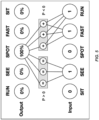
- FIG. 5 depicts a directional partitioned embodiment having one partition for all words prior to the focus term (P > 0), and one partition for all words following the focus term (P ⁇ 0).
- the neural network is analyzing the phrase "SEE SPOT RUN FAST" where the focus term is "SPOT.” As shown, the word “SEE” is input to the P > 0 partition, and the words “FAST” and “RUN” are input to the P ⁇ 0 partition. The neural network then returns the focus term "SPOT.”
- a separate set of input nodes is used for each partition.
- the set of input nodes may be modeled as specialized nodes capable of outputting a separate output to each partition. Both are mathematically equivalent.
- the present description refers to sets of input nodes for each separate partition, but in each instance where separate input nodes are used for each partition, a single set of input nodes feeding forward different values to different partitions could be used in embodiments that are not covered by the subject-matter of the claims.
- the weights for all hidden nodes in a partition of the hidden layer can be represented by a matrix formed by concatenating the vectors for each node in the hidden layer of nodes.
- This matrix can be referred to as a "synapse" matrix. Because it is the first set of nodes from the input layer, it is referred to as synapse 0 (syn0). Further, this matrix can be referred to as an "embedding matrix.”
- syn 0 w 1 ...
- w k w 0,0 w 0,1 ⁇ w 0 , j w 1,0 w 1,1 ⁇ ⁇ w k , 0 ⁇ w k , j
- there is only a single hidden layer although in some embodiments there may be two or more hidden layers. In embodiments having multiple hidden layers, there may be the same number of partitions as the previous layer, more, or fewer. In some embodiments, an additional hidden layer may not have partitions at all.
- the last hidden layer is followed by an output layer.
- the output layer can have one output neuron associated with each linguistic unit in a dictionary of linguistic units.
- there are fewer sets of output nodes than partitions in the previous hidden layer which takes as inputs the outputs of more than one partition in the last hidden layer of nodes.
- there is a single set of output nodes each node receiving as input the output of all nodes in the previous layer.
- a neural network of the present disclosure can be trained using a continuous list of words (CLOW) training style.
- c j i is the location specific representation (partition j) for the word at window position j relative to the focus word w.
- the output layer is configured as a single set (or single partition) of nodes receiving input from each node in the previous hidden layer.
- the neural network is then trained on a linguistic corpus, which is one or more sequences of a plurality of linguistic units.
- One or more training examples are run, where for each training example, the words surrounding the focus term are input into their respective input nodes corresponding to the appropriate partitions. For example, if the linguistic corpus includes the phrase "SEE SPOT RUN FAST, " and "SPOT" is the focus term, the input nodes associated with the position one-ahead of the focus term would be activated according to the term "SEE", and the position one-behind the focus term would be activated according to the term "RUN".
- Those inputs are propagated through the neural network to produce an output.
- the output of the neural network which correlates with the percent chance that the output word is the focus term, is then compared to a preferred output where the focus term ("SPOT") is 100% (or a corresponding maximum output value) and the output for all other linguistic units is 0% (or a corresponding minimum output value).
- SPOT focus term
- the actual output is compared to the preferred output, and then back-propagated through the neural network to update the synapse matrices according to one or more known back-propagation algorithms. This process can be repeated on additional sequences in the linguistic corpus, until the network is sufficiently accurate.
- the directional CLOW implementation with very small window sizes can be used to achieve acceptable performance.
- Directional CLOW is able to achieve a parity score using a window size of 1, contrasted with word2vec using a window size of 10 when all other parameters are equal.
- this optimization can reduce the number of training examples and overall training time by a factor of 10.
- a neural network of the present disclosure can be trained using a "skip-gram" training style.
- a network is configured having separate output partitions for each hidden layer partition.
- the neural network would consist of two neural networks, one modeling the probability that the focus term is a given value based on the word in the position one-ahead of the focus term, and one modeling the probability that the focus term is a given value based on the word in the position one after the focus term.
- the linguistic corpus includes the phrase "SEE SPOT RUN FAST,” and "SPOT" is the focus term, one partition will receive as input "SEE”, and one partition will receive as input "RUN.” The corresponding output nodes will then generate an output.
- This actual output is compared with a preferred output where the focus term ("SPOT") is 100% (or a corresponding maximum output value) and the output for all other linguistic units is 0% (or a corresponding minimum output value).
- SPOT focus term
- the actual output is compared to the preferred output, and then back-propagated through the neural network to update the synapse matrices according to any back-propagation algorithm, as is known in the art of neural networks. This process can be repeated on additional sequences in the linguistic corpus, until the network is sufficiently accurate.
- the outputs of the various output partitions can be added together, or otherwise combined to produce a final probability of the focus term.
- the skip-gram training style can be used to train a neural network in parallel. That is, each separate partition of hidden nodes, and partition of output nodes can be trained independently of other partitions of hidden nodes and output nodes. Thus those embodiment could be trained using multiple threads on a single computer processor, or on multiple computers operating in parallel.
- each classifier partition and its associated embedding partitions can be trained in full parallel reach the same state as if they were not distributed.
- the training can be accomplished by multiple computers with no inter-communication at all.
- the windowed embedding configuration can trained all window positions in full parallel and concatenate embeddings and classifiers at the end of training. Given machine j , the following objective function is optimized: arg max ⁇ ⁇ w C ⁇ d p c j i ; ⁇ ⁇ w C ⁇ d ′ p c j i ; ⁇
- c j i is the location specific representation (partition j ) for the word at window position j relative to the focus word w.
- syntactic tasks can be performed by a process called dense interpolation embedding (DIEM).
- DIEM dense interpolation embedding
- characteristic vectors for larger, compound linguistic units can be calculated from embeddings generated on smaller linguistic units (such as letters). Because word or phrase structure correlates more with syntax than semantic meaning, such a technique performs better on syntactic analogy tasks.
- characteristic vectors are first calculated for the smaller linguistic units using a neural network in accordance with an embodiment.
- a characteristic vector for a larger linguistic unit can then be calculated by interpolating the embeddings for the smaller linguistic unit over the larger linguistic unit. For example, where the smaller linguistic unit is a letter, and the larger linguistic unit is a word, characteristic vectors for words can be generated according to the following pseudocode:
- the final embedding size can be selected as a multiple M of the character embedding dimensionality C, such that the final embedding contains M buckets of length C.
- every character's embedding is summed according to a weighted average. This weighted average is determined by the variable d above. This variable compares the squared percent distance between the character's position i in the word of length I and the bucket's position m in the sequence of M buckets. This is computed such that the far left character is of approximate distance 0% from the far left bucket, and the far right character is of approximate distance 100% from the far right bucket. 1 minus this distance, squared, is then used to weight each respective character's embedding into each respective bucket.
- the percentage distance across a word of length 4 is 0%, 33%, 66%, and 100% (from left to right across the word).
- the percentage distance across a sequence of buckets of length 3 is 0%, 50%, and 100%.
- the distance between character 1 and bucket 3 is (0% - 100%). Squaring this equals 100%. One minus this square is 0%.
- character 1 in bucket 3 would have a weight of 0% (nothing).
- a dense interpolation embedding method can be accomplished more efficiently by caching a set of transformation matrices, which are cached values of d i,j for words of varying size. These matrices can be used to transform variable length concatenated character vectors into fixed length word embeddings via vector-matrix multiplication.
- Syntactic vectors in accordance with some embodiments also provide significant scaling and generalization advantages over semantic vectors. For example, new syntactic vectors may be easily generated for words never before seen, giving loss-less generalization to any word from initial character training, assuming only that the word is made up of characters that have been seen. Syntactic embeddings can be generated in a fully distributed fashion and only require a small vector concatenation and vector-matrix multiplication per word. Further, in some embodiments, character vectors (typically length 32) and transformation matrices (at most 20 or so of them) can be stored very efficiently relative to the semantic vocabularies, which can be several million vectors of dimensionality 1000 or more. In some embodiments, DIEM optimally performs using 6+ orders of magnitude less storage space, and 5+ orders of magnitude fewer training examples than word-level semantic embeddings.
- the PENN framework models the probability of a word occurring given the words surrounding it. Changing the partitioning strategy modifies this probability distribution by capturing (or ignoring) various synergies. Modeling every permutation of window position around a focus word approaches the full distribution, or the full conditional probability of the focus word occurring given the position and value of each and all of the words in the context surrounding it.
- Modeling every distribution allows every potential synergy to be captured in the combined embedding.
- the number of permutations possible in this partitioning strategy can easily exceed several hundred given a window size of 10 or more with each trained model containing billions of parameters.
- similar word partitioning strategies yield similar word embeddings and by extension, similar word-analogy quality in each sub-task.
- some embodiments can approximate the varying perspectives generated using the full co-occurrence distribution with fewer trained models by training sufficiently different models and concatenating them.
- Such a method uses different probability distributions to generate word embeddings modeling different perspectives on each word in the vocabulary.
- Character-derived vectors also embed a unique perspective by capturing information from the characters of a word instead of the contexts in which a word occurs. Because the embedding represents syntactic relationships between words from a unique perspective, the concatenation method in accordance with embodiments described above may be generalized to include the DIEM vectors.
- a related aspect of neural networks in accordance with some embodiments is that the embedding matrix Syn0 can be used for analogy tasks.
- each row may represent all the inputs to a specific neuron, each row represents a specific word's characteristic "embedding" in the neural network.
- a word's embedding can be a vector corresponding to all or a subset of the synapse weights for a single partition, or all or a subset of all partitions, or variations thereof.
- characteristic word embeddings can be used to perform analogy tasks.
- the word embeddings learned via neural language models can share resources between multiple languages. By pre-training over both languages, semantic relationships between languages can be encoded into the embeddings.
- This vector operation subtracts an English stop word ("is”) from an English noun and adds the equivalent Spanish stop word ("es") to the embedding.
- the equation returns the Spanish word for film ("pelicula").
- this property of the embeddings enables a sentiment model trained in one language to predict on another.
- a sentiment trained in one language will predict on another better where there is a shared vocabulary between languages.
- the neural language models can construct a hidden layer using neurons sampled according to vocabulary frequencies. In this way, the hidden layer construction for each language will be similar despite having completely different input layer representations. The consistency in the hidden layer can enable the alignment of semantic concepts in vector space. This alignment can enable sentiment prediction across languages.
- the present inventors conducted experiments on word-analogy tasks made up of a variety of word similarity tasks. Specifically, the Google Analogy Dataset was used, which contains 19,544 questions, split into semantic and syntactic sections. Both sections are further divided into subcategories based on analogy type. Each analogy task is phrased as a question "A is to B as C is to ?”.
- FIG. 6 displays the relative accuracy of each partition in a PENN model as judged by row-relative word-analogy scores. Other experiments indicated that the pattern present in the heat-map is consistent across parameter tunings. There is a clear quality difference between window positions that predict forward (left side of the figure) and window positions that predict backward (right side of the figure). "Currency” achieves most of its predictive power in short range predictions, whereas “capital-common countries” is a much smoother gradient over the window.
- Table A shows the performance of the default CBOW implementation of word2vec relative to the directional configuration. Most prominently, PENN outperforms the word2vec implementation using only a window size of 1, whereas word2vec was parameterized with the default of 10. Furthermore, it can be seen that increasing dimensionality of baseline CBOW word2vec past 500 achieves suboptimal performance. Thus, a fair comparison of two models should be between optimal (as opposed to equal) parameterization for each model. This is especially important given that PENN models are modeling a much richer probability distribution, given that order is being preserved. Thus, optimal parameter settings often require larger dimensionality. Additionally in this table, it can be seen that, unlike the original CBOW word2vec, bigger window size is not always better.
- Table B documents the change in syntactic analogy query quality as a result of the interpolated DIEM vectors.
- each analogy query was first performed by running the query on CLOW and DIEM independently, and selecting the top thousand CLOW cosine similarities.
- the present inventors summed the squared cosine similarity of each of these top thousand with each associated cosine similarity returned by the DIEM, and resorted. This was found to be an efficient estimation of concatenation that did not reduce quality.
- Tables C and D show the performance of the default CBOW implementation of word2vec relative to the directional configuration. Most prominently, PENN outperforms the word2vec implementation using only a window size of 1, whereas word2vec was parameterized with the default of 10. Furthermore, it can be seen that increasing dimensionality of baseline CBOW word2vec past 500 achieves suboptimal performance. Thus, a fair comparison of two models should be between optimal (as opposed to equal) parameterization for each model. This is especially important given that PENN models are modeling a much richer probability distribution, given that order is being preserved. Thus, optimal parameter settings often require larger dimensionality. Additionally in this table, it can be seen that, unlike the original CBOW word2vec, bigger window size is not always better.
- modeling large windows for semantic embeddings is optimal when using either the directional embedding model, which has a fixed partition size of 2, or a large global vector size.
- the directional model with optimal parameters has slightly less quality than the windowed model with optimal parameters due to the vector averaging occurring in each window pane.
- Table B documents the change in syntactic analogy query quality as a result of the interpolated DIEM vectors.
- each analogy query was first performed by running the query on CLOW and DIEM independently, and selecting the top thousand CLOW cosine similarities.
- the present inventors summed the squared cosine similarity of each of these top thousand with each associated cosine similarity returned by the DIEM, and resorted. This was found to be an efficient estimation of concatenation that did not reduce quality.
- Final results show a lift in quality and size over previous models with a 40% syntactic lift over the best published result.
- Within PENN models there exists a speed vs. performance tradeoff between SG-DIEM and CLOW-DIEM.
- CLOW is the slower model and achieves a higher score.
- a 160 billion parameter network was also trained overnight on 3 multi-core CPUs, however it yielded 20000 dimensional vectors for each word and subsequently overfit the training data. This is because a dataset of 8 billion tokens with a negative sampling parameter of 10 has 80 billion training examples. Having more parameters than training examples overfits a dataset, whereas 40 billion performs at parity with current state of the art, as pictured in Table E.
- the present inventors conducted further experiments to approximate the full conditional distribution of word embeddings. These experiments were likewise conducted on word-analogy tasks in the Google Analogy Dataset. This data set contains 19,544 questions asking "a is to b as c is to ?” and is split into 14 subcategories, ⁇ semantic and 9 syntactic.
- the training occurs over the 'data-phrase2.txt' dataset available from the Google word2vec website using the packaged word-analogy evaluation script for querying each individual model. Because querying each semantic model requires as much as 128 gb of RAM, a normalized concatenation approximation was used similar to that in the experiments described above. Each analogy was queried against each semantic model in parallel, and the top 1000 results were saved. Each word's score was summed across the various models to create a global score for each word. The word with the maximum value was selected as the ensemble's prediction. In the present inventors' experiments, each score in every semantic model (PENN model) was raised to the power of 0.1 before being summed. This was found to normalize the models to similar confidence ranges.
- PNN model semantic model
- syntactic analogy queries For syntactic analogy queries, the top 100 words from the semantic step were selected used to create syntactic embeddings. The analogy query was then performed using the syntactic embeddings such that syntactic embedding based cosine distance scores were generated. These scores were summed element-wise with semantic scores in the original top 100 words. The top word was then selected as the final analogy answer. This step was skipped for analogies coming from semantic categories. Syntactic scores were normalized by raising them to the power of 10.
- the corpus consists of 100,000 movie reviews that are labeled for sentiment polarity (positive / negative).
- the reviews are split into training, testing and development sections.
- the training and testing sets have 25,000 reviews each with 12,500 positive and 12,500 negative reviews.
- the remaining 50,000 documents comprise the development set.
- the present inventors used the Google Translate API to curate a Spanish movie review corpus.
- Systems such as Google's translation API have been evaluated by research in the NLP literature and are generally accepted as a mechanism with which to curate labeled data sets in new languages [1][2][3].
- an API request was made to the Google Translate API to translate the entire text of the review to Spanish.
- the resulting paragraph-level translations maintained the same polarity label as well as ID in order to maintain one-to-one comparisons between the Spanish and English corpora.
- the present inventors used word2vec's skip-gram architecture to learn 100 dimensional feature representations for words in the corpus by using hierarchical softmax and negative sampling (with 10 samples) for the focus word representations. Pre-processing consists of lower-casing, separating words from punctuation, and removing HTML tags. After learning word representations, stop-words are filtered out using NLTK's [4] stop word corpus and review-level representations are created by averaging the features for each remaining word in the review.
- the present inventors used Paragraph Vector's distributed bag-of-words (dbow) configuration to learn 100 dimensional feature representations for reviews by using both hierarchical softmax and negative sampling (with 10 samples) for the focus word representations.
- Pre-processing consists of lower-casing, separating words from punctuation, and removing HTML tags. Stop words are preserved in the reviews.
- the present inventors used PENN's skip-gram architecture to learn 100 dimensional feature representations for words in the corpus by using negative sampling (with 10 samples) and no hierarchical softmax for the focus representations. Partitions from window posititions -9 to -4 were used. The pre-processing and averaging steps are identical to the process described in the word2vec configuration section.
- Model ensembling was performed using an augmented implementation of the recent work by [5]. For each corpus (English and Spanish) a validation word model and a full word model was trained. The validation word models (word2vec and PENN) are trained on 20,000 reviews from the training sets (10,000 positive, 10,000 negative) and 50,000 reviews in the development sets. The remaining 5,000 reviews in the training sets are used as validation sets. The full word models are trained on the entire training sets and development sets. Paragraph Vector representations are learned using unsupervised pre-training over the entire corpus (training, development, and testing) using the implementation provided with [5].
- Single language models pre-train English and Spanish word models independently from one another.
- the English and Spanish feature representations are learned in separate unsupervised models. Their evaluations act as a baseline with which to interpret the cross-language models in later experiments. Review-level representations are used as features in a support vector machine (SVM). A separate classifier was used for each language.
- SVM support vector machine
- a separate classifier was used for each language.
- the unsupervised models for English and Spanish never interact. Spanish models were evaluated against the Spanish test set and English models against the English test set. The resulting scores for these models are provided in Table H.
- Cross-language models pre-train using both English and Spanish to learn representations.
- the English and Spanish feature representations are learned in the same unsupervised model. Review-level representations are used as features in an SVM.
- the classifier is trained on English examples. No training is performed over the Spanish corpus.
- the features learned in the cross-language pretraining allow feature resources to be shared between both Spanish and English.
- the resulting models are evaluated on the Spanish corpus. The scores for these models are provided in Table I. TABLE I Pre-Training Training Target Language Model Percent Accuracy English + Spanish English English Word2Vec 77.54 Paragraph Vector 86.02 PENN 78.33 Ensemble 85.11 English + Spanish English Spanish Word2Vec 80.08 Paragraph Vector 78.86 PENN 77.54 Ensemble 85.51
- Bilingual feature models ensemble single language models with cross-language models leverage ID mappings between the English and Spanish corpora to ensemble each combination of pretraining and training routines mentioned in the previous section. Furthermore, ngram models (no pre-training) were incorporated that are trained in English. The first n-gram model is an Averaged Perceptron with high affinity n-gram features (chosen through Person's as proposed in [6]). The second n-gram model is a Naive Bayes SVM as proposed in [7]. Maintaining IDs between the languages allows for obtaining multiple predictions for each review: some models predict on the English translation of the review, other models predict on the Spanish translation of the review, creating an ensembled review sentiment score.
- the present inventors' experiments demonstrate the efficacy of neural language modeling for cross-language sentiment classification.
- Neural language models encode meaningful relationships between words by mapping them to vector space, and this property of their embeddings helps explain why the cross-language models can effectively predict on languages on which they have not trained.
- the present inventors employ three different techniques for unsupervised pre-training and show that each technique is capable of encoding semantic relationships across languages.
- the present inventors trained baseline, single language models with which to compare the cross-language predictions (Table H). The highest baseline score for Spanish is 87.31% (word2vec) and the ensemble score is 86.63%. Using the baseline scores for comparison, the present inventors evaluate cross-language models on the Spanish corpus.
- the models are able to classify polarity with 80% accuracy, and when these same models are ensembled together they classify polarity with an accuracy of 85.51% (Table 1).
- the present inventors achieve a margin of 2% between the baseline, single language models and cross-language models.
- the overall accuracy of the cross-language models increases by 5% when they are ensembled. This behavior suggests that pretraining for each language captures slightly different patterns and structure that ultimately help the classifier accurately predict labels for those examples near the decision boundary.
- aspects of the present disclosure may be implemented in numerous other fields, including but not limited to healthcare, for instance in real-time clinical monitoring and historical reporting on patient populations. Some embodiments described herein may be applied in clinical decision support and other tasks that require summaries of unstructured text.
- aspects of the present disclosure can be used for modeling the likelihood of a patient developing an infection, including full body systemic infection. More generally speaking, aspects of the present disclosure may be used for predicting whether or not a patient will develop a particular health condition.
- EHR Electronic health records
- EHR Electronic health records for various patients may be used with aspects of the present disclosure as described above in order to learn representations of the positions of nodes and using embeddings to predict whether a patient would develop an an infection.
- the locations of particular clusters in vector space can be representative of such likelihoods of developing certain conditions.
- FIG. 7 is a computing architecture diagram of a computing system.
- the computing system includes a computer 700 that can be configured to perform one or more functions associated with the present disclosed technology.
- the computer 700 includes a processing unit 702, a system memory 704, and a system bus 706 that couples the memory 704 to the processing unit 702.
- the computer 700 further includes a mass storage device 712 for storing program modules 714.
- the program modules 714 can include computer-executable modules for performing the one or more functions associated with FIGS. 1-6 .
- the mass storage device 712 further includes a data store 716.
- the mass storage device 712 is connected to the processing unit 702 through a mass storage controller (not shown) connected to the bus 706.
- the mass storage device 712 and its associated computer-storage media provide non-volatile storage for the computer 700.
- computer-readable storage media can be any available computer-readable storage medium that can be accessed and read by the computer 700.
- computer-readable storage media can include volatile and non-volatile, removable and non-removable media implemented in any method or technology for storage of information such as computer-storage instructions, data structures, program modules, or other data.
- computer-readable storage media includes, but is not limited to, RAM, ROM, EPROM, EEPROM, flash memory or other solid state memory technology, CD-ROM, digital versatile disks ("DVD"), HD-DVD, BLU-RAY, or other optical storage, magnetic cassettes, magnetic tape, magnetic disk storage or other magnetic storage devices, or any other medium which can be used to store the desired information and which can be accessed by the computer 700.
- Computer-readable storage media as described herein does not include transitory signals.
- the computer 700 can operate in a networked environment using logical connections to remote computers through a network 718.
- the computer 700 can connect to the network 718 through a network interface unit 710 connected to the bus 706. It should be appreciated that the network interface unit 710 can also be utilized to connect to other types of networks and remote computer systems.
- the computer 700 can also include an input/output controller 708 for receiving and processing input from a number of input devices. Input devices may include, but are not limited to, keyboards, mice, stylus, touchscreens, microphones, audio capturing devices, or image/video capturing devices. An end user may utilize such input devices to interact with a user interface such as a graphical user interface for managing various functions performed by the computer 700.
- the bus 706 can enable the processing unit 702 to read code and/or data to/from the mass storage device 712 or other computer-storage media.
- the computer-readable storage media can represent apparatus in the form of storage elements that are implemented using any suitable technology, including but not limited to semiconductors, magnetic materials, optics, or the like.
- the program modules 714 include software instructions that, when loaded into the processing unit 702 and executed, cause the computer 700 to provide functions for neural language modeling in accordance with aspects of the present disclosure described herein with reference to exemplary embodiments.
- the program modules 714 can also provide various tools or techniques by which the computer 700 can participate within the overall systems or operating environments using the components, flows, and data structures discussed throughout this description.
- the program modules 714 can, when loaded into the processing unit 702 and executed, transform the processing unit 702 and the overall computer 700 from a general- purpose computing system into a special-purpose computing system.
- the processing unit 702 can be constructed from any number of transistors or other discrete circuit elements, which can individually or collectively assume any number of states. More specifically, the processing unit 702 can operate as a finite-state machine, in response to executable instructions contained within the program modules 714. These computer-executable instructions can transform the processing unit 702 by specifying how the processing unit 702 transitions between states, thereby transforming the transistors or other discrete hardware elements constituting the processing unit 702 .
- Encoding the program modules 714 can also transform the physical structure of the computer-storage media.
- the specific transformation of physical structure can depend on various factors, in different implementations of this description. Examples of such factors can include, but are not limited to: the technology used to implement the computer-storage media, whether the computer storage media are characterized as primary or secondary storage, and the like.
- the program module 714 can transform the physical state of the semiconductor memory, when the software is encoded therein.
- the program modules 714 can transform the state of transistors, capacitors, or other discrete circuit elements constituting the semiconductor memory.
- the computer-readable storage media can be implemented using magnetic or optical technology.
- the program modules 714 can transform the physical state of magnetic or optical media, when the software is encoded therein. These transformations can include altering the magnetic characteristics of particular locations within given magnetic media. These transformations can also include altering the physical features or characteristics of particular locations within given optical media, to change the optical characteristics of those locations. It should be appreciated that other transformations of physical media are possible without departing from the scope of the present disclosure.
Landscapes
- Engineering & Computer Science (AREA)
- Theoretical Computer Science (AREA)
- Physics & Mathematics (AREA)
- General Health & Medical Sciences (AREA)
- Health & Medical Sciences (AREA)
- Artificial Intelligence (AREA)
- General Physics & Mathematics (AREA)
- Computational Linguistics (AREA)
- General Engineering & Computer Science (AREA)
- Biomedical Technology (AREA)
- Evolutionary Computation (AREA)
- Molecular Biology (AREA)
- Computing Systems (AREA)
- Data Mining & Analysis (AREA)
- Biophysics (AREA)
- Mathematical Physics (AREA)
- Software Systems (AREA)
- Life Sciences & Earth Sciences (AREA)
- Audiology, Speech & Language Pathology (AREA)
- Probability & Statistics with Applications (AREA)
- Machine Translation (AREA)
Claims (11)
- Computerimplementiertes Verfahren, umfassend:Empfangen, an einer Vielzahl von neuronalen Eingabeknoten eines computerimplementierten neuronalen Netzwerks, einer Eingabe, die eine geordnete Liste einer Vielzahl von sprachlichen Einheiten umfasst, wobei eine sprachliche Einheit weggelassen ist, wobei jeder der neuronalen Eingabeknoten einer sprachlichen Einheit entspricht, die aus der geordneten Liste einer Vielzahl von sprachlichen Einheiten ausgewählt ist, und die sprachlichen Einheiten Phrasen, Wörter, Buchstaben oder andere in der Sprache verwendete Zeichen umfassen;One-Hot-Codieren der von den neuronalen Eingabeknoten empfangenen Eingabe an der Vielzahl von neuronalen Eingabeknoten;Empfangen, an einer Vielzahl von neuronalen Knoten an jeder einer Vielzahl von Einbettungsknotenpartitionen in einer Einbettungsschicht des computerimplementierten neuronalen Netzwerks, einer Eingabe von einem separaten Satz der eingegebenen neuronalen Knoten und Erzeugen einer Ausgabe durch mindestens Multiplizieren der Eingabe von jedem neuronalen Eingabeknoten mit einem von einer Vielzahl von Eingabegewichten, wobei jede der Einbettungsknotenpartitionen einer Position in der geordneten Liste in Bezug auf einen Fokusbegriff entspricht und eine Vielzahl von neuronalen Knoten umfasst, wobei der Fokusbegriff eine sprachliche Einheit ist, die aus der geordneten Liste der Vielzahl von sprachlichen Einheiten weggelassen ist; undEmpfangen, an jedem neuronalen Knoten in einer Klassifikatorschicht des computerimplementierten neuronalen Netzes, der Ausgabe von jedem der neuronalen Knoten der Einbettungsschicht, um eine Ausgabe zu erzeugen, indem die Ausgabe von jedem neuronalen Knoten der Einbettungsschicht mindestens mit einer aus einer Vielzahl von Eingabegewichten multipliziert wird, und wobei die Ausgabe einer Wahrscheinlichkeit entspricht, dass eine bestimmte sprachliche Einheit der Fokusbegriff ist;wobei jeder neuronale Knoten einer Partition der Einbettungsschicht unabhängig von anderen Partitionen trainiert wird; undwobei die Vielzahl von neuronalen Eingabeknoten, die Einbettungsschicht, mindestens eine versteckte Schicht und die Klassifikatorschicht das neuronale Netzwerk bilden und das Verfahren ferner das Trainieren des neuronalen Netzwerks durch Folgendes umfasst:Trainieren einer ersten Partition der Einbettungsknotenpartitionen durch:Entfernen des Fokusbegriffs aus der geordneten Liste der sprachlichen Einheiten;Auswählen einer Partition aus den Einbettungen jeder verbleibenden sprachlichen Einheit auf Grundlage der Position dieser jeweiligen sprachlichen Einheit in Bezug auf den Fokusbegriff; undAktualisieren der Gewichte für jeden neuronalen Knoten in der Klassifikatorschicht und der Einbettungsschicht, sodass die Wahrscheinlichkeit des Vorhandenseins des Fokusbegriffs etwa 100 % beträgt und andere zufällig abgetastete sprachliche Einheiten 0 % betragen; undTrainieren einer zweiten Partition durch:Entfernen des Fokusbegriffs aus der geordneten Liste der sprachlichen Einheiten;Auswählen einer Partition aus der Einbettung jeder verbleibenden sprachlichen Einheit auf Grundlage der Position dieser sprachlichen Einheit in Bezug auf den Fokusbegriff; undAktualisieren der Gewichte, um die Wahrscheinlichkeit des Vorhandenseins des Fokusbegriffs zu modellieren, beträgt etwa 100 % und andere zufällig abgetastete sprachliche Einheiten 0 % betragen,wobei die Schritte des Trainierens einer ersten Partition und des Trainierens einer zweiten Partition parallel auf zwei verschiedenen Computern durchgeführt werden.
- Computerimplementiertes Verfahren nach Anspruch 1, wobei die sprachliche Einheit ein Zeichen oder ein Wort ist.
- Computerimplementiertes Verfahren nach Anspruch 1, wobei die Positionen in Bezug auf einen Fokusbegriff der Einbettungsnotenpartitionen Fensterpositionen in Bezug auf den Fokusbegriff oder Richtungen in Bezug auf den Fokusbegriff sind.
- Computerimplementiertes Verfahren nach Anspruch 1, wobei das Verfahren ferner das Trainieren des neuronalen Netzwerks durch Durchführen von Funktionen umfasst, die Folgendes umfassen:Entfernen des Fokusbegriffs aus der geordneten Liste der sprachlichen Einheiten;Auswählen einer Partition aus den Einbettungen jeder verbleibenden sprachlichen Einheit auf Grundlage der Position dieser sprachlichen Einheit in Bezug auf den Fokusbegriff; Verketten der Partitionen;Verbreiten der Partitionen durch die Klassifikatorschicht; undAktualisieren der Gewichte für einen oder mehrere neuronale Knoten in der Klassifikatorschicht und der Einbettungsschicht, sodass eine Wahrscheinlichkeit des Vorhandenseins des Fokusbegriffs ungefähr 100 % beträgt und andere zufällig abgetastete sprachliche Einheiten ungefähr 0 % betragen.
- Computerimplementiertes Verfahren nach Anspruch 1, wobei bestimmte sprachliche Einheiten aus der geordneten Liste der Vielzahl von sprachlichen Einheiten ausgewählt sind und mehrere sprachliche Domänen, die den ausgewählten bestimmten sprachlichen Einheiten zugeordnet sind, in einen gemeinsamen Vektorraum modelliert werden, wobei jede der mehreren sprachlichen Domänen einer anderen Sprache entspricht.
- Computerimplementiertes Verfahren nach Anspruch 1, wobei die Eingabegewichte für jede Einbettungsknotenpartition unabhängig von den anderen Einbettungsknotenpartitionen trainiert werden.
- System, das zwei Computer aufweist, die konfiguriert sind, um Folgendes zu implementieren:
eine Vielzahl von neuronalen Eingabeknoten, wobei die Vielzahl von neuronalen Eingabeknoten zu Folgendem konfiguriert ist:Empfangen einer Eingabe, die eine geordnete Liste einer Vielzahl von sprachlichen Einheiten umfasst, wobei eine sprachliche Einheit weggelassen ist, wobei jeder neuronale Eingabeknoten der Vielzahl von neuronalen Eingabeknoten einer sprachlichen Einheit entspricht, die aus der geordneten Liste einer Vielzahl von sprachlichen Einheiten ausgewählt ist, und die sprachlichen Einheiten Phrasen, Wörter, Buchstaben oder andere Zeichen umfassen, die in der Sprache verwendet werden; undOne-Hot-Codieren der von den neuronalen Eingabeknoten empfangene Eingabe;eine Einbettungsschicht, die eine Vielzahl von Einbettungsknotenpartitionen umfasst, wobei jede der Einbettungsknotenpartitionen einer Position in der geordneten Liste in Bezug auf einen Fokusbegriff entspricht und eine Vielzahl von neuronalen Knoten umfasst, wobei der Fokusbegriff eine sprachliche Einheit ist, die aus der geordneten Liste der Vielzahl von sprachlichen Einheiten weggelassen ist, wobei die Vielzahl von neuronalen Knoten jeder der Einbettungsknotenpartitionen zu Folgendem konfiguriert ist:Empfangen einer Eingabe von einem separaten Satz der neuronalen Eingabeknoten; undBerechnen einer Ausgabe durch mindestens Multiplizieren der Eingabe von jedem neuronalen Eingabeknoten mit einer aus einer Vielzahl von Eingabegewichten; undeine Klassifikatorschicht, die eine Vielzahl von neuronalen Knoten umfasst, wobei jeder neuronale Knoten in der Klassifikatorschicht zu Folgendem konfiguriert ist:Empfangen der Ausgabe von jedem neuronalen Knoten der Einbettungsschicht; undErzeugen einer Ausgabe durch mindestens Multiplizieren der Ausgabe von jedem neuronalen Knoten der Einbettungsschicht mit einem von einer Vielzahl von Eingabegewichten, und wobei die Ausgabe einer Wahrscheinlichkeit entspricht, dass eine bestimmte sprachliche Einheit der Fokusbegriff ist;wobei jeder neuronale Knoten einer Partition der Einbettungsschicht unabhängig von anderen Partitionen trainiert wird; undwobei die Vielzahl von neuronalen Eingabeknoten, die Einbettungsschicht, mindestens eine versteckte Schicht und der Klassifikator ein neuronales Netzwerk bilden, wobei das neuronale Netzwerk trainiert wird durch:Trainieren einer ersten Partition der Einbettungsknotenpartitionen durch:Entfernen des Fokusbegriffs aus der geordneten Liste der sprachlichen Einheiten;Auswählen einer Partition aus den Einbettungen jeder verbleibenden sprachlichen Einheit auf Grundlage der Position dieser jeweiligen sprachlichen Einheit in Bezug auf den Fokusbegriff; undAktualisieren der Gewichte für jeden neuronalen Knoten in der Klassifikatorschicht und der Einbettungsschicht, sodass die Wahrscheinlichkeit des Vorhandenseins des Fokusbegriffs etwa 100 % beträgt und andere zufällig abgetastetesprachliche Einheiten 0 % betragen; undTrainieren einer zweiten Partition durch:Entfernen des Fokusbegriffs aus der geordneten Liste der sprachlichen Einheiten;Auswählen einer Partition aus der Einbettung jeder verbleibenden sprachlichen Einheit auf Grundlage der Position dieser sprachlichen Einheit in Bezug auf den Fokusbegriff; undAktualisieren der Gewichte, um die Wahrscheinlichkeit des Vorhandenseins des Fokusbegriffs zu modellieren, beträgt etwa 100 % und andere zufällig abgetastete sprachliche Einheiten 0 % betragen,wobei die Schritte des Trainierens einer ersten Partition und des Trainierens einer zweiten Partition parallel auf den zwei Computern durchgeführt werden. - System nach Anspruch 7, wobei die sprachliche Einheit ein Zeichen oder ein Wort ist.
- System nach Anspruch 7, wobei die Positionen in Bezug auf einen Fokusbegriff der Einbettungsnotenpartitionen Fensterpositionen in Bezug auf den Fokusbegriff oder Richtungen in Bezug auf den Fokusbegriff sind.
- System nach Anspruch 7, wobei bestimmte sprachliche Einheiten aus der geordneten Liste der Vielzahl von sprachlichen Einheiten ausgewählt sind und mehrere sprachliche Domänen, die den ausgewählten bestimmten sprachlichen Einheiten zugeordnet sind, in einen gemeinsamen Vektorraum modelliert werden, wobei jede der mehreren sprachlichen Domänen einer anderen Sprache entspricht.
- System nach Anspruch 7, wobei die Eingabegewichte für jede Einbettungsknotenpartition unabhängig von den anderen Einbettungsknotenpartitionen trainiert werden.
Applications Claiming Priority (3)
| Application Number | Priority Date | Filing Date | Title |
|---|---|---|---|
| US201562118200P | 2015-02-19 | 2015-02-19 | |
| US201562128915P | 2015-03-05 | 2015-03-05 | |
| PCT/US2016/018536 WO2016134183A1 (en) | 2015-02-19 | 2016-02-18 | Systems and methods for neural language modeling |
Publications (4)
| Publication Number | Publication Date |
|---|---|
| EP3259688A1 EP3259688A1 (de) | 2017-12-27 |
| EP3259688A4 EP3259688A4 (de) | 2018-12-12 |
| EP3259688B1 true EP3259688B1 (de) | 2024-09-25 |
| EP3259688C0 EP3259688C0 (de) | 2024-09-25 |
Family
ID=56689176
Family Applications (1)
| Application Number | Title | Priority Date | Filing Date |
|---|---|---|---|
| EP16753087.2A Active EP3259688B1 (de) | 2015-02-19 | 2016-02-18 | Systeme und verfahren zur modellierung von neuraler sprache |
Country Status (4)
| Country | Link |
|---|---|
| US (1) | US10339440B2 (de) |
| EP (1) | EP3259688B1 (de) |
| ES (1) | ES2993023T3 (de) |
| WO (1) | WO2016134183A1 (de) |
Families Citing this family (196)
| Publication number | Priority date | Publication date | Assignee | Title |
|---|---|---|---|---|
| US8677377B2 (en) | 2005-09-08 | 2014-03-18 | Apple Inc. | Method and apparatus for building an intelligent automated assistant |
| US9318108B2 (en) | 2010-01-18 | 2016-04-19 | Apple Inc. | Intelligent automated assistant |
| US8977255B2 (en) | 2007-04-03 | 2015-03-10 | Apple Inc. | Method and system for operating a multi-function portable electronic device using voice-activation |
| US10002189B2 (en) | 2007-12-20 | 2018-06-19 | Apple Inc. | Method and apparatus for searching using an active ontology |
| US9330720B2 (en) | 2008-01-03 | 2016-05-03 | Apple Inc. | Methods and apparatus for altering audio output signals |
| US20100030549A1 (en) | 2008-07-31 | 2010-02-04 | Lee Michael M | Mobile device having human language translation capability with positional feedback |
| US8676904B2 (en) | 2008-10-02 | 2014-03-18 | Apple Inc. | Electronic devices with voice command and contextual data processing capabilities |
| US10706373B2 (en) | 2011-06-03 | 2020-07-07 | Apple Inc. | Performing actions associated with task items that represent tasks to perform |
| US10276170B2 (en) | 2010-01-18 | 2019-04-30 | Apple Inc. | Intelligent automated assistant |
| US8682667B2 (en) | 2010-02-25 | 2014-03-25 | Apple Inc. | User profiling for selecting user specific voice input processing information |
| US9262612B2 (en) | 2011-03-21 | 2016-02-16 | Apple Inc. | Device access using voice authentication |
| US10057736B2 (en) | 2011-06-03 | 2018-08-21 | Apple Inc. | Active transport based notifications |
| US10134385B2 (en) | 2012-03-02 | 2018-11-20 | Apple Inc. | Systems and methods for name pronunciation |
| US10417037B2 (en) | 2012-05-15 | 2019-09-17 | Apple Inc. | Systems and methods for integrating third party services with a digital assistant |
| DE112014000709B4 (de) | 2013-02-07 | 2021-12-30 | Apple Inc. | Verfahren und vorrichtung zum betrieb eines sprachtriggers für einen digitalen assistenten |
| US10652394B2 (en) | 2013-03-14 | 2020-05-12 | Apple Inc. | System and method for processing voicemail |
| US10748529B1 (en) | 2013-03-15 | 2020-08-18 | Apple Inc. | Voice activated device for use with a voice-based digital assistant |
| WO2014197335A1 (en) | 2013-06-08 | 2014-12-11 | Apple Inc. | Interpreting and acting upon commands that involve sharing information with remote devices |
| KR101922663B1 (ko) | 2013-06-09 | 2018-11-28 | 애플 인크. | 디지털 어시스턴트의 둘 이상의 인스턴스들에 걸친 대화 지속성을 가능하게 하기 위한 디바이스, 방법 및 그래픽 사용자 인터페이스 |
| US10176167B2 (en) | 2013-06-09 | 2019-01-08 | Apple Inc. | System and method for inferring user intent from speech inputs |
| DE112014003653B4 (de) | 2013-08-06 | 2024-04-18 | Apple Inc. | Automatisch aktivierende intelligente Antworten auf der Grundlage von Aktivitäten von entfernt angeordneten Vorrichtungen |
| US10296160B2 (en) | 2013-12-06 | 2019-05-21 | Apple Inc. | Method for extracting salient dialog usage from live data |
| US10170123B2 (en) | 2014-05-30 | 2019-01-01 | Apple Inc. | Intelligent assistant for home automation |
| US9633004B2 (en) | 2014-05-30 | 2017-04-25 | Apple Inc. | Better resolution when referencing to concepts |
| US9430463B2 (en) | 2014-05-30 | 2016-08-30 | Apple Inc. | Exemplar-based natural language processing |
| US9966065B2 (en) | 2014-05-30 | 2018-05-08 | Apple Inc. | Multi-command single utterance input method |
| US9715875B2 (en) | 2014-05-30 | 2017-07-25 | Apple Inc. | Reducing the need for manual start/end-pointing and trigger phrases |
| US9338493B2 (en) | 2014-06-30 | 2016-05-10 | Apple Inc. | Intelligent automated assistant for TV user interactions |
| US9818400B2 (en) | 2014-09-11 | 2017-11-14 | Apple Inc. | Method and apparatus for discovering trending terms in speech requests |
| US10127911B2 (en) | 2014-09-30 | 2018-11-13 | Apple Inc. | Speaker identification and unsupervised speaker adaptation techniques |
| US9668121B2 (en) | 2014-09-30 | 2017-05-30 | Apple Inc. | Social reminders |
| US10074360B2 (en) | 2014-09-30 | 2018-09-11 | Apple Inc. | Providing an indication of the suitability of speech recognition |
| US10152299B2 (en) | 2015-03-06 | 2018-12-11 | Apple Inc. | Reducing response latency of intelligent automated assistants |
| US9886953B2 (en) | 2015-03-08 | 2018-02-06 | Apple Inc. | Virtual assistant activation |
| US9721566B2 (en) | 2015-03-08 | 2017-08-01 | Apple Inc. | Competing devices responding to voice triggers |
| US10460227B2 (en) | 2015-05-15 | 2019-10-29 | Apple Inc. | Virtual assistant in a communication session |
| US10200824B2 (en) | 2015-05-27 | 2019-02-05 | Apple Inc. | Systems and methods for proactively identifying and surfacing relevant content on a touch-sensitive device |
| US10083688B2 (en) | 2015-05-27 | 2018-09-25 | Apple Inc. | Device voice control for selecting a displayed affordance |
| US9595002B2 (en) | 2015-05-29 | 2017-03-14 | Sas Institute Inc. | Normalizing electronic communications using a vector having a repeating substring as input for a neural network |
| US9552547B2 (en) * | 2015-05-29 | 2017-01-24 | Sas Institute Inc. | Normalizing electronic communications using a neural-network normalizer and a neural-network flagger |
| US20160350644A1 (en) | 2015-05-29 | 2016-12-01 | Sas Institute Inc. | Visualizing results of electronic sentiment analysis |
| US9578173B2 (en) | 2015-06-05 | 2017-02-21 | Apple Inc. | Virtual assistant aided communication with 3rd party service in a communication session |
| US11025565B2 (en) | 2015-06-07 | 2021-06-01 | Apple Inc. | Personalized prediction of responses for instant messaging |
| US20160378747A1 (en) | 2015-06-29 | 2016-12-29 | Apple Inc. | Virtual assistant for media playback |
| US10740384B2 (en) | 2015-09-08 | 2020-08-11 | Apple Inc. | Intelligent automated assistant for media search and playback |
| US10671428B2 (en) | 2015-09-08 | 2020-06-02 | Apple Inc. | Distributed personal assistant |
| US10331312B2 (en) | 2015-09-08 | 2019-06-25 | Apple Inc. | Intelligent automated assistant in a media environment |
| US10747498B2 (en) | 2015-09-08 | 2020-08-18 | Apple Inc. | Zero latency digital assistant |
| KR102437689B1 (ko) * | 2015-09-16 | 2022-08-30 | 삼성전자주식회사 | 음성 인식 서버 및 그 제어 방법 |
| US11587559B2 (en) | 2015-09-30 | 2023-02-21 | Apple Inc. | Intelligent device identification |
| US10691473B2 (en) | 2015-11-06 | 2020-06-23 | Apple Inc. | Intelligent automated assistant in a messaging environment |
| US10956666B2 (en) | 2015-11-09 | 2021-03-23 | Apple Inc. | Unconventional virtual assistant interactions |
| US10049668B2 (en) | 2015-12-02 | 2018-08-14 | Apple Inc. | Applying neural network language models to weighted finite state transducers for automatic speech recognition |
| US10223066B2 (en) | 2015-12-23 | 2019-03-05 | Apple Inc. | Proactive assistance based on dialog communication between devices |
| JP6400037B2 (ja) * | 2016-03-17 | 2018-10-03 | ヤフー株式会社 | 判定装置、および判定方法 |
| US11227589B2 (en) | 2016-06-06 | 2022-01-18 | Apple Inc. | Intelligent list reading |
| US10049663B2 (en) | 2016-06-08 | 2018-08-14 | Apple, Inc. | Intelligent automated assistant for media exploration |
| US12223282B2 (en) | 2016-06-09 | 2025-02-11 | Apple Inc. | Intelligent automated assistant in a home environment |
| US10586535B2 (en) | 2016-06-10 | 2020-03-10 | Apple Inc. | Intelligent digital assistant in a multi-tasking environment |
| DK179049B1 (en) * | 2016-06-11 | 2017-09-18 | Apple Inc | Data driven natural language event detection and classification |
| US12197817B2 (en) | 2016-06-11 | 2025-01-14 | Apple Inc. | Intelligent device arbitration and control |
| DK179415B1 (en) | 2016-06-11 | 2018-06-14 | Apple Inc | Intelligent device arbitration and control |
| DK201670540A1 (en) | 2016-06-11 | 2018-01-08 | Apple Inc | Application integration with a digital assistant |
| WO2017217661A1 (ko) * | 2016-06-15 | 2017-12-21 | 울산대학교 산학협력단 | 어휘 의미망을 이용한 단어 의미 임베딩 장치 및 방법과, 어휘 의미망 및 단어 임베딩을 이용한 동형이의어 분별 장치 및 방법 |
| US10740374B2 (en) | 2016-06-30 | 2020-08-11 | International Business Machines Corporation | Log-aided automatic query expansion based on model mapping |
| WO2018022821A1 (en) * | 2016-07-29 | 2018-02-01 | Arizona Board Of Regents On Behalf Of Arizona State University | Memory compression in a deep neural network |
| CN107785016A (zh) * | 2016-08-31 | 2018-03-09 | 株式会社东芝 | 训练神经网络辅助模型的方法和装置及语音识别方法和装置 |
| US10474753B2 (en) | 2016-09-07 | 2019-11-12 | Apple Inc. | Language identification using recurrent neural networks |
| US10043516B2 (en) | 2016-09-23 | 2018-08-07 | Apple Inc. | Intelligent automated assistant |
| US10664722B1 (en) * | 2016-10-05 | 2020-05-26 | Digimarc Corporation | Image processing arrangements |
| US11222253B2 (en) * | 2016-11-03 | 2022-01-11 | Salesforce.Com, Inc. | Deep neural network model for processing data through multiple linguistic task hierarchies |
| GB201619724D0 (en) * | 2016-11-22 | 2017-01-04 | Microsoft Technology Licensing Llc | Trained data input system |
| GB201620232D0 (en) * | 2016-11-29 | 2017-01-11 | Microsoft Technology Licensing Llc | Data input system with online learning |
| US11281993B2 (en) | 2016-12-05 | 2022-03-22 | Apple Inc. | Model and ensemble compression for metric learning |
| DE102016125162B4 (de) * | 2016-12-05 | 2018-07-26 | Ernst-Moritz-Arndt-Universität Greifswald | Verfahren und Vorrichtung zum maschinellen Verarbeiten von Texten |
| US11068658B2 (en) * | 2016-12-07 | 2021-07-20 | Disney Enterprises, Inc. | Dynamic word embeddings |
| US11204787B2 (en) | 2017-01-09 | 2021-12-21 | Apple Inc. | Application integration with a digital assistant |
| US12411880B2 (en) * | 2017-02-16 | 2025-09-09 | Globality, Inc. | Intelligent matching system with ontology-aided relation extraction |
| CN108287858B (zh) * | 2017-03-02 | 2021-08-10 | 腾讯科技(深圳)有限公司 | 自然语言的语义提取方法及装置 |
| JP6705763B2 (ja) * | 2017-03-16 | 2020-06-03 | ヤフー株式会社 | 生成装置、生成方法および生成プログラム |
| US11640617B2 (en) * | 2017-03-21 | 2023-05-02 | Adobe Inc. | Metric forecasting employing a similarity determination in a digital medium environment |
| US10755174B2 (en) * | 2017-04-11 | 2020-08-25 | Sap Se | Unsupervised neural attention model for aspect extraction |
| EP3563302A1 (de) * | 2017-04-20 | 2019-11-06 | Google LLC | Verarbeitung von sequentiellen daten unter verwendung von rekurrenten neuralen netzen |
| US10963501B1 (en) * | 2017-04-29 | 2021-03-30 | Veritas Technologies Llc | Systems and methods for generating a topic tree for digital information |
| US10417266B2 (en) | 2017-05-09 | 2019-09-17 | Apple Inc. | Context-aware ranking of intelligent response suggestions |
| DK201770383A1 (en) | 2017-05-09 | 2018-12-14 | Apple Inc. | USER INTERFACE FOR CORRECTING RECOGNITION ERRORS |
| DK180048B1 (en) | 2017-05-11 | 2020-02-04 | Apple Inc. | MAINTAINING THE DATA PROTECTION OF PERSONAL INFORMATION |
| US10726832B2 (en) | 2017-05-11 | 2020-07-28 | Apple Inc. | Maintaining privacy of personal information |
| US10395654B2 (en) | 2017-05-11 | 2019-08-27 | Apple Inc. | Text normalization based on a data-driven learning network |
| US11301477B2 (en) | 2017-05-12 | 2022-04-12 | Apple Inc. | Feedback analysis of a digital assistant |
| DK179745B1 (en) | 2017-05-12 | 2019-05-01 | Apple Inc. | SYNCHRONIZATION AND TASK DELEGATION OF A DIGITAL ASSISTANT |
| DK179496B1 (en) | 2017-05-12 | 2019-01-15 | Apple Inc. | USER-SPECIFIC Acoustic Models |
| DK201770428A1 (en) | 2017-05-12 | 2019-02-18 | Apple Inc. | LOW-LATENCY INTELLIGENT AUTOMATED ASSISTANT |
| DK201770411A1 (en) | 2017-05-15 | 2018-12-20 | Apple Inc. | Multi-modal interfaces |
| US10311144B2 (en) | 2017-05-16 | 2019-06-04 | Apple Inc. | Emoji word sense disambiguation |
| US10303715B2 (en) | 2017-05-16 | 2019-05-28 | Apple Inc. | Intelligent automated assistant for media exploration |
| US10403278B2 (en) | 2017-05-16 | 2019-09-03 | Apple Inc. | Methods and systems for phonetic matching in digital assistant services |
| DK179549B1 (en) | 2017-05-16 | 2019-02-12 | Apple Inc. | FAR-FIELD EXTENSION FOR DIGITAL ASSISTANT SERVICES |
| US20180336892A1 (en) | 2017-05-16 | 2018-11-22 | Apple Inc. | Detecting a trigger of a digital assistant |
| US10447635B2 (en) | 2017-05-17 | 2019-10-15 | Slice Technologies, Inc. | Filtering electronic messages |
| US10817650B2 (en) | 2017-05-19 | 2020-10-27 | Salesforce.Com, Inc. | Natural language processing using context specific word vectors |
| US11005864B2 (en) | 2017-05-19 | 2021-05-11 | Salesforce.Com, Inc. | Feature-agnostic behavior profile based anomaly detection |
| US10810472B2 (en) | 2017-05-26 | 2020-10-20 | Oracle International Corporation | Techniques for sentiment analysis of data using a convolutional neural network and a co-occurrence network |
| US10958422B2 (en) * | 2017-06-01 | 2021-03-23 | Cotiviti, Inc. | Methods for disseminating reasoning supporting insights without disclosing uniquely identifiable data, and systems for the same |
| US10657328B2 (en) | 2017-06-02 | 2020-05-19 | Apple Inc. | Multi-task recurrent neural network architecture for efficient morphology handling in neural language modeling |
| CN107330513B (zh) * | 2017-06-28 | 2020-07-31 | 深圳爱拼信息科技有限公司 | 一种提取深度信念网络中隐含节点语义的方法 |
| WO2019000051A1 (en) * | 2017-06-30 | 2019-01-03 | Xref (Au) Pty Ltd | DATA ANALYSIS METHOD AND LEARNING SYSTEM |
| CN110019770A (zh) * | 2017-07-24 | 2019-07-16 | 华为技术有限公司 | 训练分类模型的方法与装置 |
| CN107436942A (zh) * | 2017-07-28 | 2017-12-05 | 广州市香港科大霍英东研究院 | 基于社交媒体的词嵌入方法、系统、终端设备及存储介质 |
| US11531859B2 (en) | 2017-08-08 | 2022-12-20 | Samsung Electronics Co., Ltd. | System and method for hashed compressed weighting matrix in neural networks |
| US20190066843A1 (en) * | 2017-08-22 | 2019-02-28 | Koninklijke Philips N.V. | Collapsing clinical event data into meaningful states of patient care |
| US11817103B2 (en) * | 2017-09-15 | 2023-11-14 | Nec Corporation | Pattern recognition apparatus, pattern recognition method, and storage medium |
| US10445429B2 (en) | 2017-09-21 | 2019-10-15 | Apple Inc. | Natural language understanding using vocabularies with compressed serialized tries |
| US10755051B2 (en) | 2017-09-29 | 2020-08-25 | Apple Inc. | Rule-based natural language processing |
| US10915707B2 (en) * | 2017-10-20 | 2021-02-09 | MachineVantage, Inc. | Word replaceability through word vectors |
| EP3625699A1 (de) | 2017-10-25 | 2020-03-25 | Google LLC | Natürliche sprachverarbeitung mit einer n-gram-maschine |
| US11335460B2 (en) * | 2017-11-09 | 2022-05-17 | International Business Machines Corporation | Neural network based selection of representative patients |
| US11030997B2 (en) * | 2017-11-22 | 2021-06-08 | Baidu Usa Llc | Slim embedding layers for recurrent neural language models |
| US10636424B2 (en) | 2017-11-30 | 2020-04-28 | Apple Inc. | Multi-turn canned dialog |
| US10733982B2 (en) | 2018-01-08 | 2020-08-04 | Apple Inc. | Multi-directional dialog |
| CN108287820B (zh) * | 2018-01-12 | 2021-06-11 | 鼎富智能科技有限公司 | 一种文本表示的生成方法及装置 |
| US10891943B2 (en) * | 2018-01-18 | 2021-01-12 | Citrix Systems, Inc. | Intelligent short text information retrieve based on deep learning |
| US11803883B2 (en) | 2018-01-29 | 2023-10-31 | Nielsen Consumer Llc | Quality assurance for labeled training data |
| US10733375B2 (en) | 2018-01-31 | 2020-08-04 | Apple Inc. | Knowledge-based framework for improving natural language understanding |
| US11334790B1 (en) * | 2018-03-02 | 2022-05-17 | Supplypike, Llc | System and method for recurrent neural networks for forecasting of consumer goods' sales and inventory |
| US10789959B2 (en) | 2018-03-02 | 2020-09-29 | Apple Inc. | Training speaker recognition models for digital assistants |
| JP6973192B2 (ja) * | 2018-03-08 | 2021-11-24 | 日本電信電話株式会社 | 言語モデルを利用する装置、方法及びプログラム |
| US10592604B2 (en) | 2018-03-12 | 2020-03-17 | Apple Inc. | Inverse text normalization for automatic speech recognition |
| US10885082B2 (en) | 2018-03-22 | 2021-01-05 | International Business Machines Corporation | Implicit relation induction via purposeful overfitting of a word embedding model on a subset of a document corpus |
| US10818288B2 (en) | 2018-03-26 | 2020-10-27 | Apple Inc. | Natural assistant interaction |
| US10909331B2 (en) | 2018-03-30 | 2021-02-02 | Apple Inc. | Implicit identification of translation payload with neural machine translation |
| US10928918B2 (en) | 2018-05-07 | 2021-02-23 | Apple Inc. | Raise to speak |
| US11145294B2 (en) | 2018-05-07 | 2021-10-12 | Apple Inc. | Intelligent automated assistant for delivering content from user experiences |
| US10984780B2 (en) * | 2018-05-21 | 2021-04-20 | Apple Inc. | Global semantic word embeddings using bi-directional recurrent neural networks |
| US10678830B2 (en) * | 2018-05-31 | 2020-06-09 | Fmr Llc | Automated computer text classification and routing using artificial intelligence transfer learning |
| DK179822B1 (da) | 2018-06-01 | 2019-07-12 | Apple Inc. | Voice interaction at a primary device to access call functionality of a companion device |
| US10892996B2 (en) | 2018-06-01 | 2021-01-12 | Apple Inc. | Variable latency device coordination |
| DK180639B1 (en) | 2018-06-01 | 2021-11-04 | Apple Inc | DISABILITY OF ATTENTION-ATTENTIVE VIRTUAL ASSISTANT |
| US11386266B2 (en) | 2018-06-01 | 2022-07-12 | Apple Inc. | Text correction |
| DK201870355A1 (en) | 2018-06-01 | 2019-12-16 | Apple Inc. | VIRTUAL ASSISTANT OPERATION IN MULTI-DEVICE ENVIRONMENTS |
| US10944859B2 (en) | 2018-06-03 | 2021-03-09 | Apple Inc. | Accelerated task performance |
| US10311058B1 (en) | 2018-07-06 | 2019-06-04 | Global Elmeast Inc. | Techniques for processing neural queries |
| US10395169B1 (en) * | 2018-07-06 | 2019-08-27 | Global Elmeast Inc. | Self learning neural knowledge artifactory for autonomous decision making |
| US11610107B2 (en) | 2018-07-06 | 2023-03-21 | Global Elmeast Inc. | Methodology to automatically incorporate feedback to enable self learning in neural learning artifactories |
| WO2020056199A1 (en) * | 2018-09-14 | 2020-03-19 | Jpmorgan Chase Bank, N.A. | Systems and methods for automated document graphing |
| US11449676B2 (en) | 2018-09-14 | 2022-09-20 | Jpmorgan Chase Bank, N.A. | Systems and methods for automated document graphing |
| US10812449B1 (en) * | 2018-09-19 | 2020-10-20 | Verisign | Method for generating a domain name using a learned information-rich latent space |
| US11010561B2 (en) | 2018-09-27 | 2021-05-18 | Apple Inc. | Sentiment prediction from textual data |
| US11170166B2 (en) | 2018-09-28 | 2021-11-09 | Apple Inc. | Neural typographical error modeling via generative adversarial networks |
| US10839159B2 (en) | 2018-09-28 | 2020-11-17 | Apple Inc. | Named entity normalization in a spoken dialog system |
| US11462215B2 (en) | 2018-09-28 | 2022-10-04 | Apple Inc. | Multi-modal inputs for voice commands |
| US11475898B2 (en) | 2018-10-26 | 2022-10-18 | Apple Inc. | Low-latency multi-speaker speech recognition |
| US10915711B2 (en) | 2018-12-09 | 2021-02-09 | International Business Machines Corporation | Numerical representation in natural language processing techniques |
| CN110033091B (zh) | 2018-12-13 | 2020-09-01 | 阿里巴巴集团控股有限公司 | 一种基于模型进行预测的方法和装置 |
| US11638059B2 (en) | 2019-01-04 | 2023-04-25 | Apple Inc. | Content playback on multiple devices |
| CN109740164B (zh) * | 2019-01-09 | 2023-08-15 | 国网浙江省电力有限公司舟山供电公司 | 基于深度语义匹配的电力缺陷等级识别方法 |
| CN109858031B (zh) * | 2019-02-14 | 2023-05-23 | 北京小米智能科技有限公司 | 神经网络模型训练、上下文预测方法及装置 |
| US11348573B2 (en) | 2019-03-18 | 2022-05-31 | Apple Inc. | Multimodality in digital assistant systems |
| US11113469B2 (en) * | 2019-03-27 | 2021-09-07 | International Business Machines Corporation | Natural language processing matrices |
| US11144735B2 (en) * | 2019-04-09 | 2021-10-12 | International Business Machines Corporation | Semantic concept scorer based on an ensemble of language translation models for question answer system |
| US11307752B2 (en) | 2019-05-06 | 2022-04-19 | Apple Inc. | User configurable task triggers |
| DK201970509A1 (en) | 2019-05-06 | 2021-01-15 | Apple Inc | Spoken notifications |
| US11475884B2 (en) | 2019-05-06 | 2022-10-18 | Apple Inc. | Reducing digital assistant latency when a language is incorrectly determined |
| US11423908B2 (en) | 2019-05-06 | 2022-08-23 | Apple Inc. | Interpreting spoken requests |
| WO2020227970A1 (en) * | 2019-05-15 | 2020-11-19 | Beijing Didi Infinity Technology And Development Co., Ltd. | Systems and methods for generating abstractive text summarization |
| US11140099B2 (en) | 2019-05-21 | 2021-10-05 | Apple Inc. | Providing message response suggestions |
| US11386276B2 (en) * | 2019-05-24 | 2022-07-12 | International Business Machines Corporation | Method and system for language and domain acceleration with embedding alignment |
| US11289073B2 (en) | 2019-05-31 | 2022-03-29 | Apple Inc. | Device text to speech |
| DK201970510A1 (en) | 2019-05-31 | 2021-02-11 | Apple Inc | Voice identification in digital assistant systems |
| DK180129B1 (en) | 2019-05-31 | 2020-06-02 | Apple Inc. | User activity shortcut suggestions |
| US11496600B2 (en) | 2019-05-31 | 2022-11-08 | Apple Inc. | Remote execution of machine-learned models |
| US11468890B2 (en) | 2019-06-01 | 2022-10-11 | Apple Inc. | Methods and user interfaces for voice-based control of electronic devices |
| US11360641B2 (en) | 2019-06-01 | 2022-06-14 | Apple Inc. | Increasing the relevance of new available information |
| CN110196979B (zh) * | 2019-06-05 | 2023-07-25 | 深圳市思迪信息技术股份有限公司 | 基于分布式系统的意图识别方法及装置 |
| US11915701B2 (en) | 2019-06-05 | 2024-02-27 | Refinitiv Us Organization Llc | Automatic summarization of financial earnings call transcripts |
| WO2020245754A1 (en) * | 2019-06-05 | 2020-12-10 | Financial & Risk Organisation Limited | Machine-learning natural language processing classifier |
| US10685286B1 (en) * | 2019-07-30 | 2020-06-16 | SparkCognition, Inc. | Automated neural network generation using fitness estimation |
| US11488406B2 (en) | 2019-09-25 | 2022-11-01 | Apple Inc. | Text detection using global geometry estimators |
| US11408746B2 (en) | 2019-12-04 | 2022-08-09 | Toyota Connected North America, Inc. | Systems and methods for generating attributes-based recommendations |
| US11875116B2 (en) * | 2019-12-20 | 2024-01-16 | Intuit Inc. | Machine learning models with improved semantic awareness |
| CN111625276B (zh) * | 2020-05-09 | 2023-04-21 | 山东师范大学 | 基于语义与语法信息融合的代码摘要生成方法及系统 |
| US11061543B1 (en) | 2020-05-11 | 2021-07-13 | Apple Inc. | Providing relevant data items based on context |
| US11043220B1 (en) | 2020-05-11 | 2021-06-22 | Apple Inc. | Digital assistant hardware abstraction |
| US12301635B2 (en) | 2020-05-11 | 2025-05-13 | Apple Inc. | Digital assistant hardware abstraction |
| US11657332B2 (en) * | 2020-06-12 | 2023-05-23 | Baidu Usa Llc | Method for AI model transferring with layer randomization |
| CN111813934B (zh) * | 2020-06-22 | 2024-04-30 | 贵州大学 | 一种基于dma模型和特征划分多源文本主题模型聚类方法 |
| EP3937170A1 (de) * | 2020-07-10 | 2022-01-12 | Novoic Ltd. | Sprachanalyse zur überwachung oder diagnose eines gesundheitszustands |
| US11490204B2 (en) | 2020-07-20 | 2022-11-01 | Apple Inc. | Multi-device audio adjustment coordination |
| US11438683B2 (en) | 2020-07-21 | 2022-09-06 | Apple Inc. | User identification using headphones |
| US20220284485A1 (en) * | 2021-03-02 | 2022-09-08 | International Business Machines Corporation | Stratified social review recommendation |
| CN113032559B (zh) * | 2021-03-15 | 2023-04-28 | 新疆大学 | 一种用于低资源黏着性语言文本分类的语言模型微调方法 |
| US12321428B2 (en) * | 2021-07-08 | 2025-06-03 | Nippon Telegraph And Telephone Corporation | User authentication device, user authentication method, and user authentication computer program |
| US12423507B2 (en) * | 2021-07-12 | 2025-09-23 | International Business Machines Corporation | Elucidated natural language artifact recombination with contextual awareness |
| CN114091453B (zh) * | 2021-11-29 | 2025-07-25 | 桂林电子科技大学 | 一种拉丁壮语向量表示与计算方法 |
| US12346665B2 (en) | 2022-02-14 | 2025-07-01 | International Business Machines Corporation | Neural architecture search of language models using knowledge distillation |
| US12321957B2 (en) * | 2022-08-31 | 2025-06-03 | Accenture Global Solutions Limited | System and method for assigning agents to critical/high priority supply chain risk use cases |
Family Cites Families (32)
| Publication number | Priority date | Publication date | Assignee | Title |
|---|---|---|---|---|
| AUPQ138199A0 (en) * | 1999-07-02 | 1999-07-29 | Telstra R & D Management Pty Ltd | A search system |
| US8165870B2 (en) | 2005-02-10 | 2012-04-24 | Microsoft Corporation | Classification filter for processing data for creating a language model |
| US8219406B2 (en) | 2007-03-15 | 2012-07-10 | Microsoft Corporation | Speech-centric multimodal user interface design in mobile technology |
| US8473430B2 (en) | 2010-01-29 | 2013-06-25 | Microsoft Corporation | Deep-structured conditional random fields for sequential labeling and classification |
| US8825648B2 (en) * | 2010-04-15 | 2014-09-02 | Microsoft Corporation | Mining multilingual topics |
| US8972253B2 (en) | 2010-09-15 | 2015-03-03 | Microsoft Technology Licensing, Llc | Deep belief network for large vocabulary continuous speech recognition |
| US9031844B2 (en) | 2010-09-21 | 2015-05-12 | Microsoft Technology Licensing, Llc | Full-sequence training of deep structures for speech recognition |
| US8489529B2 (en) | 2011-03-31 | 2013-07-16 | Microsoft Corporation | Deep convex network with joint use of nonlinear random projection, Restricted Boltzmann Machine and batch-based parallelizable optimization |
| US8918352B2 (en) | 2011-05-23 | 2014-12-23 | Microsoft Corporation | Learning processes for single hidden layer neural networks with linear output units |
| US10078620B2 (en) | 2011-05-27 | 2018-09-18 | New York University | Runtime reconfigurable dataflow processor with multi-port memory access module |
| US8831358B1 (en) | 2011-11-21 | 2014-09-09 | Google Inc. | Evaluating image similarity |
| US9235799B2 (en) | 2011-11-26 | 2016-01-12 | Microsoft Technology Licensing, Llc | Discriminative pretraining of deep neural networks |
| US8700552B2 (en) | 2011-11-28 | 2014-04-15 | Microsoft Corporation | Exploiting sparseness in training deep neural networks |
| US8626684B2 (en) * | 2011-12-14 | 2014-01-07 | International Business Machines Corporation | Multi-modal neural network for universal, online learning |
| US9165243B2 (en) | 2012-02-15 | 2015-10-20 | Microsoft Technology Licensing, Llc | Tensor deep stacked neural network |
| US9292789B2 (en) | 2012-03-02 | 2016-03-22 | California Institute Of Technology | Continuous-weight neural networks |
| US9704068B2 (en) | 2012-06-22 | 2017-07-11 | Google Inc. | System and method for labelling aerial images |
| US9292787B2 (en) | 2012-08-29 | 2016-03-22 | Microsoft Technology Licensing, Llc | Computer-implemented deep tensor neural network |
| ES2791776T3 (es) | 2012-09-05 | 2020-11-05 | Element Inc | Sistema y método para la autenticación biométrica en conexión con dispositivos equipados con cámara |
| US9477925B2 (en) | 2012-11-20 | 2016-10-25 | Microsoft Technology Licensing, Llc | Deep neural networks training for speech and pattern recognition |
| US9406017B2 (en) | 2012-12-24 | 2016-08-02 | Google Inc. | System and method for addressing overfitting in a neural network |
| US9251437B2 (en) | 2012-12-24 | 2016-02-02 | Google Inc. | System and method for generating training cases for image classification |
| US9811775B2 (en) | 2012-12-24 | 2017-11-07 | Google Inc. | Parallelizing neural networks during training |
| US9037464B1 (en) | 2013-01-15 | 2015-05-19 | Google Inc. | Computing numeric representations of words in a high-dimensional space |
| US9519858B2 (en) | 2013-02-10 | 2016-12-13 | Microsoft Technology Licensing, Llc | Feature-augmented neural networks and applications of same |
| US20140249799A1 (en) | 2013-03-04 | 2014-09-04 | Microsoft Corporation | Relational similarity measurement |
| US9177550B2 (en) | 2013-03-06 | 2015-11-03 | Microsoft Technology Licensing, Llc | Conservatively adapting a deep neural network in a recognition system |
| US9454958B2 (en) | 2013-03-07 | 2016-09-27 | Microsoft Technology Licensing, Llc | Exploiting heterogeneous data in deep neural network-based speech recognition systems |
| US9842585B2 (en) | 2013-03-11 | 2017-12-12 | Microsoft Technology Licensing, Llc | Multilingual deep neural network |
| US9141906B2 (en) * | 2013-03-13 | 2015-09-22 | Google Inc. | Scoring concept terms using a deep network |
| US9099083B2 (en) | 2013-03-13 | 2015-08-04 | Microsoft Technology Licensing, Llc | Kernel deep convex networks and end-to-end learning |
| US20150379571A1 (en) * | 2014-06-30 | 2015-12-31 | Yahoo! Inc. | Systems and methods for search retargeting using directed distributed query word representations |
-
2016
- 2016-02-18 ES ES16753087T patent/ES2993023T3/es active Active
- 2016-02-18 WO PCT/US2016/018536 patent/WO2016134183A1/en not_active Ceased
- 2016-02-18 EP EP16753087.2A patent/EP3259688B1/de active Active
- 2016-02-18 US US15/047,532 patent/US10339440B2/en active Active
Also Published As
| Publication number | Publication date |
|---|---|
| WO2016134183A1 (en) | 2016-08-25 |
| US20160247061A1 (en) | 2016-08-25 |
| ES2993023T3 (en) | 2024-12-20 |
| EP3259688A1 (de) | 2017-12-27 |
| US10339440B2 (en) | 2019-07-02 |
| EP3259688C0 (de) | 2024-09-25 |
| EP3259688A4 (de) | 2018-12-12 |
Similar Documents
| Publication | Publication Date | Title |
|---|---|---|
| EP3259688B1 (de) | Systeme und verfahren zur modellierung von neuraler sprache | |
| Lee et al. | Sentiment classification with word localization based on weakly supervised learning with a convolutional neural network | |
| Dhingra et al. | Embedding text in hyperbolic spaces | |
| Wahid et al. | Topic2Labels: A framework to annotate and classify the social media data through LDA topics and deep learning models for crisis response | |
| Badjatiya et al. | Attention-based neural text segmentation | |
| Neubig | Neural machine translation and sequence-to-sequence models: A tutorial | |
| Jang et al. | Recurrent neural network-based semantic variational autoencoder for sequence-to-sequence learning | |
| Dos Santos et al. | Deep convolutional neural networks for sentiment analysis of short texts | |
| Trask et al. | Modeling order in neural word embeddings at scale | |
| CN110569511A (zh) | 基于混合神经网络的电子病历特征提取方法 | |
| Popov | Neural network models for word sense disambiguation: an overview | |
| Luo et al. | Research on Text Sentiment Analysis Based on Neural Network and Ensemble Learning. | |
| Alsafari et al. | Semi-supervised self-training of hate and offensive speech from social media | |
| Lin et al. | Multi-channel word embeddings for sentiment analysis | |
| Pradhan et al. | A multichannel embedding and arithmetic optimized stacked Bi-GRU model with semantic attention to detect emotion over text data | |
| Madhyastha et al. | Learning task-specific bilexical embeddings | |
| Wiriyathammabhum et al. | Applying deep belief networks to word sense disambiguation | |
| Yadav et al. | Feature assisted bi-directional LSTM model for protein-protein interaction identification from biomedical texts | |
| Nazarizadeh et al. | Using Group Deep Learning and Data Augmentation in Persian Sentiment Analysis | |
| Fikadu et al. | MLP-SVM: a hybrid approach for improving the performance of the classification model for health-related documents from social media using multi-layer perceptron and support vector machine | |
| Serban et al. | Text-based speaker identification for multi-participant opendomain dialogue systems | |
| CN116204644A (zh) | 一种基于VAE和Attention的主题增强文本情感分类方法 | |
| Yelisetti et al. | Aspect-based text classification for sentimental analysis using attention mechanism with RU-BiLSTM | |
| Luz | Deep neural semantic parsing: translating from natural language into SPARQL | |
| Patil et al. | Analysis of different types of word representations and neural networks on sentiment classification tasks |
Legal Events
| Date | Code | Title | Description |
|---|---|---|---|
| STAA | Information on the status of an ep patent application or granted ep patent |
Free format text: STATUS: THE INTERNATIONAL PUBLICATION HAS BEEN MADE |
|
| PUAI | Public reference made under article 153(3) epc to a published international application that has entered the european phase |
Free format text: ORIGINAL CODE: 0009012 |
|
| STAA | Information on the status of an ep patent application or granted ep patent |
Free format text: STATUS: REQUEST FOR EXAMINATION WAS MADE |
|
| 17P | Request for examination filed |
Effective date: 20170918 |
|
| AK | Designated contracting states |
Kind code of ref document: A1 Designated state(s): AL AT BE BG CH CY CZ DE DK EE ES FI FR GB GR HR HU IE IS IT LI LT LU LV MC MK MT NL NO PL PT RO RS SE SI SK SM TR |
|
| AX | Request for extension of the european patent |
Extension state: BA ME |
|
| RAP1 | Party data changed (applicant data changed or rights of an application transferred) |
Owner name: DIGITAL REASONING SYSTEMS, INC. |
|
| DAV | Request for validation of the european patent (deleted) | ||
| DAX | Request for extension of the european patent (deleted) | ||
| A4 | Supplementary search report drawn up and despatched |
Effective date: 20181112 |
|
| RIC1 | Information provided on ipc code assigned before grant |
Ipc: G06N 3/04 20060101AFI20181106BHEP Ipc: G06N 3/08 20060101ALI20181106BHEP Ipc: G06F 17/27 20060101ALN20181106BHEP |
|
| STAA | Information on the status of an ep patent application or granted ep patent |
Free format text: STATUS: EXAMINATION IS IN PROGRESS |
|
| 17Q | First examination report despatched |
Effective date: 20210413 |
|
| REG | Reference to a national code |
Ref country code: DE Free format text: PREVIOUS MAIN CLASS: G06F0017300000 Ipc: G06N0003098000 Ref country code: DE Ref legal event code: R079 Ref document number: 602016089552 Country of ref document: DE Free format text: PREVIOUS MAIN CLASS: G06F0017300000 Ipc: G06N0003098000 |
|
| GRAP | Despatch of communication of intention to grant a patent |
Free format text: ORIGINAL CODE: EPIDOSNIGR1 |
|
| STAA | Information on the status of an ep patent application or granted ep patent |
Free format text: STATUS: GRANT OF PATENT IS INTENDED |
|
| RIC1 | Information provided on ipc code assigned before grant |
Ipc: G06N 3/09 20230101ALN20240102BHEP Ipc: G06F 40/30 20200101ALI20240102BHEP Ipc: G06F 40/216 20200101ALI20240102BHEP Ipc: G06N 3/045 20230101ALI20240102BHEP Ipc: G06N 3/098 20230101AFI20240102BHEP |
|
| INTG | Intention to grant announced |
Effective date: 20240118 |
|
| GRAJ | Information related to disapproval of communication of intention to grant by the applicant or resumption of examination proceedings by the epo deleted |
Free format text: ORIGINAL CODE: EPIDOSDIGR1 |
|
| STAA | Information on the status of an ep patent application or granted ep patent |
Free format text: STATUS: EXAMINATION IS IN PROGRESS |
|
| GRAP | Despatch of communication of intention to grant a patent |
Free format text: ORIGINAL CODE: EPIDOSNIGR1 |
|
| STAA | Information on the status of an ep patent application or granted ep patent |
Free format text: STATUS: GRANT OF PATENT IS INTENDED |
|
| INTC | Intention to grant announced (deleted) | ||
| RIC1 | Information provided on ipc code assigned before grant |
Ipc: G06N 3/09 20230101ALN20240426BHEP Ipc: G06F 40/30 20200101ALI20240426BHEP Ipc: G06F 40/216 20200101ALI20240426BHEP Ipc: G06N 3/045 20230101ALI20240426BHEP Ipc: G06N 3/098 20230101AFI20240426BHEP |
|
| INTG | Intention to grant announced |
Effective date: 20240514 |
|
| GRAS | Grant fee paid |
Free format text: ORIGINAL CODE: EPIDOSNIGR3 |
|
| GRAA | (expected) grant |
Free format text: ORIGINAL CODE: 0009210 |
|
| STAA | Information on the status of an ep patent application or granted ep patent |
Free format text: STATUS: THE PATENT HAS BEEN GRANTED |
|
| AK | Designated contracting states |
Kind code of ref document: B1 Designated state(s): AL AT BE BG CH CY CZ DE DK EE ES FI FR GB GR HR HU IE IS IT LI LT LU LV MC MK MT NL NO PL PT RO RS SE SI SK SM TR |
|
| REG | Reference to a national code |
Ref country code: GB Ref legal event code: FG4D |
|
| REG | Reference to a national code |
Ref country code: CH Ref legal event code: EP |
|
| REG | Reference to a national code |
Ref country code: DE Ref legal event code: R096 Ref document number: 602016089552 Country of ref document: DE |
|
| REG | Reference to a national code |
Ref country code: IE Ref legal event code: FG4D |
|
| U01 | Request for unitary effect filed |
Effective date: 20241015 |
|
| U07 | Unitary effect registered |
Designated state(s): AT BE BG DE DK EE FI FR IT LT LU LV MT NL PT RO SE SI Effective date: 20241030 |
|
| REG | Reference to a national code |
Ref country code: ES Ref legal event code: FG2A Ref document number: 2993023 Country of ref document: ES Kind code of ref document: T3 Effective date: 20241220 |
|
| PG25 | Lapsed in a contracting state [announced via postgrant information from national office to epo] |
Ref country code: NO Free format text: LAPSE BECAUSE OF FAILURE TO SUBMIT A TRANSLATION OF THE DESCRIPTION OR TO PAY THE FEE WITHIN THE PRESCRIBED TIME-LIMIT Effective date: 20241225 |
|
| PG25 | Lapsed in a contracting state [announced via postgrant information from national office to epo] |
Ref country code: GR Free format text: LAPSE BECAUSE OF FAILURE TO SUBMIT A TRANSLATION OF THE DESCRIPTION OR TO PAY THE FEE WITHIN THE PRESCRIBED TIME-LIMIT Effective date: 20241226 |
|
| PG25 | Lapsed in a contracting state [announced via postgrant information from national office to epo] |
Ref country code: RS Free format text: LAPSE BECAUSE OF FAILURE TO SUBMIT A TRANSLATION OF THE DESCRIPTION OR TO PAY THE FEE WITHIN THE PRESCRIBED TIME-LIMIT Effective date: 20241225 |
|
| PG25 | Lapsed in a contracting state [announced via postgrant information from national office to epo] |
Ref country code: RS Free format text: LAPSE BECAUSE OF FAILURE TO SUBMIT A TRANSLATION OF THE DESCRIPTION OR TO PAY THE FEE WITHIN THE PRESCRIBED TIME-LIMIT Effective date: 20241225 Ref country code: NO Free format text: LAPSE BECAUSE OF FAILURE TO SUBMIT A TRANSLATION OF THE DESCRIPTION OR TO PAY THE FEE WITHIN THE PRESCRIBED TIME-LIMIT Effective date: 20241225 Ref country code: GR Free format text: LAPSE BECAUSE OF FAILURE TO SUBMIT A TRANSLATION OF THE DESCRIPTION OR TO PAY THE FEE WITHIN THE PRESCRIBED TIME-LIMIT Effective date: 20241226 |
|
| U20 | Renewal fee for the european patent with unitary effect paid |
Year of fee payment: 10 Effective date: 20250227 |
|
| PG25 | Lapsed in a contracting state [announced via postgrant information from national office to epo] |
Ref country code: IS Free format text: LAPSE BECAUSE OF FAILURE TO SUBMIT A TRANSLATION OF THE DESCRIPTION OR TO PAY THE FEE WITHIN THE PRESCRIBED TIME-LIMIT Effective date: 20250125 |
|
| PG25 | Lapsed in a contracting state [announced via postgrant information from national office to epo] |
Ref country code: SM Free format text: LAPSE BECAUSE OF FAILURE TO SUBMIT A TRANSLATION OF THE DESCRIPTION OR TO PAY THE FEE WITHIN THE PRESCRIBED TIME-LIMIT Effective date: 20240925 |
|
| PGFP | Annual fee paid to national office [announced via postgrant information from national office to epo] |
Ref country code: ES Payment date: 20250303 Year of fee payment: 10 |
|
| PG25 | Lapsed in a contracting state [announced via postgrant information from national office to epo] |
Ref country code: CZ Free format text: LAPSE BECAUSE OF FAILURE TO SUBMIT A TRANSLATION OF THE DESCRIPTION OR TO PAY THE FEE WITHIN THE PRESCRIBED TIME-LIMIT Effective date: 20240925 Ref country code: PL Free format text: LAPSE BECAUSE OF FAILURE TO SUBMIT A TRANSLATION OF THE DESCRIPTION OR TO PAY THE FEE WITHIN THE PRESCRIBED TIME-LIMIT Effective date: 20240925 |
|
| PG25 | Lapsed in a contracting state [announced via postgrant information from national office to epo] |
Ref country code: SK Free format text: LAPSE BECAUSE OF FAILURE TO SUBMIT A TRANSLATION OF THE DESCRIPTION OR TO PAY THE FEE WITHIN THE PRESCRIBED TIME-LIMIT Effective date: 20240925 |
|
| PGFP | Annual fee paid to national office [announced via postgrant information from national office to epo] |
Ref country code: GB Payment date: 20250227 Year of fee payment: 10 |
|
| PLBE | No opposition filed within time limit |
Free format text: ORIGINAL CODE: 0009261 |
|
| STAA | Information on the status of an ep patent application or granted ep patent |
Free format text: STATUS: NO OPPOSITION FILED WITHIN TIME LIMIT |
|
| 26N | No opposition filed |
Effective date: 20250626 |
|
| PG25 | Lapsed in a contracting state [announced via postgrant information from national office to epo] |
Ref country code: MC Free format text: LAPSE BECAUSE OF FAILURE TO SUBMIT A TRANSLATION OF THE DESCRIPTION OR TO PAY THE FEE WITHIN THE PRESCRIBED TIME-LIMIT Effective date: 20240925 |
|
| REG | Reference to a national code |
Ref country code: CH Ref legal event code: PL |
|
| PG25 | Lapsed in a contracting state [announced via postgrant information from national office to epo] |
Ref country code: CH Free format text: LAPSE BECAUSE OF NON-PAYMENT OF DUE FEES Effective date: 20250228 |
|
| U1N | Appointed representative for the unitary patent procedure changed after the registration of the unitary effect |
Representative=s name: KILBURN & STRODE LLP; GB |