EP3257178B1 - Channel quality reporting for deterministic null scheduling - Google Patents
Channel quality reporting for deterministic null scheduling Download PDFInfo
- Publication number
- EP3257178B1 EP3257178B1 EP16704293.6A EP16704293A EP3257178B1 EP 3257178 B1 EP3257178 B1 EP 3257178B1 EP 16704293 A EP16704293 A EP 16704293A EP 3257178 B1 EP3257178 B1 EP 3257178B1
- Authority
- EP
- European Patent Office
- Prior art keywords
- cqi value
- sub
- scheduling
- determining
- compensatory
- Prior art date
- Legal status (The legal status is an assumption and is not a legal conclusion. Google has not performed a legal analysis and makes no representation as to the accuracy of the status listed.)
- Active
Links
- 230000001447 compensatory effect Effects 0.000 claims description 59
- 238000000034 method Methods 0.000 claims description 58
- 230000005540 biological transmission Effects 0.000 claims description 38
- 238000004891 communication Methods 0.000 claims description 30
- 238000005259 measurement Methods 0.000 claims description 22
- 230000004044 response Effects 0.000 claims description 12
- 230000000694 effects Effects 0.000 claims description 4
- 230000008859 change Effects 0.000 claims description 3
- 238000010586 diagram Methods 0.000 description 12
- 238000012545 processing Methods 0.000 description 8
- 238000005516 engineering process Methods 0.000 description 5
- 230000006870 function Effects 0.000 description 4
- 238000013461 design Methods 0.000 description 3
- 230000011664 signaling Effects 0.000 description 3
- 238000004364 calculation method Methods 0.000 description 2
- 238000004590 computer program Methods 0.000 description 2
- 238000012937 correction Methods 0.000 description 2
- 230000007774 longterm Effects 0.000 description 2
- 238000010295 mobile communication Methods 0.000 description 2
- 230000003287 optical effect Effects 0.000 description 2
- 230000010363 phase shift Effects 0.000 description 2
- 230000008569 process Effects 0.000 description 2
- 230000009467 reduction Effects 0.000 description 2
- 230000007480 spreading Effects 0.000 description 2
- 230000003044 adaptive effect Effects 0.000 description 1
- 238000003491 array Methods 0.000 description 1
- 230000001413 cellular effect Effects 0.000 description 1
- 239000003795 chemical substances by application Substances 0.000 description 1
- 125000004122 cyclic group Chemical group 0.000 description 1
- 230000036541 health Effects 0.000 description 1
- 238000012986 modification Methods 0.000 description 1
- 230000004048 modification Effects 0.000 description 1
- 239000005022 packaging material Substances 0.000 description 1
- 230000000737 periodic effect Effects 0.000 description 1
- 238000012827 research and development Methods 0.000 description 1
- 238000012552 review Methods 0.000 description 1
- 239000004984 smart glass Substances 0.000 description 1
- 238000012546 transfer Methods 0.000 description 1
Images


Classifications
-
- H—ELECTRICITY
- H04—ELECTRIC COMMUNICATION TECHNIQUE
- H04W—WIRELESS COMMUNICATION NETWORKS
- H04W72/00—Local resource management
- H04W72/12—Wireless traffic scheduling
- H04W72/1263—Mapping of traffic onto schedule, e.g. scheduled allocation or multiplexing of flows
- H04W72/1273—Mapping of traffic onto schedule, e.g. scheduled allocation or multiplexing of flows of downlink data flows
-
- H—ELECTRICITY
- H04—ELECTRIC COMMUNICATION TECHNIQUE
- H04B—TRANSMISSION
- H04B7/00—Radio transmission systems, i.e. using radiation field
- H04B7/02—Diversity systems; Multi-antenna system, i.e. transmission or reception using multiple antennas
- H04B7/04—Diversity systems; Multi-antenna system, i.e. transmission or reception using multiple antennas using two or more spaced independent antennas
- H04B7/06—Diversity systems; Multi-antenna system, i.e. transmission or reception using multiple antennas using two or more spaced independent antennas at the transmitting station
- H04B7/0613—Diversity systems; Multi-antenna system, i.e. transmission or reception using multiple antennas using two or more spaced independent antennas at the transmitting station using simultaneous transmission
- H04B7/0615—Diversity systems; Multi-antenna system, i.e. transmission or reception using multiple antennas using two or more spaced independent antennas at the transmitting station using simultaneous transmission of weighted versions of same signal
- H04B7/0619—Diversity systems; Multi-antenna system, i.e. transmission or reception using multiple antennas using two or more spaced independent antennas at the transmitting station using simultaneous transmission of weighted versions of same signal using feedback from receiving side
- H04B7/0621—Feedback content
- H04B7/0632—Channel quality parameters, e.g. channel quality indicator [CQI]
-
- H—ELECTRICITY
- H04—ELECTRIC COMMUNICATION TECHNIQUE
- H04L—TRANSMISSION OF DIGITAL INFORMATION, e.g. TELEGRAPHIC COMMUNICATION
- H04L1/00—Arrangements for detecting or preventing errors in the information received
- H04L1/0001—Systems modifying transmission characteristics according to link quality, e.g. power backoff
- H04L1/0023—Systems modifying transmission characteristics according to link quality, e.g. power backoff characterised by the signalling
- H04L1/0026—Transmission of channel quality indication
-
- H—ELECTRICITY
- H04—ELECTRIC COMMUNICATION TECHNIQUE
- H04L—TRANSMISSION OF DIGITAL INFORMATION, e.g. TELEGRAPHIC COMMUNICATION
- H04L1/00—Arrangements for detecting or preventing errors in the information received
- H04L1/0001—Systems modifying transmission characteristics according to link quality, e.g. power backoff
- H04L1/0036—Systems modifying transmission characteristics according to link quality, e.g. power backoff arrangements specific to the receiver
-
- H—ELECTRICITY
- H04—ELECTRIC COMMUNICATION TECHNIQUE
- H04L—TRANSMISSION OF DIGITAL INFORMATION, e.g. TELEGRAPHIC COMMUNICATION
- H04L1/00—Arrangements for detecting or preventing errors in the information received
- H04L1/20—Arrangements for detecting or preventing errors in the information received using signal quality detector
-
- H—ELECTRICITY
- H04—ELECTRIC COMMUNICATION TECHNIQUE
- H04W—WIRELESS COMMUNICATION NETWORKS
- H04W72/00—Local resource management
- H04W72/50—Allocation or scheduling criteria for wireless resources
- H04W72/54—Allocation or scheduling criteria for wireless resources based on quality criteria
- H04W72/542—Allocation or scheduling criteria for wireless resources based on quality criteria using measured or perceived quality
Definitions
- US 2009/036117A concerns adapting channel quality indicator (CQI) reports by determining an estimated signal to noise ratio (SNR) and applying an SNR correction.
- the SNR correction is determined based on the presence of an HS-SCCH signal and CRC checks for HS-SCCH and HS-DSCH.
- the CQI report is generated based on the corrected estimated SNR.
- GB 2494499A concerns CQI reporting during periods of discontinuous reception (DRX). If CQI reporting is about to occur at the start of a DRX period, the mobile device utilizes predetermined CQI measurements obtained during the preceding DRX cycle and/or cancels CQI reporting.
- aspects of the present disclosure relate generally to wireless communication systems, and more particularly, to channel quality reporting in wireless communication systems.
- Wireless communication networks are widely deployed to provide various communication services such as telephony, video, data, messaging, broadcasts, and so on.
- Such networks which are usually multiple access networks, support communications for multiple users by sharing the available network resources.
- UTRAN UMTS Terrestrial Radio Access Network
- the UTRAN is the radio access network (RAN) defined as a part of the Universal Mobile Telecommunications System (UMTS), a third generation (3G) mobile phone technology supported by the 3rd Generation Partnership Project (3GPP).
- UMTS Universal Mobile Telecommunications System
- 3GPP 3rd Generation Partnership Project
- the UMTS which is the successor to Global System for Mobile Communications (GSM) technologies, currently supports various air interface standards, such as Wideband-Code Division Multiple Access (W-CDMA), Time Division-Code Division Multiple Access (TD-CDMA), and Time Division-Synchronous Code Division Multiple Access (TD- SCDMA).
- W-CDMA Wideband-Code Division Multiple Access
- TD-CDMA Time Division-Code Division Multiple Access
- TD- SCDMA Time Division-Synchronous Code Division Multiple Access
- the UMTS also supports enhanced 3G data communications protocols, such as High Speed Packet Access (HSPA), which provides higher data transfer speeds and capacity to associated UMTS networks.
- HSPA High Speed Packet Access
- a wireless communication network may use channel quality indicator (CQI) reporting to determine a modulation scheme for transmissions.
- CQI channel quality indicator
- a UE may report a CQI value based on a measured signal to interference plus noise ratio (SINR).
- SINR measured signal to interference plus noise ratio
- the CQI value may indicate to a base station or node B the size of a transport block that the UE is able to decode under the current channel conditions.
- a higher CQI value may indicate better channel conditions and the ability to decode a larger transport block (e.g., with a higher coding rate or higher order modulation scheme).
- the node B may not select the best modulation scheme, and a block error rate (BLER) may increase, and/or a system throughput may decrease.
- BLER block error rate
- the block error rate for sub-frames may be referred to as a sub-frame block error rate (SBLER). Accordingly, more effective channel quality reporting is desirable.
- the disclosure provides for reporting a channel quality indicator (CQI) in wireless communications.
- a user equipment may determine that a calculated CQI value to be reported in a current sub-frame is affected by a deterministic null scheduling on a downlink channel.
- the UE may determine a compensatory CQI value.
- the UE may report the lesser of the calculated CQI value and the compensatory CQI value in response to determining that the calculated CQI value is affected by the deterministic null scheduling.
- the deterministic null scheduling is associated with a compressed mode gap.
- the UE may determine whether the calculated CQI value is affected by the deterministic null scheduling by determining whether the current sub-frame is within a first time period before the start of the compressed mode gap or within a second time period after the end of the compressed mode gap.
- the disclosure provides a method of wireless communications.
- the method may include determining that a calculated CQI value to be reported in a current sub-frame is affected by a deterministic null scheduling on a downlink channel.
- the method may further include determining a compensatory CQI value.
- the method may also include reporting the lesser of the calculated CQI value and the compensatory CQI value in response to determining that the calculated CQI value is affected by the deterministic null scheduling.
- determining whether the calculated CQI value is affected by the deterministic null scheduling may include determining whether the current sub-frame is within a configured time period of a sub-frame with deterministic null scheduling.
- the deterministic null scheduling is associated with a compressed mode gap. Additionally, determining whether the calculated CQI value is affected by the deterministic null scheduling may include determining whether the current sub-frame is within a first time period before the start of the compressed mode gap or within a second time period after the end of the compressed mode gap.
- determining the compensatory CQI value may include: determining an average calculated CQI value for a plurality of most recently reported sub-frames, selecting a minimum reported CQI value for a plurality of most recently scheduled sub-frames, using a fixed CQI value, or reducing another CQI value.
- the reporting is further in response to determining that a scheduling rate is greater than a threshold and/or determining that a UE is in an active high-speed call in a dedicated channel state with compressed mode active.
- the downlink channel may be a high-speed physical downlink shared channel (HS-PDSCH).
- the disclosure provides an apparatus for reporting a CQI.
- the apparatus may include a transceiver, at least one processor, and a memory coupled to the at least one processor.
- the transceiver may be configured to receive sub-frames of a downlink channel.
- the memory may be configured to store scheduling information for the downlink channel.
- the processor may be communicatively coupled to the memory and the transceiver via at least one bus and may be configured to determine that a calculated CQI value to be reported in a current sub-frame is affected by deterministic null scheduling on a downlink channel.
- the processor may be further configured to determine a compensatory CQI value.
- the processor may also be configured to report, via the transceiver, the lesser of the calculated CQI value and the compensatory CQI value in response to determining that the calculated CQI value is affected by the deterministic null scheduling.
- the disclosure provides another apparatus for reporting a CQI.
- the apparatus may include means for determining that a calculated CQI value to be reported in a current sub-frame is affected by deterministic null scheduling on a downlink channel.
- the apparatus may further include means for determining a compensatory CQI value.
- the apparatus may also include means for reporting the lesser of the calculated CQI value and the compensatory CQI value in response to determining that the calculated CQI value is affected by the deterministic null scheduling.
- the disclosure provides a computer-readable medium storing computer executable code for reporting a CQI.
- the computer-readable medium may include code for determining that a calculated CQI value to be reported in a current sub-frame is affected by a deterministic null scheduling on a downlink channel.
- the computer-readable medium may further include code for determining a compensatory CQI value.
- the computer-readable medium may also include code for reporting the lesser of the calculated CQI value and the compensatory CQI value in response to determining that the calculated CQI value is affected by the deterministic null scheduling.
- a CQI value determined by a UE may be affected by deterministic null scheduling.
- Deterministic null scheduling may include any sub-frame where a UE may determine that the UE will not be scheduled to receive a downlink transmission. For example, deterministic null scheduling may occur due to a compressed mode transmission gap, connected mode discontinuous reception, or a scheduling pattern. For example, the UE may be unable to transmit an acknowledgement (ACK) or negative acknowledgment (NACK) during the compressed mode transmission gap. Accordingly, a base station may refrain from scheduling the UE to receive downlink traffic in sub-frames before the start of the transmission gap. The lack of downlink traffic may result in measurements that produce a higher CQI value.
- a measurement of signal quality such as the common pilot channel (CPICH) ratio of channel energy to interference (Ec/Io) may be artificially boosted due to lack of downlink traffic and inter-channel interference.
- CPICH common pilot channel
- Ec/Io channel energy to interference
- AGC automatic gain control
- CQI determinations made just before the transmission gap may tend to be artificially high.
- the UE may be prevented from transmitting a CQI report after the transmission gap because no downlink measurements are available during the transmission gap. Accordingly, a base station may continue to use the artificially boosted CQI value from before the transmission gap. Similar artificial increases in CQI values may occur when the UE is not scheduled for other reasons.
- the artificial increase in CQI value may result in the base station choosing a modulation scheme or transport block size that is too difficult for the UE to decode correctly given the actual channel conditions.
- An increase in sub-frame block error rate (SBLER) has been detected for sub-frames surrounding transmission gaps.
- SBLER sub-frame block error rate
- the increase in SBLER may result in lower throughput as the transport blocks need to be retransmitted.
- a UE may use a compensatory CQI determination for sub-frames affected by compressed mode gaps.
- the compensatory CQI determination may generally produce a lower CQI value than a CQI value based on measurements.
- the compensatory CQI determination may be an alternative CQI value that compensates for the artificial increase in CQI due to compressed mode gaps.
- the term "calculated CQI value" may refer to a CQI value that is based on recent measurements. The calculated CQI value may be reported for sub-frames that are not affected by a compressed mode gap or other deterministic null scheduling.
- the compensatory CQI value may be based on an average or minimum CQI value for an extended range of sub-frames.
- the UE may compare the compensatory CQI value with a calculated CQI value during the affected sub-frames to determine whether channel conditions have changed. Accordingly, the UE may report the lower of the calculated CQI value or the compensatory CQI value.
- the compensatory CQI value may be used when the UE has a relatively high scheduling rate (e.g., high downlink traffic rates).
- the compensatory CQI value may result in a reduction in scheduling rate or data rate (e.g., transport block size) for the UE, which may provide a reduction in BLER and an actual increase in throughput.
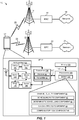
- a wireless communication system 10 includes at least one UE 12 in communication coverage of at least one network entity 14 (e.g., base station or node B in an HSPA network).
- UE 12 may communicate with a network 18 via the network entity 14 and a radio network controller (RNC) 16.
- RNC radio network controller
- multiple UEs including UE 12 may be in communication coverage with one or more network entities, including network entity 14 and network entity 20.
- the network entity 20 may be a base station such an eNodeB in a long term evolution (LTE) network 24 including an evolved packet core (EPC) 22.
- LTE long term evolution
- EPC evolved packet core
- the wireless network may employ a scheme where data assignments by the network in the downlink (a.k.a. forward link) is a function of channel quality reporting by the UE 12 in the uplink (a.k.a. reverse link).
- UE 12 may transmit and/or receive wireless communications to and/or from network entity 14 and/or network entity 20.
- the UE 12 may operate in a connected mode (e.g., CELL DCH state) with compressed mode.
- the UE 12 may be actively communicating with network entity 14.
- Compressed mode may create transmission gaps where the UE 12 interrupts the communications with network entity 14 to measure another cell such as, for example, network entity 20, which may use a different carrier frequency and/or radio access technology (RAT). Compressed mode may also be used when the UE 12 is actively communicating with the network entity 20 (e.g., in a connected mode).
- RAT radio access technology
- the network entity 14 may communicate with the UE 12 via a high speed packet access (HSPA) air interface.
- HSPA utilizes hybrid automatic repeat request (HARQ), shared channel transmission, and adaptive modulation and coding.
- the standards that define HSPA include HSDPA (high speed downlink packet access) and HSUPA (high speed uplink packet access, also referred to as enhanced uplink, or EUL).
- HSDPA utilizes as its transport channel the high-speed downlink shared channel (HS-DSCH).
- the HS-DSCH is implemented by three physical channels: the high-speed physical downlink shared channel (HS-PDSCH), the high-speed shared control channel (HS-SCCH), and the high-speed dedicated physical control channel (HS-DPCCH).
- the HS-PDSCH carries transport blocks to be decoded by specific scheduled UEs.
- the HS-SCCH indicates which UEs are scheduled on the HS-PDSCH in each sub-frame.
- the HS-DPCCH carries the HARQ ACK/NACK signaling on the uplink to indicate whether a corresponding packet transmission was decoded successfully. That is, with respect to the downlink, the UE 12 provides feedback to the network entity 14 over the HS-DPCCH to indicate whether it correctly decoded a packet on the downlink.
- the HS-DPCCH further includes feedback signaling from the UE 12 to assist the node B 14 in taking the right decision in terms of modulation and coding scheme and precoding weight selection, this feedback signaling including the CQI and PCI.
- the reported CQI value may preferably be the lesser of a calculated CQI value based on channel measurements and a compensatory CQI value.
- the network entity 14 may transmit signals (e.g. HS-PDSCH) based on various modulation schemes (e.g., binary phase-shift keying (BPSK), quadrature phase-shift keying (QPSK), M-phase-shift keying (M-PSK), M-quadrature amplitude modulation (M-QAM), and the like).
- BPSK binary phase-shift keying
- QPSK quadrature phase-shift keying
- M-PSK M-phase-shift keying
- M-QAM M-quadrature amplitude modulation
- the network entity 14 may adapt a modulation and coding scheme used for the HS-PDSCH for each sub-frame.
- Channel estimates may be used to determine the coding, modulation, spreading, and/or scrambling schemes for the downlink transmission. These channel estimates may be derived from a reference signal transmitted by the UE 12 or from a CQI value received from the UE 12.
- the CQI value may be a calculated CQI value or a compensatory CQI value; however, the CQI determination may be transparent to the network entity 14. Accordingly, the network entity 14 may determine the coding, modulation, spreading, and/or scrambling schemes regardless of how the CQI value is determined by the UE.
- UE 12 may also be referred to by those skilled in the art (as well as interchangeably herein) as a mobile station, a subscriber station, a mobile unit, a subscriber unit, a wireless unit, a remote unit, a mobile device, a wireless device, a wireless communications device, a remote device, a mobile subscriber station, an access terminal, a mobile terminal, a wireless terminal, a remote terminal, a handset, a terminal, a user agent, a mobile client, a client, or some other suitable terminology.
- a UE 12 may be a cellular phone, a personal digital assistant (PDA), a wireless modem, a wireless communication device, a handheld device, a tablet computer, a laptop computer, a cordless phone, a wireless local loop (WLL) station, a global positioning system (GPS) device, a multimedia device, a video device, a digital audio player (e.g., MP3 player), a camera, a game console, a wearable computing device (e.g., a smart-watch, smart-glasses, a health or fitness tracker, etc), an appliance, a sensor, a vehicle communication system, a medical device, a vending machine, a device for the Internet-of-Things, or any other similar functioning device.
- PDA personal digital assistant
- WLL wireless local loop
- GPS global positioning system
- multimedia device e.g., a digital audio player (e.g., MP3 player), a camera, a game console, a wearable computing device (e.g.,
- network entity 14 may be a macrocell, picocell, femtocell, relay, Node B, mobile Node B, UE (e.g., communicating in peer-to-peer or ad-hoc mode with UE 12), or substantially any type of component that can communicate with UE 12 to provide wireless network access at the UE 12.
- the UE 12 may include one or more processors 103 that may operate in combination with a channel quality component 30 configured to report CQI values.
- the channel quality component 30 may report either a calculated CQI value or a compensatory CQI value.
- the term "component" as used herein may be one of the parts that make up a system, may be hardware, firmware, and/or software, and may be divided into other components.
- the channel quality component 30 may be communicatively coupled to a transceiver 106, which may include a receiver 32 for receiving and processing RF signals and a transmitter 34 for processing and transmitting RF signals.
- the channel quality component 30 may include a scheduling rate component 40 for determining a scheduling rate of the UE 12, a deterministic scheduling component 42 for determining whether a calculated CQI value is affected by deterministic null scheduling of the UE 12, a calculated CQI component 44 for determining a CQI value based on measurements, and a compensatory CQI component 46 for determining a compensatory CQI value.
- the processor 103 may be coupled to the transceiver 106 and a memory 130 via at least one bus 110.
- the receiver 32 may include hardware, firmware, and/or software code executable by a processor for receiving data, the code comprising instructions and being stored in a memory (e.g., computer-readable medium).
- the receiver 32 may be, for example, a radio frequency (RF) receiver.
- the receiver 32 may receive and decode signals transmitted by the network entity 14.
- the receiver 32 may obtain measurements of the signals that may be used to determine a calculated CQI value. For example, the receiver 32 may determine Ec/Io, SNR, etc. Further, the receiver 32 may determine a BLER. If the receiver 32 is unable to successfully decode a transport block carried by the signals (e.g., CRC failure), a block error may be recorded.
- the BLER may represent a ratio of block errors to total received transport blocks. A high block error rate may indicate that the CQI value is too high.
- the receiver 32 may also determine an SBLER for one or more sub-frames.
- the transmitter 34 may include hardware, firmware, and/or software code executable by a processor for transmitting data, the code comprising instructions and being stored in a memory (e.g., computer-readable medium).
- the transmitter 34 may be, for example, a RF transmitter.
- the transmitter 34 may transmit a determined CQI value during a set time interval.
- a CQI value may be carried on an uplink high-speed dedicated physical control channel (HS-DPCCH).
- HS-DPCCH uplink high-speed dedicated physical control channel
- the timing of the HS-DPCCH may be based on the timing of downlink channels received by the receiver 32.
- the transmitter 34 may periodically transmit a determined CQI value on a physical uplink control channel (PUCCH) or a physical uplink shared channel (PUSCH).
- PUCCH physical uplink control channel
- PUSCH physical uplink shared channel
- the one or more processors 103 can include a modem 108 that uses one or more modem processors.
- the various functions related to channel quality component 30 may be included in modem 108 and/or processors 103 and, in an aspect, can be executed by a single processor, while in other aspects, different ones of the functions may be executed by a combination of two or more different processors.
- the one or more processors 103 may include any one or any combination of a modem processor, or a baseband processor, or a digital signal processor, or a transmit processor, or a transceiver processor associated with transceiver 106.
- the one or more processors 103 may implement components included in channel quality component 30, including a scheduling rate component 40 for determining a scheduling rate of the UE 12, a deterministic scheduling component 42 for determining whether a calculated CQI value is affected by deterministic null scheduling of the UE 12, a calculated CQI component 44 for determining a CQI value based on measurements, and a compensatory CQI component 46 for determining a compensatory CQI value.
- a scheduling rate component 40 for determining a scheduling rate of the UE 12
- a deterministic scheduling component 42 for determining whether a calculated CQI value is affected by deterministic null scheduling of the UE 12
- a calculated CQI component 44 for determining a CQI value based on measurements
- a compensatory CQI component 46 for determining a compensatory CQI value.
- the scheduling rate component 40 may include hardware, firmware, and/or software code executable by processor 103 for determining a scheduling rate of the UE 12, the code comprising instructions and being stored in a memory (e.g., computer-readable medium).
- a scheduling rate may indicate how often the UE 12 is scheduled to receive data.
- the scheduling rate may be determined based on a number of scheduled sub-frames for the UE 12 during a most recent number of sub-frames. For example, the scheduling rate may be calculated as the number of scheduled sub-frames in the last N sub-frames, divided by N.
- the scheduling rate component 40 may exclude sub-frames having deterministic null scheduling from the last N sub-frames so that the scheduling rate indicates a rate of scheduling on available sub-frames.
- the scheduling rate may also be a data rate.
- the scheduling rate may be determined based on the amount of downlink data received during a time period.
- the scheduling rate component 40 may also compare the determined scheduling rate to a threshold.
- the threshold may indicate a level where the UE 12 is considered busy. When the UE 12 is busy, an artificial increase in the reported CQI value may result in lower throughput for the UE 12 due to block errors. Conversely, when the UE is not busy, throughput may be less important, or block errors may be less likely due to smaller block sizes.
- the deterministic scheduling component 42 may include hardware, firmware, and/or software code executable by processor 103 for determining whether a calculated CQI value is affected by deterministic scheduling, the code comprising instructions and being stored in a memory (e.g., computer-readable medium).
- deterministic null scheduling may include any sub-frame where the UE 12 may predict that the UE 12 will not be scheduled to receive a downlink transmission on a downlink channel.
- a sub-frame where the UE is not scheduled due to downlink resources being used for other UEs or a lack of downlink traffic for the UE may not be considered deterministic null scheduling.
- the deterministic scheduling component 42 and/or the memory 130 may store scheduling information that may be used to determine null scheduling.
- the deterministic null scheduling may affect the calculated CQI value because measurements (e.g., SINR) may not include inter-channel interference caused by the downlink transmission on the channel.
- deterministic null scheduling may occur in association with or due to a compressed mode transmission gap.
- the deterministic scheduling component 42 may determine the timing of compressed mode transmission gaps based on parameters signaled by the network entity 14. The parameters may be stored by deterministic scheduling component 42 and/or the memory 130 as scheduling information.
- the deterministic scheduling component 42 may further determine which sub-frames will be affected by the compressed mode transmission gaps. For example, a configured value, x, may indicate the number of sub-frames before the start of a transmission gap that are affected by the transmission gap. The value of x may be based on the configuration of the network entity 14.
- the deterministic scheduling component 42 may determine the value of x based on a number of sub-frames where the UE 12 is not scheduled on the HS-DPSCH before the start of a transmission gap (e.g., based on an observed pattern).
- the value of x may indicate a number of sub-frames with deterministic null scheduling on the HS-DPSCH.
- the deterministic scheduling component 42 may use a configured value, y, to determine a number of sub-frames after the end of the transmission gap that are affected by the transmission gap.
- the affected sub-frames may include sub-frames where a CQI report is not permitted because no downlink measurements were performed during a reference period during the transmission gap.
- the affected sub-frames after the transmission gap may also include sub-frames based on measurements made immediately after the transmission gap where the UE 12 may not have been scheduled (e.g., because the HS-SCCH sub-frame overlapped the transmission gap).
- Deterministic null scheduling may also occur any time a UE 12 may be aware of a sub-frame in which the UE 12 is unlikely to be scheduled. For example, connected mode discontinuous reception (CDRX) may be used to turn off the receiver 32 for some sub-frames.
- CDRX connected mode discontinuous reception
- the deterministic scheduling component 42 and/or the memory 130 may store a CDRX period as scheduling information.
- the deterministic scheduling component 42 may determine that the UE 12 is unlikely to be scheduled in sub-frames related to a CDRX period (e.g., sub-frames immediately following the CDRX period).
- the UE 12 may be in a data call where the UE 12 receives data periodically (e.g., large periodic bursts for streaming media).
- the deterministic scheduling component 42 may determine sub-frames where the UE 12 is unlikely to be scheduled based on the characteristics of the data call. For example, the deterministic scheduling component 42 may determine a scheduling pattern by measuring time periods where the UE 12 is not scheduled before or after various events. As a further example, deterministic null scheduling may occur in response to reporting a CQI value of zero (0) for a reason other than RF conditions. A UE 12 may report a CQI value of zero (0) for various reasons. The deterministic scheduling component 42 may expect null scheduling in sub-frames following the reported CQI value of zero (0).
- deterministic null scheduling may occur include tune away of a transceiver to another radio access technology and higher layer reconfiguration (e.g., radio resource control (RRC) layer reconfiguration).
- RRC radio resource control
- the deterministic scheduling component 42 may determine that a current sub-frame is affected by deterministic null scheduling when the current sub-frame is within a time period before or after a sub-frame having deterministic null scheduling.
- the calculated CQI component 44 may include hardware, firmware, and/or software code executable by processor 103 for determining a CQI value based on measurements, the code comprising instructions and being stored in a memory (e.g., computer-readable medium).
- the calculated CQI component 44 may determine a CQI value based on measurements during a reference period.
- the reference period may be the three (3) slots (sub-frame) preceding the current sub-frame.
- the calculated CQI value may be determined by methods known in the art, for example, based on a measured channel quality such as a signal to noise ratio (SNR) SINR, and/or Ec/Io.
- SNR signal to noise ratio
- a CQI value may be calculated using a look-up table according to the SNR or SINR, which may be based on an Ec/Io measurement.
- the calculated CQI value may indicate a transport block size and/or modulation and coding scheme that the UE 12 should be able to receive with a given BLER (e.g., less than 10%).
- the compensatory CQI component 46 may include hardware, and/or software code executable by processor 103 for determining a compensatory CQI value, the code comprising instructions and being stored in a memory (e.g., computer-readable medium).
- a compensatory CQI value may be a CQI value that compensates for effects of null scheduling on measurements and CQI value calculations.
- the compensatory CQI value may be determined without measurements during the reference period.
- the compensatory CQI value may be determined based on an average reported CQI value for a plurality of most recently scheduled sub-frames.
- the average may be based on the N most recent sub-frames where HS-PDSCH was scheduled.
- N may be, for example, 5.
- the compensatory CQI value may be determined by selecting a minimum reported CQI value from CQI values reported during the plurality of most recently scheduled sub-frames.
- the compensatory CQI value may be a fixed value.
- the fixed value may be pre-configured, configured by the network entity, and/or stored in a memory (e.g., memory 130).
- the compensatory CQI value may be determined by reducing another CQI value such as the current calculated CQI value, the average reported CQI value, or the minimum reported CQI value.
- the CQI value may be reduced by scaling the other CQI value (e.g., by applying a scaling factor), applying an offset, adjusting an input parameter to a CQI calculation, or otherwise generating a lower CQI value.
- UE 12 may include RF front end 104 and transceiver 106 for receiving and transmitting radio transmissions, for example, wireless communications 26 transmitted by the network entity 14 or network entity 20.
- transceiver 106 may receive a packet on the HS-PDSCH or HS-SCCH transmitted by the network entity 14.
- UE 12 upon receipt of an entire message, may decode the packet and perform a cyclic redundancy check (CRC) to determine whether the packet was received correctly.
- CRC cyclic redundancy check
- transceiver 106 may communicate with modem 108 to transmit messages generated by channel quality component 30 and to receive messages and forward them to channel quality component 30.
- RF front end 104 may be connected to one or more antennas 102 and can include one or more low-noise amplifiers (LNAs) 141, one or more switches 142, 143, one or more power amplifiers (PAs) 145, and one or more filters 144 for transmitting and receiving RF signals.
- LNAs low-noise amplifiers
- PAs power amplifiers
- filters 144 for transmitting and receiving RF signals.
- components of RF front end 104 can connect with transceiver 106.
- Transceiver 106 may connect to one or more modems 108 and processor 103.
- LNA 141 can amplify a received signal at a desired output level.
- each LNA 141 may have a specified minimum and maximum gain values.
- RF front end 104 may use one or more switches 142, 143 to select a particular LNA 141 and its specified gain value based on a desired gain value for a particular application.
- the RF front end 104 may provide measurements (e.g., Ec/Io) and/or applied gain values to the transceiver 106 and/or calculated CQI component 44 for determining channel quality measurements.
- one or more PA(s) 145 may be used by RF front end 104 to amplify a signal for an RF output at a desired output power level.
- each PA 145 may have a specified minimum and maximum gain values.
- RF front end 104 may use one or more switches 143, 146 to select a particular PA 145 and its specified gain value based on a desired gain value for a particular application.
- one or more filters 144 can be used by RF front end 104 to filter a received signal to obtain an input RF signal.
- a respective filter 144 can be used to filter an output from a respective PA 145 to produce an output signal for transmission.
- each filter 144 can be connected to a specific LNA 141 and/or PA 145.
- RF front end 104 can use one or more switches 142, 143, 146 to select a transmit or receive path using a specified filter 144, LNA, 141, and/or PA 145, based on a configuration as specified by transceiver 106 and/or processor 103.
- Transceiver 106 may be configured to transmit and receive wireless signals through antenna 102 via RF front end 104.
- transceiver may be tuned to operate at specified frequencies such that UE 12 can communicate with, for example, network entity 14 or network entity 20.
- modem 108 can configure transceiver 106 to operate at a specified frequency and power level based on the UE configuration of the UE 12 and communication protocol used by modem 108.
- modem 108 can be a multiband-multimode modem, which can process digital data and communicate with transceiver 106 such that the digital data is sent and received using transceiver 106.
- modem 108 can be multiband and be configured to support multiple frequency bands for a specific communications protocol.
- modem 108 can be multimode and be configured to support multiple operating networks and communications protocols.
- modem 108 can control one or more components of UE 12 (e.g., RF front end 104, transceiver 106) to enable transmission and/or reception of signals from the network based on a specified modem configuration.
- the modem configuration can be based on the mode of the modem and the frequency band in use.
- the modem configuration can be based on UE configuration information associated with UE 12 as provided by the network during cell selection and/or cell reselection.
- UE 12 may further include a memory 130, such as for storing data used herein and/or local versions of applications or channel quality component 30 and/or one or more of its subcomponents being executed by processor 103.
- Memory 130 can include any type of computer-readable medium usable by a computer or processor 103, such as random access memory (RAM), read only memory (ROM), tapes, magnetic discs, optical discs, volatile memory, non-volatile memory, and any combination thereof.
- memory 130 may be a computer-readable storage medium that stores one or more computer-executable codes defining channel quality component 30 and/or one or more of its subcomponents, and/or data associated therewith, when UE 12 is operating processor 103 to execute channel quality component 30 and/or one or more of its subcomponents.
- memory 130 may be a non-transitory computer-readable storage medium.
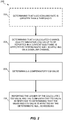
- a UE such as UE 12 ( FIG. 1 ) may perform one aspect of a method 200 for CQI reporting. While, for purposes of simplicity of explanation, the method is shown and described as a series of acts, it is to be understood and appreciated that the method (and further methods related thereto) is/are not limited by the order of acts, as some acts may, in accordance with one or more aspects, occur in different orders and/or concurrently with other acts from that shown and described herein. For example, it is to be appreciated that a method could alternatively be represented as a series of interrelated states or events, such as in a state diagram. Moreover, not all illustrated acts may be required to implement a method in accordance with one or more features described herein.
- the method 200 may optionally include determining that a scheduling rate is greater than a threshold.
- the scheduling rate component 40 may determine that a scheduling rate for the UE 12 is greater than the threshold.
- the method 200 may proceed to block 204 responsive to determining that the scheduling rate is greater than the threshold.
- the method 200 may include determining that a calculated CQI value to be reported in a current sub-frame is affected by deterministic null scheduling.
- the deterministic scheduling component 42 ( FIG. 1 ) may determine that a calculated CQI value to be reported in a current sub-frame is affected by deterministic null scheduling.
- the deterministic scheduling component 42 may determine that the current sub-frame falls within a time period defined by the parameters x and y.
- the deterministic scheduling component 42 may also determine that a CQI report is allowed because the current sub-frame is not within a compressed mode gap.
- the method 200 may also include determining that the calculated CQI value is affected by another form of deterministic null scheduling on a high-speed physical downlink shared channel (HS-PDSCH).
- HS-PDSCH high-speed physical downlink shared channel
- the deterministic scheduling component 42 may determine that the UE 12 is unlikely to be scheduled in a particular sub-frame. The deterministic scheduling component 42 may then determine whether the current sub-frame is affected by the null scheduling based on, for example, the time between the null scheduled sub-frame and the current sub-frame.
- the method 200 may include determining a compensatory CQI value.
- the compensatory CQI component 46 may determine the compensatory CQI value.
- the compensatory CQI component 46 may determine the compensatory CQI value based on an average calculated CQI value for a plurality of most recently scheduled sub-frames.
- the compensatory CQI component 46 may determine the compensatory CQI value by selecting a minimum calculated CQI from reported CQI values for a plurality of most recently scheduled sub-frames.
- the compensatory CQI component 46 may also determine the compensatory CQI value based on a fixed value or by reducing another CQI value.
- the method 200 may include reporting the lesser of the calculated CQI value and the compensatory CQI value in response to determining that the calculated CQI value is affected by the deterministic null scheduling.
- the transmitter 34 may report the lesser of the calculated CQI value and the compensatory CQI value.
- the calculated CQI value may be determined by the calculated CQI component 44 ( FIG. 1 ). Generally, the lesser CQI value will indicate lower quality channel conditions.
- the compensatory CQI value will usually be less than the calculated CQI value.
- the calculated CQI value may be less than the compensatory CQI value, for example, when the channel quality suddenly deteriorates. Accordingly, reporting the lesser of the calculated CQI value and the compensatory CQI value may account for changes in channel conditions.
- FIG. 3 is a flowchart illustrating another method 300 of reporting CQI, where method 300 may represent one particular use case of implementing the aspects of the present disclosure.
- method 300 may represent a more detailed implementation of method 200 ( FIG. 2 ).
- a UE such as UE 12 ( FIG. 1 ) may perform one aspect of a method 300 for CQI reporting.
- the method is shown and described as a series of acts, it is to be understood and appreciated that the method (and further methods related thereto) is/are not limited by the order of acts, as some acts may, in accordance with one or more aspects, occur in different orders and/or concurrently with other acts from that shown and described herein.
- a method could alternatively be represented as a series of interrelated states or events, such as in a state diagram.
- not all illustrated acts may be required to implement a method in accordance with one or more features described herein.
- the method 300 may begin when the UE 12 has an active high-speed call in a dedicated channel (DCH) state with compressed mode.
- the channel quality component 30 may determine when the UE 12 has an active high-speed call in a DCH state with compressed mode.
- the method 300 may include determining whether the scheduling rate is greater than a threshold, D.
- the scheduling rate component 40 may determine whether the scheduling rate is greater than the threshold D.
- the threshold D may be configured between approximately 60% and approximately 90% for a scheduling rate based on scheduled sub-frames for the UE 12. If the scheduling rate is not above the threshold, the method 300 may proceed to block 306, where the scheduling rate component 40 may determine that only intermittent traffic is scheduled. Accordingly, the scheduling rate component 40 may determine that it is unnecessary to change CQI reporting for the current sub-frame. The method 300 may return to block 304 for the next sub-frame.
- the method 300 may include determining whether the deterministic null scheduling (e.g., compressed mode gap) starts within the next x sub-frames or the end of the deterministic null scheduling was within the last y sub-frames.
- the deterministic scheduling component 42 may determine whether the compressed mode gap starts within the next x sub-frames or the end of compressed mode gap was within the last y sub-frames.
- the parameters x and y may be whole numbers.
- the deterministic scheduling component 42 may determine that the current sub-frame is a non-adjacent sub-frame to the compressed mode gap. In other words, the current sub-frame may not be affected by the compressed mode gap. Accordingly, the deterministic scheduling component 42 may determine that that it is unnecessary to change CQI reporting for the current sub-frame. The method 300 may return to block 304 for the next sub-frame.
- the method 300 may include setting the CQI value to the minimum of the calculated CQI value or a compensatory CQI value, K.
- the calculated CQI value may be determined by the calculated CQI component 44.
- the compensatory CQI value K may be determined by the compensatory CQI component 46.
- the method 300 may include reporting the CQI value on the HS-DPCCH.
- the transmitter 34 may report the CQI value on the HS-DPCCH.
- the reported CQI value may help reduce the effects of the compressed mode gap on scheduling at the network entity 14.
- the reported CQI value may avoid an artificially boosted CQI, which in turn may prevent the network entity 14 from selecting a modulation scheme or block size that the UE 12 will be unable to decode. Accordingly, the reported CQI value may improve downlink throughput by reducing decoding errors.
- the method 300 may return to block 304 for the next sub-frame.
- FIG. 4 is a diagram 400 illustrating timing of compressed mode transmission gaps in high speed channels.
- sub-frames having deterministic null scheduling may be determined based on the timing of the compressed mode transmission gaps.
- a channel may be represented by a series of sub-frames.
- an HSPA system may have a 2 millisecond (ms) sub-frame (also referred to as a transmission time interval (TTI)), where each TTI comprises 3 slots.
- TTI transmission time interval
- timing of the channels may be varied in units of block processing groups (BPG), which may be equal to one-tenth of a slot (approximately 0.067 ms).
- BPG block processing groups
- the common pilot channel (CPICH) 402 may be constantly transmitted by the network entity 14.
- the CPICH 402 may be used by the UE 12 to perform measurements. The timing for other channels may be based on the CPICH.
- the high-speed shared control channel (HS-SCCH) 404 may be transmitted by the network entity 14 to carry scheduling information for the UE 12.
- the HS-SCCH 404 may indicate whether the UE 12 is scheduled to receive data on the high-speed physical downlink shared channel (HS-PDSCH) 408.
- the HS-SCCH 404 may also indicate a modulation and coding scheme.
- the downlink DPCH 406 may be a dedicated channel for the UE 12.
- the downlink DPCH 406 may be a fractional DPCH 406 with a timing offset.
- the timing offset illustrated in diagram 400 may be 2 bpg.
- the HS-PDSCH 408 may carry downlink traffic for one or more UEs.
- the high speed dedicated physical control channel (HS-DPCCH) 410 may be an uplink channel used by the UE 12 to provide feedback to the network entity 14 regarding the HS-PDSCH 408.
- the HS-DPCCH 410 may include an ACK/NACK portion and a CQI portion in a sub-frame corresponding to a previous HS-DPCCH sub-frame.
- a sub-frame of the HS-DPCCH may be transmitted 5 slots (75 bpg or 19200 chips) after the corresponding sub-frame of the HS-PDSCH.
- the compressed mode gaps 420, 422 may be based on the timing of the DPCH 406.
- the network entity 14 or RNC 16 may configure the UE 12 ( FIG. 1 ) with compressed mode gap scheduling based on the DPCH.
- a compressed mode gap 420 may be up to 7 slots. Two compressed mode gaps may be scheduled consecutively in consecutive frames for a maximum total length of 14 slots.
- the UE 12 may neglect receiving of any sub-frames of the HS-SCCH 404 and the HS-PDSCH 408 that overlap the compressed mode gap 420.
- any sub-frames that overlap with the compressed mode gap may be considered to have deterministic null scheduling because the timing of the compressed mode gaps is known to the UE 12.
- the UE 12 may also use discontinuous transmission (DTX) to refrain from transmitting an ACK/NACK portion of the HS-DPCCH 410 during the compressed mode gap 420.
- DTX discontinuous transmission
- the UE 12 may refrain from transmitting a CQI portion of the HS-DPCCH 412 that overlaps the compressed mode gap 420.
- the UE 12 may also refrain from transmitting the CQI where the reference slots used to determine the CQI overlap the compressed mode gap 420.
- the compressed mode gap 422 may be similar to the compressed mode gap 420 except occurring at a later time.
- the compressed mode gap 420 may affect the above described channels.
- the HS-SCCH 404 may not be decoded in sub-frames 1014, 1015, and 1016, due to overlap with the compressed mode gap 420 and in sub-frames 1021, 1022, and 1023 due to overlap with the compressed mode gap 422.
- sub-frames 1014, 1015, 1016, 1021, 1022, and 1023 may be considered to have deterministic null scheduling because the scheduling information on these sub-frames cannot be read.
- HS-PDSCH 408 may not be decoded in sub-frames 1014 and 1015 due to the compressed mode gap 420, in sub-frames 1021, 1022, and 1023 due to the compressed mode gap 422.
- HS-DPCCH 410 may not be transmitted in sub-frames 1011 and 1012 because of overlap with compressed mode gap 420 and may not be transmitted in sub-frames 1017-1019 due to overlap with compressed mode gap 420. Further, HS-DPCCH 410 may not include a CQI in sub-frames 1013, and 1020 because the reference periods overlap the compressed mode gaps 420, 422.
- the calculated CQI value may be affected for other sub-frames.
- the network entity 14 may not schedule any data during those sub-frames. Therefore, sub-frames 1017-1019 may also be considered to have deterministic null scheduling. Accordingly, the calculated CQI values reported in HS-DPCCH 410 sub-frames 1014-1016 may be affected by the compressed mode gap 422 (due to deterministic null scheduling of HS-PDSCH sub-frames 1017-1019 during the reference period), even though these uplink sub-frames do not overlap the compressed mode gap 422.
- the calculated CQI value may be affected because the UE 12 was not scheduled to decode the HS-PDSCH during the reference period for those sub-frames.
- a sub-frame e.g. HS-DPCCH sub-frame 1015
- a sub-frame e.g. HS-DPCCH sub-frame 1015
- various aspects may be extended to other UMTS systems such as High Speed Downlink Packet Access (HSDPA), High Speed Uplink Packet Access (HSUPA), High Speed Packet Access Plus (HSPA+) and TD-CDMA.
- Various aspects may also be extended to systems employing Long Term Evolution (LTE) (in FDD, TDD, or both modes), LTE-Advanced (LTE-A) (in FDD, TDD, or both modes), CDMA2000, Evolution-Data Optimized (EV-DO), Ultra Mobile Broadband (UMB), IEEE 802.11 (Wi-Fi), IEEE 802.16 (WiMAX), IEEE 802.20, Ultra-Wideband (UWB), Bluetooth, and/or other suitable systems.
- LTE Long Term Evolution
- LTE-A LTE-Advanced
- CDMA2000 Long Term Evolution-Data Optimized
- UMB Ultra Mobile Broadband
- IEEE 802.11 Wi-Fi
- IEEE 802.16 WiMAX
- IEEE 802.20 Ultra-Wideband (
- processors include microprocessors, microcontrollers, digital signal processors (DSPs), field programmable gate arrays (FPGAs), programmable logic devices (PLDs), state machines, gated logic, discrete hardware circuits, and other suitable hardware configured to perform the various functionality described throughout this disclosure.
- DSPs digital signal processors
- FPGAs field programmable gate arrays
- PLDs programmable logic devices
- state machines gated logic, discrete hardware circuits, and other suitable hardware configured to perform the various functionality described throughout this disclosure.
- One or more processors in the processing system may execute software.
- Software shall be construed broadly to mean instructions, instruction sets, code, code segments, program code, programs, subprograms, software modules, applications, software applications, software packages, routines, subroutines, objects, executables, threads of execution, procedures, functions, etc., whether referred to as software, firmware, middleware, microcode, hardware description language, or otherwise.
- the software may reside on a computer-readable medium.
- the computer-readable medium may be a non-transitory computer-readable medium.
- a non-transitory computer-readable medium includes, by way of example, a magnetic storage device (e.g., hard disk, floppy disk, magnetic strip), an optical disk (e.g., compact disk (CD), digital versatile disk (DVD)), a smart card, a flash memory device (e.g., card, stick, key drive), random access memory (RAM), read only memory (ROM), programmable ROM (PROM), erasable PROM (EPROM), electrically erasable PROM (EEPROM), a register, a removable disk, and any other suitable medium for storing software and/or instructions that may be accessed and read by a computer.
- the computer-readable medium may be resident in the processing system, external to the processing system, or distributed across multiple entities including the processing system.
- the computer-readable medium may be embodied in a computer-program product.
- a computer-program product may include a computer-readable medium in packaging materials.
Landscapes
- Engineering & Computer Science (AREA)
- Quality & Reliability (AREA)
- Computer Networks & Wireless Communication (AREA)
- Signal Processing (AREA)
- Mobile Radio Communication Systems (AREA)
Applications Claiming Priority (3)
| Application Number | Priority Date | Filing Date | Title |
|---|---|---|---|
| US201562115537P | 2015-02-12 | 2015-02-12 | |
| US14/819,782 US10064210B2 (en) | 2015-02-12 | 2015-08-06 | Channel quality reporting for deterministic null scheduling |
| PCT/US2016/013652 WO2016130277A1 (en) | 2015-02-12 | 2016-01-15 | Channel quality reporting for deterministic null scheduling |
Publications (2)
| Publication Number | Publication Date |
|---|---|
| EP3257178A1 EP3257178A1 (en) | 2017-12-20 |
| EP3257178B1 true EP3257178B1 (en) | 2019-05-01 |
Family
ID=55353291
Family Applications (1)
| Application Number | Title | Priority Date | Filing Date |
|---|---|---|---|
| EP16704293.6A Active EP3257178B1 (en) | 2015-02-12 | 2016-01-15 | Channel quality reporting for deterministic null scheduling |
Country Status (6)
| Country | Link |
|---|---|
| US (1) | US10064210B2 (enExample) |
| EP (1) | EP3257178B1 (enExample) |
| JP (1) | JP6502516B2 (enExample) |
| KR (1) | KR101965369B1 (enExample) |
| CN (1) | CN107258061B (enExample) |
| WO (1) | WO2016130277A1 (enExample) |
Families Citing this family (7)
| Publication number | Priority date | Publication date | Assignee | Title |
|---|---|---|---|---|
| WO2018126415A1 (zh) * | 2017-01-05 | 2018-07-12 | 广东欧珀移动通信有限公司 | 传输反馈信息的方法、网络设备和终端设备 |
| US10659151B2 (en) | 2017-04-21 | 2020-05-19 | Apple Inc. | Apparatus, system and method for utilizing a flexible slot format indicator |
| US10673605B2 (en) | 2017-06-15 | 2020-06-02 | Apple Inc. | Semi-static and dynamic TDD configuration for 5G-NR |
| US10601472B2 (en) * | 2017-11-14 | 2020-03-24 | T-Mobile Usa, Inc. | Systems and methods for improving cell-edge receiver performance |
| US10904812B2 (en) * | 2018-03-22 | 2021-01-26 | Qualcomm Incorporated | Increasing reliability during multi-connectivity handovers |
| US10880917B2 (en) | 2018-06-11 | 2020-12-29 | Apple Inc. | TDD single Tx switched UL solution |
| CN111050349B (zh) * | 2018-10-12 | 2021-12-03 | 华为技术有限公司 | 确定信道质量信息的方法、装置及系统 |
Family Cites Families (23)
| Publication number | Priority date | Publication date | Assignee | Title |
|---|---|---|---|---|
| CN100474961C (zh) * | 2003-09-30 | 2009-04-01 | 松下电器产业株式会社 | 用于发送压缩模式中的下行传播路径质量信息的方法和装置 |
| US7813312B2 (en) * | 2005-05-06 | 2010-10-12 | Interdigital Technology Corporation | Method and system for preventing high speed downlink packet access transmissions loss |
| KR100640416B1 (ko) * | 2005-06-16 | 2006-10-30 | 삼성전자주식회사 | Pf 스케줄링 시스템 및 방법 |
| JP2007129672A (ja) * | 2005-11-02 | 2007-05-24 | Ntt Docomo Inc | 無線アクセスネットワーク装置、移動局及びハンドオーバ制御方法 |
| WO2007091677A1 (ja) * | 2006-02-10 | 2007-08-16 | Sharp Kabushiki Kaisha | 移動通信システム、移動局装置、基地局装置及び移動通信方法 |
| CN101064708B (zh) * | 2006-04-30 | 2010-04-21 | 华为技术有限公司 | 多载波系统频率资源映射方法及装置 |
| EP2051409A1 (en) * | 2006-08-08 | 2009-04-22 | Panasonic Corporation | Radio communication mobile station device and resource allocation method |
| JP4905007B2 (ja) * | 2006-09-12 | 2012-03-28 | 富士通株式会社 | 無線通信システムにおける上り通信方法及び無線端末 |
| WO2008036366A2 (en) * | 2006-09-20 | 2008-03-27 | Interdigital Technology Corporation | Method for enhanced dedicated channel (e-dch) transmission overlap detection for compressed mode gap slots |
| US9219570B2 (en) * | 2007-05-07 | 2015-12-22 | Nokia Technologies Oy | Feedback and link adaptation techniques for wireless networks |
| US7945258B2 (en) | 2007-07-31 | 2011-05-17 | Broadcom Corporation | Wireless device operable to manipulate high-speed shared control channel (HSSCCH) quality control through channel quality indication report manipulation |
| KR101513503B1 (ko) * | 2008-08-11 | 2015-04-22 | 삼성전자주식회사 | Dual-cell HSDPA 를 지원하는 이동통신 시스템에서 CQI전송 오버헤드를 감소시키는 방법 및 장치 |
| WO2011100646A1 (en) * | 2010-02-12 | 2011-08-18 | Interdigital Patent Holdings, Inc. | Sending feedback for multiple downlink carriers |
| JP2014506437A (ja) * | 2011-01-07 | 2014-03-13 | インターデイジタル パテント ホールディングス インコーポレイテッド | マルチセル高速ダウンリンクパケットアクセス動作に関するフィードバックを送信するための方法および装置 |
| US20130265960A1 (en) * | 2011-02-28 | 2013-10-10 | Nec (China) Co., Ltd. | Method and apparatus for modifying channel quality indication |
| CN102655656B (zh) * | 2011-03-02 | 2015-02-04 | 鼎桥通信技术有限公司 | 高速下行链路分组接入调度方法、装置及基站 |
| CN102265543B (zh) * | 2011-06-10 | 2014-03-12 | 华为技术有限公司 | 修正信道质量指示值的方法和设备 |
| CN102932093A (zh) * | 2011-08-12 | 2013-02-13 | 华为技术有限公司 | 一种信道质量指示的发送方法和用户设备 |
| US9332452B2 (en) * | 2012-05-30 | 2016-05-03 | Intel Deutschland Gmbh | Radio communication devices and methods for controlling a radio communication device |
| GB2494499B (en) | 2012-06-22 | 2013-08-14 | Renesas Mobile Corp | Channel Quality Indicator (CQI) reporting during periods of discontinuous reception (DRX) |
| US8929239B2 (en) * | 2012-07-02 | 2015-01-06 | Apple Inc. | Modulation and coding scheme (MCS) recovery based on CQI offset |
| US9686800B2 (en) * | 2012-08-03 | 2017-06-20 | Qualcomm Incorporated | Methods and apparatus for reporting channel quality indicator (CQI) |
| CN103684668B (zh) * | 2012-09-19 | 2017-04-26 | 中兴通讯股份有限公司 | 确定信道质量指示值的方法、装置及lte终端 |
-
2015
- 2015-08-06 US US14/819,782 patent/US10064210B2/en not_active Expired - Fee Related
-
2016
- 2016-01-15 JP JP2017541365A patent/JP6502516B2/ja not_active Expired - Fee Related
- 2016-01-15 WO PCT/US2016/013652 patent/WO2016130277A1/en not_active Ceased
- 2016-01-15 CN CN201680009957.XA patent/CN107258061B/zh not_active Expired - Fee Related
- 2016-01-15 EP EP16704293.6A patent/EP3257178B1/en active Active
- 2016-01-15 KR KR1020177022301A patent/KR101965369B1/ko not_active Expired - Fee Related
Non-Patent Citations (1)
| Title |
|---|
| None * |
Also Published As
| Publication number | Publication date |
|---|---|
| KR20170117412A (ko) | 2017-10-23 |
| WO2016130277A1 (en) | 2016-08-18 |
| KR101965369B1 (ko) | 2019-04-03 |
| US20160242202A1 (en) | 2016-08-18 |
| JP6502516B2 (ja) | 2019-04-17 |
| CN107258061B (zh) | 2020-06-05 |
| CN107258061A (zh) | 2017-10-17 |
| JP2018505621A (ja) | 2018-02-22 |
| EP3257178A1 (en) | 2017-12-20 |
| US10064210B2 (en) | 2018-08-28 |
Similar Documents
| Publication | Publication Date | Title |
|---|---|---|
| EP3257178B1 (en) | Channel quality reporting for deterministic null scheduling | |
| CA2980775C (en) | Cell selection procedures for machine type communication devices supporting coverage enhancement | |
| US9414316B2 (en) | Mobile station, radio base station, and communication control method | |
| US10165617B2 (en) | Methods of adapting receiver configuration for control channel reception based on DRX status | |
| KR102338293B1 (ko) | Dch 향상들을 갖는 압축 모드 | |
| US8903327B2 (en) | Channel quality reporting using a dynamically adjusted measurement power offset | |
| US20160204908A1 (en) | Adaptive multi-rate partial decode | |
| EP3964026A1 (en) | Wireless device-autonomous procedures for missed-wake up signals | |
| KR20130092601A (ko) | 전력 최적화된 복조기 전단 (demfront) 수신기 서브시스템 | |
| US20140112267A1 (en) | Receive diversity control in td-scdma | |
| US10764131B2 (en) | Methods of adapting receiver configuration for control channel reception based on data reception | |
| EP3301988B1 (en) | Mobile communication devices and methods in mobile communication | |
| JP2017515397A (ja) | ユーザ機器における電池消費量を削減すること | |
| KR102306683B1 (ko) | 다중 rab 시나리오들에서의 hs-dpcch 오버헤드 감소 | |
| CN113923698A (zh) | 处理下行信道异常重传的方法、装置及芯片 | |
| JP2006229382A (ja) | 移動通信システム、基地局、移動局及びそれらに用いる通信制御方法 | |
| WO2014148964A1 (en) | User equipment, network node and methods therein for reducing transmission of channel state information | |
| CN104782058A (zh) | Td-scdma中的接收分集控制 |
Legal Events
| Date | Code | Title | Description |
|---|---|---|---|
| STAA | Information on the status of an ep patent application or granted ep patent |
Free format text: STATUS: THE INTERNATIONAL PUBLICATION HAS BEEN MADE |
|
| PUAI | Public reference made under article 153(3) epc to a published international application that has entered the european phase |
Free format text: ORIGINAL CODE: 0009012 |
|
| STAA | Information on the status of an ep patent application or granted ep patent |
Free format text: STATUS: REQUEST FOR EXAMINATION WAS MADE |
|
| 17P | Request for examination filed |
Effective date: 20170629 |
|
| AK | Designated contracting states |
Kind code of ref document: A1 Designated state(s): AL AT BE BG CH CY CZ DE DK EE ES FI FR GB GR HR HU IE IS IT LI LT LU LV MC MK MT NL NO PL PT RO RS SE SI SK SM TR |
|
| AX | Request for extension of the european patent |
Extension state: BA ME |
|
| DAV | Request for validation of the european patent (deleted) | ||
| DAX | Request for extension of the european patent (deleted) | ||
| GRAP | Despatch of communication of intention to grant a patent |
Free format text: ORIGINAL CODE: EPIDOSNIGR1 |
|
| STAA | Information on the status of an ep patent application or granted ep patent |
Free format text: STATUS: GRANT OF PATENT IS INTENDED |
|
| INTG | Intention to grant announced |
Effective date: 20181121 |
|
| GRAS | Grant fee paid |
Free format text: ORIGINAL CODE: EPIDOSNIGR3 |
|
| GRAA | (expected) grant |
Free format text: ORIGINAL CODE: 0009210 |
|
| STAA | Information on the status of an ep patent application or granted ep patent |
Free format text: STATUS: THE PATENT HAS BEEN GRANTED |
|
| AK | Designated contracting states |
Kind code of ref document: B1 Designated state(s): AL AT BE BG CH CY CZ DE DK EE ES FI FR GB GR HR HU IE IS IT LI LT LU LV MC MK MT NL NO PL PT RO RS SE SI SK SM TR |
|
| REG | Reference to a national code |
Ref country code: GB Ref legal event code: FG4D |
|
| REG | Reference to a national code |
Ref country code: AT Ref legal event code: REF Ref document number: 1128352 Country of ref document: AT Kind code of ref document: T Effective date: 20190515 Ref country code: CH Ref legal event code: EP |
|
| REG | Reference to a national code |
Ref country code: DE Ref legal event code: R096 Ref document number: 602016013169 Country of ref document: DE |
|
| REG | Reference to a national code |
Ref country code: IE Ref legal event code: FG4D |
|
| REG | Reference to a national code |
Ref country code: NL Ref legal event code: MP Effective date: 20190501 |
|
| REG | Reference to a national code |
Ref country code: LT Ref legal event code: MG4D |
|
| PG25 | Lapsed in a contracting state [announced via postgrant information from national office to epo] |
Ref country code: LT Free format text: LAPSE BECAUSE OF FAILURE TO SUBMIT A TRANSLATION OF THE DESCRIPTION OR TO PAY THE FEE WITHIN THE PRESCRIBED TIME-LIMIT Effective date: 20190501 Ref country code: ES Free format text: LAPSE BECAUSE OF FAILURE TO SUBMIT A TRANSLATION OF THE DESCRIPTION OR TO PAY THE FEE WITHIN THE PRESCRIBED TIME-LIMIT Effective date: 20190501 Ref country code: NL Free format text: LAPSE BECAUSE OF FAILURE TO SUBMIT A TRANSLATION OF THE DESCRIPTION OR TO PAY THE FEE WITHIN THE PRESCRIBED TIME-LIMIT Effective date: 20190501 Ref country code: NO Free format text: LAPSE BECAUSE OF FAILURE TO SUBMIT A TRANSLATION OF THE DESCRIPTION OR TO PAY THE FEE WITHIN THE PRESCRIBED TIME-LIMIT Effective date: 20190801 Ref country code: HR Free format text: LAPSE BECAUSE OF FAILURE TO SUBMIT A TRANSLATION OF THE DESCRIPTION OR TO PAY THE FEE WITHIN THE PRESCRIBED TIME-LIMIT Effective date: 20190501 Ref country code: FI Free format text: LAPSE BECAUSE OF FAILURE TO SUBMIT A TRANSLATION OF THE DESCRIPTION OR TO PAY THE FEE WITHIN THE PRESCRIBED TIME-LIMIT Effective date: 20190501 Ref country code: SE Free format text: LAPSE BECAUSE OF FAILURE TO SUBMIT A TRANSLATION OF THE DESCRIPTION OR TO PAY THE FEE WITHIN THE PRESCRIBED TIME-LIMIT Effective date: 20190501 Ref country code: PT Free format text: LAPSE BECAUSE OF FAILURE TO SUBMIT A TRANSLATION OF THE DESCRIPTION OR TO PAY THE FEE WITHIN THE PRESCRIBED TIME-LIMIT Effective date: 20190901 Ref country code: AL Free format text: LAPSE BECAUSE OF FAILURE TO SUBMIT A TRANSLATION OF THE DESCRIPTION OR TO PAY THE FEE WITHIN THE PRESCRIBED TIME-LIMIT Effective date: 20190501 |
|
| PG25 | Lapsed in a contracting state [announced via postgrant information from national office to epo] |
Ref country code: LV Free format text: LAPSE BECAUSE OF FAILURE TO SUBMIT A TRANSLATION OF THE DESCRIPTION OR TO PAY THE FEE WITHIN THE PRESCRIBED TIME-LIMIT Effective date: 20190501 Ref country code: GR Free format text: LAPSE BECAUSE OF FAILURE TO SUBMIT A TRANSLATION OF THE DESCRIPTION OR TO PAY THE FEE WITHIN THE PRESCRIBED TIME-LIMIT Effective date: 20190802 Ref country code: BG Free format text: LAPSE BECAUSE OF FAILURE TO SUBMIT A TRANSLATION OF THE DESCRIPTION OR TO PAY THE FEE WITHIN THE PRESCRIBED TIME-LIMIT Effective date: 20190801 Ref country code: RS Free format text: LAPSE BECAUSE OF FAILURE TO SUBMIT A TRANSLATION OF THE DESCRIPTION OR TO PAY THE FEE WITHIN THE PRESCRIBED TIME-LIMIT Effective date: 20190501 |
|
| REG | Reference to a national code |
Ref country code: AT Ref legal event code: MK05 Ref document number: 1128352 Country of ref document: AT Kind code of ref document: T Effective date: 20190501 |
|
| PG25 | Lapsed in a contracting state [announced via postgrant information from national office to epo] |
Ref country code: IS Free format text: LAPSE BECAUSE OF FAILURE TO SUBMIT A TRANSLATION OF THE DESCRIPTION OR TO PAY THE FEE WITHIN THE PRESCRIBED TIME-LIMIT Effective date: 20190901 |
|
| PG25 | Lapsed in a contracting state [announced via postgrant information from national office to epo] |
Ref country code: SK Free format text: LAPSE BECAUSE OF FAILURE TO SUBMIT A TRANSLATION OF THE DESCRIPTION OR TO PAY THE FEE WITHIN THE PRESCRIBED TIME-LIMIT Effective date: 20190501 Ref country code: AT Free format text: LAPSE BECAUSE OF FAILURE TO SUBMIT A TRANSLATION OF THE DESCRIPTION OR TO PAY THE FEE WITHIN THE PRESCRIBED TIME-LIMIT Effective date: 20190501 Ref country code: EE Free format text: LAPSE BECAUSE OF FAILURE TO SUBMIT A TRANSLATION OF THE DESCRIPTION OR TO PAY THE FEE WITHIN THE PRESCRIBED TIME-LIMIT Effective date: 20190501 Ref country code: RO Free format text: LAPSE BECAUSE OF FAILURE TO SUBMIT A TRANSLATION OF THE DESCRIPTION OR TO PAY THE FEE WITHIN THE PRESCRIBED TIME-LIMIT Effective date: 20190501 Ref country code: DK Free format text: LAPSE BECAUSE OF FAILURE TO SUBMIT A TRANSLATION OF THE DESCRIPTION OR TO PAY THE FEE WITHIN THE PRESCRIBED TIME-LIMIT Effective date: 20190501 Ref country code: CZ Free format text: LAPSE BECAUSE OF FAILURE TO SUBMIT A TRANSLATION OF THE DESCRIPTION OR TO PAY THE FEE WITHIN THE PRESCRIBED TIME-LIMIT Effective date: 20190501 |
|
| REG | Reference to a national code |
Ref country code: DE Ref legal event code: R097 Ref document number: 602016013169 Country of ref document: DE |
|
| PG25 | Lapsed in a contracting state [announced via postgrant information from national office to epo] |
Ref country code: SM Free format text: LAPSE BECAUSE OF FAILURE TO SUBMIT A TRANSLATION OF THE DESCRIPTION OR TO PAY THE FEE WITHIN THE PRESCRIBED TIME-LIMIT Effective date: 20190501 Ref country code: IT Free format text: LAPSE BECAUSE OF FAILURE TO SUBMIT A TRANSLATION OF THE DESCRIPTION OR TO PAY THE FEE WITHIN THE PRESCRIBED TIME-LIMIT Effective date: 20190501 |
|
| PGFP | Annual fee paid to national office [announced via postgrant information from national office to epo] |
Ref country code: FR Payment date: 20191226 Year of fee payment: 5 |
|
| PLBE | No opposition filed within time limit |
Free format text: ORIGINAL CODE: 0009261 |
|
| STAA | Information on the status of an ep patent application or granted ep patent |
Free format text: STATUS: NO OPPOSITION FILED WITHIN TIME LIMIT |
|
| PG25 | Lapsed in a contracting state [announced via postgrant information from national office to epo] |
Ref country code: TR Free format text: LAPSE BECAUSE OF FAILURE TO SUBMIT A TRANSLATION OF THE DESCRIPTION OR TO PAY THE FEE WITHIN THE PRESCRIBED TIME-LIMIT Effective date: 20190501 |
|
| 26N | No opposition filed |
Effective date: 20200204 |
|
| PG25 | Lapsed in a contracting state [announced via postgrant information from national office to epo] |
Ref country code: PL Free format text: LAPSE BECAUSE OF FAILURE TO SUBMIT A TRANSLATION OF THE DESCRIPTION OR TO PAY THE FEE WITHIN THE PRESCRIBED TIME-LIMIT Effective date: 20190501 |
|
| PGFP | Annual fee paid to national office [announced via postgrant information from national office to epo] |
Ref country code: GB Payment date: 20191231 Year of fee payment: 5 Ref country code: DE Payment date: 20191218 Year of fee payment: 5 |
|
| PG25 | Lapsed in a contracting state [announced via postgrant information from national office to epo] |
Ref country code: SI Free format text: LAPSE BECAUSE OF FAILURE TO SUBMIT A TRANSLATION OF THE DESCRIPTION OR TO PAY THE FEE WITHIN THE PRESCRIBED TIME-LIMIT Effective date: 20190501 |
|
| PG25 | Lapsed in a contracting state [announced via postgrant information from national office to epo] |
Ref country code: MC Free format text: LAPSE BECAUSE OF FAILURE TO SUBMIT A TRANSLATION OF THE DESCRIPTION OR TO PAY THE FEE WITHIN THE PRESCRIBED TIME-LIMIT Effective date: 20190501 |
|
| REG | Reference to a national code |
Ref country code: CH Ref legal event code: PL |
|
| REG | Reference to a national code |
Ref country code: BE Ref legal event code: MM Effective date: 20200131 |
|
| PG25 | Lapsed in a contracting state [announced via postgrant information from national office to epo] |
Ref country code: LU Free format text: LAPSE BECAUSE OF NON-PAYMENT OF DUE FEES Effective date: 20200115 |
|
| PG25 | Lapsed in a contracting state [announced via postgrant information from national office to epo] |
Ref country code: CH Free format text: LAPSE BECAUSE OF NON-PAYMENT OF DUE FEES Effective date: 20200131 Ref country code: BE Free format text: LAPSE BECAUSE OF NON-PAYMENT OF DUE FEES Effective date: 20200131 Ref country code: LI Free format text: LAPSE BECAUSE OF NON-PAYMENT OF DUE FEES Effective date: 20200131 |
|
| PG25 | Lapsed in a contracting state [announced via postgrant information from national office to epo] |
Ref country code: IE Free format text: LAPSE BECAUSE OF NON-PAYMENT OF DUE FEES Effective date: 20200115 |
|
| REG | Reference to a national code |
Ref country code: DE Ref legal event code: R119 Ref document number: 602016013169 Country of ref document: DE |
|
| GBPC | Gb: european patent ceased through non-payment of renewal fee |
Effective date: 20210115 |
|
| PG25 | Lapsed in a contracting state [announced via postgrant information from national office to epo] |
Ref country code: FR Free format text: LAPSE BECAUSE OF NON-PAYMENT OF DUE FEES Effective date: 20210131 |
|
| PG25 | Lapsed in a contracting state [announced via postgrant information from national office to epo] |
Ref country code: DE Free format text: LAPSE BECAUSE OF NON-PAYMENT OF DUE FEES Effective date: 20210803 Ref country code: GB Free format text: LAPSE BECAUSE OF NON-PAYMENT OF DUE FEES Effective date: 20210115 |
|
| PG25 | Lapsed in a contracting state [announced via postgrant information from national office to epo] |
Ref country code: MT Free format text: LAPSE BECAUSE OF FAILURE TO SUBMIT A TRANSLATION OF THE DESCRIPTION OR TO PAY THE FEE WITHIN THE PRESCRIBED TIME-LIMIT Effective date: 20190501 Ref country code: CY Free format text: LAPSE BECAUSE OF FAILURE TO SUBMIT A TRANSLATION OF THE DESCRIPTION OR TO PAY THE FEE WITHIN THE PRESCRIBED TIME-LIMIT Effective date: 20190501 |
|
| PG25 | Lapsed in a contracting state [announced via postgrant information from national office to epo] |
Ref country code: MK Free format text: LAPSE BECAUSE OF FAILURE TO SUBMIT A TRANSLATION OF THE DESCRIPTION OR TO PAY THE FEE WITHIN THE PRESCRIBED TIME-LIMIT Effective date: 20190501 |