EP3256012B1 - Method for producing a milk-based product - Google Patents
Method for producing a milk-based product Download PDFInfo
- Publication number
- EP3256012B1 EP3256012B1 EP16708432.6A EP16708432A EP3256012B1 EP 3256012 B1 EP3256012 B1 EP 3256012B1 EP 16708432 A EP16708432 A EP 16708432A EP 3256012 B1 EP3256012 B1 EP 3256012B1
- Authority
- EP
- European Patent Office
- Prior art keywords
- milk
- casein
- protein
- less
- specifically
- Prior art date
- Legal status (The legal status is an assumption and is not a legal conclusion. Google has not performed a legal analysis and makes no representation as to the accuracy of the status listed.)
- Active
Links
Images


Classifications
-
- A—HUMAN NECESSITIES
- A23—FOODS OR FOODSTUFFS; TREATMENT THEREOF, NOT COVERED BY OTHER CLASSES
- A23L—FOODS, FOODSTUFFS OR NON-ALCOHOLIC BEVERAGES, NOT OTHERWISE PROVIDED FOR; PREPARATION OR TREATMENT THEREOF
- A23L33/00—Modifying nutritive qualities of foods; Dietetic products; Preparation or treatment thereof
-
- A—HUMAN NECESSITIES
- A23—FOODS OR FOODSTUFFS; TREATMENT THEREOF, NOT COVERED BY OTHER CLASSES
- A23B—PRESERVATION OF FOODS, FOODSTUFFS OR NON-ALCOHOLIC BEVERAGES; CHEMICAL RIPENING OF FRUIT OR VEGETABLES
- A23B11/00—Preservation of milk or dairy products
- A23B11/10—Preservation of milk or milk preparations
- A23B11/12—Preservation of milk or milk preparations by heating
-
- A—HUMAN NECESSITIES
- A23—FOODS OR FOODSTUFFS; TREATMENT THEREOF, NOT COVERED BY OTHER CLASSES
- A23B—PRESERVATION OF FOODS, FOODSTUFFS OR NON-ALCOHOLIC BEVERAGES; CHEMICAL RIPENING OF FRUIT OR VEGETABLES
- A23B11/00—Preservation of milk or dairy products
- A23B11/10—Preservation of milk or milk preparations
- A23B11/12—Preservation of milk or milk preparations by heating
- A23B11/13—Preservation of milk or milk preparations by heating the materials being loose unpacked
- A23B11/133—Preservation of milk or milk preparations by heating the materials being loose unpacked and progressively transported through the apparatus
- A23B11/137—Preservation of milk or milk preparations by heating the materials being loose unpacked and progressively transported through the apparatus in direct contact with the heating medium, e.g. steam
-
- A—HUMAN NECESSITIES
- A23—FOODS OR FOODSTUFFS; TREATMENT THEREOF, NOT COVERED BY OTHER CLASSES
- A23C—DAIRY PRODUCTS, e.g. MILK, BUTTER OR CHEESE; MILK OR CHEESE SUBSTITUTES; PREPARATION THEREOF
- A23C7/00—Other dairy technology
- A23C7/04—Removing unwanted substances other than lactose or milk proteins from milk
-
- A—HUMAN NECESSITIES
- A23—FOODS OR FOODSTUFFS; TREATMENT THEREOF, NOT COVERED BY OTHER CLASSES
- A23C—DAIRY PRODUCTS, e.g. MILK, BUTTER OR CHEESE; MILK OR CHEESE SUBSTITUTES; PREPARATION THEREOF
- A23C9/00—Milk preparations; Milk powder or milk powder preparations
- A23C9/12—Fermented milk preparations; Treatment using microorganisms or enzymes
- A23C9/1203—Addition of, or treatment with, enzymes or microorganisms other than lactobacteriaceae
- A23C9/1206—Lactose hydrolysing enzymes, e.g. lactase, beta-galactosidase
-
- A—HUMAN NECESSITIES
- A23—FOODS OR FOODSTUFFS; TREATMENT THEREOF, NOT COVERED BY OTHER CLASSES
- A23C—DAIRY PRODUCTS, e.g. MILK, BUTTER OR CHEESE; MILK OR CHEESE SUBSTITUTES; PREPARATION THEREOF
- A23C9/00—Milk preparations; Milk powder or milk powder preparations
- A23C9/14—Milk preparations; Milk powder or milk powder preparations in which the chemical composition of the milk is modified by non-chemical treatment
- A23C9/142—Milk preparations; Milk powder or milk powder preparations in which the chemical composition of the milk is modified by non-chemical treatment by dialysis, reverse osmosis or ultrafiltration
- A23C9/1422—Milk preparations; Milk powder or milk powder preparations in which the chemical composition of the milk is modified by non-chemical treatment by dialysis, reverse osmosis or ultrafiltration by ultrafiltration, microfiltration or diafiltration of milk, e.g. for separating protein and lactose; Treatment of the UF permeate
-
- A—HUMAN NECESSITIES
- A23—FOODS OR FOODSTUFFS; TREATMENT THEREOF, NOT COVERED BY OTHER CLASSES
- A23C—DAIRY PRODUCTS, e.g. MILK, BUTTER OR CHEESE; MILK OR CHEESE SUBSTITUTES; PREPARATION THEREOF
- A23C9/00—Milk preparations; Milk powder or milk powder preparations
- A23C9/14—Milk preparations; Milk powder or milk powder preparations in which the chemical composition of the milk is modified by non-chemical treatment
- A23C9/142—Milk preparations; Milk powder or milk powder preparations in which the chemical composition of the milk is modified by non-chemical treatment by dialysis, reverse osmosis or ultrafiltration
- A23C9/1425—Milk preparations; Milk powder or milk powder preparations in which the chemical composition of the milk is modified by non-chemical treatment by dialysis, reverse osmosis or ultrafiltration by ultrafiltration, microfiltration or diafiltration of whey, e.g. treatment of the UF permeate
-
- A—HUMAN NECESSITIES
- A23—FOODS OR FOODSTUFFS; TREATMENT THEREOF, NOT COVERED BY OTHER CLASSES
- A23C—DAIRY PRODUCTS, e.g. MILK, BUTTER OR CHEESE; MILK OR CHEESE SUBSTITUTES; PREPARATION THEREOF
- A23C9/00—Milk preparations; Milk powder or milk powder preparations
- A23C9/20—Dietetic milk products not covered by groups A23C9/12 - A23C9/18
- A23C9/206—Colostrum; Human milk
-
- A—HUMAN NECESSITIES
- A23—FOODS OR FOODSTUFFS; TREATMENT THEREOF, NOT COVERED BY OTHER CLASSES
- A23J—PROTEIN COMPOSITIONS FOR FOODSTUFFS; WORKING-UP PROTEINS FOR FOODSTUFFS; PHOSPHATIDE COMPOSITIONS FOR FOODSTUFFS
- A23J1/00—Obtaining protein compositions for foodstuffs; Bulk opening of eggs and separation of yolks from whites
- A23J1/20—Obtaining protein compositions for foodstuffs; Bulk opening of eggs and separation of yolks from whites from milk, e.g. casein; from whey
-
- A—HUMAN NECESSITIES
- A23—FOODS OR FOODSTUFFS; TREATMENT THEREOF, NOT COVERED BY OTHER CLASSES
- A23J—PROTEIN COMPOSITIONS FOR FOODSTUFFS; WORKING-UP PROTEINS FOR FOODSTUFFS; PHOSPHATIDE COMPOSITIONS FOR FOODSTUFFS
- A23J1/00—Obtaining protein compositions for foodstuffs; Bulk opening of eggs and separation of yolks from whites
- A23J1/20—Obtaining protein compositions for foodstuffs; Bulk opening of eggs and separation of yolks from whites from milk, e.g. casein; from whey
- A23J1/202—Casein or caseinates
-
- A—HUMAN NECESSITIES
- A23—FOODS OR FOODSTUFFS; TREATMENT THEREOF, NOT COVERED BY OTHER CLASSES
- A23J—PROTEIN COMPOSITIONS FOR FOODSTUFFS; WORKING-UP PROTEINS FOR FOODSTUFFS; PHOSPHATIDE COMPOSITIONS FOR FOODSTUFFS
- A23J1/00—Obtaining protein compositions for foodstuffs; Bulk opening of eggs and separation of yolks from whites
- A23J1/20—Obtaining protein compositions for foodstuffs; Bulk opening of eggs and separation of yolks from whites from milk, e.g. casein; from whey
- A23J1/205—Obtaining protein compositions for foodstuffs; Bulk opening of eggs and separation of yolks from whites from milk, e.g. casein; from whey from whey, e.g. lactalbumine
-
- A—HUMAN NECESSITIES
- A23—FOODS OR FOODSTUFFS; TREATMENT THEREOF, NOT COVERED BY OTHER CLASSES
- A23J—PROTEIN COMPOSITIONS FOR FOODSTUFFS; WORKING-UP PROTEINS FOR FOODSTUFFS; PHOSPHATIDE COMPOSITIONS FOR FOODSTUFFS
- A23J3/00—Working-up of proteins for foodstuffs
-
- A—HUMAN NECESSITIES
- A23—FOODS OR FOODSTUFFS; TREATMENT THEREOF, NOT COVERED BY OTHER CLASSES
- A23J—PROTEIN COMPOSITIONS FOR FOODSTUFFS; WORKING-UP PROTEINS FOR FOODSTUFFS; PHOSPHATIDE COMPOSITIONS FOR FOODSTUFFS
- A23J3/00—Working-up of proteins for foodstuffs
- A23J3/04—Animal proteins
- A23J3/08—Dairy proteins
-
- A—HUMAN NECESSITIES
- A23—FOODS OR FOODSTUFFS; TREATMENT THEREOF, NOT COVERED BY OTHER CLASSES
- A23J—PROTEIN COMPOSITIONS FOR FOODSTUFFS; WORKING-UP PROTEINS FOR FOODSTUFFS; PHOSPHATIDE COMPOSITIONS FOR FOODSTUFFS
- A23J3/00—Working-up of proteins for foodstuffs
- A23J3/04—Animal proteins
- A23J3/08—Dairy proteins
- A23J3/10—Casein
-
- A—HUMAN NECESSITIES
- A23—FOODS OR FOODSTUFFS; TREATMENT THEREOF, NOT COVERED BY OTHER CLASSES
- A23L—FOODS, FOODSTUFFS OR NON-ALCOHOLIC BEVERAGES, NOT OTHERWISE PROVIDED FOR; PREPARATION OR TREATMENT THEREOF
- A23L33/00—Modifying nutritive qualities of foods; Dietetic products; Preparation or treatment thereof
- A23L33/10—Modifying nutritive qualities of foods; Dietetic products; Preparation or treatment thereof using additives
- A23L33/17—Amino acids, peptides or proteins
- A23L33/19—Dairy proteins
-
- A—HUMAN NECESSITIES
- A23—FOODS OR FOODSTUFFS; TREATMENT THEREOF, NOT COVERED BY OTHER CLASSES
- A23L—FOODS, FOODSTUFFS OR NON-ALCOHOLIC BEVERAGES, NOT OTHERWISE PROVIDED FOR; PREPARATION OR TREATMENT THEREOF
- A23L33/00—Modifying nutritive qualities of foods; Dietetic products; Preparation or treatment thereof
- A23L33/40—Complete food formulations for specific consumer groups or specific purposes, e.g. infant formula
-
- A—HUMAN NECESSITIES
- A23—FOODS OR FOODSTUFFS; TREATMENT THEREOF, NOT COVERED BY OTHER CLASSES
- A23C—DAIRY PRODUCTS, e.g. MILK, BUTTER OR CHEESE; MILK OR CHEESE SUBSTITUTES; PREPARATION THEREOF
- A23C2210/00—Physical treatment of dairy products
- A23C2210/20—Treatment using membranes, including sterile filtration
-
- A—HUMAN NECESSITIES
- A23—FOODS OR FOODSTUFFS; TREATMENT THEREOF, NOT COVERED BY OTHER CLASSES
- A23C—DAIRY PRODUCTS, e.g. MILK, BUTTER OR CHEESE; MILK OR CHEESE SUBSTITUTES; PREPARATION THEREOF
- A23C2210/00—Physical treatment of dairy products
- A23C2210/25—Separating and blending
-
- A—HUMAN NECESSITIES
- A23—FOODS OR FOODSTUFFS; TREATMENT THEREOF, NOT COVERED BY OTHER CLASSES
- A23C—DAIRY PRODUCTS, e.g. MILK, BUTTER OR CHEESE; MILK OR CHEESE SUBSTITUTES; PREPARATION THEREOF
- A23C2210/00—Physical treatment of dairy products
- A23C2210/25—Separating and blending
- A23C2210/252—Separating a milk product in at least two fractions followed by treatment of at least one of the fractions and remixing at least part of the two fractions
-
- A—HUMAN NECESSITIES
- A23—FOODS OR FOODSTUFFS; TREATMENT THEREOF, NOT COVERED BY OTHER CLASSES
- A23V—INDEXING SCHEME RELATING TO FOODS, FOODSTUFFS OR NON-ALCOHOLIC BEVERAGES AND LACTIC OR PROPIONIC ACID BACTERIA USED IN FOODSTUFFS OR FOOD PREPARATION
- A23V2002/00—Food compositions, function of food ingredients or processes for food or foodstuffs
Definitions
- the present invention relates to a method for producing milk-based products.
- the method provides milk-based products with long shelf life in which good organoleptic properties are retained.
- Ultra high temperature (UHT) treatment is a well-known process in the dairy field to provide milk products with extended shelf life at ambient temperatures.
- the UHT treatment is typically carried out at a temperature of 135°C or above and in a time period of more than 1 sec.
- the UHT treatment destroys pathogenic and spoilage microbes and their spores in milk.
- the UHT treatment does not necessarily inactivate enzymes included in milk which can be naturally present in milk or derived from microbes.
- An example of these enzymes is a natural protease, i.e. plasmin, which causes bitter taste to milk.
- plasmin has to be sufficiently inactivated in order to retain good organoleptic properties of milk during the whole selling period.
- Plasmin enzyme is heat-stable and can be inactivated only by a severe heat treatment, such as by a prolonged heat treatment. Prolonged heat treatment again has an adverse effect on the organoleptic properties of milk, the milk typically having a strong cooked or even burnt flavour. Hence, the presence of plasmin generally impairs the organoleptic properties of a milk product, especially when stored at an ambient temperature for a prolonged period.
- WO 2010/085957 A1 discloses a method for producing long shelf life milk products, wherein milk is subjected to physical separation of microorganisms and a high temperature treatment at 140 - 180°C for a period of at most 200 msec.
- WO 2012/010699 A1 discloses a method for producing long shelf life milk products with a reduced lactose content, wherein lactose-reduced milk is subjected to a high temperature treatment at 140 - 180°C for a period of at most 200 msec.
- WO 2009/000972 A1 discloses a process for producing well-preserving low-lactose or lactose-free milk products. Proteins and sugars of milk are first separated into different fractions, and then ultra high temperature treated separately. After the UHT treatment, the fractions are recombined. It is reported that the plasmin enzyme system can be inactivated and Maillard browning reactions can be avoided, whereby defects in taste, colour and structure of the UHT treated milk products can be avoided.
- the invention is as defined in claim 1.
- the invention provides a method by which the plasmin enzyme activity of milk is significantly decreased.
- the milk-based product prepared by the method has flawless organoleptic properties and an extended shelf life at ambient temperatures.
- the method of the invention is simple, efficient and economic.
- protease i.e. plasmin enzyme
- activity of milk is inactivated by altering a natural proportion of casein to total protein content in milk so that the content of whey protein in respect to casein is increased.
- whey protein content of the milk-based product is increased, no defects in organoleptic properties, such as cooked taste, are detected.
- the invention is as defined in claim 1.
- Milk can be pre-processed as desired to adjust fat and/or lactose content to a desired level.
- the milk raw material can be standardized in respect of the fat content in a manner generally known in the art.
- the milk raw material can be pretreated in order to lower its microbial load in a manner generally known in the art.
- Pathogenic and spoilage microorganisms removal is generally carried out by physical separation such as microfiltration, bactofugation or a combination thereof.
- the milk raw material optionally standardized (fat and/or lactose) and/or pretreated for microbial removal (microfiltration, bactofugation), can be subjected to a thermal treatment prior to alteration a ratio of casein to total protein.
- suitable thermal treatments include pasteurization, high pasteurization, or heating at a temperature lower than the pasteurization temperature for a sufficiently long time.
- UHT treatment e.g. milk at least at 138°C, 2 to 4 s
- high pasteurization e.g. milk at 130°C, 1 to 2 s
- pasteurization e.g. milk at 72°C, 15 s
- thermisation e.g. at 65°C, 2 s to 3 min
- the thermal treatment can be either direct (steam to milk, milk to steam) or indirect (tube heat exchanger, plate heat exchanger, scraped-surface heat exchanger).
- the lactose content of the milk raw material can be reduced.
- lactose content is reduced enzymatically by adding a lactase to the raw material. Lactases typically used in the lactose hydrolysis of milk can be used.
- the lactose content can also be reduced by other suitable means generally known in the art, such as by means of membrane filtration, chromatography, electrodialysis, crystallization, centrifugation, or precipitation. Various techniques can be combined in an appropriate manner.
- the low lactose raw material can be further lactose-hydrolyzed to provide a lactose-free milk raw material.
- the milk raw material can thus be, for instance, full-fat (whole) milk, cream, low fat milk, skim milk, buttermilk, colostrum, low-lactose milk, lactose-free milk, whey protein depleted milk, Ca depleted milk, reconstituted (recombined) milk from milk powder, or a combination thereof as such or as a concentrate and pre-treated as described above, such as heat-treated.
- the milk raw material is derived from bovine milk.
- the milk raw material can contain fat and/or protein of vegetable origin.
- the ratio of casein to total protein of normal milk is typically 0.80.
- a raw material derived from milk is provided in which the natural casein to total protein is altered to about 0.70 or less.
- the altered ratio is about 0.60 or less.
- the altered ratio is about 0.50 or less.
- the altered ratio is about 0.40 or less.
- the altered ratio is about 0.20 or less.
- the milk raw material with the altered casein/total protein ratio of about 0.70 or less can be prepared by combining various milk components and/or fractions, including but not limited to skim milk, cream, a milk protein concentrate, a casein concentrate and a whey protein concentrate, in suitable proportions.
- the milk raw material can also be any individual fraction or milk component having the altered casein/total protein ratio of about 0.70 or less.
- the milk components and fractions can be available as commercial products or can be prepared by various separation techniques, including but not limited to membrane filtrations, chromatography, precipitation, centrifugation and evaporation.
- the milk protein concentrate can be conveniently obtained, for example, by concentrating milk by ultrafiltration.
- casein and whey concentrates can be conveniently obtained, for example, by a method in which whey protein and casein of milk are separated by microfiltration to provide a casein concentrate as a microfiltration retentate and the whey protein concentrate as a microfiltration permeate. Casein and whey protein can also be separated from each other by chromatography.
- the milk components and various fractions derived from milk can be provided in the form from liquid to powder.
- casein and whey protein preparations which are commercially available and suitable for use in the present invention.
- the milk raw material with the altered casein/total protein ratio of about 0.70 or less comprises a whey protein concentrate, skim milk, cream and a milk protein concentrate.
- the whey protein concentrate is obtained by a method comprising the steps:
- the pore size of a membrane used in the microfiltration to separate casein and whey protein of milk is about 0.08 ⁇ m.
- the microfiltration and ultrafiltration can be carried out at temperatures from about 1°C to about 55°C. In an embodiment, the microfiltration is carried out at 10°C to 15°C. In an embodiment, the ultrafiltration is carried out at 10°C to 15°C.
- Diafiltration can be used in the microfiltration and ultrafiltration to enhance the separation of casein and whey protein.
- diafiltration means a filtration process in which a retentate is diluted with water or permeate and re-filtered to reduce the concentration of soluble permeate components and to increase the concentration of retained components.
- Diafiltration also means a filtration process in which water or permeate is added to a material to be fed to a filtration.
- the milk raw material is subjected to heat treatment at a temperature of at least about 150°C for a period of at most about 0.3 sec.
- the heat treatment is performed at a temperature of at least about 155°C.
- the heat treatment is performed at a temperature of at least about 157°C.
- the heat treatment is performed for a period of at most about 0.2 sec. In another embodiment, the heat treatment is performed for a period of at most about 0.1 sec. In another embodiment, the heat treatment is performed at a temperature of at least about 150°C for a period of at most about 0.2 sec. In still another embodiment, the heat treatment is performed at a temperature of at least of about 155°C for a period of at most about 0.1 sec. In a further embodiment, the heat treatment is performed at 157°C for 0.1 sec.
- the milk raw material After the heat treatment, the milk raw material is cooled to provide a ready-to-use milk-based product.
- the milk-based product produced by the method of the invention has an altered ratio of casein to total protein.
- the altered casein/total protein ratio is about 0.70 or less.
- the altered ratio is about 0.60 or less.
- the altered ratio is about 0.50 or less.
- the altered ratio is about 0.40 or less.
- the altered ratio is about 0.20 or less.
- the fat content of the milk-based product produced by the method of the invention is typically in the range of 0.05 to 10%, specifically 1.0 to 3.0%.
- the protein content of the milk-based product produced by the method of the invention is at least of about 0.9%. In an embodiment, the protein content is about 0.9 to about 20%. In another embodiment, the protein content is about 1.3% to about 10%.
- the milk-based product has an increased protein content and altered casein/total protein ratio.
- the protein content of the milk-based product is up to about 20%. In another embodiment, the protein content is up to about 10%. In an embodiment, the casein/total protein ratio of the milk-based product with increased protein content is about 0.70. In another embodiment, the casein/total protein ratio is about 0.40.
- the milk-based product has a protein content of about 3% of normal milk and altered casein/total protein ratio.
- the casein/total protein ratio of the milk-based product with about 3% protein is about 0.70. In another embodiment, the casein/total protein ratio is about 0.50.
- the milk-based product has a reduced protein content and altered casein/total protein ratio.
- the protein content is down to about 0.9%. In another embodiment, the protein content is less than about 3% of normal milk. In an embodiment, the casein/total protein ratio of the milk-based product with reduced protein content is about 0.40. In another embodiment, the casein/total protein ratio is about 0.20.
- the milk-based product prepared by the method of the invention includes, but is not limited to, milk beverages with varied fat, protein and lactose contents, milk products with increased whey protein content, and mixtures thereof, infant formula and baby food with reduced total protein content.
- the milk-based product is an infant formula.
- the protein content of the infant formula is typically in the range of about 1% to about 1.5%. In an embodiment, the protein content is about 1.2% to about 1.3%.
- the casein content of the infant formula is typically less than about 50% of total protein.
- the infant formula prepared by the method of the invention has a protein content in the range of about 1% to about 1.5% and a casein content of less than 50% of total protein.
- the infant formula prepared by the method of the invention has a protein content in the range of about 1.2% to about 1.3 and a casein content of less than 50% of total protein.
- the method of the invention comprises a lactose hydrolysis step.
- the lactose is hydrolyzed prior to heat treatment step c).
- the lactose is hydrolyzed after step c).
- the lactose is hydrolyzed both prior to and after step c).
- the milk-based product is low-lactose having a lactose content of at most 1%. In another embodiment, the milk-based product is lactose-free having a lactose content of at most 0.01%.
- the milk-based product prepared by the method of the invention is packaged in aseptic conditions.
- the method of the invention can be a continuous process or a batch process.
- the milk-based product prepared by the method of the invention can be dried to powder or further processed to other milk products, including fermented and sour milk products, such as yoghurt, fermented milk, viili, fermented cream, sour cream, quark, butter milk, kefir, dairy shot drinks and cream cheese, or ice cream.
- fermented and sour milk products such as yoghurt, fermented milk, viili, fermented cream, sour cream, quark, butter milk, kefir, dairy shot drinks and cream cheese, or ice cream.
- Native whey protein Size exclusion chromatography modified ( Syväoja, E.-L., Korhonen, H., Determination of colostral immunoglobulins by gel filtration chromatography, IDF Special issue 9404, International Dairy Federation, Bruessels (1994) 216-219 ).
- the content of native whey protein illustrates denaturation, i.e. chemical changes, of whey protein.
- High content of native whey protein indicates a low degree of denaturation and minor chemical changes of whey protein.
- Furosine according to the IDF standard (IDF 193:2004(E)/ISO 18329:2004(E). Milk and milk products - Determination of furosine content - Ion-pair reverse-phase high-performance liquid chromatography method, 11 p.). Furosine describes the chemical changes caused by heat treatment to protein. The higher the furosine content more significant changes have happened to the protein.
- Free tyrosine equivalent as described by Matsubara et al. ( Matsubara, H., Hagihara, B., Nakai, M., Komaki, T., Yonetani, T., Okunuki, K., Crystalline bacterial proteinase II. General properties of crystalline proteinase of Bacillus subtilis N', J. Biochem. 45 (4) (1958) 251-258 ). Free tyrosine equivalent method can be used to study the level of proteolysis in the product.
- Skim milk was ultrafiltrated by a volumetric concentration factor (VCR) of 3.7 at about 10°C.
- VCR volumetric concentration factor
- the membrane used in the ultrafiltration was Koch HKF 131 from Koch Membrane Systems, Inc.
- Table 1 shows the compositions of skim milk and of the obtained milk protein concentrate, that is the ultrafiltration retentate.
- Skim milk was microfiltrated at a temperature range from 10°C to 15°C at a pressure of less than 1.5 bar to concentrate casein in the microfiltration retentate.
- the membrane used in the microfiltration was Synder FR from Synder Filtration, Inc.
- the skim milk was first microfiltrated by a concentration factor of about 4.
- the microfiltration was then continued by means of diafiltration, in which tap water was added to the obtained microfiltration retentate in an amount equal to that of the obtained retentate.
- the microfiltration was continued until an equivalent amount of the obtained permeate, compared to the amount of added water, was discharged.
- the diafiltration step was repeated two times.
- Permeates obtained from the two diafiltration steps were combined and the combined mixture was ultrafiltrated at a temperature range from 10°C to 15°C using the Koch HKF 131 membrane to concentrate whey protein in the ultrafiltration retentate. The ultrafiltration was continued until a protein content of the retentate of 9% was reached.
- the permeate of the ultrafiltration was concentrated by nanofiltration (membranes Desal DK, filtration temperature 10°C) to concentrate lactose in the nanofiltration retentate so as to provide a total solids content (TS) of about 20% of the retentate.
- nanofiltration membrane Desal DK, filtration temperature 10°C
- the nanofiltration permeate obtained was concentrated by reverse osmosis (membranes Filmtec RO and filtration temperature about 10°C) to concentrate minerals in the retentate. The filtration was continued until TS of the retentate was about 2.5%.
- Table 1 shows the compositions of the various fractions obtained in the microfiltration, ultrafiltration, nanofiltration and reverse osmosis above. Table 1 further shows the composition of cream separated from the skim milk.
- Table 1 Skim milk Cream Milk protein concentrate Casein Fraction Whey protein fraction Lactose fraction Mineral fraction Fat (%) ⁇ 0.1 38 0.2 0.1 ⁇ 0.1 ⁇ 0.1 Total protein (%) 3.5 2.0 12.0 9.2 8.9 0.5 0.2 NPN* (%) 0.2 0.2 0.2 ⁇ 0.1 0.2 0.4 0.2 Whey protein (%) 0.5 0.3 1.9 0.5 6.9 ⁇ 0.1 ⁇ 0.1 Casein (%) 2.8 1.5 9.8 8.7 1.7 ⁇ 0.1 ⁇ 0.1 Casein/total protein 0.80 0.80 0.81 0.94 0.19 - - Lactose (%) 4.6 2.8 4.2 0.6 2.7 18.0 0.4 Ash (%) 0.8 0.5 1.6 0.88 0.5 2.1 Total solids (%) 9.0 43.3 18.1 11.4 12.4 20.0 2.5 * non-nitrogen protein protein
- Raw milk was pasteurized at 72°C for 15 sec. After pasteurization, the raw milk was separated into cream and skim milk.
- the skim milk was heat-treated by direct steam infusion (UHT steam infusion plant from SPX, Denmark). Temperatures and time periods used in various heat treatments are illustrated in Table 2.
- Table 2 Temperature (°C) Time period (sec) A 135 0.5 B 157 0.1 C 150 4
- Figure 2 shows a tyrosine content vs. storage time of heat-treated skim milk. Significant proteolysis of the skim milk heat-treated in accordance with "B” and stored at an ambient temperature of 20°C can be seen. No notable proteolysis of the skim milk heat-treated in accordance with "C” and stored at a room temperature was indicated.
- Furosine level in milk C is at significantly higher level compared to other products. This indicates that chemical changes in product C are more significant due to the more severe heat treatment.
- Example 3 Milk products of the invention
- Milk products with an altered casein/total protein ratio were prepared by a method of the invention.
- the membrane filtration fractions obtained in Example 1 were used in the preparation.
- the recipes and composition of the milk products are illustrated in Table 4. Composition of the milk-based product of the invention is calculated based on the composition of the milk fractions.
- the components were combined and thoroughly mixed. 0.12% (w/w) of a lactase enzyme (Maxilact LGX5000 from DSM) was added to the mixture. The mixture was allowed to be hydrolyzed for 20 hours at 5°C. The hydrolyzed mixture was divided into two batches. Both batches were heat-treated by direct steam infusion (UHT steam infusion plant from SPX, Denmark). The first batch was heat-treated at 135°C for 0.5 sec (reference). The second batch was heat-treated at 157°C for 0.1 sec in accordance with the invention. After the heat treatments, the batches were packaged aseptically. The packages were stored at a room temperature and at about 6°C.
- a lactase enzyme Maxilact LGX5000 from DSM
- Figure 3 is a SDS page of the milk-based product of Table 4.
- Lane 1 represents a milk-based product which is heat-treated at 157°C for 0.1 sec and stored at a room temperature for 50 days (invention).
- Lane 2 represents a milk-based product which is heat-treated at 157°C for 0.1 sec and stored at 6°C for 50 days (invention).
- Lane 3 represents a milk-based product which is heat-treated at 135°C for 0.5 sec and stored at 6°C for 50 days (reference).
- Figure 3 shows the result which is expectable from the plasmin activities shown in Table 5. No notable proteolysis of the milk-based product prepared by the method of the invention and stored at a room temperature was indicated.
- Figure 3 further illustrates that the milk-based product prepared by the method of the invention shows a good preservability at a cold temperature.
- Furosine content of both products was relatively low despite the high protein content and lactose hydrolysis carried out before heat treatment. Both factors typically lead to significantly elevated furosine content.
- Example 1 The membrane filtration fractions obtained in Example 1 were used for the preparation of milk products with altered proportion of casein to the total protein in accordance with the method of the invention.
- the recipes A, B and C, and calculated compositions of the milk products A, B and C, respectively, are illustrated in Table 6 and 7, respectively.
- the components were combined and thoroughly mixed.
- the mixtures obtained were heat-treated by direct steam infusion (UHT steam infusion plant from SPX, Denmark) at 157°C for 0.1 sec in accordance with the invention. After heating, the milk products were cooled and packed aseptically. The packages were stored at 6°C and at room temperature.
- the amount of proteolysis during storage was evaluated by determining the tyrosine equivalent of the samples. The results are shown in Figure 4 .
- the increase in tyrosine equivalent decreased with decreasing ratio of casein to total protein content when samples were stored at room temperature. During cold storage, significant proteolysis could not be detected because the functioning of plasmin enzyme is considerably weaker at low temperatures as compared to a room temperature.
- Organoleptic properties of the milk products A, B and C were also evaluated by a trained panel during storage. It was proved that the sensory quality of milk stored at cold remained good for 7 weeks of storage. The sensory quality of the milk products stored at room temperature depended on the ratio of casein to total protein content. The sensory quality of the milk product prepared by using the recipe C remained good for 6 weeks of storage. The sensory quality of milk products prepared by using recipes A and B remained good for 5 weeks.
- Example 5 Hydrolyzed lactose-free milk beverage with elevated whey protein content
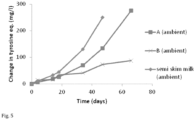
- Lactose content means that before hydrolysis. Lactose content of the packaged milk products was analysed, and residual lactose of the two milk products after hydrolysis was ⁇ 0.01%. Table 11 Product A Product B Fat (%) 1.5 1.5 Total Protein (%) 3.5 3.5 NPN (%) 0.2 0.2 Whey protein (%) 0.9 1.2 Casein (%) 2.5 2.2 Casein/total protein 0.70 0.60 Lactose (%) 2.8 2.8 Ash (%) 0.7 0.7
- proteolysis of the milk products A and B during shelf life is described in Figure 5 .
- Proteolysis of milk product B is very limited during the shelf life.
- Proteolysis of milk product A advanced faster but is still clearly lower than that of standard semi-skimmed milk.
- Milk products A and B were compared in their organoleptic properties during the storage time. Semi-skimmed milk became bitter within 35 days. Product A turned bitter after 60 days whereas product B had not bitter taste after storage of 60 days.
- Example 6 Milk product with low protein concentration and altered casein/total protein ratio of the invention
- Example 2 The membrane filtration fractions obtained in Example 1 were used for the preparation of milk product with altered proportion of casein to the total protein in accordance with the method of the invention.
- the recipe and calculated composition of the milk product are illustrated in Table 13 and 14, respectively.
- the composition is suitable for use as an infant formula.
- Table 13 Ingredient Recipe Skim milk (%) 7.3 Cream (%) 5.3 Whey protein concentrate (%) 10.3 Lactose concentrate (%) 7.4 Water (%) 69.7
- Table 14 Component Product A Fat (%) 2.0 Total protein (%) 1.3 NPN (%) 0.1 Whey protein (%) 0.8 Casein (%) 0.5 Casein/total protein 0.34 Lactose (%) 2.1 Ash (%) 0.2
- the components were combined and thoroughly mixed.
- the mixture obtained was heat-treated by direct steam infusion (UHT steam infusion plant from SPX, Denmark) at 157°C for 0.1 sec in accordance with the invention. After heating, the milk product was cooled and packed aseptically. The packages were stored at 6°C and at room temperature.
Landscapes
- Life Sciences & Earth Sciences (AREA)
- Engineering & Computer Science (AREA)
- Chemical & Material Sciences (AREA)
- Food Science & Technology (AREA)
- Polymers & Plastics (AREA)
- Health & Medical Sciences (AREA)
- Nutrition Science (AREA)
- Water Supply & Treatment (AREA)
- Zoology (AREA)
- Mycology (AREA)
- Biochemistry (AREA)
- Wood Science & Technology (AREA)
- Pediatric Medicine (AREA)
- Proteomics, Peptides & Aminoacids (AREA)
- Microbiology (AREA)
- Dairy Products (AREA)
Applications Claiming Priority (2)
| Application Number | Priority Date | Filing Date | Title |
|---|---|---|---|
| FI20155096A FI126179B (en) | 2015-02-12 | 2015-02-12 | Method for producing a milk-based product |
| PCT/FI2016/050089 WO2016128623A1 (en) | 2015-02-12 | 2016-02-11 | Method for producing a milk-based product |
Publications (3)
| Publication Number | Publication Date |
|---|---|
| EP3256012A1 EP3256012A1 (en) | 2017-12-20 |
| EP3256012C0 EP3256012C0 (en) | 2024-06-26 |
| EP3256012B1 true EP3256012B1 (en) | 2024-06-26 |
Family
ID=55485005
Family Applications (1)
| Application Number | Title | Priority Date | Filing Date |
|---|---|---|---|
| EP16708432.6A Active EP3256012B1 (en) | 2015-02-12 | 2016-02-11 | Method for producing a milk-based product |
Country Status (8)
| Country | Link |
|---|---|
| US (2) | US11076624B2 (pl) |
| EP (1) | EP3256012B1 (pl) |
| CN (1) | CN107404889B (pl) |
| ES (1) | ES2989134T3 (pl) |
| FI (1) | FI126179B (pl) |
| PL (1) | PL3256012T3 (pl) |
| RU (1) | RU2671085C1 (pl) |
| WO (1) | WO2016128623A1 (pl) |
Families Citing this family (12)
| Publication number | Priority date | Publication date | Assignee | Title |
|---|---|---|---|---|
| FI129567B (en) * | 2015-08-31 | 2022-04-29 | Valio Oy | Method for producing a milk-based product |
| WO2018028764A1 (en) * | 2016-08-08 | 2018-02-15 | Compagnie Gervais Danone | Process for producing infant formula products and acidic dairy products |
| WO2018028765A1 (en) * | 2016-08-08 | 2018-02-15 | Compagnie Gervais Danone | Process for producing infant formula products and dairy products |
| EP3300606A1 (de) * | 2016-09-28 | 2018-04-04 | DMK Deutsches Milchkontor GmbH | Aufschäumbare milchzubereitung |
| IT201600132159A1 (it) * | 2016-12-29 | 2018-06-29 | Granarolo S P A | Processo di preparazione di un latte lactose-free |
| DK201870562A1 (en) * | 2018-08-31 | 2018-09-07 | Spx Flow Technology Danmark A/S | Process for producing milk and milk-related products with extended shelf life |
| BE1026724B1 (nl) * | 2018-10-24 | 2020-05-28 | Inex Nv | Melkproduct met een verlaagd lactosegehalte en een werkwijze ter vervaardiging van het melkproduct |
| CN111248261A (zh) * | 2018-11-30 | 2020-06-09 | 内蒙古伊利实业集团股份有限公司 | 一种液态乳及其制备方法 |
| WO2020159356A1 (en) * | 2019-02-01 | 2020-08-06 | N.V. Nutricia | Native whey protein for improving intestinal maturation |
| US11503836B2 (en) | 2020-10-20 | 2022-11-22 | Michael J. McCloskey | Process for making lactose-free milk powders |
| CN116725195A (zh) * | 2023-06-27 | 2023-09-12 | 黑龙江飞鹤乳业有限公司 | 乳清蛋白制品及其制备方法 |
| EP4555867A1 (de) * | 2023-11-20 | 2025-05-21 | Wheyco GmbH | Lactosefreie molkenproteinkonzentrate |
Citations (9)
| Publication number | Priority date | Publication date | Assignee | Title |
|---|---|---|---|---|
| WO2009113858A1 (en) | 2008-03-12 | 2009-09-17 | N.V. Nutricia | High protein liquid enteral nutritional composition |
| WO2010085957A2 (en) | 2009-01-27 | 2010-08-05 | Arla Foods Amba | Long shelf life milk and milk-related products, and a process and milk processing plant for their manufacture |
| WO2012010699A1 (en) | 2010-07-23 | 2012-01-26 | Arla Foods Amba | Lactose-reduced milk-related product, and a process and milk processing plant for its manufacture |
| US20130064923A1 (en) | 2011-09-13 | 2013-03-14 | Agropur Cooperative | Liquid Milk Beverage For Toddlers |
| WO2013137714A1 (en) | 2012-03-12 | 2013-09-19 | N.V. Nutricia | Process for the humanization of animal skim milk and products obtained thereby |
| US20140302219A1 (en) | 2011-11-11 | 2014-10-09 | Valio Ltd. | Method for producing a milk product |
| WO2014177762A1 (en) | 2013-04-29 | 2014-11-06 | Valio Oy | Whippable milk product and a method for its production |
| WO2015079108A1 (en) | 2013-11-27 | 2015-06-04 | Valio Ltd | A method for processing milk |
| EP3344047B1 (en) | 2015-08-31 | 2024-11-20 | Valio Ltd | Method for producing a milk-based product with reduced plasmin-activity |
Family Cites Families (8)
| Publication number | Priority date | Publication date | Assignee | Title |
|---|---|---|---|---|
| EP2048962B1 (en) | 2006-06-23 | 2018-01-03 | Fairlife, LLC | Methods for heat treatment of milk |
| FI120953B (fi) | 2007-06-26 | 2010-05-31 | Valio Oy | Menetelmä hyvin säilyvän vähälaktoosisen tai laktoosittoman maitotuotteen valmistamiseksi |
| AU2010311316B2 (en) * | 2009-10-28 | 2015-03-12 | Valio Ltd | Whey protein product and a method for its preparation |
| US20110097442A1 (en) * | 2009-10-28 | 2011-04-28 | Valio Oy | Whey protein product and a method for its preparation |
| AU2011284802B2 (en) * | 2010-07-29 | 2015-04-23 | The University Of Sydney | Vegetable and fruit juice powder |
| US20130287892A1 (en) * | 2012-04-30 | 2013-10-31 | Ralph J. Knights | Milk protein concentrates |
| CN116869047A (zh) | 2013-01-23 | 2023-10-13 | 阿拉食品公司 | 生产β-酪蛋白组合物和相关产品的方法 |
| WO2014163485A1 (en) * | 2013-04-03 | 2014-10-09 | N.V. Nutricia | Process and system for preparing dry milk formulae |
-
2015
- 2015-02-12 FI FI20155096A patent/FI126179B/en active IP Right Grant
-
2016
- 2016-02-11 CN CN201680018566.4A patent/CN107404889B/zh active Active
- 2016-02-11 WO PCT/FI2016/050089 patent/WO2016128623A1/en not_active Ceased
- 2016-02-11 ES ES16708432T patent/ES2989134T3/es active Active
- 2016-02-11 EP EP16708432.6A patent/EP3256012B1/en active Active
- 2016-02-11 PL PL16708432.6T patent/PL3256012T3/pl unknown
- 2016-02-11 US US15/550,588 patent/US11076624B2/en active Active
- 2016-02-11 RU RU2017131589A patent/RU2671085C1/ru active
-
2021
- 2021-07-09 US US17/371,216 patent/US20210329958A1/en not_active Abandoned
Patent Citations (10)
| Publication number | Priority date | Publication date | Assignee | Title |
|---|---|---|---|---|
| WO2009113858A1 (en) | 2008-03-12 | 2009-09-17 | N.V. Nutricia | High protein liquid enteral nutritional composition |
| WO2009113845A1 (en) | 2008-03-12 | 2009-09-17 | N.V. Nutricia | High protein liquid enteral nutritional composition |
| WO2010085957A2 (en) | 2009-01-27 | 2010-08-05 | Arla Foods Amba | Long shelf life milk and milk-related products, and a process and milk processing plant for their manufacture |
| WO2012010699A1 (en) | 2010-07-23 | 2012-01-26 | Arla Foods Amba | Lactose-reduced milk-related product, and a process and milk processing plant for its manufacture |
| US20130064923A1 (en) | 2011-09-13 | 2013-03-14 | Agropur Cooperative | Liquid Milk Beverage For Toddlers |
| US20140302219A1 (en) | 2011-11-11 | 2014-10-09 | Valio Ltd. | Method for producing a milk product |
| WO2013137714A1 (en) | 2012-03-12 | 2013-09-19 | N.V. Nutricia | Process for the humanization of animal skim milk and products obtained thereby |
| WO2014177762A1 (en) | 2013-04-29 | 2014-11-06 | Valio Oy | Whippable milk product and a method for its production |
| WO2015079108A1 (en) | 2013-11-27 | 2015-06-04 | Valio Ltd | A method for processing milk |
| EP3344047B1 (en) | 2015-08-31 | 2024-11-20 | Valio Ltd | Method for producing a milk-based product with reduced plasmin-activity |
Non-Patent Citations (16)
| Title |
|---|
| ALI A M METWALLI ET AL: "Heat inactivation of bovine plasmin", INTERNATIONAL DAIRY JOU, ELSEVIER APPLIED SCIENCE, BARKING, GB, vol. 8, 26 February 1998 (1998-02-26), pages 47 - 56, XP008126755, ISSN: 0958-6946 * |
| ALI A.M METWALLI, HARMEN H.J DE JONGH, MARTINUS A.J.S VAN BOEKEL: "Heat inactivation of bovine plasmin", INTERNATIONAL DIARY JOURNAL, vol. 8, 26 February 1998 (1998-02-26), GB , pages 47 - 56, XP008126755, ISSN: 0958-6946 |
| ANONYMOUS: "Commission Directive 2006/141/EC ", OFFICIAL JOURNAL OF THE EUROPEAN UNION, 30 December 2006 (2006-12-30), pages L 401/1 - L 401/33 , XP093267961, Retrieved from the Internet <URL:https://eur-lex.europa.eu/legal-content/EN/TXT/PDF/?uri=CELEX:32006L0141> [retrieved on 20250408] |
| ANONYMOUS: "Milk protein concentrate", WIKIPEDIA, 9 January 2025 (2025-01-09), pages 1 - 3, XP093267770, Retrieved from the Internet <URL:https://en.wikipedia.org/w/index.php?title=Milk_protein_concentrate&oldid=1268452614> [retrieved on 20250407] |
| D014: "BiPRO Whey Protein Isolate", pages 1 - 2 |
| D19 - Microfiltration – an overview – ScienceDirect Topics |
| D20 - Whey protein concentrate – an overview – ScienceDirect Topics |
| D21 - Diafiltration – an overview – ScienceDirect Topics |
| HUIJS G; PETER DE JONG; VAN ASSELT A J; RUUD VERDURMEN: "High speed milk. A new way of treating milk has massive potential", DIARY INDUSTRIES INTERNATIONAL, vol. 69, no. 11, 1 November 2004 (2004-11-01), pages 30 - 32, XP009554358, ISSN: 0308-8197 |
| P. F. FOX, P. L. H. MCSWEENEY: "Advanced Dairy Chemistry – Volume 1 – Proteins Third edition - Part A", 1 January 2003, SPRINGER NEW YORK, NY, article A. L. KELLY, P. L. H. MCSWEENEY: "Indigenous Proteinases in Milk", pages: 496 - 516, XP093267764 |
| P.F. FOX, P.L.H. MCSWEENEY (EDS.): "Advanced Dairy Chemistry, Third Edition", vol. 1, part A 28 February 2003, KLUWER ACADEMIC/PLENUM PUBLISHERS, New York, ISBN: 0306472716, article "Plasmin system in milk", pages: 496 - 517 * |
| TAMIME T: "Milk Processing and Quality Management ", 1 January 2009, BLACKWELL PUBLISHING, ISBN: 978-1-4051-4530-5, article VILLAMIEL M , SCHUTYSER M A I . DE JOMG P: "Chapter 8 Novel Methods of Milk Processing", pages: 220 - 221, XP093267747 |
| THIERRY SAINT DENIS ET AL: "Heat inactivation of native plasmin, plasminogen and plasminogen activators in bovine milk: a revisited study", LE LAIT, 1 November 2001 (2001-11-01), pages 715 - 729, XP055321650, Retrieved from the Internet <URL:http://lait.dairy-journal.org/articles/lait/pdf/2001/06/saint-denis.pdf> DOI: 10.1051/lait:2001159 * |
| THIERRY SAINT DENIS, G RARD HUMBERT, JEAN-LUC GAILLARD: "Heat inactivation of native plasmin, plasminogen and plasminogen activators in bovine milk: a revisited study", LE LAIT, 1 November 2001 (2001-11-01), pages 715 - 729, XP055321650, DOI: 10.1051/lait:2001159 |
| VAN ASSELT ET AL: "Extreme high-temperature treatment of milk with respect to plasmin inactivation", INTERNATIONAL DAIRY JOURNAL, ELSEVIER APPLIED SCIENCE, BARKING, GB, vol. 18, no. 5, 8 December 2007 (2007-12-08), pages 531 - 538, XP022526380, ISSN: 0958-6946 * |
| VAN ASSELT, A.J. SWEERE, A.P.J. ROLLEMA, H.S. DE JONG, P.: "Extreme high-temperature treatment of milk with respect to plasmin inactivation", INTERNATIONAL DIARY JOURNAL, vol. 18, no. 5, 8 December 2007 (2007-12-08), GB , pages 531 - 538, XP022526380, ISSN: 0958-6946 |
Also Published As
| Publication number | Publication date |
|---|---|
| US11076624B2 (en) | 2021-08-03 |
| WO2016128623A1 (en) | 2016-08-18 |
| ES2989134T3 (es) | 2024-11-25 |
| FI126179B (en) | 2016-07-29 |
| RU2671085C1 (ru) | 2018-10-29 |
| US20180027864A1 (en) | 2018-02-01 |
| EP3256012C0 (en) | 2024-06-26 |
| PL3256012T3 (pl) | 2024-11-04 |
| CN107404889A (zh) | 2017-11-28 |
| EP3256012A1 (en) | 2017-12-20 |
| CN107404889B (zh) | 2021-06-04 |
| FI20155096A7 (fi) | 2016-07-29 |
| US20210329958A1 (en) | 2021-10-28 |
Similar Documents
| Publication | Publication Date | Title |
|---|---|---|
| EP3256012B1 (en) | Method for producing a milk-based product | |
| US10993454B2 (en) | Milk-based product and a method for its preparation | |
| EP2493325B1 (en) | Whey protein product and a method for its preparation | |
| US20120232023A1 (en) | Whey protein product and a method for its preparation | |
| KR20140067955A (ko) | 우유제품 및 그의 제조방법 | |
| EP3344047B1 (en) | Method for producing a milk-based product with reduced plasmin-activity | |
| US20170105424A1 (en) | A method for processing milk | |
| EP3236759B1 (en) | Whey protein concentrate, acidified milk products comprising the concentrate and methods therefor | |
| MX2013015232A (es) | Formulacion que contiene leche como base. | |
| US20240000090A1 (en) | Method for producing a milk product and a milk product | |
| CA2895703A1 (en) | A process for preparing a milk product | |
| US20220330568A1 (en) | Ideal whey protein concentrate, and a spoonable acidified milk product | |
| EP3843550B1 (en) | Process for producing milk and milk-related products with extended shelf life |
Legal Events
| Date | Code | Title | Description |
|---|---|---|---|
| STAA | Information on the status of an ep patent application or granted ep patent |
Free format text: STATUS: THE INTERNATIONAL PUBLICATION HAS BEEN MADE |
|
| TPAC | Observations filed by third parties |
Free format text: ORIGINAL CODE: EPIDOSNTIPA |
|
| PUAI | Public reference made under article 153(3) epc to a published international application that has entered the european phase |
Free format text: ORIGINAL CODE: 0009012 |
|
| STAA | Information on the status of an ep patent application or granted ep patent |
Free format text: STATUS: REQUEST FOR EXAMINATION WAS MADE |
|
| 17P | Request for examination filed |
Effective date: 20170905 |
|
| AK | Designated contracting states |
Kind code of ref document: A1 Designated state(s): AL AT BE BG CH CY CZ DE DK EE ES FI FR GB GR HR HU IE IS IT LI LT LU LV MC MK MT NL NO PL PT RO RS SE SI SK SM TR |
|
| AX | Request for extension of the european patent |
Extension state: BA ME |
|
| DAV | Request for validation of the european patent (deleted) | ||
| DAX | Request for extension of the european patent (deleted) | ||
| STAA | Information on the status of an ep patent application or granted ep patent |
Free format text: STATUS: EXAMINATION IS IN PROGRESS |
|
| 17Q | First examination report despatched |
Effective date: 20180607 |
|
| GRAP | Despatch of communication of intention to grant a patent |
Free format text: ORIGINAL CODE: EPIDOSNIGR1 |
|
| STAA | Information on the status of an ep patent application or granted ep patent |
Free format text: STATUS: GRANT OF PATENT IS INTENDED |
|
| INTG | Intention to grant announced |
Effective date: 20240125 |
|
| GRAS | Grant fee paid |
Free format text: ORIGINAL CODE: EPIDOSNIGR3 |
|
| GRAA | (expected) grant |
Free format text: ORIGINAL CODE: 0009210 |
|
| STAA | Information on the status of an ep patent application or granted ep patent |
Free format text: STATUS: THE PATENT HAS BEEN GRANTED |
|
| AK | Designated contracting states |
Kind code of ref document: B1 Designated state(s): AL AT BE BG CH CY CZ DE DK EE ES FI FR GB GR HR HU IE IS IT LI LT LU LV MC MK MT NL NO PL PT RO RS SE SI SK SM TR |
|
| REG | Reference to a national code |
Ref country code: GB Ref legal event code: FG4D |
|
| REG | Reference to a national code |
Ref country code: CH Ref legal event code: EP |
|
| REG | Reference to a national code |
Ref country code: DE Ref legal event code: R096 Ref document number: 602016088103 Country of ref document: DE |
|
| U01 | Request for unitary effect filed |
Effective date: 20240719 |
|
| U07 | Unitary effect registered |
Designated state(s): AT BE BG DE DK EE FI FR IT LT LU LV MT NL PT SE SI Effective date: 20240730 |
|
| PG25 | Lapsed in a contracting state [announced via postgrant information from national office to epo] |
Ref country code: HR Free format text: LAPSE BECAUSE OF FAILURE TO SUBMIT A TRANSLATION OF THE DESCRIPTION OR TO PAY THE FEE WITHIN THE PRESCRIBED TIME-LIMIT Effective date: 20240626 |
|
| PG25 | Lapsed in a contracting state [announced via postgrant information from national office to epo] |
Ref country code: GR Free format text: LAPSE BECAUSE OF FAILURE TO SUBMIT A TRANSLATION OF THE DESCRIPTION OR TO PAY THE FEE WITHIN THE PRESCRIBED TIME-LIMIT Effective date: 20240927 |
|
| PG25 | Lapsed in a contracting state [announced via postgrant information from national office to epo] |
Ref country code: NO Free format text: LAPSE BECAUSE OF FAILURE TO SUBMIT A TRANSLATION OF THE DESCRIPTION OR TO PAY THE FEE WITHIN THE PRESCRIBED TIME-LIMIT Effective date: 20240926 Ref country code: HR Free format text: LAPSE BECAUSE OF FAILURE TO SUBMIT A TRANSLATION OF THE DESCRIPTION OR TO PAY THE FEE WITHIN THE PRESCRIBED TIME-LIMIT Effective date: 20240626 Ref country code: GR Free format text: LAPSE BECAUSE OF FAILURE TO SUBMIT A TRANSLATION OF THE DESCRIPTION OR TO PAY THE FEE WITHIN THE PRESCRIBED TIME-LIMIT Effective date: 20240927 Ref country code: RS Free format text: LAPSE BECAUSE OF FAILURE TO SUBMIT A TRANSLATION OF THE DESCRIPTION OR TO PAY THE FEE WITHIN THE PRESCRIBED TIME-LIMIT Effective date: 20240926 |
|
| REG | Reference to a national code |
Ref country code: ES Ref legal event code: FG2A Ref document number: 2989134 Country of ref document: ES Kind code of ref document: T3 Effective date: 20241125 |
|
| PG25 | Lapsed in a contracting state [announced via postgrant information from national office to epo] |
Ref country code: IS Free format text: LAPSE BECAUSE OF FAILURE TO SUBMIT A TRANSLATION OF THE DESCRIPTION OR TO PAY THE FEE WITHIN THE PRESCRIBED TIME-LIMIT Effective date: 20241026 |
|
| PG25 | Lapsed in a contracting state [announced via postgrant information from national office to epo] |
Ref country code: CZ Free format text: LAPSE BECAUSE OF FAILURE TO SUBMIT A TRANSLATION OF THE DESCRIPTION OR TO PAY THE FEE WITHIN THE PRESCRIBED TIME-LIMIT Effective date: 20240626 |
|
| PG25 | Lapsed in a contracting state [announced via postgrant information from national office to epo] |
Ref country code: RO Free format text: LAPSE BECAUSE OF FAILURE TO SUBMIT A TRANSLATION OF THE DESCRIPTION OR TO PAY THE FEE WITHIN THE PRESCRIBED TIME-LIMIT Effective date: 20240626 Ref country code: SK Free format text: LAPSE BECAUSE OF FAILURE TO SUBMIT A TRANSLATION OF THE DESCRIPTION OR TO PAY THE FEE WITHIN THE PRESCRIBED TIME-LIMIT Effective date: 20240626 |
|
| PG25 | Lapsed in a contracting state [announced via postgrant information from national office to epo] |
Ref country code: SM Free format text: LAPSE BECAUSE OF FAILURE TO SUBMIT A TRANSLATION OF THE DESCRIPTION OR TO PAY THE FEE WITHIN THE PRESCRIBED TIME-LIMIT Effective date: 20240626 |
|
| PG25 | Lapsed in a contracting state [announced via postgrant information from national office to epo] |
Ref country code: SM Free format text: LAPSE BECAUSE OF FAILURE TO SUBMIT A TRANSLATION OF THE DESCRIPTION OR TO PAY THE FEE WITHIN THE PRESCRIBED TIME-LIMIT Effective date: 20240626 Ref country code: SK Free format text: LAPSE BECAUSE OF FAILURE TO SUBMIT A TRANSLATION OF THE DESCRIPTION OR TO PAY THE FEE WITHIN THE PRESCRIBED TIME-LIMIT Effective date: 20240626 Ref country code: RO Free format text: LAPSE BECAUSE OF FAILURE TO SUBMIT A TRANSLATION OF THE DESCRIPTION OR TO PAY THE FEE WITHIN THE PRESCRIBED TIME-LIMIT Effective date: 20240626 Ref country code: IS Free format text: LAPSE BECAUSE OF FAILURE TO SUBMIT A TRANSLATION OF THE DESCRIPTION OR TO PAY THE FEE WITHIN THE PRESCRIBED TIME-LIMIT Effective date: 20241026 Ref country code: CZ Free format text: LAPSE BECAUSE OF FAILURE TO SUBMIT A TRANSLATION OF THE DESCRIPTION OR TO PAY THE FEE WITHIN THE PRESCRIBED TIME-LIMIT Effective date: 20240626 |
|
| REG | Reference to a national code |
Ref country code: DE Ref legal event code: R026 Ref document number: 602016088103 Country of ref document: DE |
|
| PLBI | Opposition filed |
Free format text: ORIGINAL CODE: 0009260 |
|
| U20 | Renewal fee for the european patent with unitary effect paid |
Year of fee payment: 10 Effective date: 20250221 |
|
| PLAX | Notice of opposition and request to file observation + time limit sent |
Free format text: ORIGINAL CODE: EPIDOSNOBS2 |
|
| PGFP | Annual fee paid to national office [announced via postgrant information from national office to epo] |
Ref country code: PL Payment date: 20250131 Year of fee payment: 10 |
|
| 26 | Opposition filed |
Opponent name: SOCIETE DES PRODUITS NESTLE S.A. Effective date: 20250325 Opponent name: N.V. NUTRICIA Effective date: 20250320 |
|
| PGFP | Annual fee paid to national office [announced via postgrant information from national office to epo] |
Ref country code: ES Payment date: 20250331 Year of fee payment: 10 |
|
| PLBB | Reply of patent proprietor to notice(s) of opposition received |
Free format text: ORIGINAL CODE: EPIDOSNOBS3 |
|
| PG25 | Lapsed in a contracting state [announced via postgrant information from national office to epo] |
Ref country code: MC Free format text: LAPSE BECAUSE OF FAILURE TO SUBMIT A TRANSLATION OF THE DESCRIPTION OR TO PAY THE FEE WITHIN THE PRESCRIBED TIME-LIMIT Effective date: 20240626 |
|
| REG | Reference to a national code |
Ref country code: CH Ref legal event code: PL |
|
| PG25 | Lapsed in a contracting state [announced via postgrant information from national office to epo] |
Ref country code: CH Free format text: LAPSE BECAUSE OF NON-PAYMENT OF DUE FEES Effective date: 20250228 |
|
| GBPC | Gb: european patent ceased through non-payment of renewal fee |
Effective date: 20250211 |
|
| PG25 | Lapsed in a contracting state [announced via postgrant information from national office to epo] |
Ref country code: GB Free format text: LAPSE BECAUSE OF NON-PAYMENT OF DUE FEES Effective date: 20250211 |
|
| PG25 | Lapsed in a contracting state [announced via postgrant information from national office to epo] |
Ref country code: IE Free format text: LAPSE BECAUSE OF NON-PAYMENT OF DUE FEES Effective date: 20250211 |
|
| U20 | Renewal fee for the european patent with unitary effect paid |
Year of fee payment: 11 Effective date: 20260225 |
|
| PLCK | Communication despatched that opposition was rejected |
Free format text: ORIGINAL CODE: EPIDOSNREJ1 |