EP3248969B1 - Process for the preparation of n-[3-(aminomethyl)oxetan-3-yl]carbamate intermediates - Google Patents
Process for the preparation of n-[3-(aminomethyl)oxetan-3-yl]carbamate intermediates Download PDFInfo
- Publication number
- EP3248969B1 EP3248969B1 EP17176794.0A EP17176794A EP3248969B1 EP 3248969 B1 EP3248969 B1 EP 3248969B1 EP 17176794 A EP17176794 A EP 17176794A EP 3248969 B1 EP3248969 B1 EP 3248969B1
- Authority
- EP
- European Patent Office
- Prior art keywords
- acid
- process according
- formula
- compound
- reaction
- Prior art date
- Legal status (The legal status is an assumption and is not a legal conclusion. Google has not performed a legal analysis and makes no representation as to the accuracy of the status listed.)
- Active
Links
- 0 *OC(NC1(CBr)COC1)=O Chemical compound *OC(NC1(CBr)COC1)=O 0.000 description 6
- NHMUKHJLHFQYIB-UHFFFAOYSA-N COc1ccc(COC(NC2(CBr)COC2)=O)cc1 Chemical compound COc1ccc(COC(NC2(CBr)COC2)=O)cc1 NHMUKHJLHFQYIB-UHFFFAOYSA-N 0.000 description 1
- XQBSSOJEZBJBKW-UHFFFAOYSA-N COc1ccc(COC(NC2(CN)COC2)=O)cc1 Chemical compound COc1ccc(COC(NC2(CN)COC2)=O)cc1 XQBSSOJEZBJBKW-UHFFFAOYSA-N 0.000 description 1
Classifications
-
- C—CHEMISTRY; METALLURGY
- C07—ORGANIC CHEMISTRY
- C07D—HETEROCYCLIC COMPOUNDS
- C07D417/00—Heterocyclic compounds containing two or more hetero rings, at least one ring having nitrogen and sulfur atoms as the only ring hetero atoms, not provided for by group C07D415/00
- C07D417/14—Heterocyclic compounds containing two or more hetero rings, at least one ring having nitrogen and sulfur atoms as the only ring hetero atoms, not provided for by group C07D415/00 containing three or more hetero rings
-
- A—HUMAN NECESSITIES
- A61—MEDICAL OR VETERINARY SCIENCE; HYGIENE
- A61K—PREPARATIONS FOR MEDICAL, DENTAL OR TOILETRY PURPOSES
- A61K31/00—Medicinal preparations containing organic active ingredients
- A61K31/33—Heterocyclic compounds
- A61K31/335—Heterocyclic compounds having oxygen as the only ring hetero atom, e.g. fungichromin
- A61K31/337—Heterocyclic compounds having oxygen as the only ring hetero atom, e.g. fungichromin having four-membered rings, e.g. taxol
-
- A—HUMAN NECESSITIES
- A61—MEDICAL OR VETERINARY SCIENCE; HYGIENE
- A61K—PREPARATIONS FOR MEDICAL, DENTAL OR TOILETRY PURPOSES
- A61K31/00—Medicinal preparations containing organic active ingredients
- A61K31/33—Heterocyclic compounds
- A61K31/395—Heterocyclic compounds having nitrogen as a ring hetero atom, e.g. guanethidine or rifamycins
- A61K31/435—Heterocyclic compounds having nitrogen as a ring hetero atom, e.g. guanethidine or rifamycins having six-membered rings with one nitrogen as the only ring hetero atom
- A61K31/47—Quinolines; Isoquinolines
- A61K31/472—Non-condensed isoquinolines, e.g. papaverine
- A61K31/4725—Non-condensed isoquinolines, e.g. papaverine containing further heterocyclic rings
-
- A—HUMAN NECESSITIES
- A61—MEDICAL OR VETERINARY SCIENCE; HYGIENE
- A61K—PREPARATIONS FOR MEDICAL, DENTAL OR TOILETRY PURPOSES
- A61K31/00—Medicinal preparations containing organic active ingredients
- A61K31/33—Heterocyclic compounds
- A61K31/395—Heterocyclic compounds having nitrogen as a ring hetero atom, e.g. guanethidine or rifamycins
- A61K31/55—Heterocyclic compounds having nitrogen as a ring hetero atom, e.g. guanethidine or rifamycins having seven-membered rings, e.g. azelastine, pentylenetetrazole
- A61K31/554—Heterocyclic compounds having nitrogen as a ring hetero atom, e.g. guanethidine or rifamycins having seven-membered rings, e.g. azelastine, pentylenetetrazole having at least one nitrogen and one sulfur as ring hetero atoms, e.g. clothiapine, diltiazem
-
- A—HUMAN NECESSITIES
- A61—MEDICAL OR VETERINARY SCIENCE; HYGIENE
- A61P—SPECIFIC THERAPEUTIC ACTIVITY OF CHEMICAL COMPOUNDS OR MEDICINAL PREPARATIONS
- A61P31/00—Antiinfectives, i.e. antibiotics, antiseptics, chemotherapeutics
- A61P31/12—Antivirals
- A61P31/14—Antivirals for RNA viruses
-
- C—CHEMISTRY; METALLURGY
- C07—ORGANIC CHEMISTRY
- C07D—HETEROCYCLIC COMPOUNDS
- C07D305/00—Heterocyclic compounds containing four-membered rings having one oxygen atom as the only ring hetero atoms
- C07D305/02—Heterocyclic compounds containing four-membered rings having one oxygen atom as the only ring hetero atoms not condensed with other rings
- C07D305/04—Heterocyclic compounds containing four-membered rings having one oxygen atom as the only ring hetero atoms not condensed with other rings having no double bonds between ring members or between ring members and non-ring members
- C07D305/06—Heterocyclic compounds containing four-membered rings having one oxygen atom as the only ring hetero atoms not condensed with other rings having no double bonds between ring members or between ring members and non-ring members with only hydrogen atoms, hydrocarbon or substituted hydrocarbon radicals, directly attached to the ring atoms
-
- C—CHEMISTRY; METALLURGY
- C07—ORGANIC CHEMISTRY
- C07D—HETEROCYCLIC COMPOUNDS
- C07D305/00—Heterocyclic compounds containing four-membered rings having one oxygen atom as the only ring hetero atoms
- C07D305/02—Heterocyclic compounds containing four-membered rings having one oxygen atom as the only ring hetero atoms not condensed with other rings
- C07D305/04—Heterocyclic compounds containing four-membered rings having one oxygen atom as the only ring hetero atoms not condensed with other rings having no double bonds between ring members or between ring members and non-ring members
- C07D305/08—Heterocyclic compounds containing four-membered rings having one oxygen atom as the only ring hetero atoms not condensed with other rings having no double bonds between ring members or between ring members and non-ring members with hetero atoms or with carbon atoms having three bonds to hetero atoms with at the most one bond to halogen, e.g. ester or nitrile radicals, directly attached to ring atoms
Definitions
- the present invention relates to a novel process for the preparation of a compound of the formula (V): wherein R is C 1-6 alkyl, C 1-6 alkoxyphenyl-C x H 2x - or phenyl-C x H 2x -.
- Compound of the formula (V) is an important intermediate in the synthesis and manufacture of pharmaceutically active compound of formula (I) which is useful for prophylaxis and treatment of respiratory syncytial virus (RSV) infection in mammal or human being, as described in patent WO2013020993 A1 .
- C 1-6 alkyl signifies a saturated, linear- or branched chain alkyl group containing 1 to 6, particularly 1 to 5 carbon atoms, for example as methyl, ethyl, n-propyl, isopropyl, n-butyl, s-butyl, isobutyl, tert-butyl, n-pentyl, 3-methylbutyl, 1,1-dimethylpropyl, n-hexyl, 2-ethylbutyl and the like.
- Particular "C 1-6 alkyl” groups are tert-butyl and 1,1-dimethylpropyl.
- C x H 2x signifies a saturated, linear- or branched chain alkyl group containing 1 to 6, particularly 1 to 4 carbon atoms.
- C 1-6 alkoxy signifies a group C 1-6 alkyl-O-, wherein the "C 1-6 alkyl” is as defined above, for example methoxy, ethoxy, propoxy, iso-propoxy, n-butoxy, iso-butoxy, 2-butoxy, tert-butoxy and the like.
- Particular "C 1-6 alkoxy” groups are methoxy and ethoxy and more particularly methoxy.
- C 1-6 alkoxyphenyl signifies a phenyl substituted by C 1-6 alkoxy group as defined above at ortho, meta or para position.
- Particular "C 1-6 alkoxyphenyl” group is 4-methoxyphenyl.
- amino refers to primary (-NH 2 ), secondary (-NH-) or tertiary amino ( ).
- hydroxy refers to the group -OH.
- HA refers to organic or inorganic acids such as hydrochloric acid, hydrobromic acid, sulfuric acid, phosphoric acid, acetic acid, L-tartaric acid, citric acid, L-lactic acid, maleic acid, fumaric acid, succinic acid, methanesulfonic acid, benzenesulfonic acid, benzoic acid, p-toluenesulfonic acid, oxalic acid, p-nitrobenzoic acid, salicylic acid and 4-chlorobenzoic acid and the like.
- acid addition salt refers to conventional acid addition salts that are formed from suitable non-toxic organic or inorganic acids.
- Acid addition salts include for example those derived from organic or inorganic acids such as hydrochloric acid, hydrobromic acid, sulfuric acid, phosphoric acid, acetic acid, L-tartaric acid, citric acid, L-lactic acid, maleic acid, fumaric acid, succinic acid, methanesulfonic acid, benzenesulfonic acid, benzoic acid, p-toluenesulfonic acid, oxalic acid, p-nitrobenzoic acid, salicylic acid and 4-chlorobenzoic acid and the like.
- Scheme 1 also discloses the subsequent synthetic steps to convert compounds of formula (V) into compounds of formula (I). wherein R is C 1-6 alkyl, C 1-6 alkoxyphenyl-C x H 2x - or phenyl-C x H 2x -.
- Preliminary step a) (not part of the invention) comprises preparation of carboxylic acid of formula (III) by oxidizing [3-(bromomethyl)oxetan-3-yl]methanol of formula (II)
- This reaction is performed with an oxidant at a reaction temperature range between 0°C and 100°C, particularly between 15°C to 25°C.
- the order of addition of reactants can be compelled by convenience.
- the reaction can be conducted in various solvents, in particular, the reaction solvent is water, acetonitrile, dichloromethane, ethyl acetate or isopropyl acetate; or a co-solvent which is a mixture of two or more kinds of solvents selected from water, acetonitrile, dichloromethane, ethyl acetate and isopropyl acetate. More particular solvent is a co-solvent of water and acetonitrile.
- the oxidant used in this reaction is sodium hypochlorite, potassium permanganate, 2,2,6,6-tetramethylpiperidinooxy or pyridinium chlorochromate; or a co-oxidant which is a mixture of two or more kinds of oxidants selected from sodium hypochlorite, potassium permanganate, 2,2,6,6-tetramethylpiperidinooxy and pyridinium chlorochromate.
- Particular oxidant is a co-oxidant of 2,2,6,6-tetramethylpiperidinooxy and sodium hypochlorite.
- the oxidation reaction is as a rule finished after 1 to 24 hours, particularly 4 to 6 hours.
- step b) comprises the conversion of carboxylic acid of formula (III) to carbamate of formula (IV) through Curtius rearrangement.
- the reaction is performed with an azide reagent and a base in an organic solvent and followed by adding an alcohol at temperature range of 0 °C and 100 °C, particularly 80°C.
- a compound of formula (III) is mixed with an azide reagent, particularly diphenylphosphoryl azide, and a base in an organic solvent to form an active intermediate 3-(bromomethyl)-3-isocyanato-oxetane, which can be furthur converted to carbamates of formula (IV) by adding various alcohols.
- an azide reagent particularly diphenylphosphoryl azide
- a base in an organic solvent to form an active intermediate 3-(bromomethyl)-3-isocyanato-oxetane, which can be furthur converted to carbamates of formula (IV) by adding various alcohols.
- the base used in this reaction is triethylamine, diisopropylethylamine or 4-methyl morpholine, more particularly 4-methyl morpholine.
- the reaction can be conducted in many organic solvents.
- the solvent used in step b) is acetonitrile, toluene, chlorobenzene, dichloromethane. More particular solvent is toluene.
- the reaction temperature lies in the range of 0 °C and 100 °C, particularly 80°C.
- the alcohol used in step b) is tert-butanol, 2-methyl-2-butanol, benzyl alcohol or 4-methoxyphenylmethanol, particularly 4-methoxyphenylmethanol.
- step c) comprises amination of compound of formula (IV) to form an amino compound of formula (V).
- reaction is performed with an amination agent, at reaction temperature range of 0 °C and 60 °C, particularly in the rage of 25°C and 30°C.
- compound of formula (IV) and an amination reagent, particularly liquid ammonia are charged to an autoclave to give the compound of formula (V).
- Reaction temperature as a rule lies in the range of 0°C and 60°C, particularly in the rage of 25°C and 30°C.
- the reaction is generally finished after 1 to 24 hours, particularly 8 hours.
- step d comprising salt formation of a compound of formula (V) with an acid to form a compound of formula (VI).
- the acid used in this reaction includes various organic and inorganic acids, such as hydrochloric acid, hydrobromic acid, sulfuric acid, phosphoric acid, acetic acid, L-tartaric acid, citric acid, L-lactic acid, maleic acid, fumaric acid, succinic acid, methanesulfonic acid, benzenesulfonic acid, benzoic acid, p-toluenesulfonic acid, oxalic acid, p-nitrobenzoic acid, salicylic acid and 4-chlorobenzoic acid and the like, more particularly 4-chlorobenzoic acid.
- various organic and inorganic acids such as hydrochloric acid, hydrobromic acid, sulfuric acid, phosphoric acid, acetic acid, L-tartaric acid, citric acid, L-lactic acid, maleic acid, fumaric acid, succinic acid, methanesulfonic acid, benzenesulfonic acid, benzoic acid, p-toluenesul
- step e comprising the substitution reaction of a compound of formula (VI) with a compound of formula (IX) to give a compound of formula (VII).
- the reaction can be performed in an organic solvent.
- the reaction is performed in tetrahydrofuran, 2-methyltetrahydrofuran or acetonitrile, more particularly in tetrahydrofuran.
- the particular reaction temperature range is between 10°C and 30°C.
- step f comprising the substitution reaction of a compound of formula (VII) with a compound of formula (X) to give a compound of formula (VIII).
- This reaction is performed in an organic solvent with an acid catalyst in temperature range between 0°C and 100°C, particularly between 60°C and 80°C.
- the reaction is performed in an organic solvent.
- the reaction is performed in tetrahydrofuran, 2-methyltetrahydrofuran, acetonitrile, toluene, methanol, ethanol or isopropanol, more particularly in ethanol.
- Acid catalyst used in the reaction is hydrochloric acid, hydrobromic acid, sulfuric acid, phosphoric acid, methanesulfonic acid or ammonium chloride, particularly is ammonium chloride.
- step g comprising the deprotection of a compound of formula (VIII) to give a compound of formula (I).
- the reaction is performed in an organic solvent with acid in temperature range between 0°C and 100°C, particularly between 10°C and 40°C.
- the organic solvent used in the reaction is dichloromethane, ethylacetate, isopropyl acetate, tetrahydrofuran or dioxane, particularly dichloromethane.
- the acid used in the reaction is hydrochloric acid, hydrobromic acid, sulfuric acid, phosphoric acid, methanesulfonic acid or trifluoroacetic acid, particularly is or trifluoroacetic acid.
- R is C 1-6 alkyl, C 1-6 alkoxyphenyl-C x H 2x - or phenyl-C x H 2x -.
- Embodiment 1 provides a process for the preparation of a compound of the formula (V): wherein R is C 1-6 alkyl, C 1-6 alkoxyphenyl-C x H 2x - or phenyl-C x H 2x -, comprising the following steps:
- Embodiment 2 provides a process according to embodiment 1, wherein R is tert-butyl, 1,1-dimethylpropyl, benzyl or 4-methoxyphenylmethyl.
- step a) is performed with an oxidant at a reaction temperature range between 0°C and 100°C, particularly between 15°C to 25°C.
- step a) is performed in a solvent selected from water, acetonitrile, dichloromethane, ethyl acetate and isopropyl acetate; or a co-solvent which is a mixture of two or more kinds of solvents selected from water, acetonitrile, dichloromethane, ethyl acetate and isopropyl acetate. More particular solvent is a co-solvent of water and acetonitrile.
- oxidant is selected from sodium hypochlorite, potassium permanganate, 2,2,6,6-tetramethylpiperidinooxy and pyridinium chlorochromate; or a co-oxidant which is a mixture of two or more kinds of oxidants selected from sodium hypochlorite, potassium permanganate, 2,2,6,6-tetramethylpiperidinooxy and pyridinium chlorochromate, particularly the oxidant is a co-oxidant of 2,2,6,6-tetramethylpiperidinooxy and sodium hypochlorite.
- Embodiment 2 provides a process according to embodiment 1, wherein step a) is performed with an azide reagent and a base in an organic solvent and followed by adding an alcohol at temperature range of 0 °C and 100 °C, particularly 80°C.
- Embodiment 3 provides a process according to embodiment 2, wherein the azide reagent used in step a) is diphenylphosphoryl azide.
- Embodiment 4 provides a process according to embodiment 2, wherein the base used in step a) is triethylamine, diisopropylethylamine or 4-methyl morpholine, more particularly 4-methylmorpholine.
- Embodiment 5 provides a process according to embodiment 2, wherein the solvent used in step a) is acetonitrile, toluene, chlorobenzene or dichloromethane, more particularly is toluene.
- Embodiment 6 provides a process according to embodiment 2, wherein the alcohol used in step a) is tert-butanol, 2-methyl-2-butanol, benzyl alcohol or 4-methoxyphenylmethanol, more particularly is 4-methoxyphenylmethanol.
- Embodiment 7 provides a process according to any one of embodiments 1 to 6, wherein step b) is performed with an amination agent, at reaction temperature range of 0 °C and 60 °C, particularly in the rage of 25°C and 30°C.
- Embodiment 8 provides a process according to embodiment 7, wherein the amination agent used in step b) is liquid ammonia.
- step d) is performed in a solvent with an organic or inorganic acid at a temperature range of 0°C and 60°C, particularly in the rage of 15°C and 25°C.
- step d) is tetrahydrofuran, 2-methyltetrahydrofuran, acetonitrile, ethylacetate or methyl tert-butyl ether, more particularly in methyl tert-butyl ether.
- step d) is hydrochloric acid, hydrobromic acid, sulfuric acid, phosphoric acid, acetic acid, L-tartaric acid, citric acid, L-lactic acid, maleic acid, fumaric acid, succinic acid, methanesulfonic acid, benzenesulfonic acid, benzoic acid, p-toluenesulfonic acid, oxalic acid, p-nitrobenzoic acid, salicylic acid or 4-chlorobenzoic acid, more particularly 4-chlorobenzoic acid.
- step e) is performed in an organic solvent, particularly in tetrahydrofuran at reaction temperature range between 10°C and 30°C.
- step f) is performed in an organic solvent with acid catalyst in temperature range between 0°C and 100°C, particularly between 60°C and 80°C.
- step g) is performed in an organic solvent with acid in temperature range between 0°C and 100°C, particularly between 10°C and 40°C.
- R is C 1-6 alkyl, C 1-6 alkoxyphenyl-C x H 2x - or phenyl-C x H 2x -.
- the reaction mixture was washed with 30 mL water, 30 mL 10% Na 2 CO 3 aqueous solution and 30 mL brine.
- the organic phase was concentrated to remove most of solvents under reduced pressure and 15 mL heptane was added.
- the suspension was stirred at room temperature for 2 hours and was separated by filtration.
- the wet cake was dried under vacuum oven to afford 4.95 g benzyl N-[3-(bromomethyl)oxetan-3-yl]carbamate.
- the titled compound is prepared in analogy to Example 6 by using benzyl N-[3-(bromomethyl)oxetan-3-yl]carbamate, which is prepared in Example 4, instead of (4-methoxyphenyl)methyl N-[3-(bromomethyl)oxetan-3-yl]carbamate,
- the titled compound is prepared in analogy to Example 6 by using 1,1-dimethylpropyl N-[3-(bromomethyl)oxetan-3-yl]carbamate, which is prepared in Example 5, instead of (4-methoxyphenyl)methyl N-[3-(bromomethyl)oxetan-3-yl]carbamate.
- the titled compound is prepared in analogy to Example 6 by using tert-butyl N-[3-(bromomethyl)oxetan-3-yl]carbamate, which is prepared in Example 3, instead of (4-methoxyphenyl)methyl N-[3-(bromomethyl)oxetan-3-yl]carbamate.
- reaction mixture was concentrated in vacuum below 40°C to 24.3-32.4L over 3.5hours while maintaining the bath temperature at 15°C-25°C.
- residue was then added 80.2 kg water over 100 mins.
- the mixture was stirred at 15°C-25°C for 3.5 hours.
- the suspension was separated using centrifuge and washed with 48 kg water in four portions over 50 mins to afford 23.6 kg wet (4-methoxyphenyl)methyl N-[3-[[(2-chloro-6-methyl-quinazolin-4-yl)amino]methyl]oxetan-3-yl]carbamate.
- step 1 Preparation of 2-phenylsulfanylethanamine:
- step 2 Preparation of N-(2-phenylsulfanylethyl)acetamide:
- step 3 Preparation of 1-(3,5-dihydro-2H-1,4-benzothiazepin-4-yl)ethanone:
- N-(2-phenylsulfanylethyl)acetamide (22.2 kg, 114 mol) and 124.7 kg toluene.
- paraformaldehyde 2.1 kg, 70 mol
- methylsulfonic acid (10.9 kg, 113 mol)
- Ac 2 O (14.0 kg, 137 mol).
- the reaction mixture was heated to 75 °C-80 °C and to the reactor was then charged paraformaldehyde (4.9 kg, 163 mol) portionwise while control reaction temperature lower than 80 °C.
- the reaction mixture was heated to 100 °C-105 °C and held for 1 hour. The reaction was monitored by HPLC.
- reaction mixture was cooled to 30 °C and to the reactor was added 71.1 kg water. Phase separation and the orgnanic solution was washed with 63.1 kg saturated NaHCO 3 aqueous solution followed by 63.1 kg brine solution. The organic phase was then concentrated under vacuum to remove all the organic solvent and the residue was used directly for next step without further purification.
- step 4 Preparation of 1-(1,1-dioxido-2,3-dihydro-1,4-benzothiazepin-4(5H)-yl)ethanone:
- step 5 Preparation of 2,3,4,5-tetrahydro-1,4-benzothiazepine-1,1-dioxide:
Landscapes
- Chemical & Material Sciences (AREA)
- Organic Chemistry (AREA)
- Health & Medical Sciences (AREA)
- Life Sciences & Earth Sciences (AREA)
- Pharmacology & Pharmacy (AREA)
- Veterinary Medicine (AREA)
- Public Health (AREA)
- General Health & Medical Sciences (AREA)
- Medicinal Chemistry (AREA)
- Animal Behavior & Ethology (AREA)
- Epidemiology (AREA)
- Virology (AREA)
- Oncology (AREA)
- Nuclear Medicine, Radiotherapy & Molecular Imaging (AREA)
- General Chemical & Material Sciences (AREA)
- Chemical Kinetics & Catalysis (AREA)
- Communicable Diseases (AREA)
- Molecular Biology (AREA)
- Pharmaceuticals Containing Other Organic And Inorganic Compounds (AREA)
- Plural Heterocyclic Compounds (AREA)
- Epoxy Compounds (AREA)
- Organic Low-Molecular-Weight Compounds And Preparation Thereof (AREA)
Description
- The present invention relates to a novel process for the preparation of a compound of the formula (V):

WO2013020993 A1 .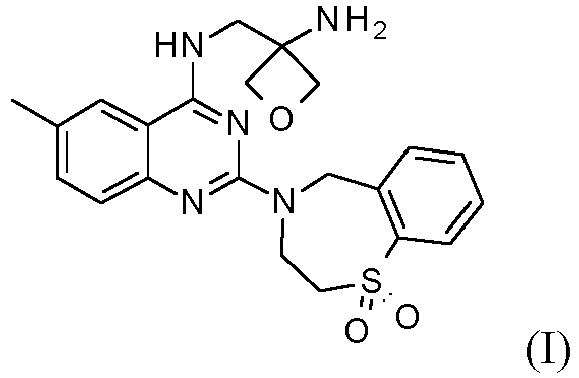
- The patent
WO2013020993 A1 disclosed synthetic approaches to obtain compound of formula (I). - However, according to the synthetic approach in patent
WO2013020993 A1 , the intermediate tert-butyl [(3-aminooxetan-3-yl)methyl] carbamate for synthesizing compound of formula (I) suffers from instability as the primary amine. - In this invention, a simple and effective synthetic approach is developed to synthesize compounds of formula (V). This synthetic approach can be applied on technical scale and allows to obtain the product in a good yield, desired purity and stable form.
- As used herein, the term "C1-6alkyl" signifies a saturated, linear- or branched chain alkyl group containing 1 to 6, particularly 1 to 5 carbon atoms, for example as methyl, ethyl, n-propyl, isopropyl, n-butyl, s-butyl, isobutyl, tert-butyl, n-pentyl, 3-methylbutyl, 1,1-dimethylpropyl, n-hexyl, 2-ethylbutyl and the like. Particular "C1-6alkyl" groups are tert-butyl and 1,1-dimethylpropyl.
- The term "CxH2x" signifies a saturated, linear- or branched chain alkyl group containing 1 to 6, particularly 1 to 4 carbon atoms.
- The term "C1-6alkoxy" signifies a group C1-6alkyl-O-, wherein the "C1-6alkyl" is as defined above, for example methoxy, ethoxy, propoxy, iso-propoxy, n-butoxy, iso-butoxy, 2-butoxy, tert-butoxy and the like. Particular "C1-6alkoxy" groups are methoxy and ethoxy and more particularly methoxy.
- The term "C1-6alkoxyphenyl" signifies a phenyl substituted by C1-6alkoxy group as defined above at ortho, meta or para position. Particular "C1-6alkoxyphenyl" group is 4-methoxyphenyl.
- The term "amino" refers to primary (-NH2), secondary (-NH-) or tertiary amino (

- The term "hydroxy" refers to the group -OH.
- The term "HA" refers to organic or inorganic acids such as hydrochloric acid, hydrobromic acid, sulfuric acid, phosphoric acid, acetic acid, L-tartaric acid, citric acid, L-lactic acid, maleic acid, fumaric acid, succinic acid, methanesulfonic acid, benzenesulfonic acid, benzoic acid, p-toluenesulfonic acid, oxalic acid, p-nitrobenzoic acid, salicylic acid and 4-chlorobenzoic acid and the like.
- The term "acid addition salt" refers to conventional acid addition salts that are formed from suitable non-toxic organic or inorganic acids. Acid addition salts include for example those derived from organic or inorganic acids such as hydrochloric acid, hydrobromic acid, sulfuric acid, phosphoric acid, acetic acid, L-tartaric acid, citric acid, L-lactic acid, maleic acid, fumaric acid, succinic acid, methanesulfonic acid, benzenesulfonic acid, benzoic acid, p-toluenesulfonic acid, oxalic acid, p-nitrobenzoic acid, salicylic acid and 4-chlorobenzoic acid and the like.
Table 1 Abbreviations Ac2O: acetic anhydride AcOH: acetic acid CD3Cl-d3: deuterated chloroform DCM: Dichloromethane DMF: Dimethylformamide DMSO-d6: deuterated dimethylsulfoxide DPPA: diphenylphosphoryl azide EtOAC: ethyl acetate EtOH: Ethanol HPLC: high performance liquid chromatography hr or hrs: hour or hours Hz: Hertz kg: Kilogram L: Liter METHANOL-d4: deuterated methanol MHz: Megahertz mins: Minutes mmol: Millimole MS (ESI): mass spectroscopy (electron spray ionization) MTBE: methyl tert-butyl ether NaOH: sodium hydroxide NMM: 4-methylmorpholine NMR: nuclear magnetic resonance obsd.: Observed sat. Saturated TEA: Triethylamine TEMPO: 2,2,6,6-tetramethylpiperidinooxy TFA: trifluoroacetic acid THF: Tetrahydrofuran - The problems in
WO2013020993 A1 are solved according to present invention by a process for preparing the compounds of formula (V) shown in scheme 1. Scheme 1 also discloses the subsequent synthetic steps to convert compounds of formula (V) into compounds of formula (I).

- Also disclosed herein is a process for the preparation of a compound of the formula (I):

comprising the following steps: - step a) oxidation of [3-(bromomethyl)oxetan-3-yl]methanol of formula (II) to form a compound of formula (III),

- step b) conversion of carboxy group of a compound of formula (III) to carbamate to form a compound of formula (IV)

- step c) amination of a compound of formula (IV) to form a compound of formula (V)

- step d) salt formation of a compound of formula (V) with an acid to form a compound of formula (VI)
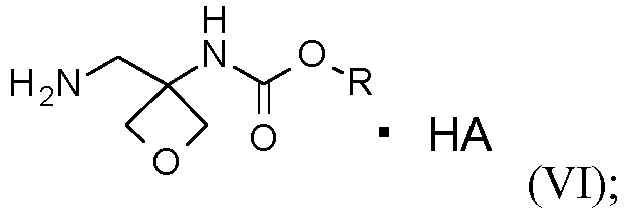
- step e) substitution reaction of a compound of formula (VI) with a compound of formula (IX) to give a compound of formula (VII)

- step f) substitution reaction of a compound of formula (VII) with a compound of formula (X) to give a compound of formula (VIII)

- step g) comprises deprotection of a compound of formula (VIII) to give a compound of formula (I)
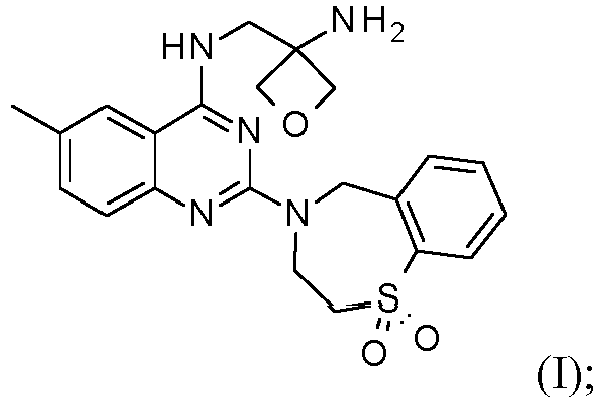
- A detailed description of present invention of process steps is as following:
Preliminary step a) (not part of the invention) comprises preparation of carboxylic acid of formula (III) by oxidizing [3-(bromomethyl)oxetan-3-yl]methanol of formula (II) - This reaction is performed with an oxidant at a reaction temperature range between 0°C and 100°C, particularly between 15°C to 25°C. The order of addition of reactants can be compelled by convenience.
- The reaction can be conducted in various solvents, in particular, the reaction solvent is water, acetonitrile, dichloromethane, ethyl acetate or isopropyl acetate; or a co-solvent which is a mixture of two or more kinds of solvents selected from water, acetonitrile, dichloromethane, ethyl acetate and isopropyl acetate. More particular solvent is a co-solvent of water and acetonitrile.
- The oxidant used in this reaction is sodium hypochlorite, potassium permanganate, 2,2,6,6-tetramethylpiperidinooxy or pyridinium chlorochromate; or a co-oxidant which is a mixture of two or more kinds of oxidants selected from sodium hypochlorite, potassium permanganate, 2,2,6,6-tetramethylpiperidinooxy and pyridinium chlorochromate. Particular oxidant is a co-oxidant of 2,2,6,6-tetramethylpiperidinooxy and sodium hypochlorite. The oxidation reaction is as a rule finished after 1 to 24 hours, particularly 4 to 6 hours.
- step b) comprises the conversion of carboxylic acid of formula (III) to carbamate of formula (IV) through Curtius rearrangement.
- The reaction is performed with an azide reagent and a base in an organic solvent and followed by adding an alcohol at temperature range of 0 °C and 100 °C, particularly 80°C.
- In this step, a compound of formula (III) is mixed with an azide reagent, particularly diphenylphosphoryl azide, and a base in an organic solvent to form an active intermediate 3-(bromomethyl)-3-isocyanato-oxetane, which can be furthur converted to carbamates of formula (IV) by adding various alcohols.
- The base used in this reaction is triethylamine, diisopropylethylamine or 4-methyl morpholine, more particularly 4-methyl morpholine.
- The reaction can be conducted in many organic solvents. In particular, the solvent used in step b) is acetonitrile, toluene, chlorobenzene, dichloromethane. More particular solvent is toluene.
- The reaction temperature lies in the range of 0 °C and 100 °C, particularly 80°C.
- Typically, the alcohol used in step b) is tert-butanol, 2-methyl-2-butanol, benzyl alcohol or 4-methoxyphenylmethanol, particularly 4-methoxyphenylmethanol.
- step c) comprises amination of compound of formula (IV) to form an amino compound of formula (V).
- The reaction is performed with an amination agent, at reaction temperature range of 0 °C and 60 °C, particularly in the rage of 25°C and 30°C.
- In order to form a primary amine, compound of formula (IV) and an amination reagent, particularly liquid ammonia, are charged to an autoclave to give the compound of formula (V).
- Reaction temperature as a rule lies in the range of 0°C and 60°C, particularly in the rage of 25°C and 30°C.
- The reaction is generally finished after 1 to 24 hours, particularly 8 hours.
- Also disclosed is step d), comprising salt formation of a compound of formula (V) with an acid to form a compound of formula (VI).
- The acid used in this reaction includes various organic and inorganic acids, such as hydrochloric acid, hydrobromic acid, sulfuric acid, phosphoric acid, acetic acid, L-tartaric acid, citric acid, L-lactic acid, maleic acid, fumaric acid, succinic acid, methanesulfonic acid, benzenesulfonic acid, benzoic acid, p-toluenesulfonic acid, oxalic acid, p-nitrobenzoic acid, salicylic acid and 4-chlorobenzoic acid and the like, more particularly 4-chlorobenzoic acid.
- Also disclosed is step e), comprising the substitution reaction of a compound of formula (VI) with a compound of formula (IX) to give a compound of formula (VII).
- The reaction can be performed in an organic solvent. In particular, the reaction is performed in tetrahydrofuran, 2-methyltetrahydrofuran or acetonitrile, more particularly in tetrahydrofuran.
- The particular reaction temperature range is between 10°C and 30°C.
- Also disclosed is step f), comprising the substitution reaction of a compound of formula (VII) with a compound of formula (X) to give a compound of formula (VIII). This reaction is performed in an organic solvent with an acid catalyst in temperature range between 0°C and 100°C, particularly between 60°C and 80°C.
- The reaction is performed in an organic solvent. In particular, the reaction is performed in tetrahydrofuran, 2-methyltetrahydrofuran, acetonitrile, toluene, methanol, ethanol or isopropanol, more particularly in ethanol.
- Acid catalyst used in the reaction is hydrochloric acid, hydrobromic acid, sulfuric acid, phosphoric acid, methanesulfonic acid or ammonium chloride, particularly is ammonium chloride.
- Also disclosed is step g), comprising the deprotection of a compound of formula (VIII) to give a compound of formula (I). The reaction is performed in an organic solvent with acid in temperature range between 0°C and 100°C, particularly between 10°C and 40°C.
- The organic solvent used in the reaction is dichloromethane, ethylacetate, isopropyl acetate, tetrahydrofuran or dioxane, particularly dichloromethane.
- The acid used in the reaction is hydrochloric acid, hydrobromic acid, sulfuric acid, phosphoric acid, methanesulfonic acid or trifluoroacetic acid, particularly is or trifluoroacetic acid.
- The invention is illustrated further by the following examples that are not be construed as limiting the invention in scope to the specific procedures described herein.
- Also disclosed is a compound of formula (V):
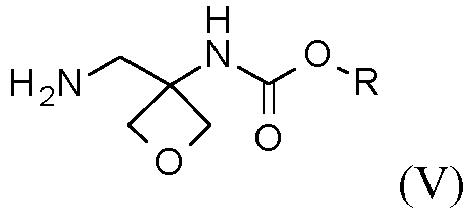
- Also disclosed is a compound of formula (III):

- The invention further relates to the following enumerated embodiments:
Embodiment 1 provides a process for the preparation of a compound of the formula (V):
comprising the following steps: - Step a) Conversion of carboxy group of a compound of formula (III)


- Step b) Amination of a compound of formula (IV) to form a compound of formula (V)
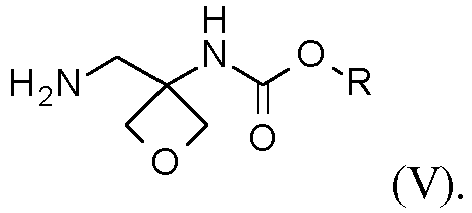
- Embodiment 2 provides a process according to embodiment 1, wherein R is tert-butyl, 1,1-dimethylpropyl, benzyl or 4-methoxyphenylmethyl.
- Also disclosed is a process according to Scheme 1, wherein step a) is performed with an oxidant at a reaction temperature range between 0°C and 100°C, particularly between 15°C to 25°C.
- Also disclosed is a process according to Scheme 1, wherein step a) is performed in a solvent selected from water, acetonitrile, dichloromethane, ethyl acetate and isopropyl acetate; or a co-solvent which is a mixture of two or more kinds of solvents selected from water, acetonitrile, dichloromethane, ethyl acetate and isopropyl acetate. More particular solvent is a co-solvent of water and acetonitrile.
- Also disclosed is a process according to Scheme 1, wherein the oxidant is selected from sodium hypochlorite, potassium permanganate, 2,2,6,6-tetramethylpiperidinooxy and pyridinium chlorochromate; or a co-oxidant which is a mixture of two or more kinds of oxidants selected from sodium hypochlorite, potassium permanganate, 2,2,6,6-tetramethylpiperidinooxy and pyridinium chlorochromate, particularly the oxidant is a co-oxidant of 2,2,6,6-tetramethylpiperidinooxy and sodium hypochlorite.
- Embodiment 2 provides a process according to embodiment 1, wherein step a) is performed with an azide reagent and a base in an organic solvent and followed by adding an alcohol at temperature range of 0 °C and 100 °C, particularly 80°C.
- Embodiment 3 provides a process according to embodiment 2, wherein the azide reagent used in step a) is diphenylphosphoryl azide.
- Embodiment 4 provides a process according to embodiment 2, wherein the base used in step a) is triethylamine, diisopropylethylamine or 4-methyl morpholine, more particularly 4-methylmorpholine.
- Embodiment 5 provides a process according to embodiment 2, wherein the solvent used in step a) is acetonitrile, toluene, chlorobenzene or dichloromethane, more particularly is toluene.
- Embodiment 6 provides a process according to embodiment 2, wherein the alcohol used in step a) is tert-butanol, 2-methyl-2-butanol, benzyl alcohol or 4-methoxyphenylmethanol, more particularly is 4-methoxyphenylmethanol.
- Embodiment 7 provides a process according to any one of embodiments 1 to 6, wherein step b) is performed with an amination agent, at reaction temperature range of 0 °C and 60 °C, particularly in the rage of 25°C and 30°C.
- Embodiment 8 provides a process according to embodiment 7, wherein the amination agent used in step b) is liquid ammonia.
- Also disclosed is a process according to Scheme 1, wherein step d) is performed in a solvent with an organic or inorganic acid at a temperature range of 0°C and 60°C, particularly in the rage of 15°C and 25°C.
- Also disclosed is a process according to Scheme 1, wherein the solvent used in step d) is tetrahydrofuran, 2-methyltetrahydrofuran, acetonitrile, ethylacetate or methyl tert-butyl ether, more particularly in methyl tert-butyl ether.
- Also disclosed is a process according to Scheme 1, wherein the acid used in step d) is hydrochloric acid, hydrobromic acid, sulfuric acid, phosphoric acid, acetic acid, L-tartaric acid, citric acid, L-lactic acid, maleic acid, fumaric acid, succinic acid, methanesulfonic acid, benzenesulfonic acid, benzoic acid, p-toluenesulfonic acid, oxalic acid, p-nitrobenzoic acid, salicylic acid or 4-chlorobenzoic acid, more particularly 4-chlorobenzoic acid.
- Also disclosed is a process according to Scheme 1, wherein step e) is performed in an organic solvent, particularly in tetrahydrofuran at reaction temperature range between 10°C and 30°C. Also disclosed is a process according to Scheme 1, wherein step f) is performed in an organic solvent with acid catalyst in temperature range between 0°C and 100°C, particularly between 60°C and 80°C.
- Also disclosed is a process according to Scheme 1, wherein step g) is performed in an organic solvent with acid in temperature range between 0°C and 100°C, particularly between 10°C and 40°C.
- Also disclosed is a compound of formula (V):

- Also disclosed is a compound of formula (III):

-

- To a 100 ml flask was charged [3-(bromomethyl)oxetan-3-yl]methanol (17.3 g, 9.6 mmol) followed with 25 ml water and 5.3 mL of acetonitrile and TEMPO (153 mg, 0.96 mmol). The mixture was cooled to 10 °C. 15.3 g sodium hypochloride (14 %) was added over 10 min with the inner temperature maintained between 15°C and 20°C. The reaction was stirred at room temperature till [3-(bromomethyl)oxetan-3-yl]methanol was consumed as monitored by HPLC. The resulted mixture was adjusted to pH 8-9 and extracted with 20 mL EtOAc twice. The aqueous layer was adjusted to pH 1-2 with 5N aqueous H2SO4 solution and extracted with dichloromethane. After removal of dichloromethane, 3-(bromomethyl)oxetane-3-carboxylic acid was obtained. MS obsd. (ESI+) [(M+H)+] 194. 1H NMR (400 MHz, METHANOL-d4) d ppm, 9.40 - 9.90 (s, 1 H), 5.00 - 5.02 (d, J=6.8 Hz, 2 H), 4.56 - 4.57 (d, J=6.8 Hz, 2 H), 3.97 (s, 2 H)
-

- To a Reactor 1 was charged 3-(bromomethyl)oxetane-3-carboxylic acid (1.2kg, 6.15mol) followed by 6.4kg toluene. The reaction mixture was cooled to 5 °C. Then NMM (0.72kg, 7.12mol) was added to this reaction mixture slowly. After the addition, the solution was stirred 10 mins at room temperature.
- To Reactor 2 was charged diphenylphosphoryl azide (1.76kg, 6.39mol) followed by 3.2 kg toluene. The mixture was heated to 80 °C. Solution in Reactor 1 was added to Reactor 2 dropwise. After the addition, the reaction mixture was stirred for 30 mins at 80°C. To the reaction mixture was then added 4-methoxyphenylmethanol (0.82kg, 5.94mol) in 1.58kg toluene solution slowly. After the addition, the reaction mixture was allowed to hold for 75 mins at 80°C. The reaction was monitored using HPLC. After reaction completion, the mixture was cooled to room temperature, and was washed with 6.0kg water, 6.24kg 4% sodium carbonate aqueous solution and 3.0 kg water sequentially. The organic phase was concentrated till dryness under reduced pressure and the residue was recrystallized in n-heptane/ethanol. The suspension was separated via centrifuge and the wet cake was washed with 1kg n-heptane. The wet cake was dried under vacuum oven for 24 hours to afford title compound 1.46kg, yield 72%. MS obsd. (ESI+) [(M+H)+] 330. 1H NMR (400 MHz, CD3Cl-d3) d ppm 7.30-7.33 (d, J=8.4 Hz, 2H), 6.91-6.93 (d, J=8.4 Hz, 2H), 5.33 (s, 1H), 5.06 (s, 2H), 4.70-4.72 (d, J=6.4 Hz, 2H), 4.51-4.53 (d, J=6.4 Hz, 2H), 4.00 (s, 2H), 3.84 (s, 3H).
-

- To a 50 ml flask was charged 3-(bromomethyl)oxetane-3-carboxylic acid (2.0 g,10.3 mmol) followed by 20 mL of anhydrous t-butanol. The reaction mixture was cooled to 5 °C. Then TEA (1.1 g, 11.3 mmol) was added. After the addition, DPPA (3.1 g, 10.8 mmol) was added in portions. The mixture was refluxed overnight. The organic phase was then concentrated till dryness under reduced pressure and the residue was dissolved in 30 ml EtOAc. The organic phase was washed with 10 mL Na2CO3 solution and 10 mL brine. After removal of solvents, tert-butyl N-[3-(bromomethyl)oxetan-3-yl]carbamate was obtained.
-

- To a 100 ml flask was charged 3-(bromomethyl)oxetane-3-carboxylic acid (5.0 g, 25.6 mmol) followed by 50 mL of anhydrous toluene. Then TEA (2.87 g, 28.2 mmol) was added. After the addition of TEA, DPPA (7.64 g, 26.9 mmol) was added in portions. The mixture was heated at 65 °C -70 °C for 1 hour. To the reaction mixture was then added benzyl alcohol (4.2 g, 38.4 mmol) and heated at 80 °C for 2 hrs. The resulted mixture was cooled to room temperature and diluted with 50 ml EtOAc. The reaction mixture was washed with 30 mL water, 30 mL 10% Na2CO3 aqueous solution and 30 mL brine. The organic phase was concentrated to remove most of solvents under reduced pressure and 15 mL heptane was added. The suspension was stirred at room temperature for 2 hours and was separated by filtration. The wet cake was dried under vacuum oven to afford 4.95 g benzyl N-[3-(bromomethyl)oxetan-3-yl]carbamate.
-

- To a 250 ml flask was charged 3-(bromomethyl)oxetane-3-carboxylic acid (20.4 g, 100 mmol) followed by 120 mL of anhydrous toluene. NMM (12.1 g, 120 mmol) was added over 10 min. After the addition, DPPA (30.3 g, 110 mmol) in 80 ml toluene was added over 30 min. The mixture was heated at 80 °C-85 °C for 40 min. To the reaction mixture was then added t-amyl alcohol (44 g, 150 mmol) and heated at 80 °C for 3 hrs. The resulted mixture was cooled to room temperature and was washed with 100 mL water, 30 mL 10% Na2CO3 aqueous solution and 30 mL brine. The organic phase was concentrated in vacuum and the crude product was purified by flash chromatography. The product was slurried in heptane. After filtration and drying, 12.3 g 1,1-dimethylpropyl N-[3-(bromomethyl)oxetan-3-yl]carbamate was obtained.
-

- To a 10 L autoclave was charged (4-methoxyphenyl)methyl N-[3-(bromomethyl)oxetan-3-yl]carbamate (1.1kg, 3.33mol) and 5.5 L liquid ammonia. The reaction mixture was stirred at 25°C -30 °C for 8 hours. Then the ammonia was released carefully. To the residue was added 5.5 L 2-methyltetrahydrofuran. The mixture was transferred into a separation funnel. To the mixture was then added 1.1 L 3N NaOH solution. The aqueous phase was extracted with 4.4 L 2-methyltetrahydrofuran. The combined organic phase was washed with 1.1 L saturated NaCl aqueous solution twice. After phase separation, organic phase was concentrated under vacuum to about 1L. The crude residual was used directly without further purification.
-

- The titled compound is prepared in analogy to Example 6 by using benzyl N-[3-(bromomethyl)oxetan-3-yl]carbamate, which is prepared in Example 4, instead of (4-methoxyphenyl)methyl N-[3-(bromomethyl)oxetan-3-yl]carbamate,
-

- The titled compound is prepared in analogy to Example 6 by using 1,1-dimethylpropyl N-[3-(bromomethyl)oxetan-3-yl]carbamate, which is prepared in Example 5, instead of (4-methoxyphenyl)methyl N-[3-(bromomethyl)oxetan-3-yl]carbamate.
-

- The titled compound is prepared in analogy to Example 6 by using tert-butyl N-[3-(bromomethyl)oxetan-3-yl]carbamate, which is prepared in Example 3, instead of (4-methoxyphenyl)methyl N-[3-(bromomethyl)oxetan-3-yl]carbamate.
-

- To the residue from Example 6 was then added 4-chlorobenzoic acid (420g, 2.68mol) and 2 L MTBE. The mixture was stirred at 15 °C-25 °C for 14 hours. Vacuum filtration to collect the solid and the wet cake was washed with 1L MTBE. The wet cake was dried under vacuum oven for 24 hours to afford 0.81 kg desired salt with yield 57.5%. MS obsd. (ESI+) [(M+H)+] 423. 1H NMR (400 MHz, DMSO-d6) d ppm 8.32 (s, 1H), 7.88-7.91 (d, J=8.4 Hz, 2H), 7.42-7.45 (d, J=8.4 Hz, 2H), 7.29-7.31 (d, J=8.4 Hz, 2H), 6.90-6.92 (d, J=8.4 Hz, 2H), 4.94 (s, 2 H), 4.54-4.56 (d, J=6.4 Hz, 2H), 4.44-4.45 (d, J=6.4 Hz, 2H), 3.75 (s, 3H), 3.19(s, 2H).
-

- To a 250 L glass-lined reactor was charged (4-methoxyphenyl)methyl N-[3-(bromomethyl)oxetan-3-yl]carbamate 4-chlorobenzoic acid salt (8.1kg, 19.2mol) and 61.6 kg tetrahydrofuran. To the solution was then added TEA (5.9kg, 58.3mol). The mixture was then cooled to 10 °C -15°C. To the mixture was then added 2,4-dichloro-6-methyl-quinazoline (3.99kg, 18.7mol) while control reaction temperature at 10°C-30°C. The reaction mixture was then stirred at 22°C-27°C for 20 hours. HPLC was used to monitor the reaction. After reaction completion, the reaction mixture was concentrated in vacuum below 40°C to 24.3-32.4L over 3.5hours while maintaining the bath temperature at 15°C-25°C. To the residue was then added 80.2 kg water over 100 mins. The mixture was stirred at 15°C-25°C for 3.5 hours. The suspension was separated using centrifuge and washed with 48 kg water in four portions over 50 mins to afford 23.6 kg wet (4-methoxyphenyl)methyl N-[3-[[(2-chloro-6-methyl-quinazolin-4-yl)amino]methyl]oxetan-3-yl]carbamate.
- To a 250 L glass-lined reactor was charged 23.6 kg wet (4-methoxyphenyl)methyl N-[3-[[(2-chloro-6-methyl-quinazolin-4-yl)amino]methyl]oxetan-3-yl]carbamate, 24.0kg MTBE and 7.0kg ethylacetate. The mixture was stirred at 15°C-25°C for 2.5 hours. The suspension was separated via centrifuge and washed with 6.0kg MTBE. The wet cake was dried under vacuum oven at 38°C-42°C with a nitrogen bleed for 3 hours and then 40°C-52°C for 17 hours to afford 7.9 kg title compound with yield 92%. MS obsd. (ESI+) [(M+H)+] 443. 1H-NMR(400Hz, DMSO-d6) d ppm 8.67-8.69(t, J=5.6 Hz, 1H), 8.09(s,1H), 7.85(s,1H), 7.64-7.67(m,1H), 7.53-7.55 (m,1H), 7.26-7.29(d, J=8.4 Hz, 2H), 6.88-6.90(d, J=8.4 Hz, 2H), 4.96(s, 2H), 4.62-4.64(d, J=6.4 Hz, 2H), 4.51-4.53(d, J=6.4 Hz, 2H), 4.07-4.09(d, J=6.4 Hz, 2H), 3.74(s, 3H), 2.47(s,3H).
-

-

- To a reactor was charged 56.1 kg of water followed by NaOH (7.0 kg, 175 mol). Start the mechanical stirrer until all NaOH dissolved to form a solution. Cool the solution to 25 °C and to the solution was added sodium thiophenoxide (50.7 kg, aqueous solution) and 2-chloroethylamine hydrochloride (17.7 kg,153 mol). The mixture was stirred at 25 °C for 15 hours. HPLC was used to monitor the reaction. After reaction completion, the reaction mixture was extrated with 61.1 kg EtOAc twice. The combined organic phase was concentrated to about 92 L and used in next step without further purification.
-

- The residue of last step was heated to 45 °C and to the solution was slowly added AcOH (14.0 kg, 233 mol) while control the reaction temperature below 60 °C. The reaction was monitored by HPLC. After reaction completion, the solution was cooled to 45 °C and concentrated under vacuum to remove 55 L EtOAc. The mixture was then cooled to below 25 °C and to the solution was slowly added 62.0 kg n-heptane. After addition, the suspension was cooled to 0 °C and held for 1 hour. The solid was collected by centrifuge.
- The wet cake was dried under vacuum oven for 22 hours to afford 22.2 kg of N-(2-phenylsulfanylethyl)acetamide with 74% yield. MS obsd. (ESI+) [(M+H)+] 196. 1H-NMR(400Hz, DMSO-d6) d ppm 8.07 (s, 1H), 7.18-7.40 (m, 5H), 3.21-3.26 (m, 2H), 2.99-3.03 (m, 2H), 1.80 (s, 3H).
-

- To a reactor was charged N-(2-phenylsulfanylethyl)acetamide (22.2 kg, 114 mol) and 124.7 kg toluene. To the solution was then added paraformaldehyde (2.1 kg, 70 mol), methylsulfonic acid (10.9 kg, 113 mol) and Ac2O (14.0 kg, 137 mol). The reaction mixture was heated to 75 °C-80 °C and to the reactor was then charged paraformaldehyde (4.9 kg, 163 mol) portionwise while control reaction temperature lower than 80 °C. After the addition, the reaction mixture was heated to 100 °C-105 °C and held for 1 hour. The reaction was monitored by HPLC. After reaction completion, the reaction mixture was cooled to 30 °C and to the reactor was added 71.1 kg water. Phase separation and the orgnanic solution was washed with 63.1 kg saturated NaHCO3 aqueous solution followed by 63.1 kg brine solution. The organic phase was then concentrated under vacuum to remove all the organic solvent and the residue was used directly for next step without further purification.
-

- To the left residue of last step was added 112.8 kg formic acid and 12.8 kg water. The mixture was cooled to 0°C. To the reaction mixture was slowly added 80.4 kg H2O2 (35%) while control reaction temperature lower than 10 °C. After addition, the reaction mixture was stirred for 1 hour at 10 °C. Then the reaction mixture was raised to 25 °C and stirred for 3 hours. The reaction was monitored using HPLC. After reaction completion, to the reaction mixture was added 177.3 kg water and 235.1 kg DCM. Phase separation and the aqueous layer was extracted with 165.9 kg DCM again. The combined organic phase was washed with 112.7 kg sat. Na2SO3 aqueous solution, 112.1 kg sat. Na2CO3 aqueous solution and 103.0 kg sat. NaCl aqueous solution. The organic phase was then concentrated under vacuum to remove all the organic solvent. The residue was then dispersed in 54.3 kg EtOH and and stirred for 1 hour at 55 °C-65 °C. The suspension was separated by centrifuge and the wet cake was dried under vacuum oven for 12 hours to afford 17.4 kg 1-(1,1-dioxido-2,3-dihydro-1,4-benzothiazepin-4(5H)-yl)ethanone with yield 64%. MS obsd. (ESI+) [(M+H)+] 240. 1H-NMR(400Hz, DMSO-d6) d ppm 7.92-8.00 (m, 1H), 7.55-7.74 (m, 3H), 4.60-4.88 (m, 2H), 4.05 (brs, 2H), 3.48-3.70 (m, 2H), 3.53 (d, J=8.0 Hz, 3H).
-

- To a reactor was charged 1-(1,1-dioxido-2,3-dihydro-1,4-benzothiazepin-4(5H)-yl)ethanone (16.6 kg, 69.4 mol), 55.2 kg EtOH and 55. 8 kg NaOH aqueous solution (11.1 kg NaOH in 44.7 kg H2O). The reaction mixture was heated to 74-79 °C and held for 24 hours at this temperature. The reaction was monitored using HPLC. After reaction completion, the mixture was cooled to 50 °C-55 °C and the organic solvent was removed under reduced pressure. To the reactor was then added 104.1 kg water and the mixture was cooled to 0°C-7 °C and held for 1hour. The suspension was separated using centrifuge and the wet cake was washed with 44.7 kg water twice. The wet cake was dried under vacuum oven for 24 hours to afford 9.9 kg 2,3,4,5-tetrahydro-1,4-benzothiazepine 1,1-dioxide with 72.3% yield. MS obsd. (ESI+) [(M+H)+] 198. 1H-NMR(400Hz, DMSO-d6) d ppm 7.89 (dd, J=1.2, 7.6 Hz, 1H), 7.56 (t, J=7.6 Hz, 1H), 7.47 (t, J=7.6 Hz, 1H), 7.42 (d, J=7.6 Hz, 1H), 4.04 (s, 2H), 3.30-3.32 (m, 2H), 3.25-3.30 (m, 2H), 2.64 (s, 1H).
-

- To a 250 L glass-lined reactor was charged 63 kg EtOH followed by (4-methoxyphenyl)methyl N-[3-[[(2-chloro-6-methyl-quinazolin-4-yl)amino]methyl]oxetan-3-yl]carbamate (7.8kg,17.6mol), 2,3,4,5-tetrahydro-1,4-benzothiazepine-1,1-dioxide (3.89kg,19.7mol) and ammonium chloride (49g, 0.92mol). The reaction mixture was stirred at 68°C-72°C for 20 hours. HPLC was used to monitor the reaction. After reaction completion, the reaction mixture was slowly cooled to 20°C-25°C. The solids were collected by vacuum filtration and washed with 15.6 kg EtOH in two portions. The wet cake was dried in a vacuum oven with a nitrogen bleed at 38°C-42°C for about 4 hours and then heated to 50 °C-55°C for 30 hours to afford 11.0 kg title compound with yield 88%. MS obsd. (ESI+) [(M+H)+] 604. 1H-NMR(400Hz, DMSO) d ppm 9.57(s, 1H), 8.14(s,1H),7.93-7.95(d,1H,J=8), 7.68(m,3H), 7.57-7.58 (m,1H),7.22-7.23(d, 2H, J=4), 7.68-7.69(d,2H, J=4), 4.98-5.17(m, 2H), 4.26-4.68(m, 5H), 3.74-4.1(m, 3H), 3.4-3.46(t, 1H,J=8),2.51(s, 3H), 2.39(s,3H).
-

- To a 250 L glass-lined reactor was charged N-[3-[[[2-(1,1-dioxo-3,5-dihydro-1,4-benzothiazepin-4-yl)-6-methyl-quinazolin-4-yl]amino]methyl]oxetan-3-yl]carbamate (10.8kg, 24.6mol) and 120kg dichloromethane. To the mixture was then added 16.0 kg IN NaOH solution in portions. After phase separation, the aqueous phase was extracted with 14.0 kg dichloromethane. The combined organic phase was washed with 25 kg 20% NaCl aqueous solution, then was transferred to a 100L glass-lined reactor and concentrated to 30-35L below 35°C in vacuum to prepare Solution 1.
- To another 250L glass-lined reactor were charged with 26.0 kg dichloromethane and 16.0 kg trifluoroacetic acid. The mixture was cooled to 15 °C-20 °C and to the solution was added the titled Solution 1 in portions. The mixture was stirred for 30 mins at 15°C-25°C and then cooled to 0°C-10°C. To the mixture was added 39.8 kg DMF and then the solution was concentrated to 62-65L between 15 °C-30°C in vacuum for over 16.5 hours to afford Solution 2.
- To a 300 L glass-lined reactor was charged 128.3 kg 1.5N NaOH solution and cooled to 5 °C-7°C. To the reactor was then added 3.0 kg dimethylformamide followed by Solution 2. The suspension was stirred at 7°C-11°C for 30 mins. The solid was collected by vacuum filtration and washed with 101 kg water. Then the wet solid was charged into a 250 L glass-lined reactor followed by 54.0 kg EtOH. The mixture was heated to 74 °C-78°C and stirred for 4.5 hours. The mixture was then cooled to 20 °C-25°C. The solid was collected by vacuum filtration and the wet cake was washed with 15.0 kg EtOH. The wet cake was dried in vacuum oven at 48°C-52°C with nitrogen bleed for 20 hours to afford 5.82 kg title compound with yield 85%. MS obsd. (ESI+) [(M+H)+] 440. 1H-NMR(400Hz, METHANOL-D4) d ppm 7.98 (d, J=7.6 Hz, 1H), 7.86 (d, J=7.6 Hz, 1H), 7.73 (s, 1H), 7.60 (t, J=7.6 Hz, 1H), 7.32-7.47 (m, 3H), 5.53 (s, 2H), 4.58 (brs, 2H), 3.84 (s, 2H), 3.53 (t, J=4.8Hz, 2H), 2.41 (2, 3H), 2.21 (m, 2H), 1.97-2.04 (m, 2H), 1.82-1.91 (m, 2H).
Claims (14)
- Process for the preparation of a compound of the formula (V):

wherein x is an integer selected from 1 to 6;
comprising the following steps:Step a) Conversion of carboxy group of a compound of formula (III)
 Step b) Amination of a compound of formula (IV) to form said compound of formula (V)
- A process according to claim 1, wherein R is tert-butyl, 1,1-dimethylpropyl, benzyl or 4-methoxyphenylmethyl.
- A process according to claim 1, wherein step a) is performed with an azide reagent and a base in an organic solvent and followed by adding an alcohol at a temperature range of 0 °C and 100 °C.
- A process according to claim 1, wherein step a) is performed with an azide reagent and a base in an organic solvent and followed by adding an alcohol at a temperature of 80 °C.
- A process according to claim 3 or 4, wherein the azide reagent used in step a) is diphenylphosphoryl azide.
- A process according to claim 3 or 4, wherein the base used in step a) is triethylamine, diisopropylethylamine or 4-methyl morpholine.
- A process according to claim 3 or 4, wherein the base used in step a) is 4-methylmorpholine.
- A process according to claim 3 or 4, wherein the solvent used in step a) is acetonitrile, toluene, chlorobenzene or dichloromethane.
- A process according to claim 3 or 4, wherein the solvent used in step a) is toluene.
- A process according to claim 3 or 4, wherein the alcohol used in step a) is tert-butanol, 2-methyl-2-butanol, benzyl alcohol or 4-methoxyphenylmethanol.
- A process according to claim 3 or 4, wherein the alcohol used in step a) is 4-methoxyphenylmethanol.
- A process according to any one of claims 1 to 11, wherein step b) is performed with an amination agent, at a reaction temperature range of 0 °C and 60 °C.
- A process according to any one of claims 1 to 11, wherein step b) is performed with an amination agent, at a reaction temperature range of 25°C and 30°C.
- A process according to claim 12 or 13, wherein the amination agent used in step b) is liquid ammonia.
Priority Applications (3)
| Application Number | Priority Date | Filing Date | Title |
|---|---|---|---|
| SI201531184T SI3248969T1 (en) | 2014-01-24 | 2015-01-21 | Process for the preparation of n-(3-(aminomethyl)oxetan-3-yl)carbamate intermediates |
| PL17176794T PL3248969T3 (en) | 2014-01-24 | 2015-01-21 | Process for the preparation of n-[3-(aminomethyl)oxetan-3-yl]carbamate intermediates |
| HRP20200680TT HRP20200680T1 (en) | 2014-01-24 | 2020-04-28 | Process for the preparation of n-[3-(aminomethyl)oxetan-3-yl]carbamate intermediates |
Applications Claiming Priority (3)
| Application Number | Priority Date | Filing Date | Title |
|---|---|---|---|
| CNPCT/CN2014/071331 | 2014-01-24 | ||
| EP15700600.8A EP3097098B1 (en) | 2014-01-24 | 2015-01-21 | Process for the preparation of n-[(3-aminooxetan-3-yl)methyl]-2-(1,1-dioxo-3,5-dihydro-1,4-benzothiazepin-4-yl)-6-methyl-quinazolin-4-amine |
| PCT/EP2015/051066 WO2015110446A1 (en) | 2014-01-24 | 2015-01-21 | Process for the preparation of n-[(3-aminooxetan-3-yl)methyl]-2-(1,1-dioxo-3,5-dihydro-1,4-benzothiazepin-4-yl)-6-methyl-quinazolin-4-amine |
Related Parent Applications (2)
| Application Number | Title | Priority Date | Filing Date |
|---|---|---|---|
| EP15700600.8A Division EP3097098B1 (en) | 2014-01-24 | 2015-01-21 | Process for the preparation of n-[(3-aminooxetan-3-yl)methyl]-2-(1,1-dioxo-3,5-dihydro-1,4-benzothiazepin-4-yl)-6-methyl-quinazolin-4-amine |
| EP15700600.8A Division-Into EP3097098B1 (en) | 2014-01-24 | 2015-01-21 | Process for the preparation of n-[(3-aminooxetan-3-yl)methyl]-2-(1,1-dioxo-3,5-dihydro-1,4-benzothiazepin-4-yl)-6-methyl-quinazolin-4-amine |
Publications (2)
| Publication Number | Publication Date |
|---|---|
| EP3248969A1 EP3248969A1 (en) | 2017-11-29 |
| EP3248969B1 true EP3248969B1 (en) | 2020-03-04 |
Family
ID=52358790
Family Applications (2)
| Application Number | Title | Priority Date | Filing Date |
|---|---|---|---|
| EP15700600.8A Active EP3097098B1 (en) | 2014-01-24 | 2015-01-21 | Process for the preparation of n-[(3-aminooxetan-3-yl)methyl]-2-(1,1-dioxo-3,5-dihydro-1,4-benzothiazepin-4-yl)-6-methyl-quinazolin-4-amine |
| EP17176794.0A Active EP3248969B1 (en) | 2014-01-24 | 2015-01-21 | Process for the preparation of n-[3-(aminomethyl)oxetan-3-yl]carbamate intermediates |
Family Applications Before (1)
| Application Number | Title | Priority Date | Filing Date |
|---|---|---|---|
| EP15700600.8A Active EP3097098B1 (en) | 2014-01-24 | 2015-01-21 | Process for the preparation of n-[(3-aminooxetan-3-yl)methyl]-2-(1,1-dioxo-3,5-dihydro-1,4-benzothiazepin-4-yl)-6-methyl-quinazolin-4-amine |
Country Status (20)
| Country | Link |
|---|---|
| US (2) | US10005770B2 (en) |
| EP (2) | EP3097098B1 (en) |
| JP (1) | JP6397501B2 (en) |
| KR (1) | KR101841866B1 (en) |
| CN (2) | CN109879837B (en) |
| AR (2) | AR099134A1 (en) |
| AU (1) | AU2015208244B2 (en) |
| BR (1) | BR112016016978B1 (en) |
| CA (1) | CA2934225C (en) |
| ES (2) | ES2788900T3 (en) |
| HR (2) | HRP20200715T1 (en) |
| IL (1) | IL245882B (en) |
| MX (1) | MX368110B (en) |
| MY (1) | MY176210A (en) |
| NZ (1) | NZ721534A (en) |
| PL (2) | PL3248969T3 (en) |
| RU (1) | RU2664643C2 (en) |
| SG (1) | SG11201605916QA (en) |
| SI (2) | SI3097098T1 (en) |
| WO (1) | WO2015110446A1 (en) |
Families Citing this family (34)
| Publication number | Priority date | Publication date | Assignee | Title |
|---|---|---|---|---|
| JP6749343B2 (en) | 2015-05-20 | 2020-09-02 | エフ.ホフマン−ラ ロシュ アーゲーF. Hoffmann−La Roche Aktiengesellschaft | Compounds for treating spinal muscular atrophy |
| EP3322704B1 (en) * | 2015-07-16 | 2019-11-27 | H. Hoffnabb-La Roche Ag | Crystalline form of n-[(3-amino-3-oxetanyl)methyl]-2-(2,3-dihydro-1,1-dioxido-1,4-benzothiazepin-4(5h)-yl)-6-methyl-4-quinazolinamine for the treatment of respiratory syncytial virus (rsv) infections |
| MY197231A (en) | 2015-07-22 | 2023-06-06 | Enanta Pharm Inc | Benzodiazepine derivatives as rsv inhibitors |
| AU2016353961B2 (en) | 2015-11-12 | 2019-08-29 | F. Hoffmann-La Roche Ag | Compositions for treating spinal muscular atrophy |
| KR20220100719A (en) | 2015-12-10 | 2022-07-15 | 피티씨 테라퓨틱스, 인크. | Composition for treating huntington's disease |
| WO2017097728A1 (en) | 2015-12-10 | 2017-06-15 | F. Hoffmann-La Roche Ag | Bridged piperidine derivatives |
| CN108017599B (en) * | 2016-11-04 | 2020-03-03 | 上海爱科百发生物医药技术有限公司 | Synthesis method of [3- (aminomethyl) -oxetane-3-yl ] carbamic acid p-methoxybenzyl ester p-chlorobenzoate |
| AU2018282154B2 (en) | 2017-06-05 | 2022-04-07 | Ptc Therapeutics, Inc. | Compounds for treating huntington's disease |
| CA3067591A1 (en) | 2017-06-28 | 2019-01-03 | Ptc Therapeutics, Inc. | Methods for treating huntington's disease |
| WO2019005993A1 (en) | 2017-06-28 | 2019-01-03 | Ptc Therapeutics, Inc. | Methods for treating huntington's disease |
| WO2019006295A1 (en) | 2017-06-30 | 2019-01-03 | Enanta Pharmaceuticals, Inc. | Heterocyclic compounds as rsv inhibitors |
| WO2019067864A1 (en) | 2017-09-29 | 2019-04-04 | Enanta Pharmaceuticals, Inc. | Combination pharmaceutical agents as rsv inhibitors |
| AU2019243048A1 (en) | 2018-03-27 | 2020-10-15 | Ptc Therapeutics, Inc. | Compounds for treating Huntington's disease |
| IL279688B2 (en) | 2018-06-27 | 2025-01-01 | Ptc Therapeutics Inc | Heterocyclic and heteroaryl compounds for treating huntington's disease |
| BR112020026534A2 (en) | 2018-06-27 | 2021-03-23 | Ptc Therapeutics, Inc. | HETEROARYL COMPOUNDS FOR THE TREATMENT OF HUNTINGTON'S DISEASE |
| WO2020005882A1 (en) | 2018-06-27 | 2020-01-02 | Ptc Therapeutics, Inc. | Heteroaryl compounds for treating huntington's disease |
| CA3133300A1 (en) | 2019-03-18 | 2020-09-24 | Enanta Pharmaceuticals, Inc. | Benzodiazepine derivatives as rsv inhibitors |
| CN114245794B (en) | 2019-05-13 | 2024-09-13 | Ptc医疗公司 | Compounds for treating Huntington's disease |
| IL291834B1 (en) | 2019-10-04 | 2026-02-01 | Enanta Pharm Inc | Antiviral heterocyclic compounds |
| US11505558B1 (en) | 2019-10-04 | 2022-11-22 | Enanta Pharmaceuticals, Inc. | Antiviral heterocyclic compounds |
| JP7357157B2 (en) * | 2019-10-31 | 2023-10-05 | シャンハイ アーク バイオファーマスゥ-ティカル カンパニー リミテッド | Respiratory syncytial virus fusion protein inhibitor compositions and methods of treating and preventing RSV infection using the same |
| CN113149977A (en) | 2020-01-22 | 2021-07-23 | 苏州爱科百发生物医药技术有限公司 | Synthesis and Application of a Class of Respiratory Syncytial Virus Inhibitors |
| UY39032A (en) | 2020-01-24 | 2021-07-30 | Enanta Pharm Inc | HETEROCYCLIC COMPOUNDS AS ANTIVIRAL AGENTS |
| CN111518055A (en) * | 2020-05-16 | 2020-08-11 | 西安都创医药科技有限公司 | Preparation method of benzothiazepine oxide, product prepared by preparation method and application of product |
| CN111620838A (en) * | 2020-05-16 | 2020-09-04 | 西安都创医药科技有限公司 | Preparation method of chloro-benzothiepin compound, product prepared by preparation method and application of chloro-benzothiepin compound |
| CN111548325A (en) * | 2020-05-16 | 2020-08-18 | 西安都创医药科技有限公司 | Preparation method of halogenated benzothiazepine compound, product prepared by preparation method and application of product |
| CN111574475B (en) * | 2020-06-03 | 2022-09-20 | 西安都创医药科技有限公司 | Preparation method of halogenated benzothiepin oxide, product prepared by preparation method and application of product |
| US11534439B2 (en) | 2020-07-07 | 2022-12-27 | Enanta Pharmaceuticals, Inc. | Dihydroquinoxaline and dihydropyridopyrazine derivatives as RSV inhibitors |
| WO2022086840A1 (en) | 2020-10-19 | 2022-04-28 | Enanta Pharmaceuticals, Inc. | Heterocyclic compounds as anti-viral agents |
| IL305189A (en) | 2021-02-26 | 2023-10-01 | Enanta Pharm Inc | Antiviral heterocyclic compounds |
| US12612412B2 (en) | 2021-02-26 | 2026-04-28 | Enanta Pharmaceuticals, Inc. | Antiviral heterocyclic compounds |
| AR129003A1 (en) | 2022-04-07 | 2024-07-03 | Enanta Pharm Inc | HETEROCYCLIC ANTIVIRAL COMPOUNDS |
| WO2023211997A1 (en) | 2022-04-27 | 2023-11-02 | Enanta Pharmaceuticals, Inc. | Antiviral compounds |
| KR20260021067A (en) * | 2023-07-10 | 2026-02-12 | 씨에스피씨 종콰이 팔마씨우티컬 테크놀로지 (스자좡) 컴퍼니 리미티드 | Compounds for the treatment and prevention of respiratory syncytial virus infection |
Family Cites Families (12)
| Publication number | Priority date | Publication date | Assignee | Title |
|---|---|---|---|---|
| GB1383409A (en) * | 1972-09-09 | 1974-02-12 | Pfizer Ltd | Derivatives of 2-amino- and 4-amino-quinazoline and pharmaceutical compositions containing them |
| SE9901573D0 (en) * | 1999-05-03 | 1999-05-03 | Astra Ab | New compounds |
| BRPI0407714A (en) * | 2003-02-21 | 2006-02-14 | Pharmacia & Up John Company Ll | "exo-2r (+) - t-butyl 2-amino-7-azabicyclo [2.2.1] heptane-7-carboxylate, intermediate, and process for preparing and isolating them |
| DE602004008762T2 (en) * | 2003-04-30 | 2008-06-12 | The Institutes for Pharmaceutical Discovery, LLC, Branford | SUBSTITUTED HETEROARYL COMPOUNDS AS INHIBITORS OF PROTEINTYROSINPHOSPHATASES |
| DE102004045648A1 (en) * | 2004-09-21 | 2006-03-23 | Boehringer Ingelheim Pharma Gmbh & Co. Kg | New betamimetics for the treatment of respiratory diseases |
| JP4899385B2 (en) * | 2005-09-06 | 2012-03-21 | 宇部興産株式会社 | Method for producing 3-aminomethyloxetane compound |
| TW201215387A (en) | 2010-07-05 | 2012-04-16 | Sanofi Aventis | Spirocyclically substituted 1,3-propane dioxide derivatives, processes for preparation thereof and use thereof as a medicament |
| WO2012022681A2 (en) | 2010-08-20 | 2012-02-23 | Cellzome Limited | Heterocyclyl pyrazolopyrimidine analogues as selective jak inhibitors |
| US8871756B2 (en) | 2011-08-11 | 2014-10-28 | Hoffmann-La Roche Inc. | Compounds for the treatment and prophylaxis of Respiratory Syncytial Virus disease |
| CA2847071A1 (en) | 2011-10-11 | 2013-04-18 | F. Hoffmann-La Roche Ag | Compounds for the treatment and prophylaxis of respiratory syncytial virus disease |
| CN105392787B (en) * | 2013-05-14 | 2017-11-24 | 豪夫迈·罗氏有限公司 | For treating and preventing the azepine oxindole of respiratory syncytial virus infection |
| BR112015028475A2 (en) * | 2013-05-14 | 2017-07-25 | Hoffmann La Roche | new aza-oxo-iris for the treatment or prophylaxis of syncytial respiratory viral infection |
-
2015
- 2015-01-20 AR ARP150100146A patent/AR099134A1/en active IP Right Grant
- 2015-01-21 EP EP15700600.8A patent/EP3097098B1/en active Active
- 2015-01-21 EP EP17176794.0A patent/EP3248969B1/en active Active
- 2015-01-21 CN CN201910222238.1A patent/CN109879837B/en active Active
- 2015-01-21 ES ES15700600T patent/ES2788900T3/en active Active
- 2015-01-21 SI SI201531193T patent/SI3097098T1/en unknown
- 2015-01-21 CA CA2934225A patent/CA2934225C/en active Active
- 2015-01-21 WO PCT/EP2015/051066 patent/WO2015110446A1/en not_active Ceased
- 2015-01-21 RU RU2016133187A patent/RU2664643C2/en active
- 2015-01-21 MX MX2016009514A patent/MX368110B/en active IP Right Grant
- 2015-01-21 PL PL17176794T patent/PL3248969T3/en unknown
- 2015-01-21 BR BR112016016978-6A patent/BR112016016978B1/en active IP Right Grant
- 2015-01-21 AU AU2015208244A patent/AU2015208244B2/en active Active
- 2015-01-21 KR KR1020167020106A patent/KR101841866B1/en active Active
- 2015-01-21 SG SG11201605916QA patent/SG11201605916QA/en unknown
- 2015-01-21 NZ NZ721534A patent/NZ721534A/en unknown
- 2015-01-21 SI SI201531184T patent/SI3248969T1/en unknown
- 2015-01-21 HR HRP20200715TT patent/HRP20200715T1/en unknown
- 2015-01-21 MY MYPI2016702654A patent/MY176210A/en unknown
- 2015-01-21 ES ES17176794T patent/ES2789798T3/en active Active
- 2015-01-21 PL PL15700600T patent/PL3097098T3/en unknown
- 2015-01-21 JP JP2016548177A patent/JP6397501B2/en active Active
- 2015-01-21 CN CN201580005504.5A patent/CN106414436B/en active Active
-
2016
- 2016-05-26 IL IL245882A patent/IL245882B/en active IP Right Grant
- 2016-07-21 US US15/216,501 patent/US10005770B2/en active Active
-
2018
- 2018-05-24 US US15/988,570 patent/US10253022B2/en active Active
-
2020
- 2020-03-16 AR ARP200100726A patent/AR118371A2/en unknown
- 2020-04-28 HR HRP20200680TT patent/HRP20200680T1/en unknown
Non-Patent Citations (1)
| Title |
|---|
| None * |
Also Published As
Similar Documents
| Publication | Publication Date | Title |
|---|---|---|
| EP3097098B1 (en) | Process for the preparation of n-[(3-aminooxetan-3-yl)methyl]-2-(1,1-dioxo-3,5-dihydro-1,4-benzothiazepin-4-yl)-6-methyl-quinazolin-4-amine | |
| CN107922352B (en) | Methods of preparing protein deacetylase inhibitors | |
| JP2025061453A (en) | Process for Producing 1,5-Benzothiazepine Compounds | |
| JP2023536207A (en) | Process for preparing phthalazinone derivatives and intermediates thereof | |
| JPH06199759A (en) | Preparation of phenylacetic acid derivative | |
| HK1231875A1 (en) | Process for the preparation of compound for prophylaxis and treatment of rsv | |
| US9067868B2 (en) | Chemical process for opening ring compounds | |
| HK1231875B (en) | Process for the preparation of compound for prophylaxis and treatment of rsv | |
| JP2001502298A (en) | Methods and new intermediates | |
| WO2025186427A1 (en) | Process for the preparation of deucravacitinib and intermediates thereof and method for purifying deucravacitinib | |
| EP4110759A1 (en) | Process for the preparation of panobinostat | |
| AU2014201355B2 (en) | Process for the Synthesis of 7,8-Dimethoxy-1,3-dihydro-2H-3-benzazepin-2-one Compounds, and Application in the Synthesis of Ivabradine | |
| HU207987B (en) | Process for producing 4-ethyl-2-/hydroxy-imino/-5-nitro-3-hexenamide | |
| WO2018130942A1 (en) | A process for the preparation of phenoxybenzamine | |
| EP2456758A1 (en) | A process for preparing trisubstituted phenyl derivatives comprising a (1h-1,2,4-triazol-1-yl)alkyl group |
Legal Events
| Date | Code | Title | Description |
|---|---|---|---|
| PUAI | Public reference made under article 153(3) epc to a published international application that has entered the european phase |
Free format text: ORIGINAL CODE: 0009012 |
|
| STAA | Information on the status of an ep patent application or granted ep patent |
Free format text: STATUS: THE APPLICATION HAS BEEN PUBLISHED |
|
| AC | Divisional application: reference to earlier application |
Ref document number: 3097098 Country of ref document: EP Kind code of ref document: P |
|
| AK | Designated contracting states |
Kind code of ref document: A1 Designated state(s): AL AT BE BG CH CY CZ DE DK EE ES FI FR GB GR HR HU IE IS IT LI LT LU LV MC MK MT NL NO PL PT RO RS SE SI SK SM TR |
|
| STAA | Information on the status of an ep patent application or granted ep patent |
Free format text: STATUS: REQUEST FOR EXAMINATION WAS MADE |
|
| 17P | Request for examination filed |
Effective date: 20180529 |
|
| RBV | Designated contracting states (corrected) |
Designated state(s): AL AT BE BG CH CY CZ DE DK EE ES FI FR GB GR HR HU IE IS IT LI LT LU LV MC MK MT NL NO PL PT RO RS SE SI SK SM TR |
|
| STAA | Information on the status of an ep patent application or granted ep patent |
Free format text: STATUS: EXAMINATION IS IN PROGRESS |
|
| 17Q | First examination report despatched |
Effective date: 20190403 |
|
| GRAP | Despatch of communication of intention to grant a patent |
Free format text: ORIGINAL CODE: EPIDOSNIGR1 |
|
| STAA | Information on the status of an ep patent application or granted ep patent |
Free format text: STATUS: GRANT OF PATENT IS INTENDED |
|
| INTG | Intention to grant announced |
Effective date: 20191017 |
|
| GRAS | Grant fee paid |
Free format text: ORIGINAL CODE: EPIDOSNIGR3 |
|
| GRAA | (expected) grant |
Free format text: ORIGINAL CODE: 0009210 |
|
| STAA | Information on the status of an ep patent application or granted ep patent |
Free format text: STATUS: THE PATENT HAS BEEN GRANTED |
|
| AC | Divisional application: reference to earlier application |
Ref document number: 3097098 Country of ref document: EP Kind code of ref document: P |
|
| AK | Designated contracting states |
Kind code of ref document: B1 Designated state(s): AL AT BE BG CH CY CZ DE DK EE ES FI FR GB GR HR HU IE IS IT LI LT LU LV MC MK MT NL NO PL PT RO RS SE SI SK SM TR |
|
| REG | Reference to a national code |
Ref country code: GB Ref legal event code: FG4D |
|
| REG | Reference to a national code |
Ref country code: CH Ref legal event code: EP |
|
| REG | Reference to a national code |
Ref country code: AT Ref legal event code: REF Ref document number: 1240249 Country of ref document: AT Kind code of ref document: T Effective date: 20200315 |
|
| REG | Reference to a national code |
Ref country code: DE Ref legal event code: R096 Ref document number: 602015048416 Country of ref document: DE |
|
| REG | Reference to a national code |
Ref country code: IE Ref legal event code: FG4D |
|
| REG | Reference to a national code |
Ref country code: HR Ref legal event code: TUEP Ref document number: P20200680T Country of ref document: HR |
|
| REG | Reference to a national code |
Ref country code: RO Ref legal event code: EPE |
|
| REG | Reference to a national code |
Ref country code: NL Ref legal event code: FP |
|
| REG | Reference to a national code |
Ref country code: SE Ref legal event code: TRGR |
|
| REG | Reference to a national code |
Ref country code: GR Ref legal event code: EP Ref document number: 20200401186 Country of ref document: GR Effective date: 20200615 |
|
| REG | Reference to a national code |
Ref country code: HR Ref legal event code: T1PR Ref document number: P20200680 Country of ref document: HR |
|
| PG25 | Lapsed in a contracting state [announced via postgrant information from national office to epo] |
Ref country code: FI Free format text: LAPSE BECAUSE OF FAILURE TO SUBMIT A TRANSLATION OF THE DESCRIPTION OR TO PAY THE FEE WITHIN THE PRESCRIBED TIME-LIMIT Effective date: 20200304 Ref country code: NO Free format text: LAPSE BECAUSE OF FAILURE TO SUBMIT A TRANSLATION OF THE DESCRIPTION OR TO PAY THE FEE WITHIN THE PRESCRIBED TIME-LIMIT Effective date: 20200604 Ref country code: RS Free format text: LAPSE BECAUSE OF FAILURE TO SUBMIT A TRANSLATION OF THE DESCRIPTION OR TO PAY THE FEE WITHIN THE PRESCRIBED TIME-LIMIT Effective date: 20200304 |
|
| PG25 | Lapsed in a contracting state [announced via postgrant information from national office to epo] |
Ref country code: BG Free format text: LAPSE BECAUSE OF FAILURE TO SUBMIT A TRANSLATION OF THE DESCRIPTION OR TO PAY THE FEE WITHIN THE PRESCRIBED TIME-LIMIT Effective date: 20200604 Ref country code: LV Free format text: LAPSE BECAUSE OF FAILURE TO SUBMIT A TRANSLATION OF THE DESCRIPTION OR TO PAY THE FEE WITHIN THE PRESCRIBED TIME-LIMIT Effective date: 20200304 |
|
| REG | Reference to a national code |
Ref country code: LT Ref legal event code: MG4D |
|
| REG | Reference to a national code |
Ref country code: ES Ref legal event code: FG2A Ref document number: 2789798 Country of ref document: ES Kind code of ref document: T3 Effective date: 20201026 |
|
| PG25 | Lapsed in a contracting state [announced via postgrant information from national office to epo] |
Ref country code: PT Free format text: LAPSE BECAUSE OF FAILURE TO SUBMIT A TRANSLATION OF THE DESCRIPTION OR TO PAY THE FEE WITHIN THE PRESCRIBED TIME-LIMIT Effective date: 20200729 Ref country code: IS Free format text: LAPSE BECAUSE OF FAILURE TO SUBMIT A TRANSLATION OF THE DESCRIPTION OR TO PAY THE FEE WITHIN THE PRESCRIBED TIME-LIMIT Effective date: 20200704 Ref country code: CZ Free format text: LAPSE BECAUSE OF FAILURE TO SUBMIT A TRANSLATION OF THE DESCRIPTION OR TO PAY THE FEE WITHIN THE PRESCRIBED TIME-LIMIT Effective date: 20200304 Ref country code: SK Free format text: LAPSE BECAUSE OF FAILURE TO SUBMIT A TRANSLATION OF THE DESCRIPTION OR TO PAY THE FEE WITHIN THE PRESCRIBED TIME-LIMIT Effective date: 20200304 Ref country code: LT Free format text: LAPSE BECAUSE OF FAILURE TO SUBMIT A TRANSLATION OF THE DESCRIPTION OR TO PAY THE FEE WITHIN THE PRESCRIBED TIME-LIMIT Effective date: 20200304 Ref country code: EE Free format text: LAPSE BECAUSE OF FAILURE TO SUBMIT A TRANSLATION OF THE DESCRIPTION OR TO PAY THE FEE WITHIN THE PRESCRIBED TIME-LIMIT Effective date: 20200304 Ref country code: SM Free format text: LAPSE BECAUSE OF FAILURE TO SUBMIT A TRANSLATION OF THE DESCRIPTION OR TO PAY THE FEE WITHIN THE PRESCRIBED TIME-LIMIT Effective date: 20200304 |
|
| REG | Reference to a national code |
Ref country code: DE Ref legal event code: R097 Ref document number: 602015048416 Country of ref document: DE |
|
| PLBE | No opposition filed within time limit |
Free format text: ORIGINAL CODE: 0009261 |
|
| STAA | Information on the status of an ep patent application or granted ep patent |
Free format text: STATUS: NO OPPOSITION FILED WITHIN TIME LIMIT |
|
| REG | Reference to a national code |
Ref country code: HR Ref legal event code: ODRP Ref document number: P20200680 Country of ref document: HR Payment date: 20210114 Year of fee payment: 7 |
|
| PG25 | Lapsed in a contracting state [announced via postgrant information from national office to epo] |
Ref country code: DK Free format text: LAPSE BECAUSE OF FAILURE TO SUBMIT A TRANSLATION OF THE DESCRIPTION OR TO PAY THE FEE WITHIN THE PRESCRIBED TIME-LIMIT Effective date: 20200304 |
|
| 26N | No opposition filed |
Effective date: 20201207 |
|
| PG25 | Lapsed in a contracting state [announced via postgrant information from national office to epo] |
Ref country code: MC Free format text: LAPSE BECAUSE OF FAILURE TO SUBMIT A TRANSLATION OF THE DESCRIPTION OR TO PAY THE FEE WITHIN THE PRESCRIBED TIME-LIMIT Effective date: 20200304 |
|
| PG25 | Lapsed in a contracting state [announced via postgrant information from national office to epo] |
Ref country code: LU Free format text: LAPSE BECAUSE OF NON-PAYMENT OF DUE FEES Effective date: 20210121 |
|
| REG | Reference to a national code |
Ref country code: HR Ref legal event code: ODRP Ref document number: P20200680 Country of ref document: HR Payment date: 20211228 Year of fee payment: 8 |
|
| REG | Reference to a national code |
Ref country code: AT Ref legal event code: UEP Ref document number: 1240249 Country of ref document: AT Kind code of ref document: T Effective date: 20200304 |
|
| REG | Reference to a national code |
Ref country code: HR Ref legal event code: ODRP Ref document number: P20200680 Country of ref document: HR Payment date: 20221228 Year of fee payment: 9 |
|
| PG25 | Lapsed in a contracting state [announced via postgrant information from national office to epo] |
Ref country code: HU Free format text: LAPSE BECAUSE OF FAILURE TO SUBMIT A TRANSLATION OF THE DESCRIPTION OR TO PAY THE FEE WITHIN THE PRESCRIBED TIME-LIMIT; INVALID AB INITIO Effective date: 20150121 |
|
| PG25 | Lapsed in a contracting state [announced via postgrant information from national office to epo] |
Ref country code: CY Free format text: LAPSE BECAUSE OF FAILURE TO SUBMIT A TRANSLATION OF THE DESCRIPTION OR TO PAY THE FEE WITHIN THE PRESCRIBED TIME-LIMIT Effective date: 20200304 |
|
| REG | Reference to a national code |
Ref country code: DE Ref legal event code: R082 Ref document number: 602015048416 Country of ref document: DE Representative=s name: KRAUS & LEDERER PARTGMBB, DE |
|
| REG | Reference to a national code |
Ref country code: HR Ref legal event code: ODRP Ref document number: P20200680 Country of ref document: HR Payment date: 20240109 Year of fee payment: 10 |
|
| PG25 | Lapsed in a contracting state [announced via postgrant information from national office to epo] |
Ref country code: MK Free format text: LAPSE BECAUSE OF FAILURE TO SUBMIT A TRANSLATION OF THE DESCRIPTION OR TO PAY THE FEE WITHIN THE PRESCRIBED TIME-LIMIT Effective date: 20200304 |
|
| PG25 | Lapsed in a contracting state [announced via postgrant information from national office to epo] |
Ref country code: MT Free format text: LAPSE BECAUSE OF FAILURE TO SUBMIT A TRANSLATION OF THE DESCRIPTION OR TO PAY THE FEE WITHIN THE PRESCRIBED TIME-LIMIT Effective date: 20200304 |
|
| REG | Reference to a national code |
Ref country code: HR Ref legal event code: ODRP Ref document number: P20200680 Country of ref document: HR Payment date: 20250109 Year of fee payment: 11 |
|
| PGFP | Annual fee paid to national office [announced via postgrant information from national office to epo] |
Ref country code: GB Payment date: 20251219 Year of fee payment: 12 |
|
| PGFP | Annual fee paid to national office [announced via postgrant information from national office to epo] |
Ref country code: NL Payment date: 20251217 Year of fee payment: 12 Ref country code: FR Payment date: 20251217 Year of fee payment: 12 |
|
| PGFP | Annual fee paid to national office [announced via postgrant information from national office to epo] |
Ref country code: BE Payment date: 20251217 Year of fee payment: 12 Ref country code: GR Payment date: 20251218 Year of fee payment: 12 |
|
| PGFP | Annual fee paid to national office [announced via postgrant information from national office to epo] |
Ref country code: SE Payment date: 20251217 Year of fee payment: 12 |
|
| PGFP | Annual fee paid to national office [announced via postgrant information from national office to epo] |
Ref country code: IE Payment date: 20251218 Year of fee payment: 12 |
|
| PGFP | Annual fee paid to national office [announced via postgrant information from national office to epo] |
Ref country code: PL Payment date: 20251219 Year of fee payment: 12 |
|
| REG | Reference to a national code |
Ref country code: CH Ref legal event code: U11 Free format text: ST27 STATUS EVENT CODE: U-0-0-U10-U11 (AS PROVIDED BY THE NATIONAL OFFICE) Effective date: 20260201 |
|
| REG | Reference to a national code |
Ref country code: HR Ref legal event code: ODRP Ref document number: P20200680 Country of ref document: HR Payment date: 20260112 Year of fee payment: 12 |
|
| PGFP | Annual fee paid to national office [announced via postgrant information from national office to epo] |
Ref country code: ES Payment date: 20260202 Year of fee payment: 12 |
|
| PGFP | Annual fee paid to national office [announced via postgrant information from national office to epo] |
Ref country code: DE Payment date: 20251217 Year of fee payment: 12 |
|
| PGFP | Annual fee paid to national office [announced via postgrant information from national office to epo] |
Ref country code: AT Payment date: 20251218 Year of fee payment: 12 Ref country code: HR Payment date: 20260112 Year of fee payment: 12 |
|
| PGFP | Annual fee paid to national office [announced via postgrant information from national office to epo] |
Ref country code: RO Payment date: 20260105 Year of fee payment: 12 Ref country code: IT Payment date: 20260107 Year of fee payment: 12 |
|
| PGFP | Annual fee paid to national office [announced via postgrant information from national office to epo] |
Ref country code: TR Payment date: 20260106 Year of fee payment: 12 |
|
| PGFP | Annual fee paid to national office [announced via postgrant information from national office to epo] |
Ref country code: CH Payment date: 20260201 Year of fee payment: 12 |
|
| PGFP | Annual fee paid to national office [announced via postgrant information from national office to epo] |
Ref country code: SI Payment date: 20260106 Year of fee payment: 12 |