EP3246831A1 - Scalable finite element simulation of additive manufacturing - Google Patents
Scalable finite element simulation of additive manufacturing Download PDFInfo
- Publication number
- EP3246831A1 EP3246831A1 EP17168873.2A EP17168873A EP3246831A1 EP 3246831 A1 EP3246831 A1 EP 3246831A1 EP 17168873 A EP17168873 A EP 17168873A EP 3246831 A1 EP3246831 A1 EP 3246831A1
- Authority
- EP
- European Patent Office
- Prior art keywords
- finite element
- additive manufacturing
- simulated
- finite
- processor
- Prior art date
- Legal status (The legal status is an assumption and is not a legal conclusion. Google has not performed a legal analysis and makes no representation as to the accuracy of the status listed.)
- Ceased
Links
Images


Classifications
-
- G—PHYSICS
- G06—COMPUTING OR CALCULATING; COUNTING
- G06F—ELECTRIC DIGITAL DATA PROCESSING
- G06F30/00—Computer-aided design [CAD]
- G06F30/20—Design optimisation, verification or simulation
- G06F30/23—Design optimisation, verification or simulation using finite element methods [FEM] or finite difference methods [FDM]
-
- B—PERFORMING OPERATIONS; TRANSPORTING
- B22—CASTING; POWDER METALLURGY
- B22F—WORKING METALLIC POWDER; MANUFACTURE OF ARTICLES FROM METALLIC POWDER; MAKING METALLIC POWDER; APPARATUS OR DEVICES SPECIALLY ADAPTED FOR METALLIC POWDER
- B22F10/00—Additive manufacturing of workpieces or articles from metallic powder
- B22F10/20—Direct sintering or melting
-
- B—PERFORMING OPERATIONS; TRANSPORTING
- B22—CASTING; POWDER METALLURGY
- B22F—WORKING METALLIC POWDER; MANUFACTURE OF ARTICLES FROM METALLIC POWDER; MAKING METALLIC POWDER; APPARATUS OR DEVICES SPECIALLY ADAPTED FOR METALLIC POWDER
- B22F10/00—Additive manufacturing of workpieces or articles from metallic powder
- B22F10/80—Data acquisition or data processing
-
- B—PERFORMING OPERATIONS; TRANSPORTING
- B33—ADDITIVE MANUFACTURING TECHNOLOGY
- B33Y—ADDITIVE MANUFACTURING, i.e. MANUFACTURING OF THREE-DIMENSIONAL [3D] OBJECTS BY ADDITIVE DEPOSITION, ADDITIVE AGGLOMERATION OR ADDITIVE LAYERING, e.g. BY 3D PRINTING, STEREOLITHOGRAPHY OR SELECTIVE LASER SINTERING
- B33Y50/00—Data acquisition or data processing for additive manufacturing
-
- B—PERFORMING OPERATIONS; TRANSPORTING
- B33—ADDITIVE MANUFACTURING TECHNOLOGY
- B33Y—ADDITIVE MANUFACTURING, i.e. MANUFACTURING OF THREE-DIMENSIONAL [3D] OBJECTS BY ADDITIVE DEPOSITION, ADDITIVE AGGLOMERATION OR ADDITIVE LAYERING, e.g. BY 3D PRINTING, STEREOLITHOGRAPHY OR SELECTIVE LASER SINTERING
- B33Y50/00—Data acquisition or data processing for additive manufacturing
- B33Y50/02—Data acquisition or data processing for additive manufacturing for controlling or regulating additive manufacturing processes
-
- G—PHYSICS
- G06—COMPUTING OR CALCULATING; COUNTING
- G06F—ELECTRIC DIGITAL DATA PROCESSING
- G06F2111/00—Details relating to CAD techniques
- G06F2111/10—Numerical modelling
-
- Y—GENERAL TAGGING OF NEW TECHNOLOGICAL DEVELOPMENTS; GENERAL TAGGING OF CROSS-SECTIONAL TECHNOLOGIES SPANNING OVER SEVERAL SECTIONS OF THE IPC; TECHNICAL SUBJECTS COVERED BY FORMER USPC CROSS-REFERENCE ART COLLECTIONS [XRACs] AND DIGESTS
- Y02—TECHNOLOGIES OR APPLICATIONS FOR MITIGATION OR ADAPTATION AGAINST CLIMATE CHANGE
- Y02P—CLIMATE CHANGE MITIGATION TECHNOLOGIES IN THE PRODUCTION OR PROCESSING OF GOODS
- Y02P10/00—Technologies related to metal processing
- Y02P10/25—Process efficiency
Definitions
- AM additive manufactured
- 3DSIM is a company that claims it develops efficient numerical simulation technology based on finite elements. 3DSIM's method appears to take advantage of adaptive mesh refinement/coarsening techniques while leveraging advanced metal modeling constitutive behavior. See www.3dsim.com and I. Gibson, D. Rosen, B. Stucker, Additive manufacturing technologies: rapid prototyping to direct digital manufacturing, Springer, New York, 2009 .
- the technology is intended for laser melting/sintering AM applications and employs an automated mesh refinement technique in the "action" zone (e.g., current laser location). However, it does not leverage actual laser path information and recoater/spreader bar throughout the part.
- PANCOMPUTING is another example of a company that leverages finite element-based solutions. PANCOMPUTING's method also incorporates adaptive mesh refinement techniques and is able to make predictions of undesired distortions during the printing process. See www.pancomputing.com and P. Michaleris, "Modeling metal deposition in heat transfer analyses of additive manufacturing processes In situ monitoring.” Finite Elements in Analysis and Design (2014): 51-60 . The technology is similar to 3DSIM and faces similar limitations.
- Embodiments of the present invention provide accurate, scalable, and predictive 3D printing simulations using numerical methods for part-level simulations.
- One example embodiment of the present invention is a method of simulating additive manufacturing of a real-world object.
- a processor discretizes a representation of the real-world object into a plurality of finite elements using arbitrary meshes of arbitrary densities, where the finite elements are representations of geometrical portions of the real-world object, and the finite elements are stored in memory.
- a real-world additive manufacturing sequence to be used by a real-world additive manufacturing device to manufacture the real-world object is determined as a function of time, where the additive manufacturing sequence includes a plurality of time steps and indicates an order in which to manufacture the portions of the real-world object represented by the finite elements.
- the processor For each time step of the additive manufacturing sequence, the processor (i) simulates manufacturing an arbitrary geometric layer of a finite element of the finite elements according to the additive manufacturing sequence, (ii) determines a sequence of simulated heat fluxes at corresponding locations of the layer according to the additive manufacturing sequence, where the simulated heat fluxes account for a path and intensity of a heat source of a simulated additive manufacturing device within the layer when simulating the manufacturing of the layer, (iii) stores in the memory representations of the simulated heat fluxes in association with the finite element corresponding to the layer, and (iv) for each finite element having a simulated manufactured layer, determines a current exposed partial surface area of the finite element, simulates cooling of the finite element based on the current exposed partial surface area of the finite element, and updates in the memory the representations of the simulated heat fluxes associated with the finite element based on the simulated cooling of the finite element.
- Another example embodiment of the present invention is also a method of simulating additive manufacturing of a real-world object, which involves a processor in communication with a memory storing, as representations, a plurality of finite elements of the real-world object.
- the method obtains a real-world additive manufacturing sequence to be used by a real-world additive manufacturing device to manufacture the real-world object, where the additive manufacturing sequence includes a plurality of time steps.
- the processor For each time step of the additive manufacturing sequence, the processor (i) simulates manufacturing an arbitrary geometric layer of a finite element of the plurality of finite elements according to the additive manufacturing sequence, (ii) determines one or more simulated heat fluxes at corresponding locations of the layer according to the additive manufacturing sequence, where the simulated heat fluxes account for a path and intensity of a heat source of a simulated additive manufacturing device within the layer when simulating the manufacturing of the layer, (iii) stores in the memory representations of the simulated heat fluxes in association with the finite element corresponding to the layer, and (iv) for each finite element having a simulated manufactured layer, determines a current exposed partial surface area of the finite element, simulates cooling of the finite element based on the current exposed partial surface area of the finite element, and updates in the memory the representations of the heat fluxes of the finite element based on the simulated cooling of the finite element.
- determining the current exposed partial surface area of the finite element can include determining the surface facets of the finite element that are not located adjacent to another active finite element surface facet based on the finite elements stored in the memory.
- determining the sequence of simulated heat fluxes at corresponding locations of the layer can include analyzing a path of simulated additive manufacturing tooling with respect to the layer according to the additive manufacturing sequence, and determining the sequence of simulated heat fluxes can include, for a given simulated heat flux, determining an intensity and duration of the heat source at a portion of the corresponding layer.
- updating the representations of the simulated heat fluxes associated with the finite element can include determining and storing, in the memory, a partial volume of the finite element and partial facets areas of the finite element.
- updating the representations of the heat fluxes of the finite element can include determining a state of a simulated substrate used to manufacture the finite element based on the simulated cooling of the finite element, the determined partial volume of the finite element, and the partial facets areas of the finite element, or can further include, for each finite element, storing in the memory a list of any neighboring finite elements and the partial volumes and partial facets areas of those neighboring finite elements.
- Another example embodiment of the present invention is a system for simulating additive manufacturing of a real-world object, which includes a data store, hardware processor, and intersection module.
- the data store stores a plurality of finite elements of the real-world object, where the finite elements are representations of geometrical portions of the real-world object according to arbitrary meshes of arbitrary densities.
- the hardware processor is in communication with the data store and is configured to simulate a real-world additive manufacturing device manufacturing the real-world object according to an additive manufacturing sequence that includes a plurality of time steps.
- the intersection module is in communication with the hardware processor and the data store and is configured to, given a particular time step of the additive manufacturing sequence, (i) determine added volumes and partial facet areas for finite elements affected by the simulated additive manufacturing device at the particular time step of the additive manufacturing sequence, and (ii) determine heat flux events and locations for the finite elements at the particular time step of the additive manufacturing sequence.
- the hardware processor is configured to, in simulating the real-world additive manufacturing device, for each time step of the additive manufacturing sequence, (i) provide the time step to the intersection module, (ii) receive, from the intersection module, added volumes and partial facet areas for finite elements affected by the simulated additive manufacturing device at the particular time step of the additive manufacturing sequence, (iii) for each finite element of the affected finite elements, update the finite element stored in the data store with the added volumes and partial facet areas for the finite element, and determine a current exposed partial surface area of the finite element based on the added volumes and partial facet areas for the finite element, (iv) receive, from the intersection module, heat flux events and associated locations for the finite elements, (v) for each received heat flux event, update nodal heat fluxes associated with a corresponding finite element stored in the data store based on the associated location, (vi) determine cooling of each finite element based on the current exposed partial surface area of the finite element, and (vii) update each nodal heat flux
- the data store can include, for each finite element stored in the data store, a list of neighboring finite elements, and the processor may be configured to determine the current exposed partial surface area of a given finite element based on the list of neighboring finite elements for the given finite element.
- the data store can further include, for each neighboring finite element in each list of neighboring finite elements, an indication whether the neighboring finite element is active, and the processor may be configured to determine the current exposed partial surface area of a given finite element based on the list of neighboring finite elements for the given finite element and the associated indications of whether each neighboring finite element is active.
- the hardware processor may be further configured to provide the intersection module with nodal coordinates of the simulated additive manufacturing device, or may be further configured to determine and store, in the data store, states of simulated substrates used to manufacture the finite elements based on the simulated cooling of the finite elements and the heat flux events.
- the intersection module may be configured to determine heat flux events based on an intensity and path of a simulated heat source of the simulated additive manufacturing device at a given time step of the additive manufacturing sequence.
- Embodiments of the present invention provide accurate, scalable, and predictive 3D printing simulations using numerical methods for part-level simulations, and involve the following methodologies.
- Machine information Information related to a 3D printing machine (e.g., powder recoating sequence, laser scan path, material deposition of the printing head, etc.) that will be manufacturing the part is pre-processed with no loss of accuracy from actual data as used by the physical machine. As far as the modeling process is concerned, no loss of accuracy is thus encountered by simplifying the information that the printing machine would actually use.
- a 3D printing machine e.g., powder recoating sequence, laser scan path, material deposition of the printing head, etc.
- Intersections A component referred to as an "Intersection Module” is used to "intersect" the finite element mesh with the tool path information of the printing machine in a geometric sense. For example, the information of the current surface height of a powder bed recoater may be used to compute a partial element volume of the elements intersected at any given time.
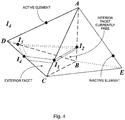
- FIG. 2 depicts a finite element 200 and shows two different partial volumes at two different times during the simulation.
- Pd shows the additive manufacturing direction.
- Plane Pi is the fill level of the finite element 200 at layer L i .
- Plane P j is the fill level of the finite element 200 at layer L j , which is at a time later then L i .
- partial areas on the facets of the intersected elements are computed.
- the partial area of polygon A,B,C is I 1 ,I 2 ,B,C when the finite element is filled up to layer L i .
- the intersection can be based on either the original shape of the part or the current shape of the predicted deformed/distorted shape of the part during the analysis.
- the Intersection Module may be implemented using software.
- any particular finite element is either completely filled with mater, partially filled with matter, or completely empty.
- the Intersection Module keeps track of this evolution in a precise fashion. Partial volume integration techniques are employed to account for the various material phases or states (e.g., powder, molten liquid state, solid state) in each of these partial volumes. An arbitrary time incrementation sequence is allowed. For example, in FIG. 2 , a thin slice around the I 1 ,I 2 ,I 3 ,I 4 polygon (P i ) of finite element 200 would be material in raw state (e.g., powder or liquid), below would be solid (or partially liquid), and above would be void.
- the progressive activation technology allows for exact specification of the initial temperature at which the material in raw state (e.g., powder) may be added to a given element. This is achieved by applying an automatically computed equivalent latent heat flux based on the difference between the current temperature of the element's integration point and the desired initial temperature.
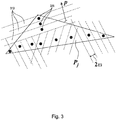
- FIG. 3 depicts a cross-sectional view associated with a top surface intersection plane (e.g., P j from FIG. 2 , viewed from above).
- An arbitrary number of heating events (characterized as a sequence of heat fluxes at given locations, shown as the circles 305 in FIG. 3 ) are computed per layer per element for accurate representation of the heating source in both time and space.
- paths 310 represent the paths that a laser takes according to the machine information.
- a heat flux is calculated based on the area covered by each pass of the laser over the triangular layer and on the laser's intensity.
- An arbitrary time incrementation sequence is allowed.
- the partial facet area integration discussed above allows for a very precise assessment of cooling-related heat fluxes on any given finite element discretization.
- the location and surface area of the polygon I 1 ,I 2 ,I 3 ,I 4 and of the side polygon B,I 2 ,I 1 ,C is be computed at any point in time to account very precisely for the area of the part being fabricated that is currently exposed to the exterior. Radiation and convection cooling can then be modeled well on accurately computed areas.
- Embodiments of the present invention provide a highly scalable solution for part-level simulations of additive manufacturing processes of many kinds. This includes, but is not limited to, SLM, DLM, Polyjet, inkjet, and FDM technologies. Some particular advantages include:
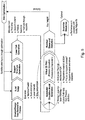
- An overall additive manufacturing workflow includes a larger number of building blocks, as depicted in FIG. 5 .
- the aspects described herein are associated with the two building blocks circled in FIG. 5 .
- the two circled blocks may follow the flow chart 600 shown in FIG. 6 .
- the chart includes architectural details and is based on a Lagrangian FE code for time transient heat transfer solution.
- the time marching sequence follows the typical incrementation sequence usually encountered in time-transient solutions.
- the flow chart 600 of FIG. 6 includes four major building blocks to carry out its functionality, as follows:
- Some example data structures for implementing the above components can include a finite element data structure, which stores for a finite element of the object to be simulated, (1) node numbers associated with the element, (2) nodal coordinates in 3D for the element, (3) and nodal displacements (used to compute deformed configurations of the element).
- Such data structures can be used to represent, in memory, a collection of elements of the part to be fabricated.
- Such data structures can also be used to represent, in memory, a collection of elements of the supports to be used to anchor the part during a printing process.
- Example data structures for implementing the above components can also include machine processing information, which stores data representing raw material arrival information and data representing moving heat source information (e.g., lasers, UV lamps, etc.).
- the data representing raw material arrival can include, for example, (1) geometry of the raw material deposition entity (e.g., nozzle, spreader bar, ink jet printing banks, etc.), (2) time and location coordinates when a material depositing entity starts depositing material, and (3) time and location coordinates when a material depositing entity stops depositing material.
- the data representing a moving heat source can include, for example, (1) geometry of the heat source, (2) time and location coordinates when the heat source is turned on, and (3) time and location coordinates when the heat source is turned off.
- the intersection module can, at each increment of the simulation, compute and store intersections between the machine processing information and the finite elements.
- Such intersection can be computed by, (1) for each finite element, computing intersections between the material deposition trail and the finite element, (2) storing coordinates of the intersections of the trail with the edges of the finite elements, (3) computing the centers of mass of the added raw material in the corresponding finite elements for the increment, (4) for each finite element, computing intersections between the trail of each moving heat source with the edges of the finite elements, and (5) storing the duration of the time spent by each moving heat source in the corresponding elements and the locations of the centers of the areas covered by the heat source in the corresponding elements.
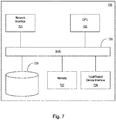
- FIG. 7 is a simplified block diagram of a computer-based system 720 that may be used for simulating an additive manufacturing process according to an example embodiment of the present invention.
- the system 720 comprises a bus 725.
- the bus 725 serves as an interconnector between the various components of the system 720.
- an input/output device interface 728 for connecting various input and output devices such as a keyboard, mouse, display, touch screen overlay, speakers, camera, sensor feeds, controllers, etc. to the system 720.
- a central processing unit (CPU) 722 is connected to the bus 725 and provides for the execution of computer instructions.
- Memory 727 provides volatile storage for data used for carrying out computer instructions.
- Storage 726 provides non-volatile storage for software instructions, such as an operating system (not shown).
- memory 727 and/or storage 726 are configured with program instructions implementing methods and/or modules 600, 605, 610, 615, 620, 625, and 630 for simulating an additive manufacturing process, as detailed in association with FIG. 6 , for example.
- the system 720 also comprises a network interface 721 for connecting to any variety of networks known in the art, including cloud, wide area networks (WANs) and local area networks (LANs).
- WANs wide area networks
- LANs local area networks
- the various methods, systems, and devices described herein may each be implemented by a physical, virtual, or hybrid general purpose computer.
- the computer system 720 may be transformed into the machines that execute the methods described herein, for example, by loading software instructions into either memory 727 or non-volatile storage 726 for execution by the CPU 722.
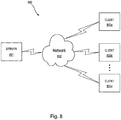
- FIG. 8 illustrates a computer network environment 860 in which an embodiment of the present invention may be implemented.
- the server 831 is linked through a communications network 832 to clients 833a-n.
- the environment 860 may be used to allow the clients 833a-n, alone or in combination with server 831 to execute any of the modules and/or methods described hereinabove (e.g., the methods and/or modules 600, 605, 610, 615, 620, 625, and 630 as detailed in association with FIG. 6 , for example).
- the example embodiments described above may be implemented in many different ways.
- the various methods and machines described herein may each be implemented by a physical, virtual, or hybrid general purpose computer, or a computer network environment such as the computer environment 860.
- Embodiments or aspects thereof may be implemented in the form of hardware, firmware, or software. If implemented in software, the software may be stored on any non-transient computer readable medium that is configured to enable a processor to load the software or subsets of instructions thereof. The processor then executes the instructions and is configured to operate or cause an apparatus to operate in a manner as described herein.
- firmware, software, routines, or instructions may be described herein as performing certain actions and/or functions of the data processors. However, it should be appreciated that such descriptions contained herein are merely for convenience and that such actions in fact result from computing devices, processors, controllers, or other devices executing the firmware, software, routines, instructions, etc.
Landscapes
- Engineering & Computer Science (AREA)
- Chemical & Material Sciences (AREA)
- Manufacturing & Machinery (AREA)
- Materials Engineering (AREA)
- Physics & Mathematics (AREA)
- Theoretical Computer Science (AREA)
- Computer Hardware Design (AREA)
- Evolutionary Computation (AREA)
- Geometry (AREA)
- General Engineering & Computer Science (AREA)
- General Physics & Mathematics (AREA)
- Powder Metallurgy (AREA)
Applications Claiming Priority (1)
| Application Number | Priority Date | Filing Date | Title |
|---|---|---|---|
| US201662339203P | 2016-05-20 | 2016-05-20 |
Publications (1)
| Publication Number | Publication Date |
|---|---|
| EP3246831A1 true EP3246831A1 (en) | 2017-11-22 |
Family
ID=58640792
Family Applications (1)
| Application Number | Title | Priority Date | Filing Date |
|---|---|---|---|
| EP17168873.2A Ceased EP3246831A1 (en) | 2016-05-20 | 2017-04-28 | Scalable finite element simulation of additive manufacturing |
Country Status (4)
| Country | Link |
|---|---|
| US (1) | US10671777B2 (enExample) |
| EP (1) | EP3246831A1 (enExample) |
| JP (1) | JP6920882B2 (enExample) |
| CN (1) | CN107403026B (enExample) |
Cited By (7)
| Publication number | Priority date | Publication date | Assignee | Title |
|---|---|---|---|---|
| CN108399307A (zh) * | 2018-03-14 | 2018-08-14 | 大连交通大学 | 一种激光3d打印有限元模拟方法 |
| EP3549746A1 (en) * | 2018-04-06 | 2019-10-09 | Bond high performance 3D technology B.V. | Generating adapted control instructions for a 3d printing process |
| WO2020014078A1 (en) * | 2018-07-10 | 2020-01-16 | Materialise N.V. | Systems and methods for reducing rigid body motion in simulated models |
| EP3871804A1 (de) | 2020-02-25 | 2021-09-01 | Heraeus Amloy Technologies GmbH | Verfahren zum anpassen einer bauteilbeschreibung eines zu fertigenden werkstücks mit amorphen eigenschaften |
| EP3915701A1 (de) | 2020-05-28 | 2021-12-01 | Heraeus Amloy Technologies GmbH | Simulationssystem zur auswahl einer legierung sowie eines fertigungsverfahrens für ein zu fertigendes werkstück mit amorphen eigenschaften |
| CN114905746A (zh) * | 2021-01-29 | 2022-08-16 | 通用电气公司 | 用于识别具有复杂特征的烧结零件的畸变补偿阈值的系统和方法 |
| US12189362B2 (en) | 2018-05-15 | 2025-01-07 | Edwards Limited | Method for fabricating a component of an abatement apparatus |
Families Citing this family (25)
| Publication number | Priority date | Publication date | Assignee | Title |
|---|---|---|---|---|
| US10891788B2 (en) * | 2017-12-13 | 2021-01-12 | Dassault Systemes Simulia Corp. | Systems and methods for finite element mesh repair |
| EP3501758A1 (de) * | 2017-12-22 | 2019-06-26 | Heraeus Additive Manufacturing GmbH | Verfahren zur bestimmung mindestens eines druckprozessparameterwerts, computerlesbares speichermedium und additive fertigungsanlage |
| US10518356B2 (en) * | 2018-02-05 | 2019-12-31 | General Electric Company | Methods and apparatus for generating additive manufacturing scan paths using thermal and strain modeling |
| US20200050715A1 (en) * | 2018-08-09 | 2020-02-13 | Dassault Systemes Simulia Corp. | Performance and Accuracy of Stability Explicit Diffusion |
| US11328107B2 (en) | 2018-08-31 | 2022-05-10 | General Electric Company | Hybrid measurement and simulation based distortion compensation system for additive manufacturing processes |
| WO2020056388A1 (en) * | 2018-09-13 | 2020-03-19 | Board Of Regents Of The University Of Nebraska | Simulating heat flux in additive manufacturing |
| CN109332691B (zh) * | 2018-10-31 | 2020-08-28 | 有研工程技术研究院有限公司 | 一种纳米铜粉3d打印激光烧结参数确定方法 |
| CN113165271B (zh) * | 2018-12-19 | 2024-02-06 | 惠普发展公司,有限责任合伙企业 | 确定针对三维打印零件的热占用空间 |
| US11407179B2 (en) * | 2019-03-20 | 2022-08-09 | General Electric Company | Recoater automated monitoring systems and methods for additive manufacturing machines |
| US11783102B2 (en) * | 2019-04-30 | 2023-10-10 | BabySteps Orthopedics Inc. | Predictive modeling platform for serial casting to correct orthopedic deformities |
| WO2021028037A1 (en) * | 2019-08-14 | 2021-02-18 | Siemens Industry Software Nv | Method for generating a structure mesh, use of a structure mesh, computer program and computer-readable medium |
| CN110610040B (zh) * | 2019-09-06 | 2022-04-05 | 北京星航机电装备有限公司 | 一种多相材料梯度点阵结构设计方法 |
| CN111090937B (zh) * | 2019-12-13 | 2021-10-29 | 北京理工大学 | 基于欧拉网格的增材制造工艺构件尺度的仿真处理方法 |
| CN111597739A (zh) * | 2020-04-09 | 2020-08-28 | 西安理工大学 | 一种异种材料用于管板结构焊接的数值模拟方法 |
| EP3919205A1 (de) * | 2020-06-04 | 2021-12-08 | Siemens Aktiengesellschaft | Verfahren und anordnung zum separieren überschüssigen werkstoffs von einem additiv hergestellten bauteil |
| CN111783181B (zh) * | 2020-06-30 | 2021-08-03 | 南京理工大学 | 一种考虑尖角特征约束的保外形拓扑优化方法 |
| IT202000017164A1 (it) * | 2020-07-15 | 2022-01-15 | Nuovo Pignone Tecnologie Srl | Metodo di scalabilità basato su una procedura di sovrapposizione punto per punto e relativo sistema |
| US12373616B2 (en) * | 2020-10-12 | 2025-07-29 | Nutech Ventures | Thermal modeling of additive manufacturing using graph theory |
| US20220284154A1 (en) * | 2021-02-09 | 2022-09-08 | Nutech Ventures | Thermal modeling of additive manufacturing using progressive horizontal subsections |
| CN113237920B (zh) * | 2021-05-17 | 2022-04-22 | 西南交通大学 | 一种特高压换流变压器阀侧套管故障热源检测方法 |
| CN113673124A (zh) * | 2021-07-06 | 2021-11-19 | 华南理工大学 | 三通相贯线焊接温度场数值模拟预测方法、系统及介质 |
| CN113688553B (zh) * | 2021-09-10 | 2025-01-14 | 昆山丘钛微电子科技股份有限公司 | 一种卡扣装配仿真模拟方法及装置 |
| US12472559B2 (en) * | 2021-09-23 | 2025-11-18 | Rolls-Royce Corporation | Mass and heat flow in additive manufacturing systems |
| WO2023076636A1 (en) * | 2021-10-29 | 2023-05-04 | Nutech Ventures | Thermal modeling of additive manufacturing |
| CN115048830B (zh) * | 2022-05-17 | 2024-12-24 | 华中科技大学 | 一种增材制造分区工艺仿真方法 |
Citations (2)
| Publication number | Priority date | Publication date | Assignee | Title |
|---|---|---|---|---|
| US20150352794A1 (en) * | 2014-06-05 | 2015-12-10 | Commonwealth Scientific And Industrial Research Organisation | Distortion prediction and minimisation in additive manufacturing |
| US20160086376A1 (en) * | 2014-09-19 | 2016-03-24 | Siemens Product Lifecycle Management Software Inc. | Computer-Aided Simulation of Multi-Layer Selective Laser Sintering and Melting Additive Manufacturing Processes |
Family Cites Families (7)
| Publication number | Priority date | Publication date | Assignee | Title |
|---|---|---|---|---|
| US10590762B2 (en) * | 2008-09-18 | 2020-03-17 | Geoscale, Inc. | N-phasic finite element method for calculating a fully coupled response of multiphase compositional fluid flow and a system for uncertainty estimation of the calculated reservoir response |
| MX2011005663A (es) * | 2008-12-03 | 2011-06-16 | Chevron Usa Inc | Sistema y metodo de generacion de mallas para el modelado de fracturas discretas. |
| US9481131B2 (en) * | 2013-07-18 | 2016-11-01 | Mitsubishi Electric Research Laboratories, Inc. | Method and apparatus for printing 3D objects using additive manufacturing and material extruder with translational and rotational axes |
| US10664560B2 (en) | 2013-12-19 | 2020-05-26 | University Of Louisville Research Foundation, Inc. | Multi-scale mesh modeling software products and controllers |
| US20150286757A1 (en) * | 2014-04-04 | 2015-10-08 | Shi-Chune Yao | Method for Efficiently Predicting the Quality of Additively Manufactured Metal Products |
| US10565333B2 (en) * | 2014-04-25 | 2020-02-18 | Alberto Daniel Lacaze | Structural analysis for additive manufacturing |
| CN104504186B (zh) * | 2014-12-10 | 2017-10-31 | 广州中国科学院先进技术研究所 | 一种基于3d打印数据处理软件平台的实现方式 |
-
2017
- 2017-04-28 EP EP17168873.2A patent/EP3246831A1/en not_active Ceased
- 2017-05-17 US US15/597,473 patent/US10671777B2/en active Active
- 2017-05-18 CN CN201710352391.7A patent/CN107403026B/zh active Active
- 2017-05-19 JP JP2017100213A patent/JP6920882B2/ja active Active
Patent Citations (2)
| Publication number | Priority date | Publication date | Assignee | Title |
|---|---|---|---|---|
| US20150352794A1 (en) * | 2014-06-05 | 2015-12-10 | Commonwealth Scientific And Industrial Research Organisation | Distortion prediction and minimisation in additive manufacturing |
| US20160086376A1 (en) * | 2014-09-19 | 2016-03-24 | Siemens Product Lifecycle Management Software Inc. | Computer-Aided Simulation of Multi-Layer Selective Laser Sintering and Melting Additive Manufacturing Processes |
Non-Patent Citations (7)
| Title |
|---|
| B. LYNN FERGUSON; ZHICHAO LI: "Using Simulation for Heat Treat Process Design: Matching the Quenching Process", ICTPMCS-2010, 31 May 2010 (2010-05-31) |
| I. GIBSON; D. ROSEN; B. STUCKER: "Additive manufacturing technologies: rapid prototyping to direct digital manufacturing", 2009, SPRINGER |
| J.B. LEBLOND: "Mathematical Modeling of Transformation Plasticity in Steels", INTERNATIONAL JOURNAL OF PLASTICITY, vol. 5, 1989, pages 573 - 591 |
| M R TALAGANI ET AL: "Numerical Simulation of Big Area Additive Manufacturing (3D Printing) of a Full Size Car", SAMPE JOURNAL, VOL 51, NO. 4, July 2015 (2015-07-01), SAMPE Journal, Vol 51, No. 4, pages 27 - 36, XP055375939, Retrieved from the Internet <URL:http://www.alphastarcorp.com/sections/Knowledge_Center/Books_Journals_Articles/SAMPE_Journal_AlphaSTAR_Feature_Article.pdf> [retrieved on 20170524] * |
| N. E. HODGE; R. M. FERENCZ; J. M. SOLBERG: "Implementation of a thermomechanical model for the simulation of selective laser melting", COMPUT MECH, vol. 54, 2014, pages 33 - 51 |
| P. MICHALERIS: "Modeling metal deposition in heat transfer analyses of additive manufacturing processes In situ monitoring", FINITE ELEMENTS IN ANALYSIS AND DESIGN, 2014, pages 51 - 60 |
| XIPENG TAN; YIHONG KOK: "An experimental and simulation study on build thickness dependent microstructure for electron beam melted Tie6Ale4V", JOURNAL OF ALLOYS AND COMPOUNDS, vol. 646, 2015, pages 303 - 309, XP029265644, DOI: doi:10.1016/j.jallcom.2015.05.178 |
Cited By (14)
| Publication number | Priority date | Publication date | Assignee | Title |
|---|---|---|---|---|
| CN108399307A (zh) * | 2018-03-14 | 2018-08-14 | 大连交通大学 | 一种激光3d打印有限元模拟方法 |
| EP3549746A1 (en) * | 2018-04-06 | 2019-10-09 | Bond high performance 3D technology B.V. | Generating adapted control instructions for a 3d printing process |
| WO2019193146A1 (en) * | 2018-04-06 | 2019-10-10 | Bond High Performance 3D Technology B.V. | Generating adapted control instructions for a 3d printing process |
| US11090872B2 (en) | 2018-04-06 | 2021-08-17 | Bond High Performance 3D Technology B.V. | Generating adapted control instructions for a 3D printing process |
| US12189362B2 (en) | 2018-05-15 | 2025-01-07 | Edwards Limited | Method for fabricating a component of an abatement apparatus |
| US11847388B2 (en) | 2018-07-10 | 2023-12-19 | Materialise N.V. | Systems and methods for reducing rigid body motion in simulated models |
| WO2020014078A1 (en) * | 2018-07-10 | 2020-01-16 | Materialise N.V. | Systems and methods for reducing rigid body motion in simulated models |
| US20210124859A1 (en) * | 2018-07-10 | 2021-04-29 | Materialise N.V. | Systems and methods for reducing rigid body motion in simulated models |
| EP3871804A1 (de) | 2020-02-25 | 2021-09-01 | Heraeus Amloy Technologies GmbH | Verfahren zum anpassen einer bauteilbeschreibung eines zu fertigenden werkstücks mit amorphen eigenschaften |
| WO2021170468A1 (de) | 2020-02-25 | 2021-09-02 | Heraeus Amloy Technologies Gmbh | Verfahren zum anpassen einer bauteilbeschreibung eines zu fertigenden werkstücks mit amorphen eigenschaften |
| WO2021239703A1 (de) | 2020-05-28 | 2021-12-02 | Heraeus Amloy Technologies Gmbh | Simulationssystem zur auswahl einer legierung sowie eines fertigungsverfahrens für ein zu fertigendes werkstück mit amorphen eigenschaften |
| EP3915701A1 (de) | 2020-05-28 | 2021-12-01 | Heraeus Amloy Technologies GmbH | Simulationssystem zur auswahl einer legierung sowie eines fertigungsverfahrens für ein zu fertigendes werkstück mit amorphen eigenschaften |
| CN114905746A (zh) * | 2021-01-29 | 2022-08-16 | 通用电气公司 | 用于识别具有复杂特征的烧结零件的畸变补偿阈值的系统和方法 |
| CN114905746B (zh) * | 2021-01-29 | 2024-09-06 | 通用电气公司 | 用于识别具有复杂特征的烧结零件的畸变补偿阈值的系统和方法 |
Also Published As
| Publication number | Publication date |
|---|---|
| JP6920882B2 (ja) | 2021-08-18 |
| CN107403026B (zh) | 2023-06-27 |
| US20170337307A1 (en) | 2017-11-23 |
| CN107403026A (zh) | 2017-11-28 |
| US10671777B2 (en) | 2020-06-02 |
| JP2017215957A (ja) | 2017-12-07 |
Similar Documents
| Publication | Publication Date | Title |
|---|---|---|
| US10671777B2 (en) | Scalable finite element simulation of additive manufacturing | |
| Liang et al. | Modified inherent strain method for efficient prediction of residual deformation in direct metal laser sintered components | |
| US10409933B2 (en) | Computer-aided simulation of additive manufacturing processes | |
| US11022957B2 (en) | System and method for adaptive domain reduction for thermo-structural simulation of additive manufacturing process | |
| US10664560B2 (en) | Multi-scale mesh modeling software products and controllers | |
| EP3369014B1 (en) | System and method for optimizing tool paths based on thermal/structural simulations of a part being produced via a 3d-printer | |
| Tuegel et al. | Reengineering aircraft structural life prediction using a digital twin | |
| CN109074410B (zh) | 用于确定增材制造的结构中的应力和形状偏差的方法 | |
| EP3259691B1 (en) | Additive manufacturing method involving computer-aided simulation of additive manufacturing processes | |
| Yu et al. | Multi-material additive manufacturing: a computational design perspective | |
| CN115130239A (zh) | 基于多尺度建模的金属增材制造的力学性能预测方法 | |
| Ball et al. | AI modeling for high-fidelity heat transfer and thermal distortion forecast in metal additive manufacturing | |
| Beghini et al. | A coupled fluid-mechanical workflow to simulate the directed energy deposition additive manufacturing process | |
| Wang et al. | On efficiency and effectiveness of finite volume method for thermal analysis of selective laser melting | |
| Olleak et al. | Scan-wise adaptive remeshing for efficient LPBF process simulation: The thermal problem | |
| Bellet et al. | The inherent strain rate method for thermo‐mechanical simulation of directed energy deposition additive manufacturing | |
| JP7474382B2 (ja) | 点ごとの重ね合わせ手順に基づくスケーリング方法及びそのシステム | |
| Tozoni et al. | Cut‐Cell Microstructures for Two‐scale Structural Optimization | |
| Tsivilskiy et al. | Thermal-structural hybrid Lagrangian solver and numerical simulation-based correction of shape deformation of stainless-steel parts produced by laser powder bed Fusion | |
| Mejia et al. | Appraisal of open software for finite element simulation of 2D metal sheet laser cut | |
| US20250367883A1 (en) | Lower-level finite element analysis mesh homogenization for simulation of additive manufacturing | |
| US12613503B2 (en) | Techniques for solving additive manufacturing part analyses for powder bed fusion technologies | |
| CN120910935B (zh) | 一种激光熔锻多物理场一体化数值模拟方法和系统 | |
| Li | Fast Powder Bed Fusion Additive Manufacturing (PBFAM) Simulation and Optimization for Minimizing Part Distortions | |
| Srivatsa | Additive manufacturing research and development needs |
Legal Events
| Date | Code | Title | Description |
|---|---|---|---|
| PUAI | Public reference made under article 153(3) epc to a published international application that has entered the european phase |
Free format text: ORIGINAL CODE: 0009012 |
|
| STAA | Information on the status of an ep patent application or granted ep patent |
Free format text: STATUS: THE APPLICATION HAS BEEN PUBLISHED |
|
| AK | Designated contracting states |
Kind code of ref document: A1 Designated state(s): AL AT BE BG CH CY CZ DE DK EE ES FI FR GB GR HR HU IE IS IT LI LT LU LV MC MK MT NL NO PL PT RO RS SE SI SK SM TR |
|
| AX | Request for extension of the european patent |
Extension state: BA ME |
|
| STAA | Information on the status of an ep patent application or granted ep patent |
Free format text: STATUS: REQUEST FOR EXAMINATION WAS MADE |
|
| 17P | Request for examination filed |
Effective date: 20180522 |
|
| RBV | Designated contracting states (corrected) |
Designated state(s): AL AT BE BG CH CY CZ DE DK EE ES FI FR GB GR HR HU IE IS IT LI LT LU LV MC MK MT NL NO PL PT RO RS SE SI SK SM TR |
|
| STAA | Information on the status of an ep patent application or granted ep patent |
Free format text: STATUS: EXAMINATION IS IN PROGRESS |
|
| 17Q | First examination report despatched |
Effective date: 20180813 |
|
| APBK | Appeal reference recorded |
Free format text: ORIGINAL CODE: EPIDOSNREFNE |
|
| APBN | Date of receipt of notice of appeal recorded |
Free format text: ORIGINAL CODE: EPIDOSNNOA2E |
|
| APBR | Date of receipt of statement of grounds of appeal recorded |
Free format text: ORIGINAL CODE: EPIDOSNNOA3E |
|
| APAF | Appeal reference modified |
Free format text: ORIGINAL CODE: EPIDOSCREFNE |
|
| P01 | Opt-out of the competence of the unified patent court (upc) registered |
Effective date: 20230526 |
|
| APBT | Appeal procedure closed |
Free format text: ORIGINAL CODE: EPIDOSNNOA9E |
|
| STAA | Information on the status of an ep patent application or granted ep patent |
Free format text: STATUS: THE APPLICATION HAS BEEN REFUSED |
|
| 18R | Application refused |
Effective date: 20231006 |